WO2012035217A1 - Générateur électrochimique et procédé de réalisation d'un tel générateur - Google Patents
Générateur électrochimique et procédé de réalisation d'un tel générateur Download PDFInfo
- Publication number
- WO2012035217A1 WO2012035217A1 PCT/FR2011/000507 FR2011000507W WO2012035217A1 WO 2012035217 A1 WO2012035217 A1 WO 2012035217A1 FR 2011000507 W FR2011000507 W FR 2011000507W WO 2012035217 A1 WO2012035217 A1 WO 2012035217A1
- Authority
- WO
- WIPO (PCT)
- Prior art keywords
- group
- linear
- alkyl chain
- branched
- electrode
- Prior art date
- Legal status (The legal status is an assumption and is not a legal conclusion. Google has not performed a legal analysis and makes no representation as to the accuracy of the status listed.)
- Ceased
Links
Classifications
-
- H—ELECTRICITY
- H01—ELECTRIC ELEMENTS
- H01G—CAPACITORS; CAPACITORS, RECTIFIERS, DETECTORS, SWITCHING DEVICES, LIGHT-SENSITIVE OR TEMPERATURE-SENSITIVE DEVICES OF THE ELECTROLYTIC TYPE
- H01G11/00—Hybrid capacitors, i.e. capacitors having different positive and negative electrodes; Electric double-layer [EDL] capacitors; Processes for the manufacture thereof or of parts thereof
- H01G11/54—Electrolytes
- H01G11/58—Liquid electrolytes
-
- H—ELECTRICITY
- H01—ELECTRIC ELEMENTS
- H01M—PROCESSES OR MEANS, e.g. BATTERIES, FOR THE DIRECT CONVERSION OF CHEMICAL ENERGY INTO ELECTRICAL ENERGY
- H01M10/00—Secondary cells; Manufacture thereof
- H01M10/05—Accumulators with non-aqueous electrolyte
- H01M10/052—Li-accumulators
- H01M10/0525—Rocking-chair batteries, i.e. batteries with lithium insertion or intercalation in both electrodes; Lithium-ion batteries
-
- H—ELECTRICITY
- H01—ELECTRIC ELEMENTS
- H01G—CAPACITORS; CAPACITORS, RECTIFIERS, DETECTORS, SWITCHING DEVICES, LIGHT-SENSITIVE OR TEMPERATURE-SENSITIVE DEVICES OF THE ELECTROLYTIC TYPE
- H01G11/00—Hybrid capacitors, i.e. capacitors having different positive and negative electrodes; Electric double-layer [EDL] capacitors; Processes for the manufacture thereof or of parts thereof
- H01G11/22—Electrodes
- H01G11/26—Electrodes characterised by their structure, e.g. multi-layered, porosity or surface features
-
- H—ELECTRICITY
- H01—ELECTRIC ELEMENTS
- H01G—CAPACITORS; CAPACITORS, RECTIFIERS, DETECTORS, SWITCHING DEVICES, LIGHT-SENSITIVE OR TEMPERATURE-SENSITIVE DEVICES OF THE ELECTROLYTIC TYPE
- H01G11/00—Hybrid capacitors, i.e. capacitors having different positive and negative electrodes; Electric double-layer [EDL] capacitors; Processes for the manufacture thereof or of parts thereof
- H01G11/22—Electrodes
- H01G11/26—Electrodes characterised by their structure, e.g. multi-layered, porosity or surface features
- H01G11/28—Electrodes characterised by their structure, e.g. multi-layered, porosity or surface features arranged or disposed on a current collector; Layers or phases between electrodes and current collectors, e.g. adhesives
-
- H—ELECTRICITY
- H01—ELECTRIC ELEMENTS
- H01M—PROCESSES OR MEANS, e.g. BATTERIES, FOR THE DIRECT CONVERSION OF CHEMICAL ENERGY INTO ELECTRICAL ENERGY
- H01M10/00—Secondary cells; Manufacture thereof
- H01M10/05—Accumulators with non-aqueous electrolyte
- H01M10/052—Li-accumulators
-
- H—ELECTRICITY
- H01—ELECTRIC ELEMENTS
- H01M—PROCESSES OR MEANS, e.g. BATTERIES, FOR THE DIRECT CONVERSION OF CHEMICAL ENERGY INTO ELECTRICAL ENERGY
- H01M10/00—Secondary cells; Manufacture thereof
- H01M10/05—Accumulators with non-aqueous electrolyte
- H01M10/056—Accumulators with non-aqueous electrolyte characterised by the materials used as electrolytes, e.g. mixed inorganic/organic electrolytes
- H01M10/0561—Accumulators with non-aqueous electrolyte characterised by the materials used as electrolytes, e.g. mixed inorganic/organic electrolytes the electrolyte being constituted of inorganic materials only
- H01M10/0563—Liquid materials, e.g. for Li-SOCl2 cells
-
- H—ELECTRICITY
- H01—ELECTRIC ELEMENTS
- H01M—PROCESSES OR MEANS, e.g. BATTERIES, FOR THE DIRECT CONVERSION OF CHEMICAL ENERGY INTO ELECTRICAL ENERGY
- H01M10/00—Secondary cells; Manufacture thereof
- H01M10/05—Accumulators with non-aqueous electrolyte
- H01M10/056—Accumulators with non-aqueous electrolyte characterised by the materials used as electrolytes, e.g. mixed inorganic/organic electrolytes
- H01M10/0564—Accumulators with non-aqueous electrolyte characterised by the materials used as electrolytes, e.g. mixed inorganic/organic electrolytes the electrolyte being constituted of organic materials only
- H01M10/0566—Liquid materials
- H01M10/0567—Liquid materials characterised by the additives
-
- H—ELECTRICITY
- H01—ELECTRIC ELEMENTS
- H01M—PROCESSES OR MEANS, e.g. BATTERIES, FOR THE DIRECT CONVERSION OF CHEMICAL ENERGY INTO ELECTRICAL ENERGY
- H01M4/00—Electrodes
- H01M4/02—Electrodes composed of, or comprising, active material
- H01M4/62—Selection of inactive substances as ingredients for active masses, e.g. binders, fillers
- H01M4/628—Inhibitors, e.g. gassing inhibitors, corrosion inhibitors
-
- H—ELECTRICITY
- H01—ELECTRIC ELEMENTS
- H01M—PROCESSES OR MEANS, e.g. BATTERIES, FOR THE DIRECT CONVERSION OF CHEMICAL ENERGY INTO ELECTRICAL ENERGY
- H01M4/00—Electrodes
- H01M4/02—Electrodes composed of, or comprising, active material
- H01M4/13—Electrodes for accumulators with non-aqueous electrolyte, e.g. for lithium-accumulators; Processes of manufacture thereof
- H01M4/131—Electrodes based on mixed oxides or hydroxides, or on mixtures of oxides or hydroxides, e.g. LiCoOx
-
- H—ELECTRICITY
- H01—ELECTRIC ELEMENTS
- H01M—PROCESSES OR MEANS, e.g. BATTERIES, FOR THE DIRECT CONVERSION OF CHEMICAL ENERGY INTO ELECTRICAL ENERGY
- H01M4/00—Electrodes
- H01M4/02—Electrodes composed of, or comprising, active material
- H01M4/13—Electrodes for accumulators with non-aqueous electrolyte, e.g. for lithium-accumulators; Processes of manufacture thereof
- H01M4/133—Electrodes based on carbonaceous material, e.g. graphite-intercalation compounds or CFx
-
- H—ELECTRICITY
- H01—ELECTRIC ELEMENTS
- H01M—PROCESSES OR MEANS, e.g. BATTERIES, FOR THE DIRECT CONVERSION OF CHEMICAL ENERGY INTO ELECTRICAL ENERGY
- H01M4/00—Electrodes
- H01M4/02—Electrodes composed of, or comprising, active material
- H01M4/13—Electrodes for accumulators with non-aqueous electrolyte, e.g. for lithium-accumulators; Processes of manufacture thereof
- H01M4/134—Electrodes based on metals, Si or alloys
-
- Y—GENERAL TAGGING OF NEW TECHNOLOGICAL DEVELOPMENTS; GENERAL TAGGING OF CROSS-SECTIONAL TECHNOLOGIES SPANNING OVER SEVERAL SECTIONS OF THE IPC; TECHNICAL SUBJECTS COVERED BY FORMER USPC CROSS-REFERENCE ART COLLECTIONS [XRACs] AND DIGESTS
- Y02—TECHNOLOGIES OR APPLICATIONS FOR MITIGATION OR ADAPTATION AGAINST CLIMATE CHANGE
- Y02E—REDUCTION OF GREENHOUSE GAS [GHG] EMISSIONS, RELATED TO ENERGY GENERATION, TRANSMISSION OR DISTRIBUTION
- Y02E60/00—Enabling technologies; Technologies with a potential or indirect contribution to GHG emissions mitigation
- Y02E60/10—Energy storage using batteries
-
- Y—GENERAL TAGGING OF NEW TECHNOLOGICAL DEVELOPMENTS; GENERAL TAGGING OF CROSS-SECTIONAL TECHNOLOGIES SPANNING OVER SEVERAL SECTIONS OF THE IPC; TECHNICAL SUBJECTS COVERED BY FORMER USPC CROSS-REFERENCE ART COLLECTIONS [XRACs] AND DIGESTS
- Y02—TECHNOLOGIES OR APPLICATIONS FOR MITIGATION OR ADAPTATION AGAINST CLIMATE CHANGE
- Y02E—REDUCTION OF GREENHOUSE GAS [GHG] EMISSIONS, RELATED TO ENERGY GENERATION, TRANSMISSION OR DISTRIBUTION
- Y02E60/00—Enabling technologies; Technologies with a potential or indirect contribution to GHG emissions mitigation
- Y02E60/13—Energy storage using capacitors
Definitions
- the invention relates to an electrochemical generator having first and second electrodes separated by a final electrolytic solution, said first electrode being covered by a passivation layer.
- the invention also relates to a method of producing such a generator.
- Electrochemical generators conventionally consist of a solvent and an electrolytic salt.
- Electrochemical generators include accumulators and supercapacitors.
- An accumulator is defined as an energy storage system, using electrochemical reactions to store and restore electrical energy.
- Li-ion batteries generally use electrolytes based on organic solvents containing a dissolved lithium salt.
- a supercapacitor is an electrochemical capacitor for storing a quantity of energy via surface adsorption reactions of the electrode materials and for restoring a power density, intermediate between the batteries and the conventional electrolytic capacitors.
- Electrochemical generators in particular lithium-ion batteries, using aqueous electrolytes are, however, beginning to develop.
- An aqueous electrochemical accumulator is conventionally composed of a positive electrode and a negative electrode, a porous separator ensuring the electronic insulation between the electrodes, positive and negative, of a water-based electrolyte in which is dissolved one or more salts providing the ionic conductivity.
- Salts commonly used are, for example, H 2 S0 4 for lead-acid accumulators, a KOH-LiOH-NaOH mixture for alkaline storage batteries and a lithium salt such as LiNO 3 , Li 2 SO 4 , LiOH for aqueous lithium batteries. .
- the electrolyte impregnates all or part of the porosity of the electrodes and the separator.
- Each of the positive and negative electrodes is composed of an active material, positive and negative respectively, of an electronic conductor such as carbon black and carbon fibers, a thickener and a binder.
- An aqueous super capacitor is conventionally composed of two porous electrodes, integrating either high surface area activated carbon type compounds or transition metal oxides of the MnO 2 , RuO 2 , Li 4 Ti 5 O 12 , TiO 2 type , a porous separator membrane between the two electrodes, an aqueous electrolyte in which is dissolved one or more salts ensuring the ionic conductivity such as KOH, H 2 SO 4 , K 0 3 , LiNO 3 , NaSO 4 .
- the performance of the electrochemical generators may be affected by instability phenomena of the organic or aqueous liquid electrolyte during operation of the accumulator.
- the electrolyte must effectively withstand the operating voltage of the battery which is between 1.9V and 5V depending on the pair of electrodes used for organic electrolytes and between 1.2V and 2V for aqueous electrolytes.
- the operating voltage of the battery which is between 1.9V and 5V depending on the pair of electrodes used for organic electrolytes and between 1.2V and 2V for aqueous electrolytes.
- parasitic reactions of decomposition of the catalyzed electrolyte on the surface of the electrodes are observed.
- the development of solutions tending to eliminate or reduce this phenomenon of decomposition is particularly crucial, especially for lithium-ion batteries with aqueous electrolyte for which this phenomenon is particularly restrictive. As shown in FIG.
- thermodynamic stability of the water as a function of the pH is 1.23 V and considerably limits the choice of active materials for such an electrochemical generator.
- active battery materials Lithium-Ion having a potential for insertion and disinsertion of lithium located outside the water stability window.
- the electrochemical decomposition of water is observed.
- the oxidation of the water on the positive electrode is observed for potentials located above the line represented by a broken line (at the top in FIG. observe the reduction of the water on the negative electrode for potentials located below the line represented by a dashed line (bottom in Figure 1).
- Overvoltage phenomena related to oxidation and water reduction are low on lithium insertion materials. The decomposition of water is thus observed for potentials close to those fixed by thermodynamics.
- JP-A-2000340256 and JP-A-2000077073 exploit electrode surges to control interfacial reactions.
- Another proposed solution consists of passivating at least one electrode of the lithium-ion accumulator in order to inhibit the degradation of the liquid electrolyte.
- the document US-A-20090155696 proposes to produce an insulating film on the electrode, by polymerization of a monomer present in the electrolyte of the accumulator.
- Another way is to form a protective layer on the surface of an electrode by grafting via an electrochemical process of the aromatic group an aryl diazonium salt for modifying or improving the physico-chemical properties of the electrode material.
- R is a substituent of the aryl group
- X is an anion such as a halide or BF 4 " ion
- C is carbon
- SC is a semiconductor
- M is a metal.
- the grafting by electrochemical reduction of the diazonium salt to the surface of the positive electrode of Li 3 V 0 8 takes place when required to the electrode a potential lower than the potential
- the presence of an organic layer obtained by such a process does not limit the charge transfer of the electrode and strongly inhibits the decomposition of the catalyzed organic electrolyte on the surface of the electrode.
- the object of the invention is to provide an electrochemical generator having improved performance overcoming the drawbacks of the prior art.
- the object of the invention is to provide a stable aqueous electrolyte electrochemical generator up to a high operating voltage.
- FIG. 1 corresponds to a water stability diagram representing the nominal voltage of the water as a function of the pH as well as the insertion and de-insertion potentials of various active materials of lithium-ion battery electrode.
- FIG. 3 represents the superposition of three spectra obtained according to a Total Attenuated Reflection (ATR) method, of a sample of a diazonium salt according to the invention, denoted DS 3 , of a sample of a LiFePO 4j electrode. covered with a passivation layer according to the invention, denoted D 1; and a comparative sample of a bare LiFePO 4 electrode denoted D 0 .
- ATR Total Attenuated Reflection
- FIG. 4 represents the superposition of three infrared spectra obtained according to an ATR method, a sample of a diazonium salt, denoted S 2 , and two comparative samples, respectively, of the bare electrode D 0 and a electrode passivated with salt S 2 , denoted D 2 .
- FIG. 5 shows three cyclic voltammetry curves for an electrochemical cell having, respectively, the electrode A 0, ⁇ and D 2 in an aqueous electrolyte L1NO 3 5M. Description of particular embodiments.
- Initial electrolytic solution of an electrochemical generator is understood to mean an electrolytic solution present in the electrochemical generator before the first charge of this generator. Initial electrolytic solutions containing such salts are more stable than those of the prior art and contribute to improving the performance of the generator, in particular, a lithium-ion battery.
- the improvement is particularly significant in the case of use in an aqueous electrolyte solution. Indeed, it has surprisingly been found that this family of diazonium salts significantly slows down the kinetics of oxidation and reduction of water on the electrodes of the electrochemical generator without, however, affecting the performance of the electrochemical generator and, in particular, in particular, without limiting the kinetics of charge transfer associated with the insertion / deinsertion of the lithium cation into the intercalation material of a lithium-ion battery.
- the diazonium salt has the following general formula (1):
- n is an integer between 1 and 10, preferably between 1 and 4,
- X " represents a counterion of the diazonium cation chosen from halides, BF 4 " ,
- R 1 is chosen from the group consisting of -CH 2 -, an alkyl chain preferably comprising from 1 to 6 carbon atoms, linear or branched, cyclic or acyclic
- R 2 is chosen from the group consisting of -CH 2 - an alkyl chain preferably comprising from 2 to 6 carbon atoms, linear or branched, cyclic or acyclic, preferably a methylene-, ethylene-, n-propylene-, iso-propylene-, n-butylene- tert-butylene, sec-butylene and n-pentylene,
- R 3 is selected from the group consisting of -CH 3 , an alkyl chain preferably comprising from 2 to 6 carbon atoms, linear or branched, cyclic or acyclic and a group of formula (2) below:
- a ' is an aromatic hydrocarbon group, mono or polycyclic, selected from the group consisting of phenyl, aryl groups, condensed polyaromatic groups, optionally substituted,
- R4 is selected from the group consisting of -CH 2 -, an alkyl chain preferably comprising from 2 to 8 carbon atoms, linear or branched, cyclic or acyclic, and
- A is identical to or different from A 'and represents an aromatic hydrocarbon group, mono or polycyclic, selected from the group consisting of phenyl, aryl groups, condensed polyaromatic groups, optionally substituted, with the exception of the group of formula (3 ), shown below, when R 3 is selected from the group consisting of -CH 3 , an alkyl chain, linear or branched, cyclic or acyclic:
- R 5 and R O are the same or different and independently selected from the group consisting of -CH 3, an alkyl group, linear or branched, cyclic or acyclic.
- aryl group an aromatic system having one or more aromatic rings, optionally substituted.
- a and / or A ' is an aryl group
- an aryl group comprising from 6 to 9 carbon atoms, for example a phenyl, tolyl, xylyl or trimethylphenyl group
- the diazonium function is carried on the aromatic ring of the aryl group.
- condensed polyaromatic group is meant a polycyclic aromatic system formed of several fused benzene rings.
- the diazonium function can be carried on any of the aromatic rings of the condensed polyaromatic group.
- a and / or A ' is a fused polyaromatic group
- a polyaromatic group comprising from 10 to 45 carbon atoms, optionally substituted by one or more groups selected from the group consisting of -H, -CH3, will preferably be chosen, a halide, a linear or branched alkyl chain comprising from 2 to 8 carbon atoms and, optionally, one or more heteroatoms chosen from O, S and N.
- the diazonium salt is free of hydroxyl functions so as to minimize the affinity of the diazonium salt with the water of the electrolytic solution, for example, by avoiding the creation of Van der Waals and / or hydrogen bonds.
- R 1 , R 2 and R 3 are advantageously devoid of hydroxyl functions in order to obtain a diazonium salt having an apolar part A and A 1 containing the aromatic hydrocarbon group and an aprotic polar part consisting of a polyether chain. .
- a and A ' may be identical or different and chosen from phenyl, anthracenyl and naphthalenyl groups, optionally substituted, preferably, with one or more groups selected from the group consisting of - H, -CH 3 , a halide, a linear or branched alkyl chain comprising 2 and 8 carbon atoms and, optionally, one or more heteroatoms chosen from O, S and N.
- the diazonium salt may advantageously be a bis-diazonium salt of formula (1) in which R 3 is a group of formula (2).
- the diazonium salt may, for example, be a bis-diazonium salt of the following general formula (4):
- n is an integer between 1 and 10, preferably between 1 and 4,
- n 0 or 1
- p is an integer between 1 and 5, advantageously equal to 2,
- X " and Y " are identical or different and represent, independently, a counter-ion of the diazonium cation chosen from halides, BF 4 " , N0 3 “ , HSO 4 " , PF 6 “ , CH 3 COO ⁇ N (SO 2 CF 3 ) 2 “ , CF 3 SO 3 CH 3 SO 3 " , CF 3 COO (CH 3 0) (H) PO 2 -, N (CN) 2 - , R 1 and R 4 are the same or different and independently selected from the group consisting of -CH 2 -, an alkyl chain preferably comprising from 1 to 6 carbon atoms, linear or branched, cyclic or acyclic,
- R 7 and R 3 ⁇ 4 are identical or different and independently selected from the group consisting of -H, -CH 3 , a halide, an alkyl chain preferably comprising from 2 to 8 carbon atoms, linear or branched, optionally containing a or more heteroatoms, advantageously chosen from O, S and N.
- the bis-diazonium salt advantageously has a polyether chain which makes it possible to solvate the cations, in particular the Li + ions.
- the polyether chain is advantageously a poly (oxyethylene).
- m is preferably equal to 0 and p between 2 and 4, advantageously equal to 2.
- the polyether chain between the aromatic groups of A and A ' is preferably in the benzylic position.
- each of R1 and R4 represents, advantageously, a group -CH 2 -, respectively, in formulas (1) and (2).
- the polyether chain is advantageously in position relative to the diazonium functions.
- the diazonium salt has a following general formula (5):
- n is an integer between 1 and 10, preferably between 1 and 4,
- n 0 or 1
- p is an integer between 1 and 5, advantageously equal to 2,
- X "and Y" are identical or different and represent, independently, a cation of the diazonium against ion selected from halides, BF 4 ", N0 3", HS0 4 ", PF", CH 3 COO-, N (S0 2 CF 3 ) 2 CF 3 SO 3 -, CH 3 SO 3 " , CF 3 COO (CH 3 0) (H) PO 2 N (CN) 2 - , R 1 and R 4 are the same or different and independently selected from the group consisting of -CH-, an alkyl chain preferably comprising from 1 to 6 carbon atoms, linear or branched, cyclic or acyclic,
- R 7 and R 8 are identical or different and independently selected from the group consisting of -H, -CH 3 , a halide, an alkyl chain preferably comprising from 2 to 8 carbon atoms, linear or branched, optionally containing a or more heteroatoms, advantageously chosen from O, S and N.
- R 7 and R 8 are chosen so as to promote the stability of the diazonium functions.
- substitute aromatic rings with R 7 and R 8 groups methoxy or ethoxy, in the ortho- and / or meta position with respect to the diazonium functional groups.
- R 7 and R 8 may advantageously be identical and preferably represent a hydrogen atom.
- a bis-diazonium salt of formula (5) can be obtained according to a synthesis method comprising three steps.
- a first step consists in adding a polyether via one or two hydroxyl functions to nitro-bromomethylbenzene, preferably 4-nitro-1-bromomethylbenzene, according to the following reaction scheme (1):
- the reaction step (1) makes it possible to add the benzyl group of 4-nitro-1-bromomethylbenzene at each end of a dihydroxylated polyether via the two free hydroxyl functional groups of the polyether chain.
- a polyether chain having a nitrobenzene group at each of its ends By choosing different starting dihydroxy polyethers, that is to say by choosing the value of n, m and p appropriately, it is easy to vary the length and the nature of the polyether chain separating the two apolar aromatic rings located at ends of the polyether thus formed.
- nature is meant the hydrophilic / hydrophobic character of the polyether chain and its solvating character vis-à-vis the lithium.
- a second step consists in reducing the nitro group of the aromatic rings of the polyether obtained in an amino group, according to any known method, at the end of the first step.
- This step may, for example, be carried out by a conventional reduction using hydrazine, catalyzed by palladium carbonaceous, denoted Pd-C.
- a third step consists of a diazotization reaction according to any known process, which makes it possible to convert the two amino groups into diazonium groups.
- the diazotization reaction is carried out, for example, by adding tetrafluoroboric acid and isoamyl nitrite to the polyether diamine obtained in the second step described above. There is then obtained a bis-diazonium salt of general formula (5) in which X " represents the counterion tetrafluoroborate BF 4 ⁇ .
- Oxide Ag 2 0 and excess silver bromide AgBr product are removed by filtration or centrifugation in dichloromethane wherein the nitro compound is soluble. After purification on a silica column with a dichloromethane / methanol mixture, 7.5 g (0.0178 mol) of pure, dry bis (4-nitrobenzyl) -trioxyethylene are obtained with a yield of 74%.
- the resulting bis (4-diazoniumbenzyl) -trioxyethylene tetrafluoroborate salt is almost pure.
- the traces of possible impurities may possibly be eliminated by additional successive purification operations according to common practices in the field of chemical synthesis.
- a diazonium salt, denoted DS5 was also synthesized.
- diazonium salt whose diazonium function is in position on the aromatic hydrocarbon group of A and, optionally, of A '
- the subject of the invention is not limited to at this position. It can also be envisaged to produce a salt of diazonium whose diazonium function (s) are in the ortho- or meta- position according to a synthetic method similar to that described above, by choosing appropriate starting materials.
- An electrolytic solution comprising the diazonium salt described above may advantageously be used in a non-charged lithium-ion battery so as to form a passivation layer on an electrode of the lithium-ion battery, during the first charge.
- an electrode of a lithium-ion accumulator is passivated by electrochemical reduction of an initial electrolytic solution containing the diazonium salt described above.
- the lithium-ion accumulator comprises first and second electrodes isolated from each other by a separator.
- the separator may be a microporous film made of polyethylene or polypropylene, cellulose or polyvinylidene fluoride impregnated with an electrolytic solution.
- the first electrode is preferably constituted by a material chosen from metals and their alloys, carbon, semiconductors and lithium insertion materials.
- the first electrode constituting the negative electrode may, for example, be based on Li 4 Ti 5 0 12 , Li 3 Fe 2 (PO 4 ) 3 or TiO 2 , or a mixture of these materials and possibly supported by a strip of copper.
- the second electrode constituting the positive electrode may, for example, be based on LiCoO 2 , LiMn 2 O 4 , LiFePO 4 , Li 3 V 2 (PO 4 ) 3 or other lamellar oxides such as LiNiCoA10 2 and its derivatives, and possibly supported by an aluminum strip.
- the following positive and negative pairs of electrodes may be mentioned: LiMn 2 0 4 / Li 3 Fe 2 (PO 4 ) 3 , LiCoO 2 / Li Ti 5 O 12 , LiCoO 2 / LiTi 2 (PO 4 ) 3 , LiFePO 4 / Li 4 Ti 5 O 12 , Li 3 V 2 (PO 4 ) 3 / Li 4 Ti 5 O 12 .
- the first and second electrodes are separated by a final electrolytic solution.
- final electrolytic solution is meant the electrolytic solution present in the lithium-ion battery, after having made a first charge of the lithium-ion battery containing the initial electrolytic solution.
- the Lithium-Ion accumulator containing the initial electrolytic solution is uncharged, that is to say has not been subjected to any charge.
- the initial or final electrolyte solution is preferably an aqueous solution.
- the initial or final electrolytic solution advantageously comprises a salt whose cation is at least partly lithium ion Li + dissolved in a solvent or a mixture of solvents.
- the solvent is preferably an aqueous solvent.
- aqueous solvent is meant a solvent containing mainly water.
- the salt must, advantageously, withstand the operating voltage of the lithium-ion accumulator formed.
- the lithium salt can be, typically, lithium nitrate, LiNO 3 .
- the first electrode is covered by a passivation layer.
- the passivation layer is remarkable in that it comprises a compound consisting of the repetition of a unit of formula (7) according to:
- n is an integer between 1 and 10, preferably between 1 and 4,
- R 1 is selected from the group consisting of -CH 2 -, an alkyl chain preferably comprising from 1 to 6 carbon atoms, linear or branched, cyclic or acyclic
- R 2 is selected from the group consisting of -CH 2 - an alkyl chain preferably comprising from 2 to 6 carbon atoms, linear or branched, cyclic or acyclic, for example a methylene-, ethylene-, n-propylene-, iso-propylene-, n-butylene- , tert-butylene-, sec-butylene- or n-pentylene-
- R 3 is selected from the group consisting of -CH 3 , an alkyl chain preferably comprising from 2 to 6 carbon atoms, linear or branched, cyclic or acyclic and a group of formula (8) below:
- a ' is an aromatic hydrocarbon group, mono or polycyclic, selected from the group consisting of phenyl, aryl groups, condensed polyaromatic groups, optionally substituted,
- R4 is selected from the group consisting of -CH 2 -, an alkyl chain preferably comprising from 2 to 8 carbon atoms, linear or branched, cyclic or acyclic, and
- A is identical to or different from A 'and represents an aromatic hydrocarbon group, mono or polycyclic, selected from the group consisting of phenyl, aryl groups, condensed polyaromatic groups, optionally substituted.
- a and / or A ' is an aryl group
- an aryl group comprising from 6 to 9 carbon atoms, for example a phenyl, tolyl, xylyl, trimethylphenyl or tetramethylphenyl group
- a and / or A ' is a fused polyaromatic group
- a polyaromatic group comprising from 10 to 45 carbon atoms, optionally substituted with one or more groups selected from the group consisting of -H, -CH3, will preferably be selected.
- a halide a linear or branched alkyl chain comprising from 2 to 8 carbon atoms and, optionally, one or more heteroatoms chosen from O, S and N.
- the unit is devoid of hydroxyl functions to form a barrier at the entry of water and comprises at least one polyether chain promoting the interactions between the passivation film formed on the first electrode and the cation, preferably Li + , present in the the final electrolytic solution.
- the hatched portion corresponds to the surface of the electrode.
- the pattern is grafted onto the first electrode by the group A and when R 3 is a group of formula (8), by the two groups A and A '.
- the pattern is grafted to the material of the first electrode via an aromatic hydrocarbon ring of the group A and, when R 3 is a group of formula (8), by an aromatic hydrocarbon ring of each of the groups A and A ' the bond connecting the first electrode and the pattern being a C-aromatic / metal or C-aromatic / carbon covalent bond.
- the presence of a polyether chain has a solvating effect of lithium ions Li + important that promotes the passage of lithium ions through the passivation layer, to be inserted in the first electrode.
- the kinetics of the insertion and de-insertion reactions of Li + ions in the material of the first electrode are therefore not significantly retarded.
- the apolar aromatic rings of the units create a hydrophobic zone near the surface of the first electrode.
- This hydrophobic zone limits the approach of water or, advantageously, can prevent the water from reaching the first electrode.
- the water reduction reaction which affects, in particular, the performance of a lithium-ion battery with an aqueous electrolyte is then strongly limited or even completely suppressed, at the operating potential of the first electrode thanks to the presence of this layer of water. passivation.
- Polyether chains which are suitable for solvating the cations of the final electrolytic solution, for example Li + ions, will therefore preferably be chosen.
- a polyether chain having a suitable conformation and / or a number of sufficient ether function to solvate the Li ions and / or to create a selective circulation of Li + ions through the passivation layer, discriminant against water.
- 3 ⁇ 4 and 4 are identical and each of R1 and R4 may, for example, represent a group -CH 2 -, to obtain a polyether chain in position. benzyl.
- the pattern may form a bridge structure on the surface of the first electrode.
- R 3 is, advantageously, a group of formula (8).
- the bridge structure on the surface of the first electrode makes it possible to orient the polar polyether chain, aprotic, towards the final electrolyte solution of the charged lithium-ion battery.
- a and A ' may be identical or different and chosen from phenyl, anthracenyl and naphthalenyl groups, optionally substituted, preferably, with one or more groups selected from the group consisting of -H, -CH 3 , a halide, a linear or branched alkyl chain comprising 2 and 8 carbon atoms and, optionally, one or more heteroatoms selected from O, S and N.
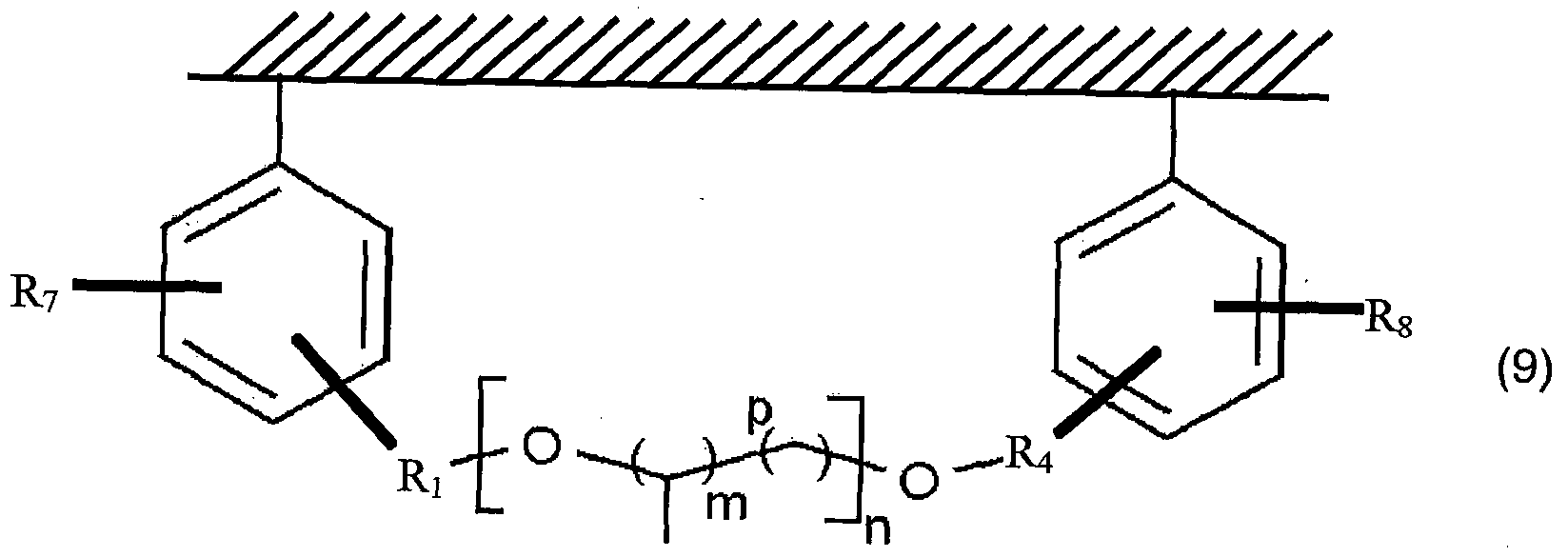
- the pattern of the passivation layer may advantageously be represented by the following eneral formula (9):
- n is an integer between 1 and 10, preferably between 1 and 4,
- n 0 or 1
- p is an integer between 1 and 5, advantageously equal to 2
- R 1 and R 4 are identical or different and independently selected from the group consisting of -CH 2 -, an alkyl chain preferably comprising from 1 to 6 carbon atoms, linear or branched, cyclic or acyclic,
- R 7 and R 8 are identical or different and independently selected from the group consisting of -H, -CH 3 , a halide, an alkyl chain preferably comprising from 2 to 8 carbon atoms, linear or branched, optionally containing a or more heteroatoms advantageously chosen from O, S and N.
- the pattern of the passivation layer is represented by the following general formula (10):
- n is an integer between 1 and 10, preferably between 1 and 4,
- n 0 or 1
- p is an integer between 1 and 5, advantageously equal to 2,
- R 1 and R 4 are identical or different and independently selected from the group consisting of -CH 2 -, an alkyl chain preferably comprising from 1 to 6 carbon atoms, linear or branched, cyclic or acyclic,
- R 7 and R 8 are identical or different and independently selected from the group consisting of -H, -CH 3 , a halide, an alkyl chain preferably comprising from 2 to 8 carbon atoms, linear or branched, optionally containing a or more heteroatoms advantageously chosen from O, S and N.
- R 7 and R 8 are preferably identical and represent a hydrogen atom, -H.
- a method for producing a lithium-ion battery comprises a step of forming, according to any known method, an electrochemical cell comprising the first and second electrodes separated by an initial electrolytic solution.
- the initial electrolytic solution comprises a diazonium salt devoid of hydroxyl functions and of general formula (11) below:
- n is an integer between 1 and 10, preferably between 1 and 4,
- X " represents a counterion of the diazonium cation chosen from halides, BF 4 " ,
- R 1 and R 2 are identical or different and independently selected from the group consisting of -CH 2 -, an alkyl chain preferably comprising from 1 to 6 carbon atoms, linear or branched, cyclic or acyclic,
- R 3 is selected from the group consisting of -CH 3 , an alkyl chain preferably comprising from 2 to 6 carbon atoms, linear or branched, cyclic or acyclic and a group of formula (12) below: in which
- a ' is an aromatic hydrocarbon group, mono or polycyclic, selected from the group consisting of phenyl, aryl groups, condensed polyaromatic groups, optionally substituted
- R4 is selected from the group consisting of -CH 2 -, an alkyl chain preferably comprising from 2 to 8 carbon atoms, linear or branched, cyclic or acyclic, and
- A is identical to or different from A 'and represents an aromatic hydrocarbon group, mono or polycyclic, selected from the group consisting of phenyl, aryl groups, condensed polyaromatic groups, optionally substituted.
- a and / or A ' is an aryl group
- an aryl group comprising from 6 to 9 carbon atoms, for example a phenyl, tolyl, xylyl or trimethylphenyl group, will preferably be chosen.
- a and / or A ' is a fused polyaromatic group
- a polyaromatic group comprising from 10 to 45 carbon atoms, optionally substituted with one or more groups selected from the group consisting of -H, -CH3, will preferably be selected.
- the first electrode is preferably the negative electrode where the water reduction reaction takes place.
- the step of assembling the electrochemical cell is followed by a step of forming the passivation layer on the first electrode of the electrochemical cell, by electrochemical reduction of the initial electrolytic solution.
- the groups A and A 'are preferably chosen for their stability properties, in particular electrochemical properties, at the reduction potential of the diazonium salt.
- groups A and A 'do not contain nitro, amine or ester functions in their structure.
- the aromatic hydrocarbon ring (s) of A and A 'are advantageously not substituted, to avoid steric hindrance problems that may affect the grafting efficiency of the diazonium salt on the first electrode.
- the electrochemical reduction step makes it possible to form in situ the passivation layer on the first electrode, during a first charge of the cell of the lithium-ion accumulator.
- the non-charged Lithium-on accumulator formed at the end of the first step of the process is subjected to an operating voltage during the first charge of the lithium-ion battery, according to any known method.
- the first charge allows both the insertion of lithium into the material of the first electrode and the reduction of the diazonium salt present in the initial electrolytic solution.
- the first charge carries out the grafting of at least one aromatic hydrocarbon ring of the group A and / or A 'of the diazonium salt of formula (11) on the first electrode.
- the diazonium salt is consumed during the first charge in proportion to the creation of the passivation layer on the first electrode.
- the step of forming the passivation layer preferably comprises the creation of a covalent bond of C-aryl / metal or C-aryl / carbon type between an aromatic hydrocarbon ring of the group A and the material of the first electrode. and an aromatic hydrocarbon ring of the group A 'and the material of the first electrode, when R 3 is a group of formula (8) in the unit constituting the passivation layer.
- the lithium-ion battery comprises the first electrode covered by the passivation layer described above and a final electrolytic solution separating the first and second electrodes. At the end of the first charge, all the diazonium salt has preferably been consumed and the final electrolyte solution is then free of the diazonium salt.
- the diazonium salt may advantageously be present in the initial electrolytic solution at a molar concentration of less than 0.5M, preferably of between 0.05M and 0.3M.
- Passivation of a passivated LiFePO 4 electrode by electrochemical reduction of an aqueous initial electrolytic solution was carried out by cyclic voltammetry.
- passivation means that the electrode is covered by a passivation layer as described above.
- the initial electrolytic solution consists of 10 ml of an aqueous solution of a salt of L1NO3 at a concentration of 5M and a bis (4-diazoniumbenzyl) -trioxyethylene tetrafluoroborate salt, denoted DS3, as synthesized in Example 1, at a concentration of 2 mM.
- the LiFePO 4 electrode is made on a current collector according to any known method.
- an ink is constituted by a mixture of LiFePO 4 forming the insertion material, carbon forming a conductive additive and polymeric binders forming a binder.
- the ink is coated on a collector, for example nickel, and then dried to form the LiFePO 4 electrode.
- the LiFePO 4 electrode is then calendered and cut, for use in a conventional cyclic voltammetry circuit.
- the cyclic voltammetry was carried out according to a conventional argon assembly with the initial electrolytic solution described above and three electrodes of which the LiFePO 4 electrode as described above, denoted Di, constituting a working electrode, a calomel electrode. saturated constituting the reference electrode and a platinum wire, for the counter-electrode.
- D 2 is a passivated LiFePO 4 electrode according to the same operating procedure as above but with a 4-methoxybenzenediazonium tetrafluoroborate salt, denoted S 2 , marketed by Sigma-Aldrich, and the other, denoted D 0 , is a bare LiFePO 4 electrode, that is to say devoid of a passivation layer obtained according to the same protocol but without adding a diazonium salt in the initial electrolytic solution.
- S 2 4-methoxybenzenediazonium tetrafluoroborate salt
- D 0 is a bare LiFePO 4 electrode, that is to say devoid of a passivation layer obtained according to the same protocol but without adding a diazonium salt in the initial electrolytic solution.
- Infrared spectra were obtained after the voltammetry on the electrodes D 1 and D 2; to confirm the formation of the passivation layer by verifying that the diazonium DS3 and S 2 aryl salts have been grafted, respectively, Di and D 2.
- the IR spectra shown in FIG. 3 were obtained by a Total Attenuated Reflection method (denoted ATR) on the diazonium salt DS3 alone and on the electrodes D 0 and ⁇ .
- the analysis of the spectrum of D] compared with the spectra of DS3 and Do shows, effectively, the disappearance of a peak located at 2200 cm -1 characteristic of the diazonium function (dashed arrow in FIG. 3) and the appearance of diazonium. a peak around 1600 cm -1 characteristic of an aromatic ring substituted by an alkyl chain (solid arrow in Figure 3).
- the electrodes Ci, C 2 , C 3 , C 4 , C 5 and C 6 were passivated according to the same operating protocol as for a LiFePO 4 electrode, respectively with S 2 , DS 2 , DS 3 , DS 5 , DS 6 and DS 7.
- the electrode C0 is the non-passivated electrode.
- the comparative tests show the improvement of the electrochemical stability of the aqueous electrolyte according to the invention.
- the results particularly interesting for C 5 with a high surge of 290mV and a low current.
- the electrochemical generators according to the invention in particular the lithium-ion accumulators, have improved performances, superior to those of conventional electrochemical generators.
- the electrochemical generator according to the invention is stable for high operating voltages and can be achieved by a process that is easy to implement and inexpensive.
Landscapes
- Engineering & Computer Science (AREA)
- Chemical & Material Sciences (AREA)
- Chemical Kinetics & Catalysis (AREA)
- Electrochemistry (AREA)
- General Chemical & Material Sciences (AREA)
- Power Engineering (AREA)
- Manufacturing & Machinery (AREA)
- Microelectronics & Electronic Packaging (AREA)
- Inorganic Chemistry (AREA)
- Condensed Matter Physics & Semiconductors (AREA)
- General Physics & Mathematics (AREA)
- Materials Engineering (AREA)
- Physics & Mathematics (AREA)
- Secondary Cells (AREA)
- Battery Electrode And Active Subsutance (AREA)
- Electric Double-Layer Capacitors Or The Like (AREA)
Abstract
Description


Claims




Priority Applications (7)
| Application Number | Priority Date | Filing Date | Title |
|---|---|---|---|
| CN201180055588.5A CN103222099B (zh) | 2010-09-17 | 2011-09-19 | 电化学发生器和制造这种发生器的方法 |
| JP2013528737A JP5947300B2 (ja) | 2010-09-17 | 2011-09-19 | 電気化学的発電装置およびそのような発電装置の作製方法 |
| BR112013006159A BR112013006159A2 (pt) | 2010-09-17 | 2011-09-19 | gerador eletroquímico e processo de realização desse gerador |
| KR1020137009642A KR20130119427A (ko) | 2010-09-17 | 2011-09-19 | 전기화학 발전기 및 이러한 발전기를 제조하는 방법 |
| EP11764803.0A EP2617092B1 (fr) | 2010-09-17 | 2011-09-19 | Générateur électrochimique et procédé de réalisation d'un tel générateur |
| US13/824,244 US9362059B2 (en) | 2010-09-17 | 2011-09-19 | Electrochemical generator and method of producing such a generator |
| RU2013117450/04A RU2013117450A (ru) | 2010-09-17 | 2011-09-19 | Электрохимический генератор и способ получения такого генератора |
Applications Claiming Priority (2)
| Application Number | Priority Date | Filing Date | Title |
|---|---|---|---|
| FR1003705 | 2010-09-17 | ||
| FR1003705A FR2965109B1 (fr) | 2010-09-17 | 2010-09-17 | Generateur electrochimique et procede de realisation d'un tel generateur |
Publications (1)
| Publication Number | Publication Date |
|---|---|
| WO2012035217A1 true WO2012035217A1 (fr) | 2012-03-22 |
Family
ID=43513946
Family Applications (1)
| Application Number | Title | Priority Date | Filing Date |
|---|---|---|---|
| PCT/FR2011/000507 Ceased WO2012035217A1 (fr) | 2010-09-17 | 2011-09-19 | Générateur électrochimique et procédé de réalisation d'un tel générateur |
Country Status (9)
| Country | Link |
|---|---|
| US (1) | US9362059B2 (fr) |
| EP (1) | EP2617092B1 (fr) |
| JP (1) | JP5947300B2 (fr) |
| KR (1) | KR20130119427A (fr) |
| CN (1) | CN103222099B (fr) |
| BR (1) | BR112013006159A2 (fr) |
| FR (1) | FR2965109B1 (fr) |
| RU (1) | RU2013117450A (fr) |
| WO (1) | WO2012035217A1 (fr) |
Cited By (4)
| Publication number | Priority date | Publication date | Assignee | Title |
|---|---|---|---|---|
| US10056197B2 (en) | 2013-04-10 | 2018-08-21 | Thales | Electrode-gel electrolyte assembly comprising a porous carbon material and obtained by radical polymerisation |
| EP3304625A4 (fr) * | 2015-05-27 | 2019-01-23 | Hydro-Québec | Procédé pour la protection de matériaux d'électrode contre l'humidité |
| WO2019218067A1 (fr) * | 2018-05-15 | 2019-11-21 | HYDRO-QUéBEC | Films autoportants à base de cellulose pour utilisation dans des batteries li-ion |
| JP2022545108A (ja) * | 2019-12-20 | 2022-10-25 | エルジー エナジー ソリューション リミテッド | 二次電池用負極、その製造方法、およびそれを含むリチウム金属二次電池 |
Families Citing this family (3)
| Publication number | Priority date | Publication date | Assignee | Title |
|---|---|---|---|---|
| KR20180018884A (ko) * | 2016-08-09 | 2018-02-22 | 인천대학교 산학협력단 | 수계 리튬이차전지용 표면 처리된 양극 활물질 |
| US20210167394A1 (en) * | 2017-09-08 | 2021-06-03 | Cornell University | Protective layers for battery electrodes |
| EP3745505B1 (fr) * | 2019-05-30 | 2023-11-29 | Acondicionamiento Tarrasense | Anode au lithium fonctionnalisée pour batteries |
Citations (5)
| Publication number | Priority date | Publication date | Assignee | Title |
|---|---|---|---|---|
| JP2000077073A (ja) | 1998-08-31 | 2000-03-14 | Kansai Shingijutsu Kenkyusho:Kk | 水系リチウムイオン電池 |
| JP2000340256A (ja) | 1999-05-31 | 2000-12-08 | Kansai Research Institute | 水系リチウムイオン電池 |
| WO2002060812A2 (fr) * | 2001-01-29 | 2002-08-08 | William Marsh Rice University | Processus de derivatisation de nanotubes de carbone avec des especes chimiques diazonium et compositions de celles-ci |
| US20070289872A1 (en) * | 2006-02-28 | 2007-12-20 | Commissariat A L'energie Atomique | Process for forming organic films on electrically conductive or semi-conductive surfaces using aqueous solutions |
| US20090155696A1 (en) | 2007-12-14 | 2009-06-18 | Samsung Sdi Co., Ltd. | Organic electrolytic solution and lithium battery employing the same |
Family Cites Families (5)
| Publication number | Priority date | Publication date | Assignee | Title |
|---|---|---|---|---|
| JPS6298713A (ja) * | 1985-10-25 | 1987-05-08 | 日本ケミコン株式会社 | 電解コンデンサ用電解液 |
| JP2645966B2 (ja) * | 1992-10-20 | 1997-08-25 | 株式会社巴川製紙所 | 電 極 |
| JP3432922B2 (ja) * | 1994-10-06 | 2003-08-04 | 三洋電機株式会社 | 固体電解質二次電池 |
| TWI302760B (en) * | 2004-01-15 | 2008-11-01 | Lg Chemical Ltd | Electrochemical device comprising aliphatic nitrile compound |
| US8147916B2 (en) | 2008-03-07 | 2012-04-03 | Bathium Canada Inc. | Process for making electrodes for lithium based electrochemical cells |
-
2010
- 2010-09-17 FR FR1003705A patent/FR2965109B1/fr not_active Expired - Fee Related
-
2011
- 2011-09-19 JP JP2013528737A patent/JP5947300B2/ja not_active Expired - Fee Related
- 2011-09-19 RU RU2013117450/04A patent/RU2013117450A/ru not_active Application Discontinuation
- 2011-09-19 EP EP11764803.0A patent/EP2617092B1/fr active Active
- 2011-09-19 CN CN201180055588.5A patent/CN103222099B/zh not_active Expired - Fee Related
- 2011-09-19 KR KR1020137009642A patent/KR20130119427A/ko not_active Ceased
- 2011-09-19 WO PCT/FR2011/000507 patent/WO2012035217A1/fr not_active Ceased
- 2011-09-19 BR BR112013006159A patent/BR112013006159A2/pt not_active Application Discontinuation
- 2011-09-19 US US13/824,244 patent/US9362059B2/en not_active Expired - Fee Related
Patent Citations (5)
| Publication number | Priority date | Publication date | Assignee | Title |
|---|---|---|---|---|
| JP2000077073A (ja) | 1998-08-31 | 2000-03-14 | Kansai Shingijutsu Kenkyusho:Kk | 水系リチウムイオン電池 |
| JP2000340256A (ja) | 1999-05-31 | 2000-12-08 | Kansai Research Institute | 水系リチウムイオン電池 |
| WO2002060812A2 (fr) * | 2001-01-29 | 2002-08-08 | William Marsh Rice University | Processus de derivatisation de nanotubes de carbone avec des especes chimiques diazonium et compositions de celles-ci |
| US20070289872A1 (en) * | 2006-02-28 | 2007-12-20 | Commissariat A L'energie Atomique | Process for forming organic films on electrically conductive or semi-conductive surfaces using aqueous solutions |
| US20090155696A1 (en) | 2007-12-14 | 2009-06-18 | Samsung Sdi Co., Ltd. | Organic electrolytic solution and lithium battery employing the same |
Non-Patent Citations (4)
| Title |
|---|
| BROOKSBY, P.A. ET AL.: "Electrochemical and Atomic Force Microscopy Study of Carbon Surface Modification via Diazonium Reduction in Aqueous and Acetonitrile Solutions", LANGMUIR, vol. 20, 2004, pages 5038 - 5045 |
| FRANÇOIS TANGUY ET AL: "Lowering interfacial chemical reactivity of oxide materials for lithium batteries. A molecular grafting approach", JOURNAL OF MATERIALS CHEMISTRY, THE ROYAL SOCIETY OF CHEMISTRY, CAMBRIDGE, GB, vol. 19, no. 27, 21 July 2009 (2009-07-21), pages 4771 - 4777, XP002631126, ISSN: 0959-9428, [retrieved on 20090526], DOI: DOI:10.1039/B901387C * |
| QINMIN PAN, HONGBO WANG, YINGHUA JIANG: "Natural graphite modified with nitrophenyl multilayers as anode materials for lithium ion batteries", J. OF MATERIALS CHEMISTRY, vol. 17, no. 2007, 2 November 2006 (2006-11-02), pages 329 - 334, XP002635671 * |
| TANGUY, F. A: "Lowering interfacial chemical reactivity of oxide materials for lithium batteries. A molecular grafting approach", JOURNAL OF MATERIALS CHEMISTRY, 2009, pages 4771 - 4777, XP002631126, DOI: doi:10.1039/B901387C |
Cited By (8)
| Publication number | Priority date | Publication date | Assignee | Title |
|---|---|---|---|---|
| US10056197B2 (en) | 2013-04-10 | 2018-08-21 | Thales | Electrode-gel electrolyte assembly comprising a porous carbon material and obtained by radical polymerisation |
| EP3304625A4 (fr) * | 2015-05-27 | 2019-01-23 | Hydro-Québec | Procédé pour la protection de matériaux d'électrode contre l'humidité |
| US10644319B2 (en) | 2015-05-27 | 2020-05-05 | Transfert Plus, S.E.C. | Process for protecting electrode materials against moisture |
| WO2019218067A1 (fr) * | 2018-05-15 | 2019-11-21 | HYDRO-QUéBEC | Films autoportants à base de cellulose pour utilisation dans des batteries li-ion |
| US11811068B2 (en) | 2018-05-15 | 2023-11-07 | HYDRO-QUéBEC | Cellulose-based self-standing films for use in Li-ion batteries |
| US12603299B2 (en) | 2018-05-15 | 2026-04-14 | HYDRO-QUéBEC | Cellulose-based self-standing films for use in Li-ion batteries |
| JP2022545108A (ja) * | 2019-12-20 | 2022-10-25 | エルジー エナジー ソリューション リミテッド | 二次電池用負極、その製造方法、およびそれを含むリチウム金属二次電池 |
| US12374676B2 (en) | 2019-12-20 | 2025-07-29 | Lg Energy Solution, Ltd. | Negative electrode for secondary battery, method for manufacturing the same, and lithium metal secondary battery comprising the same |
Also Published As
| Publication number | Publication date |
|---|---|
| CN103222099A (zh) | 2013-07-24 |
| EP2617092B1 (fr) | 2015-03-04 |
| KR20130119427A (ko) | 2013-10-31 |
| FR2965109B1 (fr) | 2012-09-28 |
| JP2013538432A (ja) | 2013-10-10 |
| US20130177805A1 (en) | 2013-07-11 |
| CN103222099B (zh) | 2016-03-30 |
| EP2617092A1 (fr) | 2013-07-24 |
| RU2013117450A (ru) | 2014-10-27 |
| BR112013006159A2 (pt) | 2016-06-07 |
| US9362059B2 (en) | 2016-06-07 |
| FR2965109A1 (fr) | 2012-03-23 |
| JP5947300B2 (ja) | 2016-07-06 |
Similar Documents
| Publication | Publication Date | Title |
|---|---|---|
| WO2012035218A1 (fr) | Sel d'aryle diazonium et utilisation dans une solution électrolytique d'un générateur électrochimique | |
| EP2617092B1 (fr) | Générateur électrochimique et procédé de réalisation d'un tel générateur | |
| Vadehra et al. | Naphthalene diimide based materials with adjustable redox potentials: Evaluation for organic lithium-ion batteries | |
| EP1626041B1 (fr) | Nouveaux matériaux utiles en tant que solutés électrolytiques | |
| FR2589631A1 (fr) | Batterie rechargeable | |
| EP3794661A1 (fr) | Films autoportants à base de cellulose pour utilisation dans des batteries li-ion | |
| EP0970496A1 (fr) | Supercondensateur du type double couche comprenant un electrolyte organique liquide | |
| FR3063728A1 (fr) | Composes ioniques redox bis(pyridinium)-naphthalene diimide comme materiaux actifs d'electrode | |
| FR2624526A1 (fr) | Electrode composite comprenant un corps en aluminium lie a un polymere electroconducteur et cellule electrique utilisant une telle electrode composite | |
| EP4271668A1 (fr) | Liquide ionique à base de bis(fluorosulfonyl)imidure | |
| JP2022509022A (ja) | 高収率貯蔵材料 | |
| EP3353262B1 (fr) | Électrolyte pour générateur électrochimique | |
| FR2975098A1 (fr) | Composes a groupement redox, leur utilisation comme additif d'electrolyte, composition d'electrolyte et systemes electrochimiques les contenant | |
| FR3070382A1 (fr) | Procede de fabrication de nanotubes de carbone verticalement alignes, et supercondensateurs electrochimiques utilisant ces nanotubes comme electrodes | |
| EP3063127B1 (fr) | Materiau d'electrode pour batterie organique comprenant des dérivés de l'acide benzene-bisdithioïque | |
| WO2014166952A1 (fr) | Ensemble electrode-electrolyte gel comprenant un materiau carbone poreux et obtenu par polymerisation radicalaire | |
| EP0416078A1 (fr) | Element composite comportant un polyether ou copolyether, son procede de preparation et son utilisation pour l'extraction et la separation de cations metalliques | |
| KR101870563B1 (ko) | 전극활물질 및 그 형성 방법 | |
| US20250320331A1 (en) | Conducting polymers and use in electrodes for high capacity, low-cost, energy storage | |
| WO2017050691A1 (fr) | Electrolyte solide pour generateur electrochimique | |
| JPWO2007111070A1 (ja) | エネルギー貯蔵デバイス電極用組成物及びその製造方法 | |
| FR2622601A1 (fr) | Procede de fabrication d'un film de polyaniline, film obtenu par ce procede et generateur electrochimique utilisant ce film | |
| FR3088639A1 (fr) | Nouvelles molecules p-conjuguees a base de benzothioxanthene pour le stockage de l'energie |
Legal Events
| Date | Code | Title | Description |
|---|---|---|---|
| WWE | Wipo information: entry into national phase |
Ref document number: 201180055588.5 Country of ref document: CN |
|
| 121 | Ep: the epo has been informed by wipo that ep was designated in this application |
Ref document number: 11764803 Country of ref document: EP Kind code of ref document: A1 |
|
| ENP | Entry into the national phase |
Ref document number: 2013528737 Country of ref document: JP Kind code of ref document: A |
|
| WWE | Wipo information: entry into national phase |
Ref document number: 13824244 Country of ref document: US |
|
| NENP | Non-entry into the national phase |
Ref country code: DE |
|
| WWE | Wipo information: entry into national phase |
Ref document number: 2011764803 Country of ref document: EP |
|
| ENP | Entry into the national phase |
Ref document number: 20137009642 Country of ref document: KR Kind code of ref document: A |
|
| ENP | Entry into the national phase |
Ref document number: 2013117450 Country of ref document: RU Kind code of ref document: A |
|
| REG | Reference to national code |
Ref country code: BR Ref legal event code: B01A Ref document number: 112013006159 Country of ref document: BR |
|
| ENP | Entry into the national phase |
Ref document number: 112013006159 Country of ref document: BR Kind code of ref document: A2 Effective date: 20130314 |