WO2012035870A1 - 皮膚化粧料 - Google Patents
皮膚化粧料 Download PDFInfo
- Publication number
- WO2012035870A1 WO2012035870A1 PCT/JP2011/066097 JP2011066097W WO2012035870A1 WO 2012035870 A1 WO2012035870 A1 WO 2012035870A1 JP 2011066097 W JP2011066097 W JP 2011066097W WO 2012035870 A1 WO2012035870 A1 WO 2012035870A1
- Authority
- WO
- WIPO (PCT)
- Prior art keywords
- agar
- hydrogel particles
- oil
- skin
- skin cosmetic
- Prior art date
- Legal status (The legal status is an assumption and is not a legal conclusion. Google has not performed a legal analysis and makes no representation as to the accuracy of the status listed.)
- Ceased
Links
Classifications
-
- A—HUMAN NECESSITIES
- A61—MEDICAL OR VETERINARY SCIENCE; HYGIENE
- A61K—PREPARATIONS FOR MEDICAL, DENTAL OR TOILETRY PURPOSES
- A61K8/00—Cosmetics or similar toiletry preparations
- A61K8/18—Cosmetics or similar toiletry preparations characterised by the composition
- A61K8/72—Cosmetics or similar toiletry preparations characterised by the composition containing organic macromolecular compounds
- A61K8/84—Cosmetics or similar toiletry preparations characterised by the composition containing organic macromolecular compounds obtained by reactions otherwise than those involving only carbon-carbon unsaturated bonds
- A61K8/89—Polysiloxanes
- A61K8/891—Polysiloxanes saturated, e.g. dimethicone, phenyl trimethicone, C24-C28 methicone or stearyl dimethicone
-
- A—HUMAN NECESSITIES
- A61—MEDICAL OR VETERINARY SCIENCE; HYGIENE
- A61K—PREPARATIONS FOR MEDICAL, DENTAL OR TOILETRY PURPOSES
- A61K8/00—Cosmetics or similar toiletry preparations
- A61K8/02—Cosmetics or similar toiletry preparations characterised by special physical form
- A61K8/04—Dispersions; Emulsions
- A61K8/042—Gels
-
- A—HUMAN NECESSITIES
- A61—MEDICAL OR VETERINARY SCIENCE; HYGIENE
- A61K—PREPARATIONS FOR MEDICAL, DENTAL OR TOILETRY PURPOSES
- A61K8/00—Cosmetics or similar toiletry preparations
- A61K8/02—Cosmetics or similar toiletry preparations characterised by special physical form
- A61K8/0241—Containing particulates characterized by their shape and/or structure
-
- A—HUMAN NECESSITIES
- A61—MEDICAL OR VETERINARY SCIENCE; HYGIENE
- A61K—PREPARATIONS FOR MEDICAL, DENTAL OR TOILETRY PURPOSES
- A61K8/00—Cosmetics or similar toiletry preparations
- A61K8/18—Cosmetics or similar toiletry preparations characterised by the composition
-
- A—HUMAN NECESSITIES
- A61—MEDICAL OR VETERINARY SCIENCE; HYGIENE
- A61K—PREPARATIONS FOR MEDICAL, DENTAL OR TOILETRY PURPOSES
- A61K8/00—Cosmetics or similar toiletry preparations
- A61K8/18—Cosmetics or similar toiletry preparations characterised by the composition
- A61K8/30—Cosmetics or similar toiletry preparations characterised by the composition containing organic compounds
- A61K8/31—Hydrocarbons
-
- A—HUMAN NECESSITIES
- A61—MEDICAL OR VETERINARY SCIENCE; HYGIENE
- A61K—PREPARATIONS FOR MEDICAL, DENTAL OR TOILETRY PURPOSES
- A61K8/00—Cosmetics or similar toiletry preparations
- A61K8/18—Cosmetics or similar toiletry preparations characterised by the composition
- A61K8/72—Cosmetics or similar toiletry preparations characterised by the composition containing organic macromolecular compounds
- A61K8/73—Polysaccharides
-
- A—HUMAN NECESSITIES
- A61—MEDICAL OR VETERINARY SCIENCE; HYGIENE
- A61K—PREPARATIONS FOR MEDICAL, DENTAL OR TOILETRY PURPOSES
- A61K8/00—Cosmetics or similar toiletry preparations
- A61K8/18—Cosmetics or similar toiletry preparations characterised by the composition
- A61K8/72—Cosmetics or similar toiletry preparations characterised by the composition containing organic macromolecular compounds
- A61K8/84—Cosmetics or similar toiletry preparations characterised by the composition containing organic macromolecular compounds obtained by reactions otherwise than those involving only carbon-carbon unsaturated bonds
- A61K8/89—Polysiloxanes
- A61K8/895—Polysiloxanes containing silicon bound to unsaturated aliphatic groups, e.g. vinyl dimethicone
-
- A—HUMAN NECESSITIES
- A61—MEDICAL OR VETERINARY SCIENCE; HYGIENE
- A61Q—SPECIFIC USE OF COSMETICS OR SIMILAR TOILETRY PREPARATIONS
- A61Q19/00—Preparations for care of the skin
-
- A—HUMAN NECESSITIES
- A61—MEDICAL OR VETERINARY SCIENCE; HYGIENE
- A61K—PREPARATIONS FOR MEDICAL, DENTAL OR TOILETRY PURPOSES
- A61K2800/00—Properties of cosmetic compositions or active ingredients thereof or formulation aids used therein and process related aspects
- A61K2800/20—Chemical, physico-chemical or functional or structural properties of the composition as a whole
- A61K2800/26—Optical properties
- A61K2800/262—Transparent; Translucent
Definitions
- the present invention relates to a skin cosmetic containing agar hydrogel particles. More specifically, the present invention relates to a skin cosmetic in which agar hydrogel particles and oily gel are mixed, and the agar hydrogel particles are dispersed in a transparent or translucent oily gel, and exhibits excellent usability. .
- Patent Document 1 discloses a composite composition in which a small spherical aqueous composition containing agar is dispersed in a gelled or solidified oily composition containing 12-hydroxystearic acid. It is described that the composition can be used for makeup cosmetics such as lip gloss.
- the oily gel forming the outer phase (continuous phase) is solidified, there is a concern that the gel is gradually broken due to pressure applied during fingering during repeated use, and globules are precipitated. .
- the oily gel that forms the outer phase contains a lot of high-viscosity oils such as polybutene. Has no use feeling.
- Patent Document 2 discloses a skin cosmetic in which particles having an average particle size of 0.1 to 5 mm including agar are dispersed and suspended in a transparent or translucent aqueous base having a viscosity of 300 to 5000 mPa ⁇ s.
- Patent Document 3 discloses a cosmetic containing capsules encapsulating an oil-in-water emulsion, wherein the capsule membrane is 0.1 to 1.0% by weight of calcium alginate with respect to the total amount of the capsule. Contained cosmetics are disclosed.
- Patent Document 4 discloses that an outer phase comprising a pH-adjusted aqueous solution of a carboxyvinyl polymer, wherein a barium alginate capsule in which at least a part of an alginate is present in the form of a polyvalent metal salt containing a barium salt as an essential component is present. There is disclosed a capsuled cosmetic present therein.
- Patent Document 5 discloses a water-containing cosmetic containing a soft capsule based on agar and a spherical product.
- the alginate capsules used in Patent Documents 3 and 4 are produced by reacting a water-soluble alginate and a water-soluble calcium salt to produce water-insoluble calcium alginate, When applied, the capsule residue remains on the skin, causing a sense of discomfort. Further, the water-containing cosmetic of Patent Document 5 has a drawback that it is extremely difficult to impart a skin protection effect (emollient effect) or a massage effect because the blending amount of oil is limited.
- JP 2007-22950 A Japanese Patent No. 3756043 Japanese Patent Laid-Open No. 2-117610 JP 11-29433 A JP-A-1-193216
- the present inventors have conducted intensive research to obtain a skin cosmetic material having a preferable feeling of use for skin care in a cosmetic material containing agar hydrogel particles.
- Skin cosmetics in which particles and oily gel are mixed and agar hydrogel particles are dispersed in a transparent or translucent oily gel, can suppress the feeling of residue after crushing the capsule on the skin
- the oily gel of the outer oil phase in which the agar hydrogel particles are dispersed can be obtained with a mixture of silicone cloth polymer and low-viscosity silicone oil and / or hydrocarbon oil.
- thickening and gelling there is a concern that the gel of the outer phase is destroyed and the agar hydrogel particles are precipitated as in Patent Document 1 even during repeated use. It not, further, by not mixing a high viscosity oil in the oily gel, found to exhibit feel to elongation good non-sticky, and have completed the present invention.
- An object of the present invention is to provide a skin cosmetic for skin care, having an excellent feeling of use, and giving a moderately good massage feeling in a cosmetic containing agar hydrogel particles.
- the present invention relates to agar hydrogel particles having an average particle diameter of 0.2 to 5 mm obtained by cooling an agar aqueous solution prepared so as to have a breaking stress after cooling and solidification of 0.005 to 0.1 MPa in an oily solvent. And an oily gel in which fine particles obtained by chemically three-dimensionally crosslinking silicone and silicone oil and / or hydrocarbon oil are blended.
- the present invention also provides the above-described skin cosmetic, wherein the amount of the agar hydrogel particles is 1 to 80% by mass based on the total amount of the skin cosmetic.
- the present invention provides the above-described skin cosmetic, wherein the skin cosmetic is a massage cosmetic.
- the skin cosmetic of the present invention When the skin cosmetic of the present invention is produced, a suitable amount of agar is blended and an agar aqueous solution having a specific breaking stress is used to apply the agar hydrogel particles after crushing the agar hydrogel particles.
- a good feeling of use can be obtained, and at the same time, a good and moderate massage feeling can be obtained by crushing the agar hydrogel particles on the skin during use.
- by thickening and gelling the oily gel that forms the outer oil phase with a mixture of silicone cloth polymer and low-viscosity silicone oil and / or hydrocarbon oil the gel of the outer phase does not break down even during repeated use. There is no concern about the precipitation of hydrogel particles.
- the agar hydrogel particles used in the present invention have an average particle size of 0.2 to 5 mm obtained by cooling an agar aqueous solution prepared so that the breaking stress after cooling and solidification is 0.005 to 0.1 MPa while stirring in an oily solvent.
- the resulting agar hydrogel particles are hydrogel composition globules made of an aqueous solution of agar, and are dispersed in an oily solvent, so that they are separated and recovered by filtration.
- agar hydrogel particles are uniformly dispersed in the oily gel to obtain the skin cosmetic of the present invention.
- An agar aqueous solution is an aqueous phase composition, and agar functions as a solidifying agent.
- the hardness of the agar hydrogel particles formed becomes moderate, and even if this is rubbed on the skin, the agar hydrogel particles There is an advantage that the residue is not easily left behind and the skin can be given freshness.
- the blending amount of agar in the agar aqueous solution is preferably 0.5 to 5% by mass, particularly preferably 1.0 to 3.0% by mass with respect to the total amount of the agar aqueous solution. If the blending amount is less than 0.5% by mass, the agar aqueous solution is soft and is not suitable for solidifying as agar hydrogel particles, and if it exceeds 5.0% by mass, the agar hydrogel particles become too hard, The disintegration property on the skin is inferior and tends to be difficult to be crushed, and at the same time, a feeling of residue of scum is generated after crushing.
- solvent components that are compatible with water, specifically lower alcohols such as ethanol, menthol, camphors (used to give a refreshing feeling), Polyhydric alcohols such as propylene glycol, butylene glycol and glycerin (used when it is desired to impart moisture retention) and the like can be blended.
- lower alcohols such as ethanol, menthol, camphors (used to give a refreshing feeling)
- Polyhydric alcohols such as propylene glycol, butylene glycol and glycerin (used when it is desired to impart moisture retention) and the like can be blended.
- other components having compatibility with water for example, surfactants, UV protection agents, preservatives, antioxidants, pH adjusting agents, chelating agents, polymer compounds, thickeners. It is possible to add a fragrance, a water-soluble drug, and the like.
- the skin cosmetic by blending the above-mentioned components into the agar aqueous solution, agar hydrogel particles containing these components can be obtained, and a skin cosmetic having a refreshing feeling, moisturizing property and the like is produced.
- the above-mentioned optional blending components are blended in an appropriate amount in the agar aqueous solution depending on the purpose.
- the amount of water in the agar aqueous solution is not particularly limited, but is preferably 1 to 50% by mass with respect to the total amount of the agar aqueous solution.
- the agar hydrogel particles obtained by coloring the agar aqueous solution may be performed by dispersing a pigment such as iron oxide or a pearling agent in an agar aqueous solution, or by adding an oil component to an agar aqueous solution and emulsifying it to make the resulting agar hydrogel particles opaque. You may do it.
- the amount of agar and other water-soluble optional ingredients to be blended in the agar aqueous solution is appropriately determined, and agar and water-soluble optional ingredients are added to hot water. It is possible to prepare by dissolving and then solidifying by cooling and confirming that the breaking stress is in the range of 0.005 to 0.1 MPa.
- the breaking stress is measured with a rheometer (COMPAC-100 II manufactured by Sun Kagaku Co., Ltd.) after cooling and solidifying the agar aqueous solution. If the breaking stress is less than 0.005 MPa, it is difficult to obtain a sufficient massage effect. If the breaking stress exceeds 0.1 MPa, the agar hydrogel particles become too hard and the disintegration property on the skin is inferior, and is not easily crushed. Tends to remain.
- the average particle size of the agar hydrogel particles used in the present invention is 0.2 to 5 mm.
- the average particle diameter is a value obtained by observing the agar hydrogel particles visually or with a microscope and averaging the particle diameters of any 100 agar hydrogel particles.
- Agar hydrogel particles having an average particle size of 0.2 to 5 mm were prepared by putting an agar aqueous solution of about 65 to 80 ° C. previously dissolved in a kettle into another kettle from a nozzle having an opening diameter of 0.5 to 8 mm. It is discharged in an oily solvent at about ° C. The mixture is sufficiently stirred and cooled to about 30 ° C., then the mixture is filtered, and agar hydrogel particles having a desired average particle size can be separated and recovered.
- an oil component having a relatively low viscosity and compatible with the external phase gel such as cyclomethicone (decamethylcyclopentasiloxane), dimethylpolysiloxane, methylphenylpolysiloxane, liquid paraffin, etc. is used. It is preferable.
- Oil-based gel The oily gel used as the external phase gel in the skin cosmetic of the present invention uses a mixture of fine particles obtained by chemically three-dimensionally cross-linking silicone and low-viscosity silicone oil and / or hydrocarbon oil. At least one of low-viscosity silicone oil and hydrocarbon oil may be mixed with fine particles obtained by chemically three-dimensionally crosslinking silicone. Examples of such oil-based gel include KSG series (KSG-15, KSG-1610, KSG-16, KSG-41, KSG-42, KSG-44, KSG-210, KSG-240, manufactured by Shin-Etsu Chemical Co., Ltd.
- fine particles obtained by chemically three-dimensionally cross-linking silicone are fine particles obtained by three-dimensionally cross-linking dimethylpolysiloxane, vinyldimethylpolysiloxane, polyether-modified silicone, alkyl-modified silicone, polyglycerin-modified silicone, and the like. Is preferred.
- the low viscosity silicone oil or hydrocarbon oil it is preferable to use dimethylpolysiloxane, decamethylcyclopentasiloxane, isododecane, squalane and the like having a viscosity at 20 ° C. of about 2 to 100 mPa ⁇ s.
- the oily gel of the outer phase uses a mixture of fine particles obtained by chemically three-dimensionally cross-linking silicone and low-viscosity silicone oil and / or hydrocarbon oil, or other low-viscosity gels. Even when the oil component is blended, if the viscosity of the oily gel is about 5000 to 50000 mPa ⁇ s at 20 ° C., the disadvantages caused by using the high viscosity oil component of Patent Document 1 can be solved, the spread is good, and the It becomes possible to demonstrate no feeling of use.
- an oil that can be used for a composition for external use such as cosmetics can be appropriately selected and blended.
- the oily gel may contain other components having compatibility with the oil as necessary, for example, surfactants, UV protection agents, preservatives, antioxidants, chelating agents, film forming agents, polymers. It is possible to add a compound, a fragrance, an oily drug, and the like.
- the oily gel is preferably translucent to transparent. This is because the agar hydrogel particles dispersed in the oily gel can be confirmed by the visual perception of the consumer, and the joy of appearance can be exhibited as a skin cosmetic. “Translucent to transparent” in the present invention is determined by visual observation. Translucent means to the extent that the agar hydrogel particles dispersed in the oily gel can be seen blurry, and transparent means to the extent that it can be clearly seen. In addition, it is also possible to mix
- blend coloring components such as a coloring agent, a dye, a pearl agent, and a lame agent
- the skin cosmetic of the present invention is a composite composition in which the agar hydrogel particles described above are uniformly dispersed in an oily gel.
- the blending amount of the agar hydrogel particles is preferably 5 to 80% by mass with respect to the total amount of the skin cosmetic.
- the blending amount of the oily gel is preferably 10 to 80% by mass with respect to the total amount of the skin cosmetic.
- the mass ratio of the agar hydrogel particles and the oily gel can be appropriately determined according to the purpose of the skin cosmetic, and is not particularly limited.
- Gel: Agar hydrogel particles preferably in the range of 30:70 to 80:20.
- the method for producing the skin cosmetic of the present invention is not particularly limited as long as the agar hydrogel particles and the oily gel are mixed and the agar hydrogel particles are uniformly dispersed in the oily gel as the outer phase.
- a hose is connected to a kettle containing an agar aqueous solution, a nozzle with an opening diameter of about 0.5 to 8 mm is attached to the tip of the hose, and the agar aqueous solution is added from the nozzle to an oily solvent in a heated and melted state. Stir.
- the skin cosmetic of the present invention is preferably used as a skin care skin cosmetic containing a skin care ingredient. Moreover, since it has a favorable and moderate massage effect, it can be suitably used as a massage cosmetic.
- a compounding quantity is represented by the mass% with respect to the whole quantity of agar aqueous solution or skin cosmetics whole quantity.
- the jelly strength of the agar aqueous solution is a value measured with a rheometer (COMPAC-100 II manufactured by Sun Kagaku).
- the average particle diameter of the agar hydrogel particles is a value measured visually.
- hydrogel particles Composition 1 Ion-exchanged water 78.5 2 Glycerin 10 3 1,3-butylene glycol 4 4 Dipropylene glycol 5 5 Agar 2 6 Phenoxyethanol 0.5
- ⁇ Production method> Ingredients 1-6 were heated to 90 ° C. to dissolve. The solution is cooled to 65 ° C., discharged from a nozzle with an opening diameter of 8 mm onto decamethylcyclopentasiloxane at 40 ° C., and the mixture is cooled to 30 ° C. with stirring, and a sieve or filter cloth having an appropriate mesh size is used. The outer oil solution was filtered to obtain agar hydrogel particles 1 (hydrogel particles 1). The breaking stress of the agar aqueous solution is 0.025 MPa, and the average particle diameter of the agar hydrogel particles is 1.5 mm.
- ⁇ Production method> Ingredients 1-6 were heated to 90 ° C. to dissolve. This solution is cooled to 80 ° C., dripped into a 1% calcium chloride aqueous solution from a nozzle with an opening diameter of 0.5 mm, and the outer solution is filtered using a sieve or a filter cloth of an appropriate mesh size, and a sodium alginate capsule (hydrogel) Particle 2) was obtained.
- the breaking stress of the said sodium alginate aqueous solution is 0.12 MPa, and an average particle diameter is 1 mm.
- * 1 Combining 4% by mass of a three-dimensional crosslinked silicone product composed of dimethylpolysiloxane and vinyldimethylpolysiloxane with 96% by mass of decamethylcyclopentasiloxane (4 mPa ⁇ s (20 ° C.)) as a solvent for swelling it. It has been done.
- * 2 A combination of a three-dimensional crosslinked silicone product composed of dimethylpolysiloxane and hexadiene and dimethylpolysiloxane (5 mPa ⁇ s (20 ° C.)) as a solvent for swelling it.
- Examples 1 and 2 Comparative Example 3 After oily gel and decamethylcyclopentasiloxane were uniformly mixed, the hydrogel particles were mixed and stirred until uniform to obtain a skin cosmetic. “Comparative Examples 1 and 2” The carboxyvinyl polymer was dissolved in water and then neutralized by adding caustic potash, and then the hydrogel particles were mixed and stirred until uniform to obtain a skin cosmetic.
- the evaluation method is as follows. In addition, all the evaluation regarding a feeling of use was determined and evaluated by the actual use test (the skin cosmetics were apply
- coated to the face) by a special panel (N 6).
- Agar hydrogel particles (hydrogel particles 3) Composition 1 Ion-exchanged water 68.8 2 Glycerin 10 3 1,3-butylene glycol 4 4 Dipropylene glycol 5 5 Agar 2 6 Phenoxyethanol 0.5 7 Ion exchange water 0.8 8 1,3-butylene glycol 3.5 9 POE (60) hydrogenated castor oil 0.4 10 Liquid paraffin 5
- ⁇ Production method> Ingredients 1-6 were heated to 90 ° C. to dissolve. This solution was cooled to 70 ° C., mixed with an emulsion obtained by mixing and emulsifying 7 to 10, and then discharged from a nozzle with an opening diameter of 8 mm into decamethylcyclopentasiloxane at 40 ° C. The mixture was stirred at 30 ° C. Then, the outer oil liquid was filtered using a sieve or filter cloth having an appropriate mesh size to obtain agar hydrogel particles 2 (hydrogel particles 3). The breaking stress of the agar aqueous solution is 0.02 MPa, and the average particle diameter of the agar hydrogel particles is 1 mm.
- “Comparative Examples 4-7” 12-hydroxystearic acid, dextrin palmitate, (behenic acid / eicosanedioic acid) glyceryl, etc. are added to a fluid oil heated to 90 ° C. and then melted. After cooling to around 70 ° C., the hydrogel particles are mixed and allowed to solidify. The skin cosmetic was obtained.
- the oil phase gel was mixed with fine particles ((dimethicone / vinyl dimethicone) cross-polymer) obtained by chemically cross-linking silicone with low-viscosity silicone oil (decamethylcyclopentasiloxane).
- fine particles (dimethicone / vinyl dimethicone) cross-polymer) obtained by chemically cross-linking silicone with low-viscosity silicone oil (decamethylcyclopentasiloxane).
- Agar hydrogel particles (hydrogel particles 4-7)
- Comparative Example 8 and Comparative Example 9 in which the breaking stress of the agar aqueous solution is not in the range specified by the present invention (0.005 to 0.1 MPa) are “massage effect feeling when applied on the skin” or “when applied to the skin” It is inferior to the effect of “the rest of the residue”.
- Example 4 and Example 5 in which the breaking stress of the agar aqueous solution satisfies the requirements of the present invention are “the feeling of massage effect when applied on the skin” and “the residue of the residue when applied on the skin” It can be seen that it has an excellent effect.
- the skin cosmetic of the present invention has excellent usability by dispersing specific agar hydrogel particles in a specific oily gel, and is extremely useful as a skin cosmetic excellent in the visibility of agar hydrogel particles. It is. In particular, it has a high utility value as a massage cosmetic for the purpose of skin care having an appropriate massage feeling.
Landscapes
- Health & Medical Sciences (AREA)
- Life Sciences & Earth Sciences (AREA)
- Animal Behavior & Ethology (AREA)
- General Health & Medical Sciences (AREA)
- Public Health (AREA)
- Veterinary Medicine (AREA)
- Birds (AREA)
- Epidemiology (AREA)
- Dermatology (AREA)
- Chemical & Material Sciences (AREA)
- Dispersion Chemistry (AREA)
- Cosmetics (AREA)
Abstract
Description
また、特許文献4には、アルギン酸塩の少なくとも一部がバリウム塩を必須成分とする多価金属塩の形で存在しているアルギン酸バリウムカプセルが、pH調整されたカルボキシビニルポリマーの水溶液からなる外相中に存在しているカプセル入り化粧料が開示されている。
さらに、特許文献5には、寒天を基剤とするソフトカプセル及び球状物を配合した水含有化粧料が開示されている。
また、特許文献5の水含有化粧料は、油分の配合量が限定されるため肌保護効果(エモリエント効果)やマッサージ効果を付与することが極めて難しいという欠点がある。
また、外油相となる油性ジェルをシリコーンクロスポリマーと低粘度シリコーン油及び/又は炭化水素油の混合物で増粘、ジェル化することで、繰り返し使用時にも、外相のジェルの破壊が起きず寒天ハイドロゲル粒子が沈殿する懸念がない。
さらに、低粘度シリコーン油及び/又は炭化水素油を油性ジェルに使用して、高粘度油分を油性ジェルに配合させないことにより、のびが良くべたつかない使用感を有する。
本発明に用いる寒天ハイドロゲル粒子は、冷却固化後の破断応力が0.005~0.1MPaとなるよう調製した寒天水溶液を油性溶媒中で攪拌しながら冷却して得られる平均粒径0.2~5mmの寒天ハイドロゲル粒子である。
得られる寒天ハイドロゲル粒子は寒天水溶液からなるハイドロゲル組成物の小球であり、油性溶媒中に分散しているので、これをろ過して分離回収し、これを外相となる油性ジェルと室温にて混合し、寒天ハイドロゲル粒子を油性ジェル中に均一に分散させて、本発明の皮膚化粧料を得る。
寒天水溶液は水相組成物であり、寒天は固形化剤として機能する。寒天を固形化剤として用い、寒天水溶液の水性組成物を寒天によってハイドロゲル粒子とすることにより、形成される寒天ハイドロゲル粒子の硬度が適度となり、これを肌上でこすりつけても寒天ハイドロゲル粒子のカスが後残りしにくく、かつ、肌上にみずみずしさを与えることができるという利点がある。
この配合量が0.5質量%未満では、寒天水溶液が軟調で、寒天ハイドロゲル粒子として固化させるのに適当でなく、また、5.0質量%を超えると寒天ハイドロゲル粒子が硬くなりすぎ、肌上における崩壊性が劣ってきて、潰れ難くなる傾向があると同時に、潰した後にカスの残り感が生じてしまう。
また、必要に応じて、水に対して相溶性を有する他の成分、例えば、界面活性剤、紫外線防御剤、防腐剤、酸化防止剤、pH調整剤、キレート剤、高分子化合物、増粘剤、香料、水溶性の薬剤等を配合することが可能である。
皮膚化粧料の目的に応じて、寒天水溶液に、上述の成分を配合することにより、これらの成分を含む寒天ハイドロゲル粒子が得られ、清涼感や保湿性等を有する皮膚化粧料を製造することが可能となる。
上記の任意配合成分は、寒天水溶液中に、目的に応じて、適宜適する量が配合される。その際、寒天水溶液中の水の配合量は特に限定されないが、寒天水溶液全量に対して1~50質量%が好ましい。
着色は、寒天水溶液中に酸化鉄などの顔料やパール剤を分散することで行なってもよいし、寒天水溶液に油性成分を加えて乳化することにより、得られる寒天ハイドロゲル粒子を不透明化することで行なってもよい。
破断応力は、寒天水溶液を冷却固化させた後、レオメーター(サン科学社製COMPAC-100 II)によって測定する。
破断応力が0.005MPa未満では、充分なマッサージ効果を得ることが難しく、破断応力が0.1MPaを超えると、寒天ハイドロゲル粒子が硬くなりすぎ、肌上における崩壊性が劣ってきて、潰れ難く、カスが残りやすくなる傾向がある。
寒天水溶液を吐出する油性溶媒としては、シクロメチコン(デカメチルシクロペンタシロキサン)、ジメチルポリシロキサン、メチルフェニルポリシロキサン、流動パラフィンなどの比較的低粘度で、かつ外相ジェルと相溶性のある油分を用いることが好ましい。
本発明の皮膚化粧料に外相ジェルとして用いる油性ジェルは、シリコーンを化学的に3次元架橋した微粒子と、低粘度のシリコーン油及び/又は炭化水素油を混合したものを使用する。低粘度のシリコーン油と炭化水素油は少なくともどちらか一方が、シリコーンを化学的に3次元架橋した微粒子と混合されていれば良い。
このような油性ジェルとしては、例えば、信越化学工業社製KSGシリーズ(KSG-15、KSG-1610、KSG-16、KSG-41、KSG-42、KSG-44、KSG-210、KSG-240、KSG-310、KSG-320、KSG-330、KSG-340、KSG-710、KSG-810、KSG-820、KSG-830、KSG-840)東レ・ダウコーニング社製シリコーンエラストマーブレンド(9040、9045、9140DM、9041、9546、FB-9586)、同社製シリコーンオーガニックエラストマーブレンド(EL-8040 ID、EL-8541 IN)等が挙げられる。
なお、油性ジェル中における、シリコーンを化学的に3次元架橋した微粒子と、低粘度のシリコーン油及び/又は炭化水素油の配合比は、ジェルを形成する限り、特に限定されないが、質量比で、シリコーンを化学的に3次元架橋した微粒子:低粘度のシリコーン油及び/又は炭化水素油=1:50~3:10が好ましい。
一方、低粘度のシリコーン油又は炭化水素油は、20℃での粘度が2~100mPa・s程度のジメチルポリシロキサン、デカメチルシクロペンタシロキサン、イソドデカン、スクワラン等を使用することが好ましい。
外相の油性ジェルが、油分として、シリコーンを化学的に3次元架橋した微粒子と、低粘度のシリコーン油及び/又は炭化水素油を混合したものを使用する場合、或いは、これらにその他の低粘度の油分を配合した場合であっても、油性ジェルの粘度が20℃で5000~50000mPa・s程度であれば、特許文献1の高粘度油分を使用することによる欠点を解決でき、のびが良く、べたつかない使用感を発揮することが可能となる。
本発明に言う「半透明~透明」とは、目視により観察されて決定される。半透明とは油性ジェル中に分散する寒天ハイドロゲル粒子がぼんやりと見える程度を意味し、透明とは明確に見える程度を意味する。
なお、必要に応じて、油性ジェルに、色剤、染料、パール剤、ラメ剤等の呈色成分を配合することも、寒天ハイドロゲル粒子が目視で認められる限度で可能である。
本発明の皮膚化粧料は、上述した寒天ハイドロゲル粒子が油性ジェル中に均一に分散した複合組成物である。
寒天ハイドロゲル粒子の配合量は、皮膚化粧料全量に対して5~80質量%が好ましい。
また、油性ジェルの配合量は、皮膚化粧料全量に対して10~80質量%が好ましい。
さらに、本発明の皮膚化粧料において、寒天ハイドロゲル粒子と、油性ジェルの質量比は、皮膚化粧料の目的に応じて適宜決定することが可能であり、特に限定されるものではないが、油性ジェル:寒天ハイドロゲル粒子=30:70~80:20の範囲であることが好適である。
例えば、寒天水溶液が入った釜にホースを連結し、ホースの先端に開口径0.5~8mm程度のノズルを取り付け、当該ノズルから、寒天水溶液を加熱溶融状態で、油性溶媒中に、添加、攪拌する。この攪拌力により、小球状の寒天ハイドロゲル粒子を流動油分中に形成させた後(この攪拌の速度が大きくなるほど、小球の粒径を小さくすることができる)、流動油分中の寒天ハイドロゲル粒子を分離し、回収する。回収した寒天ハイドロゲル粒子を、加熱した油性ジェル中に添加し攪拌して均一に分散後、冷却することにより、本発明の皮膚化粧料を製造することができる。
なお、寒天水溶液のゼリー強度は、レオメーター(サン科学社製COMPAC-100 II)により測定した値である。
また、寒天ハイドロゲル粒子の平均粒子径は、目視により測定した値である。
組成
1 イオン交換水 78.5
2 グリセリン 10
3 1,3-ブチレングリコール 4
4 ジプロピレングリコール 5
5 寒天 2
6 フェノキシエタノール 0.5
成分1~6を90℃に加熱して溶解させた。この溶液を65℃まで冷却し、開口径8mmのノズルから40℃のデカメチルシクロペンタシロキサンに吐出させ、混合液を攪拌しながら30℃まで冷却し、適切なメッシュサイズの篩またはろ布を用いて外油液をろ過し、寒天ハイドロゲル粒子1(ハイドロゲル粒子1)を得た。
なお、上記寒天水溶液の破断応力は、0.025MPaであり、寒天ハイドロゲル粒子の平均粒子径は1.5mmである。
組成
1 イオン交換水 79.5
2 グリセリン 10
3 1,3-ブチレングリコール 4
4 ジプロピレングリコール 5
5 アルギン酸ナトリウム 1
6 フェノキシエタノール 0.5
成分1~6を90℃に加熱して溶解させた。この溶液を80℃まで冷却し、開口径0.5mmのノズルから1%塩化カルシウム水溶液中に滴下し、適切なメッシュサイズの篩またはろ布を用いて外溶液をろ過し、アルギン酸ナトリウムカプセル(ハイドロゲル粒子2)を得た。
なお、上記アルギン酸ナトリウム水溶液の破断応力は、0.12MPaであり、平均粒子径は1mmである。

*2:ジメチルポリシロキサンとヘキサジエンからなるシリコーンの三次元架橋体と、それを膨潤させる溶媒として、ジメチルポリシロキサン(5mPa・s(20℃))が組み合わされたものである。
<製法>
「実施例1~2 比較例3」
油性ジェルとデカメチルシクロペンタシロキサンを均一に混合した後、ハイドロゲル粒子を混合し均一になるまで撹拌して、皮膚化粧料を得た。
「比較例1~2」
カルボキシビニルポリマーを水中に溶解し後苛性カリを加えて中和した後、ハイドロゲル粒子を混合し均一になるまで撹拌して、皮膚化粧料を得た。
なお、使用感に関する評価は、全て専門パネル(N=6)による実使用試験(皮膚化粧料を顔面に塗布した)により判定し評価した。
○:保湿(エモリエント)効果を感じると評価した専門パネルが5名以上である。
△:保湿(エモリエント)効果を感じると評価した専門パネルが2~4名である。
×:保湿(エモリエント)効果を感じると評価した専門パネルが0~1名である。
○:皮膚上でののびの良さを感じると評価した専門パネルが5名以上である。
△:皮膚上でののびの良さを感じると評価した専門パネルが2~4名である。
×:皮膚上でののびの良さを感じると評価した専門パネルが0~1名である。
○:皮膚上に塗布した際のカスの残りを感じないと評価した専門パネルが5名以上である。
△:皮膚上に塗布した際のカスの残りを感じないと評価した専門パネルが2~4名である。
×:皮膚上に塗布した際のカスの残りを感じないと評価した専門パネルが0~1名である。
○:皮膚上に塗布した場合のマッサージ効果感を感じると評価した専門パネルが5名以上である。
△:皮膚上に塗布した場合のマッサージ効果感を感じると評価した専門パネルが2~4名である。
×:皮膚上に塗布した場合のマッサージ効果感を感じると評価した専門パネルが0~1名である。
○:-5℃~50℃で1ヶ月保存したとき、保存の前後で色や性状の変化が少ない。
×:-5℃~50℃で1ヶ月保存したとき、保存の前後で色や性状の変化が大きい。
○:透明なガラス容器に入れたとき、外観から、寒天ハイドロゲル粒子の存在が視認できる。
×:透明なガラス容器に入れたとき、外観から、寒天ハイドロゲル粒子の存在が視認できない。
○:ハイドロゲル粒子が油相に均一に分散している。
×:ハイドロゲル粒子が沈降し、均一に分散していない。
組成
1 イオン交換水 68.8
2 グリセリン 10
3 1,3-ブチレングリコール 4
4 ジプロピレングリコール 5
5 寒天 2
6 フェノキシエタノール 0.5
7 イオン交換水 0.8
8 1,3-ブチレングリコール 3.5
9 POE(60)硬化ヒマシ油 0.4
10 流動パラフィン 5
成分1~6を90℃に加熱して溶解させた。この溶液を70℃まで冷却し、7~10を混合乳化した乳化物と混合した後、開口径8mmのノズルから40℃のデカメチルシクロペンタシロキサン中に吐出させ、混合液を攪拌しながら30℃まで冷却し、適切なメッシュサイズの篩またはろ布を用いて外油液をろ過し、寒天ハイドロゲル粒子2(ハイドロゲル粒子3)を得た。
なお、上記寒天水溶液の破断応力は0.02MPaであり、寒天ハイドロゲル粒子の平均粒子径は1mmである。
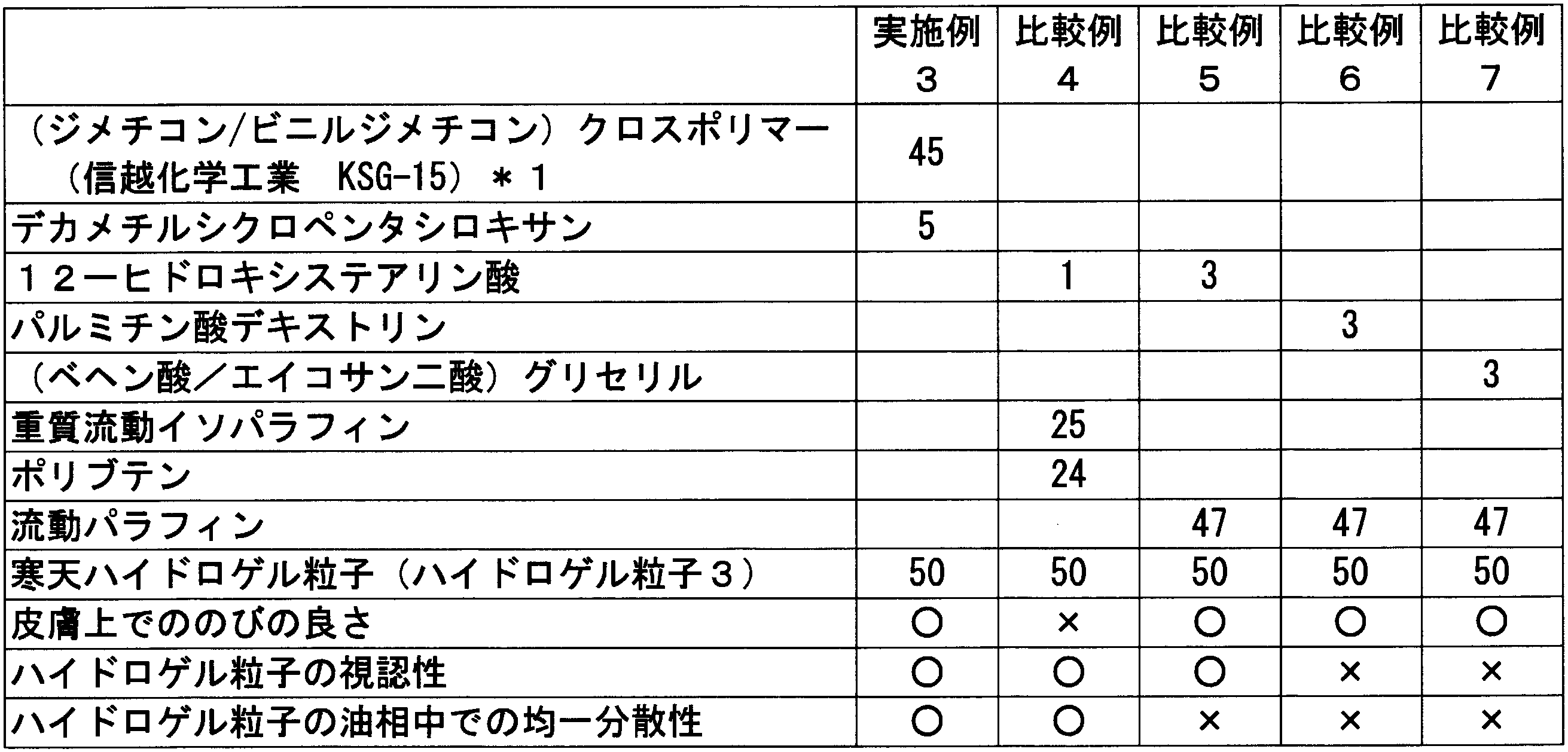
<製法>
「実施例3」
(ジメチコン/ビニルジメチコン)クロスポリマーとシクロメチコンを均一に混合した後、ハイドロゲル粒子を混合し均一になるまで撹拌して、皮膚化粧料を得た。
「比較例4~7」
12-ヒドロキシステアリン酸、パルミチン酸デキストリン、(ベヘン酸/エイコサン二酸)グリセリル等を90℃に加熱した流動油分に添加後融解し、70度付近まで冷却後ハイドロゲル粒子を混合し静置固化して、皮膚化粧料を得た。

成分1~6を90℃に加熱して溶解させた。この溶液を65℃まで冷却し、開口径8mmのノズルから40℃のデカメチルシクロペンタシロキサン中に吐出させ、混合液を攪拌しながら30℃まで冷却し、適切なメッシュサイズの篩またはろ布を用いて外油液をろ過し、それぞれの寒天ハイドロゲル粒子(ハイドロゲル粒子4~7)を得た。

<製法>
(ジメチコン/ビニルジメチコン)クロスポリマーと寒天ハイドロゲル粒子を室温にて混合することにより、実施例と比較例の皮膚化粧料を得た。
これに対して、寒天水溶液の破断応力が本発明の要件を満たす実施例4及び実施例5は、「皮膚上に塗布した場合のマッサージ効果感」及び「皮膚上に塗布した際のカスの残り」に優れた効果を有していることが分かる。
Claims (3)
- 冷却固化後の破断応力が0.005~0.1MPaとなるよう調製した寒天水溶液を油性溶媒中で攪拌しながら冷却して得られる平均粒径が0.2~5mmの寒天ハイドロゲル粒子と、シリコーンを化学的に3次元架橋した微粒子とシリコーン油及び/又は炭化水素油とを混合した油性ジェルとを配合することを特徴とする皮膚化粧料。
- 前記寒天ハイドロゲル粒子の配合量が、皮膚化粧料全量に対して1~80質量%であることを特徴とする請求項1記載の皮膚化粧料。
- 前記皮膚化粧料が、マッサージ化粧料であることを特徴とする請求項1又は2記載の皮膚化粧料。
Priority Applications (7)
| Application Number | Priority Date | Filing Date | Title |
|---|---|---|---|
| KR1020127031273A KR101301442B1 (ko) | 2010-09-17 | 2011-07-14 | 피부화장료 |
| HK13113719.8A HK1186129B (en) | 2010-09-17 | 2011-07-14 | Skin cosmetic |
| ES11824879.8T ES2641867T3 (es) | 2010-09-17 | 2011-07-14 | Cosmético para la piel |
| EP11824879.8A EP2617409B1 (en) | 2010-09-17 | 2011-07-14 | Skin cosmetic |
| CN201180044628.6A CN103249397B (zh) | 2010-09-17 | 2011-07-14 | 皮肤化妆品 |
| US13/816,557 US20130142853A1 (en) | 2010-09-17 | 2011-07-14 | Skin Cosmetic |
| US13/941,467 US9757312B2 (en) | 2010-09-17 | 2013-07-13 | Method of skin massaging |
Applications Claiming Priority (2)
| Application Number | Priority Date | Filing Date | Title |
|---|---|---|---|
| JP2010209297A JP5073031B2 (ja) | 2010-09-17 | 2010-09-17 | 皮膚化粧料 |
| JP2010-209297 | 2010-09-17 |
Related Child Applications (2)
| Application Number | Title | Priority Date | Filing Date |
|---|---|---|---|
| US13/816,557 A-371-Of-International US20130142853A1 (en) | 2010-09-17 | 2011-07-14 | Skin Cosmetic |
| US13/941,467 Continuation US9757312B2 (en) | 2010-09-17 | 2013-07-13 | Method of skin massaging |
Publications (1)
| Publication Number | Publication Date |
|---|---|
| WO2012035870A1 true WO2012035870A1 (ja) | 2012-03-22 |
Family
ID=45831345
Family Applications (1)
| Application Number | Title | Priority Date | Filing Date |
|---|---|---|---|
| PCT/JP2011/066097 Ceased WO2012035870A1 (ja) | 2010-09-17 | 2011-07-14 | 皮膚化粧料 |
Country Status (8)
| Country | Link |
|---|---|
| US (2) | US20130142853A1 (ja) |
| EP (1) | EP2617409B1 (ja) |
| JP (1) | JP5073031B2 (ja) |
| KR (1) | KR101301442B1 (ja) |
| CN (1) | CN103249397B (ja) |
| ES (1) | ES2641867T3 (ja) |
| TW (1) | TWI482637B (ja) |
| WO (1) | WO2012035870A1 (ja) |
Families Citing this family (12)
| Publication number | Priority date | Publication date | Assignee | Title |
|---|---|---|---|---|
| BR112015007118A2 (pt) * | 2012-10-11 | 2017-07-04 | Unilever Nv | composição cosmética e processo. |
| JP6039369B2 (ja) * | 2012-11-06 | 2016-12-07 | 花王株式会社 | 水中油型乳化化粧料 |
| JP2014210770A (ja) * | 2013-04-03 | 2014-11-13 | 株式会社コーセー | 化粧料 |
| FR3063899B1 (fr) * | 2017-03-17 | 2019-04-19 | Capsum | Compositions comprenant une phase grasse et une phase aqueuse sous forme de spheres solides |
| CN108938459A (zh) * | 2018-08-13 | 2018-12-07 | 广州荣创优品科技有限公司 | 一种双相护肤品组合物及其制备方法 |
| EP3897513A1 (en) * | 2018-12-19 | 2021-10-27 | L V M H Recherche | Redispersible three-layer cosmetic |
| FR3091165B1 (fr) | 2018-12-31 | 2021-12-31 | Lvmh Rech | Composition cosmétique solide comprenant des sphéroïdes aqueux en dispersion dans une phase continue anhydre solide |
| US20220354756A1 (en) | 2019-07-24 | 2022-11-10 | Shiseido Company, Ltd. | A water-in-oil emulsion with emollient and methods of using the same |
| EP4273187A4 (en) * | 2021-02-05 | 2024-10-09 | Kao Corporation | HYDROGEL STRUCTURE |
| CN112957279A (zh) * | 2021-02-26 | 2021-06-15 | 广州米卡美妆有限公司 | 一种水凝胶粒子及其在个人护理产品制备中的应用 |
| US20250049654A1 (en) | 2021-12-09 | 2025-02-13 | Shiseido Company, Ltd. | Cosmetic composition |
| CN115364011A (zh) * | 2022-08-25 | 2022-11-22 | 皓雨(广州)化妆品制造有限公司 | 一种球形护肤基质及其制备方法与应用 |
Citations (10)
| Publication number | Priority date | Publication date | Assignee | Title |
|---|---|---|---|---|
| JPH01129433A (ja) | 1987-11-16 | 1989-05-22 | Matsushita Electron Corp | パターン自動検査方法 |
| JPH01193216A (ja) | 1988-01-29 | 1989-08-03 | Fuji Kapuseru Kk | ソフトカプセル及び球状物 |
| JPH02117610A (ja) | 1988-10-26 | 1990-05-02 | Kobayashi Kose Co Ltd | エマルシヨン内包カプセル含有化粧料 |
| JP2000239147A (ja) * | 1999-02-18 | 2000-09-05 | Naris Cosmetics Co Ltd | 化粧料 |
| JP2002159838A (ja) * | 2000-08-14 | 2002-06-04 | Kao Corp | ハイドロゲル粒子 |
| JP2003055141A (ja) * | 2001-08-06 | 2003-02-26 | Kose Corp | 油中水型乳化化粧料 |
| JP2003286125A (ja) * | 2002-03-28 | 2003-10-07 | Kose Corp | 油中水型乳化化粧料 |
| JP2005179374A (ja) * | 1999-07-12 | 2005-07-07 | L'oreal Sa | 油中水型エマルション形態の組成物とその美容のための使用 |
| JP3756043B2 (ja) | 2000-06-30 | 2006-03-15 | 花王株式会社 | 皮膚化粧料 |
| JP2007022950A (ja) | 2005-07-14 | 2007-02-01 | Shiseido Co Ltd | 複合組成物 |
Family Cites Families (7)
| Publication number | Priority date | Publication date | Assignee | Title |
|---|---|---|---|---|
| GB9622580D0 (en) * | 1996-10-30 | 1997-01-08 | Unilever Plc | Antiperspirant composition |
| US6319507B1 (en) * | 1997-05-02 | 2001-11-20 | Kobo Products, Inc. | Agar gel bead composition and method |
| US5961990A (en) * | 1997-05-02 | 1999-10-05 | Kobo Products S.A.R.L. | Cosmetic particulate gel delivery system and method of preparing complex gel particles |
| JP4229548B2 (ja) * | 1999-11-16 | 2009-02-25 | 東レ・ダウコーニング株式会社 | 化粧品、および化粧品の製造方法 |
| US20020034525A1 (en) * | 2000-06-30 | 2002-03-21 | Kao Corporation | Skin cosmetic composition |
| WO2003024413A1 (en) * | 2001-09-14 | 2003-03-27 | Shin-Etsu Chemical Co., Ltd. | Composition and cosmetic preparation containing the same |
| JP4823675B2 (ja) * | 2005-12-16 | 2011-11-24 | 花王株式会社 | ハイドロゲル粒子の製造方法、並びに、それによって製造されるハイドロゲル粒子及びそれを用いた分散体 |
-
2010
- 2010-09-17 JP JP2010209297A patent/JP5073031B2/ja active Active
-
2011
- 2011-07-14 KR KR1020127031273A patent/KR101301442B1/ko not_active Expired - Fee Related
- 2011-07-14 WO PCT/JP2011/066097 patent/WO2012035870A1/ja not_active Ceased
- 2011-07-14 ES ES11824879.8T patent/ES2641867T3/es active Active
- 2011-07-14 EP EP11824879.8A patent/EP2617409B1/en active Active
- 2011-07-14 US US13/816,557 patent/US20130142853A1/en not_active Abandoned
- 2011-07-14 CN CN201180044628.6A patent/CN103249397B/zh active Active
- 2011-07-18 TW TW100125269A patent/TWI482637B/zh not_active IP Right Cessation
-
2013
- 2013-07-13 US US13/941,467 patent/US9757312B2/en active Active
Patent Citations (10)
| Publication number | Priority date | Publication date | Assignee | Title |
|---|---|---|---|---|
| JPH01129433A (ja) | 1987-11-16 | 1989-05-22 | Matsushita Electron Corp | パターン自動検査方法 |
| JPH01193216A (ja) | 1988-01-29 | 1989-08-03 | Fuji Kapuseru Kk | ソフトカプセル及び球状物 |
| JPH02117610A (ja) | 1988-10-26 | 1990-05-02 | Kobayashi Kose Co Ltd | エマルシヨン内包カプセル含有化粧料 |
| JP2000239147A (ja) * | 1999-02-18 | 2000-09-05 | Naris Cosmetics Co Ltd | 化粧料 |
| JP2005179374A (ja) * | 1999-07-12 | 2005-07-07 | L'oreal Sa | 油中水型エマルション形態の組成物とその美容のための使用 |
| JP3756043B2 (ja) | 2000-06-30 | 2006-03-15 | 花王株式会社 | 皮膚化粧料 |
| JP2002159838A (ja) * | 2000-08-14 | 2002-06-04 | Kao Corp | ハイドロゲル粒子 |
| JP2003055141A (ja) * | 2001-08-06 | 2003-02-26 | Kose Corp | 油中水型乳化化粧料 |
| JP2003286125A (ja) * | 2002-03-28 | 2003-10-07 | Kose Corp | 油中水型乳化化粧料 |
| JP2007022950A (ja) | 2005-07-14 | 2007-02-01 | Shiseido Co Ltd | 複合組成物 |
Also Published As
| Publication number | Publication date |
|---|---|
| KR20120138837A (ko) | 2012-12-26 |
| HK1186129A1 (zh) | 2014-03-07 |
| US20130142853A1 (en) | 2013-06-06 |
| KR101301442B1 (ko) | 2013-08-28 |
| CN103249397B (zh) | 2016-04-20 |
| JP5073031B2 (ja) | 2012-11-14 |
| TW201212945A (en) | 2012-04-01 |
| EP2617409A1 (en) | 2013-07-24 |
| EP2617409A4 (en) | 2015-06-17 |
| US9757312B2 (en) | 2017-09-12 |
| EP2617409B1 (en) | 2017-08-23 |
| TWI482637B (zh) | 2015-05-01 |
| US20130302388A1 (en) | 2013-11-14 |
| JP2012062289A (ja) | 2012-03-29 |
| CN103249397A (zh) | 2013-08-14 |
| ES2641867T3 (es) | 2017-11-14 |
Similar Documents
| Publication | Publication Date | Title |
|---|---|---|
| JP5073031B2 (ja) | 皮膚化粧料 | |
| JP2010138074A (ja) | 水系分散体及び水系化粧料 | |
| JP3659395B2 (ja) | 親水性の増粘化合物と多糖類アルキルエーテルを含有するエマルション及び該エマルションを含有する組成物及びその用途 | |
| JP7671952B2 (ja) | 水中油型乳化化粧料 | |
| ES2486790T3 (es) | Cosmético | |
| JP3935421B2 (ja) | クレンジング用組成物 | |
| TW201900142A (zh) | 水中油型乳化組合物 | |
| KR101197489B1 (ko) | 셀프태닝 화장료 | |
| JP2007001994A (ja) | 化粧料 | |
| JP2000239147A (ja) | 化粧料 | |
| JP2008044901A (ja) | 水中油型メイクアップ化粧料 | |
| WO2020009078A1 (ja) | メイクアップリムーバー | |
| JP2004107306A (ja) | 皮膚化粧料 | |
| JP7785541B2 (ja) | 水中油型乳化日焼け止め化粧料 | |
| JP7818899B2 (ja) | 高内油相水中油型乳化組成物 | |
| JP2003306410A (ja) | 粉末含有油中水型乳化化粧料 | |
| CN112533582B (zh) | 凝胶粒子及包含该凝胶粒子的皮肤外用剂 | |
| KR101932687B1 (ko) | 캡슐형 립 그로스 조성물 및 그 제조방법 | |
| JP2022086863A (ja) | 水中油型乳化化粧料 | |
| HK1186129B (en) | Skin cosmetic | |
| JP2000355518A (ja) | ゲル状化粧料 | |
| JP7782828B2 (ja) | 水中油型化粧料 | |
| JP2001158714A (ja) | 高内水相油中水型乳化化粧料 | |
| CN109069353A (zh) | 化妆品 | |
| JP2023073678A (ja) | 液体毛髪保護化粧料 |
Legal Events
| Date | Code | Title | Description |
|---|---|---|---|
| WWE | Wipo information: entry into national phase |
Ref document number: 201180044628.6 Country of ref document: CN |
|
| 121 | Ep: the epo has been informed by wipo that ep was designated in this application |
Ref document number: 11824879 Country of ref document: EP Kind code of ref document: A1 |
|
| ENP | Entry into the national phase |
Ref document number: 20127031273 Country of ref document: KR Kind code of ref document: A |
|
| WWE | Wipo information: entry into national phase |
Ref document number: 13816557 Country of ref document: US |
|
| REEP | Request for entry into the european phase |
Ref document number: 2011824879 Country of ref document: EP |
|
| WWE | Wipo information: entry into national phase |
Ref document number: 2011824879 Country of ref document: EP |
|
| NENP | Non-entry into the national phase |
Ref country code: DE |