WO2012042813A1 - 空気ばね装置 - Google Patents
空気ばね装置 Download PDFInfo
- Publication number
- WO2012042813A1 WO2012042813A1 PCT/JP2011/005375 JP2011005375W WO2012042813A1 WO 2012042813 A1 WO2012042813 A1 WO 2012042813A1 JP 2011005375 W JP2011005375 W JP 2011005375W WO 2012042813 A1 WO2012042813 A1 WO 2012042813A1
- Authority
- WO
- WIPO (PCT)
- Prior art keywords
- air spring
- plate
- elastic body
- surface plate
- support plate
- Prior art date
- Legal status (The legal status is an assumption and is not a legal conclusion. Google has not performed a legal analysis and makes no representation as to the accuracy of the status listed.)
- Ceased
Links
Images



Classifications
-
- F—MECHANICAL ENGINEERING; LIGHTING; HEATING; WEAPONS; BLASTING
- F16—ENGINEERING ELEMENTS AND UNITS; GENERAL MEASURES FOR PRODUCING AND MAINTAINING EFFECTIVE FUNCTIONING OF MACHINES OR INSTALLATIONS; THERMAL INSULATION IN GENERAL
- F16F—SPRINGS; SHOCK-ABSORBERS; MEANS FOR DAMPING VIBRATION
- F16F9/00—Springs, vibration-dampers, shock-absorbers, or similarly-constructed movement-dampers using a fluid or the equivalent as damping medium
- F16F9/02—Springs, vibration-dampers, shock-absorbers, or similarly-constructed movement-dampers using a fluid or the equivalent as damping medium using gas only or vacuum
- F16F9/04—Springs, vibration-dampers, shock-absorbers, or similarly-constructed movement-dampers using a fluid or the equivalent as damping medium using gas only or vacuum in a chamber with a flexible wall
- F16F9/05—Springs, vibration-dampers, shock-absorbers, or similarly-constructed movement-dampers using a fluid or the equivalent as damping medium using gas only or vacuum in a chamber with a flexible wall the flexible wall being of the rolling diaphragm type
-
- F—MECHANICAL ENGINEERING; LIGHTING; HEATING; WEAPONS; BLASTING
- F16—ENGINEERING ELEMENTS AND UNITS; GENERAL MEASURES FOR PRODUCING AND MAINTAINING EFFECTIVE FUNCTIONING OF MACHINES OR INSTALLATIONS; THERMAL INSULATION IN GENERAL
- F16F—SPRINGS; SHOCK-ABSORBERS; MEANS FOR DAMPING VIBRATION
- F16F9/00—Springs, vibration-dampers, shock-absorbers, or similarly-constructed movement-dampers using a fluid or the equivalent as damping medium
- F16F9/02—Springs, vibration-dampers, shock-absorbers, or similarly-constructed movement-dampers using a fluid or the equivalent as damping medium using gas only or vacuum
- F16F9/04—Springs, vibration-dampers, shock-absorbers, or similarly-constructed movement-dampers using a fluid or the equivalent as damping medium using gas only or vacuum in a chamber with a flexible wall
-
- B—PERFORMING OPERATIONS; TRANSPORTING
- B61—RAILWAYS
- B61F—RAIL VEHICLE SUSPENSIONS, e.g. UNDERFRAMES, BOGIES OR ARRANGEMENTS OF WHEEL AXLES; RAIL VEHICLES FOR USE ON TRACKS OF DIFFERENT WIDTH; PREVENTING DERAILING OF RAIL VEHICLES; WHEEL GUARDS, OBSTRUCTION REMOVERS OR THE LIKE FOR RAIL VEHICLES
- B61F5/00—Constructional details of bogies; Connections between bogies and vehicle underframes; Arrangements or devices for adjusting or allowing self-adjustment of wheel axles or bogies when rounding curves
- B61F5/02—Arrangements permitting limited transverse relative movements between vehicle underframe or bolster and bogie; Connections between underframes and bogies
- B61F5/04—Bolster supports or mountings
- B61F5/10—Bolster supports or mountings incorporating fluid springs
-
- F—MECHANICAL ENGINEERING; LIGHTING; HEATING; WEAPONS; BLASTING
- F16—ENGINEERING ELEMENTS AND UNITS; GENERAL MEASURES FOR PRODUCING AND MAINTAINING EFFECTIVE FUNCTIONING OF MACHINES OR INSTALLATIONS; THERMAL INSULATION IN GENERAL
- F16F—SPRINGS; SHOCK-ABSORBERS; MEANS FOR DAMPING VIBRATION
- F16F1/00—Springs
- F16F1/36—Springs made of rubber or other material having high internal friction, e.g. thermoplastic elastomers
-
- F—MECHANICAL ENGINEERING; LIGHTING; HEATING; WEAPONS; BLASTING
- F16—ENGINEERING ELEMENTS AND UNITS; GENERAL MEASURES FOR PRODUCING AND MAINTAINING EFFECTIVE FUNCTIONING OF MACHINES OR INSTALLATIONS; THERMAL INSULATION IN GENERAL
- F16F—SPRINGS; SHOCK-ABSORBERS; MEANS FOR DAMPING VIBRATION
- F16F13/00—Units comprising springs of the non-fluid type as well as vibration-dampers, shock-absorbers, or fluid springs
- F16F13/002—Units comprising springs of the non-fluid type as well as vibration-dampers, shock-absorbers, or fluid springs comprising at least one fluid spring
-
- F—MECHANICAL ENGINEERING; LIGHTING; HEATING; WEAPONS; BLASTING
- F16—ENGINEERING ELEMENTS AND UNITS; GENERAL MEASURES FOR PRODUCING AND MAINTAINING EFFECTIVE FUNCTIONING OF MACHINES OR INSTALLATIONS; THERMAL INSULATION IN GENERAL
- F16F—SPRINGS; SHOCK-ABSORBERS; MEANS FOR DAMPING VIBRATION
- F16F15/00—Suppression of vibrations in systems; Means or arrangements for avoiding or reducing out-of-balance forces, e.g. due to motion
- F16F15/02—Suppression of vibrations of non-rotating, e.g. reciprocating systems; Suppression of vibrations of rotating systems by use of members not moving with the rotating systems
- F16F15/023—Suppression of vibrations of non-rotating, e.g. reciprocating systems; Suppression of vibrations of rotating systems by use of members not moving with the rotating systems using fluid means
-
- F—MECHANICAL ENGINEERING; LIGHTING; HEATING; WEAPONS; BLASTING
- F16—ENGINEERING ELEMENTS AND UNITS; GENERAL MEASURES FOR PRODUCING AND MAINTAINING EFFECTIVE FUNCTIONING OF MACHINES OR INSTALLATIONS; THERMAL INSULATION IN GENERAL
- F16F—SPRINGS; SHOCK-ABSORBERS; MEANS FOR DAMPING VIBRATION
- F16F15/00—Suppression of vibrations in systems; Means or arrangements for avoiding or reducing out-of-balance forces, e.g. due to motion
- F16F15/02—Suppression of vibrations of non-rotating, e.g. reciprocating systems; Suppression of vibrations of rotating systems by use of members not moving with the rotating systems
- F16F15/04—Suppression of vibrations of non-rotating, e.g. reciprocating systems; Suppression of vibrations of rotating systems by use of members not moving with the rotating systems using elastic means
Definitions
- the present invention relates to an air spring device in which an upper plate and a lower plate are hermetically connected to each other with a cylindrical flexible film body, and an air spring in which gas is sealed and a support plate are connected with an elastic member.
- the present invention relates to an air spring device suitable for use in a railway vehicle.
- the air spring is deflated by puncture or the like, it exhibits a spring characteristic that is soft in the vertical direction, and is high in riding on the vehicle.
- the present invention proposes a technique for preventing a decrease in durability due to a large horizontal input effect while ensuring comfort.
- an air spring device that is interposed between a vehicle and a carriage and is used mainly for use in Europe. Because of the distance, even when the air spring is deflated, the vehicle must travel at a normal speed for a certain distance. Therefore, even if such deflation occurs, the vehicle From the standpoint of ensuring high ride comfort, an air spring device that can exhibit sufficiently soft spring characteristics in the vertical direction is desired.
- an outer cylinder, an inner cylinder, a diaphragm disposed over both of these, and a conical or pyramidal outer periphery An air spring comprising a support member having a surface and an annular elastic body provided across the outer peripheral surface of the support member and the inner cylinder, wherein the shock absorber having the elastic member is The elastic member is arranged between a cylinder and the support member, and the elastic deformation of the elastic member due to relative movement between the inner cylinder and the support member is started after the elastic body is elastically deformed by a predetermined amount.
- an "ring-shaped elastic body provided across the outer peripheral surface of the support member and the inner cylinder is used during normal normal operation. Although it has a soft spring characteristic, As you can exert hard spring characteristics so as to be some of the lower back, and. “Which could be improved to what has nonlinear characteristics provided.
- the “annular elastic body 100” has a frustum shape having different sizes. Since the “annular rubber material 100A to 100C” and the “annular metal members 100a, 100b” are “laminated rubber” which is alternately laminated, the load in the vertical direction causes shear deformation of the “annular elastic body 100”. However, since the “annular metal members 100a and 100b” that are not elastically deformed are interposed between the “annular rubber materials 100A to 100C”, the “diaphragm 101” is particularly suitable.
- the upper or lower plate of the air spring and the support plate are connected by an elastic body made of only an elastic material that does not contain a rigid material such as a metal material in order to exhibit soft spring characteristics in both the vertical and horizontal directions.
- an upper plate or a lower plate is provided in the central area of the elastic body adjacent to the support plate. It has been devised to form recesses that are recessed toward.
- An object of the present invention is to solve such a problem of the prior art, and the object of the present invention is to be interposed between an air spring and a support plate so that they are mutually connected.
- the elastic member to be connected is composed of an elastic body made of only an elastic material, while achieving a soft spring characteristic in the vertical direction and the horizontal direction, a desired rigidity in the horizontal direction is achieved when a large load is applied in the vertical direction. It is in providing the air spring apparatus which can exhibit durability and can improve durability performance.
- the air spring device includes an air spring in which an upper surface plate and a lower surface plate are hermetically connected with a cylindrical flexible film body and gas is sealed therein, and the upper surface plate or the lower surface plate of the air spring.
- a support plate disposed at a required interval; an upper plate or a lower plate; and an elastic body made only of an elastic material for connecting the support plate to each other.
- a recess is formed that is recessed toward the upper surface plate or the lower surface plate, and the elastic body is surrounded by an annular body provided on the support plate and restrained.
- the upper surface plate or the lower surface plate is provided with a protruding portion that protrudes to the inside of the annular body.
- the annular body may be formed integrally with the support plate, or may be a member separate from the support plate attached to the support plate.
- the support plate is provided with a raised portion that enters the concave portion of the elastic body.
- the inside of the protruding portion of the upper surface plate or the lower surface plate is a gas chamber communicating with the air spring.
- the air spring and the support plate are connected to each other by the elastic body that does not include the rigid material and is composed of only the elastic material, and the elastic body is adjacent to the support plate.
- the concave portion recessed toward the upper surface plate or the lower surface plate is formed, so that the entire elastic body made only of an elastic material with respect to the vertical and horizontal inputs to the air spring device,
- the elastic body is greatly elastically deformed as compared with the case of laminating with a rigid plate, and the concave portion functions as a clearance for a part of the elastic body, particularly for the input in the vertical direction.
- the support plate is provided with an annular body that surrounds and restrains the portion of the elastic body on the side of the support plate, and the upper surface plate or the lower surface plate is provided with a protruding portion that protrudes to the inside of the annular body.
- the protrusions of the upper surface plate or the lower surface plate try to enter the inside of the annular body of the support plate.
- the elastic body portion sandwiched between the protrusion and the annular body mainly undergoes compression deformation, the horizontal input is elastically supported while exhibiting high rigidity. .
- the cylindrical flexible film body in which the internal pressure and the horizontal rigidity increase with the increase of the support load, causes the protrusion to move inside the annular body. Since it functions to further enter, the horizontal spring characteristics of the air spring device can be hardened as the support load in the vertical direction increases, and as a result, the bottom plate or the top plate as described above. It is possible to prevent the deformation of the air spring from being inclined with respect to the horizontal direction, and to effectively prevent the deterioration of the durability performance of the air spring due to the occurrence of the deformation.
- the support plate when the support plate is provided with a raised portion that enters the concave portion of the elastic body, when the elastic body is greatly deformed in the horizontal direction by the action of a large horizontal input to the device, the raised portion is Since it functions to abut against the inner surface of the concave portion of the elastic body and regulate the amount of horizontal displacement between the support plate and the air spring, by appropriately selecting the size and shape of such a raised portion, as described above.
- the horizontal spring characteristic of the air spring device can be further hardened as required.
- the inside of the protruding portion of the upper surface plate or the lower surface plate is a gas chamber communicating with the air spring
- the internal volume of the air spring increases, and the internal pressure of the air spring increases due to the vertical input.
- the effect of relaxing can be obtained, and the air spring device can be softened in the vertical spring characteristics when the air spring is not punctured and functions effectively. It will be further improved.
- FIG. 1 is a perspective view showing an embodiment of an air spring device according to the present invention with a part thereof broken away.
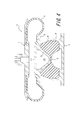
- FIG. FIG. 2 is a longitudinal sectional view taken along line II-II in FIG. 1, showing the air spring device in FIG. It is a principal part expanded sectional view of FIG. It is a figure similar to FIG. 2 which shows other embodiment. It is a longitudinal cross-sectional view which shows the conventional air spring apparatus.
- the air spring device shown in FIG. 1 is a cylindrical flexible film body formed by embedding a reinforcing layer (not shown) inside each other of, for example, an upper surface plate 1 and a lower surface plate 2 that can be formed into a disk shape. 3, an air spring 4 which is hermetically coupled and gas is enclosed therein, a support plate 5 of the air spring 4 which is disposed at a predetermined interval from the lower surface plate 2, the lower surface plate 2 and the support An elastic body 6 for connecting the plates 5 to each other is provided.
- the air spring device shown in FIG. 1 can be made as if it is upside down by connecting the upper surface plate of the air spring and the support plate with an elastic body. .
- the upper surface plate 1, the lower surface plate 2, and the support plate 5 are each composed of, for example, a metal material, a plastic material, or other rigid material, while the elastic body 6 does not include such a rigid material. It consists only of elastic materials such as rubber and elastomer.
- the elastic body 6 By constituting the elastic body 6 only from an elastic material, the elastic member is elastically deformed between the rigid members as in a conventional air spring device having a laminated structure in which a rigid member and an elastic member are laminated. Is not restrained, and the amount of deformation of the elastic body 6 itself is increased by the absence of the rigid member. Therefore, the elastic constant of the elastic body 6 and thus the air spring device is effectively reduced. Can be reduced.
- a recess 7 that is recessed toward the lower surface plate 2 is formed in the central region of the elastic body 6 adjacent to the support plate 5. Since the concave portion 7 allows a part of the elastic body 6 to escape into the concave portion 7 when a load in the vertical direction is input, the air spring device according to the present invention has the elastic body 6 as described above. Combined with the elastic material only, even when the air spring 4 is deflated, the spring characteristics that are sufficiently soft in the vertical direction can be exhibited. As long as the recess 7 functions as a clearance for a part of the elastic body 6, the recess 7 is not limited to the one having the bottom surface of the recess as a curved surface as shown in FIG. Various shapes can be used.
- the support plate 5 is provided with an annular body 8 that surrounds the end portion (lower end portion in the figure) of the elastic body 6 on the support plate side, and the lower surface plate 2 is pressed toward the inside of the annular body 8. Protrusions 9 that protrude in the protruding direction and can enter the elastic body 6 are provided.
- the protruding portion 9 of the lower surface plate 2 enters the inside of the annular body 8 of the support plate 5 and surrounds the protruding portion 9 in the elastic body portion. Is restrained by the annular body 8 provided on the support plate 5, so that the elastic body part mainly has a compressive deformation and elastically supports the horizontal input with respect to the horizontal input to the air spring device.
- the spring constant in the vertical direction of the air spring device is reduced, and still a hard spring characteristic is exhibited in the horizontal direction under the action of a large load in the vertical direction.
- the annular body 8 is formed integrally with the support plate 5.
- the annular body 8 formed of a separate member is attached to the support plate with screws or the like afterwards. Is also possible. This also applies to the formation of the protrusions 9 on the lower surface plate 2.
- the protrusion 9 and the annular body 8 described above effectively exhibit a hard spring characteristic with respect to the horizontal input in accordance with the input of the vertical load to the air spring device under actual use conditions.
- the length La is 20 to 70%, particularly 33%, of the vertical height H of the elastic body 6.
- the protruding length Lb of the annular body 8 from the support plate 5 is elastic. It is preferably 15 to 50% of the height H of the body 6 and more preferably 26%.
- the maximum diameter Ra of the projection 9 is set to the inner diameter R of the annular body 8. 40 to 80% of the above is preferable in that a required volume of the elastic body 6 contributing to realization of the soft spring characteristic in the vertical direction of the air spring device can be secured.
- the raised ridges 10 can be provided integrally or as a separate member. According to this, by appropriately selecting the dimensional shape of the raised portion 10, when a large horizontal input is applied to the air spring device, the raised portion 10 is brought into contact with the concave portion 7 of the elastic body 6. Thus, the horizontal relative displacement between the support plate 5 and the air spring 4 can be regulated.
- the raised portion 10 can have various dimensions and shapes depending on the use state of the air spring device, the shape of the concave portion, etc. Here, for example, as shown in an enlarged view in FIG.
- the separation distance Ld between the raised portion 10 and the bottom surface of the concave portion 7 was set to 65% of the depth D of the concave portion 7 of the raised portion.
- the separation distance Ld is desirably determined according to the use conditions in consideration of static and dynamic inputs when the air spring device is mounted on a vehicle and used.
- the gas chamber 11 is formed inside the protrusion 9 provided on the lower surface plate 2 and the passage 12 communicating with the air spring is provided.
- the gas chamber 11 and the passage 12 are not essential components of the present invention. .
- the raised portion 10 is provided on the support plate 5.
- the raised portion 10 is not an essential component of the present invention, the raised portion is provided on the support plate 5.
- An air spring device such as that shown in FIG.
Landscapes
- Engineering & Computer Science (AREA)
- General Engineering & Computer Science (AREA)
- Mechanical Engineering (AREA)
- Physics & Mathematics (AREA)
- Acoustics & Sound (AREA)
- Aviation & Aerospace Engineering (AREA)
- Fluid-Damping Devices (AREA)
- Vibration Prevention Devices (AREA)
- Springs (AREA)
Abstract
上面板(1)および下面板(2)の相互を、筒状可撓膜体(3)で気密に連結するとともに、内部に気体を封入した空気ばね(4)と、空気ばね(4)の前記上面板(1)もしくは下面板(2)から所要の間隔をおいて配置した支持プレート(5)と、前記上面板(1)もしくは下面板(2)および、支持プレート(5)の相互を連結する弾性体(6)とを具え、弾性体(6)の、支持プレート(5)への隣接面の中央域に、前記上面板(1)もしくは下面板(2)に向けて窪ませた凹部(7)を形成してなる空気ばね装置であって、前記弾性体(6)の、支持プレート(5)側の部分を、支持プレート(5)に設けた環状体(8)で取り囲んで拘束するとともに、前記上面板(1)もしくは下面板(2)に、前記環状体(8)の内側に迫出す突起部(9)を設けてなる。
Description
この発明は、上面板および下面板の相互を、筒状可撓膜体で気密に連結するとともに、内部に気体を封入した空気ばねと、支持プレートとを弾性部材で連結してなる空気ばね装置、なかでも鉄道車両に用いて好適な空気ばね装置に関するものであり、とくに、空気ばねの、パンク等によるデフレートの際にあっても、上下方向に軟らかいばね特性を発揮して車両への高い乗り心地を確保しつつ、水平方向の大きな入力の作用に起因する耐久性能の低下を防止する技術を提案するものである。
たとえば鉄道車両で、車両と台車との間に介装されて使用に供される空気ばね装置のうち、主に欧州向けとして使用されるものでは、とくに高速鉄道においては、車両基地間が比較的離れているため、空気ばねがデフレートされた際にも、ある程度の距離を車両が通常に近い速度で走行しなければならず、それ故に、このようなデフレートが生じた場合であっても、車両への高い乗り心地性を確保する等の観点から、上下方向に十分軟らかいばね特性を発揮し得る空気ばね装置が希求されている。
従来、この種の空気ばね装置としては、特許文献1に記載されているような、「外筒と、内筒と、これら両者に亘って配備されるダイヤフラムと、円錐面又は角錐面状の外周面を有する支持部材と、この支持部材の前記外周面と前記内筒とに亘って配備される環状の弾性体とを有して成る空気バネであって、弾性部材を有する緩衝体を前記内筒と前記支持部材との間に配備して、前記内筒と前記支持部材との相対接近移動による前記弾性部材の弾性変形が、前記弾性体が所定量弾性変形してから開始される状態に構成されている空気バネ」が知られており、この「空気バネ」によれば、「支持部材の外周面と内筒とに亘って配備される環状の弾性体を、通常の正常動作時における柔らかいバネ特性を持つものとしながらも、大荷重時には全体として硬いバネ特性が発揮できて腰のあるものとなるよう、非線形特性が備わったものに改善することができた。」とする。
しかるに、特許文献1に記載されたような「空気バネ」では、この出願の添付図面の図5に示すように、前記「環状の弾性体100」を、互いに大きさの異なる錐台形状の、「環状ゴム材100A~100C」と「環状金属部材100a、100b」とが交互に積層されて成る「積層ゴム」としていることから、上下方向の荷重は、「環状の弾性体100」の剪断変形をもって軟らかく弾性支持することができるが、「環状のゴム材100A~100C」の相互間に、弾性変形しない「環状金属部材100a、100b」を介装しているため、とくに、「ダイヤフラム101」がパンクした場合等の、「環状の弾性体100」の水平方向のばね特性を十分軟らかくすることができず、このことによって空気ばねの追従性が悪化することになるため、鉄道車両の脱線のおそれを取り除くためには、スライドシート等による摺動と、一定の変位を許容するストッパーに頼らざるを得ないという問題があった。
そこで、上下方向および水平方向ともに、軟らかいばね特性を発揮させるべく、空気ばねの上面板もしくは下面板と支持プレートとを、金属材料などの剛性材料を含まない、弾性材料のみからなる弾性体で連結した空気ばね装置が提案されており、この空気ばね装置において、上下方向のばね定数をさらに低減させるために、前記弾性体の、支持プレートへの隣接面の中央域に、上面板もしくは下面板に向けて窪ませた凹部を形成することが案出されている。
ところで、特許文献1に記載されたような「空気バネ」および、上述したような、空気ばねの上面板もしくは下面板と支持プレートとを、弾性材料のみからなる弾性体で連結した空気ばね装置では、上下方向の剛性が低いことから、満車時などの重い積載条件下、つまり、上下方向の大きな荷重の作用下での、弾性体の圧縮変形姿勢で、空気ばね装置に水平方向の入力が作用した場合、下面板もしくは上面板が水平方向に対して傾く姿勢となり易く、このことが、上面板と下面板、もしくは支持部材との接触を引き起こしたり、弾性体、ひいては、空気ばね装置の耐久性能の低下を招くという問題があった。
この発明は、従来技術が抱えるこのような問題を解決することを課題とするものであり、それの目的とするところは、空気ばねと支持プレートとの間に介装されて、これらの相互を連結する弾性部材を、弾性材料のみからなる弾性体で構成した空気ばね装置において、上下方向および水平方向に軟らかいばね特性を実現しつつ、上下方向の大きな荷重の作用時には、水平方向に所望の剛性を発揮して、耐久性能を向上させることができる空気ばね装置を提供するにある。
この発明の空気ばね装置は、上面板および下面板の相互を、筒状可撓膜体で気密に連結するとともに、内部に気体を封入した空気ばねと、空気ばねの前記上面板もしくは下面板から所要の間隔をおいて配置した支持プレートと、前記上面板もしくは下面板および、支持プレートの相互を連結する、弾性材料のみからなる弾性体とを具え、弾性体の、支持プレートへの隣接面の中央域に、前記上面板もしくは下面板に向けて窪ませた凹部を形成してなるものであって、前記弾性体の、支持プレート側の部分を、支持プレートに設けた環状体で取り囲んで拘束するとともに、前記上面板もしくは下面板に、前記環状体の内側に迫出す突起部を設けてなるものである。
なおここで、前記環状体は、支持プレートと一体形成したものすることができる他、支持プレートに取り付けられた、支持プレートとは別個の部材とすることもできる。
なおここで、前記環状体は、支持プレートと一体形成したものすることができる他、支持プレートに取り付けられた、支持プレートとは別個の部材とすることもできる。
ここで好ましくは、支持プレートに、弾性体の前記凹部内へ入り込む隆起部を設ける。
また好ましくは、上面板もしくは下面板の前記突起部の内部を、空気ばねに連通する気体室とする。
この発明の空気ばね装置によれば、空気ばねと支持プレートとの相互を、剛性材料を含まない、弾性材料だけから構成した弾性体で連結するとともに、この弾性体の、支持プレートへの隣接面の中央域に、前記上面板もしくは下面板に向けて窪ませた凹部を形成したことにより、空気ばね装置への上下方向および水平方向の入力に対し、弾性材料のみからなる弾性体の全体が、剛性板を介在させて積層する場合に比して大きく弾性変形するとともに、とくに上下方向の入力に対しては、前記凹部が、弾性体の一部分の逃げ代として機能することになるので、弾性体それ自身の、上下方向および水平方向のばね定数が、従来の、剛性部材と弾性部材とを積層させたものに比して大きく低減され、また、空気ばねがデフレートされた場合であっても、空気ばね装置が上下方向に軟らかいばね特性を発揮して、車両への優れた乗り心地性を確保することができる。
そしてここでは、支持プレートに、前記弾性体の、支部プレート側の部分を取り囲んで拘束する環状体を設けるとともに、上面板もしくは下面板に、前記環状体の内側に迫出す突起部を設けたことにより、上下方向の大きな荷重の作用の下では、上面板もしくは下面板の前記突起部が、支持プレートの環状体の内側へ入り込もうとする姿勢となり、このような姿勢での、空気ばね装置への水平方向の入力に対しては、前記突起部と環状体の間に挟まれる弾性体部分が主として圧縮変形を行うことになるので、高い剛性を発揮しつつ、水平入力を弾性支持することになる。
そして、とくに、支持荷重が大きい満車時の積載条件の際に、その支持荷重の増大に伴って、内圧および水平方向剛性が上昇する筒状可撓膜体が、突起部を環状体の内側へさらに入り込ませるべく機能することになるので、上下方向の支持荷重が増大するに従い、空気ばね装置の水平方向のばね特性を硬くすることでき、この結果として、先述したような、下面板もしくは上面板が水平方向に対して傾く姿勢となる変形が防止されて、かかる変形の発生に起因する空気ばねの耐久性能の低下を有効に防止することができる。
そして、とくに、支持荷重が大きい満車時の積載条件の際に、その支持荷重の増大に伴って、内圧および水平方向剛性が上昇する筒状可撓膜体が、突起部を環状体の内側へさらに入り込ませるべく機能することになるので、上下方向の支持荷重が増大するに従い、空気ばね装置の水平方向のばね特性を硬くすることでき、この結果として、先述したような、下面板もしくは上面板が水平方向に対して傾く姿勢となる変形が防止されて、かかる変形の発生に起因する空気ばねの耐久性能の低下を有効に防止することができる。
ここにおいて、支持プレートに、弾性体の前記凹部内へ入り込む隆起部を設けたときは、装置への大きな水平方向入力の作用によって、弾性体が水平方向に大きく変形する場合に、前記隆起部が、弾性体の凹部の内面に当接して、支持プレートと空気ばねとの水平方向の変位量を規制するべく機能するので、このような隆起部の寸法形状を適宜選択することで、上述したような、弾性体の窪みによる上下方向の軟らかいばね特性を発揮してなお、空気ばね装置の水平方向のばね特性を、所要に応じてさらに硬くすることが可能となる。
なおここで、上面板もしくは下面板の前記突起部の内部を、空気ばねに連通する気体室としたときは、空気ばねの内部容積が大きくなって、上下方向の入力による空気ばねの内圧上昇を緩和する効果が得られ、空気ばねが、パンク等しておらず有効に機能する状態での、空気ばね装置の上下方向のばね特性を軟らかくすることができ、これがため、車両への乗り心地がより一層向上されることになる。
以下に図面を参照しつつ、この発明の実施形態について説明する。
図1に示す空気ばね装置は、いずれも円盤状とすることができる上面板1および下面板2の相互を、たとえば内部に補強層(図示せず)を埋設してなる筒状可撓膜体3で気密に連結するとともに、内部に気体を封入した空気ばね4と、この空気ばね4の、ここでは下面板2から所要の間隔をおいて配置した支持プレート5と、その下面板2および支持プレート5の相互を連結する弾性体6とを具えてなるものである。
なお、図示は省略するが、空気ばねの上面板と支持プレートとを弾性体で連結して、図1に示す空気ばね装置を、あたかも上下反転姿勢としたかの如くのものとすることもできる。
図1に示す空気ばね装置は、いずれも円盤状とすることができる上面板1および下面板2の相互を、たとえば内部に補強層(図示せず)を埋設してなる筒状可撓膜体3で気密に連結するとともに、内部に気体を封入した空気ばね4と、この空気ばね4の、ここでは下面板2から所要の間隔をおいて配置した支持プレート5と、その下面板2および支持プレート5の相互を連結する弾性体6とを具えてなるものである。
なお、図示は省略するが、空気ばねの上面板と支持プレートとを弾性体で連結して、図1に示す空気ばね装置を、あたかも上下反転姿勢としたかの如くのものとすることもできる。
ここで、上面板1、下面板2および支持プレート5はそれぞれ、たとえば金属材料、プラスチック材料その他の剛性材料にて構成し、この一方で、弾性体6は、そのような剛性材料を含まずに、ゴム、エラストマー等の弾性材料のみから構成する。
弾性体6を弾性材料のみから構成することにより、従来の、剛性部材と弾性部材とを積層させた積層構造体を具える空気ばね装置のように、剛性部材の相互間で弾性部材の弾性変形が拘束されることがなく、また、剛性部材が存在しない分だけ、弾性体6それ自身の変形量が大きくなるので、弾性体6、ひいては、空気ばね装置の上下方向のばね定数を効果的に低減させることができる。
弾性体6を弾性材料のみから構成することにより、従来の、剛性部材と弾性部材とを積層させた積層構造体を具える空気ばね装置のように、剛性部材の相互間で弾性部材の弾性変形が拘束されることがなく、また、剛性部材が存在しない分だけ、弾性体6それ自身の変形量が大きくなるので、弾性体6、ひいては、空気ばね装置の上下方向のばね定数を効果的に低減させることができる。
そしてここでは、上下方向のばね定数のさらなる低減のため、弾性体6の、支持プレート5への隣接面の中央域に、下面板2に向けて窪ませた凹部7を形成する。
かかる凹部7により、上下方向の荷重が入力した際に、弾性体6の一部分が凹部7内へ逃げ変形することができるので、この発明の空気ばね装置は、上述したように、弾性体6を弾性材料のみから構成したことと相俟って、空気ばね4のデフレート時にあっても、上下方向に十分軟らかいばね特性を発揮することができる。
なお、この凹部7は、弾性体6の一部分の逃げ代として機能するものであれば、図1に示すような、凹部底面を曲面としたものに限定されることはなく、たとえば半球形状等の様々な形状とすることができる。
かかる凹部7により、上下方向の荷重が入力した際に、弾性体6の一部分が凹部7内へ逃げ変形することができるので、この発明の空気ばね装置は、上述したように、弾性体6を弾性材料のみから構成したことと相俟って、空気ばね4のデフレート時にあっても、上下方向に十分軟らかいばね特性を発揮することができる。
なお、この凹部7は、弾性体6の一部分の逃げ代として機能するものであれば、図1に示すような、凹部底面を曲面としたものに限定されることはなく、たとえば半球形状等の様々な形状とすることができる。
このように、上下方向のばね特性を軟らかくした空気ばね装置では、水平方向の剛性もまた必然的に低下することになって、とくに、上下方向の圧縮姿勢での、水平方向の入力の作用による弾性体6の大きな剪断変形に起因して、空気ばね装置に、下面板2が水平方向に対して傾く形態の変形が生じ易く、弾性体6の耐久性能が低下するおそれがあることから、この発明では、支持プレート5に、弾性体6の、支持プレート側の端部分(図では下方側の端部分)を取り囲む環状体8を設けるとともに、下面板2に、その環状体8の内側へ迫出す向きに突出して弾性体6内に入り込み可能な突起部9を設ける。
この構成によれば、上下方向の荷重の作用した場合、下面板2の突起部9が、支持プレート5の環状体8の内側へ入り込む姿勢となって、突起部9の周りを取り囲む弾性体部分の変形が、支持プレート5に設けた環状体8により拘束されるので、空気ばね装置への水平方向の入力に対しては、前記弾性体部分が主として圧縮変形をもって、水平方向入力を弾性支持することになり、この結果として、上記の如く、空気ばね装置の上下方向のばね定数を小さくしてなお、上下方向の大きな荷重の作用下で、水平方向には硬いばね特性を発揮することになり、とくに、満車条件等の支持荷重が重い積載条件時に、空気ばね4の内圧が高くなることで、弾性体6が環状体8の内側へさらに入り込む姿勢となるため、筒状可撓膜体3の水平方向の剛性の増加と併せて、弾性体6の水平剛性を上げることができる。これにより、弾性体6の耐久性の低下を有効に防止することができる。
なお、図に示すところでは、環状体8を、支持プレート5と一体的に形成するものとしたが、別個の部材で形成した環状体8を、たとえばねじ等により支持プレートに事後的に取り付けることも可能である。
そしてこのことは、突起部9の、下面板2への形成についてもまた同様である。
そしてこのことは、突起部9の、下面板2への形成についてもまた同様である。
ここで、上述した突起部9や環状体8によって、実際の使用条件にて空気ばね装置への上下方向荷重の入力に合わせ、水平方向入力に対し効果的に硬いばね特性を発揮させるという観点から、空気バネセット前、ストッパーゴムに無負荷の状態での空気ばね装置の寸法、いわゆるフリー時の寸法で、図2に縦断面図で示すように、突起部9の、下面板2からの迫出し長さLaを、弾性体6の上下方向の高さHの20~70%、とくに33%とし、また、この場合においては、環状体8の、支持プレート5からの突出長さLbを、弾性体6の高さHの15~50%、なかでも26%とすることが好ましい。
またここで、図に示すような、円錐台状の弾性体6および、倒立円錐台状の突起部9を具えた空気ばね装置では、突起部9の最大径Raを、環状体8の内径Rの40~80%とすることが、空気ばね装置の上下方向の軟らかいばね特性の実現に寄与する弾性体6の所要の体積を確保できる点で好ましい。
またここで、図に示すような、円錐台状の弾性体6および、倒立円錐台状の突起部9を具えた空気ばね装置では、突起部9の最大径Raを、環状体8の内径Rの40~80%とすることが、空気ばね装置の上下方向の軟らかいばね特性の実現に寄与する弾性体6の所要の体積を確保できる点で好ましい。
ここにおいて、空気ばね装置に作用する水平方向の入力レベルに応じて、ばね硬さをさらに高める必要がある場合は、図1、2に示すように、支持プレート5に、弾性体6の凹部7に入り込む隆起部10を、一体的に、もしくは別個の部材として設けることができる。
このことによれば、隆起部10の寸法形状を適宜選択することにより、空気ばね装置に大きな水平方向の入力が作用した際に、隆起部10の、弾性体6の凹部7への当接下で、支持プレート5と空気ばね4との水平方向の相対変位量を規制することができる。
ここで、隆起部10は、空気ばね装置の使用状態や凹部の形状などに応じて、様々な寸法形状とすることができるが、ここでは、たとえば、図3に拡大図で示すように、空気ばね装置の上下方向で、隆起部10と凹部7の底面との離隔距離Ldを、隆起部の凹部7の深さDの65%とした。
なお、この離隔距離Ldは、空気ばね装置を、車両に装着して使用に供した際の、静的および動的な入力を考慮した上で、使用条件に応じて決定することが望ましい。
このことによれば、隆起部10の寸法形状を適宜選択することにより、空気ばね装置に大きな水平方向の入力が作用した際に、隆起部10の、弾性体6の凹部7への当接下で、支持プレート5と空気ばね4との水平方向の相対変位量を規制することができる。
ここで、隆起部10は、空気ばね装置の使用状態や凹部の形状などに応じて、様々な寸法形状とすることができるが、ここでは、たとえば、図3に拡大図で示すように、空気ばね装置の上下方向で、隆起部10と凹部7の底面との離隔距離Ldを、隆起部の凹部7の深さDの65%とした。
なお、この離隔距離Ldは、空気ばね装置を、車両に装着して使用に供した際の、静的および動的な入力を考慮した上で、使用条件に応じて決定することが望ましい。
ところで、図1に示す空気ばねでは、車両への乗り心地を一層向上させることを目的として、空気ばね4が有効に機能する状態での、空気ばね装置の上下方向のばね特性を軟らかくするため、下面板2に設けた突起部9の内部に気体室11を形成し、これを空気ばねに連通する通路12を設けたが、かかる気体室11および通路12は、この発明の必須の構成ではない。
また、図1、2に示す空気ばね装置では、支持プレート5に、隆起部10を設けたが、この隆起部10もまたこの発明の必須の構成ではないので、支持プレート5に隆起部を設けない図4に示すような空気ばね装置とすることも可能である。
1 上面板
2 下面板
3 筒状可撓膜体
4 空気ばね
5 支持プレート
6 弾性体
7 凹部
8 環状体
9 突起部
10 隆起部
11 気体室
12 通路
La 突起部の迫出し長さ
Lb 環状体の突出長さ
H 弾性体の高さ
Ra 突起部の最大径
R 環状体の内径
Ld 離隔距離
D 凹部の深さ
2 下面板
3 筒状可撓膜体
4 空気ばね
5 支持プレート
6 弾性体
7 凹部
8 環状体
9 突起部
10 隆起部
11 気体室
12 通路
La 突起部の迫出し長さ
Lb 環状体の突出長さ
H 弾性体の高さ
Ra 突起部の最大径
R 環状体の内径
Ld 離隔距離
D 凹部の深さ
Claims (3)
- 上面板および下面板の相互を、筒状可撓膜体で気密に連結するとともに、内部に気体を封入した空気ばねと、空気ばねの前記上面板もしくは下面板から所要の間隔をおいて配置した支持プレートと、前記上面板もしくは下面板および、支持プレートの相互を連結する弾性体とを具え、
弾性体の、支持プレートへの隣接面の中央域に、前記上面板もしくは下面板に向けて窪ませた凹部を形成してなる空気ばね装置であって、
前記弾性体の、支持プレート側の部分を、支持プレートに設けた環状体で取り囲んで拘束するとともに、前記上面板もしくは下面板に、前記環状体の内側に迫出す突起部を設けてなる空気ばね装置。 - 支持プレートに、弾性体の前記凹部内へ入り込む隆起部を設けてなる請求項1に記載の空気ばね装置。
- 上面板もしくは下面板の前記突起部の内部を、空気ばねに連通する気体室としてなる請求項1もしくは2に記載の空気ばね装置。
Priority Applications (4)
| Application Number | Priority Date | Filing Date | Title |
|---|---|---|---|
| ES11828379T ES2706984T3 (es) | 2010-09-28 | 2011-09-26 | Dispositivo de muelle neumático |
| CN201180051628.9A CN103189664B (zh) | 2010-09-28 | 2011-09-26 | 空气弹簧装置 |
| EP11828379.5A EP2623816B1 (en) | 2010-09-28 | 2011-09-26 | Air spring device |
| KR1020137010691A KR101653439B1 (ko) | 2010-09-28 | 2011-09-26 | 공기 스프링 장치 |
Applications Claiming Priority (2)
| Application Number | Priority Date | Filing Date | Title |
|---|---|---|---|
| JP2010-217459 | 2010-09-28 | ||
| JP2010217459A JP5722582B2 (ja) | 2010-09-28 | 2010-09-28 | 空気ばね装置 |
Publications (1)
| Publication Number | Publication Date |
|---|---|
| WO2012042813A1 true WO2012042813A1 (ja) | 2012-04-05 |
Family
ID=45892305
Family Applications (1)
| Application Number | Title | Priority Date | Filing Date |
|---|---|---|---|
| PCT/JP2011/005375 Ceased WO2012042813A1 (ja) | 2010-09-28 | 2011-09-26 | 空気ばね装置 |
Country Status (6)
| Country | Link |
|---|---|
| EP (1) | EP2623816B1 (ja) |
| JP (1) | JP5722582B2 (ja) |
| KR (1) | KR101653439B1 (ja) |
| CN (1) | CN103189664B (ja) |
| ES (1) | ES2706984T3 (ja) |
| WO (1) | WO2012042813A1 (ja) |
Cited By (2)
| Publication number | Priority date | Publication date | Assignee | Title |
|---|---|---|---|---|
| WO2019080574A1 (zh) * | 2017-10-27 | 2019-05-02 | 株洲时代新材料科技股份有限公司 | 沙漏式空气弹簧组件 |
| CN113983115A (zh) * | 2021-10-26 | 2022-01-28 | 株洲时代瑞唯减振装备有限公司 | 一种大横垂比空气弹簧的装配方法 |
Families Citing this family (12)
| Publication number | Priority date | Publication date | Assignee | Title |
|---|---|---|---|---|
| WO2014020942A1 (ja) * | 2012-07-30 | 2014-02-06 | 住友電気工業株式会社 | 空気ばね |
| KR101891905B1 (ko) * | 2014-01-28 | 2018-08-24 | 가부시키가이샤 브리지스톤 | 공기 스프링 장치 및 공기 스프링 장치의 제조 방법 |
| WO2015163473A1 (ja) * | 2014-04-25 | 2015-10-29 | 本田技研工業株式会社 | 防振装置 |
| CN104985421B (zh) * | 2014-11-25 | 2018-02-23 | 惊天智能装备股份有限公司 | 连接件拆解机器人 |
| ES2685597T3 (es) * | 2014-12-15 | 2018-10-10 | G + H Schallschutz Gmbh | Sistema de resorte para el apoyo con aislamiento de vibraciones |
| CN104527694B (zh) * | 2014-12-31 | 2017-12-08 | 株洲时代新材料科技股份有限公司 | 轨道交通用空气弹簧 |
| JP2016173129A (ja) * | 2015-03-17 | 2016-09-29 | 東洋ゴム工業株式会社 | 防火カバー付き空気ばね |
| JP6526991B2 (ja) * | 2015-03-17 | 2019-06-05 | Toyo Tire株式会社 | 空気ばね |
| JP2016223457A (ja) * | 2015-05-27 | 2016-12-28 | 東洋ゴム工業株式会社 | 懸架装置用ストッパ |
| JP6637380B2 (ja) | 2016-05-20 | 2020-01-29 | 株式会社ブリヂストン | 空気ばね装置 |
| JP2018105453A (ja) * | 2016-12-27 | 2018-07-05 | 東洋ゴム工業株式会社 | 空気ばね |
| CN110194195B (zh) * | 2019-06-13 | 2020-06-05 | 中车青岛四方车辆研究所有限公司 | 空气弹簧和车辆 |
Citations (4)
| Publication number | Priority date | Publication date | Assignee | Title |
|---|---|---|---|---|
| JPS57155340U (ja) * | 1981-03-24 | 1982-09-29 | ||
| JPS60226308A (ja) * | 1984-03-29 | 1985-11-11 | ダンロツプ・リミテツド | 車輌用懸架装置 |
| JP2006329280A (ja) | 2005-05-25 | 2006-12-07 | Toyo Tire & Rubber Co Ltd | 空気ばね |
| WO2009021848A1 (en) * | 2007-08-10 | 2009-02-19 | Trelleborg Automotive Uk Ltd. | Spring assembly |
Family Cites Families (6)
| Publication number | Priority date | Publication date | Assignee | Title |
|---|---|---|---|---|
| GB362470A (en) * | 1930-07-29 | 1931-11-30 | Leopold Rado | Underlay for machines |
| CA1097380A (en) * | 1977-12-20 | 1981-03-10 | William C. Pierce | Air spring assembly |
| ES2142164T3 (es) * | 1996-05-07 | 2000-04-01 | Phoenix Ag | Resorte neumatico. |
| CN2450434Y (zh) * | 2000-11-22 | 2001-09-26 | 陈东茂 | 外罩式气垫避震器 |
| JP4297803B2 (ja) * | 2004-02-18 | 2009-07-15 | 住友金属工業株式会社 | 鉄道車両用の空気ばね及び台車 |
| JP5297603B2 (ja) * | 2007-06-11 | 2013-09-25 | 東洋ゴム工業株式会社 | 鉄道車両用空気ばね |
-
2010
- 2010-09-28 JP JP2010217459A patent/JP5722582B2/ja active Active
-
2011
- 2011-09-26 KR KR1020137010691A patent/KR101653439B1/ko active Active
- 2011-09-26 EP EP11828379.5A patent/EP2623816B1/en active Active
- 2011-09-26 WO PCT/JP2011/005375 patent/WO2012042813A1/ja not_active Ceased
- 2011-09-26 CN CN201180051628.9A patent/CN103189664B/zh active Active
- 2011-09-26 ES ES11828379T patent/ES2706984T3/es active Active
Patent Citations (4)
| Publication number | Priority date | Publication date | Assignee | Title |
|---|---|---|---|---|
| JPS57155340U (ja) * | 1981-03-24 | 1982-09-29 | ||
| JPS60226308A (ja) * | 1984-03-29 | 1985-11-11 | ダンロツプ・リミテツド | 車輌用懸架装置 |
| JP2006329280A (ja) | 2005-05-25 | 2006-12-07 | Toyo Tire & Rubber Co Ltd | 空気ばね |
| WO2009021848A1 (en) * | 2007-08-10 | 2009-02-19 | Trelleborg Automotive Uk Ltd. | Spring assembly |
Cited By (4)
| Publication number | Priority date | Publication date | Assignee | Title |
|---|---|---|---|---|
| WO2019080574A1 (zh) * | 2017-10-27 | 2019-05-02 | 株洲时代新材料科技股份有限公司 | 沙漏式空气弹簧组件 |
| RU2745464C1 (ru) * | 2017-10-27 | 2021-03-25 | Жужоу Таймс Нью Материал Текнолоджи Ко., Лтд. | Пневматический элемент по типу песочных часов |
| US11287005B2 (en) | 2017-10-27 | 2022-03-29 | Zhuzhou Times New Material Technology Co., Ltd. | Hourglass type air spring assembly |
| CN113983115A (zh) * | 2021-10-26 | 2022-01-28 | 株洲时代瑞唯减振装备有限公司 | 一种大横垂比空气弹簧的装配方法 |
Also Published As
| Publication number | Publication date |
|---|---|
| ES2706984T3 (es) | 2019-04-02 |
| KR20130065718A (ko) | 2013-06-19 |
| CN103189664A (zh) | 2013-07-03 |
| KR101653439B1 (ko) | 2016-09-01 |
| CN103189664B (zh) | 2016-01-06 |
| EP2623816B1 (en) | 2018-11-07 |
| JP2012072825A (ja) | 2012-04-12 |
| JP5722582B2 (ja) | 2015-05-20 |
| EP2623816A1 (en) | 2013-08-07 |
| EP2623816A4 (en) | 2017-09-06 |
Similar Documents
| Publication | Publication Date | Title |
|---|---|---|
| JP5722582B2 (ja) | 空気ばね装置 | |
| JP4714505B2 (ja) | 空気バネ | |
| JP5297603B2 (ja) | 鉄道車両用空気ばね | |
| JP5803930B2 (ja) | 車両用空気ばねとそれを用いた台車 | |
| CN102007318A (zh) | 空气弹簧装置 | |
| JP2009197986A (ja) | 空気ばね装置 | |
| CN101821530A (zh) | 弹簧组件 | |
| US10138972B2 (en) | Air spring and carriage for vehicle | |
| CN102384201A (zh) | 空气弹簧 | |
| JP5116523B2 (ja) | 空気ばね | |
| JP5297602B2 (ja) | 鉄道車両用懸架装置 | |
| JP2003254378A (ja) | 空気バネ | |
| KR102114570B1 (ko) | 공기 스프링 장치 | |
| CN103133592B (zh) | 移动体用防震机构及移动体用空气弹簧、使用该移动体用防震机构或空气弹簧的移动体车辆 | |
| JP5461780B2 (ja) | 空気バネ装置 | |
| JP4928757B2 (ja) | 鉄道車両用空気ばね | |
| CN103129575B (zh) | 移动体用空气弹簧及使用该空气弹簧的移动体车辆 | |
| JP4061818B2 (ja) | 免震装置 | |
| JPH0828618A (ja) | 空気ばね | |
| JPH04145240A (ja) | 異方性空気ばね | |
| JP2009156330A (ja) | 空気バネ | |
| JP5829511B2 (ja) | 空気ばね | |
| JP3170969U (ja) | 空気ばね | |
| CN108215758A (zh) | 一种带膨胀减震的车用橡胶垫板 | |
| JP2008240987A (ja) | 防振装置 |
Legal Events
| Date | Code | Title | Description |
|---|---|---|---|
| 121 | Ep: the epo has been informed by wipo that ep was designated in this application |
Ref document number: 11828379 Country of ref document: EP Kind code of ref document: A1 |
|
| NENP | Non-entry into the national phase |
Ref country code: DE |
|
| WWE | Wipo information: entry into national phase |
Ref document number: 2011828379 Country of ref document: EP |
|
| ENP | Entry into the national phase |
Ref document number: 20137010691 Country of ref document: KR Kind code of ref document: A |