WO2012049828A1 - 芳香族複素環誘導体及びそれらを用いた有機エレクトロルミネッセンス素子 - Google Patents
芳香族複素環誘導体及びそれらを用いた有機エレクトロルミネッセンス素子 Download PDFInfo
- Publication number
- WO2012049828A1 WO2012049828A1 PCT/JP2011/005668 JP2011005668W WO2012049828A1 WO 2012049828 A1 WO2012049828 A1 WO 2012049828A1 JP 2011005668 W JP2011005668 W JP 2011005668W WO 2012049828 A1 WO2012049828 A1 WO 2012049828A1
- Authority
- WO
- WIPO (PCT)
- Prior art keywords
- group
- substituted
- unsubstituted
- carbon atoms
- ring
- Prior art date
- Legal status (The legal status is an assumption and is not a legal conclusion. Google has not performed a legal analysis and makes no representation as to the accuracy of the status listed.)
- Ceased
Links
- 0 Cc(nc1c2n3)c(*)nc1c1nc(*)c(*)nc1c2nc(*)c3S Chemical compound Cc(nc1c2n3)c(*)nc1c1nc(*)c(*)nc1c2nc(*)c3S 0.000 description 4
- CYGUSWLILLCKBY-UHFFFAOYSA-N C1=C(c2cc(-[n]3c(cccc4)c4c4c3cccc4)cc(-[n]3c4ccccc4c4c3cccc4)c2)N=C(c2ccccc2)NC1c1ccccc1 Chemical compound C1=C(c2cc(-[n]3c(cccc4)c4c4c3cccc4)cc(-[n]3c4ccccc4c4c3cccc4)c2)N=C(c2ccccc2)NC1c1ccccc1 CYGUSWLILLCKBY-UHFFFAOYSA-N 0.000 description 1
- MDPDXOFVIBYAAQ-UHFFFAOYSA-N CC1(C(C(N=C2C#N)=C3N=C4C#N)N=C2C#N)N=C(C2NC2)C(C#N)=NC1=C3N=C4C#N Chemical compound CC1(C(C(N=C2C#N)=C3N=C4C#N)N=C2C#N)N=C(C2NC2)C(C#N)=NC1=C3N=C4C#N MDPDXOFVIBYAAQ-UHFFFAOYSA-N 0.000 description 1
- PHBJYIUTTPNUBD-UHFFFAOYSA-N c(cc1)ccc1-c1nc2ccccc2[n]1-c(cc1)ccc1-c1c(cccc2)c2c(-c2cc(cccc3)c3cc2)c2c1cccc2 Chemical compound c(cc1)ccc1-c1nc2ccccc2[n]1-c(cc1)ccc1-c1c(cccc2)c2c(-c2cc(cccc3)c3cc2)c2c1cccc2 PHBJYIUTTPNUBD-UHFFFAOYSA-N 0.000 description 1
Classifications
-
- H—ELECTRICITY
- H10—SEMICONDUCTOR DEVICES; ELECTRIC SOLID-STATE DEVICES NOT OTHERWISE PROVIDED FOR
- H10K—ORGANIC ELECTRIC SOLID-STATE DEVICES
- H10K85/00—Organic materials used in the body or electrodes of devices covered by this subclass
- H10K85/60—Organic compounds having low molecular weight
- H10K85/649—Aromatic compounds comprising a hetero atom
- H10K85/657—Polycyclic condensed heteroaromatic hydrocarbons
- H10K85/6572—Polycyclic condensed heteroaromatic hydrocarbons comprising only nitrogen in the heteroaromatic polycondensed ring system, e.g. phenanthroline or carbazole
-
- C—CHEMISTRY; METALLURGY
- C07—ORGANIC CHEMISTRY
- C07D—HETEROCYCLIC COMPOUNDS
- C07D219/00—Heterocyclic compounds containing acridine or hydrogenated acridine ring systems
- C07D219/02—Heterocyclic compounds containing acridine or hydrogenated acridine ring systems with only hydrogen, hydrocarbon or substituted hydrocarbon radicals, directly attached to carbon atoms of the ring system
-
- C—CHEMISTRY; METALLURGY
- C07—ORGANIC CHEMISTRY
- C07D—HETEROCYCLIC COMPOUNDS
- C07D401/00—Heterocyclic compounds containing two or more hetero rings, having nitrogen atoms as the only ring hetero atoms, at least one ring being a six-membered ring with only one nitrogen atom
- C07D401/02—Heterocyclic compounds containing two or more hetero rings, having nitrogen atoms as the only ring hetero atoms, at least one ring being a six-membered ring with only one nitrogen atom containing two hetero rings
- C07D401/04—Heterocyclic compounds containing two or more hetero rings, having nitrogen atoms as the only ring hetero atoms, at least one ring being a six-membered ring with only one nitrogen atom containing two hetero rings directly linked by a ring-member-to-ring-member bond
-
- C—CHEMISTRY; METALLURGY
- C07—ORGANIC CHEMISTRY
- C07D—HETEROCYCLIC COMPOUNDS
- C07D401/00—Heterocyclic compounds containing two or more hetero rings, having nitrogen atoms as the only ring hetero atoms, at least one ring being a six-membered ring with only one nitrogen atom
- C07D401/14—Heterocyclic compounds containing two or more hetero rings, having nitrogen atoms as the only ring hetero atoms, at least one ring being a six-membered ring with only one nitrogen atom containing three or more hetero rings
-
- C—CHEMISTRY; METALLURGY
- C07—ORGANIC CHEMISTRY
- C07D—HETEROCYCLIC COMPOUNDS
- C07D403/00—Heterocyclic compounds containing two or more hetero rings, having nitrogen atoms as the only ring hetero atoms, not provided for by group C07D401/00
- C07D403/14—Heterocyclic compounds containing two or more hetero rings, having nitrogen atoms as the only ring hetero atoms, not provided for by group C07D401/00 containing three or more hetero rings
-
- C—CHEMISTRY; METALLURGY
- C07—ORGANIC CHEMISTRY
- C07D—HETEROCYCLIC COMPOUNDS
- C07D405/00—Heterocyclic compounds containing both one or more hetero rings having oxygen atoms as the only ring hetero atoms, and one or more rings having nitrogen as the only ring hetero atom
- C07D405/02—Heterocyclic compounds containing both one or more hetero rings having oxygen atoms as the only ring hetero atoms, and one or more rings having nitrogen as the only ring hetero atom containing two hetero rings
- C07D405/04—Heterocyclic compounds containing both one or more hetero rings having oxygen atoms as the only ring hetero atoms, and one or more rings having nitrogen as the only ring hetero atom containing two hetero rings directly linked by a ring-member-to-ring-member bond
-
- C—CHEMISTRY; METALLURGY
- C07—ORGANIC CHEMISTRY
- C07D—HETEROCYCLIC COMPOUNDS
- C07D405/00—Heterocyclic compounds containing both one or more hetero rings having oxygen atoms as the only ring hetero atoms, and one or more rings having nitrogen as the only ring hetero atom
- C07D405/14—Heterocyclic compounds containing both one or more hetero rings having oxygen atoms as the only ring hetero atoms, and one or more rings having nitrogen as the only ring hetero atom containing three or more hetero rings
-
- C—CHEMISTRY; METALLURGY
- C07—ORGANIC CHEMISTRY
- C07D—HETEROCYCLIC COMPOUNDS
- C07D407/00—Heterocyclic compounds containing two or more hetero rings, at least one ring having oxygen atoms as the only ring hetero atoms, not provided for by group C07D405/00
- C07D407/02—Heterocyclic compounds containing two or more hetero rings, at least one ring having oxygen atoms as the only ring hetero atoms, not provided for by group C07D405/00 containing two hetero rings
- C07D407/04—Heterocyclic compounds containing two or more hetero rings, at least one ring having oxygen atoms as the only ring hetero atoms, not provided for by group C07D405/00 containing two hetero rings directly linked by a ring-member-to-ring-member bond
-
- C—CHEMISTRY; METALLURGY
- C07—ORGANIC CHEMISTRY
- C07D—HETEROCYCLIC COMPOUNDS
- C07D407/00—Heterocyclic compounds containing two or more hetero rings, at least one ring having oxygen atoms as the only ring hetero atoms, not provided for by group C07D405/00
- C07D407/14—Heterocyclic compounds containing two or more hetero rings, at least one ring having oxygen atoms as the only ring hetero atoms, not provided for by group C07D405/00 containing three or more hetero rings
-
- C—CHEMISTRY; METALLURGY
- C07—ORGANIC CHEMISTRY
- C07D—HETEROCYCLIC COMPOUNDS
- C07D409/00—Heterocyclic compounds containing two or more hetero rings, at least one ring having sulfur atoms as the only ring hetero atoms
- C07D409/02—Heterocyclic compounds containing two or more hetero rings, at least one ring having sulfur atoms as the only ring hetero atoms containing two hetero rings
- C07D409/04—Heterocyclic compounds containing two or more hetero rings, at least one ring having sulfur atoms as the only ring hetero atoms containing two hetero rings directly linked by a ring-member-to-ring-member bond
-
- C—CHEMISTRY; METALLURGY
- C07—ORGANIC CHEMISTRY
- C07D—HETEROCYCLIC COMPOUNDS
- C07D409/00—Heterocyclic compounds containing two or more hetero rings, at least one ring having sulfur atoms as the only ring hetero atoms
- C07D409/14—Heterocyclic compounds containing two or more hetero rings, at least one ring having sulfur atoms as the only ring hetero atoms containing three or more hetero rings
-
- C—CHEMISTRY; METALLURGY
- C07—ORGANIC CHEMISTRY
- C07D—HETEROCYCLIC COMPOUNDS
- C07D471/00—Heterocyclic compounds containing nitrogen atoms as the only ring hetero atoms in the condensed system, at least one ring being a six-membered ring with one nitrogen atom, not provided for by groups C07D451/00 - C07D463/00
- C07D471/02—Heterocyclic compounds containing nitrogen atoms as the only ring hetero atoms in the condensed system, at least one ring being a six-membered ring with one nitrogen atom, not provided for by groups C07D451/00 - C07D463/00 in which the condensed system contains two hetero rings
- C07D471/04—Ortho-condensed systems
-
- C—CHEMISTRY; METALLURGY
- C07—ORGANIC CHEMISTRY
- C07F—ACYCLIC, CARBOCYCLIC OR HETEROCYCLIC COMPOUNDS CONTAINING ELEMENTS OTHER THAN CARBON, HYDROGEN, HALOGEN, OXYGEN, NITROGEN, SULFUR, SELENIUM OR TELLURIUM
- C07F7/00—Compounds containing elements of Groups 4 or 14 of the Periodic Table
- C07F7/02—Silicon compounds
- C07F7/08—Compounds having one or more C—Si linkages
- C07F7/0803—Compounds with Si-C or Si-Si linkages
- C07F7/081—Compounds with Si-C or Si-Si linkages comprising at least one atom selected from the elements N, O, halogen, S, Se or Te
- C07F7/0812—Compounds with Si-C or Si-Si linkages comprising at least one atom selected from the elements N, O, halogen, S, Se or Te comprising a heterocyclic ring
- C07F7/0816—Compounds with Si-C or Si-Si linkages comprising at least one atom selected from the elements N, O, halogen, S, Se or Te comprising a heterocyclic ring said ring comprising Si as a ring atom
-
- H—ELECTRICITY
- H10—SEMICONDUCTOR DEVICES; ELECTRIC SOLID-STATE DEVICES NOT OTHERWISE PROVIDED FOR
- H10K—ORGANIC ELECTRIC SOLID-STATE DEVICES
- H10K85/00—Organic materials used in the body or electrodes of devices covered by this subclass
- H10K85/30—Coordination compounds
- H10K85/341—Transition metal complexes, e.g. Ru(II)polypyridine complexes
- H10K85/342—Transition metal complexes, e.g. Ru(II)polypyridine complexes comprising iridium
-
- H—ELECTRICITY
- H10—SEMICONDUCTOR DEVICES; ELECTRIC SOLID-STATE DEVICES NOT OTHERWISE PROVIDED FOR
- H10K—ORGANIC ELECTRIC SOLID-STATE DEVICES
- H10K85/00—Organic materials used in the body or electrodes of devices covered by this subclass
- H10K85/60—Organic compounds having low molecular weight
- H10K85/631—Amine compounds having at least two aryl rest on at least one amine-nitrogen atom, e.g. triphenylamine
-
- H—ELECTRICITY
- H10—SEMICONDUCTOR DEVICES; ELECTRIC SOLID-STATE DEVICES NOT OTHERWISE PROVIDED FOR
- H10K—ORGANIC ELECTRIC SOLID-STATE DEVICES
- H10K85/00—Organic materials used in the body or electrodes of devices covered by this subclass
- H10K85/60—Organic compounds having low molecular weight
- H10K85/649—Aromatic compounds comprising a hetero atom
- H10K85/657—Polycyclic condensed heteroaromatic hydrocarbons
- H10K85/6574—Polycyclic condensed heteroaromatic hydrocarbons comprising only oxygen in the heteroaromatic polycondensed ring system, e.g. cumarine dyes
-
- H—ELECTRICITY
- H10—SEMICONDUCTOR DEVICES; ELECTRIC SOLID-STATE DEVICES NOT OTHERWISE PROVIDED FOR
- H10K—ORGANIC ELECTRIC SOLID-STATE DEVICES
- H10K85/00—Organic materials used in the body or electrodes of devices covered by this subclass
- H10K85/60—Organic compounds having low molecular weight
- H10K85/649—Aromatic compounds comprising a hetero atom
- H10K85/657—Polycyclic condensed heteroaromatic hydrocarbons
- H10K85/6576—Polycyclic condensed heteroaromatic hydrocarbons comprising only sulfur in the heteroaromatic polycondensed ring system, e.g. benzothiophene
Definitions
- the present invention relates to an aromatic heterocyclic derivative and an organic electroluminescence device using the same.
- an organic electroluminescence (EL) element is considered to be promising for use as an inexpensive large-area full-color display element of a solid light emitting type, and many developments have been made.
- an organic EL element is composed of a light emitting layer and a pair of counter electrodes sandwiching the layer. When an electric field is applied between both electrodes, electrons are injected from the cathode side and holes are injected from the anode side. Further, the electrons recombine with holes in the light emitting layer to generate an excited state, and energy is emitted as light when the excited state returns to the ground state.
- a phosphorescent organic EL element that uses an organic phosphorescent material for the light emitting layer of the organic EL element has been proposed.
- This phosphorescent organic EL element achieves high luminous efficiency by utilizing the excited singlet state and triplet state of the organic phosphorescent material.
- When electrons and holes are recombined in an organic EL device it is considered that singlet excitons and triplet excitons are generated at a ratio of 1: 3 due to the difference in spin multiplicity.
- a phosphorescent light emitting material is used, it is conceivable to achieve light emission efficiency 3 to 4 times that of an element using only a fluorescent material.
- phosphorescent light emitting elements are required to optimize not only singlet energy, HOMO, and LUMO required for fluorescent light emitting element materials, but also triplet energy, etc. Cannot be diverted. It has been difficult to achieve efficiency, lifetime and low voltage at the same time in phosphorescent as well as phosphorescent light emitting devices.
- Patent Document 1 discloses conventional N, N′-di (1-naphthyl) -N, N′-diphenyl- (1,1′-biphenyl) -4, An organic EL device having high luminance, high luminous efficiency and high durability using a compound having a structure in which two carbazolyl skeletons are joined by a single bond instead of 4′-diamine ( ⁇ -NPD) is disclosed.
- Patent Document 2 discloses a phenoxazine-based compound as a material excellent in hole transport capability.
- the bisphenoxazine derivative is described as being easy to charge transfer and exhibiting excellent blue light-emitting properties, but there is no description suggesting a combination with a phosphorescent light-emitting layer.
- the phenoxazine derivative has a low minimum excited triplet energy (T 1 )
- T 1 minimum excited triplet energy
- Patent Document 3 discloses an organic EL element having a high chemical stability, a charge transport material having a large minimum excited triplet energy (T 1 ), a high efficiency, a low driving voltage, and a high driving durability. ing.
- An aromatic heterocyclic derivative represented by the following formula (1) [In Formula (1), X represents CRaRb or SiRaRb. Y and W each independently represent NRc, an oxygen atom, or a sulfur atom. Z represents a single bond, CRaRb or SiRaRb. Ra, Rb and Rc are each independently a hydrogen atom, a substituted or unsubstituted alkyl group having 1 to 15 carbon atoms, a substituted or unsubstituted cycloalkyl group having 3 to 15 ring carbon atoms, a substituted or unsubstituted group.
- R 1 , R 2 , R 3 and R 4 are each independently a substituted or unsubstituted alkyl group having 1 to 15 carbon atoms, a substituted or unsubstituted cycloalkyl group having 3 to 15 ring carbon atoms, substituted or unsubstituted An unsubstituted alkoxy group having 1 to 15 carbon atoms, a substituted or unsubstituted aralkyl group having 7 to 25 carbon atoms, a substituted or unsubstituted fluoroalkyl group having 1 to 15 carbon atoms, a substituted or unsubstituted carbon atom having 1 to 15 fluoroalkoxy groups, substituted or unsubstituted silyl groups, substituted or unsubstituted aryl groups having 6 to 24 ring carbon atoms, substituted or unsubstituted heteroaryl groups having 5 to 24 ring atoms, substituted or unsubstituted Substituted amino group
- a, b and d each independently represents an integer of 0 to 4; c represents an integer of 0 to 3.
- a to d are integers of 2 or more, two or more R 1 to R 4 may be bonded to each other to form a saturated or unsaturated divalent group.
- m and n each independently represents an integer of 0 to 4.
- Substituents of the above “substituted or unsubstituted groups” are alkyl groups having 1 to 15 carbon atoms, cycloalkyl groups having 3 to 15 ring carbon atoms, alkoxy groups having 1 to 15 carbon atoms, and 7 to 25 carbon atoms.
- the substituent is not a 9,10-dihydroacridinyl group.
- R 1 , R 2 , R 3 and R 4 are each independently a substituted or unsubstituted alkyl group having 1 to 15 carbon atoms, a substituted or unsubstituted cycloalkyl group having 3 to 15 ring carbon atoms, substituted or unsubstituted An unsubstituted alkoxy group having 1 to 15 carbon atoms, a substituted or unsubstituted aralkyl group having 7 to 25 carbon atoms, a substituted or unsubstituted fluoroalkyl group having 1 to 15 carbon atoms, a substituted or unsubstituted carbon atom having 1 to 15 fluoroalkoxy groups, substituted or unsubstituted silyl groups, substituted or unsubstituted aryl groups having 6 to 24 ring carbon atoms, substituted or unsubstituted heteroaryl groups having 5 to 24 ring atoms, substituted or unsubstituted Substituted amino group
- a and d each independently represents an integer of 0 to 4.
- b and c each represents an integer of 0 to 3.
- a to d are integers of 2 or more, two or more R 1 to R 4 may be bonded to each other to form a saturated or unsaturated divalent group.
- Substituents of the above “substituted or unsubstituted groups” are alkyl groups having 1 to 15 carbon atoms, cycloalkyl groups having 3 to 15 ring carbon atoms, alkoxy groups having 1 to 15 carbon atoms, and 7 to 25 carbon atoms.
- the substituent is not a 9,10-dihydroacridinyl group.
- X represents CRaRb or SiRaRb.
- Y and W each independently represent NRc, an oxygen atom, or a sulfur atom.
- Ra, Rb and Rc are each independently a hydrogen atom, a substituted or unsubstituted alkyl group having 1 to 15 carbon atoms, a substituted or unsubstituted cycloalkyl group having 3 to 15 ring carbon atoms, a substituted or unsubstituted group.
- R 1 , R 2 , R 3 and R 4 are each independently a substituted or unsubstituted alkyl group having 1 to 15 carbon atoms, a substituted or unsubstituted cycloalkyl group having 3 to 15 ring carbon atoms, substituted or unsubstituted An unsubstituted alkoxy group having 1 to 15 carbon atoms, a substituted or unsubstituted aralkyl group having 7 to 25 carbon atoms, a substituted or unsubstituted fluoroalkyl group having 1 to 15 carbon atoms, a substituted or unsubstituted carbon atom having 1 to 15 fluoroalkoxy groups, substituted or unsubstituted silyl groups, substituted or unsubstituted aryl groups having 6 to 24 ring carbon atoms, substituted or unsubstituted heteroaryl groups having 5 to 24 ring atoms, substituted or unsubstituted Substituted amino group
- a and d each independently represents an integer of 0 to 4.
- b and c each represents an integer of 0 to 3.
- a to d are integers of 2 or more, two or more R 1 to R 4 may be bonded to each other to form a saturated or unsaturated divalent group.
- Substituents of the above “substituted or unsubstituted groups” are alkyl groups having 1 to 15 carbon atoms, cycloalkyl groups having 3 to 15 ring carbon atoms, alkoxy groups having 1 to 15 carbon atoms, and 7 to 25 carbon atoms.
- the substituent is not a 9,10-dihydroacridinyl group.
- X represents CRaRb or SiRaRb.
- Y and W each independently represent NRc, an oxygen atom, or a sulfur atom.
- Ra, Rb and Rc are each independently a hydrogen atom, a substituted or unsubstituted alkyl group having 1 to 15 carbon atoms, a substituted or unsubstituted cycloalkyl group having 3 to 15 ring carbon atoms, a substituted or unsubstituted group.
- R 1 , R 2 , R 3 and R 4 are each independently a substituted or unsubstituted alkyl group having 1 to 15 carbon atoms, a substituted or unsubstituted cycloalkyl group having 3 to 15 ring carbon atoms, substituted or unsubstituted An unsubstituted alkoxy group having 1 to 15 carbon atoms, a substituted or unsubstituted aralkyl group having 7 to 25 carbon atoms, a substituted or unsubstituted fluoroalkyl group having 1 to 15 carbon atoms, a substituted or unsubstituted carbon atom having 1 to 15 fluoroalkoxy groups, substituted or unsubstituted silyl groups, substituted or unsubstituted aryl groups having 6 to 24 ring carbon atoms, substituted or unsubstituted heteroaryl groups having 5 to 24 ring atoms, substituted or unsubstituted Substituted amino group
- a and d each independently represents an integer of 0 to 4.
- b and c each represents an integer of 0 to 3.
- a to d are integers of 2 or more, two or more R 1 to R 4 may be bonded to each other to form a saturated or unsaturated divalent group.
- Substituents of the above “substituted or unsubstituted groups” are alkyl groups having 1 to 15 carbon atoms, cycloalkyl groups having 3 to 15 ring carbon atoms, alkoxy groups having 1 to 15 carbon atoms, and 7 to 25 carbon atoms.
- the substituent is not a 9,10-dihydroacridinyl group.
- An anode and a cathode Comprising one or more organic thin film layers between the anode and the cathode;
- An organic electroluminescence device wherein at least one of the organic thin film layers contains the aromatic heterocyclic derivative according to any one of 1 to 8 above.
- the organic thin film layer has a hole transport layer and / or a hole injection layer, and the hole transport layer and / or the hole injection layer contains the aromatic heterocyclic derivative.
- Organic electroluminescence element 11.
- the organic electroluminescence device according to 10 above wherein a layer containing a compound represented by the following formula (10) is bonded to the hole transport layer and / or the hole injection layer.
- R 7 to R 12 independently a cyano group, —CONH 2 , a carboxy group, or —COOR 13 (R 13 is an alkyl group having 1 to 20 carbon atoms)? Or R 7 and R 8 , R 9 and R 10 , or R 11 and R 12 are bonded to each other and represent a group represented by —CO—O—CO—. ] 12 12.
- R 1 and R 2 each independently represents a substituted or unsubstituted aryl group having 6 to 50 ring carbon atoms, a substituted or unsubstituted heteroaryl group having 3 to 50 ring atoms, or 1 to 20 carbon atoms.
- n is an integer of 0 to 5, and when n is an integer of 2 or more, the plurality of R 1 may be the same or different from each other.
- by combining two of R 1, where adjacent may form a substituted or unsubstituted aromatic hydrocarbon ring.
- Ar 1 is a substituted or unsubstituted aryl group having 6 to 50 ring carbon atoms or a substituted or unsubstituted heteroaryl group having 3 to 50 ring atoms.
- Ar 2 is a hydrogen atom, an alkyl group having 1 to 20 carbon atoms, an alkyl group having 1 to 20 carbon atoms substituted by a halogen atom, an alkoxy group having 1 to 20 carbon atoms, a substituted or unsubstituted ring forming carbon atom having 6 to 6 carbon atoms. Or a substituted or unsubstituted heteroaryl group having 3 to 50 ring atoms.
- Ar 1 or Ar 2 is a substituted or unsubstituted condensed aromatic hydrocarbon ring group having 10 to 50 ring carbon atoms or a substituted or unsubstituted condensed aromatic group having 9 to 50 ring atoms. It is a heterocyclic group.
- Ar 3 is a substituted or unsubstituted arylene group having 6 to 50 ring carbon atoms or a substituted or unsubstituted heteroarylene group having 3 to 50 ring atoms.
- L 1 , L 2 and L 3 each independently represent a single bond, a substituted or unsubstituted arylene group having 6 to 50 ring carbon atoms, or a substituted or unsubstituted hetero condensed ring having 9 to 50 ring atoms. It is a group. )
- a novel compound that can be used not only for a fluorescent type but also for a phosphorescent type organic EL element is provided.
- the aromatic complex ring derivative of the present invention is used for a hole transport material or the like, an organic EL device having high luminous efficiency, low voltage drive and long life can be obtained.
- the aromatic heterocyclic derivative of the present invention is represented by the following formula (1).
- X represents CRaRb or SiRaRb.
- Y and W each independently represent NRc, an oxygen atom, or a sulfur atom.
- Z represents a single bond, CRaRb or SiRaRb.
- Ra, Rb and Rc are each independently a hydrogen atom, a substituted or unsubstituted alkyl group having 1 to 15 carbon atoms, a substituted or unsubstituted cycloalkyl group having 3 to 15 ring carbon atoms, a substituted or unsubstituted group.
- Aralkyl group having 7 to 25 carbon atoms, substituted or unsubstituted fluoroalkyl group having 1 to 15 carbon atoms, substituted or unsubstituted aryl group having 6 to 24 ring carbon atoms, or substituted or unsubstituted 5 ring atoms Represents 24 to 24 heteroaryl groups.
- R 1 , R 2 , R 3 and R 4 are each independently a substituted or unsubstituted alkyl group having 1 to 15 carbon atoms, a substituted or unsubstituted cycloalkyl group having 3 to 15 ring carbon atoms, substituted or unsubstituted An unsubstituted alkoxy group having 1 to 15 carbon atoms, a substituted or unsubstituted aralkyl group having 7 to 25 carbon atoms, a substituted or unsubstituted fluoroalkyl group having 1 to 15 carbon atoms, a substituted or unsubstituted carbon atom having 1 to 15 fluoroalkoxy groups, substituted or unsubstituted silyl groups, substituted or unsubstituted aryl groups having 6 to 24 ring carbon atoms, substituted or unsubstituted heteroaryl groups having 5 to 24 ring atoms, substituted or unsubstituted Substituted amino group
- a, b and d each independently represents an integer of 0 to 4;
- c represents an integer of 0 to 3.
- a to d are integers of 2 or more, two or more R 1 to R 4 may be bonded to each other to form a saturated or unsaturated divalent group.
- a to d are 0 or 1.
- m and n each independently represents an integer of 0 to 4.
- both m and n are 0, or one or both of m and n are 1.
- the optional substituent in the case of “substituted or unsubstituted” includes an alkyl group having 1 to 15 carbon atoms, a cycloalkyl group having 3 to 15 ring carbon atoms, an alkoxy group having 1 to 15 carbon atoms, and a carbon number.
- the substituent is not a 9,10-dihydroacridinyl group represented by the following formula.
- any group may be selected as long as the effect exhibited by the aromatic heterocyclic derivative represented by the formula (1) is exhibited.
- the substituent is preferably an alkyl group having 1 to 15 carbon atoms, an alkylsilyl group having 3 to 30 carbon atoms, an arylsilyl group having 8 to 30 carbon atoms, or an aryl group having 6 to 24 ring carbon atoms, and more preferably Is an alkyl group having 1 to 6 carbon atoms, an alkylsilyl group having 3 to 6 carbon atoms, an arylsilyl group having 8 to 14 carbon atoms, or an aryl group having 6 to 14 ring carbon atoms.
- ring-forming carbon means a carbon atom constituting a saturated ring, an unsaturated ring or an aromatic ring.
- Ring-forming atom means carbon atoms and heteroatoms constituting these rings.
- Unsubstituted means that a hydrogen atom is substituted, and the hydrogen atom of the present invention includes light hydrogen, deuterium, and tritium.
- the aryl group includes a monocyclic aromatic hydrocarbon ring (also simply referred to as an aromatic hydrocarbon ring) and a condensed aromatic hydrocarbon ring.
- the heteroaryl group includes a monocyclic aromatic heterocyclic ring (also simply referred to as an aromatic heterocyclic ring) and a condensed aromatic heterocyclic ring.
- the aryl group or heteroaryl group is one monocyclic or condensed ring.
- the aromatic heterocyclic derivative of the present invention represented by the above formula (1) includes an aromatic heterocyclic unit represented by the following formula (1-1) and an aromatic heterocycle represented by the following formula (1-2). It consists of a ring unit.
- X, Y, Z, W, R 1 to R 4 , a to d, m, and n are as defined in the above formula (1).
- aromatic heterocyclic derivative of the present invention represented by the formula (1), two types of aromatic heterocyclic units (1-1) and (1-2) are bonded to each other via a benzene ring in the unit. It has a structure.
- aromatic heterocycles are bonded to each other via an intra-unit benzene ring, the electron-donating effect is obtained because the non-shared electron pairs of heteroatoms within the heterocycle are coplanar with the intra-unit benzene ring. Therefore, it is considered that the aromatic heterocycle functions as an electron-donating substituent and increases the electron density of the entire molecule.
- the aromatic heterocyclic derivative of the present invention as a hole transporting material adjacent to the light emitting layer, it is considered that hole injection into the light emitting layer is promoted, and as a result, the driving voltage of the organic EL element can be reduced. It is done.
- Af affinity
- confinement of charges in the light emitting layer is advantageous, and the light emission efficiency is improved.
- electron injection into the hole transport layer is suppressed and the lifetime is improved.
- the aromatic heterocyclic derivative of the present invention is composed of only an aromatic heterocyclic ring, resulting in a singlet energy and a triplet energy. Will increase. Therefore, by using it as a hole transport material adjacent to the light emitting layer, it is possible to effectively confine charges and excitons in the light emitting layer, and the light emission efficiency is improved. In particular, since triplet energy is large, it can be effectively used in combination with a phosphorescent light emitting layer. Furthermore, the aromatic heterocyclic derivative of the present invention can also be used as a phosphorescent host.
- the triplet energy means the difference between the energy in the lowest excited triplet state and the energy in the ground state
- the singlet energy (sometimes referred to as an energy gap) means the lowest excited singlet. The difference between the energy in the term state and the energy in the ground state.
- the aromatic heterocyclic derivative of the present invention is preferably represented by the following formula (2).
- X, Y, Z, W and R 1 to R 4 are as defined in the above formula (1).
- a and d each independently represents an integer of 0 to 4, and
- b and c each represents an integer of 0 to 3.
- the aromatic heterocyclic derivative of the present invention is more preferably represented by the following formula (3).
- X, Y, W and R 1 to R 4 are as defined in the above formula (1).
- a and d each independently represents an integer of 0 to 4
- b and c each represents an integer of 0 to 3.
- the aromatic heterocyclic derivative represented by the formula (3) is a compound in which Z is a single bond in the formula (2).
- the aromatic heterocyclic derivative of the present invention is more preferably represented by the following formula (4).
- X, Y, W and R 1 to R 4 are as defined in the above formula (1).
- a and d each independently represents an integer of 0 to 4
- b and c each represents an integer of 0 to 3.
- the aromatic heterocyclic derivative represented by the formula (4) is a compound that specifies the bonding position between two aromatic heterocyclic rings in the formula (3).
- X is preferably CRaRb.
- Y is preferably NRc or an oxygen atom, and particularly preferably NRc.
- W is NRc or an oxygen atom.
- alkyl group examples include methyl group, ethyl group, propyl group, isopropyl group, n-butyl group, s-butyl group, isobutyl group, t-butyl group, n-pentyl group, n-hexyl group, n-heptyl group, An n-octyl group and the like can be mentioned.
- the alkyl group preferably has 1 to 10 carbon atoms, and more preferably 1 to 6 carbon atoms.
- methyl, ethyl, propyl, isopropyl, n-butyl, s-butyl, isobutyl, t-butyl, n-pentyl and n-hexyl are preferred.
- cycloalkyl group examples include a cyclopropyl group, a cyclobutyl group, a cyclopentyl group, a cyclohexyl group, an adamantyl group, and a norbornyl group.
- the cycloalkyl group preferably has 3 to 10 ring carbon atoms, and more preferably 3 to 8 carbon atoms.
- the aralkyl group is represented by -AZ, and examples of A include alkylene groups corresponding to the above examples of alkyl groups, and examples of Z include those exemplified as the following aryl groups.
- the aralkyl group is an aralkyl group having 7 to 25 carbon atoms (the aryl moiety has 6 to 24 carbon atoms (preferably 6 to 20, more preferably 6 to 14, particularly preferably 6 to 12), and the alkylene moiety has 1 to 15 carbon atoms. (Preferably 1 to 10, particularly preferably 1 to 6)), for example, a benzyl group, a phenylethyl group, or a 2-phenylpropan-2-yl group.
- the fluoroalkyl group is an alkyl group substituted with a fluorine atom, and examples thereof include a trifluoromethyl group, a 2,2,2-trifluoroethyl group, and a pentafluoroethyl group.
- the fluoroalkyl group preferably has 1 to 10 carbon atoms, and more preferably 1 to 6 carbon atoms.
- aryl group for example, phenyl group, 1-naphthyl group, 2-naphthyl group, 1-anthryl group, 2-anthryl group, 9-anthryl group, 1-phenanthryl group, 2-phenanthryl group, 3-phenanthryl group, 4-phenanthryl group, 9-phenanthryl group, naphthacenyl group, pyrenyl group, chrysenyl group, benzo [c] phenanthryl group, benzo [g] chrysenyl group, triphenylenyl group, 1-fluorenyl group, 2-fluorenyl group, 3-fluorenyl group 4-fluorenyl group, 9-fluorenyl group, benzofluorenyl group, dibenzofluorenyl group, 2-biphenylyl group, 3-biphenylyl group, 4-biphenylyl group, terphenyl group, fluoranthenyl group, etc.
- the aryl group preferably has 6 to 20 ring carbon atoms, more preferably 6 to 12, and among the aryl groups described above, a phenyl group, a biphenyl group, a tolyl group, a xylyl group, and a 1-naphthyl group. Is particularly preferred.
- heteroaryl group examples include pyrrolyl group, pyrazinyl group, pyridinyl group, indolyl group, isoindolyl group, imidazolyl group, furyl group, benzofuranyl group, isobenzofuranyl group, 1-dibenzofuranyl group, and 2-dibenzofuranyl group.
- the heteroaryl group preferably has 5 to 20 ring atoms, more preferably 5 to 14, and among the above heteroaryl groups, a 1-dibenzofuranyl group, 2-dibenzofuranyl group, 3- Dibenzofuranyl group, 4-dibenzofuranyl group, 1-dibenzothiophenyl group, 2-dibenzothiophenyl group, 3-dibenzothiophenyl group, 4-dibenzothiophenyl group, 1-carbazolyl group, 2-carbazolyl group, 3-carbazolyl group, 4-carbazolyl group, 9-carbazolyl group.
- the alkoxy group is represented by —OA, and examples of A include those exemplified as the above alkyl group.
- examples of the alkoxy group include a methoxy group and an ethoxy group.
- the alkoxy group preferably has 1 to 10 carbon atoms, and more preferably 1 to 6 carbon atoms.
- the fluoroalkoxy group is represented by —OB, and examples of B include those exemplified as the above-described fluoroalkyl group.
- examples of the fluoroalkoxy group include a trifluoromethoxy group and a pentafluoroethoxy group.
- the fluoroalkoxy group preferably has 1 to 10 carbon atoms, and more preferably 1 to 6 carbon atoms.
- the substituted or unsubstituted silyl group is represented by —SiX 1 X 2 X 3, and examples of X 1 , X 2 and X 3 are each independently exemplified as a hydrogen atom and the above alkyl group or aryl group. The thing which was done is mentioned.
- An unsubstituted silyl group is SiH 3 .
- the substituted silyl group includes an alkylsilyl group having 3 to 30 carbon atoms (including mono-, di- and trialkylsilyl groups) and an arylsilyl group having 8 to 30 carbon atoms (an aryldialkylsilyl group, a diarylalkylsilyl group, and Including triarylsilyl groups).
- alkylsilyl group having 3 to 30 carbon atoms examples include trimethylsilyl group, triethylsilyl group, t-butyldimethylsilyl group, vinyldimethylsilyl group, propyldimethylsilyl group, etc. Is mentioned.
- arylsilyl group having 8 to 30 carbon atoms include a triphenylsilyl group, a phenyldimethylsilyl group, a t-butyldiphenylsilyl group, a tolylsilylsilyl group, a trixylsilyl group, and a trinaphthylsilyl group.
- the substituted or unsubstituted amino groups are represented as —NHY 1 and —NY 2 Y 3, and examples of Y 1 , Y 2 and Y 3 are independently a hydrogen atom, and the above alkyl group or aryl group. Are exemplified.
- the aryloxy group is represented by —OZ, and examples of Z include those exemplified as the above aryl group.
- the aryl group contained in the aryloxy group preferably has 6 to 20 ring carbon atoms, more preferably 6 to 12, and among the above aryl groups, a phenyl group, a biphenyl group, a tolyl group, a xylyl group. And the 1-naphthyl group is particularly preferred.
- the heteroaryloxy group is represented by —OY, and examples of Y include those exemplified as the above heteroaryl group.
- the number of ring-forming atoms of the heteroaryl group contained in the heteroaryloxy group is preferably 5 to 20, and more preferably 5 to 14. More preferably, 1-dibenzofuranyl group, 2-dibenzofuranyl group, 3-dibenzofuranyl group, 4-dibenzofuranyl group, 1-dibenzothiophenyl group, 2-dibenzothiophenyl group, 3-dibenzothiol A phenyl group and a 4-dibenzothiophenyl group;
- Examples of the aryl group having 6 to 20 ring carbon atoms substituted with an aryloxy group include a phenoxyphenyl group, a phenoxynaphthyl group, a naphthoxyphenyl group, and a biphenyloxyphenyl group.
- Examples of the aryl group having 6 to 20 ring carbon atoms substituted with a heteroaryloxy group include a dibenzofuran-1-yloxyphenyl group, a dibenzofuran-2-yloxyphenyl group, a dibenzofuran-3-yloxyphenyl group, and a dibenzofuran.
- the aryloxy group and heteroaryloxy group are more stable with respect to the oxidation state than the alkoxy group, and improve the lifetime of the organic EL device.
- Examples of the aryl group having 6 to 20 carbon atoms substituted with a heteroaryl group include a dibenzofuran-1-ylphenyl group, a dibenzofuran-2-ylphenyl group, a dibenzofuran-3-ylphenyl group, and a dibenzofuran-4-ylphenyl group.
- halogen atom examples include fluorine, chlorine, bromine, iodine, and the like, preferably a fluorine atom.
- the aromatic heterocyclic derivative of the present invention can be used as a material for an organic EL device, preferably as a hole transport material. Since the aromatic heterocyclic derivative of the present invention has a large triplet energy, it can be used as a material for a phosphorescent light emitting device. By appropriately selecting the formulas (1) to (4), it can be used for a plurality of layers such as a light emitting layer material of a phosphorescent light emitting element and a hole transporting material.
- the aromatic heterocyclic derivatives represented by the formulas (2) to (4) not only the triplet energy is large but also the ionization potential (Ip) tends to be small, so that the hole transporting material Therefore, it can be used not only for phosphorescent light emitting devices but also for fluorescent light emitting devices.
- an organic thin film layer comprising at least one light emitting layer or a plurality of layers is sandwiched between a cathode and an anode, and at least one of the organic thin film layers is the above aromatic heterocyclic derivative. Containing.
- the light emitting layer preferably comprises a phosphorescent material.
- the organic EL element of the present invention is not particularly limited as long as the anode, the one or more organic thin film layers, and the cathode are laminated in this order.
- the organic thin film layer includes a light emitting layer, and may further include one or more other organic layers.
- the organic EL element can also include one or more inorganic layers.
- the organic thin film layer preferably includes a hole transport layer and / or a hole injection layer, and the aromatic heterocyclic derivative is contained in at least one layer of the hole transport layer and the hole injection layer.
- the hole transport layer and / or the hole injection layer may be configured to contain an aromatic heterocyclic derivative as a main component, or may be configured only from an aromatic heterocyclic derivative.
- the light emitting layer can contain the aromatic heterocyclic derivative of the present invention as a host material.
- the element configuration of the organic EL element examples include the following first to third embodiments.
- the light emitting layer may be a laminate of a plurality of light emitting layers.
- the organic EL element of this embodiment has an element structure having at least one light emitting layer.
- a specific configuration example is shown below. (1) Anode / light emitting layer / electron injection / transport layer / cathode (2) Anode / hole injection / transport layer / light emitting layer / electron injection / transport layer / cathode (3) Anode / hole injection layer / hole transport Layer / light emitting layer / electron injection / transport layer / cathode
- hole injection / transport layer means “one or both of a hole injection layer and a hole transport layer”
- electron injection / transport layer means “electron injection layer and electron transport layer”. It means “one or both of the layers”.
- the light emitting layer includes both fluorescence and phosphorescence.
- the organic EL element of this embodiment has a tandem element configuration having at least two light emitting layers (units including a light emitting layer).
- a charge generation layer also referred to as CGL
- an electron transport band can be provided for each unit.
- the organic EL element of this embodiment includes a plurality of light emitting layers, and has a charge barrier layer between any two light emitting layers of the plurality of light emitting layers.
- anode and a first light emitting layer As a configuration of a suitable organic EL device according to the third embodiment, as described in Japanese Patent No. 4134280, US Patent Publication US2007 / 0273270A1, and International Publication WO2008 / 023623A1, an anode and a first light emitting layer In the configuration in which the charge barrier layer, the second light emitting layer, and the cathode are stacked in this order, an electron transport band having a barrier layer for preventing diffusion of triplet excitons is provided between the second light emitting layer and the cathode. A configuration is mentioned.
- the charge barrier layer is provided with HOMO level and LUMO level energy barriers between adjacent light emitting layers, thereby adjusting the carrier injection into the light emitting layer, and electrons and holes injected into the light emitting layer. It is a layer having a function of adjusting the carrier balance.
- Anode / hole injection / transport layer / first light emitting layer / charge barrier layer / second light emitting layer / electron injection / transport layer / cathode Anode / hole injection / transport layer / first light emitting layer / charge barrier layer / second Light emitting layer / third light emitting layer / electron injection / transport layer / cathode
- the layer in contact with the anode preferably contains an acceptor material.
- a layer containing a compound represented by the following formula (10) is preferably bonded to the hole transport layer.
- acceptor materials include hexaazatriphenylene derivatives described in Patent Publication Nos. 3614405, 3571977, or US Pat. No. 4,780,536, inorganic compounds such as p-type Si and p-type SiC, molybdenum oxide, and the like.
- Electron-accepting organic compounds such as electron-accepting inorganic oxides and TCNQ derivatives can also be suitably used.
- acceptor material those represented by the following formula (10) or (11) are preferably used.
- R 7 to R 12 each independently represent a cyano group, —CONH 2 , a carboxy group, or —COOR 13 (R 13 is an alkyl group having 1 to 20 carbon atoms).
- R 7 and R 8 , R 9 and R 10 , or R 11 and R 12 are bonded to each other to represent a group represented by —CO—O—CO—.
- alkyl group examples include straight-chain, branched or cyclic groups, preferably those having 1 to 12 carbon atoms, more preferably those having 1 to 8 carbon atoms, specifically, methyl group, ethyl group, Examples include n-propyl group, isopropyl group, n-butyl group, sec-butyl group, t-butyl group, n-hexyl group, n-octyl group, n-decyl group, n-hexadecyl group and the like.
- Ar is a hydrocarbon monocyclic or condensed ring having 6 to 24 ring carbon atoms, or a heterocyclic monocyclic or condensed ring having 6 to 24 ring atoms.
- ar 1 and ar 2 may be the same as or different from each other, and are represented by the following formula (i) or (ii).
- X 11 and X 12 may be the same or different from each other, and are any of divalent groups represented by the following formulas (a) to (g).
- each of R 61 to R 64 may be the same as or different from each other, and is a hydrogen atom, a substituted or unsubstituted fluoroalkyl group having 1 to 20 carbon atoms, or a substituted or unsubstituted alkyl group having 1 to 20 carbon atoms.
- a substituted or unsubstituted aryl group having 6 to 50 carbon atoms or a substituted or unsubstituted heterocyclic group having 3 to 50 ring atoms, and R 62 and R 63 are bonded to each other to form a ring. Also good.
- R 51 to R 54 in formula (11) may be the same or different and are a hydrogen atom, a substituted or unsubstituted alkyl group having 1 to 20 carbon atoms, a substituted or unsubstituted carbon atom having 6 to 50 carbon atoms.
- Adjacent ones of R 51 to R 54 may be bonded to each other to form a ring.
- Y 1 to Y 4 may be the same or different and are —N ⁇ , —CH ⁇ , or C (R 55 ) ⁇ , and R 55 is a substituted or unsubstituted alkyl group having 1 to 20 carbon atoms, Substituted or unsubstituted aryl group having 6 to 50 carbon atoms, substituted or unsubstituted heterocyclic group having 3 to 50 ring atoms, halogen atom, substituted or unsubstituted fluoroalkyl group having 1 to 20 carbon atoms, substituted Or an unsubstituted alkoxy group having 1 to 20 carbon atoms, a substituted or unsubstituted fluoroalkoxy group having 1 to 20 carbon atoms, a substituted or unsubstituted aryloxy group having 6 to 50 ring carbon atoms, or a cyano group. .
- the organic EL device of the present invention preferably contains at least one of the carbazolyl compounds represented by any one of the following formulas (20) and (21) in at least one of the organic thin film layers, preferably the light emitting layer. Is preferred. These are preferably used as host materials in the light emitting layer.
- Cz is a substituted or unsubstituted arylcarbazolyl group, a substituted or unsubstituted carbazolylaryl group, or a substituted or unsubstituted carbazolylalkylene group.
- a 3 is a group represented by the following formula (A). a and b are each an integer of 1 to 3.
- M 1 and M 2 are each independently a substituted or unsubstituted nitrogen-containing aromatic heterocyclic ring having 3 to 40 ring atoms or a nitrogen-containing condensed aromatic heterocyclic ring, which may be the same or different. It may be.
- L 5 represents a single bond, a substituted or unsubstituted aromatic hydrocarbon ring group having 6 to 30 carbon atoms or a condensed aromatic hydrocarbon ring group, a substituted or unsubstituted cycloalkylene group having 5 to 30 carbon atoms, or a substituted group.
- it is an unsubstituted aromatic heterocyclic group having 2 to 30 carbon atoms or a condensed aromatic heterocyclic group.
- c is an integer of 0 to 2
- d is an integer of 1 to 2
- e is an integer of 0 to 2.
- c + e is 1 or more.
- Cz is a substituted or unsubstituted arylcarbazolyl group, a substituted or unsubstituted carbazolylaryl group, or a substituted or unsubstituted carbazolylalkylene group.
- the arylcarbazolyl group refers to a carbazolyl group having at least one aryl group or heteroaryl group as a substituent, and the position where the aryl group or heteroaryl group is substituted is not limited. Specific examples include the following.
- Ar represents an aryl group or a heteroaryl group, and * represents a position to which another group is bonded.
- the carbazolylaryl group means an aryl group having at least one carbazolyl group as a substituent, and the position where the aryl group is substituted is not limited. Specific examples include the following. In the following chemical formulas, Ar represents an aryl group, and * represents a position to which another group is bonded.
- the carbazolylalkylene group refers to an alkylene group having at least one carbazolyl group as a substituent, and the position where the alkylene group is substituted is not limited.
- Ar is an alkylene group.
- the substituted arylcarbazolyl group means that the arylcarbazolyl group has at least one substituent regardless of the position of substitution
- the substituted carbazolylaryl group means that the carbazolylaryl group is , Which has at least one substituent regardless of the substitution position.
- a and b are integers of 1 to 3, respectively.
- the aryl group in the arylcarbazolyl group or carbazolylaryl group preferably has 6 to 30 carbon atoms.
- phenyl group, naphthyl group, anthryl group, phenanthryl group, naphthacenyl group, pyrenyl group, fluorenyl group, biphenyl Group, terphenyl group and the like Among these, a phenyl group, a naphthyl group, a biphenyl group and a terphenyl group are preferable.
- the heteroaryl group in the heteroarylcarbazolyl group includes pyridine, pyrimidine, pyrazine, triazine, aziridine, azaindolizine, indolizine, imidazole, indole, isoindole, indazole, purine, pteridine, ⁇ -carboline, naphthyridine, Examples include quinoxaline, terpyridine, bipyridine, acridine, phenanthroline, phenazine, and imidazopyridine. Particularly, a group formed from a ring of pyridine, terpyridine, pyrimidine, imidazopyridine, and triazine is preferable.
- the alkylene group in the carbazolylalkylene group preferably has 1 to 10 carbon atoms, and specifically includes a methylene group, an ethylene group, a propylene group, an isopropylene group, an n-butylene group, an s-butylene group, Examples include t-butylene group, isobutylene group, n-pentylene group, n-hexylene group, n-heptylene group, n-octylene group, hydroxymethylene group, chloromethylene group, aminomethylene group, etc. Among these, methylene group , Ethylene group, propylene group, isopropylene group, n-butylene group, t-butylene group and n-pentylene group are preferable.
- a 3 in the formulas (20) and (21) is a group represented by the formula (A).
- M 1 and M 2 are preferably each independently a substituted or unsubstituted nitrogen-containing heterocyclic group having 3 to 40 ring atoms, which may be the same or different.
- Nitrogen-containing heterocycles include pyridine, pyrimidine, pyrazine, triazine, aziridine, azaindolizine, indolizine, imidazole, indole, isoindole, indazole, purine, pteridine, ⁇ -carboline, naphthyridine, quinoxaline, terpyridine, bipyridine, acridine , Phenanthroline, phenazine, imidazopyridine, and the like.
- a group formed from a ring of pyridine, terpyridine, pyrimidine, imidazopyridine, or triazine is preferable.
- L 5 represents a single bond, a substituted or unsubstituted aromatic hydrocarbon ring group having 6 to 30 carbon atoms or a condensed aromatic hydrocarbon ring group, a substituted or unsubstituted cycloalkylene group having 5 to 30 carbon atoms, substituted or unsubstituted, An unsubstituted aromatic heterocyclic group having 2 to 30 carbon atoms or a condensed aromatic heterocyclic group.
- c is an integer of 0 to 2
- d is an integer of 1 to 2
- e is an integer of 0 to 2.
- c + e is 1 or more.
- the compounds of the following formulas (30) to (33) are contained in at least one of the organic thin film layers, preferably in the light emitting layer. These are preferably used as host materials in the light emitting layer.
- X 5 and X 6 each independently represent oxygen (O), sulfur (S), N—R 1 or CR 2 R 3 .
- R 1 , R 2 and R 3 are each independently an alkyl group having 1 to 20 carbon atoms, a substituted or unsubstituted cycloalkyl group having 3 to 20 ring carbon atoms, an aralkyl group having 7 to 24 carbon atoms, Silyl group or substituted silyl group having 3 to 20 carbon atoms, substituted or unsubstituted aromatic hydrocarbon ring group or condensed aromatic hydrocarbon ring group having 6 to 24 ring carbon atoms, or substituted or unsubstituted ring-forming carbon Represents an aromatic heterocyclic group of 3 to 24 or a condensed aromatic heterocyclic group.
- at least one of R 1 represents a monovalent fused aromatic heterocyclic group is a ring atoms 8 to 24
- s represents 2, 3 or 4, and is a dimer, trimer or tetramer each having L 4 as a linking group.
- L 2 represents a single bond, an alkylene group having 1 to 20 carbon atoms, a substituted or unsubstituted cycloalkylene group having 3 to 20 ring carbon atoms, a substituted or unsubstituted group having 2 to 20 carbon atoms, or An unsubstituted silylene group, a substituted or unsubstituted divalent aromatic hydrocarbon ring group having 6 to 24 ring carbon atoms or a condensed aromatic hydrocarbon ring group, or a substituted or unsubstituted ring carbon atom number having 3 to 24 Represents a divalent aromatic heterocyclic group or a condensed aromatic heterocyclic group.
- L 3 represents a single bond, an alkylene group having 1 to 20 carbon atoms, a substituted or unsubstituted cycloalkylene group having 3 to 20 ring carbon atoms, a substituted or unsubstituted group having 2 to 20 carbon atoms, or An unsubstituted silylene group, a substituted or unsubstituted divalent aromatic hydrocarbon ring group having 6 to 24 ring carbon atoms or a condensed aromatic hydrocarbon ring group, or a substituted or unsubstituted ring carbon atom number having 3 to 24 Represents a divalent aromatic heterocyclic group or a condensed aromatic heterocyclic group.
- L 4 is a single bond, an alkylene group having 1 to 20 carbon atoms, a substituted or unsubstituted cycloalkylene group having 3 to 20 ring carbon atoms, carbon A substituted or unsubstituted silylene group having 2 to 20 carbon atoms, a substituted or unsubstituted divalent aromatic hydrocarbon ring group or condensed aromatic hydrocarbon ring group having 6 to 24 carbon atoms, or a substituted or unsubstituted ring group It represents a divalent aromatic heterocyclic group or condensed aromatic heterocyclic group having 3 to 24 ring carbon atoms.
- s 3
- s is 4
- the above tetravalent group is represented.
- a 1 represents a hydrogen atom, a substituted or unsubstituted cycloalkyl group having 3 to 20 ring carbon atoms, a substituted or unsubstituted silyl group having 3 to 20 carbon atoms, substituted or unsubstituted Unsubstituted aromatic hydrocarbon ring group having 6 to 24 carbon atoms or condensed aromatic hydrocarbon ring group, or substituted or unsubstituted aromatic heterocyclic group having 3 to 24 ring carbon atoms or condensed aromatic hetero ring Represents a cyclic group.
- a 2 represents a hydrogen atom, a substituted or unsubstituted cycloalkyl group having 3 to 20 ring carbon atoms, a substituted or unsubstituted silyl group having 3 to 20 carbon atoms, substituted or unsubstituted Unsubstituted aromatic hydrocarbon ring group having 6 to 24 carbon atoms or condensed aromatic hydrocarbon ring group, or substituted or unsubstituted aromatic heterocyclic group having 3 to 24 ring carbon atoms or condensed aromatic hetero ring Represents a cyclic group.
- Y 5 , Y 6 and Y 7 are each an alkyl group having 1 to 20 carbon atoms, a substituted or unsubstituted cycloalkyl group having 3 to 20 ring carbon atoms, or 1 to 20 alkoxy groups, aralkyl groups having 7 to 24 carbon atoms, substituted or unsubstituted silyl groups having 3 to 20 carbon atoms, substituted or unsubstituted aromatic hydrocarbon ring groups having 6 to 24 carbon atoms or condensed aromatics Represents an aromatic hydrocarbon ring group, a substituted or unsubstituted aromatic heterocyclic group having 3 to 24 ring carbon atoms or a condensed aromatic heterocyclic group.
- j and l are 0, 1, 2 or 3 and k is 0, 1 or 2.
- a 1 , A 2 , L 2 , L 3 and L 4 do not contain a carbonyl group.
- an anthracene derivative represented by the following formula (40) or a pyrene derivative represented by the following formula (41) is included in at least one of the organic thin film layers, preferably in the light emitting layer. These are preferably used as host materials in the light emitting layer.
- Anthracene derivative represented by the formula (40) is the following compound.
- Ar 101 and Ar 102 each independently represent a substituted or unsubstituted monocyclic group having 5 to 50 ring atoms or a substituted or unsubstituted condensed ring group having 8 to 50 ring atoms. Or a group composed of a combination of a monocyclic group and a condensed ring group, wherein R 101 to R 108 each independently represents a hydrogen atom, a substituted or unsubstituted monocyclic group having 5 to 50 ring-forming atoms.
- a substituted or unsubstituted condensed ring group having 8 to 50 ring atoms a group composed of a combination of a monocyclic group and a condensed ring group, a substituted or unsubstituted alkyl group having 1 to 50 carbon atoms, substituted or Unsubstituted cycloalkyl group having 3 to 50 carbon atoms, substituted or unsubstituted alkoxy group having 1 to 50 carbon atoms, substituted or unsubstituted aralkyl group having 7 to 50 carbon atoms, substituted or unsubstituted ring formation Ants with 6 to 50 carbon atoms
- monocyclic groups having 5 to 50 ring atoms include phenyl, biphenyl, terphenyl, and quarter
- An aromatic group such as a phenyl group and a heterocyclic group such as a pyridyl group, pyrazyl group, pyrimidyl group, triazinyl group, furyl group, and thienyl group are preferable.
- a phenyl group, a biphenyl group, and a terphenyl group are preferable.
- condensed ring group having 8 to 50 ring atoms include naphthyl group, phenanthryl group, anthryl group, chrysenyl group.
- benzoanthryl group benzophenanthryl group, triphenylenyl group, benzocrisenyl group, indenyl group, fluorenyl group, 9,9-dimethylfluorenyl group, benzofluorenyl group, dibenzofluorenyl group, fluoranthenyl Groups, condensed aromatic ring groups such as benzofluoranthenyl group, benzofuranyl group, benzothiophenyl group, indolyl group, dibenzofuranyl group, dibenzothiophenyl group, carbazolyl group, quinolyl group, phenanthrolinyl group, etc.
- a fused heterocyclic group is preferred.
- naphthyl group phenanthryl group, anthryl group, 9,9-dimethylfluorenyl group, fluoranthenyl group, benzoanthryl group, dibenzothiophenyl group, dibenzofuranyl group, and carbazolyl group are preferable.
- alkyl group, substituted silyl group, cycloalkyl group, and halogen atom in the formula (40) are the same as the specific examples of the groups in the above formulas (1) to (3).
- the alkoxy group is represented as —OY, and examples of Y include the above alkyl examples.
- the alkoxy group is, for example, a methoxy group or an ethoxy group.
- the aryloxy group is represented by —OZ, and examples of Z include the above aryl groups.
- the aryloxy group is, for example, a phenoxy group.
- the aralkyl group is represented by —Y—Z.
- Y include alkylene examples corresponding to the above alkyl examples, and examples of Z include the above aryl examples.
- the aralkyl group has 7 to 50 carbon atoms (the aryl moiety has 6 to 49 carbon atoms (preferably 6 to 30, more preferably 6 to 20, particularly preferably 6 to 12), and the alkyl moiety has 1 to 44 carbon atoms. (Preferably 1-30, more preferably 1-20, still more preferably 1-10, particularly preferably 1-6)), for example, benzyl group, phenylethyl group, 2-phenylpropane-2- It is an yl group.
- the anthracene derivative represented by the formula (40) is preferably any of the following anthracene derivatives (A), (B), and (C), and is selected depending on the configuration of the organic EL element to be applied and the required characteristics. .
- Ar 101 and Ar 102 in Formula (40) are each independently a substituted or unsubstituted condensed ring group having 8 to 50 ring atoms.
- the anthracene derivative can be classified into a case where Ar 101 and Ar 102 are the same substituted or unsubstituted condensed ring group and a case where they are different substituted or unsubstituted condensed ring groups.
- Anthracene derivatives which are substituted or unsubstituted condensed ring groups in which Ar 101 and Ar 102 in formula (40) are different (including the difference in substitution position) are particularly preferred, and preferred specific examples of the condensed ring are as described above. Of these, naphthyl group, phenanthryl group, benzanthryl group, 9,9-dimethylfluorenyl group, and dibenzofuranyl group are preferable.
- Ar 101 and Ar 102 in formula (40) are a substituted or unsubstituted monocyclic group having 5 to 50 ring atoms, and the other is a substituted or unsubstituted ring atom having 8 to 8 ring atoms. 50 fused ring groups.
- Ar 102 is a naphthyl group, phenanthryl group, benzoanthryl group, 9,9-dimethylfluorenyl group, dibenzofuranyl group
- Ar 101 is a phenyl group substituted with a monocyclic group or a condensed ring group. It is a group.
- Ar 102 is a condensed ring group
- Ar 101 is an unsubstituted phenyl group.
- the condensed ring group is particularly preferably a phenanthryl group, a 9,9-dimethylfluorenyl group, a dibenzofuranyl group, or a benzoanthryl group.
- Ar 101 and Ar 102 in formula (40) are each independently a substituted or unsubstituted monocyclic group having 5 to 50 ring atoms.
- both Ar 101 and Ar 102 are substituted or unsubstituted phenyl groups.
- Ar 101 is an unsubstituted phenyl group
- Ar 102 is a monocyclic group
- Ar 101 and Ar 102 are each independently a monocyclic group. In some cases, it may be a phenyl group having a condensed ring group as a substituent.
- a monocyclic group as a substituent is a phenyl group, a biphenyl group, and a condensed ring group is a naphthyl group, a phenanthryl group, a 9,9-dimethylfluorenyl group, a dibenzofuranyl group, or a benzoanthryl group.
- Ar 111 and Ar 222 are each independently a substituted or unsubstituted aryl group having 6 to 30 ring carbon atoms.
- L 21 and L 22 each independently represent a substituted or unsubstituted divalent aryl group or heterocyclic group having 6 to 30 ring carbon atoms.
- m is an integer from 0 to 1
- n is an integer from 1 to 4
- s is an integer from 0 to 1
- t is an integer from 0 to 3.
- L 21 or Ar 111 is bonded to any one of the 1 to 5 positions of pyrene
- L 22 or Ar 222 is bonded to any of the 6 to 10 positions of pyrene.
- L 21 and L 22 in formula (41) are preferably a substituted or unsubstituted phenylene group, a substituted or unsubstituted biphenylene group, a substituted or unsubstituted naphthylene group, a substituted or unsubstituted terphenylene group, and a substituted or unsubstituted group. It is a divalent aryl group composed of a substituted fluorenylene group and a combination of these substituents. Examples of this substituent are the same as described above.
- the substituent of L 21 and L 22 is preferably an alkyl group having 1 to 20 carbon atoms.
- M in the formula (41) is preferably an integer of 0 to 1.
- N in the formula (41) is preferably an integer of 1 to 2.
- s is preferably an integer of 0 to 1.
- T in the formula (41) is preferably an integer of 0 to 2.
- the aryl groups of Ar 111 and Ar 222 are the same as described above.
- a substituted or unsubstituted aryl group having 6 to 20 ring carbon atoms more preferably a substituted or unsubstituted aryl group having 6 to 16 ring carbon atoms, and preferred specific examples of the aryl group include a phenyl group.
- the above formulas (20) to (22), (30) to (33), (40), and (41) are used as the host material in the light emitting layer, two or more of these may be used in combination.
- the light emitting layer may contain a light emitting dopant (phosphorescent dopant and / or fluorescent dopant) in addition to the light emitting material.
- a light emitting dopant phosphorescent dopant and / or fluorescent dopant
- Fluorescent dopant is a compound that can emit light from singlet excitons. Fluorescent dopants are required from amine compounds, aromatic compounds, chelate complexes such as tris (8-quinolinolato) aluminum complex, coumarin derivatives, tetraphenylbutadiene derivatives, bisstyrylarylene derivatives, oxadiazole derivatives, etc. A compound selected in accordance with the emission color is preferable, a styrylamine compound, a styryldiamine compound, an arylamine compound, and an aryldiamine compound are more preferable, and a condensed polycyclic amine derivative is more preferable. These fluorescent dopants may be used alone or in combination.
- Y represents a substituted or unsubstituted condensed aryl group having 10 to 50 ring carbon atoms.
- Ar 201 and Ar 202 each represent a substituted or unsubstituted aryl group having 6 to 50 ring carbon atoms or a substituted or unsubstituted heterocyclic group having 5 to 50 ring atoms.
- the condensed aryl group is a group in which two or more ring structures are condensed in the aryl group.
- the condensed aryl group is a condensed aryl group having 10 to 50 ring carbon atoms (preferably 10 to 30 ring carbon atoms, more preferably 10 to 20 ring carbon atoms).
- a naphthyl group, anthryl group, pyrenyl group, phenanthryl group, fluorenyl group, fluoranthenyl group, naphthacenyl group and the like can be mentioned.
- Y include the above-mentioned condensed aryl groups, preferably a substituted or unsubstituted anthryl group, a substituted or unsubstituted pyrenyl group, or a substituted or unsubstituted chrysenyl group.
- Ar 201 and Ar 202 include a substituted or unsubstituted phenyl group and a substituted or unsubstituted dibenzofuranyl group.
- n is an integer of 1 to 4.
- n is preferably an integer of 1 to 2.
- styrylamine compound and styryldiamine compound those represented by the following formulas (51) and (52) are preferable.
- Ar 301 is a k-valent group, and is a k-valent group corresponding to a phenyl group, a naphthyl group, a biphenyl group, a terphenyl group, a stilbene group, a styrylaryl group, or a distyrylaryl group
- Ar 302 and Ar 303 are each an aryl group having 6 to 20 ring carbon atoms, and Ar 301 , Ar 302 and Ar 303 may be substituted.
- k is an integer of 1 to 4, and k is preferably an integer of 1 to 2. Any one of Ar 301 to Ar 303 is a group containing a styryl group.
- At least one of Ar 302 and Ar 303 is substituted with a styryl group.
- the aryl group having 6 to 20 ring carbon atoms include the aryl groups described above, and preferably include a phenyl group, a naphthyl group, an anthranyl group, a phenanthryl group, a terphenyl group, and the like. .
- Ar 304 to Ar 306 are v-valent substituted or unsubstituted aryl groups having 6 to 40 ring carbon atoms.
- v is an integer of 1 to 4, and among them, v is preferably an integer of 1 to 2.
- specific examples of the aryl group having 6 to 40 ring carbon atoms in the formula (52) include the above-described aryl groups, and an aryl represented by a naphthyl group, an anthranyl group, a chrysenyl group, or a pyrenyl group. Groups are preferred.
- Preferred substituents substituted on the aryl group include alkyl groups having 1 to 6 carbon atoms, alkoxy groups having 1 to 6 carbon atoms, aryl groups having 6 to 40 ring carbon atoms, and 6 to 40 ring carbon atoms.
- a phosphorescent dopant is a compound that can emit light from triplet excitons.
- the phosphorescent dopant preferably contains a metal complex, and the metal complex preferably has a metal atom selected from Ir, Pt, Os, Au, Cu, Re, and Ru, and a ligand.
- the ligand preferably has an ortho metal bond.
- a compound containing a metal atom selected from Ir, Os and Pt is preferable in that the phosphorescent quantum yield is high and the external quantum efficiency of the light emitting device can be further improved, and an iridium complex, an osmium complex, platinum Metal complexes such as complexes are more preferred, with iridium complexes and platinum complexes being more preferred, and orthometalated iridium complexes being most preferred. Specific examples of preferable metal complexes are shown below.
- the electron injecting / transporting material a compound having an ability to transport electrons, an electron injecting effect from the cathode, an excellent electron injecting effect for the light emitting layer or the light emitting material, and an excellent thin film forming ability is preferable.
- more effective electron injection materials are metal complex compounds and nitrogen-containing heterocyclic derivatives.
- the metal complex compound include 8-hydroxyquinolinate lithium, bis (8-hydroxyquinolinato) zinc, tris (8-hydroxyquinolinato) aluminum, tris (8-hydroxyquinolinato) gallium, and bis.
- (10-Hydroxybenzo [h] quinolinato) beryllium, bis (10-hydroxybenzo [h] quinolinato) zinc, and the like are exemplified, but not limited thereto.
- these electron injection materials further contain a dopant, and in order to facilitate the reception of electrons from the cathode, more preferably, a dopant typified by an alkali metal is doped in the vicinity of the interface between the organic layer and the cathode.
- the dopant include a donor metal, a donor metal compound, and a donor metal complex.
- the organic thin film layer has at least an electron transport layer, and a nitrogen-containing heterocyclic derivative represented by any one of the following formulas (60) to (62) is contained in the electron transport layer. It is preferable that
- Z 1 , Z 2 and Z 3 are each independently a nitrogen atom, a carbon atom or C—H.
- R 1 and R 2 each independently represents a substituted or unsubstituted aryl group having 6 to 50 ring carbon atoms, a substituted or unsubstituted heteroaryl group having 3 to 50 ring atoms, or 1 to 20 carbon atoms.
- it is an aryl group such as a substituted or unsubstituted phenyl group having 6 to 50 ring carbon atoms.
- n is an integer of 0 to 5, and when n is an integer of 2 or more, the plurality of R 1 may be the same or different from each other. Moreover, by combining two of R 1, where adjacent, may form a substituted or unsubstituted aromatic hydrocarbon ring.
- Ar 1 is a substituted or unsubstituted aryl group having 6 to 50 ring carbon atoms or a substituted or unsubstituted heteroaryl group having 3 to 50 ring atoms.
- Ar 2 is a hydrogen atom, an alkyl group having 1 to 20 carbon atoms, an alkyl group having 1 to 20 carbon atoms substituted by a halogen atom, an alkoxy group having 1 to 20 carbon atoms, a substituted or unsubstituted ring forming carbon atom having 6 to 6 carbon atoms. Or a substituted or unsubstituted heteroaryl group having 3 to 50 ring atoms.
- any one of Ar 1 and Ar 2 is a substituted or unsubstituted condensed aromatic hydrocarbon ring group having 10 to 50 ring carbon atoms (for example, naphthyl group) or a substituted or unsubstituted ring atom number 9 to 50 condensed aromatic heterocyclic groups.
- Ar 3 is a substituted or unsubstituted arylene group having 6 to 50 ring carbon atoms (eg, anthracenylene group) or a substituted or unsubstituted heteroarylene group having 3 to 50 ring atoms.
- L 1 , L 2 and L 3 are each independently a single bond, a substituted or unsubstituted arylene group having 6 to 50 ring carbon atoms (for example, a phenylene group or a fluorenylene group), or a substituted or unsubstituted ring atom.
- members such as a substrate, an anode, and a cathode of the organic EL element may be appropriately selected from known materials described in WO2009 / 107596A1, WO2009 / 081857A1, US2009 / 0243473A1, US2008 / 0014464A1, US2009 / 0021160A1, and the like. Can do.
- the extract was washed with saturated brine, dried over anhydrous magnesium sulfate, filtered and concentrated.
- the obtained solid was purified by silica gel chromatography (toluene), and the obtained solid was washed with n-hexane and dried under reduced pressure to obtain 7.10 g of a solid.
- the powder was identified as Intermediate 2 by FD-MS analysis.
- the obtained concentrated residue was purified by silica gel column chromatography to obtain a white solid.
- the crude product was recrystallized with toluene to obtain 3.1 g of white crystals. It was identified as an aromatic heterocyclic derivative (H4) by FD-MS analysis.
- Example 1-1 (Production of organic EL element) A 25 mm ⁇ 75 mm ⁇ 1.1 mm glass substrate with an ITO transparent electrode (manufactured by Geomatic) was subjected to ultrasonic cleaning for 5 minutes in isopropyl alcohol, and further subjected to UV (Ultraviolet) ozone cleaning for 30 minutes.
- the glass substrate with a transparent electrode line after washing is mounted on a substrate holder of a vacuum deposition apparatus, and the following electron-accepting compound (A) is first formed so as to cover the transparent electrode on the surface on which the transparent electrode line is formed.
- the following aromatic amine derivative (X1) was vapor-deposited as a 1st positive hole transport material, and the 1st positive hole transport layer with a film thickness of 120 nm was formed into a film.
- the aromatic heterocyclic derivative (H1) obtained in Synthesis Example 1 is deposited as the second hole transport material, and the second hole transport layer having a thickness of 20 nm is deposited.
- a compound (B) as a phosphorescent host and Ir (ppy) 3 as a phosphorescent dopant were co-evaporated at a thickness of 40 nm to obtain a phosphorescent light emitting layer.
- the concentration of Ir (ppy) 3 was 15% by mass.
- a compound (C) having a thickness of 20 nm, LiF having a thickness of 1 nm, and metal Al having a thickness of 80 nm were sequentially laminated on the phosphorescent light emitting layer to obtain a cathode.
- LiF which is an electron injecting electrode, was formed at a rate of 1 ⁇ / min.
- the organic EL device manufactured as described above is caused to emit light by direct current drive, and the luminance (L) and current density are measured to obtain the light emission efficiency (cd / A) and drive voltage (V) at a current density of 1 mA / cm 2 . It was. Further, the device lifetime (half-life) at an initial luminance of 10,000 cd / m 2 was determined. The results are shown in Table 1.
- Example 1-1 Manufacture of organic EL elements and evaluation of light emission performance
- Example 1-1 the same procedure as in Example 1-1 was performed, except that the aromatic heterocyclic derivative shown in Table 1 was used instead of the aromatic heterocyclic derivative (H1) as the second hole transport material.
- H1 aromatic heterocyclic derivative
- Example 1 Manufacture of organic EL elements and evaluation of light emission performance
- Example 1 an organic EL device was produced in the same manner as in Example 1-1 except that the following comparative compound 1 and comparative compound 2 were used instead of the aromatic heterocyclic derivative (H1) as the second hole transport material. Were made and evaluated. The results are shown in Table 1.
- Example 2-1> (Production of organic EL element) A 25 mm ⁇ 75 mm ⁇ 1.1 mm glass substrate with an ITO transparent electrode (manufactured by Geomatic) was subjected to ultrasonic cleaning for 5 minutes in isopropyl alcohol, and further subjected to UV (Ultraviolet) ozone cleaning for 30 minutes.
- the glass substrate with a transparent electrode line after washing is mounted on a substrate holder of a vacuum deposition apparatus, and the electron-accepting compound (A) is first covered so that the transparent electrode is covered on the surface on which the transparent electrode line is formed.
- the said aromatic amine derivative (X1) was vapor-deposited as a 1st positive hole transport material, and the 70-nm-thick 1st positive hole transport layer was formed into a film.
- the aromatic heterocyclic derivative (H1) obtained in Synthesis Example 1 is deposited as the second hole transport material, and the second hole transport layer having a thickness of 20 nm is deposited.
- the second hole transport layer having a thickness of 20 nm is deposited.
- a compound (B) as a phosphorescent host and FIrpic as a phosphorescent dopant were co-evaporated with a thickness of 40 nm to obtain a phosphorescent light emitting layer.
- the concentration of FIrpic was 15% by mass.
- the compound (C) having a thickness of 20 nm, LiF having a thickness of 1 nm, and metal Al having a thickness of 80 nm were sequentially laminated on the phosphorescent light emitting layer to obtain a cathode.
- LiF which is an electron injecting electrode, was formed at a rate of 1 ⁇ / min.
- the organic EL device manufactured as described above is caused to emit light by direct current drive, and the luminance (L) and current density are measured to obtain the light emission efficiency (cd / A) and drive voltage (V) at a current density of 1 mA / cm 2 . It was. Further, the device lifetime (half-life) at an initial luminance of 1000 cd / m 2 was determined. The results are shown in Table 2.
- Example 2-1 the same procedure as in Example 2-1 was conducted, except that the compounds (H2) and (H3) were used in place of the aromatic heterocyclic derivative (H1) as the second hole transport material.
- An organic EL element was produced and evaluated. The results are shown in Table 2.
- Example 2-1 an organic EL device was produced in the same manner as in Example 2-1, except that the comparative compounds 1 and 2 were used instead of the aromatic heterocyclic derivative (H1) as the second hole transport material. Were made and evaluated. The results are shown in Table 2.
- the aromatic complex ring derivative of the present invention can be used for fluorescent and phosphorescent organic EL devices.
- the organic EL device of the present invention can be used for a flat light emitter such as a flat panel display of a wall-mounted television, a light source such as a copying machine, a printer, a backlight of a liquid crystal display or instruments, a display board, a marker lamp, and the like.
Landscapes
- Chemical & Material Sciences (AREA)
- Organic Chemistry (AREA)
- Engineering & Computer Science (AREA)
- Materials Engineering (AREA)
- Physics & Mathematics (AREA)
- Spectroscopy & Molecular Physics (AREA)
- Crystallography & Structural Chemistry (AREA)
- Inorganic Chemistry (AREA)
- Electroluminescent Light Sources (AREA)
- Other In-Based Heterocyclic Compounds (AREA)
- Plural Heterocyclic Compounds (AREA)
Abstract
Description
また、有機EL素子の発光層に有機燐光材料を利用する、燐光型有機EL素子が提案されている。この燐光型有機EL素子は、有機燐光材料の励起状態の1重項状態と3重項状態とを利用することにより、高い発光効率が達成される。有機EL素子内で電子と正孔とが再結合する際には、スピン多重度の違いから1重項励起子と3重項励起子とが1:3の割合で生成すると考えられているので、燐光性の発光材料を用いれば、蛍光性材料のみを使用した素子の3~4倍の発光効率の達成が考えられる。しかしながら、燐光発光素子は、蛍光発光素子用材料に求められる1重項エネルギーやHOMO、LUMOだけでなく、3重項エネルギー等を最適化することが求められており、容易に蛍光発光素子用材料を転用することはできない。蛍光型のみならず燐光型の発光素子において、効率・寿命・低電圧を同時に達成することは困難な技術であった。
有機EL素子の発光効率の向上及び長寿命化はディスプレイの消費電力の低下、耐久性の向上につながる重要な課題であり、さらなる改良が求められている。
また、フェノキサジン誘導体は、最低励起3重項エネルギー(T1)が小さいため燐光材料(特に発光波長短波な青色燐光材料)と共に用いると燐光発光材料の発光を消光してしまい、効率を大きく低下させ、駆動耐久性が不十分であるという問題点がある。
特許文献3は、化学的安定性が高く、最低励起3重項エネルギー(T1)が大きな電荷輸送材料を用い、高効率、低駆動電圧であり、駆動耐久性も高い有機EL素子を開示している。
1.下記式(1)で表される芳香族複素環誘導体。

Xは、CRaRb又はSiRaRbを表わす。
Y及びWは、それぞれ独立に、NRc、酸素原子、硫黄原子を表わす。
Zは、単結合、CRaRb又はSiRaRbを表わす。
Ra、Rb及びRcは、それぞれ独立に、水素原子、置換もしくは無置換の炭素数1~15のアルキル基、置換もしくは無置換の環形成炭素数3~15のシクロアルキル基、置換もしくは無置換の炭素数7~25のアラルキル基、置換もしくは無置換の炭素数1~15のフルオロアルキル基、置換もしくは無置換の環形成炭素数6~24のアリール基又は置換もしくは無置換の環形成原子数5~24のヘテロアリール基を表わす。
R1、R2、R3及びR4は、それぞれ独立に、置換もしくは無置換の炭素数1~15のアルキル基、置換もしくは無置換の環形成炭素数3~15のシクロアルキル基、置換もしくは無置換の炭素数1~15のアルコキシ基、置換もしくは無置換の炭素数7~25のアラルキル基、置換もしくは無置換の炭素数1~15のフルオロアルキル基、置換もしくは無置換の炭素数1~15のフルオロアルコキシ基、置換もしくは無置換のシリル基、置換もしくは無置換の環形成炭素数6~24のアリール基、置換もしくは無置換の環形成原子数5~24のヘテロアリール基、置換もしくは無置換のアミノ基、置換もしくは無置換の環形成炭素数6~24のアリールオキシ基、置換もしくは無置換の環形成原子数5~24のヘテロアリールオキシ基、ハロゲン原子又はシアノ基を表す。
a、b及びdは、それぞれ独立に、0~4の整数を表す。
cは、0~3の整数を表す。
a~dが2以上の整数の場合、それぞれ独立に、2以上のR1~R4同士が互いに結合して飽和もしくは不飽和の2価の基を形成してもよい。
m及びnは、それぞれ独立に、0~4の整数を表す。
前記「置換もしくは無置換の各基」の置換基は、炭素数1~15のアルキル基、環形成炭素数3~15のシクロアルキル基、炭素数1~15のアルコキシ基、炭素数7~25のアラルキル基、炭素数1~15のフルオロアルキル基、炭素数1~15のフルオロアルコキシ基、シリル基、炭素数3~30のアルキルシリル基、炭素数8~30のアリールシリル基、環形成炭素数6~24のアリール基、環形成原子数5~24のヘテロアリール基、環形成炭素数6~24のアリールオキシ基、環形成原子数5~24のヘテロアリールオキシ基、ハロゲン原子及びシアノ基からなる群より選ばれる基である。
但し、前記置換基は、9,10-ジヒドロアクリジニル基ではない。]
2.下記式(2)で表される上記1に記載の芳香族複素環誘導体。

Xは、CRaRb又はSiRaRbを表わす。
Y及びWは、それぞれ独立に、NRc、酸素原子、硫黄原子を表わす。
Zは、単結合、CRaRb又はSiRaRbを表わす。
Ra、Rb及びRcは、それぞれ独立に、水素原子、置換もしくは無置換の炭素数1~15のアルキル基、置換もしくは無置換の環形成炭素数3~15のシクロアルキル基、置換もしくは無置換の炭素数7~25のアラルキル基、置換もしくは無置換の炭素数1~15のフルオロアルキル基、置換もしくは無置換の環形成炭素数6~24のアリール基又は置換もしくは無置換の環形成原子数5~24のヘテロアリール基を表わす。
R1、R2、R3及びR4は、それぞれ独立に、置換もしくは無置換の炭素数1~15のアルキル基、置換もしくは無置換の環形成炭素数3~15のシクロアルキル基、置換もしくは無置換の炭素数1~15のアルコキシ基、置換もしくは無置換の炭素数7~25のアラルキル基、置換もしくは無置換の炭素数1~15のフルオロアルキル基、置換もしくは無置換の炭素数1~15のフルオロアルコキシ基、置換もしくは無置換のシリル基、置換もしくは無置換の環形成炭素数6~24のアリール基、置換もしくは無置換の環形成原子数5~24のヘテロアリール基、置換もしくは無置換のアミノ基、置換もしくは無置換の環形成炭素数6~24のアリールオキシ基、置換もしくは無置換の環形成原子数5~24のヘテロアリールオキシ基、ハロゲン原子又はシアノ基を表す。
a及びdは、それぞれ独立に、0~4の整数を表す。
b及びcは、0~3の整数を表す。
a~dが2以上の整数の場合、それぞれ独立に、2以上のR1~R4同士が互いに結合して飽和もしくは不飽和の2価の基を形成してもよい。
前記「置換もしくは無置換の各基」の置換基は、炭素数1~15のアルキル基、環形成炭素数3~15のシクロアルキル基、炭素数1~15のアルコキシ基、炭素数7~25のアラルキル基、炭素数1~15のフルオロアルキル基、炭素数1~15のフルオロアルコキシ基、シリル基、炭素数3~30のアルキルシリル基、炭素数8~30のアリールシリル基、環形成炭素数6~24のアリール基、環形成原子数5~24のヘテロアリール基、環形成炭素数6~24のアリールオキシ基、環形成原子数5~24のヘテロアリールオキシ基、ハロゲン原子及びシアノ基からなる群より選ばれる基である。
但し、前記置換基は、9,10-ジヒドロアクリジニル基ではない。]
3.下記式(3)で表される上記2に記載の芳香族複素環誘導体。

Xは、CRaRb又はSiRaRbを表わす。
Y及びWは、それぞれ独立に、NRc、酸素原子、硫黄原子を表わす。
Ra、Rb及びRcは、それぞれ独立に、水素原子、置換もしくは無置換の炭素数1~15のアルキル基、置換もしくは無置換の環形成炭素数3~15のシクロアルキル基、置換もしくは無置換の炭素数7~25のアラルキル基、置換もしくは無置換の炭素数1~15のフルオロアルキル基、置換もしくは無置換の環形成炭素数6~24のアリール基又は置換もしくは無置換の環形成原子数5~24のヘテロアリール基を表わす。
R1、R2、R3及びR4は、それぞれ独立に、置換もしくは無置換の炭素数1~15のアルキル基、置換もしくは無置換の環形成炭素数3~15のシクロアルキル基、置換もしくは無置換の炭素数1~15のアルコキシ基、置換もしくは無置換の炭素数7~25のアラルキル基、置換もしくは無置換の炭素数1~15のフルオロアルキル基、置換もしくは無置換の炭素数1~15のフルオロアルコキシ基、置換もしくは無置換のシリル基、置換もしくは無置換の環形成炭素数6~24のアリール基、置換もしくは無置換の環形成原子数5~24のヘテロアリール基、置換もしくは無置換のアミノ基、置換もしくは無置換の環形成炭素数6~24のアリールオキシ基、置換もしくは無置換の環形成原子数5~24のヘテロアリールオキシ基、ハロゲン原子又はシアノ基を表す。
a及びdは、それぞれ独立に、0~4の整数を表す。
b及びcは、0~3の整数を表す。
a~dが2以上の整数の場合、それぞれ独立に、2以上のR1~R4同士が互いに結合して飽和もしくは不飽和の2価の基を形成してもよい。
前記「置換もしくは無置換の各基」の置換基は、炭素数1~15のアルキル基、環形成炭素数3~15のシクロアルキル基、炭素数1~15のアルコキシ基、炭素数7~25のアラルキル基、炭素数1~15のフルオロアルキル基、炭素数1~15のフルオロアルコキシ基、シリル基、炭素数3~30のアルキルシリル基、炭素数8~30のアリールシリル基、環形成炭素数6~24のアリール基、環形成原子数5~24のヘテロアリール基、環形成炭素数6~24のアリールオキシ基、環形成原子数5~24のヘテロアリールオキシ基、ハロゲン原子及びシアノ基からなる群より選ばれる基である。
但し、前記置換基は、9,10-ジヒドロアクリジニル基ではない。]
4.下記式(4)で表される上記3に記載の芳香族複素環誘導体。
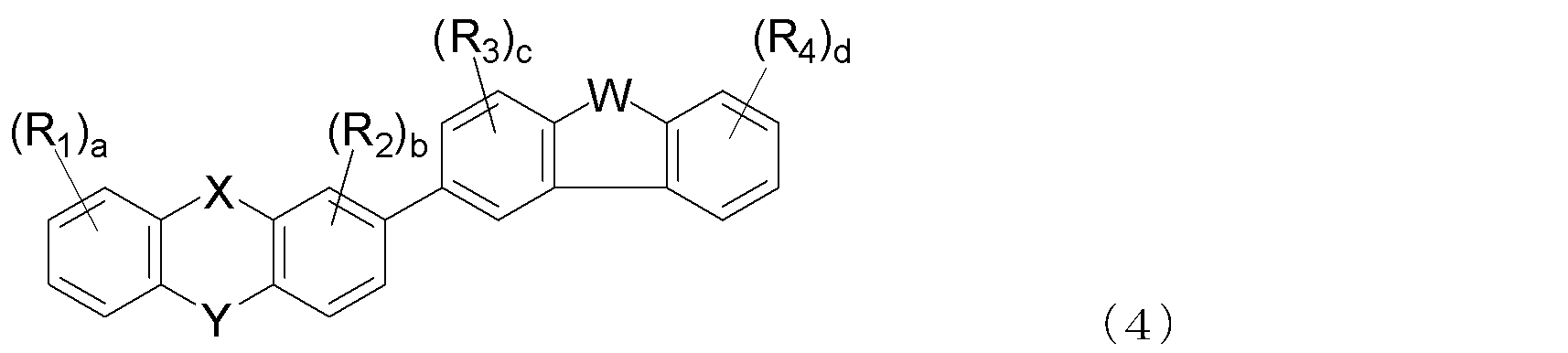
Xは、CRaRb又はSiRaRbを表わす。
Y及びWは、それぞれ独立に、NRc、酸素原子、硫黄原子を表わす。
Ra、Rb及びRcは、それぞれ独立に、水素原子、置換もしくは無置換の炭素数1~15のアルキル基、置換もしくは無置換の環形成炭素数3~15のシクロアルキル基、置換もしくは無置換の炭素数7~25のアラルキル基、置換もしくは無置換の炭素数1~15のフルオロアルキル基、置換もしくは無置換の環形成炭素数6~24のアリール基又は置換もしくは無置換の環形成原子数5~24のヘテロアリール基を表わす。
R1、R2、R3及びR4は、それぞれ独立に、置換もしくは無置換の炭素数1~15のアルキル基、置換もしくは無置換の環形成炭素数3~15のシクロアルキル基、置換もしくは無置換の炭素数1~15のアルコキシ基、置換もしくは無置換の炭素数7~25のアラルキル基、置換もしくは無置換の炭素数1~15のフルオロアルキル基、置換もしくは無置換の炭素数1~15のフルオロアルコキシ基、置換もしくは無置換のシリル基、置換もしくは無置換の環形成炭素数6~24のアリール基、置換もしくは無置換の環形成原子数5~24のヘテロアリール基、置換もしくは無置換のアミノ基、置換もしくは無置換の環形成炭素数6~24のアリールオキシ基、置換もしくは無置換の環形成原子数5~24のヘテロアリールオキシ基、ハロゲン原子又はシアノ基を表す。
a及びdは、それぞれ独立に、0~4の整数を表す。
b及びcは、0~3の整数を表す。
a~dが2以上の整数の場合、それぞれ独立に、2以上のR1~R4同士が互いに結合して飽和もしくは不飽和の2価の基を形成してもよい。
前記「置換もしくは無置換の各基」の置換基は、炭素数1~15のアルキル基、環形成炭素数3~15のシクロアルキル基、炭素数1~15のアルコキシ基、炭素数7~25のアラルキル基、炭素数1~15のフルオロアルキル基、炭素数1~15のフルオロアルコキシ基、シリル基、炭素数3~30のアルキルシリル基、炭素数8~30のアリールシリル基、環形成炭素数6~24のアリール基、環形成原子数5~24のヘテロアリール基、環形成炭素数6~24のアリールオキシ基、環形成原子数5~24のヘテロアリールオキシ基、ハロゲン原子及びシアノ基からなる群より選ばれる基である。
但し、前記置換基は、9,10-ジヒドロアクリジニル基ではない。]
5.前記XがCRaRbで表される上記1~4のいずれかに記載の芳香族複素環誘導体。
6.前記YがNRcで表される上記1~5のいずれかに記載の芳香族複素環誘導体。
7.有機エレクトロルミネッセンス素子用材料である上記1~6のいずれかに記載の芳香族複素環誘導体。
8.有機エレクトロルミネッセンス素子用正孔輸送材料である上記7に記載の芳香族複素環誘導体。
9.陽極と陰極と、
前記陽極と陰極の間に1以上の有機薄膜層を備え、
前記有機薄膜層の1層以上が、上記1~8のいずれかに記載の芳香族複素環誘導体を含有する有機エレクトロルミネッセンス素子。
10.前記有機薄膜層が、正孔輸送層及び/又は正孔注入層を有し、前記正孔輸送層及び/又は正孔注入層が、前記芳香族複素環誘導体を含有している上記9に記載の有機エレクトロルミネッセンス素子。
11.前記正孔輸送層及び/又は正孔注入層に、下記式(10)で表される化合物を含有する層が接合されている上記10に記載の有機エレクトロルミネッセンス素子。
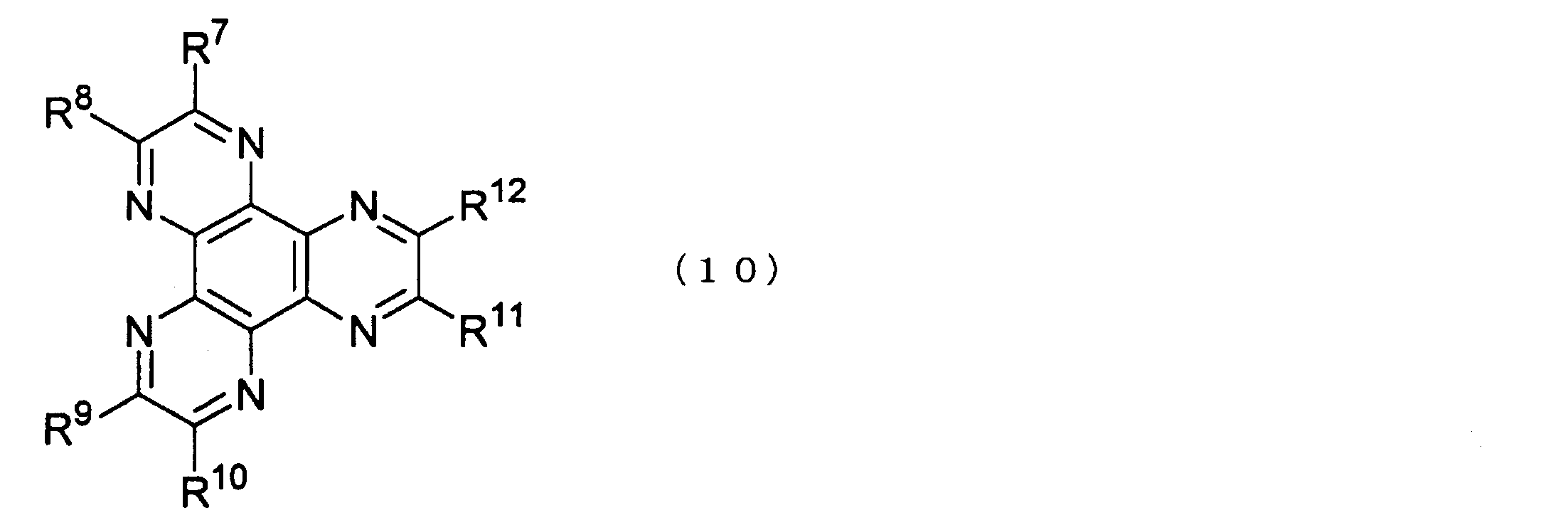
12.前記有機薄膜層が発光層を有し、前記発光層が燐光発光性材料を含有する上記9~11のいずれか記載の有機エレクトロルミネッセンス素子。
13.前記燐光発光材料がイリジウム(Ir)、オスミウム(Os)又は白金(Pt)金属のオルトメタル化錯体である上記12記載の有機エレクトロルミネッセンス素子。
14.前記有機薄膜層が電子輸送層を有し、前記電子輸送層が下記式のいずれかで表される含窒素複素環誘導体を含有している上記9~13のいずれか記載の有機エレクトロルミネッセンス素子。
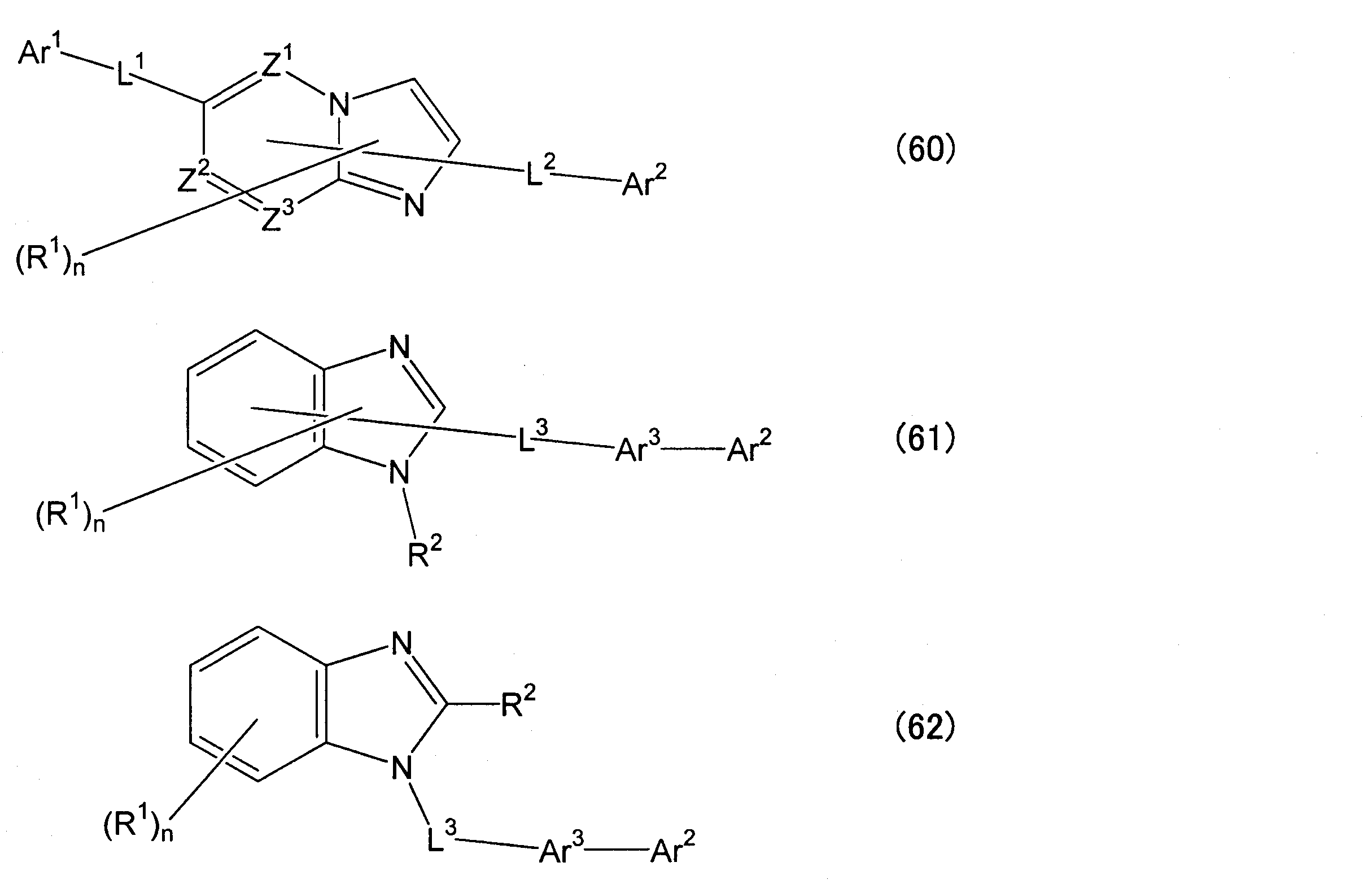
R1及びR2は、それぞれ独立に、置換もしくは無置換の環形成炭素数6~50のアリール基、置換もしくは無置換の環形成原子数3~50のヘテロアリール基、炭素数1~20のアルキル基、ハロゲン原子が置換した炭素数1~20のアルキル基又は炭素数1~20のアルコキシ基である。
nは、0~5の整数であり、nが2以上の整数であるとき、複数のR1は互いに同一でも異なっていてもよい。また、隣接する2つのR1同士が互いに結合して、置換もしくは無置換の芳香族炭化水素環を形成していてもよい。
Ar1は、置換もしくは無置換の環形成炭素数6~50のアリール基又は置換もしくは無置換の環形成原子数3~50のヘテロアリール基である。
Ar2は、水素原子、炭素数1~20のアルキル基、ハロゲン原子が置換した炭素数1~20のアルキル基、炭素数1~20のアルコキシ基、置換もしくは無置換の環形成炭素数6~50のアリール基又は置換もしくは無置換の環形成原子数3~50のヘテロアリール基である。
但し、Ar1、Ar2のいずれか一方は、置換もしくは無置換の環形成炭素数10~50の縮合芳香族炭化水素環基又は置換もしくは無置換の環形成原子数9~50の縮合芳香族複素環基である。
Ar3は、置換もしくは無置換の環形成炭素数6~50のアリーレン基又は置換もしくは無置換の環形成原子数3~50のヘテロアリーレン基である。
L1、L2及びL3は、それぞれ独立に、単結合、置換もしくは無置換の環形成炭素数6~50のアリーレン基、又は置換もしくは無置換の環形成原子数9~50のヘテロ縮合環基である。)

Xは、CRaRb又はSiRaRbを表す。
Y及びWは、それぞれ独立に、NRc、酸素原子、硫黄原子を表す。
Zは、単結合、CRaRb又はSiRaRbを表す。
Ra、Rb及びRcは、それぞれ独立に、水素原子、置換もしくは無置換の炭素数1~15のアルキル基、置換もしくは無置換の環形成炭素数3~15のシクロアルキル基、置換もしくは無置換の炭素数7~25のアラルキル基、置換もしくは無置換の炭素数1~15のフルオロアルキル基、置換もしくは無置換の環形成炭素数6~24のアリール基又は置換もしくは無置換の環形成原子数5~24のヘテロアリール基を表す。好ましくは、水素原子、置換もしくは無置換の炭素数1~15のアルキル基、置換もしくは無置換の環形成炭素数6~24のアリール基又は置換もしくは無置換の環形成原子数5~24のヘテロアリール基である。
R1、R2、R3及びR4は、それぞれ独立に、置換もしくは無置換の炭素数1~15のアルキル基、置換もしくは無置換の環形成炭素数3~15のシクロアルキル基、置換もしくは無置換の炭素数1~15のアルコキシ基、置換もしくは無置換の炭素数7~25のアラルキル基、置換もしくは無置換の炭素数1~15のフルオロアルキル基、置換もしくは無置換の炭素数1~15のフルオロアルコキシ基、置換もしくは無置換のシリル基、置換もしくは無置換の環形成炭素数6~24のアリール基、置換もしくは無置換の環形成原子数5~24のヘテロアリール基、置換もしくは無置換のアミノ基、置換もしくは無置換の環形成炭素数6~24のアリールオキシ基、置換もしくは無置換の環形成原子数5~24のヘテロアリールオキシ基、ハロゲン原子又はシアノ基を表す。好ましくは、置換もしくは無置換の環形成炭素数6~24のアリール基又は置換もしくは無置換の環形成原子数5~24のヘテロアリール基である。
a、b及びdは、それぞれ独立に、0~4の整数を表す。
cは、0~3の整数を表す。
a~dが2以上の整数の場合、それぞれ独立に、2以上のR1~R4同士が互いに結合して飽和もしくは不飽和の2価の基を形成してもよい。好ましくは、a~dは0又は1である。
m及びnは、それぞれ独立に、0~4の整数を表す。好ましくは、m及びnの両方が0、又はm及びnのいずれか一方又は両方が1である。
但し、前記置換基は、下記式で示される9,10-ジヒドロアクリジニル基ではない。

置換基は、好ましくは炭素数1~15のアルキル基、炭素数3~30のアルキルシリル基、炭素数8~30のアリールシリル基、環形成炭素数6~24のアリール基であり、より好ましくは炭素数1~6のアルキル基、炭素数3~6のアルキルシリル基、炭素数8~14のアリールシリル基、環形成炭素数6~14のアリール基である。
「無置換」とは、水素原子が置換したことを意味し、本発明の水素原子には、軽水素、重水素、三重水素が含まれる。
アリール基は、単環芳香族炭化水素環(単に芳香族炭化水素環ともいう)、縮合芳香族炭化水素環を含む。ヘテロアリール基は、単環芳香族複素環(単に芳香族複素環ともいう)、縮合芳香族複素環を含む。好ましくはアリール基又はヘテロアリール基は1つの単環又は縮合環である。
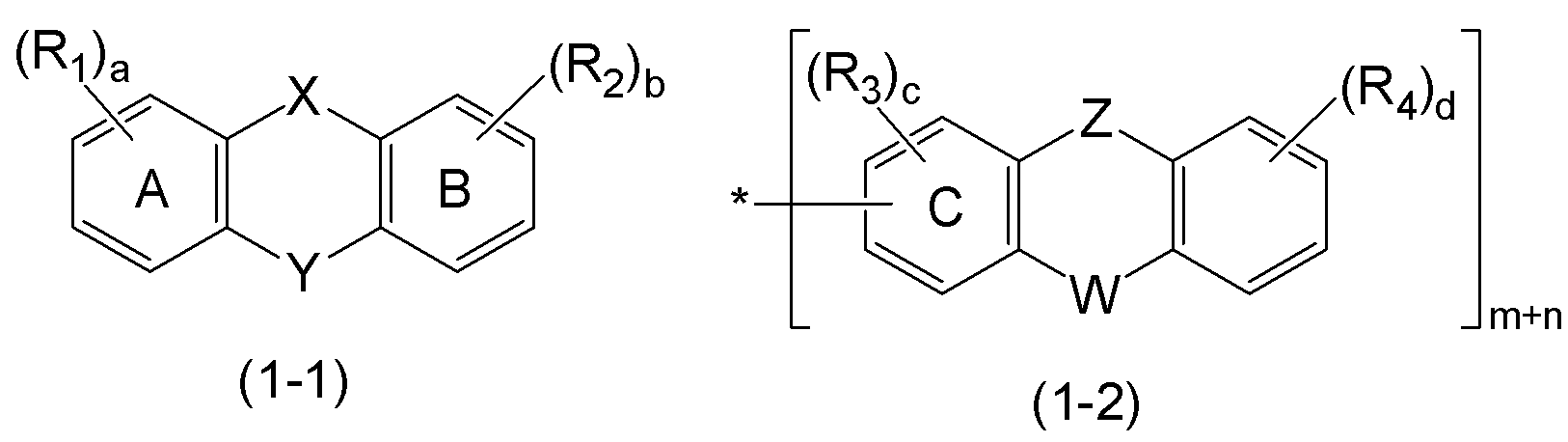
芳香族複素環が、互いに、ユニット内ベンゼン環を介して結合する場合は、複素環内ヘテロ原子の非共有電子対がユニット内ベンゼン環と同一平面上に存在することにより電子供与性効果を有するため、芳香族複素環が電子供与性の置換基として機能し、分子全体の電子密度を上昇させると考えられる。
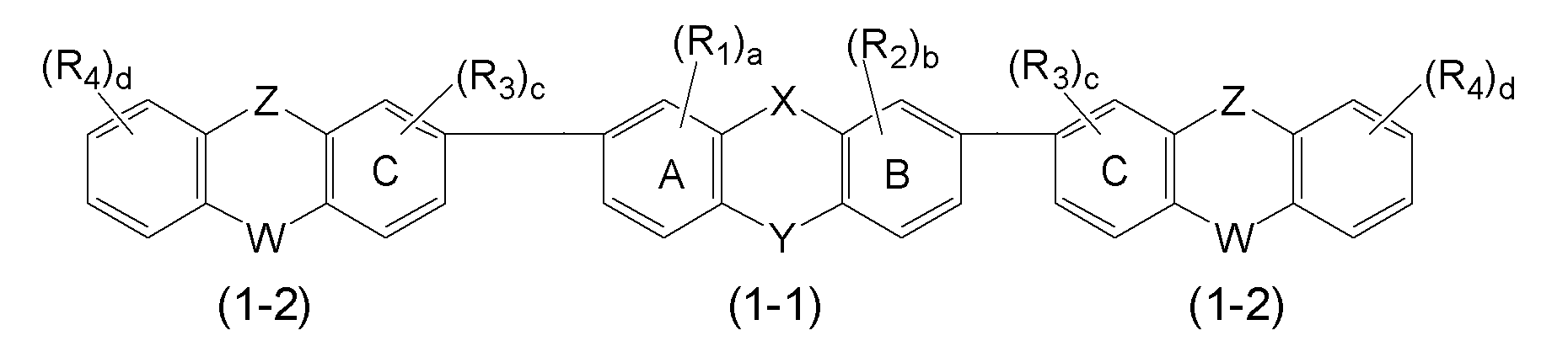
併せて、Af(アフィニティ)が小さくなるために発光層内における電荷の閉じ込めが有利になり発光効率が向上すると共に、正孔輸送層への電子注入が抑制され寿命が向上すると考えられる。
さらに、本発明の芳香族複素環誘導体は燐光ホストに用いることもできる。
また、1重項エネルギーが大きいことからAf(アフィニティー)が低減し、電子耐性が向上するため、有機EL素子の寿命を改善させることができる。
尚、本明細書では3重項エネルギーとは、最低励起3重項状態におけるエネルギーと基底状態におけるエネルギーの差をいい、1重項エネルギーとは(エネルギーギャップという場合もある)、最低励起1重項状態におけるエネルギーと基底状態におけるエネルギーの差をいう。

式(2)で表される芳香族複素環誘導体は、式(1)において、m=0、n=1の化合物である。

式(3)で表される芳香族複素環誘導体は、式(2)において、Zが単結合の化合物である。
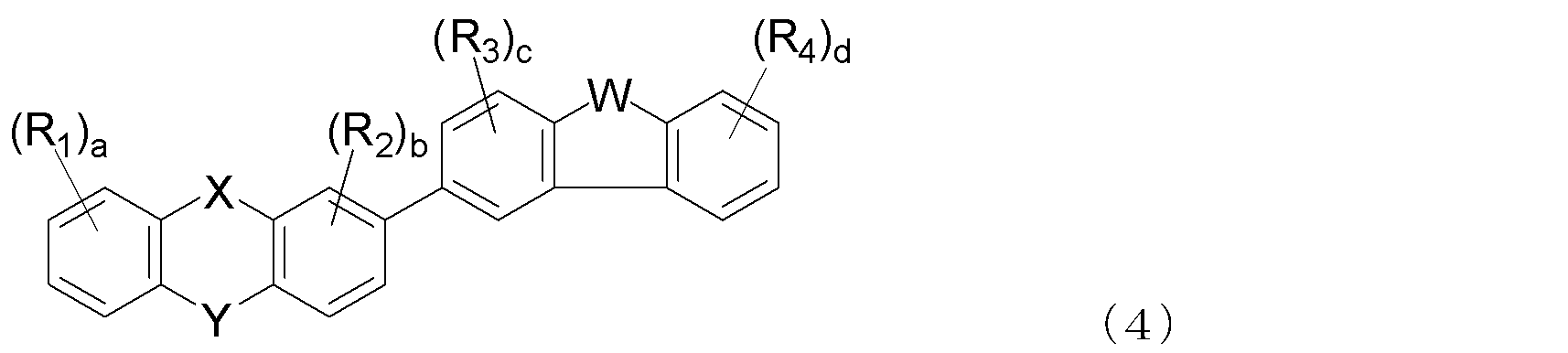
式(4)で表される芳香族複素環誘導体は、式(3)において、2つの芳香族複素環の間の結合位置を特定した化合物である。
前記アルキル基は、炭素数1~10が好ましく、1~6がさらに好ましい。中でもメチル基、エチル基、プロピル基、イソプロピル基、n-ブチル基、s-ブチル基、イソブチル基、t-ブチル基、n-ペンチル基、n-ヘキシル基が好ましい。
上記アリール基は、環形成炭素数が6~20であることが好ましく、より好ましくは6~12であり、上述したアリール基の中でもフェニル基、ビフェニル基、トリル基、キシリル基、1-ナフチル基が特に好ましい。
上記ヘテロアリール基は、環形成原子数5~20が好ましく、5~14がさらに好ましく、上述したヘテロアリール基の中でも、好ましくは、1-ジベンゾフラニル基、2-ジベンゾフラニル基、3-ジベンゾフラニル基、4-ジベンゾフラニル基、1-ジベンゾチオフェニル基、2-ジベンゾチオフェニル基、3-ジベンゾチオフェニル基、4-ジベンゾチオフェニル基、1-カルバゾリル基、2-カルバゾリル基、3-カルバゾリル基、4-カルバゾリル基、9-カルバゾリル基である。
前記アルコキシ基は、炭素数1~10が好ましく、1~6がさらに好ましい。
前記フルオロアルコキシ基は、炭素数1~10が好ましく、1~6がさらに好ましい。
炭素数3~30(好ましくは3~20、より好ましくは3~10)のアルキルシリル基としては、トリメチルシリル基、トリエチルシリル基、t-ブチルジメチルシリル基、ビニルジメチルシリル基、プロピルジメチルシリル基等が挙げられる。炭素数8~30のアリールシリル基としては、トリフェニルシリル基、フェニルジメチルシリル基、t-ブチルジフェニルシリル基、トリトリルシリル基、トリキシリルシリル基、トリナフチルシリル基等が挙げられる。
上記アリールオキシ基に含まれるアリール基は、環形成炭素数が6~20であることが好ましく、より好ましくは6~12であり、上述したアリール基の中でもフェニル基、ビフェニル基、トリル基、キシリル基、1-ナフチル基が特に好ましい。
上記ヘテロアリールオキシ基に含まれるヘテロアリール基の環形成原子数は、5~20が好ましく、5~14がより好ましい。さらに好ましくは、1-ジベンゾフラニル基、2-ジベンゾフラニル基、3-ジベンゾフラニル基、4-ジベンゾフラニル基、1-ジベンゾチオフェニル基、2-ジベンゾチオフェニル基、3-ジベンゾチオフェニル基、4-ジベンゾチオフェニル基である。
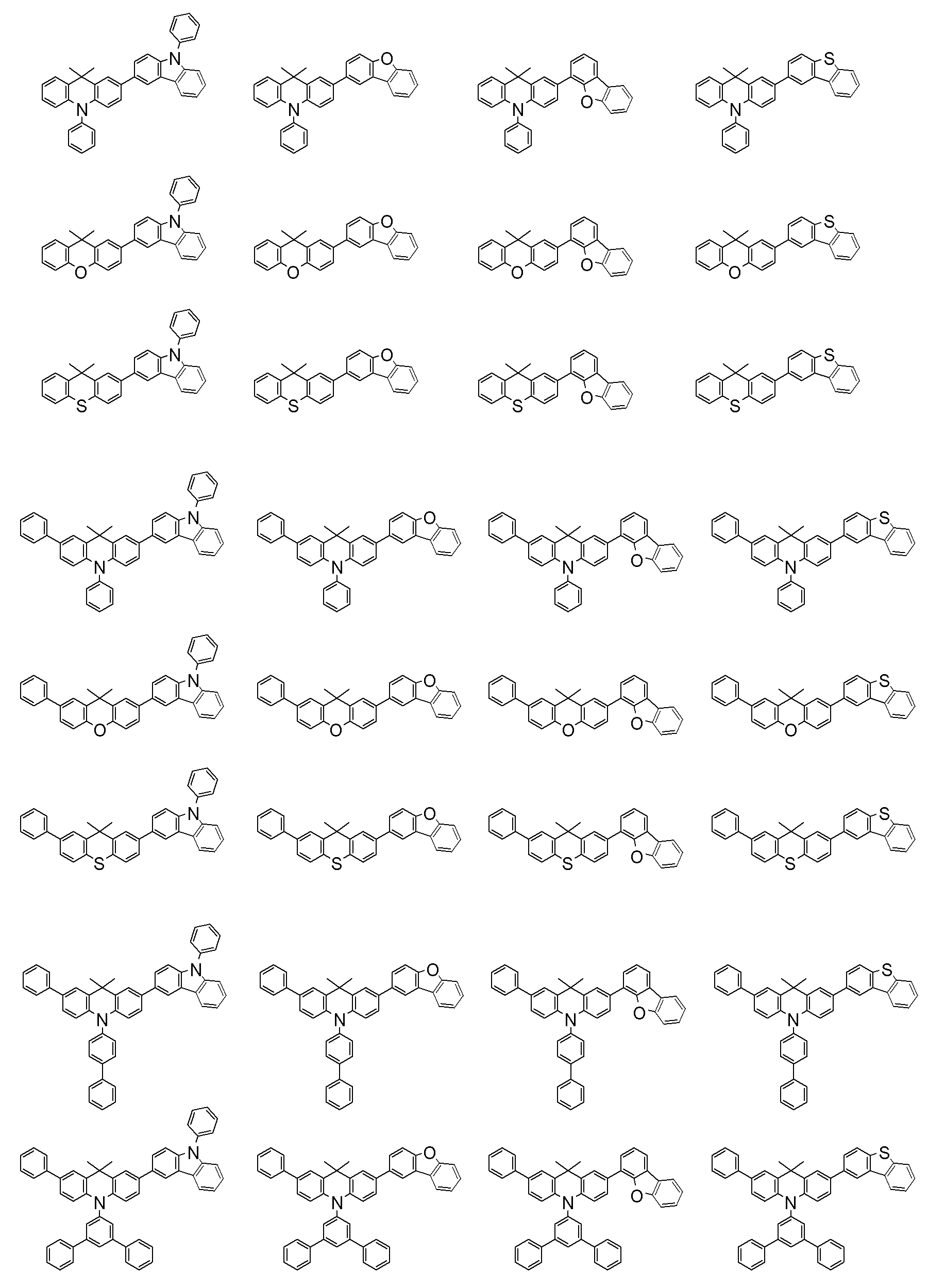
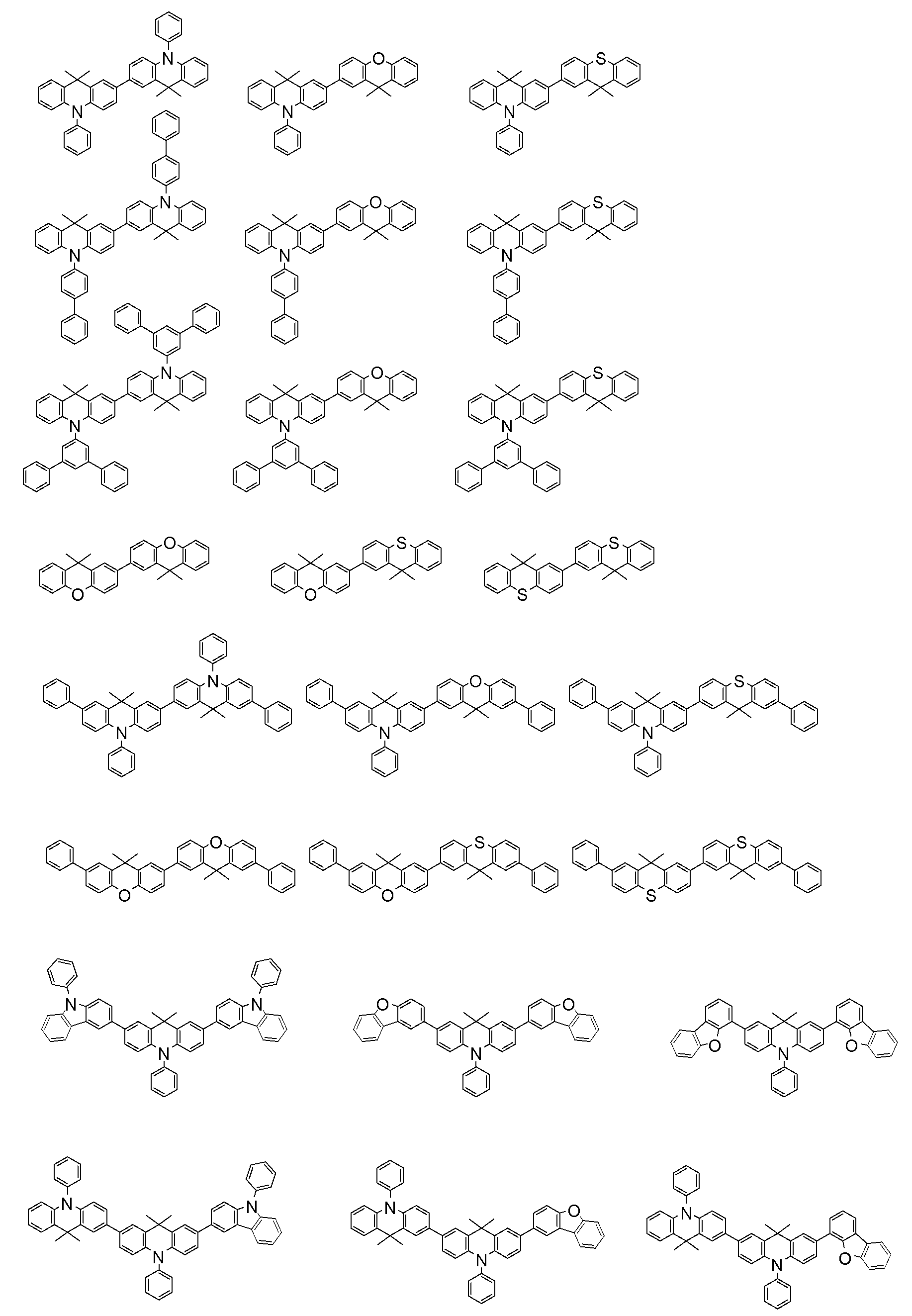
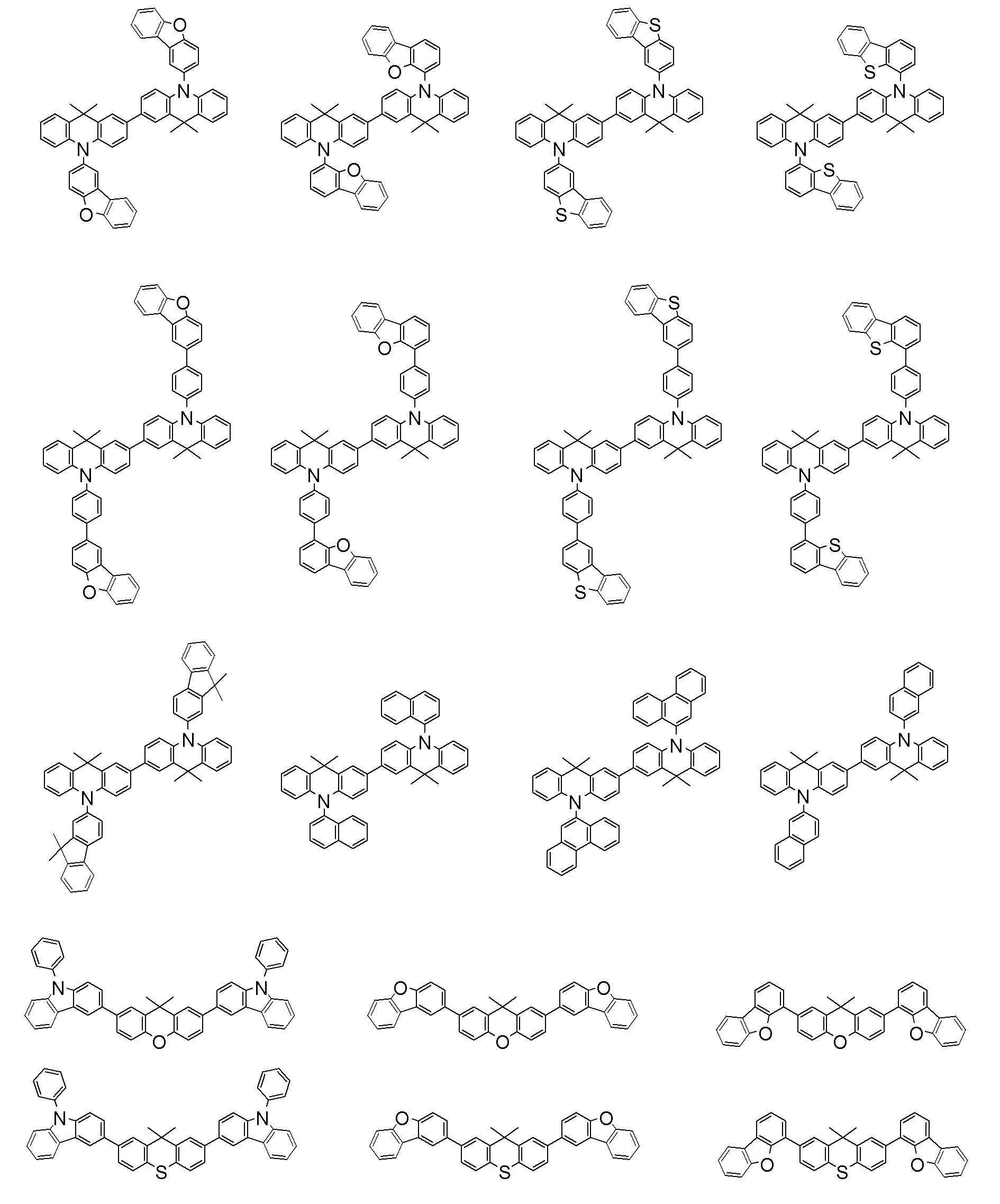
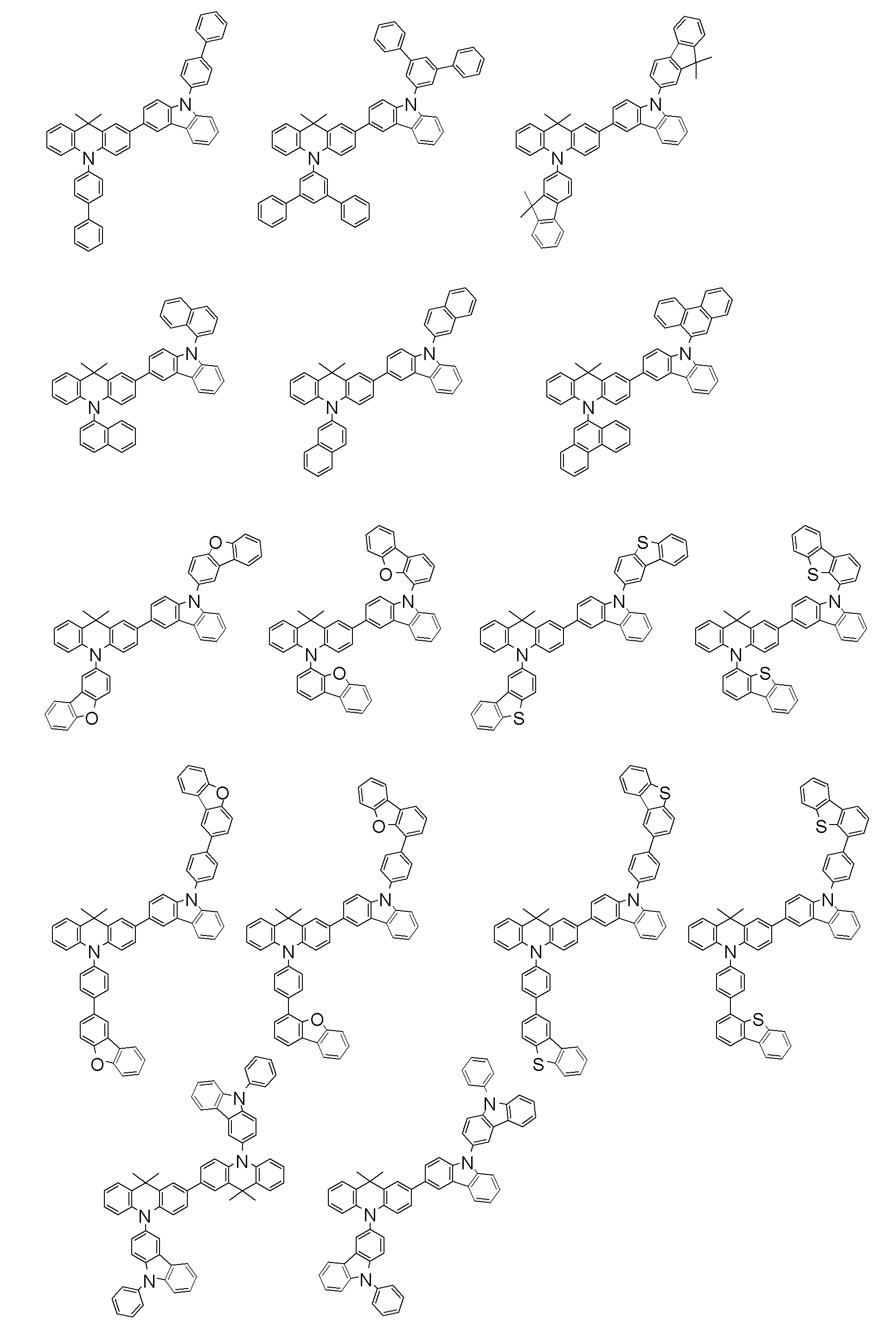

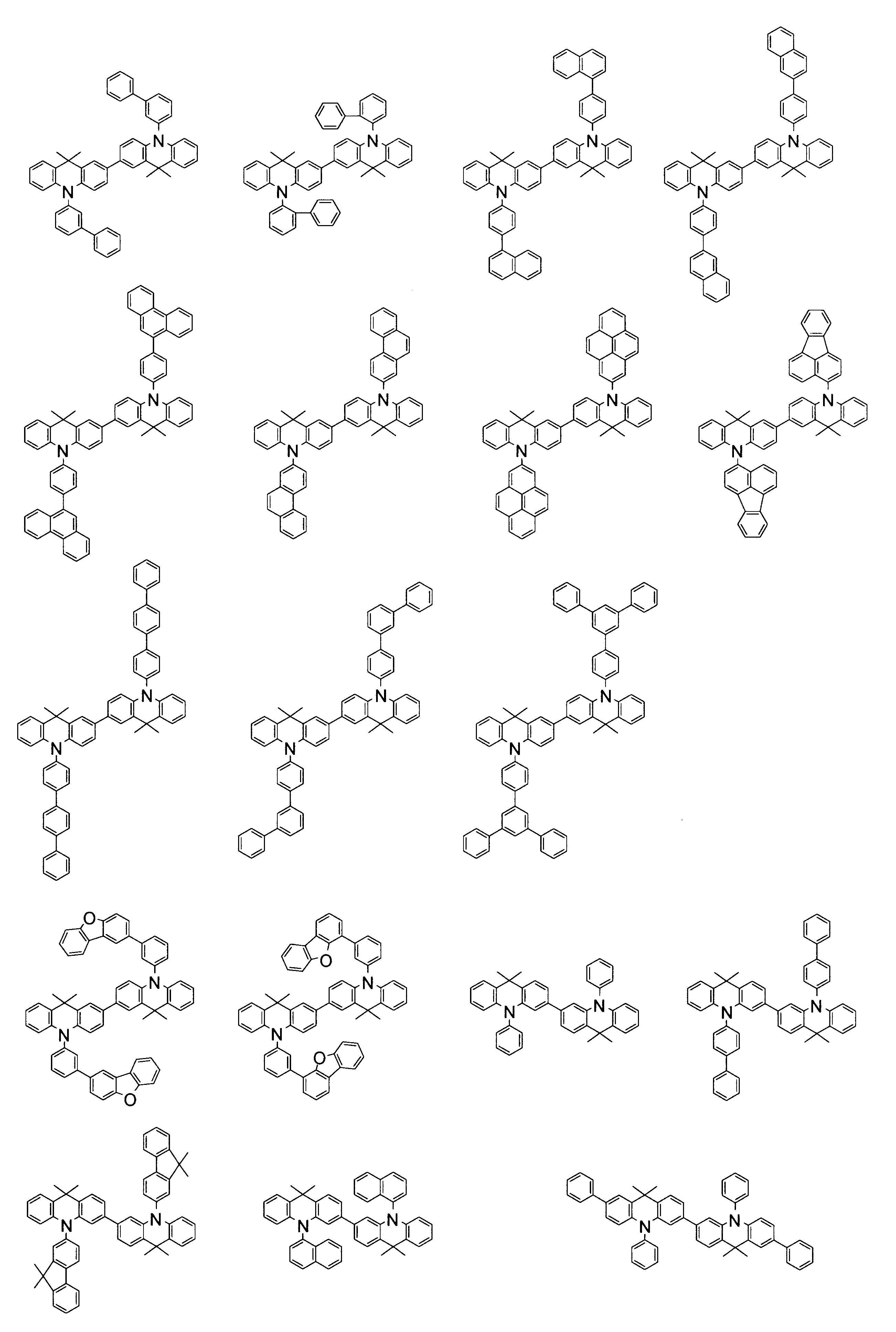
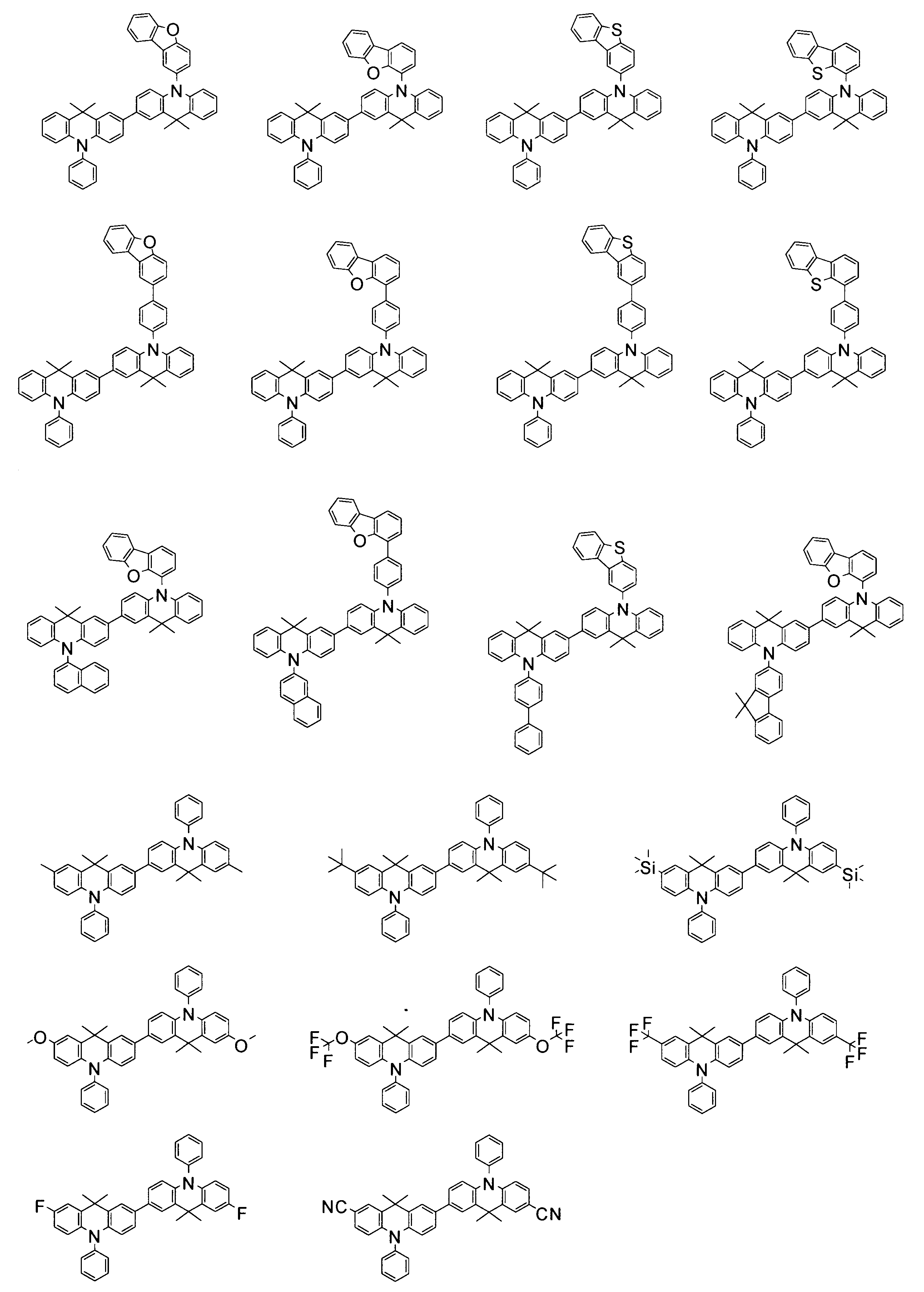
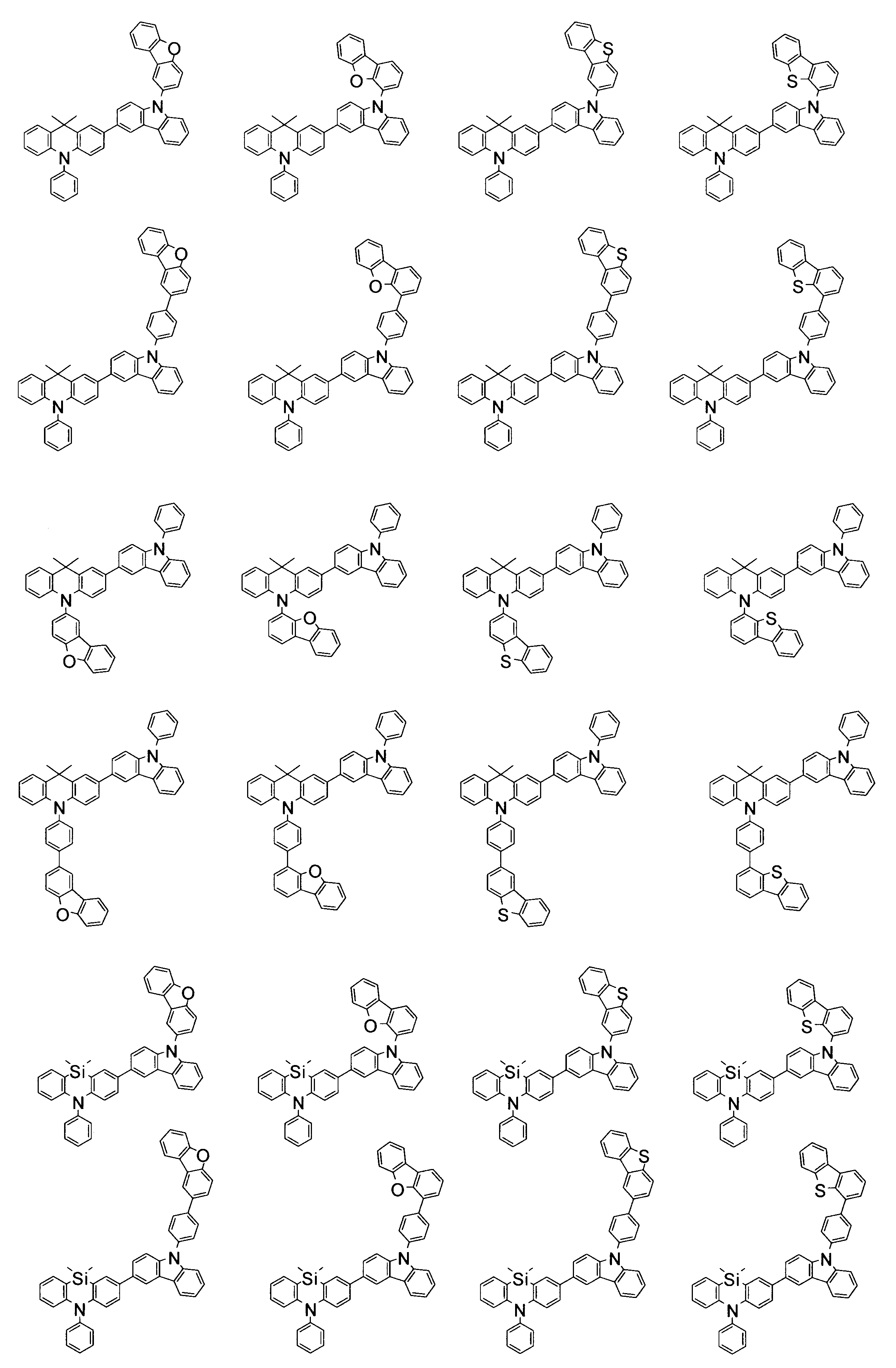
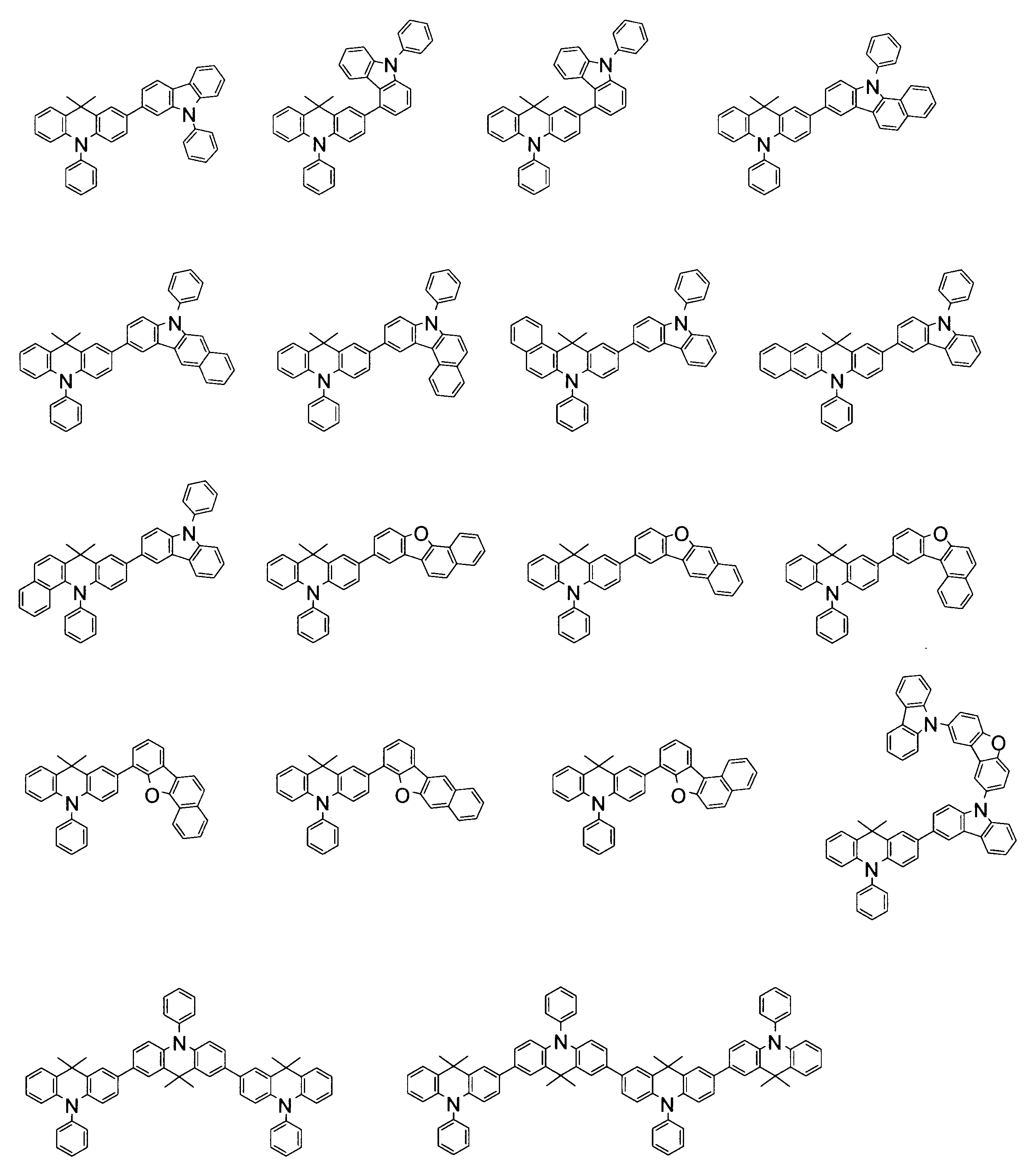


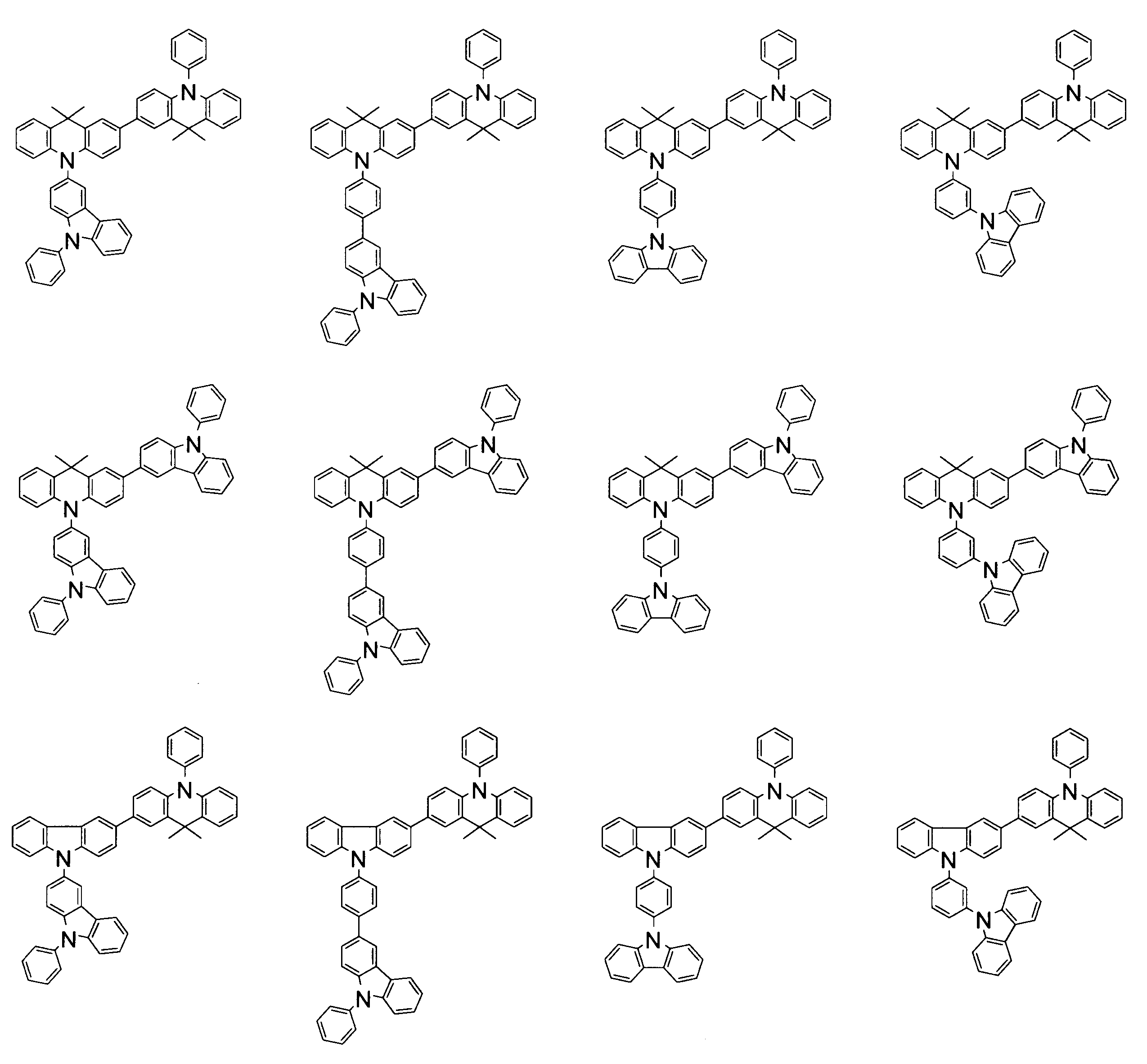
本発明の芳香族複素環誘導体は、3重項エネルギーが大きいため、燐光発光素子用材料として用いることができる。式(1)~(4)を適宜選択することで、燐光発光素子の発光層材料や、正孔輸送性材料等の複数の層に使用することができる。
さらに、式(2)~(4)で表される芳香族複素環誘導体の場合、3重項エネルギーが大きいだけでなく、イオン化ポテンシャル(Ip)が小さくなる傾向があるため、正孔輸送性材料として、燐光発光素子だけでなく蛍光発光素子にも用いることができるため有用である。
本発明の有機EL素子は、陽極、1以上の有機薄膜層及び陰極がこの順に積層していれば特に限定されない。有機薄膜層は、発光層を含み、その他の1以上の有機層をさらに含むことができる。また、有機EL素子は1以上の無機層を含むこともできる。
本実施形態の有機EL素子は、発光層を少なくとも1つ有する素子構成を有する。具体的な構成例を以下に示す。
(1)陽極/発光層/電子注入・輸送層/陰極
(2)陽極/正孔注入・輸送層/発光層/電子注入・輸送層/陰極
(3)陽極/正孔注入層/正孔輸送層/発光層/電子注入・輸送層/陰極
本実施形態の有機EL素子は、発光層(発光層を含むユニット)を少なくとも2つ有するタンデム素子構成を有する。
2つの発光層の間に電荷発生層(CGLとも呼ぶ)を介在させ、ユニット毎に電子輸送帯域を設けることができる。
陽極/正孔注入・輸送層/蛍光発光層/電荷発生層/蛍光発光層/電子注入・輸送層/陰極
陽極/正孔注入・輸送層/蛍光発光層/電子注入・輸送層/電荷発生層/蛍光発光層/陰極
陽極/正孔注入・輸送層/蛍光発光層/電子注入・輸送層/電荷発生層/蛍光発光層/障壁層/陰極
陽極/正孔注入・輸送層/燐光発光層/電荷発生層/蛍光発光層/電子注入・輸送層/陰極
陽極/正孔注入・輸送層/蛍光発光層/電子注入・輸送層/電荷発生層/燐光発光層/陰極
本実施形態の有機EL素子は、複数の発光層を備え、複数の発光層のいずれか2つの発光層の間に電荷障壁層を有する。
陽極/正孔注入・輸送層/第1発光層/電荷障壁層/第2発光層/電子注入・輸送層/陰極
陽極/正孔注入・輸送層/第1発光層/電荷障壁層/第2発光層/第3発
光層/電子注入・輸送層/陰極
このような構成によれば、後述の特許に記載された効果により低電圧駆動及び高効率発光が実現する。
アクセプター材料としては、特許公報第3614405号、3571977号又は米国特許4,780,536に記載されているヘキサアザトリフェニレン誘導体等の他、p型Si、p型SiC等の無機化合物、酸化モリブデン等の電子受容性無機酸化物、TCNQ誘導体等の電子受容性有機化合物等も好適に使用することができる。
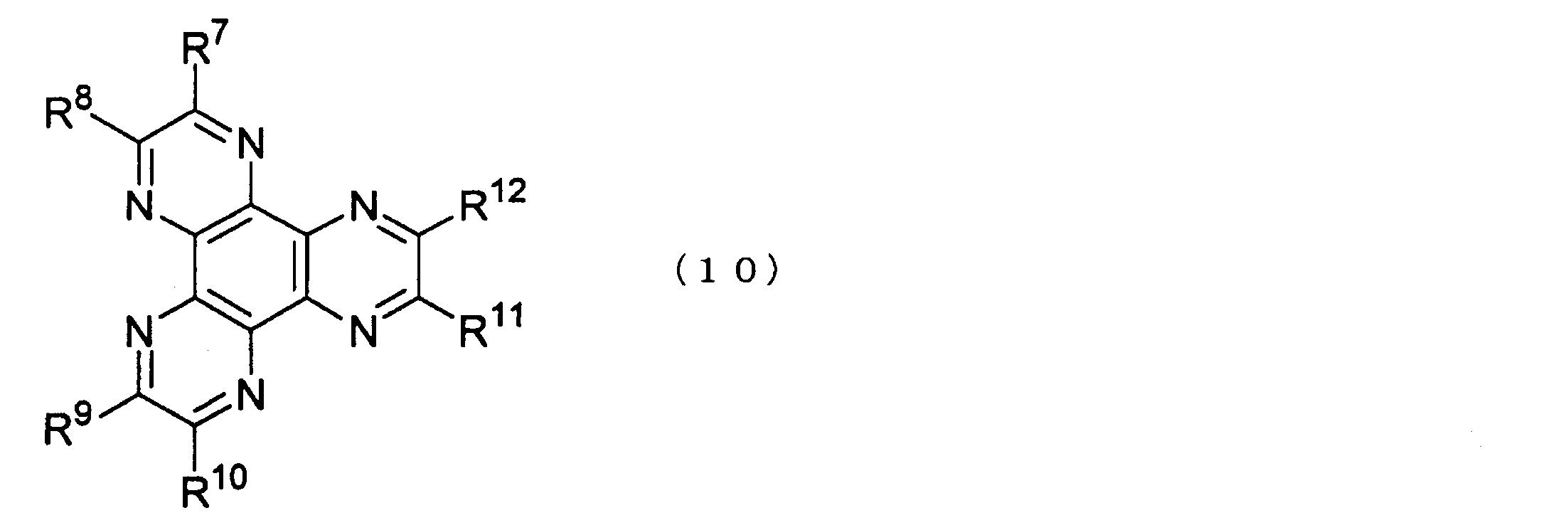
上記アルキル基としては、直鎖、分岐又は環状のものが挙げられ、好ましくは炭素数1~12、より好ましくは炭素数1~8のものであり、具体的には、メチル基、エチル基、n-プロピル基、イソプロピル基、n-ブチル基、sec-ブチル基、t-ブチル基、n-ヘキシル基、n-オクチル基、n-デシル基、n-ヘキサデシル基等が挙げられる。
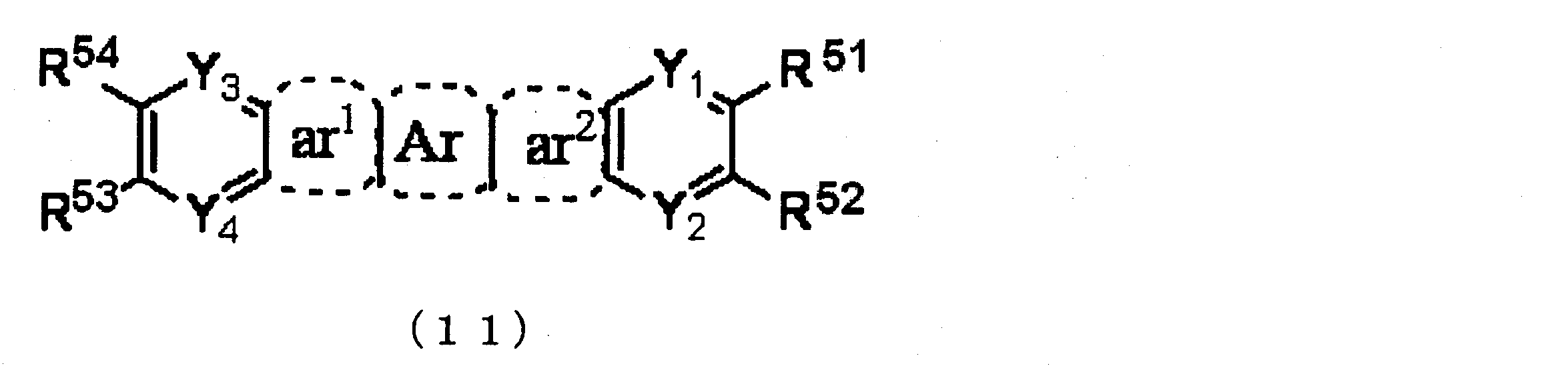
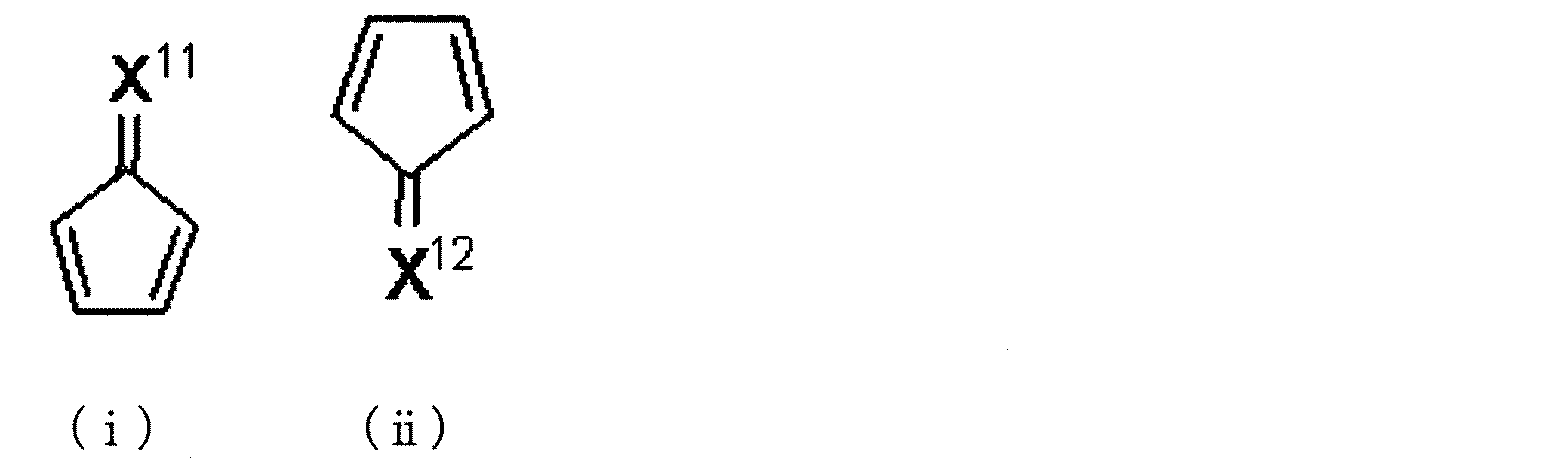
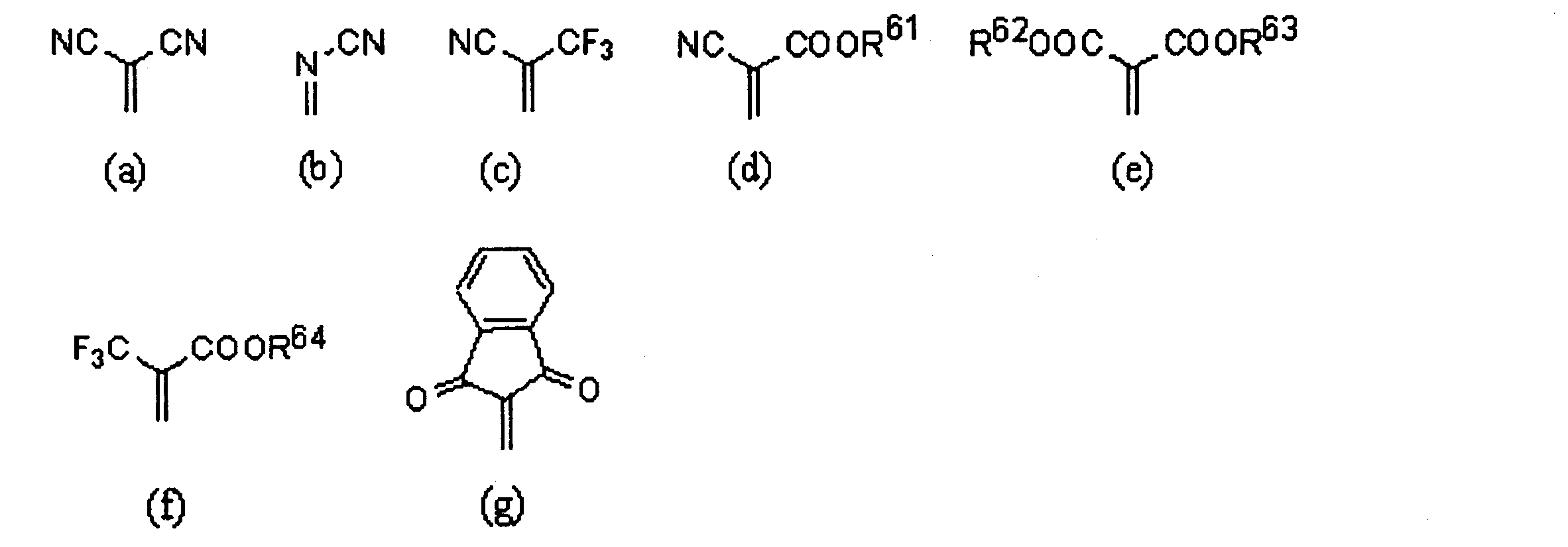

A3は、下記式(A)で表される基である。
a、bは、それぞれ1~3の整数である。

L5は、単結合、置換もしくは無置換の炭素数6~30の芳香族炭化水素環基又は縮合芳香族炭化水素環基、置換もしくは無置換の炭素数5~30のシクロアルキレン基、又は置換もしくは無置換の炭素数2~30の芳香族複素環基又は縮合芳香族複素環基である。
cは0~2、dは1~2、eは0~2の整数である。ただし、c+eは1以上である。
Czは、置換もしくは無置換のアリールカルバゾリル基、置換もしくは無置換のカルバゾリルアリール基又は置換もしくは無置換のカルバゾリルアルキレン基である。
具体的には、例えば以下のものが挙げられる。以下の化学式中、Arはアリール基又はヘテロアリール基を表し、*は他の基が結合する位置を表す。

具体的には、例えば、以下のものが挙げられる。以下の化学式中、Arはアリール基を表し、*は他の基が結合する位置を表す。
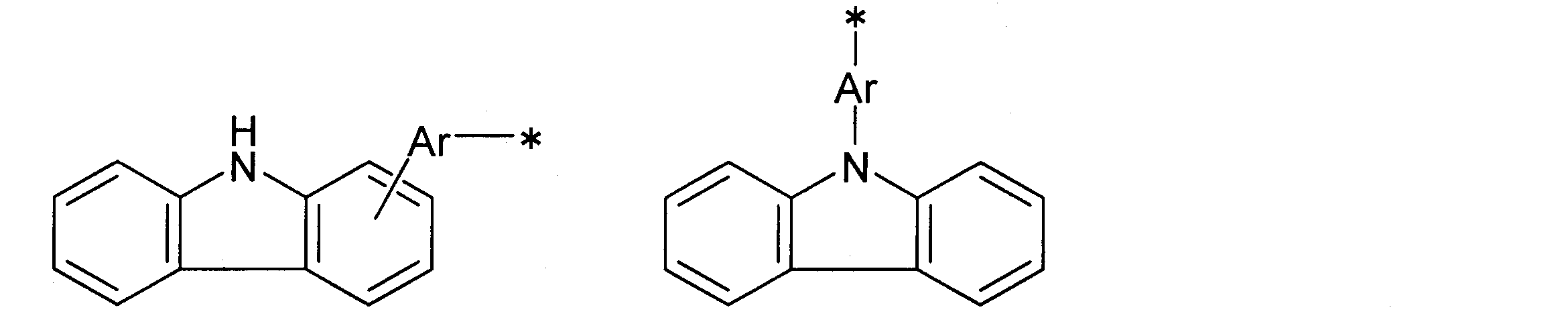
具体的には、前記カルバゾリルアリール基において、Arがアルキレン基であるものが該当する。
置換のアリールカルバゾリル基とは、前記アリールカルバゾリル基が少なくとも1つの置換基を置換位置を問わず有するものをいい、置換のカルバゾリルアリール基とは、前記カルバゾリルアリール基が、少なくとも1つの置換基を置換位置を問わず有するものをいう。
式(A)において、M1及びM2は、好ましくは、それぞれ独立に、置換もしくは無置換の環形成原子数3~40の含窒素複素環基であり、同一でも異なっていてもよい。
cは0~2、dは1~2、eは0~2の整数である。ただし、c+eは1以上である。
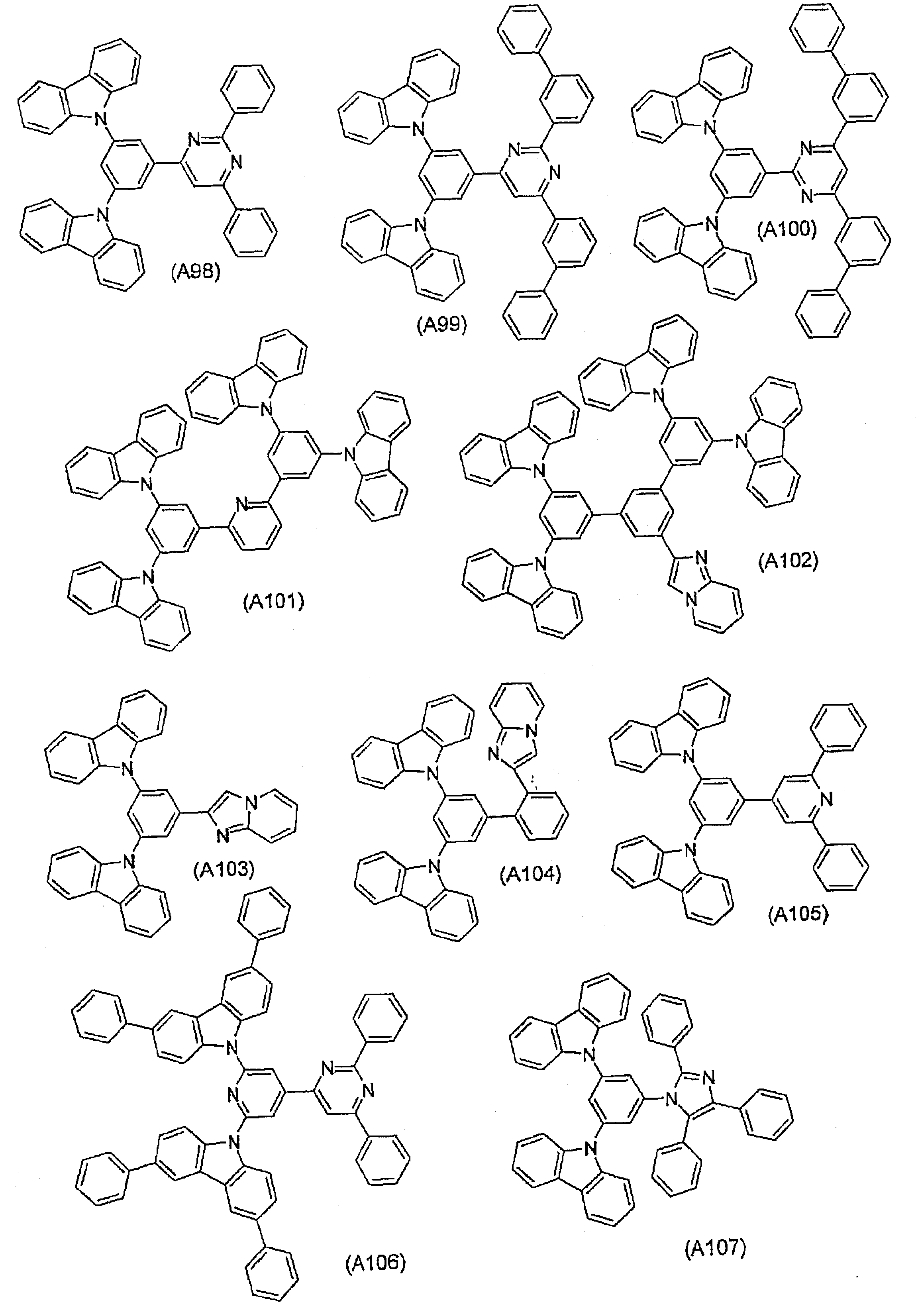


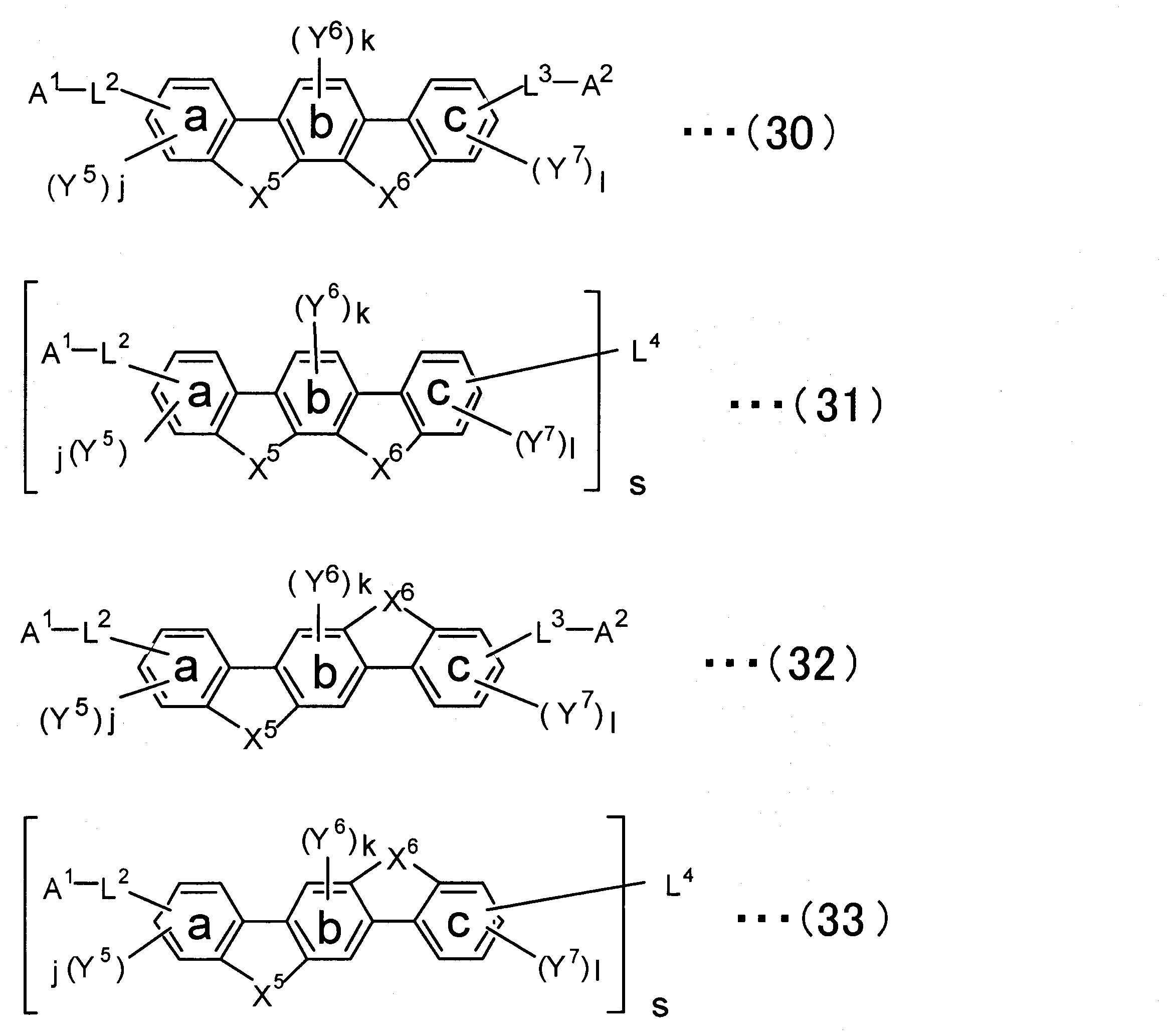
前記R1、R2及びR3は、それぞれ独立に、炭素数1~20のアルキル基、置換もしくは無置換の環形成炭素数3~20のシクロアルキル基、炭素数7~24のアラルキル基、シリル基もしくは炭素数3~20の置換シリル基、置換もしくは無置換の環形成炭素数6~24の芳香族炭化水素環基又は縮合芳香族炭化水素環基、又は置換もしくは無置換の環形成炭素数3~24の芳香族複素環基又は縮合芳香族複素環基を表す。但し、X5とX6が共にN-R1の場合は、R1の少なくとも1つは置換もしくは無置換の環形成原子数8~24である1価の縮合芳香族複素環基を表す。
式(30)~(33)において、A1、A2、L2、L3及びL4は、カルボニル基を含まない。
式(40)で表されるアントラセン誘導体は、下記化合物である。
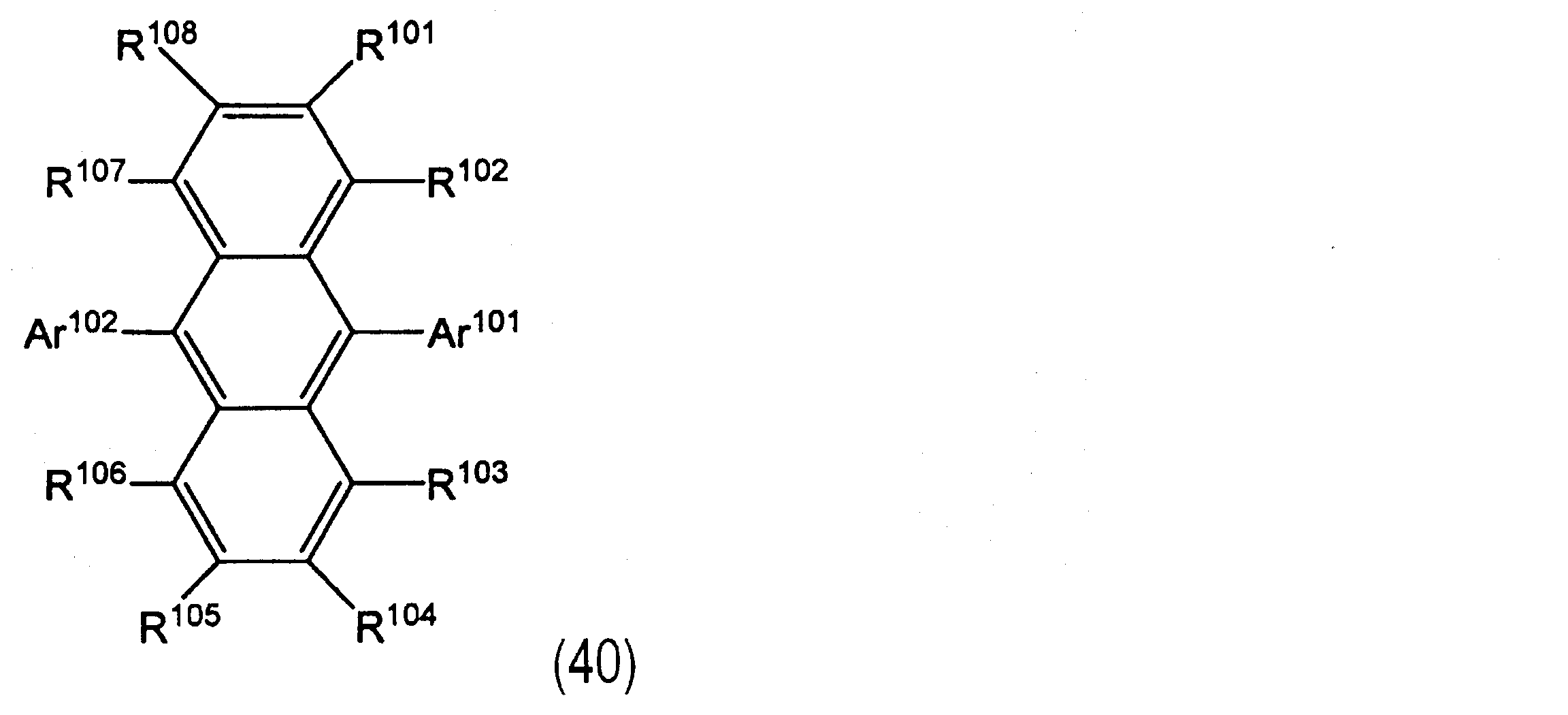
中でも、フェニル基、ビフェニル基、ターフェニル基が好ましい。
中でも、ナフチル基、フェナントリル基、アントリル基、9,9-ジメチルフルオレニル基、フルオランテニル基、ベンゾアントリル基、ジベンゾチオフェニル基、ジベンゾフラニル基、カルバゾリル基が好ましい。
Ar101、Ar102、R101~R108、の「置換もしくは無置換」の好ましい置換基として、単環基、縮合環基、アルキル基、シクロアルキル基、シリル基、アルコキシ基、シアノ基、ハロゲン原子(特にフッ素)が好ましく、特に好ましくは、単環基、縮合環基であり、好ましい具体例は上述の通りである。
当該アントラセン誘導体は、式(40)におけるAr101及びAr102が、それぞれ独立に、置換もしくは無置換の環形成原子数8~50の縮合環基である。当該アントラセン誘導体としては、Ar101及びAr102が同一の置換もしくは無置換の縮合環基である場合、及び異なる置換もしくは無置換の縮合環基である場合に分けることができる。
当該アントラセン誘導体は、式(40)におけるAr101及びAr102の一方が置換もしくは無置換の環形成原子数5~50の単環基であり、他方が置換もしくは無置換の環形成原子数8~50の縮合環基である。
好ましい形態として、Ar102がナフチル基、フェナントリル基、ベンゾアントリル基、9,9-ジメチルフルオレニル基、ジベンゾフラニル基であり、Ar101が単環基又は縮合環基が置換されたフェニル基である。
好ましい単環基、縮合環基の具体的な基は上述した通りである。
別の好ましい形態として、Ar102が縮合環基であり、Ar101が無置換のフェニル基である。この場合、縮合環基として、フェナントリル基、9,9-ジメチルフルオレニル基、ジベンゾフラニル基、ベンゾアントリル基が特に好ましい。
当該アントラセン誘導体は、式(40)におけるAr101及びAr102が、それぞれ独立に、置換もしくは無置換の環形成原子数5~50の単環基である。
好ましい形態として、Ar101、Ar102ともに置換もしくは無置換のフェニル基である。
さらに好ましい形態として、Ar101が無置換のフェニル基であり、Ar102が単環基、縮合環基を置換基として有するフェニル基である場合と、Ar101、Ar102がそれぞれ独立に単環基、縮合環基を置換基として有するフェニル基である場合がある。
前記置換基としての好ましい単環基、縮合環基の具体例は上述した通りである。さらに好ましくは、置換基としての単環基としてフェニル基、ビフェニル基、縮合環基として、ナフチル基、フェナントリル基、9,9-ジメチルフルオレニル基、ジベンゾフラニル基、ベンゾアントリル基である。
下記式(41)で表されるピレン誘導体は以下の化合物である。
L21及びL22は、それぞれ独立に、置換もしくは無置換の環形成炭素数6~30の2価のアリール基又は複素環基を示す。
mは0~1の整数、nは1~4の整数、sは0~1の整数、tは0~3の整数である。
また、L21又はAr111はピレンの1~5位のいずれかに結合し、L22又はAr222はピレンの6~10位のいずれかに結合する。
また、この置換基の例は上記と同様である。L21及びL22の置換基は、好ましくは、炭素数1~20のアルキル基である。
式(41)におけるtは、好ましくは0~2の整数である。
Ar111及びAr222のアリール基は、上記と同様である。
好ましくは、置換もしくは無置換の環形成炭素数6~20のアリール基、より好ましくは、置換もしくは無置換の環形成炭素数6~16のアリール基、アリール基の好ましい具体例としては、フェニル基、ナフチル基、フェナントリル基、フルオレニル基、ビフェニル基、アントリル基、ピレニル基である。
以上の式(20)~(22)、(30)~(33)、(40)、(41)を発光層におけるホスト物質として用いる場合、これらを2種以上併用してもよい。

Ar201、Ar202は、それぞれ置換もしくは無置換の環形成炭素数6~50のアリール基、又は置換もしくは無置換の環形成原子数5~50の複素環基を示す。
縮合アリール基としては、環形成炭素数10~50(好ましくは環形成炭素数10~30、より好ましくは環形成炭素数10~20)の縮合アリール基であり、上記アリール基の具体例中、好ましくは、ナフチル基、アントリル基、ピレニル基、フェナントリル基、フルオレニル基、フルオランテニル基、ナフタセニル基等が挙げられる。
nは1~4の整数である。nは1~2の整数であることが好ましい。
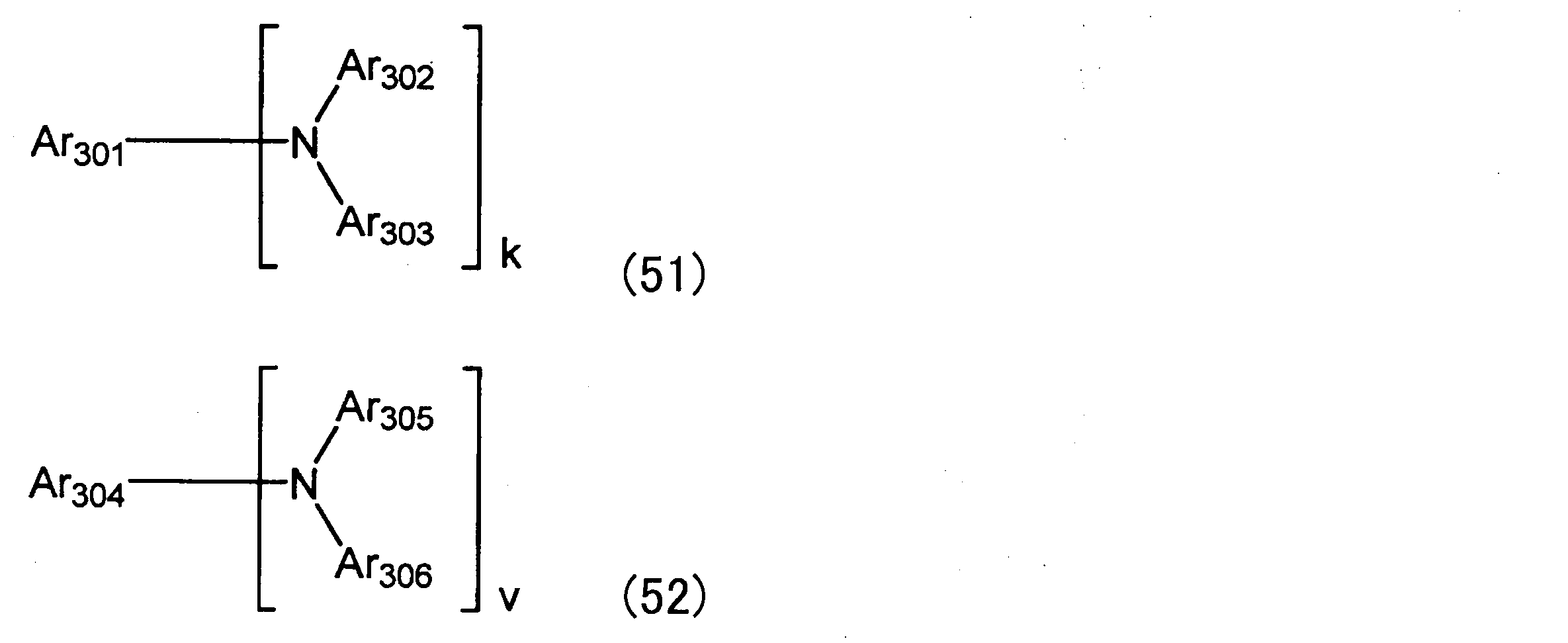
kは1~4の整数であり、そのなかでもkは1~2の整数であるのが好ましい。Ar301~Ar303のいずれか一つはスチリル基を含有する基である。さらに好ましくはAr302又はAr303の少なくとも一方はスチリル基で置換されている。
ここで、環形成炭素数が6~20のアリール基としては、具体的には上述したアリール基が挙げられ、好ましくはフェニル基、ナフチル基、アントラニル基、フェナンスリル基、ターフェニル基等が挙げられる。
ここで、式(52)中の環形成炭素数が6~40のアリール基としては、具体的には上述したアリール基が挙げられ、ナフチル基、アントラニル基、クリセニル基又はピレニル基で示されるアリール基が好ましい。
前記燐光性ドーパントは、金属錯体を含有し、前記金属錯体は、Ir,Pt,Os,Au,Cu,Re及びRuから選択される金属原子と、配位子と、を有することが好ましい。特に、前記配位子は、オルトメタル結合を有することが好ましい。
燐光量子収率が高く、発光素子の外部量子効率をより向上させることができるという点で、Ir,Os及びPtから選ばれる金属原子を含有する化合物であると好ましく、イリジウム錯体、オスミウム錯体、白金錯体等の金属錯体であるとさらに好ましく、中でもイリジウム錯体及び白金錯体がより好ましく、オルトメタル化イリジウム錯体が最も好ましい。
好ましい金属錯体の具体例を、以下に示す。
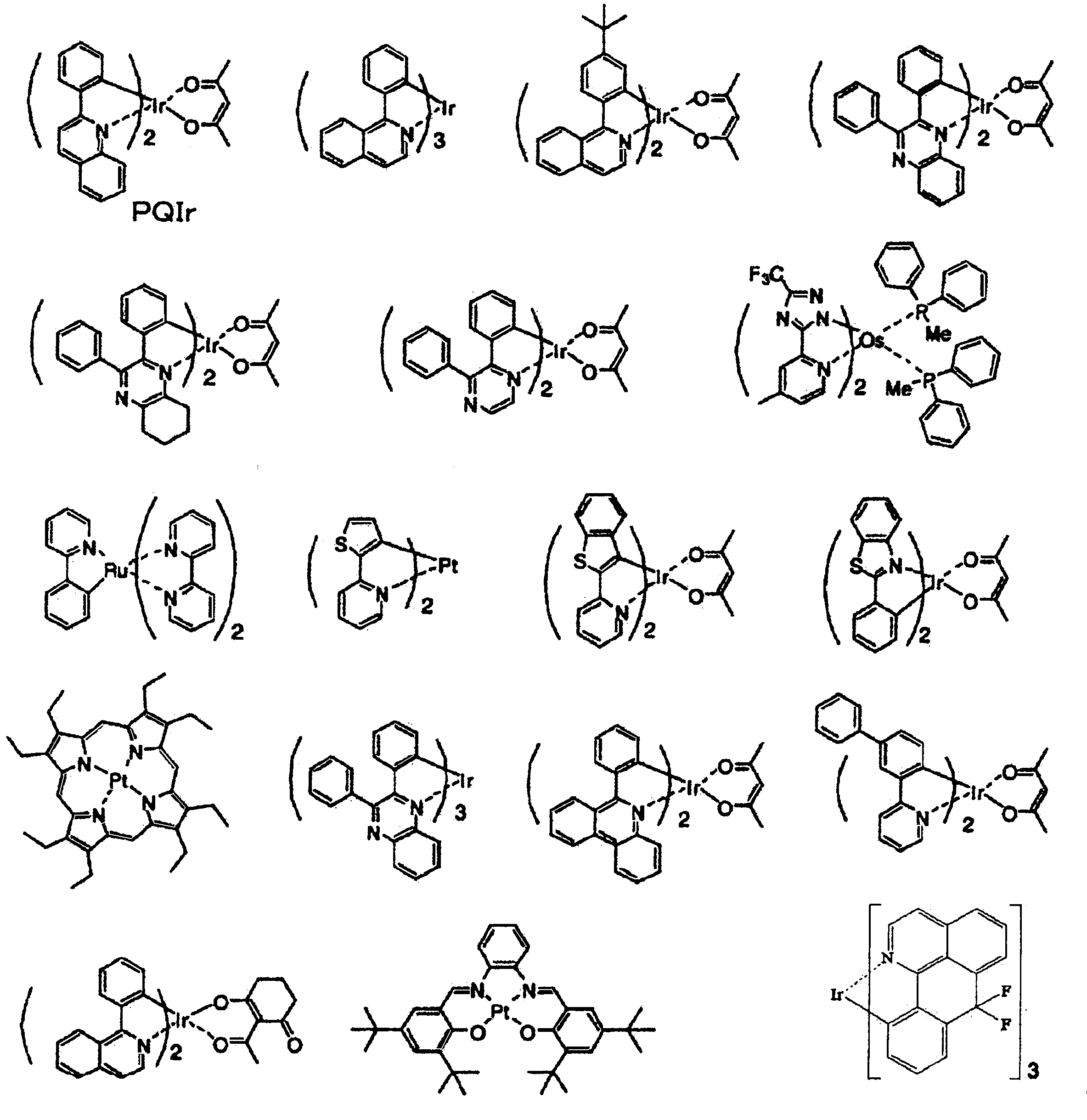
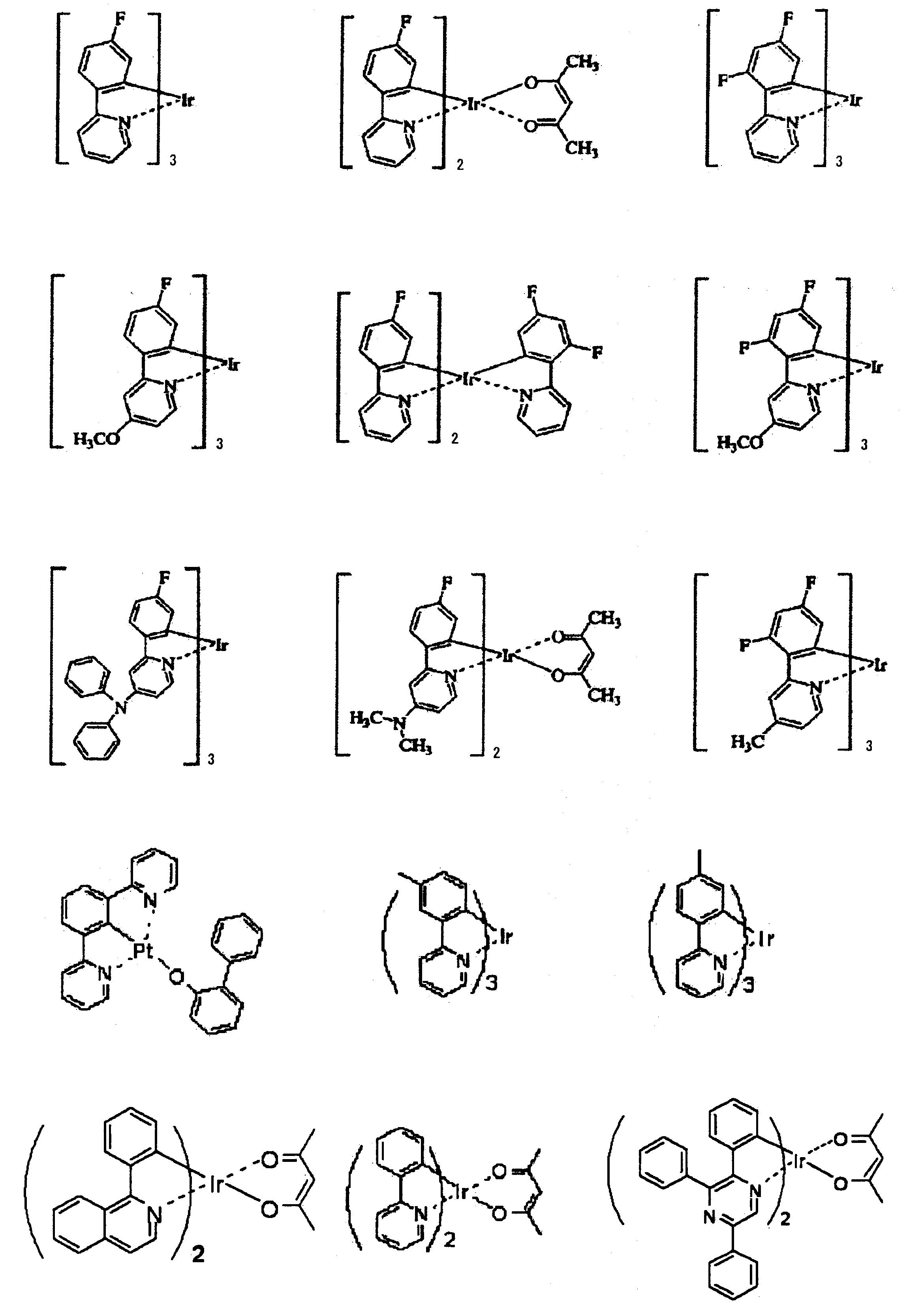
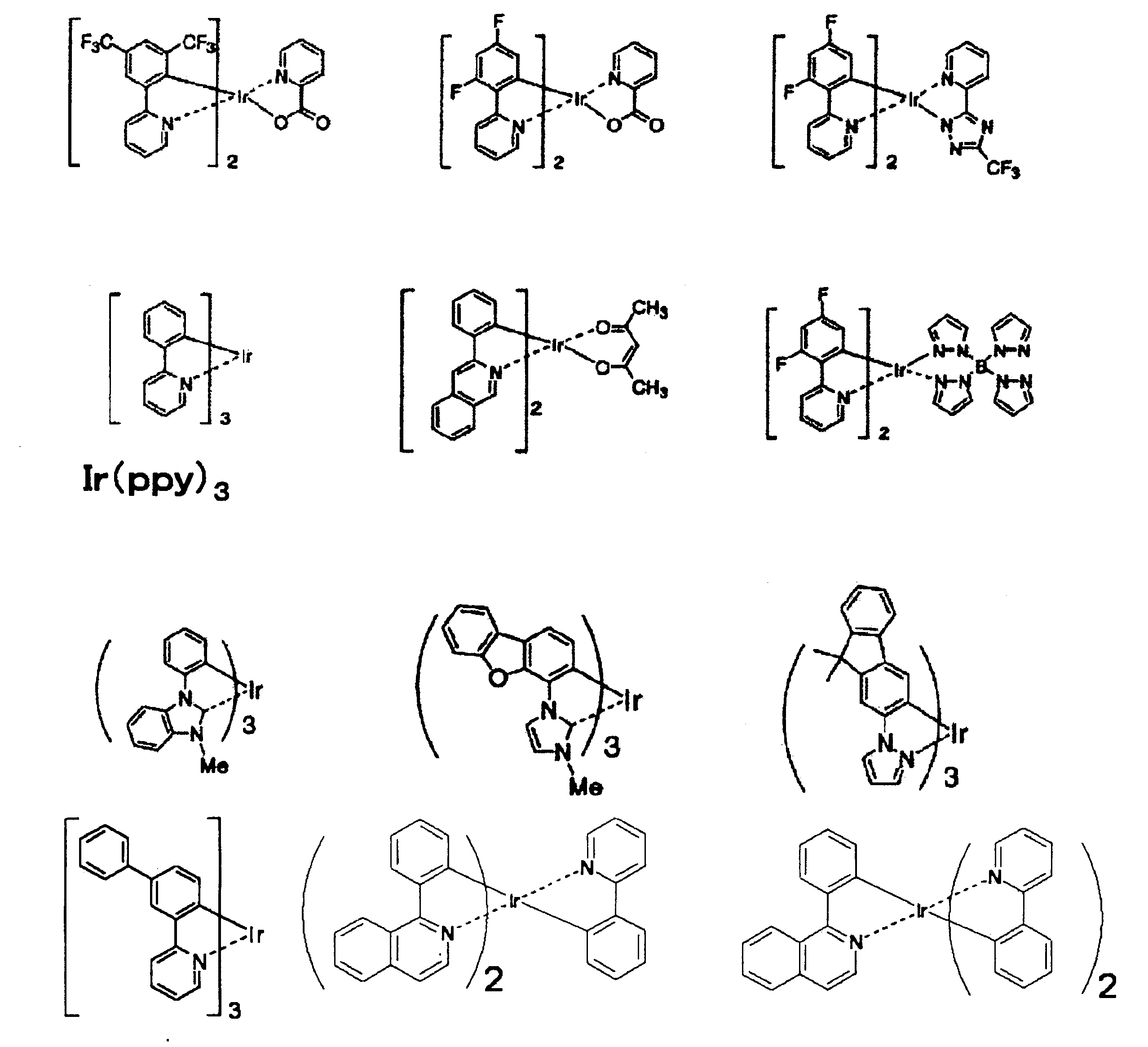
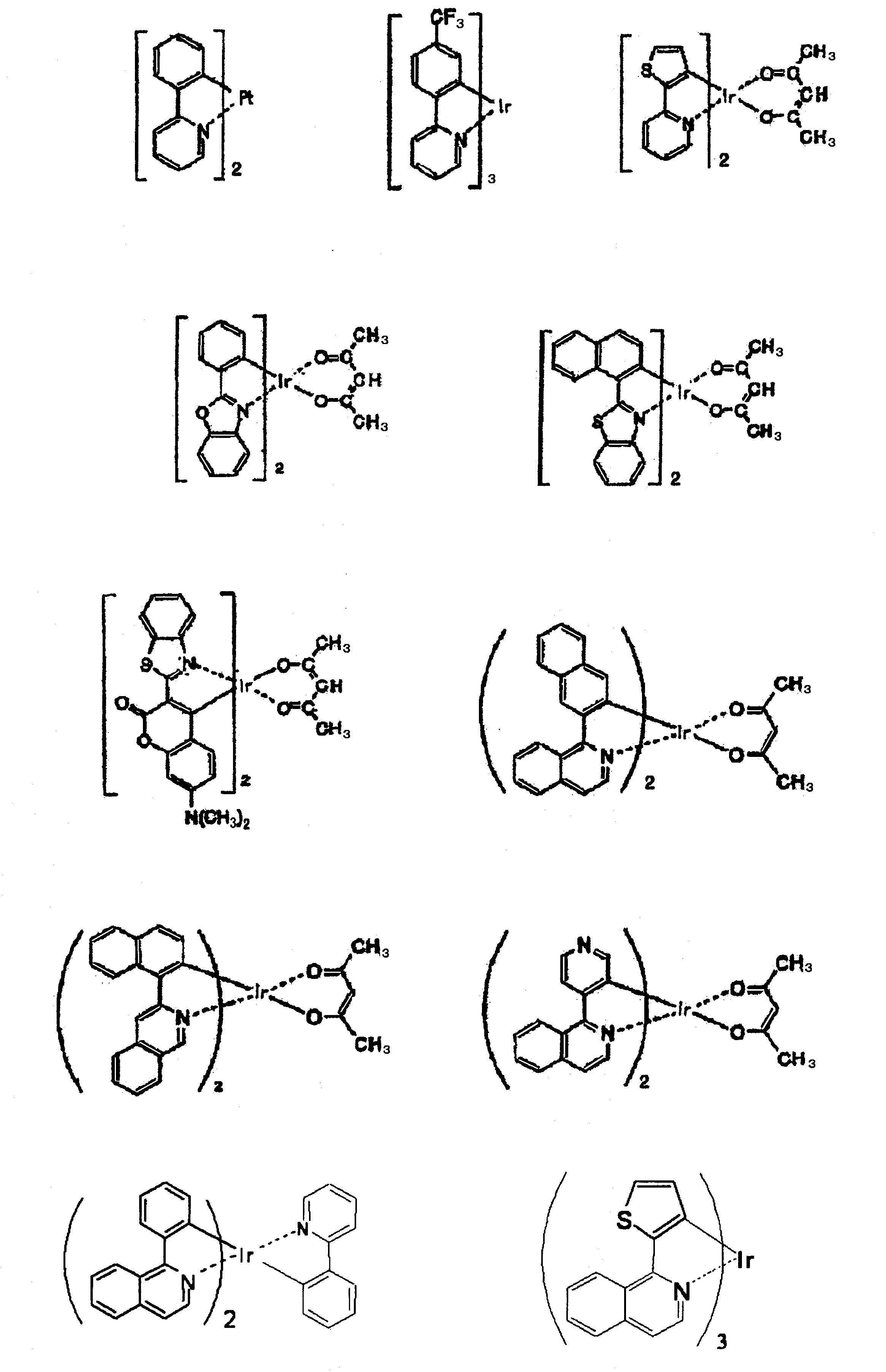
前記金属錯体化合物としては、例えば、8-ヒドロキシキノリナートリチウム、ビス(8-ヒドロキシキノリナート)亜鉛、トリス(8-ヒドロキシキノリナート)アルミニウム、トリス(8-ヒドロキシキノリナート)ガリウム、ビス(10-ヒドロキシベンゾ[h]キノリナート)ベリリウム、ビス(10-ヒドロキシベンゾ[h]キノリナート)亜鉛等が挙げられるが、これらに限定されるものではない。
好ましい形態として、これらの電子注入材料にさらにドーパントを含有し、陰極からの電子の受け取りを容易にするため、より好ましくは有機層と陰極の界面近傍にアルカリ金属で代表されるドーパントをドープする。
ドーパントとしては、ドナー性金属、ドナー性金属化合物及びドナー性金属錯体が挙げられ、これら還元性ドーパントは1種単独で使用してもよいし、2種以上を組み合わせて使用してもよい。
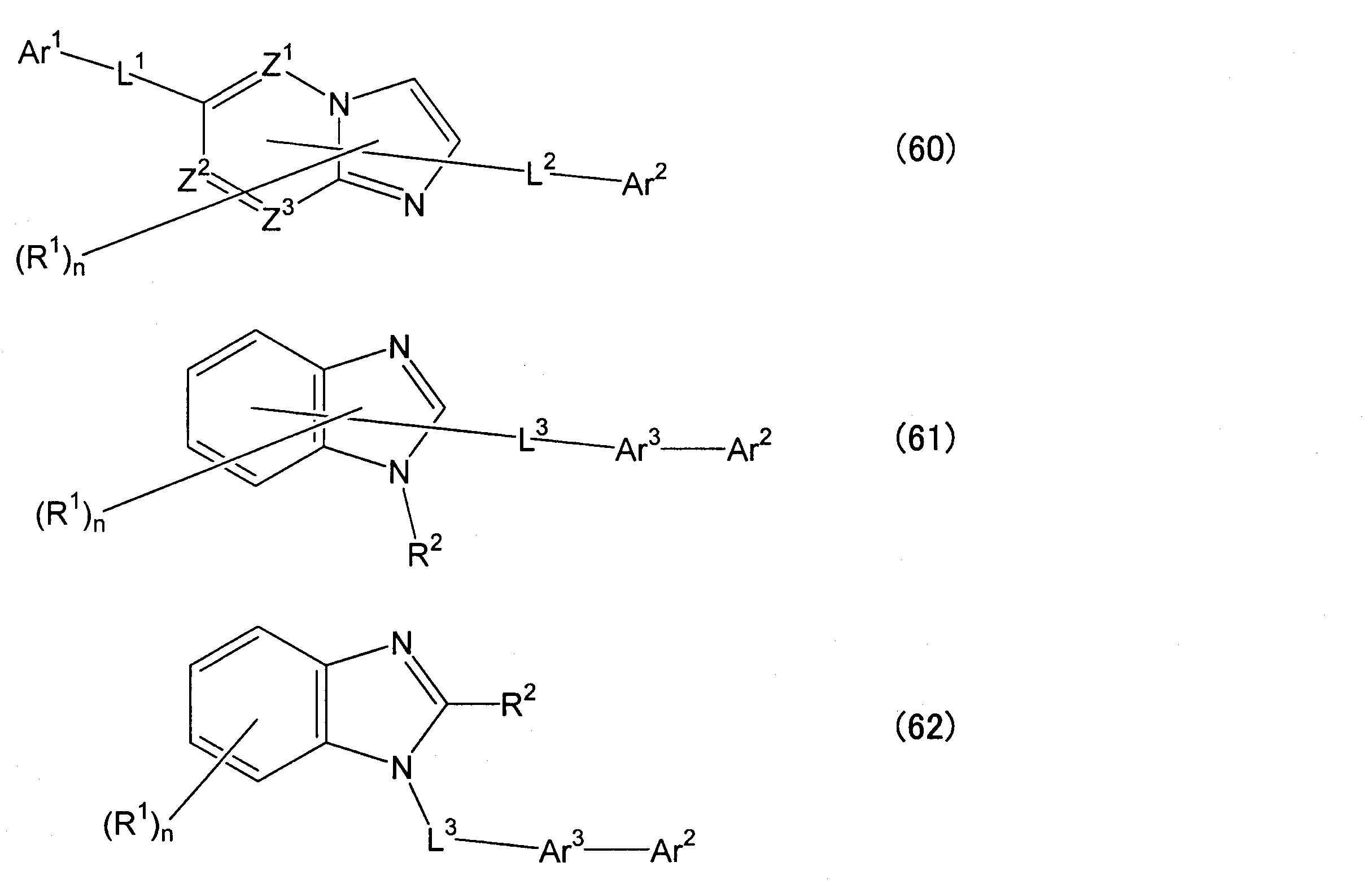
R1及びR2は、それぞれ独立に、置換もしくは無置換の環形成炭素数6~50のアリール基、置換もしくは無置換の環形成原子数3~50のヘテロアリール基、炭素数1~20のアルキル基、ハロゲン原子が置換した炭素数1~20のアルキル基又は炭素数1~20のアルコキシ基である。好ましくは置換もしくは無置換の環形成炭素数6~50のフェニル基等のアリール基である。
nは、0~5の整数であり、nが2以上の整数であるとき、複数のR1は互いに同一でも異なっていてもよい。また、隣接する2つのR1同士が互いに結合して、置換もしくは無置換の芳香族炭化水素環を形成していてもよい。
Ar1は、置換もしくは無置換の環形成炭素数6~50のアリール基又は置換もしくは無置換の環形成原子数3~50のヘテロアリール基である。
Ar2は、水素原子、炭素数1~20のアルキル基、ハロゲン原子が置換した炭素数1~20のアルキル基、炭素数1~20のアルコキシ基、置換もしくは無置換の環形成炭素数6~50のアリール基又は置換もしくは無置換の環形成原子数3~50のヘテロアリール基である。
但し、Ar1、Ar2のいずれか一方は、置換もしくは無置換の環形成炭素数10~50の縮合芳香族炭化水素環基(例えばナフチル基)又は置換もしくは無置換の環形成原子数9~50の縮合芳香族複素環基である。
Ar3は、置換もしくは無置換の環形成炭素数6~50のアリーレン基(例えばアントラセニレン基)又は置換もしくは無置換の環形成原子数3~50のヘテロアリーレン基である。
L1、L2及びL3は、それぞれ独立に、単結合、置換もしくは無置換の環形成炭素数6~50のアリーレン基(例えばフェニレン基、フルオレニレン基)、又は置換もしくは無置換の環形成原子数9~50のヘテロ縮合環基である。
尚、下記合成例1~14において合成した中間体の構造は、以下の通りである。
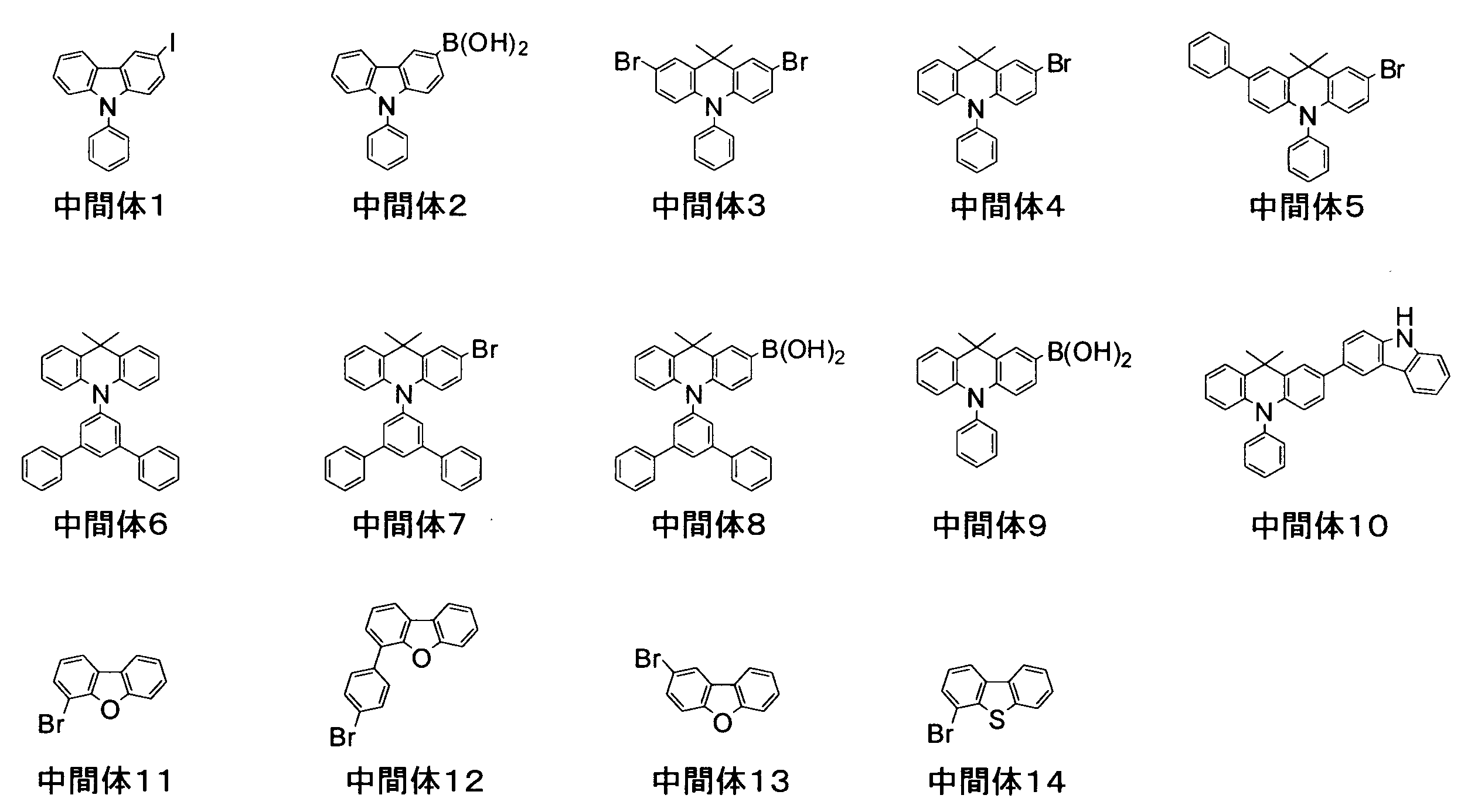
9-フェニルカルバゾール17.7g、ヨウ化カリウム6.03g、ヨウ素酸カリウム7.78g、硫酸5.90mL及びエタノールを入れ、75℃にて2時間反応させた。
冷却後、水、酢酸エチルを加えて分液、抽出した後、重曹水、水を用いて有機層を洗浄し、濃縮し、得られた粗生成物をシリカゲルクロマトグラフィー(トルエン)で精製し、得られた固体を減圧乾燥したところ、21.8gの白色固体を得た。FD-MSの分析により、中間体1と同定した。
アルゴン気流下、中間体1(13.1g)に脱水トルエン、脱水エーテルを加え、-45℃に冷却し、n-ブチルリチウムヘキサン溶液(1.58M)を25mL滴下して、攪拌しながら1時間かけて-5℃まで昇温した。再び-45℃まで冷却し、ボロン酸トリイソプロピルエステル25mLをゆっくり滴下してから2時間反応させた。
室温に戻した後、10%希塩酸溶液を加えて攪拌し、有機層を抽出した。飽和食塩水で洗浄した後、無水硫酸マグネシウムで乾燥し、ろ別後、濃縮した。得られた固体を、シリカゲルクロマトグラフィー(トルエン)で精製し、得られた固体をn-ヘキサンで洗浄し、減圧乾燥したところ、7.10gの固体を得た。FD-MSの分析により、中間体2と同定した。
アルゴン雰囲気下、9,9-ジメチル-10-フェニル-9,10-ジヒドロアクリジン(28.5g、100ミリモル)、N-ブロモスクシンイミド(NBS)(35.6g、200ミリモル)、にジメチルホルムアミド(DMF)(350mL)を入れ、室温で8時間撹拌した。反応終了後、試料を分液ロートに移し、水(500mL)を加え、酢酸エチルにて抽出した。試料をカラムクロマトグラフィーで精製し、35.4gの白色固体を得た。FD-MSの分析により、中間体3と同定した。
アルゴン雰囲気下、9,9-ジメチル-10-フェニル-9,10-ジヒドロアクリジン(28.5g、100ミリモル)、NBS(17.8g、100ミリモル)、にDMF(350mL)を入れ、室温で8時間撹拌した。反応終了後、試料を分液ロートに移し、水(500mL)を加え、酢酸エチルにて抽出した。試料をカラムクロマトグラフィーで精製し、18.4gの白色固体を得た。FD-MSの分析により、中間体4と同定した。
アルゴン雰囲気下、中間体3(4.4g)、フェニルボロン酸1.2g、テトラキス(トリフェニルフォスフィン)パラジウム(0)92mgにトルエン10mL、1,2-ジメトキシエタン10mL、2M濃度の炭酸ナトリウム水溶液5mLを加え、10時間還流させながら加熱した。
反応終了後、直ちにろ過した後、水層を除去した。有機層を硫酸ナトリウムで乾燥させた後、濃縮した。残渣をシリカゲルカラムクロマトグラフィーで精製し、2.1gの白色結晶を得た。FD-MSの分析により、中間体5と同定した。
アルゴン気流下、9,9-ジメチル-9,10-ジヒドロアクリジン2.1g、1-ブロモ-3,5-ジフェニルベンゼン3.1g、t-ブトキシナトリウム1.3g、トリス(ジベンジリデンアセトン)ジパラジウム46mg、トリ-tert-ブチルホスホニウムテトラフルオロボラート29mg及び脱水トルエン50mLを入れ、80℃にて8時間反応させた。
冷却後、水500mLを加え、混合物をセライト濾過し、濾液をトルエンで抽出し、無水硫酸マグネシウムで乾燥させた。これを減圧下で濃縮し、得られた粗生成物をカラム精製し、トルエンで再結晶し、それを濾取した後、乾燥したところ、4.0gの白色粉末を得た。FD-MSの分析により、中間体6と同定した。
合成例4において、9,9-ジメチル-10-フェニル-9,10-ジヒドロアクリジンの代わりに中間体6を10.0g用いた以外は同様に反応を行ったところ、6.2gの白色粉末を得た。FD-MSの分析により、中間体7と同定した。
合成例2において、中間体1の代わりに、中間体7を6.2g用いた以外は同様に反応を行ったところ、3.2gの白色固体を得た。FD-MSの分析により、中間体8と同定した。
アルゴン雰囲気下、中間体4(32.7g、89.8mmol)に、脱水キシレン200mlを加え、-30℃に冷却した。1.6M濃度のn-ブチルリチウム-ヘキサン溶液60ml(96.0mmol)を加え、1時間反応した。-70℃に冷却した後、ホウ酸トリイソプロピル45.9g(244.0mmol)を加えた。反応溶液を徐々に昇温し、室温で1時間撹拌した。その後、10%塩酸溶液64mlを加え撹拌した。反応終了後、酢酸エチルで抽出し、有機層を水で洗浄後、Na2SO4で乾燥、濃縮した。残渣をヘキサンで洗浄することにより17.7gの白色固体を得た。
アルゴン雰囲気下、3-ブロモカルバゾール9.8g(40.0mmol)、中間体9(14.5g、44.0mmol)に、2MのNa2CO3水溶液40ml(80.0mmol)、ジオキサン200ml、PdCl2(dppf)0.33g(0.4mmol)を加えて、12時間加熱還流攪拌した。
反応終了後、室温まで冷却した。試料を分液ロートに移し、水(100ml)を加え、ジクロロメタンにて抽出した。MgSO4で乾燥後、ろ過、濃縮した。残渣をシリカゲルカラムクロマトグラフィーで精製し、9.0gの白色固体を得た。FD-MSの分析により、中間体10と同定した。
アルゴン雰囲気下、ジベンゾフラン78.0g(0.46mol)に脱水テトラヒドロフラン600mlを加え、-30℃に冷却し、1.65M濃度のn-ブチルリチウムヘキサン溶液300ml(0.50mol)を滴下して、攪拌しながら1時間かけて室温まで昇温した。室温で5時間撹拌後、-60℃まで冷却し、1,2-ジブロモエタン60ml(0.70mol)を1時間かけて滴下した。
室温で15時間撹拌した後、氷水1000mlに注ぎ、ジクロロメタンにて抽出した。有機層を飽和食塩水で洗浄した後、MgSO4で乾燥し、濾過、濃縮した。濃縮残渣をシリカゲルクロマトグラフィーで精製し、テトラヒドロフラン/メタノールで洗浄し、70gの固体を得た。FD-MSの分析により、中間体11と同定した。
アルゴン雰囲気下、4-ヨードブロモベンゼン28.3g(100.0mmol)、ジベンゾフラン-4-ボロン酸22.3g(105.0mmol)、Pd[PPh3]4 2.31g(2.00mmol)にトルエン150ml、ジメトキシエタン150ml、2M Na2CO3水溶液150ml(300.0mmol)を加え、10時間加熱還流攪拌した。
反応終了後、試料を分液ロートに移しジクロロメタンにて抽出した。有機層をMgSO4で乾燥後、ろ過、濃縮した。濃縮残渣をシリカゲルカラムクロマトグラフィーにて精製し、26.2gの白色固体を得た。FD-MSの分析により、中間体12と同定した。
窒素雰囲気下、ジベンゾフラン150g(0.89mol)に酢酸1000mlを加え加熱溶解させた。さらに、臭素188g(1.18mol)を滴下して加えた後、室温で20時間撹拌した。析出した結晶を濾取し、酢酸、水で順次洗浄した。粗生成物をメタノールにより数回再結晶を繰り返し、66.8gの白色結晶を得た。FD-MSの分析により、中間体13と同定した。
アルゴン雰囲気下、ジベンゾチオフェン48.2g(261.6mmol)に脱水テトラヒドロフラン480mlを加え、-30℃に冷却し、1.60M濃度のn-ブチルリチウムヘキサン溶液164ml(262.0mol)を滴下して、攪拌しながら1時間かけて室温まで昇温した。室温で3時間撹拌後、-60℃まで冷却し、1,2-ジブロモエタン73.7g(393mmol)を脱水テトラヒドロフラン50mlに溶かした溶液を1時間かけて滴下した。
室温で15時間撹拌した後、氷水400mlに注ぎ、トルエンにて抽出した。有機層を飽和食塩水で洗浄した後、MgSO4で乾燥し、濾過、濃縮した。濃縮残渣をシリカゲルクロマトグラフィーで精製した。粗生成物をヘプタンにより数回再結晶を繰り返し、33.1gの白色結晶を得た。FD-MSの分析により、下記中間体14と同定した。
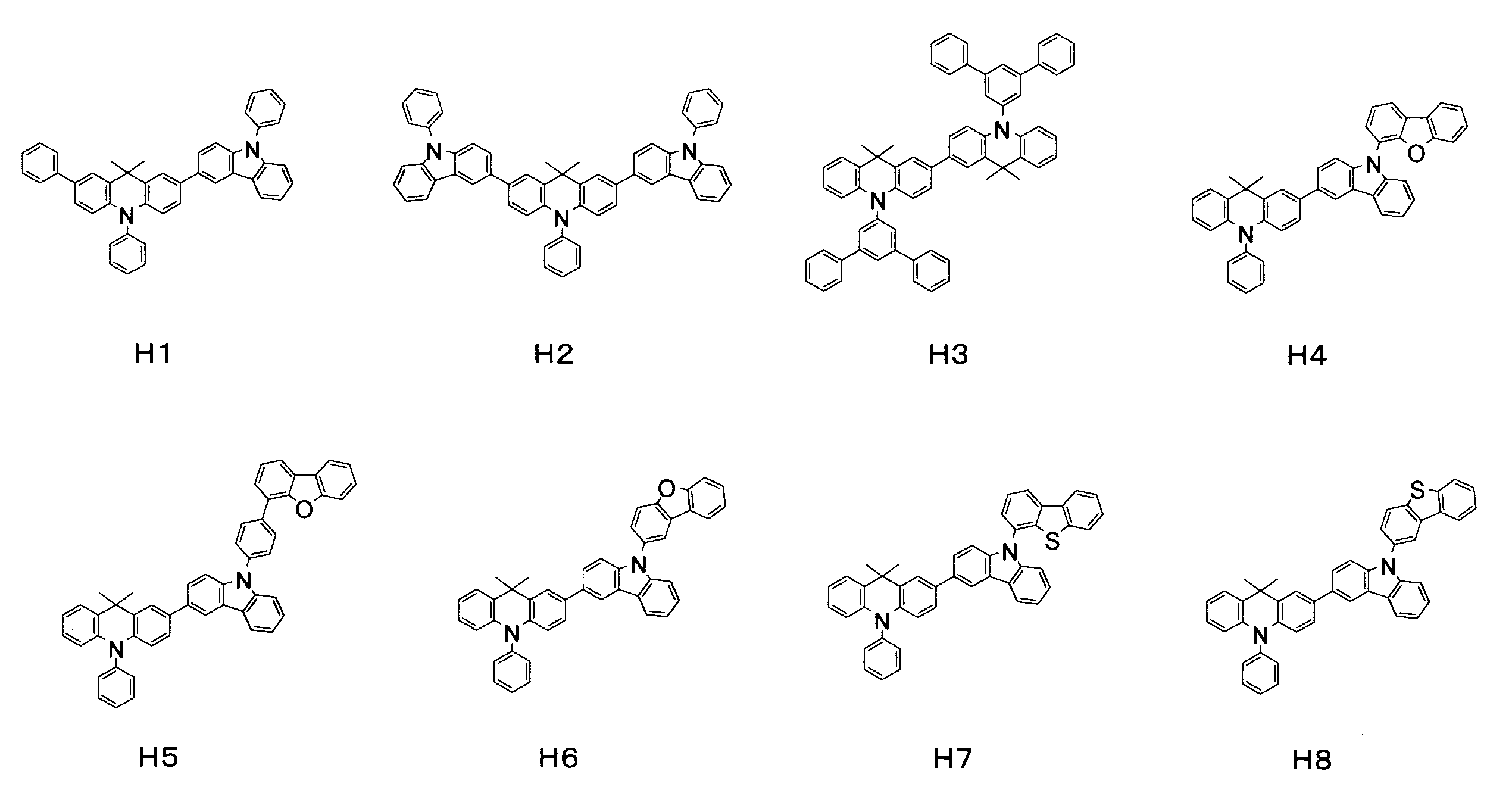
アルゴン雰囲気下、中間体5を4.4g、中間体2を3.0g、テトラキス(トリフェニルフォスフィン)パラジウム(0)92mgにトルエン10mL、1,2-ジメトキシエタン10mL、2M濃度の炭酸ナトリウム水溶液5mLを加え、10時間還流させながら加熱した。
反応終了後、直ちにろ過した後、水層を除去した。有機層を硫酸ナトリウムで乾燥させた後、濃縮した。残渣をシリカゲルカラムクロマトグラフィーで精製し、4.0gの白色結晶を得た。FD-MSの分析により、白色粉末を芳香族複素環誘導体(H1)と同定した。
合成実施例1において、中間体5の代わりに中間体3を4.4g、中間体2を6.3g用いた以外は同様に反応を行ったところ、5.4gの白色粉末を得た。FD-MSの分析により、白色粉末を芳香族複素環誘導体(H2)と同定した。
合成実施例1において、中間体5の代わりに中間体7を5.2g、中間体2の代わりに中間体8を4.8g用いた以外は同様に反応を行ったところ、6.3gの白色粉末を得た。FD-MSの分析により、白色粉末を芳香族複素環誘導体(H3)と同定した。
アルゴン雰囲気下、中間体10(4.5g、10.0mmol)、中間体11(2.5g、10.0mmol)、Pd2(dba)3(0.14g、0.15mmol)、P(tBu)3HBF4(0.087g、0.3mmol)、t-ブトキシナトリウム(1.9g、20.0mmol)に、無水キシレン50mlを加えて8時間加熱還流した。
反応終了後、反応液を50℃に冷却し、セライト、及びシリカゲルを通して濾過を行い、濾液を濃縮した。得られた濃縮残渣をシリカゲルカラムクロマトグラフィーにて精製し白色固体を得た。粗生成物をトルエンにて再結晶し、3.1gの白色結晶を得た。FD-MSの分析により、芳香族複素環誘導体(H4)と同定した。
合成実施例4において、中間体11の代わりに中間体12を3.2g用いた以外は同様に反応を行ったところ、4.8gの白色粉末を得た。FD-MSの分析により、白色粉末を芳香族複素環誘導体(H5)と同定した。
合成実施例4において、中間体11の代わりに中間体13を2.5g用いた以外は同様に反応を行ったところ、3.7gの白色粉末を得た。FD-MSの分析により、白色粉末を芳香族複素環誘導体(H6)と同定した。
合成実施例4において、中間体11の代わりに中間体14を2.6g用いた以外は同様に反応を行ったところ、1.9gの白色粉末を得た。FD-MSの分析により、白色粉末を芳香族複素環誘導体(H7)と同定した。
合成実施例4において、中間体11の代わりに2-ブロモジベンゾチオフェンを2.6g用いた以外は同様に反応を行ったところ、3.2gの白色粉末を得た。FD-MSの分析により、白色粉末を芳香族複素環誘導体(H8)と同定した。
(有機EL素子の作製)
25mm×75mm×1.1mmのITO透明電極付きガラス基板(ジオマティック社製)に、イソプロピルアルコール中で5分間の超音波洗浄を施し、さらに、30分間のUV(Ultraviolet)オゾン洗浄を施した。
洗浄後の透明電極ライン付きガラス基板を真空蒸着装置の基板ホルダーに装着し、まず透明電極ラインが形成されている側の面上に前記透明電極を覆うようにして下記電子受容性化合物(A)を蒸着し、膜厚5nmのA膜を成膜した。このA膜上に、第1正孔輸送材料として下記芳香族アミン誘導体(X1)を蒸着し、膜厚120nmの第1正孔輸送層を成膜した。第1正孔輸送層の成膜に続けて、第2正孔輸送材料として前記合成実施例1で得た芳香族複素環誘導体(H1)を蒸着し、膜厚20nmの第2正孔輸送層を成膜した。
この正孔輸送層上に、燐光用ホストである化合物(B)と燐光用ドーパントであるIr(ppy)3とを厚さ40nmで共蒸着し、燐光発光層を得た。Ir(ppy)3の濃度は、15質量%であった。
続いて、この燐光発光層上に、厚さ20nmの化合物(C)、厚さ1nmのLiF、厚さ80nmの金属Alを順次積層し、陰極を得た。尚、電子注入性電極であるLiFについては、1Å/minの速度で形成した。

以上のように作製した有機EL素子を直流電流駆動により発光させ、輝度(L)、電流密度を測定し、電流密度1mA/cm2における発光効率(cd/A)、駆動電圧(V)を求めた。
さらに初期輝度10000cd/m2における素子寿命(半減寿命)を求めた。結果を表1に示す。
(有機EL素子の製造及び発光性能評価)
実施例1-1において、第2正孔輸送材料として芳香族複素環誘導体(H1)の代わりに、表1に記載の芳香族複素環誘導体を用いた以外は、実施例1-1と同様にして有機EL素子を作製し、評価した。結果を表1に示す。
(有機EL素子の製造及び発光性能評価)
実施例1において、第2正孔輸送材料として芳香族複素環誘導体(H1)の代わりに、下記比較化合物1及び比較化合物2を用いた以外は、実施例1-1と同様にして有機EL素子を作製し、評価した。結果を表1に示す。
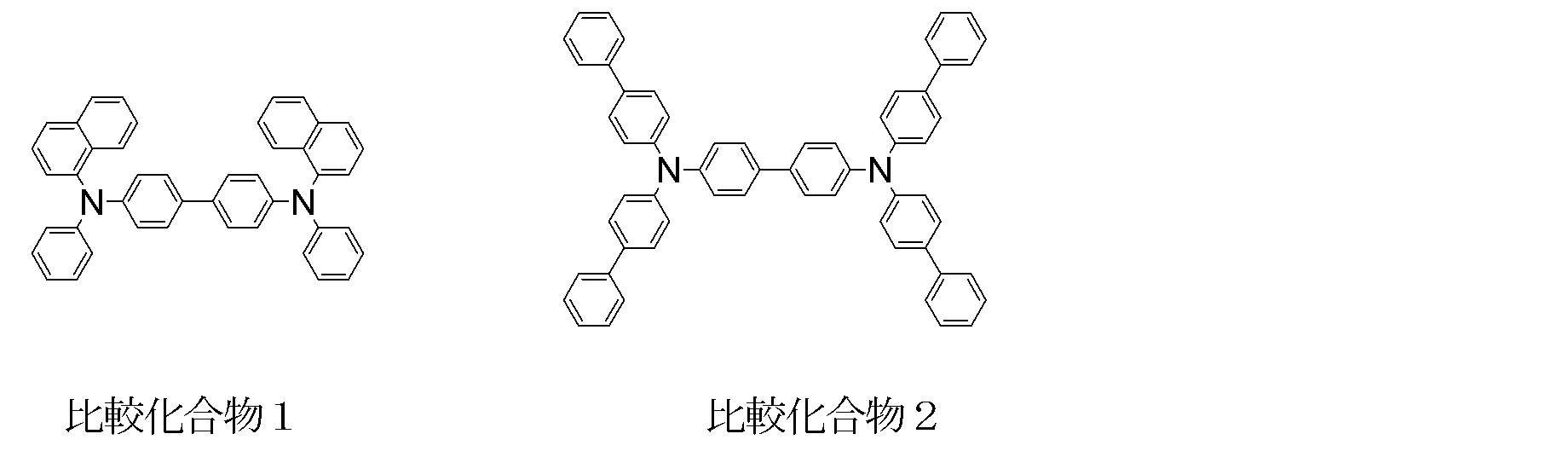
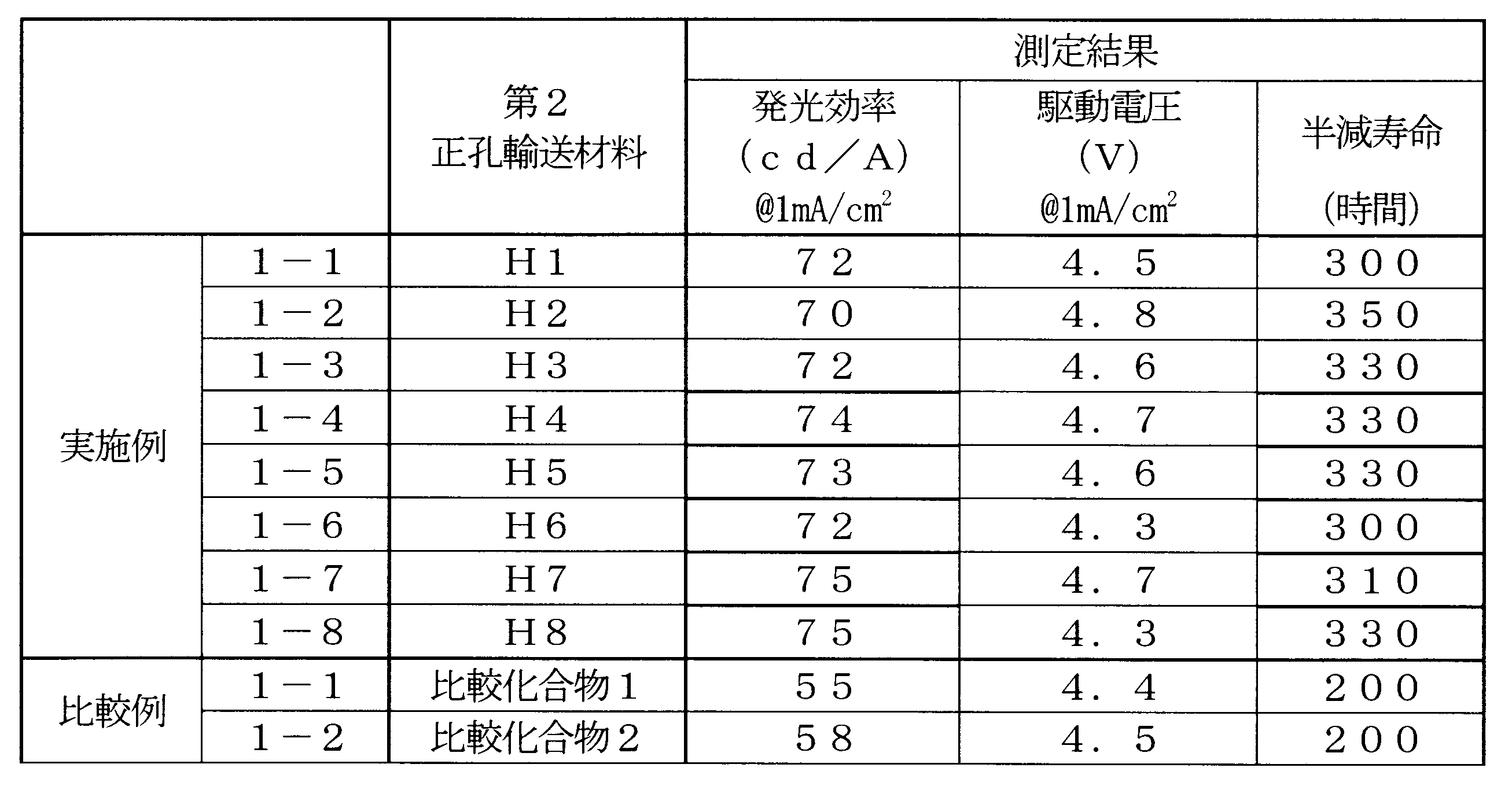
(有機EL素子の作製)
25mm×75mm×1.1mmのITO透明電極付きガラス基板(ジオマティック社製)に、イソプロピルアルコール中で5分間の超音波洗浄を施し、さらに、30分間のUV(Ultraviolet)オゾン洗浄を施した。
洗浄後の透明電極ライン付きガラス基板を真空蒸着装置の基板ホルダーに装着し、まず透明電極ラインが形成されている側の面上に前記透明電極を覆うようにして前記電子受容性化合物(A)を蒸着し、膜厚5nmのA膜を成膜した。このA膜上に、第1正孔輸送材料として前記芳香族アミン誘導体(X1)を蒸着し、膜厚70nmの第1正孔輸送層を成膜した。第1正孔輸送層の成膜に続けて、第2正孔輸送材料として前記合成実施例1で得た芳香族複素環誘導体(H1)を蒸着し、膜厚20nmの第2正孔輸送層を成膜した。
この正孔輸送層上に、燐光用ホストである化合物(B)と燐光用ドーパントであるFIrpicとを厚さ40nmで共蒸着し、燐光発光層を得た。FIrpicの濃度は、15質量%であった。
続いて、この燐光発光層上に、厚さ20nmの前記化合物(C)、厚さ1nmのLiF、厚さ80nmの金属Alを順次積層し、陰極を得た。尚、電子注入性電極であるLiFについては、1Å/minの速度で形成した。
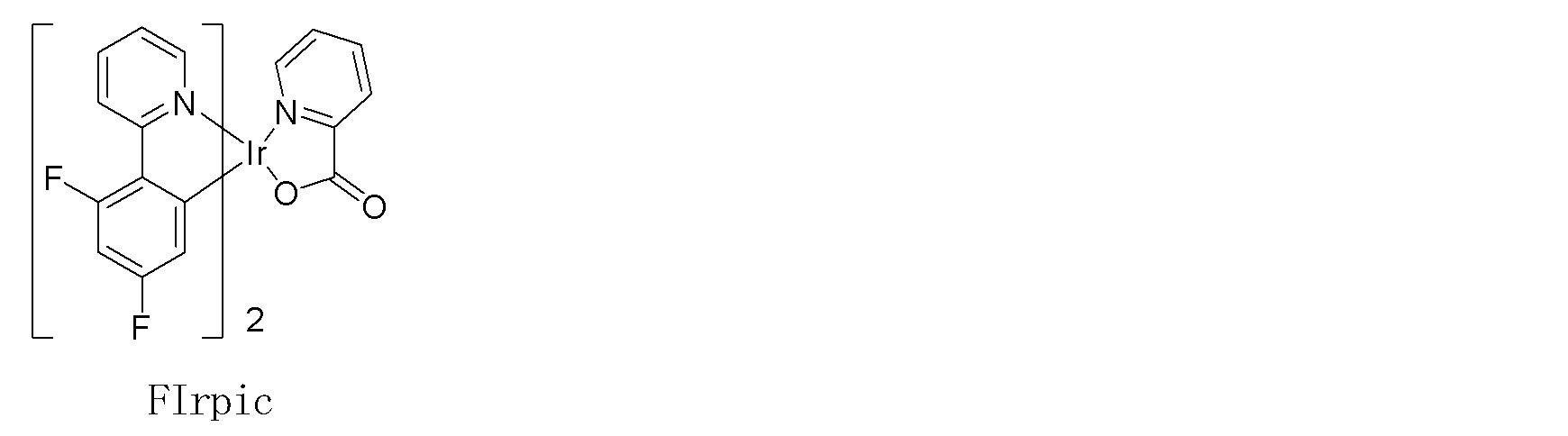
以上のように作製した有機EL素子を直流電流駆動により発光させ、輝度(L)、電流密度を測定し、電流密度1mA/cm2における発光効率(cd/A)、駆動電圧(V)を求めた。
さらに初期輝度1000cd/m2における素子寿命(半減寿命)を求めた。結果を表2に示す。
実施例2-1において、第2正孔輸送材料として芳香族複素環誘導体(H1)の代わりに、前記化合物(H2)、(H3)を用いた以外は、実施例2-1と同様にして有機EL素子を作製し、評価した。結果を表2に示す。
実施例2-1において、第2正孔輸送材料として芳香族複素環誘導体(H1)の代わりに、前記比較化合物1、2を用いた以外は、実施例2-1と同様にして有機EL素子を作製し、評価した。結果を表2に示す。
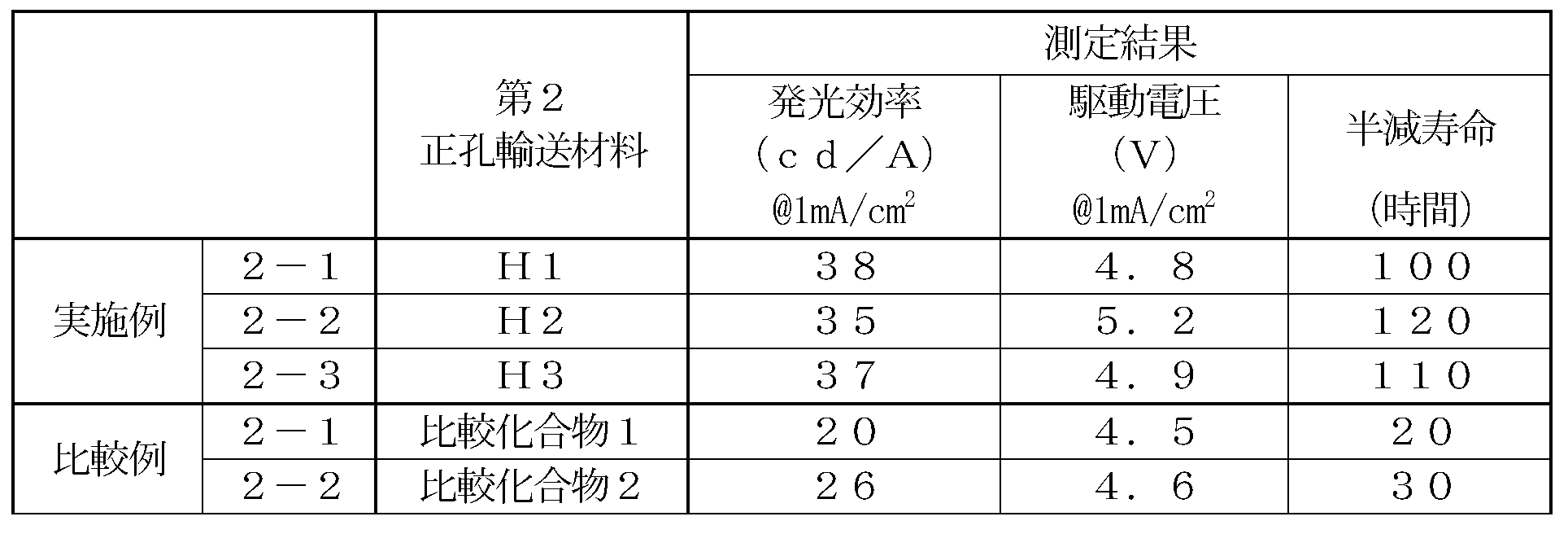
本発明の有機EL素子は、壁掛けテレビのフラットパネルディスプレイ等の平面発光体、複写機、プリンター、液晶ディスプレイのバックライト又は計器類等の光源、表示板、標識灯等に利用できる。
この明細書に記載の文献の内容を全てここに援用する。
Claims (14)
- 下記式(1)で表される芳香族複素環誘導体。

Xは、CRaRb又はSiRaRbを表わす。
Y及びWは、それぞれ独立に、NRc、酸素原子、硫黄原子を表わす。
Zは、単結合、CRaRb又はSiRaRbを表わす。
Ra、Rb及びRcは、それぞれ独立に、水素原子、置換もしくは無置換の炭素数1~15のアルキル基、置換もしくは無置換の環形成炭素数3~15のシクロアルキル基、置換もしくは無置換の炭素数7~25のアラルキル基、置換もしくは無置換の炭素数1~15のフルオロアルキル基、置換もしくは無置換の環形成炭素数6~24のアリール基又は置換もしくは無置換の環形成原子数5~24のヘテロアリール基を表わす。
R1、R2、R3及びR4は、それぞれ独立に、置換もしくは無置換の炭素数1~15のアルキル基、置換もしくは無置換の環形成炭素数3~15のシクロアルキル基、置換もしくは無置換の炭素数1~15のアルコキシ基、置換もしくは無置換の炭素数7~25のアラルキル基、置換もしくは無置換の炭素数1~15のフルオロアルキル基、置換もしくは無置換の炭素数1~15のフルオロアルコキシ基、置換もしくは無置換のシリル基、置換もしくは無置換の環形成炭素数6~24のアリール基、置換もしくは無置換の環形成原子数5~24のヘテロアリール基、置換もしくは無置換のアミノ基、置換もしくは無置換の環形成炭素数6~24のアリールオキシ基、置換もしくは無置換の環形成原子数5~24のヘテロアリールオキシ基、ハロゲン原子又はシアノ基を表す。
a、b及びdは、それぞれ独立に、0~4の整数を表す。
cは、0~3の整数を表す。
a~dが2以上の整数の場合、それぞれ独立に、2以上のR1~R4同士が互いに結合して飽和もしくは不飽和の2価の基を形成してもよい。
m及びnは、それぞれ独立に、0~4の整数を表す。
前記「置換もしくは無置換の各基」の置換基は、炭素数1~15のアルキル基、環形成炭素数3~15のシクロアルキル基、炭素数1~15のアルコキシ基、炭素数7~25のアラルキル基、炭素数1~15のフルオロアルキル基、炭素数1~15のフルオロアルコキシ基、シリル基、炭素数3~30のアルキルシリル基、炭素数8~30のアリールシリル基、環形成炭素数6~24のアリール基、環形成原子数5~24のヘテロアリール基、環形成炭素数6~24のアリールオキシ基、環形成原子数5~24のヘテロアリールオキシ基、ハロゲン原子及びシアノ基からなる群より選ばれる基である。
但し、前記置換基は、9,10-ジヒドロアクリジニル基ではない。] - 下記式(2)で表される請求項1に記載の芳香族複素環誘導体。

Xは、CRaRb又はSiRaRbを表わす。
Y及びWは、それぞれ独立に、NRc、酸素原子、硫黄原子を表わす。
Zは、単結合、CRaRb又はSiRaRbを表わす。
Ra、Rb及びRcは、それぞれ独立に、水素原子、置換もしくは無置換の炭素数1~15のアルキル基、置換もしくは無置換の環形成炭素数3~15のシクロアルキル基、置換もしくは無置換の炭素数7~25のアラルキル基、置換もしくは無置換の炭素数1~15のフルオロアルキル基、置換もしくは無置換の環形成炭素数6~24のアリール基又は置換もしくは無置換の環形成原子数5~24のヘテロアリール基を表わす。
R1、R2、R3及びR4は、それぞれ独立に、置換もしくは無置換の炭素数1~15のアルキル基、置換もしくは無置換の環形成炭素数3~15のシクロアルキル基、置換もしくは無置換の炭素数1~15のアルコキシ基、置換もしくは無置換の炭素数7~25のアラルキル基、置換もしくは無置換の炭素数1~15のフルオロアルキル基、置換もしくは無置換の炭素数1~15のフルオロアルコキシ基、置換もしくは無置換のシリル基、置換もしくは無置換の環形成炭素数6~24のアリール基、置換もしくは無置換の環形成原子数5~24のヘテロアリール基、置換もしくは無置換のアミノ基、置換もしくは無置換の環形成炭素数6~24のアリールオキシ基、置換もしくは無置換の環形成原子数5~24のヘテロアリールオキシ基、ハロゲン原子又はシアノ基を表す。
a及びdは、それぞれ独立に、0~4の整数を表す。
b及びcは、0~3の整数を表す。
a~dが2以上の整数の場合、それぞれ独立に、2以上のR1~R4同士が互いに結合して飽和もしくは不飽和の2価の基を形成してもよい。
前記「置換もしくは無置換の各基」の置換基は、炭素数1~15のアルキル基、環形成炭素数3~15のシクロアルキル基、炭素数1~15のアルコキシ基、炭素数7~25のアラルキル基、炭素数1~15のフルオロアルキル基、炭素数1~15のフルオロアルコキシ基、シリル基、炭素数3~30のアルキルシリル基、炭素数8~30のアリールシリル基、環形成炭素数6~24のアリール基、環形成原子数5~24のヘテロアリール基、環形成炭素数6~24のアリールオキシ基、環形成原子数5~24のヘテロアリールオキシ基、ハロゲン原子及びシアノ基からなる群より選ばれる基である。
但し、前記置換基は、9,10-ジヒドロアクリジニル基ではない。] - 下記式(3)で表される請求項2に記載の芳香族複素環誘導体。

Xは、CRaRb又はSiRaRbを表わす。
Y及びWは、それぞれ独立に、NRc、酸素原子、硫黄原子を表わす。
Ra、Rb及びRcは、それぞれ独立に、水素原子、置換もしくは無置換の炭素数1~15のアルキル基、置換もしくは無置換の環形成炭素数3~15のシクロアルキル基、置換もしくは無置換の炭素数7~25のアラルキル基、置換もしくは無置換の炭素数1~15のフルオロアルキル基、置換もしくは無置換の環形成炭素数6~24のアリール基又は置換もしくは無置換の環形成原子数5~24のヘテロアリール基を表わす。
R1、R2、R3及びR4は、それぞれ独立に、置換もしくは無置換の炭素数1~15のアルキル基、置換もしくは無置換の環形成炭素数3~15のシクロアルキル基、置換もしくは無置換の炭素数1~15のアルコキシ基、置換もしくは無置換の炭素数7~25のアラルキル基、置換もしくは無置換の炭素数1~15のフルオロアルキル基、置換もしくは無置換の炭素数1~15のフルオロアルコキシ基、置換もしくは無置換のシリル基、置換もしくは無置換の環形成炭素数6~24のアリール基、置換もしくは無置換の環形成原子数5~24のヘテロアリール基、置換もしくは無置換のアミノ基、置換もしくは無置換の環形成炭素数6~24のアリールオキシ基、置換もしくは無置換の環形成原子数5~24のヘテロアリールオキシ基、ハロゲン原子又はシアノ基を表す。
a及びdは、それぞれ独立に、0~4の整数を表す。
b及びcは、0~3の整数を表す。
a~dが2以上の整数の場合、それぞれ独立に、2以上のR1~R4同士が互いに結合して飽和もしくは不飽和の2価の基を形成してもよい。
前記「置換もしくは無置換の各基」の置換基は、炭素数1~15のアルキル基、環形成炭素数3~15のシクロアルキル基、炭素数1~15のアルコキシ基、炭素数7~25のアラルキル基、炭素数1~15のフルオロアルキル基、炭素数1~15のフルオロアルコキシ基、シリル基、炭素数3~30のアルキルシリル基、炭素数8~30のアリールシリル基、環形成炭素数6~24のアリール基、環形成原子数5~24のヘテロアリール基、環形成炭素数6~24のアリールオキシ基、環形成原子数5~24のヘテロアリールオキシ基、ハロゲン原子及びシアノ基からなる群より選ばれる基である。
但し、前記置換基は、9,10-ジヒドロアクリジニル基ではない。] - 下記式(4)で表される請求項3に記載の芳香族複素環誘導体。
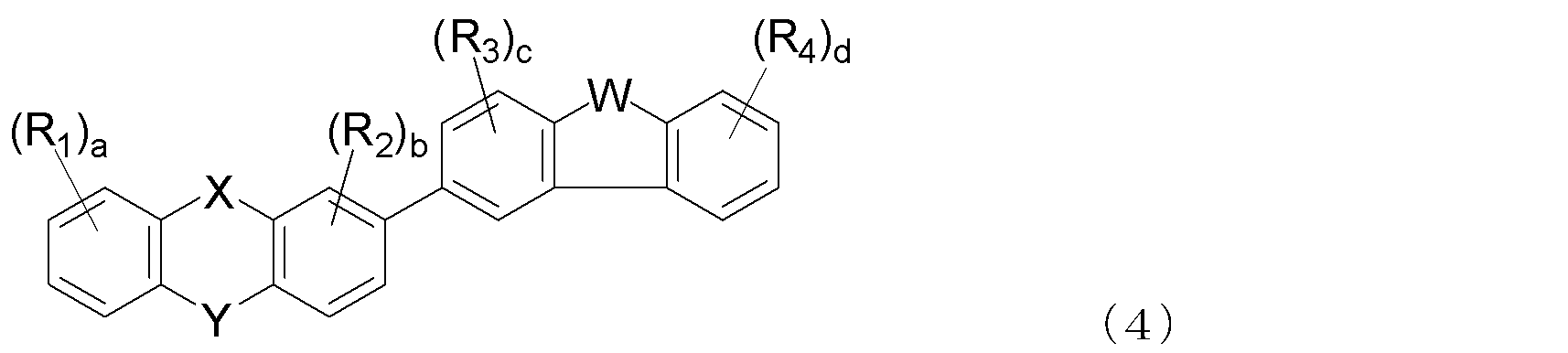
Xは、CRaRb又はSiRaRbを表わす。
Y及びWは、それぞれ独立に、NRc、酸素原子、硫黄原子を表わす。
Ra、Rb及びRcは、それぞれ独立に、水素原子、置換もしくは無置換の炭素数1~15のアルキル基、置換もしくは無置換の環形成炭素数3~15のシクロアルキル基、置換もしくは無置換の炭素数7~25のアラルキル基、置換もしくは無置換の炭素数1~15のフルオロアルキル基、置換もしくは無置換の環形成炭素数6~24のアリール基又は置換もしくは無置換の環形成原子数5~24のヘテロアリール基を表わす。
R1、R2、R3及びR4は、それぞれ独立に、置換もしくは無置換の炭素数1~15のアルキル基、置換もしくは無置換の環形成炭素数3~15のシクロアルキル基、置換もしくは無置換の炭素数1~15のアルコキシ基、置換もしくは無置換の炭素数7~25のアラルキル基、置換もしくは無置換の炭素数1~15のフルオロアルキル基、置換もしくは無置換の炭素数1~15のフルオロアルコキシ基、置換もしくは無置換のシリル基、置換もしくは無置換の環形成炭素数6~24のアリール基、置換もしくは無置換の環形成原子数5~24のヘテロアリール基、置換もしくは無置換のアミノ基、置換もしくは無置換の環形成炭素数6~24のアリールオキシ基、置換もしくは無置換の環形成原子数5~24のヘテロアリールオキシ基、ハロゲン原子又はシアノ基を表す。
a及びdは、それぞれ独立に、0~4の整数を表す。
b及びcは、0~3の整数を表す。
a~dが2以上の整数の場合、それぞれ独立に、2以上のR1~R4同士が互いに結合して飽和もしくは不飽和の2価の基を形成してもよい。
前記「置換もしくは無置換の各基」の置換基は、炭素数1~15のアルキル基、環形成炭素数3~15のシクロアルキル基、炭素数1~15のアルコキシ基、炭素数7~25のアラルキル基、炭素数1~15のフルオロアルキル基、炭素数1~15のフルオロアルコキシ基、シリル基、炭素数3~30のアルキルシリル基、炭素数8~30のアリールシリル基、環形成炭素数6~24のアリール基、環形成原子数5~24のヘテロアリール基、環形成炭素数6~24のアリールオキシ基、環形成原子数5~24のヘテロアリールオキシ基、ハロゲン原子及びシアノ基からなる群より選ばれる基である。
但し、前記置換基は、9,10-ジヒドロアクリジニル基ではない。] - 前記XがCRaRbで表される請求項1~4のいずれかに記載の芳香族複素環誘導体。
- 前記YがNRcで表される請求項1~5のいずれかに記載の芳香族複素環誘導体。
- 有機エレクトロルミネッセンス素子用材料である請求項1~6のいずれかに記載の芳香族複素環誘導体。
- 有機エレクトロルミネッセンス素子用正孔輸送材料である請求項7に記載の芳香族複素環誘導体。
- 陽極と陰極と、
前記陽極と陰極の間に1以上の有機薄膜層を備え、
前記有機薄膜層の1層以上が、請求項1~8のいずれかに記載の芳香族複素環誘導体を含有する有機エレクトロルミネッセンス素子。 - 前記有機薄膜層が、正孔輸送層及び/又は正孔注入層を有し、前記正孔輸送層及び/又は正孔注入層が、前記芳香族複素環誘導体を含有している請求項9に記載の有機エレクトロルミネッセンス素子。
- 前記正孔輸送層及び/又は正孔注入層に、下記式(10)で表される化合物を含有する層が接合されている請求項10に記載の有機エレクトロルミネッセンス素子。
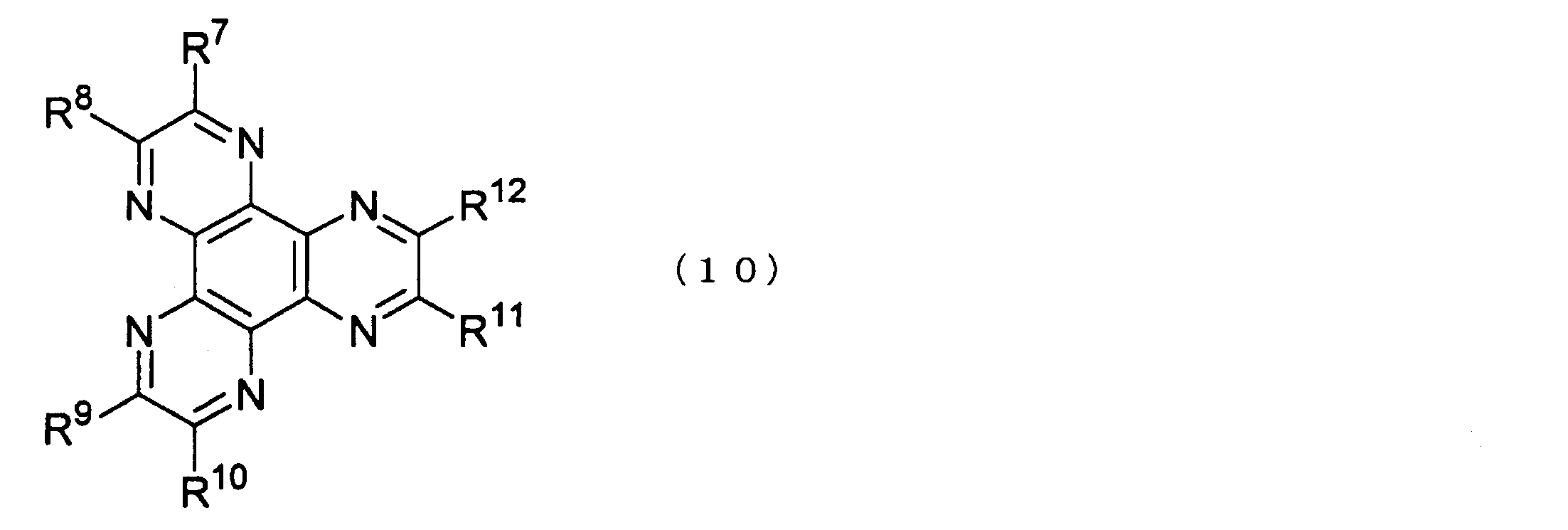
- 前記有機薄膜層が発光層を有し、前記発光層が燐光発光性材料を含有する請求項9~11のいずれか記載の有機エレクトロルミネッセンス素子。
- 前記燐光発光材料がイリジウム(Ir)、オスミウム(Os)又は白金(Pt)金属のオルトメタル化錯体である請求項12記載の有機エレクトロルミネッセンス素子。
- 前記有機薄膜層が電子輸送層を有し、前記電子輸送層が下記式のいずれかで表される含窒素複素環誘導体を含有している請求項9~13のいずれか記載の有機エレクトロルミネッセンス素子。
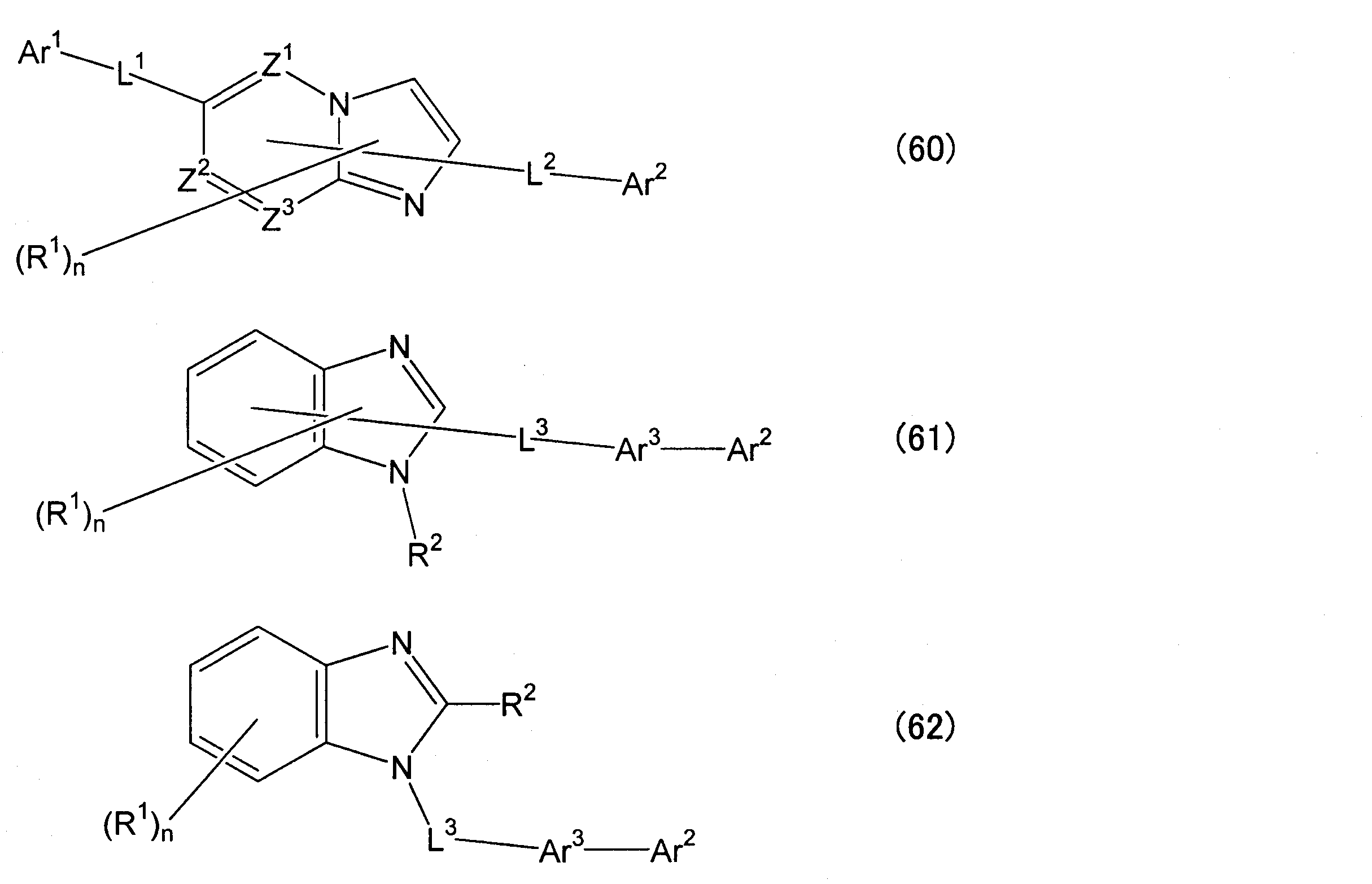
R1及びR2は、それぞれ独立に、置換もしくは無置換の環形成炭素数6~50のアリール基、置換もしくは無置換の環形成原子数3~50のヘテロアリール基、炭素数1~20のアルキル基、ハロゲン原子が置換した炭素数1~20のアルキル基又は炭素数1~20のアルコキシ基である。
nは、0~5の整数であり、nが2以上の整数であるとき、複数のR1は互いに同一でも異なっていてもよい。また、隣接する2つのR1同士が互いに結合して、置換もしくは無置換の芳香族炭化水素環を形成していてもよい。
Ar1は、置換もしくは無置換の環形成炭素数6~50のアリール基又は置換もしくは無置換の環形成原子数3~50のヘテロアリール基である。
Ar2は、水素原子、炭素数1~20のアルキル基、ハロゲン原子が置換した炭素数1~20のアルキル基、炭素数1~20のアルコキシ基、置換もしくは無置換の環形成炭素数6~50のアリール基又は置換もしくは無置換の環形成原子数3~50のヘテロアリール基である。
但し、Ar1、Ar2のいずれか一方は、置換もしくは無置換の環形成炭素数10~50の縮合芳香族炭化水素環基又は置換もしくは無置換の環形成原子数9~50の縮合芳香族複素環基である。
Ar3は、置換もしくは無置換の環形成炭素数6~50のアリーレン基又は置換もしくは無置換の環形成原子数3~50のヘテロアリーレン基である。
L1、L2及びL3は、それぞれ独立に、単結合、置換もしくは無置換の環形成炭素数6~50のアリーレン基、又は置換もしくは無置換の環形成原子数9~50のヘテロ縮合環基である。)
Priority Applications (4)
| Application Number | Priority Date | Filing Date | Title |
|---|---|---|---|
| CN201180002628XA CN102548968A (zh) | 2010-10-12 | 2011-10-07 | 芳香族杂环衍生物及使用该芳香族杂环衍生物的有机场致发光元件 |
| US13/501,423 US20120273766A1 (en) | 2010-10-12 | 2011-10-07 | Aromatic heterocyclic derivative and organic electroluminescence device using the same |
| JP2011548458A JPWO2012049828A1 (ja) | 2010-10-12 | 2011-10-07 | 芳香族複素環誘導体及びそれらを用いた有機エレクトロルミネッセンス素子 |
| EP11832068.8A EP2628729A4 (en) | 2010-10-12 | 2011-10-07 | AROMATIC HETEROCYCLIC DERIVATIVE AND ORGANIC ELECTROLUMINESCENT ELEMENT THEREWITH |
Applications Claiming Priority (2)
| Application Number | Priority Date | Filing Date | Title |
|---|---|---|---|
| JP2010229987 | 2010-10-12 | ||
| JP2010-229987 | 2010-10-12 |
Publications (1)
| Publication Number | Publication Date |
|---|---|
| WO2012049828A1 true WO2012049828A1 (ja) | 2012-04-19 |
Family
ID=45938069
Family Applications (1)
| Application Number | Title | Priority Date | Filing Date |
|---|---|---|---|
| PCT/JP2011/005668 Ceased WO2012049828A1 (ja) | 2010-10-12 | 2011-10-07 | 芳香族複素環誘導体及びそれらを用いた有機エレクトロルミネッセンス素子 |
Country Status (7)
| Country | Link |
|---|---|
| US (1) | US20120273766A1 (ja) |
| EP (1) | EP2628729A4 (ja) |
| JP (1) | JPWO2012049828A1 (ja) |
| KR (1) | KR20120104084A (ja) |
| CN (1) | CN102548968A (ja) |
| TW (1) | TW201223951A (ja) |
| WO (1) | WO2012049828A1 (ja) |
Cited By (14)
| Publication number | Priority date | Publication date | Assignee | Title |
|---|---|---|---|---|
| WO2012147330A1 (ja) * | 2011-04-27 | 2012-11-01 | 保土谷化学工業株式会社 | アクリダン環構造を有する化合物および有機エレクトロルミネッセンス素子 |
| WO2014017844A1 (ko) * | 2012-07-26 | 2014-01-30 | 주식회사 동진쎄미켐 | 아크리딘 유도체를 포함하는 유기발광 화합물 및 이를 포함하는 유기발광소자 |
| KR20140015202A (ko) * | 2012-07-26 | 2014-02-06 | 주식회사 동진쎄미켐 | 아크리딘 유도체를 포함하는 유기발광 화합물 및 이를 포함하는 유기발광소자 |
| US9000171B2 (en) | 2012-11-19 | 2015-04-07 | Samsung Display Co., Ltd. | Organic electroluminescence material including a substituted acridine compound and organic electroluminescence device including the same |
| KR101536169B1 (ko) * | 2012-07-16 | 2015-07-14 | 주식회사 엠비케이 | 신규한 유기발광화합물 및 이를 포함하는 유기전기발광소자 |
| JPWO2013153780A1 (ja) * | 2012-04-10 | 2015-12-17 | 保土谷化学工業株式会社 | アクリダン環構造を有する化合物および有機エレクトロルミネッセンス素子 |
| JP2016534096A (ja) * | 2013-07-30 | 2016-11-04 | メルク パテント ゲーエムベーハー | 電子素子のための材料 |
| JP2016534095A (ja) * | 2013-07-30 | 2016-11-04 | メルク パテント ゲーエムベーハー | 電子素子のための材料 |
| KR20170121691A (ko) * | 2016-04-25 | 2017-11-02 | 주식회사 엘지화학 | 화합물 및 이를 포함하는 유기 전자 소자 |
| JP2018016638A (ja) * | 2012-08-30 | 2018-02-01 | 出光興産株式会社 | 芳香族アミン誘導体およびこれを用いた有機エレクトロルミネッセンス素子 |
| US10566547B2 (en) | 2016-07-11 | 2020-02-18 | Universal Display Corporation | Organic electroluminescent materials and devices |
| US11158820B2 (en) | 2017-03-29 | 2021-10-26 | Universal Display Corporation | Organic electroluminescent materials and devices |
| WO2021261856A1 (ko) * | 2020-06-26 | 2021-12-30 | 주식회사 엘지화학 | 헤테로고리 화합물 및 이를 포함하는 유기 발광 소자 |
| WO2022019535A1 (ko) * | 2020-07-24 | 2022-01-27 | 주식회사 엘지화학 | 화합물 및 이를 포함하는 유기 발광 소자 |
Families Citing this family (11)
| Publication number | Priority date | Publication date | Assignee | Title |
|---|---|---|---|---|
| KR101153910B1 (ko) * | 2010-02-19 | 2012-06-07 | 덕산하이메탈(주) | 인돌 유도체를 핵심으로 하는 화합물 및 이를 이용한 유기전기소자, 그 단말 |
| WO2012108389A1 (ja) | 2011-02-07 | 2012-08-16 | 出光興産株式会社 | ビスカルバゾール誘導体及びそれを用いた有機エレクトロルミネッセンス素子 |
| JP6060095B2 (ja) | 2012-02-03 | 2017-01-11 | 出光興産株式会社 | カルバゾール化合物、有機エレクトロルミネッセンス素子用材料および有機エレクトロルミネッセンス素子 |
| KR102191023B1 (ko) * | 2013-02-28 | 2020-12-15 | 에스에프씨 주식회사 | 유기발광 화합물 및 이를 포함하는 유기전계발광소자 |
| WO2014148047A1 (ja) * | 2013-03-22 | 2014-09-25 | 出光興産株式会社 | ヘテロ縮合環を有するアミン化合物及びそれを用いた有機エレクトロルミネッセンス素子 |
| KR101671561B1 (ko) | 2013-09-25 | 2016-11-01 | 주식회사 엘지화학 | 신규한 화합물 및 이를 이용한 유기 발광 소자 |
| KR102510392B1 (ko) | 2015-09-10 | 2023-03-16 | 삼성디스플레이 주식회사 | 카바졸계 화합물 및 이를 포함한 유기 발광 소자 |
| CN105330611B (zh) * | 2015-11-20 | 2017-10-31 | 江苏三月光电科技有限公司 | 一种含有双氮杂蒽结构的化合物材料及其应用 |
| CN108516959A (zh) * | 2018-02-23 | 2018-09-11 | 王美妮 | 吖啶类化合物、有机电致发光器件及显示装置 |
| CN108586337A (zh) * | 2018-03-05 | 2018-09-28 | 王美妮 | 有机电致发光材料、有机电致发光器件及显示装置 |
| WO2022019536A1 (ko) * | 2020-07-24 | 2022-01-27 | 주식회사 엘지화학 | 화합물 및 이를 포함하는 유기 발광 소자 |
Citations (22)
| Publication number | Priority date | Publication date | Assignee | Title |
|---|---|---|---|---|
| US4780536A (en) | 1986-09-05 | 1988-10-25 | The Ohio State University Research Foundation | Hexaazatriphenylene hexanitrile and its derivatives and their preparations |
| JPH083547A (ja) | 1994-03-31 | 1996-01-09 | Toray Ind Inc | 発光素子 |
| JP3571977B2 (ja) | 1999-11-12 | 2004-09-29 | キヤノン株式会社 | 有機発光素子 |
| JP3614405B2 (ja) | 1999-12-31 | 2005-01-26 | エルジー・ケミカル・カンパニー・リミテッド | p−型半導体性質を有する有機化合物を含む電子素子 |
| WO2006033563A1 (en) * | 2004-09-24 | 2006-03-30 | Lg Chem. Ltd. | Organic light emitting device |
| JP2006199698A (ja) | 2005-01-21 | 2006-08-03 | Samsung Sdi Co Ltd | 青色発光化合物及びそれを採用した有機電界発光素子 |
| WO2006114966A1 (ja) * | 2005-04-18 | 2006-11-02 | Konica Minolta Holdings, Inc. | 有機エレクトロルミネッセンス素子、表示装置及び照明装置 |
| US20070273270A1 (en) | 2006-05-25 | 2007-11-29 | Idemitsu Kosan Co., Ltd. | Organic electroluminescence device |
| US20080014464A1 (en) | 2006-06-22 | 2008-01-17 | Idemitsu Kosan Co., Ltd. | Organic electroluminescent device using aryl amine derivative containing heterocycle |
| WO2008023623A1 (en) | 2006-08-22 | 2008-02-28 | Idemitsu Kosan Co., Ltd. | Organic electroluminescent device |
| JP4134280B2 (ja) | 2006-05-25 | 2008-08-20 | 出光興産株式会社 | 有機エレクトロルミネッセンス素子及びフルカラー発光装置 |
| US20090021160A1 (en) | 2006-02-23 | 2009-01-22 | Idemitsu Kosan Co., Ltd. | Material for organic electroluminescent device, method for producing same and organic electroluminescent device |
| WO2009081857A1 (ja) | 2007-12-21 | 2009-07-02 | Idemitsu Kosan Co., Ltd. | 有機エレクトロルミネッセンス素子 |
| WO2009107596A1 (ja) | 2008-02-25 | 2009-09-03 | 出光興産株式会社 | 有機発光媒体及び有機el素子 |
| US20090243473A1 (en) | 2006-08-04 | 2009-10-01 | Idemitsu Kosan Co., Ltd. | Organic electroluminescence device |
| JP2009298730A (ja) * | 2008-06-13 | 2009-12-24 | Nagoya City | ビスフェナザシリン化合物、ビスフェナザシリン化合物の製造方法、ビスフェナザシリン化合物を用いた有機薄膜トランジスタ |
| WO2010083871A1 (de) * | 2009-01-20 | 2010-07-29 | Merck Patent Gmbh | Verbindungen für elektronische vorrichtungen |
| JP2010180204A (ja) | 2009-01-06 | 2010-08-19 | Fujifilm Corp | 電荷輸送材料及び有機電界発光素子 |
| WO2010150593A1 (ja) * | 2009-06-24 | 2010-12-29 | コニカミノルタホールディングス株式会社 | 有機エレクトロルミネッセンス素子、表示装置、照明装置及び縮合多環式複素環化合物 |
| JP2011119205A (ja) * | 2009-11-06 | 2011-06-16 | Fujifilm Corp | 光電変換素子および光電気化学電池 |
| WO2011088877A1 (de) * | 2010-01-25 | 2011-07-28 | Merck Patent Gmbh | Verbindungen für elektronische vorrichtungen |
| WO2011107186A2 (de) * | 2010-03-02 | 2011-09-09 | Merck Patent Gmbh | Verbindungen für elektronische vorrichtungen |
Family Cites Families (6)
| Publication number | Priority date | Publication date | Assignee | Title |
|---|---|---|---|---|
| CN1751024A (zh) * | 2003-01-10 | 2006-03-22 | 出光兴产株式会社 | 含氮杂环衍生物以及使用该衍生物的有机电致发光元件 |
| JP2007149941A (ja) * | 2005-11-28 | 2007-06-14 | Idemitsu Kosan Co Ltd | 有機エレクトロルミネッセンス素子 |
| US20090091253A1 (en) * | 2006-03-17 | 2009-04-09 | Konica Minolta Holdings, Inc. | Organic electroluminescent element, display device and lighting device |
| KR101384046B1 (ko) * | 2006-05-11 | 2014-04-09 | 이데미쓰 고산 가부시키가이샤 | 유기 전계발광 소자 |
| KR101577468B1 (ko) * | 2007-10-02 | 2015-12-14 | 바스프 에스이 | Oled에서의 매트릭스 물질 및/또는 전자 차단체로서의 아크리딘 유도체의 용도 |
| KR20120104086A (ko) * | 2010-08-31 | 2012-09-20 | 이데미쓰 고산 가부시키가이샤 | 질소 함유 방향족 복소환 유도체 및 이들을 이용한 유기 전계 발광 소자 |
-
2011
- 2011-10-07 JP JP2011548458A patent/JPWO2012049828A1/ja active Pending
- 2011-10-07 KR KR1020117031465A patent/KR20120104084A/ko not_active Ceased
- 2011-10-07 CN CN201180002628XA patent/CN102548968A/zh active Pending
- 2011-10-07 WO PCT/JP2011/005668 patent/WO2012049828A1/ja not_active Ceased
- 2011-10-07 US US13/501,423 patent/US20120273766A1/en not_active Abandoned
- 2011-10-07 EP EP11832068.8A patent/EP2628729A4/en not_active Withdrawn
- 2011-10-11 TW TW100136641A patent/TW201223951A/zh unknown
Patent Citations (22)
| Publication number | Priority date | Publication date | Assignee | Title |
|---|---|---|---|---|
| US4780536A (en) | 1986-09-05 | 1988-10-25 | The Ohio State University Research Foundation | Hexaazatriphenylene hexanitrile and its derivatives and their preparations |
| JPH083547A (ja) | 1994-03-31 | 1996-01-09 | Toray Ind Inc | 発光素子 |
| JP3571977B2 (ja) | 1999-11-12 | 2004-09-29 | キヤノン株式会社 | 有機発光素子 |
| JP3614405B2 (ja) | 1999-12-31 | 2005-01-26 | エルジー・ケミカル・カンパニー・リミテッド | p−型半導体性質を有する有機化合物を含む電子素子 |
| WO2006033563A1 (en) * | 2004-09-24 | 2006-03-30 | Lg Chem. Ltd. | Organic light emitting device |
| JP2006199698A (ja) | 2005-01-21 | 2006-08-03 | Samsung Sdi Co Ltd | 青色発光化合物及びそれを採用した有機電界発光素子 |
| WO2006114966A1 (ja) * | 2005-04-18 | 2006-11-02 | Konica Minolta Holdings, Inc. | 有機エレクトロルミネッセンス素子、表示装置及び照明装置 |
| US20090021160A1 (en) | 2006-02-23 | 2009-01-22 | Idemitsu Kosan Co., Ltd. | Material for organic electroluminescent device, method for producing same and organic electroluminescent device |
| JP4134280B2 (ja) | 2006-05-25 | 2008-08-20 | 出光興産株式会社 | 有機エレクトロルミネッセンス素子及びフルカラー発光装置 |
| US20070273270A1 (en) | 2006-05-25 | 2007-11-29 | Idemitsu Kosan Co., Ltd. | Organic electroluminescence device |
| US20080014464A1 (en) | 2006-06-22 | 2008-01-17 | Idemitsu Kosan Co., Ltd. | Organic electroluminescent device using aryl amine derivative containing heterocycle |
| US20090243473A1 (en) | 2006-08-04 | 2009-10-01 | Idemitsu Kosan Co., Ltd. | Organic electroluminescence device |
| WO2008023623A1 (en) | 2006-08-22 | 2008-02-28 | Idemitsu Kosan Co., Ltd. | Organic electroluminescent device |
| WO2009081857A1 (ja) | 2007-12-21 | 2009-07-02 | Idemitsu Kosan Co., Ltd. | 有機エレクトロルミネッセンス素子 |
| WO2009107596A1 (ja) | 2008-02-25 | 2009-09-03 | 出光興産株式会社 | 有機発光媒体及び有機el素子 |
| JP2009298730A (ja) * | 2008-06-13 | 2009-12-24 | Nagoya City | ビスフェナザシリン化合物、ビスフェナザシリン化合物の製造方法、ビスフェナザシリン化合物を用いた有機薄膜トランジスタ |
| JP2010180204A (ja) | 2009-01-06 | 2010-08-19 | Fujifilm Corp | 電荷輸送材料及び有機電界発光素子 |
| WO2010083871A1 (de) * | 2009-01-20 | 2010-07-29 | Merck Patent Gmbh | Verbindungen für elektronische vorrichtungen |
| WO2010150593A1 (ja) * | 2009-06-24 | 2010-12-29 | コニカミノルタホールディングス株式会社 | 有機エレクトロルミネッセンス素子、表示装置、照明装置及び縮合多環式複素環化合物 |
| JP2011119205A (ja) * | 2009-11-06 | 2011-06-16 | Fujifilm Corp | 光電変換素子および光電気化学電池 |
| WO2011088877A1 (de) * | 2010-01-25 | 2011-07-28 | Merck Patent Gmbh | Verbindungen für elektronische vorrichtungen |
| WO2011107186A2 (de) * | 2010-03-02 | 2011-09-09 | Merck Patent Gmbh | Verbindungen für elektronische vorrichtungen |
Non-Patent Citations (1)
| Title |
|---|
| See also references of EP2628729A4 |
Cited By (20)
| Publication number | Priority date | Publication date | Assignee | Title |
|---|---|---|---|---|
| WO2012147330A1 (ja) * | 2011-04-27 | 2012-11-01 | 保土谷化学工業株式会社 | アクリダン環構造を有する化合物および有機エレクトロルミネッセンス素子 |
| US9905770B2 (en) | 2011-04-27 | 2018-02-27 | Hodogaya Chemical Co., Ltd. | Compound having acridan ring structure, and organic electroluminescent device |
| JPWO2012147330A1 (ja) * | 2011-04-27 | 2014-07-28 | 保土谷化学工業株式会社 | アクリダン環構造を有する化合物および有機エレクトロルミネッセンス素子 |
| JPWO2013153780A1 (ja) * | 2012-04-10 | 2015-12-17 | 保土谷化学工業株式会社 | アクリダン環構造を有する化合物および有機エレクトロルミネッセンス素子 |
| KR101536169B1 (ko) * | 2012-07-16 | 2015-07-14 | 주식회사 엠비케이 | 신규한 유기발광화합물 및 이를 포함하는 유기전기발광소자 |
| KR102169273B1 (ko) * | 2012-07-26 | 2020-10-23 | 주식회사 동진쎄미켐 | 아크리딘 유도체를 포함하는 유기발광 화합물 및 이를 포함하는 유기발광소자 |
| WO2014017844A1 (ko) * | 2012-07-26 | 2014-01-30 | 주식회사 동진쎄미켐 | 아크리딘 유도체를 포함하는 유기발광 화합물 및 이를 포함하는 유기발광소자 |
| KR20140015202A (ko) * | 2012-07-26 | 2014-02-06 | 주식회사 동진쎄미켐 | 아크리딘 유도체를 포함하는 유기발광 화합물 및 이를 포함하는 유기발광소자 |
| JP2018016638A (ja) * | 2012-08-30 | 2018-02-01 | 出光興産株式会社 | 芳香族アミン誘導体およびこれを用いた有機エレクトロルミネッセンス素子 |
| US9000171B2 (en) | 2012-11-19 | 2015-04-07 | Samsung Display Co., Ltd. | Organic electroluminescence material including a substituted acridine compound and organic electroluminescence device including the same |
| JP2016534096A (ja) * | 2013-07-30 | 2016-11-04 | メルク パテント ゲーエムベーハー | 電子素子のための材料 |
| JP2016534095A (ja) * | 2013-07-30 | 2016-11-04 | メルク パテント ゲーエムベーハー | 電子素子のための材料 |
| US11588117B2 (en) | 2013-07-30 | 2023-02-21 | Merck Patent Gmbh | Materials for electronic devices |
| KR20170121691A (ko) * | 2016-04-25 | 2017-11-02 | 주식회사 엘지화학 | 화합물 및 이를 포함하는 유기 전자 소자 |
| KR101897907B1 (ko) | 2016-04-25 | 2018-09-12 | 주식회사 엘지화학 | 화합물 및 이를 포함하는 유기 전자 소자 |
| US10680184B2 (en) | 2016-07-11 | 2020-06-09 | Universal Display Corporation | Organic electroluminescent materials and devices |
| US10566547B2 (en) | 2016-07-11 | 2020-02-18 | Universal Display Corporation | Organic electroluminescent materials and devices |
| US11158820B2 (en) | 2017-03-29 | 2021-10-26 | Universal Display Corporation | Organic electroluminescent materials and devices |
| WO2021261856A1 (ko) * | 2020-06-26 | 2021-12-30 | 주식회사 엘지화학 | 헤테로고리 화합물 및 이를 포함하는 유기 발광 소자 |
| WO2022019535A1 (ko) * | 2020-07-24 | 2022-01-27 | 주식회사 엘지화학 | 화합물 및 이를 포함하는 유기 발광 소자 |
Also Published As
| Publication number | Publication date |
|---|---|
| EP2628729A1 (en) | 2013-08-21 |
| JPWO2012049828A1 (ja) | 2014-02-24 |
| EP2628729A4 (en) | 2014-04-16 |
| CN102548968A (zh) | 2012-07-04 |
| TW201223951A (en) | 2012-06-16 |
| KR20120104084A (ko) | 2012-09-20 |
| US20120273766A1 (en) | 2012-11-01 |
Similar Documents
| Publication | Publication Date | Title |
|---|---|---|
| US9382206B2 (en) | Nitrogen-containing aromatic heterocyclic derivative and organic electroluminescence device using the same | |
| WO2012049828A1 (ja) | 芳香族複素環誘導体及びそれらを用いた有機エレクトロルミネッセンス素子 | |
| JP6338630B2 (ja) | 新規な化合物 | |
| KR101588941B1 (ko) | 비스카바졸 유도체 및 그것을 이용한 유기 전기발광 소자 | |
| JP5617398B2 (ja) | ベンゾフルオレン化合物、該化合物を用いた発光層用材料および有機電界発光素子 | |
| US8586206B2 (en) | Aromatic amine derivative and organic electroluminescence device using the same | |
| JP6754422B2 (ja) | 有機エレクトロルミネッセンス素子、及び電子機器 | |
| KR20240142609A (ko) | 유기 일렉트로 루미네선스 소자, 전자 기기, 및 화합물 | |
| KR20120116282A (ko) | 신규한 유기 발광 화합물 및 이를 채용하고 있는 유기 전계 발광 소자 | |
| CN103384712A (zh) | 新有机电致发光化合物和使用该化合物的有机电致发光器件 | |
| WO2019240251A1 (ja) | 有機エレクトロルミネッセンス素子及びそれを用いた電子機器 | |
| KR20180097573A (ko) | 신규 화합물, 유기 전기발광 소자용 재료 및 유기 전기발광 소자 | |
| KR20230121081A (ko) | 유기 일렉트로루미네센스 소자 및 전자 기기 | |
| JP2025061694A (ja) | 化合物、有機エレクトロルミネッセンス素子用材料、有機エレクトロルミネッセンス素子及び電子機器 | |
| WO2020115933A1 (ja) | 有機エレクトロルミネッセンス素子及びそれを用いた電子機器 | |
| JP2020188121A (ja) | 有機エレクトロルミネッセンス素子及び電子機器 | |
| CN116998242A (zh) | 有机电致发光元件及电子设备 | |
| CN116568776A (zh) | 有机电致发光元件及电子设备 | |
| KR20240157739A (ko) | 화합물, 유기 일렉트로루미네센스 소자용 재료, 유기 일렉트로루미네센스 소자 및 전자 기기 | |
| KR20250006868A (ko) | 화합물, 유기 일렉트로루미네센스 소자 및 전자 기기 | |
| KR101251655B1 (ko) | 신규한 바이안트라센 유도체 및 이를 이용한 유기전자소자 |
Legal Events
| Date | Code | Title | Description |
|---|---|---|---|
| WWE | Wipo information: entry into national phase |
Ref document number: 201180002628.X Country of ref document: CN |
|
| WWE | Wipo information: entry into national phase |
Ref document number: 2011548458 Country of ref document: JP |
|
| ENP | Entry into the national phase |
Ref document number: 20117031465 Country of ref document: KR Kind code of ref document: A |
|
| WWE | Wipo information: entry into national phase |
Ref document number: 13501423 Country of ref document: US |
|
| WWE | Wipo information: entry into national phase |
Ref document number: 2011832068 Country of ref document: EP |
|
| 121 | Ep: the epo has been informed by wipo that ep was designated in this application |
Ref document number: 11832068 Country of ref document: EP Kind code of ref document: A1 |
|
| NENP | Non-entry into the national phase |
Ref country code: DE |