WO2012053208A1 - Wireless communication system, base station, management server, and wireless communication method - Google Patents
Wireless communication system, base station, management server, and wireless communication method Download PDFInfo
- Publication number
- WO2012053208A1 WO2012053208A1 PCT/JP2011/005869 JP2011005869W WO2012053208A1 WO 2012053208 A1 WO2012053208 A1 WO 2012053208A1 JP 2011005869 W JP2011005869 W JP 2011005869W WO 2012053208 A1 WO2012053208 A1 WO 2012053208A1
- Authority
- WO
- WIPO (PCT)
- Prior art keywords
- base station
- mobile station
- wireless communication
- adjuster
- mobile
- Prior art date
- Legal status (The legal status is an assumption and is not a legal conclusion. Google has not performed a legal analysis and makes no representation as to the accuracy of the status listed.)
- Ceased
Links
Images







Classifications
-
- H—ELECTRICITY
- H04—ELECTRIC COMMUNICATION TECHNIQUE
- H04W—WIRELESS COMMUNICATION NETWORKS
- H04W16/00—Network planning, e.g. coverage or traffic planning tools; Network deployment, e.g. resource partitioning or cells structures
- H04W16/02—Resource partitioning among network components, e.g. reuse partitioning
- H04W16/10—Dynamic resource partitioning
-
- H—ELECTRICITY
- H04—ELECTRIC COMMUNICATION TECHNIQUE
- H04W—WIRELESS COMMUNICATION NETWORKS
- H04W16/00—Network planning, e.g. coverage or traffic planning tools; Network deployment, e.g. resource partitioning or cells structures
- H04W16/02—Resource partitioning among network components, e.g. reuse partitioning
- H04W16/06—Hybrid resource partitioning, e.g. channel borrowing
- H04W16/08—Load shedding arrangements
-
- H—ELECTRICITY
- H04—ELECTRIC COMMUNICATION TECHNIQUE
- H04W—WIRELESS COMMUNICATION NETWORKS
- H04W16/00—Network planning, e.g. coverage or traffic planning tools; Network deployment, e.g. resource partitioning or cells structures
- H04W16/24—Cell structures
- H04W16/32—Hierarchical cell structures
-
- H—ELECTRICITY
- H04—ELECTRIC COMMUNICATION TECHNIQUE
- H04W—WIRELESS COMMUNICATION NETWORKS
- H04W84/00—Network topologies
- H04W84/02—Hierarchically pre-organised networks, e.g. paging networks, cellular networks, WLAN [Wireless Local Area Network] or WLL [Wireless Local Loop]
- H04W84/10—Small scale networks; Flat hierarchical networks
- H04W84/105—PBS [Private Base Station] network
Definitions
- Apparatuses and methods consistent with exemplary embodiments relate to a wireless communication system, a base station, a management server, and a wireless communication method.
- a base station that can be installed in rooms such as a user's house and a small-scale office is being progressed.
- a scope to be covered by this base station that can be installed indoors is extremely small as compared with a scope (macrocell) to be covered by the existing base station (macro base station) that is installed outdoors, so it is called a femtocell.
- the base station forming the femtocell is called a femto base station.
- the femto base station and the macro base station in an existing mobile communication network transmit a common pilot signal.
- a mobile station carries out synchronized establishment, channel estimation and the like, and transmits/receives data to/from the base station by receiving the above common pilot signal. For this, it is necessary to make a configuration so that the mobile station can receive the common pilot signal at an excellent received quality in order to provide an excellent communication quality.
- a transmission power of the common pilot signal to be transmitted by each cell is settled in a fixed manner in the macro base station of the existing mobile communication network.
- the femto base station autonomously sets the transmission power of the common pilot signal that the femto base station transmits in the femtocell.
- Such a method is disclosed, for example, in British Patent Laid-open No. 2428937.
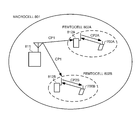
- a macro base station 811 forms a macrocell 801, transmits a common pilot signal CP1 with a constant transmission power, and makes communication with mobile stations (not shown in the figure).
- Femto base stations 812A and 812B form femtocells 802A and 802B, and make communication with mobile stations 700A and 700B, respectively.
- Each of the femto base stations 812A and 812B measures received power Pmacro [dBm] of the common pilot signal CP1 of the macro base station 811, and transmits common pilot signals CP2A and CP2B with Pmarco+Poffset [dBm] as a transmission power by employing a wireless frequency band identical to that of the macro base station 811.
- Poffset which is a power offset, is a constant value common to all of the femtocells 802A and 802B.
- the femto base station mentioned above is used in the system such as W-CDMA (Wideband Code Division Multiple Access) and E-UTRAN (Evolved Universal Terrestrial Radio Access Network, or it is also called LTE: Long Term Evolution) with the wireless communication standards of the mobile telephones, and in the system such as IEEE (Institute of Electrical and Electronics Engineers) 802.16m with the wireless communication standards of wireless MAN (Wireless Metropolitan Area Network).
- W-CDMA Wideband Code Division Multiple Access
- E-UTRAN Evolved Universal Terrestrial Radio Access Network, or it is also called LTE: Long Term Evolution
- IEEE Institutee of Electrical and Electronics Engineers
- 802.16m IEEE (Institute of Electrical and Electronics Engineers) 802.16m with the wireless communication standards of wireless MAN (Wireless Metropolitan Area Network).
- the data transmission employing dedicated channels subjected to a transmission power control in an uplink and a downlink, and the data transmission employing a common channel in a downlink are carried out.
- a band of a radio frequency is divided into a plurality of resource blocks (PRB: Physical Resource Block).
- PRB Physical Resource Block
- a scheduler mounted in the base station of E-UTRAN allocates the PRB, and the base station makes the data communication with the mobile stations by employing the allocated PRB.
- OFDMA Orthogonal Frequency Division Multiple Access
- the band of the radio frequency is divided into sub-carriers
- the scheduler mounted in the base station allocates the sub-carriers
- the data communication employing the allocated sub-carriers is made.
- bundling the sub-carriers is equivalent to the resource block that is called in the E-UTRAN.
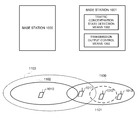
- each of base stations 1000 and 1001 is provided with a traffic concentration state detection means 1002 and a transmission output control means 1003.
- the traffic concentration state detection means 1002 detects the traffic concentration state exceeding a specified speech enable channel caused by the concentration of terminal devices 1011 to 1013 into a speech area 1100 of its own base station 1001.
- the transmission output control means 1003 lowers a control channel signal level of its own base station 1001 at the time of that detection, instructs a peripheral base station 1000 to raise a signal level, and further, raises the signal level responding to the instruction coming from the peripheral base station 1000.
- the transmission output control means 1003 lowers the signal level of the base station 1001 that is in a traffic concentrate state, and reduces the speech area 1100 to a speech area 1101.
- the base station 1000 raises the level of the transmission output, and enlarges a speech area 1102 to a speech area 1103.
- the terminal device 1011 which has received the control channel signal of the base station 1001 up to the moment, enters the speech area 1103 to receive the signal of the base station 1000.
- the speech area and the communication area including the data communication together with voice are generally called coverage.
- the signal level of the above base station is lowered, and the signal level of the peripheral base station is raised.
- the speech area of its own base station becomes small, and the speech are of the peripheral base station becomes large, thereby distributing the traffics concentrated at a specific base station to the other base stations.
- a utilization frequency of the femto base station differs user by user. For example, there exist a user (light user) who does not use the femto base station so much, and a user (heavy user) who frequently uses the femto base station. The times during which a downlink transmission power of the femto base station for the mobile station of the light user becomes large are infrequent. On the other hand, the times during which the downlink transmission power for the mobile station of the heavy user becomes large are frequent.
- each of the macro base station 811 and the femto base station 812A in the Patent literature 1 makes communication with the mobile stations is studied while the above-described contents are taken into consideration. It is assumed that, as shown in Fig. 17, the mobile station 900 makes a connection to and communication with the macro base station 811 and the mobile station 700A makes a connection to and communication with the femto base station 812A and makes communication.
- the mobile station 700A is a registered mobile station registered to the femto base station 812A.
- the mobile station 900 is a non-registered mobile station not registered to the femto base station 812A.
- the times during which the downlink transmission power becomes large are frequent.
- the macro base stations 811 and the femto base station 812A make communication with the mobile station 900 and the mobile station 700A by employing the identical frequency band, respectively, the downlink signal DS2 to be transmitted from the femto base station 812A to the mobile station 700A becomes an interference to the downlink signal DS1 to be transmitted from the macro base station 811 to the mobile station 900, and hence, a quality of the downlink signal DS1 deteriorates.
- the macro base station 811 increases the transmission power of the downlink signal DS1 in order to avoid a quality deterioration of the downlink signal DS1, a downlink capacity of the macro base station 811 is reduced, which causes the throughput of the macrocell 801 to deteriorate.
- the method of setting the transmission power of the femto base station disclosed in the Patent literature 1 decides the transmission power of the common pilot signal of the femto base station by adding a fixed power offset Poffset to the received power of the common pilot signal coming from the macro base station. That is, the setting method disclosed in the Patent literature 1 decides the transmission power of the common pilot signal of the femto base station responding to the received power of the common pilot signal coming from the macro base station.
- the method of setting the transmission power of the femto base station disclosed in the Patent literature 1 does not take into consideration an influence upon the microcell that originates in the fact that the time in which the downlink transmission power becomes large becomes long, as is the case with the heavy user who frequently uses the femto base station 812A. That is, the method disclosed in the Patent literature 1 does not take into consideration a change in the transmission power responding to a utilization degree at which the user utilizes the femto base station, and does not take into consideration at all a difference of the interference to the macrocell that originates in this.
- the wireless communication system of the Patent literature 2 is configured of the base station that covers a wide constant scope, like the macro base station, one part of the speech area that the macro base station forms overlaps the speech area of the other macro base stations, and the terminal device can make communication by making a connection to anyone of the base stations.
- the speech area of the femto base station overlaps the speech area of the macro base station including a connotative relation, and only a specific terminal device can make a connection to the femto base station causes the following problems.
- the communication with the macro base station is often poor as compared with the communication with the femto base station because many terminal devises make connection to the macro base station, and the macro base station is positioned relatively away from the terminal devices (in the first place, the femto base station is installed in many cases because the communication with the macro base station is poor.)
- the problem that the throughput of the terminal device connected to the macro base station deteriorates takes place.
- One or more exemplary embodiments provide a wireless communication system including a first base station, and a second base station of which at least one part of the coverage overlaps the coverage of the first base station, in which the interference by the second base station to the coverage of the first base station is reduced based upon the utilization degrees of the mobile stations connected to the second base station, a base station, a managing server, and a wireless communication method.
- a wireless communication system includes a first base station, and a second base station of which at least one part of the coverage overlaps the coverage of the aforementioned first base station, which includes a measurer that measures utilization degrees of the mobile stations connected to the second base station, and an adjuster that adjusts wireless resource allocation of the aforementioned mobile stations connected to the aforementioned second base station based upon the aforementioned utilization degrees.
- a base station of which at least one part of the coverage overlaps the coverage of the other base stations includes a measurer that measures utilization degrees of the mobile stations connected to its own base station, and an adjuster that adjusts wireless resource allocation of the aforementioned mobile stations connected to the aforementioned its own base station based upon the aforementioned utilization degrees.
- a management server in a wireless communication system including a first base station and a second base station of which at least one part of the coverage overlaps the coverage of the aforementioned first base station, which is connected to the aforementioned second base station via a network, and includes a measurer that measures utilization degrees of the mobile stations connected to the second base station, and an adjuster that instructs the aforementioned second base station to adjust wireless resource allocation of the aforementioned mobile stations connected to the aforementioned second base station based upon the aforementioned utilization degrees.
- a wireless communication method in a wireless communication method including a first base station and a second base station of which at least one part of the coverage overlaps the coverage of the aforementioned first base station, which measures utilization degrees of the mobile stations connected to the second base station, and adjusts wireless resource allocation of the aforementioned mobile stations connected to the aforementioned second base station based upon the aforementioned utilization degrees.
- One or more exemplary embodiments make it possible to reduce the interference by the second base station to the coverage of the first base station in the wireless communication system including the first base station and the second base station of which at least one part of the coverage overlaps the coverage of the first base station.
- Fig. 1 is a view for explaining a wirelesscommunication system to which exemplary embodiments are applied.
- Fig. 2 is a block diagram of an exemplary embodiment.
- Fig. 3 is a view for explaining an exemplary embodiment.
- Fig. 4 is a view for explaining an exemplary embodiment.
- Fig. 5 is a schematic view of the wireless communication system of a first exemplary embodiment.
- Fig. 6 is a block diagram of a femto base station 20.
- Fig. 7 is an operational flowchart of the first exemplary embodiment.
- Fig. 8 is a schematic view of the wireless communication system of a second exemplary embodiment.
- Fig. 9 is a block diagram of the femto base station 20 and a management server 50 of the second exemplary embodiment.
- Fig. 10 is an operational flowchart of the management server 50 of the second exemplary embodiment.
- Fig. 11 is an operational flowchart of the femto base station 20 of the second exemplary embodiment.
- Fig. 12 is a block diagram of the femto base station 20 and the management server 50 of a third exemplary embodiment.
- Fig. 13 is an operational flowchart of the management server 50 of the third exemplary embodiment.
- Fig. 14 is an operational flowchart of the management server 50 of the third exemplary embodiment.
- Fig. 15 is a view for explaining technology of the related art.
- Fig. 16 is a view for explaining technology of the related art.
- Fig. 17 is a view for explaining problems of the related art.
- Fig. 1 is a view for explaining a wireless communication system to which the exemplary embodiments are applied.
- the wireless communication system to which exemplary embodiments are applied, as shown in Fig. 1, includes a first base station 1, and a second base station 2 of which at least one part of the coverage overlaps the coverage of the first base station 1. And, a mobile station 3 1 makes a connection to the second base station 2, and makes communication, and a mobile station 3 2 makes a connection to the first base station 1, and makes communication. Additionally, when the second base station 2 has a function of giving permission of the connection only to the pre-registered mobile stations, the mobile station 3 1 is a registered mobile station registered to the second base station 2. On the other hand, the mobile station 3 2 is a non-registered mobile station not registered to the second base station 2.
- the first base station is, for example, a macro base station
- the second base station is a femto base station
- the first base station and the second base station are not limited hereto, and any kind of the base station is accepted so long as it is a base station playing a similar role.
- the coverage of the first base station 1 is a macrocell
- the coverage of the second base station 2 is a femtocell.
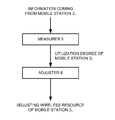
- this exemplary embodiment includes a measurer 5 that measures the utilization degree of the mobile station 3 1 , and an adjuster 6 that adjusts the wireless resource to be allocated to the mobile station 3 1 connected to the second base station 2, based upon the aforementioned utilization degree.
- the second base station 2 may be provided with the measurer 5 and the adjuster 6, and the management server existing in a network side may be provided therewith.
- the utilization degree of the mobile station 3 1 that the measurer 5 measures is indicative of the utilization degree at which the mobile station 3 1 utilizes the second base station 2.
- the utilization degree is an index value based upon, for example, a resource usage ratio of the mobile station 3 1 that makes communication via the second base station 2, a transmission traffic (or throughput) indicative of a data quantity per a predetermined observation time transmitted to the mobile station 3 1 by the second base station 2, a transmission time ratio (for example, a time ratio at which the data has been actually transmitted within a predetermined period), a resource usage time ratio (for example, a time ratio at which the resource usage ratio has exceeded a predetermined threshold (for example, 90% etc.) within a predetermined period) and the like.
- the so-called resource herein represents at least one of the transmission power in the wireless communication, the frequency band, and the transmission time slot.
- the measurer 5 measures the utilization degree for each mobile station 3 1 . That is, an adjuster 6 to be described later adjusts the wireless resource for each mobile station 3 1 by the measurement of the utilization degrees of the mobile stations 3 1 .
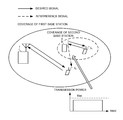
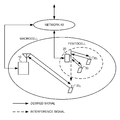
- the adjuster 6 adjusts the wireless resources of the mobile stations 3 1 so as to avoid the interference, which is caused by the second base station 2. to the coverage of the first base station 1, based upon the utilization degrees of the mobile stations 3 1 measured by the measurer 5. Specifically, as shown in Fig. 3, when the utilization degree of the mobile station 3 1 is high (for example, when the index value of the utilization degree exceeds a predetermined first threshold, or the like), the state in which the transmission power of the second base station 2 is high continues, and the signal of the second base station 2 becomes an interference signal to the mobile station 3 2 , which causes the throughput to deteriorate. Thereupon, as shown in Fig. 4, the adjuster 6 adjusts the wireless resource of the second base station 2.
- the adjustment of the wireless resource there exists the adjustment of reducing the setting value of the transmission power of the second base station 2, the adjustment of reducing the transmission frequency band, the adjustment of reducing the transmission time slot, or the like.
- the adjustment of reducing the setting value of the transmission power is shown in the figure as an example.
- the adjustment of reducing the setting value of the transmission power not only the transmission power of each channel (a reference or pilot signal, a control channel, and a data channel) may be evenly reduced by the identical value (for example, 1 dB etc.), but also the transmission power alone of the data channel of the mobile station of which the utilization degree is high may be reduced by a predetermined quantity (for example, 1 dB etc.) as well as the maximum transmission power may be reduced by a predetermined quantity (for example, 1 dB etc.). And, when the adjustment of lowering the setting value of the transmission power is performed, the adjuster 6 performs the scheduling in consideration of a change in the transmission power per a resource block due to a reduction in the transmission power of each channel.
- the available band may be restricted to a predetermined band of all frequency bands (for example, 10 MHz is restricted to 5 MHz) or the like.
- the adjuster 6 performs the scheduling from among the resource blocks existing in the reduced frequency band.
- the adjustment of reducing the transmission time slot may be performed by restricting the transmittable time slot to a predetermined time slot within 1 subframe, or the like (for example, with the case of 2 time slots per 1 subframe, two time slots are restricted to one time slot).
- the adjuster 6 performs the scheduling for the resource block having a time region in which no transmission is made within 1 subframe.
- the resource is reduced at an extent with which the mobile station 3 1 is not handed over to the other base stations, for example, to the first base station 1. For example, only the transmission power of the data channel may be reduced. At this time, an influence is not exerted upon the coverage because the transmission power for the pilot signal is not changed. Or, the received powers of the pilot signal of the first and second base stations in the mobile station 3 1 are measured, and the transmission power of each channel may be reduced under the condition that the received power of the pilot signal of the second base station 2 exceeds the received power of the pilot signal of the first base station 1 by a predetermined quantity.
- the adjuster 6 individually adjusts the wireless resources of the mobile stations 3 1 responding to the utilization degree of each mobile station 3 1 .
- the adjuster 6 reduces allocation of the wireless resource to the mobile station 3 1 of which the utilization degree is high, based upon the utilization degree of each mobile station 3 1 measured by the measurer 5, and increases a quantity of the wireless resource that is not used by the above base station (for example, the adjuster 6 reduces the transmission power of the data channel of the mobile station 3 1 of which the utilization degree is high).
- the adjuster 6 may gradually increase the reduced wireless resource of the second base station 2 (for example, the setting value of the transmission power (the transmission power and the maximum value of the reference signal, the control channel, and the data channel)) so that it returns to the original value.
- the adjuster 6 may not change the wireless resource.
- the wireless resources to be allocated to the mobile stations 3 1 connected to the second base station 2 are adjusted based upon the utilization degrees of the mobile stations 3 1 connected to the second base station 2, whereby the possibility that the signal of the second base station 2 becomes an interference signal to the mobile station 3 2 is decreased, and an influence of the second base station 2 of which an interference to the coverage of the first base station 1 is large alleviated, and a deterioration in the throughput in the coverage of the first base station 1 can be avoided.
- Fig. 5 is a schematic view of the wireless communication system of the first exemplary embodiment.
- the first base station is a macro base station 10
- the second base station is a femto base station 20
- the femto base station 20 autonomously measures the utilization degrees of the mobile stations 30 1 existing within the femtocell, and adjusts the wireless resources to be allocated to the mobile stations 30 1
- the utilization degree is assumed to be a resource usage ratio of the mobile station 30 1 , and the case of adjusting the transmission power of the data channel as the adjustment of the wireless resource will be explained.
- the macro base station 10 connected to a network 40 forms a macrocell, and a mobile station 30 2 existing within the macrocell is connected to the macro base station 10.
- the femto base station 20 connected to the network 40 forms a femtocell, and a plurality of the mobile stations 30 1 existing within the femtocell are connected to the femto base station 20.
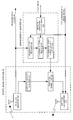
- Fig. 6 is a block diagram of the femto base station 20.
- the femto base station 20 is provided with a wireless receiver 100 that receives the signal of the uplink, a wireless quality acquirer 101, a resource scheduler 102, a utilization degree measurer 103, a transmission power adjuster 104, and a wireless transmitter 105 that transmits the signal of the downlink.
- the wireless quality acquirer 101 acquires a measurement report including quality information indicative of the received quality of the downlink signal of the femto base station 20 measured by the mobile station 30 1 within the femtocell.
- quality information indicative of the received quality of the downlink signal of the femto base station 20 measured by the mobile station 30 1 within the femtocell.
- the received power RSCP: Received Signal Code Power
- SINR Signal-to-Interference plus Noise power Ratio, Ec/No etc.
- the received power (RSRP: Reference Signal Received Power) or the received quality (RSRQ: Reference Signal Received Quality) at the moment of receiving the reference signal that is transmitted by employing a predetermined downlink resource element can be used as the received quality of downlink signal.
- the items to be actually measured, and the setting of a reporting period etc., can be informed, by the network 40, to the femto base station 20.
- the measurement report is discretized into CQI (Channel Quality Indicator), and is transmitted to the femto base station 20 from the mobile station 30 1 by employing the uplink control channel.
- CQI Channel Quality Indicator
- any method can be selected among a plurality of the methods such as the method of preparing one CQI in all bands, and the method of preparing the CQI for each divided frequency unit.
- the resource scheduler 102 performs the scheduling of the wireless resource for the wireless communication between the mobile station 30 1 and the femto base station 20.
- the quality information of the downlink received quality acquired by the wireless quality acquirer 101, and an adjustment result by the transmission power adjuster 104, which is described later, are reflected into this scheduling.
- the resource scheduler 102 by making a reference to the downlink received quality, decides the communication rate at which the transmission can be made by employing each frequency-divided/time-divided resource unit (for example, the resource block of E-UTRA).
- the resource scheduler 102 decides the resource that is allocated to each of the mobile stations 30 1 base upon the quality information reported from a plurality of the mobile stations 30 1 .
- the time scale may be short because the resource usage ratio has a relation to an operation of the scheduler.
- the resource scheduler 102 identifies each mobile station 30 1 by employing ID of each mobile station 30 1 , and performs the scheduling.
- the scheduling it can be grasped how many resource blocks are allocated to which mobile station 30 1 , whereby operating the above-described calculation by making a reference to the resource blocks allocated to the mobile stations 30 1 makes it possible to acquire the utilization degree for each mobile station 30 1 .
- the transmission traffic is also possible. Specifically, it is assumed that the data quantity per a predetermined observation time transmitted by the mobile station 30 1 connected to the femto base station 20 is the transmission traffic. For example, when the data quantity of 1 GByte has been transmitted for a certain day, the transmission traffic becomes 1 GByte/day.
- the transmission power adjuster 104 determines whether the wireless resource allocation of each mobile station 30 1 needs to be adjusted by employing the measurement result by the utilization degree measurer 103, and adjusts the wireless resource that is allocated to each mobile station 30 1 when it is determined that it needs to be adjusted.
- the transmission power adjuster 104 determines that the transmission power of the data channel of the above mobile station 30 1 needs to be adjusted. Additionally, with the case of the transmission traffic, the transmission power adjuster 104 compares the transmission traffic with the threshold for each predetermined observation time, and determines that the transmission power of the femto base station 20 needs to be adjusted until the next observation time when the above transmission traffic exceeds the threshold.
- a first threshold for example, 0.8
- the transmission power adjuster 104 determines that the transmission power of the data channel of the mobile station 30 1 needs to be adjusted, it adjusts the transmission power of the data channel of the mobile station 30 1 .
- the first threshold for example, 0.8
- the first threshold for example, 0.8
- Reducing only the transmission power of the data channel by a predetermined quantity (1dB) allows the transmission powers of the other data channels to be kept unchanged, whereby there is no possibility that the mobile station 30 1 is handed over to the other base stations such as the macro base station 10 from the femto base station 20.
- the transmission power of each channel may be evenly reduced by an identical value (1 dB etc.) in some cases, and the maximum transmission power may be reduced by a predetermined quantity (1 dB) in some cases.
- the reduction is carried out at an extent with which the mobile station 30 1 is not handed over to the other base stations such as the macro base station 10 from the femto base station 20.
- the transmission power adjuster 104 measures the received powers of the pilot signals of the macro base station 10 and the femto base station 20 in the mobile station 30 1 , and reduces the transmission power of each channel under the condition that the received power of the pilot signal of the femto base station 20 exceeds the received power of the pilot signal of the macro base station 10 by a predetermined quantity.
- the transmission power adjuster 104 reduces the transmission power of the data channel because the averaged resource usage ratio of a certain mobile station 30 1 is high, it gradually increases (for example, 1 dB) the reduced transmission power of the data channel so that it returns to the original value when the averaged resource usage ratio lowers (for example, when the index value of the utilization degree is equal to or less than a predetermined second threshold ( ⁇ the first threshold).
- a predetermined second threshold ⁇ the first threshold
- the transmission power adjuster 104 gives an instruction for the adjusted transmission power value and the value of the reduction or the increase to the resource scheduler 102.
- the resource scheduler 102 schedules the wireless resource of each mobile station 30 1 by reflecting a notification of a new transmission power value etc. coming from the transmission power adjuster 104. Specifically, the resource scheduler 102 performs the scheduling in consideration of the changed transmission power per a resource block due to a reduction in the transmission power of the data channel.
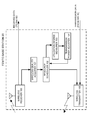
- Fig. 7 is an operational flowchart of the first exemplary embodiment.
- the utilization degree measurer 103 measures the averaged resource usage ratio of each mobile station 30 1 based upon the scheduling result by the resource scheduler 102 (Operation 10).
- the transmission power adjuster 104 compares the averaged resource usage ratio of each mobile station 30 1 with the first threshold according to the measurement result by the utilization degree measurer 103 (Operation 11).
- the transmission power adjuster 104 instructs the resource scheduler 102 to reduce the transmission power of the data channel of the above mobile station 30 1 (Operation 13).
- the resource scheduler 102 upon receipt an instruction for reducing the setting value of the transmission power of the data channel of the above mobile station 30 1 from the transmission power adjuster 104, performs the scheduling in consideration of the changed transmission power per a resource block, and reduces the transmission power of the data channel of the instructed mobile station 30 1 (Operation 14).
- the transmission power adjuster 104 compares the averaged resource usage ratio of the mobile station 30 1 with the second threshold (Operation 15). When the mobile station 30 1 of which the averaged resource usage ratio is equal to or less than the second threshold exists (Operation 16), the transmission power adjuster 104 instructs the resource scheduler 102 to increase the transmission power of the data channel of the above mobile station 30 1 (Operation 17).
- the transmission power adjuster 104 does not give any instruction particularly, and keeps the current transmission power of the data channel.
- the resource scheduler 102 upon receipt an instruction for increasing the setting value of the transmission power of the data channel of the mobile station 30 1 from the transmission power adjuster 104, performs the scheduling in consideration of the changed transmission power per a resource block, and increases the transmission power of the data channel of the instructed mobile station 30 1 (Operation 18).
- the wireless resource that is allocated to each mobile station connected to the femto base station is adjusted based upon the utilization degree of each mobile station connected to the femto base station, whereby the signal coming from the femto base station of a heavy user that exerts a large influence upon the signal of the macro base station is lessened, thereby making it possible to avoid a deterioration in the throughput in the macrocell.
- the reduced wireless resource is increased when the utilization degree of the above mobile station is lowered, whereby there is no possibility that the state in which the allocation of the wireless resource is not sufficient permanently takes place.
- Fig. 8 is a schematic view of the wireless communication system of the second exemplary embodiment.
- the macro base station 10 forms the macrocell, and is connected to the management server 50 via the network 40. Further, the mobile station 30 2 existing within the macrocell is connected to the macro base station 10.
- the femto base station 20 forms the femtocell, and is connected to the management server 50 via the network 40. Further, a plurality of the mobile stations 30 1 existing within the femtocell are connected to the femto base station 20.
- Fig. 9 is a block diagram of the femto base station 20 and the management server 50. Additionally, like reference numbers are used for elements identical to those of the first exemplary embodiment, and the detailed explanation thereof is omitted.
- the management server 50 is provided with a utilization degree measurer 200, a transmission power adjuster 201, and a transmission power change request notifier 202.
- the utilization degree measurer 200 measures the transmission traffic, being the data quantity per a predetermined observation time transmitted to the mobile station 30 1 connected to the femto base station 20, as the utilization degree of each mobile station 30 1 . For example, when the data quantity of 1 GByte is transmitted for a certain day, the transmission traffic is 1 GByte/day. And, the utilization degree measurer 200 notifies the measured transmission traffic to the transmission power adjuster 201.
- the transmission power adjuster 201 compares the transmission traffic of each mobile station 30 1 notified by the utilization degree measurer 200 with the first threshold (for example, 1 GByte/day) for each predetermined observation time, and with regard to the mobile station 30 1 of which the transmission traffic has exceeded the first threshold, notifies the adjustment of lowering the transmission power of the data channel of the above mobile station 30 1 until the next observation time to the transmission power change request notifier 202.
- the first threshold for example, 1 GByte/day
- the transmission power of the data channel is reduced by a predetermined quantity (1 dB), and the transmission powers of the other channels are not changed, whereby there is no possibility that the mobile station 30 1 is handed over to other base stations such as the macro base station 10 from the femto base station 20, and when the transmission powers of all channels are lowered, the reduction is carried out at an extent with which the mobile station 30 1 is not handed over to other base stations such as the macro base station 10 from the femto base station 20.
- the transmission power adjuster 201 when the transmission traffic is reduced after the transmission power of the data channel is reduced because the transmission traffic of a certain mobile station 30 1 is high, (for example, the transmission traffic is equal to or less than the predetermined second threshold ( ⁇ the first threshold), or the like), the transmission power adjuster 201 gradually increase (for example, 1 dB by 1 dB) the reduced transmission power of the data channel so that it returns to the original value. In the case other than it, for example, the transmission traffic is equal to or more than the second threshold, and is equal to or less than the first threshold, or the like, the transmission power adjuster 201 does not perform the adjustment of changing the transmission power.
- the transmission power change request notifier 202 receives the setting value of the transmission power of the data channel of each mobile station 30 1 , the values of the reduction or the increase, and the like from the transmission power adjuster 201, and notifies them to the resource scheduler 102 of the femto base station 20.
- the management server 50 also can manage a plurality of the femto base stations.
- each femto base station acquires the utilization degrees of the mobile stations connected to the above femto base station, and adjusts the wireless resources for the mobile stations for each femto base station.
- Fig. 10 is an operational flowchart of the management server 50 of the second exemplary embodiment.
- the utilization degree measurer 200 measures the transmission traffic of each mobile station 30 1 connected to the femto base station for each femto base station (Operation 20).
- the transmission power adjuster 201 compares the transmission traffic of the mobile station 30 1 of each femto base station with the first threshold for each predetermined observation time by the measurement result by the utilization degree measurer 200 (Operation 21).
- the transmission power adjuster 201 When the mobile station 30 1 of which the transmission traffic exceeds the first threshold exists (Operation 22), the transmission power adjuster 201 notifies the reduction of the transmission power of the data channel of the above mobile station 30 1 to the transmission power change request notifier 202 (Operation 23). And, the transmission power change request notifier 202 notifies an instruction for the reduction of the transmission power of the mobile station 30 1 received from the transmission power adjuster 201 to the femto base station in which the above mobile station 30 1 exists (Operation 24). On the other hand, when the mobile station 30 1 of which the transmission traffic exceeds the first threshold does not exist (Operation 22), the operation proceeds to a Operation 25.
- the transmission power adjuster 201 compares the transmission traffic of the mobile station 30 1 with the second threshold (Operation 25). When the mobile station 30 1 of which the transmission traffic is equal to or less than the second threshold exists (Operation 26), the transmission power adjuster 201 notifies the increase of the transmission power of the data channel of the above mobile station 30 1 to the transmission power change request notifier 202 (Operation 27). Additionally, when the transmission traffic of the mobile station 30 1 is equal to or less than the first threshold, and exceeds the second threshold, the transmission power adjuster 201 does not give any instruction particularly, and keeps the current transmission power of the data channel.
- the transmission power change request notifier 202 notifies the instruction for the increase of the transmission power of the mobile station 30 1 received from the transmission power adjuster 201 to the femto base station in which the above mobile station 30 1 exists (Operation 28).
- Fig. 11 is an operational flowchart of the femto base station 20 of the second exemplary embodiment.
- the resource scheduler 102 receives an instruction from the management server 50 (Operation 30).
- the resource scheduler 102 performs the scheduling in consideration of the changed transmission power per a resource block, and reduces the transmission power of the data channel of the mobile station 30 1 instructed by the management server 50 (Operation 32).
- the resource scheduler 102 When the instruction coming from the management server 50 states the increase of the transmission power of the data channel of the mobile station 30 1 (Operation 33), the resource scheduler 102 performs the scheduling in consideration of the changed transmission power per a resource block, and increases the transmission power of the data channel of the mobile station 30 1 instructed by the management server 50 (Operation 34).
- the processing load upon the femto base station is alleviated because the management server adjusts the wireless resource.
- Fig. 12 is a block diagram of the femto base station 20 and the management server 50 of the third exemplary embodiment. Additionally, like reference numbers are used for elements identical to those of the first and second exemplary embodiments, and the detailed explanation thereof is omitted.
- the management server 50 is provided with a network congestion state acquirer 300 that acquires a congestion state of the network of the macro base station side.
- the network congestion state acquirer 300 acquires a congestion state of the traffic, which is transmitted to the mobile station 30 2 from the macro base station 10, via the network 40 from the macro base station 10.
- the transmission power adjuster 201 changes the wireless resource allocation of the mobile station 30 1 responding to the utilization degree of the mobile station 30 1 . Specifically, the transmission power adjuster 201 arranges a plurality of the first thresholds for determining that the utilization degree is high, and enlarges the reduction quantity of the transmission power of the femto base station all the more as the utilization degree of the mobile station 30 1 is higher.
- the transmission power adjuster 201 reduces the transmission power by 1 dB when the transmission traffic has exceeded 1 GByte/day with the first threshold taken as 1 GByte/day.
- the transmission power adjuster 201 arranges the first thresholds in a plural number like a first threshold A (for example, 0.5 GByte/day), a first threshold B (for example, 1 GByte/day), and a first threshold C (for example, 1.5 GByte/day), reduces the transmission power by X (for example, 1 dB) from a reference value when the transmission traffic of the mobile station 30 1 has exceeded first threshold A (for example, 0.5 GByte/day), reduces the transmission power by Y (for example, 2 dB) from the reference value when the transmission traffic of the mobile station 30 1 has exceeded first threshold B (for example, 1 GByte/day), and reduces the transmission power by Z (for example, 3 dB) from the reference value when the transmission traffic of the mobile station 30 1 has exceeded first threshold C (for example, 1.5 GByte/day).
- a first threshold A for example, 0.5 GByte/day
- a first threshold B for example, 1
- the number of the first thresholds is not limited hereto, and an arbitrary number may be used.
- FIG. 13 and Fig. 14 is an operational flowchart of the management server 50 of the third exemplary embodiment.
- the network congestion state acquirer 300 acquires the congestion state of the network of the macro base station side (Operation 40).
- the network congestion state acquirer 300 determines whether the network of the macro base station side is congested based upon the acquired congestion state of the macro base station side, and when the network of the macro base station side is not congested (Operation 41), the operation proceeds to the Operation 20 of Fig. 10 in order to perform the process similar to that of the second exemplary embodiment.
- the utilization degree measurer 200 measures the transmission traffic of each mobile station 30 1 connected to the femto base station for each femto base station (Operation 42).
- the transmission power adjuster 201 compares the transmission traffic of the mobile stations 30 1 of each femto base station with the first threshold C (for example, 1.5 GByte/day) for each predetermined observation time by the measurement result by the utilization degree measurer 200 (Operation 43).
- the first threshold C for example, 1.5 GByte/day
- the transmission power adjuster 201 When the mobile station 30 1 of which the transmission traffic exceeds the first threshold C exists (Operation 44), the transmission power adjuster 201 notifies the effect that the transmission power of the data channel of the above mobile station 30 1 is reduced by Z (for example, 3 dB) from the reference value to the transmission power change request notifier 202 (Operation 45). And, the transmission power change request notifier 202 notifies an instruction for reducing the transmission power of the mobile station 30 1 received from the transmission power adjuster 201 to the femto base station in which the above mobile station 30 1 exists (Operation 46).
- the transmission power adjuster 201 compares the transmission traffic of the mobile station 30 1 with the first threshold C (for example, 1.5 GByte/day) and the first threshold B (for example, 1 GByte/day) (Operation 47).
- the transmission power adjuster 201 notifies the effect that the transmission power of the data channel of the above mobile station 30 1 is reduced by Y (for example, 2 dB) from the reference value to the transmission power change request notifier 202 (Operation 49).
- the transmission power change request notifier 202 notifies an instruction for reducing the transmission power of the mobile station 30 1 received from the transmission power adjuster 201 to the femto base station in which the above mobile station 30 1 exists (Operation 50).
- the mobile station 30 1 of which the transmission traffic is equal to or less than the first threshold C (for example, 1.5 GByte /day) and exceeds the first threshold B (for example, 1 GByte /day) does not exist (Operation 48)
- the operation proceeds to a Operation 51.
- the transmission power adjuster 201 compares the transmission traffic of the mobile station 30 1 with the first threshold B (for example, 1 GByte/day) and the first threshold A (for example, 0.5 GByte/day) (Operation 51).
- the transmission power adjuster 201 notifies the effect that the transmission power of the data channel of the above mobile station 30 1 is reduced by X (for example, 1 dB) from the reference value to the transmission power change request notifier 202 (Operation 53).
- the transmission power change request notifier 202 notifies an instruction for reducing the transmission power of the mobile station 30 1 received from the transmission power adjuster 201 to the femto base station in which the above mobile station 30 1 exists (Operation 54). Thereafter, the operation proceeds to the Operation 25 of Fig. 10 in order to perform the process similar to that of the second exemplary embodiment.
- the operation proceeds to the Operation 25 of Fig. 10 in order to perform the process similar to that of the second exemplary embodiment.
- each femto base station 20 having received a notification for changing the transmission power from the management server 50 is similar to that of the second exemplary embodiment, so its explanation is omitted.
- the determination of a choice between two things of whether or not the network of the macro base station side is congested may be made, but also a control may be taken by arranging the degrees of the congestion state of the network of the macro base station side in a plural number, and arranging the first thresholds in a plural number for each degree of the congestion state of the network.
- the wireless resource allocation based upon the utilization degree may be changed according to an installation position of the femto base station.
- the femto base station 20 is provided with a configuration for receiving a radio wave that is transmitted from the macro base station 10, and other transmission sources (for example, a positioning satellite system etc. to be typified by GPS (Global Positioning System), and determines its own installation position based upon the received power of the radio wave.
- a positioning satellite system etc. to be typified by GPS (Global Positioning System)
- GPS Global Positioning System
- a penetration loss of the radio wave becomes larger as compared with the case that the windows exist. Further, a penetration loss of the radio wave becomes larger with going deeper inside the building as compared with a penetration loss in the neighborhood of the wall.
- a penetration loss is small, and the received power of the radio wave becomes relatively large, whereby it can be determined to some extent that the femto base station is installed in the neighborhood of the window.
- the wireless communication technique for which these exemplary embodiments are applied is not limited particularly, and these exemplary embodiments are applicable, for example, for various wireless communication techniques including specifications etc. specified by LTE, W-CDMA, WLAN (Wireless Local Area Network), and IEEE 802.16m.
- each unit can be configured with hardware, it also can be realized with a computer program.
- the function and the operation similar to the above-described exemplary embodiments are realized by a processor that operates under a program stored in a program memory. Additionally, it is also possible that only one part of the function of the above-described embodiments is realized with the computer program.
- a wireless communication system comprising a first base station and a second base station having a coverage area at least one part of which overlaps a coverage area of said first base station, comprising: a measurer that measures utilization degrees of mobile stations connected to said second base station; and an adjuster that adjusts wireless resource allocation of said mobile stations connected to said second base station based upon said utilization degrees.
- a wireless communication system according to supplementary note 1: wherein said measurer individually measures the utilization degrees of the mobile stations that make communication via said second base station; and wherein said adjuster adjusts allocation of the wireless resource of each of said mobile stations based upon the utilization degree of each of said mobile stations.
- a wireless communication system according to one of supplementary note 1 to supplementary note 6, wherein said adjuster arranges a first threshold and a second threshold, reduces the wireless resource that is allocated to the mobile station of which said utilization degree has exceeded said first threshold, and increases the wireless resource that is allocated to the mobile station of which said utilization degree is equal to or less than said second threshold.
- a wireless communication system comprising an acquisition means that acquires a congestion state of a network of the first base station, wherein said adjuster adjusts a reduction quantity of the allocation of the wireless resource of said mobile station responding to said acquired congestion state.
- a wireless communication system according to one of supplementary note 1 to supplementary note 9, wherein said measurer measures at least one of a resource usage ratio of said mobile station that makes communication via said second base station, a transmission traffic or a throughput indicative of a data quantity transmitted per a predetermined observation time, a time ratio at which data has been actually transmitted within a predetermined period, and a time ratio at which the resource usage ratio has exceeded a predetermined threshold within a predetermined period, or a combination thereof as the utilization degree of said mobile station.
- a wireless communication system according to one of supplementary note 1 to supplementary note 10, wherein said adjuster performs at least one of the adjustment of reducing the transmission power of said second base station, the adjustment of reducing a frequency band, and the adjustment of reducing a transmission time slot, or a combination thereof as the adjustment of the wireless resource of said mobile station.
- a wireless communication system according to one of supplementary note 1 to supplementary note 12: wherein a management server connected to said second base station via the network comprises said measurer and said adjuster; and wherein said adjuster instructs said second base station to adjust the wireless resource allocation.
- a base station having a coverage area at least one part of which overlaps a coverage area of other base station comprising: a measurer that measures utilization degrees of mobile stations connected to its own base station; and an adjuster that adjusts wireless resource allocation of said mobile stations connected to said its own base station based upon said utilization degrees.
- a management server in a wireless communication system that comprises a first base station and a second base station having at least one part of which overlaps a coverage area of said first base station, said management server connected to said second base station via a network, comprising: a measurer that measures utilization degrees of mobile stations connected to said second base station; and an adjuster that instructs said second base station to adjust wireless resource allocation of said mobile stations connected to said second base station based upon said utilization degrees.
- a wireless communication method in a wireless communication system comprising: a first base station; and a second base station having a coverage area at least one part of which overlaps a coverage area of said first base station, comprising: measuring utilization degrees of mobile stations connected to said second base station; and adjusting wireless resource allocation of said mobile stations connected to said second base station based upon said utilization degrees.
- Second base station 3 1 Mobile station 3 2 Mobile station 5 Measurer 6 Adjuster 10 Macro base station 20 Femto base station 30 1 Mobile station 30 2 Mobile station 40 Network 50 Management server 100 Wireless receiver 101 Wireless quality acquirer 102 Resource scheduler 103 Utilization degree measurer 104 Transmission power adjuster 105 Wireless transmitter 200 Utilization degree measurer 201 Transmission power adjuster 202 Transmission power change request notifier 300 Network congestion state acquirer
Landscapes
- Engineering & Computer Science (AREA)
- Computer Networks & Wireless Communication (AREA)
- Signal Processing (AREA)
- Mobile Radio Communication Systems (AREA)
Abstract
Description
The first exemplary embodiment will be explained.
In the second exemplary embodiment, an example in which an external management server measures the utilization degree of each mobile station, and gives an instruction for the transmission power to the femto base station will be explained.
On the other hand, when the
Next, an operation of the
The third exemplary embodiment will be explained. Fig. 12 is a block diagram of the
On the other hand, when the
a measurer that measures utilization degrees of mobile stations connected to said second base station; and
an adjuster that adjusts wireless resource allocation of said mobile stations connected to said second base station based upon said utilization degrees.
wherein said measurer individually measures the utilization degrees of the mobile stations that make communication via said second base station; and
wherein said adjuster adjusts allocation of the wireless resource of each of said mobile stations based upon the utilization degree of each of said mobile stations.
wherein a management server connected to said second base station via the network comprises said measurer and said adjuster; and
wherein said adjuster instructs said second base station to adjust the wireless resource allocation.
a measurer that measures utilization degrees of mobile stations connected to its own base station; and
an adjuster that adjusts wireless resource allocation of said mobile stations connected to said its own base station based upon said utilization degrees.
a measurer that measures utilization degrees of mobile stations connected to said second base station; and
an adjuster that instructs said second base station to adjust wireless resource allocation of said mobile stations connected to said second base station based upon said utilization degrees.
measuring utilization degrees of mobile stations connected to said second base station; and
adjusting wireless resource allocation of said mobile stations connected to said second base station based upon said utilization degrees.
2 Second base station
31 Mobile station
32 Mobile station
5 Measurer
6 Adjuster
10 Macro base station
20 Femto base station
301 Mobile station
302 Mobile station
40 Network
50 Management server
100 Wireless receiver
101 Wireless quality acquirer
102 Resource scheduler
103 Utilization degree measurer
104 Transmission power adjuster
105 Wireless transmitter
200 Utilization degree measurer
201 Transmission power adjuster
202 Transmission power change request notifier
300 Network congestion state acquirer
Claims (17)
- A wireless communication system comprising:
a first base station; and
a second base station having a coverage area at least one part of which overlaps a coverage area of said first base station,
wherein the system comprises:
a measurer that measures a utilization degree of at least one mobile station connected to said second base station; and
an adjuster that adjusts a wireless resource allocation of said at least one mobile station connected to said second base station based upon said utilization degree. - A wireless communication system according to claim 1,
wherein said at least one mobile station comprises a plurality of mobile stations;
wherein said measurer individually measures the utilization degrees of said plurality of mobile stations ; and
wherein said adjuster adjusts allocation of the wireless resource of each of said plurality of mobile stations based upon the utilization degree of each of said plurality of mobile stations. - A wireless communication system according to claim 1,
wherein said adjuster adjusts the allocation of the wireless resources of said at least one mobile station so as to avoid an interference to said first base station. - A wireless communication system according to claim 1,
wherein said adjuster reduces the allocation of the wireless resource of said at least one mobile station when the utilization degree of said at least one mobile station exceeds a predetermined threshold. - A wireless communication system according to claim 1,
wherein said adjuster reduces the allocation of the wireless resource of said at least one mobile station while maintaining said at least one mobile station in communication with said second base station. - A wireless communication system according to claim 1,
wherein when said at least one mobile station comprises a plurality of mobile stations, said adjuster reduces the wireless resource to be allocated to one of said plurality of mobile stations for which said utilization degree has exceeded a predetermined threshold, and increases a wireless resource quantity that is not used in said second base station. - A wireless communication system according to claim 1,
wherein said at least one mobile station comprises a first mobile station and a second mobile station; and
wherein said adjuster arranges a first threshold and a second threshold, reduces the wireless resource that is allocated to said first mobile station for which said utilization degree has exceeded said first threshold, and increases the wireless resource that is allocated to said second mobile station for which said utilization degree is equal to or less than said second threshold. - A wireless communication system according to claim 1,
wherein said adjuster adjusts a reduction quantity of the allocation of the wireless resource of said at least one mobile station based on an installation position of said second base station. - A wireless communication system according to claim 1,
further comprises an acquirer that acquires a congestion state of a network of the first base station,
wherein said adjuster adjusts a reduction quantity of the allocation of the wireless resource of said at least one mobile station based on said acquired congestion state. - A wireless communication system according to claim 1,
wherein the utilization degree is at least one of a resource usage ratio of said at least one mobile station , a transmission traffic or a throughput indicative of a data quantity transmitted per a predetermined observation time, a time ratio at which data has been actually transmitted within a predetermined period, and a time ratio at which the resource usage ratio has exceeded a predetermined threshold within a predetermined period. - A wireless communication system according to claim 1,
wherein the wireless resource allocation is at least one of reducing the transmission power of said second base station, reducing a frequency band, and reducing a transmission time slot. - A wireless communication system according to claim 1,
wherein the wireless resource allocation is reducing the transmission power of a data channel of said at least one mobile station . - A wireless communication system according to claim 1,
wherein said second base station comprises said measurer and said adjuster. - A wireless communication system according to one of claim 1,
further comprising a management server connected to said second base station via the network, wherein said management server comprises said measurer and said adjuster; and
wherein said adjuster instructs said second base station to adjust the wireless resource allocation. - A base station having a coverage area at least one part of which overlaps a coverage area of other base station, comprising:
a measurer that measures a utilization degree of at least one mobile station connected to the base station; and
an adjuster that adjusts a wireless resource allocation of said at least one mobile station connected to said base station based upon said utilization degree. - A management server in a wireless communication system that comprises a first base station and a second base station having at least one part of which overlaps a coverage area of said first base station, said management server connected to said second base station via a network, comprising:
a measurer that measures a utilization degree of at least one mobile station connected to said second base station; and
an adjuster that instructs said second base station to adjust a wireless resource allocation of said at least one mobile station connected to said second base station based upon said utilization degree. - A wireless communication method in a wireless communication system comprising:
a first base station; and
a second base station having a coverage area at least one part of which overlaps a coverage area of said first base station
wherein said system comprises
measuring a utilization degree of mobile stations connected to said second base station; and
adjusting a wireless resource allocation of said mobile stations connected to said second base station based upon said utilization degree.
Priority Applications (3)
| Application Number | Priority Date | Filing Date | Title |
|---|---|---|---|
| EP11834054.6A EP2630819A4 (en) | 2010-10-22 | 2011-10-20 | Wireless communication system, base station, management server, and wireless communication method |
| JP2013516869A JP5896177B2 (en) | 2010-10-22 | 2011-10-20 | Wireless communication system, base station, management server, and wireless communication method |
| CN2011800509162A CN103181212A (en) | 2010-10-22 | 2011-10-20 | Wireless communication system, base station, management server, and wireless communication method |
Applications Claiming Priority (2)
| Application Number | Priority Date | Filing Date | Title |
|---|---|---|---|
| JP2010-237039 | 2010-10-22 | ||
| JP2010237039 | 2010-10-22 |
Publications (1)
| Publication Number | Publication Date |
|---|---|
| WO2012053208A1 true WO2012053208A1 (en) | 2012-04-26 |
Family
ID=45972964
Family Applications (1)
| Application Number | Title | Priority Date | Filing Date |
|---|---|---|---|
| PCT/JP2011/005869 Ceased WO2012053208A1 (en) | 2010-10-22 | 2011-10-20 | Wireless communication system, base station, management server, and wireless communication method |
Country Status (5)
| Country | Link |
|---|---|
| US (1) | US9432850B2 (en) |
| EP (1) | EP2630819A4 (en) |
| JP (1) | JP5896177B2 (en) |
| CN (1) | CN103181212A (en) |
| WO (1) | WO2012053208A1 (en) |
Families Citing this family (15)
| Publication number | Priority date | Publication date | Assignee | Title |
|---|---|---|---|---|
| WO2012034580A1 (en) * | 2010-09-13 | 2012-03-22 | Nokia Siemens Networks Oy | Reduced radio resource control connectivity |
| US20130225183A1 (en) * | 2012-02-24 | 2013-08-29 | Qualcomm Incorporated | Methods and apparatus for turning off macro carriers to deploy femtocells |
| IL218527A0 (en) * | 2012-03-07 | 2012-04-30 | Mariana Goldhamer | Collaborative measurements in cellular networks |
| US20140029439A1 (en) * | 2012-07-24 | 2014-01-30 | At&T Intellectual Property I, L.P. | Long term evolution traffic management and event planning |
| US9743416B2 (en) | 2012-09-20 | 2017-08-22 | Telefonaktiebolaget Lm Ericsson (Publ) | Method and network node for improving resource utilization of a radio cell |
| KR20140133408A (en) * | 2013-05-10 | 2014-11-19 | 주식회사 팬택 | Method and apparatus for configuring maximum transmit power in wireless communication system |
| EP3090339B1 (en) * | 2014-01-02 | 2020-11-11 | Sky Atlas Iletisim Sanayi ve Ticaret Anonim Sirket | Method and system for allocating resources to resource consumers in a cloud computing environment |
| US9894581B2 (en) * | 2014-01-06 | 2018-02-13 | Intel IP Corporation | Apparatus, system and method of access network discovery and selection function (ANDSF) for traffic offloading |
| CN106664611B (en) * | 2014-08-07 | 2020-03-06 | 日本电气株式会社 | Radio communication system, control device, base station, information transmission method, and information reception method |
| CN105517118A (en) * | 2014-09-24 | 2016-04-20 | 中兴通讯股份有限公司 | Downlink multi-user data transmission method and system in wireless local area network, and access point |
| KR102250991B1 (en) * | 2015-04-16 | 2021-05-12 | 한국전자통신연구원 | Controller for managing base station in heterogeneous network environment and managing method of the controller, base station managing system |
| CN107567102A (en) * | 2017-09-22 | 2018-01-09 | 上海华为技术有限公司 | A kind of resource allocation methods and device |
| WO2019228695A1 (en) * | 2018-06-01 | 2019-12-05 | British Telecommunications Public Limited Company | Cellular telecommunications network |
| WO2021024400A1 (en) * | 2019-08-07 | 2021-02-11 | 日本電信電話株式会社 | Wireless communication system, control station, base station, and wireless communication method |
| WO2023047551A1 (en) * | 2021-09-24 | 2023-03-30 | 富士通株式会社 | Base station device, terminal device, wireless communication system, and wireless communication method |
Citations (1)
| Publication number | Priority date | Publication date | Assignee | Title |
|---|---|---|---|---|
| WO2009120689A2 (en) * | 2008-03-25 | 2009-10-01 | Nortel Networks Limited | Method for controlling interference in femto cell deployments |
Family Cites Families (33)
| Publication number | Priority date | Publication date | Assignee | Title |
|---|---|---|---|---|
| JPH09163435A (en) | 1995-12-13 | 1997-06-20 | Fujitsu Ltd | Traffic load balancing method for mobile communication systems |
| US6138024A (en) * | 1997-10-23 | 2000-10-24 | Allen Telecom Inc. | Dynamic channel selection in a cellular communication system |
| SE515898C2 (en) * | 1999-05-21 | 2001-10-22 | Ericsson Telefon Ab L M | A method for cell load distribution in a cellular mobile radio communication system |
| JP3543323B2 (en) * | 2001-02-14 | 2004-07-14 | 日本電気株式会社 | Base station transmission control method, cellular system and base station |
| JP4378967B2 (en) | 2003-02-10 | 2009-12-09 | 日本電気株式会社 | Mobile communication system, radio network control apparatus, and resource allocation control method used therefor |
| EP1643690B1 (en) * | 2004-10-01 | 2008-04-02 | Matsushita Electric Industrial Co., Ltd. | Quality-of-Service (QoS)-aware scheduling for uplink transmissions on dedicated channels |
| JP4683235B2 (en) * | 2005-01-20 | 2011-05-18 | 日本電気株式会社 | RADIO RESOURCE ALLOCATION SYSTEM, RADIO CONTROL STATION, RADIO RESOURCE ALLOCATION METHOD USED FOR THEM, AND PROGRAM THEREOF |
| US8942639B2 (en) * | 2005-03-15 | 2015-01-27 | Qualcomm Incorporated | Interference control in a wireless communication system |
| DE202005021930U1 (en) | 2005-08-01 | 2011-08-08 | Corning Cable Systems Llc | Fiber optic decoupling cables and pre-connected assemblies with toning parts |
| KR101172654B1 (en) * | 2006-02-07 | 2012-08-08 | 닛본 덴끼 가부시끼가이샤 | Mobile communication system, wireless base station controller, and relocation method |
| US8744466B2 (en) * | 2006-10-10 | 2014-06-03 | Broadcom Corporation | Sensing RF environment to manage mobile network resources |
| JP5087973B2 (en) * | 2007-04-05 | 2012-12-05 | 日本電気株式会社 | Radio communication control method, radio communication system, and radio control station |
| US8830818B2 (en) * | 2007-06-07 | 2014-09-09 | Qualcomm Incorporated | Forward handover under radio link failure |
| US8811198B2 (en) * | 2007-10-24 | 2014-08-19 | Qualcomm Incorporated | Pilot report based on interference indications in wireless communication systems |
| JP5268932B2 (en) * | 2007-10-30 | 2013-08-21 | 株式会社エヌ・ティ・ティ・ドコモ | Base station apparatus and communication control method |
| WO2009064575A1 (en) * | 2007-11-15 | 2009-05-22 | Airwalk Communications, Inc. | System, method, and computer-readable medium for short message service processing by a femtocell system |
| US8229445B2 (en) * | 2008-05-21 | 2012-07-24 | Samsung Electronics Co., Ltd. | Apparatus and method for determining fractional frequency reuse region by using broadcast reference signal in broadband wireless communication system |
| CN101662775B (en) * | 2008-08-27 | 2013-08-28 | 上海华为技术有限公司 | Method, device and system for reducing base station interference |
| US8503400B2 (en) * | 2008-09-18 | 2013-08-06 | Sharp Laboratories Of America, Inc. | Systems and methods for closed subscriber group cell reselection |
| JP2010171829A (en) * | 2009-01-26 | 2010-08-05 | Nec Corp | Radio communication system, base station, mobile station, and resource allocation method, and program |
| US8543121B2 (en) * | 2009-02-24 | 2013-09-24 | Eden Rock Communications, Llc | Systems and methods for usage-based radio resource management of self-optimizing cells |
| JP5186423B2 (en) * | 2009-03-27 | 2013-04-17 | 株式会社Kddi研究所 | Base station control apparatus and base station control method |
| US8498267B2 (en) * | 2009-05-01 | 2013-07-30 | At&T Mobility Ii Llc | Access control for macrocell to femtocell handover |
| US9060311B2 (en) * | 2009-05-22 | 2015-06-16 | Broadcom Corporation | Enterprise level management in a multi-femtocell network |
| US8843131B2 (en) * | 2009-05-28 | 2014-09-23 | Qualcomm Incorporated | Reducing frequent handoffs of a wireless communication device |
| TW201044893A (en) * | 2009-06-01 | 2010-12-16 | Ralink Technology Corp | Method and apparatus for roaming in wireless networks |
| US9084271B2 (en) * | 2009-06-30 | 2015-07-14 | Lg Electronics Inc. | Femto base station and method for managing resource thereof |
| CN101938773B (en) * | 2009-06-30 | 2014-11-05 | 中兴通讯股份有限公司 | Initial transmitting power acquisition method and base station |
| US20110021197A1 (en) * | 2009-07-24 | 2011-01-27 | Qualcomm Incorporated | Apparatus and method for facilitating transfer to a secondary cell |
| US9084171B2 (en) * | 2009-09-10 | 2015-07-14 | At&T Mobility Ii Llc | Predictive hard and soft handover |
| US8954051B2 (en) * | 2010-04-23 | 2015-02-10 | Qualcomm Incorporated | Uniquely identifying target femtocell to facilitate femto-assisted active hand-in |
| US8923892B2 (en) * | 2010-05-14 | 2014-12-30 | Qualcomm Incorporated | Method and apparatus for updating femtocell proximity information |
| US8886198B2 (en) * | 2010-09-28 | 2014-11-11 | Qualcomm Incorporated | Active hang-in for multi-FEMTO deployments |
-
2011
- 2011-10-20 EP EP11834054.6A patent/EP2630819A4/en not_active Withdrawn
- 2011-10-20 JP JP2013516869A patent/JP5896177B2/en not_active Expired - Fee Related
- 2011-10-20 CN CN2011800509162A patent/CN103181212A/en active Pending
- 2011-10-20 WO PCT/JP2011/005869 patent/WO2012053208A1/en not_active Ceased
- 2011-10-24 US US13/279,918 patent/US9432850B2/en active Active
Patent Citations (1)
| Publication number | Priority date | Publication date | Assignee | Title |
|---|---|---|---|---|
| WO2009120689A2 (en) * | 2008-03-25 | 2009-10-01 | Nortel Networks Limited | Method for controlling interference in femto cell deployments |
Non-Patent Citations (2)
| Title |
|---|
| See also references of EP2630819A4 * |
| SEYOUNG YUN ET AL.: "Traffic density based power control scheme for Femto AP", 2010 IEEE 21ST INTERNATIONAL SYMPOSIUM ON PERSONAL INDOOR AND MOBILE RADIO COMMUNICATIONS(PIMRC), 26 September 2010 (2010-09-26) - 30 September 2010 (2010-09-30), pages 1378 - 1383, XP031838262 * |
Also Published As
| Publication number | Publication date |
|---|---|
| US9432850B2 (en) | 2016-08-30 |
| CN103181212A (en) | 2013-06-26 |
| EP2630819A1 (en) | 2013-08-28 |
| EP2630819A4 (en) | 2016-08-24 |
| JP5896177B2 (en) | 2016-03-30 |
| JP2013544039A (en) | 2013-12-09 |
| US20120099455A1 (en) | 2012-04-26 |
Similar Documents
| Publication | Publication Date | Title |
|---|---|---|
| US9432850B2 (en) | Wireless communication system, base station, management server, and wireless communication method | |
| US9072105B2 (en) | Interference-control method and femto base station | |
| US10123281B2 (en) | Inter-network assisted power control for interference mitigation of D2D communications | |
| JP6440718B2 (en) | Techniques for performing carrier-sensing adaptive transmission in unlicensed frequency bands | |
| US10110337B2 (en) | Techniques for performing carrier sense adaptive transmission in unlicensed spectrum | |
| EP2268072B1 (en) | Radio station device, radio resource control method, recording medium containing radio station control program | |
| US8619680B2 (en) | Radio communication system, base station apparatus, radio resource control method, and non-transitory computer readable medium | |
| KR101507529B1 (en) | Wireless communication system, base station device, base station control device, transmission power control method for a base station, and computer-readable medium | |
| US8385220B2 (en) | Systems and methods for determining time varying radio frequency isolation characteristics between network cells | |
| CN101652935B (en) | Method and base station for controlling access point power transmission | |
| US9655055B2 (en) | Wireless communication system, transmission power control apparatus, base station apparatus, parameter providing apparatus, and transmission power control method | |
| EP3622758B1 (en) | Method, apparatus and computer-readable medium for pathloss measurement | |
| US9002397B2 (en) | Method and apparatus for device transmit power capping in wireless communications | |
| CN102036296B (en) | A method, system and device for determining uplink and downlink configuration | |
| CN102498732B (en) | Interference control method, macro terminal, macro base station and femto base station | |
| EP2413644A2 (en) | Base station and cellular wireless communication system with uplink power control | |
| US20130150116A1 (en) | Radio communicaton system, network side device, small cell base station, and transmission power control method | |
| KR20110119578A (en) | Small base station and its uplink power control method | |
| KR20160052651A (en) | Measurement reporting in unlicensed spectrum | |
| KR20150129759A (en) | Transmit power calibration for matching the coverage of different radio technologies on a common radio node | |
| KR20120065406A (en) | Wireless communication system, large cell base station and communication control method | |
| KR20110137974A (en) | Method and apparatus for power control of femtocell in communication system | |
| JP2015037235A (en) | Handover control method, base station device, radio communication system, base station control program, and management server | |
| KR101687501B1 (en) | Wireless base station apparatus and communication method | |
| GB2508604A (en) | Inter-cell interference coordination in a cellular communication system |
Legal Events
| Date | Code | Title | Description |
|---|---|---|---|
| 121 | Ep: the epo has been informed by wipo that ep was designated in this application |
Ref document number: 11834054 Country of ref document: EP Kind code of ref document: A1 |
|
| REEP | Request for entry into the european phase |
Ref document number: 2011834054 Country of ref document: EP |
|
| WWE | Wipo information: entry into national phase |
Ref document number: 2011834054 Country of ref document: EP |
|
| ENP | Entry into the national phase |
Ref document number: 2013516869 Country of ref document: JP Kind code of ref document: A |
|
| NENP | Non-entry into the national phase |
Ref country code: DE |