WO2012056458A2 - Intermediate compounds and process for the preparation of fingolimod - Google Patents
Intermediate compounds and process for the preparation of fingolimod Download PDFInfo
- Publication number
- WO2012056458A2 WO2012056458A2 PCT/IL2011/000838 IL2011000838W WO2012056458A2 WO 2012056458 A2 WO2012056458 A2 WO 2012056458A2 IL 2011000838 W IL2011000838 W IL 2011000838W WO 2012056458 A2 WO2012056458 A2 WO 2012056458A2
- Authority
- WO
- WIPO (PCT)
- Prior art keywords
- compound
- fingolimod
- formula
- process according
- catalyst
- Prior art date
- Legal status (The legal status is an assumption and is not a legal conclusion. Google has not performed a legal analysis and makes no representation as to the accuracy of the status listed.)
- Ceased
Links
- 0 CC(C)(OC1)OCC1(*1IC=C1)N*c1ccc(*)cc1 Chemical compound CC(C)(OC1)OCC1(*1IC=C1)N*c1ccc(*)cc1 0.000 description 1
- GJYXQMYVZCRHMR-UHFFFAOYSA-N [O-][N+](CCCc(cc1)ccc1C(S)=O)=O Chemical compound [O-][N+](CCCc(cc1)ccc1C(S)=O)=O GJYXQMYVZCRHMR-UHFFFAOYSA-N 0.000 description 1
Classifications
-
- C—CHEMISTRY; METALLURGY
- C07—ORGANIC CHEMISTRY
- C07C—ACYCLIC OR CARBOCYCLIC COMPOUNDS
- C07C213/00—Preparation of compounds containing amino and hydroxy, amino and etherified hydroxy or amino and esterified hydroxy groups bound to the same carbon skeleton
- C07C213/02—Preparation of compounds containing amino and hydroxy, amino and etherified hydroxy or amino and esterified hydroxy groups bound to the same carbon skeleton by reactions involving the formation of amino groups from compounds containing hydroxy groups or etherified or esterified hydroxy groups
-
- C—CHEMISTRY; METALLURGY
- C07—ORGANIC CHEMISTRY
- C07C—ACYCLIC OR CARBOCYCLIC COMPOUNDS
- C07C201/00—Preparation of esters of nitric or nitrous acid or of compounds containing nitro or nitroso groups bound to a carbon skeleton
- C07C201/06—Preparation of nitro compounds
- C07C201/12—Preparation of nitro compounds by reactions not involving the formation of nitro groups
-
- A—HUMAN NECESSITIES
- A61—MEDICAL OR VETERINARY SCIENCE; HYGIENE
- A61P—SPECIFIC THERAPEUTIC ACTIVITY OF CHEMICAL COMPOUNDS OR MEDICINAL PREPARATIONS
- A61P25/00—Drugs for disorders of the nervous system
-
- A—HUMAN NECESSITIES
- A61—MEDICAL OR VETERINARY SCIENCE; HYGIENE
- A61P—SPECIFIC THERAPEUTIC ACTIVITY OF CHEMICAL COMPOUNDS OR MEDICINAL PREPARATIONS
- A61P43/00—Drugs for specific purposes, not provided for in groups A61P1/00-A61P41/00
-
- C—CHEMISTRY; METALLURGY
- C07—ORGANIC CHEMISTRY
- C07C—ACYCLIC OR CARBOCYCLIC COMPOUNDS
- C07C205/00—Compounds containing nitro groups bound to a carbon skeleton
- C07C205/01—Compounds containing nitro groups bound to a carbon skeleton having nitro groups bound to acyclic carbon atoms
- C07C205/02—Compounds containing nitro groups bound to a carbon skeleton having nitro groups bound to acyclic carbon atoms of a saturated carbon skeleton
-
- C—CHEMISTRY; METALLURGY
- C07—ORGANIC CHEMISTRY
- C07C—ACYCLIC OR CARBOCYCLIC COMPOUNDS
- C07C205/00—Compounds containing nitro groups bound to a carbon skeleton
- C07C205/27—Compounds containing nitro groups bound to a carbon skeleton the carbon skeleton being further substituted by etherified hydroxy groups
- C07C205/28—Compounds containing nitro groups bound to a carbon skeleton the carbon skeleton being further substituted by etherified hydroxy groups having nitro groups and etherified hydroxy groups bound to acyclic carbon atoms of the carbon skeleton
- C07C205/31—Compounds containing nitro groups bound to a carbon skeleton the carbon skeleton being further substituted by etherified hydroxy groups having nitro groups and etherified hydroxy groups bound to acyclic carbon atoms of the carbon skeleton the carbon skeleton containing six-membered aromatic rings
-
- C—CHEMISTRY; METALLURGY
- C07—ORGANIC CHEMISTRY
- C07C—ACYCLIC OR CARBOCYCLIC COMPOUNDS
- C07C205/00—Compounds containing nitro groups bound to a carbon skeleton
- C07C205/39—Compounds containing nitro groups bound to a carbon skeleton the carbon skeleton being further substituted by esterified hydroxy groups
- C07C205/40—Compounds containing nitro groups bound to a carbon skeleton the carbon skeleton being further substituted by esterified hydroxy groups having nitro groups and esterified hydroxy groups bound to acyclic carbon atoms of the carbon skeleton
-
- C—CHEMISTRY; METALLURGY
- C07—ORGANIC CHEMISTRY
- C07C—ACYCLIC OR CARBOCYCLIC COMPOUNDS
- C07C205/00—Compounds containing nitro groups bound to a carbon skeleton
- C07C205/45—Compounds containing nitro groups bound to a carbon skeleton the carbon skeleton being further substituted by at least one doubly—bound oxygen atom, not being part of a —CHO group
-
- C—CHEMISTRY; METALLURGY
- C07—ORGANIC CHEMISTRY
- C07C—ACYCLIC OR CARBOCYCLIC COMPOUNDS
- C07C231/00—Preparation of carboxylic acid amides
- C07C231/02—Preparation of carboxylic acid amides from carboxylic acids or from esters, anhydrides, or halides thereof by reaction with ammonia or amines
-
- C—CHEMISTRY; METALLURGY
- C07—ORGANIC CHEMISTRY
- C07D—HETEROCYCLIC COMPOUNDS
- C07D319/00—Heterocyclic compounds containing six-membered rings having two oxygen atoms as the only ring hetero atoms
- C07D319/04—1,3-Dioxanes; Hydrogenated 1,3-dioxanes
- C07D319/06—1,3-Dioxanes; Hydrogenated 1,3-dioxanes not condensed with other rings
-
- C—CHEMISTRY; METALLURGY
- C07—ORGANIC CHEMISTRY
- C07F—ACYCLIC, CARBOCYCLIC OR HETEROCYCLIC COMPOUNDS CONTAINING ELEMENTS OTHER THAN CARBON, HYDROGEN, HALOGEN, OXYGEN, NITROGEN, SULFUR, SELENIUM OR TELLURIUM
- C07F9/00—Compounds containing elements of Groups 5 or 15 of the Periodic Table
- C07F9/02—Phosphorus compounds
- C07F9/28—Phosphorus compounds with one or more P—C bonds
- C07F9/38—Phosphonic acids [RP(=O)(OH)2]; Thiophosphonic acids ; [RP(=X1)(X2H)2(X1, X2 are each independently O, S or Se)]
- C07F9/40—Esters thereof
- C07F9/4003—Esters thereof the acid moiety containing a substituent or a structure which is considered as characteristic
- C07F9/4021—Esters of aromatic acids (P-C aromatic linkage)
-
- C—CHEMISTRY; METALLURGY
- C07—ORGANIC CHEMISTRY
- C07F—ACYCLIC, CARBOCYCLIC OR HETEROCYCLIC COMPOUNDS CONTAINING ELEMENTS OTHER THAN CARBON, HYDROGEN, HALOGEN, OXYGEN, NITROGEN, SULFUR, SELENIUM OR TELLURIUM
- C07F9/00—Compounds containing elements of Groups 5 or 15 of the Periodic Table
- C07F9/02—Phosphorus compounds
- C07F9/28—Phosphorus compounds with one or more P—C bonds
- C07F9/38—Phosphonic acids [RP(=O)(OH)2]; Thiophosphonic acids ; [RP(=X1)(X2H)2(X1, X2 are each independently O, S or Se)]
- C07F9/40—Esters thereof
- C07F9/4003—Esters thereof the acid moiety containing a substituent or a structure which is considered as characteristic
- C07F9/4056—Esters of arylalkanephosphonic acids
-
- C—CHEMISTRY; METALLURGY
- C07—ORGANIC CHEMISTRY
- C07F—ACYCLIC, CARBOCYCLIC OR HETEROCYCLIC COMPOUNDS CONTAINING ELEMENTS OTHER THAN CARBON, HYDROGEN, HALOGEN, OXYGEN, NITROGEN, SULFUR, SELENIUM OR TELLURIUM
- C07F9/00—Compounds containing elements of Groups 5 or 15 of the Periodic Table
- C07F9/02—Phosphorus compounds
- C07F9/28—Phosphorus compounds with one or more P—C bonds
- C07F9/54—Quaternary phosphonium compounds
- C07F9/5442—Aromatic phosphonium compounds (P-C aromatic linkage)
-
- C—CHEMISTRY; METALLURGY
- C07—ORGANIC CHEMISTRY
- C07F—ACYCLIC, CARBOCYCLIC OR HETEROCYCLIC COMPOUNDS CONTAINING ELEMENTS OTHER THAN CARBON, HYDROGEN, HALOGEN, OXYGEN, NITROGEN, SULFUR, SELENIUM OR TELLURIUM
- C07F9/00—Compounds containing elements of Groups 5 or 15 of the Periodic Table
- C07F9/02—Phosphorus compounds
- C07F9/28—Phosphorus compounds with one or more P—C bonds
- C07F9/54—Quaternary phosphonium compounds
- C07F9/5456—Arylalkanephosphonium compounds
Definitions
- the present invention relates to processes for the preparation of (2-amino-2-[2-(4- octylphenyl)ethyl]propane-l,3-diol (Fingolimod) and pharmaceutically acceptable salts thereof, and intermediates formed in such processes.
- Fingolimod also known as 2-amino-2-[2-(4-octylphenyl)ethyl]-l,3-propanediol, is marketed as its hydrochloride salt, and is a sphingosine-1 -phosphate receptor (SI P-R) modulator which acts as an immunomodulator by inducing lymphopenia through sequestration of circulating lymphocytes into secondary lymphoid tissues, thus preventing lymphocytes from moving into the transplanted or other affected tissues.
- SI P-R sphingosine-1 -phosphate receptor
- Fingolimod Fingolimod (FTY720) is an innovative oral treatment for Relapsing Remitting Multiple Sclerosis (RRMS).
- Fingolimod reduces the number of inflammatory T cells in the circulation and CNS and in so doing reduces their potential to damage nerve cells.
- this novel therapy may have the potential to reduce neurodegeneration as well as promote endogenous repair of the CNS.
- no marketed treatments for MS can produce remyelination.
- JP 1 1310556, US 5,604,229, US 5,952,316, US 2001/008945, US 2009/082471, WO 00/27798, WO 00/53569, WO 2005/041899, WO 2009/061374, DE 10355169, and CN1528738 disclose 2- amino- 1,3 -propanediol derivatives, their pharmacological activity and processes for preparing 2- amino- 1,3 -propanediol derivatives.
- the typical preparation scheme is summarized below (Scheme NaOEt
- CN1765872 discloses a process for preparing fingolimod according to Scheme IB:
- the reaction of alkyl halides with metal nitrites is an important method for the preparation of nitroalkanes.
- metal nitrite silver nitrite (Victor-Meyer reaction), potassium nitrite, or sodium nitrite (Kornblum reaction) have been frequently used.
- the products are reported to be a mixture of nitroalkanes and alkyl nitrites, which are then separated by distillation or chromatography.
- reaction of 4-(3-bromopropyl)-l,2- dimethoxybenzene with sodium nitrite in DMF at room temperature gave the desired nitroalkane in 54% yield only by halting the reaction at the point where nitrite ester formation was minimal and did not significantly affect the nitrosation of l ,2-dimethoxy-4-(3-nitropropyl)benzene into its corresponding nitrolic acid. Although significant amounts of starting material could be recovered, it was found that chromatographic separation of the resulting mixture was an unavoidable necessity.
- the present invention provides several processes for preparing Fingolimod, and certain novel intermediates formed in said processes.
- the present invention provides a process for preparing Fingolimod or pharmaceutically acceptable salts thereof, which is designated herein "Process 1 " and illustrated in Scheme 2 hereinbelow.
- the process comprises the steps of: a) reacting octylbenzene with a 3-nitropropanoic acid derivative of formula A:
- step (a) is conducted in the presence of a Friedel-Crafts catalyst (e.g., A1C1 3 FeCl 3j SnCU, TiCl 4 , ZnCl 2 or BF 3 ).
- a Friedel-Crafts catalyst e.g., A1C1 3 FeCl 3j SnCU, TiCl 4 , ZnCl 2 or BF 3 .
- step (a) is conducted in the presence of a metal salt of an organic acid (e.g., a metal triflate, preferably hafnium triflate or cerium triflate).
- step (a) is conducted in the presence of a protic acid (e.g. HF, H2SO4, CF 3 S0 3 H and an ion-exchange resin, preferably Nafion or zeolite).
- a protic acid e.g. HF, H2SO4, CF 3 S0 3 H and an ion-exchange resin, preferably Nafi
- the reducing agent in step (b) is NaBH 4 .
- Other reducing agents that can be used for this step include other complex hydride reducing reagents such as lithium, calcium or zinc borohydrides or lithium aluminum hydride and the like. Each possibility represents a separate embodiment of the present invention.
- the hydroxy protecting group P can be any hydroxyl protecting group known in the art.
- a currently preferred hydroxyl protecting group is acetyl (COCH 3 ).
- step (c), i.e., the protection of 3-nitro-l -(4-octylphenyl)propan-l-ol is carried out by acylation with acetyl chloride or acetic anhydride in the presence of base.
- the reduction of 3-nitro-l-(4-octylphenyl)propan-l-one (12) to 3-nitro-l-(4- octylphenyl)propan-l-ol and its protection (e.g., acylation) to compound (13A) can be carried out in one step, without isolation of the intermediate having a free hydroxyl.
- the bis-hydroxymethylation of compound (13 A) (step d) is carried out using a formaldehyde derivative of formula (CH 2 ) n O which may be, e.g., formaldehyde, paraformaldehyde or trioxane. In some embodiments, this reaction is conducted in the presence of a base.
- the bis-hydroxymethylation of compound (13 A) and deprotection to compound (14) is carried out in one step.
- Each possibility represents a separate embodiment of the present invention.
- the reduction step (e) comprises hydrogenating compound (14) to Fingolimod (1) in the presence of catalyst.
- the hydrogenation step is carried out in the presence of Pd/C as a catalyst.
- the present invention further relates to a protected derivative of formula (13A) as described herein or, more generally, to compound represented by the following structure: wherein P is a hydroxyl protecting group and R is an alkyl.
- P is acetyl (COCH 3 ).
- R is octyl.
- P is acetyl (COCH 3 ) and R is octyl.
- the present invention relates to an intermediate of formula (14) or, more generally, a compound represented by the following structure: wherein P is a hydroxyl protecting group and R is an alkyl.
- R is octyl.
- P is acetyl (COCH 3 ).
- P is acetyl (COCH 3 ) and R is octyl.
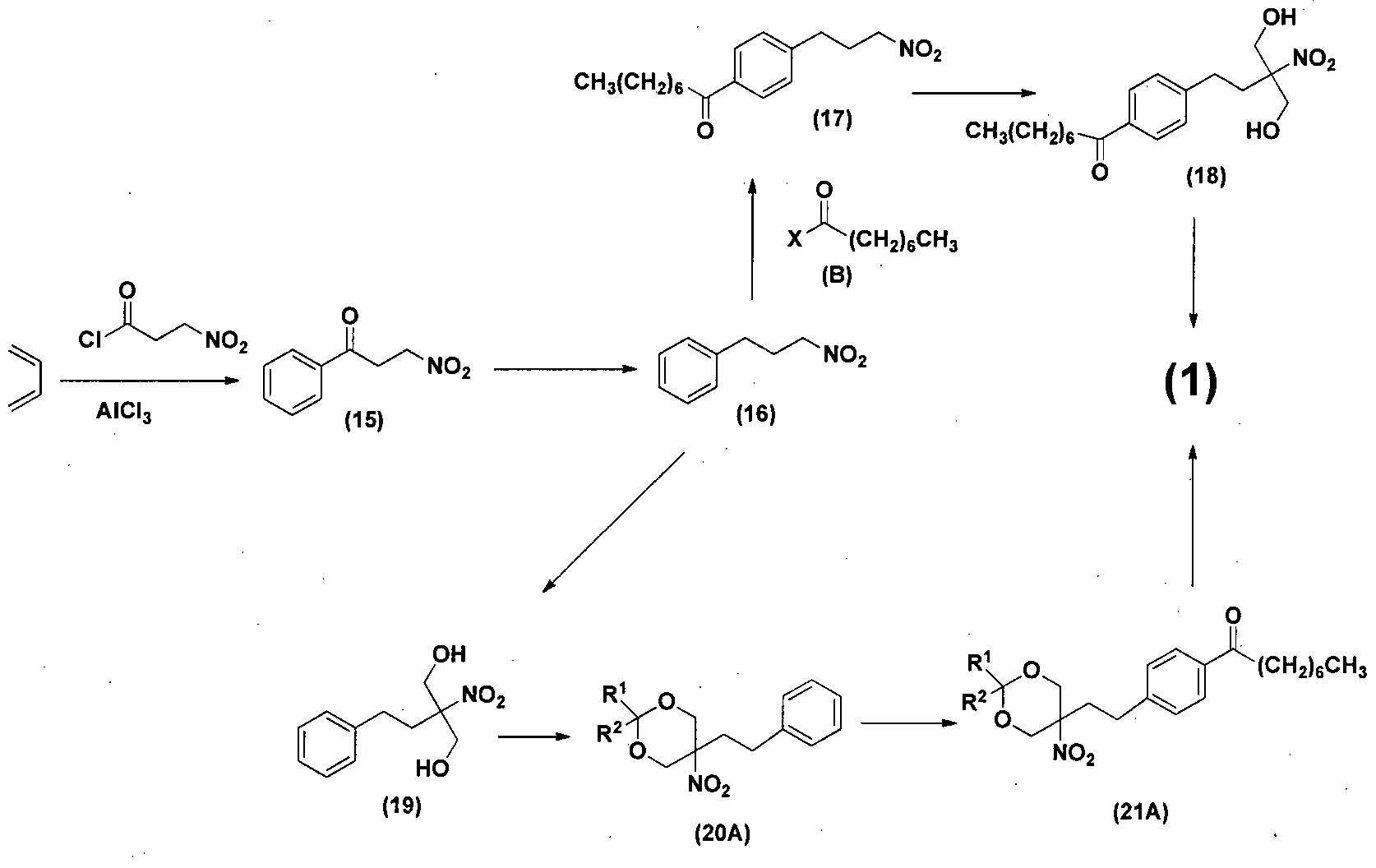
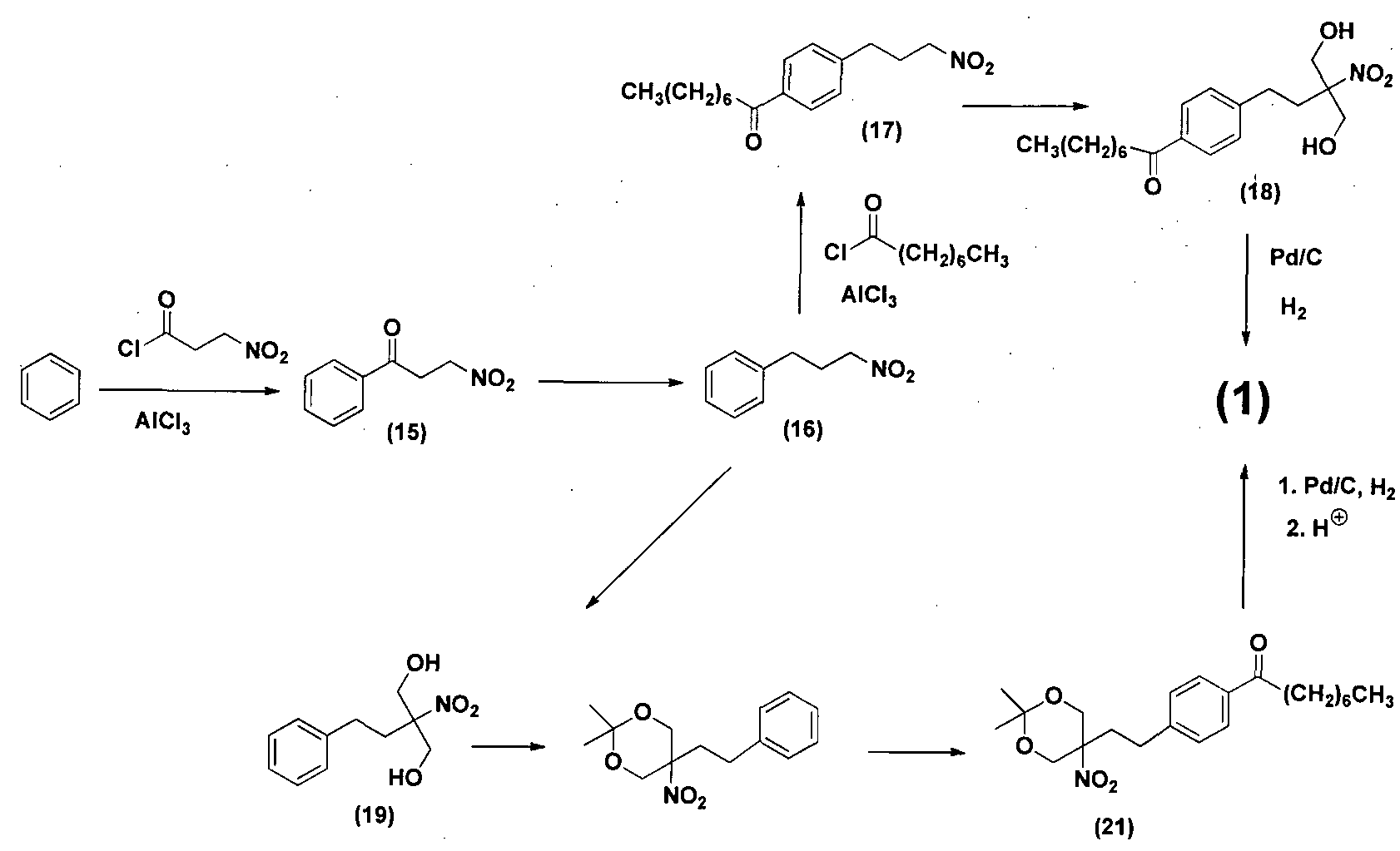
- the present invention provides a process for preparing Fingolimod or pharmaceutically acceptable salts thereof, which is designated herein “Process 2" and illustrated in Scheme 3 hereinbelow.
- the process can be conducted in accordance with alternative embodiments, designated herein “Process 2A” and “Process 2B”.
- Process 2 A comprises the steps of: a) reacting 3-nitropropylbenzene with an octanoic acid derivative of formula B:
- Process 2B which is also illustrated in Scheme 3 hereinbelow, comprises the steps of: a) bis-hydroxymethylation of 3-nitropropylbenzene with formaldehyde or an equivalent thereof in the presence of a catalyst to generate a compound of formula (19):
- R and R are each independently H, an alkyl or an aryl; c) reacting compound (20A) with an octanoic acid derivative of formula B
- the bis-hydroxymethylation of compound (17) or compound (19) can be carried out with a formaldehyde derivative of formula (CH ) n O, e.g., formaldehyde, paraformaldehyde or trioxane, preferably in the presence of a base, using the same or similar conditions to those described above for Process 1.
- a formaldehyde derivative of formula (CH ) n O e.g., formaldehyde, paraformaldehyde or trioxane
- R and R in compounds (20A) or (21 A) are each CH 3 .
- the present invention further relates to a compound of formula (17), i.e., a compound represented by the following structure:
- R is heptyl
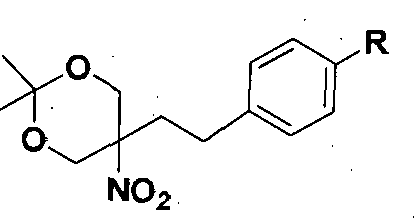
- the present invention relates to a compound represented by formula (20A) or (21 A) or, more specifically, to a compound represented by the following structure:
- R is selected from H, CH 3 (CH 2 ) 6 C(0)- and CH 3 (CH 2 ) 7 -.
- Fingolimod can be prepared by yet a different method, based on Wittig or Horner-Wadsworth-Emmons reactions using cheap and available tris(hydroxymethyl)aminomethane (TRIS) as starting material.
- This process designated herein as "Process 3" and illustrated in Scheme 4 hereinbelow, comprises the following steps:
- R and R" are each independently H, an alkyl or an aryl
- R 3 and R 4 are each independently alkyl or aryl
- P' is a nitrogen protecting group
- Z is a counter-ion, preferably a halogen
- the reducing step (b) is carried out by hydrogenating compound (26A) in the presence of a catalyst, for example Pd/C.
- a catalyst for example Pd/C.
- the nitrogen protecting group P' can be any protecting group known in the art, for example Boc.
- Process 3 comprises the following steps, as summarized in Scheme 4A hereinbelow: a) reacting an aldehyde of formula (24)
- the present invention further relates to a compound of formula (26A) or (27A) i.e., a compound represented by the following structure:
- P' is a nitrogen protecting group such as Boc
- A-B is CH 2 -CH 2
- R is CH 3 (CH 2 )7-.
- the present invention relates to an intermediate of formula (23A) or
- Y is O or H 2 ;
- R 3 and R 4 are each independently alkyl or aryl
- Z is a counter-ion, preferably a halogen.
- R 3 is phenyl
- R 4 is ethyl
- Z is a halogen, preferably a bromine.
- Fingolimod prepared by any of the Processes 1, 2 or 3 can further be converted into its pharmaceutically acceptable salt, such as the hydrochloride salt, in a manner known to a person of skill in the art.
- alkyl refers to any saturated aliphatic hydrocarbon, including straight-chain, and branched-chain. In one embodiment, the alkyl group has 1-12 carbons designated here as Ci-C] 2 -alkyl.
- the alkyl group has 1-6 carbons designated here as Ci-C6-alkyl. In another embodiment, the alkyl group has 1-4 carbons designated here as Ci-C4-alkyl.
- the alkyl group may be unsubstituted or substituted by one or more groups selected from halogen, hydroxy, alkoxy carbonyl, amido, alkylamido, dialkylamido, nitro, amino, alkylamino, dialkylamino, carboxyl, thio and thioalkyl.
- aryl refers to an aromatic ring system containing from 6-14 ring carbon atoms.
- the aryl ring can be a monocyclic, bicyclic, tricyclic and the like.
- Non-limiting examples of aryl groups are phenyl, naphthyl including 1-naphthyl and 2-naphthyl, and the like. Each possibility represents a separate embodiment of the present invention.
- the present invention provides a process for preparing Fingolimod or pharmaceutically acceptable salts thereof, designated herein as "Process 1 ", as illustrated in Scheme 2:
- Fingolimod can be prepared from a compound of formula (11) by several steps, as illustrated in Scheme 2 or 2A, and in the experimental section.
- the process comprises the following steps: a) reacting octylbenzene with a 3-nitropropanoic acid derivative of formula A wherein X is a halogen, preferably CI, or an anhydride, so as to obtain 3-nitro-l-(4-octylphenyl)propan-l -one of formula (12); b) reducing 3-nitro-l-(4-octylphenyl)propan-l-one (12) to 3-nitro-l-(4-octylphenyl)propan-l-ol with a reducing agent; c) protecting the hydroxy 1 group of 3-nitro-l-(4-octylphenyl)propan-l-ol so as to obtain compound (13A) wherein P is a hydroxyl protecting group; d) bis-hydroxymethylation of compound (13A) with formaldehyde or an equivalent thereof in the presence of catalyst, and removal of the hydroxyl protecting group to obtain compound (14); e)
- Octylbenzene (1 1) which is used here as a raw material is a commercially-available reagent, or it can be produced by well-known methods described in Org. Lett., 2009, Vol. 1 1 , No. 2, p.277 or WO 2009/133045, the contents of each of which are incorporated by reference herein.
- the reaction may be carried out in the presence of a Friedel-Crafts catalyst, such as ⁇ 10 3 ⁇ FeCl 3i SnC , TiCl 4 , ZnCl 2; BF 3 , and like; metal salts of organic acids, such as metal triflates (hafnium triflate, cerium triflate, and like) or of protic acids (for example, HF, H2SO4, CF 3 S0 3 H), ion-exchange resins, such as Nafion, zeolite and the like.
- a Friedel-Crafts catalyst such as ⁇ 10 3 ⁇ FeCl 3i SnC , TiCl 4 , ZnCl 2; BF 3 , and like
- metal salts of organic acids such as metal triflates (hafnium triflate, cerium triflate, and like) or of protic acids (for example, HF, H2SO4, CF 3 S0 3 H)
- ion-exchange resins such
- the acylation reaction is conducted in any solvent suitable for the Friedel-Crafts reaction, such as but not limited to methylene chloride, chloroform, dichloroethane, dioxane, nitroalkanes or their mixtures.
- the reaction can be performed in the presence of additives, such as AgSbF 6 , AgBF 6i preferably, L1CIO4. Each possibility represents a separate embodiment of the present invention.
- the reaction can further be accelerated by using ionic liquids as a solvent and under microwave irradiation.
- the reaction can be carried out at any temperature between about 0°C and about 120°C, for example at room temperature or at reflux temperature which will vary depending on the solvent being used.
- Compound (12) is pure enough for the use on the next step, but if necessary, it can be further purified by any suitable technique, for example, by distillation or by column chromatography.
- a Fingolimod intermediate (13A) is prepared by reduction of compound (12) with a reducing agent, followed by protecting the hydroxyl group (e.g., by acylation).
- the reducing agent can be, for example borane and its complexes with dimethylsulfide, pyridine, triethylamine and like; lithium and sodium borohydride in presence of a Lewis acid, such as boron trifluoride diethyl ether complex, aluminum-, titanium- or cobalt- chlorides and the like, or in the presence of trimethylchlorosilane or phosphorus oxychloride; or an aluminum hydride such as A1H 3 and its complex with amines, L1AIH4, sodium bis(2-methoxyethoxy)aluminum hydride (Red-Al) or diisobutylaluminum hydride.
- the reducing agent is sodium borohydride.
- the intermediate compound 3-nitro-l-(4-octylphenyl)propan-l-ol, formed by the aforementioned reduction step, may undergo dehydration (under heating or acidic catalyst assistance) to form the undesirable 3-(nitroprop-l-enyl)-4-octylbenzene, which may be subject to isomerization, decomposition or polymerization, all undesired reactions (analogous reactions are described in Noboru Ono, The nitro Group in Organic Synthesis. Wiley-VCH, 2001, p.38).
- Suitable hydroxyl protecting groups include, but are not limited to, triorganosilyl, such as trimethylsilyl (TMS), triethylsilyl (TES), t-butyldimethylsilyl (TBDMS), t- butyldiphenylsilyl (TBDPS), tripropylsilyl, triisopropylsilyl, triphenylsilyl, and the like, methoxymethyl, benzyloxymethyl, methoxyethoxymethyl, 2-(trimethylsilyl) ethoxymethyl, tetrahydropyranyl, t-butyl, 4-methoxybenzyl and analogous groups.
- TMS trimethylsilyl
- TES triethylsilyl
- TDMS t-butyldimethylsilyl
- TDPS t-butyldiphenylsilyl
- tripropylsilyl triisopropylsilyl, triphenylsilyl
- One preferred hydroxyl protecting group is acyl, more preferably, acetyl (COCH 3 ), which can be attached to the hydroxyl of the 3-nitro-l -(4-octylphenyl)propan-l -ol by a reaction with acyl anhydride, such as acetyl anhydride, or acetyl halide, such as acetyl chloride, in the presence of a base.
- the bases include, but are not limited to, organic bases such as pyridine, triethylamine, sodium alkoxide or potassium alkoxide and the like or inorganic base such as sodium carbonate, potassium carbonate, sodium or potassium hydroxide and the like.
- the protection of the hydroxyl group provides a stable intermediate, for crystallization and transferred without decomposition. Each possibility represents a separate embodiment of the present invention.
- a Fingolimod intermediate of formula (14) is prepared by reacting 1 -substituted phenyl-3- nitro-propan-l-ol (13) or more generally (13A) with hydroxymethylation reagent (CH 2 ) n O, such as formaldehyde in an organic solvent or in water (formalin), paraformaldehyde or trioxane.
- CH 2 ) n O hydroxymethylation reagent
- the reaction may be carried out in a solvent in the presence of base.
- the reaction is carried out at a temperature between about -10° C and about 50° C, more preferably at about 20-25° C.
- the reaction is conducted in any suitable solvent, which may be for example selected from the group consisting of CI to C5 alcohols, C2 to C7 esters, C4 to C7 ethers, CI to C5 carboxylic acid amides, water, or suitable mixtures of these solvents.
- suitable solvents are alcohols, such as methanol, ethanol, isopropanol, water or their mixtures.
- the bases include but not limited to alkali metal hydroxides, carbonates, bicarbonates and alkoxides, such as potassium bicarbonate, sodium bicarbonate, potassium carbonate, sodium carbonate, sodium hydroxide, potassium hydroxide, calcium hydroxide, and the like; amines such as triethylamine, diisopropylethylamine, N-methylmorpholine, pyridine, lutidine DBU, DBN, tetramethylguanidine (TMG), P(RNCH 2 CH 2 ) 3 N (PAP), and like; KF, n-Bu 4 NF, A1 2 0 3 -KF, basic resins such as amberlyst A-21 , amberlite IRA-420. Each possibility represents a separate embodiment of the present invention.
- alkali metal hydroxides, carbonates, bicarbonates and alkoxides such as potassium bicarbonate, sodium bicarbonate, potassium carbonate, sodium carbonate, sodium hydroxide, potassium hydroxide, calcium hydroxide,
- the base is a solid base, such as Amberlyst.
- a solid base may increase reaction yields, and makes work-up and recycling of the base more technologically and economically suitable.
- the reaction may be carried out in water using the abovementioned bases and phase transfer catalysts, for example, NaOH and cetyltrimethylammonium chloride (CTACl).
- CTCl cetyltrimethylammonium chloride
- the protecting group can be removed by methods described in Greene. Protective Groups in Organic Synthesis, 2nd ed, John Wiley & Sons, New York, 1991 , the contents of which are incorporated by reference.
- the preferred acetyl protecting group can be removed under basic conditions at a temperature between about 30° C and about 70° C, more preferably at about 40-50° C.
- the preparation of compound (14) may be carried out in one stage, by performing the reaction of 1 -substituted phenyl-3-nitro-propan-l-ol (13) with formaldehyde at about 20-25°C and then deprotecting of hydroxyl group at about 40-50°C, using the same solvent and base without separation and purification of the intermediate compound.
- Fingolimod is prepared by reduction of compound (14) with a reducing agent, preferably in an organic solvent and/or water.
- a reducing agent preferably in an organic solvent and/or water.
- the reducing agent to be used for the reduction of compound (14) include metal hydrides, such as lithium aluminum hydride, hydrogen (H 2 ) in the presence of a transition metal such as palladium, rhodium or ruthenium-based reagents, for example, Pd/C, platinum oxide, and like; Raney nickel; and metals such as iron, zinc or tin in acidic or basic media.
- the reduction of compound (14) to compound (1) comprises two parts: reduction of the hydroxyl group and reduction of the nitro group.
- the reduction of both groups can be carried out in one step using the same reducing agent (e.g., by hydrogenation using H 2 in the presence of a catalyst).
- each reduction step can be carried out separately in any order, using the same or different reducing agents, with or without isolation of reaction intermediates.
- Each possibility represents a separate embodiment of the present invention.
- solvents to be used for the reduction of compound (14) include, but are not limited to, water, methanol, ethanol, tert-butyl alcohol, tetrahydrofuran, diethyl ether, dioxane, acetone, ethyl acetate, acetic acid, benzene, toluene, xylene, dimethylformamide and dimethyl sulfoxide and their mixtures.
- the reduction of compound (14) generally proceeds at a temperature in the range of about 0° C to about 70° C, but a temperature lower or higher than this temperature range may be selected on demand.
- the hydrogenation may be carried out at about 1 to 30 about atm of hydrogen pressure.
- Fingolimod can be transformed in its pharmaceutical salts (e.g., the hydrochloride salt) by methods described in literature, for example EP 09891 13, US 6,284,915; and WO 99/01419, the contents of each of which is incorporated by reference herein.
- pharmaceutical salts e.g., the hydrochloride salt
- Fingolimod can be prepared from (3-nitropropyl)benzene by acylation with octanoyl chloride, hydroxymethylation and reduction ("Process 2A”: 16-> 17- 18- 1 in Scheme 3) or hydroxymethylation, protection, acylation and reduction (Process 2B: 16-> 19->20A- 21 A- 1 in Scheme 3).
- Fingolimod can be prepared from tris(hydroxymethyl)aminomethane (TRIS), a cheap and commercially-available starting material using Wittig or Horner-Wadsworth-Emmons reactions, as illustrated in Scheme 4.
- TIS tris(hydroxymethyl)aminomethane
- Z is a counter-ion, which is preferably a halogen (e.g., F, CI, Br or I).
- halogen e.g., F, CI, Br or I
- suitable counter-ions include, but are not limited to, sulfonates, trifluoroacetates [Bull. Korean Chem. Soc. 5 2001, Vol. 22, No. 4 351] and the like.
- Y is O. In another embodiment, Y is H 2 , i.e., Y together with the carbon to which it is attached forms a methylene (CH 2 ) group.
- CH 2 methylene
- the protecting group P' can be any nitrogen protecting groups, for example carbamates, amides, N-benzyl derivatives, and imine derivatives.
- nitrogen-protecting groups are acetyl (COCH 3 ), benzoyl, benzyl, benzyloxycarbonyl (Cbz), formyl, phenylsulfonyl, pivaloyl, tert-butoxycarbonyl (Boc), tert-butylacetyl, and triphenylmethyl (trityl), fluorenylmethyloxycarbonyl (Fmoc), p-nitrobenzenesulfoethoxycarbonyl propargyloxycarbonyl, picolinyl, prenyl, o-nitrobenzyloxy methyl, 4-methyoxyphenoxymethyl, guaiacolmethyl, siloxymethyl, such as triisopropylsiloxymethyl, 2-cyanoethyoxymethyl, 2-quinolinylmethyl, dich
- Tris(hydroxymethyl)aminomethane may be converted to compound (24A) by known methods, for example Tetrahedron, 2001, 57, p. 6531.
- the preparation of two phosphorus containing precursors (23A) and (25A) may be achieved by methods described for their analogous compounds (Organophosphorus Reagents: A Practical Approach In Chemistry, P. J. Murphy, Oxford University Press, USA, 2004, 288pp; Organophosphorus reagents in organic synthesis, ed. J.I.G.
- R 1 and R 2 are each methyl, and the compound of formula (24 A) is represented by the structure of compound (24). Also, particular embodiments of compound (23A) and (25A) are represented by the structures (23) or (25), respectively (Scheme 4A).
- a Fingolimod intermediate of formula (26A) is prepared by a reaction of a Wittig reagent (23A) or phosphonate (25A) with aldehyde (24A) in the presence of a base in an appropriate solvent.
- a Fingolimod intermediate of formula (26) is prepared by a reaction of a Wittig reagent (23) or phosphonate (25) with aldehyde (24) (Scheme 4A).
- solvents for this reaction include, but are not limited to ethers (diethyl, diisopropyl, tert-butyl methyl ether, tetrahydrofuran, dioxane), acetonitrile, toluene, propionitrile, N,N- dimethylformamide, dimethylsulphoxide, N-methylpyrrolidone.
- ethers diethyl, diisopropyl, tert-butyl methyl ether, tetrahydrofuran, dioxane
- acetonitrile toluene
- propionitrile N,N- dimethylformamide
- dimethylsulphoxide N-methylpyrrolidone
- polar solvent are currently preferred, with THF-DMF mixture being preferred currently preferred example.
- Suitable bases for this reaction include, but are not limited to, alkali metal and alkaline earth carbonates, hydroxides and alkoxides, for example potassium bicarbonate, sodium bicarbonate, potassium carbonate, sodium carbonate, sodium hydroxide, potassium hydroxide, calcium hydroxide, and the like; amines such as triethylamine, diisopropylethylamine, N- methylmorpholine, pyridine, lutidine, DNU, DBN, DABCO and the like; basic resins and the like.
- the base is selected from alkali metal carbonates and alkoxides; such as potassium carbonate or potassium tert-butoxide.
- the reaction is typically carried out in a temperature range of about 20°C to about 100° C, from example from about 40°C to 80°C, or from about 60 to70°C.
- Compound (26) or (26A) can be isolated from the reaction mixture by conventional means, for example, by extraction to obtain two phases, separating the organic layer, and evaporating the organic layer to obtain a residue. Evaporation can be carried out at an elevated temperature of about 45° to about 60°C and/or a pressure of less than about one atmosphere.
- the crude product if necessary, can be purified by any suitable technique, for example, by distillation, crystallization or column chromatography.
- the thus prepared Fingolimod can be transformed in its pharmaceutical salts (e.g., the hydrochloride salt) by methods described in literature, for example EP 09891 13, US 6,284,915; and WO 99/01419, the contents of each of which is incorporated by reference herein.
- pharmaceutical salts e.g., the hydrochloride salt
- 3-nitropropanoic acid available commercially or prepared according to Silva, P. C; Costa, J. S.; Pereira, V. L. P. Synth. Commun. 2001, 31, 595, (10.0 g, 85.0 mmol) was stirred overnight with SOCl 2 (100 ml). Following addition of anhydrous toluene, the solution was azeotropically distilled to remove excess SOCl 2 . The residue can be used directly for acylation or distilled (80-83 °C/0.1-0.2 mbar [SYNTHESIS 2009, No. 5, p. 715]) to afford pure 3- nitropropanoyl chloride as a clear liquid.
- A1C1 3 (12.0 g, 89.0 mmol) was added to 15 ml of methylene chloride and cooled to 0-5 °C, following by addition of 3-nitropropanoyl chloride (1 1 g, 80 mmol) .
- Octylbenzene (17.10 g, 89.0 mmol) in 40 ml of CH 2 C1 2 was dropwise added and the solution was stirred at room temperature under TLC monitoring. After reaction completion, the mixture was poured onto ice, acidified by addition of 2 M HCl to pH 2, and extracted with CH C1 2 .
- 3-nitro-l-phenylpropan-l-one (15) (12.5 g, 70.0 mmol) was dissolved in TFA (100 ml) and Et 3 SiH (30 ml). This mixture was stirred at room temperature under TLC and GC control. After reaction completion, the mixture was concentrated under reduced pressure and. residue was distilled in vacuum to give 3-nitropropylbenzene (16) with 88% yield, bp. 120-123° C/4 mm.
- Example 8 Preparation of 1 -(4-(3 -nitropropyl)phenyl)octan- 1 -one ( 17)
- the title compound was prepared from 3-nitropropylbenzene (16) and octanoyl chloride, according to example 2, affording compound (17) with 73% yield, which was used at the next step without additional purification.
- Example 14 Preparation of Fingolimod hydrochloride from compound (21) The title compound was prepared in 80% yield from l -(4-(2-(2,2-dimethyl-5-nitro-l,3-dioxan-5- yl)ethyl)phenyl)octan-l -one (21) according to example 4. Process 3: Examples 15-17:
- ter/-Butyl-5-Formyl-2,2-dimethyl-l,3-dioxan-5-ylcarbamate (24) was prepared according to the procedure described by Ooi et al. [J. Org. Chem. 2004, 69, 7765-7768].
- Fingolimod hydrochloride was prepared by hydrogenation according to example 4.
Landscapes
- Chemical & Material Sciences (AREA)
- Organic Chemistry (AREA)
- Health & Medical Sciences (AREA)
- General Health & Medical Sciences (AREA)
- Life Sciences & Earth Sciences (AREA)
- Chemical Kinetics & Catalysis (AREA)
- Molecular Biology (AREA)
- Biochemistry (AREA)
- Medicinal Chemistry (AREA)
- Pharmacology & Pharmacy (AREA)
- Nuclear Medicine, Radiotherapy & Molecular Imaging (AREA)
- Animal Behavior & Ethology (AREA)
- Engineering & Computer Science (AREA)
- Public Health (AREA)
- Veterinary Medicine (AREA)
- General Chemical & Material Sciences (AREA)
- Bioinformatics & Cheminformatics (AREA)
- Biomedical Technology (AREA)
- Neurology (AREA)
- Neurosurgery (AREA)
- Organic Low-Molecular-Weight Compounds And Preparation Thereof (AREA)
- Heterocyclic Compounds That Contain Two Or More Ring Oxygen Atoms (AREA)
- Acyclic And Carbocyclic Compounds In Medicinal Compositions (AREA)
- Low-Molecular Organic Synthesis Reactions Using Catalysts (AREA)
- Nitrogen Condensed Heterocyclic Rings (AREA)
Abstract
Description






Claims


Priority Applications (11)
| Application Number | Priority Date | Filing Date | Title |
|---|---|---|---|
| JP2013535590A JP2014503478A (en) | 2010-10-28 | 2011-10-27 | Intermediate compounds and processes for the preparation of fingolimod |
| CN2011800632167A CN103313964A (en) | 2010-10-28 | 2011-10-27 | Intermediate compounds and methods for the preparation of fingolimod |
| MX2013004649A MX2013004649A (en) | 2010-10-28 | 2011-10-27 | Intermediate compounds and process for the preparation of fingolimod. |
| CA2815634A CA2815634A1 (en) | 2010-10-28 | 2011-10-27 | Intermediate compounds and process for the preparation of fingolimod |
| AU2011322115A AU2011322115A1 (en) | 2010-10-28 | 2011-10-27 | Intermediate compounds and process for the preparation of Fingolimod |
| EP11835740.9A EP2632889B1 (en) | 2010-10-28 | 2011-10-27 | Intermediate compounds and process for the preparation of fingolimod |
| PL11835740T PL2632889T3 (en) | 2010-10-28 | 2011-10-27 | Intermediate compounds and process for the preparation of fingolimod |
| ES11835740T ES2697605T3 (en) | 2010-10-28 | 2011-10-27 | Intermediate compound and process for the preparation of fingolimod |
| BR112013010075A BR112013010075A2 (en) | 2010-10-28 | 2011-10-27 | intermediate compounds and process for the preparation of fingolimod |
| US13/881,961 US8735627B2 (en) | 2010-10-28 | 2011-10-27 | Intermediate compounds and process for the preparation of fingolimod |
| IL226042A IL226042A (en) | 2010-10-28 | 2013-04-28 | Intermediate compounds and process for the preparation of fingolimod |
Applications Claiming Priority (2)
| Application Number | Priority Date | Filing Date | Title |
|---|---|---|---|
| US40748310P | 2010-10-28 | 2010-10-28 | |
| US61/407,483 | 2010-10-28 |
Publications (2)
| Publication Number | Publication Date |
|---|---|
| WO2012056458A2 true WO2012056458A2 (en) | 2012-05-03 |
| WO2012056458A3 WO2012056458A3 (en) | 2013-07-18 |
Family
ID=45994490
Family Applications (1)
| Application Number | Title | Priority Date | Filing Date |
|---|---|---|---|
| PCT/IL2011/000838 Ceased WO2012056458A2 (en) | 2010-10-28 | 2011-10-27 | Intermediate compounds and process for the preparation of fingolimod |
Country Status (11)
| Country | Link |
|---|---|
| US (1) | US8735627B2 (en) |
| EP (1) | EP2632889B1 (en) |
| JP (1) | JP2014503478A (en) |
| CN (1) | CN103313964A (en) |
| AU (1) | AU2011322115A1 (en) |
| BR (1) | BR112013010075A2 (en) |
| CA (1) | CA2815634A1 (en) |
| ES (1) | ES2697605T3 (en) |
| MX (1) | MX2013004649A (en) |
| PL (1) | PL2632889T3 (en) |
| WO (1) | WO2012056458A2 (en) |
Cited By (6)
| Publication number | Priority date | Publication date | Assignee | Title |
|---|---|---|---|---|
| CN103145689A (en) * | 2013-01-24 | 2013-06-12 | 华东师范大学 | Method for combining Fingolimod intermediate |
| CZ304188B6 (en) * | 2012-06-15 | 2013-12-18 | Zentiva, K.S. | Process for preparing fingolimod based on opening of aziridine ring |
| CN103539683A (en) * | 2012-07-17 | 2014-01-29 | 广东东阳光药业有限公司 | New crystal form of drug for treating sclerosis and preparation method thereof |
| CN103804123A (en) * | 2012-11-14 | 2014-05-21 | 成都弘达药业有限公司 | Method and intermediate for synthesizing Fingolimod hydrochloride |
| WO2014111836A1 (en) * | 2013-01-17 | 2014-07-24 | Shilpa Medicare Limited | Process for preparation of fingolimod and its salts |
| WO2015107548A1 (en) | 2014-01-07 | 2015-07-23 | Emcure Pharmaceuticals Limited | Improved fingolimod process |
Families Citing this family (8)
| Publication number | Priority date | Publication date | Assignee | Title |
|---|---|---|---|---|
| CN103724215A (en) * | 2013-11-28 | 2014-04-16 | 镇江圣安医药有限公司 | Novel derivative of 2-amino-2-[2-(4-octylphenyl)ethyl]-1,3-propandiol and application of novel derivative |
| US9925138B2 (en) | 2015-01-20 | 2018-03-27 | Handa Pharmaceuticals, Llc | Stable solid fingolimod dosage forms |
| JP2017008044A (en) * | 2015-06-22 | 2017-01-12 | 学校法人 久留米大学 | Inhibitor of dopamine signal transduction |
| CN105924327A (en) * | 2016-05-05 | 2016-09-07 | 成都百裕制药股份有限公司 | Preparing method for fingolimode intermediate and analog thereof |
| WO2020165672A1 (en) | 2019-02-15 | 2020-08-20 | Shivalik Rasayan Limited | Process for preparation of highly pure fingolimod hydrochloride |
| WO2021158848A1 (en) * | 2020-02-07 | 2021-08-12 | Argentum Pharmaceuticals Llc | Dosage regimen of an s1p receptor agonist |
| US11135197B2 (en) | 2020-02-07 | 2021-10-05 | Argentum Pharmaceuticals Llc | Dosage regimen of an S1P receptor modulator |
| CN112679299B (en) * | 2020-12-29 | 2022-03-18 | 湖南科技大学 | Preparation method of diarylmethane and derivatives thereof |
Citations (14)
| Publication number | Priority date | Publication date | Assignee | Title |
|---|---|---|---|---|
| US2946824A (en) | 1958-10-15 | 1960-07-26 | Gen Aniline & Film Corp | Alkylbenzyltriphenylphosphonium chlorides |
| US4808572A (en) | 1985-12-06 | 1989-02-28 | Ciba-Geigy Corporation | α-Hydroxy thioethers |
| US5604229A (en) | 1992-10-21 | 1997-02-18 | Yoshitomi Pharmaceutical Industries, Ltd. | 2-amino-1,3-propanediol compound and immunosuppressant |
| WO1999001419A1 (en) | 1997-07-03 | 1999-01-14 | Taito Co., Ltd. | Processes for producing 2-aminomalonic acid derivatives and 2-amino-1,3-propanediol derivatives, and intermediates for producing the derivatives |
| JPH11310556A (en) | 1998-04-28 | 1999-11-09 | Yoshitomi Pharmaceut Ind Ltd | Novel process for producing 2-amino-2- [2- (4-octylphenyl) ethyl] propane-1,3-diol |
| WO2000027798A1 (en) | 1998-11-11 | 2000-05-18 | Novartis Ag | Production of 2-amino-2-[2-(4-c2-20-alkyl-phenyl)ethyl]propane-1,3-diols |
| WO2000053569A1 (en) | 1999-03-11 | 2000-09-14 | Hangzhou Zhongmei Huadong Pharmaceutical Co. Ltd. | Method for preparing 2-2[(4-alkylphenyl)-ethyl]-2-amino-propanediol and intermediates useful in such preparation |
| CN1528738A (en) | 2003-10-14 | 2004-09-15 | 马启明 | Method for preparing 2-para octylphenyl ehtyl-2-amino propanediol |
| WO2005041899A2 (en) | 2003-11-03 | 2005-05-12 | University Of Virginia Patent Foundation | Orally available sphingosine 1-phosphate receptor agonists and antagonists |
| DE10355169A1 (en) | 2003-11-26 | 2005-06-23 | Studiengesellschaft Kohle Mbh | Production of optionally substituted alkyl benzene derivatives, useful in the production of e.g. immunomodulator FTY720, comprises reaction of phenyl halide, sulfonate or phosphate and metal-alkyl compound over iron catalyst |
| CN1765872A (en) | 2005-11-22 | 2006-05-03 | 江苏吴中苏药医药开发有限责任公司 | 2-amido-2-[2-(4-alkylphenyl)ethyl]-1,3-methyl glycol preparation method |
| US20090082471A1 (en) | 2007-09-26 | 2009-03-26 | Protia, Llc | Deuterium-enriched fingolimod |
| WO2009061374A2 (en) | 2007-11-02 | 2009-05-14 | Concert Pharmaceuticals, Inc. | Deuterated fingolimod |
| WO2009133045A1 (en) | 2008-04-28 | 2009-11-05 | Basf Se | New borane-amine complexes and their application in suzuki-type cross -coupling reactions |
Family Cites Families (8)
| Publication number | Priority date | Publication date | Assignee | Title |
|---|---|---|---|---|
| US4086341A (en) | 1974-08-22 | 1978-04-25 | Bayer Aktiengesellschaft | Cephalosporin derivatives |
| US4857659A (en) | 1986-04-28 | 1989-08-15 | Merck Frosst Canada, Inc. | Stereoselective synthesis of leukotriene antagonists |
| US4978793A (en) | 1988-06-23 | 1990-12-18 | W. R. Grace & Co.-Conn. | Novel process for the preparation of serinol |
| DE19711762A1 (en) * | 1997-03-21 | 1998-09-24 | Huels Chemische Werke Ag | Process for the preparation of bishydroxymethyl compounds |
| JP2006199652A (en) | 2005-01-21 | 2006-08-03 | Ajinomoto Co Inc | Method for producing 2'-deoxyguanosine compound |
| PT2356090T (en) | 2008-11-11 | 2017-10-16 | Novartis Ag | Crystalline forms of fingolimod hcl |
| JP2012508215A (en) | 2008-11-11 | 2012-04-05 | ノバルティス アーゲー | Organic compounds |
| WO2011159870A1 (en) * | 2010-06-17 | 2011-12-22 | Bracco Imaging S.P.A. | Methods and compounds for the preparation of fluorine-labeled deoxy-fty720 |
-
2011
- 2011-10-27 EP EP11835740.9A patent/EP2632889B1/en active Active
- 2011-10-27 MX MX2013004649A patent/MX2013004649A/en not_active Application Discontinuation
- 2011-10-27 JP JP2013535590A patent/JP2014503478A/en active Pending
- 2011-10-27 BR BR112013010075A patent/BR112013010075A2/en not_active IP Right Cessation
- 2011-10-27 AU AU2011322115A patent/AU2011322115A1/en not_active Abandoned
- 2011-10-27 CN CN2011800632167A patent/CN103313964A/en active Pending
- 2011-10-27 WO PCT/IL2011/000838 patent/WO2012056458A2/en not_active Ceased
- 2011-10-27 ES ES11835740T patent/ES2697605T3/en active Active
- 2011-10-27 US US13/881,961 patent/US8735627B2/en active Active
- 2011-10-27 PL PL11835740T patent/PL2632889T3/en unknown
- 2011-10-27 CA CA2815634A patent/CA2815634A1/en not_active Abandoned
Patent Citations (18)
| Publication number | Priority date | Publication date | Assignee | Title |
|---|---|---|---|---|
| US2946824A (en) | 1958-10-15 | 1960-07-26 | Gen Aniline & Film Corp | Alkylbenzyltriphenylphosphonium chlorides |
| US4808572A (en) | 1985-12-06 | 1989-02-28 | Ciba-Geigy Corporation | α-Hydroxy thioethers |
| US5604229A (en) | 1992-10-21 | 1997-02-18 | Yoshitomi Pharmaceutical Industries, Ltd. | 2-amino-1,3-propanediol compound and immunosuppressant |
| US5952316A (en) | 1992-10-21 | 1999-09-14 | Yoshitomi Pharmaceutical Industries, Ltd. | 2-amino-1,3-propanediol compound and immunosuppressant |
| US6284915B2 (en) | 1997-07-03 | 2001-09-04 | Taito Co., Ltd | Process for preparing 2-amino malonic acid derivatives and 2-amino-1,3-propanediol derivatives, and intermediates for preparing the same |
| WO1999001419A1 (en) | 1997-07-03 | 1999-01-14 | Taito Co., Ltd. | Processes for producing 2-aminomalonic acid derivatives and 2-amino-1,3-propanediol derivatives, and intermediates for producing the derivatives |
| EP0989113A1 (en) | 1997-07-03 | 2000-03-29 | Taito Co., Ltd. | Processes for producing 2-aminomalonic acid derivatives and 2-amino-1,3-propanediol derivatives, and intermediates for producing the derivatives |
| US20010008945A1 (en) | 1997-07-03 | 2001-07-19 | Susumu Hirase | Process for preparing 2-amino malonic acid derivatives and 2-amino-1,3 - propanediol derivatives, and intermediates for preparing the same |
| JPH11310556A (en) | 1998-04-28 | 1999-11-09 | Yoshitomi Pharmaceut Ind Ltd | Novel process for producing 2-amino-2- [2- (4-octylphenyl) ethyl] propane-1,3-diol |
| WO2000027798A1 (en) | 1998-11-11 | 2000-05-18 | Novartis Ag | Production of 2-amino-2-[2-(4-c2-20-alkyl-phenyl)ethyl]propane-1,3-diols |
| WO2000053569A1 (en) | 1999-03-11 | 2000-09-14 | Hangzhou Zhongmei Huadong Pharmaceutical Co. Ltd. | Method for preparing 2-2[(4-alkylphenyl)-ethyl]-2-amino-propanediol and intermediates useful in such preparation |
| CN1528738A (en) | 2003-10-14 | 2004-09-15 | 马启明 | Method for preparing 2-para octylphenyl ehtyl-2-amino propanediol |
| WO2005041899A2 (en) | 2003-11-03 | 2005-05-12 | University Of Virginia Patent Foundation | Orally available sphingosine 1-phosphate receptor agonists and antagonists |
| DE10355169A1 (en) | 2003-11-26 | 2005-06-23 | Studiengesellschaft Kohle Mbh | Production of optionally substituted alkyl benzene derivatives, useful in the production of e.g. immunomodulator FTY720, comprises reaction of phenyl halide, sulfonate or phosphate and metal-alkyl compound over iron catalyst |
| CN1765872A (en) | 2005-11-22 | 2006-05-03 | 江苏吴中苏药医药开发有限责任公司 | 2-amido-2-[2-(4-alkylphenyl)ethyl]-1,3-methyl glycol preparation method |
| US20090082471A1 (en) | 2007-09-26 | 2009-03-26 | Protia, Llc | Deuterium-enriched fingolimod |
| WO2009061374A2 (en) | 2007-11-02 | 2009-05-14 | Concert Pharmaceuticals, Inc. | Deuterated fingolimod |
| WO2009133045A1 (en) | 2008-04-28 | 2009-11-05 | Basf Se | New borane-amine complexes and their application in suzuki-type cross -coupling reactions |
Non-Patent Citations (14)
| Title |
|---|
| ASTLE; ABBOT, J.ORG. CHEM., vol. 21, 1956, pages 1228 |
| BALASUBRAMANIAM ET AL., SYNLETT, vol. 18, 2007, pages 2841 - 2846 |
| BULL. KOREAN CHERN. SOC., vol. 22, no. 4, 2001, pages 351 |
| GREENE: "Protective Groups in Organic Synthesis, 2nd ed,", 1991, JOHN WILEY & SONS |
| J.I.G. CADOGAN,: "Organophosphorus reagents in organic synthesis", 1979, ACADEMIC PRESS, pages: 608 |
| KIM ET AL., SYNTHESIS, vol. 5, 2006, pages 753 - 755 |
| NOBORU ONO: "The nitro Group in Organic Synthesis", 2001, WILEY-VCH, pages: 38 |
| OOI ET AL., J. ORG. CHEM., vol. 69, 2004, pages 7765 - 7768 |
| ORG. LETT., vol. 11, no. 2, 2009, pages 277 |
| P. J. MURPHY: "Organophosphorus Reagents: A Practical Approach In Chemistry", 2004, OXFORD UNIVERSITY PRESS, pages: 288 |
| See also references of EP2632889A4 |
| SILVA, P. C.; COSTA, J. S.; PEREIRA, V. L. P., SYNTH. COMMUN., vol. 31, 2001, pages 595 |
| SYNTHESIS, no. 5, 2009, pages 715 |
| TETRAHEDRON, vol. 57, 2001, pages 6531 |
Cited By (8)
| Publication number | Priority date | Publication date | Assignee | Title |
|---|---|---|---|---|
| CZ304188B6 (en) * | 2012-06-15 | 2013-12-18 | Zentiva, K.S. | Process for preparing fingolimod based on opening of aziridine ring |
| WO2013185740A1 (en) * | 2012-06-15 | 2013-12-19 | Zentiva, K.S. | A method for the preparation of fingolimod |
| CN103539683A (en) * | 2012-07-17 | 2014-01-29 | 广东东阳光药业有限公司 | New crystal form of drug for treating sclerosis and preparation method thereof |
| CN103804123A (en) * | 2012-11-14 | 2014-05-21 | 成都弘达药业有限公司 | Method and intermediate for synthesizing Fingolimod hydrochloride |
| WO2014111836A1 (en) * | 2013-01-17 | 2014-07-24 | Shilpa Medicare Limited | Process for preparation of fingolimod and its salts |
| US9732030B2 (en) | 2013-01-17 | 2017-08-15 | Shilpa Medicare Limited | Process for the preparation of fingolimod and its salts |
| CN103145689A (en) * | 2013-01-24 | 2013-06-12 | 华东师范大学 | Method for combining Fingolimod intermediate |
| WO2015107548A1 (en) | 2014-01-07 | 2015-07-23 | Emcure Pharmaceuticals Limited | Improved fingolimod process |
Also Published As
| Publication number | Publication date |
|---|---|
| EP2632889A2 (en) | 2013-09-04 |
| EP2632889B1 (en) | 2018-08-29 |
| WO2012056458A3 (en) | 2013-07-18 |
| US20130217899A1 (en) | 2013-08-22 |
| BR112013010075A2 (en) | 2017-10-24 |
| CN103313964A (en) | 2013-09-18 |
| US8735627B2 (en) | 2014-05-27 |
| JP2014503478A (en) | 2014-02-13 |
| ES2697605T3 (en) | 2019-01-25 |
| EP2632889A4 (en) | 2015-01-07 |
| AU2011322115A1 (en) | 2013-05-30 |
| PL2632889T3 (en) | 2019-04-30 |
| CA2815634A1 (en) | 2012-05-03 |
| MX2013004649A (en) | 2013-06-05 |
Similar Documents
| Publication | Publication Date | Title |
|---|---|---|
| EP2632889B1 (en) | Intermediate compounds and process for the preparation of fingolimod | |
| CA2658652C (en) | Novel process for the synthesis of (e)-stilbene derivatives which makes it possible to obtain resveratrol and piceatannol | |
| JP2012528114A (en) | Method for producing benzofuran | |
| JP2007504191A (en) | Method for producing stilbene derivatives | |
| KR101932206B1 (en) | New processes for preparing 4-substituted imidazoles | |
| KR100732147B1 (en) | Synthesis method of nitromethylphenyl ester of aspirin derivative | |
| JPS6240358B2 (en) | ||
| KR20170108080A (en) | Methods for the preparation of compounds such as 3-arylbutanal which are useful in the synthesis of medetomidine | |
| EP1611084A1 (en) | Process for the manufacture of n-alkoxalyl-alaninates | |
| RU2470018C2 (en) | New pyrocatechol derivatives | |
| US6815559B2 (en) | Process for producing 3,3,3-trifluoro-2-hydroxypropionic acid or its derivative | |
| EP2060557B1 (en) | Intermediate compounds useful to prepare dolasetron | |
| Reese | Facile preparation of acetals and enol ethers derived from 1-arylpiperidin-4-ones | |
| HU200459B (en) | New process for producing 7-bromo-beta-carboline compounds | |
| Gazzaeva et al. | Synthesis of o-nitrosoacylbenzenes from o-nitrobenzyl alcohols and their derivatives | |
| JP2000256244A (en) | Method for producing 4-methyltetrafluorobenzyl alcohol derivative | |
| Lin et al. | Regioselective friedel-crafts acylation with unsymmetrically substituted furandicarboxylic acid anhydride and furan acid chloride: syntheses of 4-substituted 3-arylcarbonyl-2-phenylfuran and 3-substituted 4-arylcarbonyl-2-phenylfuran | |
| US20190315669A1 (en) | Process for the preparation of hu-910 and crystalline structure thereof | |
| JP4800933B2 (en) | Process for producing cyclopropane monoacetal derivative and its intermediate | |
| JP4330783B2 (en) | Method for producing formylcyclopropanecarboxylic acid ester | |
| JP3632979B6 (en) | Method for producing 2-aminomalonic acid derivative and 2-amino-1,3-propanediol derivative | |
| WO1986000068A1 (en) | 5-HALO-4H-1,3-DIOXIN-4-ONE COMPOUNDS, alpha-HALO-ACETOACETIC ESTERS PREPARED FROM SUCH COMPOUNDS AND PROCESS FOR THEIR PREPARATION | |
| US20010007909A1 (en) | Preparation of tris (trimethylsilyl) silylethyl esters | |
| JPH08283222A (en) | Method for producing substituted amine | |
| JPH0332536B2 (en) |
Legal Events
| Date | Code | Title | Description |
|---|---|---|---|
| 121 | Ep: the epo has been informed by wipo that ep was designated in this application |
Ref document number: 11835740 Country of ref document: EP Kind code of ref document: A2 |
|
| WWE | Wipo information: entry into national phase |
Ref document number: 2011835740 Country of ref document: EP |
|
| ENP | Entry into the national phase |
Ref document number: 2815634 Country of ref document: CA Ref document number: 2013535590 Country of ref document: JP Kind code of ref document: A |
|
| WWE | Wipo information: entry into national phase |
Ref document number: MX/A/2013/004649 Country of ref document: MX |
|
| WWE | Wipo information: entry into national phase |
Ref document number: 13881961 Country of ref document: US |
|
| WWE | Wipo information: entry into national phase |
Ref document number: 226042 Country of ref document: IL |
|
| ENP | Entry into the national phase |
Ref document number: 2011322115 Country of ref document: AU Date of ref document: 20111027 Kind code of ref document: A |
|
| REG | Reference to national code |
Ref country code: BR Ref legal event code: B01A Ref document number: 112013010075 Country of ref document: BR |
|
| REG | Reference to national code |
Ref country code: BR Ref legal event code: B01E Ref document number: 112013010075 Country of ref document: BR |
|
| ENP | Entry into the national phase |
Ref document number: 112013010075 Country of ref document: BR Kind code of ref document: A2 Effective date: 20130425 |