WO2012060429A1 - 通信システム - Google Patents
通信システム Download PDFInfo
- Publication number
- WO2012060429A1 WO2012060429A1 PCT/JP2011/075350 JP2011075350W WO2012060429A1 WO 2012060429 A1 WO2012060429 A1 WO 2012060429A1 JP 2011075350 W JP2011075350 W JP 2011075350W WO 2012060429 A1 WO2012060429 A1 WO 2012060429A1
- Authority
- WO
- WIPO (PCT)
- Prior art keywords
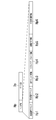
- transmission
- node
- transmission group
- subcarrier
- grouping
- Prior art date
- Legal status (The legal status is an assumption and is not a legal conclusion. Google has not performed a legal analysis and makes no representation as to the accuracy of the status listed.)
- Ceased
Links
Images




















Classifications
-
- H—ELECTRICITY
- H04—ELECTRIC COMMUNICATION TECHNIQUE
- H04L—TRANSMISSION OF DIGITAL INFORMATION, e.g. TELEGRAPHIC COMMUNICATION
- H04L5/00—Arrangements affording multiple use of the transmission path
- H04L5/003—Arrangements for allocating sub-channels of the transmission path
- H04L5/0053—Allocation of signalling, i.e. of overhead other than pilot signals
-
- H—ELECTRICITY
- H04—ELECTRIC COMMUNICATION TECHNIQUE
- H04W—WIRELESS COMMUNICATION NETWORKS
- H04W72/00—Local resource management
- H04W72/30—Resource management for broadcast services
-
- H—ELECTRICITY
- H04—ELECTRIC COMMUNICATION TECHNIQUE
- H04L—TRANSMISSION OF DIGITAL INFORMATION, e.g. TELEGRAPHIC COMMUNICATION
- H04L5/00—Arrangements affording multiple use of the transmission path
- H04L5/003—Arrangements for allocating sub-channels of the transmission path
- H04L5/0058—Allocation criteria
- H04L5/006—Quality of the received signal, e.g. BER, SNR, water filling
-
- H—ELECTRICITY
- H04—ELECTRIC COMMUNICATION TECHNIQUE
- H04L—TRANSMISSION OF DIGITAL INFORMATION, e.g. TELEGRAPHIC COMMUNICATION
- H04L27/00—Modulated-carrier systems
- H04L27/26—Systems using multi-frequency codes
- H04L27/2601—Multicarrier modulation systems
Definitions
- the present invention relates to a communication system, and more particularly, to a communication system that performs communication using a multicarrier modulation scheme composed of a plurality of subcarriers.
- selectable modulation schemes are selected based on packet degradation information (symbol noise, carrier noise), and the modulation scheme is determined based on a threshold set for each modulation scheme.
- the modulation scheme with the highest communication speed is selected from the modulation schemes that satisfy the predetermined condition, but if there is no modulation scheme that satisfies the predetermined condition, a modulation scheme with high robustness is selected.
- Communication systems using conventional multicarrier modulation schemes such as Documents 1 and 2 are aimed at improving efficiency in one-to-one unicast transmission, and broadcast the same data to multiple nodes (broadcast, multicast). This configuration is not supported. That is, it is difficult to efficiently use subcarriers when broadcasting the same data to a plurality of nodes simultaneously.
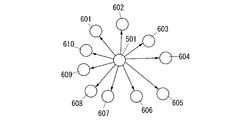
- FIG. 44 there is a communication system including one transmission node 501 and ten reception nodes 601 to 610.
- the transmitting node 501 performs multicarrier communication for transmitting data to the ten receiving nodes 601 to 610 using the 20 subcarriers f1 to f20.
- transmission line state information J101 indicating the state of the transmission line between the transmission node 501 and each of the reception nodes 601 to 610 is shown in FIG.
- This transmission path state information J101 is set to “1” for an available subcarrier for each receiving node for communication performed between the transmitting node 501 and each of the receiving nodes 601 to 610, and cannot be used. It is composed of a data table in which “0” is set for the carrier.
- the subcarriers with which the transmitting node 501 can communicate with each of the receiving nodes 601 to 610 are different for each receiving node. Therefore, as a conventional method, there is a method of performing simultaneous broadcast by assigning the same data to all the subcarriers f1 to f20. However, the amount of information that can be transmitted per hour is limited.
- the data frame transmitted by the transmission node 501 is composed of a header portion Hp and a data body portion Dp.
- the header part Hp stores information such as a transmission address and a reception address
- the data body part Dp stores the contents of data to be transmitted.
- the accumulated transmission time T101 required for data transmission is the sum of the transmission time Th of the header part Hp and the transmission time Td101 of the data body part Dp.
- the same data is simultaneously transmitted to all of the receiving nodes 601 to 610.
- the subcarrier f7 cannot communicate with the receiving nodes 603, 604, and 607.
- FIG. 46 by combining subcarrier f12 communicable with receiving nodes 603, 604, and 607 with subcarrier f7, it becomes possible to communicate with all receiving nodes 601 to 610.
- the amount of information that can be transmitted per time increases. For example, in the example of FIG.
- the present invention has been made in view of the above reasons, and an object of the present invention is to improve communication efficiency when performing simultaneous broadcasting using a multi-carrier modulation scheme composed of a plurality of subcarriers. To provide a system.
- a first form of a communication system is a communication system including a plurality of reception nodes and a transmission node that transmits broadcast data to the plurality of reception nodes.
- the transmission node includes a transmission unit, a storage unit, a node grouping unit, and a subcarrier selection unit.
- the transmitting unit is configured to transmit the broadcast data to the plurality of receiving nodes using at least one of a plurality of subcarriers prepared in advance.
- the storage unit is configured to store transmission path state information indicating a transmission path state for each receiving node.
- the node grouping unit refers to the transmission path state information, divides the plurality of receiving nodes into a plurality of transmission groups based on a classification criterion related to the state of the transmission path, and is defined by the plurality of transmission groups A grouping process for creating a transmission group set is configured.
- the subcarrier selection unit refers to the transmission path state information, and for each transmission group of the transmission group set, selects a subcarrier for transmitting the broadcast data to the reception node belonging to the transmission group. It is configured to select from a plurality of subcarriers.
- the transmission unit is configured to transmit the broadcast data using the subcarriers selected by the subcarrier selection unit in order to the plurality of transmission groups of the transmission group set.
- the state of the transmission path indicates whether or not the subcarrier is an effective subcarrier usable for communication with the receiving node. It is configured as shown for each carrier.
- the node grouping unit performs a selection process, a calculation process, a determination process, and a classification process in the grouping process.
- the selection process is a process of selecting the effective subcarrier as the priority subcarrier in the receiving node having the smallest number of effective subcarriers.
- the calculation process is a process of calculating the number of the priority subcarriers included in the effective subcarriers of the reception node for each reception node.
- the determination process is a process for determining for each receiving node whether or not the number of the priority subcarriers is equal to or greater than a grouping threshold.
- the transmission node is different from the transmission group to which the reception node to which the number of the priority subcarriers belongs is less than the grouping threshold. This is a process of dividing into groups.
- the grouping threshold is a constant.
- the node grouping unit creates a plurality of transmission group sets by performing a plurality of grouping processes with different grouping thresholds. , Configured to select one from the plurality of transmission group sets based on a predetermined condition.
- the node grouping unit includes the selection process, the calculation process, the determination process, and the classification process.
- the transmission group set defined by three or more of the transmission groups is created by performing the division process defined by and multiple times.
- the node grouping unit includes a first transmission group in which the number of priority subcarriers is equal to or greater than the grouping threshold, and a second transmission group in which the number of priority subcarriers is less than the grouping threshold. And configured to create.
- the node grouping unit is configured to perform the first division process for all the receiving nodes, and perform the second and subsequent division processes for the second transmission group created in the previous division process.
- the node grouping unit performs a selection process, a calculation process, a determination process, and a classification process in the grouping process.
- the selection process is a selection in which the effective subcarrier in the receiving node having the smallest number of effective subcarriers is selected as a priority subcarrier.
- the calculation process is a process of calculating the number of the priority subcarriers included in the effective subcarriers of the reception node for each reception node.
- the determination process is a process for determining for each receiving node whether or not the number of the priority subcarriers is equal to or greater than a grouping threshold.
- the classification process it is determined whether or not there are a plurality of boundary receiving nodes defined as the receiving node having the smallest number of the priority subcarriers in the receiving node in which the number of the priority subcarriers is equal to or greater than the grouping threshold. And when it is determined that there are a plurality of boundary receiving nodes, a plurality of the transmission group sets are obtained by combining the plurality of boundary receiving nodes and the receiving node having a higher number of priority subcarriers than the boundary receiving node. It is a process to create.
- the node grouping unit includes the boundary reception in which the number of effective subcarriers among the plurality of boundary reception nodes is small in the classification process.
- the node is configured so as to be divided into the same transmission group as that of the receiving node having a higher number of the priority subcarriers than the boundary receiving node.
- the subcarrier selection unit assigns the plurality of subcarriers to common subcarriers and non-common subcarriers for each transmission group of the transmission group set. Configured to divide into carriers.
- the common subcarrier is the subcarrier that becomes the effective subcarrier for all the receiving nodes belonging to the transmission group.
- the non-common subcarrier is the subcarrier that becomes the effective subcarrier for at least one of the receiving nodes that belong to the transmission group instead of all of the receiving nodes.
- the subcarrier selection unit is configured to create a subcarrier set for each transmission group of the transmission group set.
- the subcarrier set includes at least one of the common subcarrier and a non-common subcarrier set.
- the non-common subcarrier set is defined by a plurality of non-common subcarriers combined so that all the receiving nodes belonging to the transmission group can receive the broadcast data.
- the transmission unit is configured to transmit the broadcast data for each transmission group of the transmission group set using the subcarrier set created by the subcarrier selection unit.
- the transmission node in the first mode, includes a transmission time calculation unit.
- the node grouping unit performs a plurality of the grouping processes with different classification criteria to create a plurality of the transmission group sets, and selects one from the plurality of transmission group sets based on a predetermined condition Configured.
- the transmission time calculation unit is configured to calculate an accumulated transmission time necessary for transmitting the broadcast data to all of the plurality of reception nodes for each transmission group set.
- the predetermined condition is that the cumulative transmission time is the shortest.
- the transmission node in the ninth mode, includes a transmission time calculation unit.
- the node grouping unit performs a plurality of the grouping processes with different classification criteria to create a plurality of the transmission group sets, and selects one from the plurality of transmission group sets based on a predetermined condition Configured.
- the subcarrier selection unit is configured to create the subcarrier set for each transmission group with respect to each of the transmission group sets created by the node grouping unit.
- the transmission time calculation unit calculates the number of carriers indicating the sum of the number of the common subcarrier and the non-common subcarrier set in the subcarrier set for each transmission group, and the transmission group set based on the number of carriers
- the accumulated transmission time is calculated every time.
- the cumulative transmission time is a time required for transmitting the broadcast data to all of the plurality of receiving nodes.
- the predetermined condition is that the cumulative transmission time is the shortest.
- the transmission node includes a transmission time calculation unit and a modulation scheme selection unit.
- the transmission unit is configured to transmit the broadcast data using one selected from a plurality of modulation schemes.
- the storage unit is configured to store the transmission path state information for each modulation scheme.
- the node grouping unit performs a plurality of the grouping processes with different classification criteria for each modulation scheme to create a plurality of the transmission group sets, and selects one of the plurality of transmission group sets based on a predetermined condition. Configured to select one.
- the transmission time calculation unit is configured to calculate an accumulated transmission time necessary for transmitting the broadcast data to all of the plurality of reception nodes for each transmission group set.
- the predetermined condition is that the cumulative transmission time is the shortest.
- the modulation scheme selection unit is configured to select the modulation scheme corresponding to the transmission group set selected by the node grouping unit.
- the transmission unit is configured to transmit the broadcast data using the modulation scheme selected by the modulation scheme selection unit.
- the transmission node in the ninth mode, includes a transmission time calculation unit and a modulation scheme selection unit.
- the transmission unit is configured to transmit the broadcast data using one selected from a plurality of modulation schemes.
- the storage unit is configured to store the transmission path state information for each modulation scheme.
- the node grouping unit performs a plurality of the grouping processes with different classification criteria for each modulation scheme to create a plurality of the transmission group sets, and selects one of the plurality of transmission group sets based on a predetermined condition. Configured to select one.
- the subcarrier selection unit is configured to create the subcarrier set for each transmission group of the plurality of transmission group sets created by the node grouping unit.
- the transmission time calculation unit calculates the number of carriers indicating the sum of the numbers of the common subcarriers and the non-common subcarrier sets in the subcarrier set for each transmission group of the transmission group set, and based on the number of carriers The accumulated transmission time is calculated for each transmission group set.
- the cumulative transmission time is a time required for transmitting the broadcast data to all of the plurality of receiving nodes.
- the predetermined condition is that the cumulative transmission time is the shortest.
- the modulation scheme selection unit is configured to select the modulation scheme corresponding to the transmission group set selected by the node grouping unit.
- the transmission unit is configured to transmit the broadcast data using the modulation scheme selected by the modulation scheme selection unit.
- the transmission unit performs the next processing after a predetermined interval period has elapsed after transmitting the broadcast data to the transmission group.
- the broadcast data is transmitted to the transmission group.
- the transmission time calculation unit calculates a transmission time required for transmitting the broadcast data to all of the receiving nodes belonging to the transmission group for each transmission group of the transmission group set, and transmits the transmission group set.
- the sum of the interval periods is added to the sum of the transmission times of each of the plurality of transmission groups to calculate the cumulative transmission time of the transmission group set.
- the transmission unit in the first mode, is configured to transmit transmission group information together with the broadcast data.
- the transmission group information includes destination information indicating the transmission group that is the destination of the broadcast data.
- the receiving node determines whether it belongs to the transmission group indicated by the destination information of the received transmission group information, and the destination information indicates The broadcast data is fetched if it belongs to the transmission group, and the broadcast data is discarded if it does not belong to the transmission group indicated by the destination information.
- FIG. 1 is a block diagram illustrating a configuration of a communication device in a communication system according to Embodiment 1.
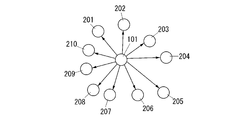
- FIG. It is a whole figure which shows the structure of the communication system of the said Embodiment 1.
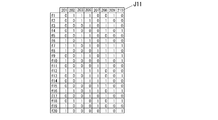
- FIG. It is a table figure which shows the transmission-line state information in the said Embodiment 1.
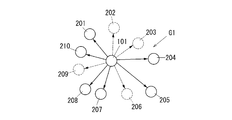
- FIG. It is a block diagram which shows the transmission group in the said Embodiment 1.
- FIG. It is a block diagram which shows the transmission group in the said Embodiment 1.
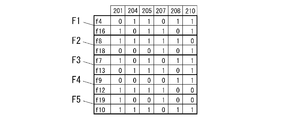
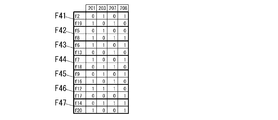
- FIG. It is a table figure which shows the allocation of the subcarrier for every transmission group in the said Embodiment 1.
- FIG. It is a table figure which shows the allocation of the subcarrier for every transmission group in the said Embodiment 1.
- FIG. It is a table figure which shows the allocation of the subcarrier for every transmission group in the said Embodiment 1.
- FIG. It is a format figure which shows the structure of the data frame in the said Embodiment 1.
- FIG. It is a format figure which shows the structure of the data frame in the said Embodiment 1.
- FIG. It is a format figure which shows the structure of the data frame in the said Embodiment 1.
- FIG. It is a format figure which shows the structure of the header part in the said Embodiment 1.
- FIG. It is a format figure which shows the structure of the subcarrier group information in the said Embodiment 1.
- FIG. It is a format figure which shows the structure of the subcarrier group information in the said Embodiment 1.
- FIG. It is a table figure which shows the calculation process of the number of effective subcarriers in the said Embodiment 1.
- FIG. It is a table figure which shows the calculation process of the number of effective subcarriers in the said Embodiment 1.
- FIG. 1 It is a table figure which shows the calculation process of the number of priority subcarriers in the said Embodiment 1.
- FIG. It is a table figure which shows the rearrangement process of the receiving node by the number of priority subcarriers in the said Embodiment 1.
- FIG. It is a block diagram which shows the transmission group in the said Embodiment 1.
- FIG. It is a block diagram which shows the transmission group in the said Embodiment 1.
- FIG. It is a table figure which shows the allocation of the subcarrier for every transmission group in the said Embodiment 1.
- FIG. It is a table figure which shows the allocation of the subcarrier for every transmission group in the said Embodiment 1.
- FIG. 10 is a diagram illustrating a receiving node rearrangement process based on the number of priority subcarriers in the second embodiment. It is a table figure which shows the production
- FIG. It is a table figure which shows the production
- FIG. It is a table figure which shows the production
- FIG. It is a table figure which shows another creation process of the transmission group in the said Embodiment 2.
- FIG. It is a table figure which shows another creation process of the transmission group in the said Embodiment 2.
- FIG. 11 is a table diagram illustrating a receiving node rearrangement process based on the number of priority subcarriers in the third embodiment. It is a table figure which shows allocation of the subcarrier for every transmission group in the said Embodiment 3.
- FIG. It is a table figure which shows the transmission path state information in the 2nd grouping process in the said Embodiment 3.
- FIG. It is a table figure which shows the rearrangement process of the receiving node by the number of priority subcarriers in the 2nd grouping process in the said Embodiment 3.
- FIG. It is a table figure which shows the allocation of the subcarrier for every transmission group in the grouping process of the 2nd time in the said Embodiment 3.
- FIG. 10 is a table diagram illustrating a receiving node rearrangement process based on the number of priority subcarriers in the fourth embodiment.
- FIG. 4 It is a table figure which shows the rearrangement process of the receiving node by the number of priority subcarriers in the said Embodiment 4.
- FIG. It is a table figure which shows the rearrangement process of the receiving node by the number of priority subcarriers in the said Embodiment 4.
- FIG. It is a table figure which shows the rearrangement process of the receiving node by the number of priority subcarriers in the said Embodiment 4.
- FIG. It is a table figure which shows another rearrangement process of the receiving node by the number of priority subcarriers in the fourth embodiment.
- FIG. 10 is a table diagram illustrating a modulation scheme selection process by a modulation scheme selection unit according to the fifth embodiment. It is a general view which shows the structure of the conventional communication system. It is a table figure which shows the conventional transmission-line state information. It is a table figure which shows the combination of the conventional subcarrier.
- the communication system includes one transmission node 101 and ten reception nodes 201 to 210.
- the transmitting node 101 performs multicarrier communication for transmitting data to the ten receiving nodes 201 to 210 using the 20 subcarriers f1 to f20.
- the communication transmission path may be either a wired transmission path or a wireless transmission path.
- the transmission node 101 only needs to have at least a data transmission function, and the reception nodes 201 to 210 need only have at least a data reception function. Further, the transmission node 101 and the reception nodes 201 to 210 may be configured by a communication device having both a data transmission function and a data reception function. In this embodiment, it is assumed that the communication apparatus A having the data transmission / reception function shown in FIG. 1 constitutes the transmission node 101 and the reception nodes 201 to 210. When the receiving nodes 201 to 210 are not distinguished, they are referred to as a receiving node 2. The number of receiving nodes 2 is not limited to ten.
- the communication device A configuring the transmission node 101 and the reception nodes 201 to 210 includes a control unit 11, a transmission unit 12, a reception unit 13, and a storage unit 14.
- the control unit 11 monitors and controls the operation of each unit (the transmission unit 12, the reception unit 13, and the storage unit 14) of the communication apparatus A.
- the transmission unit 12 is configured to transmit data (simultaneous broadcast data) to the plurality of receiving nodes 2 using at least one of a plurality of (20 in the present embodiment) subcarriers prepared in advance.
- the transmission unit 12 has a modulation function for transmitting data using 20 subcarriers f1 to f20, and includes a header generation unit 121.
- the header generation unit 121 creates a header part Hp and adds it to the front of the data body part Dp (see FIG. 11).
- the receiving unit 13 has a demodulation function for receiving data using 20 subcarriers f1 to f20, and includes a transmission path state estimating unit 131.
- the transmission unit 12 and the reception unit 13 are configured to be able to switch between a plurality of modulation schemes, and any one of the plurality of modulation schemes is set to be switchable, and the set modulation scheme is used.
- Sending and receiving data That is, the transmission unit 12 is configured to transmit broadcast data using one selected from a plurality of modulation schemes.
- a plurality of modulation schemes For example, in the present embodiment, one of BPSK, QPSK, 16QAM, 64QAM, and 256QAM is selected.
- BPSK is an abbreviation for Binary Phase Shift Keying
- QPSK is an abbreviation for Quadrature Phase Shift Keying
- QAM is an abbreviation for Quadrature Amplitude Modulation.
- the storage unit 14 stores transmission path state information J1 indicating the state of the transmission path between the transmission node 101 and each of the reception nodes 201 to 210. That is, the storage unit 14 is configured to store transmission path state information J1 indicating the transmission path state for each receiving node 2.
- the state of the transmission path is configured to indicate, for each subcarrier, whether or not the subcarrier is an effective subcarrier that can be used for communication with the receiving node 2.
- the transmission path state information J1 is “1” for subcarriers (effective subcarriers) that can be used for each receiving node for communication performed from the transmitting node 101 to each of the receiving nodes 201 to 210.
- the transmission path state information J1 is created for each modulation scheme of BPSK, QPSK, 16QAM, 64QAM, and 256QAM. That is, the storage unit 14 is configured to store the transmission path state information J1 for each modulation method.
- Transmission path state information J1 is created by the following procedure.
- the control unit 11 of the transmission node 101 transmits the same test frame to the reception nodes 201 to 210 using all the subcarriers f1 to f20.
- the control unit 11 of the receiving nodes 201 to 210 that has received the test frame analyzes the test frame in all the subcarriers f1 to f20, and sends a response frame including information on the subcarriers that have successfully received the test frame to the transmitting node. Reply to 101.
- the transmission path state estimation unit 131 analyzes each response frame received from the reception nodes 201 to 210 and performs normal communication with each of the reception nodes 201 to 210.
- Subcarriers that is, effective subcarriers that can be received are determined for each receiving node. Then, the transmission path state estimation unit 131 of the transmission node 101 creates transmission path state information J1 based on the determination result and stores it in the storage unit 13. This creation process is performed for each of BPSK, QPSK, 16QAM, 64QAM, and 256QAM modulation schemes.
- the transmission node 101 may periodically create the transmission path state information J1 and store it in the storage unit 14. That is, the transmission node 101 may periodically update the transmission path state information J1. Alternatively, the transmission node 101 may use the latest transmission path state information J1 by creating the transmission path state information J1 before transmitting the broadcast data.
- the transmission path state estimation unit 131 of the transmission node 101 analyzes the response frame in all the subcarriers f1 to f20, and determines the subcarrier that has successfully received the response frame.
- the transmission path state estimation unit 131 of the transmission node 101 can also obtain information on subcarriers that can be used for communication performed from each of the reception nodes 201 to 210 to the transmission node 101 based on the determination result.
- the control unit 11 groups subcarriers based on the transmission path state information J1. Grouping is a problem of combinatorial optimization, and combinatorial optimization itself is the subject of research, and various methods have been proposed depending on the problem. However, a multi-carrier communication system generally has many limitations, and a simpler method is desired.
- the same data can be broadcast simultaneously to all the receiving nodes 2, and a plurality of subcarriers to which the same data is assigned are assigned to the same receiving node 2 in order to efficiently use subcarriers. Is required to be minimized. Therefore, we approach this requirement from two viewpoints. The first is the total number of receiving nodes 2 to which each subcarrier is allocated, and the second is the total number of subcarriers allocated to each of the receiving nodes 2.
- the transmission node 101 may improve the communication efficiency by transmitting data to a plurality of times instead of transmitting data to all the reception nodes 201 to 210 at the same time.
- the node grouping unit 111 of the transmission node 101 performs grouping to divide the reception nodes 201 to 210 into two or more transmission groups, and the transmission unit 12 sequentially transmits broadcast data for each transmission group. .
- the node grouping unit 111 refers to the transmission path state information J1 stored in the storage unit 14, divides a plurality of receiving nodes 2 into a plurality of transmission groups based on a classification criterion related to the state of the transmission path, and transmits a plurality of transmission groups. Configured to create a transmission group set defined by the group.
- the subcarrier selection unit 112 of the transmission node 101 transmits the common subcarrier and the non-common subcarrier group (non-common subcarrier set) from the subcarriers f1 to f20 with reference to the transmission path state information J1. Set for each group. Then, broadcast data is transmitted for each transmission group using the common subcarrier and the non-common subcarrier group.
- the common subcarrier is a subcarrier that can communicate with all the receiving nodes 2 belonging to each transmission group.
- subcarriers that can communicate with some of all receiving nodes 2 belonging to each transmission group are referred to as non-common subcarriers.
- the non-common subcarrier group is configured by combining a plurality of non-common subcarriers, and belongs to each transmission group by simultaneously using a plurality of non-common subcarriers constituting one non-common subcarrier group. Communication with all receiving nodes 2 becomes possible.
- the subcarrier selection unit 112 refers to the transmission path state information J1 stored in the storage unit 14, and transmits the broadcast data to the reception nodes 2 belonging to the transmission group for each transmission group of the transmission group set.
- the subcarrier to be selected is selected from a plurality of subcarriers f1 to f20.
- the subcarrier selection unit 112 is configured to divide a plurality of subcarriers into common subcarriers and non-common subcarriers for each transmission group of the transmission group set.
- the common subcarrier is a subcarrier that becomes an effective subcarrier for all the receiving nodes 2 belonging to the transmission group.
- the non-common subcarrier is a subcarrier that becomes an effective subcarrier for at least one of the reception nodes 2 that belong to the transmission group.
- the subcarrier selection unit 112 is configured to create a subcarrier set for each transmission group of the transmission group set.
- the subcarrier set includes at least one of a common subcarrier and a non-common subcarrier set.
- the non-common subcarrier set is defined by a plurality of non-common subcarriers combined so that all the receiving nodes 2 belonging to the transmission group can receive broadcast data.
- the transmission unit 12 is configured to transmit the broadcast data using the subcarriers selected by the subcarrier selection unit 112 in order to a plurality of transmission groups in the transmission group set.
- the transmission unit 12 is configured to transmit the broadcast data using the subcarrier set created by the subcarrier selection unit 112 for each transmission group of the transmission group set.
- the transmission unit 12 is configured to transmit the transmission group information together with the broadcast data.
- the transmission group information includes destination information indicating a transmission group that is a destination of the broadcast data, and classification information indicating a reception node belonging to the transmission group indicated by the destination information.
- the amount of transmission information is increased by assigning different divided data obtained by dividing the simultaneous broadcast data to each of the common subcarrier and the non-common subcarrier group used at the same time.
- the node grouping unit 111 performs grouping by dividing the ten receiving nodes 201 to 210 into two transmission groups G1 and G2. That is, the node grouping unit 111 creates a transmission group set defined by two transmission groups G1 and G2.
- FIG. 4 shows the transmission group G1, and six reception nodes 201, 204, 205, 207, 208, and 210 belong to the transmission group G1.
- FIG. 5 shows a transmission group G2, and four reception nodes 202, 203, 206, and 209 belong to the transmission group G2.
- the broadcast data is transmitted to the transmission group G1 using the five non-common subcarrier groups F1 to F5 shown in FIG. That is, the subcarrier set corresponding to transmission group G1 includes five non-common subcarrier groups F1 to F5.
- the non-common subcarrier group F1 includes two subcarriers f4 and f16
- the non-common subcarrier group F2 includes two subcarriers f8 and f18
- the non-common subcarrier group F3 includes two subcarriers. It consists of f7 and f13.
- the non-common subcarrier group F4 includes two subcarriers f9 and f12
- the non-common subcarrier group F5 includes two subcarriers f19 and f10.
- the broadcast data is transmitted to the transmission group G2 using one common subcarrier f1 and five non-common subcarrier groups F11 to F15 shown in FIG. That is, the subcarrier set corresponding to transmission group G2 includes one common subcarrier f1 and five non-common subcarrier groups F11 to F15.
- the non-common subcarrier group F11 includes two subcarriers f4 and f9
- the non-common subcarrier group F12 includes two subcarriers f6 and f16
- the non-common subcarrier group F13 includes two subcarriers. It consists of f7 and f14.
- the non-common subcarrier group F14 includes two subcarriers f8 and f12
- the non-common subcarrier group F15 includes two subcarriers f17 and f18.
- the communication speed during simultaneous broadcasting to the transmission groups G1 and G2 is as follows. .
- the number of carriers is “5” and the data rate is 5 bits / packet.
- the number of carriers is “6” and the data rate is 6 bits / packet.
- the number of carriers is the sum of the number of common subcarriers and non-common subcarrier sets (non-common subcarrier group) in the subcarrier set.
- grouping of transmission groups by the node grouping unit 111 and allocation of common subcarriers and non-common subcarriers by the subcarrier selection unit 112 are performed for each modulation scheme before transmission of broadcast data.
- BPSK, QPSK, 16QAM, 64QAM, and 256QAM are used as modulation schemes.
- the transmission time calculation unit 114 calculates each communication time (communication speed) when each of BPSK, QPSK, 16QAM, 64QAM, and 256QAM is used as a modulation method.
- the node grouping unit 111 and the subcarrier selection unit 112 employ grouping according to the modulation scheme with the fastest communication speed among BPSK, QPSK, 16QAM, 64QAM, and 256QAM, and allocation of common subcarriers and non-common subcarriers. Further, the modulation scheme selection unit 113 sets the modulation scheme with the fastest communication speed in the transmission unit 12.
- the modulation scheme selection unit 113 refers to the communication time for each modulation scheme calculated by the transmission time calculation unit 114, and performs modulation with the shortest communication time from a plurality of modulation schemes (BPSK, QPSK, 16QAM, 64QAM, 256QAM). Configured to select a scheme.
- the transmission unit 12 is configured to transmit the broadcast data using the modulation method selected by the modulation method selection unit 113.
- the data frame transmitted by the transmission node 101 is composed of a header portion Hp and a data body portion Dp as in the conventional case, and an inter-frame gap Ip (interval period) is provided between the data frames.
- the header part Hp stores information such as a transmission address and a reception address
- the data body part Dp stores the contents of data to be transmitted.
- the inter-frame gap Ip is an interval period for preventing interference with data to be transmitted next, and is an interval period necessary for switching a transmission group that is a transmission destination of broadcast data. That is, the transmission unit 12 is configured to transmit the broadcast data to the next transmission group after a predetermined interval period has elapsed since the transmission of the broadcast data to the transmission group.
- the cumulative transmission time T1 required for simultaneous broadcast to all the receiving nodes 201 to 210 is the sum of the transmission time T11 to the transmission group G1 and the transmission time T12 to the transmission group G2, as shown in FIG.
- the inter-frame gap Ip is added.
- the inter-frame gap Ip is provided between the transmission time T11 and the transmission time T12.
- the transmission time T11 to the transmission group G1 includes a transmission time Th of the header part Hp and a transmission time Td11 of the data body part Dp.
- the transmission time T12 to the transmission group G2 is composed of the transmission time Th of the header part Hp and the transmission time Td12 of the data body part Dp.
- the transmission time of the header portion Hp is referred to as “header transmission time”
- the transmission time of the data main body portion Dp is referred to as “main body transmission time”
- the time of the interframe gap Ip is referred to as “gap time”.
- the data body Dp transmitted to the transmission group G1 has a data rate of 5 bits / packet for the transmission group G1. Therefore, it becomes 160 packets.
- the cumulative transmission time T1 (see FIG. 8) is shorter than the cumulative transmission time T101 (see FIG. 10), and communication is performed when simultaneous broadcasting is performed using a multicarrier modulation scheme composed of a plurality of subcarriers. Efficiency can be improved.
- FIG. 11 shows the configuration of the header part Hp.
- the header part Hp is composed of six fields Hp1 to Hp6.
- the header part Hp is created by the header generation part 121 and provided in the preceding stage of the data body part Dp.
- the first field Hp1 is a transmission terminal address field, in which the address of the transmission node 101 is stored.
- the second field Hp2 is a receiving terminal address field, and stores a broadcast address (broadcast address, multicast address) at the time of broadcast. At the time of unicast, the address of the destination receiving node 2 is individually stored.
- the receiving node 2 that has received the header portion Hp can recognize the transmitting node with reference to the transmitting terminal address field Hp1.
- the third field Hp3 is a transmission group information field and stores transmission group information related to the above grouping.
- the transmission group information includes the number of transmission groups, the address (classification information) of the receiving node 2 belonging to each transmission group, and the transmission group (destination of the data frame to which the header portion Hp is added ( Destination information). Note that the transmission group information may not include the number of transmission groups.
- the receiving node 2 that has received this header part Hp refers to the transmission group information field Hp3 and determines whether to take in or discard the data body part Dp following this header part Hp. That is, in the case of data addressed to the transmission group to which the data belongs, the data body Dp following the header Hp is fetched.
- receiving node 2 determines whether it belongs to the transmission group indicated by the destination information of the received transmission group information, and belongs to the transmission group indicated by the destination information. If so, the broadcast data is taken in, and if it does not belong to the transmission group indicated by the destination information, the broadcast data is discarded.
- the receiving node 2 refers to the classification information of the received transmission group information and determines whether or not it belongs to the transmission group indicated by the destination information.
- the classification information is transmitted to the receiving node 2 together with the broadcast data.
- the receiving node 2 may be configured to store in advance the transmission group to which the receiving node 2 belongs.
- the transmission node 101 is configured to perform a grouping process before transmitting the broadcast data.
- the transmission node 101 performs the grouping process when the construction of the communication system is completed or when the reception node 2 is added to the communication system.
- the transmission node 101 may periodically perform grouping processing.
- the transmission node 101 notifies all the reception nodes 2 of the result of the grouping process before transmitting the broadcast data.
- the transmission node 101 transmits a notification signal (information notification dedicated packet) for notifying the result of the grouping process to each reception node 2.
- the notification signal is an identifier (type identifier) indicating that it is a signal notifying the result of the grouping process, grouping information indicating the result of the grouping process, transmission node address information indicating the address of the transmission node 101, Is included.
- the grouping information indicates a correspondence relationship between the transmission group (identifier individually given to the transmission group) and the reception node 2 (address of the reception node 2) belonging to the transmission group.
- the transmission node 101 When the communication system is activated, the transmission node 101 preferably transmits a notification signal to all the reception nodes 2 by broadcasting. Also, by transmitting the same grouping information to all receiving nodes 2 using each of all subcarriers, it is possible to reliably notify all receiving nodes 2 of the result of the grouping process.
- the receiving node 2 determines whether or not the received signal is a notification signal based on the type identifier. If the received signal is a notification signal, the receiving node 2 acquires grouping information from the notification signal. The receiving node 2 identifies the transmission group to which it belongs based on the grouping information, and stores the identifier of the transmission group to which it belongs as address information.
- the receiving node 2 when receiving the broadcast data and the transmission group information, the receiving node 2 refers to the address information and determines whether or not it belongs to the transmission group indicated by the destination information of the received transmission group information. . That is, the receiving node 2 determines whether or not the transmission group indicated by the destination information matches the transmission group indicated by the address information. If the receiving node 2 belongs to the transmission group indicated by the destination information (if the transmission group indicated by the destination information matches the transmission group indicated by the address information), the receiving node 2 takes in the simultaneous broadcast data, and the transmission group indicated by the destination information The broadcast data is discarded (if the transmission group indicated by the destination information does not match the transmission group indicated by the address information).
- the receiving node 2 may store the grouping information as it is. In this case, when receiving the broadcast data and transmission group information, the receiving node 2 refers to the grouping information and determines whether or not it belongs to the transmission group indicated by the destination information of the received transmission group information. . Further, the receiving node 2 may extract and store only the information indicating the correspondence relationship between the transmission group to which the receiving node 2 belongs and the receiving node 2 belonging to the transmission group.
- the fourth field Hp4 is a subcarrier group information field, in which subcarrier group information related to the common subcarrier and the non-common subcarrier group set for the transmission group of the transmission destination is stored.
- the identification numbers of the common subcarrier and the non-common subcarrier group are set corresponding to each of the subcarriers f1 to f20.
- the receiving node 2 which received this header part Hp can grasp
- FIG. 12 shows subcarrier group information corresponding to one common subcarrier f1 and five non-common subcarrier groups F11 to F15 shown in FIG.
- An identification number “1” is set for the common subcarrier f1
- an identification number “2” is set for the two subcarriers f4 and f9 constituting the non-common subcarrier group F11.
- the identification number “3” is assigned to the two subcarriers f6 and f16 constituting the non-common subcarrier group F12
- the identification number “4” is assigned to the two subcarriers f7 and f14 constituting the non-common subcarrier group F13.
- the identification number “5” is set to the two subcarriers f8 and f12 constituting the subcarrier group F14.
- the identification number “6” is set to the two subcarriers f17 and f18 constituting the non-common subcarrier group F15. That is, a smaller identification number is set for the subcarrier group of the common subcarrier than the non-common subcarrier group, and for each of the common subcarrier and the non-common subcarrier group, an identification number smaller than the smaller subcarrier number. Is set.
- An identification number “0” is set for a subcarrier that does not belong to either the common subcarrier or the non-common subcarrier group.
- the fifth field Hp5 is a modulation scheme information field and stores information on the modulation scheme used in the subcarriers f1 to f20. That is, the modulation scheme information set by the modulation scheme selection unit 113 in the transmission unit 12 is stored in the modulation scheme information field Hp5. In the present embodiment, one of BPSK, QPSK, 16QAM, 64QAM, and 256QAM is selected. Then, the receiving node 2 that has received the header part Hp refers to the modulation method information field Hp5 and acquires information on the modulation method.
- the sixth field is a field in which control information other than the above fields is stored.
- a symbol for synchronization, a symbol for equalization, and the like are stored in the header portion Hp.
- the receiving nodes 201 to 210 that have received the broadcast data from the transmitting node 101 refer to the fields Hp1 to Hp6 of the header part Hp to perform data fetching, demodulation, data analysis, synchronization processing, and the like. .
- the subcarrier group information stored in the subcarrier group information field Hp4 there is a format that uses the subcarrier group ID shown in FIG. 13 (here, the subcarrier group ID “19”) in addition to the format shown in FIG.
- transmission node 101 and reception nodes 201 to 210 all patterns of subcarrier group information to be set for subcarriers f1 to f20 are stored in storage unit 14 in advance, and a subcarrier group ID is set for each pattern of subcarrier group information. Is assigned. Then, the transmitting node 101 transmits this subcarrier group ID to the receiving nodes 201 to 210.
- the receiving nodes 201 to 210 read the subcarrier information from the storage unit 14 with reference to the received subcarrier group ID.
- the subcarrier selection unit 112 refers to the transmission path state information J1, and sets a subcarrier that can communicate with all the reception nodes 2 in one transmission group as a common subcarrier. Furthermore, a subcarrier that can communicate with a part of all the receiving nodes 2 in one transmission group as a target is set as a non-common subcarrier. Then, the non-common subcarriers are sorted so as to be higher in the descending order of the number of communicable receiving nodes 2.
- the non-common subcarriers sorted in the highest order are searched for non-common subcarriers that can be communicated to the receiving node 2 incapable of communication in order from the non-common subcarriers sorted in the lowest order to the higher order.
- the selected non-common subcarrier is paired with the non-common subcarrier sorted at the top to create one non-common subcarrier group.
- the non-common subcarrier group is created by repeating the creation process of the non-common subcarrier group. .
- transmission group creation processing (grouping processing) by the node grouping unit 111 of the transmission node 101 will be described with reference to FIGS.
- the node grouping unit 111 reads the transmission path state information J1 from the storage unit 14, and performs a grouping process for creating a transmission group based on the transmission path state information J1. That is, the node grouping unit 111 refers to the transmission path state information J1 and divides a plurality of receiving nodes 2 into a plurality of transmission groups based on classification criteria related to the state of the transmission path and is defined by a plurality of transmission groups. A grouping process for creating a transmission group set is performed.
- the grouping process includes a selection process, a calculation process, a determination process, and a classification process.
- the selection process is a process of selecting an effective subcarrier in the receiving node 2 having the smallest number of effective subcarriers as a priority subcarrier.
- the calculation process is a process of calculating the number of priority subcarriers included in the effective subcarriers of the reception node 2 for each reception node 2.
- the determination process is a process for determining for each receiving node 2 whether or not the number of priority subcarriers is equal to or greater than the grouping threshold.
- the classification process is a process of dividing the receiving node 2 whose number of priority subcarriers is equal to or greater than the grouping threshold into a transmission group different from the transmission group to which the receiving node 2 whose number of priority subcarriers is less than the grouping threshold belongs.
- the transmission path state information J1 shown in FIG. 3 is used.
- the node grouping unit 111 calculates the number N1 of effective subcarriers for each of the receiving nodes 201 to 210 based on the transmission path state information J1.
- the effective subcarrier is a subcarrier with which the transmission node 101 can communicate with each of the reception nodes 201 to 210.
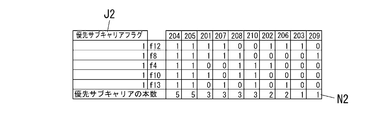
- the node grouping unit 111 sets subcarriers f4, f8, f10, f12, and f13 that can communicate with the receiving node 204 having the smallest number of effective subcarriers.
- Set as the priority subcarrier That is, the node grouping unit 111 selects five effective subcarriers f4, f8, f10, f12, and f13 in the receiving node 2 (204) with the smallest number of effective subcarriers as priority subcarriers (selection process).
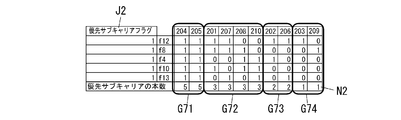
- subcarriers other than priority subcarriers are referred to as non-priority subcarriers. In FIG.
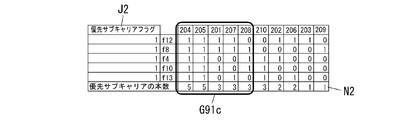
- a priority subcarrier flag J2 indicating whether or not the subcarrier is a priority subcarrier is provided, the priority subcarrier flag is set to “1” for the priority subcarrier, and the non-priority subcarrier is set. On the other hand, the priority subcarrier flag is set to “0”.
- the node grouping unit 111 sorts the priority subcarriers f4, f8, f10, f12, and f13 in the higher order and rearranges the order of the subcarriers.
- the sorting order within the priority subcarriers and the non-priority subcarriers is arranged in descending order of the number of receiving nodes 2 (number of communicable nodes) N3 with which the subcarriers can communicate.
- the node grouping unit 111 obtains the number N2 of priority subcarriers communicable with the receiving node for each of the receiving nodes 201 to 210. That is, the node grouping unit 111 calculates the number of priority subcarriers included in the effective subcarriers of the reception node 2 for each reception node 2 (calculation processing).
- the effective subcarriers of the receiving node 201 are subcarriers f 6, 7, 8, 10, 12, 16, 19, and 20.
- the priority subcarriers are subcarriers f4, f8, f10, f12, and f13. Therefore, for the receiving node 201, the number of priority subcarriers is “3”.
- the node grouping unit 111 rearranges the receiving nodes 201 to 210 in descending order of the number of priority subcarriers N2. Then, the number N2 of priority subcarriers of each of the receiving nodes 201 to 210 is compared with a predetermined grouping threshold “5”, and a transmission group is set based on the comparison result. That is, the node grouping unit 111 determines for each receiving node 2 whether or not the number of priority subcarriers is equal to or greater than the grouping threshold (in this example, “5”) (determination process). As shown in FIG. 15, the receiving nodes 204 and 205 have the number of priority subcarriers of “5” or more.
- the grouping threshold in this example, “5”
- the remaining receiving nodes 201 to 203 and 206 to 210 have the number of priority subcarriers less than “5”.
- the node grouping unit 111 divides the receiving node 2 in which the number of priority subcarriers is greater than or equal to the grouping threshold into a transmission group that is different from the transmission group to which the receiving node 2 in which the number of priority subcarriers is less than the grouping threshold belongs ( Classification process).
- the node grouping unit 111 creates two transmission groups G11 and G12. That is, the node grouping unit 111 divides the receiving node 2 into two transmission groups G11 and G12 depending on whether or not the number of priority subcarriers is equal to or greater than the grouping threshold.
- the two receiving nodes 204 and 205 whose priority subcarrier number N2 is equal to or greater than the grouping threshold “5” are set to the transmission group G11.
- the eight receiving nodes 201 to 203 and 206 to 210 whose number of priority subcarriers N2 is less than the grouping threshold “5” are set to the transmission group G12.
- the transmission groups G11 and G12 are created by comparing the number N2 of priority subcarriers in each of the receiving nodes 201 to 210 with the grouping threshold “5”.
- FIG. 17 shows a transmission group G11, and two reception nodes 204 and 205 belong to the transmission group G11.
- FIG. 18 shows a transmission group G12, and eight reception nodes 201 to 203 and 206 to 210 belong to the transmission group G12.
- the transmission unit 12 transmits the transmission groups G11 and G12 in the same order. Send the report data.
- the transmission order of the transmission groups G11 and G12 may be any of G11 ⁇ G12 and G12 ⁇ G11.
- the broadcast data is transmitted to the transmission group G11 using the five common subcarriers f4, f8, f10, f12, and f13 shown in FIG.
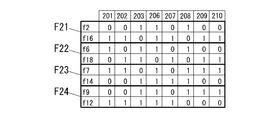
- the broadcast data is transmitted to the transmission group G12 using the four non-common subcarrier groups F21 to F24 shown in FIG.
- the non-common subcarrier group F21 includes two subcarriers f2 and f16
- the non-common subcarrier group F22 includes two subcarriers f6 and f18
- the non-common subcarrier group F23 includes two subcarriers f7 and f14
- the non-common subcarrier group F24 includes two subcarriers f9 and f12.
- the communication speed at the time of simultaneous broadcasting to the transmission groups G11 and G12 is as follows. . Since five common subcarriers f4, f8, f10, f12, and f13 are used for the transmission group G11, the number of carriers is “5” and the data rate is 5 bits / packet. For the transmission group G12, since four non-common subcarrier groups F21 to F24 are used, the number of carriers is “4” and the data rate is 4 bits / packet.
- the cumulative transmission time T2 required for simultaneous broadcasting to all the receiving nodes 201 to 210 is the sum of the transmission time T21 to the transmission group G11 and the transmission time T22 to the transmission group G12. It is expressed by adding the interstitial gap Ip.
- the inter-frame gap Ip is provided between the transmission time T21 and the transmission time T22.
- the transmission time T21 to the transmission group G11 includes a header transmission time Th and a main body transmission time Td21.
- the transmission time T22 to the transmission group G12 includes a transmission time Th of the header part Hp and a transmission time Td22 of the data body part Dp.
- the data body Dp transmitted to the transmission group G11 has a data rate of 5 bits / packet for the transmission group G11. Therefore, it becomes 160 packets.
- the communication system of the present embodiment includes a plurality of nodes that perform communication using a multicarrier modulation signal composed of a plurality of subcarriers.
- Each of the plurality of nodes constitutes at least one of a transmission node 101 that transmits data and a reception node 2 that receives data.
- the transmitting node 101 broadcasts broadcast data to the plurality of receiving nodes 2 and the storage unit 14 storing the transmission path state information J1 indicating the state of the transmission path between each of the receiving nodes 2.
- the node grouping unit 111 that performs grouping to divide the plurality of receiving nodes 2 into two or more transmission groups, and for each transmission group, based on the transmission path state information J1 Using the subcarrier selection unit 112 that selects one or a plurality of subcarriers used for communication and the subcarrier selected for each transmission group, the broadcast data is transmitted for each transmission group, and this simultaneous transmission is performed. And a transmission unit 12 that adds transmission group information related to a transmission group to be a transmission destination to the report data.
- the communication system of this embodiment includes a plurality of receiving nodes 2 and a transmitting node 101 that transmits broadcast data to the plurality of receiving nodes 2.
- the transmission node 101 includes a transmission unit 12, a storage unit 14, a node grouping unit 111, and a subcarrier selection unit 112.
- the transmission unit 12 is configured to transmit the broadcast data to the plurality of receiving nodes 2 using at least one of a plurality of subcarriers prepared in advance.
- the storage unit 14 is configured to store transmission path state information J1 indicating a transmission path state for each receiving node 2.
- the node grouping unit 111 refers to the transmission path state information J1, divides a plurality of receiving nodes 2 into a plurality of transmission groups based on a classification criterion related to the transmission path state, and is defined by a plurality of transmission groups. It is configured to perform a grouping process to create a set.
- the subcarrier selection unit 112 refers to the transmission path state information J1 and sets, for each transmission group of the transmission group set, a subcarrier for transmitting broadcast data to the receiving node 2 belonging to the transmission group from a plurality of subcarriers. Configured to select.
- the transmission unit 12 is configured to transmit the broadcast data using the subcarriers selected by the subcarrier selection unit 112 in order to a plurality of transmission groups in the transmission group set.
- the state of the transmission path is configured to indicate for each subcarrier whether or not the subcarrier is an effective subcarrier that can be used for communication with the receiving node 2.
- the node grouping unit 111 refers to the transmission path state information J1 and sets subcarriers that allow the transmission node 101 to communicate with the reception node 2 as effective subcarriers. Is set for each receiving node 2, and a subcarrier capable of communicating with the receiving node 2 having the smallest number of effective subcarriers is set as a priority subcarrier, and is set for each of the plurality of receiving nodes 2. By comparing the number of priority subcarriers included in the effective subcarriers with the grouping threshold, grouping is performed to divide the plurality of receiving nodes 2 into two or more transmission groups.
- the node grouping unit 111 selects the effective subcarrier in the receiving node 2 having the smallest number of effective subcarriers as the priority subcarrier and the effective subcarrier in the receiving node 2.
- a calculation process for calculating the number of priority subcarriers included for each reception node 2 a determination process for determining for each reception node 2 whether the number of priority subcarriers is equal to or greater than a grouping threshold, Classification processing is performed to divide the receiving node 2 whose number is equal to or greater than the grouping threshold into a transmission group different from the transmission group to which the receiving node 2 whose number of priority subcarriers is less than the grouping threshold belongs.
- the node grouping unit 111 fixes the grouping threshold value to a predetermined value. That is, the grouping threshold is a constant.
- the subcarrier selection unit 112 refers to the transmission path state information J1, and is a common subcarrier that is a subcarrier that can communicate with all the reception nodes 2 belonging to each transmission group.
- the transmission unit 12 selects the common subcarrier and non-common selected for each transmission group. Broadcast data is transmitted for each transmission group using subcarrier groups.
- the subcarrier selection unit 112 is configured to divide a plurality of subcarriers into common subcarriers and non-common subcarriers for each transmission group of the transmission group set.
- the common subcarrier is a subcarrier that becomes an effective subcarrier for all the receiving nodes 2 belonging to the transmission group.
- the non-common subcarrier is a subcarrier that becomes an effective subcarrier for at least one of the reception nodes 2 that belong to the transmission group.
- the subcarrier selection unit 112 is configured to create a subcarrier set for each transmission group of the transmission group set.
- the subcarrier set includes at least one of a common subcarrier and a non-common subcarrier set.
- the non-common subcarrier set is defined by a plurality of non-common subcarriers combined so that all the receiving nodes 2 belonging to the transmission group can receive broadcast data.
- the transmission unit 12 is configured to transmit simultaneous broadcast data using the subcarrier set created by the subcarrier selection unit 112 for each transmission group of the transmission group set.
- the communication system of the present embodiment performs grouping by dividing all receiving nodes 201 to 210, which are broadcast transmission destinations, into a plurality of transmission groups, and broadcast data is transmitted for each transmission group. Send. Then, by performing grouping of the receiving nodes 201 to 210, the cumulative transmission time is compared with the case where the broadcast data is collectively transmitted to all the receiving nodes 201 to 210 as the transmission destination as in the past. May be shortened. That is, the accumulated transmission time T2 (see FIG. 9) is shorter than the accumulated transmission time T101 (see FIG. 10), and communication is performed when simultaneous broadcasting is performed using a multicarrier modulation scheme composed of a plurality of subcarriers. Efficiency can be improved.
- the grouping threshold used for this grouping is fixed to “5”, so that the grouping process can be performed easily.
- the grouping threshold value may be set to the maximum value of the number N2 of priority subcarriers in each of the receiving nodes 201 to 210.
- the grouping threshold can be fixed in accordance with the change in the transmission path state of each of the receiving nodes 201 to 210, and grouping can be performed appropriately.
- the communication system of the present embodiment has the same configuration as that of the first embodiment, and the same components are denoted by the same reference numerals and description thereof is omitted.
- grouping is performed a plurality of times by switching the grouping threshold.
- the node grouping unit 111 of the present embodiment executes the set of the determination process and the classification process a plurality of times with different grouping threshold values. Accordingly, the node grouping unit 111 creates a plurality of transmission group sets with different classification criteria (grouping conditions).
- the node grouping unit 111 calculates the number of effective subcarriers N1, sets the priority subcarriers, calculates the number of priority subcarriers N2, and calculates the number of subcarriers based on the transmission path state information J1 (see FIG. 3). Sort and sort the receiving nodes 201 to 210. Then, the data shown in FIG. 21 is obtained from the transmission path state information J1.
- the node grouping unit 111 compares the number N2 of priority subcarriers of each of the receiving nodes 201 to 210 with the grouping threshold, and sets a transmission group based on the comparison result.
- the node grouping unit 111 performs multiple patterns of grouping for creating a transmission group using each of a plurality of grouping thresholds. Then, the grouping pattern having the fastest communication speed among the grouping of a plurality of patterns is adopted. That is, the node grouping unit 111 performs a plurality of grouping processes with different classification criteria (in the case of this embodiment, a grouping threshold) to create a plurality of transmission group sets, and performs a plurality of transmissions based on a predetermined condition. It is configured to select one from the group set.
- the predetermined condition is that the cumulative transmission time is the shortest.
- the accumulated transmission time is a time required for transmitting the broadcast data to all of the plurality of receiving nodes 2.
- the node grouping unit 111 compares the number N2 of priority subcarriers of each of the receiving nodes 201 to 210 with the grouping threshold “5”, and based on the comparison result, the transmission group G21 and G22 are set. That is, the node grouping unit 111 sets the receiving node 2 whose priority subcarrier number N2 is equal to or greater than the grouping threshold “5” to the transmission group G21, and the priority subcarrier number N2 is less than the grouping threshold “5”.
- the receiving node 2 is divided into the transmission group G22. In this way, the node grouping unit 111 creates a transmission group set G20 defined by the two transmission groups G21 and G22.
- the node grouping unit 111 compares the number N2 of priority subcarriers of each of the receiving nodes 201 to 210 with the grouping threshold “3” and transmits based on the comparison result. Groups G31 and G32 are set. In this way, the node grouping unit 111 creates a transmission group set G30 defined by the two transmission groups G31 and G32.
- the node grouping unit 111 compares the number N2 of priority subcarriers of each of the receiving nodes 201 to 210 with the grouping threshold “2”, and transmits based on the comparison result. Groups G41 and G42 are set. In this way, the node grouping unit 111 creates a transmission group set G40 defined by the two transmission groups G41 and G42.
- the transmission time calculation unit 114 performs all the reception nodes for the three patterns of grouping (transmission group sets G20, G30, G40) performed using the grouping thresholds “5”, “4”, and “3”. Cumulative transmission time required for simultaneous broadcast to 201 to 210 is calculated. That is, the transmission time calculation unit 114 is configured to calculate the accumulated transmission time for each transmission group set.
- the node grouping unit 111 employs a grouping pattern having the fastest communication speed (the shortest cumulative transmission time).
- the grouping pattern is not limited to dividing the receiving nodes 201 to 210 into two transmission groups by using one grouping threshold as described above, but by using a plurality of grouping thresholds.
- the first grouping range is defined as a grouping threshold value “3” or more
- the second grouping range is defined as a grouping threshold value “2” or more less than “3”
- the third grouping range is a group value
- the threshold value is defined as less than “2”.
- the node grouping unit 111 compares the number N2 of priority subcarriers of each of the receiving nodes 201 to 210 with two grouping thresholds “3” and “2”, and the comparison result
- the transmission groups G51, G52, and G53 are set based on the above. That is, the node grouping unit 111 sets the receiving node 2 whose priority subcarrier number N2 is equal to or greater than the grouping threshold “3” to the transmission group G51, and the priority subcarrier number N2 is less than the grouping threshold “3” “2”.
- the reception node 2 that is equal to or larger than the number is divided into the transmission group G52, and the reception node 2 whose number of priority subcarriers N2 is less than the grouping threshold “2” is divided into the transmission group G53.
- the node grouping unit 111 creates a transmission group set G50 defined by the three transmission groups G51, G52, and G53.
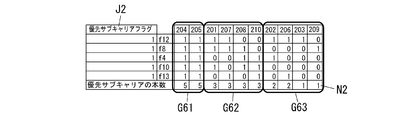
- the node grouping unit 111 compares the number N2 of priority subcarriers of each of the receiving nodes 201 to 210 with two grouping thresholds “5” and “3”, Based on the result, transmission groups G61, G62, and G63 are set. In this way, the node grouping unit 111 creates a transmission group set G60 defined by the three transmission groups G61, G62, and G63.
- the node grouping unit 111 compares the number N2 of priority subcarriers of each of the receiving nodes 201 to 210 with three grouping thresholds “5”, “3”, and “2”. Based on the comparison result, transmission groups G71 to G74 are set. In this way, the node grouping unit 111 creates a transmission group set G70 defined by the three transmission groups G71, G72, and G73.
- the transmission time calculation unit 114 performs simultaneous transmission to all the reception nodes 201 to 210 with respect to the three patterns of grouping (transmission group sets G50, G60, and G70) performed using the plurality of grouping threshold values. Calculate the cumulative transmission time required for information.
- the node grouping unit 111 employs a grouping pattern having the fastest communication speed (the shortest cumulative transmission time).
- the node grouping unit 111 has the fastest communication speed among the grouping of six patterns (transmission group sets G20, g30, G40, G50, G60, G70) of FIGS. 22 to 24 and FIGS. 25 to 27 ( A grouping pattern may be adopted in which the cumulative transmission time is the shortest.
- the node grouping unit 111 forms the first grouping for forming the transmission groups G1 and G2 (first transmission group set defined by the transmission groups G1 and G2) shown in FIGS. And the second grouping forming the transmission groups G11 and G12 (second transmission group set defined by the transmission groups G11 and G12) shown in FIG.
- the node grouping unit 111 compares the cumulative transmission time T1 of the first grouping that forms the transmission groups G1 and G2 with the cumulative transmission time T2 of the second grouping that forms the transmission groups G11 and G12. And adopt a grouping with a shorter transmission time. In this case, since the accumulated transmission time T1 is shorter than the accumulated transmission time T2, the node grouping unit 111 employs the first grouping that forms the transmission groups G1 and G2. That is, the node grouping unit 111 selects the first transmission group set.
- the node grouping unit 111 performs grouping a plurality of times and uses a grouping threshold set for each grouping.
- the node grouping unit 111 performs a plurality of grouping processes with different grouping thresholds to create a plurality of transmission group sets, and selects one from the plurality of transmission group sets based on a predetermined condition. Configured as follows.
- the transmission node 101 includes a transmission time calculation unit 114 that calculates a transmission time required for data transmission.
- the node grouping unit 111 performs grouping a plurality of times.
- the transmission time calculation unit 114 calculates the accumulated transmission time that is the sum of the transmission times of the simultaneous broadcast data for each transmission group in each of the groupings performed a plurality of times.
- the node grouping unit 111 employs the grouping having the shortest cumulative transmission time of the simultaneous broadcast data among the grouping performed a plurality of times.
- the transmission node 101 includes a transmission time calculation unit 114.
- the node grouping unit 111 is configured to perform a plurality of grouping processes with different classification criteria, create a plurality of transmission group sets, and select one from the plurality of transmission group sets based on a predetermined condition.
- the transmission time calculation unit 114 is configured to calculate the accumulated transmission time necessary for transmitting the broadcast data to all of the plurality of reception nodes 2 for each transmission group set.
- the predetermined condition is that the accumulated transmission time is the shortest.
- the transmission node 101 includes a transmission time calculation unit 114 that calculates a transmission time required for data transmission.
- the node grouping unit 111 performs grouping a plurality of times.
- the transmission time calculation unit 114 calculates the number of carriers that is the sum of the number of common subcarriers selected for each transmission group and the number of non-common subcarrier groups for each grouping performed a plurality of times, Based on the calculated number of carriers, the transmission time of the broadcast data is calculated for each transmission group, and the cumulative transmission time that is the sum of the transmission times for each transmission group is calculated.
- the node grouping unit 111 employs the grouping having the shortest cumulative transmission time among the grouping performed a plurality of times.
- the transmission node 101 includes a transmission time calculation unit 114.
- the node grouping unit 111 is configured to perform a plurality of grouping processes with different classification criteria, create a plurality of transmission group sets, and select one from the plurality of transmission group sets based on a predetermined condition.
- the subcarrier selection unit 112 is configured to create a subcarrier set for each transmission group with respect to each transmission group set created by the node grouping unit 111.
- the transmission time calculation unit 114 calculates the number of carriers indicating the sum of the number of common subcarriers and non-common subcarrier sets in the subcarrier set for each transmission group, and calculates the cumulative transmission time for each transmission group set based on the number of carriers. Configured to calculate.
- the accumulated transmission time is a time required for transmitting the broadcast data to all of the plurality of receiving nodes 2.
- the predetermined condition is that the accumulated transmission time is the shortest.
- the transmission time calculation unit 114 adds the interval period necessary for switching the transmission group to which the broadcast data is transmitted to the sum of the transmission times for each transmission group. Calculate the transmission time.
- the transmission unit 12 is configured to transmit the broadcast data to the next transmission group after a predetermined interval period has elapsed since the transmission of the broadcast data to the transmission group. Then, the transmission time calculation unit 114 calculates the transmission time necessary for transmitting the broadcast data to all the reception nodes 2 belonging to the transmission group for each transmission group of the transmission group set, and transmits a plurality of transmission group sets. The sum of the interval periods is added to the sum of the transmission times of the respective transmission groups to calculate the cumulative transmission time of the transmission group set. When the transmission group set includes two transmission groups, the sum of the interval periods is equal to a single interval period.
- the node grouping unit 111 performs grouping a plurality of times by switching the grouping threshold when performing grouping to create a transmission group. Then, for a grouping of a plurality of patterns, an accumulated transmission time required for simultaneous broadcasting to all receiving nodes 201 to 210 is calculated. Then, a grouping pattern having the fastest communication speed (shortest cumulative transmission time) is adopted.
- the communication speed at the time of simultaneous broadcast becomes faster, and the multi-carrier modulation method consisting of multiple subcarriers is used for simultaneous transmission.
- the multi-carrier modulation method consisting of multiple subcarriers is used for simultaneous transmission. In the case of performing broadcast, it is possible to improve communication efficiency.
- grouping by the grouping threshold in the present embodiment is an example, and grouping using a grouping threshold other than the above may be performed.
- the communication system of the present embodiment has the same configuration as that of the first or second embodiment, and the same components are denoted by the same reference numerals and description thereof is omitted.
- the node grouping unit 111 when the node grouping unit 111 performs grouping to create a transmission group, a process of dividing the receiving nodes 201 to 210 into three or more transmission groups using a plurality of grouping thresholds Will be described in detail.
- the node grouping unit 111 receives a selection process for selecting an effective subcarrier as a priority subcarrier in the reception node 2 having the smallest number of effective subcarriers, and the number of priority subcarriers included in the effective subcarrier of the reception node 2 Calculation processing for each node 2, determination processing for determining for each receiving node 2 whether or not the number of priority subcarriers is equal to or greater than the grouping threshold, and reception for which the number of priority subcarriers is equal to or greater than the grouping threshold A classification process is performed in which the node 2 is classified into a transmission group different from the transmission group to which the reception node 2 to which the number of priority subcarriers is less than the grouping threshold belongs.
- the node grouping unit 111 is configured to divide the receiving nodes 2 whose number of priority subcarriers is equal to or greater than the grouping threshold into the same transmission group in the classification process. Further, after the classification process, the node grouping unit 111 performs a selection process and a calculation process for the receiving node 2 in which the number of priority subcarriers is less than the grouping threshold, and then performs the grouping in the previous determination process. The determination process is performed using a grouping threshold value smaller than the threshold value.
- the node grouping unit 111 performs the division process defined by the selection process, the calculation process, the determination process, and the classification process a plurality of times, thereby transmitting group sets defined by three or more transmission groups. Configured to create.
- the node grouping unit 111 calculates the number of effective subcarriers N1, sets the priority subcarriers, calculates the number of priority subcarriers N2, and calculates the number of subcarriers based on the transmission path state information J1 (see FIG. 3). Sort and sort the receiving nodes 201 to 210. Then, the data shown in FIG. 28 is obtained from the transmission path state information J1. The data shown in FIG. 28 is obtained by rearranging the receiving nodes 2 having the same number of priority subcarriers N2 from the data shown in FIG. 21 in ascending order of the number of effective subcarriers N1.
- the node grouping unit 111 compares the number N2 of priority subcarriers of each of the receiving nodes 201 to 210 with the grouping threshold “5”, and based on the comparison result, the transmission group G81 (receiving nodes 204, 205) is set. As shown in FIG. 29, broadcast data is transmitted to the transmission group G81 using five common subcarriers f4, f8, f10, f12, and f13.
- the node grouping unit 111 performs the first division process for all the receiving nodes 2 (201 to 210).
- the grouping threshold of the determination process in the first division process is “5”, and in the classification process, the transmission group (first transmission group) G81 having the number of priority subcarriers “5” or more and the number of priority subcarriers And a transmission group (second transmission group) having a value less than “5”.
- the first transmission group G81 created by the first division process includes two reception nodes 204 and 205, and the second transmission group created by the first division process has eight reception nodes 201 to 203 and 206 to 210. including.
- the node grouping unit 111 creates transmission path state information J11 in which the information of the receiving nodes 204 and 205 set in the transmission group G81 is deleted from the transmission path state information J1 (see FIG. 3) (FIG. 30). reference). Then, with respect to this transmission path state information J11, calculation of the number of effective subcarriers N1, setting of priority subcarriers, calculation of the number of priority subcarriers N2, sorting of subcarriers, receiving nodes 201 to 203, 206 to 210 Sort the.
- FIG. 31 shows the execution result.
- the node grouping unit 111 compares the number N2 of priority subcarriers of each of the receiving nodes 201 to 203 and 206 to 210 with the grouping threshold “4”, and based on the comparison result, the transmission group G82 ( The receiving nodes 202, 206, 209, and 210) are set. As shown in FIG. 32, broadcast data is transmitted to the transmission group G82 using two common subcarriers f7 and f16 and four non-common subcarrier groups F31 to F34. .
- the node grouping unit 111 performs the second and subsequent division processes on the second transmission group created in the previous division process. Therefore, the node grouping unit 111 performs the second division process on the second transmission group (eight reception nodes 201 to 203 and 206 to 210) created by the first division process.
- the grouping threshold of the determination process in the second division process is “4”, and in the classification process, the transmission group (first transmission group) G82 having the number of priority subcarriers “4” or more and the number of priority subcarriers And a transmission group (second transmission group) having a value less than “4”.
- the first transmission group G82 created by the second division process includes four reception nodes 202, 206, 209, and 210, and the second transmission group created by the second division process has four reception nodes 201 and 203. , 207, 208.
- the node grouping unit 111 creates transmission path state information J12 in which the information of the receiving nodes 202, 206, 209, and 210 already set in the transmission group G82 is deleted from the transmission path state information J11 (see FIG. 30). (See FIG. 33). Then, for this transmission path state information J12, calculation of the number of effective subcarriers N1, setting of priority subcarriers, calculation of the number of priority subcarriers N2, sorting of subcarriers, receiving nodes 201, 203, 207, 208 Sort the.
- FIG. 34 shows the execution result.
- the node grouping unit 111 compares the number N2 of priority subcarriers of each of the receiving nodes 201, 203, 207, and 208 with the grouping threshold “2”, and based on the comparison result, the transmission group G83 ( Receiving nodes 201, 203, 207, 208) are set. As shown in FIG. 35, broadcast data is transmitted to the transmission group G83 using seven non-common subcarrier groups F41 to F47.
- the node grouping unit 111 performs the second and subsequent division processes on the second transmission group created in the previous division process. Therefore, the node grouping unit 111 performs the third division process on the second transmission group (four reception nodes 201, 203, 207, and 208) created by the second division process.
- the grouping threshold of the determination process in the third division process is “2”, and in the classification process, the transmission group (first transmission group) G83 in which the number of priority subcarriers is “2” or more, and the number of priority subcarriers And a transmission group (second transmission group) having a value less than “2”.
- the first transmission group G83 created by the third division process includes four reception nodes 201, 203, 207, and 208, and the second transmission group created by the third division process does not include the reception node 2. .
- the second transmission group is not created in the third classification process.
- the node grouping unit 111 creates a transmission group set including the three transmission groups G81, G82, and G83.
- the communication speed at the time of simultaneous broadcasting to the transmission groups G81 to G83 is as follows. . Since five common subcarriers f4, f8, f10, f12, and f13 are used for the transmission group G81, the number of carriers is “5”, and the data rate is 5 bits / packet. Since the transmission group G82 uses two common subcarriers f7 and f16 and four non-common subcarrier groups F31 to F34, the number of carriers is “6” and the data rate is 6 bits / Packet. Since seven non-common subcarrier groups F41 to F47 are used for the transmission group G83, the number of carriers is “7” and the data rate is 7 bits / packet.
- the cumulative transmission time T3 required for simultaneous broadcasting to all the receiving nodes 201 to 210 is as follows: the transmission time T31 to the transmission group G81, the transmission time T32 to the transmission group G82, and the transmission group G83. This is expressed by adding the inter-frame gap Ip to the sum of the transmission time T33.
- the inter-frame gap Ip is provided between the transmission time T31 and the transmission time T32, and between the transmission time T32 and the transmission time T33.
- the transmission time T31 to the transmission group G81 includes a header transmission time Th and a main body transmission time Td31.
- the transmission time T32 to the transmission group G82 includes a header transmission time Th and a main body transmission time Td32.
- the transmission time T33 to the transmission group G83 includes a header transmission time Th and a main body transmission time Td33.
- the node grouping unit 111 includes the receiving node 2 in which the number of priority subcarriers included in the effective subcarrier is equal to or more than the grouping threshold among the plurality of receiving nodes 2. Is set to the same transmission group, and the grouping is repeated once or more for a plurality of remaining receiving nodes 2 not belonging to the same transmission group.
- the node grouping unit 111 is defined by three or more transmission groups by performing the division process defined by the selection process, the calculation process, the determination process, and the classification process a plurality of times. Configured to create a transmission group set. The node grouping unit 111 creates a first transmission group in which the number of priority subcarriers is equal to or greater than the grouping threshold and a second transmission group in which the number of priority subcarriers is less than the grouping threshold in the classification process. Configured. The node grouping unit 111 is configured to perform the first division process on all receiving nodes 2 and perform the second and subsequent division processes on the second transmission group created in the previous division process.
- the grouping threshold for each grouping is used to create each of the transmission groups G81 to G83.
- the receiving nodes 201 to 210 are divided into three or more transmission groups. That is, the node grouping unit 111 performs grouping in which the receiving nodes 2 having the number N2 of priority subcarriers equal to or greater than the grouping threshold among the receiving nodes 201 to 210 are set to the same transmission group. Further, grouping is repeated once or more for the remaining plurality of receiving nodes 2 that do not belong to the same transmission group.
- the receiving nodes 201 to 210 which are broadcast transmission destinations, into three or more transmission groups, and to adopt an optimum grouping that shortens the cumulative transmission time at the time of simultaneous broadcast. That is, the communication speed at the time of simultaneous broadcast becomes faster, and when simultaneous broadcast is performed using a multicarrier modulation scheme composed of a plurality of subcarriers, communication efficiency can be improved.
- the communication system of the present embodiment has the same configuration as that of any one of the first to third embodiments, and the same components are denoted by the same reference numerals and description thereof is omitted.
- the reception node 2 having the number of priority subcarriers N2 equal to or greater than the grouping threshold is referred to as a boundary reception node 2.
- a plurality of receiving nodes 2 having the smallest number of subcarriers N2 are defined as boundary receiving nodes 2.
- these receiving nodes 2 are defined as boundary receiving nodes 2. That is, in the receiving node 2 in which the number N2 of priority subcarriers is equal to or greater than the grouping threshold, when there are a plurality of boundary receiving node candidates having different numbers N2 of priority subcarriers, boundary reception in which the number N2 of priority subcarriers is the smallest Select node candidates.
- the grouping is performed a plurality of times by sequentially combining one or more from the boundary receiving nodes 2 selected as described above and setting them in the same transmission group.
- the node grouping unit 111 determines whether or not there are a plurality of boundary receiving nodes. If it is determined that there are a plurality of boundary receiving nodes, the node grouping unit 111 and the boundary receiving nodes A plurality of transmission group sets are created in combination with the receiving node 2 having a higher number of priority subcarriers than the node.
- the boundary reception node is defined as the reception node 2 having the smallest number of priority subcarriers in the reception node 2 in which the number of priority subcarriers is equal to or greater than the grouping threshold.
- the node grouping unit 111 calculates the number of effective subcarriers N1, sets the priority subcarriers, calculates the number of priority subcarriers N2, and calculates the number of subcarriers based on the transmission path state information J1 (see FIG. 3). Sort and sort the receiving nodes 201 to 210. Then, the data shown in FIG. 21 is obtained from the transmission path state information J1.
- the node grouping unit 111 compares the number N2 of priority subcarriers of each of the reception nodes 201 to 210 with the grouping threshold “3”, and the reception node 2 having the number N2 of priority subcarriers of “3” or more. Is set in the transmission group G91.
- the node grouping unit 111 sets only the boundary reception node 201 to the transmission group G91a in addition to the reception nodes 204 and 205 in which the number N2 of priority subcarriers is “5”.
- the remaining boundary reception nodes 207, 208, and 210 are set to other transmission groups.
- the node grouping unit 111 is defined by a transmission group G91a including three reception nodes 201, 204, and 205 and a transmission group including seven reception nodes 202, 203, 206, 207, 208, 209, and 210. Create a transmission group set.
- the node grouping unit 111 adds only the boundary reception nodes 201 and 207 to the transmission group G91b in addition to the reception nodes 204 and 205 in which the number N2 of priority subcarriers is “5”.
- the remaining boundary receiving nodes 208 and 210 are set to other transmission groups.
- the node grouping unit 111 is defined by a transmission group G91b including four reception nodes 201, 204, 205, and 207 and a transmission group including six reception nodes 202, 203, 206, 208, 209, and 210. Create a transmission group set.
- the node grouping unit 111 adds only the boundary reception nodes 201, 207, and 208 to the transmission group in addition to the reception nodes 204 and 205 in which the number N2 of priority subcarriers is “5”.
- the remaining boundary receiving node 210 is set to another transmission group.
- the node grouping unit 111 is defined by a transmission group G91c including five reception nodes 201, 204, 205, 207, and 208 and a transmission group including five reception nodes 202, 203, 206, 209, and 210. Create a transmission group set.
- the node grouping unit 111 adds all the boundary receiving nodes 201, 207, 208, 210 in addition to the receiving nodes 204, 205 in which the number N2 of priority subcarriers is “5”. Is set in the transmission group G91d.
- the node grouping unit 111 is defined by a transmission group G91d including six reception nodes 201, 204, 205, 207, 208, and 210 and a transmission group including four reception nodes 202, 203, 206, and 209. Create a transmission group set.
- boundary reception node may be a transmission group different from the reception node 2 whose grouping threshold is less than “3”.
- the node grouping unit 111 includes a transmission group G91a including three reception nodes 201, 204, and 205, a transmission group including the remaining three boundary reception nodes 207, 208, and 210.
- a transmission group set defined by a transmission group including four reception nodes 202, 203, 206, and 209 having a grouping threshold value less than “3” may be created.
- the node grouping unit 111 includes a transmission group G91b including four reception nodes 201, 204, 205, and 207, a transmission group including the remaining two boundary reception nodes 208 and 210, A transmission group set defined by a transmission group including four reception nodes 202, 203, 206, and 209 having a grouping threshold value less than “3” may be created.
- the node grouping unit 111 includes a transmission group G91b including five reception nodes 201, 204, 205, 207, and 208, a transmission group including the remaining one boundary reception node 210, A transmission group set defined by a transmission group including four reception nodes 202, 203, 206, and 209 having a grouping threshold value less than “3” may be created.
- the node grouping unit 111 selects the grouping pattern having the shortest cumulative transmission time required for simultaneous broadcasting to all the receiving nodes 201 to 210 among the grouping using the four patterns of FIGS. adopt. That is, the node grouping unit 111 selects a transmission group set with the shortest cumulative transmission time from the above four transmission group sets.
- the node grouping unit 111 selects the receiving node 2 in which the number of priority subcarriers included in the effective subcarrier is equal to or more than the grouping threshold among the plurality of receiving nodes 2.
- grouping is performed a plurality of times by sequentially combining one or more boundary reception nodes as boundary reception nodes set in the same transmission group.
- the node grouping unit 111 performs a selection process in which the effective subcarrier in the receiving node 2 with the smallest number of effective subcarriers is selected as a priority subcarrier in the grouping process, and the receiving node 2 Calculation processing for calculating the number of priority subcarriers included in each effective subcarrier for each reception node 2, and determination processing for determining for each reception node 2 whether or not the number of priority subcarriers is equal to or greater than a grouping threshold
- the receiving node 2 in which the number of priority subcarriers is equal to or greater than the grouping threshold it is determined whether or not there are a plurality of boundary receiving nodes defined as receiving nodes having the smallest number of priority subcarriers. If it is determined that there is a plurality of boundary receiving nodes and a receiving node having a higher number of priority subcarriers than the boundary receiving nodes, A classification process of creating a plurality of transmission group set by a combination, configured to perform.
- the node grouping unit 111 when the node grouping unit 111 performs grouping to create a transmission group, by sequentially combining one or more from the plurality of boundary reception nodes 2 and setting the transmission group, Grouping is performed multiple times.
- the node grouping unit may perform grouping in which the boundary reception node having a small number of effective subcarriers is preferentially set to the same transmission group among the plurality of boundary reception nodes. Good.
- the node grouping unit 111 gives priority to the boundary receiving node having a smaller number of effective subcarriers among the plurality of boundary receiving nodes, and receives a higher number of priority subcarriers than the boundary receiving node. It may be configured to divide into the same transmission group.
- the data shown in FIG. 42 in which the boundary receiving nodes 201, 207, 208, and 210 are rearranged from the data shown in FIG. 41 in ascending order of the number N1 of the effective subcarriers may be used.
- the node grouping unit 111 performs grouping in which a boundary receiving node having a small number of effective subcarriers N1 among the plurality of boundary receiving nodes 201, 207, 208, and 210 is preferentially set in the transmission group G91. .
- the node grouping unit 111 selects only the boundary receiving node 201 having the smallest number of effective subcarriers N1 in addition to the receiving nodes 204 and 205 having the number of priority subcarriers N2 of “5”. Set to the same transmission group. When there are a plurality of boundary reception nodes in which both the number of effective subcarriers N1 and the number of priority subcarriers N2 are equal, grouping is performed in ascending order of identification numbers assigned to the boundary reception nodes.
- the node grouping unit 111 sets only two boundary receiving nodes 201 and 210 having a small number of effective subcarriers N1. Set to the sending group.
- the node grouping unit 111 adds only three boundary receiving nodes 201, 210, and 207 having a small number of effective subcarriers N1, in addition to the receiving nodes 204 and 205 having a priority subcarrier number N2 of “5”. Are set to the same transmission group.
- the node grouping unit 111 sets all the boundary reception nodes 201, 210, 207, and 208 to the same transmission group in addition to the reception nodes 204 and 205 whose priority subcarrier number N2 is “5”. To do.
- grouping may be performed in which a boundary receiving node 2 having a small number of effective subcarriers N1 among the plurality of boundary receiving nodes 2 is preferentially set as a transmission group.
- the combination of the plurality of boundary receiving nodes 201, 207, 208, and 210 is not limited to the above patterns.
- any one of the boundary receiving nodes 201, 207, 208, and 210 may be set in the transmission group G91.
- any two of the boundary receiving nodes 201, 207, 208, and 210 may be set in the transmission group G91.
- any three of the boundary receiving nodes 201, 207, 208, and 210 may be set in the transmission group G91.
- the communication system of the present embodiment has the same configuration as that of any one of the first to fourth embodiments, and the same components are denoted by the same reference numerals and description thereof is omitted.
- grouping of transmission groups by the node grouping unit 111 and allocation of common subcarriers and non-common subcarriers by the subcarrier selection unit 112 are performed by BPSK, QPSK, 16QAM before transmission of broadcast data. , 64QAM, and 256QAM modulation schemes. Then, among BPSK, QPSK, 16QAM, 64QAM, and 256QAM, grouping by the modulation method with the highest communication speed and allocation of common subcarriers and non-common subcarriers are employed. Further, the modulation scheme selection unit 113 sets the modulation scheme with the fastest communication speed in the transmission unit 12.
- FIG. 43 is a data table DT1 that stores the calculation result of the communication speed by the transmission time calculation unit 114 for each of the BPSK, QPSK, 16QAM, 64QAM, and 256QAM modulation schemes.
- This data table DT1 includes the number of transmission groups, the number of bits of transmission data per group, the amount of transmission data (bits / packet) per packet, and the number of packets required for data transmission (packets) corresponding to each modulation method. ) Are stored.
- the amount of transmission data per packet is obtained by the product of the number of transmission groups and the number of bits of transmission data per group.
- the number of packets required for data transmission is a value obtained by dividing the total number of bits of transmission data by the amount of transmission data per packet.
- the number of packets necessary for data transmission is represented by “X5”, “X4”, “X3”, “X2”, and “X1” for each of the BPSK, QPSK, 16QAM, 64QAM, and 256QAM modulation schemes.
- the modulation scheme selection unit 113 calculates the main body transmission time Td of the data main body portion Dp in each transmission group according to the number of packets required for data transmission for each modulation scheme.
- the header transmission time Th of the necessary header part Hp is added to the main body transmission time Td to calculate the transmission time for each transmission group, and the gap time Ti is added to the transmission time for each transmission group. Calculate the cumulative transmission time.
- the combination of the modulation scheme, the transmission group grouping, and the allocation of common subcarriers and non-common subcarriers that minimize the calculated cumulative transmission time is selected and set in the transmission unit 12.
- the transmission node 101 includes the transmission time calculation unit 114 that calculates the transmission time required for data transmission, and the transmission unit 12 with one of a plurality of modulation schemes.
- a modulation method selection unit 113 that is set to be switchable, the transmission unit 12 transmits data using the modulation method set by the modulation method selection unit 113, and the storage unit 14 uses each of the modulation methods.
- the transmission path state information J1 is stored, the node grouping unit 111 refers to the transmission path state information J1, performs grouping one or more times for each modulation scheme, and the transmission time calculation unit 114 In each grouping performed every time, a cumulative transmission time that is a sum of transmission times of broadcast data for each transmission group is calculated, and a modulation scheme selection unit 113 and a node grouping unit 114 are calculated. , Of the combination of a modulation scheme and grouping, it adopts the shortest combination cumulative transmit time.
- the subcarrier selection unit 112 refers to the transmission path state information for each grouping performed one or more times for each modulation scheme, and performs communication for each transmission group.
- the transmission time calculation unit 114 selects the number of common subcarriers used for the transmission group and the number of common subcarriers selected for each transmission group for each grouping performed for each modulation scheme. And the number of non-common subcarrier groups, the number of carriers is calculated, the transmission time of the broadcast data is calculated for each transmission group based on the calculated number of carriers, and the sum of the transmission times for each transmission group is calculated. The accumulated transmission time is calculated.
- the transmission node 2 includes a transmission time calculation unit 114 and a modulation scheme selection unit 113.
- the transmission unit 12 is configured to transmit simultaneous broadcast data using one selected from a plurality of modulation schemes.
- the storage unit 14 is configured to store transmission path state information for each modulation scheme.
- the node grouping unit 111 generates a plurality of transmission group sets by performing a plurality of grouping processes with different classification criteria for each modulation scheme, and selects one from the plurality of transmission group sets based on a predetermined condition. Configured.
- the transmission time calculation unit 114 is configured to calculate the accumulated transmission time necessary for transmitting the broadcast data to all of the plurality of reception nodes 2 for each transmission group set.
- the predetermined condition is that the accumulated transmission time is the shortest.
- the modulation scheme selection unit 113 is configured to select a modulation scheme corresponding to the transmission group set selected by the node grouping unit 111.
- the transmission unit 12 is configured to transmit the broadcast data using the modulation method selected by the modul
- the subcarrier selection unit 112 is configured to create a subcarrier set for each transmission group of a plurality of transmission group sets created by the node grouping unit 111.
- the transmission time calculation unit 114 calculates the number of carriers indicating the sum of the number of common subcarriers and non-common subcarrier sets in the subcarrier set for each transmission group of the transmission group set, and for each transmission group set based on the number of carriers. It is configured to calculate the cumulative transmission time.
- the transmission time calculation unit 114 adds the interval period necessary for switching the transmission group to which the broadcast data is transmitted to the sum of the transmission times for each transmission group. Calculate the transmission time.
- the transmission unit 12 is configured to transmit the broadcast data to the next transmission group after a predetermined interval period has elapsed since the transmission of the broadcast data to the transmission group.
- the transmission time calculation unit 114 calculates a transmission time necessary for transmitting the broadcast data to all the receiving nodes 2 belonging to the transmission group for each transmission group of the transmission group set, and a plurality of transmission groups of the transmission group set The sum of the interval periods is added to the sum of the respective transmission times to calculate the cumulative transmission time of the transmission group set.
- the communication speed at the time of simultaneous broadcast becomes faster.
Landscapes
- Engineering & Computer Science (AREA)
- Signal Processing (AREA)
- Computer Networks & Wireless Communication (AREA)
- Quality & Reliability (AREA)
- Mobile Radio Communication Systems (AREA)
- Digital Transmission Methods That Use Modulated Carrier Waves (AREA)
Abstract
Description
本実施形態の通信システムは、図2に示すように、1台の送信ノード101と、10台の受信ノード201~210とで構成される。送信ノード101は、10台の受信ノード201~210に対して、20本のサブキャリアf1~f20を用いてデータを送信するマルチキャリア通信を行う。この通信の伝送経路は、有線伝送路、無線伝送路のいずれであってもよい。
本実施形態の通信システムは、実施形態1と同様の構成を備えており、同様の構成には同一の符号を付して説明は省略する。
本実施形態の通信システムは、実施形態1または2と同様の構成を備えており、同様の構成には同一の符号を付して説明は省略する。
本実施形態の通信システムは、実施形態1乃至3いずれかと同様の構成を備えており、同様の構成には同一の符号を付して説明は省略する。
本実施形態の通信システムは、実施形態1乃至4いずれかと同様の構成を備えており、同様の構成には同一の符号を付して説明は省略する。
Claims (15)
- 複数の受信ノードと、
前記複数の受信ノードに一斉同報データを送信する送信ノードと、
を備える通信システムであって、
前記送信ノードは、
予め用意された複数のサブキャリアの少なくとも1つを用いて前記複数の受信ノードに前記一斉同報データを送信する送信部と、
前記受信ノード毎の伝送路の状態を示す伝送路状態情報を記憶する記憶部と、
前記伝送路状態情報を参照し、前記伝送路の状態に関する分類基準に基づいて前記複数の受信ノードを複数の送信グループに分けて、前記複数の送信グループで定義される送信グループセットを作成するグループ化処理を行うノードグループ化部と、
前記伝送路状態情報を参照し、前記送信グループセットの前記送信グループ毎に、前記送信グループに属する前記受信ノードに前記一斉同報データを送信するためのサブキャリアを前記複数のサブキャリアから選択するサブキャリア選択部と、
を備え、
前記送信部は、前記送信グループセットの前記複数の送信グループに順番に、前記サブキャリア選択部で選択された前記サブキャリアを用いて前記一斉同報データを送信するように構成される
ことを特徴とする通信システム。 - 前記伝送路の状態は、前記サブキャリアが前記受信ノードとの通信に利用できる有効サブキャリアであるか否かを前記サブキャリア毎に示すように構成される
ことを特徴とする請求項1記載の通信システム。 - 前記ノードグループ化部は、前記グループ化処理では、
前記有効サブキャリアの数が最も少ない前記受信ノードにおける前記有効サブキャリアを優先サブキャリアとして選択する選択処理と、
前記受信ノードの前記有効サブキャリアに含まれる前記優先サブキャリアの数を前記受信ノード毎に算出する算出処理と、
前記優先サブキャリアの数がグループ化閾値以上であるか否かを前記受信ノード毎に判定する判定処理と、
前記優先サブキャリアの数が前記グループ化閾値以上である前記受信ノードを前記優先サブキャリアの数が前記グループ化閾値未満である前記受信ノードが属する前記送信グループとは異なる前記送信グループに分ける分類処理と、
を行うように構成される
ことを特徴とする請求項2記載の通信システム。 - 前記グループ化閾値は定数である
ことを特徴とする請求項3記載の通信システム。 - 前記ノードグループ化部は、前記グループ化閾値が異なる複数の前記グループ化処理を行って複数の前記送信グループセットを作成し、所定の条件に基づいて前記複数の送信グループセットから1つを選択するように構成される
ことを特徴とする請求項3記載の通信システム。 - 前記ノードグループ化部は、前記選択処理と前記算出処理と前記判定処理と前記分類処理とで定義される分割処理を複数回行うことで、3以上の前記送信グループで定義される前記送信グループセットを作成するように構成され、
前記ノードグループ化部は、前記分類処理において、前記優先サブキャリアの数が前記グループ化閾値以上である第1送信グループと、前記優先サブキャリアの数が前記グループ化閾値未満である第2送信グループとを作成するように構成され、
前記ノードグループ化部は、全ての前記受信ノードに関して1回目の前記分割処理を行い、2回目以降の前記分割処理は前回の前記分割処理で作成された前記第2送信グループに関して行うように構成される
ことを特徴とする請求項3~5のうちいずれか1項記載の通信システム。 - 前記ノードグループ化部は、前記グループ化処理では、
前記有効サブキャリアの数が最も少ない前記受信ノードにおける前記有効サブキャリアを優先サブキャリアとして選択する選択処理と、
前記受信ノードの前記有効サブキャリアに含まれる前記優先サブキャリアの数を前記受信ノード毎に算出する算出処理と、
前記優先サブキャリアの数がグループ化閾値以上であるか否かを前記受信ノード毎に判定する判定処理と、
前記優先サブキャリアの数が前記グループ化閾値以上である前記受信ノードにおいて前記優先サブキャリアの数が最も少ない前記受信ノードと定義される境界受信ノードが複数存在するか否かを判定し、前記境界受信ノードが複数存在すると判定した場合、前記複数の境界受信ノードと前記境界受信ノードよりも前記優先サブキャリアの数が多い前記受信ノードとの組み合わせによって複数の前記送信グループセットを作成する分類処理と、
を行うように構成される
ことを特徴とする請求項2記載の通信システム。 - 前記ノードグループ化部は、前記分類処理では、前記複数の境界受信ノードのうち前記有効サブキャリアの数が少ない前記境界受信ノードを優先して前記境界受信ノードよりも前記優先サブキャリアの数が多い前記受信ノードと同じ前記送信グループに分けるように構成される
ことを特徴とする請求項7記載の通信システム。 - 前記サブキャリア選択部は、前記送信グループセットの前記送信グループ毎に、前記複数のサブキャリアを共通サブキャリアと非共通サブキャリアとに分けるように構成され、
前記共通サブキャリアは、前記送信グループに属する全ての前記受信ノードに対して前記有効サブキャリアとなる前記サブキャリアであり、
前記非共通サブキャリアは、前記送信グループに属する前記受信ノードの全てではなく少なくとも1つに対して前記有効サブキャリアとなる前記サブキャリアであり、
前記サブキャリア選択部は、前記送信グループセットの前記送信グループ毎に、サブキャリアセットを作成するように構成され、
前記サブキャリアセットは、前記共通サブキャリアと、非共通サブキャリアセットとの少なくとも一方を含み、
前記非共通サブキャリアセットは、前記送信グループに属する前記受信ノードの全てが前記一斉同報データを受信できるように組み合わされた複数の前記非共通サブキャリアで定義され、
前記送信部は、前記送信グループセットの前記送信グループ毎に、前記サブキャリア選択部で作成された前記サブキャリアセットを用いて前記一斉同報データを送信するように構成される
ことを特徴とする請求項2記載の通信システム。 - 前記送信ノードは、送信時間算出部を備え、
前記ノードグループ化部は、前記分類基準が異なる複数の前記グループ化処理を行って複数の前記送信グループセットを作成し、所定の条件に基づいて前記複数の送信グループセットから1つを選択するように構成され、
前記送信時間算出部は、前記送信グループセット毎に、前記複数の受信ノードの全てに前記一斉同報データを送信するために必要な累積送信時間を算出するように構成され、
前記所定の条件は、前記累積送信時間が最も短いことである
ことを特徴とする請求項1記載の通信システム。 - 前記送信ノードは、送信時間算出部を備え、
前記ノードグループ化部は、前記分類基準が異なる複数の前記グループ化処理を行って複数の前記送信グループセットを作成し、所定の条件に基づいて前記複数の送信グループセットから1つを選択するように構成され、
前記サブキャリア選択部は、前記ノードグループ化部で作成された前記送信グループセットのそれぞれに関し、前記送信グループ毎に前記サブキャリアセットを作成するように構成され、
前記送信時間算出部は、前記送信グループ毎に前記サブキャリアセットにおける前記共通サブキャリアと前記非共通サブキャリアセットの数の和を示すキャリア数を算出し、前記キャリア数に基づいて前記送信グループセット毎に累積送信時間を算出するように構成され、
前記累積送信時間は、前記複数の受信ノードの全てに前記一斉同報データを送信するために必要な時間であり、
前記所定の条件は、前記累積送信時間が最も短いことである
ことを特徴とする請求項9記載の通信システム。 - 前記送信ノードは、送信時間算出部と、変調方式選択部と、を備え、
前記送信部は、複数の変調方式から選択される1つを用いて前記一斉同報データの送信を行うように構成され、
前記記憶部は、前記変調方式毎に前記伝送路状態情報を記憶するように構成され、
前記ノードグループ化部は、前記変調方式毎に前記分類基準が異なる複数の前記グループ化処理を行って複数の前記送信グループセットを作成し、所定の条件に基づいて前記複数の送信グループセットから1つを選択するように構成され、
前記送信時間算出部は、前記送信グループセット毎に、前記複数の受信ノードの全てに前記一斉同報データを送信するために必要な累積送信時間を算出するように構成され、
前記所定の条件は、前記累積送信時間が最も短いことであり、
前記変調方式選択部は、前記ノードグループ化部で選択された前記送信グループセットに対応する前記変調方式を選択するように構成され、
前記送信部は、前記変調方式選択部で選択された前記変調方式を用いて前記一斉同報データの送信を行うように構成される
ことを特徴とする請求項1記載の通信システム。 - 前記送信ノードは、送信時間算出部と、変調方式選択部と、を備え、
前記送信部は、複数の変調方式から選択される1つを用いて前記一斉同報データの送信を行うように構成され、
前記記憶部は、前記変調方式毎に前記伝送路状態情報を記憶するように構成され、
前記ノードグループ化部は、前記変調方式毎に前記分類基準が異なる複数の前記グループ化処理を行って複数の前記送信グループセットを作成し、所定の条件に基づいて前記複数の送信グループセットから1つを選択するように構成され、
前記サブキャリア選択部は、前記ノードグループ化部で作成された前記複数の送信グループセットの前記送信グループ毎に、前記サブキャリアセットを作成するように構成され、
前記送信時間算出部は、前記送信グループセットの前記送信グループ毎に前記サブキャリアセットにおける前記共通サブキャリアと前記非共通サブキャリアセットの数の和を示すキャリア数を算出し、前記キャリア数に基づいて前記送信グループセット毎に累積送信時間を算出するように構成され、
前記累積送信時間は、前記複数の受信ノードの全てに前記一斉同報データを送信するために必要な時間であり、
前記所定の条件は、前記累積送信時間が最も短いことであり、
前記変調方式選択部は、前記ノードグループ化部で選択された前記送信グループセットに対応する前記変調方式を選択するように構成され、
前記送信部は、前記変調方式選択部で選択された前記変調方式を用いて前記一斉同報データの送信を行うように構成される
ことを特徴とする請求項9記載の通信システム。 - 前記送信部は、前記送信グループに前記一斉同報データを送信してから所定のインターバル期間が経過した後に次の送信グループに前記一斉同報データを送信するように構成され、
前記送信時間算出部は、前記送信グループに属する前記受信ノードの全てに前記一斉同報データを送信するために必要な送信時間を前記送信グループセットの前記送信グループ毎に算出し、前記送信グループセットの前記複数の送信グループそれぞれの前記送信時間の和に前記インターバル期間の合計を加算して、前記送信グループセットの前記累積送信時間を算出するように構成される
ことを特徴とする請求項11または13記載の通信システム。 - 前記送信部は、前記一斉同報データとともに送信グループ情報を送信するように構成され、
前記送信グループ情報は、前記一斉同報データの宛先となる前記送信グループを示す宛先情報を含み、
前記受信ノードは、前記一斉同報データおよび前記送信グループ情報を受け取ると、受け取った前記送信グループ情報の前記宛先情報が示す前記送信グループに自身が属するか否かを判定し、前記宛先情報が示す前記送信グループに属していれば前記一斉同報データを取り込み、前記宛先情報が示す前記送信グループに属していなければ前記一斉同報データを破棄するように構成される
ことを特徴とする請求項1記載の通信システム。
Priority Applications (4)
| Application Number | Priority Date | Filing Date | Title |
|---|---|---|---|
| JP2012541904A JP5514324B2 (ja) | 2010-11-02 | 2011-11-02 | 通信システム |
| US13/882,776 US20130329622A1 (en) | 2010-11-02 | 2011-11-02 | Communication system |
| CN2011800530074A CN103190101A (zh) | 2010-11-02 | 2011-11-02 | 通信系统 |
| EP11838079.9A EP2637330A4 (en) | 2010-11-02 | 2011-11-02 | COMMUNICATION SYSTEM |
Applications Claiming Priority (2)
| Application Number | Priority Date | Filing Date | Title |
|---|---|---|---|
| JP2010246568 | 2010-11-02 | ||
| JP2010-246568 | 2010-11-02 |
Publications (1)
| Publication Number | Publication Date |
|---|---|
| WO2012060429A1 true WO2012060429A1 (ja) | 2012-05-10 |
Family
ID=46024542
Family Applications (1)
| Application Number | Title | Priority Date | Filing Date |
|---|---|---|---|
| PCT/JP2011/075350 Ceased WO2012060429A1 (ja) | 2010-11-02 | 2011-11-02 | 通信システム |
Country Status (5)
| Country | Link |
|---|---|
| US (1) | US20130329622A1 (ja) |
| EP (1) | EP2637330A4 (ja) |
| JP (1) | JP5514324B2 (ja) |
| CN (1) | CN103190101A (ja) |
| WO (1) | WO2012060429A1 (ja) |
Cited By (1)
| Publication number | Priority date | Publication date | Assignee | Title |
|---|---|---|---|---|
| JP2015142345A (ja) * | 2014-01-30 | 2015-08-03 | 三菱電機株式会社 | 無線通信装置、同報配信システムおよび通信パラメータ決定方法 |
Citations (5)
| Publication number | Priority date | Publication date | Assignee | Title |
|---|---|---|---|---|
| US6442129B1 (en) | 1999-12-06 | 2002-08-27 | Intellon Corporation | Enhanced channel estimation |
| JP2005101730A (ja) * | 2003-09-22 | 2005-04-14 | Toshiba Corp | 通信装置、通信システムおよび通信方法 |
| JP2006504372A (ja) | 2002-10-25 | 2006-02-02 | クゥアルコム・インコーポレイテッド | マルチチャネル通信システムの閉ループレートコントロール |
| JP2011119983A (ja) * | 2009-12-03 | 2011-06-16 | Panasonic Electric Works Co Ltd | 通信システム |
| JP2011130313A (ja) * | 2009-12-21 | 2011-06-30 | Panasonic Electric Works Co Ltd | 通信システム |
Family Cites Families (12)
| Publication number | Priority date | Publication date | Assignee | Title |
|---|---|---|---|---|
| US7164669B2 (en) * | 2001-01-19 | 2007-01-16 | Adaptix, Inc. | Multi-carrier communication with time division multiplexing and carrier-selective loading |
| JP4418377B2 (ja) * | 2004-01-29 | 2010-02-17 | パナソニック株式会社 | 通信端末装置および基地局装置 |
| JP2007221178A (ja) * | 2005-04-01 | 2007-08-30 | Ntt Docomo Inc | 送信装置及び送信方法 |
| JP4342477B2 (ja) * | 2005-05-31 | 2009-10-14 | 株式会社東芝 | 無線送信装置及び無線受信装置 |
| WO2007043108A1 (ja) * | 2005-09-30 | 2007-04-19 | Mitsubishi Denki Kabushiki Kaisha | 無線通信システムおよび無線通信方法 |
| JP4649353B2 (ja) * | 2006-03-17 | 2011-03-09 | 株式会社東芝 | Ofdm信号の送信方法、ofdm送信機及びofdm受信機 |
| GB2436416A (en) * | 2006-03-20 | 2007-09-26 | Nec Corp | Signal resource allocation in a communication system using a plurality of subcarriers |
| JP5025022B2 (ja) * | 2006-07-20 | 2012-09-12 | シャープ株式会社 | マルチキャリア信号受信装置およびマルチキャリア信号受信方法 |
| JP4845644B2 (ja) * | 2006-08-29 | 2011-12-28 | 三洋電機株式会社 | 通信方法およびそれを利用した無線装置 |
| JP2008109406A (ja) * | 2006-10-25 | 2008-05-08 | Toyota Motor Corp | 無線通信方法および無線通信システム |
| JP5366494B2 (ja) * | 2007-10-10 | 2013-12-11 | パナソニック株式会社 | マルチキャリア送信装置 |
| US8238323B2 (en) * | 2009-06-11 | 2012-08-07 | Intel Corporation | OFDMA cellular network and method for mitigating interference |
-
2011
- 2011-11-02 JP JP2012541904A patent/JP5514324B2/ja not_active Expired - Fee Related
- 2011-11-02 US US13/882,776 patent/US20130329622A1/en not_active Abandoned
- 2011-11-02 WO PCT/JP2011/075350 patent/WO2012060429A1/ja not_active Ceased
- 2011-11-02 EP EP11838079.9A patent/EP2637330A4/en not_active Withdrawn
- 2011-11-02 CN CN2011800530074A patent/CN103190101A/zh active Pending
Patent Citations (5)
| Publication number | Priority date | Publication date | Assignee | Title |
|---|---|---|---|---|
| US6442129B1 (en) | 1999-12-06 | 2002-08-27 | Intellon Corporation | Enhanced channel estimation |
| JP2006504372A (ja) | 2002-10-25 | 2006-02-02 | クゥアルコム・インコーポレイテッド | マルチチャネル通信システムの閉ループレートコントロール |
| JP2005101730A (ja) * | 2003-09-22 | 2005-04-14 | Toshiba Corp | 通信装置、通信システムおよび通信方法 |
| JP2011119983A (ja) * | 2009-12-03 | 2011-06-16 | Panasonic Electric Works Co Ltd | 通信システム |
| JP2011130313A (ja) * | 2009-12-21 | 2011-06-30 | Panasonic Electric Works Co Ltd | 通信システム |
Non-Patent Citations (2)
| Title |
|---|
| MAKOTO ISE ET AL.: "Wireless Multi-casting Scheme with OFDM Space Combining Transmission Diversity", IEICE TECHNICAL REPORT, RCS98-173, THE INSTITUTE OF ELECTRONICS, INFORMATION AND COMMUNICATION ENGINEERS, 21 January 1999 (1999-01-21), pages 33 - 38, XP008170532 * |
| See also references of EP2637330A4 |
Cited By (1)
| Publication number | Priority date | Publication date | Assignee | Title |
|---|---|---|---|---|
| JP2015142345A (ja) * | 2014-01-30 | 2015-08-03 | 三菱電機株式会社 | 無線通信装置、同報配信システムおよび通信パラメータ決定方法 |
Also Published As
| Publication number | Publication date |
|---|---|
| EP2637330A1 (en) | 2013-09-11 |
| CN103190101A (zh) | 2013-07-03 |
| JP5514324B2 (ja) | 2014-06-04 |
| JPWO2012060429A1 (ja) | 2014-05-12 |
| US20130329622A1 (en) | 2013-12-12 |
| EP2637330A4 (en) | 2015-09-30 |
Similar Documents
| Publication | Publication Date | Title |
|---|---|---|
| CN101305574B (zh) | 在频分多路复用系统中实施单音跳跃的方法、无线终端和基站 | |
| CN101491151B (zh) | 涉及无线通信系统中资源分配的方法和装置 | |
| US9288066B2 (en) | Dynamic multicast mode selection in a communication network | |
| CN102577566B (zh) | 用于控制信道利用的方法和装置 | |
| US7706456B2 (en) | Methods and apparatus for combining and/or transmitting multiple symbol streams | |
| CA2866890C (en) | Allowing a single transmitter to transmit multiple data frames in ofdm communication networks | |
| US8593932B2 (en) | Efficient signal transmission methods and apparatus using a shared transmission resource | |
| EP3125451B1 (en) | Wireless communication transmitter and receiver | |
| JP2009542121A (ja) | 無線資源の割当方法と装置 | |
| EP1856877A1 (en) | Methods for receiving and transmitting signals in a multicarrier system | |
| RU2013144973A (ru) | Способ передачи многоадресных пакетов в сети пакетной передачи | |
| CN110637453B (zh) | 高效的多用户寻址 | |
| JP2013521678A (ja) | さまざまな送信電力モードを使用して、情報を通信する方法および装置 | |
| JP2012085308A (ja) | マルチキャリヤシステムにおける信号送信の方法および装置 | |
| JP2012151884A (ja) | 無線通信システムにおける割当に関連する方法および装置 | |
| US20190334644A1 (en) | TIME MULTIPLEXED CHANNEL HOPPING FOR LLNs | |
| Yu | NPDCCH period adaptation and downlink scheduling for NB-IoT networks | |
| JP5514324B2 (ja) | 通信システム | |
| CN101931874B (zh) | 无线系统中多播应答的方法及装置 | |
| CN100505936C (zh) | 分发数据的方法、基站收发信台、基站控制器及移动网络 | |
| US20150327260A1 (en) | Data rate hopping scheduling | |
| Penttinen et al. | Low-complexity distributed fair scheduling for wireless multi-hop networks | |
| CN113923784A (zh) | 一种无线自组网静态子帧资源分配方法及装置 | |
| CN101160762A (zh) | 无线通信装置及无线通信方法 | |
| GB2443009A (en) | Optimising data communications in a power line communiation system |
Legal Events
| Date | Code | Title | Description |
|---|---|---|---|
| 121 | Ep: the epo has been informed by wipo that ep was designated in this application |
Ref document number: 11838079 Country of ref document: EP Kind code of ref document: A1 |
|
| ENP | Entry into the national phase |
Ref document number: 2012541904 Country of ref document: JP Kind code of ref document: A |
|
| WWE | Wipo information: entry into national phase |
Ref document number: 13882776 Country of ref document: US |
|
| NENP | Non-entry into the national phase |
Ref country code: DE |
|
| REEP | Request for entry into the european phase |
Ref document number: 2011838079 Country of ref document: EP |
|
| WWE | Wipo information: entry into national phase |
Ref document number: 2011838079 Country of ref document: EP |