WO2012064043A2 - 폴리유산 수지, 이의 제조 방법 및 이를 포함하는 포장용 필름 - Google Patents
폴리유산 수지, 이의 제조 방법 및 이를 포함하는 포장용 필름 Download PDFInfo
- Publication number
- WO2012064043A2 WO2012064043A2 PCT/KR2011/008307 KR2011008307W WO2012064043A2 WO 2012064043 A2 WO2012064043 A2 WO 2012064043A2 KR 2011008307 W KR2011008307 W KR 2011008307W WO 2012064043 A2 WO2012064043 A2 WO 2012064043A2
- Authority
- WO
- WIPO (PCT)
- Prior art keywords
- polylactic acid
- acid resin
- repeating unit
- film
- diisocyanate
- Prior art date
- Legal status (The legal status is an assumption and is not a legal conclusion. Google has not performed a legal analysis and makes no representation as to the accuracy of the status listed.)
- Ceased
Links
Classifications
-
- C—CHEMISTRY; METALLURGY
- C08—ORGANIC MACROMOLECULAR COMPOUNDS; THEIR PREPARATION OR CHEMICAL WORKING-UP; COMPOSITIONS BASED THEREON
- C08G—MACROMOLECULAR COMPOUNDS OBTAINED OTHERWISE THAN BY REACTIONS ONLY INVOLVING UNSATURATED CARBON-TO-CARBON BONDS
- C08G18/00—Polymeric products of isocyanates or isothiocyanates
- C08G18/06—Polymeric products of isocyanates or isothiocyanates with compounds having active hydrogen
- C08G18/83—Chemically modified polymers
- C08G18/831—Chemically modified polymers by oxygen-containing compounds inclusive of carbonic acid halogenides, carboxylic acid halogenides and epoxy halides
-
- B—PERFORMING OPERATIONS; TRANSPORTING
- B65—CONVEYING; PACKING; STORING; HANDLING THIN OR FILAMENTARY MATERIAL
- B65D—CONTAINERS FOR STORAGE OR TRANSPORT OF ARTICLES OR MATERIALS, e.g. BAGS, BARRELS, BOTTLES, BOXES, CANS, CARTONS, CRATES, DRUMS, JARS, TANKS, HOPPERS, FORWARDING CONTAINERS; ACCESSORIES, CLOSURES, OR FITTINGS THEREFOR; PACKAGING ELEMENTS; PACKAGES
- B65D65/00—Wrappers or flexible covers; Packaging materials of special type or form
- B65D65/02—Wrappers or flexible covers
-
- C—CHEMISTRY; METALLURGY
- C08—ORGANIC MACROMOLECULAR COMPOUNDS; THEIR PREPARATION OR CHEMICAL WORKING-UP; COMPOSITIONS BASED THEREON
- C08G—MACROMOLECULAR COMPOUNDS OBTAINED OTHERWISE THAN BY REACTIONS ONLY INVOLVING UNSATURATED CARBON-TO-CARBON BONDS
- C08G18/00—Polymeric products of isocyanates or isothiocyanates
- C08G18/06—Polymeric products of isocyanates or isothiocyanates with compounds having active hydrogen
- C08G18/28—Polymeric products of isocyanates or isothiocyanates with compounds having active hydrogen characterised by the compounds used containing active hydrogen
- C08G18/40—High-molecular-weight compounds
- C08G18/42—Polycondensates having carboxylic or carbonic ester groups in the main chain
- C08G18/4266—Polycondensates having carboxylic or carbonic ester groups in the main chain prepared from hydroxycarboxylic acids and/or lactones
- C08G18/428—Lactides
-
- C—CHEMISTRY; METALLURGY
- C08—ORGANIC MACROMOLECULAR COMPOUNDS; THEIR PREPARATION OR CHEMICAL WORKING-UP; COMPOSITIONS BASED THEREON
- C08G—MACROMOLECULAR COMPOUNDS OBTAINED OTHERWISE THAN BY REACTIONS ONLY INVOLVING UNSATURATED CARBON-TO-CARBON BONDS
- C08G18/00—Polymeric products of isocyanates or isothiocyanates
- C08G18/06—Polymeric products of isocyanates or isothiocyanates with compounds having active hydrogen
- C08G18/28—Polymeric products of isocyanates or isothiocyanates with compounds having active hydrogen characterised by the compounds used containing active hydrogen
- C08G18/40—High-molecular-weight compounds
- C08G18/48—Polyethers
-
- C—CHEMISTRY; METALLURGY
- C08—ORGANIC MACROMOLECULAR COMPOUNDS; THEIR PREPARATION OR CHEMICAL WORKING-UP; COMPOSITIONS BASED THEREON
- C08G—MACROMOLECULAR COMPOUNDS OBTAINED OTHERWISE THAN BY REACTIONS ONLY INVOLVING UNSATURATED CARBON-TO-CARBON BONDS
- C08G63/00—Macromolecular compounds obtained by reactions forming a carboxylic ester link in the main chain of the macromolecule
- C08G63/66—Polyesters containing oxygen in the form of ether groups
- C08G63/664—Polyesters containing oxygen in the form of ether groups derived from hydroxy carboxylic acids
-
- C—CHEMISTRY; METALLURGY
- C08—ORGANIC MACROMOLECULAR COMPOUNDS; THEIR PREPARATION OR CHEMICAL WORKING-UP; COMPOSITIONS BASED THEREON
- C08G—MACROMOLECULAR COMPOUNDS OBTAINED OTHERWISE THAN BY REACTIONS ONLY INVOLVING UNSATURATED CARBON-TO-CARBON BONDS
- C08G63/00—Macromolecular compounds obtained by reactions forming a carboxylic ester link in the main chain of the macromolecule
- C08G63/68—Polyesters containing atoms other than carbon, hydrogen and oxygen
- C08G63/685—Polyesters containing atoms other than carbon, hydrogen and oxygen containing nitrogen
- C08G63/6852—Polyesters containing atoms other than carbon, hydrogen and oxygen containing nitrogen derived from hydroxy carboxylic acids
-
- C—CHEMISTRY; METALLURGY
- C08—ORGANIC MACROMOLECULAR COMPOUNDS; THEIR PREPARATION OR CHEMICAL WORKING-UP; COMPOSITIONS BASED THEREON
- C08G—MACROMOLECULAR COMPOUNDS OBTAINED OTHERWISE THAN BY REACTIONS ONLY INVOLVING UNSATURATED CARBON-TO-CARBON BONDS
- C08G63/00—Macromolecular compounds obtained by reactions forming a carboxylic ester link in the main chain of the macromolecule
- C08G63/78—Preparation processes
-
- C—CHEMISTRY; METALLURGY
- C08—ORGANIC MACROMOLECULAR COMPOUNDS; THEIR PREPARATION OR CHEMICAL WORKING-UP; COMPOSITIONS BASED THEREON
- C08J—WORKING-UP; GENERAL PROCESSES OF COMPOUNDING; AFTER-TREATMENT NOT COVERED BY SUBCLASSES C08B, C08C, C08F, C08G or C08H
- C08J5/00—Manufacture of articles or shaped materials containing macromolecular substances
- C08J5/18—Manufacture of films or sheets
-
- C—CHEMISTRY; METALLURGY
- C08—ORGANIC MACROMOLECULAR COMPOUNDS; THEIR PREPARATION OR CHEMICAL WORKING-UP; COMPOSITIONS BASED THEREON
- C08J—WORKING-UP; GENERAL PROCESSES OF COMPOUNDING; AFTER-TREATMENT NOT COVERED BY SUBCLASSES C08B, C08C, C08F, C08G or C08H
- C08J2367/00—Characterised by the use of polyesters obtained by reactions forming a carboxylic ester link in the main chain; Derivatives of such polymers
- C08J2367/04—Polyesters derived from hydroxy carboxylic acids, e.g. lactones
-
- C—CHEMISTRY; METALLURGY
- C08—ORGANIC MACROMOLECULAR COMPOUNDS; THEIR PREPARATION OR CHEMICAL WORKING-UP; COMPOSITIONS BASED THEREON
- C08J—WORKING-UP; GENERAL PROCESSES OF COMPOUNDING; AFTER-TREATMENT NOT COVERED BY SUBCLASSES C08B, C08C, C08F, C08G or C08H
- C08J2375/00—Characterised by the use of polyureas or polyurethanes; Derivatives of such polymers
- C08J2375/04—Polyurethanes
- C08J2375/08—Polyurethanes from polyethers
-
- Y—GENERAL TAGGING OF NEW TECHNOLOGICAL DEVELOPMENTS; GENERAL TAGGING OF CROSS-SECTIONAL TECHNOLOGIES SPANNING OVER SEVERAL SECTIONS OF THE IPC; TECHNICAL SUBJECTS COVERED BY FORMER USPC CROSS-REFERENCE ART COLLECTIONS [XRACs] AND DIGESTS
- Y02—TECHNOLOGIES OR APPLICATIONS FOR MITIGATION OR ADAPTATION AGAINST CLIMATE CHANGE
- Y02W—CLIMATE CHANGE MITIGATION TECHNOLOGIES RELATED TO WASTEWATER TREATMENT OR WASTE MANAGEMENT
- Y02W90/00—Enabling technologies or technologies with a potential or indirect contribution to greenhouse gas [GHG] emissions mitigation
- Y02W90/10—Bio-packaging, e.g. packing containers made from renewable resources or bio-plastics
Definitions
- the present invention relates to a novel polylactic acid resin, a manufacturing method thereof, and a packaging film including the same. More specifically, the present invention relates to a polylactic acid resin, a manufacturing method thereof, and a packaging film including the same, which exhibit not only optimized flexibility but also excellent physical properties including heat resistance, which can be usefully used as a packaging material.
- Crude oil-based resins such as polyethylene terephthalate, nylon, polyolefm or soft polyvinyl chloride (PVC) are still widely used as materials for various applications such as packaging materials.
- PVC polyvinyl chloride
- such crude oil-based resins do not have biodegradability, and thus have a problem of causing environmental pollution such as discharging a large amount of carbon dioxide, a global warming gas, when disposed.
- biomass-based resins typically polylactic acid resins
- polylactic acid resins are inferior in heat resistance or mechanical properties to crude oil-based resins, it is true that the polylactic acid resins have limitations in applications or applications.
- attempts have been made to apply polylactic acid resin as a packaging material for packaging film rounds, but such applications face limitations due to the low flexibility of the polylactic acid resin.
- low molecular weight softeners or plasticizers are added to the polylactic acid resins, or polylactic acid resins.
- a method of introducing a plasticizer obtained by addition polymerization of a polyether-based or aliphatic polyester-based polyol has been proposed.
- polylactic acid resin another problem of the polylactic acid resin is heat resistance, and the polylactic acid resin or the film including the same may be decomposed by depolymerization when exposed to silver, and thus may exhibit low heat resistance.
- the development of polylactic acid resin packaging film and the like which exhibits improved flexibility and excellent physical properties such as mechanical properties, transparency, heat resistance, blocking resistance, film processability or anti-bleed out characteristics, etc. This is constantly being requested.
- the present invention provides a polylactic acid resin that can be usefully used as a packaging material, as well as exhibiting optimized flexibility and excellent physical properties such as heat resistance, film processability, and mechanical properties.
- the present invention is to provide a method for producing the polylactic acid resin.
- the present invention also provides a packaging film containing the polylactic acid resin.
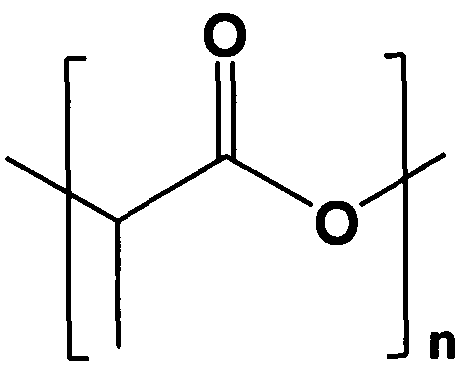
- the present invention provides a hard segment including a polylactic acid repeating unit represented by Formula 1 below; And a polyurethane poly in which polyether polyol repeating units of Formula 2 are linearly connected through a urethane bond.
- Soft segments containing repeating units 25-55 ° C.
- a polylactic acid resin having a temperature (Tg) is provided:
- A is a linear or branched alkylene group having 2 to 5 carbon atoms, m is an integer of 10 to 100, n is an integer of 700 to 5000.
- the present invention also comprises the steps of ring-opening polymerization of a monomer comprising at least one alkylene oxide to form a polymer having a polyether polyol repeating unit of the formula (2); In the presence of a urethane reaction catalyst, reacting the polymer with a diisocyanate compound and urethane to form a polymer having repeating units of a polyurethane poly in which repeating units of Formula 2 are linearly connected through a urethane bond; And condensation of lactic acid or ring-opening polymerization of lactide in the presence of the polymer having the polyurethane polyol repeating unit to form a polylactic acid repeating unit of Formula 1
- the present invention provides a packaging film containing the polylactic acid resin.
- a hard segment including a polylactic acid repeating unit of Formula 1 and a polyether polyol repeating unit of Formula 2 may be a polyurethane polyol linearly connected through a urethane bond.
- a polylactic acid resin is provided comprising a soft segment comprising repeating units and having a glass transition temperature (Tg) of about 25 to 55 ° C .:
- A is a linear or branched alkylene group having 2 to 5 carbon atoms
- m is an integer of 10 to 100
- n is an integer of 700 to 5000.
- Such a polylactic acid resin basically includes a polylactic acid repeating unit represented by Chemical Formula 1 as a hard segment.
- the polylactic acid resin includes a polyurethane polyol repeating unit as a soft segment
- polylactic acid resins show biodegradability peculiar to biomass-based resins by basically including polylactic acid repeating units as hard segments.
- the polylactic acid resin has a greatly improved flexibility (for example, a relatively low Young's modulus when measured in the length and width directions) by including the polyurethane polyol repeating unit as a soft segment. It has been found to enable the provision of films which exhibit not only all but also excellent transparency and low haze values.
- the polylactic acid resin has a glass transition temperature (Tg) of about 25 to 55 ° C, preferably a glass transition temperature (Tg) of about 30 to 55 ° C.
- the polylactic acid resin is a polyether polyol repeating unit with a diisocyanate compound
- the reaction may include a block copolymer in which a plurality of polyether polyol repeating units form a repeating unit of a polyurethane poly linearly linked with a urethane bond, and then copolymerized with the polylactic acid repeating unit.
- the polylactic acid resin includes the block copolymer thus obtained, it is possible to stratify the glass transition temperature (Tg) range of about 25 to 55 ° C, which is optimized not only in terms of flexibility of the film but also in terms of other physical properties such as mechanical properties. Turned out.
- Tg glass transition temperature
- the flexibility or stiffness of the film containing the polylactic acid resin is optimized, and thus it can be used very preferably as a packaging film. If the glass transition temperature of the polylactic acid resin is too low, the flexibility of the film may be improved, but as the stiffness is too low, slipping, handling, shape retention properties, and heat resistance during packaging using the film may be improved. Alternatively, blocking resistance or the like may be poor, and therefore, application to a packaging film may be inappropriate. On the contrary, if the glass transition temperature is too high, the film may have low flexibility and too high stiffness, so that the film may not easily be folded and its marks may be lost or the adhesion to the target product may be poor when packaged. In addition, when the film is wrapped, the noise is severely generated, there may be a limit to the application to the packaging film.
- the polylactic acid resin according to one embodiment enables the provision of a film with optimized flexibility as a packaging material, as the glass transition temperature is optimized and has the aforementioned structural properties.
- a film is also excellent in other physical properties such as mechanical properties, heat resistance, blocking resistance and transparency, it can be very preferably used as a packaging material for various applications.
- the polylactic acid repeating unit of Formula 1 included in the hard segment may refer to a polylactic acid homopolymer or a repeating unit forming the same.
- Such polylactic acid repeating units can be obtained according to methods for preparing polylactic acid homopolymers well known to those skilled in the art.
- L-lactide or D-lactide which is a cyclic dimer, can be produced from the L- or D-lactic acid and ring-opened polymerized. It can be obtained by the method or by direct dehydration condensation polymerization of L- or D-lactic acid, and among these, polylactic acid repeating units having a higher degree of polymerization can be obtained through ring-opening polymerization.
- the polylactic acid repeating unit may be prepared to have amorphous by copolymerizing L-lactide and D-lactide in a predetermined ratio, in order to further improve the heat resistance of the film containing the polylactic acid resin, It is preferable to prepare by the method of homopolymerization using either L-lactide or D-lactide. More specifically, the polylactic acid repeating unit may be obtained by ring-opening polymerization using L-lactide or D-lactide raw material having an optical purity of about 98% or more, and if the optical purity is less than this, the melting temperature (Tm) of the polylactic acid resin ) Can be lowered.
- Tm melting temperature
- the polyurethane polyol repeating unit included in the soft segment has a structure in which the repeating units of the polyether poly of Formula 2 are linearly connected through a urethane bond (-C (-O) -NH-). More specifically, the polyether polyol repeating units ring-open a monomer such as alkylene oxide
- the polymer obtained by (co) polymerization or the repeating unit which forms it may have a hydroxyl group at the terminal.
- the polyurethane poly repeating unit By including the polyurethane poly repeating unit as a soft segment, the flexibility of the film containing the polylactic acid resin can be greatly improved.
- the polyurethane polyol repeating unit makes it possible to provide a film exhibiting excellent physical properties without deteriorating heat resistance, blocking resistance, mechanical properties, or transparency of the polylactic acid resin or a film including the same.
- polylactic acid-based copolymers containing soft segments in which polyester polyol repeating units are connected by urethane bonds have been known.
- these polylactic acid copolymers have a low compatibility between polyester polyols and polylactic acid, and thus, the transparency of the film decreases and the haze value increases. There was a problem.
- the polylactic acid copolymer has a wide molecular weight distribution and an excessively low glass transition temperature, and thus has poor melt characteristics, resulting in poor film extrusion, and poor mechanical properties, heat resistance, and blocking resistance of the film.
- a polylactic acid copolymer having a polyether polyol repeating unit copolymerized with a polylactic acid repeating unit and a branched form using a trifunctional or higher isocyanate compound, or after copolymerizing the polyether polyol repeating unit and the polylactic acid repeating unit Polylactic acid copolymers in the form of chain extension with urethane reactions have also been previously known. However, these previously known polylactic acid copolymers also have a small block size of the polylactic acid repeating units in the hard segment and an excessively low glass transition temperature, resulting in poor heat resistance, mechanical properties and blocking resistance of the film. However, the film still had problems such as poor molecular weight distribution and poor melting characteristics, resulting in poor film extrusion.
- the polylactic acid resin of one embodiment in which a plurality of polyether poly repeating units linearly connect a polyurethane poly connected through a urethane bond, includes a repeating unit and a polylactic acid repeating unit, has excellent flexibility due to the polyurethane polyol repeating unit. While providing a film to be shown, it exhibits an optimized glass transition temperature, has a low molecular weight distribution and includes polylactic acid repeat units in large segment sizes, allowing the film to exhibit excellent mechanical properties, heat resistance and blocking resistance, etc. . Accordingly, it has been found that the polylactic acid resin of the above embodiment solves all the problems of the copolymers known in the art, thereby providing a film having excellent flexibility while having excellent overall physical properties.
- the polyether polyol repeating unit and the diisocyanate compound react the polyether poly such that the molar ratio of the isocyanate group of the terminal hydroxy group of the repeating unit: the compound of the diisocyanate compound is about 1: 0.50 to 1: 0.99, and the polyurethane Polyol repeat units can be formed.
- the molar ratio can be about 1: 0.60 to 1: 0.90, more preferably about 1: 0.70 to 1: 0.85.
- the polyurethane polyol repeating unit refers to a polymer formed by linearly connecting the polyether polyol repeating units via a urethane bond or a repeating unit forming the same, and may have a hydroxyl group at the terminal thereof. have. Accordingly, the polyurethane poly repeating unit may act as an initiator in the polymerization process for forming a polylactic acid repeating unit. However, if the reaction molar ratio of the hydroxyl group: isocyanate group is excessively higher than about 0.99, the number of terminal hydroxyl groups of the polyurethane polyol repeating unit may be insufficient (OHV ⁇ 3), and thus may not function properly as an initiator.
- the polyether-based poly repeating unit for example, the polyether-based poly obtained by ring-opening (co) polymerization of one or more alkylene oxide may be a (co) polymer or a repeating unit thereof.
- alkylene oxide may include ethylene oxide, propylene oxide, butylene oxide, tetrahydrofuran, and the like.
- repeating units of polyether polys obtained therefrom include repeating units of polyethylene glycol (PEG); Repeating units of poly (1,2-propyleneglycol); Repeating units of poly (1,3-propanedi); Repeating units of polytetramethylene glycol; Repeating units of polybutylene glycol; Repeating units of poly, which is a copolymer of propylene oxide and tetrahydrofuran; Repeating units of polyols which are copolymers of ethylene oxide and tetrahydrofuran; Or the repeating unit of the polyol which is a copolymer of ethylene oxide and a propylene oxide, etc. are mentioned.
- the polyether polyol repeating unit may be a repeating unit of poly (1,3-propanediol) or polytetramethylene glycol It is preferable to use a repeating unit of The polyether-based poly repeating unit may have a number average molecular weight of about 400 to 9000, preferably 1000 to 3000.
- the diisocyanate compound capable of forming a urethane bond by bonding to the terminal hydroxyl group of the polyether polyol repeating unit may be any compound having two isocyanate groups in molecular weight.
- diisocyanate compounds include 1,6-nuclemethylene diisocyanate, 2,4- toluene diisocyanate, 2,6-luluenedi isocyanate, 1,3-xylene di isocyanate, 1,4-xylene di Isocyanate, 1,5-naphthalenedi isocyanate, m-phenylenedi isocyanate, P-phenylenedi isocyanate, 3,3'-dimethyl-4,4'-diphenylmethane diisocyanate, 4,4'-bisphenylenedi isocyanate, Nucleated methylene diisocyanate, isophorone di isocyanate or hydrogenated di phenylmethane diisocyanate, and the like.
- the polylactic acid resin according to an embodiment of the present invention may include a block copolymer copolymerized with the hard segment and soft segment described above. More specifically, the block copolymer may have a structure in which the polylactic acid repeating unit of the hard segment is combined with the polyurethane polyol repeating unit of the soft segment, and the terminal carboxyl group of the polylactic acid repeating unit is the polyurethane polyol repeating unit. The terminal hydroxyl group of may be connected by an ester bond.
- the chemical structure of such block copolymers can be represented by the following general formula (1):
- E represents a polyether polyol repeating unit
- U represents a urethane bond
- Ester represents an ester bond.
- the polylactic acid repeating unit and the polyurethane poly repeating unit copolymerized By including a block copolymer, while being able to suppress the bleeding-out of the polyurethane polyol repeating unit for the flexibility, such as transparency, mechanical properties, heat resistance or blocking resistance of the film formed of the polylactic acid resin Physical properties can be excellent.
- the glass transition silver (Tg) and the melting temperature (Tm) of the polylactic acid resin may be optimized, such as flexibility of the film and blocking. It is possible to further improve the resistance and heat resistance.
- polylactic acid repeating units included in the polylactic acid resin need not be in the form of a block copolymer combined with the polyurethane polyol repeating unit, and at least some of the polylactic acid repeating units repeat the polyurethane polyol. It may also take the form of a polylactic acid homopolymer without being bound to a unit. In this case, the polylactic acid resin may be in the form of a complex comprising the block copolymer described above and a polylactic acid repeating unit that is not bonded to the polyurethane repeating unit, that is, a polylactic acid homopolymer.
- the polylactic acid resin is based on its total increase (the weight of the above-described block copolymer, and optionally, the sum of the weight of such a single polymer, in the case where a polylactic acid single polymer is included), and 80 to 95% by weight, may comprise from about 5 to 20 parts by weight 0/0 of the soft segment, and preferably from about 8 to about 18, from about 82 to 92 weight 0/0, and a soft segment, the hard segment weight 0 / «, may be more preferably from about 10 to 15 parts by weight 0/0 of about 85 to 90 parts by weight 0/0, and a soft segment, the hard segment.
- the content of the soft segment is too high, it may be difficult to provide a high molecular weight polylactic acid resin, which may lower mechanical properties such as strength of the film.
- the glass transition temperature is lowered, the slipperiness (slipping), handling or shape retention characteristics or blocking resistance, etc. in the packaging process using the film may be inferior.
- the content of the soft segment is too low, there is a limit in improving the flexibility of the polylactic acid resin and the film.
- the glass transition temperature of the polylactic acid resin may be excessively high, which may reduce the flexibility of the film, and the polyurethane polyol of the soft segment Repeating units are difficult to function properly as an initiator, resulting in poor polymerization conversion or poor production of high molecular weight polylactic acid resins.
- the polylactic acid resin may further include a phosphorus-based stabilizer and / or antioxidant to inhibit the soft segment or the like is oxidized or pyrolyzed in the manufacturing process.
- a phosphorus-based stabilizer and / or antioxidant to inhibit the soft segment or the like is oxidized or pyrolyzed in the manufacturing process.
- the antioxidant include a hindered phenol antioxidant, an amine antioxidant, a thio antioxidant, or a phosphite antioxidant.
- the types of each of these stabilizers and antioxidants are well known to those skilled in the art.
- the polylactic acid resins may contain various known plasticizers, UV stabilizers, anti-colorants, matte agents, deodorants, flame retardants, weathering agents, and antistatic agents within a range that does not impair the effect thereof. It may further comprise various additives, such as this type
- plasticizer examples include phthalic ester plasticizers such as diethyl phthalate, dioxyl phthalate, and dicyclonuclear phthalate; Aliphatic dibasic acid ester-based plasticizers of di-1-butyl adipic acid, di-n-octyl adipic acid, di-n-butyl sebacic acid, and di-2-ethyl azerate acid nucleus; Phosphoric ester plasticizers such as diphenyl-2-ethyl nucleus phosphate and diphenyl octyl phosphate; Hydroxy polyhydric carboxylic acid ester plasticizers such as acetyl citrate tributyl, acetyl citrate tri-2-ethyl nucleus and tributyl citrate; Fatty acid ester plasticizers such as acetyl ricinolic acid methyl and stearic acid mil; Polyhydric alcohol ester plasticizers such as gly,
- Inorganic pigments such as carbon black, titanium oxide, zinc oxide, iron oxide; Organic pigments such as cyanine-based, phosphorus-based, quinone-based, lerione-based, isoindolinone-based and thio-indigo-based;
- inorganic or organic particles may be further included, such as silica, colloidal silica, alumina, alumina sol, talc, mica, calcium carbonate, polystyrene, poly Methyl methacrylate, silicone, etc. are mentioned.
- polylactic acid resin or Various additives known to be usable for the film may be included, and the specific types and obtaining methods thereof are obvious to those skilled in the art.
- the polylactic acid resin described above for example, the block copolymer contained therein may have a number average molecular weight of about 50,000 to 200,000, preferably a number average molecular weight of about 50,000 to 150,000.
- the polylactic acid resin may have a weight average molecular weight of about 100,000 to 400,000, preferably a weight average molecular weight of about 100,000 to 320,000.
- Such molecular weight may affect the processability and mechanical properties of the polylactic acid resin described above.
- the melt viscosity is too low, the workability to the film or the like may be inferior, even if the processing to the film may be a mechanical property such as strength.
- the molecular weight is too large, the melt viscosity during the melt processing is too high can greatly reduce the productivity of the film.
- the polylactic acid resin for example, the block copolymer contained therein has a molecular weight distribution (Mw / Mn) defined as the ratio of the weight average molecular weight (Mw) to the number average molecular weight ( ⁇ ) of about 1.60 to 2.20, preferably Preferably about 1.80 to 2.15.
- Mw / Mn molecular weight distribution
- the polylactic acid resin exhibits such a narrow molecular weight distribution, it exhibits proper melt viscosity and melt characteristics when melt processing by extrusion or the like, and thus exhibits excellent film extrusion state and processability.
- the film containing the polylactic acid resin may exhibit excellent mechanical properties such as strength.
- the polylactic acid resin may have a melting temperature (Tm) of about 160 to 178t, preferably about 165 to 175 ° C.
- Tm melting temperature
- the heat resistance of the film containing the polylactic acid resin may be lowered
- too high a high temperature is required during melt processing by extrusion or the like, or the viscosity may be too high, thereby deteriorating the processing characteristics of the film.
- the polylactic acid resin described above is optimized in such a way that the glass transition temperature and the like, together with the melting temperature, it is possible to provide a packaging film that not only has excellent melt processability, but also shows excellent physical properties including heat resistance with optimized flexibility.
- polylactic acid resin may satisfy the following Equation 1:
- w L and W P represent 100 parts by weight of the total polylactic acid resin, and parts by weight of the hard segment and the soft segment, respectively.
- Mw p represents the number average molecular weight of the soft segment.
- the film obtained from the polylactic acid resin not only exhibits improved flexibility, but also exhibits optimized properties as a packaging material in other physical properties such as mechanical properties, transparency, heat resistance, blocking resistance and processability.
- the polylactic acid resin that does not satisfy the relationship of Equation 1 the flexibility or mechanical properties, such as greatly reduced, can not exhibit a proper melt viscosity and melting characteristics when melt processing by the extrusion method, such as a film Machinability to the furnace can be greatly degraded.
- the polyurethane polyol repeating unit of the soft segment may act as an initiator when the polylactic acid repeating unit of the hard segment is integrated.
- the action of the initiator is not properly expressed. Or may be overexpressed. Therefore, in the case of forming a film or the like with a polylactic acid resin that does not satisfy the relationship of Equation 1, such as mechanical properties or processability
- the physical properties may be greatly reduced or the flexibility may be inferior due to the lack of the content of the soft segment.
- the method for producing a polylactic acid resin may include ring-opening polymerization of a monomer including at least one alkylene oxide to form a polymer having a polyether polyol repeating unit of Formula 2; Urethane reaction of the polymer with a diisocyanate compound in the presence of a urethane reaction catalyst to form a polymer having a polyurethane polyol repeating unit in which the repeating units of Formula 2 are linearly connected through a urethane bond; And condensation of lactic acid or ring-opening polymerization of lactide in the presence of the polymer having the polyurethane polyol repeating unit to form a polylactic acid repeating unit of Chemical Formula 1.
- the polylactic acid repeating unit of Formula 1 is included as a hard segment, and together, a polylactic acid resin including a predetermined polyurethane polyol repeating unit as a soft segment may be prepared. That is, in the production method, a polyether poly having a repeating unit of Formula 2 causes a polymer to form a urethane reaction with a diisocyanate compound, and a plurality of repeating units of Formula 2 are linearly connected to a polyurethane polyol repeating unit via a urethane bond. A polymer having can be formed.
- polylactic acid resin including a soft segment may be prepared.
- the polylactic acid resin prepared by this method can satisfy the physical properties of one embodiment such as the above-described glass transition temperature range, and as a result, it is possible to provide a packaging film exhibiting better overall physical properties.
- the polylactic acid resin of the above embodiment can be continuously produced with high productivity.
- the optical purity of the heterochain L-lactide or D-lactide of the lactide can be described, for example, by adjusting it to about 98% or more, preferably about 99% or more, and most preferably about 99.5% or more.
- Polylactic acid resins which stratify one glass transition temperature, melting temperature and the like can be prepared. However, since an appropriate range such as the molecular weight of the polylactic acid resin, the content of the soft segment or the optical purity has already been described above, a detailed description thereof will be omitted.
- At least one monomer such as alkylene oxide is ring-opened (co) polymerized to form a (co) polymer having a polyether polyol repeating unit, which is used to prepare a conventional polyether poly (co) polymer. You can proceed according to the method.
- the polyether-based poly (co) polymer having a repeating unit, a diisocyanate compound and a urethane reaction catalyst are layered in a reactor, and then heated and stirred to perform a urethane reaction.
- a urethane reaction catalyst By this reaction, two isocyanate groups of the diisocyanate compound and terminal hydroxyl groups of the (co) polymer are bonded to form a urethane bond.
- a (co) polymer having a polyurethane polyol repeating unit in which polyether polyol repeating units are linearly linked through the urethane bond can be formed, which is included as the soft segment of the polylactic acid resin described above. .
- the polyurethane polyol (co) polymer is a polyether-based polyol repeating units (E) are linearly bonded in the form of EUEUE via a urethane bond (U) at both ends It may be formed in the form having a polyether polyol repeating unit.
- the urethane reaction can be carried out in the presence of a conventional tin-based catalyst, for example, Stannous Octoate, Dibutyltin Dilaurate, Dioctyltin Dilaurate and the like.
- a conventional tin-based catalyst for example, Stannous Octoate, Dibutyltin Dilaurate, Dioctyltin Dilaurate and the like.
- the urethane reaction can be carried out under reaction conditions for the production of conventional polyurethane resin. For example, after adding a diisocyanate compound and a polyether polyol (co) polymer under a nitrogen atmosphere, the urethane reaction mixture is added thereto, and the reaction mixture is reacted at a reaction temperature of 70 to 80 ° C. for 1 to 5 hours to repeat the polyurethane poly repeating unit.
- the (co) polymer having can be prepared.
- the polylactic acid resin in particular, it can be prepared a block co-polymer contained therein. That is, when such a polymerization reaction is performed, a polylactic acid repeating unit included as a hard segment is formed, and the polylactic acid resin is prepared. At this time, the polyurethane polyol repeating unit is bonded to at least a portion of the polylactic acid repeating unit. Block copolymers may be formed.
- the block copolymer may be formed while the carboxyl group at the end of the polylactic acid repeating unit is ester-bonded with the hydroxyl group at the end of the polyurethane polyol repeating unit.
- Block copolymers of one embodiment may be formed that exhibit a different structure, glass transition temperature, and the like from known branched copolymers.
- the block copolymer of such an embodiment may include blocks (hard segments) in which polylactic acid repeating units are bonded to each other in relatively large units (molecular weights), so that a film formed of the polylactic acid resin containing the same may have a narrow molecular weight distribution and proper Tg, and thus excellent mechanical properties and heat resistance can be exhibited.
- the above known copolymers have a structure in which polylactic acid repeating units having a small unit (molecular weight) have a structure in which polyether poly is alternately arranged at random with a repeating unit, and thus the film obtained therefrom has characteristics such as glass transition temperature and the like. Can't meet Mechanical properties, heat resistance, etc. are not easy.
- the lactide ring-opening polymerization reaction may be performed in the presence of a metal catalyst including an alkaline earth metal, a rare earth metal, a transition metal, aluminum, germanium, tin, antimony, and the like. More specifically, these metal catalysts may be in the form of carbonates, alkoxydes, halides, oxides or carbonates of these metals.
- a metal catalyst including an alkaline earth metal, a rare earth metal, a transition metal, aluminum, germanium, tin, antimony, and the like.
- these metal catalysts may be in the form of carbonates, alkoxydes, halides, oxides or carbonates of these metals.
- tin octylate, titanium tetraisopropoxide, aluminum triisopropoxide, or the like can be used.
- the antioxidant can be used together with such a catalyst as described above, the use of such an antioxidant, it is possible to produce a polylactic acid resin suppressed yellowing and excellent appearance.
- the step of forming a polylactic acid repeating unit such as the lactide ring-opening polymerization reaction may be continuously performed in the same reaction group in which the urethane reaction reaction proceeds. That is, the polyether polyol polymer and the diisocyanate compound are urethane reacted to form a polymer having a polyurethane poly repeating unit, and then a monomer such as lactide and a catalyst are continuously added to form a polylactic acid repeating unit. Can be.
- the polymer having a polyurethane polyol repeating unit serves as an initiator, the polylactic acid repeating unit and the polylactic acid resin containing the same can be continuously produced in high yield and high productivity.
- the polylactic acid resin may include a block copolymer in which specific hard and soft segments are combined, thereby exhibiting biodegradability of the polylactic acid resin and exhibiting improved flexibility.
- bleeding out of the soft segment for providing flexibility can be minimized, and the addition of such soft segments can greatly reduce the mechanical properties, heat resistance, transparency, or haze characteristics of the film.
- the polylactic acid resin is manufactured to have a predetermined glass transition temperature and optionally a physical property such as a predetermined melting temperature, the film obtained therefrom may exhibit optimized flexibility and stiffness as a packaging material. In addition, melt workability is also excellent, and blocking resistance and heat resistance are further improved. Therefore, these polylactic acid resins are used for packaging such as packaging films. It is very preferably applied to the material.
- a packaging film comprising the polylactic acid resin described above. Since the packaging film includes the polylactic acid resin described above, it is excellent in mechanical properties, heat resistance, blocking resistance, transparency, and the like, and can exhibit optimized flexibility and stiffness. Very preferably.
- Such a packaging film may have various thicknesses according to each use, and may have a thickness of 5 to 500 / im.
- the packaging film is subjected to a tensile test on a specimen having a width of 10 mm and a length of 150 mm using a Instron 1123 UTM universal testing machine under a degree of silver of 20 ° C and a relative humidity of 65% at a drawing speed of 300 mm / min and a distance of 100 mm between grips.
- the total Young's modulus in the longitudinal direction and the width direction may be about 350 to 750 kgf / Binf, preferably about 450 to 650 kgf / miif, and more preferably about 500 to 600 kgf / mn. have.
- the range of this Young's modulus may reflect the optimized flexibility and stiffness of the packaging film, and this flexibility and stiffness is due to the stratification of the above-described structural properties and glass transition temperature of the polylactic acid resin. see.
- the total Young's modulus is too low, spreading or loosening may occur during film formation and processing of the film, and the handling, process permeability, slit processability, or shape retention characteristics may be poor.
- the wrap film is used, the lack of slipperiness of the film may result in a lack of this formation, or the film may be difficult to be effectively packaged by the deformation of the film before surrounding the article or food such as a container.
- the Young's modulus sum is excessively high, when the film is folded during the packaging process, the folding line remains as it is, and the appearance of the film is not deformed, or it may be difficult to be packaged because it is not deformed depending on the shape of the packaged product or food.
- the packaging film is tensile under the same conditions as the Young's modulus When tested, an initial tensile strength of at least about 10 kgf1 ⁇ 2f, preferably at least about 12 kgf / mii, more preferably at least about 15 gf / wsl at most up to about 30 kg £ 1 ⁇ 2f in both the longitudinal and the width directions It can have an initial tensile strength of. If the initial tensile strength is less than this, the handleability of the film is poor, and even after packaging, the film may be easily broken and a risk of contents damage may occur.
- the packaging film may have a weight change rate of about 3 wt% or less, preferably about 0.01 to 3.0 wt%, and more preferably about 0.05 to 1.0 ⁇ %, when treated at 100 ° C. in a hot air oven for 1 hour. .
- a weight change rate of about 3 wt% or less, preferably about 0.01 to 3.0 wt%, and more preferably about 0.05 to 1.0 ⁇ %, when treated at 100 ° C. in a hot air oven for 1 hour. .
- Such properties may reflect the excellent heat resistance and anti-bleed out property of the packaging film. If the weight change rate is about 3 wt% or more, the dimensional stability of the film becomes poor, which means that plasticizers, residual monomers, or additives bleed out, and these components may contaminate the package contents.
- the packaging film may have a haze of about 3% or less, a light transmittance of about 85% or more, preferably a haze of about 2% or less, a light transmittance of about 90% or more, and more preferably,
- the haze may be about 1% or less and the light transmittance may be about 92% or more. If the haze is too large or the light transmittance is too low, the contents cannot be easily distinguished during film packaging, and the printed image is less likely to appear clearly when applying a multilayer film in which a printed layer is used.
- the above-mentioned packaging film may provide the properties required as a food packaging material such as heat sealability, gas barrier properties such as water vapor, oxygen or carbon dioxide, release property, printability, etc. as necessary within a range that does not impair the effect.
- a polymer having such properties may compound the compound into a film, or may apply an acrylic resin, a polyester resin, a thermoplastic resin of an acrylic resin, an antistatic agent, a surfactant, a release agent, or the like on at least one surface of the packaging film.
- another film having a function such as a polyolefin sealant or the like may be coextruded to produce a multilayer film.
- the above-mentioned packaging film may be prepared according to a conventional method.
- the polylactic acid resin may be formed in the form of a stretched film by applying the inflation method, the sequential biaxial stretching method, the simultaneous biaxial stretching method, and the like, and then heat-fix it.
- the stretched film forming step is melt-extruded the polylactic acid resin on a sheet by an extruder equipped with a T-die, and then the sheet-like molten extrudate is subjected to engraving and solidification to obtain an unstretched film. It can advance by the method of extending
- Stretching conditions of the film can be appropriately adjusted according to heat shrinkage characteristics, dimensional stability, strength, Young's modulus and the like.
- the stretching temperature is preferably adjusted to above the glass transition temperature of the polylactic acid resin, below the crystallization temperature.
- the stretching ratio may be in the range of about 1.5 to 10 times in the length and width directions, respectively, and the length and the width direction stretching ratio may be adjusted differently.
- this heat setting is preferably treated for at least about 10 seconds at ioo ° c or more for the strength and dimensional stability of the film.
- the above-mentioned packaging film may not only have excellent flexibility and transparency even when stored for a long time, but also exhibit mechanical properties such as layered strength and anti-bleed out characteristics. Moreover, the biodegradability peculiar to a polylactic acid resin can be exhibited. Therefore, such a packaging film can be preferably applied as a packaging material of various fields. For example, consumer goods or grocery general packaging / envelopes, ⁇ / ⁇ food packaging, shrinkable over-wrapping film, bundle bundle film, sanitary ware film such as sanitary napkin or baby products, lamination film, shrinkable label packaging and snack packaging mat In addition to the film, it can be widely used as a packaging material for industrial materials, such as agricultural multi-film, automotive film protection sheet, garbage bags and compost bags.
- polylactic acid resin and packaging film can be provided. Therefore, such a polylactic acid resin and a packaging film can be preferably applied as a packaging material in various fields to replace the packaging film obtained from crude oil-based resin, and can greatly contribute to preventing environmental pollution.
- NCO / OH terminal hydroxyl groups of isocyanate groups / polyether-based polyol repeating units (or (co) polymers) of diisocyanate compounds (e.g., nusamethylene diisocyanates) for the formation of polyurethane polyol repeating units Represents the reaction molar ratio of ".
- Mw and Mn (g / mol), molecular weight distribution (Mw / Mn): polylactic acid resin was dissolved in Chloroform at a concentration of 025 weight 0 /., Gel permeation chromatography (manufacturer: Viscotek TDA305, Column: ShodexLF804 * 2ea) Polystyrene was used as a standard to calculate the weight average molecular weight (Mw) and the number average molecular weight (Mn), respectively. The molecular weight distribution value was calculated from Mw and Mn thus calculated.
- Tg Glass Transition Degree, ° C
- Tm melting temperature, ° C
- Equation 1 w L and W P represent 100 parts by weight of the total polylactic acid resin, and parts by weight of the hard segment and soft segment, respectively, and Mw p represents the number average molecular weight of the soft segment.
- the extrusion conditions and melt viscosity for unstretched Sheet Production T die (die), a diameter of 30mm single screw and in the polylactic acid resin, from 200 to 250 'C
- the extrusion temperature condition extruder extruded Sheet a 5 ° C equipped with a
- the electrostatic cast was cast on a drum cooled with furnace.
- F100 (kg £ 1 ⁇ 2f) MD Determination of the slope of the tangent to the point contact point of the force at 100% deformation in the tensile-distortion curve obtained in (6) above, and 100% elongation obtained from this slope.
- the value of the force of the city was calculated
- Moiré horizontal lines: When the film is extruded by compounding two kinds of resins having different molecular weights or resins and plasticizers, the moiré pattern caused by the difference in melt viscosity is measured in the following A4 size film sample. To the standard Therefore, it evaluated.
- ⁇ no moiré (cross)
- O no more than 3 moiré (horizontal)
- X 5 or more moiré (horizontal).
- ⁇ No pin hole and bleed out
- O Within 5 pin holes or bleed out but not severe
- X 5 or more pin holes or severe bleed out.
- Haze (%) and light transmittance (%) The film sample was aged for 24 hours in an atmosphere of a temperature of 23 ° C. and a humidity of 65% RH in advance, and a Haze meter (model name: Japan NDH2000) was used in accordance with JIS K7136. The average value was calculated as a result by measuring about three other parts using the same.
- Blocking resistance Using the COLORITP type (manufactured by Coolz) of the stamping foil, the antistatic and printing surfaces of the film sample were matched and left for 24 hours at a temperature of 40 ° C. and l K g / orf pressure. Then, the blocking state of the antistatic layer and the printing surface was observed. Based on these observations, the blocking resistance between the antistatic layer (A layer) and the printing surface of the in-mold transfer foil was evaluated. At this time, up to O satisfies the practical performance.
- PPDO 2.0 poly (1,3-propanediol); Number average molecular weight 2,000
- PPDO 1.0 poly (1,3-propanediol); Number average molecular weight 1,000
- PTMEG 3.0 poly tetramethylene glycol; Number average molecular weight 3,000
- PTMEG 2.0 poly tetramethylene glycol; Number average molecular weight 2,000
- PTMEG 1.0 poly tetramethylene glycol; Number average molecular weight 1,000
- PEG 8.0 polyethylene glycol; Number average molecular weight 8,000
- PBSA 1 1.0 aliphatic polyester polyols made of 1,4-butanediol and condensates of succinic acid and adipic acid; Number average molecular weight 11,000
- HDI nucleated methylene diisocyanate
- Bayer Desmodur L75 (TRIMETHYLOL PROPANE + 3 leuene diisocyanate)
- TNPP Tris (nonylphenyl) phosphite
- the reaction was carried out at 185 t for 2 hours under 1 kg of nitrogen pressurization, 200 ppmmw of phosphoric acid was added to the catalyst inlet, and mixed for 15 minutes to inactivate the residual catalyst.
- Mibanung L-lactide (approximately 5 weights of initial dose) was removed via vacuum until 0.5torr was reached. Thereafter, D-L75 and 120 ppm Dibutyltin Dilaurate 120 ppmmw of the catalyst 130ppmw were diluted with 500 ml of toluene and added into the reaction vessel through the catalyst inlet. The reaction was carried out at 190 ° C.
- the unstretched film was stretched three times in the longitudinal direction between heating under the stretching conditions shown in Table 2, and then the stretched longitudinal film was fixed with a clip and drawn into the tenter four times in the width direction, and then fixed in the width direction. Heat treatment for 120 seconds at 120 ° C. Through this, a biaxially stretched polylactic acid resin film having a thickness of 20 ⁇ m was obtained. The evaluation result of the obtained film is shown together in Table 2.
- 4000 4000 400 400 400 (g) IV (dl / g) 0.95 1.35 1.52 0.64 0.92 0.52 0.2 1.55----
- the resins A to E are poly (1,3-propanediol) having a molecular weight of 1,000 to 2,400 or poly tetramethylene glycol having a number average molecular weight of 1,000 to 3,000.
- the polylactic acid resin includes a soft segment of the polyurethane polyol repeating unit in an appropriate amount of 5 to 20% by weight, and the value of Equation 1 is 80,000 to 200,000, which satisfies the relationship of Equation 1 will be.
- the repeating unit (or (co) polymer) of the polyurethane poly in such a polylactic acid resin has a value of OHV 3 to 20, it preferably serves as an initiator in the polymerization process for forming the polylactic acid repeating unit. It can be confirmed.
- the final produced polylactic acid resins A to E have a weight average molecular weight 100,000 to 400,000, molecular weight distribution 1.80 to 2.15, Tg 25 to 55 ° C and Tm 160 to 178 ° C, not only can be chipped, but also the melt viscosity at film extrusion temperature of 200 ° C or higher alone to produce film It was confirmed that it was possible.
- the resin J had a significantly higher content and usage amount of the polyurethane polyol repeating unit (or (co) polymer) exceeding 20% by weight, so that the value of Equation 1 was 66667, which satisfies the relationship of Equation 1 It was confirmed that the weight average molecular weight of the prepared polylactic acid resin was less than 100,000, and the glass transition temperature was less than 25 ° C.
- resin L is an attempt to prepare a polylactic acid resin by using polyethylene glycol having a molecular weight of 8,000 as an initiator in the ring-opening polymerization of L_ lactide without urethane reaction.
- the OHV of the initiator was high, and a polylactic acid resin having a desired weight average molecular weight could not be obtained.
- the resin L has a Tg of only 15 ° C, does not satisfy the relationship of Equation 1, the polymerization conversion is low, the melt viscosity is too low at the film extrusion temperature of 200 ° C or more to form a film alone This was confirmed to be impossible.
- resin M was prepared by ring-opening polymerization of L-lactide using a small amount of 1-dodecand as an initiator according to a general polylactic acid resin production method without introducing a softening component (polyurethane polyol repeating unit) in the resin.
- a softening component polyurethane polyol repeating unit
- lactic acid resin In the case of these polylactic acid resins, film production was possible alone at a film extrusion temperature of 200 ° C or higher. However, these polylactic acid resins were found to have a fairly wide molecular weight distribution of 2.30.
- Resin N corresponds to a polylactic acid resin obtained by using a polyurethane poly to obtain a repeating unit (or (co) polymer) as an initiator and a soft segment, but 5 weights of a soft segment of the polyurethane poly as a repeating unit. It contains a low content of less than%, the glass transition temperature is high as 58 ° C., the value of Equation 1 is 1000000 does not satisfy the relationship.
- This polylactic acid resin has a weight average molecular weight of more than 400000, it was confirmed that the molecular weight distribution is also quite wide as 2.41.
- resin 0 is not a repeating unit of polyether poly, Polylactic acid obtained by copolycondensation of the polyurethane and lactide in the presence of a ring-opening polymerization catalyst, a transesterification catalyst and / or an ester amide exchange catalyst, while using a polyurethane formed from a polyester poly as a softening component in the resin System copolymer.
- the ester and / or ester amide exchange reaction takes place, and the polyurethane is randomly introduced into a small segment size to form a copolymer with a polylactic acid repeating unit.
- This resin 0 was found to have a wide molecular weight distribution of 2.85, too low Tg compared to the present invention, and a relatively low Tm.
- the resins P and Q add lactic acid to the polyether polyol repeating unit first to prepare a prepolymer copolymerized with the polyether polyol repeating unit and the polylactic acid repeating unit, and then chain extend the prepolymer with a diisocyanate compound.
- the copolymer (resin P) and the branched copolymer (resin Q) in which the prepolymers are reacted with at least trifunctional isocyanate compounds corresponds to the copolymer (resin P) and the branched copolymer (resin Q) in which the prepolymers are reacted with at least trifunctional isocyanate compounds.
- These resins P and Q have a wide molecular weight distribution of 2.50 and 3.91, an excessively low Tg compared with the present invention, and a relatively low Tm.
- Example 1 the content of the softening component (polyurethane polyol repeating unit) in the polylactic acid resin is 5 to 20wt%, the weight average molecular weight It is prepared using the polylactic acid resin of the present invention having physical properties such as 100,000 to 400,000, molecular weight distribution 1.80 to 2.15, Tg 25 to 55 ° C and Tm 160 to 178 ° C.
- Example 6 was also produced using a polylactic acid resin (resin E) and a general polylactic acid resin (resin M) which fall within the scope of the present invention.
- the films of Examples 1 to 6 all have excellent mechanical properties with an initial tensile strength of lO kgf / mnf or more in the length and width directions, as well as excellent flexibility with a Young's modulus in the length and width directions of 750 kgf / mnf or less. Indication was confirmed. In addition, this Young's modulus is not too low In keeping with the range, it was confirmed that the stiffness also showed an appropriate level. And,
- the film of Comparative Example 1 made of a general polylactic acid resin M, the total length and width direction Young's modulus exceeded 750 kgf / nmf, it was confirmed that it is difficult to use as a packaging film due to the lack of flexibility.
- the difference in melt viscosity between the two resins is too large, the extrusion state is poor, there is also a problem that a wave pattern occurs in the final film It was.
- the appearance of pin holes on the film was poor, the film appearance was poor, and the resin 1 Tg was too low to cause problems such as blocking resistance, and the initial tensile strength and light transmittance were also poor.
- Comparative Examples 3 and 4 do not use the polyurethane polyol repeating unit which is a softening component in the resin, and as the plasticizer component, poly (1,3-propanediol) having a number average molecular weight of 2,400 and 1,4 having a number average molecular weight of 11,000, respectively.
- poly (1,3-propanediol) having a number average molecular weight of 2,400 and 1,4 having a number average molecular weight of 11,000, respectively.
- -An aliphatic polyester polyol made of a butanediol and a condensate of succinic acid and adipic acid is simply compounded and mixed into a resin M into a film.
- the films of Comparative Examples 3 and 4 had a high haze of the film because the degree of dispersion of the plasticizer component in the resin was not perfect, and a phenomenon in which the plasticizer component bleeded out from the surface of the film was found after a lapse of time.
- Comparative Example 5 has a high glass transition temperature, due to the low content of the soft segment does not satisfy the relationship of the formula (1), it was prepared using a resin N having a high molecular weight.
- the resin N was not easy to process as a film due to the excessively high melt viscosity, and was also poor due to the occurrence of water ripples in the final film, the flexibility of the film by adding the film Young's modulus in the length and width direction exceeded 750 kgf / mirror It was confirmed that it could not be used as a packaging film because it could not be layered.
- the film of Comparative Example 6 has a polyester poly repeating unit It is prepared from copolymers that are introduced and have low glass transition temperatures that do not satisfy the properties of the present invention.
- Such films showed relatively good flexibility as the softening component polyurethane was randomly introduced into a small segment size, but as polylactic acid repeat units were also introduced into a relatively small segment size, the film exhibited poor heat resistance due to low Tg and Tm. , Filming difficulty was confirmed due to the blocking problem.
- the low compatibility of the polyester polyol and polylactic acid used to form the softening component was found to have high haze value and low transparency of the film, and the molecular weight was confirmed by the ester and / or ester amide exchange reaction during the preparation of the resin. It was confirmed that the distribution was wide, resulting in non-uniform melting characteristics, poor film extrusion state, and deterioration of mechanical properties.
- the films of Comparative Examples 7 and 8 include a resin obtained by urethane reaction of a prepolymer obtained by addition polymerization of lactide to a polyether polyol with a diisocyanate or a trifunctional or higher isocyanate compound, and this resin also has a low glass transition temperature. It does not meet the characteristics of the invention. These films were found to exhibit non-uniform melt viscosity and poor mechanical properties. In addition, as the blocking characteristics of the hard and soft segments in the resin were lowered, and the lower Tm and Tg were exhibited, poor heat resistance was observed and filming was difficult due to blocking problems.
Landscapes
- Chemical & Material Sciences (AREA)
- Health & Medical Sciences (AREA)
- Chemical Kinetics & Catalysis (AREA)
- Medicinal Chemistry (AREA)
- Polymers & Plastics (AREA)
- Organic Chemistry (AREA)
- Engineering & Computer Science (AREA)
- Manufacturing & Machinery (AREA)
- Materials Engineering (AREA)
- Mechanical Engineering (AREA)
- General Chemical & Material Sciences (AREA)
- Polyurethanes Or Polyureas (AREA)
- Manufacture Of Macromolecular Shaped Articles (AREA)
- Biological Depolymerization Polymers (AREA)
- Polyesters Or Polycarbonates (AREA)
- Compositions Of Macromolecular Compounds (AREA)
- Wrappers (AREA)
Abstract
Description


Claims

Priority Applications (10)
| Application Number | Priority Date | Filing Date | Title |
|---|---|---|---|
| CN201180062682.3A CN103328535B (zh) | 2010-11-08 | 2011-11-02 | 聚乳酸树脂、其制备方法以及包含所述聚乳酸树脂的包装膜 |
| HK13112401.3A HK1185092B (en) | 2010-11-08 | 2011-11-02 | Polylactic acid resin, preparation method thereof, and packaging film comprising same |
| AU2011327062A AU2011327062B8 (en) | 2010-11-08 | 2011-11-02 | Polylactic acid resin, preparation method thereof, and packing film comprising the same |
| EP11840311.2A EP2639255B1 (en) | 2010-11-08 | 2011-11-02 | Polylactic acid resin, preparation method thereof, and packaging film comprising same |
| BR112013011361A BR112013011361B1 (pt) | 2010-11-08 | 2011-11-02 | resina de ácido polilático, método de preparação da mesma, e película de embalagem compreendendo a mesma |
| CA2817192A CA2817192C (en) | 2010-11-08 | 2011-11-02 | Polylactic acid resin, preparation method thereof, and packaging film comprising the same |
| US13/883,881 US9499658B2 (en) | 2010-11-08 | 2011-11-02 | Polylactic acid resin, preparation method thereof, and packing film comprising the same |
| MX2013005122A MX351693B (es) | 2010-11-08 | 2011-11-02 | Resina de ácido poliláctico, método para la preparación de la misma, y película para empaque que comprende la misma. |
| JP2013537606A JP5913343B2 (ja) | 2010-11-08 | 2011-11-02 | ポリ乳酸樹脂、その製造方法およびこれを含む包装用フィルム |
| ES11840311T ES2962147T3 (es) | 2010-11-08 | 2011-11-02 | Resina de ácido poliláctico, procedimiento de preparación de la misma, y película de embalaje que comprende la misma |
Applications Claiming Priority (16)
| Application Number | Priority Date | Filing Date | Title |
|---|---|---|---|
| KR20100110547 | 2010-11-08 | ||
| KR10-2010-0110547 | 2010-11-08 | ||
| KR20100111766 | 2010-11-10 | ||
| KR20100111767 | 2010-11-10 | ||
| KR10-2010-0111766 | 2010-11-10 | ||
| KR10-2010-0111767 | 2010-11-10 | ||
| KR1020100130226A KR101717186B1 (ko) | 2010-12-17 | 2010-12-17 | 폴리유산 수지의 제조 방법 |
| KR20100130218A KR101191968B1 (ko) | 2010-11-08 | 2010-12-17 | 폴리유산 수지 및 이를 포함하는 포장용 필름 |
| KR20100130217A KR101191967B1 (ko) | 2010-11-08 | 2010-12-17 | 폴리유산 수지 및 이를 포함하는 포장용 필름 |
| KR10-2010-0130216 | 2010-12-17 | ||
| KR10-2010-0130226 | 2010-12-17 | ||
| KR10-2010-0130217 | 2010-12-17 | ||
| KR20100130216A KR101191966B1 (ko) | 2010-11-08 | 2010-12-17 | 폴리유산 수지 및 이를 포함하는 포장용 필름 |
| KR10-2010-0130218 | 2010-12-17 | ||
| KR20100130215A KR101191961B1 (ko) | 2010-11-08 | 2010-12-17 | 폴리유산 수지 및 이를 포함하는 포장용 필름 |
| KR10-2010-0130215 | 2010-12-17 |
Publications (2)
| Publication Number | Publication Date |
|---|---|
| WO2012064043A2 true WO2012064043A2 (ko) | 2012-05-18 |
| WO2012064043A3 WO2012064043A3 (ko) | 2012-07-26 |
Family
ID=48481607
Family Applications (1)
| Application Number | Title | Priority Date | Filing Date |
|---|---|---|---|
| PCT/KR2011/008307 Ceased WO2012064043A2 (ko) | 2010-11-08 | 2011-11-02 | 폴리유산 수지, 이의 제조 방법 및 이를 포함하는 포장용 필름 |
Country Status (10)
| Country | Link |
|---|---|
| US (1) | US9499658B2 (ko) |
| EP (1) | EP2639255B1 (ko) |
| JP (1) | JP5913343B2 (ko) |
| CN (1) | CN103328535B (ko) |
| AU (1) | AU2011327062B8 (ko) |
| BR (1) | BR112013011361B1 (ko) |
| CA (1) | CA2817192C (ko) |
| ES (1) | ES2962147T3 (ko) |
| MX (1) | MX351693B (ko) |
| WO (1) | WO2012064043A2 (ko) |
Cited By (4)
| Publication number | Priority date | Publication date | Assignee | Title |
|---|---|---|---|---|
| JP2015518080A (ja) * | 2012-06-01 | 2015-06-25 | エスケー ケミカルズ カンパニー リミテッド | ポリ乳酸樹脂およびこれを含む包装用フィルム |
| JP2015532329A (ja) * | 2012-12-04 | 2015-11-09 | エルジー・ケム・リミテッド | 延伸フィルム |
| JP2015535878A (ja) * | 2012-12-06 | 2015-12-17 | エルジー・ケム・リミテッド | ラクチド共重合体、その製造方法およびこれを含む樹脂組成物 |
| CN115667898A (zh) * | 2021-04-16 | 2023-01-31 | 株式会社Lg化学 | 聚乳酸中的d-乳酸重复单元含量的分析方法 |
Families Citing this family (7)
| Publication number | Priority date | Publication date | Assignee | Title |
|---|---|---|---|---|
| KR102130039B1 (ko) * | 2014-06-05 | 2020-07-03 | 에스케이케미칼 주식회사 | 열 접착성 유연 폴리유산 수지 조성물 |
| KR102149304B1 (ko) | 2014-09-17 | 2020-08-28 | 에스케이케미칼 주식회사 | 3d 인쇄용 폴리유산 수지 조성물 |
| KR20170093028A (ko) * | 2016-02-04 | 2017-08-14 | 에스케이케미칼주식회사 | 물 소거제를 포함하는 유연 폴리유산 수지 조성물 |
| KR102456006B1 (ko) * | 2016-03-24 | 2022-10-18 | 에스케이케미칼 주식회사 | 폴리유산 수지 조성물 및 이를 포함한 성형용품 |
| CN108003760B (zh) * | 2017-11-10 | 2020-04-07 | 安徽新源农业科技有限公司 | 一种用于塑料大棚的涂膜液 |
| US11485852B2 (en) * | 2020-02-18 | 2022-11-01 | Northern Technologies International Corporation | High impact resistant poly(lactic acid) blends |
| WO2022241522A1 (en) * | 2021-05-21 | 2022-11-24 | Varden Process Pty Ltd | A film material |
Citations (8)
| Publication number | Priority date | Publication date | Assignee | Title |
|---|---|---|---|---|
| KR20100110547A (ko) | 2009-04-03 | 2010-10-13 | 엘지전자 주식회사 | 식기세척기 |
| KR20100111767A (ko) | 2009-04-08 | 2010-10-18 | 한국화학연구원 | 카바졸이 함유된 전도성 고분자 및 그를 이용한 유기 광기전력 장치 |
| KR20100111766A (ko) | 2009-04-08 | 2010-10-18 | 한국과학기술원 | 락테이트글라이콜레이트 공중합체 또는 락테이트글라이콜레이트하이드록시알카노에이트 공중합체 생성능을 가지는 세포 또는 식물을 이용한 락테이트글라이콜레이트 공중합체 또는 락테이트글라이콜레이트하이드록시알카노에이트 공중합체의 제조방법 |
| KR20100130218A (ko) | 2008-03-17 | 2010-12-10 | 콘세호 수페리오르 데 인베스티가시오네스 시엔티피카스 | 예정된 세균 숙주 균주를 감염시킬 수 있는 박테리오파지를 탐지 및/정량화시키는 방법 및 시스템, 상기 박테리오파지 탐지 그리고 상기 방법을 실행하기 위한 마이크로전자공학 센서 장치 |
| KR20100130215A (ko) | 2008-03-17 | 2010-12-10 | 파우워매트 엘티디. | 유도송전장치 |
| KR20100130216A (ko) | 2008-04-16 | 2010-12-10 | 알카텔-루센트 유에스에이 인코포레이티드 | Lte/epc 통신 네트워크 및 방문 네트워크 내에서의 온라인 과금 크레딧 제어 수행 방법 |
| KR20100130226A (ko) | 2008-04-29 | 2010-12-10 | 노파르티스 아게 | 액티빈-유사 수용체 키나제 (alk4 또는 alk5) 억제제로서의 이미다조-피리딘 유도체 |
| KR20100130217A (ko) | 2008-03-19 | 2010-12-10 | 센토코 오르토 바이오테크 인코포레이티드 | 중증 또는 지속성 천식의 평가 및 치료를 위한 마커 및 방법 |
Family Cites Families (19)
| Publication number | Priority date | Publication date | Assignee | Title |
|---|---|---|---|---|
| JP3407772B2 (ja) | 1994-07-20 | 2003-05-19 | 大日本インキ化学工業株式会社 | 高分子量乳酸系共重合ポリエステルの製造方法及びその成形物 |
| JP3503260B2 (ja) * | 1995-04-27 | 2004-03-02 | 大日本インキ化学工業株式会社 | 乳酸系ポリエーテルポリエステルの製造方法 |
| JP3620170B2 (ja) | 1996-09-30 | 2005-02-16 | トヨタ自動車株式会社 | ポリ乳酸系共重合体の製造方法及びポリ乳酸系共重合体 |
| JP4552298B2 (ja) | 2000-09-12 | 2010-09-29 | Dic株式会社 | 乳酸系共重合ポリエステルの製造方法 |
| JP4411521B2 (ja) | 2003-01-30 | 2010-02-10 | Dic株式会社 | ポリ乳酸組成物 |
| CN1621433A (zh) | 2003-11-24 | 2005-06-01 | 中国石化仪征化纤股份有限公司 | 高分子量乳酸共聚物的制备方法 |
| WO2005100429A1 (en) * | 2004-04-15 | 2005-10-27 | The University Of Utah Research Foundation | Bioresponsive polymer system for delivery of microbicides |
| JP3775423B2 (ja) | 2004-09-27 | 2006-05-17 | トヨタ自動車株式会社 | ポリ乳酸系共重合体 |
| US20070005130A1 (en) | 2005-06-29 | 2007-01-04 | Thierry Glauser | Biodegradable polymer for coating |
| EP2633834A1 (en) * | 2005-12-06 | 2013-09-04 | Covidien LP | Bioabsorbable Surgical Composition |
| JP5404040B2 (ja) * | 2006-07-26 | 2014-01-29 | 三井化学株式会社 | ポリ乳酸系樹脂組成物およびその成形体 |
| EP2116576A4 (en) | 2007-02-23 | 2011-04-06 | Teijin Ltd | POLYLACTIC ACID COMPOSITION |
| KR100877696B1 (ko) | 2007-02-27 | 2009-01-09 | 사단법인 삼성생명공익재단삼성서울병원 | 리피오돌을 함유하는 나노입자 및 이를 포함하는 x―선 컴퓨터 단층촬영용혈관 조영제 |
| CN101130600A (zh) | 2007-08-23 | 2008-02-27 | 复旦大学 | 一种含有聚乳酸链段的可降解泡沫塑料及其制备方法 |
| EP2220277A2 (en) | 2007-12-13 | 2010-08-25 | Kimberly-Clark Worldwide, Inc. | Biodegradable fibers formed from a thermoplastic composition containing polylactic acid and a polyether copolymer |
| CN101302284B (zh) * | 2008-06-23 | 2011-11-23 | 中国科学院长春应用化学研究所 | 一种高分子量高性能化聚乳酸的制备方法 |
| WO2010053065A1 (ja) | 2008-11-04 | 2010-05-14 | 東洋紡績株式会社 | ポリ乳酸セグメントを含有する共重合ポリウレタン樹脂、これを含有する水系エマルジョンおよびコーティング液組成物 |
| RU2485144C2 (ru) * | 2008-11-05 | 2013-06-20 | Тейдзин Кемикалз Лтд. | Композиция полимера молочной кислоты и формованное изделие из данной композиции |
| JP5960725B2 (ja) * | 2011-01-25 | 2016-08-02 | エスケー ケミカルズ カンパニー リミテッド | ポリ乳酸樹脂フィルムおよびその製造方法 |
-
2011
- 2011-11-02 WO PCT/KR2011/008307 patent/WO2012064043A2/ko not_active Ceased
- 2011-11-02 CN CN201180062682.3A patent/CN103328535B/zh active Active
- 2011-11-02 EP EP11840311.2A patent/EP2639255B1/en active Active
- 2011-11-02 CA CA2817192A patent/CA2817192C/en active Active
- 2011-11-02 ES ES11840311T patent/ES2962147T3/es active Active
- 2011-11-02 MX MX2013005122A patent/MX351693B/es active IP Right Grant
- 2011-11-02 US US13/883,881 patent/US9499658B2/en active Active
- 2011-11-02 BR BR112013011361A patent/BR112013011361B1/pt active IP Right Grant
- 2011-11-02 AU AU2011327062A patent/AU2011327062B8/en active Active
- 2011-11-02 JP JP2013537606A patent/JP5913343B2/ja active Active
Patent Citations (8)
| Publication number | Priority date | Publication date | Assignee | Title |
|---|---|---|---|---|
| KR20100130218A (ko) | 2008-03-17 | 2010-12-10 | 콘세호 수페리오르 데 인베스티가시오네스 시엔티피카스 | 예정된 세균 숙주 균주를 감염시킬 수 있는 박테리오파지를 탐지 및/정량화시키는 방법 및 시스템, 상기 박테리오파지 탐지 그리고 상기 방법을 실행하기 위한 마이크로전자공학 센서 장치 |
| KR20100130215A (ko) | 2008-03-17 | 2010-12-10 | 파우워매트 엘티디. | 유도송전장치 |
| KR20100130217A (ko) | 2008-03-19 | 2010-12-10 | 센토코 오르토 바이오테크 인코포레이티드 | 중증 또는 지속성 천식의 평가 및 치료를 위한 마커 및 방법 |
| KR20100130216A (ko) | 2008-04-16 | 2010-12-10 | 알카텔-루센트 유에스에이 인코포레이티드 | Lte/epc 통신 네트워크 및 방문 네트워크 내에서의 온라인 과금 크레딧 제어 수행 방법 |
| KR20100130226A (ko) | 2008-04-29 | 2010-12-10 | 노파르티스 아게 | 액티빈-유사 수용체 키나제 (alk4 또는 alk5) 억제제로서의 이미다조-피리딘 유도체 |
| KR20100110547A (ko) | 2009-04-03 | 2010-10-13 | 엘지전자 주식회사 | 식기세척기 |
| KR20100111767A (ko) | 2009-04-08 | 2010-10-18 | 한국화학연구원 | 카바졸이 함유된 전도성 고분자 및 그를 이용한 유기 광기전력 장치 |
| KR20100111766A (ko) | 2009-04-08 | 2010-10-18 | 한국과학기술원 | 락테이트글라이콜레이트 공중합체 또는 락테이트글라이콜레이트하이드록시알카노에이트 공중합체 생성능을 가지는 세포 또는 식물을 이용한 락테이트글라이콜레이트 공중합체 또는 락테이트글라이콜레이트하이드록시알카노에이트 공중합체의 제조방법 |
Cited By (6)
| Publication number | Priority date | Publication date | Assignee | Title |
|---|---|---|---|---|
| JP2015518080A (ja) * | 2012-06-01 | 2015-06-25 | エスケー ケミカルズ カンパニー リミテッド | ポリ乳酸樹脂およびこれを含む包装用フィルム |
| JP2015532329A (ja) * | 2012-12-04 | 2015-11-09 | エルジー・ケム・リミテッド | 延伸フィルム |
| US9580566B2 (en) | 2012-12-04 | 2017-02-28 | Lg Chem, Ltd. | Oriented film |
| JP2015535878A (ja) * | 2012-12-06 | 2015-12-17 | エルジー・ケム・リミテッド | ラクチド共重合体、その製造方法およびこれを含む樹脂組成物 |
| US9382386B2 (en) | 2012-12-06 | 2016-07-05 | Lg Chem, Ltd | Lactide copolymer, method for preparing same, and resin composition comprising same |
| CN115667898A (zh) * | 2021-04-16 | 2023-01-31 | 株式会社Lg化学 | 聚乳酸中的d-乳酸重复单元含量的分析方法 |
Also Published As
| Publication number | Publication date |
|---|---|
| CN103328535B (zh) | 2016-01-20 |
| MX2013005122A (es) | 2013-10-01 |
| EP2639255A4 (en) | 2017-01-25 |
| CN103328535A (zh) | 2013-09-25 |
| JP5913343B2 (ja) | 2016-04-27 |
| CA2817192C (en) | 2018-05-01 |
| CA2817192A1 (en) | 2012-05-18 |
| MX351693B (es) | 2017-10-24 |
| US9499658B2 (en) | 2016-11-22 |
| ES2962147T3 (es) | 2024-03-15 |
| US20140004330A1 (en) | 2014-01-02 |
| EP2639255B1 (en) | 2023-08-23 |
| WO2012064043A3 (ko) | 2012-07-26 |
| HK1185092A1 (zh) | 2014-02-07 |
| AU2011327062A1 (en) | 2013-05-30 |
| EP2639255A2 (en) | 2013-09-18 |
| BR112013011361B1 (pt) | 2020-01-28 |
| JP2013544928A (ja) | 2013-12-19 |
| AU2011327062B2 (en) | 2017-02-23 |
| BR112013011361A2 (pt) | 2016-08-09 |
| AU2011327062B8 (en) | 2017-03-02 |
Similar Documents
| Publication | Publication Date | Title |
|---|---|---|
| KR101191961B1 (ko) | 폴리유산 수지 및 이를 포함하는 포장용 필름 | |
| CN103328535B (zh) | 聚乳酸树脂、其制备方法以及包含所述聚乳酸树脂的包装膜 | |
| CN103328547B (zh) | 聚乳酸树脂膜 | |
| CA2820198C (en) | A polylactic acid resin composition and a packaging film | |
| KR101804431B1 (ko) | 폴리유산 수지 필름 | |
| KR101804430B1 (ko) | 폴리유산 수지 필름 | |
| KR101717186B1 (ko) | 폴리유산 수지의 제조 방법 | |
| KR101804429B1 (ko) | 폴리유산 수지 필름 | |
| HK1185092B (en) | Polylactic acid resin, preparation method thereof, and packaging film comprising same |
Legal Events
| Date | Code | Title | Description |
|---|---|---|---|
| 121 | Ep: the epo has been informed by wipo that ep was designated in this application |
Ref document number: 11840311 Country of ref document: EP Kind code of ref document: A2 |
|
| ENP | Entry into the national phase |
Ref document number: 2013537606 Country of ref document: JP Kind code of ref document: A Ref document number: 2817192 Country of ref document: CA |
|
| WWE | Wipo information: entry into national phase |
Ref document number: MX/A/2013/005122 Country of ref document: MX |
|
| NENP | Non-entry into the national phase |
Ref country code: DE |
|
| WWE | Wipo information: entry into national phase |
Ref document number: 2011840311 Country of ref document: EP |
|
| ENP | Entry into the national phase |
Ref document number: 2011327062 Country of ref document: AU Date of ref document: 20111102 Kind code of ref document: A |
|
| WWE | Wipo information: entry into national phase |
Ref document number: 13883881 Country of ref document: US |
|
| REG | Reference to national code |
Ref country code: BR Ref legal event code: B01A Ref document number: 112013011361 Country of ref document: BR |
|
| ENP | Entry into the national phase |
Ref document number: 112013011361 Country of ref document: BR Kind code of ref document: A2 Effective date: 20130508 |