WO2012070226A1 - 含酸素縮合環誘導体及びそれを含んでなる有機エレクトロルミネッセンス素子 - Google Patents
含酸素縮合環誘導体及びそれを含んでなる有機エレクトロルミネッセンス素子 Download PDFInfo
- Publication number
- WO2012070226A1 WO2012070226A1 PCT/JP2011/006486 JP2011006486W WO2012070226A1 WO 2012070226 A1 WO2012070226 A1 WO 2012070226A1 JP 2011006486 W JP2011006486 W JP 2011006486W WO 2012070226 A1 WO2012070226 A1 WO 2012070226A1
- Authority
- WO
- WIPO (PCT)
- Prior art keywords
- group
- substituted
- carbon atoms
- unsubstituted
- ring
- Prior art date
- Legal status (The legal status is an assumption and is not a legal conclusion. Google has not performed a legal analysis and makes no representation as to the accuracy of the status listed.)
- Ceased
Links
- 0 Cc(c(*)c(*)c(*)c1*)c1OC Chemical compound Cc(c(*)c(*)c(*)c1*)c1OC 0.000 description 5
- PPYIZNYOMNYZCG-UHFFFAOYSA-N Brc(cc1)ccc1-[n]1c(-c2ccccc2)nc2ccccc12 Chemical compound Brc(cc1)ccc1-[n]1c(-c2ccccc2)nc2ccccc12 PPYIZNYOMNYZCG-UHFFFAOYSA-N 0.000 description 1
- PNRLLPCVLUUOJL-UHFFFAOYSA-N C(C(c1ccccc1O1)C1=C1)c2c1c(cc(cc1)-[n]3c(-c4ccccc4)nc4ccccc34)c1[o]2 Chemical compound C(C(c1ccccc1O1)C1=C1)c2c1c(cc(cc1)-[n]3c(-c4ccccc4)nc4ccccc34)c1[o]2 PNRLLPCVLUUOJL-UHFFFAOYSA-N 0.000 description 1
- RYPIADVJZYHEOW-UHFFFAOYSA-N CCCc1nc(cccc2)c2[n]1-c(cc1)ccc1-c(c1c2cccc1)cc1c2[o]c2c1cccc2 Chemical compound CCCc1nc(cccc2)c2[n]1-c(cc1)ccc1-c(c1c2cccc1)cc1c2[o]c2c1cccc2 RYPIADVJZYHEOW-UHFFFAOYSA-N 0.000 description 1
- OWYAUNONBHIVNH-UHFFFAOYSA-N CCCc1nc2ccccc2[n]1-c(cc1)ccc1-c1c2[o]c(cccc3)c3c2c2[o]c3ccccc3c2c1 Chemical compound CCCc1nc2ccccc2[n]1-c(cc1)ccc1-c1c2[o]c(cccc3)c3c2c2[o]c3ccccc3c2c1 OWYAUNONBHIVNH-UHFFFAOYSA-N 0.000 description 1
- ZTEKYLSJTYTGQN-UHFFFAOYSA-N CCc1nc(cccc2)c2[n]1-c(cc1)ccc1-c(cc1)ccc1-c1c2[o]c3ccccc3c2c2[o]c(cccc3)c3c2c1 Chemical compound CCc1nc(cccc2)c2[n]1-c(cc1)ccc1-c(cc1)ccc1-c1c2[o]c3ccccc3c2c2[o]c(cccc3)c3c2c1 ZTEKYLSJTYTGQN-UHFFFAOYSA-N 0.000 description 1
- SUMYGIDIZZUJLP-UHFFFAOYSA-N CCc1nc(cccc2)c2[n]1-c(cc1)ccc1-c1c(cccc2)c2c2[o]c(cccc3)c3c2c1 Chemical compound CCc1nc(cccc2)c2[n]1-c(cc1)ccc1-c1c(cccc2)c2c2[o]c(cccc3)c3c2c1 SUMYGIDIZZUJLP-UHFFFAOYSA-N 0.000 description 1
- BETGLEGMGIABBS-UHFFFAOYSA-N CCc1nc(cccc2)c2[n]1-c1cc(-c2c(cccc3)c3c3[o]c4ccccc4c3c2)ccc1 Chemical compound CCc1nc(cccc2)c2[n]1-c1cc(-c2c(cccc3)c3c3[o]c4ccccc4c3c2)ccc1 BETGLEGMGIABBS-UHFFFAOYSA-N 0.000 description 1
- HXOSQPVGBRBRHF-UHFFFAOYSA-N CCc1nc(cccc2)c2[n]1-c1cccc(-c(c2c3c4ccccc4[o]2)cc2c3[o]c3ccccc23)c1 Chemical compound CCc1nc(cccc2)c2[n]1-c1cccc(-c(c2c3c4ccccc4[o]2)cc2c3[o]c3ccccc23)c1 HXOSQPVGBRBRHF-UHFFFAOYSA-N 0.000 description 1
- WIKHXEBHBPFUKN-UHFFFAOYSA-N CCc1nc2ccccc2[n]1-c(cc1)cc(cc2)c1cc2-c1c(cccc2)c2c2[o]c(cccc3)c3c2c1 Chemical compound CCc1nc2ccccc2[n]1-c(cc1)cc(cc2)c1cc2-c1c(cccc2)c2c2[o]c(cccc3)c3c2c1 WIKHXEBHBPFUKN-UHFFFAOYSA-N 0.000 description 1
- FLNYZRFAHAUSDU-UHFFFAOYSA-N CCc1nc2ccccc2[n]1-c(cc1)cc(cc2)c1cc2-c1c2[o]c(cccc3)c3c2c2[o]c(cccc3)c3c2c1 Chemical compound CCc1nc2ccccc2[n]1-c(cc1)cc(cc2)c1cc2-c1c2[o]c(cccc3)c3c2c2[o]c(cccc3)c3c2c1 FLNYZRFAHAUSDU-UHFFFAOYSA-N 0.000 description 1
- DIWYVBAUNFRTBN-UHFFFAOYSA-N CCc1nc2ccccc2[n]1-c(cc1)ccc1-c(cc1)ccc1-c1c(cccc2)c2c2[o]c(cccc3)c3c2c1 Chemical compound CCc1nc2ccccc2[n]1-c(cc1)ccc1-c(cc1)ccc1-c1c(cccc2)c2c2[o]c(cccc3)c3c2c1 DIWYVBAUNFRTBN-UHFFFAOYSA-N 0.000 description 1
- YMVNPBYPYILTML-UHFFFAOYSA-N CCc1nc2ccccc2[n]1-c(cc1)ccc1-c1c2[o]c(cccc3)c3c2c2[o]c3ccccc3c2c1 Chemical compound CCc1nc2ccccc2[n]1-c(cc1)ccc1-c1c2[o]c(cccc3)c3c2c2[o]c3ccccc3c2c1 YMVNPBYPYILTML-UHFFFAOYSA-N 0.000 description 1
- USUQXVKDJUWQNE-UHFFFAOYSA-N CCc1nc2ccccc2[n]1-c1cccc(-c(cc2)cc(cc3)c2cc3-c(c2c3c4ccccc4[o]2)cc2c3[o]c3ccccc23)c1 Chemical compound CCc1nc2ccccc2[n]1-c1cccc(-c(cc2)cc(cc3)c2cc3-c(c2c3c4ccccc4[o]2)cc2c3[o]c3ccccc23)c1 USUQXVKDJUWQNE-UHFFFAOYSA-N 0.000 description 1
- BJDHVIJGNDXCHE-UHFFFAOYSA-N CCc1nc2ccccc2[n]1-c1cccc(-c(cc2)cc(cc3)c2cc3-c(c2c3cccc2)cc2c3[o]c3ccccc23)c1 Chemical compound CCc1nc2ccccc2[n]1-c1cccc(-c(cc2)cc(cc3)c2cc3-c(c2c3cccc2)cc2c3[o]c3ccccc23)c1 BJDHVIJGNDXCHE-UHFFFAOYSA-N 0.000 description 1
- XABUKVNGOJGULC-UHFFFAOYSA-N C[n]1c(-c2ccccc2)nc2c1ccc(-c(c1c3cccc1)ccc3-c1c(cccc3)c3c3[o]c4ccccc4c3c1)c2 Chemical compound C[n]1c(-c2ccccc2)nc2c1ccc(-c(c1c3cccc1)ccc3-c1c(cccc3)c3c3[o]c4ccccc4c3c1)c2 XABUKVNGOJGULC-UHFFFAOYSA-N 0.000 description 1
- PKAARXZEYQYGRW-UHFFFAOYSA-N C[n]1c(-c2ccccc2)nc2c1ccc(-c(cc1)cc(cc3)c1cc3-c1c(cccc3)c3c3[o]c4ccccc4c3c1)c2 Chemical compound C[n]1c(-c2ccccc2)nc2c1ccc(-c(cc1)cc(cc3)c1cc3-c1c(cccc3)c3c3[o]c4ccccc4c3c1)c2 PKAARXZEYQYGRW-UHFFFAOYSA-N 0.000 description 1
- FPZRGAATEYRIIC-UHFFFAOYSA-N C[n]1c(-c2ccccc2)nc2c1ccc(-c(cc1)ccc1-c(cc1)ccc1-c1c(cccc3)c3c3[o]c(cccc4)c4c3c1)c2 Chemical compound C[n]1c(-c2ccccc2)nc2c1ccc(-c(cc1)ccc1-c(cc1)ccc1-c1c(cccc3)c3c3[o]c(cccc4)c4c3c1)c2 FPZRGAATEYRIIC-UHFFFAOYSA-N 0.000 description 1
- FOXHVERUZAMURE-UHFFFAOYSA-N C[n]1c(-c2ccccc2)nc2c1ccc(-c(cc1)ccc1-c1c(cccc3)c3c3[o]c(cccc4)c4c3c1)c2 Chemical compound C[n]1c(-c2ccccc2)nc2c1ccc(-c(cc1)ccc1-c1c(cccc3)c3c3[o]c(cccc4)c4c3c1)c2 FOXHVERUZAMURE-UHFFFAOYSA-N 0.000 description 1
- VMMXVZQIZDGYEB-UHFFFAOYSA-N C[n]1c(-c2ccccc2)nc2c1ccc(-c1ccc(-c(cc3c4c5)ccc3[o]c4cc3c5[o]c4ccccc34)c3c1cccc3)c2 Chemical compound C[n]1c(-c2ccccc2)nc2c1ccc(-c1ccc(-c(cc3c4c5)ccc3[o]c4cc3c5[o]c4ccccc34)c3c1cccc3)c2 VMMXVZQIZDGYEB-UHFFFAOYSA-N 0.000 description 1
- WGSUQTVSLZLBBO-UHFFFAOYSA-N C[n]1c(-c2ccccc2)nc2cc(-c(c3c4cccc3)cc3c4[o]c4c3cccc4)ccc12 Chemical compound C[n]1c(-c2ccccc2)nc2cc(-c(c3c4cccc3)cc3c4[o]c4c3cccc4)ccc12 WGSUQTVSLZLBBO-UHFFFAOYSA-N 0.000 description 1
- CQGKTWFCAGQCQB-UHFFFAOYSA-N C[n]1c(-c2ccccc2)nc2cc(-c(cc3)ccc3-c(cc3)ccc3-c3ccc4[o]c(cc(c5ccccc5[o]5)c5c5)c5c4c3)ccc12 Chemical compound C[n]1c(-c2ccccc2)nc2cc(-c(cc3)ccc3-c(cc3)ccc3-c3ccc4[o]c(cc(c5ccccc5[o]5)c5c5)c5c4c3)ccc12 CQGKTWFCAGQCQB-UHFFFAOYSA-N 0.000 description 1
- TTXCAGWQZCIHRQ-UHFFFAOYSA-N C[n]1c(-c2ccccc2)nc2cc(-c(cc3)ccc3-c3ccc4[o]c(cc(c(cccc5)c5[o]5)c5c5)c5c4c3)ccc12 Chemical compound C[n]1c(-c2ccccc2)nc2cc(-c(cc3)ccc3-c3ccc4[o]c(cc(c(cccc5)c5[o]5)c5c5)c5c4c3)ccc12 TTXCAGWQZCIHRQ-UHFFFAOYSA-N 0.000 description 1
- OTASFLKIMHUOPX-UHFFFAOYSA-N C[n]1c(-c2ccccc2)nc2cc(-c(ccc3c4)cc3ccc4-c3ccc4[o]c(cc(c5ccccc5[o]5)c5c5)c5c4c3)ccc12 Chemical compound C[n]1c(-c2ccccc2)nc2cc(-c(ccc3c4)cc3ccc4-c3ccc4[o]c(cc(c5ccccc5[o]5)c5c5)c5c4c3)ccc12 OTASFLKIMHUOPX-UHFFFAOYSA-N 0.000 description 1
- UVFPDCZCFYKREB-UHFFFAOYSA-N C[n]1c(-c2ccccc2)nc2cc(-c3c(cccc4)c4c(c(cccc4)c4c4c5cccc4)c5c3)ccc12 Chemical compound C[n]1c(-c2ccccc2)nc2cc(-c3c(cccc4)c4c(c(cccc4)c4c4c5cccc4)c5c3)ccc12 UVFPDCZCFYKREB-UHFFFAOYSA-N 0.000 description 1
- JVUYKUNDNXWASZ-UHFFFAOYSA-N C[n]1c(-c2ccccc2)nc2cc(-c3cc(-c(cc4)cc5c4[o]c4c5cc5[o]c6ccccc6c5c4)ccc3)ccc12 Chemical compound C[n]1c(-c2ccccc2)nc2cc(-c3cc(-c(cc4)cc5c4[o]c4c5cc5[o]c6ccccc6c5c4)ccc3)ccc12 JVUYKUNDNXWASZ-UHFFFAOYSA-N 0.000 description 1
- HEBJCSYBBOFPGF-UHFFFAOYSA-N C[n]1c(-c2ccccc2)nc2cc(-c3cc(-c4c(cccc5)c5c5[o]c6ccccc6c5c4)ccc3)ccc12 Chemical compound C[n]1c(-c2ccccc2)nc2cc(-c3cc(-c4c(cccc5)c5c5[o]c6ccccc6c5c4)ccc3)ccc12 HEBJCSYBBOFPGF-UHFFFAOYSA-N 0.000 description 1
- QYFRCOLMIIGQNL-UHFFFAOYSA-N C[n]1c(-c2ccccc2)nc2cc(-c3ccc4[o]c(cc(c(cccc5)c5[o]5)c5c5)c5c4c3)ccc12 Chemical compound C[n]1c(-c2ccccc2)nc2cc(-c3ccc4[o]c(cc(c(cccc5)c5[o]5)c5c5)c5c4c3)ccc12 QYFRCOLMIIGQNL-UHFFFAOYSA-N 0.000 description 1
- XWLWCCJVCWPFEG-UHFFFAOYSA-N Cc1nc(cccc2)c2[n]1-c(cc1)cc(cc2)c1cc2-c1c(cccc2)c2c2[o]c(cccc3)c3c2c1 Chemical compound Cc1nc(cccc2)c2[n]1-c(cc1)cc(cc2)c1cc2-c1c(cccc2)c2c2[o]c(cccc3)c3c2c1 XWLWCCJVCWPFEG-UHFFFAOYSA-N 0.000 description 1
- QXELOKLIKJPHPX-UHFFFAOYSA-N Cc1nc(cccc2)c2[n]1-c(cc1)ccc1-c(c1ccccc11)cc2c1[o]c1c2cccc1 Chemical compound Cc1nc(cccc2)c2[n]1-c(cc1)ccc1-c(c1ccccc11)cc2c1[o]c1c2cccc1 QXELOKLIKJPHPX-UHFFFAOYSA-N 0.000 description 1
- NAEXAFYRQVZDHC-UHFFFAOYSA-N Cc1nc(cccc2)c2[n]1-c(cc1)ccc1-c1c2[o]c3ccccc3c2c2[o]c(cccc3)c3c2c1 Chemical compound Cc1nc(cccc2)c2[n]1-c(cc1)ccc1-c1c2[o]c3ccccc3c2c2[o]c(cccc3)c3c2c1 NAEXAFYRQVZDHC-UHFFFAOYSA-N 0.000 description 1
- VIUNRZRNDLFAHW-UHFFFAOYSA-N Cc1nc(cccc2)c2[n]1-c1cccc(-c(c2c3c4ccccc4[o]2)cc2c3[o]c3c2cccc3)c1 Chemical compound Cc1nc(cccc2)c2[n]1-c1cccc(-c(c2c3c4ccccc4[o]2)cc2c3[o]c3c2cccc3)c1 VIUNRZRNDLFAHW-UHFFFAOYSA-N 0.000 description 1
- BVCVLEVAKIPPNI-UHFFFAOYSA-N Cc1nc(cccc2)c2[n]1-c1cccc(-c(ccc2c3)cc2ccc3-c(c2c3cccc2)cc2c3[o]c3ccccc23)c1 Chemical compound Cc1nc(cccc2)c2[n]1-c1cccc(-c(ccc2c3)cc2ccc3-c(c2c3cccc2)cc2c3[o]c3ccccc23)c1 BVCVLEVAKIPPNI-UHFFFAOYSA-N 0.000 description 1
- RQOUYNDNQPZVQZ-UHFFFAOYSA-N Cc1nc(cccc2)c2[n]1-c1cccc(-c2c(cccc3)c3c3[o]c4ccccc4c3c2)c1 Chemical compound Cc1nc(cccc2)c2[n]1-c1cccc(-c2c(cccc3)c3c3[o]c4ccccc4c3c2)c1 RQOUYNDNQPZVQZ-UHFFFAOYSA-N 0.000 description 1
- GMHTWZHQCJBBTR-UHFFFAOYSA-N Cc1nc2ccccc2[n]1-c(cc1)ccc1-c(cc1)ccc1-c(c1ccccc11)cc2c1[o]c1ccccc21 Chemical compound Cc1nc2ccccc2[n]1-c(cc1)ccc1-c(cc1)ccc1-c(c1ccccc11)cc2c1[o]c1ccccc21 GMHTWZHQCJBBTR-UHFFFAOYSA-N 0.000 description 1
- FABVNBYIDOYSBV-UHFFFAOYSA-N Cc1nc2ccccc2[n]1-c(cc1)ccc1-c(cc1)ccc1-c1c2[o]c(cccc3)c3c2c2[o]c(cccc3)c3c2c1 Chemical compound Cc1nc2ccccc2[n]1-c(cc1)ccc1-c(cc1)ccc1-c1c2[o]c(cccc3)c3c2c2[o]c(cccc3)c3c2c1 FABVNBYIDOYSBV-UHFFFAOYSA-N 0.000 description 1
- INKINAUNTOWMTE-UHFFFAOYSA-N Cc1nc2ccccc2[n]1-c1ccc(cc(cc2)-c3c4[o]c(cccc5)c5c4c4[o]c(cccc5)c5c4c3)c2c1 Chemical compound Cc1nc2ccccc2[n]1-c1ccc(cc(cc2)-c3c4[o]c(cccc5)c5c4c4[o]c(cccc5)c5c4c3)c2c1 INKINAUNTOWMTE-UHFFFAOYSA-N 0.000 description 1
- SRDHFVYZHKIAKK-UHFFFAOYSA-N Cc1nc2ccccc2[n]1-c1cccc(-c(cc2)cc(cc3)c2cc3-c(c2c3c(cccc4)c4[o]2)cc2c3[o]c3c2cccc3)c1 Chemical compound Cc1nc2ccccc2[n]1-c1cccc(-c(cc2)cc(cc3)c2cc3-c(c2c3c(cccc4)c4[o]2)cc2c3[o]c3c2cccc3)c1 SRDHFVYZHKIAKK-UHFFFAOYSA-N 0.000 description 1
- NMPTXTNCTUHDSB-UHFFFAOYSA-N c(cc1)cc2c1[o]c1c2cc(-c(cc2)ccc2-[n]2c(-c3cc(cccc4)c4cc3)nc3ccccc23)c2c1cccc2 Chemical compound c(cc1)cc2c1[o]c1c2cc(-c(cc2)ccc2-[n]2c(-c3cc(cccc4)c4cc3)nc3ccccc23)c2c1cccc2 NMPTXTNCTUHDSB-UHFFFAOYSA-N 0.000 description 1
- BXENAMVVRVIJPM-UHFFFAOYSA-N c(cc1)cc2c1[o]c1c2cc(-c(cc2)ccc2-[n]2c(-c3cccc4c3cccc4)nc3c2cccc3)c2ccccc12 Chemical compound c(cc1)cc2c1[o]c1c2cc(-c(cc2)ccc2-[n]2c(-c3cccc4c3cccc4)nc3c2cccc3)c2ccccc12 BXENAMVVRVIJPM-UHFFFAOYSA-N 0.000 description 1
- XSSOUWOHMHRNAR-UHFFFAOYSA-N c(cc1)ccc1-c(cc1)cc2c1[o]c1c2cc(cccc2)c2c1-c1cccc(-c2ccccn2)n1 Chemical compound c(cc1)ccc1-c(cc1)cc2c1[o]c1c2cc(cccc2)c2c1-c1cccc(-c2ccccn2)n1 XSSOUWOHMHRNAR-UHFFFAOYSA-N 0.000 description 1
- OSPFPDHUAJWSBZ-UHFFFAOYSA-N c(cc1)ccc1-c(cc1)ccc1-c1nc(cccc2)c2[n]1-c(cc1)cc(cc2)c1cc2-c1c2[o]c(cccc3)c3c2c2[o]c(cccc3)c3c2c1 Chemical compound c(cc1)ccc1-c(cc1)ccc1-c1nc(cccc2)c2[n]1-c(cc1)cc(cc2)c1cc2-c1c2[o]c(cccc3)c3c2c2[o]c(cccc3)c3c2c1 OSPFPDHUAJWSBZ-UHFFFAOYSA-N 0.000 description 1
- YTJVPMUITLZIQZ-UHFFFAOYSA-N c(cc1)ccc1-c(cc1)ccc1-c1nc(cccc2)c2[n]1-c(cc1)ccc1-c(c1c2c(cccc3)c3[o]1)cc1c2[o]c2c1cccc2 Chemical compound c(cc1)ccc1-c(cc1)ccc1-c1nc(cccc2)c2[n]1-c(cc1)ccc1-c(c1c2c(cccc3)c3[o]1)cc1c2[o]c2c1cccc2 YTJVPMUITLZIQZ-UHFFFAOYSA-N 0.000 description 1
- WIHSHBQGMAXLGB-UHFFFAOYSA-N c(cc1)ccc1-c(cc1)ccc1-c1nc(cccc2)c2[n]1-c(cc1)ccc1-c(c1ccccc11)cc2c1[o]c1c2cccc1 Chemical compound c(cc1)ccc1-c(cc1)ccc1-c1nc(cccc2)c2[n]1-c(cc1)ccc1-c(c1ccccc11)cc2c1[o]c1c2cccc1 WIHSHBQGMAXLGB-UHFFFAOYSA-N 0.000 description 1
- OZQRYILOTYKELX-UHFFFAOYSA-N c(cc1)ccc1-c(cc1)ccc1-c1nc(cccc2)c2[n]1-c1cccc(-c(c2c3c(cccc4)c4[o]2)cc2c3[o]c3c2cccc3)c1 Chemical compound c(cc1)ccc1-c(cc1)ccc1-c1nc(cccc2)c2[n]1-c1cccc(-c(c2c3c(cccc4)c4[o]2)cc2c3[o]c3c2cccc3)c1 OZQRYILOTYKELX-UHFFFAOYSA-N 0.000 description 1
- GEIXLSMXBJULHP-UHFFFAOYSA-N c(cc1)ccc1-c(cc1)ccc1-c1nc(cccc2)c2[n]1-c1cccc(-c(c2c3cccc2)cc2c3[o]c3c2cccc3)c1 Chemical compound c(cc1)ccc1-c(cc1)ccc1-c1nc(cccc2)c2[n]1-c1cccc(-c(c2c3cccc2)cc2c3[o]c3c2cccc3)c1 GEIXLSMXBJULHP-UHFFFAOYSA-N 0.000 description 1
- IEXNJRZVRZVMOC-UHFFFAOYSA-N c(cc1)ccc1-c(cc1)ccc1-c1nc2ccccc2[n]1-c(cc1)cc(cc2)c1cc2-c(c1c2cccc1)cc1c2[o]c2c1cccc2 Chemical compound c(cc1)ccc1-c(cc1)ccc1-c1nc2ccccc2[n]1-c(cc1)cc(cc2)c1cc2-c(c1c2cccc1)cc1c2[o]c2c1cccc2 IEXNJRZVRZVMOC-UHFFFAOYSA-N 0.000 description 1
- YVLGMXWSCWSVNK-UHFFFAOYSA-N c(cc1)ccc1-c(cc1)ccc1-c1nc2ccccc2[n]1-c(cc1)ccc1-c(cc1)ccc1-c(c1ccccc11)cc2c1[o]c1c2cccc1 Chemical compound c(cc1)ccc1-c(cc1)ccc1-c1nc2ccccc2[n]1-c(cc1)ccc1-c(cc1)ccc1-c(c1ccccc11)cc2c1[o]c1c2cccc1 YVLGMXWSCWSVNK-UHFFFAOYSA-N 0.000 description 1
- KWRCLWSPZFTEFK-UHFFFAOYSA-N c(cc1)ccc1-c(cc1)ccc1-c1nc2ccccc2[n]1-c(cc1)ccc1-c(cc1)ccc1-c1c2[o]c(cccc3)c3c2c2[o]c(cccc3)c3c2c1 Chemical compound c(cc1)ccc1-c(cc1)ccc1-c1nc2ccccc2[n]1-c(cc1)ccc1-c(cc1)ccc1-c1c2[o]c(cccc3)c3c2c2[o]c(cccc3)c3c2c1 KWRCLWSPZFTEFK-UHFFFAOYSA-N 0.000 description 1
- KWKBYBZGCIPGEA-UHFFFAOYSA-N c(cc1)ccc1-c(cc1)ccc1-c1nc2ccccc2[n]1-c1cccc(-c(cc2)cc(cc3)c2cc3-c(c2c3c4ccccc4[o]2)cc2c3[o]c3ccccc23)c1 Chemical compound c(cc1)ccc1-c(cc1)ccc1-c1nc2ccccc2[n]1-c1cccc(-c(cc2)cc(cc3)c2cc3-c(c2c3c4ccccc4[o]2)cc2c3[o]c3ccccc23)c1 KWKBYBZGCIPGEA-UHFFFAOYSA-N 0.000 description 1
- WTBSPPOWQUSEEC-UHFFFAOYSA-N c(cc1)ccc1-c(cc1)ccc1-c1nc2ccccc2[n]1-c1cccc(-c(cc2)cc(cc3)c2cc3-c2c(cccc3)c3c3[o]c4ccccc4c3c2)c1 Chemical compound c(cc1)ccc1-c(cc1)ccc1-c1nc2ccccc2[n]1-c1cccc(-c(cc2)cc(cc3)c2cc3-c2c(cccc3)c3c3[o]c4ccccc4c3c2)c1 WTBSPPOWQUSEEC-UHFFFAOYSA-N 0.000 description 1
- HXYBQRIZLKFYPH-UHFFFAOYSA-N c(cc1)ccc1-c1ccc2[o]c(c(-c(cc3)ccc3-c3ccc(ccc4c5nccc4)c5n3)c(cccc3)c3c3)c3c2c1 Chemical compound c(cc1)ccc1-c1ccc2[o]c(c(-c(cc3)ccc3-c3ccc(ccc4c5nccc4)c5n3)c(cccc3)c3c3)c3c2c1 HXYBQRIZLKFYPH-UHFFFAOYSA-N 0.000 description 1
- HJYUQSTVFWOOOQ-UHFFFAOYSA-N c(cc1)ccc1-c1ccc2[o]c(c(-c(cc3)ccc3-c3cccc(-c4ccccn4)n3)c(cccc3)c3c3)c3c2c1 Chemical compound c(cc1)ccc1-c1ccc2[o]c(c(-c(cc3)ccc3-c3cccc(-c4ccccn4)n3)c(cccc3)c3c3)c3c2c1 HJYUQSTVFWOOOQ-UHFFFAOYSA-N 0.000 description 1
- OQGHZAMLHLKSIO-UHFFFAOYSA-N c(cc1)ccc1-c1ccc2[o]c(c(-c3cccc(-c4nc(-c5ccccn5)ccc4)c3)c(cccc3)c3c3)c3c2c1 Chemical compound c(cc1)ccc1-c1ccc2[o]c(c(-c3cccc(-c4nc(-c5ccccn5)ccc4)c3)c(cccc3)c3c3)c3c2c1 OQGHZAMLHLKSIO-UHFFFAOYSA-N 0.000 description 1
- YOBKEMDGXHMILT-UHFFFAOYSA-N c(cc1)ccc1-c1ccc2[o]c(c(-c3nc(c(nccc4)c4cc4)c4cc3)c(cccc3)c3c3)c3c2c1 Chemical compound c(cc1)ccc1-c1ccc2[o]c(c(-c3nc(c(nccc4)c4cc4)c4cc3)c(cccc3)c3c3)c3c2c1 YOBKEMDGXHMILT-UHFFFAOYSA-N 0.000 description 1
- FSOPFDDEHFPFOZ-UHFFFAOYSA-N c(cc1)ccc1-c1ccc2[o]c3c(-c4cccc(-c5ccc(ccc6cccnc66)c6n5)c4)c(cccc4)c4cc3c2c1 Chemical compound c(cc1)ccc1-c1ccc2[o]c3c(-c4cccc(-c5ccc(ccc6cccnc66)c6n5)c4)c(cccc4)c4cc3c2c1 FSOPFDDEHFPFOZ-UHFFFAOYSA-N 0.000 description 1
- LADHWPQSFVUPBE-UHFFFAOYSA-N c(cc1)ccc1-c1nc(cc(cc2)-c(c3c4cccc3)cc3c4[o]c4c3cccc4)c2[n]1-c1ccccc1 Chemical compound c(cc1)ccc1-c1nc(cc(cc2)-c(c3c4cccc3)cc3c4[o]c4c3cccc4)c2[n]1-c1ccccc1 LADHWPQSFVUPBE-UHFFFAOYSA-N 0.000 description 1
- VUACONOCWMBQDO-UHFFFAOYSA-N c(cc1)ccc1-c1nc(cc(cc2)-c(cc3)ccc3-c(cc3)ccc3-c(cc3c4c5)ccc3[o]c4cc3c5[o]c4ccccc34)c2[n]1-c1ccccc1 Chemical compound c(cc1)ccc1-c1nc(cc(cc2)-c(cc3)ccc3-c(cc3)ccc3-c(cc3c4c5)ccc3[o]c4cc3c5[o]c4ccccc34)c2[n]1-c1ccccc1 VUACONOCWMBQDO-UHFFFAOYSA-N 0.000 description 1
- GXGHYACDJFGXHK-UHFFFAOYSA-N c(cc1)ccc1-c1nc(cc(cc2)-c(cc3)ccc3-c(cc3)ccc3-c3c(cccc4)c4c4[o]c5ccccc5c4c3)c2[n]1-c1ccccc1 Chemical compound c(cc1)ccc1-c1nc(cc(cc2)-c(cc3)ccc3-c(cc3)ccc3-c3c(cccc4)c4c4[o]c5ccccc5c4c3)c2[n]1-c1ccccc1 GXGHYACDJFGXHK-UHFFFAOYSA-N 0.000 description 1
- LKBPCAYLHVFFEO-UHFFFAOYSA-N c(cc1)ccc1-c1nc(cc(cc2)-c(cc3)ccc3-c3c(cccc4)c4c4[o]c5ccccc5c4c3)c2[n]1-c1ccccc1 Chemical compound c(cc1)ccc1-c1nc(cc(cc2)-c(cc3)ccc3-c3c(cccc4)c4c4[o]c5ccccc5c4c3)c2[n]1-c1ccccc1 LKBPCAYLHVFFEO-UHFFFAOYSA-N 0.000 description 1
- KZMAYZZSJLKOGP-UHFFFAOYSA-N c(cc1)ccc1-c1nc(cccc2)c2[n]1-c(cc1)ccc1-c(cc1)ccc1-c1c2[o]c(ccc(-c3ccccc3)c3)c3c2cc2c1cccc2 Chemical compound c(cc1)ccc1-c1nc(cccc2)c2[n]1-c(cc1)ccc1-c(cc1)ccc1-c1c2[o]c(ccc(-c3ccccc3)c3)c3c2cc2c1cccc2 KZMAYZZSJLKOGP-UHFFFAOYSA-N 0.000 description 1
- XBGQJSORYADBQY-UHFFFAOYSA-N c(cc1)ccc1-c1nc(cccc2)c2[n]1-c1cc(-c2c(cccc3)c3c3[o]c4ccccc4c3c2)cc(-c(c2c3cccc2)cc2c3[o]c3c2cccc3)c1 Chemical compound c(cc1)ccc1-c1nc(cccc2)c2[n]1-c1cc(-c2c(cccc3)c3c3[o]c4ccccc4c3c2)cc(-c(c2c3cccc2)cc2c3[o]c3c2cccc3)c1 XBGQJSORYADBQY-UHFFFAOYSA-N 0.000 description 1
- BRLPASHKGBASOM-UHFFFAOYSA-N c(cc1)ccc1-c1nc2cc(-c(cc3)ccc3-c3ccc4[o]c(cc(c5ccccc5[o]5)c5c5)c5c4c3)ccc2[n]1-c1ccccc1 Chemical compound c(cc1)ccc1-c1nc2cc(-c(cc3)ccc3-c3ccc4[o]c(cc(c5ccccc5[o]5)c5c5)c5c4c3)ccc2[n]1-c1ccccc1 BRLPASHKGBASOM-UHFFFAOYSA-N 0.000 description 1
- UXGITTILXWFYAT-UHFFFAOYSA-N c(cc1)ccc1-c1nc2cc(-c(cc3c4c5)ccc3[o]c4cc3c5[o]c4c3cccc4)ccc2[n]1-c1ccccc1 Chemical compound c(cc1)ccc1-c1nc2cc(-c(cc3c4c5)ccc3[o]c4cc3c5[o]c4c3cccc4)ccc2[n]1-c1ccccc1 UXGITTILXWFYAT-UHFFFAOYSA-N 0.000 description 1
- YYALJGFBNGADMB-UHFFFAOYSA-N c(cc1)ccc1-c1nc2cc(-c3cc(-c(cc4c5c6)ccc4[o]c5cc4c6[o]c5ccccc45)ccc3)ccc2[n]1-c1ccccc1 Chemical compound c(cc1)ccc1-c1nc2cc(-c3cc(-c(cc4c5c6)ccc4[o]c5cc4c6[o]c5ccccc45)ccc3)ccc2[n]1-c1ccccc1 YYALJGFBNGADMB-UHFFFAOYSA-N 0.000 description 1
- VFPAIPLRUBLJAS-UHFFFAOYSA-N c(cc1)ccc1-c1nc2cc(-c3cc(-c4c(cccc5)c5c5[o]c(cccc6)c6c5c4)ccc3)ccc2[n]1-c1ccccc1 Chemical compound c(cc1)ccc1-c1nc2cc(-c3cc(-c4c(cccc5)c5c5[o]c(cccc6)c6c5c4)ccc3)ccc2[n]1-c1ccccc1 VFPAIPLRUBLJAS-UHFFFAOYSA-N 0.000 description 1
- RGUPRWNCCWTZCP-UHFFFAOYSA-N c(cc1)ccc1-c1nc2cc(-c3ccccc3)ccc2[n]1-c(cc1)ccc1-c(c1c2cccc1)cc1c2[o]c2c1cccc2 Chemical compound c(cc1)ccc1-c1nc2cc(-c3ccccc3)ccc2[n]1-c(cc1)ccc1-c(c1c2cccc1)cc1c2[o]c2c1cccc2 RGUPRWNCCWTZCP-UHFFFAOYSA-N 0.000 description 1
- FYQSWIHLUISBKU-UHFFFAOYSA-N c(cc1)ccc1-c1nc2cc(-c3ccccc3)ccc2[n]1-c(cc1)ccc1-c1ccc2[o]c(cc(c3ccccc3[o]3)c3c3)c3c2c1 Chemical compound c(cc1)ccc1-c1nc2cc(-c3ccccc3)ccc2[n]1-c(cc1)ccc1-c1ccc2[o]c(cc(c3ccccc3[o]3)c3c3)c3c2c1 FYQSWIHLUISBKU-UHFFFAOYSA-N 0.000 description 1
- SABFWFMVBLHESN-UHFFFAOYSA-N c(cc1)ccc1-c1nc2ccccc2[n]1-c(cc1)ccc1-c(c(cccc1)c1cc1c2c3)c1[o]c2ccc3-c1ccccc1 Chemical compound c(cc1)ccc1-c1nc2ccccc2[n]1-c(cc1)ccc1-c(c(cccc1)c1cc1c2c3)c1[o]c2ccc3-c1ccccc1 SABFWFMVBLHESN-UHFFFAOYSA-N 0.000 description 1
- UEQSJNMNMCTZJB-UHFFFAOYSA-N c(cc1)ccc1-c1nc2ccccc2[n]1-c(cc1)ccc1-c(c(cccc1)c1cc1c2c3)c1[o]c2ccc3-c1cccnc1 Chemical compound c(cc1)ccc1-c1nc2ccccc2[n]1-c(cc1)ccc1-c(c(cccc1)c1cc1c2c3)c1[o]c2ccc3-c1cccnc1 UEQSJNMNMCTZJB-UHFFFAOYSA-N 0.000 description 1
- QHYICRKBMNXIFX-UHFFFAOYSA-N c(cc1)ccc1-c1nc2ccccc2[n]1-c(cc1)ccc1-c1c2[o]c3ccccc3c2cc2c1[o]c1ccccc21 Chemical compound c(cc1)ccc1-c1nc2ccccc2[n]1-c(cc1)ccc1-c1c2[o]c3ccccc3c2cc2c1[o]c1ccccc21 QHYICRKBMNXIFX-UHFFFAOYSA-N 0.000 description 1
- GBANSERRJBEBNE-UHFFFAOYSA-N c(cc1)ccc1-c1nc2ccccc2[n]1-c1c(cccc2)c2c2[o]c(cccc3)c3c2c1 Chemical compound c(cc1)ccc1-c1nc2ccccc2[n]1-c1c(cccc2)c2c2[o]c(cccc3)c3c2c1 GBANSERRJBEBNE-UHFFFAOYSA-N 0.000 description 1
- GMEDOPXIWGAOJQ-UHFFFAOYSA-N c(cc1)ccc1-c1nc2ccccc2[n]1-c1cc(-c2ccc3[o]c(cc(c4ccccc4[o]4)c4c4)c4c3c2)cc(-c(cc2c3c4)ccc2[o]c3cc2c4[o]c3ccccc23)c1 Chemical compound c(cc1)ccc1-c1nc2ccccc2[n]1-c1cc(-c2ccc3[o]c(cc(c4ccccc4[o]4)c4c4)c4c3c2)cc(-c(cc2c3c4)ccc2[o]c3cc2c4[o]c3ccccc23)c1 GMEDOPXIWGAOJQ-UHFFFAOYSA-N 0.000 description 1
- DJRQRVQXNCKQKG-UHFFFAOYSA-N c(cc1c2c3)ccc1[o]c2cc(c1c2)c3[o]c1ccc2-c(cc1)ccc1-[n]1c(-c2c(cccc3)c3ccc2)nc2ccccc12 Chemical compound c(cc1c2c3)ccc1[o]c2cc(c1c2)c3[o]c1ccc2-c(cc1)ccc1-[n]1c(-c2c(cccc3)c3ccc2)nc2ccccc12 DJRQRVQXNCKQKG-UHFFFAOYSA-N 0.000 description 1
- RLNCGNYGFXEJBZ-UHFFFAOYSA-N c(cc1c2c3)ccc1[o]c2cc1c3[o]c(cc2)c1cc2-c(cc1)ccc1-[n]1c(-c2cc(cccc3)c3cc2)nc2ccccc12 Chemical compound c(cc1c2c3)ccc1[o]c2cc1c3[o]c(cc2)c1cc2-c(cc1)ccc1-[n]1c(-c2cc(cccc3)c3cc2)nc2ccccc12 RLNCGNYGFXEJBZ-UHFFFAOYSA-N 0.000 description 1
- WNYFUHVIPZCBKJ-UHFFFAOYSA-N c1c(-c(cc2)ccc2-c(c(cccc2)c2cc2c3c4)c2[o]c3ccc4-c2ccccn2)nc2[n]1cccc2 Chemical compound c1c(-c(cc2)ccc2-c(c(cccc2)c2cc2c3c4)c2[o]c3ccc4-c2ccccn2)nc2[n]1cccc2 WNYFUHVIPZCBKJ-UHFFFAOYSA-N 0.000 description 1
- CLTNXQRWDKBTSF-UHFFFAOYSA-N c1c(-c(cc2)ccc2-c(cc2)ccc2-c(c(cccc2)c2cc2c3c4)c2[o]c3ccc4-c2ccccc2)nc2[n]1cccc2 Chemical compound c1c(-c(cc2)ccc2-c(cc2)ccc2-c(c(cccc2)c2cc2c3c4)c2[o]c3ccc4-c2ccccc2)nc2[n]1cccc2 CLTNXQRWDKBTSF-UHFFFAOYSA-N 0.000 description 1
- QHKQTTFMRBBIQW-UHFFFAOYSA-N c1c(-c(cc2)ccc2-c2c(cccc3)c3cc3c2[o]c(cc2)c3cc2-c2ccccc2)nc2[n]1cccc2 Chemical compound c1c(-c(cc2)ccc2-c2c(cccc3)c3cc3c2[o]c(cc2)c3cc2-c2ccccc2)nc2[n]1cccc2 QHKQTTFMRBBIQW-UHFFFAOYSA-N 0.000 description 1
Images


Classifications
-
- C—CHEMISTRY; METALLURGY
- C07—ORGANIC CHEMISTRY
- C07D—HETEROCYCLIC COMPOUNDS
- C07D405/00—Heterocyclic compounds containing both one or more hetero rings having oxygen atoms as the only ring hetero atoms, and one or more rings having nitrogen as the only ring hetero atom
- C07D405/02—Heterocyclic compounds containing both one or more hetero rings having oxygen atoms as the only ring hetero atoms, and one or more rings having nitrogen as the only ring hetero atom containing two hetero rings
- C07D405/10—Heterocyclic compounds containing both one or more hetero rings having oxygen atoms as the only ring hetero atoms, and one or more rings having nitrogen as the only ring hetero atom containing two hetero rings linked by a carbon chain containing aromatic rings
-
- C—CHEMISTRY; METALLURGY
- C07—ORGANIC CHEMISTRY
- C07D—HETEROCYCLIC COMPOUNDS
- C07D493/00—Heterocyclic compounds containing oxygen atoms as the only ring hetero atoms in the condensed system
- C07D493/02—Heterocyclic compounds containing oxygen atoms as the only ring hetero atoms in the condensed system in which the condensed system contains two hetero rings
- C07D493/04—Ortho-condensed systems
-
- C—CHEMISTRY; METALLURGY
- C09—DYES; PAINTS; POLISHES; NATURAL RESINS; ADHESIVES; COMPOSITIONS NOT OTHERWISE PROVIDED FOR; APPLICATIONS OF MATERIALS NOT OTHERWISE PROVIDED FOR
- C09K—MATERIALS FOR MISCELLANEOUS APPLICATIONS, NOT PROVIDED FOR ELSEWHERE
- C09K11/00—Luminescent materials, e.g. electroluminescent or chemiluminescent
- C09K11/06—Luminescent materials, e.g. electroluminescent or chemiluminescent containing organic luminescent materials
-
- H—ELECTRICITY
- H05—ELECTRIC TECHNIQUES NOT OTHERWISE PROVIDED FOR
- H05B—ELECTRIC HEATING; ELECTRIC LIGHT SOURCES NOT OTHERWISE PROVIDED FOR; CIRCUIT ARRANGEMENTS FOR ELECTRIC LIGHT SOURCES, IN GENERAL
- H05B33/00—Electroluminescent light sources
- H05B33/12—Light sources with substantially two-dimensional [2D] radiating surfaces
- H05B33/14—Light sources with substantially two-dimensional [2D] radiating surfaces characterised by the chemical or physical composition or the arrangement of the electroluminescent material, or by the simultaneous addition of the electroluminescent material in or onto the light source
-
- H—ELECTRICITY
- H10—SEMICONDUCTOR DEVICES; ELECTRIC SOLID-STATE DEVICES NOT OTHERWISE PROVIDED FOR
- H10K—ORGANIC ELECTRIC SOLID-STATE DEVICES
- H10K50/00—Organic light-emitting devices
- H10K50/10—OLEDs or polymer light-emitting diodes [PLED]
- H10K50/11—OLEDs or polymer light-emitting diodes [PLED] characterised by the electroluminescent [EL] layers
-
- H—ELECTRICITY
- H10—SEMICONDUCTOR DEVICES; ELECTRIC SOLID-STATE DEVICES NOT OTHERWISE PROVIDED FOR
- H10K—ORGANIC ELECTRIC SOLID-STATE DEVICES
- H10K85/00—Organic materials used in the body or electrodes of devices covered by this subclass
- H10K85/60—Organic compounds having low molecular weight
- H10K85/615—Polycyclic condensed aromatic hydrocarbons, e.g. anthracene
- H10K85/623—Polycyclic condensed aromatic hydrocarbons, e.g. anthracene containing five rings, e.g. pentacene
-
- H—ELECTRICITY
- H10—SEMICONDUCTOR DEVICES; ELECTRIC SOLID-STATE DEVICES NOT OTHERWISE PROVIDED FOR
- H10K—ORGANIC ELECTRIC SOLID-STATE DEVICES
- H10K85/00—Organic materials used in the body or electrodes of devices covered by this subclass
- H10K85/60—Organic compounds having low molecular weight
- H10K85/615—Polycyclic condensed aromatic hydrocarbons, e.g. anthracene
- H10K85/626—Polycyclic condensed aromatic hydrocarbons, e.g. anthracene containing more than one polycyclic condensed aromatic rings, e.g. bis-anthracene
-
- H—ELECTRICITY
- H10—SEMICONDUCTOR DEVICES; ELECTRIC SOLID-STATE DEVICES NOT OTHERWISE PROVIDED FOR
- H10K—ORGANIC ELECTRIC SOLID-STATE DEVICES
- H10K85/00—Organic materials used in the body or electrodes of devices covered by this subclass
- H10K85/60—Organic compounds having low molecular weight
- H10K85/631—Amine compounds having at least two aryl rest on at least one amine-nitrogen atom, e.g. triphenylamine
-
- H—ELECTRICITY
- H10—SEMICONDUCTOR DEVICES; ELECTRIC SOLID-STATE DEVICES NOT OTHERWISE PROVIDED FOR
- H10K—ORGANIC ELECTRIC SOLID-STATE DEVICES
- H10K85/00—Organic materials used in the body or electrodes of devices covered by this subclass
- H10K85/60—Organic compounds having low molecular weight
- H10K85/631—Amine compounds having at least two aryl rest on at least one amine-nitrogen atom, e.g. triphenylamine
- H10K85/636—Amine compounds having at least two aryl rest on at least one amine-nitrogen atom, e.g. triphenylamine comprising heteroaromatic hydrocarbons as substituents on the nitrogen atom
-
- H—ELECTRICITY
- H10—SEMICONDUCTOR DEVICES; ELECTRIC SOLID-STATE DEVICES NOT OTHERWISE PROVIDED FOR
- H10K—ORGANIC ELECTRIC SOLID-STATE DEVICES
- H10K85/00—Organic materials used in the body or electrodes of devices covered by this subclass
- H10K85/60—Organic compounds having low molecular weight
- H10K85/649—Aromatic compounds comprising a hetero atom
- H10K85/654—Aromatic compounds comprising a hetero atom comprising only nitrogen as heteroatom
-
- H—ELECTRICITY
- H10—SEMICONDUCTOR DEVICES; ELECTRIC SOLID-STATE DEVICES NOT OTHERWISE PROVIDED FOR
- H10K—ORGANIC ELECTRIC SOLID-STATE DEVICES
- H10K85/00—Organic materials used in the body or electrodes of devices covered by this subclass
- H10K85/60—Organic compounds having low molecular weight
- H10K85/649—Aromatic compounds comprising a hetero atom
- H10K85/657—Polycyclic condensed heteroaromatic hydrocarbons
- H10K85/6572—Polycyclic condensed heteroaromatic hydrocarbons comprising only nitrogen in the heteroaromatic polycondensed ring system, e.g. phenanthroline or carbazole
-
- H—ELECTRICITY
- H10—SEMICONDUCTOR DEVICES; ELECTRIC SOLID-STATE DEVICES NOT OTHERWISE PROVIDED FOR
- H10K—ORGANIC ELECTRIC SOLID-STATE DEVICES
- H10K85/00—Organic materials used in the body or electrodes of devices covered by this subclass
- H10K85/60—Organic compounds having low molecular weight
- H10K85/649—Aromatic compounds comprising a hetero atom
- H10K85/657—Polycyclic condensed heteroaromatic hydrocarbons
- H10K85/6574—Polycyclic condensed heteroaromatic hydrocarbons comprising only oxygen in the heteroaromatic polycondensed ring system, e.g. cumarine dyes
-
- C—CHEMISTRY; METALLURGY
- C09—DYES; PAINTS; POLISHES; NATURAL RESINS; ADHESIVES; COMPOSITIONS NOT OTHERWISE PROVIDED FOR; APPLICATIONS OF MATERIALS NOT OTHERWISE PROVIDED FOR
- C09K—MATERIALS FOR MISCELLANEOUS APPLICATIONS, NOT PROVIDED FOR ELSEWHERE
- C09K2211/00—Chemical nature of organic luminescent or tenebrescent compounds
- C09K2211/10—Non-macromolecular compounds
- C09K2211/1003—Carbocyclic compounds
- C09K2211/1011—Condensed systems
-
- H—ELECTRICITY
- H10—SEMICONDUCTOR DEVICES; ELECTRIC SOLID-STATE DEVICES NOT OTHERWISE PROVIDED FOR
- H10K—ORGANIC ELECTRIC SOLID-STATE DEVICES
- H10K50/00—Organic light-emitting devices
- H10K50/10—OLEDs or polymer light-emitting diodes [PLED]
- H10K50/14—Carrier transporting layers
- H10K50/16—Electron transporting layers
- H10K50/165—Electron transporting layers comprising dopants
-
- H—ELECTRICITY
- H10—SEMICONDUCTOR DEVICES; ELECTRIC SOLID-STATE DEVICES NOT OTHERWISE PROVIDED FOR
- H10K—ORGANIC ELECTRIC SOLID-STATE DEVICES
- H10K50/00—Organic light-emitting devices
- H10K50/10—OLEDs or polymer light-emitting diodes [PLED]
- H10K50/18—Carrier blocking layers
Definitions
- the present invention relates to an oxygen-containing fused ring derivative and an organic electroluminescence device comprising the same.
- An organic electroluminescence (EL) element is a self-luminous element utilizing the principle that a fluorescent substance emits light by recombination energy of holes injected from an anode and electrons injected from a cathode by applying an electric field. .
- the organic EL element includes a pair of electrodes composed of an anode and a cathode, and an organic thin film layer between the electrodes.
- the organic thin film layer is composed of a laminate of layers having various functions. For example, an anode, a hole injection layer, a hole transport layer, a light emitting layer, a barrier layer, an electron transport layer, and an electron injection layer are stacked in this order. It is a laminated body.
- Organic EL elements can be classified into two types, fluorescent and phosphorescent, according to the light emission principle.
- the fluorescence type organic EL element uses light emission by singlet excitons
- the phosphorescence type organic EL element uses light emission by triplet excitons.
- triplet energy is applied to the layer adjacent to the cathode side interface of the light emitting layer for the purpose of preventing the diffusion of triplet excitons having a longer exciton lifetime than that of the singlet excitons. It is known to achieve high efficiency by using large materials.
- Patent Document 1 discloses a technique for improving efficiency by providing a barrier layer made of BCP (bathocuproine) which is a phenanthroline derivative adjacent to a light emitting layer and confining triplet excitons.
- BCP bathoproine
- Patent Document 2 a specific aromatic ring compound is used for the hole blocking layer to achieve high efficiency and long life.
- light emission caused by triplet excitons has also been reported recently in fluorescent organic EL devices (for example, Non-Patent Documents 1 and 2 and Patent Document 3).
- An object of the present invention is to provide a novel oxygen-containing fused ring derivative that prevents an increase in applied voltage and enables high-efficiency light emission of an organic EL element by utilizing a TTF (triplet-triplet fusion) phenomenon.
- Another object of the present invention is to provide an optimum barrier material for promoting the TTF phenomenon.
- An oxygen-containing condensed ring derivative represented by the following formula (1) is an m-valent condensed ring group in which four or more rings having one or more rings selected from a furan ring and a pyran ring are condensed.
- HAr is any of the nitrogen-containing heterocyclic groups represented by the following formulas (2) to (5).
- n and m are each an integer of 1 to 5, and at least one of n and m is 1.
- L represents a single bond, a substituted or unsubstituted n + 1 valent aryl group having 6 to 30 ring carbon atoms, a substituted or unsubstituted n + 1 valent heterocyclic group having 5 to 30 ring atoms, or a substituted or unsubstituted group.
- R 11 , R 12 , R 21 , R 22 , R 31 to R 40 , and R 41 to R 46 are each independently a hydrogen atom, a halogen atom, or a substituted or unsubstituted carbon atom having 1 to 10 carbon atoms.
- R 31 to R 35 and any one of R 36 to R 40 is a single bond that connects two pyridine rings of the formula (4).
- X is selected from N or CR 13 ;
- R 13 is a hydrogen atom, a halogen atom, a substituted or unsubstituted alkyl group having 1 to 10 carbon atoms, or a substituted or unsubstituted cycloalkyl group having 3 to 8 ring carbon atoms.
- R 13 there are a plurality, each of R 13 may be the same or different.
- Y is selected from N or CR 23 , and R 23 is a hydrogen atom, a halogen atom, a substituted or unsubstituted alkyl group having 1 to 10 carbon atoms, or a substituted or unsubstituted cycloalkyl group having 3 to 8 ring carbon atoms.
- each of R 23 may be the same or different.
- Z is a bridging group, which is a substituted or unsubstituted alkylene group or a substituted or unsubstituted alkenylene group. Any one of R 11 to R 13 , any one of R 21 to R 23 , any one of R 31 to R 40 , and any one of R 41 to R 46 is a single bond to L. It is a bond. ) 2.
- R 51 to R 58 are each independently a hydrogen atom, a halogen atom, a substituted or unsubstituted alkyl group having 1 to 10 carbon atoms, or a substituted or unsubstituted cycloalkyl having 3 to 8 ring carbon atoms.
- R 51 and R 52 , R 52 and R 53 , R 53 and R 54 , R 54 and R 55 , R 55 and R 56 , R 56 and R 57 , or R 57 and R 58 is A ring is formed by bonding in the form represented by the following formula (7) or (8).
- R 61 to R 68 are each independently a hydrogen atom, a halogen atom, a substituted or unsubstituted alkyl group having 1 to 10 carbon atoms, or a substituted or unsubstituted cycloalkyl group having 3 to 8 ring carbon atoms.
- any m of R 61 to R 68 is a single bond that bonds to L.
- R 71 to R 90 are each independently a hydrogen atom, a halogen atom, a substituted or unsubstituted alkyl group having 1 to 10 carbon atoms, or a substituted or unsubstituted cycloalkyl group having 3 to 8 ring carbon atoms.
- any m of R 71 to R 80 and any m of R 81 to R 90 are single bonds that bind to L. ) 4).
- R 91 to R 130 each independently represents a hydrogen atom, a halogen atom, a substituted or unsubstituted alkyl group having 1 to 10 carbon atoms, or a substituted or unsubstituted cycloalkyl group having 3 to 8 ring carbon atoms).
- any m of R 131 to R 140 is a single bond that bonds to L. ) 6). 6.
- An anode, a light emitting layer, a barrier layer, and a cathode are provided in this order, An organic electroluminescence device wherein the barrier layer contains the oxygen-containing fused ring derivative according to any one of 1 to 6. 10.
- the organic electroluminescence according to 9, comprising an electron injection layer and / or an electron transport layer between the barrier layer and the cathode, wherein at least one of the electron injection layer and the electron transport layer contains a heterocyclic derivative. element. 11.
- the electron donating dopant is alkali metal, alkaline earth metal, rare earth metal, alkali metal oxide, alkali metal halide, alkaline earth metal oxide, alkaline earth metal halide, rare earth metal oxidation. 12.
- the organic electroluminescence device wherein the organic electroluminescence device is one or more selected from the group consisting of a metal oxide, a rare earth metal halide, an alkali metal organic complex, an alkaline earth metal organic complex, and a rare earth metal organic complex .
- the organic electroluminescence device according to any one of 9 to 12, wherein the light emitting layer contains an anthracene derivative represented by the following formula (16).
- Ar 11 and Ar 12 are each a substituted or unsubstituted aryl group having 6 to 30 ring carbon atoms or a substituted or unsubstituted heterocyclic group having 5 to 30 ring atoms.
- R 201 to R 208 are each a hydrogen atom, a fluorine atom, a substituted or unsubstituted alkyl group having 1 to 10 carbon atoms, a substituted or unsubstituted cycloalkyl group having 3 to 10 ring carbon atoms, a substituted or unsubstituted group.
- the oxygen-containing fused ring derivative of the present invention is represented by the following formula (1).
- Ar 1 is an m-valent condensed ring group in which four or more rings having one or more rings selected from a furan ring and a pyran ring are condensed.
- HAr is any of the nitrogen-containing heterocyclic groups represented by the following formulas (2) to (5).
- n and m are each an integer of 1 to 5, and at least one of n and m is 1.
- L represents a single bond, a substituted or unsubstituted n + 1 valent aryl group having 6 to 30 ring carbon atoms, a substituted or unsubstituted n + 1 valent heterocyclic group having 5 to 30 ring atoms, or a substituted or unsubstituted group.
- R 11 , R 12 , R 21 , R 22 , R 31 to R 40 , and R 41 to R 46 are each independently a hydrogen atom, a halogen atom, or a substituted or unsubstituted carbon atom having 1 to 10 carbon atoms.
- R 31 to R 35 and any one of R 36 to R 40 is a single bond that connects two pyridine rings of the formula (4).
- X is selected from N or CR 13 ;
- R 13 is a hydrogen atom, a halogen atom, a substituted or unsubstituted alkyl group having 1 to 10 carbon atoms, or a substituted or unsubstituted cycloalkyl group having 3 to 8 ring carbon atoms.
- R 13 there are a plurality, each of R 13 may be the same or different.
- Y is selected from N or CR 23 , and R 23 is a hydrogen atom, a halogen atom, a substituted or unsubstituted alkyl group having 1 to 10 carbon atoms, or a substituted or unsubstituted cycloalkyl group having 3 to 8 ring carbon atoms.
- each of R 23 may be the same or different.
- Z is a bridging group, which is a substituted or unsubstituted alkylene group or a substituted or unsubstituted alkenylene group. Any one of R 11 to R 13 , any one of R 21 to R 23 , any one of R 31 to R 40 , and any one of R 41 to R 46 is a single bond to L. It is a bond. )
- HAr represented by the formula (2) is preferably any of the following nitrogen-containing heterocyclic groups.
- R 211 to R 216 , R 221 to R 225 , R 231 to R 235 , R 241 to R 245 , R 251 to R 255 , R 261 to R 264 , R 271 to R 274 , R 281 to R 284 , R 291 to R 294 each independently represents a hydrogen atom, a halogen atom, a substituted or unsubstituted alkyl group having 1 to 10 carbon atoms, a substituted or unsubstituted cycloalkyl group having 3 to 8 ring carbon atoms, carbon A substituted silyl group having 3 to 30 carbon atoms, a cyano group, a substituted or unsubstituted alkoxy group having 1 to 20 carbon atoms, a substituted or unsubstituted aryloxy group having 6 to 20 ring carbon atoms, a substituted or
- R 211 to R 216 , R 221 to R 225 , R 231 to R 235 , R 241 to R 245 , R 251 to R 255 , R 261 to R 264 , R 271 to R 274 , R 281 To R 284 and R 291 to R 294 are each a single bond that binds to L. )
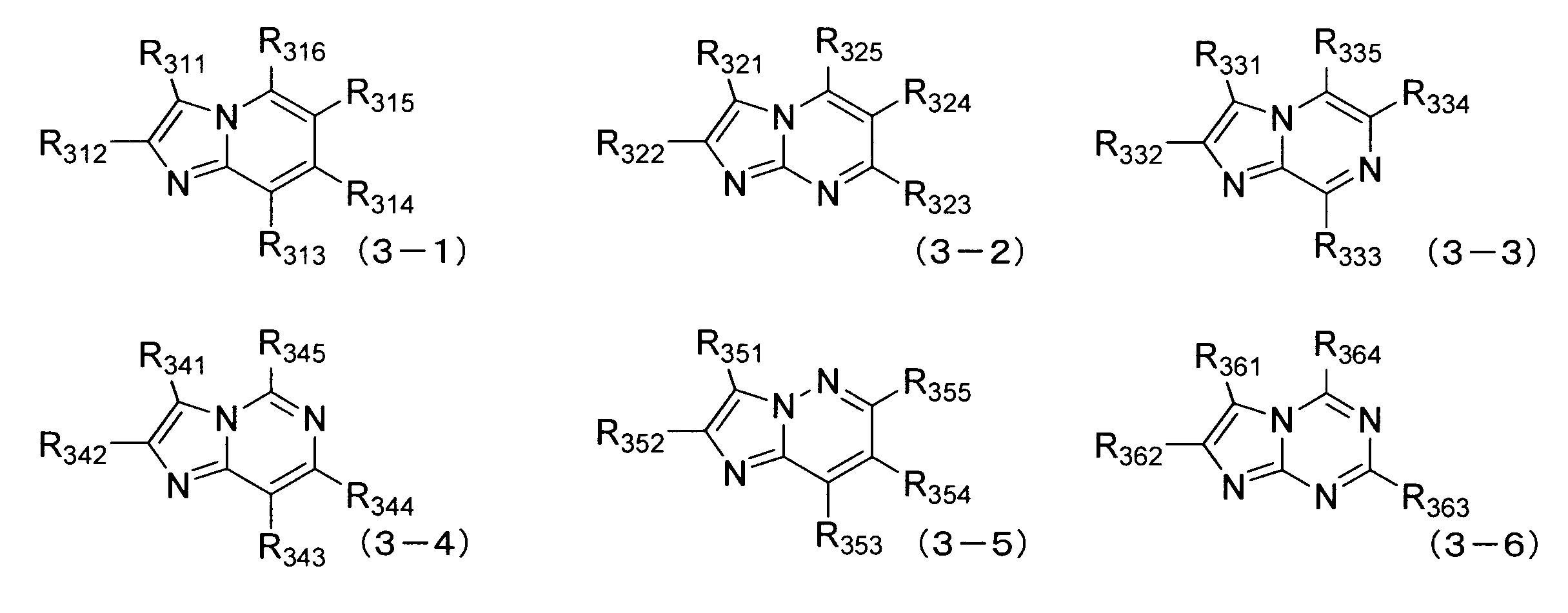
- HAr represented by the formula (3) is preferably any of the following nitrogen-containing heterocyclic groups.
- R 311 to R 316 , R 321 to R 325 , R 331 to R 335 , R 341 to R 345 , R 351 to R 355 , R 361 to R 364 are each independently a hydrogen atom, a halogen atom, Substituted or unsubstituted alkyl group having 1 to 10 carbon atoms, substituted or unsubstituted cycloalkyl group having 3 to 8 ring carbon atoms, substituted silyl group having 3 to 30 carbon atoms, cyano group, substituted or unsubstituted carbon An alkoxy group having 1 to 20 carbon atoms, a substituted or unsubstituted aryloxy group having 6 to 20 ring carbon atoms, a substituted or unsubstituted alkylthio group having 1 to 20 carbon atoms, a substituted or unsubstituted
- the R 311 R 316 Any one of R 321 to R 325 , R 331 to R 335 , R 341 to R 345 , R 351 to R 355 , R 361 to R 364 is a single bond that binds to L).
- HAr represented by the formula (4) is preferably any of the following nitrogen-containing heterocyclic groups.
- R 411 to R 418 , R 421 to R 428 , R 431 to R 438 , R 441 to R 448 , R 451 to R 458 , and R 461 to R 468 are each independently a hydrogen atom, a halogen atom, Substituted or unsubstituted alkyl group having 1 to 10 carbon atoms, substituted or unsubstituted cycloalkyl group having 3 to 8 ring carbon atoms, substituted silyl group having 3 to 30 carbon atoms, cyano group, substituted or unsubstituted carbon An alkoxy group having 1 to 20 carbon atoms, a substituted or unsubstituted aryloxy group having 6 to 20 carbon atoms, a substituted or unsubstituted alkylthio group having 1 to 20 carbon atoms, a substituted or unsubstituted
- the R 411 R 418 Any one of R 421 to R 428 , R 431 to R 438 , R 441 to R 448 , R 451 to R 458 , and R 461 to R 468 is a single bond that binds to L).
- HAr represented by the formula (4) preferably has a structure represented by (4-1). In the structure of (4-1), the nitrogen atoms of the two pyridine rings are close to each other.
- HAr represented by the formula (5) is preferably any of the following nitrogen-containing heterocyclic groups.
- R 511 to R 516 , R 521 to R 526 , R ′ 1 to R ′ 4 are each independently a hydrogen atom, a halogen atom, a substituted or unsubstituted alkyl group having 1 to 10 carbon atoms, a substituted or Unsubstituted cycloalkyl group having 3 to 8 carbon atoms, substituted silyl group having 3 to 30 carbon atoms, cyano group, substituted or unsubstituted alkoxy group having 1 to 20 carbon atoms, substituted or unsubstituted ring forming carbon An aryloxy group having 6 to 20 carbon atoms, a substituted or unsubstituted alkylthio group having 1 to 20 carbon atoms, a substituted or unsubstituted arylthio group having 6 to 30 carbon atoms, a substituted or unsubstitute
- R ′ is independently a hydrogen atom, a halogen atom, Substituted or unsubstituted alkyl group having 1 to 10 carbon atoms, substituted or unsubstituted cycloalkyl group having 3 to 8 ring carbon atoms, substituted silyl group having 3 to 30 carbon atoms, cyano group, substituted or unsubstituted carbon An alkoxy group having 1 to 20 carbon atoms, a substituted or unsubstituted aryloxy group having 6 to 20 carbon atoms, a substituted or unsubstituted alkylthio group having 1 to 20 carbon atoms, an amino group, a substituted or unsubstituted carbon atom of 1 A mono- or dialkylamino group of ⁇ 20, a substituted or unsubstituted aryl group having 6 to 30 ring carbon atoms, or a substituted or unsubstituted heterocyclic group having 5 to 30 ring atoms.
- ring group includes one or more rings selected from a furan ring and a pyran ring, and a substituted or unsubstituted benzene ring, pyridine ring, pyrimidine ring, pyrazine ring, pyridazine ring in a structure including the oxygen-containing ring.
- Ar 1 is preferably a condensed ring having one or more rings selected from a furan ring and a pyran ring, and having a structure in which a benzene ring is condensed to a structure containing the oxygen-containing ring and a total of four or more rings are condensed.
- a fused group having 1 or 2 rings selected from a furan ring and a pyran ring, and having a structure in which a benzene ring is condensed to a structure containing the oxygen-containing ring and 4 or more rings are condensed. It is a cyclic group.
- the “fused ring” is a polycyclic ring in which adjacent rings share two atoms.
- a ring structure in which four or more rings of Ar 1 are condensed has high planarity. If the organic EL material has a structure with high planarity, the overlap between molecules increases, the distance between the molecules decreases, and the charge transport property can be improved. Conceivable.
- a condensed ring structure having an oxygen-containing ring has a high triplet energy. Since the compound having a condensed ring having an oxygen-containing ring has a large triplet energy, the TTF phenomenon can be promoted by using it as a material for a barrier layer in contact with the light emitting layer of the organic EL element, for example. From this viewpoint, it is more preferable that the oxygen-containing condensed ring structure of Ar 1 does not include an anthracene structure in which three benzene rings are linearly condensed as a partial structure.
- Ar 1 is a condensed ring group in which four or more rings having one or more furan rings are condensed
- the following condensed ring groups are exemplified.
- Ar represents a substituted or unsubstituted benzene ring, pyridine ring, pyrimidine ring, pyrazine ring or pyridazine ring, respectively, and each forms a condensed ring with an adjacent ring. May further form a condensed ring structure with a benzene ring, pyridine ring, pyrimidine ring, pyrazine ring or pyridazine ring.
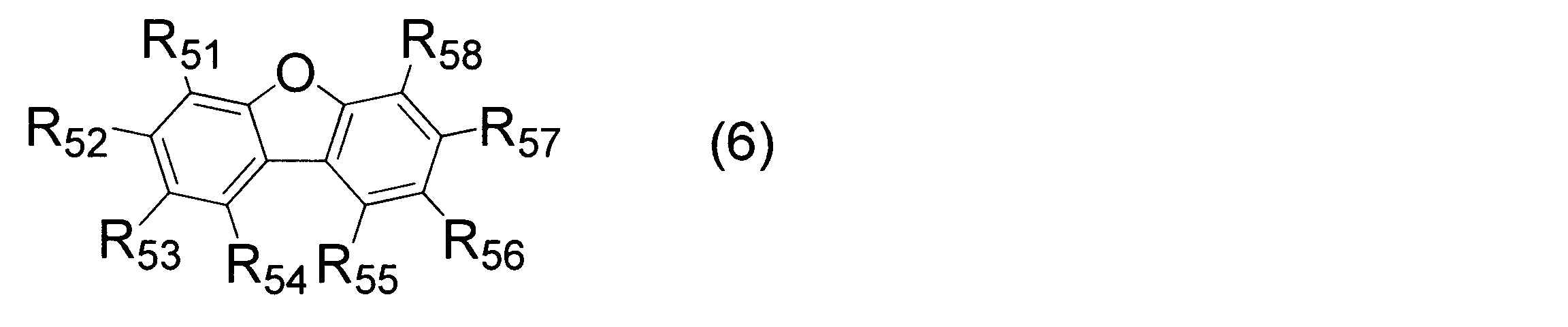
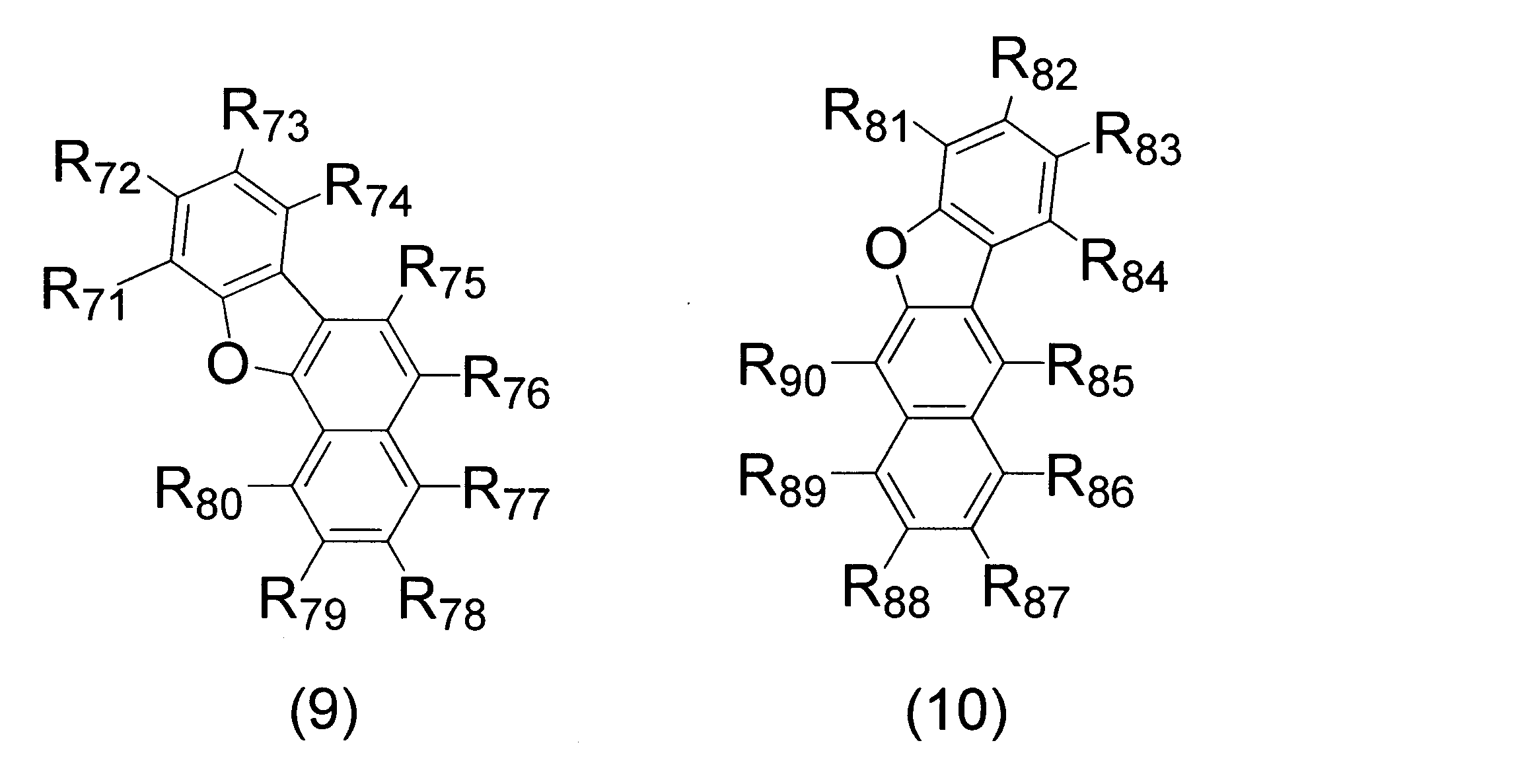
- the condensed ring group having a furan ring is preferably a condensed ring group represented by the following formula (6), more preferably represented by any one of the following formulas (9) to (10) having one furan ring. Or a condensed ring group represented by any one of the following formulas (11) to (14) having two furan rings.
- R 51 to R 58 are each independently a hydrogen atom, a halogen atom, a substituted or unsubstituted alkyl group having 1 to 10 carbon atoms, or a substituted or unsubstituted cycloalkyl having 3 to 8 ring carbon atoms.
- R 51 and R 52 , R 52 and R 53 , R 53 and R 54 , R 54 and R 55 , R 55 and R 56 , R 56 and R 57 , or R 57 and R 58 is Are bonded to each other in the form represented by the following formula (7) or (8) to form a ring.
- R 61 to R 68 are each independently a hydrogen atom, a halogen atom, a substituted or unsubstituted alkyl group having 1 to 10 carbon atoms, or a substituted or unsubstituted cycloalkyl group having 3 to 8 ring carbon atoms.
- any m of R 51 to R 68 is a single bond that bonds to L.
- R 71 to R 90 are each independently a hydrogen atom, a halogen atom, a substituted or unsubstituted alkyl group having 1 to 10 carbon atoms, or a substituted or unsubstituted cycloalkyl group having 3 to 8 ring carbon atoms.
- any m of R 71 to R 80 and any m of R 81 to R 90 are single bonds that
- R 91 to R 130 each independently represents a hydrogen atom, a halogen atom, a substituted or unsubstituted alkyl group having 1 to 10 carbon atoms, or a substituted or unsubstituted cycloalkyl group having 3 to 8 ring carbon atoms).
- the condensed ring group having a furan ring is particularly preferably a condensed ring group represented by any one of the following formulas (11) to (14) having two furan rings. Since the compound of the present invention having these fused ring groups has a larger triplet energy, it is considered that the ability to confine triplet excitons becomes higher. This is considered to be advantageous for causing the TTF phenomenon to be described later more efficiently and to be one factor for increasing the light emission efficiency of the organic EL element.
- Ar 1 is a condensed ring group in which four or more rings having one or more pyran rings are condensed
- the following condensed ring groups are exemplified.
- Ar represents a substituted or unsubstituted benzene ring, pyridine ring, pyrimidine ring, pyrazine ring or pyridazine ring, respectively, and forms a condensed ring with an adjacent ring.
- the ring may further form a condensed ring structure with a benzene ring, pyridine ring, pyrimidine ring, pyrazine ring or pyridazine ring.
- the condensed ring group having a pyran ring is preferably a condensed ring group represented by the following formula (15).
- R 131 to R 140 each independently represents a hydrogen atom, a halogen atom, a substituted or unsubstituted alkyl group having 1 to 10 carbon atoms, or a substituted or unsubstituted cycloalkyl group having 3 to 8 ring carbon atoms.
- any m of R 131 to R 140 is a single bond that bonds to L.
- the plurality of Ar 1 when n is 2 or more, the plurality of Ar 1 may be the same as or different from each other.
- the plurality of (L-HAr) s when m is 2 or more, the plurality of (L-HAr) s may be the same or different.
- the plurality of L and HAr when m is 2 or more, the plurality of L and HAr may be the same as or different from each other.
- the substituted silyl group having
- alkylsilyl group having 3 to 30 carbon atoms examples include a trimethylsilyl group, a triethylsilyl group, a t-butyldimethylsilyl group, a vinyldimethylsilyl group, and a propyldimethylsilyl group.
- the alkylsilyl group preferably has 3 to 20 carbon atoms, more preferably 3 to 10 carbon atoms, and particularly preferably 3 to 6 carbon atoms.
- Examples of the arylsilyl group having 8 to 30 ring carbon atoms include a triphenylsilyl group, a phenyldimethylsilyl group, a t-butyldiphenylsilyl group, a tolylsilylsilyl group, a trixylsilyl group, and a trinaphthylsilyl group.
- the number of ring-forming carbon atoms of the arylsilyl group is preferably 8-20, and particularly preferably 8-18.
- n + m valent aryl group having 6 to 30 ring carbon atoms of L examples include a divalent arylene group, such as a phenylene group, a naphthylene group, a biphenylene group, a terphenylene group, a picenylene group, a pyrenylene group, a fluorenylene group, Examples include a chrysenylene group.
- L is trivalent or more
- examples of the L include a residue corresponding to the divalent arylene group.
- n + m-valent heterocyclic group having 5 to 30 ring-forming atoms of L for example, in the case of a divalent heterocyclic group, a pyridinylene group, a pyrazinylene group, a pyrimidinylene group, a pyridazinylene group, a triazinylene group, an indylene group, a quinolinylene group , Acridinylene group, pyrrolidinylene group, dioxanylene group, piperidinylene group, morpholinylene group, piperazinylene group, carbazolylene group, furanylene group, thiophenylene group, oxazolylene group, oxadiazolylene group, benzooxazolylene group, thiazolylene group , Benzothiazolylene group, triazolylene group, imidazolylene group, benzimidazolylene group, imidazolpyridinylene group, benzofuranylene
- unsubstituted means that a hydrogen atom is substituted.
- the hydrogen atom of the oxygen-containing fused ring derivative of the present invention includes light hydrogen and deuterium.
- the oxygen-containing fused ring derivative of the present invention is preferably used as a material for an organic EL device, and more preferably used as a barrier material for an organic EL device. Since the compound having the structure represented by formulas (9) to (15), which is the basic skeleton of the oxygen-containing fused ring derivative of the present invention, has high triplet energy and high confinement effect of triplet excitons, By using it as a material for the barrier layer in contact with the light emitting layer of the organic EL element, the TTF phenomenon can be promoted.
- the oxygen-containing fused ring structure which is the basic skeleton of the oxygen-containing fused ring derivative of the present invention, is characterized by improved molecular stacking in a thin film and high electron transport properties due to its high planarity.
- the electron injection into the light emitting layer is promoted, the recombination efficiency in the light emitting layer is increased, and the TTF phenomenon can be efficiently caused.
- the TTF phenomenon has been confirmed when the site having the lowest triplet energy among the compounds used for the barrier layer is a hydrocarbon condensed ring group. Further, as in the oxygen-containing condensed ring derivative of the present invention, It was found that the TTF phenomenon can be efficiently caused even when the heterocyclic moiety has the lowest triplet energy.
- the oxygen-containing fused ring derivative of the present invention includes a nitrogen-containing heterocycle having a high electron-injecting property from a metal-containing layer such as an electrode, an organic EL device with a low driving voltage can be formed without further stacking an electron-injecting layer. Can be realized.
- the TTF phenomenon will be briefly described below.
- a voltage is applied to the organic EL element, electrons and holes are injected from the anode and the cathode, and the injected electrons and holes are recombined in the light emitting layer to generate excitons.
- the spin state is 25% for singlet excitons and 75% for triplet excitons.
- Conventionally known fluorescent elements emit light when singlet excitons relax to the ground state, but the remaining triplet excitons enter the ground state through thermal deactivation without emitting light.
- S.M. M.M. According to Bachilo et al. (J. Phys. Chem.
- the TTF phenomenon is a phenomenon in which singlet excitons are generated by collisional fusion of triplet excitons. If this TTF phenomenon is used, not only the 25% singlet excitons that are initially generated, but also triplet excitons Singlet excitons generated by collision fusion can also be used for light emission, and the light emission efficiency of the device can be increased.
- the barrier layer containing the oxygen-containing fused ring derivative of the present invention is adjacent to the light emitting layer of the fluorescent element.
- a fluorescent element caused by singlet excitons having a short exciton lifetime it is common not to use a barrier layer that causes process up, but a barrier comprising the oxygen-containing fused ring derivative of the present invention.
- the oxygen-containing fused ring derivative of the present invention has a high triplet energy, the function of the barrier layer can be exhibited even in a conventional phosphorescent device, and diffusion of the triplet energy can be prevented.
- the term “barrier layer” means a layer having a barrier function against triplet energy, and its function is different from that of a hole barrier layer or a charge barrier layer.
- the barrier layer containing the oxygen-containing fused ring derivative of the present invention preferably further contains an electron donating dopant.
- the electron donating dopant is preferably an alkali metal, alkaline earth metal, rare earth metal, alkali metal oxide, alkali metal halide, alkaline earth metal oxide, alkaline earth metal halide, rare earth metal And one or more selected from the group consisting of oxides of rare earth metals, halides of rare earth metals, organic complexes of alkali metals, organic complexes of alkaline earth metals, and organic complexes of rare earth metals.
- rubrene, anthracene, tetracene, pyrene, perylene and the like can be used, preferably an anthracene derivative, and more preferably an anthracene derivative represented by the following formula (16).
- Ar 11 and Ar 12 are each a substituted or unsubstituted aryl group having 6 to 30 ring carbon atoms or a substituted or unsubstituted heterocyclic group having 5 to 30 ring atoms.
- R 201 to R 208 are each a hydrogen atom, a fluorine atom, a substituted or unsubstituted alkyl group having 1 to 10 carbon atoms, a substituted or unsubstituted cycloalkyl group having 3 to 10 carbon atoms, or a substituted or unsubstituted carbon number.
- the aryl group and heterocyclic group of Ar 11 and Ar 12, the aryl group of R 201 to R 208 , the heterocyclic group, the alkyl group, the cycloalkyl group, the alkylsilyl group, the arylsilyl group, the alkoxy group, and the aryloxy group are respectively This is the same as the description of each group in the above paragraphs 0027 to 0033. )
- the light emitting layer containing the anthracene derivative represented by the formula (16) is preferably in contact with the barrier layer containing the oxygen-containing fused ring derivative of the present invention.
- the light emission efficiency can be increased by utilizing the TTF phenomenon.
- the triplet energy of the compound constituting the barrier layer comprising the oxygen-containing fused ring derivative of the present invention must be higher than the triplet energy of the host mainly constituting the light emitting layer.
- the host and dopant contained in the oxygen-containing fused ring derivative of the present invention and the light emitting layer satisfy the following formulas (1) and (2).
- E T h, E T b and E T d represent the triplet energy of the host material, the oxygen-containing fused ring derivative of the barrier layer, and the dopant, respectively.
- FIG. 1 is a schematic configuration diagram of an organic EL element showing an example of the first embodiment of the present invention.
- FIG. 2A schematically shows the lowest excited singlet energy level and the lowest excited triplet energy level of each layer.
- the triplet energy means a difference between the energy in the lowest excited triplet state and the energy in the ground state
- the singlet energy (sometimes referred to as an energy gap) is the energy in the lowest excited singlet state and the ground state. This is the difference in energy.
- the organic EL element shown in FIG. 1 is laminated in order of the hole transport zone 50, the light emitting layer 20, the electron transport zone 30, and the cathode 40 in order from the anode 10.
- a hole transport zone 50 is preferably provided between the anode 10 and the light emitting layer 20.
- the electron transport zone has a configuration including only a barrier layer.
- the embodiment with only the barrier layer does not prevent the insertion of the electron injection layer having a higher injection property.
- the general compound conventionally used as an electron injection layer can be used, and a hetero ring-containing compound is preferable.
- FIG. 2A holes injected from the anode are injected into the light emitting layer through the hole transport band, and electrons injected from the cathode are injected into the light emitting layer through the electron transport band. Thereafter, holes and electrons are recombined in the light emitting layer, and singlet excitons and triplet excitons are generated.
- the triplet energies of the host and dopant are E T h and E T d, respectively, it is preferable that the relationship E T h ⁇ E T d is satisfied.
- FIG. 2B triplet excitons generated by recombination on the host do not migrate to a dopant having a higher triplet energy.
- Triplet excitons generated by recombination on the dopant molecule quickly transfer energy to the host molecule. That is, the triplet excitons collide with each other on the host efficiently by the TTF phenomenon without the host triplet excitons moving to the dopant, thereby generating singlet excitons. Furthermore, since the singlet energy E S d of the dopant is smaller than the singlet energy E S h of the host, the singlet excitons generated by the TTF phenomenon transfer energy from the host to the dopant and contribute to the fluorescence emission of the dopant. To do. Originally, in a dopant used in a fluorescent element, a transition from an excited triplet state to a ground state is forbidden.
- the triplet exciton does not undergo optical energy deactivation and is thermally depleted. It was alive.
- the relationship between the triplet energy of the host and the dopant as described above singlet excitons are efficiently generated by collision with each other before the triplet excitons are thermally deactivated, and the luminous efficiency is increased. Will improve.
- a barrier layer is provided adjacent to the light emitting layer.
- the barrier layer prevents the triplet excitons generated in the light emitting layer from diffusing into the electron transport band, and increases the density of the triplet excitons by confining the triplet excitons in the light emitting layer, thereby improving the efficiency of the TTF phenomenon. Has the function to cause well.
- the triplet energy E T b of the compound constituting the barrier layer is preferably larger than E T h and more preferably larger than E T d.
- the barrier layer prevents triplet excitons generated in the light-emitting layer from diffusing into the electron transport band, so that the host triplet excitons efficiently become singlet excitons in the light-emitting layer.
- the exciton moves onto the dopant and is optically deactivated.
- the material forming the barrier layer is the oxygen-containing fused ring derivative of the present invention.
- the barrier layer containing the oxygen-containing fused ring derivative of the present invention can also play a role of an electron injection / transport function.
- the unshared electron pair mediates transfer of electrons from the adjacent layer.
- the electrons injected into the barrier material are more likely to donate electrons through the electron transport structure site. That is, by moving to a structural part having a high LUMO level, it contributes to electron injection into the light emitting layer.
- a low work function metal-containing layer may be provided between the electron transport zone and the cathode.
- the low work function metal-containing layer is a layer containing a low work function metal or a low work function metal compound. Even if it is formed of only a low work function metal or a low work metal compound, it is formed by adding a low work function metal, a low work function metal compound, or a low work function metal complex as a donor to the material used for the electron transport layer. May be.
- a low work function metal means a metal having a work function of 3.8 eV or less. Examples of the metal having a low work function of 3.8 eV or less include alkali metals and alkaline earth metals. Examples of the alkali metal include Li, Na, K, and Cs.
- alkaline earth metal examples include Mg, Ca, Sr, and Ba. Other examples include Yb, Eu and Ce.
- the oxide, halide, carbonate, borate of a low work metal function is preferable.
- Halides include fluoride, chloride and bromide, with fluoride being preferred.
- LiF is preferably used.
- the low work function metal complex is a low work function metal complex, and an alkali metal, alkaline earth metal, or rare earth metal organometallic complex is preferable.
- the efficiency using the TTF phenomenon is remarkable in the blue fluorescent layer.
- a blue fluorescent element main peak wavelength is 500 nm or less
- a high luminous efficiency improvement effect can be obtained by using the compound of the present invention as a barrier material.
- the phosphorescent light emitting layer an effect of confining triplet energy in the light emitting layer can be obtained, diffusion of the triplet energy can be prevented, and the emission efficiency of the phosphorescent dopant can be improved.
- Synthesis example 1 (A) Synthesis of benzo [b] naphtho [2,1-d] furan-5-boronic acid According to the following scheme, benzo [b] naphtho [2,1-d] furan-5-boronic acid was synthesized.
- the obtained residue was purified by silica gel chromatography, and the obtained residue was dispersed and washed with a mixed solution of hexane-ethyl acetate and dried to give 3.26 g of 4-methoxybenzo [kl] xanthene as a yellow solid (yield) 33%).
- the produced precipitate was collected by filtration, washed with water and dichloromethane, and dried to obtain 4-hydroxybenzo [kl] xanthene crystals (2.35 g).
- the filtrate was separated, and the aqueous layer was extracted with dichloromethane.
- the organic layers were combined, dried over anhydrous sodium sulfate, filtered and concentrated.
- the obtained residue was dispersed and washed with a small amount of dichloromethane and dried to obtain 4-hydroxybenzo [kl] xanthene crystals (0.53 g). Together, the yield was 2.88 g and the yield was 94%.
- the reaction mixture was cooled to room temperature, water was added and the mixture was stirred for 30 minutes, ethyl acetate and hexane were added, and the mixture was further stirred for 30 minutes.
- the produced solid was collected by filtration, washed with water, methanol, and hexane, and then dried under reduced pressure.
- the obtained solid was further dispersed and washed with a hexane-ethyl acetate mixed solution, then purified by silica gel chromatography, and dispersed and washed in hot toluene to obtain 3.01 g of a white solid.
- the yield was 72%.
- the obtained solid was purified by silica gel chromatography to obtain 4.42 g of a white solid.
- the yield was 97%.
- the produced solid was collected by filtration, washed with water, methanol and hexane, and dried under reduced pressure.
- the obtained solid was purified by silica gel chromatography and dispersed and washed in ethyl acetate to obtain 1.67 g of a white solid.
- Example 4 Synthesis of Compound 4 2- (3-Bromophenyl) -imidazo [1,2-a] synthesized in Synthesis Example 4 instead of 1- (4-bromophenyl) -2-phenyl-1H-benz [d] imidazole
- the reaction was performed in the same manner as in Example 2 except that pyridine was used.
- the phosphorescence measurement sample was cooled to 77 (K), the excitation light was irradiated onto the phosphorescence measurement sample, and the phosphorescence intensity was measured while changing the wavelength.
- the intensity and the horizontal axis are wavelength.
- a tangent line was drawn with respect to the rising edge of the phosphorescence spectrum on the short wavelength side, and the wavelength value ⁇ ph (nm) at the intersection of the tangent line and the horizontal axis was obtained.
- the tangent to the rising edge on the short wavelength side of the phosphorescence spectrum is drawn as follows. When moving on the spectrum curve from the short wavelength side of the phosphorescence spectrum to the maximum value on the shortest wavelength side among the maximum values of the spectrum, tangents at each point on the curve are considered toward the long wavelength side. The slope of this tangent line increases as the curve rises (that is, as the vertical axis increases). The tangent drawn at the point where the value of the slope takes the maximum value is the tangent to the rising edge of the phosphorescence spectrum on the short wavelength side.
- the maximum point having a peak intensity of 10% or less of the maximum peak intensity of the spectrum is not included in the above-mentioned maximum value on the shortest wavelength side, and has the maximum slope value closest to the maximum value on the shortest wavelength side.
- the tangent drawn at the point where the value is taken is taken as the tangent to the rising edge of the phosphorescence spectrum on the short wavelength side.
- the measurement was performed by irradiating the material with light and measuring the amount of electrons generated by charge separation at that time.
- the emitted photoelectrons were plotted by the 1/2 power with respect to the energy of the irradiation light, and the threshold of the photoelectron emission energy was defined as the ionization potential (Ip).
- Ip ionization potential
- the absorption spectrum was measured using a commercially available visible / ultraviolet spectrophotometer, and calculated from the falling wavelength on the long wavelength side of the spectrum.
- ⁇ ab (unit: nm) means a wavelength value at the intersection of the tangent line and the horizontal axis with respect to the falling edge of the absorption spectrum on the long wavelength side.
- each compound was dissolved in toluene solvent (Sample 2 ⁇ 10 -5 mol / l), the optical path length was prepared a sample so that 1 cm. Absorbance was measured while changing the wavelength.
- the tangent to the falling edge of the absorption spectrum on the long wavelength side is drawn as follows. When moving on the spectrum curve in the long wavelength direction from the maximum value on the longest wavelength side among the maximum values of the absorption spectrum, the tangent at each point on the curve is considered. The tangent, as curve falls (i.e. as the vertical axis is decreased), repeats the inclination decreases then increases.
- the tangent drawn at the point where the slope value takes the minimum value on the long wavelength side (except when the absorbance is 0.1 or less) is taken as the tangent to the fall on the long wavelength side of the absorption spectrum.
- the value is 0.2 or less maxima absorbance is not included in the maximum value of the longest wavelength side.
- Example 5 The materials used for the organic EL element are as follows.
- a glass substrate with a transparent electrode line after washing is mounted on a substrate holder of a vacuum deposition apparatus, and first, a compound HT-1 having a film thickness of 50 nm is formed so as to cover the transparent electrode on the surface on which the transparent electrode line is formed. A film was formed.
- the HT-1 film functions as a hole injection layer.
- the compound HT-2 was vapor-deposited to form an HT-2 film having a thickness of 45 nm on the HT-1 film.
- the HT-2 film functions as a hole transport layer.
- Compound BH-1 (host material) and compound BD-1 (dopant material) were deposited on the HT-2 film at a film thickness ratio of 20: 1 to form a light emitting layer having a film thickness of 25 nm. Further, Compound 1 was deposited on the light emitting layer to form a 5 nm thick barrier layer.
- ET-1 which is an electron transport material was vapor-deposited to form an electron transport layer having a thickness of 20 nm on the light emitting layer. Thereafter, LiF was formed to a thickness of 1 nm.
- metal Al was deposited to a thickness of 150 nm to form a metal cathode, thereby forming an organic EL device.
- Examples 6, 7, 8 and 9 and Comparative Example 1 An organic EL device was prepared and evaluated in the same manner as in Example 5 except that a barrier layer was laminated using the compound shown in Table 2 instead of Compound 1 and the compound shown in Table 2 was used as the dopant material. The results are shown in Table 2.
- the BD-2 used in Example 8 and the compound ET-2 used in Comparative Example 1 are the following compounds.
- Example 10 A 25 mm ⁇ 75 mm ⁇ 1.1 mm thick glass substrate with ITO transparent electrode (anode) (manufactured by Geomatic) was ultrasonically cleaned in isopropyl alcohol for 5 minutes, and then UV ozone cleaning was performed for 30 minutes.
- a glass substrate with a transparent electrode line after washing is mounted on a substrate holder of a vacuum deposition apparatus, and first, a compound HT-1 having a film thickness of 50 nm is formed so as to cover the transparent electrode on the surface on which the transparent electrode line is formed. A film was formed.
- the HT-1 film functions as a hole injection layer.
- the compound HT-2 was vapor-deposited to form an HT-2 film having a thickness of 45 nm on the HT-1 film.
- the HT-2 film functions as a hole transport layer.
- Compound BH-1 (host material) and compound BD-2 (dopant material) were vapor-deposited on the HT-2 film at a film thickness ratio of 20: 1 to form a light-emitting layer having a film thickness of 25 nm.
- the compound 1 was vapor-deposited on the light emitting layer, and the electron carrying layer with a film thickness of 25 nm was formed. Thereafter, LiF was formed to a thickness of 1 nm.
- metal Al was deposited to a thickness of 150 nm to form a metal cathode, thereby forming an organic EL device.
- Example 11 An organic EL device was prepared and evaluated in the same manner as in Example 10 except that an electron transport layer was laminated using the compounds shown in Table 3 instead of Compound 1. The results are shown in Table 3.
- the compound of the present invention is used as a material for forming a single electron transport layer, a high luminous efficiency can be obtained as compared with a conventional electron transport material.
- the compound of the present invention has not only the effect of confining triplet excitons in the light-emitting layer due to the effect of the barrier material suggested as described above, but also a nitrogen-containing heterocyclic moiety having electron injection / transport properties. Since it is a compound having in the same molecule, it also functions as an electron transporting material.
- an electron transport zone having a barrier ability can be formed with a smaller number of layers.
- the organic EL device comprising the oxygen-containing fused ring derivative of the present invention can be used for a display panel or a lighting panel for a large-sized television where low power consumption is desired.
Landscapes
- Chemical & Material Sciences (AREA)
- Organic Chemistry (AREA)
- Engineering & Computer Science (AREA)
- Materials Engineering (AREA)
- Physics & Mathematics (AREA)
- Spectroscopy & Molecular Physics (AREA)
- Optics & Photonics (AREA)
- Electroluminescent Light Sources (AREA)
- Plural Heterocyclic Compounds (AREA)
- Heterocyclic Carbon Compounds Containing A Hetero Ring Having Oxygen Or Sulfur (AREA)
Abstract
Description
一方、蛍光型有機EL素子においても、三重項励起子に起因する発光が近年報告がされている(例えば、非特許文献1及び2、特許文献3)。
また、本発明の目的は、TTF現象を促進するために最適な障壁材料を提供することである。
1.下記式(1)で表される含酸素縮合環誘導体。

HArは、下記式(2)~(5)で表わされる含窒素複素環基のいずれかである。
n及びmは、それぞれ1~5の整数であり、n及びmの少なくとも一方は1である。
Lは、単結合、置換もしくは無置換の環形成炭素数6~30のn+1価のアリール基、置換もしくは無置換の環形成原子数5~30のn+1価の複素環基、又は置換もしくは無置換の環形成炭素数6~30のアリール基及び置換もしくは無置換の環形成原子数5~30の複素環基からなる群から選択される2つもしくは3つが単結合で連結してなるn+1価の基である。)

R31~R35のいずれか1つ及びR36~R40のいずれか1つは、式(4)の2つのピリジン環同士を結合する単結合である。
Xは、N又はCR13より選ばれ、R13は水素原子、ハロゲン原子、置換もしくは無置換の炭素数1~10のアルキル基、置換もしくは無置換の環形成炭素数3~8のシクロアルキル基、炭素数3~30の置換シリル基、シアノ基、置換もしくは無置換の炭素数1~20のアルコキシ基、置換もしくは無置換の環形成炭素数6~20のアリールオキシ基、置換もしくは無置換の炭素数1~20のアルキルチオ基、置換もしくは無置換の炭素数6~30のアリールチオ基、置換もしくは無置換の炭素数6~30のアリールアミノ基、置換もしくは無置換の炭素数1~20のモノもしくはジアルキルアミノ基、置換もしくは無置換の環形成炭素数6~30のアリール基、又は置換もしくは無置換の環形成原子数5~30の複素環基である。
R13が複数ある場合、それぞれのR13は同じでも異なっていてもよい。
Yは、N又はCR23より選ばれ、R23は水素原子、ハロゲン原子、置換もしくは無置換の炭素数1~10のアルキル基、置換もしくは無置換の環形成炭素数3~8のシクロアルキル基、炭素数3~30の置換シリル基、シアノ基、置換もしくは無置換の炭素数1~20のアルコキシ基、置換もしくは無置換の環形成炭素数6~20のアリールオキシ基、置換もしくは無置換の炭素数1~20のアルキルチオ基、置換もしくは無置換の炭素数6~30のアリールチオ基、置換もしくは無置換の炭素数6~30のアリールアミノ基、置換もしくは無置換の炭素数1~20のモノもしくはジアルキルアミノ基、置換もしくは無置換の環形成炭素数6~30のアリール基、又は置換もしくは無置換の環形成原子数5~30の複素環基である。
R23が複数ある場合、それぞれのR23は同じでも異なっていてもよい。
Zは架橋基であり、置換もしくは無置換のアルキレン基、又は置換もしくは無置換のアルケニレン基である。
R11~R13のいずれか1つ、R21~R23のいずれか1つ、R31~R40のいずれか1つ、及びR41~R46のいずれか1つはLと結合する単結合である。)
2.Ar1が下記式(6)で表わされる縮合環基である1に記載の含酸素縮合環誘導体。
R51とR52、R52とR53、R53とR54、R54とR55、R55とR56、R56とR57、またはR57とR58のうち少なくとも1組は、互いに下記式(7)又は(8)で表わされる形で結合して、環を形成する。)

また、R61~R68のいずれかm個は、Lと結合する単結合である。)
3.Ar1が下記式(9)又は(10)で表される縮合環基である1又は2に記載の含酸素縮合環誘導体。
また、R71~R80のいずれかm個及びR81~R90のいずれかm個はLと結合する単結合である。)
4.Ar1が下記式(11)、(12)、(13)又は(14)で表される縮合環基である1又は2に記載の含酸素縮合環誘導体。

また、R91~R100のいずれかm個、R101~R110のいずれかm個、R111~R120のいずれかm個及びR121~R130のいずれかm個はLと結合する単結合である。)
5.Ar1が下記式(15)で表される縮合環基である1に記載の含酸素縮合環誘導体。

但し、R131~R140のいずれかm個はLと結合する単結合である。)
6.mが1であり、nが1である1~5のいずれかに記載の含酸素縮合環誘導体。
7.有機エレクトロルミネッセンス素子用材料である1~6のいずれかに記載の含酸素縮合環誘導体。
8.前記有機エレクトロルミネッセンス素子用材料が、障壁層材料である7に記載の含酸素縮合環誘導体。
9.陽極、発光層、障壁層、及び陰極をこの順に備え、
前記障壁層が1~6のいずれかに記載の含酸素縮合環誘導体を含有する有機エレクトロルミネッセンス素子。
10.前記障壁層と陰極との間に、電子注入層及び/又は電子輸送層を有し、前記電子注入層及び電子輸送層の少なくとも1層が含ヘテロ環誘導体を含有する9に記載の有機エレクトロルミネッセンス素子。
11.前記電子注入層及び/又は電子輸送層が、電子供与性ドーパントを含有する10に記載の有機エレクトロルミネッセンス素子。
12.前記電子供与性ドーパントが、アルカリ金属、アルカリ土類金属、希土類金属、アルカリ金属の酸化物、アルカリ金属のハロゲン化物、アルカリ土類金属の酸化物、アルカリ土類金属のハロゲン化物、希土類金属の酸化物、希土類金属のハロゲン化物、アルカリ金属の有機錯体、アルカリ土類金属の有機錯体及び希土類金属の有機錯体からなる群から選択される1種又は2種以上である11に記載の有機エレクトロルミネッセンス素子。
13.前記発光層が、下記式(16)で表されるアントラセン誘導体を含む9~12のいずれかに記載の有機エレクトロルミネッセンス素子。

R201~R208は、それぞれ水素原子、フッ素原子、置換もしくは無置換の炭素数1~10のアルキル基、置換もしくは無置換の環形成炭素数3~10のシクロアルキル基、置換もしくは無置換の炭素数3~30のアルキルシリル基、置換もしくは無置換の環形成炭素数8~30のアリールシリル基、置換もしくは無置換の炭素数1~20のアルコキシ基、置換もしくは無置換の環形成炭素数6~20のアリールオキシ基、置換もしくは無置換の環形成炭素数6~30のアリール基、又は置換もしくは無置換の環形成原子数5~30の複素環基である。)
14.前記式(16)で表されるアントラセン誘導体を含有する発光層が、前記含酸素縮合環誘導体を含有する障壁層と接している13に記載の有機エレクトロルミネッセンス素子。
15.前記発光層が、主ピーク波長が500nm以下の蛍光ドーパントを含有する9~14のいずれかに記載の有機エレクトロルミネッセンス素子。

HArは、下記式(2)~(5)で表わされる含窒素複素環基のいずれかである。
n及びmは、それぞれ1~5の整数であり、n及びmの少なくとも一方は1である。
Lは、単結合、置換もしくは無置換の環形成炭素数6~30のn+1価のアリール基、置換もしくは無置換の環形成原子数5~30のn+1価の複素環基、又は置換もしくは無置換の環形成炭素数6~30のアリール基及び置換もしくは無置換の環形成原子数5~30の複素環基からなる群から選択される2つもしくは3つが単結合で連結してなるn+1価の基である。)

R31~R35のいずれか1つ及びR36~R40のいずれか1つは、式(4)の2つのピリジン環同士を結合する単結合である。
Xは、N又はCR13より選ばれ、R13は水素原子、ハロゲン原子、置換もしくは無置換の炭素数1~10のアルキル基、置換もしくは無置換の環形成炭素数3~8のシクロアルキル基、炭素数3~30の置換シリル基、シアノ基、置換もしくは無置換の炭素数1~20のアルコキシ基、置換もしくは無置換の環形成炭素数6~20のアリールオキシ基、置換もしくは無置換の炭素数1~20のアルキルチオ基、置換もしくは無置換の炭素数6~30のアリールチオ基、置換もしくは無置換の炭素数6~30のアリールアミノ基、置換もしくは無置換の炭素数1~20のモノもしくはジアルキルアミノ基、置換もしくは無置換の環形成炭素数6~30のアリール基、又は置換もしくは無置換の環形成原子数5~30の複素環基である。
R13が複数ある場合、それぞれのR13は同じでも異なっていてもよい。
Yは、N又はCR23より選ばれ、R23は水素原子、ハロゲン原子、置換もしくは無置換の炭素数1~10のアルキル基、置換もしくは無置換の環形成炭素数3~8のシクロアルキル基、炭素数3~30の置換シリル基、シアノ基、置換もしくは無置換の炭素数1~20のアルコキシ基、置換もしくは無置換の環形成炭素数6~20のアリールオキシ基、置換もしくは無置換の炭素数1~20のアルキルチオ基、置換もしくは無置換の炭素数6~30のアリールチオ基、置換もしくは無置換の炭素数6~30のアリールアミノ基、置換もしくは無置換の炭素数1~20のモノもしくはジアルキルアミノ基、置換もしくは無置換の環形成炭素数6~30のアリール基、又は置換もしくは無置換の環形成原子数5~30の複素環基である。
R23が複数ある場合、それぞれのR23は同じでも異なっていてもよい。
Zは架橋基であり、置換もしくは無置換のアルキレン基、又は置換もしくは無置換のアルケニレン基である。
R11~R13のいずれか1つ、R21~R23のいずれか1つ、R31~R40のいずれか1つ、及びR41~R46のいずれか1つはLと結合する単結合である。)
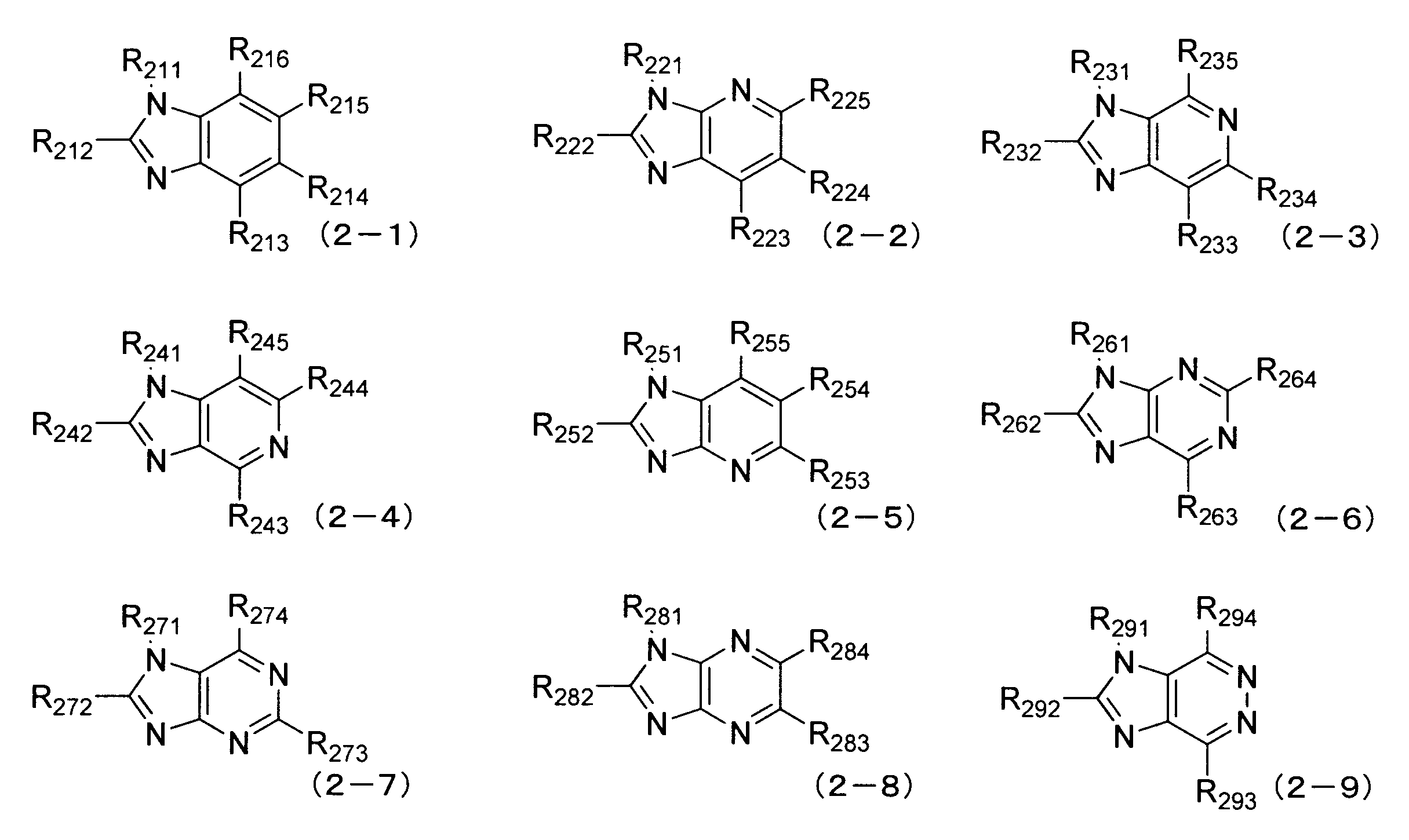
各複素環基において、R211からR216、R221からR225、R231からR235、R241からR245、R251からR255、R261からR264、R271からR274、R281からR284、R291からR294、のいずれか1つはLと結合する単結合である。)

式(4)で表されるHArは、好ましくは(4-1)で表される構造である。(4-1)の構造においては2つのピリジン環の窒素原子が近接した構造をとっている。この構造を有する材料にLi、Naなどに代表される金属イオンを有する電子供与性ドーパントを共蒸着させて用いる場合、(4-1)で表されるビピリジン構造の2つの窒素原子において金属原子または金属イオンに配位したキレート構造を形成することが出来るため、上記の電子供与性ドーパントとの反応性が高くなると考えられ、電子供与性ドーパントの効果をより効果的に得ることが出来ると考えられる。

Ar1は、好ましくはフラン環及びピラン環から選択される環を1以上有し、当該含酸素環を含む構造にベンゼン環が縮環して合計で4環以上縮環した構造を有する縮合環基であり、特に好ましくは、フラン環及びピラン環から選択される環を1もしくは2有し、当該含酸素環を含む構造にベンゼン環が縮環し、4環以上縮環した構造を有する縮合環基である。
尚、本明細書中「縮合環」とは、隣接した環同士が2個の原子を共有する多環系の環である。
また、含酸素環を有する縮合環構造は高い三重項エネルギーを有している。この含酸素環を有する縮合環を有する化合物は、三重項エネルギーが大きくなるため、例えば有機EL素子の発光層に接した障壁層の材料として利用することによって、TTF現象を促進させることができる。この観点から、Ar1の含酸素縮合環構造としてはベンゼン環3個が直線的に縮環したアントラセン構造を部分構造として含まないものであることがより好ましい。


また、R51とR52、R52とR53、R53とR54、R54とR55、R55とR56、R56とR57、またはR57とR58のうち少なくとも1組は、互いに下記式(7)又は(8)で表わされる形で結合して、環を形成する。

また、R51~R68のいずれかm個はLと結合する単結合である。)

また、R71~R80のいずれかm個及びR81~R90のいずれかm個はLと結合する単結合である。)
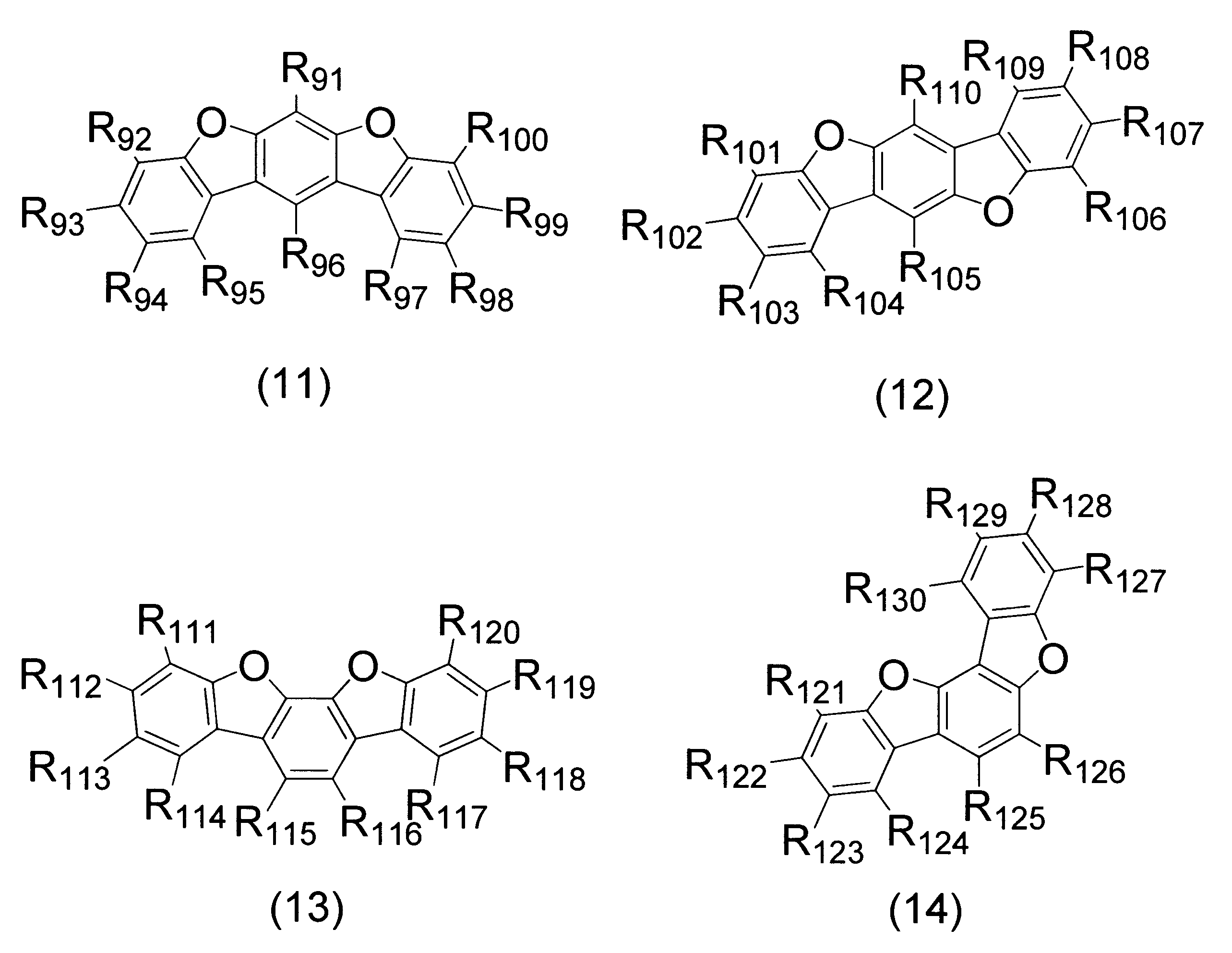
また、R91~R100のいずれかm個、R101~R110のいずれかm個、R111~R120のいずれかm個及びR121~R130のいずれかm個はLと結合する単結合である。)
上記のフラン環を有する縮合環基においては、フラン環を2つ有する下記式(11)~(14)のいずれかで表される縮合環基であることが特に好ましい。これらの縮合環基を有する本願化合物は、より大きな三重項エネルギーを有することから、より三重項励起子を閉じ込める能力が高くなると考えられる。このことは、後述するTTF現象をより効率よく起こすために有利に働き、有機EL素子の発光効率を高めるための一つの要因となると考えられる。

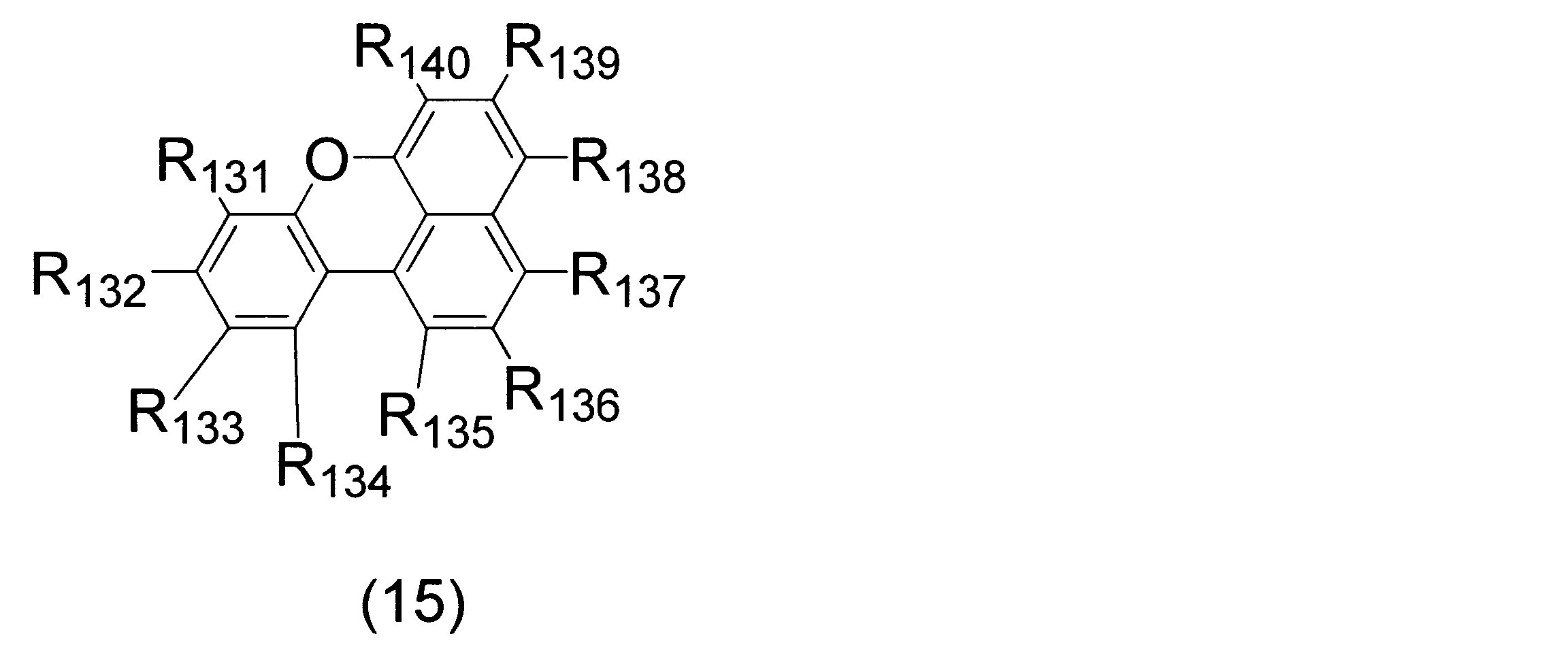
また、R131~R140のいずれかm個はLと結合する単結合である。)
式(1)のm及びnは、好ましくはm=n=1である。
R11、R12、R21、R22、R31~R40、R41~R46、R51~R58、R61~R68、R71~R90、R91~R130、R131~R140、R211からR216、R221からR225、R231からR235、R241からR245、R251からR255、R261からR264、R271からR274、R281からR284、R291からR294、R311からR316、R321からR325、R331からR335、R341からR345、R351からR355、R361からR364、R411からR418、R421からR428、R431からR438、R441からR448、R451からR458、R461からR468、R511からR516、R521からR526、及びR’1からR’4の環形成炭素数6~30のアリール基としては、フェニル基、ナフチル基、フェナントリル基、ビフェニル基、ターフェニル基、クリセニル基、ベンゾフェナントリル基、ベンズアントリル基、ベンゾクリセニル基、フルオレニル基、フルオランテニル基、ピレニル基、ベンゾフルオランテニル基、トリフェニレニル基等が挙げられる。前記アリール基の環形成炭素数は、6~20が好ましく、6~14が特に好ましい。
上記炭素数3~30のアルキルシリル基としては、トリメチルシリル基、トリエチルシリル基、t-ブチルジメチルシリル基、ビニルジメチルシリル基、プロピルジメチルシリル基等が挙げられる。前記アルキルシリル基の炭素数は、3~20が好ましく、3~10がより好ましく、3~6が特に好ましい。
上記環形成炭素数8~30のアリールシリル基としては、トリフェニルシリル基、フェニルジメチルシリル基、t-ブチルジフェニルシリル基、トリトリルシリル基、トリキシリルシリル基、トリナフチルシリル基等が挙げられる。前記アリールシリル基の環形成炭素数は、8~20が好ましく、8~18が特に好ましい。
Lが3価以上の場合、当該Lは、上記2価のアリーレン基に対応する残基が挙げられる。
Lが3価以上の場合、当該Lは、上記2価の複素環基に対応する残基が挙げられる。
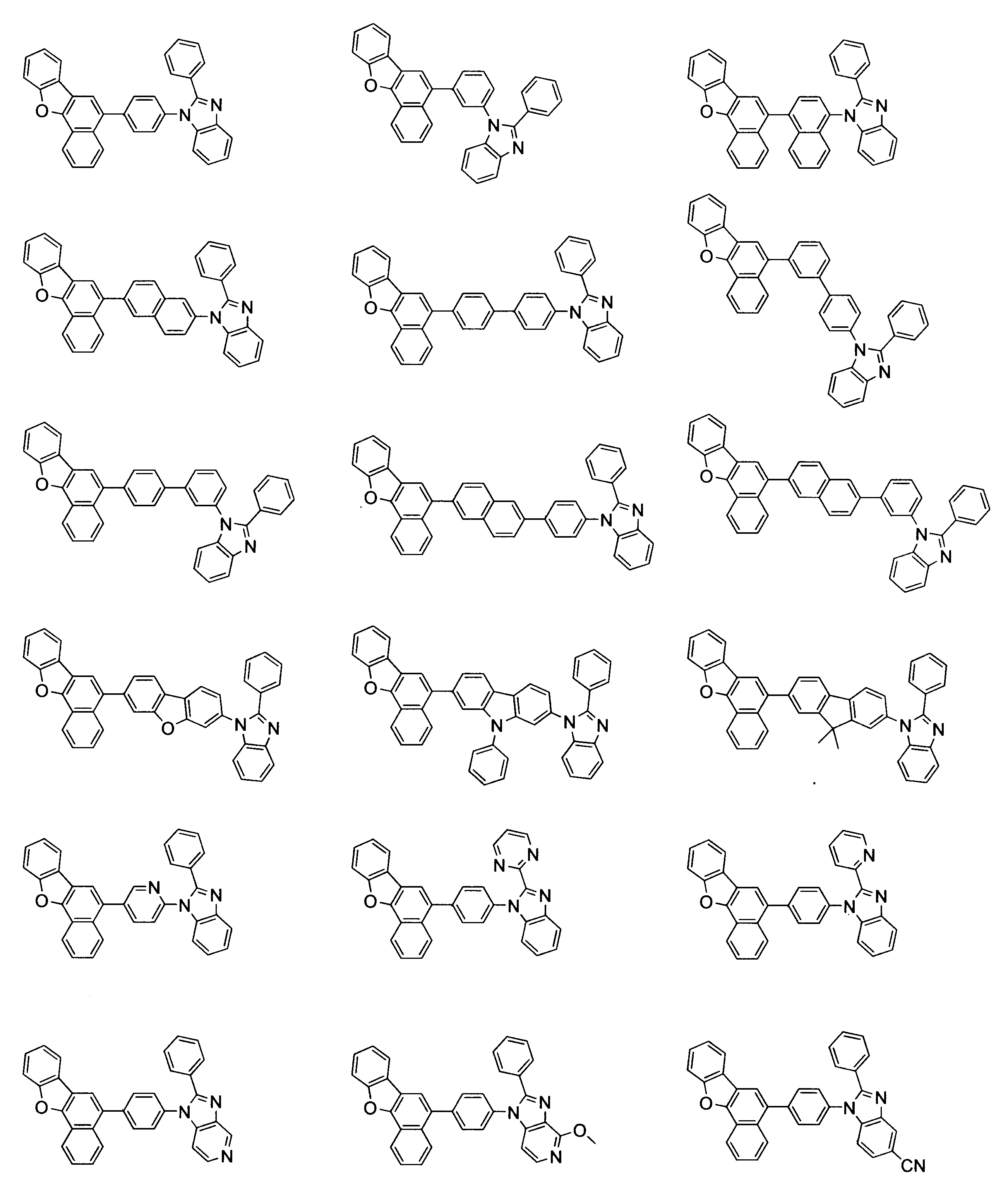


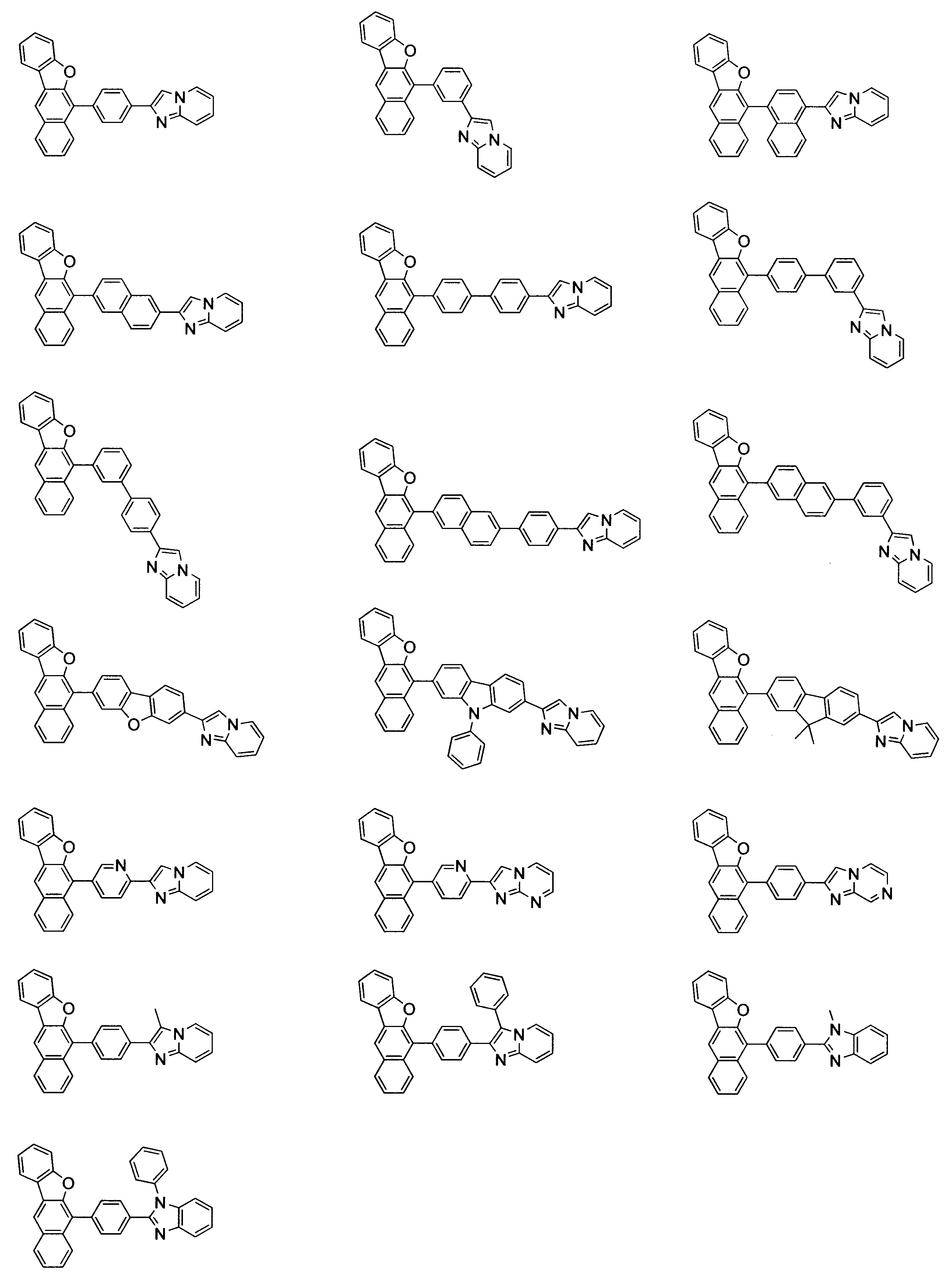

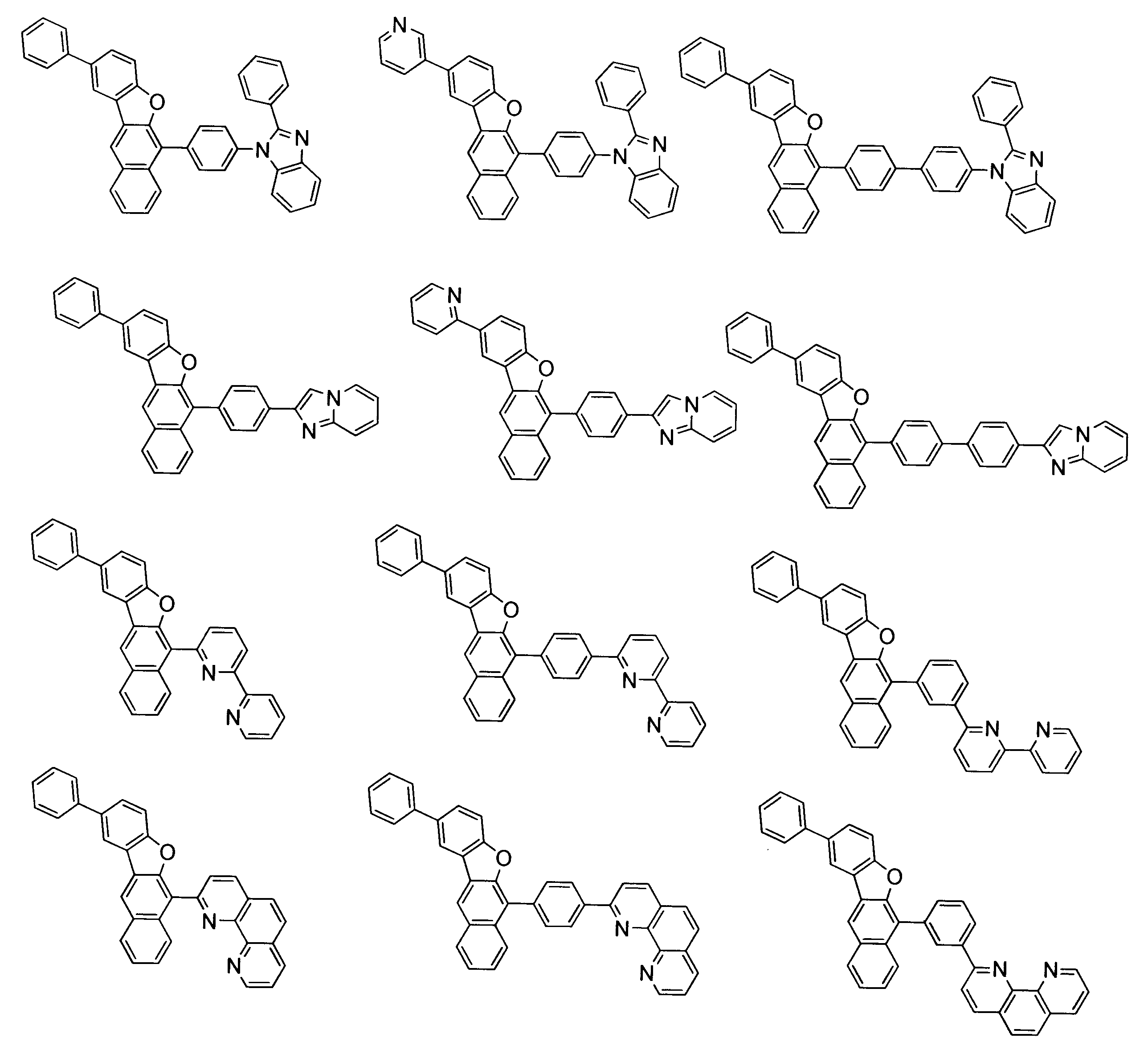


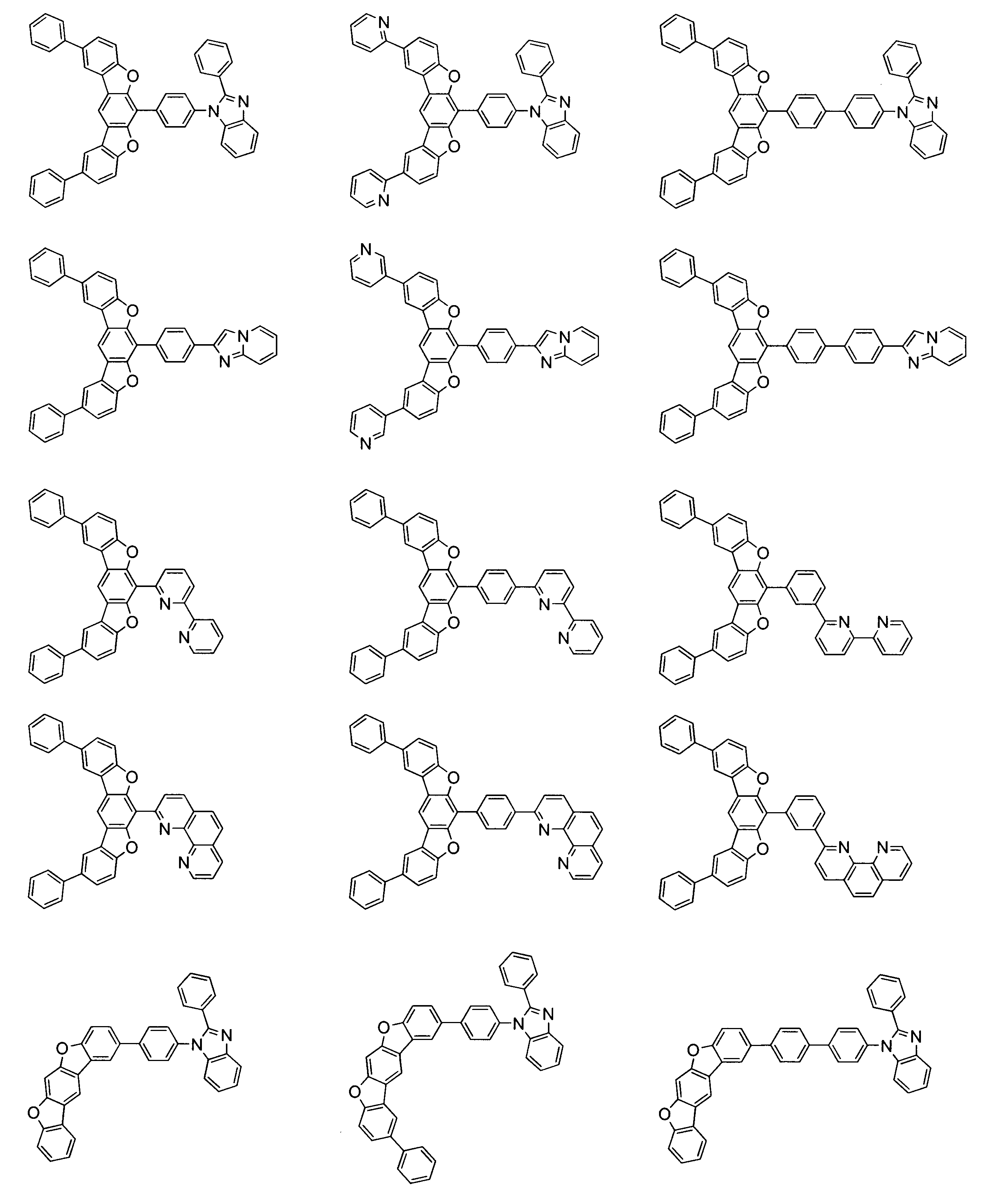


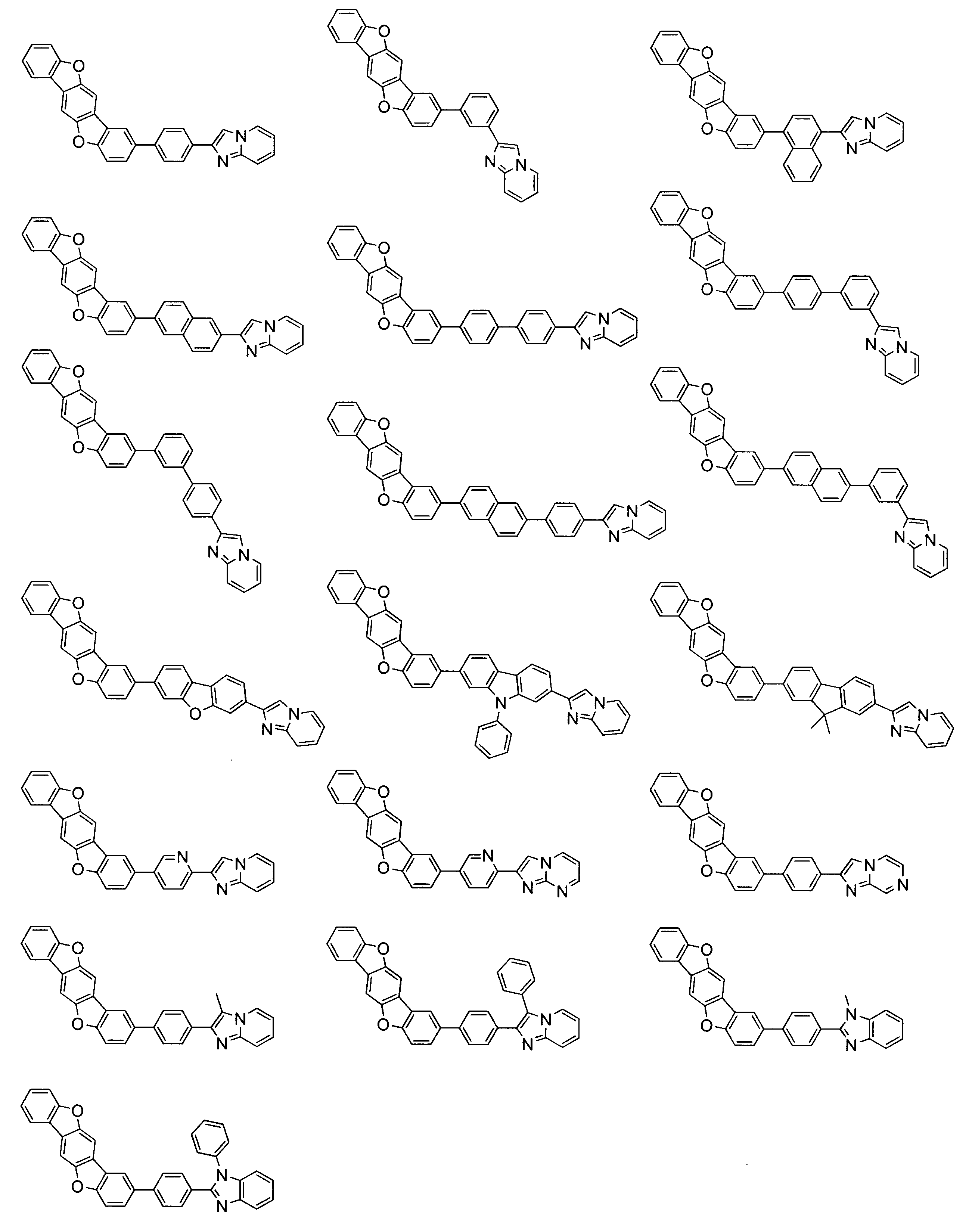


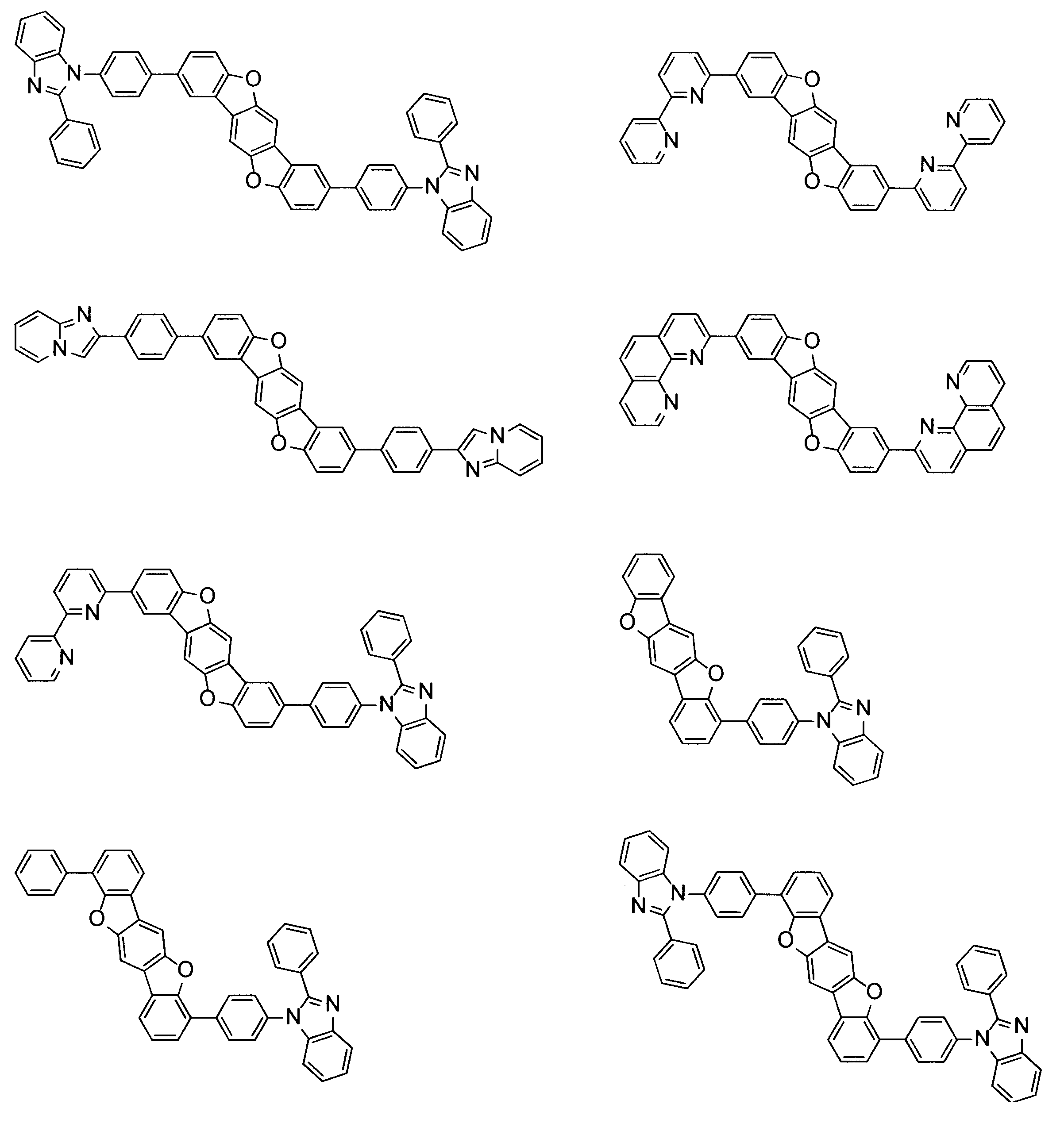


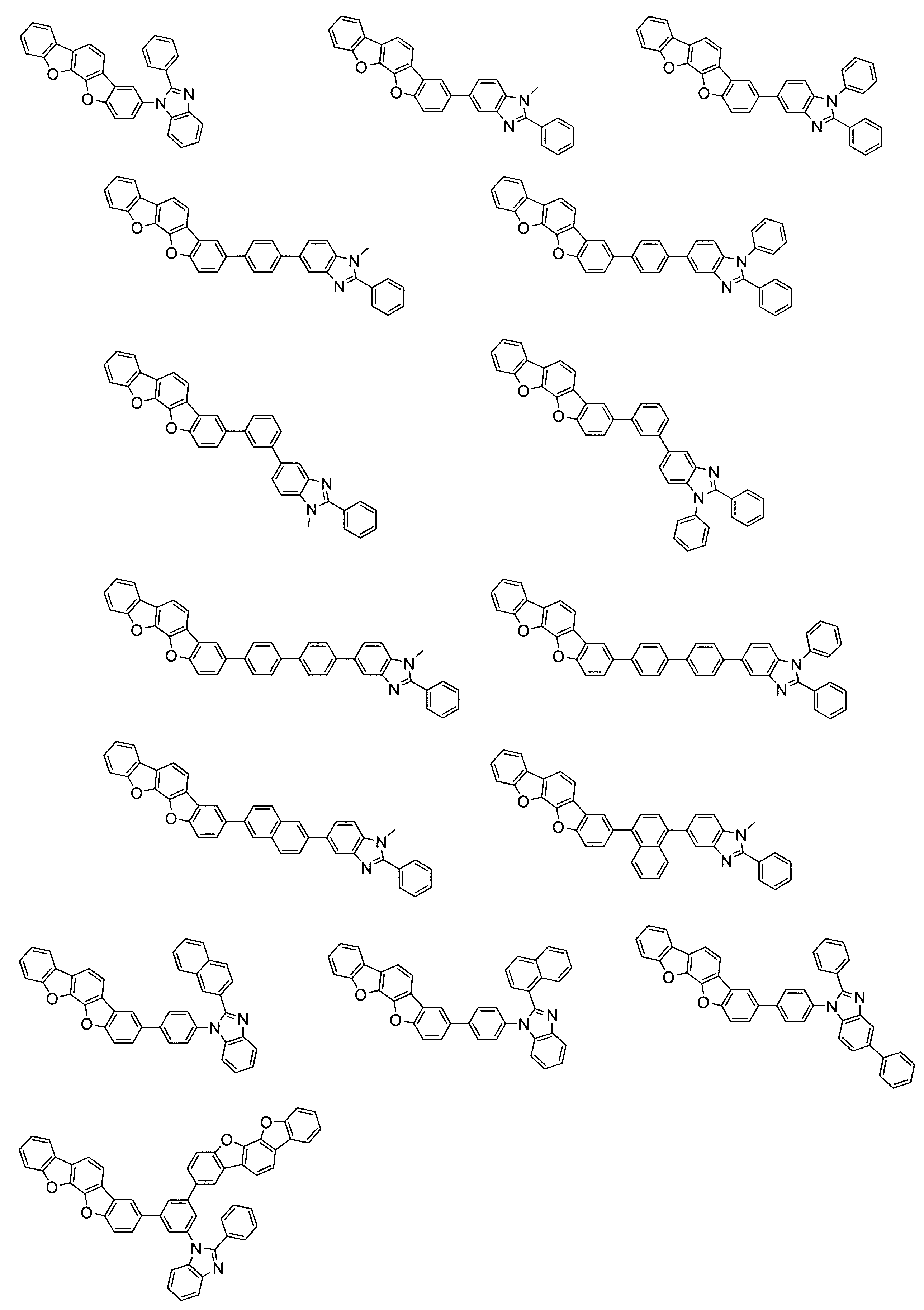


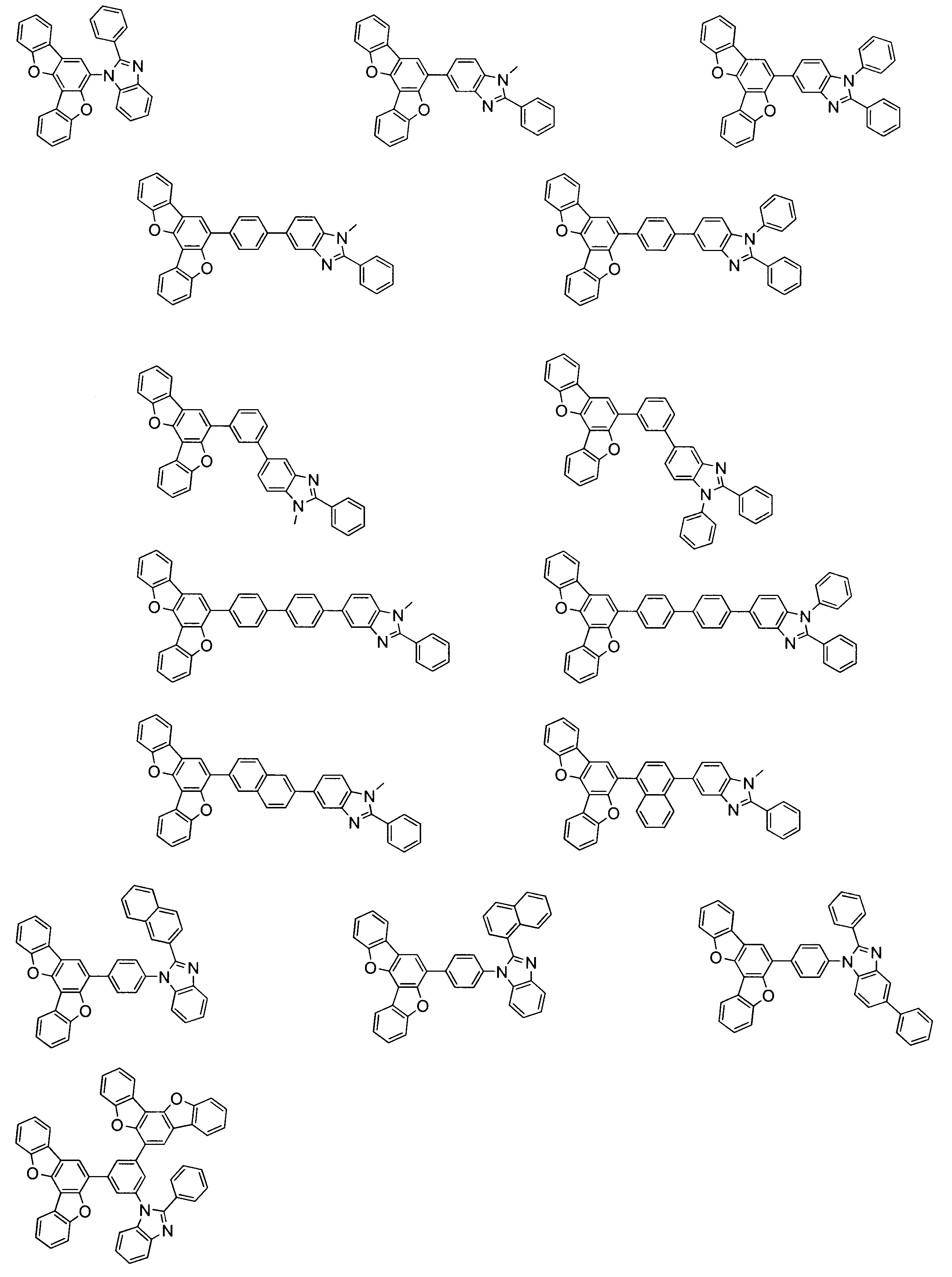

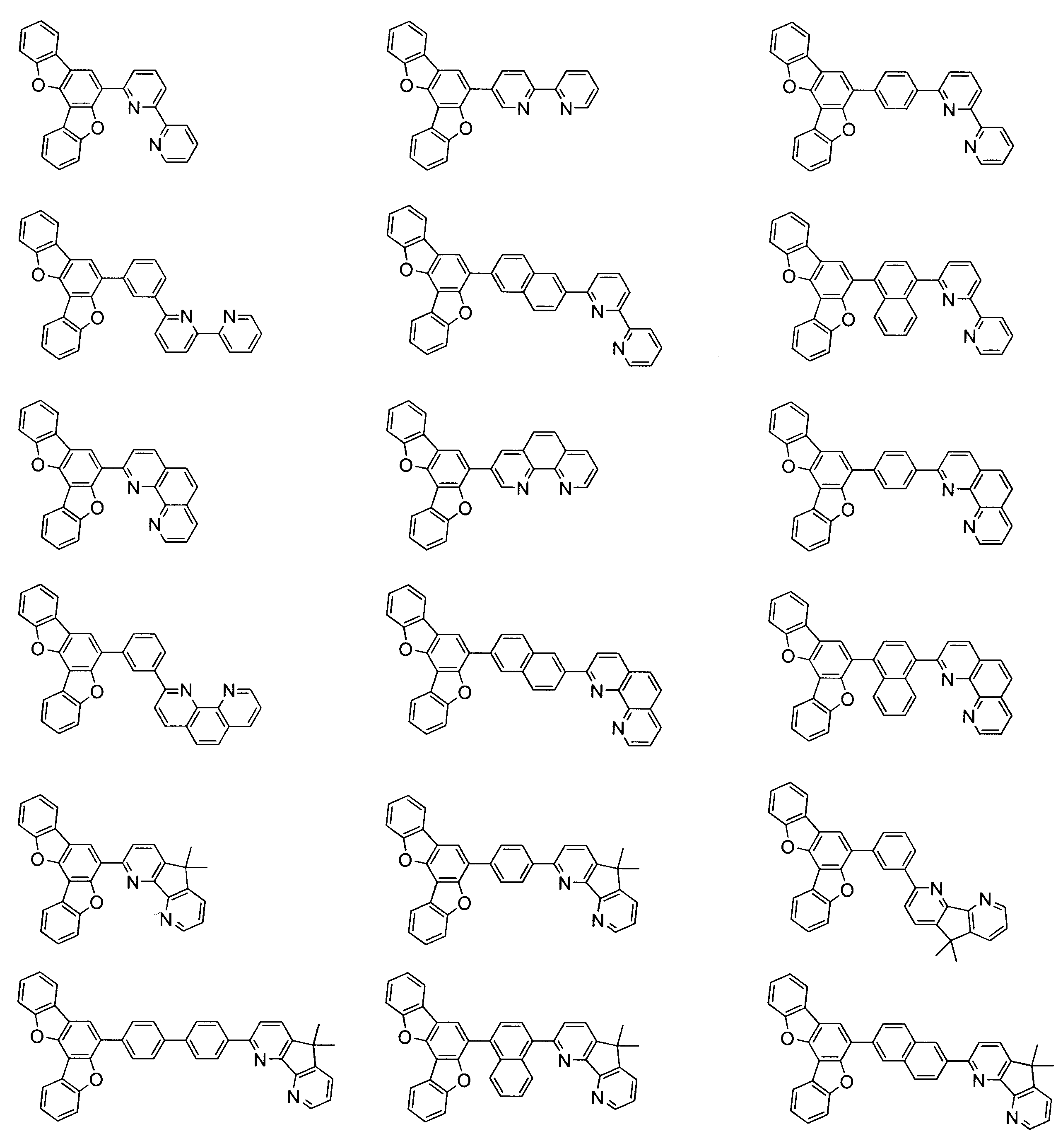


本発明の含酸素縮合環誘導体の基本骨格である、式(9)~(15)で表わされた構造を有する化合物は三重項エネルギーが高く、三重項励起子の閉じ込め効果が高いため、例えば有機EL素子の発光層に接した障壁層の材料として利用することによって、TTF現象を促進させることができる。また、本発明の含酸素縮合環誘導体の基本骨格である含酸素縮合環構造は、その平面性の高さによって薄膜中での分子スタッキングが向上し、電子輸送性が大きくなるという特徴を持つため、発光層への電子注入を促進し、発光層での再結合効率を高め、TTF現象を効率的に起こすことができる。
従来、TTF現象は、障壁層に用いる化合物中で最も低い三重項エネルギーを有する部位が炭化水素の縮合環基である場合に確認されていたが、さらに、本発明の含酸素縮合環誘導体のように複素環部位が最も低い三重項エネルギーを有する場合でも、TTF現象を効率的に起こすことができることを見出した。
さらに、本発明の含酸素縮合環誘導体は、電極等の金属含有層からの電子注入性の高い含窒素複素環を含むため、電子注入層をさらに積層させることなく低駆動電圧の有機EL素子を実現させることができる。
有機EL素子に電圧を印加すると、陽極、陰極から電子と正孔が注入され、注入された電子と正孔は発光層内で再結合し励起子を生成する。そのスピン状態は、一重項励起子が25%、三重項励起子が75%である。従来知られている蛍光素子においては、一重項励起子が基底状態に緩和するときに光を発するが、残りの三重項励起子については光を発することなく熱的失活過程を経て基底状態に戻る。しかしながら、S.M.Bachiloらによれば(J.Phys.Cem.A,104,7711(2000))、当初生成した75%の三重項励起子のうち、1/5が一重項励起子に変化する。
TTF現象とは三重項励起子の衝突融合により一重項励起子が生成する現象であり、このTTF現象を利用すれば、当初生成する25%の一重項励起子だけでなく、三重項励起子の衝突融合により生じる一重項励起子も発光に利用でき、素子の発光効率を高めることができる。
本発明では、本発明の含酸素縮合環誘導体を含有する障壁層を蛍光素子の発光層に隣接させることが好ましい。励起子寿命が短い一重項励起子を起因とする蛍光素子においては、プロセスアップの原因となる障壁層を利用しないのが一般的であるが、本発明の含酸素縮合環誘導体を含んでなる障壁層を蛍光素子に用いることによってTTF現象を引き起こし、高効率な有機EL素子を実現することができる。また、本発明の含酸素縮合環誘導体は三重項エネルギーが高いため、従来の燐光素子においても障壁層の機能を発揮し、三重項エネルギーの拡散を防ぐことができる。
尚、本発明において単に障壁層といったときは三重項エネルギーに対する障壁機能を有する層をいうものとし、正孔障壁層や電荷障壁層とはその機能が異なる。
上記電子供与性ドーパントは、好ましくはアルカリ金属、アルカリ土類金属、希土類金属、アルカリ金属の酸化物、アルカリ金属のハロゲン化物、アルカリ土類金属の酸化物、アルカリ土類金属のハロゲン化物、希土類金属の酸化物、希土類金属のハロゲン化物、アルカリ金属の有機錯体、アルカリ土類金属の有機錯体及び希土類金属の有機錯体からなる群から選択される1種又は2種以上である。

R201~R208は、それぞれ水素原子、フッ素原子、置換もしくは無置換の炭素数1~10のアルキル基、置換もしくは無置換の炭素数3~10のシクロアルキル基、置換もしくは無置換の炭素数3~30のアルキルシリル基、置換もしくは無置換の環形成炭素数8~30のアリールシリル基、置換もしくは無置換の炭素数1~20のアルコキシ基、置換もしくは無置換の環形成炭素数6~20のアリールオキシ基、置換もしくは無置換の環形成炭素数6~30のアリール基、又は置換もしくは無置換の環形成原子数5~30の複素環基である。Ar11及びAr12のアリール基及び複素環状基、R201~R208のアリール基、複素環基、アルキル基、シクロアルキル基、アルキルシリル基、アリールシリル基、アルコキシ基、アリールオキシ基は、それぞれ上記段落0027~0033の各基の説明と同様である。)
ETb>ETh・・・(1)
ETd>ETh・・・(2)
(ETh、ETb及びETdは、それぞれホスト材料、障壁層の含酸素縮合環誘導体及びドーパントの三重項エネルギーを示す。)
本発明の含酸素縮合環誘導体を含む障壁層は、電子注入・輸送機能の役割も果たすことができる。これは、非共有電子対が隣接層からの電子の授受を媒介するためである。次に、障壁材料に注入された電子は、電子輸送構造部位を介してより電子を供与しやすい。即ちLUMO準位の高い構造部位へと移動することによって、発光層への電子注入に寄与することとなる。
燐光発光層においては、三重項エネルギーを発光層内に閉じ込める効果を得ることが可能であり、三重項エネルギーの拡散を防ぎ、燐光発光性ドーパントの発光効率の向上に寄与できる。
(a) ベンゾ[b]ナフト[2,1-d]フラン-5-ボロン酸の合成
下記スキームに従って、ベンゾ[b]ナフト[2,1-d]フラン-5-ボロン酸を合成した。

1-ナフトール144g、p-トルエンスルホン酸1水和物(190g)、1,3-シクロヘキサジエン(80.1g)、トルエン4Lをフラスコに仕込み、24時間還流撹拌した。反応溶液を室温まで冷却後、水600mLで洗浄した。有機層を硫酸マグネシウムで乾燥させた後、溶媒を減圧留去させた。残渣をシリカゲルカラムクロマトグラフィで精製し、7,8,9,10-テトラヒドロベンゾ[b]ナフト[2,1-d]フラン55.5g(収率25%)を得た。
アルゴン雰囲気下、7,8,9,10-テトラヒドロベンゾ[b]ナフト[2,1-d]フラン(55.5g)、2,3-ジクロロ-5,6-ジシアノ-1,4-ベンゾキノン(119g)、無水1,4-ジオキサン1Lをフラスコに仕込み、12時間還流攪拌した。反応溶液を室温まで冷却後、トルエンで抽出し、析出した固体をろ別した。ろ液をロータリーエバポレータで濃縮後、残渣をシリカゲルカラムクロマトグラフィで精製し、ベンゾ[b]ナフト[2,1-d]フラン32.7g(収率60%)を得た。
ベンゾ[b]ナフト[2,1-d]フラン(32.7g)をN,N-ジメチルホルムアミド300mLに溶解させ、N-ブロモスクシンイミド(28.0g)のN,N-ジメチルホルムアミド50mL溶液を加えた後、反応溶液を60℃で5時間加熱攪拌した。反応溶液を室温まで冷却した後、水2L中に注いだ。得られた固体をメタノール、水、メタノールで順次洗浄した。得られた粗生成物をシリカゲルカラムクロマトグラフィで精製し、5-ブロモベンゾ[b]ナフト[2,1-d]フラン36.5g(収率82%)を得た。
5-ブロモベンゾ[b]ナフト[2,1-d]フラン(29.7g)、テトラヒドロフラン(脱水)500mLをフラスコに加え、-78℃に冷却した。そこへn-BuLi((1.60M in hexane)66mL)を加え、0℃まで昇温させながら2時間撹拌した。次に再度-78℃に冷却し、B(OMe)3(27.3g)を加え、-78℃で10分間撹拌した後、室温で5時間撹拌した。反応終了後、1N HCl aq.(200mL)を加え、室温で1時間撹拌した。その後、反応液を分液ロートに移し、酢酸エチルで抽出した。この溶液をMgSO4で乾燥した後、濃縮し、ヘキサンで洗浄して、ベンゾ[b]ナフト[2,1-d]フラン-5-ボロン酸の白色固体17.0g(収率65%)を得た。
(b)ベンゾフラノ[3,2-b]ジベンゾフラン-6-ボロン酸の合成
下記合成スキームに従って、ベンゾフラノ[3,2-b]ジベンゾフラン-6-ボロン酸を合成した。

1,3-ジメトキシベンゼン(53.9g)をジクロロメタン860mLに溶解させアルゴン置換し、氷冷下、臭素(129.3g)のジクロロメタン150mL溶液を2時間半かけて滴下し、3時間かけて徐々に室温まで昇温させ、さらに一日撹拌を行った。反応液を氷冷し、10%水酸化ナトリウム水溶液で中和した。ジクロロメタン層を回収し、水層をジクロロメタンで抽出し、有機層をまとめて無水硫酸ナトリウムで乾燥し、濾過した後、濾液の濃縮を行った。得られた残渣をヘキサンで分散洗浄し、生成した結晶を濾取して乾燥し、2,4-ジブロモ-1,5-ジメトキシベンゼンの白色結晶110.5g(収率97%)を得た。
2,4-ジブロモ-1,5-ジメトキシベンゼン(88.8g)、2-フルオロフェニルボロン酸(100.74g)、Na2CO3 2M aq.(600mL)、Pd(PPh3)4(6.73g)、1,2-ジメトキシエタン150mL、トルエン150mLをフラスコに入れ、36時間還流した。反応終了後、水500mLとトルエン1Lを加えて分液ロートに移し、トルエン相を回収した。MgSO4で乾燥した後、シリカゲルショートカラムを通し原点不純物の除去を行い、溶液を濃縮した。これをトルエン/ヘキサン混合溶媒から再結晶し、2,4-ビス(2-フルオロフェニル)-1,5-ジメトキシベンゼンの白色固体86.5g(収率88%)を得た。
1,5-ジメトキシ-2,4-ビス(2-フルオロフェニル)ベンゼン(48.3g)、ジクロロメタン(脱水)740mLをフラスコに入れ、0℃に冷却した。BBr3(89.0g)を加え、その後室温で24時間撹拌した。反応終了後、溶液を-78℃に冷却し、メタノールで慎重に失活し、さらに十分量の水で失活した。溶液を分液ロートに移し、ジクロロメタンで抽出し、MgSO4で乾燥した後、シリカゲルショートカラムを通し原点不純物の除去を行い、溶液を濃縮し、得られた試料を60℃で5時間真空乾燥し2,4-ビス(2-フルオロフェニル)-1,5-ジヒドロキシベンゼンの白色固体44.1g(収率100%)を得た。
2,4-ビス(2-フルオロフェニル)-1,5-ジヒドロキシベンゼン(44.14g)、N-メチル-2-ピロリジノン(脱水)888mL、をフラスコに入れ、固体を完全に溶解させた。K2CO3(81.8g)を加え、その後200℃で2時間撹拌した。反応終了後、溶液を室温まで冷却し、トルエン2Lを加え、分液ロートに移し、水で洗浄した。この溶液をMgSO4で乾燥した後、シリカゲルショートカラムを通し原点不純物の除去を行い、溶液を濃縮し、トルエン/メタノール混合溶媒から再結晶しベンゾフラノ[3,2-b]ジベンゾフランの白色固体27.9g(収率73%)を得た。
ベンゾフラノ[3,2-b]ジベンゾフラン(12.9g)、テトラヒドロフラン(脱水)(300mL)をフラスコに加え、-78℃に冷却した。そこへn-BuLi((2.63M in hexane)20.0mL)を加え、その後、室温で1時間放置した。次に再度-78℃に冷却し、B(OMe)3(10.4g)を加え、-78℃で10分間撹拌した後、室温で1時間放置した。反応終了後、エバポレータで半分程度の容量に濃縮した後、1N HCl aq.(200mL)を加え、室温で1時間撹拌した。その後分液ロートに移し、酢酸エチルで抽出した。この溶液をMgSO4で乾燥した後、濃縮し、トルエン/ヘキサン混合溶媒で分散洗浄し、ベンゾフラノ[3,2-b]ジベンゾフラン-6-ボロン酸の白色固体13.7g(収率91%)を得た。
(c)2-(ベンゾ[kl]キサンテン-4-イル)-4,4,5,5-テトラメチル-1,3,2-ジオキサボロランの合成
下記合成スキームに従って、2-(ベンゾ[kl]キサンテン-4-イル)-4,4,5,5-テトラメチル-1,3,2-ジオキサボロランを合成した。
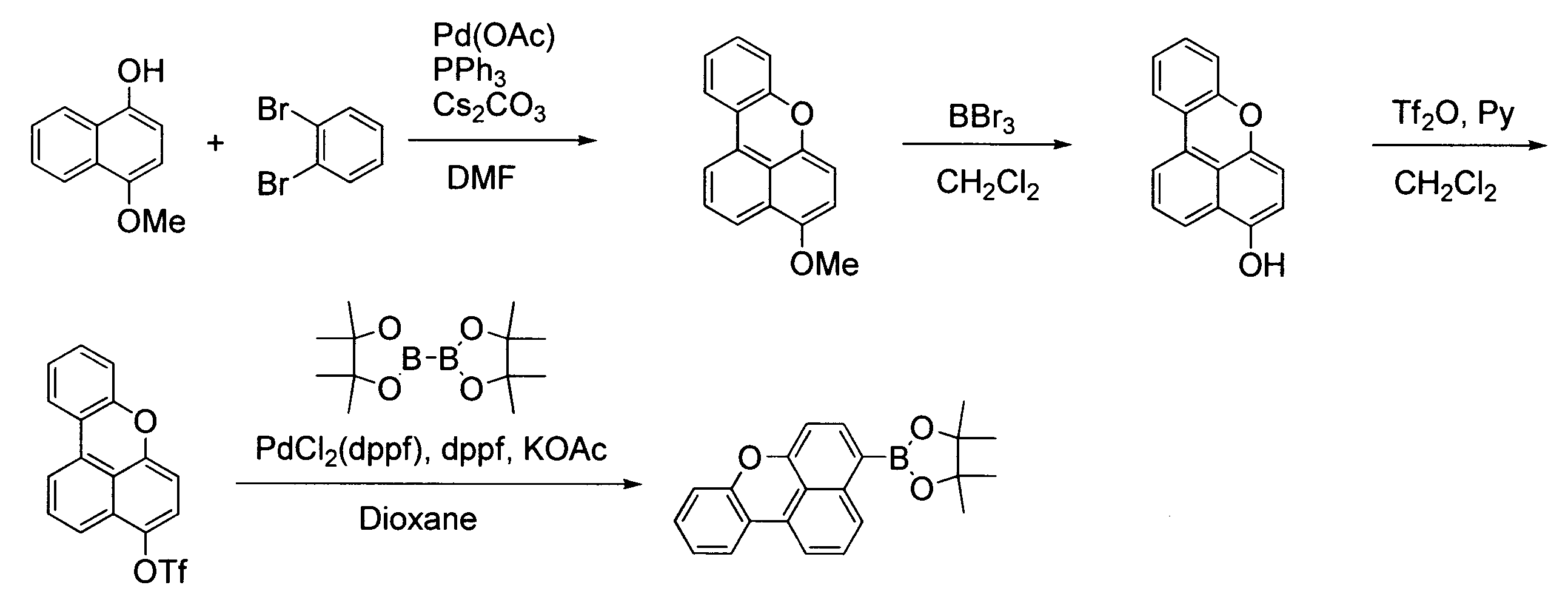
4-メトキシ-1-ナフトール(6.97g)及び1,2-ジブロモベンゼン(11.3g)をジメチルホルムアミド200mLに溶解し、炭酸セシウム(52.13g)、トリフェニルフォスフィン(2.10g)及び酢酸パラジウム(II)(0.45g)を順次加え、140℃にて15時間撹拌を行った。室温まで冷却し、水及び酢酸エチルを加えて分液を行い、水層を酢酸エチルで抽出を行い、水及び飽和食塩水で洗浄し、有機層を合わせて無水硫酸ナトリウムで乾燥し濾過した後、濃縮を行った。得られた残渣に水及びメタノールを加えて、ジエチルエーテル及び酢酸エチルで抽出を行い、水及び飽和食塩水で洗浄し、有機層を合わせて無水硫酸ナトリウムで乾燥し濾過した後、濃縮を行った。得られた残渣をシリカゲルクロマトグラフィーで精製したのち、得られた残渣をヘキサン-酢酸エチル混合溶液で分散洗浄して乾燥を行い、4-メトキシベンゾ[kl]キサンテンの黄色固体3.26g(収率33%)を得た。
4-メトキシベンゾ[kl]キサンテン(3.26g)をジクロロメタン100mLに溶解し、アルゴン雰囲気下、ドライアイス-メタノール浴で-68℃に冷却し、三臭化ホウ素のジクロロメタン溶液(1M,14mL)を20分間かけて滴下した。室温まで徐々に昇温しながら4時間撹拌を行った。得られた混合物を氷冷して、数滴ずつ水を加えて慎重に失活させ、さらに100mLの水を加えた。生成した沈殿を濾取し、水及びジクロロメタンで洗浄して乾燥を行い、4-ヒドロキシベンゾ[kl]キサンテンの結晶(2.35g)を得た。濾液は分液し、水層をジクロロメタン抽出し、有機層を合わせて無水硫酸ナトリウムで乾燥し、濾過した後濃縮した。得られた残渣を少量のジクロロメタンで分散洗浄を行い、乾燥を行い、4-ヒドロキシベンゾ[kl]キサンテンの結晶(0.53g)を得た。両者を合わせて収量2.88g、収率は94%であった。
4-ヒドロキシベンゾ[kl]キサンテン(2.88g)をジクロロメタン100mLに分散し、アルゴン雰囲気下、氷冷し、ピリジン(4.0mL)を加えた。得られた溶液にトリフルオロメタンスルホン酸無水物(3.0mL)を10分間かけて滴下し、氷冷下で5分撹拌した後、徐々に室温に昇温しながら3時間撹拌を行った。得られた溶液に氷冷下で1M塩酸(50mL)を加え、混合溶液をジクロロメタンで抽出し、飽和重曹水で洗浄した後、無水硫酸ナトリウムで乾燥し、濾過して濃縮した。この残渣をヘキサン-酢酸エチル混合溶液で分散洗浄して乾燥させ、4-トリフルオロメタンスルホニルベンゾ[kl]キサンテンの固体を得た。洗浄母液を濃縮し、シリカゲルクロマトグラフィーで精製を行った。得られた残渣をヘキサンで分散洗浄して乾燥させ、4-トリフルオロメタンスルホニルベンゾ[kl]キサンテンの固体を得た。両者を合わせ、4-トリフルオロメタンスルホニルベンゾ[kl]キサンテンの茶白色固体3.01g(収率67%)を得た。
4-トリフルオロメタンスルホニルベンゾ[kl]キサンテン(3.01g)、ビスピナコラートジボロン(2.30g)、[1,1’-ビス(ジフェニルホスフィノ)フェロセン]パラジウム(II)ジクロリド ジクロロメタン付加物(0.34g)、1,1’-ビス(ジフェニルホスフィノ)フェロセン(0.23g)及び酢酸カリウム(2.42g)を1,4-ジオキサン50mlに溶解し、80℃にて17時間撹拌した。ビスピナコラートジボロン(1.15g)、[1,1’-ビス(ジフェニルホスフィノ)フェロセン]パラジウム(II)ジクロリド ジクロロメタン付加物(0.34g)及び1,1’-ビス(ジフェニルホスフィノ)フェロセン(0.23g)を加えて80℃にて7時間半撹拌した。反応液を室温まで冷却し、水及び酢酸エチルを加えて濾過した。得られた混合液を分液し、酢酸エチルで抽出した後、有機層を合わせて飽和食塩水で洗浄し、無水硫酸ナトリウムで乾燥し、濾過した後、濃縮を行った。得られた残渣をシリカゲルクロマトグラフィーで精製し、2-(ベンゾ[kl]キサンテン-4-イル)-4,4,5,5-テトラメチル-1,3,2-ジオキサボロランの黄色固体1.47g(収率52%)を得た。
(d)2-(3-ブロモフェニル)-イミダゾ[1,2-a]ピリジンの合成
下記スキームに従って、2-(3-ブロモフェニル)-イミダゾ[1,2-a]ピリジンを合成した。

実施例1
化合物1の合成
1-(4-ブロモフェニル)-2-フェニル-1H-ベンズ[d]イミダゾール(3.00g)、ベンゾ[b]ナフト[2,1-d]フラン-5-ボロン酸(2.94g)、テトラキストリフェニルフォスフィンパラジウム(0)0.50g、1,2-ジメトキシエタン26ml及び2M炭酸ナトリウム水溶液13mlの混合物を8時間加熱還流撹拌した。反応混合物を室温まで冷却し、水を加え30分間撹拌を行い、酢酸エチル、ヘキサンを加えて更に30分間撹拌を行った。生成した固体をろ取し、水、メタノール、ヘキサンで洗浄後、減圧下にて乾燥を行った。得られた固体をさらにヘキサン-酢酸エチル混合液で分散洗浄した後、シリカゲルクロマトグラフィーにて精製し、熱トルエン中で分散洗浄することで、白色固体3.01gを得た。
得られた化合物は、マススペクトル分析の結果、下記化合物1と同定した(分子量486.17に対しm/e=486)。収率72%であった。

化合物2の合成
1-(4-ブロモフェニル)-2-フェニル-1H-ベンズ[d]イミダゾール(3.00g)ベンゾフラノ[3,2-b]ジベンゾフラン-6-ボロン酸(3.70g)テトラキストリフェニルフォスフィンパラジウム(0)(0.60g)、1,2-ジメトキシエタン26ml及び2M炭酸ナトリウム水溶液13mlの混合物を13時間加熱還流撹拌した。反応混合物を室温まで冷却し、水を加え30分間撹拌を行い、生成した固体をろ取し、水、メタノール、ヘキサンで洗浄後、減圧下にて乾燥を行った。得られた固体をシリカゲルクロマトグラフィーにて精製し、白色固体4.42gを得た。
得られた化合物は、マススペクトル分析の結果、下記化合物2と同定した(分子量526.17に対しm/e=526)。収率97%であった。

化合物3の合成
1-(4-ブロモフェニル)-2-フェニル-1H-ベンズ[d]イミダゾール(1.36g)、2-(ベンゾ[kl]キサンテン-4-イル)-4,4,5,5-テトラメチル-1,3,2-ジオキサボロラン(1.47g)、テトラキストリフェニルフォスフィンパラジウム(0)(0.14g)、1,2-ジメトキシエタン12ml及び2M炭酸ナトリウム水溶液6mlの混合物を6時間加熱還流撹拌した。反応混合物を室温まで冷却し、水を加え30分間撹拌を行い、生成した固体をろ取し、水、メタノール、ヘキサンで洗浄後、減圧下にて乾燥を行った。得られた固体をシリカゲルクロマトグラフィーにて精製し、酢酸エチル中で分散洗浄することで、白色固体1.67gを得た。
得られた化合物はマススペクトル分析の結果、下記化合物3と同定した(分子量486.17に対しm/e=486)。収率88%であった。

化合物4の合成
1-(4-ブロモフェニル)-2-フェニル-1H-ベンズ[d]イミダゾールの代わりに合成例4で合成した2-(3-ブロモフェニル)-イミダゾ[1,2-a]ピリジンを用いた他は実施例2と同様に反応を行った。
得られた化合物は、マススペクトル分析の結果、下記化合物4と同定した(分子量450.14に対しm/e=450)。収率73%であった。

(1)三重項エネルギー(ET)
市販の装置F-4500(日立社製)を用いて測定した。ETの換算式は以下の通りである。
換算式ET( eV)=1239.85/λph
「λph」とは、縦軸にリン光強度、横軸に波長をとって、リン光スペクトルを表したときに、リン光スペクトルの短波長側の立ち上がりに対して接線を引き、その接線と横軸の交点の波長値(単位:nm)を意味する。
各化合物を溶媒に溶解(試料10μmol/リットル、EPA(ジエチルエーテル:イソペンタン:エタノール=5:5:5(容積比)、各溶媒は分光用グレード)し、リン光測定用試料とした。石英セルへ入れたリン光測定用試料を77(K)に冷却し、励起光をリン光測定用試料に照射し、波長を変えながらリン光強度を測定した。リン光スペクトルは、縦軸をリン光強度、横軸を波長とした。
このリン光スペクトルの短波長側の立ち上がりに対して接線を引き、その接線と横軸との交点の波長値λph(nm)を求めた。
燐光スペクトルの短波長側の立ち上がりに対する接線は以下のように引く。燐光スペクトルの短波長側から、スペクトルの極大値のうち、最も短波長側の極大値までスペクトル曲線上を移動する際に、長波長側に向けて曲線上の各点における接線を考える。この接線は、曲線が立ち上がるにつれ(つまり縦軸が増加するにつれ)、傾きが増加する。この傾きの値が極大値をとる点において引いた接線が、当該燐光スペクトルの短波長側の立ち上がりに対する接線とする。
なお、スペクトルの最大ピーク強度の10%以下のピーク強度をもつ極大点は、上述の最も短波長側の極大値には含めず、最も短波長側の極大値に最も近い、傾きの値が極大値をとる点において引いた接線を当該燐光スペクトルの短波長側の立ち上がりに対する接線とする。
(2)イオン化ポテンシャル(Ip)
イオン化ポテンシャルは、各層の単独層を別途ガラス基板上に真空蒸着で作製し、ガラス基板上の薄膜を用いて大気下で光電子分光装置(理研計器(株)社製:AC-3)を用いて測定した。具体的には、材料に光を照射し、その際に電荷分離によって生じる電子量を測定することにより測定した。照射光のエネルギーに対し、放出された光電子を1/2乗でプロットし、光電子放出エネルギーのしきい値をイオン化ポテンシャル(Ip)とした。
(3)アフィニティ(Af)
イオン化ポテンシャルIpとエネルギーギャップEgの測定値から算出した。算出式は、次のとおりである。
Af=Ip-Eg
エネルギーギャップEgは、トルエン溶液中の吸収スペクトルの吸収端から測定した。具体的には、市販の可視・紫外分光光度計を用いて、吸収スペクトルを測定し、そのスペクトルの長波長側の立ち下がり波長から算出した。
換算式は、次のとおりである。
Eg(eV)=1239.85/λab
縦軸に吸光度、横軸に波長をとって、吸収スペクトルを表したものを吸収スペクトルとした。エネルギーギャップEgに関する上記換算式において、λab(単位:nm)は、吸収スペクトルの長波長側の立ち下がりに対して接線を引き、その接線と横軸の交点の波長値を意味する。
各化合物をトルエン溶媒に溶解(試料2×10⁻⁵mol/リットル)し、光路長は1cmとなるように試料を準備した。波長を変えながら吸光度を測定した。
吸収スペクトルの長波長側の立ち下がりに対する接線は以下のように引く。
吸収スペクトルの極大値のうち、最も長波長側の極大値から長波長方向にスペクトル曲線上を移動する際に、曲線上の各点における接線を考える。この接線は、曲線が立ち下がるにつれ(つまり縦軸が減少するにつれ)、傾きが減少しその後増加することを繰り返す。傾きの値が最も長波長側(ただし、吸光度が0.1以下となる場合は除く)で極小値をとる点において引いた接線を当該吸収スペクトルの長波長側の立ち下がりに対する接線とする。
なお、吸光度の値が0.2以下の極大点は、上記最も長波長側の極大値には含めない。

実施例5
有機EL素子に使用した材料は以下の通りである。

HT-2膜上に化合物BH-1(ホスト材料)及び化合物BD-1(ドーパント材料)を20:1の膜厚比で蒸着し、膜厚25nmの発光層を成膜した。さらに発光層上に化合物1を蒸着し、膜厚5nmの障壁層を形成した。さらに電子輸送材料であるET-1を蒸着して、発光層上に膜厚20nmの電子輸送層を形成した。この後、LiFを膜厚1nmで成膜した。このLiF膜上に金属Alを150nm蒸着させ金属陰極を形成し有機EL素子を形成した。
化合物1の代わりに表2に示す化合物を用いて障壁層を積層し、ドーパント材料に表2に示した化合物を用いた他は実施例5と同様にして有機EL素子を作製し、評価した。結果を表2に示す。
尚、実施例8で用いたBD-2および比較例1で用いた化合物ET-2は、下記化合物である。


上記高効率は、障壁材の効果が関与している可能性が示唆される。ホスト材料のBH-1の三重項エネルギーは、化合物1~4と同様の方法で算出すると1.83eVであり、化合物1~3の値はこれと比べ十分に大きいことから、発光層内への三重項励起子の閉じ込め効果が生じていることが考えられる。
25mm×75mm×1.1mm厚のITO透明電極(陽極)付きガラス基板(ジオマティック社製)をイソプロピルアルコール中で超音波洗浄を5分間行なった後、UVオゾン洗浄を30分間行なった。洗浄後の透明電極ライン付きガラス基板を真空蒸着装置の基板ホルダーに装着し、まず透明電極ラインが形成されている側の面上に透明電極を覆うようにして膜厚50nmの化合物HT-1を成膜した。HT-1膜は正孔注入層として機能する。HT-1膜の成膜に続けて、化合物HT-2を蒸着してHT-1膜上に膜厚45nmのHT-2膜を成膜した。HT-2膜は正孔輸送層として機能する。
HT-2膜上に化合物BH-1(ホスト材料)及び化合物BD-2(ドーパント材料)を20:1の膜厚比で蒸着し、膜厚25nmの発光層を成膜した。さらに発光層上に化合物1を蒸着し、膜厚25nmの電子輸送層を形成した。この後、LiFを膜厚1nmで成膜した。このLiF膜上に金属Alを150nm蒸着させ金属陰極を形成し有機EL素子を形成した。
化合物1の代わりに表3に示す化合物を用いて電子輸送層を積層した他は実施例10と同様にして有機EL素子を作製し、評価した。結果を表3に示す。
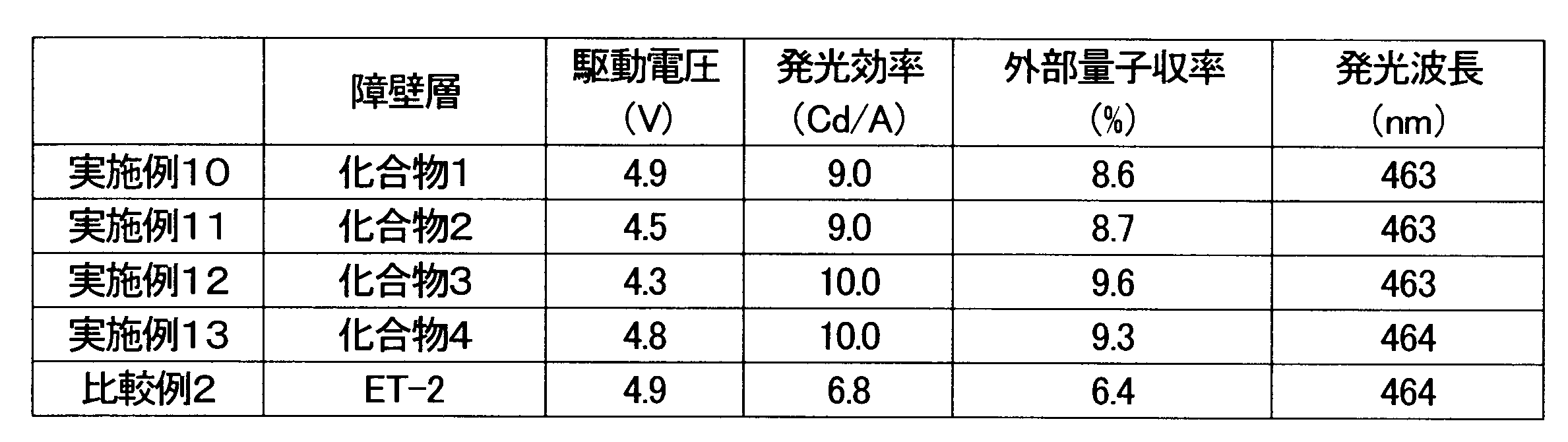
この明細書に記載の文献の内容を全てここに援用する。
Claims (15)
- 下記式(1)で表される含酸素縮合環誘導体。

HArは、下記式(2)~(5)で表わされる含窒素複素環基のいずれかである。
n及びmは、それぞれ1~5の整数であり、n及びmの少なくとも一方は1である。
Lは、単結合、置換もしくは無置換の環形成炭素数6~30のn+1価のアリール基、置換もしくは無置換の環形成原子数5~30のn+1価の複素環基、又は置換もしくは無置換の環形成炭素数6~30のアリール基及び置換もしくは無置換の環形成原子数5~30の複素環基からなる群から選択される2つもしくは3つが単結合で連結してなるn+1価の基である。)

R31~R35のいずれか1つ及びR36~R40のいずれか1つは、式(4)の2つのピリジン環同士を結合する単結合である。
Xは、N又はCR13より選ばれ、R13は水素原子、ハロゲン原子、置換もしくは無置換の炭素数1~10のアルキル基、置換もしくは無置換の環形成炭素数3~8のシクロアルキル基、炭素数3~30の置換シリル基、シアノ基、置換もしくは無置換の炭素数1~20のアルコキシ基、置換もしくは無置換の環形成炭素数6~20のアリールオキシ基、置換もしくは無置換の炭素数1~20のアルキルチオ基、置換もしくは無置換の炭素数6~30のアリールチオ基、置換もしくは無置換の炭素数6~30のアリールアミノ基、置換もしくは無置換の炭素数1~20のモノもしくはジアルキルアミノ基、置換もしくは無置換の環形成炭素数6~30のアリール基、又は置換もしくは無置換の環形成原子数5~30の複素環基である。
R13が複数ある場合、それぞれのR13は同じでも異なっていてもよい。
Yは、N又はCR23より選ばれ、R23は水素原子、ハロゲン原子、置換もしくは無置換の炭素数1~10のアルキル基、置換もしくは無置換の環形成炭素数3~8のシクロアルキル基、炭素数3~30の置換シリル基、シアノ基、置換もしくは無置換の炭素数1~20のアルコキシ基、置換もしくは無置換の環形成炭素数6~20のアリールオキシ基、置換もしくは無置換の炭素数1~20のアルキルチオ基、置換もしくは無置換の炭素数6~30のアリールチオ基、置換もしくは無置換の炭素数6~30のアリールアミノ基、置換もしくは無置換の炭素数1~20のモノもしくはジアルキルアミノ基、置換もしくは無置換の環形成炭素数6~30のアリール基、又は置換もしくは無置換の環形成原子数5~30の複素環基である。
R23が複数ある場合、それぞれのR23は同じでも異なっていてもよい。
Zは架橋基であり、置換もしくは無置換のアルキレン基、又は置換もしくは無置換のアルケニレン基である。
R11~R13のいずれか1つ、R21~R23のいずれか1つ、R31~R40のいずれか1つ、及びR41~R46のいずれか1つはLと結合する単結合である。) - Ar1が下記式(6)で表わされる縮合環基である請求項1に記載の含酸素縮合環誘導体。
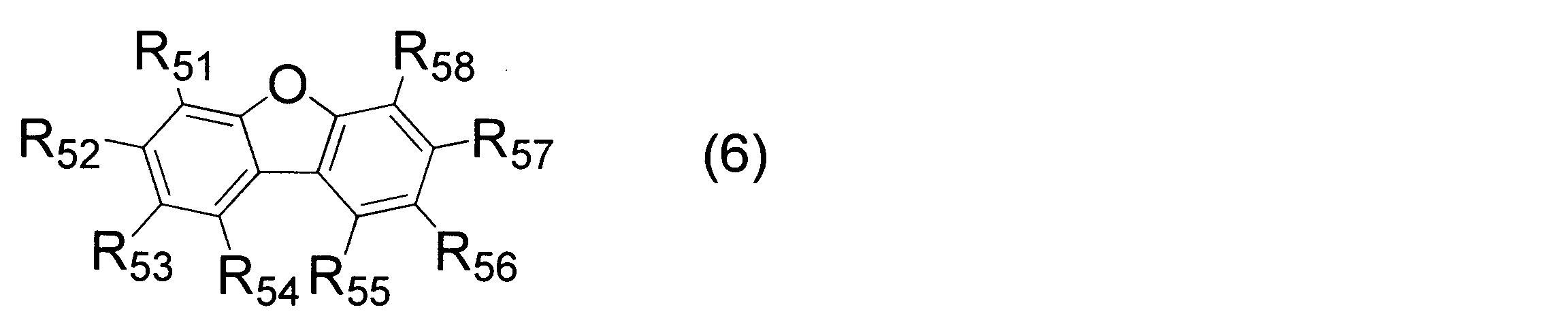
R51とR52、R52とR53、R53とR54、R54とR55、R55とR56、R56とR57、またはR57とR58のうち少なくとも1組は、互いに下記式(7)又は(8)で表わされる形で結合して、環を形成する。)

また、R61~R68のいずれかm個は、Lと結合する単結合である。) - Ar1が下記式(9)又は(10)で表される縮合環基である請求項1又は2に記載の含酸素縮合環誘導体。

また、R71~R80のいずれかm個及びR81~R90のいずれかm個はLと結合する単結合である。) - Ar1が下記式(11)、(12)、(13)又は(14)で表される縮合環基である請求項1又は2に記載の含酸素縮合環誘導体。

また、R91~R100のいずれかm個、R101~R110のいずれかm個、R111~R120のいずれかm個及びR121~R130のいずれかm個はLと結合する単結合である。) - Ar1が下記式(15)で表される縮合環基である請求項1に記載の含酸素縮合環誘導体。

但し、R131~R140のいずれかm個はLと結合する単結合である。) - mが1であり、nが1である請求項1~5のいずれかに記載の含酸素縮合環誘導体。
- 有機エレクトロルミネッセンス素子用材料である請求項1~6のいずれかに記載の含酸素縮合環誘導体。
- 前記有機エレクトロルミネッセンス素子用材料が、障壁層材料である請求項7に記載の含酸素縮合環誘導体。
- 陽極、発光層、障壁層、及び陰極をこの順に備え、
前記障壁層が請求項1~6のいずれかに記載の含酸素縮合環誘導体を含有する有機エレクトロルミネッセンス素子。 - 前記障壁層と陰極との間に、電子注入層及び/又は電子輸送層を有し、前記電子注入層及び電子輸送層の少なくとも1層が含ヘテロ環誘導体を含有する請求項9に記載の有機エレクトロルミネッセンス素子。
- 前記電子注入層及び/又は電子輸送層が、電子供与性ドーパントを含有する請求項10に記載の有機エレクトロルミネッセンス素子。
- 前記電子供与性ドーパントが、アルカリ金属、アルカリ土類金属、希土類金属、アルカリ金属の酸化物、アルカリ金属のハロゲン化物、アルカリ土類金属の酸化物、アルカリ土類金属のハロゲン化物、希土類金属の酸化物、希土類金属のハロゲン化物、アルカリ金属の有機錯体、アルカリ土類金属の有機錯体及び希土類金属の有機錯体からなる群から選択される1種又は2種以上である請求項11に記載の有機エレクトロルミネッセンス素子。
- 前記発光層が、下記式(16)で表されるアントラセン誘導体を含む請求項9~12のいずれかに記載の有機エレクトロルミネッセンス素子。

R201~R208は、それぞれ水素原子、フッ素原子、置換もしくは無置換の炭素数1~10のアルキル基、置換もしくは無置換の環形成炭素数3~10のシクロアルキル基、置換もしくは無置換の炭素数3~30のアルキルシリル基、置換もしくは無置換の環形成炭素数8~30のアリールシリル基、置換もしくは無置換の炭素数1~20のアルコキシ基、置換もしくは無置換の環形成炭素数6~20のアリールオキシ基、置換もしくは無置換の環形成炭素数6~30のアリール基、又は置換もしくは無置換の環形成原子数5~30の複素環基である。) - 前記式(16)で表されるアントラセン誘導体を含有する発光層が、前記含酸素縮合環誘導体を含有する障壁層と接している請求項13に記載の有機エレクトロルミネッセンス素子。
- 前記発光層が、主ピーク波長が500nm以下の蛍光ドーパントを含有する請求項9~14のいずれかに記載の有機エレクトロルミネッセンス素子。
Priority Applications (5)
| Application Number | Priority Date | Filing Date | Title |
|---|---|---|---|
| KR1020137012966A KR20140032948A (ko) | 2010-11-22 | 2011-11-22 | 산소 함유 축합환 유도체 및 그것을 포함하여 이루어지는 유기 전계 발광 소자 |
| CN2011800560934A CN103221407A (zh) | 2010-11-22 | 2011-11-22 | 含氧稠环衍生物和含有其而成的有机电致发光元件 |
| JP2012545613A JPWO2012070226A1 (ja) | 2010-11-22 | 2011-11-22 | 含酸素縮合環誘導体及びそれを含んでなる有機エレクトロルミネッセンス素子 |
| US13/988,920 US9484540B2 (en) | 2010-11-22 | 2011-11-22 | Oxygen-containing fused ring derivative and organic electroluminescence device comprising the same |
| EP11842678.2A EP2644607A4 (en) | 2010-11-22 | 2011-11-22 | OXYGENIC FUSIONED RING DERIVATIVE AND ORGANIC ELECTROLUMINESCENT ELEMENT THEREWITH |
Applications Claiming Priority (2)
| Application Number | Priority Date | Filing Date | Title |
|---|---|---|---|
| JP2010-260653 | 2010-11-22 | ||
| JP2010260653 | 2010-11-22 |
Publications (1)
| Publication Number | Publication Date |
|---|---|
| WO2012070226A1 true WO2012070226A1 (ja) | 2012-05-31 |
Family
ID=46145593
Family Applications (1)
| Application Number | Title | Priority Date | Filing Date |
|---|---|---|---|
| PCT/JP2011/006486 Ceased WO2012070226A1 (ja) | 2010-11-22 | 2011-11-22 | 含酸素縮合環誘導体及びそれを含んでなる有機エレクトロルミネッセンス素子 |
Country Status (7)
| Country | Link |
|---|---|
| US (1) | US9484540B2 (ja) |
| EP (1) | EP2644607A4 (ja) |
| JP (1) | JPWO2012070226A1 (ja) |
| KR (1) | KR20140032948A (ja) |
| CN (1) | CN103221407A (ja) |
| TW (1) | TW201229048A (ja) |
| WO (1) | WO2012070226A1 (ja) |
Cited By (29)
| Publication number | Priority date | Publication date | Assignee | Title |
|---|---|---|---|---|
| WO2014199637A1 (ja) * | 2013-06-11 | 2014-12-18 | 出光興産株式会社 | 有機エレクトロルミネッセンス素子用材料、これを用いた有機エレクトロルミネッセンス素子及び電子機器 |
| JP2015109407A (ja) * | 2013-05-16 | 2015-06-11 | 株式会社半導体エネルギー研究所 | 発光素子、発光装置、電子機器、および照明装置 |
| KR101554600B1 (ko) | 2013-06-07 | 2015-09-22 | 삼성디스플레이 주식회사 | 축합환 화합물 및 이를 포함한 유기 발광 소자 |
| US9425416B2 (en) | 2013-06-07 | 2016-08-23 | Samsung Display Co., Ltd. | Condensed cyclic compound and organic light-emitting device including the same |
| JP2017008043A (ja) * | 2015-06-25 | 2017-01-12 | 株式会社半導体エネルギー研究所 | 複素環化合物、発光素子、発光装置、電子機器、および照明装置 |
| KR20170048473A (ko) | 2015-03-24 | 2017-05-08 | 미쓰비시 가가꾸 가부시키가이샤 | 유기 전계 발광 소자용 조성물, 유기 전계 발광 소자, 표시 장치 및 조명 장치 |
| US9680108B2 (en) | 2014-06-11 | 2017-06-13 | Samsung Display Co., Ltd. | Organic light-emitting device |
| US9711736B2 (en) | 2014-05-19 | 2017-07-18 | Samsung Display Co., Ltd. | Condensed cyclic compound and organic light-emitting device comprising the same |
| JP2017523153A (ja) * | 2014-06-27 | 2017-08-17 | ヒソン・マテリアル・リミテッドHeesung Material Ltd. | 複素環化合物及びそれを用いた有機発光素子 |
| US9741939B2 (en) | 2014-10-23 | 2017-08-22 | Samsung Display Co., Ltd. | Condensed cyclic compound and organic light-emitting device including the same |
| US9818952B2 (en) | 2013-10-22 | 2017-11-14 | Samsung Display Co., Ltd. | Condensed cyclic compound and organic light emitting device including the same |
| US9831443B2 (en) | 2014-03-19 | 2017-11-28 | Samsung Display Co., Ltd. | Condensed cyclic compound and organic light-emitting device comprising the same |
| US9831445B2 (en) | 2014-12-12 | 2017-11-28 | Samsung Display Co., Ltd. | Condensed cyclic compound and organic light-emitting device including the same |
| US9856243B2 (en) | 2014-10-06 | 2018-01-02 | Samsung Display Co., Ltd. | Condensed cyclic compound and organic light-emitting device including the same |
| US9923147B2 (en) | 2015-04-29 | 2018-03-20 | Samsung Display Co., Ltd. | Organic light emitting device |
| US9966535B2 (en) | 2014-11-06 | 2018-05-08 | Samsung Display Co., Ltd. | Organic light-emitting device |
| JP2018512726A (ja) * | 2015-02-18 | 2018-05-17 | ノヴァレッド ゲーエムベーハー | 半導体材料および半導体材料用のナフトフランマトリクス化合物 |
| US10008676B2 (en) | 2014-12-31 | 2018-06-26 | Samsung Display Co., Ltd. | Compound and organic light-emitting device comprising the compound |
| US10014477B2 (en) | 2012-08-31 | 2018-07-03 | Idemitsu Kosan Co., Ltd. | Aromatic amine derivative, and organic electroluminescent element using same |
| US10026906B2 (en) | 2015-01-12 | 2018-07-17 | Samsung Display Co., Ltd. | Condensed cyclic compound and organic light-emitting device including the same |
| US10062850B2 (en) | 2013-12-12 | 2018-08-28 | Samsung Display Co., Ltd. | Amine-based compounds and organic light-emitting devices comprising the same |
| US10147882B2 (en) | 2013-05-09 | 2018-12-04 | Samsung Display Co., Ltd. | Styrl-based compound and organic light emitting diode comprising the same |
| US10147884B2 (en) | 2015-05-06 | 2018-12-04 | Samsung Display Co., Ltd. | Organic light-emitting device |
| US10256416B2 (en) | 2013-07-01 | 2019-04-09 | Samsung Display Co., Ltd. | Compound and organic light-emitting device including the same |
| US10290811B2 (en) | 2014-05-16 | 2019-05-14 | Samsung Display Co., Ltd. | Organic light-emitting device |
| US10388882B2 (en) | 2013-03-04 | 2019-08-20 | Samsung Display Co., Ltd. | Anthracene derivatives and organic light emitting devices comprising the same |
| US10439149B2 (en) | 2016-08-19 | 2019-10-08 | Samsung Display Co., Ltd. | Compound and organic light-emitting device including the same |
| JP2022544344A (ja) * | 2019-08-16 | 2022-10-18 | エルティー・マテリアルズ・カンパニー・リミテッド | ヘテロ環化合物およびこれを含む有機発光素子 |
| WO2023223855A1 (ja) * | 2022-05-20 | 2023-11-23 | 出光興産株式会社 | 化合物、有機エレクトロルミネッセンス素子用材料、有機エレクトロルミネッセンス素子、及び電子機器 |
Families Citing this family (21)
| Publication number | Priority date | Publication date | Assignee | Title |
|---|---|---|---|---|
| WO2013039221A1 (ja) | 2011-09-16 | 2013-03-21 | 出光興産株式会社 | 芳香族アミン誘導体およびそれを用いた有機エレクトロルミネッセンス素子 |
| US10056558B2 (en) | 2011-11-25 | 2018-08-21 | Idemitsu Kosan Co., Ltd. | Aromatic amine derivative, material for organic electroluminescent element, and organic electroluminescent element |
| KR102270082B1 (ko) | 2014-09-05 | 2021-06-29 | 삼성디스플레이 주식회사 | 축합환 화합물 및 이를 포함한 유기 발광 소자 |
| KR102291489B1 (ko) | 2014-11-10 | 2021-08-20 | 삼성디스플레이 주식회사 | 화합물 및 이를 포함하는 유기 발광 소자 |
| KR102304721B1 (ko) | 2014-11-21 | 2021-09-27 | 삼성디스플레이 주식회사 | 아민계 화합물 및 이를 포함한 유기 발광 소자 |
| CN104650029B (zh) * | 2014-12-26 | 2017-07-18 | 固安鼎材科技有限公司 | 一种稠杂环芳烃衍生物及其应用 |
| KR102314468B1 (ko) | 2014-12-30 | 2021-10-20 | 삼성디스플레이 주식회사 | 축합환 화합물 및 이를 포함한 유기 발광 소자 |
| KR102360091B1 (ko) | 2014-12-31 | 2022-02-09 | 삼성디스플레이 주식회사 | 축합환 화합물 및 이를 포함한 유기 발광 소자 |
| KR20160099157A (ko) * | 2015-02-11 | 2016-08-22 | 삼성디스플레이 주식회사 | 유기 발광 소자 |
| KR102376967B1 (ko) | 2015-02-13 | 2022-03-22 | 삼성디스플레이 주식회사 | 축합환 화합물 및 이를 포함한 유기 발광 소자 |
| KR102364221B1 (ko) | 2015-03-23 | 2022-02-18 | 삼성디스플레이 주식회사 | 축합환 화합물 및 이를 포함한 유기 발광 소자 |
| KR102527223B1 (ko) | 2015-08-21 | 2023-05-02 | 삼성디스플레이 주식회사 | 화합물 및 이를 포함하는 유기 발광 소자 |
| KR102458684B1 (ko) | 2015-10-08 | 2022-10-26 | 삼성디스플레이 주식회사 | 유기 발광 소자 |
| KR102562893B1 (ko) | 2015-11-03 | 2023-08-04 | 삼성디스플레이 주식회사 | 축합환 화합물 및 이를 포함한 유기 발광 소자 |
| KR102603864B1 (ko) * | 2016-05-13 | 2023-11-21 | 삼성디스플레이 주식회사 | 화합물 및 이를 포함하는 유기 발광 소자 |
| KR102577003B1 (ko) | 2016-06-03 | 2023-09-12 | 삼성디스플레이 주식회사 | 화합물 및 이를 포함하는 유기 발광 소자 |
| JP7082984B2 (ja) * | 2017-02-20 | 2022-06-09 | ノヴァレッド ゲーエムベーハー | 電子半導体デバイスおよびその電子半導体デバイスの製造方法および化合物 |
| US11773320B2 (en) * | 2019-02-21 | 2023-10-03 | Universal Display Corporation | Organic electroluminescent materials and devices |
| CN110724132B (zh) * | 2019-10-29 | 2021-09-03 | 上海天马有机发光显示技术有限公司 | 一种化合物、显示面板、显示装置 |
| CN112830925B (zh) * | 2019-11-25 | 2022-09-02 | 广东阿格蕾雅光电材料有限公司 | 一种化合物和含该化合物的有机电致发光器件 |
| US20230002417A1 (en) * | 2021-05-20 | 2023-01-05 | Universal Display Corporation | Organic electroluminescent materials and devices |
Citations (21)
| Publication number | Priority date | Publication date | Assignee | Title |
|---|---|---|---|---|
| JPS57198756A (en) * | 1981-05-22 | 1982-12-06 | Hoechst Ag | Novel coumarin compound, manufacture and use as dye |
| JPH03200880A (ja) * | 1989-12-28 | 1991-09-02 | Mitsui Toatsu Chem Inc | 光重合性樹脂組成物 |
| JPH05202356A (ja) * | 1991-09-11 | 1993-08-10 | Pioneer Electron Corp | 有機エレクトロルミネッセンス素子 |
| JPH069952A (ja) * | 1992-06-22 | 1994-01-18 | Tdk Corp | 有機el素子 |
| JPH08334898A (ja) * | 1995-04-07 | 1996-12-17 | Konica Corp | 光重合性組成物及びそれを用いた画像形成方法 |
| WO1999011627A1 (en) * | 1997-09-05 | 1999-03-11 | Ortho-Mcneil Pharmaceutical, Inc. | 2-substituted phenyl-benzimidazole antibacterial agents |
| JP2000252069A (ja) * | 1999-03-03 | 2000-09-14 | Honda Motor Co Ltd | 有機エレクトロルミネッセンス素子とその製造方法 |
| JP2000344780A (ja) * | 1998-09-24 | 2000-12-12 | Fuji Photo Film Co Ltd | 新規ベンゾピラン化合物、発光素子材料及びそれを使用した発光素子 |
| JP2001011080A (ja) * | 1999-04-28 | 2001-01-16 | Mitsubishi Chemicals Corp | ベンゾピラン系化合物及びその製造方法 |
| JP2001011079A (ja) * | 1999-04-27 | 2001-01-16 | Mitsubishi Chemicals Corp | クマリン系化合物、有機電界発光素子用色素及びこれを用いた有機電界発光素子 |
| JP2001081347A (ja) * | 1999-09-09 | 2001-03-27 | Mitsubishi Chemicals Corp | クマリン系化合物およびその製造方法 |
| WO2002043449A1 (en) * | 2000-11-24 | 2002-05-30 | Toray Industries, Inc. | Luminescent element material and luminescent element comprising the same |
| US20030215667A1 (en) * | 2001-11-02 | 2003-11-20 | Shuang Xie | Electroluminescent devices |
| JP2004170762A (ja) * | 2002-11-21 | 2004-06-17 | Konica Minolta Holdings Inc | 感光性組成物及び感光性平版印刷版 |
| WO2008117738A1 (ja) * | 2007-03-23 | 2008-10-02 | Mitsubishi Paper Mills Limited | 水現像可能な感光性平版印刷版材料 |
| WO2010030954A1 (en) * | 2008-09-11 | 2010-03-18 | Amgen Inc. | Spiro-tetracyclic ring compounds as betasecretase modulators and methods of use |
| WO2010036027A2 (ko) * | 2008-09-23 | 2010-04-01 | 주식회사 엘지화학 | 신규한 화합물 및 이의 제조방법 및 이를 이용한 유기전자소자 |
| WO2010107244A2 (en) * | 2009-03-20 | 2010-09-23 | Dow Advanced Display Materials, Ltd. | Novel organic electroluminescent compounds and organic electroluminescent device using the same |
| US20110136201A1 (en) * | 2009-12-04 | 2011-06-09 | Biotium, Inc. | Heterocycle-substituted xanthene dyes |
| KR20110111093A (ko) * | 2010-04-02 | 2011-10-10 | 에스에프씨 주식회사 | 스피로 화합물 및 이를 포함하는 유기전계발광소자 |
| KR20110113470A (ko) * | 2010-04-09 | 2011-10-17 | 에스에프씨 주식회사 | 이형고리 화합물 및 이를 포함하는 유기전계발광소자 |
Family Cites Families (7)
| Publication number | Priority date | Publication date | Assignee | Title |
|---|---|---|---|---|
| US6097147A (en) | 1998-09-14 | 2000-08-01 | The Trustees Of Princeton University | Structure for high efficiency electroluminescent device |
| US6440586B1 (en) | 1999-03-26 | 2002-08-27 | Fuji Photo Film Co., Ltd. | Benzopyran compound, material for luminous device, and luminous device using the same |
| EP1413925A3 (en) | 2002-10-23 | 2004-08-25 | Konica Minolta Holdings, Inc. | Photosensitive composition and photosensitive lithographic printing plate |
| CN1292305C (zh) * | 2002-10-23 | 2006-12-27 | 柯尼卡美能达控股株式会社 | 光敏组合物和光敏平版印刷板 |
| JP2004214180A (ja) | 2002-12-16 | 2004-07-29 | Canon Inc | 有機発光素子 |
| US7018723B2 (en) | 2003-07-25 | 2006-03-28 | The University Of Southern California | Materials and structures for enhancing the performance of organic light emitting devices |
| JP5493309B2 (ja) * | 2008-08-18 | 2014-05-14 | コニカミノルタ株式会社 | 有機エレクトロルミネッセンス素子材料、有機エレクトロルミネッセンス素子、表示装置及び照明装置 |
-
2011
- 2011-11-22 JP JP2012545613A patent/JPWO2012070226A1/ja not_active Withdrawn
- 2011-11-22 WO PCT/JP2011/006486 patent/WO2012070226A1/ja not_active Ceased
- 2011-11-22 TW TW100142682A patent/TW201229048A/zh unknown
- 2011-11-22 EP EP11842678.2A patent/EP2644607A4/en not_active Withdrawn
- 2011-11-22 CN CN2011800560934A patent/CN103221407A/zh active Pending
- 2011-11-22 US US13/988,920 patent/US9484540B2/en active Active
- 2011-11-22 KR KR1020137012966A patent/KR20140032948A/ko not_active Withdrawn
Patent Citations (21)
| Publication number | Priority date | Publication date | Assignee | Title |
|---|---|---|---|---|
| JPS57198756A (en) * | 1981-05-22 | 1982-12-06 | Hoechst Ag | Novel coumarin compound, manufacture and use as dye |
| JPH03200880A (ja) * | 1989-12-28 | 1991-09-02 | Mitsui Toatsu Chem Inc | 光重合性樹脂組成物 |
| JPH05202356A (ja) * | 1991-09-11 | 1993-08-10 | Pioneer Electron Corp | 有機エレクトロルミネッセンス素子 |
| JPH069952A (ja) * | 1992-06-22 | 1994-01-18 | Tdk Corp | 有機el素子 |
| JPH08334898A (ja) * | 1995-04-07 | 1996-12-17 | Konica Corp | 光重合性組成物及びそれを用いた画像形成方法 |
| WO1999011627A1 (en) * | 1997-09-05 | 1999-03-11 | Ortho-Mcneil Pharmaceutical, Inc. | 2-substituted phenyl-benzimidazole antibacterial agents |
| JP2000344780A (ja) * | 1998-09-24 | 2000-12-12 | Fuji Photo Film Co Ltd | 新規ベンゾピラン化合物、発光素子材料及びそれを使用した発光素子 |
| JP2000252069A (ja) * | 1999-03-03 | 2000-09-14 | Honda Motor Co Ltd | 有機エレクトロルミネッセンス素子とその製造方法 |
| JP2001011079A (ja) * | 1999-04-27 | 2001-01-16 | Mitsubishi Chemicals Corp | クマリン系化合物、有機電界発光素子用色素及びこれを用いた有機電界発光素子 |
| JP2001011080A (ja) * | 1999-04-28 | 2001-01-16 | Mitsubishi Chemicals Corp | ベンゾピラン系化合物及びその製造方法 |
| JP2001081347A (ja) * | 1999-09-09 | 2001-03-27 | Mitsubishi Chemicals Corp | クマリン系化合物およびその製造方法 |
| WO2002043449A1 (en) * | 2000-11-24 | 2002-05-30 | Toray Industries, Inc. | Luminescent element material and luminescent element comprising the same |
| US20030215667A1 (en) * | 2001-11-02 | 2003-11-20 | Shuang Xie | Electroluminescent devices |
| JP2004170762A (ja) * | 2002-11-21 | 2004-06-17 | Konica Minolta Holdings Inc | 感光性組成物及び感光性平版印刷版 |
| WO2008117738A1 (ja) * | 2007-03-23 | 2008-10-02 | Mitsubishi Paper Mills Limited | 水現像可能な感光性平版印刷版材料 |
| WO2010030954A1 (en) * | 2008-09-11 | 2010-03-18 | Amgen Inc. | Spiro-tetracyclic ring compounds as betasecretase modulators and methods of use |
| WO2010036027A2 (ko) * | 2008-09-23 | 2010-04-01 | 주식회사 엘지화학 | 신규한 화합물 및 이의 제조방법 및 이를 이용한 유기전자소자 |
| WO2010107244A2 (en) * | 2009-03-20 | 2010-09-23 | Dow Advanced Display Materials, Ltd. | Novel organic electroluminescent compounds and organic electroluminescent device using the same |
| US20110136201A1 (en) * | 2009-12-04 | 2011-06-09 | Biotium, Inc. | Heterocycle-substituted xanthene dyes |
| KR20110111093A (ko) * | 2010-04-02 | 2011-10-10 | 에스에프씨 주식회사 | 스피로 화합물 및 이를 포함하는 유기전계발광소자 |
| KR20110113470A (ko) * | 2010-04-09 | 2011-10-17 | 에스에프씨 주식회사 | 이형고리 화합물 및 이를 포함하는 유기전계발광소자 |
Non-Patent Citations (7)
| Title |
|---|
| DATABASE CAPLUS [online] XP002690464, accession no. STN Database accession no. 2011:1305143 * |
| DATABASE CAPLUS [online] XP003033131, accession no. STN Database accession no. 2011:1332788 * |
| DATABASE CAPLUS [online] XP003033132, accession no. STN Database accession no. 1988:5911 * |
| JUKES R.T.F. ET AL.: "Photophysical and Redox Properties of Dinuclear Ru and Os Polypyridyl Complexes with Incorporated Photostable Spiropyran Bridge", INORGANIC CHEMISTRY, vol. 48, no. 4, 2009, pages 1711 - 1721, XP055088648 * |
| JUKES R.T.F. ET AL.: "Synthesis, Photophysical, Photochemical, and Redox Properties of Nitrospiropyrans Substituted with Ru or Os Tris(bipyridine) Complexes", INORGANIC CHEMISTRY, vol. 45, no. 20, 2006, pages 8326 - 8341, XP055088646 * |
| OOYAMA Y. ET AL.: "Dye-Sensitized Solar Cells Based on a Novel Fluorescent Dye with a Pyridine Ringand a Pyridinium Dye with the Pyridinium Ring Forming Strong Interactions with Nanocrystalline TiO2 Films", EUROPEAN JOURNAL OF ORGANIC CHEMISTRY, 2010, pages 92 - 100, XP055088652 * |
| See also references of EP2644607A4 * |
Cited By (43)
| Publication number | Priority date | Publication date | Assignee | Title |
|---|---|---|---|---|
| US11362279B2 (en) | 2012-08-31 | 2022-06-14 | Idemitsu Kosan Co., Ltd. | Aromatic amine derivative, and organic electroluminescent element using same |
| US11444246B2 (en) | 2012-08-31 | 2022-09-13 | Idemitsu Kosan Co., Ltd. | Aromatic amine derivative, and organic electroluminescent element using same |
| US10014477B2 (en) | 2012-08-31 | 2018-07-03 | Idemitsu Kosan Co., Ltd. | Aromatic amine derivative, and organic electroluminescent element using same |
| US10388882B2 (en) | 2013-03-04 | 2019-08-20 | Samsung Display Co., Ltd. | Anthracene derivatives and organic light emitting devices comprising the same |
| US10147882B2 (en) | 2013-05-09 | 2018-12-04 | Samsung Display Co., Ltd. | Styrl-based compound and organic light emitting diode comprising the same |
| JP2015109407A (ja) * | 2013-05-16 | 2015-06-11 | 株式会社半導体エネルギー研究所 | 発光素子、発光装置、電子機器、および照明装置 |
| US11462701B2 (en) | 2013-05-16 | 2022-10-04 | Semiconductor Energy Laboratory Co., Ltd. | Light-emitting element, light-emitting device, electronic device, and lighting device |
| US10128455B2 (en) | 2013-05-16 | 2018-11-13 | Semiconductor Energy Laboratory Co., Ltd. | Light-emitting element, light-emitting device, electronic device, and lighting device |
| KR101554600B1 (ko) | 2013-06-07 | 2015-09-22 | 삼성디스플레이 주식회사 | 축합환 화합물 및 이를 포함한 유기 발광 소자 |
| US9425416B2 (en) | 2013-06-07 | 2016-08-23 | Samsung Display Co., Ltd. | Condensed cyclic compound and organic light-emitting device including the same |
| JPWO2014199637A1 (ja) * | 2013-06-11 | 2017-02-23 | 出光興産株式会社 | 有機エレクトロルミネッセンス素子用材料、これを用いた有機エレクトロルミネッセンス素子及び電子機器 |
| WO2014199637A1 (ja) * | 2013-06-11 | 2014-12-18 | 出光興産株式会社 | 有機エレクトロルミネッセンス素子用材料、これを用いた有機エレクトロルミネッセンス素子及び電子機器 |
| CN105283977A (zh) * | 2013-06-11 | 2016-01-27 | 出光兴产株式会社 | 有机电致发光元件用材料、使用了该材料的有机电致发光元件和电子设备 |
| CN105283977B (zh) * | 2013-06-11 | 2017-05-17 | 出光兴产株式会社 | 有机电致发光元件用材料、使用了该材料的有机电致发光元件和电子设备 |
| US10256416B2 (en) | 2013-07-01 | 2019-04-09 | Samsung Display Co., Ltd. | Compound and organic light-emitting device including the same |
| US9818952B2 (en) | 2013-10-22 | 2017-11-14 | Samsung Display Co., Ltd. | Condensed cyclic compound and organic light emitting device including the same |
| US10062850B2 (en) | 2013-12-12 | 2018-08-28 | Samsung Display Co., Ltd. | Amine-based compounds and organic light-emitting devices comprising the same |
| US9831443B2 (en) | 2014-03-19 | 2017-11-28 | Samsung Display Co., Ltd. | Condensed cyclic compound and organic light-emitting device comprising the same |
| US10290811B2 (en) | 2014-05-16 | 2019-05-14 | Samsung Display Co., Ltd. | Organic light-emitting device |
| US9711736B2 (en) | 2014-05-19 | 2017-07-18 | Samsung Display Co., Ltd. | Condensed cyclic compound and organic light-emitting device comprising the same |
| US9680108B2 (en) | 2014-06-11 | 2017-06-13 | Samsung Display Co., Ltd. | Organic light-emitting device |
| US10644244B2 (en) | 2014-06-27 | 2020-05-05 | Lt Materials Co., Ltd. | Heterocyclic compound and organic light emitting device using same |
| JP2017523153A (ja) * | 2014-06-27 | 2017-08-17 | ヒソン・マテリアル・リミテッドHeesung Material Ltd. | 複素環化合物及びそれを用いた有機発光素子 |
| US9856243B2 (en) | 2014-10-06 | 2018-01-02 | Samsung Display Co., Ltd. | Condensed cyclic compound and organic light-emitting device including the same |
| US9741939B2 (en) | 2014-10-23 | 2017-08-22 | Samsung Display Co., Ltd. | Condensed cyclic compound and organic light-emitting device including the same |
| US9966535B2 (en) | 2014-11-06 | 2018-05-08 | Samsung Display Co., Ltd. | Organic light-emitting device |
| US9831445B2 (en) | 2014-12-12 | 2017-11-28 | Samsung Display Co., Ltd. | Condensed cyclic compound and organic light-emitting device including the same |
| US10008676B2 (en) | 2014-12-31 | 2018-06-26 | Samsung Display Co., Ltd. | Compound and organic light-emitting device comprising the compound |
| US10026906B2 (en) | 2015-01-12 | 2018-07-17 | Samsung Display Co., Ltd. | Condensed cyclic compound and organic light-emitting device including the same |
| JP2018512726A (ja) * | 2015-02-18 | 2018-05-17 | ノヴァレッド ゲーエムベーハー | 半導体材料および半導体材料用のナフトフランマトリクス化合物 |
| EP3259786B1 (en) * | 2015-02-18 | 2023-08-30 | Novaled GmbH | Semiconducting material and naphtofurane matrix compound for it |
| KR20210049980A (ko) | 2015-03-24 | 2021-05-06 | 미쯔비시 케미컬 주식회사 | 유기 전계 발광 소자용 조성물, 유기 전계 발광 소자, 표시 장치 및 조명 장치 |
| KR20190135567A (ko) | 2015-03-24 | 2019-12-06 | 미쯔비시 케미컬 주식회사 | 유기 전계 발광 소자용 조성물, 유기 전계 발광 소자, 표시 장치 및 조명 장치 |
| KR20170048473A (ko) | 2015-03-24 | 2017-05-08 | 미쓰비시 가가꾸 가부시키가이샤 | 유기 전계 발광 소자용 조성물, 유기 전계 발광 소자, 표시 장치 및 조명 장치 |
| US9923147B2 (en) | 2015-04-29 | 2018-03-20 | Samsung Display Co., Ltd. | Organic light emitting device |
| US10147884B2 (en) | 2015-05-06 | 2018-12-04 | Samsung Display Co., Ltd. | Organic light-emitting device |
| US10811617B2 (en) | 2015-06-25 | 2020-10-20 | Semiconductor Energy Laboratory Co., Ltd. | Heterocyclic compound, light-emitting element, light-emitting device, electronic device, and lighting device |
| JP2021119147A (ja) * | 2015-06-25 | 2021-08-12 | 株式会社半導体エネルギー研究所 | 複素環化合物、発光素子、発光装置、電子機器、および照明装置 |
| JP2017008043A (ja) * | 2015-06-25 | 2017-01-12 | 株式会社半導体エネルギー研究所 | 複素環化合物、発光素子、発光装置、電子機器、および照明装置 |
| US10439149B2 (en) | 2016-08-19 | 2019-10-08 | Samsung Display Co., Ltd. | Compound and organic light-emitting device including the same |
| JP2022544344A (ja) * | 2019-08-16 | 2022-10-18 | エルティー・マテリアルズ・カンパニー・リミテッド | ヘテロ環化合物およびこれを含む有機発光素子 |
| JP7671504B2 (ja) | 2019-08-16 | 2025-05-02 | エルティー・マテリアルズ・カンパニー・リミテッド | ヘテロ環化合物およびこれを含む有機発光素子 |
| WO2023223855A1 (ja) * | 2022-05-20 | 2023-11-23 | 出光興産株式会社 | 化合物、有機エレクトロルミネッセンス素子用材料、有機エレクトロルミネッセンス素子、及び電子機器 |
Also Published As
| Publication number | Publication date |
|---|---|
| CN103221407A (zh) | 2013-07-24 |
| TW201229048A (en) | 2012-07-16 |
| US9484540B2 (en) | 2016-11-01 |
| KR20140032948A (ko) | 2014-03-17 |
| EP2644607A1 (en) | 2013-10-02 |
| US20130306958A1 (en) | 2013-11-21 |
| JPWO2012070226A1 (ja) | 2014-05-19 |
| EP2644607A4 (en) | 2014-05-28 |
Similar Documents
| Publication | Publication Date | Title |
|---|---|---|
| WO2012070226A1 (ja) | 含酸素縮合環誘導体及びそれを含んでなる有機エレクトロルミネッセンス素子 | |
| JP5722238B2 (ja) | 含窒素複素環誘導体及びそれを含んでなる有機エレクトロルミネッセンス素子 | |
| CN111247140B (zh) | 化合物及包含其的有机发光器件 | |
| JP5909179B2 (ja) | ベンゾ[k]フルオランテン誘導体及びそれを含んでなる有機エレクトロルミネッセンス素子 | |
| JP5315420B2 (ja) | イミダゾピリジン誘導体及びそれを含んでなる有機エレクトロルミネッセンス素子 | |
| EP2602839A1 (en) | Organic electroluminescent element | |
| JPWO2012029253A1 (ja) | 含窒素芳香族複素環誘導体及びそれらを用いた有機エレクトロルミネッセンス素子 | |
| KR102100581B1 (ko) | 유기 발광 화합물 및 이를 이용한 유기 전계 발광 소자 | |
| JP2019506729A (ja) | 有機発光素子 | |
| JPWO2012049828A1 (ja) | 芳香族複素環誘導体及びそれらを用いた有機エレクトロルミネッセンス素子 | |
| JP6991254B2 (ja) | 有機化合物およびこれを含む有機電界発光素子 | |
| CN113200990A (zh) | 有机化合物及包含其的有机电致发光元件 | |
| JPWO2012001969A1 (ja) | 芳香族アミン誘導体及びそれを用いた有機エレクトロルミネッセンス素子 | |
| KR102506419B1 (ko) | 유기 화합물 및 이를 포함하는 유기 전계 발광 소자 | |
| CN109053547B (zh) | 一种有机电致发光器件 | |
| KR101603384B1 (ko) | 유기 화합물 및 이를 포함하는 유기 전계 발광 소자 | |
| KR102263237B1 (ko) | 유기 전계 발광 소자 | |
| KR102307342B1 (ko) | 유기 발광 화합물 및 이를 이용한 유기 전계 발광 소자 | |
| CN116554201B (zh) | 含氮稠环化合物及其应用和有机电致发光器件 | |
| CN116554157B (zh) | 有机化合物及其应用和有机电致发光器件 | |
| JP2024111412A (ja) | 化合物及びそれを用いた有機エレクトロルミネッセンス素子 |
Legal Events
| Date | Code | Title | Description |
|---|---|---|---|
| 121 | Ep: the epo has been informed by wipo that ep was designated in this application |
Ref document number: 11842678 Country of ref document: EP Kind code of ref document: A1 |
|
| ENP | Entry into the national phase |
Ref document number: 2012545613 Country of ref document: JP Kind code of ref document: A |
|
| ENP | Entry into the national phase |
Ref document number: 20137012966 Country of ref document: KR Kind code of ref document: A |
|
| NENP | Non-entry into the national phase |
Ref country code: DE |
|
| WWE | Wipo information: entry into national phase |
Ref document number: 2011842678 Country of ref document: EP |
|
| WWE | Wipo information: entry into national phase |
Ref document number: 13988920 Country of ref document: US |