WO2012070578A1 - 焙煎コーヒー豆抽出物の製造方法 - Google Patents
焙煎コーヒー豆抽出物の製造方法 Download PDFInfo
- Publication number
- WO2012070578A1 WO2012070578A1 PCT/JP2011/076916 JP2011076916W WO2012070578A1 WO 2012070578 A1 WO2012070578 A1 WO 2012070578A1 JP 2011076916 W JP2011076916 W JP 2011076916W WO 2012070578 A1 WO2012070578 A1 WO 2012070578A1
- Authority
- WO
- WIPO (PCT)
- Prior art keywords
- mass
- bean extract
- roasted coffee
- coffee bean
- content
- Prior art date
- Legal status (The legal status is an assumption and is not a legal conclusion. Google has not performed a legal analysis and makes no representation as to the accuracy of the status listed.)
- Ceased
Links
Classifications
-
- A—HUMAN NECESSITIES
- A23—FOODS OR FOODSTUFFS; TREATMENT THEREOF, NOT COVERED BY OTHER CLASSES
- A23F—COFFEE; TEA; THEIR SUBSTITUTES; MANUFACTURE, PREPARATION, OR INFUSION THEREOF
- A23F5/00—Coffee; Coffee substitutes; Preparations thereof
- A23F5/24—Extraction of coffee; Coffee extracts; Making instant coffee
-
- A—HUMAN NECESSITIES
- A23—FOODS OR FOODSTUFFS; TREATMENT THEREOF, NOT COVERED BY OTHER CLASSES
- A23F—COFFEE; TEA; THEIR SUBSTITUTES; MANUFACTURE, PREPARATION, OR INFUSION THEREOF
- A23F5/00—Coffee; Coffee substitutes; Preparations thereof
- A23F5/04—Methods of roasting coffee
- A23F5/06—Methods of roasting coffee of roasting extracted coffee ; Caramelisation of coffee extract
-
- A—HUMAN NECESSITIES
- A23—FOODS OR FOODSTUFFS; TREATMENT THEREOF, NOT COVERED BY OTHER CLASSES
- A23F—COFFEE; TEA; THEIR SUBSTITUTES; MANUFACTURE, PREPARATION, OR INFUSION THEREOF
- A23F5/00—Coffee; Coffee substitutes; Preparations thereof
- A23F5/24—Extraction of coffee; Coffee extracts; Making instant coffee
- A23F5/243—Liquid, semi-liquid or non-dried semi-solid coffee extract preparations; Coffee gels; Liquid coffee in solid capsules
-
- A—HUMAN NECESSITIES
- A23—FOODS OR FOODSTUFFS; TREATMENT THEREOF, NOT COVERED BY OTHER CLASSES
- A23F—COFFEE; TEA; THEIR SUBSTITUTES; MANUFACTURE, PREPARATION, OR INFUSION THEREOF
- A23F5/00—Coffee; Coffee substitutes; Preparations thereof
- A23F5/24—Extraction of coffee; Coffee extracts; Making instant coffee
- A23F5/26—Extraction of water soluble constituents
-
- A—HUMAN NECESSITIES
- A23—FOODS OR FOODSTUFFS; TREATMENT THEREOF, NOT COVERED BY OTHER CLASSES
- A23F—COFFEE; TEA; THEIR SUBSTITUTES; MANUFACTURE, PREPARATION, OR INFUSION THEREOF
- A23F5/00—Coffee; Coffee substitutes; Preparations thereof
- A23F5/24—Extraction of coffee; Coffee extracts; Making instant coffee
- A23F5/28—Drying or concentrating coffee extract
-
- A—HUMAN NECESSITIES
- A23—FOODS OR FOODSTUFFS; TREATMENT THEREOF, NOT COVERED BY OTHER CLASSES
- A23F—COFFEE; TEA; THEIR SUBSTITUTES; MANUFACTURE, PREPARATION, OR INFUSION THEREOF
- A23F5/00—Coffee; Coffee substitutes; Preparations thereof
- A23F5/24—Extraction of coffee; Coffee extracts; Making instant coffee
- A23F5/36—Further treatment of dried coffee extract; Preparations produced thereby, e.g. instant coffee
-
- A—HUMAN NECESSITIES
- A23—FOODS OR FOODSTUFFS; TREATMENT THEREOF, NOT COVERED BY OTHER CLASSES
- A23F—COFFEE; TEA; THEIR SUBSTITUTES; MANUFACTURE, PREPARATION, OR INFUSION THEREOF
- A23F5/00—Coffee; Coffee substitutes; Preparations thereof
- A23F5/24—Extraction of coffee; Coffee extracts; Making instant coffee
- A23F5/36—Further treatment of dried coffee extract; Preparations produced thereby, e.g. instant coffee
- A23F5/40—Further treatment of dried coffee extract; Preparations produced thereby, e.g. instant coffee using organic additives, e.g. milk, sugar
-
- A—HUMAN NECESSITIES
- A23—FOODS OR FOODSTUFFS; TREATMENT THEREOF, NOT COVERED BY OTHER CLASSES
- A23L—FOODS, FOODSTUFFS OR NON-ALCOHOLIC BEVERAGES, NOT OTHERWISE PROVIDED FOR; PREPARATION OR TREATMENT THEREOF
- A23L33/00—Modifying nutritive qualities of foods; Dietetic products; Preparation or treatment thereof
- A23L33/10—Modifying nutritive qualities of foods; Dietetic products; Preparation or treatment thereof using additives
- A23L33/105—Plant extracts, their artificial duplicates or their derivatives
-
- B—PERFORMING OPERATIONS; TRANSPORTING
- B65—CONVEYING; PACKING; STORING; HANDLING THIN OR FILAMENTARY MATERIAL
- B65B—MACHINES, APPARATUS OR DEVICES FOR, OR METHODS OF, PACKAGING ARTICLES OR MATERIALS; UNPACKING
- B65B29/00—Packaging of materials presenting special problems
- B65B29/02—Packaging of substances, e.g. tea, which are intended to be infused in the package
Definitions
- the present invention relates to a method for producing a roasted coffee bean extract.
- Coffee drinks are widely favored as taste drinks, and are usually produced by blending roasted coffee bean extract.
- the flavors of coffee beverages include bitterness, sweetness, acidity, body feeling, richness and miscellaneous taste. These flavors are characterized by the type of raw coffee beans used in the production of roasted coffee bean extract and the roasting method.
- chlorogenic acids are modified during roasting to produce chlorogenic acid lactones.
- chlorogenic acid lactones are substances that exhibit a bitter taste, they have a low threshold value, so that even if they are present in a slight amount, they will feel a strong bitter taste.
- Patent Document 1 a method in which roasted coffee bean extract is treated with alkali to convert chlorogenic acid lactones to chlorogenic acid
- Patent Document 2 a method in which roasted coffee bean extract is treated with enzymes to produce chlorogenic acid lactones.
- Patent Document 2 a method in which chlorogenic acid lactones are reduced by hydrolyzing or by bringing a roasted coffee bean extract into contact with a solid adsorbent.
- the present invention provides a method for producing a roasted coffee bean extract, wherein the raw roasted coffee bean extract is adjusted to Brix 10 to 40 and pH 5.5 to 6.5, and heat-treated at 100 ° C. or higher. Is.
- the present invention also provides the following components (A) and (B): (A) chlorogenic acids, and (B) chlorogenic acid lactones,
- the mass ratio [(A) / (B)] of (A) chlorogenic acids to (B) chlorogenic acid lactones is 45 to 100,000
- (A) The content of (A 1 ) dicaffeoylquinic acid in the chlorogenic acids is 3 to 13% by mass
- a roasted coffee bean extract having a Brix of 10 to 40 is provided.
- the present invention further provides instant coffee obtained by drying the roasted coffee bean extract, a concentrated coffee composition obtained by concentrating the roasted coffee bean extract, and the roasted coffee bean extract in a container.
- the present invention provides a filled coffee beverage filled.
- Patent Document 1 can reduce chlorogenic acid lactones, it has been found that the original flavor of roasted coffee bean extract is impaired by alkali treatment. Further, in the method described in Patent Document 2, although the amount of chlorogenic acid lactones can be reduced, the original flavor of roasted coffee bean extract is impaired by removing the off-flavor odors derived from enzymes and flavor components by solid adsorbent. It turned out that.
- the present invention provides a roasted coffee bean extract that selectively reduces chlorogenic acid lactones and suppresses bitterness while maintaining the amount of chlorogenic acids and the original flavor of the roasted coffee bean extract, and a method for producing the same. It is to provide.
- the present invention also provides an instant coffee, a concentrated coffee composition and a packaged coffee beverage using the roasted coffee bean extract.
- the present inventor maintains the amount of chlorogenic acids by controlling the Brix and pH of the raw roasted coffee bean extract within a specific range and performing heat treatment under specific conditions.
- a roasted coffee bean extract that selectively reduces chlorogenic acid lactones to suppress bitterness and retains the original flavor of the roasted coffee bean extract can be obtained.
- a roasted coffee bean extract that suppresses bitterness by selectively reducing chlorogenic acid lactones while maintaining the amount of chlorogenic acids and that retains the original flavor of the roasted coffee bean extract. can do. Accordingly, the roasted coffee bean extract produced by the method of the present invention is useful as a raw material for instant coffee, concentrated coffee compositions and containerized coffee beverages because its bitterness is suppressed.
- Chlorogenic acids means 3-caffeoylquinic acid, 4-caffeoylquinic acid and monocaffeoylquinic acid of 5-caffeoylquinic acid; 3-ferlaquinic acid, 4-ferlaquinic acid and 5-ferlaquina Acid monoferlaquinic acid; 3,4-dicaffeoylquinic acid, 3,5-dicaffeoylquinic acid and 4,5-dicaffeoylquinic acid dicaffeoylquinic acid (A 1 ) It is a generic term and “content of chlorogenic acids” is defined based on the total amount of these nine types.
- (A 1 ) dicaffeoylquinic acid content is defined based on the total amount of the above three types.
- (B) Chlorogenic acid lactones is a general term for 3-caffeoylquinic acid lactone, 4-caffeoylquinic acid lactone and 5-caffeoylquinic acid lactone together, and “(B) chlorogenic acid lactone”. Class content "is defined based on the total amount of these three types.
- the method for producing a roasted coffee bean extract of the present invention is characterized in that the raw roasted coffee bean extract is adjusted to Brix 10 to 40 and pH 5.5 to 6.5 and heat-treated at 100 ° C. or higher. It is what.
- the raw material roasted coffee bean extract for example, a roasted coffee bean extract extracted from roasted coffee beans, an aqueous solution of instant coffee, or the like can be used.
- the raw material roasted coffee bean extract used in the present invention uses 1 g or more, further 2.5 g or more, and further 5 g or more of roasted coffee beans per 100 g of the raw material roasted coffee bean extract. Is preferred.
- Examples of coffee bean species used for extraction include Arabica, Robusta, and Riberica. There are no particular restrictions on the coffee beans' production area, but examples include Brazil, Colombia, Africa, Mocha, Kilibando, Mandelin, and Blue Mountain. Moreover, one kind of coffee beans may be used, or a plurality of kinds may be blended.
- a publicly known method such as a direct fire method, a hot air method, and a semi-hot air method can be appropriately selected, and those having a rotating drum in these roasting methods are preferable.
- the roasting temperature is not particularly limited, but is preferably 100 to 300 ° C, more preferably 150 to 250 ° C.
- Examples of the roasted degree of roasted coffee beans include light, cinnamon, medium, high, city, full city, french and restaurant. Among these, light, cinnamon, medium, high, and city are preferable because they contain a large amount of chlorogenic acids and are easy to drink.
- the upper limit of the L value is 29, 28, 27, 25, and 24 from the viewpoint of the flavor of the roasted coffee bean extract obtained.
- the other lower limit is preferably 19, further 21, and 22.
- the range of the L value is 19 to 29, further 19 to 28, further 19 to 27, further 19 to 25, further 19 to 24, further 21 to 25, further 21 to 24, further 22 to 25, further 22 to 24 is preferred.
- coffee beans having different roasting degrees may be mixed and used, and those having an L value outside the above range may be used, but the entire roasted coffee beans to be used have an L value. It is preferable to be within the above range.
- the sum total of the value which multiplied the L value of the roasted coffee bean to the mass ratio in the whole of each roasted coffee bean is made into L value.
- the “L value” is a value obtained by measuring the brightness of roasted coffee beans with a color difference meter, with black as L value 0 and white as L value 100.
- the L value is an index representing the degree of roasting of coffee beans. The deeper the roasted coffee beans, the darker the coffee beans are, and the lower the L value, the lower the roasting degree. L value becomes a high value.
- extraction method it does not specifically limit as an extraction method, For example, well-known methods, such as a drip type, a continuous multi-column type, a kneader type, a countercurrent type, are employable.
- the extraction conditions can be appropriately selected depending on the extraction method.
- the extraction solvent include water, an aqueous alcohol solution, milk, carbonated water, and the like. Among these, water is preferable from the viewpoint of flavor.
- the pH of the extraction solvent (20 ° C., hereinafter the same) is usually 4 to 10, but 5 to 7 is preferable from the viewpoint of flavor.
- Brix By concentrating or diluting the raw material roasted coffee bean extract thus obtained as necessary, Brix (referred to as a refractometer for sugar; the same shall apply hereinafter) is set in the range of 10-40. To do.
- the Brix range of the raw roasted coffee bean extract is preferably set to 13 from the viewpoint of maintaining the chlorogenic acid content, reducing the chlorogenic acid lactone content, and suppressing bitterness, while the upper limit value. Is preferably 35, and more preferably 30.
- the Brix range is preferably 10 to 35, more preferably 13 to 30.
- “Brix” refers to a value measured by the method described in Examples below.
- the pH of the raw roasted coffee bean extract used in the present invention is 5.5 to 6.5.
- the upper limit is 6.2 and 6 are preferable, while the lower limit is preferably 5.6 and more preferably 5.7.
- the pH range is preferably 5.6 to 6.2, more preferably 5.7 to 6.
- inorganic acid, organic acid, or those salts for pH adjustment. Specific examples include sodium bicarbonate, sodium bicarbonate, L-ascorbic acid, sodium L-alcorbate and the like. Among these, sodium bicarbonate is preferred because of its flavor and ease of pH adjustment.
- the raw material roasted coffee bean extract which adjusted Brix and pH is heat-processed.
- the heating temperature is 100 ° C. or higher, but from the viewpoint of maintaining the amount of chlorogenic acids, reducing the amount of chlorogenic acid lactones and suppressing bitterness, the upper limit is preferably 145 ° C., more preferably 130 ° C., and further 125 ° C., On the other hand, the lower limit is preferably 105 ° C, more preferably 110 ° C, and further 115 ° C.
- the range of the heating temperature is preferably 100 to 145 ° C, more preferably 105 to 130 ° C, and further preferably 115 to 125 ° C.
- the treatment time is preferably 1 to 60 minutes, more preferably 3 to 40 minutes, and further preferably 5 to 30 minutes from the viewpoint of maintaining the amount of chlorogenic acids, reducing the amount of chlorogenic acid lactones, and suppressing bitterness.
- the heat treatment is preferably performed under pressure, but the pressure is not particularly limited as long as the pressure is sufficient to prevent moisture in the roasted coffee bean extract from evaporating.
- the absolute pressure is preferably 400 kPa or less, more preferably 300 kPa or less, and further 290 kPa or less, and the lower limit is preferably 150 kPa, further 180 kPa, and further 220 kPa.
- the pressure range is preferably 150 to 400 kPa, more preferably 180 to 300 kPa, and even more preferably 220 to 290 kPa as absolute pressure.
- a measuring method of a pressure the measurement by the pressure gauge for internal pressure measurement is mentioned, for example.
- a low oxygen atmosphere diluted with an inert gas may be used. Examples of the inert gas include nitrogen, argon, water vapor and the like, and nitrogen is preferable.
- the roasted coffee bean extract of the present invention contains (A) chlorogenic acids, but from the viewpoint of flavor and physiological effect, the lower limit is 0.1% by mass, further 0.5% by mass in Brix 10 to 40, Further, it is preferably 1% by mass, while the upper limit is preferably 12%, further 10% by mass, further 8% by mass, further 5% by mass, especially 3.5% by mass.
- the range of the content of the (A) chlorogenic acids is preferably 0.1 to 12% by mass, more preferably 0.5 to 8% by mass, further 1 to 5% by mass, and further preferably 1 to 3.5% by mass.
- the content of chlorogenic acids in the solid content is preferably 5% by mass, more preferably 8% by mass, further 9% by mass, and further 10% by mass from the viewpoint of flavor and physiological effect, and the other upper limit.
- the value is preferably 30% by mass, further 28% by mass, further 25% by mass, and further 15% by mass.
- the range of the content of (A) chlorogenic acids in the solid content is 5 to 30% by mass, further 8 to 28% by mass, further 9 to 28% by mass, further 10 to 25% by mass, and further 10 to 15% by mass. % Is preferred.
- solid content refers to a residue obtained by drying a sample for 3 hours with an electric thermostatic dryer at 105 ° C. to remove volatile substances.
- the roasted coffee bean extract of the present invention contains (A) abundant chlorogenic acids, while (B) the content of chlorogenic acid lactones is reduced. Therefore, the relative abundance ratio of (B) chlorogenic acid lactones to (A) chlorogenic acids decreases, and as a result, the bitter taste of the roasted coffee bean extract is suppressed.
- the mass ratio [(A) / (B)] of (A) chlorogenic acids to (B) chlorogenic acid lactones is 45 to 100,000, but from the viewpoint of bitterness suppression, 50 to 10,000, more preferably 63 to 1,000, Further, it is preferably 100 to 500.
- the roasted coffee bean extract of the present invention has a content of (A 1 ) dicaffeoylquinic acid in (A) chlorogenic acids of 3 to 13% by mass.
- the upper limit is preferably 12.5% by mass, further 12% by mass, further 11.5% by mass, further 11% by mass, further 10% by mass, especially 9% by mass, while the lower limit is 3%. It is preferably 5% by mass, further 4% by mass, further 4.5% by mass, further 5% by mass, further 6% by mass, especially 7% by mass.
- the range of the content of (A 1 ) dicaffeoylquinic acid in the (A) chlorogenic acids is 3.5 to 12.5% by mass, further 4 to 12% by mass, and further 4.5 to 11.5%. It is preferably 5% by weight, more preferably 5 to 11% by weight, further 6 to 10% by weight, especially 7 to 9% by weight.
- the Brix of the roasted coffee bean extract of the present invention is 10 to 40, but the lower limit is preferably 13 from the viewpoint that chlorogenic lactones are reduced and bitterness is suppressed.
- the upper limit is preferably 35, further 31, and further 30.
- the range of Brix is preferably 10 to 35, more preferably 13 to 31, and further preferably 13 to 30.
- the bitterness of the roasted coffee bean extract of the present invention is suppressed because chlorogenic acid lactones are reduced. Moreover, since the chlorogenic acids are hardly impaired even by heat treatment, the physiological effect of the chlorogenic acids can be sufficiently expected.
- the roasted coffee bean extract of the present invention is useful for making instant coffee and concentrated coffee compositions.
- the instant coffee of the present invention can be obtained by drying the roasted coffee bean extract of the present invention. Examples of the drying method include spray drying, freeze drying and the like.
- instant coffee refers to a porous granular coffee concentrated composition that has a water content of 3% by mass or less and is reduced by a liquid such as water, hot water, milk, etc. when drinking.
- Examples of the form of instant coffee include one prepared by weighing with a spoon, a permeable brewing package, or a stick type divided into portions for each cup.
- the concentrated coffee composition of the present invention can be obtained by concentrating the roasted coffee bean extract of the present invention, and the concentration conditions can be appropriately selected.
- the “concentrated coffee composition” in the present specification refers to a solid content amount of more than 10% by mass to less than 97% by mass.
- the form of the concentrated coffee composition may be liquid, gel, or slurry.
- the concentrated coffee composition when it is liquid, it can be a portion-type diluted beverage.
- the instant coffee and concentrated coffee composition of the present invention preferably contains 5% by mass, further 8% by mass, further 9% by mass, and further 10% by mass of chlorogenic acids in the solid content, and the other upper limit value. It is preferable to contain 30% by mass, further 28% by mass, further 25% by mass, and further 15% by mass.
- the range of the content of (A) chlorogenic acids in the solid content is 5 to 30% by mass, further 8 to 28% by mass, further 9 to 28% by mass, further 10 to 25% by mass, and further 10 to 15% by mass. % Is preferred.
- the container-packed coffee beverage of the present invention can be obtained by diluting the roasted coffee bean extract of the present invention with water as necessary and filling the container.
- “contained coffee drink” in the present specification refers to one having a solid content of 10% by mass or less.
- the container-packed coffee beverage of the present invention includes, as necessary, milk components, sweeteners, bitterness inhibitors, antioxidants, fragrances, organic acids, organic acid salts, inorganic acids, inorganic acid salts, inorganic salts, pigments, and emulsifiers.
- One or more additives such as preservatives, seasonings, acidulants, vitamins, amino acids, pH adjusters, and quality stabilizers may be blended.
- the container-packed coffee drink of the present invention may be a container-packed black coffee drink or a container-packed milk coffee drink, but is preferably a container-packed black coffee drink substantially free of milk components.
- the container-packed coffee beverage is preferably single-strength.
- single strength refers to a beverage that can be used as it is without being diluted after the container-packed coffee beverage is opened.
- the container-packed coffee beverage of the present invention preferably has a Brix of 0.5 to 5, more preferably 0.8 to 4, and more preferably 1 to 3 from the viewpoint of flavor and suppression of precipitation during long-term storage. .
- the container-packed coffee beverage of the present invention contains chlorogenic acids in an amount of 0.01 to 8% by mass, further 0.05 to 6% by mass, further 0.1 to 4% by mass, further 0.1 to 2% by mass, and further 0.1%.
- the content of 1 to 1% by mass is preferable from the viewpoint of flavor and physiological effects.
- the pH (20 ° C.) of the packaged coffee beverage of the present invention is preferably 5 to 7, more preferably 5.4 to 6.5, and more preferably 5.6 to 6.3 from the viewpoint of stability and flavor.
- the container-packed coffee beverage of the present invention is filled into a normal packaging container such as a molded container (so-called PET bottle) mainly composed of polyethylene terephthalate, a metal can, a paper container combined with a metal foil or a plastic film, or a bottle.
- PET bottle molded container
- packaged beverages are manufactured under the sterilization conditions stipulated in the applicable regulations (Food Sanitation Law in Japan) if they can be sterilized by heating after filling in containers such as metal cans. it can.
- Food Sanitation Law in Japan Food Sanitation Law in Japan
- PET bottles and paper containers that cannot be sterilized by retort sterilize under the same conditions as above, for example, after sterilizing at high temperature and short time with a plate heat exchanger, etc. The method can be adopted.
- the composition of the roasted coffee bean extract for example, in the solid content In the content of chlorogenic acids, the mass ratio [(A) / (B)], and the content of the component (A 1 ) in the component (A), the same composition as the roasted coffee bean extract can be provided.
- Preferred embodiments of the present invention are as follows.
- [1-1] A method for producing a roasted coffee bean extract, wherein the raw roasted coffee bean extract is adjusted to Brix 10 to 40 and pH 5.5 to 6.5, and heat-treated at 100 ° C. or higher.
- the raw roasted coffee bean extract has an L value of preferably 19 to 29, more preferably 19 to 28, still more preferably 19 to 27, still more preferably 19 to 25, and still more preferably 19 to 24, more preferably from 21 to 25, more preferably from 21 to 24, more preferably from 22 to 25, and even more preferably from 22 to 24 roasted coffee beans,
- the content of (A) chlorogenic acids in the solid content is preferably 5 to 30% by mass, more preferably 8 to 28% by mass, still more preferably 9 to 28% by mass, and still more preferably 10 to The roasted coffee bean extract according to the above [2-1] or [2-2], which is 25% by mass, more preferably 10 to 15% by mass.
- the mass ratio (A) / (B) is preferably 50 to 10000, more preferably 63 to 1000, and still more preferably 100 to 500.
- the content of (A 1 ) dicaffeoylquinic acid in (A) chlorogenic acids is preferably 3.5 to 12.5% by mass, more preferably 4 to 12% by mass, and still more preferably Is 4.5 to 11.5% by mass, more preferably 5 to 11% by mass, still more preferably 6 to 10% by mass, and even more preferably 7 to 9% by mass, the above [2-1] to [2 -4].
- [3-1] Instant coffee obtained by drying the roasted coffee bean extract according to any one of [2-1] to [2-7] above.
- the content of (A) chlorogenic acids in the solid content is preferably 5 to 30% by mass, more preferably 8 to 28% by mass, still more preferably 9 to 28% by mass, and still more preferably 10 to 10%.
- the mass ratio (A) / (B) of (A) chlorogenic acids to (B) chlorogenic acid lactones is 45 to 100,000, preferably 50 to 10,000, more preferably 63 to 1,000, still more preferably.
- the content of (A 1 ) dicaffeoylquinic acid in (A) chlorogenic acids is 3 to 13% by mass, preferably 3.5 to 12.5% by mass, more preferably 4 to 12% by mass. %, More preferably 4.5 to 11.5% by mass, still more preferably 5 to 11% by mass, still more preferably 6 to 10% by mass, and still more preferably 7 to 9% by mass.
- [3-6] The instant coffee according to any one of [3-1] to [3-5] above, wherein the drying method is spray drying or freeze drying.
- [4-1] A concentrated coffee composition obtained by concentrating the roasted coffee bean extract according to any one of [2-1] to [2-7] above.
- the content of (A) chlorogenic acids in the solid content is preferably 5 to 30% by mass, more preferably 8 to 28% by mass, still more preferably 9 to 28% by mass, and still more preferably 10 to 10%.
- the mass ratio (A) / (B) of (A) chlorogenic acids to (B) chlorogenic acid lactones is 45 to 100,000, preferably 50 to 10,000, more preferably 63 to 1,000, still more preferably.
- the content of (A 1 ) dicaffeoylquinic acid in (A) chlorogenic acids is 3 to 13% by mass, preferably 3.5 to 12.5% by mass, more preferably 4 to 12% by mass. %, More preferably 4.5 to 11.5% by mass, still more preferably 5 to 11% by mass, still more preferably 6 to 10% by mass, and still more preferably 7 to 9% by mass.
- [5-1] A container-packed coffee beverage obtained by filling a roasted coffee bean extract according to any one of the above [2-1] to [2-7] into a container.
- the content of (A) chlorogenic acids is preferably 0.01 to 8% by mass, more preferably 0.05 to 6% by mass, still more preferably 0.1 to 4% by mass, and still more preferably.
- [5-3] The above [5-1] or [5-2], wherein the pH is preferably 5 to 7, more preferably 5.4 to 6.5, and still more preferably 5.6 to 6.3. The packaged coffee drink described.
- the content of (A) chlorogenic acids in the solid content is preferably 5 to 30% by mass, more preferably 8 to 28% by mass, still more preferably 9 to 28% by mass, and still more preferably 10 to
- the packaged coffee drink according to any one of [5-1] to [5-3] above, which is 25% by mass, and more preferably 10 to 15% by mass.
- the mass ratio (A) / (B) of (A) chlorogenic acids to (B) chlorogenic acid lactones is 45 to 100,000, preferably 50 to 10,000, more preferably 63 to 1,000, still more preferably.
- the content of (A 1 ) dicaffeoylquinic acid in (A) chlorogenic acids is 3 to 13% by mass, preferably 3.5 to 12.5% by mass, more preferably 4 to 12% by mass. %, More preferably 4.5 to 11.5% by mass, still more preferably 5 to 11% by mass, further preferably 6 to 10% by mass, and even more preferably 7 to 9% by mass.
- [5-6] The container-packed coffee drink according to any one of [5-6].
- the coffee extract was made up to 10 mL, filtered through a membrane filter (GL chromatodisc 25A, pore size 0.45 ⁇ m, GL Sciences Inc.), and subjected to analysis.
- Retention time of chlorogenic acids (unit: minutes) ⁇ Monocaffeoylquinic acid: 5.3, 8.8, 11.6 total 3 points ⁇ Monoferroylquinic acid: 13.0, 19.9, 21.0 total 3 points ⁇ Dicaffeoylquinic acid (A 1 ): 36.6, 37.4, 44.2 in total. From the area values of the nine types of chlorogenic acids determined here, the content of chlorogenic acids (g / 100 g) was determined using 5-caffeoylquinic acid as a standard substance.
- Production Example 1 Production of raw material roasted coffee bean extract (1) A column shape extractor equipped with a metal mesh was charged with 0.4 kg of roasted L22 Colombian beans and 700 mL of ion-exchanged water (pH 5.7) at a temperature of 95 ° C. The raw material roasted coffee bean extract (1) of Brix 15 was obtained through distribution. The pH of this extract is 4.6, the content of (A) chlorogenic acids is 1335 mg / 100 mL, the content of (B) chlorogenic acid lactones is 45 mg / 100 mL, (A 1 ) dicaffe oil in (A) The content of quinic acid was 4.9% by mass.
- Production Example 2 Production of raw roasted coffee bean extract (2) 0.4 kg of roasted L16.5 and L30 blended beans (50/50) are charged into a column shape extractor equipped with a metal mesh, and ion exchange at a temperature of 95 ° C. 700 mL of water (pH 5.7) was passed through to obtain a Brix 15% coffee extract. The obtained extract was concentrated to Brix 32 using a concentrator to obtain a raw material roasted coffee bean extract (2). The pH of this extract is 5.3, the content of chlorogenic acids is 3672 mg / 100 mL, the content of chlorogenic acid lactones is 77 mg / 100 mL, the content of (A 1 ) dicaffeoylquinic acid in (A) is It was 9.6 mass%.
- Comparative Example 4 (Alkali treatment) 100 mL of the raw material roasted coffee bean extract (3) obtained in Production Example 3 was adjusted to Brix 8.5 with ion-exchanged water.
- the content of chlorogenic acids in the raw roasted coffee bean extract at this time is 119 mg / 100 mL
- the content of chlorogenic acid lactones is 11.3 mg / 100 mL
- the content of was 1.9% by mass.
- This solution was treated with 1M aqueous potassium hydroxide solution with stirring so as to maintain pH 11 at 25 ° C. for 1 hour.
- 85% phosphoric acid was added to the liquid to adjust the pH to 4.8 to obtain a roasted coffee bean extract.
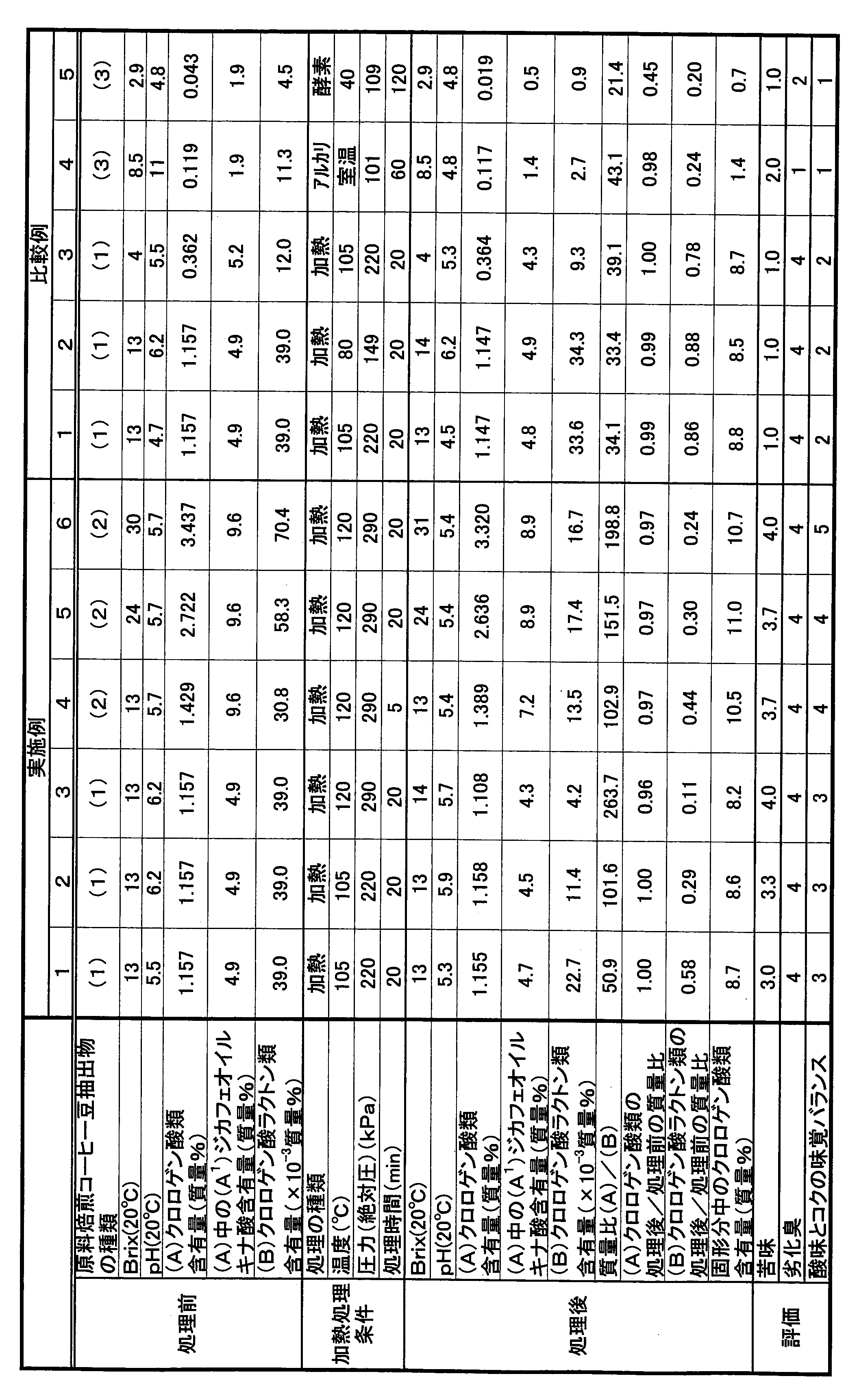
- Table 1 shows the analysis results of the roasted coffee bean extract obtained.
Landscapes
- Life Sciences & Earth Sciences (AREA)
- Chemical & Material Sciences (AREA)
- Engineering & Computer Science (AREA)
- Food Science & Technology (AREA)
- Polymers & Plastics (AREA)
- Botany (AREA)
- Mycology (AREA)
- Health & Medical Sciences (AREA)
- Nutrition Science (AREA)
- Tea And Coffee (AREA)
Abstract
Description
(A)クロロゲン酸類、及び
(B)クロロゲン酸ラクトン類
を含み、
(A)クロロゲン酸類と、(B)クロロゲン酸ラクトン類との質量比[(A)/(B)]が45~100000であり、
(A)クロロゲン酸類中の(A1)ジカフェオイルキナ酸の含有量が3~13質量%であり、
Brixが10~40である、焙煎コーヒー豆抽出物を提供するものである。
本発明はまた、当該焙煎コーヒー豆抽出物を用いたインスタントコーヒー、濃縮コーヒー組成物及び容器詰コーヒー飲料を提供するものである。
「(A)クロロゲン酸類」とは、3-カフェオイルキナ酸、4-カフェオイルキナ酸及び5-カフェオイルキナ酸のモノカフェオイルキナ酸;3-フェルラキナ酸、4-フェルラキナ酸及び5-フェルラキナ酸のモノフェルラキナ酸;3,4-ジカフェオイルキナ酸、3,5-ジカフェオイルキナ酸及び4,5-ジカフェオイルキナ酸のジカフェオイルキナ酸(A1)を併せての総称であり、「クロロゲン酸類の含有量」はこれら9種の合計量に基づいて定義される。また、「(A1)ジカフェオイルキナ酸の含有量」は上記3種の合計量に基づいて定義される。
「(B)クロロゲン酸ラクトン類」とは、3-カフェオイルキナ酸ラクトン、4-カフェオイルキナ酸ラクトン及び5-カフェオイルキナ酸ラクトンを併せての総称であり、「(B)クロロゲン酸ラクトン類の含有量」はこれら3種の合計量に基づいて定義される。
本発明の焙煎コーヒー豆抽出物の製造方法は、原料焙煎コーヒー豆抽出物を、Brix10~40、及びpH5.5~6.5に調整し、100℃以上にて加熱処理することを特徴とするものである。
本発明で使用する原料焙煎コーヒー豆抽出物は、当該原料焙煎コーヒー豆抽出物100g当たり焙煎コーヒー豆を生豆換算で1g以上、更に2.5g以上、更に5g以上使用しているものが好ましい。
焙煎コーヒー豆の焙煎度としては、例えば、ライト、シナモン、ミディアム、ハイ、シティ、フルシティ、フレンチ、イタリアンが例示される。中でも、ライト、シナモン、ミディアム、ハイ、シティがクロロゲン酸類を多く含み、飲用しやすい点で好ましい。
ここで、「L値」とは、黒をL値0とし、また白をL値100として、焙煎コーヒー豆の明度を色差計で測定したものである。すなわち、L値はコーヒー豆の焙煎の程度を表す指標であり、コーヒー豆の焙煎が深いものほどコーヒー豆の色は黒っぽくなるためL値は低い値となり、逆に焙煎度が浅いほどL値は高い値となる。
抽出溶媒としては、水、アルコール水溶液、ミルク、炭酸水等が例示される。中でも、風味の観点から、水が好ましい。抽出溶媒のpH(20℃、以下同じ)は通常4~10であるが、風味の観点から、5~7が好ましい。
加熱温度は100℃以上であるが、クロロゲン酸類量の保持、クロロゲン酸ラクトン類量を低減し、苦味を抑制する観点から、上限は145℃、更に130℃、更に125℃であることが好ましく、他方下限は105℃、更に110℃、更に115℃であることが好ましい。かかる加熱温度の範囲としては、100~145℃、更に105~130℃、更に115~125℃が好ましい。
処理時間は、クロロゲン酸類量の保持、クロロゲン酸ラクトン類量を低減し、苦味を抑制する観点から、1~60分が好ましく、更に3~40分、更に5~30分が好ましい。
加圧条件とする際に、不活性ガスにより希釈した低酸素雰囲気としてもよい。不活性ガスとしては、窒素、アルゴン、水蒸気等が挙げられ、中でも窒素が好ましい。
以下、本発明の製造方法により得られる焙煎コーヒー豆抽出物(以下、単に「本発明の焙煎コーヒー豆抽出物」とも称する)の好適な実施形態について詳細に説明する。
(A)クロロゲン酸類と、(B)クロロゲン酸ラクトン類との質量比[(A)/(B)]は45~100000であるが、苦味抑制の観点から、50~10000、更に63~1000、更に100~500であることが好ましい。
本発明の焙煎コーヒー豆抽出物は、苦味が抑制されているため、インスタントコーヒー、濃縮コーヒー組成物とするのに有用である。
本発明のインスタントコーヒーは、本発明の焙煎コーヒー豆抽出物を乾燥して得ることが可能であり、乾燥方法としては、噴霧乾燥、凍結乾燥等が例示される。ここで、本明細書において「インスタントコーヒー」とは、水分量3質量%以下であって、飲用時に水、熱水、ミルク等の液体で還元される多孔質粒状コーヒー濃縮組成物をいう。インスタントコーヒーの形態としては、例えば、スプーンで計量して調製するもの、透過性浸出パッケージ又はカップ1杯分毎に小分けしたスティックタイプが挙げられる。
また、本発明の濃縮コーヒー組成物は、本発明の焙煎コーヒー豆抽出物を濃縮して得ることが可能であり、濃縮条件は適宜選択することができる。ここで、本明細書において「濃縮コーヒー組成物」とは、固形分量が10質量%超から97質量%未満であるものをいう。濃縮コーヒー組成物の形態としては、液状、ゲル状、スラリー状であってもよく、例えば、濃縮コーヒー組成物が液体の場合、ポーションタイプの希釈飲料とすることができる。
本発明の容器詰コーヒー飲料は、本発明の焙煎コーヒー豆抽出物を必要により水希釈して容器に充填することで得ることができる。ここで、本明細書において「容器詰コーヒー飲料」とは、固形分量が10質量%以下であるものをいう。
また、容器詰飲料は、例えば、金属缶のような容器に充填後、加熱殺菌できる場合にあっては適用されるべき法規(日本にあっては食品衛生法)に定められた殺菌条件で製造できる。PETボトル、紙容器のようにレトルト殺菌できないものについては、あらかじめ上記と同等の殺菌条件、例えばプレート式熱交換器などで高温短時間殺菌後、一定の温度迄冷却して容器に充填する等の方法が採用できる。
〔1-1〕原料焙煎コーヒー豆抽出物を、Brix10~40、及びpH5.5~6.5に調整し、100℃以上にて加熱処理する、焙煎コーヒー豆抽出物の製造方法。
〔1-2〕前記原料焙煎コーヒー豆抽出物は、L値が好ましくは19~29、より好ましくは19~28、更に好ましくは19~27、更に好ましくは19~25、更に好ましくは19~24、更に好ましくは21~25、更に好ましくは21~24、更に好ましくは22~25、殊更に好ましくは22~24である焙煎コーヒー豆から得られたものである、上記〔1-1〕記載の製造方法。
〔1-3〕前記Brixが、好ましくは10~35、更に好ましくは13~30である、上記〔1-1〕又は〔1-2〕記載の製造方法。
〔1-4〕前記pHが、好ましくは5.6~6.2、更に好ましくは5.7~6である、上記〔1-1〕~〔1-3〕のいずれか一に記載の製造方法。
〔1-5〕前記加熱処理の温度が、好ましくは100~145℃、より好ましくは105~130℃、更に好ましくは115~125℃である、上記〔1-1〕~〔1-4〕のいずれか一に記載の製造方法。
〔1-6〕前記加熱処理の加熱時間が、好ましくは1~60分、より好ましくは3~40分、更に好ましくは5~30分である、上記〔1-1〕~〔1-5〕のいずれか一に記載の製造方法。
〔1-7〕加熱処理の加圧条件が、絶対圧として、好ましくは150~400kPa、より好ましくは180~300kPa、更に好ましくは220~290kPaである、上記〔1-1〕~〔1-6〕のいずれか一に記載の製造方法。
(A)クロロゲン酸類、及び
(B)クロロゲン酸ラクトン類
を含み、(A)クロロゲン酸類と、(B)クロロゲン酸ラクトン類との質量比(A)/(B)が45~100000であり、(A)クロロゲン酸類中の(A1)ジカフェオイルキナ酸の含有量が3~13質量%であり、Brixが10~40である、焙煎コーヒー豆抽出物。
〔2-2〕(A)クロロゲン酸類の含有量が、好ましくは0.1~12質量%、より好ましくは0.5~8質量%、更に好ましくは1~5質量%、更に好ましくは1~3.5質量%である、上記〔2-1〕記載の焙煎コーヒー豆抽出物。
〔2-3〕固形分中の(A)クロロゲン酸類の含有量が、好ましくは5~30質量%、より好ましくは8~28質量%、更に好ましくは9~28質量%、更に好ましくは10~25質量%、殊更に好ましくは10~15質量%である、上記〔2-1〕又は〔2-2〕記載の焙煎コーヒー豆抽出物。
〔2-4〕前記質量比(A)/(B)が、好ましくは50~10000、より好ましくは63~1000、更に好ましくは100~500である、上記〔2-1〕~〔2-3〕のいずれか一に記載の焙煎コーヒー豆抽出物。
〔2-5〕(A)クロロゲン酸類中の前記(A1)ジカフェオイルキナ酸の含有量が、好ましくは3.5~12.5質量%、より好ましくは4~12質量%、更に好ましくは4.5~11.5質量%、更に好ましくは5~11質量%、更に好ましくは6~10質量%、殊更に好ましくは7~9質量%である、上記〔2-1〕~〔2-4〕のいずれか一に記載の焙煎コーヒー豆抽出物。
〔2-6〕前記Brixが、好ましくは10~35、より好ましくは13~31、更に好ましくは13~30である、上記〔2-1〕~〔2-5〕のいずれか一に記載の焙煎コーヒー豆抽出物。
〔2-7〕上記〔1-1〕~〔1-7〕のいずれか一に記載の製造方法により得られたものである、上記〔2-1〕~〔2-6〕のいずれか一に記載の焙煎コーヒー豆抽出物。
〔3-2〕固形分中の(A)クロロゲン酸類の含有量が、好ましくは5~30質量%、より好ましくは8~28質量%、更に好ましくは9~28質量%、更に好ましくは10~25質量%、殊更に好ましくは10~15質量%である、上記〔3-1〕記載のインスタントコーヒー。
〔3-3〕(A)クロロゲン酸類と、(B)クロロゲン酸ラクトン類との質量比(A)/(B)が45~100000、好ましくは50~10000、より好ましくは63~1000、更に好ましくは100~500である、上記〔3-1〕又は〔3-2〕記載のインスタントコーヒー。
〔3-4〕(A)クロロゲン酸類中の(A1)ジカフェオイルキナ酸の含有量が3~13質量%、好ましくは3.5~12.5質量%、より好ましくは4~12質量%、更に好ましくは4.5~11.5質量%、更に好ましくは5~11質量%、更に好ましくは6~10質量%、殊更に好ましくは7~9質量%である、上記〔3-1〕~〔3-3〕のいずれか一に記載のインスタントコーヒー。
〔3-5〕水分量3質量%以下である、上記〔3-1〕~〔3-4〕のいずれか一に記載のインスタントコーヒー。
〔3-6〕乾燥方法が、噴霧乾燥又は凍結乾燥である、上記〔3-1〕~〔3-5〕のいずれか一に記載のインスタントコーヒー。
〔4-2〕固形分中の(A)クロロゲン酸類の含有量が、好ましくは5~30質量%、より好ましくは8~28質量%、更に好ましくは9~28質量%、更に好ましくは10~25質量%、殊更に好ましくは10~15質量%である、上記〔4-1〕記載の濃縮コーヒー組成物。
〔4-3〕(A)クロロゲン酸類と、(B)クロロゲン酸ラクトン類との質量比(A)/(B)が45~100000、好ましくは50~10000、より好ましくは63~1000、更に好ましくは100~500である、上記〔4-1〕又は〔4-2〕記載の濃縮コーヒー組成物。
〔4-4〕(A)クロロゲン酸類中の(A1)ジカフェオイルキナ酸の含有量が3~13質量%、好ましくは3.5~12.5質量%、より好ましくは4~12質量%、更に好ましくは4.5~11.5質量%、更に好ましくは5~11質量%、更に好ましくは6~10質量%、殊更に好ましくは7~9質量%である、上記〔4-1〕~〔4-3〕のいずれか一に記載の濃縮コーヒー組成物。
〔4-5〕固形分量が10質量%超から97質量%未満である、上記〔4-1〕~〔4-4〕のいずれか一に記載の濃縮コーヒー組成物。
〔5-2〕(A)クロロゲン酸類の含有量が、好ましくは0.01~8質量%、より好ましくは0.05~6質量%、更に好ましくは0.1~4質量%、更に好ましくは0.1~2質量%、殊更に好ましくは0.1~1質量%である、上記〔5-1〕記載の容器詰コーヒー飲料。
〔5-3〕pHが、好ましくは5~7、より好ましくは5.4~6.5、更に好ましくは5.6~6.3である、上記〔5-1〕又は〔5-2〕記載の容器詰コーヒー飲料。
〔5-4〕固形分中の(A)クロロゲン酸類の含有量が、好ましくは5~30質量%、より好ましくは8~28質量%、更に好ましくは9~28質量%、更に好ましくは10~25質量%、殊更に好ましくは10~15質量%である、上記〔5-1〕~〔5-3〕のいずれか一に記載の容器詰コーヒー飲料。
〔5-5〕Brixが、好ましくは0.5~5、より好ましくは0.8~4、更に好ましくは1~3である、上記〔5-1〕~〔5-4〕のいずれか一に記載の容器詰コーヒー飲料。
〔5-6〕(A)クロロゲン酸類と、(B)クロロゲン酸ラクトン類との質量比(A)/(B)が45~100000、好ましくは50~10000、より好ましくは63~1000、更に好ましくは100~500である、上記〔5-1〕~〔5-5〕のいずれか一に記載の容器詰コーヒー飲料。
〔5-7〕(A)クロロゲン酸類中の(A1)ジカフェオイルキナ酸の含有量が3~13質量%、好ましくは3.5~12.5質量%、より好ましくは4~12質量%、更に好ましくは4.5~11.5質量%、更に好ましくは5~11質量%、更に好ましくは6~10質量%、殊更に好ましくは7~9質量%である、上記〔5-1〕~〔5-6〕のいずれか一に記載の容器詰コーヒー飲料。
〔5-8〕固形分量が10質量%以下である、上記〔5-1〕~〔5-7〕のいずれか一に記載の容器詰コーヒー飲料。
分析機器はHPLCを使用した。装置の構成ユニットの型番は次の通りである。
UV-VIS検出器:L-2420((株)日立ハイテクノロジーズ)、
カラムオーブン:L-2300((株)日立ハイテクノロジーズ)、
ポンプ:L-2130((株)日立ハイテクノロジーズ)、
オートサンプラー:L-2200((株)日立ハイテクノロジーズ)、
カラム:Cadenza CD-C18 内径4.6mm×長さ150mm、粒子径3μm(インタクト(株))。
サンプル注入量:10μL、
流量:1.0mL/min、
UV-VIS検出器設定波長:325nm、
カラムオーブン設定温度:35℃、
溶離液A:0.05M 酢酸、0.1mM ヒドロキシエタン-1,1-ジホスホン酸(HEDPO)、10mM 酢酸ナトリウム、5(V/V)%アセトニトリル溶液、
溶離液B:アセトニトリル。
時間 溶離液A 溶離液B
0.0分 100% 0%
10.0分 100% 0%
15.0分 95% 5%
20.0分 95% 5%
22.0分 92% 8%
50.0分 92% 8%
52.0分 10% 90%
60.0分 10% 90%
60.1分 100% 0%
70.0分 100% 0%
クロロゲン酸類の保持時間(単位:分)
・モノカフェオイルキナ酸:5.3、8.8、11.6の計3点
・モノフェルロイルキナ酸:13.0、19.9、21.0の計3点
・ジカフェオイルキナ酸(A1):36.6、37.4、44.2の計3点。
ここで求めた9種のクロロゲン酸類の面積値から5-カフェオイルキナ酸を標準物質とし、クロロゲン酸類含量(g/100g)を求めた。
クロロゲン酸類の分析と同じ分析機器及び分析条件を用い、分析を行った。
クロロゲン酸ラクトン類の保持時間(単位:分)
(B)カフェオイルキナ酸ラクトン:26.8、28.2、30.6の計3点。
ここで求めた3種のクロロゲン酸ラクトン類の面積値から5-カフェオイルキナ酸を標準物質とし、クロロゲン酸ラクトン類含有量(g/100g)を求めた。
20℃における試料のBrixを、糖度計(Atago RX-5000、Atago社製)を用いて測定した。
試料を、色差計((株)日本電色社製 スペクトロフォトメーター SE2000)を用いて測定した。
各実施例及び比較例で得られた焙煎コーヒー豆抽出物をBrix2に調整し、その苦味、劣化臭及び酸味とコクの味覚バランスについて、パネル3名が下記の基準に基づいて評価し、その平均値をもって最終スコアを決定した。なお、「劣化臭」は、焙煎コーヒー豆抽出物本来の風味が損なわれているかどうかの観点から評価した。
4:弱い
3:やや弱い
2:やや強い
1:強い
5:非常に良い
4:良い
3:やや良い
2:悪い
1:非常に悪い
原料焙煎コーヒー豆抽出物(1)の製造
金属メッシュを備えたカラム形状抽出機に、焙煎度L22のコロンビア豆を0.4kg仕込み、温度95℃のイオン交換水(pH5.7)を700mL流通して、Brix15の原料焙煎コーヒー豆抽出物(1)を得た。この抽出物のpHは4.6、(A)クロロゲン酸類の含有量は1335mg/100mL、(B)クロロゲン酸ラクトン類の含有量は45mg/100mL、(A)中の(A1)ジカフェオイルキナ酸の含有量は4.9質量%であった。
原料焙煎コーヒー豆抽出物(2)の製造
金属メッシュを備えたカラム形状抽出機に焙煎度L16.5とL30のブレンド豆(50/50)を0.4kg仕込み、温度95℃のイオン交換水(pH5.7)を700mL流通して、Brix15%のコーヒー抽出液を得た。得られた抽出液を濃縮機によりBrix32まで濃縮して原料焙煎コーヒー豆抽出物(2)を得た。この抽出物のpHは5.3、クロロゲン酸類の含有量は3672mg/100mL、クロロゲン酸ラクトン類の含有量は77mg/100mL、(A)中の(A1)ジカフェオイルキナ酸の含有量は9.6質量%であった。
表1に示した原料焙煎コーヒー豆抽出物100mLを用い、イオン交換水にてBrixを、10%炭酸水素ナトリウムにてpHをそれぞれ調整し(比較例1はpH調整なし)、次いで表1に示した加熱、加圧処理条件にて処理し、焙煎コーヒー豆抽出物を得た。得られた焙煎コーヒー豆抽出物の分析結果を表1に示す。
原料焙煎コーヒー豆抽出物(3)の製造
金属メッシュを備えたカラム形状抽出機に焙煎度L16.5のコロンビア豆を0.4kg仕込み、温度95℃のイオン交換水(pH5.7)600mLを流通して、Brix18の原料焙煎コーヒー豆抽出物(3)を得た。この抽出物のpHは4.86、クロロゲン酸類の含有量は273mg/100mL、クロロゲン酸ラクトン類の含有量は26mg/100mLであった。
(アルカリ処理)
製造例3で得られた原料焙煎コーヒー豆抽出物(3)100mLをイオン交換水でBrix8.5に調整した。この際の原料焙煎コーヒー豆抽出物中のクロロゲン酸類の含有量は119mg/100mL、クロロゲン酸ラクトン類の含有量は11.3mg/100mL、(A)中の(A1)ジカフェオイルキナ酸の含有量は1.9質量%であった。この液を、1時間、25℃でpH11に保たれるように、攪拌しながら、1M水酸化カリウム水溶液で処理した。次に、その液に85%リン酸を加え、pHを4.8に調整して焙煎コーヒー豆抽出物を得た。得られた焙煎コーヒー豆抽出物の分析結果を表1に示す。
(酵素処理)
製造例3で得られた原料焙煎コーヒー豆抽出物(3)100mLをイオン交換水でBrix2.9に調整した。この際の原料焙煎コーヒー豆抽出物中のクロロゲン酸類の含有量は43mg/100mL、クロロゲン酸ラクトン類の含有量は4.5mg/100mL、(A)中の(A1)ジカフェオイルキナ酸の含有量は1.9質量%であった。この液のpHを4.8に調整し、この液に加水分解酵素であるエステラーゼ(セルロシンGM5(エイチビィアイ(株))、1U/mgコーヒー固形分)を加えて、スクリュー管に入れた。このスクリュー管を40℃の水槽で攪拌(100rpm)し、2時間の反応時間の後にスクリュー管をから取り出し、焙煎コーヒー豆抽出物を得た。得られた焙煎コーヒー豆抽出物の分析結果を表1に示す。
Claims (8)
- 原料焙煎コーヒー豆抽出物を、Brix10~40、及びpH5.5~6.5に調整し、100℃以上にて加熱処理する、焙煎コーヒー豆抽出物の製造方法。
- 原料焙煎コーヒー豆抽出物が、L値19~29の焙煎コーヒー豆から得られたものである、請求項1記載の製造方法。
- 次の成分(A)及び(B);
(A)クロロゲン酸類、及び
(B)クロロゲン酸ラクトン類
を含み、
(A)クロロゲン酸類と、(B)クロロゲン酸ラクトン類との質量比(A)/(B)が45~100000であり、
(A)クロロゲン酸類中の(A1)ジカフェオイルキナ酸の含有量が3~13質量%であり、
Brixが10~40である、焙煎コーヒー豆抽出物。 - (A)クロロゲン酸類の含有量が0.1~12質量%である、請求項3記載の焙煎コーヒー豆抽出物。
- 固形分中の(A)クロロゲン酸類の含有量が5~30質量%である、請求項3又は4記載の焙煎コーヒー豆抽出物。
- 請求項3~5のいずれか一項に記載の焙煎コーヒー豆抽出物を乾燥して得られる、インスタントコーヒー。
- 請求項3~5のいずれか一項に記載の焙煎コーヒー豆抽出物を濃縮して得られる、濃縮コーヒー組成物。
- 請求項3~5のいずれか一項に記載の焙煎コーヒー豆抽出物を容器に充填してなる、容器詰コーヒー飲料。
Priority Applications (6)
| Application Number | Priority Date | Filing Date | Title |
|---|---|---|---|
| RU2013128601/10A RU2583292C2 (ru) | 2010-11-24 | 2011-11-22 | Способ производства экстракта из обжаренных зерен кофе |
| EP11843435.6A EP2644036B1 (en) | 2010-11-24 | 2011-11-22 | Process for production of roasted coffee bean extract |
| US13/989,705 US8734884B2 (en) | 2010-11-24 | 2011-11-22 | Roasted coffee bean extract |
| BR112013012855-0A BR112013012855B1 (pt) | 2010-11-24 | 2011-11-22 | Processo para a produzir um extrato de grãos de café torrados, extrato de grãos de café torrados produzido pelo dito processo, café instantâneo e composição de café concentrada |
| CN201180055436.5A CN103220918B (zh) | 2010-11-24 | 2011-11-22 | 煎焙咖啡豆提取物的制造方法 |
| US14/149,270 US9173416B2 (en) | 2010-11-24 | 2014-01-07 | Process for production of roasted coffee bean extract |
Applications Claiming Priority (2)
| Application Number | Priority Date | Filing Date | Title |
|---|---|---|---|
| JP2010261127 | 2010-11-24 | ||
| JP2010-261127 | 2010-11-24 |
Related Child Applications (2)
| Application Number | Title | Priority Date | Filing Date |
|---|---|---|---|
| US13/989,705 A-371-Of-International US8734884B2 (en) | 2010-11-24 | 2011-11-22 | Roasted coffee bean extract |
| US14/149,270 Continuation US9173416B2 (en) | 2010-11-24 | 2014-01-07 | Process for production of roasted coffee bean extract |
Publications (1)
| Publication Number | Publication Date |
|---|---|
| WO2012070578A1 true WO2012070578A1 (ja) | 2012-05-31 |
Family
ID=46145919
Family Applications (1)
| Application Number | Title | Priority Date | Filing Date |
|---|---|---|---|
| PCT/JP2011/076916 Ceased WO2012070578A1 (ja) | 2010-11-24 | 2011-11-22 | 焙煎コーヒー豆抽出物の製造方法 |
Country Status (7)
| Country | Link |
|---|---|
| US (2) | US8734884B2 (ja) |
| EP (1) | EP2644036B1 (ja) |
| JP (2) | JP5155435B2 (ja) |
| CN (1) | CN103220918B (ja) |
| BR (1) | BR112013012855B1 (ja) |
| RU (1) | RU2583292C2 (ja) |
| WO (1) | WO2012070578A1 (ja) |
Cited By (5)
| Publication number | Priority date | Publication date | Assignee | Title |
|---|---|---|---|---|
| JP2013252112A (ja) * | 2012-06-08 | 2013-12-19 | T Hasegawa Co Ltd | コーヒー含有飲食品用呈味改善剤 |
| CN104717892A (zh) * | 2012-10-16 | 2015-06-17 | 因德纳有限公司 | 由向日葵获得富含咖啡酰奎宁酸的提取物的方法 |
| JP2016111981A (ja) * | 2014-12-17 | 2016-06-23 | アサヒ飲料株式会社 | 容器詰めコーヒー飲料の製造方法、容器詰めコーヒー飲料および容器詰めコーヒー飲料の香味劣化抑制方法 |
| US10188125B2 (en) | 2013-12-18 | 2019-01-29 | Kao Corporation | Coffee concentrate composition |
| JP2019113337A (ja) * | 2017-12-21 | 2019-07-11 | エステー株式会社 | 摩擦特性評価装置 |
Families Citing this family (19)
| Publication number | Priority date | Publication date | Assignee | Title |
|---|---|---|---|---|
| SG11201508068YA (en) * | 2013-03-29 | 2015-11-27 | Kao Corp | Coffee beverage |
| CN106793818B (zh) * | 2014-10-23 | 2020-10-27 | 长谷川香料株式会社 | 饮食品用呈味改善剂 |
| JP6338228B2 (ja) * | 2014-11-05 | 2018-06-06 | 長谷川香料株式会社 | コーヒー飲食品用の風味付与、増強または変調剤 |
| JP2015091271A (ja) * | 2015-02-12 | 2015-05-14 | 花王株式会社 | コーヒー飲料 |
| US10111554B2 (en) | 2015-03-20 | 2018-10-30 | Meltz, LLC | Systems for and methods of controlled liquid food or beverage product creation |
| WO2017004219A1 (en) * | 2015-06-29 | 2017-01-05 | Meltz, LLC | Continuous production of an extract |
| JP2017085984A (ja) * | 2015-11-11 | 2017-05-25 | 花王株式会社 | 希釈用コーヒー組成物の製造方法 |
| CN109922663B (zh) | 2016-10-26 | 2023-06-16 | 花王株式会社 | 含有绿原酸类的精制组合物的制造方法 |
| EP3533346B1 (en) | 2016-10-26 | 2021-06-09 | Kao Corporation | Refined chlorogenic acid-containing composition |
| JP6389940B2 (ja) * | 2016-10-26 | 2018-09-12 | 花王株式会社 | クロロゲン酸類含有組成物の製造方法 |
| WO2018200922A1 (en) | 2017-04-27 | 2018-11-01 | Meltz, LLC | Method for centrifugal extraction and apparatus suitable for carrying out this method |
| JP6654211B2 (ja) * | 2018-02-28 | 2020-02-26 | 長谷川香料株式会社 | 飲食品用呈味改善剤 |
| CN109393485A (zh) * | 2018-12-26 | 2019-03-01 | 陕西天承生物科技股份有限公司 | 一种高品质杜仲叶浸膏粉的制备方法 |
| CN109363042A (zh) * | 2018-12-26 | 2019-02-22 | 陕西天承生物科技股份有限公司 | 一种高品质杜仲叶饮料浓缩底浆的制备方法 |
| US11724849B2 (en) | 2019-06-07 | 2023-08-15 | Cometeer, Inc. | Packaging and method for single serve beverage product |
| JP6706372B1 (ja) * | 2019-07-08 | 2020-06-03 | サントリーホールディングス株式会社 | 低カフェインコーヒー濃縮液 |
| US12508521B1 (en) | 2020-10-31 | 2025-12-30 | Jot Labs, LLC | Extractor apparatus |
| US12053000B1 (en) | 2020-10-31 | 2024-08-06 | Jot Labs, LLC | Beverage extract from collected fractions |
| WO2023013578A1 (ja) * | 2021-08-03 | 2023-02-09 | 味の素株式会社 | インスタント飲料用キット |
Citations (9)
| Publication number | Priority date | Publication date | Assignee | Title |
|---|---|---|---|---|
| JPH10215771A (ja) | 1997-02-05 | 1998-08-18 | Kraft Foods Inc | アルカリ処理による液体コーヒーの安定化 |
| WO2008093892A1 (ja) * | 2007-02-02 | 2008-08-07 | Kao Corporation | 容器詰コーヒー飲料 |
| WO2008102892A1 (ja) * | 2007-02-20 | 2008-08-28 | Kao Corporation | 容器詰ミルクコーヒー飲料 |
| JP2008541712A (ja) | 2005-05-24 | 2008-11-27 | ネステク ソシエテ アノニム | 可溶性コーヒー製品 |
| JP2009017825A (ja) * | 2007-07-12 | 2009-01-29 | Kao Corp | 容器詰コーヒー飲料の製造方法 |
| JP2009124951A (ja) * | 2007-11-20 | 2009-06-11 | Kao Corp | 容器詰コーヒー飲料 |
| JP2009153452A (ja) * | 2007-12-27 | 2009-07-16 | Kao Corp | 容器詰コーヒー飲料の製造方法 |
| JP2009153451A (ja) * | 2007-12-27 | 2009-07-16 | Kao Corp | 容器詰コーヒー飲料の製造方法 |
| WO2010125770A1 (ja) * | 2009-04-28 | 2010-11-04 | 花王株式会社 | 濃縮コーヒー抽出液 |
Family Cites Families (26)
| Publication number | Priority date | Publication date | Assignee | Title |
|---|---|---|---|---|
| US2282139A (en) * | 1941-09-29 | 1942-05-05 | Helen L Kellogg | Process for production of coffee extract |
| US2874629A (en) * | 1955-12-21 | 1959-02-24 | Mortimer J Kahan | Coffee extracting apparatus |
| US2874620A (en) | 1956-07-11 | 1959-02-24 | Alexander G Mentes | Spreader with aggregate desegregating means |
| US3119695A (en) * | 1961-10-05 | 1964-01-28 | Glamorene Ind Factors Inc | Pressurized liquid instant coffee |
| IN141178B (ja) * | 1973-06-01 | 1977-01-29 | Unilever Ltd | |
| JP2920826B1 (ja) * | 1998-02-13 | 1999-07-19 | 株式会社ユニカフェ | 長期保存が可能なコーヒー抽出液の製造方法 |
| US6177119B1 (en) * | 1998-11-10 | 2001-01-23 | Kraft Foods, Inc. | Self-Whitening coffee and method of manufacture therefor |
| JP3706339B2 (ja) * | 2002-01-15 | 2005-10-12 | 花王株式会社 | 容器詰コーヒー飲料 |
| ITVR20020070A1 (it) * | 2002-06-26 | 2003-12-29 | Procaffe S P A | Preparazione di un estratto acquoso di caffé a lunga conservazione. |
| JP4551329B2 (ja) * | 2003-07-31 | 2010-09-29 | サントリーホールディングス株式会社 | コーヒー焙煎豆の処理方法および水蒸気処理コーヒー焙煎豆 |
| EP1695631A4 (en) * | 2003-09-25 | 2011-09-07 | Suntory Holdings Ltd | PROCESS FOR PREPARING GREEN COFFEE BEANS |
| JP4568490B2 (ja) * | 2003-11-06 | 2010-10-27 | 株式会社ポッカコーポレーション | 揮発性成分の製造方法、揮発性成分を含む飲食品及びコーヒー飲料又は茶飲料の製造方法 |
| DE602005015547D1 (de) | 2004-01-30 | 2009-09-03 | Kao Corp | Kaffeegetränkzusammensetzung |
| CN100566583C (zh) | 2004-01-30 | 2009-12-09 | 花王株式会社 | 咖啡饮料组合物 |
| SG155900A1 (en) * | 2004-09-08 | 2009-10-29 | Takasago Perfumery Co Ltd | Concentrated coffee extract and process for producing the same |
| JP4771063B2 (ja) * | 2004-09-30 | 2011-09-14 | タマティーエルオー株式会社 | 改質コーヒー及びコーヒー豆の焙煎方法 |
| CN101106908B (zh) * | 2004-12-13 | 2010-09-15 | 三得利控股株式会社 | 使用经过过滤处理的提取液的咖啡饮料的制造方法 |
| TWI469737B (zh) | 2005-01-28 | 2015-01-21 | Suntory Beverage & Food Ltd | Can be processed into high green base of coffee beans method |
| WO2007013616A1 (ja) * | 2005-07-29 | 2007-02-01 | Kao Corporation | 容器詰ミルクコーヒー飲料 |
| TWI391099B (zh) * | 2005-07-29 | 2013-04-01 | Kao Corp | 容器裝牛奶咖啡飲料 |
| US9055753B2 (en) * | 2005-07-29 | 2015-06-16 | Kao Corporation | Container-packed black coffee beverage |
| JP4842680B2 (ja) * | 2006-03-28 | 2011-12-21 | 花王株式会社 | クロロゲン酸類含有物の製造方法 |
| DK1872665T3 (da) * | 2006-06-29 | 2014-01-20 | Kraft Foods R & D Inc | Fremgangsmåde til modifikation af kaffesmag |
| JP4896863B2 (ja) * | 2006-12-27 | 2012-03-14 | 花王株式会社 | 精製焙煎コーヒー豆 |
| JP5214518B2 (ja) * | 2009-03-31 | 2013-06-19 | 花王株式会社 | コーヒー組成物の製造方法 |
| US8277864B2 (en) * | 2009-06-10 | 2012-10-02 | Kraft Foods Global Brands Llc | Liquid coffee concentrates and methods of making thereof |
-
2011
- 2011-11-22 EP EP11843435.6A patent/EP2644036B1/en active Active
- 2011-11-22 RU RU2013128601/10A patent/RU2583292C2/ru active
- 2011-11-22 BR BR112013012855-0A patent/BR112013012855B1/pt not_active IP Right Cessation
- 2011-11-22 JP JP2011254858A patent/JP5155435B2/ja active Active
- 2011-11-22 CN CN201180055436.5A patent/CN103220918B/zh active Active
- 2011-11-22 WO PCT/JP2011/076916 patent/WO2012070578A1/ja not_active Ceased
- 2011-11-22 US US13/989,705 patent/US8734884B2/en active Active
-
2012
- 2012-12-05 JP JP2012266301A patent/JP5238906B2/ja active Active
-
2014
- 2014-01-07 US US14/149,270 patent/US9173416B2/en active Active
Patent Citations (9)
| Publication number | Priority date | Publication date | Assignee | Title |
|---|---|---|---|---|
| JPH10215771A (ja) | 1997-02-05 | 1998-08-18 | Kraft Foods Inc | アルカリ処理による液体コーヒーの安定化 |
| JP2008541712A (ja) | 2005-05-24 | 2008-11-27 | ネステク ソシエテ アノニム | 可溶性コーヒー製品 |
| WO2008093892A1 (ja) * | 2007-02-02 | 2008-08-07 | Kao Corporation | 容器詰コーヒー飲料 |
| WO2008102892A1 (ja) * | 2007-02-20 | 2008-08-28 | Kao Corporation | 容器詰ミルクコーヒー飲料 |
| JP2009017825A (ja) * | 2007-07-12 | 2009-01-29 | Kao Corp | 容器詰コーヒー飲料の製造方法 |
| JP2009124951A (ja) * | 2007-11-20 | 2009-06-11 | Kao Corp | 容器詰コーヒー飲料 |
| JP2009153452A (ja) * | 2007-12-27 | 2009-07-16 | Kao Corp | 容器詰コーヒー飲料の製造方法 |
| JP2009153451A (ja) * | 2007-12-27 | 2009-07-16 | Kao Corp | 容器詰コーヒー飲料の製造方法 |
| WO2010125770A1 (ja) * | 2009-04-28 | 2010-11-04 | 花王株式会社 | 濃縮コーヒー抽出液 |
Cited By (6)
| Publication number | Priority date | Publication date | Assignee | Title |
|---|---|---|---|---|
| JP2013252112A (ja) * | 2012-06-08 | 2013-12-19 | T Hasegawa Co Ltd | コーヒー含有飲食品用呈味改善剤 |
| CN104717892A (zh) * | 2012-10-16 | 2015-06-17 | 因德纳有限公司 | 由向日葵获得富含咖啡酰奎宁酸的提取物的方法 |
| US10188125B2 (en) | 2013-12-18 | 2019-01-29 | Kao Corporation | Coffee concentrate composition |
| JP2016111981A (ja) * | 2014-12-17 | 2016-06-23 | アサヒ飲料株式会社 | 容器詰めコーヒー飲料の製造方法、容器詰めコーヒー飲料および容器詰めコーヒー飲料の香味劣化抑制方法 |
| JP2019113337A (ja) * | 2017-12-21 | 2019-07-11 | エステー株式会社 | 摩擦特性評価装置 |
| JP7009202B2 (ja) | 2017-12-21 | 2022-01-25 | エステー株式会社 | 摩擦特性評価装置 |
Also Published As
| Publication number | Publication date |
|---|---|
| BR112013012855A2 (pt) | 2017-10-31 |
| BR112013012855B1 (pt) | 2019-03-06 |
| JP2012125237A (ja) | 2012-07-05 |
| US20140120231A1 (en) | 2014-05-01 |
| US8734884B2 (en) | 2014-05-27 |
| EP2644036B1 (en) | 2020-06-10 |
| US9173416B2 (en) | 2015-11-03 |
| CN103220918B (zh) | 2015-05-13 |
| EP2644036A4 (en) | 2017-06-07 |
| US20130243929A1 (en) | 2013-09-19 |
| JP5238906B2 (ja) | 2013-07-17 |
| RU2583292C2 (ru) | 2016-05-10 |
| EP2644036A1 (en) | 2013-10-02 |
| JP5155435B2 (ja) | 2013-03-06 |
| JP2013046641A (ja) | 2013-03-07 |
| CN103220918A (zh) | 2013-07-24 |
| RU2013128601A (ru) | 2014-12-27 |
Similar Documents
| Publication | Publication Date | Title |
|---|---|---|
| JP5238906B2 (ja) | 焙煎コーヒー豆抽出物の製造方法 | |
| JP5877063B2 (ja) | コーヒー抽出液 | |
| CN101951784A (zh) | 容器装咖啡饮料 | |
| AU2018236545A1 (en) | Packed coffee beverage containing furfuryl methyl sulfide | |
| JP4953949B2 (ja) | 容器詰コーヒー飲料の製造方法 | |
| US7771770B2 (en) | Packaged coffee drink | |
| JP5965479B2 (ja) | コーヒー飲料 | |
| WO2006098232A1 (ja) | 容器詰コーヒー飲料 | |
| JP7810515B2 (ja) | 飲料組成物 | |
| JP2015091271A (ja) | コーヒー飲料 | |
| JP3973670B2 (ja) | 容器詰コーヒー飲料 | |
| JP2009028013A (ja) | 容器詰コーヒー飲料 | |
| JP2023111064A (ja) | コーヒー飲料およびその甘味質の改善方法 | |
| JP2023111066A (ja) | コーヒー飲料およびそのすっきり感と後切れとを改善する方法 | |
| JP2023111065A (ja) | コーヒー飲料およびその飲み応えと飲みやすさとを改善する方法 | |
| JP2018153100A (ja) | 容器詰め濃縮コーヒー飲料 | |
| JP2023051305A (ja) | 飲料組成物 | |
| JP7767436B2 (ja) | 風味が改善されたコーヒー豆抽出物、飲食品、容器詰め飲料及び該コーヒー豆抽出物の製造方法 | |
| JP3819417B1 (ja) | 容器詰コーヒー飲料 | |
| JP2008022751A (ja) | コーヒー抽出液 | |
| TWI924914B (zh) | 風味經改善的咖啡豆萃取物、飲食品及容器裝飲料 | |
| JP6584749B2 (ja) | 容器詰コーヒー飲料 | |
| JP2022136741A (ja) | コーヒー風味飲料及びその製造方法 | |
| JP2021103962A (ja) | コーヒー飲料 |
Legal Events
| Date | Code | Title | Description |
|---|---|---|---|
| 121 | Ep: the epo has been informed by wipo that ep was designated in this application |
Ref document number: 11843435 Country of ref document: EP Kind code of ref document: A1 |
|
| WWE | Wipo information: entry into national phase |
Ref document number: 2011843435 Country of ref document: EP |
|
| NENP | Non-entry into the national phase |
Ref country code: DE |
|
| WWE | Wipo information: entry into national phase |
Ref document number: 13989705 Country of ref document: US |
|
| ENP | Entry into the national phase |
Ref document number: 2013128601 Country of ref document: RU Kind code of ref document: A |
|
| REG | Reference to national code |
Ref country code: BR Ref legal event code: B01A Ref document number: 112013012855 Country of ref document: BR |
|
| ENP | Entry into the national phase |
Ref document number: 112013012855 Country of ref document: BR Kind code of ref document: A2 Effective date: 20130523 |