WO2012073891A1 - 輸液製剤 - Google Patents
輸液製剤 Download PDFInfo
- Publication number
- WO2012073891A1 WO2012073891A1 PCT/JP2011/077392 JP2011077392W WO2012073891A1 WO 2012073891 A1 WO2012073891 A1 WO 2012073891A1 JP 2011077392 W JP2011077392 W JP 2011077392W WO 2012073891 A1 WO2012073891 A1 WO 2012073891A1
- Authority
- WO
- WIPO (PCT)
- Prior art keywords
- infusion
- chamber
- vitamin
- chamber infusion
- preparation
- Prior art date
- Legal status (The legal status is an assumption and is not a legal conclusion. Google has not performed a legal analysis and makes no representation as to the accuracy of the status listed.)
- Ceased
Links
Classifications
-
- A—HUMAN NECESSITIES
- A61—MEDICAL OR VETERINARY SCIENCE; HYGIENE
- A61M—DEVICES FOR INTRODUCING MEDIA INTO, OR ONTO, THE BODY; DEVICES FOR TRANSDUCING BODY MEDIA OR FOR TAKING MEDIA FROM THE BODY; DEVICES FOR PRODUCING OR ENDING SLEEP OR STUPOR
- A61M5/00—Devices for bringing media into the body in a subcutaneous, intra-vascular or intramuscular way; Accessories therefor, e.g. filling or cleaning devices, arm-rests
- A61M5/14—Infusion devices, e.g. infusing by gravity; Blood infusion; Accessories therefor
- A61M5/1407—Infusion of two or more substances
-
- A—HUMAN NECESSITIES
- A61—MEDICAL OR VETERINARY SCIENCE; HYGIENE
- A61K—PREPARATIONS FOR MEDICAL, DENTAL OR TOILETRY PURPOSES
- A61K9/00—Medicinal preparations characterised by special physical form
- A61K9/08—Solutions
-
- A—HUMAN NECESSITIES
- A23—FOODS OR FOODSTUFFS; TREATMENT THEREOF, NOT COVERED BY OTHER CLASSES
- A23L—FOODS, FOODSTUFFS OR NON-ALCOHOLIC BEVERAGES, NOT OTHERWISE PROVIDED FOR; PREPARATION OR TREATMENT THEREOF
- A23L33/00—Modifying nutritive qualities of foods; Dietetic products; Preparation or treatment thereof
- A23L33/10—Modifying nutritive qualities of foods; Dietetic products; Preparation or treatment thereof using additives
- A23L33/115—Fatty acids or derivatives thereof; Fats or oils
-
- A—HUMAN NECESSITIES
- A23—FOODS OR FOODSTUFFS; TREATMENT THEREOF, NOT COVERED BY OTHER CLASSES
- A23L—FOODS, FOODSTUFFS OR NON-ALCOHOLIC BEVERAGES, NOT OTHERWISE PROVIDED FOR; PREPARATION OR TREATMENT THEREOF
- A23L33/00—Modifying nutritive qualities of foods; Dietetic products; Preparation or treatment thereof
- A23L33/10—Modifying nutritive qualities of foods; Dietetic products; Preparation or treatment thereof using additives
- A23L33/125—Modifying nutritive qualities of foods; Dietetic products; Preparation or treatment thereof using additives containing carbohydrate syrups; containing sugars; containing sugar alcohols; containing starch hydrolysates
-
- A—HUMAN NECESSITIES
- A23—FOODS OR FOODSTUFFS; TREATMENT THEREOF, NOT COVERED BY OTHER CLASSES
- A23L—FOODS, FOODSTUFFS OR NON-ALCOHOLIC BEVERAGES, NOT OTHERWISE PROVIDED FOR; PREPARATION OR TREATMENT THEREOF
- A23L33/00—Modifying nutritive qualities of foods; Dietetic products; Preparation or treatment thereof
- A23L33/10—Modifying nutritive qualities of foods; Dietetic products; Preparation or treatment thereof using additives
- A23L33/15—Vitamins
-
- A—HUMAN NECESSITIES
- A23—FOODS OR FOODSTUFFS; TREATMENT THEREOF, NOT COVERED BY OTHER CLASSES
- A23L—FOODS, FOODSTUFFS OR NON-ALCOHOLIC BEVERAGES, NOT OTHERWISE PROVIDED FOR; PREPARATION OR TREATMENT THEREOF
- A23L33/00—Modifying nutritive qualities of foods; Dietetic products; Preparation or treatment thereof
- A23L33/10—Modifying nutritive qualities of foods; Dietetic products; Preparation or treatment thereof using additives
- A23L33/17—Amino acids, peptides or proteins
- A23L33/175—Amino acids
-
- A—HUMAN NECESSITIES
- A61—MEDICAL OR VETERINARY SCIENCE; HYGIENE
- A61J—CONTAINERS SPECIALLY ADAPTED FOR MEDICAL OR PHARMACEUTICAL PURPOSES; DEVICES OR METHODS SPECIALLY ADAPTED FOR BRINGING PHARMACEUTICAL PRODUCTS INTO PARTICULAR PHYSICAL OR ADMINISTERING FORMS; DEVICES FOR ADMINISTERING FOOD OR MEDICINES ORALLY; BABY COMFORTERS; DEVICES FOR RECEIVING SPITTLE
- A61J1/00—Containers specially adapted for medical or pharmaceutical purposes
- A61J1/14—Details; Accessories therefor
- A61J1/20—Arrangements for transferring or mixing fluids, e.g. from vial to syringe
- A61J1/2093—Containers having several compartments for products to be mixed
-
- A—HUMAN NECESSITIES
- A61—MEDICAL OR VETERINARY SCIENCE; HYGIENE
- A61K—PREPARATIONS FOR MEDICAL, DENTAL OR TOILETRY PURPOSES
- A61K31/00—Medicinal preparations containing organic active ingredients
- A61K31/045—Hydroxy compounds, e.g. alcohols; Salts thereof, e.g. alcoholates
- A61K31/07—Retinol compounds, e.g. vitamin A
-
- A—HUMAN NECESSITIES
- A61—MEDICAL OR VETERINARY SCIENCE; HYGIENE
- A61K—PREPARATIONS FOR MEDICAL, DENTAL OR TOILETRY PURPOSES
- A61K31/00—Medicinal preparations containing organic active ingredients
- A61K31/12—Ketones
- A61K31/122—Ketones having the oxygen directly attached to a ring, e.g. quinones, vitamin K1, anthralin
-
- A—HUMAN NECESSITIES
- A61—MEDICAL OR VETERINARY SCIENCE; HYGIENE
- A61K—PREPARATIONS FOR MEDICAL, DENTAL OR TOILETRY PURPOSES
- A61K31/00—Medicinal preparations containing organic active ingredients
- A61K31/185—Acids; Anhydrides, halides or salts thereof, e.g. sulfur acids, imidic, hydrazonic or hydroximic acids
- A61K31/19—Carboxylic acids, e.g. valproic acid
- A61K31/195—Carboxylic acids, e.g. valproic acid having an amino group
- A61K31/197—Carboxylic acids, e.g. valproic acid having an amino group the amino and the carboxyl groups being attached to the same acyclic carbon chain, e.g. gamma-aminobutyric acid [GABA], beta-alanine, epsilon-aminocaproic acid or pantothenic acid
- A61K31/198—Alpha-amino acids, e.g. alanine or edetic acid [EDTA]
-
- A—HUMAN NECESSITIES
- A61—MEDICAL OR VETERINARY SCIENCE; HYGIENE
- A61K—PREPARATIONS FOR MEDICAL, DENTAL OR TOILETRY PURPOSES
- A61K31/00—Medicinal preparations containing organic active ingredients
- A61K31/21—Esters, e.g. nitroglycerine, selenocyanates
- A61K31/215—Esters, e.g. nitroglycerine, selenocyanates of carboxylic acids
-
- A—HUMAN NECESSITIES
- A61—MEDICAL OR VETERINARY SCIENCE; HYGIENE
- A61K—PREPARATIONS FOR MEDICAL, DENTAL OR TOILETRY PURPOSES
- A61K31/00—Medicinal preparations containing organic active ingredients
- A61K31/33—Heterocyclic compounds
- A61K31/335—Heterocyclic compounds having oxygen as the only ring hetero atom, e.g. fungichromin
- A61K31/35—Heterocyclic compounds having oxygen as the only ring hetero atom, e.g. fungichromin having six-membered rings with one oxygen as the only ring hetero atom
- A61K31/352—Heterocyclic compounds having oxygen as the only ring hetero atom, e.g. fungichromin having six-membered rings with one oxygen as the only ring hetero atom condensed with carbocyclic rings, e.g. methantheline
- A61K31/353—3,4-Dihydrobenzopyrans, e.g. chroman, catechin
- A61K31/355—Tocopherols, e.g. vitamin E
-
- A—HUMAN NECESSITIES
- A61—MEDICAL OR VETERINARY SCIENCE; HYGIENE
- A61K—PREPARATIONS FOR MEDICAL, DENTAL OR TOILETRY PURPOSES
- A61K31/00—Medicinal preparations containing organic active ingredients
- A61K31/33—Heterocyclic compounds
- A61K31/335—Heterocyclic compounds having oxygen as the only ring hetero atom, e.g. fungichromin
- A61K31/365—Lactones
- A61K31/375—Ascorbic acid, i.e. vitamin C; Salts thereof
-
- A—HUMAN NECESSITIES
- A61—MEDICAL OR VETERINARY SCIENCE; HYGIENE
- A61K—PREPARATIONS FOR MEDICAL, DENTAL OR TOILETRY PURPOSES
- A61K31/00—Medicinal preparations containing organic active ingredients
- A61K31/33—Heterocyclic compounds
- A61K31/395—Heterocyclic compounds having nitrogen as a ring hetero atom, e.g. guanethidine or rifamycins
- A61K31/41—Heterocyclic compounds having nitrogen as a ring hetero atom, e.g. guanethidine or rifamycins having five-membered rings with two or more ring hetero atoms, at least one of which being nitrogen, e.g. tetrazole
- A61K31/4164—1,3-Diazoles
- A61K31/4172—Imidazole-alkanecarboxylic acids, e.g. histidine
-
- A—HUMAN NECESSITIES
- A61—MEDICAL OR VETERINARY SCIENCE; HYGIENE
- A61K—PREPARATIONS FOR MEDICAL, DENTAL OR TOILETRY PURPOSES
- A61K31/00—Medicinal preparations containing organic active ingredients
- A61K31/33—Heterocyclic compounds
- A61K31/395—Heterocyclic compounds having nitrogen as a ring hetero atom, e.g. guanethidine or rifamycins
- A61K31/435—Heterocyclic compounds having nitrogen as a ring hetero atom, e.g. guanethidine or rifamycins having six-membered rings with one nitrogen as the only ring hetero atom
- A61K31/44—Non condensed pyridines; Hydrogenated derivatives thereof
- A61K31/4415—Pyridoxine, i.e. Vitamin B6
-
- A—HUMAN NECESSITIES
- A61—MEDICAL OR VETERINARY SCIENCE; HYGIENE
- A61K—PREPARATIONS FOR MEDICAL, DENTAL OR TOILETRY PURPOSES
- A61K31/00—Medicinal preparations containing organic active ingredients
- A61K31/33—Heterocyclic compounds
- A61K31/395—Heterocyclic compounds having nitrogen as a ring hetero atom, e.g. guanethidine or rifamycins
- A61K31/495—Heterocyclic compounds having nitrogen as a ring hetero atom, e.g. guanethidine or rifamycins having six-membered rings with two or more nitrogen atoms as the only ring heteroatoms, e.g. piperazine or tetrazines
- A61K31/505—Pyrimidines; Hydrogenated pyrimidines, e.g. trimethoprim
- A61K31/506—Pyrimidines; Hydrogenated pyrimidines, e.g. trimethoprim not condensed and containing further heterocyclic rings
- A61K31/51—Thiamines, e.g. vitamin B1
-
- A—HUMAN NECESSITIES
- A61—MEDICAL OR VETERINARY SCIENCE; HYGIENE
- A61K—PREPARATIONS FOR MEDICAL, DENTAL OR TOILETRY PURPOSES
- A61K31/00—Medicinal preparations containing organic active ingredients
- A61K31/33—Heterocyclic compounds
- A61K31/395—Heterocyclic compounds having nitrogen as a ring hetero atom, e.g. guanethidine or rifamycins
- A61K31/495—Heterocyclic compounds having nitrogen as a ring hetero atom, e.g. guanethidine or rifamycins having six-membered rings with two or more nitrogen atoms as the only ring heteroatoms, e.g. piperazine or tetrazines
- A61K31/505—Pyrimidines; Hydrogenated pyrimidines, e.g. trimethoprim
- A61K31/519—Pyrimidines; Hydrogenated pyrimidines, e.g. trimethoprim ortho- or peri-condensed with heterocyclic rings
-
- A—HUMAN NECESSITIES
- A61—MEDICAL OR VETERINARY SCIENCE; HYGIENE
- A61K—PREPARATIONS FOR MEDICAL, DENTAL OR TOILETRY PURPOSES
- A61K31/00—Medicinal preparations containing organic active ingredients
- A61K31/33—Heterocyclic compounds
- A61K31/395—Heterocyclic compounds having nitrogen as a ring hetero atom, e.g. guanethidine or rifamycins
- A61K31/495—Heterocyclic compounds having nitrogen as a ring hetero atom, e.g. guanethidine or rifamycins having six-membered rings with two or more nitrogen atoms as the only ring heteroatoms, e.g. piperazine or tetrazines
- A61K31/505—Pyrimidines; Hydrogenated pyrimidines, e.g. trimethoprim
- A61K31/519—Pyrimidines; Hydrogenated pyrimidines, e.g. trimethoprim ortho- or peri-condensed with heterocyclic rings
- A61K31/525—Isoalloxazines, e.g. riboflavins, vitamin B2
-
- A—HUMAN NECESSITIES
- A61—MEDICAL OR VETERINARY SCIENCE; HYGIENE
- A61K—PREPARATIONS FOR MEDICAL, DENTAL OR TOILETRY PURPOSES
- A61K31/00—Medicinal preparations containing organic active ingredients
- A61K31/59—Compounds containing 9, 10- seco- cyclopenta[a]hydrophenanthrene ring systems
- A61K31/593—9,10-Secocholestane derivatives, e.g. cholecalciferol, i.e. vitamin D3
-
- A—HUMAN NECESSITIES
- A61—MEDICAL OR VETERINARY SCIENCE; HYGIENE
- A61K—PREPARATIONS FOR MEDICAL, DENTAL OR TOILETRY PURPOSES
- A61K31/00—Medicinal preparations containing organic active ingredients
- A61K31/66—Phosphorus compounds
- A61K31/675—Phosphorus compounds having nitrogen as a ring hetero atom, e.g. pyridoxal phosphate
-
- A—HUMAN NECESSITIES
- A61—MEDICAL OR VETERINARY SCIENCE; HYGIENE
- A61K—PREPARATIONS FOR MEDICAL, DENTAL OR TOILETRY PURPOSES
- A61K31/00—Medicinal preparations containing organic active ingredients
- A61K31/66—Phosphorus compounds
- A61K31/683—Diesters of a phosphorus acid with two hydroxy compounds, e.g. phosphatidylinositols
- A61K31/685—Diesters of a phosphorus acid with two hydroxy compounds, e.g. phosphatidylinositols one of the hydroxy compounds having nitrogen atoms, e.g. phosphatidylserine, lecithin
-
- A—HUMAN NECESSITIES
- A61—MEDICAL OR VETERINARY SCIENCE; HYGIENE
- A61K—PREPARATIONS FOR MEDICAL, DENTAL OR TOILETRY PURPOSES
- A61K31/00—Medicinal preparations containing organic active ingredients
- A61K31/70—Carbohydrates; Sugars; Derivatives thereof
- A61K31/7004—Monosaccharides having only carbon, hydrogen and oxygen atoms
-
- A—HUMAN NECESSITIES
- A61—MEDICAL OR VETERINARY SCIENCE; HYGIENE
- A61K—PREPARATIONS FOR MEDICAL, DENTAL OR TOILETRY PURPOSES
- A61K31/00—Medicinal preparations containing organic active ingredients
- A61K31/70—Carbohydrates; Sugars; Derivatives thereof
- A61K31/7135—Compounds containing heavy metals
- A61K31/714—Cobalamins, e.g. cyanocobalamin, i.e. vitamin B12
-
- A—HUMAN NECESSITIES
- A61—MEDICAL OR VETERINARY SCIENCE; HYGIENE
- A61K—PREPARATIONS FOR MEDICAL, DENTAL OR TOILETRY PURPOSES
- A61K33/00—Medicinal preparations containing inorganic active ingredients
- A61K33/14—Alkali metal chlorides; Alkaline earth metal chlorides
-
- A—HUMAN NECESSITIES
- A61—MEDICAL OR VETERINARY SCIENCE; HYGIENE
- A61K—PREPARATIONS FOR MEDICAL, DENTAL OR TOILETRY PURPOSES
- A61K36/00—Medicinal preparations of undetermined constitution containing material from algae, lichens, fungi or plants, or derivatives thereof, e.g. traditional herbal medicines
- A61K36/18—Magnoliophyta (angiosperms)
- A61K36/185—Magnoliopsida (dicotyledons)
- A61K36/48—Fabaceae or Leguminosae (Pea or Legume family); Caesalpiniaceae; Mimosaceae; Papilionaceae
-
- A—HUMAN NECESSITIES
- A61—MEDICAL OR VETERINARY SCIENCE; HYGIENE
- A61K—PREPARATIONS FOR MEDICAL, DENTAL OR TOILETRY PURPOSES
- A61K45/00—Medicinal preparations containing active ingredients not provided for in groups A61K31/00 - A61K41/00
- A61K45/06—Mixtures of active ingredients without chemical characterisation, e.g. antiphlogistics and cardiaca
-
- A—HUMAN NECESSITIES
- A61—MEDICAL OR VETERINARY SCIENCE; HYGIENE
- A61K—PREPARATIONS FOR MEDICAL, DENTAL OR TOILETRY PURPOSES
- A61K9/00—Medicinal preparations characterised by special physical form
- A61K9/0012—Galenical forms characterised by the site of application
- A61K9/0019—Injectable compositions; Intramuscular, intravenous, arterial, subcutaneous administration; Compositions to be administered through the skin in an invasive manner
- A61K9/0029—Parenteral nutrition; Parenteral nutrition compositions as drug carriers
-
- A—HUMAN NECESSITIES
- A61—MEDICAL OR VETERINARY SCIENCE; HYGIENE
- A61K—PREPARATIONS FOR MEDICAL, DENTAL OR TOILETRY PURPOSES
- A61K9/00—Medicinal preparations characterised by special physical form
- A61K9/10—Dispersions; Emulsions
- A61K9/107—Emulsions ; Emulsion preconcentrates; Micelles
-
- A—HUMAN NECESSITIES
- A61—MEDICAL OR VETERINARY SCIENCE; HYGIENE
- A61P—SPECIFIC THERAPEUTIC ACTIVITY OF CHEMICAL COMPOUNDS OR MEDICINAL PREPARATIONS
- A61P3/00—Drugs for disorders of the metabolism
- A61P3/02—Nutrients, e.g. vitamins, minerals
-
- A—HUMAN NECESSITIES
- A61—MEDICAL OR VETERINARY SCIENCE; HYGIENE
- A61P—SPECIFIC THERAPEUTIC ACTIVITY OF CHEMICAL COMPOUNDS OR MEDICINAL PREPARATIONS
- A61P7/00—Drugs for disorders of the blood or the extracellular fluid
- A61P7/08—Plasma substitutes; Perfusion solutions; Dialytics or haemodialytics; Drugs for electrolytic or acid-base disorders, e.g. hypovolemic shock
-
- A—HUMAN NECESSITIES
- A23—FOODS OR FOODSTUFFS; TREATMENT THEREOF, NOT COVERED BY OTHER CLASSES
- A23V—INDEXING SCHEME RELATING TO FOODS, FOODSTUFFS OR NON-ALCOHOLIC BEVERAGES AND LACTIC OR PROPIONIC ACID BACTERIA USED IN FOODSTUFFS OR FOOD PREPARATION
- A23V2002/00—Food compositions, function of food ingredients or processes for food or foodstuffs
Definitions
- the present invention relates to an infusion preparation containing sugar, fat, amino acid, and electrolyte. More specifically, the present invention relates to an infusion preparation containing a two-chamber container, in which a sugar and a fat emulsion are contained in a first chamber and an amino acid and an electrolyte are contained in a second chamber (high calorie infusion preparation). .
- An infusion preparation containing a sugar, an amino acid and an electrolyte contained in an infusion bag having two chambers is known and widely used for patient nutrition management (see Non-Patent Document 1).
- the infusion solution containing the reducing sugar in one chamber of the infusion bag and the infusion solution containing the amino acid in the other chamber are separately stored. Is done. In use, the two liquids are communicated with each other and mixed with each solution before being administered to the patient. In order to facilitate the mixing operation, these two chambers are usually separated by a partition wall (for example, easy peel seal (easy peel seal)) capable of communicating with each other. However, a mistake often occurs that the user forgets to perform this communication operation and administers only one solution to the patient.
- a partition wall for example, easy peel seal (easy peel seal)
- Patent Document 1 an infusion preparation in which potassium is divided into two chambers and the potassium concentration in each infusion is 40 mEq / L or less has been studied.
- Patent Document 2 when infusion is administered by infusion from a peripheral vein, if the osmotic pressure is too high, there is a risk of causing vascular pain or phlebitis. Therefore, it is said that it is desirable to have an appropriate osmotic pressure even for an infusion before mixing (Patent Document 2).
- a high-calorie infusion preparation comprising three liquids of a large chamber liquid, a middle chamber liquid, and a small chamber liquid in which vitamins are pre-mixed in addition to sugar, amino acid, and electrolyte has been developed (for example, flucalic infusion formulation).
- a high-calorie infusion preparation due to the stability problem of vitamins (particularly fat-soluble vitamins), a form in which infusions having different compositions are accommodated in three chambers, a large chamber, a middle chamber, and a small chamber, is adopted.
- the object of the present invention is to develop an infusion preparation that can solve all the above problems.
- the inventors of the present invention are infusion preparations having two chambers separated by a communicable partition, wherein a first chamber infusion containing sugar and a fat emulsion is accommodated in the first chamber, and the second chamber is contained.
- a second chamber infusion containing an amino acid and an electrolyte is contained
- the first chamber infusion is substantially free of potassium and has an osmotic pressure ratio of 2.0 to 3.0
- the second chamber infusion is potassium
- concentration is 40 mEq / L or less
- the osmotic pressure ratio is 2.5 to 3.5
- the potassium concentration of the mixed solution of the first chamber infusion and the second chamber infusion at the time of partition communication is 16 mEq / L or more.
- the Maillard reaction due to reducing sugars and amino acids does not occur during storage, the fat particle size in the fat emulsion does not increase during storage, and even if only one infusion is administered, the patient is highly Develop potassiumemia or blood vessels And phlebitis possibility is small that or cause, found that it is possible to blend a two-chamber container formulation in which stable despite the various vitamins, and completed the present invention further evolving.
- the present invention includes, for example, the infusion preparation described in the following section.
- Item 1 An infusion preparation having two chambers separated by a communicable partition, The first chamber contains the first chamber infusion containing sugar and fat emulsion, The second chamber contains a second chamber infusion containing amino acids and electrolytes, The first chamber infusion is substantially free of potassium and has an osmotic pressure ratio of 2.0 to 3.0, The second chamber infusion has a potassium concentration of 40 mEq / L or less and an osmotic pressure ratio of 2.5 to 3.5, An infusion preparation having a potassium concentration of 16 mEq / L or more in a mixed solution of the first chamber infusion and the second chamber infusion during partition communication.
- Item 2. An infusion preparation having a potassium concentration of 16 mEq / L or more in a mixed solution of the first chamber infusion and the second chamber infusion during partition communication.
- the infusion preparation according to Item 1 wherein the first chamber infusion has a pH of 4.5 to 6.5 and the second chamber infusion has a pH of 6.0 to 7.4.
- Item 3. Item 3.
- Item 4. Item 4.
- the infusion preparation according to Item 4 further comprising vitamin A, vitamin B6, vitamin B12, vitamin D, vitamin E, and vitamin K in the first chamber infusion and vitamin C and vitamin B2 in the second chamber infusion.
- the infusion preparation of the present invention is an infusion preparation that solves all of the above problems.
- the infusion preparation does not cause a Maillard reaction with reducing sugars and amino acids during storage, and the fat particle size in the fat emulsion does not increase.
- the patient hardly develops hyperkalemia, vascular pain or phlebitis.
- vitamin B1 is expected to suppress acidosis.
- it because it is a two-chamber container formulation that can be mixed with other vitamins including fat-soluble vitamins, it requires less labor during production and use than a formulation (three-chamber container formulation) having a form separated into three or more chambers. It is reduced.
- the first chamber contains a first chamber infusion containing sugar and a fat emulsion
- the second chamber contains a second chamber infusion containing an amino acid and an electrolyte.
- the two chambers are separated by a communicable partition. It relates to an infusion preparation having
- the first chamber infusion used in the present invention contains sugar and a fat emulsion.
- sugars to be mixed in the first chamber infusion include reducing sugars such as glucose, fructose and maltose, and non-reducing sugars such as xylitol, sorbitol and glycerin.
- reducing sugars such as glucose, fructose and maltose
- non-reducing sugars such as xylitol, sorbitol and glycerin.
- it is preferably a reducing sugar, and more preferably glucose.
- These sugars may be used individually by 1 type, and may be used in combination of 2 or more type.
- the ratio of sugar in the first chamber infusion is preferably set in the range of 70 to 150 g / L.
- the sugar concentration in the mixed solution of the first chamber infusion and the second chamber infusion is preferably in the range satisfying the range of 50 to 100 g / L, more preferably 50 to 75 g / L. Is done.
- vitamin B1 in order to prevent the development of acidosis during the administration of fluid therapy, it is desirable to add vitamin B1 to the fluid in the first chamber.
- vitamin B1 blended in the first chamber infusion thiamine chloride hydrochloride, thiamine nitrate, prosultiamine, octothiamine and the like can be used.
- the mixing ratio of vitamin B1 in the first chamber infusion is exemplified by a range satisfying 1.5 to 10 mg / L, preferably 2 to 8 mg / L as thiamine.
- the concentration of vitamin B1 in the mixed solution of the first chamber infusion and the second chamber infusion satisfies the range of 1 to 6 mg / L, preferably 1.5 to 4 mg / L as thiamine. It is desirable to be set to.
- the fat emulsion blended in the first chamber infusion is an oil-in-water emulsion prepared by dispersing fats and oils in water using an emulsifier.
- the fat emulsion can be prepared according to a conventional method. For example, after adding an oil and fat and an emulsifier to water, stirring is performed to prepare a crude emulsion, and then the crude emulsion is emulsified by a conventional method such as a high-pressure emulsification method.
- oils and fats edible oils can be preferably used.
- vegetable oil (soybean oil, olive oil, cottonseed oil, safflower oil, corn oil, coconut oil, perilla oil, sesame oil, etc.), fish oil (eg, cod liver oil), medium chain fatty acid triglycerides (triglycerides of fatty acids with 8-10 carbon atoms)
- chemically synthesized triglycerides [ 2-linoleoyl-1,3-dioctanoylglycerol (8L8), 2-linoleoyl-1,3-didecanoylglycerol (10L10), etc.] and the
- emulsifier for example, various pharmaceutically acceptable emulsifiers can be used.
- egg yolk phospholipid egg yolk lecithin
- hydrogenated egg yolk phospholipid egg yolk lecithin
- soybean phospholipid soy lecithin
- hydrogenated soybean phospholipid and the like emulsifiers
- nonionic surfactants and the like exemplified. These may be used alone or in combination of two or more.
- oils and fats include soybean oil, and particularly preferred emulsifiers are egg yolk phospholipid (egg yolk lecithin).
- egg yolk lecithin egg yolk lecithin
- lecithin such as egg yolk lecithin
- the ratio of the fats and emulsifiers used in the preparation of the fat emulsion is not particularly limited as long as an oil-in-water fat emulsion is obtained.
- fats and oils are used in the resulting fat emulsion at a ratio of about 0.5 to 6 w / v%, preferably about 1 to 5 w / v%.
- the emulsifier is usually used in the range of about 0.01 to 2% w / v%, preferably about 0.05 to 1% w / v% in the resulting fat emulsion.
- One specific example of a method for producing a fat emulsion particularly suitable for the present invention is as follows. That is, oil and fat and an emulsifier are added to water, and at least one selected from glycerin and glucose is added, followed by stirring to prepare a crude emulsion, and then the crude emulsion is emulsified by a conventional method such as a high-pressure emulsification method. .
- a high-pressure emulsification method is adopted, the method is performed, for example, using an emulsifier such as a Manton gorin homogenizer, and the crude emulsion is about 2 to 50 times, preferably about 3 to about 20 to 700 kg / cm 2. This can be done by passing it about 20 times.
- glycerin and / or glucose may be present at the time of emulsification.
- glycerin and / or glucose may be added to a crude emulsion prepared using an oil and fat and an emulsifier to emulsify. Good.
- the amount of glycerin and / or glucose used it is usually appropriate that the resulting fat emulsion contains about 30 to 70 w / v%, preferably about 40 to 60 w / v% of glycerin and / or glucose.
- various additives known to be added and blended in the fat emulsion can be further blended.
- the additive include a pH adjuster.
- organic acids and amino acids can be used in addition to acids such as hydrochloric acid and alkalis such as sodium hydroxide and potassium hydroxide.
- the organic acid include acetic acid, lactic acid, citric acid, malic acid, succinic acid and the like.
- amino acids include L-histidine and L-lysine.
- the oil-soluble material can be used by being mixed in advance with the oil component constituting the emulsion.
- the water-soluble material can be mixed with water for injection or added and incorporated into the aqueous phase of the resulting fat emulsion.
- the mixing ratio of the fat emulsion in the first chamber infusion is 0.5 to 6 w / v%, preferably 1 to 5% w / v%, more preferably 2 to 5 w / v% in terms of the amount of fat.
- the amount of the fat emulsion in the mixed solution of the first chamber infusion and the second chamber infusion is 0.25 to 6 w / v%, preferably 0.5 to 3% w in terms of the amount of fats and oils. / v%, more preferably 1 to 2.5 w / v%.
- the pH of the infusion solution in the first chamber may be in the range of 4.5 to 6.5, preferably 5.0 to 6.5. Within such a pH range, the fat emulsion and vitamin B1 can be stabilized in the first chamber infusion.
- the pH adjustment of the first chamber infusion is performed using a pH adjuster such as hydrochloric acid, acetic acid, glacial acetic acid, lactic acid, malic acid, citric acid, sodium hydroxide, potassium hydroxide and the like. Further, L-histidine may be used as a pH adjuster.
- the first chamber infusion preferably has a titratable acidity of 1 or less from the viewpoint of further improving the stability of vitamin B1.
- the titratable acidity is the amount of mL of a 0.1 mol / L sodium hydroxide solution necessary to neutralize 100 mL of the solution to pH 7.4.
- the solvent for the first chamber infusion it is usually possible to use distilled water for injection.
- the amount of the first chamber infusion is appropriately set according to the total amount of the infusion preparation, the amount of the second chamber infusion, and the like.
- the first chamber infusion is substantially free of potassium. “Substantially not containing potassium” means that a compound containing potassium is not blended.
- the osmotic pressure ratio of the first chamber infusion is about 2.0 to 3.0.
- the osmotic pressure ratio is a ratio to the osmotic pressure of physiological saline (that is, a relative ratio when the osmotic pressure of physiological saline is 1).
- the osmotic pressure ratio of infusion refers to the ratio of physiological saline to the osmotic pressure unless otherwise specified.
- the second chamber infusion used in the present invention contains an amino acid and an electrolyte.
- amino acid blended in the second chamber infusion any amino acid may be used as long as it is used for amino acid infusion for the purpose of supplementing the living body.
- the amino acid is usually used in the form of a free amino acid, but may be in the form of a pharmaceutically acceptable salt, ester, N-acyl derivative or dipeptide.
- free amino acids to be blended in the second chamber infusion include L-leucine, L-isoleucine, L-valine, L-lysine, L-threonine, L-tryptophan, L-methionine, L-phenylalanine, L- Examples include cysteine, L-tyrosine, L-arginine, L-histidine, L-alanine, L-proline, L-serine, glycine, L-aspartic acid, L-glutamic acid and the like.
- amino acid salts include inorganic acid salts such as L-arginine hydrochloride, L-cysteine hydrochloride, L-glutamine hydrochloride, L-histidine hydrochloride, L-lysine hydrochloride; Examples include organic acid salts such as lysine acetate and L-lysine malate.
- amino acid ester include L-tyrosin methyl ester, L-methionine methyl ester, L-methionine ethyl ester, and the like.
- N-acyl forms of amino acids include N-acetyl-L-cysteine, N-acetyl-L-tryptophan, N-acetyl-L-proline and the like.
- amino acid dipeptides include L-tyrosyl-L-tyrosin, L-alanyl-L-tyrosine, L-arginyl-L-tyrosine, L-tyrosyl-L-arginine and the like.
- L-cysteine is preferably formulated as acetylcysteine from the viewpoint of stability.
- These amino acids may be used alone or in combination of two or more from the viewpoint of nutritional supplementation.
- At least all the essential amino acids ie, 9 kinds of L-leucine, L-isoleucine, L-valine, L-lysine, L-threonine, L-tryptophan, L-methionine, L-phenylalanine, L-histidine
- Amino acids are included.
- the mixing ratio of amino acids in the second chamber infusion is preferably 40 to 120 g / L, more preferably 50 to 100 g / L as the total amount of free amino acids.
- the amino acid concentration in the mixed solution of the first chamber infusion and the second chamber infusion satisfies the range of 10 to 50 g / L, preferably 20 to 30 g / L as the total amount of free amino acids. It is desirable to be set to.
- a suitable example of the combination of amino acids blended in the second chamber infusion and the blending ratio is as follows. That is, in terms of free amino acids, L-leucine: 5 to 15 g / L, L-isoleucine: 3 to 9 g / L, L-valine: 3 to 9 g / L, L-lysine: 3 to 12 g / L, L-threonine : 1.2 to 6 g / L, L-tryptophan: 0.3 to 3 g / L, L-methionine: 0.6 to 4.8 g / L, L-phenylalanine: 1.8 to 9 g / L, L-cysteine : 0.1-1.8 g / L, L-tyrosine: 0.06-1.2 g / L, L-arginine: 3-12 g / L, L-histidine: 1.2-6 g / L, L-alanine : 3-9 g / L, L-proline:
- a preferred example of the amino acid concentration in the mixed solution of the first chamber infusion and the second chamber infusion is as follows. That is, in terms of free amino acid, L-leucine: 3 to 9 g / L, L-isoleucine: 1.5 to 4.5 g / L, L-valine: 1.5 to 4.5 g / L, L-lysine: 1 0.5-5 g / L, L-threonine: 0.6-3 g / L, L-tryptophan: 0.15-1.5 g / L, L-methionine: 0.3-2.4 g / L, L-phenylalanine : 0.85 to 4.5 g / L, L-cysteine: 0.03 to 0.9 g / L, L-tyrosine: 0.03 to 0.6 g / L, L-arginine: 1.5 to 5 g / L L-histidine: 0.6-3 g / L, L-alanine: 1.5-4.5
- the electrolyte blended in the second chamber infusion is an electrolyte in the meaning used in the infusion field, and specifically is an electrolyte (body fluid electrolyte) contained in a body fluid (for example, blood, intracellular fluid). It may be said that it is a physiologically important electrolyte. More specifically, potassium, calcium, sodium, magnesium, phosphorus, zinc, chlorine and the like are exemplified. In the infusion preparation of the present invention, these electrolytes are preferably not blended in the first chamber infusion. In particular, potassium is usually compounded in both infusions in the two-chamber infusion preparation to avoid the danger of administration of high-concentration potassium, but in the infusion preparation of the present invention, it is blended only in the second-chamber infusion.
- potassium supply source examples include potassium chloride, potassium acetate, potassium citrate, potassium glycerophosphate, potassium sulfate, and potassium lactate.
- potassium glycerophosphate is preferable because it also serves as a phosphorus supply source.
- These potassium sources may be in hydrate form.
- Potassium is blended so that the concentration in the second chamber infusion is 40 mEq / L or less (preferably 25 to 40 mEq / L).
- the potassium concentration in the mixture of the first chamber infusion and the second chamber infusion is 16 mEq / L or more (preferably 16 to 25 mEq / L, more preferably 16 to 20 mEq / L).
- Examples of calcium supply sources include calcium salts such as calcium gluconate, calcium chloride, calcium glycerophosphate, calcium lactate, calcium pantothenate, and calcium acetate.
- the calcium salt may be in a hydrate form (for example, calcium gluconate hydrate).
- Calcium is blended so that the concentration in the second chamber infusion is 15 mEq / L or less (preferably 6 to 12 mEq / L).
- the calcium concentration in the mixed solution of the first chamber infusion and the second chamber infusion is 9 mEq / L or less (preferably 3 to 6 mEq / L).
- sodium supply source examples include sodium salts such as sodium chloride, sodium lactate, sodium acetate, sodium sulfate, sodium glycerophosphate, sodium citrate, and sodium lactate.
- sodium citrate may be used as a (part of) sodium source in order to prevent these from causing precipitation.
- the sodium source may also be in hydrate form.
- the mixing ratio of sodium in the second chamber infusion is 50 to 100 mEq / L, preferably 40 to 80 mEq / L in the second chamber infusion.
- the concentration of sodium in the mixed solution of the first chamber infusion and the second chamber infusion is set to satisfy the range of 25 to 50 mEq / L, preferably 30 to 40 mEq / L. It is desirable.
- magnesium supply sources include magnesium sulfate, magnesium chloride, and magnesium acetate.
- the magnesium source may also be in hydrate form.
- the mixing ratio of magnesium in the second chamber infusion is 1 to 20 mEq / L, preferably 5 to 15 mEq / L in the second chamber infusion.
- the magnesium concentration in the mixed solution of the first chamber infusion and the second chamber infusion is set to satisfy the range of 0.5 to 10 mEq / L, preferably 2 to 6 mEq / L. It is desirable that
- the phosphorus supply source when an inorganic salt is used, precipitation of calcium phosphate or magnesium phosphate may occur. Therefore, organic salts such as sodium glycerophosphate and potassium glycerophosphate are preferably used.
- the lecithin when lecithin is used as an emulsifier in the first chamber, the lecithin is also a phosphorus supply source.
- the necessary amount of phosphorus can be provided only by the lecithin-derived phosphorus, it is not necessary to add phosphorus to the second chamber and it is preferable because precipitation of calcium phosphate or the like does not occur. Examples of the mixing ratio of phosphorus in the second chamber infusion include 0 to 20 mmol / L in the second chamber infusion.
- the phosphorus concentration in the mixed solution of the first chamber infusion and the second chamber infusion is set to satisfy the range of 1 to 20 mmol / L, preferably 5 to 10 mmol / L. It is desirable.
- Examples of the zinc supply source include zinc sulfate and zinc chloride.
- the zinc source may also be in hydrate form.
- An example of the mixing ratio of zinc in the second chamber infusion is 2.5 to 15 ⁇ mol / L in the second chamber infusion. In the infusion preparation of the invention, it is desirable that the zinc concentration in the mixed solution of the first chamber infusion and the second chamber infusion is set to satisfy a range of 1.5 to 9 ⁇ mol / L.
- chlorine supply sources include sodium chloride, potassium chloride, magnesium chloride, and calcium chloride.
- the mixing ratio of chlorine to the second chamber infusion is 50 to 100 mEq / L, preferably 40 to 80 mEq / L in the second chamber infusion.
- the concentration of chlorine in the mixed solution of the first chamber infusion and the second chamber infusion is set to satisfy the range of 25 to 60 mEq / L, preferably 30 to 40 mEq / L. It is desirable.
- the second chamber infusion is adjusted to a pH of 6.0 to 7.4, preferably 6.5 to 7.2 with a pH adjuster as necessary.
- a pH adjuster the same one as described for the first chamber infusion can be used.
- citric acid can be preferably used because it can suppress the precipitation of calcium phosphate.
- distilled water for injection can usually be used as the solvent for the second chamber infusion.
- the osmotic pressure ratio of the second chamber infusion is about 2.5 to 3.5.
- a stabilizer may be added to the infusion preparation of the present invention.
- sulfites such as sodium hydrogensulfite
- the sulfite is blended in the second chamber infusion in order to avoid the decomposition of vitamin B1 contained in the first chamber infusion.
- the amount of sulfite in the second chamber infusion include a range of 20 to 50 mg / L.
- Vitamins include water-soluble vitamins and fat-soluble vitamins.
- the fat-soluble vitamin is blended in the first chamber infusion.
- the water-soluble vitamin may be blended in either the first chamber infusion or the second chamber infusion.
- vitamin B1 is blended in the first chamber infusion.
- Examples of water-soluble vitamins blended in the infusion preparation of the present invention include vitamin B group and vitamin C.
- Vitamin B group includes vitamin B1 (thiamine), vitamin B2 (riboflavin), vitamin B3 (niacin), vitamin B5 (pantothenic acid), vitamin B6, vitamin B7 (biotin), vitamin B9 (folic acid), vitamin B12 (Cyanocobalamin) and the like.
- Vitamin B group includes vitamin B1 (thiamine), vitamin B2 (riboflavin), vitamin B3 (niacin), vitamin B5 (pantothenic acid), vitamin B6, vitamin B7 (biotin), vitamin B9 (folic acid), vitamin B12 (Cyanocobalamin) and the like.
- the fat-soluble vitamin include vitamin A, vitamin D (particularly cholecalciferol), vitamin E, vitamin K, and the like.
- vitamin C ascorbic acid
- the blending ratio of vitamin C in the second chamber infusion is 50 to 500 mg / L, preferably 100 to 400 mg / L.
- the concentration of vitamin C in the mixed solution of the first chamber infusion and the second chamber infusion is usually 25 to 250 mg / L, preferably 50 to 200 mg / L, more preferably 40 to 100 mg / L. It is desirable to set so as to satisfy the range of L.
- vitamin B2 riboflavin, riboflavin phosphate sodium, flavin mononucleotide and the like can be used.
- vitamin B2 when blending vitamin B2, it can be blended in either or both of the first chamber infusion and the second chamber infusion. However, in order to avoid destabilization of folic acid due to the reaction between vitamin B2 and folic acid, it is preferable that these be separately contained.
- vitamin B2 when folic acid is blended in the first chamber infusion, vitamin B2 is desirably blended in the second chamber infusion.
- the proportion of vitamin B2 in the second chamber infusion is typically 2.5 to 15 mg / L, preferably 4 to 8 mg / L as riboflavin.
- the concentration of vitamin B2 in the mixed solution of the first chamber infusion and the second chamber infusion is usually in the range of 0.5 to 10 mg / L, preferably 0.5 to 3 mg / L as riboflavin. It is desirable to set so as to satisfy.
- vitamin B6 pyridoxine salts such as pyridoxine and pyridoxine hydrochloride can be used.
- vitamin B6 When vitamin B6 is blended, it can be blended in one or both of the first chamber infusion and the second chamber infusion, but vitamin B6 becomes very unstable to light by coexisting with vitamin B2, so that vitamin B2 It is preferable to mix in a different direction.
- the proportion of vitamin B6 in the first chamber infusion is typically 2 to 10 mg / L, preferably 2.5 to 5 mg / L as pyridoxine.
- the concentration of vitamin B6 in the mixed solution of the first chamber infusion and the second chamber infusion is usually in the range of 1 to 10 mg / L, preferably 1.5 to 3.5 mg / L as pyridoxine. It is desirable to set so as to satisfy.
- the blending ratio of folic acid in the first chamber infusion is typically 0.1 to 0.8 mg / L, preferably 0.2 to 0.5 mg / L.
- the concentration of folic acid in the mixed solution of the first chamber infusion and the second chamber infusion is usually 0.1 to 0.7 mg / L, preferably 0.2 to 0.4 mg / L. It is desirable that it is set to satisfy the range.
- vitamin B12 cyanocobalamin, hydroxocobalamin acetate, methylcobalamin and the like can be used.
- vitamin B12 When blending vitamin B12, it can be blended in either or both of the first chamber infusion and the second chamber infusion, but is preferably blended in the first chamber infusion.
- the blending ratio of vitamin B12 in the first chamber infusion is 2 to 10 ⁇ g / L, preferably 2.5 to 5 ⁇ g / L.
- the concentration of vitamin B12 in the mixed solution of the first chamber infusion and the second chamber infusion usually satisfies the range of 0.5 to 10 mg / L, preferably 0.5 to 3 mg / L. It is desirable to be set as follows.
- niacin for example, nicotinamide can be preferably used.
- niacin for example, nicotinamide can be preferably used.
- niacin when blending niacin, it can be blended in either or both of the first chamber infusion and the second chamber infusion, but is preferably blended in the second chamber infusion.
- the niacin blending ratio in the second chamber infusion is 10 to 100 mg / L, preferably 20 to 50 mg / L.
- the concentration of niacin in the mixed solution of the first chamber infusion and the second chamber infusion is usually set to satisfy the range of 5 to 50 mg / L, preferably 5 to 20 mg / L. It is desirable.
- panthenol can be preferably used.
- pantothenic acid When pantothenic acid is blended, it can be blended in one or both of the first chamber infusion and the second chamber infusion, but is preferably blended in the second chamber infusion.
- the blending ratio of pantothenic acid in the second chamber infusion is 5 to 30 mg / L, preferably 10 to 20 mg / L as panthenol.
- the concentration of panthenol in the mixed solution of the first chamber infusion and the second chamber infusion is usually 2.5 to 15 mg / L, preferably 5 to 10 mg / L. It is desirable that it is set.
- biotin When biotin is blended, it can be blended in one or both of the first chamber infusion and the second chamber infusion, but is preferably blended in the second chamber infusion.
- the biotin blending ratio in the second chamber infusion is 10 to 100 ⁇ g / L, preferably 20 to 80 ⁇ g / L.
- the concentration of biotin in the mixed solution of the first chamber infusion and the second chamber infusion is usually set to satisfy the range of 1 to 50 ⁇ g / L, preferably 10 to 40 ⁇ g / L. It is desirable.
- Vitamin A retinol palmitate can be preferably used.
- dissolved this in oil can also be used.
- Vitamin A is a fat-soluble vitamin and is blended into the first chamber infusion. Examples of the mixing ratio of vitamin A in the first chamber infusion include 1000 to 5000 IU / L, preferably 2000 to 4000 IU / L.
- the concentration of vitamin A in the mixed solution of the first chamber infusion and the second chamber infusion is usually set to satisfy the range of 500 to 2500 IU / L, preferably 1000 to 2000 IU / L. It is desirable that In addition, IU is an international unit (international unit). Also called vitamin A unit.
- Vitamin D As vitamin D, cholecalciferol (vitamin D 3 ) can be preferably used.
- Vitamin D is a fat-soluble vitamin and is blended in the first chamber infusion.
- Examples of the mixing ratio of vitamin D in the first chamber infusion include 2 to 10 ⁇ g / L, preferably 2.5 to 5 ⁇ g / L.
- the concentration of vitamin D in the mixed solution of the first chamber infusion and the second chamber infusion usually satisfies the range of 0.5 to 10 ⁇ g / L, preferably 0.5 to 3 ⁇ g / L. It is desirable to be set as follows.
- Vitamin E is a fat-soluble vitamin and is blended into the first chamber infusion.
- the mixing ratio of vitamin E in the first chamber infusion is 2 to 50 mg / L, preferably 5 to 20 mg / L.
- the concentration of vitamin D in the mixed solution of the first chamber infusion and the second chamber infusion is usually 1 to 25 mg / L, preferably 2.5 to 10 mg / L. It is desirable that it is set.
- vitamin K 1 phytonadione
- Vitamin K is a fat-soluble vitamin and is blended into the first chamber infusion.
- the mixing ratio of vitamin K in the first chamber infusion is 50 to 2500 ⁇ g / L, preferably 80 to 2000 ⁇ g / L.
- the concentration of vitamin K in the mixed solution of the first chamber infusion and the second chamber infusion is usually set to satisfy the range of 20 to 1200 ⁇ g / L, preferably 30 to 1000 ⁇ g / L. It is desirable that
- compositions can be illustrated as a preferable example of the first chamber infusion composition and the second chamber infusion composition.
- both the first chamber infusion and the second chamber infusion can be manufactured in accordance with a known infusion manufacturing method.
- each infusion component can be produced by dissolving in distilled water for injection.
- the fat-soluble component is preferably used after being emulsified as described above, for example.
- the infusion preparation of the present invention is used by mixing first chamber infusion and second chamber infusion at the time of use.
- the mixed solution of the first chamber infusion and the second chamber infusion has a pH of 6 to 7.4, preferably 6.5 to 7.0, in order to suppress the occurrence of vascular pain and phlebitis and increase safety. It is desirable that the titratable acidity is 1 to 10 and the osmotic pressure ratio is 2 to 3.
- the volume ratio between the first chamber infusion and the second chamber infusion is appropriately set according to the liquid volume of the first chamber infusion and the second chamber infusion described above, but is contained. From the viewpoint of the stability of each component and the setting of the osmotic pressure of each chamber, for example, a volume ratio in which the volume ratio of (first chamber infusion: second chamber infusion) is (3: 2 to 3: 5) can be mentioned. .
- the amount of heat in the mixed solution is preferably 450 to 750 kcal / L, more preferably 500 to 650 kcal / L.
- the proportion of fat is preferably 40% or less, more preferably 20 to 40%.
- the ratio of sugar, fat, and amino acid is preferably sugar: 40-60%, fat: 20-40%, amino acid: 10-30%, sugar: 45-55%, More preferably, the fat is 25 to 35%, and the amino acid is 15 to 25%.
- the approximate amount of heat can be obtained by multiplying the blending amount (g) of each component by 4 for sugar, 9 for fat, and 4 for amino acid. That is, the calorie of 1 g of sugar is about 4 kcal, the calorie of 1 g of lipid is about 9 kcal, the calorie of 1 g of amino acid is about 4 kcal, and the calorie can be determined based on this.
- the above description of “amount of heat in the mixture” is based on the value calculated by this calculation.
- composition can be illustrated as a preferable example of a composition of each component in the said liquid mixture.
- the infusion formulation of the present invention is used for the purpose of nutritional management of patients before and after surgery in the case of mild hypoproteinemia or mild undernutrition due to insufficient oral intake, or in the invasive phase.
- it is preferably used for the purpose of nutrition management of patients who are difficult to orally supplement after oral surgery or due to digestive diseases (preferably patients who have undergone surgery for gastrointestinal resection).
- the infusion preparation of the present invention can be administered to a patient for 1 to 14 days after surgery, preferably 1 to 3 days after surgery, the nutritional status of the patient can be maintained healthy.
- the dose and the administration rate can be appropriately set in consideration of the symptoms and age of each patient.
- the infusion preparation of the present invention can keep the nutritional state of a patient healthy only with the infusion preparation during the administration period.
- the infusion preparation of the present invention is preferably administered from a peripheral vein. That is, the infusion preparation of the present invention is preferably an infusion preparation for peripheral vein administration.
- the infusion preparation of the present invention is preferably exhibited.
- the container for storing the infusion solution in the first chamber and the infusion solution in the second chamber is not particularly limited as long as it has two chambers that can communicate with each other.
- various communication means that can be opened in the partition Examples thereof include a two-chamber container (infusion bag) separated by a partition wall that can be communicated, such as the one provided (Japanese Patent Publication No. 63-20550).
- an infusion bag in which the partition wall is formed by an easy peel seal is suitable because it is suitable for mass production and communication work is easy.
- the material of the container include various gas permeable plastics commonly used for medical containers, such as polyethylene, polypropylene, polyvinyl chloride, crosslinked ethylene / vinyl acetate copolymer, ethylene / ⁇ -olefin copolymer.
- gas permeable plastics commonly used for medical containers, such as polyethylene, polypropylene, polyvinyl chloride, crosslinked ethylene / vinyl acetate copolymer, ethylene / ⁇ -olefin copolymer.
- flexible plastics such as blends, blends of these polymers, and laminates.
- each infusion is filled in each chamber under an inert gas atmosphere, sealed, and heat sterilized.
- a method is mentioned.
- the heat sterilization can employ known methods such as high-pressure steam sterilization and hot water shower sterilization, and can be performed in an inert gas atmosphere such as carbon dioxide and nitrogen as necessary.
- the first chamber infusion and the second chamber infusion contained in the container are preferably packaged with an oxygen barrier outer packaging bag together with an oxygen scavenger in order to reliably prevent alteration, oxidation and the like.
- an infusion bag in which a partition wall is formed by an easily peelable seal is adopted as a container, the infusion bag is folded at an easily peelable seal portion so that the partition wall does not communicate due to external pressure, for example, an easily peelable seal portion It is preferable that it is packaged in a folded state.
- inert gas filling packaging etc. can also be performed as needed.
- the material of the oxygen barrier outer packaging suitable for the above packaging various commonly used films, sheets, etc. can be used. Specific examples thereof include an ethylene / vinyl alcohol copolymer, polyvinylidene chloride, polyacrylonitrile, polyvinyl alcohol, polyamide, polyester, etc., or a film or sheet made of a material containing at least one of these.
- oxygen scavenger various known materials, for example, those containing iron compounds such as iron hydroxide, iron oxide, and iron carbide as active ingredients, and those using low-molecular phenol and activated carbon may be used. it can.
- Typical commercial product names include “Ageless” (Mitsubishi Gas Chemical Co., Ltd.), “Modulan” (Nippon Kayaku Co., Ltd.), “Secur” (Nippon Soda Co., Ltd.), and “Tamotsu” (Oji Chemical). And “Keypit” (manufactured by Draincy).
- Example 1 Preparation of Infusion Formulation
- 1st chamber infusion In accordance with the composition shown in Table 2, refined soybean oil, purified egg yolk lecithin and glucose were added to water, coarsely emulsified with a homomixer, then finely emulsified with a high-pressure emulsifier (Manton Gorin), and further added with water.
- a high-pressure emulsifier Manton Gorin
- the pH was adjusted to about 6.0 using a pH adjuster (L-histidine and hydrochloric acid).
- the osmotic pressure ratio of the first chamber infusion thus obtained was 3.0, and the titratable acidity was 0.5.
- each amino acid, electrolyte and stabilizer sodium hydrogen sulfite were dissolved in distilled water for injection to prepare an amino electrolyte solution. Further, the pH of the solution was adjusted to 6.7 with glacial acetic acid to make a total volume of 250 mL, and a second chamber infusion was prepared. The second chamber infusion thus obtained had an osmotic pressure ratio of 3.0 and a potassium concentration of 40 mEq / L.
- the mixed solution (composition is shown in Table 4) after mixing the first chamber infusion and the second chamber infusion of this infusion preparation has a pH of 6.7, a titratable acidity of 7, and a potassium concentration of 20 mEq / L. there were.
- the volume of coarse particles having a particle size of 0.5 ⁇ m or more was 0.05% or less, which is the standard of USP (US Pharmacopoeia), and the fat particles were stable.
- the particle size was measured using an Accusizer 780 (manufactured by PERTICLE SIZING SYSTEM).
- Example 2 Preparation of Infusion Formulation Preparation of first chamber infusion
- 250 ml of a solution containing 0.96 mg of thiamine chloride hydrochloride was prepared in the same manner as in Example 1 to prepare a first chamber infusion.
- the pH of the first chamber infusion was adjusted to about 6.0.
- the osmotic pressure ratio of the first chamber infusion was 3, and the titratable acidity was 0.5.
- the mixed solution (composition is shown in Table 5) after mixing the first chamber infusion and the second chamber infusion of this infusion preparation has a pH of 6.7, a titratable acidity of 7, and a potassium concentration of 20 mEq / L. there were.
- the volume of coarse particles having a particle size of 0.5 ⁇ m or more was 0.05% or less, and the fat particles were stable.
- Example 3 Preparation of Infusion Formulation
- vitamin A oil 2.75 mg (825 vitamin A units)
- phytonadione 1 mg thiamine chloride hydrochloride 0.96 250 ml of a solution containing mg, pyridoxine hydrochloride 1.23 mg, cyanocobalamin 1.25 ⁇ g and folic acid 0.1 mg
- Vitamin A oil, cholecalciferol, tocopherol acetate, and phytonadione were used after being dissolved in purified soybean oil in advance.
- the pH of the first chamber infusion was adjusted to about 6.0. Further, the osmotic pressure ratio of the first chamber infusion was 3.0, and the titratable acidity was 0.5.
- Second chamber infusion In addition to the ingredients in Table 3, 250 ml of a solution containing 25 mg of ascorbic acid, 15 ⁇ g of biotin, 10 mg of nicotinamide, 3.5 mg of panthenol, and 1.15 mg of riboflavin phosphate sodium was used in Example 1. A second chamber infusion was prepared in the same manner. The osmotic pressure ratio was 3, and the potassium concentration was 40 mEq / L. The pH was adjusted to 6.7.
- the mixed solution (composition is shown in Table 6) after mixing the first chamber infusion and second chamber infusion of this infusion preparation has a pH of 6.7, a titratable acidity of 7, and a potassium concentration of 20 mEq / L. there were.
- the volume of coarse particles having a particle size of 0.5 ⁇ m or more was 0.05% or less, and the fat particles were stable.
- the amount of each vitamin component contained in the first chamber infusion or the second chamber infusion is determined by HPLC. As a result, the results shown in the following Table 7 were obtained. From the results, it was confirmed that each vitamin component was stably present even after 6 months in the case of the infusion preparation.
- Example 4 Preparation of Infusion Formulation
- vitamin A oil 2.75 mg (825 vitamin A units), cholecalciferol 1.25 ⁇ g, tocopherol acetate 2.5 mg, phytonadione 37.55 ⁇ g, thiamine chloride hydrochloride
- the pH was adjusted to about 6.0.
- the osmotic pressure ratio was 2.5 and the titratable acidity was 0.5.
- the mixed solution (composition is shown in Table 8) after mixing the first chamber infusion and the second chamber infusion of this infusion preparation has a pH of 6.7, a titratable acidity of 6, and a potassium concentration of 18.2 mEq / L.
- the volume of coarse particles having a particle size of 0.5 ⁇ m or more was 0.05% or less, and the fat particles were stable.
- Second chamber infusion 150 ml of a solution containing the ingredients in Table 3 was prepared in the same manner as in Example 1 to prepare a second chamber infusion. At this time, the pH was adjusted to about 6.7. The osmotic pressure ratio was 5, and the potassium concentration was 67 mEq / L.
- the mixed solution after mixing the first chamber infusion and the second chamber infusion of this infusion preparation has the same composition as in Example 1, but in the prescription of Comparative Example 1, the potassium concentration in the second chamber is 67 mEq. / L is a high concentration, so when used without the septum open, high concentrations of potassium will be administered into the body, which is extremely dangerous. Moreover, the osmotic pressure ratio of the second chamber is very high at 5, and the adverse effects such as phlebitis cannot be ignored.
Landscapes
- Health & Medical Sciences (AREA)
- Life Sciences & Earth Sciences (AREA)
- Chemical & Material Sciences (AREA)
- Public Health (AREA)
- Veterinary Medicine (AREA)
- Animal Behavior & Ethology (AREA)
- General Health & Medical Sciences (AREA)
- Pharmacology & Pharmacy (AREA)
- Medicinal Chemistry (AREA)
- Epidemiology (AREA)
- Engineering & Computer Science (AREA)
- Nutrition Science (AREA)
- Mycology (AREA)
- Molecular Biology (AREA)
- Polymers & Plastics (AREA)
- Food Science & Technology (AREA)
- Natural Medicines & Medicinal Plants (AREA)
- Bioinformatics & Cheminformatics (AREA)
- Hematology (AREA)
- Dermatology (AREA)
- Inorganic Chemistry (AREA)
- Diabetes (AREA)
- Chemical Kinetics & Catalysis (AREA)
- General Chemical & Material Sciences (AREA)
- Nuclear Medicine, Radiotherapy & Molecular Imaging (AREA)
- Organic Chemistry (AREA)
- Heart & Thoracic Surgery (AREA)
- Vascular Medicine (AREA)
- Anesthesiology (AREA)
- Biomedical Technology (AREA)
- Oil, Petroleum & Natural Gas (AREA)
- Microbiology (AREA)
- Proteomics, Peptides & Aminoacids (AREA)
- Alternative & Traditional Medicine (AREA)
- Biotechnology (AREA)
- Botany (AREA)
- Medical Informatics (AREA)
- Obesity (AREA)
- Dispersion Chemistry (AREA)
- Emergency Medicine (AREA)
Abstract
Description
項1.
連通可能な仕切りにより隔てられた2室を有する輸液製剤であって、
第1室に糖及び脂肪乳剤を含む第1室輸液が収容され、
第2室にアミノ酸及び電解質を含む第2室輸液が収容され、
前記第1室輸液は、実質的にカリウムを含まず、浸透圧比が2.0~3.0であり、
前記第2室輸液は、カリウム濃度が40mEq/L以下であり、浸透圧比が2.5~3.5であり、
仕切り連通時の前記第1室輸液及び第2室輸液の混合液のカリウム濃度が16mEq/L以上である、輸液製剤。
項2.
第1室輸液のpHが4.5~6.5、第2室輸液のpHが6.0~7.4である項1に記載の輸液製剤。
項3.
第1室輸液と第2室輸液の体積比が、3:2~3:5である項1又は2に記載の輸液製剤。
項4.
さらに、ビタミンB1を第1室に含有する項1~3のいずれかに記載の輸液製剤。
項5.
さらに、ビタミンA、ビタミンB6、ビタミンB12、ビタミンD、ビタミンE、及びビタミンKを第1室輸液に、ビタミンC、及びビタミンB2を第2室輸液に含有する項4に記載の輸液製剤。
本発明で用いられる第1室輸液は、糖、脂肪乳剤を含む。
本発明で用いられる第2室輸液は、アミノ酸及び電解質を含む。
精製大豆油:10-50 g/L
ブドウ糖:70-150 g/L
チアミン塩化物塩酸塩:3-10 mg/L
ピリドキシン塩酸塩:3-7 mg/L
シアノコバラミン:2.5-5μg/L
葉酸:0.2-0.5 mg/L
ビタミンA油:2000-4000 IU/L
コレカルシフェロール:2.5-5μg/L
トコフェロール酢酸エステル:5-20 mg/L
フィトナジオン:80-2000μg/L
L-ロイシン:5-15g/L
L-イソロイシン:3-9g/L
L-バリン:3-9g/L
L-リジン塩酸塩:3.5-15g/L
L-トレオニン:1.2-6g/L
L-トリプトファン:0.3-3g/L
L-メチオニン:0.6-4.8g/L
アセチルシステイン:0.13-2.4g/L
L-フェニルアラニン:1.8-9g/L
L-チロジン:0.06-1.2g/L
L-アルギニン:3-12g/L
L-ヒスチジン:1.2-6g/L
L-アラニン:3-9g/L
L-プロリン:1.2-6g/L
L-セリン:0.6-4.2g/L
グリシン:1.2-6g/L
L-アスパラギン酸:0.12-1.8g/L
L-グルタミン酸:0.12-1.8g/L
ナトリウム:40-80mEq/L
カリウム:25-40mEq/L
カルシウム:6-12mEq/L
マグネシウム:5-15mEq/L
塩素:40-80mEq/L
リン:0-20mmoL/L
亜鉛:2.5-15μmol/L
リボフラビンリン酸エステルナトリウム:5-10mg/L
アスコルビン酸:0.1-0.4g/L
ビオチン:20-80μg/L
ニコチン酸アミド:20-50mg/L
パンテノール:9-19mg/L
本発明の輸液製剤は、用時に、第1室輸液と第2室輸液を混合して使用される。第1室輸液と第2室輸液の混合液は、血管痛や静脈炎の発生を抑制して安全性を高めるために、pHが6~7.4、好ましくは6.5~7.0、滴定酸度が1~10、浸透圧比が2~3であることが望ましい。

本発明の輸液製剤は、経口摂取不十分で軽度の低蛋白血症又は軽度の低栄養状態にある場合や侵襲期の場合、手術前後の患者の栄養管理の目的で使用され、とりわけ手術後や消化器疾患等によるに経口的に栄養補給が困難な患者(好ましくは、消化器切除の手術を受けた患者)の栄養管理の目的で好適に使用される。本発明の輸液製剤を、手術後1~14日間、好ましくは手術後1~3日間、患者に投与することにより、患者の栄養状態を健全に保持させることができる。投与量及び投与速度は、各患者の症状や年齢等を考慮した上で適宜設定することができる。特に、本発明の輸液製剤は、上記投与期間、当該輸液製剤のみで、患者の栄養状態を健全に保持させることができる。
第1室輸液と第2室輸液を収容する容器としては、連通可能な2室を有するものであれば特に限定されないが、例えば易剥離シールにより隔壁が形成されたもの(特開平2-4671号公報、実開平5-5138号公報等)、室間をクリップで挟むことにより隔壁が形成されたもの(特開昭63-309263号公報等)、隔壁に開封可能な種々の連通手段を設けたもの(特公昭63-20550号公報等)等のように連通可能な隔壁で隔てられた2室容器(輸液バッグ)が挙げられる。これらのうち、隔壁が易剥離シール(イージーピールシール)により形成された輸液バッグが、大量生産に適しており、また連通作業も容易であるので好ましい。また、上記容器の材質としては、医療用容器等に慣用されている各種のガス透過性プラスチック、例えばポリエチレン、ポリプロピレン、ポリ塩化ビニル、架橋エチレン・酢酸ビニル共重合体、エチレン・α-オレフィン共重合体、これら各ポリマーのブレンドや積層体等の柔軟性プラスチックが挙げられる。
1.第1室輸液の調製
表2に示す組成に従い、精製大豆油、精製卵黄レシチン及びブドウ糖を水に加えホモミキサーにより粗乳化後、高圧乳化機(マントンゴーリン)で精乳化し、さらに水を加え全量を250mlに調整した。また、pH調整剤(L-ヒスチジン及び塩酸)を用いてpHを約6.0に調整した。このようにして得られた第1室輸液の浸透圧比は3.0、滴定酸度は0.5であった。
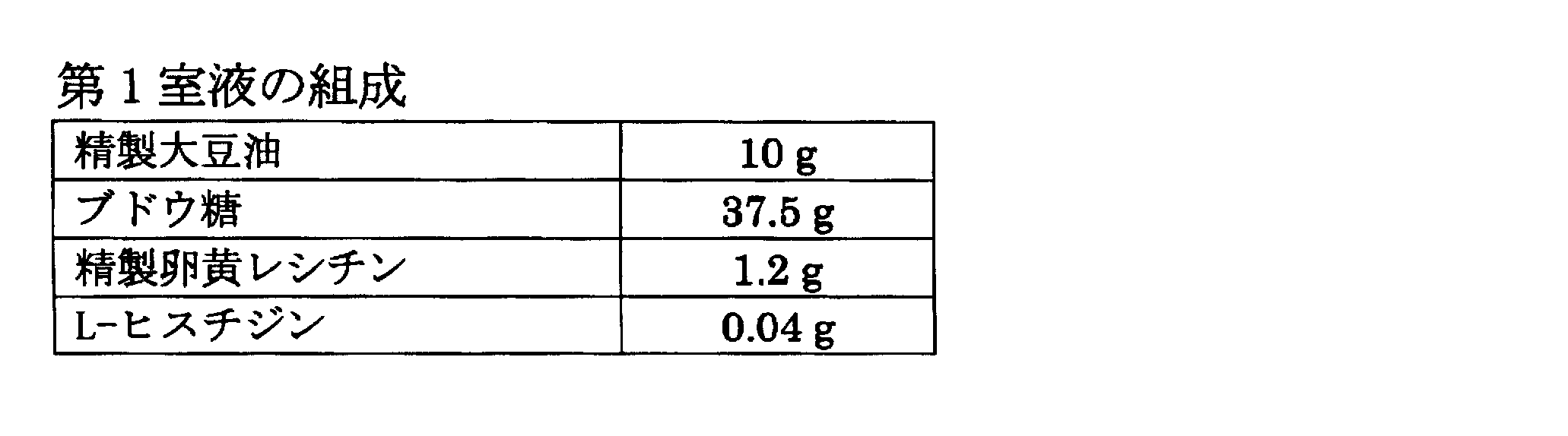
表3に示す組成に従って、各アミノ酸、電解質及び安定化剤(亜硫酸水素ナトリウム)を注射用蒸留水に溶解し、アミノ電解質液を調製した。更に、当該液のpHを氷酢酸で6.7に調整し、全量250mLとして、第2室輸液を調製した。このようにして得られた第2室輸液の浸透圧比は3.0、カリウム濃度は40mEq/Lであった。

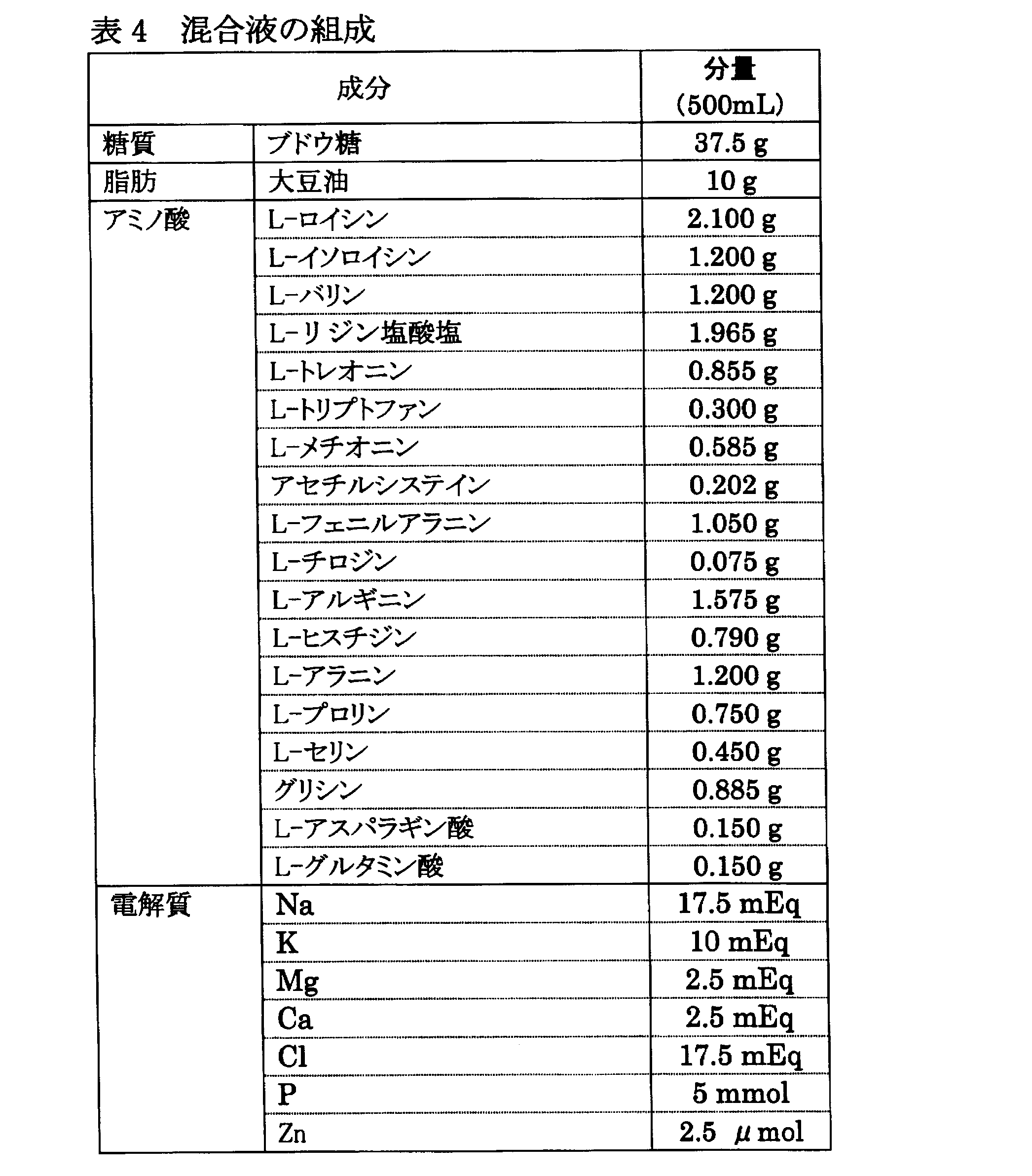
上記で得られた第1室輸液250mL及び第2室輸液250mLを、各室が易剥離シールで仕切られたポリエチレン製2室容器の各室にそれぞれ充填し、各室空間部の窒素置換を行い、密封した後、常法に従い高圧蒸気滅菌を行った。その後、容器を易剥離シール部で折り畳み、脱酸素剤(商品名「エージレス」;三菱ガス化学社製)と共に、多層バリアフィルム(商品名「ボブロン」;NSR社製)の外装袋(酸素バリア性外装袋)に封入し、輸液製剤を得た。なお、この輸液製剤の第1室輸液と第2室輸液を混合した後の混合液(組成を表4に示す)は、pHが6.7、滴定酸度が7、カリウム濃度は20mEq/Lであった。また、混合後3日間の保存において粒子径0.5μm以上の粗大粒子の体積はUSP(米国薬局方)の規格である0.05%以下であり、脂肪粒子は安定であった。粒子径は、アキュサイザー780 (PERTICLE SIZING SYSTEM社製)を用いて測定した。
1.第1室輸液の調製
表2の成分に加え、さらにチアミン塩化物塩酸塩0.96mgを配合した液剤250mlを実施例1と同様にして調製し、第1室輸液を作製した。なお、当該第1室輸液のpHは約6.0に調整した。また、当該第1室輸液の浸透圧比は3、滴定酸度は0.5であった。
実施例1と同様にして、第2室輸液を作製した。
上記で得られた第1室輸液250mL及び第2室輸液250mLを、各室が易剥離シールで仕切られたポリエチレン製2室容器の各室にそれぞれ充填し、各室空間部の窒素置換を行い、密封した後、常法に従い高圧蒸気滅菌を行った。その後、容器を易剥離シール部で折り畳み、脱酸素剤(商品名「エージレス」;三菱ガス化学社製)と共に、多層バリアフィルム(商品名「ボブロン」;NSR社製)の外装袋(酸素バリア性外装袋)に封入し、輸液製剤を得た。なお、この輸液製剤の第1室輸液と第2室輸液を混合した後の混合液(組成を表5に示す)は、pHが6.7、滴定酸度が7、カリウム濃度は20mEq/Lであった。また、混合後3日間の保存において粒子径0.5μm以上の粗大粒子の体積は0.05%以下であり、脂肪粒子は安定であった。

1.第1室輸液の調製
表2の成分に加え、さらにビタミンA油2.75mg(825ビタミンA単位)、コレカルシフェロール1.25μg、トコフェロール酢酸エステル2.5mg、フィトナジオン1mg、チアミン塩化物塩酸塩0.96mg、ピリドキシン塩酸塩1.23mg、シアノコバラミン1.25μg及び葉酸0.1 mgを配合した液剤250mlを実施例1と同様にして調製し、第1室輸液を作製した。なお、ビタミンA油、コレカルシフェロール、トコフェロール酢酸エステル、フィトナジオンは、予め精製大豆油に溶解させてから用いた。当該第1室輸液のpHは約6.0に調整した。また、当該第1室輸液の浸透圧比は3.0、滴定酸度は0.5であった。
表3の成分に加え、アスコルビン酸25mg、ビオチン15μg、ニコチン酸アミド10mg、パンテノール3.5mg、及びリボフラビンリン酸エステルナトリウム1.15mgを配合した液剤250mlを実施例1と同様にして調製し、第2室輸液を作製した。浸透圧比は3、カリウム濃度は40mEq/Lであった。またpHは6.7に調整した。
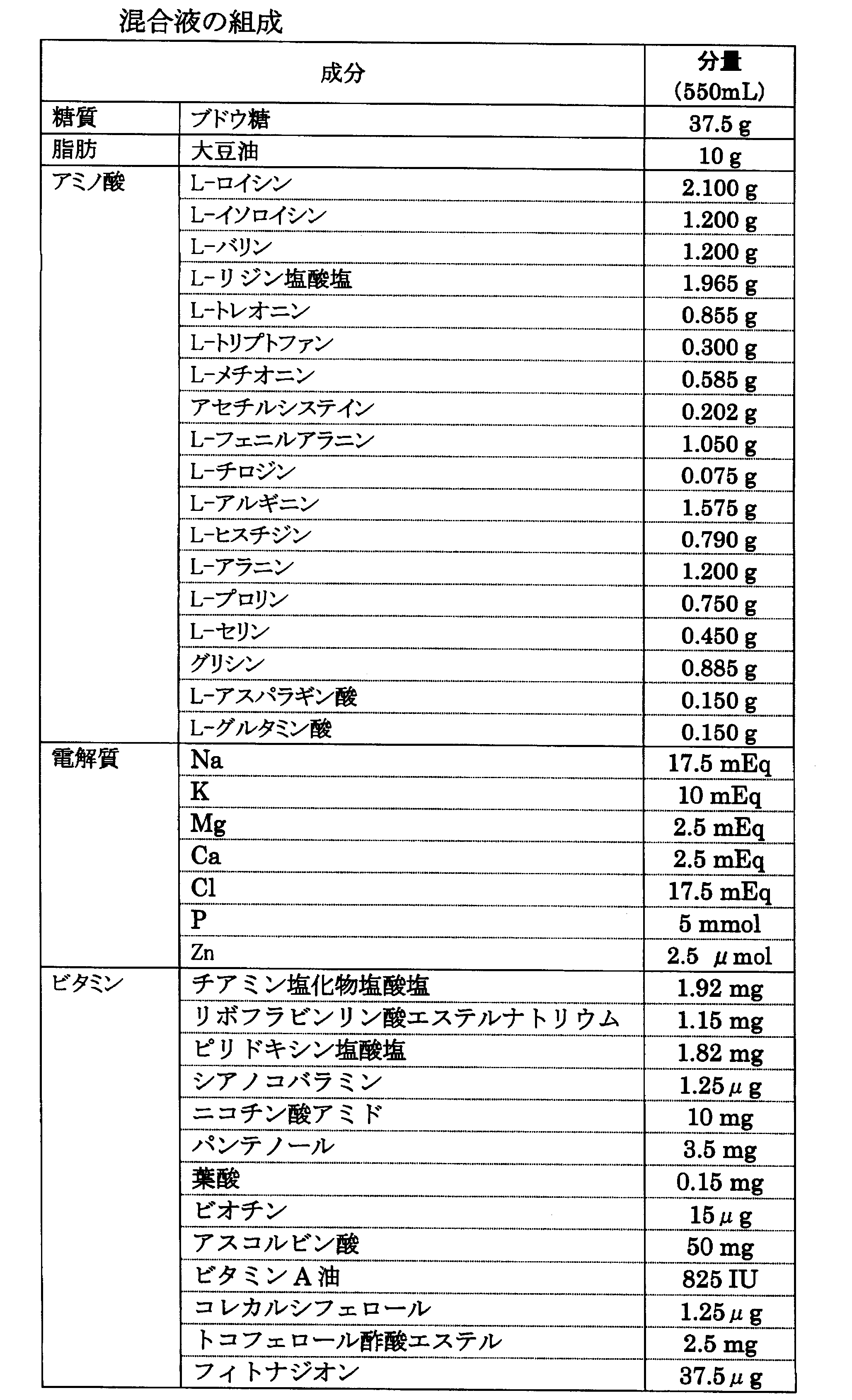
上記で得られた第1室輸液250mL及び第2室輸液250mLを、各室が易剥離シールで仕切られたポリエチレン製2室容器の各室にそれぞれ充填し、各室空間部の窒素置換を行い、密封した後、常法に従い高圧蒸気滅菌を行った。その後、容器を易剥離シール部で折り畳み、脱酸素剤(商品名「エージレス」;三菱ガス化学社製)と共に、多層バリアフィルム(商品名「ボブロン」;NSR社製)の外装袋(酸素バリア性外装袋)に封入し、輸液製剤を得た。なお、この輸液製剤の第1室輸液と第2室輸液を混合した後の混合液(組成を表6に示す)は、pHが6.7、滴定酸度が7、カリウム濃度は20mEq/Lであった。また、混合後3日間の保存において粒子径0.5μm以上の粗大粒子の体積は0.05%以下であり、脂肪粒子は安定であった。


1.第1室輸液の調製
表2の成分に加え、ビタミンA油2.75mg(825ビタミンA単位)、コレカルシフェロール1.25μg、トコフェロール酢酸エステル2.5mg、フィトナジオン37.55μg、チアミン塩化物塩酸塩1.92mg、ピリドキシン塩酸塩1.82mg、及びシアノコバラミン1.25μg、葉酸0.15mgを配合した液剤300mlを実施例3と同様にして調製し、第1室輸液を作製した。このとき、pHは約6.0に調整した。また、浸透圧比は2.5、滴定酸度は0.5であった。
表3の成分に加え、ビタミンC(アスコルビン酸)50mg、ビオチン15μg、ニコチン酸アミド10mg、パンテノール3.5mg、及びビタミンB2(リン酸リボフラビンナトリウム)1.15mgを配合した液剤250mlを実施例3と同様にして調製し、第2室輸液を作製した。このとき、pHは約6.7に調整した。浸透圧比は3.0、カリウム濃度は40mEq/Lであった。
上記で得られた第1室輸液300mL及び第2室輸液250mLを、各室が易剥離シールで仕切られたポリエチレン製2室容器の各室にそれぞれ充填し、各室空間部の窒素置換を行い、密封した後、常法に従い高圧蒸気滅菌を行った。その後、容器を易剥離シール部で折り畳み、脱酸素剤(商品名「エージレス」;三菱ガス化学社製)と共に、多層バリアフィルム(商品名「ボブロン」;NSR社製)の外装袋(酸素バリア性外装袋)に封入し、輸液製剤を得た。なお、この輸液製剤の第1室輸液と第2室輸液を混合した後の混合液(組成を表8に示す)は、pHが6.7、滴定酸度が6、カリウム濃度は18.2mEq/Lであった。また、混合後3日間の保存において粒子径0.5μm以上の粗大粒子の体積は0.05%以下であり、脂肪粒子は安定であった。
1.第1室輸液の調製
表2に示す組成に従い、精製大豆油、精製卵黄レシチン及びブドウ糖を水に加えホモミキサーにより粗乳化後、高圧乳化機(マントンゴーリン)で精乳化し、さらに水を加え全量を350mlに調整した。また、pH調整剤(L-ヒスチジン及び塩酸)を用いてpHを約6.0に調整した。このようにして得られた第1室輸液の浸透圧比は2.1、滴定酸度は0.5であった。
表3の成分を配合した液剤150mlを実施例1と同様にして調製し、第2室輸液を作製した。このとき、pHは約6.7に調整した。浸透圧比は5、カリウム濃度は67mEq/Lであった。
上記で得られた第1室輸液350mL及び第2室輸液150mLを、各室が易剥離シールで仕切られたポリエチレン製2室容器の各室にそれぞれ充填し、各室空間部の窒素置換を行い、密封した後、常法に従い高圧蒸気滅菌を行った。その後、容器を易剥離シール部で折り畳み、脱酸素剤(商品名「エージレス」;三菱ガス化学社製)と共に、多層バリアフィルム(商品名「ボブロン」;NSR社製)の外装袋(酸素バリア性外装袋)に封入し、輸液製剤を得た。なお、この輸液製剤の第1室輸液と第2室輸液を混合した後の混合液は、実施例1と全く同一の組成となるが、比較例1の処方では第2室のカリウム濃度が67mEq/Lと高濃度となるため、隔壁未開通で使用された場合には、高濃度のカリウムが体内に投与されることとなり非常に危険である。また、第2室の浸透圧比が5と非常に高く静脈炎等の悪影響も看過できない。
Claims (5)
- 連通可能な仕切りにより隔てられた2室を有する輸液製剤であって、
第1室に糖及び脂肪乳剤を含む第1室輸液が収容され、
第2室にアミノ酸及び電解質を含む第2室輸液が収容され、
前記第1室輸液は、実質的にカリウムを含まず、浸透圧比が2.0~3.0であり、
前記第2室輸液は、カリウム濃度が40mEq/L以下であり、浸透圧比が2.5~3.5であり、
仕切り連通時の前記第1室輸液及び第2室輸液の混合液のカリウム濃度が16mEq/L以上である、輸液製剤。 - 第1室輸液のpHが4.5~6.5、第2室輸液のpHが6.0~7.4である請求項1に記載の輸液製剤。
- 第1室輸液と第2室輸液の体積比が、3:2~3:5である請求項1又は2に記載の輸液製剤。
- さらに、ビタミンB1を第1室に含有する請求項1~3のいずれかに記載の輸液製剤。
- さらに、ビタミンA、ビタミンB6、ビタミンB12、ビタミンD、ビタミンE、及びビタミンKを第1室輸液に、ビタミンC、及びビタミンB2を第2室輸液に含有する請求項4に記載の輸液製剤。
Priority Applications (14)
| Application Number | Priority Date | Filing Date | Title |
|---|---|---|---|
| SG2013041249A SG190915A1 (en) | 2010-11-29 | 2011-11-28 | Infusion preparation |
| EP11845978.3A EP2647370B1 (en) | 2010-11-29 | 2011-11-28 | Infusion preparation |
| EP17164509.6A EP3210598B1 (en) | 2010-11-29 | 2011-11-28 | Infusion preparation |
| JP2012546860A JP5866582B2 (ja) | 2010-11-29 | 2011-11-28 | 輸液製剤 |
| CN201180056952XA CN103237541A (zh) | 2010-11-29 | 2011-11-28 | 输液制剂 |
| US13/990,018 US9446184B2 (en) | 2010-11-29 | 2011-11-28 | Infusion preparation |
| CA2819212A CA2819212C (en) | 2010-11-29 | 2011-11-28 | Infusion preparation |
| AU2011337781A AU2011337781B2 (en) | 2010-11-29 | 2011-11-28 | Infusion preparation |
| PH1/2013/501060A PH12013501060A1 (en) | 2010-11-29 | 2011-11-28 | Infusion preparation |
| KR1020137015992A KR101799135B1 (ko) | 2010-11-29 | 2011-11-28 | 수액 제제 |
| AU2015268572A AU2015268572B2 (en) | 2010-11-29 | 2015-12-08 | Infusion preparation |
| PH12015502806A PH12015502806B1 (en) | 2010-11-29 | 2015-12-17 | Infusion preparation |
| US14/974,534 US9687600B2 (en) | 2010-11-29 | 2015-12-18 | Infusion preparation |
| US15/627,783 US9884149B2 (en) | 2010-11-29 | 2017-06-20 | Infusion preparation |
Applications Claiming Priority (2)
| Application Number | Priority Date | Filing Date | Title |
|---|---|---|---|
| JP2010-265611 | 2010-11-29 | ||
| JP2010265611 | 2010-11-29 |
Related Child Applications (2)
| Application Number | Title | Priority Date | Filing Date |
|---|---|---|---|
| US13/990,018 A-371-Of-International US9446184B2 (en) | 2010-11-29 | 2011-11-28 | Infusion preparation |
| US14/974,534 Division US9687600B2 (en) | 2010-11-29 | 2015-12-18 | Infusion preparation |
Publications (1)
| Publication Number | Publication Date |
|---|---|
| WO2012073891A1 true WO2012073891A1 (ja) | 2012-06-07 |
Family
ID=46171823
Family Applications (1)
| Application Number | Title | Priority Date | Filing Date |
|---|---|---|---|
| PCT/JP2011/077392 Ceased WO2012073891A1 (ja) | 2010-11-29 | 2011-11-28 | 輸液製剤 |
Country Status (12)
| Country | Link |
|---|---|
| US (3) | US9446184B2 (ja) |
| EP (2) | EP3210598B1 (ja) |
| JP (2) | JP5866582B2 (ja) |
| KR (1) | KR101799135B1 (ja) |
| CN (3) | CN105342995B (ja) |
| AU (1) | AU2011337781B2 (ja) |
| CA (1) | CA2819212C (ja) |
| MY (2) | MY186310A (ja) |
| PH (2) | PH12013501060A1 (ja) |
| SG (3) | SG190915A1 (ja) |
| TW (2) | TWI597070B (ja) |
| WO (1) | WO2012073891A1 (ja) |
Cited By (3)
| Publication number | Priority date | Publication date | Assignee | Title |
|---|---|---|---|---|
| WO2019176996A1 (ja) | 2018-03-13 | 2019-09-19 | 株式会社大塚製薬工場 | 輸液製剤 |
| US10821119B2 (en) | 2013-07-01 | 2020-11-03 | Maruishi Pharmaceutical Co., Ltd. | Rocuronium preparation causing less pain, method for producing the same, and method for reducing and/or alleviating vascular pain to be induced using the same |
| JP2021024796A (ja) * | 2019-08-02 | 2021-02-22 | 株式会社大塚製薬工場 | 輸液製品 |
Families Citing this family (5)
| Publication number | Priority date | Publication date | Assignee | Title |
|---|---|---|---|---|
| MY186310A (en) * | 2010-11-29 | 2021-07-07 | Otsuka Pharma Factory Inc | Infusion preparation |
| CN107898808B (zh) * | 2017-10-31 | 2021-04-27 | 华仁药业股份有限公司 | 小儿用静脉营养制剂 |
| CN107802596A (zh) * | 2017-11-30 | 2018-03-16 | 哈尔滨珍宝制药有限公司 | 一种羟乙基淀粉注射液组合物及其制备方法与应用 |
| GB2569997A (en) * | 2018-01-09 | 2019-07-10 | Counsell David | Improvements relating to intravenous fluids |
| WO2019222673A2 (en) | 2018-05-18 | 2019-11-21 | Baxter International Inc. | Dual chamber flexible container, method of making and drug product using same |
Citations (11)
| Publication number | Priority date | Publication date | Assignee | Title |
|---|---|---|---|---|
| JPS6320550B2 (ja) | 1980-09-16 | 1988-04-28 | Nitsushoo Kk | |
| JPS63309263A (ja) | 1987-06-09 | 1988-12-16 | Otsuka Pharmaceut Factory Inc | 輸液バッグ |
| JPH024671A (ja) | 1988-06-10 | 1990-01-09 | Material Eng Tech Lab Inc | 内容物入り容器 |
| JPH055138U (ja) | 1990-11-20 | 1993-01-26 | 株式会社大塚製薬工場 | 輸液バツグ |
| JPH06209979A (ja) * | 1992-10-22 | 1994-08-02 | Green Cross Corp:The | 輸液入り容器及び輸液製剤 |
| JPH08709A (ja) * | 1994-04-20 | 1996-01-09 | Green Cross Corp:The | 輸液入り容器、輸液製剤及びビタミン配合総合高カロリー輸液製剤 |
| JP2000143509A (ja) * | 1998-08-31 | 2000-05-23 | Nissho Corp | 栄養輸液製剤 |
| JP2001328934A (ja) * | 2000-05-18 | 2001-11-27 | Nipro Corp | 末梢静脈栄養輸液製剤 |
| JP2003095937A (ja) | 2001-07-17 | 2003-04-03 | Otsuka Pharmaceut Factory Inc | 末梢静脈用輸液 |
| JP2004189677A (ja) | 2002-12-12 | 2004-07-08 | Otsuka Pharmaceut Factory Inc | 輸液製剤 |
| JP2007137836A (ja) * | 2005-11-21 | 2007-06-07 | Ajinomoto Co Inc | 末梢静脈栄養輸液 |
Family Cites Families (8)
| Publication number | Priority date | Publication date | Assignee | Title |
|---|---|---|---|---|
| US3610693A (en) | 1969-12-30 | 1971-10-05 | Xerox Corp | Method of making a cylindrical brush |
| DK0671166T3 (da) * | 1991-04-26 | 2005-01-03 | Mitsubishi Pharma Corp | Næringstilförende præparater |
| JPH06312923A (ja) * | 1993-04-30 | 1994-11-08 | Green Cross Corp:The | 末梢静脈投与用栄養輸液 |
| US5728681A (en) * | 1994-04-20 | 1998-03-17 | The Green Cross Corporation | Infusion preparation and two compartment container containing the preparation |
| DE69929128T2 (de) | 1998-08-31 | 2006-06-29 | Nipro Corp. | Nährstoffinfusionspräparat |
| CA2526208C (en) * | 2003-05-22 | 2011-11-08 | Otsuka Pharmaceutical Factory, Inc. | Infusion preparation for peripheral parenteral administration and method for stabilizing vitamin b1 |
| JP4622311B2 (ja) * | 2004-05-21 | 2011-02-02 | 味の素株式会社 | 末梢静脈投与用輸液 |
| MY186310A (en) * | 2010-11-29 | 2021-07-07 | Otsuka Pharma Factory Inc | Infusion preparation |
-
2011
- 2011-11-28 MY MYPI2016000682A patent/MY186310A/en unknown
- 2011-11-28 SG SG2013041249A patent/SG190915A1/en unknown
- 2011-11-28 JP JP2012546860A patent/JP5866582B2/ja active Active
- 2011-11-28 KR KR1020137015992A patent/KR101799135B1/ko active Active
- 2011-11-28 EP EP17164509.6A patent/EP3210598B1/en active Active
- 2011-11-28 SG SG10201509567PA patent/SG10201509567PA/en unknown
- 2011-11-28 SG SG10201606838VA patent/SG10201606838VA/en unknown
- 2011-11-28 PH PH1/2013/501060A patent/PH12013501060A1/en unknown
- 2011-11-28 CN CN201510815943.4A patent/CN105342995B/zh active Active
- 2011-11-28 WO PCT/JP2011/077392 patent/WO2012073891A1/ja not_active Ceased
- 2011-11-28 CN CN201510815549.0A patent/CN105342994B/zh active Active
- 2011-11-28 US US13/990,018 patent/US9446184B2/en not_active Expired - Fee Related
- 2011-11-28 EP EP11845978.3A patent/EP2647370B1/en active Active
- 2011-11-28 CN CN201180056952XA patent/CN103237541A/zh active Pending
- 2011-11-28 MY MYPI2013001927A patent/MY157108A/en unknown
- 2011-11-28 AU AU2011337781A patent/AU2011337781B2/en active Active
- 2011-11-28 CA CA2819212A patent/CA2819212C/en active Active
- 2011-11-29 TW TW100143712A patent/TWI597070B/zh active
- 2011-11-29 TW TW105126766A patent/TWI603747B/zh active
-
2015
- 2015-10-05 JP JP2015197970A patent/JP6002980B2/ja active Active
- 2015-12-17 PH PH12015502806A patent/PH12015502806B1/en unknown
- 2015-12-18 US US14/974,534 patent/US9687600B2/en active Active
-
2017
- 2017-06-20 US US15/627,783 patent/US9884149B2/en active Active
Patent Citations (11)
| Publication number | Priority date | Publication date | Assignee | Title |
|---|---|---|---|---|
| JPS6320550B2 (ja) | 1980-09-16 | 1988-04-28 | Nitsushoo Kk | |
| JPS63309263A (ja) | 1987-06-09 | 1988-12-16 | Otsuka Pharmaceut Factory Inc | 輸液バッグ |
| JPH024671A (ja) | 1988-06-10 | 1990-01-09 | Material Eng Tech Lab Inc | 内容物入り容器 |
| JPH055138U (ja) | 1990-11-20 | 1993-01-26 | 株式会社大塚製薬工場 | 輸液バツグ |
| JPH06209979A (ja) * | 1992-10-22 | 1994-08-02 | Green Cross Corp:The | 輸液入り容器及び輸液製剤 |
| JPH08709A (ja) * | 1994-04-20 | 1996-01-09 | Green Cross Corp:The | 輸液入り容器、輸液製剤及びビタミン配合総合高カロリー輸液製剤 |
| JP2000143509A (ja) * | 1998-08-31 | 2000-05-23 | Nissho Corp | 栄養輸液製剤 |
| JP2001328934A (ja) * | 2000-05-18 | 2001-11-27 | Nipro Corp | 末梢静脈栄養輸液製剤 |
| JP2003095937A (ja) | 2001-07-17 | 2003-04-03 | Otsuka Pharmaceut Factory Inc | 末梢静脈用輸液 |
| JP2004189677A (ja) | 2002-12-12 | 2004-07-08 | Otsuka Pharmaceut Factory Inc | 輸液製剤 |
| JP2007137836A (ja) * | 2005-11-21 | 2007-06-07 | Ajinomoto Co Inc | 末梢静脈栄養輸液 |
Non-Patent Citations (1)
| Title |
|---|
| JAPANESE PHARMACOLOGY & THERAPEUTICS, vol. 24, no. 10, 1996, pages 2151 |
Cited By (10)
| Publication number | Priority date | Publication date | Assignee | Title |
|---|---|---|---|---|
| US10821119B2 (en) | 2013-07-01 | 2020-11-03 | Maruishi Pharmaceutical Co., Ltd. | Rocuronium preparation causing less pain, method for producing the same, and method for reducing and/or alleviating vascular pain to be induced using the same |
| WO2019176996A1 (ja) | 2018-03-13 | 2019-09-19 | 株式会社大塚製薬工場 | 輸液製剤 |
| JP6647656B1 (ja) * | 2018-03-13 | 2020-02-14 | 株式会社大塚製薬工場 | 輸液製剤 |
| KR20200131280A (ko) | 2018-03-13 | 2020-11-23 | 가부시키가이샤 오츠까 세이야꾸 고죠 | 수액 제제 |
| US11890372B2 (en) | 2018-03-13 | 2024-02-06 | Otsuka Pharmaceutical Factory, Inc. | Transfusion preparation |
| JP2021024796A (ja) * | 2019-08-02 | 2021-02-22 | 株式会社大塚製薬工場 | 輸液製品 |
| JP2023076732A (ja) * | 2019-08-02 | 2023-06-01 | 株式会社大塚製薬工場 | 輸液製品 |
| JP7289137B2 (ja) | 2019-08-02 | 2023-06-09 | 株式会社大塚製薬工場 | 輸液製品 |
| JP7403891B2 (ja) | 2019-08-02 | 2023-12-25 | 株式会社大塚製薬工場 | 輸液製品 |
| JP2024020624A (ja) * | 2019-08-02 | 2024-02-14 | 株式会社大塚製薬工場 | 輸液製品 |
Also Published As
Similar Documents
| Publication | Publication Date | Title |
|---|---|---|
| JP6002980B2 (ja) | 輸液製剤 | |
| JP6647656B1 (ja) | 輸液製剤 | |
| HK1243004B (en) | Infusion preparation | |
| HK40039605B (zh) | 输液制剂 | |
| HK40039605A (en) | Transfusion preparation | |
| HK1190086A (en) | Infusion preparation | |
| AU2015268572A1 (en) | Infusion preparation | |
| HK1190086B (en) | Infusion preparation |
Legal Events
| Date | Code | Title | Description |
|---|---|---|---|
| 121 | Ep: the epo has been informed by wipo that ep was designated in this application |
Ref document number: 11845978 Country of ref document: EP Kind code of ref document: A1 |
|
| ENP | Entry into the national phase |
Ref document number: 2012546860 Country of ref document: JP Kind code of ref document: A |
|
| WWE | Wipo information: entry into national phase |
Ref document number: 12013501060 Country of ref document: PH |
|
| ENP | Entry into the national phase |
Ref document number: 2819212 Country of ref document: CA |
|
| NENP | Non-entry into the national phase |
Ref country code: DE |
|
| WWE | Wipo information: entry into national phase |
Ref document number: 2011845978 Country of ref document: EP |
|
| ENP | Entry into the national phase |
Ref document number: 20137015992 Country of ref document: KR Kind code of ref document: A |
|
| ENP | Entry into the national phase |
Ref document number: 2011337781 Country of ref document: AU Date of ref document: 20111128 Kind code of ref document: A |
|
| WWE | Wipo information: entry into national phase |
Ref document number: 13990018 Country of ref document: US |
|
| WWE | Wipo information: entry into national phase |
Ref document number: 12015502806 Country of ref document: PH |
|
| WWE | Wipo information: entry into national phase |
Ref document number: IDP00201600536 Country of ref document: ID |