WO2012084855A2 - Verfahren zur herstellung von triazinylsubstituierten oxindolen - Google Patents
Verfahren zur herstellung von triazinylsubstituierten oxindolen Download PDFInfo
- Publication number
- WO2012084855A2 WO2012084855A2 PCT/EP2011/073283 EP2011073283W WO2012084855A2 WO 2012084855 A2 WO2012084855 A2 WO 2012084855A2 EP 2011073283 W EP2011073283 W EP 2011073283W WO 2012084855 A2 WO2012084855 A2 WO 2012084855A2
- Authority
- WO
- WIPO (PCT)
- Prior art keywords
- alkyl
- alkoxy
- substituted
- unsubstituted
- chlorine
- Prior art date
- Legal status (The legal status is an assumption and is not a legal conclusion. Google has not performed a legal analysis and makes no representation as to the accuracy of the status listed.)
- Ceased
Links
- JMCKGUCMDBRRQG-UHFFFAOYSA-N COc(cc1C2c3nc(OC)nc(OC)n3)ccc1NC2=O Chemical compound COc(cc1C2c3nc(OC)nc(OC)n3)ccc1NC2=O JMCKGUCMDBRRQG-UHFFFAOYSA-N 0.000 description 1
- WTPPZNMXBIQABH-UHFFFAOYSA-N COc1nc(OC)nc(C(c2ccccc2N2)C2=O)n1 Chemical compound COc1nc(OC)nc(C(c2ccccc2N2)C2=O)n1 WTPPZNMXBIQABH-UHFFFAOYSA-N 0.000 description 1
Classifications
-
- C—CHEMISTRY; METALLURGY
- C07—ORGANIC CHEMISTRY
- C07D—HETEROCYCLIC COMPOUNDS
- C07D403/00—Heterocyclic compounds containing two or more hetero rings, having nitrogen atoms as the only ring hetero atoms, not provided for by group C07D401/00
- C07D403/02—Heterocyclic compounds containing two or more hetero rings, having nitrogen atoms as the only ring hetero atoms, not provided for by group C07D401/00 containing two hetero rings
- C07D403/04—Heterocyclic compounds containing two or more hetero rings, having nitrogen atoms as the only ring hetero atoms, not provided for by group C07D401/00 containing two hetero rings directly linked by a ring-member-to-ring-member bond
-
- A—HUMAN NECESSITIES
- A01—AGRICULTURE; FORESTRY; ANIMAL HUSBANDRY; HUNTING; TRAPPING; FISHING
- A01N—PRESERVATION OF BODIES OF HUMANS OR ANIMALS OR PLANTS OR PARTS THEREOF; BIOCIDES, e.g. AS DISINFECTANTS, AS PESTICIDES OR AS HERBICIDES; PEST REPELLANTS OR ATTRACTANTS; PLANT GROWTH REGULATORS
- A01N43/00—Biocides, pest repellants or attractants, or plant growth regulators containing heterocyclic compounds
- A01N43/64—Biocides, pest repellants or attractants, or plant growth regulators containing heterocyclic compounds having rings with three nitrogen atoms as the only ring hetero atoms
- A01N43/66—1,3,5-Triazines, not hydrogenated and not substituted at the ring nitrogen atoms
-
- A—HUMAN NECESSITIES
- A61—MEDICAL OR VETERINARY SCIENCE; HYGIENE
- A61K—PREPARATIONS FOR MEDICAL, DENTAL OR TOILETRY PURPOSES
- A61K31/00—Medicinal preparations containing organic active ingredients
- A61K31/33—Heterocyclic compounds
- A61K31/395—Heterocyclic compounds having nitrogen as a ring hetero atom, e.g. guanethidine or rifamycins
- A61K31/53—Heterocyclic compounds having nitrogen as a ring hetero atom, e.g. guanethidine or rifamycins having six-membered rings with three nitrogens as the only ring hetero atoms, e.g. chlorazanil, melamine
-
- A—HUMAN NECESSITIES
- A61—MEDICAL OR VETERINARY SCIENCE; HYGIENE
- A61P—SPECIFIC THERAPEUTIC ACTIVITY OF CHEMICAL COMPOUNDS OR MEDICINAL PREPARATIONS
- A61P31/00—Antiinfectives, i.e. antibiotics, antiseptics, chemotherapeutics
- A61P31/12—Antivirals
- A61P31/14—Antivirals for RNA viruses
- A61P31/18—Antivirals for RNA viruses for HIV
-
- A—HUMAN NECESSITIES
- A61—MEDICAL OR VETERINARY SCIENCE; HYGIENE
- A61P—SPECIFIC THERAPEUTIC ACTIVITY OF CHEMICAL COMPOUNDS OR MEDICINAL PREPARATIONS
- A61P35/00—Antineoplastic agents
-
- C—CHEMISTRY; METALLURGY
- C07—ORGANIC CHEMISTRY
- C07D—HETEROCYCLIC COMPOUNDS
- C07D403/00—Heterocyclic compounds containing two or more hetero rings, having nitrogen atoms as the only ring hetero atoms, not provided for by group C07D401/00
- C07D403/02—Heterocyclic compounds containing two or more hetero rings, having nitrogen atoms as the only ring hetero atoms, not provided for by group C07D401/00 containing two hetero rings
- C07D403/12—Heterocyclic compounds containing two or more hetero rings, having nitrogen atoms as the only ring hetero atoms, not provided for by group C07D401/00 containing two hetero rings linked by a chain containing hetero atoms as chain links
-
- C—CHEMISTRY; METALLURGY
- C07—ORGANIC CHEMISTRY
- C07D—HETEROCYCLIC COMPOUNDS
- C07D405/00—Heterocyclic compounds containing both one or more hetero rings having oxygen atoms as the only ring hetero atoms, and one or more rings having nitrogen as the only ring hetero atom
- C07D405/02—Heterocyclic compounds containing both one or more hetero rings having oxygen atoms as the only ring hetero atoms, and one or more rings having nitrogen as the only ring hetero atom containing two hetero rings
- C07D405/04—Heterocyclic compounds containing both one or more hetero rings having oxygen atoms as the only ring hetero atoms, and one or more rings having nitrogen as the only ring hetero atom containing two hetero rings directly linked by a ring-member-to-ring-member bond
Definitions
- Oxindoie substituted in the 3-position represents an important structural motif in a number of natural products and pharmaceutically active substances. Some of these compounds exhibit biological activity against various clinical pictures and have e.g. Antitumor or anti-HIV properties (Ding et al., J. Med. Chem. 2006, 49, 3432; Jiang et al., Bioorg. Med. Chem. Lett., 2006, 16, 2105).
- Oxindoies are the 3-triazinyloxindoles (3- (1,3,5-triazin-2-yl) -1,3-dihydro-2H-indole-2-ones.)
- the preparation of these, trivially designated "3-triazinyloxindoles" designated compounds, is the subject of the present invention.
- Substituents which may also be aromatic, heteroaromatic or aliphatic, can be replaced.
- 3-triazinyloxindoles can be prepared by replacing a
- the triazine-containing component used in the reaction according to Scheme 2 is a substituted 4-chloro-N-phenyl-1,3,5-triazin-2-amine.
- the reaction was carried out by deprotonation of the oxindole used in DMF / THF with
- the disadvantages of the method described relate, in addition to the very low Yields, including the use of strong bases such as sodium hydride, which lead to the formation of equimolar amounts of elemental hydrogen, which are technically difficult to handle. Therefore, the method described is not a viable solution for the technical (industrial) scale.
- Example 1 variant F 7-fluoro-1,3-dihydro-2H-indol-2-one
- Example 2 variant B 1, 3-dihydro-2H -indol-2-one
- 3-phenyloxindole is used as starting material in the arylation reactions described in Table 4, ie an oxindole which carries a phenyl substituent in the 3-position.
- This 3-phenyloxindole is arylated with electron-poor chlorobenzene derivatives and 5-halooxazoles in the presence of cesium carbonate in the 3-position.
- the acidity of methyl groups or methylene groups is generally greatly increased by replacing a hydrogen substituent with a phenyl substituent. This leads to a pKa value of the remaining hydrogen substituent on the methyl group or methylene group which is lowered by several orders of magnitude.
- Oxindole which carry a substituent in the 3-position, which reduces the acidity in non-aqueous solvents by several orders of magnitude, to
- the object of the invention is to provide an improved process which, on an industrial scale, makes it possible to produce 3-triazinyloxindoles in a simplified manner compared to the known processes while at the same time improving the overall yield.
- Potassium phosphate (K3PO4), K2HPO4 or sodium phosphate or mixtures consisting of at least two of the abovementioned bases are suitable for the solution of the problem.
- the abovementioned bases have the advantage that they are suitable for use on an industrial scale, since they are not decomposable, in particular in the presence of water, and do not produce equimolar amounts of hydrogen and at the same time lead to a significantly improved overall yield.
- n R 1a to R 1d are independently selected from the group consisting of hydrogen, fluorine, chlorine, bromine, iodine and from
- (C 1 -C 6 ) -alkyl where the alkyl radical is branched or unbranched and is unsubstituted or by one or more substituents selected from among fluorine, chlorine, (CrC.i) -alkoxy or (C 3 -C 7 ) -cycloalkyl existing group, is substituted,
- (C 3 -C 7 ) -cycloalkyl wherein the cycloalkyl is unsubstituted or by one or more substituents selected from among fluorine, chlorine, (C 1 -C 4 ) -alkyl or (C 3 -C 7 ) -cycloalkyl or (C 1 -C 4 -alkoxy existing group, is substituted,
- (C 1 -C 6 ) -alkyl where the alkyl radical is unsubstituted or substituted by one or more substituents selected from the group consisting of fluorine, chlorine, (CC 4 ) -alkoxy or (C 3 -C 7) -cycloalkyl , or
- Benzyl wherein the benzyl is unsubstituted or substituted by one or more substituents selected from the group consisting of fluorine, chlorine, bromine, iodine, nitro, (CC 4 ) alkyl, (CC 4 ) alkoxy or (C 3 - C 7 ) - cycloalkyl or (C 1 -C 4 ) -alkylthio and also COOR a , wherein R a is a (C 1 -C 4 ) -alkyl, and -CONR 0 R ° or -CONHR where R and R b "are each independently each represent a (C 1 -C 4 ) -alkyl, where in each case two substituents on the N-atom together optionally one
- R 4 and R 5 are each independently
- alkoxy radical is branched or unbranched and is unsubstituted or by one or more substituents selected from the group consisting of fluoro, chloro, (CC 4 ) alkoxy or (C 3 -C 7 ) cycloalkyl , is substituted,
- R 1a to R 1d and R 2 and R 3 are as defined in formula (3), in one
- R 4 and R 5 are as defined in formula (3), and
- X is a leaving group for Cl, Br, I, alkoxy, alkylsulfonyl, (alkylsulfonyl) oxy, haloalkylsulfonyl, phenylsulfonyl or toluene-4-sulfonyl,
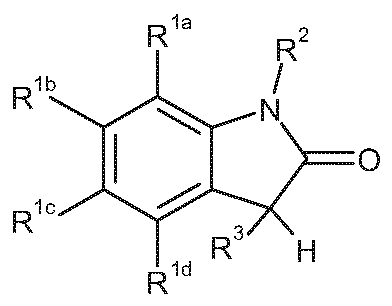
- oxindole As far as reference is made in this application to an “oxindole”, it is meant one of the compounds encompassed by the general formula (1).
- the oxindoles used as starting materials (1) (1)
- R 1a to R 1d , R 2 and R 3 are as defined above are known or can be prepared by the methods known to those skilled in the art. As far as in this application to a "triazine" or a
- Triazine component is meant one of the compounds encompassed by the general formula (2).
- the triazines (2) also used as starting materials
- R 4 , R 5 and X are as defined above are also known or can be prepared using methods known to those skilled in the art.
- halogen means, for example, fluorine, chlorine, bromine or iodine.
- halogen means, for example, a fluorine, chlorine, bromine or iodine atom.
- Alkyl is a straight-chain or branched, open-chain, saturated hydrocarbon radical.
- (C 1 -C 4 ) alkyl means a short notation for alkyl of one to 4 carbon atoms corresponding to the range for C atoms, ie, the groups include methyl, ethyl, 1-propyl, 2-propyl, 1-butyl, 2-butyl , 2-methylpropyl or tert-butyl.
- General alkyl radicals having a larger specified range of carbon atoms eg. B.
- (d-Ce alkyl) accordingly also include straight-chain or branched alkyl radicals having a larger number of C atoms, ie, according to the example, also the alkyl radicals having 5 and 6 carbon atoms
- substituents having a double bond on the cycloalkyl radical for example an alkylidene group such as methylidene, are also included ,
- optionally substituted cycioalkyl it also encompasses polycyclic aliphatic systems such as, for example, bicyclo [1.1.0] butan-1-yl, bicyclo [1-1.0] butan-2-yl, bicyclo [2.1.0] pentan-1-yl , Bicyclo [2.1.0] pentan-2-yl, bicyclo [2.1.0] pentan-5-yl, bicyclo [2.2.1] hept-2-yl (norbornyl), adamantan-1-yl and adamantan-2 yl.
- polycyclic aliphatic systems such as, for example, bicyclo [1.1.0] butan-1-yl, bicyclo [1-1.0] butan-2-yl, bicyclo [2.1.0] pentan-1-yl , Bicyclo [2.1.0] pentan-2-yl, bicyclo [2.1.0] pentan-5-yl, bicyclo [2.2.1] hept-2-yl (
- Aryl is a mono-, bi- or polycyclic aromatic system having preferably 6 to 14, in particular 6 to 10 ring C atoms, for example phenyl, naphthyl, anthryl, phenanthrenyl, and the like, preferably phenyl.
- optionally substituted aryl also includes polycyclic systems, such as tetrahydronaphthyl, indenyl, indanyl, fluorenyl, biphenylyl, where the binding site is on the aromatic system.
- Aryl as a rule, is also encompassed by the term "optionally substituted phenyl.”
- Alkoxy is an alkyl radical bonded via an oxygen atom
- alkenyloxy is an acyl radical bonded via an oxygen atom
- alkynyloxy is an alkyne radical bonded via an oxygen atom
- cycloalkyloxy is a Cycloalkyl radical bonded via an oxygen atom
- cycloalkenyloxy means a cycloalkenyl radical bonded via an oxygen atom.
- Alkylthio represents an alkyl radical bonded via a sulfur atom
- alkenylthio represents an alkyne radical bonded via a sulfur atom
- alkynylthio represents an alkyne radical bonded via a sulfur atom
- cycloalkylthio denotes a cycloalkyl radical bonded via a sulfur atom
- cycloalkenylthio denotes a cycloalkenyl radical bonded via a sulfur atom.
- Haloalkyl, alkenyl and alkynyl mean the same or different
- monohaloalkyl such as CH 2 CH 2 Cl, CH 2 CH 2 F, CHCICH 3 , CHFCH 3 , CH 2 Cl
- radicals means different radicals, wherein two or more radicals can form one or more rings on a cycle as a base body.
- Substituted radicals such as a substituted alkyl, cycloalkyl, cycloalkenyl, aryl, phenyl, benzyl, heterocyclyl and heteroaryl radical, mean, for example, a substituted radical derived from the unsubstituted radical, where the Substituents, for example, one or more, preferably 1, 2 or 3 radicals from the group halogen, alkoxy, alkylthio, hydroxy, amino, nitro, carboxy or a carboxy group equivalent group, cyano, isocyano, azido,
- Alkoxycarbonyl alkylcarbonyl, formyl, carbamoyl, mono- and
- optionally substituted aryl, optionally substituted heterocyclyl, wherein each of the latter cyclic groups may also be bonded through heteroatoms or divalent functional groups as in said alkyl radicals, and alkylsulfinyl, both enantiomers of the alkylsulfinyl group being included, alkylsulfonyl, aikylphosphinyl, alkylphosphonyi and, in the case cyclic radicals ( "cyclic body”), also alkyl, haloalkyl, alkylthioalkyl, alkoxyalkyl, optionally substituted mono- and dialkylaminoalkyl and hydroxyalkyl.
- substituted radicals such as substituted alkyl etc. as substituents in addition to the saturated hydrocarbon radicals mentioned corresponding unsaturated aliphatic and aromatic radicals such as optionally substituted alkenyl, alkynyl, alkenyloxy, alkynyloxy, alkenylthio, alkynylthio, alkenyloxycarbonyl, alkynyloxycarbonyl, alkenyl carbonyl, alkynylcarbonyl , Mono and
- Dialkenylaminocarbonyl mono- and Dialkinylaminocarbonyl, mono- and
- Cycloalkynyl, phenyl, phenoxy, etc. included.
- substituted cyclic moieties having aliphatic moieties in the ring cyclic systems are also included having those substituents attached to the ring with a double bond, e.g. B. substituted with an alkylidene group such as methylidene or ethylidene or an oxo group, imino group or substituted imino group.
- the respectively unsubstituted or substituted radicals may be branched and unbranched.
- a group designated "C 4 alkyl" includes in addition to the unbranched butyl radical all other C 4 -l sort including tert-butyl.
- the core of the process according to the invention is the reaction of the starting materials of the formula (1) and (2) in the presence of bases, which are not decomposed in the presence of water and, in addition, no hydrogen (H 2 ) release.
- bases which are not decomposed in the presence of water and, in addition, no hydrogen (H 2 ) release.
- Some very strong to medium strong bases such as sodium hydride (NaH), react in water with decomposition and are therefore not suitable for industrial application. Bases with these disadvantages are safe only on a laboratory scale
- the said carbonates, hydroxides and phosphates have opposite strong bases, such.
- Sodium hydride the main advantage that they are technical
- Particularly preferred bases are potassium carbonate, sodium carbonate,
- Mixture consisting of at least one of the two carbonates: potassium carbonate and sodium carbonate and at least one of the two hydroxides:
- Potassium hydroxide or sodium hydroxide The four particularly preferred two-component mixtures thus relate to the mixtures consisting of potassium carbonate and potassium hydroxide,
- radicals R 1a to R 1d in the compounds of the formulas (3) and (1) are independently selected from the group consisting of hydrogen, fluorine, chlorine, bromine, iodine and also
- (d-CeJ-alkyl wherein the alkyl radical is branched or unbranched and is unsubstituted or substituted by one or more substituents selected from the group consisting of fluorine and chlorine, and (C 3 -C 7 ) -cycloalkyl, wherein the cycloalkyl radical is unsubstituted or by one or more substituents selected from among fluorine, chlorine, (C 1 -C 4 ) -alkyl or (C 3 -C 7 ) -cycloalkyl or (C 1 -C 4 ) ) Alkoxy existing group, is substituted.
- radicals R 1a to R 1d in the compounds of the formulas (3) and (1) are independently selected from the group consisting of fluorine, chlorine and trifluoromethyl (CF 3 ), trifluoromethoxy (O-CF 3 ) and methoxy (O-Me).
- the radical R 1a is fluorine or chlorine, ie the compounds of the formulas (3) and (1) are substituted in the 7-position by fluorine (7-fluoro) or chlorine (7-chloro). Also very particularly preferred are compounds of the formulas (3) and (1) which are substituted in the 5-position by fluorine (5-fluoro), ie the radical R 1c is fluorine (see Example 5).
- radical R 2 in the formulas (3) and (1) stands for
- the nitrogen in the 1-position of the compounds of the formulas (3) and (1) is unsubstituted, ie the radical R 2 is hydrogen.
- a suitable amount of defoamer is added to reduce undesirable foaming of the reaction mixture.
- radicals R 4 and R 5 in the formulas (2) and (3) are each independently unsubstituted (CC 4) - alkyl, and unsubstituted (dC 4) alkoxy.
- Haloalkane especially dichloromethane or dichloroethane
- Flavorings in particular toluene, xylene or chlorobenzene,
- Ketones in particular acetone, butanone, 2-methylbutanone
- - nitriles in particular acetonitrile, butyronitrile, isobutylnitrile;
- Sulfoxides and sulfones for example dimethyl sulfoxide, dimethly sulphone, sulfolane;
- Ethers in particular dioxane, 2-methyltetrahydrofuran,
- - Are used, in particular ethyl acetate, n-butyl acetate or isopropyl acetate.
- polar solvents mentioned can be used either alone or in mixtures with other solvents, preferably with other polar organic solvents
- Solvents or with water are used. It is not
- reaction also takes place in water as the sole solvent. It is particularly preferred to carry out the process without the use of water as solvent.
- the triazine component is preferably used in excess (1.1 to 1.4 equivalents, preferably 1.1 to 1.25 equivalents).
- the base is used equimolar or in excess.
- All reactants may be premixed either in pure form or with each other or dissolved or suspended in a solvent or solvent mixture to the reaction mixture.
- Triazine are initially charged in a suitable solvent and the base, or the mixture of different bases added in portions.
- the addition of the reactants can take place in one portion or in several portions over a period of up to 24 hours, preferably up to 6 hours, in particular 0.05 to 6 hours.
- the reaction temperature is in the range of -20 ° C to 150 ° C, preferably in
- reaction can be carried out under pressure.
- Additional solvent may be added during the reaction to allow for better mixing of the reactants.
- the stirring time after addition of all the reactants is in the range up to 48 hours, preferably 0.05 to 24 hours.
- Solvent is used or if the product is a solid or a liquid.
- the invention also relates to the compounds of the formula (3),
- R 1a to R 1d are independently selected from the group consisting of hydrogen, fluorine, chlorine, bromine, iodine and from
- (Ci-C 6 ) -alkyl wherein the Aikyirest is branched or unbranched and is unsubstituted or by one or more substituents selected from among fluorine, chlorine, (CC 4 ) alkoxy or (C 3 -C 7 ) cycloalkyl existing group, is substituted,
- (C 3 -C 7 ) -cycloalkyl wherein the cycloalkyl radical is unsubstituted or by one or more substituents selected from among fluorine, chlorine, (C 1 -C 4 ) -alkyl or (C 3 -C 7 ) -cycloalkyl or (dC 4 ) Alkoxy group is substituted,
- Benzyl wherein the benzyl is unsubstituted or substituted by one or more substituents selected from the group consisting of fluorine, chlorine, bromine, iodine, nitro, (CC 4 ) alkyl, (CC 4 ) alkoxy or (C 3 - C 7) - cycloalkyl or (dC 4) alkylthio and from COOR a wherein R a stands for a (Cr C4) alkyl, and -CONR b R b or -CONHR wherein R and R b "are each independently a (CC 4 ) - alkyl, wherein in each case two
- R 4 and R 5 are each independently
- Alkoxy or (C 3 -C 7 ) -Cycloalkyl existing group is substituted, (CC 6 ) alkoxy wherein the alkoxy radical is branched or unbranched and is unsubstituted or substituted by one or more substituents selected from the group consisting of fluoro, chloro, (C 1 -C 4 ) alkoxy or (C 3 -C 7) cycloalkyl is
- the formulas (3) and (3 ") also include, as appropriate, all stereoisomers, tautomers and / or polymorphic forms and salts thereof.
- Compounds of the general formula (3) prepared according to the invention are suitable as intermediates for the preparation of fine chemicals and active ingredients from agriculture.
- the multi-step process for the preparation of N-alkyl-N- [2- (1, 3,5-triazin-2-ylcarbonyl) phenyl] alkanesulfonamides (4-1) consists of the following substeps: reduction of substituted or unsubstituted 3- (alkylsulfanyl ) -1, 3-dihydro-2H-indol-2-ones (7-1) to substituted or unsubstituted 1,3-dihydro-2H-indol-2-ones (6-1).
- This method is possible on an industrial scale and is in the patent application with the application number
- EP 10162381 .7 described. Arylation of substituted or unsubstituted 1,3-dihydro-2H-indol-2-ones (6-1) to triazine-substituted oxindoles (5-1). This method is possible on an industrial scale and is described in the present patent application.
- Triazinylcarbonyl) sulfonaniliden (1 -1) characterized in that oxindole compounds are used as starting materials or as intermediates. This has the advantage that it can be carried out in comparison to the previously known methods on an industrial scale and at the same time high yields can be obtained.
- R 1a to R 1d are independently selected from the group consisting of hydrogen, fluorine, chlorine, bromine, iodine and from
- (C 1 -C 6 ) -alkyl where the alkyl radical is unsubstituted or substituted by one or more substituents selected from the group consisting of fluorine, chlorine, (C 1 -C 4 ) -alkoxy or (C 3 -C 7) -cycloalkyl,
- (C 3 -C 7 ) -cycloalkyl wherein the cycloalkyl radical is unsubstituted or by one or more substituents selected from among fluorine, chlorine, (C 1 -C 4 ) -alkyl or (C 3 -C 7 ) -cycloalkyl or (CC 4 ) Alkoxy group is substituted,
- (C3-C7) -cycloalkylthio wherein the cycloalkylthio radical is unsubstituted or substituted by one or more substituents selected from the group consisting of fluoro, chloro, (C 1 -C 4 ) -alkyl or (C 1 -C 4 ) -alkoxy, and phenyl or 1 -naphthyl or 2-naphthyl or a five- or six-membered heteroaromatic ring having 1 to 2 heteroatoms, wherein the heteroatoms are independently selected from the group consisting of O or N and wherein the aryl or heteroaryl is unsubstituted or by a or a plurality of substituents selected from the group consisting of fluorine, chlorine, bromine, iodine, (CC 4 ) alkyl, (CC 4 ) alkoxy or (C 3 -C 7 ) cycloalkyl or (CC 4 ) alkylthio is
- R 4 and R 5 are each independently
- (C 1 -C 6 ) -alkyl where the alkyl radical is unsubstituted or by one or more substituents selected from among fluorine, chlorine, (C 1 -C 4 ) -
- R 1a to R 1d are as defined for formula (4-1),
- R 3 is hydrogen
- R 7 is hydrogen, in a first step by arylation to a triazinyl-substituted oxindole of the formula (5-1)
- R 1a to R 10 , R 2 " and R 4 and R 5 are as defined in formula (4-1) and R 3 as defined for the formula (5-1), and the sulfonylation products of the formula (2-1 ) in a third step by oxidative ring opening to a 2- (triazinylcarbonyl) sulfonanilide of
- R 1a to R 1d , R 2 " and R 4 and R 5 are as defined for formula (4-1) are reacted, and the oxidation products of formula (1 -1) in a fourth step by alkylation to an N-alkyl -N- [2- (1, 3,5-triazin-2-ylcarbonyl) phenyl] alkanesulfonamide of the formula (4-1)
- R 1a to R 1d , R 2 " , R 4 , R 5 and R 8 are as defined above for formula (4-1), being reacted as alkylating reagent
- (4-1) is defined, or - (R) 2 S0 4 , wherein R is as defined above for formula (4-1) is used.
- imidazole bases are 1-ethyl-1H-imidazole, 1-butyl-1H-imidazole or 1-benzyl-1H-imidazole, which can be used individually or in a mixture, the use of 1-methyl 1 H-imidazole is very particularly preferred.
- R 1a to R 1d are as defined for formula (4-1),
- R 3 is hydrogen
- R 7 is hydrogen
- R 6 is an unsubstituted or substituted (C 1 -C 4 ) -alkyl, (C 3 -C 7 ) -cycloalkyl, benzyl or is a CH 2 -C (O) O- (C 1 -C 6 ) -alkyl, by reduction to a 1, 3-dihydro-2H-indol-2-one (6-1)
- R 1a to R 1c1 , R 3 and R 7 are as defined for formula (7-1).
- Boiling the polar solvent corresponds is heated to reflux.
- sulfur-containing salts are sodium salts selected from the group consisting of sodium bisulfite, sodium sulfite, sodium thionite,
- triazinyl-substituted oxindoles of the formula (3) are suitable as intermediates for the preparation of crop protection agents, in particular of herbicides and fungicides.
- the invention therefore also relates to the use of the compounds according to the invention of the formulas (3) or salts thereof (3 ") for the production of active compounds from agriculture or from intermediates for
- the solid is filtered off, washed twice with 100 ml of water / acetone (3: 1) and dried in vacuo at 50 ° C.
- the title compound is obtained as a solid in a purity of 96.2% (80.09 g, 81% of theory).
- the NMR signals of the product are in agreement with the signals of the product obtained according to Variant A.
- Variant A obtained product match.
- Variant D obtained product match.
- Example 1 variant F 7-fluoro-1,3-dihydro-2H-indol-2-one (10 g; 1 eq.) And 2-chloro-4,6-dimethoxy-1,3,5-triazine (14.1 g; 2 eq.) are implemented analogously to Example 1 variant F.
- the title compound is obtained as a solid in an HPLC purity of 97% area (7.65 g, 39% of theory based on the 7-fluoro-1,3-dihydro-2H-indol-2-one used).
- the NMR signals of the product are in agreement with the signals of the product obtained according to Variant A.
- the reaction is cooled to room temperature and added to 200 ml of saturated ammonium chloride solution. Ethyl acetate is added until two clear phases are formed (Total 2900 ml), the phases were separated, the organic phase washed with water (2 times 150 ml) and 150 ml of sodium chloride solution and dried over magnesium sulfate. The solvent is removed in vacuo, precipitating a solid. The solid is filtered off and washed with a little ethyl acetate.
- Example 1 variant C 1, 3-dihydro-2H-indol-2-one (3.0 g) and 2-chloro-4,6-dimethoxy-1,3,5-triazine (7.52 g) are reacted analogously to Example 1 variant C.
- the title compound is obtained as a solid in an HPLC purity of 91% area (4.79 g, 73% of theory).
- Example 1 variant F 1, 3-dihydro-2H-indol-2-one (0.80 g, 1 eq.) And 2-chloro-4,6-dimethoxy-1,3,5-triazine (1, 27 g; 1, 2 eq. ) are implemented analogously to Example 1 variant F.
- the title compound is obtained as a solid in an HPLC purity of 78% area (0.59 g, 30% of theory based on the 1, 3-dihydro-2H-indol-2-one used).
- the NMR signals of the product are in agreement with the signals of the product obtained according to Variant A.
- Example 1 7-ethoxy-1,3-dihydro-2H-indol-2-one (1, 24g) and 2-chloro-4,6-dimethoxy-1,3,5-triazine (1, 84g) are analogous to Example 1 Variant A implemented.
- the title compound is obtained as a solid in an HPLC purity of 87% area (1, 04 g, 43% of theory).
- the reaction is stirred at room temperature and additional 2-chloro-4,6-diethoxy-1,3,5-triazine (1 g, about 50% purity) is added in two portions after 2 and 18 hours, respectively.
- the mixture is stirred for 3 hours at 30 ° C, 10 ml of toluene, adjusted with hydrochloric acid (10%) to pH 1-2 and stirred for 30 min.
- the solid is filtered off, washed twice alternately with water and heptane and dried.
- the title compound is obtained as a solid in an HPLC purity of 99% area (1.53 g, 72% of theory).
- HPLC analysis shows 3% of 3-phenyl-1,3-dihydro-2H-indol-2-one, 1.5% of 2-chloro-4, 6-dimethoxy-1, 3,5-triazine, 68% of one
Landscapes
- Chemical & Material Sciences (AREA)
- Organic Chemistry (AREA)
- Health & Medical Sciences (AREA)
- Life Sciences & Earth Sciences (AREA)
- General Health & Medical Sciences (AREA)
- Medicinal Chemistry (AREA)
- Veterinary Medicine (AREA)
- Public Health (AREA)
- Animal Behavior & Ethology (AREA)
- Pharmacology & Pharmacy (AREA)
- Dentistry (AREA)
- Agronomy & Crop Science (AREA)
- Environmental Sciences (AREA)
- Zoology (AREA)
- Pest Control & Pesticides (AREA)
- Plant Pathology (AREA)
- Engineering & Computer Science (AREA)
- Wood Science & Technology (AREA)
- Nuclear Medicine, Radiotherapy & Molecular Imaging (AREA)
- Chemical Kinetics & Catalysis (AREA)
- General Chemical & Material Sciences (AREA)
- Virology (AREA)
- Molecular Biology (AREA)
- Communicable Diseases (AREA)
- Oncology (AREA)
- Tropical Medicine & Parasitology (AREA)
- AIDS & HIV (AREA)
- Epidemiology (AREA)
- Plural Heterocyclic Compounds (AREA)
- Agricultural Chemicals And Associated Chemicals (AREA)
- Low-Molecular Organic Synthesis Reactions Using Catalysts (AREA)
- Nitrogen Condensed Heterocyclic Rings (AREA)
Abstract
Description




Claims


Priority Applications (11)
| Application Number | Priority Date | Filing Date | Title |
|---|---|---|---|
| EP11802378.7A EP2655361B1 (de) | 2010-12-21 | 2011-12-19 | Verfahren zur herstellung von triazinylsubstituierten oxindolen |
| MX2013006694A MX2013006694A (es) | 2010-12-21 | 2011-12-19 | Procedimiento para producir oxindoles sustituidos con triazinilo. |
| ES11802378T ES2571553T3 (es) | 2010-12-21 | 2011-12-19 | Procedimiento para la preparación de oxindoles sustituidos con triazinilo |
| BR112013016028-4A BR112013016028B1 (pt) | 2010-12-21 | 2011-12-19 | Oxindóis substituídos por triazinila, seus usos e seu processo de produção |
| US13/995,891 US8962828B2 (en) | 2010-12-21 | 2011-12-19 | Method for producing triazinyl-substituted oxindoles |
| DK11802378.7T DK2655361T3 (en) | 2010-12-21 | 2011-12-19 | PROCEDURE FOR PREPARING TRIAZINYL-SUBSTITUTED OXINDOLS |
| CN201180068006.7A CN103380125B (zh) | 2010-12-21 | 2011-12-19 | 制备三嗪基取代的羟吲哚的方法 |
| KR1020137019022A KR101902599B1 (ko) | 2010-12-21 | 2011-12-19 | 트리아지닐-치환된 옥신돌의 제조 방법 |
| JP2013545282A JP5980808B2 (ja) | 2010-12-21 | 2011-12-19 | トリアジニル−置換オキシインドール類を製造する方法 |
| IL226866A IL226866A (en) | 2010-12-21 | 2013-06-11 | A method for the production of oxindulins is produced in triazinyl |
| US14/596,425 US9522904B2 (en) | 2010-12-21 | 2015-01-14 | Method for producing triazinyl-substituted oxindoles |
Applications Claiming Priority (4)
| Application Number | Priority Date | Filing Date | Title |
|---|---|---|---|
| US201061425349P | 2010-12-21 | 2010-12-21 | |
| US61/425,349 | 2010-12-21 | ||
| EP10196205.8 | 2010-12-21 | ||
| EP10196205 | 2010-12-21 |
Related Child Applications (2)
| Application Number | Title | Priority Date | Filing Date |
|---|---|---|---|
| US13/995,891 A-371-Of-International US8962828B2 (en) | 2010-12-21 | 2011-12-19 | Method for producing triazinyl-substituted oxindoles |
| US14/596,425 Continuation US9522904B2 (en) | 2010-12-21 | 2015-01-14 | Method for producing triazinyl-substituted oxindoles |
Publications (2)
| Publication Number | Publication Date |
|---|---|
| WO2012084855A2 true WO2012084855A2 (de) | 2012-06-28 |
| WO2012084855A3 WO2012084855A3 (de) | 2012-09-07 |
Family
ID=44148782
Family Applications (1)
| Application Number | Title | Priority Date | Filing Date |
|---|---|---|---|
| PCT/EP2011/073283 Ceased WO2012084855A2 (de) | 2010-12-21 | 2011-12-19 | Verfahren zur herstellung von triazinylsubstituierten oxindolen |
Country Status (12)
| Country | Link |
|---|---|
| US (2) | US8962828B2 (de) |
| EP (1) | EP2655361B1 (de) |
| JP (1) | JP5980808B2 (de) |
| KR (1) | KR101902599B1 (de) |
| CN (1) | CN103380125B (de) |
| BR (1) | BR112013016028B1 (de) |
| DK (1) | DK2655361T3 (de) |
| ES (1) | ES2571553T3 (de) |
| IL (1) | IL226866A (de) |
| MX (1) | MX2013006694A (de) |
| TW (1) | TWI546296B (de) |
| WO (1) | WO2012084855A2 (de) |
Cited By (1)
| Publication number | Priority date | Publication date | Assignee | Title |
|---|---|---|---|---|
| EP3360417A1 (de) | 2017-11-02 | 2018-08-15 | Bayer CropScience Aktiengesellschaft | Verwendung von sulfonylindol als herbizid |
Families Citing this family (4)
| Publication number | Priority date | Publication date | Assignee | Title |
|---|---|---|---|---|
| EP2655361B1 (de) * | 2010-12-21 | 2016-02-24 | Bayer Intellectual Property GmbH | Verfahren zur herstellung von triazinylsubstituierten oxindolen |
| US8969553B2 (en) * | 2010-12-21 | 2015-03-03 | Bayer Intellectual Property Gmbh | Method for producing N-sulfonyl-substituted oxindoles |
| US11306100B2 (en) | 2017-03-10 | 2022-04-19 | Council Of Scientific & Industrial Research | Spirooxindole compounds as GSK3B inhibitors and process for preparation thereof |
| KR102214988B1 (ko) * | 2019-06-20 | 2021-02-10 | 영남대학교 산학협력단 | 신규한 옥시인돌 유도체 및 이를 유효성분으로 함유하는 항균용 조성물 |
Citations (12)
| Publication number | Priority date | Publication date | Assignee | Title |
|---|---|---|---|---|
| WO2001025220A1 (en) | 1999-10-07 | 2001-04-12 | Amgen Inc. | Triazine kinase inhibitors |
| US6265411B1 (en) | 1996-05-06 | 2001-07-24 | Zeneca Limited | Oxindole derivatives |
| WO2002083654A1 (en) | 2001-04-11 | 2002-10-24 | Amgen Inc. | Triazinyl amide derivatives as angiogenesis inhibitors |
| WO2003082853A1 (en) | 2002-03-28 | 2003-10-09 | Astrazeneca Ab | New compounds |
| WO2005027823A2 (en) | 2003-09-24 | 2005-03-31 | Astrazeneca Ab | 3-heterocyclyl-indole derivatives as inhibitors of glycogen synthase kinase-3 (gsk-3) |
| WO2005061519A1 (en) | 2003-12-19 | 2005-07-07 | Takeda San Diego, Inc. | Kinase inhibitors |
| WO2006008159A1 (en) | 2004-07-23 | 2006-01-26 | Bayer Cropscience Ag | A use of sulfonanilides as agricultural and horticultural fungicide |
| WO2006136606A2 (en) | 2005-06-24 | 2006-12-28 | F. Hoffmann-La Roche Ag | Oxindole derivatives |
| WO2007031208A2 (en) | 2005-09-16 | 2007-03-22 | Bayer Cropscience Ag | A use of sulfonanilides as herbicide |
| WO2007089193A1 (en) | 2006-02-02 | 2007-08-09 | Astrazeneca Ab | A process for preparing 2-hydroxy-3- [5- (morpholin-4-ylmethyl)pyridin-2-yl] lh-indole-5-carbonitrile as a free base or salts thereof |
| US20070281949A1 (en) | 2006-05-15 | 2007-12-06 | Cephalon, Inc. | Substituted pyrazolopyrimidines |
| US20090291982A1 (en) | 2008-05-22 | 2009-11-26 | Astrazeneca Ab | New Substituted Oxindole Derivative 352 |
Family Cites Families (7)
| Publication number | Priority date | Publication date | Assignee | Title |
|---|---|---|---|---|
| JP3632947B2 (ja) * | 1998-07-29 | 2005-03-30 | クミアイ化学工業株式会社 | ジフルオロメタンスルホニルアニリド誘導体、その製造方法及びそれを有効成分とする除草剤 |
| US20050070718A1 (en) | 2003-09-30 | 2005-03-31 | Abbott Gmbh & Co. Kg | Heteroaryl-substituted 1,3-dihydroindol-2-one derivatives and medicaments containing them |
| DE102006040915A1 (de) | 2006-08-26 | 2008-03-20 | Abbott Gmbh & Co. Kg | Substituierte Oxindol-Derivate, diese enthaltende Arzneimittel und deren Verwendung |
| FR2909668B1 (fr) | 2006-12-12 | 2009-01-23 | Sanofi Aventis Sa | Derives de 5-alkyloxy-indolin-2-one,leur preparation et leurs applications en therapeutique |
| EP2655361B1 (de) * | 2010-12-21 | 2016-02-24 | Bayer Intellectual Property GmbH | Verfahren zur herstellung von triazinylsubstituierten oxindolen |
| US8969553B2 (en) * | 2010-12-21 | 2015-03-03 | Bayer Intellectual Property Gmbh | Method for producing N-sulfonyl-substituted oxindoles |
| JP5964320B2 (ja) | 2010-12-21 | 2016-08-03 | バイエル・インテレクチュアル・プロパティ・ゲゼルシャフト・ミット・ベシュレンクテル・ハフツングBayer Intellectual Property GmbH | 2−(トリアジニルカルボニル)スルホンアニリド類の製造方法 |
-
2011
- 2011-12-19 EP EP11802378.7A patent/EP2655361B1/de active Active
- 2011-12-19 ES ES11802378T patent/ES2571553T3/es active Active
- 2011-12-19 TW TW100147139A patent/TWI546296B/zh active
- 2011-12-19 BR BR112013016028-4A patent/BR112013016028B1/pt active IP Right Grant
- 2011-12-19 JP JP2013545282A patent/JP5980808B2/ja active Active
- 2011-12-19 KR KR1020137019022A patent/KR101902599B1/ko active Active
- 2011-12-19 MX MX2013006694A patent/MX2013006694A/es active IP Right Grant
- 2011-12-19 US US13/995,891 patent/US8962828B2/en active Active
- 2011-12-19 DK DK11802378.7T patent/DK2655361T3/en active
- 2011-12-19 WO PCT/EP2011/073283 patent/WO2012084855A2/de not_active Ceased
- 2011-12-19 CN CN201180068006.7A patent/CN103380125B/zh active Active
-
2013
- 2013-06-11 IL IL226866A patent/IL226866A/en active IP Right Grant
-
2015
- 2015-01-14 US US14/596,425 patent/US9522904B2/en active Active
Patent Citations (13)
| Publication number | Priority date | Publication date | Assignee | Title |
|---|---|---|---|---|
| US6265411B1 (en) | 1996-05-06 | 2001-07-24 | Zeneca Limited | Oxindole derivatives |
| WO2001025220A1 (en) | 1999-10-07 | 2001-04-12 | Amgen Inc. | Triazine kinase inhibitors |
| US20040116388A1 (en) | 1999-10-07 | 2004-06-17 | Amgen Inc. | Kinase inhibitors |
| WO2002083654A1 (en) | 2001-04-11 | 2002-10-24 | Amgen Inc. | Triazinyl amide derivatives as angiogenesis inhibitors |
| WO2003082853A1 (en) | 2002-03-28 | 2003-10-09 | Astrazeneca Ab | New compounds |
| WO2005027823A2 (en) | 2003-09-24 | 2005-03-31 | Astrazeneca Ab | 3-heterocyclyl-indole derivatives as inhibitors of glycogen synthase kinase-3 (gsk-3) |
| WO2005061519A1 (en) | 2003-12-19 | 2005-07-07 | Takeda San Diego, Inc. | Kinase inhibitors |
| WO2006008159A1 (en) | 2004-07-23 | 2006-01-26 | Bayer Cropscience Ag | A use of sulfonanilides as agricultural and horticultural fungicide |
| WO2006136606A2 (en) | 2005-06-24 | 2006-12-28 | F. Hoffmann-La Roche Ag | Oxindole derivatives |
| WO2007031208A2 (en) | 2005-09-16 | 2007-03-22 | Bayer Cropscience Ag | A use of sulfonanilides as herbicide |
| WO2007089193A1 (en) | 2006-02-02 | 2007-08-09 | Astrazeneca Ab | A process for preparing 2-hydroxy-3- [5- (morpholin-4-ylmethyl)pyridin-2-yl] lh-indole-5-carbonitrile as a free base or salts thereof |
| US20070281949A1 (en) | 2006-05-15 | 2007-12-06 | Cephalon, Inc. | Substituted pyrazolopyrimidines |
| US20090291982A1 (en) | 2008-05-22 | 2009-11-26 | Astrazeneca Ab | New Substituted Oxindole Derivative 352 |
Non-Patent Citations (11)
| Title |
|---|
| ACC. CHEM. RES., vol. 21, 1988, pages 456 |
| ALTMAN ET AL., J. AM. CHEM. SOC., vol. 130, no. 29, 2008, pages 9613 - 9620 |
| DING ET AL., J. MED. CHEM., vol. 49, 2006, pages 3432 |
| DURBIN ET AL., ORG. LETT., vol. 10, no. 7, 2008, pages 1413 - 1415 |
| HENNEQUIN ET AL., TETRAHEDRON LETT., vol. 40, 1999, pages 3881 - 3884 |
| JIANG ET AL., BIOORG. MED. CHEM. LETT., vol. 16, 2006, pages 2105 |
| ORGANIC LETTERS, 2010, pages 2306 |
| ORGANIC LETTERS, 2010, pages 2306 - 2309 |
| SCIENCE OF SYNTHESIS, vol. 10, 2000, pages 600 |
| SHEN ET AL., ORG. LETT., vol. 8, 2006, pages 1447 - 1450 |
| TAYLOR ET AL., J. AM. CHEM. SOC., vol. 131, 2009, pages 9900 - 9901 |
Cited By (1)
| Publication number | Priority date | Publication date | Assignee | Title |
|---|---|---|---|---|
| EP3360417A1 (de) | 2017-11-02 | 2018-08-15 | Bayer CropScience Aktiengesellschaft | Verwendung von sulfonylindol als herbizid |
Also Published As
| Publication number | Publication date |
|---|---|
| IL226866A (en) | 2016-12-29 |
| KR20140005921A (ko) | 2014-01-15 |
| US20130345422A1 (en) | 2013-12-26 |
| EP2655361A2 (de) | 2013-10-30 |
| MX2013006694A (es) | 2013-07-29 |
| ES2571553T3 (es) | 2016-05-25 |
| US8962828B2 (en) | 2015-02-24 |
| DK2655361T3 (en) | 2016-05-23 |
| CN103380125A (zh) | 2013-10-30 |
| EP2655361B1 (de) | 2016-02-24 |
| KR101902599B1 (ko) | 2018-09-28 |
| US9522904B2 (en) | 2016-12-20 |
| TWI546296B (zh) | 2016-08-21 |
| US20150126737A1 (en) | 2015-05-07 |
| JP2014501744A (ja) | 2014-01-23 |
| WO2012084855A3 (de) | 2012-09-07 |
| CN103380125B (zh) | 2015-11-25 |
| JP5980808B2 (ja) | 2016-08-31 |
| TW201238960A (en) | 2012-10-01 |
| BR112013016028B1 (pt) | 2019-05-07 |
| BR112013016028A2 (pt) | 2018-07-10 |
Similar Documents
| Publication | Publication Date | Title |
|---|---|---|
| EP2655361B1 (de) | Verfahren zur herstellung von triazinylsubstituierten oxindolen | |
| EP0409368B1 (de) | Substituierte alfa-Pyrimidinyloxy-carbonsäurederivate, Verfahren zu ihrer Herstellung und ihre Verwendung als Mittel mit herbizider, fungizider und pflanzenwachstumsregulierender Wirkung | |
| DE3604042A1 (de) | Imidazolidin(thi)on-derivate, verfahren zu ihrer herstellung sowie ihre verwendung im pflanzenschutz | |
| EP2655360B1 (de) | Verfahren zur herstellung von n-sulfonylsubstituierten oxindolen | |
| DD218544A5 (de) | Herbizide mittel | |
| DE69418478T2 (de) | Herbizide pyridinverbindungen | |
| EP2655346B1 (de) | Verfahren zur herstellung von 2-(triazinylcarbonyl)sulfonaniliden | |
| DE69017383T2 (de) | Substituierte bicycloheptadionderivate. | |
| EP0906287A1 (de) | Substituierte pyrazolyl-pyrazolderivate und ihre verwendung als herbizide | |
| EP0422751B1 (de) | Substituierte 2-Pyrimidinyl- und 2-Triazinylessigsäurederivate, Verfahren zu ihrer Herstellung und ihre Verwendung als Mittel mit herbizider, Fungizider und Pflanzenwachstumsregulierender Wirkung | |
| DE10064997A1 (de) | Benzoylpyridazine | |
| DE3924259A1 (de) | Substituierte (alpha)-pyrimidinyloxy(thio)- und (alpha)-triazinyloxy(thio)carbonsaeurederivate, verfahren zu ihrer herstellung und ihre verwendung als mittel mit herbizider, fungizider und pflanzenwachstumsregulierender wirkung | |
| EP0410552A1 (de) | Substituierte 4-Heteroaroylpyrazole, Verfahren zur Herstellung dieser Verbindungen und ihre Verwendung als Mittel mit herbizider Wirkung | |
| DE3740837A1 (de) | Substituierte bicyclische triazole, verfahren zu ihrer herstellung und ihre verwendung als herbizide mittel | |
| DE3880988T2 (de) | Cinnolin-derivate, verfahren zu deren herstellung und diese enthaltende herbizide zusammenstellungen. | |
| DE3819823A1 (de) | Durch zum teil kondensierte heterocyclen substituierte indole, indazole und benzimidazole, verfahren zu ihrer herstellung und ihre verwendung als mittel mit herbizider wirkung | |
| DE69306518T2 (de) | Phenylimidazolderivate, Verfahren zu deren Herstellung, diese Derivate enthaltende Herbizide und Verwendungen dieser Herbizide | |
| WO1998034924A1 (de) | Herbizide 3-arylamino-6-trifluormethyluracile | |
| DE2219702A1 (de) | Pyrazolderivate und diese enthaltende, pflanzenwachstumsregelnde Mittel | |
| DE2114018A1 (de) | Neue Tetrahydropyrimidinverbindungen und Verfahren zu ihrer Herstellung | |
| DD296597A5 (de) | Substituierte pyrimidnyloxy(thio)-und triazinyloxy(thio)acry;saaeurderivate enthaltende mittel mit herbizider, fungizider und pflanzenwachstumsregulierender wirkung | |
| DE4035758A1 (de) | Substituierte (alpha)-pyrimidinyloxy(thio)- und (alpha)-triazinyloxy(thio)-carbonsaeurederivate, verfahren zu ihrer herstellung und ihre verwendung als mittel mit herbizider, fungizider und pflanzenwachstumsregulierender wirkung | |
| DE4026177A1 (de) | Substituierte 2-pyrimidinylmethyl- und 2-triazinylmethylbenzoe- und nicotinsaeurederivate, verfahren zu ihrer herstellung und ihre verwendung als mittel mit herbizider, fungizider und pflanzenwachstums-regulierender wirkung | |
| EP0397295A2 (de) | 2-Phenyl-perhydro-isoindol-1-one und -1-thione, Verfahren zu ihrer Herstellung und ihre Verwendung als Mittel mit herbizider Wirkung | |
| DE4007025A1 (de) | Mittel mit herbizider wirkung mit einem gehalt an in 3-stellung aliphatisch substituierten 1,2,4-triazolo (4,3-a)pyridinen |
Legal Events
| Date | Code | Title | Description |
|---|---|---|---|
| 121 | Ep: the epo has been informed by wipo that ep was designated in this application |
Ref document number: 11802378 Country of ref document: EP Kind code of ref document: A2 |
|
| WWE | Wipo information: entry into national phase |
Ref document number: 2011802378 Country of ref document: EP |
|
| WWE | Wipo information: entry into national phase |
Ref document number: MX/A/2013/006694 Country of ref document: MX |
|
| ENP | Entry into the national phase |
Ref document number: 2013545282 Country of ref document: JP Kind code of ref document: A |
|
| NENP | Non-entry into the national phase |
Ref country code: DE |
|
| ENP | Entry into the national phase |
Ref document number: 20137019022 Country of ref document: KR Kind code of ref document: A |
|
| WWE | Wipo information: entry into national phase |
Ref document number: 13995891 Country of ref document: US |
|
| REG | Reference to national code |
Ref country code: BR Ref legal event code: B01A Ref document number: 112013016028 Country of ref document: BR |
|
| ENP | Entry into the national phase |
Ref document number: 112013016028 Country of ref document: BR Kind code of ref document: A2 Effective date: 20130621 |