WO2012086437A1 - ジヒドロフェナントレンを有する化合物、液晶組成物および液晶表示素子 - Google Patents
ジヒドロフェナントレンを有する化合物、液晶組成物および液晶表示素子 Download PDFInfo
- Publication number
- WO2012086437A1 WO2012086437A1 PCT/JP2011/078551 JP2011078551W WO2012086437A1 WO 2012086437 A1 WO2012086437 A1 WO 2012086437A1 JP 2011078551 W JP2011078551 W JP 2011078551W WO 2012086437 A1 WO2012086437 A1 WO 2012086437A1
- Authority
- WO
- WIPO (PCT)
- Prior art keywords
- compound
- liquid crystal
- phenylene
- ring
- independently
- Prior art date
- Legal status (The legal status is an assumption and is not a legal conclusion. Google has not performed a legal analysis and makes no representation as to the accuracy of the status listed.)
- Ceased
Links
- DQPIFYKPNXDTAF-UHFFFAOYSA-N CCCC(CC1)CC=C1c(ccc(-c(c(C1(F)F)c2F)ccc2OCC)c2C1(F)F)c2F Chemical compound CCCC(CC1)CC=C1c(ccc(-c(c(C1(F)F)c2F)ccc2OCC)c2C1(F)F)c2F DQPIFYKPNXDTAF-UHFFFAOYSA-N 0.000 description 1
- QBEMFLUQJDJORA-UHFFFAOYSA-N CCCC(CC1)CC=C1c(ccc(Br)c1C=O)c1F Chemical compound CCCC(CC1)CC=C1c(ccc(Br)c1C=O)c1F QBEMFLUQJDJORA-UHFFFAOYSA-N 0.000 description 1
- 0 CCOc(ccc(*)c1C=O)c1F Chemical compound CCOc(ccc(*)c1C=O)c1F 0.000 description 1
Classifications
-
- C—CHEMISTRY; METALLURGY
- C09—DYES; PAINTS; POLISHES; NATURAL RESINS; ADHESIVES; COMPOSITIONS NOT OTHERWISE PROVIDED FOR; APPLICATIONS OF MATERIALS NOT OTHERWISE PROVIDED FOR
- C09K—MATERIALS FOR MISCELLANEOUS APPLICATIONS, NOT PROVIDED FOR ELSEWHERE
- C09K19/00—Liquid crystal materials
- C09K19/04—Liquid crystal materials characterised by the chemical structure of the liquid crystal components, e.g. by a specific unit
- C09K19/06—Non-steroidal liquid crystal compounds
- C09K19/32—Non-steroidal liquid crystal compounds containing condensed ring systems, i.e. fused, bridged or spiro ring systems
-
- C—CHEMISTRY; METALLURGY
- C07—ORGANIC CHEMISTRY
- C07C—ACYCLIC OR CARBOCYCLIC COMPOUNDS
- C07C25/00—Compounds containing at least one halogen atom bound to a six-membered aromatic ring
- C07C25/18—Polycyclic aromatic halogenated hydrocarbons
- C07C25/22—Polycyclic aromatic halogenated hydrocarbons with condensed rings
-
- C—CHEMISTRY; METALLURGY
- C07—ORGANIC CHEMISTRY
- C07C—ACYCLIC OR CARBOCYCLIC COMPOUNDS
- C07C25/00—Compounds containing at least one halogen atom bound to a six-membered aromatic ring
- C07C25/24—Halogenated aromatic hydrocarbons with unsaturated side chains
-
- C—CHEMISTRY; METALLURGY
- C07—ORGANIC CHEMISTRY
- C07C—ACYCLIC OR CARBOCYCLIC COMPOUNDS
- C07C43/00—Ethers; Compounds having groups, groups or groups
- C07C43/02—Ethers
- C07C43/18—Ethers having an ether-oxygen atom bound to a carbon atom of a ring other than a six-membered aromatic ring
- C07C43/192—Ethers having an ether-oxygen atom bound to a carbon atom of a ring other than a six-membered aromatic ring containing halogen
-
- C—CHEMISTRY; METALLURGY
- C07—ORGANIC CHEMISTRY
- C07C—ACYCLIC OR CARBOCYCLIC COMPOUNDS
- C07C43/00—Ethers; Compounds having groups, groups or groups
- C07C43/02—Ethers
- C07C43/20—Ethers having an ether-oxygen atom bound to a carbon atom of a six-membered aromatic ring
- C07C43/225—Ethers having an ether-oxygen atom bound to a carbon atom of a six-membered aromatic ring containing halogen
-
- C—CHEMISTRY; METALLURGY
- C07—ORGANIC CHEMISTRY
- C07C—ACYCLIC OR CARBOCYCLIC COMPOUNDS
- C07C69/00—Esters of carboxylic acids; Esters of carbonic or haloformic acids
- C07C69/74—Esters of carboxylic acids having an esterified carboxyl group bound to a carbon atom of a ring other than a six-membered aromatic ring
- C07C69/75—Esters of carboxylic acids having an esterified carboxyl group bound to a carbon atom of a ring other than a six-membered aromatic ring of acids with a six-membered ring
-
- C—CHEMISTRY; METALLURGY
- C07—ORGANIC CHEMISTRY
- C07C—ACYCLIC OR CARBOCYCLIC COMPOUNDS
- C07C69/00—Esters of carboxylic acids; Esters of carbonic or haloformic acids
- C07C69/76—Esters of carboxylic acids having a carboxyl group bound to a carbon atom of a six-membered aromatic ring
-
- C—CHEMISTRY; METALLURGY
- C07—ORGANIC CHEMISTRY
- C07C—ACYCLIC OR CARBOCYCLIC COMPOUNDS
- C07C69/00—Esters of carboxylic acids; Esters of carbonic or haloformic acids
- C07C69/76—Esters of carboxylic acids having a carboxyl group bound to a carbon atom of a six-membered aromatic ring
- C07C69/94—Esters of carboxylic acids having a carboxyl group bound to a carbon atom of a six-membered aromatic ring of polycyclic hydroxy carboxylic acids, the hydroxy groups and the carboxyl groups of which are bound to carbon atoms of six-membered aromatic rings
-
- C—CHEMISTRY; METALLURGY
- C09—DYES; PAINTS; POLISHES; NATURAL RESINS; ADHESIVES; COMPOSITIONS NOT OTHERWISE PROVIDED FOR; APPLICATIONS OF MATERIALS NOT OTHERWISE PROVIDED FOR
- C09K—MATERIALS FOR MISCELLANEOUS APPLICATIONS, NOT PROVIDED FOR ELSEWHERE
- C09K19/00—Liquid crystal materials
- C09K19/04—Liquid crystal materials characterised by the chemical structure of the liquid crystal components, e.g. by a specific unit
- C09K19/06—Non-steroidal liquid crystal compounds
- C09K19/34—Non-steroidal liquid crystal compounds containing at least one heterocyclic ring
- C09K19/3402—Non-steroidal liquid crystal compounds containing at least one heterocyclic ring having oxygen as hetero atom
-
- G—PHYSICS
- G02—OPTICS
- G02F—OPTICAL DEVICES OR ARRANGEMENTS FOR THE CONTROL OF LIGHT BY MODIFICATION OF THE OPTICAL PROPERTIES OF THE MEDIA OF THE ELEMENTS INVOLVED THEREIN; NON-LINEAR OPTICS; FREQUENCY-CHANGING OF LIGHT; OPTICAL LOGIC ELEMENTS; OPTICAL ANALOGUE/DIGITAL CONVERTERS
- G02F1/00—Devices or arrangements for the control of the intensity, colour, phase, polarisation or direction of light arriving from an independent light source, e.g. switching, gating or modulating; Non-linear optics
- G02F1/01—Devices or arrangements for the control of the intensity, colour, phase, polarisation or direction of light arriving from an independent light source, e.g. switching, gating or modulating; Non-linear optics for the control of the intensity, phase, polarisation or colour
- G02F1/13—Devices or arrangements for the control of the intensity, colour, phase, polarisation or direction of light arriving from an independent light source, e.g. switching, gating or modulating; Non-linear optics for the control of the intensity, phase, polarisation or colour based on liquid crystals, e.g. single liquid crystal display cells
-
- C—CHEMISTRY; METALLURGY
- C07—ORGANIC CHEMISTRY
- C07C—ACYCLIC OR CARBOCYCLIC COMPOUNDS
- C07C2603/00—Systems containing at least three condensed rings
- C07C2603/02—Ortho- or ortho- and peri-condensed systems
- C07C2603/04—Ortho- or ortho- and peri-condensed systems containing three rings
- C07C2603/22—Ortho- or ortho- and peri-condensed systems containing three rings containing only six-membered rings
- C07C2603/26—Phenanthrenes; Hydrogenated phenanthrenes
-
- C—CHEMISTRY; METALLURGY
- C09—DYES; PAINTS; POLISHES; NATURAL RESINS; ADHESIVES; COMPOSITIONS NOT OTHERWISE PROVIDED FOR; APPLICATIONS OF MATERIALS NOT OTHERWISE PROVIDED FOR
- C09K—MATERIALS FOR MISCELLANEOUS APPLICATIONS, NOT PROVIDED FOR ELSEWHERE
- C09K19/00—Liquid crystal materials
- C09K19/04—Liquid crystal materials characterised by the chemical structure of the liquid crystal components, e.g. by a specific unit
- C09K19/06—Non-steroidal liquid crystal compounds
- C09K19/34—Non-steroidal liquid crystal compounds containing at least one heterocyclic ring
- C09K19/3402—Non-steroidal liquid crystal compounds containing at least one heterocyclic ring having oxygen as hetero atom
- C09K2019/3422—Non-steroidal liquid crystal compounds containing at least one heterocyclic ring having oxygen as hetero atom the heterocyclic ring being a six-membered ring
- C09K2019/3425—Six-membered ring with oxygen(s) in fused, bridged or spiro ring systems
-
- G—PHYSICS
- G02—OPTICS
- G02F—OPTICAL DEVICES OR ARRANGEMENTS FOR THE CONTROL OF LIGHT BY MODIFICATION OF THE OPTICAL PROPERTIES OF THE MEDIA OF THE ELEMENTS INVOLVED THEREIN; NON-LINEAR OPTICS; FREQUENCY-CHANGING OF LIGHT; OPTICAL LOGIC ELEMENTS; OPTICAL ANALOGUE/DIGITAL CONVERTERS
- G02F1/00—Devices or arrangements for the control of the intensity, colour, phase, polarisation or direction of light arriving from an independent light source, e.g. switching, gating or modulating; Non-linear optics
- G02F1/01—Devices or arrangements for the control of the intensity, colour, phase, polarisation or direction of light arriving from an independent light source, e.g. switching, gating or modulating; Non-linear optics for the control of the intensity, phase, polarisation or colour
- G02F1/13—Devices or arrangements for the control of the intensity, colour, phase, polarisation or direction of light arriving from an independent light source, e.g. switching, gating or modulating; Non-linear optics for the control of the intensity, phase, polarisation or colour based on liquid crystals, e.g. single liquid crystal display cells
- G02F1/137—Devices or arrangements for the control of the intensity, colour, phase, polarisation or direction of light arriving from an independent light source, e.g. switching, gating or modulating; Non-linear optics for the control of the intensity, phase, polarisation or colour based on liquid crystals, e.g. single liquid crystal display cells characterised by the electro-optical or magneto-optical effect, e.g. field-induced phase transition, orientation effect, guest-host interaction or dynamic scattering
- G02F1/13712—Devices or arrangements for the control of the intensity, colour, phase, polarisation or direction of light arriving from an independent light source, e.g. switching, gating or modulating; Non-linear optics for the control of the intensity, phase, polarisation or colour based on liquid crystals, e.g. single liquid crystal display cells characterised by the electro-optical or magneto-optical effect, e.g. field-induced phase transition, orientation effect, guest-host interaction or dynamic scattering the liquid crystal having negative dielectric anisotropy
-
- G—PHYSICS
- G02—OPTICS
- G02F—OPTICAL DEVICES OR ARRANGEMENTS FOR THE CONTROL OF LIGHT BY MODIFICATION OF THE OPTICAL PROPERTIES OF THE MEDIA OF THE ELEMENTS INVOLVED THEREIN; NON-LINEAR OPTICS; FREQUENCY-CHANGING OF LIGHT; OPTICAL LOGIC ELEMENTS; OPTICAL ANALOGUE/DIGITAL CONVERTERS
- G02F2201/00—Constructional arrangements not provided for in groups G02F1/00 - G02F7/00
- G02F2201/08—Constructional arrangements not provided for in groups G02F1/00 - G02F7/00 light absorbing layer
- G02F2201/086—UV absorbing
Definitions
- the present invention relates to a novel liquid crystal compound and a liquid crystal composition. More specifically, the present invention relates to a liquid crystal compound having a negative dielectric anisotropy ( ⁇ ), a liquid crystal composition containing the compound, and a liquid crystal display device including the liquid crystal composition.
- ⁇ negative dielectric anisotropy
- Display elements using liquid crystal compounds are widely used for displays such as watches, calculators, word processors and the like. These display elements utilize the refractive index anisotropy and dielectric anisotropy of liquid crystal compounds.
- the liquid crystal phase includes a nematic liquid crystal phase, a smectic liquid crystal phase, and a cholesteric liquid crystal phase, and those using a nematic liquid crystal phase are most widely used.
- DS dynamic scattering
- DAP orientation phase deformation
- GH guest / host
- TN twisted nematic
- STN super twisted nematic
- TFT thin film transistor
- VA vertical alignment
- IPS in-plane switching
- PSA polymer support alignment
- liquid crystalline compounds used in these display systems exhibit a liquid crystal phase in a wide temperature range centering on room temperature, are sufficiently stable under the environment in which the display element is used, and are sufficient to drive the display element. Although it must have characteristics, no single liquid crystal compound satisfying this condition has been found at present.
- liquid crystal composition having required characteristics is prepared by mixing several to several tens of liquid crystal compounds.
- These liquid crystal compositions are stable to moisture, light, heat and air that are usually present under the conditions in which the display element is used, are stable to electric fields and electromagnetic radiation, and are mixed.
- the compound is required to be chemically stable.
- the liquid crystal composition is required to have appropriate values for various physical properties such as refractive index anisotropy ( ⁇ n) and dielectric anisotropy ( ⁇ ) depending on the display method and the shape of the display element. Is done.
- ⁇ n refractive index anisotropy
- ⁇ dielectric anisotropy
- IPS, VA, OCB, PSA, etc. are attracting attention as display methods that overcome the narrow viewing angle, which is the biggest problem of liquid crystal display elements.
- the VA mode and IPS mode liquid crystal display elements are particularly actively developed because they have excellent responsiveness in addition to a wide viewing angle and a high contrast display.
- a characteristic of the liquid crystal composition used in these display-type liquid crystal display elements is that the dielectric anisotropy ( ⁇ ) is negative. It is known that a liquid crystal composition having a large negative dielectric anisotropy ( ⁇ ) can reduce the driving voltage of a liquid crystal display element containing the liquid crystal composition (Non-patent Document 1). Therefore, the liquid crystalline compound that is a constituent component of the liquid crystal composition is also required to have a larger negative dielectric anisotropy ( ⁇ ).
- Patent Document 1 proposes the following compounds, but the dielectric anisotropy ( ⁇ ) is not large.
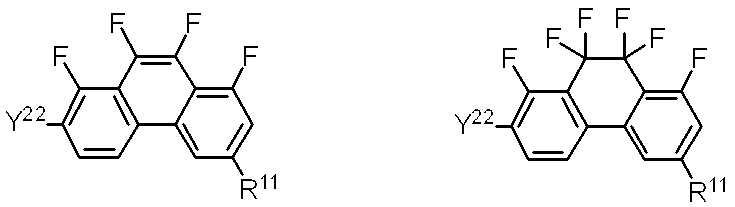
- Patent Document 2 proposes the following compounds, but is not suitable as a liquid crystal compound because the molecular shape is not linear.
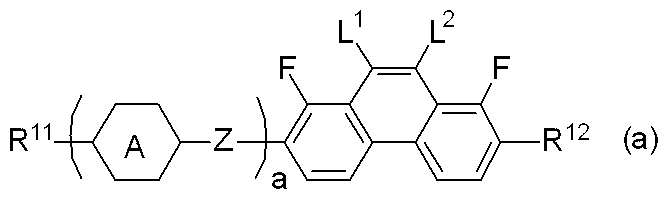
- Patent Document 3 proposes a liquid crystal composition using a compound represented by the formula (a).
- L 1 and L 2 are independently hydrogen or fluorine.
- the compound represented by the formula (a) has a large negative dielectric anisotropy ( ⁇ ), it is not sufficient for lowering the driving voltage of a liquid crystal display element such as a VA mode and an IPS mode. In general, the solubility is very low and the light is unstable.
- Patent Document 4 proposes a benzochromene derivative (b).
- Y is —CO—, —CS—, —CH 2 —, —CF 2 —, or —CHF—
- L 1 and L 2 are independently hydrogen, fluorine, chlorine, or —CN It is.
- Y is —CF 2 — and L 1 and L 2 are fluorine, they have a large negative dielectric anisotropy ( ⁇ ), but the basic skeleton is different from the present application.
- Patent Document 5 proposes a fluorine-substituted dihydrophenanthrene derivative represented by the formula (C).
- E 1 , E 2 , E 3 , E 4 , E 5 and E 6 are independently —CF— or —CH—, and G is —CF 2 CF 2 — or —CF ⁇ CF—. It is.
- liquid crystal compounds, liquid crystal compositions and liquid crystal display elements having a further large negative dielectric anisotropy ( ⁇ ) are desired.
- the first object of the present invention has a large negative dielectric anisotropy ( ⁇ ), high stability to heat, light, etc., high clearing point, appropriate refractive index anisotropy ( ⁇ n), and others It is to provide a liquid crystal compound having at least one characteristic such as excellent compatibility with the liquid crystal compound, and an intermediate thereof.
- the second object of the present invention contains this compound, has a low viscosity, has an appropriate refractive index anisotropy ( ⁇ n), and an appropriate negative dielectric anisotropy ( ⁇ ), and has a threshold value. It has at least one of the characteristics such as low voltage, high upper limit temperature of the nematic phase (nematic phase-isotropic phase transition temperature), low lower limit temperature of the nematic phase, or suitable for at least two characteristics It is to provide a liquid crystal composition having a balance.
- the third object of the present invention is to contain at least one of the characteristics including this composition, such as short response time, low power consumption and driving voltage, large contrast, and usable in a wide temperature range. It is to provide a liquid crystal display element having or having an appropriate balance with respect to at least two characteristics.
- R 1 and R 2 are independently hydrogen, alkyl having 1 to 10 carbons, alkenyl having 2 to 10 carbons, alkoxy having 1 to 9 carbons, alkoxyalkyl having 2 to 9 carbons Or in these alkyl, alkenyl, alkoxy, alkoxyalkyl and alkenyloxy, at least one hydrogen may be replaced by fluorine;
- Ring A 1 , Ring A 2 , and Ring A 3 are independently 1,4-cyclohexylene, 1,4-cyclohexenylene, 1,4-phenylene, tetrahydropyran-2,5-diyl, or 1 , 3-dioxane-2,5-diyl, in which at least one hydrogen may be replaced by fluorine;
- Z 1, Z 2, and Z 3 are independently a single bond, - (CH 2) 2 - , - OCH 2 -, - CH 2
- R 1 and R 2 are independently alkyl having 1 to 10 carbons, alkenyl having 2 to 10 carbons, or alkoxy having 1 to 9 carbons;
- Ring A 1 , Ring A 2 , and Ring A 3 are independently 1,4-cyclohexylene, 1,4-cyclohexenylene, 1,4-phenylene, tetrahydropyran-2,5-diyl,
- Item [1] is 3-dioxane-2,5-diyl, 2-fluoro-1,4-phenylene, 3-fluoro-1,4-phenylene, or 2,3-difluoro-1,4-phenylene Compound.
- ring A 1 , ring A 2 , and ring A 3 are each independently 1,4-cyclohexylene, 1,4-cyclohexenylene, 1,4-phenylene, 2- The compound according to item [2], which is fluoro-1,4-phenylene, 3-fluoro-1,4-phenylene, or 2,3-difluoro-1,4-phenylene.
- ring A 1 is 1,4-cyclohexylene, 1,4-cyclohexenylene, 1,4-phenylene, 2-fluoro-1,4-phenylene, 3-fluoro-1 , 4-phenylene, or 2,3-difluoro-1,4-phenylene;
- R 1 and R 2 are independently alkyl having 1 to 10 carbons, alkenyl having 2 to 10 carbons, or alkoxy having 1 to 9 carbons;
- Z 1 is a single bond, - (CH 2) 2 - , - OCH 2 -, - CH 2 O -, - COO -, - OCO -, - CF 2 O-, or -OCF 2 - and is;
- X is independently —C ( ⁇ O) —, —CHF—, or —CF 2 —;
- l is 0 or 1.
- Z 1 is a single bond, — (CH 2 ) 2 —, —CH 2 O—, —COO—, or —CF 2 O—.
- ring A 1 is 1,4-cyclohexylene, 1,4-cyclohexenylene, 1,4-phenylene, or 2,3-difluoro-1,4-phenylene.
- a liquid crystal composition comprising at least one compound according to any one of items [1] to [7].
- Item [8] further containing at least one compound selected from the group of compounds represented by formulas (2), (3), (4), (5), (6) and (7) The liquid crystal composition described in 1.
- R 3 and R 4 are independently alkyl having 1 to 10 carbons or alkenyl having 2 to 10 carbons, in which at least one hydrogen may be replaced by fluorine, in which At least one —CH 2 — may be replaced by —O—;
- Ring C 1 , Ring C 2 , Ring C 3 , and Ring C 4 are independently 1,4-cyclohexylene, 1,4-cyclohexenylene, wherein at least one hydrogen may be replaced with fluorine, 4-phenylene, tetrahydropyran-2,5-diyl, or decahydro-2,6-naphthalene;
- Z 4 , Z 5 , Z 6 , and Z 7 are each independently — (CH 2 ) 2 —, —COO—, —CH 2 O—, —OCF 2 —
- R 5 and R 6 are independently alkyl having 1 to 10 carbons or alkenyl having 2 to 10 carbons, in which at least one hydrogen may be replaced by fluorine, and at least One —CH 2 — may be replaced by —O—;
- Ring D 1 , Ring D 2 and Ring D 3 are independently 1,4-cyclohexylene, pyrimidine-2,5-diyl, 1,4-phenylene, 2-fluoro-1,4-phenylene, 3-fluoro -1,4-phenylene or 2,5-difluoro1,4-phenylene;
- Z 8 and Z 9 are independently —C ⁇ C—, —COO—, — (CH 2 ) 2 —, —CH ⁇ CH—, or a single bond.
- liquid crystal composition according to any one of items [8] to [11], further containing at least one optically active compound and / or polymerizable compound.
- liquid crystal composition according to any one of items [8] to [12], comprising at least one antioxidant and / or ultraviolet absorber.
- a liquid crystal display device comprising the liquid crystal composition according to any one of items [8] to [13].
- the present invention has a large negative dielectric anisotropy ( ⁇ ), high stability to heat, light, etc., high clearing point, appropriate refractive index anisotropy ( ⁇ n), nematic over a wide temperature range
- ⁇ negative dielectric anisotropy
- ⁇ n refractive index anisotropy
- a liquid crystalline compound having at least one of properties such as a phase and excellent compatibility with other liquid crystalline compounds, and an intermediate thereof can be obtained.
- the nematic phase has a low viscosity, an appropriate refractive index anisotropy ( ⁇ n), an appropriate negative dielectric anisotropy ( ⁇ ), a low threshold voltage, and a high upper limit temperature of the nematic phase.
- a liquid crystal composition having at least one of characteristics such as low minimum phase temperature is obtained.
- the liquid crystal display element of the present invention has at least one of characteristics that can be used in a wide temperature range, such as a PC mode, a TN mode, a short response time, a low power consumption and a low driving voltage, a large contrast, It can be suitably used for liquid crystal display elements of display modes such as STN mode, ECB mode, OCB mode, IPS mode, VA mode, and PSA mode, and particularly for liquid crystal display elements of IPS mode, VA mode, and PSA mode. It can be preferably used.
- liquid crystal compound and the liquid crystal composition of the present invention may be abbreviated as “compound” and “composition”, respectively.
- the liquid crystal display element may be abbreviated as “display element” or “element”.
- a liquid crystal display element is a general term for a liquid crystal display panel and a liquid crystal display module.
- Liquid crystal compound means a compound having a liquid crystal phase such as a nematic phase or a smectic phase, or a compound having no liquid crystal phase but useful as a component of a composition. This useful compound contains a six-membered ring such as 1,4-cyclohexylene and 1,4-phenylene, and has a rod-like molecular structure.
- An optically active compound may be added to the composition. Even if this compound is a liquid crystal compound, it is classified here as an additive. At least one compound selected from the group of compounds represented by formula (1) may be abbreviated as “compound (1)”. “Compound (1)” means one compound or two or more compounds represented by formula (1). The same applies to compounds represented by other formulas. The expression “A and / or B” means that the selection “A and B” and the selection “A or B” can be made arbitrarily. “At least one” in “may be replaced” indicates that not only the position but also the number is arbitrary.
- alkyl in which at least one —CH 2 — may be replaced by —O— or —CH ⁇ CH— includes alkyl, alkenyl, alkoxy, alkoxyalkyl, alkoxyalkenyl, alkenyloxyalkyl.
- the compound of the present invention is a liquid crystal compound represented by the following formula (1) or an intermediate thereof.
- R 1 and R 2 are independently hydrogen, alkyl having 1 to 10 carbons, alkenyl having 2 to 10 carbons, alkoxy having 1 to 9 carbons, alkoxyalkyl having 2 to 9 carbons Or alkenyloxy having 2 to 9 carbon atoms, and in these alkyl, alkenyl, alkoxy, alkoxyalkyl, and alkenyloxy, at least one hydrogen may be replaced with fluorine.
- the alkyl chain of these groups is preferably a straight chain.
- the temperature range of the liquid crystal phase can be widened, and the viscosity can be reduced.
- alkenyl it is preferable that the double bond is in an odd-numbered position, and the steric configuration is a trans configuration. When there are a plurality of double bonds in alkenyl, it is preferable that they are not conjugated.
- Alkyl includes —CH 3 , —C 2 H 5 , —C 3 H 7 , —C 4 H 9 , —C 5 H 11 , —C 6 H 13 , —C 7 H 15 , and —C 8 H 17.
- alkenyl examples include —CH ⁇ CH 2 , —CH ⁇ CHCH 3 , —CH ⁇ CHC 2 H 5 , — (CH 2 ) 2 CH ⁇ CH 2 , —CH ⁇ CHC 3 H 7 , — (CH 2 ) 2 CH ⁇ CHCH 3 , — (CH 2 ) 3 CH ⁇ CH 2 , —CH ⁇ CH (CH 2 ) 2 CH ⁇ CH 2 , and — (CH 2 ) 2 CH ⁇ CH (CH 2 ) 2 CH ⁇ CH 2 etc.
- Alkoxy includes —OCH 3 , —OC 2 H 5 , —OC 3 H 7 , —OC 4 H 9 , —OC 5 H 11 , —OC 6 H 13 , —OC 7 H 15 and the like;
- Alkoxyalkyl includes —CH 2 OCH 3 , —CH 2 OC 2 H 5 , — (CH 2 ) 2 OCH 3 , and — (CH 2 ) 2 OC 2 H 5 and the like;
- Examples of alkenyloxy include —OCH 2 CH ⁇ CH 2 , —OCH 2 CH ⁇ CHCH 3 , and —OCH 2 CH ⁇ CHC 2 H 5 . ;
- R 1 and R 2 are —CH 3 , —C 2 H 5 , —C 3 H 7 , —C 4 H 9 , —C 5 H 11 , —CH ⁇ CH 2 , —CH ⁇ CHCH 3 , — (CH 2 ) 2 CH ⁇ CH 2 , — (CH 2 ) 2 CH ⁇ CHCH 3 , —OCH 3 , —OC 2 H 5 , —OC 3 H 7 , and —OC 4 H 9 .
- ring A 1 , ring A 2 , and ring A 3 are independently 1,4-cyclohexylene, 1,4-cyclohexenylene, 1,4-phenylene, tetrahydropyran-2, 5-diyl or 1,3-dioxane-2,5-diyl, in which at least one hydrogen may be replaced by fluorine.
- the refractive index anisotropy ( ⁇ n) can be reduced and the viscosity can be reduced. Further, when this liquid crystalline compound is added to the liquid crystal composition, a nematic phase can be obtained. The upper limit temperature can be increased.
- the refractive index anisotropy ( ⁇ n) can be made relatively large and the orientation order parameter can be made large. it can.
- ring A 1 , ring A 2 , and ring A 3 include 1,4-cyclohexylene, 1,4-cyclohexenylene, 1,4-phenylene, 2-fluoro-1,4-phenylene, 3-Fluoro-1,4-phenylene, 2,3-difluoro-1,4-phenylene, or tetrahydropyran-2,5-diyl is preferred.
- More preferred ring A 1 , ring A 2 , or ring A 3 is 1,4-cyclohexylene, 1,4-phenylene, or 2,3-difluoro-1,4-phenylene.
- Z 1 , Z 2 , and Z 3 are each independently a single bond, — (CH 2 ) 2 —, —OCH 2 —, —CH 2 O—, —COO—, —OCO—, —CF 2 O— or —OCF 2 —.
- linking groups are — (CH 2 ) 2 —, it is preferable from the viewpoint of reducing the high solubility in other liquid crystal compounds and the viscosity.
- X is independently —C ( ⁇ O) —, —CHF—, or —CF 2 —.
- X is preferably —CHF— or —CF 2 — from the viewpoint of large negative dielectric anisotropy and excellent compatibility with other liquid crystal compounds.
- L, m, and n are independently 0 or 1.
- the terminal groups R 1 and R 2 , the ring A 1 , the ring A 2 and the ring A 3 , and the bonding groups Z 1 , Z 2 , and Z 3 are appropriately selected within the above range. By doing so, it is also possible to adjust physical properties such as refractive index anisotropy ( ⁇ n), dielectric anisotropy ( ⁇ ), and viscosity to desired physical properties.
- liquid crystalline compound represented by the formula (1) include compounds (1-1-1) to (1-1-6).
- R 1 and R 2 are independently alkyl having 1 to 10 carbons, alkenyl having 2 to 10 carbons, alkoxy having 1 to 9 carbons;
- Ring A 1 is 1,4-cyclohexylene, 1,4-cyclohexenylene, 1,4-phenylene, 2-fluoro-1,4-phenylene, 3-fluoro-1,4-phenylene, or 2, 3-difluoro-1,4-phenylene;
- Z 1 is, - (CH 2) 2 - , - OCH 2 -, - CH 2 O -, - COO -, - OCO -, - CF 2 O-, or -OCF 2 - is.
- Compound (1) can be synthesized by appropriately combining methods in organic synthetic chemistry. Methods for introducing the desired end groups, ring structures and linking groups into the starting materials are organic synthesis (Organic Syntheses, John Wiley & Sons, Inc), Organic Reactions (Organic Reactions, John Wiley & Sons, Inc), Complement. It is described in books such as Sibu Organic Synthesis (Comprehensive Organic Synthesis, Pergamon Press) and New Experimental Chemistry Course (Maruzen).
- MSG 1 or MSG 2 is a monovalent organic group having at least one ring.
- a plurality of MSG 1 (or MSG 2 ) used in the scheme may be the same or different.
- Compounds (1A) to (1F) correspond to compound (1).
- (IV)-(CH 2 ) 2 Compound (23) is treated with n-butyllithium and then reacted with formamide such as DMF (N, N-dimethylformamide) to obtain aldehyde (28). It is done.
- Compound (1D) can be synthesized by reacting phosphonium salt (27) synthesized by a known method with a base such as potassium tert-butoxide and reacting with aldehyde (28).
- Compound (1E) can be synthesized by hydrogenating compound (1D) in the presence of a palladium carbon catalyst.
- Compound (41) can be synthesized by reacting compound (40) with LDA (lithium diisopropylamide) and then reacting with DMF. This reaction is preferably carried out in a tetrahydrofuran solvent at a temperature of ⁇ 70 ° C. or lower and then slowly raised to room temperature.
- Compound (43) can be synthesized by refluxing compound (42) and EG (ethylene glycol) in the presence of PTSA (paratoluenesulfonic acid-hydrate) with a Dean-stark condenser in a toluene solvent. The compound (43) is reacted with n-butyllithium in a tetrahydrofuran solvent and then reacted with trimethoxyborane.
- This reaction is preferably carried out at a temperature of ⁇ 60 ° C. or lower and then slowly raised to room temperature. Then, the compound (44) is obtained by treatment with an acid.
- Compound (45) can be synthesized by reacting compound (41) with compound (44) in the presence of a tetrakistriphenylphosphine palladium catalyst and a base. This reaction is preferably performed by refluxing in a mixed solvent of toluene-alcohol-water in the presence of a phase transfer catalyst such as TBAB (tetrabutylammonium bromide).
- TBAB tetrabutylammonium bromide
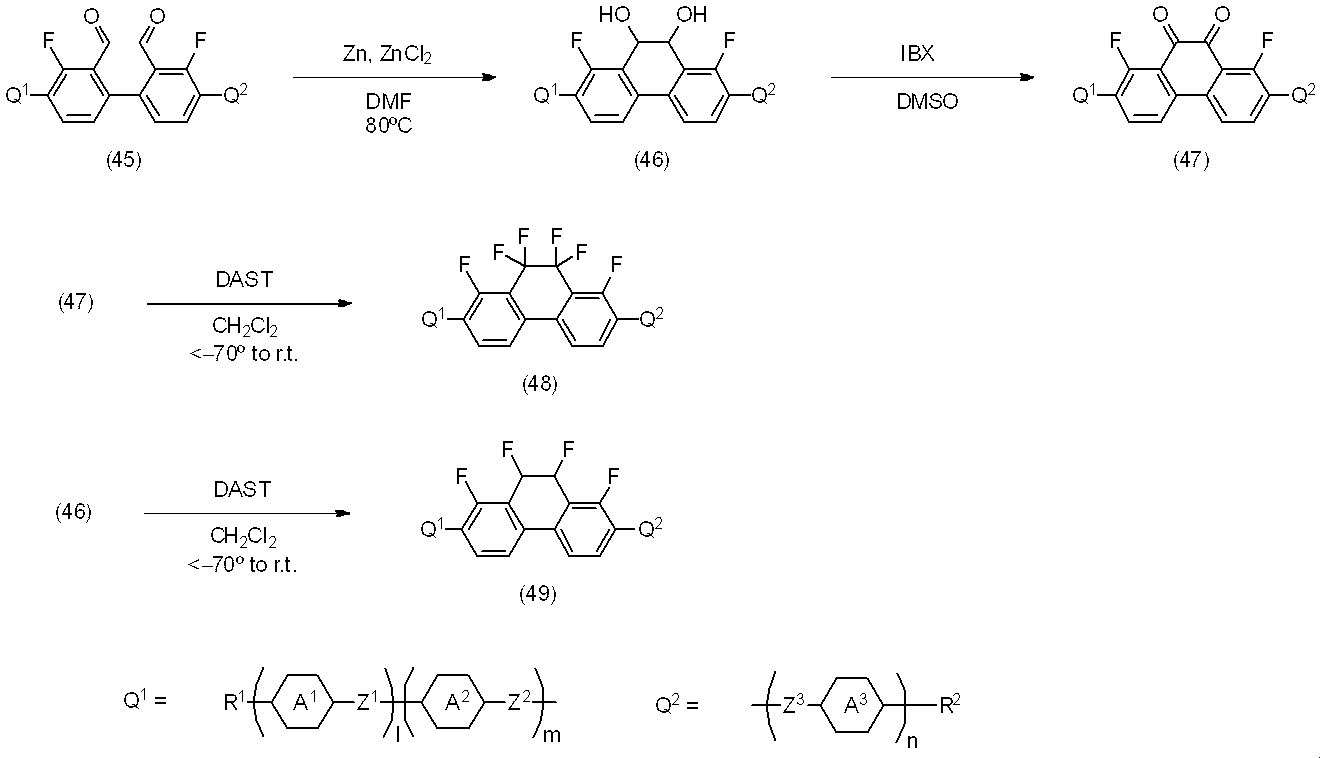
- Compound (46) can be synthesized by reacting compound (45) in DMF in the presence of Zn and ZnCl 2 (Tetrahedron, 64 (2008), 9906-9910).
- Compound (47) can be synthesized by reacting compound (46) with IBX (1-hydroxy-1,2-benzoiodoxy-3 (1H) -one) in DMSO (dimethyl sulfoxide).
- Compound (48) can be synthesized by reacting compound (47) with DAST in dichloromethane. This reaction is preferably carried out at a temperature of ⁇ 70 ° C. or lower and then slowly raised to room temperature. Similarly, compound (49) is obtained from compound (46).
- Q 1 and Q 2 are structural units of the formula (1).
- the structural unit is shown in the scheme.
- the definitions of R 1 , R 2 , A 1 , A 2 , A 3 , Z 1 , Z 2 , Z 3 , l, m, and n in these compounds are the same as those described in the item [1]. is there.
- the compound of the present invention is superior in compatibility with other liquid crystal compounds, has a low viscosity, and has a wide liquid crystal temperature range as compared with a compound having a similar structure. Moreover, compared with a similar compound, it has a low threshold voltage and a relatively low viscosity. Further, the compound of the present invention is sufficiently stable physically and chemically in an environment where a liquid crystal display element is usually used, and is extremely excellent as a constituent component of a nematic liquid crystal composition, and includes a TN mode, an STN mode, a TFT mode, a VA mode, It can be suitably used as a component of a liquid crystal composition for IPS mode and PSA mode.
- the liquid crystal composition of the present invention needs to contain compound (1) as component A.
- This component A only composition or a composition of component A and other components not specifically indicated in the present specification may be used, but this component A is selected from components B and C shown below.
- the liquid crystal composition of the present invention having various characteristics can be provided.
- Component B composed of at least one compound selected from the group consisting of Formulas (2), (3), (4), (5), (6), and (7) is preferable. Further, by mixing component C composed of at least one compound selected from the group consisting of formulas (8), (9) and (10), threshold voltage, liquid crystal phase temperature range, refractive index anisotropy, dielectric The rate anisotropy and the viscosity can be adjusted.
- each component of the liquid crystal composition used in the present invention is not greatly different in physical properties even if it is an analog composed of an isotope element of each element.
- Component B consisting of compounds (2) to (7) is a material having a negative dielectric anisotropy used in vertical alignment mode (VA mode), polymer supported alignment mode (PSA mode), etc. It is a preferred component when preparing the liquid crystal composition of the invention.
- Preferred examples of compounds (2) to (7) as component B include compounds (2-1) to (2-6), (3-1) to (3-15), (4-1), (5 -1) to (5-3), (6-1) to (6-11), and (7-1) to (7-10).
- R 3 and R 4 are as defined above.
- These compounds of component B are mainly used in VA mode and PSA mode liquid crystal compositions having a negative dielectric anisotropy value. Increasing the content lowers the threshold voltage of the composition, but increases the viscosity. Therefore, it is preferable to reduce the content as long as the required value of the threshold voltage is satisfied. However, since the absolute value of dielectric anisotropy is about 5, if the content is less than 40% by weight, voltage driving may not be possible.
- component (2) of component B is a bicyclic compound, it is mainly effective in adjusting the threshold voltage, adjusting the viscosity, or adjusting the refractive index anisotropy.
- the compounds (3) and (4) are tricyclic compounds, effects such as increasing the clearing point, widening the nematic range, lowering the threshold voltage, and increasing the refractive index anisotropy are obtained. It is done.
- the compounds (5), (6) and (7) have effects such as lowering the threshold voltage.
- the content of Component B is preferably 40% by weight or more, more preferably 50 to 95% by weight, based on the total amount of the composition when a composition for VA mode or PSA mode is prepared. Further, by mixing the component B, it is possible to control the elastic constant and control the voltage transmittance curve of the element.
- compounds (8), (9) and (10) which are component C compounds (8-1) to (8-11), (9-1) to (9-19), and (10- 1) to (10-6).
- R 5 and R 6 are as defined above.
- Compounds (8) to (10) as component C are compounds having a small absolute value of dielectric anisotropy and close to neutrality.
- Compound (8) is mainly effective in adjusting viscosity or refractive index anisotropy, and compounds (9) and (10) are effective in widening the nematic range such as increasing the clearing point, or refractive index anisotropy. There is an effect of adjustment.
- the content of component C is preferably 30% by weight or more, more preferably 50% by weight or more based on the total amount of the composition. Further, when preparing a liquid crystal composition for TN, STN, or PSA, the content of component C is preferably 30% by weight or more, more preferably 40% by weight or more based on the total amount of the composition. .
- the liquid crystal composition of the present invention preferably contains at least one of the compound (1) of the present invention in a proportion of 0.1 to 99% by weight in order to develop excellent characteristics.
- the liquid crystal composition of the present invention is generally prepared by a known method, for example, a method of dissolving necessary components at a high temperature. Additives well known to those skilled in the art are added depending on the application, for example, an optically active compound as described below, a polymerizable compound, a liquid crystal composition containing a polymerization initiator, or a dye. A liquid crystal composition for GH mode can be prepared. Usually, additives are well known to those skilled in the art and are described in detail in the literature.
- the liquid crystal composition of the present invention may further contain one or more optically active compounds.
- a known chiral dopant is added as an optically active compound. This chiral dopant has the effect of inducing the helical structure of the liquid crystal to adjust the necessary twist angle and preventing reverse twist. Examples of the chiral dopant include the following optically active compounds (Op-1) to (Op-13).
- these optically active compounds are usually added to adjust the twist pitch.
- the twist pitch is preferably adjusted in the range of 40 to 200 ⁇ m for TFT and TN liquid crystal compositions.
- a liquid crystal composition for STN it is preferably adjusted to a range of 6 to 20 ⁇ m.
- BTN bistable twisted nematic
- Two or more optically active compounds may be added for the purpose of adjusting the temperature dependence of the pitch.
- the liquid crystal composition of the present invention can be used as a liquid crystal composition for GH mode by adding a dichroic dye such as merocyanine, styryl, azo, azomethine, azoxy, quinophthalone, anthraquinone, and tetrazine. It can also be used.
- the liquid crystal composition of the present invention is an NCAP produced by encapsulating nematic liquid crystals, or a polymer dispersed liquid crystal display device (PDLCD) produced by forming a three-dimensional network polymer in a liquid crystal, such as a polymer network. It can be used as a liquid crystal composition for birefringence control (ECB) type and DS type as well as for liquid crystal display elements (PNLCD).
- ECB birefringence control
- PLCD liquid crystal display elements
- the liquid crystal composition of the present invention can be used as a liquid crystal composition for PSA (Polymer Sustained Alignment) mode by adding a polymerizable compound.
- polymerizable compounds are compounds having polymerizable groups such as acrylate, methacrylate, vinyl, vinyloxy, propenyl ether, epoxy, vinyl ketone, and oxetane.
- the polymerizable compound is preferably polymerized by UV irradiation or the like in the presence of a suitable initiator such as a photopolymerization initiator. Appropriate conditions for polymerization, the appropriate type of initiator, and the appropriate amount are known to those skilled in the art and are described in the literature.
- Irgacure 651 (registered trademark), Irgacure 184 (registered trademark), or Darocure 1173 (registered trademark) (Ciba Japan KK), which is a photopolymerization initiator, is suitable for radical polymerization.
- C represents a crystal
- SA represents a smectic A phase
- SB represents a smectic B phase
- SX represents an unanalyzed smectic phase
- N represents a nematic phase
- I represents an isotropic phase.
- the unit of the phase transition temperature is all ° C. Unless otherwise specified, “%” means “% by weight”.
- the resulting compound was identified by 1 H-NMR analysis, mass spectrum analysis, and the like. First, the analysis method will be described.
- 1 H-NMR analysis DRX-500 (manufactured by Bruker Biospin Co., Ltd.) was used as a measuring apparatus. The measurement was carried out by dissolving the sample produced in Examples and the like in a deuterated solvent in which a sample such as CDCl 3 is soluble, and at room temperature under conditions of 500 MHz and 24 times of integration. Tetramethylsilane (TMS) was used as a reference material for the zero point of the chemical shift ⁇ value.
- TMS Tetramethylsilane
- GC analysis A GC-2014 type gas chromatograph manufactured by Shimadzu Corporation was used as a measuring apparatus.
- the column used was Agilent Technologies Inc. capillary column DB-1 (length 30 m, inner diameter 0.25 mm, film thickness 0.25 ⁇ m; stationary liquid phase: dimethylpolysiloxane; nonpolar). Helium was used as the carrier gas, and the flow rate was adjusted to 1 ml / min.
- the temperature of the sample vaporizing chamber was set to 300 ° C.
- the temperature of the detector (FID) portion was set to 300 ° C.
- the sample was dissolved in toluene to prepare a 1% by weight solution, and 1 ⁇ l of the resulting solution was injected into the sample vaporization chamber.
- a recorder a C-R6A Chromatopac manufactured by Shimadzu Corporation or an equivalent thereof was used.
- the obtained gas chromatogram shows the peak retention time and peak area value corresponding to the component compounds.
- capillary columns CBP1-M25-025 (length: 25 m, inner diameter: 0.25 mm, film thickness: 0.25 ⁇ m) manufactured by Shimadzu Corporation, HP-1 (length: 30 m, inner diameter: 0.3 mm) manufactured by Agilent Technologies Inc. 25 mm, film thickness 0.25 ⁇ m), Rtx-1 from Restek Corporation (length 30 m, inner diameter 0.32 mm, film thickness 0.25 ⁇ m), BP-1 from SGE International Co., Ltd. Pty. .32 mm, film thickness of 0.25 ⁇ m) or the like may be used.
- the peak area ratio in the gas chromatogram corresponds to the ratio of the component compounds.
- the weight% of the component compound of the analysis sample is not completely the same as the area% of each peak of the analysis sample.
- the correction factor is substantially 1. Therefore, the weight% of the component compound in the analysis sample corresponds to the area% of each peak in the analysis sample.
- GCMS analysis As a measuring apparatus, a GCMS-QP2010 type gas chromatograph mass spectrometer manufactured by Shimadzu Corporation was used. As the column, capillary column DB-1MS (length 60 m, inner diameter 0.25 mm, film thickness 0.25 ⁇ m) manufactured by Agilent Technologies Inc. was used. Helium was used as the carrier gas, and the flow rate was adjusted to 1 ml / min. The temperature of the sample vaporization chamber was set to 300 ° C., the temperature of the ion source portion was set to 200 ° C., the ionization voltage was set to 70 eV, and the emission current was set to 150 ⁇ A.
- the measurement was performed by the following method. First, a sample was prepared by mixing 15% by weight of the obtained liquid crystal compound and 85% by weight of a mother liquid crystal. And the extrapolated value was calculated from the measured value of the obtained sample according to the extrapolation method shown in the following formula, and this extrapolated value was used as the physical property value of the compound.
- ⁇ Extrapolated value> (100 ⁇ ⁇ Measured value of sample> ⁇ ⁇ Weight% of mother liquid crystal> ⁇ ⁇ Measured value of mother liquid crystal>) / ⁇ Weight% of liquid crystalline compound>
- the ratio between the liquid crystal compound and the mother liquid crystal is this ratio, when the smectic phase is formed at 25 ° C., or when crystals are precipitated at 25 ° C., the ratio of the liquid crystal compound to the mother liquid crystal is 10% by weight. %: 90% by weight, 5% by weight: 95% by weight, 1% by weight: 99% by weight, the ratio of no smectic phase at 25 ° C, or the percentage of crystals no longer precipitated at 25 ° C
- the sample was measured at And from the measured value of the obtained sample, the extrapolated value was calculated
- mother liquid crystals A having the following composition were used.
- liquid crystal composition itself was used as a sample for measuring physical properties of the liquid crystal composition.
- Phase structure and transition temperature (°C) Measurement was carried out by the methods (1) and (2) below.
- a compound is placed on a hot plate (Mettler FP-52 type hot stage) of a melting point measuring apparatus equipped with a polarizing microscope, and a phase state and its change are observed with a polarizing microscope while heating at a rate of 3 ° C./min. , Identified the type of phase.
- (2) Using a scanning calorimeter DSC-7 system or Diamond DSC system manufactured by PerkinElmer, Inc., the temperature is raised and lowered at a rate of 3 ° C / min, and the start point of the endothermic peak or exothermic peak accompanying the phase change of the sample is excluded.
- the transition temperature was determined by onset.
- the crystal was expressed as C. If a crystal is distinguished into two crystals, it is denoted as C 1 or C 2, respectively. Further, the smectic phase is represented as S and the nematic phase is represented as N. The liquid (isotropic) was expressed as Iso. In the smectic phase, when the smectic B phase or the smectic A phase can be distinguished, they are represented as S B or S A , respectively.
- C 50.0 N 100.0 Iso means that the transition temperature (CN) from the crystal to the nematic phase is 50.0 ° C., and the transition temperature from the nematic phase to the liquid ( NI) is 100.0 ° C. The same applies to other notations.
- T NI Maximum temperature of nematic phase
- a sample liquid crystal composition or a mixture of liquid crystallizable compound and mother liquid crystal
- a hot plate Metal FP-52 type hot stage
- the polarizing microscope was observed while heating at a speed.
- the temperature at which a part of the sample changed from a nematic phase to an isotropic liquid was defined as the upper limit temperature of the nematic phase.
- the upper limit temperature of the nematic phase may be simply abbreviated as “upper limit temperature”.
- Viscosity (bulk viscosity; ⁇ ; measured at 20 ° C .; mPa ⁇ s) Bulk viscosity was measured using an E-type rotational viscometer.
- Viscosity (Rotational viscosity; ⁇ 1; measured at 25 ° C .; mPa ⁇ s) The measurement was performed by M. Imai et al., Molecular Crystals and Liquid Crystals, Vol. 259, 3 7 (1995).
- a sample (a liquid crystal composition or a mixture of a liquid crystal compound and a mother liquid crystal) was placed in a VA device having a distance (cell gap) between two glass substrates of 20 ⁇ m. This element was applied stepwise in increments of 1 volt in the range of 30 to 50 volts. After no application for 0.2 seconds, the application was repeated under the condition of only one rectangular wave (rectangular pulse; 0.2 seconds) and no application (2 seconds).
- the peak current and peak time of the transient current generated by this application were measured.
- the value of rotational viscosity was obtained from these measured values and the paper by M. Imai et al., Formula (8) on page 40.
- the dielectric anisotropy ( ⁇ ) necessary for this calculation was a value measured by the following dielectric anisotropy ( ⁇ ).
- Dielectric anisotropy ( ⁇ ; measured at 25 ° C) An ethanol (20 ml) solution of octadecyltriethoxysilane (0.16 ml) was applied to a well-cleaned glass substrate. The glass substrate was rotated with a spinner and then heated at 150 ° C. for 1 hour. A VA device having an interval (cell gap) of 20 ⁇ m was assembled from two glass substrates. In the same manner, a polyimide alignment film was prepared on a glass substrate. After the alignment film of the obtained glass substrate was rubbed, a TN device in which the distance between the two glass substrates was 9 ⁇ m and the twist angle was 80 degrees was assembled.
- a sample (a liquid crystal composition or a mixture of a liquid crystal compound and a mother liquid crystal) is put into the obtained VA element, 0.5 volt (1 kHz, sine wave) is applied, and the dielectric constant in the major axis direction of the liquid crystal molecules. ( ⁇ ) was measured.
- a sample liquid crystal composition or a mixture of a liquid crystal compound and a mother liquid crystal
- the dielectric constant ( ⁇ ) was measured.
- Example 1 First Step Under a nitrogen atmosphere, a solution of 4-bromo-2-fluoro-1-propylbenzene (50) (11.1 g, 51.13 mmol) in THF (100 ml) at ⁇ 70 ° C. or lower and LDA (50.7 ml) , 56.25 mmol) was slowly added dropwise. After the reaction solution was stirred at ⁇ 70 ° C. or lower for 1 hour, DMF (6.15 g, 76.70 mmol) was slowly added dropwise. After returning the reaction solution to room temperature, it was quenched with 100 ml of 1N hydrochloric acid aqueous solution and extracted three times with 60 ml of toluene.
- n-BuLi (43.3 ml, 71.42 mmol) was slowly added dropwise to a solution of compound (54) (19.8 g, 68.02 mmol) in THF (200 ml) at ⁇ 70 ° C. or lower.
- the reaction mixture was stirred at ⁇ 70 ° C. or lower for 1 hour, and trimethyl borate (10.6 g, 102.0 mmol) was slowly added dropwise.
- the reaction solution was returned to room temperature, quenched with 200 ml of 2N hydrochloric acid aqueous solution, and extracted three times with 100 ml of toluene.
- a liquid crystal composition was prepared from 1% by weight of compound (58) and 99% by weight of mother liquid crystal A.
- the physical property value of the obtained liquid crystal composition was measured, and the measured value was extrapolated to obtain the compound No.
- Example 2 Under a nitrogen atmosphere, DAST (2.93 g, 18.16 mmol) was added to a suspension of the compound (58) synthesized in Example 1 (1.0 g, 3.027 mmol) in dichloromethane (10 ml) at ⁇ 70 ° C. or lower. Slowly dripped. The reaction solution was slowly returned to room temperature and then quenched with 10 ml of water. The dichloromethane layer was washed with a saturated aqueous sodium hydrogen carbonate solution, water and saturated brine, dried over magnesium sulfate, and the solvent was distilled off with an evaporator.
- phase transition temperature of 1 was as follows. Phase transition temperature: C 89.5 Iso.
- reaction solution was extracted three times with 20 ml of toluene, and the combined organic layer was washed with water and saturated brine, dried over magnesium sulfate, and the solvent was distilled off with an evaporator.
- the residue was purified by silica gel column chromatography, and 4-ethoxy-3,3′-difluoro-4 ′-((4-propylcyclohexyl) methoxy)-[1,1′-biphenyl] -2,2′-dicar Butaldehyde (63) was obtained (4.20 g, yield 80.3%).
- Example 4 Under a nitrogen atmosphere, DAST (2.16 g, 13.56 mmol) was added to a suspension of the compound (65) synthesized in Example 3 (1.2 g, 2.712 mmol) in dichloromethane (10 ml) at ⁇ 70 ° C. or lower. Slowly dripped. The reaction was slowly warmed to room temperature and quenched with 10 ml of water. The dichloromethane layer was washed with a saturated aqueous sodium hydrogen carbonate solution, water and saturated brine, dried over magnesium sulfate, and the solvent was distilled off with an evaporator.
- phase transition temperature of 211 was as follows. Phase transition temperature: C 115.0 Iso.
- Example 5 Synthesis of 2-ethoxy-1,8,9,9,10,10-hexafluoro-7-((4-pentylcyclohexyl) methoxy) -9,10-dihydrophenanthrene (No. 513) 1- (Bromomethyl) -4-propylcyclohexane (60) described in Example 3 was changed to 1- (bromomethyl) -4-pentylcyclohexane, and a reaction similar to that described in Examples 3 and 4 was performed.
- phase transition temperature of 513 was as follows. Phase transition temperature: C 109.7 Iso.
- the reaction solution was washed with a saturated aqueous sodium hydrogen carbonate solution, water and saturated brine, and dried over magnesium sulfate.
- Toluene was distilled off with an evaporator to obtain 4′-bromo-2′-fluoro-4-propyl-2,3,4,5, -tetrahydro-1,1′-biphenyl (69) (39.2 g, Yield 99.0%).
- phase transition temperature of 11 was as follows. Phase transition temperature: C 100.7 N 110.7 Iso.
- Example 7 Synthesis of 2-ethoxy-1,8,9,9,10,10-hexafluoro-7- (4-pentylcyclohexyl) -9,10-dihydrophenanthrene (No. 514)
- 4-propylcyclohexanone (66) described in Example 6 4-pentylcyclohexanone and carrying out the same reaction as in Example 6, 2-ethoxy-1,8,9,9,10,10-hexa Fluoro-7- (4-pentylcyclohexyl) -9,10-dihydrophenanthrene (No. 514) was obtained.
- phase transition temperature of 514 was as follows. Phase transition temperature: C 107.5 N 122.2 Iso.
- phase transition temperature of 101 was as follows. Phase transition temperature: C 93.3 N 103.1 Iso.
- reaction solution was returned to room temperature, quenched with 500 ml of water, and extracted three times with 200 ml of toluene.
- the combined organic layers were washed with water and saturated brine, dried over magnesium sulfate, and the solvent was distilled off with an evaporator.
- the residue was purified by silica gel column chromatography to obtain 4-bromo-2-fluoro-1- (2- (4-propylcyclohexyl) vinyl) benzene (75) (75.0 g, yield 94.0%). ).
- phase transition temperature of 121 was as follows. Phase transition temperature: C 87.8 N 101.7 Iso.
- phase transition temperature of 512 was as follows. Phase transition temperature: C 76.4 Iso.
- Example 11 2- (4- (But-3-en-1-yl) phenyl) -7-ethoxy-1,8,9,9,10,10-hexafluoro-9,10-dihydrophenanthrene ( Synthesis of No. 24) First Step Under a nitrogen atmosphere, 2-chloro-6-fluorobenzaldehyde (84) (50.0 g, 315 mmol), compound (55) (73.5 g, 347 mmol), Pd-132 (manufactured by Johnson Matthey) (0 .223 g, 0.315 mmol), potassium carbonate (87 g, 631 mmol) and TBAB (20.33 g, 63.1 mmol) were refluxed in a solvent of toluene 500 ml-ethanol 100 ml-water 500 ml for 5 hours.
- reaction solution was extracted three times with 300 ml of toluene.
- the combined organic layers were washed with a saturated aqueous solution of sodium hydrogen carbonate, water and saturated brine, dried over magnesium sulfate, and the solvent was distilled off with an evaporator.
- the residue was purified by silica gel column chromatography to obtain 4-ethoxy-3,3′-difluoro- [1,1′-biphenyl] -2,2′-dicarbaldehyde (85) (77.25 g, Yield 84%).
- phase transition temperature of 24 was as follows. Phase transition temperature: C 108.0 N 118.8 Iso.
- Example 12 2-Ethoxy-7- (4-ethoxy-2,3-difluorophenyl) -1,8,9,9,10,10-hexafluoro-9,10-dihydrophenanthrene (No. 509) Synthesis of 2- (4- (But-3-en-1-yl) phenyl) -1,3,2-dioxoborolane (89) of Example 11 was converted to (4-ethoxy-2,3-difluorophenyl) boronic acid (90 And 2-ethoxy-7- (4-ethoxy-2,3-difluorophenyl) -1,8,9,9,10,10-hexafluoro- is reacted in the same manner as in Example 11. 9,10-dihydrophenanthrene (No. 509) was obtained.
- phase transition temperature of 509 was as follows. Phase transition temperature: C 154.5 Iso.
- Example 13 Synthesis of 2- (difluoro (4-propylcyclohexyl) methoxy) -7-ethoxy-1,8,9,9,10,10-hexafluoro-9,10-dihydrophenanthrene (No. 411) First Step Under a nitrogen atmosphere, n-butyllithium (1.63M, 8) was added to a solution of the compound (87) synthesized in Example 11 (4.29 g, 12.91 mmol) in THF (40 ml) at ⁇ 60 ° C. or lower. .71 ml, 14.20 mmol) was slowly added dropwise.
- phase transition temperature of 411 was as follows. Phase transition temperature: C 97.8 N 132.6 Iso.
- Example 14 Synthesis of 2-ethoxy-1,8,9,10-tetrafluoro-7-propyl-9,10-dihydrophenanthrene (No. 6)
- DAST 0.2 g, 1.26 mmol
- the reaction solution was slowly returned to room temperature and then quenched with 5 ml of water, and the dichloromethane layer was washed with a saturated aqueous sodium hydrogen carbonate solution and water.
- the formation of 2-ethoxy-1,8,9,10-tetrafluoro-7-propyl-9,10-dihydrophenanthrene (No. 6) was confirmed by analyzing the dichloromethane layer by GCMS.
- the fragment of the peak obtained by GCMS analysis is as follows and supports the structure of 2-ethoxy-1,8,9,10-tetrafluoro-7-propyl-9,10-dihydrophenanthrene (No. 6) is doing.
- a liquid crystal composition was prepared from 15% by weight of compound (C-11) and 85% by weight of mother liquid crystal A.
- the physical property value of the obtained liquid crystal composition was measured, and the physical property value of the compound (C-11) was calculated by extrapolating the measured value.
- the results were as follows.
- a liquid crystal composition was prepared from 15% by weight of compound (C-12) and 85% by weight of mother liquid crystal A.
- the physical property value of the obtained liquid crystal composition was measured, and the physical property value of the compound (C-12) was calculated by extrapolating the measured value.
- the results were as follows.
- a liquid crystal composition was prepared from 15% by weight of compound (C-13) and 85% by weight of mother liquid crystal A.
- the physical property value of the obtained liquid crystal composition was measured, and the physical property value of the compound (C-13) was calculated by extrapolating the measured value.
- the results were as follows.
- the compound (No. 211) has a high maximum temperature (NI) and a large negative dielectric anisotropy ( ⁇ ). ), And was found to be excellent in having a low viscosity ( ⁇ ).
- Example of liquid crystal composition Representative compositions of the present invention are shown in Examples 15 and 16. First, compounds that are components of the composition and their amounts (% by weight) are shown. The compounds were indicated by the symbols of the left terminal group, linking group, ring structure, and right terminal group according to the conventions in the table.
- the present invention provides a liquid crystal compound having excellent compatibility with other liquid crystal compounds and having negatively large dielectric anisotropy ( ⁇ ).
- the desired physical properties can be obtained by appropriately selecting terminal groups, linking groups, rings and the like constituting this compound.
- this invention provides the liquid crystal composition containing this compound, and the liquid crystal display element using this composition.
Landscapes
- Chemical & Material Sciences (AREA)
- Organic Chemistry (AREA)
- Crystallography & Structural Chemistry (AREA)
- Engineering & Computer Science (AREA)
- Materials Engineering (AREA)
- Physics & Mathematics (AREA)
- Nonlinear Science (AREA)
- General Physics & Mathematics (AREA)
- Optics & Photonics (AREA)
- Liquid Crystal Substances (AREA)
- Organic Low-Molecular-Weight Compounds And Preparation Thereof (AREA)
Abstract
Description



式中、E1、E2、E3、E4、E5およびE6は、独立して、-CF-または-CH-であり、Gは-CF2CF2-または-CF=CF-である。

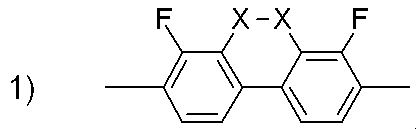
(式中、Xは独立して、-C(=O)-、-CHF-、または-CF2-である。)
の要素を含むことにより、他の液晶性化合物との優れた相溶性、特に誘電率異方性(Δε)の値が負に大きくなるという優れた効果が発現することを見出した。この効果を活用することで、課題を解決できるという知見を見出すことができ、本発明を完成するに至った。
[1] 式(1)で表される化合物。

式(1)において、R1およびR2は独立して、水素、炭素数1~10のアルキル、炭素数2~10のアルケニル、炭素数1~9のアルコキシ、炭素数2~9のアルコキシアルキル、または炭素数2~9のアルケニルオキシであり、これらのアルキル、アルケニル、アルコキシ、アルコキシアルキル、およびアルケニルオキシにおいて、少なくとも1つの水素はフッ素で置き換えられていてもよく;
環A1、環A2、および環A3は独立して、1,4-シクロへキシレン、1,4-シクロヘキセニレン、1,4-フェニレン、テトラヒドロピラン-2,5-ジイル、または1,3-ジオキサン-2,5-ジイルであり、これらの環において少なくとも1つの水素はフッ素で置き換えられていてもよく;
Z1、Z2、およびZ3は独立して、単結合、-(CH2)2-、-OCH2-、-CH2O―、―COO-、-OCO-、-CF2O-、または-OCF2-であり;
Xは独立して、-C(=O)-、-CHF-、または-CF2-であり;
l、m、およびnは独立して、0または1である。
環A1、環A2、および環A3が独立して、1,4-シクロへキシレン、1,4-シクロヘキセニレン、1,4-フェニレン、テトラヒドロピラン-2,5-ジイル、1,3-ジオキサン-2,5-ジイル、2-フルオロ-1,4-フェニレン、3-フルオロ-1,4-フェニレン、または2,3-ジフルオロ-1,4-フェニレンである項[1]に記載の化合物。
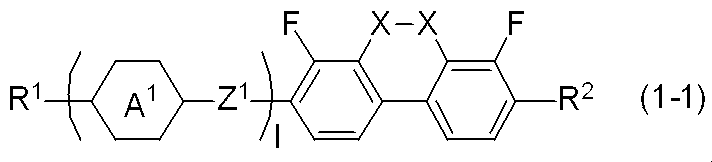
式(1-1)において、環A1は、1,4-シクロへキシレン、1,4-シクロヘキセニレン、1,4-フェニレン、2-フルオロ-1,4-フェニレン、3-フルオロ-1,4-フェニレン、または2,3-ジフルオロ-1,4-フェニレンであり;
R1およびR2は独立して、炭素数1~10のアルキル、炭素数2~10のアルケニル、炭素数1~9のアルコキシであり;
Z1は、単結合、-(CH2)2-、-OCH2-、-CH2O―、―COO-、-OCO-、-CF2O-、または-OCF2-であり;
Xは独立して、-C(=O)-、-CHF-、または-CF2-であり;
lは0または1である。
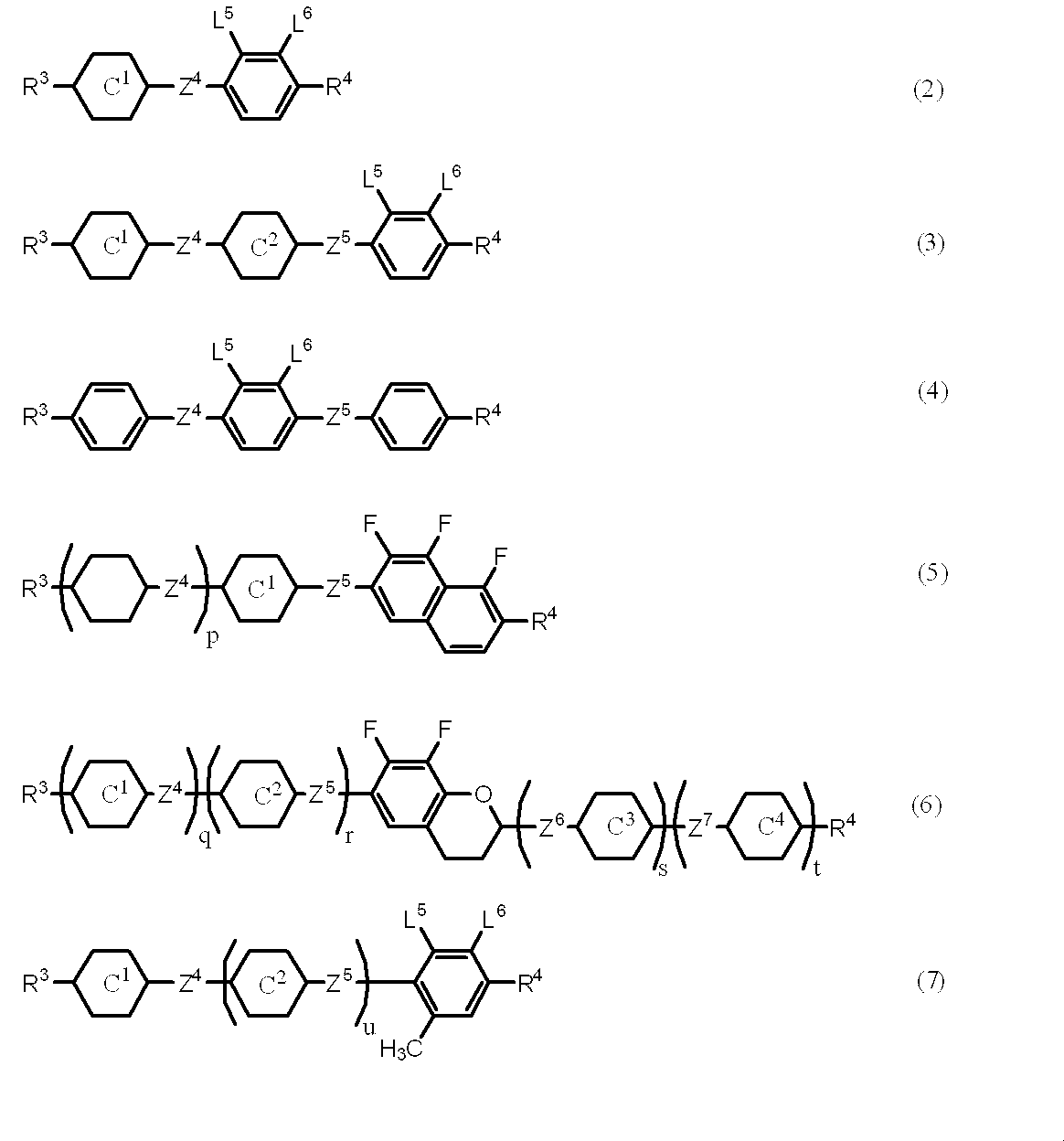
式中、R3およびR4は独立して、炭素数1~10のアルキルまたは炭素数2~10のアルケニルであり、アルキルおよびアルケニルにおいて少なくとも1つの水素はフッ素で置き換えられてもよく、これらにおいて少なくとも1つの-CH2-は-O-で置き換えられてもよく;
環C1、環C2、環C3、および環C4は独立して、1,4-シクロヘキシレン、1,4-シクロヘキセニレン、少なくとも1つの水素がフッ素で置き換えられてもよい1,4-フェニレン、テトラヒドロピラン-2,5-ジイル、またはデカヒドロ-2,6-ナフタレンであり;
Z4、Z5、Z6、およびZ7は独立して、-(CH2)2-、-COO-、-CH2O-、-OCF2-、-OCF2(CH2)2-、または単結合であり;
L5およびL6は独立してフッ素または塩素であり;
p、q、r、s、t、およびuは独立して、0または1であり、q、r、s、およびtの和は1または2である。

式中、R5およびR6は独立して、炭素数1~10のアルキルまたは炭素数2~10のアルケニルであり、このアルキルおよびアルケニルにおいて少なくとも1つの水素はフッ素で置き換えられてもよく、少なくとも1つの-CH2-は-O-で置き換えられてもよく;
環D1、環D2および環D3は独立して、1,4-シクロヘキシレン、ピリミジン-2,5-ジイル、1,4-フェニレン、2-フルオロ-1,4-フェニレン、3-フルオロ-1,4-フェニレン、または2,5-ジフルオロ1,4-フェニレンであり;
Z8およびZ9は独立して、-C≡C-、-COO-、-(CH2)2-、-CH=CH-、または単結合である。
本発明の化合物は以下の式(1)で表される液晶性化合物またはその中間体である。

アルケニルとしては、-CH=CH2、-CH=CHCH3、-CH=CHC2H5、-(CH2)2CH=CH2、-CH=CHC3H7、-(CH2)2CH=CHCH3、-(CH2)3CH=CH2、-CH=CH(CH2)2CH=CH2、および-(CH2)2CH=CH(CH2)2CH=CH2などが挙げられ;
アルコキシとしては、-OCH3、-OC2H5、-OC3H7、-OC4H9、-OC5H11、-OC6H13、および-OC7H15などが挙げられ;
アルコキシアルキルとしては、-CH2OCH3、-CH2OC2H5、-(CH2)2OCH3、および-(CH2)2OC2H5などが挙げられ;
アルケニルオキシとしては、-OCH2CH=CH2、-OCH2CH=CHCH3、および-OCH2CH=CHC2H5などが挙げられる。;

環A1は、1,4-シクロへキシレン、1,4-シクロヘキセニレン、1,4-フェニレン、2-フルオロ-1,4-フェニレン、3-フルオロ-1,4-フェニレン、または2,3-ジフルオロ-1,4-フェニレンであり;
Z1は、-(CH2)2-、-OCH2-、-CH2O―、―COO-、-OCO-、-CF2O-、または-OCF2-である。

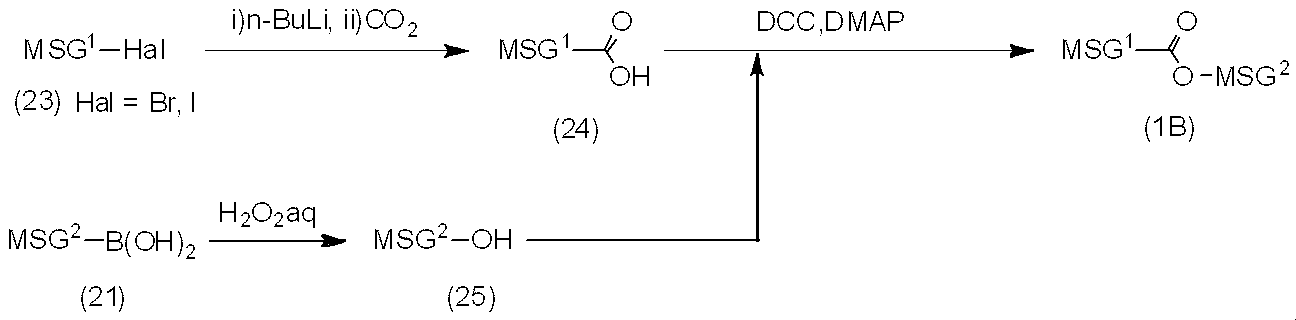



アリールホウ酸(21)と公知の方法で合成される化合物(22)とを、炭酸塩水溶液とテトラキス(トリフェニルホスフィン)パラジウム触媒の存在下で反応させて化合物(1A)が合成できる。この化合物(1A)は、公知の方法で合成される化合物(23)にn-ブチルリチウムを、次いで塩化亜鉛を反応させ、ジクロロビス(トリフェニルホスフィン)パラジウム触媒の存在下で化合物(22)を反応させることによっても合成できる。
化合物(23)にn-ブチルリチウムを、続いて二酸化炭素を反応させてカルボン酸(24)が得られる。化合物(24)と、公知の方法で合成されるフェノール(25)とをDDC(1,3-ジシクロヘキシルカルボジイミド)とDMAP(4-ジメチルアミノピリジン)の存在下で脱水させることにより、-COO-を有する化合物(1B)が合成できる。この方法によって-OCO-を有する化合物も合成できる。
化合物(1B)をローソン試薬のような硫黄化剤で処理して化合物(26)が得られる。化合物(26)をフッ化水素ピリジン錯体とNBS(N-ブロモスクシンイミド)でフッ素化することで、-CF2O-を有する化合物(1C)が合成できる(M. Kuroboshi et al., Chem. Lett., 1992,827.)。化合物(1C)は化合物(26)をDAST((ジエチルアミノ)サルファートリフルオリド)でフッ素化することでも合成できる(W. H. Bunnelle et al., J. Org. Chem. 1990, 55, 768.)。この方法によって-OCF2-を有する化合物も合成できる。Peer. Kirsch et al., Anbew. Chem. Int. Ed. 2001, 40, 1480.に記載の方法によってこれらの結合基を生成させることも可能である。
化合物(23)をn-ブチルリチウムで処理した後、DMF(N,N-ジメチルホルムアミド)などのホルムアミドと反応させることにより、アルデヒド(28)が得られる。公知の方法で合成されるホスホニウム塩(27)をカリウムtert-ブトキシドのような塩基で処理して発生させたリンイリドを、アルデヒド(28)に反応させることにより、化合物(1D)が合成できる。化合物(1D)をパラジウム炭素触媒の存在下で水素化することにより、化合物(1E)が合成できる。
化合物(28)を水素化ホウ素ナトリウムなどの還元剤で還元して化合物(29)を得る。これを臭化水素酸などでハロゲン化することにより化合物(30)が得られる。炭酸カリウムの存在下で、化合物(30)を化合物(25)と反応させることにより、化合物(1F)が合成できる。



これら成分Bの化合物は主として誘電率異方性の値が負であるVAモ-ド、PSAモード用の液晶組成物に用いられる。その含有量を増加させると組成物のしきい値電圧が低くなるが、粘度が大きくなるので、しきい値電圧の要求値を満足している限り含有量を少なくすることが好ましい。しかしながら、誘電率異方性の絶対値が5程度であるので、含有量が40重量%より少なくなると電圧駆動ができなくなる場合がある。

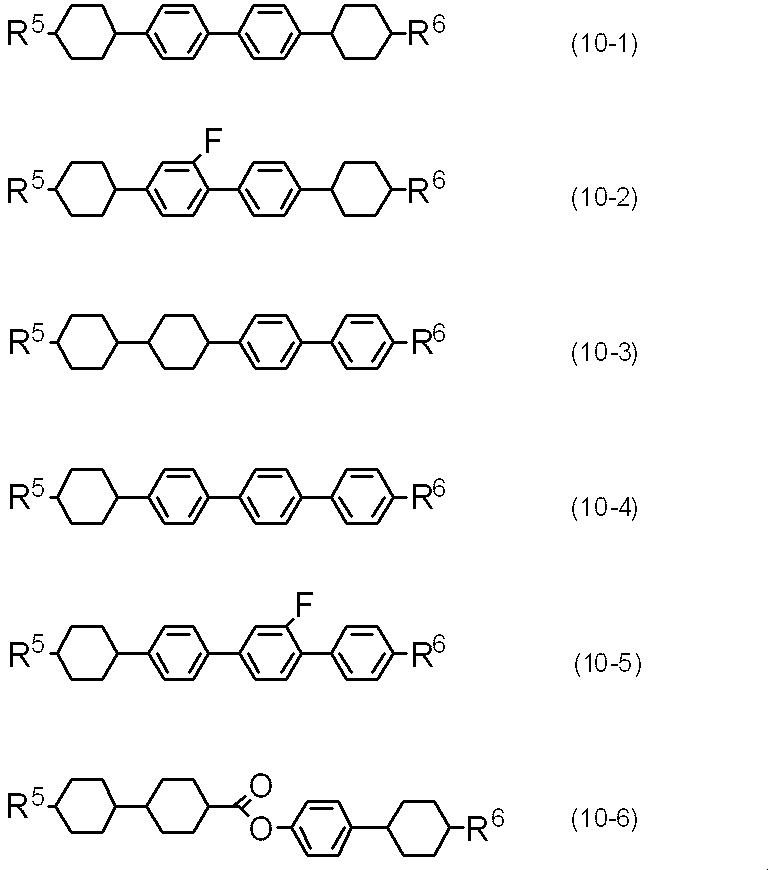
成分Cである化合物(8)~(10)は、誘電率異方性の絶対値が小さく、中性に近い化合物である。化合物(8)は主として粘度調整または屈折率異方性の調整の効果があり、また化合物(9)および(10)は透明点を高くするなどのネマチックレンジを広げる効果、または屈折率異方性の調整の効果がある。
本発明の液晶組成物の調製は、公知の方法、例えば必要な成分を高温度下で溶解させる方法などにより一般に調製される。また、用途に応じて当業者によく知られている添加物を添加して、例えばつぎに述べるような光学活性化合物、または重合可能な化合物、重合開始剤を含む液晶組成物、染料を添加したGHモード用の液晶組成物を調製することができる。通常、添加物は当該業者によく知られており、文献などに詳細に記載されている。

本発明の液晶組成物は、ネマチック液晶をマイクロカプセル化して作製したNCAPや、液晶中に三次元網目状高分子を形成して作製したポリマ-分散型液晶表示素子(PDLCD)、例えばポリマ-ネットワ-ク液晶表示素子(PNLCD)用をはじめ、複屈折制御(ECB)型やDS型用の液晶組成物としても使用できる。
測定装置は、DRX-500(ブルカーバイオスピン(株)社製)を用いた。測定は、実施例等で製造したサンプルを、CDCl3等のサンプルが可溶な重水素化溶媒に溶解し、室温で、500MHz、積算回数24回の条件で行った。化学シフトδ値のゼロ点の基準物質としてはテトラメチルシラン(TMS)を用いた。
測定装置は、島津製作所製のGC-2014型ガスクロマトグラフを用いた。カラムは、Agilent Technologies Inc.製のキャピラリカラムDB-1(長さ30m、内径0.25mm、膜厚0.25μm;固定液相:ジメチルポリシロキサン;無極性)を用いた。キャリアーガスとしてはヘリウムを用い、流量は1ml/分に調整した。試料気化室の温度を300℃、検出器(FID)部分の温度を300℃に設定した。
記録計としては島津製作所製のC-R6A型Chromatopac、またはその同等品を用いた。得られたガスクロマトグラムには、成分化合物に対応するピークの保持時間およびピークの面積値が示されている。
測定装置は、島津製作所製のGCMS-QP2010型ガスクロマトグラフ質量分析計を用いた。カラムは、Agilent Technologies Inc.製のキャピラリカラムDB-1MS(長さ60m、内径0.25mm、膜厚0.25μm)を用いた。キャリアーガスとしてはヘリウムを用い、流量は1ml/分に調整した。試料気化室の温度を300℃、イオン源部分の温度を200℃に、イオン化電圧を70eV,エミッション電流を150μAに設定した。
液晶性化合物の物性値を測定する試料としては、化合物そのものを試料とする場合、化合物を母液晶と混合して試料とする場合の2種類を用いた。
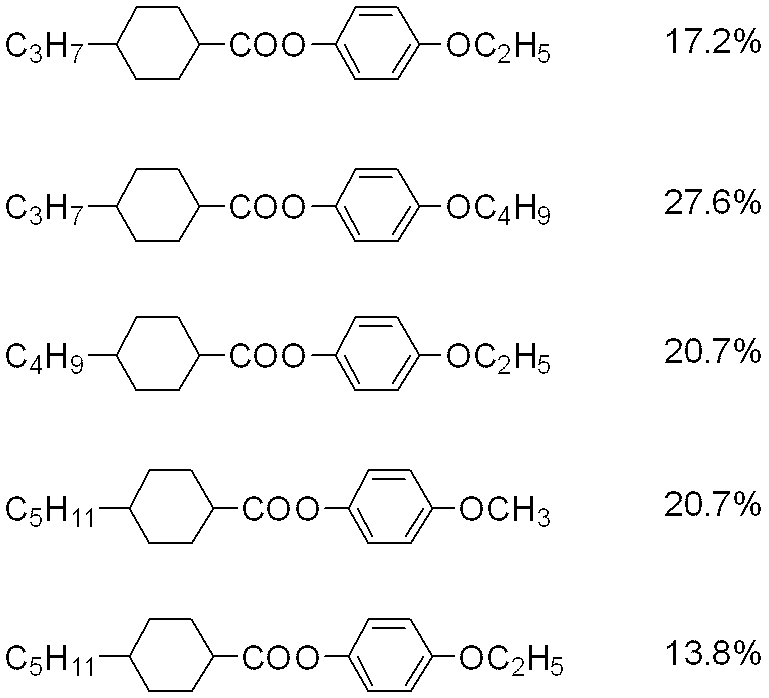
物性値の測定は後述する方法で行った。これら測定方法の多くは、日本電子機械工業会規格(Standards of Electric Industries Association of Japan)EIAJ・ED-2521Aに記載された方法、またはこれを修飾した方法である。また、測定に用いたTN素子またはVA素子には、TFTを取り付けなかった。
以下(1)、および(2)の方法で測定を行った。
(1)偏光顕微鏡を備えた融点測定装置のホットプレート(メトラー社FP-52型ホットステージ)に化合物を置き、3℃/分の速度で加熱しながら相状態とその変化を偏光顕微鏡で観察し、相の種類を特定した。
(2)パーキンエルマー社製走査熱量計DSC-7システム、またはDiamond DSCシステムを用いて、3℃/分速度で昇降温し、試料の相変化に伴う吸熱ピーク、または発熱ピークの開始点を外挿により求め(on set)、転移温度を決定した。
偏光顕微鏡を備えた融点測定装置のホットプレート(メトラー社FP-52型ホットステージ)に、試料(液晶組成物、または液晶化性合物と母液晶との混合物)を置き、1℃/分の速度で加熱しながら偏光顕微鏡を観察した。試料の一部がネマチック相から等方性液体に変化したときの温度をネマチック相の上限温度とした。ネマチック相の上限温度を、単に「上限温度」と略すことがある。
母液晶と液晶性化合物とを、液晶性化合物が、20重量%、15重量%、10重量%、5重量%、3重量%、および1重量%の量となるように混合した試料を作製し、試料をガラス瓶に入れる。このガラス瓶を、-10℃または-20℃のフリーザー中に一定期間保管したあと、結晶もしくはスメクチック相が析出しているかどうか観察をした。
バルク粘度は、E型回転粘度計を用いて測定した。
測定はM. Imai et al., Molecular Crystals and Liquid Crystals, Vol. 259, 3
7 (1995) に記載された方法に従った。2枚のガラス基板の間隔(セルギャップ)が20μmのVA素子に試料(液晶組成物、または液晶性化合物と母液晶との混合物)を入れた。この素子に30ボルトから50ボルトの範囲で1ボルト毎に段階的に印加した。0.2秒の無印加のあと、ただ1つの矩形波(矩形パルス;0.2 秒)と無印加(2秒)の条件で印加を繰り返した。この印加によって発生した過渡電流(transient current)のピーク電流(peak current)とピーク時間(peak time)を測定した。これらの測定値とM. Imaiらの論文、40頁の計算式(8)とから回転粘度の値を得た。
なお、この計算に必要な誘電率異方性(Δε)は、下記誘電率異方性(Δε)で測定した値を用いた。
測定は、25℃の温度下で、波長589nmの光を用い、接眼鏡に偏光板を取り付けた
アッベ屈折計により行った。主プリズムの表面を一方向にラビングしたあと、試料(液晶組成物、または液晶性化合物と母液晶との混合物)を主プリズムに滴下した。屈折率(n∥)は偏光の方向がラビングの方向と平行であるときに測定した。屈折率(n⊥)は偏光の方向がラビングの方向と垂直であるときに測定した。屈折率異方性(Δn)の値は、(Δn)=(n∥)-(n⊥)
の式から算出した。
よく洗浄したガラス基板にオクタデシルトリエトキシシラン(0.16ml)のエタノール(20ml)溶液を塗布した。ガラス基板をスピンナーで回転させたあと、150℃で1時間加熱した。2枚のガラス基板から、間隔(セルギャップ)が20μmであるVA素子を組み立てた。
同様の方法で、ガラス基板にポリイミドの配向膜を調製した。得られたガラス基板の配向膜にラビング処理をした後、2枚のガラス基板の間隔が9μmであり、ツイスト角が80度であるTN素子を組み立てた。
得られたVA素子に試料(液晶組成物、または液晶性化合物と母液晶との混合物)を入れ、0.5ボルト(1kHz、サイン波)を印加して、液晶分子の長軸方向における誘電率(ε∥)を測定した。
また、得られたTN素子に試料(液晶組成物、または液晶性化合物と母液晶との混合物)を入れ、0.5ボルト(1kHz、サイン波)を印加して、液晶分子の短軸方向における誘電率(ε⊥)を測定した。
誘電率異方性(Δε)の値は、(Δε)=(ε∥)-(ε⊥)の式から算出した。
[実施例1および2] 2-エトキシ-1,8-ジフルオロ-7-プロピルフェナントレン-9,10-ジオン(58)および2-エトキシ-1,8,9,9,10,10-ヘキサフルオロ-7-プロピル-9,10-ジヒドロフェナントレン(No.1)の合成

第一工程
窒素雰囲気下、4-ブロモ-2-フルオロ-1-プロピルベンゼン(50)(11.1g,51.13mmol)のTHF(100ml)溶液に、-70℃以下で、LDA(50.7ml,56.25mmol)をゆっくり滴下した。反応液を-70℃以下で1時間攪拌後、DMF(6.15g,76.70mmol)をゆっくり滴下した。反応液を室温まで戻したのち、1N-塩酸水溶液100mlでクエンチし、トルエン60mlで3回抽出した。一緒にした有機層を、飽和炭酸水素ナトリウム水溶液、水、飽和食塩水で洗浄した後、硫酸マグネシウムで乾燥させ、エバポレーターで溶媒を留去した。残渣をシリカゲルカラムクロマトグラフィーにて精製し、6-ブロモ-2-フルオロ-3-プロピルベンズアルデヒド(51)を得た(5.0g,収率36%)。
化合物(51)と同様の方法で、4-ブロモ-1-エトキシ-2-フルオロベンゼン(52)(20.0g,91.30mmol)から6-ブロモ-3-エトキシ-2-フルオロベンズアルデヒド(53)を得た(17.0g,収率75.4%)。
化合物(53)(17.0g,68.81mmol)、EG(12.8g,200.2mmol)およびPTSA(0.17g,1wt%)の混合物をトルエン200ml溶媒中、Dean-starkコンデンサーを装着させ、3時間還流した。反応液を飽和炭酸水素ナトリウム水溶液、水、飽和食塩水で洗浄し、硫酸マグネシウムで乾燥した。エバポレーターでトルエンを留去し、2-(6-ブロモ-3-エトキシ-2-フルオロフェニル)-1,3-ジオキソラン(54)を得た(19.8g,収率98.8%)。
窒素雰囲気下、化合物(54)(19.8g,68.02mmol)のTHF(200ml)溶液に、-70℃以下でn-BuLi(43.3ml,71.42mmol)をゆっくり滴下した。反応液を-70℃以下で1時間攪拌後、ホウ酸トリメチル(10.6g,102.0mmol)をゆっくり滴下した。反応液を室温まで戻したのち、2N-塩酸水溶液200mlでクエンチし、トルエン100mlで3回抽出した。一緒にした有機層を、飽和炭酸水素ナトリウム水溶液、水、飽和食塩水で洗浄した後、硫酸マグネシウムで乾燥させ、エバポレーターで溶媒を留去した。残渣をヘプタンで洗浄することにより、(4-エトキシ-3-フルオロ-2-ホルミルフェニル)ボロン酸(55)を得た(9.85g,収率68.3%)。
窒素雰囲気下、化合物(51)(4.9g,19.99mmol)、化合物(55)(4.9g,23.12mmol)、テトラキストリフェニルホスフィンパラジウム(0.23g,0.199mmol)、炭酸ナトリウム(4.9g,46.23mmol)およびTBAB(0.96g,2.978mmol)の混合物を、トルエン30ml-エタノール20ml-水50ml溶媒中、5時間還流した。反応液をトルエン30mlで3回抽出した。一緒にした有機層を、飽和炭酸水素ナトリウム水溶液、水、飽和食塩水で洗浄した後、硫酸マグネシウムで乾燥させ、エバポレーターで溶媒を留去した。残渣をシリカゲルカラムクロマトグラフィーにて精製し、4-エトキシ-3,3’-ジフルオロ-4’-プロピル-[1,1’-ビフェニル]-2,2’-ジカルボアルデヒド(56)を得た(5.35g,収率80.5%)。
窒素雰囲気下、化合物(56)(0.5g,1.504mmol)のDMF(5ml)溶液に、亜鉛粉末(0.295g,4.513mmol)および塩化亜鉛(0.1g,0.752mmol)を加え、80℃で8時間攪拌した。反応液を1N-塩酸水溶液20mlでクエンチし、トルエン10mlで3回抽出した。一緒にした有機層を、飽和炭酸水素ナトリウム水溶液、水、飽和食塩水で洗浄した後、硫酸マグネシウムで乾燥させ、エバポレーターで溶媒を留去した。残渣をシリカゲルカラムクロマトグラフィーにて精製し、2-エトキシ-1,8-ジフルオロ-7-プロピル-9,10-ジヒドロフェナントレン-9,10-ジオール(57)を得た(0.3g,収率59.7%)。
DMSO100mlにIBX(31.5g,112.5mmol)を加え室温で30分攪拌した後、化合物(57)(9.4g,28.11mmol)を加え、さらに3時間攪拌した。反応液をろ過し、ろ液に水200mlを加え、酢酸エチル100mlで3回抽出した。一緒にした有機層を、飽和炭酸水素ナトリウム水溶液、水、飽和食塩水で洗浄した後、硫酸マグネシウムで乾燥させ、エバポレーターで溶媒を留去した。残渣をトルエンから再結晶することにより、2-エトキシ-1,8-ジフルオロ-7-プロピルフェナントレン-9,10-ジオン(58)を得た(3.2g,収率34.5%)。
上限温度(NI)=4.6℃;誘電率異方性(Δε)=-28.4;屈折率異方性(Δn)=0.187;粘度(η)=247.8mPa・s
窒素雰囲気下、実施例1で合成した化合物(58)(1.0g,3.027mmol)のジクロロメタン(10ml)懸濁液に、-70℃以下で、DAST(2.93g,18.16mmol)をゆっくり滴下した。反応液を室温までゆっくり戻したのち、水10mlでクエンチした。ジクロロメタン層を飽和炭酸水素ナトリウム水溶液、水、飽和食塩水で洗浄した後、硫酸マグネシウムで乾燥させ、エバポレーターで溶媒を留去した。シリカゲルカラムクロマトグラフィ-で精製することにより、2-エトキシ-1,8,9,9,10,10-ヘキサフルオロ-7-プロピル-9,10-ジヒドロフェナントレン(No.1)を得た(0.8g,収率70.6%)。
相転移温度:C 89.5 Iso。
上限温度(NI)=-18.1℃;誘電率異方性(Δε)=-18.2;屈折率異方性(Δn)=0.1197;粘度(η)=139.8mPa・s
第一工程
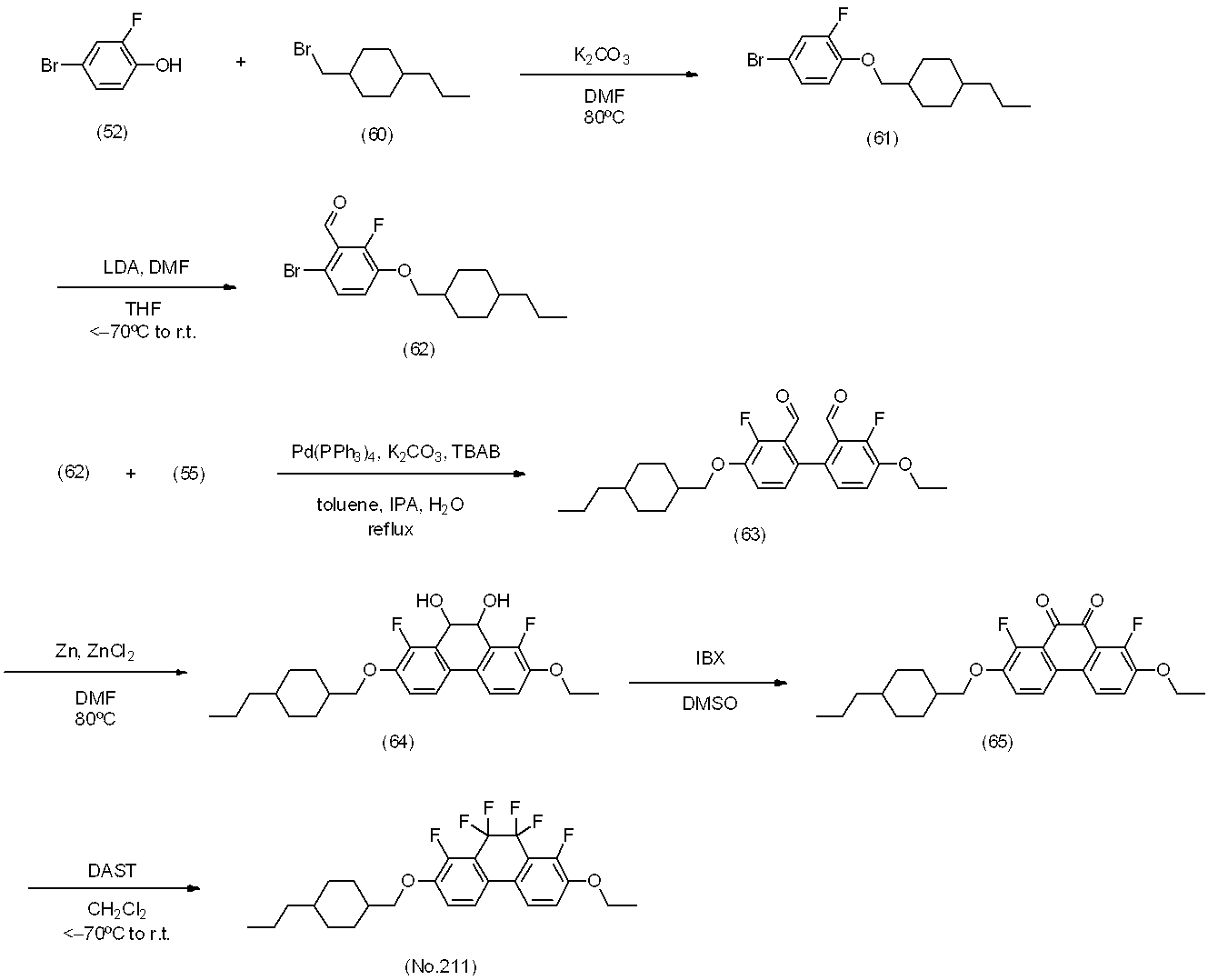
窒素雰囲気下、4-ブロモ-2-フルオロ-1-フェノール(52)(10.8g,56.58mmol)、1-(ブロモメチル)-4-プロピルシクロヘキサン(60)(12.4g,56.58mmol)および炭酸カリウム(15.6g,112.9mmol)の混合物をDMF100ml中80℃で5時間攪拌した。反応液を水100mlでクエンチし、トルエン60mlで3回抽出した。一緒にした有機層を、2N-水酸化ナトリウム水溶液、水、飽和食塩水で洗浄した後、硫酸マグネシウムで乾燥させ、エバポレーターで溶媒を留去した。残渣をシリカゲルカラムクロマトグラフィーにて精製し、4-ブロモ-2-フルオロ-1-((4-プロピルシクロヘキシル)ベンゼン(61)を得た(11.4g,収率61。2%)。
窒素雰囲気下、化合物(61)(11.4g,34.62mmol)のTHF(100ml)溶液に-70℃以下で、LDA(34.4ml,38.18mmol)をゆっくり滴下した。反応液を-70℃以下で1時間攪拌後、DMF(4.17g,52.07mmol)をゆっくり滴下した。反応液を室温まで戻したのち、1N-塩酸水溶液100mlでクエンチし、トルエン60mlで3回抽出した。一緒にした有機層を、飽和炭酸水素ナトリウム水溶液、水、飽和食塩水で洗浄した後、硫酸マグネシウムで乾燥させ、エバポレーターで溶媒を留去した。残渣をシリカゲルカラムクロマトグラフィーにて精製し、6-ブロモ-2-フルオロ-3-((4-プロピルシクロヘキシル)メトキシ)ベンズアルデヒド(62)を得た(4.20g,収率33.9%)。
窒素雰囲気下、化合物(62)(4.20g,11.76mmol)、実施例1で合成した化合物(55)(2.74g,12.93mmol)、テトラキストリフェニルホスフィンパラジウム(0.14g,0.121mmol)、炭酸カリウム(3.25g,23.51mmol)およびTBAB(0.76g,2.351mmol)の混合物を、トルエン20ml-エタノール10ml-水50ml溶媒中、5時間還流した。反応液をトルエン20mlで3回抽出し、一緒にした有機層を、水、飽和食塩水で洗浄した後、硫酸マグネシウムで乾燥させ、エバポレーターで溶媒を留去した。残渣をシリカゲルカラムクロマトグラフィーにて精製し、4-エトキシ-3,3’-ジフルオロ-4’-((4-プロピルシクロヘキシル)メトキシ)-[1,1’-ビフェニル]-2,2’-ジカルブアルデヒド(63)を得た(4.20g,収率80.3%)。
窒素雰囲気下、化合物(63)(4.20g,9.449mmol)のDMF(50ml)溶液に、亜鉛粉末(1.85g,28.30mmol)および塩化亜鉛(0.64g,4.696mmol)を加え、80℃で8時間攪拌した。1N-塩酸水溶液100mlでクエンチし、トルエン50mlで3回抽出した。一緒にした有機層を、飽和炭酸水素ナトリウム水溶液、水、飽和食塩水で洗浄した後、硫酸マグネシウムで乾燥させ、エバポレーターで溶媒を留去した。残渣をシリカゲルカラムクロマトグラフィーにて精製し、2-エトキシ-1,8-ジフルオロ-7-((4-プロピルシクロヘキシル)メトキシ)-9,10-ジヒドロフェナントレン-9,10-ジオール(64)を得た(3.6g,収率85.4%)。
DMSO100mlにIBX(9.03g,32.25mmol)を加え室温で30分攪拌した後、化合物(64)(3.6g,8.062mmol)を加え、さらに3時間攪拌した。反応液をろ過し、ろ液に水200mlを加え、酢酸エチル100mlで3回抽出した。一緒にした有機層を、飽和炭酸水素ナトリウム水溶液、水、飽和食塩水で洗浄した後、硫酸マグネシウムで乾燥させ、エバポレーターで溶媒を留去した。残渣をトルエンから再結晶することにより、2-エトキシ-1,8-ジフルオロ-7-((4-プロピルシクロヘキシル)メトキシ)フェナントレン-9,10-ジオン(65)を得た(3.2g,収率34.5%)。
窒素雰囲気下、実施例3で合成した化合物(65)(1.2g,2.712mmol)のジクロロメタン(10ml)懸濁液に、-70℃以下で、DAST(2.16g,13.56mmol)をゆっくり滴下した。反応液を室温までゆっくり戻し、水10mlでクエンチした。ジクロロメタン層を飽和炭酸水素ナトリウム水溶液、水、飽和食塩水で洗浄した後、硫酸マグネシウムで乾燥させ、エバポレーターで溶媒を留去した。残渣をシリカゲルカラムクロマトグラフィ-にて精製し、2-エトキシ-1,8,9,9,10,10-ヘキサフルオロ-7-((4-プロピルシクロヘキシル)メトキシ)-9,10-ジヒドロフェナントレン(No.211)を得た(0.73g,収率55.4%)。
相転移温度:C 115.0 Iso。
上限温度(NI)=99.3℃;誘電率異方性(Δε)=-24.4;屈折率異方性(Δn)=0.167;粘度(η)=174.8mPa・s

実施例3に記載の1-(ブロモメチル)-4-プロピルシクロヘキサン(60)を1-(ブロモメチル)-4-ペンチルシクロヘキサンに変え、実施例3および4に記載と同様の反応を行うことで、2-エトキシ-1,8,9,9,10,10-ヘキサフルオロ-7-((4-ペンチルシクロヘキシル)メトキシ)-9,10-ジヒドロフェナントレン(No.513)を得た。
相転移温度:C 109.7 Iso。
上限温度(NI)=101.3℃;誘電率異方性(Δε)=-23.7;屈折率異方性(Δn)=0.158;粘度(η)=169.3mPa・s

窒素雰囲気下、4-ブロモ-2-フルオロ-1-ヨードベンゼン(67)(50.0g,166.0mmol)のTHF(300ml)溶液に-70℃以下で、n-BuLi(108.0ml,174.0mmol)をゆっくり滴下した。反応液を-70℃以下で1時間攪拌後、4-プロピルシクロヘキサノン(66)(24.5g,174.0mmol)をゆっくり滴下した。反応液を室温まで戻したのち、1N-塩酸水溶液200mlでクエンチし、トルエン100mlで3回抽出した。一緒にした有機層を、飽和炭酸水素ナトリウム水溶液、水、飽和食塩水で洗浄した後、硫酸マグネシウムで乾燥させ、エバポレーターで溶媒を留去した。残渣をシリカゲルカラムクロマトグラフィーにて精製し、1-(4-ブロモ-2-フルオロフェニル)-4-プロピルシクロヘキサノール(68)を得た(42.0g,収率80.2%)。
化合物(68)(42.0g,133.2mmol)およびPTSA(0.42g,1wt%)の混合物をトルエン300ml溶媒中、Dean-starkコンデンサーを装着させ、3時間還流した。反応液を飽和炭酸水素ナトリウム水溶液、水、飽和食塩水で洗浄し、硫酸マグネシウムで乾燥した。エバポレーターでトルエンを留去し、4’-ブロモ-2’-フルオロ-4-プロピル-2,3,4,5,-テトラヒドロ-1,1’-ビフェニル(69)を得た(39.2g,収率99.0%)。
化合物(69)(39.2g,131.9mmol)および5%-パラジウム炭素(0.5%硫黄、50%含水品)(1.18g,3wt%)の混合物を、トルエン200ml、IPA100ml溶媒中、水素雰囲気下で18時間攪拌した。反応液をろ過し、ろ液の溶媒をエバポレーターで留去した。残渣をシリカゲルカラムクロマトグラフィーに通したのち、蒸留にて低沸点物を留去することにより、4-ブロモ-2-フルオロ-1-(4-プロピルシクロヘキシル)ベンゼン(70)を得た(30.8g,収率78.1%)。
窒素雰囲気下、化合物(70)(3.5g,11.70mmol)のTHF(30ml)溶液に、-70℃以下で、LDA(11.6ml,12.87mmol)をゆっくり滴下した。反応液を-70℃以下で1時間攪拌後、DMF(1.28g,17.55mmol)をゆっくり滴下した。反応液を室温まで戻したのち、1N-塩酸水溶液50mlでクエンチし、トルエン20mlで3回抽出した。一緒にした有機層を、飽和炭酸水素ナトリウム水溶液、水、飽和食塩水で洗浄した後、硫酸マグネシウムで乾燥させ、エバポレーターで溶媒を留去した。残渣をシリカゲルカラムクロマトグラフィーにて精製し、6-ブロモ-2-フルオロ-3-(4-プロピル)シクロヘキシル)ベンズアルデヒド(71)を得た(2.3g,収率89.7%)。
化合物(71)と実施例1で合成した化合物(55)から、実施例1および2に記載と同様の反応を行うことで、2-エトキシ-1,8,9,9,10,10-ヘキサフルオロ-7-(4-プロピルシクロヘキシル)-9,10-ジヒドロフェナントレン(No.11)を得た。
相転移温度:C 100.7 N 110.7 Iso。
化合物No.11 15重量%と、母液晶A 85重量%とから液晶組成物を調製した。得られた液晶組成物の物性値を測定し、測定値を外挿することで化合物No.11の物性値を算出した。結果は以下のとおりであった。
上限温度(NI)=101.9℃;誘電率異方性(Δε)=-20.1;屈折率異方性(Δn)=0.163;粘度(η)=154.5mPa・s

相転移温度:C 107.5 N 122.2 Iso。
上限温度(NI)=111.3℃;誘電率異方性(Δε)=-19.2;屈折率異方性(Δn)=0.161;粘度(η)=154.5mPa・s
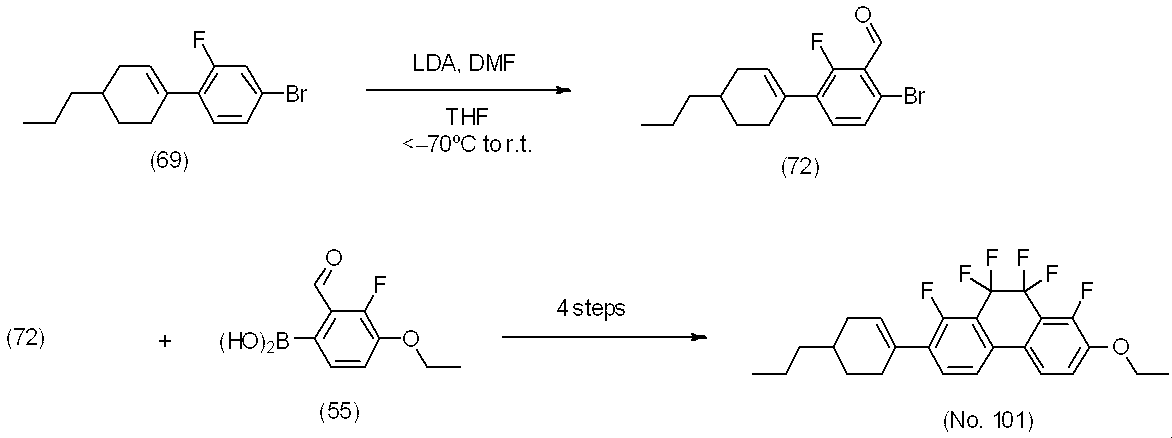
窒素雰囲気下、実施例6で合成した化合物(69)(27.8g,93.54mmol)のTHF(300ml)溶液に、-70℃以下で、LDA(93.6ml,103.9mmol)をゆっくり滴下した。反応液を-70℃以下で1時間攪拌後、DMF(11.2g,139.8mmol)をゆっくり滴下した。反応液を室温まで戻したのち、1N-塩酸水溶液300mlでクエンチし、トルエン100mlで3回抽出した。一緒にした有機層を、飽和炭酸水素ナトリウム水溶液、水、飽和食塩水で洗浄した後、硫酸マグネシウムで乾燥させ、エバポレーターで溶媒を留去した。残渣をシリカゲルカラムクロマトグラフィーにて精製し、4-ブロモ-2-フルオロ-4’-プロピル-2’,3’,4’,5’-テトラヒドロ-[1,1’-ビフェニル]-3-カルボアルデヒド(72)を得た(28.2g,収率92.7%)。
化合物(72)と実施例1で合成した化合物(55)から、実施例6と同様の反応を行うことで、2-エトキシ-1,8,9,9,10,10-ヘキサフルオロ-7-(4-プロピルシクロヘキサ-1-エン-1‐イル)-9,10-ジヒドロフェナントレン(No.101)を得た。
相転移温度:C 93.3 N 103.1 Iso。
上限温度(NI)=97.9℃;誘電率異方性(Δε)=-19.5;屈折率異方性(Δn)=0.194;粘度(η)=141.3mPa・s
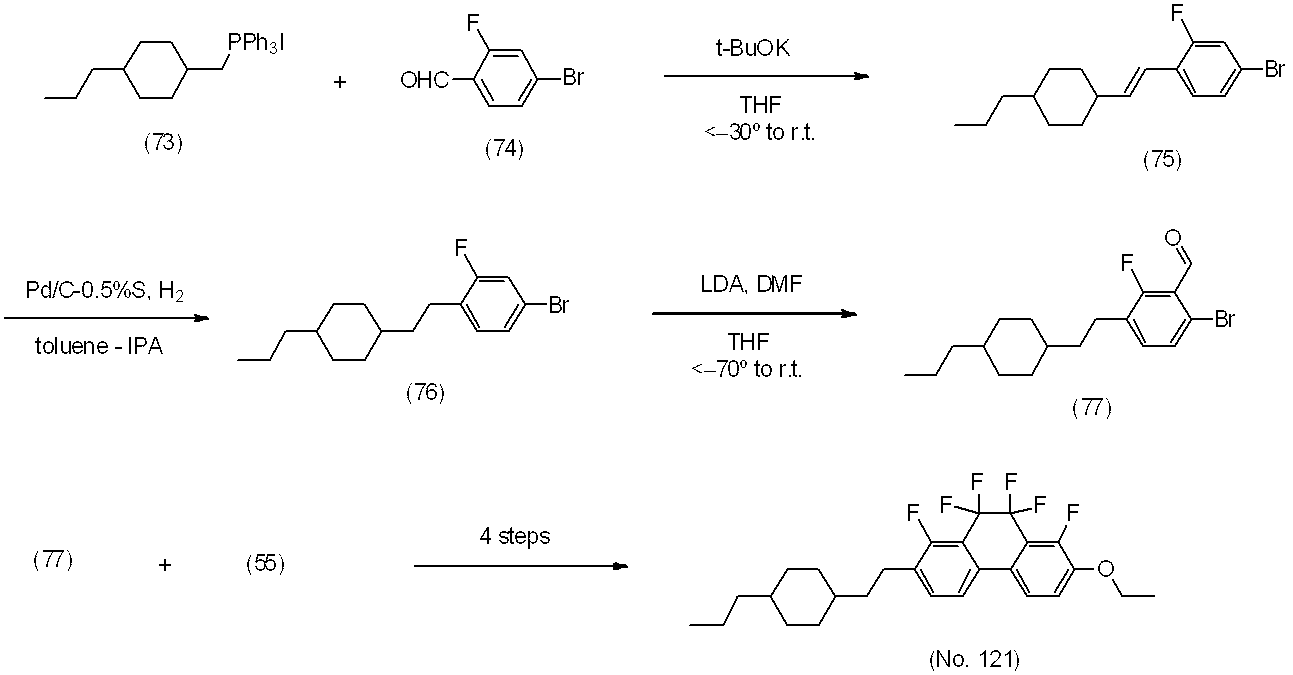
窒素雰囲気下、ヨードトリフェニル((4-プロピルシクロヘキシル)メチル)ホスフィン(73)(143.0g,271.0mmol)のTHF(500ml)懸濁液に、-30℃以下で、カリウムt-ブトキシド(30.4g,271.0mmol)を添加した。反応液を-30℃以下で1時間攪拌後、4-ブロモ-2-フルオロベンズアルデヒド(50.0g,246.0mmol)のTHF(100ml)溶液を滴下した。反応液を室温まで戻したのち、水500mlでクエンチし、トルエン200mlで3回抽出した。一緒にした有機層を、水、飽和食塩水で洗浄した後、硫酸マグネシウムで乾燥させ、エバポレーターで溶媒を留去した。残渣をシリカゲルカラムクロマトグラフィーにて精製し、4-ブロモ-2-フルオロ-1-(2-(4-プロピルシクロヘキシル)ビニル)ベンゼン(75)を得た(75.0g,収率94.0%)。
化合物(75)(75.0g,231.0mmol)および5%-パラジウム炭素(0.5%硫黄、50%含水品)(2.82g,3wt%)の混合物を、トルエン300ml、IPA100ml溶媒中、水素雰囲気下で18時間攪拌した。反応液をろ過し、ろ液の溶媒をエバポレーターで留去した。残渣をシリカゲルカラムクロマトグラフィーに通し、ヘプタン-エタノールから再結晶することにより、4-ブロモ-2-フルオロ-1-(2-(4-プロピルシクロヘキシル)エチル)ベンゼン(76)を得た(57.1g,収率75.5%)。
窒素雰囲気下、化合物(76)(89.7g,274.1mmol)のTHF(400ml)溶液に、-70℃以下で、LDA(299.0ml,328.9mmol)をゆっくり滴下した。反応液を-70℃以下で1時間攪拌後、DMF(30.1g,411.1mmol)をゆっくり滴下した。反応液を室温まで戻したのち、1N-塩酸水溶液400mlでクエンチし、トルエン200mlで3回抽出した。一緒にした有機層を、飽和炭酸水素ナトリウム水溶液、水、飽和食塩水で洗浄した後、硫酸マグネシウムで乾燥させ、エバポレーターで溶媒を留去した。残渣をシリカゲルカラムクロマトグラフィーにて精製し、6-ブロモ-2-フルオロ-3-(2-(4-プロピルシクロヘキシル)エチル)ベンズアルデヒド(77)を得た(61.4g,収率63.1%)。
化合物(77)と実施例1で合成した化合物(55)から、実施例1および2と同様の反応を行うことで、2-エトキシ-1,8,9,9,10,10-ヘキサフルオロ-7-(2-(4-プロピルシクロヘキシル)エチル)-9,10-ジヒドロフェナントレン(No.121)を得た。
相転移温度:C 87.8 N 101.7 Iso。
上限温度(NI)=97.9℃;誘電率異方性(Δε)=-17.7;屈折率異方性(Δn)=0.158;粘度(η)=144.4mPa・s

実施例1で合成した化合物(51)(52.4g,213.8mmol)、EG(39.8g,641.4mmol)およびPTSA(0.52g,1wt%)の混合物をトルエン300ml溶媒中、Dean-starkコンデンサーを装着させ、3時間還流した。反応液を飽和炭酸水素ナトリウム水溶液、水、飽和食塩水で洗浄し、硫酸マグネシウムで乾燥した。エバポレーターでトルエンを留去し、2-(6-ブロモ-2-フルオロ-3-プロピルフェニル)-1,3-ジオキソラン(78)を得た(61.2g,収率99.0%)。
窒素雰囲気下、化合物(78)(61.2g,213.0mmol)のTHF(500ml)溶液に、-70℃以下でn-BuLi(141.1ml,232.8mmol)をゆっくり滴下した。反応液を-70℃以下で1時間攪拌後、ホウ酸トリメチル(33.0g,317mmol)をゆっくり滴下した。反応液を室温まで戻したのち、2N-塩酸水溶液400mlでクエンチし、トルエン200mlで3回抽出した。一緒にした有機層を、飽和炭酸水素ナトリウム水溶液、水、飽和食塩水で洗浄した後、硫酸マグネシウムで乾燥させ、エバポレーターで溶媒を留去した。残渣をヘプタンで洗浄することにより、(3-フルオロ-2-ホルミル-4-エトキシフェニル)ボロン酸(79)を得た(38.1g,収率86.0%)。
実施例9で合成した化合物(77)と化合物(79)から、実施例1および2と同様の反応を行うことで、1,8,9,9,10,10-ヘキサフルオロー2-プロピル-7-(2-(4-プロピルシクロヘキシル)エチル)-9,10-ジヒドロフェナントレン(No.512)を得た。
相転移温度:C 76.4 Iso。
上限温度(NI)=65.9℃;誘電率異方性(Δε)=-13.4;屈折率異方性(Δn)=0.1297;粘度(η)=119.4mPa・s

第一工程
窒素雰囲気下、2-クロロ-6-フルオロベンズアルデヒド(84)(50.0g,315mmol)、化合物(55)(73.5g,347mmol)、Pd-132(ジョンソン-マッセイ社製)(0.223g,0.315mmol)、炭酸カリウム(87g,631mmol)およびTBAB(20.33g,63.1mmol)の混合物を、トルエン500ml-エタノール100ml-水500ml溶媒中、5時間還流した。反応液をトルエン300mlで3回抽出した。一緒にした有機層を、飽和炭酸水素ナトリウム水溶液、水、飽和食塩水で洗浄した後、硫酸マグネシウムで乾燥させ、エバポレーターで溶媒を留去した。残渣をシリカゲルカラムクロマトグラフィーにて精製し、4-エトキシ-3,3’-ジフルオロ-[1,1’-ビフェニル]-2,2’-ジカルボアルデヒド(85)を得た(77.25g,収率84%)。
窒素雰囲気下、化合物(85)(10.0g,3.45mmol)、3-エチル-5-(2-ヒドロキシエチル)-4-メチルチアゾ-ル-3-イウム ブロミド(1.74g,6.89mmol)およびトリエチルアミン(1.05g,10.34mmol)のDMF(50ml)溶液を60℃で6時間攪拌した。反応液を水150mlでクエンチし、ジクロロメタン50mlで3回抽出した。一緒にした有機層を、1N-塩酸水溶液、水、飽和食塩水で洗浄した後、硫酸マグネシウムで乾燥させ、エバポレーターで溶媒を留去した。残渣をトルエンで洗浄し、2-エトキシ-1,8-ジフルオロフェナントレン-9,10-ジオン(86)を得た(7.0g,70.5%)。
窒素雰囲気下、化合物(86)(6.21g,21.54mmol)のジクロロメタン(50ml)溶液に-70℃以下で、DAST(15.63g,97.00mmol)をゆっくり滴下した。反応液を室温までゆっくり戻したのち、水100mlでクエンチした。ジクロロメタン層を飽和炭酸水素ナトリウム水溶液、水、飽和食塩水で洗浄した後、硫酸マグネシウムで乾燥させ、エバポレーターで溶媒を留去した。残渣をシリカゲルカラムクロマトグラフィ-にて精製し、2-エトキシ-1,8,9,9,10,10-ヘキサフルオロ-9,10-ジヒドロフェナントレン(87)を得た(6.44g,収率90.0%)。
窒素雰囲気下、化合物(87)(6.44g,19.38mmol)のTHF(50ml)溶液に、-60℃以下で、n-ブチルリチウム(1.65M,14.1ml,23.26mmol)をゆっくり滴下した。反応液を-60℃以下で1時間攪拌した後、ヨウ素(5.9g,23.26mmol)のTHF(30ml)溶液を滴下した。反応液を室温まで戻したのち、飽和塩化アンモニウム水溶液でクエンチし、トルエン50mlで3回抽出した。一緒にした有機層を、チオ硫酸ナトリウム水溶液、飽和炭酸水素ナトリウム水溶液、水、飽和食塩水で洗浄した後、硫酸マグネシウムで乾燥させ、エバポレーターで溶媒を留去した。残渣をシリカゲルカラムクロマトグラフィーにて精製し、2-エトキシ-1,8,9,9,10,10-ヘキサフルオロ-7-ヨード-9,10-ジヒドロフェナントレン(88)を得た(6.7g,収率74.5%)。
窒素雰囲気下、2-(4-(ブタ-3-エン-1-イル)フェニル)-1,3,2-ジオキソボロラン(89)(1.76g,8.73mmol)、化合物(88)(2.0g,4.37mmol)、テトラキストリフェニルホスフィンパラジウム(5.04mg,4.37μmol)、炭酸カリウム(1.21g,8.73mmol)およびTBAB(0.035g,0.11mmol)の混合物を、トルエン10ml-エタノール5ml-水10ml溶媒中、5時間還流した。反応液をトルエン10mlで3回抽出した。一緒にした有機層を、水、飽和食塩水で洗浄した後、硫酸マグネシウムで乾燥させ、エバポレーターで溶媒を留去した。残渣をシリカゲルカラムクロマトグラフィーにて精製し、2-(4-(ブタ-3-エン-1-イル)フェニル)-7-エトキシ-1,8,9,9,10,10-ヘキサフルオロ-9,10-ジヒドロフェナントレン(No.24)を得た(1.85g,収率87%)。
相転移温度:C 108.0 N 118.8 Iso。
上限温度(NI)=103.9℃;誘電率異方性(Δε)=-18.8;屈折率異方性(Δn)=0.244;粘度(η)=155.3mPa・s

実施例11の2-(4-(ブタ-3-エン-1-イル)フェニル)-1,3,2-ジオキソボロラン(89)を(4-エトキシ-2,3-ジフルオロフェニル)ボロン酸(90)に変え、実施例11と同様の反応を行うことで、2-エトキシ-7-(4-エトキシ-2,3-ジフルオロフェニル)-1,8,9,9,10,10-ヘキサフルオロ-9,10-ジヒドロフェナントレン(No.509)を得た。
相転移温度:C 154.5 Iso。
上限温度(NI)=106.6℃;誘電率異方性(Δε)=-21.9;屈折率異方性(Δn)=0.243;粘度(η)=156.2mPa・s
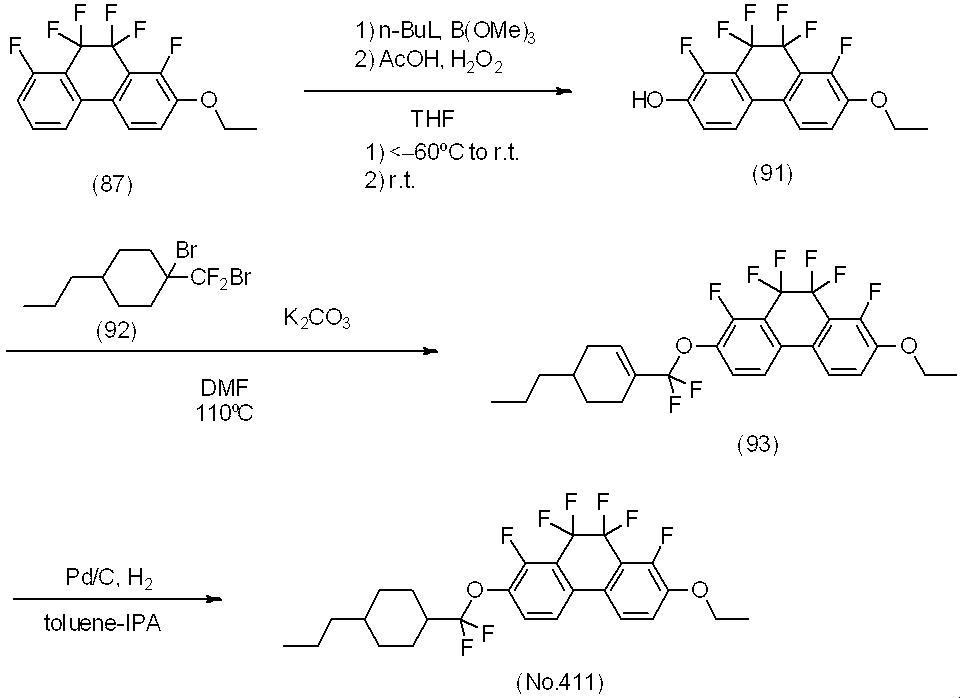
第一工程
窒素雰囲気下、実施例11で合成した化合物(87)(4.29g,12.91mmol)のTHF(40ml)溶液に、-60℃以下で、n-ブチルリチウム(1.63M,8.71ml,14.20mmol)をゆっくり滴下した。反応液を-60以下で1時間攪拌した後、ホウ酸トリメチル(1.61g,15.49mmol)をゆっくり滴下した。反応液を室温まで戻したのち、酢酸(1.16g,19.37mmol)、過酸化水素水(2.93g,25.80mmol)を加え、3時間攪拌した。反応液を飽和塩化アンモニウム水溶液でクエンチし、トルエン50mlで3回抽出した。一緒にした有機層を、チオ硫酸ナトリウム水溶液、飽和炭酸水素ナトリウム水溶液、水、飽和食塩水で洗浄した後、硫酸マグネシウムで乾燥させ、エバポレーターで溶媒を留去した。残渣をシリカゲルカラムクロマトグラフィーにて精製し、7-エトキシ-1,8,9,9,10,10-ヘキサフルオロ-9,10-ジヒドロフェナントレン-2-オール(91)を得た(3.76g,収率84.0%)。
窒素雰囲気下、化合物(91)(3.76g,10.80mmol)および炭酸カリウム(4.48g,32.4mmol)の混合物をDMF40ml溶媒中、110℃で1時間加熱攪拌した。次いで、1-ブロモ-1-(ブロモジフルオロメチル)-4-プロピルシクロヘキサン(92)(7.21g,21.59mmol)を110度で反応液に滴下し、さらに3時間攪拌した。反応液を水でクエンチし、トルエン50mlで3回抽出した。一緒にした有機層を、水、飽和食塩水で洗浄した後、硫酸マグネシウムで乾燥させ、エバポレーターで溶媒を留去した。残渣をシリカゲルカラムクロマトグラフィーにて精製し、2-(ジフルオロ(4-プロピルシクロヘキサ-1-エン-1-イル)メトキシ)-7-エトキシ-1,8,9,9,10,10-ヘキサフルオロ-9,10-ジヒドロフェナントレン(93)を得た(4.40g,収率78.0%)。
化合物(93)(4.40g,8.45mmol)および5%-パラジウム炭素(50%含水品)(0.132g,3wt%)の混合物を、トルエン10ml、IPA10ml溶媒中、水素雰囲気下で24時間攪拌した。反応液をろ過し、ろ液の溶媒をエバポレーターで留去した。残渣をシリカゲルカラムクロマトグラフィーにて精製し、2-(ジフルオロ(4-プロピルシクロヘキシル)メトキシ)-7-エトキシ-1,8,9,9,10,10-ヘキサフルオロ-9,10-ジヒドロフェナントレン(No.411)を得た。
相転移温度:C 97.8 N 132.6 Iso。
上限温度(NI)=115.3℃;誘電率異方性(Δε)=-15.1;屈折率異方性(Δn)=0.1483;粘度(η)=137.5mPa・s

実施例1で合成した2-エトキシ-1,8-ジフルオロ-7-プロピル-9,10-ジヒドロフェナントレン-9,10-ジオール(57)(0.2g,0.598mmol)のジクロロメタン(5ml)溶液に、-70℃以下でDAST(0.2g,1.26mmol)をゆっくり滴下した。反応液をゆっくり室温まで戻した後、水5mlでクエンチし、ジクロロメタン層を飽和炭酸水素ナトリウム水溶液、水で洗浄した。ジクロロメタン層をGCMSで分析することにより、2-エトキシ-1,8,9,10-テトラフルオロ-7-プロピル-9,10-ジヒドロフェナントレン(No.6)の生成を確認した。
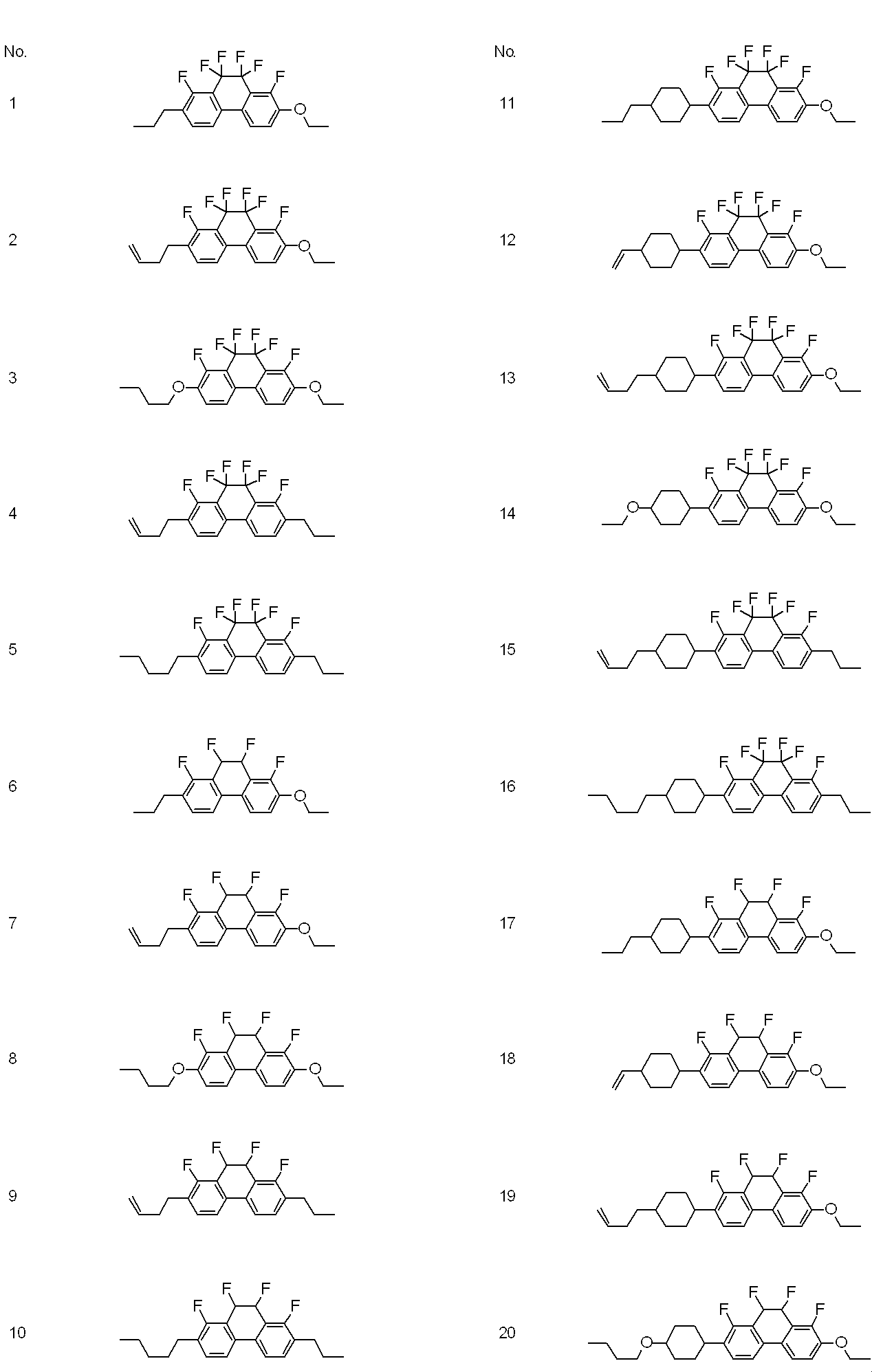
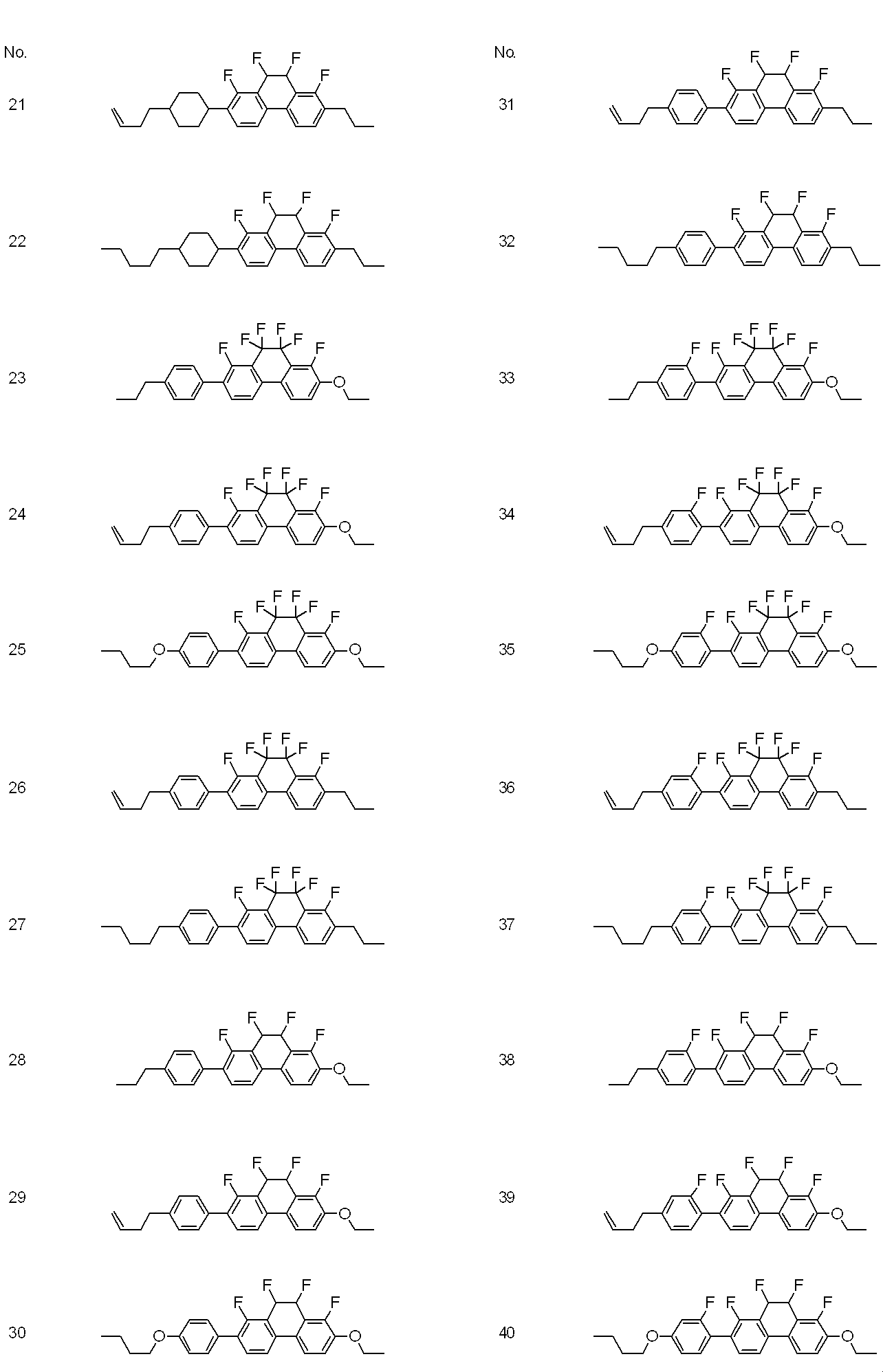
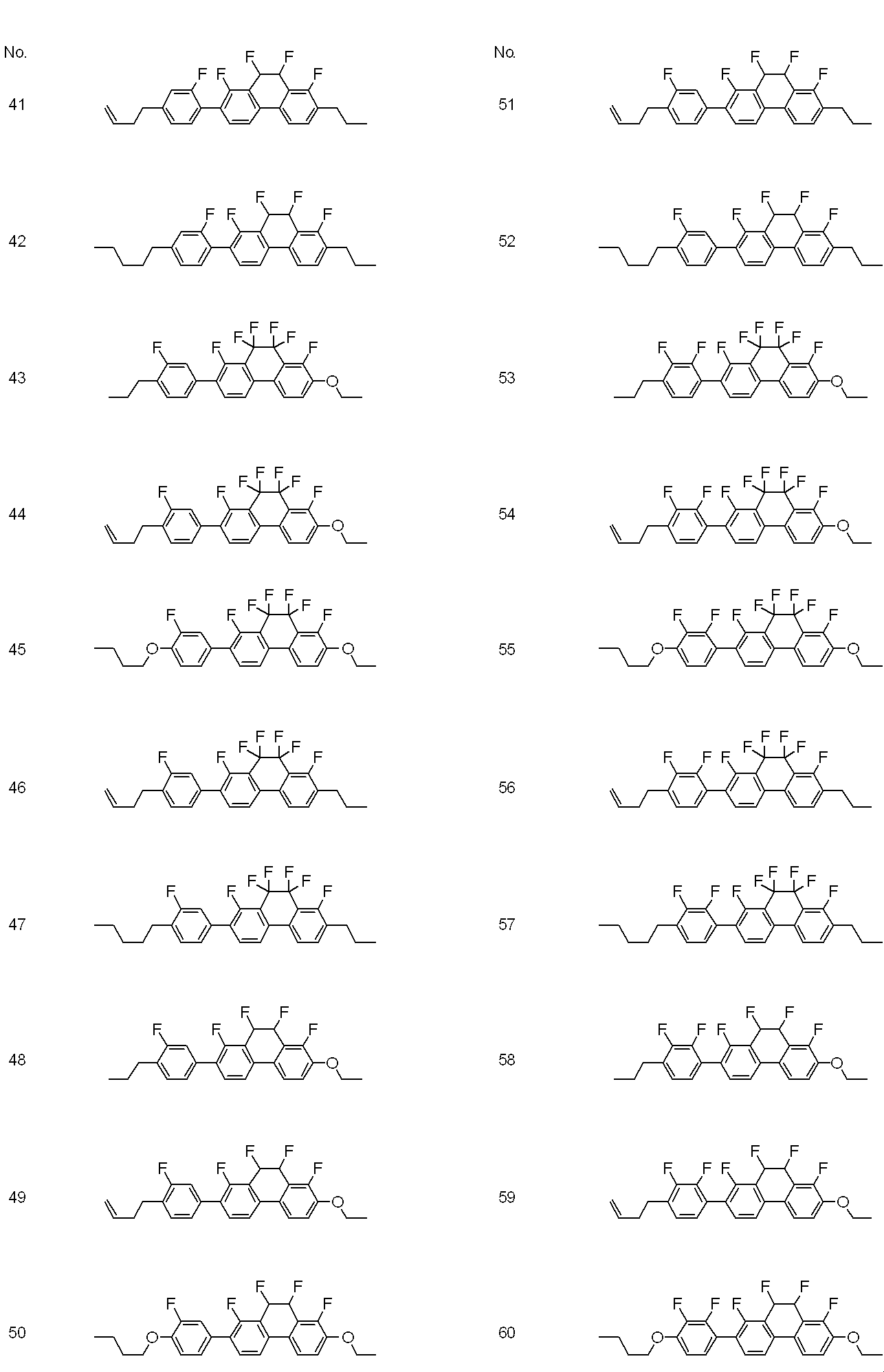


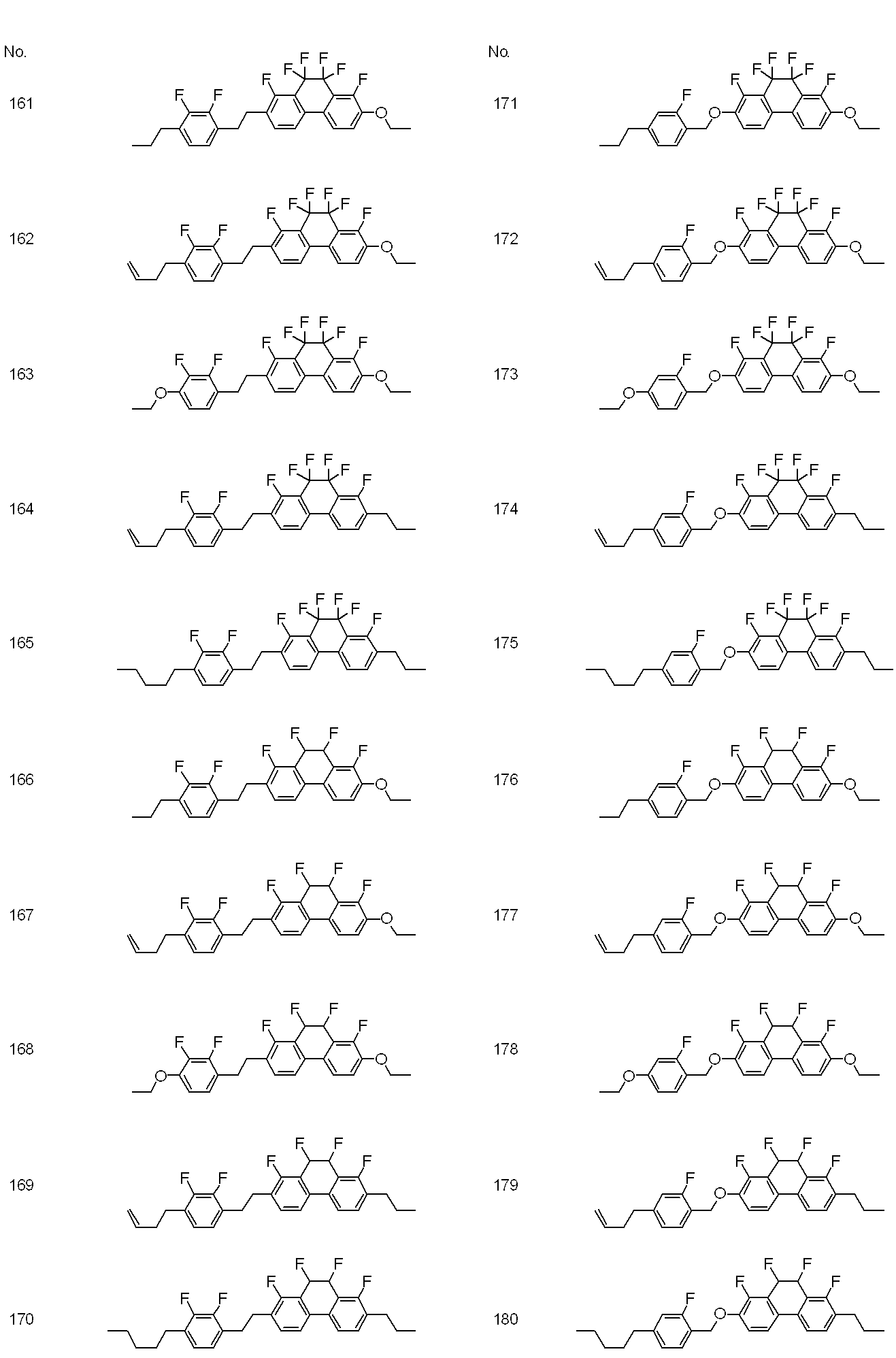

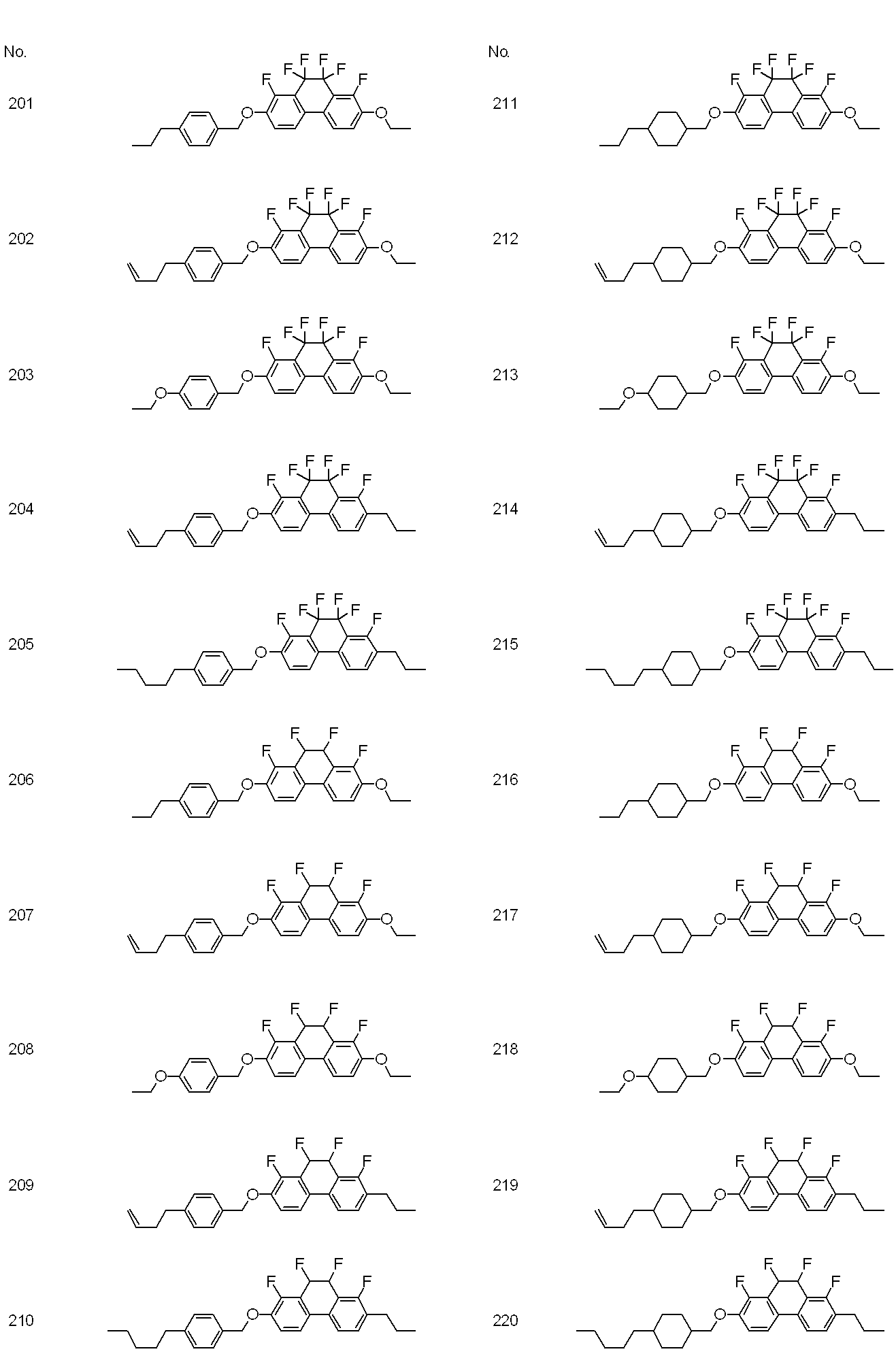


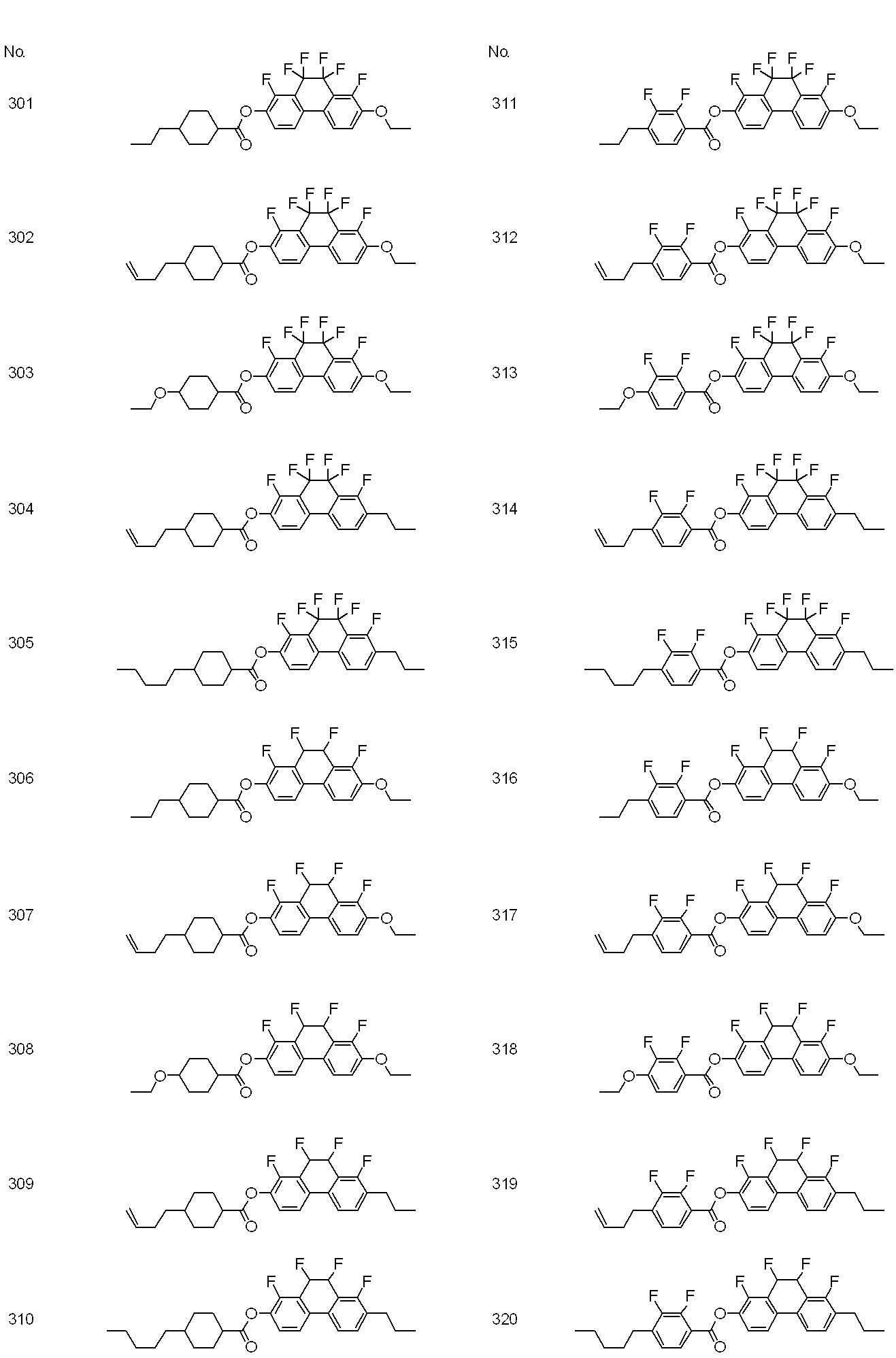

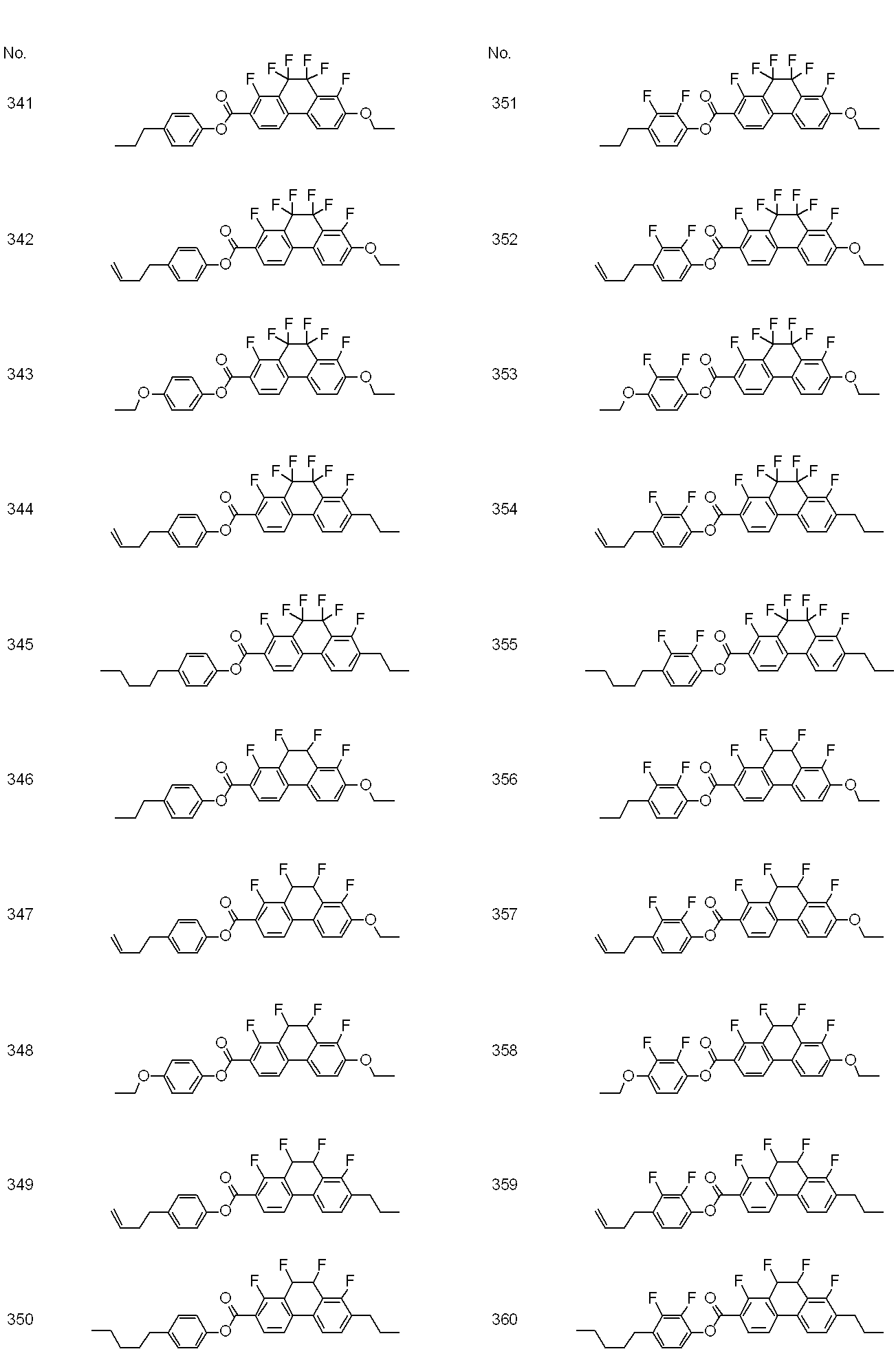


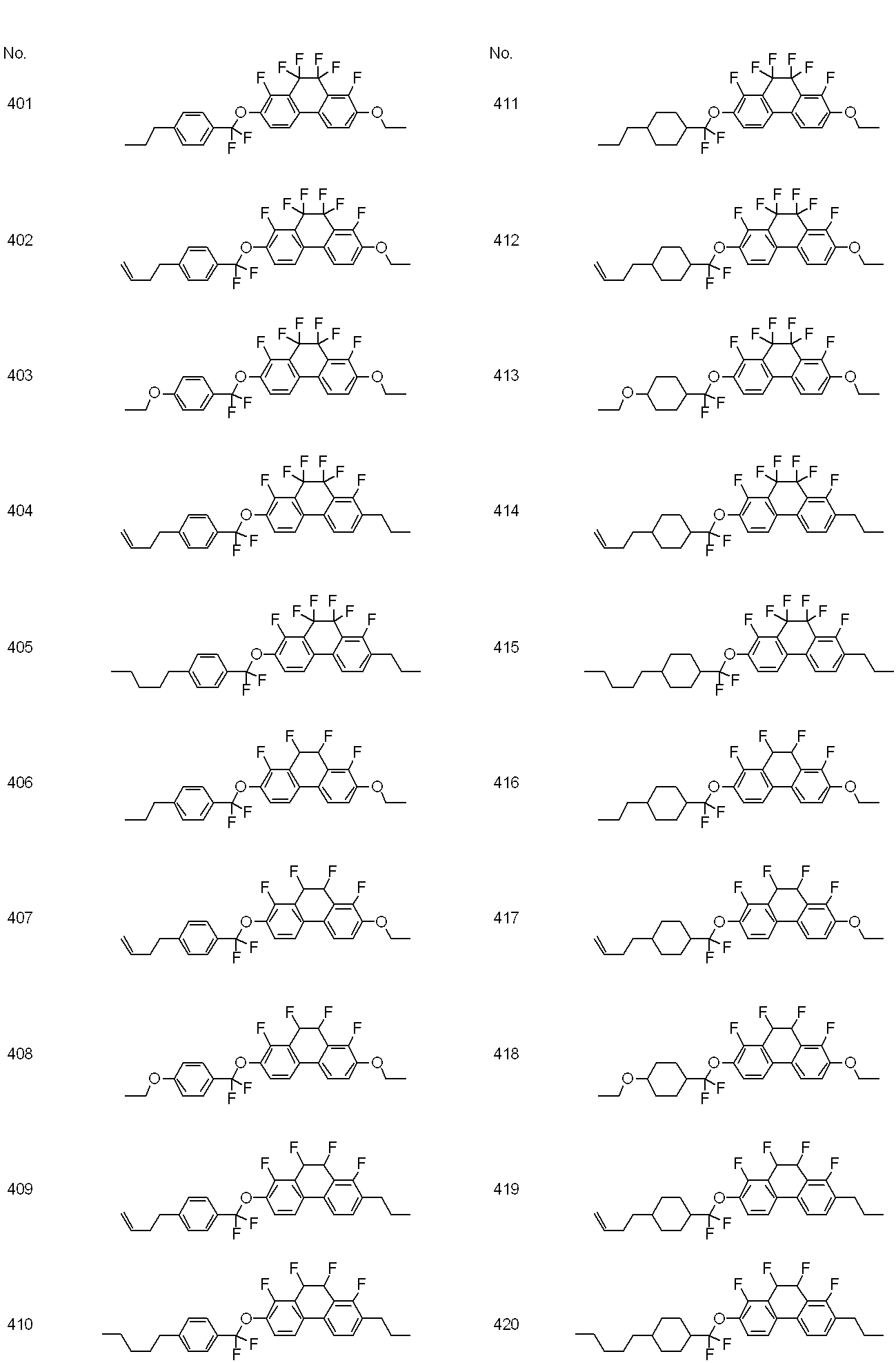
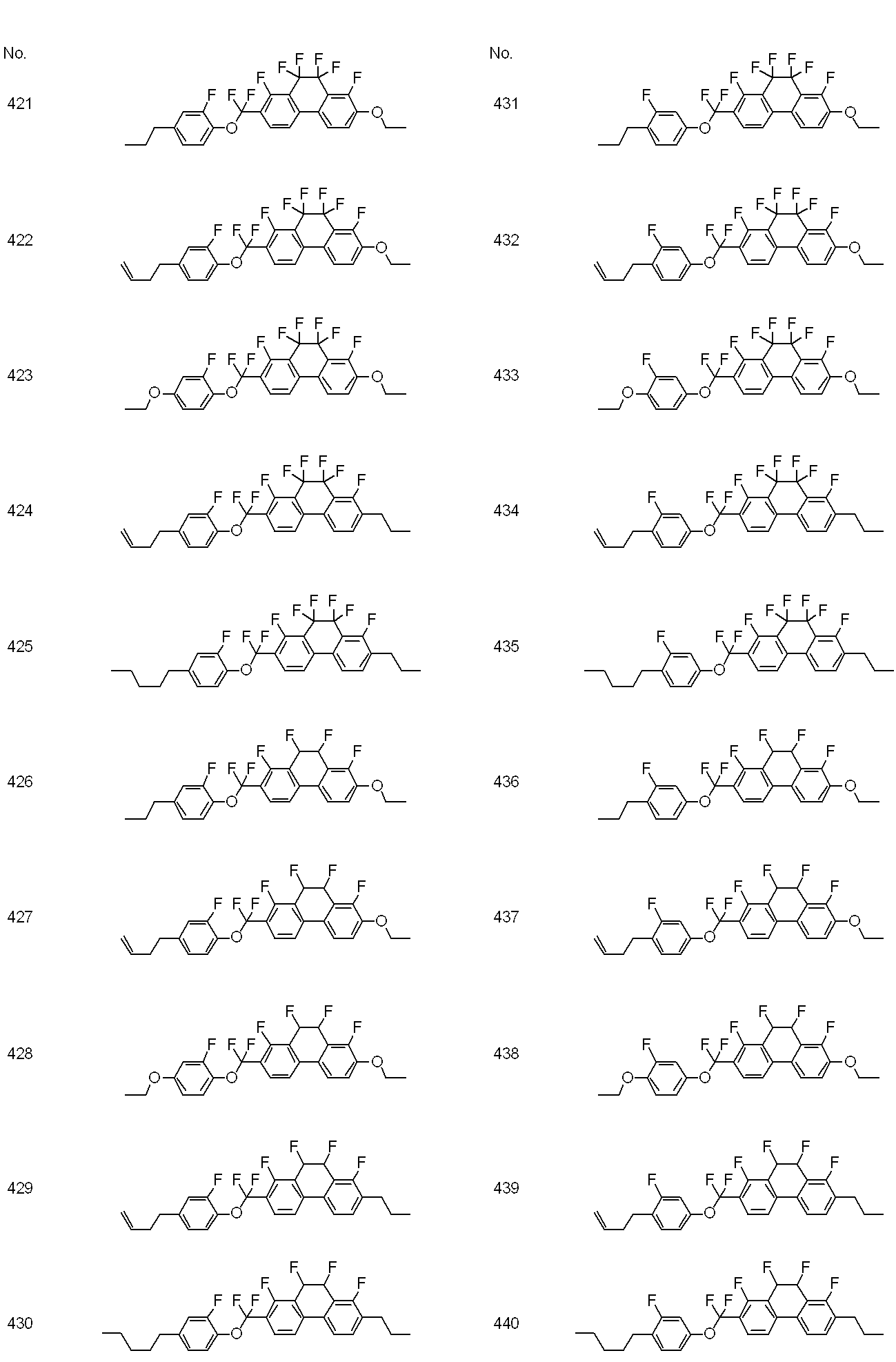
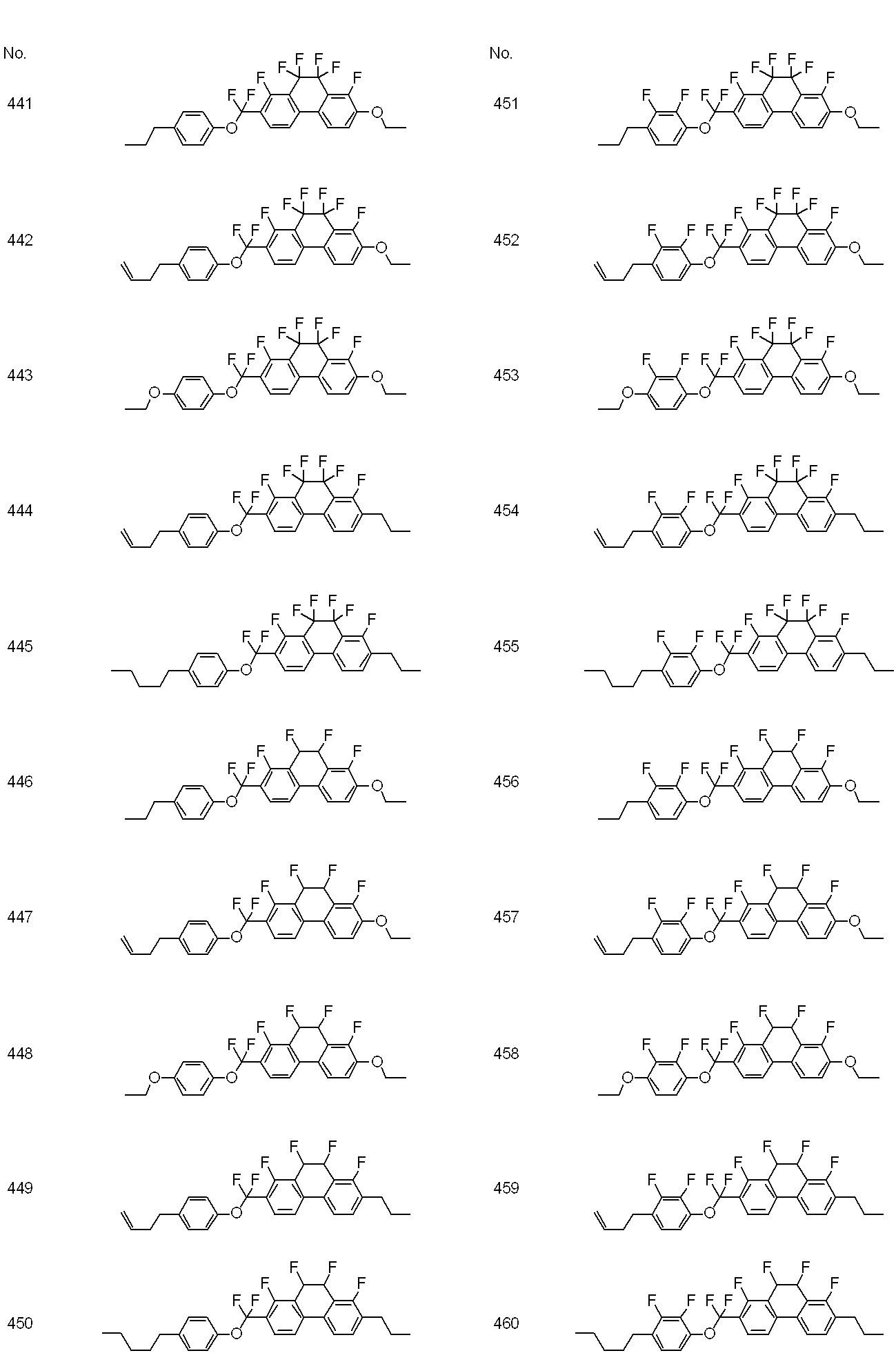


特表平11-508890号公報(特許文献5)に記載された一般式に含まれる化合物(C-11)を合成した。この化合物は本発明の化合物(No.211)に類似するが、ジヒドロフェナントレン環の1位と8位にフッ素を有していない。
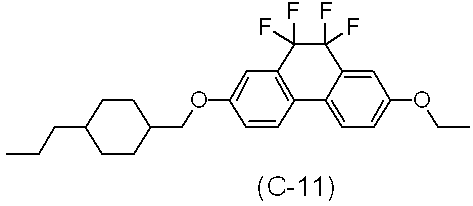
上限温度(NI)=67.9℃;誘電率異方性(Δε)=-6.5;屈折率異方性(Δn)=0.1603;粘度(η)=170.3mPa・s
特許文献5に記載された一般式に含まれる化合物(C-12)を合成した。この化合物は、ジヒドロフェナントレン環の8位にフッ素を有していない。

上限温度(NI)=73.3℃;誘電率異方性(Δε)=-12.7;屈折率異方性(Δn)=0.1537;粘度(η)=194.9mPa・s
特許文献5に記載された一般式に含まれる化合物(C-13)を合成した。この化合物は、ジヒドロフェナントレン環の8位にフッ素を有していない。
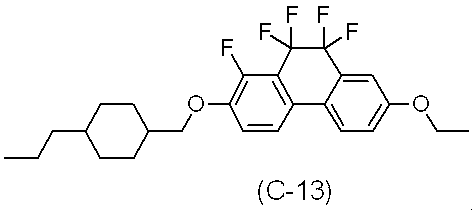
上限温度(NI)=79.9℃;誘電率異方性(Δε)=-13.0;屈折率異方性(Δn)=0.163;粘度(η)=174.5mPa・s
本発明の代表的な組成物を実施例15および16に示す。最初に、組成物の成分である化合物とその量(重量%)を示した。化合物は表の取り決めに従い、左末端基、結合基、環構造、および右末端基の記号によって表示した。
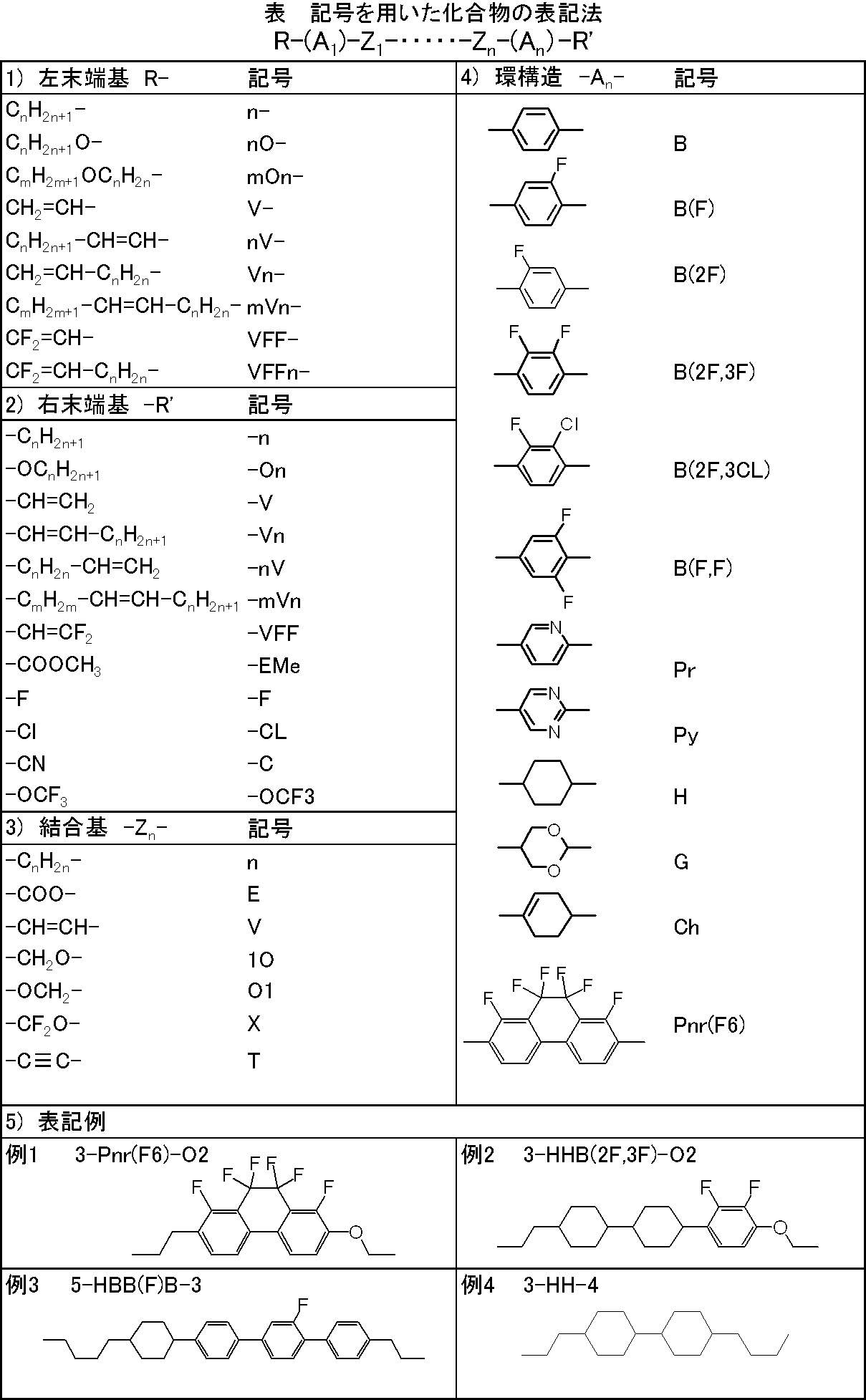
3-Pnr(F6)-O2 (No.1) 3%
3-HB-O1 (8-5) 15%
3-HH-4 (8-1) 5%
3-HB(2F,3F)-O2 (2-1) 9%
5-HB(2F,3F)-O2 (2-1) 12%
2-HHB(2F,3F)-1 (3-1) 12%
3-HHB(2F,3F)-1 (3-1) 12%
3-HHB(2F,3F)-O2 (3-1) 13%
5-HHB(2F,3F)-O2 (3-1) 13%
6-HEB(2F,3F)-O2 (2-6) 6%
NI=81.0℃;Δn=0.088;η=37.6mPa・s;Δε=-4.1
上記組成物100重量部に光学活性化合物(Op-5)を0.25重量部添加したときのピッチは62.1μmであった。
3-Pnr(F6)-O2 (No.1) 3%
2-HH-5 (8-1) 3%
3-HH-4 (8-1) 15%
3-HH-5 (8-1) 4%
3-HB-O2 (8-5) 12%
3-H2B(2F,3F)-O2 (2-4) 13%
3-H2B(2F,3F)-O2 (2-4) 14%
3-HHB(2F,3CL)-O2 (3-12) 5%
3-HBB(2F,3F)-O2 (3-7) 3%
3-HBB(2F,3F)-O2 (3-7) 9%
5-HBB(2F,3F)-O2 (3-7) 9%
3-HHB-1 (9-1) 3%
3-HHB-3 (9-1) 4%
3-HHB-O1 (9-1) 3%
NI=74.8℃;Δn=0.094;η=22.8mPa・s;Δε=-4.4
Claims (14)
- 式(1)で表される化合物。
式(1)において、R1およびR2は独立して、水素、炭素数1~10のアルキル、炭素数2~10のアルケニル、炭素数1~9のアルコキシ、炭素数2~9のアルコキシアルキル、または炭素数2~9のアルケニルオキシであり、これらのアルキル、アルケニル、アルコキシ、アルコキシアルキル、およびアルケニルオキシにおいて、少なくとも1つの水素はフッ素で置き換えられていてもよく;
環A1、環A2、および環A3は独立して、1,4-シクロへキシレン、1,4-シクロヘキセニレン、1,4-フェニレン、テトラヒドロピラン-2,5-ジイル、または1,3-ジオキサン-2,5-ジイルであり、これらの環において少なくとも1つの水素はフッ素で置き換えられていてもよく;
Z1、Z2、およびZ3は独立して、単結合、-(CH2)2-、-OCH2-、-CH2O―、―COO-、-OCO-、-CF2O-、または-OCF2-であり;
Xは独立して、-C(=O)-、-CHF-、または-CF2-であり;
l、m、およびnは独立して、0または1である。 - 式(1)において、R1およびR2が独立して、炭素数1~10のアルキル、炭素数2~10のアルケニル、炭素数1~9のアルコキシであり;
環A1、環A2、および環A3が独立して、1,4-シクロへキシレン、1,4-シクロヘキセニレン、1,4-フェニレン、テトラヒドロピラン-2,5-ジイル、1,3-ジオキサン-2,5-ジイル、2-フルオロ-1,4-フェニレン、3-フルオロ-1,4-フェニレン、または2,3-ジフルオロ-1,4-フェニレンである請求項1に記載の化合物。 - 式(1)において、環A1、環A2、および環A3が独立して、1,4-シクロへキシレン、1,4-シクロヘキセニレン、1,4-フェニレン、2-フルオロ-1,4-フェニレン、3-フルオロ-1,4-フェニレン、または2,3-ジフルオロ-1,4-フェニレンである請求項2に記載の化合物。
- 式(1)において、l、m、およびnの和が、0、1、または2である請求項1~3のいずれか1項に記載の化合物。
- 式(1-1)で表される請求項1に記載の化合物。

式(1-1)において、環A1は、1,4-シクロへキシレン、1,4-シクロヘキセニレン、1,4-フェニレン、2-フルオロ-1,4-フェニレン、3-フルオロ-1,4-フェニレン、または2,3-ジフルオロ-1,4-フェニレンであり;
R1およびR2は独立して、炭素数1~10のアルキル、炭素数2~10のアルケニル、炭素数1~9のアルコキシであり;
Z1は、単結合、-(CH2)2-、-OCH2-、-CH2O―、―COO-、-OCO-、-CF2O-、または-OCF2-であり;
Xは独立して、-C(=O)-、-CHF-、または-CF2-であり;
lは0または1である。 - 式(1-1)において、Z1が、単結合、-(CH2)2-、-CH2O-、-COO-、または-CF2O-である請求項5に記載の化合物。
- 式(1-1)において、環A1が、1,4-シクロへキシレン、1,4-シクロヘキセニレン、1,4-フェニレン、または2,3-ジフルオロ-1,4-フェニレンである請求項5または6に記載の化合物。
- 請求項1~7のいずれか1項に記載の化合物を少なくとも1つ含有する液晶組成物。
- 式(2)、(3)、(4)、(5)、(6)および(7)で表される化合物の群から選択される少なくとも1つの化合物をさらに含有する請求項8に記載の液晶組成物。
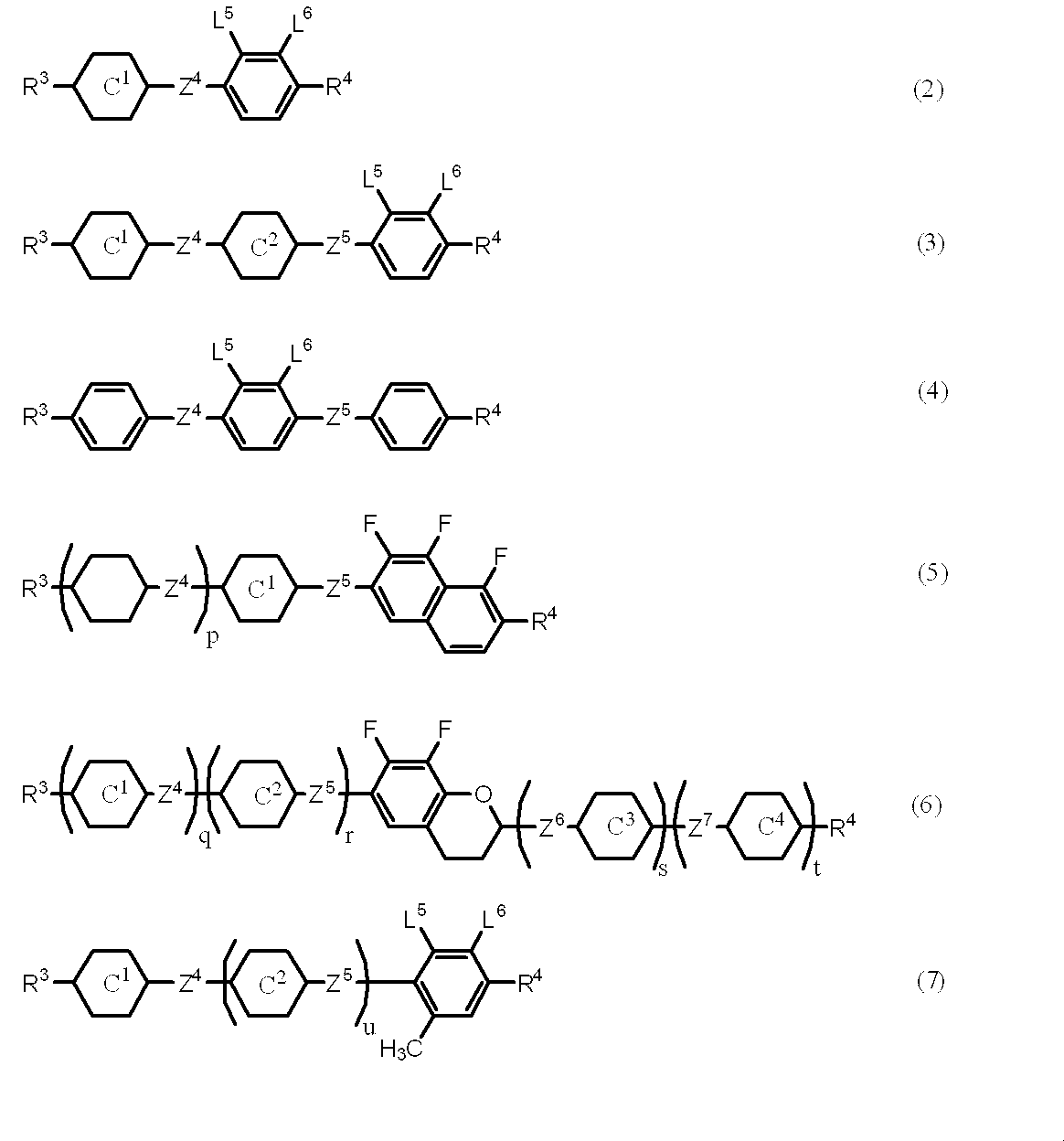
式中、R3およびR4は独立して、炭素数1~10のアルキルまたは炭素数2~10のアルケニルであり、アルキルおよびアルケニルにおいて少なくとも1つの水素はフッ素で置き換えられてもよく、これらにおいて少なくとも1つの-CH2-は-O-で置き換えられてもよく;
環C1、環C2、環C3、および環C4は独立して、1,4-シクロヘキシレン、1,4-シクロヘキセニレン、少なくとも1つの水素がフッ素で置き換えられてもよい1,4-フェニレン、テトラヒドロピラン-2,5-ジイル、またはデカヒドロ-2,6-ナフタレンであり;
Z4、Z5、Z6、およびZ7は独立して、-(CH2)2-、-COO-、-CH2O-、-OCF2-、-OCF2(CH2)2-、または単結合であり;
L5およびL6は独立してフッ素または塩素であり;
p、q、r、s、t、およびuは独立して、0または1であり、q、r、s、およびtの和は1または2である。 - 式(8)、(9)および(10)で表される化合物の群から選択される少なくとも1つの化合物をさらに含有する請求項8に記載の液晶組成物。
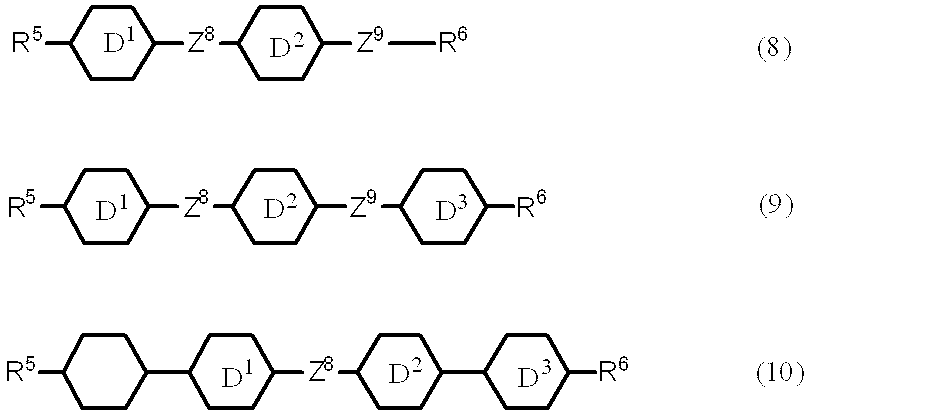
式中、R5およびR6は独立して、炭素数1~10のアルキルまたは炭素数2~10のアルケニルであり、このアルキルおよびアルケニルにおいて少なくとも1つの水素はフッ素で置き換えられてもよく、少なくとも1つの-CH2-は-O-で置き換えられてもよく;
環D1、環D2および環D3は独立して、1,4-シクロヘキシレン、ピリミジン-2,5-ジイル、1,4-フェニレン、2-フルオロ-1,4-フェニレン、3-フルオロ-1,4-フェニレン、または2,5-ジフルオロ1,4-フェニレンであり;
Z8およびZ9は独立して、-C≡C-、-COO-、-(CH2)2-、-CH=CH-、または単結合である。 - 式(8)、(9)および(10)で表される化合物の群から選択される少なくとも1つの化合物をさらに含有する請求項9に記載の液晶組成物。
- 少なくとも1つの光学活性化合物および/または重合可能な化合物をさらに含有する請求項8~11のいずれか1項に記載の液晶組成物。
- 少なくとも1つの酸化防止剤および/または紫外線吸収剤を含有する請求項8~12のいずれか1項に記載の液晶組成物。
- 請求項8~13のいずれか1項に記載の液晶組成物を含有する液晶表示素子。
Priority Applications (5)
| Application Number | Priority Date | Filing Date | Title |
|---|---|---|---|
| EP11850879.5A EP2669263B1 (en) | 2010-12-21 | 2011-12-09 | Compound containing dihydrophenanthrene, liquid crystal composition and liquid crystal display device |
| JP2012549721A JP5838974B2 (ja) | 2010-12-21 | 2011-12-09 | ジヒドロフェナントレンを有する化合物、液晶組成物および液晶表示素子 |
| US13/991,170 US9193908B2 (en) | 2010-12-21 | 2011-12-09 | Compound having dihydrophenanthrene, liquid crystal composition and liquid crystal display device |
| KR1020137015869A KR101821003B1 (ko) | 2010-12-21 | 2011-12-09 | 디하이드로페난트렌을 갖는 화합물, 액정 조성물 및 액정 표시 소자 |
| CN201180060715.0A CN103261132B (zh) | 2010-12-21 | 2011-12-09 | 具有二氢菲的化合物、液晶组成物及液晶显示元件 |
Applications Claiming Priority (2)
| Application Number | Priority Date | Filing Date | Title |
|---|---|---|---|
| JP2010-284260 | 2010-12-21 | ||
| JP2010284260 | 2010-12-21 |
Publications (1)
| Publication Number | Publication Date |
|---|---|
| WO2012086437A1 true WO2012086437A1 (ja) | 2012-06-28 |
Family
ID=46313717
Family Applications (1)
| Application Number | Title | Priority Date | Filing Date |
|---|---|---|---|
| PCT/JP2011/078551 Ceased WO2012086437A1 (ja) | 2010-12-21 | 2011-12-09 | ジヒドロフェナントレンを有する化合物、液晶組成物および液晶表示素子 |
Country Status (7)
| Country | Link |
|---|---|
| US (1) | US9193908B2 (ja) |
| EP (1) | EP2669263B1 (ja) |
| JP (1) | JP5838974B2 (ja) |
| KR (1) | KR101821003B1 (ja) |
| CN (1) | CN103261132B (ja) |
| TW (1) | TWI516576B (ja) |
| WO (1) | WO2012086437A1 (ja) |
Cited By (2)
| Publication number | Priority date | Publication date | Assignee | Title |
|---|---|---|---|---|
| WO2014171272A1 (ja) * | 2013-04-19 | 2014-10-23 | Jnc株式会社 | キサンテン骨格を有する負の誘電率異方性を示す液晶性化合物、液晶組成物および液晶表示素子 |
| KR20200021912A (ko) | 2017-06-26 | 2020-03-02 | 제이엔씨 주식회사 | 액정 조성물 및 액정 표시 소자 |
Families Citing this family (8)
| Publication number | Priority date | Publication date | Assignee | Title |
|---|---|---|---|---|
| JP5983393B2 (ja) * | 2012-01-27 | 2016-08-31 | Jnc株式会社 | 液晶組成物および液晶表示素子 |
| US9399698B2 (en) | 2014-01-31 | 2016-07-26 | Xerox Corporation | Processes for purifying diketopyrrolopyrrole copolymers |
| CN104557481B (zh) * | 2015-01-07 | 2017-01-11 | 石家庄诚志永华显示材料有限公司 | 4,5-二取代的菲和氢菲类液晶化合物及其制备方法 |
| CN104610217A (zh) * | 2015-02-09 | 2015-05-13 | 石家庄诚志永华显示材料有限公司 | 含有环戊基的二苯并吡喃酮衍生物的液晶化合物及其应用 |
| CN104817515A (zh) * | 2015-04-22 | 2015-08-05 | 湖南华腾制药有限公司 | 一种苯取代恶二唑化合物的制备方法 |
| JP7392434B2 (ja) * | 2019-12-02 | 2023-12-06 | Dic株式会社 | 液晶組成物及び液晶表示素子 |
| CN113088292A (zh) * | 2020-01-08 | 2021-07-09 | 北京八亿时空液晶科技股份有限公司 | 一种含有菲结构的液晶化合物及其制备方法与应用 |
| CN116410756B (zh) * | 2023-02-22 | 2025-04-11 | 北京云基科技股份有限公司 | 一种含多氟菲结构的液晶化合物及其应用 |
Citations (8)
| Publication number | Priority date | Publication date | Assignee | Title |
|---|---|---|---|---|
| JPH0853672A (ja) | 1994-01-17 | 1996-02-27 | Hoechst Ag | フェナントレン誘導体、およびその強誘電性液晶混合物における使用 |
| JPH11508890A (ja) | 1995-07-04 | 1999-08-03 | ヘキスト・アクチェンゲゼルシャフト | フッ化フェナントレン誘導体、およびその液晶混合物における使用 |
| JP2001064216A (ja) * | 1999-08-27 | 2001-03-13 | Dainippon Ink & Chem Inc | フェナントレン及びフルオレン誘導体 |
| JP2003096003A (ja) * | 2001-06-07 | 2003-04-03 | Merck Patent Gmbh | フッ素化(ジヒドロ)フェナントレン誘導体および液晶媒体におけるそれらの使用 |
| US20040099842A1 (en) * | 2000-12-23 | 2004-05-27 | Melanie Klasen-Memmer | Liquid crystalline medium |
| JP2005325113A (ja) | 2004-05-07 | 2005-11-24 | Az Electronic Materials (Germany) Gmbh | フッ素化フェナントレンおよびそれらの液晶混合物における使用 |
| JP2006206887A (ja) * | 2004-12-27 | 2006-08-10 | Dainippon Ink & Chem Inc | 液晶組成物 |
| JP2006520327A (ja) | 2003-02-25 | 2006-09-07 | メルク パテント ゲゼルシャフト ミット ベシュレンクテル ハフトング | ベンゾクロメン誘導体 |
Family Cites Families (2)
| Publication number | Priority date | Publication date | Assignee | Title |
|---|---|---|---|---|
| US7067179B1 (en) * | 1999-08-03 | 2006-06-27 | Dainippon Ink And Chemicals, Inc. | Fused ring compound |
| DE102009022309A1 (de) * | 2009-05-22 | 2010-11-25 | Merck Patent Gmbh | Flüssigkristallanzeige |
-
2011
- 2011-12-09 US US13/991,170 patent/US9193908B2/en not_active Expired - Fee Related
- 2011-12-09 CN CN201180060715.0A patent/CN103261132B/zh active Active
- 2011-12-09 JP JP2012549721A patent/JP5838974B2/ja active Active
- 2011-12-09 WO PCT/JP2011/078551 patent/WO2012086437A1/ja not_active Ceased
- 2011-12-09 EP EP11850879.5A patent/EP2669263B1/en not_active Not-in-force
- 2011-12-09 KR KR1020137015869A patent/KR101821003B1/ko not_active Expired - Fee Related
- 2011-12-19 TW TW100147217A patent/TWI516576B/zh active
Patent Citations (9)
| Publication number | Priority date | Publication date | Assignee | Title |
|---|---|---|---|---|
| JPH0853672A (ja) | 1994-01-17 | 1996-02-27 | Hoechst Ag | フェナントレン誘導体、およびその強誘電性液晶混合物における使用 |
| JPH11508890A (ja) | 1995-07-04 | 1999-08-03 | ヘキスト・アクチェンゲゼルシャフト | フッ化フェナントレン誘導体、およびその液晶混合物における使用 |
| JP2001064216A (ja) * | 1999-08-27 | 2001-03-13 | Dainippon Ink & Chem Inc | フェナントレン及びフルオレン誘導体 |
| US20040099842A1 (en) * | 2000-12-23 | 2004-05-27 | Melanie Klasen-Memmer | Liquid crystalline medium |
| US6929834B2 (en) | 2000-12-23 | 2005-08-16 | Merck Patent Gmbh | Liquid crystalline medium |
| JP2003096003A (ja) * | 2001-06-07 | 2003-04-03 | Merck Patent Gmbh | フッ素化(ジヒドロ)フェナントレン誘導体および液晶媒体におけるそれらの使用 |
| JP2006520327A (ja) | 2003-02-25 | 2006-09-07 | メルク パテント ゲゼルシャフト ミット ベシュレンクテル ハフトング | ベンゾクロメン誘導体 |
| JP2005325113A (ja) | 2004-05-07 | 2005-11-24 | Az Electronic Materials (Germany) Gmbh | フッ素化フェナントレンおよびそれらの液晶混合物における使用 |
| JP2006206887A (ja) * | 2004-12-27 | 2006-08-10 | Dainippon Ink & Chem Inc | 液晶組成物 |
Non-Patent Citations (10)
| Title |
|---|
| "Comprehensive Organic Synthesis", PERGAMON PRESS |
| "New Experimental Chemistry Course", MARUZEN CO. LTD. |
| "Organic Reactions", JOHN WILEY & SONS, INC. |
| "Organic Syntheses", JOHN WILEY & SONS, INC. |
| M. IMAI ET AL., MOLECULAR CRYSTALS AND LIQUID CRYSTALS, vol. 259, 1995, pages 37 |
| M. KUROBOSHI ET AL., CHEM. LETT., 1992, pages 827 |
| MOL. CRYST. LIQ. CRYST., vol. 12, 1970, pages 57 |
| PEER. KIRSCH ET AL., ANGEW. CHEM. INT. ED., vol. 40, 2001, pages 1480 |
| TETRAHEDRON, vol. 64, 2008, pages 9906 - 9910 |
| W. H. BUNNELLE ET AL., J. ORG. CHEM., vol. 55, 1990, pages 768 |
Cited By (6)
| Publication number | Priority date | Publication date | Assignee | Title |
|---|---|---|---|---|
| WO2014171272A1 (ja) * | 2013-04-19 | 2014-10-23 | Jnc株式会社 | キサンテン骨格を有する負の誘電率異方性を示す液晶性化合物、液晶組成物および液晶表示素子 |
| CN105121422A (zh) * | 2013-04-19 | 2015-12-02 | 捷恩智株式会社 | 具有呫吨骨架的显示出负的介电各向异性的液晶性化合物、液晶组合物及液晶显示元件 |
| JPWO2014171272A1 (ja) * | 2013-04-19 | 2017-02-23 | Jnc株式会社 | キサンテン骨格を有する負の誘電率異方性を示す液晶性化合物、液晶組成物および液晶表示素子 |
| US9879182B2 (en) | 2013-04-19 | 2018-01-30 | Jnc Corporation | Liquid crystal compound having xanthene skeleton and exhibiting negative dielectric anisotropy, liquid crystal composition and liquid crystal display device |
| CN105121422B (zh) * | 2013-04-19 | 2018-11-23 | 捷恩智株式会社 | 具有呫吨骨架的显示出负的介电各向异性的液晶性化合物、液晶组合物及液晶显示元件 |
| KR20200021912A (ko) | 2017-06-26 | 2020-03-02 | 제이엔씨 주식회사 | 액정 조성물 및 액정 표시 소자 |
Also Published As
| Publication number | Publication date |
|---|---|
| KR20130133214A (ko) | 2013-12-06 |
| CN103261132A (zh) | 2013-08-21 |
| TWI516576B (zh) | 2016-01-11 |
| EP2669263A4 (en) | 2014-10-08 |
| JPWO2012086437A1 (ja) | 2014-05-22 |
| CN103261132B (zh) | 2016-06-29 |
| JP5838974B2 (ja) | 2016-01-06 |
| KR101821003B1 (ko) | 2018-03-08 |
| EP2669263B1 (en) | 2017-11-22 |
| TW201229218A (en) | 2012-07-16 |
| US20130240784A1 (en) | 2013-09-19 |
| EP2669263A1 (en) | 2013-12-04 |
| US9193908B2 (en) | 2015-11-24 |
Similar Documents
| Publication | Publication Date | Title |
|---|---|---|
| JP5838974B2 (ja) | ジヒドロフェナントレンを有する化合物、液晶組成物および液晶表示素子 | |
| JP5712510B2 (ja) | 5員環を有する化合物、液晶組成物および液晶表示素子 | |
| JP5509852B2 (ja) | 液晶性化合物、液晶組成物および液晶表示素子 | |
| CN102186821B (zh) | 有含氮杂环的5环液晶化合物、液晶组成物及液晶显示元件 | |
| JP5958608B2 (ja) | 誘電率異方性が負の液晶性化合物、これを用いた液晶組成物および液晶表示素子 | |
| TWI468381B (zh) | 十氫化萘化合物、含有此化合物的液晶組成物及含有此液晶組成物的液晶顯示元件 | |
| JP5585444B2 (ja) | 誘電率異方性が負の液晶性化合物、液晶組成物および液晶表示素子 | |
| JP5392256B2 (ja) | 誘電率異方性が負の液晶性化合物、液晶組成物および液晶表示素子 | |
| JP5686136B2 (ja) | プロピルエーテルを結合基に持つ化合物、液晶組成物、および液晶表示素子 | |
| JP5663957B2 (ja) | 誘電率異方性が負のトランスモノフルオロエチレン液晶性化合物、これを用いた液晶組成物および液晶表示素子 | |
| JP5699934B2 (ja) | テトラヒドロピラン化合物、液晶組成物および液晶表示素子 | |
| JP6052033B2 (ja) | 負の誘電率異方性を示す液晶性化合物、液晶組成物および液晶表示素子 | |
| JP2006160727A (ja) | ベンゼン環にアルキル基を有する化合物、この化合物を含有する液晶組成物およびこの液晶組成物を含有する液晶表示素子 | |
| JP6115303B2 (ja) | 隣接基としてカルボニル基を有するフェノール化合物およびその用途 | |
| JP5929781B2 (ja) | ジフルオロエチレンオキシ化合物、液晶組成物および液晶表示素子 | |
| KR102077868B1 (ko) | 액정성 화합물, 액정 조성물 및 액정 표시 소자 |
Legal Events
| Date | Code | Title | Description |
|---|---|---|---|
| 121 | Ep: the epo has been informed by wipo that ep was designated in this application |
Ref document number: 11850879 Country of ref document: EP Kind code of ref document: A1 |
|
| ENP | Entry into the national phase |
Ref document number: 2012549721 Country of ref document: JP Kind code of ref document: A |
|
| WWE | Wipo information: entry into national phase |
Ref document number: 13991170 Country of ref document: US |
|
| ENP | Entry into the national phase |
Ref document number: 20137015869 Country of ref document: KR Kind code of ref document: A |
|
| NENP | Non-entry into the national phase |
Ref country code: DE |
|
| REEP | Request for entry into the european phase |
Ref document number: 2011850879 Country of ref document: EP |
|
| WWE | Wipo information: entry into national phase |
Ref document number: 2011850879 Country of ref document: EP |