WO2012090639A1 - 平版印刷版原版及び平版印刷方法 - Google Patents
平版印刷版原版及び平版印刷方法 Download PDFInfo
- Publication number
- WO2012090639A1 WO2012090639A1 PCT/JP2011/077709 JP2011077709W WO2012090639A1 WO 2012090639 A1 WO2012090639 A1 WO 2012090639A1 JP 2011077709 W JP2011077709 W JP 2011077709W WO 2012090639 A1 WO2012090639 A1 WO 2012090639A1
- Authority
- WO
- WIPO (PCT)
- Prior art keywords
- printing plate
- lithographic printing
- group
- plate precursor
- polymer
- Prior art date
- Legal status (The legal status is an assumption and is not a legal conclusion. Google has not performed a legal analysis and makes no representation as to the accuracy of the status listed.)
- Ceased
Links
Images
Classifications
-
- B—PERFORMING OPERATIONS; TRANSPORTING
- B41—PRINTING; LINING MACHINES; TYPEWRITERS; STAMPS
- B41C—PROCESSES FOR THE MANUFACTURE OR REPRODUCTION OF PRINTING SURFACES
- B41C1/00—Forme preparation
- B41C1/10—Forme preparation for lithographic printing; Master sheets for transferring a lithographic image to the forme
- B41C1/1008—Forme preparation for lithographic printing; Master sheets for transferring a lithographic image to the forme by removal or destruction of lithographic material on the lithographic support, e.g. by laser or spark ablation; by the use of materials rendered soluble or insoluble by heat exposure, e.g. by heat produced from a light to heat transforming system; by on-the-press exposure or on-the-press development, e.g. by the fountain of photolithographic materials
-
- G—PHYSICS
- G03—PHOTOGRAPHY; CINEMATOGRAPHY; ANALOGOUS TECHNIQUES USING WAVES OTHER THAN OPTICAL WAVES; ELECTROGRAPHY; HOLOGRAPHY
- G03F—PHOTOMECHANICAL PRODUCTION OF TEXTURED OR PATTERNED SURFACES, e.g. FOR PRINTING, FOR PROCESSING OF SEMICONDUCTOR DEVICES; MATERIALS THEREFOR; ORIGINALS THEREFOR; APPARATUS SPECIALLY ADAPTED THEREFOR
- G03F7/00—Photomechanical, e.g. photolithographic, production of textured or patterned surfaces, e.g. printing surfaces; Materials therefor, e.g. comprising photoresists; Apparatus specially adapted therefor
- G03F7/004—Photosensitive materials
- G03F7/027—Non-macromolecular photopolymerisable compounds having carbon-to-carbon double bonds, e.g. ethylenic compounds
- G03F7/032—Non-macromolecular photopolymerisable compounds having carbon-to-carbon double bonds, e.g. ethylenic compounds with binders
- G03F7/033—Non-macromolecular photopolymerisable compounds having carbon-to-carbon double bonds, e.g. ethylenic compounds with binders the binders being polymers obtained by reactions only involving carbon-to-carbon unsaturated bonds, e.g. vinyl polymers
-
- G—PHYSICS
- G03—PHOTOGRAPHY; CINEMATOGRAPHY; ANALOGOUS TECHNIQUES USING WAVES OTHER THAN OPTICAL WAVES; ELECTROGRAPHY; HOLOGRAPHY
- G03F—PHOTOMECHANICAL PRODUCTION OF TEXTURED OR PATTERNED SURFACES, e.g. FOR PRINTING, FOR PROCESSING OF SEMICONDUCTOR DEVICES; MATERIALS THEREFOR; ORIGINALS THEREFOR; APPARATUS SPECIALLY ADAPTED THEREFOR
- G03F7/00—Photomechanical, e.g. photolithographic, production of textured or patterned surfaces, e.g. printing surfaces; Materials therefor, e.g. comprising photoresists; Apparatus specially adapted therefor
- G03F7/004—Photosensitive materials
- G03F7/038—Macromolecular compounds which are rendered insoluble or differentially wettable
- G03F7/0388—Macromolecular compounds which are rendered insoluble or differentially wettable with ethylenic or acetylenic bands in the side chains of the photopolymer
-
- G—PHYSICS
- G03—PHOTOGRAPHY; CINEMATOGRAPHY; ANALOGOUS TECHNIQUES USING WAVES OTHER THAN OPTICAL WAVES; ELECTROGRAPHY; HOLOGRAPHY
- G03F—PHOTOMECHANICAL PRODUCTION OF TEXTURED OR PATTERNED SURFACES, e.g. FOR PRINTING, FOR PROCESSING OF SEMICONDUCTOR DEVICES; MATERIALS THEREFOR; ORIGINALS THEREFOR; APPARATUS SPECIALLY ADAPTED THEREFOR
- G03F7/00—Photomechanical, e.g. photolithographic, production of textured or patterned surfaces, e.g. printing surfaces; Materials therefor, e.g. comprising photoresists; Apparatus specially adapted therefor
- G03F7/26—Processing photosensitive materials; Apparatus therefor
- G03F7/30—Imagewise removal using liquid means
- G03F7/3035—Imagewise removal using liquid means from printing plates fixed on a cylinder or on a curved surface; from printing cylinders
-
- B—PERFORMING OPERATIONS; TRANSPORTING
- B41—PRINTING; LINING MACHINES; TYPEWRITERS; STAMPS
- B41C—PROCESSES FOR THE MANUFACTURE OR REPRODUCTION OF PRINTING SURFACES
- B41C1/00—Forme preparation
- B41C1/10—Forme preparation for lithographic printing; Master sheets for transferring a lithographic image to the forme
- B41C1/1008—Forme preparation for lithographic printing; Master sheets for transferring a lithographic image to the forme by removal or destruction of lithographic material on the lithographic support, e.g. by laser or spark ablation; by the use of materials rendered soluble or insoluble by heat exposure, e.g. by heat produced from a light to heat transforming system; by on-the-press exposure or on-the-press development, e.g. by the fountain of photolithographic materials
- B41C1/1016—Forme preparation for lithographic printing; Master sheets for transferring a lithographic image to the forme by removal or destruction of lithographic material on the lithographic support, e.g. by laser or spark ablation; by the use of materials rendered soluble or insoluble by heat exposure, e.g. by heat produced from a light to heat transforming system; by on-the-press exposure or on-the-press development, e.g. by the fountain of photolithographic materials characterised by structural details, e.g. protective layers, backcoat layers or several imaging layers
-
- B—PERFORMING OPERATIONS; TRANSPORTING
- B41—PRINTING; LINING MACHINES; TYPEWRITERS; STAMPS
- B41C—PROCESSES FOR THE MANUFACTURE OR REPRODUCTION OF PRINTING SURFACES
- B41C2201/00—Location, type or constituents of the non-imaging layers in lithographic printing formes
- B41C2201/02—Cover layers; Protective layers
-
- B—PERFORMING OPERATIONS; TRANSPORTING
- B41—PRINTING; LINING MACHINES; TYPEWRITERS; STAMPS
- B41C—PROCESSES FOR THE MANUFACTURE OR REPRODUCTION OF PRINTING SURFACES
- B41C2201/00—Location, type or constituents of the non-imaging layers in lithographic printing formes
- B41C2201/04—Intermediate layers
-
- B—PERFORMING OPERATIONS; TRANSPORTING
- B41—PRINTING; LINING MACHINES; TYPEWRITERS; STAMPS
- B41C—PROCESSES FOR THE MANUFACTURE OR REPRODUCTION OF PRINTING SURFACES
- B41C2201/00—Location, type or constituents of the non-imaging layers in lithographic printing formes
- B41C2201/10—Location, type or constituents of the non-imaging layers in lithographic printing formes characterised by inorganic compounds, e.g. pigments
-
- B—PERFORMING OPERATIONS; TRANSPORTING
- B41—PRINTING; LINING MACHINES; TYPEWRITERS; STAMPS
- B41C—PROCESSES FOR THE MANUFACTURE OR REPRODUCTION OF PRINTING SURFACES
- B41C2201/00—Location, type or constituents of the non-imaging layers in lithographic printing formes
- B41C2201/12—Location, type or constituents of the non-imaging layers in lithographic printing formes characterised by non-macromolecular organic compounds
-
- B—PERFORMING OPERATIONS; TRANSPORTING
- B41—PRINTING; LINING MACHINES; TYPEWRITERS; STAMPS
- B41C—PROCESSES FOR THE MANUFACTURE OR REPRODUCTION OF PRINTING SURFACES
- B41C2201/00—Location, type or constituents of the non-imaging layers in lithographic printing formes
- B41C2201/14—Location, type or constituents of the non-imaging layers in lithographic printing formes characterised by macromolecular organic compounds, e.g. binder, adhesives
-
- B—PERFORMING OPERATIONS; TRANSPORTING
- B41—PRINTING; LINING MACHINES; TYPEWRITERS; STAMPS
- B41C—PROCESSES FOR THE MANUFACTURE OR REPRODUCTION OF PRINTING SURFACES
- B41C2210/00—Preparation or type or constituents of the imaging layers, in relation to lithographic printing forme preparation
- B41C2210/04—Negative working, i.e. the non-exposed (non-imaged) areas are removed
-
- B—PERFORMING OPERATIONS; TRANSPORTING
- B41—PRINTING; LINING MACHINES; TYPEWRITERS; STAMPS
- B41C—PROCESSES FOR THE MANUFACTURE OR REPRODUCTION OF PRINTING SURFACES
- B41C2210/00—Preparation or type or constituents of the imaging layers, in relation to lithographic printing forme preparation
- B41C2210/06—Developable by an alkaline solution
-
- B—PERFORMING OPERATIONS; TRANSPORTING
- B41—PRINTING; LINING MACHINES; TYPEWRITERS; STAMPS
- B41C—PROCESSES FOR THE MANUFACTURE OR REPRODUCTION OF PRINTING SURFACES
- B41C2210/00—Preparation or type or constituents of the imaging layers, in relation to lithographic printing forme preparation
- B41C2210/08—Developable by water or the fountain solution
-
- B—PERFORMING OPERATIONS; TRANSPORTING
- B41—PRINTING; LINING MACHINES; TYPEWRITERS; STAMPS
- B41C—PROCESSES FOR THE MANUFACTURE OR REPRODUCTION OF PRINTING SURFACES
- B41C2210/00—Preparation or type or constituents of the imaging layers, in relation to lithographic printing forme preparation
- B41C2210/22—Preparation or type or constituents of the imaging layers, in relation to lithographic printing forme preparation characterised by organic non-macromolecular additives, e.g. dyes, UV-absorbers, plasticisers
-
- B—PERFORMING OPERATIONS; TRANSPORTING
- B41—PRINTING; LINING MACHINES; TYPEWRITERS; STAMPS
- B41C—PROCESSES FOR THE MANUFACTURE OR REPRODUCTION OF PRINTING SURFACES
- B41C2210/00—Preparation or type or constituents of the imaging layers, in relation to lithographic printing forme preparation
- B41C2210/24—Preparation or type or constituents of the imaging layers, in relation to lithographic printing forme preparation characterised by a macromolecular compound or binder obtained by reactions involving carbon-to-carbon unsaturated bonds, e.g. acrylics, vinyl polymers
Definitions
- the present invention relates to a lithographic printing plate precursor and a lithographic printing method. More particularly, the present invention relates to a lithographic printing plate precursor and a lithographic printing method which can be used for a so-called lithographic printing plate precursor capable of direct plate making which can be directly made from various digital signals from a computer or the like.
- a lithographic printing plate comprises an oleophilic image area that receives ink in the printing process and a hydrophilic non-image area that receives dampening water.
- Lithographic printing utilizes the property that water and oil-based inks repel each other, so that the oleophilic image area of the lithographic printing plate is the ink receiving area, and the hydrophilic non-image area is dampened with the water receiving area (ink non-receiving area).
- a difference in ink adhesion is caused on the surface of the lithographic printing plate, and after ink is applied only to the image area, the ink is transferred to a printing medium such as paper and printed.
- a lithographic printing plate precursor in which an oleophilic photosensitive resin layer (image recording layer) is provided on a hydrophilic support is used.
- a mask such as a film
- development with an alkaline developer is performed to leave the image recording layer corresponding to the image area, and dissolve and remove the unnecessary image recording layer corresponding to the non-image area. And obtained a lithographic printing plate.
- lithographic printing plates are now available with CTP (computer to plate) technology. That is, a lithographic printing plate can be obtained by scanning and exposing a lithographic printing plate precursor directly using a laser or a laser diode without a lith film, and developing it.
- CTP computer to plate
- a method called “on-press development” is performed. That is, after the exposure of the lithographic printing plate precursor, conventional development is not performed, but it is mounted on a printing machine as it is, and unnecessary portions of the image recording layer are removed at the initial stage of a normal printing process.
- a method called “gum development” in which unnecessary portions of the image recording layer are removed with a finisher or gum solution having a pH close to neutral instead of a conventional highly alkaline developer is also performed. ing.
- a system using a lithographic printing plate precursor and a light source that can be handled in a bright room or under a yellow light is preferable from the viewpoint of ease of work.
- a solid-state laser such as a semiconductor laser or a YAG laser emitting an infrared ray of 1200 nm is used. Further, a UV laser can be used.
- Patent Documents 1 and 2 As a lithographic printing plate precursor capable of on-machine development, for example, in Patent Documents 1 and 2, a lithographic printing plate having an image recording layer (thermosensitive layer) containing a microcapsule containing a polymerizable compound on a hydrophilic support. The original edition is listed. Patent Document 3 describes a lithographic printing plate precursor in which an image recording layer (photosensitive layer) containing an infrared absorber, a radical polymerization initiator, and a polymerizable compound is provided on a support.
- Patent Document 4 on-press development is possible in which an image recording layer containing a polymerizable compound and a graft polymer having a polyethylene oxide chain in the side chain or a block polymer having a polyethylene oxide block is provided on a support.
- a planographic printing plate precursor is described.
- Patent Document 5 also discloses a lithographic printing plate precursor provided with an image forming layer containing a polymer compound (hereinafter also referred to as a star polymer) having a main chain branched into three or more on a support. It has been proposed as a planographic printing plate precursor that can be developed on top. However, these techniques are still insufficient to obtain both good developability and high printing durability.
- Patent Document 6 and Patent Document 7 describe that a crosslinkable functional group is introduced into a star polymer to increase the film strength of a paint or the like.
- a crosslinkable functional group is introduced into a star polymer to increase the film strength of a paint or the like.
- these techniques are applied to lithographic printing plate precursors, only insufficient results have been obtained, particularly in terms of developability.
- Japanese Unexamined Patent Publication No. 2001-277740 Japanese Laid-Open Patent Publication No. 2001-277742 Japanese Patent Laid-Open No. 2002-287334 US Patent Application Publication No. 2003/0064318 Japanese Unexamined Patent Publication No. 2007-249036 Japanese Patent No. 3084227 Japanese Unexamined Patent Publication No. 6-87908
- An object of the present invention is to provide a lithographic printing plate precursor and a lithographic printing method capable of obtaining good developability while maintaining the printing durability of the lithographic printing plate after development.
- the inventor of the present invention has, in the image recording layer, a polymer fine particle having a polyethyleneoxy group in a side chain, and a star shape in which the main chain is branched into three or more.
- the said subject was able to be solved by containing the polymeric composition containing the high molecular compound which has at least any one of a polyethyleneoxy group and a polypropyleneoxy group in a side chain. That is, the present invention is as follows.
- a lithographic printing plate precursor having a polymerizable compound, a polymerization initiator, a polymer fine particle having a polyethyleneoxy group in a side chain, and an image recording layer containing the polymer compound on a surface hydrophilic support A lithographic printing plate precursor wherein the molecular compound has a star shape in which the main chain is branched into three or more, and has at least one of a polyethyleneoxy group and a polypropyleneoxy group in a side chain of the branched main chain . 2.
- the lithographic printing plate precursor as described in 7 above is mounted on a printing press and imagewise exposed with a laser, or after imagewise exposure with a laser, mounted on a printing press and printed on the lithographic printing plate precursor
- the image recording layer has a polymer fine particle having a polyethyleneoxy group in the side chain, and a star shape in which the main chain is branched into three or more, and the polyethyleneoxy group is present in the branched side chain of the main chain.
- the said subject was able to be solved by containing the high molecular compound which has at least any one of polypropyleneoxy group.
- an image recording layer of polymer fine particles having a polyethyleneoxy group in the side chain and a polymer compound having at least one of a polyethyleneoxy group and a polypropyleneoxy group in the side chain The dispersibility of the lithographic printing plate is improved compared to the conventional linear polymer because the polymer compound is a star polymer, and as a result, the developability of the lithographic printing plate after development is further improved while maintaining the printing durability. It is presumed that
- lithographic printing plate precursor having good developability and its lithographic printing method while maintaining the printing durability of the lithographic printing plate after development.
- the lithographic printing plate precursor according to the invention has a polymerizable compound, a polymerization initiator, polymer fine particles having a polyethyleneoxy group in the side chain, and an image recording layer containing the polymer compound on a surface hydrophilic support.
- a lithographic printing plate precursor, wherein the polymer compound has a star shape in which the main chain is branched into three or more, and has at least one of a polyethyleneoxy group and a polypropyleneoxy group in a side chain of the branched main chain It is characterized by that.
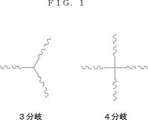
- the polymer compound used in the present invention is a star polymer having a main chain branched into three or more, has a main chain structure as shown in the schematic diagram of FIG. ).
- A represents a branch unit (constituent unit including a branch point) of a star polymer
- Polymer is a polymer chain constituting the main chain, and at least one of a polyethyleneoxy group or a polypropyleneoxy group as a side chain thereof Have n is 3 or more.
- the star polymer used in the present invention is a polymer compound having the main chain structure as described above, wherein the polymer chain has at least one of a polyethyleneoxy group and a polypropyleneoxy group as a side chain.
- the side chain may be either a polyethyleneoxy group or a polypropyleneoxy group alone, or may contain both groups.
- the above polyethyleneoxy group or polypropyleneoxy group is a group represented by the following general formula (2).
- R 1 represents a hydrogen atom or a methyl group
- R 2 represents a hydrogen atom or an alkyl group having 1 to 12 carbon atoms
- n represents 2 to 120.
- R 1 is a hydrogen atom
- R 2 is a hydrogen atom or a methyl group.
- n is preferably 2 to 90, more preferably 2 to 50, still more preferably 2 to 12, and particularly preferably 2 to 8.
- a monomer of the following general formula (3) may be copolymerized.
- R 3 represents a methyl group or a hydrogen atom
- L represents an oxygen atom or NH.
- L is more preferably an oxygen atom.
- R 1, R 2 and n are R 1, R 2 and synonymous with n in the general formula (2), it is preferable also the same.
- the ratio of the repeating unit from the monomer represented by the general formula (3) is preferably 20 to 80% by mass, more preferably 30 to 70% by mass in the polymer compound represented by the general formula (1).
- the content is 35 to 65% by mass.
- the polymer of the general formula (1) includes a repeating unit having an ethylenically unsaturated group.
- Ethylenically unsaturated groups form crosslinks between polymer molecules during photopolymerization and promote photocuring.
- a (meth) acryl group As the ethylenically unsaturated group, a (meth) acryl group, a vinyl group, an allyl group and the like are preferable, and these groups can be introduced into a polymer by a polymer reaction or copolymerization.
- reaction between an acrylic polymer having a carboxy group in the side chain and glycidyl methacrylate reaction between a polymer having an epoxy group and an ethylenically unsaturated group-containing carboxylic acid such as methacrylic acid, or a polymer having a hydroxy group and an isocyanate group Reaction with methacrylate can be used.
- a (meth) acryl group is preferred.
- repeating unit having an ethylenically unsaturated group used in the present invention are described below.
- the present invention is not limited to these.
- the content of the ethylenically unsaturated group in the polymer compound of the present invention is preferably 0.1 to 10.0 mmol, more preferably 0.25 to 7.0 mmol, most preferably 0, per 1 g of the polymer compound. .5 to 5.5 mmol.
- the star polymer used in the present invention may contain other repeating units. Specific examples of monomers corresponding to such repeating units are described below. The present invention is not limited to these.
- (M1) Acrylic acid esters and methacrylic acid esters having an aliphatic hydroxy group such as 2-hydroxyethyl acrylate or 2-hydroxyethyl methacrylate.
- (M2) Alkyl acrylates such as methyl acrylate, ethyl acrylate, propyl acrylate, butyl acrylate, amyl acrylate, hexyl acrylate, octyl acrylate, benzyl acrylate, 2-chloroethyl acrylate, and glycidyl acrylate.
- (M3) Alkyl methacrylate such as methyl methacrylate, ethyl methacrylate, propyl methacrylate, butyl methacrylate, amyl methacrylate, hexyl methacrylate, cyclohexyl methacrylate, benzyl methacrylate, 2-chloroethyl methacrylate, glycidyl methacrylate and the like.
- (M4) Acrylamide, methacrylamide, N-methylolacrylamide, N-ethylacrylamide, N-hexylmethacrylamide, N-cyclohexylacrylamide, N-hydroxyethylacrylamide, N-phenylacrylamide, N-nitrophenylacrylamide, N-ethyl- Acrylamide or methacrylamide such as N-phenylacrylamide.
- (M5) Vinyl ethers such as ethyl vinyl ether, 2-chloroethyl vinyl ether, hydroxyethyl vinyl ether, propyl vinyl ether, butyl vinyl ether, octyl vinyl ether, and phenyl vinyl ether.
- (M6) Vinyl esters such as vinyl acetate, vinyl chloroacetate, vinyl butyrate and vinyl benzoate.
- Styrenes such as styrene, ⁇ -methylstyrene, methylstyrene, and chloromethylstyrene.
- (M8) Vinyl ketones such as methyl vinyl ketone, ethyl vinyl ketone, propyl vinyl ketone, and phenyl vinyl ketone.
- Olefins such as ethylene, propylene, isobutylene, butadiene and isoprene.
- M10 N-vinylpyrrolidone, acrylonitrile, methacrylonitrile and the like.
- Unsaturated imides such as maleimide, N-acetylmethacrylamide, N-propionylmethacrylamide, N- (p-chlorobenzoyl) methacrylamide.
- the copolymerization ratio is a molar ratio.
- the branch unit represented by A in the general formula (1) is not particularly limited, but those having a hub portion which is a residue of a thiol having 3 or more functionalities are preferable.
- the addition polymer backbone extends from each thio moiety in the hub; thus, three or more backbones extend from the thio moiety. That is, the branch unit A preferably has a structure represented by the following general formula (4).
- a 1 is an n-valent organic group, and n is an integer of 3 or more.
- Specific examples of A 1 include the following structures or organic groups constituted by combining a plurality of these structures.
- n is preferably an integer of 3 to 6, particularly preferably an integer of 4 to 6.
- Trifunctional or higher thiol residues are derived from aromatic or aliphatic thiols.
- aromatic thiols include benzene-1,3,5-trithiol, 3,4,8,9-tetramercaptotetrathiafulvalene and 7-methyltrithiouric acid.
- the thiol residue of the aliphatic thiol is preferably an ester residue formed from a trifunctional or higher alcohol and a mercaptoalkanoic acid having 2 to 6 carbon atoms.
- suitable alcohols include glycerin, sorbitol, alcohol represented by formula (5), and alcohol having a group represented by formula (6).
- an alcohol represented by the formula (5) and an alcohol having a group represented by the formula (6) are preferable.
- R 1 represents a hydrogen atom, an alkyl group having 1 to 4 carbon atoms, or a hydroxy-substituted alkyl group.
- a methyl group, an ethyl group, a hydroxymethyl group, and a hydroxyethyl group are preferable.
- Examples of mercaptoalkanoic acids having 2 to 6 carbon atoms include 2-mercaptoacetic acid, 2-mercaptopropionic acid, 3-mercaptopropionic acid, 4-mercaptobutyric acid, 5-mercaptovaleric acid, and 6-mercaptocaproic acid. It is done. Of these, 2-mercaptoacetic acid and 3-mercaptopropionic acid are preferable.
- esters formed from trifunctional or higher alcohols and mercaptoalkanoic acids having 2 to 6 carbon atoms include 1,2,6-hexanetriol trithioglycolate, 1,3,5-trithiocyanuric acid, 1,3,5-tris (3-mercaptobutyryloxyethyl) -1,3,5-triazine-2,4,6 (1H, 3H, 5H) -trione, trimethylolpropane tris (3-mercaptopropio Nate), trimethylolpropane tristhioglycolate, trimethylolpropane tristhiopropionate, trihydroxyethyltriisocyanuric acid tristhiopropionate, tris-[(ethyl-3-mercaptopropionyloxy) -ethyl] isocyanurate, etc.
- a compound having three mercapto groups It has four mercapto groups such as pentaerythritol tetrakis (3-mercaptopropionate), pentaerythritol tetrakis (3-mercaptobutyrate), pentaerythritol tetrakisthioglycolate, dipentaerythritol hexakis-3-mercaptopropionate, etc. Examples thereof include, but are not limited to, compounds.
- TMTG trimethylolpropane tristhiopropionate
- PETG pentaerythritol tetrakisthiopropionate
- Karenz MT PE1 penta Erythritol tetrakis (3-mercaptobutyrate)
- Karenz MT PE1 penta Erythritol tetrakis (3-mercaptobutyrate)
- TM 1,3,5-tris (3-mercaptobutyryloxyethyl) -1,3,5-triazine-2,4,6 (1H , 3H, 5H) -trione
- TMMP trimethylolpropane tris-3-mercaptopropionate
- PEMP pentaerythritol tetrakis-3- Mercaptopropionate
- Examples of the branch unit represented by the general formula (4) include those having the following structure.
- the mass average molar mass (Mw) of the star polymer used in the present invention is preferably 5,000 to 500,000, and more preferably 10,000 to 250,000. Specific examples of the star polymer used in the present invention are shown in Table 1. However, the present invention is not limited to these.
- the star polymer of the present invention When used for the image recording layer, one kind may be used alone, or two or more kinds may be mixed and used.
- the content of the star polymer of the present invention in the image recording layer is preferably from 0.5 to 90% by mass, more preferably from 1 to 80% by mass, more preferably from 1.5 to 90% by mass, based on the total solid content of the image recording layer. More preferably, it is ⁇ 70% by mass.
- the star polymer of the present invention can be synthesized by a known method such as radical polymerization of the monomer constituting the polymer chain in the presence of the polyfunctional thiol compound.
- polymer fine particles having a polyethyleneoxy group in the side chain are used in order to improve on-press developability.
- the interaction between the polymer fine particles having a polyethyleneoxy group and the star polymer improves the developability while maintaining the printing durability of the lithographic printing plate after development.
- the ethyleneoxy repeating unit of the polyethyleneoxy group is preferably 2 to 120, more preferably 20 to 100, and particularly preferably 20 to 70. Within this range, good printing durability and wearability can be obtained.
- polymer fine polymer main chain polymer examples include vinyl resin, polyurethane resin, polyurea resin, polyimide resin, polyamide resin, epoxy resin, polystyrene resin, novolac phenol resin, polyester resin, synthetic rubber, and natural rubber.
- vinyl resin is particularly preferable.
- the polyethyleneoxy group is preferably contained as a side chain of a polymer forming fine particles, more preferably as a side chain of a vinyl resin, in a structure represented by the general formula (7).
- R represents a hydrogen atom or an alkyl group having 1 to 12 carbon atoms, and n represents 2 to 120.
- R is preferably a hydrogen atom or a methyl group.
- n is more preferably 20 to 100, and particularly preferably 20 to 70.
- Polymer fine particles having such a side chain can be obtained by copolymerizing a monomer represented by the following general formula (8).
- B represents a methyl group or a hydrogen atom.
- L represents an oxygen atom or NH, and is preferably an oxygen atom.
- R and n are synonymous with those in the general formula (7), and preferred ones are also the same.
- the amount of the polyethyleneoxy group in the polymer fine particles is preferably 3.0 to 90% by mass, more preferably 5.0 to 70% by mass, and particularly preferably 5.0 to 60% by mass.
- the polymer fine particles may have crosslinkability in order to improve the film strength of the image area.
- a crosslinkable functional group such as an ethylenically unsaturated bond may be introduced into the main chain or side chain of the polymer.
- the crosslinkable functional group may be introduced by copolymerization. Examples of the polymer having an ethylenically unsaturated bond in the main chain of the molecule include poly-1,4-butadiene and poly-1,4-isoprene.
- polymers having an ethylenically unsaturated bond in the side chain of the molecule are polymers of esters or amides of acrylic acid or methacrylic acid, where the ester or amide residue (-COOR or CONHR R) is ethylene.
- ester or amide residue is ethylene.
- polymers having a polymerizable unsaturated bond examples include polymers having a polymerizable unsaturated bond.
- Specific examples of the amide residue include —CH 2 CH ⁇ CH 2 , —CH 2 CH 2 —Y (wherein Y represents a cyclohexene residue), —CH 2 CH 2 —OCO—CH ⁇ CH 2. Is mentioned.
- the content of the crosslinkable group in the polymer fine particles is preferably 0.1 to 10.0 mmol, more preferably 1 per 1 g of the polymer compound. 0.0 to 7.0 mmol, most preferably 2.0 to 5.5 mmol. Within this range, good sensitivity and good storage stability can be obtained.
- the monomers (m1) to (m11) described in the description of the star polymer can be used.
- the polymer fine particles of the present invention can be obtained by, for example, emulsion polymerization or suspension polymerization of the above-described monomer having a polyethyleneoxy group.
- Specific examples (1) to (13) of the vinyl resin forming the polymer fine particles used in the present invention are shown below, but the present invention is not limited thereto.
- the copolymerization ratio is a molar ratio.
- the polymer fine particles in the present invention preferably have a mass average molar mass (Mw) of 2000 or more, more preferably 5000 or more, and still more preferably 10,000 or more.
- Mw mass average molar mass
- the average particle size of the polymer fine particles of the present invention is preferably in the range of 10 to 1000 nm, more preferably in the range of 20 to 300 nm, and particularly preferably in the range of 30 to 120 nm.
- the polymer fine particles of the present invention are contained in an amount of preferably 10 to 90% by mass, more preferably 10 to 80% by mass, and particularly preferably 15 to 70% by mass with respect to the total solid content of the image recording layer. .
- the polymerizable compound used in the present invention is an addition polymerizable compound having at least one ethylenically unsaturated double bond, and is selected from compounds having at least one terminal ethylenically unsaturated bond, preferably two or more. . These have chemical forms such as monomers, prepolymers, ie dimers, trimers and oligomers, or mixtures thereof.
- Examples of monomers include unsaturated carboxylic acids (for example, acrylic acid, methacrylic acid, itaconic acid, crotonic acid, isocrotonic acid, maleic acid, etc.), esters and amides thereof, preferably unsaturated carboxylic acids.
- An ester of an acid and a polyhydric alcohol compound and an amide of an unsaturated carboxylic acid and a polyvalent amine compound are used.
- an addition reaction product of an unsaturated carboxylic acid ester or amide having a nucleophilic substituent such as a hydroxy group, an amino group or a mercapto group with a monofunctional or polyfunctional isocyanate or epoxy, and a monofunctional or polyfunctional compound.
- a dehydration condensation reaction product with a functional carboxylic acid is also preferably used.
- a substitution reaction product of an unsaturated carboxylic acid ester or amide having a leaving substituent such as a tosyloxy group and a monofunctional or polyfunctional alcohol, amine or thiol is also suitable.
- JP-T-2006-508380 JP-A-2002-287344, JP-A-2008-256850, JP-A-2001-342222, JP-A-9-179296, JP-A-9-179297.
- JP-A-9-179298 JP-A-2004-294935, JP-A-2006-243493, JP-A-2002-275129, JP-A-2003-64130, JP-A-2003-280187, It is described in references including Kaihei 10-333321.
- monomers of esters of polyhydric alcohol compounds and unsaturated carboxylic acids include acrylic acid esters such as ethylene glycol diacrylate, 1,3-butanediol diacrylate, tetramethylene glycol diacrylate, propylene glycol diacrylate, Examples include trimethylolpropane triacrylate, hexanediol diacrylate, tetraethylene glycol diacrylate, pentaerythritol tetraacrylate, sorbitol triacrylate, isocyanuric acid ethylene oxide (EO) -modified triacrylate, and polyester acrylate oligomer.
- acrylic acid esters such as ethylene glycol diacrylate, 1,3-butanediol diacrylate, tetramethylene glycol diacrylate, propylene glycol diacrylate
- Examples include trimethylolpropane triacrylate, hexanediol diacrylate, tetraethylene glycol diacrylate, pentaery
- Methacrylic acid esters include tetramethylene glycol dimethacrylate, neopentyl glycol dimethacrylate, trimethylolpropane trimethacrylate, ethylene glycol dimethacrylate, pentaerythritol trimethacrylate, bis [p- (3-methacryloxy-2-hydroxypropoxy) phenyl ] Dimethylmethane, bis- [p- (methacryloxyethoxy) phenyl] dimethylmethane, and the like.
- amide monomers of polyvalent amine compounds and unsaturated carboxylic acids include methylene bis-acrylamide, methylene bis-methacrylamide, 1,6-hexamethylene bis-acrylamide, 1,6-hexamethylene bis-methacrylic.
- examples include amide, diethylenetriamine trisacrylamide, xylylene bisacrylamide, and xylylene bismethacrylamide.
- urethane-based addition polymerizable compounds produced by an addition reaction of isocyanate and hydroxy group are also suitable. Specific examples thereof include, for example, one molecule described in JP-B-48-41708.
- a vinyl containing two or more polymerizable vinyl groups in one molecule obtained by adding a vinyl monomer containing a hydroxy group represented by the following general formula (A) to a polyisocyanate compound having two or more isocyanate groups.
- a urethane compound etc. are mentioned.
- CH 2 C (R 4) COOCH 2 CH (R 5) OH (A) (However, R 4 and R 5 represent H or CH 3. )
- urethanes as described in JP-A-51-37193, JP-B-2-32293, JP-B-2-16765, JP-A-2003-344997, JP-A-2006-65210 are disclosed.
- Acrylates, JP-B 58-49860, JP-B 56-17654, JP-B 62-39417, JP-B 62-39418, JP-A 2000-250211, JP-A 2007-94138 Urethane compounds having an ethylene oxide skeleton described in the publication, and hydrophilic groups described in US Pat. No. 7,153,632, JP-A-8-505958, JP-A-2007-293221, and JP-A-2007-293223.
- tris (acryloyloxyethyl) isocyanurate, bis (acryloyloxyethyl) hydroxyethyl isocyanurate, etc. are excellent in the balance between the hydrophilicity involved in on-press developability and the polymerization ability involved in printing durability.
- Isocyanuric acid ethylene oxide modified acrylates are particularly preferred.
- the details of the method of use such as the structure of these polymerizable compounds, whether they are used alone or in combination, and the amount added can be arbitrarily set according to the performance design of the lithographic printing plate precursor.
- the polymerizable compound of the present invention is preferably used in the range of 1 to 75% by mass, more preferably 3 to 70% by mass, and particularly preferably 5 to 60% by mass with respect to the total solid content of the image recording layer. .
- Polymerization initiator As a polymerization initiator used for this invention, the compound which starts and accelerates
- a radical polymerization initiator is preferable, and a known thermal polymerization initiator, a compound having a bond with a small bond dissociation energy, a photopolymerization initiator, and the like can be used.
- Examples of the polymerization initiator in the present invention include (a) an organic halide, (b) a carbonyl compound, (c) an azo compound, (d) an organic peroxide, (e) a metallocene compound, (f) an azide compound, (G) hexaarylbiimidazole compounds, (h) organic borate compounds, (i) disulfone compounds, (j) oxime ester compounds, (k) onium salt compounds, and the like.
- the carbonyl compound is preferably a compound described in paragraph [0024] of JP-A-2008-195018.
- azo compound for example, an azo compound described in JP-A-8-108621 can be used.
- (d) organic peroxide for example, compounds described in paragraph [0025] of JP-A-2008-195018 are preferable.
- Examples of the azide compound include 2,6-bis (4-azidobenzylidene) -4-methylcyclohexanone.
- Examples of the hexaarylbiimidazole compound for example, the compound described in paragraph [0027] of JP-A-2008-195018 is preferable.
- organic borate compound for example, compounds described in paragraph [0028] of JP-A-2008-195018 are preferred.
- Examples of the (i) disulfone compound include compounds described in JP-A Nos. 61-166544 and 2002-328465.
- onium salt compounds examples include S.I. I. Schlesinger, Photogr. Sci. Eng. , 18, 387 (1974), T.A. S. Bal et al, Polymer, 21, 423 (1980), diazonium salts described in JP-A-5-158230 (corresponding to NI3 diazonium), US Pat. No. 4,069,055, JP-A-4-365049 Ammonium salts described in U.S. Pat. Nos. 4,069,055 and 4,069,056, EP 104,143, U.S. Patent Application Publication No. 2008/0311520 Nos. 1-150848, JP-A-2-150848, JP-A-2008-195018, or J. Pat. V.
- onium salts especially iodonium salts, sulfonium salts and azinium salts.
- iodonium salts especially iodonium salts, sulfonium salts and azinium salts.
- iodonium salts include diphenyl iodonium salts, particularly diphenyl iodonium salts substituted with an electron donating group such as an alkyl group or an alkoxyl group, and more preferably asymmetric diphenyl iodonium salts.
- diphenyliodonium hexafluorophosphate
- 4-methoxyphenyl-4- (2-methylpropyl) phenyliodonium hexafluorophosphate
- 4- (2-methylpropyl) phenyl-p-tolyliodonium hexa Fluorophosphate
- 4-hexyloxyphenyl-2,4,6-trimethoxyphenyliodonium hexafluorophosphate
- 4-hexyloxyphenyl-2,4-diethoxyphenyliodonium tetrafluoroborate
- 4-octyloxy Phenyl-2,4,6-trimethoxyphenyliodonium 1-perfluorobutanesulfonate
- 4-octyloxyphenyl-2,4,6-trimethoxyphenyliodonium hexafluorophosphate, bis ( -t- butylphenyl) iodonium
- the polymerization initiator of the present invention is preferably 0.1 to 50% by mass, more preferably 0.5 to 30% by mass, and particularly preferably 0.8 to 20% by mass with respect to the total solid content constituting the image recording layer. Can be added at a ratio of Within this range, good sensitivity and good stain resistance of the non-image area during printing can be obtained.
- an infrared absorber a low molecular weight hydrophilic compound, a sensitizer, and the like can be added to the image recording layer of the lithographic printing plate precursor according to the invention.
- the image recording layer of the present invention preferably contains an infrared absorber in order to improve the polymerization initiation function during infrared laser exposure.
- the infrared absorber has a function of converting absorbed infrared rays into heat and a function of being excited by infrared rays to transfer electrons and / or energy to a polymerization initiator.
- a dye or pigment having an absorption maximum at a wavelength of 760 to 1200 nm is used.
- dyes such as azo dyes, metal complex azo dyes, pyrazolone azo dyes, naphthoquinone dyes, anthraquinone dyes, phthalocyanine dyes, carbonium dyes, quinoneimine dyes, methine dyes, cyanine dyes, squarylium dyes, pyrylium salts, metal thiolate complexes, etc. Is mentioned.
- cyanine dyes particularly preferred among these dyes are cyanine dyes, squarylium dyes, pyrylium salts, nickel thiolate complexes, and indolenine cyanine dyes. Further, cyanine dyes and indolenine cyanine dyes are preferred, and particularly preferred examples include cyanine dyes represented by the following general formula (a).
- X 1 represents a hydrogen atom, a halogen atom, —NPh 2 , X 2 -L 1 or a group shown below.
- X 2 represents an oxygen atom, a nitrogen atom, or a sulfur atom
- L 1 represents an aromatic having a hydrocarbon group having 1 to 12 carbon atoms and a hetero atom (N, S, O, halogen atom, Se).
- a hydrocarbon group having 1 to 12 carbon atoms including a heterocycle atom and a group ring.
- X a - is Z a which will be described below - has the same definition as, R a represents a hydrogen atom, an alkyl group, an aryl group, a substituted or unsubstituted amino group, substituted or unsubstituted amino group and a halogen atom.
- R 1 and R 2 each independently represents a hydrocarbon group having 1 to 12 carbon atoms.
- R 1 and R 2 are preferably hydrocarbon groups having 2 or more carbon atoms.
- R 1 and R 2 may be bonded to each other to form a ring, and when forming a ring, it is particularly preferable that a 5-membered ring or a 6-membered ring is formed.
- Ar 1 and Ar 2 may be the same or different and each represents an aromatic hydrocarbon group which may have a substituent.
- Preferred aromatic hydrocarbon groups include a benzene ring and a naphthalene ring.
- a C12 or less hydrocarbon group, a halogen atom, and a C12 or less alkoxy group are mentioned.
- Y 1 and Y 2 may be the same or different and each represents a sulfur atom or a dialkylmethylene group having 12 or less carbon atoms.
- R 3 and R 4 may be the same or different and each represents a hydrocarbon group having 20 or less carbon atoms which may have a substituent.
- Preferred substituents include alkoxy groups having 12 or less carbon atoms, carboxy groups, and sulfo groups.
- R 5 , R 6 , R 7 and R 8 may be the same or different and each represents a hydrogen atom or a hydrocarbon group having 12 or less carbon atoms. From the availability of raw materials, a hydrogen atom is preferred.
- Za ⁇ represents a counter anion. However, Za ⁇ is not necessary when the cyanine dye represented by formula (a) has an anionic substituent in its structure and neutralization of charge is not necessary.
- Preferred Za ⁇ is a halide ion, a perchlorate ion, a tetrafluoroborate ion, a hexafluorophosphate ion, and a sulfonate ion, particularly preferably a perchlorate ion, in view of the storage stability of the image recording layer coating solution.
- Hexafluorophosphate ions, and aryl sulfonate ions are examples of the storage stability of the image recording layer coating solution.
- cyanine dyes represented by formula (a) that can be suitably used include those described in paragraph numbers [0017] to [0019] of JP-A No. 2001-133969.
- pigments examples include commercially available pigment and color index (CI) manuals, “Latest Pigment Handbook” (edited by the Japan Pigment Technology Association, published in 1977), “Latest Pigment Applied Technology” (published by CMC, published in 1986), “Printing” The pigments described in "Ink Technology”, published by CMC Publishing, 1984) can be used.
- CI pigment and color index
- a preferable addition amount of these infrared absorbers is preferably 0.05 to 30 parts by mass, more preferably 0.1 to 20 parts by mass, and most preferably 0.2 to 100 parts by mass of the total solid content of the image recording layer. It is in the range of ⁇ 10 parts by mass.
- the image recording layer in the invention may contain a low molecular weight hydrophilic compound in order to improve the on-press developability without reducing the printing durability.
- a low molecular weight hydrophilic compound for example, as the water-soluble organic compound, ethylene glycol, diethylene glycol, triethylene glycol, propylene glycol, dipropylene glycol, tripropylene glycol and the like glycols and ether or ester derivatives thereof, glycerin, Polyols such as pentaerythritol and tris (2-hydroxyethyl) isocyanurate, organic amines such as triethanolamine, diethanolamine and monoethanolamine and salts thereof, organic sulfones such as alkylsulfonic acid, toluenesulfonic acid and benzenesulfonic acid Acids and salts thereof, organic sulfamic acids such as alkylsulfamic acid and salts thereof, organic sulfuric acids such
- the above low molecular weight hydrophilic compound has a small hydrophobic part structure and almost no surface-active action, so that dampening water penetrates into the exposed part of the image recording layer (image part) and the hydrophobicity and film strength of the image part. Ink acceptability and printing durability of the image recording layer can be maintained satisfactorily.
- the amount of these low molecular weight hydrophilic compounds added to the image recording layer is preferably 0.5% by mass or more and 20% by mass or less of the total solid content of the image recording layer. More preferably, they are 1 mass% or more and 15 mass% or less, More preferably, they are 2 mass% or more and 10 mass% or less. In this range, good on-press developability and printing durability can be obtained. These compounds may be used alone or in combination of two or more.
- a sensitizing agent such as a phosphonium compound, a nitrogen-containing low molecular weight compound, or an ammonium group-containing polymer can be used in the image recording layer in order to improve the inking property.
- a sensitizing agent such as a phosphonium compound, a nitrogen-containing low molecular weight compound, or an ammonium group-containing polymer
- these compounds function as a surface coating agent for the inorganic layered compound and prevent a decrease in the inking property during printing by the inorganic layered compound.
- nitrogen-containing low molecular weight compound examples include amine salts and quaternary ammonium salts. Also included are imidazolinium salts, benzoimidazolinium salts, pyridinium salts, and quinolinium salts. Of these, quaternary ammonium salts and pyridinium salts are preferable.
- tetramethylammonium hexafluorophosphate
- tetrabutylammonium hexafluorophosphate
- dodecyltrimethylammonium p-toluenesulfonate
- benzyltriethylammonium hexafluorophosphate
- benzyldimethyloctylammonium hexafluorophosphate.
- the ammonium group-containing polymer may be any polymer as long as it has an ammonium group in its structure, but a polymer containing 5 to 80 mol% of (meth) acrylate having an ammonium group in the side chain as a copolymerization component is preferable. . Specific examples include the polymers described in paragraph numbers [0089] to [0105] of JP-A-2009-208458.
- the ammonium salt-containing polymer has a reduced specific viscosity (unit: ml / g) determined by the following measurement method, preferably in the range of 5 to 120, more preferably in the range of 10 to 110, Those in the range of ⁇ 100 are particularly preferred.
- Mw mass average molar mass
- the content of the sensitizer is preferably 0.01 to 30.0% by mass, more preferably 0.1 to 15.0% by mass, and more preferably 1 to 10% by mass with respect to the total solid content of the image recording layer. Is more preferable.
- the image recording layer in the present invention is a coating solution prepared by dispersing or dissolving the necessary components in a known solvent as described in paragraphs [0142] to [0143] of JP-A-2008-195018, for example. This is prepared by coating the substrate by a known method such as bar coater coating and drying.
- the image recording layer coating amount (solid content) on the support obtained after coating and drying varies depending on the application, but is generally preferably 0.3 to 3.0 g / m 2 . Within this range, good sensitivity and good film characteristics of the image recording layer can be obtained.
- an undercoat layer (sometimes referred to as an intermediate layer) is preferably provided between the image recording layer and the support.
- the undercoat layer enhances the adhesion between the support and the image recording layer in the exposed area, and easily peels off the image recording layer from the support in the unexposed area. Contributes to improvement.
- the undercoat layer functions as a heat insulating layer, thereby preventing the heat generated by the exposure from diffusing to the support and reducing the sensitivity.
- the compound used for the undercoat layer those having an adsorptive group capable of being adsorbed on the surface of the support and a crosslinkable group for improving adhesion to the image recording layer are preferable.
- compounds having a hydrophilicity-imparting group such as a sulfo group can also be mentioned as suitable compounds. These compounds may be low molecular weight or high molecular weight polymers. Moreover, you may use these compounds in mixture of 2 or more types as needed.
- a copolymer of a monomer having an adsorptive group, a monomer having a hydrophilic group, and a monomer having a crosslinkable group is preferable.
- the adsorptive groups that can be adsorbed on the support surface include phenolic hydroxy groups, carboxy groups, —PO 3 H 2 , —OPO 3 H 2 , —CONHSO 2 —, —SO 2 NHSO 2 —, —COCH 2 COCH 3. Is preferred.
- a sulfo group is preferable.
- the crosslinkable group is preferably a methacryl group or an allyl group.
- This polymer may have a crosslinkable group introduced by salt formation between the polar substituent of the polymer, a substituent having a counter charge and a compound having an ethylenically unsaturated bond,
- Other monomers, preferably hydrophilic monomers, may be further copolymerized.
- the phosphorus compound which has a heavy bond reactive group is mentioned suitably.
- Crosslinkable groups (preferably ethylenically unsaturated bond groups) described in JP-A-2005-238816, JP-A-2005-12549, JP-A-2006-239867, JP-A-2006-215263, surface of support Those containing a low-molecular or high-molecular compound having a functional group that interacts with each other and a hydrophilic group are also preferably used. More preferred are polymer polymers having adsorbable groups, hydrophilic groups, and crosslinkable groups that can be adsorbed on the support surface described in JP-A Nos. 2005-125749 and 2006-188038.
- the content of unsaturated double bonds in the polymer resin for the undercoat layer is preferably 0.1 to 10.0 mmol, most preferably 0.2 to 5.5 mmol per 1 g of the polymer.
- the polymer for the undercoat layer preferably has a mass average molar mass of 5000 or more, more preferably 10,000 to 300,000.
- the undercoat layer of the present invention comprises, in addition to the above undercoat compound, a chelating agent, a secondary or tertiary amine, a polymerization inhibitor, an amino group, or a functional group having a polymerization inhibiting ability, in order to prevent contamination over time.
- a chelating agent for example, 1,4-diazabicyclo [2,2,2] octane (DABCO), 2,3,5,6-tetrahydroxy-p-quinone, chloranil , Sulfophthalic acid, hydroxyethylethylenediaminetriacetic acid, dihydroxyethylethylenediaminediacetic acid, hydroxyethyliminodiacetic acid, and the like.
- the undercoat layer is applied by a known method.
- the coating amount (solid content) of the undercoat layer is preferably 0.1 to 100 mg / m 2 , and more preferably 1 to 30 mg / m 2 .
- a known surface hydrophilic support is used as the support used in the lithographic printing plate precursor according to the invention.
- an aluminum plate that has been roughened and anodized by a known method is preferred.
- the aluminum plate is subjected to micropore enlargement treatment or sealing treatment of an anodized film described in JP-A-2001-253181 or JP-A-2001-322365, and US Pat. 714,066, 3,181,461, 3,280,734 and 3,902,734, or alkali metal silicates as described in U.S. Pat.
- the support preferably has a center line average roughness of 0.10 to 1.2 ⁇ m.
- the support of the present invention includes an organic polymer compound described in JP-A-5-45885 and a silicon alkoxy compound described in JP-A-6-35174 on the back surface.
- a backcoat layer can be provided.
- a protective layer (overcoat layer) is preferably provided on the image recording layer.
- the protective layer has a function of preventing scratches in the image recording layer and preventing ablation during high-illuminance laser exposure.
- the protective layer having such characteristics is described in, for example, US Pat. No. 3,458,311 and Japanese Patent Publication No. 55-49729.
- the low oxygen permeability polymer used for the protective layer either a water-soluble polymer or a water-insoluble polymer can be appropriately selected and used, and two or more types can be mixed and used as necessary. it can.
- Specific examples include polyvinyl alcohol, modified polyvinyl alcohol, polyvinyl pyrrolidone, water-soluble cellulose derivatives, poly (meth) acrylonitrile, and the like.
- modified polyvinyl alcohol acid-modified polyvinyl alcohol having a carboxylic acid group or a sulfonic acid group is preferably used.
- modified polyvinyl alcohols described in JP-A-2005-250216 and JP-A-2006-259137 are preferable.
- the protective layer preferably contains an inorganic layered compound such as natural mica and synthetic mica as described in JP-A-2005-119273 in order to enhance oxygen barrier properties. Further, the protective layer may contain known additives such as a plasticizer for imparting flexibility, a surfactant for improving coating properties, and inorganic fine particles for controlling surface slipperiness. Further, the protective layer can contain the sensitizer described in the description of the image recording layer.
- the protective layer is applied by a known method.
- the coating amount of the protective layer, the coating amount after drying is preferably in the range of 0.01 ⁇ 10g / m 2, more preferably in the range of 0.02 ⁇ 3g / m 2, and most preferably 0.
- the range is 02 to 1 g / m 2 .
- the lithographic printing plate precursor according to the invention is subjected to development processing after image exposure or is developed on a printing machine to be used for printing.
- the lithographic printing plate precursor is imagewise exposed by laser exposure through a transparent original image having a line image, a halftone dot image or the like, or by laser beam scanning by digital data.
- the wavelength of the light source is preferably 750 to 1400 nm.
- a solid laser or semiconductor laser that emits infrared light is suitable.
- the output is preferably 100 mW or more
- the exposure time per pixel is preferably within 20 microseconds
- the irradiation energy amount is preferably 10 to 300 mJ / cm 2 . In order to shorten the exposure time, it is preferable to use a multi-beam laser device.
- the exposure mechanism may be any of an internal drum system, an external drum system, a flat bed system, and the like.
- Image exposure can be performed by a conventional method using a plate setter or the like.
- the lithographic printing plate precursor may be mounted on a printing press and then image exposure may be performed on the printing press.
- the development processing is (1) a method of developing with a developer having a pH of 2 to 14 (developer processing method), or (2) a method of developing while adding dampening water and / or ink on a printing machine ( (On-press development system).
- ⁇ Developer processing method> an image-exposed lithographic printing plate precursor is processed with a developer having a pH of 2 to 14, and an image recording layer in a non-exposed portion is removed to prepare a lithographic printing plate.
- development processing using a highly alkaline developer the protective layer is usually removed by a pre-water washing step, then alkali development is performed, the alkali is washed and removed by a post-water washing step, gum treatment is performed, and drying is performed.
- a lithographic printing plate is produced by drying in the process.
- a developer having a pH of 8 to 12 is used.
- a surfactant or a water-soluble polymer compound is contained in the developer, whereby the development and the gum solution treatment can be performed simultaneously. Therefore, the post-water washing step is not particularly required, and the development-gum solution treatment can be performed with one solution. Further, the pre-water washing step is not particularly required, and the protective layer can be removed simultaneously with the development-gum solution treatment. After the development-gum treatment, it is preferable to remove the excess developer using, for example, a squeeze roller and then dry.
- the anionic surfactant used in the developer of the present invention is not particularly limited, but fatty acid salts, abietic acid salts, hydroxyalkanesulfonic acid salts, alkanesulfonic acid salts, dialkylsulfosuccinic acid salts, linear alkylbenzenesulfonic acid salts.
- alkylbenzene sulfonates alkylnaphthalene sulfonates, alkyl diphenyl ether (di) sulfonates, alkylphenoxy polyoxyethylene alkyl sulfonates, polyoxyethylene alkyl sulfophenyl ether salts, N-alkyl-N-oleyl taurine Sodium, N-alkylsulfosuccinic acid monoamide disodium salt, petroleum sulfonate, sulfated castor oil, sulfated tallow oil, fatty acid alkyl ester sulfate ester salt, alkyl Sulfuric acid ester salts, polyoxyethylene alkyl ether sulfuric acid ester salts, fatty acid monoglyceride sulfuric acid ester salts, polyoxyethylene alkylphenyl ether sulfuric acid ester salts, polyoxyethylene styryl phenyl ether sulfuric acid ester salts,
- the cationic surfactant used in the developer of the present invention is not particularly limited, and conventionally known cationic surfactants can be used. Examples thereof include alkylamine salts, quaternary ammonium salts, alkyl imidazolinium salts, polyoxyethylene alkylamine salts, and polyethylene polyamine derivatives.
- the nonionic surfactant used in the developer of the present invention is not particularly limited, but is a polyethylene glycol type higher alcohol ethylene oxide adduct, alkylphenol ethylene oxide adduct, alkyl naphthol ethylene oxide adduct, phenol ethylene oxide adduct.
- the zwitterionic surfactant used in the developer of the present invention is not particularly limited, and examples thereof include amine oxides such as alkyldimethylamine oxide, betaines such as alkylbetaine, and amino acids such as sodium alkylamino fatty acid. .
- alkyldimethylamine oxide which may have a substituent alkylcarboxybetaine which may have a substituent
- alkylsulfobetaine which may have a substituent are preferably used.
- the compound represented by the formula (2) in paragraph [0256] of JP-A-2008-203359, the formula (I) and the formula (II) in paragraph [0028] of JP-A-2008-276166 are disclosed.
- a compound represented by the formula (VI), and compounds represented by paragraph numbers [0022] to [0029] of JP-A-2009-47927 can be used.
- the amount of the surfactant contained in the developer is preferably 0.01 to 20% by mass, and more preferably 0.1 to 10% by mass.
- water-soluble polymer compound used in the developer of the present invention examples include soybean polysaccharide, modified starch, gum arabic, dextrin, fiber derivatives (eg, carboxymethyl cellulose, carboxyethyl cellulose, methyl cellulose, etc.) and modified products thereof, pullulan, polyvinyl Alcohol and derivatives thereof, polyvinylpyrrolidone, polyacrylamide and acrylamide copolymer, vinyl methyl ether / maleic anhydride copolymer, vinyl acetate / maleic anhydride copolymer, styrene / maleic anhydride copolymer, polyvinyl sulfonic acid and The salt, polystyrene sulfonic acid, its salt, etc.
- soybean polysaccharide modified starch, gum arabic, dextrin
- fiber derivatives eg, carboxymethyl cellulose, carboxyethyl cellulose, methyl cellulose, etc.
- fiber derivatives eg, carboxymethyl
- soybean polysaccharide for example, there exists a brand name Soya Five (made by Fuji Oil Co., Ltd.) as a commercial item, and the thing of various grades can be used. What can be preferably used is one in which the viscosity of a 10% by mass aqueous solution is in the range of 10 to 100 mPa / sec.
- modified starch known ones can be used. For example, starch such as corn, potato, tapioca, rice and wheat is decomposed with acid or enzyme in the range of 5 to 30 glucose residues per molecule, and further alkali It can be made by a method of adding oxypropylene in the inside.
- Two or more water-soluble polymer compounds can be used in the developer.
- the content of the water-soluble polymer compound in the developer is preferably from 0.1 to 20% by mass, and more preferably from 0.5 to 10% by mass.
- the developer used in the present invention may contain a pH buffer.
- the developing solution of the present invention can be used without particular limitation as long as it is a buffering agent that exhibits a buffering action at a pH of 2 to 14.
- weakly alkaline buffering agents are preferably used.
- (a) carbonate ions and hydrogen carbonate ions, (b) borate ions, (c) water-soluble amine compounds and ions of the amine compounds, and their Combination use etc. are mentioned. That is, for example, a combination of (a) carbonate ion-bicarbonate ion, (b) borate ion, or (c) water-soluble amine compound-amine compound ion exhibits pH buffering action in the developer.
- carbonate ions and bicarbonate ions are not particularly limited, but are preferably alkali metal salts. Examples of the alkali metal include lithium, sodium, and potassium, and sodium is particularly preferable. Alkali metals may be used alone or in combination of two or more.
- the total amount of carbonate ions and bicarbonate ions is preferably 0.05 to 5 mol / L, more preferably 0.07 to 2 mol / L, and particularly preferably 0.1 to 1 mol / L with respect to the developer.
- the developer of the present invention may contain an organic solvent.
- organic solvent examples include aliphatic hydrocarbons (hexane, heptane, Isopar E, H, G (manufactured by Esso Chemical Co., Ltd.)), aromatic hydrocarbons (toluene, xylene, etc.), halogens, and the like. Hydrocarbons (methylene dichloride, ethylene dichloride, trichlene, monochlorobenzene, etc.) and polar solvents.
- Polar solvents include alcohols (methanol, ethanol, propanol, isopropanol, 1-butanol, 1-pentanol, 1-hexanol, 1-heptanol, 1-octanol, 2-octanol, 2-ethyl-1-hexanol, 1 -Nonanol, 1-decanol, benzyl alcohol, ethylene glycol monomethyl ether, 2-ethoxyethanol, diethylene glycol monoethyl ether, diethylene glycol monohexyl ether, triethylene glycol monomethyl ether, propylene glycol monoethyl ether, propylene glycol monomethyl ether, polyethylene glycol monomethyl Ether, polypropylene glycol, tetraethylene glycol, ethylene glycol monobutyl ether Ter, ethylene glycol monobenzyl ether, ethylene glycol monophenyl ether, propylene glycol monophenyl ether, methylphenyl carbinol, am
- the organic solvent contained in the developer can be used in combination of two or more.
- the organic solvent When the organic solvent is insoluble in water, it can be used after being solubilized in water using a surfactant or the like.
- the concentration of the organic solvent is preferably less than 40% by mass from the viewpoint of safety and flammability.
- the developer of the present invention may contain a preservative, a chelate compound, an antifoaming agent, an organic acid, an inorganic acid, an inorganic salt, and the like.
- a preservative e.g., benzyl alcohol, benzyl ether, benzyl ether, benzyl ether, benzyl ether, benzyl ether, benzyl ether, benzyl, sodium metabisulfite, sodium metabisulfite, sodium metabisulfite, sodium metabisulfite, sodium metabisulfite, sodium metabisulfite, sodium metabisulfite, sodium metabisulfite, sodium metabisulfite, sodium metabisulfite, sodium metabisulfite, sodium metabisulfite, sodium metabisulfite, sodium metabisulfite, sodium metabisulfite, sodium metabisulfite, sodium metabisulfite, sodium metabisulfite, sodium metabisulfite, sodium metabisulfit
- the developer treatment of the lithographic printing plate precursor according to the invention is carried out in accordance with a conventional method at a temperature of 0 to 60 ° C., preferably about 15 to 40 ° C., for example, by immersing the exposed lithographic printing plate precursor in a developer solution with a brush. It can be carried out by a method of rubbing with a brush, a method of spraying a developer by spraying and rubbing with a brush.
- the development treatment with a developer having a pH of 2 to 14 can be preferably carried out by an automatic development processor equipped with a developer supply means and a rubbing member.
- An automatic developing processor using a rotating brush roll as the rubbing member is particularly preferable.
- the automatic development processor is preferably provided with a means for removing excess developer such as a squeeze roller and a drying means such as a warm air device after the development processing means.
- the automatic development processor may be provided with a preheating means for heat-treating the lithographic printing plate precursor after image exposure before the development processing means.
- the developer of the present invention can be used as a developer and developer replenisher for an exposed lithographic printing plate precursor. Further, the present invention can be preferably applied to the automatic developing processor as described above. When developing using an automatic developing processor, the developing solution becomes fatigued according to the amount of processing, so that the processing capability may be restored by using a replenishing solution or a fresh developing solution.
- On-press development method an image-exposed lithographic printing plate precursor is supplied with oil-based ink or an aqueous component on the printing press, and the image recording layer in the non-image area is removed to produce a lithographic printing plate.
- image exposure is performed on the printing machine.
- the uncured image recording layer is dissolved or dispersed in the non-image area by the supplied oil-based ink and / or the aqueous component in the initial stage of printing.
- the image recording layer cured by exposure forms an oil-based ink receiving portion having a lipophilic surface.
- Oil-based ink or water-based component may be first supplied to the plate surface, but oil-based ink is supplied first in order to prevent the water-based component from being contaminated by the removed image recording layer component. Is preferred.
- the lithographic printing plate precursor is subjected to on-press development on a printing machine and used as it is for printing a large number of sheets.
- the oil-based ink and the aqueous component ordinary lithographic printing ink and fountain solution are preferably used.
- the entire lithographic printing plate precursor is exposed before exposure, during exposure, and from exposure to development, regardless of the development method. You may heat. By such heating, an image forming reaction in the image recording layer is promoted, and advantages such as improvement in sensitivity and printing durability and stabilization of sensitivity may occur.
- it is also effective to perform whole surface post-heating or whole surface exposure on the image after development processing for the purpose of improving the image strength and printing durability.
- heating before development is preferably performed under a mild condition of 150 ° C. or less. If the temperature is too high, problems such as curing of the non-image area may occur.
- Very strong conditions are used for heating after development. Usually, it is in the range of 100 to 500 ° C. If the temperature is low, sufficient image reinforcing action cannot be obtained. If the temperature is too high, problems such as deterioration of the support and thermal decomposition of the image area may occur.
- the molecular weight is a mass average molar mass (Mw), and the ratio of repeating units is a mole percentage, except for those specifically defined.
- the star polymer (P-1) solution represented by the structural formula thus obtained had a mass average molar mass (Mw) of 35,000 as measured by GPC.
- the star polymers (P-2) to (P-10), (P-21) to (P-25) and (P-32) were synthesized by the same method as that for the star polymer (P-1).
- V-601 0.143 g was further added, the temperature was raised to 90 ° C., and the reaction was continued for 2 hours. After the reaction, the reaction solution was cooled to 50 ° C. and 1-methoxy-2-propanol: 145.66 g was added to dilute the reaction solution.
- 4-hydroxy-2,2,6,6-tetramethylpiperidine-1-oxide free radical 0.971 g, glycidyl methacrylate: 35.5 g and 1-methoxy-2-propanol: 13.
- a liquid for mixing consisting of 6 g was added and stirred for 5 minutes. The reaction mixture was heated to 90 ° C. and stirred for 10 minutes.
- This plate was etched by being immersed in a 25 mass% aqueous sodium hydroxide solution at 45 ° C for 9 seconds, washed with water, further immersed in a 20 mass% nitric acid aqueous solution at 60 ° C for 20 seconds, and washed with water. At this time, the etching amount of the grained surface was about 3 g / m 2 .
- an electrochemical roughening treatment was performed continuously using an alternating voltage of 60 Hz.
- the electrolytic solution at this time was a 1% by mass nitric acid aqueous solution (containing 0.5% by mass of aluminum ions) and a liquid temperature of 50 ° C.
- the AC power source waveform is electrochemical roughening treatment using a trapezoidal rectangular wave alternating current with a time ratio TP of 0.8 msec until the current value reaches a peak from zero, a duty ratio of 1: 1, and a trapezoidal rectangular wave alternating current. Went. Ferrite was used for the auxiliary anode.
- the current density was 30 A / dm 2 at the peak current value, and 5% of the current flowing from the power source was shunted to the auxiliary anode.
- the amount of electricity in nitric acid electrolysis was 175 C / dm 2 when the aluminum plate was the anode. Then, water washing by spraying was performed.
- nitric acid electrolysis was performed with an aqueous solution of 0.5% by mass of hydrochloric acid (containing 0.5% by mass of aluminum ions) and an electrolytic solution having a liquid temperature of 50 ° C. under the condition of an electric quantity of 50 C / dm 2 when the aluminum plate was the anode.
- an electrochemical surface roughening treatment was performed, followed by washing with water by spraying.
- a 2.5 g / m 2 direct current anodic oxide film having a current density of 15 A / dm 2 was provided on the plate as a 15% by weight sulfuric acid aqueous solution (containing 0.5% by weight of aluminum ions) as an electrolyte, followed by washing with water.
- the support (1) was subjected to a silicate treatment at 60 ° C. for 10 seconds using an aqueous 2.5 mass% No. 3 sodium silicate solution, and then washed with water for support.
- Body (2) was obtained.
- the adhesion amount of Si was 10 mg / m 2 .
- the centerline average roughness (Ra) of this substrate was measured using a needle having a diameter of 2 ⁇ m and found to be 0.51 ⁇ m.
- undercoat layer coating solution (1) is applied onto the support (2) so that the dry coating amount is 20 mg / m 2 , and a support having an undercoat layer. Was made.
- the particle size distribution of the polymer fine particles had a maximum value at a particle size of 150 nm.
- the particle size distribution is obtained by taking an electron micrograph of polymer fine particles, measuring a total of 5000 fine particle sizes on the photograph, and logarithm between 0 and the maximum value of the obtained particle size measurement values. The frequency of appearance of each particle size was plotted by dividing it into 50 on the scale. For non-spherical particles, the particle size of spherical particles having the same particle area as that on the photograph was used as the particle size. *
- a protective layer coating solution (1) having the following composition was further bar coated, followed by oven drying at 120 ° C. for 60 seconds and drying.
- a protective layer having a coating amount of 0.15 g / m 2 was formed to obtain a lithographic printing plate precursor (17).
- Polymer fine particles (2) having no polyethyleneoxy group and polymer compounds R-1 and R-2 used in the above comparative examples are as follows.
- the copolymerization ratio is a molar ratio.
- lithographic printing plate precursors (1) to (17) obtained as described above were subjected to an external drum rotation speed of 1000 rpm and a laser output of 70% on a Luxel PLANETSETTER T-6000III manufactured by FUJIFILM Corporation equipped with an infrared semiconductor laser.
- the exposure was performed under the condition of a resolution of 2400 dpi.
- the exposure image included a solid image and a 50% halftone dot chart of a 20 ⁇ m dot FM screen.
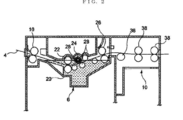
- development processing was carried out with an automatic developing processor having a structure as shown in FIG.
- the automatic development processor includes a developing unit 6 that develops a planographic printing plate precursor (hereinafter referred to as “PS plate”) 4 and a drying unit 10 that dries the developed PS plate 4.
- An insertion port is formed in the side plate of the automatic developing machine (the left portion in FIG. 2), and the PS plate 4 inserted from the insertion port is fed by a carry-in roller 16 provided on the inner side surface of the side plate of the automatic developing machine. It is conveyed to the developing unit 6.
- a conveyance roller 22, a brush roller 24, and a squeeze roller 26 are provided in order from the upstream side in the conveyance direction, and a backup roller 28 is provided at an appropriate position therebetween.
- the PS plate 4 is developed by being immersed in the developer while being conveyed by the conveying roller 22 and rotating the brush roller 24 to remove the protective layer and the image recording layer unexposed portion of the PS plate 4.
- the developed PS plate 4 is conveyed to the next drying unit 10 by a squeeze roller (unloading roller) 26.
- the drying unit 10 is provided with a guide roller 36 and a pair of skewer rollers 38 in order from the upstream side in the transport direction.
- the drying unit 10 is provided with drying means such as hot air supply means and heat generation means (not shown).
- the drying unit 10 is provided with a discharge port, and the PS plate 4 dried by the drying means is discharged, and the automatic development processing for the PS plate is completed.
- the automatic processor used in the examples has one brush roller having an outer diameter of 50 mm in which fibers made of polybutylene terephthalate (hair diameter: 200 ⁇ m, hair length: 17 mm) are implanted in the same direction as the conveying direction. 200 revolutions per minute (peripheral speed of the brush tip: 0.52 m / sec).
- the temperature of the developer was 30 ° C.
- the planographic printing plate precursor was transported at a transport speed of 82 cm / min (the transport speed was changed when developing properties were evaluated). After the development processing, drying was performed in a drying section. The drying temperature was 80 ° C.
- composition of developer (1) Table 3 below shows the composition of the developer 1 used in Examples and Comparative Examples.
- a lithographic printing plate precursor and a lithographic printing method capable of obtaining good developability while maintaining the printing durability of the lithographic printing plate after development.
Landscapes
- Physics & Mathematics (AREA)
- General Physics & Mathematics (AREA)
- Spectroscopy & Molecular Physics (AREA)
- Chemical & Material Sciences (AREA)
- Chemical Kinetics & Catalysis (AREA)
- Optics & Photonics (AREA)
- Thermal Sciences (AREA)
- Engineering & Computer Science (AREA)
- Manufacturing & Machinery (AREA)
- Materials For Photolithography (AREA)
- Printing Plates And Materials Therefor (AREA)
- Photosensitive Polymer And Photoresist Processing (AREA)
Abstract
Description
この平版印刷版を作製するため、従来は、親水性の支持体上に親油性の感光性樹脂層(画像記録層)を設けてなる平版印刷版原版(PS版)を用い、PS版にリスフィルムなどのマスクを通した露光を行った後、アルカリ性現像液などによる現像処理を行い、画像部に対応する画像記録層を残存させ、非画像部に対応する不要な画像記録層を溶解除去して、平版印刷版を得ていた。
また、簡易現像の方法としては、画像記録層の不要部分の除去を、従来の高アルカリ性現像液ではなく、pHが中性に近いフィニッシャー又はガム液によって行う「ガム現像」と呼ばれる方法も行われている。
また、特許文献6及び特許文献7には、星型ポリマーに架橋性官能基を導入し、塗料などの皮膜強度を上げることが記載されている。しかしながらこれらの技術は、平版印刷版原版に応用した場合、特に現像性の点で不十分な結果しか得られなかった。
すなわち、本発明は以下のとおりである。
2.主鎖が3つ以上に分岐した星型形状を有する高分子化合物が、分岐した主鎖の側鎖にエチレン性不飽和基を有することを特徴とする前記1に記載の平版印刷版原版。
3.主鎖が3つ以上に分岐した星型形状を有する高分子化合物が、分岐した主鎖の側鎖にポリエチレンオキシ基を有することを特徴とする前記1又は前記2に記載の平版印刷版原版。
4.主鎖が3つ以上に分岐した星型形状を有する高分子化合物が、チオール基を3つ以上有する化合物の存在下で、ポリエチレンオキシ基及びポリプロピレンオキシ基の少なくともいずれかを有するモノマーをラジカル重合して得られることを特徴とする前記1~3のいずれか一項に記載の平版印刷版原版。
5.画像記録層が赤外線吸収剤を含有することを特徴とする前記1~4のいずれか一項に記載の平版印刷版原版。
6.画像記録層上に保護層を有することを特徴とする前記1~5のいずれか一項に記載の平版印刷版原版。
7.画像記録層が印刷インキ及び湿し水のうち少なくともいずれかにより除去可能であることを特徴とする前記1~6のいずれか一項に記載の平版印刷版原版。
8.前記7に記載の平版印刷版原版を、印刷機に装着し、レーザーで画像様に露光した後、又は、レーザーで画像様に露光した後、印刷機に装着し、該平版印刷版原版に印刷インキ及び湿し水の少なくともいずれかを供給して、画像記録層の未露光部分を除去し、印刷する平版印刷方法。
発明の作用機構としては、必ずしも明確ではないが、側鎖にポリエチレンオキシ基を有する高分子微粒子と側鎖にポリエチレンオキシ基及びポリプロピレンオキシ基の少なくともいずれかを有する高分子化合物との画像記録層中での分散性が、高分子化合物が星型ポリマーであることにより、従来の直鎖ポリマーより向上し、その結果、現像後における平版印刷版の耐刷性を維持したまま現像性の一層の良化が得られたと推察される。
以下、本発明の平版印刷版原版に用いられる成分、構成要素について詳細に説明する。
本発明に用いられる高分子化合物は、主鎖が3つ以上に分岐している星型ポリマーであり、図1の模式図に示されるような主鎖構造を有し、下記の一般式(1)で表される高分子化合物である。

本発明に用いられる星型ポリマーは、上記の如き主鎖構造を有し、ポリマー鎖が側鎖としてポリエチレンオキシ基及びポリプロピレンオキシ基の少なくともいずれかを有する高分子化合物である。
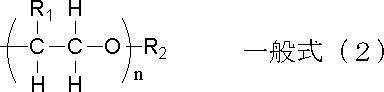
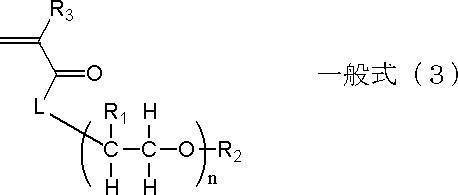
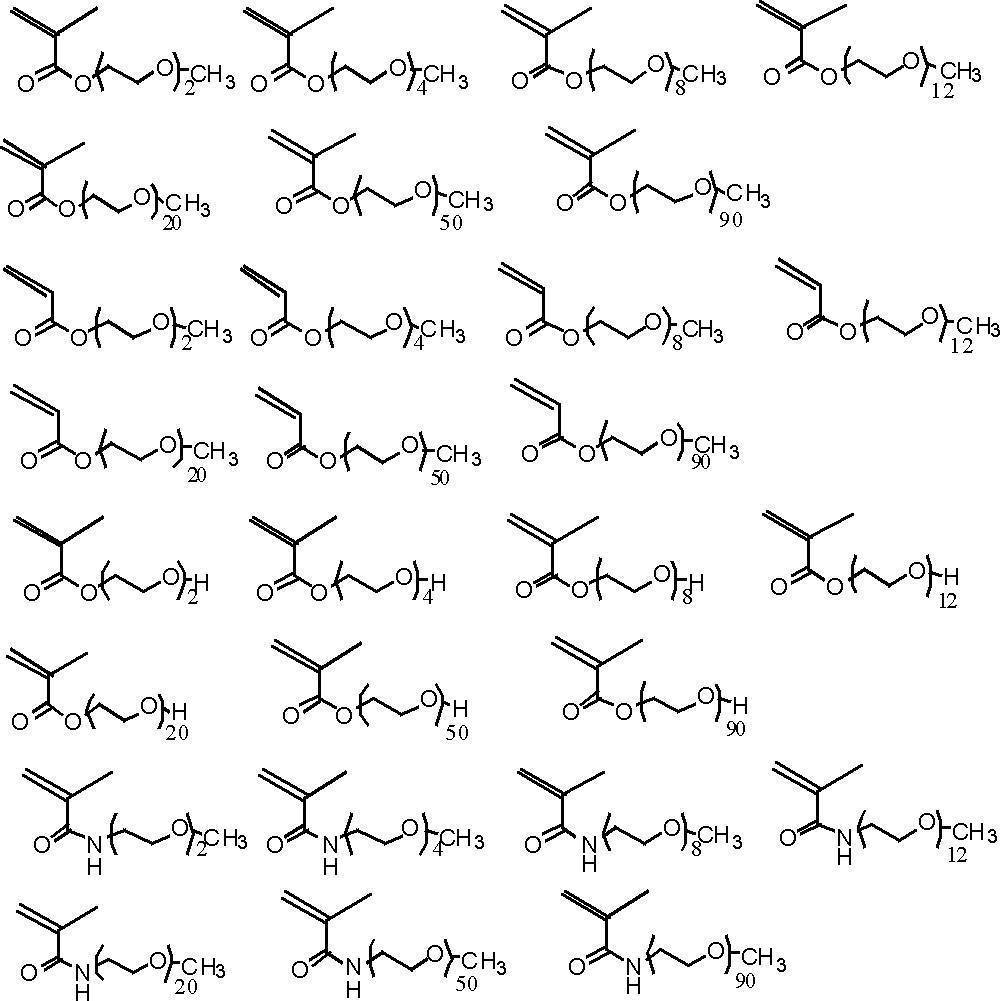
高分子化合物の保存安定性及び皮膜強度の観点より、(メタ)アクリル基が好ましい。
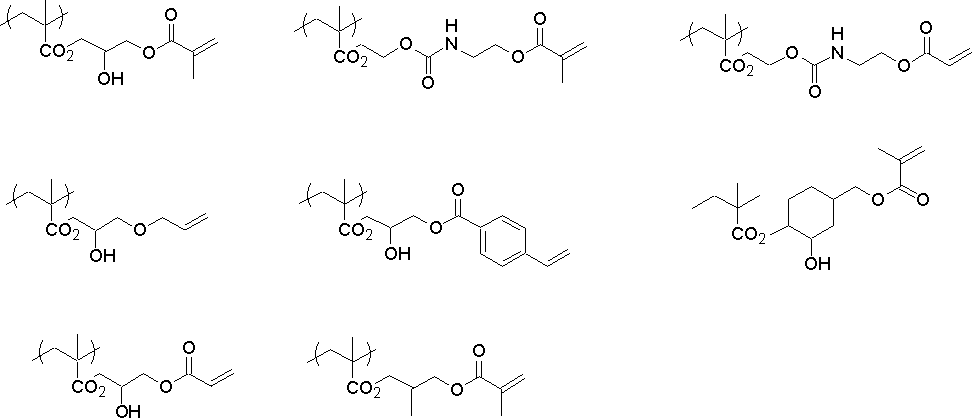
(m2)アクリル酸メチル、アクリル酸エチル、アクリル酸プロピル、アクリル酸ブチル、アクリル酸アミル、アクリル酸ヘキシル、アクリル酸オクチル、アクリル酸ベンジル、アクリル酸‐2‐クロロエチル、グリシジルアクリレート等のアルキルアクリレート。
(m3)メタクリル酸メチル、メタクリル酸エチル、メタクリル酸プロピル、メタクリル酸ブチル、メタクリル酸アミル、メタクリル酸ヘキシル、メタクリル酸シクロヘキシル、メタクリル酸ベンジル、メタクリル酸‐2‐クロロエチル、グリシジルメタクリレート等のアルキルメタクリレート。
(m4)アクリルアミド、メタクリルアミド、N‐メチロールアクリルアミド、N‐エチルアクリルアミド、N‐ヘキシルメタクリルアミド、N‐シクロヘキシルアクリルアミド、N‐ヒドロキシエチルアクリルアミド、N‐フェニルアクリルアミド、N‐ニトロフェニルアクリルアミド、N‐エチル‐N‐フェニルアクリルアミド等のアクリルアミド若しくはメタクリルアミド。
(m5)エチルビニルエーテル、2‐クロロエチルビニルエーテル、ヒドロキシエチルビニルエーテル、プロピルビニルエーテル、ブチルビニルエーテル、オクチルビニルエーテル、フェニルビニルエーテル等のビニルエーテル類。
(m6)ビニルアセテート、ビニルクロロアセテート、ビニルブチレート、安息香酸ビニル等のビニルエステル類。
(m7)スチレン、α‐メチルスチレン、メチルスチレン、クロロメチルスチレン等のスチレン類。
(m8)メチルビニルケトン、エチルビニルケトン、プロピルビニルケトン、フェニルビニルケトン等のビニルケトン類。
(m9)エチレン、プロピレン、イソブチレン、ブタジエン、イソプレン等のオレフィン類。
(m10)N‐ビニルピロリドン、アクリロニトリル、メタクリロニトリル等。
(m11)マレイミド、N‐アセチルメタクリルアミド、N‐プロピオニルメタクリルアミド、N‐(p‐クロロベンゾイル)メタクリルアミド等の不飽和イミド。

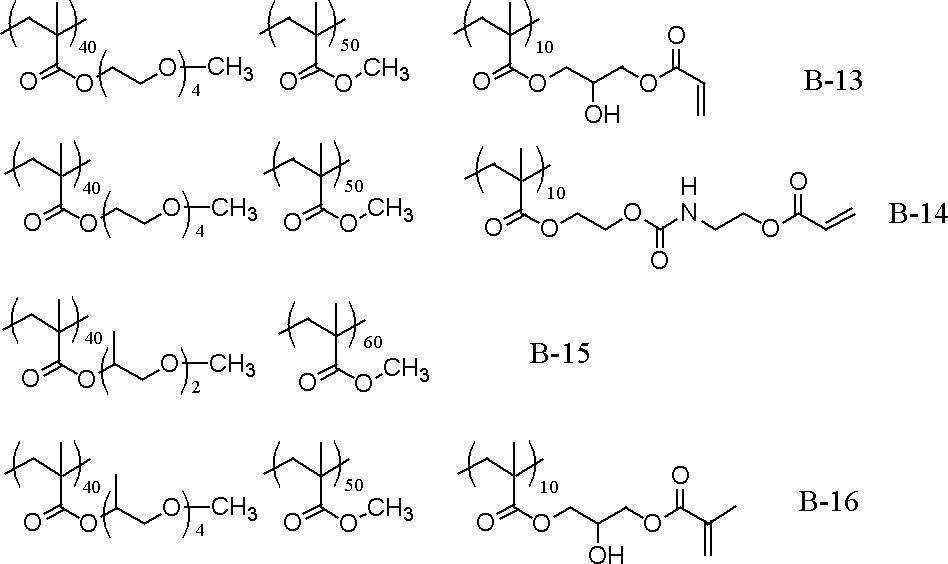

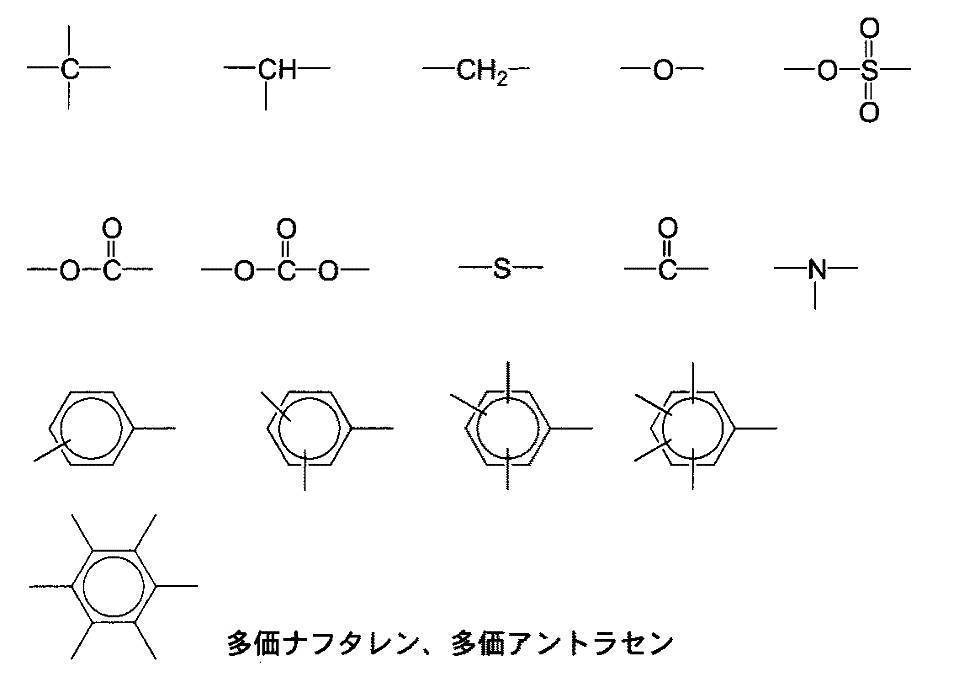
脂肪族チオールのチオール残基は3官能性以上のアルコールと炭素数2~6のメルカプトアルカン酸とから形成されるエステルの残基であることが好ましい。
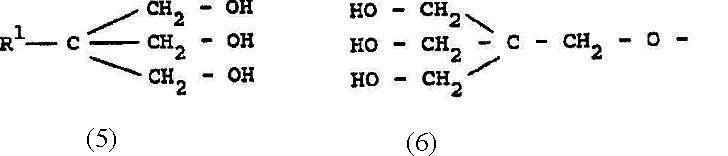
ペンタエリスリトールテトラキス(3‐メルカプトプロピオネート)、ペンタエリスリトールテトラキス(3‐メルカプトブチレート)、ペンタエリスリトールテトラキスチオグリコレート、ジペンタエリスリトールヘキサキスー3‐メルカプトプロピオネート等の4個のメルカプト基を有する化合物等が挙げられるがこの限りではない。
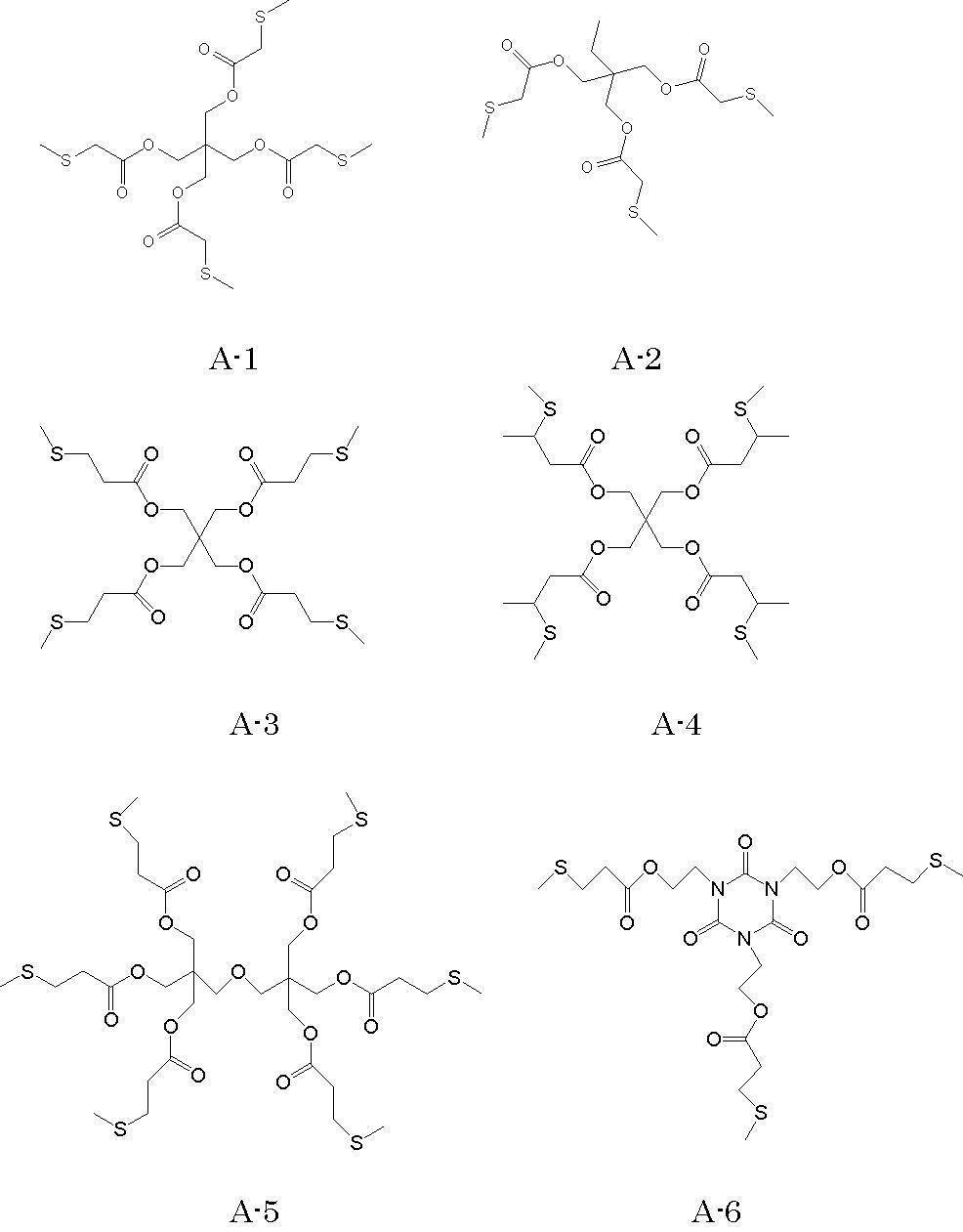
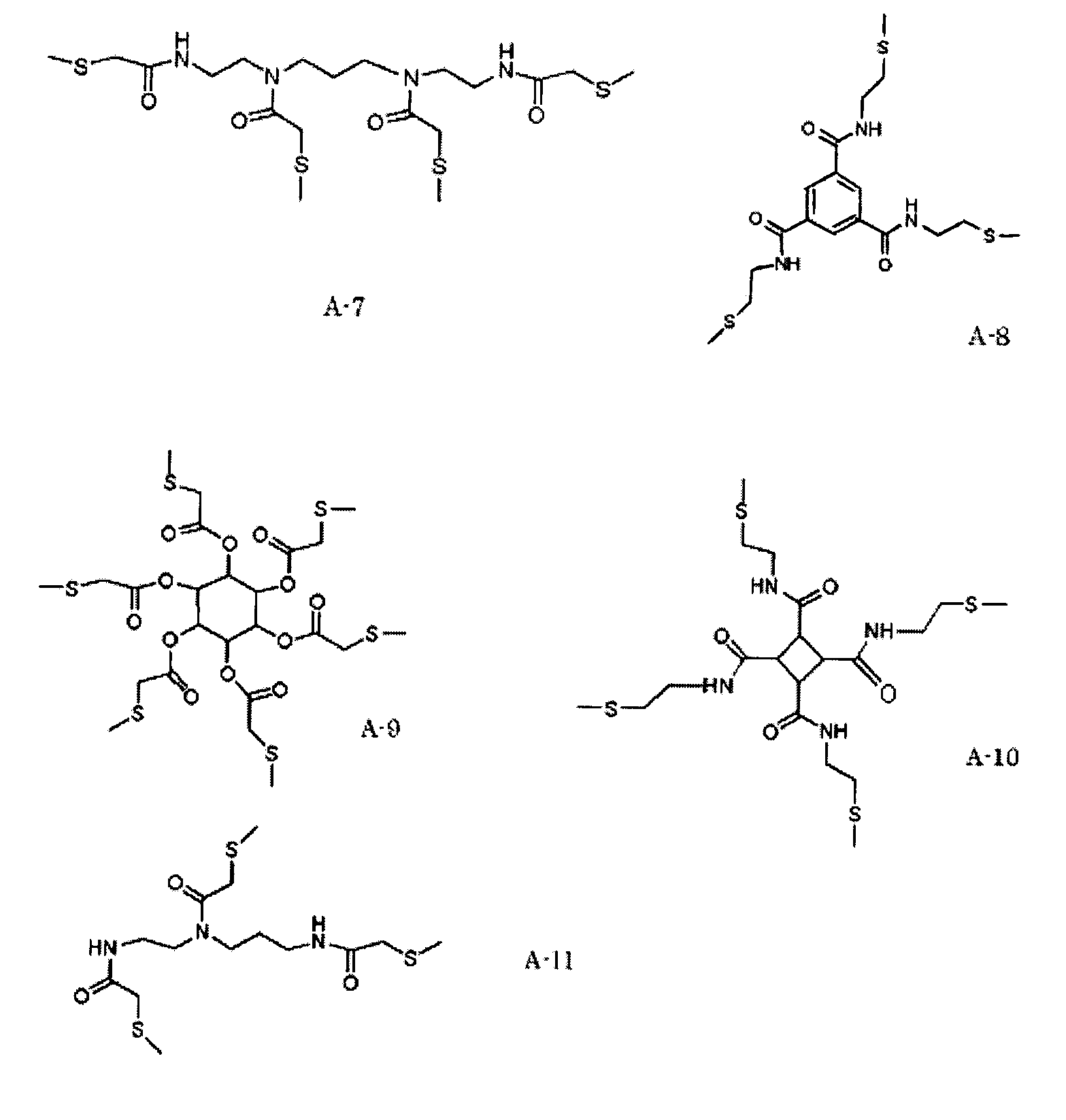
本発明で用いられる星型ポリマーの具体例を表1に示す。但し、本発明はこれらに限定されるわけではない。
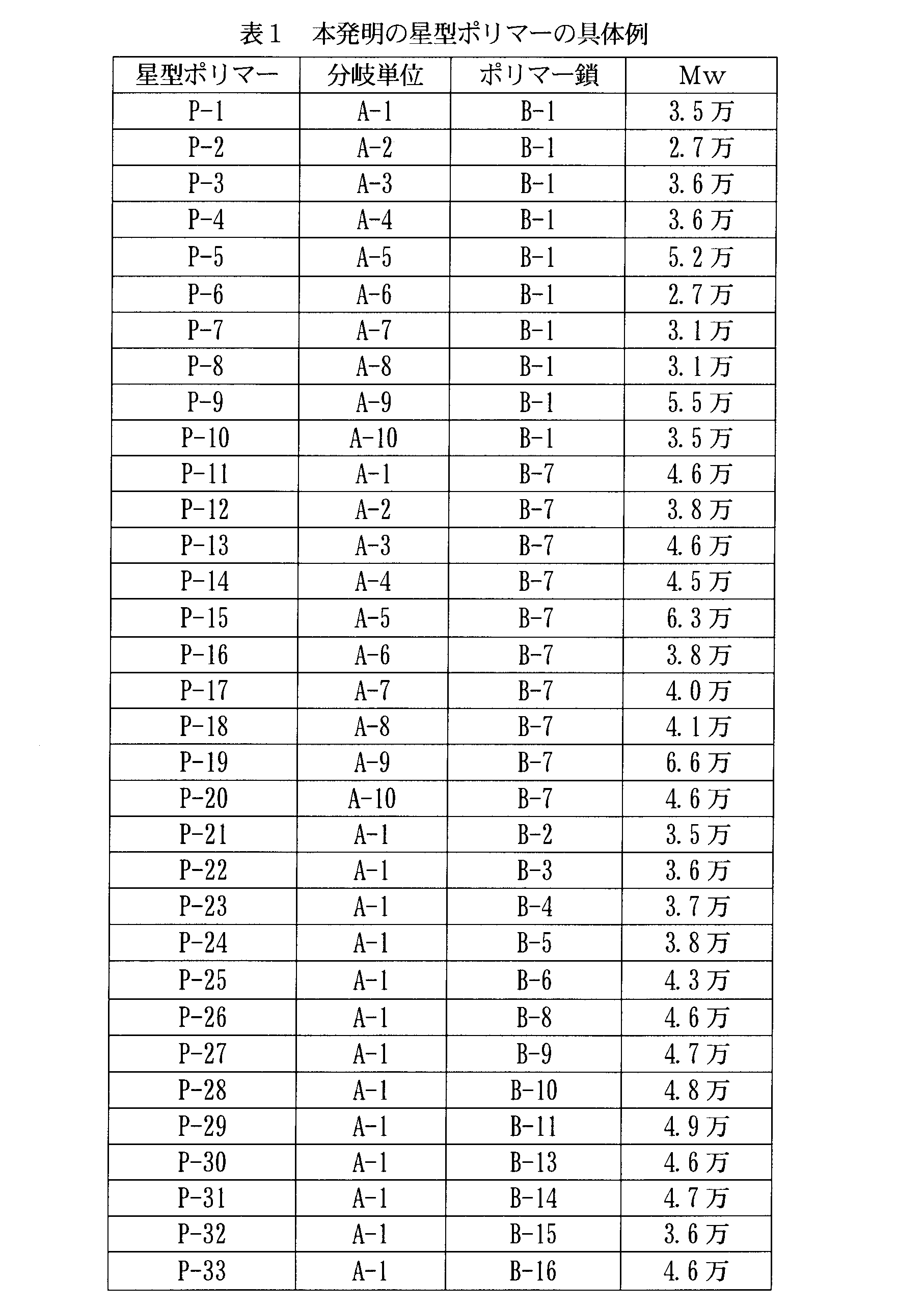
本発明の画像記録層には、機上現像性を向上させるため、ポリエチレンオキシ基を側鎖に有する高分子微粒子が用いられる。このようなポリエチレンオキシ基を有する高分子微粒子と前記星型ポリマーとの相互作用によって、現像後における平版印刷版の耐刷性を維持しつつ現像性が良化する。
ポリエチレンオキシ基のエチレンオキシ繰り返し単位は2~120個が好ましく、より好ましくは20~100個、特に好ましくは20~70個である。この範囲内で良好な耐刷性及び着肉性が得られる。

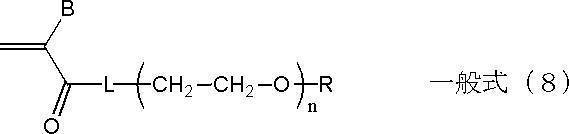

分子の主鎖中にエチレン性不飽和結合を有するポリマーの例としては、ポリ-1,4-ブタジエン、ポリ-1,4-イソプレンなどが挙げられる。
分子の側鎖中にエチレン性不飽和結合を有するポリマーの例としては、アクリル酸又はメタクリル酸のエステル又はアミドのポリマーであって、エステル又はアミドの残基(-COOR又はCONHRのR)がエチレン性不飽和結合を有するポリマーを挙げることができる。
アミド残基の具体例としては、-CH2 CH=CH2 、-CH2 CH2 -Y(式中、Yはシクロヘキセン残基を表す。)、-CH2 CH2 -OCO-CH=CH2 が挙げられる。
以下に本発明に用いられる高分子微粒子を形成するビニル樹脂の具体例(1)~(13)を示すが、本発明はこれらに限定されるものではない。共重合比はモル比である。
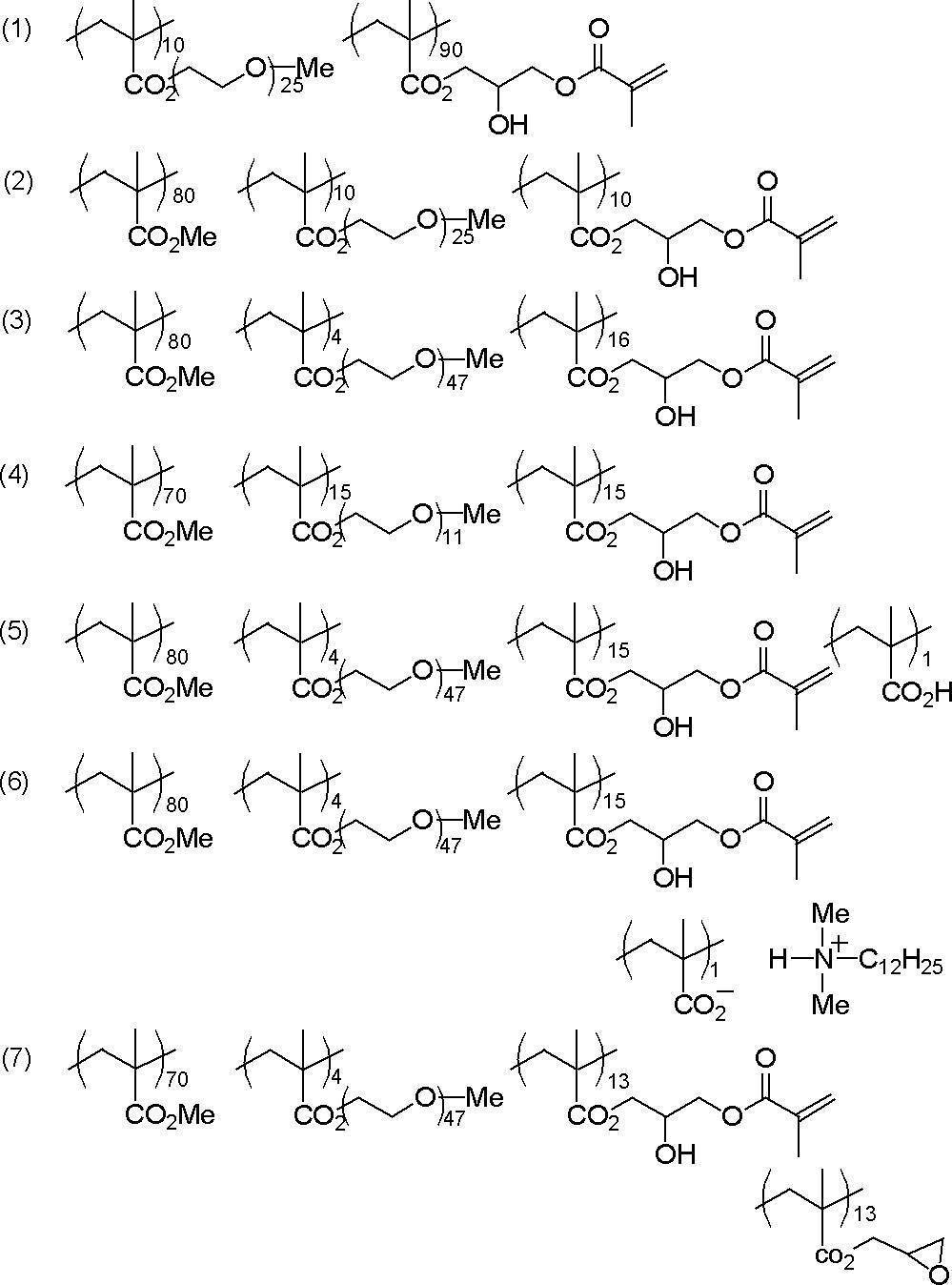
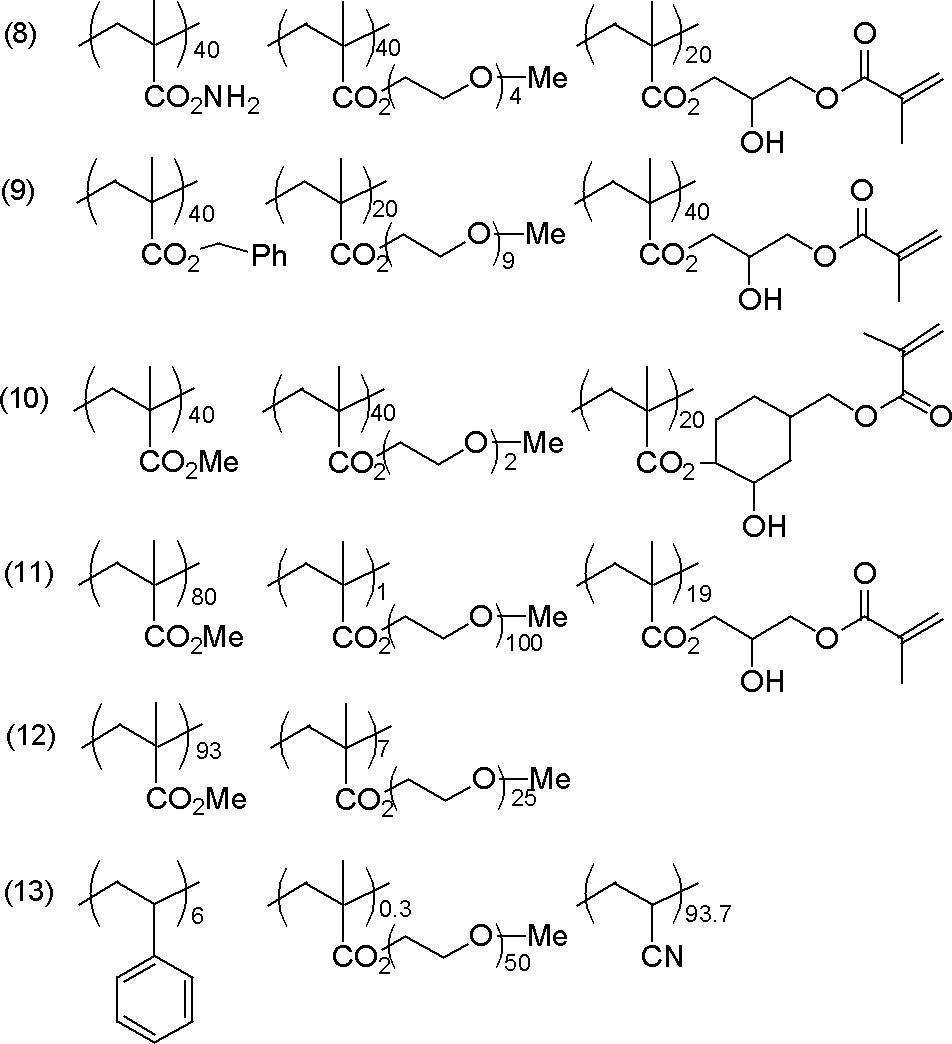
本発明の高分子微粒子の平均粒径は、10~1000nmの範囲が好ましく、より好ましくは20~300nmの範囲であり、特に好ましくは30~120nmの範囲である。
本発明に用いられる重合性化合物は、少なくとも一個のエチレン性不飽和二重結合を有する付加重合性化合物であり、末端エチレン性不飽和結合を少なくとも1個、好ましくは2個以上有する化合物から選ばれる。これらは、例えばモノマー、プレポリマー、すなわち2量体、3量体及びオリゴマー、又はそれらの混合物などの化学的形態を持つ。
CH2=C(R4)COOCH2CH(R5)OH (A)
(ただし、R4及びR5は、H又はCH3を示す。)
本発明に用いられる重合開始剤としては、重合性化合物の重合を開始、促進する化合物を示す。本発明において使用しうる重合開始剤としては、ラジカル重合開始剤が好ましく、公知の熱重合開始剤、結合解離エネルギーの小さな結合を有する化合物、光重合開始剤などを使用することができる。
本発明における重合開始剤としては、例えば、(a)有機ハロゲン化物、(b)カルボニル化合物、(c)アゾ化合物、(d)有機過酸化物、(e)メタロセン化合物、(f)アジド化合物、(g)ヘキサアリールビイミダゾール化合物、(h)有機ホウ酸塩化合物、(i)ジスルホン化合物、(j)オキシムエステル化合物、(k)オニウム塩化合物、等が挙げられる。
(g)ヘキサアリールビイミダゾール化合物としては、例えば、特開2008-195018号公報の段落番号[0027]に記載の化合物が好ましい。
本発明の平版印刷版原版の画像記録層には、上記の他に、赤外線吸収剤、低分子親水性化合物、感脂化剤などを添加することができる。
本発明の画像記録層は、赤外レーザー露光時の重合開始機能を向上させるため、赤外線吸収剤を含有することが好ましい。赤外線吸収剤は、吸収した赤外線を熱に変換する機能と赤外線により励起して重合開始剤に電子移動及び/又はエネルギー移動する機能を有する。本発明の赤外線吸収剤には、波長760~1200nmに吸収極大を有する染料又は顔料が用いられる。
これらの染料のうち特に好ましいものとしては、シアニン色素、スクワリリウム色素、ピリリウム塩、ニッケルチオレート錯体、インドレニンシアニン色素が挙げられる。更に、シアニン色素やインドレニンシアニン色素が好ましく、特に好ましい例として下記一般式(a)で示されるシアニン色素が挙げられる。
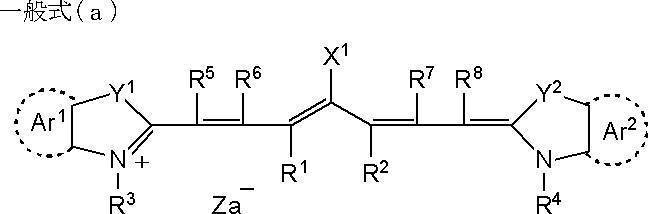
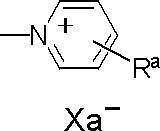
本発明における画像記録層は、耐刷性を低下させることなく機上現像性を向上させるために、低分子親水性化合物を含有してもよい。
低分子親水性化合物としては、例えば、水溶性有機化合物としては、エチレングリコール、ジエチレングリコール、トリエチレングリコール、プロピレングリコール、ジプロピレングリコール、トリプロピレングリコール等のグリコール類及びそのエーテル又はエステル誘導体類、グリセリン、ペンタエリスリトール、トリス(2-ヒドロキシエチル)イソシアヌレート等のポリオール類、トリエタノールアミン、ジエタノールアミン、モノエタノールアミン等の有機アミン類及びその塩、アルキルスルホン酸、トルエンスルホン酸、ベンゼンスルホン酸等の有機スルホン酸類及びその塩、アルキルスルファミン酸等の有機スルファミン酸類及びその塩、アルキル硫酸、アルキルエーテル硫酸等の有機硫酸類及びその塩、フェニルホスホン酸等の有機ホスホン酸類及びその塩、酒石酸、シュウ酸、クエン酸、リンゴ酸、乳酸、グルコン酸、アミノ酸類等の有機カルボン酸類及びその塩、ベタイン類、等が挙げられる。
これらの化合物は単独で用いてもよく、2種以上を混合して用いてもよい。
本発明の画像記録層には、着肉性を向上させるために、画像記録層にホスホニウム化合物、含窒素低分子化合物、アンモニウム基含有ポリマーなどの感脂化剤を用いることができる。特に、後述の保護層に無機質の層状化合物を含有させる場合、これらの化合物は、無機質の層状化合物の表面被覆剤として機能し、無機質の層状化合物による印刷途中の着肉性低下を防止する。
30質量%ポリマー溶液3.33g(固形分として1g)を、20mlのメスフラスコに秤量し、N-メチルピロリドンでメスアップする。この溶液を30℃の恒温槽で30分間静置し、ウベローデ還元比粘度管(粘度計定数=0.010cSt/s)に入れて30℃にて流れ落ちる時間を測定する。なお測定は同一サンプルで2回測定し、その平均値を算出する。同様にブランク(N-メチルピロリドンのみ)の場合も測定し、下記式から還元比粘度(ml/g)を算出した。

(1)2-(トリメチルアンモニオ)エチルメタクリレート=p-トルエンスルホナート/3,6-ジオキサヘプチルメタクリレート共重合体(モル比10/90 Mw4.5万)
(2)2-(トリメチルアンモニオ)エチルメタクリレート=ヘキサフルオロホスファート/3,6-ジオキサヘプチルメタクリレート共重合体(モル比20/80 Mw6.0万)
(3)2-(エチルジメチルアンモニオ)エチルメタクリレート=p-トルエンスルホナート/ヘキシルメタクリレート共重合体(モル比30/70 Mw4.5万)
(4)2-(トリメチルアンモニオ)エチルメタクリレート=ヘキサフルオロホスファート/2-エチルヘキシルメタクリレート共重合体(モル比20/80 Mw6.0万)
(5)2-(トリメチルアンモニオ)エチルメタクリレート=メチルスルファート/ヘキシルメタクリレート共重合体(モル比40/60 Mw7.0万)
(6)2-(ブチルジメチルアンモニオ)エチルメタクリレート=ヘキサフルオロホスファート/3,6-ジオキサヘプチルメタクリレート共重合体(モル比 25/75 Mw6.5万)
(7)2-(ブチルジメチルアンモニオ)エチルアクリレート=ヘキサフルオロホスファート/3,6-ジオキサヘプチルメタクリレート共重合体(モル比20/80 Mw6.5万)
(8)2-(ブチルジメチルアンモニオ)エチルメタクリレート=13-エチル-5,8,11-トリオキサ-1-ヘプタデカンスルホナート/3,6-ジオキサヘプチルメタクリレート共重合体(モル比20/80 Mw7.5万)
(9)2-(ブチルジメチルアンモニオ)エチルメタクリレート=ヘキサフルオロホスファート/3,6-ジオキサヘプチルメタクリレート/2-ヒドロキシ-3-メタクロイルオキシプロピルメタクリレート共重合体(モル比15/80/5 Mw6.5万)
更にその他の成分として、界面活性剤、着色剤、焼き出し剤、重合禁止剤、高級脂肪酸誘導体、可塑剤、無機微粒子、無機層状化合物、及び共増感剤若しくは連鎖移動剤などを添加することができる。具体的には、特開2008-284817号公報の段落番号[0114]~[0159]、特開2006-091479号公報の段落番号[0023]~[0027]、米国特許公開2008/0311520号明細書段落番号[0060]に記載の化合物及び添加量が好ましい。
本発明における画像記録層は、例えば、特開2008-195018号公報の段落番号[0142]~[0143]に記載のように、必要な上記各成分を公知の溶剤に分散又は溶解して塗布液を調製し、これを支持体上にバーコーター塗布など公知の方法で塗布し、乾燥することで形成される。塗布、乾燥後に得られる支持体上の画像記録層塗布量(固形分)は、用途によって異なるが、一般的に0.3~3.0g/m2が好ましい。この範囲で、良好な感度と画像記録層の良好な皮膜特性が得られる。
本発明の平版印刷版原版は、画像記録層と支持体との間に下塗り層(中間層と呼ばれることもある)を設けることが好ましい。下塗り層は、露光部においては支持体と画像記録層との密着を強化し、未露光部においては画像記録層の支持体からのはく離を生じやすくさせるため、耐刷性を損なわず現像性を向上させるのに寄与する。また、赤外線レーザー露光の場合は、下塗り層が断熱層として機能することにより、露光により発生した熱が支持体に拡散して感度が低下するのを防ぐ。
より好ましいものとして、特開2005-125749号及び特開2006-188038号公報に記載の支持体表面に吸着可能な吸着性基、親水性基、及び架橋性基を有する高分子ポリマーが挙げられる。
下塗り層用の高分子ポリマーは、質量平均モル質量が5000以上であるのが好ましく、1万~30万であるのがより好ましい。
本発明の平版印刷版原版に用いられる支持体としては、公知の表面親水性の支持体が用いられる。なかでも、公知の方法で粗面化処理され、陽極酸化処理されたアルミニウム板が好ましい。
また、上記アルミニウム板は必要に応じて、特開2001-253181号公報や特開2001-322365号公報に記載されている陽極酸化皮膜のマイクロポアの拡大処理や封孔処理、及び米国特許第2,714,066号、同第3,181,461号、同第3,280,734号及び同第3,902,734号の各明細書に記載されているようなアルカリ金属シリケートあるいは米国特許第3,276,868号、同第4,153,461号及び同第4,689,272号の各明細書に記載されているようなポリビニルホスホン酸などによる表面親水化処理を適宜選択して行うことができる。
支持体は、中心線平均粗さが0.10~1.2μmであるのが好ましい。
本発明の平版印刷版原版は、画像記録層の上に保護層(オーバーコート層)を設けることが好ましい。保護層は酸素遮断によって画像形成阻害反応を抑制する機能の他、画像記録層における傷の発生防止、及び高照度レーザー露光時のアブレーション防止の機能を有する。
変性ポリビニルアルコールとしては、カルボン酸基又はスルホン酸基を有する酸変性ポリビニルアルコールが好ましく用いられる。具体的には、特開2005-250216号公報、特開2006-259137号公報記載の変性ポリビニルアルコールが好適に挙げられる。
また、保護層には、可撓性付与のための可塑剤、塗布性を向上させための界面活性剤、表面の滑り性を制御する無機微粒子など公知の添加物を含むことができる。また、画像記録層の説明に記載した感脂化剤を保護層に含有させることもできる。
本発明の平版印刷版原版は、画像露光後、現像処理を行うか又は印刷機上で現像することにより製版され、印刷に用いられる。
平版印刷版原版は、線画像、網点画像等を有する透明原画を通してレーザー露光するかデジタルデータによるレーザー光走査等で画像様に露光される。
光源の波長は750~1400nmが好ましく用いられる。750~1400nmの光源としては、赤外線を放射する固体レーザー及び半導体レーザーが好適である。赤外線レーザーに関しては、出力は100mW以上であることが好ましく、1画素当たりの露光時間は20マイクロ秒以内であるのが好ましく、また照射エネルギー量は10~300mJ/cm2であるのが好ましい。また、露光時間を短縮するためマルチビームレーザーデバイスを用いることが好ましい。露光機構は、内面ドラム方式、外面ドラム方式、フラットベッド方式等の何れでもよい。
画像露光は、プレートセッターなどを用いて常法により行うことができる。機上現像の場合には、平版印刷版原版を印刷機に装着した後、印刷機上で画像露光を行ってもよい。
現像処理は、(1)pHが2~14の現像液にて現像する方法(現像液処理方式)、又は(2)印刷機上で、湿し水及び/又はインキを加えながら現像する方法(機上現像方式)で行うことができる。
現像液処理方式においては、画像露光された平版印刷版原版は、pHが2~14の現像液により処理され、非露光部の画像記録層が除去されて平版印刷版が作製される。
高アルカリ性現像液(pH14以上)を用いる現像処理においては、通常、前水洗工程により保護層を除去し、次いでアルカリ現像を行い、後水洗工程でアルカリを水洗除去し、ガム液処理を行い、乾燥工程で乾燥して平版印刷版が作製される。
本発明の好ましい態様によれば、pHが8~12の現像液が使用される。この態様においては、現像液中に界面活性剤又は水溶性高分子化合物を含有させることが好ましく、これにより現像とガム液処理を同時に行うことが可能となる。よって後水洗工程は特に必要とせず、1液で現像-ガム液処理を行うことができる。更に、前水洗工程も特に必要とせず、保護層の除去も現像-ガム液処理と同時に行うことができる。現像-ガム処理の後に、例えば、スクイズローラを用いて余剰の現像液を除去した後、乾燥を行うことが好ましい。
上記大豆多糖類は、公知のものが使用でき、例えば市販品として商品名ソヤファイブ(不二製油(株)製)があり、各種グレードのものを使用することができる。好ましく使用できるものは、10質量%水溶液の粘度が10~100mPa/secの範囲にあるものである。
上記変性澱粉も、公知のものが使用でき、例えば、トウモロコシ、じゃがいも、タピオカ、米、小麦等の澱粉を酸又は酵素等で1分子当たりグルコース残基数5~30の範囲で分解し、更にアルカリ中でオキシプロピレンを付加する方法等で作ることができる。
炭酸イオン及び炭酸水素イオンを現像液中に存在させるには、炭酸塩と炭酸水素塩を現像液に加えてもよいし、炭酸塩又は炭酸水素塩を加えた後にpHを調整することで、炭酸イオンと炭酸水素イオンを発生させてもよい。炭酸塩及び炭酸水素塩は、特に限定されないが、アルカリ金属塩であることが好ましい。アルカリ金属としては、リチウム、ナトリウム、カリウムが挙げられ、ナトリウムが特に好ましい。アルカリ金属は単独でも、二種以上を組み合わせて用いてもよい。
炭酸イオン及び炭酸水素イオンの総量は、現像液に対して0.05~5mol/Lが好ましく、0.07~2mol/Lがより好ましく、0.1~1mol/Lが特に好ましい。
機上現像方式においては、画像露光された平版印刷版原版は、印刷機上で油性インキ又は水性成分を供給し、非画像部の画像記録層が除去されて平版印刷版が作製される。
すなわち、平版印刷版原版を画像露光後、なんらの現像処理を施すことなくそのまま印刷機に装着するか、あるいは、平版印刷版原版を印刷機に装着した後、印刷機上で画像露光し、ついで、油性インキと水性成分とを供給して印刷すると、印刷途上の初期の段階で、非画像部においては、供給された油性インキ及び/又は水性成分によって、未硬化の画像記録層が溶解又は分散して除去され、その部分に親水性の表面が露出する。一方、露光部においては、露光により硬化した画像記録層が、親油性表面を有する油性インキ受容部を形成する。最初に版面に供給されるのは、油性インキでもよく、水性成分でもよいが、水性成分が除去された画像記録層成分によって汚染されることを防止する点で、最初に油性インキを供給することが好ましい。このようにして、平版印刷版原版は印刷機上で機上現像され、そのまま多数枚の印刷に用いられる。油性インキ及び水性成分としては、通常の平版印刷用の印刷インキと湿し水が好適に用いられる。
窒素気流下、80℃に加熱した1-メトキシ-2-プロパノール:330gに、ブレンマーPME-100(メトキシポリエチレングリコールモノメタクリレート(エチレングリコール繰り返し単位数n=2)、日本油脂(株)製):101g、メチルメタクリレート:125g、テトラキス(メルカプト酢酸)ペンタエリスリトール:2.3g、V-601(ジメチル2,2’-アゾビス(2-メチルプロピオネート)、和光純薬工業(株)製):2.4g、1-メトキシ-2-プロパノール:330gから成る混合溶液を2時間30分かけて滴下した。滴下終了後、更に3時間反応を続けた。反応後、よく攪拌した水:4000gに注ぐと固体が析出した。析出した固体をろ過し、水洗後減圧下にて乾燥して、上記構造式で表される星型ポリマー(P-1)を得た。こうして得られた、上記構造式で表される星型ポリマー(P-1)溶液のGPCで測定した該星型ポリマーの質量平均モル質量(Mw)は、3.5万であった。
星型ポリマー(P-2)~(P-10)、(P-21)~(P-25)及び(P-32)は、星型ポリマー(P-1)と同様の方法により合成した。
窒素気流下、80℃に加熱した1-メトキシ-2-プロパノール:330gに、ブレンマーPME-100:188g、メチルメタクリレート:125g、メタクリル酸:21.5g、テトラキス(メルカプト酢酸)ペンタエリスリトール:2.3g、V-601(和光純薬工業(株)製):2.4g、1-メトキシ-2-プロパノール:330gから成る混合溶液を2時間30分かけて滴下した。滴下終了後、更にV-601:0.143gを加え、90℃に昇温して2時間反応を続けた。反応後、50℃まで冷却した後に1-メトキシ-2-プロパノール:145.66gを加えて反応液を希釈した。得られた反応混合物に、4-ヒドロキシ-2,2,6,6-テトラメチルピペリジン-1-オキシドフリーラジカル:0.971gとグリシジルメタクリレート:35.5gと1-メトキシ-2-プロパノール:13.6gからなる混合用液を加えて5分間攪拌した。反応混合物を90℃に昇温して10分間攪拌した後、テトラエチルアンモニウムブロミド:2.21gを加え、1-メトキシ-2-プロパノール:30.47gで反応容器の壁に付着したテトラエチルアンモニウムブロミドを洗い流した。90℃にて18時間攪拌した後、1-メトキシ-2-プロパノール:297.0gを加えて反応混合物を希釈した。こうして得られた、上記構造式で表される星型ポリマー(P-11)溶液のGPCで測定した該星型ポリマーの質量平均モル質量(Mw)は、4.6万であった。
星型ポリマー(P-12)~(P-20)、(P-26)~(P-31)及び(P-33)は、星型ポリマー(P-11)と同様の方法により合成した。
(1)支持体の作製
厚み0.3mmのアルミニウム板(材質JIS A 1050)の表面の圧延油を除去するため、10質量%アルミン酸ソーダ水溶液を用いて50℃で30秒間、脱脂処理を施した後、毛径0.3mmの束植ナイロンブラシ3本とメジアン径25μmのパミス-水懸濁液(比重1.1g/cm3)を用いアルミニウム表面を砂目立てして、水でよく洗浄した。この板を45℃の25質量%水酸化ナトリウム水溶液に9秒間浸漬してエッチングを行い、水洗後、更に60℃で20質量%硝酸水溶液に20秒間浸漬し、水洗した。この時の砂目立て表面のエッチング量は約3g/m2であった。
次に、この板に15質量%硫酸水溶液(アルミニウムイオンを0.5質量%含む)を電解液として電流密度15A/dm2で2.5g/m2の直流陽極酸化皮膜を設けた後、水洗、乾燥して支持体(1)を作製した。
その後、非画像部の親水性を確保するため、支持体(1)に2.5質量%3号ケイ酸ソーダ水溶液を用いて60℃で10秒間、シリケート処理を施し、その後、水洗して支持体(2)を得た。Siの付着量は10mg/m2であった。この基板の中心線平均粗さ(Ra)を直径2μmの針を用いて測定したところ、0.51μmであった。
次に、上記支持体(2)上に、下記下塗り層用塗布液(1)を乾燥塗布量が20mg/m2になるよう塗布して、下塗り層を有する支持体を作製した。
・下記構造の下塗り層用化合物(1) 0.18g
・ヒドロキシエチルイミノ二酢酸 0.10g
・メタノール 55.24g
・水 6.15g
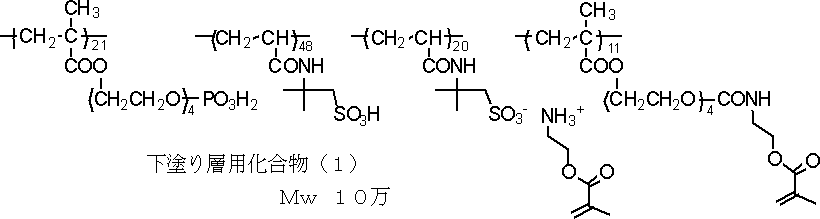
下塗り層を有する上記の支持体に、下記の画像記録層塗布液(1)をバー塗布した後、70℃、60秒でオーブン乾燥し、乾燥塗布量0.6g/m2の画像記録層を設けて、平版印刷版原版(1)~(16)を得た。
・高分子微粒子水分散液[表2記載](固形分としての質量)4.0g
・赤外線吸収染料(2)[下記構造] 0.2g
・重合開始剤 Irgacure250(BASF社製) 0.5g
・重合性化合物 SR-399(サートマー社製) 1.50g
・メルカプト-3-トリアゾール 0.2g
・高分子化合物(星型ポリマー)[表2記載] 4.5g
・n-プロパノール 55.0g
・2-ブタノン 17.0g
・IRGACURE 250:(4-メトキシフェニル)[4-(2-メチルプロピル)フェニル]ヨードニウム=ヘキサフルオロホスファート(75質量%プロピレンカーボナート溶液)
・SR-399:ジペンタエリスリトールペンタアクリレート
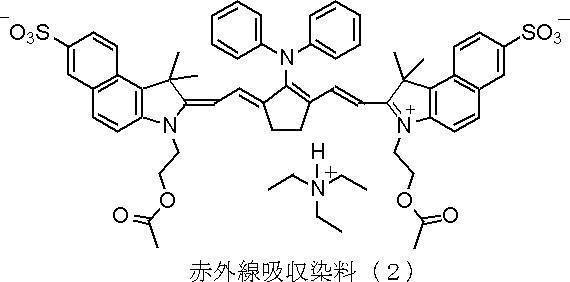
1000mlの4つ口フラスコに撹拌機、温度計、滴下ロート、窒素導入管、還流冷却器を施し、窒素ガスを導入して脱酸素を行いつつ、ポリエチレングリコールメチルエーテルメタクリレート(PEGMA エチレングリコールの平均の繰返し単位は50)10g、蒸留水200g及びn-プロパノール200gを加えて内温が70℃となるまで加熱した。次に予め混合されたスチレン(St)10g、アクリロニトリル(AN)80g及び2,2’-アゾビスイソブチロニトリル0.8gの混合物を1時間かけて滴下した。滴下終了後5時間そのまま反応を続けた後、2,2’-アゾビスイソブチロニトリル0.4gを添加し、内温を80℃まで上昇させた。続いて、0.5gの2,2’-アゾビスイソブチロニトリルを6時間かけて添加した。合計で20時間反応させた段階でポリマー化は98%以上進行しており、質量比でPEGMA/St/AN=10/10/80の高分子微粒子水分散液(1)が得られた。この高分子微粒子の粒径分布は、粒子径150nmに極大値を有していた。
上記のようにして得られた平版印刷版原版(6)の画像記録層上に、更に下記組成の保護層塗布液(1)をバー塗布した後、120℃、60秒でオーブン乾燥し、乾燥塗布量0.15g/m2の保護層を形成して平版印刷版原版(17)を得た。
・無機質層状化合物分散液(1) 1.5g
・ポリビニルアルコール(日本合成化学工業(株)製CKS50、スルホン酸変性、
けん化度99モル%以上、重合度300)6質量%水溶液
0.55g
・ポリビニルアルコール((株)クラレ製PVA-405、
けん化度81.5モル%、重合度500)6質量%水溶液
0.03g
・日本エマルジョン(株)製界面活性剤
(エマレックス710)1質量%水溶液 0.86g
・イオン交換水 6.0g
イオン交換水193.6gに合成雲母ソマシフME-100(コープケミカル(株)製)6.4gを添加し、ホモジナイザーを用いて平均粒径(レーザー散乱法)が3μmになるまで分散した。得られた分散粒子のアスペクト比は100以上であった。
(1)機上現像性
得られた平版印刷版原版を赤外線半導体レーザー搭載の富士フイルム(株)製Luxel PLATESETTER T-6000IIIにて、外面ドラム回転数1000rpm、レーザー出力70%、解像度2400dpiの条件で露光した。露光画像にはベタ画像及び20μmドットFMスクリーンの50%網点チャートを含むようにした。
得られた露光済み原版を現像処理することなく、(株)小森コーポレーション製印刷機LITHRONE26の版胴に取り付けた。Ecolity-2(富士フイルム(株)製)/水道水=2/98(容量比)の湿し水とFusion-G EZ紅 Nインキ(DIC(株)製)とを用い、LITHRONE26の標準自動印刷スタート方法で湿し水とインキとを供給して機上現像した後、毎時10000枚の印刷速度で、特菱アート(76.5kg)紙(三菱製紙製)に印刷を100枚行った。
画像記録層の未露光部の印刷機上での機上現像が完了し、非画像部にインキが転写しない状態になるまでに要した印刷用紙の枚数を機上現像性として計測した。結果を表2に示す。
上述した機上現像性の評価を行った後、得られた平版印刷版を用いて更に印刷を続けた。印刷枚数を増やしていくと徐々に画像記録層が磨耗するため印刷物上のインキ濃度が低下した。印刷物におけるFMスクリーン50%網点の網点面積率をグレタグ濃度計で計測した値が印刷100枚目の計測値よりも5%低下したときの印刷部数を刷了枚数として耐刷性を評価した。結果を表2に示す。
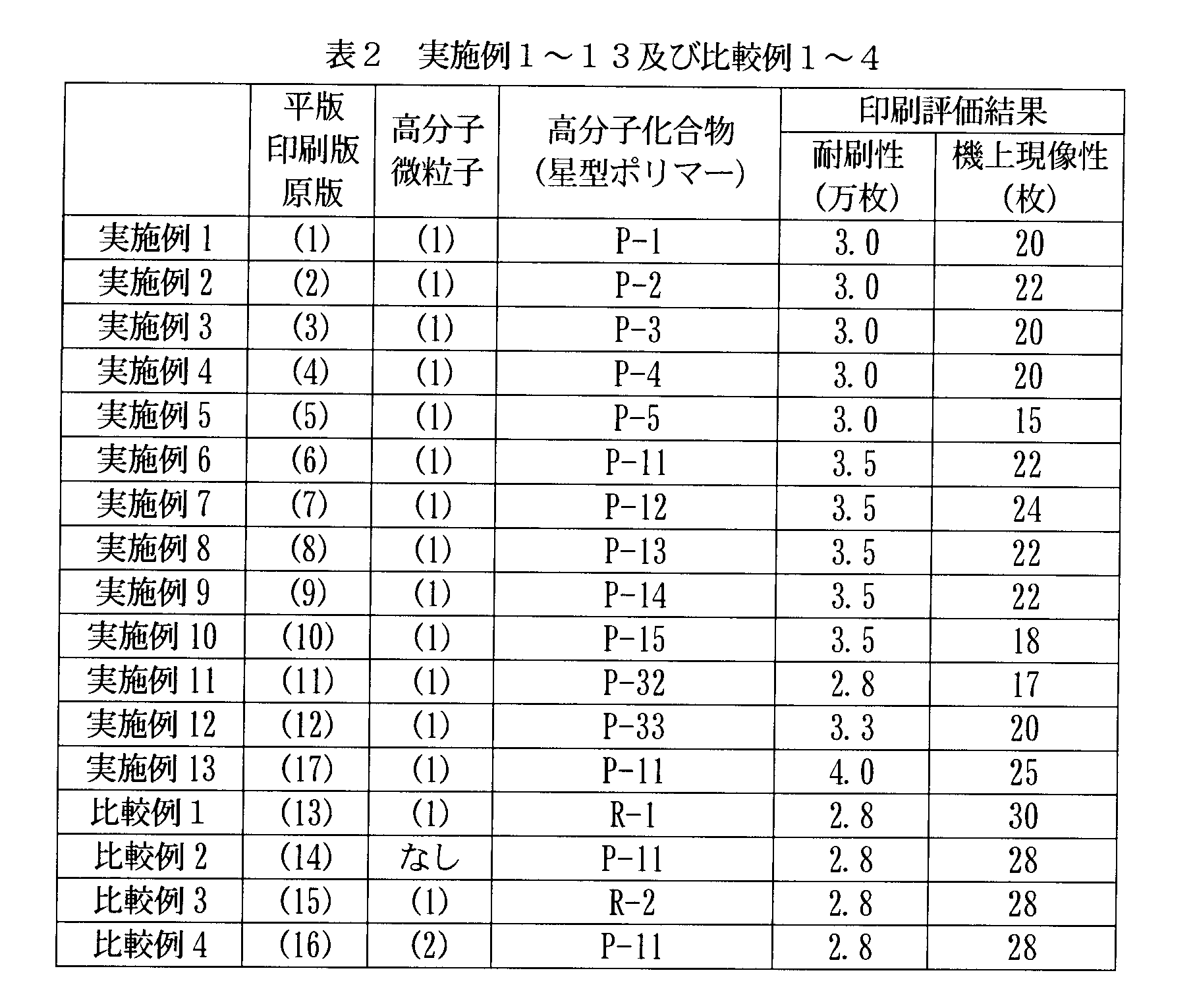
1000mlの4つ口フラスコに撹拌機、温度計、滴下ロート、窒素導入管、還流冷却器を施し、窒素ガスを導入して脱酸素を行いつつ蒸留水300mLを加えて内温が80℃となるまで加熱した。分散剤としてドデシル硫酸ナトリウム1.5gを添加し、更に開始剤として過硫化アンモニウム0.45gを添加し、次いでスチレン5.0g、アクリロニトリル40.0gを滴下ロートから約1時間かけて滴下した。滴下終了後5時間そのまま反応を続けた後、水蒸気蒸留で未反応単量体を除去した。その後冷却しアンモニア水でpH6に調整し、最後に不揮発分が15質量%となるように純水を添加して高分子微粒子水分散液(2)を得た。高分子微粒子水分散液(1)の場合と同様に測定したこの高分子微粒子の粒径分布は、粒子径60nmに極大値を有していた。
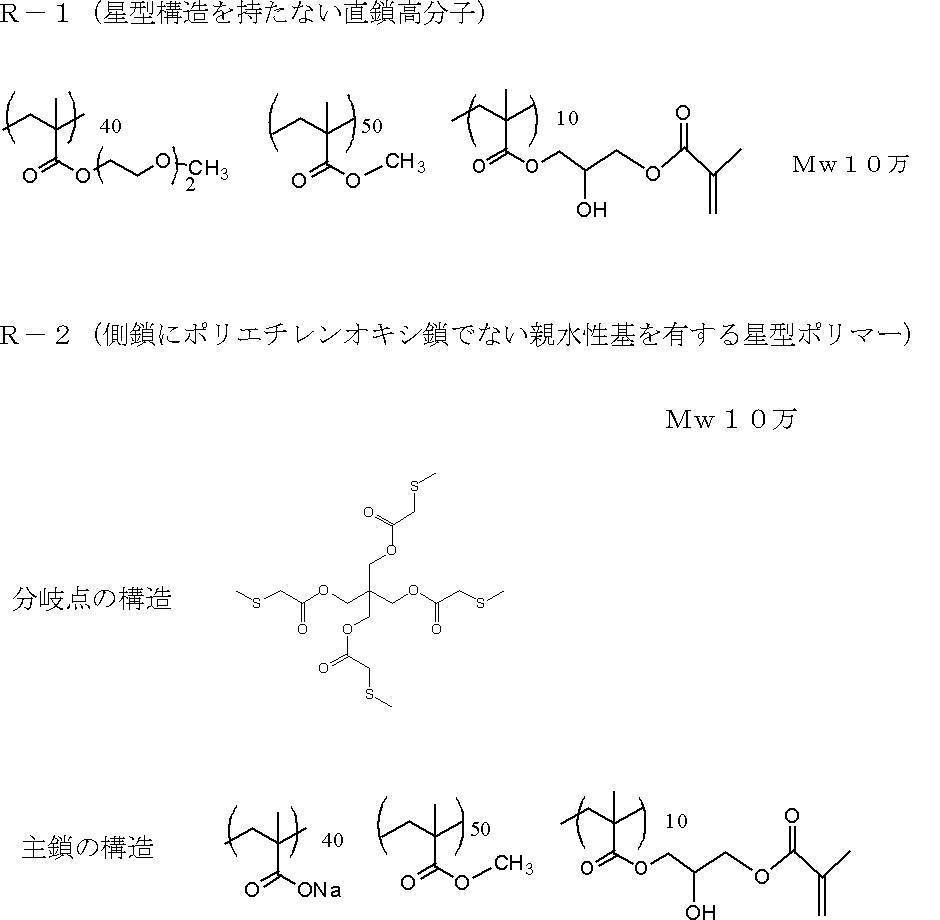
前記のようにして得られた平版印刷版原版(1)~(17)を赤外線半導体レーザー搭載の富士フイルム(株)製Luxel PLATESETTER T-6000IIIにて、外面ドラム回転数1000rpm、レーザー出力70%、解像度2400dpiの条件で露光した。露光画像にはベタ画像及び20μmドットFMスクリーンの50%網点チャートを含むようにした。
下記組成の現像液(1)を用い、図2に示すような構造の自動現像処理機にて現像処理を実施した。ここで、自動現像処理機は、平版印刷版原版(以下「PS版」という。)4を現像する現像部6と、現像後のPS版4を乾燥する乾燥部10とを備えている。自動現像処理機の側板には挿入口が形成されており(図2左側部分)、挿入口から挿入されたPS版4は、自動現像処理機の側板の内側面に設けられた搬入ローラ16により現像部6へ搬送される。現像部6の現像槽20内には、搬送方向上流側から順に、搬送ローラ22、ブラシローラ24、スクイズローラ26が備えられ、これらの間の適所にバックアップローラ28が備えられている。PS版4は搬送ローラ22により搬送されながら現像液中を浸漬されてブラシローラ24を回転させることによりPS版4の保護層及び画像記録層未露光部の除去を行って現像処理される。現像処理されたPS版4はスクイズローラ(搬出ローラ)26により次の乾燥部10へ搬送される。乾燥部10は、搬送方向上流側から順に、ガイドローラ36、一対の串ローラ38が設けられている。また、乾燥部10には図示しない温風供給手段、発熱手段等の乾燥手段が設けられている。乾燥部10には排出口が設けられ、乾燥手段により乾燥されたPS版4は排出されて、PS版に対する自動現像処理が完了する。実施例で使用した自動現像処理機は、ポリブチレンテレフタレート製の繊維(毛の直径200μm、毛の長さ17mm)を植え込んだ外径50mmのブラシローラを1本有し、搬送方向と同一方向に毎分200回転(ブラシの先端の周速0.52m/sec)させた。現像液の温度は30℃であった。平版印刷版原版の搬送は、搬送速度82cm/min(現像性を評価する際は搬送速度を変化させた)で行った。現像処理後、乾燥部にて乾燥を行った。乾燥温度は80℃であった。
以下の表3に、実施例及び比較例で使用した現像液1の組成を示す。なお、下記ニューコールB13(日本乳化剤(株)製)は、ポリオキシエチレン β-ナフチルエーテル(オキシエチレン平均数n=13)であり、また、アラビアガムは、質量平均モル質量(Mw)が20万のものを使用した。
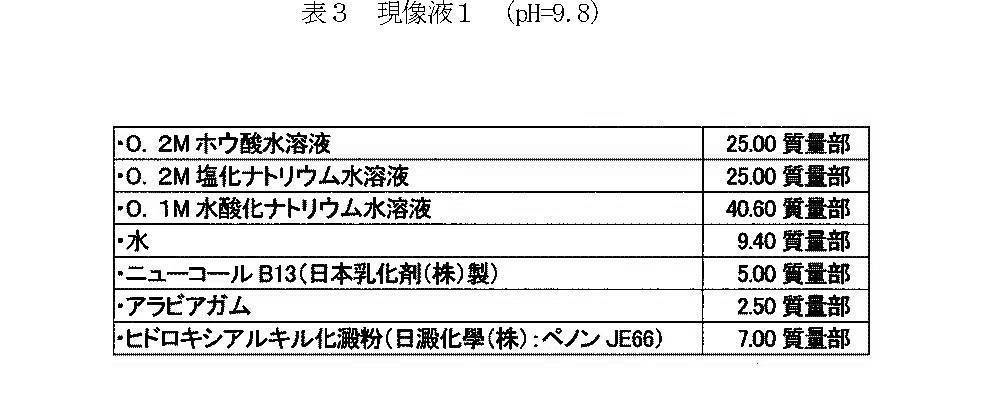
耐刷性及び現像性を下記のように評価した。結果を表4に示す。
種々の搬送速度にて現像を行い、非画像部のシアン濃度をマクベス濃度計(Gretag Macbeth社製)により測定した。非画像部のシアン濃度がアルミニウム基板のシアン濃度と同等になった搬送速度を求め、この搬送速度における原版の先頭部が現像液に浸漬されてから、原版の先頭部が現像液から出てくるまでの時間を現像時間とし、現像性の評価とした。
上述した現像性の評価を行った後、得られた平版印刷版を用いて更に印刷を行った。印刷枚数を増やしていくと徐々に画像記録層が磨耗するため印刷物上のインキ濃度が低下した。印刷物におけるFMスクリーン50%網点の網点面積率をグレタグ濃度計で計測した値が印刷100枚目の計測値よりも5%低下したときの印刷部数を刷了枚数として耐刷性を評価した。結果を表4に示す。
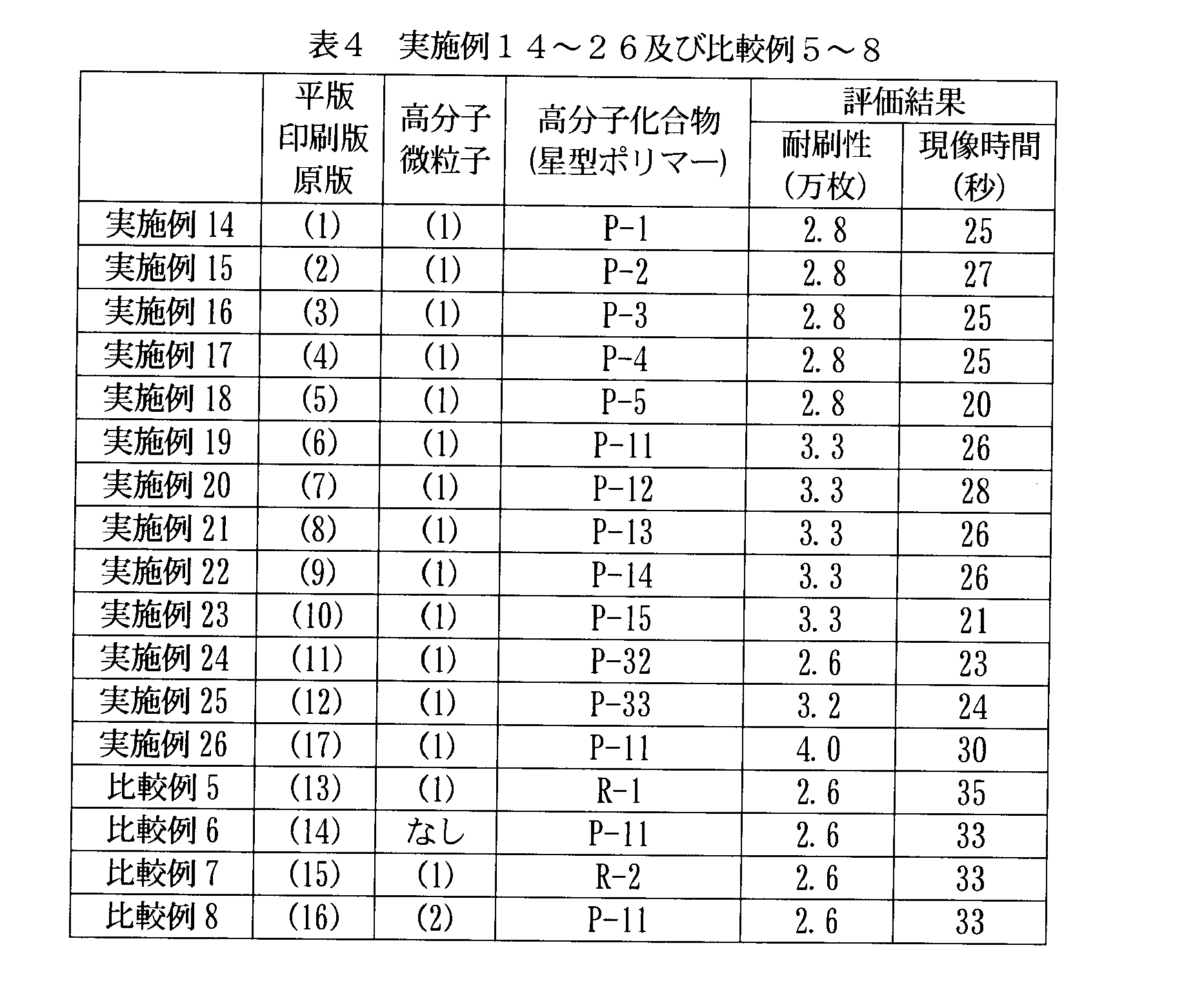
本出願は、2010年12月28日出願の日本特許出願(特願2010-294337)に基づくものであり、その内容はここに参照として取り込まれる。
6 現像部
10 乾燥部
16 搬入ローラ
20 現像槽
22 搬送ローラ
24 ブラシローラ
26 スクイズローラ(搬出ローラ)
28 バックアップローラ
36 ガイドローラ
38 串ローラ
Claims (8)
- 表面親水性の支持体上に、重合性化合物、重合開始剤、ポリエチレンオキシ基を側鎖に有する高分子微粒子、及び高分子化合物を含有する画像記録層を有する平版印刷版原版であって、高分子化合物が、主鎖が3つ以上に分岐した星型形状を有し、分岐した主鎖の側鎖にポリエチレンオキシ基及びポリプロピレンオキシ基の少なくともいずれかを有することを特徴とする平版印刷版原版。
- 主鎖が3つ以上に分岐した星型形状を有する高分子化合物が、分岐した主鎖の側鎖にエチレン性不飽和基を有することを特徴とする請求項1に記載の平版印刷版原版。
- 主鎖が3つ以上に分岐した星型形状を有する高分子化合物が、分岐した主鎖の側鎖にポリエチレンオキシ基を有することを特徴とする請求項1又は請求項2に記載の平版印刷版原版。
- 主鎖が3つ以上に分岐した星型形状を有する高分子化合物が、チオール基を3つ以上有する化合物の存在下で、ポリエチレンオキシ基及びポリプロピレンオキシ基の少なくともいずれかを有するモノマーをラジカル重合して得られることを特徴とする請求項1~3のいずれか一項に記載の平版印刷版原版。
- 画像記録層が赤外線吸収剤を含有することを特徴とする請求項1~4のいずれか一項に記載の平版印刷版原版。
- 画像記録層上に保護層を有することを特徴とする請求項1~5のいずれか一項に記載の平版印刷版原版。
- 画像記録層が印刷インキ及び湿し水のうち少なくともいずれかにより除去可能であることを特徴とする請求項1~6のいずれか一項に記載の平版印刷版原版。
- 請求項7に記載の平版印刷版原版を、印刷機に装着し、レーザーで画像様に露光した後、又は、レーザーで画像様に露光した後、印刷機に装着し、該平版印刷版原版に印刷インキ及び湿し水の少なくともいずれかを供給して、画像記録層の未露光部分を除去し、印刷する平版印刷方法。
Priority Applications (3)
| Application Number | Priority Date | Filing Date | Title |
|---|---|---|---|
| CN201180062679.1A CN103282211B (zh) | 2010-12-28 | 2011-11-30 | 平版印刷版原版和平版印刷方法 |
| BR112013016909-5A BR112013016909B1 (pt) | 2010-12-28 | 2011-11-30 | Precursor de chapa de impressão litográfica e método de impressão litográfica |
| EP11852391.9A EP2660068B1 (en) | 2010-12-28 | 2011-11-30 | Planographic printing plate precursor and planographic printing method |
Applications Claiming Priority (2)
| Application Number | Priority Date | Filing Date | Title |
|---|---|---|---|
| JP2010294337 | 2010-12-28 | ||
| JP2010-294337 | 2010-12-28 |
Publications (1)
| Publication Number | Publication Date |
|---|---|
| WO2012090639A1 true WO2012090639A1 (ja) | 2012-07-05 |
Family
ID=46382759
Family Applications (1)
| Application Number | Title | Priority Date | Filing Date |
|---|---|---|---|
| PCT/JP2011/077709 Ceased WO2012090639A1 (ja) | 2010-12-28 | 2011-11-30 | 平版印刷版原版及び平版印刷方法 |
Country Status (5)
| Country | Link |
|---|---|
| EP (1) | EP2660068B1 (ja) |
| JP (1) | JP5715936B2 (ja) |
| CN (1) | CN103282211B (ja) |
| BR (1) | BR112013016909B1 (ja) |
| WO (1) | WO2012090639A1 (ja) |
Cited By (3)
| Publication number | Priority date | Publication date | Assignee | Title |
|---|---|---|---|---|
| JP2012148555A (ja) * | 2010-12-28 | 2012-08-09 | Fujifilm Corp | 平版印刷版原版及びその平版印刷方法 |
| US9802889B2 (en) | 2014-12-02 | 2017-10-31 | Covalent Research Technologies, LLC | Solid supported trithiol compounds for removing heavy metals from solution, and filtration systems utilizing the compounds |
| JPWO2019044432A1 (ja) * | 2017-08-31 | 2020-03-26 | 富士フイルム株式会社 | 硬化性組成物、硬化物、カラーフィルタ、カラーフィルタの製造方法、固体撮像素子及び画像表示装置 |
Families Citing this family (14)
| Publication number | Priority date | Publication date | Assignee | Title |
|---|---|---|---|---|
| EP2916171B1 (en) | 2014-03-03 | 2017-05-31 | Agfa Graphics Nv | A method for making a lithographic printing plate precursor |
| CN110678335B (zh) * | 2017-05-31 | 2021-11-16 | 富士胶片株式会社 | 平版印刷版原版、平版印刷版的制作方法、聚合物粒子及组合物 |
| EP3730307B1 (en) * | 2018-01-31 | 2024-10-23 | FUJIFILM Corporation | Planographic printing plate precursor and production method for planographic printing plate |
| EP3587112B1 (en) | 2018-06-21 | 2024-04-03 | Eco3 Bv | A lithographic printing plate precursor |
| EP3587113B1 (en) | 2018-06-21 | 2023-01-04 | Agfa Offset Bv | A lithographic printing plate precursor |
| CN112698548B (zh) * | 2019-10-23 | 2023-12-08 | 乐凯华光印刷科技有限公司 | 一种长印程uv-ctp版及其制备方法和应用方法 |
| EP3875271B1 (en) | 2020-03-04 | 2025-10-15 | Eco3 Bv | A lithographic printing plate precursor |
| EP3892469B1 (en) | 2020-04-10 | 2023-11-08 | Eco3 Bv | Lithographic printing plate precursor |
| EP3960455B1 (en) | 2020-08-31 | 2025-08-06 | Eco3 Bv | A lithographic printing plate precursor, a method for making a lithographic printing plate precursor and a method for making a lithographic printing plate |
| EP4225582B1 (en) | 2020-10-09 | 2024-08-28 | Eco3 Bv | A lithographic printing plate precursor |
| CN116601006A (zh) | 2020-12-16 | 2023-08-15 | 爱克发胶印有限公司 | 平版印刷机印活准备方法 |
| EP4035897A1 (en) | 2021-01-28 | 2022-08-03 | Agfa Offset Bv | A lithographic printing plate precursor |
| EP4239411A1 (en) | 2022-03-04 | 2023-09-06 | Eco3 Bv | Method and apparatus for processing a lithographic printing plate precursor |
| EP4382306A1 (en) | 2022-12-08 | 2024-06-12 | Eco3 Bv | Lithographic printing press make-ready method |
Citations (4)
| Publication number | Priority date | Publication date | Assignee | Title |
|---|---|---|---|---|
| JP2002365789A (ja) * | 2001-06-05 | 2002-12-18 | Fuji Photo Film Co Ltd | 平版印刷版用原版 |
| JP2004317543A (ja) * | 2003-04-11 | 2004-11-11 | Fuji Photo Film Co Ltd | 重合性組成物、及びそれを用いた平版印刷版原版 |
| JP2007249036A (ja) * | 2006-03-17 | 2007-09-27 | Fujifilm Corp | 平版印刷版原版および平版印刷方法 |
| JP2010234587A (ja) * | 2009-03-30 | 2010-10-21 | Fujifilm Corp | 平版印刷版原版およびその製版方法 |
Family Cites Families (6)
| Publication number | Priority date | Publication date | Assignee | Title |
|---|---|---|---|---|
| JP4418714B2 (ja) * | 2003-07-10 | 2010-02-24 | 富士フイルム株式会社 | 平版印刷版原版及び平版印刷方法 |
| JP5090631B2 (ja) * | 2005-05-12 | 2012-12-05 | イーストマン コダック カンパニー | 変性シリカ粒子並びにそれを含む感光性組成物及び感光性平版印刷版 |
| US7153632B1 (en) * | 2005-08-03 | 2006-12-26 | Eastman Kodak Company | Radiation-sensitive compositions and imageable materials |
| US7704671B2 (en) * | 2005-09-27 | 2010-04-27 | Fujifilm Corporation | Lithographic printing plate precursor and lithographic printing method |
| JPWO2007123031A1 (ja) * | 2006-04-20 | 2009-09-03 | コニカミノルタエムジー株式会社 | 印刷版材料 |
| JP5286350B2 (ja) * | 2010-12-28 | 2013-09-11 | 富士フイルム株式会社 | 平版印刷版原版、その製版方法、及び、その平版印刷方法 |
-
2011
- 2011-11-30 BR BR112013016909-5A patent/BR112013016909B1/pt active IP Right Grant
- 2011-11-30 EP EP11852391.9A patent/EP2660068B1/en active Active
- 2011-11-30 WO PCT/JP2011/077709 patent/WO2012090639A1/ja not_active Ceased
- 2011-11-30 CN CN201180062679.1A patent/CN103282211B/zh active Active
- 2011-12-05 JP JP2011266159A patent/JP5715936B2/ja active Active
Patent Citations (4)
| Publication number | Priority date | Publication date | Assignee | Title |
|---|---|---|---|---|
| JP2002365789A (ja) * | 2001-06-05 | 2002-12-18 | Fuji Photo Film Co Ltd | 平版印刷版用原版 |
| JP2004317543A (ja) * | 2003-04-11 | 2004-11-11 | Fuji Photo Film Co Ltd | 重合性組成物、及びそれを用いた平版印刷版原版 |
| JP2007249036A (ja) * | 2006-03-17 | 2007-09-27 | Fujifilm Corp | 平版印刷版原版および平版印刷方法 |
| JP2010234587A (ja) * | 2009-03-30 | 2010-10-21 | Fujifilm Corp | 平版印刷版原版およびその製版方法 |
Non-Patent Citations (1)
| Title |
|---|
| See also references of EP2660068A4 * |
Cited By (3)
| Publication number | Priority date | Publication date | Assignee | Title |
|---|---|---|---|---|
| JP2012148555A (ja) * | 2010-12-28 | 2012-08-09 | Fujifilm Corp | 平版印刷版原版及びその平版印刷方法 |
| US9802889B2 (en) | 2014-12-02 | 2017-10-31 | Covalent Research Technologies, LLC | Solid supported trithiol compounds for removing heavy metals from solution, and filtration systems utilizing the compounds |
| JPWO2019044432A1 (ja) * | 2017-08-31 | 2020-03-26 | 富士フイルム株式会社 | 硬化性組成物、硬化物、カラーフィルタ、カラーフィルタの製造方法、固体撮像素子及び画像表示装置 |
Also Published As
| Publication number | Publication date |
|---|---|
| JP2012150447A (ja) | 2012-08-09 |
| EP2660068A1 (en) | 2013-11-06 |
| EP2660068B1 (en) | 2015-07-29 |
| EP2660068A4 (en) | 2014-09-03 |
| CN103282211A (zh) | 2013-09-04 |
| JP5715936B2 (ja) | 2015-05-13 |
| BR112013016909A2 (pt) | 2020-12-08 |
| CN103282211B (zh) | 2015-04-01 |
| BR112013016909B1 (pt) | 2021-07-13 |
Similar Documents
| Publication | Publication Date | Title |
|---|---|---|
| JP5715936B2 (ja) | 平版印刷版原版及び平版印刷方法 | |
| JP5894905B2 (ja) | 新聞印刷用平版印刷版原版及びその製造方法、並びに平版印刷版の製版方法 | |
| JP5205505B2 (ja) | 平版印刷版原版及びその平版印刷方法 | |
| JP5690671B2 (ja) | 新規な重合性組成物及びそれに用いる重合性化合物、並びに新規な重合性組成物を用いた画像形成材料及び平版印刷版原版 | |
| JP5786099B2 (ja) | 平版印刷版原版及び平版印刷版の製版方法 | |
| JP2011177983A (ja) | 新聞印刷用平版印刷版原版及びその製造方法 | |
| JP5579217B2 (ja) | 平版印刷版原版 | |
| JP5740234B2 (ja) | 平版印刷版原版及びそれに用いる新規なベタイン含有ポリマー | |
| JP5593262B2 (ja) | 平版印刷版原版及びその製造方法 | |
| JP2012211938A (ja) | 重合性組成物及び平版印刷版原版 | |
| JP2012139921A (ja) | 平版印刷版原版、その製版方法、及び、その平版印刷方法 | |
| JP5736277B2 (ja) | 平版印刷版原版 | |
| WO2012026265A1 (ja) | 機上現像型平版印刷版原版及びそれを用いる製版方法 | |
| JP5834082B2 (ja) | 平版印刷版原版及び平版印刷版の作製方法 | |
| JP5514781B2 (ja) | 平版印刷版原版及びこれを用いた平版印刷版の作成方法 | |
| JP5205483B2 (ja) | 平版印刷版原版及び製版方法 | |
| JP5656784B2 (ja) | 重合性組成物及びそれを用いた平版印刷版原版、並びに平版印刷方法 | |
| JP6133261B2 (ja) | 平版印刷版原版及び平版印刷版の製版方法 | |
| WO2011040114A1 (ja) | 平版印刷版原版の製造方法 | |
| CN103442900B (zh) | 平版印刷版原版及其制版方法 | |
| JP5322963B2 (ja) | 平版印刷版原版及び平版印刷版の作製方法 | |
| JP2012071557A (ja) | 平版印刷版原版、平版印刷方法、及び、有機粘土複合体 | |
| US20120141942A1 (en) | Method of preparing lithographic printing plates | |
| WO2015146716A1 (ja) | 平版印刷方法 |
Legal Events
| Date | Code | Title | Description |
|---|---|---|---|
| 121 | Ep: the epo has been informed by wipo that ep was designated in this application |
Ref document number: 11852391 Country of ref document: EP Kind code of ref document: A1 |
|
| WWE | Wipo information: entry into national phase |
Ref document number: 2011852391 Country of ref document: EP |
|
| NENP | Non-entry into the national phase |
Ref country code: DE |
|
| REG | Reference to national code |
Ref country code: BR Ref legal event code: B01A Ref document number: 112013016909 Country of ref document: BR |
|
| REG | Reference to national code |
Ref country code: BR Ref legal event code: B01E Ref document number: 112013016909 Country of ref document: BR Free format text: APRESENTE A TRADUCAO SIMPLES DA FOLHA DE ROSTO DA CERTIDAO DE DEPOSITO DA PRIORIDADE REIVINDICADA; OU DECLARACAO DE QUE OS DADOS DO PEDIDO INTERNACIONAL ESTAO FIELMENTE CONTIDOS NA PRIORIDADE REIVINDICADA, CONTENDO TODOS OS DADOS IDENTIFICADORES (NUMERO DA PRIORIDADE, DATA, DEPOSITANTE E INVENTORES), CONFORME O PARAGRAFO UNICO DO ART. 25 DA RESOLUCAO 77/2013. CABE SALIENTAR NAO FOI POSSIVEL INDIVIDUALIZAR OS TITULARES DA CITADA PRIORIDADE, INFORMACAO NECESSARIA PARA O EXAME DA CESSAO DO DOCUMENTO DE PRIORIDADE, SE FOR O CASO. |
|
| ENP | Entry into the national phase |
Ref document number: 112013016909 Country of ref document: BR Kind code of ref document: A2 Effective date: 20130628 |