WO2012090985A1 - 水性眼科組成物 - Google Patents
水性眼科組成物 Download PDFInfo
- Publication number
- WO2012090985A1 WO2012090985A1 PCT/JP2011/080163 JP2011080163W WO2012090985A1 WO 2012090985 A1 WO2012090985 A1 WO 2012090985A1 JP 2011080163 W JP2011080163 W JP 2011080163W WO 2012090985 A1 WO2012090985 A1 WO 2012090985A1
- Authority
- WO
- WIPO (PCT)
- Prior art keywords
- ophthalmic composition
- aqueous ophthalmic
- castor oil
- polyoxyethylene castor
- terpenoid
- Prior art date
- Legal status (The legal status is an assumption and is not a legal conclusion. Google has not performed a legal analysis and makes no representation as to the accuracy of the status listed.)
- Ceased
Links
Classifications
-
- A—HUMAN NECESSITIES
- A61—MEDICAL OR VETERINARY SCIENCE; HYGIENE
- A61K—PREPARATIONS FOR MEDICAL, DENTAL OR TOILETRY PURPOSES
- A61K47/00—Medicinal preparations characterised by the non-active ingredients used, e.g. carriers or inert additives; Targeting or modifying agents chemically bound to the active ingredient
- A61K47/44—Oils, fats or waxes according to two or more groups of A61K47/02-A61K47/42; Natural or modified natural oils, fats or waxes, e.g. castor oil, polyethoxylated castor oil, montan wax, lignite, shellac, rosin, beeswax or lanolin
-
- A—HUMAN NECESSITIES
- A61—MEDICAL OR VETERINARY SCIENCE; HYGIENE
- A61K—PREPARATIONS FOR MEDICAL, DENTAL OR TOILETRY PURPOSES
- A61K47/00—Medicinal preparations characterised by the non-active ingredients used, e.g. carriers or inert additives; Targeting or modifying agents chemically bound to the active ingredient
- A61K47/02—Inorganic compounds
-
- A—HUMAN NECESSITIES
- A61—MEDICAL OR VETERINARY SCIENCE; HYGIENE
- A61K—PREPARATIONS FOR MEDICAL, DENTAL OR TOILETRY PURPOSES
- A61K47/00—Medicinal preparations characterised by the non-active ingredients used, e.g. carriers or inert additives; Targeting or modifying agents chemically bound to the active ingredient
- A61K47/06—Organic compounds, e.g. natural or synthetic hydrocarbons, polyolefins, mineral oil, petrolatum or ozokerite
- A61K47/08—Organic compounds, e.g. natural or synthetic hydrocarbons, polyolefins, mineral oil, petrolatum or ozokerite containing oxygen, e.g. ethers, acetals, ketones, quinones, aldehydes, peroxides
- A61K47/10—Alcohols; Phenols; Salts thereof, e.g. glycerol; Polyethylene glycols [PEG]; Poloxamers; PEG/POE alkyl ethers
-
- A—HUMAN NECESSITIES
- A61—MEDICAL OR VETERINARY SCIENCE; HYGIENE
- A61K—PREPARATIONS FOR MEDICAL, DENTAL OR TOILETRY PURPOSES
- A61K47/00—Medicinal preparations characterised by the non-active ingredients used, e.g. carriers or inert additives; Targeting or modifying agents chemically bound to the active ingredient
- A61K47/06—Organic compounds, e.g. natural or synthetic hydrocarbons, polyolefins, mineral oil, petrolatum or ozokerite
- A61K47/24—Organic compounds, e.g. natural or synthetic hydrocarbons, polyolefins, mineral oil, petrolatum or ozokerite containing atoms other than carbon, hydrogen, oxygen, halogen, nitrogen or sulfur, e.g. cyclomethicone or phospholipids
-
- A—HUMAN NECESSITIES
- A61—MEDICAL OR VETERINARY SCIENCE; HYGIENE
- A61K—PREPARATIONS FOR MEDICAL, DENTAL OR TOILETRY PURPOSES
- A61K47/00—Medicinal preparations characterised by the non-active ingredients used, e.g. carriers or inert additives; Targeting or modifying agents chemically bound to the active ingredient
- A61K47/06—Organic compounds, e.g. natural or synthetic hydrocarbons, polyolefins, mineral oil, petrolatum or ozokerite
- A61K47/26—Carbohydrates, e.g. sugar alcohols, amino sugars, nucleic acids, mono-, di- or oligo-saccharides; Derivatives thereof, e.g. polysorbates, sorbitan fatty acid esters or glycyrrhizin
-
- A—HUMAN NECESSITIES
- A61—MEDICAL OR VETERINARY SCIENCE; HYGIENE
- A61K—PREPARATIONS FOR MEDICAL, DENTAL OR TOILETRY PURPOSES
- A61K9/00—Medicinal preparations characterised by special physical form
- A61K9/0012—Galenical forms characterised by the site of application
- A61K9/0048—Eye, e.g. artificial tears
-
- A—HUMAN NECESSITIES
- A61—MEDICAL OR VETERINARY SCIENCE; HYGIENE
- A61K—PREPARATIONS FOR MEDICAL, DENTAL OR TOILETRY PURPOSES
- A61K9/00—Medicinal preparations characterised by special physical form
- A61K9/08—Solutions
-
- A—HUMAN NECESSITIES
- A61—MEDICAL OR VETERINARY SCIENCE; HYGIENE
- A61P—SPECIFIC THERAPEUTIC ACTIVITY OF CHEMICAL COMPOUNDS OR MEDICINAL PREPARATIONS
- A61P27/00—Drugs for disorders of the senses
- A61P27/02—Ophthalmic agents
Definitions
- the present invention relates to an aqueous ophthalmic composition.
- solubilizing agents are blended in many prescriptions.
- various solubilizing agents have been devised for the purpose of assisting dissolution of physiologically active components and additives having relatively low water solubility.
- One of the solubilizing agents used in the ophthalmic field is a surfactant. It is known that an aqueous preparation containing a surfactant easily foams, and foam is generated by applying vibration or impact during production or distribution.
- aqueous ophthalmic composition in order to apply an aqueous ophthalmic composition to the eye safely, emphasis is placed on dissolution confirmation during production.
- foreign substances in the manufacturing process are indispensable for pharmaceuticals such as eye drops and eye wash agents among aqueous ophthalmic compositions.
- bubbles are generated in the aqueous ophthalmic composition being manufactured and the rate at which the bubbles disappear is slow, it is difficult to distinguish between the blended components or the foreign material and the foam. In other words, the current situation is that manufacturing cannot be performed efficiently.
- terpenoids are sometimes blended into ophthalmic compositions for the purpose of imparting a refreshing feeling when applied (see Patent Document 1).
- Patent Document 1 it is known that when an ophthalmic composition containing a terpenoid is stored in a container and stored, the terpenoid concentration decreases over time. As this cause, terpenoid adsorption to the container, terpenoid volatilization, etc. are presumed, but no effective solution has been found.
- the present invention has been made in view of the above-described state of the art, and the main purpose thereof is an aqueous ophthalmic composition, particularly an aqueous ophthalmic composition that is easy to foam, in which a solubilizing agent such as a surfactant is blended.
- An object of the present invention is to provide an aqueous ophthalmic composition having a fast foam disappearing speed even when foam is generated by vibration or impact.
- Another main object of the present invention is to provide a method for suppressing a decrease in terpenoid concentration over time for an aqueous ophthalmic composition containing a terpenoid.
- Another object of the present invention is to provide an aqueous ophthalmic composition having various improved effects.
- the present inventors conducted extensive studies to solve the above problems, and surprisingly, by mixing a specific polyoxyethylene castor oil and a terpenoid in an aqueous ophthalmic composition at the same time, vibration or impact is caused. It has been found that when bubbles are generated, the speed at which the bubbles disappear is significantly improved. Furthermore, as a result of investigations, the present inventors have found that an aqueous ophthalmic composition such as an eye drop in a state where a large amount of foam is generated has a large variation in the amount of drops per use at the time of use. Such a problem is particularly problematic for eye drops and contact lens mounting liquids that are used in a relatively small amount.
- the variation in the amount of dripping is large, it is difficult for the user to control the amount used each time and it is difficult to handle. This may lead to a decrease in compliance, especially when the aqueous ophthalmic composition is a pharmaceutical product. There is also sex. However, according to the aqueous ophthalmic composition of the present invention, it is possible to suppress such variations in the dripping amount.
- the present inventors have found that by blending a specific polyoxyethylene castor oil simultaneously with the terpenoid, an effect of suppressing a decrease in the terpenoid concentration in the aqueous ophthalmic composition contained in the container is exhibited.
- polyoxyethylene castor oil having an average added mole number of ethylene oxide of 2 to 12 is low in water solubility and is easily separated in an aqueous solution. It was found that, by blending with a terpenoid, the separation of both components in the aqueous ophthalmic composition is both suppressed, and it can be used stably for a long period of time. That is, according to the study by the present inventors, the above-mentioned specific polyoxyethylene castor oil and terpenoid are surprisingly formulated together, although they are easily separated or precipitated in the aqueous ophthalmic composition. As a result, it was found that the polyoxyethylene castor oil and the terpenoid were both separated and suppressed.
- the present invention has been completed as a result of further research based on these findings.
- this invention provides the ophthalmic composition of the aspect hung up below.
- Item 1-1 An aqueous ophthalmic composition comprising (A) polyoxyethylene castor oil having an average addition mole number of ethylene oxide of 2 to 12, and (B) a terpenoid.
- Item 11 The aqueous ophthalmic composition according to Item 1-1, wherein the component (A) is at least one selected from the group consisting of polyoxyethylene castor oil 3 and polyoxyethylene castor oil 10.
- Item 4. The aqueous ophthalmic composition according to any one of Items 1-1 to 1-3, wherein the component (B) is at least one selected from the group consisting of menthol, camphor, geraniol, borneol, and eucalyptus oil.
- Item 1-7. The aqueous ophthalmic composition according to Item 1-1 to 1-6, wherein the total amount of component (B) is 2 to 15 parts by weight per 100 parts by weight of component (A).
- Item 11 The aqueous ophthalmic composition according to any one of Items 1-1 to 1-10, further comprising a nonionic surfactant other than the component (A).
- the nonionic surfactant other than the component (A) is an average addition mole number of polyoxyethylene sorbitan fatty acid ester, polyoxyethylene hydrogenated castor oil, polyoxyethylene / polyoxypropylene / block copolymer, and ethylene oxide is 20 or more.
- Item 12 The aqueous ophthalmic composition according to Item 1-11, which is at least one selected from the group consisting of polyoxyethylene castor oils.
- Item 1-13. The aqueous ophthalmologic according to Item 1-11 or 1-12, wherein the content of the nonionic surfactant other than the component (A) is 0.001 to 3 w / v% with respect to the total amount of the aqueous ophthalmic composition Composition.
- Item 1-14 The aqueous ophthalmic composition according to Item 1-11 or 1-12, wherein the content of the nonionic surfactant other than the component (A) is 0.001 to 3 w / v% with respect to the total
- Item 14 The aqueous ophthalmic composition according to any one of Items 1-1 to 1-13, which is filled in a polyethylene terephthalate container. Item 1-15. Item 15. The aqueous ophthalmic composition according to any one of Items 1-1 to 1-14, which is filled in a container equipped with a polyethylene nozzle. Item 1-16. The aqueous ophthalmic composition according to any one of Items 1-1 to 1-15, which is an eye drop. Item 1-17. The aqueous ophthalmic composition according to any one of Items 1-1 to 1-15, which is an eye wash. Item 1-18. The aqueous ophthalmic composition according to any one of Items 1-1 to 1-15, which is a contact lens mounting liquid. Item 1-19. The aqueous ophthalmic composition according to any one of Items 1-1 to 1-15, which is a contact lens care agent.
- this invention provides the improvement method of the speed
- Item 2. (A) blending polyoxyethylene castor oil having an average added mole number of ethylene oxide of 2 to 12 and (B) a terpenoid into the aqueous ophthalmic composition; How to improve.
- a method for suppressing variation in quantity Item 5.
- An aqueous ophthalmic composition containing a surfactant other than the component (A) is blended with (A) polyoxyethylene castor oil having an average added mole number of ethylene oxide of 2 to 12, and (B) a terpenoid. A method for improving the speed of foam disappearance in the aqueous ophthalmic composition.
- An aqueous ophthalmic composition containing a surfactant other than the component (A) is blended with (A) polyoxyethylene castor oil having an average added mole number of ethylene oxide of 2 to 12, and (B) a terpenoid.
- a method for suppressing variation in dripping amount during use in the aqueous ophthalmic composition is described.
- the present invention provides a method for enhancing the storage efficacy of an aqueous ophthalmic composition according to the embodiment described below.
- Item 7. (A) Increasing preservative efficacy in the aqueous ophthalmic composition, comprising blending polyoxyethylene castor oil having an average addition mole number of ethylene oxide of 2 to 12 and (B) terpenoid into the aqueous ophthalmic composition how to.
- a preservative efficacy in the aqueous ophthalmic composition comprising (A) polyoxyethylene castor oil having an average added mole number of ethylene oxide of 2 to 12 is added to the aqueous ophthalmic composition containing a terpenoid. How to strengthen.
- this invention provides the isolation
- Item 9. A method for inhibiting separation of an aqueous ophthalmic composition, comprising blending polyoxyethylene castor oil having an average added mole number of ethylene oxide of 2 to 12 and (B) a terpenoid into the aqueous ophthalmic composition.
- Item 10. A method for inhibiting separation of an aqueous ophthalmic composition, which comprises blending (B) a terpenoid with an aqueous ophthalmic composition containing polyoxyethylene castor oil having an average added mole number of ethylene oxide of 2 to 12. .
- a method for inhibiting separation of an aqueous ophthalmic composition comprising blending an aqueous ophthalmic composition containing a terpenoid with (A) polyoxyethylene castor oil having an average added mole number of ethylene oxide of 2 to 12 .
- the present invention provides a method for suppressing a decrease in terpenoid concentration over time according to the embodiment described below.
- Item 12. (A) The aqueous ophthalmic composition contained in a container, comprising blending polyoxyethylene castor oil having an average addition mole number of ethylene oxide of 2 to 12 and (B) terpenoid into the aqueous ophthalmic composition A method for suppressing a decrease in terpenoid concentration in a product over time. Item 13. Item 13. The method for suppressing a decrease in terpenoid concentration over time according to Item 12, wherein the container containing the aqueous ophthalmic composition is a polyethylene terephthalate container equipped with a polyethylene nozzle. Item 14.
- Item 15. The method for imparting to the aqueous ophthalmic composition an action for suppressing a decrease in terpenoid concentration over time according to Item 14, wherein the container containing the aqueous ophthalmic composition is a polyethylene terephthalate container equipped with a polyethylene nozzle.
- this invention provides the method of maintaining the refreshing feeling of the aqueous ophthalmic composition of the aspect hung up below.
- Item 16 (A) Containing a polyoxyethylene castor oil having an average added mole number of ethylene oxide of 2 to 12 and (B) a terpenoid in the aqueous ophthalmic composition, maintaining the refreshing feeling of the aqueous ophthalmic composition How to make.
- the present invention also provides the following uses.
- Item 17. Use of (A) polyoxyethylene castor oil having an average addition mole number of ethylene oxide of 2 to 12 and (B) terpenoid for the production of an aqueous ophthalmic composition.
- Item 18. The use according to Item 17, wherein the aqueous ophthalmic composition is the composition according to any one of Items 1-1 to 1-19.
- the present invention also provides the use of the embodiments listed below.
- Item 19 Use of a composition comprising (A) polyoxyethylene castor oil having an average addition mole number of ethylene oxide of 2 to 12 and (B) a terpenoid as an aqueous ophthalmic composition.
- Item 20 The use according to Item 19, wherein the composition is the composition according to any one of Items 1-1 to 1-19.
- this invention also provides the composition of the aspect hung up below.
- Item 21 A composition comprising (A) polyoxyethylene castor oil having an average addition mole number of ethylene oxide of 2 to 12, and (B) a terpenoid for use as an aqueous ophthalmic composition.
- Item 22 The composition according to Item 21, which is described in any one of Items 1-1 to 1-19.
- this invention also provides the manufacturing method of the aqueous ophthalmic composition of the aspect hung up below.
- Item 23 A method for producing an aqueous ophthalmic composition, comprising adding (A) polyoxyethylene castor oil having an average added mole number of ethylene oxide of 2 to 12 and (B) a terpenoid to a carrier containing water. .
- Item 24 The method according to Item 23, wherein the aqueous ophthalmic composition is the composition according to any one of Items 1-1 to 1-19.
- the present invention the following various effects are exhibited.
- (1) by using a polyoxyethylene castor oil having an average added mole number of ethylene oxide of 2 to 12 and a terpenoid in combination, the speed of disappearance of bubbles in the aqueous ophthalmic composition is improved. Can do. As a result, it is possible to perform dissolution confirmation or foreign matter confirmation during the production of the aqueous ophthalmic composition in a short time, and the production efficiency can be improved.
- the aqueous ophthalmic composition of the present invention has the characteristics described above, it is possible to suppress variations in the amount of dripping due to foaming during use.
- the aqueous ophthalmic composition of the present invention has enhanced storage efficacy. For this reason, also in the ophthalmic field where high safety is particularly required against bacterial contamination, the contamination of the aqueous ophthalmic composition during use, the risk of microbial infection caused by the contamination, and the like can be reduced.
- the aqueous ophthalmic composition of the present invention it is possible to suppress a decrease in terpenoid concentration over time when accommodated in a container. For this reason, the refreshing feeling by a terpenoid and the effect of this invention can be exhibited stably over a long period of time.
- aqueous ophthalmic composition of the present invention In the aqueous ophthalmic composition of the present invention, separation of hardly soluble components such as polyoxyethylene castor oil and terpenoid having an average added mole number of ethylene oxide of 2 to 12 is suppressed. For this reason, the physical properties of the aqueous ophthalmic composition are kept stable for a long period of time. (6) The aqueous ophthalmic composition of the present invention maintains a refreshing feeling when used. For this reason, a user's feeling of use is good and can use an aqueous ophthalmic composition comfortably.
- the aqueous ophthalmic composition of the present invention has the various excellent effects described above, and can be used safely and comfortably for a long period of time.
- the unit “%” of the blending ratio means “w / v%” and is synonymous with “g / 100 mL”.
- POP polyoxypropylene
- the contact lens is meant to include all types of contact lenses such as hard, oxygen permeable hard, soft (including silicone hydrogel lens), and color.
- the aqueous ophthalmic composition of the present invention contains polyoxyethylene castor oil (hereinafter sometimes simply referred to as “component (A)”) having an average added mole number of ethylene oxide of 2 to 12.
- component (A) polyoxyethylene castor oil having such a specific number of moles of added ethylene oxide in combination with a terpenoid described later, the excellent effects of the present invention described above are exhibited.
- Polyoxyethylene castor oil is a known compound obtained by addition polymerization of ethylene oxide to castor oil, and several types having different average addition mole numbers of ethylene oxide are known.
- the average added mole number of ethylene oxide in the polyoxyethylene castor oil used as the component (A) of the present invention is 2 to 12 moles.
- Specific examples include polyoxyethylene castor oil 3 having an average addition mole number of ethylene oxide of 3, polyoxyethylene castor oil 10 having an average addition mole number of ethylene oxide of 10, and the like.
- polyoxyethylene castor oils may be used alone or in any combination of two or more.
- the polyoxyethylene castor oil used by this invention is a compound different from the polyoxyethylene hydrogenated castor oil obtained by addition-polymerizing ethylene oxide to hydrogenated castor oil, and is distinguished from this.
- the content ratio of the component (A) is appropriately set according to the type of the component (A), the type of the component (B) to be used together, the formulation form of the aqueous ophthalmic composition, etc.
- the total amount of component (A) is 0.01 to 3 w / v%, preferably 0.02 to 2 w / v%, more preferably 0.02 to 1 w based on the total amount of the aqueous ophthalmic composition.
- / v% more preferably 0.05 to 1 w / v%, more preferably 0.05 to 0.6 w / v%, still more preferably 0.2 to 0.6 w / v%, particularly preferably 0.2.
- Illustrative examples are ⁇ 0.4 w / v%, most preferably 0.2 to 0.3 w / v%.
- aqueous ophthalmic composition of the present invention from the viewpoint of suppressing foaming of the aqueous ophthalmic composition, for example, 0.05 to 0.3 w / v% is preferable, and from the viewpoint of the storage efficacy of the aqueous ophthalmic composition. For example, 0.025 to 0.4 w / v% is preferable.
- the content ratio of the component (A) is from the viewpoint of further improving the action of improving the speed of disappearance of bubbles in the aqueous ophthalmic composition, the action of suppressing variation in the amount of dripping during use, the action of improving storage efficacy, or the action of suppressing separation. Is preferred. Moreover, it is suitable also from a viewpoint of further improving the effect
- the ophthalmic composition of the present invention needs to contain a terpenoid (hereinafter also referred to as component (B)) in addition to the component (A).
- component (B) a terpenoid
- the effects described above that is, the improvement of the defoaming speed, the dispersion of the dripping amount at the time of use, the suppression of the decrease in the terpenoid concentration over time, the storage Effects such as enhancement of efficacy and suppression of separation of hardly soluble components are exhibited.
- the terpenoid used as the component (B) is not particularly limited as long as it is pharmaceutically, pharmacologically (pharmaceutically) or physiologically acceptable.
- Specific examples of such terpenoids include menthol, camphor, borneol, geraniol, cineole, citronellol, menthone, carvone, anethole, eugenol, limonene, linalool, linalyl acetate, and derivatives thereof. These compounds may be d-form, l-form or dl-form.
- an essential oil containing the above compound may be used as a terpenoid.
- terpenoids examples include eucalyptus oil, bergamot oil, peppermint oil, cool mint oil, spearmint oil, peppermint oil, fennel oil, cinnamon oil, and rose oil. These terpenoids may be used alone or in any combination of two or more.
- menthol, camphor, geraniol, borneol, and the like are preferable from the viewpoint of more suitably exerting the effects of the present invention, and preferred essential oils containing these include cool mint oil and peppermint.
- preferred essential oils containing these include cool mint oil and peppermint. Examples include oil, mint oil, camphor oil, eucalyptus oil and the like. More preferred are menthol, camphor, geraniol, borneol and eucalyptus oil, and still more preferred are l-menthol, d-camphor, dl-camphor, geraniol, d-borneol and eucalyptus oil.
- the component (B) is a total amount with respect to the total amount of the aqueous ophthalmic composition from the viewpoint of more suitably exhibiting the effects of the present invention. 0.0001 to 1 w / v%, preferably 0.001 to 0.1 w / v%, more preferably 0.003 to 0.06 w / v%, and still more preferably 0.003 to 0.02 w / v%.
- the essential oil containing a terpenoid as said (B) component, it sets so that the total amount of terpenoid content in the essential oil mix
- the ratio of the component (B) to the component (A) is not particularly limited as long as the content ratio described above is satisfied.
- component (A) The total amount of component (B) is 0.01 to 1000 parts by weight, preferably 0.1 to 500 parts by weight, more preferably 0.5 to 100 parts by weight, still more preferably 0.5 to 80 parts by weight, and particularly preferably 0.5 parts per 100 parts by weight of the total amount of It is desirable to satisfy a ratio of ⁇ 50 parts by weight, most preferably 1 to 25 parts by weight.
- the ratio of the total amount of the component (B) is 2 to 15 parts by weight per 100 parts by weight of the total amount of the component (A), the above-described effects are exhibited extremely well.
- aqueous ophthalmic composition of the present invention various pharmacologically active ingredients, physiologically active ingredients and the like can be blended according to the purpose of use, and various additives can be blended. .
- foaming usually increases.
- the aqueous ophthalmic composition that is easily foamed by blending a surfactant other than the component (A) is also described above.
- the speed at which the bubbles disappear can be improved, the production efficiency can be improved, and the variation in the dripping amount can be suppressed.
- the effects of the present invention can be further enhanced, such as suppression of a decrease in terpenoid concentration over time.
- the surfactant other than the component (A) that can be blended in the aqueous ophthalmic composition of the present invention is not particularly limited as long as it is pharmaceutically, pharmacologically (pharmaceutically) or physiologically acceptable.
- any of nonionic surfactants, amphoteric surfactants, anionic surfactants, and cationic surfactants may be used.
- Lopylene block copolymer polyoxyethylene castor oil 20, polyoxyethylene castor oil 35, polyoxyethylene castor oil 40, polyoxyethylene castor oil 50, polyoxyethylene castor oil 60, and the like. And polyoxyethylene castor oil.
- the numbers in parentheses indicate the number of added moles.
- it is a nonionic surfactant, more preferably POE sorbitan fatty acid ester, POE hydrogenated castor oil, POE / POP block copolymer, polyoxyethylene castor oil having an average addition mole number of ethylene oxide of 20 or more.
- polysorbate 80, polyoxyethylene hydrogenated castor oil 60, poloxamer 407, and polyoxyethylene castor oil 35 are particularly preferable.
- surfactants other than the component (A) may be used singly or in combination of two or more.
- the content of the surfactant is the type of the surfactant, the type and content of other ingredients, the formulation of the aqueous ophthalmic composition, etc. It can be set accordingly.
- the content ratio of the surfactant the total amount of the surfactant other than the component (A) is 0.001 to 3 w / v%, preferably 0.01 to 2 w /% with respect to the total amount of the aqueous ophthalmic composition. Examples are v%, more preferably 0.05 to 1 w / v%, and still more preferably 0.1 to 1 w / v%.
- the aqueous ophthalmic composition of the present invention preferably further contains a buffer. Thereby, pH of the aqueous ophthalmic composition of this invention can be adjusted.
- the buffer that can be incorporated into the aqueous ophthalmic composition of the present invention is not particularly limited as long as it is pharmaceutically, pharmacologically (pharmaceutically) or physiologically acceptable. Examples of such buffers include borate buffer, phosphate buffer, carbonate buffer, citrate buffer, acetate buffer, aspartate, aspartate and the like. These buffering agents may be used in combination.
- the boric acid buffer include boric acid or boric acid salts such as alkali metal borate and alkaline earth metal borate.
- Examples of the phosphate buffer include phosphoric acid or phosphates such as alkali metal phosphates and alkaline earth metal phosphates.
- Examples of the carbonate buffer include carbonates or carbonates such as alkali metal carbonates and alkaline earth metal carbonates.
- Examples of the citrate buffer include citric acid, alkali metal citrate, and alkaline earth metal citrate. Moreover, you may use the borate or the hydrate of a phosphate as a borate buffer or a phosphate buffer.
- boric acid or a salt thereof sodium borate, potassium tetraborate, potassium metaborate, ammonium borate, borax, etc.
- a phosphate buffer phosphoric acid or a salt thereof Salt (disodium hydrogen phosphate, sodium dihydrogen phosphate, potassium dihydrogen phosphate, trisodium phosphate, dipotassium phosphate, calcium monohydrogen phosphate, calcium dihydrogen phosphate, etc.);
- a salt thereof sodium bicarbonate, sodium carbonate, ammonium carbonate, potassium carbonate, calcium carbonate, potassium bicarbonate, magnesium carbonate, etc.
- citric acid or a salt thereof sodium citrate, potassium citrate, citric acid, etc.
- acetic acid or a salt thereof ammonium acetate, potassium acetate, calcium acetate, sodium acetate
- the content of the buffering agent is the type of buffering agent used, the type and content of other ingredients, the formulation of the aqueous ophthalmic composition, etc.
- the total amount of the buffer is 0.01 to 10 w / v%, preferably 0.05 to 5 w / Examples are v%, more preferably 0.1 to 2.5 w / v%, and still more preferably 0.1 to 1 w / v%.
- the aqueous ophthalmic composition of the present invention may further contain an isotonic agent.
- the isotonic agent that can be incorporated into the aqueous ophthalmic composition of the present invention is not particularly limited as long as it is pharmaceutically, pharmacologically (pharmaceutically) or physiologically acceptable.
- isotonic agents include, for example, disodium hydrogen phosphate, sodium dihydrogen phosphate, potassium dihydrogen phosphate, sodium hydrogen sulfite, sodium sulfite, potassium chloride, calcium chloride, sodium chloride, magnesium chloride Potassium acetate, sodium acetate, sodium hydrogen carbonate, sodium carbonate, sodium thiosulfate, magnesium sulfate, glycerin, propylene glycol and the like.
- isotonic agents preferably, glycerin, propylene glycol, sodium chloride, potassium chloride, calcium chloride, and magnesium chloride are mentioned, more preferably sodium chloride or glycerin is mentioned, and sodium chloride is particularly preferred. Can be mentioned.
- These isotonic agents may be used alone or in any combination of two or more.
- the content of the tonicity agent varies depending on the type of tonicity agent used and cannot be uniformly defined.
- the total amount of the tonicity agent is 0.01 to 10 w / v%, preferably 0.05 to 5 w / v%, more preferably 0.1 to 3 w / v with respect to the total amount of the aqueous ophthalmic composition.
- the ratio of v% is exemplified.
- the pH of the aqueous ophthalmic composition of the present invention is not particularly limited as long as it is within a pharmaceutically, pharmacologically (pharmaceutically) or physiologically acceptable range.
- a pharmaceutically, pharmacologically (pharmaceutically) or physiologically acceptable range As an example of the pH of the aqueous ophthalmic composition of the present invention, 4.0 to 9.5, preferably 5.0 to 9.0, more preferably 6.2 to 8.5, and still more preferably 6.5 to 8.
- the range is particularly preferably, for example, about 6.5 to 7.5.
- the osmotic pressure of the aqueous ophthalmic composition of the present invention is not particularly limited as long as it is within a range acceptable for a living body.
- An example of the osmotic pressure ratio of the aqueous ophthalmic composition of the present invention is preferably in the range of 0.5 to 5.0, more preferably 0.6 to 3.0, particularly preferably 0.7 to 2.0. It is done.
- the adjustment of the osmotic pressure can be performed by a method known in the technical field using inorganic salt, polyhydric alcohol, sugar alcohol, sugar or the like.
- the osmotic pressure ratio is the ratio of the osmotic pressure of the sample to 286 mOsm (0.9 w / v% sodium chloride aqueous solution) based on the 15th revised Japanese pharmacopoeia. Measure with reference to the descent method.
- the standard solution for measuring the osmotic pressure ratio (0.9 w / v% sodium chloride aqueous solution) was dried in sodium chloride (Japanese Pharmacopoeia standard reagent) at 500 to 650 ° C for 40 to 50 minutes and then released in a desiccator (silica gel). Cool and accurately measure 0.900 g and dissolve in purified water to make exactly 100 mL, or use a commercially available standard solution for osmotic pressure ratio measurement (0.9 w / v% sodium chloride aqueous solution).
- the aqueous ophthalmic composition of the present invention may contain an appropriate amount of various pharmacologically active ingredients and / or physiologically active ingredients in addition to the above ingredients, as long as the effects of the present invention are exhibited.
- Such an ingredient is not particularly limited, and examples thereof include an active ingredient in an ophthalmic drug described in the over-the-counter drug manufacturing (import) approval standard 2000 version (supervised by the Pharmaceutical Affairs Research Committee). Specifically, the following components are listed as components used in ophthalmic drugs.
- Antihistamine For example, iproheptin, diphenhydramine hydrochloride, chlorpheniramine maleate, ketotifen fumarate, pemirolast potassium and the like.
- Decongestant for example, tetrahydrozoline hydrochloride, naphazoline hydrochloride, naphazoline sulfate, epinephrine hydrochloride, ephedrine hydrochloride, methylephedrine hydrochloride, etc.
- Bactericides for example, cetylpyridinium, benzalkonium chloride, benzethonium chloride, chlorhexidine hydrochloride, chlorhexidine gluconate, polyhexanide hydrochloride, etc.
- Vitamin For example, flavin adenine dinucleotide sodium, cyanocobalamin, retinol acetate, retinol palmitate, pyridoxine hydrochloride, panthenol, calcium pantothenate, tocopherol acetate, etc.
- Amino acids For example, potassium aspartate, magnesium aspartate and the like.
- Anti-inflammatory agents for example, dipotassium glycyrrhizinate, pranoprofen, allantoin, azulene, sodium azulenesulfonate, guaiazulene, berberine chloride, berberine sulfate, lysozyme chloride, licorice, etc.
- sodium cromoglycate sodium chondroitin sulfate, sodium hyaluronate, sulfamethoxazole, sodium sulfamethoxazole and the like.
- additives are appropriately selected according to conventional methods depending on the use, formulation form, etc., as long as the effects of the invention are exerted, and one type or An appropriate amount may be added in combination.
- additives include various additives described in Pharmaceutical Additives Encyclopedia 2007 (edited by Japan Pharmaceutical Additives Association). Typical additives include the following additives.
- Carrier Aqueous carrier such as water or hydrous ethanol.
- Sugar For example, cyclodextrin and the like.
- Sugar alcohol For example, xylitol, sorbitol, mannitol and the like. These may be d-form, l-form or dl-form.
- Preservatives, bactericides or antibacterials for example, alkyldiaminoethylglycine hydrochloride, sodium benzoate, ethanol, benzalkonium chloride, benzethonium chloride, chlorhexidine gluconate, chlorobutanol, sorbic acid, potassium sorbate, sodium dehydroacetate, paraoxy Methyl benzoate, ethyl paraoxybenzoate, propyl paraoxybenzoate, butyl paraoxybenzoate, oxyquinoline sulfate, phenethyl alcohol, benzyl alcohol, glowkill (trade name, Rhodia), etc.
- alkyldiaminoethylglycine hydrochloride sodium benzoate
- ethanol benzalkonium chloride
- benzethonium chloride chlorhexidine gluconate
- chlorobutanol chlorobutanol
- sorbic acid potassium sorbate
- sodium dehydroacetate
- the aqueous ophthalmic composition of the present invention is prepared by adding a desired amount of the above-mentioned components (A) and (B) and, if necessary, other compounding components to a carrier at a desired concentration.
- a desired concentration for example, in the case of eye drops, contact lens mounting solution, eye wash or contact lens care agent, the above components are dissolved or suspended in purified water, adjusted to a predetermined pH and osmotic pressure, and sterilized by filtration sterilization or the like.
- Regarding the dissolution of the above components (A) and (B) and other highly hydrophobic components stir in advance with a component having a solubilizing action such as a surfactant, and then add purified water. It may be dissolved or suspended.
- the present invention provides a method for producing an aqueous ophthalmic composition comprising adding (A) polyoxyethylene castor oil having an average addition mole number of ethylene oxalate of 2 to 12 and (B) terpenoid to a carrier containing water.
- a method comprising:
- the aqueous ophthalmic composition means an ophthalmic composition having a water content of 85 w / v% or more based on the total amount of the aqueous ophthalmic composition.
- the water content in the aqueous ophthalmic composition is preferably 90 w / v% or more, more preferably 92 w / v% or more, still more preferably 95 w / v% or more, and particularly preferably 97 w / v% or more.
- water used in the aqueous ophthalmic composition of the present invention water that is pharmaceutically, pharmacologically (pharmaceutically) or physiologically acceptable may be used, and as such water, specifically, Examples include distilled water, ordinary water, purified water, sterilized purified water, water for injection, distilled water for injection, and the like.
- the dosage form of the aqueous ophthalmic composition in the present invention is not particularly limited as long as it can be used in the ophthalmic field, but a liquid form is preferable. These definitions are based on the 15th revision Japanese Pharmacopoeia.
- aqueous ophthalmic composition of the present invention include eye drops (also referred to as eye drops or eye drops) [however, eye drops include eye drops that can be applied while wearing contact lenses], eye wash (eye wash or eye drops) (It is also called eye wash) [However, eye wash includes eye wash that can be washed while wearing contact lenses], contact lens mounting solution, contact lens care products (contact lens disinfectant, contact lens preservative, contact lens use) Cleaning agents, contact lens cleaning preservatives, contact lens disinfecting / preserving / cleaning agents (multipurpose solutions for contact lenses)) and the like.
- eye drops also referred to as eye drops or eye drops
- eye wash eye wash or eye drops
- eye wash includes eye wash that can be washed while wearing contact lenses
- contact lens mounting solution contact lens care products (contact lens disinfectant, contact lens preservative, contact lens use) Cleaning agents, contact lens cleaning preservatives, contact lens disinfecting / preserving / cleaning agents (multipurpose solutions for contact lenses)
- contact lens care products contact lens disinfectant, contact
- the aqueous ophthalmic composition of the present invention is suitably used for eye drops and contact lens mounting liquids that require a small amount of use at one time because the speed at which bubbles disappear and the variation in the amount of dripping during use is small. Eye drops are particularly preferable.
- the aqueous ophthalmic composition of the present invention has an excellent antiseptic action due to improved storage efficacy, and also has an excellent inhibitory action on the decrease in terpenoid concentration over time, so that it is a multi-dose type aqueous ophthalmic ophthalmic composition. It is preferably used for an aqueous ophthalmic composition that is used several times after the composition is opened, and the aqueous ophthalmic composition is stably stored for several days or weeks. be able to.
- a container usually used as a container for containing the aqueous ophthalmic composition can be used, and it may be made of glass or plastic.
- the constituent material of the plastic container is not particularly limited.
- polyethylene naphthalate, polyarylate, polyethylene terephthalate, polypropylene, polyethylene, Any one of polyimides, a copolymer thereof, or a mixture of two or more types can be given.
- the copolymer is mainly composed of any one of ethylene-2,6-naphthalate units, arylate units, ethylene terephthalate units, propylene units, ethylene units, and imide units, and other polyester units and imide units.
- Examples of the copolymer include.
- a container made of polyethylene terephthalate means that the polyethylene terephthalate is 50 w / w% or more based on the weight of the entire material constituting the container.
- the polyethylene terephthalate container is excellent in terms of durability and cost, but when stored in a polyethylene terephthalate container, a decrease in the concentration of terpenoids over time may be observed. is there. Even when the aqueous ophthalmic composition of the present invention is housed in a polyethylene terephthalate container, the use of a specific polyoxyethylene castor oil and a terpenoid suppresses a decrease in terpenoid concentration over time. A terephthalate container can be used effectively.
- the concentration of terpenoids is greatly reduced over time. It can be used effectively without any problems.
- the structure, constituent materials and the like of the peripheral portion of the container inlet such as a nozzle provided in the container for storing the aqueous ophthalmic composition of the present invention are not particularly limited.
- the structure around the container inlet such as a nozzle, may be any structure that is generally employed as a spout (e.g., a nozzle) for an ophthalmic composition container (e.g., an eye drop container), and is integrated with the container body. Or may be molded separately from the container body.
- a spout e.g., a nozzle
- the constituent material of the spout peripheral portion or the spout for example, the same material as that of the plastic container is exemplified.
- a spout containing polyethylene or polypropylene as a constituent material is suitable.
- these materials are used as nozzles, the concentration of terpenoids tends to decrease over time. This is probably because terpenoids are easily adsorbed to these materials.
- the aqueous ophthalmic composition of the present invention by using a specific polyoxyethylene castor oil and a terpenoid in combination, even if the terpenoid is contained in a container serving as a spout containing polyethylene or polypropylene as a constituent material, The decrease in concentration over time is suppressed. For this reason, the container used as the spout which contains polyethylene or a polypropylene as a constituent material can be used effectively.
- polyethylene examples include high-density polyethylene and low-density polyethylene, among which a spout containing low-density polyethylene as a constituent material is suitable. Moreover, as a spout, the nozzle used for an eye drop container is suitable.
- a combination of a polyethylene terephthalate container and a peripheral part of the polyethylene container spout more preferably a polyethylene terephthalate eye drop container and a polyethylene nozzle
- This combination is particularly preferably a combination of a polyethylene terephthalate eye drop container and a low density polyethylene nozzle, and by using such a combination, the effect of suppressing variation in the amount of dripping in the present invention can be exhibited well.
- the aqueous ophthalmic composition of the present invention has an action of suppressing a decrease in the terpenoid concentration over time, even when a container having a container body portion and a container spout peripheral portion made of the above-described materials is used, it will last for a long time.
- the refreshing sensation by the terpenoid can be kept stable, and furthermore, the effect of simultaneously blending the specific polyoxyethylene castor oil and the terpenoid can be stably exhibited over a long period of time.
- the aqueous ophthalmic composition of the present invention improves the speed of disappearance of bubbles, suppresses variations in the amount of dripping during use, and allows a constant amount to be instilled with each use. It is preferable to use it as an eye drop containing an active ingredient. Examples of the use of such eye drops include eye drops for suppressing itchiness and eye drops for suppressing fatigue eyes.
- the present invention also provides the use of (A) polyoxyethylene castor oil having an average added mole number of ethylene oxalate of 2 to 12 and coconut (B) terpenoid for the production of an aqueous ophthalmic composition. provide.
- the present invention provides an aqueous ophthalmic composition
- a aqueous ophthalmic composition comprising (A) a polyoxyethylene castor oil having an average addition mole number of ethylene oxalate of 2 to 12, and (B) a composition comprising a terpenoid. Also provides use.
- the present invention provides (A) polyoxyethylene castor oil having an average addition mole number of ethylene oxalate of 2 to 12 and (B) terpenoid for use as an aqueous ophthalmic composition.
- a composition comprising is provided.
- the present invention comprises blending (A) polyoxyethylene castor oil having an average added mole number of ethylene oxalate of 2 to 12 and (B) terpenoid into an aqueous ophthalmic composition.
- a method for improving the rate of foam disappearance in the aqueous ophthalmic composition comprises blending (A) polyoxyethylene castor oil having an average added mole number of ethylene oxalate of 2 to 12 and (B) terpenoid into an aqueous ophthalmic composition.
- the present invention also provides (A) an aqueous ophthalmic composition containing (B) a terpenoid in an aqueous ophthalmic composition containing polyoxyethylene castor oil having an average addition mole number of ethylene oxide of 2 to 12. Also provided is a method of improving the rate of foam disappearance in the composition.
- the present invention also includes (A) a polyoxyethylene castor oil having an average addition mole number of ethylene oxalate of 2 to 12 and (B) a terpenoid in an aqueous ophthalmic composition.
- A a polyoxyethylene castor oil having an average addition mole number of ethylene oxalate of 2 to 12 and (B) a terpenoid in an aqueous ophthalmic composition.
- the present invention provides an aqueous ophthalmic composition containing a surfactant other than the component (A), (A) polyoxyethylene castor oil having an average added mole number of ethylene oxalate of 2 to 12, and (B) Provided is a method for improving the speed of disappearance of bubbles in the aqueous ophthalmic composition, or a method for suppressing variation in the amount of dripping during use in the aqueous ophthalmic composition, which comprises blending a terpenoid.
- aqueous ophthalmic composition the types of components (A) and (B) to be used, their content (or blending ratio), their ratio, other types of ingredients, content (or blending ratio), aqueous About the formulation form of an ophthalmic composition, the kind of container, a combination, an implementation method, etc., it is the same as that of said "1. aqueous ophthalmic composition”.
- aqueous ophthalmic composition is an eye drop or a contact lens mounting solution.
- the storage efficacy of the aqueous ophthalmic composition can be enhanced by using the components (A) and (B) in combination.
- the present invention comprises blending (A) polyoxyethylene castor oil having an average added mole number of ethylene oxalate of 2 to 12 and (B) terpenoid into an aqueous ophthalmic composition.
- a method of enhancing storage efficacy in the aqueous ophthalmic composition is provided.
- the present invention also includes (B) an aqueous ophthalmic composition containing a terpenoid and (A) a polyoxyethylene castor oil having an average added mole number of ethylene oxalate of 2 to 12, which is added to the aqueous ophthalmic composition. Also provided is a method of enhancing the storage efficacy in a composition.
- aqueous ophthalmic composition the types of components (A) and (B) to be used, their content (or blending ratio), their ratio, other types of ingredients, content (or blending ratio), aqueous About the formulation form of an ophthalmic composition, the kind of container, a combination, an implementation method, etc., it is the same as that of said "1. aqueous ophthalmic composition”.
- aqueous ophthalmic compositions that are used several times after the aqueous ophthalmic composition is a multi-dose type aqueous ophthalmic composition, that is, once the product is opened.
- aqueous ophthalmic composition examples include multi-dose type eye drops, multi-dose type eye wash, multi-dose type contact lens mounting solution, and multi-dose type contact lens care products.
- the present invention comprises blending (A) polyoxyethylene castor oil having an average addition mole number of ethylene oxalate of 2 to 12 and (B) terpenoid into an aqueous ophthalmic composition.
- a method for suppressing separation of the aqueous ophthalmic composition is provided.
- the present invention also provides (A) an aqueous ophthalmic composition containing (B) a terpenoid in an aqueous ophthalmic composition containing polyoxyethylene castor oil having an average added mole number of ethylene oxalate of 2 to 12.
- a method for inhibiting separation of the composition is also provided.
- the present invention also includes (B) an aqueous ophthalmic composition containing a terpenoid and (A) a polyoxyethylene castor oil having an average added mole number of ethylene oxalate of 2 to 12, which is added to the aqueous ophthalmic composition.
- a method for inhibiting separation of the composition is also provided.
- aqueous ophthalmic composition the types of components (A) and (B) to be used, their content (or blending ratio), their ratio, other types of ingredients, content (or blending ratio), aqueous About the formulation form of an ophthalmic composition, the kind of container, a combination, an implementation method, etc., it is the same as that of said "1. aqueous ophthalmic composition”.
- the present invention comprises blending (A) polyoxyethylene castor oil having an average addition mole number of ethylene oxalate of 2 to 12 and (B) terpenoid in an aqueous ophthalmic composition. And a method for suppressing a decrease in terpenoid concentration over time in the aqueous ophthalmic composition contained in a container.
- the present invention provides a method for suppressing the above-described decrease in terpenoid concentration over time, wherein the container containing the aqueous ophthalmic composition is a polyethylene terephthalate container equipped with a polyethylene nozzle.
- the present invention provides that (B) terpenoid-containing aqueous ophthalmic composition is blended with (A) polyoxyethylene castor oil having an average added mole number of ethylene oxalate of 2 to 12. And a method for imparting to the aqueous ophthalmic composition an action of suppressing a decrease in terpenoid concentration over time in the aqueous ophthalmic composition contained in a container.
- the present invention provides the aqueous ophthalmic composition having an action of suppressing the above-described decrease in the terpenoid concentration over time, wherein the container containing the aqueous ophthalmic composition is a polyethylene terephthalate container equipped with a polyethylene nozzle. Provide a way to do it.
- aqueous ophthalmic composition the types of components (A) and (B) to be used, their content (or blending ratio), their ratio, other types of ingredients, content (or blending ratio), aqueous About the formulation form of an ophthalmic composition, the kind of container, a combination, an implementation method, etc., it is the same as that of said "1. aqueous ophthalmic composition”.
- aqueous ophthalmic composition is an eye drop or a contact lens mounting solution.
- the refreshing feeling of the aqueous ophthalmic composition can be maintained by using the components (A) and (B) in combination with the aqueous ophthalmic composition. For this reason, the refreshing feeling of the aqueous ophthalmic composition at the time of instillation or the like can be maintained.
- the present invention comprises blending (A) polyoxyethylene castor oil having an average addition mole number of ethylene oxalate of 2 to 12 and (B) terpenoid in an aqueous ophthalmic composition.
- a method of sustaining the refreshing sensation of the aqueous ophthalmic composition comprises blending (A) polyoxyethylene castor oil having an average addition mole number of ethylene oxalate of 2 to 12 and (B) terpenoid in an aqueous ophthalmic composition.
- aqueous ophthalmic composition the types of components (A) and (B) to be used, their content (or blending ratio), their ratio, other types of ingredients, content (or blending ratio), aqueous About the formulation form of an ophthalmic composition, the kind of container, a combination, an implementation method, etc., it is the same as that of said "1. aqueous ophthalmic composition”.
- aqueous ophthalmic composition is an eye drop or a contact lens mounting solution.
- Test Example 1 Test on speed of disappearance of foam (1) An aqueous ophthalmic composition (Example 1-1, Comparative Example 1-1) having the composition shown in Table 1 below was prepared by a conventional method, and the rate at which the foam disappeared was evaluated using these. Specifically, in the aqueous ophthalmic composition containing various surfactants and the aqueous ophthalmic composition in which terpenoids were added thereto, the foaming at the time of shaking and the rate at which the foam disappeared after a lapse of a certain time were evaluated.
- each aqueous ophthalmic composition (Comparative Example 1-1 and Example 1-1) shown in Table 1 was prepared.
- l-menthol conforms to the 15th revised Japanese Pharmacopoeia standard
- polyoxyethylene castor oil 10 conforms to the standard of polyoxyethylene castor oil of the pharmaceutical additive standard 2003, and ethylene oxide The average number of moles added was 10.
- each aqueous ophthalmic composition was filled in a 50 mL glass centrifuge tube, and these were shaken 1500 times using RECIPAD SHAKER SR-2w (TAITEC). Immediately after the end of shaking, the foam part and the aqueous solution part were visually confirmed, and the volume of the foam part was measured. Next, they were allowed to stand, the volume of the foam portion was measured over time, and the speed at which the foam disappeared was evaluated by the time required until the foam completely disappeared. The results are also shown in Table 1.
- Example 1-1 and Comparative Example 1-1 were comparable. However, after 1 minute, the foam volume of Example 1-1 decreased to about 1/8 of Comparative Example 1-1. Further, in the time required until the foam completely disappeared, as shown in Table 1, in the aqueous ophthalmic composition (Comparative Example 1-1) containing polyoxyethylene castor oil 10 and not containing terpenoid (menthol) 165 minutes, whereas the aqueous ophthalmic composition (Example 1-1) containing both polyoxyethylene castor oil 10 and terpenoid (menthol) completely disappeared in 15 minutes.
- Test Example 2 Test on speed of disappearance of foam (2) As shown in Table 2 below, aqueous ophthalmic compositions (Example 1-2 and Comparative Examples 1-2 to 1-4) containing a surfactant (polysorbate 80) other than the component (A) were prepared by a conventional method. . Note that l-menthol and polysorbate 80 conform to the 15th revised Japanese Pharmacopoeia standard, and polyoxyethylene castor oil 10 and polyoxyethylene castor oil 35 are those of polyoxyethylene castor oil of the pharmaceutical additive standard 2003. The average added moles of ethylene oxide were 10 and 35, respectively.
- Example 1-2 In the measurement of the volume of the foam part immediately after stirring in Example 1-2 and Comparative Examples 1-2 to 1-4, the volume of the foam part in Comparative Example 1-2 was about 30% larger than the other three preparations. However, the foam volume of Comparative Examples 1-3 and 1-4 and Example 1-2 was similar. However, in the time required until the foam is halved, as shown in Table 2, the aqueous ophthalmic composition containing polyoxyethylene castor oil 10 and polysorbate 80 (Comparative Example 1-2) requires 120 minutes, The aqueous ophthalmic composition containing menthol and polysorbate 80 (Comparative Example 1-3) required 450 minutes.
- aqueous ophthalmic composition (Example 1-2) containing polyoxyethylene castor oil 10, menthol and polysorbate 80, the foam was halved in only 50 minutes.
- the aqueous ophthalmic composition (Comparative Example 1-4) using the polyoxyethylene castor oil 35 instead of the polyoxyethylene castor oil 10 required 380 minutes.
- each aqueous ophthalmic composition containing a surfactant (polysorbate 80) other than the component (A) (Examples 1-3 to 1-12 and Comparative Examples 1-5 to 1-6) ) was prepared by conventional methods.
- a surfactant polysorbate 80
- l-menthol, eucalyptus oil, and polysorbate 80 conform to the 15th revised Japanese Pharmacopoeia standard, and geraniol conforms to the standard of the pharmaceutical additive standard 2003.
- the polyoxyethylene castor oil 3 conforms to the standard of polyoxyethylene castor oil of the pharmaceutical additive standard 2003, and the average added mole number of ethylene oxide was 3.
- each aqueous ophthalmic composition containing a surfactant (polyoxyethylene castor oil 35) other than the component (A) was prepared by a conventional method.
- borax was added in such an amount that the pH of the aqueous ophthalmic composition was 7.
- d-camphor was in conformity with the 15th revised Japanese Pharmacopoeia standard, and d-borneol was in conformity with the standard of the pharmaceutical additive standard 2003.
- Polyoxyethylene castor oil 3, polyoxyethylene castor oil 10 and polyoxyethylene castor oil 35 conform to the standard of polyoxyethylene castor oil of the Pharmaceutical Additives Standard 2003, and the average added moles of ethylene oxide are respectively 3, 10 and 35.
- the formulation containing the polyoxyethylene castor oil 3 and the polyoxyethylene castor oil 35 (Comparative Example 1-7) requires 300 minutes.
- the aqueous ophthalmic composition containing the oxyethylene castor oil 10 and the polyoxyethylene castor oil 35 (Comparative Example 1-8) required 390 minutes.
- Test Example 5 Test on foam disappearing speed (5)
- aqueous ophthalmic composition Examples 1-15 to 1-17 and Comparative Examples 1-9 and 1-10 containing a surfactant (polysorbate 80) other than the component (A) was added.
- a surfactant polysorbate 80
- l-menthol and polysorbate 80 conform to the 15th revised Japanese Pharmacopoeia standard
- polyoxyethylene castor oil 3 and polyoxyethylene castor oil 10 are those of polyoxyethylene castor oil of the pharmaceutical additive standard 2003. It was in conformity with the standard, and the average added moles of ethylene oxide were 3 and 10, respectively.
- each aqueous ophthalmic composition containing polyoxyethylene castor oil 3 and polyoxyethylene castor oil 10 as component (A) and containing a surfactant (polysorbate 80) other than component (A) was prepared by a conventional method. Note that l-menthol and polysorbate 80 conform to the 15th revised Japanese Pharmacopoeia standard, and polyoxyethylene castor oil 3 and polyoxyethylene castor oil 10 are those of polyoxyethylene castor oil of the pharmaceutical additive standard 2003. It was in conformity with the standard, and the average added moles of ethylene oxide were 3 and 10, respectively.
- Test Example 7 Test for disappearance of foam and amount of dripping .
- Aqueous ophthalmic compositions (Examples 2-1 to 2-3 and Comparative Examples 2-1 and 2-2) shown in Table 9 below were prepared according to a conventional method, and evaluations regarding the speed at which bubbles disappeared and the amount of dripping were performed.
- l-menthol and polysorbate 80 conform to the 15th revised Japanese Pharmacopoeia standard
- geraniol and polyoxyethylene hydrogenated castor oil 60 conform to the standard of pharmaceutical additive standard 2003.
- the polyoxyethylene castor oil 10 conforms to the standard of polyoxyethylene castor oil of the pharmaceutical additive standard 2003, and the average number of moles of ethylene oxide added was 10.
- aqueous ophthalmic composition 6.5 mL was filled into a 13 mL polyethylene terephthalate eye drop container, and a low density polyethylene nozzle was attached to make an eye drop.
- the filter paper was accommodated in the measurement container, the lid was closed and sealed, and the total weight (initial value) of the filter paper and the measurement container was measured.
- One drop of the aqueous ophthalmic composition was dropped into the measurement container with the angle of the nozzle of the eye drop container being horizontal (container turned sideways).
- the lid of the measurement container was closed and sealed.
- the total weight of the filter paper from which the liquid had been sucked up and the container for measurement was measured, and the initial value was subtracted to measure the drop amount (weight) of one drop. This was repeated 10 times, and the variation occurring between 10 drops was calculated as the SD value (SD value of the drop amount before shaking).
- the SD value of the dripping amount after shaking was about twice that before shaking in Comparative Example 2-1, but it was about 1.3 times that before shaking in Example 2-1. That is, it was revealed that the variation rate of the variation was significantly smaller in Example 2-1 than that of Comparative Example 2-1, and the variation in the dripping amount was suppressed even after shaking. In addition, the same tendency was observed in the comparison between Comparative Example 2-2 and Examples 2-2 and 2-3.
- Test Example 8 Separation suppression test Aqueous ophthalmic compositions (Example 3-1 and Comparative Example 3-1) shown in Table 10 below were prepared according to a conventional method, and the presence or absence of separation was evaluated visually.
- l-menthol conforms to the 15th revised Japanese Pharmacopoeia standard
- polyoxyethylene castor oil 10 conforms to the standard of polyoxyethylene castor oil of the Pharmaceutical Additives Standard 2003.
- the average number of moles added was 10.
- 1 mL of each aqueous ophthalmic composition was sampled and filled into an Eppendorf tube in order to separate those having a specific gravity difference.
- the mixture was centrifuged at 6000 G for 3 minutes using a centrifuge (MX-100 TOMY), and the properties of the aqueous ophthalmic composition after centrifugation were visually confirmed again.
- the results are also shown in Table 10.
- polyoxyethylene castor oil 10 is surprisingly difficult to separate in water-based ophthalmic compositions when used in combination with l-menthol, which is also low in water solubility, despite its relatively low water solubility. It became clear.
- Test Example 9 Particle Size Measurement Test Aqueous ophthalmic compositions (Example 3-2 and Comparative Example 3-2) shown in Table 11 below were prepared according to a conventional method, and an aqueous ophthalmic composition was prepared using a particle size measuring device (FPAR-1000 (Otsuka Electronics)). Measurement of the inside particle diameter was carried out. Note that l-menthol was in conformity with the 15th revised Japanese Pharmacopoeia standard, and polyoxyethylene hydrogenated castor oil 60 was in conformity with the standard of pharmaceutical additive standard 2003. The polyoxyethylene castor oil 10 conforms to the standard of polyoxyethylene castor oil of the pharmaceutical additive standard 2003, and the average number of moles of ethylene oxide added was 10. The results are also shown in Table 11.
- Measurement condition Temperature 25 °C ND value AUTO (10% or 25%) Probe for thick Measurement time 180 seconds Repeat once Dust cut 10 times (upper10%, lower1000%) Light intensity adjustment Homodyne light quantity optimum 30000cps MAX 50000cps MIN 10000cps Analytical method Marquardt (Lambda1000, interaction1000)
- the average particle size of Comparative Example 3-2 was about 1.4 times the average particle size of Example 3-2.
- This test is based on an aqueous ophthalmic composition having a solubility improved by adding a nonionic surfactant (polyoxyethylene hydrogenated castor oil 60) in addition to polyoxyethylene castor oil 10. It is measured. It can be said that Example 3-2 is more difficult to separate than Comparative Example 3-2 because the micelles are less likely to coalesce and are difficult to separate if the particle size is small.
- Aqueous ophthalmic compositions (Example 4-1 and Comparative Examples 4-1 and 4-2) shown in Table 12 below were prepared according to a conventional method, filled in an eye drop container made of polyethylene terephthalate (hereinafter referred to as PET), and menthol.
- PET polyethylene terephthalate
- the confirmation test of the concentration change was conducted.
- l-menthol was in conformity with the 15th revised Japanese Pharmacopoeia standard
- polyoxyethylene hydrogenated castor oil 60 was in conformity with the standard of pharmaceutical additive standard 2003.
- the polyoxyethylene castor oil 10 and the polyoxyethylene castor oil 35 conformed to the standard of polyoxyethylene castor oil of the pharmaceutical additive standard 2003, and the average added moles of ethylene oxide were 10 and 35.
- 10 mL of a PET eye drop container is filled with 10 mL of each aqueous ophthalmic composition (Example 4-1 and Comparative Examples 4-1 and 4-2), and a low-density polyethylene nozzle is attached and sealed. did.
- 10 mL of each aqueous ophthalmic composition was filled into a 10 mL glass ampule tube (glass container) and sealed.
- the aqueous ophthalmic composition contained in a glass container was used as a control because it hardly adsorbs menthol and the loss of menthol due to volatilization or the like is small.
- Test Example 11 Preservative Efficacy Test (1)
- Aqueous ophthalmic compositions (Example 5-1 and Comparative Examples 5-1 to 5-3) shown in Table 13 below were prepared according to a conventional method, and the storage efficacy test of each aqueous ophthalmic composition was performed. Specifically, Staphylococcus aureus (ATCC6538) was inoculated on the surface of soy bean / casein / digest slant medium and cultured at 33 ° C. for 24 hours. The cultured cells were aseptically collected with a platinum loop and suspended in an appropriate amount of sterile physiological saline to prepare a bacterial suspension containing about 1 ⁇ 10 5 CFU / mL viable bacteria.
- the number of viable bacteria in the suspension was measured by separately culturing.
- 10 mL of each aqueous ophthalmic composition sterilized by filtration was filled into a 15 mL CORNIA conical tube (PET). Inoculate this aqueous ophthalmic composition with Staphylococcus aureus bacterial solution (suspended in physiological saline) so that the viable count (final concentration) is about 10 3 CFU / mL (3Log) did.
- Samples were stored for 3 days at 23 ° C. in the dark. Three days later, a sample containing bacteria was prepared to have an appropriate concentration for counting, and the bacteria were counted by a membrane filter filtration method.
- the number of viable bacteria immediately after inoculation was compared with the number of viable bacteria in the sample after storage for 3 days, and the reduction amount of the number of bacteria was calculated as Log Reduction.
- cultivation of the microbe for a count was implemented at 33 degreeC for 3 days.
- l-menthol was in conformity with the 15th revised Japanese Pharmacopoeia standard
- polyoxyethylene hydrogenated castor oil 60 was in conformity with the standard of pharmaceutical additive standard 2003.
- the polyoxyethylene castor oil 10 and the polyoxyethylene castor oil 35 conformed to the standard of polyoxyethylene castor oil of the pharmaceutical additive standard 2003, and the average added moles of ethylene oxide were 10 and 35. The results are also shown in Table 13.
- Comparative Example 5-1 In Comparative Example 5-1 containing only menthol, there was almost no reduction in bacteria. In Comparative Example 5-2 in which only polyoxyethylene castor oil 10 was blended, the bacterial reduction was 1.6 logs. On the other hand, Example 5-1 in which both menthol and polyoxyethylene castor oil 10 were blended had a preservative effect that killed the fungus. In Comparative Example 5-3 in which polyoxyethylene castor oil 35 was blended in place of polyoxyethylene castor oil 10, such high storage efficacy was not observed.
- Test Example 12 Storage efficacy test (2)
- Aqueous ophthalmic compositions (Examples 5-2, 5-3 and Comparative Examples 5-4, 5-5) shown in Table 14 below were prepared according to a conventional method, and these aqueous ophthalmic compositions were used to test Example 11.
- the number of viable bacteria immediately after inoculation with Staphylococcus aureus was compared with the number of viable bacteria in the sample after storage for 7 days, and the decrease in the number of bacteria was calculated as Log Reduction.
- cultivation of the microbe for a count was implemented at 33 degreeC.
- D-Camphor was compliant with the 15th revised Japanese Pharmacopoeia standard, and geraniol and polyoxyethylene hydrogenated castor oil 60 were compliant with the standard of pharmaceutical additive standard 2003.
- the polyoxyethylene castor oil 10 and the polyoxyethylene castor oil 35 conformed to the standard of polyoxyethylene castor oil of the pharmaceutical additive standard 2003, and the average added moles of ethylene oxide were 10 and 35. The results are also shown in Table 14.
- Example 5-4 in which only geraniol was blended, a significant decrease in the number of bacteria was observed and high Preservative efficacy was observed. Further, compared to Comparative Example 5-5 in which polyoxyethylene castor oil 35 and d-camphor were blended, in Example 5-3 in which polyoxyethylene castor oil 10 and d-camphor were blended, there was a significant decrease in the number of bacteria. A high storage efficacy was observed.
- Test Example 13 Preservation Efficacy Test (3) Aqueous ophthalmic compositions (Example 5-4 and Comparative Example 5-6) shown in Table 15 below were prepared according to a conventional method, and these aqueous ophthalmic compositions were used in the same manner as in Test Example 11 to prepare Staphylococcus aureus. The number of viable bacteria immediately after inoculation with E. Coli was compared with the number of viable bacteria in the sample after storage, and the amount of decrease in the number of bacteria was calculated as Log Reduction. The culture of the bacteria for counting was performed at 33 ° C. for 3 days for Staphylococcus aureus and 7 days for E. Coli.
- Eucalyptus oil conforms to the 15th revised Japanese Pharmacopoeia standard
- polyoxyethylene hydrogenated castor oil 60 conforms to the standard of Pharmaceutical Additive Standard 2003.
- the polyoxyethylene castor oil 10 conforms to the standard of polyoxyethylene castor oil of the pharmaceutical additive standard 2003, and the average number of moles of ethylene oxide added was 10. The results are also shown in Table 15 below.
- Example 5-4 in which polyoxyethylene castor oil 10 and eucalyptus oil were blended, compared to Comparative Example 5-6 in which only eucalyptus oil was blended, a significant decrease in the number of Staphylococcus aureus bacteria was observed. And a high preservation effect was observed.
- Comparative Example 5-6 containing only eucalyptus oil there was no effect on the number of E. coli bacteria, whereas in Example 5-4 containing polyoxyethylene castor oil 10 and eucalyptus oil, E. There was a decrease in the number of Coli bacteria.
- Test Example 14 Sensory test Aqueous ophthalmic compositions (Example 6-1 and Comparative Example 6-1) having the compositions shown in Table 16 were prepared, and using these aqueous ophthalmic compositions, a refreshing sensation was achieved according to the visual analog scale (VAS). Evaluation was performed. Specifically, the degree of symptom felt by the panelist was described on the subjective symptom survey sheet regarding “coolness” felt immediately after and 5 minutes after instilling the aqueous ophthalmic composition to 6 panelists. Then, from the subjective symptom survey sheet, measure the strength of the subjective symptom as a length (cm). If you feel no refreshing feeling, it is 0 cm, if you feel it is 5 cm, if you feel strong, it is 10 cm. The thickness (cm) was calculated as a coolness score. The cool feeling was evaluated by calculating the average score of 6 panelists immediately after instillation and 5 minutes later. The results are shown in Table 16.
- the refreshing score was almost the same immediately after instillation, but the aqueous ophthalmic composition containing polyoxyethylene castor oil 10 had a clear refreshing feeling even 5 minutes after instillation. confirmed.
- aqueous ophthalmic composition of the present invention using polyoxyethylene castor oil 10 and a terpenoid in combination has an effect of maintaining the refreshing feeling of terpenoid.
Landscapes
- Health & Medical Sciences (AREA)
- Chemical & Material Sciences (AREA)
- Life Sciences & Earth Sciences (AREA)
- Veterinary Medicine (AREA)
- Pharmacology & Pharmacy (AREA)
- Public Health (AREA)
- General Health & Medical Sciences (AREA)
- Medicinal Chemistry (AREA)
- Animal Behavior & Ethology (AREA)
- Epidemiology (AREA)
- Oil, Petroleum & Natural Gas (AREA)
- Engineering & Computer Science (AREA)
- General Chemical & Material Sciences (AREA)
- Chemical Kinetics & Catalysis (AREA)
- Molecular Biology (AREA)
- Ophthalmology & Optometry (AREA)
- Biochemistry (AREA)
- Inorganic Chemistry (AREA)
- Biophysics (AREA)
- Bioinformatics & Cheminformatics (AREA)
- Organic Chemistry (AREA)
- Nuclear Medicine, Radiotherapy & Molecular Imaging (AREA)
- Medicinal Preparation (AREA)
Abstract
Description
項1-1.(A) 酸化エチレンの平均付加モル数が2~12であるポリオキシエチレンヒマシ油と、(B)テルペノイドを含む、水性眼科組成物。
項1-2.(A)成分が、 ポリオキシエチレンヒマシ油3及びポリオキシエチレンヒマシ油10からなる群より選択される少なくとも1種である、項1-1に記載の水性眼科組成物。
項1-3.水性眼科組成物の総量に対して、(A)成分の含有割合が0.01~3w/v%である、項1-1又は1-2に記載の水性眼科組成物。
項1-4.(B)成分が、メントール、カンフル、ゲラニオール、ボルネオール、及びユーカリ油からなる群より選択される少なくとも1種である、項1-1乃至1-3のいずれかに記載の水性眼科組成物。
項1-5.水性眼科組成物の総量に対して、(B)成分の含有割合が0.0001~1w/v%である、項1-1乃至1-4のいずれかに記載の水性眼科組成物。
項1-6.(A)成分の総量100重量部当たり、(B)成分の総量が0.01~1000重量部である、項1-1乃至1-5に記載の水性眼科組成物。
項1-7.(A)成分の総量100重量部当たり、(B)成分の総量が2~15重量部である、項1-1乃至1-6に記載の水性眼科組成物。
項1-8. さらに緩衝剤を含有する、項1-1乃至1-7のいずれかに記載の水性眼科組成物。
項1-9.緩衝剤がホウ酸緩衝剤である、項1-1乃至1-8のいずれかに記載の水性眼科組成物。
項1-10.水性眼科組成物の総量に対して、緩衝剤の含有割合が0.01~10w/v%である、項1-8又は1-9に記載の水性眼科組成物。
項1-11.さらに(A)成分以外の非イオン性界面活性剤を含有する、項1-1乃至1-10のいずれかに記載の水性眼科組成物。
項1-12.(A)成分以外の非イオン性界面活性剤が、ポリオキシエチレンソルビタン脂肪酸エステル、ポリオキシエチレン硬化ヒマシ油、ポリオキシエチレン・ポリオキシプロピレン・ブロックコポリマー、及び酸化エチレンの平均付加モル数が20以上であるポリオキシエチレンヒマシ油からなる群より選択される少なくとも1種である、項1-11に記載の水性眼科組成物。
項1-13.水性眼科組成物の総量に対して、(A)成分以外の非イオン性界面活性剤の含有割合が0.001~3w/v%である、項1-11又は1-12に記載の水性眼科組成物。
項1-14.ポリエチレンテレフタレート製容器に充填されてなる、項1-1乃至1-13のいずれかに記載の水性眼科組成物。
項1-15.ポリエチレン製ノズルが装着された容器に充填されてなる、項1-1乃至1-14のいずれかに記載の水性眼科組成物。
項1-16.点眼剤である項1-1乃至1-15のいずれかに記載の水性眼科組成物。
項1-17.洗眼剤である項1-1乃至1-15のいずれかに記載の水性眼科組成物。
項1-18.コンタクトレンズ装着液である項1-1乃至1-15のいずれかに記載の水性眼科組成物。
項1-19.コンタクトレンズケア用剤である項1-1乃至1-15のいずれかに記載の水性眼科組成物。
項2.(A) 酸化エチレンの平均付加モル数が2~12であるポリオキシエチレンヒマシ油と、(B)テルペノイドを水性眼科組成物に配合することを含む、該水性眼科組成物における泡の消える速度を向上させる方法。
項3.(A) 酸化エチレンの平均付加モル数が2~12であるポリオキシエチレンヒマシ油を含有する水性眼科組成物に、(B)テルペノイドを配合することを含む、該水性眼科組成物における泡の消える速度を向上させる方法。
項4.(A) 酸化エチレンの平均付加モル数が2~12であるポリオキシエチレンヒマシ油と、(B)テルペノイドを、水性眼科組成物に配合することを含む、該水性眼科組成物における使用時の滴下量のバラツキを抑制する方法。
項5.(A)成分以外の界面活性剤を含有する水性眼科組成物に、(A) 酸化エチレンの平均付加モル数が2~12であるポリオキシエチレンヒマシ油と、(B)テルペノイドを配合することを含む、該水性眼科組成物における泡の消える速度を向上させる方法。
項6.(A)成分以外の界面活性剤を含有する水性眼科組成物に、(A) 酸化エチレンの平均付加モル数が2~12であるポリオキシエチレンヒマシ油と、(B)テルペノイドを配合することを含む、該水性眼科組成物における使用時の滴下量のバラツキを抑制する方法。
項7.(A) 酸化エチレンの平均付加モル数が2~12であるポリオキシエチレンヒマシ油と、(B)テルペノイドを、水性眼科組成物に配合することを含む、該水性眼科組成物における保存効力を増強する方法。
項8.(B)テルペノイドを含有する水性眼科組成物に、(A) 酸化エチレンの平均付加モル数が2~12であるポリオキシエチレンヒマシ油を配合することを含む、該水性眼科組成物における保存効力を増強する方法。
項9.(A) 酸化エチレンの平均付加モル数が2~12であるポリオキシエチレンヒマシ油と、(B)テルペノイドを、水性眼科組成物に配合することを含む、該水性眼科組成物の分離抑制方法。
項10.(A) 酸化エチレンの平均付加モル数が2~12であるポリオキシエチレンヒマシ油を含有する水性眼科組成物に、(B)テルペノイドを配合することを含む、該水性眼科組成物の分離抑制方法。
項11.(B)テルペノイドを含有する水性眼科組成物に、(A) 酸化エチレンの平均付加モル数が2~12であるポリオキシエチレンヒマシ油を配合することを含む、該水性眼科組成物の分離抑制方法。
項12.(A) 酸化エチレンの平均付加モル数が2~12であるポリオキシエチレンヒマシ油と、(B)テルペノイドとを、水性眼科組成物に配合することを含む、容器に収容された該水性眼科組成物におけるテルペノイド濃度の経時的低下を抑制する方法。
項13.水性眼科組成物を収容した容器が、ポリエチレン製ノズルが装着されたポリエチレンテレフタレート製容器である、項12に記載のテルペノイド濃度の経時的低下を抑制する方法。
項14. (B)テルペノイドを含有する水性眼科組成物に、(A) 酸化エチレンの平均付加モル数が2~12であるポリオキシエチレンヒマシ油を配合することを含む、容器に収容された該水性眼科組成物におけるテルペノイド濃度の経時的低下を抑制する作用を該水性眼科組成物に付与する方法。
項15. 水性眼科組成物を収容した容器が、ポリエチレン製ノズルが装着されたポリエチレンテレフタレート製容器である、項14に記載のテルペノイド濃度の経時的低下を抑制する作用を該水性眼科組成物に付与する方法。
項16.(A) 酸化エチレンの平均付加モル数が2~12であるポリオキシエチレンヒマシ油と、(B)テルペノイドを、水性眼科組成物に配合することを含む、該水性眼科組成物の清涼感を持続させる方法。
項17. 水性眼科組成物の製造のための、(A) 酸化エチレンの平均付加モル数が2~12であるポリオキシエチレンヒマシ油と (B)テルペノイドの使用。
項18. 水性眼科組成物が、上記項1-1乃至1-19のいずれかに記載の組成物である、項17に記載の使用。
項19. 水性眼科組成物としての、(A) 酸化エチレンの平均付加モル数が2~12であるポリオキシエチレンヒマシ油、及び(B)テルペノイドを含む組成物の使用。
項20. 組成物が、上記項1-1乃至1-19のいずれかに記載の組成物である、項19に記載の使用。
項21. 水性眼科組成物としての使用のための、(A) 酸化エチレンの平均付加モル数が2~12であるポリオキシエチレンヒマシ油、及び(B)テルペノイドを含む組成物。
項22. 上記項1-1乃至1-19のいずれかに記載されたものである、項21に記載の組成物。
項23. 水を含む担体に、(A) 酸化エチレンの平均付加モル数が2~12であるポリオキシエチレンヒマシ油、及び(B)テルペノイドを添加することを含む、水性眼科組成物の製造方法。
項24. 水性眼科組成物が、上記項1-1乃至1-19のいずれかに記載の組成物である、項23に記載の製造方法。
(1)本発明によれば、酸化エチレンの平均付加モル数が2~12であるポリオキシエチレンヒマシ油と、テルペノイドとを併用することによって、水性眼科組成物における泡の消える速度を向上させることができる。その結果、水性眼科組成物の製造時の溶解確認又は異物確認を短時間で行うことが可能となり、製造効率を改善することができる。
(2)本発明の水性眼科組成物は、上記した特徴を有することによって、使用時においては、泡立ちによる滴下量のバラツキを抑制できる。このため、使用量をコントロールし易く、使用者にとって扱いやすく、コンプライアンスの向上に繋がる。
(3)本発明の水性眼科組成物は、保存効力が増強されている。このため、菌汚染に対して特に高い安全性が要求される眼科分野においても、使用時の水性眼科組成物の汚染、それによる微生物感染症のリスク等を低減できる。
(4)本発明の水性眼科組成物によれば、容器に収容した際に、経時的なテルペノイド濃度の低下を抑制できる。このため、長期に亘り、テルペノイドによる清涼感、及び本発明の効果を安定に発揮することができる。
(5)本発明の水性眼科組成物は、酸化エチレンの平均付加モル数が2~12であるポリオキシエチレンヒマシ油、テルペノイド等の難溶性成分の分離が抑制されている。このため、水性眼科組成物の物性が長期間安定に保たれる。
(6)本発明の水性眼科組成物は、使用時に清涼感が持続する。このため、使用者の使用感がよく、水性眼科組成物を快適に使用することができる。
本発明の水性眼科組成物は、酸化エチレンの平均付加モル数が2~12であるポリオキシエチレンヒマシ油(以下、単に(A)成分と表記することもある)を含有するものである。このような特定の酸化エチレンの付加モル数のポリオキシエチレンヒマシ油を用い、これを後述するテルペノイドと併用することによって、上記した本発明の優れた効果が発揮される。
前述したように、本発明の水性眼科組成物では、(A)及び(B)成分を併用することによって、水性眼科組成物において泡の消える速度を向上させ、使用時の滴下量のバラツキを抑制することができる。
また、前述したように、(A)及び(B)成分を併用することによって、水性眼科組成物において保存効力を増強させることができる。
また、前述したように、(A)及び(B)成分を併用することによって、水性眼科組成物からの(A)成分、(B)成分などの難溶性成分の分離を抑制し、製剤物性を安定化させることができる。
また、前述したように、(A)及び(B)成分を併用することによって、これらの成分を含む水性眼科組成物を容器に収容した際に、経時的な(B)成分の濃度低下を抑制することができる。これは、(A)成分と(B)成分を併用することによって、該水性眼科組成物中の(B)成分の容器への吸着、容器からの揮発などが抑制されることによるものと推測される。このため、長期にわたり水性眼科組成物の清涼感を維持すること、及び本発明の効果を長期間にわたり維持することが可能となる。
また、前述したように、水性眼科組成物に(A)及び(B)成分を併用することによって、水性眼科組成物の清涼感を持続させることができる。このため、点眼時等における水性眼科組成物の清涼感を持続させることが可能となる。
下記表1に示す組成の水性眼科組成物(実施例1-1、比較例1-1)を常法により調製し、これらを用いて、泡の消える速度を評価した。具体的には、各種界面活性剤を含む水性眼科組成物及びそれらにテルペノイドを加えた水性眼科組成物における振とう時の泡立ち及び一定時間経過後の泡の消える速度について評価した。

下記表2に示す通り、(A)成分以外の界面活性剤(ポリソルベート80)を含有する水性眼科組成物(実施例1-2及び比較例1-2~1-4)を常法により調製した。なお、l-メントール及びポリソルベート80は第15改正日本薬局方の規格に適合するものであり、ポリオキシエチレンヒマシ油10及びポリオキシエチレンヒマシ油35は医薬品添加物規格2003のポリオキシエチレンヒマシ油の規格に適合するものであり、酸化エチレンの平均付加モル数はそれぞれ10及び35であった。

下記表3~5に示す通り、 (A)成分以外の界面活性剤(ポリソルベート80)を含有する各水性眼科組成物(実施例1-3~1-12及び比較例1-5~1-6)を常法により調製した。なお、l-メントール、ユーカリ油及びポリソルベート80は第15改正日本薬局方の規格に適合するものであり、ゲラニオールは医薬品添加物規格2003の規格に適合するものであった。ポリオキシエチレンヒマシ油3は医薬品添加物規格2003のポリオキシエチレンヒマシ油の規格に適合するものであり、酸化エチレンの平均付加モル数は3であった。
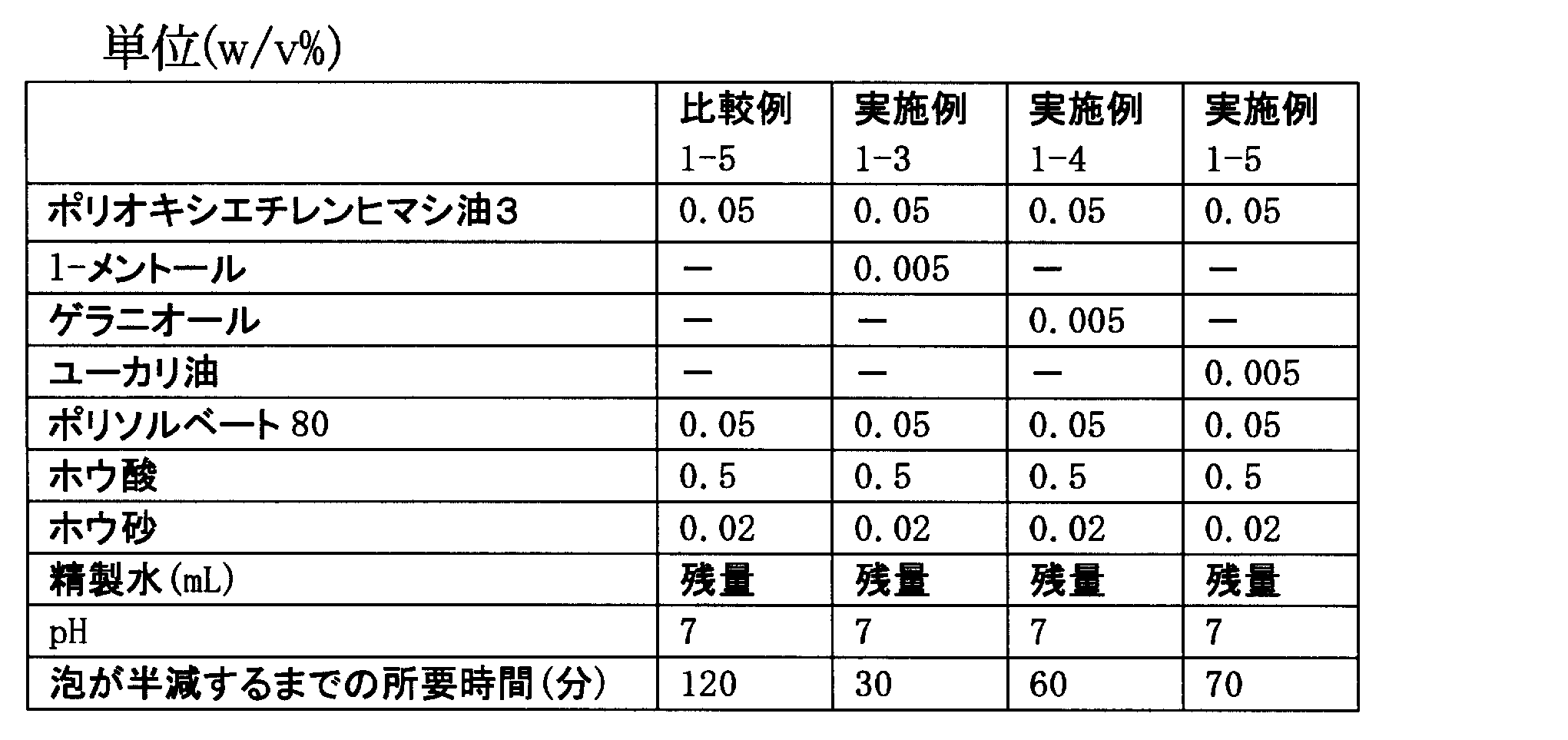

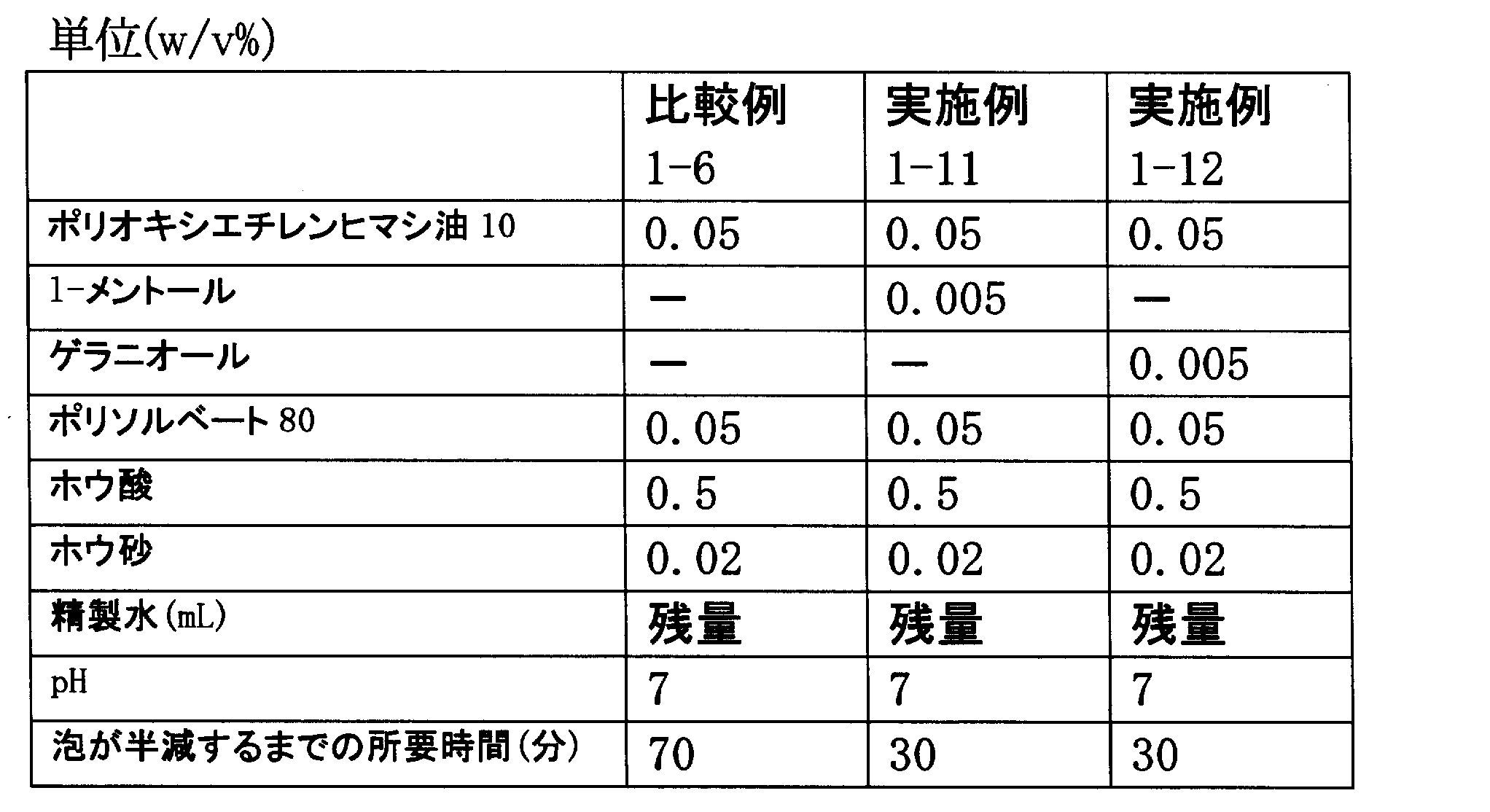
下記表6に示す通り、(A)成分以外の界面活性剤(ポリオキシエチレンヒマシ油35)を含有する各水性眼科組成物(実施例1-13、1-14及び比較例1-7、1-8)を常法により調製した。なお、水性眼科組成物の調製において、ホウ砂は、水性眼科組成物のpHが7になる量で添加した。なお、d-カンフルは第15改正日本薬局方の規格に適合するものであり、d-ボルネオールは医薬品添加物規格2003の規格に適合するものであった。ポリオキシエチレンヒマシ油3、ポリオキシエチレンヒマシ油10及びポリオキシエチレンヒマシ油35は医薬品添加物規格2003のポリオキシエチレンヒマシ油の規格に適合するものであり、酸化エチレンの平均付加モル数はそれぞれ3、10及び35であった。

下記表7に示す通り、 (A)成分以外の界面活性剤(ポリソルベート80)を含有する各水性眼科組成物(実施例1-15~1-17及び比較例1-9、1-10)を常法により調製した。なお、l-メントール及びポリソルベート80は第15改正日本薬局方の規格に適合するものであり、ポリオキシエチレンヒマシ油3及びポリオキシエチレンヒマシ油10は医薬品添加物規格2003のポリオキシエチレンヒマシ油の規格に適合するものであり、酸化エチレンの平均付加モル数はそれぞれ3及び10であった。
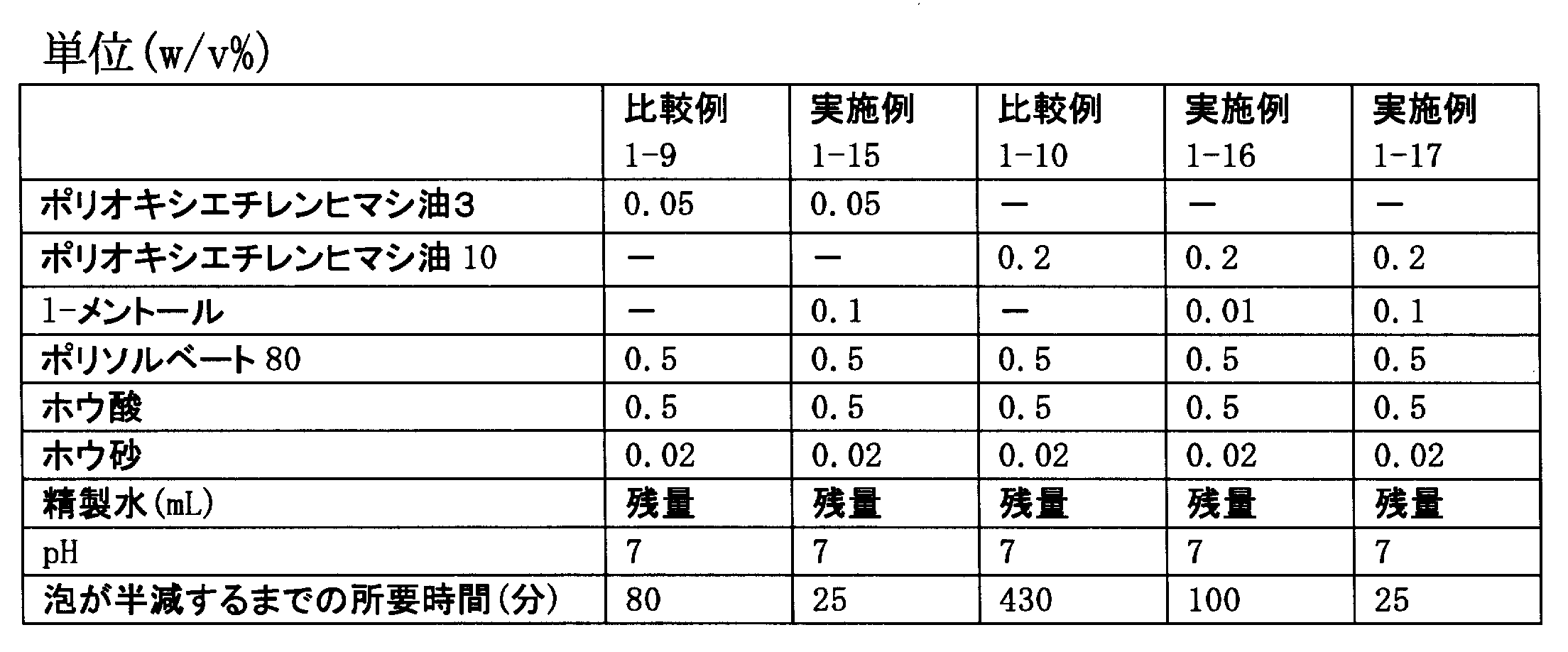
下記表8に示す通り、(A)成分として、ポリオキシエチレンヒマシ油3とポリオキシエチレンヒマシ油10を併用し、(A)成分以外の界面活性剤(ポリソルベート80)を含有する各水性眼科組成物(実施例1-18、1-19)を常法により調製した。なお、l-メントール及びポリソルベート80は第15改正日本薬局方の規格に適合するものであり、ポリオキシエチレンヒマシ油3及びポリオキシエチレンヒマシ油10は医薬品添加物規格2003のポリオキシエチレンヒマシ油の規格に適合するものであり、酸化エチレンの平均付加モル数はそれぞれ3及び10であった。

下記表9に示す水性眼科組成物(実施例2-1~2-3及び比較例2-1、2-2)を常法に従って調製し、泡の消える速度と滴下量に関する評価を実施した。なお、l-メントール及びポリソルベート80は第15改正日本薬局方の規格に適合するものであり、ゲラニオール及びポリオキシエチレン硬化ヒマシ油60は、医薬品添加物規格2003の規格に適合するものであった。ポリオキシエチレンヒマシ油10は医薬品添加物規格2003のポリオキシエチレンヒマシ油の規格に適合するものであり、酸化エチレンの平均付加モル数は10であった。
バラツキの変化率(倍)=振とう後のSD値/振とう前のSD値

下記表10に示す水性眼科組成物(実施例3-1及び比較例3-1)を常法に従って調製し、目視によって分離の有無を評価した。なお、l-メントールは第15改正日本薬局方の規格に適合するものであり、ポリオキシエチレンヒマシ油10は医薬品添加物規格2003のポリオキシエチレンヒマシ油の規格に適合するものであり、酸化エチレンの平均付加モル数は10であった。具体的には、調製直後に水性眼科組成物の性状を目視にて確認した後、比重差のあるものを分離するため、各水性眼科組成物を1mLずつ採取し、エッペンチューブに充填したものを、遠心機(MX-100 TOMY)を用いて6000Gで3分間遠心し、遠心後の水性眼科組成物の性状を再度目視確認した。結果を表10に併せて示す。

下記表11に示す水性眼科組成物(実施例3-2及び比較例3-2)を常法に従って調製し、粒子径測定装置(FPAR-1000(大塚電子))を用いて、水性眼科組成物中の粒子径の測定を実施した。なお、l-メントールは第15改正日本薬局方の規格に適合するものであり、ポリオキシエチレン硬化ヒマシ油60は医薬品添加物規格2003の規格に適合するものであった。ポリオキシエチレンヒマシ油10は医薬品添加物規格2003のポリオキシエチレンヒマシ油の規格に適合するものであり、酸化エチレンの平均付加モル数は10であった。結果を表11に併せて示す。
測定条件
温度 25℃
ND値 AUTO(10% or 25%)
プローブ 濃厚用
測定時間 180秒間
繰り返し回数 1回
ダストカット 10回(upper10%、lower1000%)
光量調整
ホモダイン光量最適 30000cps
MAX 50000cps
MIN 10000cps
解析手法
Marquardt(Lambda1000、interation1000)

下記表12に示す水性眼科組成物(実施例4-1及び比較例4-1、4-2)を常法に従って調製して、ポリエチレンテレフタレート(以下PET)製の点眼容器に充填して、メントールの濃度変化の確認試験を行った。なお、l-メントールは第15改正日本薬局方の規格に適合するものであり、ポリオキシエチレン硬化ヒマシ油60は医薬品添加物規格2003の規格に適合するものであった。ポリオキシエチレンヒマシ油10及びポリオキシエチレンヒマシ油35は医薬品添加物規格2003のポリオキシエチレンヒマシ油の規格に適合するものであり、酸化エチレンの平均付加モル数は10及び35であった。

下記表13に示す水性眼科組成物(実施例5-1及び比較例5-1~5-3)を常法に従って調製して、各水性眼科組成物の保存効力試験を実施した。具体的には、Staphylococcus aureus(ATCC6538)を、ソイビーン・カゼイン・ダイジェスト斜面培地の表面に接種して、33℃で、24時間培養した。培養菌体を白金耳で無菌的に採取し、適量の滅菌生理食塩水に浮遊させて、約1×10⁵CFU/mLの生菌を含む細菌浮遊液を調製した。なお、浮遊液の生菌数は、別途培養して計測した。次に、15mLCORNIAコニカルチューブ(PET)に、ろ過滅菌した各水性眼科組成物を10mLずつ充填した。この水性眼科組成物に、生菌数(最終濃度)が約103CFU/mL(3Log)となるよう、Staphylococcus aureus菌液(生理食塩水で懸濁)を接種し、よく攪拌して試料とした。試料を3日間、遮光下23℃で保存した。3日後に菌を含む試料を計数に適切な濃度となるよう調製し、メンブランフィルターろ過法によって菌の計数を行った。接種直後の生菌数と、3日間保存後の試料中の生菌数を比較し、菌数の減少量をLog Reductionとして算出した。尚、計数の為の菌の培養は、33℃にて3日間実施した。なお、l-メントールは第15改正日本薬局方の規格に適合するものであり、ポリオキシエチレン硬化ヒマシ油60は医薬品添加物規格2003の規格に適合するものであった。ポリオキシエチレンヒマシ油10及びポリオキシエチレンヒマシ油35は医薬品添加物規格2003のポリオキシエチレンヒマシ油の規格に適合するものであり、酸化エチレンの平均付加モル数は10及び35であった。結果を表13に併せて示す。
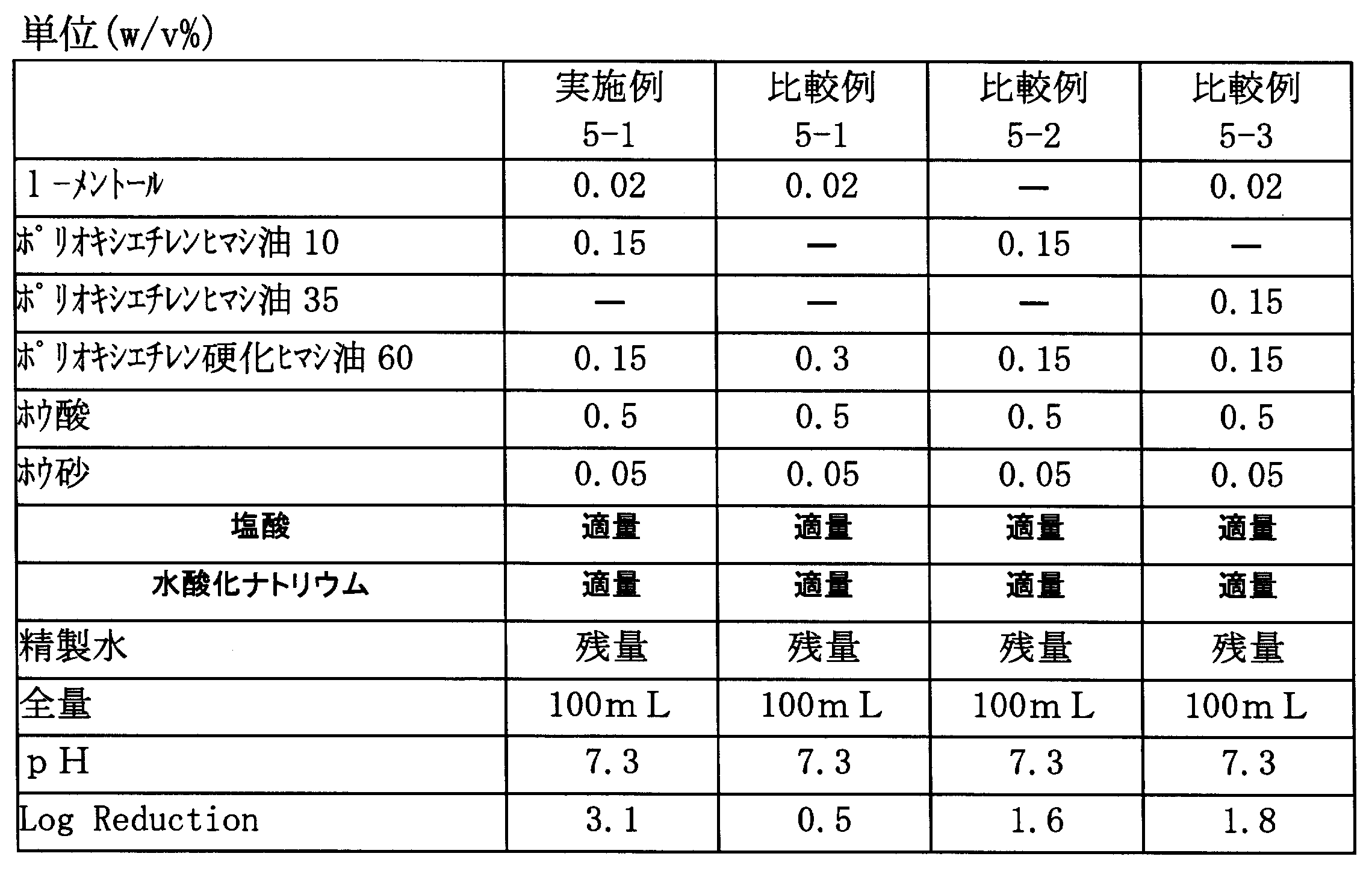
下記表14に示す水性眼科組成物(実施例5-2, 5-3及び比較例5-4, 5-5)を常法に従って調製して、これらの水性眼科組成物を用い、試験例11と同様の方法で、Staphylococcus aureusの接種直後の生菌数と、7日間保存後の試料中の生菌数を比較し、菌数の減少量をLog Reductionとして算出した。尚、計数の為の菌の培養は、33℃にて実施した。なお、d-カンフルは第15改正日本薬局方の規格に適合するものであり、ゲラニオール、ポリオキシエチレン硬化ヒマシ油60は医薬品添加物規格2003の規格に適合するものであった。ポリオキシエチレンヒマシ油10及びポリオキシエチレンヒマシ油35は医薬品添加物規格2003のポリオキシエチレンヒマシ油の規格に適合するものであり、酸化エチレンの平均付加モル数は10及び35であった。結果を表14に併せて示す。

下記表15に示す水性眼科組成物(実施例5-4及び比較例5-6)を常法に従って調製して、これらの水性眼科組成物を用い、試験例11と同様の方法で、Staphylococcus aureus及びE.Coliの接種直後の生菌数と、保存後の試料中の生菌数を比較し、菌数の減少量をLog Reductionとして算出した。尚、計数の為の菌の培養は、Staphylococcus aureus については3日間、E.Coli については7日間33℃にて実施した。なお、ユーカリ油は第15改正日本薬局方の規格に適合するものであり、ポリオキシエチレン硬化ヒマシ油60は医薬品添加物規格2003の規格に適合するものであった。ポリオキシエチレンヒマシ油10は医薬品添加物規格2003のポリオキシエチレンヒマシ油の規格に適合するものであり、酸化エチレンの平均付加モル数は10であった。結果を下記表15に併せて示す。

表16に示す組成の水性眼科組成物(実施例6-1及び比較例6-1)を調製して、これらの水性眼科組成物を用いてビジュアルアナログスケール(VAS)に準じて、清涼感の評価を行った。具体的には、6人のパネラーに水性眼科組成物を点眼して、その直後及び5分後に感じられる「清涼感」について、自覚症状調査シートにパネラーが感じた症状の程度を記載した。その後、自覚症状調査シートから、自覚症状の強さを長さ(cm)として測定して、清涼感が感じられない場合を0cm、感じられる場合を5cm、強く感じられる場合を10cmとして、この長さ(cm)を清涼感スコアとして算出した。点眼直後、5分後における6人のパネラーのスコア平均値を算出することにより、清涼感の評価を行った。結果を表16に示す。

表17及び表18に記載の処方で、常法により、点眼剤(製剤例1~7)、洗眼剤(製剤例8)、コンタクトレンズ装着液(製剤例9)コンタクトレンズ用マルチパーパスソリューション(製剤例10)を調製する。尚、浸透圧の単位は、mOsm(ミリオスモル)である。


Claims (5)
- (A)酸化エチレンの平均付加モル数が2~12であるポリオキシエチレンヒマシ油と、 (B)テルペノイドを含む、水性眼科組成物。
- (A)成分が、 ポリオキシエチレンヒマシ油3及びポリオキシエチレンヒマシ油10からなる群より選択される少なくとも1種である、請求項1に記載の水性眼科組成物。
- (A)成分の総量100重量部当たり、(B)成分の総量が0.01~1000重量部である、請求項1又は2に記載の水性眼科組成物。
- さらに(A)成分以外の非イオン性界面活性剤を含有する、請求項1又は2に記載の水性眼科組成物。
- さらに(A)成分以外の非イオン性界面活性剤を含有する、請求項3に記載の水性眼科組成物。
Priority Applications (7)
| Application Number | Priority Date | Filing Date | Title |
|---|---|---|---|
| BR112013016897A BR112013016897A2 (pt) | 2010-12-28 | 2011-12-27 | composição oftálmica aquosa |
| JP2012550960A JP5810098B2 (ja) | 2010-12-28 | 2011-12-27 | 水性眼科組成物 |
| EP11852851.2A EP2659911A4 (en) | 2010-12-28 | 2011-12-27 | AQUEOUS OPHTHALMIC COMPOSITION |
| HK13114320.7A HK1186684B (en) | 2010-12-28 | 2011-12-27 | Aqueous ophthalmic composition |
| US13/995,893 US9034931B2 (en) | 2010-12-28 | 2011-12-27 | Aqueous ophthalmic composition |
| CN201180063560.6A CN103282052B (zh) | 2010-12-28 | 2011-12-27 | 水性眼科组合物 |
| US14/683,579 US9320802B2 (en) | 2010-12-28 | 2015-04-10 | Aqueous ophthalmic composition |
Applications Claiming Priority (2)
| Application Number | Priority Date | Filing Date | Title |
|---|---|---|---|
| JP2010-292441 | 2010-12-28 | ||
| JP2010292441 | 2010-12-28 |
Related Child Applications (2)
| Application Number | Title | Priority Date | Filing Date |
|---|---|---|---|
| US13/995,893 A-371-Of-International US9034931B2 (en) | 2010-12-28 | 2011-12-27 | Aqueous ophthalmic composition |
| US14/683,579 Continuation US9320802B2 (en) | 2010-12-28 | 2015-04-10 | Aqueous ophthalmic composition |
Publications (1)
| Publication Number | Publication Date |
|---|---|
| WO2012090985A1 true WO2012090985A1 (ja) | 2012-07-05 |
Family
ID=46383079
Family Applications (1)
| Application Number | Title | Priority Date | Filing Date |
|---|---|---|---|
| PCT/JP2011/080163 Ceased WO2012090985A1 (ja) | 2010-12-28 | 2011-12-27 | 水性眼科組成物 |
Country Status (6)
| Country | Link |
|---|---|
| US (2) | US9034931B2 (ja) |
| EP (1) | EP2659911A4 (ja) |
| JP (2) | JP5810098B2 (ja) |
| CN (1) | CN103282052B (ja) |
| BR (1) | BR112013016897A2 (ja) |
| WO (1) | WO2012090985A1 (ja) |
Cited By (16)
| Publication number | Priority date | Publication date | Assignee | Title |
|---|---|---|---|---|
| JP2013256475A (ja) * | 2012-06-14 | 2013-12-26 | Rohto Pharmaceutical Co Ltd | グリチルリチン酸含有水性眼科組成物 |
| JP2014015417A (ja) * | 2012-07-09 | 2014-01-30 | Rohto Pharmaceut Co Ltd | 水性眼科組成物 |
| JP2014015453A (ja) * | 2012-06-15 | 2014-01-30 | Rohto Pharmaceut Co Ltd | ソフトコンタクトレンズ用眼科組成物 |
| JP2014028789A (ja) * | 2012-06-27 | 2014-02-13 | Rohto Pharmaceut Co Ltd | 水性眼科組成物 |
| WO2014087931A1 (ja) * | 2012-12-04 | 2014-06-12 | ロート製薬株式会社 | 水性眼科組成物 |
| JP2014166977A (ja) * | 2013-01-31 | 2014-09-11 | Rohto Pharmaceut Co Ltd | 点眼剤 |
| WO2015029926A1 (ja) * | 2013-08-26 | 2015-03-05 | ロート製薬株式会社 | 眼科用組成物 |
| US20170027880A1 (en) * | 2013-11-29 | 2017-02-02 | Rohto Pharmaceutical Co., Ltd. | Aqueous Composition for Ophthalmological Use or Otolaryngological Use |
| JP2017132764A (ja) * | 2016-01-27 | 2017-08-03 | ロート製薬株式会社 | シリコーンハイドロゲルカラーコンタクトレンズ用眼科組成物 |
| JP2017197527A (ja) * | 2016-04-22 | 2017-11-02 | ロート製薬株式会社 | 眼科組成物 |
| JP2017197524A (ja) * | 2016-04-22 | 2017-11-02 | ロート製薬株式会社 | 眼科組成物 |
| JP2017197526A (ja) * | 2016-04-22 | 2017-11-02 | ロート製薬株式会社 | 眼科組成物 |
| JP2020055805A (ja) * | 2018-09-28 | 2020-04-09 | ロート製薬株式会社 | 内服組成物およびその吸湿抑制方法 |
| US11331390B2 (en) | 2016-04-22 | 2022-05-17 | Rohto Pharmaceutical Co., Ltd. | Ophthalmic composition |
| JP2022160514A (ja) * | 2016-04-22 | 2022-10-19 | ロート製薬株式会社 | 眼科組成物 |
| JP2022176963A (ja) * | 2016-04-22 | 2022-11-30 | ロート製薬株式会社 | 眼科組成物 |
Families Citing this family (8)
| Publication number | Priority date | Publication date | Assignee | Title |
|---|---|---|---|---|
| JPWO2015190483A1 (ja) * | 2014-06-10 | 2017-04-20 | ロート製薬株式会社 | 眼科用水性組成物 |
| EP3518672B1 (en) | 2016-09-29 | 2025-11-05 | JRX Biotechnology, Inc. | Methods for modifying plant growth and reducing water consumption by plants |
| US11260035B2 (en) | 2016-10-12 | 2022-03-01 | Ps Therapies Ltd | Topical compositions and methods of use thereof |
| US11583496B2 (en) | 2016-10-12 | 2023-02-21 | PS Therapy Inc. | Drug vehicle compositions and methods of use thereof |
| JP7138103B2 (ja) | 2016-11-29 | 2022-09-15 | オキュリス エスエー | 眼科用活性医薬成分送達のためのシクロデキストリン固体複合体の製造 |
| WO2019191471A1 (en) | 2018-03-28 | 2019-10-03 | Jrx Biotechnology, Inc. | Agricultural compositions |
| JP7343964B2 (ja) * | 2018-09-21 | 2023-09-13 | 小林製薬株式会社 | 医薬組成物 |
| EP4670738A3 (en) | 2019-07-01 | 2026-03-04 | Oculis Operations Sàrl | Method for stabilizing the ph of an aqueous composition comprising a drug |
Citations (6)
| Publication number | Priority date | Publication date | Assignee | Title |
|---|---|---|---|---|
| JPH11130667A (ja) * | 1997-08-26 | 1999-05-18 | Senju Pharmaceut Co Ltd | ソフトコンタクトレンズ用の眼科用組成物、ソフトコンタクトレンズの濡れ増強方法およびテルペノイドの吸着抑制方法 |
| JPH11180858A (ja) * | 1997-12-18 | 1999-07-06 | Rohto Pharmaceut Co Ltd | 清涼化剤を含有するコンタクトレンズ用点眼剤 |
| JP2002003364A (ja) * | 2000-06-23 | 2002-01-09 | Lion Corp | 点眼剤、眼科用組成物及び吸着抑制方法 |
| JP2002356420A (ja) * | 2001-03-27 | 2002-12-13 | Santen Pharmaceut Co Ltd | 安定な水性液剤 |
| JP2006151971A (ja) * | 2004-11-05 | 2006-06-15 | Maruishi Pharmaceutical Co Ltd | インスリン様成長因子−1分泌促進剤 |
| JP2006321790A (ja) * | 2005-04-18 | 2006-11-30 | Taisho Pharmaceut Co Ltd | 眼科用剤 |
Family Cites Families (13)
| Publication number | Priority date | Publication date | Assignee | Title |
|---|---|---|---|---|
| JPS5762218A (en) * | 1980-10-01 | 1982-04-15 | Lion Corp | Ophthalmic solution |
| US5800389A (en) * | 1996-02-09 | 1998-09-01 | Emx, Inc. | Biopsy device |
| KR100683510B1 (ko) * | 1998-01-22 | 2007-02-16 | 산텐 세이야꾸 가부시키가이샤 | 플루오로메톨론 현탁형 점안제 |
| JP4748947B2 (ja) | 2003-04-04 | 2011-08-17 | ロート製薬株式会社 | 眼科用組成物 |
| KR20060040550A (ko) | 2004-11-05 | 2006-05-10 | 마루이시세이야쿠가부시키가이샤 | 인슐린유사 성장인자-1 분비촉진제 |
| US20070015693A1 (en) | 2005-07-13 | 2007-01-18 | Allergan, Inc. | Cyclosporin compositions |
| US20070148099A1 (en) * | 2005-12-27 | 2007-06-28 | Burke Susan E | Use of aroma compounds as defoaming agents for ophthalmic solutions with high concentrations of surfactants |
| CN101400354B (zh) * | 2006-03-13 | 2014-10-22 | 株式会社·R-技术上野 | 水性组合物 |
| JPWO2007145344A1 (ja) * | 2006-06-16 | 2009-11-12 | ロート製薬株式会社 | テルペノイドを含有するソフトコンタクトレンズ用眼科組成物 |
| WO2008123396A1 (ja) * | 2007-03-29 | 2008-10-16 | Santen Pharmaceutical Co., Ltd. | フルオロメトロンを含有する懸濁型点眼剤 |
| JP5525816B2 (ja) * | 2007-09-14 | 2014-06-18 | ロート製薬株式会社 | 眼科用組成物 |
| WO2012081673A1 (ja) * | 2010-12-17 | 2012-06-21 | ロート製薬株式会社 | コンタクトレンズ用眼科組成物 |
| CN103764168B (zh) | 2011-07-08 | 2016-02-17 | 乐敦制药株式会社 | 水性眼科用组合物 |
-
2011
- 2011-12-27 WO PCT/JP2011/080163 patent/WO2012090985A1/ja not_active Ceased
- 2011-12-27 JP JP2012550960A patent/JP5810098B2/ja active Active
- 2011-12-27 BR BR112013016897A patent/BR112013016897A2/pt not_active IP Right Cessation
- 2011-12-27 CN CN201180063560.6A patent/CN103282052B/zh active Active
- 2011-12-27 EP EP11852851.2A patent/EP2659911A4/en not_active Withdrawn
- 2011-12-27 US US13/995,893 patent/US9034931B2/en active Active
-
2015
- 2015-04-10 US US14/683,579 patent/US9320802B2/en not_active Expired - Fee Related
- 2015-09-11 JP JP2015179270A patent/JP2016028077A/ja active Pending
Patent Citations (6)
| Publication number | Priority date | Publication date | Assignee | Title |
|---|---|---|---|---|
| JPH11130667A (ja) * | 1997-08-26 | 1999-05-18 | Senju Pharmaceut Co Ltd | ソフトコンタクトレンズ用の眼科用組成物、ソフトコンタクトレンズの濡れ増強方法およびテルペノイドの吸着抑制方法 |
| JPH11180858A (ja) * | 1997-12-18 | 1999-07-06 | Rohto Pharmaceut Co Ltd | 清涼化剤を含有するコンタクトレンズ用点眼剤 |
| JP2002003364A (ja) * | 2000-06-23 | 2002-01-09 | Lion Corp | 点眼剤、眼科用組成物及び吸着抑制方法 |
| JP2002356420A (ja) * | 2001-03-27 | 2002-12-13 | Santen Pharmaceut Co Ltd | 安定な水性液剤 |
| JP2006151971A (ja) * | 2004-11-05 | 2006-06-15 | Maruishi Pharmaceutical Co Ltd | インスリン様成長因子−1分泌促進剤 |
| JP2006321790A (ja) * | 2005-04-18 | 2006-11-30 | Taisho Pharmaceut Co Ltd | 眼科用剤 |
Non-Patent Citations (1)
| Title |
|---|
| See also references of EP2659911A4 * |
Cited By (26)
| Publication number | Priority date | Publication date | Assignee | Title |
|---|---|---|---|---|
| JP2013256475A (ja) * | 2012-06-14 | 2013-12-26 | Rohto Pharmaceutical Co Ltd | グリチルリチン酸含有水性眼科組成物 |
| JP2014015453A (ja) * | 2012-06-15 | 2014-01-30 | Rohto Pharmaceut Co Ltd | ソフトコンタクトレンズ用眼科組成物 |
| JP2016188259A (ja) * | 2012-06-27 | 2016-11-04 | ロート製薬株式会社 | 水性眼科組成物 |
| JP2014028789A (ja) * | 2012-06-27 | 2014-02-13 | Rohto Pharmaceut Co Ltd | 水性眼科組成物 |
| JP2014015417A (ja) * | 2012-07-09 | 2014-01-30 | Rohto Pharmaceut Co Ltd | 水性眼科組成物 |
| JPWO2014087931A1 (ja) * | 2012-12-04 | 2017-01-05 | ロート製薬株式会社 | 水性眼科組成物 |
| US9427473B2 (en) | 2012-12-04 | 2016-08-30 | Rohto Pharmaceutical Co., Ltd. | Aqueous ophthalmic composition |
| WO2014087931A1 (ja) * | 2012-12-04 | 2014-06-12 | ロート製薬株式会社 | 水性眼科組成物 |
| JP2014166977A (ja) * | 2013-01-31 | 2014-09-11 | Rohto Pharmaceut Co Ltd | 点眼剤 |
| JP2018044002A (ja) * | 2013-01-31 | 2018-03-22 | ロート製薬株式会社 | 点眼剤 |
| WO2015029926A1 (ja) * | 2013-08-26 | 2015-03-05 | ロート製薬株式会社 | 眼科用組成物 |
| US20170027880A1 (en) * | 2013-11-29 | 2017-02-02 | Rohto Pharmaceutical Co., Ltd. | Aqueous Composition for Ophthalmological Use or Otolaryngological Use |
| US11103464B2 (en) * | 2013-11-29 | 2021-08-31 | Rohto Pharmaceutical Co., Ltd. | Aqueous composition for ophthalmological use or otolaryngological use |
| JP2017132764A (ja) * | 2016-01-27 | 2017-08-03 | ロート製薬株式会社 | シリコーンハイドロゲルカラーコンタクトレンズ用眼科組成物 |
| JP2017197527A (ja) * | 2016-04-22 | 2017-11-02 | ロート製薬株式会社 | 眼科組成物 |
| JP2017197526A (ja) * | 2016-04-22 | 2017-11-02 | ロート製薬株式会社 | 眼科組成物 |
| JP2017197524A (ja) * | 2016-04-22 | 2017-11-02 | ロート製薬株式会社 | 眼科組成物 |
| US11331390B2 (en) | 2016-04-22 | 2022-05-17 | Rohto Pharmaceutical Co., Ltd. | Ophthalmic composition |
| JP7125250B2 (ja) | 2016-04-22 | 2022-08-24 | ロート製薬株式会社 | 眼科組成物 |
| JP2022160514A (ja) * | 2016-04-22 | 2022-10-19 | ロート製薬株式会社 | 眼科組成物 |
| JP7159501B1 (ja) | 2016-04-22 | 2022-10-24 | ロート製薬株式会社 | 眼科組成物 |
| JP2022176963A (ja) * | 2016-04-22 | 2022-11-30 | ロート製薬株式会社 | 眼科組成物 |
| JP7387835B2 (ja) | 2016-04-22 | 2023-11-28 | ロート製薬株式会社 | 眼科組成物 |
| JP2024012611A (ja) * | 2016-04-22 | 2024-01-30 | ロート製薬株式会社 | 眼科組成物 |
| JP2020055805A (ja) * | 2018-09-28 | 2020-04-09 | ロート製薬株式会社 | 内服組成物およびその吸湿抑制方法 |
| JP7451124B2 (ja) | 2018-09-28 | 2024-03-18 | ロート製薬株式会社 | 内服組成物およびその吸湿抑制方法 |
Also Published As
| Publication number | Publication date |
|---|---|
| BR112013016897A2 (pt) | 2019-09-24 |
| CN103282052B (zh) | 2015-08-12 |
| EP2659911A4 (en) | 2015-01-14 |
| HK1186684A1 (en) | 2014-03-21 |
| US20130296446A1 (en) | 2013-11-07 |
| JP2016028077A (ja) | 2016-02-25 |
| US9034931B2 (en) | 2015-05-19 |
| JPWO2012090985A1 (ja) | 2014-06-05 |
| US20150209437A1 (en) | 2015-07-30 |
| US9320802B2 (en) | 2016-04-26 |
| EP2659911A1 (en) | 2013-11-06 |
| CN103282052A (zh) | 2013-09-04 |
| JP5810098B2 (ja) | 2015-11-11 |
Similar Documents
| Publication | Publication Date | Title |
|---|---|---|
| JP5810098B2 (ja) | 水性眼科組成物 | |
| JP7288289B2 (ja) | 水性眼科組成物 | |
| JP6596116B2 (ja) | 水性眼科組成物 | |
| JP5873573B2 (ja) | 水性眼科組成物 | |
| JP6190503B2 (ja) | 水性眼科組成物 | |
| JP6177594B2 (ja) | 水性眼科組成物 | |
| JP2026009270A (ja) | 眼科用製剤 | |
| JP2019202166A (ja) | 眼科組成物 | |
| JP5922505B2 (ja) | グリチルリチン酸含有水性眼科組成物 | |
| EP2730292A1 (en) | Aqueous ophthalmic composition | |
| HK1186684B (en) | Aqueous ophthalmic composition | |
| HK1186394A (en) | Aqueous ophthalmic composition | |
| JP6091780B2 (ja) | 水性眼科組成物 | |
| WO2025053197A1 (ja) | 眼科組成物 | |
| HK1192167A (en) | Aqueous ophthalmic composition | |
| HK1192140B (en) | Aqueous ophthalmic composition |
Legal Events
| Date | Code | Title | Description |
|---|---|---|---|
| 121 | Ep: the epo has been informed by wipo that ep was designated in this application |
Ref document number: 11852851 Country of ref document: EP Kind code of ref document: A1 |
|
| ENP | Entry into the national phase |
Ref document number: 2012550960 Country of ref document: JP Kind code of ref document: A |
|
| WWE | Wipo information: entry into national phase |
Ref document number: 13995893 Country of ref document: US |
|
| WWE | Wipo information: entry into national phase |
Ref document number: 2011852851 Country of ref document: EP |
|
| NENP | Non-entry into the national phase |
Ref country code: DE |
|
| REG | Reference to national code |
Ref country code: BR Ref legal event code: B01A Ref document number: 112013016897 Country of ref document: BR |
|
| ENP | Entry into the national phase |
Ref document number: 112013016897 Country of ref document: BR Kind code of ref document: A2 Effective date: 20130628 |