WO2012091073A1 - 毛髪化粧料 - Google Patents
毛髪化粧料 Download PDFInfo
- Publication number
- WO2012091073A1 WO2012091073A1 PCT/JP2011/080346 JP2011080346W WO2012091073A1 WO 2012091073 A1 WO2012091073 A1 WO 2012091073A1 JP 2011080346 W JP2011080346 W JP 2011080346W WO 2012091073 A1 WO2012091073 A1 WO 2012091073A1
- Authority
- WO
- WIPO (PCT)
- Prior art keywords
- cellulose
- cationized
- group
- hair
- hair cosmetic
- Prior art date
- Legal status (The legal status is an assumption and is not a legal conclusion. Google has not performed a legal analysis and makes no representation as to the accuracy of the status listed.)
- Ceased
Links
- 0 CCC(C)(C)C(C(CO*)*C(C1O*)OC(C)(C)C)C1O Chemical compound CCC(C)(C)C(C(CO*)*C(C1O*)OC(C)(C)C)C1O 0.000 description 2
Classifications
-
- A—HUMAN NECESSITIES
- A61—MEDICAL OR VETERINARY SCIENCE; HYGIENE
- A61K—PREPARATIONS FOR MEDICAL, DENTAL OR TOILETRY PURPOSES
- A61K8/00—Cosmetics or similar toiletry preparations
- A61K8/18—Cosmetics or similar toiletry preparations characterised by the composition
- A61K8/72—Cosmetics or similar toiletry preparations characterised by the composition containing organic macromolecular compounds
- A61K8/73—Polysaccharides
-
- A—HUMAN NECESSITIES
- A61—MEDICAL OR VETERINARY SCIENCE; HYGIENE
- A61K—PREPARATIONS FOR MEDICAL, DENTAL OR TOILETRY PURPOSES
- A61K8/00—Cosmetics or similar toiletry preparations
- A61K8/18—Cosmetics or similar toiletry preparations characterised by the composition
- A61K8/72—Cosmetics or similar toiletry preparations characterised by the composition containing organic macromolecular compounds
- A61K8/73—Polysaccharides
- A61K8/731—Cellulose; Quaternized cellulose derivatives
-
- A—HUMAN NECESSITIES
- A61—MEDICAL OR VETERINARY SCIENCE; HYGIENE
- A61K—PREPARATIONS FOR MEDICAL, DENTAL OR TOILETRY PURPOSES
- A61K8/00—Cosmetics or similar toiletry preparations
- A61K8/18—Cosmetics or similar toiletry preparations characterised by the composition
- A61K8/30—Cosmetics or similar toiletry preparations characterised by the composition containing organic compounds
- A61K8/33—Cosmetics or similar toiletry preparations characterised by the composition containing organic compounds containing oxygen
-
- A—HUMAN NECESSITIES
- A61—MEDICAL OR VETERINARY SCIENCE; HYGIENE
- A61K—PREPARATIONS FOR MEDICAL, DENTAL OR TOILETRY PURPOSES
- A61K8/00—Cosmetics or similar toiletry preparations
- A61K8/18—Cosmetics or similar toiletry preparations characterised by the composition
- A61K8/30—Cosmetics or similar toiletry preparations characterised by the composition containing organic compounds
- A61K8/33—Cosmetics or similar toiletry preparations characterised by the composition containing organic compounds containing oxygen
- A61K8/39—Derivatives containing from 2 to 10 oxyalkylene groups
-
- A—HUMAN NECESSITIES
- A61—MEDICAL OR VETERINARY SCIENCE; HYGIENE
- A61K—PREPARATIONS FOR MEDICAL, DENTAL OR TOILETRY PURPOSES
- A61K8/00—Cosmetics or similar toiletry preparations
- A61K8/18—Cosmetics or similar toiletry preparations characterised by the composition
- A61K8/30—Cosmetics or similar toiletry preparations characterised by the composition containing organic compounds
- A61K8/40—Cosmetics or similar toiletry preparations characterised by the composition containing organic compounds containing nitrogen
- A61K8/42—Amides
-
- A—HUMAN NECESSITIES
- A61—MEDICAL OR VETERINARY SCIENCE; HYGIENE
- A61K—PREPARATIONS FOR MEDICAL, DENTAL OR TOILETRY PURPOSES
- A61K8/00—Cosmetics or similar toiletry preparations
- A61K8/18—Cosmetics or similar toiletry preparations characterised by the composition
- A61K8/30—Cosmetics or similar toiletry preparations characterised by the composition containing organic compounds
- A61K8/46—Cosmetics or similar toiletry preparations characterised by the composition containing organic compounds containing sulfur
- A61K8/463—Cosmetics or similar toiletry preparations characterised by the composition containing organic compounds containing sulfur containing sulfuric acid derivatives, e.g. sodium lauryl sulfate
-
- A—HUMAN NECESSITIES
- A61—MEDICAL OR VETERINARY SCIENCE; HYGIENE
- A61K—PREPARATIONS FOR MEDICAL, DENTAL OR TOILETRY PURPOSES
- A61K8/00—Cosmetics or similar toiletry preparations
- A61K8/18—Cosmetics or similar toiletry preparations characterised by the composition
- A61K8/92—Oils, fats or waxes; Derivatives thereof, e.g. hydrogenation products thereof
-
- A—HUMAN NECESSITIES
- A61—MEDICAL OR VETERINARY SCIENCE; HYGIENE
- A61K—PREPARATIONS FOR MEDICAL, DENTAL OR TOILETRY PURPOSES
- A61K8/00—Cosmetics or similar toiletry preparations
- A61K8/18—Cosmetics or similar toiletry preparations characterised by the composition
- A61K8/92—Oils, fats or waxes; Derivatives thereof, e.g. hydrogenation products thereof
- A61K8/922—Oils, fats or waxes; Derivatives thereof, e.g. hydrogenation products thereof of vegetable origin
-
- A—HUMAN NECESSITIES
- A61—MEDICAL OR VETERINARY SCIENCE; HYGIENE
- A61Q—SPECIFIC USE OF COSMETICS OR SIMILAR TOILETRY PREPARATIONS
- A61Q19/00—Preparations for care of the skin
- A61Q19/10—Washing or bathing preparations
-
- A—HUMAN NECESSITIES
- A61—MEDICAL OR VETERINARY SCIENCE; HYGIENE
- A61Q—SPECIFIC USE OF COSMETICS OR SIMILAR TOILETRY PREPARATIONS
- A61Q5/00—Preparations for care of the hair
-
- A—HUMAN NECESSITIES
- A61—MEDICAL OR VETERINARY SCIENCE; HYGIENE
- A61Q—SPECIFIC USE OF COSMETICS OR SIMILAR TOILETRY PREPARATIONS
- A61Q5/00—Preparations for care of the hair
- A61Q5/02—Preparations for cleaning the hair
-
- A—HUMAN NECESSITIES
- A61—MEDICAL OR VETERINARY SCIENCE; HYGIENE
- A61Q—SPECIFIC USE OF COSMETICS OR SIMILAR TOILETRY PREPARATIONS
- A61Q5/00—Preparations for care of the hair
- A61Q5/12—Preparations containing hair conditioners
-
- C—CHEMISTRY; METALLURGY
- C08—ORGANIC MACROMOLECULAR COMPOUNDS; THEIR PREPARATION OR CHEMICAL WORKING-UP; COMPOSITIONS BASED THEREON
- C08B—POLYSACCHARIDES; DERIVATIVES THEREOF
- C08B1/00—Preparatory treatment of cellulose for making derivatives thereof, e.g. pre-treatment, pre-soaking, activation
- C08B1/06—Rendering cellulose suitable for etherification
-
- C—CHEMISTRY; METALLURGY
- C08—ORGANIC MACROMOLECULAR COMPOUNDS; THEIR PREPARATION OR CHEMICAL WORKING-UP; COMPOSITIONS BASED THEREON
- C08B—POLYSACCHARIDES; DERIVATIVES THEREOF
- C08B1/00—Preparatory treatment of cellulose for making derivatives thereof, e.g. pre-treatment, pre-soaking, activation
- C08B1/08—Alkali cellulose
-
- C—CHEMISTRY; METALLURGY
- C08—ORGANIC MACROMOLECULAR COMPOUNDS; THEIR PREPARATION OR CHEMICAL WORKING-UP; COMPOSITIONS BASED THEREON
- C08B—POLYSACCHARIDES; DERIVATIVES THEREOF
- C08B11/00—Preparation of cellulose ethers
- C08B11/02—Alkyl or cycloalkyl ethers
- C08B11/04—Alkyl or cycloalkyl ethers with substituted hydrocarbon radicals
- C08B11/08—Alkyl or cycloalkyl ethers with substituted hydrocarbon radicals with hydroxylated hydrocarbon radicals; Esters, ethers, or acetals thereof
-
- C—CHEMISTRY; METALLURGY
- C08—ORGANIC MACROMOLECULAR COMPOUNDS; THEIR PREPARATION OR CHEMICAL WORKING-UP; COMPOSITIONS BASED THEREON
- C08B—POLYSACCHARIDES; DERIVATIVES THEREOF
- C08B11/00—Preparation of cellulose ethers
- C08B11/02—Alkyl or cycloalkyl ethers
- C08B11/04—Alkyl or cycloalkyl ethers with substituted hydrocarbon radicals
- C08B11/14—Alkyl or cycloalkyl ethers with substituted hydrocarbon radicals with nitrogen-containing groups
- C08B11/145—Alkyl or cycloalkyl ethers with substituted hydrocarbon radicals with nitrogen-containing groups with basic nitrogen, e.g. aminoalkyl ethers
-
- C—CHEMISTRY; METALLURGY
- C08—ORGANIC MACROMOLECULAR COMPOUNDS; THEIR PREPARATION OR CHEMICAL WORKING-UP; COMPOSITIONS BASED THEREON
- C08B—POLYSACCHARIDES; DERIVATIVES THEREOF
- C08B11/00—Preparation of cellulose ethers
- C08B11/193—Mixed ethers, i.e. ethers with two or more different etherifying groups
-
- C—CHEMISTRY; METALLURGY
- C08—ORGANIC MACROMOLECULAR COMPOUNDS; THEIR PREPARATION OR CHEMICAL WORKING-UP; COMPOSITIONS BASED THEREON
- C08B—POLYSACCHARIDES; DERIVATIVES THEREOF
- C08B11/00—Preparation of cellulose ethers
- C08B11/20—Post-etherification treatments of chemical or physical type, e.g. mixed etherification in two steps, including purification
-
- C—CHEMISTRY; METALLURGY
- C08—ORGANIC MACROMOLECULAR COMPOUNDS; THEIR PREPARATION OR CHEMICAL WORKING-UP; COMPOSITIONS BASED THEREON
- C08L—COMPOSITIONS OF MACROMOLECULAR COMPOUNDS
- C08L1/00—Compositions of cellulose, modified cellulose or cellulose derivatives
- C08L1/08—Cellulose derivatives
- C08L1/26—Cellulose ethers
-
- C—CHEMISTRY; METALLURGY
- C08—ORGANIC MACROMOLECULAR COMPOUNDS; THEIR PREPARATION OR CHEMICAL WORKING-UP; COMPOSITIONS BASED THEREON
- C08L—COMPOSITIONS OF MACROMOLECULAR COMPOUNDS
- C08L1/00—Compositions of cellulose, modified cellulose or cellulose derivatives
- C08L1/08—Cellulose derivatives
- C08L1/26—Cellulose ethers
- C08L1/28—Alkyl ethers
- C08L1/284—Alkyl ethers with hydroxylated hydrocarbon radicals
-
- C—CHEMISTRY; METALLURGY
- C08—ORGANIC MACROMOLECULAR COMPOUNDS; THEIR PREPARATION OR CHEMICAL WORKING-UP; COMPOSITIONS BASED THEREON
- C08L—COMPOSITIONS OF MACROMOLECULAR COMPOUNDS
- C08L1/00—Compositions of cellulose, modified cellulose or cellulose derivatives
- C08L1/08—Cellulose derivatives
- C08L1/26—Cellulose ethers
- C08L1/28—Alkyl ethers
- C08L1/288—Alkyl ethers substituted with nitrogen-containing radicals
-
- C—CHEMISTRY; METALLURGY
- C08—ORGANIC MACROMOLECULAR COMPOUNDS; THEIR PREPARATION OR CHEMICAL WORKING-UP; COMPOSITIONS BASED THEREON
- C08L—COMPOSITIONS OF MACROMOLECULAR COMPOUNDS
- C08L5/00—Compositions of polysaccharides or of their derivatives not provided for in groups C08L1/00 or C08L3/00
Definitions
- the present invention relates to a hair cosmetic containing cationized hydroxypropylcellulose, an oil and a surfactant, and a method for producing the same.
- Hair is damaged by chemical treatment with hair color, shampooing, and physical treatment with the heat of a dryer. It is well known that when hair is damaged, negative elements are generated from an aesthetic point of view, such as dryness, poor texture, and loss of gloss. Therefore, a conditioning agent for returning hair to a smooth feel before treatment is widely used.
- oil agents such as silicone, ester oil, hydrocarbon oil and the like are blended in order to improve the hairiness and improve the fingering property and unity.
- the blending amount of the oil agent is increased, the dryness is improved, but the hair after drying is felt sticky, and conversely, the touch is poor.
- Patent Document 1 discloses a hair cosmetic containing a specific modified silicone polymer, a cationized polymer, and a silicone oil for the purpose of improving hair styling properties and conditioning properties.
- Patent Document 2 discloses a cosmetic containing a dispersion in which low-substituted hydroxypropylcellulose particles are uniformly dispersed in a swollen state, as a cosmetic having a good feeling of use and a natural polymer.
- Patent Document 3 discloses a two-layer separation-type hair cosmetic containing a high-polymerized silicone, a water-soluble polymer thickener, and water as a hair cosmetic that can be put together smoothly and smoothly without stickiness. ing.
- Patent Document 4 discloses a method for producing a cation-modified cellulose derivative such as cationized hydroxypropylcellulose, and describes that it can be used in a compounding agent such as a hair cosmetic.
- Patent Document 5 discloses a hair spray composition containing cationized hydroxypropylcellulose and an alcohol solvent. Further, cosmetics containing one or more selected from dialkyl ethers, ester oils, hydroxycarboxylic acid esters, etc.
- Patent Document 6 cosmetics containing a specific dialkyl carbonate and an emulsifier (see Patent Document 7), alkoxyl A cosmetic composition (see Patent Document 8) containing a functional aromatic component and an ester of a fluorinated aromatic alcohol and an aliphatic carboxylic acid has been proposed.
- a hair cosmetic comprising a cationized hydroxypropyl cellulose (A), an oil (B) having a solubility in 100 g of water at 20 ° C. of 0 to 1 g, and a surfactant (C).
- Hydroxypropyl cellulose (A) has a main chain derived from anhydroglucose represented by a specific general formula, and the degree of substitution of a cationized ethyleneoxy group is 0.01 to 2.9, and a propyleneoxy group Hair cosmetics having a degree of substitution of 0.1 to 4.0.
- a method for producing a hair cosmetic comprising cationized hydroxypropylcellulose (A), an oil agent (B) having an amount of 0-1 g dissolved in 100 g of water at 20 ° C., and a surfactant (C).
- the cationized hydroxypropyl cellulose (A) has a main chain derived from anhydroglucose represented by a specific general formula, and the degree of substitution of the cationized ethyleneoxy group is 0.01 to 2.9
- a method for producing a hair cosmetic wherein the degree of substitution of propyleneoxy groups is 0.1 to 4.0 and has a specific step.
- the present invention relates to a hair cosmetic that can impart good fingering property, no stickiness, and a feeling of unity to the hair after treatment and drying, and a method for producing the same. That is, the present invention relates to the following (1) and (2).
- a hair cosmetic comprising a cationized hydroxypropyl cellulose (A), an oil (B) having a solubility in 100 g of water at 20 ° C. of 0 to 1 g, and a surfactant (C).
- Hydroxypropylcellulose (A) has a main chain derived from anhydroglucose represented by the following general formula (1), and the degree of substitution of the cationized ethyleneoxy group is 0.01 to 2.9. Hair cosmetics having an oxy group substitution degree of 0.1 to 4.0.
- R 1 , R 2 and R 3 each independently represent a substituent having a cationized ethyleneoxy group and a propyleneoxy group represented by the following general formula (2), and n is an average of anhydroglucose.
- the degree of polymerization is 50 to 5000.
- one of Y 1 and Y 2 represents a hydrogen atom, the other represents a cationic group represented by the following general formula (3), PO represents a propyleneoxy group, and p represents a general formula (2 ) Represents the number of cationized ethyleneoxy groups (—CH (Y 1 ) —CH (Y 2 ) —O—), and q represents the number of propyleneoxy groups (—PO—).
- p and q are not 0, the order of addition of the cationized ethyleneoxy group and the propyleneoxy group is not limited, and when p and / or q is 2 or more, block bonding or random Any of the bonds may be used.
- R 4 , R 5 and R 6 each independently represents a linear or branched alkyl group having 1 to 3 carbon atoms, and X ⁇ represents an anionic group.
- a method for producing a hair cosmetic comprising cationized hydroxypropylcellulose (A), an oil agent (B) having an amount of 0-1 g dissolved in 100 g of water at 20 ° C., and a surfactant (C).
- the cationized hydroxypropyl cellulose (A) has a main chain derived from anhydroglucose represented by the general formula (1), and the substitution degree of the cationized ethyleneoxy group is 0.01 to 2.9.
- the degree of substitution of the propyleneoxy group is 0.1 to 4.0, and the following steps (a-1) to (a-3), the following steps (b-1) to (b-4), or the following steps:
- a method for producing a hair cosmetic comprising (c-1) to (c-4).
- Step (a-1) A step of adding a cationizing agent to the pulp and carrying out a pulverizer treatment Step (a-2): Adding a base to the pulverizer treated product obtained in the step (a-1) and pulverizing Step of obtaining cationized cellulose by reacting pulp and cationizing agent while performing mechanical treatment Step (a-3): Cation by reacting cationized cellulose obtained in step (a-2) with propylene oxide Step of obtaining hydroxypropylcellulose (A)
- Step (b-1) Step of treating pulp with a grinder Step (b-2): Adding a base to the grinder processed product obtained in step (b-1) Step for obtaining alkali cellulose Step (b-3): Step for obtaining hydroxypropyl cellulose by reacting the alkali cellulose obtained in step (b-2) with propylene oxide Step (b-4): Step (b- 3) Step of obtaining cationized hydroxypropyl cellulose (A) by reacting the obtained hydroxypropyl cellulose
- Step (c-2) for obtaining a cellulose / base mixed pulverized product having a size of 10 to 150 ⁇ m Water is added to the cellulose / base mixed pulverized product obtained in step (c-1), and the cellulose / base mixed pulverized product is obtained. The water content in the cellulose is adjusted to 30 to 100% by mass with respect to the cellulose in the cellulose-containing raw material used in step (c-1).
- Step of obtaining potassium cellulose Step (c-3): Step of obtaining hydroxypropylcellulose by reacting the alkali cellulose obtained in step (c-2) with propylene oxide
- Step (c-4) Step (c-3)
- the hair after treatment drying has good fingering and stickiness. It is possible to provide a hair cosmetic that gives a sense of unity and unity, and a method for producing the same.
- the hair cosmetic composition of the present invention contains a specific cationized hydroxypropyl cellulose (A), an oil agent (B) having a dissolution amount in 100 g of water at 20 ° C. of 0 to 1 g, and a surfactant (C).
- the hair cosmetic composition of the present invention has a main chain derived from anhydroglucose represented by the following general formula (1) as the component (A), and the degree of substitution of the cationized ethyleneoxy group is 0.01-2. 9 and cationized hydroxypropylcellulose (hereinafter also referred to as “C-HPC”) having a substitution degree of propyleneoxy group of 0.1 to 4.0.
- R 1 , R 2 and R 3 each independently represent a substituent having a cationized ethyleneoxy group and a propyleneoxy group represented by the following general formula (2), and n is an average of anhydroglucose.
- the degree of polymerization is 50 to 5000.
- one of Y 1 and Y 2 represents a hydrogen atom, the other represents a cationic group represented by the following general formula (3), PO represents a propyleneoxy group, and p represents a general formula (2 ) Represents the number of cationized ethyleneoxy groups (—CH (Y 1 ) —CH (Y 2 ) —O—) contained in q), q represents the number of propyleneoxy groups (—PO—), and each represents 0 or When both p and q are not 0, the addition order of the cationized ethyleneoxy group and the propyleneoxy group is not limited, and when p and / or q is 2 or more, a block bond or Any of random bonds may be used.
- R 4 , R 5 and R 6 each independently represents a linear or branched alkyl group having 1 to 3 carbon atoms, and X ⁇ represents an anionic group.
- R 1 , R 2 and R 3 are each independently a substituent represented by the general formula (2), and R 1 , R 2 and R 3 may be the same, May be different. Further, n R 1 s , n R 2 s , and n R 3 s may be the same or different.
- the average degree of polymerization n in General formula (1) is 50 or more from a viewpoint which suppresses the sticky feeling of the hair after the process drying by the hair cosmetics of this invention, and provides favorable fingering property and a unity feeling. Yes, preferably 100 or more, more preferably 200 or more, and still more preferably 300 or more. Further, it is 5000 or less and 3000 or less from the viewpoint of suppressing the stickiness of the hair after the treatment and drying with the hair cosmetic of the present invention, imparting good fingering property, feeling of unity, and ease of production. Is preferable, 2000 or less is more preferable, and 1500 or less is more preferable.
- the average degree of polymerization n is 50 to 5000, preferably 100 to 3000, more preferably 200 to 2000, and still more preferably 300 to 1500.
- the average degree of polymerization means a viscosity average degree of polymerization measured by a copper-ammonia method, and is specifically calculated by the method described in Examples.
- the substituent represented by the general formula (2) has a cationized ethyleneoxy group and a propyleneoxy group as shown in the following formula (2).
- one of Y 1 and Y 2 is a hydrogen atom, the other is a cationic group represented by the following general formula (3), and PO is a propyleneoxy group.
- p represents the number of cationized ethyleneoxy groups (—CH (Y 1 ) —CH (Y 2 ) —O—) contained in the general formula (2), and is 0 or a positive integer. From the viewpoint of ease of production, p is preferably an integer of 0 to 3, more preferably an integer of 0 to 2, and still more preferably 0 or 1.
- q represents the number of propyleneoxy groups (—PO—) contained in the general formula (2), and is 0 or a positive integer.
- q is preferably an integer of 0 to 4, more preferably an integer of 0 to 2, and still more preferably 0 or 1.
- the values of p and q may be different between the substituents.
- the total of p and q is preferably an integer of 1 to 5, more preferably an integer of 1 to 4, still more preferably an integer of 1 to 3, from the viewpoint of ease of production. More preferably, it is 1 or 2.
- the addition order of the cationized ethyleneoxy group and propyleneoxy group is not limited, but from the viewpoint of ease of production, the order described in the general formula (2) may be used. preferable.
- neither p and q are 0 and p and / or q is 2 or more, either a block bond or a random bond may be used, but from the viewpoint of ease of manufacture, A bond is preferred.
- n R 1 , n R 2 , and n R 3 at least one of p in general formula (2) is not 0, and at least one of q in general formula (2) Is not zero.
- the cationic group represented by the general formula (3) has a structure represented by the following formula.
- R 4 , R 5 and R 6 are each independently a linear or branched alkyl group having 1 to 3 carbon atoms. Specific examples thereof include a methyl group, an ethyl group, n- A propyl group and an isopropyl group are mentioned. Among these, from the viewpoint of water solubility of C-HPC, a methyl group or an ethyl group is preferable, and a methyl group is more preferable.
- X ⁇ represents an anionic group which is a counter ion of an ammonium group. X ⁇ is not particularly limited as long as it is an anionic group.
- alkyl sulfate ions examples thereof include alkyl sulfate ions, sulfate ions, phosphate ions, alkyl carbonate ions, and halide ions.
- halide ions are preferable from the viewpoint of ease of production.
- examples of halide ions include fluoride ions, chloride ions, bromide ions, and iodide ions. From the viewpoint of the water solubility and chemical stability of C-HPC, chloride ions and bromide ions are preferable. Product ions are more preferred.
- a cation is used from the viewpoint of imparting good fingering property, feeling of unity to the hair after treatment and drying with the hair cosmetic of the present invention, and ease of production.
- the degree of substitution of the oxyethyleneoxy group is 2.9 or less, preferably 2.5 or less, more preferably 2.0 or less, still more preferably 1.5 or less, and even more preferably 1.2 or less.
- it is 0.01 or more, preferably 0.1 or more, 0 .2 or more is more preferred, 0.3 or more is more preferred, and 0.8 or more is even more preferred.
- the degree of substitution of the cationized ethyleneoxy group refers to the cationized ethyleneoxy group present in the C-HPC molecule per mole of anhydroglucose unit (hereinafter also referred to as “AGU”) constituting the cellulose main chain.
- AGU anhydroglucose unit
- the degree of substitution of the propyleneoxy group is 4 from the viewpoint of suppressing the sticky feeling of the hair after treatment drying with the hair cosmetic composition of the present invention, imparting good fingering property, feeling of unity, and ease of production.
- 0.0 or less preferably 3.0 or less, more preferably 2.9 or less, still more preferably 2.8 or less, and even more preferably 2.0 or less.
- it is 0.1 or more, preferably 0.2 or more, 0 .3 or more is more preferred, 0.6 or more is more preferred, and 1.0 or more is even more preferred.
- the degree of substitution of propyleneoxy groups means the average number of moles of propyleneoxy groups present in C-HPC molecules per mole of AGU constituting the cellulose main chain. The degree of substitution of the propyleneoxy group is measured by the method described in the examples below.
- the sum of the degree of substitution of the cationized ethyleneoxy group and the degree of substitution of the propyleneoxy group is preferably 3.2 or less, more preferably 3.0 or less. More preferably, it is preferably 5 or less, and preferably 0.9 or more, and 1.2 or more from the viewpoint of improving the fingering property after drying of the hair treated with the hair cosmetic and the feeling of unity. More preferably, it is 1.5 or more. Summing up these viewpoints, the sum of the degree of substitution of the cationized ethyleneoxy group and the degree of substitution of the propyleneoxy group is preferably 0.9 to 3.2, more preferably 1.2 to 3.0, More preferably, ⁇ 2.5.
- the viscosity of a 2% by mass aqueous solution of C-HPC at 30 ° C. is 2 to 30000 mPa ⁇ s from the viewpoint of ease of incorporation into a skin cleanser composition and storage stability. s is preferable, 3 to 25000 mPa ⁇ s is more preferable, 4 to 20000 mPa ⁇ s is more preferable, and 5 to 15000 mPa ⁇ s is still more preferable.
- the 2% viscosity is a value measured by the method described in the examples.
- the content of C-HPC is 0.0001% by mass or more from the viewpoint of suppressing the sticky feeling of the hair after the treatment and drying with the hair cosmetic of the present invention and imparting good fingering property and feeling of unity.
- 0.001 mass% or more is preferable, 0.01 mass% or more is more preferable, 0.05 mass% or more is further more preferable, and 0.07 mass% or more is still more preferable.
- it is preferably 10% by mass or less, more preferably 5% by mass or less, 2 mass% or less is more preferable, 1 mass% or less is still more preferable, and 0.7 mass% or less is still more preferable.
- the C-HPC content is 0.0005 to 10% by mass, preferably 0.001 to 10% by mass, more preferably 0.005 to 5% by mass, and 0.01 to 10% by mass. 2 mass% is more preferable, 0.05 to 1 mass% is still more preferable, and 0.07 to 0.7 mass% is still more preferable.
- the C-HPC of the present invention can be obtained, for example, by the following production methods (1) to (3).
- (1) A method in which cellulose, a large amount of water, and a large excess of alkali metal hydroxide are mixed in a slurry state and reacted with a cationizing agent and propylene oxide.
- (2) A method in which dimethylacetamide containing lithium chloride is used as a solvent, an amine or an alcoholate catalyst is further added to dissolve cellulose, and a cationizing agent and propylene oxide are reacted.
- the cellulose-containing raw material for producing C-HPC is preferably (i) a cellulose-containing raw material with reduced crystallinity, such as low crystalline powdered cellulose, or (ii) a cellulose-containing raw material with high crystallinity, such as pulp. Used for.
- Cellulose-containing raw materials with reduced crystallinity for example, low crystalline powdered cellulose can be prepared from sheet-like or roll-like pulp with high cellulose purity obtained as a general-purpose raw material.
- the method for preparing the low crystalline powder cellulose is not particularly limited. For example, the methods described in JP-A-62-236801, JP-A-2003-64184, JP-A-2004-331918, and the like can be mentioned.
- low crystalline powdered cellulose low crystalline or noncrystalline powdered cellulose obtained by mechanochemical treatment (below) And generically referred to as “low crystalline powdered cellulose”).
- the “low crystallinity” of the low crystalline powdered cellulose means a state in which the proportion of the amorphous part is large in the cellulose crystal structure.
- the degree of crystallinity obtained by the following formula (1) is preferably 30% or less, more preferably 20% or less, and more preferably 10% or less from the viewpoint of increasing the reactivity with the cationizing agent and propylene oxide.
- Examples of the method for producing low crystalline powdered cellulose by mechanochemical treatment include a method by treating chip-like pulp obtained by roughly pulverizing sheet pulp with a pulverizer. It is also possible to treat the chip-like pulp with an extruder before the treatment with the pulverizer.
- Examples of the extruder used in this method include a single-screw or twin-screw extruder, preferably a twin-screw extruder. From the viewpoint of applying a strong compressive shear force, a so-called kneading is applied to any part of the screw. What has a disk part is preferable.
- roll mills such as high pressure compression roll mills and roll rotating mills; vertical roller mills such as ring roller mills, roller race mills and ball race mills; rolling ball mills, vibration ball mills, vibration rod mills, vibration tube mills, planetary ball mills, Container-driven media mills such as centrifugal fluidization mills; medium agitation mills such as tower pulverizers, stirring tank mills, flow tank mills, and annular mills; high-speed centrifugal roller mills, compacted shear mills such as ong mills, mortars, Or a stone mill etc.
- a container-driven medium mill or a medium stirring mill is preferable, a container-driven medium mill is more preferable, a vibration ball mill, A vibration mill such as a vibration rod mill and a vibration tube mill is more preferable, and a vibration ball mill and a vibration rod mill are more preferable.
- the processing method may be either a batch type or a continuous type.
- the filling ratio of the medium such as balls and rods varies depending on the type of pulverizer, but is preferably 10 to 97%, more preferably 15 to 95%.
- the filling rate refers to the apparent volume of the medium relative to the volume of the stirring unit of the pulverizer.
- the material of the ball used as the medium is not particularly limited, and examples thereof include iron, stainless steel, alumina, zirconia and the like.
- the outer diameter of the ball is preferably 0.1 to 100 mm, more preferably 1 to 50 mm, from the viewpoint of efficiently reducing the crystallinity of cellulose.
- the treatment time of the pulverizer is preferably 5 minutes to 72 hours, more preferably 10 minutes to 30 hours.
- the treatment is preferably performed at a temperature of preferably 250 ° C. or less, more preferably 5 to 200 ° C., from the viewpoint of minimizing denaturation and deterioration due to generated heat.
- the rod used as the medium of the pulverizer is a rod-shaped medium, and a rod having a cross section of a polygon such as a quadrangle or a hexagon, a circle, or an ellipse can be used.
- the outer diameter of the rod is preferably in the range of 0.5 to 200 mm, more preferably 1 to 100 mm, and still more preferably 5 to 50 mm.
- the length of the rod is not particularly limited as long as it is shorter than the length of the crusher container. If the size of the rod is in the above range, desired pulverization force can be obtained and cellulose can be efficiently crystallized low.
- the molecular weight can be controlled, and powder cellulose having a high degree of polymerization and low crystallinity, which is generally difficult to obtain, can be easily prepared.
- the average degree of polymerization of the low crystalline powdered cellulose is preferably 50 to 5000, more preferably 100 to 3000, more preferably 200 to 2000, and still more preferably 350 to 1500.
- the average particle size of the low crystalline powder cellulose is not particularly limited as long as it can maintain a good fluidity as a powder, but is preferably 300 ⁇ m or less, more preferably 150 ⁇ m or less, and even more preferably 50 ⁇ m or less.
- a glycidyl trialkylammonium salt is reacted with a cellulose-containing raw material having reduced crystallinity obtained as described above, for example, low crystalline powdered cellulose in the presence of a base to cationize to produce cationized cellulose.
- the glycidyltrialkylammonium salt used as the cationizing agent include glycidyltrimethylammonium chloride, glycidyltriethylammonium chloride, glycidyltrimethylammonium bromide, glycidyltriethylammonium bromide, and the like.
- glycidyltrimethylammonium chloride is preferable.
- the amount of glycidyl trialkylammonium salt added is 0.01 to 8.5 times mol of AGU 1 mol of cellulose from the viewpoint of improving the fingering property and feeling of unity after drying of hair treated with a hair cosmetic. Is preferable, 0.1 to 7-fold mol is more preferable, 0.2 to 5.5-fold mol is further preferable, and 0.5 to 4.5-fold mol is still more preferable.
- the base to be present at the time of cationization include lithium hydroxide, sodium hydroxide, potassium hydroxide, calcium hydroxide, and barium hydroxide.
- the amount of the base to be added varies depending on the type of cellulose and the like, but from the viewpoint of efficiently reacting the cellulose and the cationizing agent, the amount is usually preferably 0.05 to 1.0 times mol per mol of cellulose AGU, 0
- the molar ratio is more preferably 0.06 to 1.0 times, more preferably 0.07 to 0.7 times, and still more preferably 0.1 to 0.3 times.
- the water content in the reaction system is preferably 100% by mass or less based on the cellulose used as a raw material. If the water content with respect to the cellulose is within this range, the cellulose can be reacted in a fluid powder state without excessive aggregation. In this respect, 80% by mass or less is more preferable, and 5 to 50% by mass is even more preferable.
- the reaction temperature is usually 10 to 85 ° C, preferably 15 to 80 ° C.
- C-HPC can be produced by reacting the cationized cellulose obtained as described above with propylene oxide to produce hydroxypropyl.
- the amount of propylene oxide used is 0.01 to 1 mol per mole of AGU in the cellulose molecule from the viewpoint of improving the fingering property and the feeling of unity after drying of the hair treated with the hair cosmetic and suppressing the stickiness.
- An 8.5-fold mole is preferred, a 0.1-5.0-fold mole is more preferred, and a 1.0-3.0-fold mole is even more preferred.
- a base or an acid can be used as a catalyst for hydroxypropylation.
- the base catalyst include alkali metal hydroxides such as sodium hydroxide, potassium hydroxide and lithium hydroxide, alkaline earth metal hydroxides such as magnesium hydroxide and calcium hydroxide, trimethylamine, triethylamine and triethylenediamine. Secondary amines.
- the acid catalyst include Lewis acid catalysts such as lanthanide triflate.
- a base catalyst is preferable from a viewpoint of suppressing the fall of the polymerization degree of the cellulose in a cellulose containing raw material, An alkali metal hydroxide is more preferable, Sodium hydroxide and potassium hydroxide are still more preferable.
- the amount of the catalyst used is not particularly limited, but is usually 0.05 to 1.0 times mol, preferably 0.07 to 0.7 times mol, preferably 0.1 to 0 mol per mol of AGU in the cellulose molecule. More preferable is 3 times mole.
- the base used in the cationization step can be used as it is as a catalyst in hydroxypropylation, and it is not necessary to add a new catalyst in the hydroxypropylation step.
- the water content in the reaction system is preferably 100% by mass or less based on the cellulose used as a raw material. If the water content with respect to cellulose is within this range, the cationized cellulose can be reacted in a fluid powder state without excessive aggregation. From this viewpoint, the content is preferably 80% by mass or less, and more preferably 5 to 50% by mass.
- the cationized cellulose, the catalyst and propylene oxide in a fluid powder state.
- the cationized cellulose powder and the catalyst are previously mixed with a mixer or a shaker such as a mixer, or a mixing mill. It is also possible to carry out the reaction by adding propylene oxide after uniformly mixing and dispersing as required.
- the reaction temperature for hydroxypropylation is preferably 0 to 150 ° C., but from the viewpoint of avoiding the polymerization of propylene oxides and avoiding a rapid reaction, 10 to 100 ° C. is more preferable, and 20 to 80 ° C. Is more preferable.
- the reaction can be carried out at normal pressure. Moreover, it is preferable to carry out in inert gas atmosphere, such as nitrogen, from a viewpoint of avoiding the fall of the molecular weight by cleavage of the cellulose chain during reaction.
- C-HPC used in the present invention can be obtained by removing unreacted propylene oxide, followed by neutralization treatment, purification treatment, etc., if necessary, followed by drying.
- the neutralization treatment can be performed by a conventional method.
- a base catalyst when used as the catalyst, it can be carried out by adding a liquid acid such as acetic acid, a mixed solution of an acid and an inert organic solvent, or an aqueous acid solution.
- the type of the acid is not particularly limited, and may be appropriately selected in consideration of the corrosion of the apparatus.
- the purification treatment can be performed by washing with a solvent such as water-containing isopropanol or water-containing acetone solvent and / or water or a dialysis membrane.
- the order of the reaction of cationization and hydroxypropylation in the above ⁇ (3-1-i) Production of C-HPC using cellulose-containing raw material with reduced crystallinity> is the hydroxypropylation of cellulose in the cellulose-containing raw material.
- cationization may be performed or may be performed simultaneously. From the viewpoint of controlling the degree of substitution of the cationized ethyleneoxy group and propyleneoxy group, it is preferable to cationize the cellulose-containing raw material (raw material cellulose) and then perform hydroxypropylation.
- a cationization reaction or a hydroxypropylation reaction may be performed, and then a cationization reaction may be further performed.
- the cellulose skeleton that becomes the main chain is cleaved. Therefore, the average degree of polymerization of C-HPC obtained can be approximated by the average degree of polymerization of a cellulose-containing raw material with reduced crystallinity, for example, powdered cellulose after low crystallization treatment.
- a cationizing agent is added to a cellulose-containing raw material and low crystallization is performed by a pulverizer treatment, and then a cellulose is added to the cellulose-containing raw material and the cationizing agent while low crystallization is performed by a pulverizer treatment.
- the cellulose-containing raw material and the cationizing agent are added while performing a reaction, or adding a base to the cellulose-containing raw material and performing low crystallization by a pulverizer treatment, and then adding a cationizing agent and performing low crystallization by a pulverizer treatment.
- a cationizing agent is added to the cellulose-containing raw material to perform pulverizer treatment, and then a base is added to perform pulverizer treatment. Further, it is preferable to add a cationizing agent and perform the pulverizer treatment. The addition of the base and the subsequent addition of the cationizing agent may be performed in multiple stages. From the viewpoint of water solubility of C-HPC obtained through this cationization, in the cationization of cellulose, first, a cationizing agent is added to the cellulose-containing raw material and low crystallization is performed by a pulverizer treatment. Thereafter, it is preferable to react the cellulose-containing raw material and the cationizing agent while adding a base and performing low crystallization by a pulverizer treatment.
- the types of cellulose-containing raw materials with high crystallinity include: various wood chips; wood pulp produced from wood, pulp such as cotton linter pulp obtained from fibers around cotton seeds; newspapers, cardboard, magazines, fine paper Paper stems such as rice straw, corn stalks, and other plant stems and leaves; plant husks such as rice husks, palm husks, coconut husks, etc. From the viewpoint of high cellulose purity and C-HPC productivity Wood pulp is preferred.
- the shape of the pulp used as the cellulose-containing raw material is not particularly limited as long as the introduction into the production apparatus is not hindered, but from the viewpoint of operation, a pellet form obtained by cutting or coarsely pulverizing sheet pulp or sheet pulp or It is preferable to use chip-like pulp or powdered cellulose obtained by pulverization.
- the crystallinity of the pulp used as the cellulose-containing raw material There is no limitation on the crystallinity of the pulp used as the cellulose-containing raw material. However, in general, the cellulose crystallinity-reducing treatment is accompanied by a decrease in the molecular weight associated with the breaking of the cellulose chain, so that the cellulose in the cellulose-containing raw material having a low crystallinity has a low molecular weight.
- the crystallinity of cellulose in the cellulose-containing raw material according to the calculation formula (1) is preferably 10 to 95%, more preferably 30 to 90%, and more preferably 60 to 80%. Is more preferable.
- the average degree of polymerization of cellulose in the cellulose-containing raw material is not limited, but cellulose having a higher degree of polymerization is preferably used from the viewpoint of obtaining high molecular weight C-HPC. From this viewpoint, the average degree of polymerization of cellulose in the cellulose-containing raw material is preferably 50 to 5000, and more preferably 100 to 2000.
- Preferred embodiments such as the kind and amount of the cationizing agent, the kind of base, the kind of pulverizer, the low crystallization method and the conditions, except for the processing time of the pulverizer for low crystallization and the amount of base, (3-1-i)
- the processing time of the pulverizer for low crystallization is preferably 1 minute to 5 hours from the viewpoint of efficiently reducing the crystallinity of cellulose and suppressing the decrease in polymerization degree, and 2 minutes to 3 hours. More preferred is 5 minutes to 2 hours.
- the amount of the base is preferably 0.05 to 1.5 times mol, preferably 0.07 to 1.0 times mol per mol of AGU of cellulose in the cellulose-containing raw material, from the viewpoint of efficiently reacting cellulose and cationizing agent. Is more preferable, and 0.1 to 0.6 moles is even more preferable.
- Cationization proceeds at the time of low crystallization after addition of a cationizing agent and a base, but when the reaction is not sufficiently progressed, aging is preferably performed at 10 to 100 ° C, more preferably at 30 to 80 ° C. Thus, the reaction can proceed.
- a cationized cellulose having a high degree of substitution of the cationized ethyleneoxy group can be obtained by further adding glycidyltrialkylammonium salt and aging. .
- a cellulose-containing raw material having a high degree of crystallinity instead of the low crystalline powdered cellulose It is the same.
- the cellulose-containing raw material may be cationized from the viewpoint of controlling the degree of substitution of the cationized ethyleneoxy group and propyleneoxy group, and then hydroxypropylated. It is preferable to carry out. Further, from the viewpoint of increasing the degree of substitution of the cationized ethyleneoxy group, a cationization reaction or a hydroxypropylation reaction may be performed, and then a cationization reaction may be further performed.
- the cellulose-containing raw material for producing C-HPC is, as in [(3-1) Method of cationization and hydroxypropylation of cellulose-containing raw material], (i) a cellulose-containing raw material with reduced crystallinity, (Ii) A cellulose-containing raw material having high crystallinity is preferably used.
- Method b> Manufacture of cellulose-containing raw materials with reduced crystallinity
- the cellulose-containing raw material with reduced crystallinity is the same as described in ⁇ (3-1-i) Production of C-HPC using cellulose-containing raw material with reduced crystallinity>.
- a cellulose-containing raw material having high crystallinity for example, a material obtained by pulverizing wood pulp is preferable.
- the crystallinity of the cellulose-containing raw material with reduced crystallinity is 10 to 10 from the viewpoint of increasing the reactivity between alkali cellulose, a cationizing agent, and propylene oxide, which will be described later, and the degree of polymerization of the cellulose-containing raw material. 50% is preferable, 10 to 40% is more preferable, and 10 to 30% is still more preferable.
- Alkali cellulose can be obtained by mixing a cellulose-containing raw material having reduced crystallinity, a base, and water.
- Bases include alkali metal hydroxides such as sodium hydroxide, potassium hydroxide and lithium hydroxide, alkaline earth metal hydroxides such as magnesium hydroxide and calcium hydroxide, and tertiary such as trimethylamine, triethylamine and triethylenediamine. Examples include amines. Among these, alkali metal hydroxides or alkaline earth metal hydroxides are preferable, alkali metal hydroxides are more preferable, and sodium hydroxide and potassium hydroxide are still more preferable.
- the amount of the base is 0 per mol of AGU constituting the cellulose in the cellulose-containing raw material from the viewpoint of improving the yield of the alkali cellulose and enhancing the productivity of the alkali cellulose, the cationizing agent, and propylene oxide described later. .6 to 1.5 mol is preferable, 0.7 to 1.3 mol is more preferable, and 0.8 to 1.2 mol is still more preferable.
- the amount of water added is 20 to 100 with respect to the cellulose in the cellulose-containing raw material from the viewpoint of improving the yield of alkali cellulose and from the viewpoint of increasing the productivity of alkali cellulose, a cationizing agent and propylene oxide, which will be described later. It is preferably at least mass%, more preferably from 25 to 70 mass%, still more preferably from 30 to 60 mass%.
- the method for mixing cellulose-containing raw materials, bases, and water with reduced crystallinity is not particularly limited, but from the viewpoint of improving productivity, adding base and water to cellulose-containing raw materials with reduced crystallinity Is preferred.
- a method for addition batch addition or divided addition may be used. Moreover, you may spray and add what mixed the base and water beforehand.
- An apparatus for mixing is not particularly limited as long as the apparatus can disperse the base in the cellulose-containing raw material. Examples of the mixer include a ribbon type mixer, a paddle type mixer, a conical planetary screw type mixer, and a kneader.
- a horizontal axis type paddle type mixer is more preferable, and specifically, a Redige mixer which is a horizontal axis type paddle type mixer having chopper blades is preferable.
- the aging temperature is preferably 35 to 90 ° C, more preferably 38 to 80 ° C, and further preferably 40 to 70 ° C.
- the aging time is preferably 0.1 to 24 hours, more preferably 0.5 to 12 hours, and further preferably 1 to 6 hours. The change from the cellulose-containing raw material to alkali cellulose can be confirmed by X-ray crystal diffraction measurement.
- (Hydroxypropylation of alkali cellulose) The preferred embodiments of the amount of propylene oxide, catalyst type, amount of catalyst and reaction conditions in hydroxypropylation of alkali cellulose are as follows: ⁇ (3-1-i) Production of C-HPC using cellulose-containing raw material with reduced crystallinity > Is the same as described in (Hydroxypropylation). (Cationization of hydroxypropylcellulose) Preferred embodiments of the cationizing agent species, the cationizing agent amount, the catalyst type, the catalyst amount, and the reaction conditions in the cationization of hydroxypropyl cellulose use the above-mentioned ⁇ (3-1-i) cellulose-containing raw material with reduced crystallinity. The same as described in (Cationization) in C-HPC Production>.
- Method c> Alkaline cellulose conversion of cellulose-containing raw materials
- the cellulose-containing raw material can be pulverized together with a base under conditions substantially free of water to obtain a cellulose / base mixed pulverized product, and then mixed with water to obtain alkali cellulose.
- the preferred embodiments of the type, shape, crystallinity, and average degree of polymerization of the cellulose-containing raw material are the same as those described in (Cationization of cellulose-containing raw material with high crystallinity) in Method a.
- the preferable aspect of the kind of base compound and the quantity of a base is the same as that of the thing as described in the (alkaline celluloseation) in said b method.
- the base is preferably mixed without containing water.
- the pulverizer treatment is preferably performed under conditions where water is not substantially present. That is, from the viewpoint of improving productivity such as grinding efficiency and ease of water removal, the water content with respect to the cellulose-containing raw material is preferably 10% by mass or less, more preferably 0.01 to 8% by mass, and more preferably 0.1 to 6 mass% is more preferable, and 1 to 5 mass% is still more preferable.
- the preferred embodiments of the type of pulverizer and the pulverizing conditions are as follows: (3-1-i) Production of C-HPC using cellulose-containing raw material with reduced crystallinity> This is the same as that described in (Production of raw materials).
- the average particle size of cellulose in the cellulose / base mixed pulverized product is 10 to It is preferable to grind to 150 ⁇ m, more preferably 20 to 130 ⁇ m, still more preferably 40 to 100 ⁇ m, still more preferably 50 to 80 ⁇ m.
- the average particle size of cellulose in the cellulose / base mixed pulverized product is measured by the method described in Examples. From the viewpoint of improving the yield of alkali cellulose, and from the viewpoint of increasing the productivity of alkali cellulose, a cationizing agent and propylene oxide, which will be described later, the water content of the cellulose / base mixed pulverized product is relative to the cellulose in the cellulose-containing raw material. Water is preferably mixed with the cellulose / base mixed pulverized product so as to be 30 to 100% by mass, more preferably 35 to 70% by mass, and still more preferably 40 to 60% by mass.
- (Hydroxypropylation of alkali cellulose) The preferred embodiments of the amount of propylene oxide, catalyst type, amount of catalyst and reaction conditions in hydroxypropylation of alkali cellulose are as follows: ⁇ (3-1-i) Production of C-HPC using cellulose-containing raw material with reduced crystallinity > Is the same as described in (Hydroxypropylation). (Cationization of hydroxypropylcellulose) Preferred embodiments of the cationizing agent species, the cationizing agent amount, the catalyst type, the catalyst amount, and the reaction conditions in the cationization of hydroxypropyl cellulose use the above-mentioned ⁇ (3-1-i) cellulose-containing raw material with reduced crystallinity. The same as described in (Cationization) in C-HPC Production>.
- reaction order of hydroxypropylation and cationization in the above b method and c method may be reversed, but from the viewpoint of increasing the degree of substitution of the cationized ethyleneoxy group, it is preferable to carry out the hydroxypropylation reaction and cationization reaction in this order. .
- C-HPC As a method for producing C-HPC used in the present invention, from the viewpoint of improving the fingering property after drying of the hair treated with the hair cosmetic composition of the present invention and the feeling of unity, in the method of (3-1) above, ⁇ (3-1-ii) Production of C-HPC Using Cellulose-Containing Raw Material with High Crystallinity, eg, Pulp> (Method a below) and Method (3-2) described below (b below) Method and method c) are preferred. Specifically, C-HPC is prepared from the following steps (a-1) to (a-3) from the viewpoint of improving the fingering property after drying of hair treated with the hair cosmetic composition of the present invention and the feeling of unity.
- Step (a-1) A step of adding a cationizing agent to the cellulose-containing raw material and performing a pulverizer treatment
- Step (a-2) A cationized cellulose is obtained by adding a base to the pulverized product obtained in step (a-1) and reacting the cellulose-containing raw material with a cationizing agent while performing the pulverizer treatment.
- Step Step (a-3) Step of obtaining cationized hydroxypropyl cellulose (A) by reacting the cationized cellulose obtained in step (a-2) with propylene oxide.
- Step (a-4) adding a base to the cellulose-containing raw material and performing low crystallization by a pulverizer treatment, and then adding a cationizing agent and performing crystallization by a pulverizer treatment to cationize the cellulose-containing raw material.
- Step (a-5) A step of reacting the cationized cellulose obtained in step (a-4) with propylene oxide to obtain cationized hydroxypropylcellulose.
- Step (b-1) A step of obtaining a cellulose-containing raw material containing cellulose having a crystallinity of 10 to 50% by pulverizing the cellulose-containing raw material
- Step of adding alkali cellulose to obtain step (b-3) Step of obtaining hydroxypropyl cellulose by reacting the alkali cellulose obtained in step (b-2) with propylene oxide
- Step (b-4) Step ( The step of obtaining cationized hydroxypropylcellulose (A) by reacting the hydroxypropylcellulose obtained in b-3) with a cationizing agent.
- Step (c-1) A cellulose-containing raw material and a mixture of 0.6 to 1.5-fold moles of base per mole of AGU constituting the cellulose in the cellulose-containing raw material are mixed with water in the cellulose-containing raw material.
- Step (c-2) obtained in step (c-1) Water is added to the cellulose / base mixed pulverized product, and the water content in the cellulose / base mixed pulverized product is adjusted to 30 to 100% by mass with respect to the cellulose in the cellulose-containing raw material used in step (c-1).
- Step of obtaining alkali cellulose Step (c-3): Hydroxypropyl cellulose by reacting the alkali cellulose obtained in step (c-2) with propylene oxide
- Component (B) used in the present invention The oil agent (B) having a dissolution amount of 0 to 1 g with respect to 100 g of water at 20 ° C. is usually used in pharmaceuticals, quasi drugs, cosmetics, toiletries, miscellaneous goods, etc. Any oily component may be used as long as it is a poorly water-soluble or water-insoluble oil agent having a solubility in 100 g of water at 20 ° C. of 0 to 1 g.
- the oil agent (B) can impart a noticeable unity to the hair after treatment and drying with the hair cosmetic composition of the present invention.
- oil agent (B) examples include (i) ester oil, (ii) silicone oil, (iii) ether oil, (iv) hydrocarbon oil, (0) dissolved in 100 g of water at 20 ° C. v) higher alcohols, and (vi) carboxylic acids having a hydrocarbon group having 17 to 23 carbon atoms which may be substituted with hydroxyl groups.
- ester oil from the viewpoint of imparting good fingering property after treatment and drying with the hair cosmetic of the present invention, a feeling of unity, an ester oil represented by the following general formula (11) or (12) And a hydrophobic carboxylic acid ester of dipentaerythritol is preferred.
- R 21 —COO—R 22 (11) (In the formula, R 21 represents a linear or branched alkyl group having 8 to 22 carbon atoms.
- R 22 represents a linear or branched alkyl group or alkenyl group having 1 to 22 carbon atoms.)
- the carbon number of R 21 is preferably 10 to 20, and more preferably 12 to 18.
- R 22 preferably has 1 to 20 carbon atoms, and more preferably 1 to 18 carbon atoms.
- R 22 is more preferably a propyleneoxy group or a linear or branched alkyl group or alkenyl group having 1 to 18 carbon atoms which may be separated by a phenyl group.
- R 23 , R 24 and R 25 are each independently a hydrogen atom or a group represented by the general formula (13), and all of them are not hydrogen atoms.
- R 26 is a linear or branched alkyl or alkenyl group having 8 to 22 carbon atoms which may be separated by a carboxylic acid ester group and may be substituted with a hydroxyl group.
- the carbon number of R 26 is preferably 8 to 20, and more preferably 8 to 18.
- ester oil represented by the general formula (11) or (12) include castor oil, cacao oil, mink oil, avocado oil, olive oil, sunflower oil, camellia oil, kyounin oil, almond oil, Wheat germ oil, theobromagne diflorum seed oil, grape seed oil, babas oil, jojoba oil, macadamia nut oil, yucha oil, shea fat oil, camellia seed oil, meadowfoam oil, beeswax, lanolin, reduced lanolin, lanolin fatty acid octyldodecyl, Capryryl eicosenoate, diisopropyl dimer, myristyl 2-ethylhexanoate, cetyl 2-ethylhexanoate, stearyl 2-ethylhexanoate, octyl octoate, lauryl octoate, myristyl octoate, iso
- sunflower oil avocado oil, camellia oil, macadamia nut oil, shea fat oil, octyl laurate, from the viewpoint of imparting good fingering property and feeling of unity after drying by treatment with the hair cosmetic composition of the present invention
- Preferred are isocetyl stearate, stearyl stearate, butyl stearate, isotridecyl stearate, sunflower oil, avocado oil, camellia oil, macadamia nut oil, shea oil, octyl laurate, myr
- the hydrophobic carboxylic acid ester of dipentaerythritol refers to a compound obtained by dehydration condensation of dipentaerythritol and one or more hydrophobic carboxylic acids.
- the hydrophobic carboxylic acid may have a hydroxyl group.
- Specific examples of the hydrophobic carboxylic acid include palmitic acid, stearic acid, oleic acid, isostearic acid, hydroxystearic acid, rosin acid, and the like. From the viewpoint of availability, an ester comprising a mixed acid of hydroxystearic acid, stearic acid and rosin acid and dipentaerythritol is preferred.
- silicone oil dimethylpolysiloxane, dimethiconol (dimethylpolysiloxane having a hydroxyl group at the terminal), from the viewpoint of imparting good fingering property after treatment and drying with the hair cosmetic of the present invention, and feeling of unity, And at least one selected from amino-modified silicone (dimethylpolysiloxane having an amino group in the molecule), polyether-modified silicone, glyceryl-modified silicone, amino derivative silicone, silicone wax, and silicone elastomer.
- the viscosity of the silicone oil is preferably from 10 to 15 million mm 2 / s from the viewpoints of hair fingering, unity, and dispersibility during hair cosmetic preparation.
- R 27 —O— (PO) t (EO) u —H (14) (Wherein R 27 represents a linear or branched alkyl or alkenyl group having 6 to 22 carbon atoms, PO represents a propyleneoxy group, EO represents an ethyleneoxy group, and the average number of moles of PO added) t represents a number of 0.1 to 15, and the average added mole number u of EO represents a number of 0 to 10. When u is not 0, the addition form of PO and EO is a block even if it is random.
- the carbon number of R 27 is preferably 6-20, more preferably 6-18, and still more preferably 8-18.
- the average added mole number t is preferably 1 to 15, and more preferably 2 to 13.
- ether oil examples include polyoxypropylene hexyl ether, polyoxypropylene octyl ether, polyoxypropylene 2-ethylhexyl ether, polyoxypropylene decyl having an average number of moles of propyleneoxy groups of 3 to 15 Ether, polyoxypropylene isodecyl ether, polyoxypropylene lauryl ether, polyoxypropylene myristyl ether, polyoxypropylene palmityl ether, polyoxypropylene cetyl ether, polyoxypropylene stearyl ether, polyoxypropylene isostearyl ether, polyoxypropylene Examples include octyl decyl ether, polyoxypropylene icosyl ether, and polyoxypropylene behenyl ether.
- a polyoxypropylene having an average added mole number of propyleneoxy groups of 3 to 10 from the viewpoint of imparting good fingering property and feeling of unity after treatment and drying with the hair cosmetic composition of the present invention One or more selected from octyl ether, polyoxypropylene decyl ether, and polyoxypropylene lauryl ether are more preferable.
- the hydrocarbon oil is preferably a saturated or unsaturated hydrocarbon having 20 or more carbon atoms from the viewpoint of feeling of unity of the hair after treatment and drying with the hair cosmetic composition of the present invention.
- hydrocarbon oils include squalene, squalane, liquid paraffin, liquid isoparaffin, heavy liquid isoparaffin, ⁇ -olefin oligomer, cycloparaffin, polybutene, petrolatum, paraffin wax, microcrystalline wax, polyethylene wax, ceresin. From the viewpoint of uniting hair, squalane, squalene, liquid paraffin, and paraffin wax are preferable, and one or more selected from squalane, liquid paraffin, and paraffin wax are more preferable.
- the higher alcohol is preferably an alcohol having a linear or branched alkyl group or alkenyl group having 6 to 22 carbon atoms from the viewpoint of feeling of unity of the hair after treatment and drying with the hair cosmetic composition of the present invention
- the alkyl group or the alkenyl group preferably has 8 to 20 carbon atoms, more preferably 12 to 18 carbon atoms.
- (V) Specific examples of the higher alcohol include hexyl alcohol, 2-ethylhexyl alcohol, octyl alcohol, decyl alcohol, isodecyl alcohol, lauryl alcohol, myristyl alcohol, palmityl alcohol, cetyl alcohol, stearyl alcohol, isostearyl alcohol, 2 -Octyldodecanol, icosyl alcohol, behenyl alcohol.
- lauryl alcohol, myristyl alcohol, cetyl alcohol, stearyl alcohol, behenyl alcohol, and 2-octyldodecanol are preferable from the viewpoint of finger touch and unity, lauryl alcohol, myristyl alcohol, cetyl alcohol, stearyl alcohol, 2-octyldodecanol is more preferable, and at least one selected from cetyl alcohol, stearyl alcohol and 2-octyldodecanol is more preferable.
- the hydrocarbon group of the carboxylic acid having a hydrocarbon group having 17 to 23 carbon atoms which may be substituted with a hydroxyl group is preferably a linear or branched alkyl group or alkenyl group.
- Specific examples of the carboxylic acid having a hydrocarbon group having 17 to 23 carbon atoms which may be substituted with a hydroxyl group include stearic acid, oleic acid, isostearic acid, hydroxystearic acid, behenic acid, rosin acid and the like.
- stearic acid, oleic acid, isostearic acid, hydroxystearic acid, and behenic acid are preferable, and oleic acid and isostearic acid are more preferable, from the viewpoints of the finger's ability to touch and the feeling of unity.
- the hair cosmetic composition of the present invention is an ester compound represented by the general formula (4) as an oil agent (B) from the viewpoint of suppressing the stickiness after drying of the hair and improving the fingering property and feeling of unity, It is preferable to contain 1 or more types of compounds chosen from the dialkyl carbonate compound represented by Formula (5), and the dialkyl ether compound represented by General formula (6).
- the ester compound represented by the following general formula (4) is an ester compound obtained by an esterification reaction of an aromatic alcohol alkylene oxide adduct and an aliphatic carboxylic acid.
- R 7 represents a C 6-20 carbon hydrogen group containing at least one substituted or unsubstituted aromatic ring, and R 8 is a linear or branched alkyl group having 1 to 25 carbon atoms.
- AO represents an alkyleneoxy group having 2 to 4 carbon atoms, and m is a number from 1 to 50. When m is 2 or more, the m AO groups are the same or different. May be good.
- R 7 in the general formula (4) is an aromatic having 6 to 12 carbon atoms from the viewpoint of suppressing the stickiness after drying of the hair treated with the hair cosmetic composition of the present invention and improving the feeling of fingering and unity.
- a hydrocarbon group is preferred, an aromatic hydrocarbon group having 6 to 10 carbon atoms is more preferred, and a benzyl group is still more preferred.
- R 8 is preferably an alkyl group having 7 to 21 carbon atoms, more preferably an alkyl group having 11 to 15 carbon atoms, from the same viewpoint as described above.
- the AO group is preferably a propyleneoxy group, and m is preferably from 1 to 10, more preferably from 1 to 5.
- ester compound represented by the general formula (4) examples include propylene oxide 3 mol adduct of benzyl alcohol and myristic acid ester (trade name: Kurodamol STS, manufactured by Croda), 3 mol of propylene oxide of benzyl alcohol.
- examples include adducts and esters of 2-ethylhexyl acid (manufactured by Croda, trade name: Kurodamol SFX).
- R 9 and R 10 each represent a linear or branched alkyl group and / or alkenyl group having 6 to 22 carbon atoms, and r and s are each 0 or a number from 1 to 50.
- R 9 and R 10 suppress the stickiness after drying of the hair treated with the hair cosmetic composition of the present invention, and improve the feeling of fingering and unity.
- An alkyl group having 6 to 18 carbon atoms is preferable, and an alkyl group having 8 to 12 carbon atoms is more preferable.
- r and s are preferably 0 or a number of 1 to 5, and more preferably 0.
- the dialkyl carbonate compound represented by the general formula (5) include dioctyl carbonate (trade name: cethiol CC, manufactured by Cognis).
- Dialkyl ether compound represented by the following general formula (6) R 11 —O—R 12 (6)
- R 11 and R 12 each represent a linear or branched alkyl group and / or alkenyl group having 6 to 22 carbon atoms.
- R 11 and R 12 suppress the stickiness after drying of the hair treated with the hair cosmetic composition of the present invention, and improve the fingering property and the feeling of unity. From the viewpoint, an alkyl group having 6 to 18 carbon atoms is preferable, and an alkyl group having 8 to 12 carbon atoms is more preferable.
- dialkyl ether compound represented by the general formula (6) examples include dioctyl ether (trade name: cethiol OE, manufactured by Cognis).
- the compounds represented by the general formulas (4) to (6) can be used alone or in combination of two or more.
- the oil agent (B) used in the present invention has a dissolution amount of 0 to 1 g in 100 g of water at 20 ° C. from the viewpoint of feeling of unity of hair after treatment and drying with the hair cosmetic composition of the present invention. 5 g is preferable, and 0 to 0.1 g is more preferable.
- the content of the oil agent (B) is preferably 0.01% by mass or more in the hair cosmetic from the viewpoint of imparting good fingering property and feeling of unity after the treatment and drying with the hair cosmetic of the present invention, 0.03 mass% or more is more preferable, 0.05 mass% or more is still more preferable, and 0.1 mass% or more is still more preferable.
- the hair cosmetic composition of the present invention From the viewpoint of suppressing the stickiness of the hair after treatment drying with the hair cosmetic composition of the present invention, 30% by mass or less is preferable, 20% by mass or less is more preferable, 15% by mass or less is more preferable, and 10% by mass or less is more preferable. Further preferred. From these viewpoints, 0.01 to 30% by mass is preferable, 0.03 to 20% by mass is more preferable, 0.05 to 15% by mass is further preferable, and 0.1 to 10% by mass or less is even more preferable. preferable.
- the content of the oil agent (B) is more preferably from 0.1 to 10% by mass, still more preferably from 0.5 to 8% by mass, from the same viewpoint, and from 3 to 6% by mass. Is more preferable.
- the hair cosmetic composition of the present invention can be stably emulsified even when a large amount of oil is blended.
- the content of the oil agent (B) in the hair cosmetic when the oil agent is highly blended is preferably 5 to 50% by mass, more preferably 10 to 40% by mass, and still more preferably 15 to 30% by mass in the hair cosmetic. It is.
- oil agent (B) the oil agent (hereinafter also referred to as “oil agent (B1)”) having an amount of 0-1 g dissolved in 100 g of water at 20 ° C., an ester compound represented by the general formula (4), A dialkyl carbonate compound represented by the general formula (5) and one or more compounds selected from the dialkyl ether compounds represented by the general formula (6) (hereinafter also referred to as “oil agent (B2)”) are used in combination.
- the content of the oil agent (B1) is preferably 0.1% by mass or more in the hair cosmetic composition from the viewpoint of improving the fingering property and the feeling of unity after drying the hair treated with the hair cosmetic composition of the present invention.
- the content of the oil agent (B1) is preferably 10% by mass or less in the hair cosmetic from the viewpoint of suppressing the sticky feeling of the hair after treatment drying with the hair cosmetic of the present invention and improving the fingering property. 8 mass% or less is more preferable, and 5 mass% or less is still more preferable. Taking these viewpoints together, the content of the oil agent (B1) in the hair cosmetic is preferably 0.1 to 10% by mass, more preferably 0.3 to 8% by mass, and 0.5 to 5% by mass. Further preferred. Further, it is more preferable to contain 0.5 to 5% by mass of silicone oil as another oil agent.
- the total content of the oil agent (B1) and the oil agent (B2) improves the touchability and unity feeling after drying of the hair treated with the hair cosmetic composition of the present invention.
- 0.2% by mass or more is preferable, 0.5% by mass or more is more preferable, and 1% by mass or more is more preferable.
- 10% by mass or less is preferable, and 8% by mass or less is more preferable. 6 mass% or less is still more preferable.
- the total content of the oil agent (B1) and the oil agent (B2) is preferably 0.2 to 10% by mass, more preferably 0.5 to 8% by mass in the hair cosmetic. 6 mass% is still more preferable.
- the oil agent (B2) is used as a shampoo or the like as the oil agent (B)
- the mass ratio of the oil agent (B2) to the C-HPC (A) [oil agent (B2) / C-HPC (A)]
- 0.05 to 150 is preferable, 0.1 to 50 is more preferable, and 0.5 to 25 is preferable More preferably, 1.5 to 12 is even more preferable.
- the content of the component (B) is more preferably 1 to 15% by mass, and further preferably 3 to 12% by mass from the same viewpoint.
- the hair cosmetic is an out bath treatment, it is more preferably 0.1 to 5% by mass, and still more preferably 0.3 to 1% by mass from the same viewpoint.
- the oil agent (B2) is used as a conditioner, hair rinse, treatment, etc. as the oil agent (B), its content suppresses the stickiness after drying of the hair treated with the hair cosmetic composition of the present invention.
- the content in the hair cosmetic is preferably 0.1% by mass or more, more preferably 0.5% by mass or more, and still more preferably 0.8% by mass or more.
- the content in the hair cosmetic is preferably 10% by mass or less, more preferably 8% by mass or less, and further preferably 2% by mass or less.
- the content of the oil agent (B2) in the hair cosmetic is preferably 0.1 to 10% by mass, more preferably 0.5 to 8% by mass, and 0.8 to 2% by mass. Further preferred.
- the content of the oil agent in the oil agent (B1) is from the viewpoint of improving the fingering property after drying of the hair treated with the hair cosmetic of the present invention and the feeling of unity.
- the content of the other oil agent is preferably 1 to 10% by mass, more preferably 2 to 8% by mass, and still more preferably 3 to 5% by mass in the hair cosmetic composition. Further, it is more preferable to contain 3 to 5% by mass of a higher alcohol as another oil agent.
- the total content of the oil composition (B1) and the oil composition (B2) is the dryness of the hair treated with the hair cosmetic composition of the present invention.
- the content in hair cosmetics is preferably 1% by mass or more, more preferably 2% by mass or more, and still more preferably 4% by mass or more.
- the hair cosmetic preferably has 20% by mass or less, more preferably 10% by mass or less, and still more preferably 6% by mass or less. .
- the total content of the oil agent (B1) and the oil agent (B2) is preferably 1 to 20% by mass, more preferably 2 to 10% by mass in the hair cosmetic, and 4 to 6% by mass. Further preferred.
- the mass ratio of the oil agent (B2) to the C-HPC (A) [oil agent (B2) / C-HPC (A)] is: From the viewpoint of suppressing the stickiness after drying of the hair treated with the hair cosmetic composition of the present invention and improving the feeling of fingering and unity, 0.1 to 150 is preferable, 0.5 to 50 is more preferable, 1 5 to 25 is more preferable, and 3 to 12 is still more preferable.
- the hair cosmetic composition of the present invention contains a surfactant (C).
- a surfactant (C) used in the present invention except for the compound represented by the general formula (14) and a salt of a carboxylic acid having a hydrocarbon group having 17 or more carbon atoms which may be substituted with a hydroxyl group
- any surfactant can be used as long as it is used in pharmaceuticals, quasi drugs, cosmetics, toiletries, miscellaneous goods and the like.
- Specific examples include an anionic surfactant (C ′), a nonionic surfactant, an amphoteric surfactant, and a cationic surfactant. From the above viewpoint, it is preferable to use an ionic surfactant such as an anionic surfactant (C ′), an amphoteric surfactant and a cationic surfactant.
- an anionic surfactant (C ′) and / or an amphoteric surfactant may be used from the viewpoint of detergency, foamability and foam quality. More preferred.
- cationic surfactant It is preferable to use an agent and / or a nonionic surfactant, and it is more preferable to use a cationic surfactant.
- the anionic surfactant (C ′) is preferably a sulfate ester salt, sulfonate salt, carboxylate salt, phosphate ester salt or amino acid salt.
- sulfates such as alkyl sulfates, alkenyl sulfates, polyoxyalkylene alkyl ether sulfates, polyoxyalkylene alkenyl ether sulfates, polyoxyalkylene alkylphenyl ether sulfates; sulfosuccinic acid alkyl ester salts, poly Oxyalkylene sulfosuccinic acid alkyl ester salts, alkane sulfonates, acyl isethionates, acyl methyl taurates and other sulfonates; C 8-16 higher fatty acid salts, carboxylates such as polyoxyalkylene alkyl ether acetates Phosphoric acid ester salts such as alkyl phosphat
- the anionic surfactant (C ′) is used as a hydrophobic site from the viewpoint of detergency, foamability and foam quality of hair cosmetics, as well as fingering properties after drying of the hair and a feeling of unity. It preferably has an alkyl group or alkenyl group having 8 to 20 carbon atoms, and more preferably has an alkyl group or alkenyl group having 10 to 16 carbon atoms.
- alkyl sulfates such as sodium lauryl sulfate, polyoxyethylene alkyl ether sulfates such as sodium polyoxyethylene lauryl ether sulfate, higher fatty acid salts such as potassium laurate, and polyoxyethylene lauryl ether sodium acetate
- alkyl sulfates such as sodium lauryl sulfate
- polyoxyethylene alkyl ether sulfates such as sodium polyoxyethylene lauryl ether sulfate, higher fatty acid salts such as potassium laurate
- polyoxyethylene lauryl ether sulfosuccinic acid alkyl ester salt such as sodium sulfosuccinate
- acyl glutamate such as sodium N-acyl-L-glutamate
- acyl sarcosine salt acyl glycine salt
- acyl isethionate acyl Methyl taurate and alky
- Nonionic surfactants include polyoxyethylene sorbitan fatty acid esters, polyoxyethylene sorbit fatty acid esters, polyoxyethylene glycerin fatty acid esters, polyoxyethylene fatty acid esters, polyoxyethylene alkyl ethers, polyoxyethylene alkyl phenyl ethers, polyoxyethylene alkyl ethers, Examples include polyethylene glycol types such as oxyalkylene (hardened) castor oil, polyhydric alcohol types such as sucrose fatty acid esters, polyglycerin alkyl ethers, polyglycerin fatty acid esters, alkylglycosides, and fatty acid alkanolamides.
- the nonionic surfactant is used for the hair cosmetic composition of the present invention, and the amount of foam at the time of washing, the foam quality, the feel of the hair treated with the hair cosmetic after drying, and the viewpoint of obtaining a sense of unity. Therefore, it is preferable to have an alkyl group or alkenyl group having 8 to 20 carbon atoms as the hydrophobic site.
- alkyl glucosides having 8 to 18 carbon atoms such as decyl glucoside, preferably 8 to 12 carbon atoms
- polyoxyethylene alkyl ethers such as polyoxyethylene lauryl ether
- fatty acid monoalkanols such as coconut oil fatty acid monoethanolamide.
- Amides are preferred, decyl glucoside, polyoxyethylene (3) lauryl ether (laureth-3), polyoxyethylene (16) myristyl ether (ceteales-16), coconut oil fatty acid monoethanolamide, coconut oil fatty acid N-methyl monoethanol Amides are more preferred.
- amphoteric surfactants examples include betaine surfactants such as imidazoline betaines, alkyldimethylaminoacetic acid betaines, fatty acid amidopropyl betaines, and sulfobetaines, and amine oxide surfactants such as alkyldimethylamine oxides.
- Imidazoline-based betaines Imidazoline-based betaines, sulfobetaines, fatty acid amidopropyl betaines and the like are preferred, and specifically, palm oil fatty acid amidopropyl betaines, laurylcarbomethoxymethylhydroxyimidazolium betaines, and lauryl hydroxysulfobetaines are more preferred.
- cationic surfactant examples include a mineral amine or organic acid salt of a tertiary amine represented by the following general formula (15), and a quaternary ammonium salt type surfactant represented by the following general formula (16). Is mentioned.
- R 28 represents a linear or branched alkyl or alkenyl group having 6 to 28 carbon atoms which may be interrupted by an amide group, an ester group or an ether group
- R 29 represents an amide group
- R 1 represents a linear or branched alkyl group, alkenyl group or alkanol group having 1 to 28 carbon atoms which may be interrupted by an ester group or an ether group
- R 30 represents a linear or branched chain group having 1 to 3 carbon atoms.
- the carbon number of R 28 is, hair cosmetic treated with fingercomb resistance after drying the hair of the present invention, from the viewpoint of improving the feel unity, preferably 12-28, 14-25 are More preferred is 16 to 25.
- R 29 preferably has 12 to 28, more preferably 14 to 25, and still more preferably 16 to 25, or a methyl group, an ethyl group, or a hydroxylethyl group.
- R 30 is preferably a methyl group, an ethyl group, or a hydroxylethyl group.
- the mineral acid or organic acid that forms a salt with the tertiary amine represented by the general formula (15) is not particularly limited, but from the viewpoint of dispersion stability of the surfactant, hydrogen halide, sulfuric acid, acetic acid, citric acid, Lactic acid, glutamic acid, and alkyl sulfuric acid having 1 to 3 carbon atoms are preferable, and hydrogen halide is preferable from the viewpoint of chemical stability.
- R 31 represents a linear or branched alkyl or alkenyl group having 6 to 28 carbon atoms which may be interrupted by an amide group, an ester group or an ether group
- R 32 represents an amide group
- R 33 and R 34 are linear chains having 1 to 3 carbon atoms.
- a preferred embodiment of R 31 is preferably R 28 in the general formula (15) from the viewpoint of improving the fingering property and the feeling of unity after drying of the hair treated with the hair cosmetic composition of the present invention.
- the preferred embodiment of R 32 is the same as the preferred embodiment of R 29 in the general formula (15).
- R 33 and R 34 are preferably a methyl group or an ethyl group.
- Z ⁇ is not particularly limited as long as it is an anionic group.
- alkyl sulfate ions examples thereof include alkyl sulfate ions, sulfate ions, phosphate ions, alkyl carboxylates, and halide ions.
- halide ions are preferred from the viewpoint of ease of production and availability.
- examples of halide ions include fluoride ions, chloride ions, bromide ions, and iodide ions. From the viewpoint of chemical stability, chloride ions and bromide ions are preferable, and chloride ions are more preferable.
- Examples of the salt of a tertiary amine mineral acid or organic acid represented by the general formula (15) and the quaternary ammonium salt type surfactant represented by the general formula (16) include mono long-chain alkyltrimethylammonium chloride, Examples include dilong chain alkyldimethylammonium chloride and long chain tertiary amine salts. Specifically, mono-chain alkyltrimethylammonium chloride such as stearyltrimethylammonium chloride, behenyltrimethylammonium chloride, cetyltrimethylammonium chloride, stearoxypropyltrimethylammonium chloride; distearyldimethylammonium chloride, diisostearyldimethylammonium chloride, etc.
- mono-chain alkyltrimethylammonium chloride such as stearyltrimethylammonium chloride, behenyltrimethylammonium chloride, cetyltrimethylammonium chloride, stearoxypropyltrimethylammonium
- Di long chain alkyldimethylammonium chloride di long chain dimethylamine
- mono long chain dimethylamine such as stearyl dimethylamine, behenyl dimethylamine, octadecyloxypropyl dimethylamine, stearamide ethyl diethylamine, stearamide propyl dimethylamine, behenamide propyl dimethylamine
- mono long Hair treated with the hair cosmetic of the present invention including glutamic acid, hydrochloric acid, citric acid, or lactate of chain diethylamine
- behenyltrimethylammonium chloride, cetyltrimethylammonium chloride, stearoxypropyltrimethylammonium chloride, stearyldimethylamine, stearamidepropyldimethylamine, and behenamidopropyldimethylamine are preferable. .
- the content of the surfactant (C) used in the present invention suppresses the stickiness of the hair after the treatment and drying with the hair cosmetic of the present invention, and from the viewpoint of good fingering property and feeling of unity, the hair cosmetic Among them, 50 mass% or less is preferable, 40 mass% or less is more preferable, 30 mass% or less is more preferable, and 25 mass% or less is still more preferable. Further, from the viewpoint of suppressing the stickiness of the hair after treatment drying with a hair cosmetic, 0.01% by mass or more is preferable, 0.05% by mass or more is more preferable, 0.08% by mass or more is more preferable, and 0 More preferably 1% by mass or more.
- the content of the surfactant (C) is preferably 3 to 22% by mass, more preferably 8 to 20% by mass from the same viewpoint.
- the content of the surfactant (C) is preferably 0.3 to 10% by mass, more preferably 0.5 to 5% by mass, and 0.7 to 3% from the same viewpoint. More preferred is mass%.
- the content of the surfactant (C) is preferably 0.1 to 5% by mass and more preferably 0.1 to 1% by mass from the same viewpoint.
- the mass ratio of C-HPC (A), oil agent (B), and surfactant (C) is such that there is no stickiness after drying of hair treated with the hair cosmetic composition, and the cohesiveness. From the viewpoint of obtaining:
- the mass ratio of the oil agent (B) to the C-HPC (A) [oil agent (B) / C-HPC (A)] is preferably 0.1 to 5000.
- the mass ratio [oil agent (B) / C-HPC (A)] suppresses the stickiness after drying of the hair treated with the hair cosmetic of the present invention, From the viewpoint of improving the unity feeling, 0.1 to 200 is preferable, 0.5 to 20 is more preferable, and 1 to 15 is even more preferable.
- the mass ratio [oil agent (B) / C-HPC (A)] is preferably 1 to 4000, more preferably 3 to 500, and still more preferably 5 to 100 from the same viewpoint. 6 to 50 are even more preferable.
- the mass ratio [oil agent (B) / C-HPC (A)] is preferably 1 to 100, more preferably 5 to 50, and 7 to 20 from the same viewpoint. Further preferred.
- the mass ratio of the surfactant (C) to C-HPC [surfactant (C) / C-HPC (A)] is preferably 0.1 to 2000.
- the mass ratio [Surfactant (C) / C-HPC (A)] suppresses the sticky feeling after drying of the hair treated with the hair cosmetic of the present invention. 1 to 1500 is preferable, 10 to 150 is more preferable, and 20 to 150 is still more preferable from the viewpoint of improving the property and the sense of unity.
- the mass ratio [surfactant (C) / C-HPC (A)] is preferably from 0.1 to 2000, more preferably from 1 to 200, from the same viewpoint. 20 is more preferable.
- the mass ratio [surfactant (C) / C-HPC (A)] is preferably 0.1 to 100, more preferably 0.5 to 50 from the same viewpoint. 2 to 20 are more preferable.
- the hair cosmetic composition of the present invention can contain other components that are used as usual cosmetic raw materials.
- optional components feel improvers, thickeners, surfactants, oils, fragrances, ultraviolet absorbers, visible light absorbers, chelating agents, antioxidants, colorants, preservatives, pH adjusters, A viscosity modifier, a pearl brightener, a wetting agent, etc. are mentioned.
- the method for producing a hair cosmetic of the present invention comprises a cationized hydroxypropyl cellulose (A), an oil (B) having an amount of 0-1 g dissolved in 100 g of water at 20 ° C., and a surfactant (C).
- a method for producing a cosmetic wherein the cationized hydroxypropylcellulose (A) has a main chain derived from anhydroglucose represented by the general formula (1) and has a degree of substitution of a cationized ethyleneoxy group.
- the degree of substitution of the propyleneoxy group is 0.1 to 4.0, the steps (a-1) to (a-3), the steps (a-4) to ( a-5), steps (b-1) to (b-4), or steps (c-1) to (c-4).
- the production method of the present invention is characterized in that the steps (a-1) to (a-3) and the step (b-) are performed from the viewpoint of improving the fingering property after drying of hair treated with a hair cosmetic and the feeling of unity.
- Step (I) is a step of mixing the cationized hydroxypropyl cellulose (A) and the anionic surfactant (C ′). By this step (I), it is considered that a complex of cationized hydroxypropylcellulose (A) and an anionic surfactant (C ′) is efficiently formed.
- anionic surfactant (C ′) used in the step (I) a viewpoint of efficiently forming a complex of a cationized hydroxypropyl cellulose (A) and an anionic surfactant (C ′), after drying
- the anionic surfactant (C ′) exemplified in the above-mentioned surfactant (C) is preferable from the viewpoint of suppressing stickiness and improving the touchability, unity, and moist feeling.
- Sulfate ester, sulfonic acid More preferred are salts, carboxylates, phosphate esters and amino acid salts, sodium lauryl sulfate, polyoxyethylene (1) ammonium lauryl ether sulfate (laureth-1 ammonium sulfate) polyoxyethylene (2) sodium lauryl ether sulfate (laureth-2) Sodium sulfate), potassium laurate, polyoxyethylene (4.5) lauric Ether sodium acetate (laureth -4.5 sodium acetate), polyoxyethylene lauryl ether (2) sodium sulfosuccinate (sodium laureth-2 sulfosuccinate), sodium cocoyl glutamate is more preferable.
- the cationized hydroxypropylcellulose (A) is preferably made into an aqueous solution and then mixed with the anionic surfactant (C ′).
- the concentration of the cationized hydroxypropylcellulose aqueous solution is preferably 1.0 to 10.0% by mass.
- the mass ratio of the anionic surfactant (C ′) to the C-HPC (A) [anionic surfactant (C ′) / C-HPC (A)] is the same viewpoint as described above. Therefore, 0.01 to 1.0 is preferable, 0.02 to 0.7 is more preferable, and 0.03 to 0.5 is still more preferable.
- the mixing time in step (I) is preferably 1 to 60 minutes.
- Step (II) is a step of obtaining an emulsion by mixing the mixture obtained in step (I) and the oil agent (B). It is considered that the emulsion is efficiently formed by this step (II).
- the content of the oil agent (B) in the emulsion is preferably 10 to 80% by mass, more preferably 20 to 20% from the viewpoint of suppressing the stickiness after drying and improving the feeling of fingering, cohesion and moistness. 70% by mass, more preferably 30 to 60% by mass.
- the average particle diameter of the oil droplets formed in the emulsion is preferably 0.1 to 35 ⁇ m, more preferably from the viewpoint of suppressing the sticky feeling after drying and improving the feeling of fingering, feeling of unity and moist.
- the mixture and the oil agent (B) may be added in small amounts or in a batch.
- the stirring speed during mixing is preferably 50 to 3000 rpm, more preferably 100 to 1000 rpm, still more preferably 150 to 600 rpm, and even more preferably 200 to 400 rpm from the viewpoint of adjusting a stable emulsion.
- the peripheral speed during mixing is preferably 0.1 to 8 m / s, more preferably 0.3 to 3 m / s, and still more preferably 0.4 to 2 m / s.
- the mixing time in step (II) is preferably 1 to 60 minutes.
- Step (III) is a step of obtaining a hair cosmetic by mixing the emulsion obtained in step (II), the surfactant (C) and water.
- the oil agent (B) can efficiently remain on the hair and give a moist feeling to the hair after drying.
- the emulsion is mixed with the surfactant (C) and water.
- the order of mixing the emulsion with the surfactant (C), water, and additives is not particularly limited.
- the present invention discloses the following hair cosmetics, a method for producing the composition, and the like.
- [1] Cationized hydroxypropyl cellulose (A), oil agent (B) having an amount dissolved in 100 g of water at 20 ° C.
- the degree of substitution of the oxy group is 0.01 to 2.9, preferably 0.1 to 2.5, more preferably 0.2 to 2.0, still more preferably 0.3 to 1.5, and still more preferably 0.
- the substitution degree of propyleneoxy group is 0.1 to 4.0, preferably 0.2 to 3.0, preferably 0.3 to 2.8, more preferably 0.6. To 2.5, more preferably 1.0 to 2.0, A hair cosmetic.
- R 1 , R 2 and R 3 each independently represents a substituent having a cationized ethyleneoxy group and a propyleneoxy group represented by the following general formula (2), and n is an average of anhydroglucose.
- the degree of polymerization is 50 to 5000, preferably 100 to 3000, more preferably 200 to 2000, and still more preferably 300 to 1500.
- one of Y 1 and Y 2 represents a hydrogen atom, the other represents a cationic group represented by the following general formula (3), PO represents a propyleneoxy group, and p represents a general formula (2 ) Represents the number of cationized ethyleneoxy groups (—CH (Y 1 ) —CH (Y 2 ) —O—), and q represents the number of propyleneoxy groups (—PO—).
- the addition order of the cationized ethyleneoxy group and the propyleneoxy group is not limited, and p and When / or q is 2 or more, either block bond or random bond may be used.
- R 4, R 5 and R 6 each independently having 1 to 3 carbon atoms straight or branched chain alkyl group, preferably a methyl or ethyl group, more preferably a methyl group
- X - represents an anionic group, preferably a halide ion.
- the content of the cationized hydroxypropyl cellulose (A) is 0.001 to 10% by mass, preferably 0.005 to 5% by mass, more preferably 0.01 to 2% by mass, and still more preferably 0.05.
- the hair cosmetic composition according to the above [1] which is ⁇ 1% by mass, more preferably 0.07 to 0.7% by mass.
- the oil agent (B) is an ester compound represented by the following general formula (4), a dialkyl carbonate compound represented by the following general formula (5), and a dialkyl ether compound represented by the following general formula (6)
- the hair cosmetic composition according to any one of the above [1] to [5], which is one or more compounds selected from the group consisting of: R 7 O— (AO) m —COR 8 (4) (Wherein R 7 is a C 6-20 carbon hydrogen group containing at least one aromatic ring, which is substituted or unsubstituted, preferably an aromatic hydrocarbon group having 6-12 carbon atoms, more preferably a carbon number.
- R 9 O CH 2 CH 2 O
- r CO OH 2 CH 2
- R 9 and R 10 are each a linear or branched alkyl group and / or alkenyl group having 6 to 22 carbon atoms, preferably an alkyl group having 6 to 18 carbon atoms, more preferably 8 to 8 carbon atoms.
- R 11 —O—R 12 (6) (Wherein R 11 and R 12 are each a linear or branched alkyl group and / or alkenyl group having 6 to 22 carbon atoms, preferably an alkyl group having 6 to 18 carbon atoms, more preferably 8 to 8 carbon atoms). 12 alkyl groups are shown.)
- Step (a-1) A step of adding a cationizing agent to the cellulose-containing raw material and carrying out a pulverizer treatment
- Step (a-2) Adding a base to the pulverizer treated product obtained in step (a-1)
- Step (a-3) The cationized cellulose and propylene oxide obtained in Step (a-2)
- Step (a-2) Process for obtaining cationized hydroxypropylcellulose (A) by reaction
- Step (b-1) A step of obtaining a cellulose-containing raw material containing cellulose having a crystallinity of 10 to 50% by pulverizing the cellulose-containing raw material
- the cellulose-containing raw material obtained in step (1) has a base of 0.6 to 1.5 moles per mole of anhydroglucose unit constituting the cellulose, and 20 to 100 mass with respect to the cellulose in the cellulose-containing raw material.
- Step (b-3) Step of obtaining hydroxypropylcellulose by reacting the alkali cellulose obtained in Step (b-2) with propylene oxide
- Step (b-) 4) The cationized hydroxypropylcellulose (A) is obtained by reacting the hydroxypropylcellulose obtained in the step (b-3) with a cationizing agent.
- Degree [9] The hair cosmetic composition according to any one of [1] to [6] above, wherein the cationized hydroxypropylcellulose (A) is obtained by the following steps (c-1) to (c-4).
- Step (c-1) A cellulose-containing raw material and a mixture of 0.6 to 1.5-fold moles of a basic compound per mole of anhydroglucose unit constituting cellulose in the cellulose-containing raw material are mixed in the cellulose-containing raw material.
- Step of adjusting to 100% by mass to obtain alkali cellulose Step (c-3): Hydrolysis of alkali cellulose and propylene oxide obtained in step (c-2) Step of obtaining xylpropylcellulose
- Step (c-4) Step of obtaining cationized hydroxypropylcellulose (A) by reacting the hydroxypropylcellulose obtained in step (c-3) with a cationizing agent.
- a method for producing a hair cosmetic comprising cationized hydroxypropylcellulose (A), an oil (B) having an amount dissolved in 100 g of water at 20 ° C. of 0 to 1 g, and a surfactant (C).
- the cationized hydroxypropyl cellulose (A) has a main chain derived from anhydroglucose represented by the general formula (1), and the degree of substitution of the cationized ethyleneoxy group is 0.01 to 2.9.
- the degree of substitution of the propyleneoxy group is 0.1 to 4.0; the steps (a-1) to (a-3) described in [7] above; the step (b- 1) to (b-4) or a method for producing a hair cosmetic comprising the steps (c-1) to (c-4) described in [9] above.
- a method for producing a hair cosmetic comprising the following steps (I) to (III): Step (I): Mixing the cationized hydroxypropyl cellulose (A) and the anionic surfactant (C ′) to obtain a mixture Step (II): Mixture and oil obtained by step (I) ( Step (III) in which B) is mixed to obtain an emulsion Step: Step in which the emulsion obtained in Step (II) is mixed with the surfactant (C) and water to obtain a hair cosmetic.
- the use according to [12] above, wherein the hair cosmetic is a shampoo.
- the use according to [12] above, wherein the hair cosmetic is a conditioner, hair rinse or treatment.
- a sample dispersion treated with ultrasonic waves for 1 minute was used as a measurement sample.
- the volume-based median diameter was measured at a temperature of 25 ° C., and this was defined as the average particle diameter.
- the average particle size of cellulose in the cellulose / base mixed pulverized product is adjusted to a concentration so that the transmittance is in the range of 70-95% in addition to ethanol in the cellulose / base mixed pulverized product using the same measuring device. Then, a sample dispersion in which NaOH was dissolved by ultrasonic treatment for 1 minute was used.
- a (mol / g) chlorine content obtained from elemental analysis (%) / (35.5 ⁇ 100)
- c cell u ⁇ 162 / (162 + k ⁇ K + m ⁇ 58) (6)
- u represents the mass (g) of C-HPC precisely weighed used in the preparation of the measurement solution
- k, K, and m represent the same meanings as in the above formulas (4) and (5), . ]
- Chip forming step Sheet wood pulp (Biofloc HV +, manufactured by Tenbeck Co., Ltd., average polymerization degree 1770, crystallinity 74%, moisture content 7.0%) is a sheet pelletizer ("SGG-220" manufactured by Horai Co., Ltd.) To form a 3-5 mm square chip.
- a pulverization treatment (frequency 20 Hz, amplitude 8 mm, temperature 30 to 70 ° C.) was performed for 30 minutes to obtain a powdery mixture of cellulose and GMAC.
- the obtained powder mixture was mixed with 20 g of a 24.7% sodium hydroxide aqueous solution (corresponding to 0.2 mol per mol of AGU) in a mortar, and then charged into the batch type vibration mill.
- the pulverization process was performed for 60 minutes on the same conditions, and 151g of cationized cellulose (i) was obtained.
- the reaction-terminated mixture was taken out from the kneader to obtain 210.6 g of light brown crude C-HPC powder. 10.0 g of this crude C-HPC powder was collected and neutralized with acetic acid. In order to determine the degree of substitution of propyleneoxy groups and cationized ethyleneoxy groups, the neutralized product was purified by a dialysis membrane (fractionated molecular weight 1000), and then the aqueous solution was lyophilized to obtain purified C-HPC (I-1). Obtained. From the elemental analysis of the obtained purified C-HPC (I-1), the chlorine content was 3.4%.
- hydroxypropoxy group content according to the above-mentioned “Analytical method of hydroxypropyl cellulose” was 43.3%.
- the degree of substitution of the cationized ethyleneoxy group and the degree of substitution of the propyleneoxy group were 0.30 and 1.8, respectively.
- the average degree of polymerization of purified C-HPC (I-1) was 739. The results are shown in Table 1.
- Production Example I-2 [Production of C-HPC (I-2)] The same procedure as in Production Example I-1 was performed except that the cationization step (1) was changed to the conditions shown in Table 1, the cationization step (2) was not carried out, and the hydroxypropylation step was changed to the conditions shown in Table 1. . The results of the obtained purified C-HPC (I-2) are shown in Table 1.
- Production Example I-3 [Production of C-HPC (I-3)] The procedure was the same as in Production Example I-1, except that the cationization step (1), the cationization step (2), and the hydroxypropylation step were changed to the conditions shown in Table 1. The results of the obtained purified C-HPC (I-3) are shown in Table 1.
- Production Example I-4 [Production of C-HPC (I-4)] The same procedure as in Production Example I-1 was performed except that the cationization step (1) was changed to the conditions shown in Table 1, the cationization step (2) was not carried out, and the hydroxypropylation step was changed to the conditions shown in Table 1. . The results of the obtained purified C-HPC (I-4) are shown in Table 1.
- Production Example I-5 [Production of C-HPC (I-5)] The procedure was the same as in Production Example I-1, except that the cationization step (1), cationization step (2), and hydroxypropylation step were changed to the conditions shown in Table 1. The results of the obtained purified C-HPC (I-5) are shown in Table 1.
- Chip-forming step A sheet-like wood pulp (Biofloc HV10, average polymerization degree 1508, crystallinity degree 74%, moisture content 7.0%, manufactured by Tenbeck Co., Ltd.) is used as cellulose. -220 ") to form chips of 3 to 5 mm square.
- a batch type vibration mill (Chuo Kako Co., Ltd. “FV-10”, container total capacity: 35 L, as a rod, ⁇ 30 mm, length 510 mm, circular section SUS30 4 rods of 63, filling rate of 64%).
- a pulverization treatment (frequency 20 Hz, amplitude 8 mm, temperature 10 to 40 ° C.) was performed for 12 minutes to obtain a powdery mixture of cellulose and GMAC. Further, 136.2 g of granular sodium hydroxide (effective content 100%) (corresponding to 0.60 mol per mol of AGU) was charged into the vibration mill. The pulverization treatment was again performed for 112 minutes to obtain cationized cellulose.
- the product was purified by a dialysis membrane (fractionated molecular weight 1000), and then the aqueous solution was lyophilized to obtain purified C-HPC (I-6). It was. From the elemental analysis of the obtained purified C-HPC (I-6), the chlorine content was 9.1%. The hydroxypropoxy group content was 25.1%. The substitution degrees of the cationized ethyleneoxy group and propyleneoxy group were calculated as 1.00 and 1.3, respectively. The average degree of polymerization of purified C-HPC (I-6) was 464. The results are shown in Table 2.
- Production Example I-7 [Production of C-HPC (I-7)]
- the raw material pulp was changed to the raw material pulp shown in Table 2, and the cationization step (1), the hydroxypropylation step, and the cationization step (2) were changed to the amounts shown in Table 2 in the same manner as in Production Example I-6. went.
- the results of the obtained purified C-HPC (I-7) are shown in Table 2.
- Production Example I-8 [Production of C-HPC (I-8)]
- Manufacturing process of low crystalline powder cellulose Sheet-like wood pulp (Biofloc HV + manufactured by Tenbeck Co., Ltd., average polymerization degree 1770, crystallinity 74%, water content 7.0%) was shredded (manufactured by Meiko Shokai Co., Ltd., “ MSX2000-IVP440F ”) to form chips of 3 to 5 mm square. Then, the drying process was performed under reduced pressure at 50 ° C. for 12 hours to obtain a chip-like dried pulp (water content 0.4%). Next, 100 g of the obtained chip-shaped dry pulp was put into the batch type vibration mill used in Production Example I-1.
- the neutralized product was purified with a dialysis membrane (molecular weight cut off 1000), and then the aqueous solution was lyophilized to obtain purified C-HPC (I-8). From the elemental analysis of the obtained purified C-HPC (I-8), the chlorine content was 2.1%. The hydroxypropoxy group content was 49.2%. The degree of substitution of the cationized ethyleneoxy group and propyleneoxy group was calculated as 0.18 and 2.0, respectively. The average degree of polymerization of purified C-HPC (I-8) was 832. The results are shown in Table 3.
- Production Example I-9 [Production of C-HPC (I-9)] Performed in the same manner as in Production Example I-8 except that the raw material pulp was changed to the raw material pulp shown in Table 3 and the low crystalline powdered cellulose production process, cationization process, and hydroxypropylation process were changed to the conditions shown in Table 3. It was. The results of the purified C-HPC (I-9) obtained are shown in Table 3.
- Production Example I-10 [Production of C-HPC (I-10)] The procedure was the same as in Production Example I-8 except that the hydroxypropylation step was changed to the conditions shown in Table 3. The results of the purified C-HPC (I-10) obtained are shown in Table 3.
- Production Example I-11 [Production of Cationized Cellulose (I-1)] A cationized cellulose (I-1) was obtained in the same manner as in Production Example I-5 except that the addition reaction of propylene oxide was not performed.
- Chip forming step Sheet wood pulp (Biofloc HV +, manufactured by Tenbeck Co., Ltd., average polymerization degree 1481, crystallinity 74%, moisture content 4.6%) is a sheet pelletizer (“SGG-220” manufactured by Horai Co., Ltd.) To form a 3-5 mm square chip.
- SGG-220 manufactured by Horai Co., Ltd.
- MB-1 manufactured by Co., Ltd .: Filled into a container with a total volume of 3.5 L, ⁇ 30 mm, length of 218 mm, 13 SUS304 rods with a circular cross-section, filling rate of 57%), and pulverized for 15 minutes ( (Frequency 20 Hz, amplitude 8 mm, temperature 30 to 70 ° C.).
- the obtained cellulose / NaOH mixed pulverized product (average particle diameter of cellulose: 65 ⁇ m) was transferred to a mortar, and 50 g of water was added by spraying.
- the moisture content of the pulverized cellulose / NaOH mixture was 57% with respect to cellulose.
- the mixture was mixed with a pestle at 20 ° C.
- the neutralized product is purified with a dialysis membrane (fractional molecular weight 1000), and the aqueous solution is lyophilized to obtain purified C-HPC (I-11). Obtained. From elemental analysis of the obtained purified C-HPC (I-11), the chlorine element content was 3.3% and the hydroxypropoxy group content was 38.8%. Moreover, the substitution degree of the cationized ethyleneoxy group and the substitution degree of the propyleneoxy group were calculated as 0.27 and 1.5, respectively. The average degree of polymerization was 643. The results are shown in Table 4.
- Production Example I-13 [Production of C-HPC (I-12)] (1) Low crystalline powder cellulose production process The same procedure as in Production Example I-12 (1) was carried out to obtain chip pulp of 3 to 5 mm square. 1 kg of the obtained chip-like pulp was put into a dryer (trade name: VO-402, manufactured by Advantech Toyo Co., Ltd.), dried at 105 ° C. for 2 hours, and dried chip-like pulp (water content 0.8%) ) 920 g of the obtained dried chip-like pulp was mixed with a batch vibration mill (Chuo Kako Co., Ltd., “FV-10”: total container amount 35 L, rod 30 mm, length 510 mm, circular section SUS304 rod 63. The filling rate was 65%.
- Step 369 g of powdered cellulose obtained in the above step (1) is put into a mixer (manufactured by Matsubo Co., Ltd., “Ledige Mixer”, capacity 5 L) and stirred at a main wing 250 rpm and a chopper blade 2500 rpm.
- Production Example I-14 [Production of C-HPC (I-13)]
- Low crystalline powder cellulose manufacturing process It carried out similarly to manufacture example I-13 (1), and obtained the powder cellulose (The crystallinity degree 14%, the average degree of polymerization 1198, water content 1.0%).
- Hydroxypropylation reaction step 825 g of the alkali cellulose obtained in the above step (2) was heated to 50 ° C.
- conditioners having the compositions shown in Tables 5 to 9 were prepared by a conventional method. Specifically, for Examples I-1 to 26 and 77 to 79, the component (A) was dissolved or uniformly dispersed in water to prepare a 2% polymer aqueous solution. Appropriate amounts of water and surfactant (C) were placed in a beaker, and the polymer aqueous solution was added to the aqueous solution mixed by heating to 80 ° C. and mixed uniformly. The melted oil (B) was added thereto, stirred and emulsified for 30 minutes, and cooled.
- component (A) was dissolved or uniformly dispersed in water to prepare a 2% polymer solution.
- Water and a surfactant (C) were taken in a beaker, and the polymer solution was added to an aqueous solution mixed by heating to 80 ° C. and mixed uniformly.
- the melted cetyl alcohol and stearyl alcohol were added thereto, stirred and emulsified for 30 minutes, and cooled to 50-60 ° C.
- a silicone emulsion was added and mixed uniformly and cooled.
- the hair bundle was washed with a plain shampoo shown below and sufficiently moistened with warm water of 35 to 40 ° C., and then 1 g of the conditioners of Examples I-1 to 38 and 77 to 79 were applied and blended. Thereafter, it was rinsed with warm water for 30 seconds, moisture was removed with a towel, a hair bundle was prepared with a comb, further dried with warm air from a dryer, and a hair bundle was prepared with a comb for finishing to obtain an evaluation tress.
- Five panelists evaluated the fingering property, stickiness, and cohesion of hair according to the following evaluation criteria and evaluation methods. The results are shown in Tables 7-11.
- Fingering property 5 Very good fingering 4: Good fingering 3: Normal fingering (based on the fingering of Comparative Example I-7) 2: Bad fingering 1: Very bad fingering, stickiness 5: Not sticky 4: Not sticky 3: Normal (based on the sticky feeling of Comparative Example I-7) 2: Slightly sticky 1: Sticky feeling and cohesion 5: Very good hair cohesion 4: Good hair cohesion 3: Normal (based on the cohesion of Comparative Example I-7) 2: The hair is not well organized 1: The hair is not well organized The finger score, stickiness, and feeling of comparison in Comparative Example I-7 were set as the standard score 3, and the evaluation results of 5 panelists were averaged to obtain a score. . If the score is 3.4 or more, it can be said that the evaluation clearly has excellent performance.
- Comparative Examples I-1 to 12 The component (A) of Example I-1 was not added (Comparative Examples I-10 to 12), or various polymers shown in Table 5 were used instead of the component (A) (Comparative Examples I-1 to 9). Conditioners having the compositions shown in Tables 7 to 9 were prepared in the same manner as in Example I-1. The pH of the conditioners of Comparative Examples I-1 to 9 was adjusted to 5. The conditioners of Comparative Examples I-1 to 12 were evaluated in the same manner as in Examples I-1 to 38 and 77 to 79. The results are summarized in Tables 7-9.
- the conditioners of Examples I-1 to 38 and 77 to 79 are excellent conditioners that satisfy all the feelings of oily stickiness after drying, good fingering property and cohesiveness. I understand.
- Examples I-39 to 70 production and evaluation of shampoo
- C-HPC (I-2) obtained in Production Example I-2 a shampoo having the composition shown in Examples I-39 to 70 in Tables 12 to 16 was prepared by a conventional method. Specifically, the component (C) and an appropriate amount of water were taken in a beaker, heated to 60 ° C. and dissolved. After cooling to 50 ° C., a polymer solution prepared in the same manner as in Example I-1 was added and mixed uniformly. The component (B) was added thereto, stirred and emulsified for 30 minutes, and cooled. Finally, the water evaporated by heating was replenished, and the pH was measured.
- Example I-1 The pH was adjusted to 7 with a pH adjuster (50% citric acid aqueous solution and 48% sodium hydroxide aqueous solution) as necessary.
- the hair bundle washed with the plain shampoo used in Example I-1 was sufficiently moistened with warm water of 35 to 40 ° C., then washed with the shampoo of Example I-39 to 70, rinsed with warm water, and watered with a towel.
- the hair bundle was trimmed with a comb. Then, it dried with the warm air of the dryer, arranged the hair
- Five panelists evaluated the finger's fingering property, stickiness, and cohesion according to the same evaluation criteria and evaluation methods as in Examples I-1 to 38.
- the results are shown in Tables 12-16.
- the evaluation was performed by averaging the evaluation results of five panelists with the fingering property, stickiness, and cohesiveness of Comparative Example I-16 as a reference score of 3, and obtaining a score. If the score is 3.4 or more, it can be said that the evaluation clearly has excellent performance.
- Comparative Examples I-13 to 18 In place of C-HPC (I-2) obtained in Production Example I-2, component (A) was not added (Comparative Example I-17), or various polymers shown in Tables 12 to 14 were used. Shampoos having the compositions shown in Tables 12 to 14 were prepared and evaluated in the same manner as in Example I-39. The pH of the shampoos of Comparative Examples I-13 to 18 was adjusted to 7. The results are shown in Tables 12-14.
- the shampoos of Examples I-39 to 70 are excellent shampoos that satisfy all of the feeling of oily stickiness after drying, good fingering property and feeling of unity.
- Examples I-71 to 75 production and evaluation of out bath treatment
- an out bath treatment having the composition shown in Examples I-71 to 75 in Table 17 was applied to the conditioner described in Example I-1. It was prepared by the same method as the manufacturing method. After the hair bundle washed with the plain shampoo used in Example I-1 is sufficiently moistened with warm water of 35 to 40 ° C., the hair bundle is drained, an out bath treatment is applied, and the comb is applied. I arranged the hair bundle. Then, it dried with the warm air of the dryer, and what adjusted the hair
- Comparative Examples I-19 to 26 Various polymers shown in Table 17 were added without adding cationized hydroxypropylcellulose (A) (Comparative Examples I-19 to 23), or instead of C-HPC (I-1) obtained in Production Example I-1. (Comparative Example I-24 to 26) was used to prepare an out bath treatment having the composition shown in Table 17 and evaluated in the same manner. The results are shown in Table 17. From Table 17, it can be seen that the out-bath treatments of Examples I-71 to 75 are excellent out-bath treatments that satisfy all the feelings of oily stickiness after drying, good fingering property and unity. I understand.
- Example I-76 An out bath treatment having the following composition was prepared in the same manner as in Example I-75.
- (Ingredient) (%) C-HPC (I-1) 0.5 Stearyl alcohol 4.0 Highly polymerized dimethylsiloxane * 1 4.0 Cetyltrimethylammonium chloride 5.0 pH adjuster appropriate amount purified water balance Total 100.0 * 1: 6.7% added by Toray Dow Corning Co., Ltd., trade name; BY22-060 (effective 60%)
- Example I-1 After the hair bundle washed with the plain shampoo used in Example I-1 is sufficiently moistened with warm water of 35 to 40 ° C., the hair bundle is drained, dried with warm air from a dryer, and the hair bundle is combed with a comb. Arranged. 0.1 g of the out bath treatment of Example I-75 was applied to 1 cm of the hair end of this hair bundle and allowed to adjust. After drying at room temperature, sensory evaluation of the hair bundle was performed. This out bath treatment did not have an oily stickiness after drying, and provided good fingering and cohesiveness.
- Chip forming step Sheet wood pulp (Biofloc HV +, manufactured by Tenbeck Co., Ltd., average polymerization degree 1770, crystallinity 74%, moisture content 7.0%) is a sheet pelletizer ("SGG-220" manufactured by Horai Co., Ltd.) To form a 3-5 mm square chip.
- a pulverization treatment (frequency 20 Hz, amplitude 8 mm, temperature 30 to 70 ° C.) was performed for 30 minutes to obtain a powdery mixture of cellulose and GMAC.
- the obtained powder mixture was mixed with 20 g of a 24.7% sodium hydroxide aqueous solution (corresponding to 0.2 mol per mol of AGU) in a mortar, and then charged into the batch type vibration mill.
- the pulverization process was performed for 60 minutes on the same conditions, and 151g of cationized cellulose (i) was obtained.
- the reaction-terminated mixture was taken out from the kneader to obtain 210.6 g of light brown crude C-HPC powder. 10.0 g of this crude C-HPC powder was collected and neutralized with acetic acid.
- the neutralized product is purified with a dialysis membrane (fractional molecular weight 1000), and then the aqueous solution is lyophilized to obtain purified C-HPC (II-1). Obtained. From the elemental analysis of the obtained purified C-HPC (II-1), the chlorine content was 3.4%.
- hydroxypropoxy group content according to the above-mentioned “Analytical method of hydroxypropyl cellulose” was 43.3%.
- the degree of substitution of the cationized ethyleneoxy group and the degree of substitution of the propyleneoxy group were 0.30 and 1.8, respectively.
- the average degree of polymerization of purified C-HPC (II-1) was 739. The results are shown in Table 18.
- Production Example II-2 [Production of C-HPC (II-2)] Performed in the same manner as in Production Example II-1, except that the cationization step (1) was changed to the conditions shown in Table 18, the cationization step (2) was not carried out, and the hydroxypropylation step was changed to the conditions shown in Table 18. It was.
- Table 18 shows the results of the obtained purified C-HPC (II-2).
- Production Example II-3 [Production of C-HPC (II-3)] The procedure was the same as in Production Example II-1, except that the cationization step (1), the cationization step (2), and the hydroxypropylation step were changed to the conditions shown in Table 18. The results of the obtained purified C-HPC (II-3) are shown in Table 18.
- Production Example II-4 [Production of C-HPC (II-4)] Performed in the same manner as in Production Example II-1, except that the cationization step (1) was changed to the conditions shown in Table 18, the cationization step (2) was not carried out, and the hydroxypropylation step was changed to the conditions shown in Table 18. It was. The results of the obtained purified C-HPC (II-4) are shown in Table 18.
- Production Example II-5 [Production of C-HPC (II-5)] The procedure was the same as in Production Example II-1, except that the cationization step (1), the cationization step (2), and the hydroxypropylation step were changed to the conditions shown in Table 18. The results of the purified C-HPC (II-5) obtained are shown in Table 18.
- Chip-forming step A sheet-like wood pulp (Biofloc HV10, average polymerization degree 1508, crystallinity degree 74%, moisture content 7.0%, manufactured by Tenbeck Co., Ltd.) is used as cellulose. -220 ") to form chips of 3 to 5 mm square.
- a batch type vibration mill (“FV-10” manufactured by Chuo Kako Co., Ltd., total container capacity: 35 L, ⁇ 30 mm as rod, length 510 mm, 63 SUS304 rods with a circular cross section, filling rate 64% ).
- a pulverization treatment (frequency 20 Hz, amplitude 8 mm, temperature 10 to 40 ° C.) was performed for 12 minutes to obtain a powdery mixture of cellulose and GMAC. Further, 136.2 g of granular sodium hydroxide (effective content 100%) (corresponding to 0.60 mol per mol of AGU) was charged into the vibration mill. The pulverization treatment was again performed for 112 minutes to obtain cationized cellulose.
- the product was purified with a dialysis membrane (fractional molecular weight 1000), and the aqueous solution was lyophilized to obtain purified C-HPC (II-6). It was. From the elemental analysis of the obtained purified C-HPC (II-6), the chlorine content was 9.1%. The hydroxypropoxy group content was 25.1%. The substitution degrees of the cationized ethyleneoxy group and propyleneoxy group were calculated as 1.00 and 1.3, respectively. The average degree of polymerization of purified C-HPC (II-6) was 464. The results are shown in Table 19.
- Production Example II-7 [Production of C-HPC (II-7)]
- the raw material pulp was changed to the raw material pulp shown in Table 19, and the cationization step (1), hydroxypropylation step, and cationization step (2) were changed to the amounts shown in Table 19 in the same manner as in Production Example II-6. went.
- Table 19 shows the results of the purified C-HPC (II-7) obtained.
- Production Example II-8 [Production of C-HPC (II-8)]
- Manufacturing process of low crystalline powder cellulose Sheet-like wood pulp (Biofloc HV + manufactured by Tenbeck Co., Ltd., average polymerization degree 1770, crystallinity 74%, water content 7.0%) was shredded (manufactured by Meiko Shokai Co., Ltd., “ MSX2000-IVP440F ”) to form chips of 3 to 5 mm square. Then, the drying process was performed under reduced pressure at 50 ° C. for 12 hours to obtain a chip-like dried pulp (water content 0.4%). Next, 100 g of the obtained chip-shaped dry pulp was put into the batch type vibration mill used in Production Example II-1.
- the neutralized product was purified with a dialysis membrane (molecular weight cut off 1000), and the aqueous solution was lyophilized to obtain purified C-HPC (II-8). From the elemental analysis of the obtained purified C-HPC (II-8), the chlorine content was 2.1%. The hydroxypropoxy group content was 49.2%. The degree of substitution of the cationized ethyleneoxy group and propyleneoxy group was calculated as 0.18 and 2.0, respectively. The average degree of polymerization of purified C-HPC (II-8) was 832. The results are shown in Table 20.
- Production Example II-9 [Production of C-HPC (II-9)] The raw material pulp was changed to the raw material pulp shown in Table 20, and the production process, cationization process, and hydroxypropylation process of the low crystalline powdered cellulose were changed to the conditions shown in Table 20, and the same as Production Example II-8 went. The results of the purified C-HPC (II-9) obtained are shown in Table 20.
- Production Example II-10 [Production of C-HPC (II-10)] The same procedure as in Production Example II-8 was conducted, except that the hydroxypropylation step was changed to the conditions shown in Table 20. Table 20 shows the results of the obtained purified C-HPC (II-10).
- Production Example II-11 [Production of Cationized Cellulose (II-1)] A cationized cellulose (II-1) was obtained in the same manner as in Production Example II-5 except that propylene oxide addition reaction was not performed.
- Chip forming step Sheet wood pulp (Biofloc HV +, manufactured by Tenbeck Co., Ltd., average polymerization degree 1481, crystallinity 74%, moisture content 4.6%) is a sheet pelletizer (“SGG-220” manufactured by Horai Co., Ltd.) To form a 3-5 mm square chip.
- SGG-220 manufactured by Horai Co., Ltd.
- MB-1 manufactured by Co., Ltd .: Filled into a container with a total volume of 3.5 L, ⁇ 30 mm, length of 218 mm, 13 SUS304 rods with a circular cross-section, filling rate of 57%), and pulverized for 15 minutes ( (Frequency 20 Hz, amplitude 8 mm, temperature 30 to 70 ° C.).
- the obtained cellulose / NaOH mixed pulverized product (average particle diameter of cellulose: 65 ⁇ m) was transferred to a mortar, and 50 g of water was added by spraying.
- the moisture content of the pulverized cellulose / NaOH mixture was 57% with respect to cellulose.
- the mixture was mixed with a pestle at 20 ° C.
- the neutralized product was purified with a dialysis membrane (fractional molecular weight 1000), and then the aqueous solution was lyophilized to obtain purified C-HPC (II-11). Obtained. From elemental analysis of the obtained purified C-HPC (II-11), the chlorine element content was 3.3% and the hydroxypropoxy group content was 38.8%. Moreover, the substitution degree of the cationized ethyleneoxy group and the substitution degree of the propyleneoxy group were calculated as 0.27 and 1.5, respectively. The average degree of polymerization was 643. The results are shown in Table 21.
- Production Example II-13 [Production of C-HPC (II-12)] (1) Low crystalline powder cellulose production process The same procedure as in Production Example II-12 (1) was carried out to obtain chip pulp of 3 to 5 mm square. 1 kg of the obtained chip-like pulp was put into a dryer (trade name: VO-402, manufactured by Advantech Toyo Co., Ltd.), dried at 105 ° C. for 2 hours, and dried chip-like pulp (water content 0.8%) ) 920 g of the obtained dried chip-like pulp was mixed with a batch vibration mill (Chuo Kako Co., Ltd., “FV-10”: total container amount 35 L, rod 30 mm, length 510 mm, circular section SUS304 rod 63. The filling rate was 65%.
- Step 369 g of powdered cellulose obtained in the above step (1) is put into a mixer (manufactured by Matsubo Co., Ltd., “Ledige Mixer”, capacity 5 L) and stirred at a main wing 250 rpm and a chopper blade 2500 rpm.
- Production Example II-14 [Production of C-HPC (II-13)]
- Low crystalline powder cellulose manufacturing process It carried out similarly to manufacture example II-13 (1), and obtained the powder cellulose (The crystallinity degree 14%, the average degree of polymerization 1198, and water content 1.0%).
- Hydroxypropylation reaction step 825 g of the alkali cellulose obtained in the above step (2) was heated to 50 ° C.
- the average polymerization degree, substitution degree of cationized ethyleneoxy group and substitution degree of propyleneoxy group of C-HPC obtained in Production Examples II-1 to 10 and 12 to 14, and the substitution degree of cationized cellulose (II-1) The average polymerization degree and the substitution degree of the cationized ethyleneoxy group are shown together in Table 23.
- conditioners having the compositions shown in Tables 22 to 25 were prepared by a conventional method. Specifically, component (A) was dissolved or uniformly dispersed in water to prepare a 2% aqueous polymer solution. Appropriate amounts of water and surfactant (C) were placed in a beaker, and the polymer aqueous solution was added to the aqueous solution mixed by heating to 80 ° C. and mixed uniformly. The melted oil (B), cetyl alcohol and stearyl alcohol were added thereto, stirred and emulsified for 30 minutes and cooled. Finally, the water evaporated by heating was replenished, and the pH was measured. The pH was adjusted to 5 with a pH adjuster (50% aqueous citric acid solution).
- Examples II-24 to 26 Component (A) was dissolved or uniformly dispersed in water to prepare a 2% aqueous polymer solution.
- a surfactant (C) an equimolar amount of a pH adjusting agent (50% aqueous citric acid solution) were added and heated to 80 ° C.
- the melted oil (B), cetyl alcohol, stearyl alcohol and surfactant (C) were added thereto, stirred and emulsified for 30 minutes, and cooled. Finally, the water evaporated by heating was replenished, and the pH was measured. The pH was adjusted to 5 with a pH adjuster (50% aqueous citric acid solution).
- the hair bundle was washed with the plain shampoo shown below and thoroughly moistened with warm water of 35 to 40 ° C., and then 1 g of the conditioners of Examples II-1-26 and 50-52 were applied and blended. Thereafter, it was rinsed with warm water for 30 seconds, moisture was removed with a towel, a hair bundle was prepared with a comb, further dried with warm air from a dryer, and a hair bundle was prepared with a comb for finishing to obtain an evaluation tress.
- Five panelists evaluated the fingering property, stickiness, and cohesion of hair according to the following evaluation criteria and evaluation methods. The results are shown in Tables 24-27.
- Fingering property 5 Very good fingering 4: Good fingering 3: Normal fingering 2: Bad fingering 1: Very bad fingering • Stickiness 5: Not sticky 4: Not very sticky 3: Normal 2: Slightly sticky 1: Sticky / Smoothness 5: Very good hair cohesion 4: Good hair cohesion 3: Normal 2: Poor hair cohesion 1: No hair cohesion Comparative Example II- A score of 6 was obtained by averaging the evaluation results of 5 panelists with a fingering property of 6, a feeling of stickiness, and a feeling of unity as a reference score of 3.
- Comparative Examples II-1 to 8 The component (A) of Example II-1 was not added (Comparative Example II-1), or various polymers shown in Table 24 were used instead of Component (A) (Comparative Examples II-2 to 8).
- a conditioner having the composition shown in 24 was prepared in the same manner as in Example II-1.
- the conditioners of Comparative Examples II-1 to 8 were adjusted to pH 5 with a pH adjuster (50% citric acid aqueous solution).
- the conditioners of Comparative Examples II-1 to 8 were evaluated in the same manner as in Examples II-1 to 26. The results are summarized in Table 24.
- Examples II-27 to 49 production and evaluation of shampoo
- C-HPC (II-2) as component (A)
- shampoos having the compositions shown in Tables 28 to 30 were prepared by a conventional method. Specifically, the surfactant (C) and an appropriate amount of water were taken in a beaker, heated to 60 ° C. and dissolved. After cooling to 50 ° C., a polymer solution prepared in the same manner as in Example II-1 was added and mixed uniformly. Oil agent (B) was added there, and it stirred and emulsified for 30 minutes and cooled. Finally, the water evaporated by heating was replenished, and the pH was measured.
- surfactant (C) and an appropriate amount of water were taken in a beaker, heated to 60 ° C. and dissolved. After cooling to 50 ° C., a polymer solution prepared in the same manner as in Example II-1 was added and mixed uniformly. Oil agent (B) was added there, and it stirred and emulsified for 30 minutes and cooled. Finally
- Example II-1 The pH was adjusted to 7 with a pH adjuster (50% citric acid aqueous solution and 48% sodium hydroxide aqueous solution) as necessary.
- the hair bundle washed with the plain shampoo used in Example II-1 was thoroughly moistened with warm water of 35 to 40 ° C., then washed with the shampoo of Example II-27 to 49, rinsed with warm water, and watered with a towel.
- the hair bundle was trimmed with a comb. Then, it dried with the warm air of the dryer, arranged the hair
- the evaluation was performed by averaging the evaluation results of the five panelists with the standard score of 3 as the touchability, stickiness, and unity of Comparative Example II-12. The results are shown in Tables 28-30.
- Comparative Examples II-9 to 13 A shampoo having the composition shown in Table 26 was prepared in the same manner as in Example II-27 using various polymers shown in Table 26 instead of the component (A) in Example II-27. If necessary, the pH of the shampoos of Comparative Examples II-9 to 13 was adjusted to 7 with a pH adjusting agent (50% citric acid aqueous solution and 48% sodium hydroxide aqueous solution). The shampoos of Comparative Examples II-9 to 13 were evaluated in the same manner as in Example II-27. The results are shown in Table 28.
- a pH adjusting agent 50% citric acid aqueous solution and 48% sodium hydroxide aqueous solution
- Comparative Example II-14 A shampoo of Comparative Example II-14 was prepared in the same manner as in Example II-27 except that the oil (B) was not added. The prepared shampoo of Comparative Example II-14 was evaluated in the same manner as the shampoo of Example II-27. The results are shown in Table 29.
- the shampoos of Examples II-27 to 49 have no oily stickiness after drying and have good fingering properties as compared with the shampoos of Comparative Examples II-9 to 14. A feeling was able to be given.
- the average particle size of oil droplets was measured using a dynamic light scattering particle size measuring apparatus LA-950 (manufactured by Horiba, Ltd.). In order to prevent mixing of bubbles at the time of measurement, the emulsion was completely dispersed in the LA-950 cell (measurement conditions; stirring 7, circulation 7), and measurement was performed after stirring and circulation were stopped. The volume-based median diameter was measured at a temperature of 25 ° C., and this was defined as the average particle diameter. It means that the smaller the average particle size of the oil droplets, the greater the emulsifying power of the oil (C), and the larger the particle size, the smaller the emulsifying power.
- the hair bundle was washed with a plain shampoo shown below, sufficiently moistened with warm water of 35 to 40 ° C., and then 1 g of the conditioner of Examples III-8 to 16 was applied and allowed to become familiar. Thereafter, it was rinsed with warm water for 30 seconds, moisture was removed with a towel, a hair bundle was prepared with a comb, further dried with warm air from a dryer, and a hair bundle was prepared with a comb for finishing to obtain an evaluation tress.
- Five panelists evaluated the finger fingering, stickiness, cohesion, and moist feeling of hair according to the following evaluation criteria and evaluation methods. The results are shown in Tables 32 and 33.
- Fingering property 5 Very good fingering 4: Good fingering 3: Normal fingering 2: Bad fingering 1: Very bad fingering • Stickiness 5: Not sticky 4: Not very sticky 3: Normal 2: Slightly sticky 1: Sticky / Smoothness 5: Very good hair cohesion 4: Good hair cohesion 3: Normal 2: Poor hair cohesion 1: Hair is not cohesive • Moist feeling 5 : Strongly felt 4: Feeling 3: Normal 2: Not very felt 1: Not felt at all 1: Feeling of fingering, stickiness, cohesiveness, moistness of Comparative Example III-3 was set to 3 as the standard score of 5 people The panel results were averaged to obtain a score.
- the conditioners of Examples III-8 to 16 have no oily stickiness, good fingering, moist feeling and cohesion compared to the conditioners of Comparative Examples III-3 to 5-5. A feeling was able to be given.
- Examples III-17 to 22 production and evaluation of shampoo
- a shampoo having the composition shown in Table 34 was prepared using C-HPC (I-2) as component (A). Specifically, cationized guar gum and an appropriate amount of water were taken in a beaker and dissolved uniformly. Surfactant (C) was added there, and it heated and dissolved at 60 degreeC. It cooled to 45 degreeC, and the ethylene glycol distearate (B) and the emulsion of the composition shown in Table 31 were added there, and it stirred and emulsified for 30 minutes, and cooled. Finally, the water evaporated by heating was replenished, and the pH was measured.
- Example I-1 The pH was adjusted to 7 with a pH adjuster (50% citric acid aqueous solution and 48% sodium hydroxide aqueous solution) as necessary.
- a pH adjuster 50% citric acid aqueous solution and 48% sodium hydroxide aqueous solution
- the results are shown in Table 34. The evaluation was made by averaging the evaluation results of the five panelists with the finger score, non-stickiness, cohesiveness, and moist feeling of Comparative Example III-6 as the reference score of 3, and obtaining the score.
- Comparative Example III-6 It was prepared in the same manner as in Examples III-17 to 22 except that the blended emulsion was changed to a commercially available emulsion (BY22-029, manufactured by Toray Dow Corning Co., Ltd.). The pH of the shampoo was adjusted to 7 using a pH adjuster (50% citric acid aqueous solution and 48% sodium hydroxide aqueous solution).
- the shampoos of Examples III-17 to 22 have no oily stickiness and can give good fingering, moist feeling and cohesion compared to the shampoo of Comparative Example III-6. It was.
- the hair cosmetic composition of the present invention is suitably used in the fields of hair shampoo, hair rinse, treatment, conditioner, non-washing type hair conditioner, hair cream, blow lotion, hair pack, hair color, conditioning gel, conditioning foam, etc. Can do.
Landscapes
- Health & Medical Sciences (AREA)
- Chemical & Material Sciences (AREA)
- Life Sciences & Earth Sciences (AREA)
- Public Health (AREA)
- Animal Behavior & Ethology (AREA)
- Veterinary Medicine (AREA)
- General Health & Medical Sciences (AREA)
- Polymers & Plastics (AREA)
- Organic Chemistry (AREA)
- Medicinal Chemistry (AREA)
- Chemical Kinetics & Catalysis (AREA)
- Birds (AREA)
- Epidemiology (AREA)
- Materials Engineering (AREA)
- Engineering & Computer Science (AREA)
- Biochemistry (AREA)
- Emergency Medicine (AREA)
- Dermatology (AREA)
- Oil, Petroleum & Natural Gas (AREA)
- Cosmetics (AREA)
Abstract
Description
毛髪化粧料のコンディショニング剤には、毛髪のパサつきを改善し、指通り性、まとまりを向上させるために、シリコーン、エステル油、炭化水素油等の油剤が配合されている。しかし、油剤の配合量を増やすと、パサつきは改善されるものの、乾燥後の毛髪にべたつきが感じられ、逆に感触が悪くなるという欠点があった。
特許文献2には、使用感が良好で天然高分子をベースとした化粧料として、低置換度ヒドロキシプロピルセルロース粒子が膨潤状態で均一に分散した分散液を含有する化粧料が開示されている。
特許文献3には、仕上がりがべたつかずさらっと滑らかにまとめることができる毛髪化粧料として、高重合シリコーン類、水溶性高分子増粘剤、及び水を含む二層分離型毛髪化粧料が開示されている。
また、特許文献5には、カチオン化ヒドロキシプロピルセルロースとアルコール溶媒を含むヘアースプレー用組成物が開示されている。
更に、ジアルキルエーテル、エステル油、ヒドロキシカルボン酸エステル等から選ばれる1種以上を含有する化粧料(特許文献6参照)、特定のジアルキルカーボネートと乳化剤を含有する化粧料(特許文献7参照)、アルコキシル化芳香族アルコールと脂肪族カルボン酸のエステル、及び機能性成分を含む化粧料組成物(特許文献8参照)が提案されている。
(1)カチオン化ヒドロキシプロピルセルロース(A)、20℃における水100gに対する溶解量が0~1gである油剤(B)、及び界面活性剤(C)を含有する毛髪化粧料であって、カチオン化ヒドロキシプロピルセルロース(A)が、特定の一般式で表されるアンヒドログルコース由来の主鎖を有し、かつカチオン化エチレンオキシ基の置換度が0.01~2.9であり、プロピレンオキシ基の置換度が0.1~4.0である毛髪化粧料。
(2)カチオン化ヒドロキシプロピルセルロース(A)、20℃における水100gに対する溶解量が0~1gである油剤(B)、及び界面活性剤(C)を含有する毛髪化粧料の製造方法であって、カチオン化ヒドロキシプロピルセルロース(A)が、特定の一般式で表されるアンヒドログルコース由来の主鎖を有し、かつカチオン化エチレンオキシ基の置換度が0.01~2.9であり、プロピレンオキシ基の置換度が0.1~4.0であり、特定の工程を有する、毛髪化粧料の製造方法。
本発明は、処理乾燥後の毛髪に、良好な指通り性とべたつき感のなさ、まとまり感を付与することができる毛髪化粧料、及びその製造方法に関する。
すなわち、本発明は、次の(1)及び(2)に関する。
(1)カチオン化ヒドロキシプロピルセルロース(A)、20℃における水100gに対する溶解量が0~1gである油剤(B)、及び界面活性剤(C)を含有する毛髪化粧料であって、カチオン化ヒドロキシプロピルセルロース(A)が、下記一般式(1)で表されるアンヒドログルコース由来の主鎖を有し、かつカチオン化エチレンオキシ基の置換度が0.01~2.9であり、プロピレンオキシ基の置換度が0.1~4.0である毛髪化粧料。
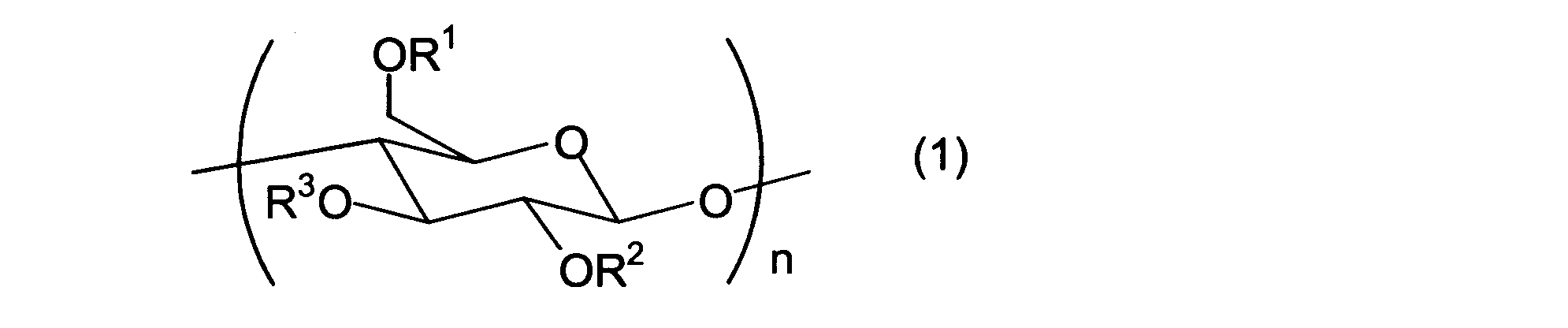

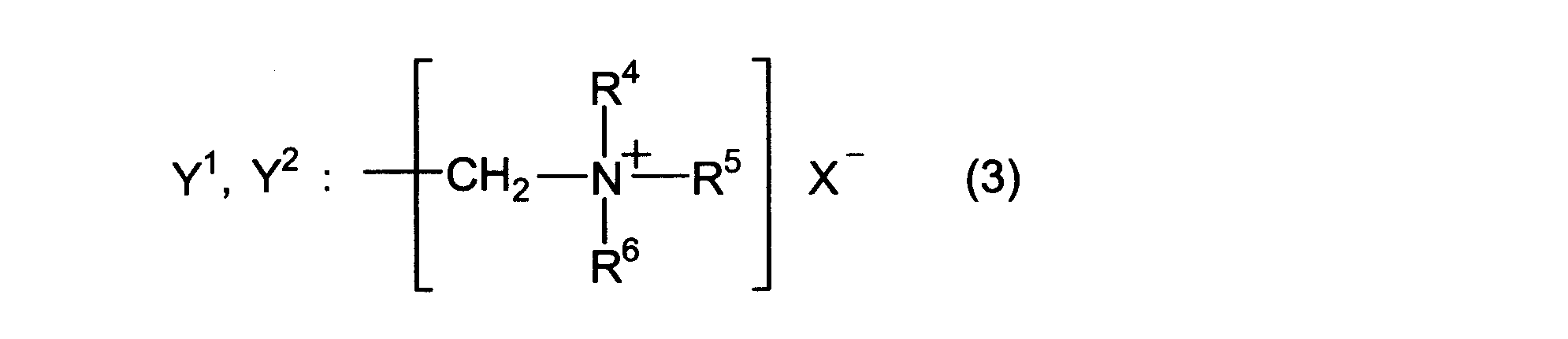
(2)カチオン化ヒドロキシプロピルセルロース(A)、20℃における水100gに対する溶解量が0~1gである油剤(B)、及び界面活性剤(C)を含有する毛髪化粧料の製造方法であって、カチオン化ヒドロキシプロピルセルロース(A)が、前記一般式(1)で表されるアンヒドログルコース由来の主鎖を有し、かつカチオン化エチレンオキシ基の置換度が0.01~2.9であり、プロピレンオキシ基の置換度が0.1~4.0であり、下記工程(a-1)~(a-3)、下記工程(b-1)~(b-4)、又は下記工程(c-1)~(c-4)を有する、毛髪化粧料の製造方法。
工程(a-1):パルプにカチオン化剤を添加して粉砕機処理を行う工程
工程(a-2):工程(a-1)で得られた粉砕機処理物に塩基を添加して粉砕機処理を行いながらパルプとカチオン化剤の反応を行ってカチオン化セルロースを得る工程
工程(a-3):工程(a-2)で得られたカチオン化セルロースと酸化プロピレンとを反応させてカチオン化ヒドロキシプロピルセルロース(A)を得る工程
工程(b-1):パルプを粉砕機処理する工程
工程(b-2):工程(b-1)で得られた粉砕機処理物に塩基を添加してアルカリセルロースを得る工程
工程(b-3):工程(b-2)で得られたアルカリセルロースと酸化プロピレンとを反応させてヒドロキシプロピルセルロースを得る工程
工程(b-4):工程(b-3)で得られたヒドロキシプロピルセルロースとカチオン化剤とを反応させてカチオン化ヒドロキシプロピルセルロース(A)を得る工程
工程(c-1):セルロース含有原料及びセルロース含有原料中のセルロースを構成するアンヒドログルコース単位1モルあたり0.6~1.5倍モルの塩基化合物との混合物を、該セルロース含有原料中のセルロースに対する水分量が10重量%以下の条件下で粉砕機処理し、セルロースの平均粒径が10~150μmであるセルロース・塩基混合粉砕物を得る工程
工程(c-2):工程(c-1)で得られたセルロース・塩基混合粉砕物に水を添加し、該セルロース・塩基混合粉砕物中の水分量を、工程(c-1)で用いたセルロース含有原料中のセルロースに対して30~100質量%に調整して、アルカリセルロースを得る工程
工程(c-3):工程(c-2)で得られたアルカリセルロースと酸化プロピレンとを反応させてヒドロキシプロピルセルロースを得る工程
工程(c-4):工程(c-3)で得られたヒドロキシプロピルセルロースとカチオン化剤とを反応させてカチオン化ヒドロキシプロピルセルロース(A)を得る工程
本発明によれば、処理乾燥後の毛髪に、良好な指通り性とべたつき感のなさ、まとまり感を付与する毛髪化粧料、及びその製造方法を提供することができる。
本発明の毛髪化粧料は、特定のカチオン化ヒドロキシプロピルセルロース(A)、20℃における水100gに対する溶解量が0~1gである油剤(B)、及び界面活性剤(C)を含有することを特徴とする。
<カチオン化ヒドロキシプロピルセルロース(A)>
本発明の毛髪化粧料は、成分(A)として、下記一般式(1)で表されるアンヒドログルコース由来の主鎖を有し、かつカチオン化エチレンオキシ基の置換度が0.01~2.9であり、プロピレンオキシ基の置換度が0.1~4.0であるカチオン化ヒドロキシプロピルセルロース(以下、「C-HPC」ともいう)を含む。


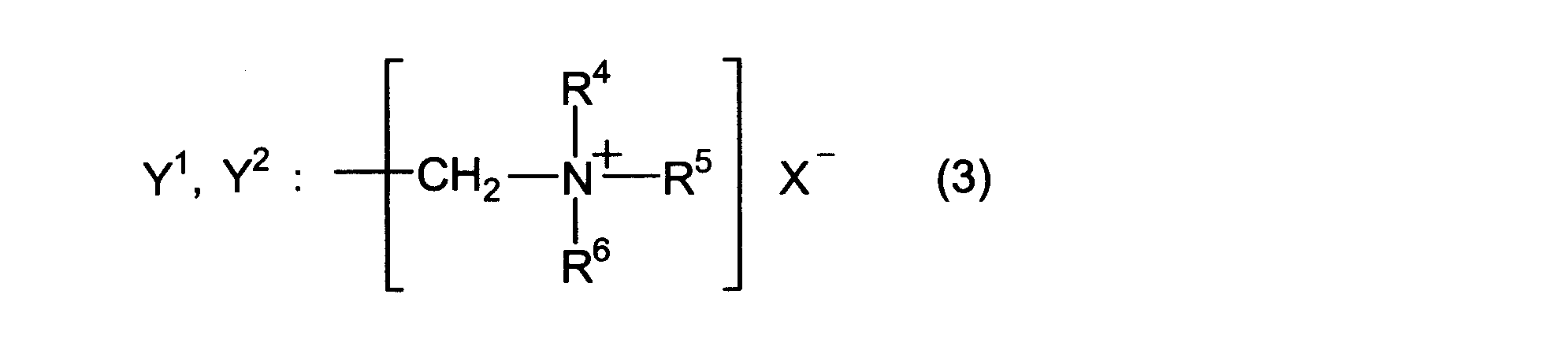
一般式(1)において、R1、R2及びR3は、それぞれ独立に一般式(2)で表される置換基であり、R1、R2及びR3は、同一であっても、異なっていてもよい。また、n個のR1、n個のR2、n個のR3は、それぞれ同一であっても、異なってもよい。
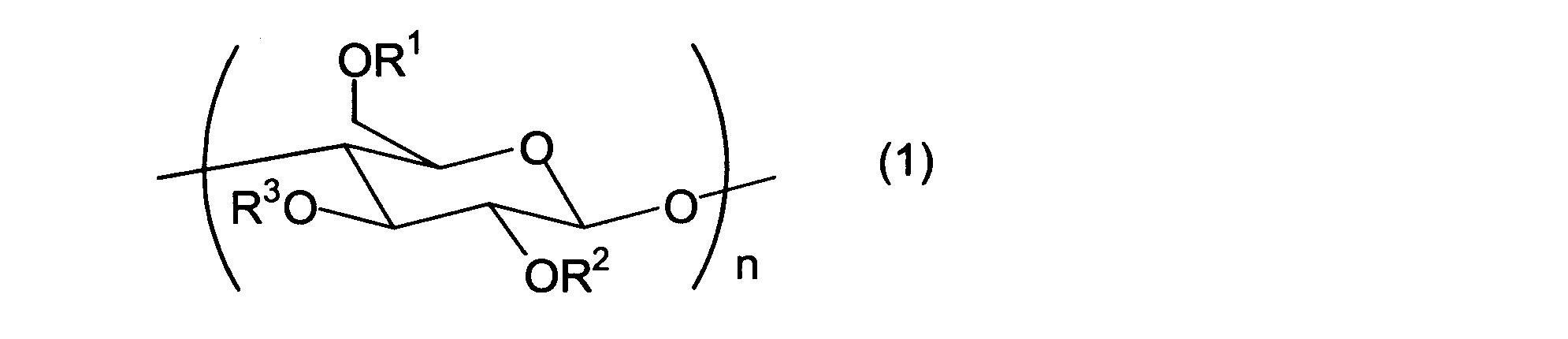
なお、本発明において平均重合度とは、銅-アンモニア法により測定される粘度平均重合度をいい、具体的には実施例に記載の方法により算出される。
一般式(2)で表される置換基は、下記式(2)に示すとおり、カチオン化エチレンオキシ基とプロピレンオキシ基を有する。

pは一般式(2)中に含まれるカチオン化エチレンオキシ基(-CH(Y1)-CH(Y2)-O-)の数を示し、0又は正の整数である。製造の容易さの観点から、pは、0~3の整数であることが好ましく、0~2の整数であることがより好ましく、0又は1であることが更に好ましい。
qは一般式(2)中に含まれるプロピレンオキシ基(-PO-)の数を示し、0又は正の整数である。製造の容易さの観点から、qは0~4の整数であることが好ましく、0~2の整数であることがより好ましく、0又は1であることがより更に好ましい。
C-HPC分子内に複数の一般式(2)で表される置換基が存在する場合、該置換基間においてp、qの値はそれぞれ異なっていてもよい。
p及びqのどちらもが0でない場合、前記カチオン化エチレンオキシ基とプロピレンオキシ基の付加順序は問わないが、製造の容易さの観点から、一般式(2)に記載した順序であることが好ましい。
また、p及びqのどちらもが0でなく、かつp及び/又はqが2以上である場合は、ブロック結合又はランダム結合のいずれであってもよいが、製造の容易さの観点から、ブロック結合であることが好ましい。
n個のR1、n個のR2、n個のR3において、少なくとも1つは、一般式(2)のpが0ではなく、また、少なくとも1つは、一般式(2)のqが0ではない。
一般式(3)で表されるカチオン性基は、下記式に示す構造を有する。
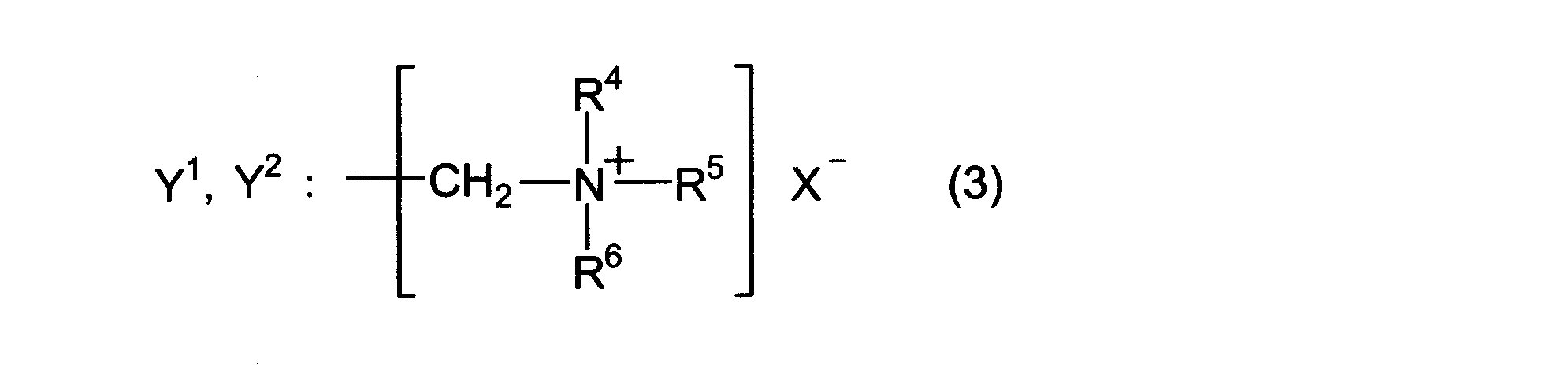
一般式(3)において、X-は、アンモニウム基の対イオンであるアニオン性基を示す。X-はアニオン性基であれば特に限定されない。その具体例としてはアルキル硫酸イオン、硫酸イオン、リン酸イオン、アルキル炭酸イオン、及びハロゲン化物イオン等が挙げられる。これらの中では、製造の容易さの観点から、ハロゲン化物イオンが好ましい。ハロゲン化物イオンとしては、フッ化物イオン、塩化物イオン、臭化物イオン及びヨウ化物イオンが挙げられるが、C-HPCの水溶性及び化学的安定性の観点から、塩化物イオン、臭化物イオンが好ましく、塩化物イオンがより好ましい。
本発明において、カチオン化エチレンオキシ基の置換度とは、セルロース主鎖を構成するアンヒドログルコース単位(以下「AGU」ともいう)1モルあたりのC-HPCの分子中に存在するカチオン化エチレンオキシ基の平均モル数をいう。カチオン化エチレンオキシ基の置換度は、後述の実施例に記載の方法により測定される。
本発明においてプロピレンオキシ基の置換度とは、セルロース主鎖を構成するAGU1モルあたりのC-HPC分子中に存在するプロピレンオキシ基の平均モル数をいう。プロピレンオキシ基の置換度は、後述の実施例に記載の方法により測定される。
本発明のC-HPCは、例えば、以下の(1)~(3)の製造方法により得ることができる。
(1)セルロースと大量の水及び大過剰のアルカリ金属水酸化物をスラリー状態で混合し、カチオン化剤及び酸化プロピレンと反応させる方法。
(2)塩化リチウムを含むジメチルアセトアミドを溶媒として用い、更にアミン類やアルコラート触媒を添加してセルロースを溶解させ、カチオン化剤及び酸化プロピレンと反応させる方法。
(3)前記(1)や(2)のように、過剰の水や溶媒を用いず、粉末状、ペレット状又はチップ状のセルロースとカチオン化剤、及び酸化プロピレンを塩基共存下に反応させる方法。
前記(1)~(3)の製造方法において、カチオン化剤との反応、及び酸化プロピレンとの反応はどちらを先に行なってもよく、同時に行なってもよい。
これら製造方法の中では、製造の容易さの観点から、前記(3)の製造方法が好ましい。前記(3)の方法によるC-HPCの製造方法の具体例としては、(3-1)セルロース含有原料のカチオン化、ヒドロキシプロピル化を順次行う方法、(3-2)セルロース含有原料のアルカリセルロース化、ヒドロキシプロピル化、カチオン化を順次行う方法等が挙げられる。
以下、前記(3)の製造方法について、具体的に説明する。
<セルロース含有原料>
C-HPCを製造するためのセルロース含有原料は、(i)結晶性を低下させたセルロース含有原料、例えば低結晶性の粉末セルロースや、(ii)結晶性の高いセルロース含有原料、例えばパルプが好適に用いられる。
(結晶性を低下させたセルロース含有原料の製造)
結晶性を低下させたセルロース含有原料、例えば低結晶性の粉末セルロースは、汎用原料として得られるシート状やロール状のセルロース純度の高いパルプから調製することができる。低結晶性粉末セルロースの調製方法は特に限定されない。例えば、特開昭62-236801号公報、特開2003-64184号公報、特開2004-331918号公報等に記載の方法を挙げることができる。これらの中では、結晶性を低下させたセルロース含有原料、例えば低結晶性の粉末セルロースの生産性を向上させる観点から、メカノケミカル処理して得られた低結晶性又は非結晶性粉末セルロース(以下、総称して「低結晶性粉末セルロース」ともいう)を使用することがより好ましい。
ここで、低結晶性粉末セルロースの「低結晶性」とは、セルロースの結晶構造においてアモルファス部の割合が多い状態を意味する。具体的には、下記計算式(1)により求められる結晶化度が、カチオン化剤及び酸化プロピレンとの反応性を高める観点から、30%以下が好ましく、20%以下がより好ましく、10%以下が更に好ましく、該結晶化度がほぼ0%である完全非晶化セルロースを用いることがより更に好ましい。
結晶化度(%)=[(I22.6-I18.5)/I22.6]×100 (1)
(式中、I22.6は、X線回折における格子面(002面)(回折角2θ=22.6°)の回折強度を示し、I18.5は、アモルファス部(回折角2θ=18.5°)の回折強度を示す。)
この方法に用いられる押出機としては、単軸又は二軸の押出機、好ましくは二軸押出機が挙げられるが、強い圧縮せん断力を加える観点から、スクリューのいずれかの部分に、いわゆるニーディングディスク部を備えるものが好ましい。
押出機を用いる処理方法としては、特に制限はないが、チップ状パルプを押出機に投入し、連続的に処理する方法が好ましい。
粉砕機としては高圧圧縮ロールミル、ロール回転ミル等のロールミル;リングローラーミル、ローラーレースミル、ボールレースミル等の竪型ローラーミル;転動ボールミル、振動ボールミル、振動ロッドミル、振動チューブミル、遊星ボールミル、遠心流動化ミル等の容器駆動媒体ミル;塔式粉砕機、攪拌槽式ミル、流通槽式ミル、アニュラー式ミル等の媒体攪拌式ミル;高速遠心ローラーミル、オングミル等の圧密せん断ミル、乳鉢、又は石臼等が挙げられる。これらの中では、セルロースの結晶化度を効率的に低下する観点、及び生産性の観点から、容器駆動式媒体ミル又は媒体攪拌式ミルが好ましく、容器駆動式媒体ミルがより好ましく、振動ボールミル、振動ロッドミル及び振動チューブミル等の振動ミルがより好ましく、振動ボールミル、振動ロッドミルが更に好ましい。
ボール、ロッド等の媒体の充填率は、粉砕機の機種により好適な範囲が異なるが、好ましくは10~97%、より好ましくは15~95%の範囲である。充填率がこの範囲内であれば、原料パルプと媒体との接触頻度が向上するとともに、媒体の動きを妨げずに、粉砕効率を向上させることができる。ここで充填率とは、粉砕機の攪拌部の容積に対する媒体の見かけの体積をいう。
ボールミルの場合、媒体として用いるボールの材質には特に制限はなく、例えば、鉄、ステンレス、アルミナ、ジルコニア等が挙げられる。ボールの外径は、セルロースの結晶化度を効率的に低下させる観点から、好ましくは0.1~100mm、より好ましくは1~50mmである。
また、セルロースの結晶化度を効率的に低下させる観点から、粉砕機の処理時間は、好ましくは5分~72時間、より好ましくは10分~30時間である。また、粉砕機処理の際には、発生する熱による変性や劣化を最小限に抑える観点から、好ましくは250℃以下、より好ましくは5~200℃の範囲で処理を行うことが望ましい。
ロッドの外径としては、好ましくは0.5~200mm、より好ましくは1~100mm、更に好ましくは5~50mmの範囲である。ロッドの長さとしては、粉砕機の容器の長さよりも短いものであれば特に限定されない。ロッドの大きさが上記の範囲であれば、所望の粉砕力が得られ効率的にセルロースを低結晶化させることができる。
ロッドを充填した振動ミルの処理時間、処理温度に特に制限はないが、前記のボールミルと同様の処理時間、処理温度で行うことができる。
また、低結晶性粉末セルロースの平均粒径は、粉体として流動性のよい状態が保てればよく、特に限定されないが、300μm以下が好ましく、150μm以下がより好ましく、50μm以下が更に好ましい。また、粉末セルロースの取り扱い性向上の観点から、20μm以上が好ましく、25μm以上がより好ましい。凝集等による微量な粗大粒子の混入を避けるため、反応には必要に応じて300~1000μm程度の篩を用いた篩下品を用いるのが好ましい。
上記のようにして得られた結晶性を低下させたセルロース含有原料、例えば低結晶性粉末セルロースに、塩基存在下、グリシジルトリアルキルアンモニウム塩を反応させてカチオン化し、カチオン化セルロースを製造する。
カチオン化剤として用いるグリシジルトリアルキルアンモニウム塩としては、グリシジルトリメチルアンモニウムクロリド、グリシジルトリエチルアンモニウムクロリド、グリシジルトリメチルアンモニウムブロミド、グリシジルトリエチルアンモニウムブロミド等が挙げられるが、入手性の観点から、グリシジルトリメチルアンモニウムクロリドが好ましい。
グリシジルトリアルキルアンモニウム塩の添加量は、毛髪化粧料で処理した毛髪の乾燥後の指通り性、まとまり感を向上させる観点から、セルロースのAGU1モルに対して、0.01~8.5倍モルが好ましく、0.1~7倍モルがより好ましく、0.2~5.5倍モルが更に好ましく、0.5~4.5倍モルがより更に好ましい。
カチオン化時に存在させる塩基としては、水酸化リチウム、水酸化ナトリウム、水酸化カリウム、水酸化カルシウム、水酸化バリウム等が挙げられるが、入手性、汎用性、経済性の観点から水酸化ナトリウム、水酸化バリウムがより好ましい。
塩基の添加量は、セルロースの種類等により異なるが、セルロースとカチオン化剤を効率的に反応させる観点から、セルロースのAGU1モルに対して、通常0.05~1.0倍モルが好ましく、0.06~1.0倍モルがより好ましく、0.07~0.7倍モルが更に好ましく、0.1~0.3倍モルがより更に好ましい。
反応系内の水分含有量は、原料として用いたセルロースに対し100質量%以下であることが好ましい。セルロースに対する水分含有量がこの範囲内であれば、セルロースが過度に凝集することなく、流動性のある粉末状態で反応させることができる。この観点から、80質量%以下がより好ましく、5~50質量%が更に好ましい。
反応温度は、通常10~85℃であり、好ましくは15~80℃である。
上記のようにして得られたカチオン化セルロースを酸化プロピレンと反応させてヒドロキシプロピル化することによりC-HPCを製造することができる。
ここで、酸化プロピレンの使用量は、毛髪化粧料で処理した毛髪の乾燥後の指通り性、まとまり感を向上させ、べたつき感を抑制する観点から、セルロース分子中のAGU1モル当たり0.01~8.5倍モルが好ましく、0.1~5.0モル倍がより好ましく、1.0~3.0倍モルが更に好ましい。
これらの中では、セルロース含有原料中のセルロースの重合度の低下を抑制する観点から、塩基触媒が好ましく、アルカリ金属水酸化物がより好ましく、水酸化ナトリウム、水酸化カリウムが更に好ましい。これらの触媒は、単独で又は2種以上を組み合わせて用いることができる。
触媒の使用量は、特に制限はないが、セルロース分子中のAGU1モル当たり、通常0.05~1.0倍モルであり、0.07~0.7倍モルが好ましく、0.1~0.3倍モルがより好ましい。カチオン化工程を先に行う場合は、カチオン化工程で用いた塩基を、そのままヒドロキシプロピル化における触媒として用いることができ、ヒドロキシプロピル化工程において新たに触媒を添加しなくてもよい。
反応系内の水分含有量は、原料として用いたセルロースに対し100質量%以下であることが好ましい。セルロースに対する水分含有量がこの範囲内であれば、カチオン化セルロースが過度に凝集することなく、流動性のある粉末状態で反応させることができる。この観点から、80質量%以下が好ましく、5~50質量%がより好ましい。
本発明においては、カチオン化セルロース、触媒及び酸化プロピレンを流動性のある粉末状態で反応させることが好ましいが、カチオン化セルロース粉末と触媒とを予めミキサー等の混合機や振とう機、又は混合ミル等で必要に応じて均一に混合分散させた後に、酸化プロピレンを添加して反応させることも可能である。
また、反応中のセルロース鎖の解裂による分子量の低下を避ける観点から、窒素等の不活性ガス雰囲気下で行うのが好ましい。
反応終了後は、未反応酸化プロピレンを除去した後、必要に応じて、中和処理、精製処理等を行った後、乾燥することにより、本発明で用いられるC-HPCを得ることができる。
中和処理は、常法により行なうことができる。例えば触媒として塩基触媒を用いた場合は、酢酸等の液体酸、酸と不活性有機溶媒との混合溶液又は酸水溶液を添加することにより行うことができる。酸の種類は特に限定されず、装置の腐食等を考慮して適宜選択すればよい。精製処理は、含水イソプロパノール、含水アセトン溶媒等の溶剤及び/又は水による洗浄又は透析膜により行うことができる。
上記<(3-1-i)結晶性を低下させたセルロース含有原料を使用するC-HPCの製造>におけるカチオン化、ヒドロキシプロピル化の反応の順序は、セルロース含有原料中のセルロースのヒドロキシプロピル化を行った後にカチオン化を行なってもよいし、同時に行なってもよい。
カチオン化エチレンオキシ基及びプロピレンオキシ基の置換度の制御の観点から、セルロース含有原料(原料セルロース)にカチオン化を行った後、ヒドロキシプロピル化を行うことが好ましい。
また、カチオン化エチレンオキシ基の置換度を高める観点から、カチオン化反応、ヒドロキシプロピル化反応を行った後、更にカチオン化反応を行ってもよい。
上記<(3-1-i)結晶性を低下させたセルロース含有原料を使用するC-HPCの製造>のカチオン化反応工程及びヒドロキシプロピル化反応工程においては、主鎖となるセルロース骨格の解裂は実質上生じないため、得られるC-HPCの平均重合度は、結晶性を低下させたセルロース含有原料、例えば低結晶化処理後の粉末セルロースの平均重合度で近似することもできる。
(結晶性の高いセルロース含有原料のカチオン化)
セルロース含有原料として前述の結晶性を低下させたセルロース含有原料、例えば低結晶性粉末セルロースを使用せずに、結晶性の高いセルロース含有原料、例えばパルプ(以下、セルロース含有原料とは、代表的にはパルプを意味する)を使用する場合は、セルロース含有原料の反応性を改善するため、カチオン化の際に低結晶化を行うことが好ましい。
具体的には、セルロース含有原料にカチオン化剤を添加して粉砕機処理による低結晶化を行い、その後塩基を添加して粉砕機処理による低結晶化を行いながらセルロース含有原料とカチオン化剤の反応を行うこと、又はセルロース含有原料に塩基を添加して粉砕機処理による低結晶化を行い、その後カチオン化剤を添加して粉砕機処理による低結晶化を行いながらセルロース含有原料とカチオン化剤の反応を行うことで、カチオン化セルロースを得ることができる。また、高いカチオン化エチレンオキシ基の置換度を持つC-HPCを得る観点から、セルロース含有原料にカチオン化剤を添加して粉砕機処理を行い、その後、塩基を添加して粉砕機処理を行い、更にカチオン化剤を添加して粉砕機処理を行うことが好ましい。塩基を添加して後のカチオン化剤の添加は、多段階で行ってもよい。
このカチオン化を経て得られるC-HPCの水への溶解性の観点から、セルロースのカチオン化においては、初めにセルロース含有原料にカチオン化剤を添加して粉砕機処理による低結晶化を行い、その後塩基を添加して粉砕機処理による低結晶化を行いながらセルロース含含有原料とカチオン化剤の反応を行うことが好ましい。
セルロース含有原料として用いるパルプの結晶化度に限定はない。しかしながら、一般に、セルロースの結晶化度低下処理には、セルロース鎖の切断に伴う分子量の低下が伴うため、結晶化度が低いセルロース含有原料中のセルロースは分子量が低い。したがって、高分子量のC-HPCを得る観点から、結晶性が高いセルロースを用いることが好ましい。また、逆に前記計算式(1)による結晶化度が95%を超える極めて結晶化度の高いセルロースも入手が困難である。よって、重合度及び入手の容易さの観点から、セルロース含有原料中のセルロースの前記計算式(1)による結晶化度は10~95%が好ましく、30~90%がより好ましく、60~80%が更に好ましい。
セルロース含有原料中のセルロースの平均重合度にも限定はないが、高分子量のC-HPCを得る観点から、より重合度の大きいセルロースを用いることが好ましい。この観点からセルロース含有原料中のセルロースの平均重合度は、50~5000が好ましく、100~2000がより好ましい。
低結晶化のための粉砕機の処理時間は、セルロースの結晶化度を効率的に低減し、かつ重合度の低下を抑制する観点から、1分~5時間が好ましく、2分~3時間がより好ましく、5分~2時間が更に好ましい。
塩基の量は、セルロースとカチオン化剤を効率的に反応させる観点から、セルロース含有原料中のセルロースのAGU1モルあたり0.05~1.5倍モルが好ましく、0.07~1.0倍モルがより好ましく、0.1~0.6倍モルが更に好ましい。
カチオン化剤及び塩基添加後の低結晶化の際にカチオン化は進行するが、反応の進行が不十分である場合、好ましくは10~100℃、より好ましくは30~80℃で熟成を行なうことにより、反応を進行させることができる。
カチオン化反応の進行が十分である場合であっても、更にグリシジルトリアルキルアンモニウム塩を加えて、上記熟成を行なうことにより、カチオン化エチレンオキシ基の置換度が高いカチオン化セルロースを得ることができる。
熟成時の水分量、及びその好ましい態様は、原料として低結晶性粉末セルロースの替わりに結晶化度の高いセルロース含有原料を用いている点を除き、前述の低結晶性粉末セルロースのカチオン化の場合と同様である。
また、反応中のセルロース鎖の解裂による分子量の低下を避ける観点から、窒素等の不活性ガス雰囲気下で行うのが好ましい。
<(3-1-ii)結晶性の高いセルロース含有原料を使用するC-HPCの製造:a法>におけるカチオン化セルロースのヒドロキシプロピル化で使用する酸化プロピレン量、触媒、反応条件、反応終了後の処理及びそれらの好ましい様態は、上記<(3-1-i)結晶性を低下させたセルロース含有原料を使用するC-HPCの製造>におけるヒドロキシプロピル化に記載のものと同様である。
上記<(3-1-ii)結晶性の高いセルロース含有原料を使用するC-HPCの製造:a法>におけるカチオン化、ヒドロキシプロピル化の反応の順序は、セルロース含有原料のヒドロキシプロピル化を行った後にカチオン化を行ってもよいし、同時に行ってもよいが、カチオン化エチレンオキシ基及びプロピレンオキシ基の置換度の制御の観点から、セルロース含有原料にカチオン化を行った後、ヒドロキシプロピル化を行うことが好ましい。
また、カチオン化エチレンオキシ基の置換度を高める観点から、カチオン化反応、ヒドロキシプロピル化反応を行った後、更にカチオン化反応を行ってもよい。
<セルロース含有原料>
C-HPCを製造するためのセルロース含有原料は、[(3-1)セルロース含有原料のカチオン化、ヒドロキシプロピル化を行う方法]と同様に、(i)結晶性を低下させたセルロース含有原料や、(ii)結晶性の高いセルロース含有原料が好適に用いられる。
(結晶性を低下させたセルロース含有原料の製造)
結晶性を低下させたセルロース含有原料については、<(3-1-i)結晶性を低下させたセルロース含有原料を使用するC-HPCの製造>に記載したものと同様である。
結晶性を低下させたセルロース含有原料の生産性を向上させる観点から、結晶性の高いセルロース含有原料、例えば、ウッドパルプを粉砕処理して得られるものが好ましい。
また、結晶性を低下させたセルロース含有原料の結晶化度は、後述するアルカリセルロースとカチオン化剤及び酸化プロピレンとの反応性を高める観点、及びセルロース含有原料の重合度を高める観点から、10~50%が好ましく、10~40%がより好ましく、10~30%が更に好ましい。
結晶性を低下させたセルロース含有原料、塩基及び水を混合することにより、アルカリセルロースを得ることができる。
塩基としては、水酸化ナトリウム、水酸化カリウム、水酸化リチウム等のアルカリ金属水酸化物、水酸化マグネシウム、水酸化カルシウム等のアルカリ土類金属水酸化物、トリメチルアミン、トリエチルアミン、トリエチレンジアミン等の3級アミン類等が挙げられる。これらの中ではアルカリ金属水酸化物、又はアルカリ土類金属水酸化物が好ましく、アルカリ金属水酸化物がより好ましく、水酸化ナトリウム、水酸化カリウムが更に好ましい。これらの塩基は、単独で又は2種以上を組み合わせて用いることができる。
塩基の量は、アルカリセルロースの収率を向上させる観点、及び後述するアルカリセルロースとカチオン化剤及び酸化プロピレンとの生産性を高める観点から、セルロース含有原料中のセルロースを構成するAGU1モルあたり、0.6~1.5モルが好ましく、0.7~1.3モルがより好ましく、0.8~1.2モルが更に好ましい。
水の添加量は、アルカリセルロースの収率を向上させる観点、及び後述するアルカリセルロースとカチオン化剤及び酸化プロピレンとの生産性を高める観点から、セルロース含有原料中のセルロースに対して、20~100質量%以上が好ましく、25~70質量%がより好ましく、30~60質量%が更に好ましい。
混合を行う装置としては、塩基をセルロース含有原料中に分散可能な装置であれば特に限定はない。例えば、リボン型混合機、パドル型混合機、円錐遊星スクリュー型混合機、ニーダー等の混合機が挙げられる。これらの中では、水平軸型パドル型混合機がより好ましく、具体的には、チョッパー翼を有する水平軸型のパドル型混合機であるレディゲミキサーが好ましい。
結晶性を低下させたセルロース含有原料、塩基、及び水を混合した後、アルカリセルロースの生成速度を向上させる観点から、熟成することが好ましい。熟成温度は、35~90℃が好ましく、38~80℃がより好ましく、40~70℃が更に好ましい。また、熟成時間は、0.1~24時間が好ましく、0.5~12時間がより好ましく、1~6時間が更に好ましい。
セルロース含有原料からアルカリセルロースへの変化は、X線結晶回折測定により確認
することができる。
アルカリセルロースのヒドロキシプロピル化における酸化プロピレン量、触媒種、触媒量、反応条件の好ましい態様は、上記<(3-1-i)結晶性を低下させたセルロース含有原料を使用するC-HPCの製造>における(ヒドロキシプロピル化)に記載のものと同様である。
(ヒドロキシプロピルセルロースのカチオン化)
ヒドロキシプロピルセルロースのカチオン化におけるカチオン化剤種、カチオン化剤量、触媒種、触媒量及び反応条件の好ましい態様は、上記<(3-1-i)結晶性を低下させたセルロース含有原料を使用するC-HPCの製造>における(カチオン化)に記載のものと同様である。
(セルロース含有原料のアルカリセルロース化)
セルロース含有原料を塩基と共に、実質的に水が存在しない条件下で粉砕機処理して、セルロース・塩基混合粉砕物を得た後、水を混合することにより、アルカリセルロースを得ることができる。
セルロース含有原料の種類、形状、結晶化度、平均重合度の好ましい態様は、上記a法における(結晶性の高いセルロース含有原料のカチオン化)に記載のものと同様である。
また、塩基化合物の種類、塩基の量の好ましい態様は、上記b法における(アルカリセルロース化)に記載のものと同様である。
塩基は、粉砕時の水分量を低減する観点から、水分を含有しない状態で混合することが好ましい。
粉砕機処理は、実質的に水が存在しない条件下で行うことが好ましい。すなわち、粉砕効率や水分除去の簡便性等の生産性を向上させる観点から、セルロース含有原料に対する水分量が、10質量%以下が好ましく、0.01~8質量%がより好ましく、0.1~6質量%が更に好ましく、1~5質量%がより更に好ましい。
アルカリセルロースの生成速度を向上させる観点、アルカリセルロースの収率を向上させる観点、及びセルロースの平均重合度の低下を抑制する観点から、セルロース・塩基混合粉砕物中のセルロースの平均粒径が10~150μmになるまで粉砕することが好ましく、20~130μmがより好ましく、40~100μmが更に好ましく、50~80μmがより更に好ましい。セルロース・塩基混合粉砕物中のセルロースの平均粒径は、実施例に記載の方法により測定される。
アルカリセルロースの収率を向上させる観点、及び後述するアルカリセルロースとカチオン化剤及び酸化プロピレンとの生産性を高める観点から、セルロース・塩基混合粉砕物の水分量が、セルロース含有原料中のセルロースに対して30~100質量%になるように、水をセルロース・塩基混合粉砕物に混合することが好ましく、35~70質量%がより好ましく、40~60質量%が更に好ましい。
アルカリセルロースのヒドロキシプロピル化における酸化プロピレン量、触媒種、触媒量、反応条件の好ましい態様は、上記<(3-1-i)結晶性を低下させたセルロース含有原料を使用するC-HPCの製造>における(ヒドロキシプロピル化)に記載のものと同様である。
(ヒドロキシプロピルセルロースのカチオン化)
ヒドロキシプロピルセルロースのカチオン化におけるカチオン化剤種、カチオン化剤量、触媒種、触媒量及び反応条件の好ましい態様は、上記<(3-1-i)結晶性を低下させたセルロース含有原料を使用するC-HPCの製造>における(カチオン化)に記載のものと同様である。
具体的には、本発明の毛髪化粧料で処理した毛髪の乾燥後の指通り性、及びまとまり感を向上させる観点から、C-HPCは、下記工程(a-1)~(a-3)を有する方法によって得られるもの、又は下記工程(a-4)及び(a-5)を有する方法によって得られるもの、又は下記工程(b1)~(b4)を有する方法によって得られるもの、又は下記工程(c-1)~(c-4)を有する方法によって得られるものが好ましく、下記a法:工程(a-1)~(a-3)を有する方法によって得られるもの、下記b法:工程(b-1)~(b-4)を有する方法によって得られるもの、又は下記c法:工程(c-1)~(c-4)を有する方法によって得られるものがより好ましい。
工程(a-1):セルロース含有原料にカチオン化剤を添加して粉砕機処理を行う工程
工程(a-2):工程(a-1)で得られた粉砕機処理物に塩基を添加して粉砕機処理を行いながらセルロース含有原料とカチオン化剤の反応を行ってカチオン化セルロースを得る工程
工程(a-3):工程(a-2)で得られたカチオン化セルロースと酸化プロピレンとを反応させてカチオン化ヒドロキシプロピルセルロース(A)を得る工程
工程(a-5):工程(a-4)で得られたカチオン化セルロースと酸化プロピレンとを反応させてカチオン化ヒドロキシプロピルセルロースを得る工程
工程(b-1):セルロース含有原料を粉砕機処理して、結晶化度が10~50%であるセルロースを含有するセルロース含有原料を得る工程
工程(b-2):工程(b-1)で得られたセルロース含有原料に対して、該セルロースを構成するAGU1モルあたり0.6~1.5倍モルの塩基、及び該セルロース含有原料中のセルロースに対して20~100質量%の水を添加してアルカリセルロースを得る工程
工程(b-3):工程(b-2)で得られたアルカリセルロースと酸化プロピレンとを反応させてヒドロキシプロピルセルロースを得る工程
工程(b-4):工程(b-3)で得られたヒドロキシプロピルセルロースとカチオン化剤とを反応させてカチオン化ヒドロキシプロピルセルロース(A)を得る工程
工程(c-1):セルロース含有原料及びセルロース含有原料中のセルロースを構成するAGU1モルあたり0.6~1.5倍モルの塩基との混合物を、該セルロース含有原料中のセルロースに対する水分量が10重量%以下の条件下で粉砕機処理し、セルロースの平均粒径が10~150μmであるセルロース・塩基混合粉砕物を得る工程
工程(c-2):工程(c-1)で得られたセルロース・塩基混合粉砕物に水を添加し、該セルロース・塩基混合粉砕物中の水分量を、工程(c-1)で用いたセルロース含有原料中のセルロースに対して30~100質量%に調整して、アルカリセルロースを得る工程
工程(c-3):工程(c-2)で得られたアルカリセルロースと酸化プロピレンとを反応させてヒドロキシプロピルセルロースを得る工程
工程(c-4):工程(c-3)で得られたヒドロキシプロピルセルロースとカチオン化剤とを反応させてカチオン化ヒドロキシプロピルセルロース(A)を得る工程
本発明で用いられる成分(B):20℃における水100gに対する溶解量が0~1gである油剤(B)としては、通常、医薬品、医薬部外品、化粧料、トイレタリー、雑貨等で用いられる油性成分であって、20℃における水100gに対する溶解量が0~1gである難水溶性又は非水溶性の油剤であれば、いずれも用いることができる。油剤(B)は本発明の毛髪化粧料による処理乾燥後の毛髪に顕著なまとまり感を付与することができる。
油剤(B)の具体例としては、20℃における水100gに対する溶解量が0~1gである(i)エステル油、(ii)シリコーン油、(iii)エーテル油、(iv)炭化水素油、(v)高級アルコール、及び(vi)水酸基が置換していてもよい炭素数17~23の炭化水素基を有するカルボン酸等が挙げられる。
R21-COO-R22 (11)
(式中、R21は炭素数8~22の直鎖又は分岐鎖のアルキル基である。R22は炭素数1~22の直鎖又は分岐鎖のアルキル基又はアルケニル基を示す。)
一般式(11)において、毛髪のまとまり感の観点から、R21の炭素数は10~20が好ましく、12~18がより好ましい。同様の観点から、R22は炭素数1~20が好ましく、1~18がより好ましい。R22は、プロピレンオキシ基、又はフェニル基で分断されていてもよい炭素数1~18の直鎖又は分岐のアルキル基又はアルケニル基が更に好ましい。


一般式(13)において、毛髪のまとまり感の観点から、R26の炭素数は8~20が好ましく、8~18がより好ましい。
これらの中では、本発明の毛髪化粧料による処理乾燥後の毛髪の良好な指通り性、まとまり感を付与する観点から、ヒマワリ油、アボカド油、ツバキ油、マカデミアナッツ油、シア脂油、ラウリン酸オクチル、ミリスチン酸オクチル、ミリスチン酸オクチルドデシル、ミリスチン酸イソプロピル、ミリスチン酸ミリスチル、パルミチン酸イソプロピル、パルミチン酸2-エチルヘキシル、パルミチン酸オクチル、パルミチン酸セチル、ステアリン酸メチル、ステアリン酸2-エチルヘキシル、ステアリン酸オクチル、ステアリン酸イソセチル、ステアリン酸ステアリル、ステアリン酸ブチル、ステアリン酸イソトリデシルが好ましく、ヒマワリ油、アボカド油、ツバキ油、マカデミアナッツ油、シア脂油、ラウリン酸オクチル、ミリスチン酸オクチル、ミリスチン酸ミリスチル、パルミチン酸イソプロピル、パルミチン酸オクチル、パルミチン酸セチル、ステアリン酸オクチル、ステアリン酸イソセチル、ステアリン酸ステアリル、ステアリン酸イソステアリル、及びイソステアリン酸イソステアリルから選ばれる1種以上がより好ましい。
入手性の観点から、ヒドロキシステアリン酸、ステアリン酸及びロジン酸の混合酸とジペンタエリスリトールからなるエステルが好ましい。
(ii)シリコーン油の粘度は、毛髪の指通り性、まとまり感、及び毛髪化粧料調製時の分散性の観点から、10~1500万mm2/sが好ましい。
R27-O-(PO)t(EO)u-H (14)
(式中、R27は炭素数6~22の直鎖又は分岐のアルキル基又はアルケニル基を示す。POはプロピレンオキシ基を示し、EOはエチレンオキシ基を示す。また、POの平均付加モル数tは0.1~15の数を示し、EOの平均付加モル数uは0~10の数を示す。uが0でない場合、PO及びEOの付加形式は、ランダムであってもブロックであってもよく、POとEOの付加順序も問わない。)
一般式(14)において、毛髪のまとまり感の観点から、R27の炭素数は6~20が好ましく、炭素数6~18がより好ましく、炭素数8~18が更に好ましい。
また、平均付加モル数tは、1~15が好ましく、2~13がより好ましい。
これらの中では、本発明の毛髪化粧料による処理乾燥後の毛髪の良好な指通り性、まとまり感を付与する観点から、プロピレンオキシ基の平均付加モル数が、3~10であるポリオキシプロピレンオクチルエーテル、ポリオキシプロピレンデシルエーテル、ポリオキシプロピレンラウリルエーテルから選ばれる1種以上がより好ましい。
(iv)炭化水素油としては、本発明の毛髪化粧料による処理乾燥後の毛髪のまとまり感の観点から、炭素数20以上の飽和又は不飽和の炭化水素が好ましい。
(iv)炭化水素油の具体例としては、スクワレン、スクワラン、流動パラフィン、流動イソパラフィン、重質流動イソパラフィン、α―オレフィンオリゴマー、シクロパラフィン、ポリブテン、ワセリン、パラフィンワックス、マイクロクリスタリンワックス、ポリエチレンワックス、セレシンが挙げられ、毛髪のまとまり間の観点から、スクワラン、スクワレン、流動パラフィン、パラフィンワックスが好ましく、スクワラン、流動パラフィン、パラフィンワックスから選ばれる1種以上が更に好ましい。
(v)高級アルコールの具体例としては、ヘキシルアルコール、2-エチルヘキシルアルコール、オクチルアルコール、デシルアルコール、イソデシルアルコール、ラウリルアルコール、ミリスチルアルコール、パルミチルアルコール、セチルアルコール、ステアリルアルコール、イソステアリルアルコール、2-オクチルドデカノール、イコシルアルコール、ベヘニルアルコールが挙げられる。
これらの中では、毛髪の指通り性、まとまり感の観点からラウリルアルコール、ミリスチルアルコール、セチルアルコール、ステアリルアルコール、ベヘニルアルコール、2-オクチルドデカノールが好ましく、ラウリルアルコール、ミリスチルアルコール、セチルアルコール、ステアリルアルコール、2-オクチルドデカノールがより好ましく、セチルアルコール、ステアリルアルコール及び2-オクチルドデカノールから選ばれる1種以上が更に好ましい。
(vi)水酸基が置換していてもよい炭素数17~23の炭化水素基を有するカルボン酸の炭化水素基としては、直鎖又は分岐鎖のアルキル基又はアルケニル基が好ましい。
水酸基が置換していてもよい炭素数17~23の炭化水素基を有するカルボン酸の具体例としては、ステアリン酸、オレイン酸、イソステアリン酸、ヒドロキシステアリン酸、ベヘニン酸、ロジン酸等が挙げられる。これらの中では、毛髪の指通り性、まとまり感の観点から、ステアリン酸、オレイン酸、イソステアリン酸、ヒドロキシステアリン酸、ベヘニン酸が好ましく、オレイン酸、イソステアリン酸がより好ましい。
(一般式(4)で表されるエステル化合物)
下記一般式(4)で表されるエステル化合物は、芳香族アルコールアルキレンオキシド付加物と脂肪族カルボン酸のエステル化反応により得られるエステル化合物である。
R7O-(AO)m-COR8 (4)
(式中、R7は置換又は無置換である少なくとも1つの芳香環を含有する炭素数6~20の炭素水素基を示し、R8は炭素数1~25の直鎖又は分岐鎖のアルキル基又はアルケニル基を示す。AOは、炭素数2~4のアルキレンオキシ基を示し、mは1~50の数である。mが2以上の場合、m個のAO基は、同一でも異なっていてもよい。)
一般式(4)のR7は、本発明の毛髪化粧料で処理した毛髪の乾燥後のべたつき感を抑制し、指通り性、まとまり感を向上させる観点から、炭素数6~12の芳香族炭化水素基が好ましく、炭素数6~10の芳香族炭化水素基がより好ましく、ベンジル基が更に好ましい。
R8は、上記と同様の観点から、炭素数7~21のアルキル基が好ましく、炭素数11~15のアルキル基がより好ましい。
上記と同様の観点から、AO基はプロピレンオキシ基が好ましく、mは1~10が好ましく、1~5がより好ましい。
一般式(4)で表されるエステル化合物の好適例としては、ベンジルアルコールのプロピレンオキシド3モル付加体とミリスチン酸のエステル(クローダ社製、商品名:クロダモルSTS)、ベンジルアルコールのプロピレンオキシド3モル付加体と2―エチルヘキシル酸のエステル(クローダ社製、商品名:クロダモルSFX)等が挙げられる。
R9O(CH2CH2O)rCO(OCH2CH2)s-OR10 (5)
(式中、R9及びR10は、それぞれ炭素数6~22の直鎖又は分岐鎖のアルキル基及び/又はアルケニル基を示し、r及びsはそれぞれ0又は1~50の数である。)
一般式(5)で表される化合物において、R9及びR10は、本発明の毛髪化粧料で処理した毛髪の乾燥後のべたつき感を抑制し、指通り性、まとまり感を向上させる観点から、炭素数6~18のアルキル基が好ましく、炭素数8~12のアルキル基がより好ましい。
r及びsは、上記と同様の観点から、0又は1~5の数が好ましく、0がより好ましい。
一般式(5)で表されるジアルキルカーボネート化合物の好適例としては、ジオクチルカーボネート(コグニス社製、商品名:セチオールCC)等が挙げられる。
R11-O-R12 (6)
(式中、R11及びR12は、それぞれ炭素数6~22の直鎖又は分岐鎖のアルキル基及び/又はアルケニル基を示す。)
一般式(6)で表されるジアルキルエーテル化合物において、R11及びR12は、本発明の毛髪化粧料で処理した毛髪の乾燥後のべたつき感を抑制し、指通り性、まとまり感を向上させる観点から、炭素数6~18のアルキル基が好ましく、炭素数8~12のアルキル基がより好ましい。
一般式(6)で表されるジアルキルエーテル化合物の好適例としては、ジオクチルエーテル(コグニス社製、商品名:セチオールOE)等が挙げられる。
一般式(4)~(6)で表される化合物は、単独で又は二種以上を組み合わせて用いることができる。
油剤(B)の含有量は、本発明の毛髪化粧料による処理乾燥後の毛髪の良好な指通り性、まとまり感を付与する観点から、毛髪化粧料中、0.01質量%以上が好ましく、0.03質量%以上がより好ましく、0.05質量%以上が更に好ましく、0.1質量%以上がより更に好ましい。本発明の毛髪化粧料による処理乾燥後の毛髪のべたつき感を抑制する観点から、30質量%以下が好ましく、20質量%以下がより好ましく、15質量%以下が更に好ましく、10質量%以下がより更に好ましい。これらの観点を総合すると、0.01~30質量%が好ましく、0.03~20質量%がより好ましく、0.05~15質量%が更に好ましく、0.1~10質量%以下がより更に好ましい。
毛髪化粧料がシャンプーである場合、油剤(B)の含有量は、同様の観点から0.1~10質量%が更に好ましく、0.5~8質量%がより更に好ましく、3~6質量%が更に好ましい。
また、本発明の毛髪化粧料は、大量の油剤を配合しても安定した乳化が可能である。油剤を高配合するときの毛髪化粧料中の油剤(B)の含有量は、毛髪化粧料中5~50質量%が好ましく、より好ましくは10~40質量%、更に好ましくは15~30質量%である。
さらに、その他の油剤として、シリコーン油を0.5~5質量%含有することが更に好ましい。
また、油剤(B)として、油剤(B2)をシャンプー等に用いる場合、C-HPC(A)に対する油剤(B2)の質量比[油剤(B2)/C-HPC(A)]は、本発明の毛髪化粧料で処理した毛髪の乾燥後のべたつき感を抑制し、指通り性を向上させる観点から、0.05~150が好ましく、0.1~50がより好ましく、0.5~25がより好ましく、1.5~12が更に好ましい。
また、油剤(B)として、油剤(B2)をコンディショナー、ヘアリンス、トリートメント等に用いる場合、その含有量は、本発明の毛髪化粧料で処理した毛髪の乾燥後のべたつき感を抑制し、指通り性、まとまり感を向上させる観点から、毛髪化粧料中、0.1質量%以上が好ましく、0.5質量%以上がより好ましく、0.8質量%以上が更に好ましい。また、本発明の毛髪化粧料で処理した毛髪の乾燥後のべたつき感を抑制する観点から、毛髪化粧料中、10質量%以下が好ましく、8質量%以下がより好ましく、2質量%以下がさらに好ましい。これらの観点を総合すると、油剤(B2)の含有量は、毛髪化粧料中、0.1~10質量%が好ましく、0.5~8質量%がより好ましく、0.8~2質量%が更に好ましい。
油剤(B2)を油剤(B1)と併用する場合、油剤(B1)の油剤の含有量は、本発明の毛髪化粧料で処理した毛髪の乾燥後の指通り性、まとまり感を向上させる観点から、毛髪化粧料中、1質量%以上が好ましく、2質量%以上がより好ましく、3質量%以上が更に好ましい。また、本発明の毛髪化粧料による処理乾燥後の毛髪のべたつき感を抑制し、指通り性を向上させる観点から、毛髪化粧料中、10質量%以下が好ましく、8質量%以下がより好ましく、5質量%以下が更に好ましい。これらの観点を総合すると、その他の油剤の含有量は、毛髪化粧料中、1~10質量%が好ましく、2~8質量%がより好ましく、3~5質量%が更に好ましい。
さらに、その他の油剤として、高級アルコールを3~5質量%含有することが更に好ましい。
油剤(B)として、油剤(B2)をコンディショナー、ヘアリンス、トリートメント等に用いる場合、C-HPC(A)に対する油剤(B2)の質量比[油剤(B2)/C-HPC(A)]は、本発明の毛髪化粧料で処理した毛髪の乾燥後のべたつき感を抑制し、指通り性、まとまり感を向上させる観点から、0.1~150が好ましく、0.5~50がより好ましく、1.5~25がより好ましく、3~12が更に好ましい。
本発明の毛髪化粧料は、界面活性剤(C)を含有する。
本発明で用いられる界面活性剤(C)としては、前記一般式(14)で示される化合物、及び水酸基が置換していてもよい炭素数17以上の炭化水素基を有するカルボン酸の塩を除き、通常、医薬品、医薬部外品、化粧料、トイレタリー、雑貨等で用いられる界面活性剤であればいずれも用いることができる。具体的には陰イオン性界面活性剤(C’)、非イオン性界面活性剤、両性界面活性剤、陽イオン性界面活性剤が挙げられるが、毛髪化粧料による処理乾燥後の毛髪のまとまり感の観点からは、陰イオン性界面活性剤(C’)、両性界面活性剤及び陽イオン性界面活性剤等のイオン性界面活性剤を用いることが好ましい。
また、本発明の毛髪化粧料をヘアトリートメント、ヘアリンス、ヘアコンディショナー又はヘアクリーム等として用いる場合は、毛髪化粧料による処理乾燥後の毛髪の指どおり性等の感触の観点から、陽イオン性界面活性剤及び/又は非イオン性界面活性剤を用いることが好ましく、陽イオン性界面活性剤を用いることがより好ましい。
具体的には、アルキル硫酸塩、アルケニル硫酸塩、ポリオキシアルキレンアルキルエーテル硫酸塩、ポリオキシアルキレンアルケニルエーテル硫酸塩、ポリオキシアルキレンアルキルフェニルエーテル硫酸塩等の硫酸エステル塩;スルホコハク酸アルキルエステル塩、ポリオキシアルキレンスルホコハク酸アルキルエステル塩、アルカンスルホン酸塩、アシルイセチオネート、アシルメチルタウレート等のスルホン酸塩;炭素数8~16の高級脂肪酸塩、ポリオキシアルキレンアルキルエーテル酢酸塩等のカルボン酸塩;アルキルリン酸塩、ポリオキシアルキレンアルキルエーテルリン酸塩等のリン酸エステル塩;アシルグルタミン酸塩、アラニン誘導体、グリシン誘導体、アルギニン誘導体等のアミノ酸塩等が挙げられる。
陰イオン性界面活性剤(C’)は、毛髪化粧料の洗浄性、起泡性及び泡質の観点、及び毛髪の乾燥後の指通り性、及びまとまり感を得る観点から、疎水性部位として炭素数8~20のアルキル基又はアルケニル基を有することが好ましく、炭素数10~16のアルキル基又はアルケニル基を有することがより好ましい。
非イオン性界面活性剤は、本発明の毛髪化粧料の洗浄性及び洗浄時の泡量、泡質の観点及び毛髪化粧料で処理した毛髪の乾燥後の指通り性、及びまとまり感を得る観点から、疎水性部位として炭素数8~20のアルキル基又はアルケニル基を有することが好ましい。
これらの中では、デシルグルコシド等の炭素数8~18、好ましくは炭素数8~12のアルキルグルコシド、ポリオキシエチレンラウリルエーテル等のポリオキシエチレンアルキルエーテル、ヤシ油脂肪酸モノエタノールアミド等の脂肪酸モノアルカノールアミドが好ましく、デシルグルコシド、ポリオキシエチレン(3)ラウリルエーテル(ラウレス-3)、ポリオキシエチレン(16)ミリスチルエーテル(セテアレス-16)、ヤシ油脂肪酸モノエタノールアミド、ヤシ油脂肪酸N-メチルモノエタノールアミドがより好ましい。

一般式(15)において、R28の炭素数は、本発明の毛髪化粧料で処理した毛髪の乾燥後の指通り性、まとまり感を向上させる観点から、12~28が好ましく、14~25がより好ましく、16~25が更に好ましい。R29の炭素数は、同様の観点から、好ましくは12~28、より好ましくは14~25、更に好ましくは16~25であり、又はメチル基、エチル基、又はヒドロキシルエチル基が好ましい。R30は、同様の観点から、メチル基、エチル基、又はヒドロキシルエチル基が好ましい。
一般式(15)で表される3級アミンと塩を形成する鉱酸又は有機酸は特に限定されないが、界面活性剤の分散安定性の観点から、ハロゲン化水素、硫酸、酢酸、クエン酸、乳酸、グルタミン酸及び炭素数1~3のアルキル硫酸が好ましく、ハロゲン化水素としては、化学的安定性の観点から塩化水素が好ましい。

一般式(16)において、R31の好ましい態様は、本発明の毛髪化粧料で処理した毛髪の乾燥後の指通り性、まとまり感を向上させる観点から、一般式(15)におけるR28の好ましい態様と同じである。同様の観点から、R32の好ましい態様は、一般式(15)におけるR29の好ましい態様と同じである。また、同様の観点から、R33及びR34は、メチル基、エチル基が好ましい。
Z-はアニオン性基であれば特に限定されない。その具体例としてはアルキル硫酸イオン、硫酸イオン、リン酸イオン、アルキルカルボキシレート、及びハロゲン化物イオン等が挙げられる。これらの中では、製造の容易さ及び入手性の観点から、ハロゲン化物イオンが好ましい。ハロゲン化物イオンとしては、フッ化物イオン、塩化物イオン、臭化物イオン及びヨウ化物イオンが挙げられるが、化学的安定性の観点から、塩化物イオン、臭化物イオンが好ましく、塩化物イオンがより好ましい。
毛髪化粧料がシャンプーである場合、界面活性剤(C)の含有量は、同様の観点から3~22質量%が好ましく、8~20質量%がより好ましい。
毛髪化粧料がコンディショナーである場合、界面活性剤(C)の含有量は、同様の観点から0.3~10質量%が好ましく、0.5~5質量%がより好ましく、0.7~3質量%が更に好ましい。
毛髪化粧料がアウトバストリートメントである場合、界面活性剤(C)の含有量は、同様の観点から0.1~5質量%が好ましく、0.1~1質量%がより好ましい。
C-HPC(A)に対する油剤(B)の質量比[油剤(B)/C-HPC(A)]は、0.1~5000が好ましい。
毛髪化粧料がシャンプーである場合、質量比[油剤(B)/C-HPC(A)]は、本発明の毛髪化粧料で処理した毛髪の乾燥後のべたつき感を抑制し、指通り性、まとまり感を向上させる観点から、0.1~200が好ましく、0.5~20がより好ましく、1~15が更に好ましい。
毛髪化粧料がコンディショナーである場合、質量比[油剤(B)/C-HPC(A)]は、同様の観点から、1~4000が好ましく、3~500がより好ましく、5~100が更に好ましく、6~50がより更に好ましい。
毛髪化粧料がアウトバストリートメントである場合、質量比[油剤(B)/C-HPC(A)]は、同様の観点から、1~100が好ましく、5~50がより好ましく、7~20が更に好ましい。
毛髪化粧料がシャンプーである場合、質量比[界面活性剤(C)/C-HPC(A)]は、本発明の毛髪化粧料で処理した毛髪の乾燥後のべたつき感を抑制し、指通り性、まとまり感を向上させる観点から、1~1500が好ましく、10~150がより好ましく、20~150が更に好ましい。
毛髪化粧料がコンディショナーである場合、質量比[界面活性剤(C)/C-HPC(A)]は、同様の観点から、0.1~2000が好ましく、1~200がより好ましく、2~20が更に好ましい。
毛髪化粧料がアウトバストリートメントである場合、質量比[界面活性剤(C)/C-HPC(A)]は、同様の観点から、0.1~100が好ましく、0.5~50がより好ましく、2~20が更に好ましい。
本発明の毛髪化粧料においては、前記C-HPC(A)、油剤(B)、及び界面活性剤(C)以外に、通常の化粧品原料として用いられる他の成分を含有することができる。このような任意成分としては、感触向上剤、増粘剤、界面活性剤、油剤、香料、紫外線吸収剤、可視光吸収剤、キレート剤、酸化防止剤、着色剤、防腐剤、pH調整剤、粘度調整剤、パール光沢剤、湿潤剤等が挙げられる。
本発明の毛髪化粧料の製造方法は、カチオン化ヒドロキシプロピルセルロース(A)、20℃における水100gに対する溶解量が0~1gである油剤(B)、及び界面活性剤(C)を含有する毛髪化粧料の製造方法であって、カチオン化ヒドロキシプロピルセルロース(A)が、前記一般式(1)で表されるアンヒドログルコース由来の主鎖を有し、かつカチオン化エチレンオキシ基の置換度が0.01~2.9であり、プロピレンオキシ基の置換度が0.1~4.0であり、前記工程(a-1)~(a-3)、前記工程(a-4)~(a-5)、前記工程(b-1)~(b-4)、又は前記工程(c-1)~(c-4)を有する。
本発明の製造方法は、毛髪化粧料で処理した毛髪の乾燥後の指通り性、及びまとまり感を向上させる観点から、前記工程(a-1)~(a-3)、前記工程(b-1)~(b-4)又は前記工程(c-1)~(c-4)を有することが好ましく、さらにC-HPCの分子量の低下を抑制する観点から、前記工程(b-1)~(b-4)又は前記工程(c-1)~(c-4)を有することがより好ましい。
工程(I):カチオン化ヒドロキシプロピルセルロース(A)と、陰イオン界面活性剤(C’)とを混合し、混合物を得る工程
工程(II):工程(I)により得られた混合物と油剤(B)とを混合してエマルションを得る工程
工程(III):工程(II)により得られたエマルションと、界面活性剤及び水とを混合して毛髪化粧料を得る工程
工程(I)は、カチオン化ヒドロキシプロピルセルロース(A)と、陰イオン界面活性剤(C’)とを混合する工程である。この工程(I)により、カチオン化ヒドロキシプロピルセルロース(A)と陰イオン界面活性剤(C’)のコンプレックスが効率よく形成されると考えられる。
工程(I)において使用される陰イオン界面活性剤(C’)としては、カチオン化ヒドロキシプロピルセルロース(A)と陰イオン界面活性剤(C’)のコンプレックスを効率よく形成する観点、乾燥後のべたつき感を抑制し、指通り性、まとまり感、しっとり感を向上させる観点から、前述の界面活性剤(C)で例示した陰イオン界面活性剤(C’)が好ましく、硫酸エステル塩、スルホン酸塩、カルボン酸塩、リン酸エステル塩及びアミノ酸塩がより好ましく、ラウリル硫酸ナトリウム、ポリオキシエチレン(1)ラウリルエーテル硫酸アンモニウム(ラウレス-1硫酸アンモニウム)ポリオキシエチレン(2)ラウリルエーテル硫酸ナトリウム(ラウレス-2硫酸ナトリウム)、ラウリン酸カリウム、ポリオキシエチレン(4.5)ラウリルエーテル酢酸ナトリウム(ラウレス-4.5酢酸ナトリウム)、ポリオキシエチレンラウリルエーテル(2)スルホコハク酸ナトリウム(ラウレス-2スルホコハク酸ナトリウム)、ココイルグルタミン酸ナトリウムが更に好ましい。
工程(I)において、カチオン化ヒドロキシプロピルセルロース(A)を水溶液にしてから、陰イオン界面活性剤(C’)と混合するのが好ましい。カチオン化ヒドロキシプロピルセルロース(A)と陰イオン界面活性剤(C’)のコンプレックスが効率よく形成される観点から、カチオン化ヒドロキシプロピルセルロース水溶液の濃度は、1.0~10.0質量%が好ましい。
工程(I)における、C-HPC(A)に対する陰イオン界面活性剤(C’)の質量比[陰イオン界面活性剤(C’)/C-HPC(A)]は、上記と同様の観点から、0.01~1.0が好ましく、0.02~0.7がより好ましく、0.03~0.5が更に好ましい。
工程(I)における混合時間は、1~60分間が好ましい。
工程(II)は、工程(I)により得られた混合物と油剤(B)とを混合してエマルションを得る工程である。この工程(II)により、エマルションが効率よく形成されると考えられる。
前記エマルション中の油剤(B)の含有量は、乾燥後のべたつき感を抑制し、指通り性、まとまり感、しっとり感を向上させる観点から、好ましくは10~80質量%、より好ましくは20~70質量%、更に好ましくは30~60質量%である。
また、エマルション中に形成される油滴の平均粒径は、乾燥後のべたつき感を抑制し、指通り性、まとまり感、しっとり感を向上させる観点から、0.1~35μmが好ましく、より好ましくは0.5~30μm、更に好ましくは1~20μmである。ここで、前記油滴の平均粒径とは、実施例に記載の方法により測定される値である。
前記混合物と油剤(B)との混合は、少量ずつ添加もしくは、一括添加どちらでもよい。混合時の撹拌速度は、安定なエマルションを調整する観点から、50~3000rpmが好ましく、100~1000rpmがより好ましく、150~600rpmが更に好ましく、200~400rpmがより更に好ましい。また、混合時の周速度は、同様の観点から、0.1~8m/sが好ましく、0.3~3m/sがより好ましく、0.4~2m/sが更に好ましい。
工程(II)における混合時間は、1~60分間が好ましい。
工程(III)は、工程(II)により得られたエマルションと、界面活性剤(C)及び水とを混合して毛髪化粧料を得る工程である。この工程(III)により、油剤(B)を毛髪に効率的に残留させ、乾燥後の毛髪にしっとり感を付与することができると考えられる。
工程(III)では、前記エマルションと、界面活性剤(C)及び水とを混合する。さらに、前述した従来公知の添加剤を混合してもよい。前記エマルションと界面活性剤(C)、水、及び添加剤との混合の順序は、特に制限されない。
以上の工程(I)~工程(III)を有する製造方法により、乾燥後のべたつき感を抑制し、指通り性、まとまり感、しっとり感が向上する毛髪化粧料を効率よく製造することができる。
[1]カチオン化ヒドロキシプロピルセルロース(A)、20℃における水100gに対する溶解量が0~1g、好ましくは0~0.5g、より好ましくは0~0.1gである油剤(B)、及び界面活性剤(C)を含有する毛髪化粧料であって、カチオン化ヒドロキシプロピルセルロース(A)が、下記一般式(1)で表されるアンヒドログルコース由来の主鎖を有し、かつカチオン化エチレンオキシ基の置換度が0.01~2.9、好ましくは0.1~2.5、より好ましくは0.2~2.0、更に好ましくは0.3~1.5、更に好ましくは0.8~1.2であり、プロピレンオキシ基の置換度が0.1~4.0、好ましくは0.2~3.0、好ましくは0.3~2.8、より好ましくは0.6~2.5、更に好ましくは1.0~2.0、である毛髪化粧料。
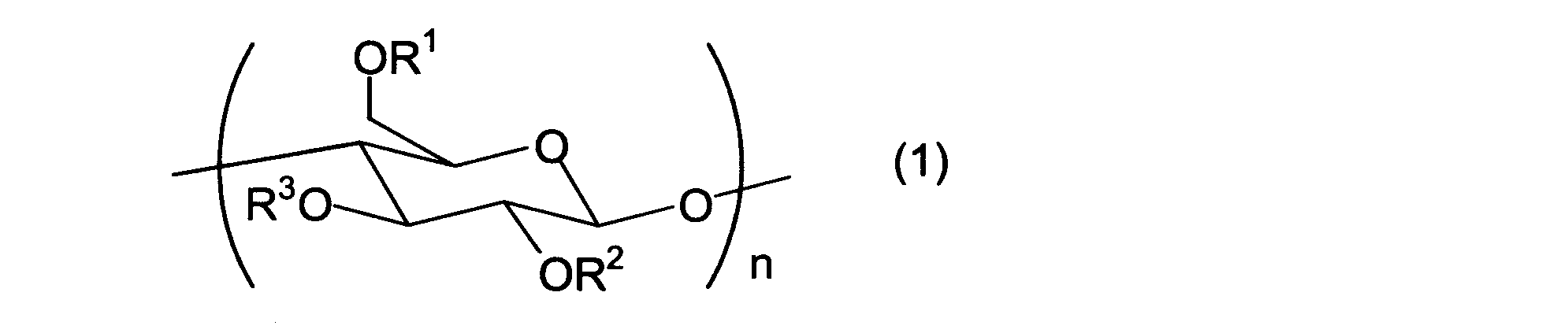

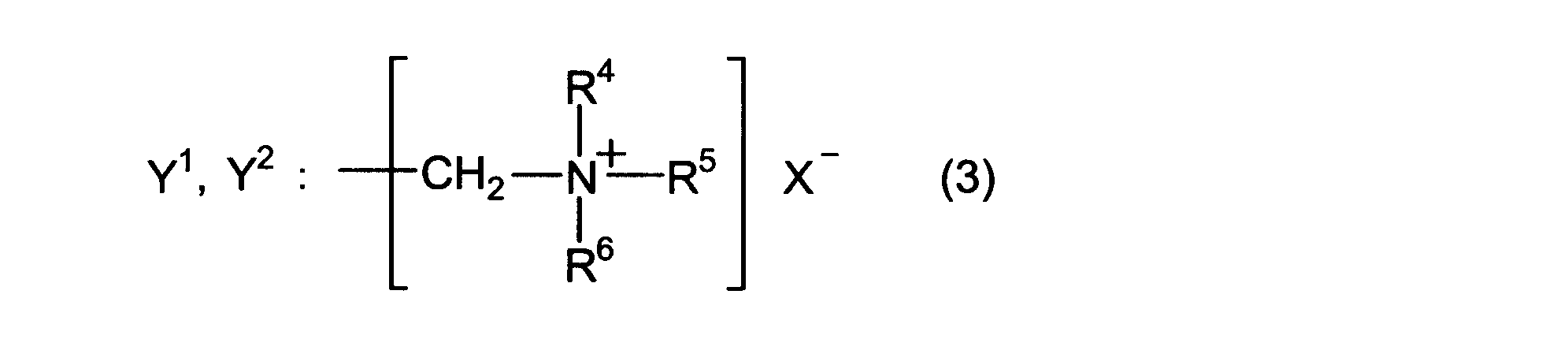
[2]カチオン化ヒドロキシプロピルセルロース(A)の含有量が0.001~10質量%、好ましくは0.005~5質量%、より好ましくは0.01~2質量%、更に好ましくは0.05~1質量%、更に好ましくは0.07~0.7質量%である、上記[1]に記載の毛髪化粧料。
[4]カチオン化ヒドロキシプロピルセルロース(C-HPC)(A)に対する油剤(B)の質量比[油剤(B)/C-HPC(A)]が、0.1~5000である、上記[1]~[3]いずれかに記載の毛髪化粧料。
[5]C-HPCに対する界面活性剤(C)の質量比[界面活性剤(C)/C-HPC(A)]が、0.1~2000である、上記[1]~[4]いずれかに記載の毛髪化粧料。
[6]油剤(B)が、下記一般式(4)で表されるエステル化合物、下記一般式(5)で表されるジアルキルカーボネート化合物、及び下記一般式(6)で表されるジアルキルエーテル化合物から選ばれる1種以上の化合物である、上記[1]~[5]いずれかに記載の毛髪化粧料。
R7O-(AO)m-COR8 (4)
(式中、R7は置換又は無置換である少なくとも1つの芳香環を含有する炭素数6~20の炭素水素基、好ましくは炭素数6~12の芳香族炭化水素基、より好ましくは炭素数6~10の芳香族炭化水素基、更に好ましくはベンジル基を示し、R8は炭素数1~25の直鎖又は分岐鎖のアルキル基又はアルケニル基、好ましくは炭素数7~21のアルキル基、より好ましくは炭素数11~15のアルキル基を示す。AOは、炭素数2~4のアルキレンオキシ基を示し、mは1~50の数、好ましくは1~10の数、より好ましく、1~5の数である。mが2以上の場合、m個のAO基は、同一でも異なっていてもよい。)
R9O(CH2CH2O)rCO(OCH2CH2)s-OR10 (5)
(式中、R9及びR10は、それぞれ炭素数6~22の直鎖又は分岐鎖のアルキル基及び/又はアルケニル基、好ましくは炭素数6~18のアルキル基、より好ましくは炭素数8~12のアルキル基を示し、r及びsはそれぞれ0又は1~50の数、好ましくは0又は1~5の数、より好ましくは0である。)
R11-O-R12 (6)
(式中、R11及びR12は、それぞれ炭素数6~22の直鎖又は分岐鎖のアルキル基及び/又はアルケニル基、好ましくは炭素数6~18のアルキル基、より好ましくは炭素数8~12のアルキル基を示す。)
工程(a-1):セルロース含有原料にカチオン化剤を添加して粉砕機処理を行う工程
工程(a-2):工程(a-1)で得られた粉砕機処理物に塩基を添加して粉砕機処理を行いながらセルロース含有原料とカチオン化剤の反応を行ってカチオン化セルロースを得る工程
工程(a-3):工程(a-2)で得られたカチオン化セルロースと酸化プロピレンとを反応させてカチオン化ヒドロキシプロピルセルロース(A)を得る工程
[8]カチオン化ヒドロキシプロピルセルロース(A)が、下記工程(b-1)~(b-4)によって得られるものである、上記[1]~[6]いずれかに記載の毛髪化粧料。
工程(b-1):セルロース含有原料を粉砕機処理して、結晶化度が10~50%であるセルロースを含有するセルロース含有原料を得る工程
工程(b-2):工程(b-1)で得られたセルロース含有原料に対して、該セルロースを構成するアンヒドログルコース単位1モルあたり0.6~1.5倍モルの塩基、及び該セルロース含有原料中のセルロースに対して20~100質量%の水を添加して、アルカリセルロースを得る工程
工程(b-3):工程(b-2)で得られたアルカリセルロースと酸化プロピレンとを反応させてヒドロキシプロピルセルロースを得る工程
工程(b-4):工程(b-3)で得られたヒドロキシプロピルセルロースとカチオン化剤とを反応させてカチオン化ヒドロキシプロピルセルロース(A)を得る工程
[9]カチオン化ヒドロキシプロピルセルロース(A)が、下記工程(c-1)~(c-4)によって得られるものである、上記[1]~[6]いずれかに記載の毛髪化粧料。
工程(c-1):セルロース含有原料及びセルロース含有原料中のセルロースを構成するアンヒドログルコース単位1モルあたり0.6~1.5倍モルの塩基化合物との混合物を、該セルロース含有原料中のセルロースに対する水分量が10重量%以下の条件下で粉砕機処理し、セルロースの平均粒径が10~150μmであるセルロース・塩基混合粉砕物を得る工程
工程(c-2):工程(c-1)で得られたセルロース・塩基混合粉砕物に水を添加し、該セルロース・塩基混合粉砕物中の水分量を、工程(c-1)で用いたセルロース含有原料中のセルロースに対して30~100質量%に調整して、アルカリセルロースを得る工程
工程(c-3):工程(c-2)で得られたアルカリセルロースと酸化プロピレンとを反応させてヒドロキシプロピルセルロースを得る工程
工程(c-4):工程(c-3)で得られたヒドロキシプロピルセルロースとカチオン化剤とを反応させてカチオン化ヒドロキシプロピルセルロース(A)を得る工程
[11]下記工程(I)~工程(III)を有する毛髪化粧料の製造方法。
工程(I):カチオン化ヒドロキシプロピルセルロース(A)と、陰イオン界面活性剤(C’)とを混合し、混合物を得る工程
工程(II):工程(I)により得られた混合物と油剤(B)を混合し、エマルションを得る工程
工程(III):工程(II)により得られたエマルションと、界面活性剤(C)及び水とを混合し、毛髪化粧料を得る工程
[12]上記[1]~[6]いずれかに記載の毛髪化粧料の毛髪化粧料としての使用。
[13]毛髪化粧料がシャンプーである、上記[12]記載の使用。
[14]毛髪化粧料が、コンディショナー、ヘアリンス又はトリートメントである、上記[12]記載の使用。
[15]毛髪化粧料がアウトバストリートメントである、上記[12]記載の使用。
パルプ、粉末セルロースの水分量は、赤外線水分計(株式会社ケット科学研究所製、「FD-610」)を使用した。測定温度120℃で、30秒間の重量変化率が0.1%以下となる点を測定の終点とした。
(2)パルプ及び粉末セルロースの結晶化度の算出
株式会社リガク製「Rigaku RINT 2500VC X-RAY diffractometer」を用いて、以下の条件で測定した回折スペクトルのピーク強度から、前記計算式(1)に基づいて算出した。
X線源:Cu/Kα-radiation、管電圧:40kV、管電流:120mA
測定範囲:2θ=5~45°
測定サンプル:面積320mm2×厚さ1mmのペレットを圧縮して作成
X線のスキャンスピード:10°/min
得られた結晶化度が負の値をとった場合は、全て結晶化度0%とした。
(3)粉末セルロース、セルロース・塩基混合粉砕物中のセルロースの平均粒径の測定 粉末セルロースの平均粒径は、レーザー回折/散乱式粒度分布測定装置「LA-920」(株式会社堀場製作所製)を用いて測定した。測定試料として粉末セルロース0.1gを5mLの水に加え、超音波で1分間処理した試料分散液を用いた。体積基準のメジアン径を、温度25℃にて測定し、これを平均粒径とした。
セルロース・塩基混合粉砕物中のセルロースの平均粒径は、同様の測定装置を用い、セルロース・塩基混合粉砕物にエタノールに加え、透過率が70-95%の範囲に入るように濃度に調節し、超音波で1分間処理し、NaOHを溶解させた試料分散液を用いた。
製造例で得られたC-HPCを透析膜(分画分子量1000)により精製後、水溶液を凍結乾燥して精製C-HPCを得た。得られた精製C-HPCの塩素含有量(%)を元素分析によって測定し、C-HPC中に含まれるカチオン性基の数と対イオンである塩化物イオンの数を同数であると近似して、下記計算式(2)から、C-HPC単位質量中に含まれるカチオン化エチレンオキシ基(-CH(Y1)-CH(Y2)O-)の量(a(モル/g))を求めた。
a(モル/g)=元素分析から求められる塩素含有量(%)/(35.5×100) (2)
分析対象がヒドロキシプロピルセルロースではなく精製C-HPCであることを除き、日本薬局方記載の「ヒドロキシプロピルセルロースの分析法」に従って、ヒドロキシプロポキシ基含有量(%)を測定した。下記計算式(3)から、ヒドロキシプロポキシ基含有量〔式量(OC3H6OH=75.09〕(bモル/g)を求めた。
b(モル/g)=ガスクロ分析から求められるヒドロキシプロポキシ基含有量(%)/(75.09×100) (3)
得られたa及びbと下記計算式(4)、(5)からカチオン化エチレンオキシ基の置換度(k)及びプロピレンオキシ基の置換度(m)を算出した。
a=k/(162+k×K+m×58) (4)
b=m/(162+k×K+m×58) (5)
〔式中、k及びKは、それぞれ、カチオン化エチレンオキシ基の置換度及び式量を示し、mはプロピレンオキシ基の置換度を示す。〕
(5-1)パルプ及び粉末セルロースの粘度平均重合度の測定
(i)測定用溶液の調製
メスフラスコ(100mL)に塩化第一銅0.5g、25%アンモニア水20~30mLを加え、完全に溶解した後に、水酸化第二銅1.0g、及び25%アンモニア水を加えて標線の一寸手前までの量とした。これを30~40分撹拌して、完全に溶解した。その後、精秤したセルロースを加え、標線まで上記アンモニア水を満たした。空気の入らないように密封し、12時間、マグネチックスターラーで撹拌して溶解し、測定用溶液を調製した。添加するセルロース量を20~500mgの範囲で変えて、異なる濃度の測定用溶液を調製した。
(ii)粘度平均重合度の測定
上記(i)得られた測定用溶液(銅アンモニア溶液)をウベローデ粘度計に入れ、恒温槽(20±0.1℃)中で1時間静置した後、液の流下速度を測定した。種々のセルロース濃度(g/dL)の銅アンモニア溶液の流下時間(t(秒))とセルロース無添加の銅アンモニア水溶液の流下時間(t0(秒))から、下記式により、それぞれの濃度における還元粘度(ηsp/c)を下記式により求めた。
ηsp/c={(t-t0)/t0}/c
(c:セルロース濃度(g/dL)
更に、還元粘度をc=0に外挿して固有粘度[η](dL/g)を求め、下記式により粘度平均重合度(DP)を求めた。
DP=2000×[η]
(iii)測定溶液の調製
精秤したセルロースの替わりに精秤したC-HPCを用いた点を除き、上記(i)の測定溶液の調製と同様にして測定溶液を調製した。
(iv)粘度平均重合度の測定
測定溶液の濃度としてセルロース換算濃度(g/dL)を用いた点を除き、上記(ii)の粘度平均重合度の測定と同様にして測定した。
ここで、セルロース換算濃度(ccell)とは、測定溶液1dL中に含まれるセルロース骨格部分の質量(g)をいい、下記計算式(6)で定義する。
ccell=u×162/(162+k×K+m×58) (6)
〔式中、uは測定溶液の調製時に用いた精秤したC-HPCの質量(g)を示し、k、K、mは、それぞれ前記計算式(4)及び(5)と同じ意味を表す。〕
25℃の水に、C-HPCを撹拌しながら加え、2質量%のC-HPC水溶液を調製した。これを泡が入らないように注意しながら粘度管に入れ、パラフィルムでシールし、30℃の水浴中に約1時間静置した。次いで、試料の粘度に応じたローター(No.M1~M4)及び回転数(6~60rpm)を選び、東機産業(株)製のB型粘度計(型式 TVB-10)を用いて、ローターを1分間回転させときの粘度計の指示値を読み取り、粘度を算出した。
(1)チップ化工程
シート状木材パルプ〔テンベック社製Biofloc HV+、平均重合度1770、結晶化度74%、水分含量7.0%〕をシートペレタイザー(株式会社ホーライ製、「SGG-220」)で処理して3~5mm角のチップ状にした。
(2)カチオン化工程(1)
上記(1)で得られたチップ状パルプ100gに、グリシジルトリメチルアンモニウムクロリド水溶液(阪本薬品工業株式会社製、含水量20%、純度90%以上)(以下「GMAC」という)23.4g〔セルロースのAGU1モルあたり0.2モル相当量〕を乳鉢で混合した後、バッチ式振動ミル(中央化工機株式会社製「MB-1」:容器全容積3.5L、ロッドとして、φ30mm、長さ218mm、断面形状が円形のSUS304製ロッド13本、充填率57%)に投入した。30分間粉砕処理(振動数20Hz、振幅8mm、温度30~70℃)を行い、セルロースとGMACの粉末状混合物を得た。
得られた粉末状混合物に、24.7%水酸化ナトリウム水溶液20g(AGU 1モルあたり0.2モル相当量)を乳鉢で混合した後、前記バッチ式振動ミルに投入した。同様の条件にて60分間粉砕処理を行い、カチオン化セルロース(i)151gを得た。
(3)カチオン化工程(2)
上記(2)で得られたカチオン化セルロース(i)128gに、GMAC31.3g(AGU 1モルあたり0.32モル相当量)を加えて乳鉢で混合した後、得られた混合物を、還流管を取り付けた1Lニーダー(株式会社入江商会製、PNV-1型)に仕込み、50℃、窒素雰囲気下、50rpmで攪拌しながら5時間熟成を行い、カチオン化セルロース(ii)を得た。
(4)ヒドロキシプロピル化工程
熟成後に得られたカチオン化セルロース(ii)152.6g(未中和・未精製品)の入ったニーダーを70℃に昇温し、酸化プロピレン72.5g(AGU 1モルあたり2.5モル相当量、関東化学株式会社製、特級試薬)を攪拌しながら滴下して、酸化プロピレンが消費され還流が止むまで20時間反応を行った。
得られた精製C-HPC(I‐1)の元素分析より、塩素含有量は3.4%であった。また、前記「ヒドロキシプロピルセルロースの分析法」によるヒドロキシプロポキシ基含有量は43.3%であった。カチオン化エチレンオキシ基の置換度、及びプロピレンオキシ基の置換度は、それぞれ0.30、及び1.8であった。精製C-HPC(I‐1)の平均重合度は739であった。結果を表1に示す。
カチオン化工程(1)を表1に示す条件に変え、カチオン化工程(2)を行なわず、ヒドロキシプロピル化工程を表1に示す条件に変えた以外は製造例I‐1と同様に行った。得られた精製C-HPC(I‐2)の結果を表1に示す。
製造例I‐3〔C-HPC(I‐3)の製造〕
カチオン化工程(1)及びカチオン化工程(2)、及びヒドロキシプロピル化工程を表1に示す条件に変えた以外は製造例I‐1と同様に行った。得られた精製C-HPC(I‐3)の結果を表1に示す。
製造例I‐4〔C-HPC(I‐4)の製造〕
カチオン化工程(1)を表1に示す条件に変え、カチオン化工程(2)を行なわず、ヒドロキシプロピル化工程を表1に示す条件に変えた以外は製造例I‐1と同様に行った。得られた精製C-HPC(I‐4)の結果を表1に示す。
製造例I‐5〔C-HPC(I‐5)の製造〕
カチオン化工程(1)、カチオン化工程(2)、及びヒドロキシプロピル化工程を表1に示す条件に変えた以外は製造例I‐1と同様に行った。得られた精製C-HPC(I‐5)の結果を表1に示す。
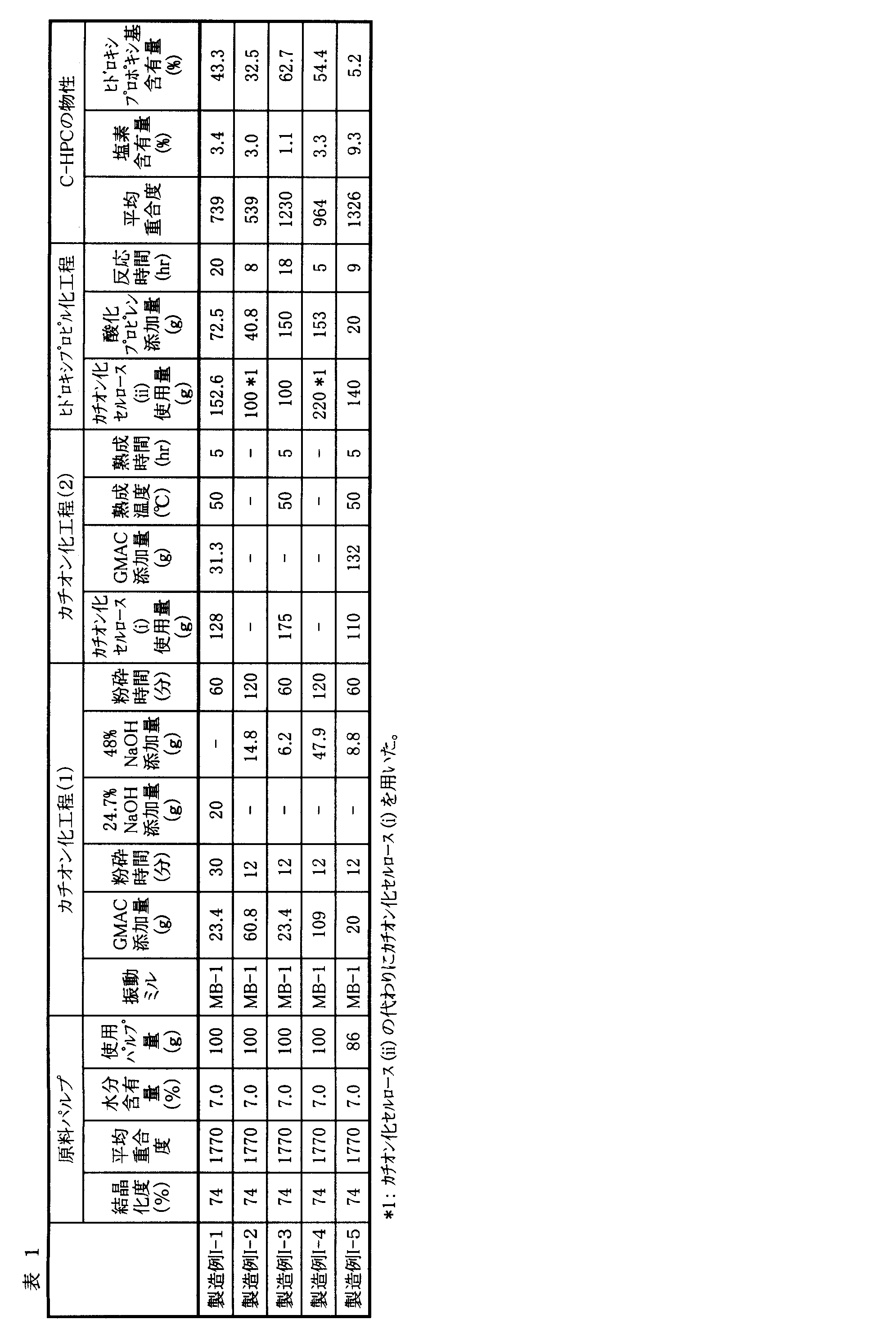
(1)チップ化工程
セルロースとして、シート状木材パルプ〔テンベック社製Biofloc HV10、平均重合度1508、結晶化度74%、水分量7.0%〕をシートペレタイザ(株式会社ホーライ製、「SGG-220」)で処理して3~5mm角のチップ状にした。
(2)カチオン化工程(1)
上記(1)で得られたチップ状パルプ989g(水分量7.0%)に、GMAC559g(AGU 1モルあたり0.52モル相当量)とイオン交換水24gを加え、ポリ袋中で混合を行った後、バッチ式振動ミル(中央化工機株式会社製「FV-10」、容器全容量;35L、ロッドとして、φ30mm、長さ510mm、断面形状が円形のSUS30
4製ロッド63本、充填率64%)に投入した。12分間粉砕処理(振動数20Hz、振幅8mm、温度10~40℃)を行い、セルロースとGMACの粉状混合物を得た。
更に振動ミル内に顆粒状水酸化ナトリウム(有効分100%)136.2g(AGU 1モルあたり0.60モル相当量)を投入した。再び112分間粉砕処理を行いカチオン化セルロースを得た。
(3)ヒドロキシプロピル化工程
上記(2)で得られたカチオン化セルロース95.0gを製造例I‐1で用いた還流管を取り付けたニーダーに仕込み、ニーダーを70℃に昇温し、酸化プロピレン35.4g(AGU 1モルあたり2.0モル相当量)を攪拌しながら滴下して、酸化プロピレンが消費され還流が止むまで7時間反応を行った。反応終了混合物をニーダーから取り出し、薄褐色の粗C-HPC粉末120.6gを得た。
(4)カチオン化工程(2)
上記(3)で得られた粗C-HPC粉末10.6gにGMAC 16.2g(AGU 1モルあたり3.5モル相当量)を添加し、乳鉢で混合を行った後、恒温槽中50℃にて24時間熟成を行った。得られた粗C-HPCに水:エタノール:イソプロピルアルコール=5:45:50(重量比)の混合溶媒100gを用いて分散を行い、酢酸を加え中和し、沈殿精製を行った。沈殿物をろ過収集し乾燥機中60℃にて一晩減圧乾燥を行い、薄褐色塊状の粗C-HPC(I‐6)を得た。
プロピレンオキシ基及びカチオン化エチレンオキシ基の置換度を求める目的で、生成物を透析膜(分画分子量1000)により精製後、水溶液の凍結乾燥を行い、精製C-HPC(I‐6)を得た。
得られた精製C-HPC(I‐6)の元素分析より、塩素含有量は9.1%であった。また、ヒドロキシプロポキシ基含有量は、25.1%であった。カチオン化エチレンオキシ基、プロピレンオキシ基の置換度は、それぞれ1.00、及び1.3と算出した。精製C-HPC(I‐6)の平均重合度は464であった。結果を表2に示す。
原料パルプを表2に示す原料パルプに変え、カチオン化工程(1)、ヒドロキシプロピル化工程、及びカチオン化工程(2)を表2に示す量に変えた以外は製造例I‐6と同様に行った。得られた精製C-HPC(I‐7)の結果を表2に示す。

(1)低結晶性粉末セルロースの製造工程
シート状木材パルプ(テンベック社製Biofloc HV+、平均重合度1770、結晶化度74%、水分含量7.0%)をシュレッダー(株式会社明光商会製、「MSX2000-IVP440F」)にかけて3~5mm角のチップ状にした。その後、50℃減圧下で12時間乾燥処理を行い、チップ状の乾燥パルプ(水分含量0.4%)を得た。
次に、得られたチップ状の乾燥パルプ100gを、製造例I‐1で使用したバッチ式振動ミルに投入した。振動数20Hz,全振幅8mm,温度30~70℃の範囲で35分粉砕処理を行い、粉末セルロース(結晶化度0%、平均重合度836、平均粒径52μm、水分含量1.0%)を得た。
(2)カチオン化工程
上記(1)で得られた粉末セルロース100gに、GMAC 46.9g(AGU 1モルあたり0.4モル相当量)を添加し、乳鉢で混合した。その後、48%水酸化ナトリウム水溶液5.14g(AGU 1モルあたり0.1モル相当量)、イオン交換水18gを添加し、混合した。製造例I‐1で使用したニーダーに、得られた混合物を仕込み、50℃で4時間撹拌し、カチオン化セルロース170gを得た。
(3)ヒドロキシプロピル化工程
上記(2)で得られたカチオン化セルロース170gを70℃に加温し、攪拌しながら48%水酸化ナトリウム水溶液を4.7g(AGU 1モルあたり0.1モル相当量)、イオン交換水を16.4g加えた。更に、酸化プロピレン101g(AGU 1モルあたり3.0モル相当量)を滴下して、酸化プロピレンが消費され還流が止むまで24時間反応を行った。反応後、セルロースは流動性のある粉末状態を保っていた。この反応終了品10.0gを採取して酢酸で中和し、薄褐色固体を得た。中和物を透析膜(分画分子量1000)により精製後、水溶液の凍結乾燥を行い、精製C-HPC(I‐8)を得た。
得られた精製C-HPC(I‐8)の元素分析より、塩素含有量は2.1%であった。また、ヒドロキシプロポキシ基含有量は、49.2%であった。カチオン化エチレンオキシ基、プロピレンオキシ基の置換度は、それぞれ0.18及び2.0と算出した。精製C-HPC(I‐8)の平均重合度は832であった。結果を表3に示す。
原料パルプを表3に示す原料パルプに変え、低結晶性粉末セルロースの製造工程、カチオン化工程、及びヒドロキシプロピル化工程を表3示す条件に変えたこと以外は製造例I‐8と同様に行った。得られた精製C-HPC(I‐9)の結果を表3に示す。
製造例I‐10〔C-HPC(I‐10)の製造〕
ヒドロキシプロピル化工程を表3に示す条件に変えたこと以外は製造例I‐8と同様に行った。得られた精製C-HPC(I‐10)の結果を表3に示す。

酸化プロピレンの付加反応を行なわなかったこと以外は、製造例I‐5と同様に行い、カチオン化セルロース(I‐1)を得た。
(1)チップ化工程
シート状木材パルプ〔テンベック社製Biofloc HV+、平均重合度1481、結晶化度74%、水分含量4.6%〕をシートペレタイザー(株式会社ホーライ製、「SGG-220」)で処理して3~5mm角のチップ状にした。
(2)アルカリセルロース化工程
上記工程(1)で得られたチップ状パルプ100gと0.7mm粒状のNaOH23.6g(AGU1モルあたり1.0モル相当量)を、バッチ式振動ミル(中央化工機株式会社製「MB-1」:容器全容積3.5L、ロッドとして、φ30mm、長さ218mm、断面形状が円形のSUS304製ロッド13本、充填率57%)に投入し、15分間粉砕処理(振動数20Hz、振幅8mm、温度30~70℃)を行った。得られたセルロース・NaOH混合粉砕物(セルロースの平均粒径:65μm)を乳鉢に移し、水50gを噴霧にて添加した。セルロース・NaOH混合粉砕物の水分量は、セルロースに対して57%であった。20℃にて乳棒で5分間混合し、アルカリセルロースを得た(平均重合度:1175)。
(3)ヒドロキシプロピル化反応工程
上記工程(2)で得られたアルカリセルロースを還流管と滴下ロートを取り付けたニーダー(株式会社入江商会製、PNV-1型、容積1.0L)に仕込み、酸化プロピレン85.7g(AGU1モルあたり2.5モル相当量)を投入し、攪拌を行いながら50℃にて6時間反応させた。反応は、酸化プロピレンを5時間かけて滴下した後、1時間熟成を行った。
(4)カチオン化反応工程
上記工程(3)で得られた反応混合物5.8gを乳鉢にとり、65% 3-クロロ-2-ヒドロキシプロピルトリメチルアンモニウムクロライド水溶液(四日市合成株式会社製)2.10g(AGU1モルあたり0.50モル相当量)を添加して、5分間混合後、50mlガラス瓶に移し、50℃、7時間反応させることで粗C-HPCを製造した。
この粗C-HPC粉末5.0gを採取して乳酸で中和した。プロピレンオキシ基及びカチオン化エチレンオキシ基の置換度を求める目的で、中和物を透析膜(分画分子量1000)により精製後、水溶液の凍結乾燥を行い、精製C-HPC(I‐11)を得た。
得られた精製C-HPC(I‐11)の元素分析より、塩素元素含有量は3.3%であり、ヒドロキシプロポキシ基含有量は38.8%であった。また、カチオン化エチレンオキシ基の置換度、及びプロピレンオキシ基の置換度は、それぞれ0.27、1.5と算出された。また、平均重合度は、643であった。結果を表4に示す。

(1)低結晶性粉末セルロース製造工程
製造例I‐12(1)と同様に行い、3~5mm角のチップ状パルプを得た。得られたチップ状パルプ1kgを、乾燥器(アドバンテック東洋株式会社製、商品名;VO-402)に投入し、105℃で2時間乾燥して、乾燥チップ状パルプ(水分含有量0.8%)を得た。
得られた乾燥チップ状パルプ920gをバッチ式振動ミル(中央化工機株式会社製、「FV-10」:全容器量35L、ロッドとして、φ30mm、長さ510mm、断面形状が円形のSUS304製ロッド63本、充填率65%)に投入した。10分間粉砕処理(振動数20Hz、振幅8mm、温度10~40℃)を行い、粉末セルロース(結晶化度14%、平均重合度1198、水分含有量1.0%)を得た。
(2)アルカリセルロース化工程
上記工程(1)で得られた粉末セルロース369gを混合機(株式会社マツボー製、「レディゲミキサー」、容量5L)に投入し、主翼250rpm、チョッパー翼2500rpmで撹拌しながら、42.5%水酸化ナトリウム水溶液212g(NaOH:AGU1モルあたり1.0モル相当量、水:セルロースに対して33%)を1.5分間で噴霧添加した。噴霧後、内温を50℃に昇温し、3時間熟成し、アルカリセルロースを得た。
(3)ヒドロキシプロピル化反応工程
上記工程(2)で得られたアルカリセルロース607gを、上記レディゲミキサー内で、主翼50rpm、チョッパー翼400rpmで撹拌しながら50℃まで昇温し、その後、酸化プロピレン187g(AGU1モルあたり1.6モル相当量)を3.5時間で滴下した。滴下終了後50℃で2時間熟成した。
(4)カチオン化反応工程
上記工程(3)で得られた反応混合物11.4gを乳鉢にとり、65% 3-クロロ-2-ヒドロキシプロピルトリメチルアンモニウムクロライド水溶液4.31g(AGU1モルあたり0.5モル相当量)とイオン交換水0.84gを添加して、5分間混合後、50mlガラス瓶に移し、50℃、5時間反応させ粗C-HPCを得た。この粗C-HPC粉末を製造例I‐12(4)と同様に、中和、精製、凍結乾燥を行い、精製C-HPC(I‐12)を得た。
得られた精製C-HPC(I‐12)の元素分析より、塩素元素含有量は4.3%であり、ヒドロキシプロポキシ基含有量は24.3%であった。また、カチオン化エチレンオキシ基の置換度、及びプロピレンオキシ基の置換度は、それぞれ0.25、0.8と算出された。また、平均重合度は、659であった。結果を表5に示す。
(1)低結晶性粉末セルロース製造工程
製造例I‐13(1)と同様に行い、粉末セルロース(結晶化度14%、平均重合度1198、水分含有量1.0%)を得た。
(2)アルカリセルロース化工程
上記工程(1)で得られた粉末セルロース530.5g及び42.5%水酸化ナトリウム水溶液307g(NaOH:AGU1モルあたり1.0モル相当量、水:セルロースに対して34%)を用いた以外は、製造例I‐13(2)と同様に行い、アルカリセルロースを得た。
(3)ヒドロキシプロピル化反応工程
上記工程(2)で得られたアルカリセルロース825gを、上記レディゲミキサー内で、主翼50rpm、チョッパー翼400rpmで撹拌しながら50℃まで昇温し、その後、酸化プロピレン467g(AGU1モルあたり2.6モル相当量)を6時間で滴下した。滴下終了後50℃で2時間熟成した。
(4)カチオン化反応工程
上記工程(3)で得られた反応混合物12.3gを乳鉢にとり、65% 3-クロロ-2-ヒドロキシプロピルトリメチルアンモニウムクロライド水溶液4.31(AGU1モルあたり0.5モル相当量)とイオン交換水0.84gを添加して、5分間混合後、50mlガラス瓶に移し、50℃、5時間反応させることで粗C-HPCを得た。この粗C-HPC粉末を製造例I‐12(4)と同様に、中和、精製、凍結乾燥を行い、精製C-HPC(I‐13)を得た。
得られたC-HPC(I‐13)の元素分析より、塩素元素含有量は2.5%であり、ヒドロキシプロポキシ基含有量は38.5%であった。また、カチオン化エチレンオキシ基の置換度、プロピレンオキシ基の置換度は、それぞれ0.19、1.4と算出された。また、平均重合度は、1186であった。結果を表5に示す。
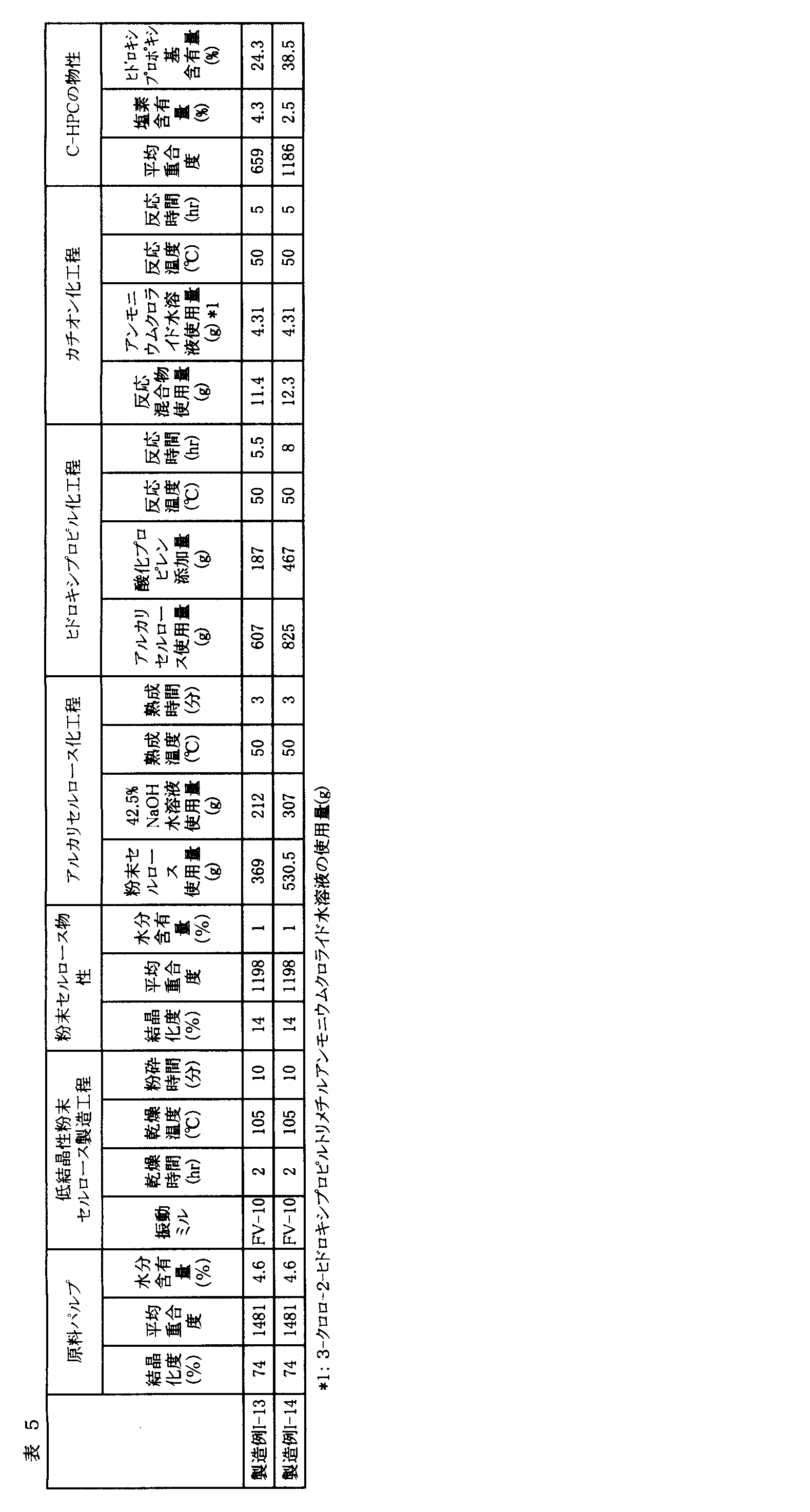

成分(A)としてC-HPC(I-1)~(I-13)を用いて、表5~9、に示す組成となるコンディショナーを常法により調製した。
具体的には、実施例I-1~26、77~79に関しては、成分(A)を水に溶解又は均一分散させ、2%ポリマー水溶液を調製した。適量の水及び界面活性剤(C)をビーカーに取り、80℃に加温して混合した水溶液を、前記ポリマー水溶液を加え、均一混合した。そこに融解させた油剤(B)を加え、30分間撹拌乳化し冷却した。最後に、加温により蒸発した水分を補充し、pHを測定した。pH調整剤(50%クエン酸水溶液)でpHを5に調整した。
実施例I-27~33に関しては、成分(A)を水に溶解又は均一分散させ、2%ポリマー溶液を調製した。水及び界面活性剤(C)をビーカーに取り、80℃に加温して混合した水溶液を、前記ポリマー溶液を加え、均一混合した。そこに融解させたセチルアルコール及びステアリルアルコールを加え、30分間撹拌乳化し50~60℃まで冷却した。次に、シリコーンのエマルションを加えて均一に混合し、冷却した。最後に、加温により蒸発した水分を補充し、pHを測定した。pH調整剤(50%クエン酸水溶液)でpHを5に調整した。
実施例I-36~38に関しては、成分(A)を水に溶解又は均一分散させ、2%ポリマー溶液を調製した。そこに適量の水と界面活性剤(C)と等モルのpH調整剤(50%クエン酸水溶液)を加え、均一に混合し、80℃に加温した。そこに、融解させた油剤(B)及び成分(C)を加え、30分間撹拌乳化し冷却した。最後に、加温により蒸発した水分を補充し、pHを測定した。pH調整剤(50%クエン酸水溶液)でpHを5に調整した。
5人のパネラーが、以下に示す評価基準、評価方法により、毛髪の指通り性、べたつき感、まとまり感の評価を行った。結果を表7~11示す。
(成分) (%)
ポリオキシエチレンラウリルエーテル硫酸Na 11.3
(エマールE-27C(花王株式会社製、有効分27重量%)として42.0%)
ヤシ油脂肪酸N-メチルエタノールアミド 3.0
(アミノーン C-11S(花王株式会社製))
クエン酸 0.2
メチルパラベン 0.3
精製水 バランス
計 100.0
各成分をビーカーに取り、80℃に加温後、混合し、均一に溶解したことを確認した後、冷却して、プレーンシャンプーを得た。
・指通り性
5:指通りが非常に良い
4:指通りが良い
3:指通りが普通(比較例I-7の指通りを基準)
2:指通りが悪い
1:指通りが非常に悪い
・べたつき感
5:べたつかない
4:あまりべたつかない
3:普通(比較例I-7のべたつき感を基準)
2:ややべたつく
1:べたつく
・まとまり感
5:髪のまとまりが非常によい
4:髪のまとまりがよい
3:普通(比較例I-7のまとまり感を基準)
2:髪のまとまりが悪い
1:髪が全くまとまらない
比較例I-7の指通り性、べたつき感、まとまり感を基準スコア3とし、5人のパネラーの評価結果を平均して評点を求めた。
評点が3.4以上であれば、その評価において明らかに優れた性能を有するといえる。
実施例I-1の成分(A)を添加しない(比較例I-10~12)、あるいは成分(A)に代えて表5に示す種々のポリマーを用いて(比較例I-1~9)、表7~9に示す組成となるコンディショナーを実施例I-1と同様に調製した。なお、比較例I-1~9のコンディショナーのpHは5に調製した。比較例I-1~12のコンデョショナーを実施例I-1~38、77~79と同様に評価した。結果をまとめて表7~9に示す。
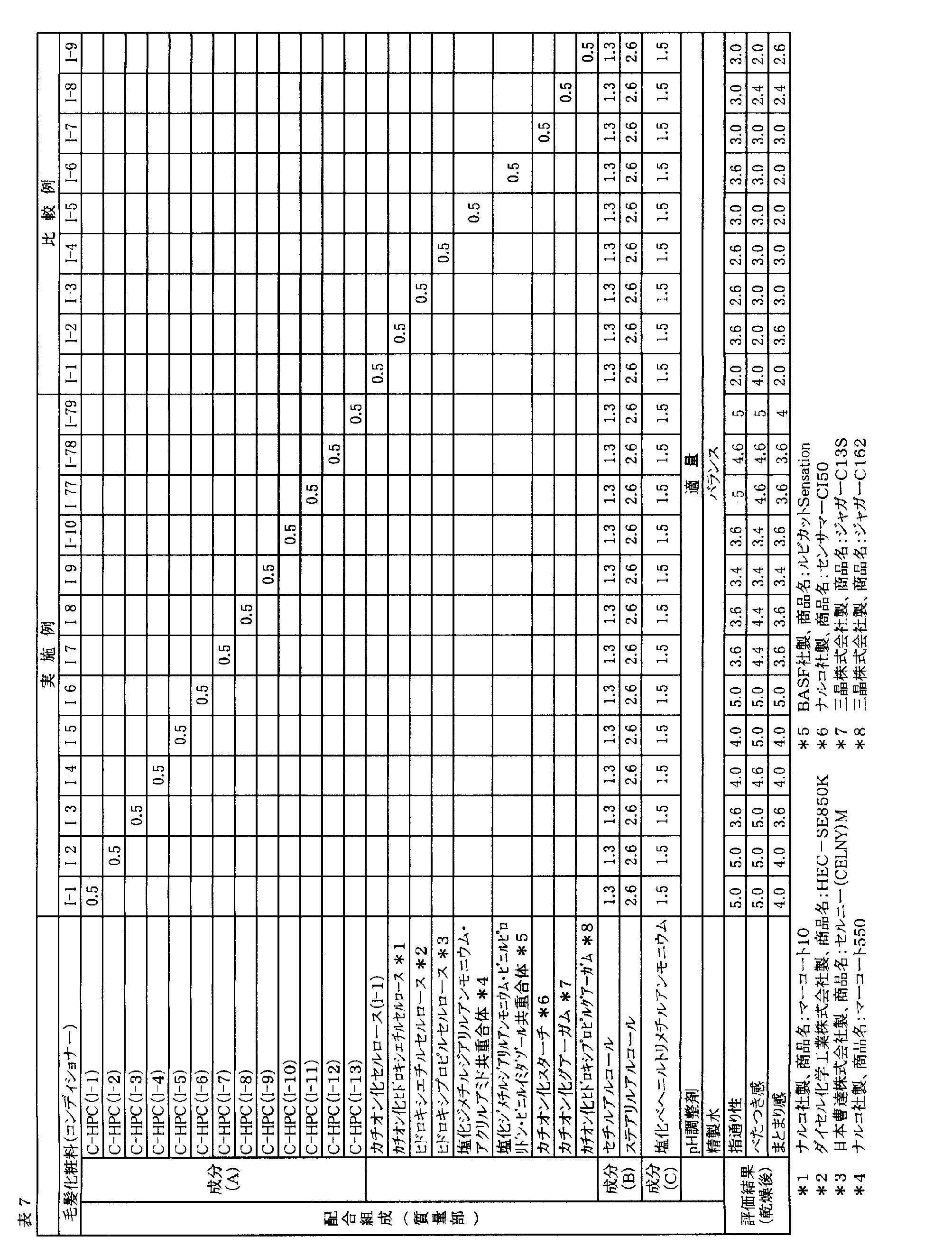

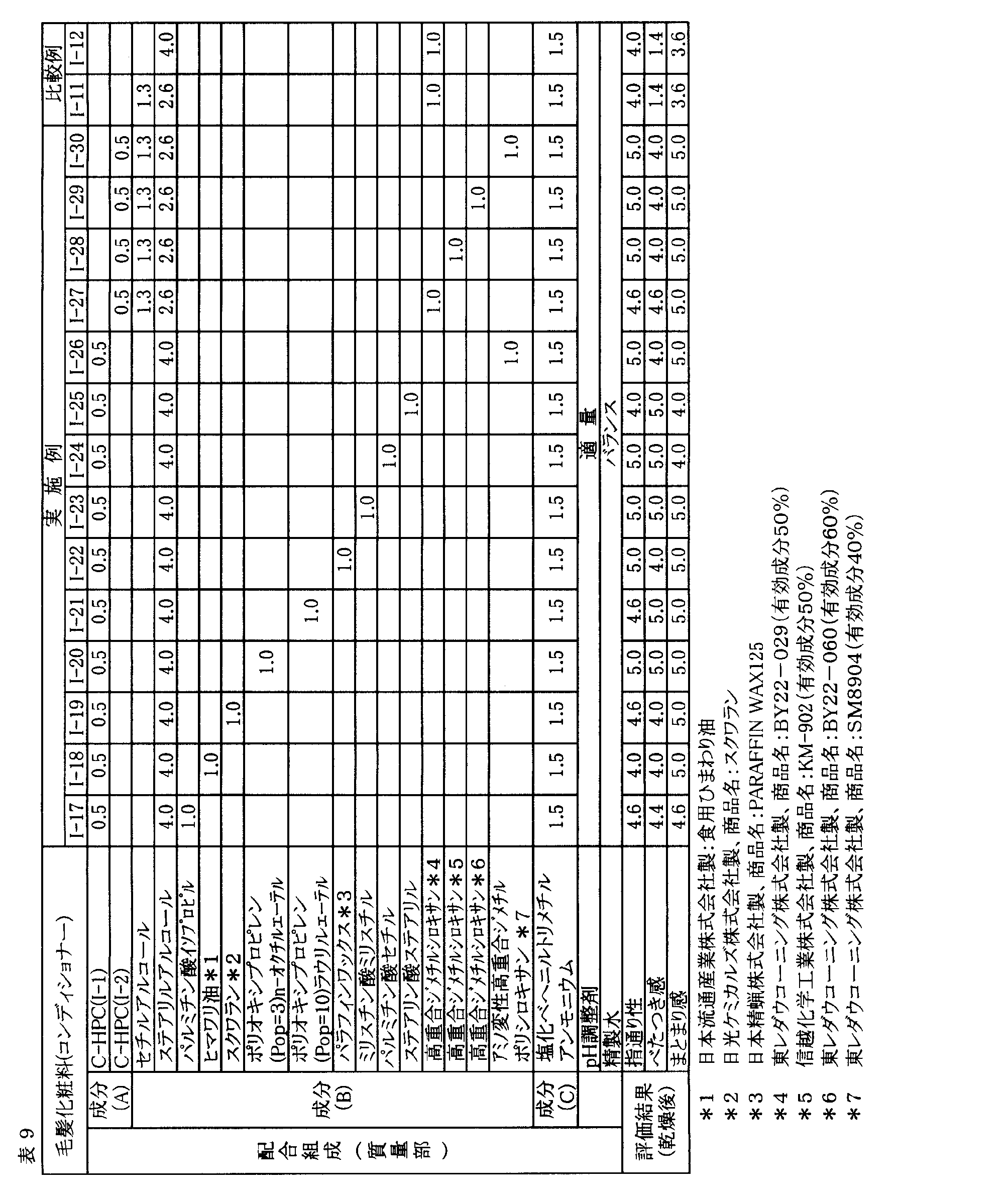
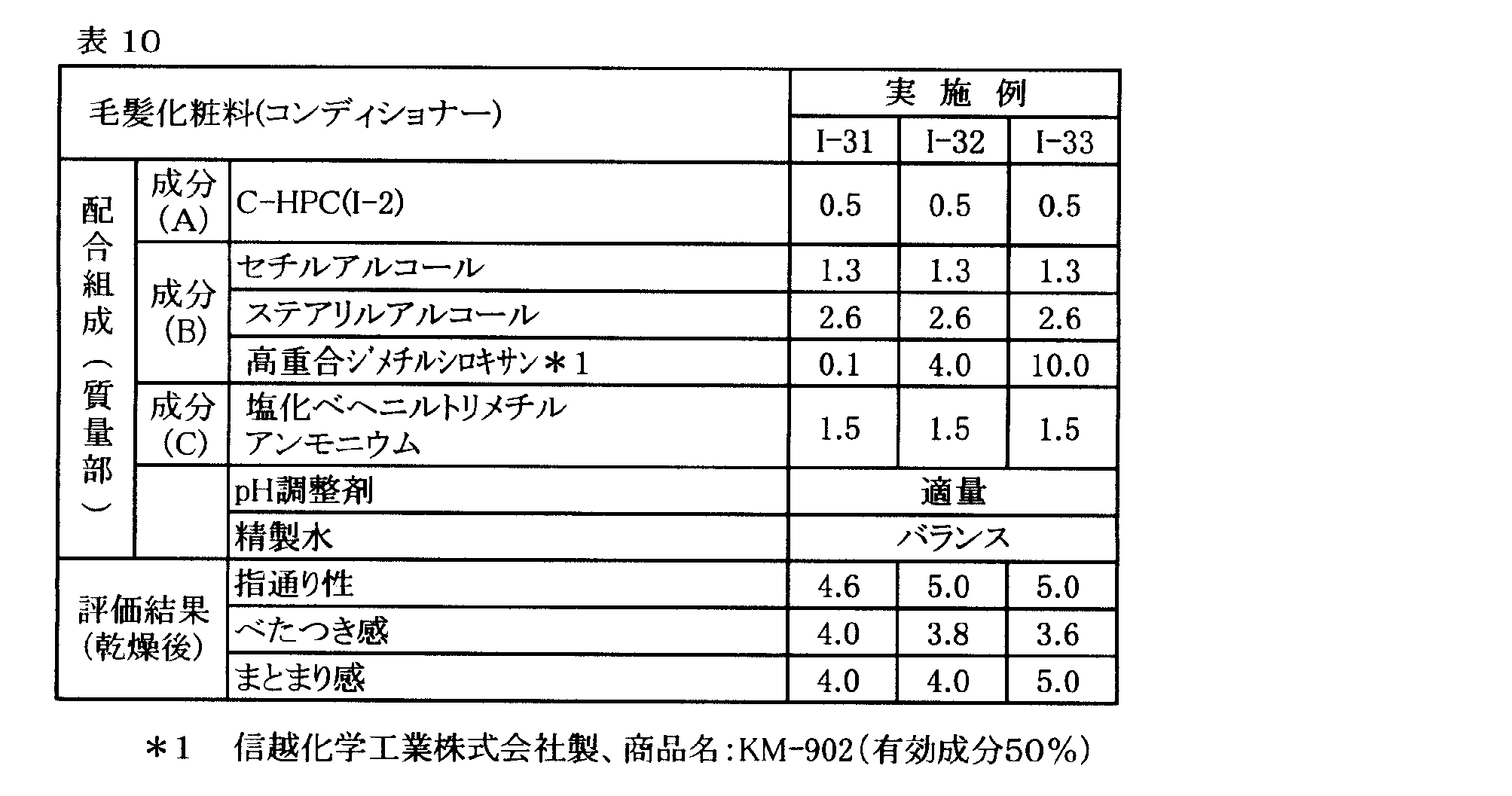
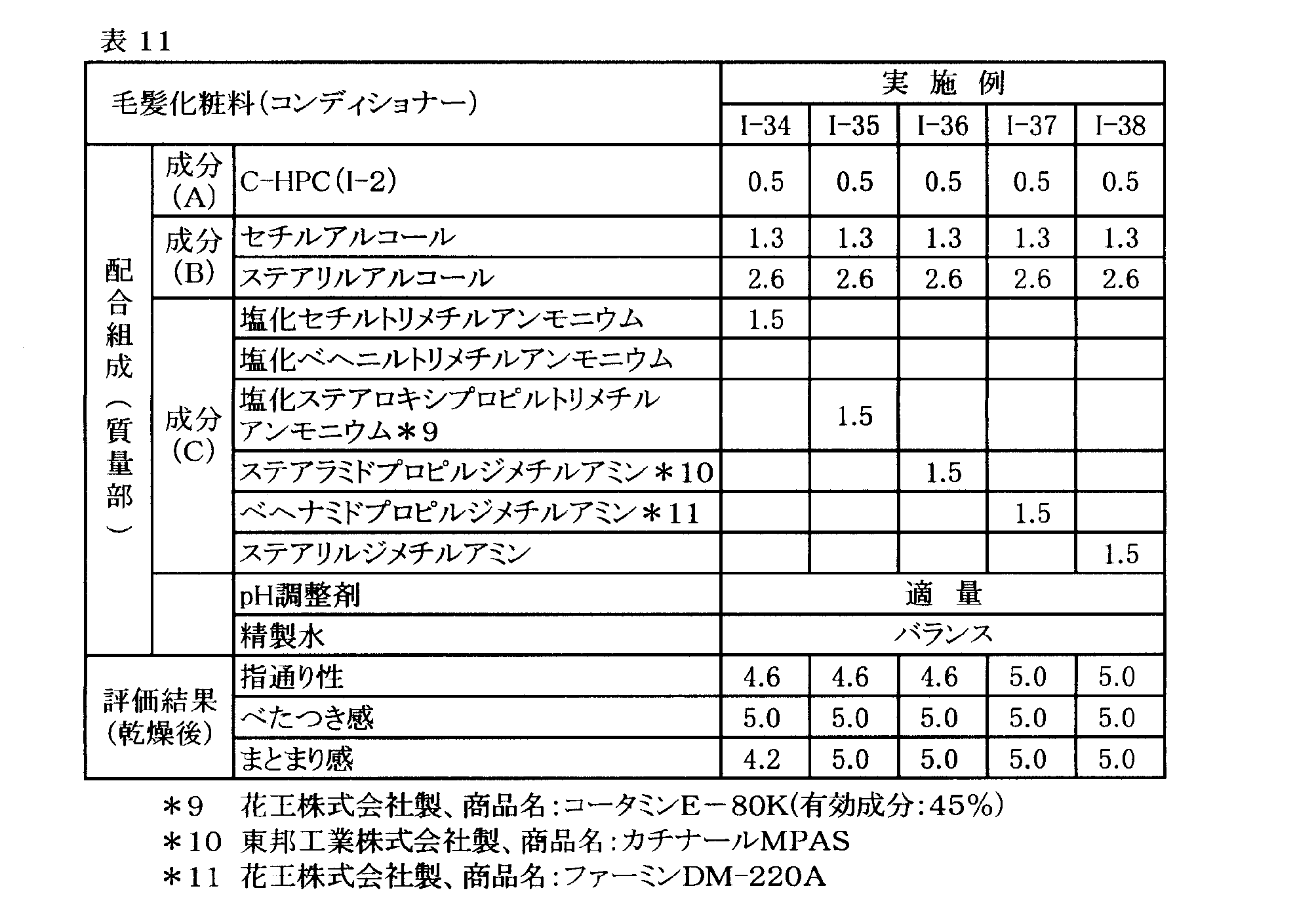
製造例I-2で得られたC-HPC(I-2)を用いて、表12~16の実施例I-39~70に示す組成となるシャンプーを常法により調製した。具体的には、成分(C)及び適量の水をビーカーに取り、60℃に加温し溶解させた。50℃まで冷却し、実施例I-1と同様の方法で調製したポリマー液を加え、均一混合した。そこに成分(B)を加え、30分間撹拌乳化して冷却した。最後に、加温により蒸発した水分を補充し、pHを測定した。必要に応じてpH調整剤(50%クエン酸水溶液及び48%水酸化ナトリウム水溶液)でpHを7に調整した。
実施例I-1で用いたプレーンシャンプーで洗浄した毛束を35~40℃の温水で十分に湿らせた後、実施例I-39~70のシャンプーで洗浄し、温水ですすぎ、タオルで水分を取り、櫛で毛束を整えた。その後、ドライヤーの温風で乾燥させ、仕上げに櫛で毛束を整え、評価用トレスを得た。5人のパネラーが、実施例I-1~38と同様の評価基準、評価方法により、毛髪の指通り性、べたつき感、まとまり感を評価した。結果を表12~16に示す。
なお、評価は、比較例I-16の指通り性、べたつき感、まとまり感を基準スコア3とし、5人のパネラーの評価結果を平均して評点を求めた。
評点が3.4以上であれば、その評価において明らかに優れた性能を有するといえる。
製造例I-2で得られたC-HPC(I-2)に代えて、成分(A)を添加しない(比較例I-17)、もしくは表12~14に示す種々のポリマーを用いて、表12~14に示す組成となるシャンプ-を実施例I-39と同様にして調製し、評価した。なお、比較例I-13~18のシャンプーのpHは7に調製した。結果を表12~14に示す。
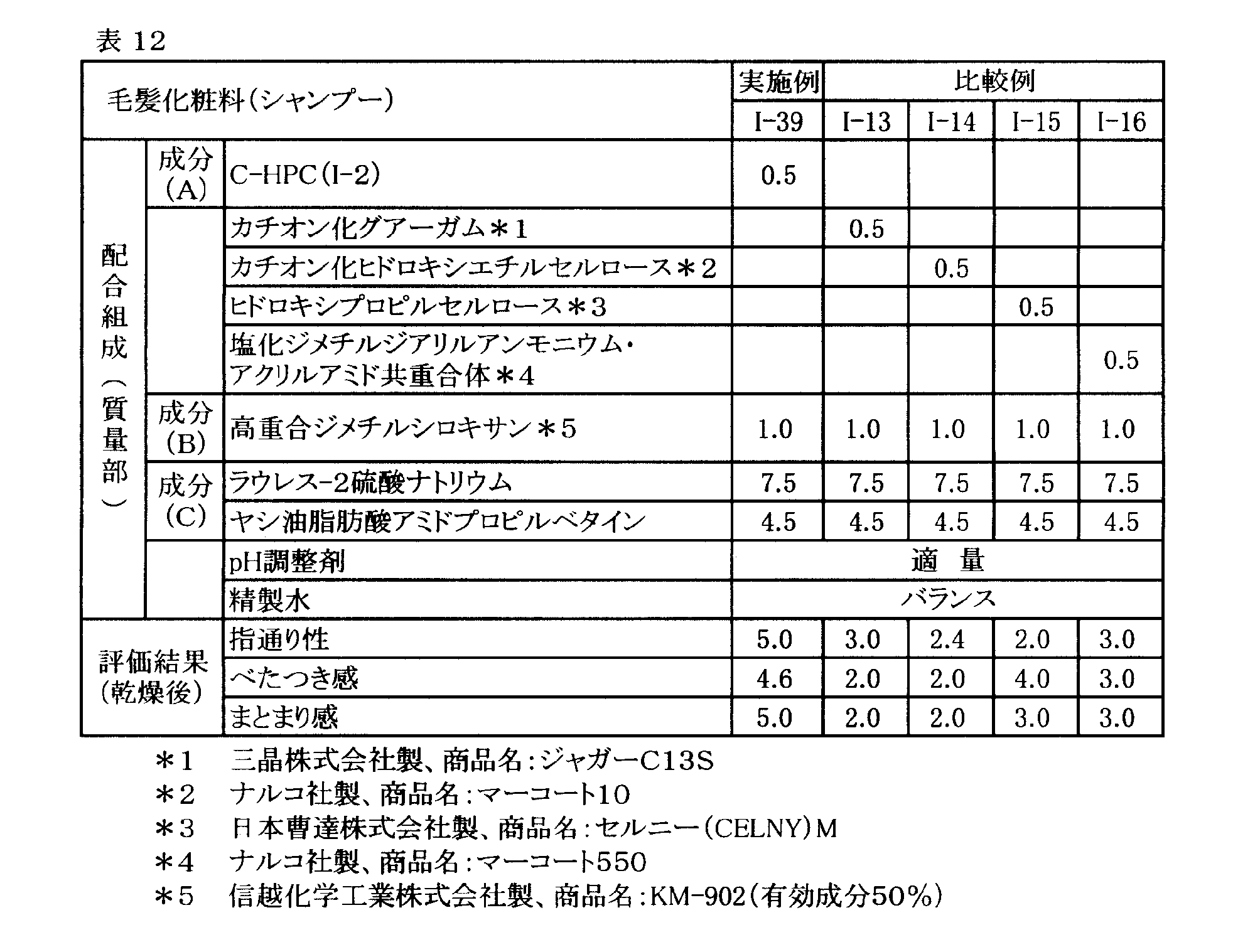
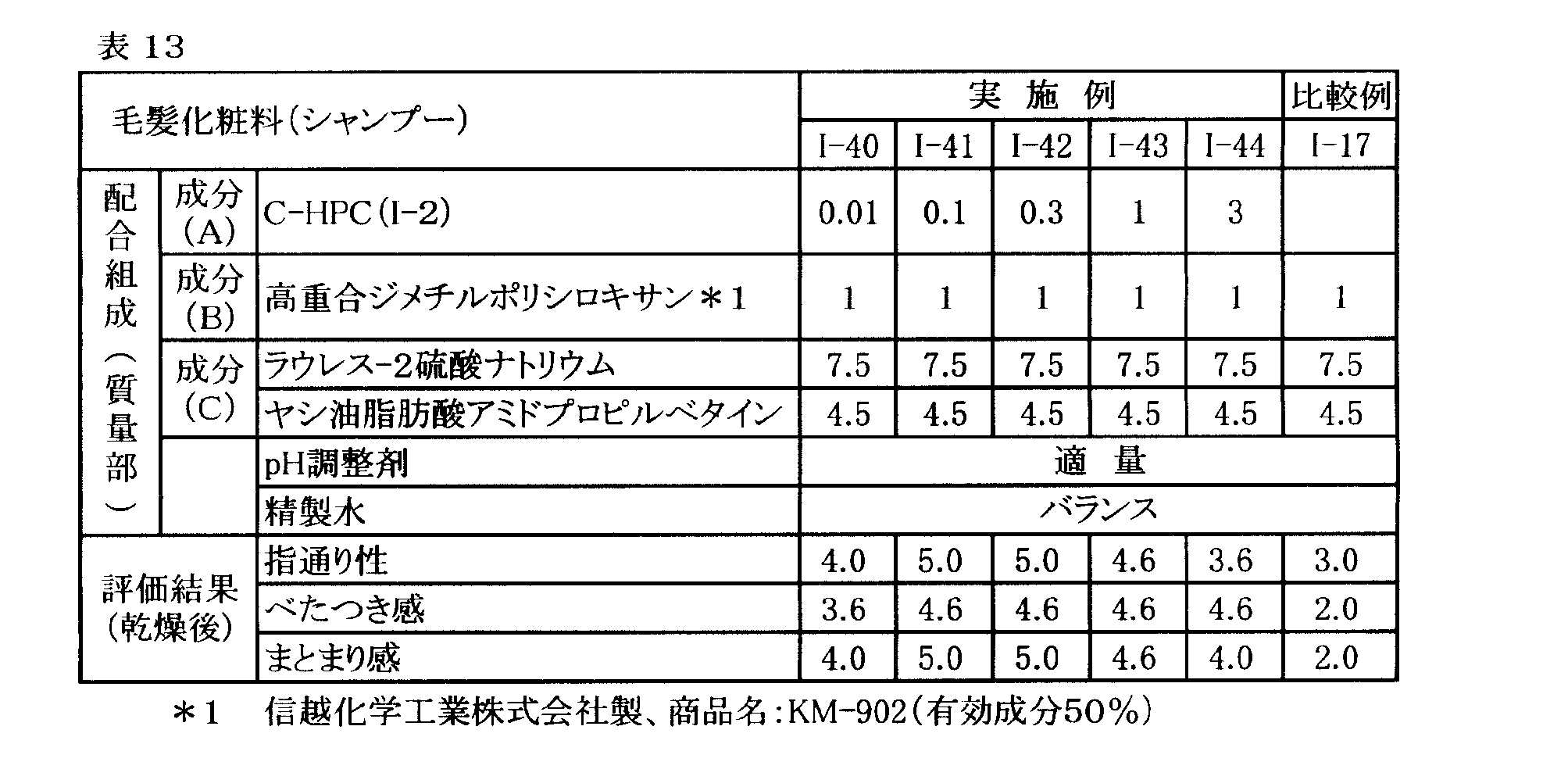

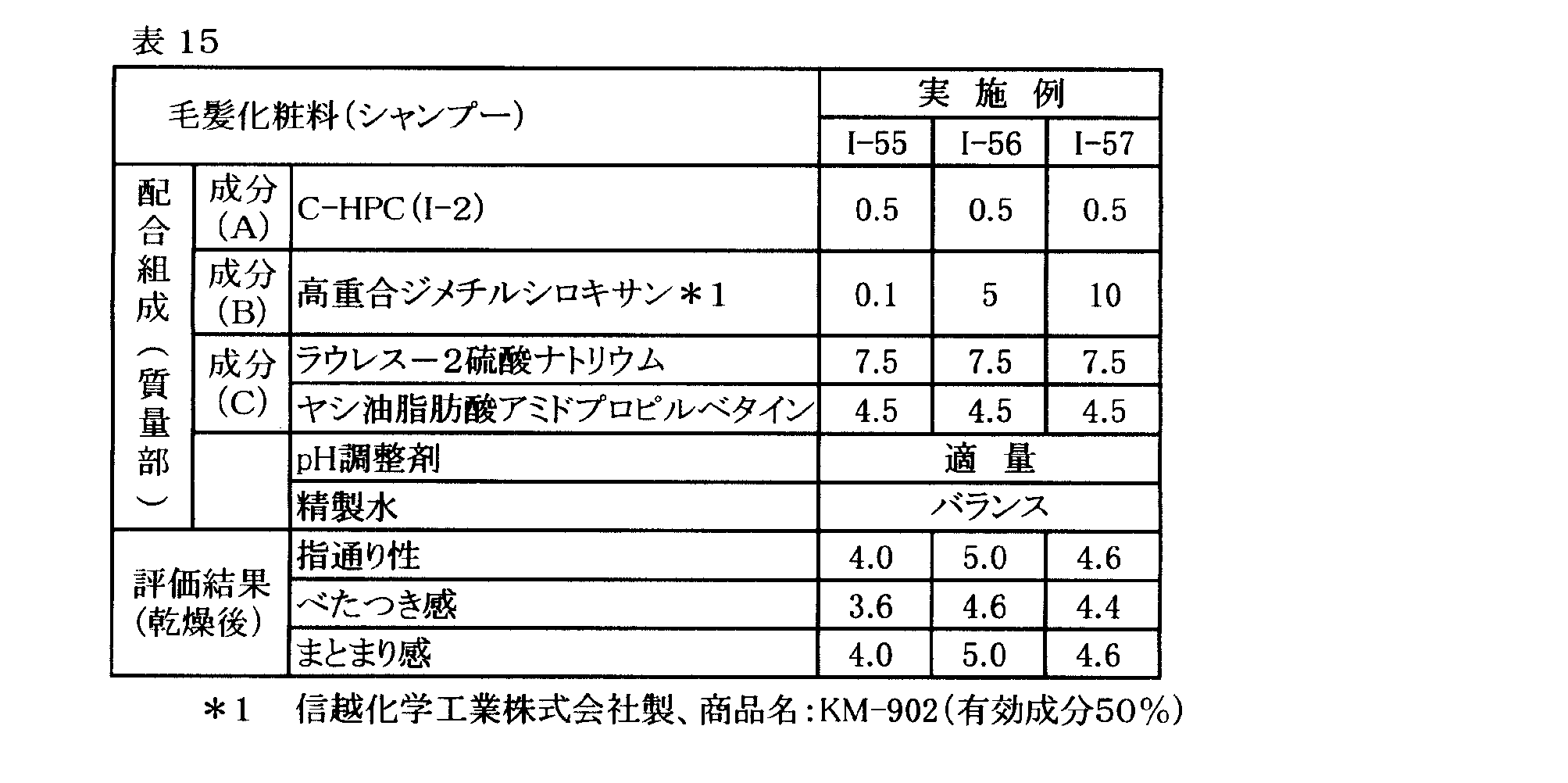
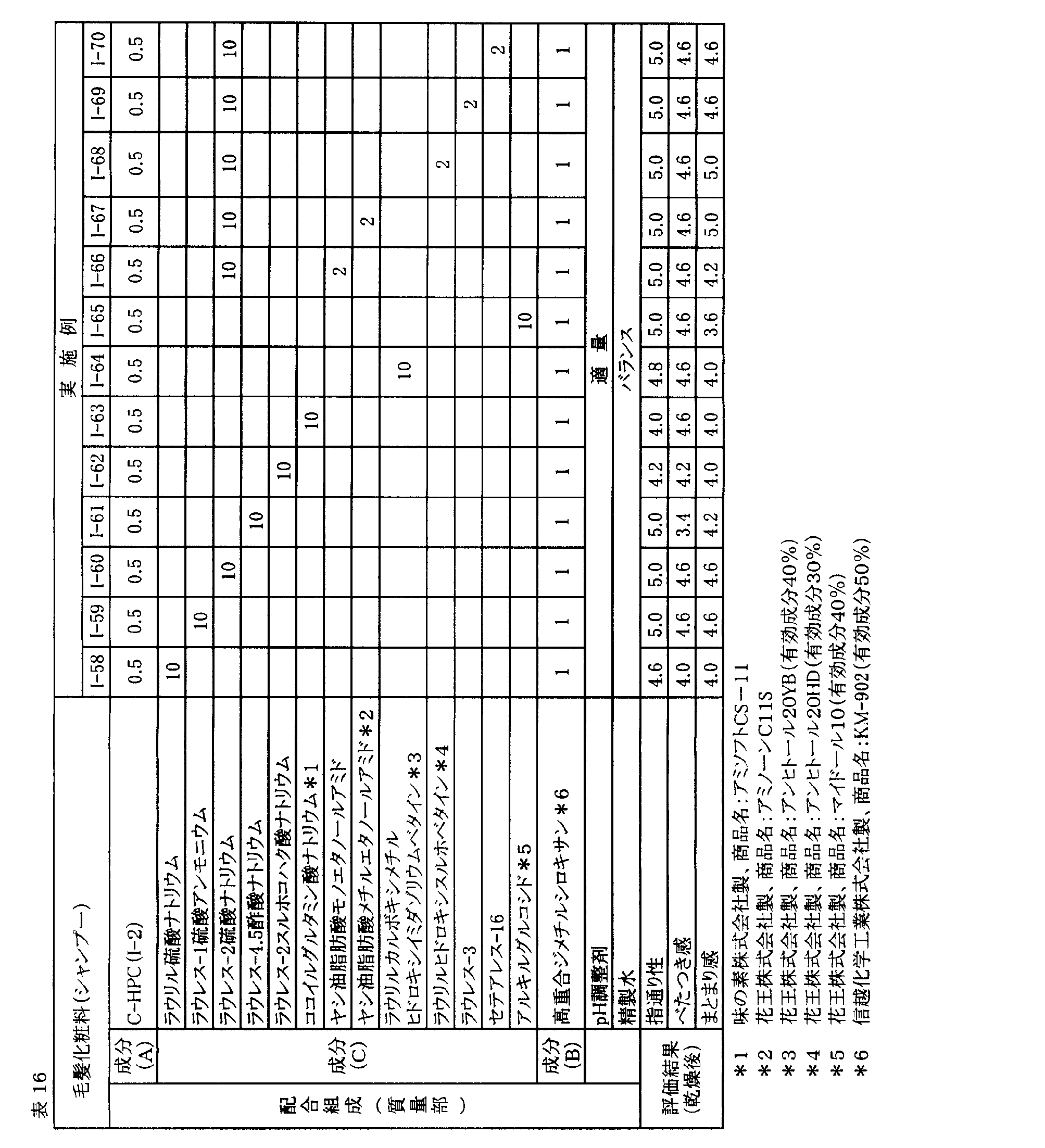
製造例I-1で得られたC-HPC(I-1)を用いて、表17の実施例I-71~75に示す組成となるアウトバストリートメントを、実施例I-1に記載のコンディショナーの製造方法と同様の方法で調製した。
実施例I-1で用いたプレーンシャンプーで洗浄した毛束を35~40℃の温水で十分に湿らせた後、毛束の水を切り、アウトバストリートメントを塗布し、なじませた後に、櫛で毛束を整えた。その後、ドライヤーの温風で乾燥させ、仕上げに櫛で毛束を整えたものを、評価用トレスとして用いた。5人のパネラーが、以下に示す評価基準、評価方法により、毛髪の指通り性、べたつき感、まとまり感を評価した。結果を表17に示す。
なお、評価は、比較例I-19の指通り性、べたつき感、まとまり感を基準スコア3とし、5人のパネラーの評価結果を平均して評点を求めた。
評点が3.4以上であれば、その評価において明らかに優れた性能を有するといえる。
カチオン化ヒドロキシプロピルセルロース(A)を添加しない(比較例I-19~23)、又は製造例I-1で得られたC-HPC(I-1)に代えて、表17に示す種々のポリマーを用いて(比較例I-24~26)、表17に示す組成となるアウトバストリートメントを調製し、同様にして評価した。結果を表17に示す。
表17から、実施例I-71~75のアウトバストリートメントは、乾燥後の油っぽいべたつき感のなさ、良好な指通り性とまとまり感の全てを満足する優れたアウトバストリートメントであることが分かる。
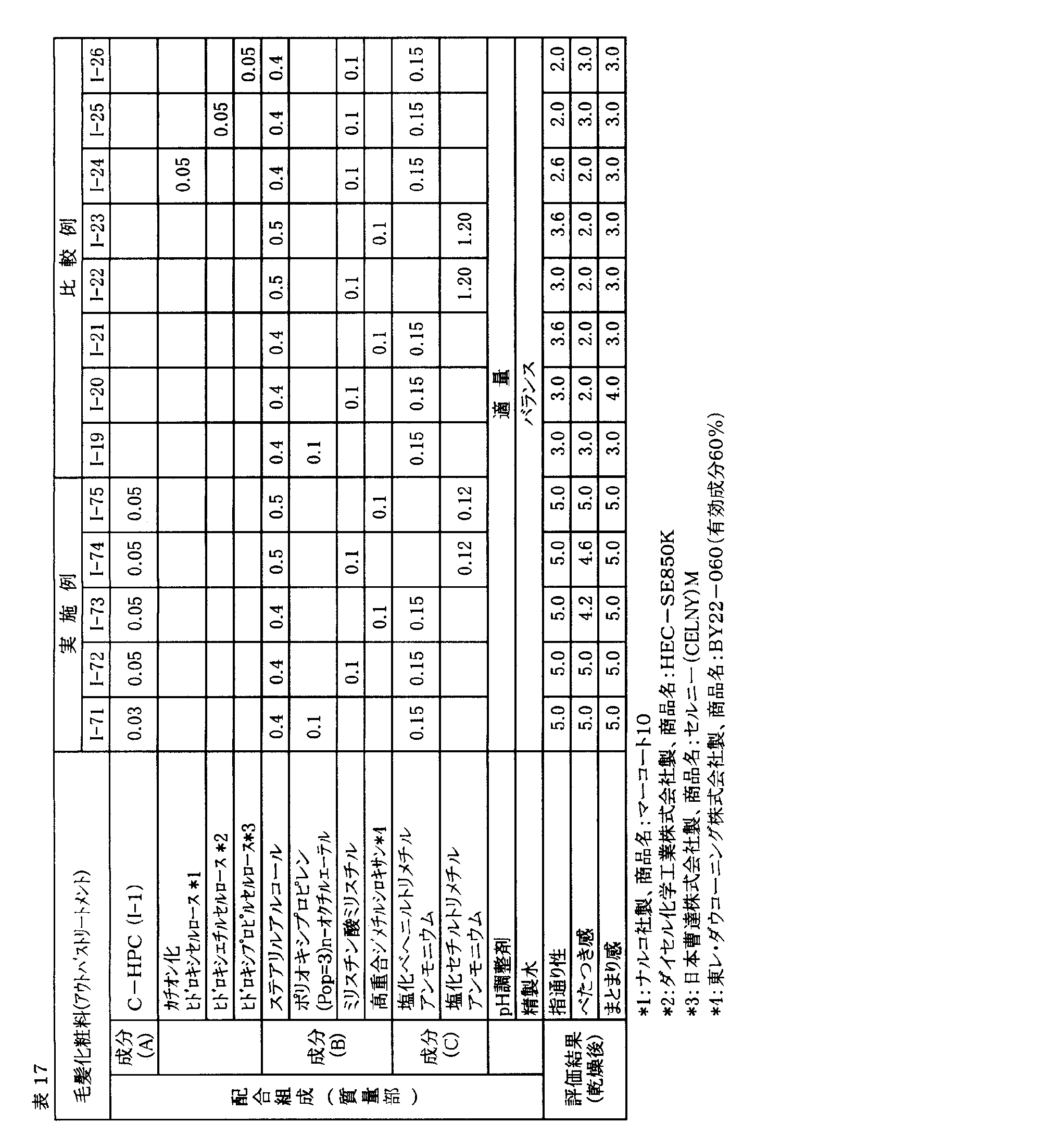
実施例I-75と同様にして下記組成のアウトバストリートメントを調製した。
(成分) (%)
C-HPC(I-1) 0.5
ステアリルアルコール 4.0
高重合ジメチルシロキサン *1 4.0
塩化セチルトリメチルアンモニウム 5.0
pH調製剤 適量
精製水 バランス
計 100.0
*1:東レ・ダウコーニング株式会社製、商品名;BY22-060(有効分60%)を
6.7%添加
このアウトバストリートメントは、乾燥後に油っぽいべたつき感がなく、良好な指通り性とまとまり感を付与できた。
(1)チップ化工程
シート状木材パルプ〔テンベック社製Biofloc HV+、平均重合度1770、結晶化度74%、水分含量7.0%〕をシートペレタイザー(株式会社ホーライ製、「SGG-220」)で処理して3~5mm角のチップ状にした。
(2)カチオン化工程(1)
上記(1)で得られたチップ状パルプ100gに、グリシジルトリメチルアンモニウムクロリド水溶液(阪本薬品工業株式会社製、含水量20%、純度90%以上)(以下「GMAC」という)23.4g〔セルロースのAGU1モルあたり0.2モル相当量〕を乳鉢で混合した後、バッチ式振動ミル(中央化工機株式会社製「MB-1」:容器全容積3.5L、ロッドとして、φ30mm、長さ218mm、断面形状が円形のSUS304製ロッド13本、充填率57%)に投入した。30分間粉砕処理(振動数20Hz、振幅8mm、温度30~70℃)を行い、セルロースとGMACの粉末状混合物を得た。
得られた粉末状混合物に、24.7%水酸化ナトリウム水溶液20g(AGU 1モルあたり0.2モル相当量)を乳鉢で混合した後、前記バッチ式振動ミルに投入した。同様の条件にて60分間粉砕処理を行い、カチオン化セルロース(i)151gを得た。
(3)カチオン化工程(2)
上記(2)で得られたカチオン化セルロース(i)128gに、GMAC 31.3g(AGU 1モルあたり0.32モル相当量)を加えて乳鉢で混合した後、得られた混合物を、還流管を取り付けた1Lニーダー(株式会社入江商会製、PNV-1型)に仕込み、50℃、窒素雰囲気下、50rpmで攪拌しながら5時間熟成を行い、カチオン化セルロース(ii)を得た。
(4)ヒドロキシプロピル化工程
熟成後に得られたカチオン化セルロース(ii)152.6g(未中和・未精製品)の入ったニーダーを70℃に昇温し、酸化プロピレン72.5g(AGU 1モルあたり2.5モル相当量、関東化学株式会社製、特級試薬)を攪拌しながら滴下して、酸化プロピレンが消費され還流が止むまで20時間反応を行った。
得られた精製C-HPC(II‐1)の元素分析より、塩素含有量は3.4%であった。また、前記「ヒドロキシプロピルセルロースの分析法」によるヒドロキシプロポキシ基含有量は43.3%であった。カチオン化エチレンオキシ基の置換度、及びプロピレンオキシ基の置換度は、それぞれ0.30、及び1.8であった。精製C-HPC(II‐1)の平均重合度は739であった。結果を表18に示す。
カチオン化工程(1)を表18に示す条件に変え、カチオン化工程(2)を行なわず、ヒドロキシプロピル化工程を表18に示す条件に変えたこと以外は製造例II‐1と同様に行った。得られた精製C-HPC(II‐2)の結果を表18に示す。
製造例II‐3〔C-HPC(II‐3)の製造〕
カチオン化工程(1)、カチオン化工程(2)、及びヒドロキシプロピル化工程を表18に示す条件に変えたこと以外は製造例II‐1と同様に行った。得られた精製C-HPC(II‐3)の結果を表18に示す。
製造例II‐4〔C-HPC(II‐4)の製造〕
カチオン化工程(1)を表18に示す条件に変え、カチオン化工程(2)を行なわず、ヒドロキシプロピル化工程を表18に示す条件に変えたこと以外は製造例II‐1と同様に行った。得られた精製C-HPC(II‐4)の結果を表18に示す。
製造例II‐5〔C-HPC(II‐5)の製造〕
カチオン化工程(1)、カチオン化工程(2)、及びヒドロキシプロピル化工程を表18に示す条件に変えたこと以外は製造例II‐1と同様に行った。得られた精製C-HPC(II‐5)の結果を表18に示す。
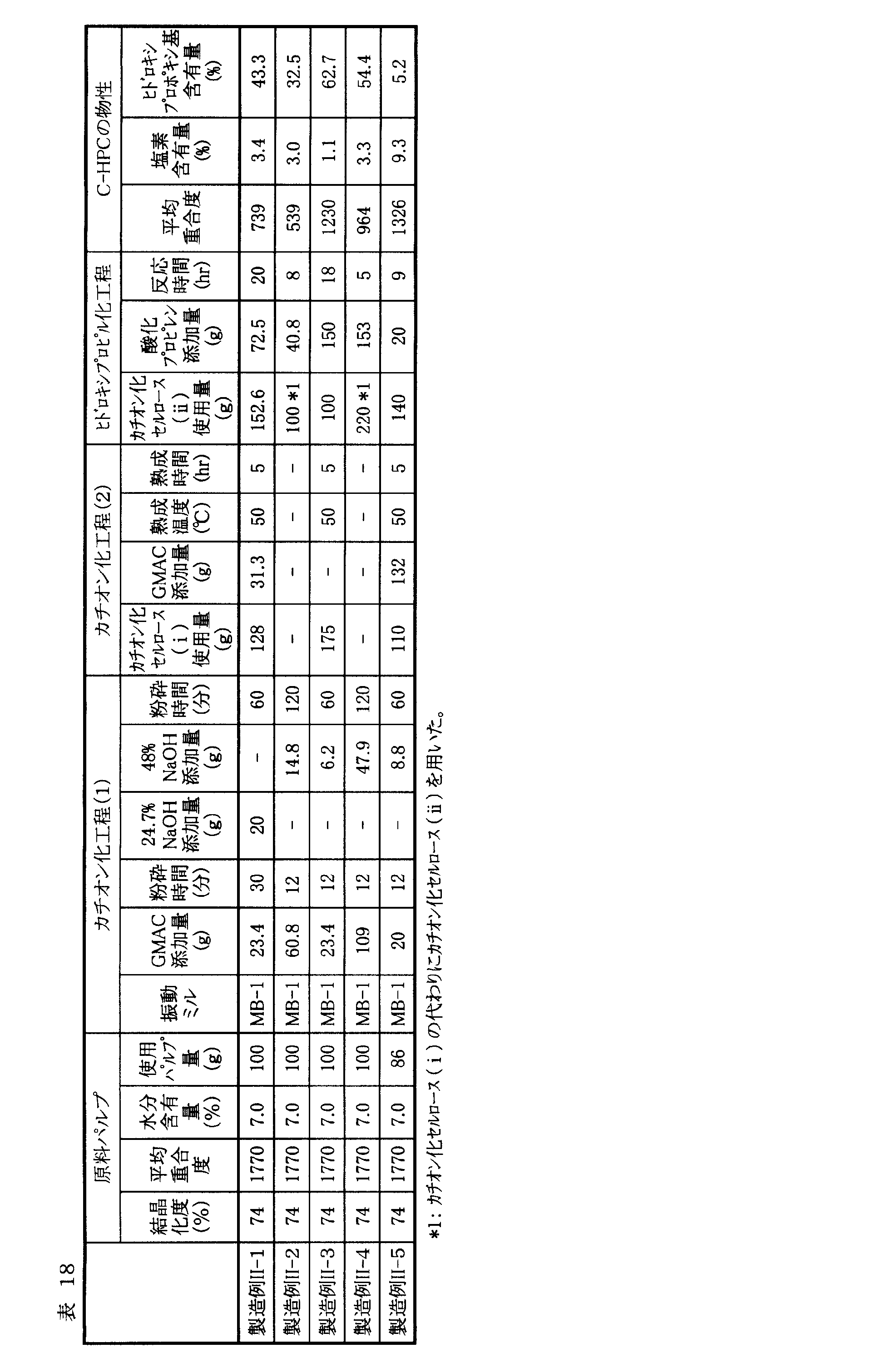
(1)チップ化工程
セルロースとして、シート状木材パルプ〔テンベック社製Biofloc HV10、平均重合度1508、結晶化度74%、水分量7.0%〕をシートペレタイザ(株式会社ホーライ製、「SGG-220」)で処理して3~5mm角のチップ状にした。
(2)カチオン化工程(1)
上記(1)で得られたチップ状パルプ989g(水分量7.0%)に、GMAC559g(AGU 1モルあたり0.52モル相当量)とイオン交換水24gを加え、ポリ袋中で混合を行った後、バッチ式振動ミル(中央化工機株式会社製「FV-10」、容器全容量;35L、ロッドとして、φ30mm、長さ510mm、断面形状が円形のSUS304製ロッド63本、充填率64%)に投入した。12分間粉砕処理(振動数20Hz、振幅8mm、温度10~40℃)を行い、セルロースとGMACの粉状混合物を得た。
更に振動ミル内に顆粒状水酸化ナトリウム(有効分100%)136.2g(AGU 1モルあたり0.60モル相当量)を投入した。再び112分間粉砕処理を行いカチオン化セルロースを得た。
(3)ヒドロキシプロピル化工程
上記(2)で得られたカチオン化セルロース95.0gを製造例II‐1で用いた還流管を取り付けたニーダーに仕込み、ニーダーを70℃に昇温し、酸化プロピレン35.4g(AGU 1モルあたり2.0モル相当量)を攪拌しながら滴下して、酸化プロピレンが消費され還流が止むまで7時間反応を行った。反応終了混合物をニーダーから取り出し、薄褐色の粗C-HPC粉末120.6gを得た。
(4)カチオン化工程(2)
上記(3)で得られた粗C-HPC粉末10.6gにGMAC 16.2g(AGU 1モルあたり3.5モル相当量)を添加し、乳鉢で混合を行った後、恒温槽中50℃にて24時間熟成を行った。得られた粗C-HPCに水:エタノール:イソプロピルアルコール=5:45:50(重量比)の混合溶媒100gを用いて分散を行い、酢酸を加え中和し、沈殿精製を行った。沈殿物をろ過収集し乾燥機中60℃にて一晩減圧乾燥を行い、薄褐色塊状の粗C-HPC(II‐6)を得た。
プロピレンオキシ基及びカチオン化エチレンオキシ基の置換度を求める目的で、生成物を透析膜(分画分子量1000)により精製後、水溶液の凍結乾燥を行い、精製C-HPC(II‐6)を得た。
得られた精製C-HPC(II‐6)の元素分析より、塩素含有量は9.1%であった。また、ヒドロキシプロポキシ基含有量は、25.1%であった。カチオン化エチレンオキシ基、プロピレンオキシ基の置換度は、それぞれ1.00、及び1.3と算出した。精製C-HPC(II‐6)の平均重合度は464であった。結果を表19に示す。
原料パルプを表19に示す原料パルプに変え、カチオン化工程(1)、ヒドロキシプロピル化工程、及びカチオン化工程(2)を表19に示す量に変えた以外は製造例II‐6と同様に行った。得られた精製C-HPC(II‐7)の結果を表19に示す。
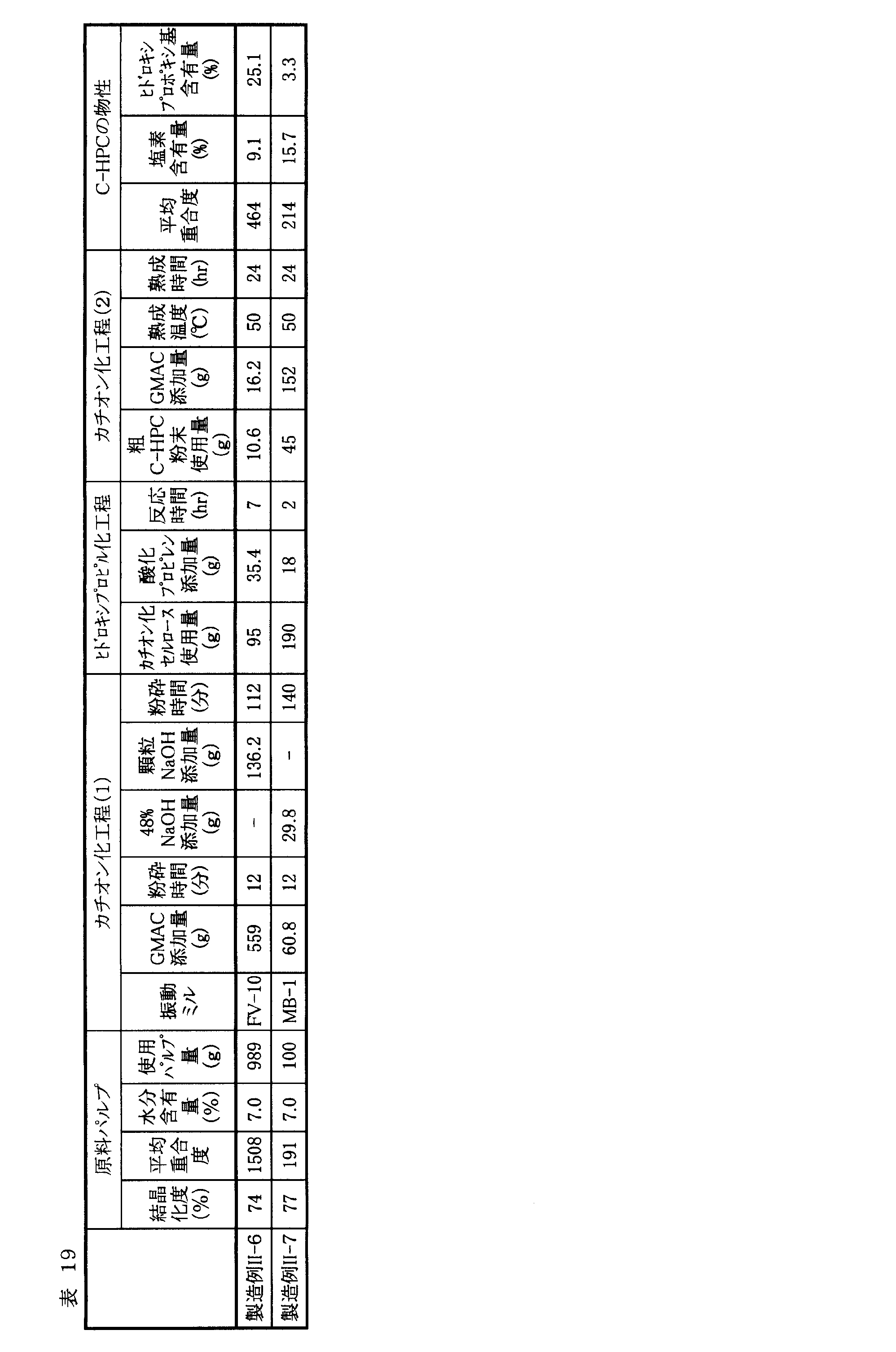
(1)低結晶性粉末セルロースの製造工程
シート状木材パルプ(テンベック社製Biofloc HV+、平均重合度1770、結晶化度74%、水分含量7.0%)をシュレッダー(株式会社明光商会製、「MSX2000-IVP440F」)にかけて3~5mm角のチップ状にした。その後、50℃減圧下で12時間乾燥処理を行い、チップ状の乾燥パルプ(水分含量0.4%)を得た。
次に、得られたチップ状の乾燥パルプ100gを、製造例II‐1で使用したバッチ式振動ミルに投入した。振動数20Hz,全振幅8mm,温度30~70℃の範囲で35分粉砕処理を行い、粉末セルロース(結晶化度0%、平均重合度836、平均粒径52μm、水分含量1.0%)を得た。
(2)カチオン化工程
上記(1)で得られた粉末セルロース100gに、GMAC 46.9g(AGU 1モルあたり0.4モル相当量)を添加し、乳鉢で混合した。その後、48%水酸化ナトリウム水溶液5.14g(AGU 1モルあたり0.1モル相当量)、イオン交換水18gを添加し、混合した。製造例II‐1で使用したニーダーに、得られた混合物を仕込み、50℃で4時間撹拌し、カチオン化セルロース170gを得た。
(3)ヒドロキシプロピル化工程
上記(2)で得られたカチオン化セルロース170gを70℃に加温し、攪拌しながら48%水酸化ナトリウム水溶液を4.7g(AGU 1モルあたり0.1モル相当量)、イオン交換水を16.4g加えた。更に、酸化プロピレン101g(AGU 1モルあたり3.0モル相当量)を滴下して、酸化プロピレンが消費され還流が止むまで24時間反応を行った。反応後、セルロースは流動性のある粉末状態を保っていた。この反応終了品10.0gを採取して酢酸で中和し、薄褐色固体を得た。中和物を透析膜(分画分子量1000)により精製後、水溶液の凍結乾燥を行い、精製C-HPC(II‐8)を得た。
得られた精製C-HPC(II‐8)の元素分析より、塩素含有量は2.1%であった。また、ヒドロキシプロポキシ基含有量は、49.2%であった。カチオン化エチレンオキシ基、プロピレンオキシ基の置換度は、それぞれ0.18及び2.0と算出した。精製C-HPC(II‐8)の平均重合度は832であった。結果を表20に示す。
原料パルプを表20に示す原料パルプに変え、低結晶性粉末セルロースの製造工程、カチオン化工程、及びヒドロキシプロピル化工程を表20に示す条件に変えたこと以外は製造例II‐8と同様に行った。得られた精製C-HPC(II‐9)の結果を表20に示す。
製造例II‐10〔C-HPC(II‐10)の製造〕
ヒドロキシプロピル化工程を表20に示す条件に変えたこと以外は製造例II‐8と同様に行った。得られた精製C-HPC(II‐10)の結果を表20に示す。

酸化プロピレンの付加反応を行なわなかったこと以外は、製造例II‐5と同様に行い、カチオン化セルロース(II‐1)を得た。
(1)チップ化工程
シート状木材パルプ〔テンベック社製Biofloc HV+、平均重合度1481、結晶化度74%、水分含量4.6%〕をシートペレタイザー(株式会社ホーライ製、「SGG-220」)で処理して3~5mm角のチップ状にした。
(2)アルカリセルロース化工程
上記工程(1)で得られたチップ状パルプ100gと0.7mm粒状のNaOH23.6g(AGU1モルあたり1.0モル相当量)を、バッチ式振動ミル(中央化工機株式会社製「MB-1」:容器全容積3.5L、ロッドとして、φ30mm、長さ218mm、断面形状が円形のSUS304製ロッド13本、充填率57%)に投入し、15分間粉砕処理(振動数20Hz、振幅8mm、温度30~70℃)を行った。得られたセルロース・NaOH混合粉砕物(セルロースの平均粒径:65μm)を乳鉢に移し、水50gを噴霧にて添加した。セルロース・NaOH混合粉砕物の水分量は、セルロースに対して57%であった。20℃にて乳棒で5分間混合し、アルカリセルロースを得た(平均重合度:1175)。
(3)ヒドロキシプロピル化反応工程
上記工程(2)で得られたアルカリセルロースを還流管と滴下ロートを取り付けたニーダー(株式会社入江商会製、PNV-1型、容積1.0L)に仕込み、酸化プロピレン85.7g(AGU1モルあたり2.5モル相当量)を投入し、攪拌を行いながら50℃にて6時間反応させた。反応は、酸化プロピレンを5時間かけて滴下した後、1時間熟成を行った。
(4)カチオン化反応工程
上記工程(3)で得られた反応混合物5.8gを乳鉢にとり、65% 3-クロロ-2-ヒドロキシプロピルトリメチルアンモニウムクロライド水溶液(四日市合成株式会社製)2.10g(AGU1モルあたり0.50モル相当量)を添加して、5分間混合後、50mlガラス瓶に移し、50℃、7時間反応させることで粗C-HPCを製造した。
この粗C-HPC粉末5.0gを採取して乳酸で中和した。プロピレンオキシ基及びカチオン化エチレンオキシ基の置換度を求める目的で、中和物を透析膜(分画分子量1000)により精製後、水溶液の凍結乾燥を行い、精製C-HPC(II‐11)を得た。
得られた精製C-HPC(II‐11)の元素分析より、塩素元素含有量は3.3%であり、ヒドロキシプロポキシ基含有量は38.8%であった。また、カチオン化エチレンオキシ基の置換度、及びプロピレンオキシ基の置換度は、それぞれ0.27、1.5と算出された。また、平均重合度は、643であった。結果を表21に示す。
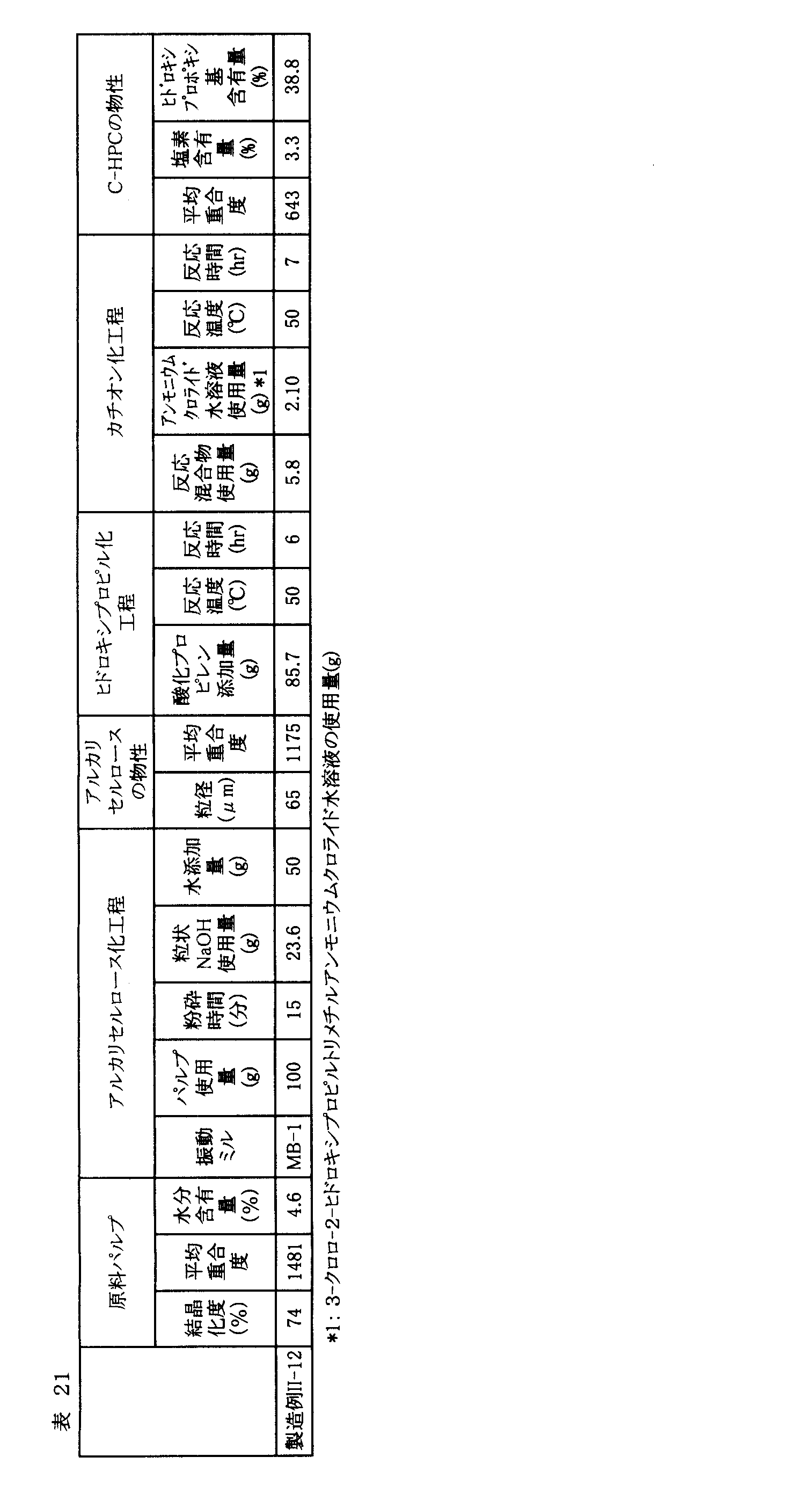
(1)低結晶性粉末セルロース製造工程
製造例II‐12(1)と同様に行い、3~5mm角のチップ状パルプを得た。得られたチップ状パルプ1kgを、乾燥器(アドバンテック東洋株式会社製、商品名;VO-402)に投入し、105℃で2時間乾燥して、乾燥チップ状パルプ(水分含有量0.8%)を得た。
得られた乾燥チップ状パルプ920gをバッチ式振動ミル(中央化工機株式会社製、「FV-10」:全容器量35L、ロッドとして、φ30mm、長さ510mm、断面形状が円形のSUS304製ロッド63本、充填率65%)に投入した。10分間粉砕処理(振動数20Hz、振幅8mm、温度10~40℃)を行い、粉末セルロース(結晶化度14%、平均重合度1198、水分含有量1.0%)を得た。
(2)アルカリセルロース化工程
上記工程(1)で得られた粉末セルロース369gを混合機(株式会社マツボー製、「レディゲミキサー」、容量5L)に投入し、主翼250rpm、チョッパー翼2500rpmで撹拌しながら、42.5%水酸化ナトリウム水溶液212g(NaOH:AGU1モルあたり1.0モル相当量、水:セルロースに対して33%)を1.5分間で噴霧添加した。噴霧後、内温を50℃に昇温し、3時間熟成し、アルカリセルロースを得た。
(3)ヒドロキシプロピル化反応工程
上記工程(2)で得られたアルカリセルロース607gを、上記レディゲミキサー内で、主翼50rpm、チョッパー翼400rpmで撹拌しながら50℃まで昇温し、その後、酸化プロピレン187g(AGU1モルあたり1.6モル相当量)を3.5時間で滴下した。滴下終了後50℃で2時間熟成した。
(4)カチオン化反応工程
上記工程(3)で得られた反応混合物11.4gを乳鉢にとり、65% 3-クロロ-2-ヒドロキシプロピルトリメチルアンモニウムクロライド水溶液4.31g(AGU1モルあたり0.5モル相当量)とイオン交換水0.84gを添加して、5分間混合後、50mlガラス瓶に移し、50℃、5時間反応させ粗C-HPCを得た。この粗C-HPC粉末を製造例II‐12(4)と同様に、中和、精製、凍結乾燥を行い、精製C-HPC(II‐12)を得た。
得られた精製C-HPC(II‐12)の元素分析より、塩素元素含有量は4.3%であり、ヒドロキシプロポキシ基含有量は24.3%であった。また、カチオン化エチレンオキシ基の置換度、及びプロピレンオキシ基の置換度は、それぞれ0.25、0.8と算出された。また、平均重合度は、659であった。結果を表22に示す。
(1)低結晶性粉末セルロース製造工程
製造例II‐13(1)と同様に行い、粉末セルロース(結晶化度14%、平均重合度1198、水分含有量1.0%)を得た。
(2)アルカリセルロース化工程
上記工程(1)で得られた粉末セルロース530.5g及び42.5%水酸化ナトリウム水溶液307g(NaOH:AGU1モルあたり1.0モル相当量、水:セルロースに対して34%)を用いた以外は、製造例II‐13(2)と同様に行い、アルカリセルロースを得た。
(3)ヒドロキシプロピル化反応工程
上記工程(2)で得られたアルカリセルロース825gを、上記レディゲミキサー内で、主翼50rpm、チョッパー翼400rpmで撹拌しながら50℃まで昇温し、その後、酸化プロピレン467g(AGU1モルあたり2.6モル相当量)を6時間で滴下した。滴下終了後50℃で2時間熟成した。
(4)カチオン化反応工程
上記工程(3)で得られた反応混合物12.3gを乳鉢にとり、65% 3-クロロ-2-ヒドロキシプロピルトリメチルアンモニウムクロライド水溶液4.31(AGU1モルあたり0.5モル相当量)とイオン交換水0.84gを添加して、5分間混合後、50mlガラス瓶に移し、50℃、5時間反応させることで粗C-HPCを得た。この粗C-HPC粉末を製造例II‐13(4)と同様に、中和、精製、凍結乾燥を行い、精製C-HPC(II‐13)を得た。
得られたC-HPC(II‐13)の元素分析より、塩素元素含有量は2.5%であり、ヒドロキシプロポキシ基含有量は38.5%であった。また、カチオン化エチレンオキシ基の置換度、プロピレンオキシ基の置換度は、それぞれ0.19、1.4と算出された。また、平均重合度は、1186であった。結果を表22に示す。
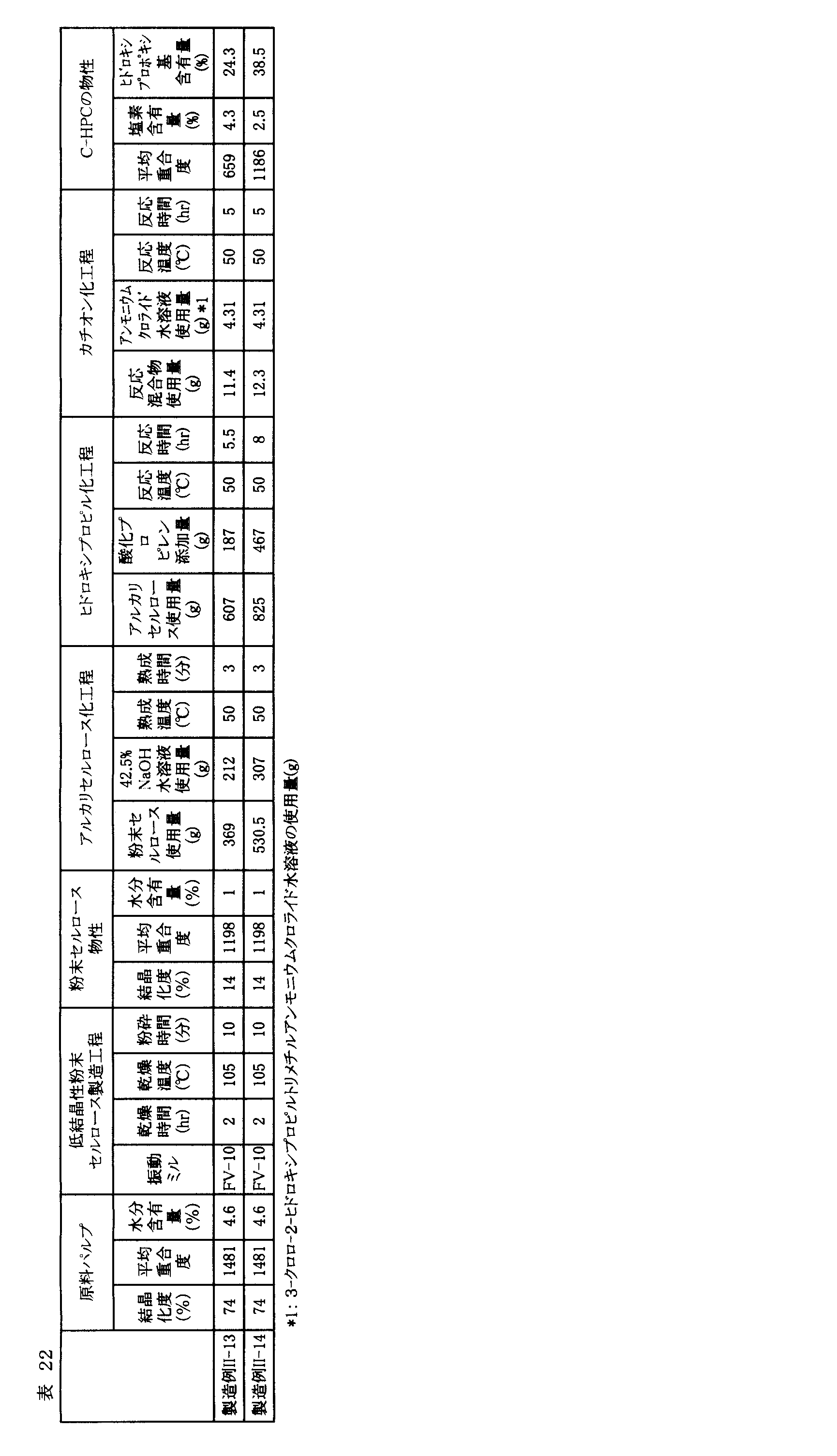

成分(A)としてC-HPC(II‐1)~(II‐13)を用いて、表22~25に示す組成となるコンディショナーを常法により調製した。
具体的には、成分(A)を水に溶解又は均一分散させ、2%ポリマー水溶液を調製した。適量の水及び界面活性剤(C)をビーカーに取り、80℃に加温して混合した水溶液を、前記ポリマー水溶液を加え、均一混合した。そこに融解させた油分(B)、セチルアルコール及びステアリルアルコールを加え、30分間撹拌乳化し冷却した。最後に、加温により蒸発した水分を補充し、pHを測定した。pH調整剤(50%クエン酸水溶液)でpHを5に調整した。
成分(A)を水に溶解又は均一分散させ、2%ポリマー水溶液を調製した。このポリマー水溶液に、適量の水と界面活性剤(C)と等モル量のpH調整剤(50%クエン酸水溶液)を加え、80℃に加温した。そこに融解させた油分(B)、セチルアルコール、ステアリルアルコール及び界面活性剤(C)を加え、30分間撹拌乳化し冷却した。最後に、加温により蒸発した水分を補充し、pHを測定した。pH調整剤(50%クエン酸水溶液)でpHを5に調整した。
5人のパネラーが、以下に示す評価基準、評価方法により、毛髪の指通り性、べたつき感、まとまり感の評価を行った。結果を表24~27に示す。
(成分) (%)
ポリオキシエチレンラウリルエーテル硫酸Na 11.3
(エマールE-27C(花王株式会社製、有効分27重量%)として42.0%)
ヤシ油脂肪酸N-メチルエタノールアミド 3.0
(アミノーン C-11S(花王株式会社製))
クエン酸 0.2
メチルパラベン 0.3
精製水 バランス
計 100.0
各成分をビーカーに取り、80℃に加温後、混合し、均一に溶解したことを確認した後、冷却して、プレーンシャンプーを得た。
・指通り性
5:指通りが非常に良い
4:指通りが良い
3:指通りが普通
2:指通りが悪い
1:指通りが非常に悪い
・べたつき感
5:べたつかない
4:あまりべたつかない
3:普通
2:ややべたつく
1:べたつく
・まとまり感
5:髪のまとまりが非常によい
4:髪のまとまりがよい
3:普通
2:髪のまとまりが悪い
1:髪が全くまとまらない
比較例II‐6の指通り性、べたつき感、まとまり感を基準スコア3とし、5人のパネラーの評価結果を平均して評点を求めた。
実施例II‐1の成分(A)を添加しない(比較例II‐1)、あるいは成分(A)に代えて表24に示す種々のポリマーを用いて(比較例II‐2~8)、表24に示す組成となるコンディショナーを実施例II‐1と同様に調製した。なお、比較例II‐1~8のコンディショナーのpHをpH調整剤(50%クエン酸水溶液)で5に調製した。比較例II‐1~8のコンデョショナーを実施例II‐1~26と同様に評価した。結果をまとめて表24に示す。
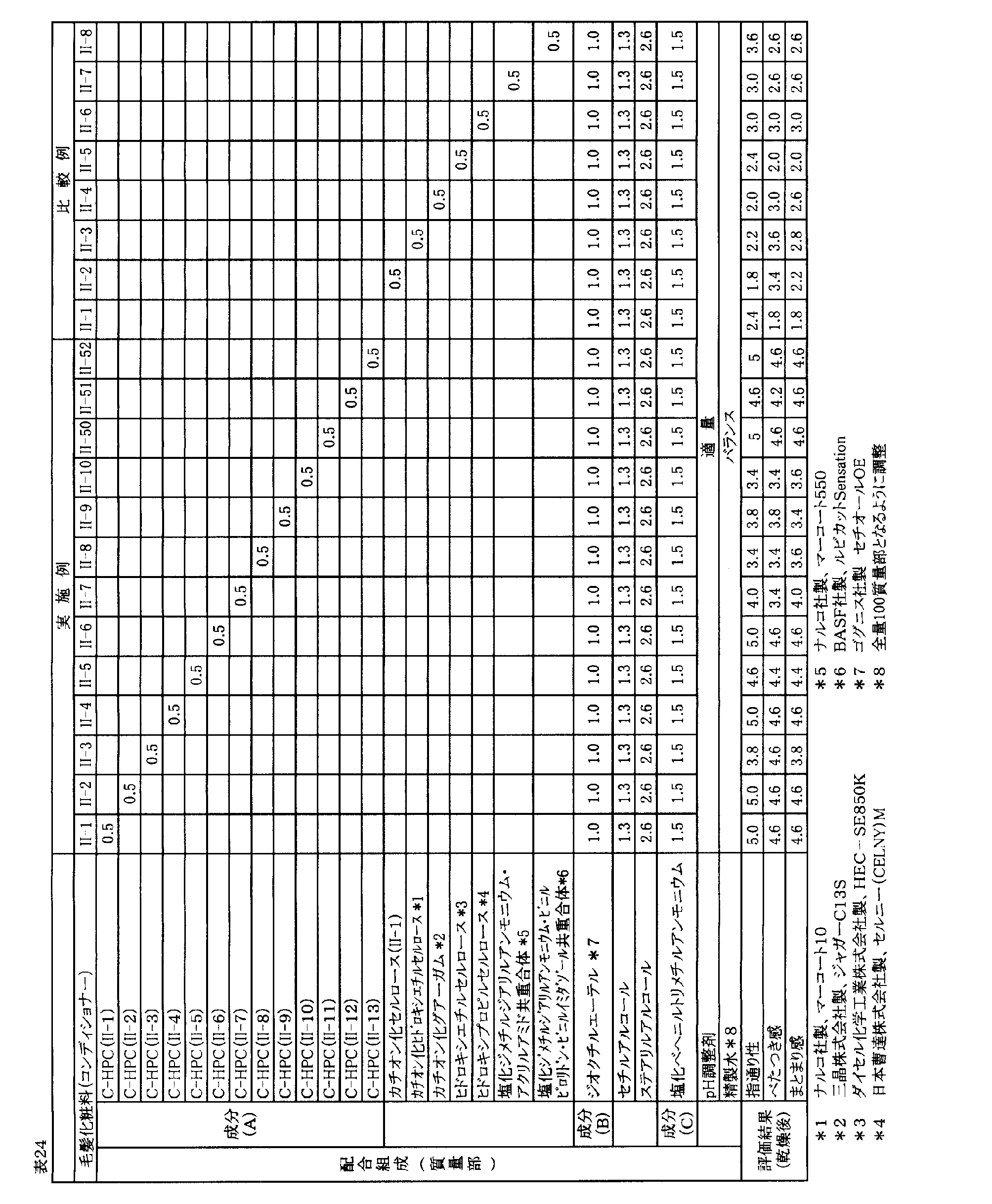
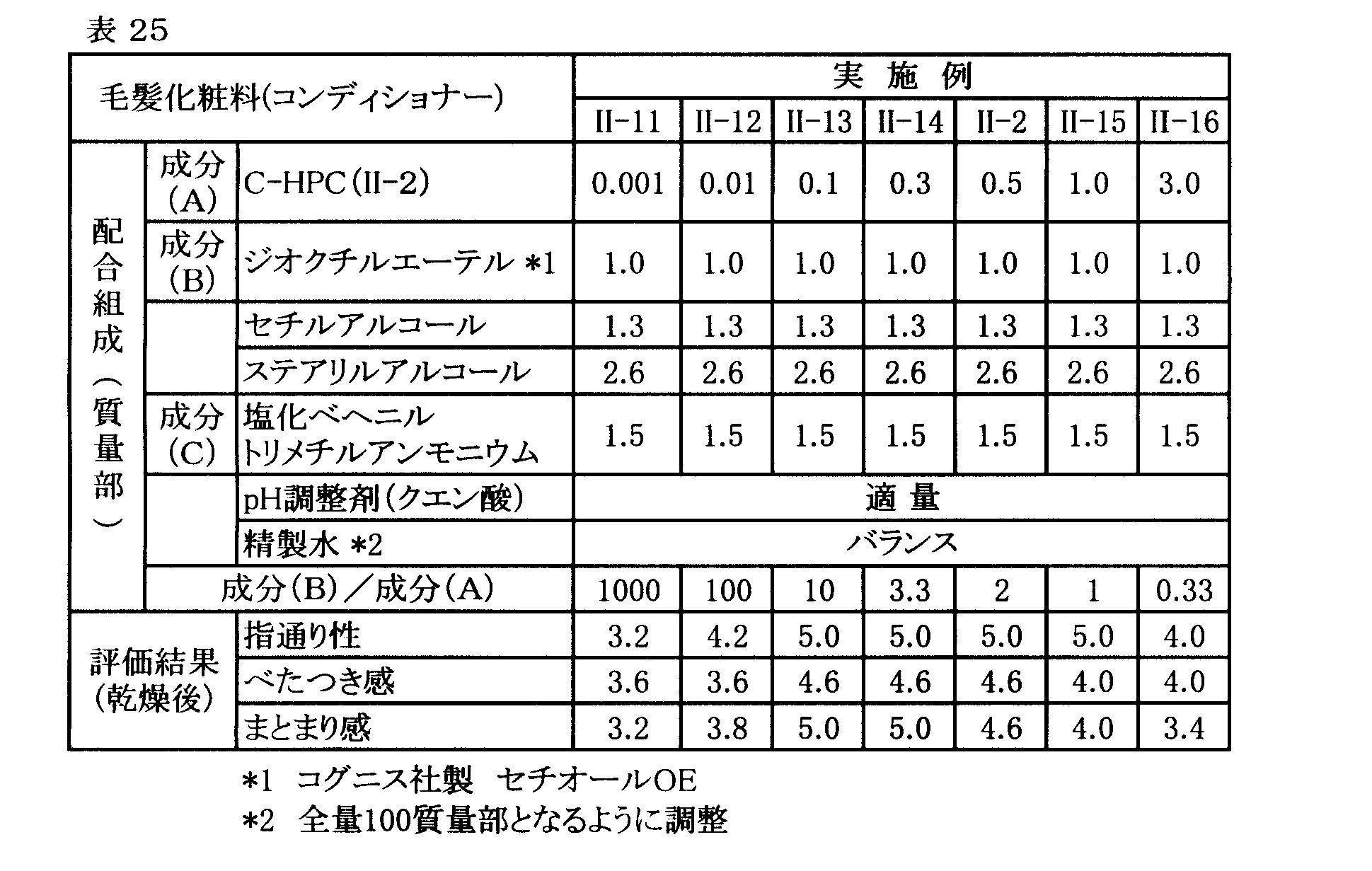
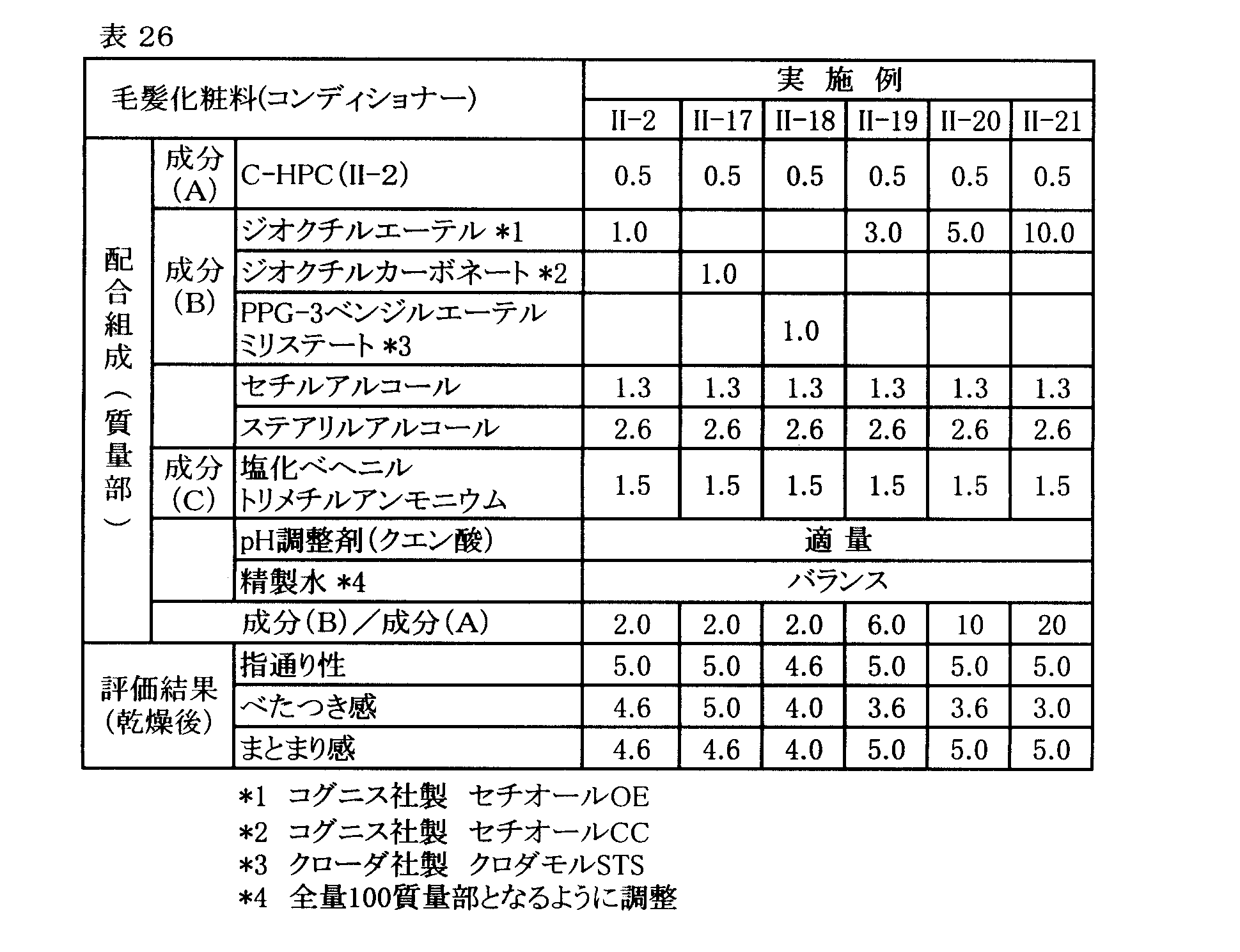
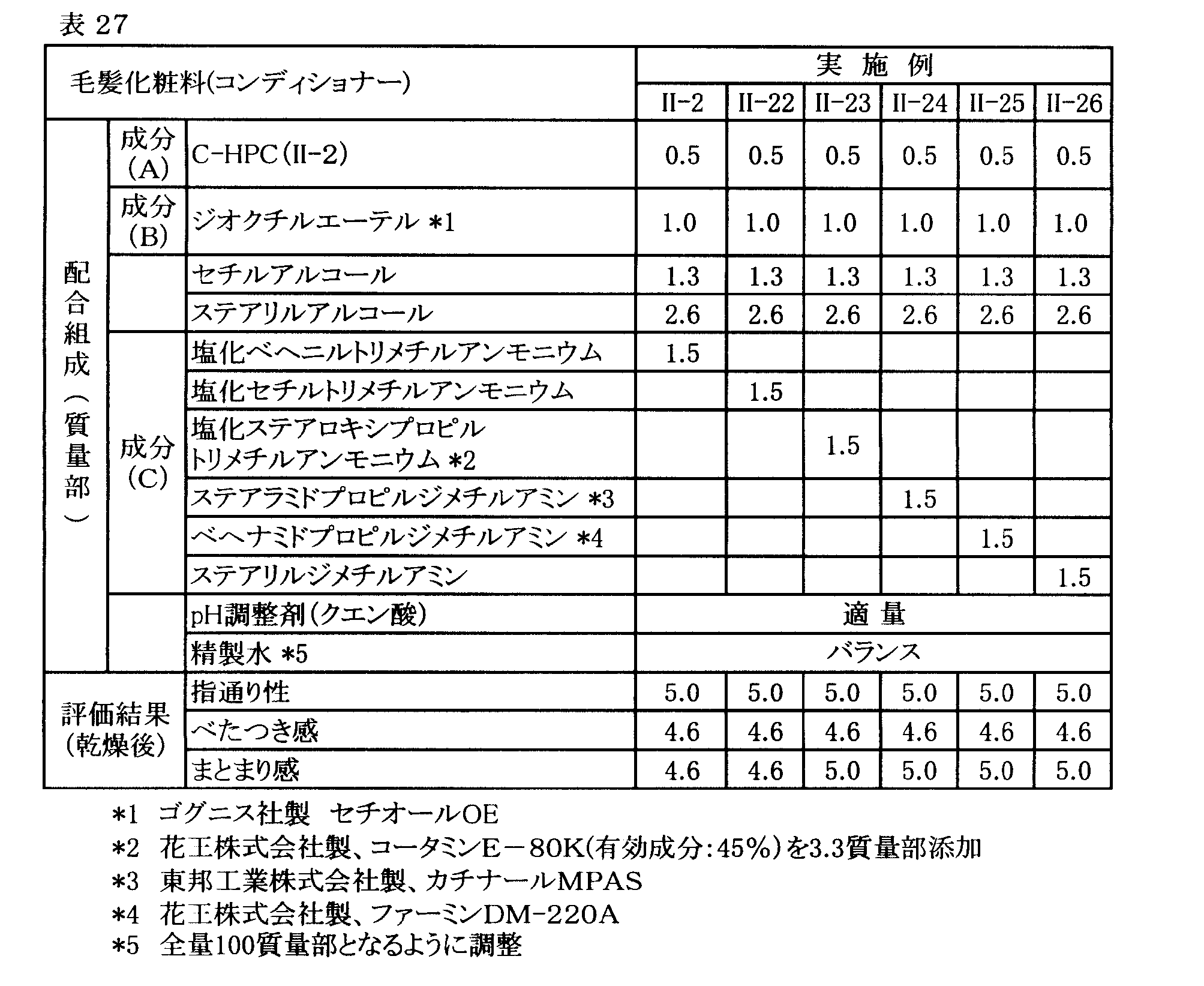
成分(A)としてC-HPC(II‐2)を用いて、表28~30に示す組成となるシャンプーを常法により調製した。
具体的には、界面活性剤(C)及び適量の水をビーカーに取り、60℃に加温し溶解させた。50℃まで冷却し、実施例II‐1と同様の方法で調製したポリマー液を加え、均一混合した。そこに油剤(B)を加え、30分間撹拌乳化し冷却した。最後に、加温により蒸発した水分を補充し、pHを測定した。必要に応じてpH調整剤(50%クエン酸水溶液及び48%水酸化ナトリウム水溶液)でpHを7に調整した。
実施例II‐1で用いたプレーンシャンプーで洗浄した毛束を35~40℃の温水で十分に湿らせた後、実施例II‐27~49のシャンプーで洗浄し、温水ですすぎ、タオルで水分を取り、櫛で毛束を整えた。その後、ドライヤーの温風で乾燥させ、仕上げに櫛で毛束を整え、評価用トレスを得た。評価は、比較例II‐12の指通り性、べたつき感、まとまり感を基準スコア3とし、5人のパネラーの評価結果を平均して評点を求めた。結果を表28~30に示す。
実施例II‐27の成分(A)に代えて、表26に示す種々のポリマーを用いて、表26に示す組成となるシャンプ-を実施例II‐27と同様に調製した。なお、必要に応じてpH調整剤(50%クエン酸水溶液及び48%水酸化ナトリウム水溶液)で、比較例II‐9~13のシャンプーのpHを7に調製した。比較例II‐9~13のシャンプーを実施例II‐27と同様に評価を行った。結果を表28に示す。
油剤(B)を添加しないこと以外は実施例II‐27と同様に行い、比較例II‐14のシャンプーを調製した。調製した比較例II‐14のシャンプーを実施例II‐27のシャンプーと同様に評価を行った。結果を表29に示す。

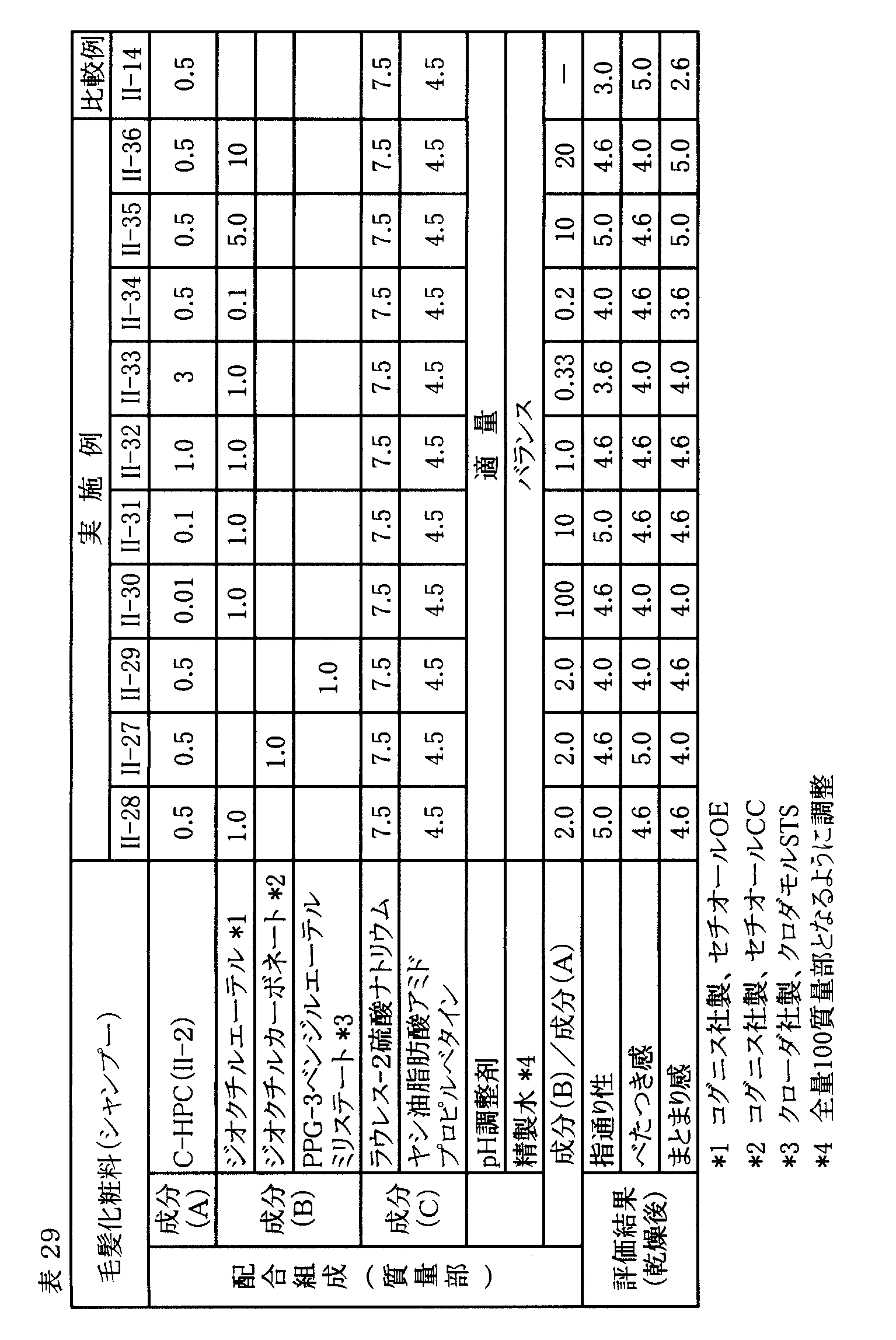
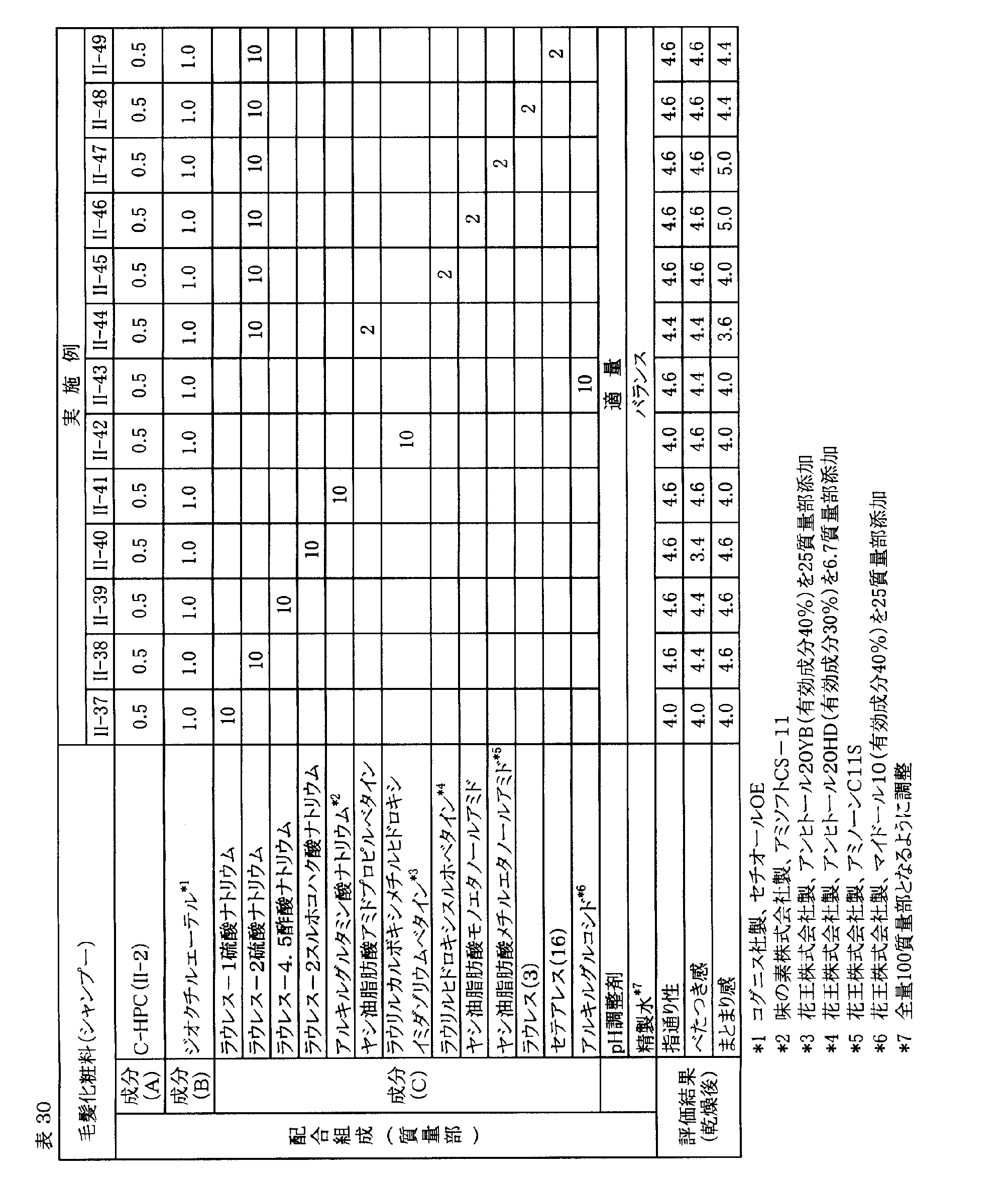
成分(A)として製造例I-2で製造したC-HPC(I‐2)を用いて、表31に示す組成のエマルションを調整した。
(工程(I))
10質量%C-HPC(A)水溶液(比較例III‐1、2に示すカチオン化ヒドロキシエチルセルロース、カチオン化グアーガムについては1質量%水溶液)及び陰イオン界面活性剤(C’)をビーカーに取り、均一になるまで混合し、C-HPC(A)と陰イオン界面活性剤(C’)との混合物を調製した。
(工程(II))
上記混合物に、油剤(B)を加え、300rpm(0.78m/s)で撹拌しながら60分間乳化し、最後に残りの水を加えてエマルションを調整した。
油滴の平均粒径は、動的光散乱粒径測定装置LA-950(株式会社堀場製作所製)を用いて測定した。測定時の泡の混入を防ぐ為、LA-950のセル中で乳化物を完全に分散後(測定条件;攪拌7、循環7)、撹拌および循環を停止させてから測定した。体積基準のメジアン径を、温度25℃にて測定し、これを平均粒径とした。
油滴の平均粒径が小さいほど、油剤(C)の乳化力が大きく、粒径が大きいほど、乳化力が小さいことを意味している。
(1)で調整したエマルションを適量の水で希釈し、5質量%水溶液とした。このエマルションの外観から下記の評価基準により評価した。結果を表31に示す。
(評価基準)
・乳化状態
A:乳化可能
B:乳化不可能(油滴合一)
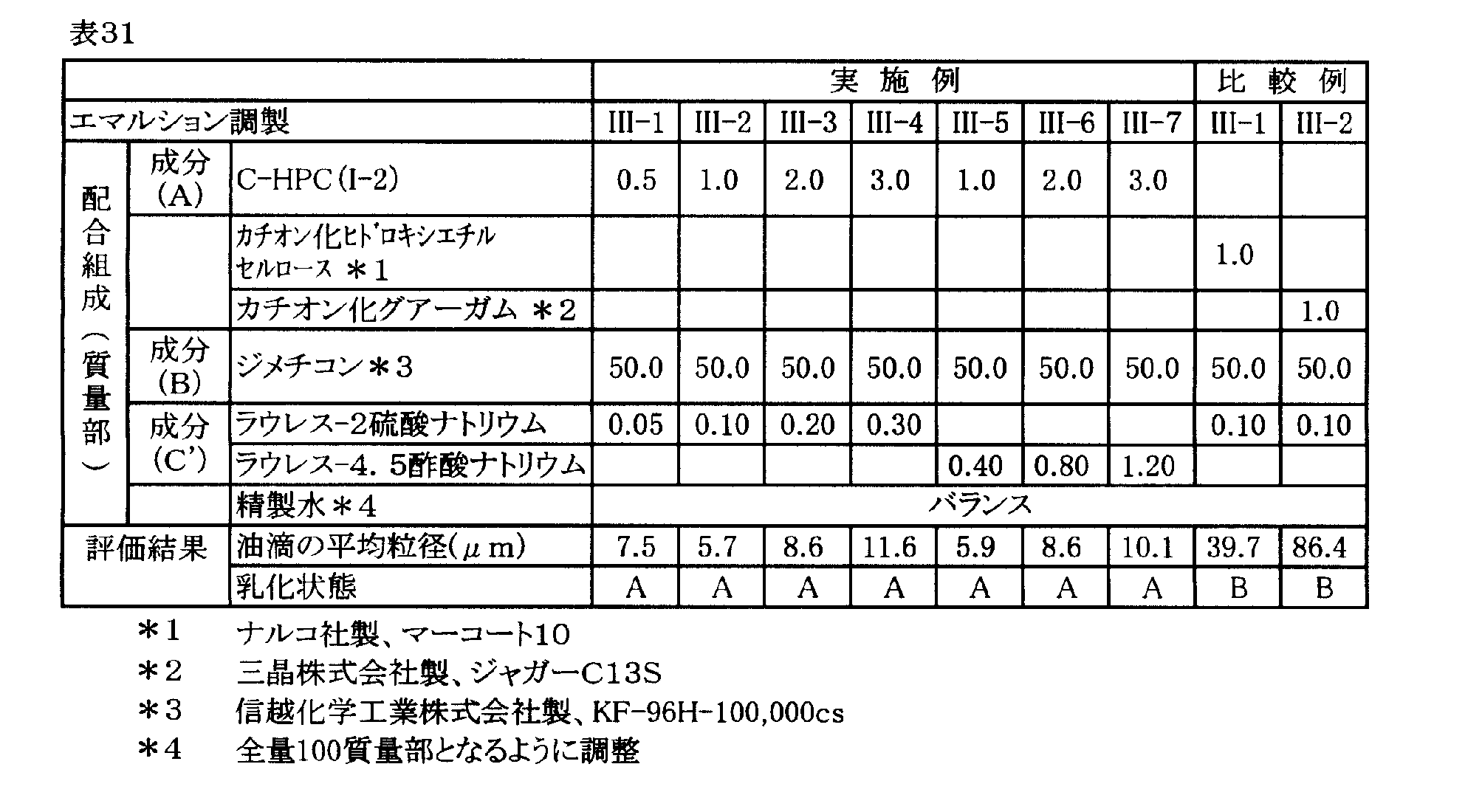
(工程(III))
適量の水及び界面活性剤(C)をビーカーに取り、80℃に加温して混合した水溶液を、前記ポリマー水溶液に加え、均一混合した。そこに融解させた油分(B)、セチルアルコール、ステアリルアルコールを加え、30分間撹拌乳化し冷却した。その後、表31に示す組成のエマルションを添加し、均一に混合した。最後に、加温により蒸発した水分を補充し、pHを測定した。pH調整剤(50%クエン酸水溶液)でpHを5に調整した。なお、比較例III-3では、表31に示すエマルションに代えて、市販のエマルション(東レダウコーニング社製、BY22-029)を用いた。
5人のパネラーが、以下に示す評価基準、評価方法により、毛髪の指通り性、べたつき感、まとまり感、しっとり感の評価を行った。結果を表32、33に示す。
(成分) (%)
ポリオキシエチレンラウリルエーテル硫酸Na 11.3
(エマールE-27C(花王株式会社製、有効分27重量%)として42.0%)
ヤシ油脂肪酸N-メチルエタノールアミド 3.0
(アミノーン C-11S(花王株式会社製))
クエン酸 0.2
メチルパラベン 0.3
精製水 バランス
計 100.0
各成分をビーカーに取り、80℃に加温後、混合し、均一に溶解したことを確認した後、冷却して、プレーンシャンプーを得た。
・指通り性
5:指通りが非常に良い
4:指通りが良い
3:指通りが普通
2:指通りが悪い
1:指通りが非常に悪い
・べたつき感
5:べたつかない
4:あまりべたつかない
3:普通
2:ややべたつく
1:べたつく
・まとまり感
5:髪のまとまりが非常によい
4:髪のまとまりがよい
3:普通
2:髪のまとまりが悪い
1:髪が全くまとまらない
・しっとり感
5:強く感じられる
4:感じられる
3:普通
2:あまり感じられない
1:全く感じられない
比較例III‐3の指通り性、べたつき感、まとまり感、しっとり感を基準スコア3とし、5人のパネラーの評価結果を平均して評点を求めた。
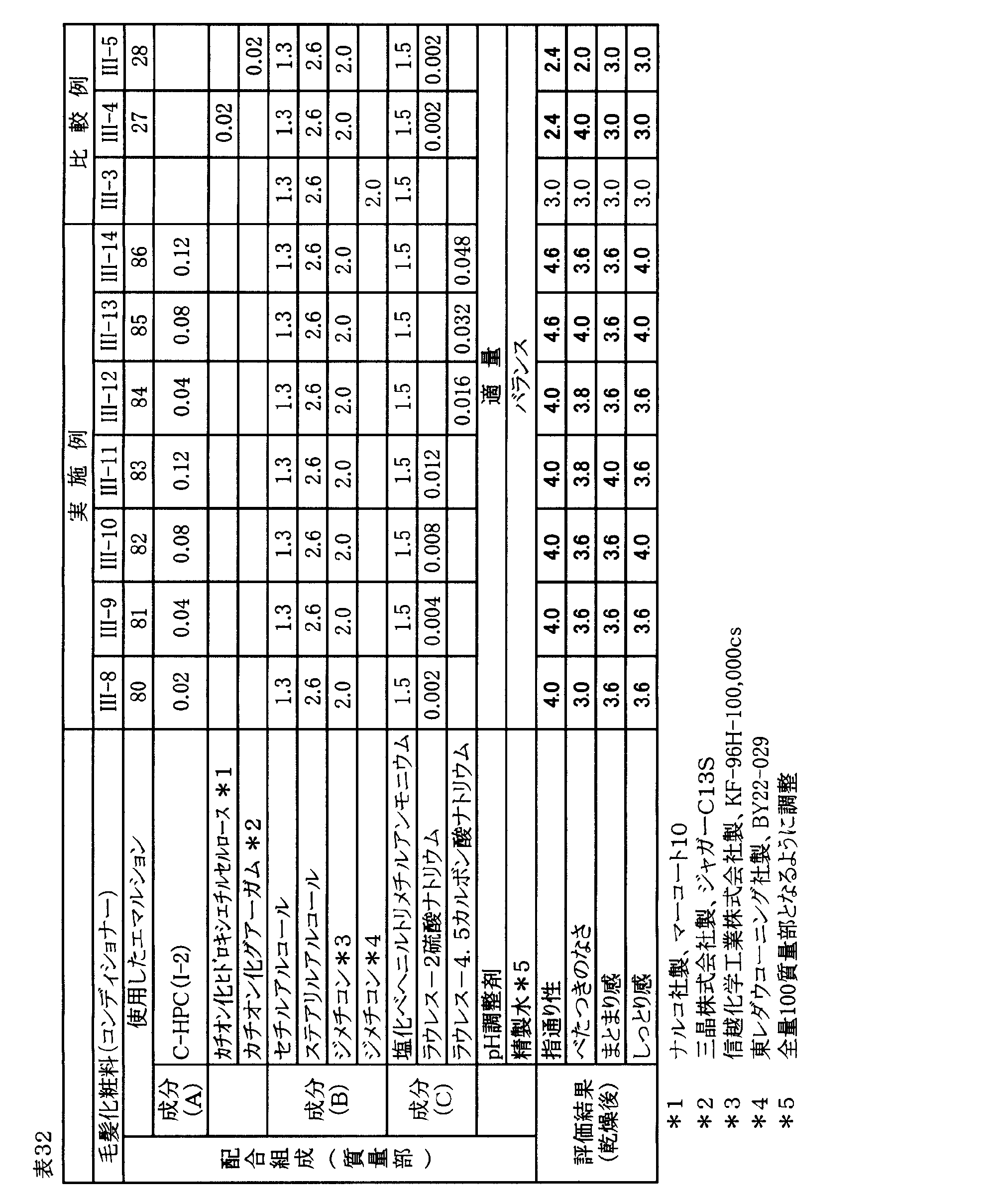
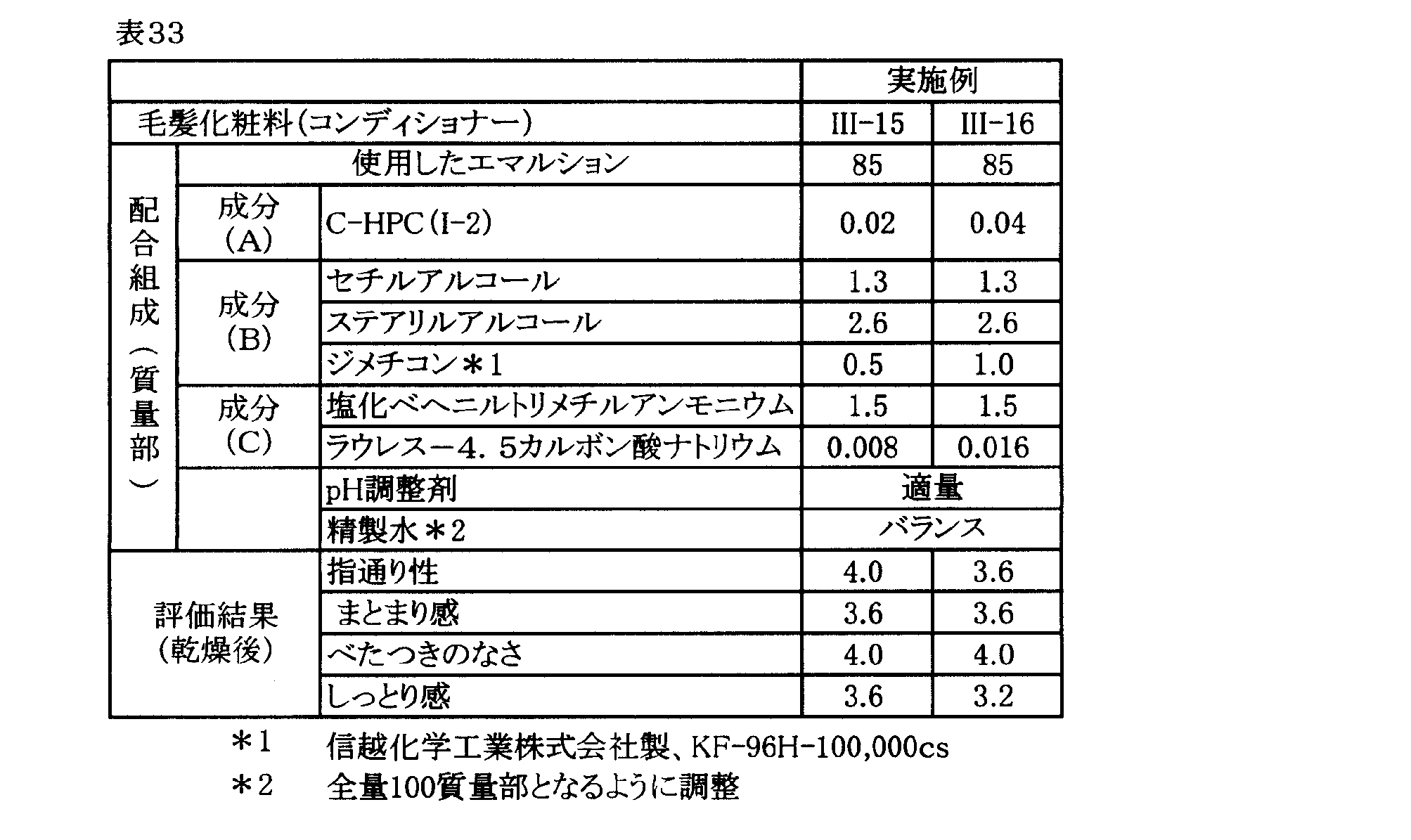
成分(A)としてC-HPC(I‐2)を用いて、表34に示す組成となるシャンプーを調製した。
具体的には、カチオン化グアーガムをと適量の水をビーカーに取り、均一に溶解させた。そこに界面活性剤(C)を加え、60℃に加温し溶解させた。45℃まで冷却し、そこにエチレングリコールジステアレート(B)及び、表31に示す組成のエマルションを加え、30分間撹拌乳化し冷却した。最後に、加温により蒸発した水分を補充し、pHを測定した。必要に応じてpH調整剤(50%クエン酸水溶液及び48%水酸化ナトリウム水溶液)でpHを7に調整した。実施例I-1と同様の評価方法により、毛髪の指通り性、べたつきのなさ、まとまり感、しっとり感の評価を行った。結果を表34に示す。なお、評価は、比較例III‐6の指通り性、べたつきのなさ、まとまり感、しっとり感を基準スコア3とし、5人のパネラーの評価結果を平均して評点を求めた。
配合したエマルションを市販のエマルション(東レダウコーニング株式会社製、BY22-029)に変えた以外は実施例III‐17~22と同様に調製した。なお、シャンプーのpHは、pH調整剤(50%クエン酸水溶液及び48%水酸化ナトリウム水溶液)を用いて7に調製した。

Claims (14)
- カチオン化ヒドロキシプロピルセルロース(A)、20℃における水100gに対する溶解量が0~1gである油剤(B)、及び界面活性剤(C)を含有する毛髪化粧料であって、カチオン化ヒドロキシプロピルセルロース(A)が、下記一般式(1)で表されるアンヒドログルコース由来の主鎖を有し、かつカチオン化エチレンオキシ基の置換度が0.01~2.9であり、プロピレンオキシ基の置換度が0.1~4.0である毛髪化粧料。
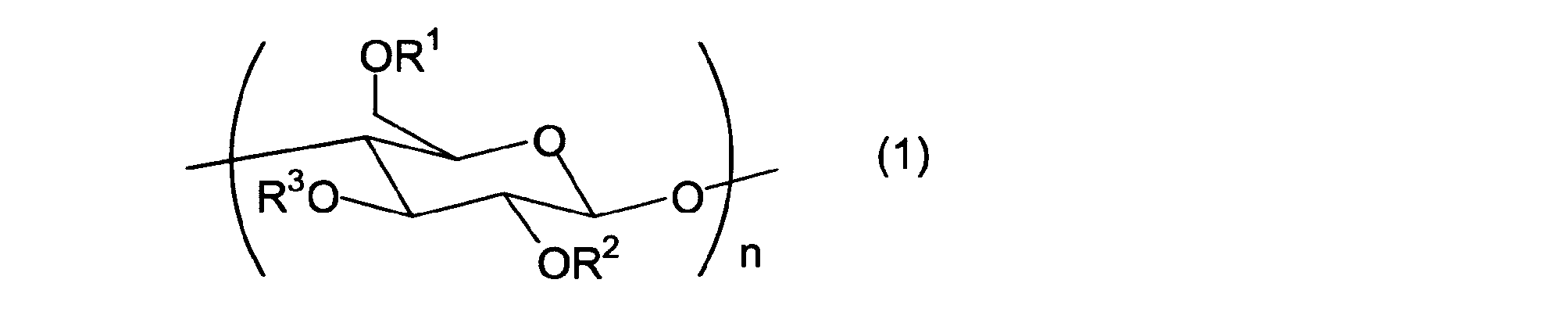

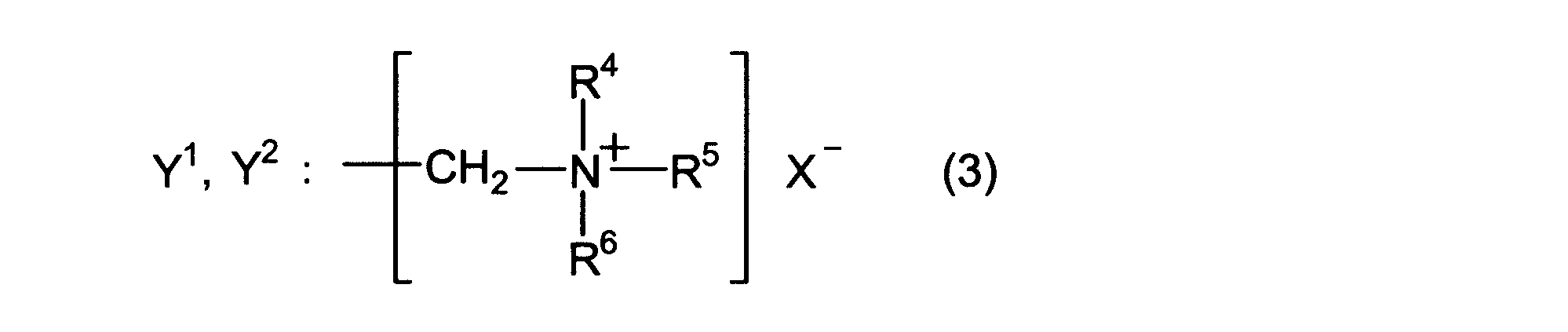
- カチオン化ヒドロキシプロピルセルロース(A)の含有量が0.001~10質量%である、請求項1に記載の毛髪化粧料。
- 一般式(1)におけるアンヒドログルコースの平均重合度nが300~1500である、請求項1又は2に記載の毛髪化粧料。
- カチオン化ヒドロキシプロピルセルロース(A)に対する油剤(B)の質量比[油剤(B)/カチオン化ヒドロキシプロピルセルロース(A)]が、0.1~5000である、請求項1~3いずれかに記載の毛髪化粧料。
- カチオン化ヒドロキシプロピルセルロース(A)に対する界面活性剤(C)の質量比[界面活性剤(C)/カチオン化ヒドロキシプロピルセルロース(A)]が、0.1~2000である、請求項1~4いずれか1項に記載の毛髪化粧料。
- 油剤(B)が、下記一般式(4)で表されるエステル化合物、下記一般式(5)で表されるジアルキルカーボネート化合物、及び下記一般式(6)で表されるジアルキルエーテル化合物から選ばれる1種以上の化合物である、請求項1~5のいずれかに記載の毛髪化粧料。
R7O-(AO)m-COR8 (4)
(式中、R7は置換又は無置換である少なくとも1つの芳香環を含有する炭素数6~20の炭素水素基を示し、R8は炭素数1~25の直鎖又は分岐鎖のアルキル基又はアルケニル基を示す。AOは、炭素数2~4のアルキレンオキシ基を示し、mは1~50の数である。mが2以上の場合、m個のAO基は、同一でも異なっていてもよい。)
R9O(CH2CH2O)rCO(OCH2CH2)s-OR10 (5)
(式中、R9及びR10は、それぞれ炭素数6~22の直鎖又は分岐鎖のアルキル基及び/又はアルケニル基を示し、r及びsはそれぞれ0又は1~50の数である。)
R11-O-R12 (6)
(式中、R11及びR12は、それぞれ炭素数6~22の直鎖又は分岐鎖のアルキル基及び/又はアルケニル基を示す。) - カチオン化ヒドロキシプロピルセルロース(A)が、下記工程(a-1)~(a-3)によって得られるものである、請求項1~6のいずれかに記載の毛髪化粧料。
工程(a-1):セルロース含有原料にカチオン化剤を添加して粉砕機処理を行う工程
工程(a-2):工程(a-1)で得られた粉砕機処理物に塩基を添加して粉砕機処理を行いながらセルロース含有原料とカチオン化剤の反応を行ってカチオン化セルロースを得る工程
工程(a-3):工程(a-2)で得られたカチオン化セルロースと酸化プロピレンとを反応させてカチオン化ヒドロキシプロピルセルロース(A)を得る工程 - カチオン化ヒドロキシプロピルセルロース(A)が、下記工程(b-1)~(b-4)によって得られるものである、請求項1~6のいずれかに記載の毛髪化粧料。
工程(b-1):セルロース含有原料を粉砕機処理して、結晶化度が10~50%であるセルロースを含有するセルロース含有原料を得る工程
工程(b-2):工程(b-1)で得られたセルロース含有原料に対して、該セルロースを構成するアンヒドログルコース単位1モルあたり0.6~1.5倍モルの塩基、及び該セルロース含有原料中のセルロースに対して20~100質量%の水を添加して、アルカリセルロースを得る工程
工程(b-3):工程(b-2)で得られたアルカリセルロースと酸化プロピレンとを反応させてヒドロキシプロピルセルロースを得る工程
工程(b-4):工程(b-3)で得られたヒドロキシプロピルセルロースとカチオン化剤とを反応させてカチオン化ヒドロキシプロピルセルロース(A)を得る工程 - カチオン化ヒドロキシプロピルセルロース(A)が、下記工程(c-1)~(c-4)によって得られるものである、請求項1~6のいずれかに記載の毛髪化粧料。
工程(c-1):セルロース含有原料及びセルロース含有原料中のセルロースを構成するアンヒドログルコース単位1モルあたり0.6~1.5倍モルの塩基化合物との混合物を、該セルロース含有原料中のセルロースに対する水分量が10重量%以下の条件下で粉砕機処理し、セルロースの平均粒径が10~150μmであるセルロース・塩基混合粉砕物を得る工程
工程(c-2):工程(c-1)で得られたセルロース・塩基混合粉砕物に水を添加し、該セルロース・塩基混合粉砕物中の水分量を、工程(c-1)で用いたセルロース含有原料中のセルロースに対して30~100質量%に調整して、アルカリセルロースを得る工程
工程(c-3):工程(c-2)で得られたアルカリセルロースと酸化プロピレンとを反応させてヒドロキシプロピルセルロースを得る工程
工程(c-4):工程(c-3)で得られたヒドロキシプロピルセルロースとカチオン化剤とを反応させてカチオン化ヒドロキシプロピルセルロース(A)を得る工程 - カチオン化ヒドロキシプロピルセルロース(A)、20℃における水100gに対する溶解量が0~1gである油剤(B)、及び界面活性剤(C)を含有する毛髪化粧料の製造方法であって、カチオン化ヒドロキシプロピルセルロース(A)が、前記一般式(1)で表されるアンヒドログルコース由来の主鎖を有し、かつカチオン化エチレンオキシ基の置換度が0.01~2.9であり、プロピレンオキシ基の置換度が0.1~4.0であり、請求項7に記載の工程(a-1)~(a-3)、請求項8に記載の工程(b-1)~(b-4)又は請求項9に記載の工程(c-1)~(c-4)を有する、毛髪化粧料の製造方法。
- 下記工程(I)~工程(III)を有する毛髪化粧料の製造方法。
工程(I):カチオン化ヒドロキシプロピルセルロース(A)と、陰イオン界面活性剤(C’)とを混合し、混合物を得る工程
工程(II):工程(I)により得られた混合物と油剤(B)を混合し、エマルションを得る工程
工程(III):工程(II)により得られたエマルションと、界面活性剤(C)及び水とを混合し、毛髪化粧料を得る工程 - 請求項1~8いずれかに記載の毛髪化粧料のシャンプーとしての使用。
- 請求項1~8いずれかに記載の毛髪化粧料のコンディショナー、ヘアリンス又はトリートメントとしての使用。
- 請求項1~8いずれかに記載の毛髪化粧料のアウトバストリートメントとしての使用。
Priority Applications (4)
| Application Number | Priority Date | Filing Date | Title |
|---|---|---|---|
| EP11854139.0A EP2659880B1 (en) | 2010-12-28 | 2011-12-27 | Hair cosmetic |
| KR1020137016766A KR101889997B1 (ko) | 2010-12-28 | 2011-12-27 | 모발 화장료 |
| CN201180066466.6A CN103347488B (zh) | 2010-12-28 | 2011-12-27 | 毛发化妆品 |
| US13/977,472 US9289368B2 (en) | 2010-12-28 | 2011-12-27 | Hair cosmetic |
Applications Claiming Priority (8)
| Application Number | Priority Date | Filing Date | Title |
|---|---|---|---|
| JP2010-294131 | 2010-12-28 | ||
| JP2010294131 | 2010-12-28 | ||
| JP2010-294134 | 2010-12-28 | ||
| JP2010294134 | 2010-12-28 | ||
| JP2011103313 | 2011-05-02 | ||
| JP2011-103313 | 2011-05-02 | ||
| JP2011103316A JP5722694B2 (ja) | 2010-12-28 | 2011-05-02 | 毛髪化粧料 |
| JP2011-103316 | 2011-05-02 |
Publications (1)
| Publication Number | Publication Date |
|---|---|
| WO2012091073A1 true WO2012091073A1 (ja) | 2012-07-05 |
Family
ID=49253476
Family Applications (1)
| Application Number | Title | Priority Date | Filing Date |
|---|---|---|---|
| PCT/JP2011/080346 Ceased WO2012091073A1 (ja) | 2010-12-28 | 2011-12-27 | 毛髪化粧料 |
Country Status (5)
| Country | Link |
|---|---|
| US (1) | US9289368B2 (ja) |
| EP (1) | EP2659880B1 (ja) |
| KR (1) | KR101889997B1 (ja) |
| CN (1) | CN103347488B (ja) |
| WO (1) | WO2012091073A1 (ja) |
Cited By (1)
| Publication number | Priority date | Publication date | Assignee | Title |
|---|---|---|---|---|
| EP2543681A4 (en) * | 2010-03-02 | 2013-12-11 | Kao Corp | METHOD FOR THE PRODUCTION OF CATIONULATED CELLULOSE AND METHOD FOR THE PRODUCTION OF CATIONIZED HYDROXYALKYL CELLULOSE |
Families Citing this family (5)
| Publication number | Priority date | Publication date | Assignee | Title |
|---|---|---|---|---|
| JP6620623B2 (ja) * | 2015-03-31 | 2019-12-18 | 日油株式会社 | 毛髪洗浄剤組成物 |
| KR102469464B1 (ko) | 2016-10-07 | 2022-11-22 | 신에쓰 가가꾸 고교 가부시끼가이샤 | 저치환도 히드록시프로필 셀룰로오스 및 그의 제조 방법, 및 고형 제제 |
| KR102498064B1 (ko) * | 2016-10-07 | 2023-02-10 | 신에쓰 가가꾸 고교 가부시끼가이샤 | 저치환도 히드록시프로필 셀룰로오스 및 그의 제조 방법, 및 고형 제제 |
| WO2020142521A1 (en) * | 2018-12-31 | 2020-07-09 | L'oreal | Hair coloring compositions and methods of use |
| FI130679B1 (en) * | 2022-09-30 | 2024-01-15 | Teknologian Tutkimuskeskus Vtt Oy | Cellulose-based absorbent material and method for its production |
Citations (15)
| Publication number | Priority date | Publication date | Assignee | Title |
|---|---|---|---|---|
| JPS4520318B1 (ja) * | 1966-09-13 | 1970-01-10 | ||
| JPS5390368A (en) | 1977-01-21 | 1978-08-09 | Lion Corp | Preparation of cation-modified cellulose derivative |
| JPS60170601A (ja) | 1983-12-30 | 1985-09-04 | ユニオン、カ−バイド、コ−ポレ−シヨン | 多糖類及びそのような多糖類を使用する容姿ケア製品 |
| JPS62236801A (ja) | 1986-04-08 | 1987-10-16 | Asahi Chem Ind Co Ltd | 可溶性セルロ−スの製造方法 |
| JPH05148123A (ja) | 1991-10-18 | 1993-06-15 | Kao Corp | 毛髪化粧料 |
| JP2000512285A (ja) | 1996-06-12 | 2000-09-19 | ヘンケル・コマンディットゲゼルシャフト・アウフ・アクチエン | 化粧品および/または薬剤製剤 |
| JP2000512284A (ja) | 1996-06-12 | 2000-09-19 | ヘンケル・コマンディットゲゼルシャフト・アウフ・アクチエン | 化粧品および/または薬剤製剤の製造におけるシリコーン代替品としての脂肪化合物の使用 |
| JP2003064184A (ja) | 2001-08-24 | 2003-03-05 | Toray Ind Inc | セルロース溶液及び熱可塑性セルロースエステルの製造方法 |
| JP2004331918A (ja) | 2003-05-12 | 2004-11-25 | Asahi Kasei Chemicals Corp | 非晶質セルロース微粉体 |
| JP2005506347A (ja) | 2001-10-17 | 2005-03-03 | クローダ,インコーポレイテッド | 芳香族アルコキシル化アルコールおよび脂肪族カルボン酸のエステル |
| JP2006151992A (ja) | 2006-01-27 | 2006-06-15 | Shin Etsu Chem Co Ltd | 低置換度ヒドロキシプロピルセルロースを含む化粧料 |
| JP2009143997A (ja) * | 2007-12-12 | 2009-07-02 | Kao Corp | ヒドロキシプロピルセルロースの製造方法 |
| JP2009161508A (ja) | 2007-04-17 | 2009-07-23 | Kao Corp | 毛髪化粧料 |
| WO2011052733A1 (ja) * | 2009-10-29 | 2011-05-05 | 花王株式会社 | カチオン性ヒドロキシプロピルセルロースの製造方法 |
| WO2011059063A1 (ja) * | 2009-11-12 | 2011-05-19 | 花王株式会社 | 毛髪化粧料 |
Family Cites Families (22)
| Publication number | Priority date | Publication date | Assignee | Title |
|---|---|---|---|---|
| US3472840A (en) | 1965-09-14 | 1969-10-14 | Union Carbide Corp | Quaternary nitrogen-containing cellulose ethers |
| US3816616A (en) | 1971-11-30 | 1974-06-11 | Warner Lambert Co | Unitary shampoo and cream rinse compositions |
| JPS5487787A (en) | 1977-12-26 | 1979-07-12 | Fuji Chemical Kk | Preparation of cellulose derivative containing ammonia nitrogen |
| JPS5942681A (ja) | 1982-09-02 | 1984-03-09 | Mitsubishi Electric Corp | テ−プ量表示装置 |
| EP0149249A3 (en) | 1983-12-30 | 1986-11-12 | Union Carbide Corporation | Polysaccharides and personal care products utilizing such polysaccharides |
| US5254333A (en) * | 1990-07-10 | 1993-10-19 | Kao Corporation | Hair treatment composition and hair dye composition |
| JP3025537B2 (ja) | 1990-12-28 | 2000-03-27 | 花王株式会社 | 毛髪化粧料 |
| GB9717949D0 (en) | 1997-08-22 | 1997-10-29 | Procter & Gamble | Cleansing compositions |
| GB9717952D0 (en) | 1997-08-22 | 1997-10-29 | Procter & Gamble | Cleansing compositions |
| JP3472491B2 (ja) | 1998-11-17 | 2003-12-02 | 花王株式会社 | 毛髪化粧料 |
| JP2000327541A (ja) | 1999-05-17 | 2000-11-28 | Daicel Chem Ind Ltd | 毛髪用シャンプー組成物 |
| US7297717B2 (en) * | 2000-04-27 | 2007-11-20 | Kao Corporation | Emulsion cosmetic |
| JP2005306843A (ja) | 2004-03-25 | 2005-11-04 | Kose Corp | 皮膚洗浄剤組成物 |
| US7589051B2 (en) | 2004-04-08 | 2009-09-15 | Hercules Incorporated | Cationic, oxidized polysaccharides in conditioning applications |
| EP1791518A1 (en) | 2004-09-24 | 2007-06-06 | Hercules Incorporated | High ds cationic polygalactomannan for skincare products |
| WO2009054373A1 (ja) * | 2007-10-25 | 2009-04-30 | Kao Corporation | セルロースエーテル誘導体の製造方法 |
| JP5804665B2 (ja) * | 2008-04-04 | 2015-11-04 | ライオン株式会社 | 毛髪化粧料 |
| JP5543080B2 (ja) | 2008-04-25 | 2014-07-09 | 花王株式会社 | 皮膚洗浄剤組成物 |
| JP5235102B2 (ja) * | 2008-06-16 | 2013-07-10 | 花王株式会社 | 水性毛髪洗浄剤 |
| KR101652536B1 (ko) | 2008-09-25 | 2016-08-30 | 카오카부시키가이샤 | 유성 화장료 |
| JP2010235523A (ja) | 2009-03-31 | 2010-10-21 | Kao Corp | 水性毛髪洗浄剤 |
| US8097574B2 (en) | 2009-08-14 | 2012-01-17 | The Gillette Company | Personal cleansing compositions comprising a bacterial cellulose network and cationic polymer |
-
2011
- 2011-12-27 KR KR1020137016766A patent/KR101889997B1/ko active Active
- 2011-12-27 US US13/977,472 patent/US9289368B2/en not_active Expired - Fee Related
- 2011-12-27 WO PCT/JP2011/080346 patent/WO2012091073A1/ja not_active Ceased
- 2011-12-27 CN CN201180066466.6A patent/CN103347488B/zh active Active
- 2011-12-27 EP EP11854139.0A patent/EP2659880B1/en not_active Not-in-force
Patent Citations (16)
| Publication number | Priority date | Publication date | Assignee | Title |
|---|---|---|---|---|
| JPS4520318B1 (ja) * | 1966-09-13 | 1970-01-10 | ||
| JPS5390368A (en) | 1977-01-21 | 1978-08-09 | Lion Corp | Preparation of cation-modified cellulose derivative |
| JPS5942681B2 (ja) * | 1977-01-21 | 1984-10-17 | ライオン株式会社 | カチオン変性セルロ−ス誘導体の製造方法 |
| JPS60170601A (ja) | 1983-12-30 | 1985-09-04 | ユニオン、カ−バイド、コ−ポレ−シヨン | 多糖類及びそのような多糖類を使用する容姿ケア製品 |
| JPS62236801A (ja) | 1986-04-08 | 1987-10-16 | Asahi Chem Ind Co Ltd | 可溶性セルロ−スの製造方法 |
| JPH05148123A (ja) | 1991-10-18 | 1993-06-15 | Kao Corp | 毛髪化粧料 |
| JP2000512285A (ja) | 1996-06-12 | 2000-09-19 | ヘンケル・コマンディットゲゼルシャフト・アウフ・アクチエン | 化粧品および/または薬剤製剤 |
| JP2000512284A (ja) | 1996-06-12 | 2000-09-19 | ヘンケル・コマンディットゲゼルシャフト・アウフ・アクチエン | 化粧品および/または薬剤製剤の製造におけるシリコーン代替品としての脂肪化合物の使用 |
| JP2003064184A (ja) | 2001-08-24 | 2003-03-05 | Toray Ind Inc | セルロース溶液及び熱可塑性セルロースエステルの製造方法 |
| JP2005506347A (ja) | 2001-10-17 | 2005-03-03 | クローダ,インコーポレイテッド | 芳香族アルコキシル化アルコールおよび脂肪族カルボン酸のエステル |
| JP2004331918A (ja) | 2003-05-12 | 2004-11-25 | Asahi Kasei Chemicals Corp | 非晶質セルロース微粉体 |
| JP2006151992A (ja) | 2006-01-27 | 2006-06-15 | Shin Etsu Chem Co Ltd | 低置換度ヒドロキシプロピルセルロースを含む化粧料 |
| JP2009161508A (ja) | 2007-04-17 | 2009-07-23 | Kao Corp | 毛髪化粧料 |
| JP2009143997A (ja) * | 2007-12-12 | 2009-07-02 | Kao Corp | ヒドロキシプロピルセルロースの製造方法 |
| WO2011052733A1 (ja) * | 2009-10-29 | 2011-05-05 | 花王株式会社 | カチオン性ヒドロキシプロピルセルロースの製造方法 |
| WO2011059063A1 (ja) * | 2009-11-12 | 2011-05-19 | 花王株式会社 | 毛髪化粧料 |
Non-Patent Citations (2)
| Title |
|---|
| FUMIAKI MATSUZAKI: "Ko Bunshi Denkaishitsu Sakutai no Nyukazai to shite no Oyo", FRAGRANCE JOURNAL, vol. 26, no. 8, 15 August 1998 (1998-08-15), pages 42 - 46, XP008168638 * |
| TAKATOSHI SATO ET AL., KOSHOHIN KAGAKU, 1ST EDITION, 4TH PRINT, ASAKURA PUBLISHING CO., LTD., 20 September 2001 (2001-09-20), pages 126 - 131, XP008169103 * |
Cited By (2)
| Publication number | Priority date | Publication date | Assignee | Title |
|---|---|---|---|---|
| EP2543681A4 (en) * | 2010-03-02 | 2013-12-11 | Kao Corp | METHOD FOR THE PRODUCTION OF CATIONULATED CELLULOSE AND METHOD FOR THE PRODUCTION OF CATIONIZED HYDROXYALKYL CELLULOSE |
| US9040681B2 (en) | 2010-03-02 | 2015-05-26 | Kao Corporation | Method for producing cationized cellulose and method for producing cationized hydroxyalkyl cellulose |
Also Published As
| Publication number | Publication date |
|---|---|
| US20130295033A1 (en) | 2013-11-07 |
| EP2659880B1 (en) | 2019-11-06 |
| CN103347488B (zh) | 2016-01-13 |
| KR101889997B1 (ko) | 2018-08-20 |
| KR20130131388A (ko) | 2013-12-03 |
| EP2659880A4 (en) | 2014-12-10 |
| CN103347488A (zh) | 2013-10-09 |
| EP2659880A1 (en) | 2013-11-06 |
| US9289368B2 (en) | 2016-03-22 |
Similar Documents
| Publication | Publication Date | Title |
|---|---|---|
| JP5827566B2 (ja) | 毛髪化粧料 | |
| JP5703116B2 (ja) | 皮膚洗浄剤組成物 | |
| JP5703117B2 (ja) | 毛髪処理剤組成物 | |
| JP2014169417A (ja) | セルロース誘導体 | |
| KR101889997B1 (ko) | 모발 화장료 | |
| JP5957223B2 (ja) | 毛髪化粧料 | |
| JP5722694B2 (ja) | 毛髪化粧料 | |
| JP5829421B2 (ja) | 毛髪化粧料 | |
| JP5791957B2 (ja) | 水性毛髪洗浄剤 | |
| JP5833336B2 (ja) | 水性毛髪洗浄剤 | |
| JP5856840B2 (ja) | 皮膚洗浄剤組成物 | |
| JP5814609B2 (ja) | 毛髪化粧料 | |
| JP5779395B2 (ja) | 毛髪化粧料 | |
| JP5779394B2 (ja) | 毛髪化粧料 |
Legal Events
| Date | Code | Title | Description |
|---|---|---|---|
| 121 | Ep: the epo has been informed by wipo that ep was designated in this application |
Ref document number: 11854139 Country of ref document: EP Kind code of ref document: A1 |
|
| ENP | Entry into the national phase |
Ref document number: 20137016766 Country of ref document: KR Kind code of ref document: A |
|
| NENP | Non-entry into the national phase |
Ref country code: DE |
|
| WWE | Wipo information: entry into national phase |
Ref document number: 13977472 Country of ref document: US Ref document number: 2011854139 Country of ref document: EP |