WO2012095143A1 - Verbindungen für organische elektrolumineszenzvorrichtungen - Google Patents
Verbindungen für organische elektrolumineszenzvorrichtungen Download PDFInfo
- Publication number
- WO2012095143A1 WO2012095143A1 PCT/EP2011/006355 EP2011006355W WO2012095143A1 WO 2012095143 A1 WO2012095143 A1 WO 2012095143A1 EP 2011006355 W EP2011006355 W EP 2011006355W WO 2012095143 A1 WO2012095143 A1 WO 2012095143A1
- Authority
- WO
- WIPO (PCT)
- Prior art keywords
- formula
- atoms
- radicals
- aromatic
- organic
- Prior art date
- Legal status (The legal status is an assumption and is not a legal conclusion. Google has not performed a legal analysis and makes no representation as to the accuracy of the status listed.)
- Ceased
Links
- 0 *c1ccc(*)nn1 Chemical compound *c1ccc(*)nn1 0.000 description 7
- IDBNNYQKFQZILX-UHFFFAOYSA-N O=C(c(c(-c1nc(Cl)nc(Cl)c11)nc(Cl)n2)c2Cl)C1=O Chemical compound O=C(c(c(-c1nc(Cl)nc(Cl)c11)nc(Cl)n2)c2Cl)C1=O IDBNNYQKFQZILX-UHFFFAOYSA-N 0.000 description 1
- MYZIBBNAUUCGQT-UHFFFAOYSA-N O=C(c(c(NC(N1)=O)c(c(NC(N2)=O)c3C2=O)C1=O)c3N1)NC1=O Chemical compound O=C(c(c(NC(N1)=O)c(c(NC(N2)=O)c3C2=O)C1=O)c3N1)NC1=O MYZIBBNAUUCGQT-UHFFFAOYSA-N 0.000 description 1
Classifications
-
- C—CHEMISTRY; METALLURGY
- C07—ORGANIC CHEMISTRY
- C07D—HETEROCYCLIC COMPOUNDS
- C07D487/00—Heterocyclic compounds containing nitrogen atoms as the only ring hetero atoms in the condensed system, not provided for by groups C07D451/00 - C07D477/00
- C07D487/22—Heterocyclic compounds containing nitrogen atoms as the only ring hetero atoms in the condensed system, not provided for by groups C07D451/00 - C07D477/00 in which the condensed system contains four or more hetero rings
-
- C—CHEMISTRY; METALLURGY
- C09—DYES; PAINTS; POLISHES; NATURAL RESINS; ADHESIVES; COMPOSITIONS NOT OTHERWISE PROVIDED FOR; APPLICATIONS OF MATERIALS NOT OTHERWISE PROVIDED FOR
- C09B—ORGANIC DYES OR CLOSELY-RELATED COMPOUNDS FOR PRODUCING DYES, e.g. PIGMENTS; MORDANTS; LAKES
- C09B57/00—Other synthetic dyes of known constitution
-
- H—ELECTRICITY
- H10—SEMICONDUCTOR DEVICES; ELECTRIC SOLID-STATE DEVICES NOT OTHERWISE PROVIDED FOR
- H10K—ORGANIC ELECTRIC SOLID-STATE DEVICES
- H10K85/00—Organic materials used in the body or electrodes of devices covered by this subclass
- H10K85/60—Organic compounds having low molecular weight
- H10K85/649—Aromatic compounds comprising a hetero atom
- H10K85/654—Aromatic compounds comprising a hetero atom comprising only nitrogen as heteroatom
-
- H—ELECTRICITY
- H10—SEMICONDUCTOR DEVICES; ELECTRIC SOLID-STATE DEVICES NOT OTHERWISE PROVIDED FOR
- H10K—ORGANIC ELECTRIC SOLID-STATE DEVICES
- H10K85/00—Organic materials used in the body or electrodes of devices covered by this subclass
- H10K85/60—Organic compounds having low molecular weight
- H10K85/649—Aromatic compounds comprising a hetero atom
- H10K85/657—Polycyclic condensed heteroaromatic hydrocarbons
- H10K85/6572—Polycyclic condensed heteroaromatic hydrocarbons comprising only nitrogen in the heteroaromatic polycondensed ring system, e.g. phenanthroline or carbazole
-
- H—ELECTRICITY
- H10—SEMICONDUCTOR DEVICES; ELECTRIC SOLID-STATE DEVICES NOT OTHERWISE PROVIDED FOR
- H10K—ORGANIC ELECTRIC SOLID-STATE DEVICES
- H10K50/00—Organic light-emitting devices
- H10K50/10—OLEDs or polymer light-emitting diodes [PLED]
- H10K50/17—Carrier injection layers
-
- Y—GENERAL TAGGING OF NEW TECHNOLOGICAL DEVELOPMENTS; GENERAL TAGGING OF CROSS-SECTIONAL TECHNOLOGIES SPANNING OVER SEVERAL SECTIONS OF THE IPC; TECHNICAL SUBJECTS COVERED BY FORMER USPC CROSS-REFERENCE ART COLLECTIONS [XRACs] AND DIGESTS
- Y02—TECHNOLOGIES OR APPLICATIONS FOR MITIGATION OR ADAPTATION AGAINST CLIMATE CHANGE
- Y02E—REDUCTION OF GREENHOUSE GAS [GHG] EMISSIONS, RELATED TO ENERGY GENERATION, TRANSMISSION OR DISTRIBUTION
- Y02E10/00—Energy generation through renewable energy sources
- Y02E10/50—Photovoltaic [PV] energy
- Y02E10/549—Organic PV cells
Definitions
- the present invention relates to novel compounds containing aromatic nitrogen heterocycles for use in electronic devices, in particular in organic electroluminescent devices.
- OLEDs organic electroluminescent devices
- OLEDs organic electroluminescent devices
- hole injection materials or hole transport materials in organic electroluminescent devices are hexaazaphenylene derivatives, especially those which are substituted by cyano groups (eg WO 2001/049806). These compounds are generally used as a separate layer adjacent to one or more hole transport layers or in admixture with a hole transport material used. When using these compounds there is still room for improvement in terms of service life, efficiency and operating voltage. Furthermore, it would be desirable to have available for use in combination with triplet emitters materials that have a higher triplet level.
- AIQ3 has long been used as an electron transport material (eg US Pat. No. 4,539,507), but has several disadvantages: It can not be vapor-deposited without residue, since it partially decomposes at the sublimation temperature, which represents a major problem, in particular for production plants. This has the consequence that the Aufdampfarion must always be cleaned or changed. Furthermore, decomposition products of AIQ 3 enter the OLED, where they contribute to a reduced lifetime and reduced quantum and power efficiency. AIQ3 also has low electron mobility, resulting in higher voltages and lower power efficiency. To avoid short circuits in the display, one would like to increase the layer thickness; this is not possible with AIQ 3 because of the low charge carrier mobility and the resulting increase in voltage.
- AIQ3 which can lead to color shifts due to reabsorption and weak reemission, especially with blue OLEDs.
- blue OLEDs can only be represented with high efficiency or color loss.
- organic electroluminescent devices which contain certain - listed below - nitrogen heteroaromatics as electron transport materials or hole injection or hole transport materials, have very good properties, especially in terms of efficiency and lifetime and in particular in combination with triplet emitters. In particular, better results are obtained with these materials than with the prior art hexaazatophenylene derivatives.
- the invention relates to a compound of the following formula (1),
- X is the same or different CR or N on each occurrence, with the proviso that in each cycle two symbols X are N and the remaining symbols X are CR;
- Aryloxy or heteroaryloxy group having 5 to 60 aromatic ring atoms, which may be substituted by one or more radicals R 2 , or a combination of these systems; is identical or different at each instance an aromatic or heteroaromatic ring system having 5 to 30 aromatic ring atoms, which may be substituted with one or more non-aromatic radicals R 1 ; it is also possible for two radicals Ar, which bind to the same nitrogen or phosphorus atom, to be bonded by a single bond or a bridge selected from B (R 2 ), C (R 2 ) 2 ,
- two adjacent radicals R which can form another ring with one another are understood to mean two radicals R which bind to the same heterocycle on directly adjacent C atoms.
- An aryl group in the sense of this invention contains 6 to 60 C atoms; a heteroaryl group in the context of this invention contains 2 to 60 carbon atoms and at least 1 heteroatom, with the proviso that the sum of
- heteroatoms are preferably selected from N, O and / or S.
- aryl group or heteroaryl either a simple aromatic cycle, ie benzene, or a simple heteroaromatic cycle, for example pyridine, pyrimidine, thiophene, etc., or a fused aryl or heteroaryl group, for example naphthalene, anthracene, pyrene, quinoline, isoquinoline, etc., understood.
- An aromatic ring system in the sense of this invention contains 6 to 60 carbon atoms in the ring system.
- a heteroaromatic ring system in the sense of this invention contains 2 to 60 C atoms and at least one heteroatom in the ring system, with the proviso that the sum of C atoms and heteroatoms gives at least 5.
- the heteroatoms are preferably selected from N, O and / or S.
- an aromatic or heteroaromatic ring system in the context of this invention is a system which does not necessarily contain only aryl or heteroaryl groups, but in which also several aryl or heteroaryl groups are represented by a short, non-aromatic moiety, such as e.g. As a C, N or O atom can be interrupted.
- systems such as 9,9'-spirobifluorene, 9,9-diaryl fluorene, triarylamine, diaryl ether, stilbene, benzophenone, etc. are to be understood as aromatic ring systems in the context of this invention.
- aromatic or heteroaromatic ring system is understood as meaning systems in which a plurality of aryl or heteroaryl groups are linked together by single bonds, for example biphenyl, terphenyl or bipyridine.
- a C 1 - to C 4 -alkyl group in which individual H atoms or CH 2 groups can also be substituted by the abovementioned groups particularly preferably the radicals methyl, ethyl, n-propyl, i-propyl, n-butyl, i-butyl, s-butyl, t-butyl, 2-methylbutyl, n-pentyl, s-pentyl, cyclopentyl, n-hexyl, cyclohexyl, n-heptyl, cycloheptyl, n-octyl, Cyclooctyl, 2-ethylhexyl, trifluoromethyl, pentafluoroethyl and 2,2,2-trifluoroethyl understood.
- an alkenyl group is understood as meaning in particular ethenyl, propenyl, butenyl, pentenyl, cyclopentenyl, hexenyl, cyclohexenyl, heptenyl, cyclohepenyl, octenyl and cyclooctenyl.
- an alkynyl group is understood as meaning, in particular, ethynyl, propynyl, butynyl, pentynyl, hexynyl, heptynyl or octynyl.
- a C 1 -C 4 -alkoxy group is particularly preferably understood as meaning methoxy, trifluoromethoxy, ethoxy, n-propoxy, isopropoxy, n-butoxy, isobutoxy, s-butoxy, t-butoxy or 2-methylbutoxy.
- aromatic or heteroaromatic ring system having 5-60 aromatic ring atoms, which may be substituted in each case with the abovementioned radicals R and which may be linked via any positions on the aromatic or heteroaromatic, are understood in particular groups which are derived from benzene, Naphthalene, anthracene, phenanthrene, benzanthracene, benzphenanthrene, pyrene, chrysene, perylene, fluoranthene, naphthacene, pentacene, benzpyrene, biphenyl, biphenylene, terphenyl, terphenylene, fluorene, spirobifluorene, dihydrophenanthrene, dihydropyrene, tetrahydropyrene, cis or trans indenofluorene , Truxen, Isotruxen, Spirotruxen, Spiroisotruxen, Furan, Benzofuran, I
- Phenanthridine benzo-5,6-quinoline, benzo-6,7-quinoline, benzo-7,8-quinoline, phenothiazine, phenoxazine, pyrazole, indazole, imidazole, benzimidazole, naphthimidazole, phenanthrimidazole, pyrimididazole, pyrazine imidazole, quinoxaline imidazole, oxazole, Benzoxazole, naphthoxazole, anthroxazole, phenanthroxazole, isoxazole, 1, 2-thiazole, 1, 3-thiazole, benzothiazole,
- the compounds of formula (1) according to the invention are nitrogen heteroaromatics having three heteroaromatic fused partial cycles.
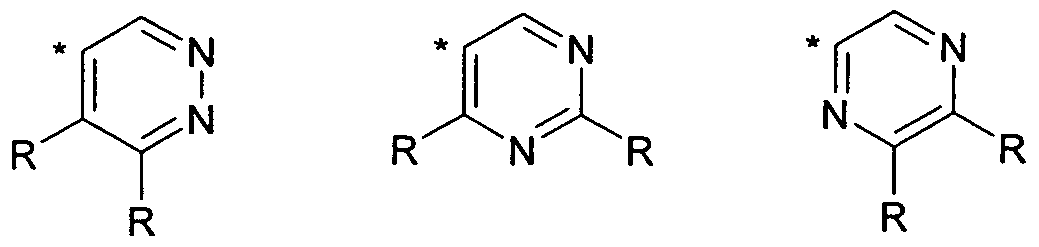
- heterocycle A Description of these heteroaromatic subcycles are hereinafter referred to as heterocycle A, heterocycle B and heterocycle C according to the following scheme:
- heterocycle A is selected from the structures of the following formulas (A-1) to (A-3),
- heterocycle B is selected from the structures of the following formulas (B-1) to (B-6),
- heterocycle C is selected from the structures of the following formulas (C-1) to (C-6),
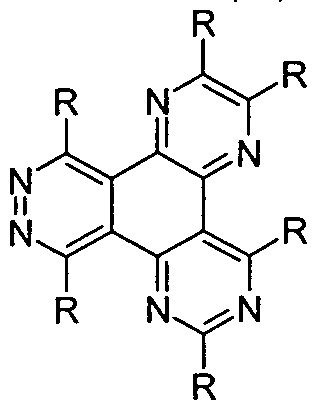
- heterocycles (A-1) to (A-3), (B-1) to (B-6) and (C-1) to (C-6) can be arbitrarily combined with each other.
- Preferred embodiments of the compounds of formula (1) are the compounds of the following formulas (2) to (14),
- R is in the Compounds of the formulas (1) to (14) and in the partial structures of the formulas (A-1) to (A-3), (B-1) to (B-6) and (C-1) to (C-6 ) identical or different at each occurrence for H, F, CN, CF 3) or an aromatic or heteroaromatic ring system having 5 to 30 aromatic ring atoms, which may be substituted by one or more radicals R, but is preferably unsubstituted.
- R is preferably selected from the group consisting of phenyl, 2-, 3- or 4-pyridyl, pyrazinyl, 2-, 4- or 5-pyrimidinyl, 3- or 4-pyridazinyl, Triazinyl, ortho-, meta- or para-biphenyl, ortho-, meta- or para-terphenyl, quaterphenyl, 2-fluorenyl, 2-spirobifluorenyl, 1-naphthyl, 2-naphthyl, anthracenyl, phenyl-anthracenyl, 1- or 2 -Naphthylanthracenyl, binaphthyl, pyrenyl, fluoran-1-enyl, 2-, 3-, 4-, 5-, 6- or 7-benzanthracenyl, N-imidazolyl, N-benzimidazolyl, phenyl-N-benzimidazolyl,
- all radicals R are chosen to be the same. This preference is due to the better synthetic accessibility of the compounds.
- At least two radicals R are different from one another, which leads to compounds with reduced symmetry.
- the reduction in symmetry can lead to advantages in terms of reduced crystallinity of the compounds.
- unbalanced compounds often have the advantage that they have a lower deposition temperature.
- Examples of preferred compounds according to the invention are the structures (1) to (44) depicted below.
- the chloro substituents can also be exchanged by nucleophilic aromatic substitution with other nucleophiles, for example F, in particular with activation by a Brönsted or Lewis acid. It is also possible to introduce other groups, for example substituted amino, alkoxy or thioalkoxy groups (Scheme 3).
- Diarylamino groups can also be introduced by palladium-catalyzed Hartwig-Buchwald coupling, alkynes via Sonogashira coupling, alkenes via Heck coupling.
- the halogen function can also be converted by transmetalation with Organolithiumitatien or Grignard compounds in an electrophilic group, which is then with a variety of electrophiles, such as. B. arylboron halides, aldehydes, ketones, nitriles, esters, Halogen esters, carbon dioxide, Arylphosphinhalogeniden, Halogensulfinklaren, Halogenarylsulfonklaren, etc., be coupled.
- electrophiles such as. B. arylboron halides, aldehydes, ketones, nitriles, esters, Halogen esters, carbon dioxide, Arylphosphinhalogeniden, Halogensulfinklaren, Halogenarylsulfonklaren, etc.
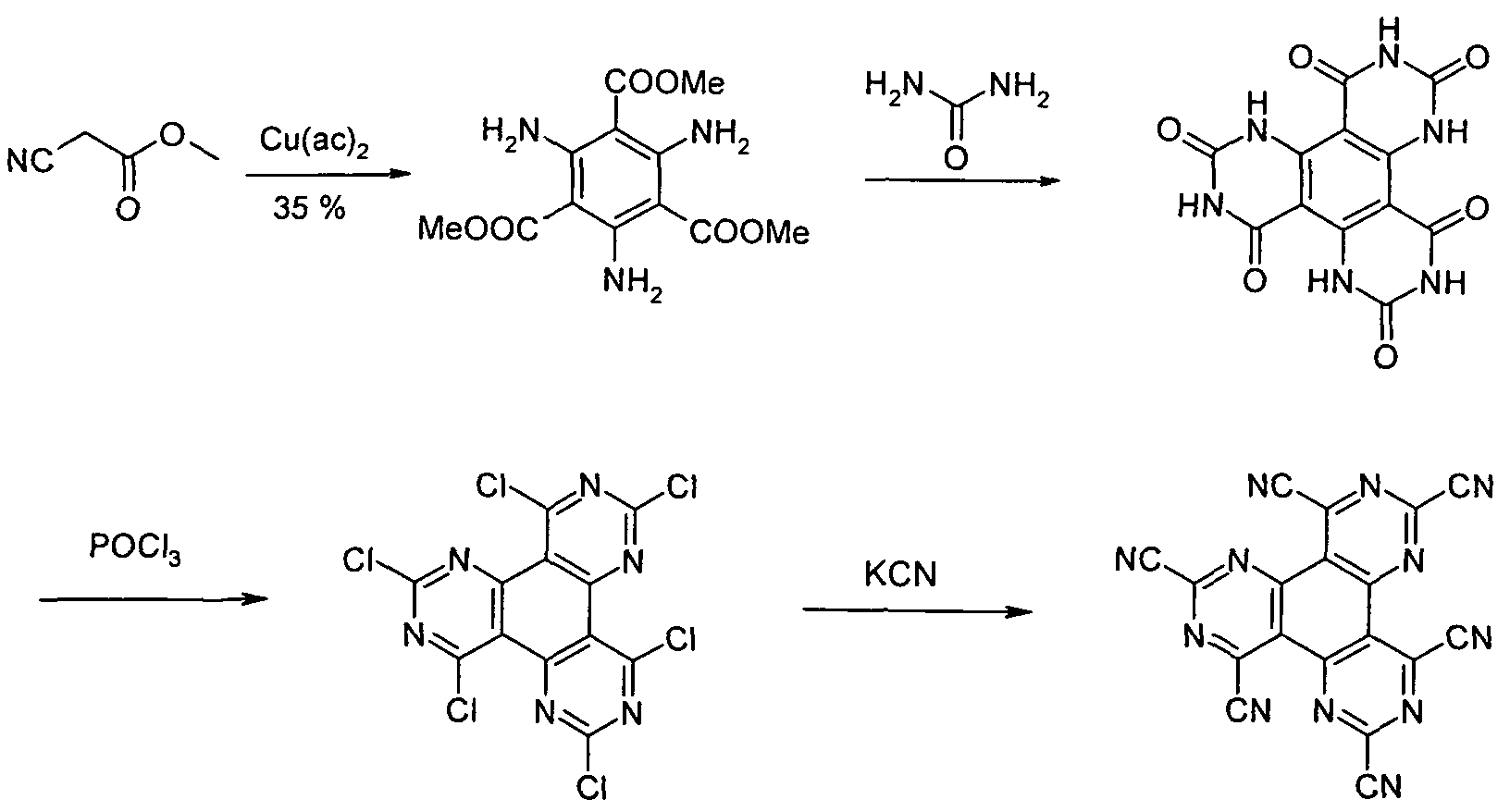
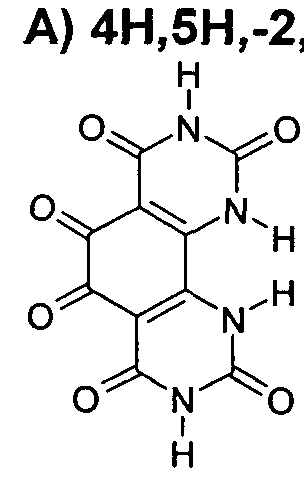
- Ortho-quinoid intermediates can be coupled with a variety of vicinal diamines, as shown in Scheme 5 using the example of intermediate 1, 3,6,8-tetrachloro-2,4,5,7-tetraaza-phenanthrene-9,10-dione is shown.
- Another object of the present invention is a process for the preparation of the compounds according to the invention, characterized by the following reaction steps:
- the compounds according to the invention described above in particular compounds in which at least one group R is a reactive leaving group, such as bromine, iodine, triflate, tosylate, boronic acid or boronic acid ester, or a polymerizable group, such as styrene, alkenyl or acrylate, can also be used as monomers for producing corresponding oligomers, polymers or as the core of dendrimers.
- the oligomerization or polymerization is preferably carried out via the halogen functionality or the boronic acid functionality.
- An oligomer in the context of this invention is understood as meaning a compound which has about 2 to 9 repeat units.
- a polymer according to this invention has about 10 or more repeat units.
- Another object of the invention are therefore oligomers, polymers or dendrimers which contain one or more compounds of the invention, wherein one or more radicals R represent bonds of the compound to the polymer, oligomer or dendrimer.
- the polymers, oligomers or dendrimers may be conjugated, partially conjugated or non-conjugated.
- the oligomers or polymers may be linear or branched. In the linearly linked structures, the units according to the invention can be linked directly to one another or they can be linked via a divalent group, such as, for example, B. via a substituted or unsubstituted alkylene group, via a heteroatom or via a bivalent aromatic or heteroaromatic group, be linked together.
- three or more units of the invention may be linked via a trivalent or higher valent group, for example via a trivalent or higher valent aromatic or heteroaromatic group, to a branched oligomer or polymer.
- the corresponding monomers are homopolymerized or copolymerized with further monomers.
- Suitable and preferred comonomers are selected from fluorenes (eg according to EP 842208 or WO 00/22026), spirobifluorenes (eg.
- EP 707020 EP 894107 or WO 2006/061181
- para-phenylenes eg according to WO 92/8552
- carbazoles eg according to WO 2004/070772 or WO 2004/13468
- thiophenes e.g. EP 1028136
- dihydrophenanthrenes eg according to WO 2005/014689
- cis- and trans-indeno-fluorenes eg according to WO 2004/041901 or WO 2004/113412
- Ketones for example according to WO 2005/040302
- phenanthrenes for example according to WO 2005/104264 or WO 2007/017066
- the polymers, oligomers and dendrimers usually also contain further units, for example emitting (fluorescent or phosphorescent) units, such as.
- Vinyl triarylamines e.g.
- the repeat olefins of the invention are particularly suitable as charge transport units for electrons.
- the compounds according to the invention are suitable for use in electronic devices, in particular in organic electroluminescent devices.
- a further subject of the present invention is therefore the use of a compound according to the invention in an electronic device, in particular in an organic electroluminescent device.
- Another object of the present invention is an electronic device containing at least one compound of the invention.
- the same compounds are preferred for the electronic device, as stated above in the protection of the fabric.
- Invention is understood to mean a device which anode and cathode and at least one layer arranged between the anode and the cathode, this layer containing at least one organic or organometallic compound.
- this layer containing at least one organic or organometallic compound.
- one or more layers may be present which contain inorganic materials or consist entirely of inorganic materials.
- anode and cathode may consist of or contain purely inorganic materials.
- the electronic device is selected from the group consisting of organic electroluminescent devices (OLEDs), organic integrated circuits (O-ICs), organic field-effect transistors (O-FETs), organic thin-film transistors (O-TFTs), organic light-emitting transistors ( O-LETs), organic solar cells (O-SCs), dye-sensitized solar cells (DSSCs), organic optical detectors, organic photoreceptors, organic field quench devices (O-FQDs), light-emitting electrochemical cells (LECs), organic laser diodes (O- Laser) and "organic plasmon emitting device” (DM Koller et al., Nature Photonics 2008, 1-4), but especially organic electroluminescent devices, organic
- the organic electroluminescent device includes an anode, a cathode and at least one emitting layer, wherein at least one organic layer, which may be the emitting layer or another layer, contains at least one compound of the invention or a corresponding oligomer, polymer or dendrimer.
- the organic electroluminescent device may contain further layers. These are, for example, selected from in each case one or more hole injection layers, hole transport layers, hole blocking layers, electron transport layers, electron injection layers, electron blocking layers, exciton blocking layers, charge generation layers (charge generation layers) and / or organic or inorganic p / n junctions. Furthermore, the layers, in particular the charge transport layers, also be doped. The doping of the layers may be advantageous for improved charge transport. It should be noted, however, that not necessarily each of these layers must be present and the choice of layers always depends on the compounds used and in particular also on the fact that it is a fluorescent or phosphorescent electroluminescent device.
- the organic electroluminescent device contains a plurality of emitting layers, wherein at least one organic layer, which may be an emitting layer or another layer, contains at least one compound according to the invention. Particularly preferably, these emission layers have a total of several emission maxima between 380 nm and 750 nm, so that overall white emission results, d. H.
- various emitting compounds are used which can fluoresce or phosphoresce and which emit blue and yellow, orange or red light.
- three-layer systems that is to say systems having three emitting layers, the three layers exhibiting blue, green and orange or red emission (for the basic structure, see, for example, WO
- a white-emitting OLED can be realized as a tandem OLED.
- the compounds according to the invention are used in a hole injection or hole transport layer. This is especially true if at least one substituent R, preferably at least two substituents R, more preferably at least three substituents R, most preferably all substituents R stand for an electron-deficient group.
- the compounds according to the invention do not have the hole transport via the HOMO but via the LUMO ("lowest unoccupied molecular orbital", lowest unoccupied molecular orbital.)
- Particularly preferred substituents R are then selected from the group consisting of CN, F, NO 2 , CF 3 and substituted
- the electron-deficient heterocycles are preferably selected from pyridine, pyrazine, pyrimidine, pyridazine, triazine, pyrrole, imidazole, triazole, benzimidazole, quinoline, isoquinoline, quinoxaline, thiadiazole, thiazole, oxadiazole or heteroaromatic ring systems which contain these heteroaryl groups include, taking these may be substituted
- a hole injection material in the context of this invention is to be understood as a compound which is used in a hole injection layer.
- a hole injection layer in the sense of this invention is a layer which directly adjoins the anode.
- the hole injection layer in the structure of the organic electroluminescent device follows a hole transport layer, so that the hole injection layer lies between the anode and a hole transport layer.
- a hole transport layer in the sense of the present invention is a layer which lies between a hole injection layer and the emitting layer.
- the electroluminescent device according to the invention comprises a structure comprising in this order: anode hole injection layer containing at least one compound hole transport layer, preferably containing at least one triarylamine derivative emitting layer cathode.
- anode hole injection layer preferably containing at least one triarylamine derivative hole transport layer, containing at least one compound hole transport layer according to the invention, preferably containing at least one triarylamine derivative-emitting layer cathode.
- a further hole transport layer preferably containing at least one Triarylaminderivat is introduced and / or that instead of a hole transport layer, which preferably contains a Triarylaminderivat, two or more hole transport layers preferably each contain at least one Triarylaminderivat be used between the layer containing the compound of the invention and the emitting layer.
- these devices may further contain one or more of the other layers listed above, for example, electron transport layers, etc.
- the hole transport layers can also be p-doped.
- the compounds according to the invention are used as electron-transport material or as hole-blocking material in an electron-transport layer or a hole-blocking layer.
- a hole blocking layer in the sense of this invention is a layer which lies between an emitting layer and an electron transport layer and directly to the emitting one
- the substituents R are the same or different at each occurrence as an aromatic or heteroaromatic ring system, which are preferably selected from the abovementioned groups.
- the compound is doped with electron donor compounds. This is especially true for use in an electron transport layer. Suitable dopants are alkali metals or alkali metal complexes or compounds, in particular lithium compounds, for example
- Lithium quinolinate Lithium quinolinate
- the compounds of the invention are used as charge generation material in a charge generation layer (charge generation layer) used. This is used, for example, in a tandem OLED.
- the compounds according to the invention are used as matrix material for an emitting compound, in particular for a phosphorescent compound.
- R is an aryl or heteroaryl group.
- the phosphorescent compound is preferably a red or green phosphorescent compound.
- the materials are also suitable for other organic electronic devices as mentioned above.
- low work function metals, metal alloys or multilayer structures of various metals are preferable, such as alkaline earth metals, alkali metals, main group metals or lanthanides (e.g., Ca, Ba, Mg, Al, In, Mg, Yb, Sm , Etc.).
- alkaline earth metals alkali metals
- main group metals or lanthanides e.g., Ca, Ba, Mg, Al, In, Mg, Yb, Sm , Etc.
- further metals which have a relatively high work function such as, for example, B. Ag, which then usually combinations of metals, such as Mg / Ag, Ca / Ag or Ba / Ag, are used.
- metal alloys in particular alloys of an alkali metal or alkaline earth metal and silver, particularly preferably an alloy of Mg and Ag. It may also be preferred to introduce between a metallic cathode and the organic semiconductor a thin intermediate layer of a material with a high dielectric constant.
- alkali metal or alkaline earth metal fluorides or the corresponding oxides or carbonates for example LiF, Li 2 O, CsF, Cs 2 CO 3 , BaF 2 , MgO, NaF, etc.
- Alkaline earth metal compounds such as. B. lithium quinolinate.
- the layer thickness of this intermediate layer is preferably between 0.5 and 5 nm.
- high work function materials are preferred.
- the anode has a work function greater than 4.5 eV. Vacuum up.
- metals with a high redox potential such as Ag, Pt or Au, are suitable for this purpose.
- metal / metal oxide electrodes may also be preferred.
- at least one of the electrodes must be transparent or partially transparent to allow either the irradiation of the organic material (O-SC) or the outcoupling of light (OLED / PLED, O-laser).
- Preferred anode materials for transparent or partially transparent anodes are conductive mixed metal oxides. Particularly preferred are indium tin oxide (ITO) or indium zinc oxide (IZO). Preference is furthermore given to conductive, doped organic materials, in particular conductive doped polymers.
- the device is structured accordingly (depending on the application), contacted and finally hermetically sealed because the life of such devices drastically shortened in the presence of water and / or air.
- the emitting layer may contain fluorescent and / or phosphorescent dopants, preferably in each case in combination with a matrix material (host material).
- Suitable fluorescent dopants are selected from the class of monostyrylamines, distyrylamines, tristyrylamines, tetrastyrylamines, styrylphosphines, styryl ethers and arylamines.
- a monostyrylamine is meant a compound containing a substituted or unsubstituted styryl group and at least one, preferably aromatic, amine.
- a distyrylamine is understood as meaning a compound which contains two substituted or unsubstituted styryl groups and at least one, preferably aromatic, amine.
- a tristyrylamine is understood as meaning a compound which has three substituted or unsubstituted styryl groups and at least one, preferably aromatic, amine.
- a tetrastyrylamine is meant a compound containing four substituted or unsubstituted styryl groups and at least one, preferably aromatic, amine.
- the styryl groups are particularly preferred stilbenes, which may also be further substituted.
- Corresponding phosphines and ethers are analogous to the
- An arylamine or an aromatic amine in the context of this invention is understood as meaning a compound which contains three substituted or unsubstituted aromatic or heteroaromatic ring systems bonded directly to the nitrogen. At least one of these aromatic or heteroaromatic ring systems is preferably a fused ring system, more preferably at least 14 aromatic ring atoms. Preferred examples of these are aromatic anthracene amines, aromatic anthracenediamines, aromatic pyrenamines, aromatic pyrenediamines, aromatic
- aromatic anthracene amine a compound in which a diarylamino group is bonded directly to an anthracene group, preferably in the 9-position.
- An aromatic anthracenediamine is understood to mean a compound in which two diarylamino groups are bonded directly to an anthracene group, preferably in the 9,10-position.
- Aromatic pyrenamines, pyrenediamines, chrysenamines and chrysenediamines are defined analogously thereto, the diarylamino groups on the pyrene preferably being bonded in the 1-position or in the 1, 6-position. Further preferred dopants are selected from indenofluorenamines or
- diamines for example according to WO 2006/122630, benzoindenofluorenamines or diamines, for example according to WO 2008/006449, and dibenzoindenofluorenamines or diamines, for example according to WO 2007/140847.
- dopants from the class of styrylamines are substituted or unsubstituted tristilbenamines or the dopants described in WO 2006/000388, WO 2006/058737, WO 2006/000389, WO
- Suitable host materials for the fluorescent emitters are selected from the classes of the oligoarylenes (for example 2,2 ', 7,7'-tetraphenylspirobifluorene according to EP 676461 or dinaphthylanthracene), in particular the oligoarylenes containing condensed aromatic groups, the oligo- arylenevinylenes (eg DPVBi or spiro-DPVBi according to EP 676461), the polypodal metal complexes (eg according to WO 2004/081017), the hole-conducting compounds (eg according to WO 2004/058911), the electron-conducting compounds, in particular Ketones, phosphine oxides, sulfoxides, etc.
- the oligoarylenes for example 2,2 ', 7,7'-tetraphenylspirobifluorene according to EP 676461 or dinaphthylanthracene
- Particularly preferred host materials are selected from the classes of oligoarylenes containing naphthalene, anthracene, benzanthracene, benzophenanthrene and / or pyrene or atropisomers of these compounds, the oligoarylenevinylenes, the ketones, the phosphine oxides and the sulfoxides.
- Very particularly preferred host materials are selected from the classes of oligoarylenes containing anthracene, Benzanthracen, Benzophenanthren and / or pyrene or atropisomers of these compounds.
- an oligoarylene is to be understood as meaning a compound in which at least three aryl or arylene groups are bonded to one another.
- Suitable host materials are furthermore, for example, materials as disclosed in WO 2004/018587, WO 2008/006449, US Pat. No. 5,935,721, US 2005/0181232, JP 2000/273056, EP 681019, US 2004/0247937 and US 2005/0211958.
- Particularly suitable as phosphorescent compounds are compounds which emit light, preferably in the visible range, with suitable excitation and also contain at least one atom of atomic number greater than 20, preferably greater than 38 and less than 84, particularly preferably greater than 56 and less than 80.
- Preferred phosphorescence emitters used are compounds containing copper, molybdenum, tungsten, rhenium, ruthenium, osmium, rhodium, iridium, palladium, platinum, silver, gold or europium, in particular compounds containing iridium or platinum.
- all luminescent metal complexes containing the above-mentioned metal are referred to as phosphorescent compounds.
- Suitable phosphorescent emitters may be the
- Suitable matrix materials for the phosphorescent emitter are selected from the group consisting of aromatic ketones, phosphine oxides, sulfoxides and sulfones, eg. B. according to WO 2004/013080, WO 2004/093207, WO 2006/005627 or WO 2010/006680,
- carbazole derivatives e.g. B. CBP (N, N-Biscarbazolylbiphenyl) or in WO 2005/039246, US 2005/0069729, JP 2004/288381, EP 1205527 or WO 2008/086851 disclosed carbazole derivatives, cis- and trans -indolocarbazolderivaten, z.
- carbazole derivatives e.g. B. CBP (N, N-Biscarbazolylbiphenyl) or in WO 2005/039246, US 2005/00697
- Suitable charge transport materials as used in Lochinjetechnische transport layer or in the electron transport layer of the organic electroluminescent device according to the invention can be used, except the materials of the invention
- Examples of preferred hole transport materials which can be used in a hole transport or hole injection layer in the electroluminescent device according to the invention are indenofluorenamines and derivatives (for example according to WO 2006/122630, WO 2006/100896 or DE 102008024182), the amine derivatives disclosed in EP 1661888, hexaazatriphenylene derivatives (for example according to WO 2001/049806), amine derivatives with condensed aromatics (for example in accordance with US Pat. No. 5,061,569), the amine derivatives disclosed in WO 95/09147, monobenzoindenofluoreneamines (eg B.
- WO 2008/006449 or dibenzoindenofluoreneamines (eg according to WO 2007/140847).
- Further suitable hole transport and hole injection materials are derivatives of the abovementioned compounds, as described in JP 2001/226331, EP 676461, EP 650955, WO
- Suitable hole transport or hole injection materials are, for example, the materials listed in the following table.
- an organic electroluminescent device characterized in that one or more layers are coated with a sublimation process.
- the materials in vacuum sublimation systems become smaller at an initial pressure
- the initial pressure may be even lower, for example less than 10" of less than 10 7 mbar.
- an organic electroluminescent device characterized in that one or more layers are coated with the OVPD (Organic Vapor Phase Deposition) method or with the aid of a carrier gas sublimation.
- the materials are applied at a pressure between 10 "applied 5 mbar and 1 bar.
- OVJP organic vapor jet printing
- the materials are applied directly through a nozzle and patterned (eg. BMS Arnold et al., Appl. Phys. Lett., 2008, 92, 053301).
- an organic electroluminescent device characterized in that one or more layers of solution, such. B. by spin coating, or with any printing process, such.
- any printing process such as screen printing, flexographic printing or offset printing, but more preferably LITI (Light Induced Thermal Imaging, thermal transfer printing) or inkjet printing (ink jet printing), are produced.
- LITI Light Induced Thermal Imaging, thermal transfer printing
- inkjet printing ink jet printing
- soluble compounds are needed. High solubility can be achieved by suitable substitution of the compounds.
- solutions of individual materials can be applied, but also solutions containing several compounds, for example matrix material and dopant. It is also possible to combine several of these methods and, for example, evaporate one or more layers and apply one or more further layers of solution.
- the compounds of the invention have a high thermal stability and can sublime undecomposed.
- the compounds according to the invention which are substituted by electron-poor substituents, in particular F, CN and / or electron-poor heterocycles, are very suitable as hole injection material or as hole transport material for use in a hole injection layer or in a hole transport layer and lead to it this use to high efficiencies, in particular to high power efficiencies, and long lifetimes.
- electron-poor substituents in particular F, CN and / or electron-poor heterocycles
- the compounds according to the invention are very suitable as electron-transport material or as hole-blocking material for use in an electron-transport layer or in a hole-blocking layer and lead to high efficiencies, in particular to high, in this use Performance efficiencies, and long lifetimes.
- the compounds of the invention have a higher triplet level than Hexaazatriphenylenderivate according to the prior art. Thus, they are better suited than the materials of the prior art for use in combination with triplet emitters, especially when the compounds of the invention are used as triplet matrix material or used in a layer directly adjacent to a phosphorescent layer.
- a melt of 148.6 g (500 mmol) of 2,4,6-triamino-1, 3,5-benzenetricarboxylic acid trimethyl ester [139286-26-3] and 450.5 g (7.5 mol) of urea are melted and so long (approx 4 h) heated to 200 ° C until the mass solidifies, with resulting methanol and water are distilled off. After cooling, the mass is introduced into 2000 ml of water and comminuted with good stirring. The resulting sand-colored solid is filtered off with suction and stirred again at 70 ° C with 2000 ml of water. After suction, the solid is washed five times with 500 ml of water and then dried in vacuo. Yield: 125.8 g
- a suspension of 22.0 g (50 mmol) of 2,4,6,8,10,12-hexachloro-1, 3,5,7,9,11-hexaazatriphenylene and 26.0 g (400 mmol) of potassium cyanide in 300 ml of anhydrous acetonitrile is stirred for 100 h at room temperature.
- the reaction mixture is poured into a well-stirred mixture of 1000 g of ice and 500 ml of water, filtered off with suction from the resulting precipitate, washed three times with 200 ml of water and dried in vacuo.
- the crude product is dissolved in 3000 ml of acetonitrile in the heat and eluted over Alox, acidic, activity level 1 (400 g).
- OLEDs according to the invention is carried out according to a general method according to WO 2004/0589 1, which is adapted to the conditions described here (layer thickness variation, materials used). in the following Examples 10 to 16, the results
- HIL Hole Injection Layer 5 nm / hole transport layer (HTL-1) 20 nm / hole transport layer (HTL-2) 20 nm / emission layer (EML) 30 nm / electron transport layer (ETL) 20 nm and finally a cathode.
- the emission layer always consists of a matrix material (host) and a dopant (dopant), which is mixed by cover evaporation to the host.
- the compound H1 is used as the matrix material
- examples 17 to 19 used the compound H2, which is doped in each case with 10% D1 or the phosphorescent dopant D2.
- These OLEDs show green emission.
- hole transport material in the HTL-1 the compound HTM-1 is used.
- NPB is used as the hole transport material in the HTL-2.
- the cathode is formed in Examples 10 to 16 by a 1 nm-thick LiF layer and a 100 nm thick Al layer deposited thereon, and 100 nm-thick Al layer in Examples 17 to 19.
- Table 1 shows the chemical structures of the materials used to construct the OLEDs. These OLEDs are characterized by default; for this the electroluminescence spectra, the efficiency (measured in cd / A) in
- the lifetime is defined as the time after which the initial brightness of
- the threshold voltage is defined as the voltage at which the OLED reaches a brightness of 1 cd / m 2 .
- HIM-1 (2,4,6,8,10,12-hexacyano-1, 3,5,7,9,11-hexaaza-triphenylene, from Example 1)
- HIM is used as the hole injection material in the hole injection layer (HIL) -2 (2, 5,7,9,10,12-hexacyano-1, 3,4,6,8,11-hexaazatriphenylene) or HIM-3 (according to the prior art).
- HIL hole injection layer
- HIM-3 2, 5,7,9,10,12-hexacyano-1, 3,4,6,8,11-hexaazatriphenylene
- HIM-3 according to the prior art.
- OLEDs containing HIM-1 or HIM-2 in the hole injection layer are distinguished by improved efficiency, in particular, improved power efficiency, and lifetime over HIM-3 of the prior art.
- ETL electron transport layer
- AIQ 3 As the electron transport material in the electron transport layer (ETL) either AIQ 3 according to the prior art or a co-evaporated combination of ETM-3 (50%) and ETM-4 (50%) or according to the invention 2,4,6,8,10,12 Hexaphenyl-1, 3,5,7,9,11-hexaaza-triphenylene (ETM-1, according to Example 3) or 2,4,6,8,10,12-hexa (5-pyrimidinyl) -1,3 , 5,7,9,11-hexaazatriphenylen (ETM-2, according to Example 6) used.
- Table 2 Table 2
Landscapes
- Chemical & Material Sciences (AREA)
- Organic Chemistry (AREA)
- Physics & Mathematics (AREA)
- Spectroscopy & Molecular Physics (AREA)
- Engineering & Computer Science (AREA)
- Materials Engineering (AREA)
- Electroluminescent Light Sources (AREA)
- Nitrogen Condensed Heterocyclic Rings (AREA)
Abstract
Description






Claims




Priority Applications (4)
| Application Number | Priority Date | Filing Date | Title |
|---|---|---|---|
| DE112011104715.0T DE112011104715A5 (de) | 2011-01-13 | 2011-12-15 | Verbindungen für organische Elektrolumineszenzvorrichtungen |
| JP2013548752A JP6022478B2 (ja) | 2011-01-13 | 2011-12-15 | 有機エレクトロルミネッセンス素子のための材料 |
| US13/979,545 US9627626B2 (en) | 2011-01-13 | 2011-12-15 | Compounds for organic electroluminescent devices |
| EP11799637.1A EP2663567B1 (de) | 2011-01-13 | 2011-12-15 | Verbindungen für organische elektrolumineszenzvorrichtungen |
Applications Claiming Priority (2)
| Application Number | Priority Date | Filing Date | Title |
|---|---|---|---|
| EP11000214 | 2011-01-13 | ||
| EP11000214.4 | 2011-01-13 |
Publications (1)
| Publication Number | Publication Date |
|---|---|
| WO2012095143A1 true WO2012095143A1 (de) | 2012-07-19 |
Family
ID=45401032
Family Applications (1)
| Application Number | Title | Priority Date | Filing Date |
|---|---|---|---|
| PCT/EP2011/006355 Ceased WO2012095143A1 (de) | 2011-01-13 | 2011-12-15 | Verbindungen für organische elektrolumineszenzvorrichtungen |
Country Status (5)
| Country | Link |
|---|---|
| US (1) | US9627626B2 (de) |
| EP (1) | EP2663567B1 (de) |
| JP (1) | JP6022478B2 (de) |
| DE (1) | DE112011104715A5 (de) |
| WO (1) | WO2012095143A1 (de) |
Cited By (66)
| Publication number | Priority date | Publication date | Assignee | Title |
|---|---|---|---|---|
| WO2013056776A1 (de) * | 2011-10-20 | 2013-04-25 | Merck Patent Gmbh | Materialien für organische elektrolumineszenzvorrichtungen |
| WO2013083216A1 (de) | 2011-11-17 | 2013-06-13 | Merck Patent Gmbh | Spiro -dihydroacridinderivate und ihre verwendung als materialien für organische elektrolumineszenzvorrichtungen |
| WO2013120577A1 (en) | 2012-02-14 | 2013-08-22 | Merck Patent Gmbh | Spirobifluorene compounds for organic electroluminescent devices |
| WO2013135352A1 (de) | 2012-03-15 | 2013-09-19 | Merck Patent Gmbh | Elektronische vorrichtungen |
| WO2013182263A1 (de) | 2012-06-06 | 2013-12-12 | Merck Patent Gmbh | Phenanthrenverbindungen für organische elektronische vorrichtungen |
| WO2014044344A1 (de) | 2012-09-18 | 2014-03-27 | Merck Patent Gmbh | Materialien für elektronische vorrichtungen |
| WO2014067614A1 (de) | 2012-10-31 | 2014-05-08 | Merck Patent Gmbh | Elektronische vorrichtung |
| WO2014106522A1 (de) | 2013-01-03 | 2014-07-10 | Merck Patent Gmbh | Materialien für elektronische vorrichtungen |
| CN104530056A (zh) * | 2015-01-07 | 2015-04-22 | 新乡医学院 | 一种邻萘醌与四唑并嘧啶的杂合体及其合成方法 |
| WO2016124304A1 (de) | 2015-02-03 | 2016-08-11 | Merck Patent Gmbh | Metallkomplexe |
| JP2016540727A (ja) * | 2013-10-04 | 2016-12-28 | メルク パテント ゲーエムベーハー | 電子素子のための材料としてのトリアリールアミン置換ベンゾ[h]キノリン誘導体 |
| WO2017012687A1 (en) | 2015-07-22 | 2017-01-26 | Merck Patent Gmbh | Materials for organic electroluminescent devices |
| WO2017028940A1 (en) | 2015-08-14 | 2017-02-23 | Merck Patent Gmbh | Phenoxazine derivatives for organic electroluminescent devices |
| WO2017133829A1 (de) | 2016-02-05 | 2017-08-10 | Merck Patent Gmbh | Materialien für elektronische vorrichtungen |
| WO2017207596A1 (en) | 2016-06-03 | 2017-12-07 | Merck Patent Gmbh | Materials for organic electroluminescent devices |
| DE102017008794A1 (de) | 2016-10-17 | 2018-04-19 | Merck Patent Gmbh | Materialien zur Verwendung in elektronischen Vorrichtungen |
| WO2018069167A1 (de) | 2016-10-10 | 2018-04-19 | Merck Patent Gmbh | Elektronische vorrichtung |
| WO2018083053A1 (de) | 2016-11-02 | 2018-05-11 | Merck Patent Gmbh | Materialien für elektronische vorrichtungen |
| WO2018087020A1 (en) | 2016-11-08 | 2018-05-17 | Merck Patent Gmbh | Compounds for electronic devices |
| WO2018095940A1 (en) | 2016-11-25 | 2018-05-31 | Merck Patent Gmbh | Bisbenzofuran-fused indeno[1,2-b]fluorene derivatives and related compounds as materials for organic electroluminescent devices (oled) |
| WO2018095888A1 (en) | 2016-11-25 | 2018-05-31 | Merck Patent Gmbh | Bisbenzofuran-fused 2,8-diaminoindeno[1,2-b]fluorene derivatives and related compounds as materials for organic electroluminescent devices (oled) |
| WO2018141706A1 (de) | 2017-02-02 | 2018-08-09 | Merck Patent Gmbh | Materialien für elektronische vorrichtungen |
| WO2018157981A1 (de) | 2017-03-02 | 2018-09-07 | Merck Patent Gmbh | Materialien für organische elektronische vorrichtungen |
| EP3378857A1 (de) | 2012-11-12 | 2018-09-26 | Merck Patent GmbH | Materialien für elektronische vorrichtungen |
| WO2018234346A1 (en) | 2017-06-23 | 2018-12-27 | Merck Patent Gmbh | MATERIALS FOR ORGANIC ELECTROLUMINESCENT DEVICES |
| WO2019002190A1 (en) | 2017-06-28 | 2019-01-03 | Merck Patent Gmbh | MATERIALS FOR ELECTRONIC DEVICES |
| WO2019020654A1 (en) | 2017-07-28 | 2019-01-31 | Merck Patent Gmbh | SPIROBIFLUORENE DERIVATIVES FOR USE IN ELECTRONIC DEVICES |
| WO2019020538A1 (de) | 2017-07-25 | 2019-01-31 | Merck Patent Gmbh | Metallkomplexe |
| WO2019048443A1 (de) | 2017-09-08 | 2019-03-14 | Merck Patent Gmbh | Materialien für elektronische vorrichtungen |
| WO2019076789A1 (en) | 2017-10-17 | 2019-04-25 | Merck Patent Gmbh | MATERIALS FOR ORGANIC ELECTROLUMINESCENT DEVICES |
| WO2019101835A1 (en) | 2017-11-24 | 2019-05-31 | Merck Patent Gmbh | Materials for organic electroluminescent devices |
| WO2019101719A1 (de) | 2017-11-23 | 2019-05-31 | Merck Patent Gmbh | Materialien für elektronische vorrichtungen |
| WO2019101833A1 (en) | 2017-11-24 | 2019-05-31 | Merck Patent Gmbh | Materials for organic electroluminescent devices |
| WO2019115577A1 (en) | 2017-12-15 | 2019-06-20 | Merck Patent Gmbh | Substituted aromatic amines for use in organic electroluminescent devices |
| WO2019115423A1 (de) | 2017-12-13 | 2019-06-20 | Merck Patent Gmbh | Metallkomplexe |
| WO2019121483A1 (en) | 2017-12-20 | 2019-06-27 | Merck Patent Gmbh | Heteroaromatic compounds |
| WO2019158453A1 (de) | 2018-02-13 | 2019-08-22 | Merck Patent Gmbh | Metallkomplexe |
| WO2019170578A1 (en) | 2018-03-06 | 2019-09-12 | Merck Patent Gmbh | Materials for organic electroluminescent devices |
| WO2019170572A1 (en) | 2018-03-06 | 2019-09-12 | Merck Patent Gmbh | Materials for organic electroluminescent devices |
| WO2019175149A1 (en) | 2018-03-16 | 2019-09-19 | Merck Patent Gmbh | Materials for organic electroluminescent devices |
| WO2020043646A1 (en) | 2018-08-28 | 2020-03-05 | Merck Patent Gmbh | Materials for organic electroluminescent devices |
| WO2020043640A1 (en) | 2018-08-28 | 2020-03-05 | Merck Patent Gmbh | Materials for organic electroluminescent devices |
| WO2020043657A1 (en) | 2018-08-28 | 2020-03-05 | Merck Patent Gmbh | Materials for organic electroluminescent devices |
| WO2020053150A1 (en) | 2018-09-12 | 2020-03-19 | Merck Patent Gmbh | Materials for organic electroluminescent devices |
| WO2020089138A1 (en) | 2018-10-31 | 2020-05-07 | Merck Patent Gmbh | Materials for organic electroluminescent devices |
| WO2020165064A1 (de) | 2019-02-11 | 2020-08-20 | Merck Patent Gmbh | Mononukleare iridiumkomplexe mit drei ortho-metallierten bidentaten liganden und optischer orientierungsanisotropie |
| WO2021110720A1 (de) | 2019-12-04 | 2021-06-10 | Merck Patent Gmbh | Metallkomplexe |
| WO2022017997A1 (en) | 2020-07-22 | 2022-01-27 | Merck Patent Gmbh | Materials for organic electroluminescent devices |
| WO2022069380A1 (de) | 2020-09-29 | 2022-04-07 | Merck Patent Gmbh | Mononukleare tripodale hexadentate iridium komplexe zur verwendung in oleds |
| EP4079742A1 (de) | 2021-04-14 | 2022-10-26 | Merck Patent GmbH | Metallkomplexe |
| WO2023052314A1 (de) | 2021-09-28 | 2023-04-06 | Merck Patent Gmbh | Materialien für elektronische vorrichtungen |
| WO2023052272A1 (de) | 2021-09-28 | 2023-04-06 | Merck Patent Gmbh | Materialien für elektronische vorrichtungen |
| WO2023052275A1 (de) | 2021-09-28 | 2023-04-06 | Merck Patent Gmbh | Materialien für elektronische vorrichtungen |
| WO2023052313A1 (de) | 2021-09-28 | 2023-04-06 | Merck Patent Gmbh | Materialien für elektronische vorrichtungen |
| WO2023094412A1 (de) | 2021-11-25 | 2023-06-01 | Merck Patent Gmbh | Materialien für elektronische vorrichtungen |
| WO2023117837A1 (de) | 2021-12-21 | 2023-06-29 | Merck Patent Gmbh | Verfahren zur herstellung von deuterierten organischen verbindungen |
| WO2023152346A1 (de) | 2022-02-14 | 2023-08-17 | Merck Patent Gmbh | Materialien für elektronische vorrichtungen |
| EP4236652A2 (de) | 2015-07-29 | 2023-08-30 | Merck Patent GmbH | Materialien für organische elektrolumineszenzvorrichtungen |
| WO2023222559A1 (de) | 2022-05-18 | 2023-11-23 | Merck Patent Gmbh | Verfahren zur herstellung von deuterierten organischen verbindungen |
| WO2024013004A1 (de) | 2022-07-11 | 2024-01-18 | Merck Patent Gmbh | Materialien für elektronische vorrichtungen |
| WO2024170605A1 (en) | 2023-02-17 | 2024-08-22 | Merck Patent Gmbh | Materials for organic electroluminescent devices |
| WO2024170609A1 (en) | 2023-02-17 | 2024-08-22 | Merck Patent Gmbh | Materials for organic electroluminescent devices |
| WO2024218109A1 (de) | 2023-04-20 | 2024-10-24 | Merck Patent Gmbh | Materialien für elektronische vorrichtungen |
| WO2025012253A1 (en) | 2023-07-12 | 2025-01-16 | Merck Patent Gmbh | Materials for electronic devices |
| WO2025021855A1 (de) | 2023-07-27 | 2025-01-30 | Merck Patent Gmbh | Materialien für organische lichtemittierende vorrichtungen und organische sensoren |
| WO2026017611A1 (en) | 2024-07-15 | 2026-01-22 | Merck Patent Gmbh | Organic light emitting device |
Families Citing this family (4)
| Publication number | Priority date | Publication date | Assignee | Title |
|---|---|---|---|---|
| CN104538559B (zh) * | 2014-12-31 | 2017-10-10 | 北京维信诺科技有限公司 | 一种具有rgb像素区的有机电致发光显示装置 |
| JP6633872B2 (ja) * | 2015-08-28 | 2020-01-22 | 学校法人近畿大学 | 半導体材料 |
| TWI811290B (zh) * | 2018-01-25 | 2023-08-11 | 德商麥克專利有限公司 | 用於有機電致發光裝置的材料 |
| CN110483529B (zh) * | 2019-08-09 | 2021-04-13 | 宁波卢米蓝新材料有限公司 | 一种稠杂环化合物及其应用 |
Citations (91)
| Publication number | Priority date | Publication date | Assignee | Title |
|---|---|---|---|---|
| US4539507A (en) | 1983-03-25 | 1985-09-03 | Eastman Kodak Company | Organic electroluminescent devices having improved power conversion efficiencies |
| US4780536A (en) | 1986-09-05 | 1988-10-25 | The Ohio State University Research Foundation | Hexaazatriphenylene hexanitrile and its derivatives and their preparations |
| US5061569A (en) | 1990-07-26 | 1991-10-29 | Eastman Kodak Company | Electroluminescent device with organic electroluminescent medium |
| US5151629A (en) | 1991-08-01 | 1992-09-29 | Eastman Kodak Company | Blue emitting internal junction organic electroluminescent device (I) |
| WO1992018552A1 (de) | 1991-04-11 | 1992-10-29 | Wacker-Chemie Gmbh | Leiterpolymere mit konjugierten doppelbindungen |
| WO1995009147A1 (en) | 1993-09-29 | 1995-04-06 | Idemitsu Kosan Co., Ltd. | Organic electroluminescent element and arylenediamine derivative |
| EP0650955A1 (de) | 1993-11-01 | 1995-05-03 | Hodogaya Chemical Co., Ltd. | Aminverbindung und sie enthaltende Elektrolumineszenzvorrichtung |
| EP0676461A2 (de) | 1994-04-07 | 1995-10-11 | Hoechst Aktiengesellschaft | Spiroverbindungen und ihre Verwendung als Elektrolumineszenzmaterialien |
| EP0681019A2 (de) | 1994-04-26 | 1995-11-08 | TDK Corporation | Phenylanthracenderivat und organisches EL-Element |
| EP0707020A2 (de) | 1994-10-14 | 1996-04-17 | Hoechst Aktiengesellschaft | Konjugierte Polymere mit Spirozentren und ihre Verwendung als Elektrolumineszenzmaterialien |
| EP0842208A1 (de) | 1995-07-28 | 1998-05-20 | The Dow Chemical Company | 2,7-aryl-9-substituierte fluorene und 9-substituierte fluorenoligomere und polymere |
| WO1998027136A1 (de) | 1996-12-16 | 1998-06-25 | Aventis Research & Technologies Gmbh & Co Kg | ARYLSUBSTITUIERTE POLY(p-ARYLENVINYLENE), VERFAHREN ZUR HERSTELLUNG UND DEREN VERWENDUNG IN ELEKTROLUMINESZENZBAUELEMENTEN |
| WO1998030071A1 (en) | 1996-12-28 | 1998-07-09 | Tdk Corporation | Organic electroluminescent elements |
| EP0894107A1 (de) | 1996-04-17 | 1999-02-03 | Hoechst Research & Technology Deutschland GmbH & Co. KG | Polymere mit spiroatomen und ihre verwendung als elektrolumineszenzmaterialien |
| US5935721A (en) | 1998-03-20 | 1999-08-10 | Eastman Kodak Company | Organic electroluminescent elements for stable electroluminescent |
| WO2000022026A1 (de) | 1998-10-10 | 2000-04-20 | Celanese Ventures Gmbh | Konjugierte polymere, enthaltend spezielle fluoren-bausteine mit verbesserten eigenschaften |
| EP1028136A2 (de) | 1999-02-10 | 2000-08-16 | Carnegie-Mellon University | Ein Verfahren zur Herstellung von Poly(3-substituierten)thiophenen |
| JP2000273056A (ja) | 1999-01-19 | 2000-10-03 | Idemitsu Kosan Co Ltd | アミノ又はスチリル化合物及びそれを用いた有機エレクトロルミネッセンス素子 |
| WO2000070655A2 (en) | 1999-05-13 | 2000-11-23 | The Trustees Of Princeton University | Very high efficiency organic light emitting devices based on electrophosphorescence |
| WO2001041512A1 (en) | 1999-12-01 | 2001-06-07 | The Trustees Of Princeton University | Complexes of form l2mx as phosphorescent dopants for organic leds |
| WO2001049806A1 (en) | 1999-12-31 | 2001-07-12 | Lg Chemical Co., Ltd | Electronic device comprising organic compound having p-type semiconducting characteristics |
| JP2001226331A (ja) | 2000-02-14 | 2001-08-21 | Mitsui Chemicals Inc | アミン化合物および該化合物を含有する有機電界発光素子 |
| WO2002002714A2 (en) | 2000-06-30 | 2002-01-10 | E.I. Du Pont De Nemours And Company | Electroluminescent iridium compounds with fluorinated phenylpyridines, phenylpyrimidines, and phenylquinolines and devices made with such compounds |
| WO2002015645A1 (en) | 2000-08-11 | 2002-02-21 | The Trustees Of Princeton University | Organometallic compounds and emission-shifting organic electrophosphorescence |
| EP1191614A2 (de) | 2000-09-26 | 2002-03-27 | Canon Kabushiki Kaisha | Lumineszente Vorrichtung und dafür verwendete Metallkoordinationsverbindung |
| EP1191612A2 (de) | 2000-09-26 | 2002-03-27 | Canon Kabushiki Kaisha | Lumineszente Vorrichtung, Bildanzeigevorrichtung und Metallkoordinationsverbindung |
| EP1191613A2 (de) | 2000-09-26 | 2002-03-27 | Canon Kabushiki Kaisha | Lumineszente Vorrichtung, Bildanzeigevorrichtung und Metallkoordinationsverbindung |
| EP1205527A1 (de) | 2000-03-27 | 2002-05-15 | Idemitsu Kosan Co., Ltd. | Organische elektrolumineszierende vorrichtung |
| WO2004013080A1 (en) | 2002-08-01 | 2004-02-12 | Covion Organic Semiconductors Gmbh | Spirobifluorene derivatives, their preparation and uses thereof |
| WO2004018587A1 (ja) | 2002-08-23 | 2004-03-04 | Idemitsu Kosan Co., Ltd. | 有機エレクトロルミネッセンス素子及びアントラセン誘導体 |
| WO2004041901A1 (en) | 2002-11-08 | 2004-05-21 | Covion Organic Semiconductors Gmbh | Aryl-substituted polyindenofluorenes for use in organic electroluminiscent devices |
| WO2004058911A2 (de) | 2002-12-23 | 2004-07-15 | Covion Organic Semiconductors Gmbh | Organisches elektrolumineszenzelement |
| WO2004070772A2 (de) | 2003-02-06 | 2004-08-19 | Covion Organic Semiconductors Gmbh | Carbazol-enthaltende konjugierte polymere und blends, deren darstellung und verwendung |
| WO2004081017A1 (de) | 2003-03-11 | 2004-09-23 | Covion Organic Semiconductors Gmbh | Metallkomplexe |
| JP2004288381A (ja) | 2003-03-19 | 2004-10-14 | Konica Minolta Holdings Inc | 有機エレクトロルミネッセンス素子 |
| WO2004093207A2 (de) | 2003-04-15 | 2004-10-28 | Covion Organic Semiconductors Gmbh | Mischungen von organischen zur emission befähigten halbleitern und matrixmaterialien, deren verwendung und elektronikbauteile enthaltend diese mischungen |
| US20040247937A1 (en) | 2003-06-03 | 2004-12-09 | Chin-Hsin Chen | Organic electroluminescent devices with a doped co-host emitter |
| WO2004113412A2 (en) | 2003-06-23 | 2004-12-29 | Covion Organic Semiconductors Gmbh | Polymer |
| WO2004113468A1 (de) | 2003-06-26 | 2004-12-29 | Covion Organic Semiconductors Gmbh | Neue materialien für die elektrolumineszenz |
| WO2005011013A1 (de) | 2003-07-21 | 2005-02-03 | Covion Organic Semiconductors Gmbh | Organisches elektrolumineszenzelement |
| WO2005014689A2 (de) | 2003-08-12 | 2005-02-17 | Covion Organic Semiconductors Gmbh | Konjugierte polymere enthaltend dihydrophenanthren-einheiten und deren verwendung |
| US20050069729A1 (en) | 2003-09-30 | 2005-03-31 | Konica Minolta Holdings, Inc. | Organic electroluminescent element, illuminator, display and compound |
| WO2005033244A1 (de) | 2003-09-29 | 2005-04-14 | Covion Organic Semiconductors Gmbh | Metallkomplexe |
| WO2005040302A1 (de) | 2003-10-22 | 2005-05-06 | Merck Patent Gmbh | Neue materialien für die elektrolumineszenz und deren verwendung |
| WO2005042550A1 (de) | 2003-10-30 | 2005-05-12 | Merck Patent Gmbh | Metallkomplexe mit bipodalen liganden |
| US20050181232A1 (en) | 2004-02-17 | 2005-08-18 | Eastman Kodak Company | Anthracene derivative host having ranges of dopants |
| WO2005084082A1 (de) | 2004-02-20 | 2005-09-09 | Merck Patent Gmbh | Organische elektronische vorrichtungen |
| US20050211958A1 (en) | 2004-03-25 | 2005-09-29 | Eastman Kodak Company | Electroluminescent device with anthracene derivative host |
| WO2005104264A1 (de) | 2004-04-26 | 2005-11-03 | Merck Patent Gmbh | Elektrolumineszierende polymere und deren verwendung |
| WO2005111172A2 (de) | 2004-05-11 | 2005-11-24 | Merck Patent Gmbh | Neue materialmischungen für die elektrolumineszenz |
| WO2005113563A1 (de) | 2004-05-19 | 2005-12-01 | Merck Patent Gmbh | Metallkomplexe |
| JP2005347160A (ja) | 2004-06-04 | 2005-12-15 | Konica Minolta Holdings Inc | 有機エレクトロルミネッセンス素子、照明装置及び表示装置 |
| WO2006000389A1 (de) | 2004-06-26 | 2006-01-05 | Merck Patent Gmbh | Verbindungen für organische elektronische vorrichtungen |
| WO2006000388A1 (de) | 2004-06-26 | 2006-01-05 | Merck Patent Gmbh | Organische elektrolumineszenzvorrichtung |
| WO2006003000A1 (de) | 2004-07-06 | 2006-01-12 | Merck Patent Gmbh | Elektrolumineszierende polymere |
| EP1617711A1 (de) | 2003-04-23 | 2006-01-18 | Konica Minolta Holdings, Inc. | Organisches elektrolumineszenzbauelement und anzeige |
| WO2006005627A1 (en) | 2004-07-15 | 2006-01-19 | Merck Patent Gmbh | Oligomeric derivatives of spirobifluorene, their preparation and use |
| WO2006008069A1 (de) | 2004-07-16 | 2006-01-26 | Merck Patent Gmbh | Metallkomplexe |
| WO2006048268A1 (de) | 2004-11-06 | 2006-05-11 | Merck Patent Gmbh | Organische elektrolumineszenzvorrichtung |
| EP1661888A1 (de) | 2004-11-29 | 2006-05-31 | Samsung SDI Co., Ltd. | Phenylcarbazole basierte Verbindungen und deren Verwendung als organische Elektroluminiszierende Vorrichtung |
| WO2006058737A1 (de) | 2004-12-01 | 2006-06-08 | Merck Patent Gmbh | Verbindungen für organische elektronische vorrichtungen |
| WO2006061182A1 (de) | 2004-12-09 | 2006-06-15 | Merck Patent Gmbh | Metallkomplexe und deren verwendung als die emittierende komponente in elektronischen bauteilen, besonders in elektrolumineszenten anzeigevorrichtungen |
| WO2006061181A1 (de) | 2004-12-06 | 2006-06-15 | Merck Patent Gmbh | Teilkonjugierte polymere, deren darstellung und verwendung |
| WO2006073054A1 (ja) | 2005-01-05 | 2006-07-13 | Idemitsu Kosan Co., Ltd. | 芳香族アミン誘導体及びそれを用いた有機エレクトロルミネッセンス素子 |
| WO2006081973A1 (de) | 2005-02-03 | 2006-08-10 | Merck Patent Gmbh | Metallkomplexe |
| JP2006253445A (ja) | 2005-03-11 | 2006-09-21 | Toyo Ink Mfg Co Ltd | 有機エレクトロルミネッセンス素子 |
| WO2006100896A1 (ja) | 2005-03-18 | 2006-09-28 | Idemitsu Kosan Co., Ltd. | 芳香族アミン誘導体及びそれを用いた有機エレクトロルミネッセンス素子 |
| WO2006117052A1 (de) | 2005-05-03 | 2006-11-09 | Merck Patent Gmbh | Organische elektrolumineszenzvorrichtung und in deren herstellung verwendete boronsäure- und borinsäure-derivate |
| WO2006122630A1 (de) | 2005-05-20 | 2006-11-23 | Merck Patent Gmbh | Verbindungen für organische elektronische vorrichtungen |
| EP1731584A1 (de) | 2004-03-31 | 2006-12-13 | Konica Minolta Holdings, Inc. | Organischer elektrolumineszenzvorrichtungsstoff, organische elektrolumineszenzvorrichtung, display und beleuchtungsvorrichtung |
| WO2007017066A1 (de) | 2005-08-10 | 2007-02-15 | Merck Patent Gmbh | Elektrolumineszierende polymere und ihre verwendung |
| WO2007063754A1 (ja) | 2005-12-01 | 2007-06-07 | Nippon Steel Chemical Co., Ltd. | 有機電界発光素子用化合物及び有機電界発光素子 |
| WO2007065549A1 (de) | 2005-12-08 | 2007-06-14 | Merck Patent Gmbh | Organische elektrolumineszenzvorrichtungen |
| WO2007068325A1 (de) | 2005-12-17 | 2007-06-21 | Merck Patent Gmbh | Konjugierte polymere enthaltend triarylamin-arylvinylen-einheiten, deren darstellung und verwendung |
| WO2007115610A1 (de) | 2006-04-01 | 2007-10-18 | Merck Patent Gmbh | Materialen für organische elektrolumineszenzvorrichtungen |
| WO2007137725A1 (de) | 2006-05-31 | 2007-12-06 | Merck Patent Gmbh | Neue materialien für organische elektrolumineszenzvorrichtungen |
| WO2007140847A1 (de) | 2006-06-02 | 2007-12-13 | Merck Patent Gmbh | Materialien für organische elektrolumineszenzvorrichtungen |
| WO2008006449A1 (de) | 2006-07-11 | 2008-01-17 | Merck Patent Gmbh | Neue materialien für organische elektrolumineszenzvorrichtungen |
| WO2008056746A1 (en) | 2006-11-09 | 2008-05-15 | Nippon Steel Chemical Co., Ltd. | Compound for organic electroluminescent device and organic electroluminescent device |
| WO2008086851A1 (de) | 2007-01-18 | 2008-07-24 | Merck Patent Gmbh | Carbazol-derivate für organische elektrolumineszenzvorrichtungen |
| WO2008145239A2 (de) | 2007-05-29 | 2008-12-04 | Merck Patent Gmbh | Benzanthracen-derivate für organische elektrolumineszenzvorrichtungen |
| WO2009062578A1 (de) | 2007-11-12 | 2009-05-22 | Merck Patent Gmbh | Organische elektrolumineszenzvorrichtungen enthaltend azomethin-metall-komplexe |
| DE102008024182A1 (de) | 2008-05-19 | 2009-11-26 | Merck Patent Gmbh | Verbindungen für organische elektronische Vorrichtung |
| WO2009146770A2 (de) | 2008-06-05 | 2009-12-10 | Merck Patent Gmbh | Elektronische vorrichtung enthaltend metallkomplexe |
| WO2010006680A1 (de) | 2008-07-18 | 2010-01-21 | Merck Patent Gmbh | Materialien für organische elektrolumineszenzvorrichtungen |
| WO2010012328A1 (de) | 2008-07-29 | 2010-02-04 | Merck Patent Gmbh | Verbindungen für elektronische vorrichtungen |
| WO2010015306A1 (de) | 2008-08-08 | 2010-02-11 | Merck Patent Gmbh, | Organische elektrolumineszenzvorrichtung |
| WO2010083869A2 (de) | 2009-01-23 | 2010-07-29 | Merck Patent Gmbh | Materialien für organische elektrolumineszenzvorrichtungen |
| WO2010086089A1 (de) | 2009-02-02 | 2010-08-05 | Merck Patent Gmbh | Metallkomplexe |
| WO2010136109A1 (de) | 2009-05-29 | 2010-12-02 | Merck Patent Gmbh | Materialien für organische elektrolumineszenzvorrichtungen |
| DE102010027317A1 (de) | 2010-07-16 | 2012-01-19 | Merck Patent Gmbh | Metallkomplexe |
Family Cites Families (6)
| Publication number | Priority date | Publication date | Assignee | Title |
|---|---|---|---|---|
| JP2007230974A (ja) * | 2006-03-03 | 2007-09-13 | Idemitsu Kosan Co Ltd | 有機エレクトロルミネッセンス素子及び有機エレクトロルミネッセンス素子用材料 |
| JP4483917B2 (ja) * | 2007-09-12 | 2010-06-16 | ソニー株式会社 | 有機電界発光素子および有機電界発光素子の製造方法、ならびに表示装置および表示装置の製造方法 |
| US7914908B2 (en) | 2007-11-02 | 2011-03-29 | Global Oled Technology Llc | Organic electroluminescent device having an azatriphenylene derivative |
| JP2010114961A (ja) | 2008-11-04 | 2010-05-20 | Sony Corp | 電力通信装置、電力通信システム、電力通信方法、およびプログラム |
| US8389979B2 (en) * | 2009-05-29 | 2013-03-05 | Semiconductor Energy Laboratory Co., Ltd. | Light-emitting element, light-emitting device, electronic device, and lighting device |
| JP5601019B2 (ja) * | 2010-05-19 | 2014-10-08 | コニカミノルタ株式会社 | 有機エレクトロニクス素子、有機エレクトロミネッセンス素子、表示装置、照明装置、有機光電変換素子、太陽電池、光センサアレイ及び有機エレクトロニクス素子材料 |
-
2011
- 2011-12-15 EP EP11799637.1A patent/EP2663567B1/de active Active
- 2011-12-15 JP JP2013548752A patent/JP6022478B2/ja active Active
- 2011-12-15 US US13/979,545 patent/US9627626B2/en active Active
- 2011-12-15 WO PCT/EP2011/006355 patent/WO2012095143A1/de not_active Ceased
- 2011-12-15 DE DE112011104715.0T patent/DE112011104715A5/de not_active Withdrawn
Patent Citations (95)
| Publication number | Priority date | Publication date | Assignee | Title |
|---|---|---|---|---|
| US4539507A (en) | 1983-03-25 | 1985-09-03 | Eastman Kodak Company | Organic electroluminescent devices having improved power conversion efficiencies |
| US4780536A (en) | 1986-09-05 | 1988-10-25 | The Ohio State University Research Foundation | Hexaazatriphenylene hexanitrile and its derivatives and their preparations |
| US5061569A (en) | 1990-07-26 | 1991-10-29 | Eastman Kodak Company | Electroluminescent device with organic electroluminescent medium |
| WO1992018552A1 (de) | 1991-04-11 | 1992-10-29 | Wacker-Chemie Gmbh | Leiterpolymere mit konjugierten doppelbindungen |
| US5151629A (en) | 1991-08-01 | 1992-09-29 | Eastman Kodak Company | Blue emitting internal junction organic electroluminescent device (I) |
| WO1995009147A1 (en) | 1993-09-29 | 1995-04-06 | Idemitsu Kosan Co., Ltd. | Organic electroluminescent element and arylenediamine derivative |
| EP0650955A1 (de) | 1993-11-01 | 1995-05-03 | Hodogaya Chemical Co., Ltd. | Aminverbindung und sie enthaltende Elektrolumineszenzvorrichtung |
| EP0676461A2 (de) | 1994-04-07 | 1995-10-11 | Hoechst Aktiengesellschaft | Spiroverbindungen und ihre Verwendung als Elektrolumineszenzmaterialien |
| EP0681019A2 (de) | 1994-04-26 | 1995-11-08 | TDK Corporation | Phenylanthracenderivat und organisches EL-Element |
| EP0707020A2 (de) | 1994-10-14 | 1996-04-17 | Hoechst Aktiengesellschaft | Konjugierte Polymere mit Spirozentren und ihre Verwendung als Elektrolumineszenzmaterialien |
| EP0842208A1 (de) | 1995-07-28 | 1998-05-20 | The Dow Chemical Company | 2,7-aryl-9-substituierte fluorene und 9-substituierte fluorenoligomere und polymere |
| EP0894107A1 (de) | 1996-04-17 | 1999-02-03 | Hoechst Research & Technology Deutschland GmbH & Co. KG | Polymere mit spiroatomen und ihre verwendung als elektrolumineszenzmaterialien |
| WO1998027136A1 (de) | 1996-12-16 | 1998-06-25 | Aventis Research & Technologies Gmbh & Co Kg | ARYLSUBSTITUIERTE POLY(p-ARYLENVINYLENE), VERFAHREN ZUR HERSTELLUNG UND DEREN VERWENDUNG IN ELEKTROLUMINESZENZBAUELEMENTEN |
| WO1998030071A1 (en) | 1996-12-28 | 1998-07-09 | Tdk Corporation | Organic electroluminescent elements |
| EP0891121A1 (de) | 1996-12-28 | 1999-01-13 | TDK Corporation | Organische elektrolumineszente elementen |
| US5935721A (en) | 1998-03-20 | 1999-08-10 | Eastman Kodak Company | Organic electroluminescent elements for stable electroluminescent |
| WO2000022026A1 (de) | 1998-10-10 | 2000-04-20 | Celanese Ventures Gmbh | Konjugierte polymere, enthaltend spezielle fluoren-bausteine mit verbesserten eigenschaften |
| JP2000273056A (ja) | 1999-01-19 | 2000-10-03 | Idemitsu Kosan Co Ltd | アミノ又はスチリル化合物及びそれを用いた有機エレクトロルミネッセンス素子 |
| EP1028136A2 (de) | 1999-02-10 | 2000-08-16 | Carnegie-Mellon University | Ein Verfahren zur Herstellung von Poly(3-substituierten)thiophenen |
| WO2000070655A2 (en) | 1999-05-13 | 2000-11-23 | The Trustees Of Princeton University | Very high efficiency organic light emitting devices based on electrophosphorescence |
| WO2001041512A1 (en) | 1999-12-01 | 2001-06-07 | The Trustees Of Princeton University | Complexes of form l2mx as phosphorescent dopants for organic leds |
| WO2001049806A1 (en) | 1999-12-31 | 2001-07-12 | Lg Chemical Co., Ltd | Electronic device comprising organic compound having p-type semiconducting characteristics |
| JP2001226331A (ja) | 2000-02-14 | 2001-08-21 | Mitsui Chemicals Inc | アミン化合物および該化合物を含有する有機電界発光素子 |
| EP1205527A1 (de) | 2000-03-27 | 2002-05-15 | Idemitsu Kosan Co., Ltd. | Organische elektrolumineszierende vorrichtung |
| WO2002002714A2 (en) | 2000-06-30 | 2002-01-10 | E.I. Du Pont De Nemours And Company | Electroluminescent iridium compounds with fluorinated phenylpyridines, phenylpyrimidines, and phenylquinolines and devices made with such compounds |
| WO2002015645A1 (en) | 2000-08-11 | 2002-02-21 | The Trustees Of Princeton University | Organometallic compounds and emission-shifting organic electrophosphorescence |
| EP1191614A2 (de) | 2000-09-26 | 2002-03-27 | Canon Kabushiki Kaisha | Lumineszente Vorrichtung und dafür verwendete Metallkoordinationsverbindung |
| EP1191612A2 (de) | 2000-09-26 | 2002-03-27 | Canon Kabushiki Kaisha | Lumineszente Vorrichtung, Bildanzeigevorrichtung und Metallkoordinationsverbindung |
| EP1191613A2 (de) | 2000-09-26 | 2002-03-27 | Canon Kabushiki Kaisha | Lumineszente Vorrichtung, Bildanzeigevorrichtung und Metallkoordinationsverbindung |
| WO2004013080A1 (en) | 2002-08-01 | 2004-02-12 | Covion Organic Semiconductors Gmbh | Spirobifluorene derivatives, their preparation and uses thereof |
| WO2004018587A1 (ja) | 2002-08-23 | 2004-03-04 | Idemitsu Kosan Co., Ltd. | 有機エレクトロルミネッセンス素子及びアントラセン誘導体 |
| WO2004041901A1 (en) | 2002-11-08 | 2004-05-21 | Covion Organic Semiconductors Gmbh | Aryl-substituted polyindenofluorenes for use in organic electroluminiscent devices |
| WO2004058911A2 (de) | 2002-12-23 | 2004-07-15 | Covion Organic Semiconductors Gmbh | Organisches elektrolumineszenzelement |
| WO2004070772A2 (de) | 2003-02-06 | 2004-08-19 | Covion Organic Semiconductors Gmbh | Carbazol-enthaltende konjugierte polymere und blends, deren darstellung und verwendung |
| WO2004081017A1 (de) | 2003-03-11 | 2004-09-23 | Covion Organic Semiconductors Gmbh | Metallkomplexe |
| JP2004288381A (ja) | 2003-03-19 | 2004-10-14 | Konica Minolta Holdings Inc | 有機エレクトロルミネッセンス素子 |
| WO2004093207A2 (de) | 2003-04-15 | 2004-10-28 | Covion Organic Semiconductors Gmbh | Mischungen von organischen zur emission befähigten halbleitern und matrixmaterialien, deren verwendung und elektronikbauteile enthaltend diese mischungen |
| EP1617711A1 (de) | 2003-04-23 | 2006-01-18 | Konica Minolta Holdings, Inc. | Organisches elektrolumineszenzbauelement und anzeige |
| EP1617710A1 (de) | 2003-04-23 | 2006-01-18 | Konica Minolta Holdings, Inc. | Material für ein organisches elektrolumineszenzgerät, organisches elektrolumineszenzgerät, beleuchtungsvorrichtung und anzeige |
| US20040247937A1 (en) | 2003-06-03 | 2004-12-09 | Chin-Hsin Chen | Organic electroluminescent devices with a doped co-host emitter |
| WO2004113412A2 (en) | 2003-06-23 | 2004-12-29 | Covion Organic Semiconductors Gmbh | Polymer |
| WO2004113468A1 (de) | 2003-06-26 | 2004-12-29 | Covion Organic Semiconductors Gmbh | Neue materialien für die elektrolumineszenz |
| WO2005011013A1 (de) | 2003-07-21 | 2005-02-03 | Covion Organic Semiconductors Gmbh | Organisches elektrolumineszenzelement |
| WO2005014689A2 (de) | 2003-08-12 | 2005-02-17 | Covion Organic Semiconductors Gmbh | Konjugierte polymere enthaltend dihydrophenanthren-einheiten und deren verwendung |
| WO2005033244A1 (de) | 2003-09-29 | 2005-04-14 | Covion Organic Semiconductors Gmbh | Metallkomplexe |
| US20050069729A1 (en) | 2003-09-30 | 2005-03-31 | Konica Minolta Holdings, Inc. | Organic electroluminescent element, illuminator, display and compound |
| WO2005039246A1 (ja) | 2003-09-30 | 2005-04-28 | Konica Minolta Holdings, Inc. | 有機エレクトロルミネッセンス素子、照明装置、表示装置 |
| WO2005040302A1 (de) | 2003-10-22 | 2005-05-06 | Merck Patent Gmbh | Neue materialien für die elektrolumineszenz und deren verwendung |
| WO2005042550A1 (de) | 2003-10-30 | 2005-05-12 | Merck Patent Gmbh | Metallkomplexe mit bipodalen liganden |
| US20050181232A1 (en) | 2004-02-17 | 2005-08-18 | Eastman Kodak Company | Anthracene derivative host having ranges of dopants |
| WO2005084082A1 (de) | 2004-02-20 | 2005-09-09 | Merck Patent Gmbh | Organische elektronische vorrichtungen |
| WO2005084081A1 (de) | 2004-02-20 | 2005-09-09 | Merck Patent Gmbh | Organische elektronische vorrichtungen |
| US20050211958A1 (en) | 2004-03-25 | 2005-09-29 | Eastman Kodak Company | Electroluminescent device with anthracene derivative host |
| EP1731584A1 (de) | 2004-03-31 | 2006-12-13 | Konica Minolta Holdings, Inc. | Organischer elektrolumineszenzvorrichtungsstoff, organische elektrolumineszenzvorrichtung, display und beleuchtungsvorrichtung |
| WO2005104264A1 (de) | 2004-04-26 | 2005-11-03 | Merck Patent Gmbh | Elektrolumineszierende polymere und deren verwendung |
| WO2005111172A2 (de) | 2004-05-11 | 2005-11-24 | Merck Patent Gmbh | Neue materialmischungen für die elektrolumineszenz |
| WO2005113563A1 (de) | 2004-05-19 | 2005-12-01 | Merck Patent Gmbh | Metallkomplexe |
| JP2005347160A (ja) | 2004-06-04 | 2005-12-15 | Konica Minolta Holdings Inc | 有機エレクトロルミネッセンス素子、照明装置及び表示装置 |
| WO2006000389A1 (de) | 2004-06-26 | 2006-01-05 | Merck Patent Gmbh | Verbindungen für organische elektronische vorrichtungen |
| WO2006000388A1 (de) | 2004-06-26 | 2006-01-05 | Merck Patent Gmbh | Organische elektrolumineszenzvorrichtung |
| WO2006003000A1 (de) | 2004-07-06 | 2006-01-12 | Merck Patent Gmbh | Elektrolumineszierende polymere |
| WO2006005627A1 (en) | 2004-07-15 | 2006-01-19 | Merck Patent Gmbh | Oligomeric derivatives of spirobifluorene, their preparation and use |
| WO2006008069A1 (de) | 2004-07-16 | 2006-01-26 | Merck Patent Gmbh | Metallkomplexe |
| WO2006048268A1 (de) | 2004-11-06 | 2006-05-11 | Merck Patent Gmbh | Organische elektrolumineszenzvorrichtung |
| EP1661888A1 (de) | 2004-11-29 | 2006-05-31 | Samsung SDI Co., Ltd. | Phenylcarbazole basierte Verbindungen und deren Verwendung als organische Elektroluminiszierende Vorrichtung |
| WO2006058737A1 (de) | 2004-12-01 | 2006-06-08 | Merck Patent Gmbh | Verbindungen für organische elektronische vorrichtungen |
| WO2006061181A1 (de) | 2004-12-06 | 2006-06-15 | Merck Patent Gmbh | Teilkonjugierte polymere, deren darstellung und verwendung |
| WO2006061182A1 (de) | 2004-12-09 | 2006-06-15 | Merck Patent Gmbh | Metallkomplexe und deren verwendung als die emittierende komponente in elektronischen bauteilen, besonders in elektrolumineszenten anzeigevorrichtungen |
| WO2006073054A1 (ja) | 2005-01-05 | 2006-07-13 | Idemitsu Kosan Co., Ltd. | 芳香族アミン誘導体及びそれを用いた有機エレクトロルミネッセンス素子 |
| WO2006081973A1 (de) | 2005-02-03 | 2006-08-10 | Merck Patent Gmbh | Metallkomplexe |
| JP2006253445A (ja) | 2005-03-11 | 2006-09-21 | Toyo Ink Mfg Co Ltd | 有機エレクトロルミネッセンス素子 |
| WO2006100896A1 (ja) | 2005-03-18 | 2006-09-28 | Idemitsu Kosan Co., Ltd. | 芳香族アミン誘導体及びそれを用いた有機エレクトロルミネッセンス素子 |
| WO2006117052A1 (de) | 2005-05-03 | 2006-11-09 | Merck Patent Gmbh | Organische elektrolumineszenzvorrichtung und in deren herstellung verwendete boronsäure- und borinsäure-derivate |
| WO2006122630A1 (de) | 2005-05-20 | 2006-11-23 | Merck Patent Gmbh | Verbindungen für organische elektronische vorrichtungen |
| WO2007017066A1 (de) | 2005-08-10 | 2007-02-15 | Merck Patent Gmbh | Elektrolumineszierende polymere und ihre verwendung |
| WO2007063754A1 (ja) | 2005-12-01 | 2007-06-07 | Nippon Steel Chemical Co., Ltd. | 有機電界発光素子用化合物及び有機電界発光素子 |
| WO2007065549A1 (de) | 2005-12-08 | 2007-06-14 | Merck Patent Gmbh | Organische elektrolumineszenzvorrichtungen |
| WO2007068325A1 (de) | 2005-12-17 | 2007-06-21 | Merck Patent Gmbh | Konjugierte polymere enthaltend triarylamin-arylvinylen-einheiten, deren darstellung und verwendung |
| WO2007115610A1 (de) | 2006-04-01 | 2007-10-18 | Merck Patent Gmbh | Materialen für organische elektrolumineszenzvorrichtungen |
| WO2007137725A1 (de) | 2006-05-31 | 2007-12-06 | Merck Patent Gmbh | Neue materialien für organische elektrolumineszenzvorrichtungen |
| WO2007140847A1 (de) | 2006-06-02 | 2007-12-13 | Merck Patent Gmbh | Materialien für organische elektrolumineszenzvorrichtungen |
| WO2008006449A1 (de) | 2006-07-11 | 2008-01-17 | Merck Patent Gmbh | Neue materialien für organische elektrolumineszenzvorrichtungen |
| WO2008056746A1 (en) | 2006-11-09 | 2008-05-15 | Nippon Steel Chemical Co., Ltd. | Compound for organic electroluminescent device and organic electroluminescent device |
| WO2008086851A1 (de) | 2007-01-18 | 2008-07-24 | Merck Patent Gmbh | Carbazol-derivate für organische elektrolumineszenzvorrichtungen |
| WO2008145239A2 (de) | 2007-05-29 | 2008-12-04 | Merck Patent Gmbh | Benzanthracen-derivate für organische elektrolumineszenzvorrichtungen |
| WO2009062578A1 (de) | 2007-11-12 | 2009-05-22 | Merck Patent Gmbh | Organische elektrolumineszenzvorrichtungen enthaltend azomethin-metall-komplexe |
| DE102008024182A1 (de) | 2008-05-19 | 2009-11-26 | Merck Patent Gmbh | Verbindungen für organische elektronische Vorrichtung |
| WO2009146770A2 (de) | 2008-06-05 | 2009-12-10 | Merck Patent Gmbh | Elektronische vorrichtung enthaltend metallkomplexe |
| WO2010006680A1 (de) | 2008-07-18 | 2010-01-21 | Merck Patent Gmbh | Materialien für organische elektrolumineszenzvorrichtungen |
| WO2010012328A1 (de) | 2008-07-29 | 2010-02-04 | Merck Patent Gmbh | Verbindungen für elektronische vorrichtungen |
| WO2010015306A1 (de) | 2008-08-08 | 2010-02-11 | Merck Patent Gmbh, | Organische elektrolumineszenzvorrichtung |
| WO2010083869A2 (de) | 2009-01-23 | 2010-07-29 | Merck Patent Gmbh | Materialien für organische elektrolumineszenzvorrichtungen |
| WO2010086089A1 (de) | 2009-02-02 | 2010-08-05 | Merck Patent Gmbh | Metallkomplexe |
| WO2010136109A1 (de) | 2009-05-29 | 2010-12-02 | Merck Patent Gmbh | Materialien für organische elektrolumineszenzvorrichtungen |
| DE102010027317A1 (de) | 2010-07-16 | 2012-01-19 | Merck Patent Gmbh | Metallkomplexe |
Non-Patent Citations (3)
| Title |
|---|
| D. M. KOLLER ET AL., NATURE PHOTONICS, 2008, pages 1 - 4 |
| M. S. ARNOLD ET AL., APPL. PHYS. LETT., vol. 92, 2008, pages 053301 |
| Y. SHIROTA ET AL., CHEM. REV., vol. 107, no. 4, 2007, pages 953 - 1010 |
Cited By (81)
| Publication number | Priority date | Publication date | Assignee | Title |
|---|---|---|---|---|
| WO2013056776A1 (de) * | 2011-10-20 | 2013-04-25 | Merck Patent Gmbh | Materialien für organische elektrolumineszenzvorrichtungen |
| US9515266B2 (en) | 2011-10-20 | 2016-12-06 | Merck Patent Gmbh | Materials for organic electroluminescent devices |
| US9978957B2 (en) | 2011-10-20 | 2018-05-22 | Merck Patent Gmbh | Materials for organic electroluminescent devices |
| WO2013083216A1 (de) | 2011-11-17 | 2013-06-13 | Merck Patent Gmbh | Spiro -dihydroacridinderivate und ihre verwendung als materialien für organische elektrolumineszenzvorrichtungen |
| EP3235892A1 (de) | 2012-02-14 | 2017-10-25 | Merck Patent GmbH | Materialien für organische elektrolumineszenzvorrichtungen |
| EP3101088A1 (de) | 2012-02-14 | 2016-12-07 | Merck Patent GmbH | Materialien für organische elektrolumineszenzvorrichtungen |
| WO2013120577A1 (en) | 2012-02-14 | 2013-08-22 | Merck Patent Gmbh | Spirobifluorene compounds for organic electroluminescent devices |
| EP3460864A1 (de) | 2012-03-15 | 2019-03-27 | Merck Patent GmbH | Elektronische vorrichtungen |
| WO2013135352A1 (de) | 2012-03-15 | 2013-09-19 | Merck Patent Gmbh | Elektronische vorrichtungen |
| EP4707357A2 (de) | 2012-03-15 | 2026-03-11 | Merck Patent GmbH | Elektronische vorrichtungen |
| EP4369378A2 (de) | 2012-03-15 | 2024-05-15 | Merck Patent GmbH | Elektronische vorrichtungen |
| WO2013182263A1 (de) | 2012-06-06 | 2013-12-12 | Merck Patent Gmbh | Phenanthrenverbindungen für organische elektronische vorrichtungen |
| WO2014044344A1 (de) | 2012-09-18 | 2014-03-27 | Merck Patent Gmbh | Materialien für elektronische vorrichtungen |
| EP3806176A1 (de) | 2012-10-31 | 2021-04-14 | Merck Patent GmbH | Elektronische vorrichtung |
| WO2014067614A1 (de) | 2012-10-31 | 2014-05-08 | Merck Patent Gmbh | Elektronische vorrichtung |
| EP3378857A1 (de) | 2012-11-12 | 2018-09-26 | Merck Patent GmbH | Materialien für elektronische vorrichtungen |
| WO2014106522A1 (de) | 2013-01-03 | 2014-07-10 | Merck Patent Gmbh | Materialien für elektronische vorrichtungen |
| US10407394B2 (en) | 2013-10-04 | 2019-09-10 | Merck Patent Gmbh | Triarylamine-substituted benzo[H]quinoline-derivatives as materials for electronic devices |
| JP2016540727A (ja) * | 2013-10-04 | 2016-12-28 | メルク パテント ゲーエムベーハー | 電子素子のための材料としてのトリアリールアミン置換ベンゾ[h]キノリン誘導体 |
| CN104530056A (zh) * | 2015-01-07 | 2015-04-22 | 新乡医学院 | 一种邻萘醌与四唑并嘧啶的杂合体及其合成方法 |
| WO2016124304A1 (de) | 2015-02-03 | 2016-08-11 | Merck Patent Gmbh | Metallkomplexe |
| WO2017012687A1 (en) | 2015-07-22 | 2017-01-26 | Merck Patent Gmbh | Materials for organic electroluminescent devices |
| EP4236652A2 (de) | 2015-07-29 | 2023-08-30 | Merck Patent GmbH | Materialien für organische elektrolumineszenzvorrichtungen |
| WO2017028940A1 (en) | 2015-08-14 | 2017-02-23 | Merck Patent Gmbh | Phenoxazine derivatives for organic electroluminescent devices |
| WO2017133829A1 (de) | 2016-02-05 | 2017-08-10 | Merck Patent Gmbh | Materialien für elektronische vorrichtungen |
| WO2017207596A1 (en) | 2016-06-03 | 2017-12-07 | Merck Patent Gmbh | Materials for organic electroluminescent devices |
| EP3978477A2 (de) | 2016-06-03 | 2022-04-06 | Merck Patent GmbH | Materialien für organische elektrolumineszente vorrichtungen |
| EP4113643A1 (de) | 2016-10-10 | 2023-01-04 | Merck Patent GmbH | Elektronische vorrichtung |
| EP4255151A2 (de) | 2016-10-10 | 2023-10-04 | Merck Patent GmbH | Spiro[fluoren-9,9'-(thio)xanthen] verbindungen |
| WO2018069167A1 (de) | 2016-10-10 | 2018-04-19 | Merck Patent Gmbh | Elektronische vorrichtung |
| DE102017008794A1 (de) | 2016-10-17 | 2018-04-19 | Merck Patent Gmbh | Materialien zur Verwendung in elektronischen Vorrichtungen |
| WO2018083053A1 (de) | 2016-11-02 | 2018-05-11 | Merck Patent Gmbh | Materialien für elektronische vorrichtungen |
| WO2018087020A1 (en) | 2016-11-08 | 2018-05-17 | Merck Patent Gmbh | Compounds for electronic devices |
| WO2018095888A1 (en) | 2016-11-25 | 2018-05-31 | Merck Patent Gmbh | Bisbenzofuran-fused 2,8-diaminoindeno[1,2-b]fluorene derivatives and related compounds as materials for organic electroluminescent devices (oled) |
| WO2018095940A1 (en) | 2016-11-25 | 2018-05-31 | Merck Patent Gmbh | Bisbenzofuran-fused indeno[1,2-b]fluorene derivatives and related compounds as materials for organic electroluminescent devices (oled) |
| WO2018141706A1 (de) | 2017-02-02 | 2018-08-09 | Merck Patent Gmbh | Materialien für elektronische vorrichtungen |
| WO2018157981A1 (de) | 2017-03-02 | 2018-09-07 | Merck Patent Gmbh | Materialien für organische elektronische vorrichtungen |
| WO2018234346A1 (en) | 2017-06-23 | 2018-12-27 | Merck Patent Gmbh | MATERIALS FOR ORGANIC ELECTROLUMINESCENT DEVICES |
| WO2019002190A1 (en) | 2017-06-28 | 2019-01-03 | Merck Patent Gmbh | MATERIALS FOR ELECTRONIC DEVICES |
| WO2019020538A1 (de) | 2017-07-25 | 2019-01-31 | Merck Patent Gmbh | Metallkomplexe |
| WO2019020654A1 (en) | 2017-07-28 | 2019-01-31 | Merck Patent Gmbh | SPIROBIFLUORENE DERIVATIVES FOR USE IN ELECTRONIC DEVICES |
| EP4603562A2 (de) | 2017-07-28 | 2025-08-20 | Merck Patent GmbH | Spirobifluorenderivate zur verwendung in elektronischen vorrichtungen |
| WO2019048443A1 (de) | 2017-09-08 | 2019-03-14 | Merck Patent Gmbh | Materialien für elektronische vorrichtungen |
| WO2019076789A1 (en) | 2017-10-17 | 2019-04-25 | Merck Patent Gmbh | MATERIALS FOR ORGANIC ELECTROLUMINESCENT DEVICES |
| EP4242286A2 (de) | 2017-11-23 | 2023-09-13 | Merck Patent GmbH | Materialien für elektronische vorrichtungen |
| WO2019101719A1 (de) | 2017-11-23 | 2019-05-31 | Merck Patent Gmbh | Materialien für elektronische vorrichtungen |
| WO2019101833A1 (en) | 2017-11-24 | 2019-05-31 | Merck Patent Gmbh | Materials for organic electroluminescent devices |
| WO2019101835A1 (en) | 2017-11-24 | 2019-05-31 | Merck Patent Gmbh | Materials for organic electroluminescent devices |
| WO2019115423A1 (de) | 2017-12-13 | 2019-06-20 | Merck Patent Gmbh | Metallkomplexe |
| WO2019115577A1 (en) | 2017-12-15 | 2019-06-20 | Merck Patent Gmbh | Substituted aromatic amines for use in organic electroluminescent devices |
| WO2019121483A1 (en) | 2017-12-20 | 2019-06-27 | Merck Patent Gmbh | Heteroaromatic compounds |
| EP4451832A2 (de) | 2017-12-20 | 2024-10-23 | Merck Patent GmbH | Heteroaromatische verbindungen |
| WO2019158453A1 (de) | 2018-02-13 | 2019-08-22 | Merck Patent Gmbh | Metallkomplexe |
| WO2019170572A1 (en) | 2018-03-06 | 2019-09-12 | Merck Patent Gmbh | Materials for organic electroluminescent devices |
| WO2019170578A1 (en) | 2018-03-06 | 2019-09-12 | Merck Patent Gmbh | Materials for organic electroluminescent devices |
| WO2019175149A1 (en) | 2018-03-16 | 2019-09-19 | Merck Patent Gmbh | Materials for organic electroluminescent devices |
| WO2020043657A1 (en) | 2018-08-28 | 2020-03-05 | Merck Patent Gmbh | Materials for organic electroluminescent devices |
| WO2020043646A1 (en) | 2018-08-28 | 2020-03-05 | Merck Patent Gmbh | Materials for organic electroluminescent devices |
| WO2020043640A1 (en) | 2018-08-28 | 2020-03-05 | Merck Patent Gmbh | Materials for organic electroluminescent devices |
| WO2020053150A1 (en) | 2018-09-12 | 2020-03-19 | Merck Patent Gmbh | Materials for organic electroluminescent devices |
| WO2020089138A1 (en) | 2018-10-31 | 2020-05-07 | Merck Patent Gmbh | Materials for organic electroluminescent devices |
| WO2020165064A1 (de) | 2019-02-11 | 2020-08-20 | Merck Patent Gmbh | Mononukleare iridiumkomplexe mit drei ortho-metallierten bidentaten liganden und optischer orientierungsanisotropie |
| WO2021110720A1 (de) | 2019-12-04 | 2021-06-10 | Merck Patent Gmbh | Metallkomplexe |
| WO2022017997A1 (en) | 2020-07-22 | 2022-01-27 | Merck Patent Gmbh | Materials for organic electroluminescent devices |
| WO2022069380A1 (de) | 2020-09-29 | 2022-04-07 | Merck Patent Gmbh | Mononukleare tripodale hexadentate iridium komplexe zur verwendung in oleds |
| EP4079742A1 (de) | 2021-04-14 | 2022-10-26 | Merck Patent GmbH | Metallkomplexe |
| WO2023052313A1 (de) | 2021-09-28 | 2023-04-06 | Merck Patent Gmbh | Materialien für elektronische vorrichtungen |
| WO2023052275A1 (de) | 2021-09-28 | 2023-04-06 | Merck Patent Gmbh | Materialien für elektronische vorrichtungen |
| WO2023052272A1 (de) | 2021-09-28 | 2023-04-06 | Merck Patent Gmbh | Materialien für elektronische vorrichtungen |
| WO2023052314A1 (de) | 2021-09-28 | 2023-04-06 | Merck Patent Gmbh | Materialien für elektronische vorrichtungen |
| WO2023094412A1 (de) | 2021-11-25 | 2023-06-01 | Merck Patent Gmbh | Materialien für elektronische vorrichtungen |
| WO2023117837A1 (de) | 2021-12-21 | 2023-06-29 | Merck Patent Gmbh | Verfahren zur herstellung von deuterierten organischen verbindungen |
| WO2023152346A1 (de) | 2022-02-14 | 2023-08-17 | Merck Patent Gmbh | Materialien für elektronische vorrichtungen |
| WO2023222559A1 (de) | 2022-05-18 | 2023-11-23 | Merck Patent Gmbh | Verfahren zur herstellung von deuterierten organischen verbindungen |
| WO2024013004A1 (de) | 2022-07-11 | 2024-01-18 | Merck Patent Gmbh | Materialien für elektronische vorrichtungen |
| WO2024170609A1 (en) | 2023-02-17 | 2024-08-22 | Merck Patent Gmbh | Materials for organic electroluminescent devices |
| WO2024170605A1 (en) | 2023-02-17 | 2024-08-22 | Merck Patent Gmbh | Materials for organic electroluminescent devices |
| WO2024218109A1 (de) | 2023-04-20 | 2024-10-24 | Merck Patent Gmbh | Materialien für elektronische vorrichtungen |
| WO2025012253A1 (en) | 2023-07-12 | 2025-01-16 | Merck Patent Gmbh | Materials for electronic devices |
| WO2025021855A1 (de) | 2023-07-27 | 2025-01-30 | Merck Patent Gmbh | Materialien für organische lichtemittierende vorrichtungen und organische sensoren |
| WO2026017611A1 (en) | 2024-07-15 | 2026-01-22 | Merck Patent Gmbh | Organic light emitting device |
Also Published As
| Publication number | Publication date |
|---|---|
| JP2014507406A (ja) | 2014-03-27 |
| EP2663567A1 (de) | 2013-11-20 |
| US20130285036A1 (en) | 2013-10-31 |
| DE112011104715A5 (de) | 2014-02-06 |
| EP2663567B1 (de) | 2016-06-01 |
| US9627626B2 (en) | 2017-04-18 |
| JP6022478B2 (ja) | 2016-11-09 |
Similar Documents
| Publication | Publication Date | Title |
|---|---|---|
| EP2663567B1 (de) | Verbindungen für organische elektrolumineszenzvorrichtungen | |
| DE102009009277B4 (de) | Organische elektronische Vorrichtung, Verfahren zu deren Herstellung und Verwendung von Verbindungen | |
| DE112010004304B4 (de) | Materialien für elektronische Vorrichtungen | |
| EP2265689B1 (de) | Neue materialien für organische elektrolumineszenzvorrichtungen | |
| EP2046915B1 (de) | Neue materialien für organische elektrolumineszenzvorrichtungen | |
| DE112009003904B4 (de) | Materialien für organische Elektrolumineszenzvorrichtungen | |
| EP1883688B1 (de) | Verbindungen für organische elektronische vorrichtungen | |
| DE112009004294B4 (de) | Materialien für organische Elektrolumineszenzvorrichtungen, deren Verwendung, Verfahren zu deren Herstellung und elektronische Vorrichtung | |
| EP1999226B1 (de) | Neue materialien für organische elektrolumineszenzvorrichtungen | |
| DE102009053644B4 (de) | Materialien für organische Elektrolumineszenzvorrichtungen | |
| EP3027707B1 (de) | Materialien für elektronische vorrichtungen | |
| EP2024310B1 (de) | Materialien für organische elektrolumineszenzvorrichtungen | |
| EP2344609B1 (de) | Materialien für organische elektrolumineszenzvorrichtungen | |
| DE112010003082B4 (de) | Neue materialien für organische elektrolumineszenzvorrichtungen | |
| EP3016952B1 (de) | Spirokondensierte lactamverbindungen für organische elektrolumineszenzvorrichtungen | |
| DE102010048607A1 (de) | Verbindungen für elektronische Vorrichtungen | |
| DE102007024850A1 (de) | Neue Materialien für organische Elektrolumineszenzvorrichtungen | |
| WO2011160757A1 (de) | Materialien für elektronische vorrichtungen | |
| WO2012048781A1 (de) | Materialien auf basis von triphenylen für organische elektrolumineszenzvorrichtungen | |
| DE102010033548A1 (de) | Materialien für elektronische Vorrichtungen | |
| EP2340290A1 (de) | Neue materialien für organische elektrolumineszenzvorrichtungen | |
| DE112011102056B4 (de) | Verbindungen für elektronische Vorrichtungen | |
| WO2014090368A1 (de) | Materialien für elektronische vorrichtungen | |
| WO2011120626A1 (de) | Materialien für organische elektrolumineszenzvorrichtungen | |
| EP3052477A1 (de) | Triarylamin-substituierte benzo[h]chinolin-derivate als materialien für elektronische vorrichtungen |
Legal Events
| Date | Code | Title | Description |
|---|---|---|---|
| 121 | Ep: the epo has been informed by wipo that ep was designated in this application |
Ref document number: 11799637 Country of ref document: EP Kind code of ref document: A1 |
|
| WWE | Wipo information: entry into national phase |
Ref document number: 2011799637 Country of ref document: EP |
|
| WWE | Wipo information: entry into national phase |
Ref document number: 13979545 Country of ref document: US |
|
| WWE | Wipo information: entry into national phase |
Ref document number: 112011104715 Country of ref document: DE Ref document number: 1120111047150 Country of ref document: DE |
|
| ENP | Entry into the national phase |
Ref document number: 2013548752 Country of ref document: JP Kind code of ref document: A |
|
| REG | Reference to national code |
Ref country code: DE Ref legal event code: R225 Ref document number: 112011104715 Country of ref document: DE Effective date: 20140206 |