WO2012096222A1 - 金属ゴム積層素材 - Google Patents
金属ゴム積層素材 Download PDFInfo
- Publication number
- WO2012096222A1 WO2012096222A1 PCT/JP2012/050135 JP2012050135W WO2012096222A1 WO 2012096222 A1 WO2012096222 A1 WO 2012096222A1 JP 2012050135 W JP2012050135 W JP 2012050135W WO 2012096222 A1 WO2012096222 A1 WO 2012096222A1
- Authority
- WO
- WIPO (PCT)
- Prior art keywords
- metal
- rubber
- laminate material
- weight
- layer
- Prior art date
- Legal status (The legal status is an assumption and is not a legal conclusion. Google has not performed a legal analysis and makes no representation as to the accuracy of the status listed.)
- Ceased
Links
Classifications
-
- F—MECHANICAL ENGINEERING; LIGHTING; HEATING; WEAPONS; BLASTING
- F02—COMBUSTION ENGINES; HOT-GAS OR COMBUSTION-PRODUCT ENGINE PLANTS
- F02F—CYLINDERS, PISTONS OR CASINGS, FOR COMBUSTION ENGINES; ARRANGEMENTS OF SEALINGS IN COMBUSTION ENGINES
- F02F11/00—Arrangements of sealings in combustion engines
-
- B—PERFORMING OPERATIONS; TRANSPORTING
- B32—LAYERED PRODUCTS
- B32B—LAYERED PRODUCTS, i.e. PRODUCTS BUILT-UP OF STRATA OF FLAT OR NON-FLAT, e.g. CELLULAR OR HONEYCOMB, FORM
- B32B15/00—Layered products comprising a layer of metal
- B32B15/04—Layered products comprising a layer of metal comprising metal as the main or only constituent of a layer, which is next to another layer of the same or of a different material
- B32B15/06—Layered products comprising a layer of metal comprising metal as the main or only constituent of a layer, which is next to another layer of the same or of a different material of natural rubber or synthetic rubber
-
- F—MECHANICAL ENGINEERING; LIGHTING; HEATING; WEAPONS; BLASTING
- F16—ENGINEERING ELEMENTS AND UNITS; GENERAL MEASURES FOR PRODUCING AND MAINTAINING EFFECTIVE FUNCTIONING OF MACHINES OR INSTALLATIONS; THERMAL INSULATION IN GENERAL
- F16J—PISTONS; CYLINDERS; SEALINGS
- F16J15/00—Sealings
- F16J15/02—Sealings between relatively-stationary surfaces
- F16J15/06—Sealings between relatively-stationary surfaces with solid packing compressed between sealing surfaces
- F16J15/08—Sealings between relatively-stationary surfaces with solid packing compressed between sealing surfaces with exclusively metal packing
- F16J15/0818—Flat gaskets
-
- F—MECHANICAL ENGINEERING; LIGHTING; HEATING; WEAPONS; BLASTING
- F16—ENGINEERING ELEMENTS AND UNITS; GENERAL MEASURES FOR PRODUCING AND MAINTAINING EFFECTIVE FUNCTIONING OF MACHINES OR INSTALLATIONS; THERMAL INSULATION IN GENERAL
- F16J—PISTONS; CYLINDERS; SEALINGS
- F16J15/00—Sealings
- F16J15/02—Sealings between relatively-stationary surfaces
- F16J15/06—Sealings between relatively-stationary surfaces with solid packing compressed between sealing surfaces
- F16J15/10—Sealings between relatively-stationary surfaces with solid packing compressed between sealing surfaces with non-metallic packing
- F16J15/12—Sealings between relatively-stationary surfaces with solid packing compressed between sealing surfaces with non-metallic packing with metal reinforcement or covering
- F16J15/121—Sealings between relatively-stationary surfaces with solid packing compressed between sealing surfaces with non-metallic packing with metal reinforcement or covering with metal reinforcement
- F16J15/122—Sealings between relatively-stationary surfaces with solid packing compressed between sealing surfaces with non-metallic packing with metal reinforcement or covering with metal reinforcement generally parallel to the surfaces
-
- B—PERFORMING OPERATIONS; TRANSPORTING
- B32—LAYERED PRODUCTS
- B32B—LAYERED PRODUCTS, i.e. PRODUCTS BUILT-UP OF STRATA OF FLAT OR NON-FLAT, e.g. CELLULAR OR HONEYCOMB, FORM
- B32B2255/00—Coating on the layer surface
- B32B2255/10—Coating on the layer surface on synthetic resin layer or on natural or synthetic rubber layer
-
- B—PERFORMING OPERATIONS; TRANSPORTING
- B32—LAYERED PRODUCTS
- B32B—LAYERED PRODUCTS, i.e. PRODUCTS BUILT-UP OF STRATA OF FLAT OR NON-FLAT, e.g. CELLULAR OR HONEYCOMB, FORM
- B32B2581/00—Seals; Sealing equipment; Gaskets
-
- B—PERFORMING OPERATIONS; TRANSPORTING
- B32—LAYERED PRODUCTS
- B32B—LAYERED PRODUCTS, i.e. PRODUCTS BUILT-UP OF STRATA OF FLAT OR NON-FLAT, e.g. CELLULAR OR HONEYCOMB, FORM
- B32B2605/00—Vehicles
- B32B2605/08—Cars
-
- F—MECHANICAL ENGINEERING; LIGHTING; HEATING; WEAPONS; BLASTING
- F16—ENGINEERING ELEMENTS AND UNITS; GENERAL MEASURES FOR PRODUCING AND MAINTAINING EFFECTIVE FUNCTIONING OF MACHINES OR INSTALLATIONS; THERMAL INSULATION IN GENERAL
- F16J—PISTONS; CYLINDERS; SEALINGS
- F16J15/00—Sealings
- F16J15/02—Sealings between relatively-stationary surfaces
- F16J15/06—Sealings between relatively-stationary surfaces with solid packing compressed between sealing surfaces
- F16J15/08—Sealings between relatively-stationary surfaces with solid packing compressed between sealing surfaces with exclusively metal packing
- F16J15/0818—Flat gaskets
- F16J2015/0856—Flat gaskets with a non-metallic coating or strip
-
- Y—GENERAL TAGGING OF NEW TECHNOLOGICAL DEVELOPMENTS; GENERAL TAGGING OF CROSS-SECTIONAL TECHNOLOGIES SPANNING OVER SEVERAL SECTIONS OF THE IPC; TECHNICAL SUBJECTS COVERED BY FORMER USPC CROSS-REFERENCE ART COLLECTIONS [XRACs] AND DIGESTS
- Y10—TECHNICAL SUBJECTS COVERED BY FORMER USPC
- Y10T—TECHNICAL SUBJECTS COVERED BY FORMER US CLASSIFICATION
- Y10T428/00—Stock material or miscellaneous articles
- Y10T428/25—Web or sheet containing structurally defined element or component and including a second component containing structurally defined particles
- Y10T428/254—Polymeric or resinous material
-
- Y—GENERAL TAGGING OF NEW TECHNOLOGICAL DEVELOPMENTS; GENERAL TAGGING OF CROSS-SECTIONAL TECHNOLOGIES SPANNING OVER SEVERAL SECTIONS OF THE IPC; TECHNICAL SUBJECTS COVERED BY FORMER USPC CROSS-REFERENCE ART COLLECTIONS [XRACs] AND DIGESTS
- Y10—TECHNICAL SUBJECTS COVERED BY FORMER USPC
- Y10T—TECHNICAL SUBJECTS COVERED BY FORMER US CLASSIFICATION
- Y10T428/00—Stock material or miscellaneous articles
- Y10T428/31504—Composite [nonstructural laminate]
- Y10T428/3154—Of fluorinated addition polymer from unsaturated monomers
-
- Y—GENERAL TAGGING OF NEW TECHNOLOGICAL DEVELOPMENTS; GENERAL TAGGING OF CROSS-SECTIONAL TECHNOLOGIES SPANNING OVER SEVERAL SECTIONS OF THE IPC; TECHNICAL SUBJECTS COVERED BY FORMER USPC CROSS-REFERENCE ART COLLECTIONS [XRACs] AND DIGESTS
- Y10—TECHNICAL SUBJECTS COVERED BY FORMER USPC
- Y10T—TECHNICAL SUBJECTS COVERED BY FORMER US CLASSIFICATION
- Y10T428/00—Stock material or miscellaneous articles
- Y10T428/31504—Composite [nonstructural laminate]
- Y10T428/31551—Of polyamidoester [polyurethane, polyisocyanate, polycarbamate, etc.]
- Y10T428/31569—Next to natural rubber
Definitions
- the present invention relates to a metal rubber laminate material. More particularly, the present invention relates to a metal-rubber laminate material that is effectively used as a metal gasket suitable for use in an internal combustion engine such as an automobile engine.
- the solid lubricant layer deposited on the rubber layer is made of PTFE (9 to 40% by weight), carbon black (1 to 10% by weight), Consisting of urethane resin (35 to 57 wt%), silicone resin (5 to 40 wt%) and NBR (5 wt% or less) or graphite (3 wt% or less) and having a coefficient of friction of 0.15 or less Proposed.
- the effect of reducing the frictional force of the inorganic powder-based solid lubricant is low, and the solid lubricant does not conform to (transfer to) the flange mating surface, so that effect can not be expected.
- fretting occurs, abrasion of the deposited rubber layer occurs.
- the liquid lubricant ages with the use environment temperature of the metal gasket being severe, and the effect of reducing the frictional force is lost, and depending on the type of liquid to be sealed, the liquid lubricant dissolves in the fluid. It is lost, and as a result, the frictional force is increased, resulting in the abrasion of the coated rubber layer.
- Patent No. 3875481 Japanese Utility Model Application Publication No. 2-59362 Japanese Utility Model Application Publication No. 3-124075
- the object of the present invention is to provide a metal-rubber laminate material in which a solid lubricant layer is formed on a rubber layer formed on the surface of a metal plate, and when it is used as a metal gasket in an internal combustion engine such as an automobile engine. It is to provide something that exerts an excellent effect on
- the object of the present invention is to use an isocyanate group-containing urethane prepolymer, a synthetic wax having a softening point of 40 to 150 ° C., a fatty acid amide having a softening point of 60 to 170 ° C., graphite and the like on the rubber layer formed on the metal plate surface.
- a metal rubber laminate material in which a solid lubricant layer containing a fluorine-based resin is formed as required.
- the metal rubber laminate material according to the present invention can effectively prevent the occurrence of abrasion of the adhered rubber layer formed on the surface of the metal plate, and the use environment temperature thereof is Even in severe cases, it is possible not only to prevent the reduction effect of the frictional force from being lost due to aging, but also to prevent the lubricant from being eluted and lost by the fluid to be sealed. Therefore, stable sealability can always be ensured over a long period of time.
- the wear can be prevented without particularly increasing the hardness of the deposited rubber layer, the sealability in the low contact pressure region and the sealability in the rough surface are deteriorated. Therefore, the original sealing function of the metal gasket can be effectively maintained.
- wear of the adherent rubber layer due to fretting can be prevented on both sides of the gasket, parts where high sealing performance is required on the side where fretting occurs, such as high surface pressure sealing parts and fuel sealing parts, etc. Even if they exist, they can be sufficiently addressed.
- the following effects can be achieved. (1) It is excellent in the coatability of the coating agent which is a solid lubricant. (2) There is no blocking between the rubber surface-treated with the solid lubricant. (3) The surface of the surface-treated rubber layer has low friction and low sliding, and is excellent in mounting workability. (4) Many chemical bonds are formed between the coating agent and the functional group of the rubber, and as a result, the surface-treated rubber exhibits durability and non-adhesiveness at high temperatures, and thus adhesion to metals. There is little sticking and the same effect can be seen even at high temperatures. (5) As a result of chemical bonding with the rubber layer, performance such as low friction and low sliding is sustained, and wear of the rubber can be reduced.
- the surface treatment film containing a conventional fluorocarbon resin is hard, and in the case of seal parts, cracking or peeling of the film is observed due to deterioration of sealing performance and repeated compression and release, but using the coating agent of the present invention If the solid lubricant layer is formed, these problems are eliminated.
- the composition of the fatty acid amide not only has high lubricity at high temperatures and good abrasion and abrasion resistance properties at high temperatures, but also has excellent flexibility of the film and does not impair the adhesion with the rubber layer.
- (11) Graphite and fluorine-based resin show little change in properties even at high temperatures of about 200 ° C., and by the addition thereof, the prevention of adhesion at high temperatures is maintained.
- the rubber layer formed on the surface of the metal plate is preferably adhered to the metal plate generally via the primer layer and the adhesive layer sequentially.
- metal plate a plate-like body such as stainless steel, mild steel, galvanized steel, SPCC steel, copper, magnesium, aluminum, aluminum die-casting, etc. is used, and in the case of metal gasket use, its thickness is generally about 2 mm The following are used. These metal plates are generally degreased, and in some cases, the surface of the metal plate is roughened by shot blasting, scotch brid, hairline, dull finishing or the like.
- the primer layer may be a zinc phosphate film, an iron phosphate film, a less preferred but coated chromate film, or an oxide such as vanadium, zirconium, titanium, molybdenum, tungsten, manganese, zinc, cerium or a compound other than an oxide Etc., and organic films such as silanes, phenols, epoxys, urethanes, etc., and these films can be used to form a primer layer by using a commercially available film forming chemical as it is. Can.
- various adhesives such as silane-based, phenol-based, epoxy-based, urethane-based and the like that are commercially available are used as they are according to the type of rubber used to form the rubber layer on the surface of the metal plate.
- an organic solvent solution in which a resol-type phenolic resin and chlorinated polyethylene are added to unvulcanized NBR which is a phenolic adhesive is used.
- nitrile rubber As rubbers that can be treated with the coating agent (solid lubricant) according to the present invention, nitrile rubber, hydrogenated nitrile rubber, fluororubber, ethylene-propylene (-diene) copolymer rubber, styrene-butadiene rubber, acrylic rubber, chloroprene
- the rubber various synthetic rubbers such as butyl rubber, and natural rubber can be mentioned. Among these various rubbers, nitrile rubber, hydrogenated nitrile rubber and fluororubber are preferably used.
- the rubber layer is generally formed to a thickness of about 15 to 200 ⁇ m, preferably about 20 to 100 ⁇ m.
- a coating agent as a solid lubricant is applied at a coating thickness of about 0.5 to 10 ⁇ m, preferably about 1 to 5 ⁇ m.
- the coating agent comprises about 20 to 70% by weight, preferably about 30 to 60% by weight of the isocyanate group-containing urethane prepolymer, and about 10 to 50% by weight, preferably about 13 to 40% by weight of synthetic wax, based on the total solid content.
- the total amount of these components is 100% by weight.
- the isocyanate group-containing urethane prepolymer is obtained by reacting an active hydrogen group-containing polyol with an isocyanate of 1.1 to 5 equivalents, preferably 1.5 to 3 equivalents, based on the equivalents of active hydrogen groups, as an end group thereof It has an isocyanate group.
- polyester polyol As a polyol which has an active hydrogen group, polyester polyol, polyether polyol, polycarbonate polyol, acrylic polyol etc. are used.
- the polyester polyol is a condensation reaction product of a dicarboxylic acid and a polyol
- the dicarboxylic acid include isophthalic acid, terephthalic acid, phthalic anhydride, isophthalic acid dimethyl ester, terephthalic acid dimethyl ester, adipic acid, azelaic acid, At least one aromatic, aliphatic or alicyclic dicarboxylic acid such as sebacic acid, glutaric acid or hexahydrophthalic anhydride, lower alkyl esters thereof or their acid anhydrides may be used, and examples of the polyol include ethylene glycol , Diethylene glycol, triethylene glycol, polyethylene glycol, trimethylol propane, propylene glycol, dipropylene glycol, 1,4-butanediol, 1,6-hexanediol, neopentyl glycol, 2,2,4-4 Methylpentane-1,3-diol,
- the polyether polyol is propylene glycol, polyether diol obtained by further adding propylene oxide [PO] to polypropylene glycol, polyether diol obtained by adding PO to bisphenol A, polyether triol obtained by adding PO to glycerin, active hydrogen of ethylene diamine At least one of POol added tetraol, polyether polyol obtained by adding PO to PO with sorbitol or sucrose, and ethylene oxide added to terminal hydrogen group of polyether polyol to make highly reactive polyether diol is used.
- these polyether polyols those having a number average molecular weight Mn of about 100 to 50,000, preferably about 500 to 5,000 are generally used.
- the polycarbonate polyol is obtained by transesterification reaction by heating polycarbonate diol and triol and / or tetraol in the presence of a catalyst at a temperature of about 150 to 240 ° C. in a nitrogen atmosphere while stirring for about 5 to 15 hours.
- polycarbonate diols such as polycarbonate ethylene glycol, diethylene glycol, triethylene glycol, tetraethylene glycol, tripropylene glycol, polypropylene glycol, 1,2-propanediol, 1,3-butanediol, 2-methyl-1 , 3-butanediol, neopentyl glycol, hydroxypivalate of neopentyl glycol, 2-methylpentanediol, 3-methylpentanediol, 2,3,5-trimethylpentanediol, 1,6-hexanediol, 2 ,
- Derivatives such as 2,4-trimethyl-1,6-hexanediol and 3,3,5-trimethyl-1,6-hexanediol are exemplified as triols, for example, aliphatic triols such as trimethylolpropane, trimethylolethane and glycerin.
- tetraols examples include aliphatic tetraols such as pentaerythritol and ditrimethylolpropane.
- polycarbonate polyols having a number average molecular weight Mn of about 100 to 50,000, preferably about 500 to 5,000 are used.
- acrylic polyol a copolymer of a hydroxyl group-containing monomer and an ⁇ , ⁇ -ethylenically unsaturated monomer other than these is used, and as the hydroxyl group-containing monomer, for example, 2-hydroxyethyl acrylate 2-hydroxypropyl acrylate, 3-hydroxypropyl acrylate, 2-hydroxyethyl methacrylate, 2-hydroxypropyl methacrylate, 3-hydroxypropyl methacrylate, allyl alcohol or acrylic acid, methacrylic acid, maleic acid, fumaric acid, itaconic acid, etc.
- Examples thereof include reaction products of aliphatic unsaturated carboxylic acids with ethylene glycol, ethylene oxide, propylene glycol, propylene oxide and the like, and examples of ⁇ , ⁇ -ethylenically unsaturated monomers other than hydroxyl group-containing monomers may be mentioned.
- acrylic polyols those having a number average molecular weight Mn of about 100 to 50,000, preferably about 500 to 5,000 are generally used.
- a commercial item can be used for all the polyols which have these various active hydrogen groups.
- isocyanate which reacts with the polyol having an active hydrogen group for example, tolylene diisocyanate, 4,4'-diphenylmethane diisocyanate, dianisidine diisocyanate, tolidene diisocyanate, hexamethylene diisocyanate, metaxylylene diisocyanate, 1,5-naphthalene diisocyanate, Aromatic or aliphatic diisocyanates such as transvinylidene diisocyanate; triisocyanates such as triphenylmethane triisocyanate; further phenylisocyanate, parachlorophenylisocyanate, orthochlorophenylisocyanate, metachlorophenylisocyanate, 3,4-dichlorophenylisocyanate, 2,5-dichlorophenyl isocyanate, methyl isocyanate, ethyl isocyanate, Aromatic or aliphatic monoisocyanates
- the isocyanate group-containing urethane prepolymer obtained by reacting a polyol having an active hydrogen group with an isocyanate is used in the proportion as described above in the solid content forming a solid lubricant. If the proportion of the urethane prepolymer is less than this, the dropout of the graphite and the fluorine resin in the solid lubricant increases, the abrasion resistance decreases, and the adhesion to the rubber layer also decreases. become. On the other hand, if it is used in a proportion higher than this, the adhesion to the rubber layer is good, but the slipperiness is reduced, the antifriction and abrasion resistance characteristics are reduced, and the adhesive strength is also increased.
- paraffin wax As synthetic waxes, paraffin wax, polyethylene wax, microcrystalline wax, various modified waxes having a softening point (measured by JIS K 5601-2-2 corresponding to ISO 4625) of about 40 to 150 ° C., preferably about 60 to 100 ° C. In general, commercial products are used as they are.
- the synthetic wax further lubricates at high temperature, so the wear resistance at high temperature is improved, but if the amount of synthetic wax is used more than the above ratio, the solid lubricant softens at high temperature and adhesion and the film strength decrease. , The hot wear resistance will be reduced.
- the softening point is higher than this range, the slipperiness and non-adhesion performance decrease, while when the softening point is lower than this range, the adhesion between the rubber layer and the coating agent and the resistance to coating Friction and wear characteristics will be degraded.
- fatty acid amides those having a softening point (measured according to JIS K 5601-2-2 corresponding to ISO 4625) of about 60 to 170 ° C., preferably about 70 to 120 ° C. are used, and those having lower softening points are more slippery And although it is excellent in lubricity, stickiness occurs at normal temperature, and non-stickiness is reduced. On the other hand, when the softening point is higher than this, slipperiness and lubricity become impaired.
- fatty acid amides having such a softening point for example, fatty acid amides such as oleic acid amide, stearic acid amide, lauric acid amide, ethylenebisstearic acid amide, stearylstearic acid amide, methylol stearic acid amide, ethylenebis lauric acid amide, hexameric acid amide
- N-substituted fatty acid amides such as methylene bis oleic acid amide and N-substituted aromatic amides such as xylylene bis stearamide.
- graphite phosphorus-like graphite, soil graphite, artificial graphite and the like are used.
- Graphite is used in the proportion as described above in the solid content of the coating agent, and when used outside the specified range, it behaves the same as in the case of the wax, that is, when it is used more than this, it adheres to the rubber layer As a result, when it is used at a ratio smaller than this, the adhesion with the rubber layer becomes good, but the slipperiness and adhesion become higher. .
- a fluorine-based resin in a proportion of not more than about 50% by weight, preferably about 10 to 40% by weight, to the solid lubricant comprising the above-described components.
- the addition of the fluorine-based resin makes the action of the solid lubricant more effective in terms of slipperiness and non-stickiness.
- adhesion with the rubber layer, abrasion and abrasion resistance, and sealability will be impaired, and the flexibility of the film will be lost, and the cured coating will crack. , Will damage the appearance.
- fluorine resin polytetrafluoroethylene [PTFE], tetrafluoroethylene / hexafluoropropylene copolymer, tetrafluoroethylene / perfluoro (alkyl vinyl ether) copolymer, polyvinylidene fluoride, polyvinyl fluoride, ethylene / tetra A fluoroethylene copolymer etc. are mentioned.
- fluorine-based resins those obtained by classifying fluorine-based resins obtained by bulk polymerization method, suspension polymerization method, solution polymerization method, emulsion polymerization method, etc.
- the coefficient tends to be large, while when the particle diameter is large, the coating thickness is large and the cost for coating is increased, but the unevenness is large and the contact area with the partner material is small at low contact pressure. And the coefficient of friction is lowered. Therefore, the particle size is appropriately adjusted according to the use requirement, and preferably about 0.5 to 5 ⁇ m.
- the solid lubricant components are prepared as a solution or dispersion of an organic solvent or water to form a coating solution.
- concentration of the coating solution is appropriately selected depending on the coating thickness, the coating method and the like, but is preferably prepared as an organic solvent dispersion having a concentration of about 2 to 50% by weight in the solid content.
- organic solvent for example, hydrocarbons such as toluene, xylene, ethyl acetate, butyl acetate, acetone, methyl ethyl ketone, methyl isobutyl ketone, dipropyl ketone, cyclohexanone, cyclohexanone, cyclohexanone, isophorone, ethyl cellosolve, methyl cellosolve, ester
- hydrocarbons such as toluene, xylene, ethyl acetate, butyl acetate, acetone, methyl ethyl ketone, methyl isobutyl ketone, dipropyl ketone, cyclohexanone, cyclohexanone, cyclohexanone, isophorone, ethyl cellosolve, methyl cellosolve, ester
- An organic solvent of a ketone system is used.
- the coating method to the rubber layer can be performed by any method such as immersion, spray, roll coater, flow coater, etc., and depending on the type of rubber forming the rubber layer after coating, curing of the film and securing of adhesion are secured.
- the heating is carried out under heating conditions which are sufficiently performed, that is, at about 150 to 250 ° C. for about 1 minute to 24 hours.
- the thickness of the solid lubricant layer after the heat treatment is usually set to about 1 to 10 ⁇ m, preferably about 2 to 5 ⁇ m. If the coating thickness is smaller than this range, all rubber layer surfaces can not be coated, and slipperiness and non-stickiness may be impaired. On the other hand, if the coating thickness is larger than this, the rigidity of the surface of the coating film becomes high, and the sealability and the flexibility are impaired.
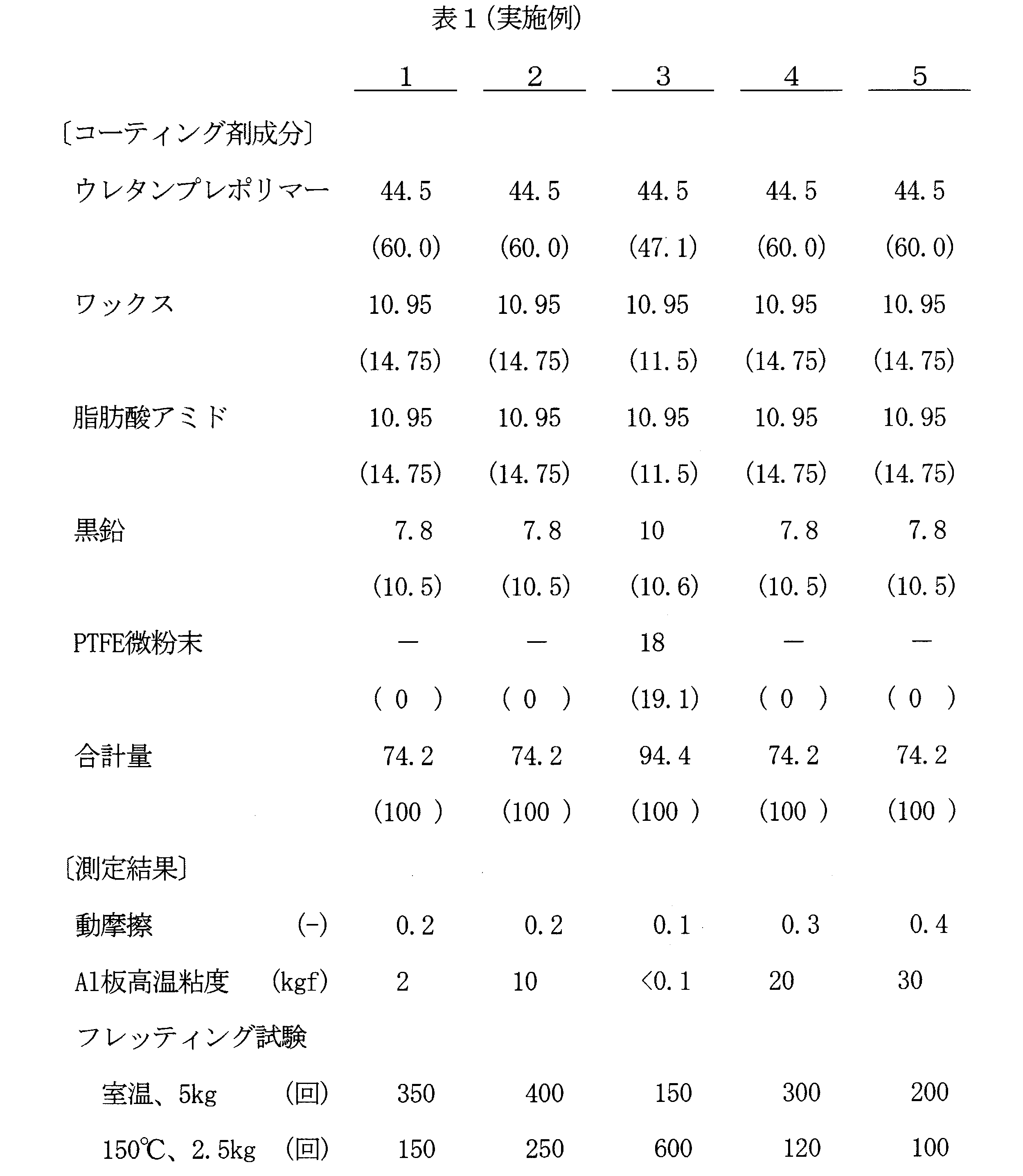
- Example 1 A stainless steel plate (Nisshin Steel Products SUS301, 0.2 mm thick) is sequentially treated with a silane primer and a phenol resin adhesive, and then the nitrile rubber composition is mixed with a toluene / methyl ethyl ketone (weight ratio 90/10) mixed solvent The solution adjusted to a concentration of 25% by weight was applied after drying to a thickness of 20 ⁇ m and press-cured at 180 ° C. for 6 minutes. A coating agent having a solid content concentration of 6.2% by weight was dip-coated on the vulcanized layer, and then heat treated at 200 ° C. for 2 minutes to form a 5 ⁇ m-thick anti-sticking layer.
- Silane-based primer 40 parts (by weight, the same shall apply hereinafter) of ⁇ -aminopropyltriethoxysilane and 20 parts of water are charged in a three-necked flask equipped with a stirrer, heating jacket and dropping funnel, and acetic acid is adjusted to pH 4 to 5 In addition, the pH is adjusted, and after stirring for several minutes, 40 parts of vinyltriethoxysilane is gradually dropped from the dropping funnel while stirring is continued, and after completion of the dropping, heating and refluxing are carried out at about 60 ° C. for 5 hours. The copolymerized oligomer was obtained.
- a silane primer was obtained by mixing 2.5 parts of this copolymerized oligomer, 1.0 part of titanium tetra (acetylacetonate), 86.5 parts of methanol and 10.0 parts of water and stirring for several minutes.
- Phenolic resin adhesive 2 parts of unvulcanized NBR (JSR product N-237, medium-high nitrile) is added to 90 parts of methyl ethyl ketone, and then 5 parts of resol-type phenolic resin (Laudfer yeast product Chemlock TS 1677-13) and chlorine Three parts of fluorinated polyethylene (Nippon Paper Chemicals Co., Ltd. Sparklon, 45% by weight chlorine content) were added to obtain a phenolic resin adhesive comprising these methyl ethyl ketone solutions.
- Nitrile rubber composition NBR (JSR product N-235S, CN content 36%) 100 parts SRF carbon black 80 parts White carbon (Nippon silica products Nip seal LP) 40 parts Zinc oxide 5 parts Stearic acid 2 parts Anti-aging agent (Ouchi emerging chemical Nocrac 224) 2 parts (N-isopropyl-N'-phenyl-p-phenylenediamine) 2 parts triallyl isocyanurate 1,3-bis (tert-butylperoxy) isopropylbenzene 7.5 parts
- Dynamic friction coefficient JIS K7125 corresponding to ISO 8295, B8147 compliant Using a surface tester manufactured by Shinto Scientific Co., Ltd., using a hard chromium steel ball friction element (diameter 10 nm), moving speed 50 mm / min, load 50 g Measurement High temperature adhesion test with Al plate: Coating agent of metal rubber composite material (60 ⁇ 25 mm) Layer side and Al plate (60 ⁇ 25 mm), bonding area 25 ⁇ 25 mm, temperature 200 ° C., time 72 hours, pressure 200 kgf / It is crimped under the condition of cm 2 (19.6MPa), and tensile shear adhesive strength (JIS corresponding to ISO 4587) under the room temperature condition.
- the surface adhesion is measured according to K 6850. Fretting test according to ISO 8295: JIS K 7125 corresponding to ISO 8295, P 8147 Using a surface tester manufactured by Shinto Scientific Co., Ltd., a mating material hard chromium steel ball friction element (diameter 10 nm) , Travel speed 400mm / min, Reciprocation movement width 30 mm, load 5 kg (at room temperature) or The friction and wear was evaluated under the condition of 5 kg (150 ° C), and the number of times the rubber layer was worn out and the adhesive layer was exposed was measured.
- Example 2 In Example 1, instead of paraffin wax, the same amount (73 parts) of polyethylene wax (a dispersion having a particle diameter of 2 ⁇ m or less containing Mitsui Chemical product melting point 110 ° C., 85 wt% toluene) was used.
- polyethylene wax a dispersion having a particle diameter of 2 ⁇ m or less containing Mitsui Chemical product melting point 110 ° C., 85 wt% toluene
- Example 3 120 parts of polytetrafluoroethylene fine powder (particle diameter 1 ⁇ m, toluene 85 wt% content) is further used, and the amount of graphite is 10 g, the amount of toluene is 939 parts, and the total is 1259.5 parts. It was changed and used.
- Example 4 In Example 2, instead of the isocyanate group-containing urethane prepolymer A, the isocyanate group-containing urethane prepolymer B (prepared from 100 parts of polyester polyol resin which is Dainippon Ink Chemical Industry product D6-439 and 60 parts of its product isocyanate DN980) The same amount (44.5 parts) was used.
- Example 5 In Example 2, instead of the isocyanate group-containing urethane prepolymer A, the same amount of isocyanate group-containing urethane prepolymer C (prepared from 100 parts of acrylic polyol resin which is SOKEN CHEMICAL PRODUCTS UMB-2005 and 6 parts of isocyanate desmodul RE) (44.5 parts) was used.
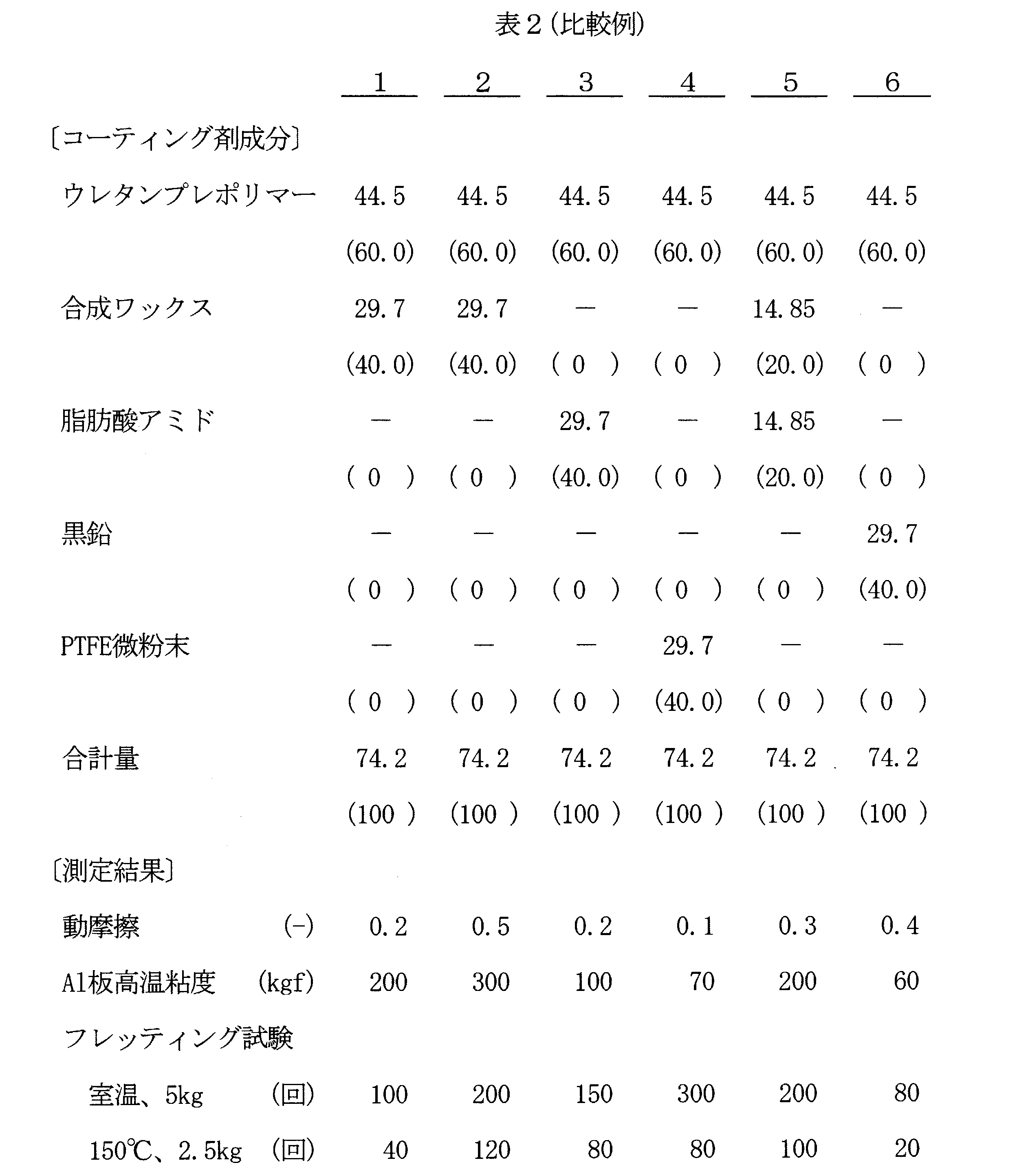
- Example 1 Comparative Example 1 In Example 1, oleic acid amide and graphite were not used, and the amount of paraffin wax was changed to 198 parts, the amount of toluene was changed to 747 parts, and the total amount was changed to 989.5 parts.
- Comparative example 2 In Comparative Example 1, instead of paraffin wax, the same amount (198 parts) of polyethylene wax was used.
- Comparative example 3 In Comparative Example 1, the same amount (198 parts) of oleic acid amide was used instead of paraffin wax.
- Comparative example 4 In Comparative Example 1, the same amount (198 parts) of polytetrafluoroethylene fine powder was used instead of paraffin wax.
- Comparative example 5 In Comparative Example 2, 99 parts each of polyethylene wax and oleic acid amide were used instead of 198 parts of polyethylene wax.
- Comparative example 6 In Comparative Example 1, 29.7 parts of graphite was used instead of paraffin wax, and the amount of toluene was changed to 915 parts, and the total amount was changed to 989.2 parts.
Landscapes
- Engineering & Computer Science (AREA)
- General Engineering & Computer Science (AREA)
- Mechanical Engineering (AREA)
- Chemical & Material Sciences (AREA)
- Combustion & Propulsion (AREA)
- Laminated Bodies (AREA)
- Gasket Seals (AREA)
- Adhesives Or Adhesive Processes (AREA)
Abstract
Description
(a) 被着ゴム層の表面に無機粉体系の固体潤滑剤であるグラファイト、二硫化モリブデン等を塗布し、フレッティングにより発生する摩擦力を低下させる方法
(1) 固体潤滑剤であるコーティング剤の塗布性にすぐれている。
(2) 固体潤滑剤で表面処理したゴム同士のブロッキングがない。
(3) 表面処理したゴム層の表面は、低摩擦、低摺動となり、装着作業性にすぐれている。
(4) コーティング剤とゴムの官能基との間に化学的結合が多く形成され、その結果表面処理したゴムの耐久性や高温での非粘着性が発揮されることにより、金属との粘着性や固着性が少なく、高温時においても同様の効果がみられる。
(5) 上記ゴム層との化学的結合の結果として、低摩擦、低摺動といった性能に持続性があり、またゴムの摩耗を低減できる。
(6) 塗布厚みを、例えば5μm以下に薄くしても性能が十分に発揮され、塗布むらをなくして、低コストでの処理が可能である。
(7) このように塗布厚みを薄くしても、滑り性や非粘着性に劣るところがなく、柔軟性があり、その結果ゴムの物性が損なわれることがなく、特にシール部品の場合にはシール性にすぐれている。
(8) イソシアネート基含有ウレタンプレポリマーが含有されているので、黒鉛やフッ素系樹脂のゴム層との密着性が良く、脱落が少ない。
(9) 従来のフッ素系樹脂を含有する表面処理膜は硬く、シール部品ではシール性能の低下や圧縮・解放のくり返しによる皮膜のクラック発生や剥がれがみられたが、本発明のコーティング剤を用いて固体潤滑剤層を形成させた場合には、こうした問題点が解消される。
(10) 脂肪酸アミドの配合は、高温での潤滑性が高く、高温での耐摩擦摩耗特性がよいばかりではなく、皮膜の柔軟性にすぐれ、ゴム層との密着性を損なうことがない。
(11) 黒鉛、フッ素系樹脂は、200℃程度の高温でもその特性変化が少なく、これらの添加により、高温での粘着防止が保たれる。
ステンレス鋼板(日新製鋼製品SUS301、厚さ0.2mm)をシラン系プライマーおよびフェノール樹脂系接着剤で順次処理した後、ニトリルゴム組成物をトルエン/メチルエチルケトン(重量比90/10)混合溶媒に固形分濃度が25重量%になるように調整した溶液を乾燥後厚さが20μmの厚さになるように塗布し、180℃で6分間プレス加硫した。その加硫層上に、固形分濃度が6.2重量%のコーティング剤を浸漬塗布した後、200℃で2分間加熱処理して、厚さ5μmの粘着防止層を形成させた。
NBR(JSR製品N-235S、CN含量36%) 100部
SRFカーボンブラック 80部
ホワイトカーボン(日本シリカ製品ニップシールLP) 40部
酸化亜鉛 5部
ステアリン酸 2部
老化防止剤(大内新興化学製品Nocrac224) 2部
(N-イソプロピル-N′-フェニル-p-フェニレンジアミン) 2部
トリアリルイソシアヌレート
1,3-ビス(第3ブチルペルオキシ)イソプロピルベンゼン 7.5部
動摩擦係数:ISO 8295に対応するJIS K7125、B8147準拠
新東科学製表面試験機を用いて、相手材硬質クロム鋼球摩
擦子(直径10nm)、移動速度50mm/分、荷重50gの条件下で
測定
Al板との高温粘着試験:金属ゴム複合素材(60×25mm)のコーティング剤
層側とAl板(60×25mm)とを、貼り合せ面積25×
25mm、温度200℃、時間72時間、圧力200kgf/
cm2(19.6MPa)の条件下で圧着し、室温条件下で
引張せん断接着強さ(ISO 4587に対応するJIS
K6850準拠)を測定し、表面粘着力とした
フレッティング試験:ISO 8295に対応するJIS K7125、P8147準拠
新東科学製表面試験機を用いて、相手材硬質クロ
ム鋼球摩擦子(直径10nm)、移動速度400mm/分、
往復動移動幅30mm、荷重5kg(室温条件下)または2.
5kg(150℃)の条件下で摩擦摩耗評価を行い、ゴム
層が摩滅して接着剤層が露出する迄の回数を測定
実施例1において、パラフィンワックスの代りに、ポリエチレンワックス(三井化学製品融点110℃、トルエン85重量%を含有した粒子径2μm以下の分散液)が同量(73部)用いられた。
実施例2において、さらにポリテトラフルオロエチレン微粉末(粒子径1μm、トルエン85重量%含量)が120部用いられ、また黒鉛量が10g部に、トルエン量が939部、合計量が1259.5部にそれぞれ変更されて用いられた。
実施例2において、イソシアネート基含有ウレタンプレポリマーAの代りに、イソシアネート基含有ウレタンプレポリマーB(大日本インキ化学工業製品D6-439であるポリエステルポリオール樹脂100部および同社製品イソシアネートDN980 60部より調製)が同量(44.5部)用いられた。
実施例2において、イソシアネート基含有ウレタンプレポリマーAの代りに、イソシアネート基含有ウレタンプレポリマーC(綜研化学製品UMB-2005であるアクリルポリオール樹脂100部およびイソシアネートデスモジュールRE 6部より調製)が同量(44.5部)用いられた。
実施例1において、オレイン酸アミドおよび黒鉛が用いられず、パラフィンワックス量が198部に、トルエン量が747部に、合計量が989.5部にそれぞれ変更されて用いられた。
比較例1において、パラフィンワックスの代りに、同量(198部)のポリエチレンワックスが用いられた。
比較例1において、パラフィンワックスの代りに、同量(198部)のオレイン酸アミドが用いられた。
比較例1において、パラフィンワックスの代りに、同量(198部)のポリテトラフルオロエチレン微粉末量が用いられた。
比較例2において、ポリエチレンワックス198部の代りに、ポリエチレンワックスおよびオレイン酸アミドがそれぞれ99部用いられた。
比較例1において、パラフィンワックスの代りに黒鉛29.7部が用いられ、またトルエン量が915部に、合計量が989.2部にそれぞれ変更されて用いられた。
Claims (9)
- 金属板表面に形成させたゴム層上に、イソシアネート基含有ウレタンプレポリマー、軟化点が40~150℃の合成ワックス、軟化点が60~170℃の脂肪酸アミドおよび黒鉛を含有する固体潤滑剤層を形成せしめた金属ゴム積層素材。
- さらにフッ素系樹脂を含有させた固体潤滑剤層を形成させた請求項1記載の金属ゴム積層素材。
- 粒子径が0.5~5μmのフッ素系樹脂が用いられた請求項2記載の金属ゴム積層素材。
- イソシアネート基含有ウレタンプレポリマー20~70重量%、合成ワックス10~50重量%、脂肪酸アミド10~50重量%、黒鉛5~40重量%およびフッ素系樹脂0~50重量%よりなり、以上の各成分の合計量が100重量%である固体潤滑剤の層が形成された請求項1または2記載の金属ゴム積層素材。
- プライマー層および接着剤層を順次介して金属板とゴム層とが被着された請求項1または2記載の金属ゴム積層素材。
- 金属ガスケットとして用いられる請求項5記載の金属ゴム積層素材。
- 金属ガスケットとして内燃機関に用いられる請求項6記載の金属ゴム積層素材。
- 金属ガスケットとして自動車エンジンの内燃機関に用いられる請求項7記載の金属ゴム積層素材。
- 請求項8記載の金属ゴム積層素材よりなる自動車エンジン内燃機関用金属ガスケット。
Priority Applications (4)
| Application Number | Priority Date | Filing Date | Title |
|---|---|---|---|
| JP2012552708A JP5617934B2 (ja) | 2011-01-12 | 2012-01-06 | 金属ゴム積層素材 |
| US13/977,837 US10047697B2 (en) | 2011-01-12 | 2012-01-06 | Metal-rubber laminate material |
| EP12733851.5A EP2664454B1 (en) | 2011-01-12 | 2012-01-06 | Metal-rubber laminate material |
| CN201280005257.5A CN103459141B (zh) | 2011-01-12 | 2012-01-06 | 金属-橡胶层压材料 |
Applications Claiming Priority (2)
| Application Number | Priority Date | Filing Date | Title |
|---|---|---|---|
| JP2011003578 | 2011-01-12 | ||
| JP2011-003578 | 2011-01-12 |
Publications (1)
| Publication Number | Publication Date |
|---|---|
| WO2012096222A1 true WO2012096222A1 (ja) | 2012-07-19 |
Family
ID=46507122
Family Applications (1)
| Application Number | Title | Priority Date | Filing Date |
|---|---|---|---|
| PCT/JP2012/050135 Ceased WO2012096222A1 (ja) | 2011-01-12 | 2012-01-06 | 金属ゴム積層素材 |
Country Status (5)
| Country | Link |
|---|---|
| US (1) | US10047697B2 (ja) |
| EP (1) | EP2664454B1 (ja) |
| JP (1) | JP5617934B2 (ja) |
| CN (1) | CN103459141B (ja) |
| WO (1) | WO2012096222A1 (ja) |
Cited By (4)
| Publication number | Priority date | Publication date | Assignee | Title |
|---|---|---|---|---|
| JP2017125147A (ja) * | 2016-01-15 | 2017-07-20 | ニチアス株式会社 | コーティング剤、表面被覆弾性体及び表面被覆ゴム金属積層体 |
| US10752804B2 (en) | 2014-06-24 | 2020-08-25 | Nichias Corporation | Coating agent |
| WO2021187028A1 (ja) * | 2020-03-17 | 2021-09-23 | Nok株式会社 | ゴム金属積層体及びガスケット |
| JP2023057818A (ja) * | 2021-10-12 | 2023-04-24 | 株式会社ユニックス | ウレタン系塗料組成物および塗膜 |
Families Citing this family (5)
| Publication number | Priority date | Publication date | Assignee | Title |
|---|---|---|---|---|
| JP6099535B2 (ja) * | 2013-09-26 | 2017-03-22 | 住友理工株式会社 | 導電性ロールおよびその製造方法 |
| JP6452505B2 (ja) * | 2015-03-12 | 2019-01-16 | 日本リークレス工業株式会社 | 金属ガスケット素材板及びその製造方法 |
| JP2018091261A (ja) * | 2016-12-06 | 2018-06-14 | ニチアス株式会社 | ゴム被覆シリンダヘッドガスケット用コーティング剤及びシリンダヘッドガスケット |
| EP3577168B1 (en) * | 2017-03-10 | 2022-09-07 | Celanese Sales Germany GmbH | Polyester polymer compositions |
| US20210309928A1 (en) * | 2020-04-03 | 2021-10-07 | Wolverine Advanced Materials, Llc | Durable low friction coating (dlfc) for brake application |
Citations (3)
| Publication number | Priority date | Publication date | Assignee | Title |
|---|---|---|---|---|
| JP2002130480A (ja) * | 2000-10-24 | 2002-05-09 | Honda Motor Co Ltd | 金属ガスケット用複合素材 |
| JP2003213122A (ja) * | 2002-01-22 | 2003-07-30 | Nok Corp | 加硫ゴム用表面処理剤 |
| JP2008260809A (ja) * | 2007-04-10 | 2008-10-30 | Nok Corp | コーティング剤 |
Family Cites Families (7)
| Publication number | Priority date | Publication date | Assignee | Title |
|---|---|---|---|---|
| JPH0259362A (ja) | 1988-08-25 | 1990-02-28 | Canon Inc | 記録装置 |
| JP2911517B2 (ja) * | 1989-02-15 | 1999-06-23 | 大日本印刷株式会社 | 熱転写シート |
| JPH03124075A (ja) | 1989-10-06 | 1991-05-27 | Sumitomo Electric Ind Ltd | 超電導素子 |
| US6485794B1 (en) * | 1999-07-09 | 2002-11-26 | Ecolab Inc. | Beverage container and beverage conveyor lubricated with a coating that is thermally or radiation cured |
| US6509099B1 (en) * | 1999-08-02 | 2003-01-21 | Nkk Corporation | Phosphate-treated steel plate |
| JP5211498B2 (ja) * | 2007-02-08 | 2013-06-12 | Nok株式会社 | コーティング剤 |
| KR101235020B1 (ko) * | 2007-03-27 | 2013-02-21 | 에누오케 가부시키가이샤 | 고무 금속 적층체 |
-
2012
- 2012-01-06 CN CN201280005257.5A patent/CN103459141B/zh not_active Expired - Fee Related
- 2012-01-06 JP JP2012552708A patent/JP5617934B2/ja not_active Expired - Fee Related
- 2012-01-06 US US13/977,837 patent/US10047697B2/en active Active
- 2012-01-06 EP EP12733851.5A patent/EP2664454B1/en not_active Not-in-force
- 2012-01-06 WO PCT/JP2012/050135 patent/WO2012096222A1/ja not_active Ceased
Patent Citations (3)
| Publication number | Priority date | Publication date | Assignee | Title |
|---|---|---|---|---|
| JP2002130480A (ja) * | 2000-10-24 | 2002-05-09 | Honda Motor Co Ltd | 金属ガスケット用複合素材 |
| JP2003213122A (ja) * | 2002-01-22 | 2003-07-30 | Nok Corp | 加硫ゴム用表面処理剤 |
| JP2008260809A (ja) * | 2007-04-10 | 2008-10-30 | Nok Corp | コーティング剤 |
Cited By (10)
| Publication number | Priority date | Publication date | Assignee | Title |
|---|---|---|---|---|
| US10752804B2 (en) | 2014-06-24 | 2020-08-25 | Nichias Corporation | Coating agent |
| JP2017125147A (ja) * | 2016-01-15 | 2017-07-20 | ニチアス株式会社 | コーティング剤、表面被覆弾性体及び表面被覆ゴム金属積層体 |
| WO2017122585A1 (ja) * | 2016-01-15 | 2017-07-20 | ニチアス株式会社 | コーティング剤、表面被覆弾性体及び表面被覆ゴム金属積層体 |
| US10640677B2 (en) | 2016-01-15 | 2020-05-05 | Nichias Corporation | Coating agent, surface-coated elastic body, and surface-coated rubber metal laminate |
| WO2021187028A1 (ja) * | 2020-03-17 | 2021-09-23 | Nok株式会社 | ゴム金属積層体及びガスケット |
| JPWO2021187028A1 (ja) * | 2020-03-17 | 2021-09-23 | ||
| JP7538854B2 (ja) | 2020-03-17 | 2024-08-22 | Nok株式会社 | ゴム金属積層体及びガスケット |
| US12343958B2 (en) | 2020-03-17 | 2025-07-01 | Nok Corporation | Rubber-metal laminate and gasket |
| JP2023057818A (ja) * | 2021-10-12 | 2023-04-24 | 株式会社ユニックス | ウレタン系塗料組成物および塗膜 |
| JP7290257B2 (ja) | 2021-10-12 | 2023-06-13 | 株式会社ユニックス | ウレタン系塗料組成物および塗膜 |
Also Published As
| Publication number | Publication date |
|---|---|
| EP2664454A4 (en) | 2015-11-04 |
| EP2664454A1 (en) | 2013-11-20 |
| US20130285334A1 (en) | 2013-10-31 |
| CN103459141B (zh) | 2015-04-01 |
| EP2664454B1 (en) | 2016-04-27 |
| JP5617934B2 (ja) | 2014-11-05 |
| US10047697B2 (en) | 2018-08-14 |
| JPWO2012096222A1 (ja) | 2014-06-09 |
| CN103459141A (zh) | 2013-12-18 |
Similar Documents
| Publication | Publication Date | Title |
|---|---|---|
| JP5617934B2 (ja) | 金属ゴム積層素材 | |
| JP5130772B2 (ja) | コーティング剤 | |
| JP5211498B2 (ja) | コーティング剤 | |
| JP5979236B2 (ja) | コーティング剤組成物 | |
| EP4006114B1 (en) | Coating agent for oil seal | |
| JP5429300B2 (ja) | 複合部材 | |
| EP3199584B1 (en) | Surface treatment agent for vulcanized rubber | |
| JP6302367B2 (ja) | コーティング剤 | |
| EP3404072B1 (en) | Coating agent, surface coated elastic body, and surface coated rubber metal laminated body | |
| CN110036191A (zh) | 橡胶被覆气缸盖衬垫用涂布剂及气缸盖衬垫 | |
| EP3199583B1 (en) | Surface treatment agent for vulcanized rubber | |
| JP5211535B2 (ja) | コーティング剤 | |
| EP4006113B1 (en) | COATING AGENT FOR OIL-SEALED SEAL | |
| JP7385215B2 (ja) | 複合体、ガスケット、複合体の製造方法および塗装金属板 | |
| JP2013189600A (ja) | コーティング剤 |
Legal Events
| Date | Code | Title | Description |
|---|---|---|---|
| 121 | Ep: the epo has been informed by wipo that ep was designated in this application |
Ref document number: 12733851 Country of ref document: EP Kind code of ref document: A1 |
|
| ENP | Entry into the national phase |
Ref document number: 2012552708 Country of ref document: JP Kind code of ref document: A |
|
| WWE | Wipo information: entry into national phase |
Ref document number: 13977837 Country of ref document: US |
|
| NENP | Non-entry into the national phase |
Ref country code: DE |
|
| WWE | Wipo information: entry into national phase |
Ref document number: 1301003885 Country of ref document: TH |
|
| WWE | Wipo information: entry into national phase |
Ref document number: 2012733851 Country of ref document: EP |