WO2012105097A1 - 導電性樹脂組成物を用いた樹脂フィルムの製造方法 - Google Patents
導電性樹脂組成物を用いた樹脂フィルムの製造方法 Download PDFInfo
- Publication number
- WO2012105097A1 WO2012105097A1 PCT/JP2011/075398 JP2011075398W WO2012105097A1 WO 2012105097 A1 WO2012105097 A1 WO 2012105097A1 JP 2011075398 W JP2011075398 W JP 2011075398W WO 2012105097 A1 WO2012105097 A1 WO 2012105097A1
- Authority
- WO
- WIPO (PCT)
- Prior art keywords
- acid
- polyaniline
- resin
- resin film
- resin composition
- Prior art date
- Legal status (The legal status is an assumption and is not a legal conclusion. Google has not performed a legal analysis and makes no representation as to the accuracy of the status listed.)
- Ceased
Links
Images
Classifications
-
- C—CHEMISTRY; METALLURGY
- C08—ORGANIC MACROMOLECULAR COMPOUNDS; THEIR PREPARATION OR CHEMICAL WORKING-UP; COMPOSITIONS BASED THEREON
- C08J—WORKING-UP; GENERAL PROCESSES OF COMPOUNDING; AFTER-TREATMENT NOT COVERED BY SUBCLASSES C08B, C08C, C08F, C08G or C08H
- C08J5/00—Manufacture of articles or shaped materials containing macromolecular substances
- C08J5/18—Manufacture of films or sheets
-
- B—PERFORMING OPERATIONS; TRANSPORTING
- B29—WORKING OF PLASTICS; WORKING OF SUBSTANCES IN A PLASTIC STATE IN GENERAL
- B29C—SHAPING OR JOINING OF PLASTICS; SHAPING OF MATERIAL IN A PLASTIC STATE, NOT OTHERWISE PROVIDED FOR; AFTER-TREATMENT OF THE SHAPED PRODUCTS, e.g. REPAIRING
- B29C41/00—Shaping by coating a mould, core or other substrate, i.e. by depositing material and stripping-off the shaped article; Apparatus therefor
- B29C41/02—Shaping by coating a mould, core or other substrate, i.e. by depositing material and stripping-off the shaped article; Apparatus therefor for making articles of definite length, i.e. discrete articles
- B29C41/12—Spreading-out the material on a substrate, e.g. on the surface of a liquid
-
- C—CHEMISTRY; METALLURGY
- C08—ORGANIC MACROMOLECULAR COMPOUNDS; THEIR PREPARATION OR CHEMICAL WORKING-UP; COMPOSITIONS BASED THEREON
- C08G—MACROMOLECULAR COMPOUNDS OBTAINED OTHERWISE THAN BY REACTIONS ONLY INVOLVING UNSATURATED CARBON-TO-CARBON BONDS
- C08G73/00—Macromolecular compounds obtained by reactions forming a linkage containing nitrogen with or without oxygen or carbon in the main chain of the macromolecule, not provided for in groups C08G12/00 - C08G71/00
-
- C—CHEMISTRY; METALLURGY
- C08—ORGANIC MACROMOLECULAR COMPOUNDS; THEIR PREPARATION OR CHEMICAL WORKING-UP; COMPOSITIONS BASED THEREON
- C08L—COMPOSITIONS OF MACROMOLECULAR COMPOUNDS
- C08L79/00—Compositions of macromolecular compounds obtained by reactions forming in the main chain of the macromolecule a linkage containing nitrogen with or without oxygen or carbon only, not provided for in groups C08L61/00 - C08L77/00
-
- C—CHEMISTRY; METALLURGY
- C08—ORGANIC MACROMOLECULAR COMPOUNDS; THEIR PREPARATION OR CHEMICAL WORKING-UP; COMPOSITIONS BASED THEREON
- C08L—COMPOSITIONS OF MACROMOLECULAR COMPOUNDS
- C08L79/00—Compositions of macromolecular compounds obtained by reactions forming in the main chain of the macromolecule a linkage containing nitrogen with or without oxygen or carbon only, not provided for in groups C08L61/00 - C08L77/00
- C08L79/02—Polyamines
-
- C—CHEMISTRY; METALLURGY
- C08—ORGANIC MACROMOLECULAR COMPOUNDS; THEIR PREPARATION OR CHEMICAL WORKING-UP; COMPOSITIONS BASED THEREON
- C08L—COMPOSITIONS OF MACROMOLECULAR COMPOUNDS
- C08L79/00—Compositions of macromolecular compounds obtained by reactions forming in the main chain of the macromolecule a linkage containing nitrogen with or without oxygen or carbon only, not provided for in groups C08L61/00 - C08L77/00
- C08L79/04—Polycondensates having nitrogen-containing heterocyclic rings in the main chain; Polyhydrazides; Polyamide acids or similar polyimide precursors
- C08L79/08—Polyimides; Polyester-imides; Polyamide-imides; Polyamide acids or similar polyimide precursors
-
- C—CHEMISTRY; METALLURGY
- C09—DYES; PAINTS; POLISHES; NATURAL RESINS; ADHESIVES; COMPOSITIONS NOT OTHERWISE PROVIDED FOR; APPLICATIONS OF MATERIALS NOT OTHERWISE PROVIDED FOR
- C09D—COATING COMPOSITIONS, e.g. PAINTS, VARNISHES OR LACQUERS; FILLING PASTES; CHEMICAL PAINT OR INK REMOVERS; INKS; CORRECTING FLUIDS; WOODSTAINS; PASTES OR SOLIDS FOR COLOURING OR PRINTING; USE OF MATERIALS THEREFOR
- C09D179/00—Coating compositions based on macromolecular compounds obtained by reactions forming in the main chain of the macromolecule a linkage containing nitrogen, with or without oxygen, or carbon only, not provided for in groups C09D161/00 - C09D177/00
- C09D179/02—Polyamines
-
- H—ELECTRICITY
- H01—ELECTRIC ELEMENTS
- H01B—CABLES; CONDUCTORS; INSULATORS; SELECTION OF MATERIALS FOR THEIR CONDUCTIVE, INSULATING OR DIELECTRIC PROPERTIES
- H01B1/00—Conductors or conductive bodies characterised by the conductive materials; Selection of materials as conductors
- H01B1/06—Conductors or conductive bodies characterised by the conductive materials; Selection of materials as conductors mainly consisting of other non-metallic substances
- H01B1/12—Conductors or conductive bodies characterised by the conductive materials; Selection of materials as conductors mainly consisting of other non-metallic substances organic substances
-
- H—ELECTRICITY
- H01—ELECTRIC ELEMENTS
- H01B—CABLES; CONDUCTORS; INSULATORS; SELECTION OF MATERIALS FOR THEIR CONDUCTIVE, INSULATING OR DIELECTRIC PROPERTIES
- H01B1/00—Conductors or conductive bodies characterised by the conductive materials; Selection of materials as conductors
- H01B1/06—Conductors or conductive bodies characterised by the conductive materials; Selection of materials as conductors mainly consisting of other non-metallic substances
- H01B1/12—Conductors or conductive bodies characterised by the conductive materials; Selection of materials as conductors mainly consisting of other non-metallic substances organic substances
- H01B1/124—Intrinsically conductive polymers
- H01B1/128—Intrinsically conductive polymers comprising six-membered aromatic rings in the main chain, e.g. polyanilines, polyphenylenes
-
- C—CHEMISTRY; METALLURGY
- C08—ORGANIC MACROMOLECULAR COMPOUNDS; THEIR PREPARATION OR CHEMICAL WORKING-UP; COMPOSITIONS BASED THEREON
- C08J—WORKING-UP; GENERAL PROCESSES OF COMPOUNDING; AFTER-TREATMENT NOT COVERED BY SUBCLASSES C08B, C08C, C08F, C08G or C08H
- C08J2365/00—Characterised by the use of macromolecular compounds obtained by reactions forming a carbon-to-carbon link in the main chain; Derivatives of such polymers
Definitions
- the present invention relates to a method for producing a resin film using a conductive resin composition.
- Conductive polyaniline obtained by doping polyaniline attracts attention as a stable conductive polymer, and is known to be useful in various fields.
- undoped polyaniline emeraldine base
- a polar solvent such as N-methyl-2-pyrrolidone (hereinafter also referred to as NMP)
- a protonic acid is added as a dopant to the doped polyaniline solution.
- Emeraldine salt and after dissolving the polyaniline solution in a polyamic acid solution, this is supplied to a support to form a film to obtain a conductive polyimide film (for example, see Patent Document 1).
- the polyaniline solution gels in about several hours, it is difficult to store the raw material solution for a long time when the conductive polyimide film is mass-produced.
- the present invention has been made in order to solve the above-described conventional problems, and the main object of the present invention is to provide a resin film capable of stably producing a resin film without the coating liquid raw material (polyaniline solution) gelling over a long period of time. It is to provide a manufacturing method.
- the method for producing a resin film of the present invention includes a step of preparing a conductive resin composition by heating and kneading polyaniline in an emeraldine base state and a protonic acid.
- the method further includes a step of supplying a coating liquid containing the conductive resin composition and the heat-resistant resin to the support and forming a coating film on the support.
- the arithmetic average particle size of the conductive polyaniline doped with the protonic acid generated by the heating and kneading in the cloth liquid is 10 ⁇ m or less.
- the heat resistant resin is a polyamideimide resin.
- the amount of the polyaniline added is in the range of 1 part by weight to 5 parts by weight with respect to 100 parts by weight of the heat resistant resin contained in the resin film. Used by adjusting.
- a resin film is provided. This resin film is manufactured by the above manufacturing method.
- a seamless belt is provided. This seamless belt includes the resin film.
- a conductive resin composition is provided. This conductive resin composition is obtained by heating and kneading polyaniline in an emeraldine base state and a protonic acid.
- a polyaniline solution is provided. This polyaniline solution is obtained by mixing the conductive resin composition in a nonpolar solvent or a mixed solvent of a nonpolar solvent and N-methyl-2-pyrrolidone.
- a coating liquid raw material (polyaniline) containing the conductive resin composition is prepared.
- the solution) does not gel for a long period of time, and a resin film can be obtained stably.
- a resin film having a desired surface resistivity for example, suitable for an intermediate transfer belt of an image forming apparatus
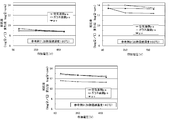
- FIG. 10 is a graph showing the surface resistivity ( ⁇ s) and volume resistivity ( ⁇ v) of resin films obtained from the resin solutions of Reference Examples 7 to 9.
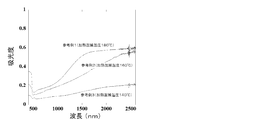
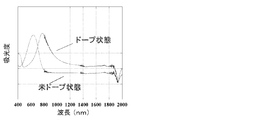
- FIG. 4 is a graph showing the absorbance of the polyaniline solutions obtained in Reference Examples 1 to 3. It is a graph which shows the light absorbency of the polyaniline which the molecular chain entangled.
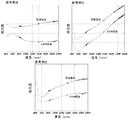
- FIG. 6 is a graph showing the absorbance of the polyaniline solutions obtained in Reference Examples 4 to 6.
- the method for producing a resin film of the present invention includes a step of preparing a conductive resin composition by heating and kneading polyaniline in an emeraldine base state and a protonic acid.
- the conductive resin composition is obtained by heat-kneading emeraldine-based polyaniline (hereinafter also simply referred to as polyaniline) and protonic acid.
- a conductive resin composition containing conductive polyaniline (emeraldine salt (hereinafter also simply referred to as conductive polyaniline)) doped with protonic acid can be obtained.
- the conductive resin composition obtained by heating and kneading in this way does not gel even when dissolved in a polar solvent and stored for a long period of time (for example, 1 month or more). Excellent.
- the emeraldine-based polyaniline has a basic structure in which an oxidized structural unit (quinoneimine structural unit) and a reduced structural unit (phenylenediamine structural unit) are present in substantially the same molar fraction as represented by the following formula (1). It has a skeleton as a repeating unit.
- m represents the molar fraction of the quinonediimine structural unit in the repeating unit
- n represents the molar fraction of the phenylenediamine structural unit in the repeating unit
- m + n 1, and the values of m and n are substantially the same. equal.
- polyaniline examples include a trade name “Panipol PA” (manufactured by Panipol).
- the proton acid may be an organic acid or an inorganic acid.
- the acid dissociation constant pKa value of the above protonic acid is preferably 4.8 or less, more preferably 1 to 4.8.
- Examples of such a protonic acid include inorganic acids such as hydrochloric acid, sulfuric acid, nitric acid, phosphoric acid, borohydrofluoric acid, phosphorous hydrofluoric acid, and perchloric acid; organic acids having an acid solubility constant pKa value of 4.8 or less.
- Etc When a protonic acid having a pKa value of 1 to 4.8 is used, a conductive resin composition having higher conductivity can be obtained as the pKa value is smaller, that is, the acidity is stronger. However, when the pKa value is less than 1, the conductivity of the obtained conductive resin composition is almost unchanged and almost constant. Of course, if necessary, a protonic acid having a pKa value of 1 or less may be used.
- organic acid examples include aliphatic organic acids such as organic carboxylic acids; aromatic organic acids such as phenols or araliphatic organic acids; alicyclic organic acids and the like. These organic acids may be monobasic acids or polybasic acids.
- the organic acid may have a substituent. Examples of the substituent include a sulfonic acid group, a sulfuric acid group, a hydroxyl group, a halogen group, a nitro group, a cyano group, and an amino group.
- organic acid examples include acetic acid, n-butyric acid, pentadecafluorooctanoic acid, pentafluoroacetic acid, trifluoroacetic acid, trichloroacetic acid, dichloroacetic acid, monofluoroacetic acid, monobromoacetic acid, monochloroacetic acid, cyanoacetic acid, acetylacetic acid , Nitroacetic acid, triphenylacetic acid, formic acid, oxalic acid, benzoic acid, m-bromobenzoic acid, p-chlorobenzoic acid, m-chlorobenzoic acid, p-chlorobenzoic acid, o-nitrobenzoic acid, 2,4-dinitro Benzoic acid, 3,5-dinitrobenzoic acid, picric acid, o-chlorobenzoic acid, p-nitrobenzoic acid, m-nitrobenzoic acid, trimethylbenzoic acid, p-
- organic acid having a sulfonic acid group and / or a sulfuric acid group examples include aminonaphtholsulfonic acid, metanilic acid, sulfanilic acid, allylsulfonic acid, laurylsulfuric acid, xylenesulfonic acid, chlorobenzenesulfonic acid, methanesulfonic acid, and ethanesulfone.
- a polyfunctional organic sulfonic acid having two or more sulfonic acid groups in the molecule can also be used.
- the polyfunctional organic sulfonic acid include ethanedisulfonic acid, propanedisulfonic acid, butanedisulfonic acid, pentanedisulfonic acid, hexanedisulfonic acid, heptanedisulfonic acid, octanedisulfonic acid, nonanedisulfonic acid, decanedisulfonic acid, benzenedisulfonic acid.
- naphthalene disulfonic acid toluene disulfonic acid, ethylbenzene disulfonic acid, propylbenzene disulfonic acid, butylbenzene disulfonic acid, dimethylbenzene disulfonic acid, diethylbenzene disulfonic acid, dipropylbenzene disulfonic acid, dibutylbenzene disulfonic acid, methyl naphthalene disulfonic acid, ethyl Naphthalene disulfonic acid, propyl naphthalene disulfonic acid, butyl naphthalene disulfonic acid, pentyl naphthalene disulfonic acid, hex Lunaphthalene disulfonic acid, heptyl naphthalene disulfonic acid, octyl naphthalene disulfonic acid, nonyl naphthalene disulfonic acid, dimethyl n
- the organic acid may be a polymer acid.
- the polymer acid include polyvinyl sulfonic acid, polyvinyl sulfuric acid, polystyrene sulfonic acid, sulfonated styrene-butadiene copolymer, polyallyl sulfonic acid, polymethallyl sulfonic acid, poly-2-acrylamido-2-methylpropane. Examples thereof include sulfonic acid, polyhalogenated acrylic acid, polyisoprene sulfonic acid, N-sulfoalkylated polyaniline, and nuclear sulfonated polyaniline.
- a fluorine-containing polymer known as naphthion (registered trademark of DuPont, USA) is also preferably used as the polymer acid.
- the amount of the protonic acid added is preferably 0.01 mol to 1 mol per mol of the reduced structural unit (phenylenediamine structure (imino-p-phenylene structure) unit) of the polyaniline.
- the amount of the protonic acid added is in such a range, a conductive polyaniline sufficiently doped with the protonic acid can be obtained.
- the conductive resin composition may contain any appropriate additive depending on the purpose and the like.
- the additive include a slidable filler, a heat conductive filler, a heat insulating filler, and an abrasion resistant filler.
- the conductive resin composition is obtained by heating and kneading the polyaniline and the protonic acid. It is considered that the conductive polyaniline obtained by heating and kneading is entangled in molecular chains.
- the apparatus that can be used for the heat kneading include a closed kneading apparatus such as a Banbury mixer, a kneader, and a roll, or a batch kneading apparatus; a continuous kneading apparatus such as a single screw extruder and a twin screw extruder. .
- the kneading temperature in the heat kneading is preferably 120 ° C. to 200 ° C., particularly preferably 140 ° C. to 180 ° C. If the kneading temperature is within such a range, the molecular chains of the polyaniline are entangled, and as a result, the conductive polyaniline sufficiently doped with the proton acid can be obtained, and further gelled in a polar solvent. It is estimated that a difficult conductive resin composition can be obtained.
- the kneading time in the above heat kneading is preferably 1 minute to 60 minutes.
- the kneading time is in such a range, it is possible to obtain a conductive polyaniline that is sufficiently doped with the protonic acid, and it is possible to obtain a conductive resin composition that hardly gels in a polar solvent.
- the method for producing a resin film of the present invention preferably includes a step of supplying a coating liquid containing the conductive resin composition and the heat-resistant resin to the support to form a coating film on the support.
- the amount of the polyaniline added is preferably 1 to 5 parts by weight, more preferably 1.5 parts by weight with respect to 100 parts by weight of the heat-resistant resin contained in the resin film. Parts to 4.5 parts by weight, particularly preferably 2 parts by weight to 3 parts by weight.
- the conductive polyaniline doped with the protonic acid in the conductive resin composition is entangled in molecular chains. Even if the addition amount is small, it is estimated that a resin film having excellent conductivity can be obtained.
- the arithmetic average particle size of the conductive polyaniline doped with the protonic acid in the conductive resin composition is preferably 10 ⁇ m or less.
- the arithmetic average particle size of the conductive polyaniline in the coating solution is in such a range, a resin film having good dispersibility in the coating solution and a small surface resistivity ( ⁇ s) difference can be obtained.
- the conductive polyaniline having a small arithmetic average particle diameter can be obtained by heat-kneading (preferably, heat-kneading) the polyaniline in the emeraldine base state and the protonic acid.
- the emeraldine-based polyaniline When heat-kneaded, the emeraldine-based polyaniline is entangled in molecular chains and easily doped with protonic acid. As a result, the resulting conductive polyaniline has solubility or dispersibility in the solvent in the coating solution. It is estimated that the arithmetic average particle size in the coating solution becomes small and becomes high.
- the arithmetic average particle size is calculated from, for example, a particle size distribution measured by a laser scattering particle size distribution measuring method.
- the heat resistant resin examples include polyamide imide resin, polyimide resin, polyether ether ketone resin, polyphenylene sulfide resin, polybenzimidazole resin, and the like. Among these, a polyamideimide resin or a polyimide resin is preferable, and a polyamideimide resin is particularly preferable.
- the heat resistant resin may be a precursor for obtaining a heat resistant resin. Examples of the precursor include polyamic acid which is a precursor of polyimide resin.
- a polyamide-imide resin is used as the heat-resistant resin, a high-strength resin film can be easily obtained.
- the polyamideimide resin can be formed into a film at a relatively low temperature (for example, 200 ° C.), thermal decomposition of the protonic acid in the conductive resin composition can be prevented.
- a resin film having desired conductive properties can be obtained even when using a conductive resin composition obtained by adding a small amount of protonic acid.
- the thermal decomposition of the protonic acid can be prevented as described above. Therefore, the coating liquid is supplied into the cylindrical mold as described later, and the coating film is applied to the inner surface of the mold.
- the resin film After forming the film, when the resin film is produced by removing (drying) the solvent by heat treatment, it is difficult to peel off the film being produced in the drying step. Moreover, if a polyimide-type resin is used as the said heat resistant resin, the resin film which is remarkably excellent in intensity
- the polyamide-imide resin can be produced by, for example, polycondensation of an acid component and a diamine or diisocyanate by any appropriate method. Specifically, the acid component and the diamine or diisocyanate are mixed at a predetermined temperature (usually about 60 ° C. to 200 ° C.) in a polar solvent such as N, N′-dimethylacetamide or N-methyl-2-pyrrolidone (NMP). It can manufacture by stirring while heating.
- a polar solvent such as N, N′-dimethylacetamide or N-methyl-2-pyrrolidone (NMP).
- the acid component examples include trimellitic acid, trimellitic anhydride or acid chloride, benzene-1,2,4,5-tetracarboxylic acid (pyromellitic acid), biphenyltetracarboxylic acid, biphenylsulfone.
- Tetracarboxylic acid benzophenone tetracarboxylic acid, biphenyl ether tetracarboxylic acid, tetracarboxylic acid such as ethylene glycol bistrimellitate, propylene glycol bistrimellitate and their anhydrides, oxalic acid, adipic acid, malonic acid, sebacic acid, azelain Aliphatic dicarboxylic acids such as acid, dodecanedicarboxylic acid, dicarboxypolybutadiene, dicarboxypoly (acrylonitrile-butadiene), dicarboxypoly (styrene-butadiene); 1,4-cyclohexanedicarboxylic acid, 1,3-si Alicyclic dicarboxylic acids such as rhohexanedicarboxylic acid, 4,4'-dicyclohexylmethane dicarboxylic acid, dimer acid; aromatic dicarboxylic acids such as terephthal
- diamine or diisocyanate examples include aliphatic diamines such as ethylenediamine, propylenediamine, and hexamethylenediamine, and diisocyanates thereof, 1,4-cyclohexanediamine, 1,3-cyclohexanediamine, isophoronediamine, 4,4'- Alicyclic diamines such as dicyclohexylmethane diamine and diisocyanates thereof, m-phenylene diamine, p-phenylene diamine, 4,4'-diaminodiphenyl methane, 4,4'-diaminodiphenyl ether, 4,4'-diaminodiphenyl sulfone, Aromatic diamines such as benzidine, o-tolidine, 2,4-tolylenediamine, 2,6-tolylenediamine, xylylenediamine and the like, diisocyanates thereof, 1,5′-diiso Anat naphthalene
- polyamideimide resin Commercially available products can be used as the polyamideimide resin. For example, Hitachi Chemical Co., Ltd. HPC series, Toyobo Co., Ltd. Bilomax etc. are mentioned.
- the resin film is obtained by dissolving a coating liquid raw material (polyaniline solution) containing the conductive resin composition in the heat-resistant resin (for example, polyamideimide). It can be formed by preparing a coating solution containing a conductive resin composition, supplying the obtained coating solution to a support, forming a coating film on the support, and then removing the solvent by heat treatment. it can. According to the present invention, since the coating liquid raw material is difficult to gel, a resin film can be stably obtained.
- a coating liquid raw material polyaniline solution
- the heat-resistant resin for example, polyamideimide
- the concentration of the heat resistant resin in the coating solution is preferably 10% by weight to 40% by weight, and more preferably 10% by weight to 35% by weight.
- the coating solution raw material can be obtained by mixing the conductive resin composition and an organic solvent.
- the organic solvent may be a polar solvent or a nonpolar solvent.
- the polar solvent include N-methyl-2-pyrrolidone and N, N-dimethylacetamide. Of these, N-methyl-2-pyrrolidone is preferable. N-methyl-2-pyrrolidone has good compatibility with the above heat-resistant resin (for example, polyamideimide). Even if the said conductive resin composition preserve
- the nonpolar solvent include toluene, xylene and the like.
- the organic solvent may be a mixed solvent of a polar solvent and a nonpolar solvent.
- a nonpolar solvent or a mixed solution of a polar solvent and a nonpolar solvent is used, a conductive resin composition having a small average particle size in the coating solution (for example, an arithmetic average particle size of 10 ⁇ m or less as described above) is obtained. As a result, a resin film having a small difference in surface resistivity ( ⁇ s) can be obtained. Further, if a nonpolar solvent or a mixed solution of a polar solvent and a nonpolar solvent is used, the progress of dedoping from the conductive polyaniline can be delayed.
- Examples of the material for the support include metals, glass, and polymer films.
- a resin film for a seamless belt can be produced.
- the resin film for the seamless belt is produced, for example, by supplying the coating liquid into a cylindrical mold to form a coating film on the inner surface of the mold, and then removing (drying) the solvent by heat treatment. .
- Any appropriate method is adopted as a method of forming a coating film when producing the resin film for the seamless belt.
- a method of applying a spiral while running a nozzle or a mold, or a method of running a traveling body (bullet shape, spherical shape) having a certain clearance between the mold after the spiral application is performed roughly After immersing the mold in the coating liquid to form a coating film on the inner surface, a method of forming a film with a cylindrical die or the like, after supplying the coating liquid to one end of the inner surface of the mold, between the mold Examples thereof include a method of traveling a traveling body (bullet shape, spherical shape) having a certain clearance.
- the temperature of the heat treatment is preferably 100 ° C. to 300 ° C., more preferably 150 ° C. to 250 ° C.
- the heat treatment time is preferably 10 minutes to 60 minutes.
- the heat treatment may be performed in two stages. By performing the heat treatment in two stages, a resin film having no defects on the surface can be obtained.
- the first heat treatment (initial drying) is preferably performed to such an extent that the fluidity of the coating film formed on the inner surface of the mold can be lost.
- the initial drying is performed by applying hot air from the outside of the mold. By applying hot air, a resin film having no defects on the surface can be obtained.
- the initial drying temperature is preferably 75 ° C to 85 ° C.
- the heating time is preferably 10 to 60 minutes.
- the heating temperature of the second heat treatment is preferably 150 ° C. to 300 ° C.
- the heating time is preferably 10 to 60 minutes.
- the resin film is prepared by supplying a coating liquid containing the conductive resin composition and polyamic acid to a support, forming a coating film on the support, and then performing a heat treatment to polyamic acid. It can form by producing
- a polyamic acid is produced by polymerizing a product or a derivative thereof and a diamine compound to prepare a coating solution containing the conductive resin composition and the polyamic acid.
- the coating solution is supplied onto the support and coated. After the film is formed, the film can be formed by heat treatment and a ring-closing imidization reaction of polyamic acid to produce a polyimide resin. According to the present invention, it is difficult to gel the coating liquid raw material, and even if the coating liquid contains polyamic acid, it is difficult to gel, so that a resin film can be stably obtained.
- any appropriate solvent can be adopted as long as it can cause a polymerization reaction between tetracarboxylic dianhydride or a derivative thereof and a diamine compound.
- the organic polar solvent include N, N-dimethylformamide, N, N-dimethylacetamide, N, N-diethylformamide, N, N-diethylacetamide, N, N-dimethylmethoxyacetamide, dimethylsulfoxide, hexa
- examples thereof include methyl phosphortriamide, N-methyl-2-pyrrolidone, pyridine, tetramethylene sulfone, dimethyltetramethylene sulfone and the like.
- N, N-dimethylformamide and N, N-dimethylacetamide are preferable.
- Such a low molecular weight solvent can be easily removed from the coating solution by evaporation, substitution or diffusion.
- the said organic polar solvent may be used independently and may be used in combination of 2 or more type.
- tetracarboxylic dianhydride examples include 3,3 ′, 4,4′-biphenyltetracarboxylic dianhydride, pyromellitic dianhydride, 3,3 ′, 4,4′-benzophenone tetra Carboxylic dianhydride, 3,3 ′, 4,4′-biphenyltetracarboxylic dianhydride, 2,3,3 ′, 4-biphenyltetracarboxylic dianhydride, 2,3,6,7-naphthalene Tetracarboxylic dianhydride, 1,2,5,6-naphthalenetetracarboxylic dianhydride, 1,4,5,8-naphthalenetetracarboxylic dianhydride, 2,2′-bis (3,4 Dicarboxyphenyl) propane dianhydride, bis (3,4-dicarboxyphenyl) sulfone dianhydride, perylene-3,4,9,10-tetracarboxylic dian
- diamine compound examples include p-phenylenediamine, 4,4′-diaminodiphenyl ether, 4,4′-diaminodiphenylmethane, 3,3′-diaminodiphenylmethane, 3,3′-dichlorobenzidine, 4,4 ′.
- a catalyst is preferably added. Any appropriate catalyst can be adopted as the catalyst. Specific examples of the catalyst include aliphatic tertiary amines, aromatic tertiary amines, and heterocyclic tertiary amines. Of these, nitrogen-containing heterocyclic compounds such as imidazole, benzimidazole, isoquinoline, quinoline, diethylpyridine and ⁇ -picoline are preferred.
- the amount of the catalyst used is 0.04 molar equivalent to 0.4 molar equivalent, preferably 0.05 molar equivalent to 0.4 molar equivalent, with respect to 1 molar equivalent of amic acid in the coating solution. When the addition amount of the catalyst is 0.04 equivalent mole or less, the effect of the catalyst is not sufficient, and even when 0.4 equivalent or more is added, the effect is not improved.
- the monomer concentration during the above polymerization reaction (total concentration of tetracarboxylic dianhydride component and diamine component in the solvent) is preferably 5% by weight to 30% by weight.
- the reaction temperature during the polymerization reaction is preferably 80 ° C. or lower, more preferably 5 ° C. to 50 ° C.
- the reaction time is preferably 5 to 10 hours.
- the solution viscosity of the coating solution containing the conductive resin composition and the polyamic acid is preferably 1 Pa ⁇ s (25 ° C.) to 1000 Pa ⁇ s (25 ° C.) with a B-type viscometer.
- the solution viscosity of the coating solution can be set to a desired viscosity by further heating and stirring the coating solution obtained after the polymerization reaction.
- the heating temperature is preferably 50 ° C. to 90 ° C.
- a coating liquid containing a conductive resin composition and a polyamic acid is supplied onto the support to form a coating film, and then a polyimide-based resin is produced by advancing the ring-closing imidization reaction of the polyamic acid. Thus, a resin film is formed.
- the method for forming the support and the coating film is as described above.
- the ring closure imidization reaction is performed by heating.
- the solvent can also be removed by the heating.
- the heating temperature can be set to any appropriate temperature.
- a multistage heating method is employed. In the multistage heating method, it is preferable to first heat at a low temperature of about 80 to 180 ° C. to evaporate and remove the solvent, and then raise the temperature to about 250 to 400 ° C. to carry out the ring-closing imidization reaction.
- the heating time can be appropriately set according to the heating temperature. Usually, both low temperature heating and subsequent high temperature heating are about 10 to 60 minutes. If such a multistage heating system is used, the generation of minute voids due to ring-closing water and solvent evaporation generated with imide conversion can be prevented.
- the resin film obtained by the said manufacturing method contains the said electroconductive polyaniline and the said heat resistant resin.
- the content of the conductive polyaniline is preferably 1 to 5 parts by weight, more preferably 1.5 to 4.5 parts by weight, particularly preferably 100 parts by weight of the heat-resistant resin. 2 to 3 parts by weight.
- the surface resistivity ( ⁇ s) of the resin film can be set to any appropriate value depending on the application. According to the production method of the present invention, a resin film having a surface resistivity adjusted over a wide range can be obtained even if the amount of polyaniline added is small.
- the surface resistivity ( ⁇ s) of the resin film is preferably 6 (log ⁇ / ⁇ ) to 15 (log ⁇ / ⁇ ), more preferably 9 (log ⁇ / ⁇ ) to 12 It is set to (log ⁇ / ⁇ ).
- the difference between the surface resistivity ( ⁇ s) of the resin film is preferably 0 (log ⁇ / ⁇ ) to 1 (log ⁇ / ⁇ ).
- the volume resistivity ( ⁇ v) of the resin film can be set to any appropriate value depending on the application. According to the production method of the present invention, a resin film having a volume resistivity adjusted over a wide range can be obtained even if the amount of polyaniline added is small.
- the volume resistivity ( ⁇ v) of the resin film is preferably 6 (log ⁇ / cm) to 15 (log ⁇ / cm), more preferably 9 (log ⁇ / cm) to 12 (Log ⁇ / cm) is set.
- the thickness of the resin film can be set to any appropriate thickness depending on the application. Typically, it is 50 ⁇ m to 100 ⁇ m.
- the seamless belt of this invention contains the said resin film.
- the seamless belt may include a layer other than the layer formed by the resin film.
- the volume resistivity ( ⁇ v) of the seamless belt is preferably 6 (log ⁇ / cm) to 15 (log ⁇ / cm), more preferably 9 (log ⁇ / cm) to 12 (log ⁇ / cm).
- Example 2 Immediately after obtaining the polyaniline solution as in Example 1, the polyamidoimide resin solution (manufactured by Hitachi Chemical Co., Ltd., trade name “HPC-7200”, solvent NMP, solid content concentration 30%) and the polyaniline solution obtained in Example 1 were used. Was mixed with 2 parts by weight of polyaniline added in Example 1 so that the solid content of the polyamideimide resin was 100 parts by weight to obtain a resin solution.
- Example 3 A resin solution was obtained in the same manner as in Example 2 except that 2.5 parts by weight of polyaniline added in Example 1 was mixed so that the polyamideimide resin solid content was 100 parts by weight.
- Example 4 A resin solution was obtained in the same manner as in Example 2 except that 3 parts by weight of polyaniline added in Example 1 was mixed so that the solid content of the polyamideimide resin was 100 parts by weight.
- Comparative Example 2 Immediately after the polyaniline solution was obtained as in Comparative Example 1, the polyamidoimide resin solution (manufactured by Hitachi Chemical Co., Ltd., trade name “HPC-7200”, solvent NMP, solid content concentration 30%) and the polyaniline solution obtained in Comparative Example 1 were used. Were mixed with 5 parts by weight of polyaniline added in Comparative Example 1 so that the solid content of the polyamideimide resin was 100 parts by weight to obtain a resin solution.
- Reference Example 5 A polyaniline solution was obtained in the same manner as in Reference Example 1, except that the conductive resin composition was mixed with toluene so that the content ratio was 0.1% by weight.
- Reference Example 7 The polyaniline solution obtained in Reference Example 1 was sonicated for 2 hours. Thereafter, a polyamidoimide resin solution (manufactured by Hitachi Chemical Co., Ltd., trade name “HPC-7200”, solvent NMP, solid content concentration of 30%) is added to the polyaniline solution, and the polyamidimide resin solid content is added to 1.9 parts by weight of the added polyaniline. Was 100 parts by weight to obtain a resin solution.
- a polyamidoimide resin solution manufactured by Hitachi Chemical Co., Ltd., trade name “HPC-7200”, solvent NMP, solid content concentration of 30%
- the resin solutions obtained in Reference Examples 7 to 9 were cast on glass plates and then heated at 200 ° C. to obtain resin films.
- the obtained resin film was subjected to an applied voltage of 100 V / 10 seconds, 250 V / 10 seconds, and 500 V / 500 V in an environment of 25 ° C./60% RH.
- the surface resistivity ( ⁇ s) on the air surface side and the glass plate side was measured. The measurement results are shown in FIG. (Volume resistivity)
- the resin solutions obtained in Reference Examples 7 to 9 were cast on glass plates and then heated at 200 ° C. to obtain resin films.
- the obtained resin film was subjected to an applied voltage of 100 V / 10 seconds, 250 V / 10 seconds, and 500 V / 500 V in an environment of 25 ° C./60% RH. Under the measurement conditions of 10 seconds, the volume resistivity ( ⁇ v) on the air surface side and the glass plate side was measured. The measurement results are shown in FIG. (Particle size of conductive polyaniline)
- the polyaniline solutions obtained in Reference Examples 1 to 3 were sonicated for 2 hours.
- the polyaniline solution was diluted with toluene so that the content of the conductive resin composition was 1% by weight, and further diluted with toluene so that the content was 0.05% by weight.
- the obtained solution was subjected to particle size distribution measurement using a laser diffraction / scattering particle size distribution analyzer LA-920 (manufactured by Horiba Ltd.), and the arithmetic average particle size was calculated.
- a mixed liquid mixed with toluene was prepared so that the content ratio of polyaniline (manufactured by PANIPOL, trade name “PANIPOL PA”) was 0.05% by weight, and the arithmetic average particle diameter was calculated in the same manner. did.
- the results are shown in Table 3.
- the conductive resin composition used in the method for producing a resin film of the present invention does not gel for a long period of time even when dissolved in a polar solvent, and has excellent storage stability.
- the absorbance of the polyaniline solution obtained in Reference Examples 1 to 3 was measured using a U-4100 spectrophotometer (manufactured by Hitachi, using 1 mm cell). The results are shown in FIG.
- the polyaniline solutions obtained in Reference Examples 1 to 3 do not have an absorption peak derived from polyaniline in which molecular chains are entangled (absorption peak expressed at 600 to 800 nm as shown in FIG. 3). That is, it is considered that the conductive polyaniline in the polyaniline solution obtained in Reference Examples 1 to 3 is in a state where molecular chains are entangled.
- Such a conductive polyaniline is considered to have improved molecular chain mobility, is sufficiently doped with protonic acid, is easily dissolved or dispersed in toluene, and has a small particle size as shown in Table 3. Further, when such a polyaniline solution is used, a resin film having a small difference in surface resistivity ( ⁇ s) between the front and back surfaces can be obtained (Reference Examples 7 to 9, FIG. 1). Such an effect is remarkably obtained when the kneading temperature is high (Reference Examples 1 and 7).
- the conductive resin composition and resin film obtained by the present invention can be suitably used for, for example, an electromagnetic shielding material, an electrostatic adsorption film, an antistatic material, an image forming apparatus component, an electronic device, and the like.
- the seamless belt obtained by the present invention can be suitably used, for example, as an intermediate transfer belt of an image forming apparatus that forms and records an image by electrophotography.
Landscapes
- Chemical & Material Sciences (AREA)
- Chemical Kinetics & Catalysis (AREA)
- Organic Chemistry (AREA)
- Engineering & Computer Science (AREA)
- Health & Medical Sciences (AREA)
- Medicinal Chemistry (AREA)
- Polymers & Plastics (AREA)
- Manufacturing & Machinery (AREA)
- Materials Engineering (AREA)
- Physics & Mathematics (AREA)
- Spectroscopy & Molecular Physics (AREA)
- Mechanical Engineering (AREA)
- Wood Science & Technology (AREA)
- Life Sciences & Earth Sciences (AREA)
- Compositions Of Macromolecular Compounds (AREA)
- Macromolecular Compounds Obtained By Forming Nitrogen-Containing Linkages In General (AREA)
Abstract
Description
好ましい実施形態においては、上記導電性樹脂組成物と耐熱性樹脂とを含む塗布液を支持体に供給して、該支持体上に塗膜を形成する工程をさらに含む。
好ましい実施形態においては、上記布液中において、前記加熱混練により生成するプロトン酸によりドーピングされた導電性ポリアニリンの算術平均粒径が10μm以下である。
好ましい実施形態においては、上記耐熱性樹脂が、ポリアミドイミド系樹脂である。
好ましい実施形態においては、上記導電性樹脂組成物が、上記ポリアニリンの添加量を、樹脂フィルムに含まれる耐熱性樹脂100重量部に対して、1重量部~5重量部の範囲内となるように調整して用いられる。
本発明の別の局面によれば、樹脂フィルムが提供される。この樹脂フィルムは、上記製造方法により製造される。
本発明の別の局面によれば、シームレスベルトが提供される。このシームレスベルトは、上記樹脂フィルムを含む。
本発明の別の局面によれば、導電性樹脂組成物が提供される。この導電性樹脂組成物は、エメラルジンベース状態のポリアニリンとプロトン酸とを加熱混練して得られる。
本発明の別の局面によれば、ポリアニリン溶液が提供される。このポリアニリン溶液は、上記導電性樹脂組成物を、非極性溶媒、または非極性溶媒とN-メチル-2-ピロリドンとの混合溶媒に混合して得られる。
本発明の樹脂フィルムの製造方法は、エメラルジンベース状態のポリアニリンとプロトン酸とを加熱混練して導電性樹脂組成物を調製する工程を含む。
上記導電性樹脂組成物は、エメラルジンベース状態のポリアニリン(以下、単にポリアニリンともいう)とプロトン酸とを加熱混練して得られる。加熱混練することにより、プロトン酸によりドーピングされた導電性ポリアニリン(エメラルジン塩(以下、単に導電性ポリアニリンともいう))を含む導電性樹脂組成物を得ることができる。このように加熱混練して得られた上記導電性樹脂組成物は、極性溶媒に溶解して長期間(例えば、1ヶ月以上)にわたって保存しても、ゲル化することがなく、保存安定性に優れる。

(式中、mは繰り返し単位中のキノンジイミン構造単位のモル分率を示し、nは繰り返し単位中のフェニレンジアミン構造単位のモル分率を示し、m+n=1であり、mとnの値は略等しい。)
本発明の樹脂フィルムの製造方法は、好ましくは、上記導電性樹脂組成物と耐熱性樹脂を含む塗布液を支持体に供給して、支持体上に塗膜を形成する工程を含む。
上記製造方法により得られる樹脂フィルムは、上記導電性ポリアニリンおよび上記耐熱性樹脂を含む。上記導電性ポリアニリンの含有割合は、上記耐熱性樹脂100重量部に対して、好ましくは1重量部~5重量部であり、さらに好ましくは1.5重量部~4.5重量部、特に好ましくは2重量部~3重量部である。
本発明のシームレスベルトは、上記樹脂フィルムを含む。当該シームレスベルトは、上記樹脂フィルムにより形成された層以外の層を含み得る。
ポリアニリン(PANIPOL社製、商品名「PANIPOL PA」)23.1gとドデシルベンゼンスルホン酸(関東化学株式会社製、pKa値=2.55)81.9gをあわとり練太郎(シンキー社製、mixingモード)を用いて、3分間、混合した。得られた混合物をラボプラストミル50MR(東洋精機社製)を用いて、180℃で30分間、加熱混練を行い導電性樹脂組成物を得た。
得られた導電性樹脂組成物を、濃度が3重量%となるようにNMPに溶解させ、2時間スターラーで撹拌し、ポリアニリン溶液を得た。
実施例1のようにポリアニリン溶液を得た直後、ポリアミドイミド樹脂溶液(日立化成社製、商品名「HPC-7200」、溶媒NMP、固形分濃度30%)と実施例1で得られたポリアニリン溶液とを、実施例1で添加したポリアニリン2重量部に対してポリアミドイミド樹脂固形分が100重量部となるように混合して樹脂溶液を得た。
実施例1で添加したポリアニリン2.5重量部に対して、ポリアミドイミド樹脂固形分が100重量部となるように混合した以外は、実施例2と同様にして樹脂溶液を得た。
実施例1で添加したポリアニリン3重量部に対して、ポリアミドイミド樹脂固形分が100重量部となるように混合した以外は、実施例2と同様にして樹脂溶液を得た。
ポリアニリン(PANIPOL社製、商品名「PANIPOL PA」)0.5gとドデシルベンゼンスルホン酸(関東化学株式会社製、pKa値=2.55)1.8gとを、濃度が3重量%となるようにNMPに溶解させた後、25℃で2時間、スターラー撹拌を行いポリアニリン溶液を得た。
比較例1のようにポリアニリン溶液を得た直後、ポリアミドイミド樹脂溶液(日立化成社製、商品名「HPC-7200」、溶媒NMP、固形分濃度30%)と比較例1で得られたポリアニリン溶液とを、比較例1で添加したポリアニリン5重量部に対してポリアミドイミド樹脂固形分が100重量部となるように混合して樹脂溶液を得た。
比較例1で添加したポリアニリン10重量部に対して、ポリアミドイミド樹脂固形分が100重量部となるように混合した以外は、比較例2と同様にして樹脂溶液を得た。
比較例1で添加したポリアニリン15重量部に対して、ポリアミドイミド樹脂固形分が100重量部となるように混合した以外は、比較例2と同様にして樹脂溶液を得た。
ポリアニリン(PANIPOL社製、商品名「PANIPOL PA」)23.1gとドデシルベンゼンスルホン酸(関東化学株式会社製、pKa値=2.55)81.9gをあわとり練太郎(シンキー社製、mixingモード)を用いて、3分間、混合した。得られた混合物をラボプラストミル50MR(東洋精機社製)を用いて、180℃で30分間、加熱混練を行い導電性樹脂組成物を得た。
得られた導電性樹脂組成物を、含有割合が3重量%となるようにトルエンに混合させ、2時間スターラーで撹拌し、ポリアニリン溶液を得た。
加熱混練時の温度を160℃とした以外は、参考例1と同様にしてポリアニリン溶液を得た。
加熱混練時の温度を140℃とした以外は、参考例1と同様にしてポリアニリン溶液を得た。
導電性樹脂組成物を、含有割合が0.1重量%となるようにNMPに混合させた以外は、参考例1と同様にして、ポリアニリン溶液を得た。
導電性樹脂組成物を、含有割合が0.1重量%となるようにトルエンに混合させた以外は、参考例1と同様にして、ポリアニリン溶液を得た。
導電性樹脂組成物を、含有割合が0.1重量%となるようにNMPとトルエンとの混合溶媒(NMP/トルエン=50/50(重量比))に混合させた以外は、参考例1と同様にして、ポリアニリン溶液を得た。
参考例1で得たポリアニリン溶液に、2時間、超音波処理を行った。その後、ポリアニリン溶液に、ポリアミドイミド樹脂溶液(日立化成社製、商品名「HPC-7200」、溶媒NMP、固形分濃度30%)を、添加ポリアニリン1.9重量部に対してポリアミドイミド樹脂固形分が100重量部となるようにして樹脂溶液を得た。
参考例1で得たポリアニリン溶液に代えて、参考例2で得たポリアニリン溶液を用いた以外は、参考例7と同様にして樹脂溶液を得た。
参考例1で得たポリアニリン溶液に代えて、参考例3で得たポリアニリン溶液を用いた以外は、参考例7と同様にして樹脂溶液を得た。
(保存安定性)
実施例1および比較例1で得られたポリアニリン溶液について、24時間経過後および30日経過後の状態を目視観察した。評価結果を表1に示す。
(表面抵抗率)
実施例2~4および比較例2~4で得られた樹脂溶液をガラス板にキャストした後、200℃で加熱して、樹脂フィルムを得た。得られた樹脂フィルムについて、ハイレスタUP MCP-HTP16(三菱化学社製、プローブ:URS)を用いて、25℃/60%RHの環境下、印加電圧500V/10秒間の測定条件で、空気面側(ガラス板とは反対側)の表面抵抗率を測定した。測定結果を表2に常用対数値にて示す。
また、参考例7~9で得られた樹脂溶液をガラス板にキャストした後、200℃で加熱して、樹脂フィルムを得た。得られた樹脂フィルムについて、ハイレスタUP MCP-HTP16(三菱化学社製、プローブ:URS)を用いて、25℃/60%RHの環境下、印加電圧100V/10秒間、250V/10秒間および500V/10秒間の測定条件で、空気面側およびガラス板側の表面抵抗率(ρs)を測定した。測定結果を図1に示す。
(体積抵抗率)
参考例7~9で得られた樹脂溶液をガラス板にキャストした後、200℃で加熱して、樹脂フィルムを得た。得られた樹脂フィルムについて、ハイレスタUP MCP-HTP16(三菱化学社製、プローブ:URS)を用いて、25℃/60%RHの環境下、印加電圧100V/10秒間、250V/10秒間および500V/10秒間の測定条件で、空気面側およびガラス板側の体積抵抗率(ρv)を測定した。測定結果を図1に示す。
(導電性ポリアニリンの粒径)
参考例1~3で得たポリアニリン溶液に、2時間、超音波処理を行った。その後、ポリアニリン溶液を、導電性樹脂組成物の含有割合が1重量%となるようにトルエンで希釈し、さらに0.05重量%となるようにトルエンで希釈した。得られた溶液について、レーザ回折/散乱式粒度分布測定装置LA-920(堀場製作所製)を使用して粒度分布測定を行い、算術平均粒子径を算出した。また、参考として、ポリアニリン(PANIPOL社製、商品名「PANIPOL PA」)の含有割合が0.05重量%となるようにトルエンに混合した混合液を準備し、同様に、算術平均粒径を算出した。結果を表3に示す。



Claims (9)
- エメラルジンベース状態のポリアニリンとプロトン酸とを加熱混練して導電性樹脂組成物を調製する工程を含む、樹脂フィルムの製造方法。
- 前記導電性樹脂組成物と耐熱性樹脂とを含む塗布液を支持体に供給して、該支持体上に塗膜を形成する工程をさらに含む、請求項1に記載の樹脂フィルムの製造方法。
- 前記布液中において、前記加熱混練により生成するプロトン酸によりドーピングされた導電性ポリアニリンの算術平均粒径が10μm以下である、請求項2に記載の樹脂フィルムの製造方法。
- 前記耐熱性樹脂が、ポリアミドイミド系樹脂である、請求項3に記載の樹脂フィルムの製造方法。
- 前記導電性樹脂組成物が、前記ポリアニリンの添加量を、樹脂フィルムに含まれる耐熱性樹脂100重量部に対して、1重量部~5重量部の範囲内となるように調整して用いられる、請求項2から4のいずれかに記載の樹脂フィルムの製造方法。
- 請求項1から5のいずれかに記載の製造方法により製造された、樹脂フィルム。
- 請求項6に記載の樹脂フィルムを含む、シームレスベルト。
- エメラルジンベース状態のポリアニリンとプロトン酸とを加熱混練して得られる、導電性樹脂組成物。
- 請求項8に記載の導電性樹脂組成物を、非極性溶媒、または非極性溶媒とN-メチル-2-ピロリドンとの混合溶媒に混合して得られる、ポリアニリン溶液。
Priority Applications (4)
| Application Number | Priority Date | Filing Date | Title |
|---|---|---|---|
| EP11857724.6A EP2671903A4 (en) | 2011-02-03 | 2011-11-04 | METHOD USING ELECTROCONDUCTIVE RESIN TO PRODUCE RESIN FILM |
| US13/982,687 US20130320268A1 (en) | 2010-05-19 | 2011-11-04 | Method for producing resin film using electroconductive resin composition |
| KR1020137020549A KR20140036141A (ko) | 2011-02-03 | 2011-11-04 | 도전성 수지 조성물을 이용한 수지 필름의 제조 방법 |
| CN2011800666252A CN103339169A (zh) | 2011-02-03 | 2011-11-04 | 使用导电性树脂组合物的树脂膜的制造方法 |
Applications Claiming Priority (2)
| Application Number | Priority Date | Filing Date | Title |
|---|---|---|---|
| JP2011021395A JP2012004102A (ja) | 2010-05-19 | 2011-02-03 | 導電性樹脂組成物を用いた樹脂フィルムの製造方法 |
| JP2011-021395 | 2011-09-20 |
Publications (1)
| Publication Number | Publication Date |
|---|---|
| WO2012105097A1 true WO2012105097A1 (ja) | 2012-08-09 |
Family
ID=46603446
Family Applications (1)
| Application Number | Title | Priority Date | Filing Date |
|---|---|---|---|
| PCT/JP2011/075398 Ceased WO2012105097A1 (ja) | 2010-05-19 | 2011-11-04 | 導電性樹脂組成物を用いた樹脂フィルムの製造方法 |
Country Status (4)
| Country | Link |
|---|---|
| EP (1) | EP2671903A4 (ja) |
| KR (1) | KR20140036141A (ja) |
| CN (1) | CN103339169A (ja) |
| WO (1) | WO2012105097A1 (ja) |
Families Citing this family (2)
| Publication number | Priority date | Publication date | Assignee | Title |
|---|---|---|---|---|
| CN107201035A (zh) * | 2017-06-22 | 2017-09-26 | 常州大学 | 一种导电自清洁聚酰胺酰亚胺/聚苯胺薄膜的制备方法 |
| CN107118555A (zh) * | 2017-06-22 | 2017-09-01 | 常州大学 | 溶液共混法制备聚酰胺酰亚胺基抗静电薄膜的方法 |
Citations (7)
| Publication number | Priority date | Publication date | Assignee | Title |
|---|---|---|---|---|
| JPH0328229A (ja) | 1988-09-30 | 1991-02-06 | Nitto Denko Corp | 有機重合体又は導電性有機重合体組成物のフィルム,繊維又は複合体の製造方法 |
| JPH0892542A (ja) * | 1994-09-27 | 1996-04-09 | Nitto Denko Corp | 導電性接着剤組成物及びこれを用いる導電性接着テープ |
| JP2003342481A (ja) * | 2002-03-20 | 2003-12-03 | Tokai Rubber Ind Ltd | 導電性組成物およびそれを用いた電子写真機器用部材 |
| JP2005194528A (ja) | 2003-12-30 | 2005-07-21 | E I Du Pont De Nemours & Co | ドープされたポリアニリンを含むポリイミドベース組成物およびそれに関する方法と組成物 |
| JP2007058154A (ja) * | 2005-07-26 | 2007-03-08 | Fuji Xerox Co Ltd | 中間転写ベルト、その製造方法、及び画像形成装置 |
| JP2008248072A (ja) * | 2007-03-30 | 2008-10-16 | Kuraray Co Ltd | 導電性ポリ乳酸組成物 |
| JP2010285534A (ja) * | 2009-06-11 | 2010-12-24 | Nitto Denko Corp | 樹脂組成物および半導電性部材 |
Family Cites Families (7)
| Publication number | Priority date | Publication date | Assignee | Title |
|---|---|---|---|---|
| ATE217439T1 (de) * | 1991-12-05 | 2002-05-15 | Neste Oy | Verfahren zur herstellung von leitfähigem polyermaterial |
| DE69321673T3 (de) * | 1992-08-11 | 2006-09-21 | Panipol Oy | Leitendes Kunststoffmaterial und Methode zu seiner Herstellung |
| FI98820C (fi) * | 1993-06-04 | 1997-08-25 | Neste Oy | Menetelmä työstettävän johdepolymeerimateriaalin valmistamiseksi |
| JPH0710992A (ja) * | 1993-06-04 | 1995-01-13 | Neste Oy | 加工可能な導電性ポリマー材料およびその製造方法 |
| US5783111A (en) * | 1993-09-03 | 1998-07-21 | Uniax Corporation | Electrically conducting compositions |
| FI98822C (fi) * | 1994-02-10 | 1997-08-25 | Neste Oy | Korkeajohtava muovimateriaali polyaniliinikompleksista ja sen valmistusmenetelmä |
| US8153213B2 (en) * | 2009-03-30 | 2012-04-10 | Xerox Corporation | Polyimide polysiloxane intermediate transfer members |
-
2011
- 2011-11-04 EP EP11857724.6A patent/EP2671903A4/en not_active Withdrawn
- 2011-11-04 CN CN2011800666252A patent/CN103339169A/zh active Pending
- 2011-11-04 WO PCT/JP2011/075398 patent/WO2012105097A1/ja not_active Ceased
- 2011-11-04 KR KR1020137020549A patent/KR20140036141A/ko not_active Withdrawn
Patent Citations (7)
| Publication number | Priority date | Publication date | Assignee | Title |
|---|---|---|---|---|
| JPH0328229A (ja) | 1988-09-30 | 1991-02-06 | Nitto Denko Corp | 有機重合体又は導電性有機重合体組成物のフィルム,繊維又は複合体の製造方法 |
| JPH0892542A (ja) * | 1994-09-27 | 1996-04-09 | Nitto Denko Corp | 導電性接着剤組成物及びこれを用いる導電性接着テープ |
| JP2003342481A (ja) * | 2002-03-20 | 2003-12-03 | Tokai Rubber Ind Ltd | 導電性組成物およびそれを用いた電子写真機器用部材 |
| JP2005194528A (ja) | 2003-12-30 | 2005-07-21 | E I Du Pont De Nemours & Co | ドープされたポリアニリンを含むポリイミドベース組成物およびそれに関する方法と組成物 |
| JP2007058154A (ja) * | 2005-07-26 | 2007-03-08 | Fuji Xerox Co Ltd | 中間転写ベルト、その製造方法、及び画像形成装置 |
| JP2008248072A (ja) * | 2007-03-30 | 2008-10-16 | Kuraray Co Ltd | 導電性ポリ乳酸組成物 |
| JP2010285534A (ja) * | 2009-06-11 | 2010-12-24 | Nitto Denko Corp | 樹脂組成物および半導電性部材 |
Non-Patent Citations (3)
| Title |
|---|
| See also references of EP2671903A4 * |
| TITELMAN, G.I. ET AL.: "Thermal Dynamic Processing of Polyaniline with Dodecylbenzene Sulfonic Acid.", J APPL POLYM SCI, vol. 66, no. 12, 1997, pages 2199 - 2208 * |
| YUMI TAKEKAWA ET AL.: "Polyaniline no Kanetsu Konren ni yoru Doping to sono Kiso Tokusei", POLYMER PREPRINTS, vol. 59, no. 2PA033, 2010, JAPAN * |
Also Published As
| Publication number | Publication date |
|---|---|
| CN103339169A (zh) | 2013-10-02 |
| KR20140036141A (ko) | 2014-03-25 |
| EP2671903A1 (en) | 2013-12-11 |
| EP2671903A4 (en) | 2014-02-26 |
Similar Documents
| Publication | Publication Date | Title |
|---|---|---|
| JP4920886B2 (ja) | ドープされたポリアニリンを含むポリイミドベース組成物およびそれに関する方法と組成物 | |
| JP2012004102A (ja) | 導電性樹脂組成物を用いた樹脂フィルムの製造方法 | |
| CN103180390B (zh) | 导电性聚酰亚胺膜的制造方法 | |
| JP3409232B2 (ja) | 導電性樹脂成形体とその製造方法 | |
| CN100545194C (zh) | 无端管状聚酰亚胺膜 | |
| US6303054B1 (en) | Electrically-semiconductive poly(amic acid) liquid compositions and their use | |
| JP3409226B2 (ja) | 半導電性樹脂シート及びその製造方法 | |
| EP2671903A1 (en) | Method for producing resin film using electroconductive resin composition | |
| JP4803963B2 (ja) | 半導電性ポリイミド系前駆体組成物及びそれを用いた半導電性ポリイミド系管状物の製造方法 | |
| JP3467345B2 (ja) | 半導電性樹脂シート及びその製造方法 | |
| JP2010195879A (ja) | カーボンブラック分散液およびこれを用いた半導電性ポリイミドベルトの製造方法 | |
| JP3721162B2 (ja) | 半導電性樹脂シートとその製造方法 | |
| CN103842912B (zh) | 环形带 | |
| JP5432012B2 (ja) | 半導電性ベルトの製造方法 | |
| JP3465727B2 (ja) | 導電性又は半導電性樹脂成形体及びその製造方法 | |
| WO2014057862A1 (ja) | 導電性ポリイミドフィルムの製造方法 | |
| CN101512443B (zh) | 半导电无缝带 | |
| JP5649765B2 (ja) | 樹脂組成物、樹脂成形品 | |
| WO2014077380A1 (ja) | 導電性樹脂組成物およびその製造方法 | |
| JP2004157474A (ja) | 半導電性ベルトおよびその製造方法 | |
| JP5133944B2 (ja) | 樹脂組成物および半導電性部材 | |
| JP2915005B2 (ja) | 導電性ポリイミド製品 | |
| JP2005264047A (ja) | シート状フィルムおよびその製造方法 | |
| WO2013088979A1 (ja) | 導電性樹脂組成物およびその製造方法、ならびに該導電性樹脂組成物を用いた樹脂フィルムの製造方法 | |
| JP2011164272A (ja) | ポリイミド環状ベルトおよびその製造方法 |
Legal Events
| Date | Code | Title | Description |
|---|---|---|---|
| 121 | Ep: the epo has been informed by wipo that ep was designated in this application |
Ref document number: 11857724 Country of ref document: EP Kind code of ref document: A1 |
|
| WWE | Wipo information: entry into national phase |
Ref document number: 2011857724 Country of ref document: EP |
|
| WWE | Wipo information: entry into national phase |
Ref document number: 13982687 Country of ref document: US |
|
| ENP | Entry into the national phase |
Ref document number: 20137020549 Country of ref document: KR Kind code of ref document: A |
|
| NENP | Non-entry into the national phase |
Ref country code: DE |