WO2012105624A1 - 経皮吸収用貼付製剤 - Google Patents
経皮吸収用貼付製剤 Download PDFInfo
- Publication number
- WO2012105624A1 WO2012105624A1 PCT/JP2012/052312 JP2012052312W WO2012105624A1 WO 2012105624 A1 WO2012105624 A1 WO 2012105624A1 JP 2012052312 W JP2012052312 W JP 2012052312W WO 2012105624 A1 WO2012105624 A1 WO 2012105624A1
- Authority
- WO
- WIPO (PCT)
- Prior art keywords
- adhesive
- preparation according
- acid
- weight
- adhesive layer
- Prior art date
- Legal status (The legal status is an assumption and is not a legal conclusion. Google has not performed a legal analysis and makes no representation as to the accuracy of the status listed.)
- Ceased
Links
- XVGOZDAJGBALKS-UHFFFAOYSA-N CCN(CC1)CCN1c1cc(-c(cc2)ccc2F)c(CCCCCC2)c2n1 Chemical compound CCN(CC1)CCN1c1cc(-c(cc2)ccc2F)c(CCCCCC2)c2n1 XVGOZDAJGBALKS-UHFFFAOYSA-N 0.000 description 1
Classifications
-
- A—HUMAN NECESSITIES
- A61—MEDICAL OR VETERINARY SCIENCE; HYGIENE
- A61K—PREPARATIONS FOR MEDICAL, DENTAL OR TOILETRY PURPOSES
- A61K9/00—Medicinal preparations characterised by special physical form
- A61K9/70—Web, sheet or filament bases ; Films; Fibres of the matrix type containing drug
-
- A—HUMAN NECESSITIES
- A61—MEDICAL OR VETERINARY SCIENCE; HYGIENE
- A61K—PREPARATIONS FOR MEDICAL, DENTAL OR TOILETRY PURPOSES
- A61K31/00—Medicinal preparations containing organic active ingredients
- A61K31/33—Heterocyclic compounds
- A61K31/395—Heterocyclic compounds having nitrogen as a ring hetero atom, e.g. guanethidine or rifamycins
- A61K31/495—Heterocyclic compounds having nitrogen as a ring hetero atom, e.g. guanethidine or rifamycins having six-membered rings with two or more nitrogen atoms as the only ring heteroatoms, e.g. piperazine or tetrazines
- A61K31/496—Non-condensed piperazines containing further heterocyclic rings, e.g. rifampin, thiothixene or sparfloxacin
-
- A—HUMAN NECESSITIES
- A61—MEDICAL OR VETERINARY SCIENCE; HYGIENE
- A61K—PREPARATIONS FOR MEDICAL, DENTAL OR TOILETRY PURPOSES
- A61K47/00—Medicinal preparations characterised by the non-active ingredients used, e.g. carriers or inert additives; Targeting or modifying agents chemically bound to the active ingredient
- A61K47/06—Organic compounds, e.g. natural or synthetic hydrocarbons, polyolefins, mineral oil, petrolatum or ozokerite
-
- A—HUMAN NECESSITIES
- A61—MEDICAL OR VETERINARY SCIENCE; HYGIENE
- A61K—PREPARATIONS FOR MEDICAL, DENTAL OR TOILETRY PURPOSES
- A61K47/00—Medicinal preparations characterised by the non-active ingredients used, e.g. carriers or inert additives; Targeting or modifying agents chemically bound to the active ingredient
- A61K47/06—Organic compounds, e.g. natural or synthetic hydrocarbons, polyolefins, mineral oil, petrolatum or ozokerite
- A61K47/08—Organic compounds, e.g. natural or synthetic hydrocarbons, polyolefins, mineral oil, petrolatum or ozokerite containing oxygen, e.g. ethers, acetals, ketones, quinones, aldehydes, peroxides
- A61K47/10—Alcohols; Phenols; Salts thereof, e.g. glycerol; Polyethylene glycols [PEG]; Poloxamers; PEG/POE alkyl ethers
-
- A—HUMAN NECESSITIES
- A61—MEDICAL OR VETERINARY SCIENCE; HYGIENE
- A61K—PREPARATIONS FOR MEDICAL, DENTAL OR TOILETRY PURPOSES
- A61K47/00—Medicinal preparations characterised by the non-active ingredients used, e.g. carriers or inert additives; Targeting or modifying agents chemically bound to the active ingredient
- A61K47/06—Organic compounds, e.g. natural or synthetic hydrocarbons, polyolefins, mineral oil, petrolatum or ozokerite
- A61K47/08—Organic compounds, e.g. natural or synthetic hydrocarbons, polyolefins, mineral oil, petrolatum or ozokerite containing oxygen, e.g. ethers, acetals, ketones, quinones, aldehydes, peroxides
- A61K47/12—Carboxylic acids; Salts or anhydrides thereof
-
- A—HUMAN NECESSITIES
- A61—MEDICAL OR VETERINARY SCIENCE; HYGIENE
- A61K—PREPARATIONS FOR MEDICAL, DENTAL OR TOILETRY PURPOSES
- A61K9/00—Medicinal preparations characterised by special physical form
- A61K9/70—Web, sheet or filament bases ; Films; Fibres of the matrix type containing drug
- A61K9/7023—Transdermal patches and similar drug-containing composite devices, e.g. cataplasms
- A61K9/703—Transdermal patches and similar drug-containing composite devices, e.g. cataplasms characterised by shape or structure; Details concerning release liner or backing; Refillable patches; User-activated patches
- A61K9/7038—Transdermal patches of the drug-in-adhesive type, i.e. comprising drug in the skin-adhesive layer
- A61K9/7046—Transdermal patches of the drug-in-adhesive type, i.e. comprising drug in the skin-adhesive layer the adhesive comprising macromolecular compounds
- A61K9/7053—Transdermal patches of the drug-in-adhesive type, i.e. comprising drug in the skin-adhesive layer the adhesive comprising macromolecular compounds obtained by reactions only involving carbon to carbon unsaturated bonds, e.g. polyvinyl, polyisobutylene, polystyrene
-
- A—HUMAN NECESSITIES
- A61—MEDICAL OR VETERINARY SCIENCE; HYGIENE
- A61K—PREPARATIONS FOR MEDICAL, DENTAL OR TOILETRY PURPOSES
- A61K9/00—Medicinal preparations characterised by special physical form
- A61K9/70—Web, sheet or filament bases ; Films; Fibres of the matrix type containing drug
- A61K9/7023—Transdermal patches and similar drug-containing composite devices, e.g. cataplasms
- A61K9/703—Transdermal patches and similar drug-containing composite devices, e.g. cataplasms characterised by shape or structure; Details concerning release liner or backing; Refillable patches; User-activated patches
- A61K9/7038—Transdermal patches of the drug-in-adhesive type, i.e. comprising drug in the skin-adhesive layer
- A61K9/7046—Transdermal patches of the drug-in-adhesive type, i.e. comprising drug in the skin-adhesive layer the adhesive comprising macromolecular compounds
- A61K9/7053—Transdermal patches of the drug-in-adhesive type, i.e. comprising drug in the skin-adhesive layer the adhesive comprising macromolecular compounds obtained by reactions only involving carbon to carbon unsaturated bonds, e.g. polyvinyl, polyisobutylene, polystyrene
- A61K9/7061—Polyacrylates
-
- A—HUMAN NECESSITIES
- A61—MEDICAL OR VETERINARY SCIENCE; HYGIENE
- A61P—SPECIFIC THERAPEUTIC ACTIVITY OF CHEMICAL COMPOUNDS OR MEDICINAL PREPARATIONS
- A61P25/00—Drugs for disorders of the nervous system
- A61P25/18—Antipsychotics, i.e. neuroleptics; Drugs for mania or schizophrenia
-
- A—HUMAN NECESSITIES
- A61—MEDICAL OR VETERINARY SCIENCE; HYGIENE
- A61P—SPECIFIC THERAPEUTIC ACTIVITY OF CHEMICAL COMPOUNDS OR MEDICINAL PREPARATIONS
- A61P43/00—Drugs for specific purposes, not provided for in groups A61P1/00-A61P41/00
Definitions
- wt% when the total weight of the pressure-sensitive adhesive layer substantially free of solvent or the like is 100 wt% due to drying or the like. To do.
- Compound A or a physiologically acceptable acid addition salt thereof can be produced, for example, by the method described in Japanese Patent Publication No. 7-47574 (Patent Document 1) or a method analogous thereto.
- the produced compound A or a physiologically acceptable acid addition salt thereof may be pulverized as appropriate by a commonly used method.
- silicone pressure-sensitive adhesive examples include those mainly composed of silicone rubber such as polydimethylsiloxane and diphenylsiloxane.
- rubber-based pressure-sensitive adhesive examples include natural rubber, polyisopropylene rubber, polyisobutylene, styrene- Examples thereof include a butadiene copolymer, a styrene-isopropylene copolymer, and a styrene-isoprene-styrene block copolymer.
- Examples of the (meth) acrylic acid alkyl ester include (meth) acrylic acid alkyl ester esterified with a linear or branched alkyl having 1 to 18 carbon atoms, specifically, (meth) Examples include acrylic acid methyl ester, (meth) acrylic acid butyl ester, (meth) acrylic acid hexyl ester, (meth) acrylic acid octyl ester, (meth) acrylic acid nonyl ester, (meth) acrylic acid decyl ester, and the like.
- a curing agent may be added as necessary in order to give appropriate adhesion to the skin.
- the curing agent include commercially available “Polysic SC-75” manufactured by Sanyo Chemical Industries, Ltd., “BHS8515” manufactured by Toyo Ink Manufacturing Co., Ltd., and the like.
- the blending amount may be appropriately selected according to the characteristics of the pressure-sensitive adhesive, and is, for example, about 0.001 to 0.05 parts by weight with respect to 1 part by weight of the pressure-sensitive adhesive.
- the compounding amount of the pressure-sensitive adhesive (i) Compound A or a physiologically acceptable acid addition salt, (iii) lactic acid, (iv) the following specific additive, and if necessary, are added to the pressure-sensitive adhesive layer. It is the remainder excluding various formulation ingredients themselves, and the amount thereof is an amount necessary to complete the pressure-sensitive adhesive layer. Therefore, for example, when the pressure-sensitive adhesive layer contains about 10% by weight of Compound A and about 20% by weight in total of lactic acid and the following specific additives, the pressure-sensitive adhesive is about 70% by weight.
- the tackiness of the pressure-sensitive adhesive used here is such that it can be used as a medical patch preparation, and is intended to be sticky to the skin so that it does not cause any particular problems.
- Lactic acid lactic acid may be a racemic DL-lactic acid, or an optically active L-lactic acid or D-lactic acid. Any of these may be sufficient as lactic acid as used in this specification.
- the blending amount of lactic acid blended in the patch preparation of the present invention is about 0.01% by weight or more, preferably about 0.1% by weight or more, about 20% by weight or less, preferably about 100% by weight in the pressure-sensitive adhesive layer. 15 wt% or less, more preferably about 10 wt% or less, usually about 0.01 to about 20 wt%, preferably about 0.1 to about 15 wt%, more preferably about 0.1 To about 10% by weight.
- compound A in a patch preparation for transdermal absorption containing additive Compound A, can be permeated by containing lactic acid and a specific additive having a lower permeation promoting effect of Compound A than lactic acid.
- the amount is significantly higher compared to the total permeation amount of the preparation containing only lactic acid and the preparation containing only the above-mentioned specific additives, that is, permeation is promoted by the combination of lactic acid and specific additives. It was found that a synergistic effect was exhibited.
- the compounding amount of the specific additive is usually 0.5 to 20 parts by weight with respect to 1 part by weight of lactic acid, and preferably 0.8 to 12 parts by weight.
- the amount of the specific additive compounded in the patch preparation of the present invention is generally about 0.1 to about 60% by weight, preferably about 0.1 to about 60% by weight in 100% by weight of the adhesive layer, About 0.1 to about 40% by weight, more preferably about 0.3 to about 40% by weight.
- thickener examples include, but are not limited to, carboxymethylcellulose, carrageenan, pectin, poly (N-vinylacetamide), N-vinylacetamide / sodium acrylate copolymer, and the like.
- the patch preparation of the present invention is a systemic action-type external preparation that expects a medicinal effect by allowing the active ingredient absorbed through the skin to reach the whole body bloodstream.
- the patch preparation of the present invention includes a tape preparation, a patch preparation, a pap preparation, a plaster preparation, and the like, and preferably a tape preparation or a patch preparation.
- the support is not particularly limited as long as it is a material that does not permeate or hardly permeate the drug, or does not affect the release of the drug, or is difficult to permeate, even if it is stretchable, It may be non-stretchable.
- resin films such as ethyl cellulose, nylon, polyethylene terephthalate (PET), polyester, polypropylene, and combinations thereof can be exemplified.
- the nonwoven fabric made from PET etc. may be formed in one surface of the support body in which an adhesive layer is not formed.
- stacked may be sufficient.
- the pressure-sensitive adhesive layer by a solvent coating method, for example, Compound A or an acid addition salt thereof, a mixed solution containing a pressure-sensitive adhesive, and lactic acid and additives, and if necessary, a formulation component such as a curing agent, Prepare an adhesive layer mixture by mixing with an organic solvent, apply the mixture on one side of a support or release liner, dry to remove the organic solvent, and peel off at any timing before and after drying It can be produced by laminating a liner or a support.
- the resulting pressure-sensitive adhesive layer has a thickness of about 10 to about 400 ⁇ m, preferably about 20 to about 200 ⁇ m.
- the thickness of the adhesive layer is not limited to these ranges, and it is within the scope of the present invention whether it is thicker or thinner than these ranges.
- the release liner for covering the surface of the pressure-sensitive adhesive layer is appropriately selected.
- the release liner having a release performance on the surface thereof is not limited to this.
- a paper binder treated with a silicon resin, A plastic film etc. are mentioned.
- the patch preparation of the present invention thus obtained is produced in an appropriate size according to factors such as the dose or cut into such a form.
- the patch preparation of that size may be a tape larger than the size to be actually applied, or conversely, it may be a small tape. May be.
- the body part to be affixed is not particularly limited, and examples thereof include an arm, a shoulder, a neck, a back, a waist, an abdomen, a chest, a buttock, and a foot.
- the patch preparation of the present invention is packaged and distributed together with a description describing information on the patch preparation. The description may be on the package or may be included as an instruction in the package.
- examples of the “information on the patch preparation” include information that can be used for treatment of schizophrenia or should be used.
- Reference example 1 8.25 g acrylic pressure-sensitive adhesive (Polysic 410-SA, Sanyo Kasei Co., Ltd., solid content 38 wt%), curing agent (Policic SC-75, Sanyo Kasei Co., Ltd., solid content 75 wt%) Polyethylene glycol mono-p-isooctylphenyl ether was mixed such that 0 mg, ethyl acetate 1.2 ml, and the content in the pressure-sensitive adhesive layer were 10%. Compound A was added to this mixed solution so that the content in the pressure-sensitive adhesive layer was 9%, and the mixture was sufficiently stirred. The obtained mixed liquid was spread on a support so that the thickness of the pressure-sensitive adhesive layer after drying was about 60 ⁇ m, and dried at room temperature for 1 day. Thereafter, a release liner was bonded to produce a tape preparation.
- Acrylic pressure-sensitive adhesive Polysic 410-SA, Sanyo Kasei Co., Ltd., solid content 38 wt%)
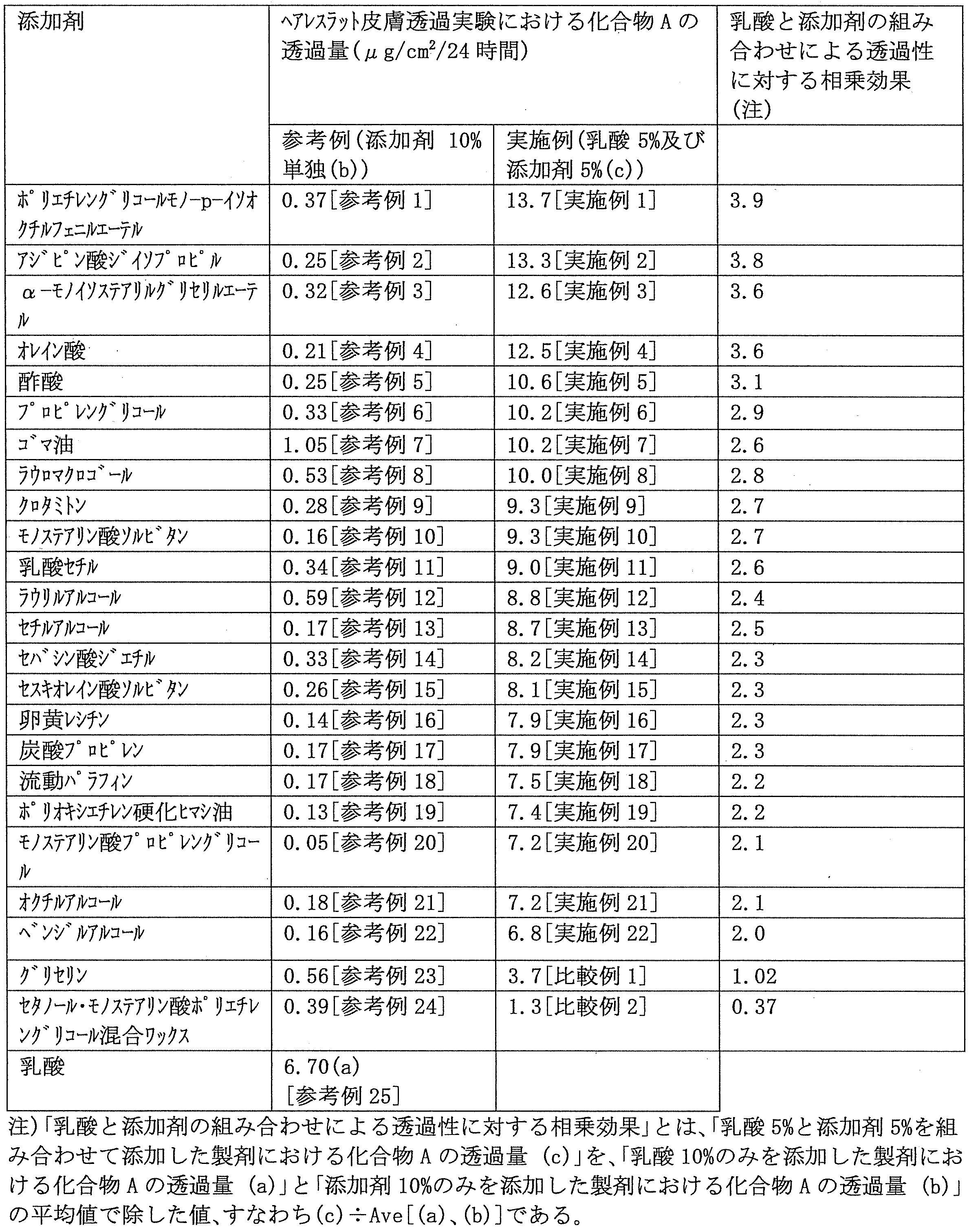
- Reference Examples 2 to 25 Tape preparations were similarly prepared using various additives shown in Table 1 instead of the polyethylene glycol mono-p-isooctylphenyl ether of Reference Example 1.
- Comparative Examples 1 and 2 Tape preparations were produced using glycerin or cetanol / monostearic acid polyethylene glycol mixed wax instead of polyethylene glycol mono-p-isooctylphenyl ether of Example 1 (Comparative Example 1 and Comparative Example 2 respectively).
- the concentration of Compound A in the receiver solution was determined by high performance liquid chromatography (column: YMC AM312 ODS 5 ⁇ m (6 mm ⁇ ⁇ 150 mm; YMC), mobile phase: 0.01 mol / l.
- Compound A in each preparation was measured with an aqueous solution containing sodium dodecyl sulfate (adjusted to pH 2.4 with phosphoric acid): acetonitrile: methanol (2: 5: 3), column temperature: 40 ° C., flow rate: 1.0 ml / min). The amount of permeation was determined. The results are shown in Table 1.
- Examples 23-29 In the same manner as in Example 1, tape preparations were produced using the raw materials shown in Table 2. That is, for example, in Example 23 of Table 2, 3.72 g of acrylic adhesive (Polysic 410-SA, manufactured by Sanyo Chemical Industries, Ltd., solid content 38%), curing agent (Polysic SC-75, Sanyo Chemical Industries Ltd.) Lactic acid and sesame oil in an amount of 7.0%, ethyl acetate 1.2 ml, and the content in the pressure-sensitive adhesive layer were 4% and 16%, respectively. Compound A was added to this mixed solution so that the content in the pressure-sensitive adhesive layer was 9%, and the mixture was sufficiently stirred. The obtained mixed liquid was spread on a support so that the thickness of the pressure-sensitive adhesive layer after drying was about 60 ⁇ m, and dried at room temperature for 1 day. Thereafter, a release liner was bonded to produce a tape preparation.
- acrylic adhesive Polysic 410-SA, manufactured by Sanyo Chemical Industries, Ltd., solid content 38%)
- Reference Examples 26 to 33 A tape preparation was produced using the raw materials shown in Table 2 in the same manner as in Reference Example 1. That is, for example, in Reference Example 27 in Table 2, 3.93 g of acrylic adhesive (Polysic 410-SA, manufactured by Sanyo Chemical Industries, Ltd., solid content 38% by weight), curing agent (Polysic SC-75, Sanyo Chemical Industries) Sesame oil was mixed so that the content in the adhesive layer was 8.0%, ethyl acetate 1.2 ml, and the content in the adhesive layer 16%. Compound A was added to this mixed solution so that the content in the pressure-sensitive adhesive layer was 9%, and the mixture was sufficiently stirred. The obtained mixed liquid was spread on a support so that the thickness of the pressure-sensitive adhesive layer after drying was about 60 ⁇ m, and dried at room temperature for 1 day. Thereafter, a release liner was bonded to produce a tape preparation.
- acrylic adhesive Polysic 410-SA, manufactured by Sanyo Chemical Industries, Ltd., solid content 38% by weight
- Test example 2 As in Test Example 1, the skin permeability of Compound A in the tape preparations obtained in Examples 23 to 29 and Reference Examples 26 to 33 to the skin of the abdomen of hairless rats was measured using an in vitro diffusion cell. Examined. The results are shown in Table 3.
- the permeation amount of Compound A in the present preparation containing lactic acid and sesame oil which is an example of a specific additive is at least 12 times that of sesame oil as compared with lactic acid. It was clearly higher than the total permeation amount of each compound A in the preparation of Reference Example and the preparation of Reference Example in which sesame oil contained the same content alone. This indicates the excellent feature of the present application that the skin permeability of Compound A is synergistically promoted by combining lactic acid and the specific additive at least in the above-mentioned blending ratio.
- Example 30 Acrylic adhesive (DURO-TAK 387-2516 (registered trademark), manufactured by National Starch & Chemical Co., Ltd., solid content 41.5%) 3.90 g, ethyl acetate 1.2 mL, the content in the adhesive layer is 5
- the ⁇ -monoisostearyl glyceryl ether and lactic acid were mixed so that the concentration was 1%.
- Compound A was added to this mixed solution so that the content in the pressure-sensitive adhesive layer was 9%, and the mixture was sufficiently stirred.
- the obtained mixed liquid was spread on a support so that the thickness of the pressure-sensitive adhesive layer after drying was about 60 ⁇ m, and dried at room temperature for 3 days. Thereafter, a release liner was bonded to produce a tape preparation.
- Example 31 A tape formulation was prepared using diisopropyl adipate instead of the ⁇ -monoisostearyl glyceryl ether of Example 30.
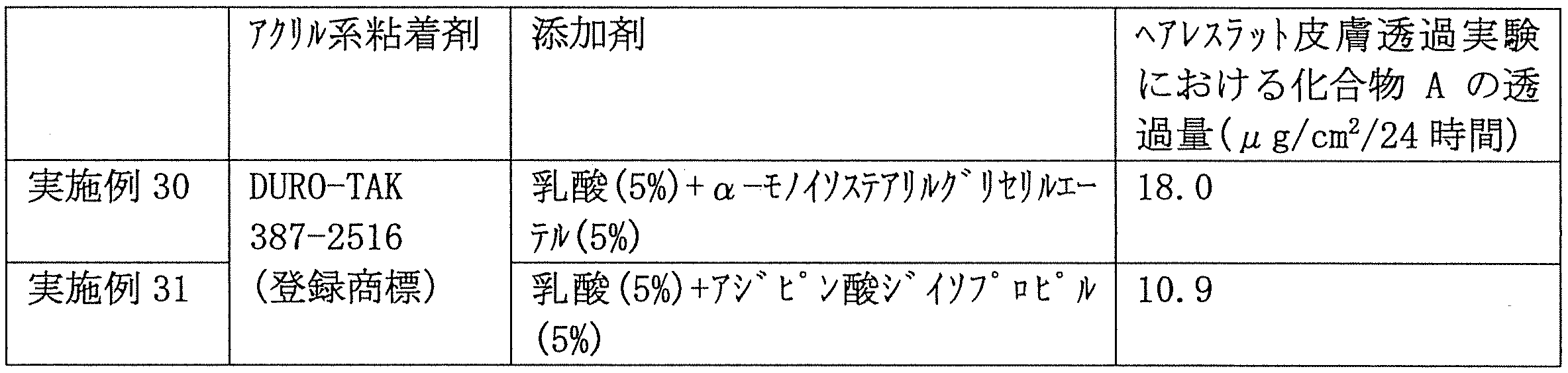
- Test example 3 In the same manner as in Test Example 1, the skin permeability of Compound A in the tape preparations obtained in Examples 30 and 31 to the abdominal skin of hairless rats was examined using an in vitro diffusion cell. The results are shown in Table 4.
- Example 32 Styrene-isoprene-styrene block copolymer (Quintac 3421, manufactured by Nippon Zeon Co., Ltd.) 0.4 g, liquid paraffin 0.4 g, polybutene (HV-300, manufactured by Nippon Petrochemical Co., Ltd.) 0.3 g, alicyclic Sesame oil and lactic acid were mixed so that the saturated hydrocarbon resin (Alcon P-100, manufactured by Arakawa Chemical Industries, Ltd.) 0.5 g, toluene 3.0 mL, and the content in the adhesive layer was 5%, respectively. Compound A was added to this mixed solution so that the content in the pressure-sensitive adhesive layer was 10%, and the mixture was sufficiently stirred. The obtained mixed solution was spread on a support so that the thickness of the pressure-sensitive adhesive layer after drying was about 60 ⁇ m, and dried at room temperature for 7 days. Thereafter, a release liner was bonded to produce a tape preparation.
- the saturated hydrocarbon resin Alcon P
- the patch preparation of the present invention skin permeability can be remarkably improved by blending lactic acid and an additive comprising a specific skin permeation enhancer.
- the patch preparation can be miniaturized, so that a practically suitable patch preparation excellent in usability and economy can be provided.
Landscapes
- Health & Medical Sciences (AREA)
- Engineering & Computer Science (AREA)
- Chemical & Material Sciences (AREA)
- Bioinformatics & Cheminformatics (AREA)
- General Health & Medical Sciences (AREA)
- Public Health (AREA)
- Medicinal Chemistry (AREA)
- Veterinary Medicine (AREA)
- Animal Behavior & Ethology (AREA)
- Pharmacology & Pharmacy (AREA)
- Life Sciences & Earth Sciences (AREA)
- Epidemiology (AREA)
- Dermatology (AREA)
- Chemical Kinetics & Catalysis (AREA)
- General Chemical & Material Sciences (AREA)
- Oil, Petroleum & Natural Gas (AREA)
- Nuclear Medicine, Radiotherapy & Molecular Imaging (AREA)
- Organic Chemistry (AREA)
- Psychiatry (AREA)
- Neurology (AREA)
- Neurosurgery (AREA)
- Biomedical Technology (AREA)
- Medicinal Preparation (AREA)
- Pharmaceuticals Containing Other Organic And Inorganic Compounds (AREA)
Abstract
Description
すなわち、本発明は以下のとおりである。
[2]添加剤が、ポリエチレングリコールモノ-p-イソオクチルフェニルエーテル、アジピン酸ジイソプロピル、α-モノイソステアリルグリセリルエーテル、オレイン酸、酢酸、プロピレングリコール、ゴマ油、及びラウロマクロゴールからなる群から選択される少なくとも1種である上記[1]に記載の貼付製剤。
[3]添加剤が、アジピン酸ジイソプロピル、α-モノイソステアリルグリセリルエーテル、オレイン酸、プロピレングリコール、ゴマ油、及びラウロマクロゴールからなる群から選択される少なくとも1種である上記[1]又は[2]に記載の貼付製剤。
[4]添加剤が、α-モノイソステアリルグリセリルエーテルを含む上記[1]~[3]のいずれかに記載の貼付製剤。
[5]添加剤が、ゴマ油を含む上記[1]~[4]のいずれかに記載の貼付製剤。
[6]添加剤が、ラウロマクロゴールを含む上記[1]~[5]のいずれかに記載の貼付製剤。
[7]添加剤が、アジピン酸ジイソプロピルを含む上記[1]~[6]のいずれかに記載の貼付製剤。
[8]添加剤が、プロピレングリコールを含む上記[1]~[7]のいずれかに記載の貼付製剤。
[9]添加剤が、オレイン酸を含む上記[1]~[8]のいずれかに記載の貼付製剤。
[10]添加剤が、ポリエチレングリコールモノ-p-イソオクチルフェニルエーテルを含む上記[1]又は[2]に記載の貼付製剤。
[11]粘着剤層中の乳酸の含有量が、0.01~20重量%である上記[1]~[10]のいずれかに記載の貼付製剤。
[12]乳酸1重量部に対して、添加剤を0.5~20重量部の割合で含む上記[1]~[11]のいずれかに記載の貼付製剤。
[13]乳酸1重量部に対して、添加剤を0.8~12重量部の割合で含む上記[12]に記載の貼付製剤。
[14]粘着剤層中の乳酸、及び添加剤の含有量の合計が、0.1~60重量%である上記[1]~[13]のいずれかに記載の貼付製剤。
[15]粘着剤が、アクリル系粘着剤、ゴム系粘着剤、及びシリコーン系粘着剤から選択される少なくとも1種である上記[1]~[14]のいずれかに記載の貼付製剤。
[16]粘着剤が、アクリル系粘着剤を含む上記[15]に記載の貼付製剤。
[17]アクリル系粘着剤が、(メタ)アクリル酸アルキルエステルを主体とする(共)重合体、及び(メタ)アクリル酸アルキルエステルと官能性モノマーとの共重合体からなる群から選択される少なくとも1種である上記[15]又は[16]に記載の貼付製剤。
[18]粘着剤が、ゴム系粘着剤を含む上記[15]又は[16]に記載の貼付製剤。
[19]ゴム系粘着剤が、スチレン-イソプレン-スチレンブロック共重合体、及びポリイソブチレンからなる群から選択される少なくとも1種である上記[15]又は[18]に記載の貼付製剤。
[20]粘着剤層が、化合物Aに換算して0.5~40重量%の濃度で成分(i)を含有する上記[1]~[19]のいずれかに記載の貼付製剤。
[21]統合失調症を対象疾患とする上記[1]~[20]のいずれかに記載の貼付製剤。
[22]上記[1]~[20]のいずれかに記載の貼付製剤を、患者の皮膚に適用することを特徴とする、2-(4-エチル-1-ピペラジニル)-4-(4-フルオロフェニル)-5,6,7,8,9,10-ヘキサヒドロシクロオクタ[b]ピリジンの経皮投与方法。
[23]上記[1]~[20]のいずれかに記載の貼付製剤を、統合失調症を患っている患者の皮膚に適用することを特徴とする、統合失調症の治療方法。
本発明にかかわる化合物A、即ち、2-(4-エチル-1-ピペラジニル)-4-(4-フルオロフェニル)-5,6,7,8,9,10-ヘキサヒドロシクロオクタ[b]ピリジン(一般名「ブロナンセリン」)は、下記式:

本発明の粘着剤としては、高分子粘着剤であるシリコーン系粘着剤、ゴム系粘着剤、アクリル系粘着剤等が例示できる。
なお、ここで「(メタ)アクリル酸」とは、「アクリル酸又はメタアクリル酸」、あるいは「アクリル酸及び/又はメタアクリル酸」を意味しており、また、「(共)重合体」とは、「重合体又は共重合体」、あるいは「重合体及び/又は共重合体」を意味する。
乳酸は、ラセミ体であるDL-乳酸であってもよく、光学活性体であるL-乳酸あるいはD-乳酸であってもよい。本明細書でいう乳酸は、これらのいずれであってもよい。
化合物Aを含有する経皮吸収用貼付製剤において、乳酸と、乳酸に比較して化合物Aの透過促進効果が低い特定の添加剤を組み合わせて含有させることにより、化合物Aの透過量は、乳酸のみを含有する製剤、及び上記の特定の添加剤のみを含有する製剤の合計透過量に比較して、顕著に高くなること、すなわち、乳酸と特定の添加剤の組み合わせにより透過促進に対する相乗効果を奏せしめることを見出した。
本発明で使用してもよいゴマ油は、ゴマの種子を圧搾して得られる油であり、生ゴマの種子由来の油でも、炒りゴマの種子由来の油でも、両者の混合物であってもよい。また、「ゴマ油」として食品用や医薬用等に市販されている市販品を用いることが出来る。
本発明の貼付製剤における粘着剤層中に、特に支障のない限り、貼付製剤の製造に用いられる薬学的に許容される製剤化成分を配合してもよい。このような成分としては、配合しても不都合がなく、且つ、配合の必要性があるものならばいずれでもよく、例えば、安定化剤、粘着付与剤、可塑剤、香料、充填剤、増粘剤、硬化剤等が例示できる。
本発明における貼付製剤とは、支持体の片面(一面)に上述の粘着剤層が形成され、粘着剤層の支持体と接触しない他方面には、適宜剥離ライナーが施されたものである。使用時にはこの剥離ライナーを剥がし、該貼付製剤の粘着剤層を皮膚に貼付することで経皮投与がされることとなる。
アクリル系粘着剤(ポリシック410-SA、三洋化成工業株式会社製、固形分38%)4.25g、硬化剤(ポリシックSC-75、三洋化成工業株式会社製、固形分75重量%)9.0mg、酢酸エチル1.2ml、及び粘着剤層中の含有率が各々5%となるような量の乳酸とポリエチレングリコールモノ-p-イソオクチルフェニルエーテルを混合した。この混合液に粘着剤層中の含有率が9%となるように化合物Aを添加し、十分に攪拌した。得られた混合液を、乾燥後の粘着剤層の厚さが約60μmとなるように支持体上に展延し、室温で1日乾燥した。その後、剥離ライナーを貼り合わせてテープ製剤を製造した。
実施例1のポリエチレングリコールモノ-p-イソオクチルフェニルエーテルの代わりに表1に示す種々の添加剤を用いてテープ製剤を製造した。
アクリル系粘着剤(ポリシック410-SA、三洋化成工業株式会社製、固形分38重量%)4.25g、硬化剤(ポリシックSC-75、三洋化成工業株式会社製、固形分75重量%)9.0mg、酢酸エチル1.2ml、及び粘着剤層中の含有率が10%となるようにポリエチレングリコールモノ-p-イソオクチルフェニルエーテルを混合した。この混合液に粘着剤層中の含有率が9%となるように化合物Aを添加し、十分に攪拌した。得られた混合液を、乾燥後の粘着剤層の厚さが約60μmとなるように支持体上に展延し、室温で1日乾燥した。その後、剥離ライナーを貼り合わせてテープ製剤を製造した。
参考例1のポリエチレングリコールモノ-p-イソオクチルフェニルエーテルの代わりに表1に示す種々の添加剤を用いて同様にテープ製剤を製造した。
実施例1のポリエチレングリコールモノ-p-イソオクチルフェニルエーテルの代わりにグリセリンあるいはセタノール・モノステアリン酸ポリエチレングリコール混合ワックスを用いてテープ製剤を製造した(各々比較例1、比較例2)。
ヘアレスラット皮膚透過実験
In vitro拡散セルを用いて、5から6週令のヘアレスラットの腹部の皮膚に対しての実施例1~22、参考例1~25、及び比較例1、2で得られたテープ製剤についての化合物Aの皮膚透過性を調べた。すなわち、透過面積1.13cm2のIn vitro拡散セルにヘアレスラットの皮膚をセットし、レシーバー液としてポリエチレングリコール200(マクロゴール200)とリン酸緩衝液の2:1混合液0.75mLを使用して、ドナー側の皮膚には各製剤を貼付した(n=4)。24時間にわたり37℃保温下、レシーバー液を撹拌した後、レシーバー液中の化合物A濃度を高速液体クロマトグラフィー(カラム:YMC AM312 ODS 5μm(6mmφ×150mm;YMC)、移動相:0.01mol/l ドデシル硫酸Na含有水溶液(pH2.4にリン酸で調整):アセトニトリル:メタノール(2:5:3)、カラム温度:40℃、流速:1.0ml/分)により測定し、各製剤における化合物Aの透過量を求めた。結果を表1に示した。
実施例1と同様の方法で、表2に記載の各原料を用いてテープ製剤を製造した。
すなわち、例えば、表2の実施例23では、アクリル系粘着剤(ポリシック410-SA、三洋化成工業株式会社製、固形分38%)3.72g、硬化剤(ポリシックSC-75、三洋化成工業株式会社製、固形分75重量%)7.0mg、酢酸エチル1.2ml、及び粘着剤層中の含有率が各々4%と16%となるような量の乳酸とゴマ油を混合した。この混合液に粘着剤層中の含有率が9%となるように化合物Aを添加し、十分に攪拌した。得られた混合液を、乾燥後の粘着剤層の厚さが約60μmとなるように支持体上に展延し、室温で1日乾燥した。その後、剥離ライナーを貼り合わせてテープ製剤を製造した。
参考例1と同様の方法で、表2に記載の各原料を用いてテープ製剤を製造した。
すなわち、例えば、表2の参考例27では、アクリル系粘着剤(ポリシック410-SA、三洋化成工業株式会社製、固形分38重量%)3.93g、硬化剤(ポリシックSC-75、三洋化成工業株式会社製、固形分75重量%)8.0mg、酢酸エチル1.2ml、及び粘着剤層中の含有率が16%となるようにゴマ油を混合した。この混合液に粘着剤層中の含有率が9%となるように化合物Aを添加し、十分に攪拌した。得られた混合液を、乾燥後の粘着剤層の厚さが約60μmとなるように支持体上に展延し、室温で1日乾燥した。その後、剥離ライナーを貼り合わせてテープ製剤を製造した。

試験例1と同様に、In vitro拡散セルを用いて、ヘアレスラットの腹部の皮膚に対しての実施例23~29及び参考例26~33で得られたテープ製剤における化合物Aの皮膚透過性を調べた。結果を表3に示した。

アクリル系粘着剤(DURO-TAK 387-2516(登録商標)、ナショナルスターチ&ケミカル社製、固形分41.5%)3.90g、酢酸エチル1.2mL、粘着剤層中の含有率がそれぞれ5%となるようにα-モノイソステアリルグリセリルエーテルと乳酸を混合した。この混合液に粘着剤層中の含有率が9%となるように化合物Aを添加し、十分に攪拌した。得られた混合液を、乾燥後の粘着剤層の厚さが約60μmとなるように支持体上に展延し、室温で3日間乾燥した。その後、剥離ライナーを貼り合わせてテープ製剤を製造した。
実施例30のα-モノイソステアリルグリセリルエーテルにかえて、アジピン酸ジイソプロピルを使用してテープ製剤を製造した。
試験例1と同様に、In vitro拡散セルを用いて、ヘアレスラットの腹部の皮膚に対しての実施例30及び31で得られたテープ製剤における化合物Aの皮膚透過性を調べた。結果を表4に示した。
スチレン-イソプレン-スチレンブロック共重合体(クインタック3421、日本ゼオン株式会社製)0.4g、流動パラフィン0.4g、ポリブテン(HV-300、日本石油化学株式会社製)0.3g、脂環族飽和炭化水素樹脂(アルコンP-100、荒川化学工業株式会社製)0.5g、トルエン3.0mL、粘着剤層中の含有率がそれぞれ5%となるようにゴマ油と乳酸を混合した。この混合液に粘着剤層中の含有率が10%となるように化合物Aを添加し、十分に攪拌した。得られた混合液を、乾燥後の粘着剤層の厚さが約60μmとなるように支持体上に展延し、室温で7日間乾燥した。その後、剥離ライナーを貼り合わせてテープ製剤を製造した。
Claims (15)
- 支持体の片面に粘着剤層を有する貼付製剤において、該粘着剤層が、
(i)2-(4-エチル-1-ピペラジニル)-4-(4-フルオロフェニル)-5,6,7,8,9,10-ヘキサヒドロシクロオクタ[b]ピリジン(以下、「化合物A」という)又はその生理学的に許容される酸付加塩、
(ii)粘着剤、
(iii)乳酸、並びに
(iv)ポリエチレングリコールモノ-p-イソオクチルフェニルエーテル、アジピン酸ジイソプロピル、α-モノイソステアリルグリセリルエーテル、オレイン酸、酢酸、プロピレングリコール、ゴマ油、ラウロマクロゴール、クロタミトン、モノステアリン酸ソルビタン、乳酸セチル、ラウリルアルコール、セチルアルコール、セバシン酸ジエチル、セスキオレイン酸ソルビタン、卵黄レシチン、炭酸プロピレン、流動パラフィン、ポリオキシエチレン硬化ヒマシ油、モノステアリン酸プロピレングリコール、オクチルアルコール及びベンジルアルコールからなる群から選択される少なくとも1種の添加剤
を含有する貼付製剤。 - 添加剤が、ポリエチレングリコールモノ-p-イソオクチルフェニルエーテル、アジピン酸ジイソプロピル、α-モノイソステアリルグリセリルエーテル、オレイン酸、酢酸、プロピレングリコール、ゴマ油、及びラウロマクロゴールからなる群から選択される少なくとも1種である請求項1に記載の貼付製剤。
- 添加剤が、アジピン酸ジイソプロピル、α-モノイソステアリルグリセリルエーテル、オレイン酸、プロピレングリコール、ゴマ油、及びラウロマクロゴールからなる群から選択される少なくとも1種である請求項1又は2に記載の貼付製剤。
- 添加剤が、ゴマ油を含む請求項1~3のいずれか一項に記載の貼付製剤。
- 粘着剤層中の乳酸の含有量が、0.01~20重量%である請求項1~4のいずれか一項に記載の貼付製剤。
- 乳酸1重量部に対して、添加剤を0.5~20重量部の割合で含む請求項1~5のいずれか一項に記載の貼付製剤。
- 乳酸1重量部に対して、添加剤を0.8~12重量部の割合で含む請求項6に記載の貼付製剤。
- 粘着剤層中の乳酸、及び添加剤の含有量の合計が、0.1~60重量%である請求項1~7のいずれか一項に記載の貼付製剤。
- 粘着剤が、アクリル系粘着剤、ゴム系粘着剤、及びシリコーン系粘着剤から選択される少なくとも1種である請求項1~8のいずれか一項に記載の貼付製剤。
- 粘着剤が、アクリル系粘着剤を含む請求項9に記載の貼付製剤。
- アクリル系粘着剤が、(メタ)アクリル酸アルキルエステルを主体とする(共)重合体、及び(メタ)アクリル酸アルキルエステルと官能性モノマーとの共重合体からなる群から選択される少なくとも1種である請求項9又は10に記載の貼付製剤。
- 粘着剤が、ゴム系粘着剤を含む請求項9又は10に記載の貼付製剤。
- ゴム系粘着剤が、スチレン-イソプレン-スチレンブロック共重合体、及びポリイソブチレンからなる群から選択される少なくとも1種である請求項9又は12に記載の貼付製剤。
- 粘着剤層が、化合物Aに換算して0.5~40重量%の濃度で成分(i)を含有する請求項1~13のいずれか一項に記載の貼付製剤。
- 統合失調症を対象疾患とする請求項1~14のいずれか一項に記載の貼付製剤。
Priority Applications (7)
| Application Number | Priority Date | Filing Date | Title |
|---|---|---|---|
| KR1020137021787A KR101868186B1 (ko) | 2011-02-02 | 2012-02-01 | 경피 흡수용 첩부 제제 |
| CA2826217A CA2826217A1 (en) | 2011-02-02 | 2012-02-01 | Transdermal patch |
| JP2012555938A JP5837518B2 (ja) | 2011-02-02 | 2012-02-01 | 経皮吸収用貼付製剤 |
| EP12742258.2A EP2671588A4 (en) | 2011-02-02 | 2012-02-01 | Transdermal patch |
| US13/983,366 US20130315977A1 (en) | 2011-02-02 | 2012-02-01 | Transdermal patch |
| HK13113457.4A HK1186099B (en) | 2011-02-02 | 2012-02-01 | Transdermal patch |
| CN201280007478.6A CN103347522B (zh) | 2011-02-02 | 2012-02-01 | 透皮贴剂 |
Applications Claiming Priority (2)
| Application Number | Priority Date | Filing Date | Title |
|---|---|---|---|
| JP2011-021197 | 2011-02-02 | ||
| JP2011021197 | 2011-02-02 |
Publications (1)
| Publication Number | Publication Date |
|---|---|
| WO2012105624A1 true WO2012105624A1 (ja) | 2012-08-09 |
Family
ID=46602830
Family Applications (1)
| Application Number | Title | Priority Date | Filing Date |
|---|---|---|---|
| PCT/JP2012/052312 Ceased WO2012105624A1 (ja) | 2011-02-02 | 2012-02-01 | 経皮吸収用貼付製剤 |
Country Status (7)
| Country | Link |
|---|---|
| US (1) | US20130315977A1 (ja) |
| EP (1) | EP2671588A4 (ja) |
| JP (1) | JP5837518B2 (ja) |
| KR (1) | KR101868186B1 (ja) |
| CN (1) | CN103347522B (ja) |
| CA (1) | CA2826217A1 (ja) |
| WO (1) | WO2012105624A1 (ja) |
Cited By (6)
| Publication number | Priority date | Publication date | Assignee | Title |
|---|---|---|---|---|
| US20180289631A1 (en) * | 2012-07-26 | 2018-10-11 | Hisamitsu Pharmaceutical Co., Inc. | Patch |
| WO2021230064A1 (ja) * | 2020-05-14 | 2021-11-18 | 株式会社カネカ | ブロナンセリン含有貼付剤、及びその製造方法 |
| JP2023011534A (ja) * | 2021-07-12 | 2023-01-24 | 久光製薬株式会社 | ブロナンセリン含有貼付剤 |
| JP2023024350A (ja) * | 2021-08-04 | 2023-02-16 | 久光製薬株式会社 | ブロナンセリン含有貼付剤 |
| US11844763B2 (en) | 2014-04-17 | 2023-12-19 | Avenir Wellness Solutions, Inc. | Pharmaceutical composition and method of manufacturing |
| US11890310B2 (en) | 2014-04-17 | 2024-02-06 | Avenir Wellness Solutions, Inc. | Pharmaceutical composition and method of manufacturing |
Families Citing this family (2)
| Publication number | Priority date | Publication date | Assignee | Title |
|---|---|---|---|---|
| JP7718992B2 (ja) * | 2020-02-05 | 2025-08-05 | 株式会社カネカ | ブロナンセリン含有貼付剤、及びその製造方法 |
| CN115087445A (zh) * | 2020-02-19 | 2022-09-20 | 住友制药株式会社 | 经皮吸收制剂 |
Citations (4)
| Publication number | Priority date | Publication date | Assignee | Title |
|---|---|---|---|---|
| JPH07506562A (ja) * | 1991-12-20 | 1995-07-20 | シグナス,インコーポレイテッド | 植物油ベースの皮膚透過促進剤組成物,およびそれに関連する方法ならびにシステム |
| WO2002032431A1 (fr) * | 2000-10-16 | 2002-04-25 | Hisamitsu Pharmaceutical Co., Inc. | Compositions pour preparations externes |
| JP2003526678A (ja) * | 2000-03-10 | 2003-09-09 | エピセプト コーポレーション | 局所麻酔薬投与用の皮内浸透剤 |
| WO2007142295A1 (ja) * | 2006-06-09 | 2007-12-13 | Dainippon Sumitomo Pharma Co., Ltd. | 新規テープ製剤 |
Family Cites Families (1)
| Publication number | Priority date | Publication date | Assignee | Title |
|---|---|---|---|---|
| JP2911340B2 (ja) | 1993-08-06 | 1999-06-23 | 三洋電機株式会社 | 射出成形金型 |
-
2012
- 2012-02-01 WO PCT/JP2012/052312 patent/WO2012105624A1/ja not_active Ceased
- 2012-02-01 EP EP12742258.2A patent/EP2671588A4/en not_active Withdrawn
- 2012-02-01 CA CA2826217A patent/CA2826217A1/en not_active Abandoned
- 2012-02-01 CN CN201280007478.6A patent/CN103347522B/zh not_active Expired - Fee Related
- 2012-02-01 JP JP2012555938A patent/JP5837518B2/ja active Active
- 2012-02-01 KR KR1020137021787A patent/KR101868186B1/ko not_active Expired - Fee Related
- 2012-02-01 US US13/983,366 patent/US20130315977A1/en not_active Abandoned
Patent Citations (4)
| Publication number | Priority date | Publication date | Assignee | Title |
|---|---|---|---|---|
| JPH07506562A (ja) * | 1991-12-20 | 1995-07-20 | シグナス,インコーポレイテッド | 植物油ベースの皮膚透過促進剤組成物,およびそれに関連する方法ならびにシステム |
| JP2003526678A (ja) * | 2000-03-10 | 2003-09-09 | エピセプト コーポレーション | 局所麻酔薬投与用の皮内浸透剤 |
| WO2002032431A1 (fr) * | 2000-10-16 | 2002-04-25 | Hisamitsu Pharmaceutical Co., Inc. | Compositions pour preparations externes |
| WO2007142295A1 (ja) * | 2006-06-09 | 2007-12-13 | Dainippon Sumitomo Pharma Co., Ltd. | 新規テープ製剤 |
Non-Patent Citations (1)
| Title |
|---|
| See also references of EP2671588A4 * |
Cited By (11)
| Publication number | Priority date | Publication date | Assignee | Title |
|---|---|---|---|---|
| US20180289631A1 (en) * | 2012-07-26 | 2018-10-11 | Hisamitsu Pharmaceutical Co., Inc. | Patch |
| US11123305B2 (en) * | 2012-07-26 | 2021-09-21 | Hisamitsu Pharmaceutical Co., Inc. | Patch |
| US11813364B2 (en) | 2012-07-26 | 2023-11-14 | Hisamitsu Pharmaceutical Co., Inc. | Patch |
| US11844763B2 (en) | 2014-04-17 | 2023-12-19 | Avenir Wellness Solutions, Inc. | Pharmaceutical composition and method of manufacturing |
| US11890310B2 (en) | 2014-04-17 | 2024-02-06 | Avenir Wellness Solutions, Inc. | Pharmaceutical composition and method of manufacturing |
| US11938160B2 (en) | 2014-04-17 | 2024-03-26 | Avenir Wellness Solutions, Inc. | Pharmaceutical composition and method of manufacturing |
| WO2021230064A1 (ja) * | 2020-05-14 | 2021-11-18 | 株式会社カネカ | ブロナンセリン含有貼付剤、及びその製造方法 |
| JP2023011534A (ja) * | 2021-07-12 | 2023-01-24 | 久光製薬株式会社 | ブロナンセリン含有貼付剤 |
| JP7653950B2 (ja) | 2021-07-12 | 2025-03-31 | 久光製薬株式会社 | ブロナンセリン含有貼付剤 |
| JP2023024350A (ja) * | 2021-08-04 | 2023-02-16 | 久光製薬株式会社 | ブロナンセリン含有貼付剤 |
| JP7640498B2 (ja) | 2021-08-04 | 2025-03-05 | 久光製薬株式会社 | ブロナンセリン含有貼付剤 |
Also Published As
| Publication number | Publication date |
|---|---|
| JP5837518B2 (ja) | 2015-12-24 |
| EP2671588A1 (en) | 2013-12-11 |
| CN103347522B (zh) | 2015-09-02 |
| EP2671588A4 (en) | 2014-10-01 |
| JPWO2012105624A1 (ja) | 2014-07-03 |
| CN103347522A (zh) | 2013-10-09 |
| KR101868186B1 (ko) | 2018-06-15 |
| CA2826217A1 (en) | 2012-08-09 |
| KR20140083922A (ko) | 2014-07-04 |
| US20130315977A1 (en) | 2013-11-28 |
| HK1186099A1 (zh) | 2014-03-07 |
Similar Documents
| Publication | Publication Date | Title |
|---|---|---|
| JP5001271B2 (ja) | 新規テープ製剤 | |
| JP5837518B2 (ja) | 経皮吸収用貼付製剤 | |
| JP6077596B2 (ja) | ロピニロール含有貼付剤及びその包装体 | |
| KR20160014064A (ko) | 경피 전달 시스템 | |
| JP2016106133A (ja) | 経皮吸収促進剤及びそれを含有する経皮吸収型製剤 | |
| CN109432061A (zh) | 含有布洛芬或其结构类似物的多层经皮给药系统 | |
| JP5913335B2 (ja) | 新規外用製剤 | |
| JP6912122B2 (ja) | 経皮投与製剤 | |
| HK1186099B (en) | Transdermal patch | |
| HK1137344B (en) | Tape preparation | |
| JP2022113659A (ja) | クロニジン含有経皮吸収型貼付製剤 | |
| JP2019034905A (ja) | デヒドロ酢酸含有経皮吸収製剤 | |
| JPWO2017164381A1 (ja) | ゾニサミド含有経皮吸収型貼付製剤 |
Legal Events
| Date | Code | Title | Description |
|---|---|---|---|
| 121 | Ep: the epo has been informed by wipo that ep was designated in this application |
Ref document number: 12742258 Country of ref document: EP Kind code of ref document: A1 |
|
| ENP | Entry into the national phase |
Ref document number: 2012555938 Country of ref document: JP Kind code of ref document: A |
|
| ENP | Entry into the national phase |
Ref document number: 2826217 Country of ref document: CA |
|
| WWE | Wipo information: entry into national phase |
Ref document number: 2012742258 Country of ref document: EP |
|
| NENP | Non-entry into the national phase |
Ref country code: DE |
|
| WWE | Wipo information: entry into national phase |
Ref document number: 13983366 Country of ref document: US |
|
| ENP | Entry into the national phase |
Ref document number: 20137021787 Country of ref document: KR Kind code of ref document: A |