WO2012107477A1 - Microbiocidal pyrazole derivatives - Google Patents

Microbiocidal pyrazole derivatives Download PDF

Info

Publication number
WO2012107477A1
WO2012107477A1 PCT/EP2012/052110 EP2012052110W WO2012107477A1 WO 2012107477 A1 WO2012107477 A1 WO 2012107477A1 EP 2012052110 W EP2012052110 W EP 2012052110W WO 2012107477 A1 WO2012107477 A1 WO 2012107477A1
Authority
WO
WIPO (PCT)
Prior art keywords
crc
formula
alkyl
compound
compounds
Prior art date
Legal status (The legal status is an assumption and is not a legal conclusion. Google has not performed a legal analysis and makes no representation as to the accuracy of the status listed.)
Ceased
Application number
PCT/EP2012/052110
Other languages
French (fr)
Inventor
Clemens Lamberth
Fredrik Cederbaum
Guillaume Berthon
Sarah Sulzer-Mosse
Current Assignee (The listed assignees may be inaccurate. Google has not performed a legal analysis and makes no representation or warranty as to the accuracy of the list.)
Syngenta Participations AG
Original Assignee
Syngenta Participations AG
Priority date (The priority date is an assumption and is not a legal conclusion. Google has not performed a legal analysis and makes no representation as to the accuracy of the date listed.)
Filing date
Publication date
Application filed by Syngenta Participations AG filed Critical Syngenta Participations AG
Priority to EP12702290.3A priority Critical patent/EP2673272A1/en
Priority to CN2012800080518A priority patent/CN103347879A/en
Priority to US13/984,459 priority patent/US20130317064A1/en
Priority to BR112013020419A priority patent/BR112013020419A2/en
Publication of WO2012107477A1 publication Critical patent/WO2012107477A1/en
Anticipated expiration legal-status Critical
Ceased legal-status Critical Current

Links

Classifications

    • AHUMAN NECESSITIES
    • A01AGRICULTURE; FORESTRY; ANIMAL HUSBANDRY; HUNTING; TRAPPING; FISHING
    • A01NPRESERVATION OF BODIES OF HUMANS OR ANIMALS OR PLANTS OR PARTS THEREOF; BIOCIDES, e.g. AS DISINFECTANTS, AS PESTICIDES OR AS HERBICIDES; PEST REPELLANTS OR ATTRACTANTS; PLANT GROWTH REGULATORS
    • A01N43/00Biocides, pest repellants or attractants, or plant growth regulators containing heterocyclic compounds
    • A01N43/72Biocides, pest repellants or attractants, or plant growth regulators containing heterocyclic compounds having rings with nitrogen atoms and oxygen or sulfur atoms as ring hetero atoms
    • A01N43/74Biocides, pest repellants or attractants, or plant growth regulators containing heterocyclic compounds having rings with nitrogen atoms and oxygen or sulfur atoms as ring hetero atoms five-membered rings with one nitrogen atom and either one oxygen atom or one sulfur atom in positions 1,3
    • A01N43/781,3-Thiazoles; Hydrogenated 1,3-thiazoles
    • CCHEMISTRY; METALLURGY
    • C07ORGANIC CHEMISTRY
    • C07DHETEROCYCLIC COMPOUNDS
    • C07D413/00Heterocyclic compounds containing two or more hetero rings, at least one ring having nitrogen and oxygen atoms as the only ring hetero atoms
    • C07D413/02Heterocyclic compounds containing two or more hetero rings, at least one ring having nitrogen and oxygen atoms as the only ring hetero atoms containing two hetero rings
    • C07D413/04Heterocyclic compounds containing two or more hetero rings, at least one ring having nitrogen and oxygen atoms as the only ring hetero atoms containing two hetero rings directly linked by a ring-member-to-ring-member bond
    • CCHEMISTRY; METALLURGY
    • C07ORGANIC CHEMISTRY
    • C07DHETEROCYCLIC COMPOUNDS
    • C07D413/00Heterocyclic compounds containing two or more hetero rings, at least one ring having nitrogen and oxygen atoms as the only ring hetero atoms
    • C07D413/14Heterocyclic compounds containing two or more hetero rings, at least one ring having nitrogen and oxygen atoms as the only ring hetero atoms containing three or more hetero rings
    • CCHEMISTRY; METALLURGY
    • C07ORGANIC CHEMISTRY
    • C07DHETEROCYCLIC COMPOUNDS
    • C07D417/00Heterocyclic compounds containing two or more hetero rings, at least one ring having nitrogen and sulfur atoms as the only ring hetero atoms, not provided for by group C07D415/00
    • C07D417/14Heterocyclic compounds containing two or more hetero rings, at least one ring having nitrogen and sulfur atoms as the only ring hetero atoms, not provided for by group C07D415/00 containing three or more hetero rings

Definitions

  • the present invention relates to microbiocidal pyrazole derivatives, e.g. as active ingredients, which have microbiocidal activity, in particular fungicidal activity.
  • the invention also relates to preparation of these pyrazole derivatives, to pyrazole derivatives used as
  • the present invention provides compounds of formula I:
  • G 1 , G 2 and G 3 are independently O or S;
  • T is CR 13 or N
  • Y 1 and Y 2 are independently CR 14 or N;
  • the bond between A and Q 1 is a single bond or a double bond
  • n 1 or 2;
  • p is 1 or 2, providing that when n is 2, p is 1 ;
  • x is 0 or 1 , providing that when x is 1 , Q 1 and Q 2 cannot both be oxygen;
  • R 1 , R 2 , R 3 , R 4 , R 5 , R 6 , R 7 , R 8 , R 9 , R 10 , R 13 and R 14 each independently are hydrogen, halogen, cyano, CrC 4 alkyl, C 3 -C 5 cycloalkyl or C C 4 haloalkyl;
  • R 11 is hydrogen, C C 4 alkyl, C 3 -C 5 cycloalkyl or C C 4 alkoxy;
  • M + is a metal cation or ammonium cation
  • R 15 , R 16 R 17 , R 18 , R 19 and R 20 each independently are hydrogen, halogen, hydroxyl, amino, cyano, CrC 8 alkyl, CrC 8 alkylcarbonyl, C 2 -C 8 alkenyl, C 2 -C 8 alkynyl, C 3 -C 8 cycloalkyl, CrC 8 alkoxy,
  • R 15 and R 16 , R 17 and R 18 , and/or R 19 and R 20 may together form a saturated three- to six- membered alicyclic or heterocyclic ring wherein the aliyclic and heterocyclic rings are optionally substituted by one or more R 24 ; and/or
  • R 15 and R 17 , and/or R 18 and R 19 may together form a saturated or partially unsaturated four- to seven-membered alicyclic or heterocyclic ring wherein the aliyclic and heterocyclic rings are optionally substituted by one or more R 24 ; and/or
  • R 15 and R 19 may together form a saturated or partially unsaturated four- to seven-membered alicyclic or heterocyclic ring wherein the aliyclic and heterocyclic rings are optionally substituted by one or more R 24 ;
  • R 21 and R 22 each independently are hydrogen, CrC 8 alkyl, CrC 8 haloalkyl C 2 -C 8 alkenyl, C C 8 haloalkenyl C 2 -C 8 alkynyl, C 2 -C 8 haloalkynyl, C 3 -C 8 cycloalkyl, C 3 -C 8 halocycloalkyl, C
  • each R 23 independently is halogen, cyano, amino, nitro, hydroxyl, mercapto, CrC 8 alkyl, C 2 - C 8 alkenyl, C 2 -C 8 alkynyl, C 3 -C 8 cycloalkyl, C3-C 8 cycloalkyl-CrC 4 alkyl, C 3 -C 8 cycloalkyl-Cr
  • alkylcarbonyl C 3 -C 8 cycloalkylcarbonyl, C 2 -C 8 alkenylcarbonyl, C 2 -C 8 alkynylcarbonyl, wherein alkyl, alkenyl, alkynyl, cycloalkyi, alkoxy, alkenyloxy, alkynyloxy and cycloalkoxy are optionally substituted by halogen, and wherein aryl and heterocyclyl are optionally substituted by one or more R 24 ;
  • each R 24 independently is halogen, cyano, C C 4 alkyl, C C 4 haloalkyl, C C 4 alkoxy or C
  • R 25 is CrC 6 alkyl or CrC 6 alkoxy; or a salt or a N-oxide thereof.
  • substituents are indicated as being optionally substituted, this means that they may or may not carry one or more identical or different substituents, e.g. one to five substituents, e.g. one to three substituents. Normally not more than three such optional substituents are present at the same time.
  • substituents are indicated as being substituted, e.g. alkyl, unless stated otherwise this includes those groups that are part of other groups, e.g. the alkyl in alkylthio.
  • halogen refers to fluorine, chlorine, bromine or iodine, preferably fluorine, chlorine or bromine.
  • Alkyl substituents may be straight-chained or branched. Alkyl on its own or as part of another substituent is, depending upon the number of carbon atoms mentioned, for example, methyl, ethyl, n-propyl, n-butyl, n-pentyl, n-hexyl and the isomers thereof, for example, iso- propyl, iso-butyl, sec-butyl, tert-butyl, iso-amyl or pivaloyl.
  • Alkenyl substituents can be in the form of straight or branched chains, and the alkenyl moieties, where appropriate, can be of either the (E)- or ⁇ -configuration. Examples are vinyl and allyl.
  • the alkenyl groups are preferably C 2 -C 6 , more preferably C 2 -C 4 and most preferably C 2 -C 3 alkenyl groups.
  • Alkynyl substituents can be in the form of straight or branched chains. Examples are ethynyl and propargyl.
  • the alkynyl groups are preferably C 2 -C 6 , more preferably C 2 -C 4 and most preferably C 2 -C 3 alkynyl groups.
  • Haloalkyl groups may contain one or more identical or different halogen atoms and, for example, may stand for CH 2 CI, CHCI 2 , CCI 3 , CH 2 F, CHF 2 , CF 3 , CF 3 CH 2 , CH 3 CF 2 , CF 3 CF 2 or CCI 3 CCI 2 .
  • Haloalkenyl groups are alkenyl groups, respectively, which are substituted with one or more of the same or different halogen atoms and are, for example, 2,2-difluorovinyl or 1 ,2- dichloro-2-fluoro-vinyl.
  • Haloalkynyl groups are alkynyl groups, respectively, which are substituted with one or more of the same or different halogen atoms and are, for example, 1-chloro-prop-2-ynyl.
  • Alkoxy means a radical -OR, where R is alkyl, e.g. as defined above.
  • Alkoxy groups include, but are not limited to, methoxy, ethoxy, 1-methylethoxy, propoxy, butoxy, 1- methylpropoxy and 2-methylpropoxy.
  • Cyano means a -CN group.
  • Amino means an NH 2 group.
  • Hydroxyl or hydroxy stands for a -OH group.
  • Aryl means a ring system which may be mono-, bi- or tricyclic. Examples of such rings include phenyl, naphthalenyl, anthracenyl, indenyl or phenanthrenyl. A preferred aryl group is phenyl.
  • Heteroaryl stands for aromatic ring systems comprising mono-, bi- or tricyclic systems wherein at least one oxygen, nitrogen or sulfur atom is present as a ring member.
  • Monocyclic and bicyclic aromatic ring systems are preferred, monocyclic ring systems are more preferred.
  • monocyclic heteoraryl may be a 5- to 7-membered aromatic ring containing one to three heteroatoms selected from oxygen, nitrogen and sulfur, more preferably selected from nitrogen and sulfur.
  • Bicyclic heteroaryl may be a 9- to 1 1-membered bicyclic ring containing one to five heteroatoms, preferably one to three heteroatoms, selected from oxygen, nitrogen and sulfur.
  • Examples are furyl, thienyl, pyrrolyl, imidazolyl, pyrazolyl, thiazolyl, isothiazolyl, oxazolyl, isoxazolyl, oxadiazolyl, thiadiazolyl, triazolyl, tetrazolyl, pyridyl, pyridazinyl, pyrimidinyl, pyrazinyl, triazinyl, tetrazinyl, indolyl, benzothiophenyl, benzofuranyl, benzimidazolyl, indazolyl, benzotriazolyl, benzothiazolyl, benzoxazolyl, imiazothiazoyl, quinolinyl, quinoxalinyl, isoquinolinyl, phthalazinyl, quinoxalinyl, quinazolinyl, cinnolinyl and naphthyridinyl, preferably pyr
  • Heterocyclyl is defined to include heteroaryl and in addition their unsaturated or partially unsaturated analogues.
  • the compounds of formula I may occur in different tautomeric forms, for example, if R 12 is hydroxyl, in the formulas I. a, l.b and I.e. Each form is included within the compounds of formula I.
  • asymmetric carbon atoms in a compound of formula I means that the compounds may occur in optically isomeric forms, i.e. enantiomeric or diastereomeric forms. Also atropisomers may occur as a result of restricted rotation about a single bond.
  • Formula I is intended to include all those possible isomeric forms and mixtures thereof.
  • the present invention includes all those possible isomeric forms and mixtures thereof for a compound of formula I.
  • formula I is intended to include all possible tautomers.
  • the present invention includes all possible tautomeric forms for a compound of formula I.
  • the compounds of formula I according to the invention are in free form, in oxidized form as a N-oxide or in salt form, e.g. an agronomically usable salt form.
  • N-oxides are oxidized forms of tertiary amines or oxidized forms of nitrogen containing heteroaromatic compounds. They are described for instance in the book "Heterocyclic N-oxides" by A. Albini and S. Pietra, CRC Press, Boca Raton 1991.
  • G 1 , G 2 and G 3 are independently O or S.
  • G 1 is preferably O.
  • G 2 is preferably S.
  • G 3 is preferably O.
  • T is CR 13 or N, preferably CH or N, more preferably CH.
  • Y 1 and Y 2 are independently CR 14 or N.
  • Y 1 is preferably CH or N, more preferably N.
  • Y 2 is preferably CH or N; more preferably CH.
  • n 1 or 2, preferably 2.
  • p is 1 or 2, providing that when n is 2, p is 1 , preferably p is 1.
  • x is 1 or 0, preferably 1.
  • Preferably there are no adjacent C 0 groups in the ring formed by A, Q 1 and Q 2 .
  • Preferably no more than two of A, Q 1 and Q 2 are NR 21 , O or S.
  • the bond between A and Q 1 is a single bond or a double bond
  • A, Q 1 and Q 2 there are no adjacent heteroatoms in the ring formed by A, Q 1 and Q 2 .
  • no more than one of A, Q 1 and Q 2 are NR 21 , O or S.
  • Q 2 is C(R 19 R 20 ), NR 17 , O or S.
  • Q 1 is C(R 17 R 18 ), NR 17 , O or S.
  • Even more preferred options for A, Q 1 and Q 2 are depicted by Z1 to Z19 in formula l.d (see below).
  • R 1 , R 2 , R 3 , R 4 , R 5 , R 6 , R 7 , R 8 , R 9 , R 10 , R 13 and R 14 each independently are hydrogen, halogen, cyano, C C 4 alkyl or C C 4 haloalkyl, preferably hydrogen, halogen, C C 4 alkyl or C C 4 haloalkyl.
  • R 1 and R 2 are each independently halogen, methyl or halomethyl, more preferably methyl or halomethyl, more preferably methyl or trifluoromethyl.
  • R 1 is trifluoromethyl.
  • R 2 is methyl. In one group of compounds R 1 is trifluoromethyl and R 2 is methyl. In another group of compounds R 1 and R 2 are both difluoromethyl.
  • R 3 , R 4 , R 5 , R 6 , R 7 , R 8 , R 9 , R 10 , R 13 and R 14 are each independently hydrogen, halogen, CrC 4 alkyl or C C 4 haloalkyl, more preferably hydrogen, halogen, methyl or
  • halomethyl even more preferably hydrogen or methyl, most preferably hydrogen.
  • R 11 is hydrogen, C C 4 alkyl, C 3 -C 5 cycloalkyl or C C 4 alkoxy; preferably hydrogen, C C 4 alkyl or C C 4 alkoxy, more preferably hydrogen or methyl, even more preferably hydrogen.
  • M + is a metal cation or ammonium cation, preferably a metal cation, e.g. an alkali metal cation, such as potassium, sodium or lithium.
  • R 15 , R 16 R 17 , R 18 , R 19 and R 20 each independently are hydrogen, halogen, hydroxyl, amino, cyano, CrC 8 alkyl, CrC 8 alkylcarbonyl, C 2 -C 8 alkenyl, C 2 -C 8 alkynyl, C 3 -C 8 cycloalkyl, CrC 8 alkoxy, CrC 8 alkoxycarbonyl, CrC 8 alkylthio, CrC 8 alkylsulfonyl, CrC 8 alkylsulfinyl, aryl, arylcarbonyl, heteroaryl or NHR 22 , wherein alkyl, alkenyl, alkynyl, cycloalkyl, alkoxy, aryl and heteroaryl are optionally substituted by one or more R 23 .
  • R 15 , R 16 R 17 , R 18 , R 19 and R 20 each independently are hydrogen, halogen, hydroxyl, cyano, CrC 8 alkyl, C 2 -C 8 alkenyl, C 2 -C 8 alkynyl, C 3 -C 8 cycloalkyl, CrC 8 alkoxy, C
  • R 15 , R 16 R 17 , R 18 , R 19 and R 20 each independently are hydrogen, halogen, hydroxyl, cyano, CrC 8 alkyl, C 2 -C 8 alkenyl, C 2 -C 8 alkynyl, C 3 -C 8 cycloalkyl, CrC 8 alkoxy, C
  • each heteroaryl is independently selected from pyridyl, pyrazinyl, pyridazinyl, pyrimidinyl, pyrrolyl, pyrazolyl, imidazolyl, triazolyl, furanyl, thienyl thiazolyl and thiadiazolyl.
  • R 15 , R 16 R 17 , R 18 , R 19 and R 20 each independently are hydrogen, halogen, cyano, C C 4 alkyl, C 3 -C 6 cycloalkyl-CrC 4 alkyl, C 3 -C 6 cycloalkyl-CrC 4 alkyl wherein one ring atom is replaced by oxygen, C 2 -C 4 alkenyl, C 2 -C 4 alkynyl, C 3 -C 6 cycloalkyl, C C 4 alkylthio-C 3 - C 6 cycloalkyl, phenylthio-C 3 -C 6 cycloalkyl, benzylthio-C 3 -C 6 cycloalkyl, C 3 -C 6 cycloalkyl wherein one ring atom is replaced by oxygen, C C 4 alkoxy, C C 4 alkylthio, Ci-C 4 alkylcarbonylamino, wherein alkyl, alken
  • R 15 and R 16 , R 17 and R 18 , and/or R 19 and R 20 may together form a saturated three- to six- membered alicyclic or heterocyclic ring wherein the aliyclic and heterocyclic rings are optionally substituted by one or more R 24 ; and/or
  • R 15 and R 17 , and/or R 18 and R 19 may together form a saturated or partially unsaturated four- to seven-membered alicyclic or heterocyclic ring wherein the aliyclic and heterocyclic rings are optionally substituted by one or more R 24 ; and/or
  • R 15 and R 19 may together form a saturated or partially unsaturated four- to seven- membered alicyclic or heterocyclic ring wherein the aliyclic and heterocyclic rings are optionally substituted by one or more R 24 .
  • a heterocyclic ring formed by any of R 15 and R 16 , R 17 and R 18 , R 19 and R 20 , R 15 and R 17 , R 18 and R 19 , and R 15 and R 19 contains for example one to three heteroatoms selected from O, S, and N(R 24 ).
  • R 15 and R 16 , R 17 and R 18 , and/or R 19 and R 20 may together form a saturated three- to six-membered alicyclic or heterocyclic ring wherein the aliyclic and heterocyclic rings are optionally substituted by one or more R 24 ; and/or
  • R 15 and R 17 may together form a saturated or partially unsaturated four- to seven- membered alicyclic or heterocyclic ring wherein the aliyclic and heterocyclic rings are optionally substituted by one or more R 24 ; and/or
  • R 15 and R 19 may together form a saturated or partially unsaturated four- to seven- membered alicyclic or heterocyclic ring wherein the aliyclic and heterocyclic rings are optionally substituted by one or more R 24 ; and where said heterocyclic rings preferably contain one or two heteroatoms selected from O, S and NR 24 .
  • one or two of the pairs R 15 and R 16 , R 17 and R 18 , and R 19 and R 20 may together form a saturated three- to six-membered alicyclic or heterocyclic ring wherein the aliyclic and heterocyclic rings are optionally substituted by one or more R 24 ; or
  • R 15 and R 17 may together form a saturated or partially unsaturated four- to seven- membered alicyclic or heterocyclic ring wherein the aliyclic and heterocyclic rings are optionally substituted by one or more R 24 ; or
  • R 15 and R 19 may together form a saturated or partially unsaturated four- to seven- membered alicyclic or heterocyclic ring wherein the aliyclic and heterocyclic rings are optionally substituted by one or more R 24 ; and where said heterocyclic rings preferably contain one heteroatom selected from O, S and NR 24 .
  • R 15 and R 16 , R 17 and R 18 , and R 19 and R 20 may together form a saturated three- to six-membered alicyclic ring wherein one of the ring members is optionally replaced by O, S, NH(CrC 4 alkyl), NH(C C 4 alkoxy), and wherein the alicyclic ring is optionally substituted by one to five groups selected from halogen, methyl and halomethyl; or R 15 and R 17 may together form a saturated four- to seven-membered alicyclic ring optionally substituted by one to five groups independently selected from halogen, methyl and halomethyl; or
  • R 15 and R 19 may together form a saturated four- to seven-membered alicyclic ring optionally substituted by one to five groups independently selected from halogen, methyl and halomethyl.
  • Each R 21 and R 22 independently are hydrogen, CrC 8 alkyl, CrC 8 haloalkyl C 2 -C 8 alkenyl, C 2 -C 8 haloalkenyl, C 2 -C 8 alkynyl, C 2 -C 8 haloalkynyl, C 3 -C 8 cycloalkyl, C 3 -C 8 halocycloalkyl, C C 8 alkoxy, CrC 8 haloalkoxy, CrC 8 alkylcarbonyl, CrC 8 alkoxycarbonyl, CrC 8 haloalkylcarbonyl, CrC 8 alkylsulfonyl or CrC 8 haloalkylsulfonyl, amino, NH(CrC 8 alkyl), N(CrC 8 alkyl) 2 , aryl or heterocycyl, wherein aryl and heterocyclyl are optionally substituted by one or more R 24 .
  • each R 21 and R 22 independently are hydrogen, CrC 8 alkyl, CrC 8 haloalkyl, C 2 - C 8 alkenyl, C 2 -C 8 haloalkenyl, C 2 -C 8 alkynyl, C 2 -C 8 haloalkynyl, C 3 -C 8 cycloalkyl, C 3 - Cshalocycloalkyl, C C 8 alkoxy, CrC 8 haloalkoxy, CrC 8 alkylcarbonyl, CrC 8 alkoxycarbonyl, C Cshaloalkylcarbonyl, CrC 8 alkylsulfonyl or Ci-C 8 haloalkylsulfonyl, amino, NH(CrC 8 alkyl), N(C C 8 alkyl) 2 , phenyl or heterocycyl, wherein phenyl and heterocyclyl are optionally substituted by one or more R 24 and wherein each heterocycle is independently
  • each R 21 and R 22 independently are hydrogen, CrC 8 alkyl, C 2 -C 8 alkenyl,
  • phenyl and B1-B4 are optionally substituted by one or more R 24 .
  • each R 21 and R 22 independently are hydrogen, CrC 4 alkyl, C 3 -
  • Each R 23 is independently, halogen, cyano, amino, nitro, hydroxyl, mercapto, C C 8 alkyl, C 2 -C 8 alkenyl, C 2 -C 8 alkynyl, C 3 -C 8 cycloalkyl, C 3 -C 8 cycloalkyl-CrC 4 alkyl, C 3 -C 8 cycloalkyl-Cr C 4 alkyloxy, C 3 -C 8 cycloalkyl-CrC 4 alkylthio, CrC 8 alkoxy, C 3 -C 8 cycloalkyloxy, C 2 -C 8 alkenyloxy, C 2 -C 8 alkynyloxy, CrC 8 alkylthio, CrC 8 alkylsulfonyl, CrC 8 alkylsulfinyl, C 3 -C 8 cycloalkylthio, C 3 - Cscycloalkylsulfonyl, C 3
  • each R 23 independently is halogen, cyano, amino, nitro, hydroxyl, mercapto, Ci-C 8 alkyl, C 2 -C 8 alkenyl, C 2 -C 8 alkynyl, C 3 -C 8 cycloalkyl, C 3 -C 8 cycloalkyl-C C 4 alkyl, C 3 - C 8 cycloalkyl-CrC 4 alkylthio, CrC 8 alkoxy, C 3 -C 8 cycloalkyloxy, C 2 -C 8 alkenyloxy, C 2 -C 8 alkynyloxy, CrC 8 alkylthio, CrC 8 alkylsulfonyl, CrC 8 alkylsulfinyl, C 3 -C 8 cycloalkylthio, C 3 - Cscycloalkylsulfonyl, C 3 -C 8 cycloalkylsulfinyl, phenyl,
  • each R 23 independently is halogen, cyano, amino, mercapto, CrC 8 alkyl,
  • heterocyclyl is indepedendently selected from pyridyl, pyrazinyl, pyridazinyl, pyrimidinyl, pyrrolyl, pyrazolyl, imidazolyl, triazolyl, furanyl, thienyl, thiazolyl, thiadiazolyl, pyrrolidinyl, piperazinyl, piperidinyl, morpholinyl, and tetrahydroyranyl, and wherein alkyl, cycloalkyi and alkoxy are optionally substituted by halogen, and wherein aryl and heterocyclyl moieties are optionally substituted by one or more R 24 .
  • each R 23 independently is halogen, cyano, amino, mercapto, C C 4 alkyl, C 3 -C 6 cycloalkyl, C 3 -C 6 cycloalkyl-CrC 4 alkylthio, C C 4 alkoxy, C C 4 alkylthio, phenyl and phenyloxy, and wherein alkyl, cycloalkyi and alkoxy are optionally substituted by halogen, and wherein phenyl is optionally substituted by one or more R 24 .
  • Each R 24 is independently halogen, cyano, C C 4 alkyl, C C 4 haloalkyl, C C 4 alkoxy or C C 4 haloalkoxy, preferably halogen, cyano, methyl, halomethyl, methoxy or halomethoxy, more preferably halogen, methyl or halomethyl.
  • R 25 is C C 4 alkyl or C C 4 alkoxy.
  • the compound of formula I may be a compound of formula l.d
  • Z15 Z16 Z17 Z18 Z19 and G 1 , G 2 , G 3 , T, Y 1 , Y 2 , n, p, R 1 , R 2 , R 3 , R 4 , R 5 , R 6 , R 7 , R 8 , R 9 , R 10 , R 11 , R 12 , R 13 , R 14 , R 15 , R R 17 , R 18 , R 19 , R 20 and R 21 are as defined for the compound of formula I.
  • the preferred substituent definitions are the same as for compounds of formula I.
  • Z is selected from Z1 , Z2, Z3, Z4, Z7, Z8, Z9, Z11 , Z12, Z13, Z16, Z17 and Z18.
  • R 15 , R 16 , R 17 , R 18 , R 19 and R 20 may form alicyclic and/or heterocyclic rings as described above. Examples of Z in such cases include, but are not limited to, the following
  • the compound of the invention may be a compound of formula l.d wherein Z is selected from Z1 to Z19, e.g. from Z1 , Z2, Z3, Z4, Z7, Z8, Z9, Z1 1 , Z12, Z13, Z16, Z17 and Z18, and wherein Z1 is selected from Z1a-Z1 i, Z2 is selected from Z2a and Z2b, Z4 is Z4a, Z7 is Z7a and Z15 is selected from Z15a and Z15b, and wherein R 15 , R 16 R 17 , R 18 , R 19 and R 20 each independently are hydrogen, halogen, hydroxyl, amino, cyano, CrC 8 alkyl, C 2 -C 8 alkenyl, C 2 - C 8 alkynyl, C 3 -C 8 cycloalkyl, CrC 8 alkoxy, CrC 8 alkylthio, CrC 8 alkylsulfonyl, CrC 8 alkylsulfinyl
  • M + is a metal cation or ammonium cation,
  • R 15 , R 16 , R 17 , R 18 , R 19 and R 20 each independently are hydrogen, halogen, hydroxyl, cyano, C C 4 alkyl, CrC 8 alkylcarbonyl, C 3 -C 5 cycloalkyl, C C 4 haloalkyl, C C 4 alkoxy, C
  • each R 24 independently is hydrogen, C C 4 alkyl, C 3 -C 5 cycloalkyl, C C 4 alkylcarbonyl, CrC 4 haloalkylcarbonyl, C
  • R 25 is C C 4 alkylsulfonyl or CrC 4 haloalkylsulfonyl; and R 25 is C C 4 alkyl or C C 4 alkoxy.
  • R 15 and R 16 , R 17 and R 18 and/or R 19 and R 20 may together form a saturated three- to six-membered alicyclic or heterocyclic ring; and R 24 is hydrogen, C C 4 alkyl, C 3 -C 5 cycloalkyl, C C 4 alkylcarbonyl, C C 4 haloalkylcarbonyl, CrC 4 alkylsulfonyl or CrC 4 haloalkylsulfonyl.
  • R 15 , R 16 , R 17 , R 18 , R 19 and R 20 each independently are hydrogen, fluoro, cyano, methyl, ethyl, cyclopropyl, cyclobutyl, trifluoromethyl, methoxy, methylthio, phenyl or pyridyl; and wherein R 15 and R 16 , R 17 and R 18 and/or R 19 and R 20 may together form a cyclopropyl or a cyclobutyl ring.
  • the compound of the invention is a compound of formula l.d; G 1 , G 2 and G 3 are independently O or S; T is CR 13 or N; Y 1 is N; Y 2 is CR 14 or N;
  • R 11 and R 22 independently are hydrogen, C C 4 alkyl or C C 4 alkoxy
  • M + is a metal cation or ammonium cation
  • R 15 , R 16 , R 17 , R 18 , R 19 and R 20 each independently are hydrogen, halogen, hydroxyl, cyano, C C 4 alkyl, C 3 -C 5 cycloalkyl, C C 4 haloalkyl, C C 4 alkoxy, C C 4 haloalkoxy, C C 4 alkylthio, aryl, heteroaryl or NHR 24 ; and wherein R 15 and R 16 , R 17 and R 18 and/or R 19 and R 20 may together form a saturated three- to six-membered alicyclic or heterocyclic ring; or R 15 and R 17 and/or R 18 and R 19 together form a saturated four
  • R 25 is C C 4 alkyl or C C alkoxy.
  • the compound of the invention is a compound of formula l.d, wherein G 1 is O; G 2 is S; G 3 is O; T is CH; Y 1 is N; Y 2 is CH; Z is selected from Z1 to Z19 (above); preferably Z1 , Z2, Z3, Z4, Z7, Z8, Z9, Z11 , Z12, Z13, Z16, Z17 and Z18; n is 2; p is 1 ; R 1 is difluoromethyl or trifluoromethyl; R 2 is methyl or difluoromethyl; R 3 , R 4 , R 5 , R 6 , R 7 , R 8 , R 9 , R 10 each independently are hydrogen; R 11 is hydrogen; R 12 is hydroxyl; R 15 , R 16 , R 17 , R 18 , R 19 and R 20 each independently are hydrogen, methyl, cyclopropyl or methylthio; and wherein R 15 and R 16 , R 17 and R 18 and/or R 19 and R 20
  • R 1 , R 2 , R 3 , R 4 , R 5 , R 6 , R 7 , R 8 , R 9 , R 10 , R 11 , R 12 , G 1 , G 2 , G 3 , T, Y 1 , Y 2 , A, Q 1 , Q 2 and x have the definitions as described for formula I.
  • R 1 , R 2 , R 3 , R 4 , R 5 , R 6 , R 7 , R 8 , R 9 , R 10 , R 11 , R 12 , G 1 , G 2 , G 3 , T, Y 1 , Y 2 , A, Q 1 , Q 2 and x have the definitions as described for formula I.
  • R 1 , R 2 , R 3 , R 4 , R 5 , R 6 , R 7 , R 8 , R 9 , R 10 , R 11 , R 12 , G 1 , G 2 , G 3 , T, Y 1 , Y 2 , A, Q 1 , Q 2 and x have the definitions as described for formula I.
  • the invention also relates to compounds of formula l-A, formula l-B and formula l-C as shown above.
  • R 1 , R 2 , R 3 , R 4 , R 5 , R 6 , R 7 , R 8 , R 9 , R 10 , R 11 , R 12 , G 2 , G 3 , Y 1 , Y 2 , A, Q 1 , Q 2 and x have the definitions as described for formula I.
  • Preferred definitions of R 1 , R 2 , R 3 , R 4 , R 5 , R 6 , R 7 , R 8 , R 9 , R 10 , R 11 , R 12 , G 2 , G 3 , Y 1 , Y 2 , A, Q 1 , Q 2 and x are as defined for formula I.
  • the invention also relates to compounds of formula l-E:
  • R 1 , R 2 , R 3 , R 4 , R 5 , R 6 , R 7 , R 8 , R 9 , R 10 , R 11 , R 12 , G 3 , A, Q 1 , Q 2 and x have the definitions as described for formula I.
  • Preferred definitions of R 1 , R 2 , R 3 , R 4 , R 5 , R 6 , R 7 , R 8 , R 9 , R 10 , R 11 , R 12 , G 3 , A, Q 1 , Q 2 and x are as defined for formula I.
  • T is CH or N, preferably CH; R 11 is CH 3 or H; and R 1 , R 2 , R 12 A, Q 1 , Q 2 and x have the definitions as described for formula I.
  • Preferred definitions of R 1 , R 2 , R 12 A, Q 1 , Q 2 and x are as defined for formula I.
  • the invention also relates to compounds of formula l-G:
  • T is CH or N, preferably CH; R 11 is CH 3 or H; and R 12 A, Q 1 , Q 2 and x have the definition as described for formula I.
  • Preferred definitions of R 12 , A, Q 1 , Q 2 and x are as defined for formula I.
  • the invention also relates to compounds of formula l-H:
  • R 3 , R 4 , R 5 , R 6 , R 7 , R 8 , R 9 , R 10 , R 11 , R 12 , G 1 , G 2 , G 3 , Y 1 , Y 2 , A, Q 1 , Q 2 , n, p and x have the definitions as described for formula I.
  • Preferred definitions of R 1 , R 2 , R 3 , R 4 , R 5 , R 6 , R 7 , R £ R 9 , R 10 , R 11 , R 12 , G 1 , G 2 , G 3 , Y 1 , Y 2 , A, Q 1 , Q 2 , n, p and x are as defined for formula I.
  • T is CH or N, preferably CH; R 11 is CH 3 or H; and R 12 A, Q 1 , Q 2 and x have the definition as described for formula I.
  • Preferred definitions of R 12 A, Q 1 , Q 2 and x are as defined for formula I.
  • the invention includes compounds of formula II. b:
  • R is hydrogen, a protecting group, such as alkylcarbonyl, benzyl or alkoxycarbonyl, e.g C 1 -C4 alkylcarbonyl, benzyl or C C 4 alkoxycarbonyl, in particular acetyl, benzyl or tert- butoxycarbonyl, and G 2 , G 3 , T, Y 1 , Y 2 , n, p, R 5 , R 6 , R 7 , R 8 , R 9 , R 10 , R 12 , A, Q 1 , Q 2 and x are as defined for a compound of formula I.
  • a protecting group such as alkylcarbonyl, benzyl or alkoxycarbonyl, e.g C 1 -C4 alkylcarbonyl, benzyl or C C 4 alkoxycarbonyl, in particular acetyl, benzyl or tert- butoxycarbonyl
  • G 2 , G 3 , T, Y 1 , Y 2 , n, p, R 5 , R 6 , R 7 , R 8 , R 9 , R 10 , R 12 , A, Q 1 , Q 2 and x are as defined for formula I.
  • the invention also includes compounds of formula III
  • E is hydrogen, a protecting group such as alkylcarbonyl, benzyl or alkoxycarbonyl, e.g. Ci-C 4 alkylcarbonyl, benzyl or C C 4 alkoxycarbonyl, in particular acetyl, benzyl or tert- butoxycarbonyl; or group M
  • G 1 , G 2 , T, Y 1 , Y 2 , n, p, R 1 , R 2 , R 3 , R 4 , R 5 , R 6 , R 7 , R 8 , R 9 and R 10 are as defined for a compound of formula I.
  • These compounds, including salts and N-oxides thereof, are useful as intermediates in the synthesis of compounds of formula I.
  • Preferred definitions of G 1 , G 2 , T, Y 1 , Y 2 , n, p, R 1 , R 2 , R 3 , R 4 , R 5 , R 6 , R 7 , R 8 , R 9 and R 10 are as defined for formula I.
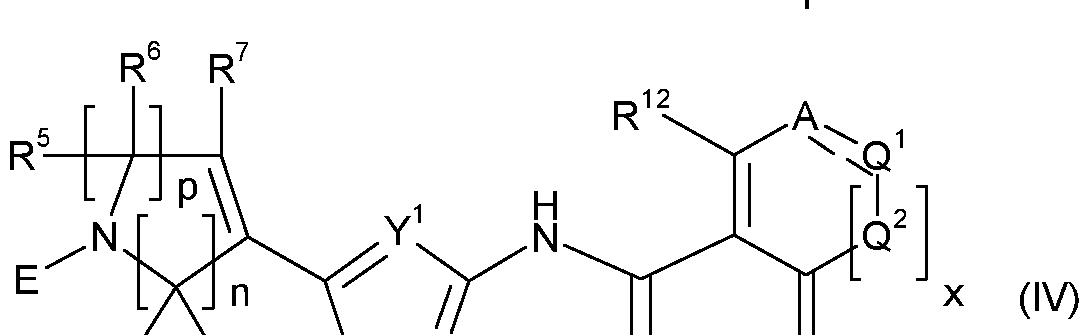
  • the invention also includes compounds of formula IV
  • E is hydrogen, a protecting group such as alkylcarbonyl, benzyl or alkoxycarbonyl, e.g. C1 -C4 alkylcarbonyl, benzyl or C C 4 alkoxycarbonyl, in particular acetyl, benzyl or tert- up M
  • G 1 , G 2 , G 3 , Y 1 , Y 2 , n, p, R 1 , R 2 , R 3 , R 4 , R 5 , R 6 , R 7 , R 9 , R 10 , R 12 , A, Q 1 , Q 2 and x are as defined for a compound of formula I.
  • These compounds, including salts and N-oxides thereof, are useful as intermediates in the synthesis of compounds of formula I.
  • G 1 , G 2 , G 3 , Y 1 , Y 2 , n, p, R 1 , R 2 , R 3 , R 4 , R 5 , R 6 , R 7 , R 9 , R 10 , R 12 , A, Q 1 , Q 2 and x are as defined for formula I.
  • the invention also includes compounds of formula V
  • Hal is halogen and G 2 , G 3 , Y 1 , Y 2 , R 12 , A, Q 1 , Q 2 and x are as defined for a compound of formula I. These compounds, including salts and N-oxides thereof, are useful as intermediates in the synthesis of compounds of formula I. Preferred definitions of G 2 , G 3 , Y 1 , Y 2 , R 12 , A, Q 1 , Q 2 and x are as defined for formula I.
  • Preferred individual compounds of formula I are:
  • the compounds of formula VII wherein R 5 , R 6 , R 7 , R 8 , R 9 , R 10 , G 2 , T, Y 1 , Y 2 , n and p are as defined for formula I and E is hydrogen, a protecting group such as acetyl, benzyl or tert-butoxycarbonyl or a group M, can be obtained by transformation of a compound of formula IX, wherein R 5 , R 6 , R 7 , R 8 , R 9 , R 10 , G 2 , T, Y 1 , Y 2 , n and p are as defined for formula I, Hal is halogen, preferably chloro or bromo, and E is hydrogen, a protecting group such as acetyl, benzyl or tert-butoxycarbonyl or a group M, with hydroxylamine or hydroxylamine hydrochloride. This is shown in Scheme 4.
  • the compounds of formula II. a wherein R 5 , R 6 , R 7 , R 8 , R 9 , R 10 , A, G 2 , G 3 , Q 1 , Q 2 T, Y 1 , Y 2 , n, p and x are as defined for formula I and E is hydrogen, a protecting group such as acetyl, benzyl or tert-butoxycarbonyl or a group M, can be obtained by transformation of a compound of formula XI, wherein R 5 , R 6 , R 7 , R 8 , R 9 , R 10 , G 2 , T, Y 1 , Y 2 , n and p are as defined for formula I and E is hydrogen, a protecting group such as acetyl, benzyl or tert-butoxycarbonyl or a group M, with a compound of formula XII, wherein A, Q 1 , Q 2 and x are as defined for formula I and R 27
  • the compounds of formula XV wherein G 2 , Y 1 and Y 2 are as defined for formula I and Hal is halogen, preferably chloro, bromo or iodo, can be obtained by transformation of a compound of formula XVI, wherein G 2 , Y 1 and Y 2 are as defined for formula I and Hal is halogen, preferably chloro, bromo or iodo, with 1 ,1 'carbonyldiimidazole. This is shown in Scheme 12.
  • novel compounds of formula I have, for practical purposes, a very advantageous level of biological activity for protecting plants against diseases that are caused by fungi.
  • the compounds of formula I can be used in the agricultural sector and related fields of use e.g. as active ingredients for controlling plant pests or on non-living materials for control of spoilage microorganisms or organisms potentially harmful to man.
  • the novel compounds are distinguished by excellent activity at low rates of application, by being well tolerated by plants and by being environmentally safe. They have very useful curative, preventive and systemic properties and may be used for protecting numerous cultivated plants.
  • the compounds of formula I can be used to inhibit or destroy the pests that occur on plants or parts of plants (fruit, blossoms, leaves, stems, tubers, roots) of different crops of useful plants, while at the same time protecting also those parts of the plants that grow later e.g. from phytopathogenic microorganisms.
  • compositions comprising a compound of formula I before planting: seed, for example, can be dressed before being sown.
  • the active ingredients according to the invention can also be applied to grains (coating), either by impregnating the seeds in a liquid formulation or by coating them with a solid formulation.
  • the composition can also be applied to the planting site when the propagation material is being planted, for example, to the seed furrow during sowing. The invention relates also to such methods of treating plant propagation material and to the plant propagation material so treated.
  • the compounds according to present invention can be used for controlling fungi in related areas, for example in the protection of technical materials, including wood and wood related technical products, in food storage, in hygiene management.
  • the invention could be used to protect non-living materials from fungal attack, e.g. lumber, wall boards and paint.
  • the compounds of formula I are, for example, effective against the phytopathogenic fungi of the following classes: Fungi imperfecti (e.g. Alternaria spp.), Basidiomycetes (e.g. Corticium spp., Ceratobasidium spp., Waitea spp., Thanatephorus spp., Rhizoctonia spp., Hemileia spp., Puccinia spp., Phakopsora spp., Ustilago spp., Tilletia spp.), Ascomycetes (e.g.
  • Venturia spp. Blumeria spp., Erysiphe spp., Podosphaera spp., Uncinula spp., Monilinia spp., Sclerotinia spp., Colletotrichum spp., Glomerella spp., Fusarium spp., Gibberella spp., Monographella spp., Phaeosphaeria spp., Mycosphaerella spp., Cercospora spp., Pyrenophora spp.,
  • Rhynchosporium spp. Magnaporthe spp., Gaeumannomyces spp., Oculimacula spp.,
  • Ramularia spp. Botryotinia spp.
  • Oomycetes e.g. Phytophthora spp., Pythium spp., Plasmopara spp., Peronospora spp., Pseudoperonospora spp. Bremia spp.
  • Outstanding activity is observed against downy mildew (e.g. Plasmopara viticola) and late blight (e.g.
  • novel compounds of formula I are effective against phytopathogenic gram negative and gram positive bacteria (e.g. Xanthomonas spp,
  • viruses e.g. tobacco mosaic virus
  • target crops and/or useful plants to be protected typically comprise the following species of plants: cereal (wheat, barley, rye, oat, rice, maize, sorghum and related species); beet (sugar beet and fodder beet); pomes, drupes and soft fruit (apples, pears, plums, peaches, almonds, cherries, strawberries, raspberries and blackberries); leguminous plants (beans, lentils, peas, soybeans); oil plants (rape, mustard, poppy, olives, sunflowers, coconut, castor oil plants, cocoa beans, groundnuts); cucumber plants (pumpkins, cucumbers, melons); fibre plants (cotton, flax, hemp, jute); citrus fruit (oranges, lemons, grapefruit, mandarins); vegetables (spinach, lettuce, asparagus, cabbages, carrots, onions, tomatoes, potatoes, paprika); lauraceae (avocado, cinnamomum, camphor)
  • the useful plants and / or target crops in accordance with the invention include conventional as well as genetically enhanced or engineered varieties such as, for example, insect resistant (e.g. Bt. and VIP varieties) as well as disease resistant, herbicide tolerant (e.g. glyphosate- and glufosinate-resistant maize varieties commercially available under the trade names RoundupReady® and LibertyLink®) and nematode tolerant varieties.
  • suitable genetically enhanced or engineered crop varieties include the Stoneville 5599BR cotton and Stoneville 4892BR cotton varieties.
  • useful plants and/or “target crops” is to be understood as including also useful plants that have been rendered tolerant to herbicides like bromoxynil or classes of herbicides (such as, for example, HPPD inhibitors, ALS inhibitors, for example primisulfuron, prosulfuron and trifloxysulfuron, EPSPS (5-enol-pyrovyl-shikimate-3-phosphate-synthase) inhibitors, GS (glutamine synthetase) inhibitors or PPO (protoporphyrinogen-oxidase) inhibitors) as a result of conventional methods of breeding or genetic engineering.
  • herbicides like bromoxynil or classes of herbicides
  • EPSPS (5-enol-pyrovyl-shikimate-3-phosphate-synthase) inhibitors
  • GS glutamine synthetase
  • PPO protoporphyrinogen-oxidase
  • imazamox by conventional methods of breeding (mutagenesis) is Clearfield® summer rape (Canola).
  • crops that have been rendered tolerant to herbicides or classes of herbicides by genetic engineering methods include glyphosate- and glufosinate-resistant maize varieties commercially available under the trade names RoundupReady® , Herculex I® and LibertyLink®.
  • useful plants and/or “target crops” is to be understood as including also useful plants which have been so transformed by the use of recombinant DNA techniques that they are capable of synthesising one or more selectively acting toxins, such as are known, for example, from toxin-producing bacteria, especially those of the genus Bacillus.
  • useful plants and/or target crops is to be understood as including also useful plants which have been so transformed by the use of recombinant DNA techniques that they are capable of synthesising antipathogenic substances having a selective action, such as, for example, the so-called “pathogenesis-related proteins” (PRPs, see e.g. EP-A-0 392 225).
  • PRPs pathogenesis-related proteins
  • Examples of such antipathogenic substances and transgenic plants capable of synthesising such antipathogenic substances are known, for example, from EP-A-0 392 225, WO 95/33818, and EP-A-0 353 191.
  • the methods of producing such transgenic plants are generally known to the person skilled in the art and are described, for example, in the publications mentioned above.
  • locus of a plant as used herein is intended to embrace the place on which the plants are growing, where the plant propagation materials of the plants are sown or where the plant propagation materials of the plants will be placed into the soil.
  • An example for such a locus is a field, on which crop plants are growing.
  • plant propagation material is understood to denote generative parts of the plant, such as seeds, which can be used for the multiplication of the latter, and vegetative material, such as cuttings or tubers, for example potatoes. There may be mentioned for example seeds (in the strict sense), roots, fruits, tubers, bulbs, rhizomes and parts of plants. Germinated plants and young plants which are to be transplanted after germination or after emergence from the soil, may also be mentioned. These young plants may be protected before transplantation by a total or partial treatment by immersion. Preferably "plant propagation material” is understood to denote seeds.
  • the compounds of formula I may be used in unmodified form or, preferably, together with the adjuvants conventionally employed in the art of formulation. To this end they may be conveniently formulated in known manner to emulsifiable concentrates, coatable pastes, directly sprayable or dilutable solutions or suspensions, dilute emulsions, wettable powders, soluble powders, dusts, granulates, and also encapsulations e.g. in polymeric substances. As with the type of the compositions, the methods of application, such as spraying, atomising, dusting, scattering, coating or pouring, are chosen in accordance with the intended objectives and the prevailing circumstances. The compositions may also contain further adjuvants such as stabilizers, antifoams, viscosity regulators, binders or tackifiers as well as fertilizers, micronutrient donors or other formulations for obtaining special effects.
  • Suitable carriers and adjuvants can be solid or liquid and are substances useful in formulation technology, e.g. natural or regenerated mineral substances, solvents, dispersants, wetting agents, tackifiers, thickeners, binders or fertilizers.
  • Such carriers are for example described in WO 97/33890.
  • the compounds of formula I are normally used in the form of compositions and can be applied to the crop area or plant to be treated, simultaneously or in succession with further compounds.
  • further compounds can be e.g. fertilizers or micronutrient donors or other preparations, which influence the growth of plants. They can also be selective herbicides or non-selective herbicides as well as insecticides, fungicides, bactericides, nematicides, molluscicides or mixtures of several of these preparations, if desired together with further carriers, surfactants or application promoting adjuvants customarily employed in the art of formulation.
  • the compounds of formula I may be used in the form of (fungicidal) compositions for controlling or protecting against phytopathogenic microorganisms, comprising as active ingredient at least one compound of formula I or of at least one preferred individual compound as above-defined, in free form or in agrochemically usable salt form, and at least one of the above-mentioned adjuvants.
  • the invention provides a fungicidal composition
  • a fungicidal composition comprising at least one compound formula I an agriculturally acceptable carrier and optionally an adjuvant.
  • An agricultural acceptable carrier is for example a carrier that is suitable for agricultural use.
  • Agricultural carriers are well known in the art.
  • said fungicidal compositions may comprise at least one additional fungicidal active ingredient in addition to the compound of formula I.
  • the compound of formula (I) may be the sole active ingredient of a composition or it may be admixed with one or more additional active ingredients such as a pesticide, fungicide, synergist, herbicide or plant growth regulator where appropriate.
  • An additional active ingredient may, in some cases, result in unexpected synergistic activities.
  • Suitable additional active ingredients include the following: Azoxystrobin (131860-33-8), Dimoxystrobin (149961- 52-4), Enestrobin (238410-1 1-2), Fluoxastrobin (193740-76-0), Kresoxim-methyl (143390-89-0), Metominostrobin (133408-50-1), Orysastrobin (248593-16-0), Picoxystrobin (1 17428-22-5), Pyraclostrobin (175013-18-0), trifloxystrobin (141517-21-7), Azaconazole (60207-31-0),
  • Another aspect of invention is related to the use of a compound of formula I or of a preferred individual compound as above-defined, of a composition comprising at least one compound of formula I or at least one preferred individual compound as above-defined, or of a fungicidal mixture comprising at least one compound of formula I or at least one preferred individual compound as above-defined, in admixture with other fungicides, as described above, for controlling or preventing infestation of plants, e.g. useful plants such as crop plants, propagation material thereof, e.g. seeds, harvested crops, e.g. harvested food crops, or non- living materials by phytopathogenic microorganisms, preferably fungal organisms.
  • useful plants such as crop plants, propagation material thereof, e.g. seeds, harvested crops, e.g. harvested food crops, or non- living materials by phytopathogenic microorganisms, preferably fungal organisms.
  • a further aspect of invention is related to a method of controlling or preventing an infestation of plants, e.g. useful plants such as crop plants, propagation material thereof, e.g. seeds, harvested crops, e.g. harvested food crops, or of non-living materials by
  • phytopathogenic or spoilage microorganisms or organisms potentially harmful to man, especially fungal organisms which comprises the application of a compound of formula I or of a preferred individual compound as above-defined as active ingredient to the plants, to parts of the plants or to the locus thereof, to the propagation material thereof, or to any part of the nonliving materials.
  • Controlling or preventing means reducing infestation by phytopathogenic or spoilage microorganisms or organisms potentially harmful to man, especially fungal organisms, to such a level that an improvement is demonstrated.
  • a preferred method of controlling or preventing an infestation of crop plants by phytopathogenic microorganisms, especially fungal organisms, which comprises the application of a compound of formula I, or an agrochemical composition which contains at least one of said compounds, is foliar application.
  • the frequency of application and the rate of application will depend on the risk of infestation by the corresponding pathogen.
  • the compounds of formula I can also penetrate the plant through the roots via the soil (systemic action) by drenching the locus of the plant with a liquid formulation, or by applying the compounds in solid form to the soil, e.g. in granular form (soil application). In crops of water rice such granulates can be applied to the flooded rice field.
  • the compounds of formula I may also be applied to seeds (coating) by impregnating the seeds or tubers either with a liquid formulation of the fungicide or coating them with a solid formulation.
  • a formulation e.g. a composition containing the compound of formula I, and, if desired, a solid or liquid adjuvant or monomers for encapsulating the compound of formula I, may be prepared in a known manner, typically by intimately mixing and/or grinding the compound with extenders, for example solvents, solid carriers and, optionally, surface active compounds (surfactants).
  • extenders for example solvents, solid carriers and, optionally, surface active compounds (surfactants).
  • the agrochemical formulations and/or compositions will usually contain from 0.1 to 99% by weight, preferably from 0.1 to 95% by weight, of the compound of formula I, 99.9 to 1 % by weight, preferably 99.8 to 5% by weight, of a solid or liquid adjuvant, and from 0 to 25% by weight, preferably from 0.1 to 25% by weight, of a surfactant.
  • Advantageous rates of application are normally from 5g to 2kg of active ingredient (a.i.) per hectare (ha), preferably from 10g to 1 kg a.i. /ha, most preferably from 20g to 600g a.i./ha.
  • convenient dosages are from 10mg to 1g of active substance per kg of seeds.
  • Example 1 This example illustrates the preparation of 2-hydroxy-6-oxo-cyclohex-1-enecarbo xylic acid (2- ⁇ 1-[2-(5-methyl-3-trifluoromethyl-pyrazol-1-yl)-acetyl]-piperidin-4-yl ⁇ -thiazol-4-yl)- amide a) Preparation of 2- ⁇ 1-[2-(5-methyl-3-trifluoromethyl-pyrazol-1-yl)-acetyl]-piperidin-4-yl ⁇ -thiazole- 4-carboxylic acid ethyl ester
  • the crude mixture is purified by column chromatography on silica gel (dichloromethane/methanol 10: 1 ) to give 2- ⁇ 1 -[2-(5-methyl-3-trif luoromethyl-pyrazol-1 -yl)-acetyl]-piperidin-4-yl ⁇ -thiazole-4- carboxylic acid ethyl ester (13.6 g, 88 %).
  • aqueous layer is re-extracted with ethylacetate (20 mL) and the combined organic layers are washed with brine (10 mL), dried over sodium sulfate, filtered, and evaporated under reduced pressure to give 2- ⁇ 1-[2-(5-methyl-3-trifluoromethyl- pyrazol-1-yl)-acetyl]-piperidin-4-yl ⁇ -thiazole-4-carboxylic acid (2.33 g, 94 %), which can be used in the next step without further purification.
  • reaction mixture was heated to 80°C for 2 h, cooled to RT and a solution of cyclohexane- 1 ,3-dione (56 mg, 0.5 mmol) and Et 3 N (50.6 mg, 0.5 mmol) in dichloroethane (0.5 ml_) was added by syringe followed by 4 drops of 1- butyl-3-methylimidazolium methylsulfate. After stirring at 80°C for 2 h, the reaction mixture was cooled to RT, diluted with dichloromethane, washed with 1 M HCI and water, dried over MgS0 4 and concentrated to give 248 mg of a yellow oil.
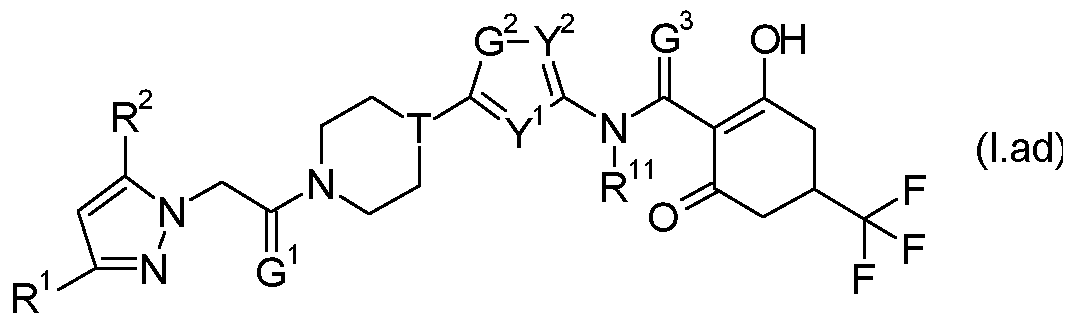
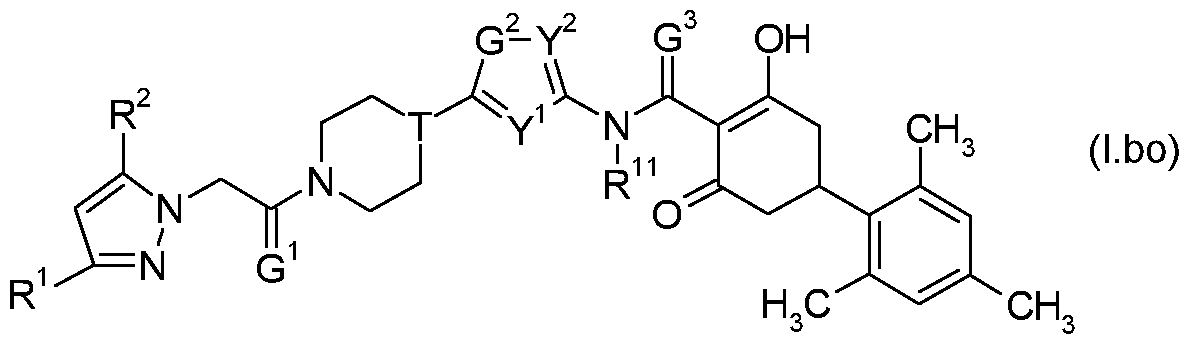
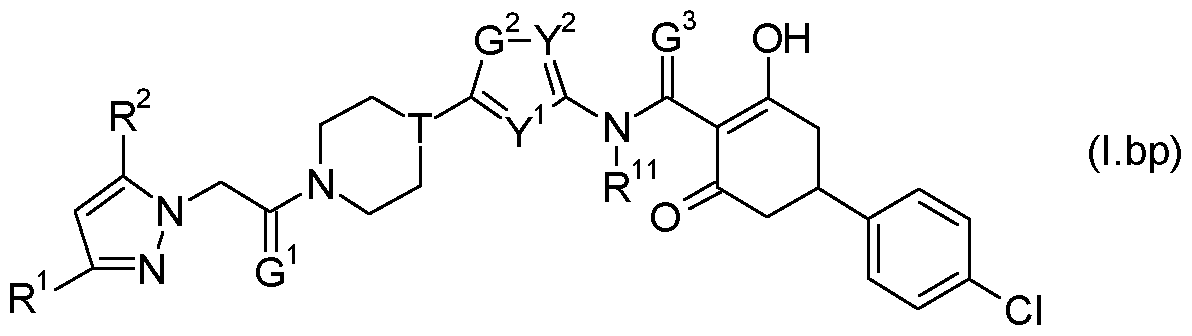
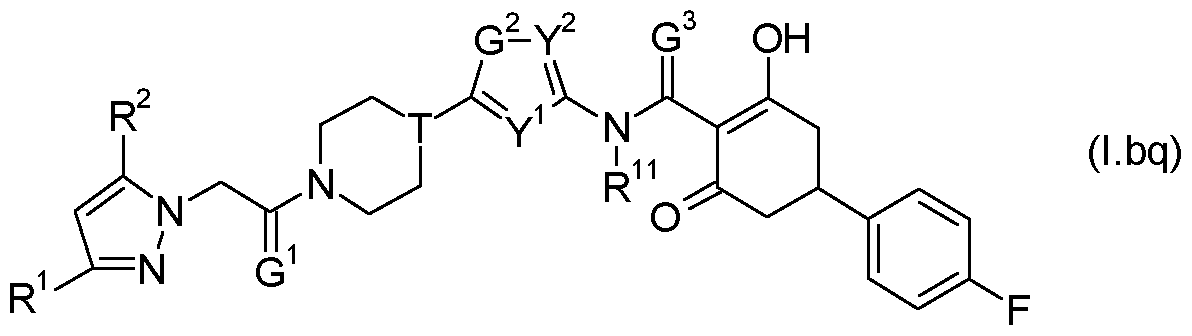
  • Table 1 illustrates examples of individual compounds of formula I according to the invention.
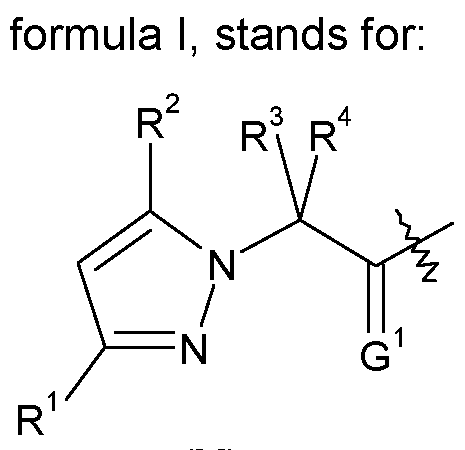
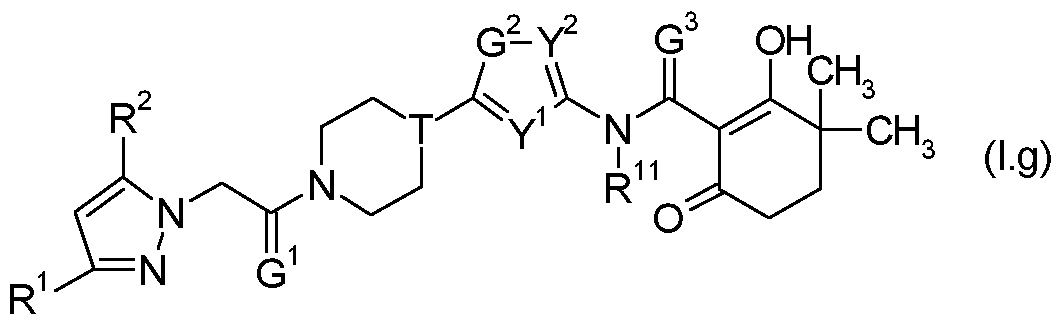
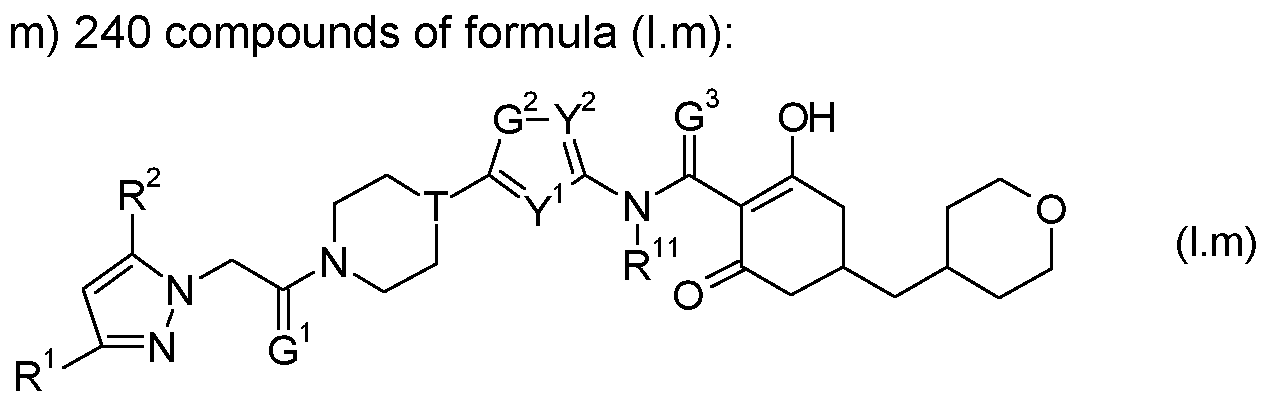
  • R 1 , R 2 , R 11 , G 1 , G 2 , G 3 , T, Y 1 and Y 2 are as defined in Table 1.
  • R 1 , R 2 , R 11 , G 1 , G 2 , G 3 , T, Y 1 and Y 2 are as defined in Table 1.
  • R 1 , R 2 , R 11 , G 1 , G 2 , G 3 , T, Y 1 and Y 2 are as defined in Table 1.
  • R 1 , R 2 , R 11 , G 1 , G 2 , G 3 , T, Y 1 and Y 2 are as defined in Table 1.
  • R 1 , R 2 , R 11 , G 1 , G 2 , G 3 , T, Y 1 and Y 2 are as defined in Table 1 cb) 240 compounds of formula (l.cb):
  • R 1 , R 2 , R 11 , G 1 , G 2 , G 3 , T, Y 1 and Y 2 are as defined in Table 1.
  • R 1 , R 2 , R 11 , G 1 , G 2 , G 3 , T, Y 1 and Y 2 are as defined in Table 1.
  • R 1 , R 2 , R 11 , G 1 , G 2 , G 3 , T, Y 1 and Y 2 are as defined in Table 1
  • R 1 , R 2 , R 11 , G 1 , G 2 , G 3 , T, Y 1 and Y 2 are as defined in Table 1.
  • R 1 , R 2 , R 11 , G 1 , G 2 , G 3 , T, Y 1 and Y 2 are as defined in Table 1 cj) 240 compounds of formula (I.cj):
  • R 1 , R 2 , R 11 , G 1 , G 2 , G 3 , T, Y 1 and Y 2 are as defined in Table 1 ck) 240 compounds of formula (l.ck):
  • R 1 , R 2 , R 11 , G 1 , G 2 , G 3 , T, Y 1 and Y 2 are as defined in Table 1.
  • R 1 , R 2 , R 11 , G 1 , G 2 , G 3 , T, Y 1 and Y 2 are as defined in Table 1
  • R 1 , R 2 , R 11 , G 1 , G 2 , G 3 , T, Y 1 and Y 2 are as defined in Table 1.
  • R 1 , R 2 , R 11 , G 1 , G 2 , G 3 , T, Y 1 and Y 2 are as defined in Table 1.
  • R 1 , R 2 , R 11 , G 1 , G 2 , G 3 , T, Y 1 and Y 2 are as defined in Table 1
  • R 1 , R 2 , R 11 , G 1 , G 2 , G 3 , T, Y 1 and Y 2 are as defined in Table 1.
  • LC/MS Liquid Chromatography Mass Spectroscopy and the description of the apparatus and the method is: (ACQUITY UPLC from Waters, Phenomenex Gemini C18, 3 ⁇ particle size, 110 Angstrom, 30 x 3 mm column, 1.7mL/min., 60 °C, H 2 0 + 0.05% HCOOH (95%) / CH 3 CN/MeOH 4:1 + 0.04% HCOOH (5%) - 2 min. - CH 3 CN/MeOH 4:1 + 0.04%
  • Tomato leaf disks are placed on water agar in multiwell plates (24-well format) and sprayed with the formulated test compound diluted in water.
  • the leaf disks are inoculated with a spore suspension of the fungus 1 day after application.
  • the inoculated leaf disks are incubated at 16°C and 75% rh under a light regime of 24 h darkness followed by 12 h light / 12 h darkness in a climate cabinet and the activity of a compound is assessed as percent disease control compared to untreated when an appropriate level of disease damage appears in untreated check leaf disks (5-7 days after application).
  • I.bq.001, l.br.001, l.bs.001, l.bu.001, l.by.001 and l.bz.001 at 200 ppm give at least 80% disease control in this test when compared to untreated control leaf disks under the same conditions, which show extensive disease development.
  • 2-week old potato plants cv. Bintje are sprayed in a spray chamber with the formulated test compound diluted in water.
  • the test plants are inoculated by spraying them with a sporangia suspension 6 days after application.
  • the inoculated test plants are incubated at 18° C with 14 h light/day and 100 % rh in a growth chamber and the percentage leaf area covered by disease is
  • Plasmopara viticola I grape / leaf disc preventative (grape downy mildew)
  • Grape vine leaf disks are placed on water agar in multiwell plates (24-well format) and sprayed with the formulated test compound diluted in water.
  • the leaf disks are inoculated with a spore suspension of the fungus 1 day after application.
  • the inoculated leaf disks are incubated at 30 19°C and 80% rh under a light regime of 12 h light / 12 h darkness in a climate cabinet and the activity of a compound is assessed as percent disease control compared to untreated when an appropriate level of disease damage appears in untreated check leaf disks (6 - 8 days after application).
  • I.bq.001 , l.br.001 , l.bs.001 , l.bt.001 , l.bu.001 , l.by.001and l.bz.001 at 200 ppm give at least 80% disease control in this test when compared to untreated control leaf disks under the same conditions, which show extensive disease development.
  • 5-week old grape seedlings cv. Gutedel are sprayed in a spray chamber with the formulated test compound diluted in water.
  • the test plants plants are inoculated by spraying a sporangia suspension on their lower leaf surface one day after application.
  • the inoculated test plants are incubated at 22° C and 100% rh in a greenhouse and the percentage leaf area covered by disease is assessed when an appropriate level of disease appears on untreated check plants (6 - 8 days after application).
  • 5-week old grape seedlings cv. Gutedel are sprayed in a spray chamber with the formulated test compound diluted in water.
  • the test plants are inoculated by spraying a sporangia suspension on their lower leaf surface 6 days after application.
  • the inoculated test plants are incubated at 22° C and 100% rh in a greenhouse and the percentage leaf area covered by disease is assessed when an appropriate level of disease appears on untreated check plants (1 1 - 13 days after application).
  • Mycelia fragments and oospores of a newly grown liquid culture of the fungus are directly mixed into nutrient broth (PDB potato dextrose broth). After placing a (DMSO) solution of test compound into a microtiter plate (96-well format), the nutrient broth containing the fungal mycelia/spore mixture is added. The test plates are incubated at 24°C and the inhibition of growth is determined photometrically 2-3 days after application.
  • DMSO DMSO

Landscapes

  • Chemical & Material Sciences (AREA)
  • Organic Chemistry (AREA)
  • Life Sciences & Earth Sciences (AREA)
  • Agronomy & Crop Science (AREA)
  • Pest Control & Pesticides (AREA)
  • Plant Pathology (AREA)
  • Health & Medical Sciences (AREA)
  • Engineering & Computer Science (AREA)
  • Dentistry (AREA)
  • General Health & Medical Sciences (AREA)
  • Wood Science & Technology (AREA)
  • Zoology (AREA)
  • Environmental Sciences (AREA)
  • Plural Heterocyclic Compounds (AREA)
  • Agricultural Chemicals And Associated Chemicals (AREA)
  • Pharmaceuticals Containing Other Organic And Inorganic Compounds (AREA)

Abstract

The present invention provides compounds of formula I: wherein the substituents are as defined in claim 1, are useful as active ingredients, which have microbiocidal activity, in particular fungicidal activity.

Description

Microbiocidal Pyrazole Derivatives
The present invention relates to microbiocidal pyrazole derivatives, e.g. as active ingredients, which have microbiocidal activity, in particular fungicidal activity. The invention also relates to preparation of these pyrazole derivatives, to pyrazole derivatives used as
intermediates in the preparation of these pyrazole derivatives, to preparation of these intermediates, to agrochemical compositions which comprise at least one of the pyrazole derivatives, to preparation of these compositions and to use of the pyrazole derivatives or compositions in agriculture or horticulture for controlling or preventing infestation of plants, harvested food crops, seeds or non-living materials by phytopathogenic microorganisms, preferably fungi.
Certain compounds for use as fungicides are described in WO 2007/014290, WO 2008/013622, WO 2008/013925, WO 2008/091580, WO 2008/091594 and WO 2009/055514.
The present invention provides compounds of formula I:
Figure imgf000002_0001
G1 , G2 and G3 are independently O or S;
T is CR13 or N;
Y1 and Y2 are independently CR14 or N;
A is C(R15R16),C(=0), C(=S), NR21 , O or S;
Q1 is C(R17R18),C(=0), C(=S), NR21 , O or S;Q2 is C(R19R20),C(=O), C(=S), NR21 , O or S;
the bond between A and Q1 is a single bond or a double bond;
n is 1 or 2;
p is 1 or 2, providing that when n is 2, p is 1 ;
x is 0 or 1 , providing that when x is 1 , Q1 and Q2 cannot both be oxygen;
R1 , R2, R3, R4, R5, R6, R7, R8, R9, R10, R13 and R14 each independently are hydrogen, halogen, cyano, CrC4alkyl, C3-C5cycloalkyl or C C4haloalkyl;
R11 is hydrogen, C C4alkyl, C3-C5cycloalkyl or C C4alkoxy;
R12 is hydroxyl, 0"M+, OC(=0)R25, amino or NHR22;
M+ is a metal cation or ammonium cation,
R15, R16 R17, R18, R19 and R20 each independently are hydrogen, halogen, hydroxyl, amino, cyano, CrC8alkyl, CrC8alkylcarbonyl, C2-C8alkenyl, C2-C8alkynyl, C3-C8cycloalkyl, CrC8alkoxy,
CrC8alkoxycarbonyl, CrC8alkylthio, CrC8alkylsulfonyl, CrC8alkylsulfinyl, aryl, arylcarbonyl, heteroaryl or NHR , wherein the alkyl, alkenyl, alkynyl, cycloalkyi, alkoxy, aryl and heteroaryl are optionally substituted by one or more R23; and wherein
R15 and R16, R17 and R18, and/or R19 and R20 may together form a saturated three- to six- membered alicyclic or heterocyclic ring wherein the aliyclic and heterocyclic rings are optionally substituted by one or more R24; and/or
R15 and R17, and/or R18 and R19 may together form a saturated or partially unsaturated four- to seven-membered alicyclic or heterocyclic ring wherein the aliyclic and heterocyclic rings are optionally substituted by one or more R24; and/or
R15 and R19 may together form a saturated or partially unsaturated four- to seven-membered alicyclic or heterocyclic ring wherein the aliyclic and heterocyclic rings are optionally substituted by one or more R24;
R21 and R22 each independently are hydrogen, CrC8alkyl, CrC8haloalkyl C2-C8alkenyl, C C8haloalkenyl C2-C8alkynyl, C2-C8haloalkynyl, C3-C8cycloalkyl, C3-C8halocycloalkyl, C
C8alkoxy, CrC8haloalkoxy, CrC8alkylcarbonyl, CrC8alkoxycarbonyl, CrC8haloalkylcarbonyl, CrC8alkylsulfonyl, CrC8haloalkylsulfonyl, amino, NH(CrC8alkyl), N(CrC8alkyl)2, aryl or heterocyclyl, wherein aryl and heterocyclyl are optionally substituted by one or more R24;
each R23 independently is halogen, cyano, amino, nitro, hydroxyl, mercapto, CrC8alkyl, C2- C8alkenyl, C2-C8alkynyl, C3-C8cycloalkyl, C3-C8cycloalkyl-CrC4alkyl, C3-C8cycloalkyl-Cr
C4alkyloxy, C3-C8cycloalkyl-CrC4alkylthio, CrC8alkoxy, C3-C8cycloalkyloxy, CrC8alkenyloxy, C2-C8alkynyloxy, CrC8alkylthio, CrC8alkylsulfonyl, CrC8alkylsulfinyl, C3-C8cycloalkylthio, C3- Cscycloalkylsulfonyl, C3-C8cycloalkylsulfinyl, aryl, aryloxy, arylthio, arylsulfonyl, arylsulfinyl, aryl- Ci-C4alkyl, aryl-C C4alkyloxy, aryl-C C4alkylthio, heterocyclyl, heterocycyl-C C4alkyl, heterocycyl-CrC4alkyloxy, heterocycyl-C C4alkylthio, NH(CrC8alkyl), N(CrC8alkyl)2, C
C4alkylcarbonyl, C3-C8cycloalkylcarbonyl, C2-C8alkenylcarbonyl, C2-C8alkynylcarbonyl, wherein alkyl, alkenyl, alkynyl, cycloalkyi, alkoxy, alkenyloxy, alkynyloxy and cycloalkoxy are optionally substituted by halogen, and wherein aryl and heterocyclyl are optionally substituted by one or more R24;
each R24 independently is halogen, cyano, C C4alkyl, C C4haloalkyl, C C4alkoxy or C
C4haloalkoxy; and
R25 is CrC6alkyl or CrC6alkoxy; or a salt or a N-oxide thereof.
Where substituents are indicated as being optionally substituted, this means that they may or may not carry one or more identical or different substituents, e.g. one to five substituents, e.g. one to three substituents. Normally not more than three such optional substituents are present at the same time. Where a group is indicated as being substituted, e.g. alkyl, unless stated otherwise this includes those groups that are part of other groups, e.g. the alkyl in alkylthio.
The term "halogen" refers to fluorine, chlorine, bromine or iodine, preferably fluorine, chlorine or bromine. Alkyl substituents may be straight-chained or branched. Alkyl on its own or as part of another substituent is, depending upon the number of carbon atoms mentioned, for example, methyl, ethyl, n-propyl, n-butyl, n-pentyl, n-hexyl and the isomers thereof, for example, iso- propyl, iso-butyl, sec-butyl, tert-butyl, iso-amyl or pivaloyl.
Alkenyl substituents can be in the form of straight or branched chains, and the alkenyl moieties, where appropriate, can be of either the (E)- or ©-configuration. Examples are vinyl and allyl. The alkenyl groups are preferably C2-C6, more preferably C2-C4 and most preferably C2-C3 alkenyl groups.
Alkynyl substituents can be in the form of straight or branched chains. Examples are ethynyl and propargyl. The alkynyl groups are preferably C2-C6, more preferably C2-C4 and most preferably C2-C3 alkynyl groups.
Haloalkyl groups may contain one or more identical or different halogen atoms and, for example, may stand for CH2CI, CHCI2, CCI3, CH2F, CHF2, CF3, CF3CH2, CH3CF2, CF3CF2 or CCI3CCI2.
Haloalkenyl groups are alkenyl groups, respectively, which are substituted with one or more of the same or different halogen atoms and are, for example, 2,2-difluorovinyl or 1 ,2- dichloro-2-fluoro-vinyl.
Haloalkynyl groups are alkynyl groups, respectively, which are substituted with one or more of the same or different halogen atoms and are, for example, 1-chloro-prop-2-ynyl.
Alkoxy means a radical -OR, where R is alkyl, e.g. as defined above. Alkoxy groups include, but are not limited to, methoxy, ethoxy, 1-methylethoxy, propoxy, butoxy, 1- methylpropoxy and 2-methylpropoxy.
Cyano means a -CN group.
Amino means an NH2 group.
Hydroxyl or hydroxy stands for a -OH group.
Aryl means a ring system which may be mono-, bi- or tricyclic. Examples of such rings include phenyl, naphthalenyl, anthracenyl, indenyl or phenanthrenyl. A preferred aryl group is phenyl.
Heteroaryl stands for aromatic ring systems comprising mono-, bi- or tricyclic systems wherein at least one oxygen, nitrogen or sulfur atom is present as a ring member. Monocyclic and bicyclic aromatic ring systems are preferred, monocyclic ring systems are more preferred. For example, monocyclic heteoraryl may be a 5- to 7-membered aromatic ring containing one to three heteroatoms selected from oxygen, nitrogen and sulfur, more preferably selected from nitrogen and sulfur. Bicyclic heteroaryl may be a 9- to 1 1-membered bicyclic ring containing one to five heteroatoms, preferably one to three heteroatoms, selected from oxygen, nitrogen and sulfur. Examples are furyl, thienyl, pyrrolyl, imidazolyl, pyrazolyl, thiazolyl, isothiazolyl, oxazolyl, isoxazolyl, oxadiazolyl, thiadiazolyl, triazolyl, tetrazolyl, pyridyl, pyridazinyl, pyrimidinyl, pyrazinyl, triazinyl, tetrazinyl, indolyl, benzothiophenyl, benzofuranyl, benzimidazolyl, indazolyl, benzotriazolyl, benzothiazolyl, benzoxazolyl, imiazothiazoyl, quinolinyl, quinoxalinyl, isoquinolinyl, phthalazinyl, quinoxalinyl, quinazolinyl, cinnolinyl and naphthyridinyl, preferably pyridyl, pyrazinyl, pyridazinyl, pyrimidinyl, pyrrolyl, pyrazolyl, imidazolyl, triazolyl, furanyl, thienyl thiazolyl or thiadiazolyl. Heteroaryl rings do not contain adjacent oxygen ring atoms, adjacent sulfur ring atoms or adjacent oxygen and sulfur ring atoms. A link to a heteroaryl group can be via a carbon atom or via a nitrogen atom.
Heterocyclyl is defined to include heteroaryl and in addition their unsaturated or partially unsaturated analogues.
The compounds of formula I may occur in different tautomeric forms, for example, if R12 is hydroxyl, in the formulas I. a, l.b and I.e. Each form is included within the compounds of formula I.
Figure imgf000005_0001
The presence of one or more possible asymmetric carbon atoms in a compound of formula I means that the compounds may occur in optically isomeric forms, i.e. enantiomeric or diastereomeric forms. Also atropisomers may occur as a result of restricted rotation about a single bond. Formula I is intended to include all those possible isomeric forms and mixtures thereof. The present invention includes all those possible isomeric forms and mixtures thereof for a compound of formula I. Likewise, formula I is intended to include all possible tautomers. The present invention includes all possible tautomeric forms for a compound of formula I. In each case, the compounds of formula I according to the invention are in free form, in oxidized form as a N-oxide or in salt form, e.g. an agronomically usable salt form.
N-oxides are oxidized forms of tertiary amines or oxidized forms of nitrogen containing heteroaromatic compounds. They are described for instance in the book "Heterocyclic N-oxides" by A. Albini and S. Pietra, CRC Press, Boca Raton 1991.
The following list provides definitions, including preferred definitions, for substituents G1 , G2, G3, T, Y1 , Y2, A, Q1 , Q2, n, p, R1 , R2, R3, R4, R5, R6, R7, R8, R9, R10, R11 , R12, R13, R14, R15, R16, R17, R18, R19, R20, R21 , R22, R23, R24 and R25 with reference to compounds of formula I and other compounds of the invention carrying the same subsituents. For any one of these substituents, any of the definitions given below may be combined with any definition of any other substituent given below or elsewhere in this document.
G1 , G2 and G3 are independently O or S.
G1 is preferably O.
G2 is preferably S.
G3 is preferably O.
T is CR13 or N, preferably CH or N, more preferably CH.
Y1 and Y2 are independently CR14 or N.
Y1 is preferably CH or N, more preferably N.
Y2 is preferably CH or N; more preferably CH.
n is 1 or 2, preferably 2.
p is 1 or 2, providing that when n is 2, p is 1 , preferably p is 1.
x is 1 or 0, preferably 1.
A is C(R15R16),C(=0), C(=S), NR21 , O or S; Q1 is C(R17R18),C(=0), C(=S), NR21 , O or S; Q2 is C(R19R20),C(=O), C(=S), NR21 , O or S. Preferably there are no -0-0-, -S-S-, -O-S- or -S-O- in the ring formed by A, Q1 and Q2. Preferably there are no adjacent C=0 groups in the ring formed by A, Q1 and Q2. Preferably no more than two of A, Q1 and Q2 are NR21 , O or S.
Preferably the bond between A and Q1 is a single bond or a double bond;
In one group of compounds there are no adjacent heteroatoms in the ring formed by A, Q1 and Q2. In another group of compounds no more than one of A, Q1 and Q2 are NR21 , O or S. In another group of compounds when x is 1 A is C(R15R16), NR17, O or S; Q1 is C(R17R18), C(=0), C(=S), NR17, O or S; and Q2 is C(R19R20), NR17, O or S. In another group of compounds when x is 0, A is C(R15R16), C(=0), C(=S), NR17, O or S; Q1 is C(R17R18), NR17, O or S. Even more preferred options for A, Q1 and Q2 are depicted by Z1 to Z19 in formula l.d (see below).
R1 , R2, R3, R4, R5, R6, R7, R8, R9, R10, R13 and R14 each independently are hydrogen, halogen, cyano, C C4alkyl or C C4haloalkyl, preferably hydrogen, halogen, C C4alkyl or C C4haloalkyl. Preferably R1 and R2 are each independently halogen, methyl or halomethyl, more preferably methyl or halomethyl, more preferably methyl or trifluoromethyl. Preferably R1 is trifluoromethyl. Preferably R2 is methyl. In one group of compounds R1 is trifluoromethyl and R2 is methyl. In another group of compounds R1 and R2 are both difluoromethyl.
Preferably R3, R4, R5, R6, R7, R8, R9, R10, R13 and R14 are each independently hydrogen, halogen, CrC4alkyl or C C4haloalkyl, more preferably hydrogen, halogen, methyl or
halomethyl, even more preferably hydrogen or methyl, most preferably hydrogen.
R11 is hydrogen, C C4alkyl, C3-C5cycloalkyl or C C4alkoxy; preferably hydrogen, C C4alkyl or C C4alkoxy, more preferably hydrogen or methyl, even more preferably hydrogen.
R12 is hydroxyl, 0"M+, OC(=0)R25, amino or NHR22; preferably hydroxyl, 0"M+, or NHR22, more preferably hydroxyl or 0"M+, even more preferably hydroxyl.
M+ is a metal cation or ammonium cation, preferably a metal cation, e.g. an alkali metal cation, such as potassium, sodium or lithium.
R15, R16 R17, R18, R19 and R20 each independently are hydrogen, halogen, hydroxyl, amino, cyano, CrC8alkyl, CrC8alkylcarbonyl, C2-C8alkenyl, C2-C8alkynyl, C3-C8cycloalkyl, CrC8alkoxy, CrC8alkoxycarbonyl, CrC8alkylthio, CrC8alkylsulfonyl, CrC8alkylsulfinyl, aryl, arylcarbonyl, heteroaryl or NHR22, wherein alkyl, alkenyl, alkynyl, cycloalkyl, alkoxy, aryl and heteroaryl are optionally substituted by one or more R23.
Preferably R15, R16 R17, R18, R19 and R20 each independently are hydrogen, halogen, hydroxyl, cyano, CrC8alkyl, C2-C8alkenyl, C2-C8alkynyl, C3-C8cycloalkyl, CrC8alkoxy, C
C8alkoxycarbonyl, CrC8alkylthio, aryl, arylcarbonyl, heteroaryl or NHR22, wherein alkyl, alkenyl, alkynyl, cycloalkyl, alkoxy, aryl and heteroaryl are optionally substituted by one or more R23.
Preferably R15, R16 R17, R18, R19 and R20 each independently are hydrogen, halogen, hydroxyl, cyano, CrC8alkyl, C2-C8alkenyl, C2-C8alkynyl, C3-C8cycloalkyl, CrC8alkoxy, C
C8alkoxycarbonyl, CrC8alkylthio, aryl, heteroaryl or NHR22, wherein alkyl, alkenyl, alkynyl, cycloalkyl, alkoxy, aryl and heteroaryl are optionally substituted by one or more R23 and wherein each heteroaryl is independently selected from pyridyl, pyrazinyl, pyridazinyl, pyrimidinyl, pyrrolyl, pyrazolyl, imidazolyl, triazolyl, furanyl, thienyl thiazolyl and thiadiazolyl.
Even more preferably R15, R16 R17, R18, R19 and R20 each independently are hydrogen, halogen, cyano, C C4alkyl, C3-C6cycloalkyl-CrC4alkyl, C3-C6cycloalkyl-CrC4alkyl wherein one ring atom is replaced by oxygen, C2-C4alkenyl, C2-C4alkynyl, C3-C6cycloalkyl, C C4alkylthio-C3- C6cycloalkyl, phenylthio-C3-C6cycloalkyl, benzylthio-C3-C6cycloalkyl, C3-C6cycloalkyl wherein one ring atom is replaced by oxygen, C C4alkoxy, C C4alkylthio, Ci-C4alkylcarbonylamino, wherein alkyl, alkenyl, alkynyl, and cycloalkyl are optionally substituted by one to five halogen, and wherein phenyl and benzyl are optionally substituted by one to five groups selected from halogen, cyano, C C4alkyl, C C4haloalkyl, C C4alkoxy and C C4haloalkoxy. R15 and R16, R17 and R18, and/or R19 and R20 may together form a saturated three- to six- membered alicyclic or heterocyclic ring wherein the aliyclic and heterocyclic rings are optionally substituted by one or more R24; and/or
R15 and R17, and/or R18 and R19 may together form a saturated or partially unsaturated four- to seven-membered alicyclic or heterocyclic ring wherein the aliyclic and heterocyclic rings are optionally substituted by one or more R24; and/or
R15 and R19 may together form a saturated or partially unsaturated four- to seven- membered alicyclic or heterocyclic ring wherein the aliyclic and heterocyclic rings are optionally substituted by one or more R24.
A heterocyclic ring formed by any of R15 and R16, R17 and R18, R19 and R20, R15 and R17, R18 and R19, and R15 and R19 contains for example one to three heteroatoms selected from O, S, and N(R24).
Preferably R15 and R16, R17 and R18, and/or R19 and R20 may together form a saturated three- to six-membered alicyclic or heterocyclic ring wherein the aliyclic and heterocyclic rings are optionally substituted by one or more R24; and/or
R15 and R17 may together form a saturated or partially unsaturated four- to seven- membered alicyclic or heterocyclic ring wherein the aliyclic and heterocyclic rings are optionally substituted by one or more R24; and/or
R15 and R19 may together form a saturated or partially unsaturated four- to seven- membered alicyclic or heterocyclic ring wherein the aliyclic and heterocyclic rings are optionally substituted by one or more R24; and where said heterocyclic rings preferably contain one or two heteroatoms selected from O, S and NR24.
More preferably one or two of the pairs R15 and R16, R17 and R18, and R19 and R20 may together form a saturated three- to six-membered alicyclic or heterocyclic ring wherein the aliyclic and heterocyclic rings are optionally substituted by one or more R24; or
R15 and R17 may together form a saturated or partially unsaturated four- to seven- membered alicyclic or heterocyclic ring wherein the aliyclic and heterocyclic rings are optionally substituted by one or more R24; or
R15 and R19 may together form a saturated or partially unsaturated four- to seven- membered alicyclic or heterocyclic ring wherein the aliyclic and heterocyclic rings are optionally substituted by one or more R24; and where said heterocyclic rings preferably contain one heteroatom selected from O, S and NR24.
Even more preferably one or two of the pairs R15 and R16, R17 and R18, and R19 and R20 may together form a saturated three- to six-membered alicyclic ring wherein one of the ring members is optionally replaced by O, S, NH(CrC4alkyl), NH(C C4alkoxy), and wherein the alicyclic ring is optionally substituted by one to five groups selected from halogen, methyl and halomethyl; or R15 and R17 may together form a saturated four- to seven-membered alicyclic ring optionally substituted by one to five groups independently selected from halogen, methyl and halomethyl; or
R15 and R19 may together form a saturated four- to seven-membered alicyclic ring optionally substituted by one to five groups independently selected from halogen, methyl and halomethyl.
Each R21 and R22 independently are hydrogen, CrC8alkyl, CrC8haloalkyl C2-C8alkenyl, C2-C8haloalkenyl, C2-C8alkynyl, C2-C8haloalkynyl, C3-C8cycloalkyl, C3-C8halocycloalkyl, C C8alkoxy, CrC8haloalkoxy, CrC8alkylcarbonyl, CrC8alkoxycarbonyl, CrC8haloalkylcarbonyl, CrC8alkylsulfonyl or CrC8haloalkylsulfonyl, amino, NH(CrC8alkyl), N(CrC8alkyl)2, aryl or heterocycyl, wherein aryl and heterocyclyl are optionally substituted by one or more R24.
Preferably each R21 and R22 independently are hydrogen, CrC8alkyl, CrC8haloalkyl, C2- C8alkenyl, C2-C8haloalkenyl, C2-C8alkynyl, C2-C8haloalkynyl, C3-C8cycloalkyl, C3- Cshalocycloalkyl, C C8alkoxy, CrC8haloalkoxy, CrC8alkylcarbonyl, CrC8alkoxycarbonyl, C Cshaloalkylcarbonyl, CrC8alkylsulfonyl or Ci-C8haloalkylsulfonyl, amino, NH(CrC8alkyl), N(C C8alkyl)2, phenyl or heterocycyl, wherein phenyl and heterocyclyl are optionally substituted by one or more R24 and wherein each heterocycle is independently selected from pyrrolidinyl, pryollyl, imidazolyl, triazolyl, piperazinyl, piperidinyl, morpholinyl, pyridyl, pyrazinyl, pyridazinyl and pyrimidinyl.
More preferably each R21 and R22 independently are hydrogen, CrC8alkyl, C2-C8alkenyl,
C2-C8alkynyl, C3-C8cycloalkyl, CrC8alkoxy, CrC8alkylcarbonyl, NH(CrC8alkyl), N(CrC8alkyl)2, phenyl, or a group selected from B1-B4
Figure imgf000009_0001
B1 B2 B3 B4
wherein the phenyl and B1-B4 are optionally substituted by one or more R24.
Even more preferably each R21 and R22 independently are hydrogen, CrC4alkyl, C3-
C6cycloalkyl, C C4alkoxy, NH(C C4alkyl), N(C C4alkyl)2, phenyl, B1 or B3, wherein phenyl and groups B1 and B3 are optionally substituted by one to five groups independently selected from halogen, methyl and halomethyl.
Each R23 is independently, halogen, cyano, amino, nitro, hydroxyl, mercapto, C C8 alkyl, C2-C8alkenyl, C2-C8alkynyl, C3-C8cycloalkyl, C3-C8cycloalkyl-CrC4alkyl, C3-C8cycloalkyl-Cr C4alkyloxy, C3-C8cycloalkyl-CrC4alkylthio, CrC8alkoxy, C3-C8cycloalkyloxy, C2-C8alkenyloxy, C2-C8alkynyloxy, CrC8alkylthio, CrC8alkylsulfonyl, CrC8alkylsulfinyl, C3-C8cycloalkylthio, C3- Cscycloalkylsulfonyl, C3-C8cycloalkylsulfinyl, aryl, aryloxy, arylthio, arylsulfonyl, arylsulfinyl, aryl- Ci-C4alkyl, aryl-C C4alkyloxy, aryl-C C4alkylthio, heterocyclyl, heterocycyl-C C4alkyl, heterocycyl-CrC4alkyloxy, heterocycyl-CrC4alkylthio, NH(CrC8alkyl), N(CrC8alkyl)2, C
C4alkylcarbonyl, C3-C8cycloalkylcarbonyl, C2-C8alkenylcarbonyl, C2-C8alkynylcarbonyl, wherein alkyl, alkenyl, alkynyl, cycloalkyi, alkoxy, alkenyloxy, alkynyloxy and cycloalkoxy are optionally substituted by halogen, and wherein the aryl and heterocyclyl are optionally substituted by one or more R24.
Preferably each R23 independently is halogen, cyano, amino, nitro, hydroxyl, mercapto, Ci-C8 alkyl, C2-C8alkenyl, C2-C8alkynyl, C3-C8cycloalkyl, C3-C8cycloalkyl-C C4alkyl, C3- C8cycloalkyl-CrC4alkylthio, CrC8alkoxy, C3-C8cycloalkyloxy, C2-C8alkenyloxy, C2-C8alkynyloxy, CrC8alkylthio, CrC8alkylsulfonyl, CrC8alkylsulfinyl, C3-C8cycloalkylthio, C3- Cscycloalkylsulfonyl, C3-C8cycloalkylsulfinyl, phenyl, phenyloxy, phenylthio, phneylsulfonyl, phenylsulfinyl, phenyl-C C4alkyl, phenyl-C C4alkyloxy, phenyl-C C4alkylthio, heterocyclyl, heterocycyl-CrC4alkyl, heterocycyl-C C4alkyloxy, heterocycyl-C C4alkylthio, NH(CrC8alkyl), N(CrC8alkyl)2, C C4alkylcarbonyl, C3-C8cycloalkylcarbonyl, C2-C8alkenylcarbonyl, C2- C8alkynylcarbonyl, wherein alkyl, alkenyl, alkynyl, cycloalkyi, alkoxy, alkenyloxy, alkynyloxy and cycloalkoxy are optionally substituted by halogen, and wherein aryl and heterocyclyl are optionally substituted by one or more R24; and wherein heterocyclyl is indepedendently selected from pyridyl, pyrazinyl, pyridazinyl, pyrimidinyl, pyrrolyl, pyrazolyl, imidazolyl, triazolyl, furanyl, thienyl, thiazolyl, thiadiazolyl, pyrrolidinyl, piperazinyl, piperidinyl, morpholinyl, and
tetrahydropyranyl.
More preferably each R23 independently is halogen, cyano, amino, mercapto, CrC8alkyl,
C3-C8cycloalkyl, C3-C8cycloalkyl-CrC4alkyloxy, C3-C8cycloalkyl-CrC4alkylthio, CrC8alkoxy, C C8alkylthio, phenyl, phenyloxy, phenylthio, phenyl-C C4alkoxy, phenyl-C C4alkylthio, heterocyclyl, heterocyclyl-CrC4alkoxy, heterocyclyl-CrC4alkylthio, NH(CrC8alkyl), N(C
C8alkyl)2, and wherein heterocyclyl is indepedendently selected from pyridyl, pyrazinyl, pyridazinyl, pyrimidinyl, pyrrolyl, pyrazolyl, imidazolyl, triazolyl, furanyl, thienyl, thiazolyl, thiadiazolyl, pyrrolidinyl, piperazinyl, piperidinyl, morpholinyl, and tetrahydroyranyl, and wherein alkyl, cycloalkyi and alkoxy are optionally substituted by halogen, and wherein aryl and heterocyclyl moieties are optionally substituted by one or more R24.
Even more preferably each R23 independently is halogen, cyano, amino, mercapto, C C4alkyl, C3-C6cycloalkyl, C3-C6cycloalkyl-CrC4alkylthio, C C4alkoxy, C C4alkylthio, phenyl and phenyloxy, and wherein alkyl, cycloalkyi and alkoxy are optionally substituted by halogen, and wherein phenyl is optionally substituted by one or more R24.
Each R24 is independently halogen, cyano, C C4alkyl, C C4haloalkyl, C C4alkoxy or C C4haloalkoxy, preferably halogen, cyano, methyl, halomethyl, methoxy or halomethoxy, more preferably halogen, methyl or halomethyl.
Preferably R25 is C C4alkyl or C C4alkoxy.
The compound of formula I may be a compound of formula l.d
Figure imgf000011_0001
Figure imgf000011_0002
Z15 Z16 Z17 Z18 Z19 and G1 , G2, G3, T, Y1 , Y2, n, p, R1 , R2, R3, R4, R5, R6, R7, R8, R9, R10, R11 , R12, R13, R14, R15, R R17, R18, R19, R20 and R21 are as defined for the compound of formula I. The preferred substituent definitions are the same as for compounds of formula I. Preferably Z is selected from Z1 , Z2, Z3, Z4, Z7, Z8, Z9, Z11 , Z12, Z13, Z16, Z17 and Z18. R15, R16, R17, R18, R19 and R20 may form alicyclic and/or heterocyclic rings as described above. Examples of Z in such cases include, but are not limited to, the following
Figure imgf000012_0001
Z1 e
Figure imgf000012_0002
Z2a Z2b
Figure imgf000012_0003
Z4a Z7a Z15a Z15b
The compound of the invention may be a compound of formula l.d wherein Z is selected from Z1 to Z19, e.g. from Z1 , Z2, Z3, Z4, Z7, Z8, Z9, Z1 1 , Z12, Z13, Z16, Z17 and Z18, and wherein Z1 is selected from Z1a-Z1 i, Z2 is selected from Z2a and Z2b, Z4 is Z4a, Z7 is Z7a and Z15 is selected from Z15a and Z15b, and wherein R15, R16 R17, R18, R19 and R20 each independently are hydrogen, halogen, hydroxyl, amino, cyano, CrC8alkyl, C2-C8alkenyl, C2- C8alkynyl, C3-C8cycloalkyl, CrC8alkoxy, CrC8alkylthio, CrC8alkylsulfonyl, CrC8alkylsulfinyl, aryl, heteroaryl or NHR22, wherein alkyl, alkenyl, alkynyl, cycloalkyl, alkoxy, aryl and heteroaryl are optionally substituted by one or more R23.
In one group of compounds of the invention G1 , G2 and G3 are independently O or S; T is CR13 or N; Y1 is N; Y2 is CR14 or N; A is C(R15R16), C(=0), NR21 , O or S; Q1 is C(R17R18), C(=0), NR21 , O or S; Q2 is C(R19R20), C(=0), NR21 , O or S; n is 1 or 2; p is 1 ; x is 0 or 1 ; R1 , R2, R3, R4, R5, R6, R7, R8, R9, R10, R13 and R14 each independently are hydrogen, halogen, C C4alkyl, C3- C5cycloalkyl or C C4haloalkyl; R11 and R22 independently are hydrogen, C C4alkyl or C
C4alkoxy; R12 is hydroxyl, 0"M+, OC(=0)R25, amino or NHR22; M+ is a metal cation or ammonium cation, R15, R16, R17, R18, R19 and R20 each independently are hydrogen, halogen, hydroxyl, cyano, C C4alkyl, CrC8alkylcarbonyl, C3-C5cycloalkyl, C C4haloalkyl, C C4alkoxy, C
C8alkoxycarbonyl, C C4haloalkoxy, C C4alkylthio, aryl, arylcarbonyl, heteroaryl or NHR24; and wherein R15 and R16, R17 and R18 and/or R19 and R20 together form a saturated three- to six- membered alicyclic or heterocyclic ring; or R15 and R17 and/or R18 and R19 together form a saturated four- to sevenmembered alicyclic or heterocyclic ring; and/or R15 and R19 together form a saturated four- to seven-membered alicyclic or heterocyclic ring; each R24 independently is hydrogen, C C4alkyl, C3-C5cycloalkyl, C C4alkylcarbonyl, CrC4haloalkylcarbonyl, C
C4alkylsulfonyl or CrC4 haloalkylsulfonyl; and R25 is C C4alkyl or C C4alkoxy.
In another group of compounds of the invention G1 is O; G2 is O or S; G3 is O; T is CR13 or N; Y1 is N; Y2 is CR14 or N; A is C(R15R16), C(=0), NR21 or O; Q1 is C(R17R18), C(=0), NR21 or O; Q2 is C(R19R20), C(=0), NR21 or O; n is 1 or 2; p is 1 ; x is 0 or 1 ; R1 , R2, R3, R4, R5, R6, R7, R8, R9, R10, R13 and R14 each independently are hydrogen, halogen, C C4alkyl or C C4haloalkyl; R11 and R22 are hydrogen or C C4alkyl; R12 is hydroxyl, 0"M+, OC(=0)R25 or NHR22; M+ is a metal cation or ammonium cation; R15,R16, R17, R18, R19 and R20 each independently are hydrogen, halogen, cyano, C C4alkyl, C3-C5cycloalkyl, C C4haloalkyl, C C4alkoxy, C
C8alkoxycarbonyl, C C4alkylthio, aryl, heteroaryl or NHR24; and wherein R15 and R16, R17 and R18 and/or R19 and R20 may together form a saturated three- to six-membered alicyclic or heterocyclic ring; and R24 is hydrogen, C C4alkyl, C3-C5cycloalkyl, C C4alkylcarbonyl, C C4haloalkylcarbonyl, CrC4alkylsulfonyl or CrC4 haloalkylsulfonyl.
In another group of compounds of the invention G1 is O; G2 is S; G3 is O; T is CH or N; Y1 is N; Y2 is CH or N; A is C(R15R16), C(=0), NH, NCH3 or O; Q1 is C(R17R18), C(=0), NH, NCH3 or O; Q2 is C(R19R20), C(=0), NH, NCH3 or O; n is 1 or 2; p is 1 ; x is 1 ; R1 and R2 each
independently are hydrogen, methyl, difluoromethyl or trifluoromethyl; R3, R4, R5, R6, R7, R8, R9, R10 each independently are hydrogen or methyl; R11 is hydrogen or methyl; R12 is hydroxyl, O" M+; M+ is a metal cation or ammonium cation; R15, R16, R17, R18, R19 and R20 each independently are hydrogen, fluoro, cyano, methyl, ethyl, cyclopropyl, cyclobutyl, trifluoromethyl, methoxy, methylthio, phenyl or pyridyl; and wherein R15 and R16, R17 and R18 and/or R19 and R20 may together form a cyclopropyl or a cyclobutyl ring.
In another group of compounds of the invention G1 is O; G2 is S; G3 is O; T is CH; Y1 is N; Y2 is CH; A is C(R15R16), C(=0) or O; Q1 is C(R17R18), C(=0) or O; Q2 is C(R19R20), C(=0) or O; n is 2; p is 1 ; x is 1 ; R1 and R2 each independently are hydrogen, methyl, difluoromethyl or trifluoromethyl; R3, R4, R5, R6, R7, R8, R9, R10 each independently are hydrogen or methyl; R11 is hydrogen or methyl; R12 is hydroxyl or 0"M+; M+ is a metal cation; R15, R16, R17, R18, R19 and R20 each independently are hydrogen, methyl, ethyl, cyclopropyl, trifluoromethyl, methoxy, methylthio or phenyl; and wherein R15 and R16, R17 and R18 and/or R19 and R20 may together form a cyclopropyl ring.
In another group of compounds of the invention G1 is O; G2 is S; G3 is O; T is CH; Y1 is N; Y2 is CH; A is C(R15R16), or C(=0); Q1 is C(R17R18), or C(=0); Q2 is C(R19R20), or C(=0);n is 2; p is 1 ; x is 2; R1 is difluoromethyl or trifluoromethyl; R2 is methyl or difluoromethyl; R3, R4, R5, R6, R7, R8, R9, R10 each independently are hydrogen; R11 is hydrogen; R12 is hydroxyl; R15, R16, R17, R18, R19 and R20 each independently are hydrogen, methyl, cyclopropyl or methylthio; and wherein R15 and R16, R17 and R18 and/or R19 and R20 may together form a cyclopropyl ring.
In another group of compounds the compound of the invention is a compound of formula l.d; G1 , G2 and G3 are independently O or S; T is CR13 or N; Y1 is N; Y2 is CR14 or N;
n is 1 or 2; p is 1 ; Z is selected from Z1 to Z19 (above); R1 , R2, R3, R4, R5, R6, R7, R8, R9, R10, R13 and R14 each independently are hydrogen, halogen, C C4alkyl, C3-C5cycloalkyl or C
C4haloalkyl; R11 and R22 independently are hydrogen, C C4alkyl or C C4alkoxy; R12 is hydroxyl, 0"M+, OC(=0)R25, amino or NHR22; M+ is a metal cation or ammonium cation, R15, R16, R17, R18, R19 and R20 each independently are hydrogen, halogen, hydroxyl, cyano, C C4alkyl, C3-C5cycloalkyl, C C4haloalkyl, C C4alkoxy, C C4haloalkoxy, C C4alkylthio, aryl, heteroaryl or NHR24; and wherein R15 and R16, R17 and R18 and/or R19 and R20 may together form a saturated three- to six-membered alicyclic or heterocyclic ring; or R15 and R17 and/or R18 and R19 together form a saturated four- to sevenmembered alicyclic or heterocyclic ring; and/or R15 and R19 together form a saturated four- to seven-membered alicyclic or heterocyclic ring; each R24 independently is hydrogen, C C4alkyl, C3-C5cycloalkyl, C C4alkylcarbonyl, C
C4haloalkylcarbonyl, CrC4alkylsulfonyl or CrC4 haloalkylsulfonyl; and R25 is C C4alkyl or C C alkoxy.
In another group of compounds the compound of the invention is a compound of formula l.d, wherein G1 is O; G2 is S; G3 is O; T is CH; Y1 is N; Y2 is CH; Z is selected from Z1 to Z19 (above); preferably Z1 , Z2, Z3, Z4, Z7, Z8, Z9, Z11 , Z12, Z13, Z16, Z17 and Z18; n is 2; p is 1 ; R1 is difluoromethyl or trifluoromethyl; R2 is methyl or difluoromethyl; R3, R4, R5, R6, R7, R8, R9, R10 each independently are hydrogen; R11 is hydrogen; R12 is hydroxyl; R15, R16, R17, R18, R19 and R20 each independently are hydrogen, methyl, cyclopropyl or methylthio; and wherein R15 and R16, R17 and R18 and/or R19 and R20 may together form a cyclopropyl ring.
For the avoidance of doubt, when n is 1 and p is 1 compounds of formula I have the formula according to formula l-A:
Figure imgf000014_0001
in which R1, R2, R3, R4, R5, R6, R7, R8, R9, R10, R11, R12, G1, G2, G3, T, Y1, Y2, A, Q1, Q2 and x have the definitions as described for formula I.
When n is 2 and p is 1 , compounds of formula I have the formula according to formula I-
B:
Figure imgf000015_0001
which R1, R2, R3, R4, R5, R6, R7, R8, R9, R10, R11, R12, G1, G2, G3, T, Y1, Y2, A, Q1, Q2 and x have the definitions as described for formula I.
When n is 1 and p is 2, compounds of formula I have the formula according to formula I-
Figure imgf000015_0002
in which R1, R2, R3, R4, R5, R6, R7, R8, R9, R10, R11, R12, G1, G2, G3, T, Y1, Y2, A, Q1, Q2 and x have the definitions as described for formula I.
The invention also relates to compounds of formula l-A, formula l-B and formula l-C as shown above.
Figure imgf000015_0003
in which R1, R2, R3, R4, R5, R6, R7, R8, R9, R10, R11, R12, G2, G3, Y1, Y2, A, Q1, Q2 and x have the definitions as described for formula I. Preferred definitions of R1, R2, R3, R4, R5, R6, R7, R8, R9, R10, R11, R12, G2, G3, Y1, Y2, A, Q1, Q2 and x are as defined for formula I.
The invention also relates to compounds of formula l-E:
Figure imgf000016_0001
in which R1 , R2, R3, R4, R5, R6, R7, R8, R9, R10, R11 , R12, G3, A, Q1 , Q2 and x have the definitions as described for formula I. Preferred definitions of R1 , R2, R3, R4, R5, R6, R7, R8, R9, R10, R11 , R12, G3, A, Q1 , Q2 and x are as defined for formula I.
Figure imgf000016_0002
wherein T is CH or N, preferably CH; R11 is CH3 or H; and R1 , R2, R12 A, Q1 , Q2 and x have the definitions as described for formula I. Preferred definitions of R1 , R2, R12 A, Q1 , Q2 and x are as defined for formula I.
The invention also relates to compounds of formula l-G:
Figure imgf000016_0003
wherein T is CH or N, preferably CH; R11 is CH3 or H; and R12 A, Q1 , Q2 and x have the definition as described for formula I. Preferred definitions of R12, A, Q1 , Q2 and x are as defined for formula I.
The invention also relates to compounds of formula l-H:
F2
Figure imgf000016_0004
in which R3, R4, R5, R6, R7, R8, R9, R10, R11 , R12, G1 , G2, G3, Y1 , Y2, A, Q1, Q2, n, p and x have the definitions as described for formula I. Preferred definitions of R1 , R2, R3, R4, R5, R6, R7, R£ R9, R10, R11 , R12, G1 , G2, G3, Y1 , Y2, A, Q1 , Q2, n, p and x are as defined for formula I.
The in
Figure imgf000017_0001
wherein T is CH or N, preferably CH; R11 is CH3 or H; and R12 A, Q1 , Q2 and x have the definition as described for formula I. Preferred definitions of R12 A, Q1 , Q2 and x are as defined for formula I.
The invention includes compounds of formula II. b:
Figure imgf000017_0002
wherein R is hydrogen, a protecting group, such as alkylcarbonyl, benzyl or alkoxycarbonyl, e.g C1-C4 alkylcarbonyl, benzyl or C C4 alkoxycarbonyl, in particular acetyl, benzyl or tert- butoxycarbonyl, and G2, G3, T, Y1 , Y2, n, p, R5, R6, R7, R8, R9, R10, R12, A, Q1 , Q2 and x are as defined for a compound of formula I. These compounds, including salts and N-oxides thereof, are useful as intermediates in the synthesis of compounds of formula I. Preferred definitions of G2, G3, T, Y1 , Y2, n, p, R5, R6, R7, R8, R9, R10, R12, A, Q1 , Q2 and x are as defined for formula I.
The invention also includes compounds of formula III
Figure imgf000017_0003
wherein E is hydrogen, a protecting group such as alkylcarbonyl, benzyl or alkoxycarbonyl, e.g. Ci-C4 alkylcarbonyl, benzyl or C C4 alkoxycarbonyl, in particular acetyl, benzyl or tert- butoxycarbonyl; or group M
Figure imgf000018_0001
and G1 , G2, T, Y1 , Y2, n, p, R1 , R2, R3, R4, R5, R6, R7, R8, R9 and R10 are as defined for a compound of formula I. These compounds, including salts and N-oxides thereof, are useful as intermediates in the synthesis of compounds of formula I. Preferred definitions of G1 , G2, T, Y1 , Y2, n, p, R1 , R2, R3, R4, R5, R6, R7, R8, R9 and R10 are as defined for formula I.
The invention also includes compounds of formula IV
Figure imgf000018_0002
wherein E is hydrogen, a protecting group such as alkylcarbonyl, benzyl or alkoxycarbonyl, e.g. C1 -C4 alkylcarbonyl, benzyl or C C4 alkoxycarbonyl, in particular acetyl, benzyl or tert- up M
Figure imgf000018_0003
(M)
and G1 , G2, G3, Y1 , Y2, n, p, R1 , R2, R3, R4, R5, R6, R7, R9, R10, R12, A, Q1 , Q2 and x are as defined for a compound of formula I. These compounds, including salts and N-oxides thereof, are useful as intermediates in the synthesis of compounds of formula I. Preferred definitions of G1 , G2, G3, Y1 , Y2, n, p, R1 , R2, R3, R4, R5, R6, R7, R9, R10, R12, A, Q1 , Q2 and x are as defined for formula I.
The invention also includes compounds of formula V
Figure imgf000018_0004
wherein Hal is halogen and G2, G3, Y1 , Y2, R12, A, Q1 , Q2 and x are as defined for a compound of formula I. These compounds, including salts and N-oxides thereof, are useful as intermediates in the synthesis of compounds of formula I. Preferred definitions of G2, G3, Y1 , Y2, R12, A, Q1 , Q2 and x are as defined for formula I.
Preferred individual compounds of formula I are:
2,6-Dioxo-cyclohexanecarboxylic acid (2-{1-[2-(5-methyl-3-trifluoromethyl-pyrazol-1-yl)-acetyl]- piperidin-4-yl}-thiazol-4-yl)-amide;
4,4-Dimethyl-2,6-dioxo-cyclohexanecarboxylic acid (2-{1-[2-(5-methyl-3-trifluoromethyl-pyrazol- 1-yl)-acetyl]-piperidin-4-yl}-thiazol-4-yl)-amide;
3,3,5,5-Tetramethyl-2,4,6-trioxo-cyclohexanecarboxylic acid (2-{1-[2-(5-methyl-3-trifluoromethyl- pyrazol-1-yl)-acetyl]-piperidin-4-yl}-thiazol-4-yl)-amide;
5,7-Dioxo-spiro[2.5]octane-6-carboxylic acid (2-{1-[2-(5-methyl-3-trifluoromethyl-pyrazol-1-yl)- acetyl]-piperidin-4-yl}-thiazol-4-yl)-amide;
3- Methyl-3-methylsulfanyl-2,6-dioxo-cyclohexanecarboxylic acid (2-{1 -[2-(5-methyl-3- trifluoromethyl-pyrazol-1-yl)-acetyl]-piperidin-4-yl}-thiazol-4-yl)-amide;
3,3,5-Trimethyl-5-methylsulfanyl-2,6-dioxo-cyclohexanecarboxylic acid (2-{1-[2-(5-methyl-3- trifluoromethyl-pyrazol-1-yl)-acetyl]-piperidin-4-yl}-thiazol-4-yl)-amide;
4- (1-Methylsulfanyl-cyclopropyl)-2,6-dioxo-cyclohexanecarboxylic acid (2-{1-[2-(5-methyl-3- trifluoromethyl-pyrazol-1-yl)-acetyl]-piperidin-4-yl}-thiazol-4-yl)-amide;
3.3- Dimethyl-2,6-dioxo-cyclohexanecarboxylic acid (2-{1-[2-(5-methyl-3-trifluoromethyl-pyrazol- 1-yl)-acetyl]-piperidin-4-yl}-thiazol-4-yl)-amide;
4-(2-Methyl-1-methylsulfanyl-cyclopropyl)-2,6-dioxo-cyclohexanecarboxylic acid (2-{1-[2-(5- methyl-3-trifluoromethyl-pyrazol-1-yl)-acetyl]-piperidin-4-yl}-thiazol-4-yl)-amide;
2.4- Dioxo-bicyclo[3.2.1]octane-3-carboxylic acid (2-{1-[2-(5-methyl-3-trifluoromethyl-pyrazol-1- yl)-acetyl]-piperidin-4-yl}-thiazol-4-yl)-amide; and
4,6-Dioxo-spiro[2.5]octane-5-carboxylic acid (2-{1-[2-(5-methyl-3-trifluoromethyl-pyrazol-1- yl)acetyl]-piperidin-4-yl}-thiazol-4-yl)-amide.
OCompounds of the present invention can be made as shown in the following schemes. Throughout this description, the group M, wherein R1 , R2, R3, R4 and G1 are as defined for
Figure imgf000019_0001
(M)
The compounds of formula II. a, wherein R5, R6, R7, R8, R9, R10, A, G2, G3, Q1 , Q2, T, Y1 , Y2, n, p and x are as defined for formula I and E is hydrogen, a protecting group such as acetyl, benzyl or tert-butoxycarbonyl or a group M, can be obtained by transformation of a compound of formula III, wherein R5, R6, R7, R8, R9, R10, G2, T, Y1 , Y2, n and p are as defined for formula I and E is hydrogen, a protecting group such as acetyl, benzyl or tert-butoxycarbonyl or a group M, with a compound of formula VI, wherein A, Q1 , Q2 and x are as defined for formula I and a base, such as sodium hydride, potassium hydride, pyridine, 4-dimethylaminopyridine or triethylamine. This is shown in Scheme 1.
Scheme 1
Figure imgf000020_0001
The compounds of formula III, wherein R5, R6, R7, R8, R9, R10, G2, T, Y1 , Y2, n and p are as defined for formula I and E is hydrogen, a protecting group such as acetyl, benzyl or tert- butoxycarbonyl or a group M, can be obtained by transformation of a compound of formula VII, wherein R5, R6, R7, R8, R9, R10, G2, T, Y1 , Y2, n and p are as defined for formula I and E is hydrogen, a protecting group such as acetyl, benzyl or tert-butoxycarbonyl or a group M, with 1 , 1 '-carbonyldiimidazole (CDI). This is shown in Scheme 2.
Scheme 2
Figure imgf000020_0002
(VII) (III)
The compounds of formula VII, wherein R5, R6, R7, R8, R9, R10, G2, T, Y1 , Y2, n and p are as defined for formula I and E is hydrogen, a protecting group such as acetyl, benzyl or tert- butoxycarbonyl or a group M, can be obtained by transformation of a compound of formula wherein R5, R6, R7, R8, R9, R10, G2, T, Y1 , Y2, n and p are as defined for formula I and E is hydrogen, a protecting group such as acetyl, benzyl or tert-butoxycarbonyl or a group M, with hydroxylamine or hydroxylamine hydrochloride and an activating reagent such as 1 ,1 '- carbonyldiimidazole (CDI). This is shown in Scheme 3. Scheme 3
Figure imgf000021_0001
(VIII)
(VII)
Alternatively, the compounds of formula VII, wherein R5, R6, R7, R8, R9, R10, G2, T, Y1 , Y2, n and p are as defined for formula I and E is hydrogen, a protecting group such as acetyl, benzyl or tert-butoxycarbonyl or a group M, can be obtained by transformation of a compound of formula IX, wherein R5, R6, R7, R8, R9, R10, G2, T, Y1 , Y2, n and p are as defined for formula I, Hal is halogen, preferably chloro or bromo, and E is hydrogen, a protecting group such as acetyl, benzyl or tert-butoxycarbonyl or a group M, with hydroxylamine or hydroxylamine hydrochloride. This is shown in Scheme 4.
Scheme 4
Figure imgf000021_0002
(IX)
(VII)
The compounds of formula VIII, wherein R5, R6, R7, R8, R9, R10, G2, T, Y1 , Y2, n and p are as defined for formula I and E is hydrogen, a protecting group such as acetyl, benzyl or tert- butoxycarbonyl or a group M, can be obtained by transformation of a compound of formula X, wherein R5, R6, R7, R8, R9, R10, G2, T, Y1 , Y2, n and p are as defined for formula I, R26 is C C4alkyl or optionally substituted aryl and E is hydrogen, a protecting group such as acetyl, benzyl or tert-butoxycarbonyl or a group M, with a base, such as sodium hydroxide, potassium hydroxide or lithium hydroxide. This is shown in Scheme 5. Scheme 5
Figure imgf000022_0001
(X)
(VIII)
The compounds of formula IX, wherein R5, R6, R7, R8, R9, R10, G2, T, Y1 , Y2, n and p are as defined for formula I, Hal is halogen, preferably chloro or bromo, and E is hydrogen, a protecting group such as acetyl, benzyl or tert-butoxycarbonyl or a group M, can be obtained by transformation of a compound of formula VIII, wherein R5, R6, R7, R8, R9, R10, G2, T, Y1 , Y2, n and p are as defined for formula I and E is hydrogen, a protecting group such as acetyl, benzyl or tert-butoxycarbonyl or a group M, with a halogenation reagent, such as thionyl chloride or thionyl bromide. This is shown in Scheme 6.
Scheme 6
Figure imgf000022_0002
(VIII)
(IX)
Alternatively, the compounds of formula II. a, wherein R5, R6, R7, R8, R9, R10, A, G2, G3, Q1 , Q2 T, Y1 , Y2, n, p and x are as defined for formula I and E is hydrogen, a protecting group such as acetyl, benzyl or tert-butoxycarbonyl or a group M, can be obtained by transformation of a compound of formula XI, wherein R5, R6, R7, R8, R9, R10, G2, T, Y1 , Y2, n and p are as defined for formula I and E is hydrogen, a protecting group such as acetyl, benzyl or tert-butoxycarbonyl or a group M, with a compound of formula XII, wherein A, Q1 , Q2 and x are as defined for formula I and R27 is hydroxy or halogen, preferably chloro or bromo, and a base, such as pyridine, 4- dimethylaminopyridine or triethylamine and, provided R20 is hydroxy, an additional activating reagent, such as BOP or CDI. This is shown in Scheme 7. Scheme 7
Figure imgf000023_0001
(XI) (XII) ("I a)
The compounds of formula XI, wherein R5, R6, R7, R8, R9, R10, G2, T, Y1 , Y2, n and p are as defined for formula I and E is hydrogen, a protecting group such as acetyl, benzyl or tert- butoxycarbonyl or a group M, can be obtained by transformation of a compound of formula wherein R5, R6, R7, R8, R9, R10, G2, T, Y1 , Y2, n and p are as defined for formula I and E is hydrogen, a protecting group such as acetyl, benzyl or tert-butoxycarbonyl or a group M with an azide, such as diphenyl phosphoryl azide and subsequent Curtius rearrangement of the resulting acyl azide with an alcohol R26-OH, wherein R26 is C C4alkyl or optionally substituted aryl, and following carbamate cleavage with a mineral acid, such as hydrochloric acid, sulfuric acid or an organic acid, such as trifluoroacetic acid. This is shown in Scheme 8.
Scheme 8
1. DPPA, R26-OH
2. deprotection
Figure imgf000023_0002
(VIII)
(XI)
The compounds of formula XIII, wherein R5, R6, R7, R9, R10, A, G2, G3, Q1 , Q2, Y1 , Y2, n, p and x are as defined for formula I and E is hydrogen, a protecting group such as acetyl, benzyl or tert-butoxycarbonyl or a group M, can be obtained by transformation of a compound of formula IV.a, wherein R5, R6, R7, R9, R10, A, G2, G3, Q1 , Q2, Y1 , Y2, n, p and x are as defined for formula I and E is hydrogen, a protecting group such as acetyl, benzyl or tert-butoxycarbonyl or a group M, with hydrogen and a catalyst, such as palladium on charcoal or raney-nickel. This is shown in Scheme 9.
Scheme 9
Figure imgf000023_0003
(IV.a) (XIII) The compounds of formula IV.a, wherein R5, R6, R7, R9, R10, A, G2, G3, Q1 , Q2, Y1 , Y2, n, p and x are as defined for formula I and E is hydrogen, a protecting group such as acetyl, benzyl or tert-butoxycarbonyl or a group M, can be obtained by transformation of a compound of formula XIV, wherein R5, R6, R7, R9, R10, n and p are as defined for formula I, R28 is B(OH)2 or an ester of such a boronic acid and E is hydrogen, a protecting group such as acetyl, benzyl or tert-butoxycarbonyl or a group M, with a compound of formula V.a, wherein A, G2, G3, A, Q1, Q2, Y1 , Y2 and x are as defined for formula I and Hal is halogen, preferably chloro, bromo or iodo, and a transition metal, such as tetrakis(triphenylphosphine)palladium, and a ligand. This is shown in Scheme 10.
Scheme 10
Figure imgf000024_0001
(XIV) (V.a) (IV.a)
The compounds of formula V.a, wherein A, G2, G3, Q1 , Q2, Y1 , Y2 and x are as defined for formula I and Hal is halogen, preferably chloro, bromo or iodo, can be obtained by
transformation of a compound of formula XV, wherein G2, Y1 and Y2 are as defined for formula I and Hal is halogen, preferably chloro, bromo or iodo, with a compound of formula VI, wherein A, Q1 , Q2 and x are as defined for formula I, and a base, such as sodium hydride, potassium hydride, pyridine, 4-dimethylaminopyridine or triethylamine. This is shown in Scheme 11.
Scheme 1 1
Figure imgf000024_0002
The compounds of formula XV, wherein G2, Y1 and Y2 are as defined for formula I and Hal is halogen, preferably chloro, bromo or iodo, can be obtained by transformation of a compound of formula XVI, wherein G2, Y1 and Y2 are as defined for formula I and Hal is halogen, preferably chloro, bromo or iodo, with 1 ,1 'carbonyldiimidazole. This is shown in Scheme 12.
Scheme 12
Figure imgf000024_0003
The compounds of formula XVI, wherein G2, Y1 and Y2 are as defined for formula I and Hal is halogen, preferably chloro, bromo or iodo, can be obtained by transformation of a compound of formula XVII, wherein G2, Y1 and Y2 are as defined for formula I and Hal is halogen, preferably chloro, bromo or iodo, with hydroxylamine or hydroxylamine hydrochloride and an activating reagent such as 1 ,1 '-carbonyldiimidazole (CDI). This is shown in Scheme 13.
Scheme 13
Figure imgf000025_0001
(XVII) (XVI)
Alternatively the compounds of formula XVI, wherein G2, Y1 and Y2 are as defined for formula I and Hal is halogen, preferably chloro, bromo or iodo, can be obtained by
transformation of a compound of formula XVII, wherein G2, Y1 and Y2 are as defined for formula I and Hal is halogen, preferably chloro, bromo or iodo, with hydroxylamine or hydroxylamine hydrochloride. This is shown in Scheme 14.
Scheme 14
Figure imgf000025_0002
(XVII) (XVI)
Surprisingly, it has now been found that the novel compounds of formula I have, for practical purposes, a very advantageous level of biological activity for protecting plants against diseases that are caused by fungi.
The compounds of formula I can be used in the agricultural sector and related fields of use e.g. as active ingredients for controlling plant pests or on non-living materials for control of spoilage microorganisms or organisms potentially harmful to man. The novel compounds are distinguished by excellent activity at low rates of application, by being well tolerated by plants and by being environmentally safe. They have very useful curative, preventive and systemic properties and may be used for protecting numerous cultivated plants. The compounds of formula I can be used to inhibit or destroy the pests that occur on plants or parts of plants (fruit, blossoms, leaves, stems, tubers, roots) of different crops of useful plants, while at the same time protecting also those parts of the plants that grow later e.g. from phytopathogenic microorganisms.
It is also possible to use compounds of formula I as dressing agents for the treatment of plant propagation material, e.g., seed, such as fruits, tubers or grains, or plant cuttings (for example rice), for the protection against fungal infections as well as against phytopathogenic fungi occurring in the soil. The propagation material can be treated with a composition comprising a compound of formula I before planting: seed, for example, can be dressed before being sown. The active ingredients according to the invention can also be applied to grains (coating), either by impregnating the seeds in a liquid formulation or by coating them with a solid formulation. The composition can also be applied to the planting site when the propagation material is being planted, for example, to the seed furrow during sowing. The invention relates also to such methods of treating plant propagation material and to the plant propagation material so treated.
Furthermore the compounds according to present invention can be used for controlling fungi in related areas, for example in the protection of technical materials, including wood and wood related technical products, in food storage, in hygiene management.
In addition, the invention could be used to protect non-living materials from fungal attack, e.g. lumber, wall boards and paint.
The compounds of formula I are, for example, effective against the phytopathogenic fungi of the following classes: Fungi imperfecti (e.g. Alternaria spp.), Basidiomycetes (e.g. Corticium spp., Ceratobasidium spp., Waitea spp., Thanatephorus spp., Rhizoctonia spp., Hemileia spp., Puccinia spp., Phakopsora spp., Ustilago spp., Tilletia spp.), Ascomycetes (e.g. Venturia spp., Blumeria spp., Erysiphe spp., Podosphaera spp., Uncinula spp., Monilinia spp., Sclerotinia spp., Colletotrichum spp., Glomerella spp., Fusarium spp., Gibberella spp., Monographella spp., Phaeosphaeria spp., Mycosphaerella spp., Cercospora spp., Pyrenophora spp.,
Rhynchosporium spp., Magnaporthe spp., Gaeumannomyces spp., Oculimacula spp.,
Ramularia spp., Botryotinia spp.) and Oomycetes (e.g. Phytophthora spp., Pythium spp., Plasmopara spp., Peronospora spp., Pseudoperonospora spp. Bremia spp). Outstanding activity is observed against downy mildew (e.g. Plasmopara viticola) and late blight (e.g.
Phytophthora infestans). Furthermore, the novel compounds of formula I are effective against phytopathogenic gram negative and gram positive bacteria (e.g. Xanthomonas spp,
Pseudomonas spp, Erwinia amylovora, Ralstonia spp.) and viruses (e.g. tobacco mosaic virus).
Within the scope of present invention, target crops and/or useful plants to be protected typically comprise the following species of plants: cereal (wheat, barley, rye, oat, rice, maize, sorghum and related species); beet (sugar beet and fodder beet); pomes, drupes and soft fruit (apples, pears, plums, peaches, almonds, cherries, strawberries, raspberries and blackberries); leguminous plants (beans, lentils, peas, soybeans); oil plants (rape, mustard, poppy, olives, sunflowers, coconut, castor oil plants, cocoa beans, groundnuts); cucumber plants (pumpkins, cucumbers, melons); fibre plants (cotton, flax, hemp, jute); citrus fruit (oranges, lemons, grapefruit, mandarins); vegetables (spinach, lettuce, asparagus, cabbages, carrots, onions, tomatoes, potatoes, paprika); lauraceae (avocado, cinnamomum, camphor) or plants such as tobacco, nuts, coffee, eggplants, sugar cane, tea, pepper, vines, hops, bananas and natural rubber plants, as well as turf and ornamentals. The useful plants and / or target crops in accordance with the invention include conventional as well as genetically enhanced or engineered varieties such as, for example, insect resistant (e.g. Bt. and VIP varieties) as well as disease resistant, herbicide tolerant (e.g. glyphosate- and glufosinate-resistant maize varieties commercially available under the trade names RoundupReady® and LibertyLink®) and nematode tolerant varieties. By way of example, suitable genetically enhanced or engineered crop varieties include the Stoneville 5599BR cotton and Stoneville 4892BR cotton varieties.
The term "useful plants" and/or "target crops" is to be understood as including also useful plants that have been rendered tolerant to herbicides like bromoxynil or classes of herbicides (such as, for example, HPPD inhibitors, ALS inhibitors, for example primisulfuron, prosulfuron and trifloxysulfuron, EPSPS (5-enol-pyrovyl-shikimate-3-phosphate-synthase) inhibitors, GS (glutamine synthetase) inhibitors or PPO (protoporphyrinogen-oxidase) inhibitors) as a result of conventional methods of breeding or genetic engineering. An example of a crop that has been rendered tolerant to imidazolinones, e.g. imazamox, by conventional methods of breeding (mutagenesis) is Clearfield® summer rape (Canola). Examples of crops that have been rendered tolerant to herbicides or classes of herbicides by genetic engineering methods include glyphosate- and glufosinate-resistant maize varieties commercially available under the trade names RoundupReady® , Herculex I® and LibertyLink®.
The term "useful plants" and/or "target crops" is to be understood as including also useful plants which have been so transformed by the use of recombinant DNA techniques that they are capable of synthesising one or more selectively acting toxins, such as are known, for example, from toxin-producing bacteria, especially those of the genus Bacillus.
The term "useful plants" and/or "target crops" is to be understood as including also useful plants which have been so transformed by the use of recombinant DNA techniques that they are capable of synthesising antipathogenic substances having a selective action, such as, for example, the so-called "pathogenesis-related proteins" (PRPs, see e.g. EP-A-0 392 225). Examples of such antipathogenic substances and transgenic plants capable of synthesising such antipathogenic substances are known, for example, from EP-A-0 392 225, WO 95/33818, and EP-A-0 353 191. The methods of producing such transgenic plants are generally known to the person skilled in the art and are described, for example, in the publications mentioned above.
The term "locus" of a plant as used herein is intended to embrace the place on which the plants are growing, where the plant propagation materials of the plants are sown or where the plant propagation materials of the plants will be placed into the soil. An example for such a locus is a field, on which crop plants are growing.
The term "plant propagation material" is understood to denote generative parts of the plant, such as seeds, which can be used for the multiplication of the latter, and vegetative material, such as cuttings or tubers, for example potatoes. There may be mentioned for example seeds (in the strict sense), roots, fruits, tubers, bulbs, rhizomes and parts of plants. Germinated plants and young plants which are to be transplanted after germination or after emergence from the soil, may also be mentioned. These young plants may be protected before transplantation by a total or partial treatment by immersion. Preferably "plant propagation material" is understood to denote seeds.
The compounds of formula I may be used in unmodified form or, preferably, together with the adjuvants conventionally employed in the art of formulation. To this end they may be conveniently formulated in known manner to emulsifiable concentrates, coatable pastes, directly sprayable or dilutable solutions or suspensions, dilute emulsions, wettable powders, soluble powders, dusts, granulates, and also encapsulations e.g. in polymeric substances. As with the type of the compositions, the methods of application, such as spraying, atomising, dusting, scattering, coating or pouring, are chosen in accordance with the intended objectives and the prevailing circumstances. The compositions may also contain further adjuvants such as stabilizers, antifoams, viscosity regulators, binders or tackifiers as well as fertilizers, micronutrient donors or other formulations for obtaining special effects.
Suitable carriers and adjuvants, e.g. for agricultural use, can be solid or liquid and are substances useful in formulation technology, e.g. natural or regenerated mineral substances, solvents, dispersants, wetting agents, tackifiers, thickeners, binders or fertilizers. Such carriers are for example described in WO 97/33890.
The compounds of formula I are normally used in the form of compositions and can be applied to the crop area or plant to be treated, simultaneously or in succession with further compounds. These further compounds can be e.g. fertilizers or micronutrient donors or other preparations, which influence the growth of plants. They can also be selective herbicides or non-selective herbicides as well as insecticides, fungicides, bactericides, nematicides, molluscicides or mixtures of several of these preparations, if desired together with further carriers, surfactants or application promoting adjuvants customarily employed in the art of formulation.
The compounds of formula I may be used in the form of (fungicidal) compositions for controlling or protecting against phytopathogenic microorganisms, comprising as active ingredient at least one compound of formula I or of at least one preferred individual compound as above-defined, in free form or in agrochemically usable salt form, and at least one of the above-mentioned adjuvants.
The invention provides a fungicidal composition comprising at least one compound formula I an agriculturally acceptable carrier and optionally an adjuvant. An agricultural acceptable carrier is for example a carrier that is suitable for agricultural use. Agricultural carriers are well known in the art. Preferably said fungicidal compositions may comprise at least one additional fungicidal active ingredient in addition to the compound of formula I.
The compound of formula (I) may be the sole active ingredient of a composition or it may be admixed with one or more additional active ingredients such as a pesticide, fungicide, synergist, herbicide or plant growth regulator where appropriate. An additional active ingredient may, in some cases, result in unexpected synergistic activities. Examples of suitable additional active ingredients include the following: Azoxystrobin (131860-33-8), Dimoxystrobin (149961- 52-4), Enestrobin (238410-1 1-2), Fluoxastrobin (193740-76-0), Kresoxim-methyl (143390-89-0), Metominostrobin (133408-50-1), Orysastrobin (248593-16-0), Picoxystrobin (1 17428-22-5), Pyraclostrobin (175013-18-0), trifloxystrobin (141517-21-7), Azaconazole (60207-31-0),
Bromuconazole (1 16255-48-2), Cyproconazole (94361-06-5), Difenoconazole (119446-68-3), Diniconazole (83657-24-3), Diniconazole-M (83657-18-5), Epoxiconazole (13385-98-8), Fenbuconazole (1 14369-43-6), Fluquinconazole (136426-54-5), Flusilazole (85509-19-9), Flutriafol (76674-21-0), Hexaconazole (79983-71-4), Imazalil (58594-72-2), Imibenconazole (86598-92-7), Ipconazole (125225-28-7), Metconazole (1251 16-23-6), Myclobutanil (88671-89- 0), Oxpoconazole (174212-12-5), Pefurazoate (58011-68-0), Penconazole (66246-88-6), Prochloraz (67747-09-5), Propiconazole (60207-90-1), Prothioconazole (178928-70-6),
Simeconazole (149508-90-7), Tebuconazole (107534-96-3), Tetraconazole (112281-77-3), Triadimefon (43121-43-3), Triadimenol (55219-65-3), Triflumizole (99387-89-0), Triticonazole (131983-72-7), Diclobutrazol (76738-62-0), Etaconazole (60207-93-4), Fluconazole (86386-73- 4), Fluconazole-cis (112839-32-4), Thiabendazole (148-79-8), Quinconazole (103970-75-8), Fenpiclonil (74738-17-3), Fludioxonil (131341-86-1), Cyprodinil (121552-61-2), Mepanipyrim (1 10235-47-7), Pyrimethanil (531 12-28-0), Aldimorph (91315-15-0), Dodemorph (1593-77-7), Fenpropimorph (67564-91-4), Tridemorph (81412-43-3), Fenpropidin (67306-00-7),
Spiroxamine (1 18134-30-8), Isopyrazam (881685-58-1), Sedaxane (874967-67-6), Bixafen (581809-46-3), Penthiopyrad (183675-82-3), Fluxapyroxad (907204-31-3), Boscalid (188425- 85-6), Penflufen (494793-67-8), Fluopyram (658066-35-4), Mandipropamid (374726-62-2), Benthiavalicarb (413615-35-7), Dimethomorph (110488-70-5), Chlorothalonil (1897-45-6), Fluazinam (79622-59-6), Dithianon (3347-22-6), Metrafenone (220899-03-6), Tricyclazole (41814-78-2), Mefenoxam (70630-17-0), Metalaxyl (57837-19-1), Acibenzolar (126448-41-7) (Acibenzolar-S-methyl (126448-41-7)), Mancozeb (8018-01-7), Ametoctradine (865318-97-4) Cyflufenamid (180409-60-3), and Kresoxim-methyl (143390-89-0), Ipconazole (125225-28-7), Amisulbrom (348635-87-0), Cyflufenamid (180409-60-3), Ethaboxam (16650-77-3), Fluopicolide (239110-15-7), Fluthianil (304900-25-2), Isotianil (224049-04-1), Proquinazid (189278-12-4), Valiphenal (283159-90-0), 1-methyl-cyclopropene (3100-04-7), Trifloxystrobin (141517-21-7), Sulfur (7704-34-9), Copper ammoniumcarbonate (CAS 33113-08-5); Copper oleate (CAS 1 120- 44-1); Folpet (133-07-3), Quinoxyfen (124495-18-7), Captan (133-06-2), Fenhexamid (126833- 17-8), Glufosinate and its salts (51276-47-2, 35597-44-5 (S-isomer)), Glyphosate (1071-83-6 ) and its salts (69254-40-6 (Diammonium), 34494-04-7 (Dimethylammonium), 38641-94-0 (Isopropylammonium), 40465-66-5 (Monoammonium), 70901-20-1 (Potassium), 70393-85-0 (Sesquisodium), 81591-81-3 (Trimesium)), 1-methyl-3-difluoromethyl-1 H-pyrazole-4-carboxylic acid (2-dichloromethylene-3-ethyl-1-methyl-indan-4-yl)-amide (1072957-71-1), 1-methyl-3- difluoromethyl-1 H-pyrazole-4-carboxylic acid (4'-methylsulfanyl-biphenyl-2-yl)-amide, 1-methyl- 3-difluoromethyl-4H-pyrazole-4-carboxylic acid [2-(2,4-dichloro-phenyl)-2-methoxy-1-methyl- ethyl]-amide, (5-Chloro-2,4-dimethyl-pyridin-3-yl)-(2,3,4-trimethoxy-6-methyl-phenyl)- methanone, (5-Bromo-4-chloro-2-methoxy-pyridin-3-yl)-(2,3,4-trimethoxy-6-methyl-phenyl)- methanone, 2-{2-[(E)-3-(2,6-Dichloro-phenyl)-1-methyl-prop-2-en-(E)-ylideneaminooxymethyl]- phenyl}-2-[(Z)-methoxyimino]-N-methyl-acetamide, 3-[5-(4-Chloro-phenyl)-2,3-dimethyl- isoxazolidin-3-yl]-pyridine.
Another aspect of invention is related to the use of a compound of formula I or of a preferred individual compound as above-defined, of a composition comprising at least one compound of formula I or at least one preferred individual compound as above-defined, or of a fungicidal mixture comprising at least one compound of formula I or at least one preferred individual compound as above-defined, in admixture with other fungicides, as described above, for controlling or preventing infestation of plants, e.g. useful plants such as crop plants, propagation material thereof, e.g. seeds, harvested crops, e.g. harvested food crops, or non- living materials by phytopathogenic microorganisms, preferably fungal organisms.
A further aspect of invention is related to a method of controlling or preventing an infestation of plants, e.g. useful plants such as crop plants, propagation material thereof, e.g. seeds, harvested crops, e.g. harvested food crops, or of non-living materials by
phytopathogenic or spoilage microorganisms or organisms potentially harmful to man, especially fungal organisms, which comprises the application of a compound of formula I or of a preferred individual compound as above-defined as active ingredient to the plants, to parts of the plants or to the locus thereof, to the propagation material thereof, or to any part of the nonliving materials.
Controlling or preventing means reducing infestation by phytopathogenic or spoilage microorganisms or organisms potentially harmful to man, especially fungal organisms, to such a level that an improvement is demonstrated.
A preferred method of controlling or preventing an infestation of crop plants by phytopathogenic microorganisms, especially fungal organisms, which comprises the application of a compound of formula I, or an agrochemical composition which contains at least one of said compounds, is foliar application. The frequency of application and the rate of application will depend on the risk of infestation by the corresponding pathogen. However, the compounds of formula I can also penetrate the plant through the roots via the soil (systemic action) by drenching the locus of the plant with a liquid formulation, or by applying the compounds in solid form to the soil, e.g. in granular form (soil application). In crops of water rice such granulates can be applied to the flooded rice field. The compounds of formula I may also be applied to seeds (coating) by impregnating the seeds or tubers either with a liquid formulation of the fungicide or coating them with a solid formulation.
A formulation, e.g. a composition containing the compound of formula I, and, if desired, a solid or liquid adjuvant or monomers for encapsulating the compound of formula I, may be prepared in a known manner, typically by intimately mixing and/or grinding the compound with extenders, for example solvents, solid carriers and, optionally, surface active compounds (surfactants).
The agrochemical formulations and/or compositions will usually contain from 0.1 to 99% by weight, preferably from 0.1 to 95% by weight, of the compound of formula I, 99.9 to 1 % by weight, preferably 99.8 to 5% by weight, of a solid or liquid adjuvant, and from 0 to 25% by weight, preferably from 0.1 to 25% by weight, of a surfactant.
Advantageous rates of application are normally from 5g to 2kg of active ingredient (a.i.) per hectare (ha), preferably from 10g to 1 kg a.i. /ha, most preferably from 20g to 600g a.i./ha. When used as seed drenching agent, convenient dosages are from 10mg to 1g of active substance per kg of seeds.
Whereas it is preferred to formulate commercial products as concentrates, the end user will normally use dilute formulations.
The following non-limiting example illustrates the above-described invention in more detail.
Example 1 : This example illustrates the preparation of 2-hydroxy-6-oxo-cyclohex-1-enecarbo xylic acid (2-{1-[2-(5-methyl-3-trifluoromethyl-pyrazol-1-yl)-acetyl]-piperidin-4-yl}-thiazol-4-yl)- amide a) Preparation of 2-{1-[2-(5-methyl-3-trifluoromethyl-pyrazol-1-yl)-acetyl]-piperidin-4-yl}-thiazole- 4-carboxylic acid ethyl ester
To a solution of (5-methyl-3-trifluoromethyl-pyrazol-1-yl)-acetic acid (9.1 g, 36.1 mmol) in DMF (100 ml_) is added diisopropylethylamine (45 ml_, 216 mmol), followed by 0-(benzotriazol- 1-yl)-N,N,N',N'-tetramethyluronium tetrafluoroborate (15.5 g, 39.7 mmol). After stirring 15 min at RT, 2-piperidin-4-yl-thiazole-4-carboxylic acid ethyl ester hydrochloride (10 g, 36.1 mmol) is added to the reaction mixture. After stirring overnight at RT, solvent is evaporated and the resulting yellow oil is dissolved in ethylacetate (300 ml_), washed with saturated aqueous sodium bicarbonate solution (300 ml_), 1 M HCI solution (300 ml_), and brine (100 ml_). The organic layer is dried over sodium sulfate, filtered, and evaporated under reduced pressure. The crude mixture is purified by column chromatography on silica gel (dichloromethane/methanol 10: 1 ) to give 2-{1 -[2-(5-methyl-3-trif luoromethyl-pyrazol-1 -yl)-acetyl]-piperidin-4-yl}-thiazole-4- carboxylic acid ethyl ester (13.6 g, 88 %). 1 H-NMR (400 MHz, CDCI3): δ = 1.40 (t, 3H), 1.70-1.85 (m, 2H), 2.16-2.30 (m, 2H), 2.32 (s, 3H), 2.79-2.89 (m, 1 H), 3.22-3.43 (m, 1 H), 4.03-4.12 (m, 1 H), 4.42 (q, 3H), 4.54-4.69 (m, 1 H), 4.93-5.08 (2d, 2H (diastereotopic)), 6.35 (s, 1 H), 8.10 (br, 1 H). MS: m/z = 209 (M+1). b) Preparation of 2-{1-[2-(5-methyl-3-trifluoromethyl-pyrazol-1-yl)-acetyl]-piperidin-4-yl}-thiazole- 4-carboxylic acid
To a solution of 2-{1-[2-(5-methyl-3-trifluoromethyl-pyrazol-1-yl)-acetyl]-piperidin-4-yl}- thiazole-4-carboxylic acid ethyl ester (2.67 g, 6.2 mmol) in THF (20 mL) is added aqueous solution of sodium hydroxide (2 M, 4.65 mL, 9.3 mmol) at RT. After stirring 3 h at RT, the reaction mixture is acidified with 2M aqueous solution of HCI until pH 2-3, and the solution is extracted with ethylacetate (20 mL). The aqueous layer is re-extracted with ethylacetate (20 mL) and the combined organic layers are washed with brine (10 mL), dried over sodium sulfate, filtered, and evaporated under reduced pressure to give 2-{1-[2-(5-methyl-3-trifluoromethyl- pyrazol-1-yl)-acetyl]-piperidin-4-yl}-thiazole-4-carboxylic acid (2.33 g, 94 %), which can be used in the next step without further purification. 1 H-NMR (400 MHz, d6-acetone): δ = 1.69-1.82 (m, 1 H), 1.87-2.02 (m, 1 H), 2.16-2.37 (m, 2H), 2.38 (s, 3H), 2.89-2.99 (m, 1 H), 3.38-3.48 (m, 2H), 4.14-4.22 (m, 1 H), 4.50-4.69 (m, 1 H), 5.20-5.36 (2d, 2H (diastereotopic)), 6.41 (s, 1 H), 8.34 (s, 1 H). MS: m/z = 403 (M+1). c) Preparation of 2-{1-[2-(5-methyl-3-trifluoromethyl-pyrazol-1-yl)-acetyl]-piperidin-4- yl}-thiazole-4-carboxylic acid hydroxyamide
To a suspension of 2-{1-[2-(5-methyl-3-trifluoromethyl-pyrazol-1-yl)-acetyl]-piperidin-4-yl}- thiazole-4-carboxylic acid (1.61 g, 4 mmol) in CH3CN (15 mL) was added portionwise 1 , 1- carbonyldiimidazole (0.712 g, 4.4 mmol) at RT. After stirring for 2 h at RT, hydroxylamine hydrochloride (0.556 g, 8 mmol) was added to the solution. The reaction mixture was heated to reflux, stirred overnight at reflux and then concentrated. The solid residue was dissolved in aqueous ammonium chloride solution (50 mL) and ethyl acetate (50 mL) and stirred for 10 min. The aqueous phase was extracted once more with ethyl acetate (50 mL). The combined organic phases were washed with 1 M HCI and brine, dried over magnesium sulfate, and evaporated under reduced pressure to give 2-{1-[2-(5-methyl-3-trifluoromethyl-pyrazol-1-yl)-acetyl]- piperidin-4-yl}-thiazole-4-carboxylic acid hydroxyamide ( 1.37 g, 80 %). 1 H-NMR (400 MHz, d4- methanol): δ = 1.76-1.87 (m, 1 H), 1.91-2.02 (m, 1 H), 2.19-2.30 (m, 2H), 2.33 (s, 3H), 2.95-3.03 (m, 1 H), 3.39-3.47 (m, 2H), 4.09-4.14 (m, 1 H), 4.50-4.58 (m, 1 H), 5.19-5.30 (2d, 2H
(diastereotopic)), 6.44 (s, 1 H), 8.12 (s, 1 H). MS: m/z = 418 (M+1). d) Preparation of 2-hydroxy-6-oxo-cyclohex-1-enecarboxylic acid (2-{1-[2-(5-methyl-3- trifluoromethyl-pyrazol-1-yl)-acetyl]-piperidin-4-yl}-thiazol-4-yl)-arnide To a solution of 2-{1-[2-(5-methyl-3-trifluoromethyl-pyrazol-1-yl)-acetyl]-piperidin-4- yl}-thiazole-4-carboxylic acid hydroxyamide (0.208 g, 0.5 mmol) in dichloroethane (2 ml_) was added 1 , 1-carbonyldiimidazole (97 mg, 0.6 mmol) at RT. The reaction mixture was heated to 80°C for 2 h, cooled to RT and a solution of cyclohexane- 1 ,3-dione (56 mg, 0.5 mmol) and Et3N (50.6 mg, 0.5 mmol) in dichloroethane (0.5 ml_) was added by syringe followed by 4 drops of 1- butyl-3-methylimidazolium methylsulfate. After stirring at 80°C for 2 h, the reaction mixture was cooled to RT, diluted with dichloromethane, washed with 1 M HCI and water, dried over MgS04 and concentrated to give 248 mg of a yellow oil. The crude mixture was purified by column chromatography on silica gel (toluene, ethanol, dioxane, triethylamine, water 100:40:20:20:5) to give 2-hydroxy-6-oxo-cyclohex-1-enecarboxylic acid (2-{1-[2-(5-methyl-3-trifluoromethyl-pyrazol- 1-yl)-acetyl]-piperidin-4-yl}-thiazol-4-yl)-amide (136 mg, 53 %). m.p. 102-105°C. 1 H-NMR (400 MHz, CDCIs): δ =1.69-1.83 (m, 2H), 1.98-2.08 (m, 2H), 2.10-2.23 (m, 2H), 2.32 (s, 3H), 2.52- 2.59 (t, 2H), 2.67-2.72 (t, 2H),2.89-2.99 (m, 1 H), 3.15-3.24 (m, 1 H), 3.25-3.35 (m, 1 H), 3.97- 4.06 (m, 1 H), 4.48-4.57 (m, 1 H), 4.99 (s, 2H), 6.33 (s, 1 H), 7.43 (s, 1 H), 12.20 (s, 1 H), 17.35 (s, 1 H). MS: m/z = 512 (M+1).
Table 1 below illustrates examples of individual compounds of formula I according to the invention.
Table 1 : individual compounds of formula I according to the invention
Comp. R R G T Y G Y G R
No.
001 F3C H3C O CH N S CH O H
002 F3C H3C O CH N S CH O CH3
003 F3C H3C 0 CH N s CH s H
004 F3C H3C 0 CH N s CH s CH3
005 F3C H3C 0 CH N s N 0 H
006 F3C H3C 0 CH N s N 0 CH3
007 F3C H3C 0 CH N s N s H
008 F3C H3C 0 CH N s N s CH3
009 F3C H3C 0 CH N 0 CH 0 H
010 F3C H3C 0 CH N 0 CH 0 CH3 F3C H3C 0 CH N 0 CH S H
F3C H3C 0 CH N 0 CH S CH3
F3C H3C 0 N N S CH 0 H
F3C H3C 0 N N S CH 0 CH3
F3C H3C 0 N N S CH S H
F3C H3C 0 N N S CH S CH3
F3C H3C 0 N N S N 0 H
F3C H3C 0 N N S N 0 CH3
F3C H3C 0 N N S N S H
F3C H3C 0 N N S N S CH3
F3C H3C 0 N N 0 CH 0 H
F3C H3C 0 N N 0 CH 0 CH3
F3C H3C 0 N N 0 CH S H
F3C H3C 0 N N 0 CH S CH3
F3C H3C S CH N S CH 0 H
F3C H3C S CH N S CH 0 CH3
F3C H3C S CH N S CH S H
F3C H3C S CH N S CH S CH3
F3C H3C S CH N S N 0 H
F3C H3C S CH N S N 0 CH3
F3C H3C S CH N S N S H
F3C H3C s CH N S N S CH3
F3C H3C s CH N 0 CH 0 H
F3C H3C s CH N 0 CH 0 CH3
F3C H3C s CH N 0 CH s H
F3C H3C s CH N 0 CH s CH3
F3C H3C s N N S CH 0 H
F3C H3C s N N s CH 0 CH3
F3C H3C s N N s CH s H
F3C H3C s N N s CH s CH3
F3C H3C s N N s N 0 H
F3C H3C s N N s N 0 CH3
F3C H3C s N N s N s H
F3C H3C s N N s N s CH3
F3C H3C s N N 0 CH 0 H
F3C H3C s N N 0 CH 0 CH3 F3C H3C S N N 0 CH S H
F3C H3C S N N 0 CH S CH3
H3C H3C 0 CH N S CH 0 H
H3C H3C 0 CH N S CH 0 CH3
H3C H3C 0 CH N S CH S H
H3C H3C 0 CH N S CH S CH3
H3C H3C 0 CH N S N 0 H
H3C H3C 0 CH N S N 0 CH3
H3C H3C 0 CH N S N S H
H3C H3C 0 CH N S N S CH3
H3C H3C 0 CH N 0 CH 0 H
H3C H3C 0 CH N 0 CH 0 CH3
H3C H3C 0 CH N 0 CH S H
H3C H3C 0 CH N 0 CH S CH3
H3C H3C 0 N N S CH 0 H
H3C H3C 0 N N S CH 0 CH3
H3C H3C 0 N N S CH S H
H3C H3C 0 N N S CH S CH3
H3C H3C 0 N N S N 0 H
H3C H3C 0 N N S N 0 CH3
H3C H3C 0 N N S N S H
H3C H3C 0 N N S N S CH3
H3C H3C 0 N N 0 CH 0 H
H3C H3C 0 N N 0 CH 0 CH3
H3C H3C 0 N N 0 CH s H
H3C H3C 0 N N 0 CH s CH3
H3C H3C s CH N S CH 0 H
H3C H3C s CH N s CH 0 CH3
H3C H3C s CH N s CH s H
H3C H3C s CH N s CH s CH3
H3C H3C s CH N s N 0 H
H3C H3C s CH N s N 0 CH3
H3C H3C s CH N s N s H
H3C H3C s CH N s N s CH3
H3C H3C s CH N 0 CH 0 H
H3C H3C s CH N 0 CH 0 CH3 083 H3C H3C S CH N 0 CH S H
084 H3C H3C S CH N 0 CH S CH3
085 H3C H3C S N N S CH 0 H
086 H3C H3C S N N S CH 0 CH3
087 H3C H3C S N N S CH S H
088 H3C H3C S N N S CH S CH3
089 H3C H3C S N N S N 0 H
090 H3C H3C S N N S N 0 CH3
091 H3C H3C S N N S N S H
092 H3C H3C S N N S N S CH3
093 H3C H3C S N N 0 CH 0 H
094 H3C H3C S N N 0 CH 0 CH3
095 H3C H3C S N N 0 CH S H
096 H3C H3C S N N 0 CH S CH3
097 CI H3C 0 CH N S CH 0 H
098 CI H3C 0 CH N S CH 0 CH3
099 CI H3C 0 CH N S CH S H
100 CI H3C 0 CH N S CH S CH3
101 CI H3C 0 CH N S N 0 H
102 CI H3C 0 CH N S N 0 CH3
103 CI H3C 0 CH N S N S H
104 CI H3C 0 CH N S N S CH3
105 CI H3C 0 CH N 0 CH 0 H
106 CI H3C 0 CH N 0 CH 0 CH3
107 CI H3C 0 CH N 0 CH s H
108 CI H3C 0 CH N 0 CH s CH3
109 CI H3C 0 N N S CH 0 H
1 10 CI H3C 0 N N s CH 0 CH3
1 11 CI H3C 0 N N s CH s H
1 12 CI H3C 0 N N s CH s CH3
1 13 CI H3C 0 N N s N 0 H
1 14 CI H3C 0 N N s N 0 CH3
1 15 CI H3C 0 N N s N s H
1 16 CI H3C 0 N N s N s CH3
1 17 CI H3C 0 N N 0 CH 0 H
1 18 CI H3C 0 N N 0 CH 0 CH3 119 CI H3C 0 N N 0 CH S H
120 CI H3C 0 N N 0 CH S CH3
121 CI H3C S CH N S CH 0 H
122 CI H3C S CH N S CH 0 CH3
123 CI H3C S CH N S CH S H
124 CI H3C S CH N S CH S CH3
125 CI H3C S CH N S N 0 H
126 CI H3C S CH N S N 0 CH3
127 CI H3C S CH N S N S H
128 CI H3C S CH N S N S CH3
129 CI H3C S CH N 0 CH 0 H
130 CI H3C S CH N 0 CH 0 CH3
131 CI H3C S CH N 0 CH S H
132 CI H3C S CH N 0 CH S CH3
133 CI H3C S N N S CH 0 H
134 CI H3C S N N S CH 0 CH3
135 CI H3C S N N S CH S H
136 CI H3C S N N S CH S CH3
137 CI H3C S N N S N 0 H
138 CI H3C S N N S N 0 CH3
139 CI H3C S N N S N S H
140 CI H3C s N N S N S CH3
141 CI H3C s N N 0 CH 0 H
142 CI H3C s N N 0 CH 0 CH3
143 CI H3C s N N 0 CH s H
144 CI H3C s N N 0 CH s CH3
145 F2HC H3C 0 CH N S CH 0 H
146 F2HC H3C 0 CH N s CH 0 CH3
147 F2HC H3C 0 CH N s CH s H
148 F2HC H3C 0 CH N s CH s CH3
149 F2HC H3C 0 CH N s N 0 H
150 F2HC H3C 0 CH N s N 0 CH3
151 F2HC H3C 0 CH N s N s H
152 F2HC H3C 0 CH N s N s CH3
153 F2HC H3C 0 CH N 0 CH 0 H
154 F2HC H3C 0 CH N 0 CH 0 CH3 155 F2HC H3C 0 CH N 0 CH S H
156 F2HC H3C 0 CH N 0 CH S CH3
157 F2HC H3C 0 N N S CH 0 H
158 F2HC H3C 0 N N S CH 0 CH3
159 F2HC H3C 0 N N S CH S H
160 F2HC H3C 0 N N S CH S CH3
161 F2HC H3C 0 N N S N 0 H
162 F2HC H3C 0 N N S N 0 CH3
163 F2HC H3C 0 N N S N S H
164 F2HC H3C 0 N N S N S CH3
165 F2HC H3C 0 N N 0 CH 0 H
166 F2HC H3C 0 N N 0 CH 0 CH3
167 F2HC H3C 0 N N 0 CH S H
168 F2HC H3C 0 N N 0 CH S CH3
169 F2HC H3C S CH N S CH 0 H
170 F2HC H3C S CH N S CH 0 CH3
171 F2HC H3C S CH N S CH S H
172 F2HC H3C S CH N S CH S CH3
173 F2HC H3C S CH N S N 0 H
174 F2HC H3C S CH N S N 0 CH3
175 F2HC H3C S CH N S N S H
176 F2HC H3C s CH N S N S CH3
177 F2HC H3C s CH N 0 CH 0 H
178 F2HC H3C s CH N 0 CH 0 CH3
179 F2HC H3C s CH N 0 CH s H
180 F2HC H3C s CH N 0 CH s CH3
181 F2HC H3C s N N S CH 0 H
182 F2HC H3C s N N s CH 0 CH3
183 F2HC H3C s N N s CH s H
184 F2HC H3C s N N s CH s CH3
185 F2HC H3C s N N s N 0 H
186 F2HC H3C s N N s N 0 CH3
187 F2HC H3C s N N s N s H
188 F2HC H3C s N N s N s CH3
189 F2HC H3C s N N 0 CH 0 H
190 F2HC H3C s N N 0 CH 0 CH3 191 F2HC H3C S N N 0 CH S H
192 F2HC H3C S N N 0 CH S CH3
193 F2HC F2HC 0 CH N S CH 0 H
194 F2HC F2HC 0 CH N S CH 0 CH3
195 F2HC F2HC 0 CH N S CH S H
196 F2HC F2HC 0 CH N S CH S CH3
197 F2HC F2HC 0 CH N S N 0 H
198 F2HC F2HC 0 CH N S N 0 CH3
199 F2HC F2HC 0 CH N S N S H
200 F2HC F2HC 0 CH N S N S CH3
201 F2HC F2HC 0 CH N 0 CH 0 H
202 F2HC F2HC 0 CH N 0 CH 0 CH3
203 F2HC F2HC 0 CH N 0 CH S H
204 F2HC F2HC 0 CH N 0 CH S CH3
205 F2HC F2HC 0 N N S CH 0 H
206 F2HC F2HC 0 N N S CH 0 CH3
207 F2HC F2HC 0 N N S CH S H
208 F2HC F2HC 0 N N S CH S CH3
209 F2HC F2HC 0 N N S N 0 H
210 F2HC F2HC 0 N N S N 0 CH3
211 F2HC F2HC 0 N N S N S H
212 F2HC F2HC 0 N N S N S CH3
213 F2HC F2HC 0 N N 0 CH 0 H
214 F2HC F2HC 0 N N 0 CH 0 CH3
215 F2HC F2HC 0 N N 0 CH s H
216 F2HC F2HC 0 N N 0 CH s CH3
217 F2HC F2HC s CH N S CH 0 H
218 F2HC F2HC s CH N s CH 0 CH3
219 F2HC F2HC s CH N s CH s H
220 F2HC F2HC s CH N s CH s CH3
221 F2HC F2HC s CH N s N 0 H
222 F2HC F2HC s CH N s N 0 CH3
223 F2HC F2HC s CH N s N s H
224 F2HC F2HC s CH N s N s CH3
225 F2HC F2HC s CH N 0 CH 0 H
226 F2HC F2HC s CH N 0 CH 0 CH3 227 F2HC F2HC S CH N 0 CH S H
228 F2HC F2HC S CH N 0 CH S CH3
229 F2HC F2HC S N N S CH 0 H
230 F2HC F2HC S N N S CH 0 CH3
231 F2HC F2HC S N N S CH S H
232 F2HC F2HC S N N S CH S CH3
233 F2HC F2HC S N N S N 0 H
234 F2HC F2HC S N N S N 0 CH3
235 F2HC F2HC S N N S N S H
236 F2HC F2HC S N N S N S CH3
237 F2HC F2HC S N N 0 CH 0 H
238 F2HC F2HC S N N 0 CH 0 CH3
239 F2HC F2HC S N N 0 CH S H
240 F2HC F2HC S N N 0 CH S CH3 where
a) 240 compounds of formula (I. a):
Figure imgf000040_0001
wherein R1 , R2, R11 , G1 , G2, G3, T, Y1 and Y2 are as defined in Table 1 b) 240 compounds of formula (l.b):
Figure imgf000040_0002
wherein R1 , R2, R11 , G1 , G2, G3, T, Y1 and Y2 are as defined in Table 1
Figure imgf000040_0003
wherein R1, R2, R11, G1, G2, G3, T, Y1 and are as defined in Table 1. d) 240 compounds of formula (I.d):
Figure imgf000041_0001
wherein R1, R2, R11, G1, G2, G3, T, Y1 and Y2 are as defined in Table 1. e) 240 compounds of formula (I.
Figure imgf000041_0002
wherein R1, R2, R11, G1, G2, G3, T, Y1 and are as defined in Table 1. f) 240 compounds of formula (l.f):
Figure imgf000041_0003
wherein R1, R2, R11, G1, G2, G3, T, Y1 and are as defined in Table 1. g) 240 compounds of formula (I. g)
Figure imgf000041_0004
wherein R1, R2, R11, G1, G2, G3, T, Y1 and Y2 are as defined in Table 1. h) 240 compounds of formula (I.h)
Figure imgf000041_0005
wherein R1, R2, R11, G1, G2, G3, T, Y1 and Y2 are as defined in Table 1. i) 240 compounds of formula (I.i)
Figure imgf000042_0001
wherein R1, R2, R11, G1, G2, G3, T, Y1 and Y2 are as defined in Table 1.
Figure imgf000042_0002
wherein R1, R2, R11, G1, G2, G3, T, Y1 and are as defined in Table 1. k) 240 compounds of formula (l.k):
Figure imgf000042_0003
wherein R1, R2, R11, G1, G2, G3, T, Y1 and are as defined in Table 1.
Figure imgf000042_0004
wherein R1, R2, R11, G1, G2, G3, T, Y1 and Y2 are as defined in Table 1. n) 240 compounds of formula (I.n):
1
Figure imgf000042_0005
R wherein R1, R2, R11, G1, G2, G3, T, Y1 and Y2 are as defined in Table 1. o) 240 compounds of formula (l.o):
Figure imgf000043_0001
wherein R1, R2, R11, G1, G2, G3, T, Y1 and Y2 are as defined in Table 1. p) 240 compounds of formula (l.p):
Figure imgf000043_0002
wherein R1, R2, R11, G1, G2, G3, T, Y1 and Y2 are as defined in Table 1 q) 240 compounds of formula (I.q):
Figure imgf000043_0003
wherein R1, R2, R11, G1, G2, G3, T, Y1 and Y2 are as defined in Table 1.
Figure imgf000043_0004
wherein R1, R2, R11, G1, G2, G3, T, Y1 and Y2 are as defined in Table 1. s) 240 compounds of formula (I.s):
G-Y2 G3 OH wherein R1, R2, R11, G1, G2, G3, T, Y1 and are as defined in Table 1. t) 240 compounds of formula (l.t):
Figure imgf000044_0001
wherein R1, R2, R11, G1, G2, G3, T, Y1 and Y2 are as defined in Table 1. u) 240 compounds of formula (l.u)
Figure imgf000044_0002
wherein R1, R2, R11, G1, G2, G3, T, Y1 and Y2 are as defined in Table 1 v) 240 compounds of formula (l.v):
Figure imgf000044_0003
wherein R1, R2, R11, G1, G2, G3, T, Y1 and are as defined in Table 1.
Figure imgf000044_0004
wherein R1, R2, R11, G1, G2, G3, T, Y1 and Y2 are as defined in Table 1. x) 240 compounds of formula (l.x):
Figure imgf000045_0001
wherein R1, R2, R11, G1, G2, G3, T, Y1 and Y2 are as defined in Table 1.
240 com ounds of formula (I.y):
Figure imgf000045_0002
wherein R1, R2, R11, G1, G2, G3, T, Y1 and Y2 are as defined in Table 1. z) 240 compounds of formula (l.z):
Figure imgf000045_0003
wherein R1, R2, R11, G1, G2, G3, T, Y1 and Y2 are as defined in Table 1 aa) 240 compounds of formula (l.aa):
Figure imgf000045_0004
wherein R1, R2, R11, G1, G2, G3, T, Y1 and Y2 are as defined in Table 1 ab) 240 compounds of formula (I.ab):
Figure imgf000045_0005
wherein R1, R2, R11, G1, G2, G3, T, Y1 and Ψ are as defined in Table 1. ac) 240 compounds of formula (l.ac):
Figure imgf000046_0001
wherein R1, R2, R11, G1, G2, G3, T, Y1 and Y2 are as defined in Table 1. ad) 240 compounds of formula (I. ad)
Figure imgf000046_0002
wherein R1, R2, R11, G1, G2, G3, T, Y1 and Y2 are as defined in Table 1. e) 240 compounds of formula (l.a<
Figure imgf000046_0003
wherein R1, R2, R11, G1, G2, G3, T, Y1 and Y2 are as defined in Table 1 af) 240 compounds of formula (I
Figure imgf000046_0004
wherein R1, R2, R11, G1, G2, G3, T, Y1 and are as defined in Table 1. ag) 240 compounds of formula (Lag)
Figure imgf000046_0005
wherein R1, R2, R11, G1, G2, G3, T, Y1 and Y2 are as defined in Table 1. ah) 240 compounds of formula (I. ah):
Figure imgf000047_0001
wherein R1, R2, R11, G1, G2, G3, T, Y1 and Y2 are as defined in Table 1. ai) 240 compounds of formula (I.ai)
Figure imgf000047_0002
wherein R1, R2, R11, G1, G2, G3, T, Y1 and Y2 are as defined in Table 1. aj) 192 compounds of formula (l.aj):
Figure imgf000047_0003
wherein R1, R2, R11, G1, G2, G3, T, Y1 and Y2 are as defined in Table 1
Figure imgf000047_0004
wherein R1, R2, R11, G1, G2, G3, T, Y1 and Y2 are as defined in Table 1 am) 240 compounds of formula (I. am):
Figure imgf000047_0005
wherein R1, R2, R11, G1, G2, G3, T, Y1 and Y2 are as defined in Table 1. an) 240 compounds of formula (I. an):
Figure imgf000048_0001
wherein R1, R2, R11, G1, G2, G3, T, Y1 and Y2 are as defined in Table 1. ao) 240 compounds of formula (l.ao):
Figure imgf000048_0002
wherein R1, R2, R11, G1, G2, G3, T, Y1 and Y2 are as defined in Table 1.
Figure imgf000048_0003
wherein R1, R2, R11, G1, G2, G3, T, Y1 and Y2 are as defined in Table 1
Figure imgf000048_0004
wherein R1, R2, R11, G1, G2, G3, T, Y1 and Y2 are as defined in Table 1. ar) 240 compounds of formula (I.
Figure imgf000048_0005
wherein R1, R2, R11, G1, G2, G3, T, Y1 and Y2 are as defined in Table 1. as) 192 compounds of formula (I. as):
Figure imgf000049_0001
wherein R1, R2, R11, G1, G2, G3, T, Y1 and Y2 are as defined in Table 1. at) 240 compounds of formula (I. at):
Figure imgf000049_0002
wherein R1, R2, R11, G1, G2, G3, T, Y1 and Y2 are as defined in Table 1. au) 240 compounds of formula (l.au):
Figure imgf000049_0003
wherein R1, R2, R11, G1, G2, G3, T, Y1 and Y2 are as defined in Table 1 av) 240 compounds of formula (l.av)
Figure imgf000049_0004
wherein R1, R2, R11, G1, G2, G3, T, Y1 and Y2 are as defined in Table 1. aw) 240 compounds of formula (Law)
Figure imgf000049_0005
wherein R1, R2, R11, G1, G2, G3, T, Y1 and Y2 are as defined in Table 1. ax) 240 compounds of formula (Lax):
Figure imgf000050_0001
wherein R1, R2, R11, G1, G2, G3, T, Y1 and Y2 are as defined in Table 1. ay) 240 compounds of formula (Lay):
Figure imgf000050_0002
wherein R1, R2, R11, G1, G2, G3, T, Y1 and Y2 are as defined in Table 1. az) 192 compounds of formula (l.az):
Figure imgf000050_0003
wherein R1, R2, R11, G1, G2, G3, T, Y1 and Y2 are as defined in Table 1 ba) 240 compounds of formula (l.ba):
Figure imgf000050_0004
wherein R1, R2, R11, G1, G2, G3, T, Y1 and Y2 are as defined in Table 1. bb) 240 compounds of formula (l.bb):
Figure imgf000050_0005
wherein R1, R2, R11, G1, G2, G3, T, Y1 and Y2 are as defined in Table 1. be) 240 compounds of formula (I. be):
Figure imgf000051_0001
wherein R1, R2, R11, G1, G2, G3, T, Y1 and Y2 are as defined in Table 1. bd) 240 compounds of formula (l.bd):
Figure imgf000051_0002
wherein R1, R2, R11, G1, G2, G3, T, Y1 and Y2 are as defined in Table 1. be) 240 compounds of formula (I. be):
Figure imgf000051_0003
wherein R1, R2, R11, G1, G2, G3, T, Y1 and Y2 are as defined in Table 1 bf) 240 compounds of formula (l.bf)
Figure imgf000051_0004
wherein R1, R2, R11, G1, G2, G3, T, Y1 and Y2 are as defined in Table 1. bg) 240 compounds of formula (l.bg):
Figure imgf000051_0005
wherein R1, R2, R11, G1, G2, G3, T, Y1 and Y2 are as defined in Table 1. bh) 240 compounds of formula (l.bh):
Figure imgf000052_0001
wherein R1, R2, R11, G1, G2, G3, T, Y1 and Y2 are as defined in Table 1. bi) 240 compounds of formula (l.bi):
Figure imgf000052_0002
wherein R1, R2, R11, G1, G2, G3, T, Y1 and Y2 are as defined in Table 1. bj) 240 compounds of formula (l.bj):
Figure imgf000052_0003
wherein R1, R2, R11, G1, G2, G3, T, Y1 and Y2 are as defined in Table 1. bk) 240 compounds of formula (l.bk):
Figure imgf000052_0004
wherein R1, R2, R11, G1, G2, G3, T, Y1 and Y2 are as defined in Table 1. bm) 240 compounds of formula (l.bm):
Figure imgf000052_0005
wherein R1, R2, R11, G1, G2, G3, T, Y1 and Y2 are as defined in Table 1 bn) 240 compounds of formula (l.bn):
Figure imgf000053_0001
wherein R1, R2, R11, G1, G2, G3, T, Y1 and Y2 are as defined in Table 1. bo) 240 compounds of formula (I. bo):
Figure imgf000053_0002
wherein R1, R2, R11, G1, G2, G3, T, Y1 and Y2 are as defined in Table 1 bp) 240 compounds of formula (I. bp):
Figure imgf000053_0003
wherein R1, R2, R11, G1, G2, G3, T, Y1 and Y2 are as defined in Table 1. bq) 240 compounds of formula (l.bq):
Figure imgf000053_0004
wherein R1, R2, R11, G1, G2, G3, T, Y1 and Y2 are as defined in Table 1 br) 240 compounds of formula (I.br):
G-Y2 G3 OH
(I.br) wherein R1, R2, R11, G1, G2, G3, T, Y1 and are as defined in Table 1. bs) 240 compounds of formula (l.bs)
Figure imgf000054_0001
wherein R1, R2, R11, G1, G2, G3, T, Y1 and Y2 are as defined in Table 1 bt) 240 compounds of formula (l.bt):
Figure imgf000054_0002
wherein R1, R2, R11, G1, G2, G3, T, Y1 and Y2 are as defined in Table 1. bu 240 compounds of formula (l.bu):
Figure imgf000054_0003
wherein R1, R2, R11, G1, G2, G3, T, Y1 and Y2 are as defined in Table 1. bv) 240 compounds of formula (l.bv):
Figure imgf000054_0004
wherein R1, R2, R11, G1, G2, G3, T, Y1 and Y2 are as defined in Table 1. bw) 240 compounds of formula (l.bw):
Figure imgf000055_0001
wherein R1, R2, R11, G1, G2, G3, T, Y1 and Y2 are as defined in Table 1. bx) 240 compounds of formula (l.bx):
Figure imgf000055_0002
wherein R1, R2, R11, G1, G2, G3, T, Y1 and Y2 are as defined in Table 1. by) 240 compounds of formula (I.by):
Figure imgf000055_0003
wherein R1, R2, R11, G1, G2, G3, T, Y1 and are as defined in Table 1. bz) 240 compounds of formula (l.bz)
Figure imgf000055_0004
wherein R1, R2, R11, G1, G2, G3, T, Y1 and Y2 are as defined in Table 1. ca) 240 compounds of formula (l.ca):
Figure imgf000055_0005
Wherein R1, R2, R11, G1, G2, G3, T, Y1 and Y2 are as defined in Table 1 cb) 240 compounds of formula (l.cb):
Figure imgf000056_0001
Wherein R1, R2, R11, G1, G2, G3, T, Y1 and Y2 are as defined in Table 1. cc) 240 compounds of formula (l.cc):
Figure imgf000056_0002
Wherein R1, R2, R11, G1, G2, G3, T, Y1 and Y2 are as defined in Table 1.
Figure imgf000056_0003
Wherein R1, R2, R11, G1, G2, G3, T, Y1 and Y2 are as defined in Table 1. ce) 240 compounds of formula (l.ce):
Figure imgf000056_0004
Wherein R1, R2, R11, G1, G2, G3, T, Y1 and Y2 are as defined in Table 1.
Figure imgf000056_0005
Wherein R1, R2, R11, G1, G2, G3, T, Y1 and Y2 are as defined in Table 1
Figure imgf000056_0006
Wherein R1, R2, R11, G1, G2, G3, T, Y1 and Y2 are as defined in Table 1. ch
Figure imgf000057_0001
Wherein R1, R2, R11, G1, G2, G3, T, Y1 and Y2 are as defined in Table 1. ci) 240 compounds of formula (l.ci):
Figure imgf000057_0002
Wherein R1, R2, R11, G1, G2, G3, T, Y1 and Y2 are as defined in Table 1 cj) 240 compounds of formula (I.cj):
Figure imgf000057_0003
Wherein R1, R2, R11, G1, G2, G3, T, Y1 and Y2 are as defined in Table 1 ck) 240 compounds of formula (l.ck):
Figure imgf000057_0004
Wherein R1, R2, R11, G1, G2, G3, T, Y1 and Y2 are as defined in Table 1. cl) 240 compounds of formula (l.ci):
Figure imgf000057_0005
Wherein R1, R2, R11, G1, G2, G3, T, Y1 and Y2 are as defined in Table 1. cm) 240 compounds of formula (I. cm):
Figure imgf000058_0001
Wherein R1, R2, R11, G1, G2, G3, T, Y1 and Y2 are as defined in Table 1. cn) 240 compounds of formula (l.cn):
Figure imgf000058_0002
Wherein R1, R2, R11, G1, G2, G3, T, Y1 and Y2 are as defined in Table 1. co) 240 compounds of formula (l.co):
Figure imgf000058_0003
Wherein R1, R2, R11, G1, G2, G3, T, Y1 and Y2 are as defined in Table 1. c 240 compounds of formula (l.cp):
Figure imgf000058_0004
Wherein R1, R2, R11, G1, G2, G3, T, Y1 and Y2 are as defined in Table 1. cq) 240 compounds of formula (l.cq):
Figure imgf000058_0005
Wherein R1, R2, R11, G1, G2, G3, T, Y1 and Y2 are as defined in Table 1. cr) 240 compounds of formula (l.cr):
Figure imgf000059_0001
Wherein R1, R2, R11, G1, G2, G3, T, Y1 and Y2 are as defined in Table 1.
Figure imgf000059_0002
Wherein R1, R2, R11, G1, G2, G3, T, Y1 and Y2 are as defined in Table 1
Figure imgf000059_0003
Wherein R1, R2, R11, G1, G2, G3, T, Y1 and Y2 are as defined in Table 1.
Figure imgf000059_0004
Wherein R1, R2, R11, G1, G2, G3, T, Y1 and Y2 are as defined in Table 1. cv) 240 compounds of formula (Lev):
Figure imgf000059_0005
Wherein R1, R2, R11, G1, G2, G3, T, Y1 and Y2 are as defined in Table 1. cw) 240 compounds of formula (Lew):
Figure imgf000060_0001
Wherein R1, R2, R11, G1, G2, G3, T, Y1 and Y2 are as defined in Table 1.
Figure imgf000060_0002
Wherein R1, R2, R11, G1, G2, G3, T, Y1 and Y2 are as defined in Table 1
Figure imgf000060_0003
Wherein R1, R2, R11, G1, G2, G3, T, Y1 and Y2 are as defined in Table 1. cz) 240 compounds of formula (l.cz):
Figure imgf000060_0004
Wherein R1, R2, R11, G1, G2, G3, T, Y1 and Y2 are as defined in Table 1. da) 240 compounds of formula (I. da):
Figure imgf000060_0005
Wherein R1, R2, R11, G1, G2, G3, T, Y1 and Y2 are as defined in Table 1. db) 240 compounds of formula (l.db):
Figure imgf000061_0001
Wherein R , R , R , G , G , G , T, Y and are as defined in Table 1.
dc) 240 compounds of formula (l.dc):
Figure imgf000061_0002
Wherein R1, R2, R11, G1, G2, G3, T, Y1 and Y2 are as defined in Table 1.
Throughout this description, temperatures are given in degrees Celsius and "m.p." means melting point. LC/MS means Liquid Chromatography Mass Spectroscopy and the description of the apparatus and the method is: (ACQUITY UPLC from Waters, Phenomenex Gemini C18, 3 μηι particle size, 110 Angstrom, 30 x 3 mm column, 1.7mL/min., 60 °C, H20 + 0.05% HCOOH (95%) / CH3CN/MeOH 4:1 + 0.04% HCOOH (5%) - 2 min. - CH3CN/MeOH 4:1 + 0.04%
HCOOH (5%) - 0.8 min., ACQUITY SQD Mass Spectrometer from Waters, ionization method: electrospray (ESI), Polarity: positive ions, Capillary (kV) 3.00, Cone (V) 20.00, Extractor (V) 3.00, Source Temperature (°C) 150, Desolvation Temperature (°C) 400, Cone Gas Flow (L/Hr) 60, Desolvation Gas Flow (L/Hr) 700)).
Table 2: Melting point and LC/MS data for compounds of Table 1
Compound No. Melting point (°C) LC/MS
I.a.001 102 - 105
l.b.001 97 - 100
l.c.001 157 - 162
l.e.001 Rt=2.03 min;MS: m/z=598.38 (M+1)
l.f.001 Rt=2.19 min;MS: m/z=580.37 (M+1)
l.g.001 Rt=1.96 min;MS: m/z=540.35 (M+1)
l.h.001 Rt=2.21 min;MS: m/z=600.24 (M+1)
l.i.001 Rt=1.98 min;MS: m/z=572.34 (M+1) Compound No. Melting point (°C) LC/MS
I.j.001 Rt=1.92 min;MS: m/z=557.33 (M+1) l.k.001 Rt=1.91 min;MS: m/z=538.32 (M+1) l.m.001 Rt=1.87 min;MS: m/z=610.41 (M+1) l.n.001 1 16 - 120
l.s.001 Rt=2.04 min;MS: m/z=552.35 (M+1) l.v.001 Rt=2.13 min;MS: m/z=566.36 (M+1) l.y.001 Rt=1.98 min;MS: m/z=625.39 (M+1) l.z.001 Rt=1.68 min;MS: m/z=585.36 (M+1) l.aa.001 Rt=1.71 min;MS: m/z=556.33 (M+1) l.ab.001 Rt=1.47 min;MS: m/z=544.31 (M+1) l.ac.001 Rt=1.97 min;MS: m/z=584.34 (M+1)
I. ad.001 Rt=1.84 min;MS: m/z=580.31 (M+1) l.ae.001 Rt=2.05 min;MS: m/z=554.36 (M+1) l.af.001 Rt=2.04 min;MS: m/z=554.36 (M+1)
Lag.001 Rt=1.40 min;MS: m/z=569.33 (M+1)
I. ah.001 Rt=2.13 min;MS: m/z=586.32 (M+1) l.ai.001 Rt=1.95 min;MS: m/z=602.32 (M+1) l.aj.001 Rt=1.83 min;MS: m/z=525.69 (M+1) l.ak.001 Rt=2.01 min;MS: m/z=539.74 (M+1)
I. am.001 Rt=2.10 min;MS: m/z=554.37 (M+1)
I. an.001 Rt=2.09 min;MS: m/z=570.39 (M+1) l.ao.001 Rt=2.04 min;MS: m/z=586.37 (M+1)
Lap.001 Rt=1.82 min;MS: m/z=538.34 (M+1) l.aq.001 Rt=1.93 min;MS: m/z=552.35 (M+1) l.ar.001 Rt=2.09 min;MS: m/z=570.38 (M+1)
I. as.001 Rt=1.56 min;MS: m/z=537.33 (M+1) l.at.001 Rt=2.22 min;MS: m/z=600.40 (M+1) l.au.001 Rt=2.19 min;MS: m/z=568.38 (M+1) l.av.001 Rt=2.1 1 min;MS: m/z=570.37 (M+1) l.aw.001 Rt=2.09 min;MS: m/z=612.36 (M+1) l.ax.001 Rt=2.14 min;MS: m/z=612.35 (M+1) l.ay.001 Rt=2.10 min;MS: m/z=580.35 (M+1) l.ba.001 Rt=2.21 min;MS: m/z=586.36 (M+1) l.bb.001 Rt=1.94 min;MS: m/z=568.36 (M+1) l.bc.001 Rt=1.33 min;MS: m/z=516.26 (M+1) Compound No. Melting point (°C) LC/MS
.be.001 Rt=2.01 min;MS: m/z=568.34 (M+1)
.bf.001 Rt=2.05 min;MS: m/z=578.34 (M+1)
.bg.001 Rt=1.57 min;MS: m/z=572.02 (M+1)
.bh.001 Rt=2.1 1 min;MS: m/z=598.39 (M+1)
.bi.001 Rt=1.88 min;MS: m/z=578.34 (M+1)
.bj.001 Rt=2.19 min;MS: m/z=660.36 (M+1)
.bk.001 Rt=2.02 min;MS: m/z=600.35 (M+1)
.bm.001 Rt=2.19 min;MS: m/z=678.36 (M+1)
.bn.001 Rt=2.21 min;MS: m/z=674.36 (M+1)
.bo.001 Rt=2.22 min;MS: m/z=630.41 (M+1)
.bp.001 Rt=2.08 min;MS: m/z=622.33 (M+1)
.bq.001 Rt=1.98 min;MS: m/z=606.33 (M+1)
.br.001 Rt=2.12 min;MS: m/z=640.29 (M+1)
.bs.001 Rt=1.97 min;MS: m/z=618.37 (M+1)
.bt.001 Rt=1.99 min;MS: m/z=588.35 (M+1)
.bu.001 Rt=1.96 min;MS: m/z=588.35 (M+1)
.bv.001 Rt=1.65 min;MS: m/z=679.27 (M+1)
.by.001 Rt=1.80 min;MS: m/z=536.33 (M+1)
.bz.001 Rt=1.74 min;MS: m/z=550.33 (M+1)
.bx.001 1 15-120 Rt=1.95 min;MS: m/z=496 (M-1)
.b.193 Rt=1.93 min;MS: m/z=558.58 (M+1)
.ca.001 Rt=1.96 min;MS: m/z=622 (M-1)
.cb.001 Rt=1.88 min;MS: m/z=584 (M+1)
.cc.001 Rt=1.74 min;MS: m/z=513 (M+1)
.cd.001 Rt=1.01 min;MS: m/z=582.00 (M+1)
.ce.001 Rt=1.31 min;MS: m/z=587.21 (M-1)
.cf.001 Rt=2.12 min;MS: m/z=567.59 (M+1)
.eg.001 179-182 Rt=2.01 min;MS: m/z=594.62 (M+1)
.ch.001 Rt=2.09 min ;MS : m/z=596.12 (M-1)
.ci.001 Rt=1.96 min;MS: m/z=540.56 (M+1)
.cj.001 Rt=1.88 min;MS: m/z=530.55 (M+1)
.ck.001 88-92 Rt=2.07 min;MS: m/z=612.63 (M+1)
.cl.001 Rt=1.97 min;MS: m/z=626.65 (m+1)
.cm.001 Rt=1.9 min;MS: m/z=674.07 (M-1)
.cn.001 Rt=1.84 min; MS: m/z=611.21 (M-1) Compound No. Melting point (°C) LC/MS
.co.001 Rt=2.04 min;MS: m/z=616.59 (M+1)
.cp.001 Rt=1.87 min;MS: m/z=620.20 (M+1)
.cq.001 Rt=2.00 min;MS: m/z=629 (M+1)
.cr.001 Rt=2.01 min;MS: m/z=636.18 (M-1)
.cs.001 Rt=1.99 min;MS: m/z=598 (M+1)
.ct.001 Rt=1.95 min;MS: m/z=613 (M+1)
.cu.001 Rt=2.04 min;MS: m/z=668.69 (M+1)
.cv.001 70-72
.CW.001 Rt=2.07 min;MS: m/z=554 (M+1)
.ex.001 Rt=1.95 min;MS: m/z=543 (M+1)
.cy.001 Rt=1.01 min;MS: m/z=582.00 (M+1)
.cz.001 Rt=1.99 min;MS: m/z=610.63 (M+1)
.da.001 Rt=1.90 min;MS: m/z=598.35 (M+1)
.db.001 Rt=1.97 min;MS: m/z=657.68 (M+1)
.dc.001 Rt=1.90 min;MS: m/z=616.35 (M+1)
The compounds according to the present invention can be prepared according to the above-mentioned reaction schemes, in which, unless otherwise stated, the definition of each variable is as defined above for a compound of formula (I).
Biological examples
Phytophthora infestans I tomato / leaf disc preventative (tomato late blight)
Tomato leaf disks are placed on water agar in multiwell plates (24-well format) and sprayed with the formulated test compound diluted in water. The leaf disks are inoculated with a spore suspension of the fungus 1 day after application. The inoculated leaf disks are incubated at 16°C and 75% rh under a light regime of 24 h darkness followed by 12 h light / 12 h darkness in a climate cabinet and the activity of a compound is assessed as percent disease control compared to untreated when an appropriate level of disease damage appears in untreated check leaf disks (5-7 days after application).
Compounds l.a.001, l.b.001, l.c.001, l.e.001, l.f.001, l.g.001, l.h.001, l.i.001, l.j.001, l.k.001, l.m.001, l.n.001, l.s.001, l.v.001, l.y.001, l.z.001, l.ac.001, l.ad.001, l.ae.001, l.af.001, I. ah.001, l.ai.001, l.aj.001, l.ak.001, l.am.001, l.an.001, l.ao.001, l.ap.001, l.aq.001, l.ar.001, l.as.001, l.at.001, l.au.001, l.av.001, l.aw.001, l.ax.001, l.ay.001, l.ba.001, l.bb.001, l.be.001, l.bf.001, l.bh.001, l.bi.001, l.bj.001, l.bk.001, l.bm.001, l.bo.001, l.bp.001. I.bq.001, l.br.001, l.bs.001, l.bu.001, l.by.001 and l.bz.001 at 200 ppm give at least 80% disease control in this test when compared to untreated control leaf disks under the same conditions, which show extensive disease development.
Phytophthora infestans I potato / preventative (potato late blight)
5 2-week old potato plants cv. Bintje are sprayed in a spray chamber with the formulated test compound diluted in water. The test plants are inoculated by spraying them with a sporangia suspension 2 days after application. The inoculated test plants are incubated at 18° C with 14 h light/day and 100 % rh in a growth chamber and the percentage leaf area covered by disease is assessed when an appropriate level of disease appears on untreated check plants (5 - 7 days 10 after application).
Compounds I. a.001 , l.b.001 and l.c.001 at 200 ppm give at least 80% disease control in this test when compared to untreated control leaf disks under the same conditions, which show extensive disease development.
15 Phytophthora infestans I potato / long lasting (potato late blight)
2-week old potato plants cv. Bintje are sprayed in a spray chamber with the formulated test compound diluted in water. The test plants are inoculated by spraying them with a sporangia suspension 6 days after application. The inoculated test plants are incubated at 18° C with 14 h light/day and 100 % rh in a growth chamber and the percentage leaf area covered by disease is
20 assessed when an appropriate level of disease appears on untreated check plants (9 - 1 1 days after application).
Compounds I. a.001 , l.b.001 and l.c.001 at 200 ppm give at least 80% disease control in this test when compared to untreated control leaf disks under the same conditions, which show extensive disease development.
25
Plasmopara viticola I grape / leaf disc preventative (grape downy mildew)
Grape vine leaf disks are placed on water agar in multiwell plates (24-well format) and sprayed with the formulated test compound diluted in water. The leaf disks are inoculated with a spore suspension of the fungus 1 day after application. The inoculated leaf disks are incubated at 30 19°C and 80% rh under a light regime of 12 h light / 12 h darkness in a climate cabinet and the activity of a compound is assessed as percent disease control compared to untreated when an appropriate level of disease damage appears in untreated check leaf disks (6 - 8 days after application).
Compounds l.a.001 , l.b.001 , l.c.001 , l.e.001 , l.f.001 , l.g.001 , l.h.001 , l.i.001 , l.j.001 , 35 l.k.001 , l.m.001 , l.n.001 , l.s.001 , l.v.001 , l.y.001 , l.z.001 , l.ab.001 , l.ac.001 , l.ad.001 , l.ae.001 , l.af.001 , l.ah.001 , l.ai.001 , l.aj.001 , l.ak.001 , l.am.001 , l.an.001 , l.ao.001 , l.ap.001 , l.aq.001 , l.ar.001 , l.as.001 , l.at.001 , l.au.001 , l.av.001 , l.ax.001 , l.ay.001 , l.ba.001 , l.bb.001 , l.bc.001 , l.be.001 , l.bf.001 , l.bh.001 , l.bi.001 , l.bj.001 , l.bk.001 , l.bm.001 , l.bp.001. I.bq.001 , l.br.001 , l.bs.001 , l.bt.001 , l.bu.001 , l.by.001and l.bz.001 at 200 ppm give at least 80% disease control in this test when compared to untreated control leaf disks under the same conditions, which show extensive disease development.
Plasmopara viticola I grape / preventative (grape downy mildew)
5-week old grape seedlings cv. Gutedel are sprayed in a spray chamber with the formulated test compound diluted in water. The test plants plants are inoculated by spraying a sporangia suspension on their lower leaf surface one day after application. The inoculated test plants are incubated at 22° C and 100% rh in a greenhouse and the percentage leaf area covered by disease is assessed when an appropriate level of disease appears on untreated check plants (6 - 8 days after application).
Compounds I. a.001 , l.b.001 and l.c.001 at 200 ppm give at least 80% disease control in this test when compared to untreated control leaf disks under the same conditions, which show extensive disease development.
Plasmopara viticola I grape / long lasting (grape downy mildew)
5-week old grape seedlings cv. Gutedel are sprayed in a spray chamber with the formulated test compound diluted in water. The test plants are inoculated by spraying a sporangia suspension on their lower leaf surface 6 days after application. The inoculated test plants are incubated at 22° C and 100% rh in a greenhouse and the percentage leaf area covered by disease is assessed when an appropriate level of disease appears on untreated check plants (1 1 - 13 days after application).
Compounds I. a.001 , l.b.001 and l.c.001 at 200 ppm give at least 80% disease control in this test when compared to untreated control leaf disks under the same conditions, which show extensive disease development.
Pvthium ultimum I liquid culture (seedling damping off)
Mycelia fragments and oospores of a newly grown liquid culture of the fungus are directly mixed into nutrient broth (PDB potato dextrose broth). After placing a (DMSO) solution of test compound into a microtiter plate (96-well format), the nutrient broth containing the fungal mycelia/spore mixture is added. The test plates are incubated at 24°C and the inhibition of growth is determined photometrically 2-3 days after application.
Compounds l.a.001 , l.b.001 , l.c.001 , l.e.001 , l.f.001 , l.g.001 , l.i.001 , l.j.001 , l.k.001 , l.m.001 , l.n.001 , l.y.001 , l.z.001 , l.ac.001 , l.ad.001 , l.ai.001 , l.an.001 , l.ap.001 , l.aq.001 , l.ar.001 , l.as.01 1 , l.av.001 , l.aw.001 , l.ax.001 , l.bb.001 , l.bc.001 , l.be.001 , l.bh.001 , l.bi.001 , l.bk.001 , l.bp.001 , l.bq.001 , l.bu.001 , l.by.001 and l.bz.001 at 200 ppm give at least 80% disease control in this test when compared to untreated control leaf disks under the same conditions, which show extensive disease development.

Claims

What is claimed is:
1. A compound of formula I:
Figure imgf000068_0001
wherein
G1 , G2 and G3 are independently O or S;
T is CR13 or N;
Y1 and Y2 are independently CR14 or N;
A is C(R15R16),C(=0), C(=S), NR21 , O or S;
Q1 is C(R17R18),C(=0), C(=S), NR21 , O or S;
Q2 is C(R19R20),C(=O), C(=S), NR21 , O or S;
the bond between A and Q1 is a single bond or a double bond;
n is 1 or 2;
p is 1 or 2, providing that when n is 2, p is 1 ;
x is 0 or 1 , providing that when x is 1 , Q1 and Q2 cannot both be oxygen;
R1 , R2, R3, R4, R5, R6, R7, R8, R9, R10, R13 and R14 each independently are hydrogen, halogen, cyano, CrC4alkyl, C3-C5cycloalkyl or C C4haloalkyl;
R11 is hydrogen, C C4alkyl, C3-C5cycloalkyl or C C4alkoxy;
R12 is hydroxyl, 0"M+, OC(=0)R25, amino or NHR22;
M+ is a metal cation or ammonium cation,
R15, R16 R17, R18, R19 and R20 each independently are hydrogen, halogen, hydroxyl, amino, cyano, CrC8alkyl, CrC8alkylcarbonyl, C2-C8alkenyl, C2-C8alkynyl, C3-C8cycloalkyl, CrC8alkoxy, CrC8alkoxycarbonyl, CrC8alkylthio, CrC8alkylsulfonyl, CrC8alkylsulfinyl, aryl, arylcarbonyl, heteroaryl or NHR22, wherein alkyl, alkenyl, alkynyl, cycloalkyl alkoxy, aryl and heteroaryl are optionally substituted by one or more R23; and wherein
R15 and R16, R17 and R18, and/or R19 and R20 may together form a saturated three- to six- membered alicyclic or heterocyclic ring wherein the aliyclic and heterocyclic rings are optionally substituted by one or more R24; and/or
R15 and R17, and/or R18 and R19 together form a saturated or partially unsaturated four- to seven-membered alicyclic or heterocyclic ring wherein the aliyclic and heterocyclic rings are optionally substituted by one or more R24; and/or R15 and R19 together form a saturated or partially unsaturated four- to seven-membered alicyclic or heterocyclic ring wherein the aliyclic and heterocyclic rings are optionally substituted by one or more R24;
R21 and R22 each independently are hydrogen, d-C8alkyl, CrC8haloalkyl C2-C8alkenyl, C Cshaloalkenyl C2-C8alkynyl, C2-C8haloalkynyl, C3-C8cycloalkyl, C3-C8halocycloalkyl, C
C8alkoxy, CrC8haloalkoxy, CrC8alkylcarbonyl, CrC8alkoxycarbonyl, CrC8haloalkylcarbonyl, CrC8alkylsulfonyl, CrC8haloalkylsulfonyl, amino, NH(CrC8alkyl), N(CrC8alkyl)2, aryl or heterocycyl, wherein aryl and heterocyclyl are optionally substituted by one or more R24;
each R23 independently is halogen, cyano, amino, nitro, hydroxyl, mercapto, CrC8alkyl, C2- C8alkenyl, C2-C8alkynyl, C3-C8cycloalkyl, C3-C8cycloalkyl-CrC4alkyl, C3-C8cycloalkyl-Cr
C4alkyloxy, C3-C8cycloalkyl-CrC4alkylthio, CrC8alkoxy, C3-C8cycloalkyloxy, CrC8alkenyloxy, C2-C8alkynyloxy, CrC8alkylthio, CrC8alkylsulfonyl, CrC8alkylsulfinyl, C3-C8cycloalkylthio, C3- Cscycloalkylsulfonyl, C3-C8cycloalkylsulfinyl, aryl, aryloxy, arylthio, arylsulfonyl, arylsulfinyl, aryl- Ci-C4alkyl, aryl-C C4alkyloxy, aryl-C C4alkylthio, heterocyclyl, heterocycyl-C C4alkyl, heterocycyl-CrC4alkyloxy, heterocyclyl-CrC4alkylthio, NH(CrC8alkyl), N(CrC8alkyl)2, C C4alkylcarbonyl, C3-C8cycloalkylcarbonyl, C2-C8alkenylcarbonyl, C2-C8alkynylcarbonyl, wherein alkyl, alkenyl, alkynyl, cycloalkyl, alkoxy, alkenyloxy, alkynyloxy and cycloalkoxy are optionally substituted by halogen, and wherein aryl and heterocyclyl are optionally substituted by one or more R24;
each R24 independently is halogen, cyano, C C4alkyl, C C4haloalkyl, C C4alkoxy or C
C4haloalkoxy; and
R25 is CrC6alkyl or CrC6alkoxy; or a salt or a N-oxide thereof.
2. A compound according to claim 1 , wherein when x is 1 , A is C(R15R16), NR21 , O or S; Q1 is C(R17R18), C(=0), C(=S), NR21 , O or S; and Q2 is C(R19R20), NR21 , O or S; and when x is 0 A is C(R15R16), C(=0), C(=S), NR21 , O or S; and Q1 is C(R17R18), NR21 , O or S.
3. A compound according to claim 1 or claim 2, wherein no more than two of A, Q1 and Q2 are NR21 , O or S.
4. A compound according to claim 1 , wherein the compound of formula I is a compound of formula I.d
(I.d)
Figure imgf000069_0001
herein Z is selected from Z1 to Z19
Figure imgf000070_0001
Z1 Z2 Z3 Z4 Z5
Figure imgf000070_0002
Z6 Z7 Z8 Z9 Z10
Figure imgf000070_0003
Z15 Z16 Z17 Z18 Z19 and G1 , G2, G3, T, Y1 , Y2, n, p, R1 , R2, R3, R4, R5, R6, R7, R8, R9, R10, R11 , R12, R13, R14, R15, R16, R17, R18, R19, R20 and R21 are as defined for the compound of formula I in claim 1.
5. A compound according to claim 4, wherein Z is selected from Z1 , Z2, Z3, Z4, Z7, Z8, Z9, Z1 1 , Z12, Z13, Z16, Z17 and Z18. 6. A compound according to any one of claims 1 to 5, wherein R12 is hydroxyl or 0"M+.
7. A compound according to any one of claims 1 to 6, wherein R1 and R2 are independently methyl or halomethyl.
8. A compound according to any one of claims 1 to 7, wherein R3, R4, R5, R6, R7, R8 R9, R10, R13 and R14 are independently hydrogen, halogen, methyl or halomethyl. 9. A compound according to any one of claims 1 to 8, wherein R11 is hydrogen or methyl.
10. A compound according to any one of claims 1 to 9, wherein G1 and G3 are O.
A compound according to any one of claims 1 to 10, wherein p is 1 and n is 2. A compound of formula II. b
Figure imgf000071_0001
wherein R is hydrogen or a protecting group and G2, G3, T, Y1 , Y2, n, p, R5, R6, R7, R8, R9, R10, R12, A, Q1 , Q2 and x are as defined for a compound of formula I in any one of claims 1 to 11 or a salt or N-oxide thereof, or
a compound of formula III
p or group M
Figure imgf000071_0002
(M)
and G1 , G2, T, Y1 , Y2, n, p, R1 , R2, R3, R4, R5, R6, R7, R8, R9 and R10 are as defined for a compound of formula I in any one of claims 1 to 11 or a salt or N-oxide thereof, or
a compound of formula IV
Figure imgf000072_0001
(M)
and G1 , G2, G3, Y1 , Y2, n, p, R1 , R2, R3, R4, R5, R6, R7, R9, R10, R12, A, Q1 , Q2 and x are as defined for a compound of formula I in any one of claims 1 to 1 1 or a salt or N-oxide thereof,
Figure imgf000072_0002
wherein Hal is halogen and G2, G3, Y1 , Y2, R12, A, Q1 , Q2 and x are as defined for a compound of formula I in any one of claims 1 to 1 1 or a salt or N-oxide thereof.
10
13. A composition comprising at least one compound as defined in any one of claims 1 to 11 and an agriculturally acceptable carrier, optionally comprising an adjuvant, and optionally comprising one or more additional pesticidally active compounds.
15 14. A method of controlling or preventing an infestation of plants, propagation material thereof, harvested crops or non-living materials by phytopathogenic or spoilage microorganisms or organisms potentially harmful to man, which comprises the application of a compound as defined in any one of claims 1 to 1 1 , to the plant, to parts of the plants or to the locus thereof, to propagation material thereof or to any part of the non-living materials.
PCT/EP2012/052110 2011-02-10 2012-02-08 Microbiocidal pyrazole derivatives Ceased WO2012107477A1 (en)

Priority Applications (4)

Application Number Priority Date Filing Date Title
EP12702290.3A EP2673272A1 (en) 2011-02-10 2012-02-08 Microbiocidal pyrazole derivatives
CN2012800080518A CN103347879A (en) 2011-02-10 2012-02-08 Microbiocidal pyrazole derivatives
US13/984,459 US20130317064A1 (en) 2011-02-10 2012-02-08 Microbiocidal pyrazole derivatives
BR112013020419A BR112013020419A2 (en) 2011-02-10 2012-02-08 pyrazole-derived microbicides

Applications Claiming Priority (4)

Application Number Priority Date Filing Date Title
EP11153986.2 2011-02-10
EP11153986 2011-02-10
EP11172561.0 2011-07-04
EP11172561 2011-07-04

Publications (1)

Publication Number Publication Date
WO2012107477A1 true WO2012107477A1 (en) 2012-08-16

Family

ID=45562349

Family Applications (1)

Application Number Title Priority Date Filing Date
PCT/EP2012/052110 Ceased WO2012107477A1 (en) 2011-02-10 2012-02-08 Microbiocidal pyrazole derivatives

Country Status (7)

Country Link
US (1) US20130317064A1 (en)
EP (1) EP2673272A1 (en)
CN (1) CN103347879A (en)
AR (1) AR085333A1 (en)
BR (1) BR112013020419A2 (en)
UY (1) UY33907A (en)
WO (1) WO2012107477A1 (en)

Cited By (10)

* Cited by examiner, † Cited by third party
Publication number Priority date Publication date Assignee Title
WO2013056911A1 (en) * 2011-10-18 2013-04-25 Syngenta Participations Ag Microbiocidal pyrazole derivatives
US9266876B2 (en) 2012-02-02 2016-02-23 Actelion Pharmaceuticals Ltd. 4-(benzoimidazol-2-yl)-thiazole compounds and related aza derivatives
KR20170036104A (en) 2014-08-13 2017-03-31 가부시키가이샤 에스디에스 바이오텍크 Condensed 11-member ring compound and agriculture and horticultural fungicide comprising same
US9951063B2 (en) 2014-03-24 2018-04-24 Idorsia Pharmaceuticals Ltd 8-(piperazin-1-yl)-1,2,3,4-tetrahydro-isoquinoline derivatives
US10047080B2 (en) 2015-01-15 2018-08-14 Idorsia Pharmaceuticals Ltd. (R)-2-methyl-piperazine derivatives as CXCR3 receptor modulators
US10053457B2 (en) 2015-01-15 2018-08-21 Idorsia Pharmaceuticals Ltd. Hydroxyalkyl-piperazine derivatives as CXCR3 receptor modulators
US10259807B2 (en) 2013-07-22 2019-04-16 Idorsia Pharmaceuticals Ltd. 1-(piperazin-1-yl)-2-([1,2,4]triazol-1-yl)-ethanone derivatives
US11274076B2 (en) 2016-02-08 2022-03-15 Gowan Company, L.L.C. Process for preparing 1, 2-benzenedimethanol compound
WO2023190015A1 (en) * 2022-03-28 2023-10-05 日本農薬株式会社 1-aryl tetrahydropyridazine-3,5-dione derivative or salt thereof, pesticide containing said compound, and method for using same
US11903387B2 (en) 2016-02-08 2024-02-20 Gowan Company, L.L.C. Fungicidal composition

Citations (9)

* Cited by examiner, † Cited by third party
Publication number Priority date Publication date Assignee Title
EP0353191A2 (en) 1988-07-29 1990-01-31 Ciba-Geigy Ag DNA sequences encoding polypeptides having beta-1,3-glucanase activity
EP0392225A2 (en) 1989-03-24 1990-10-17 Ciba-Geigy Ag Disease-resistant transgenic plants
WO1995033818A2 (en) 1994-06-08 1995-12-14 Ciba-Geigy Ag Genes for the synthesis of antipathogenic substances
WO1997033890A1 (en) 1996-03-11 1997-09-18 Novartis Ag Pyrimidin-4-one derivatives as pesticide
WO2007014290A2 (en) 2005-07-26 2007-02-01 E. I. Du Pont De Nemours And Company Fungicidal carboxamides
WO2008013925A2 (en) 2006-07-27 2008-01-31 E. I. Du Pont De Nemours And Company Fungicidal azocyclic amides
WO2008091580A2 (en) 2007-01-25 2008-07-31 E. I. Du Pont De Nemours And Company Fungicidal amides
WO2008091594A2 (en) 2007-01-24 2008-07-31 E. I. Du Pont De Nemours And Company Fungicidal mixtures
WO2009055514A2 (en) 2007-10-23 2009-04-30 E. I. Du Pont De Nemours And Company Fungicidal mixtures

Family Cites Families (6)

* Cited by examiner, † Cited by third party
Publication number Priority date Publication date Assignee Title
US3801630A (en) * 1971-11-11 1974-04-02 American Cyanamid Co Dioxocyclohexanecarboxanilide insecticides and acaricides
DE2232466A1 (en) * 1972-07-01 1974-01-10 Bayer Ag INSECTICIDES, ACARICIDES AND FINGICIDAL AGENTS
FR2856685B1 (en) * 2003-06-25 2005-09-23 Merck Sante Sas THIAZOLYLPIPERIDINE DERIVATIVES, PROCESSES FOR PREPARING THEM AND PHARMACEUTICAL COMPOSITIONS CONTAINING THEM
EP1887002B1 (en) * 2005-05-31 2015-08-26 Sumitomo Chemical Company, Limited Carboxamide compound and use thereof
EP2464643A1 (en) * 2009-08-12 2012-06-20 Syngenta Participations AG Microbiocidal heterocycles
BR112013012621A2 (en) * 2010-11-25 2016-07-12 Syngenta Participations Ag microbicidal heterocycles

Patent Citations (10)

* Cited by examiner, † Cited by third party
Publication number Priority date Publication date Assignee Title
EP0353191A2 (en) 1988-07-29 1990-01-31 Ciba-Geigy Ag DNA sequences encoding polypeptides having beta-1,3-glucanase activity
EP0392225A2 (en) 1989-03-24 1990-10-17 Ciba-Geigy Ag Disease-resistant transgenic plants
WO1995033818A2 (en) 1994-06-08 1995-12-14 Ciba-Geigy Ag Genes for the synthesis of antipathogenic substances
WO1997033890A1 (en) 1996-03-11 1997-09-18 Novartis Ag Pyrimidin-4-one derivatives as pesticide
WO2007014290A2 (en) 2005-07-26 2007-02-01 E. I. Du Pont De Nemours And Company Fungicidal carboxamides
WO2008013925A2 (en) 2006-07-27 2008-01-31 E. I. Du Pont De Nemours And Company Fungicidal azocyclic amides
WO2008013622A2 (en) 2006-07-27 2008-01-31 E. I. Du Pont De Nemours And Company Fungicidal azocyclic amides
WO2008091594A2 (en) 2007-01-24 2008-07-31 E. I. Du Pont De Nemours And Company Fungicidal mixtures
WO2008091580A2 (en) 2007-01-25 2008-07-31 E. I. Du Pont De Nemours And Company Fungicidal amides
WO2009055514A2 (en) 2007-10-23 2009-04-30 E. I. Du Pont De Nemours And Company Fungicidal mixtures

Non-Patent Citations (1)

* Cited by examiner, † Cited by third party
Title
A. ALBINI; S. PIETRA: "Heterocyclic N-oxides", 1991, CRC PRESS

Cited By (12)

* Cited by examiner, † Cited by third party
Publication number Priority date Publication date Assignee Title
WO2013056911A1 (en) * 2011-10-18 2013-04-25 Syngenta Participations Ag Microbiocidal pyrazole derivatives
US9266876B2 (en) 2012-02-02 2016-02-23 Actelion Pharmaceuticals Ltd. 4-(benzoimidazol-2-yl)-thiazole compounds and related aza derivatives
US10259807B2 (en) 2013-07-22 2019-04-16 Idorsia Pharmaceuticals Ltd. 1-(piperazin-1-yl)-2-([1,2,4]triazol-1-yl)-ethanone derivatives
US9951063B2 (en) 2014-03-24 2018-04-24 Idorsia Pharmaceuticals Ltd 8-(piperazin-1-yl)-1,2,3,4-tetrahydro-isoquinoline derivatives
KR20170036104A (en) 2014-08-13 2017-03-31 가부시키가이샤 에스디에스 바이오텍크 Condensed 11-member ring compound and agriculture and horticultural fungicide comprising same
US9980487B2 (en) 2014-08-13 2018-05-29 Sds Biotech K.K. Fused 11-membered compounds and agricultural/horticultural fungicides containing them
US10104891B2 (en) 2014-08-13 2018-10-23 Sds Biotech K.K. Fused 11-membered compounds and agricultural/horticultural fungicides containing them
US10047080B2 (en) 2015-01-15 2018-08-14 Idorsia Pharmaceuticals Ltd. (R)-2-methyl-piperazine derivatives as CXCR3 receptor modulators
US10053457B2 (en) 2015-01-15 2018-08-21 Idorsia Pharmaceuticals Ltd. Hydroxyalkyl-piperazine derivatives as CXCR3 receptor modulators
US11274076B2 (en) 2016-02-08 2022-03-15 Gowan Company, L.L.C. Process for preparing 1, 2-benzenedimethanol compound
US11903387B2 (en) 2016-02-08 2024-02-20 Gowan Company, L.L.C. Fungicidal composition
WO2023190015A1 (en) * 2022-03-28 2023-10-05 日本農薬株式会社 1-aryl tetrahydropyridazine-3,5-dione derivative or salt thereof, pesticide containing said compound, and method for using same

Also Published As

Publication number Publication date
AR085333A1 (en) 2013-09-25
UY33907A (en) 2012-09-28
CN103347879A (en) 2013-10-09
US20130317064A1 (en) 2013-11-28
EP2673272A1 (en) 2013-12-18
BR112013020419A2 (en) 2016-07-12

Similar Documents

Publication Publication Date Title
US8748432B2 (en) Microbiocidal pyrazole derivatives
EP2643312B1 (en) Microbicidal heterocycles
EP2516424B1 (en) Pyrazole derivatives
EP2768829A1 (en) Microbiocidal pyrazole derivatives
EP2820015A1 (en) Microbiocidal pyrazole derivatives
WO2011018401A1 (en) Microbiocidal heterocycles
EP2464630A2 (en) Microbiocidal heterocycles
WO2012107477A1 (en) Microbiocidal pyrazole derivatives
WO2014075874A1 (en) Microbiocidal pyrazole derivatives
EP2820012A1 (en) Microbiocidal pyrazole derivatives
WO2013056911A1 (en) Microbiocidal pyrazole derivatives
WO2014075873A1 (en) Microbiocidal pyrazole derivatives
WO2013000941A1 (en) Microbiocidal heterocycles
WO2014118143A1 (en) Microbiocidal pyrazole derivatives
WO2014154530A1 (en) Microbiocidal pyrazole derivatives
WO2014118142A1 (en) Microbiocidal pyrazole derivatives
WO2013127789A1 (en) Microbiocidal pyrazole derivatives
EP2726474B1 (en) Microbiocidal heterocycles
WO2014060176A1 (en) Microbiocidal pyrazole derivatives

Legal Events

Date Code Title Description
121 Ep: the epo has been informed by wipo that ep was designated in this application

Ref document number: 12702290

Country of ref document: EP

Kind code of ref document: A1

WWE Wipo information: entry into national phase

Ref document number: 2012702290

Country of ref document: EP

WWE Wipo information: entry into national phase

Ref document number: 13984459

Country of ref document: US

NENP Non-entry into the national phase

Ref country code: DE

REG Reference to national code

Ref country code: BR

Ref legal event code: B01A

Ref document number: 112013020419

Country of ref document: BR

ENP Entry into the national phase

Ref document number: 112013020419

Country of ref document: BR

Kind code of ref document: A2

Effective date: 20130809