WO2012108433A1 - 装飾品用部材およびこれを備える装飾品 - Google Patents
装飾品用部材およびこれを備える装飾品 Download PDFInfo
- Publication number
- WO2012108433A1 WO2012108433A1 PCT/JP2012/052754 JP2012052754W WO2012108433A1 WO 2012108433 A1 WO2012108433 A1 WO 2012108433A1 JP 2012052754 W JP2012052754 W JP 2012052754W WO 2012108433 A1 WO2012108433 A1 WO 2012108433A1
- Authority
- WO
- WIPO (PCT)
- Prior art keywords
- housing
- decorative article
- kurtosis
- skewness
- roughness curve
- Prior art date
- Legal status (The legal status is an assumption and is not a legal conclusion. Google has not performed a legal analysis and makes no representation as to the accuracy of the status listed.)
- Ceased
Links
Images


Classifications
-
- H—ELECTRICITY
- H04—ELECTRIC COMMUNICATION TECHNIQUE
- H04R—LOUDSPEAKERS, MICROPHONES, GRAMOPHONE PICK-UPS OR LIKE ACOUSTIC ELECTROMECHANICAL TRANSDUCERS; ELECTRIC HEARING AIDS; PUBLIC ADDRESS SYSTEMS
- H04R25/00—Electric hearing aids
- H04R25/65—Housing parts, e.g. shells, tips or moulds, or their manufacture
- H04R25/658—Manufacture of housing parts
-
- B—PERFORMING OPERATIONS; TRANSPORTING
- B32—LAYERED PRODUCTS
- B32B—LAYERED PRODUCTS, i.e. PRODUCTS BUILT-UP OF STRATA OF FLAT OR NON-FLAT, e.g. CELLULAR OR HONEYCOMB, FORM
- B32B3/00—Layered products comprising a layer with external or internal discontinuities or unevennesses, or a layer of non-planar shape; Layered products comprising a layer having particular features of form
- B32B3/26—Layered products comprising a layer with external or internal discontinuities or unevennesses, or a layer of non-planar shape; Layered products comprising a layer having particular features of form characterised by a particular shape of the outline of the cross-section of a continuous layer; characterised by a layer with cavities or internal voids ; characterised by an apertured layer
- B32B3/30—Layered products comprising a layer with external or internal discontinuities or unevennesses, or a layer of non-planar shape; Layered products comprising a layer having particular features of form characterised by a particular shape of the outline of the cross-section of a continuous layer; characterised by a layer with cavities or internal voids ; characterised by an apertured layer characterised by a layer formed with recesses or projections, e.g. hollows, grooves, protuberances, ribs
-
- C—CHEMISTRY; METALLURGY
- C04—CEMENTS; CONCRETE; ARTIFICIAL STONE; CERAMICS; REFRACTORIES
- C04B—LIME, MAGNESIA; SLAG; CEMENTS; COMPOSITIONS THEREOF, e.g. MORTARS, CONCRETE OR LIKE BUILDING MATERIALS; ARTIFICIAL STONE; CERAMICS; REFRACTORIES; TREATMENT OF NATURAL STONE
- C04B35/00—Shaped ceramic products characterised by their composition; Ceramics compositions; Processing powders of inorganic compounds preparatory to the manufacturing of ceramic products
- C04B35/01—Shaped ceramic products characterised by their composition; Ceramics compositions; Processing powders of inorganic compounds preparatory to the manufacturing of ceramic products based on oxide ceramics
- C04B35/10—Shaped ceramic products characterised by their composition; Ceramics compositions; Processing powders of inorganic compounds preparatory to the manufacturing of ceramic products based on oxide ceramics based on aluminium oxide
- C04B35/111—Fine ceramics
-
- C—CHEMISTRY; METALLURGY
- C04—CEMENTS; CONCRETE; ARTIFICIAL STONE; CERAMICS; REFRACTORIES
- C04B—LIME, MAGNESIA; SLAG; CEMENTS; COMPOSITIONS THEREOF, e.g. MORTARS, CONCRETE OR LIKE BUILDING MATERIALS; ARTIFICIAL STONE; CERAMICS; REFRACTORIES; TREATMENT OF NATURAL STONE
- C04B35/00—Shaped ceramic products characterised by their composition; Ceramics compositions; Processing powders of inorganic compounds preparatory to the manufacturing of ceramic products
- C04B35/01—Shaped ceramic products characterised by their composition; Ceramics compositions; Processing powders of inorganic compounds preparatory to the manufacturing of ceramic products based on oxide ceramics
- C04B35/48—Shaped ceramic products characterised by their composition; Ceramics compositions; Processing powders of inorganic compounds preparatory to the manufacturing of ceramic products based on oxide ceramics based on zirconium or hafnium oxides, zirconates, zircon or hafnates
- C04B35/486—Fine ceramics
-
- C—CHEMISTRY; METALLURGY
- C04—CEMENTS; CONCRETE; ARTIFICIAL STONE; CERAMICS; REFRACTORIES
- C04B—LIME, MAGNESIA; SLAG; CEMENTS; COMPOSITIONS THEREOF, e.g. MORTARS, CONCRETE OR LIKE BUILDING MATERIALS; ARTIFICIAL STONE; CERAMICS; REFRACTORIES; TREATMENT OF NATURAL STONE
- C04B35/00—Shaped ceramic products characterised by their composition; Ceramics compositions; Processing powders of inorganic compounds preparatory to the manufacturing of ceramic products
- C04B35/515—Shaped ceramic products characterised by their composition; Ceramics compositions; Processing powders of inorganic compounds preparatory to the manufacturing of ceramic products based on non-oxide ceramics
- C04B35/56—Shaped ceramic products characterised by their composition; Ceramics compositions; Processing powders of inorganic compounds preparatory to the manufacturing of ceramic products based on non-oxide ceramics based on carbides or oxycarbides
- C04B35/565—Shaped ceramic products characterised by their composition; Ceramics compositions; Processing powders of inorganic compounds preparatory to the manufacturing of ceramic products based on non-oxide ceramics based on carbides or oxycarbides based on silicon carbide
-
- C—CHEMISTRY; METALLURGY
- C04—CEMENTS; CONCRETE; ARTIFICIAL STONE; CERAMICS; REFRACTORIES
- C04B—LIME, MAGNESIA; SLAG; CEMENTS; COMPOSITIONS THEREOF, e.g. MORTARS, CONCRETE OR LIKE BUILDING MATERIALS; ARTIFICIAL STONE; CERAMICS; REFRACTORIES; TREATMENT OF NATURAL STONE
- C04B35/00—Shaped ceramic products characterised by their composition; Ceramics compositions; Processing powders of inorganic compounds preparatory to the manufacturing of ceramic products
- C04B35/515—Shaped ceramic products characterised by their composition; Ceramics compositions; Processing powders of inorganic compounds preparatory to the manufacturing of ceramic products based on non-oxide ceramics
- C04B35/58—Shaped ceramic products characterised by their composition; Ceramics compositions; Processing powders of inorganic compounds preparatory to the manufacturing of ceramic products based on non-oxide ceramics based on borides, nitrides, i.e. nitrides, oxynitrides, carbonitrides or oxycarbonitrides or silicides
- C04B35/584—Shaped ceramic products characterised by their composition; Ceramics compositions; Processing powders of inorganic compounds preparatory to the manufacturing of ceramic products based on non-oxide ceramics based on borides, nitrides, i.e. nitrides, oxynitrides, carbonitrides or oxycarbonitrides or silicides based on silicon nitride
-
- C—CHEMISTRY; METALLURGY
- C04—CEMENTS; CONCRETE; ARTIFICIAL STONE; CERAMICS; REFRACTORIES
- C04B—LIME, MAGNESIA; SLAG; CEMENTS; COMPOSITIONS THEREOF, e.g. MORTARS, CONCRETE OR LIKE BUILDING MATERIALS; ARTIFICIAL STONE; CERAMICS; REFRACTORIES; TREATMENT OF NATURAL STONE
- C04B35/00—Shaped ceramic products characterised by their composition; Ceramics compositions; Processing powders of inorganic compounds preparatory to the manufacturing of ceramic products
- C04B35/622—Forming processes; Processing powders of inorganic compounds preparatory to the manufacturing of ceramic products
- C04B35/626—Preparing or treating the powders individually or as batches ; preparing or treating macroscopic reinforcing agents for ceramic products, e.g. fibres; mechanical aspects section B
- C04B35/63—Preparing or treating the powders individually or as batches ; preparing or treating macroscopic reinforcing agents for ceramic products, e.g. fibres; mechanical aspects section B using additives specially adapted for forming the products, e.g.. binder binders
- C04B35/632—Organic additives
- C04B35/634—Polymers
-
- C—CHEMISTRY; METALLURGY
- C04—CEMENTS; CONCRETE; ARTIFICIAL STONE; CERAMICS; REFRACTORIES
- C04B—LIME, MAGNESIA; SLAG; CEMENTS; COMPOSITIONS THEREOF, e.g. MORTARS, CONCRETE OR LIKE BUILDING MATERIALS; ARTIFICIAL STONE; CERAMICS; REFRACTORIES; TREATMENT OF NATURAL STONE
- C04B41/00—After-treatment of mortars, concrete, artificial stone or ceramics; Treatment of natural stone
- C04B41/009—After-treatment of mortars, concrete, artificial stone or ceramics; Treatment of natural stone characterised by the material treated
-
- C—CHEMISTRY; METALLURGY
- C04—CEMENTS; CONCRETE; ARTIFICIAL STONE; CERAMICS; REFRACTORIES
- C04B—LIME, MAGNESIA; SLAG; CEMENTS; COMPOSITIONS THEREOF, e.g. MORTARS, CONCRETE OR LIKE BUILDING MATERIALS; ARTIFICIAL STONE; CERAMICS; REFRACTORIES; TREATMENT OF NATURAL STONE
- C04B41/00—After-treatment of mortars, concrete, artificial stone or ceramics; Treatment of natural stone
- C04B41/53—After-treatment of mortars, concrete, artificial stone or ceramics; Treatment of natural stone involving the removal of at least part of the materials of the treated article, e.g. etching, drying of hardened concrete
-
- C—CHEMISTRY; METALLURGY
- C04—CEMENTS; CONCRETE; ARTIFICIAL STONE; CERAMICS; REFRACTORIES
- C04B—LIME, MAGNESIA; SLAG; CEMENTS; COMPOSITIONS THEREOF, e.g. MORTARS, CONCRETE OR LIKE BUILDING MATERIALS; ARTIFICIAL STONE; CERAMICS; REFRACTORIES; TREATMENT OF NATURAL STONE
- C04B41/00—After-treatment of mortars, concrete, artificial stone or ceramics; Treatment of natural stone
- C04B41/80—After-treatment of mortars, concrete, artificial stone or ceramics; Treatment of natural stone of only ceramics
- C04B41/91—After-treatment of mortars, concrete, artificial stone or ceramics; Treatment of natural stone of only ceramics involving the removal of part of the materials of the treated articles, e.g. etching
-
- G—PHYSICS
- G04—HOROLOGY
- G04B—MECHANICALLY-DRIVEN CLOCKS OR WATCHES; MECHANICAL PARTS OF CLOCKS OR WATCHES IN GENERAL; TIME PIECES USING THE POSITION OF THE SUN, MOON OR STARS
- G04B37/00—Cases
- G04B37/22—Materials or processes of manufacturing pocket watch or wrist watch cases
- G04B37/225—Non-metallic cases
-
- C—CHEMISTRY; METALLURGY
- C04—CEMENTS; CONCRETE; ARTIFICIAL STONE; CERAMICS; REFRACTORIES
- C04B—LIME, MAGNESIA; SLAG; CEMENTS; COMPOSITIONS THEREOF, e.g. MORTARS, CONCRETE OR LIKE BUILDING MATERIALS; ARTIFICIAL STONE; CERAMICS; REFRACTORIES; TREATMENT OF NATURAL STONE
- C04B2235/00—Aspects relating to ceramic starting mixtures or sintered ceramic products
- C04B2235/02—Composition of constituents of the starting material or of secondary phases of the final product
- C04B2235/30—Constituents and secondary phases not being of a fibrous nature
- C04B2235/32—Metal oxides, mixed metal oxides, or oxide-forming salts thereof, e.g. carbonates, nitrates, (oxy)hydroxides, chlorides
- C04B2235/3205—Alkaline earth oxides or oxide forming salts thereof, e.g. beryllium oxide
- C04B2235/3206—Magnesium oxides or oxide-forming salts thereof
-
- C—CHEMISTRY; METALLURGY
- C04—CEMENTS; CONCRETE; ARTIFICIAL STONE; CERAMICS; REFRACTORIES
- C04B—LIME, MAGNESIA; SLAG; CEMENTS; COMPOSITIONS THEREOF, e.g. MORTARS, CONCRETE OR LIKE BUILDING MATERIALS; ARTIFICIAL STONE; CERAMICS; REFRACTORIES; TREATMENT OF NATURAL STONE
- C04B2235/00—Aspects relating to ceramic starting mixtures or sintered ceramic products
- C04B2235/02—Composition of constituents of the starting material or of secondary phases of the final product
- C04B2235/30—Constituents and secondary phases not being of a fibrous nature
- C04B2235/32—Metal oxides, mixed metal oxides, or oxide-forming salts thereof, e.g. carbonates, nitrates, (oxy)hydroxides, chlorides
- C04B2235/3205—Alkaline earth oxides or oxide forming salts thereof, e.g. beryllium oxide
- C04B2235/3208—Calcium oxide or oxide-forming salts thereof, e.g. lime
-
- C—CHEMISTRY; METALLURGY
- C04—CEMENTS; CONCRETE; ARTIFICIAL STONE; CERAMICS; REFRACTORIES
- C04B—LIME, MAGNESIA; SLAG; CEMENTS; COMPOSITIONS THEREOF, e.g. MORTARS, CONCRETE OR LIKE BUILDING MATERIALS; ARTIFICIAL STONE; CERAMICS; REFRACTORIES; TREATMENT OF NATURAL STONE
- C04B2235/00—Aspects relating to ceramic starting mixtures or sintered ceramic products
- C04B2235/02—Composition of constituents of the starting material or of secondary phases of the final product
- C04B2235/30—Constituents and secondary phases not being of a fibrous nature
- C04B2235/32—Metal oxides, mixed metal oxides, or oxide-forming salts thereof, e.g. carbonates, nitrates, (oxy)hydroxides, chlorides
- C04B2235/3217—Aluminum oxide or oxide forming salts thereof, e.g. bauxite, alpha-alumina
-
- C—CHEMISTRY; METALLURGY
- C04—CEMENTS; CONCRETE; ARTIFICIAL STONE; CERAMICS; REFRACTORIES
- C04B—LIME, MAGNESIA; SLAG; CEMENTS; COMPOSITIONS THEREOF, e.g. MORTARS, CONCRETE OR LIKE BUILDING MATERIALS; ARTIFICIAL STONE; CERAMICS; REFRACTORIES; TREATMENT OF NATURAL STONE
- C04B2235/00—Aspects relating to ceramic starting mixtures or sintered ceramic products
- C04B2235/02—Composition of constituents of the starting material or of secondary phases of the final product
- C04B2235/30—Constituents and secondary phases not being of a fibrous nature
- C04B2235/32—Metal oxides, mixed metal oxides, or oxide-forming salts thereof, e.g. carbonates, nitrates, (oxy)hydroxides, chlorides
- C04B2235/3224—Rare earth oxide or oxide forming salts thereof, e.g. scandium oxide
- C04B2235/3225—Yttrium oxide or oxide-forming salts thereof
-
- C—CHEMISTRY; METALLURGY
- C04—CEMENTS; CONCRETE; ARTIFICIAL STONE; CERAMICS; REFRACTORIES
- C04B—LIME, MAGNESIA; SLAG; CEMENTS; COMPOSITIONS THEREOF, e.g. MORTARS, CONCRETE OR LIKE BUILDING MATERIALS; ARTIFICIAL STONE; CERAMICS; REFRACTORIES; TREATMENT OF NATURAL STONE
- C04B2235/00—Aspects relating to ceramic starting mixtures or sintered ceramic products
- C04B2235/02—Composition of constituents of the starting material or of secondary phases of the final product
- C04B2235/30—Constituents and secondary phases not being of a fibrous nature
- C04B2235/32—Metal oxides, mixed metal oxides, or oxide-forming salts thereof, e.g. carbonates, nitrates, (oxy)hydroxides, chlorides
- C04B2235/3231—Refractory metal oxides, their mixed metal oxides, or oxide-forming salts thereof
- C04B2235/3241—Chromium oxides, chromates, or oxide-forming salts thereof
-
- C—CHEMISTRY; METALLURGY
- C04—CEMENTS; CONCRETE; ARTIFICIAL STONE; CERAMICS; REFRACTORIES
- C04B—LIME, MAGNESIA; SLAG; CEMENTS; COMPOSITIONS THEREOF, e.g. MORTARS, CONCRETE OR LIKE BUILDING MATERIALS; ARTIFICIAL STONE; CERAMICS; REFRACTORIES; TREATMENT OF NATURAL STONE
- C04B2235/00—Aspects relating to ceramic starting mixtures or sintered ceramic products
- C04B2235/02—Composition of constituents of the starting material or of secondary phases of the final product
- C04B2235/30—Constituents and secondary phases not being of a fibrous nature
- C04B2235/32—Metal oxides, mixed metal oxides, or oxide-forming salts thereof, e.g. carbonates, nitrates, (oxy)hydroxides, chlorides
- C04B2235/327—Iron group oxides, their mixed metal oxides, or oxide-forming salts thereof
- C04B2235/3272—Iron oxides or oxide forming salts thereof, e.g. hematite, magnetite
-
- C—CHEMISTRY; METALLURGY
- C04—CEMENTS; CONCRETE; ARTIFICIAL STONE; CERAMICS; REFRACTORIES
- C04B—LIME, MAGNESIA; SLAG; CEMENTS; COMPOSITIONS THEREOF, e.g. MORTARS, CONCRETE OR LIKE BUILDING MATERIALS; ARTIFICIAL STONE; CERAMICS; REFRACTORIES; TREATMENT OF NATURAL STONE
- C04B2235/00—Aspects relating to ceramic starting mixtures or sintered ceramic products
- C04B2235/02—Composition of constituents of the starting material or of secondary phases of the final product
- C04B2235/30—Constituents and secondary phases not being of a fibrous nature
- C04B2235/32—Metal oxides, mixed metal oxides, or oxide-forming salts thereof, e.g. carbonates, nitrates, (oxy)hydroxides, chlorides
- C04B2235/327—Iron group oxides, their mixed metal oxides, or oxide-forming salts thereof
- C04B2235/3275—Cobalt oxides, cobaltates or cobaltites or oxide forming salts thereof, e.g. bismuth cobaltate, zinc cobaltite
-
- C—CHEMISTRY; METALLURGY
- C04—CEMENTS; CONCRETE; ARTIFICIAL STONE; CERAMICS; REFRACTORIES
- C04B—LIME, MAGNESIA; SLAG; CEMENTS; COMPOSITIONS THEREOF, e.g. MORTARS, CONCRETE OR LIKE BUILDING MATERIALS; ARTIFICIAL STONE; CERAMICS; REFRACTORIES; TREATMENT OF NATURAL STONE
- C04B2235/00—Aspects relating to ceramic starting mixtures or sintered ceramic products
- C04B2235/02—Composition of constituents of the starting material or of secondary phases of the final product
- C04B2235/30—Constituents and secondary phases not being of a fibrous nature
- C04B2235/34—Non-metal oxides, non-metal mixed oxides, or salts thereof that form the non-metal oxides upon heating, e.g. carbonates, nitrates, (oxy)hydroxides, chlorides
- C04B2235/3418—Silicon oxide, silicic acids or oxide forming salts thereof, e.g. silica sol, fused silica, silica fume, cristobalite, quartz or flint
-
- C—CHEMISTRY; METALLURGY
- C04—CEMENTS; CONCRETE; ARTIFICIAL STONE; CERAMICS; REFRACTORIES
- C04B—LIME, MAGNESIA; SLAG; CEMENTS; COMPOSITIONS THEREOF, e.g. MORTARS, CONCRETE OR LIKE BUILDING MATERIALS; ARTIFICIAL STONE; CERAMICS; REFRACTORIES; TREATMENT OF NATURAL STONE
- C04B2235/00—Aspects relating to ceramic starting mixtures or sintered ceramic products
- C04B2235/02—Composition of constituents of the starting material or of secondary phases of the final product
- C04B2235/30—Constituents and secondary phases not being of a fibrous nature
- C04B2235/38—Non-oxide ceramic constituents or additives
- C04B2235/3817—Carbides
- C04B2235/3826—Silicon carbides
- C04B2235/383—Alpha silicon carbide
-
- C—CHEMISTRY; METALLURGY
- C04—CEMENTS; CONCRETE; ARTIFICIAL STONE; CERAMICS; REFRACTORIES
- C04B—LIME, MAGNESIA; SLAG; CEMENTS; COMPOSITIONS THEREOF, e.g. MORTARS, CONCRETE OR LIKE BUILDING MATERIALS; ARTIFICIAL STONE; CERAMICS; REFRACTORIES; TREATMENT OF NATURAL STONE
- C04B2235/00—Aspects relating to ceramic starting mixtures or sintered ceramic products
- C04B2235/60—Aspects relating to the preparation, properties or mechanical treatment of green bodies or pre-forms
- C04B2235/602—Making the green bodies or pre-forms by moulding
- C04B2235/6022—Injection moulding
-
- C—CHEMISTRY; METALLURGY
- C04—CEMENTS; CONCRETE; ARTIFICIAL STONE; CERAMICS; REFRACTORIES
- C04B—LIME, MAGNESIA; SLAG; CEMENTS; COMPOSITIONS THEREOF, e.g. MORTARS, CONCRETE OR LIKE BUILDING MATERIALS; ARTIFICIAL STONE; CERAMICS; REFRACTORIES; TREATMENT OF NATURAL STONE
- C04B2235/00—Aspects relating to ceramic starting mixtures or sintered ceramic products
- C04B2235/65—Aspects relating to heat treatments of ceramic bodies such as green ceramics or pre-sintered ceramics, e.g. burning, sintering or melting processes
- C04B2235/656—Aspects relating to heat treatments of ceramic bodies such as green ceramics or pre-sintered ceramics, e.g. burning, sintering or melting processes characterised by specific heating conditions during heat treatment
-
- C—CHEMISTRY; METALLURGY
- C04—CEMENTS; CONCRETE; ARTIFICIAL STONE; CERAMICS; REFRACTORIES
- C04B—LIME, MAGNESIA; SLAG; CEMENTS; COMPOSITIONS THEREOF, e.g. MORTARS, CONCRETE OR LIKE BUILDING MATERIALS; ARTIFICIAL STONE; CERAMICS; REFRACTORIES; TREATMENT OF NATURAL STONE
- C04B2235/00—Aspects relating to ceramic starting mixtures or sintered ceramic products
- C04B2235/65—Aspects relating to heat treatments of ceramic bodies such as green ceramics or pre-sintered ceramics, e.g. burning, sintering or melting processes
- C04B2235/66—Specific sintering techniques, e.g. centrifugal sintering
- C04B2235/661—Multi-step sintering
- C04B2235/662—Annealing after sintering
-
- C—CHEMISTRY; METALLURGY
- C04—CEMENTS; CONCRETE; ARTIFICIAL STONE; CERAMICS; REFRACTORIES
- C04B—LIME, MAGNESIA; SLAG; CEMENTS; COMPOSITIONS THEREOF, e.g. MORTARS, CONCRETE OR LIKE BUILDING MATERIALS; ARTIFICIAL STONE; CERAMICS; REFRACTORIES; TREATMENT OF NATURAL STONE
- C04B2235/00—Aspects relating to ceramic starting mixtures or sintered ceramic products
- C04B2235/70—Aspects relating to sintered or melt-casted ceramic products
- C04B2235/94—Products characterised by their shape
-
- C—CHEMISTRY; METALLURGY
- C04—CEMENTS; CONCRETE; ARTIFICIAL STONE; CERAMICS; REFRACTORIES
- C04B—LIME, MAGNESIA; SLAG; CEMENTS; COMPOSITIONS THEREOF, e.g. MORTARS, CONCRETE OR LIKE BUILDING MATERIALS; ARTIFICIAL STONE; CERAMICS; REFRACTORIES; TREATMENT OF NATURAL STONE
- C04B2235/00—Aspects relating to ceramic starting mixtures or sintered ceramic products
- C04B2235/70—Aspects relating to sintered or melt-casted ceramic products
- C04B2235/96—Properties of ceramic products, e.g. mechanical properties such as strength, toughness, wear resistance
- C04B2235/963—Surface properties, e.g. surface roughness
-
- G—PHYSICS
- G04—HOROLOGY
- G04B—MECHANICALLY-DRIVEN CLOCKS OR WATCHES; MECHANICAL PARTS OF CLOCKS OR WATCHES IN GENERAL; TIME PIECES USING THE POSITION OF THE SUN, MOON OR STARS
- G04B37/00—Cases
- G04B37/22—Materials or processes of manufacturing pocket watch or wrist watch cases
-
- Y—GENERAL TAGGING OF NEW TECHNOLOGICAL DEVELOPMENTS; GENERAL TAGGING OF CROSS-SECTIONAL TECHNOLOGIES SPANNING OVER SEVERAL SECTIONS OF THE IPC; TECHNICAL SUBJECTS COVERED BY FORMER USPC CROSS-REFERENCE ART COLLECTIONS [XRACs] AND DIGESTS
- Y10—TECHNICAL SUBJECTS COVERED BY FORMER USPC
- Y10T—TECHNICAL SUBJECTS COVERED BY FORMER US CLASSIFICATION
- Y10T428/00—Stock material or miscellaneous articles
- Y10T428/24—Structurally defined web or sheet [e.g., overall dimension, etc.]
- Y10T428/24355—Continuous and nonuniform or irregular surface on layer or component [e.g., roofing, etc.]
Definitions
- the present invention relates to a decorative article and a decorative article having the same.
- Patent Document 1 discloses that a hearing aid cover member is made of sintered polymer, polyethylene, sponge ceramic, sponge polyurethane, sintered glass, or sintered metal. A hearing aid is disclosed.
- the present invention has been devised to solve the above-described problems, and provides a decorative article member that can suppress the adhesion of dirt to the surface and can easily remove the adhered dirt, and a decorative article including the same.
- the purpose is to do.
- the decorative article member of the present invention is made of a ceramic sintered body, and a kurtosis (Rku) determined from a roughness curve of the outer surface of the ceramic sintered body is 0.5 to 2.5.
- the decorative article of the present invention is characterized by including the above-described decorative article member.
- the outer surface of the ceramic sintered body has many rounded irregularities, it is possible to suppress the adhesion of dirt to the outer surface and to easily adhere the dirt. Can be removed.
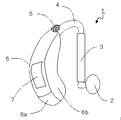
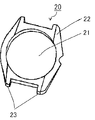
- FIG. 1 It is a perspective view of an ear hook type hearing aid which is an example of the ornament of this embodiment. It is a perspective view of the portable music player which is another example of the ornament of this embodiment. It is a perspective view of the case for wristwatches which is an example of the member for ornaments used for the ornament of this embodiment. It is a top view of the back cover for wristwatches which is another example of the member for ornaments used for the ornament of this embodiment.
- FIG. 1 is a perspective view of an ear-hearing type hearing aid 1 including a hearing aid housing 6 (hereinafter sometimes abbreviated as a housing) which is an example of a decorative article of the present embodiment.
- a hearing aid housing 6 hereinafter sometimes abbreviated as a housing
- the ear-mounted hearing aid 1 includes an ear mold 2, a sound guide tube 3, a hook 4, a microphone 5, and a housing 6.
- the housing 6 is provided with a hole 7 for exposing at least a part of an operation unit for adjusting the volume, sound quality, and the like from the outside.
- the housing 6 is for storing electronic parts such as an electric circuit composed of a control unit for processing an electric signal received by the operation unit, a battery as a power source, a metal wire for sending a signal received from the microphone 5, and the like. It has a space inside (hereinafter, this space may be abbreviated as an internal space).
- the housing 6 is composed of a cover 6a and a housing 6b. When replacing electronic parts such as a control unit, a battery, and an electric circuit housed in the internal space of the housing 6, the cover 6a is removed. Thus, the replacement can be easily performed.
- casing 6 may be accommodated in an internal space, without fixing to the inner surface which comprises the inner side of a housing
- cover 6a and the housing 6b are preferably joined without generating a gap so that moisture such as sweat or rainwater does not enter the internal space of the housing 6, and further, a water-repellent resin may be used as necessary. It may be coated.
- Such an over-the-ear hearing aid 1 can be used with the ear mold 2 inserted into the ear canal and the hook 4 over the ear.
- At least a part of the hearing aid housing 6 of the present embodiment is made of the decorative article member of the present embodiment.
- at least a portion is formed of a ceramic sintered body having a kurtosis (Rku) determined from a roughness curve of the outer surface of 0.5 to 2.5.
- the hearing aid casing 6 By forming the hearing aid casing 6 with a ceramic sintered body, it is harder to be scratched and has a higher Young's modulus than the ABS resin, metal, etc. The speed of sound in the internal space is increased, and even when a spare microphone is mounted in the internal space of the housing 6, the pitch in the high temperature range can be transmitted more delicately.
- the ceramic sintered body various materials such as zirconia, alumina, silicon carbide, or silicon nitride can be used. However, zirconia is mainly used because the strength can be improved and pores are hardly formed. What is made into a component is preferable.
- a main component means what contains more than 50 mass% with respect to a ceramic sintered compact.
- zirconia it is preferable to contain 75% by mass or more of zirconia, and it is preferable to contain zirconia in a range of 86% by mass to 95% by mass.
- zirconia stabilizer for example, yttria (Y 2 O 3 ) can be contained.
- an appropriate additive as a colorant is mixed into the raw material without coloring by plating or vapor deposition, as compared with ABS resin or metal. Since the color can be adjusted, the color colored by plating or vapor deposition is less likely to be discolored or peeled off, so that the aesthetic appearance is not impaired.
- the color of the ceramic sintered body may be green, blue, yellow, red or black.
- Various color tones can be achieved, and in addition, a texture not found in painting can be achieved.
- the decorative article refers to an article (for example, a mobile phone) that is directly attached to a human body (for example, an earphone (including a bone conduction type earphone), a headphone, a hearing aid, a wristwatch, etc.) It shall mean articles that are in direct contact with the human body, including telephones, portable music players, etc.).
- the decorative article member of the present invention refers to a member constituting the decorative article (for example, a hearing aid casing, a wristwatch case, a watch back cover, etc.).
- the outer surface of the ceramic sintered body is a generic term for, for example, a portion that is directly attached to the human body and that is in contact with the skin, a portion that is touched with a finger, a surface that is directly attached to the body and decorated as an appearance, and the like.
- the kurtosis (Rku) obtained from the roughness curve of the outer surface of the ceramic sintered body is 0.5 or more and 2.5 or less.
- the value of kurtosis (Rku) obtained from the roughness curve of the outer surface of the housing 6 of the hearing aid 1 shown in FIG. 1 is 0.5 or more and 2.5 or less, the outer surface of the housing 6 has rounded irregularities. Therefore, the adhesion of dirt to the outer surface can be suppressed, and the adhered dirt can be easily removed.
- the value of kurtosis (Rku) on the outer surface of the housing 6 is preferably 0.95 or more and 1.74 or less. Note that the kurtosis (Rku) on the surface of the housing 6 may be measured based on JIS B 0601-2001.
- the skewness (Rsk) obtained from the roughness curve of the outer surface of the housing 6 is 0.7 or more and 2.0 or less.
- the outer surface of the housing 6 is a surface with many convex portions. Discomfort can be reduced because the amount of sweat and dirt adhering to can be reduced.
- the value of skewness (Rsk) on the surface of the housing 6 is preferably 0.98 or more and 1.32 or less. Note that the skewness (Rsk) on the surface of the housing 6 may be measured based on JIS B 0601-2001.
- kurtosis (Rku) and skewness (Rsk) can be measured using a commercially available contact type or non-contact type surface roughness meter.
- the pore density of the open pores on the outer surface of the ceramic sintered body is preferably 600 / mm 2 or less. If the pore density of the open pores on the outer surface of the housing 6 is 600 / mm 2 or less, the number of open pores on the outer surface of the housing 6 is small, so that the adhesion of dirt to the outer surface can be suppressed. At the same time, the attached dirt can be easily removed. In more suppress the adhesion of dirt, it is preferable that the pore density of the open pores in the outer surface of the housing 6 272 / mm 2 or less. In addition, it is preferable that the pore density of the open pores on the inner surface on the inner space side of the housing 6 is equal to the pore density of the open pores on the outer surface.
- the pore density in the housing 6 is 600 / mm 2 or less.
- the pore density inside the housing 6 is 600 pieces / mm 2 or less. It is possible to prevent external moisture from penetrating the inside of the housing 6, and an electric circuit or the like housed inside the housing 6 can be provided. It is possible to suppress damage.
- the pore density inside the housing 6 is 272 / mm 2 or less.
- the method for measuring the pore density of the open pores on each surface of the housing 6 is that the surface of the housing 6 is arbitrarily selected at five locations by a field emission scanning electron microscope (FE-SEM) with a magnification of 800 times. After selecting and photographing, it can be obtained by measuring the long diameter of the photographed image area in the range of 150 ⁇ m ⁇ 111 ⁇ m, counting open pores of 1 ⁇ m or more, and calculating the average value.
- FE-SEM field emission scanning electron microscope
- the method for measuring the pore density of the open pores inside the housing 6 is a field emission scanning electron microscope (FE) in which the housing 6 is cut with a fine cutter and then the cross section is made into a mirror surface and the magnification is 800 times. -SEM), arbitrarily select five sections of the housing 6 and shoot. Then, measure the imaged area of 150 ⁇ m ⁇ 111 ⁇ m, measure the long diameter, and count the open pores that are 1 ⁇ m or more. It can be obtained by calculating.
- FE field emission scanning electron microscope
- the housing 6 of the present embodiment has a thermal conductivity of 1 W / (m ⁇ K) or more and 40 W / (m ⁇ K) or less. If the thermal conductivity is 1 W / (m ⁇ K) or more, the body temperature is transmitted from the skin when worn, the temperature is less likely to stay in the housing 6, and a cool feeling can be maintained, and the thermal conductivity is 40 W / ( m ⁇ K) or less, it is possible to suppress condensation on the surface of the housing 6 even when the housing 6 of the present embodiment is used in a place where the temperature is low.
- spinel exists in the outer surface of the housing
- the presence of spinel can provide more vivid colors.
- the housing 6 can be bright black.
- the ratio of the zirconia crystal structure of the ceramic sintered body is preferably 15% or less.
- the ratio of the crystal structure of zirconia in the ceramic sintered body is 15% or less as a monoclinic crystal ratio, even if heat is repeatedly applied, there are few monoclinic crystals that transform into tetragonal crystals. Since the damage due to the volume change caused by transformation from tetragonal to tetragonal is reduced, it can be used without any problem even if it is repeatedly boiled and disinfected. Thereby, the product life can be prolonged.
- the hearing aid housing 6 shown in FIG. 1 has a space for storing electronic parts such as a control unit and a battery.
- the decorative article may be formed so as to have a space inside by combining a plurality of members in addition to having a space inside by integral formation.
- the cultosis obtained from the roughness curve of the inner surface on the internal space side of the decorative article member.
- Rku is greater than the kurtosis (Rku) determined from the roughness curve of the outer surface, and the skewness (Rsk) determined from the roughness curve of the inner surface is greater than the skewness (Rsk) determined from the roughness curve of the outer surface.
- Small is preferable.
- the valleys have a sharp shape. That is, since the inner surface has a large volume of the concave portion and has a sharp shape (such as a saw blade), for example, when an electronic component is mounted on the inner surface using an adhesive, It becomes easy to bite into the recess, and the adhesive strength between the electronic component and the ceramic sintered body can be improved.
- the skewness (Rsk) obtained from the roughness curve of the inner surface is ⁇ 2.0 or more and ⁇ 0.5 or less, and the kurtosis (Rku) is 4.0 or more and 6.0 or less.
- the skewness (Rsk) obtained from the roughness curve of the inner surface of the housing 6 is ⁇ 2.0 or more and ⁇ 0.5 or less, the valleys of the concave portions tend to increase more, and the kurtosis is large. The valley becomes sharper and sharper. Therefore, the adhesive used when the electronic component is directly mounted on the inner surface is more likely to bite into the recess, and the adhesive strength between the electronic component and the ceramic sintered body can be further improved.
- the vibrator and housing Since the bonding property with the body 6 is excellent, a finer variation in vibration can be transmitted.
- FIG. 2 is a perspective view of a portable music playback device 10 including a portable music playback device case (hereinafter sometimes abbreviated as a case), which is another example of the decorative article of the present embodiment.
- the portable music player device 10 includes a power switch 11, an operation unit 12, a connection unit 13, and a case 14.
- a case which is another example of the decorative article of the present embodiment.
- the portable music player device 10 includes a power switch 11, an operation unit 12, a connection unit 13, and a case 14.
- the button or the like when the power switch 11 or the operation unit 12 is made of a button is made of the ceramic sintered body of the present embodiment, each corresponds to the decorative article member in the present embodiment. To do.
- the power switch 11 is a switch for operating the portable music player 10.
- the operation unit 12 is an operation panel for operating the portable music playback device 10 and confirming the operating program, and the input method may be either a button method or a touch panel method.
- the control unit that processes the electrical signal received by the operation unit 12, a battery that is a power source, and electronic components such as a speaker and a vibrator that operate by receiving the signal processed by the control unit.
- the connection unit 13 includes an earphone terminal, a microphone terminal, a connection terminal for connecting to another electronic device, and the like.
- the case 14 is formed of the decorative member of this embodiment, so that even if it is used while touching the human body during exercise such as jogging, dirt such as sweat Can be suppressed, and the attached dirt can be easily removed.
- the inner surface on which the electronic component is mounted has a sharp shape with a large volume of the concave portion, so that the adhesive can easily bite into the concave portion, and the bonding between the electronic component to be mounted and the case 14 is improved. Because it excels, it can improve reliability even in intense exercise, and can transmit detailed vibration when a vibrator is installed.
- the portable music player 10 also serves as a pulse meter or heart rate monitor, more accurate numerical processing is performed by transmitting the pulse and heart rate from the human body received on the outer surface to the internal vibrator. be able to.
- FIG. 3 is a perspective view of a wristwatch case which is an example of a decorative member used in the decorative article of the present embodiment.
- the wristwatch case 20 shown in FIG. 3 has a movement (drive mechanism) and a hole 21 for receiving electronic parts (not shown), and a wristwatch band (not shown) for attaching a watch to the arm formed on the body 22. And a foot portion 23 to be fixed.
- the wristwatch case 20 By forming the wristwatch case 20 with the decorative article member of the present embodiment, it is possible to suppress the adhesion of dirt to the surface and to make a decorative accessory part that can easily remove the adhered dirt. Can do.
- FIG. 4 is a plan view of a back cover for a wristwatch which is still another example of the decorative article member used in the decorative article of this embodiment.
- the wristwatch back cover 30 By forming the wristwatch back cover 30 with the decorative article member of the present embodiment, it is possible to suppress the adhesion of dirt to the surface and to make the decorative article capable of easily removing the adhered dirt. it can.
- the example of the decorative article member and the decorative article including the same according to the present embodiment has been described using the hearing aid casing, the portable music player case, and the wristwatch case / back cover.
- the ornamental member include earphones (including bone conduction type), headphones, watch ornaments such as watch band pieces, glasses, brooches, necklaces, earrings, bracelets, anklets, tie pins, tie tacks, medals,
- the present invention can be used for articles directly contacted by the human body such as mobile phones.
- a watch and a mobile phone are combined and can be suitably used as a wristwatch type mobile phone having both functions.
- Raw material powder and plastic resin containing yttria (Y 2 O 3 ) as a stabilizer to zirconia as the main component are put into a kneader, and the clay obtained by kneading while heating is put into a pelletizer. By doing, the pellet used as the raw material for injection molding is obtained.
- yttria Y 2 O 3
- the clay obtained by kneading while heating is put into a pelletizer.
- the pellet used as the raw material for injection molding is obtained.
- casing 6 it is good to add at least 1 type among oxides, such as nickel, cobalt, selenium, chromium, titanium, iron, erbium, or copper, as an additive.
- thermoplastic resin to be introduced into the kneader an ethylene vinyl acetate copolymer, polystyrene, acrylic resin, or the like may be added in an amount of 10% by mass to 35% by mass with respect to 100% by mass of the raw material powder.
- the heating temperature may be set to 140 ° C. or more and 180 ° C. or less, and other conditions such as pressure are appropriately set according to the ceramic raw material to be used, the type of thermoplastic resin and additives. do it.
- the obtained pellets are put into an injection molding machine and injection molded, and if necessary, the excess raw material attached to the molded body is cooled and solidified to cut the runner, thereby forming a molded body that becomes a casing Can be obtained.
- the obtained molded body After degreasing the obtained molded body, it is fired at 1300 ° C. or higher and 1550 ° C. or lower in an air atmosphere by a batch furnace or a continuous tunnel furnace to obtain a sintered body.
- the surface of the obtained sintered body is rough-finished with a barrel polishing machine, and then mirror-finished with a barrel polishing machine to obtain the casing of this embodiment. Further, blasting or the like may be combined as preprocessing.
- the rough finishing by a barrel polishing machine uses a known barrel apparatus, and adds an appropriate amount of abrasive grains with a water, media, and product input ratio of about 1: 1: 1.
- the medium to be used has a size of about 5 to 10 mm, and the shape may be selected from spherical, triangular prism, rhombus, cylinder, and oblique cylinder.
- the abrasive grains used may be GC abrasive grains, and those having a count of # 150 to # 800 may be used. Then, the barrel polisher is processed for 20 to 50 hours at a rotational speed of 50 to 130 rpm.
- a known barrel polisher is used as a mirror finish, and the ratio of water, media and product is set to about 1: 0.8: 0.5.
- Add abrasive grains The medium has a size of 2 to 5 mm, and the shape may be selected from a spherical shape, a triangular prism shape, a rhombus shape, a cylindrical shape, a slanted cylindrical shape, and the like, but a spherical shape is preferable. If a spherical object is used, it is easy to make point contact with the product, and it becomes easy to control skewness.
- the abrasive grains used may be GC abrasive grains and the counts may be # 1000 to # 8000.
- the inner surface on the side where electronic components are stored may be a burnt surface, but may be subjected to polishing or blasting in order to adjust skewness or kurtosis.
- the above method can also adjust the skewness and kurtosis, but in order to make the skewness and kurtosis tendencies different between the outer surface and the inner surface, it can be adjusted more accurately by adding the following methods. Can do.
- the ceramic sintered body finished up to mirror polishing have many convex portions on the outer surface, many of the convex portions tend to be rounded, that is, the skewness is large and the kurtosis tends to be small.
- Refiring is preferably performed at a temperature 50 to 100 ° C. higher than that. Thereby, it is possible to promote the bulging of the particles of the ceramic sintered body and to further round the corners of the particles.
- a jig that does not directly transfer heat to the inner surface is prepared, or it is laid down and fired for 0.5 to 1 hour. good.
- the value of kurtosis (Rku) determined from the roughness curve of the inner surface is larger than the kurtosis (Rku) determined from the roughness curve of the outer surface, and the skewness (Rsk) determined from the roughness curve of the inner surface is increased.
- the numerical value is smaller than the skewness (Rsk) obtained from the roughness curve of the outer surface.
- the raw material powder is 94.8% by mass of zirconia (ZrO 2 ), yttrium oxide (Y 2 O 3 ) as a stabilizer is 5.2% by mass, and the raw material powder is 100% by mass.
- a total of 4% by mass is added by combining chromium oxide, iron oxide and cobalt oxide as pigment additives, and water is added to these and pulverized and mixed with a ball mill to produce a slurry. These slurries were spray-dried using a spray dryer to prepare granules.
- casing for hearing aids was produced by the injection molding method.
- the surface of the sintered body was rough-finished with a barrel grinder and then mirror-finished with a barrel grinder.
- the barrel finishing conditions are as follows.
- a centrifugal barrel polishing machine manufactured by Toho Koki Co., Ltd.
- the ratio of water, media and product is set to 1: 1: 1.
- a spherical alumina medium having an average particle diameter of 8 mm was used, and abrasive grains were treated with GC # 150 at a rotation speed of 75 rpm for 30 hours.
- the amount of water, product and media charged was set to 1: 0.8: 0.5 using a centrifugal barrel polishing machine, and an appropriate amount of GC abrasive was added.
- the media was treated with spherical alumina media having the size shown in Table 1, and the abrasive grains were the GC abrasive grains with the counts shown in Table 1, and the barrel time shown in Table 1 was processed at 90 rpm.
- a hearing aid for each sample by combining the firing temperature, rough finishing with a barrel polisher, and mirror finishing to change the pore density, kurtosis (Rku) and skewness (Rsk) of the open pores to the values shown in Table 1.
- a housing was prepared.
- the surface density of the open pores on the outer surface was arbitrarily selected and photographed at five locations on the hearing aid housing surface using a field emission scanning electron microscope (FE-SEM) with a magnification of 800 times, and then the photographed image was taken.
- the major axis was measured in an area of 150 ⁇ m ⁇ 111 ⁇ m, the open pores having a size of 1 ⁇ m or more were counted, and the average value was calculated.
- the scanning electron microscope used was JSM 7001F manufactured by JEOL Ltd., and the acceleration voltage was 15 kV.
- kurtosis (Rku) and skewness (Rsk) on the outer surface are based on JIS B10601-2001, and the cutoff values are fl8, fh0.8, measurement length 30mm, measurement speed 0.5mm / sec, vertical magnification 10000, horizontal magnification The magnification was 2.
- the measuring instrument used was a surface roughness meter ET4000A manufactured by Kosaka Laboratory, which was measured with a non-contact laser stylus.
- antifouling evaluation Evaluation of the removal of attached dirt (hereinafter referred to as antifouling evaluation) was performed on the surface of the hearing aid housing using quick-drying oil-based ink (Zebra, “Mackey” (registered trademark), red) 3 ⁇ Draw a 10mm line and use Asahi Kasei's “Bem Cotton” (registered trademark) to wipe it clean, using a total of 40 monitors, 5 for each age group in their 20s to 50s. Evaluation was made using the average number of times (rounded off to the nearest decimal point). The confirmation of wiping was visually confirmed by tilting the surface of the hearing aid housing at every angle with respect to light under irradiation with a 1000 W halogen lamp.
- fingerprint wiping evaluation As another evaluation (hereinafter referred to as fingerprint wiping evaluation) for removing attached dirt, the index finger is pressed against the surface of the hearing aid housing for 5 to 10 seconds, and “Bem Cotton” (registered trademark) manufactured by Asahi Kasei Co., Ltd. ) was used to evaluate the number of times until it was wiped clean using an average of 40 monitors (5 rounds) for each age group in their 20s to 50s. The confirmation of wiping was visually confirmed by tilting the surface of the hearing aid housing at every angle with respect to light under irradiation with a 1000 W halogen lamp.
- wearing feeling evaluation For the evaluation of reducing discomfort due to sweat or the like (hereinafter referred to as wearing feeling evaluation), a wearing test was conducted. The evaluation method is based on the sensation of 40 male and female monitors for each age group in their 20s to 50s. A sample of each sample assembled as an ear hearing aid was worn on the ear. We conducted a questionnaire about the evaluation of wearing feelings to see if there was any sense of incongruity in daily life. For 40 monitors, “excellent” is all 40 people, “good” is 35-39, “possible” is 30-34, “impossible” is less than 30 It indicates that there was no problem and there was no sense of incongruity when wearing for a long time.
- Table 1 shows the above measurement results and human sensory evaluation results.
- the number of wipes in the fingerprint wipe evaluation was 9 or less.
- the number of wipes in the fingerprint wipe evaluation was 3 or less.
- the wearing feeling evaluation was excellent or good. Among them, the sample No.
- the hearing aid casing of the present embodiment has a kurtosis (Rku) value obtained from the roughness curve of the outer surface of 0.5 or more and 2.5 or less, so that attached dirt can be easily removed. Furthermore, since the skewness (Rsk) obtained from the roughness curve of the outer surface is 0.7 or more and 2.0 or less, it is possible to reduce discomfort due to sweating of the surface, etc., and furthermore, openness on each surface of the ceramic sintered body. Since the pore density of the pores was 600 / mm 2 or less, it was found that the adhesion of dirt to the surface could be suppressed.
- a plate-like molded body having a sintered body size of 30 mm in length, 30 mm in width, and 1 mm in thickness was prepared by an injection molding method. Then, firing was carried out to produce a ceramic sintered body with a maximum temperature of 1480 ° C. and a holding time of 2 hours.
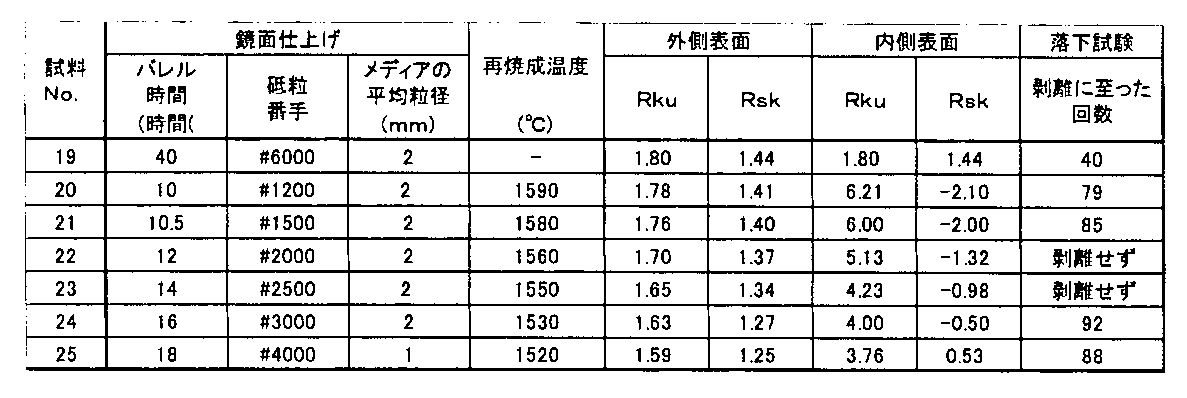
- each surface of the ceramic sintered body was subjected to a rough finishing process using a barrel polishing machine under the same conditions as in Example 1. Then, by using a centrifugal barrel polishing machine, the input amount of water, product and media is set to about 1: 0.8: 0.5, the media is a spherical alumina media having the size shown in Table 2, and the abrasive is the count shown in Table 2. Using GC abrasive grains, mirror polishing was performed at a rotation speed of 90 rpm for the time shown in Table 2.
- sample No. 19 to 26 were prepared, and the skewness (Rsk) and kurtosis (Rku) of the outer surface and the inner surface were measured in the same manner as in Example 1.
- a drop test was performed to measure the bondability with electronic components. After an epoxy resin was applied to the inner surface with a diameter of 15 mm ⁇ 0.5 mm thickness, an electronic component (bimorph structure type piezoelectric vibrator, diameter 15 mm ⁇ thickness 2 mm) was bonded and dried sufficiently, and then a drop test was performed. In the drop test, from 300mm in height, the surface where the electronic parts are not joined (outside surface) for each sample is placed in a horizontal state, and the free fall is performed up to 100 times. It was measured whether or not.
- the kurtosis (Rku) determined from the roughness curve of the inner surface is the same as the kurtosis (Rku) determined from the roughness curve of the outer surface, and the skewness determined from the roughness curve of the inner surface ( Rsk) is the same as the skewness (Rsk) obtained from the roughness curve of the outer surface.
- the number of times of peeling was as low as 40 times.
- the kurtosis (Rku) determined from the roughness curve of the inner surface is larger than the kurtosis (Rku) determined from the roughness curve of the outer surface, and the skewness (Rsk) determined from the roughness curve of the inner surface is Sample No.
- the sample No. 2 has a skewness (Rsk) determined from the roughness curve of the inner surface of ⁇ 2.0 or more and ⁇ 0.5 or less and a kurtosis (Rku) of 4.0 or more and 6.0 or less. Nos. 21 to 24 have more than 85 times of peeling, and have better bondability.
- the skewness (Rsk) obtained from the roughness curve of the inner surface is ⁇ 1.32 or more and ⁇ 0.98 or less, and kurtosis Sample No. whose Rku is 4.23 or more and 5.13 or less. It was found that 22 and 23 did not peel in the 100-drop test and were further excellent in bondability.
- the difference in the surface condition when using 60 days of daily life was confirmed by using the hearing aid housing 6 made of zirconia, alumina, silicon carbide or silicon nitride as the main component.
- Samples containing zirconia as the main component were sample No. 1 in Example 1. 15 things were used.
- the main component of alumina is 96.0% by mass of alumina (Al 2 O 3 ) as raw material powder, and 4.0% by mass of magnesium oxide, silicon oxide and calcium oxide. Slurries were prepared by mixing, and these slurries were spray-dried using a spray dryer to prepare granules.
- ⁇ - silicon carbide 95.5 wt%, alumina (Al 2 O 3) 3.5 wt%, yttrium oxide (Y 2 O 3) 1.0
- a slurry was prepared by adding a solvent to these, pulverizing and mixing with a ball mill, and spray-drying the slurry using a spray dryer to prepare granules.
- silicon nitride As a main component, 100 parts by mass of silicon nitride (Si 3 N 4 ) as a raw material powder, and a total of 5 oxides of calcium oxide, aluminum oxide and rare earth elements as sintering aids are used. Mass parts% were added, a solvent was added to these and pulverized and mixed with a ball mill to prepare slurries, and these slurries were spray-dried using a spray dryer to prepare granules.
- each granule 25 parts by mass in total of acrylic resin, polystyrene, ethylene-vinyl acetate copolymer, stearic acid, and dibutyl phthalate (DBP) is added to the kneader.
- DBP dibutyl phthalate
- casing for hearing aids was produced by the injection molding method.
- alumina is 1600 ° C. in an air atmosphere
- silicon carbide is 2000 ° C. in argon gas atmosphere baking
- silicon nitride is nitrogen gas atmosphere baking. Firing was performed at 1780 ° C. to prepare sintered bodies of the respective samples.
- the surface condition is the sample No. 1 of Example 1.
- the pore density of the open pores, kurtosis (Rku) and skewness (Rsk) are adjusted to the same value within the range of the same barrel processing conditions so as to be the same value as the value of 15. Made by processing.
- the hearing aid casing made using alumina, silicon carbide or silicon nitride as the main component was able to visually confirm a large number of scratches that may have been attached when wiping off or touching. Sample No. whose component is zirconia. In 15, the occurrence of scratches could not be confirmed visually.
- the hearing aid casing has zirconia as a main component can prevent the surface from being scratched and obtain high strength.
- Hearing hearing aid 2 Ear mold 3: Sound guide tube 4: Hook 5: Microphone 6: Housing 6a: Cover 6b: Housing 7: Operation unit 10: Portable music player 11: Power switch 12: Operation unit 13: Connection 14: Case 20: Watch case 30: Watch back cover
Landscapes
- Engineering & Computer Science (AREA)
- Chemical & Material Sciences (AREA)
- Ceramic Engineering (AREA)
- Manufacturing & Machinery (AREA)
- Organic Chemistry (AREA)
- Materials Engineering (AREA)
- Structural Engineering (AREA)
- Physics & Mathematics (AREA)
- Health & Medical Sciences (AREA)
- General Physics & Mathematics (AREA)
- General Health & Medical Sciences (AREA)
- Neurosurgery (AREA)
- Otolaryngology (AREA)
- Acoustics & Sound (AREA)
- Signal Processing (AREA)
- Inorganic Chemistry (AREA)
- Composite Materials (AREA)
- Compositions Of Oxide Ceramics (AREA)
- Adornments (AREA)
Abstract
Description

2:イヤモールド
3:導音管
4:フック
5:マイク
6:筐体
6a:カバー
6b:ハウジング
7:操作部
10:携帯型音楽再生機器
11:電源スイッチ
12:操作部
13:接続部
14:ケース
20:時計用ケース
30:時計用裏蓋
Claims (7)
- セラミック焼結体からなり、該セラミック焼結体の外側表面の粗さ曲線から求められるクルトシス(Rku)が0.5以上2.5以下であることを特徴とする装飾品用部材。
- 前記外側表面の粗さ曲線から求められるスキューネス(Rsk)が、0.7以上2.0以下であることを特徴とする請求項1に記載の装飾品用部材。
- 前記外側表面における開気孔の気孔密度が600個/mm2以下であることを特徴とする請求項1または請求項2に記載の装飾品用部材。
- 前記セラミック焼結体が、ジルコニアを主成分としてなることを特徴とする請求項1乃至請求項3のいずれかに記載の装飾品用部材。
- 請求項1乃至請求項4のいずれかに記載の装飾品用部材を備えてなることを特徴とする装飾品。
- 前記装飾品が内部に空間を有し、該装飾品の少なくとも一部が前記装飾品用部材からなり、該装飾品用部材の内側表面の粗さ曲線から求められるクルトシス(Rku)が、前記外側表面の粗さ曲線から求められるクルトシス(Rku)より大きく、前記内側表面の粗さ曲線から求められるスキューネス(Rsk)が、前記外側表面の粗さ曲線から求められるスキューネス(Rsk)より小さいことを特徴とする請求項5に記載の装飾品。
- 前記内側表面の粗さ曲線から求められるスキューネス(Rsk)が、-2.0以上-0.5以下、クルトシス(Rku)が、4.0以上6.0以下であることを特徴とする請求項6に記載の装飾品。
Priority Applications (4)
| Application Number | Priority Date | Filing Date | Title |
|---|---|---|---|
| EP12744634.2A EP2675183B1 (en) | 2011-02-07 | 2012-02-07 | Accessory member and accessory comprising same |
| CN201280007726.7A CN103370948B (zh) | 2011-02-07 | 2012-02-07 | 装饰品用构件及具备该装饰品用构件的装饰品 |
| JP2012521408A JP5052709B2 (ja) | 2011-02-07 | 2012-02-07 | 装飾品用部材およびこれを備える装飾品 |
| US13/984,145 US9358751B2 (en) | 2011-02-07 | 2012-02-07 | Accessory member, and accessory comprising the same |
Applications Claiming Priority (2)
| Application Number | Priority Date | Filing Date | Title |
|---|---|---|---|
| JP2011024072 | 2011-02-07 | ||
| JP2011-024072 | 2011-02-07 |
Publications (1)
| Publication Number | Publication Date |
|---|---|
| WO2012108433A1 true WO2012108433A1 (ja) | 2012-08-16 |
Family
ID=46638646
Family Applications (1)
| Application Number | Title | Priority Date | Filing Date |
|---|---|---|---|
| PCT/JP2012/052754 Ceased WO2012108433A1 (ja) | 2011-02-07 | 2012-02-07 | 装飾品用部材およびこれを備える装飾品 |
Country Status (5)
| Country | Link |
|---|---|
| US (1) | US9358751B2 (ja) |
| EP (1) | EP2675183B1 (ja) |
| JP (1) | JP5052709B2 (ja) |
| CN (1) | CN103370948B (ja) |
| WO (1) | WO2012108433A1 (ja) |
Cited By (9)
| Publication number | Priority date | Publication date | Assignee | Title |
|---|---|---|---|---|
| WO2014087655A1 (ja) * | 2012-12-07 | 2014-06-12 | 東ソー株式会社 | 複合プレートおよびその製造方法 |
| JP2015089863A (ja) * | 2013-11-06 | 2015-05-11 | 東ソー株式会社 | 複合プレート及びその製造方法 |
| JP2018509369A (ja) * | 2015-03-13 | 2018-04-05 | 華為技術有限公司Huawei Technologies Co.,Ltd. | 外装ジルコニアセラミック部品及びその製造方法 |
| JPWO2018079788A1 (ja) * | 2016-10-31 | 2019-09-26 | 京セラ株式会社 | プローブカード用基板、プローブカード、および検査装置 |
| JP2020509678A (ja) * | 2017-02-16 | 2020-03-26 | 華為技術有限公司Huawei Technologies Co.,Ltd. | ウェアラブルデバイス |
| WO2020067423A1 (ja) * | 2018-09-27 | 2020-04-02 | 京セラ株式会社 | サーマルヘッドおよびサーマルプリンタ |
| JP2020076740A (ja) * | 2018-09-17 | 2020-05-21 | ロレックス・ソシエテ・アノニムRolex Sa | 小型時計部品の製造方法 |
| WO2022210092A1 (ja) * | 2021-03-30 | 2022-10-06 | 富士フイルム株式会社 | 圧電フィルム |
| JP2025011029A (ja) * | 2023-07-10 | 2025-01-23 | ザ・スウォッチ・グループ・リサーチ・アンド・ディベロップメント・リミテッド | 防曇デバイス付き保護ガラスを備えた計時器 |
Families Citing this family (8)
| Publication number | Priority date | Publication date | Assignee | Title |
|---|---|---|---|---|
| CN106165949A (zh) * | 2016-08-10 | 2016-11-30 | 苏州倍声声学技术有限公司 | 一种基于amba技术的智能手环 |
| US11088718B2 (en) * | 2016-09-06 | 2021-08-10 | Apple Inc. | Multi-colored ceramic housings for an electronic device |
| EP3550383B9 (en) * | 2016-11-29 | 2024-08-14 | Kyocera Corporation | Timepiece case |
| EP3339271B1 (en) * | 2016-12-22 | 2019-03-06 | Toto Ltd. | Antifouling matted object |
| JP6496094B1 (ja) * | 2017-04-27 | 2019-04-03 | 京セラ株式会社 | 装飾部品 |
| DE102021004077A1 (de) | 2021-08-07 | 2023-02-09 | Caddent Gmbh | lndividualisierte Otoplastiken und Brillen |
| CN116233673A (zh) * | 2023-01-06 | 2023-06-06 | 极元科技(深圳) 有限公司 | 一种骨传导手环耳机扩展音箱 |
| EP4625065A1 (fr) * | 2024-03-25 | 2025-10-01 | Rolex Sa | Procédé de fabrication d'un assemblage horloger et assemblage horloger |
Citations (5)
| Publication number | Priority date | Publication date | Assignee | Title |
|---|---|---|---|---|
| JPH07191156A (ja) * | 1993-12-27 | 1995-07-28 | Kyocera Corp | ジルコニア製腕時計用ケースおよびジルコニアセラミックスの射出成形方法 |
| JP2002506335A (ja) | 1998-03-02 | 2002-02-26 | フォーナック アーゲー | 補聴器 |
| JP2004115332A (ja) * | 2002-09-27 | 2004-04-15 | Mitsui Mining & Smelting Co Ltd | 電子部品焼成用治具 |
| JP2008156160A (ja) * | 2006-12-25 | 2008-07-10 | Kyocera Corp | 耐食性部材およびその製造方法 |
| JP2010030833A (ja) * | 2008-07-29 | 2010-02-12 | Kyocera Corp | 装飾部品用セラミックスおよび装飾部品 |
Family Cites Families (4)
| Publication number | Priority date | Publication date | Assignee | Title |
|---|---|---|---|---|
| ATE267150T1 (de) | 1998-05-27 | 2004-06-15 | Toto Ltd | Sanitäre tonkeramikprodukte und verfahren zur herstellung derselben |
| US20050257740A1 (en) | 2002-09-18 | 2005-11-24 | Mitsui Mining & Smelting Co | Electronic component burning jig |
| EP2243756B1 (en) * | 2008-01-29 | 2015-09-09 | Kyocera Corporation | White ceramic |
| WO2010137652A1 (ja) * | 2009-05-27 | 2010-12-02 | 京セラ株式会社 | 装飾部品用セラミックスおよび装飾部品 |
-
2012
- 2012-02-07 US US13/984,145 patent/US9358751B2/en active Active
- 2012-02-07 CN CN201280007726.7A patent/CN103370948B/zh active Active
- 2012-02-07 WO PCT/JP2012/052754 patent/WO2012108433A1/ja not_active Ceased
- 2012-02-07 EP EP12744634.2A patent/EP2675183B1/en not_active Not-in-force
- 2012-02-07 JP JP2012521408A patent/JP5052709B2/ja active Active
Patent Citations (5)
| Publication number | Priority date | Publication date | Assignee | Title |
|---|---|---|---|---|
| JPH07191156A (ja) * | 1993-12-27 | 1995-07-28 | Kyocera Corp | ジルコニア製腕時計用ケースおよびジルコニアセラミックスの射出成形方法 |
| JP2002506335A (ja) | 1998-03-02 | 2002-02-26 | フォーナック アーゲー | 補聴器 |
| JP2004115332A (ja) * | 2002-09-27 | 2004-04-15 | Mitsui Mining & Smelting Co Ltd | 電子部品焼成用治具 |
| JP2008156160A (ja) * | 2006-12-25 | 2008-07-10 | Kyocera Corp | 耐食性部材およびその製造方法 |
| JP2010030833A (ja) * | 2008-07-29 | 2010-02-12 | Kyocera Corp | 装飾部品用セラミックスおよび装飾部品 |
Cited By (15)
| Publication number | Priority date | Publication date | Assignee | Title |
|---|---|---|---|---|
| JP2014113726A (ja) * | 2012-12-07 | 2014-06-26 | Tosoh Corp | 複合プレートおよびその製造方法 |
| WO2014087655A1 (ja) * | 2012-12-07 | 2014-06-12 | 東ソー株式会社 | 複合プレートおよびその製造方法 |
| US10682831B2 (en) | 2012-12-07 | 2020-06-16 | Tosoh Corporation | Composite plate and method for producing same |
| JP2015089863A (ja) * | 2013-11-06 | 2015-05-11 | 東ソー株式会社 | 複合プレート及びその製造方法 |
| JP2018509369A (ja) * | 2015-03-13 | 2018-04-05 | 華為技術有限公司Huawei Technologies Co.,Ltd. | 外装ジルコニアセラミック部品及びその製造方法 |
| JPWO2018079788A1 (ja) * | 2016-10-31 | 2019-09-26 | 京セラ株式会社 | プローブカード用基板、プローブカード、および検査装置 |
| US11422514B2 (en) | 2017-02-16 | 2022-08-23 | Huawei Technologies Co., Ltd. | Wearable device |
| JP2020509678A (ja) * | 2017-02-16 | 2020-03-26 | 華為技術有限公司Huawei Technologies Co.,Ltd. | ウェアラブルデバイス |
| JP2020076740A (ja) * | 2018-09-17 | 2020-05-21 | ロレックス・ソシエテ・アノニムRolex Sa | 小型時計部品の製造方法 |
| JP7474572B2 (ja) | 2018-09-17 | 2024-04-25 | ロレックス・ソシエテ・アノニム | 小型時計部品の製造方法 |
| WO2020067423A1 (ja) * | 2018-09-27 | 2020-04-02 | 京セラ株式会社 | サーマルヘッドおよびサーマルプリンタ |
| JPWO2020067423A1 (ja) * | 2018-09-27 | 2021-02-15 | 京セラ株式会社 | サーマルヘッドおよびサーマルプリンタ |
| WO2022210092A1 (ja) * | 2021-03-30 | 2022-10-06 | 富士フイルム株式会社 | 圧電フィルム |
| JP2025011029A (ja) * | 2023-07-10 | 2025-01-23 | ザ・スウォッチ・グループ・リサーチ・アンド・ディベロップメント・リミテッド | 防曇デバイス付き保護ガラスを備えた計時器 |
| JP7703745B2 (ja) | 2023-07-10 | 2025-07-07 | ザ・スウォッチ・グループ・リサーチ・アンド・ディベロップメント・リミテッド | 防曇デバイス付き保護ガラスを備えた計時器 |
Also Published As
| Publication number | Publication date |
|---|---|
| EP2675183A1 (en) | 2013-12-18 |
| CN103370948A (zh) | 2013-10-23 |
| US20140004302A1 (en) | 2014-01-02 |
| JPWO2012108433A1 (ja) | 2014-07-03 |
| JP5052709B2 (ja) | 2012-10-17 |
| EP2675183A4 (en) | 2016-05-11 |
| US9358751B2 (en) | 2016-06-07 |
| EP2675183B1 (en) | 2018-10-31 |
| CN103370948B (zh) | 2016-02-17 |
Similar Documents
| Publication | Publication Date | Title |
|---|---|---|
| JP5052709B2 (ja) | 装飾品用部材およびこれを備える装飾品 | |
| KR101138264B1 (ko) | 백색 세라믹스 | |
| EP2266934B1 (en) | Ceramic for decorative part | |
| EP2298713B1 (en) | Pinkish to purplish ceramic and decorative part | |
| JP7120340B2 (ja) | ジルコニア焼結体及びその用途 | |
| JP5361866B2 (ja) | 装飾部品用セラミックスおよびこれを用いた装飾部品 | |
| EP2336097B1 (en) | Dark-blue ceramic and decorative component | |
| JP2019521243A (ja) | 複合部品の製作方法 | |
| JP2015143180A (ja) | ジルコニア焼結体及びその用途 | |
| JP2016122091A (ja) | ペリクル枠およびペリクル枠の製造方法 | |
| JP2016121062A (ja) | ジルコニア焼結体及びその用途 | |
| JP2016122092A (ja) | ペリクル枠およびペリクル枠の製造方法 | |
| JP4960070B2 (ja) | 黒色セラミックスおよびこれを用いた時計用装飾部品ならびにその黒色セラミックスの製造方法 | |
| CN109177636A (zh) | 制备壳体的方法、壳体以及电子设备 | |
| JP6204149B2 (ja) | 窒化珪素質焼結体および時計用装飾部品 | |
| JP5590896B2 (ja) | 金色セラミック焼結体およびこれを用いた装飾部材 | |
| TW201134343A (en) | Housing for electronic device and method for making the same | |
| CN108247814B (zh) | 陶瓷后盖的制作方法及陶瓷后盖的制作模组 | |
| WO2010087092A1 (ja) | 装飾部品用セラミックスおよび装飾部品 | |
| JP2011093725A (ja) | 装飾部品用セラミックスおよび装飾部品 | |
| TWM377028U (en) | Ceramic earphone shell with tangent planes | |
| WO2012121446A1 (ko) | 세라믹 장신구 제작방법 및 세라믹 장신구 | |
| TW200412872A (en) | Structure of earring |
Legal Events
| Date | Code | Title | Description |
|---|---|---|---|
| WWE | Wipo information: entry into national phase |
Ref document number: 201280007726.7 Country of ref document: CN |
|
| WWE | Wipo information: entry into national phase |
Ref document number: 2012521408 Country of ref document: JP |
|
| 121 | Ep: the epo has been informed by wipo that ep was designated in this application |
Ref document number: 12744634 Country of ref document: EP Kind code of ref document: A1 |
|
| NENP | Non-entry into the national phase |
Ref country code: DE |
|
| WWE | Wipo information: entry into national phase |
Ref document number: 2012744634 Country of ref document: EP |
|
| WWE | Wipo information: entry into national phase |
Ref document number: 13984145 Country of ref document: US |