WO2012108485A1 - ポリオルガノシロキサンラテックス、それを用いたグラフト共重合体、熱可塑性樹脂組成物、及び成形体 - Google Patents
ポリオルガノシロキサンラテックス、それを用いたグラフト共重合体、熱可塑性樹脂組成物、及び成形体 Download PDFInfo
- Publication number
- WO2012108485A1 WO2012108485A1 PCT/JP2012/052914 JP2012052914W WO2012108485A1 WO 2012108485 A1 WO2012108485 A1 WO 2012108485A1 JP 2012052914 W JP2012052914 W JP 2012052914W WO 2012108485 A1 WO2012108485 A1 WO 2012108485A1
- Authority
- WO
- WIPO (PCT)
- Prior art keywords
- mass
- polyorganosiloxane
- parts
- copolymer
- graft copolymer
- Prior art date
- Legal status (The legal status is an assumption and is not a legal conclusion. Google has not performed a legal analysis and makes no representation as to the accuracy of the status listed.)
- Ceased
Links
Classifications
-
- C—CHEMISTRY; METALLURGY
- C08—ORGANIC MACROMOLECULAR COMPOUNDS; THEIR PREPARATION OR CHEMICAL WORKING-UP; COMPOSITIONS BASED THEREON
- C08G—MACROMOLECULAR COMPOUNDS OBTAINED OTHERWISE THAN BY REACTIONS ONLY INVOLVING UNSATURATED CARBON-TO-CARBON BONDS
- C08G77/00—Macromolecular compounds obtained by reactions forming a linkage containing silicon with or without sulfur, nitrogen, oxygen or carbon in the main chain of the macromolecule
- C08G77/04—Polysiloxanes
- C08G77/06—Preparatory processes
-
- C—CHEMISTRY; METALLURGY
- C08—ORGANIC MACROMOLECULAR COMPOUNDS; THEIR PREPARATION OR CHEMICAL WORKING-UP; COMPOSITIONS BASED THEREON
- C08F—MACROMOLECULAR COMPOUNDS OBTAINED BY REACTIONS ONLY INVOLVING CARBON-TO-CARBON UNSATURATED BONDS
- C08F290/00—Macromolecular compounds obtained by polymerising monomers on to polymers modified by introduction of aliphatic unsaturated end or side groups
- C08F290/02—Macromolecular compounds obtained by polymerising monomers on to polymers modified by introduction of aliphatic unsaturated end or side groups on to polymers modified by introduction of unsaturated end groups
- C08F290/06—Polymers provided for in subclass C08G
- C08F290/068—Polysiloxanes
-
- C—CHEMISTRY; METALLURGY
- C08—ORGANIC MACROMOLECULAR COMPOUNDS; THEIR PREPARATION OR CHEMICAL WORKING-UP; COMPOSITIONS BASED THEREON
- C08F—MACROMOLECULAR COMPOUNDS OBTAINED BY REACTIONS ONLY INVOLVING CARBON-TO-CARBON UNSATURATED BONDS
- C08F283/00—Macromolecular compounds obtained by polymerising monomers on to polymers provided for in subclass C08G
- C08F283/12—Macromolecular compounds obtained by polymerising monomers on to polymers provided for in subclass C08G on to polysiloxanes
- C08F283/124—Macromolecular compounds obtained by polymerising monomers on to polymers provided for in subclass C08G on to polysiloxanes on to polysiloxanes having carbon-to-carbon double bonds
-
- C—CHEMISTRY; METALLURGY
- C08—ORGANIC MACROMOLECULAR COMPOUNDS; THEIR PREPARATION OR CHEMICAL WORKING-UP; COMPOSITIONS BASED THEREON
- C08F—MACROMOLECULAR COMPOUNDS OBTAINED BY REACTIONS ONLY INVOLVING CARBON-TO-CARBON UNSATURATED BONDS
- C08F290/00—Macromolecular compounds obtained by polymerising monomers on to polymers modified by introduction of aliphatic unsaturated end or side groups
- C08F290/02—Macromolecular compounds obtained by polymerising monomers on to polymers modified by introduction of aliphatic unsaturated end or side groups on to polymers modified by introduction of unsaturated end groups
- C08F290/06—Polymers provided for in subclass C08G
-
- C—CHEMISTRY; METALLURGY
- C08—ORGANIC MACROMOLECULAR COMPOUNDS; THEIR PREPARATION OR CHEMICAL WORKING-UP; COMPOSITIONS BASED THEREON
- C08F—MACROMOLECULAR COMPOUNDS OBTAINED BY REACTIONS ONLY INVOLVING CARBON-TO-CARBON UNSATURATED BONDS
- C08F291/00—Macromolecular compounds obtained by polymerising monomers on to macromolecular compounds according to more than one of the groups C08F251/00 - C08F289/00
-
- C—CHEMISTRY; METALLURGY
- C08—ORGANIC MACROMOLECULAR COMPOUNDS; THEIR PREPARATION OR CHEMICAL WORKING-UP; COMPOSITIONS BASED THEREON
- C08G—MACROMOLECULAR COMPOUNDS OBTAINED OTHERWISE THAN BY REACTIONS ONLY INVOLVING UNSATURATED CARBON-TO-CARBON BONDS
- C08G77/00—Macromolecular compounds obtained by reactions forming a linkage containing silicon with or without sulfur, nitrogen, oxygen or carbon in the main chain of the macromolecule
- C08G77/04—Polysiloxanes
- C08G77/20—Polysiloxanes containing silicon bound to unsaturated aliphatic groups
-
- C—CHEMISTRY; METALLURGY
- C08—ORGANIC MACROMOLECULAR COMPOUNDS; THEIR PREPARATION OR CHEMICAL WORKING-UP; COMPOSITIONS BASED THEREON
- C08G—MACROMOLECULAR COMPOUNDS OBTAINED OTHERWISE THAN BY REACTIONS ONLY INVOLVING UNSATURATED CARBON-TO-CARBON BONDS
- C08G77/00—Macromolecular compounds obtained by reactions forming a linkage containing silicon with or without sulfur, nitrogen, oxygen or carbon in the main chain of the macromolecule
- C08G77/42—Block-or graft-polymers containing polysiloxane sequences
-
- C—CHEMISTRY; METALLURGY
- C08—ORGANIC MACROMOLECULAR COMPOUNDS; THEIR PREPARATION OR CHEMICAL WORKING-UP; COMPOSITIONS BASED THEREON
- C08K—Use of inorganic or non-macromolecular organic substances as compounding ingredients
- C08K3/00—Use of inorganic substances as compounding ingredients
- C08K3/02—Elements
- C08K3/04—Carbon
-
- C—CHEMISTRY; METALLURGY
- C08—ORGANIC MACROMOLECULAR COMPOUNDS; THEIR PREPARATION OR CHEMICAL WORKING-UP; COMPOSITIONS BASED THEREON
- C08K—Use of inorganic or non-macromolecular organic substances as compounding ingredients
- C08K3/00—Use of inorganic substances as compounding ingredients
- C08K3/18—Oxygen-containing compounds, e.g. metal carbonyls
- C08K3/20—Oxides; Hydroxides
-
- C—CHEMISTRY; METALLURGY
- C08—ORGANIC MACROMOLECULAR COMPOUNDS; THEIR PREPARATION OR CHEMICAL WORKING-UP; COMPOSITIONS BASED THEREON
- C08L—COMPOSITIONS OF MACROMOLECULAR COMPOUNDS
- C08L101/00—Compositions of unspecified macromolecular compounds
-
- C—CHEMISTRY; METALLURGY
- C08—ORGANIC MACROMOLECULAR COMPOUNDS; THEIR PREPARATION OR CHEMICAL WORKING-UP; COMPOSITIONS BASED THEREON
- C08L—COMPOSITIONS OF MACROMOLECULAR COMPOUNDS
- C08L25/00—Compositions of, homopolymers or copolymers of compounds having one or more unsaturated aliphatic radicals, each having only one carbon-to-carbon double bond, and at least one being terminated by an aromatic carbocyclic ring; Compositions of derivatives of such polymers
- C08L25/02—Homopolymers or copolymers of hydrocarbons
- C08L25/04—Homopolymers or copolymers of styrene
- C08L25/08—Copolymers of styrene
- C08L25/12—Copolymers of styrene with unsaturated nitriles
-
- C—CHEMISTRY; METALLURGY
- C08—ORGANIC MACROMOLECULAR COMPOUNDS; THEIR PREPARATION OR CHEMICAL WORKING-UP; COMPOSITIONS BASED THEREON
- C08L—COMPOSITIONS OF MACROMOLECULAR COMPOUNDS
- C08L51/00—Compositions of graft polymers in which the grafted component is obtained by reactions only involving carbon-to-carbon unsaturated bonds; Compositions of derivatives of such polymers
-
- C—CHEMISTRY; METALLURGY
- C08—ORGANIC MACROMOLECULAR COMPOUNDS; THEIR PREPARATION OR CHEMICAL WORKING-UP; COMPOSITIONS BASED THEREON
- C08L—COMPOSITIONS OF MACROMOLECULAR COMPOUNDS
- C08L51/00—Compositions of graft polymers in which the grafted component is obtained by reactions only involving carbon-to-carbon unsaturated bonds; Compositions of derivatives of such polymers
- C08L51/08—Compositions of graft polymers in which the grafted component is obtained by reactions only involving carbon-to-carbon unsaturated bonds; Compositions of derivatives of such polymers grafted on to macromolecular compounds obtained otherwise than by reactions only involving unsaturated carbon-to-carbon bonds
- C08L51/085—Compositions of graft polymers in which the grafted component is obtained by reactions only involving carbon-to-carbon unsaturated bonds; Compositions of derivatives of such polymers grafted on to macromolecular compounds obtained otherwise than by reactions only involving unsaturated carbon-to-carbon bonds on to polysiloxanes
-
- C—CHEMISTRY; METALLURGY
- C08—ORGANIC MACROMOLECULAR COMPOUNDS; THEIR PREPARATION OR CHEMICAL WORKING-UP; COMPOSITIONS BASED THEREON
- C08L—COMPOSITIONS OF MACROMOLECULAR COMPOUNDS
- C08L83/00—Compositions of macromolecular compounds obtained by reactions forming in the main chain of the macromolecule a linkage containing silicon with or without sulfur, nitrogen, oxygen or carbon only; Compositions of derivatives of such polymers
- C08L83/04—Polysiloxanes
-
- C—CHEMISTRY; METALLURGY
- C08—ORGANIC MACROMOLECULAR COMPOUNDS; THEIR PREPARATION OR CHEMICAL WORKING-UP; COMPOSITIONS BASED THEREON
- C08L—COMPOSITIONS OF MACROMOLECULAR COMPOUNDS
- C08L83/00—Compositions of macromolecular compounds obtained by reactions forming in the main chain of the macromolecule a linkage containing silicon with or without sulfur, nitrogen, oxygen or carbon only; Compositions of derivatives of such polymers
- C08L83/04—Polysiloxanes
- C08L83/06—Polysiloxanes containing silicon bound to oxygen-containing groups
-
- C—CHEMISTRY; METALLURGY
- C08—ORGANIC MACROMOLECULAR COMPOUNDS; THEIR PREPARATION OR CHEMICAL WORKING-UP; COMPOSITIONS BASED THEREON
- C08L—COMPOSITIONS OF MACROMOLECULAR COMPOUNDS
- C08L83/00—Compositions of macromolecular compounds obtained by reactions forming in the main chain of the macromolecule a linkage containing silicon with or without sulfur, nitrogen, oxygen or carbon only; Compositions of derivatives of such polymers
- C08L83/10—Block- or graft-copolymers containing polysiloxane sequences
-
- F—MECHANICAL ENGINEERING; LIGHTING; HEATING; WEAPONS; BLASTING
- F21—LIGHTING
- F21S—NON-PORTABLE LIGHTING DEVICES; SYSTEMS THEREOF; VEHICLE LIGHTING DEVICES SPECIALLY ADAPTED FOR VEHICLE EXTERIORS
- F21S41/00—Illuminating devices specially adapted for vehicle exteriors, e.g. headlamps
-
- F—MECHANICAL ENGINEERING; LIGHTING; HEATING; WEAPONS; BLASTING
- F21—LIGHTING
- F21S—NON-PORTABLE LIGHTING DEVICES; SYSTEMS THEREOF; VEHICLE LIGHTING DEVICES SPECIALLY ADAPTED FOR VEHICLE EXTERIORS
- F21S41/00—Illuminating devices specially adapted for vehicle exteriors, e.g. headlamps
- F21S41/20—Illuminating devices specially adapted for vehicle exteriors, e.g. headlamps characterised by refractors, transparent cover plates, light guides or filters
- F21S41/28—Cover glass
-
- F—MECHANICAL ENGINEERING; LIGHTING; HEATING; WEAPONS; BLASTING
- F21—LIGHTING
- F21S—NON-PORTABLE LIGHTING DEVICES; SYSTEMS THEREOF; VEHICLE LIGHTING DEVICES SPECIALLY ADAPTED FOR VEHICLE EXTERIORS
- F21S43/00—Signalling devices specially adapted for vehicle exteriors, e.g. brake lamps, direction indicator lights or reversing lights
- F21S43/20—Signalling devices specially adapted for vehicle exteriors, e.g. brake lamps, direction indicator lights or reversing lights characterised by refractors, transparent cover plates, light guides or filters
- F21S43/26—Refractors, transparent cover plates, light guides or filters not provided in groups F21S43/235 - F21S43/255
-
- F—MECHANICAL ENGINEERING; LIGHTING; HEATING; WEAPONS; BLASTING
- F21—LIGHTING
- F21S—NON-PORTABLE LIGHTING DEVICES; SYSTEMS THEREOF; VEHICLE LIGHTING DEVICES SPECIALLY ADAPTED FOR VEHICLE EXTERIORS
- F21S45/00—Arrangements within vehicle lighting devices specially adapted for vehicle exteriors, for purposes other than emission or distribution of light
- F21S45/10—Protection of lighting devices
-
- C—CHEMISTRY; METALLURGY
- C08—ORGANIC MACROMOLECULAR COMPOUNDS; THEIR PREPARATION OR CHEMICAL WORKING-UP; COMPOSITIONS BASED THEREON
- C08L—COMPOSITIONS OF MACROMOLECULAR COMPOUNDS
- C08L2201/00—Properties
- C08L2201/52—Aqueous emulsion or latex, e.g. containing polymers of a glass transition temperature (Tg) below 20°C
-
- C—CHEMISTRY; METALLURGY
- C08—ORGANIC MACROMOLECULAR COMPOUNDS; THEIR PREPARATION OR CHEMICAL WORKING-UP; COMPOSITIONS BASED THEREON
- C08L—COMPOSITIONS OF MACROMOLECULAR COMPOUNDS
- C08L2205/00—Polymer mixtures characterised by other features
- C08L2205/03—Polymer mixtures characterised by other features containing three or more polymers in a blend
-
- Y—GENERAL TAGGING OF NEW TECHNOLOGICAL DEVELOPMENTS; GENERAL TAGGING OF CROSS-SECTIONAL TECHNOLOGIES SPANNING OVER SEVERAL SECTIONS OF THE IPC; TECHNICAL SUBJECTS COVERED BY FORMER USPC CROSS-REFERENCE ART COLLECTIONS [XRACs] AND DIGESTS
- Y10—TECHNICAL SUBJECTS COVERED BY FORMER USPC
- Y10T—TECHNICAL SUBJECTS COVERED BY FORMER US CLASSIFICATION
- Y10T428/00—Stock material or miscellaneous articles
- Y10T428/29—Coated or structually defined flake, particle, cell, strand, strand portion, rod, filament, macroscopic fiber or mass thereof
- Y10T428/2982—Particulate matter [e.g., sphere, flake, etc.]
Definitions
- the present invention relates to a polyorganosiloxane latex, a graft copolymer using the latex, a thermoplastic resin composition, and a molded body.
- Patent Document 1 and Patent Document 2 describe polyorganosiloxane latex obtained by emulsion polymerization of organosiloxane in an aqueous medium.
- polyorganosiloxane in latex vary depending on the particle size.
- polyorganosiloxane latex is used as a raw material for resin additives, fiber treatment agents, mold release agents, cosmetics, antifoaming agents, paint additives, etc., in order to express the performance required by each of these objects. Those having an optimum particle size are required. Therefore, a polyorganosiloxane having a controlled particle size and particle size distribution is useful.
- the polyorganosiloxane contained in the latex produced by the method described in these patent documents has a mass average particle diameter (Dw) of 150 to 800 nm, a mass average particle diameter (Dw) and a number average particle diameter (Dn).
- the particle size distribution (Dw / Dn) indicated by the ratio of (A) is 1.2 or less (Patent Document 1), the number average particle diameter is 100 nm or less, and the standard deviation of the particle diameter is 70 nm or less (Patent Document 2).
- Patent Document 1 the number average particle diameter
- the standard deviation of the particle diameter is 70 nm or less
- Patent Document 2 the standard deviation of the particle diameter
- automobile lamps such as automobile tail lamps, stop lamps, and head lamps are roughly composed of a lens made of a transparent resin such as polymethyl methacrylate (PMMA) resin or polycarbonate (PC) resin, and a housing that supports the lens. ing.
- PMMA polymethyl methacrylate
- PC polycarbonate
- the lens and the housing have been conventionally joined and integrated with a hot melt adhesive, but recently they may be joined by a vibration welding method in order to increase productivity.
- the vibration welding method is a welding method using frictional heat, and the deflection width is 0.5 mm to 2.0 mm and the vibration frequency is 200 Hz or more with the peripheral edge of the lens pressed against the peripheral edge of the housing.
- 300 Hz vibration is applied to generate frictional heat between the lens and the housing, and the lens and the housing are melted, joined, and integrated.
- thermoplastic resin composition containing a graft copolymer containing a polyorganosiloxane containing a vinyl polymerizable functional group-containing siloxane and a composite rubbery polymer made of an alkyl (meth) acrylate rubber is available. It is disclosed.
- a molded body made of a thermoplastic resin for automobile parts and various electrical equipment casings is a metal film made of a material such as copper, chromium or nickel on the surface of the molded body in order to enhance designability or other functionality.
- the plating surface treatment to form may be performed.
- a metallization treatment may be performed to form a metal film (thickness of several tens to several hundreds of nanometers) such as aluminum or chromium on the surface of a molded body made of a thermoplastic resin by vacuum vapor deposition or sputtering.
- an undercoat layer is generally formed in advance by coating or plasma polymerization before the metallization treatment for the purpose of increasing the brightness of the molded body. Furthermore, in order to protect the metal film obtained by the metallization treatment, it is common to form a top coat layer made of a silicon-based material or the like.
- the conventional metallization treatment requires a large number of steps, a dedicated apparatus, and a high-cost treatment agent.
- "Direct) evaporation method” is adopted. Since the design of the molded body obtained by this direct vapor deposition method is likely to vary depending on the type of resin material and the surface state of the molded body, it is important to stably maintain a beautiful brilliant appearance without surface fogging. It was one.
- Patent Document 3 discloses a thermoplastic resin containing a rubber-containing graft copolymer obtained by graft polymerization of a vinyl monomer to a rubbery polymer having a specific particle size distribution. Is disclosed. Patent Document 3 discloses a thermoplastic resin composition in which the mass average particle diameter of a rubbery polymer and its component ratio (% by mass) satisfy a specific relationship.
- thermoplastic resin composition disclosed in Patent Document 3 has not been able to sufficiently satisfy the recent required levels for high glitter and impact resistance.
- thermoplastic resin compositions used in vehicle members and building members Furthermore, in recent years, higher mechanical strength at low temperatures has been required for thermoplastic resin compositions used in vehicle members and building members.
- various efforts have been made to improve the surface appearance and impact performance of molded articles using a composite rubber-based graft copolymer in which a polyorganosiloxane rubber and an acrylic rubber are used in combination.
- a thermoplastic resin composition using a polyorganosiloxane / acrylic composite rubber-based graft copolymer having an average particle size of 10 to 70 nm and particles larger than 100 nm being 20% or less of the total particle volume.
- the present invention relates to various molded articles excellent in weather resistance, impact resistance, designability, etc. (especially automobile parts, various electric equipment casings, building members, etc.), polyorganosiloxane latex and graft copolymer as raw materials thereof.
- the purpose is to provide.
- the mass average particle diameter (Dw) of the polyorganosiloxane particles is 100 to 200 nm, and the ratio (Dw / Dn) of the mass average particle diameter (Dw) to the number average particle diameter (Dn) is 1.0 to 1.7.
- a polyorganosiloxane latex is 100 to 200 nm, and the ratio (Dw / Dn) of the mass average particle diameter (Dw) to the number average particle diameter (Dn) is 1.0 to 1.7.
- the ratio of particles having a particle diameter of less than 50 nm of the polyorganosiloxane particles is 5% by mass or less of all particles, and the ratio of particles having a particle diameter of 300 nm or more is 20% by mass or less of all particles.
- the mass average particle diameter (Dw) of the polyorganosiloxane-containing vinyl copolymer particles is 110 nm to 800 nm, and the ratio of the mass average particle diameter (Dw) to the number average particle diameter (Dn) (Dw / Dn).
- the above seven kinds of materials (a) to (g) are blended and kneaded in a devolatilizing extruder (TEX-30 ⁇ manufactured by Nippon Steel Works) heated to a barrel temperature of 260 ° C. to obtain pellets.
- This pellet was molded with a 4 ounce injection molding machine (manufactured by Nippon Steel Co., Ltd.) under the conditions of a cylinder temperature of 260 ° C. and a mold temperature of 60 ° C. to prepare a test piece 1 (length 80 mm, width 10 mm, thickness 4 mm). obtain.
- a plate-like molded body 2 having a length of 100 mm, a width of 100 mm, and a thickness of 2 mm is obtained under the conditions of a cylinder temperature of 260 ° C., a mold temperature of 60 ° C., and an injection rate of 5 g / second.
- ⁇ Diffusion reflectance measurement conditions> A 50 nm aluminum film is formed on the surface of the molded body 2 by a vacuum deposition method (VPC-1100 manufactured by ULVAC) under the conditions of a degree of vacuum of 6.0 ⁇ 10 ⁇ 3 Pa and a deposition rate of 10 liters / second (direct deposition). To do.
- the diffused reflectance (%) of the obtained molded body is measured with a reflectometer (TR-1100AD manufactured by Tokyo Denshoku).
- the graft copolymer (Ga) according to [8] above, containing 5 to 25% by mass of polyorganosiloxane based on 100% by mass of the polyorganosiloxane-containing vinyl copolymer, and having a mass average particle diameter Polyorganosiloxane-containing vinyl having (Dw) of 120 to 200 nm, the proportion of particles having a particle size of 100 nm or less being 15% by mass or less of all particles, and the proportion of particles having a particle size of 400 nm or more being 1% by mass or less of all particles
- thermoplastic resin composition (Ia) comprising the graft copolymer (Ga) according to any one of [8] to [10] above and the other thermoplastic resin (Ha).
- thermoplastic resin (Ha) is composed of 0 to 40% by mass of vinyl cyanide monomer units, 40 to 80% by mass of aromatic vinyl monomer units, and other copolymerizable monomer units.
- thermoplastic resin composition (Ia) A molded product obtained by molding the thermoplastic resin composition (Ia) according to [11] or [12].
- a lamp housing for a vehicle lamp including a molded body obtained by molding the thermoplastic resin composition (Ia) according to [11] or [12].
- the above four types of materials (a) to (d) are blended and kneaded in a devolatilizing extruder (made by Ikegai Co., Ltd., PCM-30) heated to a barrel temperature of 230 ° C. to obtain pellets.
- This pellet was molded in a 4 ounce injection molding machine (manufactured by Nippon Steel Co., Ltd.) under the conditions of a cylinder temperature of 230 ° C. and a mold temperature of 60 ° C., and test piece 3 (length 80 mm, width 10 mm, thickness 4 mm) and A tensile test piece 4 (length 170 mm, width 20 mm, thickness 4 mm) is obtained.
- L * is measured on the side opposite to the gate using a colorimeter CM-508D manufactured by Konica Minolta Sensing Co., Ltd.
- the graft copolymer (Gb) according to [15] above, comprising 15 to 80% by mass of polyorganosiloxane based on 100% by mass of the polyorganosiloxane-containing vinyl copolymer, and having a mass average particle diameter
- a graft copolymer (Gb) obtained by graft polymerizing a mixture of a vinyl cyanide monomer and an aromatic vinyl monomer to a polymer.
- thermoplastic resin composition (Ib) comprising the graft copolymer (Gb) according to any one of the above [15] to [17] and another thermoplastic resin (Hb).
- thermoplastic resin (Hb) is a vinyl cyanide monomer unit of 0 to 40% by mass, an aromatic vinyl monomer unit of 40 to 80% by mass, and other vinyl resins copolymerizable therewith.
- thermoplastic resin composition (Ib) A molded product obtained by molding the thermoplastic resin composition (Ib) according to [18] or [19].
- a method for producing a polyorganosiloxane latex in which an emulsion (B) containing an organosiloxane, an emulsifier and water is dropped into an aqueous medium (A) containing water, an organic acid catalyst, and an inorganic acid catalyst, and polymerized.
- the total amount of the organic acid catalyst and the emulsifier is 0.5 to 6 parts by mass with respect to 100 parts by mass of the organosiloxane, and the pH of the aqueous medium (A) measured at 25 ° C. is 0 to 1.2.
- the dropping rate of the emulsion (B) is a rate at which the amount of organosiloxane supplied is 0.5 [parts by mass / min] or less.
- the total amount of the organic acid catalyst and the emulsifier is 0.5 to 6 parts by mass with respect to 100 parts by mass of the organosiloxane, and the pH of the aqueous medium (A) measured at 25 ° C. is 0 to 1.0.
- various molded articles excellent in weather resistance, impact resistance, designability, etc. especially automobile parts, various electrical equipment casings, building members, etc.
- polyorganosiloxane latex and graft copolymer as raw materials thereof Coalescence is provided.
- the mass average particle diameter (Dw) of the polyorganosiloxane particles is 100 to 200 nm, and the ratio of the mass average particle diameter (Dw) to the number average particle diameter (Dn) (Dw / Dn) is 1. 0.0 to 1.7.
- Dw and Dw / Dn By being in this range, the glitter, color developability, and impact resistance of the molded product containing the polyorganosiloxane-containing vinyl copolymer and graft copolymer are excellent.
- Dw is preferably 100 to 190 nm.
- Dw / Dn is preferably 1.0 to 1.3.
- the polyorganosiloxane latex preferably has a standard deviation of 0 to 80 in mass average particle diameter (Dw) of the polyorganosiloxane particles.
- the proportion of particles having a particle size of less than 50 nm is 5% by mass or less of the total particles, and the proportion of particles having a particle size of 300 nm or more is 20% by mass or less of the total particles. It is preferable.
- the polyorganosiloxane latex of the present invention is polymerized by, for example, dropping an emulsion (B) containing an organosiloxane, an emulsifier and water into an aqueous medium (A) containing water, an organic acid catalyst, and an inorganic acid catalyst.
- aqueous medium A containing water, an organic acid catalyst, and an inorganic acid catalyst.
- Specific production conditions are, for example, that the total amount of the organic acid catalyst and the emulsifier is 0.5 to 6 parts by mass with respect to 100 parts by mass of the organosiloxane, and the pH of the aqueous medium (A) measured at 25 ° C.
- the dropping rate of the emulsion (B) is 0.5 g / min. The speed is as follows.
- the total amount of the organic acid catalyst and the emulsifier is preferably 0.8 to 6 parts by mass with respect to 100 parts by mass of the organosiloxane.
- the pH of the aqueous medium (A) measured at 25 ° C. is preferably in the range of 0.1 to 1.2, and preferably in the range of 0.5 to 1.2.
- the aqueous medium (A) used in the method for producing the polyorganosiloxane latex contains water, an organic acid catalyst, and an inorganic acid catalyst.
- water deionized water can be used.
- the amount of water contained in the aqueous medium (A) is preferably 60 to 300 parts by mass, more preferably 60 to 100 parts by mass with respect to 100 parts by mass of the organosiloxane contained in the emulsion (B) described later. . If the amount of water contained in the aqueous medium (A) is 60 parts by mass or more, the resulting latex can be prevented from becoming highly viscous and easy to handle. Moreover, if the quantity of the water contained in an aqueous medium (A) is 300 mass parts or less, manufacture with sufficient productivity is possible and the fall of the solid content density
- sulfonic acids such as aliphatic sulfonic acid, aliphatic substituted benzene sulfonic acid, and aliphatic substituted naphthalene sulfonic acid are preferable, and the aliphatic substituted benzene is excellent in the stabilizing action of organosiloxane latex. Sulphonic acid is more preferred.
- the aliphatic substituent in the aliphatic substituted benzenesulfonic acid is preferably an alkyl group having 9 to 20 carbon atoms, and more preferably an n-dodecyl group having 12 carbon atoms.
- inorganic acid catalysts include mineral acids such as sulfuric acid, hydrochloric acid, and nitric acid. Of these, sulfuric acid is preferred. These may be used alone or in combination of two or more.
- the pH of the aqueous medium (A) at 25 ° C. is from 0 to 1.2.
- the amount used is adjusted so that it is within the range.
- a polyorganosiloxane having a narrow particle size distribution can be obtained by adjusting the pH of the aqueous medium (A) to the above range.
- the pH of the aqueous medium (A) at 25 ° C. is preferably in the range of 0.5 to 1.2 because the pH can be easily adjusted.
- the pH of the aqueous medium (A) is an important factor for determining the particle size of the polyorganosiloxane for the following reasons. Reaction in which the organosiloxane present in the oil droplets of the emulsion (B) contacts the acid catalyst to form silanol and dissolves in the aqueous phase, and this silanol reaches the micelles of the organic acid catalyst and emulsifier and condenses. And the condensation reaction in oil droplets proceed simultaneously. When the pH of the aqueous medium (A) is sufficiently low, the production rate of silanol is increased, the condensation reaction by silanol is promoted, and the condensation reaction rate in oil droplets is relatively slow, so that it has a narrow particle size distribution.
- a polyorganosiloxane is formed.
- the pH of the aqueous medium (A) exceeds 1.2, the production rate of silanol becomes slow, and the progress of the condensation reaction in oil droplets cannot be ignored, so the resulting polyorganosiloxane has a large particle size.
- the particle size distribution is also widened.
- the pH of such an aqueous medium (A) can be adjusted by adjusting the contents of the organic acid catalyst and the inorganic acid catalyst.
- the pH value is measured with a pH meter (model PH82: manufactured by Yokogawa Electric Corporation) at 25 ° C., and values corrected at two points of pH 4.01 and 6.86 can be adopted.
- the content of the organic acid catalyst in the aqueous medium (A) is preferably 0.1 to 5.5% by mass, and more preferably 0.1 to 2.5% by mass.
- the content of the inorganic acid catalyst in the aqueous medium (A) is such that when the obtained latex is used as a raw material to synthesize additives for resin, the inorganic acid catalyst remaining in the latex causes decomposition or coloring of the resin. From the viewpoint of avoiding this, 0.5 to 2.0% by mass is preferable, and 1.3 to 2.0% by mass is more preferable. However, these values are based on 100% by mass of the aqueous medium (A).
- the aqueous medium (A) can be obtained by appropriately mixing and stirring these components.
- the emulsion (B) contains an organosiloxane, an emulsifier and water.
- organosiloxane either a chain organosiloxane or a cyclic organosiloxane can be used, but a cyclic organosiloxane is preferred because it has high polymerization stability and a high polymerization rate.
- the cyclic organosiloxane is preferably a 3- to 7-membered ring.
- hexamethylcyclotrisiloxane, octamethylcyclotetrasiloxane, decamethylcyclopentasiloxane, dodecamethylcyclohexasiloxane, trimethyltriphenylcyclotrisiloxane, tetra Mention may be made of methyltetraphenylcyclotetrasiloxane and octaphenylcyclotetrasiloxane. These may be used alone or in combination of two or more.
- organosiloxane for example, commercially available products such as DMC manufactured by Shin-Etsu Chemical Co., Ltd. can be used.
- the emulsifier used in the emulsion (B) is preferably an anionic emulsifier or a nonionic emulsifier.
- anionic emulsifier include sodium alkylbenzene sulfonate, sodium alkyl diphenyl ether disulfonate, sodium alkyl sulfate, sodium polyoxyethylene alkyl sulfate, sodium polyoxyethylene nonyl phenyl ether sulfate, and the like.
- Nonionic emulsifiers include, for example, polyoxyethylene alkyl ether, polyoxyethylene alkylene alkyl ether, polyoxyethylene distyrenated phenyl ether, polyoxyethylene tribenzylphenyl ether, polyoxyethylene polyoxypropylene glycol and the like. it can. These emulsifiers may be used individually by 1 type, and may use 2 or more types together.
- the emulsifier content in the emulsion (B) is to disperse the organosiloxane in the form of fine oil droplets, and appropriately contact the oil droplets with the organic acid catalyst contained in the aqueous medium (A) to promote silanol formation. It is necessary to make the amount possible.
- the total amount of the emulsifier and the organic acid catalyst contained in the aqueous medium (A) is in the range of 0.5 to 6 parts by mass with respect to 100 parts by mass of the organosiloxane.
- the content of the organic acid catalyst is reduced, the content of the emulsifier is increased by antagonizing, and the total amount thereof is adjusted to be in the range of 0.5 to 6 parts by mass.
- the mass average particle diameter of the obtained polyorganosiloxane can be made 200 nm or less, and the particle diameter distribution is narrowed. Can do. Moreover, if these total amounts are 6 mass parts or less with respect to 100 mass parts of organosiloxane, the mass average particle diameter of the obtained polyorganosiloxane will be 100 nm or more, and particle size distribution will become narrow.
- the total amount of these is preferably 0.8 to 6 parts by mass, more preferably 0.8 to 3 parts by mass with respect to 100 parts by mass of the organosiloxane.
- the organic acid catalyst is 0.3 to 5.5 parts by mass and the emulsifier is 0.5 to 5.7 parts by mass with respect to 100 parts by mass of the organosiloxane.
- Deionized water can be used as the water used for the emulsion (B).
- the water content in the emulsion (B) is preferably 10 times or less with respect to the mass of the organosiloxane. If water content is 10 times or less of the mass of organosiloxane, it can suppress that the density
- a vinyl monomer is added to a polyorganosiloxane latex having an appropriate concentration of polyorganosiloxane and graft polymerization is performed, a graft copolymer can be efficiently synthesized by one polymerization.
- the obtained latex of polyorganosiloxane is used as a coating material, it is possible to suppress the drying time of the coating film from becoming long.
- a siloxane crosslinking agent and / or a siloxane grafting agent can be contained.
- these crosslinking agents and graft crossing agents those having a siloxy group are preferred.
- a siloxane-based crosslinking agent By using a siloxane-based crosslinking agent, a polyorganosiloxane having a crosslinked structure can be obtained.
- the siloxane crosslinking agent include trifunctional or tetrafunctional silane crosslinking such as trimethoxymethylsilane, triethoxyphenylsilane, tetramethoxysilane, tetraethoxysilane, tetra-n-propoxysilane, and tetrabutoxysilane.
- a tetrafunctional crosslinking agent is preferable, and tetraethoxysilane is more preferable.
- the content of the crosslinking agent is preferably 0.1 to 30 parts by mass, more preferably 0.5 to 5 parts by mass, and 0.5 to 3 parts by mass with respect to 100 parts by mass of the organosiloxane. It is particularly preferred that
- the siloxane-based graft crossing agent has a siloxy group and a functional group polymerizable with a vinyl monomer.
- a siloxane-based graft crossing agent By using a siloxane-based graft crossing agent, a polyorganosiloxane having a functional group polymerizable with a vinyl monomer can be obtained. Therefore, a vinyl monomer can be grafted to the polyorganosiloxane thus obtained by radical polymerization.
- Examples of the siloxane graft crossing agent include siloxane represented by the formula (1).
- R 1 represents a methyl group, an ethyl group, a propyl group, or a phenyl group.
- R 2 represents an organic group in the alkoxy group, and examples thereof include a methyl group, an ethyl group, a propyl group, and a phenyl group.
- n represents 0, 1 or 2.
- R represents any group represented by formulas (I-1) to (I-4).
- R 3 and R 4 each represent hydrogen or a methyl group
- p represents an integer of 1 to 6.
- Examples of the functional group represented by the formula (I-1) include a methacryloyloxyalkyl group.
- Examples of the siloxane having this group include ⁇ -methacryloyloxyethyldimethoxymethylsilane, ⁇ -methacryloyloxypropylmethoxydimethylsilane, ⁇ -methacryloyloxypropyldimethoxymethylsilane, ⁇ -methacryloyloxypropyltrimethoxysilane, and ⁇ -methacryloyloxy. Mention may be made of propylethoxydiethylsilane, ⁇ -methacryloyloxypropyldiethoxymethylsilane, ⁇ -methacryloyloxybutyldiethoxymethylsilane.
- Examples of the functional group represented by the formula (I-2) include a vinylphenyl group.
- Examples of the siloxane having this group include vinylphenylethyldimethoxysilane.
- Examples of the siloxane having a functional group represented by the formula (I-3) include vinyltrimethoxysilane and vinyltriethoxysilane.
- Examples of the functional group represented by the formula (I-4) include a mercaptoalkyl group.
- Examples of the siloxane having this group include ⁇ -mercaptopropyldimethoxymethylsilane, ⁇ -mercaptopropylmethoxydimethylsilane, ⁇ -mercaptopropyldiethoxymethylsilane, ⁇ -mercaptopropylethoxydimethylsilane, and ⁇ -mercaptopropyltrimethoxysilane. be able to.
- These siloxane grafting agents may be used alone or in combination of two or more.
- the content of the siloxane-based graft crossing agent is preferably 0.05 to 20 parts by mass with respect to 100 parts by mass of the organosiloxane.
- the siloxane-based crosslinking agent and the siloxane-based grafting agent are preferably used in combination, and 0.5 to 5 parts by mass of the siloxane-based crosslinking agent and 0.05 to 5 parts by mass of the siloxane-based crosslinking agent are used with respect to 100 parts by mass of the organosiloxane. It is preferable to use parts together.
- the emulsion (B) may contain a siloxane oligomer having a terminal blocking group as required.
- the siloxane oligomer having a terminal blocking group means a siloxane oligomer having an alkyl group or the like at the terminal of the organosiloxane oligomer and stopping the polymerization of the polyorganosiloxane.
- siloxane oligomer having a terminal blocking group examples include hexamethyldisiloxane, 1,3-bis (3-glycidoxypropyl) tetramethyldisiloxane, and 1,3-bis (3-aminopropyl) tetramethyldisiloxane. And methoxytrimethylsilane.
- the emulsion (B) can be prepared by a method in which the organosiloxane, the emulsifier and water are mixed, and the mixture is stirred and emulsified to give a shearing force.
- a stirring device a general stirring device having a stirring blade and a tank can be used, but a high-pressure emulsification device is preferably used.
- the high-pressure emulsification apparatus is an apparatus that stirs a raw material mixture in a high-pressure state and applies a shearing force to emulsify, and includes, for example, a homogenizer. By using such a high-pressure emulsifier, a stable emulsion can be efficiently generated.
- the polyorganosiloxane latex can be obtained by dropping the emulsion (B) thus obtained into the aqueous medium (A).
- the temperature of the aqueous medium (A) is preferably 60 to 100 ° C., more preferably 80 ° C. or higher.
- the acid catalyst can be sufficiently dissociated and contacted with the organosiloxane to effectively produce silanol. If it is 100 degrees C or less, a high pressure polymerization equipment will not be required.
- the dropping rate of the emulsion (B) is preferably dropped at a rate at which the organosiloxane supply rate is 0.5 [parts by mass / min] or less. More preferably, it is 0.3 [parts by mass / min] or less. If the supply amount of the organosiloxane is 0.5 [parts / minute] or less, the production of silanol can be promoted, and the progress of the condensation reaction of the organosiloxane in the micelle not containing the acid catalyst can be suppressed, A polyorganosiloxane having a narrow particle size distribution is obtained.
- the emulsion (B) should be added at a rate at which the organosiloxane supply rate is 0.05 [parts by mass / min] or more. Is more preferable, and 0.08 [parts by mass / min] or more is more preferable.
- the supply amount of the organosiloxane is 0.05 [parts by mass] or more, a decrease in productivity can be suppressed.
- the dropwise addition of the emulsion (B) is preferably performed at a temperature of 60 to 100 ° C. for 3 to 34 hours because the reaction can proceed efficiently.
- the emulsion (B) after completion of dropping, and for example, it can be performed for 2 to 50 hours.
- the silanol generated from the organosiloxane can be reacted almost completely by heating after the dropping.
- the temperature can be maintained at a temperature of 30 ° C. or lower for about 5 to 100 hours in order to increase the cross-linking density of the polyorganosiloxane.
- the polyorganosiloxane condensation reaction can be terminated by neutralizing the latex to pH 6-8 with an alkaline substance such as sodium hydroxide, potassium hydroxide, or aqueous ammonia.
- an alkaline substance such as sodium hydroxide, potassium hydroxide, or aqueous ammonia.
- the thus obtained polyorganosiloxane has a mass average particle diameter (Dw) in the range of 100 to 200 nm and a narrow particle diameter distribution with Dw / Dn of 1.7 or less. Further, by adjusting the total amount of the organic acid catalyst and the emulsifier within the range of 0.8 to 6 parts by mass with respect to 100 parts by mass of the organosiloxane, the desired mass average particle diameter of the polyorganosiloxane is within the range of 100 to 200 nm. Can be adjusted.
- the value measured by the following method can be adopted as the particle diameter of the polyorganosiloxane.
- the particle size is measured using a CHDF2000 particle size distribution meter manufactured by MATEC, USA.
- the measurement can be performed under the following standard conditions recommended by MATEC.
- Cartridge dedicated capillary cartridge for particle separation (trade name; C-202), Carrier liquid: dedicated carrier liquid (trade name: 2XGR500), Carrier liquid: almost neutral, Carrier liquid flow rate: 1.4 ml / min, Carrier liquid pressure: about 4,000 psi (2,600 kPa), Measurement temperature: 35 ° C Sample usage: 0.1 ml.
- As the standard particle size substance a monodisperse polystyrene having a known particle size manufactured by DUKE of the United States and having a particle size of 12 points in the range of 40 to 800 nm is used.
- an emulsifier may be added as necessary for the purpose of improving mechanical stability.
- the emulsifier the same anionic emulsifier and nonionic emulsifier as those exemplified above are preferable.
- the amount of the emulsifier added is preferably 0.05 to 10 parts by mass with respect to 100 parts by mass of the organosiloxane. If it is 0.05 mass part or more, the mechanical stability of latex will improve. Moreover, if it is 10 mass parts or less, in the additive for resin obtained by using polyorganosiloxane latex as a raw material, generation
- production of coloring can be suppressed.
- the polyorganosiloxane latex of the present invention is suitably used as a raw material for impact strength improvers for resins.
- various cosmetics including hair cosmetics, skin cosmetics, makeup cosmetics; polishes and surface protective agents for automobiles, furniture, leather products, etc .; surface treatment agents for improving the lubricity of weather strips, etc .; Suitable for various applications such as textile treatment agents for clothes, curtains, bedding, etc .; wastewater treatment, antifoaming agents used in food production, etc.
- the impact strength improver for resins using the latex of the polyorganosiloxane of the present invention is particularly useful because it has a narrow particle size distribution and can provide a material with an excellent balance between impact strength and surface appearance. is there.
- the polyorganosiloxane-containing vinyl copolymer of the present invention has a mass average particle diameter (Dw) of 100 to 200 nm and a ratio (Dw / Dn) of the mass average particle diameter (Dw) to the number average particle diameter (Dn) of 1. It is a copolymer obtained by polymerizing one or more vinyl monomers in the presence of a polyorganosiloxane latex of 0.0 to 1.7.
- composite polymer (g) has a mass average particle diameter (Dw) of 110 nm to 800 nm, and a mass average particle diameter (Dw) and a number average.
- the particle diameter (Dn) ratio (Dw / Dn) is preferably 1.0 to 2.0.
- the vinyl monomer that can be used to obtain the composite polymer (g) is not particularly limited, but (meth) acrylic acid ester monomers, aromatic vinyl monomers, and vinyl cyanide monomers. Examples include a polymer.
- Examples of (meth) acrylic acid ester monomers include methyl (meth) acrylate, ethyl (meth) acrylate, n-propyl (meth) acrylate, i-propyl (meth) acrylate, and n-butyl (meth) acrylate. I-butyl (meth) acrylate, t-butyl (meth) acrylate, and 2-ethylhexyl (meth) acrylate.
- Examples of the aromatic vinyl monomer include styrene, ⁇ -methylstyrene, vinyl toluene, and chlorostyrene.
- Examples of the vinyl cyanide monomer include acrylonitrile and methacrylonitrile. These vinyl monomers can be used alone or in combination of two or more. Among these vinyl monomers, acrylic acid ester monomers are preferably used.
- a graft crossing agent and a crosslinking agent can be used as necessary.
- the grafting agent or cross-linking agent include allyl methacrylate, triallyl cyanurate, triallyl isocyanurate, divinylbenzene, dimethacrylic acid ethylene glycol diester, dimethacrylic acid propylene glycol diester, dimethacrylic acid 1,3-butylene glycol diester.
- polyfunctional monomers such as dimethacrylic acid 1,4-butylene glycol diester, 1,6-hexanediol diacrylic acid ester, and trimaryl acid triallyl. These may be used alone or in combination of two or more.
- the production method of the composite polymer (g) is not particularly limited, and for example, it can be produced by an emulsion polymerization method, a suspension polymerization method, or a fine suspension polymerization method, but an emulsion polymerization method is preferably used.
- an emulsion polymerization method is preferably used.
- a method of obtaining a composite polymer (g) latex by emulsion polymerization of one or more vinyl monomers in the presence of a polyorganosiloxane latex is particularly preferable.
- a method of adding a vinyl monomer to a polyorganosiloxane latex for example, a method of adding vinyl monomers all together in a polyorganosiloxane latex, or dropping a vinyl monomer into a polyorganosiloxane latex The method of doing is mentioned.
- an emulsifier can be added in order to stabilize the latex and control the average particle size of the composite polymer.
- the emulsifier is not particularly limited, and an anionic emulsifier and a nonionic emulsifier are preferable.
- anionic emulsifiers include various carboxylates such as sodium sarcosine, fatty acid potassium, fatty acid sodium, dipotassium alkenyl succinate, and rosin acid soap; sulfonates such as sodium alkylbenzene sulfonate and sodium diphenyl ether disulfonate; alkyl sulfate Examples thereof include sulfates such as sodium, sodium polyoxyethylene alkyl sulfate, and sodium polyoxyethylene nonylphenyl ether sulfate; phosphates such as sodium polyoxyethylene alkyl phosphate and calcium polyoxyethylene alkyl phosphate.
- carboxylates such as sodium sarcosine, fatty acid potassium, fatty acid sodium, dipotassium alkenyl succinate, and rosin acid soap
- sulfonates such as sodium alkylbenzene sulfonate and sodium diphenyl ether disulfonate
- nonionic emulsifiers examples include polyoxyethylene alkyl ether, polyoxyethylene distyrenated phenyl ether, and polyoxyethylene tribenzyl phenyl ether. These emulsifiers can be used alone or in combination of two or more.
- a composite polymer (g) having a Dw of 110 to 800 nm and a Dw / Dn of 1.0 to 2.0 can be produced.
- the amount of the emulsifier is preferably 0.1 to 20 parts by mass with respect to 100 parts by mass of the polyorganosiloxane latex.
- Examples of the polymerization initiator used for polymerization of the vinyl monomer include a peroxide, an azo initiator, or a redox initiator in which an oxidizing agent and a reducing agent are combined.
- a peroxide an azo initiator
- a redox initiator in which an oxidizing agent and a reducing agent are combined.
- ferrous sulfate especially ferrous sulfate, ethylenediaminetetraacetic acid disodium salt, a reducing agent, and a peroxide.
- peroxide examples include organic peroxides such as diisopropylbenzene hydroperoxide, p-menthane hydroperoxide, cumene hydroperoxide, and t-butyl hydroperoxide. These can be used alone or in combination of two or more.
- the reducing agent examples include sodium formaldehyde sulfoxylate, L-ascorbic acid, fructose, dextrose, sorbose, and inositol. These can be used alone or in combination of two or more.
- the mass ratio of the polyorganosiloxane and the vinyl polymer in the composite polymer (g) (100% by mass) was 1.0 to 99.0% by mass of the polyorganosiloxane and 99.0 to 1. 0% by mass is preferred.
- the mass ratio can be calculated from the mass ratio of the polyorganosiloxane used for the production of the composite polymer (g), the vinyl monomer, the graft crossing agent, and the crosslinking agent.
- the composite polymer (g) can be recovered as a powder from the latex of the composite polymer (g).
- the latex of the composite polymer (g) can be used as a raw material for the graft copolymer (G) described later.
- the spray drying method is a method in which the latex of the composite polymer (g) is sprayed in the form of fine droplets in a dryer, and dried by applying a heating gas for drying thereto.
- Examples of the method for generating fine droplets include a rotating disk type, a pressure nozzle type, a two-fluid nozzle type, and a pressurized two-fluid nozzle type.
- the capacity of the dryer may be any of a small capacity used in a laboratory and a large capacity industrially used.
- the temperature of the heating gas for drying is preferably 200 ° C. or less, and more preferably 120 to 180 ° C.
- the latexes of two or more composite polymers (g) produced separately can also be spray dried together.
- an optional component such as silica can be added to the latex of the polymer and spray dried.
- the composite polymer (g) is poured into hot water in which calcium chloride, calcium acetate, aluminum sulfate, etc. are dissolved, salted out, and solidified to separate the composite polymer (g).
- the separated wet composite polymer (g) is recovered by recovering the composite polymer (g) whose water content has been reduced by dehydration or the like, and further drying it using a press dehydrator or hot air dryer. is there.
- Examples of the coagulant used when coagulating the composite polymer (g) from the latex include inorganic salts such as aluminum chloride, aluminum sulfate, sodium sulfate, magnesium sulfate, sodium nitrate, and calcium acetate, and acids such as sulfuric acid. It is done. These coagulants may be used alone or in combination of two or more, but when used in combination, it is necessary to select a combination that does not form a water-insoluble salt. For example, the combined use of calcium acetate and sulfuric acid or a sodium salt thereof is not preferable because a calcium salt insoluble in water is formed.
- the above-mentioned coagulant is usually used as an aqueous solution.
- the concentration of the aqueous solution of the coagulant is preferably 0.1% by mass or more, particularly 1% by mass or more from the viewpoint of stably coagulating and recovering the composite polymer (g). From the viewpoint of suppressing the coloring of the molded product by reducing the amount of the coagulant remaining in the recovered composite polymer (g), the concentration of the coagulant aqueous solution is 20% by mass or less, particularly 15% by mass or less. It is preferable that The amount of the coagulant aqueous solution is not particularly limited, but is preferably 10 parts by mass or more and 500 parts by mass or less with respect to 100 parts by mass of the latex.
- the method of bringing the latex into contact with the coagulant aqueous solution is not particularly limited, but usually, while stirring the coagulant aqueous solution, a method of continuously adding the latex therein and holding it for a certain period of time, Examples include a method in which a mixture containing a coagulated polymer and water is continuously withdrawn from the container by continuously injecting into a container equipped with a stirrer at a constant ratio.
- the temperature at which the latex is brought into contact with the coagulant aqueous solution is not particularly limited, but is preferably 30 ° C. or higher and 100 ° C. or lower.
- the contact time is not particularly limited.
- the coagulated composite polymer (g) is washed with about 1 to 100 times by mass of water, and the filtered wet composite polymer (g) is dried using a fluid dryer or a press dehydrator. . What is necessary is just to determine a drying temperature and drying time suitably with the composite polymer (g) obtained.
- the composite polymer (g) discharged from the press dehydrator or the extruder is not collected, but directly sent to an extruder or a molding machine for producing the resin composition, and mixed with other thermoplastic resins to form a molded body. It is also possible to obtain
- the graft copolymer (G) of the present invention is a graft copolymer obtained by graft polymerization of one or more vinyl monomers in the presence of a polyorganosiloxane-containing vinyl copolymer.
- the composite polymer (g) of the present invention can be used as a raw material for the graft copolymer (G).
- Examples of the graft polymerization method include a method of polymerizing a vinyl monomer (hereinafter sometimes referred to as “grafting monomer”) in the presence of the latex of the composite polymer (g).
- the latex of the graft copolymer (G) can be obtained by polymerization using the same method as that for producing the latex of the composite polymer (g) described above.
- the same (meth) acrylic acid ester monomer, aromatic vinyl monomer and vinyl cyanide monomer as in the case of producing the above-mentioned composite polymer (g) are preferable. .
- Examples of the graft polymerization method include a method in which a graft monomer is supplied into the latex of the composite polymer (g) and polymerization is performed in one or more stages. Specifically, a batch polymerization method in which the entire amount of the grafting monomer is supplied at once and a sequential polymerization method in which the grafting monomer is continuously added dropwise (hereinafter referred to as “semi-batch polymerization method”). Said). As an intermediate operation, a method of dividing the grafting monomer to be used in a small amount and repeating the operation of “small amount supply and polymerization” in multiple steps is also possible. The semi-batch polymerization method is preferable in that the polymerization stability is good and a latex having a desired particle size and particle size distribution can be stably obtained.
- Examples of the emulsifier used for the graft polymerization include the same as the above-mentioned emulsifier used when the composite polymer (g) is produced, and an anionic emulsifier and a nonionic emulsifier are preferable.
- polymerization initiator used in the graft polymerization examples include the same polymerization initiators used in the production of the composite polymer (g), particularly ferrous sulfate, ethylenediaminetetraacetic acid disodium salt, It is preferable to use a system in which a reducing agent and a peroxide are combined.
- the spray drying method and the coagulation method are used. Either method can be used.
- Preferred embodiments of the graft copolymer (G) of the present invention include graft copolymers (Ga) and (Gb) described later. Moreover, the below-mentioned composite polymer (ga) and (gb) are mentioned as a preferable aspect of the composite polymer (g) of this invention.
- the graft copolymer (G) of the present invention is a graft copolymer in which a molded product obtained by molding the following composition under the following conditions has the performance shown by the following (1) and (2) in the evaluation under the following measurement conditions. (Ga) is preferred.
- Charpy impact strength at 23 ° C. is 6 kJ / m 2 or more
- Diffuse reflectance is 5% or less.
- ⁇ Test specimen preparation conditions > (A) Graft copolymer (G) 33 parts by mass, (B) Acrylonitrile having a reduced viscosity ( ⁇ sp / c) of 0.40 dL / g in a 0.2 g / dL N, N-dimethylformamide solution consisting of 25% by mass of acrylonitrile units and 75% by mass of styrene units -9 parts by mass of a styrene copolymer, (C) Acrylonitrile / styrene copolymer comprising 28% by mass of acrylonitrile units and 72% by mass of styrene units and having a reduced viscosity of 0.62 dL / g in a 0.2 g / dL N, N-dimethylformamide solution at 25 ° C.
- the above seven kinds of materials (a) to (g) are blended and kneaded in a devolatilizing extruder (TEX-30 ⁇ manufactured by Nippon Steel Works) heated to a barrel temperature of 260 ° C. to obtain pellets.
- This pellet was molded with a 4 ounce injection molding machine (manufactured by Nippon Steel Co., Ltd.) under the conditions of a cylinder temperature of 260 ° C. and a mold temperature of 60 ° C. to prepare a test piece 1 (length 80 mm, width 10 mm, thickness 4 mm). obtain.
- a plate-like molded body 2 having a length of 100 mm, a width of 100 mm, and a thickness of 2 mm is obtained under the conditions of a cylinder temperature of 260 ° C., a mold temperature of 60 ° C., and an injection rate of 5 g / second.
- ⁇ Diffusion reflectance measurement conditions A 50 nm aluminum film is formed on the surface of the molded body 2 by a vacuum deposition method (VPC-1100 manufactured by ULVAC) under conditions of a degree of vacuum of 6.0 ⁇ 10 ⁇ 3 Pa and a deposition rate of 10 liters / second (direct deposition). To do.
- the diffused reflectance (%) of the obtained molded body is measured with a reflectometer (TR-1100AD manufactured by Tokyo Denshoku).
- the composite polymer (g) of the present invention contains 5 to 25% by mass of polyorganosiloxane, the mass average particle size (Dw) is 120 to 200 nm, and the proportion of particles having a particle size of 100 nm or less is 15% by mass of the total particles.
- a composite polymer (ga) in which the ratio of particles having a particle diameter of 400 nm or more is 1% by mass or less of all particles is preferable.
- the graft copolymer (Ga) of the present invention is a copolymer obtained by graft-polymerizing a mixture of a vinyl cyanide monomer and an aromatic vinyl monomer to a composite polymer (ga). Is preferred.
- the molded body obtained from the graft copolymer (Ga) preferably further has the following performance.
- (1 ′) Charpy impact strength at 23 ° C. is 6 kJ / m 2 or more, 50 kJ / m 2 or less, (2 ′) Diffuse reflectance is 0.1% or more and 5% or less.
- the polyorganosiloxane constituting the composite polymer (ga) preferably contains 0.5 to 5 parts by mass of a component derived from the siloxane-based crosslinking agent with respect to 100 parts by mass of the organosiloxane.
- the vinyl polymer constituting the composite polymer (ga) is an acrylate ester polymer obtained by polymerizing an acrylate monomer or a monomer mixture containing at least one acrylate monomer. It is a polymer.
- acrylate-based monomer examples include methyl acrylate, ethyl acrylate, n-propyl acrylate, n-butyl acrylate, 2-ethylhexyl acrylate, and the like. These can be used alone or in combination of two or more. Of these, n-butyl acrylate is preferred because the molded product obtained from the resin composition is excellent in impact resistance.
- a graft crossing agent and a crosslinking agent can be used as necessary.
- the graft crossing agent and the crosslinking agent the same polyfunctional monomer as that used in the production of the composite polymer (g) can be used. These may be used alone or in combination of two or more.
- the addition amount may be determined as appropriate, but from the viewpoint of a good balance between the impact resistance of the molded article and the glitter after direct vapor deposition, it is 0 with respect to 100 parts by mass of the acrylate monomer (including the mixture). It is preferably 1 to 5 parts by mass, more preferably 0.2 to 2 parts by mass, and particularly preferably 0.4 to 1.0 parts by mass.
- the amount used is preferably smaller from the viewpoint of impact resistance, and more preferably from the viewpoint of glitter.
- the production method of the composite polymer (ga) is not particularly limited, and a method of mixing the polyorganosiloxane latex with the latex of the acrylate ester polymer to heteroaggregate or co-enlarge may be used. A method similar to the production of the composite polymer (g) described above may be used. At this time, the monomer may be a mixture. Among them, a method of polymerizing an acrylate monomer in the presence of a polyorganosiloxane latex is preferable from the viewpoint of impact resistance of the molded body, glitter after direct vapor deposition, and weld appearance.
- the content of the acrylate polymer derived from the polyorganosiloxane and the acrylate monomer in the composite polymer (ga) is excellent in the impact resistance of the molded product and the glitter after direct vapor deposition.
- the polyorganosiloxane is 5 to 25% by mass and the acrylate polymer is 95 to 75% by mass.
- the content of polyorganosiloxane is more preferably 7 to 20% by mass, and particularly preferably 9 to 16% by mass.
- the mass average particle diameter (Dw) of the composite polymer (ga) particles is 120 nm to 200 nm from the viewpoint of improving the impact resistance of the molded article and the glitter after direct vapor deposition.
- Dw mass average particle diameter
- the ratio of the composite polymer particles having a particle diameter of 100 nm or less is 15% by mass or less. Preferably it is 10 mass% or less, More preferably, 5 mass% or less is preferable. Further, from the viewpoint of improving the glitter after direct vapor deposition of the molded product, the ratio of the composite polymer particles having a particle diameter of 400 nm or more is 1% by mass or less.
- the mass average particle diameter (Dw) of the composite polymer (ga) and the graft copolymer (G) a value measured by the following method can be adopted.
- the particle size distribution of the latex of the composite polymer (ga) and the graft copolymer (G) is measured by a dynamic light scattering method using Nanotrac UPA-EX150 manufactured by Nikkiso Co., Ltd. From the obtained particle size distribution, a mass average particle diameter, a ratio of particles having a particle diameter of 100 nm or less, and a ratio of particles having a particle diameter of 400 nm or more are calculated.
- the particle size of the polyorganosiloxane may be adjusted, and the mass average particle size (Dw) of the polyorganosiloxane Is preferably 100 nm to 150 nm, and Dw / Dn is preferably 1.00 to 1.70.
- aromatic vinyl type monomer similar to the case of the above-mentioned composite polymer (g), (meth) acrylic acid ester type monomer, vinyl cyanide type single quantity Examples include the body.
- Examples of the aromatic vinyl monomer include styrene, ⁇ -methylstyrene, vinyltoluene and the like.
- Examples of the (meth) acrylic acid ester monomer include methyl methacrylate, ethyl methacrylate, 2-ethylhexyl methacrylate, methyl acrylate, ethyl acrylate, butyl acrylate and the like.
- Examples of the vinyl cyanide monomer include acrylonitrile and methacrylonitrile. These vinyl monomers can be used alone or in combination of two or more.
- an aromatic vinyl monomer and a vinyl cyanide monomer in combination, and it is particularly preferable to use styrene and acrylonitrile in combination. preferable.
- the content of the vinyl cyanide monomer decreases, the impact resistance tends to decrease, and when the content increases, the fluidity tends to decrease.
- the mass ratio of the composite polymer (ga) as a raw material and the monomer mixture for grafting is not particularly limited, but from the viewpoint of excellent impact resistance, fluidity, and glitter after direct vapor deposition.
- the composite polymer (ga) is preferably 20 to 80% by mass, the grafting monomer is preferably 80 to 20% by mass, the composite polymer (ga) is 40 to 70% by mass, and the grafting monomer is 60 to 30% by mass. % Is particularly preferable.
- Examples of the graft polymerization method include the same methods as in the production of the composite polymer (ga) described above, and emulsion polymerization is particularly preferable.
- the emulsifier the same emulsifier as that used for producing the composite polymer (ga) described above can be used. From the viewpoint of excellent latex stability during emulsion polymerization and increasing the polymerization rate, the following are preferable.
- Anionic emulsifiers such as various carboxylates such as sodium sarcosine, fatty acid potassium, fatty acid sodium, dipotassium alkenyl succinate, and rosin acid soap, alkyl sulfate, sodium alkylbenzene sulfonate, sodium dodecyl diphenyl ether disulfonate. These are properly used according to the purpose.
- the emulsifier used for manufacture of polyorganosiloxane and a composite polymer (ga) as it is, without using an emulsifier at the time of graft polymerization.
- the emulsifier mentioned here is suitable also in superposition
- radical polymerization initiator used for the graft polymerization examples include the same polymerization initiators used for producing the above composite polymer (ga), particularly ferrous sulfate, disodium salt of ethylenediaminetetraacetic acid, It is preferable to use a system in which a reducing agent and a peroxide are combined.
- the radical polymerization initiator quoted here is a suitable thing also in superposition
- various chain transfer agents such as mercaptan compounds, terpene compounds and ⁇ -methylstyrene dimers can also be used.
- the polymerization conditions are not particularly limited, and can be appropriately set as necessary.
- the spray drying method When recovering the powder of the graft copolymer (Ga) from the latex of the graft copolymer (Ga), as in the case of recovering the powder of the composite polymer (ga), the spray drying method, Any of the coagulation methods can be used, and it is preferable to use the coagulation method.
- the graft copolymer (Ga) of the present invention can be mixed with other thermoplastic resins (Ha) and used as a thermoplastic resin composition (Ia).
- thermoplastic resin composition (Ha) Although it does not specifically limit as a thermoplastic resin (Ha), The following are mentioned.
- Acrylic (Ac) resins such as PMMA resin; polystyrene (PSt), acrylonitrile / styrene copolymer (AS resin), acrylonitrile / ⁇ -methylstyrene copolymer ( ⁇ SAN resin), styrene / maleic anhydride copolymer, acrylonitrile ⁇ Styrene / N-substituted maleimide terpolymer, acrylonitrile / styrene / ⁇ -methylstyrene / N-substituted maleimide quaternary copolymer, styrene / maleic anhydride / N-substituted maleimide terpolymer, methyl methacrylate ⁇ Styrene copolymers (MS resin), styrene resins such as
- Polyolefins such as polyethylene and polypropylene; styrene elastomers such as styrene / butadiene / styrene (SBS), styrene / butadiene (SBR), hydrogenated SBS, styrene / isoprene / styrene (SIS); various olefin elastomers; various polyester elastomers Polyacetal resin; ethylene / vinyl acetate copolymer; PPS resin; PES resin; PEEK resin; polyarylate;
- thermoplastic resins (Ha) can be used singly or in combination of two or more.
- a styrene resin is preferable, and an AS resin, an ⁇ SAN resin, a vinyl cyanide monomer / aromatic vinyl monomer / N-substituted maleimide copolymer is used. It is more preferable to use 0 to 40% by mass of vinyl cyanide monomer units, 40 to 80% by mass of aromatic vinyl monomer units, and other single units such as N-substituted maleimide copolymerizable therewith.
- styrenic resin comprising a copolymer of 0 to 60% by weight of the monomer unit.
- Acrylonitrile is preferred as the vinyl cyanide monomer, and styrene and / or ⁇ -methylstyrene is preferred as the aromatic vinyl monomer.
- the composition is particularly preferably 20 to 35% by mass of vinyl cyanide monomer units and 65 to 80% by mass of aromatic vinyl monomer units.
- Copolymers of vinyl cyanide monomer, aromatic vinyl monomer, and N-substituted maleimide include acrylonitrile, styrene, N-substituted maleimide terpolymer, or acrylonitrile, styrene, ⁇ -methylstyrene. -N-substituted maleimide quaternary copolymers.
- the composition is 0 to 35% by mass of vinyl cyanide monomer units, aromatic vinyl. Particularly preferred are 40 to 70% by mass of monomer units and 5 to 60% by mass of N-substituted maleimide units.
- Acrylonitrile is preferred as the vinyl cyanide monomer, and styrene and / or ⁇ -methylstyrene is preferred as the aromatic vinyl monomer.
- the thermoplastic resin composition (Ia) of the present invention is a composition in which a graft copolymer (Ga) and a thermoplastic resin (Ha) are blended.
- the contents in the thermoplastic resin composition (Ia) are preferably 10 to 50% by mass of the graft copolymer (Ga) and 90 to 50% by mass of the thermoplastic resin (Ha). More preferably, the graft copolymer (Ga) is 20 to 45 mass% and the thermoplastic resin (Ha) is 80 to 55 mass%.
- the gloss, impact resistance, hot plate weldability, and vibration weldability after direct vapor deposition of the molded article are excellent.
- the content of the graft copolymer (Ga) decreases, the impact resistance and hot plate weldability tend to decrease, and when the content increases, the glitter and vibration weldability after direct vapor deposition tend to decrease.
- thermoplastic resin composition (Ia) in addition to the graft copolymer (Ga) and the thermoplastic resin (Ha), if necessary, a dye, a pigment, a stabilizer, a reinforcing agent, a filler, a flame retardant Additives such as foaming agents, lubricants, plasticizers, antistatic agents, weathering agents, UV absorbers and the like can be blended.
- thermoplastic resin composition (Ia) is not particularly limited, but the graft copolymer (Ga), the thermoplastic resin (Ha), and various additives that are used as necessary may be a V-type blender. Or a Henschel mixer or the like, and this mixture can be prepared by melt kneading using an extruder, a Banbury mixer, a kneader such as a pressure kneader, or a roll.
- thermoplastic resin composition (Ia) Various molded products can be obtained by molding the thermoplastic resin composition (Ia).
- Vehicle parts various exterior parts and interior parts such as front grills that are used without painting; building materials parts such as wall materials and window frames; tableware; toys; home appliances such as vacuum cleaner housings, television housings, and air conditioner housings
- Components Interior members, ship members, communication equipment housings, notebook computer housings, portable terminal housings, electrical equipment housings such as liquid crystal projector housings, and the like.
- the thermoplastic resin composition (Ia) gives a suitable molded body in a vehicle part, in particular, a lamp housing, in which the surface of the molded body is subjected to metallization by direct vapor deposition.
- the molding method is not particularly limited, and various known molding methods such as an injection molding method, an extrusion molding method, a blow molding method, a compression molding method, a calendar molding method, and an inflation molding method can be employed. Among these, the injection molding method is particularly preferable.
- the molded body of the present invention subjected to primary processing by the above-described various molding methods can be subjected to metallization treatment by direct vapor deposition on the surface thereof. That is, a metal layer such as aluminum or chromium can be directly formed on the surface of the molded body by a vacuum deposition method or a sputtering method without performing a special pretreatment such as formation of an undercoat treatment layer.
- the metallized glitter surface may be used as it is, but it is also possible to perform a top coat treatment in which a silicon-based film is formed by coating or the like in order to protect against the generation of scratches due to dust or the like.
- thermoplastic resin composition of the present invention by adopting the above configuration, it has excellent mechanical strength such as impact resistance and weather resistance, and exhibits a beautiful brilliant appearance after direct vapor deposition. A molded article having excellent hot plate weldability and vibration weldability can be obtained.
- a lamp housing for a vehicle lamp is formed by joining the molded body of the present invention and a resin lens made of a transparent resin such as PMMA resin or PC resin by using a method such as a hot plate welding method, a vibration welding method, or a laser welding method. It has been made.
- the surface of the molded body can be subjected to metallization by direct vapor deposition. Necessary members can be appropriately attached to the molded body.
- the lamp housing is excellent in mechanical strength such as impact resistance and weather resistance, and has a good appearance.
- the lamp housing of the present invention can be suitably used for automobiles and the like.
- graft copolymer (Gb) which is a preferred embodiment of the graft copolymer (G) of the present invention
- a composite polymer (gb) which is a preferred embodiment of the composite polymer (g) of the present invention.
- the graft copolymer (G) of the present invention is a graft copolymer in which a molded product obtained by molding the following composition under the following conditions has the performance shown by the following (1) and (2) in the evaluation under the following measurement conditions. (Gb) is preferred.
- (1) L * is 24 or less
- (2) Charpy impact strength at ⁇ 30 ° C. is 6 kJ / m 2 or more.
- ⁇ Test specimen preparation conditions > (A) Graft copolymer (Gb) 42 parts by mass, (B) Acrylonitrile having a reduced viscosity ( ⁇ sp / c) of 0.62 dL / g in a 0.2 g / dL N, N-dimethylformamide solution consisting of 34% by weight of acrylonitrile units and 66% by weight of styrene units. -58 parts by mass of a styrene copolymer, (C) 0.3 parts by mass of ethylene bisstearylamide, and (D) 0.5 parts by mass of carbon black.
- Gb Graft copolymer
- B Acrylonitrile having a reduced viscosity ( ⁇ sp / c) of 0.62 dL / g in a 0.2 g / dL N, N-dimethylformamide solution consisting of 34% by weight of acrylonitrile units and 66% by weight of styrene
- the above four types of materials (a) to (d) are blended and kneaded in a devolatilizing extruder (made by Ikegai Co., Ltd., PCM-30) heated to a barrel temperature of 230 ° C. to obtain pellets.
- This pellet was molded in a 4 ounce injection molding machine (manufactured by Nippon Steel Co., Ltd.) under the conditions of a cylinder temperature of 230 ° C. and a mold temperature of 60 ° C., and test piece 3 (length 80 mm, width 10 mm, thickness 4 mm) and A tensile test piece 4 (length 170 mm, width 20 mm, thickness 4 mm, tensile test portion width 10 mm) is obtained.
- L * is measured on the side opposite to the gate using a colorimeter CM-508D manufactured by Konica Minolta Sensing Co., Ltd.
- the composite polymer (g) of the present invention contains 15 to 80% by mass of polyorganosiloxane, the mass average particle size is 110 to 250 nm, the proportion of particles having a particle size of less than 100 nm is 20% by mass or less of the total particle, the particle size A composite polymer (gb) in which the proportion of composite polymer particles of 300 nm or more is 20% by mass or less of all particles is preferable.
- the graft copolymer (Gb) of the present invention is a copolymer obtained by graft-polymerizing a mixture of a vinyl cyanide monomer and an aromatic vinyl monomer to the composite polymer (gb). It is preferable.
- the molded body obtained from the graft copolymer (Gb) preferably further has the following performance.
- (1 ′) L * is 1 or more and 24 or less,
- (2 ′) Charpy impact strength at ⁇ 30 ° C. is 6 kJ / m 2 or more and 30 kJ / m 2 or less.
- the polyorganosiloxane constituting the composite polymer (gb) preferably contains 0.5 to 3 parts by mass of a component derived from a siloxane crosslinking agent with respect to 100 parts by mass of the organosiloxane.
- the vinyl polymer constituting the composite polymer (gb) is an acrylate ester polymer obtained by polymerizing an acrylate monomer or a monomer mixture containing at least one acrylate monomer. It is a polymer.
- acrylate ester-based monomer examples include the same ones as in the production of the composite polymer (ga), and these can be used alone or in combination of two or more. Of these, n-butyl acrylate is preferred because the resulting resin composition is excellent in impact resistance.
- a graft crossing agent and a crosslinking agent can be used as needed for the vinyl monomer constituting the composite polymer (gb).
- the same polyfunctional monomer as that used in the production of the composite polymer (ga) can be used. These may be used alone or in combination of two or more.
- the amount of the polyfunctional monomer used is preferably 0.1 to 5 parts by weight, more preferably 0.2 to 2 parts by weight, based on 100 parts by weight of the acrylate monomer.
- the amount is preferably 0.4 to 1.0 part by mass.
- the amount used is preferably smaller from the viewpoint of impact resistance of the molded body, and more preferably from the viewpoint of the surface appearance of the molded body.
- the same method as that for producing the above-mentioned composite polymer (ga) can be used.
- the content ratio of the acrylate ester polymer derived from the polyorganosiloxane and the acrylate ester monomer in the composite polymer (gb) depends on the impact resistance of the resulting resin composition, the surface appearance of the molded article and the pigment coloration. From the viewpoint of improving the properties, the polyorganosiloxane is preferably 15 to 80% by mass, and the acrylate polymer is 85 to 20% by mass, the polyorganosiloxane is 20 to 70% by mass, and the acrylate ester More preferably, the polymer is 80 to 30% by mass.
- the content of the polyorganosiloxane decreases, the impact resistance decreases, and when it increases, the surface appearance and pigment colorability of the molded product tend to decrease.
- the mass average particle diameter of the composite polymer (gb) is preferably 110 to 250 nm, and preferably 110 to 200 nm from the viewpoint of improving the impact resistance, surface appearance and pigment colorability of the molded product. Is more preferable.
- the mass average particle size decreases, the impact resistance decreases, and when the mass average particle size increases, the surface appearance and pigment colorability of the molded product tend to decrease.
- the ratio of the composite polymer (gb) particles less than 100 nm is preferably 20% by mass or less, more preferably 10% by mass or less, based on all particles.
- the ratio of particles of 300 nm or more is preferably 20% by mass or less, more preferably 10% by mass or less, based on all particles.
- the proportion of particles less than 100 nm is too large, the impact resistance of the molded product tends to decrease.
- the proportion of particles of 300 nm or more is 20 mass% or less, the impact resistance and surface appearance of the molded product are reduced. Balance becomes good.
- the mass average particle diameter of the composite polymer (gb) a value measured by the same method as that for the composite polymer (ga) can be adopted.
- the particle size of the polyorganosiloxane and the amount of the vinyl monomer may be adjusted. It is preferable to set 200 nm and Dw / Dn to 1.00 to 1.70.
- Examples of the grafting monomer include the same monomers as those used in producing the above graft copolymer (Ga).
- a monomer mixture of an aromatic vinyl monomer and a vinyl cyanide monomer is preferable, and a mixture of styrene and acrylonitrile is particularly preferable from the viewpoint that the resulting molded article has excellent impact resistance.
- the vinyl monomer for grafting “other monomers” can be used as necessary.
- “Other monomers” are monomers copolymerizable with aromatic vinyl monomers, vinyl cyanide monomers, (meth) acrylate monomers, and aromatic vinyl monomers. It is a monomer excluding a monomer, a vinyl cyanide monomer, and a (meth) acrylic acid ester monomer. Examples of other monomers include acrylamide, methacrylamide, maleic anhydride, N-substituted maleimide and the like. These may be used alone or in combination of two or more.
- the proportion of “other monomers” in 100% by mass of the monomer mixture for grafting is preferably 50% by mass or less, more preferably 40% by mass or less, and particularly preferably 20% by mass or less. When the ratio of the other monomer is not more than the above upper limit, the balance between impact resistance and surface appearance is good.
- the mass ratio of the composite polymer (gb) as a raw material to the grafting monomer is not particularly limited, but is 5 to 95% by mass of the composite polymer (gb) and 95 to 5% by mass of the grafting monomer. More preferably, the composite polymer (gb) is 10 to 90% by mass, and the grafting monomer is 90 to 10% by mass, and the composite polymer (gb) is 30 to 70% by mass, and the grafting monomer 70 to 70% by mass. It is especially preferable that it is 30 mass%.
- the content of the grafting monomer decreases, the surface appearance and pigment colorability of the molded product tend to decrease, and when the content increases, the impact strength tends to decrease.
- the graft copolymer (Gb) is preferably produced by emulsion polymerization of the monomer mixture as described above in the presence of the composite polymer (gb) latex.
- Examples of the polymerization method of the graft copolymer (Gb) include the same methods as those for producing the graft copolymer (Ga) described above, and emulsion polymerization is particularly preferable.
- As an emulsifier the same thing as the time of manufacturing the above-mentioned graft copolymer (Ga) can be used.
- polymerization initiator used for the graft polymerization examples include those similar to the polymerization initiator used for producing the aforementioned graft copolymer (Ga), particularly ferrous sulfate, disodium salt of ethylenediaminetetraacetic acid. It is preferable to use a system in which a reducing agent and a peroxide are combined.
- the powder of the graft copolymer (Gb) is recovered from the graft copolymer (Gb) latex
- the same method as that used when producing the powder of the graft copolymer (Ga) described above is used. Any of a spray drying method and a coagulation method can be used, and the coagulation method is preferably used.
- the graft copolymer (Gb) of the present invention can be mixed with other thermoplastic resins (Hb) and used as the thermoplastic resin composition (Ib).
- thermoplastic resin (Hb) Although it does not specifically limit as a thermoplastic resin (Hb), The thing similar to a thermoplastic resin (Ha) can be used. Among these, from the viewpoint of improving the weather resistance of the molded body, MS resin and PMMA resin are preferable. From the viewpoint of improving the impact resistance of the molded body, PC resin is preferable, and from the viewpoint of improving the chemical resistance of the molded body. PBT resin is preferred. From the viewpoint of improving the molding processability of the thermoplastic resin composition, PET resin and styrene resin are preferable. From the viewpoint of improving the heat resistance of the molded article, modified PPE resin and polyamide are preferred. Moreover, a styrene resin is particularly preferable from the viewpoint of the balance between impact resistance and moldability of the molded body. These thermoplastic resins (Hb) can be used alone or in combination of two or more.
- Styrenic resins have an aromatic vinyl monomer as an essential component, and if necessary, such as vinyl cyanide monomers such as vinyl cyanide, unsaturated carboxylic acid anhydrides, N-substituted maleimide monomers, etc. It is a resin obtained by copolymerizing other monomers. These monomers may be used alone or in combination of two or more.
- the styrene resin is composed of 0 to 40% by mass of vinyl cyanide monomer units, 40 to 80% by mass of aromatic vinyl monomer units, and 0 to 60% by mass of other monomer units copolymerizable therewith. It is preferable that it is resin consisting of. Specifically, an AS resin, an ⁇ SAN resin, and a copolymer of a vinyl cyanide monomer, an aromatic vinyl monomer, and an N-substituted phenylmaleimide are particularly preferable. Acrylonitrile is preferred as the vinyl cyanide monomer, and styrene and / or ⁇ -methylstyrene is preferred as the aromatic vinyl monomer.
- the composition is preferably 20 to 40% by mass of vinyl cyanide monomer units and 60 to 80% by mass of aromatic vinyl monomer units, and vinyl cyanide monomer units. 25 to 35% by mass and 65 to 75% by mass of aromatic vinyl monomer units are particularly preferable.
- Acrylonitrile is preferred as the vinyl cyanide monomer, and styrene and / or ⁇ -methylstyrene is preferred as the aromatic vinyl monomer.
- the composition is 0 to 35% by weight of vinyl cyanide monomer unit, aromatic vinyl
- the monomer unit is preferably 40 to 70% by mass and the N phenylmaleimide monomer unit is preferably 5 to 60% by mass.
- the ratio of the aromatic vinyl monomer units contained in the styrene resin is equal to or higher than the above lower limit, the moldability of the thermoplastic resin composition is improved, and the ratio of the aromatic vinyl monomer units is equal to or lower than the upper limit. If it is, the impact resistance of a molded article will become favorable. Further, if the proportion of the vinyl cyanide monomer unit contained in the styrene resin is less than the above upper limit, discoloration due to heat of the molded product is suppressed, and the proportion of the vinyl cyanide monomer unit is not less than the above lower limit. If it is, the impact resistance of a molded object will become favorable.
- thermoplastic resin composition (Ib) is a composition in which a graft copolymer (Gb) and another thermoplastic resin (Hb) are blended.
- the abundance of the composite polymer (gb) in the thermoplastic resin composition (Ib) is preferably 5 to 50% by mass, more preferably 10 to 40% by mass, and 15 to 30% by mass. It is particularly preferred. If the content of the composite polymer (gb) is 10% by mass or more, the impact resistance of the molded product obtained from the thermoplastic resin composition becomes good, and the content of the composite polymer component is 40% by mass or less. For example, the molded product can maintain good appearance and fluidity.
- thermoplastic resin composition (Ib) of the present invention if necessary, colorants such as pigments and dyes, heat stabilizers, light stabilizers, reinforcing agents, fillers, flame retardants, foaming agents, lubricants, plastics Agents, antistatic agents, processing aids and the like may be included.
- colorants such as pigments and dyes, heat stabilizers, light stabilizers, reinforcing agents, fillers, flame retardants, foaming agents, lubricants, plastics Agents, antistatic agents, processing aids and the like may be included.
- thermoplastic resin composition (Ib) of the present invention can be produced by the same method as that for producing the thermoplastic resin composition (Ia) described above.
- the molded product obtained by molding the thermoplastic resin composition (Ib) of the present invention has excellent impact properties, particularly, balance between impact resistance at low temperatures, rigidity and surface appearance, and excellent weather resistance. It is suitably used for automobile materials, building materials, and household appliances used in recent years.
- the molded article made of this thermoplastic resin composition (Ib) can be used in various applications.
- As a molded object the thing similar to the molded object formed by shape
- Examples of the molding method for the molded body include the same injection molding method, extrusion molding method, blow molding method, compression molding method, calendar molding method, inflation molding method and the like as in the case of the thermoplastic resin composition (Ia) described above. It is done. Further, post-treatment of the molded body by metallization treatment or the like is also applicable.
- part indicates “part by mass”
- % indicates “% by mass”.
- Solid content (Mass of residue after drying at 180 ° C. for 30 minutes) / (Mass of latex before drying) ⁇ 100
- melt volume rate (MVR)
- the melt volume rate of the thermoplastic resin composition Ia or Ib was measured by a method according to ISO 1133 under the conditions of a barrel temperature of 220 ° C. and a load of 98 N.
- the melt volume rate is an indicator of the fluidity of the thermoplastic resin composition.
- thermoplastic resin composition Ia or Ib were measured at a measurement temperature of 23 ° C. and a test piece thickness of 4 mm by a method based on ISO test method 178.
- thermoplastic resin composition Ia or Ib The deflection temperature under load of the thermoplastic resin composition Ia or Ib was measured by a flat-wise method in accordance with ISO test method 75, 1.80 MPa, a test piece thickness of 4 mm.
- the diffuse reflectance (%) was measured under the conditions described in the section relating to the graft copolymer (Ga) to evaluate the glitter.
- the diffuse reflectance indicates that the lower the value, the more excellent the surface of the molded product.
- the vibration welding was performed under the conditions of an amplitude of 1 mm, a pressure of 0.3 MPa, and a sinking amount of 1.5 mm using BRANSON VIBRATION WELDER 2407 manufactured by Nippon Emerson Co., Ltd. Subsequently, the appearance of the melt margin generated by melting and joining during vibration welding was evaluated by the following four stages by visual observation.
- Rank 1 The welding collapse property and the fuzziness are very good all around the welded portion.
- Rank 2 The location where the weld collapse property and fuzziness are inferior is 0 to less than 10% of the entire circumference of the welded portion.
- Rank 3 10% to less than 40 to 40% of the entire circumference of the welded part is the place where the weld fallability and fuzziness are inferior.
- Rank 4 40% or more of the entire circumference of the welded portion is inferior in weld fallability and fuzziness.
- the evaluation standard is the appearance of the joint, "weldability” indicates that the melting margin is smoothly continuous between the sheet and the rib, and "fluffiness” indicates the state of occurrence of fluff at the melting portion, Good ones are excellent in vibration wear.
- L * was measured under the conditions described in the section relating to the graft copolymer (Gb). It shows that color development is so favorable that the numerical value of L * is small.
- Example 1 Production of polyorganosiloxane latex (L-1) Cyclic organosiloxane mixture (trimer: 5% by mass, tetramer: 85% by mass, pentamer: 3%, hexamer: 6% by mass) %, 7-mer: a mixture of 1% by mass, manufactured by Shin-Etsu Chemical Co., Ltd., product name: DMC) 97.5 parts, tetraethoxysilane (TEOS) 2 parts, and ⁇ -methacryloyloxypropyldimethoxymethylsilane (DSMA) 0.5 part was mixed to obtain 100 parts of an organosiloxane mixture.
- DMC Cyclic organosiloxane mixture
- TEOS tetraethoxysilane
- DSMA ⁇ -methacryloyloxypropyldimethoxymethylsilane
- a solution prepared by dissolving 0.68 parts of sodium dodecylbenzenesulfonate (DBSNa) in 300 parts of deionized water was added thereto, and the mixture was stirred for 2 minutes at 10,000 rpm with a homomixer, and then twice in a homogenizer at a pressure of 20 MPa.
- a stable premixed emulsion (B-1) was obtained.
- the aqueous medium (A-1) is heated to 90 ° C.
- the emulsion (B-1) is dropped at a rate (substantially 4 hours) at which the supply amount of organosiloxane is 0.42 parts / min, and the dropping is completed.
- the temperature was maintained for 2 hours and cooled.
- the reaction product was then kept at room temperature for 12 hours and then neutralized to pH 7.0 using a 10% aqueous sodium hydroxide solution to obtain a polyorganosiloxane latex (L-1).
- Example 2 to 23, Comparative Examples 1 and 2, Reference Examples 3 to 5, Comparative Examples 6 to 8 Production of polyorganosiloxane latex (L-2 to L-30)
- the aqueous medium (A) A latex of polyorganosiloxane (L-2 to L) in the same manner as in Example 1, except that the composition of emulsion (B) and the dropping rate of emulsion (B) were changed to the conditions shown in Table 1 or Table 2. -30) was obtained.
- the particle diameter and solid content of the polyorganosiloxane in the obtained latex were measured in the same manner as in Example 1. The results are shown in Table 3.
- the emulsion (B) was charged into a separable flask equipped with a cooling condenser and held at 85 ° C. for 6 hours to polymerize a polyorganosiloxane latex. Subsequently, the obtained reaction product was kept at room temperature for 12 hours and then neutralized to pH 7.0 with a 10% aqueous sodium hydroxide solution. The particle diameter and solid content of the polyorganosiloxane in the obtained latex were measured. The results are shown in Table 3.
- the polyorganosiloxane latex of Example 1 had a small Dw / Dn of 1.58, that is, a narrow particle size distribution, because the pH of the aqueous medium (A) was in the range of 0.1 to 1.2. . Furthermore, as in Example 2, it is also possible to obtain a polyorganosiloxane latex having a smaller Dw / Dn of 1.06 and a narrower particle size distribution by further reducing the supply rate of the emulsion (B). Met. In Example 3 in which the total amount of the organic acid catalyst and the emulsifier was changed, it was possible to reduce the mass average particle size while maintaining a narrow particle size distribution.
- Example 11 in which polyoxyethylene distyrenated phenyl ether (trade name: Emulgen A-500, manufactured by Kao Corporation), which is a nonionic emulsifier, was used as an emulsifier for emulsion (B), the particle size was It can be seen that a polyorganosiloxane latex having a narrow distribution can be produced stably.
- polyoxyethylene distyrenated phenyl ether trade name: Emulgen A-500, manufactured by Kao Corporation
- Emulgen A-500 which is a nonionic emulsifier
- Example 24 Production of graft copolymer (Ga-1) 7 parts of polyorganosiloxane latex (L-12) obtained in Example 12 (in terms of solid content) in a separable flask equipped with a cooling condenser , 0.7 parts of alkenyl succinic acid dipotassium (Kao Co., Ltd., trade name: Latemul ASK, hereinafter abbreviated as “ASK”), 197 parts of deionized water (including water in polyorganosiloxane latex) were mixed. .
- ASK alkenyl succinic acid dipotassium
- n-BA n-butyl acrylate
- AMA allyl methacrylate
- 1,3-BD 1,3-butylene dimethacrylate
- t-BH butyl hydroperoxide
- the mass average particle diameter of the composite polymer (ga-1) is 182 nm, and in 100% by mass (in terms of solid content) of this composite polymer, the ratio of the composite polymer particles having a particle diameter of 400 nm or more is 0%, The ratio of composite polymer particles having a diameter of 100 nm or less was 0%.
- an aqueous solution consisting of 0.2 part of ASK, 0.001 part of Fe, 0.003 part of EDTA, 0.3 part of SFS and 24 parts of deionized water was added to the latex of the composite polymer (ga-1).
- a mixed solution of 10 parts of acrylonitrile (AN), 30 parts of styrene (ST) and 0.2 part of t-BH was added dropwise over 1 hour for polymerization. At this time, the liquid temperature was adjusted to 80 ° C. at the end of dropping. After completion of the dropping, the mixture was cooled to 75 ° C.
- thermoplastic resin (Ha-1) Reduced viscosity measured at 25 ° C in an N, N-dimethylformamide solution by a known suspension polymerization method using 25 parts of AN and 75 parts of ST is 0.
- thermoplastic resins (Ha-2 to Ha-6) In the same manner as in Production Example 1 except that the types and amounts of vinyl monomers were changed to the conditions shown in Table 5, Thermoplastic resins (Ha-2) to (Ha-6) were produced. Table 5 shows the measurement results of the reduced viscosity.
- thermoplastic resin compositions (Ia-1 to Ia-17)
- the above graft copolymers and thermoplastic resin compositions were blended in the compositions shown in Table 6. Further, as an additive, 0.5 parts of ethylene bisstearylamide (EBS), 0.03 part of silicone oil (manufactured by Dow Corning Toray Co., Ltd., product name: SH-200), and carbon black # as a colorant 0.05 part of 960 (Mitsubishi Chemical Corporation) was added and mixed using a Henschel mixer.
- EBS ethylene bisstearylamide
- silicone oil manufactured by Dow Corning Toray Co., Ltd., product name: SH-200
- carbon black # as a colorant 0.05 part of 960 (Mitsubishi Chemical Corporation) was added and mixed using a Henschel mixer.
- each of these mixtures was supplied to a devolatilizing extruder (TEX-30 ⁇ manufactured by Nippon Steel Works, Ltd.) heated to a barrel temperature of 260 ° C. and kneaded to obtain resin composition pellets. The melt volume was measured for these pellets. Furthermore, test pieces for evaluation were prepared at 220 to 260 ° C. using a 4 ounce injection molding machine (manufactured by Nippon Steel Co., Ltd.), and Charpy impact strength (23 ° C.), MVR, bending strength, bending elasticity were obtained. Rate, deflection temperature under load, diffuse reflectance (brightness), and vibration weldability were measured. The results are shown in Tables 6 and 7.
- thermoplastic resin composition a polycarbonate resin (manufactured by Mitsubishi Engineering Plastics Co., Ltd., trade name: Iupilon S-2000F, hereinafter abbreviated as “Ha-7”) was used as the thermoplastic resin composition.
- Example 48 Production of graft copolymer (Gb-1)
- 25 parts of polyorganosiloxane latex (L-12) obtained in Example 12 in terms of solid content
- a mixture of 25 parts of n-BA, 0.2 part of AMA, 0.05 part of 1,3-BD, 0.063 part of t-BH and 208 parts of deionized water (including water in the polyorganosiloxane latex) was charged.
- the atmosphere was purged with nitrogen through a nitrogen stream in the flask, and the internal temperature was raised to 60 ° C.
- aqueous solution consisting of 0.00005 part Fe, 0.00015 part EDTA, 0.12 part SFS and 4 parts deionized water was added to initiate the polymerization.
- aqueous solution consisting of 0.00005 part Fe, 0.00015 part EDTA, 0.12 part SFS and 4 parts deionized water was added to initiate the polymerization.
- the maximum point of the internal temperature was confirmed by the polymerization exotherm due to the polymerization of the monomer component, it was cooled to 65 ° C. and held for 30 minutes to complete the polymerization of the monomer component, and polyorganosiloxane (L-12) And a composite polymer (gb-1) latex comprising a polymer of n-BA.
- the mass average particle diameter of the obtained composite polymer (gb-1) was 140 nm, the ratio of composite polymer particles of less than 100 nm was 7%, and the ratio of composite polymer particles of 300 nm or more was 1.3%.
- an aqueous solution comprising 0.001 part of Fe, 0.003 part of EDTA, 0.3 part of SFS, 0.55 part of DBSNa and 11 parts of deionized water was added to the latex of the composite polymer (gb-1).
- the temperature was raised to 80 ° C. while dropwise adding a mixture of 0.5 part, 37.5 parts of ST, and 0.23 part of t-BH over 100 minutes. After completion of the dropwise addition, the temperature was maintained at 80 ° C. for 20 minutes, 0.05 parts of CHP was added, and the mixture was further maintained for 30 minutes and then cooled to obtain a latex of graft copolymer (Gb-1).
- the mass average particle diameter (Dw) of the polyorganosiloxane (L-32) was 101 nm, the number average particle diameter (Dn) was 58 nm, and the particle diameter distribution (Dw / Dn) represented by these ratios was 1.74. It was.
- thermoplastic resins (Hb-1) to (Hb-3) Copolymers by the known suspension polymerization method using vinyl monomers of the types and amounts shown in Table 9. (Hb-1) to (Hb-3) were produced.
- Table 9 shows the reduced viscosities of each copolymer measured in an N, N-dimethylformamide solution at 25 ° C.
- thermoplastic resin compositions (Ib-1 to Ib-23) Graft copolymers (Gb-1) to (Gb-17) and thermoplastic resins described above (Hb-1) to (Hb-3) were blended in the compositions shown in Tables 10 to 12, and further 0.3 parts of EBS as a lubricant and 0.5 parts of carbon black # 960 as a colorant, using a Henschel mixer. Mixed. Next, the mixture was supplied to a devolatilization twin screw extruder (PCM-30, manufactured by Ikegai Co., Ltd.) heated to a barrel temperature of 230 ° C. and kneaded, and the thermoplastic resin compositions (Ib-1) to (Ib-1) A pellet of -23) was produced. The melt volume rate was measured for each pellet.
- PCM-30 devolatilization twin screw extruder
- a test piece for evaluation was prepared at 230 ° C. using a 4 ounce injection molding machine (manufactured by Nippon Steel Co., Ltd.). Tables 10 to 12 collectively show the measurement results of melt volume rate, flexural modulus, deflection temperature under load, Charpy impact strength at 23 ° C. and ⁇ 30 ° C., and color developability.
- polycarbonate resin manufactured by Mitsubishi Engineering Plastics Co., Ltd., trade name: Iupilon S-3000 was used as Hb-4.
- thermoplastic resin compositions of Examples 61 to 78 using the graft copolymers (Gb-1) to (Gb-13) of the present invention have mechanical strength such as impact strength and flexural modulus, particularly ⁇ 30 ° C.
- the characteristics excellent in the balance between Charpy impact strength and color developability can be obtained.
- the mass average particle diameter (Dw) of the polyorganosiloxane (L-24) and the composite polymers (gb-14) and (gb-17) is small. Since the ratio of particles having a particle diameter of 100 nm or less was large, the Charpy impact strength at ⁇ 30 ° C. was low.
- Comparative Example 19 has a large mass average particle diameter (Dw) of the polyorganosiloxane (L-31) and a large proportion of particles having a particle diameter of 300 nm or more of the composite polymer, so that the Charpy impact strength at ⁇ 30 ° C. is high. Low and color development was also deteriorated.
- Comparative Example 20 since the particle size distribution (Dw / Dn) of the polyorganosiloxane (L-32) is large, the mass average particle size (Dw) of the composite polymer (gb-16) is small, and the temperature is ⁇ 30 ° C. Charpy impact strength was low.
- the polyorganosiloxane latex of the present invention can be widely used as a raw material for resin additives, fiber treatment agents, mold release agents, cosmetics, antifoaming agents, paint additives, and the like.
- the graft copolymer obtained by using the polyorganosiloxane latex of the present invention has a narrow particle distribution and is capable of producing a thermoplastic resin composition having the optimum characteristics for the performance of the intended use. It is particularly useful as a raw material for agents.
Landscapes
- Chemical & Material Sciences (AREA)
- Health & Medical Sciences (AREA)
- Chemical Kinetics & Catalysis (AREA)
- Medicinal Chemistry (AREA)
- Polymers & Plastics (AREA)
- Organic Chemistry (AREA)
- Engineering & Computer Science (AREA)
- General Engineering & Computer Science (AREA)
- Compositions Of Macromolecular Compounds (AREA)
- Graft Or Block Polymers (AREA)
- Silicon Polymers (AREA)
- Macromonomer-Based Addition Polymer (AREA)
- Non-Portable Lighting Devices Or Systems Thereof (AREA)
- Manufacture Of Macromolecular Shaped Articles (AREA)
Abstract
Description
(1)23℃におけるシャルピー衝撃強度が6kJ/m2以上、
(2)拡散反射率が5%以下。
(a)グラフト共重合体(Ga)33質量部、
(b)アクリロニトリル単位25質量%、スチレン単位75質量%からなる25℃、0.2g/dLのN,N-ジメチルホルムアミド溶液での還元粘度(ηsp/c)が0.40dL/gであるアクリロニトリル・スチレン共重合体9質量部、
(c)アクリロニトリル単位28質量%、スチレン単位72質量%からなる25℃、0.2g/dLのN,N-ジメチルホルムアミド溶液での還元粘度が0.62dL/gであるアクリロニトリル・スチレン共重合体9質量部、
(d)アクリロニトリル単位22質量%、スチレン単位55質量%、N-フェニルマレイミド単位23質量%からなる25℃、0.2g/dLのN,N-ジメチルホルムアミド溶液での還元粘度が0.66dL/gであるアクリロニトリル・スチレン・N-フェニルマレイミド共重合体50質量部、
(e)エチレンビスステアリルアミド0.5質量部、
(f)シリコーンオイル0.03質量部、及び
(g)カーボンブラック0.05質量部。
ISO 179に準拠する方法により、23℃の雰囲気下で12時間以上放置したVノッチあり試験片1について測定する。
成形体2の表面に、真空蒸着法(ULVAC製 VPC-1100)により、真空度6.0×10⁻³Pa、成膜速度10Å/秒の条件で50nmのアルミニウム膜を成膜(ダイレクト蒸着)する。得られた成形体について、反射率計((有)東京電色製 TR-1100AD)にて拡散反射率(%)を測定する。
(1)L*が24以下、
(2)-30℃におけるシャルピー衝撃強度が6kJ/m2以上。
(a)グラフト共重合体(Gb)42質量部、
(b)アクリロニトリル単位34質量%、スチレン単位66質量%からなる25℃、0.2g/dLのN,N-ジメチルホルムアミド溶液での還元粘度(ηsp/c)が0.62dL/gであるアクリロニトリル・スチレン共重合体58質量部、
(c)エチレンビスステアリルアミド0.3質量部、及び、
(d)カーボンブラック0.5質量部。
ISO 179に準拠する方法により、-30℃の雰囲気下で12時間以上放置したVノッチあり試験片3について測定する。
引張試験片4について、コニカミノルタセンシング(株)製の測色計CM-508Dを用いて反ゲート側でL*を測定する。
本発明のポリオルガノシロキサンラテックスは、ポリオルガノシロキサン粒子の質量平均粒子径(Dw)が100~200nm、質量平均粒子径(Dw)と数平均粒子径(Dn)の比(Dw/Dn)が1.0~1.7である。Dw及びDw/Dnこの範囲にあることで、ポリオルガノシロキサン含有ビニル系共重合体及びグラフト共重合体を配合した成形体の光輝性、発色性、耐衝撃性が優れる。Dwは100~190nmが好ましい。Dw/Dnは1.0~1.3が好ましい。
CH2=C(R4)-C6H4- (I-2)
CH2=CH- (I-3)
HS-(CH2)p- (I-4)
カートリッジ:専用の粒子分離用キャピラリー式カートリッジ(商品名;C-202)、
キャリア液:専用キャリア液(商品名;2XGR500)、
キャリア液の液性:ほぼ中性、
キャリア液の流速:1.4ml/分、
キャリア液の圧力:約4,000psi(2,600kPa)、
測定温度:35℃、
試料使用量:0.1ml。
また、標準粒子径物質としては、米国DUKE社製の粒子径既知の単分散ポリスチレンで、40~800nmの粒子径の範囲で合計12点の粒子径のものを用いる。
本発明のポリオルガノシロキサン含有ビニル系共重合体は、質量平均粒子径(Dw)が100~200nm、質量平均粒子径(Dw)と数平均粒子径(Dn)の比(Dw/Dn)が1.0~1.7であるポリオルガノシロキサンラテックスの存在下に、1種以上のビニル系単量体を重合して得られる共重合体である。
本発明のグラフト共重合体(G)は、ポリオルガノシロキサン含有ビニル系共重合体の存在下に、1種以上のビニル系単量体をグラフト重合して得られるグラフト共重合体である。本発明の複合重合体(g)は、このグラフト共重合体(G)の原料として使用することができる。グラフト重合の方法としては、複合重合体(g)のラテックスの存在下に、ビニル系単量体(以下、「グラフト用単量体」という場合がある。)を重合する方法が挙げられる。前述の複合重合体(g)のラテックスを製造する際と同様の方法を用いて重合することによって、グラフト共重合体(G)のラテックスを得ることができる。
本発明のグラフト共重合体(G)は、下記組成物を下記条件で成形した成形体が、下記測定条件による評価において以下の(1)及び(2)で示される性能を有するグラフト共重合体(Ga)であることが好ましい。
(1)23℃におけるシャルピー衝撃強度が6kJ/m2以上、
(2)拡散反射率が5%以下。
(a)グラフト共重合体(G)33質量部、
(b)アクリロニトリル単位25質量%、スチレン単位75質量%からなる25℃、0.2g/dLのN,N-ジメチルホルムアミド溶液での還元粘度(ηsp/c)が0.40dL/gであるアクリロニトリル・スチレン共重合体9質量部、
(c)アクリロニトリル単位28質量%、スチレン単位72質量%からなる25℃、0.2g/dLのN,N-ジメチルホルムアミド溶液での還元粘度が0.62dL/gであるアクリロニトリル・スチレン共重合体9質量部、
(d)アクリロニトリル単位22質量%、スチレン単位55質量%、N-フェニルマレイミド単位23質量%からなる25℃、0.2g/dLのN,N-ジメチルホルムアミド溶液での還元粘度が0.66dL/gであるアクリロニトリル・スチレン・N-フェニルマレイミド共重合体50質量部、
(e)エチレンビスステアリルアミド0.5質量部、
(f)シリコーンオイル0.03質量部、及び
(g)カーボンブラック0.05質量部。
ISO 179に準拠する方法により、23℃の雰囲気下で12時間以上放置したVノッチあり試験片1について測定する。
成形体2の表面に、真空蒸着法(ULVAC製 VPC-1100)により、真空度6.0×10⁻³Pa、成膜速度10Å/秒の条件で50nmのアルミニウム膜を成膜(ダイレクト蒸着)する。得られた成形体について、反射率計((有)東京電色製 TR-1100AD)にて拡散反射率(%)を測定する。
(1’)23℃におけるシャルピー衝撃強度が6kJ/m2以上、50kJ/m2以下、
(2’)拡散反射率が0.1%以上、5%以下。
熱可塑性樹脂(Ha)としては特に限定されないが、以下のものが挙げられる。PMMA樹脂等のアクリル(Ac)系樹脂;ポリスチレン(PSt)、アクリロニトリル・スチレン共重合体(AS樹脂)、アクリロニトリル・αメチルスチレン共重合体(αSAN樹脂)、スチレン・無水マレイン酸共重合体、アクリロニトリル・スチレン・N-置換マレイミド三元共重合体、アクリロニトリル・スチレン・αメチルスチレン・N-置換マレイミド四元共重合体、スチレン・無水マレイン酸・N-置換マレイミド三元共重合体、メタクリル酸メチル・スチレン共重合体(MS樹脂)、アクリロニトリル・スチレン・メタクリル酸メチル共重合体等のスチレン系樹脂;PC樹脂;ポリブチレンテレフタレート(PBT樹脂)、ポリエチレンテレフタレート(PET樹脂)、ポリエチレンナフタレート(PEN樹脂)等のポリエステル系樹脂;ポリ塩化ビニル;変性ポリフェニレンエーテル(変性PPE樹脂);ポリアミド等。
本発明の熱可塑性樹脂組成物(Ia)は、グラフト共重合体(Ga)および熱可塑性樹脂(Ha)を配合した組成物である。熱可塑性樹脂組成物(Ia)中における含有量は、グラフト共重合体(Ga)10~50質量%と熱可塑性樹脂(Ha)90~50質量%であることが好ましい。また、グラフト共重合体(Ga)20~45質量%と熱可塑性樹脂(Ha)80~55質量%であることがより好ましい。かかる質量比で配合することによって、成形体のダイレクト蒸着後の光輝性、耐衝撃性、熱板溶着性、及び振動溶着性が優れたものとなる。グラフト共重合体(Ga)の含有量が減少すると耐衝撃性、熱板溶着性が低下する傾向であり、含有量が増加するとダイレクト蒸着後の光輝性、振動溶着性が低下する傾向である。
上記の熱可塑性樹脂組成物(Ia)を成形することによって、種々の成形体が得られる。成形体としては以下のものが挙げられる。車輌部品、特に無塗装で使用されるフロントグリルをはじめとする各種外装部品及び内装部品;壁材、窓枠等の建材部品;食器;玩具;掃除機ハウジング、テレビジョンハウジング、エアコンハウジング等の家電部品;インテリア部材、船舶部材および通信機器ハウジング、ノートパソコンハウジング、携帯端末ハウジング、液晶プロジェクターハウジング等の電機機器ハウジングなど。これらの中でも成形体の表面にダイレクト蒸着法による金属化処理を行う車輌部品、特にランプハウジングにおいて、上記の熱可塑性樹脂組成物(Ia)は好適な成形体を与える。
車両灯具用ランプハウジングは、本発明の成形体と、PMMA樹脂やPC樹脂等の透明樹脂からなる樹脂レンズとを熱板溶着法、振動溶着法、レーザー溶着法等の方法を用いて、接合一体化させたものである。成形体の表面には、ダイレクト蒸着法による金属化処理を施すことができる。また成形体には適宜、必要な部材を取り付けられる。このランプハウジングは、耐衝撃性等の機械的強度と耐候性に優れると共に、外観が良好である。本発明のランプハウジングは自動車用等として好適に利用できる。
本発明のグラフト共重合体(G)は、下記組成物を下記条件で成形した成形体が、下記測定条件による評価において以下の(1)及び(2)で示される性能を有するグラフト共重合体(Gb)であることが好ましい。
(1)L*が24以下、
(2)-30℃におけるシャルピー衝撃強度が6kJ/m2以上。
(a)グラフト共重合体(Gb)42質量部、
(b)アクリロニトリル単位34質量%、スチレン単位66質量%からなる25℃、0.2g/dLのN,N-ジメチルホルムアミド溶液での還元粘度(ηsp/c)が0.62dL/gであるアクリロニトリル・スチレン共重合体58質量部、
(c)エチレンビスステアリルアミド0.3質量部、及び、
(d)カーボンブラック0.5質量部。
ISO 179に準拠する方法により、-30℃の雰囲気下で12時間以上放置したVノッチあり試験片3について測定する。
引張試験片4について、コニカミノルタセンシング(株)製の測色計CM-508Dを用いて反ゲート側でL*を測定する。
(1’)L*が1以上、24以下、
(2’)-30℃におけるシャルピー衝撃強度が6kJ/m2以上、30kJ/m2以下。
熱可塑性樹脂(Hb)としては特に限定されないが、熱可塑性樹脂(Ha)と同様のものを用いることができる。これらの中でも、成形体の耐候性向上の点からは、MS樹脂、PMMA樹脂が好ましく、成形体の耐衝撃性向上の点からは、PC樹脂が好ましく、成形体の耐薬品性向上の点から、PBT樹脂が好ましい。熱可塑性樹脂組成物の成形加工性向上の点からは、PET樹脂、スチレン系樹脂が好ましい。成形体の耐熱性向上の点からは、変性PPE樹脂、ポリアミドが好ましい。また、成形体の耐衝撃性と成形性のバランスの面からは、スチレン系樹脂が特に好ましい。これらの熱可塑性樹脂(Hb)は、1種を単独でまたは2種以上を組み合わせて用いることができる。
本発明の熱可塑性樹脂組成物(Ib)は、グラフト共重合体(Gb)およびそれ以外の熱可塑性樹脂(Hb)を配合した組成物である。熱可塑性樹脂組成物(Ib)中における複合重合体(gb)の存在量は5~50質量%であることが好ましく、10~40質量%であることがより好ましく、15~30質量%であることが特に好ましい。複合重合体(gb)の含有量が10質量%以上であれば、熱可塑性樹脂組成物から得られる成形体の耐衝撃性が良好となり、複合重合体成分の含有量が40質量%以下であれば、該成形体は良好な外観と流動性を保つことができる。
本発明の熱可塑性樹脂組成物(Ib)は、前述の熱可塑性樹脂組成物(Ia)を製造する際と同様の方法によって製造することができる。
本発明の熱可塑性樹脂組成物(Ib)を成形してなる成形体は、優れた衝撃性、特に低温下での耐衝撃性、剛性、表面外観のバランスを有し、耐候性にも優れるため、近年用いられる自動車材用途や建材用途、家電品用途に好適に用いられる。この熱可塑性樹脂組成物(Ib)からなる成形品は様々な用途で使用することができる。成形体としては、前述の熱可塑性樹脂組成物(Ia)を成形してなる成形体と同様のものが挙げられる。
ポリオルガノシロキサンのラテックスを180℃の熱風乾燥機で30分間乾燥し、下記式により固形分を算出した。
固形分[%]=(180℃で30分間乾燥した後の残渣の質量)/(乾燥前のラテックスの質量)×100
濃度0.2[g/dL]の熱可塑性樹脂HaまたはHbのN,N-ジメチルホルムアミド溶液について、ウベローデ粘度計を用いて、25℃で、熱可塑性樹脂の還元粘度を測定した。
熱可塑性樹脂組成物IaまたはIbのメルトボリュームレートは、ISO 1133に準拠する方法により、バレル温度220℃、荷重98Nの条件で測定した。メルトボリュームレートは、熱可塑性樹脂組成物の流動性の指標となる。
グラフト共重合体(Ga)及びグラフト共重合体(Gb)に関する箇所に記載した条件で測定した。
熱可塑性樹脂組成物IaまたはIbの曲げ強度及び曲げ弾性率は、ISO試験法178に準拠する方法により、測定温度23℃、試験片厚さ4mmで測定した。
熱可塑性樹脂組成物IaまたはIbの荷重たわみ温度は、ISO試験法75に準拠し、1.80MPa、試験片厚さ4mm、フラットワイズ法で測定した。
グラフト共重合体(Ga)に関する箇所に記載した条件で、拡散反射率(%)を測定して、光輝性を評価した。拡散反射率は、その値が低いほど成形品の表面が光輝性に優れることを示す。
射出成形によって得られた厚み2mmの平板成形品(台形状、幅70mm、短辺110mm、長辺160mm)を用いた。評価レンズとしてはPMMA樹脂(三菱レイヨン(株)製 アクリペットVH4)を射出成形にて3mmのリブ付きシート(台形状、幅70mm、短辺110mm、長辺160mm、リブ:高さ10mm、短辺100mm、長辺150mm)に成形したものを使用した。
ランク1:溶着倒れ性と毛羽立ち性が溶着部全周において非常に良好である。
ランク2:溶着倒れ性と毛羽立ち性が劣っている箇所が溶着部全周の0~10%未満である。
ランク3:溶着倒れ性と毛羽立ち性が劣っている箇所が溶着部全周の10~40%未満である。
ランク4:溶着倒れ性と毛羽立ち性が劣っている箇所が溶着部全周の40%以上である。
尚、評価基準は接合部の外観において、「溶着倒れ性」は溶けしろがシートとリブとで滑らかに連続していること、また「毛羽立ち性」は溶けしろ部分の毛羽の発生状態を示し、これらが良好なものが振動用着性に優れる。
グラフト共重合体(Gb)に関する箇所に記載した条件で「L*」を測定した。L*の数値が小さいほど、発色性が良好であることを示す。
環状オルガノシロキサン混合物(3量体:5質量%、4量体:85質量%、5量体:3%、6量体:6質量%、7量体:1質量%の混合物。信越化学工業(株)製、製品名:DMC)97.5部、テトラエトキシシラン(TEOS)2部及びγ-メタクリロイルオキシプロピルジメトキシメチルシラン(DSMA)0.5部を混合してオルガノシロキサン混合物100部を得た。これにドデシルベンゼンスルホン酸ナトリウム(DBSNa)0.68部を脱イオン水300部で溶解した溶液を添加し、ホモミキサ-にて10,000rpmで2分間攪拌した後、ホモジナイザーに20MPaの圧力で2回通し、安定な予備混合エマルション(B-1)を得た。
実施例1において、水性媒体(A)、及びエマルション(B)の組成、エマルション(B)の滴下速度を表1または表2に示す条件に変更したこと以外は実施例1と同様にして、ポリオルガノシロキサンのラテックス(L-2~L-30)を得た。得られたラテックス中のポリオルガノシロキサンの粒子径、固形分含有率を実施例1と同様にして測定した。結果を表3に示す。
DMC97.5部、TEOS2部及びDSMA0.5部を混合してオルガノシロキサン混合物100部を得た。これにDBSNa0.68部、DBSH0.68部を脱イオン水200部に溶解した溶液を添加し、ホモミキサ-にて10,000rpmで2分間攪拌した後、ホモジナイザーに20MPaの圧力で2回通し、安定な予備混合エマルション(B)を得た。

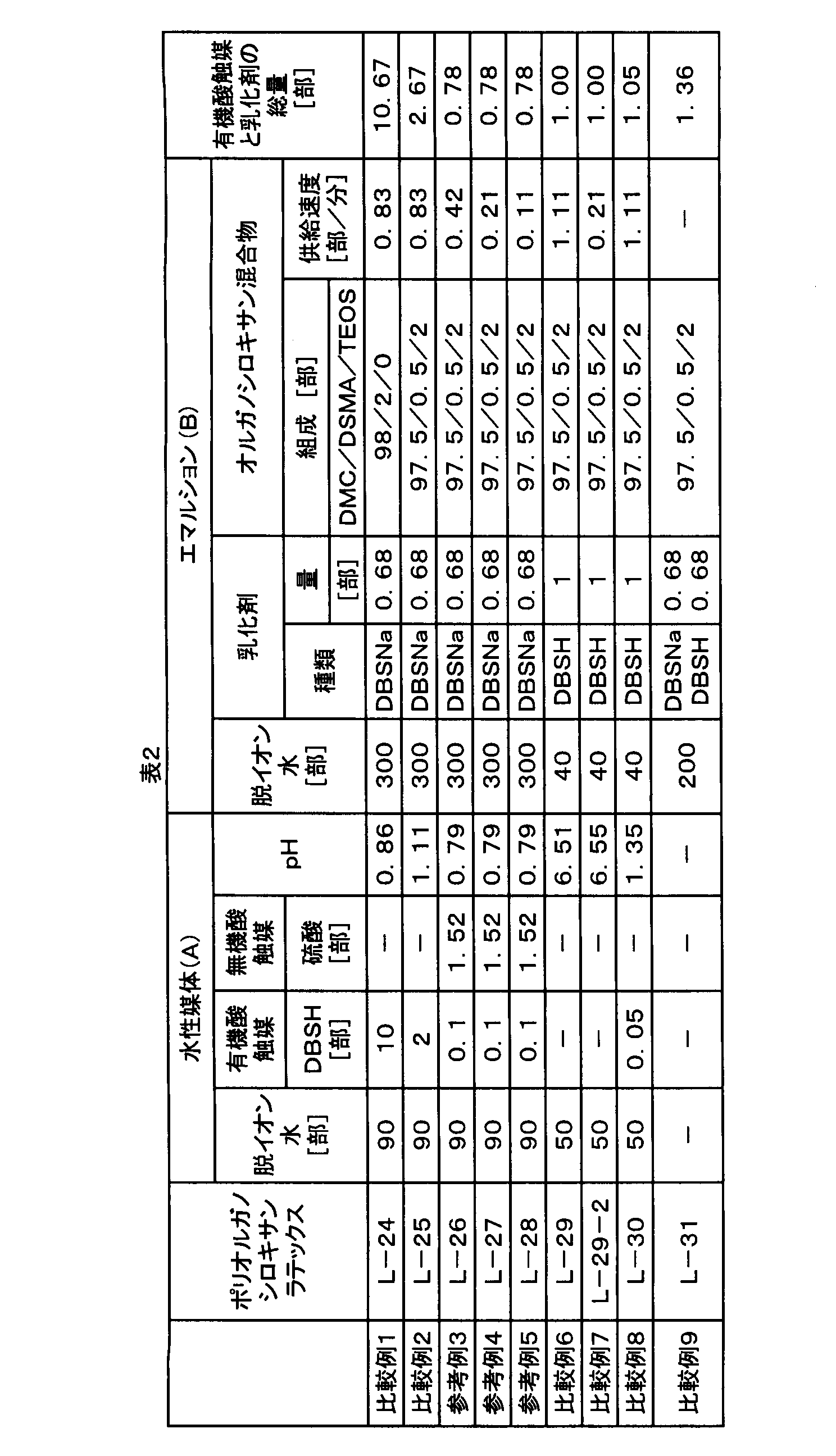
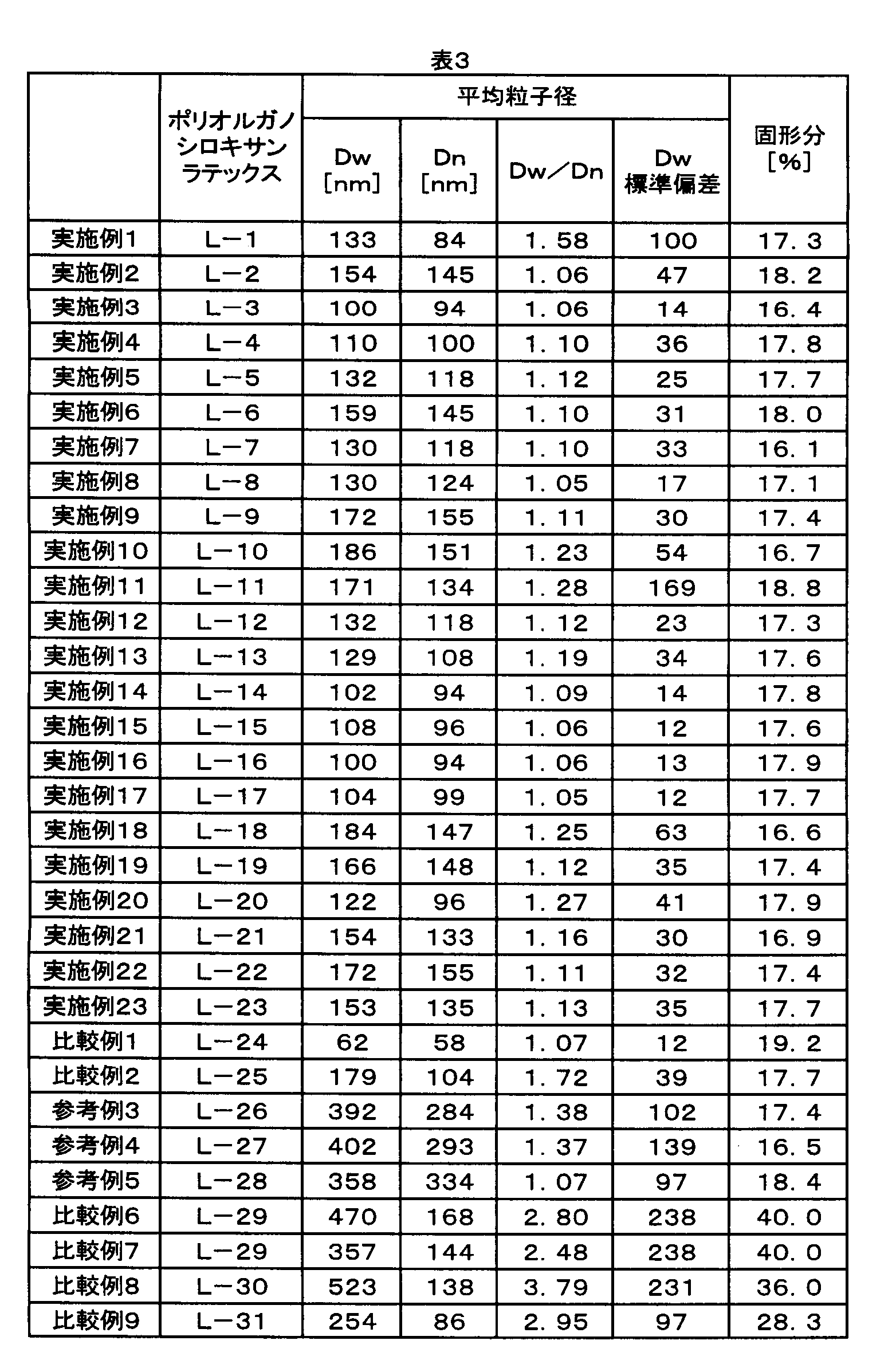
冷却コンデンサーを備えたセパラブルフラスコ中に、実施例12で得られたポリオルガノシロキサンラテックス(L-12)7部(固形分換算)、アルケニルコハク酸ジカリウム(花王(株)製、商品名:ラテムルASK、以下「ASK」と略す)0.7部、脱イオン水197部(ポリオルガノシロキサンラテックス中の水を含む)を仕込み混合した。次いで、このフラスコ中にアクリル酸n-ブチル(n-BA)43部、メタクリル酸アリル(AMA)0.3部、1,3-ブチレンジジメタクリレート(1,3-BD)0.01部、t-ブチルハイドロパーオキサイド(t-BH)0.11部からなる混合物を添加した。
ポリオルガノシロキサンの種類及び量、並びにn-BAの量を表4に記載に示す条件に変更したこと以外は実施例24と同様にして複合重合体(ga-2)~(ga-11)を得た。更にそれらを用いて、表4に示す量のAN及びSTを用いてグラフト重合を行い、グラフト共重合体(Ga-2)~(Ga-11)を得た。
AN25部及びST75部を用いて公知の懸濁重合法により、N,N-ジメチルホルムアミド溶液中、25℃で測定した還元粘度が0.40dL/gであるアクリロニトリル-スチレン共重合体(Ha-1)を製造した。
ビニル系単量体の種類及び量を表5に示す条件に変更したこと以外は製造例1と同様にして、熱可塑性樹脂(Ha-2)~(Ha-6)を製造した。還元粘度の測定結果を表5に示す。
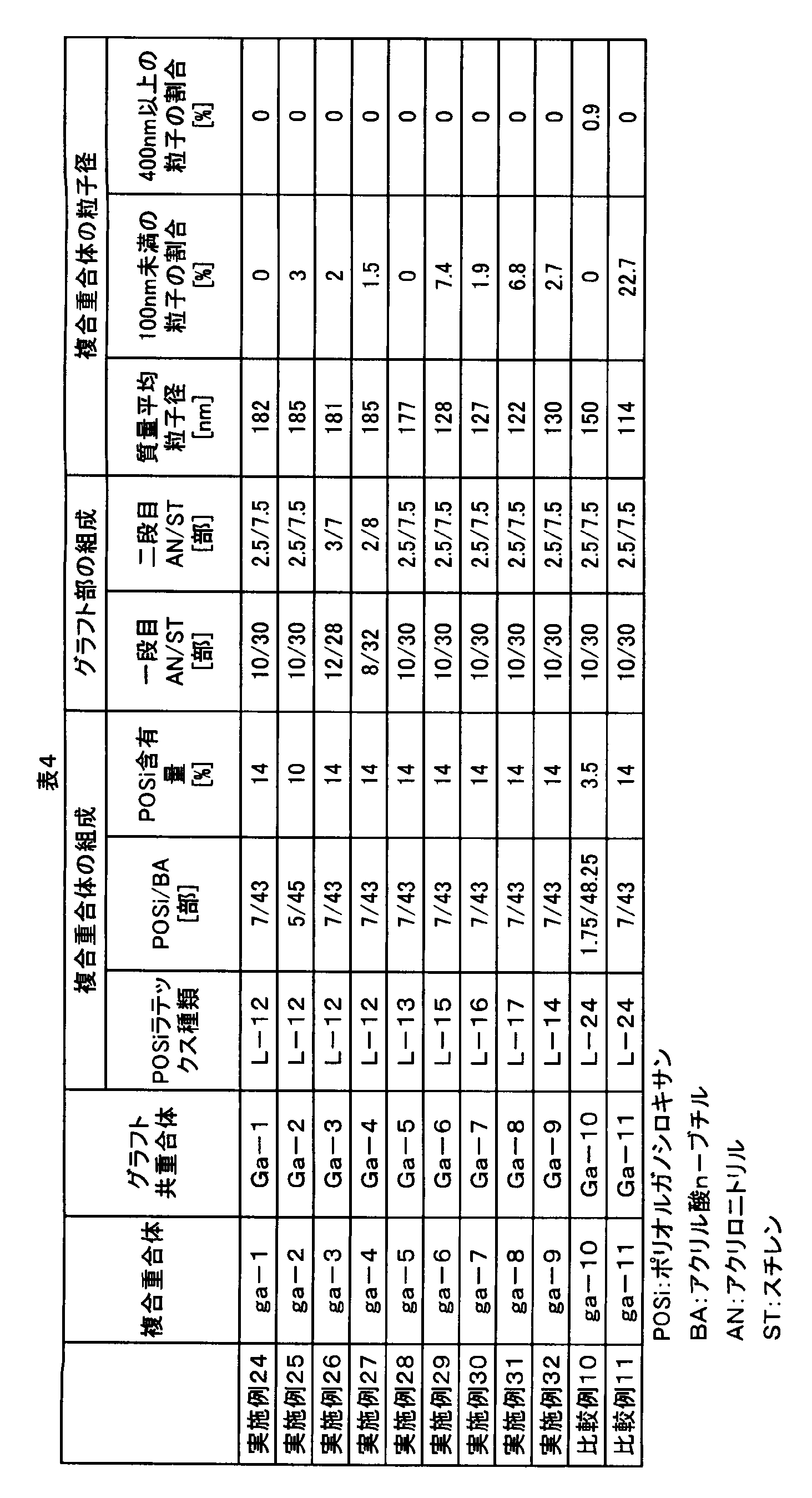

上記のグラフト共重合体及び熱可塑性樹脂組成物を表6に示す組成で配合し、さらに添加剤として、エチレンビスステアリルアミド(EBS)0.5部、シリコーンオイル(東レ・ダウコーニング(株)製、製品名:SH-200)0.03部、および着色剤として、カーボンブラック#960(三菱化学(株)製)0.05部を加え、ヘンシェルミキサーを用いて混合した。次いで、これらの各混合物をバレル温度260℃に加熱した脱揮式押出機(日本製鋼所(株)製TEX-30α)に供給して混練し、樹脂組成物のペレットを得た。これらのペレットについて、メルトボリュームを測定した。さらに各ペレットを4オンス射出成形機(日本製鋼(株)製)にて、220~260℃にて評価用のテストピースを作成し、シャルピー衝撃強度(23℃)、MVR,曲げ強度、曲げ弾性率、荷重たわみ温度、拡散反射率(光輝性)、及び振動溶着性を測定した。結果を表6及び表7に示す。


冷却コンデンサーを備えたセパラブルフラスコに、実施例12で得られたポリオルガノシロキサンラテックス(L-12)25部(固形分換算)、n-BA25部、AMA0.2部、1,3-BD0.05部、t-BH0.063部、脱イオン水208部(ポリオルガノシロキサンラテックス中の水を含む)の混合物を仕込んだ。次いでこのフラスコ内に窒素気流を通じて雰囲気の窒素置換を行い、内温を60℃まで昇温した。その時点で、Fe0.00005部、EDTA0.00015部、SFS0.12部、脱イオン水4部からなる水溶液を添加し、重合を開始させた。単量体成分の重合による重合発熱で内温の最大点が確認された後、65℃まで冷却した後に30分間保持し、単量体成分の重合を完結させてポリオルガノシロキサン(L-12)とn-BAの重合体からなる複合重合体(gb-1)ラテックスを得た。得られた複合重合体(gb-1)の質量平均粒子径は140nm、100nm未満の複合重合体粒子の割合は7%、300nm以上の複合重合体粒子の割合は1.3%であった。
ポリオルガノシロキサンの種類及び量、並びにn-BAの量を表8に示す条件に変更したこと以外は実施例48と同様にして複合重合体(gb-2)~(gb-17)を得た。更にそれらを用いて、表8に示す量のAN及びSTを用いてグラフト重合を行い、グラフト共重合体(Gb-2)~(Gb-17)を得た。なお、比較例16において、ポリオルガノシロキサンラテックス(L-32)として、固形分換算で(L-24)83部と(L-31)17部を混合したものを用いた。ポリオルガノシロキサン(L-32)の質量平均粒子径(Dw)は101nm、数平均粒子径(Dn)は58nm、これらの比で表される粒子径分布(Dw/Dn)は1.74であった。
表9に示す種類及び量のビニル系単量体を用いて公知の懸濁重合法により、共重合体(Hb-1)~(Hb-3)を製造した。各共重合体のN,N-ジメチルホルムアミド溶液中、25℃で測定した還元粘度を表9に示す。
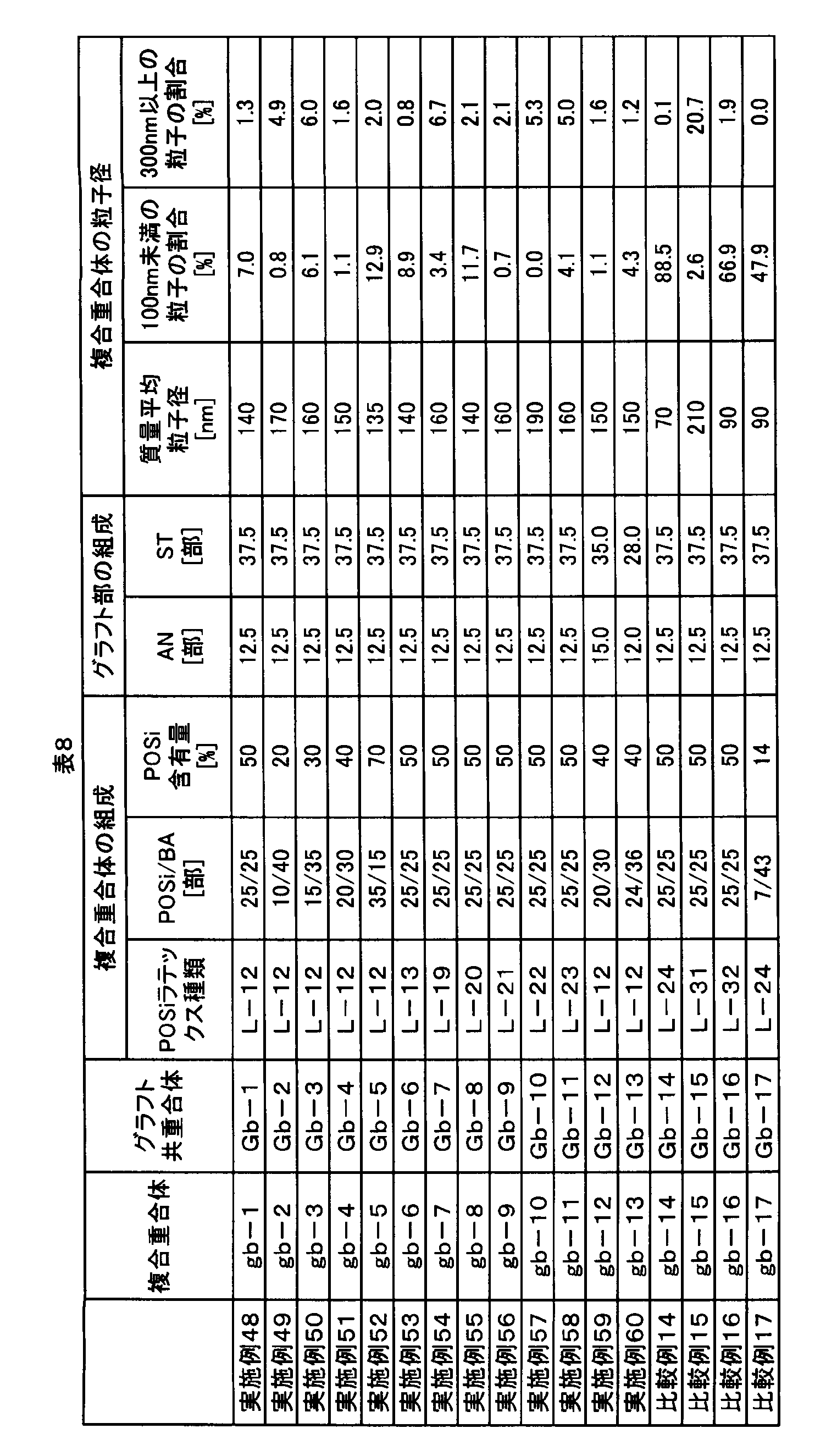
上記のグラフト共重合体(Gb-1)~(Gb-17)及び熱可塑性樹脂(Hb-1)~(Hb-3)を表10~12に示す組成で配合し、さらに滑剤としてEBS0.3部、および着色剤としてカーボンブラック#960を0.5部、ヘンシェルミキサーを用いて混合した。次いで、該混合物をバレル温度230℃に加熱した脱揮式二軸押出機((株)池貝製、PCM-30)に供給して混練し、熱可塑性樹脂組成物(Ib-1)~(Ib-23)のペレットを作製した。各ペレットについて、メルトボリュームレートを測定した。
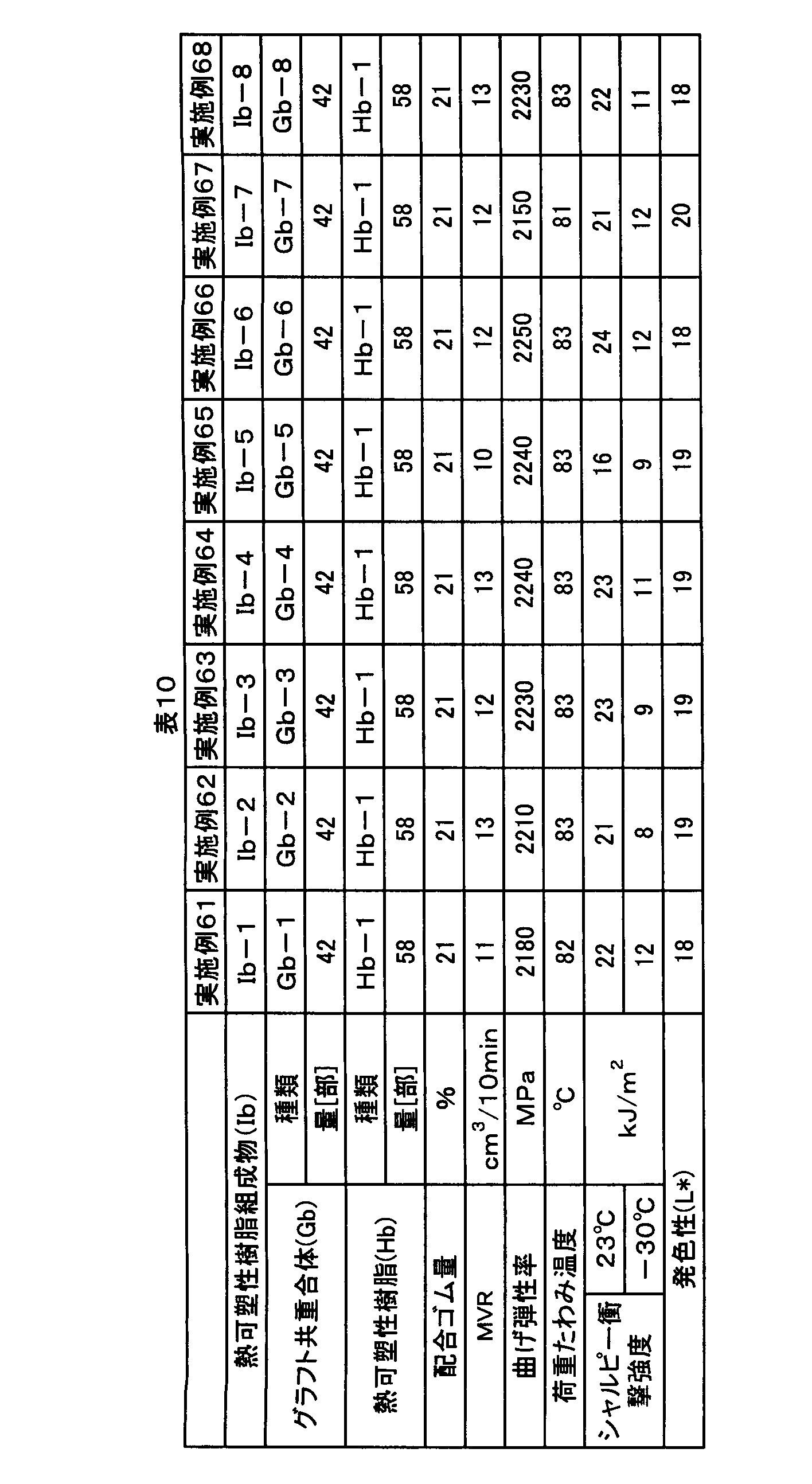


Claims (21)
- ポリオルガノシロキサン粒子の質量平均粒子径(Dw)が100~200nm、質量平均粒子径(Dw)と数平均粒子径(Dn)の比(Dw/Dn)が1.0~1.7である、ポリオルガノシロキサンラテックス。
- 前記ポリオルガノシロキサン粒子の質量平均粒子径(Dw)における標準偏差が0~80である請求項1に記載のポリオルガノシロキサンラテックス。
- 前記ポリオルガノシロキサン粒子の粒子径50nm未満の粒子の割合が全粒子の5質量%以下、粒子径300nm以上の粒子の割合が全粒子の20質量%以下であることを特徴とする請求項1又は2に記載のポリオルガノシロキサンラテックス。
- 請求項1~3のいずれかの一項に記載のポリオルガノシロキサンラテックスの存在下に、1種以上のビニル系単量体を重合して得られるポリオルガノシロキサン含有ビニル系共重合体。
- 前記ポリオルガノシロキサン含有ビニル系共重合体の粒子の質量平均粒子径(Dw)が110nm~800nm、質量平均粒子径(Dw)と数平均粒子径(Dn)の比(Dw/Dn)が1.0~2.0である、請求項4に記載のポリオルガノシロキサン含有ビニル系共重合体。
- 前記ビニル系単量体がアクリル酸エステルである請求項4又は5に記載のポリオルガノシロキサン含有ビニル系共重合体。
- 請求項4に記載のポリオルガノシロキサン含有ビニル系共重合体の存在下に、1種以上のビニル系単量体をグラフト重合して得られるグラフト共重合体(G)。
- 請求項7に記載のグラフト共重合体(G)であって、下記組成物を下記条件で成形した成形体が、下記測定条件による評価において以下の(1)及び(2)で示される性能を有するグラフト共重合体(Ga):
(1)23℃におけるシャルピー衝撃強度が6kJ/m2以上、
(2)拡散反射率が5%以下。
<試験片作製条件>;
(a)グラフト共重合体(Ga)33質量部、
(b)アクリロニトリル単位25質量%、スチレン単位75質量%からなる25℃、0.2g/dLのN,N-ジメチルホルムアミド溶液での還元粘度(ηsp/c)が0.40dL/gであるアクリロニトリル・スチレン共重合体9質量部、
(c)アクリロニトリル単位28質量%、スチレン単位72質量%からなる25℃、0.2g/dLのN,N-ジメチルホルムアミド溶液での還元粘度が0.62dL/gであるアクリロニトリル・スチレン共重合体9質量部、
(d)アクリロニトリル単位22質量%、スチレン単位55質量%、N-フェニルマレイミド単位23質量%からなる25℃、0.2g/dLのN,N-ジメチルホルムアミド溶液での還元粘度が0.66dL/gであるアクリロニトリル・スチレン・N-フェニルマレイミド共重合体50質量部、
(e)エチレンビスステアリルアミド0.5質量部、
(f)シリコーンオイル0.03質量部、及び
(g)カーボンブラック0.05質量部。
上記の7種類の材料(a)~(g)を配合し、バレル温度260℃に加熱した脱揮式押出機(日本製鋼所(株)製TEX-30α)にて混練してペレットを得る。このペレットを4オンス射出成形機(日本製鋼(株)製)にて、シリンダー温度260℃、金型温度60℃の条件で成形して試験片1(長さ80mm、幅10mm、厚み4mm)を得る。また、同様して、シリンダー温度260℃、金型温度60℃、射出率が5g/秒の条件で、長さ100mm、幅100mm、厚み2mmの板状の成形体2を得る。
<シャルピー衝撃強度測定条件>;
ISO 179に準拠する方法により、23℃の雰囲気下で12時間以上放置したVノッチあり試験片1について測定する。
<拡散反射率測定条件>;
成形体2の表面に、真空蒸着法(ULVAC製 VPC-1100)により、真空度6.0×10⁻³Pa、成膜速度10Å/秒の条件で50nmのアルミニウム膜を成膜(ダイレクト蒸着)する。得られた成形体について、反射率計((有)東京電色製 TR-1100AD)にて拡散反射率(%)を測定する。 - 請求項8に記載のグラフト共重合体(Ga)であって、ポリオルガノシロキサン含有ビニル系共重合体100質量%基準でポリオルガノシロキサン5~25質量%を含み、質量平均粒子径(Dw)が120~200nmであり、粒子径100nm以下の粒子の割合が全粒子の15質量%以下、粒子径400nm以上の粒子の割合が全粒子の1質量%以下であるポリオルガノシロキサン含有ビニル系共重合体に、シアン化ビニル系単量体及び芳香族ビニル系単量体の混合物がグラフト重合されたグラフト共重合体(Ga)。
- 前記ポリオルガノシロキサンがシロキサン系架橋剤に由来する成分を、オルガノシロキサン100質量部に対し0.5~5質量部を含むことを特徴とする請求項9に記載のグラフト共重合体(Ga)。
- 請求項8~10のいずれかの一項に記載のグラフト共重合体(Ga)と、それ以外の熱可塑性樹脂(Ha)とを含む熱可塑性樹脂組成物(Ia)。
- 前記熱可塑性樹脂(Ha)が、シアン化ビニル系単量体単位0~40質量%、芳香族ビニル系単量体単位40~80質量%、他の共重合可能な単量体単位0~60質量%からなる共重合体であることを特徴とする請求項11に記載の熱可塑性樹脂組成物(Ia)。
- 請求項11又は12に記載の熱可塑性樹脂組成物(Ia)を成形して得られる成形体。
- 請求項11又は12に記載の熱可塑性樹脂組成物(Ia)を成形して得られる成形体を含む車両灯具用ランプハウジング。
- 請求項7に記載のグラフト共重合体(G)であって、下記組成物を下記条件で成形した成形体が、下記測定条件による評価において以下の(1)及び(2)で示される性能を有するグラフト共重合体(Gb):
(1)L*が24以下、
(2)-30℃におけるシャルピー衝撃強度が6kJ/m2以上。
<試験片作製条件>;
(a)グラフト共重合体(Gb)42質量部、
(b)アクリロニトリル単位34質量%、スチレン単位66質量%からなる25℃、0.2g/dLのN,N-ジメチルホルムアミド溶液での還元粘度(ηsp/c)が0.62dL/gであるアクリロニトリル・スチレン共重合体58質量部、
(c)エチレンビスステアリルアミド0.3質量部、及び、
(d)カーボンブラック0.5質量部。
上記の4種類の材料(a)~(d)を配合し、バレル温度230℃に加熱した脱揮式押出機((株)池貝製、PCM-30)にて混練してペレットを得る。このペレットを4オンス射出成形機(日本製鋼(株)製)にて、シリンダー温度230℃、金型温度60℃の条件で成形して試験片3(長さ80mm、幅10mm、厚み4mm)及び引張試験片4(長さ170mm、幅20mm、厚み4mm)を得る。
<シャルピー衝撃強度測定条件>;
ISO 179に準拠する方法により、-30℃の雰囲気下で12時間以上放置したVノッチあり試験片3について測定する。
<L*測定条件>;
引張試験片4について、コニカミノルタセンシング(株)製の測色計CM-508Dを用いて反ゲート側でL*を測定する。 - 請求項15に記載のグラフト共重合体(Gb)であって、ポリオルガノシロキサン含有ビニル系共重合体100質量%基準でポリオルガノシロキサン15~80質量%を含み、質量平均粒子径(Dw)が110~250nm、粒子径100nm未満の粒子の割合が全粒子の20質量%以下、粒子径300nm以上の粒子の割合が全粒子の20質量%以下であるポリオルガノシロキサン含有ビニル系共重合体に、シアン化ビニル系単量体及び芳香族ビニル系単量体の混合物がグラフト重合されたグラフト共重合体(Gb)。
- 前記ポリオルガノシロキサンがシロキサン系架橋剤に由来する成分を、オルガノシロキサン100質量部に対し0.5~3質量部を含むことを特徴とする請求項16に記載のグラフト共重合体(Gb)。
- 請求項15~17のいずれかの一項に記載のグラフト共重合体(Gb)とそれ以外の熱可塑性樹脂(Hb)を含む熱可塑性樹脂組成物(Ib)。
- 前記熱可塑性樹脂(Hb)が、シアン化ビニル系単量体単位0~40質量%、芳香族ビニル系単量体単位40~80質量%、これらと共重合可能な他のビニル系単量体単位0~60質量%からなる共重合体であることを特徴とする請求項18に記載の熱可塑性樹脂組成物(Ib)。
- 請求項18又は19に記載の熱可塑性樹脂組成物(Ib)を成形して得られる成形体。
- 水、有機酸触媒、及び無機酸触媒を含む水性媒体(A)に、オルガノシロキサン、乳化剤及び水を含むエマルション(B)を滴下させて重合する、ポリオルガノシロキサンのラテックスの製造方法であって、有機酸触媒と乳化剤の総量が、オルガノシロキサン100質量部に対し0.5~6質量部であり、且つ、25℃で測定した水性媒体(A)のpHが0~1.2の範囲内であり、オルガノシロキサンの総使用量を100質量部と表示した場合、エマルション(B)の滴下速度が、オルガノシロキサンの供給量が0.5[質量部/分]以下となる速度である、ポリオルガノシロキサンのラテックスの製造方法。
Priority Applications (7)
| Application Number | Priority Date | Filing Date | Title |
|---|---|---|---|
| US13/984,206 US20130338311A1 (en) | 2011-02-09 | 2012-02-09 | Polyorganosiloxane latex, graft copolymer using the same, thermoplastic resin composition, and molded body |
| KR1020137023421A KR101556455B1 (ko) | 2011-02-09 | 2012-02-09 | 폴리오르가노실록산 라텍스, 그것을 사용한 그래프트 공중합체, 열가소성 수지 조성물 및 성형체 |
| EP12744276.2A EP2674446A4 (en) | 2011-02-09 | 2012-02-09 | Polyorganosiloxane latex and graft copolymer, thermoplastic resin composition and molded body using same |
| BR112013020305A BR112013020305A2 (pt) | 2011-02-09 | 2012-02-09 | látex de poliorganossiloxano, copolímero de enxerto utilizando o mesmo, composição de resina termoplástica e corpo moldado |
| JP2012508689A JP5848699B2 (ja) | 2011-02-09 | 2012-02-09 | ポリオルガノシロキサンラテックス、それを用いたグラフト共重合体、熱可塑性樹脂組成物、及び成形体 |
| CN2012800176417A CN103476834A (zh) | 2011-02-09 | 2012-02-09 | 聚有机硅氧烷胶乳、使用该聚有机硅氧烷胶乳的接枝共聚物、热塑性树脂组合物以及成形体 |
| US15/010,246 US9550896B2 (en) | 2011-02-09 | 2016-01-29 | Polyorganosiloxane latex, graft copolymer using the same, thermoplastic resin composition, and molded body |
Applications Claiming Priority (2)
| Application Number | Priority Date | Filing Date | Title |
|---|---|---|---|
| JP2011026088 | 2011-02-09 | ||
| JP2011-026088 | 2011-02-09 |
Related Child Applications (2)
| Application Number | Title | Priority Date | Filing Date |
|---|---|---|---|
| US13/984,206 A-371-Of-International US20130338311A1 (en) | 2011-02-09 | 2012-02-09 | Polyorganosiloxane latex, graft copolymer using the same, thermoplastic resin composition, and molded body |
| US15/010,246 Division US9550896B2 (en) | 2011-02-09 | 2016-01-29 | Polyorganosiloxane latex, graft copolymer using the same, thermoplastic resin composition, and molded body |
Publications (1)
| Publication Number | Publication Date |
|---|---|
| WO2012108485A1 true WO2012108485A1 (ja) | 2012-08-16 |
Family
ID=46638697
Family Applications (1)
| Application Number | Title | Priority Date | Filing Date |
|---|---|---|---|
| PCT/JP2012/052914 Ceased WO2012108485A1 (ja) | 2011-02-09 | 2012-02-09 | ポリオルガノシロキサンラテックス、それを用いたグラフト共重合体、熱可塑性樹脂組成物、及び成形体 |
Country Status (8)
| Country | Link |
|---|---|
| US (2) | US20130338311A1 (ja) |
| EP (1) | EP2674446A4 (ja) |
| JP (1) | JP5848699B2 (ja) |
| KR (1) | KR101556455B1 (ja) |
| CN (2) | CN106146760A (ja) |
| BR (1) | BR112013020305A2 (ja) |
| TW (1) | TWI625349B (ja) |
| WO (1) | WO2012108485A1 (ja) |
Cited By (8)
| Publication number | Priority date | Publication date | Assignee | Title |
|---|---|---|---|---|
| CN104755516A (zh) * | 2012-10-31 | 2015-07-01 | 三菱丽阳株式会社 | 含聚有机硅氧烷的接枝共聚物、树脂组合物以及成形体 |
| JP2017141406A (ja) * | 2016-02-12 | 2017-08-17 | ユーエムジー・エービーエス株式会社 | 熱可塑性樹脂組成物 |
| JP2017179074A (ja) * | 2016-03-29 | 2017-10-05 | ユーエムジー・エービーエス株式会社 | 熱可塑性樹脂組成物およびそれを用いた成形品 |
| JP2018083922A (ja) * | 2016-11-25 | 2018-05-31 | ユーエムジー・エービーエス株式会社 | 熱可塑性樹脂組成物およびそれを用いた成形品 |
| WO2018139087A1 (ja) * | 2017-01-25 | 2018-08-02 | ユーエムジー・エービーエス株式会社 | 熱板溶着用熱可塑性樹脂組成物及びその成形品、樹脂接合体 |
| JP2019172856A (ja) * | 2018-03-29 | 2019-10-10 | テクノUmg株式会社 | 熱可塑性樹脂組成物及びその成形品 |
| CN111440275A (zh) * | 2013-06-28 | 2020-07-24 | 三菱化学株式会社 | 含有聚有机硅氧烷的接枝共聚物、热塑性树脂组合物及成型体 |
| JP2020204035A (ja) * | 2020-08-19 | 2020-12-24 | テクノUmg株式会社 | 熱可塑性樹脂組成物 |
Families Citing this family (6)
| Publication number | Priority date | Publication date | Assignee | Title |
|---|---|---|---|---|
| JP2013165022A (ja) * | 2012-02-13 | 2013-08-22 | Koito Mfg Co Ltd | 車両用灯具 |
| KR102165697B1 (ko) * | 2017-10-27 | 2020-10-14 | 주식회사 엘지화학 | 그라프트 공중합체, 이를 포함하는 열가소성 수지 조성물 및 이의 제조방법 |
| WO2020084899A1 (ja) * | 2018-10-22 | 2020-04-30 | 信越化学工業株式会社 | 付加硬化型シリコーン組成物 |
| CN111607042B (zh) * | 2019-02-25 | 2023-05-23 | 美国陶氏有机硅公司 | 聚合物复合微球的水性分散液 |
| WO2022085801A1 (ja) * | 2020-10-23 | 2022-04-28 | 三菱ケミカル株式会社 | 樹脂組成物及びその成形品 |
| CN113976890B (zh) * | 2021-10-20 | 2023-03-28 | 江西虔悦新材料有限公司 | 一种粘接剂、其制备方法及其用于金属粉末注射成型的应用 |
Citations (17)
| Publication number | Priority date | Publication date | Assignee | Title |
|---|---|---|---|---|
| JPH05194740A (ja) | 1992-01-23 | 1993-08-03 | Mitsubishi Rayon Co Ltd | シリコ−ンゴムラテックスの製造方法 |
| JPH0625492A (ja) | 1992-03-10 | 1994-02-01 | Mitsubishi Rayon Co Ltd | 熱可塑性樹脂組成物 |
| JPH10279684A (ja) * | 1996-12-26 | 1998-10-20 | General Electric Co <Ge> | ポリシロキサンの単一モード水性分散液の合成方法 |
| JPH10338748A (ja) * | 1997-06-05 | 1998-12-22 | Mitsubishi Rayon Co Ltd | ポリオルガノシロキサンラテックスの製造法 |
| JP2000072983A (ja) * | 1998-09-01 | 2000-03-07 | Toray Ind Inc | アクリルシリコーンエマルジョン組成物 |
| JP2002308909A (ja) * | 2001-04-11 | 2002-10-23 | Kao Corp | シリコーン変性ポリマー粒子 |
| JP2003026807A (ja) * | 2001-07-16 | 2003-01-29 | Mitsubishi Rayon Co Ltd | ポリオルガノシロキサンラテックスの製造方法 |
| JP2003128868A (ja) | 2001-08-10 | 2003-05-08 | Mitsubishi Rayon Co Ltd | ダイレクト蒸着用樹脂組成物、および、それを用いた成型品 |
| JP2003160624A (ja) * | 2001-11-26 | 2003-06-03 | Mitsubishi Rayon Co Ltd | グラフト共重合体およびそれを含む熱可塑性樹脂組成物 |
| JP2003292507A (ja) * | 2002-03-29 | 2003-10-15 | Mitsubishi Rayon Co Ltd | 乳化重合ラテックスの製造方法 |
| JP2004331726A (ja) * | 2003-05-01 | 2004-11-25 | Mitsubishi Rayon Co Ltd | グラフト共重合体およびこれを用いた熱可塑性樹脂組成物 |
| JP2004359889A (ja) * | 2003-06-06 | 2004-12-24 | Mitsubishi Rayon Co Ltd | シリコーン/アクリル複合ゴム系グラフト共重合体および熱可塑性樹脂組成物 |
| JP2007204587A (ja) * | 2006-02-01 | 2007-08-16 | Mitsubishi Rayon Co Ltd | 塩素含有熱可塑性樹脂組成物 |
| JP2007217488A (ja) * | 2006-02-15 | 2007-08-30 | Kaneka Corp | 熱可塑性樹脂組成物および車両用灯具ランプハウジング成形品 |
| JP2007321066A (ja) | 2006-06-01 | 2007-12-13 | Mitsubishi Rayon Co Ltd | ポリオルガノシロキサンのラテックス及びその製造方法 |
| WO2009011280A1 (ja) * | 2007-07-13 | 2009-01-22 | Mitsubishi Rayon Co., Ltd. | グラフト共重合体、熱可塑性樹脂組成物及び成形物 |
| JP2011179016A (ja) * | 2011-06-17 | 2011-09-15 | Mitsubishi Rayon Co Ltd | 熱可塑性樹脂組成物 |
Family Cites Families (2)
| Publication number | Priority date | Publication date | Assignee | Title |
|---|---|---|---|---|
| CN1307257C (zh) * | 2000-12-25 | 2007-03-28 | 三菱丽阳株式会社 | 接枝共聚物和热塑性树脂组合物 |
| AU2004234224A1 (en) | 2003-04-28 | 2004-11-11 | Kaneka Corporation | Method for producing polyorganosiloxane-containing resin |
-
2012
- 2012-02-09 KR KR1020137023421A patent/KR101556455B1/ko not_active Expired - Fee Related
- 2012-02-09 US US13/984,206 patent/US20130338311A1/en not_active Abandoned
- 2012-02-09 CN CN201610375764.8A patent/CN106146760A/zh active Pending
- 2012-02-09 TW TW101104245A patent/TWI625349B/zh not_active IP Right Cessation
- 2012-02-09 CN CN2012800176417A patent/CN103476834A/zh active Pending
- 2012-02-09 WO PCT/JP2012/052914 patent/WO2012108485A1/ja not_active Ceased
- 2012-02-09 BR BR112013020305A patent/BR112013020305A2/pt not_active IP Right Cessation
- 2012-02-09 EP EP12744276.2A patent/EP2674446A4/en not_active Withdrawn
- 2012-02-09 JP JP2012508689A patent/JP5848699B2/ja not_active Expired - Fee Related
-
2016
- 2016-01-29 US US15/010,246 patent/US9550896B2/en not_active Expired - Fee Related
Patent Citations (17)
| Publication number | Priority date | Publication date | Assignee | Title |
|---|---|---|---|---|
| JPH05194740A (ja) | 1992-01-23 | 1993-08-03 | Mitsubishi Rayon Co Ltd | シリコ−ンゴムラテックスの製造方法 |
| JPH0625492A (ja) | 1992-03-10 | 1994-02-01 | Mitsubishi Rayon Co Ltd | 熱可塑性樹脂組成物 |
| JPH10279684A (ja) * | 1996-12-26 | 1998-10-20 | General Electric Co <Ge> | ポリシロキサンの単一モード水性分散液の合成方法 |
| JPH10338748A (ja) * | 1997-06-05 | 1998-12-22 | Mitsubishi Rayon Co Ltd | ポリオルガノシロキサンラテックスの製造法 |
| JP2000072983A (ja) * | 1998-09-01 | 2000-03-07 | Toray Ind Inc | アクリルシリコーンエマルジョン組成物 |
| JP2002308909A (ja) * | 2001-04-11 | 2002-10-23 | Kao Corp | シリコーン変性ポリマー粒子 |
| JP2003026807A (ja) * | 2001-07-16 | 2003-01-29 | Mitsubishi Rayon Co Ltd | ポリオルガノシロキサンラテックスの製造方法 |
| JP2003128868A (ja) | 2001-08-10 | 2003-05-08 | Mitsubishi Rayon Co Ltd | ダイレクト蒸着用樹脂組成物、および、それを用いた成型品 |
| JP2003160624A (ja) * | 2001-11-26 | 2003-06-03 | Mitsubishi Rayon Co Ltd | グラフト共重合体およびそれを含む熱可塑性樹脂組成物 |
| JP2003292507A (ja) * | 2002-03-29 | 2003-10-15 | Mitsubishi Rayon Co Ltd | 乳化重合ラテックスの製造方法 |
| JP2004331726A (ja) * | 2003-05-01 | 2004-11-25 | Mitsubishi Rayon Co Ltd | グラフト共重合体およびこれを用いた熱可塑性樹脂組成物 |
| JP2004359889A (ja) * | 2003-06-06 | 2004-12-24 | Mitsubishi Rayon Co Ltd | シリコーン/アクリル複合ゴム系グラフト共重合体および熱可塑性樹脂組成物 |
| JP2007204587A (ja) * | 2006-02-01 | 2007-08-16 | Mitsubishi Rayon Co Ltd | 塩素含有熱可塑性樹脂組成物 |
| JP2007217488A (ja) * | 2006-02-15 | 2007-08-30 | Kaneka Corp | 熱可塑性樹脂組成物および車両用灯具ランプハウジング成形品 |
| JP2007321066A (ja) | 2006-06-01 | 2007-12-13 | Mitsubishi Rayon Co Ltd | ポリオルガノシロキサンのラテックス及びその製造方法 |
| WO2009011280A1 (ja) * | 2007-07-13 | 2009-01-22 | Mitsubishi Rayon Co., Ltd. | グラフト共重合体、熱可塑性樹脂組成物及び成形物 |
| JP2011179016A (ja) * | 2011-06-17 | 2011-09-15 | Mitsubishi Rayon Co Ltd | 熱可塑性樹脂組成物 |
Non-Patent Citations (1)
| Title |
|---|
| See also references of EP2674446A4 |
Cited By (18)
| Publication number | Priority date | Publication date | Assignee | Title |
|---|---|---|---|---|
| KR101824832B1 (ko) | 2012-10-31 | 2018-02-01 | 미쯔비시 케미컬 주식회사 | 폴리오르가노실록산 함유 그래프트 공중합체, 수지 조성물 및 성형체 |
| EP3085715A1 (en) * | 2012-10-31 | 2016-10-26 | Mitsubishi Rayon Co., Ltd. | Polyorganosiloxane-containing graft copolymer, resin composition, and molded article |
| US9527997B2 (en) | 2012-10-31 | 2016-12-27 | Mitsubishi Rayon Co., Ltd. | Polyorganosiloxane-containing graft copolymer, resin composition, and molded article |
| KR101768349B1 (ko) | 2012-10-31 | 2017-08-14 | 미쯔비시 케미컬 주식회사 | 폴리오르가노실록산 함유 그래프트 공중합체, 수지 조성물 및 성형체 |
| US9803082B2 (en) | 2012-10-31 | 2017-10-31 | Mitsubishi Chemical Corporation | Polyorganosiloxane-containing graft copolymer, resin composition, and molded article |
| EP2915828A4 (en) * | 2012-10-31 | 2015-11-04 | Mitsubishi Rayon Co | POLYORGANOSILOXOUS PEPPOPOPOLYMER, RESIN COMPOSITION AND FORM BODY |
| CN104755516A (zh) * | 2012-10-31 | 2015-07-01 | 三菱丽阳株式会社 | 含聚有机硅氧烷的接枝共聚物、树脂组合物以及成形体 |
| CN111440275A (zh) * | 2013-06-28 | 2020-07-24 | 三菱化学株式会社 | 含有聚有机硅氧烷的接枝共聚物、热塑性树脂组合物及成型体 |
| CN111440275B (zh) * | 2013-06-28 | 2023-04-14 | 三菱化学株式会社 | 含有聚有机硅氧烷的接枝共聚物、热塑性树脂组合物及成型体 |
| JP2017141406A (ja) * | 2016-02-12 | 2017-08-17 | ユーエムジー・エービーエス株式会社 | 熱可塑性樹脂組成物 |
| JP2017179074A (ja) * | 2016-03-29 | 2017-10-05 | ユーエムジー・エービーエス株式会社 | 熱可塑性樹脂組成物およびそれを用いた成形品 |
| JP2018083922A (ja) * | 2016-11-25 | 2018-05-31 | ユーエムジー・エービーエス株式会社 | 熱可塑性樹脂組成物およびそれを用いた成形品 |
| WO2018139087A1 (ja) * | 2017-01-25 | 2018-08-02 | ユーエムジー・エービーエス株式会社 | 熱板溶着用熱可塑性樹脂組成物及びその成形品、樹脂接合体 |
| US10800913B2 (en) | 2017-01-25 | 2020-10-13 | Techno-Umg Co., Ltd. | Thermoplastic resin composition for hot plate welding, molded article thereof, and resin conjugate |
| JP7233846B2 (ja) | 2018-03-29 | 2023-03-07 | テクノUmg株式会社 | 熱可塑性樹脂組成物、その製造方法及び成形品 |
| JP2019172856A (ja) * | 2018-03-29 | 2019-10-10 | テクノUmg株式会社 | 熱可塑性樹脂組成物及びその成形品 |
| JP2020204035A (ja) * | 2020-08-19 | 2020-12-24 | テクノUmg株式会社 | 熱可塑性樹脂組成物 |
| JP7107998B2 (ja) | 2020-08-19 | 2022-07-27 | テクノUmg株式会社 | レーザー溶着における吸収材用熱可塑性樹脂組成物 |
Also Published As
| Publication number | Publication date |
|---|---|
| JPWO2012108485A1 (ja) | 2014-07-03 |
| TW201239008A (en) | 2012-10-01 |
| JP5848699B2 (ja) | 2016-01-27 |
| EP2674446A4 (en) | 2018-01-31 |
| CN106146760A (zh) | 2016-11-23 |
| EP2674446A1 (en) | 2013-12-18 |
| KR20130130821A (ko) | 2013-12-02 |
| US20130338311A1 (en) | 2013-12-19 |
| US20160185965A1 (en) | 2016-06-30 |
| KR101556455B1 (ko) | 2015-10-01 |
| TWI625349B (zh) | 2018-06-01 |
| US9550896B2 (en) | 2017-01-24 |
| CN103476834A (zh) | 2013-12-25 |
| BR112013020305A2 (pt) | 2016-10-18 |
Similar Documents
| Publication | Publication Date | Title |
|---|---|---|
| JP5848699B2 (ja) | ポリオルガノシロキサンラテックス、それを用いたグラフト共重合体、熱可塑性樹脂組成物、及び成形体 | |
| JP6332026B2 (ja) | ポリオルガノシロキサン含有グラフト共重合体、熱可塑性樹脂組成物及び成形体 | |
| CN107286300A (zh) | 含聚有机硅氧烷的接枝共聚物、树脂组合物以及成形体 | |
| JP2022079654A (ja) | ポリオルガノシロキサン含有グラフト共重合体、熱可塑性樹脂組成物及び成形体 | |
| CN111788241B (zh) | 含聚有机硅氧烷的接枝共聚物粉体及使用其的树脂组合物、以及由该树脂组合物构成的成形体 | |
| WO2002051935A1 (en) | Graft copolymer and thermoplastic resin composition | |
| JP3913098B2 (ja) | 樹脂組成物およびそれを用いた成型品 | |
| JP4326915B2 (ja) | 振動溶着用熱可塑性樹脂組成物、およびそれを用いた振動溶着用成形品、ランプ | |
| JP6276116B2 (ja) | 熱可塑性樹脂組成物、およびそれを用いた車両用ランプハウジング | |
| JP4346957B2 (ja) | 振動溶着用樹脂組成物、並びにそれを用いた成形品、自動車用ランプ | |
| JP4838439B2 (ja) | 振動溶着用熱可塑性樹脂組成物およびその成形体 | |
| JP3875908B2 (ja) | 成型品 | |
| JP2014034656A (ja) | ポリオルガノシロキサン含有グラフト共重合体、それを含む樹脂組成物、及び成形体 | |
| JP2016125006A (ja) | 複合ゴム系グラフト共重合体含有粉体、複合ゴム系グラフト共重合体含有凝固物、熱可塑性樹脂組成物、およびその成形品 | |
| JP6467909B2 (ja) | ポリカーボネート樹脂組成物及び成形体 | |
| JP2005139331A (ja) | 熱可塑性樹脂組成物、およびそれを用いた成形品、ランプ | |
| JP7155777B2 (ja) | ポリオルガノシロキサン含有グラフト共重合体、熱可塑性樹脂組成物及び成形体 | |
| JP7708528B2 (ja) | ポリオルガノシロキサン含有グラフト共重合体、およびそれを用いた樹脂組成物ならびにそれからなる成形体 | |
| JP6335027B2 (ja) | グラフト共重合体、および熱可塑性樹脂組成物 | |
| JP2003160624A (ja) | グラフト共重合体およびそれを含む熱可塑性樹脂組成物 | |
| JP2004346188A (ja) | 熱可塑性樹脂組成物 | |
| JP6365116B2 (ja) | 熱可塑性樹脂組成物及びその成形体。 |
Legal Events
| Date | Code | Title | Description |
|---|---|---|---|
| WWE | Wipo information: entry into national phase |
Ref document number: 2012508689 Country of ref document: JP |
|
| 121 | Ep: the epo has been informed by wipo that ep was designated in this application |
Ref document number: 12744276 Country of ref document: EP Kind code of ref document: A1 |
|
| NENP | Non-entry into the national phase |
Ref country code: DE |
|
| WWE | Wipo information: entry into national phase |
Ref document number: 1301004451 Country of ref document: TH |
|
| WWE | Wipo information: entry into national phase |
Ref document number: 2012744276 Country of ref document: EP |
|
| ENP | Entry into the national phase |
Ref document number: 20137023421 Country of ref document: KR Kind code of ref document: A |
|
| WWE | Wipo information: entry into national phase |
Ref document number: 13984206 Country of ref document: US |
|
| REG | Reference to national code |
Ref country code: BR Ref legal event code: B01A Ref document number: 112013020305 Country of ref document: BR |
|
| ENP | Entry into the national phase |
Ref document number: 112013020305 Country of ref document: BR Kind code of ref document: A2 Effective date: 20130809 |