WO2012118078A1 - インクジェットインク用共重合体、並びにそれを用いたインクジェットインク用顔料分散体及びインクジェットインク - Google Patents
インクジェットインク用共重合体、並びにそれを用いたインクジェットインク用顔料分散体及びインクジェットインク Download PDFInfo
- Publication number
- WO2012118078A1 WO2012118078A1 PCT/JP2012/054934 JP2012054934W WO2012118078A1 WO 2012118078 A1 WO2012118078 A1 WO 2012118078A1 JP 2012054934 W JP2012054934 W JP 2012054934W WO 2012118078 A1 WO2012118078 A1 WO 2012118078A1
- Authority
- WO
- WIPO (PCT)
- Prior art keywords
- weight
- inkjet ink
- copolymer
- parts
- pigment
- Prior art date
- Legal status (The legal status is an assumption and is not a legal conclusion. Google has not performed a legal analysis and makes no representation as to the accuracy of the status listed.)
- Ceased
Links
Classifications
-
- C—CHEMISTRY; METALLURGY
- C08—ORGANIC MACROMOLECULAR COMPOUNDS; THEIR PREPARATION OR CHEMICAL WORKING-UP; COMPOSITIONS BASED THEREON
- C08F—MACROMOLECULAR COMPOUNDS OBTAINED BY REACTIONS ONLY INVOLVING CARBON-TO-CARBON UNSATURATED BONDS
- C08F220/00—Copolymers of compounds having one or more unsaturated aliphatic radicals, each having only one carbon-to-carbon double bond, and only one being terminated by only one carboxyl radical or a salt, anhydride ester, amide, imide or nitrile thereof
- C08F220/02—Monocarboxylic acids having less than ten carbon atoms; Derivatives thereof
- C08F220/10—Esters
- C08F220/12—Esters of monohydric alcohols or phenols
- C08F220/16—Esters of monohydric alcohols or phenols of phenols or of alcohols containing two or more carbon atoms
- C08F220/18—Esters of monohydric alcohols or phenols of phenols or of alcohols containing two or more carbon atoms with acrylic or methacrylic acids
- C08F220/1806—C6-(meth)acrylate, e.g. (cyclo)hexyl (meth)acrylate or phenyl (meth)acrylate
-
- C—CHEMISTRY; METALLURGY
- C09—DYES; PAINTS; POLISHES; NATURAL RESINS; ADHESIVES; COMPOSITIONS NOT OTHERWISE PROVIDED FOR; APPLICATIONS OF MATERIALS NOT OTHERWISE PROVIDED FOR
- C09D—COATING COMPOSITIONS, e.g. PAINTS, VARNISHES OR LACQUERS; FILLING PASTES; CHEMICAL PAINT OR INK REMOVERS; INKS; CORRECTING FLUIDS; WOODSTAINS; PASTES OR SOLIDS FOR COLOURING OR PRINTING; USE OF MATERIALS THEREFOR
- C09D11/00—Inks
- C09D11/30—Inkjet printing inks
-
- C—CHEMISTRY; METALLURGY
- C09—DYES; PAINTS; POLISHES; NATURAL RESINS; ADHESIVES; COMPOSITIONS NOT OTHERWISE PROVIDED FOR; APPLICATIONS OF MATERIALS NOT OTHERWISE PROVIDED FOR
- C09D—COATING COMPOSITIONS, e.g. PAINTS, VARNISHES OR LACQUERS; FILLING PASTES; CHEMICAL PAINT OR INK REMOVERS; INKS; CORRECTING FLUIDS; WOODSTAINS; PASTES OR SOLIDS FOR COLOURING OR PRINTING; USE OF MATERIALS THEREFOR
- C09D11/00—Inks
- C09D11/02—Printing inks
- C09D11/10—Printing inks based on artificial resins
- C09D11/106—Printing inks based on artificial resins containing macromolecular compounds obtained by reactions only involving carbon-to-carbon unsaturated bonds
-
- C—CHEMISTRY; METALLURGY
- C09—DYES; PAINTS; POLISHES; NATURAL RESINS; ADHESIVES; COMPOSITIONS NOT OTHERWISE PROVIDED FOR; APPLICATIONS OF MATERIALS NOT OTHERWISE PROVIDED FOR
- C09D—COATING COMPOSITIONS, e.g. PAINTS, VARNISHES OR LACQUERS; FILLING PASTES; CHEMICAL PAINT OR INK REMOVERS; INKS; CORRECTING FLUIDS; WOODSTAINS; PASTES OR SOLIDS FOR COLOURING OR PRINTING; USE OF MATERIALS THEREFOR
- C09D11/00—Inks
- C09D11/02—Printing inks
- C09D11/10—Printing inks based on artificial resins
- C09D11/106—Printing inks based on artificial resins containing macromolecular compounds obtained by reactions only involving carbon-to-carbon unsaturated bonds
- C09D11/107—Printing inks based on artificial resins containing macromolecular compounds obtained by reactions only involving carbon-to-carbon unsaturated bonds from unsaturated acids or derivatives thereof
-
- C—CHEMISTRY; METALLURGY
- C09—DYES; PAINTS; POLISHES; NATURAL RESINS; ADHESIVES; COMPOSITIONS NOT OTHERWISE PROVIDED FOR; APPLICATIONS OF MATERIALS NOT OTHERWISE PROVIDED FOR
- C09D—COATING COMPOSITIONS, e.g. PAINTS, VARNISHES OR LACQUERS; FILLING PASTES; CHEMICAL PAINT OR INK REMOVERS; INKS; CORRECTING FLUIDS; WOODSTAINS; PASTES OR SOLIDS FOR COLOURING OR PRINTING; USE OF MATERIALS THEREFOR
- C09D11/00—Inks
- C09D11/30—Inkjet printing inks
- C09D11/32—Inkjet printing inks characterised by colouring agents
- C09D11/322—Pigment inks
-
- C—CHEMISTRY; METALLURGY
- C09—DYES; PAINTS; POLISHES; NATURAL RESINS; ADHESIVES; COMPOSITIONS NOT OTHERWISE PROVIDED FOR; APPLICATIONS OF MATERIALS NOT OTHERWISE PROVIDED FOR
- C09D—COATING COMPOSITIONS, e.g. PAINTS, VARNISHES OR LACQUERS; FILLING PASTES; CHEMICAL PAINT OR INK REMOVERS; INKS; CORRECTING FLUIDS; WOODSTAINS; PASTES OR SOLIDS FOR COLOURING OR PRINTING; USE OF MATERIALS THEREFOR
- C09D11/00—Inks
- C09D11/30—Inkjet printing inks
- C09D11/32—Inkjet printing inks characterised by colouring agents
- C09D11/324—Inkjet printing inks characterised by colouring agents containing carbon black
- C09D11/326—Inkjet printing inks characterised by colouring agents containing carbon black characterised by the pigment dispersant
-
- C—CHEMISTRY; METALLURGY
- C08—ORGANIC MACROMOLECULAR COMPOUNDS; THEIR PREPARATION OR CHEMICAL WORKING-UP; COMPOSITIONS BASED THEREON
- C08F—MACROMOLECULAR COMPOUNDS OBTAINED BY REACTIONS ONLY INVOLVING CARBON-TO-CARBON UNSATURATED BONDS
- C08F220/00—Copolymers of compounds having one or more unsaturated aliphatic radicals, each having only one carbon-to-carbon double bond, and only one being terminated by only one carboxyl radical or a salt, anhydride ester, amide, imide or nitrile thereof
- C08F220/02—Monocarboxylic acids having less than ten carbon atoms; Derivatives thereof
- C08F220/04—Acids; Metal salts or ammonium salts thereof
- C08F220/06—Acrylic acid; Methacrylic acid; Metal salts or ammonium salts thereof
-
- C—CHEMISTRY; METALLURGY
- C08—ORGANIC MACROMOLECULAR COMPOUNDS; THEIR PREPARATION OR CHEMICAL WORKING-UP; COMPOSITIONS BASED THEREON
- C08F—MACROMOLECULAR COMPOUNDS OBTAINED BY REACTIONS ONLY INVOLVING CARBON-TO-CARBON UNSATURATED BONDS
- C08F220/00—Copolymers of compounds having one or more unsaturated aliphatic radicals, each having only one carbon-to-carbon double bond, and only one being terminated by only one carboxyl radical or a salt, anhydride ester, amide, imide or nitrile thereof
- C08F220/02—Monocarboxylic acids having less than ten carbon atoms; Derivatives thereof
- C08F220/10—Esters
- C08F220/12—Esters of monohydric alcohols or phenols
- C08F220/16—Esters of monohydric alcohols or phenols of phenols or of alcohols containing two or more carbon atoms
- C08F220/18—Esters of monohydric alcohols or phenols of phenols or of alcohols containing two or more carbon atoms with acrylic or methacrylic acids
- C08F220/1804—C4-(meth)acrylate, e.g. butyl (meth)acrylate, isobutyl (meth)acrylate or tert-butyl (meth)acrylate
-
- C—CHEMISTRY; METALLURGY
- C08—ORGANIC MACROMOLECULAR COMPOUNDS; THEIR PREPARATION OR CHEMICAL WORKING-UP; COMPOSITIONS BASED THEREON
- C08F—MACROMOLECULAR COMPOUNDS OBTAINED BY REACTIONS ONLY INVOLVING CARBON-TO-CARBON UNSATURATED BONDS
- C08F220/00—Copolymers of compounds having one or more unsaturated aliphatic radicals, each having only one carbon-to-carbon double bond, and only one being terminated by only one carboxyl radical or a salt, anhydride ester, amide, imide or nitrile thereof
- C08F220/02—Monocarboxylic acids having less than ten carbon atoms; Derivatives thereof
- C08F220/10—Esters
- C08F220/12—Esters of monohydric alcohols or phenols
- C08F220/16—Esters of monohydric alcohols or phenols of phenols or of alcohols containing two or more carbon atoms
- C08F220/18—Esters of monohydric alcohols or phenols of phenols or of alcohols containing two or more carbon atoms with acrylic or methacrylic acids
- C08F220/1818—C13or longer chain (meth)acrylate, e.g. stearyl (meth)acrylate
Definitions
- the present invention relates to a copolymer, and more particularly to a copolymer suitable for inkjet ink.
- the present invention also relates to a pigment dispersion and inkjet ink using the copolymer.
- the ink jet recording system is now widely used because it can perform high-speed recording, can be easily colored, and can use plain paper as a recording member.
- ink-jet ink examples include dye-based inks and pigment-based inks.
- ink examples include dye-based inks and pigment-based inks.
- weather resistance, color density, and bleeding Pigment-based inks that are superior in terms are widely used.
- high print density color development
- the pigment used in the pigment-based ink is basically insoluble in an aqueous medium or an organic medium, the ink or the pigment dispersion is obtained by dispersing the pigment in the medium.
- the ink and the pigment dispersion have a problem in that it is difficult to stably maintain the dispersibility for a long time because the pigment aggregates during the long-term storage.
- Many proposals have been made regarding such long-term dispersion stability by using a specific polymer composition or modifying the surface of a pigment with a predetermined polymer (for example, Patent Documents). 1 and 2).
- the polymer composition described in Patent Document 1 is said to be excellent in dispersion stability and to increase the gloss of a photographic print printed on a photographic paper to the same level as a conventional silver salt photograph.
- the dispersion stability of the pigment is improved to some extent by using the polymer described in Patent Document 2, but it affects, for example, the gloss, print density (color development), and fixability (scratch) of the printed matter. In some cases, it has not always been possible to meet the recent demand for high-quality printed matter. In addition, it is necessary to modify the pigment surface with the polymer, and there is room for improvement in terms of productivity. Moreover, when manufacturing a pigment dispersion or an inkjet ink, it is common practice to remove particles of a certain size or larger that can be contained in the pigment dispersion or inkjet ink.
- Examples of such treatment include filter filtration and centrifugation, but when there are many particles to be removed, the frequency of filter replacement and the frequency of removal of particles removed by centrifugation increase, and the pigment dispersion In some cases, the productivity of the inkjet ink may decrease.
- an object of the present invention is to provide an inkjet ink with excellent productivity capable of forming a printed matter having excellent weather resistance, printing density (coloring property), and fixing property (rubbing property).
- Another object of the present invention is to provide an ink-jet ink polymer which can provide a pigment dispersion having excellent dispersibility with high productivity.
- the gist of the present invention is as follows.
- the pigment dispersion containing the copolymer has excellent dispersibility, and the printed matter of the inkjet ink containing the copolymer is excellent. In addition, it has weather resistance, printing density (coloring property), and fixing property (rubbing property). Moreover, the pigment dispersion and inkjet ink containing the copolymer can be obtained with high productivity.
- the copolymer for inkjet ink according to the present invention contains a copolymer containing 10 to 99% by weight of cyclohexyl methacrylate units and 1 to 90% by weight of acrylic acid units.
- the effect of the present invention can be achieved by using a copolymer containing a cyclohexyl methacrylate unit and an acrylic acid unit in a specific ratio.
- CHMA cyclohexyl methacrylate
- the content of the CHMA unit is within the above range, it may be appropriately set depending on the pigment dispersion for inkjet ink described later, the pigment used in the inkjet ink, the type and combination of other components, and the lower limit is preferably 40.
- the upper limit is preferably 96% by weight or less, more preferably 90% by weight or less, and still more preferably 80% by weight or less.
- AA acrylic acid
- the solubility in water decreases, and particularly when the pigment dispersion and the ink-jet ink medium described later are aqueous solvents. Tends to decrease the dispersion stability.
- the content is more than 99% by weight, the hydrophilicity becomes too high and the adsorptivity to the pigment tends to be lowered.
- the content of the AA unit is within the above range, it may be appropriately set depending on the pigment dispersion for inkjet ink described later, the pigment and medium used in the inkjet ink, the types and combinations of other components, and the lower limit is preferably Is 4% by weight or more, more preferably 10% by weight or more, and further preferably 15% by weight or more.
- the upper limit is preferably 50% by weight or less, more preferably 35% by weight or less.
- the copolymer may contain 1 to 25% by weight of an alkyl (meth) acrylate unit.
- Tg glass transition temperature
- the content of the alkyl (meth) acrylate unit is in the above range, it may be appropriately set depending on the pigment dispersion for inkjet ink described later, the pigment used in the inkjet ink, the type and combination of other components, etc.
- the upper limit is more preferably 5% by weight or more, and the upper limit is more preferably 20% by weight or less, still more preferably 15% by weight or less.
- the alkyl group constituting the alkyl (meth) acrylate unit is not particularly limited, the carbon number is not limited, and the structure may be linear or branched. However, from the viewpoint of dispersibility, the number of carbon atoms is preferably 1-18, and more preferably 4-12.
- the alkyl (meth) acrylate unit is particularly preferable as the alkyl (meth) acrylate unit.
- These butyl (meth) acrylates may be any of isobutyl (meth) acrylate, tert-butyl (meth) acrylate, and mixtures thereof.
- the copolymer may contain 1 to 25% by weight of styrene (hereinafter sometimes referred to as St) units.
- St styrene
- the St unit content is in the above range, it may be appropriately set depending on the pigment dispersion for inkjet ink described later, the pigment used in the inkjet ink, the types and combinations of other components, and the upper limit is more preferable. It is 20 weight% or less, More preferably, it is 5 weight% or less.
- the weight average molecular weight of the copolymer is not particularly limited, but is preferably 4500 to 150,000, more preferably 4500 to 30000 from the viewpoint of dispersibility and storage stability of the dispersion. Particularly preferred is 4500 to 20000.
- the acid value of the copolymer is not particularly limited, but is preferably 10 to 300 mgKOH / g from the viewpoint of dispersibility and color developability. Moreover, as a minimum, More preferably, it is 30 mgKOH / g or more, More preferably, it is 100 mgKOH / g or more, As an upper limit, More preferably, it is 250 mgKOH / g or less, More preferably, it is 200 mgKOH / g or less.
- the copolymer contains a cyclohexyl methacrylate unit and an acrylic acid unit as essential constituent units, and an alkyl (meth) acrylate unit and / or a styrene unit as optional components. Any other structural unit may be used as long as it has an effect.
- Said copolymer is compoundable by the normal method known conventionally.
- the method for adding the monomer in such a polymerization method is not particularly limited, and may be charged into the reaction solvent at the beginning of the reaction, or at least one of the monomers to be used may be continuously or intermittently reacted. It may be added inside. Moreover, you may perform the said superposition
- an alcohol solvent a ketone solvent, an ester solvent, an ether solvent, or a glycol ether solvent can be used.
- alcohol solvent examples include methanol, ethanol, isopropanol, 1-butanol, tertiary butanol, isobutanol, diacetone alcohol and the like.
- ketone solvent examples include acetone, methyl ethyl ketone, diethyl ketone, methyl isobutyl ketone, and cyclohexanone.
- ester solvent examples include ethyl acetate, methyl acetate, butyl acetate, methoxybutyl acetate, cellosolve acetate, amyl acetate, normal propyl acetate, isopropyl acetate, methyl lactate, ethyl lactate, butyl lactate and the like.
- ether solvent examples include dibutyl ether, tetrahydrofuran, dioxane and the like.
- glycol ethers examples include ethylene glycol monomethyl ether, diethylene glycol monomethyl ether, diethylene glycol monoethyl ether, diethylene glycol diethyl ether, and butyl cellosolve.
- radical polymerization initiator examples include organic peroxides such as t-butyl peroxy (2-ethylhexanoate), di-t-butyl peroxide, t-butyl peroxybenzoate, and t-butyl peroxy octoate.
- organic peroxides such as t-butyl peroxy (2-ethylhexanoate), di-t-butyl peroxide, t-butyl peroxybenzoate, and t-butyl peroxy octoate.
- 2,2′-azobisisobutyronitrile, 2,2′-azobis (2,4-dimethylvaleronitrile), dimethyl-2,2′-azobisbutyrate, 2,2′-azobis (2- Azo compounds such as methylbutyronitrile are preferred.
- the amount of the radical polymerization initiator used is not particularly limited, and the amount used can be set according to the weight average molecular weight of the copolymer, but is preferably 30 mol% or less based on the total monomers. .
- the temperature and time of the polymerization are not particularly limited, and the conditions may be appropriately adjusted according to the weight average molecular weight of the copolymer to be synthesized.
- the copolymer for ink-jet ink obtained as described above can be finally formed into a liquid, paste, powder, or the like.
- the copolymer for inkjet ink according to the present invention contains, as other components, other optional components such as a medium such as water and an organic solvent, a pH adjuster, an antifoaming agent, a wetting agent, and a preservative. You may comprise as follows. Moreover, what is necessary is just to determine the addition amount of these arbitrary components suitably according to the function of an arbitrary component, etc.
- the pH adjusting agent is not particularly limited as long as it can be controlled to a desired pH, and a known one can be used.
- organic amines such as methylamine and ethylamine
- lower alkanolamines such as monoethanolamine, diethanolamine and triethanolamine
- inorganic bases such as ammonium hydroxide, sodium hydroxide and potassium hydroxide Is mentioned.
- the content ratio of each unit is defined on the basis of weight.
- the calculation of the content ratio of each unit constituting the copolymer of the present invention does not consider the radical polymerization initiator or catalyst used in the polymerization reaction.
- the component composition of the copolymer of the present invention can be measured by gas chromatograph (GC-MS) or nuclear magnetic resonance (NMR) spectroscopy according to a conventional method after pretreatment if necessary.
- GC-MS gas chromatograph
- NMR nuclear magnetic resonance
- the ink-jet ink pigment dispersion contains the above-described ink-jet ink copolymer and pigment.
- the pigment is not particularly limited and may be any pigment as long as it is used for inkjet ink. From the viewpoint of improving dispersibility, and from the viewpoint of ejection from an ink ejection nozzle provided in an inkjet recording type printing machine.
- the average particle diameter of the pigment is preferably 300 nm or less, more preferably 150 nm or less. In the present invention, the average particle diameter of the pigment means a measured value obtained when the particles contained in the pigment dispersion for inkjet ink are measured with a laser zeta electrometer.
- the average primary particle diameter of the pigment is preferably 20 to 120 nm from the viewpoint of color developability.
- the pigment contained in the pigment dispersion generally exists as a result of aggregation of a plurality of primary particles of the pigment.
- the average particle diameter of the pigment contained in the above-described pigment dispersion for inkjet ink is understood as the average particle diameter of such an aggregate.
- the method for reducing the average primary particle diameter of the pigment to be in the above range is not particularly limited as long as it does not adversely affect the pigment dispersion for inkjet ink and the inkjet ink.
- sulfuric acid is used.
- various color pigments such as yellow (yellow), magenta (red), cyan (blue), and black (black) can be used.
- Various color pigments may be used alone or in combination of two or more.
- yellow pigment for example, C.I.No. I. No. PY-55, PY-74, PY-79, PY-93, PY-110, PY-120, PY-128, PY-138, PY-139, PY-150, PY-151, PY-155, PY- 156, PY-175, and the like.
- magenta color pigments examples include C.I. I. No. Examples thereof include solid solutions of PR-122, PR-122 / PR-254, PV-19, and the like.
- cyan pigments examples include C.I. I. No. Examples thereof include PB-15: 3, PB-15: 4, PB-15: 1, and aluminum phthalocyanine.
- carbon black is generally used, but titanium black and the like are also included.
- the shape of the pigment is not particularly limited, and may be any form such as paste, powder, solid solution and the like.
- the content of the pigment contained in the pigment dispersion for ink-jet ink of the present invention is not particularly limited, but is generally preferably 50 to 1000 parts by weight with respect to 100 parts by weight of the ink-jet ink polymer.
- the pigment dispersion for inkjet ink of the present invention may contain a medium and other optional components in addition to the inkjet ink copolymer and the pigment.
- an organic solvent or an aqueous solvent may be used.
- organic solvents include alcohols, ketones, esters, glycol ethers, glycol acetates, saturated hydrocarbons, unsaturated hydrocarbons, cyclic saturated hydrocarbons, and cyclic rings that are commonly used in inkjet inks.
- Organic solvents such as unsaturated hydrocarbons and aromatic hydrocarbons can be widely used.
- the aqueous solvent include water and / or a water-soluble organic solvent.
- pure water such as ion exchange water, ultrafiltration water, reverse osmosis water, distilled water, or ultrapure water can be used.
- the water-soluble organic solvent is not particularly limited as long as it is generally used for inkjet inks.
- polyhydric alcohols such as diethylene glycol
- examples include polyhydric alcohol ethers such as triethylene glycol monobutyl ether, ketones, esters, lower alkoxy alcohols, amines, amides, heterocyclic rings, sulfoxides, sulfones and the like.
- polyhydric alcohol ethers such as triethylene glycol monobutyl ether, ketones, esters, lower alkoxy alcohols, amines, amides, heterocyclic rings, sulfoxides, sulfones and the like.
- those sterilized by ultraviolet treatment, hydrogen peroxide treatment, etc. may be used.
- the content of the medium contained in the pigment dispersion for inkjet ink of the present invention is not particularly limited, but is generally preferably 200 to 600 parts by weight with respect to 100 parts by weight of the pigment.
- Examples of other optional components include a dispersant, a surface tension adjusting agent or a penetrating agent (surfactant), a wetting and drying preventing agent, an antiseptic, a bactericidal agent, a pH adjusting agent, a rust preventing agent, and a moisturizing agent. Can be mentioned. These may be used alone or in appropriate combination of two or more as required.
- the pigment dispersion for inkjet ink of the present invention is excellent in filter filterability measured by a method described later. Therefore, the pigment dispersion has a reduced content of large particles that greatly affect the ejection properties from the nozzles of the inkjet ink, and when the pigment dispersion is used for inkjet ink, It may be possible to discharge from a stable nozzle. Moreover, the pigment dispersion for inkjet inks can be obtained with good productivity by being excellent in filter filterability in this way.
- the pigment dispersion for inkjet ink of the present invention preferably has a viscosity of about 2 to 50 mPa ⁇ s as measured by a method described later.
- the viscosity of the inkjet ink can be kept low, and the inkjet ink can be discharged from a stable nozzle to obtain a good discharge performance. Is possible.
- the pigment dispersion for inkjet ink of the present invention preferably has a pH of about 7 to 10 particularly when an aqueous solvent is used. Thereby, the storage stability of the pigment dispersion is improved.
- the method for producing the inkjet ink pigment dispersion of the present invention is not particularly limited.
- the inkjet ink polymer, the pigment, the medium, and other optional components of the present invention are charged and dispersed with a (high-speed) disper or the like. Etc. Furthermore, you may disperse
- filter filtration or centrifugation is performed to remove particles of a certain size or larger that can be contained in the obtained pigment dispersion.
- the filter pore size (mesh size) is appropriately selected so that the particle size of the particles contained in the pigment dispersion is adjusted to a predetermined particle size. Also good.
- the filter filtration may be performed at the stage of the pigment dispersion, but may be performed at the stage of preparing the ink-jet ink, or may be performed at each stage when preparing the pigment dispersion and the ink-jet ink.
- the ink-jet ink of the present invention is not limited in its configuration as long as it contains the above-mentioned ink-jet ink copolymer.
- the ink-jet ink is generally contained in the ink-jet ink.
- the pigment, medium, and other optional components known in (1) can be appropriately selected and prepared by a known method.
- the content of each component contained in the ink-jet ink is not particularly limited, but the content of the pigment is preferably about 2 to 10% by weight, and the content of the copolymer for the ink-jet ink is about 1 to 10% by weight.
- the content of the medium is preferably about 70 to 97% by weight.
- an inkjet ink by adding optional components such as a medium and a surfactant to the pigment dispersion for inkjet ink containing the above-described inkjet ink copolymer, and mixing and stirring.
- the method of mixing and stirring is not particularly limited, and a general mixer may be used, or a bead mill may be used in order to further improve the dispersibility of the pigment.
- filter filtration or the like may be performed in order to remove particles of a certain size or larger that may be included in the ink.
- the solvent used in the preparation of the pigment dispersion for inkjet ink can be used.
- various additives used for the preparation of the pigment dispersion can be used as necessary. Moreover, what is necessary is just to adjust these addition amounts so that each component may become content mentioned above.
- the ink-jet ink of the present invention as described above is excellent in the print density (coloring property) and fixing property (scratch property) of the printed matter. Moreover, since it contains the copolymer for inkjet inks of this invention, it is excellent in the filter filterability evaluated, for example by the method mentioned later, and can be obtained with sufficient productivity.
- ⁇ Measurement of weight average molecular weight> It is measured by gel permeation chromatography (GPC) method using HLC-8220GPC manufactured by Tosoh Corporation.
- the weight average molecular weight is calculated as a value converted to the molecular weight using polystyrene (manufactured by Tosoh Corporation, TSK standard polystyrene) as a standard substance.
- ⁇ Filter filterability> Each aqueous pigment dispersion for inkjet ink described later is filtered with a 10 ml needleless syringe (Terumo Corp., ss-10SZ) equipped with a filter (Sartorius, Minisart (registered trademark)) having a pore size of 5 ⁇ m, Evaluation is based on the flow rate until one filter is clogged. It shows that filterability is so favorable that the liquid flow amount until clogging is large. Judgment criteria are as follows. ⁇ : Flow rate of 100 ml or more ⁇ : Flow rate of 10 ml or more, less than 100 ml ⁇ : Flow rate of less than 10 ml
- Example 1 The inside of a 1000 ml separable flask equipped with a stirrer, a cooler, a thermometer, and a dropping funnel was purged with nitrogen, and then 200 parts by weight of butyl acetate was placed in the separable flask and heated to 100 ° C. while stirring. Next, 200 parts by weight of butyl acetate, 252 parts by weight of cyclohexyl methacrylate (CHMA), 4 parts by weight of styrene (St), 56 parts by weight of butyl acrylate (BA), 88 parts by weight of acrylic acid (AA) and azobisisobutyrate are added to the dropping funnel.
- CHMA cyclohexyl methacrylate
- St styrene
- BA butyl acrylate
- AA acrylic acid
- azobisisobutyrate 88 parts by weight of acrylic acid (AA) and azobisisobutyrate
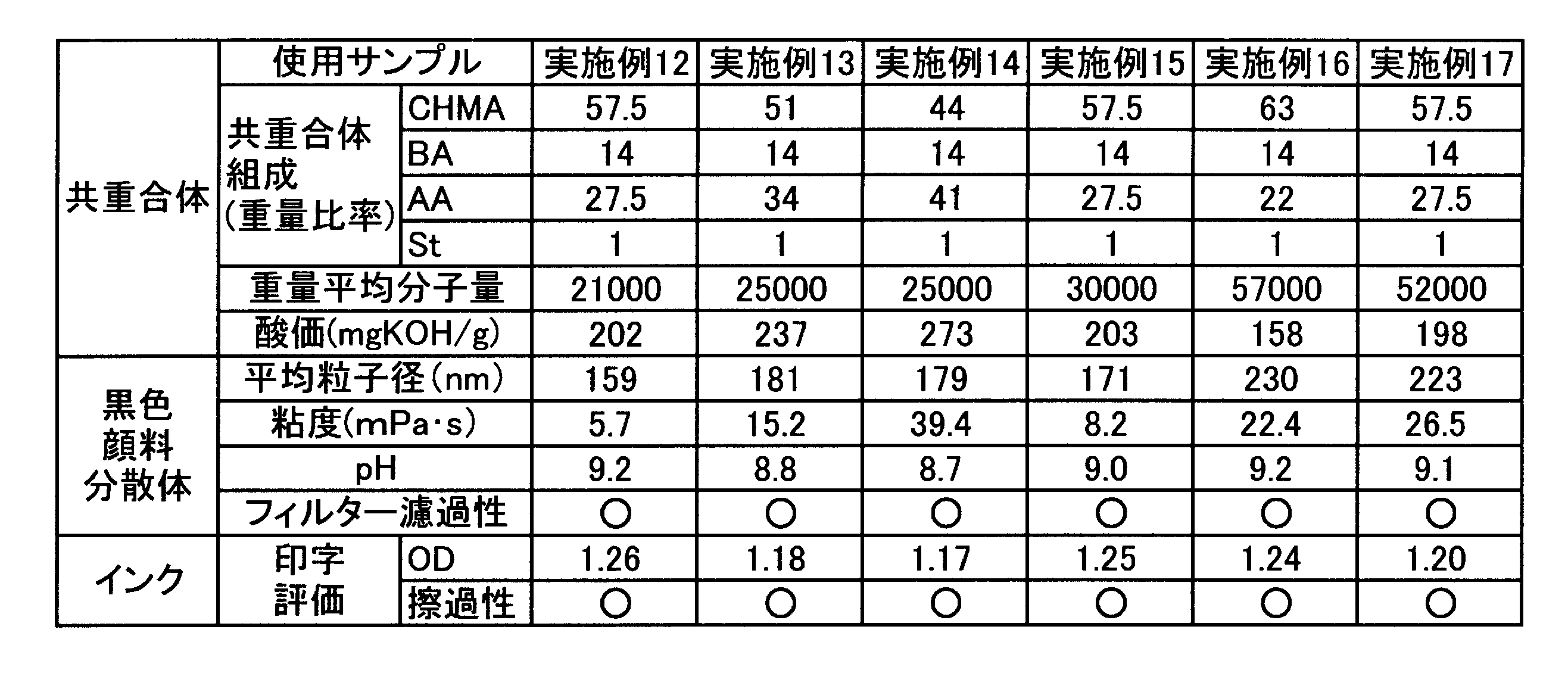
- Example 2 A copolymer was obtained in the same manner as in Example 1 except that the amount of CHMA and AA used was changed so as to have the composition shown in Table 1. The acid value and weight average molecular weight of the obtained copolymer are shown in Table 1.
- Example 5 to 8, 10, 11 A copolymer was obtained in the same manner as in Example 1, except that the amount of CHMA and AA used was changed so as to have the composition shown in Table 1, and 6 parts by weight of azobisisobutyronitrile was used. It was. The acid value and weight average molecular weight of the obtained copolymer are shown in Table 1.
- Example 9 A copolymer was obtained in the same manner as in Example 5 except that 212 parts by weight of CHMA, 60 parts by weight of BA, and 128 parts by weight of AA were used so that the composition shown in Table 1 was used (St was not added). The acid value and weight average molecular weight of the obtained copolymer are shown in Table 1.
- Example 12 A copolymer was obtained in the same manner as in Example 1 except that the amount of CHMA and AA used was changed so as to have the composition shown in Table 2, and 3 parts by weight of azobisisobutyronitrile was used. It was. The acid value and weight average molecular weight of the obtained copolymer are shown in Table 2.
- Example 15 A copolymer was obtained in the same manner as in Example 1, except that the amounts of CHMA and AA used were as shown in Table 2 and that 2 parts by weight of azobisisobutyronitrile was used. The acid value and weight average molecular weight of the obtained copolymer are shown in Table 2.
- Example 16 The inside of a 1000 ml separable flask equipped with a stirrer, a cooler, a thermometer, and a dropping funnel was purged with nitrogen, and then 200 parts by weight of butyl acetate was placed in the separable flask and heated to 80 ° C. while stirring. Next, 200 parts by weight of butyl acetate, 252 parts by weight of CHMA, 4 parts by weight of St, 56 parts by weight of BA, 88 parts by weight of AA, and 3 parts by weight of azobisisobutyronitrile were placed in a dropping funnel at 80 ° C. for 4 hours. It was dripped in. After completion of the dropwise addition, the reaction was completed by maintaining for 1 hour.
- Example 17 A copolymer was obtained in the same manner as in Example 16 except that the amount of CHMA and AA used was changed so as to have the composition shown in Table 2. The acid value and weight average molecular weight of the obtained copolymer are shown in Table 2.
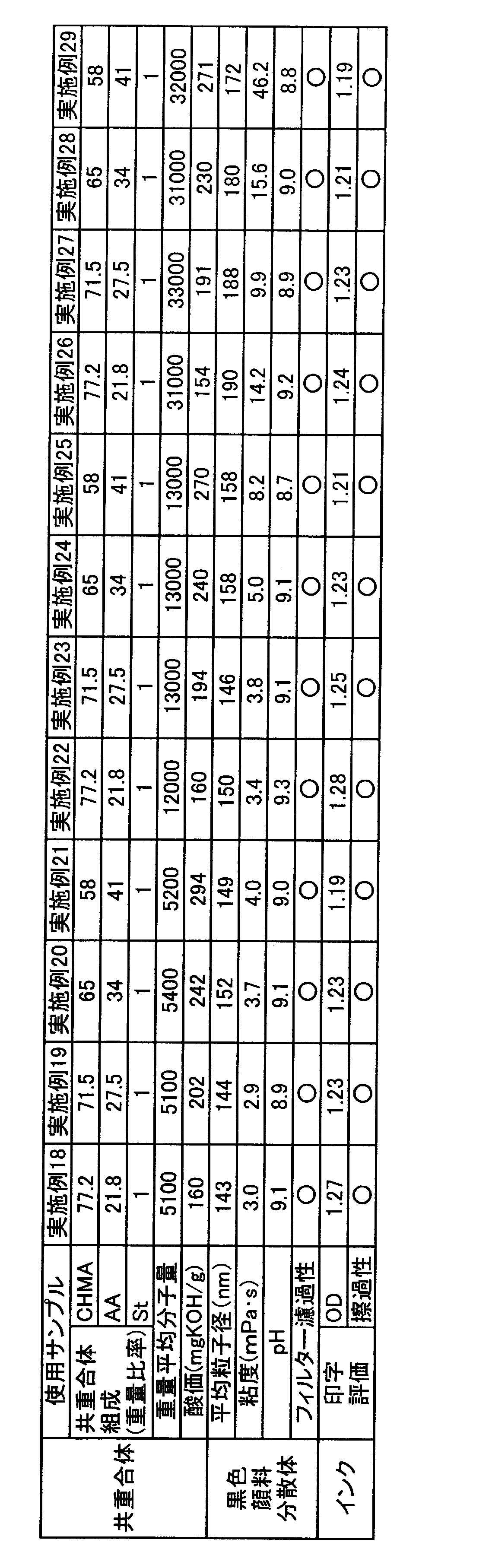
- Example 18 The inside of a 1000 ml separable flask equipped with a stirrer, a cooler, a thermometer, and a dropping funnel was purged with nitrogen, and then 200 parts by weight of butyl acetate was placed in the separable flask and heated to 95 ° C. while stirring. Next, 200 parts by weight of butyl acetate, 308.8 parts by weight of CHMA, 4 parts by weight of StA, 87.2 parts by weight of AA and 14 parts by weight of azobisisobutyronitrile were placed in a dropping funnel and placed in a separable flask at 95 ° C. for 4 hours. It was dripped in.
- Example 19 A copolymer was obtained in the same manner as in Example 18 except that the amount of CHMA and AA used was changed so as to have the composition shown in Table 3.
- Table 3 shows the acid value and weight average molecular weight of the obtained copolymer.
- Example 22 to 25 A copolymer was obtained in the same manner as in Example 18 except that the amount of CHMA and AA used was changed so that the composition shown in Table 3 was used, and 6 parts by weight of azobisisobutyronitrile was used. It was. Table 3 shows the acid value and weight average molecular weight of the obtained copolymer.
- Example 26 A copolymer was obtained in the same manner as in Example 18 except that the amount of CHMA and AA used was changed to the composition shown in Table 3 and 2 parts by weight of azobisisobutyronitrile was used. It was. Table 3 shows the acid value and weight average molecular weight of the obtained copolymer.
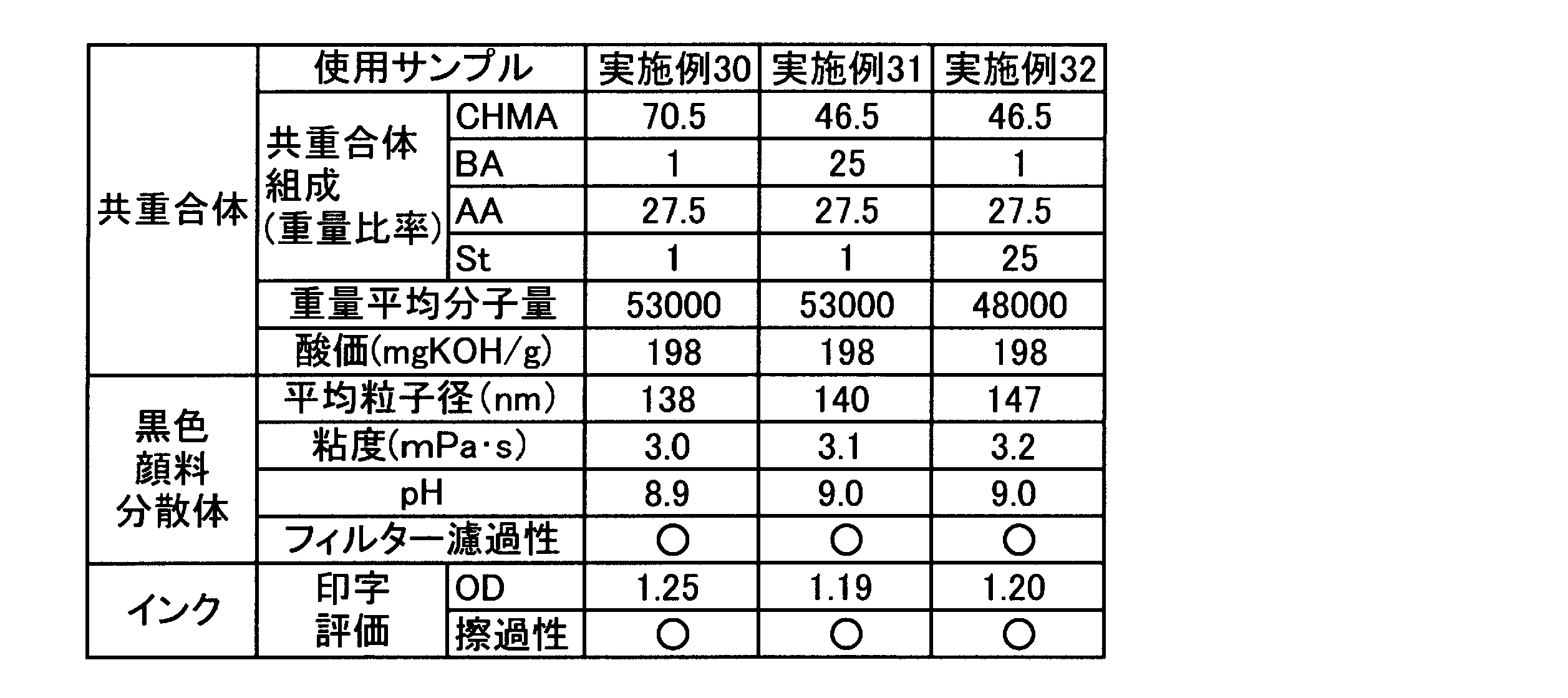
- Example 30 A copolymer was obtained in the same manner as in Example 1 except that 282 parts by weight of CHMA, 4 parts by weight of BA, 110 parts by weight of AA, and 4 parts by weight of St were used so that the composition shown in Table 4 was obtained.
- Table 4 shows the acid value and weight average molecular weight of the obtained copolymer.
- Example 31 A copolymer was obtained in the same manner as in Example 1 except that 186 parts by weight of CHMA, 100 parts by weight of BA, 110 parts by weight of AA, and 4 parts by weight of St were used so that the composition shown in Table 4 was obtained.
- Table 4 shows the acid value and weight average molecular weight of the obtained copolymer.
- Example 32 A copolymer was obtained in the same manner as in Example 1 except that 186 parts by weight of CHMA, 4 parts by weight of BA, 110 parts by weight of AA, and 100 parts by weight of St were used so that the composition shown in Table 4 was obtained.
- Table 4 shows the acid value and weight average molecular weight of the obtained copolymer.
- Example 33 A copolymer was obtained in the same manner as in Example 1 except that 252 parts by weight of CHMA, 56 parts by weight of lauryl acrylate (LMA), 88 parts by weight of AA, and 4 parts by weight of StA were used so as to have the composition shown in Table 7. .
- Table 7 shows the acid value and weight average molecular weight of the obtained copolymer.
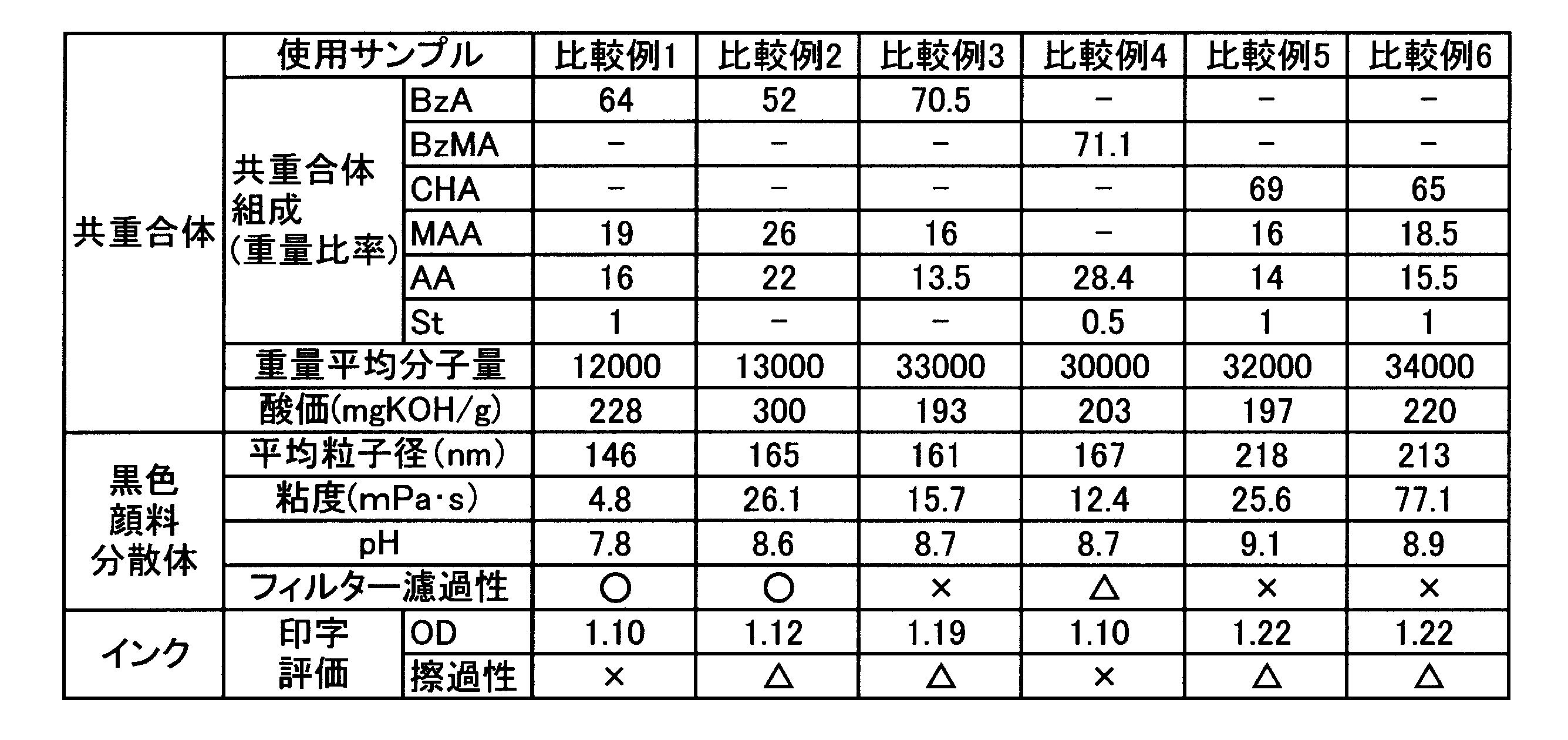
- Comparative Example 2 A copolymer was obtained in the same manner as in Comparative Example 1 except that 208 parts by weight of BzA, 104 parts by weight of MAA, and 88 parts by weight of AA were used (St is not added) so that the composition shown in Table 5 was obtained.
- Table 5 shows the acid value and weight average molecular weight of the obtained copolymer.
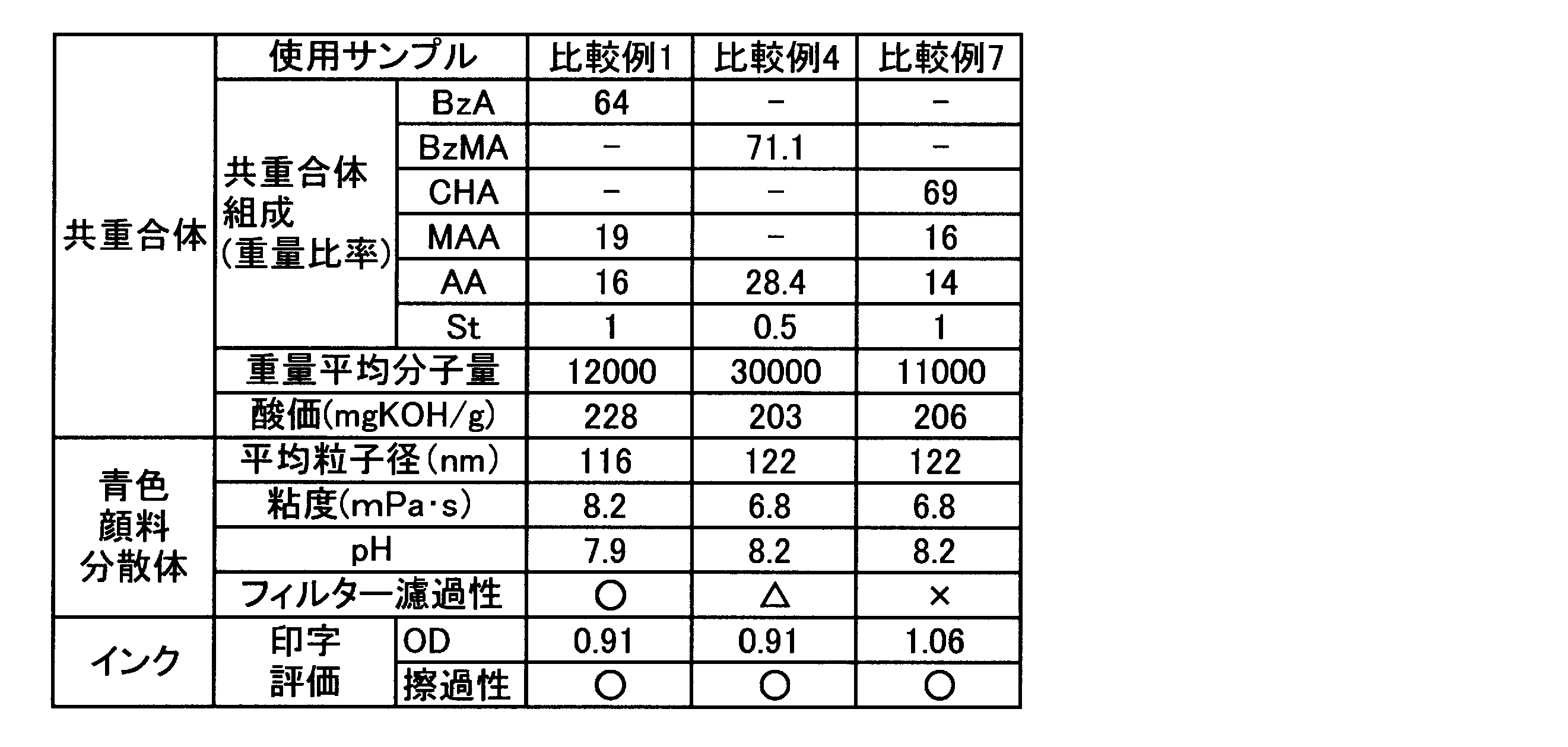
- Comparative Example 6 A copolymer was obtained in the same manner as in Comparative Example 5, except that CHA, MAA, and AA were used while changing the amounts used so as to have the compositions shown in Table 5.
- Table 5 shows the acid value and weight average molecular weight of the obtained copolymer.
- the pigment dispersion slurry was put into a cylindrical container filled with zirconia beads having a diameter of 0.5 mm, and subjected to a dispersion treatment with an agitator at a rotation speed of 2000 rpm for 3 hours to obtain a dispersion.
- the obtained dispersion was filtered through a filter having a pore size of 5 ⁇ m (manufactured by Sartorius), and then ion-exchanged water was added so that the pigment concentration was 15% by weight to prepare an aqueous pigment dispersion for inkjet ink.
- the obtained pigment dispersion for inkjet ink was subjected to the above-described evaluation (measurement of average particle diameter, measurement of viscosity, measurement of pH). The evaluation results are shown in Tables 1-5.
- the pigment dispersion slurry was treated in the same manner as in the preparation of the black pigment dispersion to prepare an aqueous pigment dispersion for inkjet ink.
- the obtained pigment dispersion for inkjet ink was subjected to the above-described evaluation (measurement of average particle diameter, measurement of viscosity, measurement of pH). The evaluation results are shown in Tables 6-8.
- red pigment paste Red pigment (“FASTOGEN Super Magenta RTS” manufactured by DIC, PR-122) 50 parts by weight, sodium chloride 500 parts by weight (average particle size 10 ⁇ m), and diethylene glycol (manufactured by Tokyo Chemical Industry Co., Ltd.) 100 A weight part was charged in a 1 gallon kneader (manufactured by Inoue Seisakusho) and kneaded at 60 ° C. for 7 hours. Next, this mixture was put into about 3000 parts by weight of warm water and stirred with a high speed mixer for about 1 hour while heating to about 80 ° C. to form a slurry.
- FASTOGEN Super Magenta RTS manufactured by DIC, PR-122
- red pigment dispersion Copolymers prepared in each of the above Examples and Comparative Examples were used samples (see Tables 9 to 10 for specific use samples), and 6.37 parts by weight of copolymer, Mix 2.57 parts by weight of a 30% aqueous sodium hydroxide solution, 100 parts by weight of the red pigment paste prepared in (1) above (pigment concentration 25% by weight), and 29.7 parts by weight of ion-exchanged water. The mixture was stirred for a time to obtain a pigment dispersion slurry.
- the pigment dispersion slurry was treated in the same manner as in the preparation of the black pigment dispersion to prepare an aqueous pigment dispersion for inkjet ink.
- the obtained pigment dispersion for inkjet ink was subjected to the above-described evaluation (measurement of average particle diameter, measurement of viscosity, measurement of pH). The evaluation results are shown in Tables 9-10.
- the pigment dispersion slurry was treated in the same manner as in the preparation of the black pigment dispersion to prepare an aqueous pigment dispersion for inkjet ink.
- the obtained pigment dispersion for inkjet ink was subjected to the above-described evaluation (measurement of average particle diameter, measurement of viscosity, measurement of pH). The evaluation results are shown in Tables 11-12.
- each black pigment dispersion has a predetermined average particle size content so that dispersibility is ensured. All of the evaluations of the filterability are “ ⁇ ”, which indicates that the productivity is excellent. Moreover, each ink-jet ink using each black pigment dispersion has an OD of 1.16 to 1.30 (generally tends to be higher than that of the comparative example) and has an evaluation of scratch resistance. In both cases, “ ⁇ ” indicates that the print evaluation is generally excellent.
Landscapes
- Chemical & Material Sciences (AREA)
- Organic Chemistry (AREA)
- Engineering & Computer Science (AREA)
- Life Sciences & Earth Sciences (AREA)
- Materials Engineering (AREA)
- Wood Science & Technology (AREA)
- Chemical Kinetics & Catalysis (AREA)
- Health & Medical Sciences (AREA)
- Medicinal Chemistry (AREA)
- Polymers & Plastics (AREA)
- Inks, Pencil-Leads, Or Crayons (AREA)
- Ink Jet Recording Methods And Recording Media Thereof (AREA)
- Ink Jet (AREA)
Abstract
Description
また、顔料分散体やインクジェットインクを製造するに際しては、顔料分散体またはインクジェットインクに含まれ得る一定以上の大きさの粒子を除去することが一般的に行われている。このような処理としては、フィルターろ過や遠心分離等が挙げられるが、除去すべき粒子が多い場合に、フィルターの交換頻度や、遠心分離により除去された粒子の除去頻度が高くなり、顔料分散体やインクジェットインクの生産性が低下する場合があった。
(2)前記共重合体が、アルキル(メタ)アクリレート単位1~25重量%を含む前記(1)記載のインクジェットインク用共重合体。
(3)前記共重合体が、スチレン単位1~25重量%を含む前記(1)または(2)記載のインクジェットインク用共重合体。
(4)前記共重合体の重量平均分子量が、4500~150000である前記(1)~(3)のいずれかに記載のインクジェットインク用共重合体。
(5)前記共重合体の酸価が、10~300mgKOH/gである前記(1)~(4)のいずれかに記載のインクジェットインク用共重合体。
(6)前記(1)~(5)のいずれかに記載のインクジェットインク用共重合体と、顔料を含有するインクジェットインク用顔料分散体。
(7)前記顔料の平均粒子径が300nm以下である前記(6)記載のインクジェットインク用顔料分散体。
(8)前記(1)~(5)の何れかに記載のインクジェットインク用共重合体を含有するインクジェットインク。
このように、シクロヘキシルメタクリレート単位とアクリル酸単位を特定比率で含有する共重合体を用いることで、本発明の効果を奏することが可能となる。
重合反応終了後は、減圧蒸留などにより反応溶媒を除去することで共重合体を得ることができる。
当該インクジェットインク用顔料分散体は、上記のインクジェットインク用共重合体と顔料を含有するものである。
また、顔料の平均一次粒子径を上記範囲程度になるように微細化する方法としては、インクジェットインク用顔料分散体やインクジェットインクに悪影響を与えるものでなければ特に限定はなく、例えば、硫酸を用いる方法や、ミキサーなどを用いた機械的摩砕による方法などが挙げられる。
有機系溶媒としては、インクジェットインキに一般的に使用されるアルコール類、ケトン類、エステル類、グリコールエーテル類、グリコールアセテート類、飽和炭水素類、不飽和炭化水素類、環状飽和炭化水素類、環状不飽和炭化水素類、芳香族炭化水素類等の有機溶剤が広く利用できる。
水性溶媒としては、水及び/又は水溶性の有機溶媒が挙げられる。水としては、例えば、イオン交換水、限外濾過水、逆浸透水、蒸留水等の純水や超純水を用いることができる。水溶性の有機溶媒としては、インクジェットインク用として一般的に用いられるものであれば特に限定されないが、具体的には、水よりも蒸気圧の小さいもの、例えば、ジエチレングリコールなどの多価アルコール類、トリエチレングリコールモノブチルエーテルなどの多価アルコールエーテル類、ケトン類、エステル類、低級アルコキシアルコール類、アミン類、アミド類、複素環類、スルホキシド類、スルホン類などが挙げられる。また、カビやバクテリア等の発生を防ぐ目的で紫外線処理、過酸化水素水処理等により滅菌されたものを用いても良い。
するものではない。また、各特性の測定条件は、次のとおりとする。
実施例および比較例において得られた各共重合体0.2重量部をアセトン60重量部に溶解させた後、0.1mol/Lエタノール性水酸化カリウム溶液を用いて、自動酸価測定装置(株式会社平沼産業製、AUTO TITRATOR COM-1600)により測定する。
東ソー株式会社製、HLC-8220GPCを用い、ゲル浸透クロマトグラフィー(GPC)法により測定する。尚、重量平均分子量は、標準物質としてポリスチレン(東ソー株式会社製、TSK 標準ポリスチレン)を用い、その分子量に換算した値として算出する。
後述する各水性のインクジェットインク用顔料分散体中の粒子の平均粒子径を、レーザーゼータ電位計(ELS-8000、大塚電子株式会社製)で測定する。
後述する各水性のインクジェットインク用顔料分散体の粘度を、東機産業株式会社製、TV-22形粘度計を用い、25℃にて測定する。
後述する各水性のインクジェットインク用顔料分散体のpHを、株式会社堀場製作所製、pHメータF-54を用いて25℃にて測定する。
後述する各水性のインクジェットインク用顔料分散体を孔径5μmのフィルター(Sartorius社製、Minisart(登録商標))を取り付けた容量10mlの針なしシリンジ〔テルモ株式会社製、ss-10SZ〕で濾過し、フィルター1個が目詰まりするまでの通液量により評価する。目詰まりするまでの通液量が大きいほど、濾過性が良好であることを示す。判断基準は下記の通りである。
○:通液量100ml以上
△:通液量10ml以上、100ml未満
×:通液量10ml未満
後述する各インクジェットインクを用い、インクジェットプリンターで普通紙(セイコーエプソン株式会社製、両面上質普通紙)にベタ印字し、その印字濃度(光学濃度:OD)を測定し、発色性の指標とする。光学濃度(OD)は、グレタグマクベス社製GRETAG(登録商標)RD-19を使用し、単一サンプルについてODを5点につき測定し、それらを平均した値を採用する。
後述する各インクジェットインクを用い、インクジェットプリンターで普通紙(セイコーエプソン株式会社製、両面上質普通紙)にベタ印字し、印字濃度の評価と同様にしてODを測定する。次に、ベタ印字部分の表面を、事務用消しゴム(MONO(登録商標)、トンボ鉛筆社製)で5回の往復運動を行った後、同様にしてODを測定する。そして、下式で示される試験前後のOD残存率(%)を算出し、擦過性を、下記判断基準により評価する。
OD残存率(%)=(擦過性試験後のOD値)/(擦過性試験前のOD値)×100
○:OD残存率90%以上
△:OD残存率70%以上90%未満
×:OD残存率70%未満
(実施例1)
攪拌装置、冷却器、温度計、滴下ロートを備えた1000mlのセパラブルフラスコ内を窒素置換した後、酢酸ブチル200重量部をセパラブルフラスコに入れ、攪拌しながら100℃に昇温した。次いで、滴下ロートに酢酸ブチル200重量部、シクロヘキシルメタクリレート(CHMA)252重量部、スチレン(St)4重量部、ブチルアクリレート(BA)56重量部、アクリル酸(AA)88重量部及びアゾビスイソブチロニトリル14重量部を入れ、100℃で4時間かけてセパラブルフラスコ中に滴下した。滴下終了後、1時間保持し反応を完了した。反応の終点は、反応液中の未反応モノマーをガスクロマトグラフィにて測定して判断した。その後、減圧蒸留により酢酸ブチルを除去して、共重合体を得た。
得られた共重合体は、酸価が160mg-KOH/g、重量平均分子量が5300であった。共重合体の組成および、その酸価、重量平均分子量を表1に示す。
CHMAおよびAAの使用量を表1に示す組成になるように変化させて使用した以外は、実施例1と同様にして、共重合体を得た。得られた共重合体の酸価、重量平均分子量を表1に示す。
CHMAおよびAAの使用量を表1に示す組成になるように変化させて使用し、アゾビスイソブチロニトリルを6重量部使用した以外は、実施例1と同様にして、共重合体を得た。得られた共重合体の酸価、重量平均分子量を表1に示す。
表1に示す組成になるように、CHMA212重量部、BA60重量部、AA128重量部を使用した以外(Stは未添加)は、実施例5と同様にして、共重合体を得た。得られた共重合体の酸価、重量平均分子量を表1に示す。
CHMAおよびAAの使用量を表2に示す組成になるように変化させて使用し、アゾビスイソブチロニトリルを3重量部使用した以外は、実施例1と同様にして、共重合体を得た。得られた共重合体の酸価、重量平均分子量を表2に示す。
CHMAおよびAAの使用量を表2に示す組成になるように使用し、アゾビスイソブチロニトリルを2重量部使用した以外は、実施例1と同様にして、共重合体を得た。得られた共重合体の酸価、重量平均分子量を表2に示す。
攪拌装置、冷却器、温度計、滴下ロートを備えた1000mlのセパラブルフラスコ内を窒素置換した後、酢酸ブチル200重量部をセパラブルフラスコに入れ、攪拌しながら80℃に昇温した。次いで、滴下ロートに酢酸ブチル200重量部、CHMA252重量部、St4重量部、BA56重量部、AA88重量部及びアゾビスイソブチロニトリル3重量部を入れ、80℃で4時間かけてセパラブルフラスコ中に滴下した。滴下終了後、1時間保持し反応を完了した。反応の終点は、反応液中の未反応モノマーをガスクロマトグラフィにて測定して判断した。その後、減圧蒸留により酢酸ブチルを除去して、共重合体を得た。
得られた共重合体の酸価、重量平均分子量を表2に示す。
CHMAおよびAAの使用量を表2に示す組成になるように変化させて使用した以外は、実施例16と同様にして、共重合体を得た。得られた共重合体の酸価、重量平均分子量を表2に示す。
攪拌装置、冷却器、温度計、滴下ロートを備えた1000mlのセパラブルフラスコ内を窒素置換した後、酢酸ブチル200重量部をセパラブルフラスコに入れ、攪拌しながら95℃に昇温した。次いで、滴下ロートに酢酸ブチル200重量部、CHMA308.8重量部、St4重量部、AA87.2重量部及びアゾビスイソブチロニトリル14重量部を入れ、95℃で4時間かけてセパラブルフラスコ中に滴下した。滴下終了後、1時間保持し反応を完了した。反応の終点は、反応液中の未反応モノマーをガスクロマトグラフィにて測定して判断した。その後、減圧蒸留により酢酸ブチルを除去して、共重合体を得た。
得られた共重合体の酸価、重量平均分子量を表3に示す。
CHMAおよびAAの使用量を表3に示す組成になるように変化させて使用した以外は、実施例18と同様にして、共重合体を得た。得られた共重合体の酸価、重量平均分子量を表3に示す。
CHMAおよびAAの使用量を表3に示す組成になるように変化させて使用し、アゾビスイソブチロニトリルを6重量部使用した以外は、実施例18と同様にして、共重合体を得た。得られた共重合体の酸価、重量平均分子量を表3に示す。
CHMAおよびAAの使用量を表3に示す組成になるように変化させて使用し、アゾビスイソブチロニトリルを2重量部使用した以外は、実施例18と同様にして、共重合体を得た。得られた共重合体の酸価、重量平均分子量を表3に示す。
表4に示す組成になるように、CHMA282重量部、BA4重量部、AA110重量部、St4重量部を使用した以外は、実施例1と同様にして、共重合体を得た。得られた共重合体の酸価、重量平均分子量を表4に示す。
表4に示す組成になるように、CHMA186重量部、BA100重量部、AA110重量部、St4重量部を使用した以外は、実施例1と同様にして、共重合体を得た。得られた共重合体の酸価、重量平均分子量を表4に示す。
表4に示す組成になるように、CHMA186重量部、BA4重量部、AA110重量部、St100重量部を使用した以外は、実施例1と同様にして、共重合体を得た。得られた共重合体の酸価、重量平均分子量を表4に示す。
表7に示す組成になるように、CHMA252重量部、ラウリルアクリレート(LMA)56重量部、AA88重量部、St4重量部を使用した以外は、実施例1と同様にして、共重合体を得た。得られた共重合体の酸価、重量平均分子量を表7に示す。
攪拌装置、冷却器、温度計、滴下ロートを備えた1000mlのセパラブルフラスコ内を窒素置換した後、酢酸ブチル200重量部をセパラブルフラスコに入れ、攪拌しながら100℃に昇温した。次いで、滴下ロートに酢酸ブチル200重量部、ベンジルアクリレート(BzA)256重量部、メタクリル酸(MAA)76重量部、St4重量部、AA64重量部及びアゾビスイソブチロニトリル6重量部を入れ、100℃で4時間かけてセパラブルフラスコ中に滴下した。滴下終了後、1時間保持し反応を完了した。反応の終点は、反応液中の未反応モノマーをガスクロマトグラフィにて測定して判断した。その後、減圧蒸留により酢酸ブチルを除去して、共重合体を得た。
得られた共重合体の酸価、重量平均分子量を表5に示す。
表5に示す組成になるように、BzA208重量部、MAA104重量部、AA88重量部を使用した以外(Stは未添加)は、比較例1と同様にして、共重合体を得た。得られた共重合体の酸価、重量平均分子量を表5に示す。
表5に示す組成になるように、BzA282重量部、MAA64重量部、AA54重量部を使用し(Stは未添加)、アゾビスイソブチロニトリルを3重量部使用した以外は、比較例1と同様にして、共重合体を得た。得られた共重合体の酸価、重量平均分子量を表5に示す。
攪拌装置、冷却器、温度計、滴下ロートを備えた1000mlのセパラブルフラスコ内を窒素置換した後、酢酸ブチル200重量部をセパラブルフラスコに入れ、攪拌しながら100℃に昇温した。次いで、滴下ロートに酢酸ブチル200重量部、ベンジルメタクリレート(BzMA)286重量部、AA114重量部、St2重量部及びアゾビスイソブチロニトリル3重量部を入れ、100℃で4時間かけてセパラブルフラスコ中に滴下した。滴下終了後、1時間保持し反応を完了した。反応の終点は、反応液中の未反応モノマーをガスクロマトグラフィにて測定して判断した。その後、減圧蒸留により酢酸ブチルを除去して、共重合体を得た。
得られた共重合体の酸価、重量平均分子量を表5に示す。
攪拌装置、冷却器、温度計、滴下ロートを備えた1000mlのセパラブルフラスコ内を窒素置換した後、酢酸ブチル200重量部をセパラブルフラスコに入れ、攪拌しながら90℃に昇温した。次いで、滴下ロートに酢酸ブチル200重量部、シクロヘキシルアクリレート(CHA)276重量部、MAA64重量部、AA56重量部、St4重量部及びアゾビスイソブチロニトリル3重量部を入れ、90℃で4時間かけてセパラブルフラスコ中に滴下した。滴下終了後、1時間保持し反応を完了した。反応の終点は、反応液中の未反応モノマーをガスクロマトグラフィにて測定して判断した。その後、減圧蒸留により酢酸ブチルを除去して、共重合体を得た。
得られた共重合体の酸価、重量平均分子量を表5に示す。
CHA、MAAおよびAAの使用量を表5に示す組成になるように変化させて使用した以外は、比較例5と同様にして、共重合体を得た。得られた共重合体の酸価、重量平均分子量を表5に示す。
攪拌装置、冷却器、温度計、滴下ロートを備えた1000mlのセパラブルフラスコ内を窒素置換した後、酢酸ブチル200重量部をセパラブルフラスコに入れ、攪拌しながら100℃に昇温した。次いで、滴下ロートに酢酸ブチル200重量部、CHA260重量部、MAA74重量部、AA62重量部、St4重量部及びアゾビスイソブチロニトリル6重量部を入れ、100℃で4時間かけてセパラブルフラスコ中に滴下した。滴下終了後、1時間保持し反応を完了した。反応の終点は、反応液中の未反応モノマーをガスクロマトグラフィにて測定して判断した。その後、減圧蒸留により酢酸ブチルを除去して、共重合体を得た。
得られた共重合体の酸価、重量平均分子量を表8に示す。
(黒色顔料分散体の調製)
上記した各実施例および比較例にて調製した共重合体を使用サンプルとして(具体的使用サンプルは表1~5参照)、共重合体6.37重量部、30%水酸化ナトリウム水溶液2.57重量部、黒色顔料(Pigment Black 7;顔料の平均一次粒子径20nm;三菱化学株式会社製、MA600)25重量部、イオン交換水104.7重量部を混合し、高速ディスパーで1時間攪拌し、顔料分散スラリーを得た。
当該顔料分散スラリーを直径0.5mmのジルコニアビーズを充填した円筒容器に投入し、アジテータにて回転数2000rpmで3時間分散処理を行い、分散体を得た。
得られた分散体を孔径5μmのフィルター(Sartorius社製)にて濾過後、顔料濃度15重量%になるようにイオン交換水を添加し、水性のインクジェットインク用顔料分散体を調製した。得られたインクジェットインク用顔料分散体を上述した評価(平均粒子径の測定、粘度測定、pH測定)に供した。評価結果を表1~5に示す。
(1)青色顔料ペーストの調製
青色顔料(DIC社製「CYANINE Blue KRO」、PB-15:3)50重量部、塩化ナトリウム500重量部(平均粒径10μm)、及びジエチレングリコール(東京化成社製)100重量部をステンレス製1ガロンニーダー(井上製作所社製)に仕込み、50℃で7時間混練した。次に、この混合物を約3000重量部の温水に投入し、約80℃に加熱しながらハイスピードミキサーで約1時間撹拌してスラリー状とした。その後、定法に従って、濾過、水洗して塩化ナトリウム及び溶剤を除去し、青色顔料ペースト(顔料の平均一次粒子径50nm)180重量部を得た。
(2)青色顔料分散体の調製
上記した各実施例および比較例にて調製した共重合体を使用サンプルとし(具体的使用サンプルは表6~8参照)、共重合体6.73重量部、30%水酸化ナトリウム水溶液2.57重量部、上記(1)にて調製した青色顔料ペースト25重量部(顔料濃度25重量%)、イオン交換水29.7重量部を混合し、高速ディスパーで1時間攪拌し、顔料分散スラリーを得た。
当該顔料分散スラリーを上記の黒色顔料分散体の調製の場合と同様に処理して、水性のインクジェットインク用顔料分散体を調製した。得られたインクジェットインク用顔料分散体を上述した評価(平均粒子径の測定、粘度測定、pH測定)に供した。評価結果を表6~8に示す。
(1)赤色顔料ペーストの調製
赤色顔料(DIC社製「FASTOGEN Super Magenta RTS」、PR-122)50重量部、塩化ナトリウム500重量部(平均粒径10μm)、及びジエチレングリコール(東京化成社製)100重量部をステンレス製1ガロンニーダー(井上製作所社製)に仕込み、60℃で7時間混練した。次に、この混合物を約3000重量部の温水に投入し、約80℃に加熱しながらハイスピードミキサーで約1時間撹拌してスラリー状とした。その後、濾過、水洗して塩化ナトリウム及び溶剤を除き赤色顔料ペースト(顔料の平均一次粒子径50nm)180重量部を得た。
(2)赤色顔料分散体の調製
上記した各実施例および比較例にて調製した共重合体を使用サンプルとし(具体的使用サンプルは表9~10参照)、共重合体6.37重量部、30%水酸化ナトリウム水溶液2.57重量部、上記(1)にて調製した赤色顔料ペースト100重量部(顔料濃度25重量%)、イオン交換水29.7重量部を混合し、高速ディスパーで1時間攪拌し、顔料分散スラリーを得た。
当該顔料分散スラリーを上記の黒色顔料分散体の調製の場合と同様に処理して、水性のインクジェットインク用顔料分散体を調製した。得られたインクジェットインク用顔料分散体を上述した評価(平均粒子径の測定、粘度測定、pH測定)に供した。評価結果を表9~10に示す。
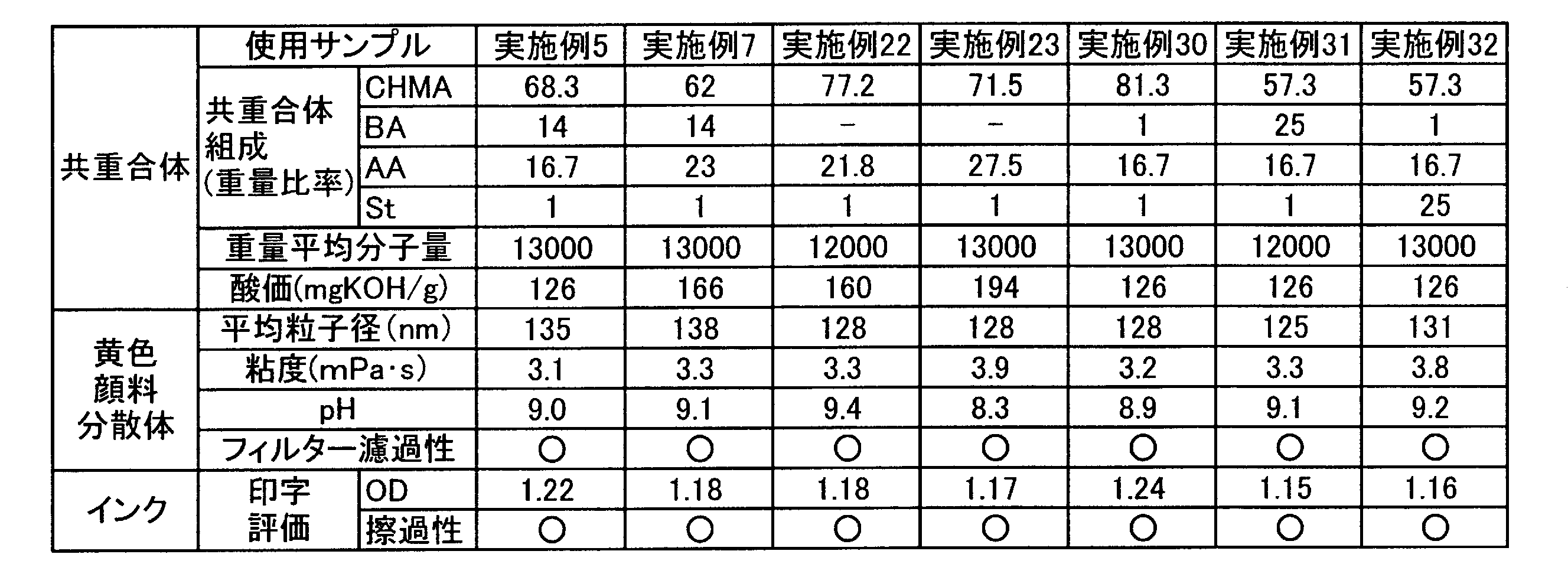
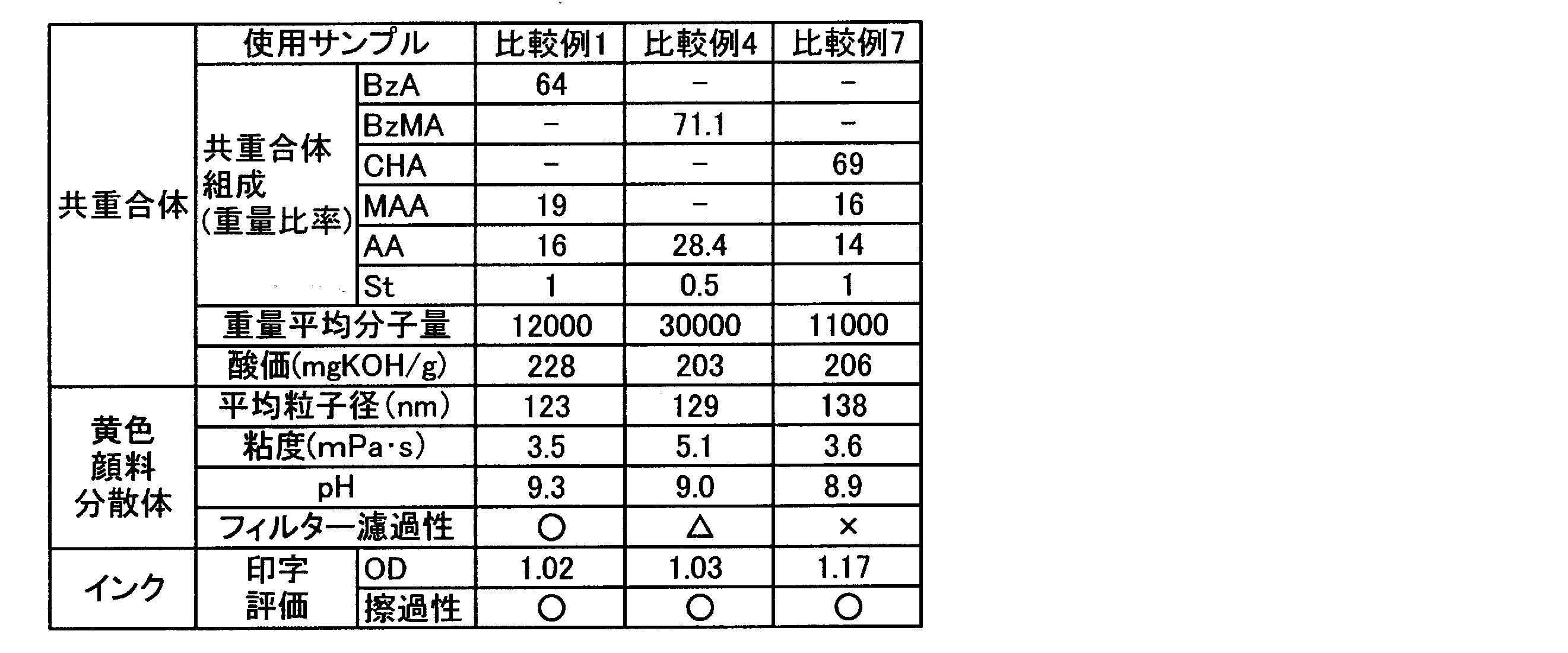
上記した各実施例および比較例にて調製した共重合体を使用サンプルとし(具体的使用サンプルは表11~12参照)、共重合体6.37重量部、30%水酸化ナトリウム水溶液2.57重量部、黄色顔料(PY-74:顔料の平均一次粒子径57nm;山陽色素株式会社製、Fast Yellow 7413-A)100重量部(顔料濃度25重量%)、イオン交換水29.7重量部を混合し、高速ディスパーで1時間攪拌し、顔料分散スラリーを得た。
当該顔料分散スラリーを上記の黒色顔料分散体の調製の場合と同様に処理して、水性のインクジェットインク用顔料分散体を調製した。得られたインクジェットインク用顔料分散体を上述した評価(平均粒子径の測定、粘度測定、pH測定)に供した。評価結果を表11~12に示す。
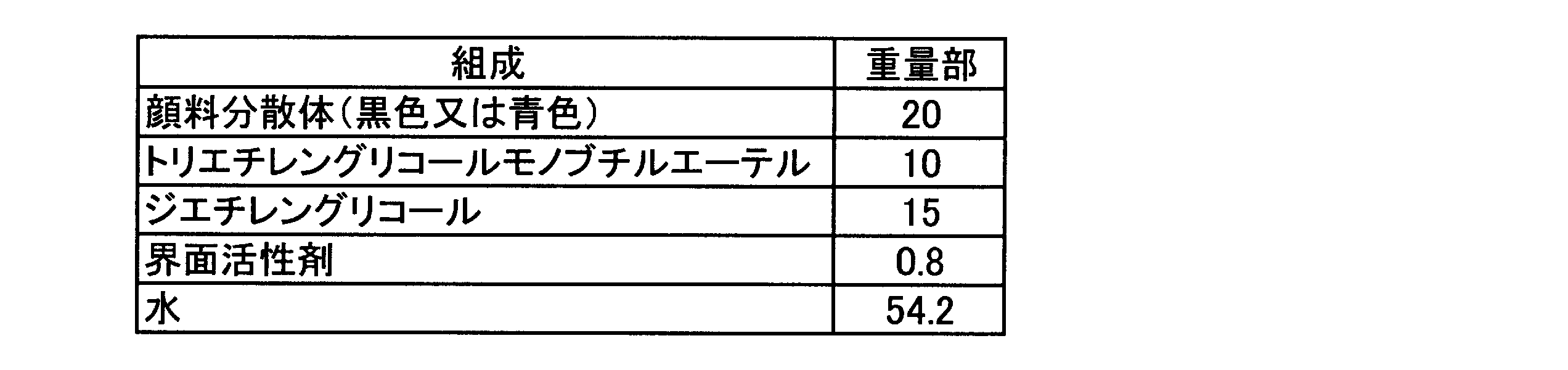
上記の黒色および青色の各インクジェットインク用顔料分散体(顔料濃度15重量%)を用い、表13に示す組成にて、当該各顔料分散体に水性媒体(水、トリエチレングリコールモノブチルエーテルおよびジエチレングリコール)および界面活性剤(サーフィノール465、エアプロダクツ社製)を混合、撹拌することで黒色および青色インクジェットインクを調製した。
また、同様に、赤色および黄色の各インクジェットインク用顔料分散体(顔料濃度15重量%)を用い、表14に示す組成にて、各成分を混合、撹拌することで黒色および青色インクジェットインクを調製した。
以上のようにして得られた各インクジェットインクを上述した評価(印字濃度、擦過性)に供した。評価結果を、表1~12に示す。
表6~12から分かるように、青色、赤色、黄色の各顔料を用いた場合も、黒色の顔料を用いた場合と概ね同様の傾向を示していることが分かる。
このように表1~12から分かるように、本発明に係るインクジェットインク用共重合体を用いることで、分散性の良好な顔料分散体を生産性よく提供可能であり、しかも、そのインクジェットインクは、形成された印刷物の印字濃度(発色性)、定着性(擦過性)にも優れたものである。また、当該共重合体を用いることでフィルターろ過性が良好となるため、生産性良くインクジェットインクを提供可能である。






Claims (8)
- シクロヘキシルメタクリレート単位10~99重量%と、アクリル酸単位1~90重量%を含むインクジェットインク用共重合体。
- 前記共重合体が、アルキル(メタ)アクリレート単位1~25重量%を含む請求項1記載のインクジェットインク用共重合体。
- 前記共重合体が、スチレン単位1~25重量%を含む請求項1または2記載のインクジェットインク用共重合体。
- 前記共重合体の重量平均分子量が、4500~150000である請求項1~3のいずれかに記載のインクジェットインク用共重合体。
- 前記共重合体の酸価が、10~300mgKOH/gである請求項1~4のいずれかに記載のインクジェットインク用共重合体。
- 請求項1~5のいずれかに記載のインクジェットインク用共重合体と、顔料を含有するインクジェットインク用顔料分散体。
- 前記顔料の平均粒子径が300nm以下である請求項6記載のインクジェットインク用顔料分散体。
- 請求項1~5の何れかに記載のインクジェットインク用共重合体を含有するインクジェットインク。
Priority Applications (6)
| Application Number | Priority Date | Filing Date | Title |
|---|---|---|---|
| US14/001,712 US8993674B2 (en) | 2011-02-28 | 2012-02-28 | Inkjet ink copolymer and inkjet ink pigment dispersion and inkjet ink using the same |
| JP2013502368A JP6123671B2 (ja) | 2011-02-28 | 2012-02-28 | インクジェットインク用共重合体、並びにそれを用いたインクジェットインク用顔料分散体及びインクジェットインク |
| KR1020197003615A KR102042106B1 (ko) | 2011-02-28 | 2012-02-28 | 잉크젯 잉크용 공중합체 및 그것을 사용한 잉크젯 잉크용 안료 분산체 및 잉크젯 잉크 |
| CN201280010749.3A CN103443145B (zh) | 2011-02-28 | 2012-02-28 | 喷墨油墨用共聚物、使用其的喷墨油墨用颜料分散体和喷墨油墨 |
| KR1020137024253A KR20140015365A (ko) | 2011-02-28 | 2012-02-28 | 잉크젯 잉크용 공중합체 및 그것을 사용한 잉크젯 잉크용 안료 분산체 및 잉크젯 잉크 |
| EP12752419.7A EP2682437B8 (en) | 2011-02-28 | 2012-02-28 | Inkjet ink copolymer, inkjet ink pigment dispersing element using same, and inkjet ink |
Applications Claiming Priority (2)
| Application Number | Priority Date | Filing Date | Title |
|---|---|---|---|
| JP2011042766 | 2011-02-28 | ||
| JP2011-042766 | 2011-02-28 |
Publications (1)
| Publication Number | Publication Date |
|---|---|
| WO2012118078A1 true WO2012118078A1 (ja) | 2012-09-07 |
Family
ID=46758009
Family Applications (1)
| Application Number | Title | Priority Date | Filing Date |
|---|---|---|---|
| PCT/JP2012/054934 Ceased WO2012118078A1 (ja) | 2011-02-28 | 2012-02-28 | インクジェットインク用共重合体、並びにそれを用いたインクジェットインク用顔料分散体及びインクジェットインク |
Country Status (6)
| Country | Link |
|---|---|
| US (1) | US8993674B2 (ja) |
| EP (1) | EP2682437B8 (ja) |
| JP (1) | JP6123671B2 (ja) |
| KR (2) | KR20140015365A (ja) |
| CN (1) | CN103443145B (ja) |
| WO (1) | WO2012118078A1 (ja) |
Cited By (3)
| Publication number | Priority date | Publication date | Assignee | Title |
|---|---|---|---|---|
| JP2013249467A (ja) * | 2012-05-31 | 2013-12-12 | Lg Chem Ltd | 新規な高分子およびこれを含む着色組成物 |
| WO2014156758A1 (ja) * | 2013-03-28 | 2014-10-02 | 日本化薬株式会社 | 着色分散液、インク組成物、インクセット、インクジェット記録方法及び着色体 |
| JP2021113296A (ja) * | 2020-01-21 | 2021-08-05 | 京セラドキュメントソリューションズ株式会社 | インクジェット用インク |
Families Citing this family (4)
| Publication number | Priority date | Publication date | Assignee | Title |
|---|---|---|---|---|
| JP6460375B2 (ja) * | 2014-08-28 | 2019-01-30 | セイコーエプソン株式会社 | インク組成物及びインクセット |
| JP7664015B2 (ja) * | 2020-11-27 | 2025-04-17 | 花王株式会社 | 水性インク |
| KR102556908B1 (ko) | 2022-08-05 | 2023-07-20 | 주식회사 지씨에스 | 플라즈마 발생 장치 |
| KR20240175224A (ko) | 2023-06-12 | 2024-12-19 | 주식회사 그린플러스 | 식물재배용 배드의 물 공급 장치 |
Citations (7)
| Publication number | Priority date | Publication date | Assignee | Title |
|---|---|---|---|---|
| JP2004107478A (ja) * | 2002-09-18 | 2004-04-08 | Nippon Shokubai Co Ltd | 水性樹脂分散液及びその製造方法、並びに、水性塗料組成物 |
| JP2005171223A (ja) | 2003-11-19 | 2005-06-30 | Sanyo Shikiso Kk | インクジェットインク用ポリマー組成物並びにインクジェットインク用顔料分散体及びその製造方法 |
| JP2008150408A (ja) * | 2006-12-14 | 2008-07-03 | Seiko Epson Corp | インクジェット記録用インク |
| JP2008239961A (ja) * | 2007-02-26 | 2008-10-09 | Mitsubishi Chemicals Corp | 水性顔料分散液及びその製造方法、ならびにそれを用いた記録液 |
| JP4532387B2 (ja) | 2004-10-19 | 2010-08-25 | ヒューレット−パッカード デベロップメント カンパニー エル.ピー. | 可変の粒径又は可変の粘度を呈する顔料分散物 |
| JP2010184429A (ja) * | 2009-02-12 | 2010-08-26 | Fujifilm Corp | インクセット及び画像記録方法 |
| JP2011012171A (ja) * | 2009-07-02 | 2011-01-20 | Canon Inc | クリアインク、インクジェット記録方法、インクセット、インクカートリッジ、記録ユニット、及びインクジェット記録装置 |
Family Cites Families (13)
| Publication number | Priority date | Publication date | Assignee | Title |
|---|---|---|---|---|
| JP3602180B2 (ja) * | 1994-12-22 | 2004-12-15 | クラリアント インターナショナル リミテッド | 窯業セメント系外装材仕上げ塗料用エマルジョン |
| JP4100529B2 (ja) * | 1998-12-05 | 2008-06-11 | 大日本印刷株式会社 | 液晶表示装置およびその製造方法 |
| NO328137B1 (no) * | 2001-12-26 | 2009-12-14 | Nippon Paint Co Ltd | Akrylharpiks og antibegroingsbelegg |
| US7736693B2 (en) | 2002-06-13 | 2010-06-15 | Cima Nanotech Israel Ltd. | Nano-powder-based coating and ink compositions |
| JP2006083277A (ja) * | 2004-09-15 | 2006-03-30 | Fuji Xerox Co Ltd | インクジェット記録用インク、インクジェット記録用インクセット、インクジェット記録装置、及びインクジェット記録方法 |
| ATE532217T1 (de) | 2005-08-12 | 2011-11-15 | Cambrios Technologies Corp | Verfahren zur herstellung von transparente leiter auf nanodrahtbasis |
| JP2008266527A (ja) * | 2007-04-24 | 2008-11-06 | Sakata Corp | インクジェット捺染用白色インク組成物およびインクジェット捺染方法 |
| US7727578B2 (en) | 2007-12-27 | 2010-06-01 | Honeywell International Inc. | Transparent conductors and methods for fabricating transparent conductors |
| SG188159A1 (en) | 2008-02-26 | 2013-03-28 | Cambrios Technologies Corp | Methods and compositions for ink jet deposition of conductive features |
| KR101346390B1 (ko) * | 2008-07-28 | 2014-01-02 | 고쿠리츠 다이가쿠 호진 교토 다이가쿠 | 수성 안료 분산액, 및 사용 |
| JP5241565B2 (ja) * | 2009-02-27 | 2013-07-17 | 富士フイルム株式会社 | インクジェット記録用水性インク |
| JP2011042150A (ja) * | 2009-08-24 | 2011-03-03 | Fujifilm Corp | 画像形成方法 |
| JP6096065B2 (ja) * | 2013-06-13 | 2017-03-15 | キヤノンマシナリー株式会社 | 摺動部材の製造方法 |
-
2012
- 2012-02-28 EP EP12752419.7A patent/EP2682437B8/en active Active
- 2012-02-28 JP JP2013502368A patent/JP6123671B2/ja active Active
- 2012-02-28 KR KR1020137024253A patent/KR20140015365A/ko not_active Ceased
- 2012-02-28 WO PCT/JP2012/054934 patent/WO2012118078A1/ja not_active Ceased
- 2012-02-28 CN CN201280010749.3A patent/CN103443145B/zh active Active
- 2012-02-28 KR KR1020197003615A patent/KR102042106B1/ko not_active Expired - Fee Related
- 2012-02-28 US US14/001,712 patent/US8993674B2/en active Active
Patent Citations (7)
| Publication number | Priority date | Publication date | Assignee | Title |
|---|---|---|---|---|
| JP2004107478A (ja) * | 2002-09-18 | 2004-04-08 | Nippon Shokubai Co Ltd | 水性樹脂分散液及びその製造方法、並びに、水性塗料組成物 |
| JP2005171223A (ja) | 2003-11-19 | 2005-06-30 | Sanyo Shikiso Kk | インクジェットインク用ポリマー組成物並びにインクジェットインク用顔料分散体及びその製造方法 |
| JP4532387B2 (ja) | 2004-10-19 | 2010-08-25 | ヒューレット−パッカード デベロップメント カンパニー エル.ピー. | 可変の粒径又は可変の粘度を呈する顔料分散物 |
| JP2008150408A (ja) * | 2006-12-14 | 2008-07-03 | Seiko Epson Corp | インクジェット記録用インク |
| JP2008239961A (ja) * | 2007-02-26 | 2008-10-09 | Mitsubishi Chemicals Corp | 水性顔料分散液及びその製造方法、ならびにそれを用いた記録液 |
| JP2010184429A (ja) * | 2009-02-12 | 2010-08-26 | Fujifilm Corp | インクセット及び画像記録方法 |
| JP2011012171A (ja) * | 2009-07-02 | 2011-01-20 | Canon Inc | クリアインク、インクジェット記録方法、インクセット、インクカートリッジ、記録ユニット、及びインクジェット記録装置 |
Non-Patent Citations (1)
| Title |
|---|
| See also references of EP2682437A4 * |
Cited By (4)
| Publication number | Priority date | Publication date | Assignee | Title |
|---|---|---|---|---|
| JP2013249467A (ja) * | 2012-05-31 | 2013-12-12 | Lg Chem Ltd | 新規な高分子およびこれを含む着色組成物 |
| WO2014156758A1 (ja) * | 2013-03-28 | 2014-10-02 | 日本化薬株式会社 | 着色分散液、インク組成物、インクセット、インクジェット記録方法及び着色体 |
| JP2021113296A (ja) * | 2020-01-21 | 2021-08-05 | 京セラドキュメントソリューションズ株式会社 | インクジェット用インク |
| JP7434918B2 (ja) | 2020-01-21 | 2024-02-21 | 京セラドキュメントソリューションズ株式会社 | インクジェット用インク |
Also Published As
| Publication number | Publication date |
|---|---|
| KR20140015365A (ko) | 2014-02-06 |
| EP2682437A4 (en) | 2016-01-06 |
| JP6123671B2 (ja) | 2017-05-10 |
| EP2682437B8 (en) | 2019-10-02 |
| KR102042106B1 (ko) | 2019-11-07 |
| EP2682437A1 (en) | 2014-01-08 |
| EP2682437B1 (en) | 2019-07-31 |
| CN103443145A (zh) | 2013-12-11 |
| US20130338302A1 (en) | 2013-12-19 |
| JPWO2012118078A1 (ja) | 2014-07-07 |
| CN103443145B (zh) | 2016-06-15 |
| US8993674B2 (en) | 2015-03-31 |
| KR20190018025A (ko) | 2019-02-20 |
Similar Documents
| Publication | Publication Date | Title |
|---|---|---|
| JP6123671B2 (ja) | インクジェットインク用共重合体、並びにそれを用いたインクジェットインク用顔料分散体及びインクジェットインク | |
| JP5782394B2 (ja) | 水性顔料分散液及びそれを用いたインクジェット用水性顔料インク | |
| JP5475399B2 (ja) | インクジェット記録用水分散体 | |
| JP2009084494A (ja) | 水系着色剤分散物、水系着色剤分散物の製造方法、及びインクジェット記録用水系インク | |
| US7244774B2 (en) | Aqueous dispersion for inkjet recording | |
| CN106133073B (zh) | 水系喷墨用颜料分散体及其制造方法以及水系喷墨墨水 | |
| JP5451294B2 (ja) | インクジェット用インク、インクジェット記録方法、及びインクカートリッジ | |
| US20070037900A1 (en) | Aqueous pigment dispersion for ink-jet ink and ink-jet ink composition | |
| JP4138304B2 (ja) | インクセット | |
| JP4872200B2 (ja) | インクジェットインク用水性顔料分散液およびインクジェットインク組成物 | |
| JP4672360B2 (ja) | インクジェット記録用水系インク | |
| JP3804800B2 (ja) | 水系インク | |
| JP4312662B2 (ja) | インクジェット記録用水系インク | |
| JP4454975B2 (ja) | インクジェット記録用水系インク | |
| US7553885B2 (en) | Ink for inkjet recording | |
| JP3828554B2 (ja) | インクジェット記録用水分散体 | |
| JP4053516B2 (ja) | インクジェット記録用水系インク | |
| JP7545291B2 (ja) | 水系インク | |
| JP4583101B2 (ja) | 水系インク | |
| JP4500020B2 (ja) | 水系インク用スタービング防止剤 | |
| JP2024063923A (ja) | 分散樹脂およびそれを用いた分散液、インク | |
| JP2008106153A (ja) | インクジェット用顔料インク | |
| JP2008156543A (ja) | インクジェット記録用水分散体及び水系インク | |
| JP2006022229A (ja) | インクジェット記録用水系インク | |
| JP2005036210A (ja) | インクジェット記録用水系インク |
Legal Events
| Date | Code | Title | Description |
|---|---|---|---|
| 121 | Ep: the epo has been informed by wipo that ep was designated in this application |
Ref document number: 12752419 Country of ref document: EP Kind code of ref document: A1 |
|
| ENP | Entry into the national phase |
Ref document number: 2013502368 Country of ref document: JP Kind code of ref document: A |
|
| WWE | Wipo information: entry into national phase |
Ref document number: 14001712 Country of ref document: US |
|
| NENP | Non-entry into the national phase |
Ref country code: DE |
|
| ENP | Entry into the national phase |
Ref document number: 20137024253 Country of ref document: KR Kind code of ref document: A |