WO2012121155A1 - 粘着テープ又はシート - Google Patents
粘着テープ又はシート Download PDFInfo
- Publication number
- WO2012121155A1 WO2012121155A1 PCT/JP2012/055410 JP2012055410W WO2012121155A1 WO 2012121155 A1 WO2012121155 A1 WO 2012121155A1 JP 2012055410 W JP2012055410 W JP 2012055410W WO 2012121155 A1 WO2012121155 A1 WO 2012121155A1
- Authority
- WO
- WIPO (PCT)
- Prior art keywords
- sensitive adhesive
- plasticizer
- pressure
- meth
- acrylate
- Prior art date
- Legal status (The legal status is an assumption and is not a legal conclusion. Google has not performed a legal analysis and makes no representation as to the accuracy of the status listed.)
- Ceased
Links
Classifications
-
- C—CHEMISTRY; METALLURGY
- C09—DYES; PAINTS; POLISHES; NATURAL RESINS; ADHESIVES; COMPOSITIONS NOT OTHERWISE PROVIDED FOR; APPLICATIONS OF MATERIALS NOT OTHERWISE PROVIDED FOR
- C09J—ADHESIVES; NON-MECHANICAL ASPECTS OF ADHESIVE PROCESSES IN GENERAL; ADHESIVE PROCESSES NOT PROVIDED FOR ELSEWHERE; USE OF MATERIALS AS ADHESIVES
- C09J7/00—Adhesives in the form of films or foils
- C09J7/20—Adhesives in the form of films or foils characterised by their carriers
- C09J7/22—Plastics; Metallised plastics
- C09J7/24—Plastics; Metallised plastics based on macromolecular compounds obtained by reactions involving only carbon-to-carbon unsaturated bonds
- C09J7/245—Vinyl resins, e.g. polyvinyl chloride [PVC]
-
- C—CHEMISTRY; METALLURGY
- C08—ORGANIC MACROMOLECULAR COMPOUNDS; THEIR PREPARATION OR CHEMICAL WORKING-UP; COMPOSITIONS BASED THEREON
- C08K—Use of inorganic or non-macromolecular organic substances as compounding ingredients
- C08K5/00—Use of organic ingredients
- C08K5/0008—Organic ingredients according to more than one of the "one dot" groups of C08K5/01 - C08K5/59
- C08K5/0016—Plasticisers
-
- C—CHEMISTRY; METALLURGY
- C09—DYES; PAINTS; POLISHES; NATURAL RESINS; ADHESIVES; COMPOSITIONS NOT OTHERWISE PROVIDED FOR; APPLICATIONS OF MATERIALS NOT OTHERWISE PROVIDED FOR
- C09J—ADHESIVES; NON-MECHANICAL ASPECTS OF ADHESIVE PROCESSES IN GENERAL; ADHESIVE PROCESSES NOT PROVIDED FOR ELSEWHERE; USE OF MATERIALS AS ADHESIVES
- C09J133/00—Adhesives based on homopolymers or copolymers of compounds having one or more unsaturated aliphatic radicals, each having only one carbon-to-carbon double bond, and at least one being terminated by only one carboxyl radical, or of salts, anhydrides, esters, amides, imides, or nitriles thereof; Adhesives based on derivatives of such polymers
- C09J133/04—Homopolymers or copolymers of esters
-
- C—CHEMISTRY; METALLURGY
- C09—DYES; PAINTS; POLISHES; NATURAL RESINS; ADHESIVES; COMPOSITIONS NOT OTHERWISE PROVIDED FOR; APPLICATIONS OF MATERIALS NOT OTHERWISE PROVIDED FOR
- C09J—ADHESIVES; NON-MECHANICAL ASPECTS OF ADHESIVE PROCESSES IN GENERAL; ADHESIVE PROCESSES NOT PROVIDED FOR ELSEWHERE; USE OF MATERIALS AS ADHESIVES
- C09J7/00—Adhesives in the form of films or foils
- C09J7/30—Adhesives in the form of films or foils characterised by the adhesive composition
- C09J7/38—Pressure-sensitive adhesives [PSA]
- C09J7/381—Pressure-sensitive adhesives [PSA] based on macromolecular compounds obtained by reactions involving only carbon-to-carbon unsaturated bonds
- C09J7/385—Acrylic polymers
-
- H—ELECTRICITY
- H10—SEMICONDUCTOR DEVICES; ELECTRIC SOLID-STATE DEVICES NOT OTHERWISE PROVIDED FOR
- H10P—GENERIC PROCESSES OR APPARATUS FOR THE MANUFACTURE OR TREATMENT OF DEVICES COVERED BY CLASS H10
- H10P72/00—Handling or holding of wafers, substrates or devices during manufacture or treatment thereof
- H10P72/70—Handling or holding of wafers, substrates or devices during manufacture or treatment thereof for supporting or gripping
- H10P72/74—Handling or holding of wafers, substrates or devices during manufacture or treatment thereof for supporting or gripping using temporarily an auxiliary support
- H10P72/7402—Wafer tapes, e.g. grinding or dicing support tapes
-
- C—CHEMISTRY; METALLURGY
- C08—ORGANIC MACROMOLECULAR COMPOUNDS; THEIR PREPARATION OR CHEMICAL WORKING-UP; COMPOSITIONS BASED THEREON
- C08L—COMPOSITIONS OF MACROMOLECULAR COMPOUNDS
- C08L27/00—Compositions of homopolymers or copolymers of compounds having one or more unsaturated aliphatic radicals, each having only one carbon-to-carbon double bond, and at least one being terminated by a halogen; Compositions of derivatives of such polymers
- C08L27/02—Compositions of homopolymers or copolymers of compounds having one or more unsaturated aliphatic radicals, each having only one carbon-to-carbon double bond, and at least one being terminated by a halogen; Compositions of derivatives of such polymers not modified by chemical after-treatment
- C08L27/04—Compositions of homopolymers or copolymers of compounds having one or more unsaturated aliphatic radicals, each having only one carbon-to-carbon double bond, and at least one being terminated by a halogen; Compositions of derivatives of such polymers not modified by chemical after-treatment containing chlorine atoms
- C08L27/06—Homopolymers or copolymers of vinyl chloride
-
- C—CHEMISTRY; METALLURGY
- C09—DYES; PAINTS; POLISHES; NATURAL RESINS; ADHESIVES; COMPOSITIONS NOT OTHERWISE PROVIDED FOR; APPLICATIONS OF MATERIALS NOT OTHERWISE PROVIDED FOR
- C09J—ADHESIVES; NON-MECHANICAL ASPECTS OF ADHESIVE PROCESSES IN GENERAL; ADHESIVE PROCESSES NOT PROVIDED FOR ELSEWHERE; USE OF MATERIALS AS ADHESIVES
- C09J2203/00—Applications of adhesives in processes or use of adhesives in the form of films or foils
- C09J2203/326—Applications of adhesives in processes or use of adhesives in the form of films or foils for bonding electronic components such as wafers, chips or semiconductors
-
- C—CHEMISTRY; METALLURGY
- C09—DYES; PAINTS; POLISHES; NATURAL RESINS; ADHESIVES; COMPOSITIONS NOT OTHERWISE PROVIDED FOR; APPLICATIONS OF MATERIALS NOT OTHERWISE PROVIDED FOR
- C09J—ADHESIVES; NON-MECHANICAL ASPECTS OF ADHESIVE PROCESSES IN GENERAL; ADHESIVE PROCESSES NOT PROVIDED FOR ELSEWHERE; USE OF MATERIALS AS ADHESIVES
- C09J2301/00—Additional features of adhesives in the form of films or foils
- C09J2301/40—Additional features of adhesives in the form of films or foils characterized by the presence of essential components
- C09J2301/41—Additional features of adhesives in the form of films or foils characterized by the presence of essential components additives as essential feature of the carrier layer
-
- C—CHEMISTRY; METALLURGY
- C09—DYES; PAINTS; POLISHES; NATURAL RESINS; ADHESIVES; COMPOSITIONS NOT OTHERWISE PROVIDED FOR; APPLICATIONS OF MATERIALS NOT OTHERWISE PROVIDED FOR
- C09J—ADHESIVES; NON-MECHANICAL ASPECTS OF ADHESIVE PROCESSES IN GENERAL; ADHESIVE PROCESSES NOT PROVIDED FOR ELSEWHERE; USE OF MATERIALS AS ADHESIVES
- C09J2427/00—Presence of halogenated polymer
- C09J2427/006—Presence of halogenated polymer in the substrate
-
- C—CHEMISTRY; METALLURGY
- C09—DYES; PAINTS; POLISHES; NATURAL RESINS; ADHESIVES; COMPOSITIONS NOT OTHERWISE PROVIDED FOR; APPLICATIONS OF MATERIALS NOT OTHERWISE PROVIDED FOR
- C09J—ADHESIVES; NON-MECHANICAL ASPECTS OF ADHESIVE PROCESSES IN GENERAL; ADHESIVE PROCESSES NOT PROVIDED FOR ELSEWHERE; USE OF MATERIALS AS ADHESIVES
- C09J2433/00—Presence of (meth)acrylic polymer
-
- C—CHEMISTRY; METALLURGY
- C09—DYES; PAINTS; POLISHES; NATURAL RESINS; ADHESIVES; COMPOSITIONS NOT OTHERWISE PROVIDED FOR; APPLICATIONS OF MATERIALS NOT OTHERWISE PROVIDED FOR
- C09J—ADHESIVES; NON-MECHANICAL ASPECTS OF ADHESIVE PROCESSES IN GENERAL; ADHESIVE PROCESSES NOT PROVIDED FOR ELSEWHERE; USE OF MATERIALS AS ADHESIVES
- C09J2467/00—Presence of polyester
- C09J2467/006—Presence of polyester in the substrate
-
- H—ELECTRICITY
- H10—SEMICONDUCTOR DEVICES; ELECTRIC SOLID-STATE DEVICES NOT OTHERWISE PROVIDED FOR
- H10P—GENERIC PROCESSES OR APPARATUS FOR THE MANUFACTURE OR TREATMENT OF DEVICES COVERED BY CLASS H10
- H10P72/00—Handling or holding of wafers, substrates or devices during manufacture or treatment thereof
- H10P72/70—Handling or holding of wafers, substrates or devices during manufacture or treatment thereof for supporting or gripping
- H10P72/74—Handling or holding of wafers, substrates or devices during manufacture or treatment thereof for supporting or gripping using temporarily an auxiliary support
- H10P72/7416—Handling or holding of wafers, substrates or devices during manufacture or treatment thereof for supporting or gripping using temporarily an auxiliary support used during dicing or grinding
-
- H—ELECTRICITY
- H10—SEMICONDUCTOR DEVICES; ELECTRIC SOLID-STATE DEVICES NOT OTHERWISE PROVIDED FOR
- H10P—GENERIC PROCESSES OR APPARATUS FOR THE MANUFACTURE OR TREATMENT OF DEVICES COVERED BY CLASS H10
- H10P72/00—Handling or holding of wafers, substrates or devices during manufacture or treatment thereof
- H10P72/70—Handling or holding of wafers, substrates or devices during manufacture or treatment thereof for supporting or gripping
- H10P72/74—Handling or holding of wafers, substrates or devices during manufacture or treatment thereof for supporting or gripping using temporarily an auxiliary support
- H10P72/7422—Handling or holding of wafers, substrates or devices during manufacture or treatment thereof for supporting or gripping using temporarily an auxiliary support used to protect an active side of a device or wafer
-
- H—ELECTRICITY
- H10—SEMICONDUCTOR DEVICES; ELECTRIC SOLID-STATE DEVICES NOT OTHERWISE PROVIDED FOR
- H10P—GENERIC PROCESSES OR APPARATUS FOR THE MANUFACTURE OR TREATMENT OF DEVICES COVERED BY CLASS H10
- H10P72/00—Handling or holding of wafers, substrates or devices during manufacture or treatment thereof
- H10P72/70—Handling or holding of wafers, substrates or devices during manufacture or treatment thereof for supporting or gripping
- H10P72/74—Handling or holding of wafers, substrates or devices during manufacture or treatment thereof for supporting or gripping using temporarily an auxiliary support
- H10P72/744—Details of chemical or physical process used for separating the auxiliary support from a device or a wafer
-
- Y—GENERAL TAGGING OF NEW TECHNOLOGICAL DEVELOPMENTS; GENERAL TAGGING OF CROSS-SECTIONAL TECHNOLOGIES SPANNING OVER SEVERAL SECTIONS OF THE IPC; TECHNICAL SUBJECTS COVERED BY FORMER USPC CROSS-REFERENCE ART COLLECTIONS [XRACs] AND DIGESTS
- Y10—TECHNICAL SUBJECTS COVERED BY FORMER USPC
- Y10T—TECHNICAL SUBJECTS COVERED BY FORMER US CLASSIFICATION
- Y10T428/00—Stock material or miscellaneous articles
- Y10T428/14—Layer or component removable to expose adhesive
- Y10T428/1462—Polymer derived from material having at least one acrylic or alkacrylic group or the nitrile or amide derivative thereof [e.g., acrylamide, acrylate ester, etc.]
-
- Y—GENERAL TAGGING OF NEW TECHNOLOGICAL DEVELOPMENTS; GENERAL TAGGING OF CROSS-SECTIONAL TECHNOLOGIES SPANNING OVER SEVERAL SECTIONS OF THE IPC; TECHNICAL SUBJECTS COVERED BY FORMER USPC CROSS-REFERENCE ART COLLECTIONS [XRACs] AND DIGESTS
- Y10—TECHNICAL SUBJECTS COVERED BY FORMER USPC
- Y10T—TECHNICAL SUBJECTS COVERED BY FORMER US CLASSIFICATION
- Y10T428/00—Stock material or miscellaneous articles
- Y10T428/28—Web or sheet containing structurally defined element or component and having an adhesive outermost layer
- Y10T428/2852—Adhesive compositions
- Y10T428/2878—Adhesive compositions including addition polymer from unsaturated monomer
- Y10T428/2891—Adhesive compositions including addition polymer from unsaturated monomer including addition polymer from alpha-beta unsaturated carboxylic acid [e.g., acrylic acid, methacrylic acid, etc.] Or derivative thereof
Definitions
- the present invention relates to an adhesive tape or sheet, and more particularly to a polyvinyl chloride adhesive tape or sheet using a vinyl chloride resin as a base material.
- polyvinyl chloride (PVC) film containing dioctyl phthalate (DOP), dibutyl phthalate (DBP), etc. as a plasticizer has excellent mechanical properties, that is, the rigidity of PVC and the flexibility of the plasticizer.
- DOP dioctyl phthalate
- DBP dibutyl phthalate
- a plasticizer has excellent mechanical properties, that is, the rigidity of PVC and the flexibility of the plasticizer.
- DOP dioctyl phthalate
- DBP dibutyl phthalate
- non-phthalic acid plasticizers such as DINCH (diisononylcyclohexane dicarbonate) and TOTM (trimellitic acid-tri-2-ethylhexyl) or high molecular weight type polyester plasticizers are used as PVC films. It has been proposed to use it (see Patent Documents 1 to 3, etc.).
- non-phthalic acid plasticizers have problems of poor compatibility with acrylic pressure-sensitive adhesives, poor stability when used as pressure-sensitive adhesive tapes, and significant surface precipitation of plasticizers. For this reason, the adhesive force becomes unstable in the pressure-sensitive adhesive tape (roll shape or sheet shape), and it is practically difficult to use it as a substitute for DOP.
- high molecular weight type polyester plasticizers have the advantage that the migration in the PVC adhesive tape is hindered, so that the precipitation on the surface is suppressed, but the plasticizing effect is the phthalates such as the current DOP. Since it differs from an acid plasticizer, it is difficult to maintain the same mechanical properties.
- the present invention is a polyvinyl chloride pressure-sensitive adhesive tape having substantially the same or better properties as a pressure-sensitive adhesive tape or sheet using a phthalic acid-based plasticizer without substantially using a phthalic acid-based plasticizer such as DOP or DBP. Or the purpose is to provide a sheet.
- a base material layer formed by blending 10 to 40 parts by weight of a plasticizer with respect to 100 parts by weight of a polyvinyl chloride resin, and an adhesive layer formed on one side of the base material layer ,
- a polyvinyl chloride pressure-sensitive adhesive tape or sheet having characteristics equivalent to or higher than those of phthalic acid plasticizers, substantially without using phthalic acid plasticizers such as DOP and DBP. be able to.
- the polyvinyl chloride pressure-sensitive adhesive tape or sheet of the present invention (hereinafter sometimes simply referred to as “pressure-sensitive adhesive tape”) includes a base material layer and a pressure-sensitive adhesive layer on one side thereof.
- the base material layer is formed including a polyvinyl chloride resin and a plasticizer in which the SP value of at least one kind of plasticizer is 9.0 or more.
- the present inventors have found that when a polyvinyl chloride base material layer using a conventional plasticizer is used as an adhesive tape, the plasticizer bleeds to the surface of the base material layer, resulting in unstable adhesive properties. Heading and conducted intensive research on this phenomenon. As a result, depending on the type of pressure-sensitive adhesive in the pressure-sensitive adhesive layer, there is a difference in the bleeding phenomenon of the plasticizer on the surface of the base material layer, and the bleeding phenomenon of the plasticizer on the surface of the base material layer is caused by the SP value of the plasticizer. It was found to correlate with the size of.
- the polyester plasticizer contained in the polyvinyl chloride base material layer is limited to those using a rubber adhesive as the adhesive layer.
- an adhesive tape provided with a polyvinyl chloride base material layer using an acrylic adhesive as the adhesive layer by adjusting the SP value of the plasticizer in PVC, It was newly found that bleed can be remarkably suppressed.
- the SP value of the plasticizer it is no longer restricted by the molecular weight, type, etc., and the mechanical properties of the PVC base material layer that could not be achieved conventionally can be achieved without using a phthalic acid plasticizer. Ensure that it is equal to or higher than that of phthalate plasticizers (for example, physical properties such as viscosity and elasticity are the same as when phthalate plasticizers are used over a wide temperature range) I found that I can do it. This brings a great advantage as an alternative technology for the phthalic plasticizer in the future.
- the base material layer is formed by blending a polyvinyl chloride resin and at least one plasticizer.
- the polyvinyl chloride resin refers to various polymers having vinyl chloride as a main monomer (a main component of monomer components, that is, a monomer occupying 50% by mass or more). That is, homopolymers of vinyl chloride monomer and copolymers of vinyl chloride monomer and various comonomers are included.
- Examples of the comonomer include vinylidene chloride; olefins such as ethylene and propylene (preferably olefins having 2 to 4 carbon atoms); acrylic acid, methacrylic acid (hereinafter, acryl and methacryl are collectively referred to as “(meth) acryl”), maleic acid Carboxyl group-containing monomers such as fumaric acid or acid anhydrides thereof (maleic anhydride, etc.); (meth) acrylic acid esters such as (meth) acrylic acid and alcohol alkyl or cycloalkyl alcohol having about 1 to 10 carbon atoms Examples include esters; vinyl ester monomers such as vinyl acetate and vinyl propionate; styrene monomers such as styrene, substituted styrene ( ⁇ -methylstyrene and the like), vinyltoluene; acrylonitrile; and the like.
- the average degree of polymerization of polyvinyl chloride is, for example, about 800
- vinyl chloride monomer copolymers include urethane-vinyl chloride copolymers, ethylene-vinyl chloride copolymers, vinyl acetate-vinyl chloride copolymers, ethylene-vinyl acetate copolymers, etc. Mergers and the like are included.
- the vinyl chloride monomer homopolymer and the vinyl chloride monomer copolymer may be used alone or as a mixture of two or more. Moreover, it is good also as a mixture with another resin or an elastomer. In this case, it is preferable that the polyvinyl chloride and the copolymer have a vinyl chloride polymerization ratio of 70% by mass or more, more preferably 90% by mass or more.
- the plasticizer used for the base material layer is not particularly limited as long as it is usually used as a plasticizer for polyvinyl chloride resin.
- adipic acid ester type (D-620, D-620N, dioctyl adipate, diisononyl adipate, etc., manufactured by J-Plus Co., Ltd.), trimellitic acid ester type (W-700, Dainippon Ink Co., Ltd., Trimerit) Trioctyl acid), phosphate ester (tricresyl phosphate, etc.), citrate ester (acetyl butyl citrate, etc.), sebacic acid ester, azelaic acid ester, maleic acid ester, phthalic acid ester, benzoic acid
- the plasticizer include ester-based, polyether-ester-based, epoxy-ester-based (epoxidized soybean oil, epoxidized linseed oil, etc.), polyester
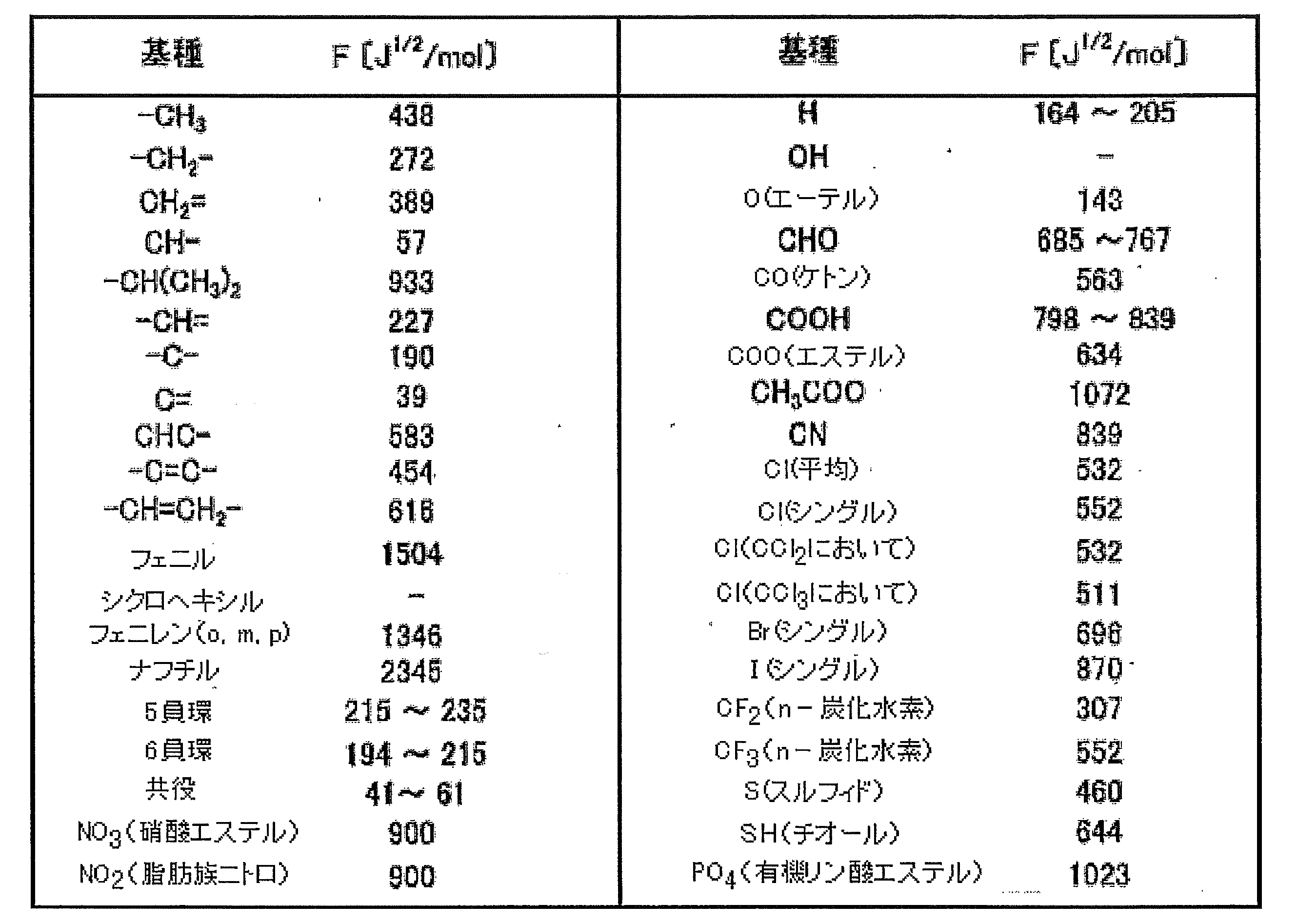
- the SP value of the plasticizer refers to a value estimated by the formula (1) which is the Small formula.
- ⁇ p is a solubility parameter
- F is a constant related to the intermolecular interaction (depending on the Small constant and the type of substituent shown in Table 1)
- V is the molar molecular volume
- plasticizer having an SP value of 9.0 or more examples include ADEKA Corporation (Adeka Sizer PN-7160, Adeka Sizer PN-9302, etc.), J Plus Co., Ltd. (D-620, D620N, etc.) ), Various adipic acid ester plasticizers and phthalic acid ester plasticizers such as those manufactured by DIC Corporation (W-230-H, W-225-EL, W-1040-S).
- the plasticizer whose SP value is 9.0 or more is an ester / polyester plasticizer.
- the ester / polyester plasticizer for example, an adipic acid ester plasticizer (phthalic acid ester plasticizer) obtained by reacting adipic acid (or phthalic acid) with a polyol is preferable.
- the polyol includes glycols such as ethylene glycol, propylene glycol, and diethylene glycol.
- Adipic acid ester plasticizers or phthalic acid ester plasticizers have various alcohols at their terminals.
- Such an alcohol is not particularly limited, but for example, alcohols such as isononyl alcohol, n-octyl alcohol, 2-ethylhexyl alcohol and the like are generally used.
- the terminal composition is not limited in terms of properties, but is more realistic using isononyl alcohol, n-octyl alcohol, etc. in consideration of the safety of impurities generated in the course of the reaction. It is.
- the plasticizer having an SP value of 9.0 or more preferably has, for example, a number average molecular weight Mn of about 800 to 1500, more preferably about 800 to 1200, or about 1000 to 1200.
- Mn means a value measured by GPC, for example.
- the plasticizer having an SP value of 9.0 or more is preferably, for example, one having a weight average molecular weight Mw of 800 to 2000, more preferably about 800 to 1500, or about 1000 to 1500.
- Mw means a value measured by GPC, for example.
- the plasticizer having an SP value of 9.0 or more is more preferably a low molecular ester / polyester plasticizer having Mn of 800 to 1500 and Mw of 800 to 2000.
- the plasticizer is preferably blended in an amount of 10 to 40 parts by weight with respect to 100 parts by weight of the polyvinyl chloride resin. From the viewpoint of maintaining the mechanical properties, 10 to 30 parts by weight or 20 to 30 parts by weight is blended. Is preferred.
- the content of the plasticizer having an SP value of 9.0 or more may be larger than 0% by weight with respect to all the plasticizers. For example, 70% by weight or more is suitable, and 90% by weight or more. It is preferred that there is 100% by weight.
- the base material layer is used in the relevant fields such as stabilizers, fillers, lubricants, colorants, ultraviolet absorbers, antioxidants, anti-aging agents, weathering stabilizers, etc., as necessary (for example, when used in outdoor applications). And may contain known additives.
- the stabilizer is not particularly limited, and examples thereof include composite stabilizers such as barium-zinc, tin, calcium-zinc, cadmium-barium.
- the filler include inorganic fillers such as calcium carbonate, silica and mica, and metal fillers such as iron and lead.
- the colorant include various pigments and dyes such as white, black, blue, green, and red.
- the base material layer may be a single layer film or a laminate (multilayer film) of films having different materials or compositions.
- the thickness is not particularly limited, and examples thereof include, for example, about 30 to 1000 ⁇ m, preferably about 50 to 200 ⁇ m.
- Conventional surface treatments such as corona treatment, chromic acid treatment, ozone in order to improve adhesion to the pressure sensitive adhesive on the front and back surfaces of the base material layer, particularly the upper surface, ie, the surface on which the pressure sensitive adhesive layer is provided.
- Oxidation treatment by a chemical or physical method such as exposure, flame exposure, high-voltage impact exposure, ionizing radiation treatment, or the like may be performed.
- the pressure-sensitive adhesive layer is not particularly limited as long as it is generally used for a pressure-sensitive adhesive tape or the like, and can be formed using various pressure-sensitive adhesives.
- the base polymer in the pressure-sensitive adhesive is, for example, a rubber-based pressure-sensitive adhesive [natural rubber-based; modified natural rubber obtained by appropriately graft-polymerizing MMA (methyl methacrylate) to natural rubber; styrene-butadiene rubber (SBR), butyl rubber, isoprene rubber (IR ), Synthetic rubbers such as butyl rubber (IIR)], block polymers such as styrene-ethylene-butylene-styrene (SEBS); acrylic adhesives, polyamide adhesives, silicone adhesives, polyester adhesives, urethane adhesives It can be appropriately selected from base polymers constituting known adhesives such as adhesives.
- the acrylic polymer that is the base polymer constituting the acrylic pressure-sensitive adhesive is excellent in various properties such as heat resistance and weather resistance, and by selecting the type of monomer component constituting the acrylic polymer, etc. Since it is possible to express desired characteristics, it can be suitably used. Moreover, by using an acrylic pressure-sensitive adhesive having a large SP value, bleeding of the plasticizer in the base material layer to the surface of the base material layer can be more effectively suppressed.
- the acrylic polymer that is the base polymer of the acrylic pressure-sensitive adhesive is composed of a (meth) acrylic acid alkyl ester as a main monomer component.
- the (meth) acrylic acid alkyl ester include, for example, methyl (meth) acrylate, ethyl (meth) acrylate, propyl (meth) acrylate, isopropyl (meth) acrylate, butyl (meth) acrylate, (meth) Isobutyl acrylate, s-butyl (meth) acrylate, t-butyl (meth) acrylate, pentyl (meth) acrylate, hexyl (meth) acrylate, heptyl (meth) acrylate, octyl (meth) acrylate, 2-Methylhexyl acrylate, isooctyl (meth) acrylate, nonyl (meth) acrylate, isonon
- the acrylic polymer contains units corresponding to other monomer components copolymerizable with (meth) acrylic acid alkyl ester as necessary for the purpose of modifying cohesive strength, heat resistance, crosslinkability and the like. You may go out.
- a monomer component for example, Carboxyl group-containing monomers such as acrylic acid, methacrylic acid, carboxyethyl acrylate, carboxypentyl acrylate, itaconic acid, maleic acid, fumaric acid, crotonic acid; Hydroxy (meth) acrylate, hydroxybutyl (meth) acrylate, hydroxyhexyl (meth) acrylate, hydroxyoctyl (meth) acrylate, hydroxydecyl (meth) acrylate, hydroxylauryl (meth) acrylate, (4-hydroxy Hydroxyl group-containing monomers such as methylcyclohexyl) methyl methacrylate;
- Sulphonic acid groups such as styrene sulfonic acid, allyl sulfonic acid, 2- (meth) acrylamide-2-methylpropane sulfonic acid, (meth) acrylamide propane sulfonic acid, sulfopropyl (meth) acrylate, (meth) acryloyloxynaphthalene sulfonic acid Containing monomers; Phosphoric acid group-containing monomers such as 2-hydroxyethyl acroyl phosphate, (meth) acrylamide, N, N-dimethyl (meth) acrylamide, N-butyl (meth) acrylamide, N-methylol (meth) acrylamide, N-methylolpropane (N-substituted) amide monomers such as (meth) acrylamide;
- Aminoalkyl (meth) acrylate monomers such as aminoethyl (meth) acrylate, N, N-dimethylaminoethyl (meth) acrylate, and t-butylaminoethyl (meth) acrylate; (Meth) acrylic acid alkoxyalkyl monomers; maleimide monomers such as N-cyclohexylmaleimide, N-isopropylmaleimide, N-laurylmaleimide, N-phenylmaleimide; Itaconimide monomers such as N-methylitaconimide, N-ethylitaconimide, N-butylitaconimide, N-octylitaconimide, N-2-ethylhexitaconimide, N-cyclohexylitaconimide, N-laurylitaconimide;
- Succinimide monomers such as N- (meth) acryloyloxymethylenesuccinimide, N- (meth) acryloyl-6-oxyhexamethylenesuccinimide, N- (meth) acryloyl-8-oxyoctamethylenesuccinimide; Vinyl acetate, vinyl propionate, N-vinyl pyrrolidone, methyl vinyl pyrrolidone, vinyl pyridine, vinyl piperidone, vinyl pyrimidine, vinyl piperazine, vinyl pyrazine, vinyl pyrrole, vinyl imidazole, vinyl oxazole, vinyl morpholine, N-vinyl carboxylic acid amides, Vinyl monomers such as styrene, ⁇ -methylstyrene, N-vinylcaprolactam; Cyanoacrylate monomers such as acrylonitrile and methacrylonitrile;
- Epoxy group-containing acrylic monomers such as (meth) acrylic acid glycidyl; glycol-based acrylic ester monomers such as (meth) acrylic acid polypropylene glycol, (meth) acrylic acid methoxyethyl glycol, (meth) acrylic acid methoxypolypropylene glycol; Acrylic acid ester monomers having a heterocyclic ring such as tetrahydrofurfuryl (meth) acrylate, fluorine (meth) acrylate, silicone (meth) acrylate, halogen atoms, silicon atoms, etc .;
- Polyfunctional monomers such as acrylate, pentaerythritol tri (meth) acrylate, dipentaerythritol hexa (meth) acrylate, epoxy acrylate, polyester acrylate, urethane acrylate, divinylbenzene, butyl di (meth) acrylate, hexyl di (meth) acrylate; Olefin monomers such as isoprene, dibutadiene, isobutylene; And vinyl ether monomers such as vinyl ether. These monomer components can be used alone or in combination of two or more.
- the acrylic copolymer is produced by polymerizing (for example, emulsion polymerization, solution polymerization, etc.) the above-mentioned (meth) acrylic acid alkyl ester and other monomers as required by a known appropriate method. it can.
- the molecular weight of the acrylic copolymer is not particularly limited.
- the weight average molecular weight is 150,000 to 2,000,000 (for example, about 200,000 to 2,000,000, 200,000 to 1,500,000, about 1,000,000 to 2,000,000), preferably 15
- the range is 10,000 to 1,000,000, more preferably 300,000 to 1,000,000.
- the weight average molecular weight can be a value measured by GPC, for example.
- the pressure sensitive adhesive can be made into an energy ray curable pressure sensitive adhesive by adding an energy ray polymerizable compound or introducing an energy ray polymerizable double bond into the base polymer.
- the pressure-sensitive adhesive layer using the energy ray-curable pressure-sensitive adhesive exhibits sufficient adhesive strength before irradiation with energy rays, but the adhesive strength is significantly reduced after irradiation with energy rays and does not give stress to the adherend. Can be easily peeled off.
- energy rays include ultraviolet rays and electron beams.
- the energy beam polymerizable compound a compound having two or more energy beam polymerizable carbon-carbon double bonds in the molecule can be used.
- examples of such compounds include polyfunctional acrylate compounds.
- polyfunctional acrylate compounds include 1,4-butylene di (meth) acrylate, 1,5-pentanediol di (meth) acrylate, 1,6-hexanediol di (meth) acrylate, and 1,9-nonanediol.
- (Meth) acrylates of linear aliphatic polyols such as di (meth) acrylate, polyethylene glycol di (meth) acrylate, and polypropylene glycol di (meth) acrylate; cyclohexanedimethanol di (meth) acrylate, tricyclodecane dimethanoldi (Meth) acrylate of an aliphatic polyol having an alicyclic group such as acrylate; trimethylolpropane tri (meth) acrylate, pentaerythritol tri (meth) acrylate, pentaerythritol tetra (meth) acrylate
- a polyfunctional acrylate oligomer such as a urethane acrylate oligomer may be used.
- the urethane acrylate oligomer is obtained, for example, by reacting a urethane oligomer obtained by the reaction of a diisocyanate compound and a polyol compound with a (meth) acrylic acid alkyl ester having a hydroxyl group.
- diisocyanate compound examples include tolylene diisocyanate, diphenylmethane diisocyanate, hexamethylene diisocyanate, phenylene diisocyanate, dicyclohexylmethane diisocyanate, xylene diisocyanate, tetramethylxylene diisocyanate, naphthalene diisocyanate, and isophorone diisocyanate.
- polyol compounds include ethylene glycol, 1,4-butanediol, 1,6-hexanediol, diethylene glycol, trimethylolpropane, dipropylene glycol, polyethylene glycol, polypropylene glycol, pentaerythritol, dipentaerythritol, and glycerin.
- Polyester polyol compound obtained by condensation reaction of alcohols, polyhydric alcohols and aliphatic dicarboxylic acids such as adipic acid, sebacic acid, azelaic acid, maleic acid or aromatic dicarboxylic acids such as terephthalic acid and isophthalic acid ;
- Polyethers such as polyethylene ether glycol, polypropylene ether glycol, polytetramethylene ether glycol, polyhexamethylene ether glycol Lactone-based polyol compounds such as polycaprolactone glycol, polypropiolactone glycol, and polyvalerolactone glycol; polyhydric alcohols such as ethylene glycol, propylene glycol, butanediol, pentanediol, octanediol, and nonanediol; and diethylene carbonate And polycarbonate polyol compounds obtained by dealcoholization reaction with dipropylene carbonate and the like.
- hydroxyl group-containing (meth) acrylic acid alkyl ester compounds examples include 2-hydroxyethyl (meth) acrylate, 2-hydroxypropyl (meth) acrylate, 4-hydroxybutyl (meth) acrylate, and (meth) acrylic. 6-hydroxyhexyl acid, 8-hydroxyoctyl (meth) acrylate, 10-hydroxydecyl (meth) acrylate, 12-hydroxylauryl (meth) acrylate, (4-hydroxymethylcyclohexyl) methyl (meth) acrylate, etc. Can be mentioned.
- the energy beam polymerizable compound can be used in the range of, for example, 5 to 200 parts by weight, preferably 10 to 100 parts by weight, and more preferably 10 to 45 parts by weight with respect to 100 parts by weight of the base polymer.
- a method for introducing an energy beam polymerizable double bond into a base polymer for example, when preparing an acrylic polymer as a base polymer, a copolymer having a reactive functional group such as a carboxyl group, a hydroxyl group, and an amino group And a method of copolymerizing a functional monomer.
- a functional group serving as a reaction base point is introduced into the base polymer, and a polyfunctional monomer or oligomer having an energy ray polymerizable carbon-carbon double bond is bonded via the functional group serving as the base point of the reaction.
- a base polymer having an energy beam polymerizable carbon-carbon double bond in the side chain can be obtained.
- the energy ray-curable pressure-sensitive adhesive may contain a photopolymerization initiator as necessary.
- the photopolymerization initiator is excited and activated by irradiation with energy rays to generate radicals, and promotes an efficient polymerization and curing reaction of the pressure-sensitive adhesive layer.
- photopolymerization initiator examples include benzoin alkyl ether initiators such as benzoin methyl ether, benzoin ethyl ether, benzoin isopropyl ether, and benzoin isobutyl ether; benzophenone, benzoylbenzoic acid, 3,3′-dimethyl-4-methoxybenzophenone Benzophenone initiators such as polyvinylbenzophenone; ⁇ -hydroxycyclohexyl phenyl ketone, 4- (2-hydroxyethoxy) phenyl (2-hydroxy-2-propyl) ketone, ⁇ -hydroxy- ⁇ , ⁇ '-dimethylacetophenone, methoxy Aromatic ketone-based initiators such as acetophenone, 2,2-dimethoxy-2-phenylacetophenone, 2,2-diethoxyacetophenone; aromatic ketal-based initiators such as benzyldimethyl ketal; Thioxanthone, 2-chlorothiox
- the pressure sensitive adhesive uses a polymer having an acidic group such as a carboxyl group as a base polymer, and a hydrophilicity is imparted by adding a neutralizing agent to neutralize all or part of the acidic groups in the base polymer. It is good also as an adhesive.
- the hydrophilic adhesive generally has little adhesive residue on the adherend, and even when adhesive residue is generated, it can be easily removed by washing with pure water.
- the polymer having an acidic group is obtained by copolymerizing a monomer having an acidic group such as the above-mentioned carboxyl group-containing monomer when preparing the base polymer.
- neutralizing agent examples include primary amines such as monoethylamine and monoethanolamine, secondary amines such as diethylamine and diethanolamine, triethylamine, triethanolamine, N, N, N′-trimethylethylenediamine, N-methyldiethanolamine, Examples thereof include organic amino compounds exhibiting alkalinity, such as tertiary amines such as N, N-diethylhydroxylamine.
- the pressure-sensitive adhesive may contain a crosslinking agent as required.
- the crosslinking agent include an epoxy crosslinking agent, an isocyanate crosslinking agent, a melamine crosslinking agent, a peroxide crosslinking agent, a metal alkoxide crosslinking agent, a metal chelate crosslinking agent, a metal salt crosslinking agent, and a carbodiimide crosslinking.
- Crosslinkers such as an agent, an oxazoline crosslinker, an aziridine crosslinker, and an amine crosslinker can be used, and an epoxy crosslinker, an isocyanate crosslinker, and the like can be preferably used. You may use these individually or in combination of 2 or more types. Of these, isocyanate-based crosslinking agents, glycidylamine-based crosslinking agents, melamine-based crosslinking agents, and the like are preferable.
- isocyanate-based crosslinking agents include lower aliphatic polyisocyanates such as 1,2-ethylene diisocyanate, 1,4-butylene diisocyanate, 1,6-hexamethylene diisocyanate; cyclopentylene diisocyanate, cyclohexylene diisocyanate, isophorone diisocyanate.
- Aliphatic polyisocyanates such as hydrogenated tolylene diisocyanate and hydrogenated xylene diisocyanate; tolylene diisocyanates such as 2,4-tolylene diisocyanate and 2,6-tolylene diisocyanate (Coronate L (made by Nippon Polyurethane), DESMODUR -L75 (manufactured by BAYER.AG), etc.), 4,4'-diphenylmethane diisocyanate (such as Millionate MR-300 (manufactured by Nippon Polyurethane)), Ki And aromatic polyisocyanates such as Li diisocyanate and the like.
- Examples of the glycidylamine-based crosslinking agent include N, N, N ′, N′-tetraglycidyl-m-xylenediamine, diglycidylaniline, 1,3-bis (N, N-glycidylaminomethyl) cyclohexane (TETRAD- C (Nippon Gas Chemical Co., Ltd.)), 1,6-hexanediol diglycidyl ether, neopentyl glycol diglycidyl ether, ethylene glycol diglycidyl ether, propylene glycol diglycidyl ether, polyethylene glycol diglycidyl ether, polypropylene glycol diglycidyl ether, Sorbitol polyglycidyl ether, glycerol polyglycidyl ether, pentaerythritol polyglycidyl ether, polyglycerol polyglycidyl ether, sorbitan polyglycidyl
- the melamine-based crosslinking agent examples include butanol-modified melamine formaldehyde resins (Super Becamine J-820-60N (manufactured by Nippon Polyurethane), Luwipal 012 (manufactured by BASF)) and the like.
- the crosslinking agent is preferably added in the range of 0.05 to 20 parts by weight with respect to 100 parts by weight of the base polymer constituting the pressure-sensitive adhesive.
- the base polymer is an acrylic polymer, it is suitable to use an isocyanate crosslinking agent, a glycidylamine crosslinking agent, a melamine crosslinking agent, etc. alone or in combination of two or more.
- the thickness of the pressure-sensitive adhesive layer is not particularly limited, but may be 1 to 50 ⁇ m, preferably 1 to 30 ⁇ m.
- the pressure-sensitive adhesive layer preferably contains a plasticizer.
- the plasticizer include the same ones as described above. Of these, a plasticizer having an SP value of 9.0 or more alone or a combination with an epoxy plasticizer is generally used.
- the addition amount of the plasticizer is, for example, 0 to 100 parts by weight, preferably 10 to 80 parts by weight, more preferably 10 to 60 parts by weight based on 100 parts by weight of the base polymer constituting the pressure-sensitive adhesive. Parts by weight.
- the adhesive layer further contains additives such as tackifiers, stabilizers, softeners, process oils, fillers, lubricants, colorants, UV absorbers, antioxidants, colorants, weathering stabilizers as necessary. May be included. These additives include the same ones as described above.
- Separator As a separator (it may describe as a release liner), if it is normally used in the said field
- the thickness of the substrate is not particularly limited, and is, for example, about 5 ⁇ m to 5 mm, preferably about 30 ⁇ m to 100 ⁇ m.
- a silicone resin for example, a silicone resin, a long chain alkyl resin, a fluorine resin, a low molecular weight polyethylene, a polypropylene, a rubber polymer, a phosphate ester surfactant.
- area such as apply
- the separator / release liner has one or more straight, wavy, sawtooth, and jagged slits (so-called back cut) in order to improve the sticking operability when sticking the adhesive tape to the adherend. May be included.
- the separator / release liner is usually a pressure-sensitive adhesive tape with a separator / release liner by forming the pressure-sensitive adhesive tape and then sticking it to the pressure-sensitive adhesive layer side.
- This adhesive tape may be affixed to a release liner and stored, transported, etc. in the form of a sheet, or may be stored, transported, etc. by being wound into a roll with or without such a release liner. .
- the base material layer and the pressure-sensitive adhesive layer can be independently formed by methods known in the art.
- a melt extrusion method an inflation method, a T-die method, etc.
- a melt casting method a calendar method, or the like
- the pressure-sensitive adhesive layer can be formed by applying the pressure-sensitive adhesive on the substrate by an appropriate method such as a knife coater, a roll coater, a gravure coater, a die coater, or a reverse coater in addition to these methods. .
- an adhesive layer may be formed on an appropriate casting process sheet such as a film having a release treatment applied to the surface, and the adhesive layer may be transferred onto the base material layer.
- you may form separately by extrusion molding with independent or a base material layer.
- the base material layer and the pressure-sensitive adhesive layer are each formed alone, both can be laminated by a method known in the art.
- the base material layer and the pressure-sensitive adhesive layer are formed as a multilayer structure by coextrusion method, laminating method (extrusion laminating method, laminating method using adhesive, etc.), heat sealing method (external heating method, internal heating method, etc.) May be.
- the pressure-sensitive adhesive tape of the present invention includes, for example, a base material layer free of a plasticizer substantially composed of 2-diethylhexyl phthalate and dibutyl phthalate.
- a plasticizer substantially composed of 2-diethylhexyl phthalate and dibutyl phthalate In the pressure-sensitive adhesive layer, it is preferable that these plasticizers are free.
- free or substantially free means that these compounds are not used as additives in the base material layer, preferably the pressure-sensitive adhesive layer, and more preferably 5000 ppm or less on a weight basis in quantitative analysis. It means that. By realizing such a specific plasticizer free, it is possible to ensure consideration for the environment and meet the trend of REACH regulations in Europe.
- the adhesive tape of the present invention can be used for various applications. For example, surface protection during processing of steel plates such as stainless steel and aluminum, optical devices or films, resin, glass, etc. (various processing such as drawing, bending, drilling), storage, transportation, etc., fixing of wafers in semiconductor processes, etc. , Semiconductor back grinding, semiconductor dicing, dicing of semiconductor packages, glass, ceramics, etc., and adhesive tapes to be used for protecting wafers or circuit surfaces during these processes.
- a polyurethane solution of pressure-sensitive adhesive comprising 10 parts by weight of polyurethane)
- This pressure-sensitive adhesive solution was applied to one side of a base material layer made of PVC and dried at 130 ° C. for 90 seconds to form a 10 ⁇ m pressure-sensitive adhesive layer on the PVC surface.
- melamine-based crosslinking agent butanol-modified melamine formaldehyde resin: Super Becamine J-820-60N
- This pressure-sensitive adhesive solution was applied to one side of a base material layer made of PVC and dried at 130 ° C. for 90 seconds to form a 10 ⁇ m pressure-sensitive adhesive layer on the PVC surface.
- D-620N adipic acid-based low molecular weight polyester plasticizer
- melamine-based crosslinking agent butanol-modified melamine formaldehyde resin: Super Becamine J-820-60N
- a polyurethane solution of a pressure-sensitive adhesive comprising 10 parts by weight of polyurethane)) and 60 parts by weight of adipic acid-based low molecular weight polyester plasticizer (D-620N: manufactured by J-Plus Co., Ltd., molecular weight: Mw 1600) was prepared.
- This pressure-sensitive adhesive solution was applied to one side of a base material layer made of PVC and dried at 130 ° C. for 90 seconds to form a 10 ⁇ m pressure-sensitive adhesive layer on the PVC surface.
- a polyurethane solution of an adhesive comprising 10 parts by weight of polyurethane)) and 60 parts by weight of an adipic acid-based low molecular weight polyester plasticizer (Adekasizer PN-9302; manufactured by ADEKA Corporation, molecular weight: Mw 1600) was prepared.
- This pressure-sensitive adhesive solution was applied to one side of a base material layer made of PVC and dried at 130 ° C. for 90 seconds to form a 10 ⁇ m pressure-sensitive adhesive layer on the PVC surface. After forming the pressure-sensitive adhesive layer, it was bonded to a Si-treated 38 ⁇ m PET film to obtain a pressure-sensitive adhesive tape.
- This pressure-sensitive adhesive solution was applied to one side of a base material layer made of PVC and dried at 130 ° C. for 90 seconds to form a 10 ⁇ m pressure-sensitive adhesive layer on the PVC surface.
- a toluene solution of an adhesive composed of 10 parts by weight of polyurethane and 60 parts by weight of TOTM was prepared. This pressure-sensitive adhesive solution was applied to one side of a base material layer made of PVC and dried at 130 ° C. for 90 seconds to form a 10 ⁇ m pressure-sensitive adhesive layer on the PVC surface.
- a polyurethane solution of a pressure-sensitive adhesive comprising 10 parts by weight of polyurethane)) and 60 parts by weight of DINCH (hexanol DINCH: manufactured by BASF) was prepared. This pressure-sensitive adhesive solution was applied to one side of a base material layer made of PVC and dried at 130 ° C. for 90 seconds to form a 10 ⁇ m pressure-sensitive adhesive layer on the PVC surface.
- D-623N adipic acid-based low molecular weight polyester plasticizer
- melamine-based crosslinking agent butanol-modified melamine formaldehyde resin: Super Becamine J-820-60N
- a polyurethane solution of a pressure-sensitive adhesive comprising 10 parts by weight of polyurethane)) and 60 parts by weight of adipic acid-based low molecular weight polyester plasticizer (D-623N: manufactured by J-Plus Co., Ltd., molecular weight: Mw 3600) was prepared.
- This pressure-sensitive adhesive solution was applied to one side of a base material layer made of PVC and dried at 130 ° C. for 90 seconds to form a 10 ⁇ m pressure-sensitive adhesive layer on the PVC surface.
- Adhesive force An adhesive tape was bonded to a SUS430BA plate and a SUS304BA plate soaked in toluene and subjected to ultrasonic cleaning at a linear pressure of 78 N / cm and a speed of 0.3 m / min.
- the adhesive tape was cut into a width of 20 mm, and the initial adhesive strength was measured at a speed of 0.3 m / min and 30 m / min. The initial adhesive strength was measured 30 minutes after application.
- the polyvinyl chloride pressure-sensitive adhesive tape or sheet of the present invention is used for surface protection during the processing of steel plates such as stainless steel and aluminum (various processing such as drawing, bending and drilling), storage and transportation, and protection of semiconductor wafers. It is useful as an adhesive tape or sheet for the dicing process.
Landscapes
- Chemical & Material Sciences (AREA)
- Organic Chemistry (AREA)
- Chemical Kinetics & Catalysis (AREA)
- Health & Medical Sciences (AREA)
- Medicinal Chemistry (AREA)
- Polymers & Plastics (AREA)
- Adhesive Tapes (AREA)
- Adhesives Or Adhesive Processes (AREA)
- Compositions Of Macromolecular Compounds (AREA)
Abstract
Description
また、DOPなどのフタル酸系可塑剤は、PVC系フィルム及び粘着剤、特にアクリル系粘着剤との相性がよく、粘着テープの可塑剤として使用した場合、表面へのブリードが少なく、粘着特性を安定させる。さらに、低温(-10℃)から高温(50℃)までの温度変化においてもテープの機械物性の変化を最小限にとどめ、安定させることができる。
しかし、近年の環境への配慮の高まりにより、PVCの可塑剤であるDOP及びDBPなどフタル酸系可塑剤の使用を見直す動きが、欧州のREACH規制をもとに高まっている。
しかし、非フタル酸系の可塑剤は、アクリル系粘着剤との相溶性が悪く、粘着テープとした場合の安定性が悪く、可塑剤の表面析出が著しいという問題がある。このため、粘着テープ(ロール状又はシート状)において粘着力が不安定となり、DOPの代替としての使用は実用上困難である。
また、高分子量タイプのポリエステル可塑剤等は、PVC系粘着テープ中での移動が阻害されるため、表面への析出が抑制されるという利点はあるが、可塑化効果が現状のDOPなどのフタル酸系可塑剤と比べて異なるため、同様の機械物性を維持するのが困難である。
〔1〕ポリ塩化ビニル系樹脂100重量部に対し、可塑剤10~40重量部が配合されて形成される基材層と、該基材層の片面に形成された粘着剤層とを有し、
前記可塑剤は、SP値が9.0以上である可塑剤を少なくとも1種類含有することを特徴とするポリ塩化ビニル系粘着テープ又はシート。
〔2〕SP値が9.0以上の可塑剤が、数平均分子量Mn800~1500、重量平均分子量Mw800~2000を有する低分子ポリエステル系可塑剤である〔1〕に記載のポリ塩化ビニル系粘着テープ又はシート。
〔3〕低分子ポリエステル系可塑剤が、アジピン酸ポリエステル系可塑剤である〔2〕に記載のポリ塩化ビニル系粘着テープ又はシート。
〔4〕低分子ポリエステル系可塑剤が、イソノニル末端又はn-オクチル末端を有する〔2〕又は〔3〕に記載のポリ塩化ビニル系粘着テープ又はシート。
〔5〕可塑剤が、実質的にフタル酸2-ジエチルヘキシル及びフタル酸ジブチルフリーである〔1〕~〔4〕のいずれか1つに記載のポリ塩化ビニル系粘着テープ又はシート。
〔6〕粘着剤層が、ベースポリマーとしてアクリル系ポリマーを含み、SP値が8.9~9.5に設定されてなる〔1〕~〔5〕のいずれか1つに記載のポリ塩化ビニル系粘着テープ又はシート。
〔7〕さらに、粘着剤層の表面にセパレータを備える〔1〕~〔6〕のいずれか1つに記載のポリ塩化ビニル系粘着テープ又はシート。
その結果、粘着剤層の粘着剤の種類によって、可塑剤の基材層表面へのブリード現象に差異があること、および、可塑剤の基材層表面へのブリード現象が、可塑剤のSP値の大小に相関することを見出した。特に、ゴム系の粘着剤と比較してアクリル系粘着剤をPVC基材層に塗布して粘着テープとした場合に、可塑剤の基材層表面へのブリード現象が顕著となること、および、表面ブリードとPVC中の可塑剤のSP値との間の相関関係があることを見出した。
一方、アクリル系粘着剤を粘着剤層に用いたポリ塩化ビニル系基材層を備えた粘着テープにおいて、PVC中の可塑剤のSP値を調整することにより、可塑剤の基材層表面へのブリードを顕著に抑制することができることを新たに見出した。
一方、SP値を調整することにより、分子量にかかわらず、可塑剤の基材層表面へのブリードを抑制することができることを新たに見出した。
基材層は、ポリ塩化ビニル系樹脂と、少なくとも1種類の可塑剤とが配合されて形成されている。
ポリ塩化ビニル系樹脂とは、塩化ビニルを主モノマー(モノマー成分のうちの主成分、すなわち50質量%以上を占めるモノマー)とする種々のポリマーを指す。つまり、塩化ビニルモノマーの単独重合体、塩化ビニルモノマーと種々のコモノマーとの共重合体が包含される。
コモノマーとしては、塩化ビニリデン;エチレン、プロピレン等のオレフィン(好ましくは炭素数2~4のオレフィン);アクリル酸、メタクリル酸(以下、アクリルおよびメタクリルを「(メタ)アクリル」と総称する)、マレイン酸、フマル酸等のカルボキシル基含有モノマーまたはその酸無水物(無水マレイン酸等);(メタ)アクリル酸エステル、例えば(メタ)アクリル酸と炭素数1~10程度のアルコールアルキルまたはシクロアルキルアルコールとのエステル;酢酸ビニル、プロピオン酸ビニル等のビニルエステル系モノマー;スチレン、置換スチレン(α-メチルスチレン等)、ビニルトルエン等のスチレン系モノマー;アクリロニトリル;等が例示される。
ポリ塩化ビニルの平均重合度は、例えば、800~1500程度、好ましくは1000~1300程度が挙げられる。
塩化ビニルモノマー単独重合体、塩化ビニルモノマーの共重合体は、1種類のみで使用してもよいし、2種以上の混合物としてもよい。また、他の樹脂又はエラストマーとの混合物としてもよい。この場合、ポリ塩化ビニル及び共重合体として、塩化ビニルの重合割合が70質量%以上、より好ましくは90質量%以上であるものが好ましい。
基材層に用いられる可塑剤としては、ポリ塩化ビニル系樹脂に対する可塑剤として通常用いられるものであれば、特に限定されるものではない。例えば、アジピン酸エステル系((株)ジェイプラス製D-620、D-620N、アジピン酸ジオクチル、アジピン酸ジイソノニル等)、トリメリット酸エステル系(大日本インキ(株)製W-700、トリメリット酸トリオクチル等)、リン酸エステル系(リン酸トリクレシル等)、クエン酸エステル系(アセチルクエン酸トリブチル等)、セバシン酸エステル系、アゼライン酸エステル系、マレイン酸エステル系、フタル酸エステル系、安息香酸エステル系、ポリエーテルエステル系、エポキシエステル系(エポキシ化大豆油、エポキシ化亜麻仁油等)、ポリエステル系(カルボン酸とグリコールからなる低分子ポリエステル等)等の可塑剤が挙げられる。これらは単独で又は2種以上を組み合わせて用いてもよい。
ここで、可塑剤のSP値は、Smallの式である式(1)により概算した値を指す。
δp[(J/cm3)1/2]=ΣF/V (1)
(式中、δpは溶解度パラメータ、Fは分子間相互作用に関係した定数(表1に示すSmallの定数、置換基の種類に依存している)であり、Vはモル分子容である)
エステル/ポリエステル系可塑剤としては、例えば、アジピン酸(又はフタル酸)とポリオールとを反応させたアジピン酸エステル系可塑剤(フタル酸エステル系可塑剤)が好ましい。ここでポリオールとは、エチレングリコール、プロピレングリコール、ジエチレングリコール等のグリコールが挙げられる。
アジピン酸エステル可塑剤又はフタル酸エステル系可塑剤は、末端に各種アルコールを有している。このようなアルコールは特に限定されないが、例えば、イソノニルアルコール、n-オクチルアルオール、2-エチルヘキシルアルコール等であるものが一般的である。末端の組成については、特性上、限定されるものではないが、反応の過程で生成される不純物の安全性を考慮して、イソノニルアルコール、n-オクチルアルコール等を用いたものがより現実的である。
また、SP値が9.0以上の可塑剤は、例えば、重量平均分子量Mw800~2000であるものが好ましく、800~1500程度、1000~1500程度であるものがより好ましい。Mwは、例えば、GPCによって測定した値を意味する。
なかでも、SP値が9.0以上の可塑剤は、Mn800~1500及びMw800~2000である低分子のエステル/ポリエステル系可塑剤であることがより好ましい。
安定剤は、特に限定されるものではないが、バリウム-亜鉛系、スズ系、カルシウム-亜鉛系、カドミウム-バリウム系等の複合安定剤が挙げられる。
フィラーとしては、炭酸カルシウム、シリカ、雲母などの無機フィラー、鉄、鉛等の金属フィラー等が挙げられる。
着色剤としては、白、黒、青、緑、赤等の各種顔料、染料等が挙げられる。なお、耐候処方として、カーボンブラック、酸化チタン、酸化亜鉛などの各種耐候性の顔料を添加してもよい。
その厚みは、特に限定されるものではなく、例えば、例えば、30~1000μm、好ましくは、50μm~200μm程度が挙げられる。
基材層の表裏面、特に、上面、すなわち粘着剤層が設けられる側の面には粘着剤との密着性を向上するために、慣用の表面処理、例えば、コロナ処理、クロム酸処理、オゾン暴露、火炎暴露、高圧電撃暴露、イオン化放射線処理等の化学的又は物理的方法による酸化処理などが施されていてもよい。
粘着剤層は、一般に粘着テープ等に用いられるものであれば特に限定されることなく、種々の粘着剤を利用して形成することができる。
粘着剤におけるベースポリマーは、例えば、ゴム系粘着剤〔天然ゴム系;天然ゴムにMMA(メタクリル酸メチル)などを適宜グラフト重合した変性天然ゴム;スチレンブタジエンゴム(SBR)、ブチルゴム、イソプレンゴム(IR)、ブチルゴム(IIR)などの合成ゴム〕、スチレン-エチレン-ブチレン-スチレン(SEBS)などのブロックポリマー;アクリル系粘着剤、ポリアミド系粘着剤、シリコーン系粘着剤、ポリエステル系粘着剤、ウレタン系粘着剤等公知の粘着剤を構成するベースポリマーの中から適宜選択することができる。なかでも、アクリル系粘着剤を構成するベースポリマーであるアクリル系重合体は、耐熱性、耐候性など種々の特性に優れ、アクリル系重合体を構成するモノマー成分の種類等を選択することにより、所望の特性を発現させることが可能であるため、好適に使用することができる。また、SP値の大きなアクリル系粘着剤を利用することにより、基材層中の可塑剤の基材層表面へのブリードをより効果的に抑制することができる。
(メタ)アクリル酸アルキルエステルとしては、例えば、(メタ)アクリル酸メチル、(メタ)アクリル酸エチル、(メタ)アクリル酸プロピル、(メタ)アクリル酸イソプロピル、(メタ)アクリル酸ブチル、(メタ)アクリル酸イソブチル、(メタ)アクリル酸s-ブチル、(メタ)アクリル酸t-ブチル、(メタ)アクリル酸ペンチル、(メタ)アクリル酸ヘキシル、(メタ)アクリル酸ヘプチル、(メタ)アクリル酸オクチル、(メタ)アクリル酸2-エチルヘキシル、(メタ)アクリル酸イソオクチル、(メタ)アクリル酸ノニル、(メタ)アクリル酸イソノニル、(メタ)アクリル酸デシル、(メタ)アクリル酸イソデシル、(メタ)アクリル酸ウンデシル、(メタ)アクリル酸ドデシル、(メタ)アクリル酸トリデシル、(メタ)アクリル酸テトラデシル、(メタ)アクリル酸ペンタデシル、(メタ)アクリル酸オクタデシル、(メタ)アクリル酸ノナデシル、(メタ)アクリル酸エイコシルなどの(メタ)アクリル酸C1~C20アルキルエステル(好ましくは(メタ)アクリル酸C1~C12アルキルエステル、さらに好ましくは(メタ)アクリル酸C1~C8アルキルエステル)などが挙げられる。(メタ)アクリル酸アルキルエステルは1種又は2種以上を選択して使用することができる。
アクリル酸、メタクリル酸、カルボキシエチルアクリレート、カルボキシペンチルアクリレート、イタコン酸、マレイン酸、フマル酸、クロトン酸などのカルボキシル基含有モノマー;
ヒドロキシ(メタ)アクリレート、(メタ)アクリル酸ヒドロキシブチル、(メタ)アクリル酸ヒドロキシヘキシル、(メタ)アクリル酸ヒドロキシオクチル、(メタ)アクリル酸ヒドロキシデシル、(メタ)アクリル酸ヒドロキシラウリル、(4-ヒドロキシメチルシクロヘキシル)メチルメタクリレートなどのヒドロキシル基含有モノマー;
2-ヒドロキシエチルアクロイルホスフェートなどのリン酸基含有モノマー、(メタ)アクリルアミド、N,N-ジメチル(メタ)アクリルアミド、N-ブチル(メタ)アクリルアミド、N-メチロール(メタ)アクリルアミド、N-メチロールプロパン(メタ)アクリルアミドなどの(N-置換)アミド系モノマー;
(メタ)アクリル酸アルコキシアルキル系モノマー;N-シクロヘキシルマレイミド、N-イソプロピルマレイミド、N-ラウリルマレイミド、N-フェニルマレイミドなどのマレイミド系モノマー;
N-メチルイタコンイミド、N-エチルイタコンイミド、N-ブチルイタコンイミド、N-オクチルイタコンイミド、N-2-エチルヘキシルイタコンイミド、N-シクロヘキシルイタコンイミド、N-ラウリルイタコンイミドなどのイタコンイミド系モノマー;
酢酸ビニル、プロピオン酸ビニル、N-ビニルピロリドン、メチルビニルピロリドン、ビニルピリジン、ビニルピペリドン、ビニルピリミジン、ビニルピペラジン、ビニルピラジン、ビニルピロール、ビニルイミダゾール、ビニルオキサゾール、ビニルモルホリン、N-ビニルカルボン酸アミド類、スチレン、α-メチルスチレン、N-ビニルカプロラクタムなどのビニル系モノマー;
アクリロニトリル、メタクリロニトリルなどのシアノアクリレート系モノマー;
(メタ)アクリル酸テトラヒドロフルフリル、フッ素(メタ)アクリレート、シリコーン(メタ)アクリレートなどの複素環、ハロゲン原子、ケイ素原子などを有するアクリル酸エステル系モノマー;
イソプレン、ジブタジエン、イソブチレンなどのオレフィン系モノマー;
ビニルエーテルなどのビニルエーテル系モノマー等が挙げられる。
これらの単量体成分は1種又は2種以上を使用することができる。
アクリル系共重合体の分子量等は特に制限されず、例えば、重量平均分子量は、150000~2000000(例えば、20万~200万、20万~150万、100万~200万程度)、好ましくは15万~100万、さらに好ましくは30万~100万の範囲が挙げられる。重量平均分子量は、例えば、GPCによって測定した値とすることができる。
多官能アクリレート系化合物としては、例えば、1,4-ブチレンジ(メタ)アクリレート、1,5-ペンタンジオールジ(メタ)アクリレート、1,6-ヘキサンジオールジ(メタ)アクリレート、1,9-ノナンジオールジ(メタ)アクリレートやポリエチレングリコールジ(メタ)アクリレート、ポリプロピレングリコールジ(メタ)アクリレートなどの直鎖状脂肪族ポリオールの(メタ)アクリレート;シクロヘキサンジメタノールジ(メタ)アクリレート、トリシクロデカンジメタノールジアクリレートなどの脂環式基を有する脂肪族ポリオールの(メタ)アクリレート;トリメチロールプロパントリ(メタ)アクリレート、ペンタエリスリトールトリ(メタ)アクリレート、ペンタエリスリトールテトラ(メタ)アクリレートなどの分岐鎖状脂肪族ポリオールの(メタ)アクリレート;これらの縮合物(ジトリメチロールプロパンテトラクリレート、ジペンタエリスリトールヘキサアクリレートなど)が挙げられる。これらは単独で又は2種以上を組み合わせて用いてもよい。
ウレタンアクリレート系オリゴマーは、例えば、ジイソシアネート化合物とポリオール化合物との反応により得られたウレタンオリゴマーに、ヒドロキシル基を有する(メタ)アクリル酸アルキルエステルを反応させて得られる。
ジイソシアネート化合物としては、例えば、トリレンジイソシアネート、ジフェニルメタンジイソシアネート、ヘキサメチレンジイソシアネート、フェニレンジイソシアネート、ジシクロヘキシルメタンジイソシアネート、キシレンジイソシアネート、テトラメチルキシレンジイソシアネート、ナフタレンジイソシアネート、イソホロンジイソシアネートなどが挙げられる。
光重合開始剤としては、例えば、ベンゾインメチルエーテル、ベンゾインエチルエーテル、ベンゾインイソプロピルエーテル、ベンゾインイソブチルエーテル等のベンゾインアルキルエーテル系開始剤;ベンゾフェノン、ベンゾイル安息香酸、3,3’-ジメチル-4-メトキシベンゾフェノン、ポリビニルベンゾフェノン等のベンゾフェノン系開始剤;α-ヒドロキシシクロヘキシルフェニルケトン、4-(2-ヒドロキシエトキシ)フェニル(2-ヒドロキシ-2-プロピル)ケトン、α-ヒドロキシ-α,α’-ジメチルアセトフェノン、メトキシアセトフェノン、2,2-ジメトキシ-2-フェニルアセトフェノン、2,2-ジエトキシアセトフェノン等の芳香族ケトン系開始剤;ベンジルジメチルケタール等の芳香族ケタール系開始剤;チオキサントン、2-クロロチオキサントン、2-メチルチオキサントン、2-エチルチオキサントン、2-イソプロピルチオキサントン、2-ドデシルチオキサントン、2,4-ジクロロチオキサントン、2,4-ジメチルチオキサントン、2,4-ジエチルチオキサントン、2,4-ジイソプロピルチオキサントン等のチオキサントン系開始剤、ベンジル等のベンジル系開始剤、ベンゾイン等のベンゾイン系開始剤、α-ケトール系化合物(2-メチル-2-ヒドロキシプロピオフェノンなど)、芳香族スルホニルクロリド系化合物(2-ナフタレンスルホニルクロリドなど)、光活性オキシム化合物(1-フェノン-1,1-プロパンジオン-2-(o-エトキシカルボニル)オキシムなど)、カンファーキノン、ハロゲン化ケトン、アシルホスフィノキシド、アシルホスフォナートなどが挙げられる。これらは単独で又は2種以上を組み合わせて用いてもよい。
酸性基を有するポリマーは、ベースポリマーを調製する際に上述のカルボキシル基含有モノマー等の酸性基を有する単量体を共重合することにより得られる。
中和剤としては、例えば、モノエチルアミン、モノエタノールアミンなどの1級アミン、ジエチルアミン、ジエタノールアミンなどの2級アミン、トリエチルアミン、トリエタノールアミン、N,N,N’-トリメチルエチレンジアミン、N-メチルジエタノールアミン、N,N-ジエチルヒドロキシルアミンなどの3級アミン等、アルカリ性を示す有機アミノ化合物が挙げられる。
架橋剤としては、例えば、エポキシ系架橋剤、イソシアネート系架橋剤、メラミン系架橋剤、過酸化物系架橋剤、金属アルコキシド系架橋剤、金属キレート系架橋剤、金属塩系架橋剤、カルボジイミド系架橋剤、オキサゾリン系架橋剤、アジリジン系架橋剤、アミン系架橋剤などの架橋剤を使用することができ、エポキシ系架橋剤、イソシアネート系架橋剤等を好適に使用することができる。これらは単独で又は2種以上を組み合わせて用いてもよい。なかでも、イソシアネート系架橋剤、グリシジルアミン系架橋剤、メラミン系架橋剤等が好ましい。
架橋剤は、粘着剤を構成するベースポリマー100重量部に対して、0.05~20重量部の範囲で添加することが好ましい。特に、ベースポリマーがアクリル系重合体である場合には、イソシアネート系架橋剤、グリシジルアミン系架橋剤、メラミン系架橋剤等を、単独で又は2種以上を組み合わせて用いることが適している。
粘着剤層は、可塑剤を含んでいることが好ましい。可塑剤としては、上述したものと同様のものが挙げられる。なかでも、SP値が9.0以上の可塑剤単独又はエポキシ系可塑剤との併用等が一般的である。
この場合の可塑剤の添加量は、粘着剤を構成するベースポリマー100重量部に対して、例えば、0~100重量部が適しており、好ましくは10~80重量部、より好ましくは10~60重量部である。
セパレータ(剥離ライナーと記載することもある)としては、当該分野で通常使用されているものであれば、特に限定されることなく用いることができる。例えば、紙、ゴム;アルミニウム箔、銅箔、ステンレス箔、鉄箔、ジュラルミン箔、錫箔、チタン箔、金箔などの各種金属箔;ポリエチレン、ポリプロピレン、ポリエチレンテレフタレート(PET)、ポリ塩化ビニル、ポリエステル、ポリアミドなどの各種樹脂よりなるフィルム;ポリウレタンフォーム、ビニールフォーム、ポリエチレンフォーム、スチレンフォームなどの発泡体;不織布、織布、フェルト;ならびにこれらを高分子材料でラミネートしてなるフィルム等を基材として用いることができる。この基材の厚みは特に限定されず、例えば、5μm~5mm、好ましくは30μm~100μm程度である。
セパレータ/剥離ライナーは、粘着テープを被着体へ貼付する際の貼付操作性を向上させるために、直線状、波状、鋸歯状、ギザギザ状のスリット(所謂、背切り)を一本又は複数本入れてもよい。
セパレータ/剥離ライナーは、通常、粘着テープを形成した後、粘着剤層側に貼着することによって、セパレータ/剥離ライナー付き粘着テープを得ることができる。この粘着テープは、剥離ライナーに貼り付けてシート状態で保存、運搬等してもよいし、このような剥離ライナーを介して又は介さずにロール状に巻回して保存、運搬等してもよい。
本発明の粘着テープは、当該分野で公知の方法によって、基材層及び粘着剤層をそれぞれ単独で形成することができる。そのために、例えば、溶融押出成形法(インフレーション法、Tダイ法等)、溶融流延法、カレンダー法等を利用することができる。
特に、粘着剤層については、これらの方法の他、粘着剤をナイフコーター、ロールコーター、グラビアコーター、ダイコーター、リバースコーターなど、適宜な方法で基材上に塗布することにより形成することができる。また、例えば、表面に離型処理を施したフィルムなど、適宜なキャスト用工程シート上に粘着剤層を形成し、この粘着剤層を基材層上に転写してもよい。さらに、単独で又は基材層とともに押出成形により別途形成してもよい。
基材層及び粘着剤層をそれぞれ単独で形成した場合には、当該分野で公知の方法によって、両者を積層することができる。さらに、基材層及び粘着剤層を、共押出法、ラミネート法(押出ラミネート法、接着剤を用いたラミネート法等)、ヒートシール法(外部加熱法、内部発熱法等)によって多層構造として形成してもよい。
本発明の粘着テープは、例えば、実質的にフタル酸2-ジエチルヘキシル及びフタル酸ジブチルからなる可塑剤がフリーの基材層を備えている。また、粘着剤層においても、これらの可塑剤がフリーであることが好ましい。ここでフリー又は実質的にフリーとは、基材層、好ましくは粘着剤層においても、添加剤としてこれらの化合物を用いないことを意味し、より好ましくは、定量分析において、重量基準で5000ppm以下であることを意味する。
このような特定の可塑剤がフリーを実現することにより、環境への配慮を確実にすることができ、欧州のREACH規制の動向にも合致する。
実施例1
重合度P=1050のPVC樹脂100重量部に対してアジピン酸系低分子ポリエステル可塑剤(アデカサイザーPN-7160;株式会社ADEKA製)27重量部を含んだ軟質PVCフィルム70μmを準備した。
アクリル共重合ポリマー(BA/AN/AA=85/15/2.5:Mw=800,000)100重量部、メラミン系架橋剤(ブタノール変性メラミンホルムアルデヒド樹脂:スーパーベッカミンJ-820-60N)日本ポリウレタン製))10重量部、アジピン酸系低分子ポリエステル可塑剤(アデカサイザーPN-7160;株式会社ADEKA製、分子量:Mw=1600)60重量部からなる粘着剤のトルエン溶液を調製した。
この粘着剤溶液を、PVCからなる基材層の片面に塗布し、130℃×90秒間乾燥して、10μmの粘着剤層をPVC表面に形成した。
重合度P=1050のPVC樹脂100重量部に対してアジピン酸系低分子ポリエステル可塑剤(アデカサイザーPN-9302;株式会社ADEKA製)27重量部を含んだ軟質PVCフィルム70μmを準備した。
アクリル共重合ポリマー(BA/AN/AA=85/15/2.5:Mw=800,000)100重量部、メラミン系架橋剤(ブタノール変性メラミンホルムアルデヒド樹脂:スーパーベッカミンJ-820-60N)日本ポリウレタン製))10重量部、アジピン酸系低分子ポリエステル可塑剤(アデカサイザーPN-9302;株式会社ADEKA製、分子量:Mw=1600)60重量部からなる粘着剤のトルエン溶液を調製した。
この粘着剤溶液を、PVCからなる基材層の片面に塗布し、130℃×90秒間乾燥して、10μmの粘着剤層をPVC表面に形成した。
重合度P=1050のPVC樹脂100重量部に対してアジピン酸系低分子ポリエステル可塑剤(D-620N:株式会社ジェイプラス製)27重量部を含んだ軟質PVCフィルム70μmを準備した。
アクリル共重合ポリマー(BA/AN/AA=85/15/2.5:Mw=800,000)100重量部、メラミン系架橋剤(ブタノール変性メラミンホルムアルデヒド樹脂:スーパーベッカミンJ-820-60N)日本ポリウレタン製))10重量部、アジピン酸系低分子ポリエステル可塑剤(D-620N:株式会社ジェイプラス製、分子量:Mw=1600)60重量部からなる粘着剤のトルエン溶液を調製した。
この粘着剤溶液を、PVCからなる基材層の片面に塗布し、130℃×90秒間乾燥して、10μmの粘着剤層をPVC表面に形成した。
重合度P=1050のPVC樹脂100重量部に対してアジピン酸系低分子ポリエステル可塑剤(アデカサイザーPN-9401;株式会社ADEKA製、分子量:Mw=1600)27重量部を含んだ軟質PVCフィルム70μmを準備した。
アクリル共重合ポリマー(BA/AN/AA=85/15/2.5:Mw=800,000)100重量部、メラミン系架橋剤(ブタノール変性メラミンホルムアルデヒド樹脂:スーパーベッカミンJ-820-60N)日本ポリウレタン製))10重量部、アジピン酸系低分子ポリエステル可塑剤(アデカサイザーPN-9302;株式会社ADEKA製、分子量:Mw=1600)60重量部からなる粘着剤のトルエン溶液を調製した。
この粘着剤溶液を、PVCからなる基材層の片面に塗布し、130℃×90秒間乾燥して、10μmの粘着剤層をPVC表面に形成した。粘着剤層形成後、Si処理を施した38μmのPETフィルムと貼り合わせ、粘着テープを得た。
重合度P=1050のPVC樹脂100重量部に対してDOP27重量部を含んだ軟質PVCフィルム70μmを準備した。
アクリル共重合ポリマー(BA/AN/AA=85/15/2.5:Mw=800,000)100重量部、メラミン系架橋剤(ブタノール変性メラミンホルムアルデヒド樹枝:スーパーベッカミンJ-820-60N)日本ポリウレタン製))10重量部、DOP60重量部からなる粘着剤のトルエン溶液を調製した。
この粘着剤溶液を、PVCからなる基材層の片面に塗布し、130℃×90秒間乾燥して、10μmの粘着剤層をPVC表面に形成した。
重合度P=1050のPVC樹脂100重量部に対してTOTM27重量部を含んだ軟質PVCフィルム70μmを準備した。
アクリル共重合ポリマー(BA/AN/AA=85/15/2.5:Mw=800,000)100重量部、メラミン系架橋剤(ブタノール変性メラミンホルムアルデヒド樹脂:スーパーベッカミンJ-820-60N)日本ポリウレタン製))10重量部、TOTM60重量部からなる粘着剤のトルエン溶液を調製した。
この粘着剤溶液を、PVCからなる基材層の片面に塗布し、130℃×90秒間乾燥して、10μmの粘着剤層をPVC表面に形成した。
重合度P=1050のPVC樹脂100重量部に対してDINCH(ヘキサノールDINCH:BASF製)27重量部を含んだ軟質PVCフィルム70μmを準備した。
アクリル共重合ポリマー(BA/AN/AA=85/15/2.5:Mw=800,000)100重量部、メラミン系架橋剤(ブタノール変性メラミンホルムアルデヒド樹脂:スーパーベッカミンJ-820-60N)日本ポリウレタン製))10重量部、DINCH(ヘキサノールDINCH:BASF製)60重量部からなる粘着剤のトルエン溶液を調製した。
この粘着剤溶液を、PVCからなる基材層の片面に塗布し、130℃×90秒間乾燥して、10μmの粘着剤層をPVC表面に形成した。
重合度P=1050のPVC樹脂100重量部に対してアジピン酸系低分子ポリエステル可塑剤(D-623N;株式会社ジェイプラス製)27重量部を含んだ軟質PVCフィルム70μmを準備した。
アクリル共重合ポリマー(BA/AN/AA=85/15/2.5:Mw=800,000)100重量部、メラミン系架橋剤(ブタノール変性メラミンホルムアルデヒド樹脂:スーパーベッカミンJ-820-60N)日本ポリウレタン製))10重量部、アジピン酸系低分子ポリエステル可塑剤(D-623N:株式会社ジェイプラス製、分子量:Mw=3600)60重量部からなる粘着剤のトルエン溶液を調製した。
この粘着剤溶液を、PVCからなる基材層の片面に塗布し、130℃×90秒間乾燥して、10μmの粘着剤層をPVC表面に形成した。
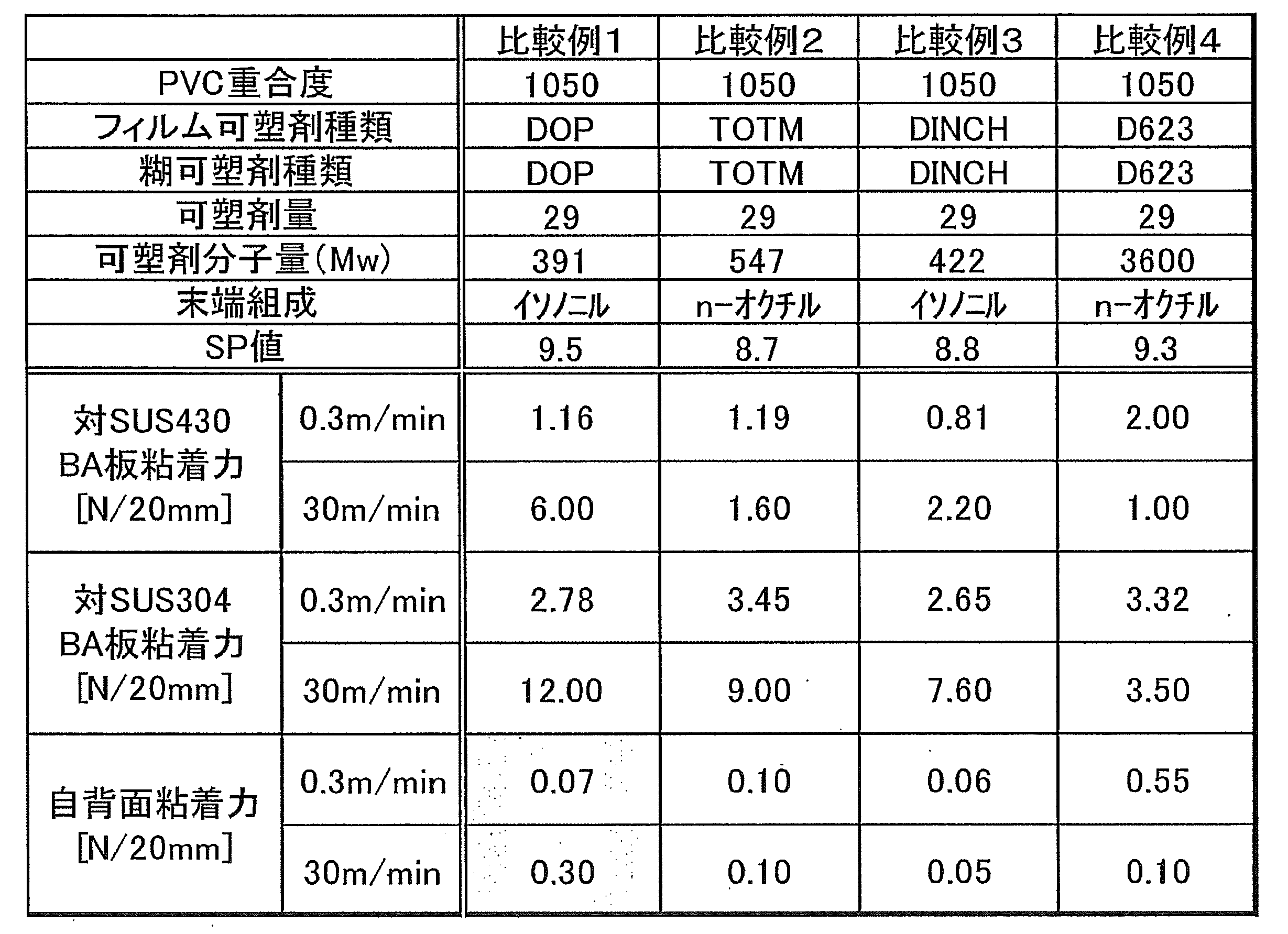
トルエンに浸漬し、超音波洗浄したSUS430BA板及びSUS304BA板に、粘着テープを線圧78N/cm、速度0.3m/分で貼り合わせた。粘着テープを20mm幅に切断し、0.3m/minと30m/minとの速度で初期粘着力を測定した。初期粘着力は、貼付後30分後に測定した。
実施例及び比較例の各粘着テープの基材層の背面に、離型処理剤を、マイヤーバー#16で塗布した。この背面に粘着剤層貼り合せて作製した粘着テープを20mm幅に切断し、0.3及び30m/minの速度で展開した時の抵抗力を測定した。
実施例及び比較例の各粘着テープを、10mm幅に切断し、-5℃の雰囲気下においてチャック間50mmで0.3m/minの速度で引っ張り、フィルムが破断した時の力を測定した。
実施例及び比較例の各粘着テープを、10mm幅に切断し、-5℃の雰囲気下においてチャック間50mmで0.3m/minの速度で引っ張り、フィルムが破断した時の初期からの伸び率を測定した。



Claims (7)
- ポリ塩化ビニル系樹脂100重量部に対し、可塑剤10~40重量部が配合されて形成される基材層と、該基材層の片面に形成された粘着剤層とを有し、
前記可塑剤は、SP値が9.0以上である可塑剤を少なくとも1種類含有することを特徴とするポリ塩化ビニル系粘着テープ又はシート。 - SP値が9.0以上の可塑剤が、数平均分子量Mn800~1500、重量平均分子量Mw800~2000を有する低分子ポリエステル系可塑剤である請求項1に記載のポリ塩化ビニル系粘着テープ又はシート。
- 低分子ポリエステル系可塑剤が、アジピン酸ポリエステル系可塑剤である請求項2に記載のポリ塩化ビニル系粘着テープ又はシート。
- 低分子ポリエステル系可塑剤が、イソノニル末端又はn-オクチル末端を有する請求項2に記載のポリ塩化ビニル系粘着テープ又はシート。
- 可塑剤が、実質的にフタル酸2-ジエチルヘキシル及びフタル酸ジブチルフリーである請求項1又は2に記載のポリ塩化ビニル系粘着テープ又はシート。
- 粘着剤層が、ベースポリマーとしてアクリル系ポリマーを含み、SP値が8.9~9.5に設定されてなる請求項1又は2に記載のポリ塩化ビニル系粘着テープ又はシート。
- さらに、粘着剤層の表面にセパレータを備える請求項1に記載のポリ塩化ビニル系粘着テープ又はシート。
Priority Applications (4)
| Application Number | Priority Date | Filing Date | Title |
|---|---|---|---|
| CN201280012174.9A CN103502373A (zh) | 2011-03-08 | 2012-03-02 | 粘合带或粘合片 |
| EP12754253.8A EP2684924A4 (en) | 2011-03-08 | 2012-03-02 | TAPE OR FOIL |
| KR1020137026052A KR20140019362A (ko) | 2011-03-08 | 2012-03-02 | 점착 테이프 또는 시트 |
| US14/003,974 US20140154450A1 (en) | 2011-03-08 | 2012-03-02 | Adhesive tape or sheet |
Applications Claiming Priority (2)
| Application Number | Priority Date | Filing Date | Title |
|---|---|---|---|
| JP2011-049753 | 2011-03-08 | ||
| JP2011049753A JP2012184369A (ja) | 2011-03-08 | 2011-03-08 | 粘着テープ又はシート |
Publications (1)
| Publication Number | Publication Date |
|---|---|
| WO2012121155A1 true WO2012121155A1 (ja) | 2012-09-13 |
Family
ID=46798119
Family Applications (1)
| Application Number | Title | Priority Date | Filing Date |
|---|---|---|---|
| PCT/JP2012/055410 Ceased WO2012121155A1 (ja) | 2011-03-08 | 2012-03-02 | 粘着テープ又はシート |
Country Status (7)
| Country | Link |
|---|---|
| US (1) | US20140154450A1 (ja) |
| EP (1) | EP2684924A4 (ja) |
| JP (1) | JP2012184369A (ja) |
| KR (1) | KR20140019362A (ja) |
| CN (1) | CN103502373A (ja) |
| TW (1) | TW201247830A (ja) |
| WO (1) | WO2012121155A1 (ja) |
Cited By (1)
| Publication number | Priority date | Publication date | Assignee | Title |
|---|---|---|---|---|
| JP2018002981A (ja) * | 2016-07-08 | 2018-01-11 | バンドー化学株式会社 | 粘着シート |
Families Citing this family (17)
| Publication number | Priority date | Publication date | Assignee | Title |
|---|---|---|---|---|
| SG11201509734YA (en) | 2013-05-29 | 2015-12-30 | Mitsui Chemicals Tohcello Inc | Semiconductor wafer protective film and method of manufacturing semiconductor device |
| WO2015131938A1 (en) | 2014-03-05 | 2015-09-11 | Novamelt GmbH Klebstofftechnologie | Adhesive-coated thermally sensitive polymer substrate, process for its manufacture and use thereof |
| JP6506955B2 (ja) * | 2014-03-11 | 2019-04-24 | 日東電工株式会社 | 粘着テープ |
| KR20170021912A (ko) | 2014-06-11 | 2017-02-28 | 닛토덴코 가부시키가이샤 | 점착 시트 |
| CN109613177B (zh) | 2014-07-01 | 2021-08-20 | 科蒙森斯公司 | 用于鉴定羊水的诊断组合物 |
| CN104130724B (zh) * | 2014-07-23 | 2016-04-20 | 日东电工(上海松江)有限公司 | 氯乙烯系胶粘片和胶带 |
| JP6676881B2 (ja) * | 2015-03-30 | 2020-04-08 | 三菱ケミカル株式会社 | 可塑剤含有部材用アクリル系粘着剤、並びに粘着テープ |
| JP6633306B2 (ja) * | 2015-04-01 | 2020-01-22 | 日東電工株式会社 | 粘着テープ |
| KR102558071B1 (ko) | 2015-04-28 | 2023-07-20 | 주식회사 쿠라레 | 적층용 아크릴계 열가소성 중합체 조성물 |
| US20210207004A1 (en) * | 2016-01-22 | 2021-07-08 | Cemedine Co., Ltd. | Photocurable composition and product |
| CN108243615B (zh) | 2016-02-29 | 2021-03-09 | 琳得科株式会社 | 半导体加工片 |
| JP6797559B2 (ja) * | 2016-05-23 | 2020-12-09 | 日東電工株式会社 | ダイシングテープ |
| CN108368405B (zh) * | 2016-11-21 | 2019-07-12 | 日东电工株式会社 | 粘合片 |
| KR102055078B1 (ko) * | 2016-11-21 | 2019-12-11 | 닛토덴코 가부시키가이샤 | 점착 시트 |
| MY197581A (en) | 2017-06-09 | 2023-06-26 | Denka Company Ltd | Pressure-sensitive adhesive tape |
| CN108948403A (zh) * | 2018-05-02 | 2018-12-07 | 广东远华新材料实业有限公司 | 一种聚氯乙烯发泡材料及其制备方法 |
| CN110878164A (zh) * | 2019-06-14 | 2020-03-13 | 安徽鑫豪爵新材料科技有限公司 | 一种具有划痕自修复功能的pvc地板膜及其生产工艺 |
Citations (9)
| Publication number | Priority date | Publication date | Assignee | Title |
|---|---|---|---|---|
| JPH07188619A (ja) * | 1993-12-27 | 1995-07-25 | Sekisui Chem Co Ltd | 装飾用粘着シート |
| JPH1161080A (ja) * | 1997-08-21 | 1999-03-05 | Nitto Denko Corp | フアスニングシステム |
| JP2001302866A (ja) | 2000-04-24 | 2001-10-31 | Bando Chem Ind Ltd | 粘着シート用基材フィルムとその製造方法 |
| JP2004175952A (ja) * | 2002-11-28 | 2004-06-24 | Riken Technos Corp | 制電性塩化ビニル系樹脂組成物 |
| JP2004283446A (ja) * | 2003-03-24 | 2004-10-14 | Duskin Co Ltd | マット |
| JP2006001951A (ja) * | 2004-06-15 | 2006-01-05 | Lintec Corp | 粘着シートおよびその製造方法 |
| JP2008201911A (ja) * | 2007-02-20 | 2008-09-04 | Lintec Corp | マスキングテープ |
| JP2010189579A (ja) * | 2009-02-19 | 2010-09-02 | Kuramoto Sangyo:Kk | フィルム基材および接着シート |
| JP2011037977A (ja) * | 2009-08-10 | 2011-02-24 | Bando Chemical Industries Ltd | 印刷用フィルム及び積層フィルム |
Family Cites Families (6)
| Publication number | Priority date | Publication date | Assignee | Title |
|---|---|---|---|---|
| JPH0284455A (ja) * | 1988-09-19 | 1990-03-26 | Okamoto Ind Inc | ゴム系粘着剤との密着性に優れた軟質塩化ビニル系樹脂組成物 |
| US6706806B2 (en) * | 2000-12-20 | 2004-03-16 | Velsicol Chemical Corporation | Polyester plasticizers for halogen-containing polymers |
| JP2003119300A (ja) * | 2001-10-09 | 2003-04-23 | Nitto Denko Corp | 粘着テープ用支持体および粘着テープ |
| DE10218686A1 (de) * | 2002-04-26 | 2003-11-27 | Tesa Ag | Handeinreißbares und dehnbares Abdeckklebeband |
| JP4565609B2 (ja) * | 2003-10-31 | 2010-10-20 | ニットウ ヨーロッパ エヌ. ブイ. | 粘着テープ |
| US20100151241A1 (en) * | 2008-04-14 | 2010-06-17 | 3M Innovative Properties Company | 2-Octyl (Meth)acrylate Adhesive Composition |
-
2011
- 2011-03-08 JP JP2011049753A patent/JP2012184369A/ja active Pending
-
2012
- 2012-03-02 US US14/003,974 patent/US20140154450A1/en not_active Abandoned
- 2012-03-02 WO PCT/JP2012/055410 patent/WO2012121155A1/ja not_active Ceased
- 2012-03-02 KR KR1020137026052A patent/KR20140019362A/ko not_active Withdrawn
- 2012-03-02 EP EP12754253.8A patent/EP2684924A4/en not_active Withdrawn
- 2012-03-02 CN CN201280012174.9A patent/CN103502373A/zh active Pending
- 2012-03-08 TW TW101107947A patent/TW201247830A/zh unknown
Patent Citations (9)
| Publication number | Priority date | Publication date | Assignee | Title |
|---|---|---|---|---|
| JPH07188619A (ja) * | 1993-12-27 | 1995-07-25 | Sekisui Chem Co Ltd | 装飾用粘着シート |
| JPH1161080A (ja) * | 1997-08-21 | 1999-03-05 | Nitto Denko Corp | フアスニングシステム |
| JP2001302866A (ja) | 2000-04-24 | 2001-10-31 | Bando Chem Ind Ltd | 粘着シート用基材フィルムとその製造方法 |
| JP2004175952A (ja) * | 2002-11-28 | 2004-06-24 | Riken Technos Corp | 制電性塩化ビニル系樹脂組成物 |
| JP2004283446A (ja) * | 2003-03-24 | 2004-10-14 | Duskin Co Ltd | マット |
| JP2006001951A (ja) * | 2004-06-15 | 2006-01-05 | Lintec Corp | 粘着シートおよびその製造方法 |
| JP2008201911A (ja) * | 2007-02-20 | 2008-09-04 | Lintec Corp | マスキングテープ |
| JP2010189579A (ja) * | 2009-02-19 | 2010-09-02 | Kuramoto Sangyo:Kk | フィルム基材および接着シート |
| JP2011037977A (ja) * | 2009-08-10 | 2011-02-24 | Bando Chemical Industries Ltd | 印刷用フィルム及び積層フィルム |
Non-Patent Citations (1)
| Title |
|---|
| See also references of EP2684924A4 |
Cited By (1)
| Publication number | Priority date | Publication date | Assignee | Title |
|---|---|---|---|---|
| JP2018002981A (ja) * | 2016-07-08 | 2018-01-11 | バンドー化学株式会社 | 粘着シート |
Also Published As
| Publication number | Publication date |
|---|---|
| TW201247830A (en) | 2012-12-01 |
| EP2684924A1 (en) | 2014-01-15 |
| KR20140019362A (ko) | 2014-02-14 |
| CN103502373A (zh) | 2014-01-08 |
| JP2012184369A (ja) | 2012-09-27 |
| US20140154450A1 (en) | 2014-06-05 |
| EP2684924A4 (en) | 2014-11-05 |
Similar Documents
| Publication | Publication Date | Title |
|---|---|---|
| WO2012121155A1 (ja) | 粘着テープ又はシート | |
| JP6064261B2 (ja) | 半導体加工用シート及びこれを利用した半導体裏面研削方法 | |
| CN101070454B (zh) | 用于加工半导体晶片或半导体基材的压敏粘着片 | |
| JP5955579B2 (ja) | ガラスエッチング用保護シート | |
| JP5406110B2 (ja) | 半導体ウエハ加工用粘着シート | |
| US20080038551A1 (en) | Warpage-inhibitive pressure-sensitive adhesive sheets for wafer grinding | |
| US20110244160A1 (en) | Adhesive tape or sheet with release liner | |
| JP6176432B2 (ja) | 粘着フィルム及びこれを使用したバックグラインディング方法 | |
| US20110244229A1 (en) | Rolled adhesive tape or sheet | |
| TW201335309A (zh) | 黏著劑用聚合物、黏著劑組合物及熱剝離性黏著片材 | |
| JP2009035635A (ja) | 非汚染性熱剥離型粘着シート | |
| JP5635825B2 (ja) | メチレンビス脂肪酸アミド組成物、粘着シート及びその製造方法 | |
| WO2013129463A1 (ja) | 粘着テープ | |
| WO2013129462A1 (ja) | 粘着テープ | |
| JP2013173874A (ja) | 粘着テープ |
Legal Events
| Date | Code | Title | Description |
|---|---|---|---|
| 121 | Ep: the epo has been informed by wipo that ep was designated in this application |
Ref document number: 12754253 Country of ref document: EP Kind code of ref document: A1 |
|
| NENP | Non-entry into the national phase |
Ref country code: DE |
|
| WWE | Wipo information: entry into national phase |
Ref document number: 2012754253 Country of ref document: EP |
|
| ENP | Entry into the national phase |
Ref document number: 20137026052 Country of ref document: KR Kind code of ref document: A |
|
| WWE | Wipo information: entry into national phase |
Ref document number: 14003974 Country of ref document: US |