WO2012128083A1 - 精算システム、精算方法、及び現金精算装置 - Google Patents
精算システム、精算方法、及び現金精算装置 Download PDFInfo
- Publication number
- WO2012128083A1 WO2012128083A1 PCT/JP2012/056148 JP2012056148W WO2012128083A1 WO 2012128083 A1 WO2012128083 A1 WO 2012128083A1 JP 2012056148 W JP2012056148 W JP 2012056148W WO 2012128083 A1 WO2012128083 A1 WO 2012128083A1
- Authority
- WO
- WIPO (PCT)
- Prior art keywords
- cash
- money
- settlement apparatus
- amount
- register
- Prior art date
- Legal status (The legal status is an assumption and is not a legal conclusion. Google has not performed a legal analysis and makes no representation as to the accuracy of the status listed.)
- Ceased
Links
Images








Classifications
-
- G—PHYSICS
- G07—CHECKING-DEVICES
- G07D—HANDLING OF COINS OR VALUABLE PAPERS, e.g. TESTING, SORTING BY DENOMINATIONS, COUNTING, DISPENSING, CHANGING OR DEPOSITING
- G07D1/00—Coin dispensers
- G07D1/02—Coin dispensers giving change
- G07D1/06—Coin dispensers giving change dispensing the difference between a sum paid and a sum charged
-
- G—PHYSICS
- G06—COMPUTING OR CALCULATING; COUNTING
- G06Q—INFORMATION AND COMMUNICATION TECHNOLOGY [ICT] SPECIALLY ADAPTED FOR ADMINISTRATIVE, COMMERCIAL, FINANCIAL, MANAGERIAL OR SUPERVISORY PURPOSES; SYSTEMS OR METHODS SPECIALLY ADAPTED FOR ADMINISTRATIVE, COMMERCIAL, FINANCIAL, MANAGERIAL OR SUPERVISORY PURPOSES, NOT OTHERWISE PROVIDED FOR
- G06Q20/00—Payment architectures, schemes or protocols
- G06Q20/08—Payment architectures
- G06Q20/20—Point-of-sale [POS] network systems
-
- G—PHYSICS
- G06—COMPUTING OR CALCULATING; COUNTING
- G06Q—INFORMATION AND COMMUNICATION TECHNOLOGY [ICT] SPECIALLY ADAPTED FOR ADMINISTRATIVE, COMMERCIAL, FINANCIAL, MANAGERIAL OR SUPERVISORY PURPOSES; SYSTEMS OR METHODS SPECIALLY ADAPTED FOR ADMINISTRATIVE, COMMERCIAL, FINANCIAL, MANAGERIAL OR SUPERVISORY PURPOSES, NOT OTHERWISE PROVIDED FOR
- G06Q20/00—Payment architectures, schemes or protocols
- G06Q20/08—Payment architectures
- G06Q20/20—Point-of-sale [POS] network systems
- G06Q20/204—Point-of-sale [POS] network systems comprising interface for record bearing medium or carrier for electronic funds transfer or payment credit
-
- G—PHYSICS
- G06—COMPUTING OR CALCULATING; COUNTING
- G06Q—INFORMATION AND COMMUNICATION TECHNOLOGY [ICT] SPECIALLY ADAPTED FOR ADMINISTRATIVE, COMMERCIAL, FINANCIAL, MANAGERIAL OR SUPERVISORY PURPOSES; SYSTEMS OR METHODS SPECIALLY ADAPTED FOR ADMINISTRATIVE, COMMERCIAL, FINANCIAL, MANAGERIAL OR SUPERVISORY PURPOSES, NOT OTHERWISE PROVIDED FOR
- G06Q20/00—Payment architectures, schemes or protocols
- G06Q20/08—Payment architectures
- G06Q20/20—Point-of-sale [POS] network systems
- G06Q20/209—Specified transaction journal output feature, e.g. printed receipt or voice output
-
- G—PHYSICS
- G07—CHECKING-DEVICES
- G07D—HANDLING OF COINS OR VALUABLE PAPERS, e.g. TESTING, SORTING BY DENOMINATIONS, COUNTING, DISPENSING, CHANGING OR DEPOSITING
- G07D11/00—Devices accepting coins; Devices accepting, dispensing, sorting or counting valuable papers
- G07D11/0087—Banknote changing devices
-
- G—PHYSICS
- G07—CHECKING-DEVICES
- G07F—COIN-FREED OR LIKE APPARATUS
- G07F19/00—Complete banking systems; Coded card-freed arrangements adapted for dispensing or receiving monies or the like and posting such transactions to existing accounts, e.g. automatic teller machines
- G07F19/20—Automatic teller machines [ATMs]
- G07F19/202—Depositing operations within ATMs
-
- G—PHYSICS
- G07—CHECKING-DEVICES
- G07F—COIN-FREED OR LIKE APPARATUS
- G07F19/00—Complete banking systems; Coded card-freed arrangements adapted for dispensing or receiving monies or the like and posting such transactions to existing accounts, e.g. automatic teller machines
- G07F19/20—Automatic teller machines [ATMs]
- G07F19/203—Dispensing operations within ATMs
-
- G—PHYSICS
- G07—CHECKING-DEVICES
- G07F—COIN-FREED OR LIKE APPARATUS
- G07F7/00—Mechanisms actuated by objects other than coins to free or to actuate vending, hiring, coin or paper currency dispensing or refunding apparatus
- G07F7/06—Mechanisms actuated by objects other than coins to free or to actuate vending, hiring, coin or paper currency dispensing or refunding apparatus by returnable containers, i.e. reverse vending systems in which a user is rewarded for returning a container that serves as a token of value, e.g. bottles
-
- G—PHYSICS
- G07—CHECKING-DEVICES
- G07G—REGISTERING THE RECEIPT OF CASH, VALUABLES, OR TOKENS
- G07G1/00—Cash registers
- G07G1/0018—Constructional details, e.g. of drawer, printing means, input means
- G07G1/0027—Details of drawer or money-box
-
- G—PHYSICS
- G07—CHECKING-DEVICES
- G07G—REGISTERING THE RECEIPT OF CASH, VALUABLES, OR TOKENS
- G07G1/00—Cash registers
- G07G1/12—Cash registers electronically operated
Definitions
- the present invention relates to a settlement system including a cash settlement apparatus that receives a manually input deposit amount from a register, calculates a change amount, and withdraws change money, a settlement method using the settlement system, and a cash settlement apparatus. .
- a checkout system In stores such as supermarkets and convenience stores, there are cash settlement devices that process deposits and withdrawals of banknotes and coins, and POS (Point Of Sale) registers that calculate the amount of sales by registering purchased products of customers.
- POS Point Of Sale
- the POS register calculates the sales amount and notifies the cash settlement apparatus.
- the cash settlement apparatus performs identification and counting when a deposit from a customer is inserted.
- the cash settlement apparatus calculates the amount of change by subtracting the sales amount notified from the POS register from the total amount of deposits from the customer, and withdraws the change.
- the deposit money from the customer contains reject money that the cash settlement device does not accept, operate the POS register and subtract the amount of reject money from the sales amount initially calculated. And changed the sales amount to the cash settlement device. However, since the sales amount is changed, there is a problem that the sales amount managed by the host machine and the amount of money stored in the cash settlement apparatus do not match.
- Patent Document 1 discloses a system including a cash settlement apparatus (a change machine) and a POS register having a manual input accepting unit for manually inputting the amount of money that has not been accepted by the cash settlement apparatus. .
- the cash settlement apparatus notifies the POS register of the amount of money input.
- the POS register calculates the total amount of the deposit from the customer by adding the manually input amount manually input through the manual input receiving means and the input amount notified from the cash settlement apparatus, and from the total amount of the deposit The change amount was calculated by reducing the sales amount, and the cash settlement apparatus was instructed to change the change.
- An object of the present invention is to provide a settlement system that can perform a settlement process without changing the sales amount in a register even if reject money is included in a deposit from a customer, and that suppresses apparatus costs. To do.
- a settlement system is a settlement system including a cash settlement apparatus that performs deposit and withdrawal processing of money, and a register that performs registration of purchased products and calculation of a total amount, wherein the register is
- the cash settlement apparatus receives a manual input of information corresponding to at least a part of the deposit from the customer, the total amount of the purchased product, and the manually input information manually input via the reception unit
- the cash settlement apparatus calculates and inserts money by identifying and counting the inserted money, and uses the input money and the manually input information received from the register.
- the total deposit amount from the customer is calculated, the change amount is calculated based on the total amount and the total amount received from the register, and the change money is withdrawn.
- the cash settlement apparatus notifies the input amount to the register, and the register performs a card settlement process of an amount obtained by subtracting the input amount from the total amount. It is preferable to have a part.
- the manually input information includes denomination information of reject money that has not been accepted by the cash settlement apparatus.
- the cash settlement apparatus outputs the input amount and the manually input information separately from each other.
- the cash settlement apparatus can be set by switching between a first mode for identifying the inserted money and a second mode for receiving the inserted money without identifying it. .
- the cash settlement apparatus stores a first storage unit that stores the currency identified at the time of setting the first mode, and a currency that is input at the time of setting the second mode. And a second storage portion.
- the settlement method is a settlement method using a cash settlement apparatus and a register, wherein the register calculates a total amount of purchased products, and transmits the total amount to the cash settlement apparatus;
- the cash settlement apparatus identifies and counts the inserted money to calculate the input amount, and the register accepts manual input of information corresponding to at least a part of the deposit from the customer, and manually input information
- the cash settlement apparatus calculates the total amount of deposits from customers using the input amount and the manual input information received from the register, and the total amount and the register Calculating the amount of change based on the total amount received from the bank, and withdrawing change money.
- a cash settlement apparatus is a cash settlement apparatus that performs deposit processing and withdrawal processing of money, and calculates the total amount of purchased products and stores information corresponding to at least a part of deposits from customers.
- a receiving unit that receives the total amount and the manually input information manually input from a register that accepts manual input, and calculates and calculates an input amount by identifying and counting input money, and the input amount and the Calculate the total amount of deposits from customers using the manual input information received from the register, calculate a change amount based on the total amount and the total amount received from the register, and based on the change amount And a withdrawal part for withdrawing change money.
- a settlement system is a settlement system including a cash settlement apparatus that performs deposit and withdrawal processing of money, and a register that performs registration of purchased products and calculation of a total amount,
- the settlement apparatus identifies the inserted money, generates acceptance refusal information for money that cannot be accepted, and outputs the acceptance refusal information to the register.
- the register receives the acceptance refusal information output from the cash settlement apparatus.
- a display unit for displaying is provided.
- the register display unit may be mounted on the register body, may be provided adjacent to the register body, or may be configured as a so-called customer display that can be visually recognized by the customer.
- the system may be configured as an attendant station display installed at a location away from the cash settlement apparatus.
- the cash settlement apparatus may identify the inserted money, generate counterfeit ticket information or suspect ticket information as acceptance refusal information for the counterfeit ticket or suspect ticket, and output the counter ticket to the register. preferable.
- the display section of the register also displays the handling method of the fake ticket or suspect ticket.
- the display unit of the register is adapted to provide guidance for confirming customer identification information. When collecting counterfeit or suspect tickets, it is necessary to link the money (fake or suspect ticket) with the information of the customer who deposited the money. It is important to check.
- the display section of the register is adapted to provide guidance for prompting another settlement method. For example, settlement with another currency, settlement with a debit card, settlement with a credit card, or the like may be prompted.
- a print output device is connected to the cash settlement apparatus, and when money that cannot be accepted by the cash settlement apparatus is taken into the apparatus, information relating to the capture is printed out as a receipt from the print output apparatus. It is preferable that it is adapted.
- a back office management device is connected to the cash settlement apparatus, and when money that cannot be accepted by the cash settlement apparatus is taken into the apparatus, information on the fetch is transferred from the cash settlement apparatus to the back office. It is preferable that the management apparatus is notified.
- a cash management method includes an interface that is communicably connected to a system of a plurality of carriers that collects or replenishes money in a storage that stores money, and information
- a cash management method using a cash management device comprising a display unit for displaying the money when the money in the storage is required to be collected or replenished to the storage.
- a request for quotation for requesting a replenishment estimate is transmitted to a plurality of the carrier systems, and a response to the request for quotation including the estimate information for collecting or replenishing money is received from the plurality of carrier systems.
- the cash management device detects a near empty state indicating that the money in the storage is below a first predetermined value, and indicates that the money in the storage is above a second predetermined value.
- the cash management apparatus may transmit the estimate request notification to a plurality of the carrier systems.
- the estimate reply notification may include at least cost information for collecting or replenishing money and date and time information for collecting or replenishing money.
- the display unit may display the estimate response notifications of each of the plurality of carriers in ascending order of cost for collecting or replenishing money, or in order of date and time when collecting or replenishing money.
- the estimate request notification may include money amount information, denomination information or quantity information of money to be collected or supplemented.
- the collection / replenishment request notification may include money amount information, denomination information or quantity information of money to be collected or supplemented.
- the cash management device further includes an estimate request transmission button that determines transmission of the estimate request notification, and a storage unit that stores in advance the mail addresses of the plurality of carriers that transmit the estimate request notification.
- the cash management apparatus may automatically transmit an e-mail as the estimate request notification to the plurality of carriers stored in the storage unit.
- the cash management device When an operator of the cash management apparatus selects a certain carrier from the plurality of carriers displayed on the display unit, the cash management device notifies the selected carrier of collection / replenishment requests for e-mails. As an automatic transmission.
- the cash management device is communicably connected to an external server accessible by a plurality of carriers, and the cash management device uses the amount of money stored in the storage as the estimate request notification. You may transmit to the said external server regularly, and may receive the said estimate reply notification transmitted from the said carrier's system based on the stock of the said storage stored in the said external server.
- a cash management system includes an interface that is communicably connected to a system of a plurality of carriers that collects or replenishes money in a storage that stores money, and information.
- a cash management device including a display unit for displaying, a system of a plurality of carriers that collects or replenishes money in the cash management device, and the cash management device and a plurality of the transports
- a cash management system including a network that connects a merchant system to be communicable, wherein the cash management device needs to collect or replenish money in the storage.
- the cash management apparatus estimates the money collection or replenishment for the estimate request notification.
- An estimate response notification including information is received from a plurality of carrier systems, and the cash management device displays the estimate response notification obtained from a plurality of carrier systems on the display unit, and the cash management device. Transmits a collection / replenishment request notification for requesting collection or replenishment of money to any of the carriers selected by the operator of the cash management apparatus.
- the cash management device detects a near empty state indicating that the money in the storage is below a first predetermined value, and indicates that the money in the storage is above a second predetermined value.
- the cash management apparatus may transmit the estimate request notification to a plurality of the carrier systems.
- the estimate reply notification may include at least cost information for collecting or replenishing money and date and time information for collecting or replenishing money.
- the display unit may display the estimate response notifications of each of the plurality of carriers in ascending order of cost for collecting or replenishing money, or in order of date and time when collecting or replenishing money.
- the estimate request notification may include money amount information, denomination information or quantity information of money to be collected or supplemented.
- the collection / replenishment request notification may include money amount information, denomination information or quantity information of money to be collected or supplemented.
- the cash management device further includes an estimate request transmission button that determines transmission of the estimate request notification, and a storage unit that stores in advance the mail addresses of the plurality of carriers that transmit the estimate request notification.
- the cash management apparatus may automatically transmit an e-mail as the estimate request notification to the plurality of carriers stored in the storage unit.
- the cash management device When an operator of the cash management apparatus selects a certain carrier from the plurality of carriers displayed on the display unit, the cash management device notifies the selected carrier of collection / replenishment requests for e-mails. As an automatic transmission.
- the cash management system further includes an external server that is communicably connected to the cash management device and is accessible to a plurality of the carriers, and the cash management device stores the amount of money stored in the storage. Is periodically transmitted to the external server as the estimate request notification, and the external server stores the storage amount of the storage so that a plurality of carriers can access the storage amount of the storage, and the transfer
- the supplier's system may transmit the estimate response notification based on the stock of the storage stored in the external server, and the cash management device may receive the estimate response notification.
- the settlement process can be performed without changing the sales amount in the register, and the apparatus cost can be suppressed.
- FIG. 1 is an external view of a register according to a first embodiment.
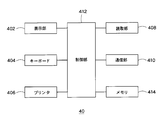
- 3 is a block diagram of a register according to the first embodiment.
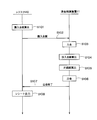
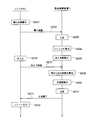
- FIG. It is a timing chart explaining the settlement method concerning a 1st embodiment. It is a timing chart explaining the settlement method concerning a 1st embodiment. It is an external view of a register according to a modification.
- FIG. 1 is a block diagram showing a configuration example of a cash management system 1 including a settlement system 2 according to a first embodiment of the present invention.
- the cash management system 1 is a system that processes and manages the cash received from the customer by the store clerk and the cash paid by the store clerk to the customer.
- the cash management system 1 is provided in a checkout area in the store, and manages a checkout counter 10 that deposits and withdraws cash exchanged between a store clerk and a customer, and cash and products of the checkout counter 10. And a cash transport cassette 30 for transporting cash between the checkout counter 10 and the back office 20.
- the checkout counter 10 is connected to a cash settlement apparatus 11 that performs settlement processing with a customer by depositing and withdrawing cash, and a register that is communicably connected to the cash settlement apparatus 11 and registers a product purchased by the customer.
- a settlement system 2 having 40 is provided.
- a plurality of settlement systems 2 may be provided.
- the cash settlement apparatus 11 is operated by the clerk or the customer himself and is used for the settlement process between the clerk and the customer. For example, the cash settlement apparatus 11 deposits the money paid by the customer or withdraws the change to be paid to the customer.
- the register 40 is, for example, a POS register operated by a store clerk.
- the back office 20 is provided with a cash accounting apparatus 21, a cash management apparatus 25, and a POS management apparatus 26.
- the cash accounting apparatus 21 is connected to the cash settlement apparatus 11 so as to be communicable. For example, the cash accounting apparatus 21 withdraws change reserves for loading into the cash settlement apparatus 11 or collects the sales collected from the cash settlement apparatus 11. Deposit money.
- the cash management device 25 is communicably connected to the cash settlement apparatus 11 and the cash accounting apparatus 21 via a LAN (Local Area Network) or the like.
- the cash management device 25 manages the cash stored in the cash settlement apparatus 11 and the cash accounting apparatus 21.
- the cash management apparatus 25 manages the cash that has been settled in each of the cash settlement apparatuses 11 and the cash that is exchanged between the cash settlement apparatus 11 and the cash accounting apparatus 21.
- the cash management apparatus 25 may monitor whether or not the cash transport cassette 30 is attached to the cash settlement apparatus 11 or the cash accounting apparatus 21.
- the POS management device 26 is communicably connected to a register 40 provided in the checkout counter 10 via a LAN or the like, and manages the flow of goods and sales at stores.
- the cash transport cassette 30 is configured to be attachable to and detachable from the cash settlement apparatus 11 and the cash accounting apparatus 21, and when attached to the cash settlement apparatus 11 or the cash accounting apparatus 21, the cash transport cassette 30 is connected to the cash settlement apparatus 11 or the cash accounting apparatus 21. Cash can be exchanged between them.
- the cash transport cassette 30 stores the cash so that the internal cash cannot be taken out when it is detached from the cash settlement apparatus 11 and the cash accounting apparatus 21.
- the store clerk carries the cash between the cash settlement apparatus 11 and the cash accounting apparatus 21 using the cash transport cassette 30. For example, when a change reserve is loaded or sales are collected, the store clerk uses the cash transport cassette 30 to transport cash between the cash settlement apparatus 11 and the cash accounting apparatus 21. Since the store clerk cannot touch the cash in the cash transport cassette 30 during the transport of cash, the store clerk can transport the cash in a safe state.
- the cash transport cassette 30 may be configured to transport either one of banknotes and coins, or may be configured to transport both.
- the banknote cash transport cassette 30 may be a stack-type cassette that stacks and stores banknotes, or a tape reel type that winds the tape together with the banknotes in a state where the banknotes are sandwiched between a plurality of tapes one by one. It may be a cassette.
- the coin cash cassette 30 for coins may be a cassette for storing coins in a denomination mixed state.
- Each cash settlement apparatus 11 includes a coin settlement apparatus 13 that performs a settlement process by depositing and dispensing coins, and a banknote settlement apparatus 12 that performs a settlement process by depositing and dispensing banknotes.
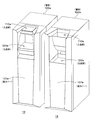
- FIG. 2 is an external view showing an example of each cash settlement apparatus 11.
- the cash settlement apparatus 11 includes a banknote settlement apparatus 12 and a coin settlement apparatus 13.
- the bill settlement apparatus 12 includes a housing 100a, a depositing unit 110a, and a dispensing unit 120a.
- the depositing unit 110a is provided to insert banknotes received from customers.
- the withdrawal unit 120a is provided to throw out change bills.
- a cassette mounting portion (see 160a in FIG. 4) for mounting the cash transport cassette 30 is provided.
- the coin settlement apparatus 13 includes a housing 100b, a depositing unit 110b, and a dispensing unit 120b.
- the depositing unit 110b is provided for inserting coins received from customers.
- the withdrawal unit 120b is provided to throw out change coins.
- a cassette mounting portion (see 160b in FIG. 5) for mounting the cash transport cassette 30 is provided.
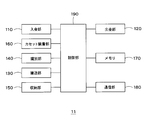
- FIG. 3 is a block diagram illustrating a configuration example of the cash settlement apparatus 11.
- the cash settlement apparatus 11 includes a transport unit 130, an identification unit 140, a storage unit 150, a cassette mounting unit 160, a memory 170, a communication unit 180, and a control unit 190. And further.
- the transport unit 130 transports the cash put into the depositing unit 110 to the storage unit 150, or transports the cash dispensed from the withdrawal unit 120 from the storage unit 150. Further, the transport unit 130 transports the cash in the cash transport cassette 30 mounted on the cassette mounting unit 160 to load the cash into the storage unit 150, or collects the cash from the storage unit 150. Therefore, the cash stored in the storage unit 150 can be transported to the cash transport cassette 30.
- the identification unit 140 is configured to detect the denomination, authenticity, correctness, new and old, quantity, etc. of the cash being conveyed by the conveyance unit 130.
- the identification unit 140 includes a sensor such as an image sensor or a magnetic sensor.
- the storage unit 150 is configured to store the cash identified by the identification unit 140 for each denomination.
- the storage section 150 may be a stack-type storage section that stacks and stores each banknote for each denomination, or each banknote is sandwiched between a plurality of tapes for each denomination. It may be a plurality of tape reel type storage units wound together with banknotes.
- the cassette mounting unit 160 is configured to be detachable from the cash transport cassette 30.
- the cassette mounting unit 160 is configured to deposit cash from the cash transport cassette 30 or to withdraw cash from the cash transport cassette 30.
- the memory 170 includes a ROM (Read Only Memory) or a HDD (Hard Disk Drive) for storing various programs and data for controlling the cash settlement apparatus 11, and a RAM (Random for a program load area and a work area at the time of program execution) Includes Access Memory).
- the memory 170 also stores information (denomination, quantity, etc.) of cash stored in the storage unit 150 and the cash transport cassette 30. Furthermore, the memory 170 may store the amount of cash identified by the identifying unit 140 for each denomination.
- the communication unit 180 is communicably connected to other devices (the cash accounting apparatus 21, the cash management apparatus 25, the POS management apparatus 26) and the register 40 that constitute the cash processing system 1.
- the control unit 190 is an arithmetic processing unit configured to execute the program in the memory 170 to control the entire cash settlement apparatus 11.
- the control unit 190 calculates the amount of money (injected amount) of cash inserted into the depositing unit 110 based on the identification / counting result by the identifying unit 140. Further, the control unit 190 receives information corresponding to at least a part of the deposit from the customer manually input into the register 40 via the communication unit 180 (hereinafter referred to as manual input information) from the register 40, Based on the manually input information and the input amount, the total amount of the deposit from the customer is calculated.
- manual input information information corresponding to at least a part of the deposit from the customer manually input into the register 40 via the communication unit 180
- control unit 190 receives the total amount of the purchased product of the customer from the register 40 via the communication unit 180, and calculates the change amount by subtracting the total amount of the purchased product from the total amount of the deposit from the customer. To do. And the control part 190 controls each part of the cash settlement apparatus 11 so that the change of the calculated change amount may be withdrawn.
- control unit 190 can output the calculated input amount and the manually input information received from the register 40 to the cash management device 25 in a distinguished manner. Therefore, the cash management device 25 calculates the amount of cash actually stored in the cash settlement apparatus 11 and the amount of money (for example, reject currency) that has not been stored in the cash settlement apparatus 11 but has been subjected to deposit processing. Can be managed separately.
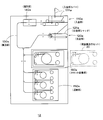
- FIG. 4 is a cross-sectional view showing an example of the internal configuration of the banknote settlement apparatus 12 in the cash settlement apparatus 11.
- the bill settlement apparatus 12 includes a depositing unit cover 111a, and a store clerk (or a customer) opens the depositing unit cover 111a when depositing and inserts a bill into the depositing unit 110a.
- the depositing unit 110a is configured to feed the inserted banknotes one by one to the transport unit 130a.
- the transport unit 130a is configured to pass the fed banknotes to the identification unit 140a and then transport the banknotes to the storage unit 150a, the cash transport cassette 30, or the withdrawal unit 120a.
- the identification unit 140a identifies the denomination, authenticity, correctness, new and old, quantity, etc., of the bill being conveyed.
- the transport unit 130a stores banknotes in the storage unit 150a for each denomination based on the identification result by the identification unit 140a.
- the conveyance part 130a may convey a banknote to the cash conveyance cassette 30 as needed, when the accommodating part 150a is full. Moreover, the conveyance part 130a throws it out to the payment part 120a, when the identification part 140a cannot identify a banknote, or when a forged banknote is identified.
- the storage unit 150a is configured to feed banknotes one by one to the transport unit 130a.
- the transport unit 130a transports the fed banknotes to the withdrawal unit 120a.
- the bill settlement apparatus 12 includes a withdrawal unit shutter 121a, and when dispensing, opens the withdrawal unit shutter 121a and throws out banknotes.
- the bill settlement apparatus 12 can store the bills inserted into the depositing unit 110a in the storage unit 150a, and conversely, can throw out the bills stored in the storage unit 150a to the withdrawal unit 120a. That is, the bill settlement apparatus 12 is configured so that the deposited bill can be reused for withdrawal.
- the banknote settlement apparatus 12 loads banknotes from the cash transport cassette 30 to the storage unit 150a, or collects banknotes from the storage unit 150a to the cash transport cassette 30a. can do.
- the cash transport cassette 30 feeds banknotes one by one to the transport unit 130a.
- the transport unit 130a loads the fed banknotes into the storage unit 150a.
- the storage unit 150a feeds the banknotes one by one to the transport unit 130a.
- the transport unit 130a collects the fed banknotes in the cash transport cassette 30.
- the bill settlement apparatus 12 is configured to be able to load and collect bills using the cash transport cassette 30.
- FIG. 5A and FIG. 5B are cross-sectional views showing an example of the internal configuration of the coin settlement apparatus 13 in the cash settlement apparatus 11.
- FIG. 5A is a cross-sectional view of the coin settlement apparatus 13 viewed from the side
- FIG. 5B is a cross-sectional view of the coin settlement apparatus 13 viewed from the front.
- illustration of the cash transport cassette 30 and the feeding unit 137b is omitted, and the storage unit 150b is illustrated.
- the coin settlement apparatus 13 includes a depositing unit 110b as shown in FIG. 5B, and a clerk (or customer) inserts coins into the depositing unit 110b when depositing. At this time, coins of a plurality of denominations may be thrown in a mixed state.
- the disc-shaped feeding unit 133b is configured to feed coins put into the depositing unit 110b one by one to the transport unit 130b.
- the transport unit 130b passes the fed coin through the identification unit 140b, and then transports the coin to the storage unit 150b, the cash transport cassette 30, or the withdrawal unit 120b.
- the identification unit 140b identifies the denomination, true / false, correct / incorrect, new / old, quantity, etc., of the coin being conveyed.
- the transport unit 130b sorts coins by denomination based on the identification result by the identification unit 140b, and stores the coins in the corresponding denomination storage unit 150b.
- the conveyance part 130b may convey a coin to the cash conveyance cassette 30 or the collection
- the storage unit 150b is configured to feed coins one by one to the transport unit 131b.
- the plurality of storage units 150b store money by denomination and each include a disk-shaped feeding unit 153b.
- the feeding unit 153b is configured to feed coins one by one to the transport unit 130b.
- the transport unit 130b transports the fed coins to the dispensing unit 120b. Thereby, the coin settlement apparatus 13 throws a coin into the withdrawal part 120b.
- the coin settlement apparatus 13 can store the coins input into the depositing unit 110b in the storage unit 150b, and conversely, can throw out the coins stored in the storage unit 150b into the dispensing unit 120b. That is, the coin settlement apparatus 13 is configured so that the deposited coin can be reused for withdrawal.
- the coin settlement apparatus 13 loads coins from the cash transport cassette 30 to the storage unit 150b or collects coins from the storage unit 150b to the cash transport cassette 30b. can do.
- the cash transport cassette 30 throws out coins into the feeding unit 137b shown in FIG. At this time, the cash transport cassette 30 may throw coins into the feeding portion 137b in a state where the denominations are mixed.
- the feeding unit 137b feeds coins to the transport unit 131b.
- the transport unit 131b transports the fed coins to the feed unit 133b, and the feed unit 133b feeds the coins one by one to the transport unit 130b.
- the conveyance unit 130b is configured to convey the fed coins to the identification unit 140b and then convey the coins to the storage unit 150b or the withdrawal unit 120b.
- the identification unit 140b identifies the denomination of the coin being conveyed.
- the transport unit 130b stores coins in the storage unit 150b for each denomination based on the identification result by the identification unit 140b.
- the coin settlement apparatus 13 feeds coins one by one from the storage unit 150b to the transport unit 131b.
- the transport unit 131b collects the fed coins into the cash transport cassette 30.
- the coin settlement apparatus 13 is configured to be able to load and collect coins using the cash transport cassette 30.
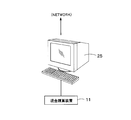
- FIG. 6 shows the external appearance of the register 40
- FIG. 7 shows the block configuration of the register 40.
- the register 40 includes a display unit 402 that displays various information, a keyboard 404 that receives manual input of various information and instructions from a store clerk, and a printer that outputs a receipt on which transaction details are printed.
- a reading unit 408 that reads product information
- a communication unit 410 that communicates with the cash settlement apparatus 11 and the POS management apparatus 26, a control unit 412, and a memory 414.
- the keyboard 404 can accept manual input of information corresponding to at least a part of the deposit from the customer.
- the manually input information is, for example, the number of types of reject money that could not be deposited into the cash settlement apparatus 11.
- the reading unit 408 is, for example, a barcode scanner that reads a barcode attached to a customer's purchased product.
- the register 40 can acquire and register the product information of the customer's purchased product.
- the register 40 may include a display unit (customer display) 402a for the customer.
- the display unit 402 may be a touch panel.
- the display unit 402 can accept manual input of information about rejected money that cannot be deposited in the cash settlement apparatus 11.
- the memory 414 includes a ROM (Read Only Memory) or HDD (Hard Disk Drive) that stores various programs and data for controlling the cash settlement apparatus 11, and a RAM (Random) that serves as a program load area and a work area during program execution. Includes Access Memory).
- the memory 414 stores a table having combinations of product information and the amount of money.
- the control unit 412 is an arithmetic processing unit configured to execute the program in the memory 414 to control the entire register 40.
- the control unit 412 can obtain the price of the product by searching the table in the memory 414 using the product information read by the reading unit 408, and can calculate the total price of the product purchased by the customer.
- control unit 412 can transmit the total amount of purchased products and the manual input information received by the keyboard 404 to the cash settlement apparatus 11 via the communication unit 410. Further, the control unit 412 can transmit the product information of the product purchased by the customer to the POS management device 26 via the communication unit 410.
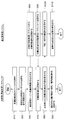
- Step S101 The product information of the product purchased by the customer is registered in the register 40, and the purchase price is calculated.
- Step S102 The register 40 transmits the purchase price to the cash settlement apparatus 11.
- Step S103 The customer's payment money is inserted into the cash settlement apparatus 11.
- the store clerk may perform the input of money or the customer himself / herself.
- the cash settlement apparatus 11 performs a deposit process including identification and counting of the inserted money.
- Step S104 The cash settlement apparatus 11 calculates the input amount.
- Step S105 The cash settlement apparatus 11 uses the input amount calculated in Step S104 as the total amount of deposits from the customer, and calculates the change amount based on the total amount of deposits and the purchase amount received from the register 40 in Step S102. To do.
- Step S106 The cash settlement apparatus 11 withdraws change money based on the change amount calculated in step S105. Specifically, the bill settlement apparatus 12 throws out a change banknote from the withdrawal unit 120a, and the coin settlement unit 13 throws out a change coin from the withdrawal unit 120b.
- the change money may be handed to the customer by the store clerk, or the changed change money may be received by the customer.
- Step S107 The cash settlement apparatus 11 notifies the register 40 of the completion of change money withdrawal.
- Step S108 The printer 406 of the register 40 outputs a receipt on which the transaction details including the product information of the customer's purchased product, the purchase amount, the customer's payment amount, the change amount, etc. are printed.
- the store clerk hands the output receipt to the customer.
- Step S201 The product information of the product purchased by the customer is registered in the register 40, and the purchase price is calculated.
- Step S202 The register 40 transmits the purchase amount to the cash settlement apparatus 11.
- Step S203 The customer's payment money is inserted into the cash settlement apparatus 11.
- the store clerk may perform the input of money or the customer himself / herself.
- the cash settlement apparatus 11 performs a deposit process including identification and counting of the inserted money.
- Step S204 The cash settlement apparatus 11 returns the reject money. Specifically, the bill settlement apparatus 12 throws out reject banknotes from the withdrawal unit 120a, and the coin settlement unit 13 dispenses reject coins from the withdrawal unit 120b.
- Step S205 The cash settlement apparatus 11 calculates the input amount of money excluding reject money.
- Step S206 The store clerk visually confirms the reject currency, and manually inputs information about the reject currency (for example, the number of denominations and the amount of money) from the keyboard 404.
- the reject money is stored in a drawer or the like (not shown).
- Step S207 The register 40 transmits the information (manual input information) manually input in Step S206 to the cash settlement apparatus 11.
- Step S208 The cash settlement apparatus 11 calculates the total amount of the deposit from the customer using the input amount calculated in Step S205 and the manually input information received from the register 40 in Step S207.
- Step S209 The cash settlement apparatus 11 calculates the amount of change based on the total deposit amount calculated in Step S208 and the purchase amount received from the register 40 in Step S202.
- Step S210 The cash settlement apparatus 11 withdraws change money based on the change amount calculated in step S209. Specifically, the bill settlement apparatus 12 throws out a change banknote from the withdrawal unit 120a, and the coin settlement unit 13 throws out a change coin from the withdrawal unit 120b.
- the change money may be handed to the customer by the store clerk, or the changed change money may be received by the customer.
- Step S211 The cash settlement apparatus 11 notifies the register 40 of the completion of change money withdrawal.
- Step S212 The printer 406 of the register 40 outputs a receipt on which the transaction details including the product information of the customer's purchased product, the purchase amount, the customer's payment amount, the change amount, etc. are printed.
- the store clerk hands the output receipt to the customer.
- the host machine POS management device 26.
- the amount of cash in the store can be matched.
- the cash settlement apparatus 11 calculates the amount of change.
- the register 40 only needs to have a function of calculating the total price of the purchased product and a function of transmitting the total price and information about the reject money manually input by the store clerk to the cash settlement apparatus 11. It is not necessary to have a function of receiving the input amount from the settlement apparatus 11, a function of calculating a change amount, a function of outputting a change withdrawal instruction to the cash settlement apparatus 11, and the like. Therefore, the register 40 can be configured at a low cost, and the payment system 2 can be easily introduced into the store.
- the register 40 may include a settlement processing unit that performs card settlement processing using a credit card or the like.
- the card settlement processing unit communicates with a card reading unit 420 that reads card information as shown in FIG. 10 and an input unit 421 that accepts input of a personal identification number, etc., and a card company, etc., and determines whether or not a card can be used. And a determination unit (not shown) for performing.
- the register 40 can make a card payment for the purchase amount of the customer.
- the register 40 may be further provided with a function of receiving information about the amount of money input from the cash settlement apparatus 11 so that when the amount of money input is smaller than the purchase amount, the difference can be settled by card.
- the reject money is stored in the drawer or the like, but may be stored in the cash settlement apparatus 11.
- the cash settlement apparatus 11 has an automatic depositing mode for identifying the inserted money and storing it in the storage unit 150, and a manual depositing mode for receiving the inserted money without identifying it and storing it in the storage unit 150. It is preferable that the setting can be made by switching.
- the cash settlement apparatus 11 since the cash settlement apparatus 11 is provided with a plurality of storage units 150, the storage unit 150 that stores the currency identified by the identification unit 140 when the automatic deposit mode is set, and the money that is inserted when the manual deposit mode is set. It may be different from the storage unit 150 for storing the battery. In this way, by changing the storage unit 150 used in accordance with the deposit mode, normal money and reject money can be stored separately. Further, only normal money can be reused as money for withdrawal.
- the cash settlement apparatus 11 may count the number of coins inserted when the manual deposit mode is set, and collate the count value with the number of reject coins based on the manually input information received from the register 40.
- the clerk visually confirms the rejected money returned by the cash settlement apparatus 11, but at that time, the reason for the rejection is displayed to the clerk. Thus, the subsequent checkout process can be speeded up.
- the cash settlement apparatus 11 generates acceptance refusal information for money that cannot be accepted, and the register 40 displays the acceptance refusal information.
- the configuration of the cash management system 1, the settlement system 2, the cash settlement apparatus 11, the banknote settlement apparatus 12, the coin settlement apparatus 13, and the register 40 according to this embodiment is the same as that of the first embodiment shown in FIGS. . In the following description, differences from the first embodiment will be mainly described.
- the control unit 190 of the cash settlement apparatus 11 When the identification result for each money (cash) inserted into the depositing unit 110 is unidentifiable due to corruption, the control unit 190 of the cash settlement apparatus 11 generates the corrupted ticket information, and when it is clearly a fake ticket Generates counterfeit ticket information, and generates suspect ticket information when suspected to be counterfeit. The generated information is output to the display unit 402 of the register 40.
- the control unit 190 is configured to calculate the amount of money (injected amount) of cash inserted into the depositing unit 110 based on the identification / counting result by the identifying unit 140. Further, the control unit 190 receives the total amount of the purchased product of the customer from the register 40 via the communication unit 180, and calculates the change amount by subtracting the total amount of the purchased product from the total amount of the deposit from the customer. To do. And the control part 190 controls each part of the cash settlement apparatus 11 so that the change of the calculated change amount may be withdrawn.
- the settlement process is interrupted.
- the amount of the inserted cash is output to the cash management device 25 in a state where the breakdown of the correct ticket, the damaged ticket, the fake ticket, and the suspect ticket is distinguished.
- the cash management apparatus 25 can distinguish and manage each of a correct ticket, a stain ticket, a fake ticket, and a suspect ticket.
- the checkout process is resumed depending on an input operation to the register 40 of the store clerk.
- the conveyance part 130a may convey a banknote to the cash conveyance cassette 30 as needed, when the accommodating part 150a is full.
- the control unit 190 rejects the acceptance information. Is output to the display unit 402 of the register 40.
- the display unit 402 displays the transaction details including the product information of the customer's purchased product, the purchase amount, the customer's payment amount, the change amount, and the like, and as described above, each currency (cash ), which is generated for the identification result, that is, the damaged ticket information, the fake ticket information, and / or the suspect ticket information is displayed. Furthermore, when displaying the counterfeit ticket information or the suspect ticket information, the display unit 402 according to the present embodiment also displays a subsequent handling method of the counterfeit ticket or the suspect ticket. ing. Further, the display unit 402 of the present embodiment provides guidance for confirming customer identification information when displaying fake ticket information or suspect ticket information.
- the keyboard 404 can receive an instruction from the store clerk for resuming the checkout process that is interrupted when the acceptance refusal information is generated.
- the input instruction may be, for example, the return (rejection) of all money (cash) inserted into the depositing unit 110.
- it may be an additional input for an amount corresponding to a fake ticket or a suspect ticket inserted into the depositing unit 110.
- it may be a return (reject) of money (cash) excluding a fake ticket or a suspect ticket inserted into the depositing unit 110.
- the cash management device 25 is configured to manage information relating to the take-in when the money that the cash settlement device 11 cannot accept is taken into the device.
- Step S301 The product information of the product purchased by the customer is registered in the register 40, and the purchase price is calculated.
- Step S302 The register 40 transmits the purchase amount to the cash settlement apparatus 11.
- Step S303 The customer's payment money is put into the cash settlement apparatus 11.
- the store clerk may perform the input of money or the customer himself / herself.
- the cash settlement apparatus 11 performs a deposit process including identification and counting of the inserted money.
- Step S304 When the cash settlement apparatus 11 recognizes the damaged ticket (for example, recognizes that the denomination is indistinguishable), the damaged ticket information is generated.
- Step S305 The cash settlement apparatus 11 transmits the fouling ticket information to the register 40.
- Step S306 The smudge ticket information output to the register 40 is displayed on the display unit 402 of the register 40.
- the display unit 402 of the register 40 further displays a screen for selecting a stain ticket reject operation or a stain ticket take-in operation.
- Step S307 the store clerk inputs an instruction from the keyboard 404 of the register 40.
- an instruction to reject a dirty ticket is input.
- Step S308 The register 40 transmits the rejection instruction to the cash settlement apparatus 11.
- Step S309 The cash settlement apparatus 11 performs a stain ticket rejection process based on the rejection instruction transmitted from the register 40. In other words, the bill settlement apparatus 12 or the coin settlement apparatus 13 throws out a damaged ticket from the withdrawal unit 120a or the withdrawal unit 120b.
- Step S310 If the clerk visually confirms the watermark pattern or the like of the smudged ticket, and if it can be determined that there is no problem, it can be accepted again into the cash settlement apparatus 11. (If there is a problem and the money cannot be accepted, it will be exchanged for another currency of the customer that the store clerk can accept, and the exchanged money will be thrown in (or the customer will be asked to do so) Prompt).)
- Step S311) the cash settlement apparatus 11 recognizes the damaged ticket again, and generates the damaged ticket information again.
- Step S312 The cash settlement apparatus 11 transmits the fouling ticket information to the register 40 again.
- Step S313 The smudge ticket information output to the register 40 is displayed again on the display unit 402 of the register 40. At this time, the display unit 402 of the register 40 further displays a screen for selecting a stain ticket rejection operation or a stain ticket take-in operation.
- Step S3114 This time, the store clerk inputs and inputs an operation for taking in a dirty ticket from the keyboard 404 of the register 40. This prevents the operation of “indistinguishable ⁇ reject” from being repeated, so that it is possible to prevent the waiting time for other customers who are lined up later from being extended.
- Step S 315) The register 40 transmits an instruction for taking in a dirty ticket to the cash settlement apparatus 11.
- Step S 316 The cash settlement apparatus 11 performs a process for taking in a damaged ticket based on the take-in instruction transmitted from the register 40.
- Step S317) the cash settlement apparatus 11 calculates the inserted amount of the correct ticket calculated in Step S303 and the inserted amount of the defaced ticket taken in Step S306 (for example, manually input from the keyboard 404 of the register 40). Used to calculate the total amount of deposits from customers.
- Step S3128 The cash settlement apparatus 11 calculates the amount of change based on the total deposit amount calculated in Step S317 and the purchase amount received from the register 40 in Step S302.
- Step S319) The cash settlement apparatus 11 withdraws change money based on the change amount calculated in step S318. Specifically, the bill settlement apparatus 12 throws out a change banknote from the withdrawal unit 120a, and the coin settlement unit 13 throws out a change coin from the withdrawal unit 120b.
- the change money may be handed to the customer by the store clerk, or the changed change money may be received by the customer.
- Step S320 The cash settlement apparatus 11 notifies the register 40 of the completion of change money withdrawal.
- Step S321 The printer 406 of the register 40 outputs a receipt on which the transaction details including the product information of the customer's purchased product, the purchase amount, the customer's payment amount, the change amount, etc. are printed.
- the store clerk hands the output receipt to the customer.
- the fouling ticket is stored in the cash settlement apparatus 11 (specifically, the storage unit 150), but the drawer is provided separately from the cash settlement apparatus 11. It may be stored.
- the storage unit 150 for storing the fouling ticket is specified in advance. In that case, since the damaged ticket can be stored separately from the correct ticket (normal money), only the correct ticket can be reused as money for withdrawal.
- the fouling ticket may be automatically ejected (rejected) simultaneously with the display on the display unit (S306). In that case, steps S307 and S308 are omitted. Furthermore, after step S309, the total amount of deposit may be calculated based on the manually input amount without re-paying the damaged ticket. In that case, steps S310 to S316 are omitted. Next, a case where a counterfeit ticket or a suspect ticket is included as money that cannot be accepted in the customer's payment money will be described with reference to a timing chart shown in FIG.
- Step S401 The product information of the product purchased by the customer is registered in the register 40, and the purchase price is calculated.
- Step S402 The register 40 transmits the purchase amount to the cash settlement apparatus 11.
- Step S 403 The customer's payment money is inserted into the cash settlement apparatus 11.
- the store clerk may perform the input of money or the customer himself / herself.
- the cash settlement apparatus 11 performs a deposit process including identification and counting of the inserted money.
- Step S404 When the cash settlement apparatus 11 recognizes the counterfeit ticket or suspect ticket, counterfeit ticket information or suspect ticket information is generated.
- Step S405 The cash settlement apparatus 11 transmits fake ticket information or suspect ticket information to the register 40.
- Step S406 The counterfeit ticket information or suspect ticket information output to the register 40 is displayed on the display unit 402 of the register 40.
- the display unit 402 of the register 40 further displays a screen for selecting a counterfeit or suspect ticket reject operation or a counterfeit or suspect ticket take-in operation.
- Step S407 the store clerk notifies the customer that a fake ticket or suspect ticket has been detected, and requests cooperation for collection.
- Step S408 When collection is not required at the retail store and the customer refuses the cooperation request, the store clerk inputs a reject instruction from the keyboard 404 of the register 40.
- Step S409 The register 40 transmits the rejection instruction to the cash settlement apparatus 11.
- Step S410 The cash settlement apparatus 11 performs a fake ticket or suspect ticket rejection process based on the rejection instruction transmitted from the register 40. That is, the bill settlement apparatus 12 or the coin settlement apparatus 13 throws out a fake ticket or a suspect ticket from the withdrawal unit 120a or the withdrawal unit 120b.
- Step S411 The issued counterfeit or suspect ticket is exchanged for another currency of the customer, and the exchanged currency is re-deposited. At this time, it is preferable that the exchanged money is re-paid after the clerk visually confirms the watermark pattern or the like.
- the cash settlement apparatus 11 performs a deposit process including identification and counting of the repaid money. (Here, if the cash settlement apparatus 11 again recognizes a fake ticket or a suspect ticket, the processes after step S404 are repeated.)
- Step S412 On the other hand, at step S407, if collection is required at the retail store, or if the customer approves the cooperation request, the store clerk inputs a capture instruction from the keyboard 404 of the register 40.
- Step S413 The register 40 transmits the take-in instruction to the cash settlement apparatus 11.
- Step S414 The cash settlement apparatus 11 performs a counterfeit or suspect ticket capture process based on the capture instruction transmitted from the register 40.
- Step S415) the money corresponding to the amount of money that is not enough for the counterfeit or suspect ticket is added to the cash settlement apparatus 11.
- the cash settlement apparatus 11 performs a deposit process including identification / counting of additionally inserted money. (Here, if the cash settlement apparatus 11 again recognizes a fake ticket or a suspect ticket, the processes after step S404 are repeated.)
- Step S416 the cash settlement apparatus 11 calculates the total amount of the deposit from the customer using the input amount calculated in Step S403 and the input amount calculated in Step S411 or Step S415.
- Step S417) The cash settlement apparatus 11 calculates the amount of change based on the total deposit amount calculated in Step S416 and the purchase amount received from the register 40 in Step S402.
- Step S4128 The cash settlement apparatus 11 withdraws change money based on the change amount calculated in step S417. Specifically, the bill settlement apparatus 12 throws out a change banknote from the withdrawal unit 120a, and the coin settlement unit 13 throws out a change coin from the withdrawal unit 120b.
- the change money may be handed to the customer by the store clerk, or the changed change money may be received by the customer.
- Step S419) The cash settlement apparatus 11 notifies the register 40 of the completion of change money withdrawal.
- Step S420 The printer 406 of the register 40 outputs a receipt on which the transaction details including the product information of the customer's purchased product, the purchase amount, the customer's payment amount, the change amount, etc. are printed.
- the store clerk hands the output receipt to the customer.
- the storage unit 150 for storing the counterfeit or suspect ticket is specified in advance. In that case, since the counterfeit ticket or suspect ticket can be stored separately from the correct ticket (normal money), only the correct ticket can be reused as money for withdrawal.
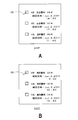
- a “deposit card” shown in FIG. 13 is printed out from the printer 406 of the register 40 as a deposit certificate. Is preferred. In the case of a suspect ticket, if it is later certified as a genuine ticket, a considerable amount of refund will be required, and depending on the law, a considerable amount of refund may be made to customers according to the collection of fake tickets. It is.
- the display unit 402 of the register 40 handles the counterfeit or suspect ticket after handling (how to proceed with the checkout process and how to notify the police). Is also displayed, the subsequent response of the store clerk and / or customer proceeds smoothly, so that it is preferable that the waiting time of the cash register of other customers lined up after the customer is suppressed.
- the display unit 402 of the register 40 provides guidance for confirming the customer identification information. For example, when the customer is registered as a member of the store, prompting the user to input a member number from the keyboard 404 quickly records the information of the customer who accepted the request for cooperation in collecting a fake ticket. be able to. However, it may be guidance that prompts recording of credit card information or cash card information, or guidance that prompts recording of a name or the like.
- step S310 when the register 40 is provided with a payment processing unit for performing card payment processing as shown in FIG. 10, for example, in step S310, step S411, or step S415, the difference is replaced instead of re-inserting / adding money. It may be displayed on the display unit 402 of the register 40 that the card payment can be selected. In addition, a debit card settlement can be adopted as a settlement method (settlement method) for the difference.
- the counterfeit or suspect ticket is always taken into the cash settlement apparatus 11.
- the store clerk does not attend the deposit operation to the cash settlement apparatus 11 (customer operation mode)
- a fake or suspect ticket must be used. While it is set to be taken into the cash settlement apparatus 11, on the other hand, when a clerk can attend the deposit operation to the cash settlement apparatus 11 (a clerk operation mode), the counterfeit or suspect ticket should be rejected outside the apparatus. May be preferred.
- the acceptance refusal information output from the cash settlement apparatus is displayed on the display part of the register which a clerk operates, the clerk rather than the customer displays acceptance refusal information. It can be easily confirmed. Thereby, it can be expected that the store clerk appropriately prompts the customer for the subsequent re-settlement process, and as a result, the settlement process can be accelerated.
- waiting time at a cash register is a factor directly linked to store reputation, so speeding up the settlement process is an extremely important effect.
- the store clerk can easily confirm the acceptance refusal information, it is not always necessary to reject the money that cannot be accepted, that is, the money that cannot be accepted can be dealt with more flexibly.
- a cash settlement apparatus or cash accounting apparatus in a store, when the storage section becomes full with money, or the storage section becomes empty, the store clerk is in charge of the police company (CIT (Cash In Transit)), the police company collects the money in the cash settlement apparatus or the cash accounting apparatus or replenishes the cash settlement apparatus or the cash accounting apparatus.
- CIT Cash In Transit
- the police company collects the money in the cash settlement apparatus or the cash accounting apparatus or replenishes the cash settlement apparatus or the cash accounting apparatus.
- a store often requests the police company to continuously collect and replenish money.
- a store often makes a contract with a police company and requests the police company to collect and replenish money.
- the clerk had previously requested the collection and replenishment of money, even though other police companies could actually collect and replenish the money cheaper or sooner. I will contact you. For example, if a money transport vehicle of another police company passes near a store, the other police company will give money faster and cheaper than the police company that has previously requested collection and replenishment of money. May be able to be recovered or
- the cash management system can reduce the cost for collecting or replenishing money at the store that requests collection or replenishment of money, and can shorten the time. For the carrier side who performs replenishment, money can be collected or replenished efficiently and at low cost.
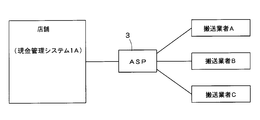
- FIG. 14 is a conceptual diagram showing a connection relationship between the cash management system 1A and the systems of the carriers A to C according to the third embodiment of the present invention.
- the cash management system 1A is a system that processes and manages money (cash) received by a clerk from a customer and money (cash) paid by the clerk to the customer.
- Carriers A to C are agents that replenish money to the cash management system 1A or transport money to collect money from the cash management system 1A.
- the carrier may be any person who transports money to the store or transports money from the store, and the business form is not particularly limited. Accordingly, the carrier may be a security company, a financial institution, a security company (CIT (Cash In Transit)), or the like.
- the cash management system 1A and the carriers A to C are connected to each other via a network so as to communicate with each other.
- the network may be any network that connects the cash management system 1A and the carriers A to C so that they can communicate with each other.
- the Internet an intranet, a LAN (Local Area Network), or a telephone line may be used. .
- the form of the system of the carrier A to C is not particularly limited, but it must be an environment that can receive at least information (for example, e-mail) transmitted from the store and transmit the information to the store. .
- FIG. 15 is a block diagram illustrating a configuration example of the cash management system 1A.
- the cash management system 1A is provided with a cash settlement apparatus 11, a cash accounting apparatus 21, a cash management apparatus 25, and a POS management apparatus 26. .
- the checkout counter 10 is provided with one or a plurality of cash settlement apparatuses 11 that perform settlement with customers by depositing and withdrawing money.
- the checkout counter 10 is provided with three cash settlement apparatuses 11.
- the cash settlement apparatus 11 is connected to, for example, a POS register operated by a store clerk or a self-checkout register operated by a customer.
- the cash settlement apparatus 11 may be integrated with a POS register or a self-checkout register.
- the back office 20 is provided with a cash accounting apparatus 21, a cash management apparatus 25, and a POS management apparatus 26.
- the cash accounting apparatus 21 is connected to the cash settlement apparatus 11 so as to be communicable. For example, the cash accounting apparatus 21 withdraws change reserves for loading into the cash settlement apparatus 11 or collects the sales collected from the cash settlement apparatus 11. Deposit money.
- the cash management device 25 is communicably connected to the cash settlement apparatus 11 and the cash accounting apparatus 21 via a LAN or the like.
- the cash management device 25 manages money stored in the cash settlement apparatus 11 and the cash accounting apparatus 21.
- the cash management apparatus 25 manages the money that has been settled in each of the cash settlement apparatuses 11 and the money exchanged between the cash settlement apparatus 11 and the cash accounting apparatus 21.
- the cash management device 25 is configured to transmit various information to the systems of the carriers A to C via the network, or to receive various information from the systems of the carriers A to C. Has been.
- the cash collection apparatus 21 collects money from the cash settlement apparatus 11 or replenishes the cash settlement apparatus 11 with money. Accordingly, the carriers A to C collect money from a safe provided separately from the cash accounting apparatus 21 or the cash management system 1, or replenish money to the cash accounting apparatus 21 or the safe.
- POS management device 26 manages the flow of goods. Since the flow of merchandise is not directly related to the present embodiment, a detailed description of the POS management device 26 is omitted here.
- FIG. 16 is a block diagram showing another configuration example of the cash management system according to the third embodiment.
- the cash management system shown in FIG. 16 is a system used in a relatively small store.
- This cash management system includes one cash settlement apparatus 11 and a cash management apparatus 25 that manages the cash settlement apparatus 11.
- the cash settlement apparatus 11 and the cash management apparatus 25 may have the same configurations as those shown in FIG.
- a single cash settlement apparatus 11 may be provided, or a plurality of cash settlement apparatuses 11 may be provided.
- the carriers A to C collect money directly from the cash settlement apparatus 11 or a safe provided separately from the cash settlement apparatus 11, or The money is directly added to the cash settlement apparatus 11 or the safe.
- the cash management system may have a form in which only the cash accounting apparatus 21 is connected to the cash management apparatus 25.
- the carriers A to C collect or replenish money from the cash accounting apparatus 21 or the safe.
- each cash settlement apparatus 11 includes a bill settlement apparatus 12 and a coin settlement apparatus 13.
- the coin settlement apparatus 13 performs settlement processing by depositing and dispensing coins.
- the bill settlement apparatus 12 performs settlement processing by depositing and withdrawing bills.
- the banknote settlement apparatus 12 includes a housing 100a, a depositing unit 110a, and a dispensing unit 120a (see FIG. 2).
- the depositing unit 110a is provided to insert banknotes received from customers.
- the withdrawal unit 120a is provided to throw out change bills.
- the coin settlement apparatus 13 includes a housing 100b, a depositing unit 110b, and a dispensing unit 120b.
- the depositing unit 110b is provided for inserting coins received from customers.
- the withdrawal unit 120b is provided to throw out change coins.
- FIG. 17 is a block diagram illustrating a configuration example of the cash settlement apparatus 11.
- the cash settlement apparatus 11 further includes a transport unit 130, an identification unit 140, a storage unit 150, a memory 170, a communication unit 180, and a control unit 190.
- This cash settlement apparatus 11 is the same as that in which the cassette mounting portion 160 is omitted from the configuration shown in FIG. It is good also as a structure which provided the cassette mounting part 160 in the cash settlement apparatus 11.
- the transport unit 130 transports money put into the depositing unit 110 to the storage unit 150, or transports money thrown out from the withdrawal unit 120 from the storage unit 150.
- the identification unit 140 is configured to detect the denomination, authenticity, correctness, old and new, quantity, etc., of money being conveyed by the conveyance unit 130.
- the identification unit 140 includes a sensor such as an image sensor or a magnetic sensor.
- the storage unit 150 is configured to store the money identified by the identification unit 140 for each denomination.
- the storage section 150 may be a stack-type storage section that stacks and stores each banknote for each denomination, or each banknote is sandwiched between a plurality of tapes for each denomination. It may be a plurality of tape reel type storage units wound together with banknotes.
- the memory 170 includes a ROM (Read Only Memory) or a HDD (Hard Disk Drive) for storing various programs and data for controlling the cash settlement apparatus 11, and a RAM (Random for a program load area and a work area at the time of program execution) Includes Access Memory).
- the memory 170 also stores information (denomination, quantity, etc.) of money stored in the storage unit 150 and the money transport cassette 30. Furthermore, the memory 170 may store the quantity of money identified by the identification unit 140 for each denomination.
- the communication unit 180 is communicably connected to other devices (cash accounting device 21, cash management device 25, POS management device 26) constituting the cash processing system 1A.
- the control unit 190 is an arithmetic processing unit configured to execute the program in the memory 170 to control the entire cash settlement apparatus 11.
- the cash settlement apparatus 11 can store the money inserted into the depositing unit 110 in the storage unit 150, and conversely, can throw out the money stored in the storage unit 150 into the dispensing unit 120. That is, the cash settlement apparatus 11 is configured to be able to reuse the deposited money for withdrawal.
- the cash accounting apparatus 21 can store money in the storage unit 150, and stores the money put into the depositing unit 150 in the storage unit 150, and conversely in the storage unit 150. It is configured so that the deposited money can be dispensed to the withdrawal unit. That is, as with the cash settlement apparatus 11, the cash accounting apparatus 21 is configured to be able to reuse the deposited money for withdrawal. Since the basic configuration of the cash accounting apparatus 21 is the same as that of the cash settlement apparatus 11, the description of the cash accounting apparatus 21 is omitted here.
- FIG. 18 is a block diagram illustrating a configuration example of the cash management apparatus 25.
- the external appearance of the cash management device 25 may be the same as that of a general PC (Personal Computer), and therefore the illustration of the external appearance is omitted here.
- the cash management device 25 includes a memory 270, a communication unit 280, a control unit 290, a display unit 295, and an operation unit 297.
- the memory 270 includes a ROM or HDD for storing various programs and data for controlling the cash management apparatus 25, a RAM serving as a work area during program execution, and a program load area.
- the memory 270 also stores information (denomination, quantity, etc.) of money stored in the storage unit 150 of the cash settlement apparatus 11.
- the memory 270 further stores cash amount management software for managing the money amount stored in the cash settlement apparatus 11 and the cash accounting apparatus 21.
- the inventory management software collects money in the storage unit 150 or replenishes the storage unit 150 with money
- the inventory management software sends an estimate request notification requesting an estimate of money collection or replenishment to a plurality of carriers A to A. It is configured to transmit to the C system.
- the cash management software is configured to transmit a collection / replenishment request notification requesting the collection or replenishment of money to any one of the carriers A to C selected by the operator. .
- the estimate request notification and the collection / replenishment request notification are e-mails, for example, and their contents are stored in the memory 270 in advance.
- the estimate request notification includes information such as the location of the store, the e-mail address of the store, the amount of money to be collected or supplemented, the denomination and the quantity.
- the collection / replenishment request notification may include the same information as the information of the quotation request notification, or may simply be a notification indicating the content requested for collection or replenishment.
- the carrier may refer to information necessary for the collection or replenishment process included in the estimate request notification.
- the memory 270 stores information (for example, e-mail addresses) of a plurality of carriers A to C in advance.
- the information of the plurality of carriers A to C may be registered in advance by the operator, or may be prepared in advance in the initial setting of the cash management software installed in the cash management device 25.
- the communication unit 280 is communicably connected to other devices (the cash settlement apparatus 11, the cash accounting apparatus 25, the POS management apparatus 26) constituting the cash processing system 1A.
- the communication unit 280 manages the amount of money stored in the storage unit 150 that stores money, collects money in the storage unit 150, or replenishes money into the storage unit 150. It also functions as an interface that is communicably connected to the systems of traders A to C.
- the control unit 290 is an arithmetic processing unit configured to execute the program in the memory 270 and control the cash accounting apparatus 21 as a whole.
- the control unit 290 is configured to execute the inventory management software.
- the display unit 295 receives money from the cash settlement apparatus 11 and the cash accounting apparatus 21, the status of the cash settlement apparatus 11 and the cash accounting apparatus 21 (for example, near-full status / near empty status, etc.), and received from the carriers A to C. It is configured to display various information such as information.
- the operation unit 297 is a keyboard or the like on which an operator can input various instructions.
- the operation unit 297 is provided with an estimate request transmission button 298 that transmits an estimate request notification to the systems of the carriers A to C.
- an estimate request transmission button 298 When the operator presses an estimate request transmission button 298, the cash management apparatus 25 transmits an estimate request notification as a broadcast mail to a plurality of preset systems of the carriers A to C.
- the display unit 295 may be a touch panel monitor. In this case, since the display unit 295 also has the function of the operation unit 297, the operator can input various instructions to the cash management apparatus 25 using the display unit 295.
- the estimate request transmission button 298 may be displayed on the screen of the display unit 295 as a touch panel monitor. The operator can send an estimate request notification as a broadcast mail to the systems of the carriers A to C by touching an estimate request transmission button 298 on the screen of the display unit 295.
- FIG. 19 is a conceptual diagram showing the operation of the cash management system 1A according to the third embodiment.
- FIG. 20 is a flowchart showing the operation of the cash management system 1A according to the third embodiment.
- movement which collects the money in the cash settlement apparatus 11 shown in FIG. 15, or replenishes money in the cash settlement apparatus 11 as a specific example is demonstrated.
- the operation of collecting money in the cash accounting apparatus 21 or safe shown in FIG. 15 or replenishing money in the cash accounting apparatus 21 or safe can be easily understood from the following description, and will not be described. .
- the money in the storage unit 150 of the cash settlement apparatus 11 increases and the near full state is reached, the money in the storage unit 150 needs to be collected. Further, the amount of money in the storage unit 150 is normally automatically detected by a sensor or a number counter (not shown) and managed by the cash management device 25. The capacity of the storage unit 150 is predetermined. The display unit 295 displays the capacity of the storage unit 150 and the amount of money in the storage unit 150. Therefore, the operator can determine the near-full state or the near-empty state by confirming the amount of money in the storage unit 150 displayed on the display unit 295 of the cash management device 25.
- the operator When the operator confirms the amount of money in the storage unit 150 and determines that the money needs to be collected or replenished, the operator presses an estimate request transmission button 298 (S10).
- the cash management apparatus 25 displays a screen that prompts the user to select either collection or replenishment according to the operation of the estimate request transmission button 298 (S20).
- the operator operates the operation unit 297 to select either collection or replenishment.
- the cash management device 25 automatically transmits an estimate request notification to the plurality of carriers A to C stored in the memory 270 according to the operator's selection (S40).
- the estimate request notification includes information such as the location of the store, the e-mail address of the store, the amount of money to be collected or supplemented, the denomination and the quantity. Since the cash management device 25 manages the amount of money in the storage unit 150 of the cash settlement apparatus 11, information on the amount, denomination and quantity of money to be collected or replenished is automatically included in the estimate request notification. be able to.
- the control unit 290 of the cash management apparatus 25 subtracts a predetermined number from the stock of the storage unit 150 of the cash settlement apparatus 11.
- the amount of money collected is set in this subtraction result.
- the predetermined number is the quantity of money (change reserve) to be left in the storage unit 150 for use in change or the like.
- the cash management device 25 can set an extra amount of money to be collected while leaving a change reserve by subtracting a predetermined number from the stock of the storage unit 150.
- the control unit 290 of the cash management apparatus 25 subtracts the stock of the storage unit 150 of the cash settlement apparatus 11 from the predetermined number.
- the quantity of money to be replenished is set in this subtraction result.
- the predetermined number may be the amount of change reserve.
- the cash management apparatus 25 can set the shortage of money to be replenished to reach the change reserve by subtracting the stock amount of the storage unit 150 from the predetermined number.
- the predetermined number is stored in the memory 270 in advance.
- the amount, denomination and quantity of money to be collected or supplemented by the operator may be arbitrarily set.
- the operator inputs the money amount, denomination and quantity to be collected or replenished using the operation unit 297.
- the carrier manages the position and travel route of the transport vehicle that transports money. Therefore, if the travel route of the transport vehicle is close to the store that sent the estimate request notification, the transporter having the transport vehicle can collect or replenish money earlier and cheaper than other transporters. is there. Conversely, if the travel route of any transport vehicle is far from the store that sent the request for quotation, the transporter will be more expensive to collect or replenish money than other transporters and collect or The replenishment date will also be delayed. In addition, it is considered that a carrier who has pioneered a new customer sets an estimate reply notification so as to collect or replenish money earlier and cheaper than other carriers.
- the contents of the estimate reply notification from the carriers A to C differ depending on various situations of the carriers A to C.
- the conditions such as the travel route of the transport vehicle, the type of transport vehicle (for example, armored car or regular car), the number of transported personnel, etc. are managed in the transporter's system, and the estimated response is notified based on these conditions. It is possible to reply automatically.
- the employees of the carriers A to C may input the cost of collecting or replenishing money and the date and time according to the above situation, and send an estimate reply notification.
- the store-side cash management device 25 When the store-side cash management device 25 receives the estimate response notification from the systems of the plurality of carriers A to C (S70), it displays the content of the estimate response notification on the display unit 295 (S80).
- the estimate response notification includes at least a carrier name, cost information for collecting or replenishing money, and date and time information for collecting or replenishing money. Accordingly, the display unit 295 displays the respective estimated answer notifications of the plurality of carriers A to C in the order of the low cost for collecting or replenishing money, or in the order of the date and time when the money is collected or replenished. Thereby, the operator can easily select a carrier having a low cost or a carrier having an early date of collection or loading.
- the cash management device 25 may be set in advance so as to automatically select a carrier having the lowest cost. In this case, after receiving the estimate reply notification from the system of the carrier A to C, the cash management device 25 automatically selects the carrier having the lowest cost and automatically issues a collection / replenishment request notification to the selected carrier. Can be sent. Thereby, an operator can save time and labor for selecting a carrier in cash management device 25.
- the cash management device 25 may be set in advance so as to automatically select the carrier with the earliest date of collection or replenishment. Also in this case, after receiving the estimate reply notification from the system of the carrier A to C, the cash management device 25 automatically selects the carrier with the lowest cost and sends a collection / replenishment request notification to the selected carrier. Can be sent automatically. Thereby, an operator can save time and labor for selecting a carrier in cash management device 25.
- the cash management device 25 transmits a collection / replenishment request notification to the selected carrier (S90). That is, when the operator operates the operation unit 298 to select an arbitrary carrier, the cash management device 25 automatically transmits a collection / replenishment request notification stored in advance in the memory 270 to the selected carrier. To do. In the example illustrated in FIG. 7, the operator selects the carrier C, and the cash management apparatus 25 transmits a collection / replenishment request notification to the carrier C.
- the collection / replenishment request notification is a notification having contents for requesting collection or replenishment as described above.
- the collection / replenishment request notification includes information such as the location of the store where the money is to be collected or replenished, the amount of money to be collected or replenished, the denomination or the quantity.
- the system of the carrier C receives the collection / replenishment request notification (S100). Then, the carrier C collects the money in the storage unit 150 of the cash settlement apparatus 11 of the store based on the contents of the collection / replenishment request notification or replenishes the storage unit 150 with money (S110).
- the collection / replenishment request notification does not necessarily include information such as the location of the store where the money is to be collected or replenished, the amount of money to be collected or replenished, the denomination or the quantity. In this case, the carrier C may collect or replenish money based on the contents of the estimate request notification.
- the cash management apparatus 25 of the cash management system 1A allows a plurality of estimation request notifications to be performed with a simple operation when it is necessary to collect money in the storage or to replenish money in the storage.
- an estimate reply notification is received from the system of the carrier A to C.
- the cash management device 25 displays an estimate reply notification obtained from the systems of the carriers A to C on the display unit, and transmits a collection / replenishment request notification to the carrier selected by the operator.
- the store clerk (requester) requesting the collection or replenishment of money can easily obtain estimates for a plurality of carriers in real time when necessary, and can obtain estimates for a plurality of carriers. Can be easily compared.
- the client can reduce the cost for collecting or replenishing money, or can collect or replenish money quickly.
- the client can select a desired carrier.
- the carrier can send an estimate reply notification according to the situation such as the route of the carriage, the amount of money to be collected or supplemented, and the like. Therefore, the carrier can efficiently collect money or replenish money efficiently. This reduces the cost of collecting or replenishing money on the carrier side. It also leads to the development of new customers for the carrier.
- the cash management device 25 automatically detects the near empty state when the money in the storage unit 150 falls below the first predetermined value, and the money in the storage unit 150 The near-full state may be automatically detected when a predetermined value of 2 is exceeded.
- the first predetermined value is a value close to empty and is a value set in advance for requesting replenishment.
- the first predetermined value is stored in the memory 170 or 270 in advance.
- the second predetermined value is a value close to full, and is a value set in advance to request collection.
- the second predetermined value is also stored in the memory 170 or 270 in advance.
- the cash management device 25 When the cash management device 25 detects a near empty state or a near full state, the cash management device 25 automatically transmits an estimate request notification to the systems of a plurality of carriers A to C. Thereby, the cash management apparatus 25 can automatically transmit an estimate request notification without waiting for the operator's judgment. The operator does not need to determine the near-full state or the near-empty state, and does not need to make a recovery or refill selection. Accordingly, the estimate request transmission button is not required in the cash management apparatus 25, and it is not necessary to execute steps S10 to S20 in FIG. As a result, the operability of the cash management system 1A is further improved.
- FIG. 21 is a conceptual diagram showing a connection relationship between a cash management system 1A and the systems of carriers A to C according to a fourth embodiment of the present invention.
- FIG. 22 is a conceptual diagram showing the contents of the cash amount information uploaded to the ASP server.
- FIG. 23 (A) and FIG. 23 (B) are conceptual diagrams showing the contents of the collection or replenishment proposal uploaded to the ASP server.
- FIG. 24 is a flowchart showing the operation of the cash management system according to the fourth embodiment. The cash management system 1 according to the fourth embodiment will be described with reference to FIGS. 21 to 24.
- the cash management system 1A is communicably connected to the systems of carriers A to C via an ASP (Application Service Provider) server 3.
- the ASP server is an external server that can be accessed by the cash management system 1A and the carriers A to C.
- the cash management device 25 uploads the money amount information in the storage unit 150 of the cash settlement apparatus 11 to the ASP server 3 and updates the money amount information regularly (for example, every 20 minutes) (S11).
- the carriers A to C access the ASP server 3 and confirm (download) the amount of money in the storage unit 150 of the cash settlement apparatus 11 at the store side in real time (S21). At this time, the carriers A to C can obtain the location information of each store and the amount of money in each store as shown in FIG.
- the amount of money in the storage unit 150 of the cash settlement apparatus 11 is 80% of the full state.
- the carriers A to C determine that the storage unit 150 is in a near-full state and submit a collection proposal (as an estimate response notification) to the ASP server. Upload to.
- store T it turns out that the amount of money of the storage part 150 of the cash settlement apparatus 11 is only 10% with respect to a full state.
- the carriers A to C determine that the storage unit 150 is in the near empty state, and make a replenishment proposal (as an estimate response notification) to the ASP. Upload to the server (S31).
- the proposal for collection or replenishment includes at least cost information for collecting or replenishing money and date and time information for collecting or replenishing money, as in the case of the estimate reply notification.
- Carriers A to C present suggestions for collection or replenishment according to their own circumstances. For example, when the travel route of the transport vehicle is far from the store S or T, the cost of collection or replenishment becomes high, or the date and time of collection or replenishment becomes late. Also, if the amount of money loaded on the transport vehicle exceeds a predetermined amount (for example, 30000 euros) when collection is performed and an armored car and three or more people are required, the cost of collection is still high. Become. On the other hand, when the travel route of the transport vehicle is close to the store S or T, the cost of collection or replenishment becomes low, or the date and time of collection or replenishment becomes early.
- a predetermined amount for example, 30000 euros
- the proposals for collection or replenishment of each carrier A to C differ depending on the situation.
- the conditions such as the travel route of the transport vehicle, the type of the transport vehicle (for example, an armored car or a normal vehicle), the number of transported personnel, and the like are managed in the transporter system. Therefore, the collection or replenishment proposal can be automatically uploaded to the ASP server based on the status of each carrier A to C. Since the situation of each carrier A to C changes every predetermined period (for example, every day or every hour), the proposal for collection or replenishment in the ASP server is also made every predetermined period (for example, , Every 20 minutes).
- FIG. 23A shows a specific example of a proposal for collection.
- FIG. 23B shows a specific example of the replenishment proposal.
- the contents of the collection or replenishment proposal shown in FIG. 23 (A) and FIG. 23 (B) are obtained when the store clerk of the store S or T pushes an estimate request button provided in the cash management apparatus 25 (S41). Are downloaded to the cash management apparatus 25 and displayed on the display unit 295 of the cash management apparatus 25 (S42).
- the traveling route of the carrier vehicle of the carrier A is close to the store S, and the amount of money loaded on the carrier vehicle is equal to or less than a predetermined amount (for example, 10,000 euros). .
- a predetermined amount for example, 10,000 euros.
- the collection cost presented by the carrier A is the lowest among the carriers A to C, for example, 25 euros.
- the traveling route of the carrier vehicle of the carrier B is far from the store S, but the amount of money loaded on the carrier vehicle is equal to or less than a predetermined amount (for example, 10,000 euros). For this reason, the collection time presented by the carrier B is the latest among the carriers A to C, for example, 17:40.
- the collection cost presented by the carrier B is higher than the collection cost presented by the carrier A, for example, 30 euros.
- carrier B since carrier B does not need an armored car and more than three people, it is cheaper than the collection cost presented by carrier C.
- the travel route of the carrier vehicle of the carrier C is close to the store S, and the amount of money mounted on the carrier vehicle is a predetermined amount or more (for example, 50000 euros). For this reason, the carrier C needs to transport money with three or more personnel using an armored car. Therefore, although the collection time is early, the collection cost presented by the carrier C is the highest among the carriers A to C, for example, 90 euros.
- the display unit 295 displays collection proposals in the order of low collection costs.
- the store clerk of the store S confirms the collection proposal on the ASP server on the display unit 295 of the cash management device 25.
- the store clerk of the store S selects the carrier A with the cursor CS using the operation unit 297 (S51).
- the cash management apparatus 25 automatically transmits the collection request notification stored in the memory 270 in advance to the selected carrier A (S61).
- the collection request notification includes the same information as the collection / replenishment request notification.
- the system of the carrier A receives the collection request notification (S71). And the carrier A collect
- the traveling route of the carrier vehicle of the carrier B is close to the store S, and the amount of money loaded on the carrier vehicle is equal to or less than a predetermined amount (for example, 10,000 euros). .
- a predetermined amount for example, 10,000 euros.
- the replenishment time presented by the carrier B is the earliest among the carriers A to C, for example, 9:00.
- the replenishment cost presented by the carrier B is higher than the replenishment cost presented by the carrier A, for example, 30 euros.
- carrier B does not require an armored car and more than three people, it is cheaper than the replenishment cost presented by carrier C.
- the travel route of the carrier vehicle of the carrier A is far from the store S, and the amount of money loaded on the carrier vehicle is a predetermined amount or more (for example, 50000 euros). For this reason, it is necessary for the carrier A to transport money with three or more personnel using an armored car. Therefore, the replenishment cost presented by the carrier A is the highest among the carriers A to C, for example, 90 euros.
- the travel route of the transport vehicle of the carrier C is close to the store S, and the amount of money loaded on the transport vehicle is equal to or less than a predetermined amount (for example, 10,000 euros). Since the traveling route of the transport vehicle is close to the store S, the transporter C can efficiently replenish money. Accordingly, the replenishment cost presented by the carrier C is the lowest among the carriers A to C, for example, 25 euros. However, the replenishment time presented by the carrier C is the latest among the carriers A to C, for example, 15:30.
- the display unit 295 displays replenishment proposals in the order of early replenishment time.
- the store clerk of the store S confirms the replenishment proposal on the ASP server on the display unit 295 of the cash management device 25.
- the store clerk of the store S selects the carrier B with the cursor CS using the operation unit 297 (S51).
- the cash management apparatus 25 automatically transmits the replenishment request notification stored in advance in the memory 270 to the selected carrier B (S61).
- the replenishment request notification includes the same information as the collection / replenishment request notification.
- the system of the carrier B receives the replenishment request notification (S71). Then, the carrier B replenishes the money in the storage unit 150 of the cash settlement apparatus 11 in the store based on the content of the replenishment request notification (S81).
- the cash management device 25 of the cash management system 1A periodically uploads the money amount information of the storage 150 to the ASP server, and refers to the money amount information on the ASP server.
- the system of the transporters A to C uploads the proposal of collection or replenishment to the ASP server as an estimate reply notification.
- the cash management device 25 receives the proposal for collection or supplement on the ASP server, displays the contents of the proposal for collection or supplement on the display unit 295, and the store clerk selects one of the carriers A to C. select.
- the cash management device 25 transmits a collection / replenishment request notification to the selected carrier, and the carrier performs collection or supplementation based on the collection / replenishment request notification.
- the carrier can check the amount of money on the store side in real time, and can present a collection or replenishment proposal from the carrier to the store side.
- a store clerk can obtain a proposal for collection or replenishment of a plurality of carriers in real time when necessary, and can easily compare the estimates of a plurality of carriers.
- the fourth embodiment can obtain the same effects as those of the third embodiment.
- the present invention is not limited to the above-described embodiment as it is, and can be embodied by modifying constituent elements without departing from the scope of the invention in the implementation stage.
- various inventions can be formed by appropriately combining a plurality of components disclosed in the embodiment. For example, some components may be deleted from all the components shown in the embodiment.
- constituent elements over different embodiments may be appropriately combined.
Landscapes
- Business, Economics & Management (AREA)
- Physics & Mathematics (AREA)
- General Physics & Mathematics (AREA)
- Accounting & Taxation (AREA)
- Finance (AREA)
- Strategic Management (AREA)
- General Business, Economics & Management (AREA)
- Engineering & Computer Science (AREA)
- Theoretical Computer Science (AREA)
- Development Economics (AREA)
- Economics (AREA)
- Cash Registers Or Receiving Machines (AREA)
Abstract
精算システム2は、顧客からの預かり金の少なくとも一部に対応する情報の手入力を受けつける受付部と、購入商品の合計金額、及び前記受付部を介して手入力された手入力情報を現金精算装置11へ送信する送信部と、を有するレジスタ40と、投入された貨幣を識別及び計数して投入金額を算出し、前記投入金額とレジスタ40から受信した前記手入力情報とを用いて顧客からの預かり金の総額を算出し、前記総額及びレジスタ40から受信した前記合計金額に基づいて釣銭額を算出し、釣銭貨幣を出金する現金精算装置11とを備えている。
Description
本発明は、手入力された入金額をレジスタから受け取り、釣銭額を算出して釣銭貨幣を出金する現金精算装置を備えた精算システム、この精算システムを用いた精算方法、及び現金精算装置に関する。
スーパーマーケットやコンビニエンスストア等の店舗には、紙幣及び硬貨の入金処理及び出金処理を行う現金精算装置と、顧客の購入商品の登録を行って売上金額を算出するPOS(Point Of Sale)レジスタとを備えた精算システムが設けられている。
このような精算システムを用いた精算処理の一例としては、まず、POSレジスタが売上金額を算出し、現金精算装置に通知する。現金精算装置は、顧客からの預かり金が投入されると、識別及び計数を行う。そして、現金精算装置は、顧客からの預かり金の総額から、POSレジスタから通知された売上金額を減じて釣銭額を算出し、釣銭を出金していた。
顧客からの預かり金の貨幣に現金精算装置が受け付けないリジェクト貨幣が含まれていた場合、POSレジスタを操作して、当初算出していた売上金額から、リジェクト貨幣の分の金額を差し引いて売上金額を変更し、変更後の売上金額を現金精算装置に通知していた。しかし、売上金額を変更するため、上位機で管理している売上金額と、現金精算装置に収納されている貨幣の金額とが一致しなくなるという問題があった。
特許文献1には、現金精算装置(釣銭機)と、現金精算装置に受け付けられなかった貨幣の金額が手入力される手入力受付手段を有するPOSレジスタと、を備えたシステムが開示されている。このシステムを用いた精算処理では、現金精算装置が、投入金額をPOSレジスタに通知する。POSレジスタは、手入力受付手段を介して手入力された手入力金額と、現金精算装置から通知された投入金額とを加算して顧客からの預かり金の総額を算出し、預かり金の総額から売上金額を減じて釣銭額を算出し、現金精算装置に釣銭の出金を指示していた。
このように、特許文献1のシステムでは、顧客からの預かり金の貨幣に現金精算装置が受け付けないリジェクト貨幣が含まれていても、POSレジスタにおいて売上金額を変更する必要がなかった。しかし、このような精算処理を行うためには、現金精算装置から通知される投入金額の受信、顧客からの預かり金の総額や釣銭額の算出、現金精算装置への釣銭出金指示などの多くの機能を有するPOSレジスタを設ける必要がある。そのため、コストが高く、店舗への導入が困難であるという問題があった。
本発明は、顧客からの預かり金にリジェクト貨幣が含まれていてもレジスタにおける売上金額を変更することなく精算処理を行うことができ、かつ装置コストを抑えた精算システムを提供することを目的とする。
本発明の一態様による精算システムは、貨幣の入金処理及び出金処理を行う現金精算装置と、購入商品の登録及び合計金額の算出を行うレジスタと、を備える精算システムであって、前記レジスタは、顧客からの預かり金の少なくとも一部に対応する情報の手入力を受けつける受付部と、前記購入商品の合計金額と、前記受付部を介して手入力された手入力情報とを前記現金精算装置へ送信する送信部と、を有し、前記現金精算装置は、投入された貨幣を識別及び計数して投入金額を算出し、前記投入金額と前記レジスタから受信した前記手入力情報とを用いて顧客からの預かり金の総額を算出し、前記総額及び前記レジスタから受信した前記合計金額に基づいて釣銭額を算出し、釣銭貨幣を出金するものである。
本発明の一態様による精算システムにおいては、前記現金精算装置は、前記投入金額を前記レジスタに通知し、前記レジスタは、前記合計金額から前記投入金額を減じた金額のカード決済処理を行う決済処理部を有することが好ましい。
本発明の一態様による精算システムにおいては、前記手入力情報は、前記現金精算装置に受け付けられなかったリジェクト貨幣の金種情報を含むことが好ましい。
本発明の一態様による精算システムにおいては、前記現金精算装置は、前記投入金額と、前記手入力情報とを区別して外部出力することが好ましい。
本発明の一態様による精算システムにおいては、前記現金精算装置は、投入された貨幣を識別する第1モードと、投入された貨幣を識別せずに受け付ける第2モードとを切り替えて設定できることが好ましい。
本発明の一態様による精算システムにおいては、前記現金精算装置は、前記第1モードの設定時に識別された貨幣を収納する第1収納部と、前記第2モードの設定時に投入された貨幣を収納する第2収納部と、を有することが好ましい。
本発明の一態様による精算方法は、現金精算装置及びレジスタを用いる精算方法であって、前記レジスタが、購入商品の合計金額を算出し、前記合計金額を前記現金精算装置へ送信する工程と、前記現金精算装置が、投入された貨幣を識別及び計数して投入金額を算出する工程と、前記レジスタが、顧客からの預かり金の少なくとも一部に対応する情報の手入力を受けつけ、手入力情報を前記現金精算装置へ送信する工程と、前記現金精算装置が、前記投入金額と前記レジスタから受信した前記手入力情報とを用いて顧客からの預かり金の総額を算出し、前記総額及び前記レジスタから受信した前記合計金額に基づいて釣銭額を算出し、釣銭貨幣を出金する工程と、を備えるものである。
本発明の一態様による現金精算装置は、貨幣の入金処理及び出金処理を行う現金精算装置であって、購入商品の合計金額の算出及び顧客からの預かり金の少なくとも一部に対応する情報の手入力の受け付けを行うレジスタから、前記合計金額と、手入力された手入力情報とを受信する受信部と、投入された貨幣を識別及び計数して投入金額を算出し、前記投入金額及び前記レジスタから受信した前記手入力情報を用いて顧客からの預かり金の総額を算出し、前記総額及び前記レジスタから受信した前記合計金額に基づいて釣銭額を算出する算出部と、前記釣銭額に基づいて釣銭貨幣を出金する出金部と、を備えるものである。
本発明の一態様により精算システムは、貨幣の入金処理及び出金処理を行う現金精算装置と、購入商品の登録及び合計金額の算出を行うレジスタと、を備えた精算システムであって、前記現金精算装置は、投入された貨幣を識別し、受け付けできない貨幣について受付拒否情報を生成して前記レジスタに出力するようになっており、前記レジスタは、前記現金精算装置から出力された受付拒否情報を表示する表示部を有している。
なお、レジスタの表示部は、レジスタ本体に搭載されていてもよいし、レジスタ本体に隣接するように設けられてもよいし、顧客からも視認できるいわゆるカスタマーディスプレイとして構成されていてもよい。あるいは、いわゆるセルフ精算が採用されるシステムにおいては、現金精算装置から離れた場所に設置されるアテンダントステーションディスプレイとして構成されていてもよい。
受け付けできない貨幣としては、特に偽券またはサスペクト券が重要である。従って、前記現金精算装置は、投入された貨幣を識別し、偽券またはサスペクト券について、受付拒否情報として偽券情報またはサスペクト券情報を生成して前記レジスタに出力するようになっていることが好ましい。
この場合、前記レジスタの表示部は、偽券またはサスペクト券の取り扱い方法についても、表示するようになっていることが好ましい。例えば、前記レジスタの表示部は、顧客の身分証明情報の確認を行うようにガイダンスするようになっていることが好ましい。偽券またはサスペクト券を回収する場合には、当該貨幣(偽券またはサスペクト券)と当該貨幣を入金した顧客の情報とを紐付けしておくことが必要であるため、顧客の身分証明情報の確認を行うことは重要である。
また、前記レジスタの表示部は、別の精算方法を促すようにガイダンスするようになっていることが好ましい。例えば、別の貨幣で精算することや、デビットカードで精算することや、クレジットカードで精算すること等が、促され得る。
また、前記現金精算装置が、店員操作モードであれば、受け付けできない貨幣を装置外にリジェクトすると共に、顧客操作モードであれば、受け付けできない貨幣を装置内に取り込むようになっていることが好ましい。この場合、偽券またはサスペクト券を確実に回収することが可能となるので、ユーロ圏において近い将来に導入される可能性がある法改正に、容易に対応することができる。
また、前記現金精算装置には、印字出力装置が接続されており、前記現金精算装置が受け付けできない貨幣を装置内に取り込んだ場合、当該取り込みに関する情報が、印字出力装置から預かり証として印字出力されるようになっていることが好ましい。
また、前記現金精算装置には、バックオフィスの管理装置が接続されており、前記現金精算装置が受け付けできない貨幣を装置内に取り込んだ場合、当該取り込みに関する情報が、前記現金精算装置からバックオフィスの管理装置に通知されるようになっていることが好ましい。
本発明の一態様による現金管理方法は、貨幣を収納する収納庫内の貨幣を回収しまたは該収納庫内へ貨幣を補充する複数の搬送業者のシステムに通信可能に接続されたインタフェースと、情報を表示する表示部とを備えた現金管理装置を用いた現金管理方法であって、前記収納庫の貨幣を回収しまたは前記収納庫へ貨幣を補充することが必要な場合に、貨幣の回収または補充の見積りを依頼する見積依頼通知を複数の前記搬送業者のシステムへ送信し、前記見積依頼通知に対する貨幣の回収または補充の見積り情報を含む見積回答通知を複数の前記搬送業者のシステムから受信し、複数の前記搬送業者のシステムから得た前記見積回答通知を前記表示部に表示し、前記現金管理装置の操作者によって選択されたいずれかの前記搬送業者へ、貨幣の回収または補充を依頼する回収/補充依頼通知を送信することを特徴とする。
前記現金管理装置は、前記収納庫内の貨幣が第1の所定値を下回ったことを示すニアエンプティ状態を検知し、前記収納庫内の貨幣が第2の所定値を上回ったことを示すニアフル状態を検知し、前記ニアエンプティ状態または前記ニアフル状態を検知したときに、前記現金管理装置は、前記見積依頼通知を複数の前記搬送業者のシステムへ送信してもよい。
前記見積回答通知は、貨幣の回収または補充にかかる費用情報および貨幣の回収または補充を行う日時情報を少なくとも含んでいてよい。
前記表示部は、貨幣の回収または補充にかかる費用の安い順、あるいは、貨幣の回収または補充を行う日時の早い順に、複数の前記搬送業者のそれぞれの前記見積回答通知を表示してもよい。
前記見積依頼通知は、回収または補充する貨幣の金額情報、金種情報または数量情報を含んでいてよい。
前記回収/補充依頼通知は、回収または補充する貨幣の金額情報、金種情報または数量情報を含んでいてよい。
前記現金管理装置は、前記見積依頼通知の送信を決定する見積依頼送信ボタンと、前記見積依頼通知を送信する複数の前記搬送業者のメールアドレスを予め記憶する記憶部とをさらに備え、前記現金管理装置の操作者が前記見積依頼送信ボタンを押すことによって、前記現金管理装置は、前記記憶部に記憶された複数の前記搬送業者へ電子メールを前記見積依頼通知として自動で送信してもよい。
前記現金管理装置の操作者が前記表示部に表示された複数の前記搬送業者から或る搬送業者を選択すると、前記現金管理装置は、選択された該搬送業者へ電子メールを回収/補充依頼通知として自動で送信してもよい。
前記現金管理装置は、複数の前記搬送業者がアクセス可能な外部サーバに通信可能に接続されており、前記現金管理装置は、前記収納庫に収納されている貨幣の在高を前記見積依頼通知として前記外部サーバに定期的に送信し、前記外部サーバ内に記憶された前記収納庫の在高に基づいて前記搬送業者のシステムから送信された前記見積回答通知を受信してもよい。
本発明の一態様による現金管理システムは、貨幣を収納する収納庫の貨幣を回収しまたは該収納庫内へ貨幣を補充する複数の搬送業者のシステムに通信可能に接続されたインタフェースと、情報を表示する表示部とを含む現金管理装置、前記現金管理装置内の貨幣を回収しまたは該現金管理装置内へ貨幣を補充する複数の搬送業者のシステム、および、前記現金管理装置および複数の前記搬送業者のシステムとを通信可能に接続するネットワークを備えた現金管理システムであって、前記現金管理装置は、前記収納庫の貨幣を回収しまたは前記収納庫へ貨幣を補充することが必要な場合に、貨幣の回収または補充の見積りを依頼する見積依頼通知を複数の前記搬送業者のシステムへ送信し、複数の前記搬送業者のシステムは、前記見積依頼通知を受信し、該見積依頼通知に対する貨幣の回収または補充の見積り情報を含む見積回答通知を前記現金管理装置へ送信し、前記現金管理装置は、前記見積依頼通知に対する貨幣の回収または補充の見積り情報を含む見積回答通知を複数の前記搬送業者のシステムから受信し、前記現金管理装置は、複数の前記搬送業者のシステムから得た前記見積回答通知を前記表示部に表示し、前記現金管理装置は、前記現金管理装置の操作者によって選択されたいずれかの前記搬送業者へ、貨幣の回収または補充を依頼する回収/補充依頼通知を送信する。
前記現金管理装置は、前記収納庫内の貨幣が第1の所定値を下回ったことを示すニアエンプティ状態を検知し、前記収納庫内の貨幣が第2の所定値を上回ったことを示すニアフル状態を検知し、前記ニアエンプティ状態または前記ニアフル状態を検知したときに、前記現金管理装置は、前記見積依頼通知を複数の前記搬送業者のシステムへ送信してもよい。
前記見積回答通知は、貨幣の回収または補充にかかる費用情報および貨幣の回収または補充を行う日時情報を少なくとも含んでいてもよい。
前記表示部は、貨幣の回収または補充にかかる費用の安い順、あるいは、貨幣の回収または補充を行う日時の早い順に、複数の前記搬送業者のそれぞれの前記見積回答通知を表示してもよい。
前記見積依頼通知は、回収または補充する貨幣の金額情報、金種情報または数量情報を含んでいてもよい。
前記回収/補充依頼通知は、回収または補充する貨幣の金額情報、金種情報または数量情報を含んでいてもよい。
前記現金管理装置は、前記見積依頼通知の送信を決定する見積依頼送信ボタンと、前記見積依頼通知を送信する複数の前記搬送業者のメールアドレスを予め記憶する記憶部とをさらに備え、前記現金管理装置の操作者が前記見積依頼送信ボタンを押すことによって、前記現金管理装置は、前記記憶部に記憶された複数の前記搬送業者へ電子メールを前記見積依頼通知として自動で送信してもよい。
前記現金管理装置の操作者が前記表示部に表示された複数の前記搬送業者から或る搬送業者を選択すると、前記現金管理装置は、選択された該搬送業者へ電子メールを回収/補充依頼通知として自動で送信してもよい。
前記現金管理システムは、前記現金管理装置に通信可能に接続され、複数の前記搬送業者がアクセス可能な外部サーバをさらに備え、前記現金管理装置は、前記収納庫に収納されている貨幣の在高を前記見積依頼通知として前記外部サーバに定期的に送信し、前記外部サーバは、複数の前記搬送業者が前記収納庫の在高にアクセスできるように該収納庫の在高を記憶し、前記搬送業者のシステムは、前記外部サーバ内に記憶された前記収納庫の在高に基づいて前記見積回答通知を送信し、前記現金管理装置は、前記見積回答通知を受信してもよい。
本発明によれば、顧客からの預かり金にリジェクト貨幣が含まれていてもレジスタにおける売上金額を変更することなく精算処理を行うことができ、かつ装置コストを抑えることができる。
以下、図面を参照して本発明に係る実施形態を説明する。本実施形態は、本発明を限定するものではない。
(第1の実施形態)図1は、本発明の第1の実施形態に係る精算システム2を備えた現金管理システム1の構成例を示すブロック図である。現金管理システム1は、店員が顧客から受け取った現金、および、店員が顧客へ支払う現金を処理および管理するシステムである。
現金管理システム1は、店舗内のチェックアウトエリアに設けられており、店員が顧客との間でやりとりした現金を入金及び出金するチェックアウトカウンター10と、チェックアウトカウンター10の現金および商品を管理するバックオフィス20と、チェックアウトカウンター10とバックオフィス20との間において現金を搬送する現金搬送カセット30とから構成されている。
チェックアウトカウンター10には、現金を入金および出金することにより顧客との精算処理を行う現金精算装置11、及び現金精算装置11と通信可能に接続され、顧客が購入する商品の登録を行うレジスタ40を有する精算システム2が設けられている。精算システム2は複数設けられていても良い。
現金精算装置11は、店員または顧客自らによって操作され、店員と顧客との間の精算処理に用いられる。例えば、現金精算装置11は、顧客が支払った代金を入金し、あるいは、顧客へ支払う釣銭を出金する。レジスタ40は、例えば、店員によって操作されるPOSレジスタである。
バックオフィス20には、現金出納装置21と、現金管理装置25と、POS管理装置26が設けられている。現金出納装置21は、現金精算装置11と通信可能に接続されており、例えば、現金精算装置11へ装填するための釣銭準備金を出金し、あるいは、現金精算装置11から回収した売上金を入金する。
現金管理装置25は、LAN(Local Area Network)等を介して現金精算装置11および現金出納装置21と通信可能に接続されている。現金管理装置25は、現金精算装置11および現金出納装置21に収納されている現金を管理する。例えば、現金管理装置25は、現金精算装置11のそれぞれにおいて精算処理された現金、並びに、現金精算装置11と現金出納装置21との間で授受された現金を管理する。また、現金管理装置25は、現金精算装置11または現金出納装置21に現金搬送カセット30が装着されているか否かを監視してもよい。
POS管理装置26は、LAN等を介してチェックアウトカウンター10に設けられているレジスタ40と通信可能に接続されており、商品の流れや店舗の売上を管理している。
現金搬送カセット30は、現金精算装置11および現金出納装置21に着脱可能に構成されており、現金精算装置11または現金出納装置21に装着されているときには現金精算装置11または現金出納装置21との間で現金を授受することができる。一方、現金搬送カセット30は、現金精算装置11および現金出納装置21から離脱しているときには内部の現金を取出せないように収納している。店員は、現金搬送カセット30を用いて現金精算装置11と現金出納装置21との間における現金の搬送を行う。例えば、釣銭準備金の装填時あるいは売上金の回収時には、店員は、現金搬送カセット30を用いて現金を現金精算装置11と現金出納装置21との間で搬送する。店員は、現金の搬送時に現金搬送カセット30内の現金に触れることができないので、セキュリティ上安全な状態で現金を搬送することができる。
現金搬送カセット30は、紙幣および硬貨のいずれか一方を搬送するように構成されていてもよく、両方を搬送できるように構成されていてもよい。紙幣用の現金搬送カセット30は、紙幣を積み重ねて収納するスタック式カセットであってもよく、あるいは、紙幣を一枚ずつ複数のテープ間に挟み込んだ状態で該テープを紙幣とともに巻き取るテープリール式カセットであってもよい。硬貨用の現金搬送カセット30は、金種混合の状態で硬貨を収納するカセットでよい。
図2~図5を用いて、現金精算装置11の構成について説明する。各現金精算装置11は、硬貨を入金および出金することにより精算処理を行う硬貨精算装置13と、紙幣を入金および出金することにより精算処理を行う紙幣精算装置12とを含む。
以下、紙幣精算装置12の構成要素と硬貨精算装置13の構成要素とを区別するために、紙幣精算装置12の構成要素の参照番号に“a”を付し、硬貨精算装置13の構成要素の参照番号に“b”を付す。尚、硬貨精算装置13および紙幣精算装置12は、取り扱う対象が硬貨と紙幣とでそれぞれ異なるので具体的構成については相違するものの、図3に示す基本的なブロック構成については同様でよい。
図2は、各現金精算装置11の一例を示す外観図である。現金精算装置11は、紙幣精算装置12および硬貨精算装置13を備える。紙幣精算装置12は、筐体100aと、入金部110aと、出金部120aとを備えている。入金部110aは、顧客から受け取った紙幣を投入するために設けられている。出金部120aは、釣銭紙幣を投出するために設けられている。筐体100aの前カバー101aを開けると、現金搬送カセット30を装着するためのカセット装着部(図4の160a参照)が設けられている。
硬貨精算装置13は、筐体100bと、入金部110bと、出金部120bとを備えている。入金部110bは、顧客から受け取った硬貨を投入するために設けられている。出金部120bは、釣銭硬貨を投出するために設けられている。筐体100bの前カバー101bを開けると、現金搬送カセット30を装着するためのカセット装着部(図5の160b参照)が設けられている。
図3は、現金精算装置11の構成例を示すブロック図である。現金精算装置11は、入金部110および出金部120のほか、搬送部130と、識別部140と、収納部150と、カセット装着部160と、メモリ170と、通信部180と、制御部190とをさらに備えている。
搬送部130は、入金部110に投入された現金を収納部150へ搬送し、あるいは、出金部120から投出する現金を収納部150から搬送する。また、搬送部130は、現金を収納部150へ装填するためにカセット装着部160に装着された現金搬送カセット30内の現金を収納部150へ搬送し、あるいは、現金を収納部150から回収するために収納部150に収納された現金を現金搬送カセット30へ搬送できるように構成されている。
識別部140は、搬送部130によって搬送されている現金の金種、真偽、正損、新旧、数量等を検知するように構成されている。例えば、識別部140は、イメージセンサまたは磁気センサ等のセンサを備えている。
収納部150は、識別部140において識別された現金を金種ごとに収納することができるように構成されている。収納部150は、紙幣を収納する場合、各紙幣を金種ごとに積み重ねて収納するスタック式収納部でもよく、あるいは、各紙幣を金種ごとに複数のテープ間に挟み込んだ状態で該テープを紙幣とともに巻き取る複数のテープリール式収納部であってもよい。
カセット装着部160は、現金搬送カセット30を着脱可能に構成されている。カセット装着部160は、現金搬送カセット30から現金を入金し、あるいは、現金搬送カセット30へ現金を出金することができるように構成されている。
メモリ170は、現金精算装置11を制御する各種プログラムおよびデータを格納するROM(Read Only Memory)またはHDD(Hard Disk Drive)、および、プログラムのロード領域やプログラム実行時における作業領域となるRAM(Random Access Memory)等を含む。メモリ170は、収納部150および現金搬送カセット30に収納されている現金の情報(金種、数量等)も記憶している。さらに、メモリ170は、識別部140で識別された現金の数量を金種ごとに記憶してもよい。
通信部180は、現金処理システム1を構成する他の装置(現金出納装置21、現金管理装置25、POS管理装置26)やレジスタ40と通信可能に接続されている。
制御部190は、メモリ170内のプログラムを実行して現金精算装置11の全体を制御するように構成された演算処理装置である。
制御部190は、識別部140による識別・計数結果に基づいて、入金部110に投入された現金の金額(投入金額)を算出する。また、制御部190は、通信部180を介して、レジスタ40に手入力された顧客からの預かり金の少なくとも一部に対応する情報(以下、手入力情報という)をレジスタ40から受信し、この手入力情報及び投入金額に基づいて、顧客からの預かり金の総額を算出する。
さらに、制御部190は、通信部180を介して、レジスタ40から顧客の購入商品の合計金額を受信し、顧客からの預かり金の総額から、購入商品の合計金額を減じて、釣銭額を算出する。そして、制御部190は、算出した釣銭額の釣銭を出金するように現金精算装置11の各部を制御する。
また、制御部190は、算出した投入金額と、レジスタ40から受信した手入力情報とを区別して現金管理装置25へ出力することができる。そのため、現金管理装置25は、実際に現金精算装置11内に収納されている現金の金額と、現金精算装置11内に収納されていないが入金処理された貨幣(例えばリジェクト貨幣)の金額とを区別して管理することができる。
図4は、現金精算装置11のうち紙幣精算装置12の内部構成の一例を示す断面図である。紙幣精算装置12は入金部カバー111aを備えており、店員(又は顧客)は入金時に入金部カバー111aを開けて紙幣を入金部110aへ投入する。入金部110aは投入された紙幣を一枚ずつ搬送部130aへ繰り出すように構成されている。搬送部130aは、繰り出された紙幣を識別部140aに通過させた後、収納部150a、現金搬送カセット30または出金部120aへ搬送するように構成されている。識別部140aは、搬送されている紙幣の金種、真偽、正損、新旧、数量等を識別する。搬送部130aは、識別部140aによる識別結果に基づいて紙幣を金種ごとに収納部150aに収納する。
尚、搬送部130aは、収納部150aがフルの場合等、必要に応じて、現金搬送カセット30に紙幣を搬送してよい。また、搬送部130aは、識別部140aにおいて紙幣を識別することができなかったり、偽造紙幣が識別されたりした場合、それを出金部120aへ投出するようになっている。
一方、紙幣を出金するために、収納部150aは、紙幣を一枚ずつ搬送部130aへ繰り出すように構成されている。搬送部130aは、繰り出された紙幣を出金部120aへ搬送する。紙幣精算装置12は、出金部シャッタ121aを備えており、出金時に出金部シャッタ121aを開け、紙幣を投出する。
このように、紙幣精算装置12は、入金部110aに投入された紙幣を収納部150aへ収納し、逆に、収納部150aに収納された紙幣を出金部120aへ投出することができる。即ち、紙幣精算装置12は、入金された紙幣を出金に再利用することができるように構成されている。
現金搬送カセット30がカセット装着部160aに装着されている場合、紙幣精算装置12は、現金搬送カセット30から収納部150aへ紙幣を装填し、あるいは、収納部150aから現金搬送カセット30aへ紙幣を回収することができる。紙幣を装填する場合、現金搬送カセット30が紙幣を一枚ずつ搬送部130aへ繰り出す。搬送部130aは繰り出された紙幣を収納部150aへ装填する。紙幣を回収する場合、収納部150aが紙幣を一枚ずつ搬送部130aへ繰り出す。搬送部130aは繰り出された紙幣を現金搬送カセット30へ回収する。
このように、紙幣精算装置12は、現金搬送カセット30を用いて紙幣の装填および回収を行うことができるように構成されている。
図5(A)および図5(B)は、現金精算装置11のうち硬貨精算装置13の内部構成の一例を示す断面図である。図5(A)は硬貨精算装置13を側方から見た断面図であり、図5(B)は硬貨精算装置13を正面から見た断面図である。尚、図5(B)では、現金搬送カセット30および繰出部137bの図示を省略しており、収納部150bを図示している。
硬貨精算装置13は、図5(B)に示すように入金部110bを備えており、店員(又は顧客)は入金時に硬貨を入金部110bへ投入する。このとき、複数の金種の硬貨は、混合された状態で投入されてよい。円盤型の繰出部133bは、入金部110bに投入された硬貨を一枚ずつ搬送部130bへ繰り出すように構成されている。搬送部130bは、繰り出された硬貨を識別部140bに通過させた後、収納部150b、現金搬送カセット30または出金部120bへ搬送する。識別部140bは、搬送されている硬貨の金種、真偽、正損、新旧、数量等を識別する。搬送部130bは、識別部140bによる識別結果に基づいて硬貨を金種ごとに選別し、硬貨を対応する金種の収納部150bに収納する。
尚、搬送部130bは、収納部150bがフルの場合等、必要に応じて、硬貨を現金搬送カセット30または回収ボックス135bに搬送してよい。また、搬送部130bは、識別部140bにおいて硬貨がリジェクト硬貨であると識別された場合、そのリジェクト硬貨を出金部120bへ投出する。
一方、硬貨を出金するために、収納部150bは、硬貨を一枚ずつ搬送部131bへ繰り出すように構成されている。複数の収納部150bは、金種別に貨幣を収納しており、それぞれ円盤型の繰出部153bを備えている。繰出部153bは、硬貨を一枚ずつ搬送部130bへ繰り出すように構成されている。搬送部130bは、繰り出された硬貨を出金部120bへ搬送する。これにより、硬貨精算装置13は、硬貨を出金部120bへ投出する。
このように、硬貨精算装置13は、入金部110bに投入された硬貨を収納部150bへ収納し、逆に、収納部150bに収納された硬貨を出金部120bへ投出することができる。即ち、硬貨精算装置13は、入金された硬貨を出金に再利用することができるように構成されている。
現金搬送カセット30がカセット装着部160bに装着されている場合、硬貨精算装置13は、現金搬送カセット30から収納部150bへ硬貨を装填し、あるいは、収納部150bから現金搬送カセット30bへ硬貨を回収することができる。硬貨を装填する場合、現金搬送カセット30は、図5(A)に示す繰出部137bに硬貨を投出する。このとき、現金搬送カセット30は、金種の混合された状態で硬貨を繰出部137bに投出してよい。繰出部137bは硬貨を搬送部131bに繰り出す。搬送部131bは繰り出された硬貨を繰出部133bへ搬送し、繰出部133bは、硬貨を一枚ずつ搬送部130bへ繰り出す。搬送部130bは、繰り出された硬貨を識別部140bに通過させた後、収納部150bまたは出金部120bへ搬送するように構成されている。識別部140bは、搬送されている硬貨の金種を識別する。搬送部130bは、識別部140bによる識別結果に基づいて硬貨を金種ごとに収納部150bに収納する。
硬貨を回収する場合、硬貨精算装置13は、収納部150bから硬貨を一枚ずつ搬送部131bへ繰り出す。搬送部131bは繰り出された硬貨を現金搬送カセット30へ回収する。
このように、硬貨精算装置13は、現金搬送カセット30を用いて硬貨の装填および回収を行うことができるように構成されている。
次に、レジスタ40の構成について、図6及び図7を用いて説明する。図6はレジスタ40の外観を示し、図7はレジスタ40のブロック構成を示す。図6及び図7に示すように、レジスタ40は、各種情報を表示する表示部402と、店員から各種情報や指示についての手入力を受け付けるキーボード404と、取引内容を印字したレシートを出力するプリンタ406と、商品情報を読み取る読取部408と、現金精算装置11やPOS管理装置26と通信を行う通信部410と、制御部412と、メモリ414とを備えている。
キーボード404は、顧客からの預かり金の少なくとも一部に対応する情報の手入力を受けつけることができる。ここで、手入力される情報は、例えば、現金精算装置11に入金できなかったリジェクト貨幣の金種別枚数である。
読取部408は、例えば、顧客の購入商品に付されたバーコードを読み取るバーコードスキャナである。読取部408がバーコードを読み取ることで、レジスタ40は顧客の購入商品の商品情報を取得して登録することができる。
図6に示すように、レジスタ40は、顧客に向けた表示部(カスタマーディスプレイ)402aを備えていてもよい。また、表示部402をタッチパネルにしてもよく、その場合、表示部402は、現金精算装置11に入金できないリジェクト貨幣についての情報の手入力を受けつけることができる。
メモリ414は、現金精算装置11を制御する各種プログラムおよびデータを格納するROM(Read Only Memory)またはHDD(Hard Disk Drive)、および、プログラムのロード領域やプログラム実行時における作業領域となるRAM(Random Access Memory)等を含む。また、メモリ414は、商品情報とその金額との組合せを有するテーブルを格納している。
制御部412は、メモリ414内のプログラムを実行してレジスタ40の全体を制御するように構成された演算処理装置である。制御部412は、読取部408が読み取った商品情報を用いて、メモリ414内のテーブルを検索することで、商品の金額を求め、顧客が購入する商品の合計金額を算出することができる。
また、制御部412は、購入商品の合計金額と、キーボード404が受け付けた手入力情報とを、通信部410を介して現金精算装置11へ送信することができる。また、制御部412は、通信部410を介して、顧客が購入する商品の商品情報をPOS管理装置26へ送信することができる。
次に、このような現金精算装置11及びレジスタ40を有する精算システム2を用いた精算方法について説明する。
まず、顧客の支払い貨幣中にリジェクト貨幣が含まれていない場合について、図8に示すタイミングチャートを用いて説明する。
(ステップS101)顧客が購入する商品の商品情報がレジスタ40に登録され、購入金額が算出される。
(ステップS102)レジスタ40が現金精算装置11に対して購入金額を送信する。
(ステップS103)顧客の支払い貨幣が現金精算装置11に投入される。貨幣の投入は店員が行ってもよいし、顧客自ら行ってもよい。現金精算装置11は、投入された貨幣の識別・計数を含む入金処理を行う。
(ステップS104)現金精算装置11が、投入金額を算出する。
(ステップS105)現金精算装置11が、ステップS104で算出した投入金額を顧客からの預かり金の総額とし、この預かり金の総額及びステップS102でレジスタ40から受信した購入金額に基づいて釣銭額を算出する。
(ステップS106)現金精算装置11が、ステップS105で算出した釣銭額に基づいて釣銭貨幣を出金する。具体的には、紙幣精算装置12が、出金部120aから釣銭紙幣を投出し、硬貨精算装置13が、出金部120bから釣銭硬貨を投出する。
釣銭貨幣は店員が顧客に手渡してもよいし、投出された釣銭貨幣を顧客自ら受け取ってもよい。
(ステップS107)現金精算装置11が、釣銭貨幣の出金完了をレジスタ40に通知する。
(ステップS108)レジスタ40のプリンタ406が、顧客の購入商品の商品情報、購入金額、顧客の支払い額、釣銭額等を含む取引内容を印字したレシートを出力する。店員は、出力されたレシートを顧客に手渡す。
次に、顧客の支払い貨幣中にリジェクト貨幣が含まれている場合について、図9に示すタイミングチャートを用いて説明する。
(ステップS201)顧客が購入する商品の商品情報がレジスタ40に登録され、購入金額が算出される。
(ステップS202)レジスタ40が現金精算装置11に対して購入金額を送信する。
(ステップS203)顧客の支払い貨幣が現金精算装置11に投入される。貨幣の投入は店員が行ってもよいし、顧客自ら行ってもよい。現金精算装置11は、投入された貨幣の識別・計数を含む入金処理を行う。
(ステップS204)現金精算装置11が、リジェクト貨幣を返却する。具体的には、紙幣精算装置12が、出金部120aからリジェクト紙幣を投出し、硬貨精算装置13が、出金部120bからリジェクト硬貨を投出する。
(ステップS205)現金精算装置11が、リジェクト貨幣を除いた貨幣についての投入金額を算出する。
(ステップS206)店員がリジェクト貨幣を目視確認し、リジェクト貨幣についての情報(例えば金種別枚数や金額)をキーボード404から手入力する。リジェクト貨幣は図示しないドロア等に収納される。
(ステップS207)レジスタ40が、ステップS206で手入力された情報(手入力情報)を現金精算装置11へ送信する。
(ステップS208)現金精算装置11が、ステップS205で算出した投入金額と、ステップS207でレジスタ40から受信した手入力情報とを用いて、顧客からの預かり金の総額を算出する。
(ステップS209)現金精算装置11が、ステップS208で算出した預かり金の総額及びステップS202でレジスタ40から受信した購入金額に基づいて釣銭額を算出する。
(ステップS210)現金精算装置11が、ステップS209で算出した釣銭額に基づいて釣銭貨幣を出金する。具体的には、紙幣精算装置12が、出金部120aから釣銭紙幣を投出し、硬貨精算装置13が、出金部120bから釣銭硬貨を投出する。
釣銭貨幣は店員が顧客に手渡してもよいし、投出された釣銭貨幣を顧客自ら受け取ってもよい。
(ステップS211)現金精算装置11が、釣銭貨幣の出金完了をレジスタ40に通知する。
(ステップS212)レジスタ40のプリンタ406が、顧客の購入商品の商品情報、購入金額、顧客の支払い額、釣銭額等を含む取引内容を印字したレシートを出力する。店員は、出力されたレシートを顧客に手渡す。
このように、本実施形態に係る精算システム2によれば、顧客の支払い貨幣にリジェクト貨幣が含まれていても、レジスタ40における売上金額を変更する必要がないため、上位機(POS管理装置26)で管理している売上金額と、店舗内にある現金の金額とを一致させることができる。
また、精算システム2では、現金精算装置11が釣銭額の算出を行う。レジスタ40は、購入商品の合計金額を算出する機能と、この合計金額、及び店員から手入力されたリジェクト貨幣等についての情報を現金精算装置11へ送信する機能を有していればよく、現金精算装置11から投入金額を受信する機能、釣銭額を算出する機能、現金精算装置11へ釣銭出金指示を出力する機能などを有する必要は無い。そのため、レジスタ40を低コストに構成することができ、精算システム2を店舗に容易に導入することができる。
レジスタ40は、クレジットカード等を用いてカード決済処理を行う決済処理部を備えていても良い。例えば、カード決済処理部は、図10に示すようなカード情報を読み取るカード読取部420及び暗証番号等の入力を受け付ける入力部421と、カード会社等と通信を行い、カードの使用可否について判定を行う判定部(図示せず)とを有している。このようなカード決済処理部を設けることで、レジスタ40は、顧客の購入金額についてカード決済を行うことができる。
レジスタ40に、現金精算装置11から、投入金額についての情報を受信する機能をさらに設け、投入金額が購入金額より少ない場合に、差額をカード決済できるようにしてもよい。
上記実施形態では、リジェクト貨幣をドロア等に収納していたが、現金精算装置11に収納できるようにしてもよい。この場合、現金精算装置11は、投入された貨幣を識別して収納部150に収納する自動入金モードと、投入された貨幣を識別せずに受け付けて収納部150に収納するマニュアル入金モードとを切り替えて設定できるようになっていることが好ましい。
また、現金精算装置11には複数の収納部150が設けられているので、自動入金モード設定時に識別部140で識別された貨幣を収納する収納部150と、マニュアル入金モード設定時に投入された貨幣を収納する収納部150と、が異なるようにしてもよい。このように、入金モードに応じて使用する収納部150を変えることで、正常な貨幣と、リジェクト貨幣とを区別して収納することができる。また、正常な貨幣のみを、出金用の貨幣として再利用することができる。
また、現金精算装置11は、マニュアル入金モード設定時に投入された貨幣の枚数をカウントし、カウント値と、レジスタ40から受信した手入力情報に基づくリジェクト貨幣の枚数とを照合してもよい。
(第2の実施形態)上記第1の実施形態では、現金精算装置11が返却したリジェクト貨幣を店員が目視確認していたが、その際に、店員に対してリジェクトの理由を表示することで、その後の精算処理の迅速化を図ることができる。本実施形態では、現金精算装置11が、受け付けできない貨幣について受付拒否情報を生成し、レジスタ40がその受付拒否情報を表示する。本実施形態に係る現金管理システム1、精算システム2、現金精算装置11、紙幣精算装置12、硬貨精算装置13、レジスタ40の構成は図1~図7に示す第1の実施形態と同様である。以下では、主に、第1の実施形態と異なる点について説明する。
現金精算装置11の制御部190は、入金部110に投入された各貨幣(現金)に対する識別結果が汚損による識別不能の場合には、汚損券情報を生成し、明らかに偽券である場合には、偽券情報を生成し、偽券と疑われる場合には、サスペクト券情報を生成するようになっている。そして、生成された各情報は、レジスタ40の表示部402に出力されるようになっている。
制御部190は、識別部140による識別・計数結果に基づいて、入金部110に投入された現金の金額(投入金額)を算出するようになっている。さらに、制御部190は、通信部180を介して、レジスタ40から顧客の購入商品の合計金額を受信し、顧客からの預かり金の総額から、購入商品の合計金額を減じて、釣銭額を算出する。そして、制御部190は、算出した釣銭額の釣銭を出金するように現金精算装置11の各部を制御する。
一方、汚損券情報、偽券情報及びサスペクト券情報のいずれかが生成された場合には、精算処理が中断するようになっている。この場合、投入された現金の金額について、正券、汚損券、偽券、サスペクト券、の内訳が区別された状態で現金管理装置25へ出力される。このため、現金管理装置25は、正券、汚損券、偽券、サスペクト券、のそれぞれを区別して管理することができる。精算処理の再開は、後述するように、店員のレジスタ40への入力操作に依存してなされる。
なお、搬送部130aは、収納部150aがフルの場合等、必要に応じて、現金搬送カセット30に紙幣を搬送してよい。前述の通り、制御部190は、識別部140aにおいて汚損により紙幣を識別することができなかったり(汚損券)、偽造紙幣(偽券、サスペクト券)が識別されたりした場合、それらの受付拒否情報をレジスタ40の表示部402へ出力するようになっている。
表示部402には、顧客の購入商品の商品情報、購入金額、顧客の支払い額、釣銭額等を含む取引内容を表示すると共に、前述のように、入金部110に投入された各貨幣(現金)に対する識別結果について生成された受付拒否情報、すなわち、汚損券情報、偽券情報、及び/または、サスペクト券情報が表示されるようになっている。そして更に、本実施の形態の表示部402は、偽券情報またはサスペクト券情報を表示する場合には、これと併せて、偽券またはサスペクト券のその後の取り扱い方法についても、表示するようになっている。さらに、本実施の形態の表示部402は、偽券情報またはサスペクト券情報を表示する場合に、顧客の身分証明情報の確認を行うようガイダンスするようになっている。
キーボード404は、受付拒否情報が生成された場合に中断する精算処理を再開させるための、店員の指示を受けつけることができる。ここで、入力される指示は、例えば、入金部110に投入された全貨幣(現金)の返却(リジェクト)であり得る。あるいは、入金部110に投入された偽券またはサスペクト券に対応する金額分の追加投入であり得る。あるいは、入金部110に投入された偽券またはサスペクト券を除いた貨幣(現金)の返却(リジェクト)であり得る。
現金管理装置25は、現金精算装置11が受け付けできない貨幣を装置内に取り込んだ場合に、当該取り込みに関する情報を管理するようになっている。
顧客の支払い貨幣中に受け付けできない貨幣として、汚損券が含まれている場合について、図11に示すタイミングチャートを用いて説明する。
(ステップS301)顧客が購入する商品の商品情報がレジスタ40に登録され、購入金額が算出される。
(ステップS302)レジスタ40が現金精算装置11に対して購入金額を送信する。
(ステップS303)顧客の支払い貨幣が現金精算装置11に投入される。貨幣の投入は店員が行ってもよいし、顧客自ら行ってもよい。現金精算装置11は、投入された貨幣の識別・計数を含む入金処理を行う。
(ステップS304)現金精算装置11が汚損券を認識する(例えば金種が識別不能であることを認識する)と、汚損券情報が生成される。
(ステップS305)現金精算装置11は、レジスタ40に対して汚損券情報を送信する。
(ステップS306)レジスタ40に出力された汚損券情報は、レジスタ40の表示部402において表示される。レジスタ40の表示部402には、さらに、汚損券のリジェクト動作または汚損券の取り込み動作を選択する画面が表示される。
(ステップS307)そして、店員が、レジスタ40のキーボード404から、指示を入力する。本例では、汚損券のリジェクト指示が入力される。
(ステップS308)レジスタ40は、現金精算装置11に対して、当該リジェクト指示を送信する。
(ステップS309)現金精算装置11は、レジスタ40から送信されてきたリジェクト指示に基づいて、汚損券のリジェクト処理を行う。すなわち、紙幣精算装置12または硬貨精算装置13が、出金部120aまたは出金部120bから、汚損券を投出する。
(ステップS310)店員が投出された汚損券の透かし模様等を目視確認し、問題が無く受け付け可能と判断できる貨幣であれば、当該貨幣が再び現金精算装置11に投入される。(問題があって受け付け可能とは判断できない貨幣であれば、店員が受け付け可能と判断できる顧客の別の貨幣と交換して、交換後の貨幣を投入する(あるいは、顧客にそのような投入を促す)。)
(ステップS311)この場合、現金精算装置11は再び汚損券を認識して、再び汚損券情報が生成される。
(ステップS312)現金精算装置11は、レジスタ40に対して汚損券情報を再び送信する。
(ステップS313)レジスタ40に出力された汚損券情報は、レジスタ40の表示部402において再び表示される。この時も、レジスタ40の表示部402には、さらに、汚損券のリジェクト動作または汚損券の取り込み動作を選択する画面が表示される。
(ステップS314)今度は、店員が、レジスタ40のキーボード404から、汚損券の取り込み動作を指示入力する。これにより、「識別不能→リジェクト」という動作が繰り返されることが防止されるため、後に並んでいる他の顧客のレジ待ち時間が延長することが抑制される。
(ステップS315)レジスタ40は、現金精算装置11に対して、汚損券の取り込み指示を送信する。
(ステップS316)現金精算装置11は、レジスタ40から送信されてきた取り込み指示に基づいて、汚損券の取り込み処理を行う。
(ステップS317)そして、現金精算装置11が、ステップS303で算出した正券の投入金額と、ステップS306で取り込まれた汚損券の投入金額(例えばレジスタ40のキーボード404から手入力される)とを用いて、顧客からの預かり金の総額を算出する。
(ステップS318)現金精算装置11が、ステップS317で算出した預かり金の総額及びステップS302でレジスタ40から受信した購入金額に基づいて釣銭額を算出する。
(ステップS319)現金精算装置11が、ステップS318で算出した釣銭額に基づいて釣銭貨幣を出金する。具体的には、紙幣精算装置12が、出金部120aから釣銭紙幣を投出し、硬貨精算装置13が、出金部120bから釣銭硬貨を投出する。釣銭貨幣は店員が顧客に手渡してもよいし、投出された釣銭貨幣を顧客自ら受け取ってもよい。
(ステップS320)現金精算装置11が、釣銭貨幣の出金完了をレジスタ40に通知する。
(ステップS321)レジスタ40のプリンタ406が、顧客の購入商品の商品情報、購入金額、顧客の支払い額、釣銭額等を含む取引内容を印字したレシートを出力する。店員は、出力されたレシートを顧客に手渡す。
なお、図11を用いて説明した前述の態様では、汚損券を現金精算装置11(具体的には収納部150)に収納しているが、現金精算装置11とは別個に設けたドロア等に収納してもよい。また、収納部150に収納する場合において、汚損券を収納する収納部150は、予め特定しておくことがこのましい。その場合、汚損券を正券(正常な貨幣)と区別して収納することができるため、正券のみを出金用の貨幣として再利用できる。
また、ステップS304において汚損券の認識後、表示部による表示(S306)と同時に汚損券を自動的に投出(リジェクト)してもよい。その場合、ステップS307とS308は省略されることになる。更に、ステップS309の後、汚損券を再入金することなく、手入力金額に基づいて預り金の総額を算出してもよい。その場合、ステップS310~S316は省略されることになる。
次に、顧客の支払い貨幣中に受け付けできない貨幣として、偽券またはサスペクト券が含まれている場合について、図12に示すタイミングチャートを用いて説明する。
次に、顧客の支払い貨幣中に受け付けできない貨幣として、偽券またはサスペクト券が含まれている場合について、図12に示すタイミングチャートを用いて説明する。
(ステップS401)顧客が購入する商品の商品情報がレジスタ40に登録され、購入金額が算出される。
(ステップS402)レジスタ40が現金精算装置11に対して購入金額を送信する。
(ステップS403)顧客の支払い貨幣が現金精算装置11に投入される。貨幣の投入は店員が行ってもよいし、顧客自ら行ってもよい。現金精算装置11は、投入された貨幣の識別・計数を含む入金処理を行う。
(ステップS404)現金精算装置11が偽券またはサスペクト券を認識すると、偽券情報またはサスペクト券情報が生成される。
(ステップS405)現金精算装置11は、レジスタ40に対して、偽券情報またはサスペクト券情報を送信する。
(ステップS406)レジスタ40に出力された偽券情報またはサスペクト券情報は、レジスタ40の表示部402において表示される。レジスタ40の表示部402には、さらに、偽券ないしサスペクト券のリジェクト動作または偽券ないしサスペクト券の取り込み動作を選択する画面が表示される。
(ステップS407)この場合、偽券ないしサスペクト券が検出された旨を店員が顧客に伝達し、回収についての協力を要請する。
(ステップS408)小売店において回収が義務付けられておらず、顧客が協力要請を拒む場合には、店員は、レジスタ40のキーボード404からリジェクト指示を入力する。
(ステップS409)レジスタ40は、現金精算装置11に対して、当該リジェクト指示を送信する。
(ステップS410)現金精算装置11は、レジスタ40から送信されてきたリジェクト指示に基づいて、偽券ないしサスペクト券のリジェクト処理を行う。すなわち、紙幣精算装置12または硬貨精算装置13が、出金部120aまたは出金部120bから、偽券ないしサスペクト券を投出する。
(ステップS411)投出された偽券ないしサスペクト券は、顧客の別の貨幣と交換され、交換後の貨幣が再入金される。この時、交換後の貨幣について、店員が透かし模様等を目視確認してから再入金されることが好ましい。現金精算装置11は、再入金された貨幣の識別・計数を含む入金処理を行う。(ここで再度、現金精算装置11が偽券またはサスペクト券を認識するならば、ステップS404以後の工程が繰り返される。)
(ステップS412)一方、ステップS407の際、小売店において回収が義務付けられている場合、あるいは、顧客が協力要請を了承した場合、店員は、レジスタ40のキーボード404から取り込み指示を入力する。
(ステップS413)レジスタ40は、現金精算装置11に対して、当該取り込み指示を送信する。
(ステップS414)現金精算装置11は、レジスタ40から送信されてきた取り込み指示に基づいて、偽券ないしサスペクト券の取り込み処理を行う。
(ステップS415)そして、偽券ないしサスペクト券の分だけ足りていない金額に対応する貨幣が、現金精算装置11に追加投入される。現金精算装置11は、追加投入された貨幣の識別・計数を含む入金処理を行う。(ここで再度、現金精算装置11が偽券またはサスペクト券を認識するならば、ステップS404以後の工程が繰り返される。)
(ステップS416)そして、現金精算装置11が、ステップS403で算出した投入金額と、ステップS411またはステップS415で算出した投入金額とを用いて、顧客からの預かり金の総額を算出する。
(ステップS417)現金精算装置11が、ステップS416で算出した預かり金の総額及びステップS402でレジスタ40から受信した購入金額に基づいて釣銭額を算出する。
(ステップS418)現金精算装置11が、ステップS417で算出した釣銭額に基づいて釣銭貨幣を出金する。具体的には、紙幣精算装置12が、出金部120aから釣銭紙幣を投出し、硬貨精算装置13が、出金部120bから釣銭硬貨を投出する。釣銭貨幣は店員が顧客に手渡してもよいし、投出された釣銭貨幣を顧客自ら受け取ってもよい。
(ステップS419)現金精算装置11が、釣銭貨幣の出金完了をレジスタ40に通知する。
(ステップS420)レジスタ40のプリンタ406が、顧客の購入商品の商品情報、購入金額、顧客の支払い額、釣銭額等を含む取引内容を印字したレシートを出力する。店員は、出力されたレシートを顧客に手渡す。
なお、偽券ないしサスペクト券を収納する収納部150は、予め特定しておくことがこのましい。その場合、偽券ないしサスペクト券を正券(正常な貨幣)と区別して収納することができるため、正券のみを出金用の貨幣として再利用できる。
偽券ないしサスペクト券を収納部150に収納した場合には、その旨を示す情報として、例えば図13に示す「預かり金証明書」が、レジスタ40のプリンタ406から預かり証として印字出力されることが好ましい。サスペクト券の場合には後に正券と認定されれば、相当額の返金の必要が生じるし、法令によっては、偽券の回収に応じた顧客に相当額の返金がなされる可能性もあるからである。
また、偽券ないしサスペクト券を収納部150に収納した場合には、当該取り込み(収納)に関する情報が、現金精算装置11からバックオフィスの管理装置25に通知されて、情報管理されるべきである。どの収納部150のどこの箇所に偽券ないしサスペクト券が収納されたかが把握されていなければ、その後の収納部150からの回収がスムーズに行えないからである。
また、図12を用いて説明した前述の態様において、レジスタ40の表示部402が、偽券またはサスペクト券の検出後の取り扱い方法(精算処理の進め方、及び、警察等への届け出の仕方)についても表示するようになっていると、店員及び/または顧客のその後の対応がスムーズに進行するため、当該顧客の後に並んでいる他の顧客のレジ待ち時間が延長することが抑制されて好ましい。
特に、レジスタ40の表示部402が、顧客の身分証明情報の確認を行うようにガイダンスするようになっていることが好ましい。例えば、当該顧客が当該店舗の会員として登録されている場合には、キーボード404から会員番号を入力することを促せば、偽券回収協力要請を了承してくれた顧客の情報を迅速に記録することができる。もっとも、クレジットカード情報や、キャッシュカード情報の記録を促すガイダンスであってもよいし、氏名等の記録を促すガイダンスであってもよい。
また、図10に示すようにレジスタ40にカード決済処理を行う決済処理部が設けられている場合には、例えばステップS310やステップS411やステップS415において、貨幣の再投入・追加投入の代わりに差額のカード決済を選択することが可能であることが、レジスタ40の表示部402において表示されてもよい。差額の決済方法(精算方法)としては、他に、デビットカード決済なども採用可能である。
なお、小売店において回収が義務付けられた状況下で、店員に選択の余地があると、却ってトラブルが生じるおそれがある。従って、そのような時代が到来した場合には、偽券ないしサスペクト券は、必ず現金精算装置11に取り込まれるようになっていることが好ましいかもしれない。あるいは、どうしても回収に応じない顧客が潜在的に存在し得ることを考慮して、現金精算装置11への入金操作に店員が立ち会わない場合(顧客操作モード)には、偽券ないしサスペクト券を必ず現金精算装置11に取り込むように設定しておく一方で、現金精算装置11への入金操作に店員が立ち会える場合(店員操作モード)には、偽券ないしサスペクト券を装置外にリジェクト可能としておくことが好ましいかもしれない。
このように、第2の実施形態によれば、店員が操作するレジスタの表示部に、現金精算装置から出力された受付拒否情報が表示されるため、顧客でなく店員の方が受付拒否情報を容易に確認することができる。これにより、その後の再精算処理について、店員が顧客を適切に促すことが期待でき、結果として精算処理の迅速化が図れる。小売店においては、レジ待ちの時間が店舗評判に直結するファクターであるため、精算処理の迅速化は極めて重要な作用効果である。
さらに、店員が受付拒否情報を容易に確認することができるため、受け付けできない貨幣を必ずしもリジェクトする必要がなく、すなわち、受け付けできない貨幣についてより柔軟な対処が可能である。
(第3の実施形態)店舗内の現金精算装置または現金出納装置において、収納部が貨幣でフル状態になったり、あるいは、収納部がエンプティ状態になったりした場合、店員は、警送会社(CIT(Cash In Transit))へ連絡し、警送会社が現金精算装置または現金出納装置内の貨幣を回収し、あるいは、現金精算装置または現金出納装置内へ貨幣を補充する。通常、貨幣の回収・補充を行う警送会社を一旦決定すると、店舗は、継続的にその警送会社に貨幣の回収・補充を依頼することが多い。あるいは、店舗は、警送会社と契約を結ぶことによって、その警送会社へ貨幣の回収・補充を依頼することも多い。このような場合、実際には他の警送会社が、より安くまたはより早く貨幣を回収・補充することができるにもかかわらず、店員は、それまで貨幣の回収・補充を依頼していた警送会社へ連絡してしまう。例えば、他の警送会社の貨幣搬送車が、店舗の近くを通る場合には、他の警送会社の方が、それまで貨幣の回収・補充を依頼していた警送会社よりも早くかつ安く貨幣を回収または補充できる場合がある。
これは、店舗側にとっては、貨幣の回収・補充のためのコストが高くなり、なおかつ、貨幣の回収・補充に時間がかかってしまうという問題に繋がる。一方、警送会社にとっては、効率良く貨幣を回収し、あるいは、効率良く貨幣を補充することができない。これは、警送会社側の貨幣の回収・補充のコストを増大させてしまうという問題にも繋がる。
本実施形態による現金管理システムは、貨幣の回収または補充を依頼する店舗側においては、貨幣の回収または補充のためのコストを低減し、その時間を短縮することができ、なおかつ、貨幣の回収または補充を実行する搬送者側にとっては効率よくかつ低コストで貨幣を回収しあるいは補充することができるものである。
図14は、本発明に係る第3の実施形態に従った現金管理システム1Aと搬送業者A~Cのシステムとの間の接続関係を示す概念図である。現金管理システム1Aは、店員が顧客から受け取った貨幣(現金)、および、店員が顧客へ支払う貨幣(現金)を処理および管理するシステムである。
搬送業者A~Cは、現金管理システム1Aへ貨幣を補充し、あるいは、現金管理システム1Aから貨幣を回収するために貨幣を搬送する業者である。搬送業者は、店舗へ貨幣を搬送し、あるいは、店舗から貨幣を搬送する者であればよく、その業務形態は特に限定しない。従って、搬送業者は、警備会社、金融機関、警送会社(CIT(Cash In Transit))等でよい。
現金管理システム1Aおよび搬送業者A~Cの各システムは、ネットワークによって互いに通信可能に接続されている。ネットワークは、現金管理システム1Aと搬送業者A~Cのシステムとの間を通信可能に接続するネットワークであればよく、例えば、インタネット、イントラネット、LAN(Local Area Network)、電話回線等のいずれでもよい。
搬送業者A~Cのシステムの形態は、特に限定しないが、少なくとも店舗から送信された情報(例えば、電子メール)を受信し、店舗へ情報を送信することができる環境であることが必要である。
図15は、現金管理システム1Aの構成例を示すブロック図である。現金管理システム1Aには、図1に示す第1の実施形態に係る現金管理システム1と同様に、現金精算装置11、現金出納装置21、現金管理装置25、POS管理装置26が設けられている。
図15に示すように、チェックアウトカウンター10には、貨幣を入金および出金することにより顧客との精算処理を行う単数または複数の現金精算装置11が設けられている。図15では、チェックアウトカウンター10には、3つの現金精算装置11が設けられている。
現金精算装置11は、例えば、店員によって操作されるPOSレジスタまたは顧客によって操作されるセルフチェックアウト用レジスタと通信可能に接続されている。現金精算装置11は、POSレジスタまたはセルフチェックアウト用レジスタと一体に構成されていてもよい。
バックオフィス20には、現金出納装置21と、現金管理装置25と、POS管理装置26が設けられている。現金出納装置21は、現金精算装置11と通信可能に接続されており、例えば、現金精算装置11へ装填するための釣銭準備金を出金し、あるいは、現金精算装置11から回収した売上金を入金する。現金管理装置25は、LAN等を介して現金精算装置11および現金出納装置21と通信可能に接続されている。現金管理装置25は、現金精算装置11および現金出納装置21に収納されている貨幣を管理する。例えば、現金管理装置25は、現金精算装置11のそれぞれにおいて精算処理された貨幣、並びに、現金精算装置11と現金出納装置21との間で授受された貨幣を管理する。
さらに、現金管理装置25は、ネットワークを介して、搬送業者A~Cのシステムへ様々な情報を送信し、あるいは、搬送業者A~Cのシステムから様々な情報を受信することができるように構成されている。
図15の現金管理システム1Aでは、現金精算装置11からの貨幣の回収または現金精算装置11への貨幣の補充は、現金出納装置21によって行われる。従って、搬送業者A~Cは、現金出納装置21または現金管理システム1とは別に設けられた金庫から貨幣を回収し、あるいは、現金出納装置21または金庫へ貨幣を補充する。
POS管理装置26は商品の流れを管理する。尚、商品の流れについては本実施形態と直接関連しないので、ここではPOS管理装置26に関する詳細な説明を省略する。
図16は、第3の実施形態による現金管理システムの他の構成例を示すブロック図である。図16に示す現金管理システムは、比較的小規模な店舗に用いられるシステムである。
この現金管理システムは、1つの現金精算装置11と、該現金精算装置11を管理する現金管理装置25とを備えている。現金精算装置11および現金管理装置25は、それぞれ図15に示すそれらの構成と同様でよい。現金精算装置11は、単数でもよく、複数設けられていてもよい。
図16に示す現金管理システムでは、バックオフィス20が設けられていないので、搬送業者A~Cは、現金精算装置11または現金精算装置11とは別に設けられた金庫から貨幣を直接回収し、あるいは、現金精算装置11または金庫へ貨幣を直接補充する。
さらに、現金管理システムは、現金管理装置25に現金出納装置21のみが接続された形態も考えられる。この場合、搬送業者A~Cは、現金出納装置21または金庫から貨幣を回収または補充する。
各現金精算装置11の一例を示す外観は図2と同様であり、現金精算装置11は、紙幣精算装置12および硬貨精算装置13を備えている。硬貨精算装置13は、硬貨を入金および出金することにより精算処理を行う。紙幣精算装置12は、紙幣を入金および出金することにより精算処理を行う。
紙幣精算装置12は、筐体100aと、入金部110aと、出金部120aとを備えている(図2参照)。入金部110aは、顧客から受け取った紙幣を投入するために設けられている。出金部120aは、釣銭紙幣を投出するために設けられている。硬貨精算装置13は、筐体100bと、入金部110bと、出金部120bとを備えている。入金部110bは、顧客から受け取った硬貨を投入するために設けられている。出金部120bは、釣銭硬貨を投出するために設けられている。
尚、紙幣精算装置12の構成要素と硬貨精算装置13の構成要素とを区別するために、紙幣精算装置12の構成要素の参照番号に“a”を付し、硬貨精算装置13の構成要素の参照番号に“b”を付す。硬貨精算装置13および紙幣精算装置12は、取り扱う対象が硬貨と紙幣とでそれぞれ異なるので具体的構成については相違するものの、図17に示す基本的なブロック構成については同様でよい。
図17は、現金精算装置11の構成例を示すブロック図である。現金精算装置11は、入金部110および出金部120のほか、搬送部130と、識別部140と、収納部150と、メモリ170と、通信部180と、制御部190とをさらに備えている。この現金精算装置11は、図3に示す構成からカセット装着部160を省略したものと同じである。現金精算装置11にカセット装着部160を設けた構成としてもよい。
搬送部130は、入金部110に投入された貨幣を収納部150へ搬送し、あるいは、出金部120から投出する貨幣を収納部150から搬送する。
識別部140は、搬送部130によって搬送されている貨幣の金種、真偽、正損、新旧、数量等を検知するように構成されている。例えば、識別部140は、イメージセンサまたは磁気センサ等のセンサを備えている。
収納部150は、識別部140において識別された貨幣を金種ごとに収納することができるように構成されている。収納部150は、紙幣を収納する場合、各紙幣を金種ごとに積み重ねて収納するスタック式収納部でもよく、あるいは、各紙幣を金種ごとに複数のテープ間に挟み込んだ状態で該テープを紙幣とともに巻き取る複数のテープリール式収納部であってもよい。
メモリ170は、現金精算装置11を制御する各種プログラムおよびデータを格納するROM(Read Only Memory)またはHDD(Hard Disk Drive)、および、プログラムのロード領域やプログラム実行時における作業領域となるRAM(Random Access Memory)等を含む。メモリ170は、収納部150および貨幣搬送カセット30に収納されている貨幣の情報(金種、数量等)も記憶している。さらに、メモリ170は、識別部140で識別された貨幣の数量を金種ごとに記憶してもよい。
通信部180は、現金処理システム1Aを構成する他の装置(現金出納装置21、現金管理装置25、POS管理装置26)と通信可能に接続されている。
制御部190は、メモリ170内のプログラムを実行して現金精算装置11の全体を制御するように構成された演算処理装置である。
このように、現金精算装置11は、入金部110に投入された貨幣を収納部150へ収納し、逆に、収納部150に収納された貨幣を出金部120へ投出することができる。即ち、現金精算装置11は、入金された貨幣を出金に再利用することができるように構成されている。
現金出納装置21は、現金精算装置11と同様に、収納部150に貨幣を収納することができ、入金部に投入された貨幣をその収納部150へ収納し、逆に、収納部150に収納された貨幣を出金部へ投出することができるように構成されている。即ち、現金出納装置21も、現金精算装置11と同様に、入金された貨幣を出金に再利用することができるように構成されている。現金出納装置21の基本的な構成は、現金精算装置11の構成と同様であるので、ここでは現金出納装置21の説明を省略する。
図18は、現金管理装置25の構成例を示すブロック図である。尚、現金管理装置25の外観は、一般のPC(Personal Computer)と同様でよいので、ここではその外観の図示を省略する。
現金管理装置25は、メモリ270と、通信部280と、制御部290と、表示部295と、操作部297とを備えている。
メモリ270は、現金管理装置25を制御する各種プログラムおよびデータを格納するROMまたはHDD、および、プログラムのロード領域やプログラム実行時における作業領域となるRAM等を含む。メモリ270は、現金精算装置11の収納部150に収納されている貨幣の情報(金種、数量等)も記憶している。
メモリ270は、現金精算装置11および現金出納装置21に収納されている貨幣の在高を管理する在高管理ソフトウェアをさらに格納している。在高管理ソフトウェアは、収納部150内の貨幣を回収しまたは収納部150へ貨幣を補充する必要がある場合に、貨幣の回収または補充の見積りを依頼する見積依頼通知を複数の搬送業者A~Cのシステムへ送信するように構成されている。また、在高管理ソフトウェアは、搬送業者A~Cのうち操作者によって選択されたいずれかの搬送業者へ、貨幣の回収または補充を依頼する回収/補充依頼通知を送信するように構成されている。
見積依頼通知および回収/補充依頼通知は、例えば、電子メールであり、それらの内容は、メモリ270に予め格納されている。見積依頼通知は、店舗の所在地、店舗側のメールアドレス、回収または補充される貨幣の金額、金種および数量等の情報を含む。回収/補充依頼通知は、見積依頼通知の情報と同じ情報を含んでいてもよく、あるいは、単に回収または補充を依頼する内容を示す通知でもよい。回収/補充依頼通知が単に回収または補充を依頼する内容を示す場合、搬送業者は、見積依頼通知に含まれている回収または補充の処理に必要な情報を参照すればよい。
また、メモリ270は、複数の搬送業者A~Cの情報(例えば、メールアドレス等)を予め記憶している。複数の搬送業者A~Cの情報は、操作者が予め登録してもよく、あるいは、現金管理装置25にインストールされている在高管理ソフトウェアの初期設定において予め準備されていてもよい。
通信部280は、現金処理システム1Aを構成する他の装置(現金精算装置11、現金出納装置25、POS管理装置26)と通信可能に接続されている。また、通信部280は、貨幣を収納する収納部150に収納された貨幣の在高を管理し、該収納部150内の貨幣を回収しまたは該収納部150内へ貨幣を補充する複数の搬送業者A~Cのシステムに通信可能に接続されたインタフェースとしても機能する。
制御部290は、メモリ270内のプログラムを実行して現金出納装置21の全体を制御するように構成された演算処理装置である。制御部290は、上記在高管理ソフトウェアを実行できるように構成されている。
表示部295は、現金精算装置11および現金出納装置21の貨幣の在高、現金精算装置11および現金出納装置21の状態(例えば、ニアフル状態/ニアエンプティ状態等)、搬送業者A~Cから受信した情報等の様々な情報を表示するように構成されている。
操作部297は、操作者が様々な指示を入力可能なキーボード等である。操作部297には、見積依頼通知を搬送業者A~Cのシステムへ送信する見積依頼送信ボタン298が設けられていている。操作者が見積依頼送信ボタン298を押すと、現金管理装置25は、予め設定された複数の搬送業者A~Cのシステムへ見積依頼通知を同報メールとして送信する。
尚、表示部295は、タッチパネル式モニタであってもよい。この場合、表示部295が操作部297の機能を兼ね備えるので、操作者は、表示部295を用いて様々な指示を現金管理装置25へ入力することができる。見積依頼送信ボタン298は、タッチパネル式モニタとしての表示部295の画面上に表示させてもよい。操作者は、表示部295の画面上の見積依頼送信ボタン298をタッチすることによって、搬送業者A~Cのシステムへ見積依頼通知を同報メールとして送信することができる。
図19は、第3の実施形態による現金管理システム1Aの動作を示す概念図である。図20は、第3の実施形態による現金管理システム1Aの動作を示すフロー図である。以下、具体例として、図15に示す現金精算装置11内の貨幣を回収し、あるいは、現金精算装置11内に貨幣を補充する動作を説明する。図15に示す現金出納装置21または金庫内の貨幣を回収し、あるいは、現金出納装置21または金庫内に貨幣を補充する動作については、以下の記述から容易に理解できるので、その説明を省略する。
店舗内の現金管理システム1Aにおいて、現金精算装置11の収納部150に収納された貨幣が少なくなりニアエンプティ状態になった場合、収納部150に貨幣を補充する必要がある。
一方、現金精算装置11の収納部150に収納された貨幣が多くなりニアフル状態になった場合、収納部150の貨幣を回収する必要がある。また、収納部150内の貨幣の在高は、通常、センサまたは枚数カウンタ(図示せず)等によって自動検出され、現金管理装置25によって管理されている。収納部150の容量は予め決まっている。そして、表示部295は、収納部150の容量および収納部150内の貨幣の在高を表示する。従って、操作者は、現金管理装置25の表示部295に表示された収納部150内の貨幣の在高を確認することによって、ニアフル状態またはニアエンプティ状態を判断することができる。
操作者が収納部150内の貨幣の在高を確認し、貨幣の回収または補充が必要と判断した場合、操作者は、見積依頼送信ボタン298を押す(S10)。
現金管理装置25は、見積依頼送信ボタン298の操作に応じて、回収または補充のいずれかの選択を促す画面を表示させる(S20)。操作者は、操作部297を操作して、回収または補充のいずれかを選択する。
現金管理装置25は、見積依頼送信ボタン298の操作に応じて、回収または補充のいずれかの選択を促す画面を表示させる(S20)。操作者は、操作部297を操作して、回収または補充のいずれかを選択する。
現金管理装置25は、操作者の選択に応じて、メモリ270に記憶された複数の搬送業者A~Cへ見積依頼通知を自動で送信する(S40)。見積依頼通知は、上述の通り、店舗の所在地、店舗側のメールアドレス、回収または補充される貨幣の金額、金種および数量等の情報を含む。現金管理装置25は、現金精算装置11の収納部150の貨幣の在高を管理しているので、回収または補充される貨幣の金額、金種および数量の情報を見積依頼通知に自動的に含めることができる。
例えば、回収の見積もりを依頼する場合、現金管理装置25の制御部290は、現金精算装置11の収納部150の在高から所定数を減算する。回収される貨幣の数量は、この減算結果に設定される。ここで、所定数は、釣銭等に用いるために収納部150に残しておくべき貨幣(釣銭準備金)の数量である。回収処理の場合、収納部150はニアフル状態であるので、収納部150の貨幣の数量は上記所定数よりも多いと考えられる。従って、現金管理装置25は、収納部150の在高から所定数を減算することによって、釣銭準備金を残しつつ、回収すべき余分な貨幣量を設定できる。
一方、補充の見積もりを依頼する場合、現金管理装置25の制御部290は、上記所定数から現金精算装置11の収納部150の在高を減算する。補充される貨幣の数量は、この減算結果に設定される。ここで、所定数は、釣銭準備金の数量でよい。補充処理の場合、収納部150は、ニアエンプティ状態であるので、収納部150の貨幣の数量は上記所定数よりも少ないと考えられる。従って、現金管理装置25は、所定数から収納部150の在高を減算することによって、釣銭準備金に達するよう補充すべき不足の貨幣量を設定できる。上記所定数は、予めメモリ270に格納されている。
勿論、操作者が回収または補充される貨幣の金額、金種および数量を任意に設定してもよい。この場合、回収または補充される貨幣の金額、金種および数量は、操作者が操作部297を用いて入力する。
次に、搬送業者A~Cのシステムは、店舗の現金管理システム1Aから見積依頼通知を受信すると(S50)、その時点における貨幣の回収または補充にかかる費用情報および貨幣の回収または補充を行う日時情報を少なくとも含む見積回答通知を現金管理システム1Aへ返信する(S60)。
通常、搬送業者は、貨幣を搬送する搬送車の位置や走行ルートを管理している。従って、搬送車の走行ルートが見積依頼通知を送信した店舗に近い場合には、その搬送車を有する搬送業者は、他の搬送業者よりも早くかつ安く貨幣の回収または補充を行うことが可能である。逆に、いずれの搬送車の走行ルートも見積依頼通知を送信した店舗から遠い場合には、その搬送業者は、他の搬送業者よりも貨幣の回収または補充の費用が高くなりかつ貨幣の回収または補充の日時も遅くなる。また、新規顧客を開拓している搬送業者は、他の搬送業者よりも早くかつ安く貨幣の回収または補充を行うように見積回答通知を設定すると考えられる。
さらに、例えば、フランスのように、所定額(例えば、30000ユーロ)以上の貨幣は、アーマードカーを搬送車として用いて3人以上で搬送しなければならないという制限がある。このような場合、搬送車に搭載される貨幣の金額によっても貨幣の回収または補充の費用が異なる場合がある。搬送車に搭載される貨幣が所定額を超えない範囲で貨幣の回収または補充を行うことが、搬送業者にとって効率的であり、かつ、経済的であるということができる。
このように、搬送業者A~Cからの見積回答通知の内容は、搬送業者A~Cの様々な状況に応じて異なる。しかし、搬送車の走行ルート、搬送車の種類(例えば、アーマードカーまたは普通車)、搬送する人員数等の状況は、搬送業者のシステムにおいて管理されており、それらの状況に基づいて見積回答通知を自動で返信することが可能である。
勿論、搬送業者A~Cの従業員が、上記状況に応じて貨幣の回収または補充の費用および日時を入力し、見積回答通知を送信してもよい。
店舗側の現金管理装置25は、複数の搬送業者A~Cのシステムから見積回答通知を受信する(S70)と、表示部295に見積回答通知の内容を表示する(S80)。見積回答通知は、搬送業者名、貨幣の回収または補充にかかる費用情報および貨幣の回収または補充を行う日時情報を少なくとも含む。従って、表示部295は、貨幣の回収または補充にかかる費用の安い順、あるいは、貨幣の回収または補充を行う日時の早い順に、複数の搬送業者A~Cのそれぞれの見積回答通知を表示する。これにより、操作者は、費用の安い搬送業者、あるいは、回収または装填の日時の早い搬送業者を容易に選択することができる。
現金管理装置25は、費用の最も安い搬送業者を自動で選択するように予め設定されてもよい。この場合、現金管理装置25は、搬送業者A~Cのシステムから見積回答通知を受信した後、費用の最も安い搬送業者を自動で選択し、選択された搬送業者へ回収/補充依頼通知を自動で送信することができる。これにより、操作者が現金管理装置25において搬送業者を選択する手間を省くことができる。
現金管理装置25は、回収または補充の日時の最も早い搬送業者を自動で選択するように予め設定されてもよい。この場合も、現金管理装置25は、搬送業者A~Cのシステムから見積回答通知を受信した後、費用の最も安い搬送業者を自動で選択し、選択された搬送業者へ回収/補充依頼通知を自動で送信することができる。これにより、操作者が現金管理装置25において搬送業者を選択する手間を省くことができる。
操作者が手動で搬送業者を選択する場合、操作者は、操作部297を操作して、搬送業者A~Cの見積回答通知の内容に応じていずれかの搬送業者を現金管理装置25の表示部295上で選択する。現金管理装置25は、その選択された搬送業者へ回収/補充依頼通知を送信する(S90)。即ち、操作者が操作部298を操作して任意の搬送業者を選択すると、現金管理装置25は、メモリ270に予め格納された回収/補充依頼通知を、選択された搬送業者へ自動的に送信する。図7に示す例では、操作者は、搬送業者Cを選択し、現金管理装置25は、搬送業者Cへ回収/補充依頼通知を送信している。回収/補充依頼通知は、上述の通り回収または補充を依頼する内容を有する通知である。回収/補充依頼通知は、貨幣を回収または補充すべき店舗の所在地、回収または補充する貨幣の金額、金種または数量等の情報を含んでいる。
搬送業者Cのシステムは、回収/補充依頼通知を受信する(S100)。そして、搬送業者Cは、回収/補充依頼通知の内容に基づいて、店舗の現金精算装置11の収納部150内の貨幣を回収し、または、収納部150に貨幣を補充する(S110)。回収/補充依頼通知は、貨幣を回収または補充すべき店舗の所在地、回収または補充する貨幣の金額、金種または数量等の情報を必ずしも含んでいなくともよい。この場合、搬送業者Cは、見積依頼通知の内容に基づいて貨幣の回収または補充を行えばよい。
このように、本実施形態による現金管理システム1Aの現金管理装置25は、収納庫の貨幣を回収しまたは収納庫へ貨幣を補充することが必要な場合に、簡単な操作で見積依頼通知を複数の搬送業者A~Cのシステムへ送信し、見積回答通知を搬送業者A~Cのシステムから受信する。そして、現金管理装置25は、搬送業者A~Cのシステムから得た見積回答通知を表示部に表示し、操作者によって選択された搬送業者へ、回収/補充依頼通知を送信する。
これにより、貨幣の回収または補充を依頼する店舗の店員(依頼者)は、複数の搬送業者の見積もりを、必要なときにリアルタイムで簡単に得ることができ、かつ、複数の搬送業者の見積もりを容易に比較することができる。その結果、依頼者は、貨幣の回収または補充のためのコストを低減することができ、あるいは、貨幣を早く回収しまたは補充してもらうことができる。このように、本実施形態による現金管理システム1によれば、依頼者は、所望の搬送業者を選択することができる。
一方、搬送業者は、搬送車の走行ルート、回収または補充する貨幣の金額等の状況に応じて見積回答通知を送信することができる。従って、搬送業者は、効率良く貨幣を回収し、あるいは、効率良く貨幣を補充することができる。これは、搬送業者側の貨幣の回収または補充のコストを低減させることになる。また、搬送業者にとっては新規顧客の開拓にも繋がる。
(第3の実施形態の変形例)現金管理装置25は、収納部150内の貨幣が第1の所定値を下回った場合にニアエンプティ状態を自動で検知し、収納部150内の貨幣が第2の所定値を上回った場合にニアフル状態を自動で検知してもよい。第1の所定値は、エンプティに近い値であって、補充を依頼するために予め設定された値である。第1の所定値は、予めメモリ170または270に格納されている。また、第2の所定値は、フルに近い値であって、回収を依頼するために予め設定された値である。第2の所定値も、予めメモリ170または270に格納されている。
現金管理装置25は、ニアエンプティ状態またはニアフル状態を検知したときに、見積依頼通知を複数の搬送業者A~Cのシステムへ自動送信する。これにより、現金管理装置25は、操作者の判断を待つことなく、見積依頼通知を自動で送信することができる。操作者は、ニアフル状態またはニアエンプティ状態を判断する必要なく、かつ、回収または補充の選択をする必要もない。従って、現金管理装置25に見積依頼送信ボタンは不要となり、図20のステップS10~S20を実行する必要がなくなる。その結果、現金管理システム1Aの操作性がさらに向上する。
(第4の実施形態)図21は、本発明に係る第4の実施形態に従った現金管理システム1Aと搬送業者A~Cのシステムとの間の接続関係を示す概念図である。図22は、ASPサーバにアップロードされた在高情報の内容示す概念図である。図23(A)および図23(B)は、ASPサーバにアップロードされた回収または補充の提案の内容を示す概念図である。図24は、第4の実施形態による現金管理システムの動作を示すフロー図である。図21から図24を参照しながら、第4の実施形態による現金管理システム1を説明する。
図21に示すように、第4の実施形態では、現金管理システム1Aは、ASP(Application Service Provider)サーバ3を介して搬送業者A~Cのシステムに通信可能に接続されている。ASPサーバは、現金管理システム1Aおよび搬送業者A~Cがアクセス可能な外部サーバである。現金管理装置25は、現金精算装置11の収納部150の貨幣の在高情報をASPサーバ3にアップロードし、定期的に(例えば、20分ごとに)その在高情報を更新する(S11)。
搬送業者A~Cは、ASPサーバ3にアクセスし、店舗側にある現金精算装置11の収納部150の在高をリアルタイムで確認(ダウンロード)する(S21)。このとき、搬送業者A~Cは、図22に示すように各店舗の所在地および各店舗における貨幣の在高情報を得ることができる。
例えば、店舗Sでは、現金精算装置11の収納部150の貨幣の在高がフル状態に対して80%であることが分かる。この場合、搬送業者A~Cは、店舗Sからの見積依頼通知を受信していなくても、収納部150がニアフル状態であると判断して、回収の提案を(見積回答通知として)ASPサーバへアップロードする。店舗Tでは、現金精算装置11の収納部150の貨幣の在高がフル状態に対して10%しかないことが分かる。この場合、搬送業者A~Cは、店舗Tからの見積依頼通知を受信していなくても、収納部150がニアエンプティ状態であると判断して、補充の提案を(見積回答通知として)ASPサーバへアップロードする(S31)。回収または補充の提案は、見積回答通知と同様に、貨幣の回収または補充にかかる費用情報および貨幣の回収または補充を行う日時情報を少なくとも含む。
搬送業者A~Cは、それぞれ自己の状況に応じて回収または補充の提案を提示する。例えば、搬送車の走行ルートが店舗SまたはTから遠い場合には、回収または補充の費用が高くなり、あるいは、回収または補充の日時が遅くなる。また、回収を行うと搬送車に搭載される貨幣の金額が所定額(例えば、30000ユーロ)を超え、アーマードカーおよび3人以上の人員が必要となる場合には、やはり、回収の費用が高くなる。一方、搬送車の走行ルートが店舗SまたはTから近い場合には、回収または補充の費用が低くなり、あるいは、回収または補充の日時が早くなる。また、回収を行っても搬送車に搭載される貨幣の金額が所定額(例えば、30000ユーロ)を超えない場合には、回収の費用が安くなる。このように、各搬送業者A~Cの回収または補充の提案は、状況に応じてそれぞれ異なる。尚、上述の通り、搬送車の走行ルート、搬送車の種類(例えば、アーマードカーまたは普通車)、搬送する人員数等の状況は、搬送業者のシステムにおいて管理されている。従って、各搬送業者A~Cの状況に基づいて回収または補充の提案を自動でASPサーバにアップロードすることができる。尚、各搬送業者A~Cの状況は、所定期間ごと(例えば、日にちごと、または、時間ごと)に変化するので、ASPサーバ内の回収または補充の提案もそれに合せて所定期間ごとに(例えば、20分ごとに)更新する。
図23(A)は、回収の提案の具体例を示している。図23(B)は、補充の提案の具体例を示している。図23(A)および図23(B)に示す回収または補充の提案の内容は、店舗SまたはTの店員が現金管理装置25に設けられた見積依頼ボタンを押すこと(S41)によって、ASPサーバから現金管理装置25へダウンロードされ、現金管理装置25の表示部295に表示される(S42)。
図23(A)に示す回収の提案では、搬送業者Aの搬送車の走行ルートは店舗Sに近く、かつ、搬送車に搭載される貨幣の金額は所定額以下(例えば、10000ユーロ)である。このため、搬送業者Aが提示する回収費用は、搬送業者A~Cの中で最も安く、例えば、25ユーロとなっている。
搬送業者Bの搬送車の走行ルートは店舗Sから遠いが、搬送車に搭載される貨幣の金額は所定額以下(例えば、10000ユーロ)である。このため、搬送業者Bが提示する回収時刻は、搬送業者A~Cの中で最も遅く、例えば、17時40分となっている。また、搬送業者Bが提示する回収費用は、搬送業者Aが提示する回収費用よりも高く、例えば、30ユーロとなっている。しかし、搬送業者Bは、アーマードカーおよび3人以上の人員を必要としないので、搬送業者Cが提示する回収費用よりも安い。
搬送業者Cの搬送車の走行ルートは店舗Sから近く、かつ、搬送車に搭載される貨幣の金額は所定額以上(例えば、50000ユーロ)である。このため、搬送業者Cは、アーマードカーを用いて3人以上の人員で貨幣を搬送する必要がある。従って、回収時刻は早いものの、搬送業者Cが提示する回収費用は、搬送業者A~Cの中で最も高く、例えば、90ユーロとなっている。
図23(A)に示す例では、表示部295は、回収費用が安い順番に回収の提案を表示している。店舗Sの店員は、ASPサーバ上の回収の提案を、現金管理装置25の表示部295において確認する。そして、回収費用の最も安い搬送業者Aを選択する場合には、店舗Sの店員は、操作部297を用いてカーソルCSで搬送業者Aを選択する(S51)。これにより、現金管理装置25は、メモリ270に予め格納された回収依頼通知を選択された搬送業者Aへ自動的に送信する(S61)。回収依頼通知は、上記回収/補充依頼通知と同様の情報を含む。
搬送業者Aのシステムは、回収依頼通知を受信する(S71)。そして、搬送業者Aは、回収依頼通知の内容に基づいて、店舗の現金精算装置11の収納部150内の貨幣を回収する(S81)。
図23(B)に示す補充の提案では、搬送業者Bの搬送車の走行ルートは店舗Sから近く、かつ、搬送車に搭載される貨幣の金額は所定額以下(例えば、10000ユーロ)である。このため、搬送業者Bが提示する補充時刻は、搬送業者A~Cの中で最も早く、例えば、9時00分となっている。また、搬送業者Bが提示する補充費用は、搬送業者Aが提示する補充費用よりも高く、例えば、30ユーロとなっている。しかし、搬送業者Bは、アーマードカーおよび3人以上の人員を必要としないので、搬送業者Cが提示する補充費用よりも安い。
搬送業者Aの搬送車の走行ルートは店舗Sから遠く、かつ、搬送車に搭載される貨幣の金額は所定額以上(例えば、50000ユーロ)である。このため、搬送業者Aは、アーマードカーを用いて3人以上の人員で貨幣を搬送する必要がある。従って、搬送業者Aが提示する補充費用は、搬送業者A~Cの中で最も高く、例えば、90ユーロとなっている。
搬送業者Cの搬送車の走行ルートは店舗Sに近く、かつ、搬送車に搭載される貨幣の金額は所定額以下(例えば、10000ユーロ)である。搬送車の走行ルートは店舗Sに近いので、搬送業者Cは、効率良く貨幣の補充を行うことができる。従って、搬送業者Cの提示する補充費用は、搬送業者A~Cの中で最も安く、例えば、25ユーロとなっている。しかし、搬送業者Cが提示する補充時刻は、搬送業者A~Cの中で最も遅く、例えば、15時30分となっている。
図23(B)に示す例では、表示部295は、補充時刻が早い順番に補充の提案を表示している。店舗Sの店員は、ASPサーバ上の補充の提案を、現金管理装置25の表示部295において確認する。そして、補充時刻の最も早い搬送業者Bを選択する場合には、店舗Sの店員は、操作部297を用いてカーソルCSで搬送業者Bを選択する(S51)。これにより、現金管理装置25は、メモリ270に予め格納された補充依頼通知を選択された搬送業者Bへ自動的に送信する(S61)。補充依頼通知は、上記回収/補充依頼通知と同様の情報を含む。
搬送業者Bのシステムは、補充依頼通知を受信する(S71)。そして、搬送業者Bは、補充依頼通知の内容に基づいて、店舗の現金精算装置11の収納部150内の貨幣を補充する(S81)。
このように、第4の実施形態による現金管理システム1Aの現金管理装置25は、収納庫150の貨幣の在高情報を定期的にASPサーバにアップロードし、このASPサーバ上の在高情報を参照した搬送業者A~Cのシステムは、回収または補充の提案を見積回答通知としてASPサーバにアップロードする。そして、現金管理装置25は、このASPサーバ上の回収または補充の提案を受けて、回収または補充の提案の内容を表示部295に表示し、店舗の店員が搬送業者A~Cのいずれかを選択する。これにより、現金管理装置25は、選択された搬送業者へ回収/補充依頼通知を送信し、搬送業者は、回収/補充依頼通知に基づいて回収または補充を行う。
このような現金管理システム1Aにより、搬送業者は、店舗側の貨幣の在高をリアルタイムで確認することができ、搬送業者側から店舗側へ回収または補充の提案を提示することができる。一方、店舗の店員は、複数の搬送業者の回収または補充の提案を見積もりとして、必要なときにリアルタイムで得ることができ、かつ、複数の搬送業者の見積もりを容易に比較することができる。
その結果、第4の実施形態も第3の実施形態と同様の効果を得ることができる。
なお、本発明は上記実施形態そのままに限定されるものではなく、実施段階ではその要旨を逸脱しない範囲で構成要素を変形して具体化できる。また、上記実施形態に開示されている複数の構成要素の適宜な組み合わせにより、種々の発明を形成できる。例えば、実施形態に示される全構成要素から幾つかの構成要素を削除してもよい。さらに、異なる実施形態にわたる構成要素を適宜組み合わせてもよい。
1 現金管理システム
2 精算システム
10 チェックアウトカウンター
11 現金精算装置
12 紙幣精算装置
13 硬貨精算装置
20 バックオフィス
21 現金出納装置
25 現金管理装置
26 POS管理装置
30 現金搬送カセット
40 レジスタ
2 精算システム
10 チェックアウトカウンター
11 現金精算装置
12 紙幣精算装置
13 硬貨精算装置
20 バックオフィス
21 現金出納装置
25 現金管理装置
26 POS管理装置
30 現金搬送カセット
40 レジスタ
Claims (8)
- 貨幣の入金処理及び出金処理を行う現金精算装置と、
購入商品の登録及び合計金額の算出を行うレジスタと、
を備える精算システムであって、
前記レジスタは、
顧客からの預かり金の少なくとも一部に対応する情報の手入力を受けつける受付部と、
前記購入商品の合計金額と、前記受付部を介して手入力された手入力情報とを前記現金精算装置へ送信する送信部と、
を有し、
前記現金精算装置は、投入された貨幣を識別及び計数して投入金額を算出し、前記投入金額と前記レジスタから受信した前記手入力情報とを用いて顧客からの預かり金の総額を算出し、前記総額及び前記レジスタから受信した前記合計金額に基づいて釣銭額を算出し、釣銭貨幣を出金することを特徴とする精算システム。 - 前記現金精算装置は、前記投入金額を前記レジスタに通知し、
前記レジスタは、前記合計金額から前記投入金額を減じた金額のカード決済処理を行う決済処理部を有することを特徴とする請求項1に記載の精算システム。 - 前記手入力情報は、前記現金精算装置に受け付けられなかったリジェクト貨幣の金種情報を含むことを特徴とする請求項1又は2に記載の精算システム。
- 前記現金精算装置は、前記投入金額と、前記手入力情報とを区別して外部出力することを特徴とする請求項1乃至3のいずれかに記載の精算システム。
- 前記現金精算装置は、投入された貨幣を識別する第1モードと、投入された貨幣を識別せずに受け付ける第2モードとを切り替えて設定できることを特徴とする請求項1乃至4のいずれかに記載の精算システム。
- 前記現金精算装置は、
前記第1モードの設定時に識別された貨幣を収納する第1収納部と、
前記第2モードの設定時に投入された貨幣を収納する第2収納部と、
を有することを特徴とする請求項5に記載の精算システム。 - 現金精算装置及びレジスタを用いる精算方法であって、
前記レジスタが、購入商品の合計金額を算出し、前記合計金額を前記現金精算装置へ送信する工程と、
前記現金精算装置が、投入された貨幣を識別及び計数して投入金額を算出する工程と、
前記レジスタが、顧客からの預かり金の少なくとも一部に対応する情報の手入力を受けつけ、手入力情報を前記現金精算装置へ送信する工程と、
前記現金精算装置が、前記投入金額と前記レジスタから受信した前記手入力情報とを用いて顧客からの預かり金の総額を算出し、前記総額及び前記レジスタから受信した前記合計金額に基づいて釣銭額を算出し、釣銭貨幣を出金する工程と、
を備える精算方法。 - 貨幣の入金処理及び出金処理を行う現金精算装置であって、
購入商品の合計金額の算出及び顧客からの預かり金の少なくとも一部に対応する情報の手入力の受け付けを行うレジスタから、前記合計金額と、手入力された手入力情報とを受信する受信部と、
投入された貨幣を識別及び計数して投入金額を算出し、前記投入金額及び前記レジスタから受信した前記手入力情報を用いて顧客からの預かり金の総額を算出し、前記総額及び前記レジスタから受信した前記合計金額に基づいて釣銭額を算出する算出部と、
前記釣銭額に基づいて釣銭貨幣を出金する出金部と、
を備える現金精算装置。
Priority Applications (4)
| Application Number | Priority Date | Filing Date | Title |
|---|---|---|---|
| US14/006,781 US9058709B2 (en) | 2011-03-23 | 2012-03-09 | Settlement system, settlement method, and cash settlement device |
| EP12761063.2A EP2690609A4 (en) | 2011-03-23 | 2012-03-09 | BILLING SYSTEM, BILLING PROCEDURE AND CASH CHARGING DEVICE |
| US14/708,342 US9437065B2 (en) | 2011-03-23 | 2015-05-11 | Settlement system, settlement method, and cash settlement device |
| US15/234,253 US9865114B2 (en) | 2011-03-23 | 2016-08-11 | Cash management method and a cash management system |
Applications Claiming Priority (6)
| Application Number | Priority Date | Filing Date | Title |
|---|---|---|---|
| JP2011064593A JP2012203446A (ja) | 2011-03-23 | 2011-03-23 | 精算システム、精算方法、及び現金精算装置 |
| JP2011-064593 | 2011-03-23 | ||
| JP2011-150871 | 2011-07-07 | ||
| JP2011150871A JP2013020301A (ja) | 2011-07-07 | 2011-07-07 | 精算システム |
| JP2011155976A JP2013025320A (ja) | 2011-07-14 | 2011-07-14 | 貨幣管理方法および貨幣管理システム |
| JP2011-155976 | 2011-07-14 |
Related Child Applications (2)
| Application Number | Title | Priority Date | Filing Date |
|---|---|---|---|
| US14/006,781 A-371-Of-International US9058709B2 (en) | 2011-03-23 | 2012-03-09 | Settlement system, settlement method, and cash settlement device |
| US14/708,342 Continuation US9437065B2 (en) | 2011-03-23 | 2015-05-11 | Settlement system, settlement method, and cash settlement device |
Publications (1)
| Publication Number | Publication Date |
|---|---|
| WO2012128083A1 true WO2012128083A1 (ja) | 2012-09-27 |
Family
ID=46879237
Family Applications (1)
| Application Number | Title | Priority Date | Filing Date |
|---|---|---|---|
| PCT/JP2012/056148 Ceased WO2012128083A1 (ja) | 2011-03-23 | 2012-03-09 | 精算システム、精算方法、及び現金精算装置 |
Country Status (3)
| Country | Link |
|---|---|
| US (3) | US9058709B2 (ja) |
| EP (1) | EP2690609A4 (ja) |
| WO (1) | WO2012128083A1 (ja) |
Families Citing this family (13)
| Publication number | Priority date | Publication date | Assignee | Title |
|---|---|---|---|---|
| CN104036595B (zh) * | 2013-03-08 | 2016-11-16 | 乐金信世股份有限公司 | 用于手续费收退款的金融自动化设备、方法和系统 |
| CN103310786B (zh) * | 2013-06-17 | 2015-10-21 | 西北工业大学 | 智能食堂打卡机的三维语音识别方法 |
| JP6605302B2 (ja) * | 2015-11-05 | 2019-11-13 | 東芝テック株式会社 | 会計装置 |
| JP2017129985A (ja) * | 2016-01-19 | 2017-07-27 | グローリー株式会社 | 貨幣処理装置及び貨幣処理システム |
| JP2017204153A (ja) | 2016-05-11 | 2017-11-16 | グローリー株式会社 | 貨幣処理システム |
| JP7011423B2 (ja) * | 2017-08-25 | 2022-01-26 | 東芝テック株式会社 | 予測管理装置およびプログラム |
| JP7036580B2 (ja) * | 2017-12-13 | 2022-03-15 | グローリー株式会社 | 貨幣入金機及び会計システム |
| US10319030B1 (en) * | 2018-11-09 | 2019-06-11 | Capital One Services, Llc | Systems and methods for automatic route re-determination for an unmanned aerial vehicle |
| US11410149B1 (en) | 2019-10-01 | 2022-08-09 | Wells Fargo Bank, N.A. | Systems and methods for cash leveling at self-checkout machine |
| JP2021114042A (ja) | 2020-01-16 | 2021-08-05 | グローリー株式会社 | 現金管理装置、現金管理システム及び現金管理方法 |
| JP2021149761A (ja) * | 2020-03-23 | 2021-09-27 | グローリー株式会社 | 紙幣処理装置 |
| JP7497218B2 (ja) * | 2020-06-03 | 2024-06-10 | グローリー株式会社 | 貨幣処理装置及び貨幣処理方法 |
| IT202200015867A1 (it) * | 2022-07-27 | 2024-01-27 | Next S R L | Cassa automatica |
Citations (4)
| Publication number | Priority date | Publication date | Assignee | Title |
|---|---|---|---|---|
| JPH07239980A (ja) * | 1994-02-28 | 1995-09-12 | Laurel Bank Mach Co Ltd | Pos用貨幣処理装置 |
| JP2000057440A (ja) * | 1998-08-10 | 2000-02-25 | Kojiro Okawa | 決済処理装置及び売買決済方法 |
| JP4194423B2 (ja) | 2003-06-03 | 2008-12-10 | 富士通株式会社 | Pos端末装置、pos端末システム、pos端末制御方法およびpos端末制御プログラム |
| JP2009238150A (ja) * | 2008-03-28 | 2009-10-15 | Glory Ltd | 釣銭機システム |
Family Cites Families (6)
| Publication number | Priority date | Publication date | Assignee | Title |
|---|---|---|---|---|
| US6067530A (en) * | 1995-10-13 | 2000-05-23 | Brooks Armored Car Services, Inc. | Cash management system |
| JP4095188B2 (ja) * | 1998-12-01 | 2008-06-04 | 日本金銭機械株式会社 | 紙幣取扱い装置 |
| JP3930209B2 (ja) * | 1999-10-20 | 2007-06-13 | 富士通株式会社 | 取引管理装置及び方法並びに取引管理プログラムを格納したコンピュータ可読の記録媒体 |
| US7401034B1 (en) * | 2002-06-27 | 2008-07-15 | Oracle International Corporation | Method and system for implementing attribute-based bidding and bid comparison in an electronic exchange |
| WO2008126567A1 (ja) * | 2007-03-15 | 2008-10-23 | Fujitsu Limited | Posシステム、posシステムの制御方法および釣銭機 |
| JP4382845B2 (ja) * | 2007-11-06 | 2009-12-16 | 東芝テック株式会社 | セルフチェックアウト端末 |
-
2012
- 2012-03-09 US US14/006,781 patent/US9058709B2/en active Active
- 2012-03-09 WO PCT/JP2012/056148 patent/WO2012128083A1/ja not_active Ceased
- 2012-03-09 EP EP12761063.2A patent/EP2690609A4/en not_active Ceased
-
2015
- 2015-05-11 US US14/708,342 patent/US9437065B2/en active Active
-
2016
- 2016-08-11 US US15/234,253 patent/US9865114B2/en not_active Expired - Fee Related
Patent Citations (4)
| Publication number | Priority date | Publication date | Assignee | Title |
|---|---|---|---|---|
| JPH07239980A (ja) * | 1994-02-28 | 1995-09-12 | Laurel Bank Mach Co Ltd | Pos用貨幣処理装置 |
| JP2000057440A (ja) * | 1998-08-10 | 2000-02-25 | Kojiro Okawa | 決済処理装置及び売買決済方法 |
| JP4194423B2 (ja) | 2003-06-03 | 2008-12-10 | 富士通株式会社 | Pos端末装置、pos端末システム、pos端末制御方法およびpos端末制御プログラム |
| JP2009238150A (ja) * | 2008-03-28 | 2009-10-15 | Glory Ltd | 釣銭機システム |
Non-Patent Citations (1)
| Title |
|---|
| See also references of EP2690609A4 * |
Also Published As
| Publication number | Publication date |
|---|---|
| US20150243117A1 (en) | 2015-08-27 |
| US20160350993A1 (en) | 2016-12-01 |
| US20140110219A1 (en) | 2014-04-24 |
| EP2690609A1 (en) | 2014-01-29 |
| US9058709B2 (en) | 2015-06-16 |
| US9437065B2 (en) | 2016-09-06 |
| EP2690609A4 (en) | 2015-01-28 |
| US9865114B2 (en) | 2018-01-09 |
Similar Documents
| Publication | Publication Date | Title |
|---|---|---|
| US9865114B2 (en) | Cash management method and a cash management system | |
| US7537153B2 (en) | Method and computer program product for electronically managing payment media | |
| US8600842B1 (en) | Universal cartridge for different cash recyclers | |
| US20050096986A1 (en) | Method of electronically managing payment media | |
| JP6422078B2 (ja) | 貨幣管理システム及び貨幣管理方法 | |
| US20140102849A1 (en) | Cash management system with replenishment and deposit capability | |
| US20100131374A1 (en) | Integrated Currency Scales | |
| JP2013134569A (ja) | 取引データ処理装置、貨幣取引システムおよび貨幣取引方法 | |
| JP2004005347A (ja) | 店舗における現金管理システム並びに現金入出金装置及び現金管理方法 | |
| JP7441542B2 (ja) | 商品販売データ処理装置、商品販売データ処理システム、及びプログラム | |
| JP2016028316A (ja) | 貨幣処理装置、貨幣処理システム及び貨幣処理方法 | |
| WO2014132326A1 (ja) | 貨幣処理システム、貨幣処理装置および貨幣処理方法 | |
| US11398124B2 (en) | Money handling system, money handling machine, and money handling method | |
| JP2004318415A (ja) | 現金取扱システム | |
| JP2013020301A (ja) | 精算システム | |
| JP6567834B2 (ja) | 貨幣管理システム及び貨幣管理方法 | |
| JP2016118876A (ja) | 貨幣管理システム及び貨幣管理方法 | |
| JP2013025320A (ja) | 貨幣管理方法および貨幣管理システム | |
| JP2020173645A (ja) | 入出金装置、入出金システム及び入出金方法 | |
| JP5606853B2 (ja) | 投票券発売払戻装置およびその現金管理方法 | |
| JP6576687B2 (ja) | 貨幣処理システム及び貨幣処理方法 | |
| JP2016024733A (ja) | 現金処理装置 | |
| JP7653700B2 (ja) | 貨幣処理装置、およびプログラム | |
| JP6738389B2 (ja) | 貨幣管理システム | |
| JP2013134568A (ja) | 貨幣精算装置、貨幣取引システムおよび貨幣取引方法 |
Legal Events
| Date | Code | Title | Description |
|---|---|---|---|
| 121 | Ep: the epo has been informed by wipo that ep was designated in this application |
Ref document number: 12761063 Country of ref document: EP Kind code of ref document: A1 |
|
| NENP | Non-entry into the national phase |
Ref country code: DE |
|
| WWE | Wipo information: entry into national phase |
Ref document number: 2012761063 Country of ref document: EP |
|
| WWE | Wipo information: entry into national phase |
Ref document number: 14006781 Country of ref document: US |