WO2012132796A1 - オルトエステル誘導体、液晶組成物および液晶表示素子 - Google Patents
オルトエステル誘導体、液晶組成物および液晶表示素子 Download PDFInfo
- Publication number
- WO2012132796A1 WO2012132796A1 PCT/JP2012/055753 JP2012055753W WO2012132796A1 WO 2012132796 A1 WO2012132796 A1 WO 2012132796A1 JP 2012055753 W JP2012055753 W JP 2012055753W WO 2012132796 A1 WO2012132796 A1 WO 2012132796A1
- Authority
- WO
- WIPO (PCT)
- Prior art keywords
- compound
- ring
- liquid crystal
- mmol
- independently
- Prior art date
- Legal status (The legal status is an assumption and is not a legal conclusion. Google has not performed a legal analysis and makes no representation as to the accuracy of the status listed.)
- Ceased
Links
- 0 *C1(C2)COC(*)=*2C1 Chemical compound *C1(C2)COC(*)=*2C1 0.000 description 11
Classifications
-
- C—CHEMISTRY; METALLURGY
- C09—DYES; PAINTS; POLISHES; NATURAL RESINS; ADHESIVES; COMPOSITIONS NOT OTHERWISE PROVIDED FOR; APPLICATIONS OF MATERIALS NOT OTHERWISE PROVIDED FOR
- C09K—MATERIALS FOR MISCELLANEOUS APPLICATIONS, NOT PROVIDED FOR ELSEWHERE
- C09K19/00—Liquid crystal materials
- C09K19/04—Liquid crystal materials characterised by the chemical structure of the liquid crystal components, e.g. by a specific unit
- C09K19/06—Non-steroidal liquid crystal compounds
- C09K19/34—Non-steroidal liquid crystal compounds containing at least one heterocyclic ring
- C09K19/3402—Non-steroidal liquid crystal compounds containing at least one heterocyclic ring having oxygen as hetero atom
-
- C—CHEMISTRY; METALLURGY
- C07—ORGANIC CHEMISTRY
- C07D—HETEROCYCLIC COMPOUNDS
- C07D493/00—Heterocyclic compounds containing oxygen atoms as the only ring hetero atoms in the condensed system
- C07D493/02—Heterocyclic compounds containing oxygen atoms as the only ring hetero atoms in the condensed system in which the condensed system contains two hetero rings
- C07D493/08—Bridged systems
-
- C—CHEMISTRY; METALLURGY
- C09—DYES; PAINTS; POLISHES; NATURAL RESINS; ADHESIVES; COMPOSITIONS NOT OTHERWISE PROVIDED FOR; APPLICATIONS OF MATERIALS NOT OTHERWISE PROVIDED FOR
- C09K—MATERIALS FOR MISCELLANEOUS APPLICATIONS, NOT PROVIDED FOR ELSEWHERE
- C09K19/00—Liquid crystal materials
- C09K19/04—Liquid crystal materials characterised by the chemical structure of the liquid crystal components, e.g. by a specific unit
- C09K19/06—Non-steroidal liquid crystal compounds
-
- C—CHEMISTRY; METALLURGY
- C09—DYES; PAINTS; POLISHES; NATURAL RESINS; ADHESIVES; COMPOSITIONS NOT OTHERWISE PROVIDED FOR; APPLICATIONS OF MATERIALS NOT OTHERWISE PROVIDED FOR
- C09K—MATERIALS FOR MISCELLANEOUS APPLICATIONS, NOT PROVIDED FOR ELSEWHERE
- C09K19/00—Liquid crystal materials
- C09K19/04—Liquid crystal materials characterised by the chemical structure of the liquid crystal components, e.g. by a specific unit
- C09K19/06—Non-steroidal liquid crystal compounds
- C09K19/34—Non-steroidal liquid crystal compounds containing at least one heterocyclic ring
-
- G—PHYSICS
- G02—OPTICS
- G02F—OPTICAL DEVICES OR ARRANGEMENTS FOR THE CONTROL OF LIGHT BY MODIFICATION OF THE OPTICAL PROPERTIES OF THE MEDIA OF THE ELEMENTS INVOLVED THEREIN; NON-LINEAR OPTICS; FREQUENCY-CHANGING OF LIGHT; OPTICAL LOGIC ELEMENTS; OPTICAL ANALOGUE/DIGITAL CONVERTERS
- G02F1/00—Devices or arrangements for the control of the intensity, colour, phase, polarisation or direction of light arriving from an independent light source, e.g. switching, gating or modulating; Non-linear optics
- G02F1/01—Devices or arrangements for the control of the intensity, colour, phase, polarisation or direction of light arriving from an independent light source, e.g. switching, gating or modulating; Non-linear optics for the control of the intensity, phase, polarisation or colour
- G02F1/13—Devices or arrangements for the control of the intensity, colour, phase, polarisation or direction of light arriving from an independent light source, e.g. switching, gating or modulating; Non-linear optics for the control of the intensity, phase, polarisation or colour based on liquid crystals, e.g. single liquid crystal display cells
-
- C—CHEMISTRY; METALLURGY
- C09—DYES; PAINTS; POLISHES; NATURAL RESINS; ADHESIVES; COMPOSITIONS NOT OTHERWISE PROVIDED FOR; APPLICATIONS OF MATERIALS NOT OTHERWISE PROVIDED FOR
- C09K—MATERIALS FOR MISCELLANEOUS APPLICATIONS, NOT PROVIDED FOR ELSEWHERE
- C09K19/00—Liquid crystal materials
- C09K19/04—Liquid crystal materials characterised by the chemical structure of the liquid crystal components, e.g. by a specific unit
- C09K19/06—Non-steroidal liquid crystal compounds
- C09K19/34—Non-steroidal liquid crystal compounds containing at least one heterocyclic ring
- C09K19/3402—Non-steroidal liquid crystal compounds containing at least one heterocyclic ring having oxygen as hetero atom
- C09K2019/3422—Non-steroidal liquid crystal compounds containing at least one heterocyclic ring having oxygen as hetero atom the heterocyclic ring being a six-membered ring
- C09K2019/3425—Six-membered ring with oxygen(s) in fused, bridged or spiro ring systems
-
- C—CHEMISTRY; METALLURGY
- C09—DYES; PAINTS; POLISHES; NATURAL RESINS; ADHESIVES; COMPOSITIONS NOT OTHERWISE PROVIDED FOR; APPLICATIONS OF MATERIALS NOT OTHERWISE PROVIDED FOR
- C09K—MATERIALS FOR MISCELLANEOUS APPLICATIONS, NOT PROVIDED FOR ELSEWHERE
- C09K19/00—Liquid crystal materials
- C09K19/04—Liquid crystal materials characterised by the chemical structure of the liquid crystal components, e.g. by a specific unit
- C09K19/06—Non-steroidal liquid crystal compounds
- C09K19/34—Non-steroidal liquid crystal compounds containing at least one heterocyclic ring
- C09K19/3402—Non-steroidal liquid crystal compounds containing at least one heterocyclic ring having oxygen as hetero atom
- C09K2019/3422—Non-steroidal liquid crystal compounds containing at least one heterocyclic ring having oxygen as hetero atom the heterocyclic ring being a six-membered ring
- C09K2019/3427—Six-membered ring with 3 or more oxygen atoms
-
- G—PHYSICS
- G02—OPTICS
- G02F—OPTICAL DEVICES OR ARRANGEMENTS FOR THE CONTROL OF LIGHT BY MODIFICATION OF THE OPTICAL PROPERTIES OF THE MEDIA OF THE ELEMENTS INVOLVED THEREIN; NON-LINEAR OPTICS; FREQUENCY-CHANGING OF LIGHT; OPTICAL LOGIC ELEMENTS; OPTICAL ANALOGUE/DIGITAL CONVERTERS
- G02F1/00—Devices or arrangements for the control of the intensity, colour, phase, polarisation or direction of light arriving from an independent light source, e.g. switching, gating or modulating; Non-linear optics
- G02F1/01—Devices or arrangements for the control of the intensity, colour, phase, polarisation or direction of light arriving from an independent light source, e.g. switching, gating or modulating; Non-linear optics for the control of the intensity, phase, polarisation or colour
- G02F1/13—Devices or arrangements for the control of the intensity, colour, phase, polarisation or direction of light arriving from an independent light source, e.g. switching, gating or modulating; Non-linear optics for the control of the intensity, phase, polarisation or colour based on liquid crystals, e.g. single liquid crystal display cells
- G02F1/137—Devices or arrangements for the control of the intensity, colour, phase, polarisation or direction of light arriving from an independent light source, e.g. switching, gating or modulating; Non-linear optics for the control of the intensity, phase, polarisation or colour based on liquid crystals, e.g. single liquid crystal display cells characterised by the electro-optical or magneto-optical effect, e.g. field-induced phase transition, orientation effect, guest-host interaction or dynamic scattering
-
- G—PHYSICS
- G02—OPTICS
- G02F—OPTICAL DEVICES OR ARRANGEMENTS FOR THE CONTROL OF LIGHT BY MODIFICATION OF THE OPTICAL PROPERTIES OF THE MEDIA OF THE ELEMENTS INVOLVED THEREIN; NON-LINEAR OPTICS; FREQUENCY-CHANGING OF LIGHT; OPTICAL LOGIC ELEMENTS; OPTICAL ANALOGUE/DIGITAL CONVERTERS
- G02F1/00—Devices or arrangements for the control of the intensity, colour, phase, polarisation or direction of light arriving from an independent light source, e.g. switching, gating or modulating; Non-linear optics
- G02F1/01—Devices or arrangements for the control of the intensity, colour, phase, polarisation or direction of light arriving from an independent light source, e.g. switching, gating or modulating; Non-linear optics for the control of the intensity, phase, polarisation or colour
- G02F1/13—Devices or arrangements for the control of the intensity, colour, phase, polarisation or direction of light arriving from an independent light source, e.g. switching, gating or modulating; Non-linear optics for the control of the intensity, phase, polarisation or colour based on liquid crystals, e.g. single liquid crystal display cells
- G02F1/137—Devices or arrangements for the control of the intensity, colour, phase, polarisation or direction of light arriving from an independent light source, e.g. switching, gating or modulating; Non-linear optics for the control of the intensity, phase, polarisation or colour based on liquid crystals, e.g. single liquid crystal display cells characterised by the electro-optical or magneto-optical effect, e.g. field-induced phase transition, orientation effect, guest-host interaction or dynamic scattering
- G02F1/13706—Devices or arrangements for the control of the intensity, colour, phase, polarisation or direction of light arriving from an independent light source, e.g. switching, gating or modulating; Non-linear optics for the control of the intensity, phase, polarisation or colour based on liquid crystals, e.g. single liquid crystal display cells characterised by the electro-optical or magneto-optical effect, e.g. field-induced phase transition, orientation effect, guest-host interaction or dynamic scattering the liquid crystal having positive dielectric anisotropy
-
- G—PHYSICS
- G02—OPTICS
- G02F—OPTICAL DEVICES OR ARRANGEMENTS FOR THE CONTROL OF LIGHT BY MODIFICATION OF THE OPTICAL PROPERTIES OF THE MEDIA OF THE ELEMENTS INVOLVED THEREIN; NON-LINEAR OPTICS; FREQUENCY-CHANGING OF LIGHT; OPTICAL LOGIC ELEMENTS; OPTICAL ANALOGUE/DIGITAL CONVERTERS
- G02F1/00—Devices or arrangements for the control of the intensity, colour, phase, polarisation or direction of light arriving from an independent light source, e.g. switching, gating or modulating; Non-linear optics
- G02F1/01—Devices or arrangements for the control of the intensity, colour, phase, polarisation or direction of light arriving from an independent light source, e.g. switching, gating or modulating; Non-linear optics for the control of the intensity, phase, polarisation or colour
- G02F1/13—Devices or arrangements for the control of the intensity, colour, phase, polarisation or direction of light arriving from an independent light source, e.g. switching, gating or modulating; Non-linear optics for the control of the intensity, phase, polarisation or colour based on liquid crystals, e.g. single liquid crystal display cells
- G02F1/137—Devices or arrangements for the control of the intensity, colour, phase, polarisation or direction of light arriving from an independent light source, e.g. switching, gating or modulating; Non-linear optics for the control of the intensity, phase, polarisation or colour based on liquid crystals, e.g. single liquid crystal display cells characterised by the electro-optical or magneto-optical effect, e.g. field-induced phase transition, orientation effect, guest-host interaction or dynamic scattering
- G02F1/13712—Devices or arrangements for the control of the intensity, colour, phase, polarisation or direction of light arriving from an independent light source, e.g. switching, gating or modulating; Non-linear optics for the control of the intensity, phase, polarisation or colour based on liquid crystals, e.g. single liquid crystal display cells characterised by the electro-optical or magneto-optical effect, e.g. field-induced phase transition, orientation effect, guest-host interaction or dynamic scattering the liquid crystal having negative dielectric anisotropy
Definitions
- the present invention relates to a novel liquid crystal compound and a liquid crystal composition. More specifically, a liquid crystal compound having a 2,6,7-trioxabicyclo [2.2.2] octane ring and having a large dielectric anisotropy and a high voltage holding ratio, and a liquid crystal composition containing the same And a liquid crystal display device comprising the liquid crystal composition.
- a display element using a liquid crystal compound (in this application, the term liquid crystal compound is used as a general term for a compound having a liquid crystal phase and a compound having no liquid crystal phase but useful as a component of a liquid crystal composition). Is widely used for displays such as clocks, calculators, word processors. These display elements utilize the optical anisotropy and dielectric anisotropy of liquid crystalline compounds.
- a liquid crystal display element typified by a liquid crystal display panel, a liquid crystal display module, etc. utilizes the optical anisotropy, dielectric anisotropy, etc. of the liquid crystal compound.
- PC phase change
- TN twisted nematic
- STN super twisted nematic
- BTN bistable twisted nematic
- ECB electrically controlled birefringence
- OCB optical compensated bend
- IPS in Various modes are known, such as a -plane (switching) mode, a VA (vertical alignment) mode, and a PSA (polymer sustained alignment) mode.
- liquid crystal display elements contain a liquid crystal composition having appropriate physical properties.
- the liquid crystal composition preferably has appropriate physical properties.
- the general physical properties necessary for the liquid crystal compound that is a component of the liquid crystal composition are required to have the following properties (1) to (6). That is, (1) being chemically stable and physically stable; (2) having a high clearing point (liquid crystal phase-isotropic phase transition temperature); (3) The lower limit temperature of the liquid crystal phase (nematic phase, smectic phase, etc.), especially the lower limit temperature of the nematic phase is low, (4) having appropriate optical anisotropy; (5) having an appropriate amount of dielectric anisotropy; (6) Excellent compatibility with other liquid crystal compounds, It is.
- the voltage holding ratio can be increased.
- a high voltage holding ratio is required for TFT active matrix liquid crystal display devices which are currently mainstream.
- the temperature range of the nematic phase is wide, so that the device is used in a wide temperature range. It becomes possible.
- the contrast of the device can be improved.
- the optical anisotropy needs to be small to large.
- methods for improving the response speed by reducing the cell thickness have been studied, and accordingly, a liquid crystal composition having a large optical anisotropy is also required.
- V th the threshold voltage (V th ) is expressed by the following equation (HJ Deuling, et al., Mol. Cryst. Liq. Cryst., 27 (1975) 81).
- V th ⁇ (K / ⁇ 0 ⁇ ) 1/2
- K is an elastic constant
- ⁇ 0 is a vacuum dielectric constant.
- the STN mode is most adopted.
- a compound having a cyano group is mainly used as a liquid crystal compound having a large dielectric anisotropy.
- a compound having a cyano group has a low voltage holding ratio, a compound having a cyano group is not used in a mainstream TFT active matrix liquid crystal display element, and a fluorine-based liquid crystal compound is used.
- the liquid crystal compound is generally used as a composition prepared by mixing with many other liquid crystal compounds in order to develop characteristics that are difficult to be exhibited by a single compound. Therefore, it is preferable that the liquid crystalline compound used for the display element has good compatibility with other liquid crystalline compounds as in (6). In addition, since the display element may be used in a wide temperature range including below freezing point, it may be preferable that the display element is a compound showing good compatibility from a low temperature range.
- liquid crystalline compounds having a 2,6,7-trioxabicyclo [2.2.2] octane ring examples include Patent Document 1, Patent Document 2, and Non-Patent Document 1. These documents show compounds such as (a) and (b). However, the dielectric anisotropy of the compound (a) is small and cannot be used for the purpose of lowering the driving voltage of the liquid crystal display element. In addition, since the compound (b) has a cyano group, the voltage holding ratio is low, and the dipole of the cyano group and the 2,6,7-trioxabicyclo [2.2.2] octane ring is directed in the opposite direction. Dielectric anisotropy does not increase.
- Patent Documents 3 to 7 describe compounds having a 2,6,7-trioxabicyclo [2.2.2] octane ring, all of which relate to insecticides and drug discovery, and include liquid crystal materials. None is said about its application.
- the first object of the present invention is to have a large dielectric anisotropy, a high voltage holding ratio, stability to heat, light, etc., a nematic phase in a wide temperature range, and an appropriate optical anisotropy. It is a liquid crystalline compound having excellent compatibility with other liquid crystalline compounds and having a particularly large dielectric anisotropy.
- the second object of the present invention is to have stability against heat, light, etc., low viscosity, appropriate optical anisotropy, and large dielectric anisotropy, low threshold voltage,
- a liquid crystal composition containing the compound and satisfying at least one of the characteristics such as a high nematic phase maximum temperature (nematic phase-isotropic phase transition temperature) and a low nematic phase minimum temperature.
- a liquid crystal composition having an appropriate balance regarding at least two characteristics.
- a third object of the present invention is to provide a liquid crystal display element containing a liquid crystal composition, which has a short response time, low power consumption and driving voltage, a large contrast, and can be used in a wide temperature range. It is.
- the present inventors have found that a compound having a specific structure having a 2,6,7-trioxabicyclo [2.2.2] octane ring and fluorine has particularly a dielectric constant. It has been found that the excellent effect of anisotropy ( ⁇ ) becomes large and has a high voltage holding ratio and stability to heat, light, etc. By utilizing this effect, it was possible to find out that the problem could be further solved, and the present invention was completed. That is, the present invention has the configurations [1] to [20].
- R 1 is alkyl having 1 to 10 carbons, alkenyl having 1 to 10 carbons, or alkoxy having 1 to 9 carbons;
- ring A 1 , Ring A 2 , ring A 3 , ring A 4 , ring A 5 , and ring A 6 are each independently 1,4-cyclohexylene, 1,4-cyclohexenylene, tetrahydropyran-2,5-diyl, 1,3-dioxane-2,5-diyl, 1,4-phenylene in which at least one hydrogen may be replaced by fluorine or chlorine, or pyrimidine-2,5-diyl;
- Z 1 , Z 2 , Z 3 , Z 4 , Z 5 , Z 6 , and Z 7 are each independently a single bond, — (CH 2 ) 2 —, —COO—, —CF 2 O—, or —CH ⁇ CH— The compound according to any one of 1 to 3].
- R 1 is alkyl having 1 to 10 carbon atoms
- ring A 1 , ring A 2 , ring A 3 , ring A 4 , ring A 5 , and Ring A 6 is independently 1,4-cyclohexylene, 1,4-phenylene, 3-fluoro-1,4-phenylene, or 3,5-difluoro-1,4-phenylene
- Z 1 , Z 2 , Z 3 , Z 4 , Z 5 , Z 6 , and Z 7 are independently a single bond, — (CH 2 ) 2 —, —COO—, —CF 2 O—, or —CH ⁇ CH—.
- R 1 is alkyl having 1 to 10 carbon atoms
- Z 4 is independently a single bond, — (CH 2 ) 2 —, —COO—, —CF 2 O—, or —CH ⁇ CH—.
- X 1 is fluorine, —CF 3 , or —OCF 3 ;
- Y 1 and Y 2 are independently hydrogen or fluorine.
- Z 1 , Z 4 and Z 7 are independently a single bond, — (CH 2 ) 2 —, —COO—, —CF 2 O—, Or —CH ⁇ CH—;
- X 1 is fluorine, —CF 3 , or —OCF 3 ;
- Y 1 and Y 2 are independently hydrogen or fluorine; in formula (1-2-1) , At least one of Z 4 and Z 7 is a single bond; In formula (1-2-2), at least one of Z 1 and Z 7 is a single bond.
- any one of Z 4 and Z 7 is —CF 2 O—, or in (1-2-2), Z The compound according to item [7], wherein any one of 1 and Z 7 is —CF 2 O—.
- any one of Z 4 , Z 5 and Z 7 is —CF 2 O—, (1-3-2) Any one of Z 1 , Z 4 and Z 7 is —CF 2 O—, or in (1-3-3), any one of Z 1 , Z 2 and Z 7 is —CF 2 O—
- any one of Z 1 , Z 2 and Z 7 is —CF 2 O—
- any one of Z 4 , Z 5 , Z 6 , and Z 7 is —CF 2 O—, (1-4- 2), any one of Z 1 , Z 4 , Z 5 , and Z 7 is —CF 2 O—.
- Z 1 , Z 2 , Z 4 , and Z 7 Any one of —CF 2 O—, or in (1-4-4), any one of Z 1 , Z 2 , Z 3 , and Z 7 is —CF 2 O— ]
- the compound of description any one of Z 4 , Z 5 , Z 6 , and Z 7 is —CF 2 O—.
- a liquid crystal composition comprising a first component and a second component, wherein the first component is at least one selected from the compounds described in any one of Items [1] to [11].
- —CH 2 — may be replaced by —O—;
- X 2 is independently fluorine, chlorine, —OCF 3 , —OCHF 2 , —CF 3 , —CHF 2 , —CH 2 F, —OCF 2 CHF 2 , or —OCF 2 CHFCF 3 ;
- Ring B 1 , Ring B 2 and Ring B 3 are independently 1,4-cyclohexylene, 1,3-dioxane-2,5-diyl, pyrimidine-2,5-diyl, tetrahydropyran-2,5- Diyl or 1,4-phenylene in which at least one hydrogen may be replaced by fluorine;
- Z 8 and Z 9 are independently — (CH 2 ) 2 —, — (CH 2 ) 4 —, —COO—, —CF 2 O—, —OCF 2 —, —CH ⁇ CH—, —C ⁇ . C—, —CH 2 O—, or a single
- the second component is at least one compound selected from the group of compounds represented by formulas (5), (6), (7), (8), (9), and (10)
- R 3 and R 4 are independently alkyl having 1 to 10 carbons or alkenyl having 2 to 10 carbons, and in the alkyl or alkenyl, at least one —CH 2 — May be replaced by —O—, in which at least one hydrogen may be replaced by fluorine;
- Ring C 1 , Ring C 2 , Ring C 3 , and Ring C 4 are independently 1,4-cyclohexylene, 1,4-cyclohexenylene, wherein at least one hydrogen may be replaced with fluorine, 4-phenylene, tetrahydropyran-2,5-diyl, or decahydronaphthalene-2,6-diyl;
- Z 11 , Z 12 , Z 13 , and Z 14 are independently — (CH 2 ) 2 —, —
- R 5 and R 6 are independently alkyl having 1 to 10 carbons or alkenyl having 2 to 10 carbons, and in the alkyl or alkenyl, at least one —CH 2 - May be replaced by -O-, in which at least one hydrogen may be replaced by fluorine;
- Ring D 1 , Ring D 2 and Ring D 3 are independently 1,4-cyclohexylene, pyrimidine-2,5-diyl, 1,4-phenylene, 2-fluoro-1,4-phenylene, 3-fluoro -1,4-phenylene, or 2,5-difluoro-1,4-phenylene;
- Z 15 and Z 16 are independently —C ⁇ C—, —COO—, — (CH 2 ) 2 —, —CH ⁇ CH—, or a single bond.
- liquid crystal composition according to any one of items [13] to [18], further containing at least one optically active compound and / or polymerizable compound.
- liquid crystal composition according to any one of items [13] to [19], further containing at least one antioxidant and / or ultraviolet absorber.
- a liquid crystal display device comprising the liquid crystal composition according to any one of items [13] to [20].
- the compound of the present invention has the general physical properties required for the compound, stability to heat, light, etc., a wide temperature range of the liquid crystal phase, good compatibility with other compounds, a large dielectric anisotropy and appropriate optical properties. Has a direction.
- the liquid crystal composition of the present invention contains at least one of these compounds and has a high maximum temperature of the nematic phase, a low minimum temperature of the nematic phase, a small viscosity, and a low threshold voltage.
- the liquid crystal display element of the present invention contains this composition and has a wide temperature range that can be used, a short response time, a small power consumption, a large contrast ratio, and a low driving voltage.
- a liquid crystal compound is a generic term for a compound having a liquid crystal phase such as a nematic phase or a smectic phase and a compound having no liquid crystal phase but useful as a component of a liquid crystal composition.
- a liquid crystal compound, a liquid crystal composition, and a liquid crystal display element may be abbreviated as a compound, a composition, and an element, respectively.
- a liquid crystal display element is a general term for a liquid crystal display panel and a liquid crystal display module.
- the upper limit temperature of the nematic phase is a nematic phase-isotropic phase transition temperature, and may simply be abbreviated as clearing point or upper limit temperature.
- the lower limit temperature of the nematic phase may simply be abbreviated as the lower limit temperature.
- the compound represented by formula (1) may be abbreviated as compound (1). This abbreviation may also apply to compounds represented by formula (2) and the like.
- symbols such as B, D, and E surrounded by hexagons correspond to the rings B, D, and E, respectively.
- the amount of the compound expressed as a percentage is a weight percentage (% by weight) based on the total weight of the composition.
- a plurality of the same symbols such as ring A 1 , Y 1 , and ring B are described in the same formula or different formulas, but the groups selected by these may be the same or different.
- At least one of “may be replaced” indicates that not only the position but also the number can be freely selected.
- the expression that at least one A may be replaced by B, C or D is the case when any A is replaced by B, when one A is replaced by C and when one A is replaced by D
- alkyl in which at least one —CH 2 — may be replaced by —O— or —CH ⁇ CH— includes alkyl, alkenyl, alkoxy, alkoxyalkyl, alkoxyalkenyl, alkenyloxyalkyl, and the like.
- R 1 is alkyl having 1 to 10 carbon atoms, and in this alkyl, at least one —CH 2 — may be replaced by —O—, and at least one — (CH 2 ) 2 — May be replaced with —CH ⁇ CH—, and at least one hydrogen may be replaced with halogen.
- R 1 is alkyl, alkoxy, alkoxyalkyl, alkoxyalkoxy, alkenyl, alkenyloxy, alkenyloxyalkyl, alkoxyalkenyl and the like.
- the upper limit temperature of the nematic phase is lowered and the viscosity is increased as compared with a straight chain.
- a straight chain is preferable to a branched chain.
- a compound in which R 1 is a branched chain group may be used in order to improve the compatibility.
- —CH ⁇ CH— in alkenyl depends on the position of the double bond. —CH ⁇ CHCH 3 , —CH ⁇ CHC 2 H 5 , —CH ⁇ CHC 3 H 7 , —CH ⁇ CHC 4 H 9 , —C 2 H 4 CH ⁇ CHCH 3 , and —C 2 H 4 CH ⁇ CHC 2
- the trans configuration is preferable.
- -CH 2 CH CHCH 3
- -CH 2 CH CHC 3 H 7, the cis configuration is preferred.
- Alkenyl having a preferred configuration has a high maximum temperature or a wide temperature range of the liquid crystal phase.
- Mol. Cryst. Liq. Cryst., 1985, 131, 109 and Mol. Cryst. Liq. Cryst., 1985, 131, 327 have detailed descriptions.
- R 1 is preferably a group such as an alkyl group that is not replaced by halogen.
- a compound that is a group in which the hydrogen of R 1 is replaced with a halogen may be used in order to improve the compatibility.
- alkyl examples include —CH 3 , —C 2 H 5 , —C 3 H 7 , —C 4 H 9 , —C 5 H 11 , —C 6 H 13 , —C 7 H 15 , —C 8 H 17, —C 9 H 19 , —C 10 H 21 .
- alkoxy examples include —OCH 3 , —OC 2 H 5 , —OC 3 H 7 , —OC 4 H 9 , —OC 5 H 11 , —OC 6 H 13 and —OC 7 H 15 , —OC 8 H 17, —OC 9 H 19 .
- alkoxyalkyl examples include —CH 2 OCH 3 , —CH 2 OC 2 H 5 , —CH 2 OC 3 H 7 , — (CH 2 ) 2 —OCH 3 , — (CH 2 ) 2 —OC 2. H 5 , — (CH 2 ) 2 —OC 3 H 7 , — (CH 2 ) 3 —OCH 3 , — (CH 2 ) 4 —OCH 3 , and — (CH 2 ) 5 —OCH 3 .
- alkenyl examples include —CH ⁇ CH 2 , —CH ⁇ CHCH 3 , —CH 2 CH ⁇ CH 2 , —CH ⁇ CHC 2 H 5 , —CH 2 CH ⁇ CHCH 3 , — (CH 2 ) 2.
- alkenyloxy are —OCH 2 CH ⁇ CH 2 , —OCH 2 CH ⁇ CHCH 3 , and —OCH 2 CH ⁇ CHC 2 H 5 .
- R 1 is preferably alkyl having 1 to 10 carbon atoms.
- Preferred examples of R 1 include —CH 3 , —C 2 H 5 , —C 3 H 7 , —C 4 H 9 , —C 5 H 11 , —C 6 H 13 , —C 7 H 15 , —C 8. H 17, -C 9 H 19 , -C 10 H 21 .
- Ring A 1 , Ring A 2 , Ring A 3 , Ring A 4 , Ring A 5 , or Ring A 6 represents 1,4-cyclohexylene (14-1), 1,4-cyclohexeni Len (14-2) (14-3), 1,3-dioxane-2,5-diyl (14-4), tetrahydropyran-2,5-diyl (14-5), pyrimidine-2,5-diyl (14-6), pyridine-2,5-diyl (14-7), 1,4-phenylene (14-8), or 1,4-phenylene in which at least one hydrogen is replaced by a halogen.
- 1,4-phenylene in which at least one hydrogen is replaced by halogen includes groups (14-9) to (14-26). Preferred examples are groups (14-9) to (14-20).
- Preferred examples of ring A 1 , ring A 2 , ring A 3 , ring A 4 , ring A 5 , or ring A 6 include 1,4-cyclohexylene (14-1), 1,4-cyclohexenylene (14 -2) (14-3), 1,4-phenylene (14-8), 2-fluoro-1,4-phenylene (14-10), 3,5-difluoro-1,4-phenylene (14-12) ), 2,5-difluoro-1,4-phenylene (14-13) and 3-chloro-5-fluoro-1,4-phenylene (14-20).
- ring A 1 , ring A 2 , ring A 3 , ring A 4 , ring A 5 , ring A 6 , ring A 7 , or ring A 8 are 1,4-cyclohexylene (14-1), 1,4-phenylene (14-8), 2-fluoro-1,4-phenylene (14-10), 3,5-difluoro-1,4-phenylene (14-12), and 2,5-difluoro- 1,4-phenylene (14-13).
- Z 1 , Z 2 , Z 3 , Z 4 , Z 5 , Z 6 , and Z 7 are independently a single bond, — (CH 2 ) 2 —, —COO—, —OCO—. , —CF 2 O—, —OCF 2 —, or —CH ⁇ CH—.
- trans is preferable to cis for the configuration of the double bond of the bonding group such as —CH ⁇ CH—.
- Most preferred Z 1 , Z 2 , Z 3 , Z 4 , Z 5 , Z 6 , or Z 7 is a single bond, — (CH 2 ) 2 —, —COO—, or —CF 2 O—.
- X 1 is fluorine, —CF 3 , or —OCF 3 .
- Y 1 and Y 2 are independently hydrogen or fluorine.
- i, j, k, m, n, p, and q are independently 0 or 1, and the sum of i, j, k, m, n, p, and q is 1, 2. 3, or 4.
- the sum of i, j, k, m, n, p, and q is 2, 3, or 4. Furthermore, it is particularly preferable that q is 1.
- the compound (1) of the present invention will be described in more detail.
- This compound is extremely physically and chemically stable under the conditions in which the device is normally used, and has good compatibility with other liquid crystal compounds.
- a composition containing this compound is stable under conditions in which the device is normally used. Even when the composition is stored at a low temperature, the compound does not precipitate as crystals (or a smectic phase).
- This compound has general physical properties necessary for the compound, appropriate optical anisotropy, and appropriate dielectric anisotropy.
- Compound (1) has a large positive dielectric anisotropy.
- a compound having a large dielectric anisotropy is useful as a component for lowering the threshold voltage of the composition.
- the physical properties such as can be adjusted according to the purpose. The effects of these on the physical properties of the compound (1) will be described below.
- ring A 1 , ring A 2 , ring A 3 , ring A 4 , ring A 5 , ring A 6 , ring A 7 , and ring A 8 are all 1,4-phenylene, optical anisotropy Is particularly large. Further, ring A 1 , ring A 2 , ring A 3 , ring A 4 , ring A 5 , ring A 6 , ring A 7 , and ring A 8 are represented by groups (14-10), (14-12), ( The dielectric anisotropy is large when 1,4-phenylene is substituted with a halogen as shown in 14-20).
- Z 1 , Z 2 , Z 3 , Z 4 , Z 5 , Z 6 , or Z 7 is a single bond, —CH 2 CH 2 —, —CH ⁇ CH—, —CF 2 O—, or —OCF 2 —. When it is, the viscosity is small.
- Z 1 , Z 2 , Z 3 , Z 4 , Z 5 , Z 6 , or Z 7 is —CH ⁇ CH—, the temperature range of the liquid crystal phase is wide, and the elastic constant ratio K 33 / K 11 (K 33 : Bend elastic constant, K 11 : Spray elastic constant) is large.
- Z 1 , Z 2 , Z 3 , Z 4 , Z 5 , Z 6 , or Z 7 is a single bond, — (CH 2 ) 2 —, —COO—, —OCO—, —CF 2 O— or —OCF
- Z 1 , Z 2 , Z 3 , Z 4 , Z 5 , Z 6 , or Z 7 is —COO— or —OCO—
- the upper limit temperature of the nematic phase is high.
- the dielectric anisotropy When X 1 is fluorine, the dielectric anisotropy is large and the viscosity is small. The dielectric anisotropy is particularly large when X 1 is —CF 3 . When X 1 is —OCF 3 , the dielectric anisotropy is large and the compatibility with other compounds is high.
- the compound (1) is useful as a component of a composition used for devices such as TN, OCB, IPS, and VA.
- Preferred examples of the compound (1) include the formula (1-1-1) shown in the item [6] and the formula (1-2-1) shown in the item [7]. (1-2-2), formulas (1-3-1) to (1-3-3) shown in the item [9], and formulas (1-4-1) shown in the term [11] (1-4-4).
- R 1 is alkyl having 1 to 10 carbon atoms
- ring A 1 , ring A 2 , ring ring A 3 , ring A 4 , ring A 5 , and ring A 6 are independently 1, 4-cyclohexylene, 1,4-phenylene, 3-fluoro-1,4-phenylene, or 3,5-difluoro-1,4-phenylene
- Z 1 , Z 2 , Z 3 , Z 4 , Z 5 , Z 6 , and Z 7 are each independently a single bond, — (CH 2 ) 2 —, —COO—, —CF 2 O—, or —CH ⁇ CH—
- X 1 is fluorine, —CF 3 Or —OCF 3
- Y 1 and Y 2 are independently hydrogen or fluorine.
- At least one of Z 4 and Z 7 is a single bond; in formula (1-2-2), at least one of Z 1 and Z 7 is In formula (1-3-1), at least two of Z 4 , Z 5 , and Z 7 are single bonds; in formula (1-3-2), Z 1 , Z 4 , And at least two of Z 7 are single bonds; in formula (1-3-3), at least two of Z 1 , Z 2 , and Z 7 are single bonds; and formula (1-4-1) ), At least three of Z 4 , Z 5 , Z 6 , and Z 7 are single bonds; in formula (1-4-2), of Z 1 , Z 4 , Z 5 , and Z 7 at least three is a single bond; in formula (1-4-3), the Z 1, Z 2, Z 4 and Z 7 At least three Chi is a single bond; in formula (1-4-4), Z 1, Z 2, Z 3, and at least three Z 7 is a single bond.
- Compound (1) can be synthesized by appropriately combining techniques in organic synthetic chemistry. Methods for introducing the desired end groups, rings and linking groups into the starting materials are as follows: Organic Syntheses (John Wiley & Sons, Inc), Organic Reactions (Organic Reactions, John Wiley & Sons, Inc), Comprehensive Organic Synthesis (Pergamon Press), New Experimental Chemistry Course (Maruzen), and the like.
- MSG 1 or MSG 2 is a monovalent organic group having at least one ring.
- a plurality of MSG 1 (or MSG 2 ) used in the scheme may be the same or different.
- Compounds (1A) to (1J) correspond to compound (1).
- the carboxylic acid (24) and the oxetane derivative (33) obtained by the method described in the method for generating the linking group Z are esterified using a dehydration condensing agent such as dicyclohexylcarbodiimide.
- a method may be used in which the carboxylic acid (24) is converted to an acid chloride with thionyl chloride and subsequently reacted with the oxetane derivative (33).
- the ester derivative (34) thus obtained is subjected to the presence reaction of Lewis acid such as a catalytic amount of boron trifluoride diethyl ether complex, whereby 2,6,7-trioxabicyclo [2.2.2].
- Lewis acid such as a catalytic amount of boron trifluoride diethyl ether complex, whereby 2,6,7-trioxabicyclo [2.2.2].
- a compound (35) having an octane ring is obtained.
- the second aspect of the present invention is a composition containing a compound represented by the formula (1), and is preferably a liquid crystal composition that can be used for a liquid crystal material.
- the liquid crystal composition of the present invention needs to contain as the component A the compound represented by the formula (1) of the present invention.
- the composition of only component A or the composition of component A and other components not specifically indicated in the present specification may be used, but components B, C, D, and By adding a component selected from E, the liquid crystal composition of the present invention having various characteristics can be provided.
- component B consisting of at least one compound selected from the group consisting of formulas (2), (3) and (4), or formulas (5), (6), (7), ( A mixture of component C consisting of at least one compound selected from the group consisting of 8), (9) and formula (10) is preferred.
- component D consisting of at least one compound selected from the group consisting of formulas (11), (12) and (13), threshold voltage, liquid crystal phase temperature range, optical anisotropy value The dielectric anisotropy value, viscosity, etc. can be adjusted.
- each component of the liquid crystal composition used in the present invention is not greatly different in physical properties even if it is an analog composed of an isotope element of each element.
- compounds (2-1) to (2-16) as preferred examples of compound (2), compounds (3-1) to (3-112) as preferred examples of compound (3), and compound Preferred examples of (4) include compounds (4-1) to (4-55).
- R 2 and X 2 have the same definition as the term [13].
- a liquid crystal composition for TFT is prepared.
- the content of Component B in the liquid crystal composition of the present invention is suitably in the range of about 1 to about 99% by weight with respect to the total weight of the liquid crystal composition, preferably about 10 to about 97% by weight, more preferably about 40 to about 95% by weight. Further, the viscosity can be adjusted by further containing the compounds (11) to (13) (component D).
- Component C consisting of compounds (5) to (10) is a material having a negative dielectric anisotropy used in vertical alignment mode (VA mode), polymer supported alignment mode (PSA mode), etc. It is a preferred component when preparing the liquid crystal composition of the invention.
- Preferred examples of the compounds (5) to (10) include the compounds (5-1) to (5-6), (6-1) to (6-15), (7-1), (8-1) To (8-3), (9-1) to (9-11), and (10-1) to (10-10).
- R 3 and R 4 have the same definition as the term [14].
- These compounds of component C are mainly used in liquid crystal compositions for VA mode having a negative dielectric anisotropy value. Increasing the content lowers the threshold voltage of the composition, but increases the viscosity. Therefore, it is preferable to reduce the content as long as the required value of the threshold voltage is satisfied. However, since the absolute value of the dielectric anisotropy value is about 5, if the content is less than about 40% by weight, voltage driving may not be possible.
- component (5) of component C is a bicyclic compound, it is mainly effective in adjusting the threshold voltage, adjusting the viscosity, or adjusting the optical anisotropy value.
- the compounds (6) and (7) are tricyclic compounds, effects such as increasing the clearing point, widening the nematic range, lowering the threshold voltage, and increasing the optical anisotropy value are obtained. It is done.
- the content of component C is preferably about 40% by weight or more, more preferably in the range of about 50 to about 95% by weight based on the total amount of the composition. It is. Further, by mixing the component C, it is possible to control the elastic constant and control the voltage transmittance curve of the composition. When component C is mixed with a composition having a positive dielectric anisotropy value, the content is preferably about 30% by weight or less based on the total amount of the composition.
- compounds (11), (12) and (13) As preferred examples of compounds (11), (12) and (13) (component E), compounds (11-1) to (11-11), (12-1) to (12-18), and (13- 1) to (13-6).
- R 5 and R 6 have the same definition as the term [15].
- Compounds (11) to (13) are compounds having a small absolute value of dielectric anisotropy and close to neutrality.
- the compound (11) mainly has an effect of adjusting the viscosity or the optical anisotropy value, and the compounds (12) and (13) have an effect of widening the nematic range such as increasing the clearing point, or a difference in refractive index. There is an effect of adjusting the directionality value.
- the content of component D is preferably about 30% by weight or more, more preferably about 50% by weight or more based on the total amount of the composition.
- the liquid crystal composition of the present invention contains at least one kind of the compound represented by the formula (1) of the present invention in a proportion of about 0.1 to about 99% by weight in order to develop excellent characteristics. preferable.
- the liquid crystal composition of the present invention is generally prepared by a known method, for example, a method of dissolving necessary components at a high temperature. Further, an additive well known to those skilled in the art is added depending on the application, for example, the liquid crystal composition of the present invention containing the optically active compound as described below, the liquid crystal composition for GH type to which a dye is added. Can be prepared. Usually, additives are well known to those skilled in the art and are described in detail in the literature.
- the liquid crystal composition of the present invention may further contain one or more optically active compounds in addition to the liquid crystal composition of the present invention described above.
- an optically active compound a known chiral dopant can be added. This chiral dopant has the effect of inducing the helical structure of the liquid crystal to adjust the necessary twist angle and preventing reverse twist. Examples of the chiral dopant include the following optically active compounds (Op-1) to (Op-13).
- these optically active compounds are usually added to adjust the twist pitch.
- the twist pitch is preferably adjusted in the range of about 40 to 200 ⁇ m for TFT and TN liquid crystal compositions. In the case of the bistable TN (Bistable TN) mode, it is preferable to adjust to a range of about 1.5 to 4 ⁇ m. Two or more optically active compounds may be added for the purpose of adjusting the temperature dependence of the pitch.
- the liquid crystal composition of the present invention can be obtained as a GH type liquid crystal composition by adding a dichroic dye such as merocyanine, styryl, azo, azomethine, azoxy, quinophthalone, anthraquinone, and tetrazine. It can also be used.
- a dichroic dye such as merocyanine, styryl, azo, azomethine, azoxy, quinophthalone, anthraquinone, and tetrazine. It can also be used.
- the liquid crystal composition of the present invention is a NCAP produced by encapsulating nematic liquid crystals, or a polymer dispersed liquid crystal display device (PDLCD) produced by forming a three-dimensional network polymer in a liquid crystal such as a polymer. It can be used as a liquid crystal composition for a birefringence control (ECB) type and a DS type as well as for a network liquid crystal display element (PNLCD).
- ECB birefringence control
- PLCD network liquid crystal display element
- % means “% by weight”.
- GC analysis GC-14B gas chromatograph manufactured by Shimadzu Corporation was used as a measuring device.
- a capillary column CBP1-M25-025 (length: 25 m, inner diameter: 0.22 mm, film thickness: 0.25 ⁇ m) manufactured by Shimadzu Corporation; dimethylpolysiloxane; nonpolar) as the stationary liquid phase was used.
- Helium was used as the carrier gas, and the flow rate was adjusted to 1 ml / min.
- the temperature of the sample vaporizing chamber was set to 300 ° C., and the temperature of the detector (FID) portion was set to 300 ° C.
- the sample was dissolved in toluene to prepare a 1% by weight solution, and 1 ⁇ l of the resulting solution was injected into the sample vaporization chamber.
- a recorder a C-R6A type Chromatopac manufactured by Shimadzu Corporation or an equivalent thereof was used.
- the obtained gas chromatogram shows the peak retention time and peak area value corresponding to the component compounds.
- capillary column DB-1 (length 30 m, inner diameter 0.32 mm, film thickness 0.25 ⁇ m) manufactured by Agilent Technologies Inc.
- HP-1 length 30 m, inner diameter 0
- Rtx-1 from Restek Corporation (length 30 m, inner diameter 0.32 mm, film thickness 0.25 ⁇ m)
- BP-1 from SGE International Corporation Pty. Ltd (length 30 m, inner diameter) 0.32 mm, film thickness of 0.25 ⁇ m) or the like
- SGE International Corporation Pty. Ltd length 30 m, inner diameter 0.32 mm, film thickness of 0.25 ⁇ m
- the peak area ratio in the gas chromatogram corresponds to the ratio of the component compounds.
- the weight% of the component compound of the analysis sample is not completely the same as the area% of each peak of the analysis sample.
- the correction factor is substantially 1. Therefore, the weight% of the component compound in the analysis sample substantially corresponds to the area% of each peak in the analysis sample. This is because there is no significant difference in the correction coefficients of the component liquid crystal compounds.
- an internal standard method based on the gas chromatogram is used.
- the liquid crystal compound component (test component) weighed in a certain amount accurately and the reference liquid crystal compound (reference material) are simultaneously measured by gas chromatography, and the area ratio between the peak of the obtained test component and the peak of the reference material Is calculated in advance.
- the composition ratio of the liquid crystal compound in the liquid crystal composition can be determined more accurately from gas chromatography analysis.
- the measurement is performed by the following method. First, 15% by weight of the obtained liquid crystal compound and 85% by weight of the mother liquid crystal are mixed to prepare a sample. Then, an extrapolated value is calculated from the measured value of the obtained sample according to the extrapolation method based on the following formula. This extrapolated value is taken as the physical property value of this compound.
- ⁇ Extrapolated value> (100 ⁇ ⁇ Measured value of sample> ⁇ ⁇ Weight% of mother liquid crystal> ⁇ ⁇ Measured value of mother liquid crystal>) / ⁇ Weight% of liquid crystal compound>
- the ratio between the liquid crystal compound and the mother liquid crystal is this ratio, when the smectic phase or crystal is precipitated at 25 ° C., the ratio between the liquid crystal compound and the mother liquid crystal is 10% by weight: 90% by weight, 5% by weight. : 95% by weight, 1% by weight: 99% by weight
- the physical property value of the sample was measured with a composition in which the smectic phase or crystals did not precipitate at 25 ° C., and the extrapolated value was calculated according to the above formula. This is determined as the physical property value of the liquid crystal compound.
- mother liquid crystals used in the measurement.
- the components of the mother liquid crystals A and the respective proportions (% by weight) are as follows.
- Phase structure and phase transition temperature Measurement was performed by the following methods (1) and (2).
- a compound is placed on a hot plate (Mettler FP-52 type hot stage) of a melting point measuring apparatus equipped with a polarizing microscope, and a phase state and its change are observed with a polarizing microscope while heating at a rate of 3 ° C./min. , Identified the type of liquid crystal phase.
- (2) Using a scanning calorimeter Diamond DSC system manufactured by Perkin Elmer, the temperature is increased and decreased at a rate of 3 ° C./min, and the endothermic peak or the starting point of the exothermic peak accompanying the phase change of the sample is obtained by extrapolation (on set ) And the phase transition temperature was determined.
- the crystal is expressed as C, and when the crystal can be distinguished, it is expressed as C 1 or C 2 , respectively.
- the smectic phase is represented as S and the nematic phase is represented as N.
- the liquid (isotropic) was designated as I.
- a smectic A phase, a smectic B phase, if can be distinguished such as smectic C phase, represented respectively S A, S B, etc. S C and.
- phase transition temperature for example, “C 50.0 N 100.0 I” means that when the temperature is raised, the phase transition temperature (CN) from the crystal to the nematic phase is 50.0 ° C., and the nematic phase This indicates that the phase transition temperature (NI) from liquid to liquid is 100.0 ° C.
- CN phase transition temperature
- NI phase transition temperature
- T NI Maximum temperature of nematic phase
- a sample (mixture of liquid crystal compound and mother liquid crystal) is placed on a hot plate (Mettler FP-52 type hot stage) of a melting point measuring apparatus equipped with a polarizing microscope. The polarizing microscope was observed while heating at a rate of ° C / min.
- the temperature at which a part of the sample changed from a nematic phase to an isotropic liquid was defined as the upper limit temperature of the nematic phase.
- the upper limit temperature of the nematic phase may be simply abbreviated as “upper limit temperature”.
- Low temperature compatibility A sample in which a mother liquid crystal and a liquid crystal compound were mixed so that the liquid crystal compound was in an amount of 20% by weight, 15% by weight, 10% by weight, 5% by weight, 3% by weight, and 1% by weight. Make and place sample in glass bottle. The glass bottle was stored in a freezer at ⁇ 10 ° C. or ⁇ 20 ° C. for a certain period, and then it was observed whether crystals or smectic phases were precipitated.
- Viscosity (bulk viscosity; ⁇ ; measured at 20 ° C .; mPa ⁇ s): A mixture of a liquid crystal compound and a mother liquid crystal was measured using an E-type rotational viscometer.
- the obtained residue was purified by preparative operation by column chromatography using ethyl acetate as a developing solvent and silica gel as a packing material, dried, and 2- (hydroxymethyl) -2-propylpropane-1,3,- Obtained 6.6 g of diol as a white solid.
- the transition temperature of compound (No. 21) obtained is as follows. Transition temperature: C 141.0 I
- T NI 55.7 ° C .
- dielectric anisotropy ( ⁇ ) 42.1
- optical anisotropy ( ⁇ n) 0.077
- viscosity ( ⁇ ) 129.2.
- the transition temperature of compound (No. 20) obtained is as follows. Transition temperature: C 168.5 I
- T NI 56.7 ° C .
- dielectric anisotropy ( ⁇ ) 40.1
- optical anisotropy ( ⁇ n) 0.067
- viscosity ( ⁇ ) 112.6.
- 4-pentyl-1- (4- (3,4,5-trifluorophenyl) cyclohexyl) -2,6,7 was prepared by synthesizing in the same manner as in Example 1 using 1-heptanal instead of valeraldehyde. -Trioxabicyclo [2.2.2] octane was synthesized.
- T NI 67.7 ° C .
- dielectric anisotropy ( ⁇ ) 37.9
- optical anisotropy ( ⁇ n) 0.067
- viscosity ( ⁇ ) 116.2.
- the transition temperature of compound (No. 24) obtained is as follows. Transition temperature: C 86.2 S B 130.6 I
- T NI 69.0 ° C .
- dielectric anisotropy ( ⁇ ) 34.1
- optical anisotropy ( ⁇ n) 0.064
- viscosity ( ⁇ ) 119.9.
- Second step To the reactor, 20.0 g (64.0 mmol) of (E) -ethyl-3- (4- (3,4,5-trifluorophenyl) cyclohexyl) acrylate obtained in the first step, 50 ml of toluene 150 ml of Solmix A-11 and 1.0 g of Pd / C (E type) were added, and the system was replaced with hydrogen. The mixture was stirred in a hydrogen atmosphere and at room temperature until hydrogen was no longer absorbed. After the reaction was completed, Pd / C was removed by filtration, and the solvent was distilled off.
- Step 5 (3-pentyloxetane-3-yl) methyl 3- (4- (3,4,5-trifluorophenyl) cyclohexyl) propanoate obtained in Step 4 into a reactor under nitrogen atmosphere 8 g (18.4 mmol) and 100 ml of dichloromethane were added, cooled to ⁇ 70 ° C., and 0.58 ml (4.6 mmol) of boron trifluoride diethyl ether complex was added dropwise. The mixture was warmed to room temperature and stirred for 25 hours. Triethylamine (1.3 ml, 9.2 mmol) was added, and the mixture was concentrated on a rotary evaporator.
- T NI 65.0 ° C .
- dielectric anisotropy ( ⁇ ) 30.6
- optical anisotropy ( ⁇ n) 0.070
- viscosity ( ⁇ ) 129.6.
- Second Step To a reactor under a nitrogen atmosphere, 10.3 g (40.7 mmol) of 2,3 ′, 5′-trifluoro-1,1′-biphenyl-4-carboxylic acid obtained in the first step, 3 -6.40 g (40.7 mmol) of 4-pentyl-3-hydroxymethyloxetane, 0.5 g (4 mmol) of 4-dimethylaminopyridine and 100 ml of dichloromethane were added, and a solution of 8.8 g (42.8 mmol) of dicyclohexylcarbodiimide at room temperature in 30 ml of dichloromethane Was added dropwise and stirred at room temperature for 15 hours.
- Step 5 1- (4 ′-(Bromodifluoromethyl) -2,3 ′, 5′-trifluoro- [1,1′-biphenyl]-obtained in Step 4 was transferred to a reactor under a nitrogen atmosphere. 4-yl) -4-pentyl-2,6,7-trioxabicyclo [2.2.2] octane 2.4 g (4.6 mmol), 3,4,5-trifluorophenol 0.68 g (4. 6 mmol), 1.9 g (14 mmol) of potassium carbonate and 40 ml of DMF were added, and the mixture was stirred at 85 ° C. for 2 hours.
- the chemical shift ⁇ (ppm) of 1 H-NMR analysis is as follows, and the obtained compound is 1- (4 ′-(difluoro (3,4,5-trifluorophenoxy) methyl) -2,3 ', 5'-trifluoro- [1,1'-biphenyl] -4-yl) -4-pentyl-2,6,7-trioxabicyclo [2.2.2] octane could be identified .
- the measurement solvent is CDCl 3 .
- transition temperature of compound (No. 106) obtained is as follows. Transition temperature: C 108.3 (S A 91.8) N 151.5 I
- C 108.3 (S A 91.8) N is the time of Atsushi Nobori is not observed S A phase occurs rearrangement of nematic phase from the crystal at 108 ° C., at 91.8 ° C. during cooling from a nematic phase is meant that rearrangement to S a phase was observed.
- the transition temperature of compound (No. 105) obtained is as follows. Transition temperature: C 99.1 S B 164.2 I
- T NI 121.0 ° C .
- dielectric anisotropy ( ⁇ ) 38.8
- optical anisotropy ( ⁇ n) 0.148
- viscosity ( ⁇ ) 129.8.
- Second Step To a reactor under nitrogen atmosphere, 35.0 g (221 mmol) of 3,5-difluorobenzoic acid obtained in the first step, 28.8 g (221 mmol) of 3-propyl-3-hydroxymethyloxetane, 4- Dimethylaminopyridine (2.7 g, 22 mmol) and dichloromethane (325 ml) were added, and a solution of dicyclohexylcarbodiimide (48.0 g, 232 mmol) in dichloromethane (175 ml) was added dropwise, and the mixture was stirred at room temperature for 3 hours.
- the insoluble material was filtered off, and the solution was washed with 1N hydrochloric acid, aqueous sodium hydrogen carbonate solution and water in that order and dried over anhydrous magnesium sulfate.
- the insoluble material was filtered off and concentrated under reduced pressure.
- Step 5 To the reactor under a nitrogen atmosphere, 1- (4- (bromodifluoromethyl) -3,5-difluorophenyl) -4-propyl-2,6,7-trioxabicyclo obtained in Step 4 [2.2.2]
- tetrabutylphosphonium bromide 2.6 g ( 7.5 mmol) 50 ml of H 2 O and 5 ml of n-heptane were added, and the mixture was refluxed at 82 to 85 ° C. for 10 hours.
- the transition temperature of compound (No. 64) obtained is as follows. Transition temperature: C 94.5 I
- T NI 15.7 ° C .
- dielectric anisotropy ( ⁇ ) 46.1
- optical anisotropy ( ⁇ n) 0.087
- viscosity ( ⁇ ) 76.7.
- transition temperature of compound (No. 63) obtained is as follows. Transition temperature: C 102.0 I
- the transition temperature of compound (No. 51) obtained is as follows. Transition temperature: C 123.9 (S B 112.7) I
- T NI 49.7 ° C .
- dielectric anisotropy ( ⁇ ) 29.8
- optical anisotropy ( ⁇ n) 0.077
- viscosity ( ⁇ ) 129.0.
- the insoluble material was filtered off and concentrated under reduced pressure.
- Second Step To a reactor under a nitrogen atmosphere, 12.0 g of ethyl 2,2-difluoro-2- (3,4,5-trifluorophenoxy) acetate obtained in the first step, 140 ml of methanol and hydroxylation A sodium aqueous solution (2N) (23 ml) was added, and the mixture was stirred at room temperature for 2 hours. Hydrochloric acid (1N) was added until acidic, extracted with ethyl acetate, washed with water, dried over anhydrous magnesium sulfate, insoluble material was filtered off and concentrated under reduced pressure. The residue was washed with heptane and dried to obtain 7.25 g of 2,2-difluoro-2- (3,4,5-trifluorophenoxy) acetic acid.
- the transition temperature of compound (No. 17) obtained is as follows. Transition temperature: C 70.5 (SB 64.7 I)
- Second Step 936 g of N, N-diethyl-3,4,5-trifluorobenzamide obtained in the first step and 45 ml of dichloromethane were added to a reactor under a nitrogen atmosphere, and 3.7 ml of oxalyl chloride at room temperature. (43 mmol) was added dropwise, and the mixture was stirred at room temperature for 30 minutes, and then stirred at 40 ° C. for 3 hours. After cooling to 0 ° C., 4.7 ml (29 mmol) of triethylamine trihydrofluoride was added dropwise, followed by dropwise addition of 8.2 ml (58 mmol) of triethylamine, and the mixture was stirred at room temperature for 30 minutes.
- the reaction mixture was filtered and the filtered solid was washed with hexane, and then the filtrate was concentrated under reduced pressure. A small amount of hexane was added to the residue, and the mixture was filtered. The filtrate was concentrated under reduced pressure, and the residue was distilled under reduced pressure at 1 mmHg and 40 ° C. to obtain N- (difluoro (3,4,5-trifluorophenyl) methyl-N -9.7 g of ethylethanamine was obtained.
- Third step 7.30 g (183 mmol) of well-dried powdered sodium hydroxide, 100 ml of acetonitrile and 13.8 g (459 mmol) of paraformaldehyde were added to a reactor under a nitrogen atmosphere, and the mixture was stirred at room temperature with 2 A solution of 30.0 g (153 mmol) of-(4-pentylcyclohexyl) acetaldehyde in 30 ml of acetonitrile was added dropwise over 40 minutes. After completion of the dropping, the temperature was 34 ° C. After stirring at room temperature for 30 minutes, the temperature was raised to 70 ° C. and stirring was continued for 20 minutes.
- T NI 89.7 ° C .
- dielectric anisotropy ( ⁇ ) 20.2
- optical anisotropy ( ⁇ n) 0.097
- viscosity ( ⁇ ) 87.2.
- reaction mixture was poured into 300 ml of water, extracted with toluene, washed with saturated brine, and dried over anhydrous magnesium sulfate.
- the insoluble material was filtered off and concentrated under reduced pressure.
- the residue was purified by a preparative operation by column chromatography using heptane as a developing solvent and silica gel as a packing material, and 4-bromo-2,3 ′, 4 ′, 5′-tetrafluoro-1,1′-biphenyl was purified. 36.8 g was obtained.
- Second Step To a reactor under a nitrogen atmosphere, 30.0 g (98.3 mmol) of 4-bromo-2,3 ′, 4 ′, 5′-tetrafluoro-1,1′-biphenyl obtained in the first step And 30 ml of THF were added, and 98.3 mL (128 mmol) of isopropylmagnesium chloride lithium chloride complex solution (1.3 M) was added dropwise at room temperature, followed by stirring at room temperature for 2 hours. Thereto was added 25 g (570 mmol) of dry ice at 0 ° C., and the mixture was warmed to room temperature and stirred for 15 hours.
- the transition temperature of compound (No. 34) obtained is as follows. Transition temperature: C 110.2 (N 73.1 I)
- T NI 65.7 ° C .
- dielectric anisotropy ( ⁇ ) 36.1
- optical anisotropy ( ⁇ n) 0.117
- viscosity ( ⁇ ) 12.9.
- Step 4 8.4 g (25 mmol) of chloro (methoxymethyl) triphenylphosphorane and 50 ml of THF were added to the reactor under a nitrogen atmosphere, and a solution of 2.8 g (25 mmol) of potassium tert-butoxide in 15 ml of THF was added dropwise at -15 ° C. And stirred at ⁇ 15 ° C. for 1 hour. A solution of 5.1 g (21 mmol) of 4 ′-(trifluoromethyl)-[1,1′-bi (cyclohexane)]-3′-en-4-one obtained in the third step at ⁇ 15 ° C. in 20 ml of THF was added.
- Step 5 To the reactor under nitrogen atmosphere, 4 ′-(methoxymethylene) -4- (trifluoromethyl)-[1,1′-bi (cyclohexane)]-3-ene obtained in Step 4 4 .9 g (18 mmol), acetone 30 ml, and hydrochloric acid (4N) 2.8 ml were added, and the mixture was stirred at room temperature for 1 hour. 20 ml of water was added, extracted with toluene, washed with water, and the rotary evaporator solvent was distilled off. Toluene 50 ml, ethanol 50 ml, sodium hydroxide 2.2 g, and water 9 ml were added, and the mixture was stirred at room temperature for 6 hours.
- the reaction mixture was washed with water and dried over anhydrous magnesium sulfate, the insoluble material was filtered off and concentrated under reduced pressure.
- Step 6 To the reactor, 4.3 g (16 mmol) of 4- (trifluoromethyl)-[1,1′-bi (cyclohexane)]-3-ene-4-carbaldehyde obtained in Step 5, and 100 ml of acetone was added, and Jones reagent was added dropwise at 0 ° C. until the orange color disappeared. 2 ml of isopropanol and 4 g of sodium hydrogen carbonate were added and filtered, the solid was rinsed with acetone, and the filtrate was concentrated under reduced pressure. 20 ml of water was added, extracted with ethyl acetate, washed with water, and the rotary evaporator solvent was distilled off.
- Step 7 To a reactor under a nitrogen atmosphere, 2.5 g of 4- (trifluoromethyl)-[1,1′-bi (cyclohexane)]-3-ene-4-carboxylic acid obtained in Step 6 ( 8.9 mmol), 2.0 g (11 mmol) of 1-ethyl-3- (3-dimethylaminopropyl) carbodiimide hydrochloride, 0.1 g (0.9 mmol) of 4-dimethylaminopyridine and 30 ml of dichloromethane were added at room temperature. -A solution of 1.5 g (9.8 mmol) of pentyl-3-hydroxymethyloxetane in 10 ml of dichloromethane was added dropwise.
- Step 8 (3-Pentyloxetane-3-yl) methyl 4- (trifluoromethyl)-[1,1′-bi (cyclohexane)]-3 obtained in Step 7 into a reactor under a nitrogen atmosphere -2.3 g (5.5 mmol) of -ene-4-carboxylate and 50 ml of dichloromethane were added, and the mixture was cooled to -70 ° C, and 0.20 g (1.4 mmol) of boron trifluoride diethyl ether complex was added dropwise. The mixture was warmed to room temperature and stirred for 15 hours. Triethylamine (1.5 ml, 11 mmol) was added and concentrated on a rotary evaporator.
- transition temperature of compound (No. 40) obtained is as described below. Transition temperature: C 160.7 C ′ 184.4 SB 248.3 I
- T NI 118.4 ° C .
- dielectric anisotropy ( ⁇ ) 28.5
- optical anisotropy ( ⁇ n) 0.084
- viscosity ( ⁇ ) 145.2.
- transition temperature of compound (No. 44) obtained is as follows. Transition temperature: C 109.8 S B 117.3 N 125.1 I
- T NI 73.7 ° C .
- dielectric anisotropy ( ⁇ ) 39.9
- optical anisotropy ( ⁇ n) 0.077
- viscosity ( ⁇ ) 101.7.
- the transition temperature of compound (No. 45) obtained is as follows. Transition temperature: C 117.3 S B 126.7 I
- T NI 75.7 ° C .
- dielectric anisotropy ( ⁇ ) 34.2
- optical anisotropy ( ⁇ n) 0.077
- viscosity ( ⁇ ) 96.8.
- the transition temperature of compound (No. 46) obtained is as follows. Transition temperature: C 118.8 S B 138.6 N 139.3 I
- T NI 89.7 ° C .
- dielectric anisotropy ( ⁇ ) 32.2
- optical anisotropy ( ⁇ n) 0.097
- viscosity ( ⁇ ) 98.8.
- Step 5 (3-Pentyloxetane-3-yl) methyl) 4- (difluoro ((3,4,5-trifluorophenoxy) methyl) cyclohexanecarboxy obtained in Step 4 into a reactor under a nitrogen atmosphere 16.9 g (36.4 mmol) of the rate and 170 ml of dichloromethane were added, cooled to ⁇ 70 ° C., and 1.3 g (9.1 mmol) of boron trifluoride diethyl ether complex was added dropwise, and the mixture was warmed to room temperature and stirred for 15 hours.
- the transition temperature of compound (No. 49) obtained is as follows. Transition temperature: C 68.8 C '83.1 S B 142.5 I
- Third Step 1.9 g (12 mmol) of sodium dihydrogen phosphate dihydrate and 40 ml of water were added to a reactor under a nitrogen atmosphere, and 3.6 ml of water of 2.9 g (32 mmol) of sodium chlorite at room temperature. The solution was added dropwise. Subsequently, a THF 38 ml solution of 7.7 g (25 mmol) of 4-difluoro (3,4,5-trifluorophenoxy) methyl) benzaldehyde obtained in the second step was dropped, and the mixture was stirred at room temperature for 2.5 hours.
- Step 5 To a reactor under a nitrogen atmosphere, 6.3 g of (3-pentyloxetane-3-yl) methyl) 4-difluoro (3,4,5-trifluorophenoxy) methyl) benzoate obtained in Step 4 (14 mmol) and 40 ml of dichloromethane were added, and the mixture was cooled to ⁇ 70 ° C., and 0.50 g (3.5 mmol) of boron trifluoride diethyl ether complex was added dropwise. The mixture was warmed to room temperature and stirred for 15 hours. Triethylamine 0.7 ml (5 mmol) was added and concentrated on a rotary evaporator.
- transition temperature of compound (No. 60) obtained is as follows. Transition temperature: C 106.9 (S B 84.1 I )
- T NI 71.1 ° C .
- dielectric anisotropy ( ⁇ ) 35.1
- optical anisotropy ( ⁇ n) 0.087
- viscosity ( ⁇ ) 92.3.
- the transition temperature of compound (No. 65) obtained is as follows. Transition temperature: C 75.0 I
- T NI 8.4 ° C .
- dielectric anisotropy ( ⁇ ) 44.1
- optical anisotropy ( ⁇ n) 0.057
- viscosity ( ⁇ ) 82.6.
- Second Step 4- (Methoxymethylene) -4 ′-(3,4,5-trifluorophenyl) -1,1′-bi (cyclohexane) 20 obtained in the first step is transferred to a reactor under a nitrogen atmosphere.
- 0.0 g (59.1 mmol) 200 ml of methanol, 20 ml of toluene, and 3.4 g (18 mmol) of p-toluenesulfonic acid monohydrate were added and refluxed for 23 hours.
- the reaction mixture was washed with water and dried over anhydrous magnesium sulfate, the insoluble material was filtered off and concentrated under reduced pressure.
- silica gel silica gel as a filler.
- 3.8 g (12 mmol) of tetrabutylammonium bromide, 100 ml of formic acid, and 100 ml of toluene were added, and the mixture was stirred at room temperature for 15 hours.
- the reaction mixture was washed with water and dried over anhydrous magnesium sulfate, the insoluble material was filtered off and concentrated under reduced pressure.
- Step 4 ′-(3,4,5-Trifluorophenyl)-[1,1′-bi (cyclohexane)]-4-carboxylic acid 3 obtained in the third step was transferred to a reactor under a nitrogen atmosphere.
- 4-dimethylaminopyridine 0.13 g (1.1 mmol) and 50 ml dichloromethane were added.
- Step 1 To the reactor, 10.2 g of 2,3 ′, 3 ′′, 4 ′′, 5 ′′ -pentafluoro [1,1 ′: 4 ′, 1 ′′ -terphenyl] -4-carbaldehyde (28.7 mmol) and 100 ml of acetone were added, and Jones reagent was added dropwise at 0 ° C. until the orange color disappeared. 4 ml of isopropanol and 8 g of sodium hydrogen carbonate were added and filtered, the solid was rinsed with acetone, and the filtrate was concentrated under reduced pressure. 40 ml of water was added, extracted with ethyl acetate, washed with water, and the rotary evaporator solvent was distilled off.
- the resulting solid, water, and heptane were washed and dried to give 2,3 ′, 3 ′′, 4 ′′, 5 ′′ -pentafluoro [1,1 ′: 4 ′, 1 ′′ -terphenyl ] 4.1 g of carboxylic acid was obtained.
- the chemical shift ⁇ (ppm) of 1 H-NMR analysis is as follows, and the obtained compound is represented by 1- (2,3 ′, 3 ′′, 4 ′′, 5 ′′ -pentafluoro [1, 1 ′: 4 ′, 1 ′′ -terphenyl] -4-yl) -4-pentyl-2,6,7-trioxabicyclo [2.2.2] octane. Note that the measurement solvent is CDCl 3 .
- the transition temperature of compound (No. 79) obtained is as follows. Transition temperature: C 99.9 C ′ 107.7 N 226.2 I
- T NI 153.7 ° C .
- dielectric anisotropy ( ⁇ ) 41.5
- optical anisotropy ( ⁇ n) 0.184
- viscosity ( ⁇ ) 170.8.
- reaction mixture was poured into 500 ml of saturated aqueous ammonium chloride solution, extracted with ethyl acetate, washed with saturated brine, dried over anhydrous magnesium sulfate, insoluble material was filtered off and concentrated under reduced pressure. The residue was recrystallized from toluene to obtain 48.7 g of 8- (3,5-difluorophenyl) -1,4-dioxaspiro [4,5] decan-8-ol.
- Second Step To a reactor under a nitrogen atmosphere, 48.7 g (180 mmol) of 8- (3,5-difluorophenyl) -1,4-dioxaspiro [4,5] decan-8-ol obtained in the first step. Then, 1.7 g (9.0 mmol) of p-toluenesulfonic acid monohydrate, 10 ml of ethane-1,2-diol, 3.5 ml of water, and 250 ml of toluene were added, and the mixture was refluxed for 5 hours.
- Step 5 To the reactor purged with nitrogen, 66.8 g (195 mmol) of chloro (methoxymethyl) triphenylphosphorane and 150 ml of THF were added, and a solution of 21.9 g of potassium tert-butoxide (195 mmol) in 50 ml of THF was added dropwise at ⁇ 40 ° C. , And stirred at ⁇ 40 ° C. for 1 hour. A solution of 28.3 g (134 mmol) of 4- (3,5-difluorophenyl) cyclohexanone obtained in the fourth step in 150 ml of THF was added dropwise at ⁇ 40 ° C., and the mixture was stirred at ⁇ 40 ° C. for 1 hour.
- Step 6 To a reactor under a nitrogen atmosphere, 31.9 g (134 mmol) of 1,3-difluoro-5- (4- (methoxymethylene) cyclohexyl) benzene obtained in Step 5, 300 ml of methanol, and p-toluene 7.7 g (40 mmol) of sulfonic acid monohydrate was added and refluxed for 12 hours. After adding 200 ml of saturated aqueous sodium hydrogen carbonate solution, extraction with toluene, washing with water, and drying over anhydrous magnesium sulfate, the insoluble material was filtered off and concentrated under reduced pressure.
- Step 7 To the reactor, add 30.3 g (135 mmol) of 4- (3,5-difluorophenyl) cyclohexanecarbaldehyde obtained in Step 6 and 300 ml of acetone, and the Jones reagent no longer disappears at 0 ° C. It was dripped until. 10 ml of isopropanol and 20 g of sodium hydrogen carbonate were added and filtered, the solid was rinsed with acetone, and the filtrate was concentrated under reduced pressure. 200 ml of water was added, extracted with ethyl acetate, washed with water, and the rotary evaporator solvent was distilled off.
- Step 8 To a reactor under a nitrogen atmosphere, 10.0 g (41.6 mmol) of 4- (3,5-difluorophenyl) cyclohexanecarboxylic acid obtained in Step 7, 1-ethyl-3- (3-dimethyl) 9.6 g (50 mmol) aminopropyl) carbodiimide hydrochloride, 0.51 g (4.2 mmol) 4-dimethylaminopyridine and 100 ml dichloromethane were added. A solution of 7.2 g (46 mmol) of 3-pentyl-3-hydroxymethyloxetane in 20 ml of dichloromethane was added dropwise at room temperature, and the mixture was stirred at room temperature for 15 hours.
- Step 9 To the reactor under a nitrogen atmosphere, 13.3 g of ((3-pentyloxetane-3-yl) methyl) 4- (3,5-difluorophenyl) cyclohexanecarboxylate obtained in Step 8 (34. 9 mmol) and 40 ml of dichloromethane were added, and the mixture was cooled to ⁇ 70 ° C., and 1.2 g (8.7 mmol) of boron trifluoride diethyl ether complex was added dropwise. The mixture was warmed to room temperature and stirred for 15 hours. Triethylamine (9.1 ml, 70 mmol) was added, and the mixture was concentrated on a rotary evaporator.
- Step 10 To a reactor under a nitrogen atmosphere, 1- (4- (3,5-difluorophenyl) cyclohexyl) -4-pentyl-2,6,7-trioxabicyclo [2. 2.2] Add 10.6 g (27.8 mmol) of octane and 200 ml of THF, cool to ⁇ 70 ° C., add 22.6 ml (36.1 mmol) of n-butyllithium (1.60 M, hexane solution) dropwise, Stir at 70 ° C. for 1 h.
- Step 11 To a reactor under a nitrogen atmosphere, 1- (4- (4- (bromodifluoromethyl) -3,5-trifluorophenyl) cyclohexyl) -4-pentyl-2,6 obtained in Step 10 , 7-trioxabicyclo [2.2.2] octane 3.7 g (7.2 mmol), 3,4,5-trifluorophenol 1.1 g (7.2 mmol), potassium carbonate 3.0 g (22 mmol) and 100 ml of DMF was added and stirred at 85 ° C. for 4 hours.
- Second Step 4 ′-(Difluoro (3,4,5-trifluorophenoxy) methyl) -3′-fluoro [1,1′-biphenyl] -4-carbaldehyde obtained in the first step is fed into the reactor. 3.2 g (8.1 mmol) and 100 ml of acetone were added, and Jones reagent was added dropwise at 0 ° C. until the orange color disappeared. 4 ml of isopropanol and 4 g of sodium hydrogen carbonate were added and filtered, the solid was rinsed with acetone, and the filtrate was concentrated under reduced pressure.
- transition temperature of compound (No. 101) obtained is as follows. Transition temperature: C 119.5 C '127.4 SA 187.0 N 193.5 I
- T NI 151.7 ° C .
- dielectric anisotropy ( ⁇ ) 35.2
- optical anisotropy ( ⁇ n) 0.157
- viscosity ( ⁇ ) 134.2.
- the transition temperature of compound (No. 104) obtained is as follows. Transition temperature: C 78.9 C ′ 106.3 C ′′ 113.1 N 148.3 I
- T NI 103.7 ° C .
- dielectric anisotropy ( ⁇ ) 56.1
- optical anisotropy ( ⁇ n) 0.135
- viscosity ( ⁇ ) 16.1.
- the transition temperature of compound (No. 107) obtained is as follows. Transition temperature: C 152.3 (N 134.8 I)
- T NI 97.7 ° C .
- dielectric anisotropy ( ⁇ ) 63.2
- optical anisotropy ( ⁇ n) 0.137
- viscosity ( ⁇ ) 140.0.
- the chemical shift ⁇ (ppm) of 1 H-NMR analysis is as follows, and the obtained compound is 1- (4- (difluoro (2,3 ′, 4 ′, 5′-tetrafluoro- [1, 1′-biphenyl] -4-yl) oxy) methyl) -3,5-difluorophenyl-4-pentyl-2,6,7-trioxabicyclo [2.2.2] octane could be identified .
- the measurement solvent is CDCl 3 .
- transition temperature of compound (No. 115) obtained is as follows. Transition temperature: C 115.0 (N 57.9 I)
- T NI 89.7 ° C .
- dielectric anisotropy ( ⁇ ) 44.1
- optical anisotropy ( ⁇ n) 0.137
- viscosity ( ⁇ ) 84.6.
- the chemical shift ⁇ (ppm) of 1 H-NMR analysis is as follows, and the obtained compound was converted to 1- (4 ′-(difluoro ((2,3 ′, 4 ′, 5′-tetrafluoro- [ 1,1′-biphenyl] -4-yl) oxy) methyl) -2,3 ′, 5′-trifluoro- [1,1′-biphenyl] -4-yl) -4-pentyl-2,6 It was identified as 7-trioxabicyclo [2.2.2] octane. Note that the measurement solvent is CDCl 3 .
- the transition temperature of compound (No. 151) obtained is as follows. Transition temperature: C 110.9 SA 128.8 N 245.7 I
- T NI 152.7 ° C .
- dielectric anisotropy ( ⁇ ) 55.2
- optical anisotropy ( ⁇ n) 0.187
- viscosity ( ⁇ ) 127.8.
- liquid crystal composition obtained by the present invention
- the liquid crystalline compounds used in the examples are represented by symbols based on the definitions in the following table.
- 1,4-cyclohexylene has a trans configuration.
- the ratio (percentage) of each compound is a weight percentage (% by weight) based on the total weight of the composition unless otherwise specified.
- the characteristics of the composition obtained at the end of each example are shown.
- the number described in the portion of the liquid crystal compound used in each example corresponds to the formula number indicating the liquid crystal compound contained in the liquid crystal composition of the present invention described above, and the formula number is not described.
- “-” when “-” is simply described, this means that this compound is another compound.
- the characteristics were measured according to the following method. Many of these are the methods described in the Standard of Electric Industries Association of Japan, EIAJ ED-2521A, or a modified method thereof.
- nematic phase (NI; ° C) A sample was placed on a hot plate of a melting point measurement apparatus equipped with a polarizing microscope and heated at a rate of 1 ° C./min. The temperature was measured when a part of the sample changed from a nematic phase to an isotropic liquid.
- upper limit temperature the upper limit temperature of the nematic phase
- Viscosity Bulk viscosity; ⁇ ; measured at 20 ° C .; mPa ⁇ s
- An E-type viscometer was used for the measurement.
- VHR Voltage holding ratio
- a sample was put in a cell having a polyimide alignment film and a distance (cell gap) between two glass substrates of 6 ⁇ m to produce a TN device.
- the TN device was charged by applying a pulse voltage (5 V, 60 microseconds).
- the waveform of the voltage applied to the TN device was observed with a cathode ray oscilloscope, and the area between the voltage curve and the horizontal axis in a unit cycle (16.7 milliseconds) was determined.
- the area was similarly determined from the waveform of the voltage applied after removing the TN element.
- VHR-1 The voltage holding ratio thus obtained is indicated as “VHR-1”.
- this TN device was heated at 100 ° C. for 250 hours. After returning the TN device to 25 ° C., the voltage holding ratio was measured by the same method as described above. The voltage holding ratio obtained after this heating test was indicated as “VHR-2”. This heating test is an accelerated test, and was used as a test corresponding to the long-term durability test of the TN device.
- the ratio (percentage) of the component is a weight percentage (% by weight) based on the total weight of the component.
- the compound of the present invention has the general physical properties required for the compound, stability to heat, light, etc., wide temperature range of liquid crystal phase, good compatibility with other compounds, large dielectric anisotropy, and appropriate optical properties. Has anisotropy.
- the liquid crystal composition of the present invention contains at least one of these compounds and has a high maximum temperature of the nematic phase, a low minimum temperature of the nematic phase, a small viscosity, and a low threshold voltage.
- the liquid crystal display element of the present invention contains this composition and has a wide temperature range that can be used, a short response time, a small power consumption, a large contrast ratio, and a low driving voltage. It can be widely used for displays such as book computers and mobile phones.
Landscapes
- Chemical & Material Sciences (AREA)
- Organic Chemistry (AREA)
- Crystallography & Structural Chemistry (AREA)
- Engineering & Computer Science (AREA)
- Materials Engineering (AREA)
- Physics & Mathematics (AREA)
- Nonlinear Science (AREA)
- General Physics & Mathematics (AREA)
- Optics & Photonics (AREA)
- Liquid Crystal Substances (AREA)
- Organic Low-Molecular-Weight Compounds And Preparation Thereof (AREA)
- Heterocyclic Carbon Compounds Containing A Hetero Ring Having Oxygen Or Sulfur (AREA)
Abstract
Description
(1)化学的に安定であること、および物理的に安定であること、
(2)高い透明点(液晶相-等方相の転移温度)を有すること、
(3)液晶相(ネマチック相、スメクチック相等)の下限温度、特にネマチック相の下限温度が低いこと、
(4)適切な光学異方性を有すること、
(5)適切な大きさの誘電率異方性を有すること、
(6)他の液晶性化合物との相溶性に優れること、
である。
Vth=π(K/ε0Δε)1/2
上式において、Kは弾性定数、ε0は真空の誘電率である。該式から判るように、Vthを低下させるには、Δε(誘電率異方性)の値を大きくするかまたはKを小さくするかの2通りの方法が考えられる。しかし、現在の技術では未だ実際にKをコントロールすることは困難であるため、通常はΔεの大きな液晶材料を用いて要求に対処しているのが現状である。このような事情から(5)のように適切な大きさの誘電率異方性を有する液晶化合物、特に大きな誘電率異方性を有する液晶化合物の開発が盛んに行われている。


すなわち本発明は、[1]~[20]などの構成を有する。

式中、R1は炭素数1~10のアルキルであり、このアルキルにおいて、少なくとも1つの-CH2-は、-O-で置き換えられてもよく、少なくとも1つの-(CH2)2-は-CH=CH-で置き換えられてもよく、少なくとも1つの水素はハロゲンで置き換えられてもよく;環A1、環A2、環A3、環A4、環A5、および環A6は独立して、1,4-シクロヘキシレンまたは1,4-フェニレンであり、1,4-シクロヘキシレンにおいて、少なくとも1つの-CH2-は、-O-で置き換えられてもよく、1,4-シクロヘキシレンにおいて、少なくとも1つの-(CH2)2-は-CH=CH-で置き換えられてもよく、1,4-フェニレンにおいて、少なくとも1つの-CH=は-N=で置き換えられてもよく、1,4-フェニレンにおいて、少なくとも1つの水素はハロゲンで置き換えられてもよく;Z1、Z2、Z3、Z4、Z5、Z6、およびZ7は独立して、単結合、-(CH2)2-、-COO-、-OCO-、-CF2O-、-OCF2-、または-CH=CH-であり;X1は、フッ素、-CF3、または-OCF3であり;Y1およびY2は独立して水素またはフッ素であり;i、j、k、m、n、p、およびqは独立して、0または1であり;i、j、k、m、n、p、およびqの和は、1、2、3、または4である。

式中、R1は炭素数1~10のアルキルであり;Z4は独立して、単結合、-(CH2)2-、-COO-、-CF2O-、または-CH=CH-であり;X1は、フッ素、-CF3、または-OCF3であり;Y1およびY2は独立して水素またはフッ素である。

式中、R1は炭素数1~10のアルキルであり;環A1および環A4は独立して、1,4-シクロヘキシレン、1,4-フェニレン、3-フルオロ-1,4-フェニレン、または3,5-ジフルオロ-1,4-フェニレンであり;Z1、Z4およびZ7は独立して、単結合、-(CH2)2-、-COO-、-CF2O-、または-CH=CH-であり;X1は、フッ素、-CF3、または-OCF3であり;Y1およびY2は独立して水素またはフッ素であり;式(1-2-1)において、Z4およびZ7の少なくとも1つは単結合であり;
式(1-2-2)において、Z1およびZ7の少なくとも1つは単結合である。

式中、R1は炭素数1~10のアルキルであり;環A1、環A2、環A4、および環A5は独立して、1,4-シクロヘキシレン、1,4-フェニレン、3-フルオロ-1,4-フェニレンまたは3,5-ジフルオロ-1,4-フェニレンであり;Z1、Z2、Z4、Z5、およびZ7は独立して、単結合、-(CH2)2-、-COO-、-CF2O-、または-CH=CH-であり;X1は、フッ素、-CF3または-OCF3であり;Y1およびY2は独立して水素またはフッ素であり;
式(1-3-1)において、Z4、Z5およびZ7のうち少なくとも2つは単結合であり;
式(1-3-2)において、Z1、Z4およびZ7のうち少なくとも2つは単結合であり;
式(1-3-3)において、Z1、Z2およびZ7のうち少なくとも2つは単結合である。
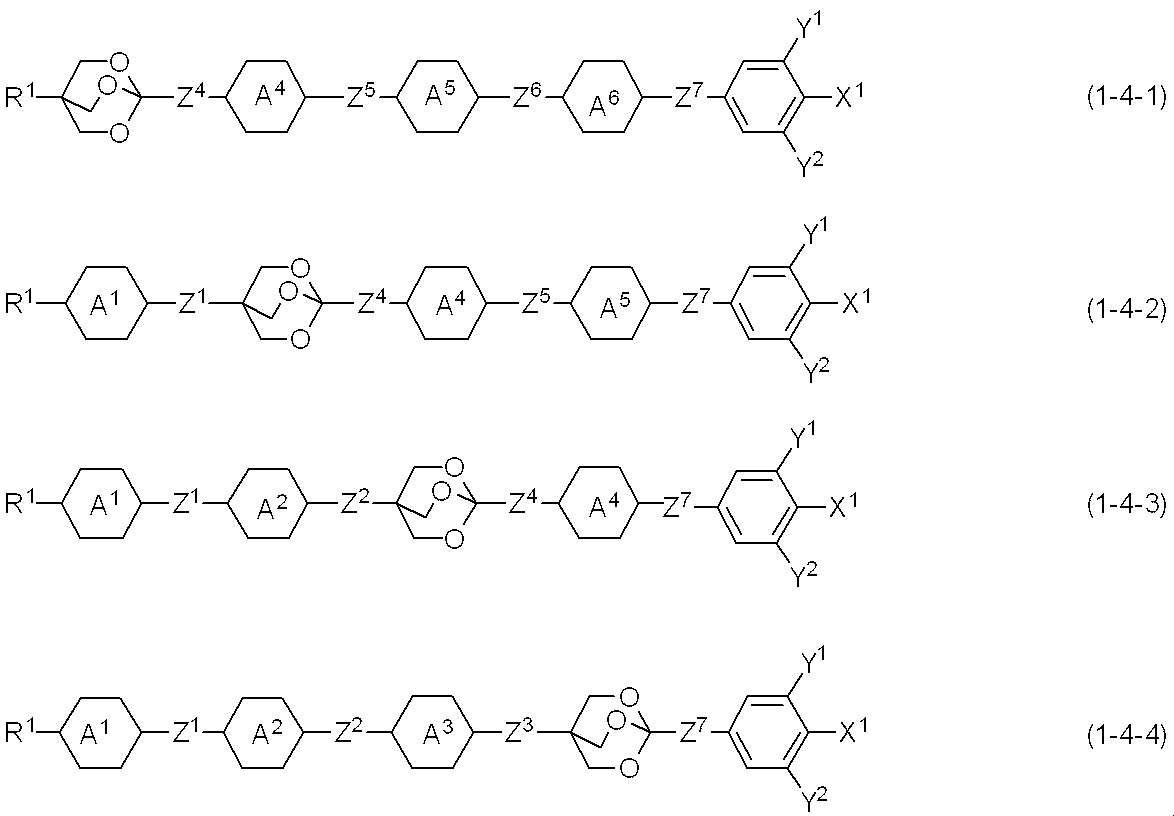
式中、R1は炭素数1~10のアルキルであり;環A1、環A2、環A3、環A4、環A5、および環A6は独立して、1,4-シクロヘキシレン、1,4-フェニレン、3-フルオロ-1,4-フェニレン、または3,5-ジフルオロ-1,4-フェニレンであり;Z1、Z2、Z3、Z4、Z5、Z6、およびZ7は独立して、単結合、-(CH2)2-、-COO-、-CF2O-、または-CH=CH-であり;X1は、フッ素、-CF3または-OCF3であり;Y1およびY2は独立して水素またはフッ素であり;
式(1-4-1)において、Z4、Z5、Z6、およびZ7のうち少なくとも3つは単結合であり;
式(1-4-2)において、Z1、Z4、Z5、およびZ7のうち少なくとも3つは単結合であり;
式(1-4-3)において、Z1、Z2、Z4、およびZ7のうち少なくとも3つは単結合であり;
式(1-4-4)において、Z1、Z2、Z3、およびZ7のうち少なくとも3つは単結合である。

式(2)~(4)において、R2は独立して炭素数1~10のアルキルまたは炭素数2~10のアルケニルであり、このアルキルおよびアルケニルにおいて、少なくとも1つの水素はフッ素で置き換えられてもよく、少なくとも1つの-CH2-は-O-で置き換えられてもよく;
X2は独立して、フッ素、塩素、-OCF3、-OCHF2、-CF3、-CHF2、-CH2F、-OCF2CHF2、または-OCF2CHFCF3であり;
環B1、環B2および環B3は独立して、1,4-シクロヘキシレン、1,3-ジオキサン-2,5-ジイル、ピリミジン-2,5-ジイル、テトラヒドロピラン-2,5-ジイル、または少なくとも1つの水素がフッ素で置き換えられてもよい1,4-フェニレンであり;
Z8およびZ9は独立して、-(CH2)2-、-(CH2)4-、-COO-、-CF2O-、-OCF2-、-CH=CH-、-C≡C-、-CH2O-、または単結合であり;
Y3およびY4は独立して水素またはフッ素である。

式(5)~(10)において、R3およびR4は独立して炭素数1~10のアルキルまたは炭素数2~10のアルケニルであり、このアルキルまたはアルケニルにおいて、少なくとも1つの-CH2-は-O-で置き換えられてもよく、このアルケニルにおいて、少なくとも1つの水素はフッ素で置き換えられてもよく;
環C1、環C2、環C3、および環C4は独立して、1,4-シクロヘキシレン、1,4-シクロヘキセニレン、少なくとも1つの水素がフッ素で置き換えられてもよい1,4-フェニレン、テトラヒドロピラン-2,5-ジイル、またはデカヒドロナフタレン-2,6-ジイルであり;
Z11、Z12、Z13、およびZ14は独立して、-(CH2)2-、-COO-、-CH2O-、-OCF2-、-OCF2(CH2)2-または単結合であり;
Y7およびY8は独立して、フッ素または塩素であり;
r、s、t、u、v、およびwは独立して、0または1であり、s、t、u、およびvの和は、1または2である。

式(11)~(13)において、R5およびR6は独立して、炭素数1~10のアルキルまたは炭素数2~10のアルケニルであり、このアルキルまたはアルケニルにおいて、少なくとも1つの-CH2-は-O-で置き換えられてもよく、このアルケニルにおいて、少なくとも1つの水素はフッ素で置き換えられてもよく、;
環D1、環D2および環D3は独立して、1,4-シクロヘキシレン、ピリミジン-2,5-ジイル、1,4-フェニレン、2-フルオロ-1,4-フェニレン、3-フルオロ-1,4-フェニレン、または2,5-ジフルオロ-1,4-フェニレンであり;
Z15およびZ16は独立して、-C≡C-、-COO-、-(CH2)2-、-CH=CH-、または単結合である。
以下に本発明をさらに説明する。
本発明の第1の態様は、式(1)で表される化合物に関する。

式(1)において、R1は炭素数1~10のアルキルであり、このアルキルにおいて少なくとも1つの-CH2-は、-O-で置き換えられてもよく、少なくとも1つの-(CH2)2-は-CH=CH-で置き換えられてもよく、少なくとも1つの水素はハロゲンで置き換えられてもよい。

本発明の化合物(1)をさらに詳細に説明する。この化合物は、素子が通常使用される条件下において物理的および化学的に極めて安定であり、そして他の液晶化合物との相溶性がよい。この化合物を含有する組成物は素子が通常使用される条件下で安定である。この組成物を低い温度で保管しても、この化合物が結晶(またはスメクチック相)として析出することがない。この化合物は、化合物に必要な一般的物性、適切な光学異方性、そして適切な誘電率異方性を有する。また、化合物(1)は、誘電率異方性が正に大きい。大きな誘電率異方性を有する化合物は、組成物のしきい値電圧を下げるための成分として有用である。
化合物(1)の好ましい例は、項[6]に示した式(1-1-1)、項[7]に示した式(1-2-1)~(1-2-2)、項[9]に示した式(1-3-1)~(1-3-3)、および項[11]に示した式(1-4-1)~(1-4-4)である。


次に、化合物(1)の合成について説明する。化合物(1)は有機合成化学における手法を適切に組み合わせることにより合成できる。出発物に目的の末端基、環および結合基を導入する方法は、オーガニックシンセシス(Organic Syntheses, John Wiley & Sons, Inc)、オーガニック・リアクションズ(Organic Reactions, John Wiley & Sons, Inc)、コンプリヘンシブ・オーガニック・シンセシス(Comprehensive Organic Synthesis, Pergamon Press)、新実験化学講座(丸善)などに記載されている。
化合物(1)における結合基Zを生成する方法の一例は、下記のスキームの通りである。このスキームにおいて、MSG1またはMSG2は少なくとも一つの環を有する1価の有機基である。スキームで用いた複数のMSG1(またはMSG2)は、同一であってもよいし、または異なってもよい。化合物(1A)~(1J)は、化合物(1)に相当する。



アリールホウ酸(21)と公知の方法で合成される化合物(22)とを、炭酸塩水溶液とテトラキス(トリフェニルホスフィン)パラジウムのような触媒の存在下で反応させて化合物(1A)を合成する。この化合物(1A)は、公知の方法で合成される化合物(23)にn-ブチルリチウムを、次いで塩化亜鉛を反応させ、ジクロロビス(トリフェニルホスフィン)パラジウムのような触媒の存在下で化合物(22)を反応させることによっても合成される。
化合物(23)にn-ブチルリチウムを、続いて二酸化炭素を反応させてカルボン酸(24)を得る。化合物(24)と、公知の方法で合成されるフェノール(25)とをDCC(1,3-ジシクロヘキシルカルボジイミド)とDMAP(4-ジメチルアミノピリジン)の存在下で脱水させて-COO-を有する化合物(1B)を合成する。この方法によって-OCO-を有する化合物も合成する。
化合物(1B)をローソン試薬のような硫黄化剤で処理して化合物(26)を得る。化合物(26)をフッ化水素ピリジン錯体とNBS(N-ブロモスクシンイミド)でフッ素化し、-CF2O-を有する化合物(1C)を合成する。M. Kuroboshi et al., Chem. Lett., 1992,827.を参照。化合物(1C)は化合物(26)を(ジエチルアミノ)サルファートリフルオリド(DAST)でフッ素化しても合成される。W. H. Bunnelle et al., J. Org. Chem. 1990, 55, 768.を参照。この方法によって-OCF2-を有する化合物も合成する。Peer. Kirsch et al., Angew. Chem. Int. Ed. 2001, 40, 1480.に記載の方法によってこれらの結合基を生成させることも可能である。
化合物(23)をn-ブチルリチウムで処理した後、N,N-ジメチルホルムアミド(DMF)などのホルムアミドと反応させてアルデヒド(28)を得る。公知の方法で合成されるホスホニウム塩(27)をカリウムtert-ブトキシドのような塩基で処理して発生させたリンイリドを、アルデヒド(28)に反応させて化合物(1D)を合成する。反応条件によってはシス体が生成するので、必要に応じて公知の方法によりシス体をトランス体に異性化する。
化合物(1D)をパラジウム炭素のような触媒の存在下で水素化することにより、化合物(1E)を合成する。
化合物(28)を水素化ホウ素ナトリウムなどの還元剤で還元して化合物(29)を得る。これを臭化水素酸などでハロゲン化して化合物(30)を得る。炭酸カリウムなどの存在下で、化合物(30)を化合物(25)と反応させて化合物(1F)を合成する。
1,4-シクロヘキシレン、1,3-ジオキサン-2,5-ジイル、1,4-フェニレン、2-フルオロ-1,4-フェニレン、2,3-ジフルオロ-1,4-フェニレン、2,5-ジフルオロ-1,4-フェニレン、2,6-ジフルオロ-1,4-フェニレン、2,3,5,6-テトラフルオロ-1,4-フェニレンなどの環に関しては出発物が市販されているか、または合成法がよく知られている。
2,6,7-トリオキサビシクロ[2.2.2]オクタン環を合成する方法の一例を下に示す。アルデヒド誘導体(31)と二等量のホルムアルデヒドを水酸化ナトリウムなどの塩基存在化に反応させると、Aldol反応、続けてCannizzaro反応が起こり、トリオール体(32)が生成する。このトリオール体(32)は炭酸ジエチル、触媒量の炭酸カリウムと共に加熱すると、脱水反応によりオキセタン誘導体(33)となる。次に、上記の結合基Zを生成する方法で記述した様な方法で得たカルボン酸(24)とオキセタン誘導体(33)をジシクロヘキシルカルボジイミドなどの脱水縮合剤を用いてエステル化する。この工程は、カルボン酸(24)を塩化チオニルで酸塩化物とし、続けてオキセタン誘導体(33)と反応させる方法を用いても良い。このようにして得られたエステル誘導体(34)を触媒量の三フッ化ホウ素ジエチルエーテル錯体などのLewis酸存在化反応させることにより、2,6,7-トリオキサビシクロ[2.2.2]オクタン環を有する化合物(35)が得られる。
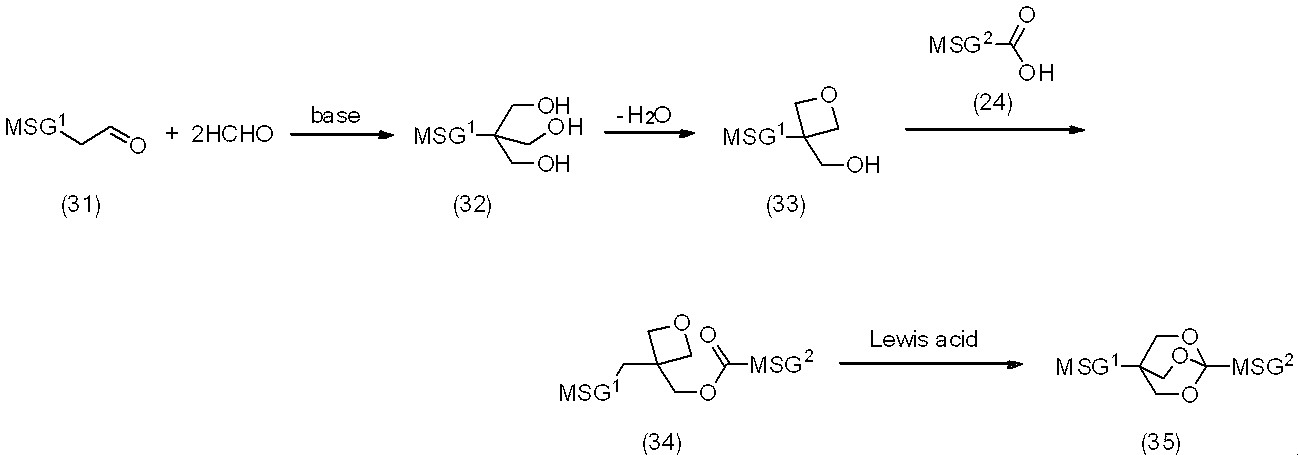
本発明の第2の態様は、式(1)で表される化合物を含む組成物であり、好ましくは、液晶材料に用いることのできる液晶組成物である。本発明の液晶組成物は、前記本発明の式(1)で表される化合物を成分Aとして含む必要がある。この成分Aのみの組成物、または成分Aと本明細書中で特に成分名を示していないその他の成分との組成物でもよいが、この成分Aに以下に示す成分B、C、D、およびEから選ばれた成分を加えることにより種々の特性を有する本発明の液晶組成物が提供できる。
さらに、式(11)、(12)および(13)からなる群から選ばれた少なくとも1つの化合物からなる成分Dを混合することにより、しきい値電圧、液晶相温度範囲、光学異方性値、誘電率異方性値、粘度等を調整することができる。


これらの式において、R2およびX2は、項[13]と同じ定義である。
この化合物(5)~(10)の好適例として、化合物(5-1)~(5-6)、(6-1)~(6-15)、(7-1)、(8-1)~(8-3)、(9-1)~(9-11)、および(10-1)~(10-10)を挙げることができる。


これらの式において、R3およびR4は、項[14]と同じ定義である。


これらの式において、R5およびR6は、項[15]と同じ定義である
本発明の液晶組成物は、本発明の式(1)で表される化合物の少なくとも1種類を約0.1~約99重量%の割合で含有することが、優良な特性を発現せしめるために好ましい。
光学活性化合物として、公知のキラルド-プ剤を添加できる。このキラルド-プ剤は液晶のらせん構造を誘起して必要なねじれ角を調整し、逆ねじれを防ぐといった効果を有する。キラルド-プ剤の例として以下の光学活性化合物(Op-1)~(Op-13)を挙げることができる。

記録計としては島津製作所製のC-R6A型Chromatopac、またはその同等品を用いた。得られたガスクロマトグラムには、成分化合物に対応するピークの保持時間およびピークの面積値が示されている。
液晶化合物の物性値を測定する試料としては、化合物そのものを試料とする場合、化合物を母液晶と混合して試料とする場合の2種類がある。
母液晶A:

物性値の測定は後述する方法で行った。これら測定方法の多くは、日本電子機械工業会規格(Standard of Electric Industries Association of Japan)、EIAJ・ED-2521Aに記載された方法、またはこれを修飾した方法である。また、測定に用いたTN素子には、TFTを取り付けなかった。
(1)偏光顕微鏡を備えた融点測定装置のホットプレート(メトラー社FP-52型ホットステージ)に化合物を置き、3℃/分の速度で加熱しながら相状態とその変化を偏光顕微鏡で観察し、液晶相の種類を特定した。
(2)パーキンエルマー社製走査熱量計Diamond DSCシステムを用いて、3℃/分速度で昇降温し、試料の相変化に伴う吸熱ピーク、または発熱ピークの開始点を外挿により求め(on set)、相転移温度を決定した。

窒素雰囲気下の反応器へ、良く乾燥させた粉末状の水酸化ナトリウム4.8g(120mmol)、アセトニトリル100mlおよびパラホルムアルデヒド9.9g(330mmol)を加えて、室温で攪拌しながら、バレルアルデヒド8.4g(97mmol)を20分かけて滴下した。滴下終了後、温度は60℃であった。続けて80℃に温度を上げ、30分撹拌した。室温まで冷却し、不溶物をろ別し、減圧下、溶媒を留去した。得られた残渣を酢酸エチルを展開溶媒とし、シリカゲルを充填剤として用いたカラムクロマトグラフィーによる分取操作で精製し、乾燥させ、2-(ヒドロキシメチル)-2-プロピルプロパン-1,3,-ジオール6.6gを白色固体として得た。
窒素雰囲気下の反応器へ、第1工程で得られた2-(ヒドロキシメチル)-2-プロピルプロパン-1,3,-ジオール6.6g(45mmol)、炭酸ジエチル5.3g(45mmol)および炭酸カリウム0.053g(0.37mmol)を加え125℃で6時間撹拌した。減圧蒸留(1mmHg、100℃)により精製し、3-プロピル-3-ヒドロキシメチルオキセタン3.7gを無色液体として得た。
窒素雰囲気下の反応器へ、4-(3,4,5-トリフルオロフェニル)シクロヘキサンカルボン酸4.4g(17mmol)、トルエン50mlおよび塩化チオニル2.4ml(34mmol)を加え85℃で1.5時間撹拌した。窒素気流下で余剰の塩化チオニルを留去し、ロータリーエバポレーターで溶媒を留去し、酸塩化物を得た。別途用意した窒素雰囲気下の反応器へ、第2工程で得られた3-プロピル-3-ヒドロキシメチルオキセタン2.4g(19mmol)、THF35mlおよびピリジン1.7ml(21mmol)を仕込み、上記の酸塩化物のTHF溶液を室温で滴下し、20時間撹拌した。ジエチルエーテル50mlと水30mlを加え、有機層と水層とに分離させ抽出操作を行った。得られた有機層を分取して、飽和食塩水で洗浄し、無水硫酸マグネシウムで乾燥した後、不溶物をろ別し、減圧下濃縮した。残渣をヘプタンと酢酸エチルの混合溶媒(容量比 酢酸エチル:ヘプタン=1:3)を展開溶媒とし、シリカゲルを充填剤として用いたカラムクロマトグラフィーによる分取操作で精製し、4-(3,4,5-トリフルオロフェニル)シクロヘキサンカルボン酸(3-プロピルオキセタン-3-イル)メチル 5.4gを淡橙色の油状物として得た。
窒素雰囲気下の反応器へ、第3工程で得られた4-(3,4,5-トリフルオロフェニル)シクロヘキサンカルボン酸(3-プロピルオキセタン-3-イル)メチル5.4g(15mmol)およびジクロロメタン60mlを加え、-70℃に冷却し、三フッ化ホウ素ジエチルエーテル錯体0.44g(3.5mmol)を滴下した。室温に昇温し、15時間撹拌した。トリエチルアミン0.67ml(4.8mmol)を加え、ロータリーエバポレーター濃縮した。その後、ジエチルエーテル30mlを加え、飽和食塩水で洗浄し、無水硫酸マグネシウムで乾燥した後、不溶物をろ別し、減圧下濃縮した。残渣をヘプタンと酢酸エチルの混合溶媒(容量比 酢酸エチル:ヘプタン=1:4)を展開溶媒とし、シリカゲルを充填剤として用いたカラムクロマトグラフィーによる分取操作で精製した。さらに、再結晶(容量比 ヘプタン/酢酸エチル=80/20)により精製し、4-プロピル-1-(4-(3,4,5-トリフルオロフェニル)シクロヘキシル)-2,6,7-トリオキサビシクロ[2.2.2]オクタン1.4gを白色固体として得た。
転移温度 :C 141.0 I
母液晶A 95重量%と、実施例1で得られた4-プロピル-1-(4-(3,4,5-トリフルオロフェニル)シクロヘキシル)-2,6,7-トリオキサビシクロ[2.2.2]オクタン(No.21)の5重量%とからなる液晶組成物Bを調製した。得られた液晶組成物Bの物性を測定し、測定値を外挿することで化合物(No.21)の物性の外挿値を算出した。その値は以下のとおりであった。
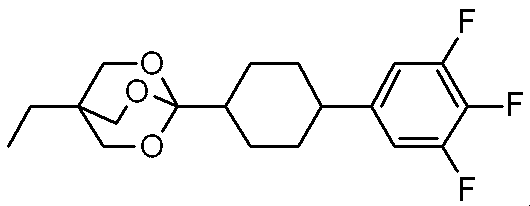
転移温度 :C 168.5 I
母液晶A 95重量%と、実施例2で得られた4-エチル-1-(4-(3,4,5-トリフルオロフェニル)シクロヘキシル)-2,6,7-トリオキサビシクロ[2.2.2]オクタン(No.20)の5重量%とからなる液晶組成物Cを調製した。得られた液晶組成物Cの物性を測定し、測定値を外挿することで化合物(No.20)の物性の外挿値を算出した。その値は以下のとおりであった。
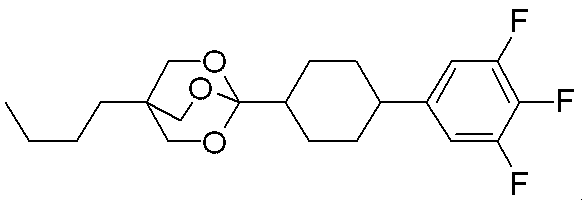
転移温度 : C 133.5 SB 135.6 I
母液晶A 90重量%と、実施例3で得られた4-ブチル-1-(4-(3,4,5-トリフルオロフェニル)シクロヘキシル)-2,6,7-トリオキサビシクロ[2.2.2]オクタン(No.22)の10重量%とからなる液晶組成物Dを調製した。得られた液晶組成物Dの物性を測定し、測定値を外挿することで化合物(No.22)の物性の外挿値を算出した。その値は以下のとおりであった。

転移温度 :C 126.2 SB 135.0 I
母液晶A 90重量%と、実施例4で得られた4-ペンチル-1-(4-(3,4,5-トリフルオロフェニル)シクロヘキシル)-2,6,7-トリオキサビシクロ[2.2.2]オクタン(No.23)の10重量%とからなる液晶組成物Eを調製した。得られた液晶組成物Eの物性を測定し、測定値を外挿することで化合物(No.23)の物性の外挿値を算出した。その値は以下のとおりであった。
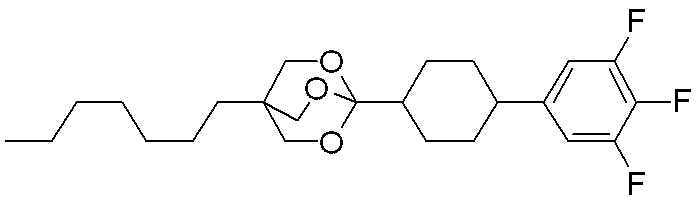
転移温度 : C 86.2 SB 130.6 I
母液晶A 85重量%と、実施例5で得られた4-ヘプチル-1-(4-(3,4,5-トリフルオロフェニル)シクロヘキシル)-2,6,7-トリオキサビシクロ[2.2.2]オクタン(No.24)の15重量%とからなる液晶組成物Fを調製した。得られた液晶組成物Fの物性を測定し、測定値を外挿することで化合物(No.24)の物性の外挿値を算出した。その値は以下のとおりであった。

窒素雰囲気下の反応器へ、水素化ナトリウム(55% in oil)7.2g(165mmol)およびTHF150mlを加え、-20℃に冷却し、ジエチルホスホノ酢酸エチル33.6g(150mmol)のTHF70ml溶液を滴下し、-20℃で1h撹拌した。次に-20℃で4-(3,4,5-トリフルオロフェニル)シクロヘキサンカルボアルデヒド36.3g(150mmol)のTHF100ml溶液を滴下した。室温まで昇温し、水200mlに投入し、酢酸エチルで抽出、有機層をまとめ、水で洗浄し、無水硫酸マグネシウムで乾燥した後、不溶物をろ別し、減圧下濃縮した。残渣をヘプタンと酢酸エチルの混合溶媒(容量比 酢酸エチル:ヘプタン=1:9)を展開溶媒とし、シリカゲルを充填剤として用いたカラムクロマトグラフィーによる分取操作で精製し、(E)-エチル 3-(4-(3,4,5-トリフルオロフェニル)シクロヘキシル)アクリレート 40.0gを白色固体として得た。
反応器へ、第1工程で得られた(E)-エチル-3-(4-(3,4,5-トリフルオロフェニル)シクロヘキシル)アクリレート20.0g(64.0mmol)、トルエン50ml、ソルミックスA-11 150ml、およびPd/C(E type)1.0gを加え、系内を水素で置換した。水素雰囲気化、水素を吸収しなくなるまで室温で撹拌し、反応終了後、Pd/Cをろ過にて除去し、溶媒を留去した。残渣をヘプタンと酢酸エチルの混合溶媒(容量比 酢酸エチル:ヘプタン=1:9)を展開溶媒とし、シリカゲルを充填剤として用いたカラムクロマトグラフィーによる分取操作で精製した。さらに、再結晶(容量比 ヘプタン/酢酸エチル=80/20)により精製し、エチル-3-(4-(3,4,5-トリフルオロフェニル)シクロヘキシル)プロパノエート13.5gを白色固体として得た。
窒素雰囲気下の反応器へ、第2工程で得られたエチル3-(4-(3,4,5-トリフルオロフェニル)シクロヘキシル)プロパノエート13.5g(42.9mmol)、エタノール200ml、および水酸化カリウム3.6g(64mmol)を加え、1h還流した。室温に冷却し、ロータリーエバポレーターで濃縮し、塩酸(2N)200mlに投入した。これを酢酸エチルで抽出、有機層をまとめ、飽和食塩水で洗浄し、無水硫酸マグネシウムで乾燥した後、不溶物をろ別し、減圧下濃縮し、3-(4-(3,4,5-トリフルオロフェニル)シクロヘキシル)プロピオン酸12.1gを白色固体として得た。
窒素雰囲気下の反応器へ、第3工程で得られた3-(4-(3,4,5-トリフルオロフェニル)シクロヘキシル)プロピオン酸6.0g(21.1mmol)、3-ペンチル-3-ヒドロキシメチルオキセタン3.3g(21.1mmol)、4-ジメチルアミノピリジン0.26g(2.1mmol)およびジクロロメタン50mlを加え、室温でジシクロヘキシルカルボジイミド4.57g(22.1mmol)のジクロロメタン 15ml溶液を滴下した。室温で15h撹拌した後、不溶物をろ別し、溶媒を留去、残渣をヘプタンと酢酸エチルの混合溶媒(容量比 酢酸エチル:ヘプタン=1:4)を展開溶媒とし、シリカゲルを充填剤として用いたカラムクロマトグラフィーによる分取操作で精製し、(3-ペンチルオキセタン-3-イル)メチル3-(4-(3,4,5-トリフルオロフェニル)シクロヘキシル)プロパノエート7.8gを無色液体として得た。
窒素雰囲気下の反応器へ、第4工程で得られた(3-ペンチルオキセタン-3-イル)メチル 3-(4-(3,4,5-トリフルオロフェニル)シクロヘキシル)プロパノエート 7.8g(18.4mmol)およびジクロロメタン100mlを加え、-70℃に冷却し、三フッ化ホウ素ジエチルエーテル錯体0.58ml(4.6mmol)を滴下した。室温に昇温し、25時間撹拌した。トリエチルアミン1.3ml(9.2mmol)を加え、ロータリーエバポレーター濃縮した。その後、ジエチルエーテル100mlを加え、飽和食塩水で洗浄し、無水硫酸マグネシウムで乾燥した後、不溶物をろ別し、減圧下濃縮した。残渣をヘプタンと酢酸エチルの混合溶媒(容量比 酢酸エチル:ヘプタン=1:4)を展開溶媒とし、シリカゲルを充填剤として用いたカラムクロマトグラフィーによる分取操作で精製した。さらに、再結晶(容量比 ヘプタン/酢酸エチル=80/20)により精製し、4-ペンチル-1-(2-(4-(3,4,5-トリフルオロフェニル)シクロヘキシル)エチル)-2,6,7-トリオキサビシクロ[2.2.2]オクタン3.7gを白色固体として得た。
転移温度 : C 128.1 (SB 117.0) I
母液晶A 85重量%と、実施例6で得られた4-ペンチル-1-(2-(4-(3,4,5-トリフルオロフェニル)シクロヘキシル)エチル)-2,6,7-トリオキサビシクロ[2.2.2]オクタン(No.41)の15重量%とからなる液晶組成物Gを調製した。得られた液晶組成物Gの物性を測定し、測定値を外挿することで化合物(No.41)の物性の外挿値を算出した。その値は以下のとおりであった。

窒素雰囲気下の反応器へ、実施例6の第1工程で得られた(E)-エチル-3-(4-(3,4,5-トリフルオロフェニル)シクロヘキシル)アクリレート20.0g(62.5mmol)、エタノール200ml、および水酸化カリウム5.4g(94mmol)を加え、4h還流した。室温に冷却し、ロータリーエバポレーターで濃縮し、塩酸(2N)200mlに投入した。これを酢酸エチルで抽出、有機層をまとめ、飽和食塩水で洗浄し、無水硫酸マグネシウムで乾燥した後、不溶物をろ別し、減圧下濃縮し、(E)-3-(4-(3,4,5-トリフルオロフェニル)シクロヘキシル)アクリル酸7.6gを白色固体として得た。
窒素雰囲気下の反応器へ、第1工程で得られた(E)-3-(4-(3,4,5-トリフルオロフェニル)シクロヘキシル)アクリル酸6.0g(21.1mmol)、3-ペンチル-3-ヒドロキシメチルオキセタン3.3g(21.1mmol)、4-ジメチルアミノピリジン0.26g(2.1mmol)およびジクロロメタン50mlを加え、室温でジシクロヘキシルカルボジイミド4.57g(22.1mmol)のジクロロメタン15ml溶液を滴下した。室温で15時間撹拌した後、不溶物をろ別し、溶媒を留去、残渣をヘプタンと酢酸エチルの混合溶媒(容量比 酢酸エチル:ヘプタン=1:4)を展開溶媒とし、シリカゲルを充填剤として用いたカラムクロマトグラフィーによる分取操作で精製し、(E)-(3-ペンチルオキセタン-3-イル)メチル-3-(4-(3,4,5-トリフルオロフェニル)シクロヘキシル)アクリレート6.8gを無色液体として得た。
窒素雰囲気下の反応器へ、第2工程で得られた(E)-(3-ペンチルオキセタン-3-イル)メチル-3-(4-(3,4,5-トリフルオロフェニル)シクロヘキシル)アクリレート6.8g(16.1mmol)およびジクロロメタン50mlを加え、-70℃に冷却し、三フッ化ホウ素ジエチルエーテル錯体0.50ml(4.0mmol)を滴下した。室温に昇温し、45時間撹拌した。トリエチルアミン3.0ml(21mmol)を加え、ロータリーエバポレーター濃縮した。その後、ジエチルエーテル100mlを加え、飽和食塩水で洗浄し、無水硫酸マグネシウムで乾燥した後、不溶物をろ別し、減圧下濃縮した。残渣をヘプタンと酢酸エチルの混合溶媒(容量比 酢酸エチル:ヘプタン=1:4)を展開溶媒とし、シリカゲルを充填剤として用いたカラムクロマトグラフィーによる分取操作で精製した。さらに、再結晶(ヘプタン/酢酸エチル=80/20(体積比))により精製し、(E)-4-ペンチル-1-(2-(4-(3,4,5-トリフルオロフェニル)シクロヘキシル)ビニル)-2,6,7-トリオキサビシクロ[2.2.2]オクタン 0.6gを白色固体として得た。

窒素雰囲気下の反応器へ、塩化イソプロピルマグネシウム/塩化リチウム錯体(1.3M、THF溶液)100ml(130mmol)を加えて、室温で攪拌しながら、4-ブロモ-2,3’,5’-トリフルオロ-1,1’-ビフェニル28.7g(100mmol)を少しずつ加え、続けて室温で2時間撹拌した。次に、氷浴で5~15℃に冷却しながら乾燥した炭酸ガスを発熱しなくなるまで吹き込んだ。反応液を2Nの塩酸200mlに注ぎ、ジエチルエーテルで抽出した。有機層をまとめ、飽和食塩水で洗浄し、無水硫酸マグネシウムで乾燥した後、不溶物をろ別し、減圧下濃縮した。残渣を酢酸エチルを展開溶媒とし、シリカゲルを充填剤として用いたカラムクロマトグラフィーによる分取操作で精製した。さらに、再結晶(容量比 ヘプタン/エタノール=30/70)により精製し、2,3’,5’-トリフルオロ-1,1’-ビフェニル-4-カルボン酸10.3gを白色固体として得た。
窒素雰囲気下の反応器へ、第1工程で得られた2,3’,5’-トリフルオロ-1,1’-ビフェニル-4-カルボン酸10.3g(40.7mmol)、3-ペンチル-3-ヒドロキシメチルオキセタン6.40g(40.7mmol)、4-ジメチルアミノピリジン0.5g(4mmol)およびジクロロメタン100mlを加え、室温でジシクロヘキシルカルボジイミド8.8g(42.8mmol)のジクロロメタン30ml溶液を滴下し、室温で15時間撹拌した。不溶物をろ別し、溶媒を留去、残渣をヘプタンと酢酸エチルの混合溶媒(容量比 酢酸エチル:ヘプタン=1:4)を展開溶媒とし、シリカゲルを充填剤として用いたカラムクロマトグラフィーによる分取操作で精製し、2,3’,5’-トリフルオロ-[1,1’-ビフェニル]-4-カルボン酸(3-ペンチルオキセタン-3-イル)メチル13.7gを無色液体として得た。
窒素雰囲気下の反応器へ、第2工程で得られた2,3’,5’-トリフルオロ-[1,1’-ビフェニル]-4-カルボン酸(3-ペンチルオキセタン-3-イル)メチル13.7g(34.9mmol)およびジクロロメタン100mlを加え、-70℃に冷却し、三フッ化ホウ素ジエチルエーテル錯体1.1ml(8.8mmol)を滴下した。室温に昇温し、20時間撹拌した。トリエチルアミン1.5ml(11mmol)を加え、ロータリーエバポレーター濃縮した。その後、ジエチルエーテル100mlを加え、飽和食塩水で洗浄し、無水硫酸マグネシウムで乾燥した後、不溶物をろ別し、減圧下濃縮した。残渣をヘプタンと酢酸エチルの混合溶媒(容量比 酢酸エチル:ヘプタン=1:4)を展開溶媒とし、シリカゲルを充填剤として用いたカラムクロマトグラフィーによる分取操作で精製し、4-ペンチル-1-(2,3’,5’-トリフルオロ-[1,1’-ビフェニル]-4-イル)-2,6,7-トリオキサビシクロ[2.2.2]オクタン 10.9gを白色固体として得た。
窒素雰囲気下の反応器へ、第3工程で得られた4-ペンチル-1-(2,3’,5’-トリフルオロ-[1,1’-ビフェニル]-4-イル)-2,6,7-トリオキサビシクロ[2.2.2]オクタン2.0g(5.1mmol)およびTHF70mlを加え、-70℃に冷却し、n-ブチルリチウム(1.62M,ヘキサン溶液)4.1ml(6.6mmol)を滴下し、-70℃で1h撹拌した。次に-70℃でジブロモジフルオロメタン 1.6g(7.7mmol)のTHF10ml溶液を滴下し、-70℃で1h撹拌した。これを氷水100mlに投入し、トルエンで抽出、有機層をまとめ、飽和食塩水で洗浄し、無水硫酸マグネシウムで乾燥した後、不溶物をろ別し、減圧下濃縮した。
残渣をヘプタンと酢酸エチルの混合溶媒(容量比 酢酸エチル:ヘプタン=1:4)を展開溶媒とし、シリカゲルを充填剤として用いたカラムクロマトグラフィーによる分取操作で精製し、1-(4’-(ブロモジフルオロメチル)-2,3’,5’-トリフルオロ-[1,1’-ビフェニル]-4-イル)-4-ペンチル-2,6,7-トリオキサビシクロ[2.2.2]オクタン2.4gを白色固体として得た。
窒素雰囲気下の反応器へ、第4工程で得られた1-(4’-(ブロモジフルオロメチル)-2,3’,5’-トリフルオロ-[1,1’-ビフェニル]-4-イル)-4-ペンチル-2,6,7-トリオキサビシクロ[2.2.2]オクタン2.4g(4.6mmol)、3,4,5-トリフルオロフェノール0.68g(4.6mmol)、炭酸カリウム 1.9g(14mmol)およびDMF40mlを加え、85℃で2時間撹拌した。室温まで冷却し、トルエン100mlと水100mlを加え、有機層を分液、水層をトルエンで抽出した。有機層をまとめ、飽和食塩水で洗浄し、無水硫酸マグネシウムで乾燥した後、不溶物をろ別し、減圧下濃縮した。残渣をヘプタンと酢酸エチルの混合溶媒(容量比 酢酸エチル:ヘプタン=1:4)を展開溶媒とし、シリカゲルを充填剤として用いたカラムクロマトグラフィーによる分取操作で精製した。さらに、再結晶(容量比 ヘプタン/酢酸エチル=80/20)により精製し、1-(4’-(ジフルオロ(3,4,5-トリフルオロフェノキシ)メチル)-2,3’,5’-トリフルオロ-[1,1’-ビフェニル]-4-イル)-4-ペンチル-2,6,7-トリオキサビシクロ[2.2.2]オクタン0.7gを白色固体として得た。
転移温度 :C 108.3(SA 91.8) N 151.5 I
ここで、C 108.3(SA 91.8) Nの表記は、昇温時にはSA相が観察されず、108℃で結晶からネマチック相での転位か起こり、降温時に91.8℃でネマチック相からSA相への転位が観察されたという意味である。
母液晶A 85重量%と、実施例8で得られた1-(4’-(ジフルオロ(3,4,5-トリフルオロフェノキシ)メチル)-2,3’,5’-トリフルオロ-[1,1’-ビフェニル]-4-イル)-4-ペンチル-2,6,7-トリオキサビシクロ[2.2.2]オクタン(No.106)の15重量%とからなる液晶組成物Hを調製した。得られた液晶組成物Hの物性を測定し、測定値を外挿することで化合物(No.106)の物性の外挿値を算出した。その値は以下のとおりであった。

転移温度 : C 99.1 SB 164.2 I
母液晶A 85重量%と、実施例9で得られた1-(4’-(ジフルオロ(3,4-ジフルオロフェノキシ)メチル)-2,3’,5’-トリフルオロ-[1,1’-ビフェニル]-4-イル)-4-ペンチル-2,6,7-トリオキサビシクロ[2.2.2]オクタン(No.105)の15重量%とからなる液晶組成物Iを調製した。得られた液晶組成物Iの物性を測定し、測定値を外挿することで化合物(No.105)の物性の外挿値を算出した。その値は以下のとおりであった。

窒素雰囲気下の反応器へ、マグネシウム片22.7G(933mmol)を加えて、室温で3日間攪拌した。THF80mlとヨウ素一片を加え、室温で1-ブロモ-3,5-ジフルオロベンゼン150g(777mmol)のTHF100ml溶液を少しずつ加え、続けて1時間還流した。次に、-10℃に冷却し、ドライアイス75g(1710mmol)を少しずつ加え、室温で1時間撹拌した。反応液を1Nの塩酸500mlに注ぎ、酢酸エチルで抽出した。有機層をまとめ、水で洗浄し、無水硫酸マグネシウムで乾燥した後、不溶物をろ別し、減圧下濃縮した。残渣をn-ヘプタンで洗浄し、3,5-ジフルオロ安息香酸66.3gを白色固体として得た。
窒素雰囲気下の反応器へ、第1工程で得られた3,5-ジフルオロ安息香酸35.0g(221mmol)、3-プロピル-3-ヒドロキシメチルオキセタン28.8g(221mmol)、4-ジメチルアミノピリジン2.7g(22mmol)およびジクロロメタン325mlを加え、室温でジシクロヘキシルカルボジイミド48.0g(232mmol)のジクロロメタン175ml溶液を滴下し、室温で3時間撹拌した。不溶物をろ別し、溶液を1Nの塩酸、炭酸水素ナトリウム水溶液、水の順で洗浄し、無水硫酸マグネシウムで乾燥した後、不溶物をろ別し、減圧下濃縮した。残渣をヘプタンと酢酸エチルの混合溶媒(容量比 酢酸エチル:ヘプタン=1:4)を展開溶媒とし、シリカゲルを充填剤として用いたカラムクロマトグラフィーによる分取操作で精製し、3,5-ジフルオロ-安息香酸(3-プロピルオキセタン-3-イル)メチル52.2gを淡黄色液体として得た。
窒素雰囲気下の反応器へ、第2工程で得られた3,5-ジフルオロ-安息香酸(3-プロピルオキセタン-3-イル)メチル52.2g(193mmol)およびジクロロメタン350mlを加え、-70℃に冷却し、三フッ化ホウ素ジエチルエーテル錯体6.1ml(48mmol)を滴下した。室温に昇温し、24時間撹拌した。トリエチルアミン10ml(72mmol)を加え、ロータリーエバポレーター濃縮した。その後、ジエチルエーテル300mlを加え、水で洗浄し、無水硫酸マグネシウムで乾燥した後、不溶物をろ別し、減圧下濃縮した。残渣をヘプタンと酢酸エチルの混合溶媒(容量比 酢酸エチル:ヘプタン=1:4)を展開溶媒とし、シリカゲルを充填剤として用いたカラムクロマトグラフィーによる分取操作で精製し、4-プロピル-1-(3,5-ジフルオロフェニル)-2,6,7-トリオキサビシクロ[2.2.2]オクタン 37.5gを白色固体として得た。
窒素雰囲気下の反応器へ、第3工程で得られた4-プロピル-1-(3,5-ジフルオロフェニル)-2,6,7-トリオキサビシクロ[2.2.2]オクタン 37.5g(139mmol)およびTHF830mlを加え、-70℃に冷却し、n-ブチルリチウム(1.67M,ヘキサン溶液)83ml(139mmol)を滴下し、-70℃で1h撹拌した。次に-70℃でジブロモジフルオロメタン34.9g(166mmol)のTHF100ml溶液を滴下し、-70℃で1時間撹拌した。これを氷水1000mlに投入し、トルエンで抽出、有機層をまとめ、飽和食塩水、水の順で洗浄し、無水硫酸マグネシウムで乾燥した後、不溶物をろ別し、減圧下濃縮した。残渣をヘプタンと酢酸エチルの混合溶媒(容量比 酢酸エチル:ヘプタン=1:4)を展開溶媒とし、シリカゲルを充填剤として用いたカラムクロマトグラフィーによる分取操作で精製し、1-(4-(ブロモジフルオロメチル)-3,5-ジフルオロフェニル)-4-プロピル-2,6,7-トリオキサビシクロ[2.2.2]オクタン50.9gを白色固体として得た。
窒素雰囲気下の反応器へ、第4工程で得られた1-(4-(ブロモジフルオロメチル)-3,5-ジフルオロフェニル)-4-プロピル-2,6,7-トリオキサビシクロ[2.2.2]オクタン10.0g(25.1mmol)、3,4,5-トリフルオロフェノール4.5g(30mmol)、炭酸カリウム3.5g(25mmol)、テトラブチルホスホニウムブロミド2.6g(7.5mmol)、H2O 50mlおよびn-ヘプタン5mlを加え、82~85℃で10時間還流した。室温まで冷却し、トルエン100mlと水100mlを加え、有機層を分液、水層をトルエンで抽出した。有機層をまとめ、炭酸水素ナトリウム水溶液、水の順で洗浄し、無水硫酸マグネシウムで乾燥した後、不溶物をろ別し、減圧下濃縮した。残渣をヘプタンと酢酸エチルの混合溶媒(容量比 酢酸エチル:ヘプタン=1:4)を展開溶媒とし、シリカゲルを充填剤として用いたカラムクロマトグラフィーによる分取操作で精製した。さらに、再結晶(容量比 イソプロパノール/酢酸エチル=80/20)により精製し、1-(4-(ジフルオロ(3,4,5-トリフルオロフェノキシ)メチル)-3,5-ジフルオロフェニル)-4-プロピル-2,6,7-トリオキサビシクロ[2.2.2]オクタン5.9gを白色固体として得た。
転移温度 :C 94.5 I
母液晶A 90重量%と、実施例10で得られた1-(4’-(ジフルオロ(3,4,5-トリフルオロフェノキシ)メチル)-2,3’,5’-トリフルオロ-[1,1’-ビフェニル]-4-イル)-4-ペンチル-2,6,7-トリオキサビシクロ[2.2.2]オクタン(No.51)の10重量%とからなる液晶組成物Jを調製した。得られた液晶組成物Jの物性を測定し、測定値を外挿することで化合物(No.64)の物性の外挿値を算出した。その値は以下のとおりであった。

転移温度 : C 102.0 I
母液晶A 90重量%と、実施例11で得られた1-(4-(ジフルオロ(3,4-ジフルオロフェノキシ)メチル)-3,5-ジフルオロフェニル)-4-プロピル-2,6,7-トリオキサビシクロ[2.2.2]オクタン(No.63)の10重量%とからなる液晶組成物Kを調製した。得られた液晶組成物Kの物性を測定し、測定値を外挿することで化合物(No.63)の物性の外挿値を算出した。その値は以下のとおりであった。
[比較例1]

窒素雰囲気下の反応器へシクロヘキサン-1,4-ジイルメタノール10.5g(73mmol)、3,4,5-トリフルオロフェノール10.7g(73mmol)、トリフェニルホスフィン24.7g(94mmol)およびTHF200mlを加え、氷浴下3~14℃でアゾジカルボン酸ジエチル(2.2M,トルエン溶液)43ml(94mmol)を滴下した。室温で20時間撹拌した後、飽和チオ硫酸ナトリウム水溶液50mlを加えジエチルエーテルで抽出し、飽和食塩水で洗浄し、無水硫酸マグネシウムで乾燥した後、不溶物をろ別し、減圧下濃縮した。残渣をヘプタンと酢酸エチルの混合溶媒(容量比 酢酸エチル:ヘプタン=1:2)を展開溶媒とし、シリカゲルを充填剤として用いたカラムクロマトグラフィーによる分取操作で精製し、(4-((3,4,5-トリフルオロフェノール)メチル)シクロヘキシル)メタノール4.41gを黄色液体として得た。
窒素雰囲気下の反応器へ、第1工程で得られた(4-((3,4,5-トリフルオロフェノール)メチル)シクロヘキシル)メタノール4.41g(7.2mmol)およびアセトン40mlを加え、氷浴下Jones試薬を橙色が消えなくなるまで滴下した後、2-プロパノールを加えた。不溶物をろ別し、ロータリーエバポレーターで濃縮し、ジエチルエーテルを加え水で洗浄した。無水硫酸マグネシウムで乾燥した後、不溶物をろ別し、減圧下濃縮した。残渣を酢酸エチルを展開溶媒とし、シリカゲルを充填剤として用いたカラムクロマトグラフィーによる分取操作で精製した。さらに、再結晶(容量比 n-ヘプタン/エタノール=50/50)により精製し、4-((3,4,5-トリフルオロフェノール)メチル)シクロヘキサンカルボン酸2.1gを淡黄色固体として得た。
窒素雰囲気下の反応器へ、第2工程で得られた4-((3,4,5-トリフルオロフェノール)メチル)シクロヘキサンカルボン酸2.1g(7.4mmol)、1-エチル-3-(3-ジメチルアミノプロピル)カルボジイミド塩酸塩1.7g(8.8mmol)、4-ジメチルアミノピリジン0.09g(0.7mmol)およびジクロロメタン60mlを加え、室温で3-プロピル-3-ヒドロキシメチルオキセタン1.15g(8.8mmol)のジクロロメタン20ml溶液を滴下した。室温で20時間撹拌した後、ロータリーエバポレーターで濃縮し、酢酸エチルを加え、水で洗浄した。むすい硫酸マグネシウムで乾燥した後、不溶物をろ過し溶媒を留去、残渣をヘプタンと酢酸エチルの混合溶媒(容量比 酢酸エチル:ヘプタン=1:4)を展開溶媒とし、シリカゲルを充填剤として用いたカラムクロマトグラフィーによる分取操作で精製し、(3-プロピルオキセタン-3-イル)メチル 4-((3,4,5-トリフルオロフェノキシ)メチル)シクロヘキサンカルボキシレート2.35gを黄色液体として得た。
窒素雰囲気下の反応器へ、第3工程で得られた(3-プロピルオキセタン-3-イル)メチル-4-((3,4,5-トリフルオロフェノキシ)メチル)シクロヘキサンカルボキシレート2.35g(5.87mmol)およびジクロロメタン50mlを加え、-70℃に冷却し、三フッ化ホウ素ジエチルエーテル錯体0.18ml(1.5mmol)を滴下した。室温に昇温し、15時間撹拌した。トリエチルアミン0.7ml(5mmol)を加え、ロータリーエバポレーター濃縮した。その後、ジエチルエーテル30mlを加え、飽和食塩水で洗浄し、無水硫酸マグネシウムで乾燥した後、不溶物をろ別し、減圧下濃縮した。残渣をヘプタンと酢酸エチルの混合溶媒(容量比 酢酸エチル:ヘプタン=1:4)を展開溶媒とし、シリカゲルを充填剤として用いたカラムクロマトグラフィーによる分取操作で精製した。さらに、再結晶(ヘプタン/エタノール=80/20(体積比))により精製し、4-プロピル-1-(4-((3,4,5-トリフルオロフェノキシ)メチル)シクロヘキシル)-2,6,7-トリオキサビシクロ[2.2.2]オクタン 0.9gを白色固体として得た。
転移温度 :C 123.9 (SB 112.7) I
母液晶A 95重量%と、参考例1で得られた4-プロピル-1-(4-((3,4,5-トリフルオロフェノキシ)メチル)シクロヘキシル)-2,6,7-トリオキサビシクロ[2.2.2]オクタン(比較化合物1)の5重量%とからなる液晶組成物Lを調製した。得られた液晶組成物Lの物性を測定し、測定値を外挿することで化合物(比較化合物1)の物性の外挿値を算出した。その値は以下のとおりであった。

転移温度 :C 127.5 I
母液晶A 95重量%と、実施例12で得られた4-プロピル-1-(3,4,5-トリフルオロフェニル)-2,6,7-トリオキサビシクロ[2.2.2]オクタン(No.5)の5重量%とからなる液晶組成物Mを調製した。得られた液晶組成物Mの物性を測定し、測定値を外挿することで化合物(No.5)の物性の外挿値を算出した。その値は以下のとおりであった。

窒素雰囲気下の反応器へ、2-ブロモ-2,2-ジフルオロ酢酸エチルエステル25.0g(123mmol)、3,4,5-トリフルオロフェノール18.2g(123mmol)、炭酸カリウム17.02g(123mmol)、テトラブチルアンモニウムブロミド3.97g(12.3mmol)およびDMF150mlを加え、90℃で3時間撹拌した。飽和食塩水100mlを加え、酢酸エチルで抽出し、飽和炭酸水素ナトリウム水溶液で洗浄、続けて水で洗浄し、無水硫酸マグネシウムで乾燥した後、不溶物をろ別し、減圧下濃縮した。残渣をヘプタンと酢酸エチルの混合溶媒(容量比 酢酸エチル:ヘプタン=1:10)を展開溶媒とし、シリカゲルを充填剤として用いたカラムクロマトグラフィーによる分取操作で精製し、エチル 2,2-ジフルオロ-2-(3,4,5-トリフルオロフェノキシ)アセテート25.0gを得た。
窒素雰囲気下の反応器へ、第1工程で得られたエチル 2,2-ジフルオロ-2-2-(3,4,5-トリフルオロフェノキシ)アセテート12.0g、メタノール140mlおよび水酸化ナトリウム水溶液(2N)23mlを加え、室温で2時間撹拌した。酸性になるまで塩酸(1N)を加え、酢酸エチルで抽出し、水で洗浄し、無水硫酸マグネシウムで乾燥した後、不溶物をろ別し、減圧下濃縮した。残渣をヘプタンで洗浄し、乾燥することで、2,2-ジフルオロ-2-(3,4,5-トリフルオロフェノキシ)酢酸7.25gを得た。
窒素雰囲気下の反応器へ、第2工程で得られた2,2-ジフルオロ-2-(3,4,5-トリフルオロフェノキシ)酢酸7.25g(29.9mmol)、3-ペンチル-3-ヒドロキシメチルオキセタン4.74g(29.9mmol)、4-ジメチルアミノピリジン0.37g(2.99mmol)およびジクロロメタン150mlを加え、0℃に冷却した。0℃でジシクロヘキシルカルボジイミド6.49g(31.4mmol)のジクロロメタン50ml溶液を滴下し、室温で15時間撹拌した。セライトろ過により不溶物を濾過した後、塩酸(1N)、飽和炭酸水素ナトリウム水溶液、水の順で洗浄し、無水硫酸マグネシウムで乾燥した後、不溶物をろ別し、減圧下濃縮した。残渣をヘプタンと酢酸エチルの混合溶媒(容量比 酢酸エチル:ヘプタン=1:4)を展開溶媒とし、シリカゲルを充填剤として用いたカラムクロマトグラフィーによる分取操作で精製し、(3-ペンチルオキセタン-3-イル)メチル 2,2-ジフルオロ-2-(3,4,5-トリフルオロフェノキシ)アセテート5.64gを得た。
窒素雰囲気下の反応器へ、第3工程で得られた(3-ペンチルオキセタン-3-イル)メチル 2,2-ジフルオロ-2-(3,4,5-トリフルオロフェノキシ)アセテート5.64g(14.8mmol)およびジクロロメタン60mlを加え、-70℃に冷却し、三フッ化ホウ素ジエチルエーテル錯体0.47ml(3.7mmol)を滴下した。室温に昇温し、24時間撹拌した。トリエチルアミン0.8ml(6mmol)を加え、ロータリーエバポレーター濃縮した。その後、ジエチルエーテル40mlを加え、飽和食塩水で洗浄し、無水硫酸マグネシウムで乾燥した後、不溶物をろ別し、減圧下濃縮した。残渣をヘプタンと酢酸エチルの混合溶媒(容量比 酢酸エチル:ヘプタン=1:5)を展開溶媒とし、シリカゲルを充填剤として用いたカラムクロマトグラフィーによる分取操作で精製した。さらに、再結晶(ヘプタン/エタノール=80/20(体積比))により精製し、1-(ジフルオロ(3,4,5-トリフルオロフェノキシ)メチル)-4-ペンチル-2,6,7-トリオキサビシクロ[2.2.2]オクタン 2.5gを白色固体として得た。
転移温度 :C 70.5(SB 64.7 I)
母液晶A 85重量%と、実施例13で得られた1-(ジフルオロ(3,4,5-トリフルオロフェノキシ)メチル)-4-ペンチル-2,6,7-トリオキサビシクロ[2.2.2]オクタン(No.17)の15重量%とからなる液晶組成物Nを調製した。得られた液晶組成物Nの物性を測定し、測定値を外挿することで化合物(No.17)の物性の外挿値を算出した。その値は以下のとおりであった。
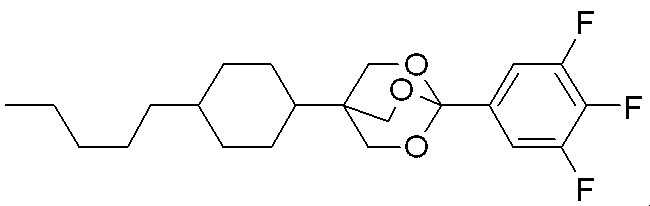
窒素雰囲気下の反応器へ、3,4,5-トリフルオロ安息香酸10.5g(59.5mmol)、1-エチル-3-(3-ジメチルアミノプロピル)カルボジイミド塩酸塩13.7g(71.4mmol)、4-ジメチルアミノピリジン0.72g(6.0mmol)、およびジクロロメタン100mlを加え、室温でジエチルアミン4.8g(65.5mmol)のジクロロメタン10ml溶液を滴下し、室温で15時間撹拌した。水50mlを加え、ジエチルエーテルで抽出し、水で洗浄し、無水硫酸マグネシウムで乾燥した後、不溶物をろ別し、減圧下濃縮した。残渣をヘプタンと酢酸エチルの混合溶媒(容量比 酢酸エチル:ヘプタン=1:4)を展開溶媒とし、シリカゲルを充填剤として用いたカラムクロマトグラフィーによる分取操作で精製し、N,N-ジエチル-3,4,5-トリフルオロベンズアミド11.4gを得た。
窒素雰囲気下の反応器へ、第1工程で得られたN,N-ジエチル-3,4,5-トリフルオロベンズアミド9.36g、およびジクロロメタン45mlを加え、室温で塩化オキサリル3.7ml(43mmol)を滴下し、室温で30分撹拌、その後40℃で3時間撹拌した。0℃に冷却し、トリエチルアミン三フッ化水素酸塩4.7ml(29mmol)を滴下し、続けてトリエチルアミン8.2ml(58mmol)を滴下し、室温で30分攪拌した。反応混合物を濾過し、ろ別された固体をヘキサンで洗浄した後、ろ液を減圧下濃縮した。残渣に少量のヘキサンを加え、濾過し、ろ液を減圧下濃縮し、残渣を1mmHg、40℃で減圧蒸留することで、N-(ジフルオロ(3,4,5-トリフルオロフェニル)メチル-N-エチルエタンアミン9.7gを得た。
窒素雰囲気下の反応器へ、良く乾燥させた粉末状の水酸化ナトリウム7.30g(183mmol)、アセトニトリル100mlおよびパラホルムアルデヒド13.8g(459mmol)を加えて、室温で攪拌しながら、2-(4-ペンチルシクロヘキシル)アセトアルデヒド30.0g(153mmol)のアセトニトリル30ml溶液を40分かけて滴下した。滴下終了後、温度は34℃であった。室温で30分攪拌した後、70℃に温度を上げ、20分撹拌した。室温まで冷却し、不溶物をろ別し、減圧下、溶媒を留去した。得られた残渣を酢酸エチルを展開溶媒とし、シリカゲルを充填剤として用いたカラムクロマトグラフィーによる分取操作で精製し、乾燥させ、2-(ヒドロキシメチル)-2-(4-ペンチルシクロヘキシル)プロパン-1,3-ジオール11.0gを白色固体として得た
窒素雰囲気下の反応器へ、第3工程で得られた2-(ヒドロキシメチル)-2-(4-ペンチルシクロヘキシル)プロパン-1,3-ジオール2.48g(9.29mmol)、DMF30ml、およびモレキュラーシーブ4A 1.8gを加え、室温で1時間攪拌した。0℃に冷却し、第2工程で得られたN-(ジフルオロ(3、4、5-トリフルオロフェニル)メチル-N-エチルエタンアミン2.35g(9.29mmol)を滴下し、室温で2時間攪拌した。トリエチルアミン1.5mlを加えた後、水酸化ナトリウム水溶液(2N)100ml中に投入し、ジクロロメタンで抽出し、無水硫酸マグネシウムで乾燥した後、不溶物をろ別し、減圧下濃縮した。残渣をヘプタンと酢酸エチルの混合溶媒(容量比 酢酸エチル:ヘプタン=1:4)を展開溶媒とし、シリカゲルを充填剤として用いたカラムクロマトグラフィーによる分取操作で精製した。さらに、再結晶(アセトニトリル)により精製し、4-(4-ペンチルシクロヘキシル)-1-(3,4,5-トリフルオロフェニル)-2,6,7-トリオキサビシクロ[2.2.2]オクタン 1.1gを白色固体として得た。
転移温度 :C 155.3 I
母液晶A 95重量%と、実施例14で得られた4-(4-ペンチルシクロヘキシル)-1-(3,4,5-トリフルオロフェニル)-2,6,7-トリオキサビシクロ[2.2.2]オクタン(No.26)の5重量%とからなる液晶組成物Oを調製した。得られた液晶組成物Oの物性を測定し、測定値を外挿することで化合物(No.26)の物性の外挿値を算出した。その値は以下のとおりであった。

窒素雰囲気下の反応器へ、4-ブロモ-2-フルオロ-1-ヨードベンゼン50.0g(166mmol)、(3,4,5-トリフルオロフェニル)ボロン酸29.3g(166mmol)、炭酸カリウム45.9g(332mmol)、テトラブチルアンモニウムブロミド(TBAB)10.7g(33.2mmol)、テトラキス(トリフェニルホスフィン)パラジウム2.7g(2.3mmol)、トルエン300mL、および1-ブタノール200mLを加え、6時間加熱還流した。反応液を水300mlへ投入し、トルエンで抽出し、飽和食塩水で洗浄し、無水硫酸マグネシウムで乾燥した後、不溶物をろ別し、減圧下濃縮した。残渣をヘプタンを展開溶媒とし、シリカゲルを充填剤として用いたカラムクロマトグラフィーによる分取操作で精製し、4-ブロモ-2,3’,4’,5’-テトラフルオロ-1,1’-ビフェニル36.8gを得た。
窒素雰囲気下の反応器へ、第1工程で得られた4-ブロモ-2,3’,4’,5’-テトラフルオロ-1,1’-ビフェニル30.0g(98.3mmol)、およびTHF30mlを加え、室温にてイソプロピルマグネシウムクロリドリチウムクロリド錯体溶液(1.3M)98.3mL(128mmol)を滴下し、室温で2時間撹拌した。そこへ0℃にて25g(570mmol)のドライアイスを加え、室温まで昇温後15時間撹拌した。0℃に冷却し塩酸(3M)70mLを滴下し、酢酸エチルで抽出し、水で洗浄し、無水硫酸マグネシウムで乾燥した後、不溶物をろ別し、減圧下濃縮した。残渣をトルエンで再結晶することで、2,3’,4’,5’-テトラフルオロ-[1,1’-ビフェニル]-4-カルボン酸22.0gを得た。
窒素雰囲気下の反応器へ、第2工程で得られた2,3’,4’,5’-テトラフルオロ-[1,1’-ビフェニル]-4-カルボン酸10.0g(37.0mmol)、3-ペンチル-3-ヒドロキシメチルオキセタン5.9g(37mmol)、4-ジメチルアミノピリジン4.5g(37mmol)およびジクロロメタン100mlを加え、0℃に冷却した。0℃でジシクロヘキシルカルボジイミド8.0g(39mmol)のジクロロメタン50ml溶液を滴下し、室温で15時間撹拌した。セライトろ過により不溶物を濾過した後、減圧下濃縮した。残渣をヘプタンと酢酸エチルの混合溶媒(容量比 酢酸エチル:ヘプタン=1:4)を展開溶媒とし、シリカゲルを充填剤として用いたカラムクロマトグラフィーによる分取操作で精製し、(3-ペンチルオキセタン-3-イル)メチル 2,3’,4’,5’-テトラフルオロ-[1,1’-ビフェニル]-4-カルボキシレート 13.9gを得た。
窒素雰囲気下の反応器へ、第3工程で得られた(3-ペンチルオキセタン-3-イル)メチル 2,3’,4’,5’-テトラフルオロ-[1,1’-ビフェニル]-4-カルボキシレート 13.9g(33.9mmol)およびジクロロメタン70mlを加え、-70℃に冷却し、三フッ化ホウ素ジエチルエーテル錯体1.2g(8.5mmol)を滴下した。室温に昇温し、15時間撹拌した。トリエチルアミン5.0ml(37mmol)を加え、ロータリーエバポレーター濃縮した。その後、ジエチルエーテル100mlを加え、飽和食塩水で洗浄し、無水硫酸マグネシウムで乾燥した後、不溶物をろ別し、減圧下濃縮した。残渣をジクロロメタンを展開溶媒とし、シリカゲルを充填剤として用いたカラムクロマトグラフィーによる分取操作で精製した。さらに、再結晶(ヘプタン)により精製し、4-ペンチル-1-(2,3’,4’,5’-テトラフルオロ[1,1’-ビフェニル]-4-イル)-2,6,7-トリオキサビシクロ[2.2.2]オクタン 9.1gを白色固体として得た。
転移温度 :C 110.2 (N 73.1 I)
母液晶A 90重量%と、実施例15で得られた4-ペンチル-1-(2,3’,4’,5’-テトラフルオロ[1,1’-ビフェニル]-4-イル)-2,6,7-トリオキサビシクロ[2.2.2]オクタン(No.34)の10重量%とからなる液晶組成物Nを調製した。得られた液晶組成物Nの物性を測定し、測定値を外挿することで化合物(No.34)の物性の外挿値を算出した。その値は以下のとおりであった。

窒素雰囲気下の反応器へ、4-(1,4-ジオキサスピロ[4,5]デカン-8-イル)シクロヘキサノン17.2g(64.0mmol)、トリメチル(トリフルオロメチル)シラン10.0g(70.0mmol)、およびTHF100mlを加え、0℃でテトラブチルアンモニウムフルオリド(1.0M,THF溶液)70ml(70mmol)を滴下した。室温に戻し、塩酸(2N )150mlを加え、ジエチルエーテルで抽出し、水で洗浄し、無水硫酸マグネシウムで乾燥した後、不溶物をろ別し、減圧下濃縮した。残渣をヘプタンと酢酸エチルの混合溶媒(容量比 酢酸エチル:ヘプタン=1:2)を展開溶媒とし、シリカゲルを充填剤として用いたカラムクロマトグラフィーによる分取操作で精製し、4-(1,4-ジオキサスピロ[4,5]デカン-8-イル)-1-(トリフルオロメチル)シクロヘキサノール8.0gを得た。
窒素雰囲気下の反応器へ、第1工程で得られた4-(1,4-ジオキサスピロ[4,5]デカン-8-イル)-1-(トリフルオロメチル)シクロヘキサノール6.4g(20.8mmol)、およびTHF60mlを加え、室温で三フッ化-N,N-ジエチルアミノ硫黄4.7ml(35.6mmol)を滴下し、70℃で1時間撹拌した。反応混合物を水に投入し、トルエンで抽出し、水で洗浄し、無水硫酸マグネシウムで乾燥した後、不溶物をろ別し、減圧下濃縮した。残渣をヘプタンと酢酸エチルの混合溶媒(容量比 酢酸エチル:ヘプタン=1:4)を展開溶媒とし、シリカゲルを充填剤として用いたカラムクロマトグラフィーによる分取操作で精製し、8-(4-(トリフルオロメチル)シクロヘキシ-3-エン-1-イル)-1,4-ジオキサスピロ[4,5]デカン6.6gを得た。
窒素雰囲気下の反応器へ、第2工程で得られた、8-(4-(トリフルオロメチル)シクロヘキシ-3-エン-1-イル)-1,4-ジオキサスピロ[4,5]デカン6.6g(23mmol)、トルエン100mlおよびギ酸8.5mlを加え、92℃で還流した。室温に戻し、水で洗浄し、無水硫酸マグネシウムで乾燥した後、不溶物をろ別し、減圧下濃縮した。残渣をヘプタンと酢酸エチルの混合溶媒(容量比 酢酸エチル:ヘプタン=1:4)を展開溶媒とし、シリカゲルを充填剤として用いたカラムクロマトグラフィーによる分取操作で精製し、4’-(トリフルオロメチル)-[1,1’-ビ(シクロヘキサン)]-3’-エン-4-オン5.1gを得た。
窒素雰囲気下の反応器へ、クロロ(メトキシメチル)トリフェニルホスホラン8.4g(25mmol),およびTHF50mlを加え-15℃でカリウムtert-ブトキシド2.8g(25mmol)のTHF15ml溶液を滴下し、-15℃で1時間攪拌した。-15℃で第3工程で得られた4’-(トリフルオロメチル)-[1,1’-ビ(シクロヘキサン)]-3’-エン-4-オン5.1g(21mmol)のTHF20ml溶液を滴下し、-15℃で1時間攪拌した。室温に戻し、水100mlを加え、トルエンで抽出、水で洗浄し、無水硫酸マグネシウムで乾燥した後、不溶物をろ別し、減圧下濃縮した。残渣を少量のトルエンに溶かし、ヘプタン200mlに攪拌しながら投入し、不溶物をろ別した。溶媒を減圧下留去し、ヘプタンと酢酸エチルの混合溶媒(容量比 酢酸エチル:ヘプタン=1:4)を展開溶媒とし、シリカゲルを充填剤として用いたカラムクロマトグラフィーによる分取操作で精製し、4’-(メトキシメチレン)-4-(トリフルオロメチル)-[1,1’-ビ(シクロヘキサン)]-3-エン 4.9gを得た。
窒素雰囲気下の反応器へ、第4工程で得られた4’-(メトキシメチレン)-4-(トリフルオロメチル)-[1,1’-ビ(シクロヘキサン)]-3-エン 4.9g(18mmol),アセトン30ml,および塩酸(4N)2.8mlを加え、室温で1時間撹拌した。水20mlを加え、トルエンで抽出、水で洗浄し、ロータリーエバポレーター溶媒を留去した。トルエン50ml,エタノール50ml,水酸化ナトリウム2.2g,および水9mlを加え、室温で6時間攪拌した。反応混合物を水で洗浄し、無水硫酸マグネシウムで乾燥した後、不溶物をろ別し、減圧下濃縮した。残渣をヘプタンと酢酸エチルの混合溶媒(容量比 酢酸エチル:ヘプタン=1:4)を展開溶媒とし、シリカゲルを充填剤として用いたカラムクロマトグラフィーによる分取操作で精製し、4-(トリフルオロメチル)-[1,1’-ビ(シクロヘキサン)]-3-エン-4-カルボアルデヒド4.3gを得た。
反応器へ、第5工程で得られた4-(トリフルオロメチル)-[1,1’-ビ(シクロヘキサン)]-3-エン-4-カルボアルデヒド4.3g(16mmol),およびアセトン100mlを加え、0℃でJones試薬を橙色が消えなくなるまで滴下した。イソプロパノール2mlと炭酸水素ナトリウム4gを加え、濾過し、固体をアセトンでリンスし、ろ液を減圧下濃縮した。水20mlを加え、酢酸エチルで抽出、水で洗浄し、ロータリーエバポレーター溶媒を留去した。残渣を酢酸エチルを展開溶媒とし、シリカゲルを充填剤として用いたカラムクロマトグラフィーによる分取操作で精製した。さらに、再結晶(トルエン)により精製し、4-(トリフルオロメチル)-[1,1’-ビ(シクロヘキサン)]-3-エン-4-カルボン酸2.5gを得た。
窒素雰囲気下の反応器へ、第6工程で得られた4-(トリフルオロメチル)-[1,1’-ビ(シクロヘキサン)]-3-エン-4-カルボン酸2.5g(8.9mmol)、1-エチル-3-(3-ジメチルアミノプロピル)カルボジイミド塩酸塩2.0g(11mmol)、4-ジメチルアミノピリジン0.1g(0.9mmol)およびジクロロメタン30mlを加え、室温で3-ペンチル-3-ヒドロキシメチルオキセタン1.5g(9.8mmol)のジクロロメタン10ml溶液を滴下した。室温で15時間撹拌した後、ロータリーエバポレーターで濃縮し、酢酸エチルを加え、水で洗浄した。無水硫酸マグネシウムで乾燥した後、不溶物をろ過し溶媒を留去、残渣をヘプタンと酢酸エチルの混合溶媒(容量比 酢酸エチル:ヘプタン=1:4)を展開溶媒とし、シリカゲルを充填剤として用いたカラムクロマトグラフィーによる分取操作で精製し、(3-ペンチルオキセタン-3-イル)メチル 4-(トリフルオロメチル)-[1,1’-ビ(シクロヘキサン)]-3-エン-4-カルボキシレート 2.3gを無色液体として得た。
第8工程
窒素雰囲気下の反応器へ、第7工程で得られた(3-ペンチルオキセタン-3-イル)メチル 4-(トリフルオロメチル)-[1,1’-ビ(シクロヘキサン)]-3-エン-4-カルボキシレート 2.3g(5.5mmol)およびジクロロメタン50mlを加え、-70℃に冷却し、三フッ化ホウ素ジエチルエーテル錯体0.20g(1.4mmol)を滴下した。室温に昇温し、15時間撹拌した。トリエチルアミン1.5ml(11mmol)を加え、ロータリーエバポレーター濃縮した。その後、ジエチルエーテル30mlを加え、飽和食塩水で洗浄し、無水硫酸マグネシウムで乾燥した後、不溶物をろ別し、減圧下濃縮した。残渣をヘプタンと酢酸エチルの混合溶媒(容量比 酢酸エチル:ヘプタン=1:4)を展開溶媒とし、シリカゲルを充填剤として用いたカラムクロマトグラフィーによる分取操作で精製した。さらに、再結晶(容量比 ヘプタン/酢酸エチル=80/20)により精製し、4-ペンチル-1-(4’-(トリフルオロメチル)-[1,1’-ビ(シクロヘキサン)]-3’-エン-4-イル)-2,6,7-トリオキサビシクロ[2.2.2]オクタン1.0gを白色固体として得た。
転移温度 :C 160.7 C’ 184.4 SB 248.3 I
母液晶A 97重量%と、実施例16で得られた4-ペンチル-1-(4’-(トリフルオロメチル)-[1,1’-ビ(シクロヘキサン)]-3’-エン-4-イル)-2,6,7-トリオキサビシクロ[2.2.2]オクタン(No.40)の3重量%とからなる液晶組成物Qを調製した。得られた液晶組成物Qの物性を測定し、測定値を外挿することで化合物(No.40)の物性の外挿値を算出した。その値は以下のとおりであった。

窒素雰囲気下の反応器へ、シクロヘキサン-1,4-ジカルボン酸10.2g(59.2mmol))、1-エチル-3-(3-ジメチルアミノプロピル)カルボジイミド塩酸塩13.6g(71.0mmol)、4-ジメチルアミノピリジン0.7g(6mmol)およびジクロロメタン60mlを加え、室温で3,4,5-トリフルオロフェノール8.6g(58mmol)のジクロロメタン20ml溶液を滴下した。室温で20時間撹拌した後、ロータリーエバポレーターで濃縮し、酢酸エチルを加え、水で洗浄した。無水硫酸マグネシウムで乾燥した後、不溶物をろ過し溶媒を留去、残渣をヘプタンと酢酸エチルの混合溶媒(容量比 酢酸エチル:ヘプタン=1:4)を展開溶媒とし、シリカゲルを充填剤として用いたカラムクロマトグラフィーによる分取操作で精製し、4-((3,4,5-トリフルオロフェノキシ)カルボニル)シクロヘキサンカルボン酸5.9gを無色液体として得た。
窒素雰囲気下の反応器へ、4-((3,4,5-トリフルオロフェノキシ)カルボニル)シクロヘキサンカルボン酸5.9g(20mmol))、1-エチル-3-(3-ジメチルアミノプロピル)カルボジイミド塩酸塩4.5g(23mmol)、4-ジメチルアミノピリジン0.24g(2.0mmol)およびジクロロメタン60mlを加え、室温で3-プロピル-3-ヒドロキシメチルオキセタン3.1g(23mmol)のジクロロメタン20ml溶液を滴下した。室温で20時間撹拌した後、ロータリーエバポレーターで濃縮し、酢酸エチルを加え、水で洗浄した。無水硫酸マグネシウムで乾燥した後、不溶物をろ過し溶媒を留去、残渣をヘプタンと酢酸エチルの混合溶媒(容量比 酢酸エチル:ヘプタン=1:4)を展開溶媒とし、シリカゲルを充填剤として用いたカラムクロマトグラフィーによる分取操作で精製し、1-((3-プロピルオキセタンー3-イル)メチル) 4-((3,4,5-トリフルオロフェニル) シクロヘキサン-1,4-ジカルボキシレート6.1gを得た。
窒素雰囲気下の反応器へ、第2工程で得られた(1-((3-プロピルオキセタンー3-イル)メチル) 4-((3,4,5-トリフルオロフェニル) シクロヘキサン-1,4-ジカルボキシレート6.1g(15mmol)およびジクロロメタン150mlを加え、-70℃に冷却し、三フッ化ホウ素ジエチルエーテル錯体0.52ml(3.7mmol)を滴下した。室温に昇温し、22時間撹拌した。トリエチルアミン3.9ml(29mmol)を加え、ロータリーエバポレーター濃縮した。その後、ジエチルエーテル80mlを加え、飽和食塩水で洗浄し、無水硫酸マグネシウムで乾燥した後、不溶物をろ別し、減圧下濃縮した。残渣をヘプタンと酢酸エチルの混合溶媒(容量比 酢酸エチル:ヘプタン=1:4)を展開溶媒とし、シリカゲルを充填剤として用いたカラムクロマトグラフィーによる分取操作で精製した。さらに、再結晶(容量比 ヘプタン/酢酸エチル=80/20)により精製し、4-(3,4,5-トリフルオロフェニル)シクロヘキシル 3,4,5-トリフルオロフェニル 4-(4-プロピル-2,6,7-トリオキサビシクロ[2.2.2]オクタン-1-イル)シクロヘキサンカルボキシレート3.1gを白色固体として得た。
転移温度 : C 109.8 SB 117.3 N 125.1 I
母液晶A 90重量%と、実施例17で得られた3,4,5-トリフルオロフェニル 4-(4-プロピル-2,6,7-トリオキサビシクロ[2.2.2]オクタン-1-イル)シクロヘキサンカルボキシレート(No.44)の10重量%とからなる液晶組成物Rを調製した。得られた液晶組成物Rの物性を測定し、測定値を外挿することで化合物(No.44)の物性の外挿値を算出した。その値は以下のとおりであった。

転移温度 :C 117.3 SB 126.7 I
母液晶A 95重量%と、実施例18で得られた3,4,5-トリフルオロフェニル 4-(4-ブチル-2,6,7-トリオキサビシクロ[2.2.2]オクタン-1-イル)シクロヘキサンカルボキシレート(No.45)の5重量%とからなる液晶組成物Sを調製した。得られた液晶組成物Sの物性を測定し、測定値を外挿することで化合物(No.45)の物性の外挿値を算出した。その値は以下のとおりであった。

転移温度 :C 118.8 SB 138.6 N 139.3 I
母液晶A 95重量%と、実施例19で得られた3,4,5-トリフルオロフェニル 4-(4-ペンチル-2,6,7-トリオキサビシクロ[2.2.2]オクタン-1-イル)シクロヘキサンカルボキシレート(No.46)の5重量%とからなる液晶組成物Tを調製した。得られた液晶組成物Tの物性を測定し、測定値を外挿することで化合物(No.46)の物性の外挿値を算出した。その値は以下のとおりであった。

窒素雰囲気下の反応器へ、(1,3-ジチアン-2-イル)トリメチルシラン60.9g(317mmol)、およびTHF500mlを加え、-70℃でsec-ブチルリチウム(1.08M,シクロヘキサン n-ヘキサン溶液)351ml(379mmol)を滴下し、ゆっくり0℃まで昇温し、再び-70℃に冷却した。-70℃でエチル 4-オキソシクロヘキサンカルボキシレート64.6gのTHF150ml溶液を滴下し、室温で6時間撹拌した。反応混合物に塩酸(1N)500mlを加え、酢酸エチルで抽出、水で洗浄した。無水硫酸マグネシウムで乾燥した後、不溶物をろ過し溶媒を留去、残渣をヘプタンと酢酸エチルの混合溶媒(容量比 酢酸エチル:ヘプタン=1:4)を展開溶媒とし、シリカゲルを充填剤として用いたカラムクロマトグラフィーによる分取操作で精製した。さらに、ヘプタンで再結晶することによりエチル 4-(1,3-ジチアン-2-イリデン)シクロヘキサンカルボキシレート32.7gを得た。
窒素雰囲気下の反応器へ、エチル 4-(1,3-ジチアン-2-イリデン)シクロヘキサンカルボキシレート32.7g(120mmol))、およびジクロロメタン800mlを加え、-20℃に冷却し、トリフルオロメタンスルホン酸17.2gを滴下し、室温に戻した。その後、-70℃に冷却し、3,4,5-トリフルオロフェノール24.7g(166mmol)のジクロロメタン50ml溶液、トリエチルアミン18.7g(185mmol)、トリエチルアミン三フッ化水素酸塩91.4g(567mmol)、1,3-ジブロモ-5,5-ジメチルヒダントイン165g(577mmol)のジクロロメタン200ml溶液を順に滴下し、室温で15時間攪拌した。反応混合物を氷冷した飽和炭酸水素ナトリウム水溶液1500mlに投入し、酢酸エチルで抽出、水で洗浄した。無水硫酸マグネシウムで乾燥した後、不溶物をろ過し溶媒を留去、残渣をヘプタンと酢酸エチルの混合溶媒(容量比 酢酸エチル:ヘプタン=1:4)を展開溶媒とし、シリカゲルを充填剤として用いたカラムクロマトグラフィーによる分取操作で精製し、エチル 4-(ジフルオロ((3,4,5-トリフルオロフェノキシ)メチル)シクロヘキサンカルボキシレート21.1gを得た。
窒素雰囲気下の反応器へ、第2工程で得られたエチル 4-(ジフルオロ((3,4,5-トリフルオロフェノキシ)メチル)シクロヘキサンカルボキシレート21.1g(15mmol)およびメタノール700mlを加え、0℃に冷却し、水酸化リチウム水溶液(1N)90ml(3.7mmol)を滴下した。室温に昇温し、24時間撹拌した。水50mlを加え、ジエチルエーテルで洗浄した。その後、塩酸(1N)を加え、pH=3~4に調整し、酢酸エチルで抽出、無水硫酸マグネシウムで乾燥した後、不溶物をろ別し、減圧下濃縮し、4-(ジフルオロ((3,4,5-トリフルオロフェノキシ)メチル)シクロヘキサンカルボン酸12.0gを得た。
窒素雰囲気下の反応器へ、第3工程で得られた4-(ジフルオロ((3,4,5-トリフルオロフェノキシ)メチル)シクロヘキサンカルボン酸12.0g(37.0mmol)、3-ペンチル-3-ヒドロキシメチルオキセタン6.4g(41mmol)、4-ジメチルアミノピリジン1.4g(11mmol)およびジクロロメタン250mlを加え、0℃に冷却した。0℃でジシクロヘキシルカルボジイミド8.4g(41mmol)のジクロロメタン30ml溶液を滴下し、室温で15時間撹拌した。セライトろ過により不溶物を濾過した後、塩酸(1N)、飽和炭酸水素ナトリウム水溶液、水の順で洗浄し、無水硫酸マグネシウムで乾燥した後、不溶物をろ別し、減圧下濃縮した。残渣をヘプタンと酢酸エチルの混合溶媒(容量比 酢酸エチル:ヘプタン=1:4)を展開溶媒とし、シリカゲルを充填剤として用いたカラムクロマトグラフィーによる分取操作で精製し、(3-ペンチルオキセタンー3-イル)メチル) 4-(ジフルオロ((3,4,5-トリフルオロフェノキシ)メチル)シクロヘキサンカルボキシレート16.9gを得た。
窒素雰囲気下の反応器へ、第4工程で得られた(3-ペンチルオキセタンー3-イル)メチル) 4-(ジフルオロ((3,4,5-トリフルオロフェノキシ)メチル)シクロヘキサンカルボキシレート16.9g(36.4mmol)およびジクロロメタン170mlを加え、-70℃に冷却し、三フッ化ホウ素ジエチルエーテル錯体1.3g(9.1mmol)を滴下した。室温に昇温し、15時間撹拌した。トリエチルアミン5.1ml(36mmol)を加え、ロータリーエバポレーター濃縮した。その後、ジエチルエーテル100mlを加え、飽和食塩水で洗浄し、無水硫酸マグネシウムで乾燥した後、不溶物をろ別し、減圧下濃縮した。残渣をヘプタンと酢酸エチルの混合溶媒(容量比 酢酸エチル:ヘプタン=1:4)を展開溶媒とし、シリカゲルを充填剤として用いたカラムクロマトグラフィーによる分取操作で精製した。さらに、再結晶(容量比 ヘプタン/酢酸エチル=80/20)により精製し、1-(4-(ジフルオロ(3,4,5-トリフルオロフェノキシ)メチル)シクロヘキシル)-4-ペンチル-2,6,7-トリオキサビシクロ[2.2.2]オクタン 3.2gを白色固体として得た。
転移温度 : C 68.8 C’ 83.1 SB 142.5 I
母液晶A 85重量%と、実施例20で得られた1-(4-(ジフルオロ(3,4,5-トリフルオロフェノキシ)メチル)シクロヘキシル)-4-ペンチル-2,6,7-トリオキサビシクロ[2.2.2]オクタン(No.49)の15重量%とからなる液晶組成物∪を調製した。得られた液晶組成物∪の物性を測定し、測定値を外挿することで化合物(No.49)の物性の外挿値を算出した。その値は以下のとおりであった。

窒素雰囲気下の反応器へ、5-((4-ブロモフェニル)ジフルオロメトキシ)-1,2,3-トリフルオロベンゼン15.0g(42.5mmol)、シアン化銅7.6g(85mmol)、およびN-メチルピロリドン150mlを加え160℃で50時間撹拌した。室温に戻し、アンモニア水50mlを加えた後セライトろ過し、トルエンで中質紙、水で洗浄した。無水硫酸マグネシウムで乾燥した後、不溶物をろ過し溶媒を留去、残渣をヘプタンとトルエンの混合溶媒(容量比 ヘプタン:トルエン=1:1)を展開溶媒とし、シリカゲルを充填剤として用いたカラムクロマトグラフィーによる分取操作で精製し、4-ジフルオロ(3,4,5-トリフルオロフェノキシ)メチル)ベンゾニトリル8.8gを得た。
窒素雰囲気下の反応器へ、4-ジフルオロ(3,4,5-トリフルオロフェノキシ)メチル)ベンゾニトリル8.8g(30mmol)、およびトルエン170mlを加え、-70℃に冷却し、水素化ジイソブチルアルミニウム(1.01M,トルエン溶液)を滴下し2時間攪拌した。室温に戻し、塩酸(1N)200mlに投入し、トルエンで抽出、水で洗浄した。無水硫酸マグネシウムで乾燥した後、不溶物をろ過し溶媒を留去、残渣をトルエンを展開溶媒とし、シリカゲルを充填剤として用いたカラムクロマトグラフィーによる分取操作で精製し、4-ジフルオロ(3,4,5-トリフルオロフェノキシ)メチル)ベンズアルデヒド7.7gを得た。
窒素雰囲気下の反応器へ、リン酸二水素ナトリウム二水和物1.9g(12mmol)、および水40mlを加え、室温で亜塩素酸ナトリウム2.9g(32mmol)の水3.6ml溶液を滴下した。続けて、第2工程で得られた4-ジフルオロ(3,4,5-トリフルオロフェノキシ)メチル)ベンズアルデヒド7.7g(25mmol)のTHF38ml溶液を滴下し、室温で2.5時間攪拌した。その後、塩酸(1N)50mlに投入し、トルエンで抽出し、水で洗浄し、無水硫酸マグネシウムで乾燥した後、不溶物をろ別し、減圧下濃縮し、4-ジフルオロ(3,4,5-トリフルオロフェノキシ)メチル)安息香酸7.8gを得た。
窒素雰囲気下の反応器へ、第3工程で得られた4-ジフルオロ(3,4,5-トリフルオロフェノキシ)メチル)安息香酸5.0g(16mmol)、3-ペンチル-3-ヒドロキシメチルオキセタン2.5g(16mmol)、4-ジメチルアミノピリジン0.19g(1.6mmol)およびジクロロメタン50mlを加え、0℃に冷却した。0℃でジシクロヘキシルカルボジイミド3.4g(17mmol)のジクロロメタン20ml溶液を滴下し、室温で3時間撹拌した。セライトろ過により不溶物を濾過した後、塩酸(1N)、飽和炭酸水素ナトリウム水溶液、水の順で洗浄し、無水硫酸マグネシウムで乾燥した後、不溶物をろ別し、減圧下濃縮した。残渣をヘプタンと酢酸エチルの混合溶媒(容量比 酢酸エチル:ヘプタン=1:4)を展開溶媒とし、シリカゲルを充填剤として用いたカラムクロマトグラフィーによる分取操作で精製し、(3-ペンチルオキセタンー3-イル)メチル) 4-ジフルオロ(3,4,5-トリフルオロフェノキシ)メチル)ベンゾエート6.3gを得た。
窒素雰囲気下の反応器へ、第4工程で得られた(3-ペンチルオキセタンー3-イル)メチル) 4-ジフルオロ(3,4,5-トリフルオロフェノキシ)メチル)ベンゾエート6.3g(14mmol)およびジクロロメタン40mlを加え、-70℃に冷却し、三フッ化ホウ素ジエチルエーテル錯体0.50g(3.5mmol)を滴下した。室温に昇温し、15時間撹拌した。トリエチルアミン0.7ml(5mmol)を加え、ロータリーエバポレーター濃縮した。その後、ジエチルエーテル50mlを加え、飽和食塩水で洗浄し、無水硫酸マグネシウムで乾燥した後、不溶物をろ別し、減圧下濃縮した。残渣をヘプタンと酢酸エチルの混合溶媒(容量比 酢酸エチル:ヘプタン=1:4)を展開溶媒とし、シリカゲルを充填剤として用いたカラムクロマトグラフィーによる分取操作で精製した。さらに、再結晶(ヘプタン)により精製し、1-(4-(ジフルオロ(3,4,5-トリフルオロフェノキシ)メチル)フェニル)-4-ペンチル-2,6,7-トリオキサビシクロ[2.2.2]オクタン 3.0gを白色固体として得た。
転移温度 : C 106.9 (SB 84.1 I)
母液晶A 90重量%と、実施例21で得られた1-(4-(ジフルオロ(3,4,5-トリフルオロフェノキシ)メチル)フェニル)-4-ペンチル-2,6,7-トリオキサビシクロ[2.2.2]オクタン(No.60)の10重量%とからなる液晶組成物∨を調製した。得られた液晶組成物∨の物性を測定し、測定値を外挿することで化合物(No.60)の物性の外挿値を算出した。その値は以下のとおりであった。

窒素雰囲気下の反応器へ、イソプロピルマグネシウムクロリドリチウムクロリド錯体溶液(1.3M)20.2ml(26.3mmol)を加え、室温で5-((4-ブロモ-2-フルオロフェニル)ジフルオロメトキシ)-1,2,3-トリフロオロベンゼン7.5g(20mmol)のTHF20ml溶液を滴下し、室温で2時間攪拌した。0℃に冷却し、乾燥した炭酸ガスを発熱しなくなるまで吹き込んだ。その後、反応混合物を塩酸(2N)50mlに投入し、ジエチルエーテルで抽出、飽和食塩水で洗浄した。無水硫酸マグネシウムで乾燥した後、不溶物をろ過し溶媒を留去、残渣をヘプタンと酢酸エチルの混合溶媒(容量比 酢酸エチル:ヘプタン=1:4)を展開溶媒とし、シリカゲルを充填剤として用いたカラムクロマトグラフィーによる分取操作で精製した。さらに、再結晶(ヘプタン/エタノール=80/20(体積比))により精製し、4-(ジフルオロ(3,4,5-トリフルオロフェノキシ)メチル)-3-フルオロ安息香酸4.2gを得た。
窒素雰囲気下の反応器へ、第1工程で得られた4-(ジフルオロ(3,4,5-トリフルオロフェノキシ)メチル)-3-フルオロ安息香酸2.1g(6.3mmol)、1-エチル-3-(3-ジメチルアミノプロピル)カルボジイミド塩酸塩1.4g(7.5mmol)、4-ジメチルアミノピリジン0.08g(0.6mmol)およびジクロロメタン30mlを加えた。室温で3-ペンチル-3-ヒドロキシメチルオキセタン1.7g(6.9mmol)のジクロロメタン10ml溶液を滴下し、室温で3日間撹拌した。水30mlを加え、ジエチルエーテルで抽出、飽和食塩水で洗浄し、無水硫酸マグネシウムで乾燥した後、不溶物をろ別し、減圧下濃縮した。残渣をヘプタンと酢酸エチルの混合溶媒(容量比 酢酸エチル:ヘプタン=1:4)を展開溶媒とし、シリカゲルを充填剤として用いたカラムクロマトグラフィーによる分取操作で精製し、(3-ペンチルオキセタン-3-イル)メチル) 4-(ジフルオロ(3,4,5-トリフルオロフェノキシ)メチル)-3-フルオロベンゾエート2.2gを得た。
窒素雰囲気下の反応器へ、第2工程で得られた3-ペンチルオキセタン-3-イル)メチル) 4-(ジフルオロ(3,4,5-トリフルオロフェノキシ)メチル)-3-フルオロベンゾエート2.2g(4.6mmol)およびジクロロメタン50mlを加え、-70℃に冷却し、三フッ化ホウ素ジエチルエーテル錯体0.17g(1.2mmol)を滴下した。室温に昇温し、15時間撹拌した。トリエチルアミン1.3ml(9.2mmol)を加え、ロータリーエバポレーター濃縮した。その後、ジエチルエーテル50mlを加え、飽和食塩水で洗浄し、無水硫酸マグネシウムで乾燥した後、不溶物をろ別し、減圧下濃縮した。残渣をヘプタンと酢酸エチルの混合溶媒(容量比 酢酸エチル:ヘプタン=1:4)を展開溶媒とし、シリカゲルを充填剤として用いたカラムクロマトグラフィーによる分取操作で精製した。さらに、再結晶(容量比 ヘプタン/酢酸エチル=80/20)により精製し、1-(4-(ジフルオロ(3,4,5-トリフルオロフェノキシ)メチル)-3-フルオロフェニル)-4-ペンチル-2,6,7-トリオキサビシクロ[2.2.2]オクタン 1.0gを白色固体として得た。
転移温度 : C 94.2 I
母液晶A 85重量%と、実施例22で得られた1-(4-(ジフルオロ(3,4,5-トリフルオロフェノキシ)メチル)-3-フルオロフェニル)-4-ペンチル-2,6,7-トリオキサビシクロ[2.2.2]オクタン(No.62)の15重量%とからなる液晶組成物Wを調製した。得られた液晶組成物Wの物性を測定し、測定値を外挿することで化合物(No.62)の物性の外挿値を算出した。その値は以下のとおりであった。
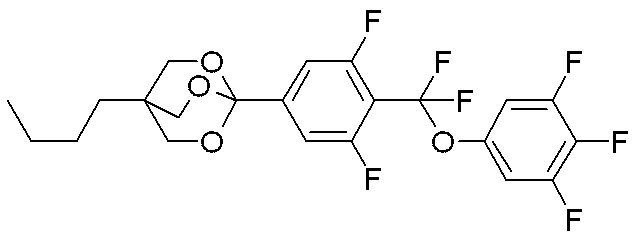
転移温度 : C 75.0 I
母液晶A 85重量%と、実施例23で得られた4-ブチル-1-(4-(ジフルオロ(3,4,5-トリフルオロフェノキシ)メチル)-3,5-ジフルオロフェニル)-2,6,7-トリオキサビシクロ[2.2.2]オクタン(No.65)の15重量%とからなる液晶組成物Xを調製した。得られた液晶組成物Xの物性を測定し、測定値を外挿することで化合物(No.65)の物性の外挿値を算出した。その値は以下のとおりであった。

転移温度 : C 88.5 I
母液晶A 85重量%と、実施例24で得られた4-ペンチル-1-(4-(ジフルオロ(3,4,5-トリフルオロフェノキシ)メチル)-3,5-ジフルオロフェニル)-2,6,7-トリオキサビシクロ[2.2.2]オクタン(No.66)の15重量%とからなる液晶組成物Yを調製した。得られた液晶組成物Yの物性を測定し、測定値を外挿することで化合物(No.66)の物性の外挿値を算出した。その値は以下のとおりであった。
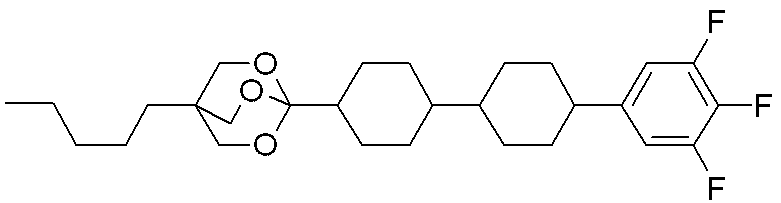
窒素雰囲気下の反応器へ、クロロ(メトキシメチル)トリフェニルホスホラン24.3g(70.8mmol),およびTHF100mlを加え-15℃でカリウムtert-ブトキシド8.0g(71mmol)のTHF50ml溶液を滴下し、-15℃で1時間攪拌した。-15℃で4'-(3,4,5-トリフロオロフェニル)-[1,1'-ビ(シクロヘキサン)]-4-オン 20.0g(64.4mmol)のTHF60ml溶液を滴下し、-15℃で1時間攪拌した。室温に戻し、水200mlを加え、トルエンで抽出、水で洗浄し、無水硫酸マグネシウムで乾燥した後、不溶物をろ別し、減圧下濃縮した。残渣を少量のトルエンに溶かし、ヘプタン500mlに攪拌しながら投入し、不溶物をろ別した。溶媒を減圧下留去し、ヘプタンと酢酸エチルの混合溶媒(容量比 酢酸エチル:ヘプタン=1:4)を展開溶媒とし、シリカゲルを充填剤として用いたカラムクロマトグラフィーによる分取操作で精製し、4-(メトキシメチレン)-4’-(3,4,5-トリフルオロフェニル)-1,1’-ビ(シクロヘキサン) 20.0gを得た。
窒素雰囲気下の反応器へ、第1工程で得られた4-(メトキシメチレン)-4’-(3,4,5-トリフルオロフェニル)-1,1’-ビ(シクロヘキサン) 20.0g(59.1mmol)、メタノール200ml、トルエン20ml、およびp-トルエンスルホン酸一水和物3.4g(18mmol)を加え、23時間還流した。反応混合物を水で洗浄し、無水硫酸マグネシウムで乾燥した後、不溶物をろ別し、減圧下濃縮した。残渣をヘプタンと酢酸エチルの混合溶媒(容量比 酢酸エチル:ヘプタン=1:4)を展開溶媒とし、シリカゲルを充填剤として用いたカラムクロマトグラフィーによる分取操作で精製した。次に、テトラブチルアンモニウムブロミド3.8g(12mmol)、ギ酸100ml、およびトルエン100mlを加え、室温で15時間攪拌した。反応混合物を水で洗浄し、無水硫酸マグネシウムで乾燥した後、不溶物をろ別し、減圧下濃縮した。残渣をヘプタンと酢酸エチルの混合溶媒(容量比 酢酸エチル:ヘプタン=1:4)を展開溶媒とし、シリカゲルを充填剤として用いたカラムクロマトグラフィーによる分取操作で精製し、4’-(3,4,5-トリフルオロフェニル)-[1,1’-ビ(シクロヘキサン)]-4-カルボアルデヒド11.3gを得た。
反応器へ、第2工程で得られた4’-(3,4,5-トリフルオロフェニル)-[1,1’-ビ(シクロヘキサン)]-4-カルボアルデヒド11.3g(34.7mmol)、およびアセトン200mlを加え、0℃でJones試薬を橙色が消えなくなるまで滴下した。イソプロパノール4mlと炭酸水素ナトリウム8gを加え、濾過し、固体をアセトンでリンスし、ろ液を減圧下濃縮した。水50mlを加え、酢酸エチルで抽出、水で洗浄し、ロータリーエバポレーター溶媒を留去した。残渣をトルエンとイソプロパノールの混合溶媒(容量比 トルエン:イソプロパノール=1:1)を展開溶媒とし、シリカゲルを充填剤として用いたカラムクロマトグラフィーによる分取操作で精製することにより、4’-(3,4,5-トリフルオロフェニル)-[1,1’-ビ(シクロヘキサン)]-4-カルボン酸10.9gを得た
窒素雰囲気下の反応器へ、第3工程で得られた4’-(3,4,5-トリフルオロフェニル)-[1,1’-ビ(シクロヘキサン)]-4-カルボン酸3.5g(10mmol)、1-エチル-3-(3-ジメチルアミノプロピル)カルボジイミド塩酸塩2.3g(12mmol)、4-ジメチルアミノピリジン0.13g(1.1mmol)およびジクロロメタン50mlを加えた。室温で3-ペンチル-3-ヒドロキシメチルオキセタン1.8g(11mmol)のジクロロメタン10ml溶液を滴下し、室温で15時間撹拌した。水20mlを加え、ジエチルエーテルで抽出、飽和食塩水で洗浄し、無水硫酸マグネシウムで乾燥した後、不溶物をろ別し、減圧下濃縮した。残渣をヘプタンと酢酸エチルの混合溶媒(容量比 酢酸エチル:ヘプタン=1:4)を展開溶媒とし、シリカゲルを充填剤として用いたカラムクロマトグラフィーによる分取操作で精製し、(3-ペンチルオキセタン-3-イル)メチル) 4’-(3,4,5-トリフルオロフェニル)-[1,1’-ビ(シクロヘキサン)]-4-カルボキシレート 3.7gを得た。
窒素雰囲気下の反応器へ、第4工程で得られた(3-ペンチルオキセタン-3-イル)メチル) 4’-(3,4,5-トリフルオロフェニル)-[1,1’-ビ(シクロヘキサン)]-4-カルボキシレート 3.7g(7.8mmol)およびジクロロメタン80mlを加え、-70℃に冷却し、三フッ化ホウ素ジエチルエーテル錯体0.28g(1.9mmol)を滴下した。室温に昇温し、15時間撹拌した。トリエチルアミン2.1ml(16mmol)を加え、ロータリーエバポレーター濃縮した。その後、ジエチルエーテル100mlを加え、飽和食塩水で洗浄し、無水硫酸マグネシウムで乾燥した後、不溶物をろ別し、減圧下濃縮した。残渣をヘプタンと酢酸エチルの混合溶媒(容量比 酢酸エチル:ヘプタン=1:4)を展開溶媒とし、シリカゲルを充填剤として用いたカラムクロマトグラフィーによる分取操作で精製した。さらに、再結晶(容量比 ヘプタン/酢酸エチル=80/20)により精製し、4-ペンチル-1-(4’-(3,4,5-トリフルオロフェニル)-[1,1’-ビ(シクロヘキサン]]-4-イル)-2,6,7-トリオキサビシクロ[2.2.2]オクタン 2.0gを白色固体として得た。

反応器へ、2,3’,3’’,4’’,5’’-ペンタフルオロ[1,1’:4’,1’’-ターフェニル]-4-カルボアルデヒド10.2g(28.7mmol)、およびアセトン100mlを加え、0℃でJones試薬を橙色が消えなくなるまで滴下した。イソプロパノール4mlと炭酸水素ナトリウム8gを加え、濾過し、固体をアセトンでリンスし、ろ液を減圧下濃縮した。水40mlを加え、酢酸エチルで抽出、水で洗浄し、ロータリーエバポレーター溶媒を留去した。残渣をメタノールとアセトンの混合溶媒(容量比 メタノール:アセトン=1:4)を展開溶媒とし、シリカゲルを充填剤として用いたカラムクロマトグラフィーによる分取操作で精製した。得られた固体と水とヘプタンで洗浄し乾燥させることにより、2,3’,3’’,4’’,5’’-ペンタフルオロ[1,1’:4’,1’’-ターフェニル]-4-カルボン酸4.1gを得た。
窒素雰囲気下の反応器へ、第1工程で得られた2,3’,3’’,4’’,5’’-ペンタフルオロ[1,1’:4’,1’’-ターフェニル]-4-カルボン酸4.1g(14mmol)、1-エチル-3-(3-ジメチルアミノプロピル)カルボジイミド塩酸塩3.2g(17mmol)、4-ジメチルアミノピリジン0.14g(1.4mmol)およびDMF100mlを加えた。室温で3-ペンチル-3-ヒドロキシメチルオキセタン2.0g(15mmol)のジクロロメタン20ml溶液を滴下し、室温で24時間撹拌した。水30mlを加え、ジエチルエーテルで抽出、飽和食塩水で洗浄し、無水硫酸マグネシウムで乾燥した後、不溶物をろ別し、減圧下濃縮した。残渣をヘプタンと酢酸エチルの混合溶媒(容量比 酢酸エチル:ヘプタン=1:4)を展開溶媒とし、シリカゲルを充填剤として用いたカラムクロマトグラフィーによる分取操作で精製し、(3-ペンチルオキセタン-3-イル)メチル) 2,3’,3’’,4’’,5’’-ペンタフルオロ[1,1’:4’,1’’-ターフェニル]-4-カルボキシレート 1.8gを得た。
窒素雰囲気下の反応器へ、第2工程で得られた(3-ペンチルオキセタン-3-イル)メチル) 2,3’,3’’,4’’,5’’-ペンタフルオロ[1,1’:4’,1’’-ターフェニル]-4-カルボキシレート 1.8g(3.7mmol)およびジクロロメタン40mlを加え、-70℃に冷却し、三フッ化ホウ素ジエチルエーテル錯体0.13g(0.91mmol)を滴下した。室温に昇温し、15時間撹拌した。トリエチルアミン0.95ml(7.3mmol)を加え、ロータリーエバポレーター濃縮した。その後、ジエチルエーテル50mlを加え、飽和食塩水で洗浄し、無水硫酸マグネシウムで乾燥した後、不溶物をろ別し、減圧下濃縮した。残渣をヘプタンと酢酸エチルの混合溶媒(容量比 酢酸エチル:ヘプタン=1:4)を展開溶媒とし、シリカゲルを充填剤として用いたカラムクロマトグラフィーによる分取操作で精製した。さらに、再結晶(容量比 ヘプタン/酢酸エチル=80/20)により精製し、1-(2,3’,3’’,4’’,5’’-ペンタフルオロ[1,1’:4’,1’’-ターフェニル]-4-イル)-4-ペンチル-2,6,7-トリオキサビシクロ[2.2.2]オクタン 1.1gを白色固体として得た。
転移温度 : C 99.9 C’ 107.7 N 226.2 I
母液晶A 85重量%と、実施例26で得られた1-(2,3’,3’’,4’’,5’’-ペンタフルオロ[1,1’:4’,1’’-ターフェニル]-4-イル)-4-ペンチル-2,6,7-トリオキサビシクロ[2.2.2]オクタン(No.79)の15重量%とからなる液晶組成物Zを調製した。得られた液晶組成物Zの物性を測定し、測定値を外挿することで化合物(No.79)の物性の外挿値を算出した。その値は以下のとおりであった。

窒素雰囲気下の反応器へ、マグネシウム粉末6.8g(280mmol)とTHF10mlを加え、1-ブロモ-3,5-ジフルオロベンゼン 50.0g(259mmol)のTHF200ml溶液を滴下し、1時間還流した。室温に戻し、1,4-ジオキサスピロ[4,5]デカン-8-オン 33.7g(216mmol)のTHF300ml溶液を滴下し、室温で2時間攪拌した。反応液を飽和塩化アンモニウム水溶液500mlに投入し、酢酸エチルで抽出し、飽和食塩水で洗浄し、無水硫酸マグネシウムで乾燥した後、不溶物をろ別し、減圧下濃縮した。残渣をトルエンで再結晶し、8-(3,5-ジフルオロフェニル)-1,4-ジオキサスピロ[4,5]デカン-8-オール 48.7gを得た。
窒素雰囲気下の反応器へ、第1工程で得られた8-(3,5-ジフルオロフェニル)-1,4-ジオキサスピロ[4,5]デカン-8-オール 48.7g(180mmol)、p-トルエンスルホン酸一水和物 1.7g(9.0mmol)、エタン-1,2-ジオール10ml、水3.5ml、およびトルエン250mlを加え、5時間還流した。室温に戻し、飽和炭酸水素ナトリウム水溶液、水、飽和食塩水の順で洗浄し、無水硫酸マグネシウムで乾燥した後、不溶物をろ別し、減圧下濃縮した。残渣を残渣をヘプタンと酢酸エチルの混合溶媒(容量比 酢酸エチル:ヘプタン=1:9)を展開溶媒とし、シリカゲルを充填剤として用いたカラムクロマトグラフィーによる分取操作で精製し、8-(3,5-ジフルオロフェニル)-1,4-ジオキサスピロ[4,5]デカ-7-エン 38.1gを得た。
反応器へ、第2工程で得られた8-(3,5-ジフルオロフェニル)-1,4-ジオキサスピロ[4,5]デカ-7-エン 38.1g(151mmol)、トルエン120ml、イソプロパノール 80ml、およびPd/C(E type)2.3gを加え、系内を水素で置換した。水素雰囲気化、水素を吸収しなくなるまで室温で撹拌し、反応終了後、Pd/Cをろ過にて除去し、溶媒を留去した。残渣を残渣をヘプタンと酢酸エチルの混合溶媒(容量比 酢酸エチル:ヘプタン=1:3)を展開溶媒とし、シリカゲルを充填剤として用いたカラムクロマトグラフィーによる分取操作で精製し、8-(3,5-ジフルオロフェニル)-1,4-ジオキサスピロ[4,5]デカン 38.2gを得た。
反応器へ、第3工程で得られた8-(3,5-ジフルオロフェニル)-1,4-ジオキサスピロ[4,5]デカン 38.2g(150mmol)、トルエン200ml、およびギ酸113mlを加え、2時間還流した。室温に戻し、水150mlを加え、トルエンで抽出し、水で洗浄し、無水硫酸マグネシウムで乾燥した後、不溶物をろ別し、減圧下濃縮した。残渣をヘプタンと酢酸エチルの混合溶媒(容量比 酢酸エチル:ヘプタン=1:3)を展開溶媒とし、シリカゲルを充填剤として用いたカラムクロマトグラフィーによる分取操作で精製し、4-(3,5-ジフルオロフェニル)シクロヘキサノン 28.3gを得た。
窒素置換した反応器へ、クロロ(メトキシメチル)トリフェニルホスホラン66.8g(195mmol),およびTHF150mlを加え-40℃でカリウムtert-ブトキシド21.9g(195mmol)のTHF50ml溶液を滴下し、-40℃で1時間攪拌した。-40℃で第4工程で得られた4-(3,5-ジフルオロフェニル)シクロヘキサノン 28.3g(134mmol)のTHF150ml溶液を滴下し、-40℃で1時間攪拌した。室温に戻し、15時間攪拌した後、水400mlを加え、酢酸エチルでで抽出、水で洗浄し、無水硫酸マグネシウムで乾燥した後、不溶物をろ別し、減圧下濃縮した。残渣を少量のトルエンに溶かし、ヘプタン500mlに攪拌しながら投入し、不溶物をろ別した。溶媒を減圧下留去し、ヘプタンと酢酸エチルの混合溶媒(容量比 酢酸エチル:ヘプタン=1:20)を展開溶媒とし、シリカゲルを充填剤として用いたカラムクロマトグラフィーによる分取操作で精製し、1,3-ジフルオロ-5-(4-(メトキシメチレン)シクロヘキシル)ベンゼン 31.9gを得た。
窒素雰囲気下の反応器へ、第5工程で得られた1,3-ジフルオロ-5-(4-(メトキシメチレン)シクロヘキシル)ベンゼン 31.9g(134mmol),メタノール300ml,およびp-トルエンスルホン酸一水和物 7.7g(40mmol)を加え、12時間還流した。飽和炭酸水素ナトリウム水溶液200mlを加え、トルエンで抽出、水で洗浄し、無水硫酸マグネシウムで乾燥した後、不溶物をろ別し、減圧下濃縮した。トルエン70ml,テトラブチルアンモニウムブロミド 13g(40mmol),ギ酸35ml,およびトルエン 70mlを加え、3時間還流した。反応混合物を水で洗浄し、無水硫酸マグネシウムで乾燥した後、不溶物をろ別し、減圧下溶媒を留去することにより4-(3,5-ジフルオロフェニル)シクロヘキサンカルボアルデヒド30.3gを得た。
反応器へ、第6工程で得られた4-(3,5-ジフルオロフェニル)シクロヘキサンカルボアルデヒド30.3g(135mmol),およびアセトン300mlを加え、0℃でJones試薬を橙色が消えなくなるまで滴下した。イソプロパノール10mlと炭酸水素ナトリウム20gを加え、濾過し、固体をアセトンでリンスし、ろ液を減圧下濃縮した。水200mlを加え、酢酸エチルで抽出、水で洗浄し、ロータリーエバポレーター溶媒を留去した。残渣を酢酸エチルを展開溶媒とし、シリカゲルを充填剤として用いたカラムクロマトグラフィーによる分取操作で精製した。さらに、再結晶(トルエン)により精製し、4-(3,5-ジフルオロフェニル)シクロヘキサンカルボン酸25.0gを得た。
窒素雰囲気下の反応器へ、第7工程で得られた4-(3,5-ジフルオロフェニル)シクロヘキサンカルボン酸10.0g(41.6mmol)、1-エチル-3-(3-ジメチルアミノプロピル)カルボジイミド塩酸塩9.6g(50mmol)、4-ジメチルアミノピリジン0.51g(4.2mmol)およびジクロロメタン100mlを加えた。室温で3-ペンチル-3-ヒドロキシメチルオキセタン7.2g(46mmol)のジクロロメタン20ml溶液を滴下し、室温で15時間撹拌した。水30mlを加え、ジエチルエーテルで抽出、飽和食塩水で洗浄し、無水硫酸マグネシウムで乾燥した後、不溶物をろ別し、減圧下濃縮した。残渣をヘプタンと酢酸エチルの混合溶媒(容量比 酢酸エチル:ヘプタン=1:4)を展開溶媒とし、シリカゲルを充填剤として用いたカラムクロマトグラフィーによる分取操作で精製し、(3-ペンチルオキセタン-3-イル)メチル) 4-(3,5-ジフルオロフェニル)シクロヘキサンカルボキシレート 13.3gを得た。
窒素雰囲気下の反応器へ、第8工程で得られた((3-ペンチルオキセタン-3-イル)メチル) 4-(3,5-ジフルオロフェニル)シクロヘキサンカルボキシレート 13.3g(34.9mmol)およびジクロロメタン40mlを加え、-70℃に冷却し、三フッ化ホウ素ジエチルエーテル錯体1.2g(8.7mmol)を滴下した。室温に昇温し、15時間撹拌した。トリエチルアミン9.1ml(70mmol)を加え、ロータリーエバポレーター濃縮した。その後、ジエチルエーテル150mlを加え、飽和食塩水で洗浄し、無水硫酸マグネシウムで乾燥した後、不溶物をろ別し、減圧下濃縮した。残渣をヘプタンと酢酸エチルの混合溶媒(容量比 酢酸エチル:ヘプタン=1:4)を展開溶媒とし、シリカゲルを充填剤として用いたカラムクロマトグラフィーによる分取操作で精製した。さらに、再結晶(容量比 ヘプタン/酢酸エチル=80/20)により精製し、1-(4-(3,5-ジフルオロフェニル)シクロヘキシル)-4-ペンチル-2,6,7-トリオキサビシクロ[2.2.2]オクタン 10.6gを得た。
窒素雰囲気下の反応器へ、第9工程で得られた1-(4-(3,5-ジフルオロフェニル)シクロヘキシル)-4-ペンチル-2,6,7-トリオキサビシクロ[2.2.2]オクタン 10.6g(27.8mmol)およびTHF200mlを加え、-70℃に冷却し、n-ブチルリチウム(1.60M,ヘキサン溶液)22.6ml(36.1mmol)を滴下し、-70℃で1h撹拌した。次に-70℃でジブロモジフルオロメタン 8.8g(42mmol)のTHF20ml溶液を滴下し、-70℃で1h撹拌した。その後、室温に戻し1時間攪拌し、反応混合物をを氷水300mlに投入し、トルエンで抽出、飽和食塩水で洗浄し、無水硫酸マグネシウムで乾燥した後、不溶物をろ別し、減圧下濃縮した。残渣をヘプタンと酢酸エチルの混合溶媒(容量比 酢酸エチル:ヘプタン=1:4)を展開溶媒とし、シリカゲルを充填剤として用いたカラムクロマトグラフィーによる分取操作で精製し、1-(4-(4-(ブロモジフルオロメチル)-3,5-トリフルオロフェニル)シクロヘキシル)-4-ペンチル-2,6,7-トリオキサビシクロ[2.2.2]オクタン3.7gを得た。
窒素雰囲気下の反応器へ、第10工程で得られた1-(4-(4-(ブロモジフルオロメチル)-3,5-トリフルオロフェニル)シクロヘキシル)-4-ペンチル-2,6,7-トリオキサビシクロ[2.2.2]オクタン3.7g(7.2mmol)、3,4,5-トリフルオロフェノール1.1g(7.2mmol)、炭酸カリウム 3.0g(22mmol)およびDMF100mlを加え、85℃で4時間撹拌した。室温まで冷却し、トルエン100mlと水酸化ナトリウム水溶液(2N)100mlを加え、有機層を分液、水層をトルエンで抽出した。飽和食塩水で洗浄し、無水硫酸マグネシウムで乾燥した後、不溶物をろ別し、減圧下濃縮した。残渣をヘプタンと酢酸エチルの混合溶媒(容量比 酢酸エチル:ヘプタン=1:4)を展開溶媒とし、シリカゲルを充填剤として用いたカラムクロマトグラフィーによる分取操作で精製した。さらに、再結晶(容量比 ヘプタン/酢酸エチル=80/20)により精製し、1-(4’-(4-ジフルオロ(3,4,5-トリフルオロフェニル)メチル)3,5-ジフルオロフェニル)シクロヘキシル-4-ペンチル-2,6,7-トリオキサビシクロ[2.2.2]オクタン0.2gを白色固体として得た。

窒素雰囲気下の反応器へ、5-((4-ブロモ-2-フルオロフェニル)ジフルオロメトキシ)-1,2,3-トリフルオロベンゼン 3.8g(10mmol)、4-ホルミルフェニルボロン酸1.8g(12mmol)、ジクロロビス(トリフェニルホスフィン)パラジウム(II)0.34g(0.48mmol)、炭酸カリウム 1.7g(12mmol)、トリフェニルホスフィン0.34g(1.3mmol)、トルエン20ml、およびエタノール20mlを加え、80℃で5時間撹拌した。室温まで冷却し、塩酸(2N)200mlを加え、トルエンで抽出した。飽和食塩水で洗浄し、無水硫酸マグネシウムで乾燥した後、不溶物をろ別し、減圧下濃縮した。残渣をヘプタンと酢酸エチルの混合溶媒(容量比 酢酸エチル:ヘプタン=1:4)を展開溶媒とし、シリカゲルを充填剤として用いたカラムクロマトグラフィーによる分取操作で精製し、4’-(ジフルオロ(3,4,5-トリフルオロフェノキシ)メチル)-3’-フルオロ[1,1’-ビフェニル]-4-カルボアルデヒド 3.2gを得た。
反応器へ、第1工程で得られた4’-(ジフルオロ(3,4,5-トリフルオロフェノキシ)メチル)-3’-フルオロ[1,1’-ビフェニル]-4-カルボアルデヒド 3.2g(8.1mmol)、およびアセトン100mlを加え、0℃でJones試薬を橙色が消えなくなるまで滴下した。イソプロパノール4mlと炭酸水素ナトリウム4gを加え、濾過し、固体をアセトンでリンスし、ろ液を減圧下濃縮した。水50mlを加え、酢酸エチルで抽出、水で洗浄し、ロータリーエバポレーター溶媒を留去した。残渣をトルエンとエタノールの混合溶媒(容量比 トルエン:エタノール=1:1)を展開溶媒とし、シリカゲルを充填剤として用いたカラムクロマトグラフィーによる分取操作で精製することにより、4’-(ジフルオロ(3,4,5-トリフルオロフェノキシ)メチル)-3’-フルオロ[1,1’-ビフェニル]-4-カルボン酸3.2gを得た
窒素雰囲気下の反応器へ、第2工程で得られた4’-(ジフルオロ(3,4,5-トリフルオロフェノキシ)メチル)-3’-フルオロ[1,1’-ビフェニル]-4-カルボン酸3.2g(7.8mmol)、1-エチル-3-(3-ジメチルアミノプロピル)カルボジイミド塩酸塩1.8g(9.3mmol)、4-ジメチルアミノピリジン0.09g(0.8mmol)およびジクロロメタン20mlを加えた。室温で3-ペンチル-3-ヒドロキシメチルオキセタン1.4g(8.5mmol)のジクロロメタン10ml溶液を滴下し、室温で15時間撹拌した。水20mlを加え、ジエチルエーテルで抽出、飽和食塩水で洗浄し、無水硫酸マグネシウムで乾燥した後、不溶物をろ別し、減圧下濃縮した。残渣をヘプタンと酢酸エチルの混合溶媒(容量比 酢酸エチル:ヘプタン=1:4)を展開溶媒とし、シリカゲルを充填剤として用いたカラムクロマトグラフィーによる分取操作で精製し、(3-ペンチルオキセタン-3-イル)メチル) 4’-(ジフルオロ(3,4,5-トリフルオロフェノキシ)メチル)-3’-フルオロ[1,1’-ビフェニル]-4-カルボキシレート 3.0gを得た
窒素雰囲気下の反応器へ、第3工程で得られた(3-ペンチルオキセタン-3-イル)メチル) 4’-(ジフルオロ(3,4,5-トリフルオロフェノキシ)メチル)-3’-フルオロ[1,1’-ビフェニル]-4-カルボキシレート 3.0g(5.6mmol)およびジクロロメタン50mlを加え、-70℃に冷却し、三フッ化ホウ素ジエチルエーテル錯体0.20g(1.4mmol)を滴下した。室温に昇温し、15時間撹拌した。トリエチルアミン1.5ml(11mmol)を加え、ロータリーエバポレーター濃縮した。その後、ジエチルエーテル50mlを加え、飽和食塩水で洗浄し、無水硫酸マグネシウムで乾燥した後、不溶物をろ別し、減圧下濃縮した。残渣をヘプタンと酢酸エチルの混合溶媒(容量比 酢酸エチル:ヘプタン=1:4)を展開溶媒とし、シリカゲルを充填剤として用いたカラムクロマトグラフィーによる分取操作で精製した。さらに、再結晶(容量比 ヘプタン/酢酸エチル=80/20)により精製し、1-(4’-(ジフルオロ(3,4,5-トリフルオロフェノキシ)メチル)-3’-フルオロ[1,1’-ビフェニル]-4-イル)-4-ペンチル-2,6,7-トリオキサビシクロ[2.2.2]オクタン 2.3gを白色固体として得た。
転移温度 : C 119.5 C' 127.4 SA 187.0 N 193.5 I
母液晶A 80重量%と、実施例28で得られた1-(4’-(ジフルオロ(3,4,5-トリフルオロフェノキシ)メチル)-3’-フルオロ[1,1’-ビフェニル]-4-イル)-4-ペンチル-2,6,7-トリオキサビシクロ[2.2.2]オクタン(No.101)の10重量%とからなる液晶組成物αを調製した。得られた液晶組成物αの物性を測定し、測定値を外挿することで化合物(No.101)の物性の外挿値を算出した。その値は以下のとおりであった。
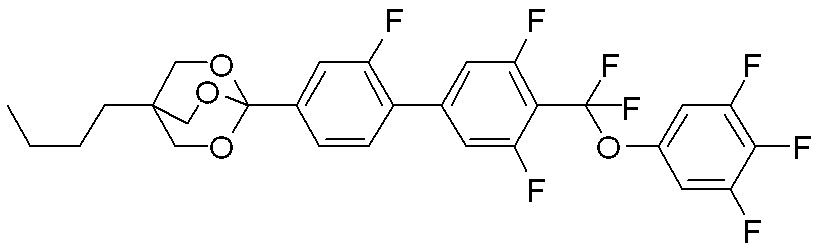
転移温度 :C 78.9 C’ 106.3 C’’ 113.1 N 148.3 I
母液晶A 85重量%と、実施例29で得られた4-ブチル-1-(4’-(ジフルオロ(3,4,5-トリフルオロフェノキシ)メチル)2,3’,5’-トリフルオロ-[1,1’-ビフェニル]-4-イル)-2,6,7-トリオキサビシクロ[2.2.2]オクタン(No.104)の15重量%とからなる液晶組成物βを調製した。得られた液晶組成物βの物性を測定し、測定値を外挿することで化合物(No.104)の物性の外挿値を算出した。その値は以下のとおりであった。
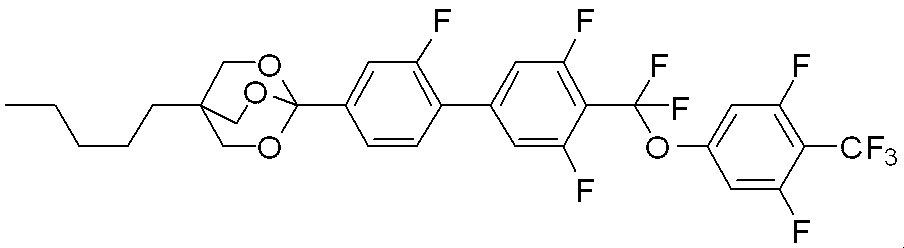
転移温度 :C 152.3 (N 134.8 I)
母液晶A 90重量%と、実施例30で得られた1-(4’((3,5-ジフルオロ-4-(トリフルオロメチル)フェノキシ)ジフルオロメチル)-2,3’,5’-トリフルオロ-[1,1’-ビフェニル]-4-イル)-4-ペンチル-2,6,7-トリオキサビシクロ[2.2.2]オクタン(No.107)の10重量%とからなる液晶組成物γを調製した。得られた液晶組成物γの物性を測定し、測定値を外挿することで化合物(No.107)の物性の外挿値を算出した。その値は以下のとおりであった。

転移温度 :C 115.0 (N 57.9 I)
母液晶A 95重量%と、実施例31で得られた1-(4-(ジフルオロ(2,3’,4’,5’-テトラフルオロ-[1,1’-ビフェニル]-4-イル)オキシ)メチル)-3,5-ジフルオロフェニル-4-ペンチル-2,6,7-トリオキサビシクロ[2.2.2]オクタン(No.115)の5重量%とからなる液晶組成物δを調製した。得られた液晶組成物δの物性を測定し、測定値を外挿することで化合物(No.115)の物性の外挿値を算出した。その値は以下のとおりであった。
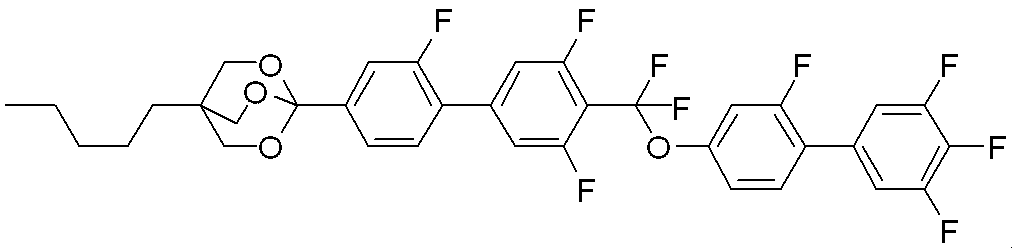
転移温度 :C 110.9 SA 128.8 N 245.7 I
母液晶A 90重量%と、実施例32で得られた1-(4’-(ジフルオロ((2,3’,4’,5’-テトラフルオロ-[1,1’-ビフェニル]―4-イル)オキシ)メチル)-2,3’,5’-トリフルオロ-[1,1’-ビフェニル]-4-イル)-4-ペンチル-2,6,7-トリオキサビシクロ[2.2.2]オクタン(No.151)の10重量%とからなる液晶組成物εを調製した。得られた液晶組成物εの物性を測定し、測定値を外挿することで化合物(No.151)の物性の外挿値を算出した。その値は以下のとおりであった。


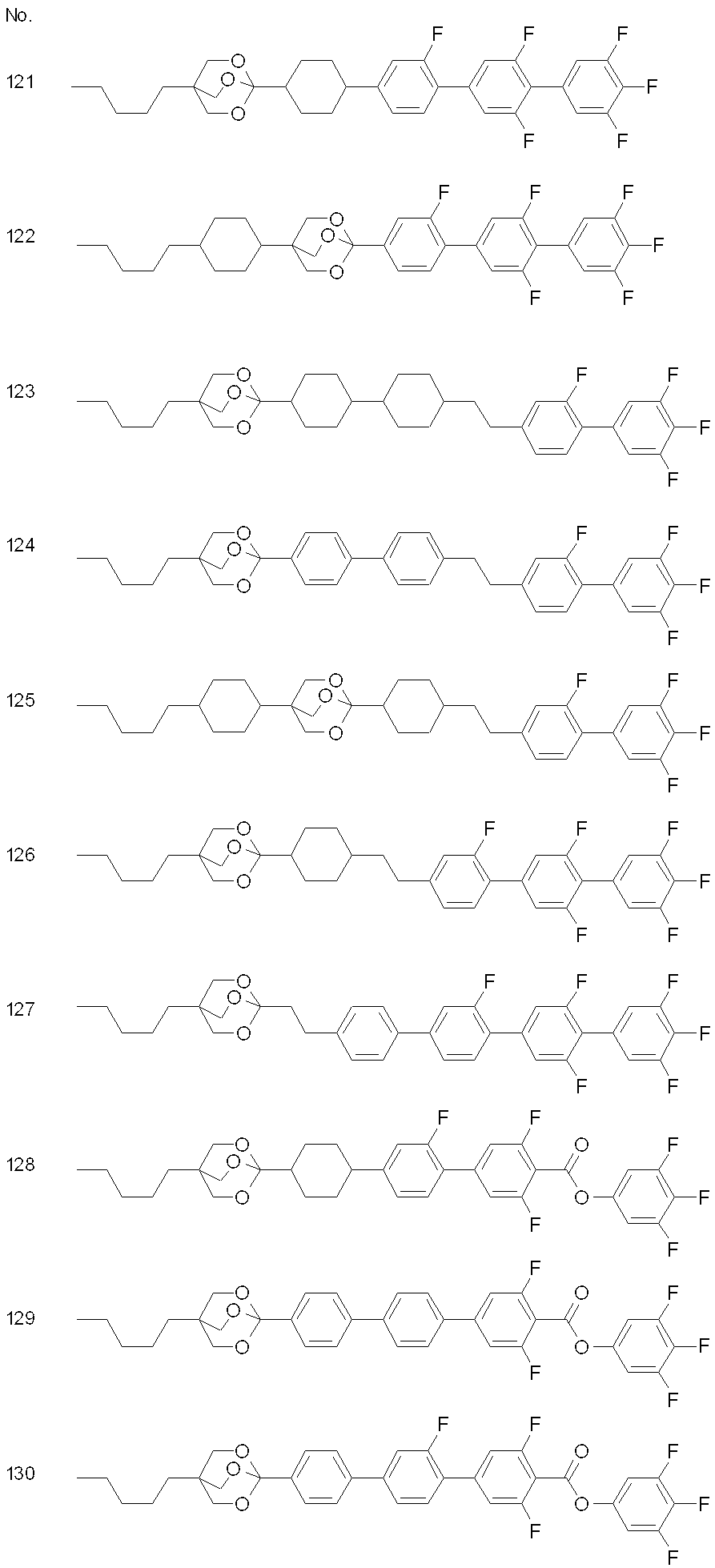


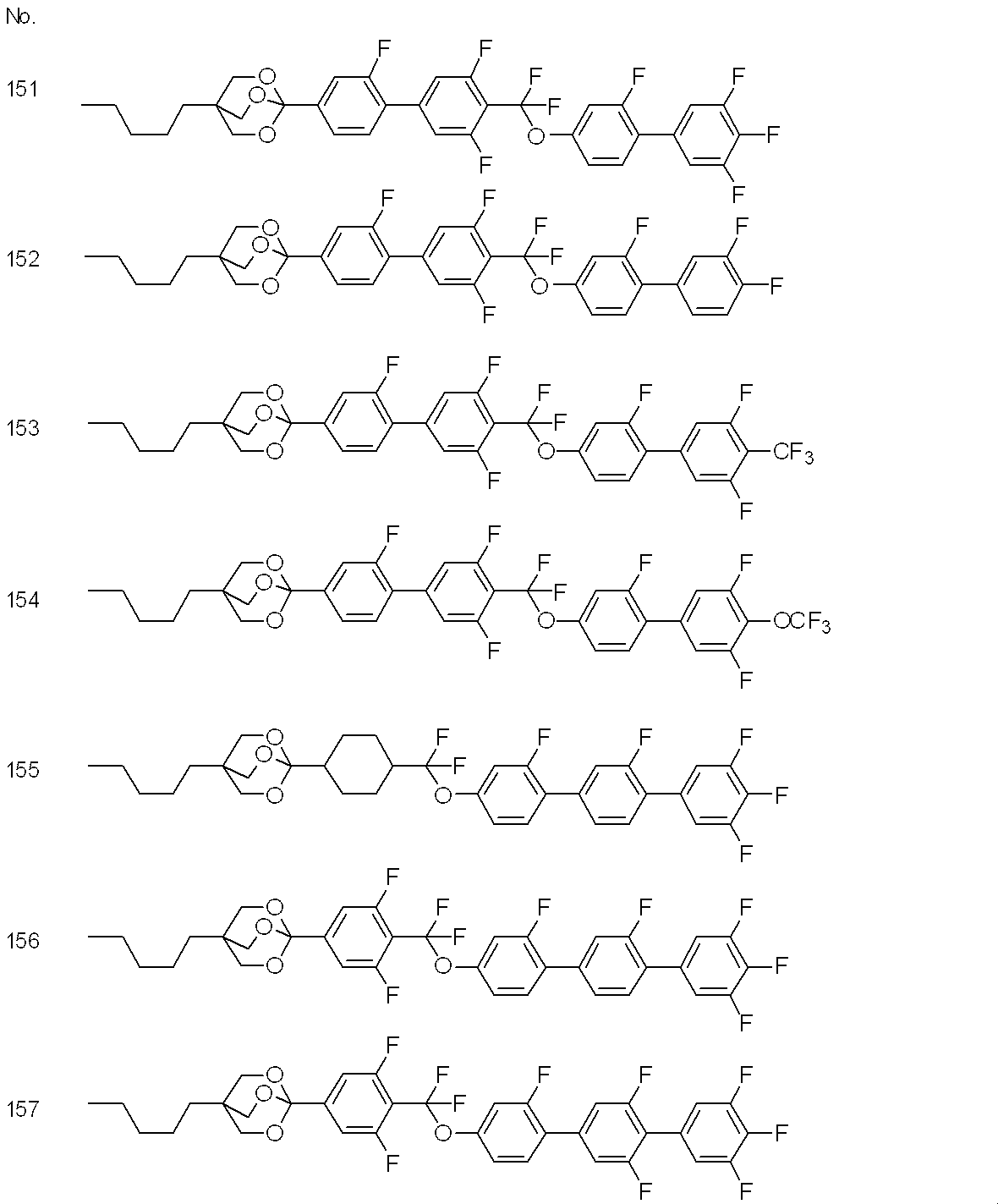
以下、本発明で得られる液晶組成物を実施例により詳細に説明する。なお、実施例で用いる液晶性化合物は、下記表の定義に基づいて記号により表す。なお、表中、1,4-シクロへキシレンの立体配置はトランス配置である。各化合物の割合(百分率)は、特に断りのない限り、組成物の全重量に基づいた重量百分率(重量%)である。各実施例の最後に得られた組成物の特性を示す。

偏光顕微鏡を備えた融点測定装置のホットプレートに試料を置き、1℃/分の速度で加熱した。試料の一部がネマチック相から等方性液体に変化したときの温度を測定した。以下、ネマチック相の上限温度を「上限温度」と略することがある。
ネマチック相を有する試料を0℃、-10℃、-20℃、-30℃、および-40℃のフリーザー中に10日間保管したあと、液晶相を観察した。例えば、試料が-20℃ではネマチック相のままであり、-30℃では結晶またはスメクチック相に変化したとき、TCを≦-20℃と記載した。以下、ネマチック相の下限温度を「下限温度」と略すことがある。
波長が589nmの光を用い、接眼鏡に偏光板を取り付けたアッベ屈折計により測定した。まず、主プリズムの表面を一方向にラビングしたあと、試料を主プリズムに滴下した。そして、偏光の方向がラビングの方向と平行であるときの屈折率(n∥)、および偏光の方向がラビングの方向と垂直であるときの屈折率(n⊥)を測定した。光学異方性の値(Δn)は、(Δn)=(n∥)-(n⊥)の式から算出した。
測定にはE型粘度計を用いた。
2枚のガラス基板の間隔(ギャップ)が約9μm、ツイスト角が80度のTN素子に試料を入れた。このセルに20ボルトを印加して、液晶分子の長軸方向における誘電率(ε∥)を測定した。0.5ボルトを印加して、液晶分子の短軸方向における誘電率(ε⊥)を測定した。誘電率異方性の値は、Δε=ε∥-ε⊥、の式から計算した。
ポリイミド配向膜を有し、そして2枚のガラス基板の間隔(セルギャップ)が6μmであるセルに試料を入れてTN素子を作製した。25℃において、このTN素子にパルス電圧(5Vで60マイクロ秒)を印加して充電した。TN素子に印加した電圧の波形を陰極線オシロスコープで観測し、単位周期(16.7ミリ秒)における電圧曲線と横軸との間の面積を求めた。TN素子を取り除いたあと印加した電圧の波形から同様にして面積を求めた。電圧保持率(%)の値は、(電圧保持率)=(TN素子がある場合の面積値)/(TN素子がない場合の面積値)×100の値から算出した。
3-OeHB(F,F)-F (No.17) 4%
5-OeHB(F,F)-F (No.19) 3%
5-HB-CL (2-2) 16%
3-HB-O2 (11-5) 10%
3-HB-O2 (11-5) 6%
3-HHB-F (3-1) 4%
3-HHB-CL (3-1) 3%
4-HHB-CL (3-1) 4%
3-HHB(F)-F (3-2) 10%
4-HHB(F)-F (3-2) 9%
5-HHB(F)-F (3-2) 9%
7-HHB(F)-F (3-2) 5%
1O1-HBBH-5 (13-1) 3%
3-HHBB(F,F)-F (4-6) 2%
4-HHBB(F,F)-F (4-6) 3%
5-HHBB(F,F)-F (4-6) 3%
3-HH2BB(F,F)-F (4-15) 3%
4-HH2BB(F,F)-F (4-15) 3%
NI=116.6℃;Δn=0.100;Δε=6.6;Vth=1.98V;η=24.6mPa・s.
4-OeHB(F,F)-F (No.18) 3%
3-OeB(F,F)XB(F,F)-F(No.54) 3%
5-OeB(F)B(F,F)XB(F,F)-F
(No.94) 3%
3-HHB(F,F)-F (3-3) 9%
3-H2HB(F,F)-F (3-15) 8%
4-H2HB(F,F)-F (3-15) 8%
5-H2HB(F,F)-F (3-15) 8%
3-HBB(F,F)-F (3-24) 21%
5-HBB(F,F)-F (3-24) 20%
3-H2BB(F,F)-F (3-27) 8%
5-HHBB(F,F)-F (4-6) 3%
5-HHEBB-F (4-17) 2%
1O1-HBBH-5 (13-1) 4%
NI=87.1℃;Δn=0.111;Δε=12.4;Vth=1.28V;η=39.7mPa・s.
上記組成物100重量部に光学活性化合物(Op-5)を0.25重量部添加したときのピッチは61.0μmであった。
3-OeB(F,F)XB(F)B(F,F)-F
(No.102)3%
5-OeB(F)B(F,F)XB(F)B(F,F)-F
(No.139)3%
5-HB-F (2-2) 12%
6-HB-F (2-2) 9%
7-HB-F (2-2) 7%
2-HHB-OCF3 (3-1) 7%
3-HHB-OCF3 (3-1) 7%
4-HHB-OCF3 (3-1) 7%
5-HHB-OCF3 (3-1) 5%
3-HH2B-OCF3 (3-4) 4%
5-HH2B-OCF3 (3-4) 4%
3-HHB(F,F)-OCF2H (3-3) 4%
3-HHB(F,F)-OCF3 (3-3) 5%
3-HH2B(F)-F (3-5) 3%
3-HBB(F)-F (3-23) 7%
5-HBB(F)-F (3-23) 7%
5-HBBH-3 (13-1) 3%
3-HB(F)BH-3 (13-2) 3%
2-OeHB(F,F)-F (No.16) 3%
7-OeHB(F,F)-F (No.20) 2%
5-OeVHB(F,F)-F (No.36) 3%
5-HB-CL (2-2) 8%
3-HB-O2 (11-5) 4%
5-HB-O2 (11-5) 4%
3-HHB-1 (12-1) 2%
3-HHB(F,F)-F (3-3) 8%
3-HBB(F,F)-F (3-24) 20%
5-HBB(F,F)-F (3-24) 15%
3-HHEB(F,F)-F (3-12) 8%
4-HHEB(F,F)-F (3-12) 3%
5-HHEB(F,F)-F (3-12) 3%
2-HBEB(F,F)-F (3-39) 3%
3-HBEB(F,F)-F (3-39) 5%
5-HBEB(F,F)-F (3-39) 3%
3-HHBB(F,F)-F (4-6) 6%
3-OeHXB(F,F)-F (No.40) 4%
3-OeBXB(F,F)-F (No.51) 4%
3-HB-CL (2-2) 3%
5-HB-CL (2-2) 4%
3-HHB-OCF3 (3-1) 5%
3-H2HB-OCF3 (3-13) 5%
5-H4HB-OCF3 (3-19) 15%
V-HHB(F)-F (3-2) 5%
3-HHB(F)-F (3-2) 5%
5-HHB(F)-F (3-2) 5%
3-H4HB(F,F)-CF3 (3-21) 8%
5-H4HB(F,F)-CF3 (3-21) 10%
5-H2HB(F,F)-F (3-15) 5%
5-H4HB(F,F)-F (3-21) 7%
2-H2BB(F)-F (3-26) 5%
3-H2BB(F)-F (3-26) 5%
3-HBEB(F,F)-F (3-39) 5%
5-OeB(F)B(F,F)XB(F,F)-F
(No.94) 5%
5-OeB(F)B(F,F)XB(F,F)-CF3
(No.95) 5%
5-HB-CL (2-2) 7%
7-HB(F,F)-F (2-4) 3%
7-HB-1 (11-5) 5%
3-HB-O2 (11-5) 15%
V2-BB-1 (11-8) 5%
3-HHB-1 (12-1) 8%
3-HHB-3 (12-1) 5%
3-HHB-O1 (12-1) 5%
2-HHB(F)-F (3-2) 7%
3-HHB(F)-F (3-2) 7%
5-HHB(F)-F (3-2) 7%
3-HHB(F,F)-F (3-3) 6%
3-H2HB(F,F)-F (3-15) 5%
4-H2HB(F,F)-F (3-15) 5%
3-OeB(F,F)XB(F)-OCF3
(No.58) 4%
5-OeB(F)B(F,F)XB(F)-F
(No.93) 3%
5-OeHB(F,F)XB(F,F)-F
(No.85) 3%
5-HB-CL (2-2) 3%
7-HB(F)-F (2-3) 7%
3-HB-O2 (11-5) 9%
3-HH-EMe (11-2) 23%
3-HHEB-F (3-10) 8%
5-HHEB-F (3-10) 8%
3-HHEB(F,F)-F (3-12) 10%
4-HHEB(F,F)-F (3-12) 5%
5-HGB(F,F)-F (3-103) 6%
2-H2GB(F,F)-F (3-106) 4%
5-GHB(F,F)-F (3-109) 7%
3-OeHB(F,F)-F (No.17) 4%
5-OeHB(F,F)-F (No.19) 4%
3-HB-O1 (11-5) 15%
3-HB-O2 (11-5) 5%
3-HB(2F,3F)-O2 (5-1) 12%
5-HB(2F,3F)-O2 (5-1) 12%
2-HHB(2F,3F)-1 (6-7) 12%
3-HHB(2F,3F)-1 (6-7) 10%
3-HHB(2F,3F)-O2 (6-7) 7%
5-HHB(2F,3F)-O2 (6-7) 13%
3-HHB-1 (12-1) 6%
NI=80.5℃;Δn=0.091;Δε=0.3;η=41.4mPa・s.
3-OeB(F,F)-F (No.5) 3%
5-OeXB(F,F)-F (No.17) 4%
5-HB-CL (2-2) 16%
3-HB-O2 (11-5) 10%
5-HB-O2 (11-5) 6%
3-HHB-F (3-1) 4%
3-HHB-CL (3-1) 3%
4-HHB-CL (3-1) 4%
3-HHB(F)-F (3-2) 10%
4-HHB(F)-F (3-2) 9%
5-HHB(F)-F (3-2) 9%
7-HHB(F)-F (3-2) 5%
1O1-HBBH-5 (13-1) 3%
3-HHBB(F,F)-F (4-6) 2%
4-HHBB(F,F)-F (4-6) 3%
5-HHBB(F,F)-F (4-6) 3%
3-HH2BB(F,F)-F (4-15) 3%
4-HH2BB(F,F)-F (4-15) 3%
NI=106.8℃;Δn=0.095;Δε=5.6;Vth=1.91V;η=22.8mPa・s.
3-OeB(F,F)-F (No.5) 3%
5-HOeB(F,F)-F (No.26) 3%
5-HB-F (2-2) 12%
6-HB-F (2-2) 9%
7-HB-F (2-2) 7%
2-HHB-OCF3 (3-1) 7%
3-HHB-OCF3 (3-1) 7%
4-HHB-OCF3 (3-1) 7%
5-HHB-OCF3 (3-1) 5%
3-HH2B-OCF3 (3-4) 4%
5-HH2B-OCF3 (3-4) 4%
3-HHB(F,F)-OCF2H (3-3) 4%
3-HHB(F,F)-OCF3 (3-3) 5%
3-HH2B(F)-F (3-5) 3%
3-HBB(F)-F (3-23) 7%
5-HBB(F)-F (3-23) 7%
5-HBBH-3 (13-1) 3%
3-HB(F)BH-3 (13-2) 3%
NI=80.5℃;Δn=0.087;Δε=5.6;Vth=2.02V;η=17.7mPa・s.
3-OeHEB(F,F)-F (No.44) 3%
4-OeHEB(F,F)-F (No.45) 3%
5-OeHEB(F,F)-F (No.46) 3%
3-HHB(F,F)-F (3-3) 9%
3-H2HB(F,F)-F (3-15) 8%
4-H2HB(F,F)-F (3-15) 8%
5-H2HB(F,F)-F (3-15) 8%
3-HBB(F,F)-F (3-24) 21%
5-HBB(F,F)-F (3-24) 20%
3-H2BB(F,F)-F (3-27) 8%
5-HHBB(F,F)-F (4-6) 3%
5-HHEBB-F (4-17) 2%
1O1-HBBH-5 (13-1) 4%
NI=88.8℃;Δn=0.109;Δε=11.5;Vth=1.30V;η=38.7mPa・s.
4-OeB(F,F)XB(F,F)-F
(No.65) 5%
4-OeB(F)B(F,F)XB(F,F)-F
(No.104) 5%
5-HB-CL (2-2) 7%
7-HB(F,F)-F (2-4) 3%
7-HB-1 (11-5) 5%
3-HB-O2 (11-5) 15%
V2-BB-1 (11-8) 5%
3-HHB-1 (12-1) 8%
3-HHB-3 (12-1) 5%
3-HHB-O1 (12-1) 5%
2-HHB(F)-F (3-2) 7%
3-HHB(F)-F (3-2) 7%
5-HHB(F)-F (3-2) 7%
3-HHB(F,F)-F (3-3) 6%
3-H2HB(F,F)-F (3-15) 5%
4-H2HB(F,F)-F (3-15) 5%
NI=84.3℃;Δn=0.089;Δε=7.5;Vth=1.40V;η=24.2mPa・s.
3-OeB(F,F)XB(F)-F
(No.63) 4%
5-OeB(F,F)XB(F)B(F,F)-F
(No.115) 4%
5-HB-CL (2-2) 8%
3-HB-O2 (11-5) 4%
5-HB-O2 (11-5) 4%
3-HHB-1 (12-1) 2%
3-HHB(F,F)-F (3-3) 8%
3-HBB(F,F)-F (3-24) 20%
5-HBB(F,F)-F (3-24) 15%
3-HHEB(F,F)-F (3-12) 8%
4-HHEB(F,F)-F (3-12) 3%
5-HHEB(F,F)-F (3-12) 3%
2-HBEB(F,F)-F (3-39) 3%
3-HBEB(F,F)-F (3-39) 5%
5-HBEB(F,F)-F (3-39) 3%
3-HHBB(F,F)-F (4-6) 6%
NI=75.0℃;Δn=0.109;Δε=11.7;Vth=1.22V;η=27.9mPa・s.
5-OeB(F)XB(F,F)-F (No.62) 5%
5-OeBB(F)XB(F,F)-F(No.101) 5%
5-HB-CL (2-2) 3%
7-HB(F)-F (2-3) 7%
3-HB-O2 (11-5) 9%
3-HH-E1 (11-2) 23%
3-HHEB-F (3-10) 8%
5-HHEB-F (3-10) 8%
3-HHEB(F,F)-F (3-12) 10%
4-HHEB(F,F)-F (3-12) 5%
5-HGB(F,F)-F (3-103) 6%
2-H2GB(F,F)-F (3-106) 4%
5-GHB(F,F)-F (3-109) 7%
NI=86.0℃;Δn=0.076;Δε=8.2;Vth=1.36V;η=27.0mPa・s.
5-OeBXB(F,F)-F (No.60) 4%
5-OeHXB(F,F)-F (No.49) 4%
3-HB-CL (2-2) 3%
5-HB-CL (2-2) 4%
3-HHB-OCF3 (3-1) 5%
3-H2HB-OCF3 (3-13) 5%
5-H4HB-OCF3 (3-19) 15%
V-HHB(F)-F (3-2) 5%
3-HHB(F)-F (3-2) 5%
5-HHB(F)-F (3-2) 5%
3-H4HB(F,F)-CF3
(3-21) 8%
5-H4HB(F,F)-CF3
(3-21) 10%
5-H2HB(F,F)-F (3-15) 5%
5-H4HB(F,F)-F (3-21) 7%
2-H2BB(F)-F (3-26) 5%
3-H2BB(F)-F (3-26) 5%
3-HBEB(F,F)-F (3-39) 5%
NI=71.9℃;Δn=0.094;Δε=10.6;Vth=1.59V;η=31.7mPa・s.
5-OeB(F)B(F)B(F,F)-F
(No.79) 5%
4-OeHch-CF3 (No.40) 5%
3-HB-O2 (11-5) 10%
5-HB-CL (2-2) 13%
3-HBB(F,F)-F (3-24) 7%
3-PyB(F)-F (2-15) 10%
5-PyB(F)-F (2-15) 10%
3-PyBB-F (3-80) 10%
4-PyBB-F (3-80) 10%
5-PyBB-F (3-80) 10%
5-HBB(F)B-3 (13-5) 10%
NI=89.7℃;Δn=0.179;Δε=11.1;Vth=1.51V;η=49.7mPa・s.
5-HOe-CF3 (No.9) 3%
5-OeH-CF3 (No.10) 2%
5-Oech-CF3 (No.11) 3%
3-HB-O1 (11-5) 15%
3-HB-O2 (11-5) 5%
3-HB(2F,3F)-O2 (5-1) 12%
5-HB(2F,3F)-O2 (5-1) 12%
2-HHB(2F,3F)-1 (6-7) 12%
3-HHB(2F,3F)-1 (6-7) 10%
3-HHB(2F,3F)-O2 (6-7) 7%
5-HHB(2F,3F)-O2 (6-7) 13%
3-HHB-1 (12-1) 6%
Claims (21)
- 式(1)で表される化合物。

式中、R1は炭素数1~10のアルキルであり、このアルキルにおいて、少なくとも1つの-CH2-は、-O-で置き換えられてもよく、少なくとも1つの-(CH2)2-は-CH=CH-で置き換えられてもよく、少なくとも1つの水素はハロゲンで置き換えられてもよく;環A1、環A2、環A3、環A4、環A5、および環A6は独立して、1,4-シクロヘキシレンまたは1,4-フェニレンであり、1,4-シクロヘキシレンにおいて、少なくとも1つの-CH2-は、-O-で置き換えられてもよく、1,4-シクロヘキシレンにおいて、少なくとも1つの-(CH2)2-は-CH=CH-で置き換えられてもよく、1,4-フェニレンにおいて、少なくとも1つの-CH=は-N=で置き換えられてもよく、1,4-フェニレンにおいて、少なくとも1つの水素はハロゲンで置き換えられてもよく;Z1、Z2、Z3、Z4、Z5、Z6、およびZ7は独立して、単結合、-(CH2)2-、-COO-、-OCO-、-CF2O-、-OCF2-、または-CH=CH-であり;X1は、フッ素、-CF-3、または-OCF3であり;Y1およびY2は独立して水素またはフッ素であり;i、j、k、m、n、p、およびqは独立して、0または1であり;i、j、k、m、n、p、およびqの和は、1、2、3、または4である。 - 請求項1に記載の式(1)において、i、j、k、m、n、p、およびqの和が、2、3または4である請求項1に記載の化合物。
- 請求項1に記載の式(1)において、qが1である請求項1または2に記載の化合物。
- 請求項1に記載の式(1)において、R1が、炭素数1~10のアルキル、炭素数1~10のアルケニル、または炭素数1~9のアルコキシであり;環A1、環A2、環A3、環A4、環A5、および環A6が独立して、1,4-シクロヘキシレン、1,4-シクロヘキセニレン、テトラヒドロピラン-2,5-ジイル、1,3-ジオキサン-2,5-ジイル、少なくとも1つの水素がフッ素または塩素で置き換えられてもよい1,4-フェニレン、またはピリミジン-2,5-ジイルであり;Z1、Z2、Z3、Z4、Z5、Z6、およびZ7が独立して、単結合、-(CH2)2-、-COO-、-CF2O-、または-CH=CH-である請求項1~3のいずれか1項に記載の化合物。
- 請求項1に記載の式(1)において、R1が炭素数1~10のアルキルであり;環A1、環A2、環A3、環A4、環A5、および環A6が独立して、1,4-シクロヘキシレン、1,4-フェニレン、3-フルオロ-1,4-フェニレン、または3,5-ジフルオロ-1,4-フェニレンであり;Z1、Z2、Z3、Z4、Z5、Z6、およびZ7が独立して、単結合、-(CH2)2-、-COO-、-CF2O-、または-CH=CH-である請求項1~4のいずれか1項に記載の化合物。
- 式(1-1-1)で表される請求項1に記載の化合物。
式中、R1は炭素数1~10のアルキルであり;Z4は独立して、単結合、-(CH2)2-、-COO-、-CF2O-、または-CH=CH-であり;X1は、フッ素、-CF-3、または-OCF3であり;Y1およびY2は独立して水素またはフッ素である。
- 式(1-2-1)または(1-2-2)で表される請求項1に記載の化合物。

式中、R1は炭素数1~10のアルキルであり;環A1および環A4は独立して、1,4-シクロヘキシレン、1,4-フェニレン、3-フルオロ-1,4-フェニレン、または3,5-ジフルオロ-1,4-フェニレンであり;Z1、Z4およびZ7は独立して、単結合、-(CH2)2-、-COO-、-CF2O-、または-CH=CH-であり;X1は、フッ素、-CF-3、または-OCF3であり;Y1およびY2は独立して水素またはフッ素であり;式(1-2-1)において、Z4およびZ7の少なくとも1つは単結合であり;
式(1-2-2)において、Z1およびZ7の少なくとも1つは単結合である。 - 請求項7に記載の式(1-2-1)において、Z4およびZ7のいずれか1つが-CF2O-である、または(1-2-2)において、Z1およびZ7のいずれか1つが-CF2O-である請求項7に記載の化合物。
- 式(1-3-1)、(1-3-2)または(1-3-3)で表される請求項1に記載の化合物。
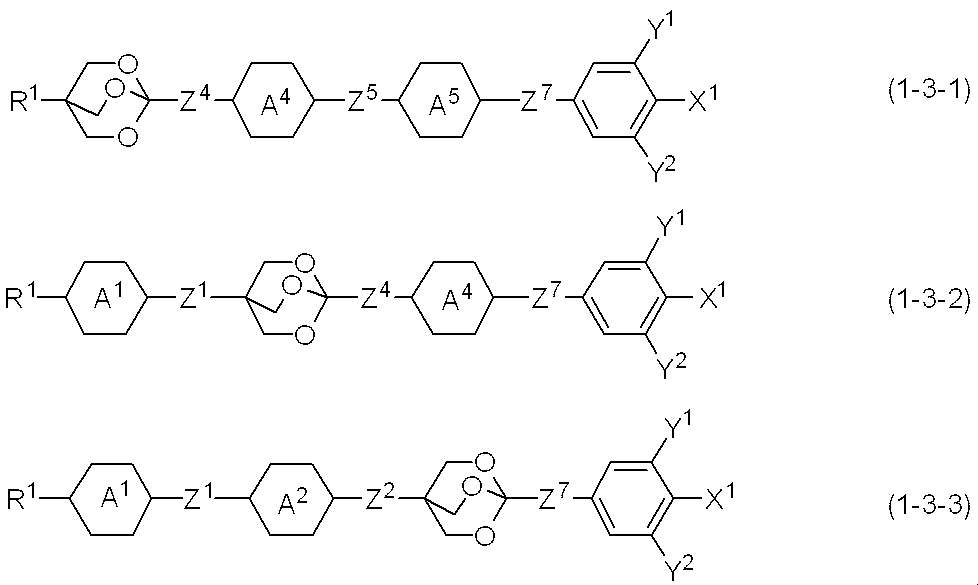
式中、R1は炭素数1~10のアルキルであり;環A1、環A2、環A4、および環A5は独立して、1,4-シクロヘキシレン、1,4-フェニレン、3-フルオロ-1,4-フェニレンまたは3,5-ジフルオロ-1,4-フェニレンであり;Z1、Z2、Z4、Z5、およびZ7は独立して、単結合、-(CH2)2-、-COO-、-CF2O-、または-CH=CH-であり;X1は、フッ素、-CF-3または-OCF3であり;Y1およびY2は独立して水素またはフッ素であり;
式(1-3-1)において、Z4、Z5およびZ7のうち少なくとも2つは単結合であり;
式(1-3-2)において、Z1、Z4およびZ7のうち少なくとも2つは単結合であり;
式(1-3-3)において、Z1、Z2およびZ7のうち少なくとも2つは単結合である。 - 請求項9に記載の式(1-3-1)において、Z4、Z5およびZ7のいずれか1つが-CF2O-である、(1-3-2)において、Z1、Z4およびZ7のいずれか1つが-CF2O-である、または(1-3-3)において、Z1、Z2およびZ7のいずれか1つが-CF2O-である請求項9に記載の化合物。
- 式(1-4-1)、(1-4-2)、(1-4-3)、または(1-4-4)で表される請求項1に記載の化合物。
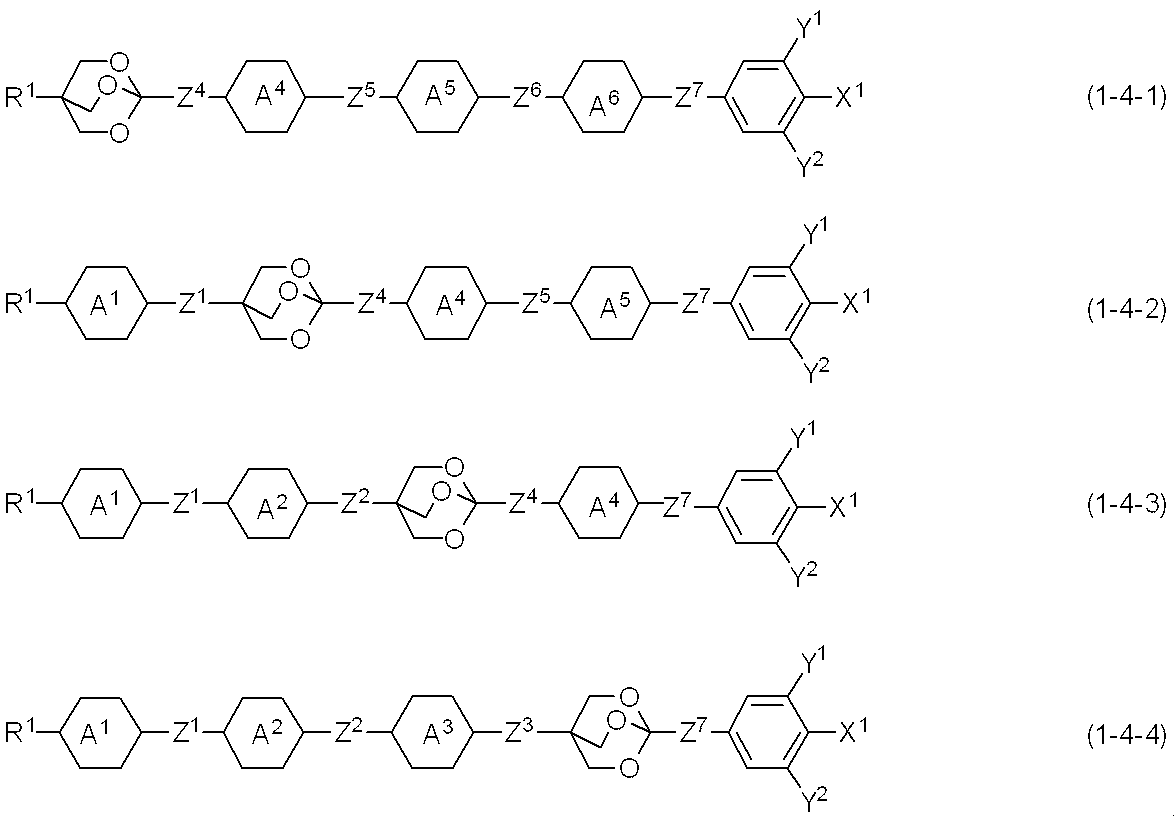
式中、R1は炭素数1~10のアルキルであり;環A1、環A2、環A3、環A4、環A5、および環A6は独立して、1,4-シクロヘキシレン、1,4-フェニレン、3-フルオロ-1,4-フェニレン、または3,5-ジフルオロ-1,4-フェニレンであり;Z1、Z2、Z3、Z4、Z5、Z6、およびZ7は独立して、単結合、-(CH2)2-、-COO-、-CF2O-、または-CH=CH-であり;X1は、フッ素、-CF3または-OCF3であり;Y1およびY2は独立して水素またはフッ素であり;
式(1-4-1)において、Z4、Z5、Z6、およびZ7のうち少なくとも3つは単結合であり;
式(1-4-2)において、Z1、Z4、Z5、およびZ7のうち少なくとも3つは単結合であり;
式(1-4-3)において、Z1、Z2、Z4、およびZ7のうち少なくとも3つは単結合であり;
式(1-4-4)において、Z1、Z2、Z3、およびZ7のうち少なくとも3つは単結合である。 - 請求項11に記載の式(1-4-1)において、Z4、Z5、Z6、およびZ7のいずれか1つが-CF2O-である、(1-4-2)において、Z1、Z4、Z5、およびZ7のいずれか1つが-CF2O-である、(1-4-3)において、Z1、Z2、Z4、およびZ7のいずれか1つが-CF2O-である、または(1-4-4)において、Z1、Z2、Z3、およびZ7のいずれか1つが-CF2O-である請求項11に記載の化合物。
- 第一成分および第二成分を含有し、第一成分が請求項1~12のいずれか1項に記載の化合物から選択された少なくとも1つである液晶組成物。
- 第二成分が、式(2)、(3)および(4)で表される化合物の群から選択される少なくとも1つの化合物である請求項13に記載の液晶組成物。

式(2)~(4)において、R2は独立して炭素数1~10のアルキルまたは炭素数2~10のアルケニルであり、このアルキルおよびアルケニルにおいて、少なくとも1つの水素はフッ素で置き換えられてもよく、少なくとも1つの-CH2-は-O-で置き換えられてもよく;
X2は独立して、フッ素、塩素、-OCF3、-OCHF2、-CF3、-CHF2、-CH2F、-OCF2CHF2、または-OCF2CHFCF3であり;
環B1、環B2および環B3は独立して、1,4-シクロヘキシレン、1,3-ジオキサン-2,5-ジイル、ピリミジン-2,5-ジイル、テトラヒドロピラン-2,5-ジイル、または少なくとも1つの水素がフッ素で置き換えられてもよい1,4-フェニレンであり;
Z8およびZ9は独立して、-(CH2)2-、-(CH2)4-、-COO-、-CF2O-、-OCF2-、-CH=CH-、-C≡C-、-CH2O-、または単結合であり;
Y3およびY4は独立して水素またはフッ素である。 - 第二成分が、式(5)、(6)、(7)、(8)、(9)、および(10)で表される化合物の群から選択される少なくとも1つの化合物である請求項13に記載の液晶組成物。

式(5)~(10)において、R3およびR4は独立して炭素数1~10のアルキルまたは炭素数2~10のアルケニルであり、このアルキルまたはアルケニルにおいて、少なくとも1つの-CH2-は-O-で置き換えられてもよく、このアルケニルにおいて、少なくとも1つの水素はフッ素で置き換えられてもよく;
環C1、環C2、環C3、および環C4は独立して、1,4-シクロヘキシレン、1,4-シクロヘキセニレン、少なくとも1つの水素がフッ素で置き換えられてもよい1,4-フェニレン、テトラヒドロピラン-2,5-ジイル、またはデカヒドロナフタレン-2,6-ジイルであり;
Z11、Z12、Z13、およびZ14は独立して、-(CH2)2-、-COO-、-CH2O-、-OCF2-、-OCF2(CH2)2-または単結合であり;
Y7およびY8は独立して、フッ素または塩素であり;
r、s、t、u、v,およびwは独立して、0または1であり、s、t、u、およびvの和は、1または2である。 - 第二成分が、式(11)、(12)および(13)で表される化合物の群から選択される少なくとも1つの化合物である請求項13に記載の液晶組成物。

式(11)~(13)において、R5およびR6は独立して、炭素数1~10のアルキルまたは炭素数2~10のアルケニルであり、このアルキルまたはアルケニルにおいて、少なくとも1つの-CH2-は-O-で置き換えられてもよく、このアルケニルにおいて、少なくとも1つの水素はフッ素で置き換えられてもよく、;
環D1、環D2および環D3は独立して、1,4-シクロヘキシレン、ピリミジン-2,5-ジイル、1,4-フェニレン、2-フルオロ-1,4-フェニレン、3-フルオロ-1,4-フェニレン、または2,5-ジフルオロ-1,4-フェニレンであり;
Z15およびZ16は独立して、-C≡C-、-COO-、-(CH2)2-、-CH=CH-、または単結合である。 - 請求項16に記載の式(11)、(12)および(13)で表される化合物の群から選択される少なくとも1つの化合物をさらに含有する、請求項14に記載の液晶組成物。
- 請求項16に記載の式(11)、(12)および(13)で表される化合物の群から選択される少なくとも1つの化合物をさらに含有する、請求項15に記載の液晶組成物。
- 少なくとも1つの光学活性化合物および/または重合可能な化合物をさらに含有する、請求項13~18のいずれか1項に記載の液晶組成物。
- 少なくとも1つの酸化防止剤および/または紫外線吸収剤をさらに含有する請求項13~19のいずれか1項に記載の液晶組成物。
- 請求項13~20のいずれか1項に記載の液晶組成物を含有する液晶表示素子。
Priority Applications (5)
| Application Number | Priority Date | Filing Date | Title |
|---|---|---|---|
| EP12764033.2A EP2690103B1 (en) | 2011-03-25 | 2012-03-07 | Ortho ester derivative, liquid crystal composition, and liquid crystal display device |
| JP2013507320A JP5858040B2 (ja) | 2011-03-25 | 2012-03-07 | オルトエステル誘導体、液晶組成物および液晶表示素子 |
| US14/007,330 US9605207B2 (en) | 2011-03-25 | 2012-03-07 | Orthoester derivative, liquid crystal composition and liquid crystal display device |
| CN201280014715.1A CN103443104B (zh) | 2011-03-25 | 2012-03-07 | 具有2,6,7-三氧杂双环[2.2.2]辛烷环的化合物、液晶组成物及液晶显示元件 |
| KR1020137024855A KR101868658B1 (ko) | 2011-03-25 | 2012-03-07 | 오르토에스테르 유도체, 액정 조성물 및 액정 표시 소자 |
Applications Claiming Priority (2)
| Application Number | Priority Date | Filing Date | Title |
|---|---|---|---|
| JP2011-068002 | 2011-03-25 | ||
| JP2011068002 | 2011-03-25 |
Publications (1)
| Publication Number | Publication Date |
|---|---|
| WO2012132796A1 true WO2012132796A1 (ja) | 2012-10-04 |
Family
ID=46930542
Family Applications (1)
| Application Number | Title | Priority Date | Filing Date |
|---|---|---|---|
| PCT/JP2012/055753 Ceased WO2012132796A1 (ja) | 2011-03-25 | 2012-03-07 | オルトエステル誘導体、液晶組成物および液晶表示素子 |
Country Status (7)
| Country | Link |
|---|---|
| US (1) | US9605207B2 (ja) |
| EP (1) | EP2690103B1 (ja) |
| JP (1) | JP5858040B2 (ja) |
| KR (1) | KR101868658B1 (ja) |
| CN (1) | CN103443104B (ja) |
| TW (1) | TWI550071B (ja) |
| WO (1) | WO2012132796A1 (ja) |
Cited By (5)
| Publication number | Priority date | Publication date | Assignee | Title |
|---|---|---|---|---|
| WO2013065622A1 (ja) * | 2011-11-01 | 2013-05-10 | Jnc株式会社 | 光学的に等方性の液晶媒体及び光素子 |
| WO2014171272A1 (ja) * | 2013-04-19 | 2014-10-23 | Jnc株式会社 | キサンテン骨格を有する負の誘電率異方性を示す液晶性化合物、液晶組成物および液晶表示素子 |
| JP2016014021A (ja) * | 2014-07-02 | 2016-01-28 | 達興材料股▲ふん▼有限公司 | 液晶化合物、該液晶化合物を含有する液晶組成物、及び該液晶化合物を使用する液晶ディスプレー |
| JP2016029040A (ja) * | 2014-07-23 | 2016-03-03 | 達興材料股▲ふん▼有限公司 | 液晶化合物、液晶組成物および液晶表示装置 |
| JP2023507399A (ja) * | 2019-12-20 | 2023-02-22 | ファイザー アイルランド ファーマシューティカルズ | 6-カルボキシベンゾオキサゾール誘導体を作製するための効率的なプロセス |
Families Citing this family (10)
| Publication number | Priority date | Publication date | Assignee | Title |
|---|---|---|---|---|
| JP6586785B2 (ja) * | 2014-06-18 | 2019-10-09 | Jnc株式会社 | アキシアル位にフッ素原子を有する1,3−ジオキサン化合物、液晶組成物および液晶表示素子 |
| CN105441087B (zh) * | 2014-07-23 | 2017-09-22 | 达兴材料股份有限公司 | 液晶化合物、液晶组合物以及液晶显示元件 |
| TWI518175B (zh) * | 2015-05-11 | 2016-01-21 | 達興材料股份有限公司 | 液晶組成物及包含其之液晶顯示元件 |
| KR102388345B1 (ko) | 2015-05-29 | 2022-04-19 | 삼성디스플레이 주식회사 | 액정 조성물 및 액정 표시 장치 |
| KR20170015800A (ko) | 2015-07-31 | 2017-02-09 | 삼성디스플레이 주식회사 | 액정 조성물 및 액정 표시 장치 |
| CN107418596B (zh) * | 2017-05-31 | 2020-04-07 | 烟台显华化工科技有限公司 | 一种含1-氧代-双环基-[2.2.2]辛烷化合物的液晶组合物及其应用 |
| CN107828424A (zh) * | 2017-11-17 | 2018-03-23 | 烟台显华化工科技有限公司 | 一种含有二氟甲氧基桥键和双环(2,2,2)辛烷环结构的液晶化合物、制备方法及应用 |
| WO2019101661A1 (en) * | 2017-11-21 | 2019-05-31 | Merck Patent Gmbh | Liquid crystal medium and light modulation element |
| CN109825308B (zh) * | 2019-03-19 | 2021-02-02 | 石家庄晶奥量新材料有限公司 | 负性液晶化合物和负性液晶组合物及应用 |
| CN117486753B (zh) * | 2023-10-13 | 2026-04-03 | 天津科技大学 | 一类具有驱蚊作用的含氟苯甲酰二乙胺类化合物、方法及在驱蚊剂中的应用 |
Citations (12)
| Publication number | Priority date | Publication date | Assignee | Title |
|---|---|---|---|---|
| WO1985003203A1 (en) | 1984-01-30 | 1985-08-01 | The Regents Of The University Of California | A new class of pesticides comprising 1,4-bis-substituted-2,6,7-trioxabicyclo ad2.2.2. bd octanes |
| DD248122A1 (de) | 1986-04-16 | 1987-07-29 | Univ Halle Wittenberg | Verfahren zur herstellung von kristallin-fluessigen 2,6,7-trioxanbicyclo (2.2.2.) octanderivaten |
| DD248136A1 (de) | 1986-04-16 | 1987-07-29 | Univ Halle Wittenberg | Nematische kristallin-fluessige gemische |
| EP0279698A2 (en) | 1987-02-20 | 1988-08-24 | The Wellcome Foundation Limited | Pesticidal compounds |
| US4772624A (en) | 1985-01-23 | 1988-09-20 | The Regents Of The University Of California | 1,4-bis-substituted-2,6,7-trioxabicyclo(2.2.2)-octanes having ethynyl substituted phenyl group |
| JP2001003053A (ja) * | 1999-04-19 | 2001-01-09 | Chisso Corp | 液晶組成物および液晶表示素子 |
| WO2004089885A1 (en) | 2003-04-07 | 2004-10-21 | Astrazeneca Ab | Novel compounds |
| WO2006037982A2 (en) | 2004-10-05 | 2006-04-13 | Astrazeneca Ab | Modulators of crth2 receptor activity for the treatment of prostaglandin d2 mediated diseases |
| JP2007091796A (ja) * | 2005-09-27 | 2007-04-12 | Dainippon Ink & Chem Inc | ネマチック液晶組成物 |
| JP2007169460A (ja) * | 2005-12-22 | 2007-07-05 | Chisso Corp | 液晶組成物および液晶表示素子 |
| JP2008069153A (ja) * | 2006-09-13 | 2008-03-27 | Merck Patent Gmbh | 液晶混合物用のフルオロフェニル化合物類 |
| JP2009256614A (ja) * | 2008-03-18 | 2009-11-05 | Chisso Corp | 液晶組成物および液晶表示素子 |
Family Cites Families (8)
| Publication number | Priority date | Publication date | Assignee | Title |
|---|---|---|---|---|
| US4876274A (en) * | 1985-01-23 | 1989-10-24 | The Regents Of The University Of California | New class of pesticides comprising 1,4-bis-substituted-2,6,7-trioxabicyclo(2.2.2)octanes |
| ES2003872A6 (es) * | 1985-09-24 | 1988-12-01 | Wellcome Found | Un procedimiento para la preparacion de derivados de heterobicicloalcanos |
| JP3241577B2 (ja) | 1995-11-24 | 2001-12-25 | 日本電気株式会社 | 表示パネル駆動回路 |
| KR100248122B1 (ko) | 1997-10-30 | 2000-03-15 | 구본준 | 액정표시장치 및 그 제조방법과 이 액정표시장치를 생산하는제조장비 |
| JP5471189B2 (ja) * | 2009-09-02 | 2014-04-16 | Jnc株式会社 | 液晶組成物および液晶表示素子 |
| EP2423294A1 (en) * | 2010-08-24 | 2012-02-29 | Merck Patent GmbH | Switch element comprising a liquid-crystalline medium |
| JP5729149B2 (ja) * | 2011-06-08 | 2015-06-03 | Jnc株式会社 | 液晶組成物および液晶表示素子 |
| CN103906824B (zh) * | 2011-11-01 | 2016-05-25 | 捷恩智株式会社 | 液晶组合物、混合物、高分子/液晶复合材料以及光学器件 |
-
2012
- 2012-03-02 TW TW101106868A patent/TWI550071B/zh active
- 2012-03-07 US US14/007,330 patent/US9605207B2/en not_active Expired - Fee Related
- 2012-03-07 JP JP2013507320A patent/JP5858040B2/ja not_active Expired - Fee Related
- 2012-03-07 KR KR1020137024855A patent/KR101868658B1/ko not_active Expired - Fee Related
- 2012-03-07 WO PCT/JP2012/055753 patent/WO2012132796A1/ja not_active Ceased
- 2012-03-07 EP EP12764033.2A patent/EP2690103B1/en not_active Not-in-force
- 2012-03-07 CN CN201280014715.1A patent/CN103443104B/zh active Active
Patent Citations (12)
| Publication number | Priority date | Publication date | Assignee | Title |
|---|---|---|---|---|
| WO1985003203A1 (en) | 1984-01-30 | 1985-08-01 | The Regents Of The University Of California | A new class of pesticides comprising 1,4-bis-substituted-2,6,7-trioxabicyclo ad2.2.2. bd octanes |
| US4772624A (en) | 1985-01-23 | 1988-09-20 | The Regents Of The University Of California | 1,4-bis-substituted-2,6,7-trioxabicyclo(2.2.2)-octanes having ethynyl substituted phenyl group |
| DD248122A1 (de) | 1986-04-16 | 1987-07-29 | Univ Halle Wittenberg | Verfahren zur herstellung von kristallin-fluessigen 2,6,7-trioxanbicyclo (2.2.2.) octanderivaten |
| DD248136A1 (de) | 1986-04-16 | 1987-07-29 | Univ Halle Wittenberg | Nematische kristallin-fluessige gemische |
| EP0279698A2 (en) | 1987-02-20 | 1988-08-24 | The Wellcome Foundation Limited | Pesticidal compounds |
| JP2001003053A (ja) * | 1999-04-19 | 2001-01-09 | Chisso Corp | 液晶組成物および液晶表示素子 |
| WO2004089885A1 (en) | 2003-04-07 | 2004-10-21 | Astrazeneca Ab | Novel compounds |
| WO2006037982A2 (en) | 2004-10-05 | 2006-04-13 | Astrazeneca Ab | Modulators of crth2 receptor activity for the treatment of prostaglandin d2 mediated diseases |
| JP2007091796A (ja) * | 2005-09-27 | 2007-04-12 | Dainippon Ink & Chem Inc | ネマチック液晶組成物 |
| JP2007169460A (ja) * | 2005-12-22 | 2007-07-05 | Chisso Corp | 液晶組成物および液晶表示素子 |
| JP2008069153A (ja) * | 2006-09-13 | 2008-03-27 | Merck Patent Gmbh | 液晶混合物用のフルオロフェニル化合物類 |
| JP2009256614A (ja) * | 2008-03-18 | 2009-11-05 | Chisso Corp | 液晶組成物および液晶表示素子 |
Non-Patent Citations (8)
| Title |
|---|
| COLE,L.M. ET AL.: "Structure-biodegradability relationships of insecticidal 1,4-disubstituted- 2,6,7-trioxabicyclo[2.2.2]octanes", JOURNAL OF AGRICULTURAL AND FOOD CHEMISTRY, vol. 39, no. 3, 1991, pages 560 - 565, XP055124376 * |
| H. J. DEULING ET AL., MOL. CRYST. LIQ. CRYST., vol. 27, 1975, pages 81 |
| LIQUID CRYSTALS, vol. 6, no. 4, 1989, pages 397 |
| MOL. CRYST. LIQ. CRYST., vol. 131, 1985, pages 109 |
| MOL. CRYST. LIQ. CRYST., vol. 131, 1985, pages 327 |
| PASCHKE,R. ET AL.: "Synthesis and liquid- crystalline properties of compounds incorporating the 2,6,7-trioxabicyclo(2.2.2) octane", LIQUID CRYSTALS, vol. 6, no. 4, 1989, pages 397 - 407, XP008170202 * |
| PEER. KIRSCH ET AL., ANGEW. CHEM. INT. ED., vol. 40, 2001, pages 1480 |
| W. H. BUNNELLE ET AL., J. ORG. CHEM., vol. 55, 1990, pages 768 |
Cited By (9)
| Publication number | Priority date | Publication date | Assignee | Title |
|---|---|---|---|---|
| WO2013065622A1 (ja) * | 2011-11-01 | 2013-05-10 | Jnc株式会社 | 光学的に等方性の液晶媒体及び光素子 |
| WO2014171272A1 (ja) * | 2013-04-19 | 2014-10-23 | Jnc株式会社 | キサンテン骨格を有する負の誘電率異方性を示す液晶性化合物、液晶組成物および液晶表示素子 |
| CN105121422A (zh) * | 2013-04-19 | 2015-12-02 | 捷恩智株式会社 | 具有呫吨骨架的显示出负的介电各向异性的液晶性化合物、液晶组合物及液晶显示元件 |
| JPWO2014171272A1 (ja) * | 2013-04-19 | 2017-02-23 | Jnc株式会社 | キサンテン骨格を有する負の誘電率異方性を示す液晶性化合物、液晶組成物および液晶表示素子 |
| US9879182B2 (en) | 2013-04-19 | 2018-01-30 | Jnc Corporation | Liquid crystal compound having xanthene skeleton and exhibiting negative dielectric anisotropy, liquid crystal composition and liquid crystal display device |
| CN105121422B (zh) * | 2013-04-19 | 2018-11-23 | 捷恩智株式会社 | 具有呫吨骨架的显示出负的介电各向异性的液晶性化合物、液晶组合物及液晶显示元件 |
| JP2016014021A (ja) * | 2014-07-02 | 2016-01-28 | 達興材料股▲ふん▼有限公司 | 液晶化合物、該液晶化合物を含有する液晶組成物、及び該液晶化合物を使用する液晶ディスプレー |
| JP2016029040A (ja) * | 2014-07-23 | 2016-03-03 | 達興材料股▲ふん▼有限公司 | 液晶化合物、液晶組成物および液晶表示装置 |
| JP2023507399A (ja) * | 2019-12-20 | 2023-02-22 | ファイザー アイルランド ファーマシューティカルズ | 6-カルボキシベンゾオキサゾール誘導体を作製するための効率的なプロセス |
Also Published As
| Publication number | Publication date |
|---|---|
| EP2690103B1 (en) | 2017-12-13 |
| CN103443104A (zh) | 2013-12-11 |
| US9605207B2 (en) | 2017-03-28 |
| CN103443104B (zh) | 2016-08-10 |
| US20140021407A1 (en) | 2014-01-23 |
| KR20140014177A (ko) | 2014-02-05 |
| JPWO2012132796A1 (ja) | 2014-07-28 |
| KR101868658B1 (ko) | 2018-07-19 |
| TWI550071B (zh) | 2016-09-21 |
| JP5858040B2 (ja) | 2016-02-10 |
| TW201239070A (en) | 2012-10-01 |
| EP2690103A4 (en) | 2014-10-01 |
| EP2690103A1 (en) | 2014-01-29 |
Similar Documents
| Publication | Publication Date | Title |
|---|---|---|
| JP5858040B2 (ja) | オルトエステル誘導体、液晶組成物および液晶表示素子 | |
| JP5458577B2 (ja) | 液晶性化合物、液晶組成物および液晶表示素子 | |
| JP5582035B2 (ja) | 含窒素複素環を有する5環液晶化合物、液晶組成物および液晶表示素子 | |
| JP3646671B2 (ja) | 液晶性化合物、この液晶性化合物を含有する液晶組成物、及び液晶組成物を用いた液晶表示素子 | |
| US7951432B2 (en) | Five-ring liquid crystal compound having cyclohexane ring, liquid crystal composition, and liquid crystal display device | |
| US9090825B2 (en) | Cyclohexene-3,6-diyl compound, liquid crystal composition and liquid crystal display device | |
| JP5880832B2 (ja) | 液晶化合物、液晶組成物および液晶表示素子 | |
| JP2009292729A (ja) | Cf2o結合基を有する5環液晶化合物、液晶組成物および液晶表示素子 | |
| WO2014125911A1 (ja) | ジフルオロメチレンオキシを有する液晶性化合物、液晶組成物および液晶表示素子 | |
| WO2014129268A1 (ja) | 液晶性化合物、液晶組成物および液晶表示素子 | |
| JP5531954B2 (ja) | フッ素原子を有する液晶性四環化合物、液晶組成物、及び液晶表示素子 | |
| US8603359B2 (en) | Four-ring compound having a plurality of CF2O bonding groups, liquid crystal composition and liquid crystal display device | |
| JP5686136B2 (ja) | プロピルエーテルを結合基に持つ化合物、液晶組成物、および液晶表示素子 | |
| JP4654474B2 (ja) | 分岐メチル基を有する液晶性化合物、液晶組成物及び液晶表示素子 | |
| JP2009292730A (ja) | 5環液晶化合物、液晶組成物および液晶表示素子 | |
| JP5422898B2 (ja) | ハロゲン化アルキル基と結合した2,2,2−ビシクロオクタンを有する新規な化合物およびこれを用いた液晶組成物 | |
| JP5929781B2 (ja) | ジフルオロエチレンオキシ化合物、液晶組成物および液晶表示素子 | |
| WO2010146992A1 (ja) | 5環液晶性化合物、液晶組成物および液晶表示素子 | |
| JP2000191653A (ja) | フラン環を有する液晶性化合物、液晶組成物及び液晶表示素子 | |
| JP2003300972A (ja) | トリフルオロメチルフラン環を有する化合物 |
Legal Events
| Date | Code | Title | Description |
|---|---|---|---|
| 121 | Ep: the epo has been informed by wipo that ep was designated in this application |
Ref document number: 12764033 Country of ref document: EP Kind code of ref document: A1 |
|
| ENP | Entry into the national phase |
Ref document number: 2013507320 Country of ref document: JP Kind code of ref document: A |
|
| ENP | Entry into the national phase |
Ref document number: 20137024855 Country of ref document: KR Kind code of ref document: A |
|
| NENP | Non-entry into the national phase |
Ref country code: DE |
|
| WWE | Wipo information: entry into national phase |
Ref document number: 14007330 Country of ref document: US |
|
| WWE | Wipo information: entry into national phase |
Ref document number: 2012764033 Country of ref document: EP |