WO2012133694A1 - 活性エネルギー線硬化型インクジェットインク組成物 - Google Patents
活性エネルギー線硬化型インクジェットインク組成物 Download PDFInfo
- Publication number
- WO2012133694A1 WO2012133694A1 PCT/JP2012/058449 JP2012058449W WO2012133694A1 WO 2012133694 A1 WO2012133694 A1 WO 2012133694A1 JP 2012058449 W JP2012058449 W JP 2012058449W WO 2012133694 A1 WO2012133694 A1 WO 2012133694A1
- Authority
- WO
- WIPO (PCT)
- Prior art keywords
- ink composition
- active energy
- energy ray
- polymerizable monomer
- compound
- Prior art date
- Legal status (The legal status is an assumption and is not a legal conclusion. Google has not performed a legal analysis and makes no representation as to the accuracy of the status listed.)
- Ceased
Links
Classifications
-
- C—CHEMISTRY; METALLURGY
- C09—DYES; PAINTS; POLISHES; NATURAL RESINS; ADHESIVES; COMPOSITIONS NOT OTHERWISE PROVIDED FOR; APPLICATIONS OF MATERIALS NOT OTHERWISE PROVIDED FOR
- C09D—COATING COMPOSITIONS, e.g. PAINTS, VARNISHES OR LACQUERS; FILLING PASTES; CHEMICAL PAINT OR INK REMOVERS; INKS; CORRECTING FLUIDS; WOODSTAINS; PASTES OR SOLIDS FOR COLOURING OR PRINTING; USE OF MATERIALS THEREFOR
- C09D11/00—Inks
- C09D11/30—Inkjet printing inks
-
- C—CHEMISTRY; METALLURGY
- C09—DYES; PAINTS; POLISHES; NATURAL RESINS; ADHESIVES; COMPOSITIONS NOT OTHERWISE PROVIDED FOR; APPLICATIONS OF MATERIALS NOT OTHERWISE PROVIDED FOR
- C09D—COATING COMPOSITIONS, e.g. PAINTS, VARNISHES OR LACQUERS; FILLING PASTES; CHEMICAL PAINT OR INK REMOVERS; INKS; CORRECTING FLUIDS; WOODSTAINS; PASTES OR SOLIDS FOR COLOURING OR PRINTING; USE OF MATERIALS THEREFOR
- C09D11/00—Inks
- C09D11/02—Printing inks
- C09D11/10—Printing inks based on artificial resins
- C09D11/101—Inks specially adapted for printing processes involving curing by wave energy or particle radiation, e.g. with UV-curing following the printing
-
- C—CHEMISTRY; METALLURGY
- C09—DYES; PAINTS; POLISHES; NATURAL RESINS; ADHESIVES; COMPOSITIONS NOT OTHERWISE PROVIDED FOR; APPLICATIONS OF MATERIALS NOT OTHERWISE PROVIDED FOR
- C09D—COATING COMPOSITIONS, e.g. PAINTS, VARNISHES OR LACQUERS; FILLING PASTES; CHEMICAL PAINT OR INK REMOVERS; INKS; CORRECTING FLUIDS; WOODSTAINS; PASTES OR SOLIDS FOR COLOURING OR PRINTING; USE OF MATERIALS THEREFOR
- C09D11/00—Inks
- C09D11/30—Inkjet printing inks
- C09D11/38—Inkjet printing inks characterised by non-macromolecular additives other than solvents, pigments or dyes
Definitions
- the present invention relates to an ink composition used for active energy ray-curable inkjet printing.
- the ink jet printing method is a method in which fine droplets of an ink composition are attached to a substrate to be printed to record images and characters, and a printing plate is not used in the printing process.
- a printing method that does not use a plate an electrophotographic method is also well known, but an ink jet printing method is considered to be superior in terms of apparatus cost, running cost, printing speed, and the like.
- ink compositions used for inkjet printing require stricter viscosity control than ink compositions used for offset printing and gravure printing. This is because the amount of droplets at the time of ejection changes due to the change in the viscosity of the ink composition, and as a result, the image quality of the printed matter changes. Furthermore, in recent years, inkjet printing methods have been used all over the world, and even for long-term transportation and storage, the quality change including viscosity is as small as possible, that is, excellent in stability over time. There is a need for ink compositions.
- ink compositions used for ink jet printing such as solvent type, water type, and active energy ray curable type.
- solvent type such as solvent type, water type, and active energy ray curable type.
- active energy ray curable inks because it cures quickly by irradiation with active energy rays, it has excellent printing speed, it can be applied to non-absorbent base materials such as plastic and board, etc.
- active energy ray curable inks There is an increasing demand for active energy ray curable inks.
- the active energy ray curable type is used in consideration of the strength and durability of the printed matter, the ink drying energy, and the difficulty of ink components adhering to the head due to drying. Is the current situation.
- the active energy ray-curable ink-jet ink composition is difficult to control the viscosity and stability over time as compared with other types of ink-jet ink compositions. This is because the main component of the active energy ray-curable ink-jet ink composition is a polymerizable monomer, and the polymerization reaction of the polymerizable monomer proceeds due to a small amount of a polymerization initiating component generated during transportation and storage. .
- Patent Document 1 is an example in which storage stability is improved by adding an organic solvent such as petroleum to the ink composition.
- an organic solvent that does not participate in the polymerization reaction is added, the curability deteriorates.
- Patent Document 2 is an example in which storage stability is improved by using N-vinyl lactams as a polymerizable monomer and further adding an antioxidant or a polymerization inhibitor.
- the ink composition disclosed in the specification has a very high content of a polymerizable monomer (monofunctional monomer) containing only one polymerizable reactive group. Therefore, the strength and durability of the printed matter, which should be an advantage of the active energy ray curable ink jet printing method, are deteriorated, which is not preferable.
- Patent Document 3 is an example in which the stability with time is improved by adding a pH buffer to the ink composition in order to improve the storage stability.
- the Good buffer disclosed in this document is an ionic compound. For this reason, depending on the storage conditions, an ionic compound different from the material in the ink composition may be formed, which may appear as a precipitate in the inkjet head, which is not preferable.
- the present invention is an ink composition used for active energy ray-curable ink jet printing, having an excellent curability and multi-substrate adhesion while having a low viscosity, and an excellent storage stability. It provides things.
- the present inventor is an ink composition used for active energy ray-curable ink jet printing, having an excellent curability and multi-substrate adhesion while having a low viscosity, and an excellent storage stability.
- the above-mentioned problem can be solved by including two or more polymerizable monomers containing two or more reactive sites and a stabilizer (B). And the present invention has been made.
- an active energy ray-curable inkjet ink composition containing at least a polymerizable monomer (A) and a stabilizer (B) and substantially free of water, wherein the polymerizable monomer (A) is:
- An active energy ray-curable inkjet ink composition comprising two or more polymerizable monomers containing two or more reactive sites.
- the stabilizer (B) contains a hindered phenol compound (B-1) and a compound (B-2) selected from phenothiazine, hindered amine, or phosphorus.
- the active energy ray-curable inkjet ink composition according to (1).
- the active energy ray-curable inkjet ink composition according to any one of (1) to (2), which comprises (4) As the compound (B-2) selected from the phenothiazine, hindered amine, or phosphorus compound, the compound (B-2-1) selected from the phenothiazine or hindered amine, and the phosphorus compound (B- 2-2), the active energy ray-curable inkjet ink composition according to any one of (1) to (3).
- An ink composition used for active energy ray-curable ink jet printing comprising two or more polymerizable monomers containing two or more reactive sites and a stabilizer (B), and having a low viscosity
- B stabilizer
- the polymerizable monomer containing two or more reactive sites includes a polymerizable monomer (A-1) containing a vinyl ether group and an acryloyl group, and a polymerizable monomer (A-2) containing two or more acryloyl groups. 2 or more types of monomers selected from the group consisting of:
- a polymerizable monomer has a higher reactivity as the amount of the polymerizable reactive group relative to the molecular weight (hereinafter referred to as “reactive group equivalent”) is higher, and the amount of radicals that trigger the polymerization reaction is smaller.
- reactive group equivalent the amount of radicals that trigger the polymerization reaction is smaller.
- the polymerizable reactive group an acryloyl group, a methacryloyl group, a vinyl group, and the like are known. Of these, the acryloyl group is known to have the best reactivity. From the above, in order to increase the reactivity of the ink composition, the polymerizable monomer (A-2) containing two or more acryloyl groups is preferred.
- the polymerizable monomer (A-2) containing two or more acryloyl groups may have a high viscosity derived from the intermolecular interaction caused by the acryloyl groups.
- the viscosity of the ink composition exceeds 100 mPa ⁇ s, and cannot be used as an inkjet ink composition.
- a polymerizable monomer containing two or more reactive sites in order to solve this problem, it is preferable to use a polymerizable monomer containing two or more reactive sites.
- (A-1) exemplified as this polymerizable monomer is characterized by its extremely low viscosity of 10 mPa ⁇ s or less although it is a polyfunctional monomer.
- the polymerization reaction may proceed due to radicals generated in some amount, and viscosity increase or gelation may occur during storage of the ink composition.
- the stabilizer (B) is used in combination to solve this problem.
- a conventionally known material can be used as the stabilizer (B), and a hindered phenol compound (B-1) and a compound (B-2) selected from phenothiazine, hindered amine, or phosphorus It is preferable to use together.
- the compound (B-2) selected from phenothiazine, hindered amine, or phosphorus compound the compound (B-2-1) selected from phenothiazine or hindered amine, and the phosphorus compound (B-2) -2) is more preferably used in combination. It has been found in the present invention that the combination of these stabilizers can remarkably improve the temporal stability while maintaining the curability. The reason is not clear, but interaction occurs when the above materials are combined, and it has a much greater effect than when used alone. This is presumably because the influence on the polymerization reaction when irradiated with energy rays is minimized.
- a polymerizable monomer containing two or more reactive sites and a stabilizer (B) are used in combination.
- the blending ratio of the materials can be adjusted in order to develop excellent curability, adhesion, and stability over time.
- the proportion of the polymerizable monomer (A-1) containing a vinyl ether group and an acryloyl group relative to the amount of the polymerizable monomer (A-2) containing two or more acryloyl groups is 25 wt% or more and 400 % Weight or less is preferable, and 50 weight% or more and 200 weight% or less is particularly preferable (hereinafter, unless otherwise specified, “%” means “wt%”).
- the ratio of the blending amount of the polymerizable monomer (A-1) containing a vinyl ether group and an acryloyl group to the blending amount of the polymerizable monomer (A-2) containing two or more acryloyl groups is 25% or more.
- the influence of the polymerizable monomer (A-1) containing a vinyl ether group and an acryloyl group is sufficient, the viscosity of the ink composition does not increase too much, and the ink jet suitability is good, and the curability and adhesion are also good. It is. When it is 400% or less, adhesion and stability over time are good.
- the blending amount of the stabilizer (B) can be set in consideration of the blending amount of the polymerizable monomer (A) that should suppress the polymerization reaction.
- the blending amount of the stabilizer (B) is preferably from 0.1% to 2%, particularly from 0.5% to 1.5%, based on the total amount of the polymerizable monomer (A). preferable. Within this range, the above interaction is sufficient, and the balance between stability over time and curability is good.
- polymerizable monomer (A-1) containing a vinyl ether group and an acryloyl group examples include “VEEA” manufactured by Nippon Shokubai Co., Ltd.
- the blending amount of the polymerizable monomer (A-1) containing a vinyl ether group and an acryloyl group is preferably 33.4% or more, more preferably 35% or more and 80% or less with respect to the total amount of the polymerizable monomer (A). More preferably, it is particularly preferably 40% or more and 60% or less.
- the content is 33.4% or more, the viscosity of the ink composition does not increase excessively and the curability and adhesion are good.
- the compounding amount of the polymerizable monomer (A-1) containing a vinyl ether group and an acryloyl group is such that the polymerizable monomer (A-2) containing two or more acryloyl groups or the stabilizer (B). It can be set in consideration of the blending amount.
- the polymerizable monomer (A-2) containing two or more acryloyl groups conventionally known materials can be used as necessary. Specifically, dimethylol tricyclodecane diacrylate, (ethoxy (or propoxy)) bisphenol A diacrylate, cyclohexane dimethanol diacrylate, ethylene glycol diacrylate, (ethoxy (or propoxy)) 1,6-hexane Diol diacrylate, 1,9-nonanediol diacrylate, 1,10-decanediol diacrylate, (ethoxy (or propoxy)) neopentyl glycol diacrylate, hydroxypivalate neopentyl glycol diacrylate, dipropylene glycol diacrylate , (Neopentyl glycol modified) trimethylolpropane diacrylate, tripropylene glycol diacrylate, dicyclopentanyl diacrylate, pentaerythritol It can be cited Li (or t
- dimethylol tricyclodecane diacrylate (ethoxy (or propoxy)) neopentyl glycol diacrylate, neopentyl glycol diacrylate hydroxypivalate, 1,6-hexanediol diacrylate, 1,9-nonanediol diacrylate It is preferable to select acrylate, 1,10-decanediol diacrylate, dipropylene glycol diacrylate, tripropylene glycol diacrylate, or trimethylolpropane triacrylate. However, it is excellent in curability and adhesiveness despite its low viscosity. 1,9-nonanediol diacrylate is particularly preferably selected.
- the blending amount of the polymerizable monomer (A-2) containing two or more acryloyl groups is preferably less than 66.6%, more preferably from 20% to less than 65% with respect to the total amount of the polymerizable monomer (A). More preferred.
- the blending amount is less than 66.6%, the viscosity of the ink composition does not become too high, and the inkjet suitability is good.
- the compounding amount of the polymerizable monomer (A-2) containing two or more acryloyl groups is such that the polymerizable monomer (A-1) containing the vinyl ether group and the acryloyl group or the stabilizer (B). It can be set in consideration of the blending amount.
- a known material can be used as necessary.
- a hindered phenol compound, a phenothiazine compound, a hindered amine compound, Phosphorus compounds are particularly preferably used.
- hindered phenol compounds “IRGANOX 1010, 1010FF, 1035, 1035FF, 1076, 1076FD, 1076DWJ, 1098, 1135, 1330, 245, 245FF, 245DWJ, 259, 3114, 565, manufactured by BASF, 565DD, 295 ", Seiko Chemical Co., Ltd.”
- BHT Swanox "" Nonflex Aruba, MBP, EBP, CBP, BB “” TBH “, ADEKA” AO-20, 30, 50, 50F, 70, 80, 330 ", “H-BHT” manufactured by Honshu Chemical Co., Ltd., and “Yoshinox BB, 425, 930” manufactured by API Corporation can be mentioned.
- the blending amount of the stabilizer (B) needs to be set in consideration of the blending amount of the polymerizable monomer (A).
- the compounding quantity of a stabilizer (B) can be determined in consideration of the compounding ratio of each material.
- the proportion of the compound (B-2) selected from phenothiazine, hindered amine, or phosphorus with respect to the amount of the hindered phenol compound (B-1) is 5% or more and 25% or less. Is preferably 10% or more and 20% or less.
- the compound (B-2) selected from phenothiazines, hindered amines or phosphorus compounds a compound (B-2-1) selected from phenothiazines or hindered amines, and a phosphorus compound (B-2-2)
- the ratio of the compounding amount of the phosphorus compound (B-2-2) to the compounding amount of the compound (B-2-1) selected from the phenothiazine-based or hindered amine-based compound is 5% or more and 100% or less. It is preferably 10% or more and 50% or less. Within these ranges, the interaction between the stabilizers can be used effectively, and as a result, the balance between stability over time and curability is good.
- polymerizable monomer (A) other than the polymerizable monomer containing two or more reactive sites conventionally known materials can be used as necessary.
- monomers containing a plurality of methacryloyl groups include dimethylol tricyclodecane dimethacrylate, (ethoxy (or propoxy)) bisphenol A dimethacrylate, cyclohexanedimethanol dimethacrylate, and (poly) ethylene glycol dimethacrylate.
- butanediol divinyl ether diethylene glycol divinyl ether, triethylene glycol divinyl ether, cyclohexane dimethanol divinyl ether, trimethylolpropane divinyl ether, pentaerythritol tri (or tetra) vinyl ether, trimethylolpropane diallyl Mention may be made of ether and pentaerythritol tri (or tetra) allyl ether.
- a monofunctional monomer in terms of viscosity and reactivity, and (ethoxy (or propoxy)) 2-phenoxyethyl acrylate, ethoxyethoxyethyl acrylate, isobornyl acrylate, isooctyl acrylate, lauryl acrylate N-vinylcaprolactam and N-acryloyloxyethyl hexahydrophthalimide are preferably selected.
- the blending amount of the monofunctional monomer with respect to the total amount of the polymerizable monomer (A) is preferably 10 to 50%, and more preferably 20 to 40%.
- oligomers and prepolymers can be used for the ink composition.
- Specific examples of oligomers and prepolymers include “Ebecryl 230, 244, 245, 270, 280 / 15IB, 284, 285, 4830, 4835, 4858, 4883, 8402, 8803, 8800, 254, 264, 265, manufactured by Daicel UCB.
- the ink composition may contain an organic solvent in order to reduce the viscosity and improve the wetting and spreading property to the substrate.
- Organic solvents include ethylene glycol monomethyl ether acetate, ethylene glycol monoethyl ether acetate, ethylene glycol monobutyl ether acetate, diethylene glycol monomethyl ether acetate, diethylene glycol monoethyl ether acetate, diethylene glycol monobutyl ether acetate, propylene glycol monomethyl ether acetate, dipropylene glycol monomethyl Ether acetate, ethylene glycol monomethyl ether propionate, ethylene glycol monoethyl ether propionate, ethylene glycol monobutyl ether propionate, diethyl diglycol, diethylene glycol dialkyl ether, tetraethylene glycol dialkyl Ether, diethylene glycol monomethyl ether propionate, diethylene glycol monoethyl ether propionate, diethylene glycol monobutyl ether propionate, propylene glycol monomethyl ether propionate, dipropylene glycol monomethyl ether propionate,
- the ink composition of this embodiment does not substantially contain water, that is, is a non-aqueous ink.
- the water content in the ink composition is preferably 5% by weight or less.
- the radical photopolymerization initiator contained in the ink composition can be freely selected depending on the curing rate, the cured coating film properties, and the coloring material.
- molecular cleavage type or hydrogen abstraction type is preferable, and specifically, benzoin isobutyl ether, 2,4-diethylthioxanthone, 2-isopropylthioxanthone, 2,4,6-trimethylbenzoyldiphenylphosphine oxide, 2 -Benzyl-2-dimethylamino-1- (4-morpholinophenyl) -butan-1-one, bis (2,4,6-dimethoxybenzoyl) -2,4,4-trimethylpentylphosphine oxide, 2- Methyl-1- (4-methylthiophenyl) -2-morpholinopropan-1-one, oligo (2-hydroxy-2-methyl-1- (4- (1-methylvinyl) phenyl) propanone), 4-benzoyl -4'-methyl-diphen
- radical photopolymerization initiators examples include 1-hydroxycyclohexyl phenyl ketone, benzoin ethyl ether, benzyl dimethyl ketal, 2-hydroxy-2-methyl-1-phenylpropan-1-one, and 1- Examples of (4-isopropylphenyl) -2-hydroxy-2-methylpropan-1-one and hydrogen abstraction type polymerization initiators include benzophenone, 4-phenylbenzophenone and isophthalphenone.
- the photo radical polymerization initiator can be used alone or in combination of two or more in consideration of the wavelength spectrum of the active energy ray and the light absorption spectrum of the photo radical polymerization initiator.
- the photo radical polymerization initiator is preferably contained in an amount of 2 to 25% by weight based on the polymerizable compound. When it is 2% by weight or more, the curing rate is good, and when it is 25% by weight or less, it is economical and no dissolution residue occurs. If a dissolution residue occurs, even if heat is applied to dissolve the dissolution residue, the viscosity of the ink composition increases, and as a result, the viscosity of the ink composition cannot fall within the preferred range, The problem that it becomes impossible to discharge occurs.
- a dye or a pigment can be used, but a pigment can be more preferably used from the viewpoint of the durability of the printed matter.
- a pigment generally used for an ink composition for printing or paint can be used, and can be selected according to necessary uses such as color developability and light resistance.
- achromatic pigments such as carbon black, titanium oxide, calcium carbonate, or chromatic organic pigments can be used.
- organic pigments examples include insoluble azo pigments such as toluidine red, toluidine maroon, Hansa Yellow, Benzidine Yellow, and pyrazolone red, soluble azo pigments such as Ritol Red, Helio Bordeaux, Pigment Scarlet, and Permanent Red 2B, alizarin, indanthrone, and thioindigo.
- insoluble azo pigments such as toluidine red, toluidine maroon, Hansa Yellow, Benzidine Yellow, and pyrazolone red
- soluble azo pigments such as Ritol Red, Helio Bordeaux, Pigment Scarlet, and Permanent Red 2B
- alizarin, indanthrone, and thioindigo examples include insoluble azo pigments such as toluidine red, toluidine maroon, Hansa Yellow, Benzidine Yellow, and pyrazolone red
- soluble azo pigments such as Ritol Red, Helio Bordeaux, Pigment Scarlet, and Permanent Red 2B
- vat dyes such as maroon, phthalocyanine organic pigments such as phthalocyanine blue and phthalocyanine green, quinacridone organic pigments such as quinacridone red and quinacridone magenta, perylene organic pigments such as perylene red and perylene scarlet, isoindolinone yellow , Isoindolinone organic pigments such as isoindolinone orange, pyranthrone organic pigments such as pyranthrone red and pyranthrone orange, thioy Flavanthrone as digo organic pigments, condensed azo organic pigments, benzimidazolone organic pigments, quinophthalone organic pigments such as quinophthalone yellow, isoindoline organic pigments such as isoindoline yellow, naphthol organic pigments, and other pigments Examples include yellow, acylamide yellow, nickel azo yellow, copper azomethine yellow, perinone orange, anthrone orange, dian
- organic pigments by color index (CI) number is C.I. I. Pigment Yellow 12, 13, 14, 17, 20, 24, 74, 83, 86 93, 109, 110, 117, 120, 125, 128, 129, 137, 138, 139, 147, 148, 150, 151, 153 154, 155, 166, 168, 180, 185, C.I. I. Pigment orange 16, 36, 43, 51, 55, 59, 61, C.I. I.
- carbon black examples include “Special Black 350, 250, 100, 550, 5, 4, 4A, 6” manufactured by Degussa, Inc., “Printex U, V, 140 U, 140 V, 95, 90, 85, 80, 75, 55, 45, 40, P, 60, L6, L, 300, 30, 3, 35, 25, A, G ”,“ REGAL400R, 660R, 330R, 250R ”“ MOGUL E, L ”, manufactured by Mitsubishi Chemical Corporation “MA7, 8, 11, 77, 100, 100R, 100S, 220, 230” “# 2700, # 2650, # 2600, # 200, # 2350, # 2300, # 2200, # 1000, # 990, # 980, # 970, # 960, # 950, # 900, # 850, # 750, # 650, # 52, # 50, # 47, # 45, 45L, # 44, # 40, # 33, # 332, # 30, # 25, # 20, # 10, # 5, CF9, # 95, include
- titanium oxide examples include “Taipaque CR-50, 50-2, 57, 80, 90, 93, 95, 953, 97, 60, 60-2, 63, 67, 58, 58-” manufactured by Ishihara Sangyo Co., Ltd.
- quinacridone organic pigments phthalocyanine organic pigments, benzimidazolone organic pigments, isoindolinone organic pigments, condensed azo organic pigments, quinophthalone organic pigments, isoindoline organic pigments, etc. are light-resistant. Is preferable because it is excellent.
- the organic pigment is preferably a fine pigment having an average particle diameter of 10 to 200 nm as measured by laser scattering. If the average particle size of the pigment is 10 nm or more, the particle size will not be too small, and the light resistance will not be lowered. If it is 200 nm or less, the dispersion can be stably maintained, and the pigment does not precipitate.
- the organic pigment can be miniaturized, for example, by the following method. That is, a mixture comprising at least three components of an organic pigment, a water-soluble inorganic salt that is at least 3 times the weight of the organic pigment, and a water-soluble solvent is made into a clay-like mixture, and is kneaded strongly with a kneader or the like and then refined. And stirred with a high speed mixer or the like to form a slurry. Next, filtration and washing of the slurry are repeated to remove the water-soluble inorganic salt and the water-soluble solvent. In the miniaturization step, a resin, a pigment dispersant and the like may be added. Examples of the water-soluble inorganic salt include sodium chloride and potassium chloride.
- These inorganic salts are preferably used in an amount of 3 times by weight or more, preferably 20 times by weight or less of the organic pigment. If the amount of the inorganic salt is 3 times by weight or more, a treated pigment having a desired size can be obtained. On the other hand, if it is 20 weight times or less, the cleaning process in the subsequent step is easy, and the substantial amount of the organic pigment is large.
- the water-soluble solvent is an organic solvent and a water-soluble inorganic salt that is used as a crushing aid, and is used for efficient crushing efficiently, especially if it is a solvent that dissolves in water.
- a high boiling point solvent having a boiling point of 120 to 250 ° C. is preferable from the viewpoint of safety because the temperature rises during kneading and the solvent easily evaporates.
- the pigment is preferably contained in the ink composition in a range of 0.1 to 30% by weight in order to obtain a sufficient concentration and sufficient light resistance.
- a pigment dispersant examples include a hydroxyl group-containing carboxylic acid ester, a salt of a long chain polyaminoamide and a high molecular weight acid ester, a salt of a high molecular weight polycarboxylic acid, a salt of a long chain polyaminoamide and a polar acid ester, a high molecular weight unsaturated acid ester, Polymer copolymer, modified polyurethane, modified polyacrylate, polyether ester type anionic activator, naphthalene sulfonic acid formalin condensate salt, aromatic sulfonic acid formalin condensate salt, polyoxyethylene alkyl phosphate ester, polyoxyethylene Nonylphenyl ether, stearylamine acetate, etc. can be used.
- dispersant examples include “Anti-Terra-U (polyaminoamide phosphate)”, “Anti-Terra-203 / 204 (high molecular weight polycarboxylate)”, “Disperbyk-101” (polyamino) manufactured by BYK Chemie.
- Amide phosphate and acid ester 107 (hydroxyl group-containing carboxylic acid ester), 110, 111 (copolymer containing acid group), 130 (polyamide), 161, 162, 163, 164, 165, 166, 170 (high Molecular copolymer) ”,“ 400 ”,“ Bykumen ”(high molecular weight unsaturated acid ester),“ BYK-P104, P105 (high molecular weight unsaturated acid polycarboxylic acid) ”,“ P104S, 240S (high molecular weight unsaturated) Acid polycarboxylic acid and silicon system "," Lactimon (long chain amine and unsaturated acid poly) Carboxylic acid and silicon) "can be mentioned.
- the dispersant is preferably contained in the ink composition in an amount of 0.01 to 10% by weight.
- an acidic derivative of an organic pigment is preferably blended when the pigment is dispersed.
- the ink composition contains a colorant
- the polymerizable monomer, the pigment dispersant, the pigment, and the additives are dispersed in advance using a normal dispersing machine such as a sand mill to create a concentrated solution containing the pigment at a high concentration. Then, it is preferable to dilute with the remaining polymerizable monomer.
- additives such as a surface conditioner, a leveling agent, an ultraviolet absorber, and an antioxidant can be used as necessary in order to enhance printability and printed matter resistance.
- the ink composition contains a polymerizable monomer (A), a stabilizer (B), a photopolymerization initiator, an additive, and a colorant
- the above-described pigment concentrate is added and mixed to obtain a photopolymerization initiator. It is manufactured by dissolving.
- the ink composition preferably has a viscosity at 25 ° C. of 5 to 50 mPa ⁇ s, more preferably 5 to 30 mPa ⁇ s, and particularly preferably 5 to 15 mPa ⁇ s. Within this viscosity range, stable ejection characteristics are exhibited even from a head having a normal frequency of 5 to 30 KHz to a head having a high frequency of 10 to 50 KHz.
- the ink composition preferably has an electric conductivity of 10 ⁇ S / cm or less in a piezo head and does not cause electrical corrosion inside the head.
- the continuous type it is necessary to adjust the electric conductivity by the electrolyte. In this case, it is necessary to adjust the electric conductivity to 0.5 mS / cm or more.
- the ink composition it is preferable to control the pH in order to improve the temporal stability of the polymerizable monomer and to suppress the decomposition of the material.
- the pH is confirmed by mixing the ink composition and pure water at a weight ratio of 1: 1 and measuring the pH of the water after sufficiently shaking using an aqueous solution digital pH meter or the like.
- the pH range is preferably 5 or more and 7.5 or less, and more preferably 5.5 or more and 7 or less.
- the ink composition is supplied to the printer head of the printer for the ink jet recording system, discharged from the printer head onto the substrate, and then irradiated with active energy rays such as ultraviolet rays or electron beams. To do. As a result, the ink composition on the print medium is quickly cured.
- an ultraviolet-ray as a light source of an active energy ray
- a high pressure mercury lamp, a metal halide lamp, a low pressure mercury lamp, an ultrahigh pressure mercury lamp, an ultraviolet laser, LED, and sunlight can be used, for example.
- plastic substrates such as polycarbonate, hard vinyl chloride, soft vinyl chloride, polystyrene, foamed polystyrene, PMMA, polypropylene, polyethylene, and PET, and mixed or modified products thereof, fine paper, art paper, and coating Examples thereof include paper base materials such as paper and cast-coated paper, and metal base materials such as glass and stainless steel.
- Pigment Carbon black pigment (Degussa) “Special Black 350” 30.0 parts
- Pigment dispersant Solsperse 32000 (manufactured by Lubrizol) 6.0 parts
- Monomer 6-parts of 1,9-nonanediol diacrylate
- Pigment Phthalocyanine pigment (manufactured by Toyo Ink) “LIONOL BLUE FG-7400G” 15.0 parts Pigment dispersant: “Solsperse 32000” manufactured by Lubrizol, Inc. 4.5 parts Monomer: 1,9-nonanediol diacrylate 80.5 parts Similar to Pigment Dispersion A above The material was stirred with a high-speed mixer or the like until uniform, and then the obtained mill base was dispersed with a horizontal sand mill for about 1 hour to prepare Pigment Dispersion B.
- Pigment Carbon black pigment (Degussa) “Special Black 350” 30.0 parts
- Pigment dispersant Solsperse 32000 (manufactured by Lubrizol) 6.0 parts
- Monomer 64.0 parts Dipropylene glycol diacrylate Similar to Pigment Dispersion A, the above materials were mixed with a high speed mixer, etc. After stirring until uniform, the obtained mill base was dispersed in a horizontal sand mill for about 1 hour to prepare Pigment Dispersion C.
- Pigment Carbon black pigment (Degussa) “Special Black 350” 30.0 parts
- Pigment Dispersant Solsperse 32000 (manufactured by Lubrizol) 6.0 parts
- Monomer 2-phenoxyethyl acrylate 64.0 parts
- the above materials were mixed with a high speed mixer or the like. After stirring until uniform, the resulting mill base was dispersed in a horizontal sand mill for about 1 hour to prepare Pigment Dispersion D.
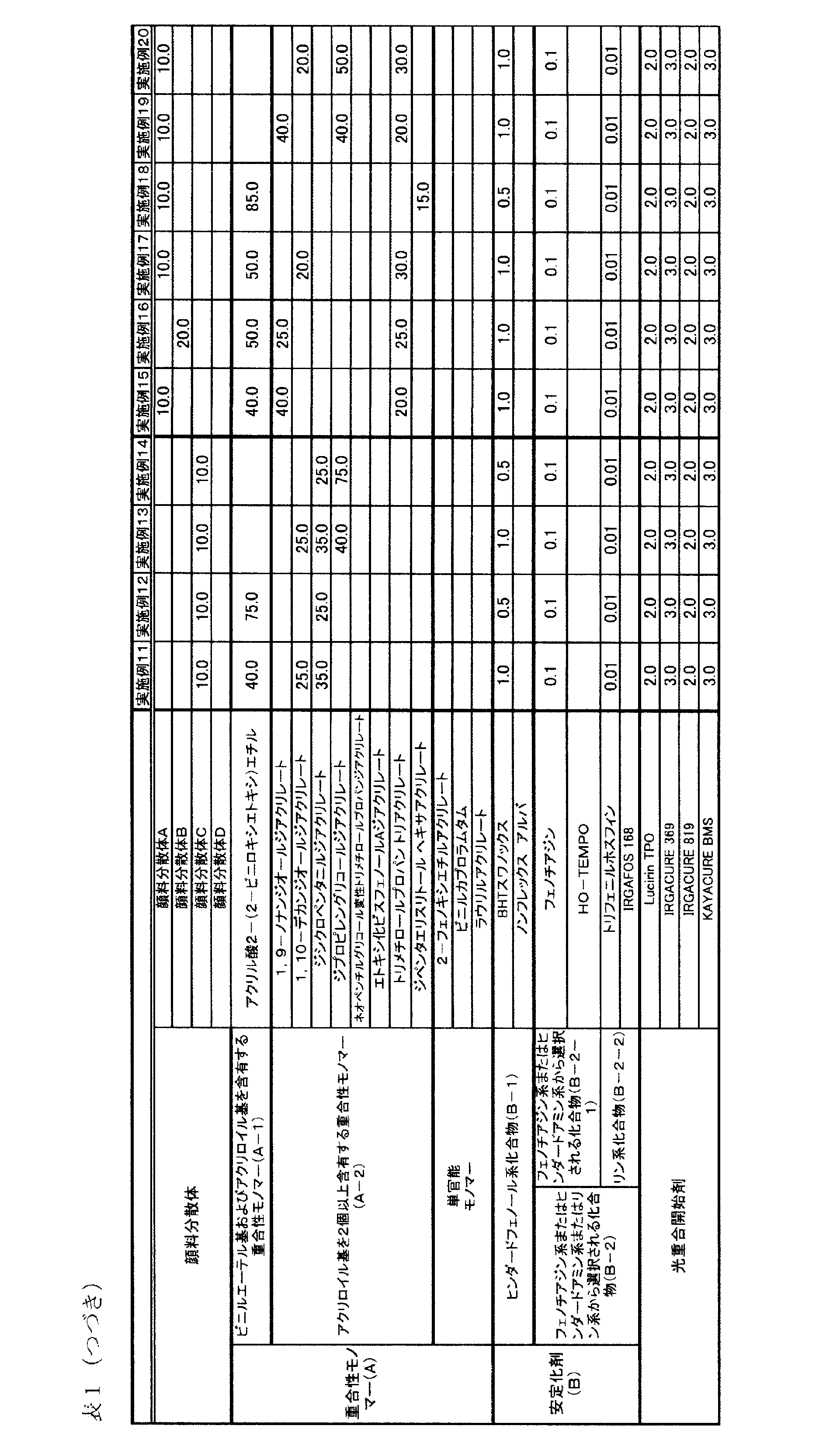
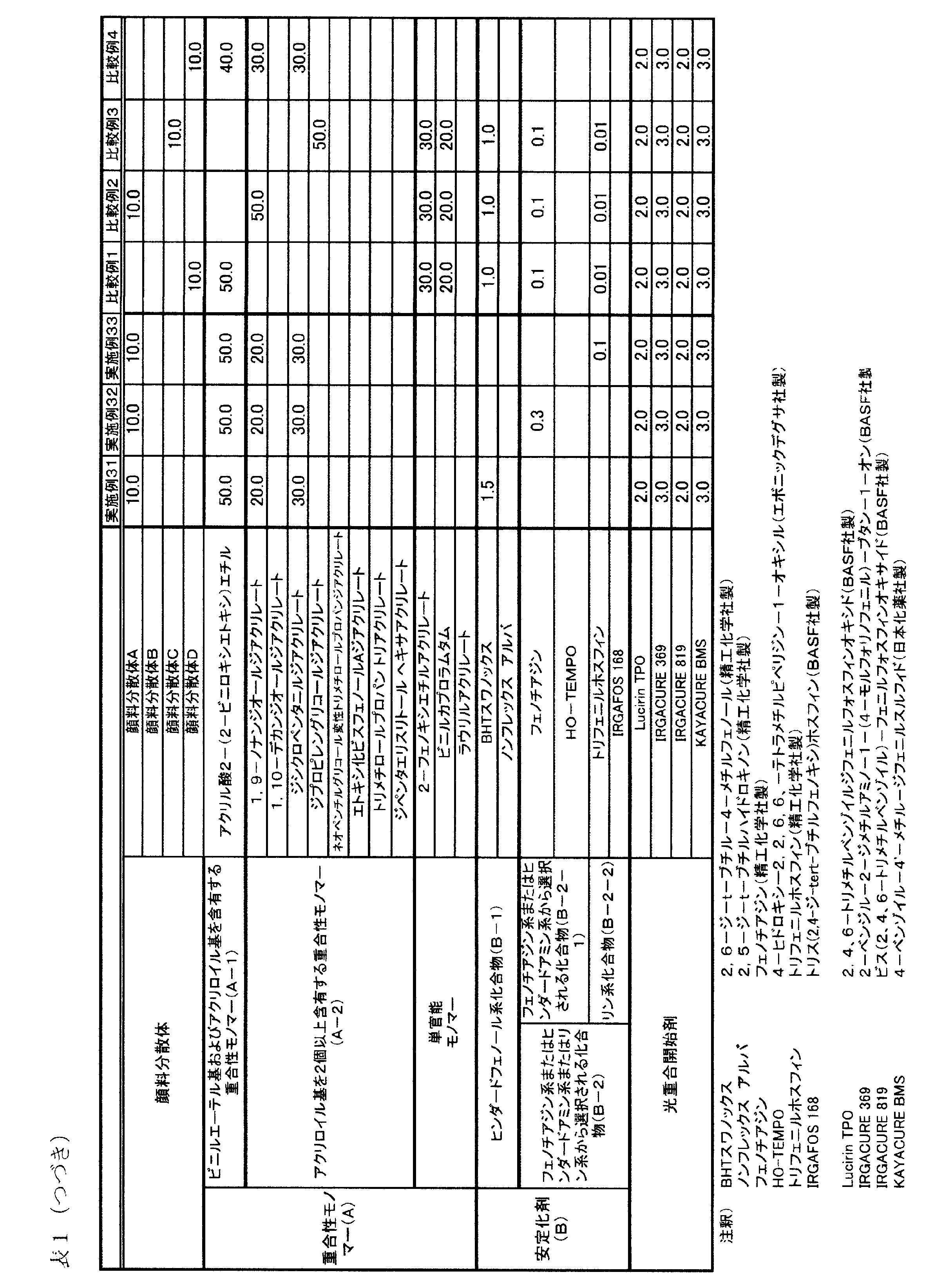
- Example 1 The materials listed in Table 1 were added and mixed with sequential stirring, mixed gently until the photopolymerization initiator was dissolved, then filtered through a membrane filter with a pore size of 1 ⁇ m to remove coarse particles, and inkjet ink A composition was obtained.
- Example 2 to Example 33 In the same manner as in Example 1, an inkjet ink composition was prepared as shown in Table 1.
- A Increase in viscosity after a aging test is less than 5% compared to the initial viscosity
- B Increase in viscosity after a aging test is 5% or more and less than 10% compared to the initial viscosity
- ⁇ Increase in viscosity after a aging test , 10% or more and less than 15% compared to initial viscosity
- the ink composition was ejected onto a PET plate by an inkjet ejection apparatus equipped with a piezo head manufactured by Konica Minolta IJ so that the film thickness upon ejection was 12 ⁇ m.
- the maximum conveyor speed at which the printed matter can be cured in one pass was examined by irradiating with ultraviolet rays using one metal halide lamp (output 120 W / cm) manufactured by Harrison Toshiba Lighting.
- the evaluation criteria at this time are as follows, and ⁇ or higher is considered to be good curability.
- Maximum conveyor speed is 40 m / min or more ⁇ : Maximum conveyor speed is 25 m / min or more and less than 40 m / min ⁇ : Maximum conveyor speed is 10 m / min or more and less than 25 m / min ⁇ : Even if the conveyor speed is 10 m / min Does not cure
- the ink composition prepared above was discharged onto a PET plate and a vinyl chloride plate by an inkjet discharge device equipped with a piezo type head manufactured by Konica Minolta IJ so that the film thickness at the time of discharge was 12 ⁇ m.
- ultraviolet light curing was performed with one metal halide lamp (output 120 W / cm) manufactured by Harrison Toshiba Lighting, conveyor speed 10 m / min, and one pass to obtain a coating film.
- the adhesive evaluation on crosscut conditions was performed.
- the cellophane adhesive tape was applied to the cross-cut portion of the cured coating so that it became 100 squares at 1 mm intervals, and the cellophane adhesive tape was rubbed with an eraser from the upper surface to sufficiently adhere the cellophane adhesive tape to the coated surface. Then, it peeled at 90 degrees, and judged from the adhesion degree to the base material of the coating film after peeling. Evaluation criteria are as follows, and ⁇ or higher is considered to be good adhesion. ⁇ : When no peeling is observed in 100 squares ⁇ : When 1 to 50 squares are peeled in 100 squares ⁇ : When 50 or more squares are peeled in 100 squares
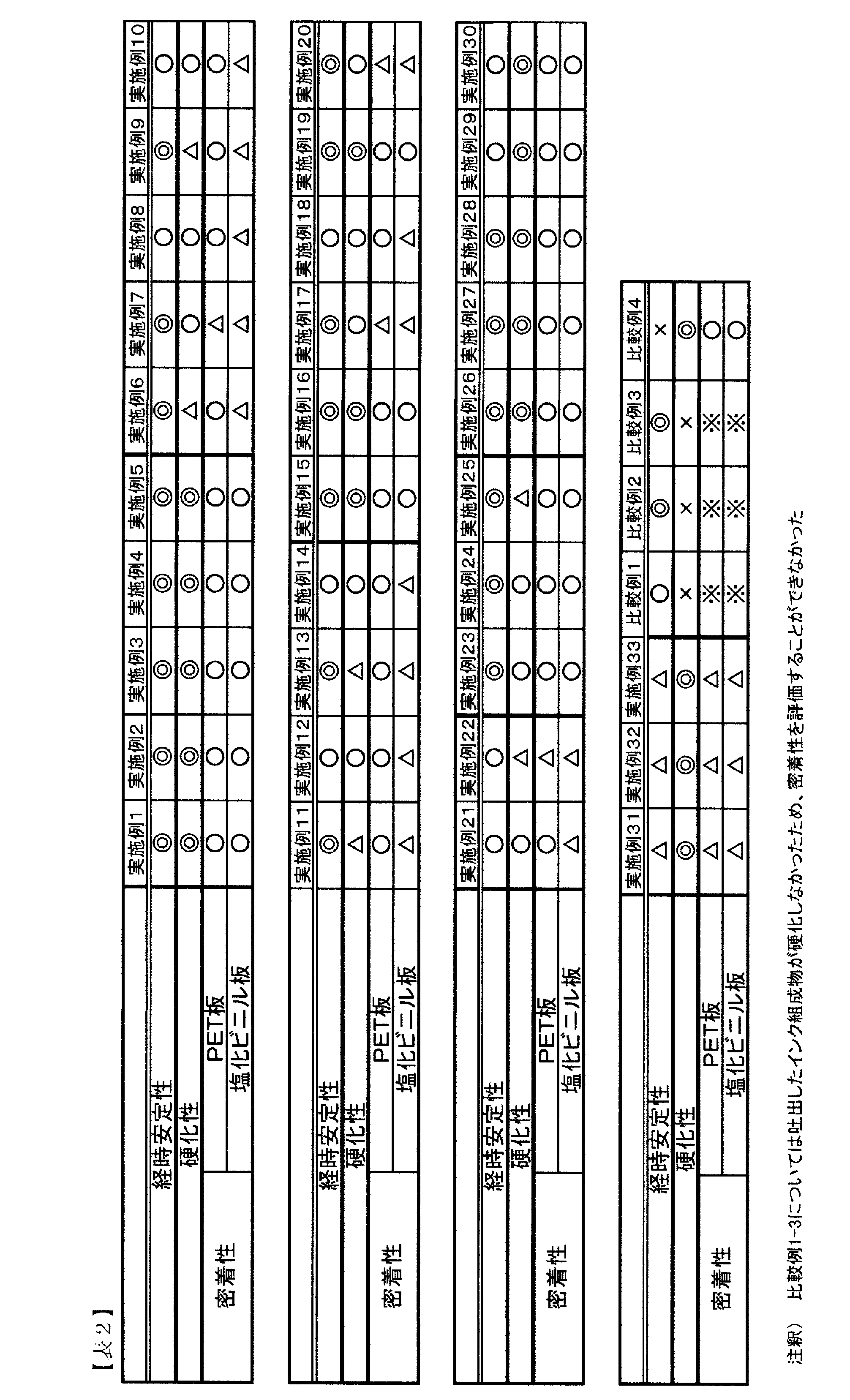
- Table 2 shows the evaluation results for the ink compositions prepared in Examples 1 to 33 and Comparative Examples 1 to 4.
- Examples 1 to 33 are examples in which two or more polymerizable monomers containing two or more reactive sites and a stabilizer (B) are contained, and any of stability over time, curability, and adhesion are included. Also good results were obtained.
- Examples 1 to 5, 15 to 16, and 19 are 2- (2-vinyloxyethoxy) ethyl acrylate, 1,9-nonanediol diacrylate as polymerizable monomers containing two or more reactive sites, Compound (B-2-1) containing at least one of dipropylene glycol diacrylate and selected from a hindered phenol compound (B-1), phenothiazine compound or hindered amine compound as stabilizer (B) And a phosphorus compound (B-2-2), both the stability over time and the curability are both ⁇ and the adhesion is ⁇ or more, and a very good evaluation result is obtained.
- Compound (B-2-1) containing at least one of dipropylene glycol diacrylate and selected from a hindered phenol compound (B-1), phenothiazine compound or hindered amine compound as stabilizer (B) And a phosphorus compound (B-2-2), both the stability over time and the curability are both ⁇ and the adhesion is
- Example 22 2- (2-vinyloxyethoxy) ethyl acrylate, 1,9-nonanediol diacrylate, dipropylene as a polymerizable monomer (A-1) containing two or more reactive sites.
- This system does not contain any glycol diacrylate.
- Examples 1 to 5, 15 to 16, and 19 the curability and adhesion to the vinyl chloride plate were particularly poor.
- 2- (2-vinyloxyethoxy) ethyl acrylate, 1,9-nonanediol diacrylate, and dipropylene glycol diacrylate contribute to improving curability and adhesion. It has become.
- Examples 15 to 21 are systems having a polymerizable monomer containing 3 or more reactive sites as a polymerizable monomer containing 2 or more reactive sites. In any case, good evaluation results were obtained with the stability over time and curability being ⁇ or more.
- Examples 26 to 32 are obtained by changing the stabilizer (B) with respect to the polymerizable monomer formulation of Example 1.
- a hindered phenol compound (B-1), a compound (B-2-1) selected from a phenothiazine compound or a hindered amine compound, and a phosphorus compound ( B-2-2) contains a very good evaluation result that the stability over time and curability are both ⁇ or more and the adhesion is ⁇ or more.
- Examples 29 to 30 do not use the compound (B-2-1) selected from the phenothiazine type or the hindered amine type and the phosphorus type compound (B-2-2), and contain only one of them. System. As a result of the evaluation, it was confirmed that good quality was obtained, but the stability over time was good, which was slightly inferior to Examples 26 to 28.
- a hindered phenol compound (B-1), a compound (B-2-1) selected from a phenothiazine compound or a hindered amine compound, and a phosphorus compound (B -2-2) A system containing any of the above, and as a result of evaluation, although all the quality was good, the stability over time and the adhesion became ⁇ , and the results were inferior to those of Examples 26 to 28. It became. These results show that excellent stability over time is expressed for the first time by the combined use of the stabilizer (B).
- Comparative Examples 1 to 3 are systems containing only one type of polymerizable monomer containing two or more reactive sites, and Comparative Example 4 is a system containing no stabilizer (B). The results were inferior in curability and stability over time.
- the active energy ray-curable inkjet ink composition of the present embodiment is an ink composition having excellent curability and multi-substrate adhesion while having low viscosity, and excellent storage stability. It can be used for ink jet printing in industrial applications and industrial applications.
Landscapes
- Chemical & Material Sciences (AREA)
- Life Sciences & Earth Sciences (AREA)
- Engineering & Computer Science (AREA)
- Materials Engineering (AREA)
- Wood Science & Technology (AREA)
- Organic Chemistry (AREA)
- Inks, Pencil-Leads, Or Crayons (AREA)
- Ink Jet Recording Methods And Recording Media Thereof (AREA)
- Ink Jet (AREA)
- Polymerisation Methods In General (AREA)
Abstract
Description
(1)少なくとも重合性モノマー(A)および安定化剤(B)を含有し、水を実質的に含有しない活性エネルギー線硬化型インクジェットインク組成物であって、前記重合性モノマー(A)として、反応性部位を2個以上含有する重合性モノマーを2種以上含有することを特徴とする、活性エネルギー線硬化型インクジェットインク組成物。
(2)前記安定化剤(B)として、ヒンダードフェノール系化合物(B-1)、およびフェノチアジン系またはヒンダードアミン系またはリン系から選択される化合物(B-2)を含有することを特徴とする、(1)に記載の活性エネルギー線硬化型インクジェットインク組成物。
(3)前記反応性部位を2個以上含有する重合性モノマーとして、アクリル酸2-(2-ビニロキシエトキシ)エチル、1,9-ノナンジオールジアクリレート、ジプロピレングリコールジアクリレートのうち少なくとも1つを含有することを特徴とする、(1)~(2)いずれかに記載の活性エネルギー線硬化型インクジェットインク組成物。
(4)前記フェノチアジン系またはヒンダードアミン系またはリン系化合物から選択される化合物(B-2)として、フェノチアジン系またはヒンダードアミン系から選択される化合物(B-2-1)、およびリン系化合物(B-2-2)を含有することを特徴とする、(1)~(3)に記載の活性エネルギー線硬化型インクジェットインク組成物。
水溶性の無機塩としては、塩化ナトリウム、塩化カリウム等が挙げられる。これらの無機塩は、有機顔料の3重量倍以上、好ましくは20重量倍以下の範囲で用いるのが好ましい。無機塩の量が3重量倍以上だと、所望の大きさの処理顔料が得られる。また、20重量倍以下だと、後の工程における洗浄処理が容易であり、有機顔料の実質的な処理量が多い。
顔料:カーボンブラック顔料(デグサ社製)
「Special Black350」 30.0部
顔料分散剤:ソルスパース32000(ルーブリゾール社製) 6.0部
モノマー:1,9-ノナンジオールジアクリレート 64.0部
上記材料をハイスピードミキサー等で均一になるまで撹拌した後、得られたミルベースを横型サンドミルで約1時間分散することで、顔料分散体Aを作製した。
顔料:フタロシアニン顔料(東洋インキ製造社製)
「LIONOL BLUE FG-7400G」 15.0部
顔料分散剤:ルーブリゾール社製「ソルスパース32000」 4.5部
モノマー:1,9-ノナンジオールジアクリレート 80.5部
顔料分散体Aと同様に、上記材料をハイスピードミキサー等で均一になるまで撹拌した後、得られたミルベースを横型サンドミルで約1時間分散することで、顔料分散体Bを作製した。
顔料:カーボンブラック顔料(デグサ社製)
「Special Black350」 30.0部
顔料分散剤:ソルスパース32000(ルーブリゾール社製) 6.0部
モノマー:ジプロピレングリコールジアクリレート 64.0部
顔料分散体Aと同様に、上記材料をハイスピードミキサー等で均一になるまで撹拌した後、得られたミルベースを横型サンドミルで約1時間分散することで、顔料分散体Cを作製した。
顔料:カーボンブラック顔料(デグサ社製)
「Special Black350」 30.0部
顔料分散剤:ソルスパース32000(ルーブリゾール社製) 6.0部
モノマー:2-フェノキシエチルアクリレート 64.0部
顔料分散体Aと同様に、上記材料をハイスピードミキサー等で均一になるまで撹拌した後、得られたミルベースを横型サンドミルで約1時間分散することで、顔料分散体Dを作製した。
表1に記載した材料を順次撹拌しながら添加、混合し、光重合開始剤が溶解するまで穏やかに混合させた後、孔径1μmのメンブランフィルターで濾過を行い、粗大粒子を除去することでインクジェットインク組成物を得た。
実施例1と同様に表1記載の通りにインクジェットインク組成物を作製した。
実施例1と同様に表1記載の通りにインクジェットインク組成物を作製した。
上記で作製したインク組成物をスクリュー管瓶(容量約7mL)に6mL取り分け密栓したのち、60℃環境下に7日間静置した後に測定した粘度を、作製直後の初期粘度と比較することで、経時安定性の評価を行った。粘度の測定には東機産業社製TVE25L型粘度計を使用した。またこのときの評価基準は以下の通りであり、△以上を経時安定性良好とする。
◎:経時試験後の粘度上昇が、初期粘度と比較して5%未満
○:経時試験後の粘度上昇が、初期粘度と比較して5%以上10%未満
△:経時試験後の粘度上昇が、初期粘度と比較して10%以上15%未満
×:経時試験後の粘度上昇が、初期粘度と比較して15%以上
上記で作成したインク組成物を用い、コニカミノルタIJ社のピエゾ方式ヘッドを搭載したインクジェット吐出装置により、吐出時の膜厚が12μmになるように、PET板上へ吐出した。吐出の直後、ハリソン東芝ライティング社製メタルハライドランプ(出力120W/cm)1灯を使用して紫外線を照射し、印字物を1パスで硬化させることができる最大のコンベヤスピードを調査した。このときの評価基準はいずれも以下の通りであり、△以上を硬化性良好とする。
◎:最大コンベヤスピードが40m/min以上
○:最大コンベヤスピードが25m/min以上40m/min未満
△:最大コンベヤスピードが10m/min以上25m/min未満
×:コンベヤスピードが10m/minであっても硬化しない
上記で作成したインク組成物を用い、コニカミノルタIJ社のピエゾ方式ヘッドを搭載したインクジェット吐出装置により、吐出時の膜厚が12μmになるように、PET板、および塩化ビニル板上に吐出した。吐出の直後、ハリソン東芝ライティング社製メタルハライドランプ(出力120W/cm)1灯、コンベア速度10m/min、1パスで紫外線硬化し、塗膜を得た。
これらの塗膜について、クロスカット条件での密着性評価を行った。試験は、硬化後の塗膜を1mm間隔で100マスになるようにクロスカットした部分にセロハン密着テープを貼り付け、上面から消しゴムでこすり、セロハン密着テープの塗工面への密着を充分に行った後、90°で剥離させることで行い、剥離後の塗膜の基材への密着の程度から判断した。評価基準は以下の通りであり、△以上を密着性良好とする。
○:100マス中全く剥離が観察されない場合
△:100マス中1~50マス剥離した場合
×:100マス中50マス以上剥離した場合


Claims (4)
- 少なくとも重合性モノマー(A)および安定化剤(B)を含有し、水を実質的に含有しない活性エネルギー線硬化型インクジェットインク組成物であって、前記重合性モノマー(A)として、反応性部位を2個以上含有する重合性モノマーを2種以上含有することを特徴とする、活性エネルギー線硬化型インクジェットインク組成物。
- 前記安定化剤(B)として、ヒンダードフェノール系化合物(B-1)、およびフェノチアジン系またはヒンダードアミン系またはリン系から選択される化合物(B-2)を含有することを特徴とする、請求項1に記載の活性エネルギー線硬化型インクジェットインク組成物。
- 前記反応性部位を2個以上含有する重合性モノマーとして、アクリル酸2-(2-ビニロキシエトキシ)エチル、1,9-ノナンジオールジアクリレート、ジプロピレングリコールジアクリレートのうち少なくとも1つを含有することを特徴とする、請求項1または2記載の活性エネルギー線硬化型インクジェットインク組成物。
- 前記フェノチアジン系またはヒンダードアミン系またはリン系化合物から選択される化合物(B-2)として、フェノチアジン系またはヒンダードアミン系から選択される化合物(B-2-1)、およびリン系化合物(B-2-2)を含有することを特徴とする、請求項1~3に記載の活性エネルギー線硬化型インクジェットインク組成物。
Priority Applications (5)
| Application Number | Priority Date | Filing Date | Title |
|---|---|---|---|
| US14/008,926 US9157000B2 (en) | 2011-03-29 | 2012-03-29 | Active energy beam-curable inkjet ink composition |
| CN201280016351.0A CN103547641B (zh) | 2011-03-29 | 2012-03-29 | 活性能量射线固化型喷墨油墨组合物 |
| EP18168241.0A EP3381687B1 (en) | 2011-03-29 | 2012-03-29 | Active energy beam-curable inkjet ink composition |
| EP12763533.2A EP2692803B1 (en) | 2011-03-29 | 2012-03-29 | Active energy ray-curable inkjet ink composition |
| JP2013507745A JP6156141B2 (ja) | 2011-03-29 | 2012-03-29 | 活性エネルギー線硬化型インクジェットインク組成物 |
Applications Claiming Priority (2)
| Application Number | Priority Date | Filing Date | Title |
|---|---|---|---|
| JP2011072492 | 2011-03-29 | ||
| JP2011-072492 | 2011-03-29 |
Publications (1)
| Publication Number | Publication Date |
|---|---|
| WO2012133694A1 true WO2012133694A1 (ja) | 2012-10-04 |
Family
ID=46931396
Family Applications (1)
| Application Number | Title | Priority Date | Filing Date |
|---|---|---|---|
| PCT/JP2012/058449 Ceased WO2012133694A1 (ja) | 2011-03-29 | 2012-03-29 | 活性エネルギー線硬化型インクジェットインク組成物 |
Country Status (5)
| Country | Link |
|---|---|
| US (1) | US9157000B2 (ja) |
| EP (2) | EP3381687B1 (ja) |
| JP (2) | JP6156141B2 (ja) |
| CN (1) | CN103547641B (ja) |
| WO (1) | WO2012133694A1 (ja) |
Cited By (17)
| Publication number | Priority date | Publication date | Assignee | Title |
|---|---|---|---|---|
| JP2012207084A (ja) * | 2011-03-29 | 2012-10-25 | Toyo Ink Sc Holdings Co Ltd | 活性エネルギー線硬化型インクジェットインク組成物 |
| JP2012236966A (ja) * | 2011-04-28 | 2012-12-06 | Seiko Epson Corp | 光硬化型インク組成物、記録方法及び記録装置 |
| WO2013118766A1 (ja) * | 2012-02-09 | 2013-08-15 | 富士フイルム株式会社 | インクジェット記録用インク組成物、インクジェット記録方法、及び、印刷物 |
| JP2014156506A (ja) * | 2013-02-14 | 2014-08-28 | Dic Corp | 活性エネルギー線硬化性組成物及びそれを使用したインクジェット記録用インク組成物 |
| JP2015113434A (ja) * | 2013-12-13 | 2015-06-22 | Dic株式会社 | 活性エネルギー線硬化型インクジェット記録用インク及びインクセット |
| JP2015172134A (ja) * | 2014-03-11 | 2015-10-01 | セイコーエプソン株式会社 | 紫外線硬化型インクジェット組成物、収容体及びインクジェット方法 |
| JP2016180072A (ja) * | 2015-03-25 | 2016-10-13 | 東洋インキScホールディングス株式会社 | 電子線硬化型インクジェットインキ |
| JP2016194063A (ja) * | 2015-03-31 | 2016-11-17 | 大日本塗料株式会社 | 活性エネルギー線硬化型インクジェットインク組成物、並びに印刷物及びその製造方法 |
| JP2018083951A (ja) * | 2017-12-26 | 2018-05-31 | セイコーエプソン株式会社 | 紫外線硬化型インクジェット組成物、収容体及びインクジェット方法 |
| JP2018087344A (ja) * | 2018-01-23 | 2018-06-07 | セイコーエプソン株式会社 | 紫外線硬化型インクジェット組成物及び収容体 |
| US10029483B2 (en) | 2012-04-25 | 2018-07-24 | Seiko Epson Corporation | Ink jet recording method, ultraviolet-ray curable ink, and ink jet recording apparatus |
| JP2020007565A (ja) * | 2019-09-20 | 2020-01-16 | セイコーエプソン株式会社 | 紫外線硬化型インクジェット組成物及び収容体 |
| US10569571B2 (en) | 2012-03-28 | 2020-02-25 | Seiko Epson Corporation | Ink jet recording method, ultraviolet curable ink, and ink jet recording apparatus |
| US10583649B2 (en) | 2012-04-27 | 2020-03-10 | Seiko Epson Corporation | Ink jet recording method and ink jet recording apparatus |
| US11635683B2 (en) | 2015-08-24 | 2023-04-25 | Toyo Gosei Co., Ltd. | Method for manufacturing device, and composition |
| WO2026034056A1 (ja) * | 2024-08-08 | 2026-02-12 | 株式会社Dnpファインケミカル | インク組成物、顔料分散液、インクセット、印刷物、インクジェット記録装置、記録方法、及び印刷物の製造方法 |
| US12611874B2 (en) | 2012-03-28 | 2026-04-28 | Seiko Epson Corporation | Ink jet recording method, ultraviolet curable ink, and ink jet recording apparatus |
Families Citing this family (9)
| Publication number | Priority date | Publication date | Assignee | Title |
|---|---|---|---|---|
| EP3255110B2 (en) | 2011-07-08 | 2025-05-21 | Seiko Epson Corporation | Photocurable ink composition for inkjet recording and ink jet recording method |
| CN105683310B (zh) * | 2013-10-23 | 2018-10-26 | 东洋油墨Sc控股株式会社 | 活性能量射线固化型喷墨油墨及油墨组 |
| JP5776129B1 (ja) * | 2014-03-26 | 2015-09-09 | 東洋インキScホールディングス株式会社 | 活性エネルギー線硬化型インクジェットインキ組成物 |
| US9631108B2 (en) * | 2014-09-18 | 2017-04-25 | Markem-Imaje Corporation | Ink compositions |
| TWI798395B (zh) | 2018-03-30 | 2023-04-11 | 日商太陽油墨製造股份有限公司 | 噴墨印刷用之硬化性組成物、其之硬化物及具有該硬化物之電子零件 |
| GB201916902D0 (en) * | 2019-11-20 | 2020-01-01 | Fujifilm Speciality Ink Systems Ltd | Printing ink |
| GB202001157D0 (en) * | 2020-01-28 | 2020-03-11 | Fujifilm Speciality Ink Systems Ltd | Printing ink |
| US20250346753A1 (en) * | 2021-09-07 | 2025-11-13 | Sika Technology Ag | Stabilization of pigmented (meth)acrylate-based compositions |
| JP7264219B1 (ja) | 2021-12-09 | 2023-04-25 | 東洋インキScホールディングス株式会社 | 活性エネルギー線硬化型インキ組成物および印刷物 |
Citations (8)
| Publication number | Priority date | Publication date | Assignee | Title |
|---|---|---|---|---|
| JP2004042429A (ja) | 2002-07-11 | 2004-02-12 | Konica Minolta Holdings Inc | インクジェット記録方法、記録ユニット及びインクジェット記録装置 |
| JP2007211181A (ja) * | 2006-02-10 | 2007-08-23 | Fujifilm Corp | インク組成物、インクジェット記録方法、平版印刷版の製造方法、及び平版印刷版 |
| JP2008507598A (ja) * | 2004-07-16 | 2008-03-13 | ヘキソン スペシャルティ ケミカルズ インコーポレーテッド | 放射線硬化性インクジェットインク、その製造方法及びその使用方法 |
| JP2009073945A (ja) * | 2007-09-21 | 2009-04-09 | Fujifilm Corp | インク組成物、インクジェット記録方法、及び、印刷物 |
| JP2009120628A (ja) | 2007-11-12 | 2009-06-04 | Fujifilm Corp | インク組成物、インクカートリッジ、インクジェット記録方法及び印刷物 |
| JP2009191183A (ja) | 2008-02-15 | 2009-08-27 | Fujifilm Corp | インク組成物、インクジェット記録方法、及び、印刷物 |
| JP2011072492A (ja) | 2009-09-30 | 2011-04-14 | Okamura Corp | 椅子 |
| JP2011241323A (ja) * | 2010-05-19 | 2011-12-01 | Seiko Epson Corp | インク組成物セット、これを用いたインクジェット記録方法及び記録物 |
Family Cites Families (15)
| Publication number | Priority date | Publication date | Assignee | Title |
|---|---|---|---|---|
| KR100738275B1 (ko) * | 2002-04-22 | 2007-07-12 | 가부시키가이샤 닛폰 쇼쿠바이 | 반응성 희석제 조성물 및 경화성 수지 조성물 |
| JP3461501B1 (ja) | 2002-06-10 | 2003-10-27 | 株式会社日本触媒 | 活性エネルギー線硬化型インクジェット印刷用インク |
| KR20070067645A (ko) * | 2003-08-22 | 2007-06-28 | 사토머 테크놀로지 컴퍼니, 인코포레이티드 | Uv 계의 고온 안정화 |
| US7806050B2 (en) | 2006-02-06 | 2010-10-05 | Fujifilm Corporation | Ink composition, inkjet recording method, method of producing planographic printing plate, and planographic printing plate |
| PL2053101T3 (pl) * | 2007-10-24 | 2011-09-30 | Agfa Nv | Utwardzalne ciecze i atramenty do zastosowań na zabawkach i opakowaniach do żywności |
| EP2053100B1 (en) | 2007-10-24 | 2015-06-17 | Agfa Graphics N.V. | Radiation curable inkjet printing methods |
| ES2372370T3 (es) * | 2007-10-24 | 2012-01-19 | Agfa Graphics N.V. | Tinta de inyección por chorro blanca mejorada para la estabilidad de la dispersión. |
| EP2053103B1 (en) | 2007-10-24 | 2010-10-06 | Agfa Graphics N.V. | Curable liquids and inks for toys and food packaging applications |
| JP2009156999A (ja) * | 2007-12-25 | 2009-07-16 | Jsr Corp | 光学部材用放射線硬化性樹脂組成物及び光学部材 |
| JP2009179681A (ja) * | 2008-01-30 | 2009-08-13 | Toyo Ink Mfg Co Ltd | 活性エネルギー線硬化型インクジェットインキ |
| JP4335950B2 (ja) | 2008-02-05 | 2009-09-30 | 日立マクセル株式会社 | エネルギー線硬化型インク組成物 |
| EP2130818A1 (en) * | 2008-06-05 | 2009-12-09 | AGFA Graphics NV | Multifunctional Type II photoinitiators and curable compositions |
| JP5171794B2 (ja) | 2009-03-11 | 2013-03-27 | 東洋インキScホールディングス株式会社 | インキ組成物およびそれを用いた硬化物 |
| JP5609321B2 (ja) * | 2010-06-30 | 2014-10-22 | 東洋インキScホールディングス株式会社 | 活性エネルギー線硬化型インキ組成物 |
| JP6120477B2 (ja) | 2011-03-29 | 2017-04-26 | 東洋インキScホールディングス株式会社 | 活性エネルギー線硬化型インクジェットインク組成物 |
-
2012
- 2012-03-29 WO PCT/JP2012/058449 patent/WO2012133694A1/ja not_active Ceased
- 2012-03-29 US US14/008,926 patent/US9157000B2/en active Active
- 2012-03-29 EP EP18168241.0A patent/EP3381687B1/en active Active
- 2012-03-29 CN CN201280016351.0A patent/CN103547641B/zh active Active
- 2012-03-29 EP EP12763533.2A patent/EP2692803B1/en active Active
- 2012-03-29 JP JP2013507745A patent/JP6156141B2/ja active Active
-
2017
- 2017-06-05 JP JP2017110730A patent/JP6536625B2/ja active Active
Patent Citations (8)
| Publication number | Priority date | Publication date | Assignee | Title |
|---|---|---|---|---|
| JP2004042429A (ja) | 2002-07-11 | 2004-02-12 | Konica Minolta Holdings Inc | インクジェット記録方法、記録ユニット及びインクジェット記録装置 |
| JP2008507598A (ja) * | 2004-07-16 | 2008-03-13 | ヘキソン スペシャルティ ケミカルズ インコーポレーテッド | 放射線硬化性インクジェットインク、その製造方法及びその使用方法 |
| JP2007211181A (ja) * | 2006-02-10 | 2007-08-23 | Fujifilm Corp | インク組成物、インクジェット記録方法、平版印刷版の製造方法、及び平版印刷版 |
| JP2009073945A (ja) * | 2007-09-21 | 2009-04-09 | Fujifilm Corp | インク組成物、インクジェット記録方法、及び、印刷物 |
| JP2009120628A (ja) | 2007-11-12 | 2009-06-04 | Fujifilm Corp | インク組成物、インクカートリッジ、インクジェット記録方法及び印刷物 |
| JP2009191183A (ja) | 2008-02-15 | 2009-08-27 | Fujifilm Corp | インク組成物、インクジェット記録方法、及び、印刷物 |
| JP2011072492A (ja) | 2009-09-30 | 2011-04-14 | Okamura Corp | 椅子 |
| JP2011241323A (ja) * | 2010-05-19 | 2011-12-01 | Seiko Epson Corp | インク組成物セット、これを用いたインクジェット記録方法及び記録物 |
Non-Patent Citations (1)
| Title |
|---|
| See also references of EP2692803A1 |
Cited By (25)
| Publication number | Priority date | Publication date | Assignee | Title |
|---|---|---|---|---|
| JP2012207084A (ja) * | 2011-03-29 | 2012-10-25 | Toyo Ink Sc Holdings Co Ltd | 活性エネルギー線硬化型インクジェットインク組成物 |
| JP2012236966A (ja) * | 2011-04-28 | 2012-12-06 | Seiko Epson Corp | 光硬化型インク組成物、記録方法及び記録装置 |
| JP2016053183A (ja) * | 2011-04-28 | 2016-04-14 | セイコーエプソン株式会社 | 光硬化型インク組成物、記録方法及び記録装置 |
| WO2013118766A1 (ja) * | 2012-02-09 | 2013-08-15 | 富士フイルム株式会社 | インクジェット記録用インク組成物、インクジェット記録方法、及び、印刷物 |
| JP2013163740A (ja) * | 2012-02-09 | 2013-08-22 | Fujifilm Corp | インクジェット記録用インク組成物、インクジェット記録方法、及び、印刷物 |
| US10569571B2 (en) | 2012-03-28 | 2020-02-25 | Seiko Epson Corporation | Ink jet recording method, ultraviolet curable ink, and ink jet recording apparatus |
| US12611874B2 (en) | 2012-03-28 | 2026-04-28 | Seiko Epson Corporation | Ink jet recording method, ultraviolet curable ink, and ink jet recording apparatus |
| US11813843B2 (en) | 2012-03-28 | 2023-11-14 | Seiko Epson Corporation | Ink jet recording method, ultraviolet curable ink, and ink jet recording apparatus |
| US10894430B2 (en) | 2012-03-28 | 2021-01-19 | Seiko Epson Corporation | Ink jet recording method, ultraviolet curable ink, and ink jet recording apparatus |
| US11077677B2 (en) | 2012-04-25 | 2021-08-03 | Seiko Epson Corporation | Ink jet recording method, ultraviolet-ray curable ink, and ink jet recording apparatus |
| US10029483B2 (en) | 2012-04-25 | 2018-07-24 | Seiko Epson Corporation | Ink jet recording method, ultraviolet-ray curable ink, and ink jet recording apparatus |
| US10625519B2 (en) | 2012-04-25 | 2020-04-21 | Seiko Epson Corporation | Ink jet recording method, ultraviolet-ray curable ink, and ink jet recording apparatus |
| US10583649B2 (en) | 2012-04-27 | 2020-03-10 | Seiko Epson Corporation | Ink jet recording method and ink jet recording apparatus |
| JP2014156506A (ja) * | 2013-02-14 | 2014-08-28 | Dic Corp | 活性エネルギー線硬化性組成物及びそれを使用したインクジェット記録用インク組成物 |
| JP2015113434A (ja) * | 2013-12-13 | 2015-06-22 | Dic株式会社 | 活性エネルギー線硬化型インクジェット記録用インク及びインクセット |
| JP2015172134A (ja) * | 2014-03-11 | 2015-10-01 | セイコーエプソン株式会社 | 紫外線硬化型インクジェット組成物、収容体及びインクジェット方法 |
| JP2016180072A (ja) * | 2015-03-25 | 2016-10-13 | 東洋インキScホールディングス株式会社 | 電子線硬化型インクジェットインキ |
| JP2016194063A (ja) * | 2015-03-31 | 2016-11-17 | 大日本塗料株式会社 | 活性エネルギー線硬化型インクジェットインク組成物、並びに印刷物及びその製造方法 |
| US11635683B2 (en) | 2015-08-24 | 2023-04-25 | Toyo Gosei Co., Ltd. | Method for manufacturing device, and composition |
| JP2018083951A (ja) * | 2017-12-26 | 2018-05-31 | セイコーエプソン株式会社 | 紫外線硬化型インクジェット組成物、収容体及びインクジェット方法 |
| JP2018087344A (ja) * | 2018-01-23 | 2018-06-07 | セイコーエプソン株式会社 | 紫外線硬化型インクジェット組成物及び収容体 |
| JP2020007565A (ja) * | 2019-09-20 | 2020-01-16 | セイコーエプソン株式会社 | 紫外線硬化型インクジェット組成物及び収容体 |
| JP7107293B2 (ja) | 2019-09-20 | 2022-07-27 | セイコーエプソン株式会社 | インクジェット方法、及びインクジェット装置 |
| WO2026034056A1 (ja) * | 2024-08-08 | 2026-02-12 | 株式会社Dnpファインケミカル | インク組成物、顔料分散液、インクセット、印刷物、インクジェット記録装置、記録方法、及び印刷物の製造方法 |
| JP7853523B1 (ja) | 2024-08-08 | 2026-04-28 | 株式会社Dnpファインケミカル | インク組成物、顔料分散液、インクセット、印刷物、インクジェット記録装置、記録方法、及び印刷物の製造方法 |
Also Published As
| Publication number | Publication date |
|---|---|
| JP6156141B2 (ja) | 2017-07-05 |
| US20140053753A1 (en) | 2014-02-27 |
| EP3381687B1 (en) | 2019-09-04 |
| EP3381687A1 (en) | 2018-10-03 |
| JPWO2012133694A1 (ja) | 2014-07-28 |
| EP2692803B1 (en) | 2018-08-01 |
| US9157000B2 (en) | 2015-10-13 |
| EP2692803A4 (en) | 2014-09-03 |
| JP6536625B2 (ja) | 2019-07-03 |
| EP2692803A1 (en) | 2014-02-05 |
| CN103547641A (zh) | 2014-01-29 |
| CN103547641B (zh) | 2015-12-23 |
| JP2017171937A (ja) | 2017-09-28 |
Similar Documents
| Publication | Publication Date | Title |
|---|---|---|
| JP6156141B2 (ja) | 活性エネルギー線硬化型インクジェットインク組成物 | |
| JP6120477B2 (ja) | 活性エネルギー線硬化型インクジェットインク組成物 | |
| JP5990879B2 (ja) | 活性エネルギー線硬化型インクジェットインキ組成物 | |
| JP5171794B2 (ja) | インキ組成物およびそれを用いた硬化物 | |
| CN102311678B (zh) | 活性能量射线固化型喷墨油墨组合物 | |
| JP5621209B2 (ja) | 活性エネルギー線硬化型インクジェットインキ | |
| JP5729369B2 (ja) | インキ組成物およびそれを用いた硬化物 | |
| WO2013031871A1 (ja) | 活性エネルギー線硬化型インクジェットインキ組成物、及びそれを用いた印刷物 | |
| JP5776129B1 (ja) | 活性エネルギー線硬化型インクジェットインキ組成物 | |
| JP2009179681A (ja) | 活性エネルギー線硬化型インクジェットインキ | |
| JP5548333B2 (ja) | 活性エネルギー線硬化型インクジェットインキ | |
| JP5521281B2 (ja) | インキ組成物およびそれを用いた硬化物 | |
| JP5589223B2 (ja) | 活性エネルギー線硬化型インクジェットインキセット | |
| JP5217362B2 (ja) | 活性エネルギー線硬化型インクジェットインキ | |
| JP5505016B2 (ja) | インク組成物、インクジェット記録方法、及び印刷物 | |
| JP2008050602A (ja) | 活性エネルギー線硬化型インクジェットインキ | |
| JP2008050601A (ja) | 活性エネルギー線硬化型インクジェットインキ | |
| JP2010195904A (ja) | 活性エネルギー線硬化型インクジェットインク組成物 | |
| JP2009114235A (ja) | インキ組成物およびそれを用いた硬化物 |
Legal Events
| Date | Code | Title | Description |
|---|---|---|---|
| 121 | Ep: the epo has been informed by wipo that ep was designated in this application |
Ref document number: 12763533 Country of ref document: EP Kind code of ref document: A1 |
|
| ENP | Entry into the national phase |
Ref document number: 2013507745 Country of ref document: JP Kind code of ref document: A |
|
| NENP | Non-entry into the national phase |
Ref country code: DE |
|
| WWE | Wipo information: entry into national phase |
Ref document number: 2012763533 Country of ref document: EP |
|
| WWE | Wipo information: entry into national phase |
Ref document number: 14008926 Country of ref document: US |