WO2012136427A1 - Method of laundering fabric - Google Patents
Method of laundering fabric Download PDFInfo
- Publication number
- WO2012136427A1 WO2012136427A1 PCT/EP2012/053709 EP2012053709W WO2012136427A1 WO 2012136427 A1 WO2012136427 A1 WO 2012136427A1 EP 2012053709 W EP2012053709 W EP 2012053709W WO 2012136427 A1 WO2012136427 A1 WO 2012136427A1
- Authority
- WO
- WIPO (PCT)
- Prior art keywords
- ppm
- surfactant
- composition
- fabric
- acid
- Prior art date
- Legal status (The legal status is an assumption and is not a legal conclusion. Google has not performed a legal analysis and makes no representation as to the accuracy of the status listed.)
- Ceased
Links
Classifications
-
- C—CHEMISTRY; METALLURGY
- C11—ANIMAL OR VEGETABLE OILS, FATS, FATTY SUBSTANCES OR WAXES; FATTY ACIDS THEREFROM; DETERGENTS; CANDLES
- C11D—DETERGENT COMPOSITIONS; USE OF SINGLE SUBSTANCES AS DETERGENTS; SOAP OR SOAP-MAKING; RESIN SOAPS; RECOVERY OF GLYCEROL
- C11D3/00—Other compounding ingredients of detergent compositions covered in group C11D1/00
- C11D3/16—Organic compounds
- C11D3/37—Polymers
- C11D3/3703—Macromolecular compounds obtained otherwise than by reactions only involving carbon-to-carbon unsaturated bonds
- C11D3/3723—Polyamines or polyalkyleneimines
-
- C—CHEMISTRY; METALLURGY
- C11—ANIMAL OR VEGETABLE OILS, FATS, FATTY SUBSTANCES OR WAXES; FATTY ACIDS THEREFROM; DETERGENTS; CANDLES
- C11D—DETERGENT COMPOSITIONS; USE OF SINGLE SUBSTANCES AS DETERGENTS; SOAP OR SOAP-MAKING; RESIN SOAPS; RECOVERY OF GLYCEROL
- C11D3/00—Other compounding ingredients of detergent compositions covered in group C11D1/00
- C11D3/0005—Other compounding ingredients characterised by their effect
- C11D3/0036—Soil deposition preventing compositions; Antiredeposition agents
-
- C—CHEMISTRY; METALLURGY
- C11—ANIMAL OR VEGETABLE OILS, FATS, FATTY SUBSTANCES OR WAXES; FATTY ACIDS THEREFROM; DETERGENTS; CANDLES
- C11D—DETERGENT COMPOSITIONS; USE OF SINGLE SUBSTANCES AS DETERGENTS; SOAP OR SOAP-MAKING; RESIN SOAPS; RECOVERY OF GLYCEROL
- C11D3/00—Other compounding ingredients of detergent compositions covered in group C11D1/00
- C11D3/16—Organic compounds
- C11D3/37—Polymers
- C11D3/3703—Macromolecular compounds obtained otherwise than by reactions only involving carbon-to-carbon unsaturated bonds
- C11D3/3715—Polyesters or polycarbonates
-
- C—CHEMISTRY; METALLURGY
- C11—ANIMAL OR VEGETABLE OILS, FATS, FATTY SUBSTANCES OR WAXES; FATTY ACIDS THEREFROM; DETERGENTS; CANDLES
- C11D—DETERGENT COMPOSITIONS; USE OF SINGLE SUBSTANCES AS DETERGENTS; SOAP OR SOAP-MAKING; RESIN SOAPS; RECOVERY OF GLYCEROL
- C11D3/00—Other compounding ingredients of detergent compositions covered in group C11D1/00
- C11D3/16—Organic compounds
- C11D3/38—Products with no well-defined composition, e.g. natural products
- C11D3/386—Preparations containing enzymes, e.g. protease or amylase
-
- C—CHEMISTRY; METALLURGY
- C11—ANIMAL OR VEGETABLE OILS, FATS, FATTY SUBSTANCES OR WAXES; FATTY ACIDS THEREFROM; DETERGENTS; CANDLES
- C11D—DETERGENT COMPOSITIONS; USE OF SINGLE SUBSTANCES AS DETERGENTS; SOAP OR SOAP-MAKING; RESIN SOAPS; RECOVERY OF GLYCEROL
- C11D3/00—Other compounding ingredients of detergent compositions covered in group C11D1/00
- C11D3/16—Organic compounds
- C11D3/38—Products with no well-defined composition, e.g. natural products
- C11D3/386—Preparations containing enzymes, e.g. protease or amylase
- C11D3/38645—Preparations containing enzymes, e.g. protease or amylase containing cellulase
-
- C—CHEMISTRY; METALLURGY
- C11—ANIMAL OR VEGETABLE OILS, FATS, FATTY SUBSTANCES OR WAXES; FATTY ACIDS THEREFROM; DETERGENTS; CANDLES
- C11D—DETERGENT COMPOSITIONS; USE OF SINGLE SUBSTANCES AS DETERGENTS; SOAP OR SOAP-MAKING; RESIN SOAPS; RECOVERY OF GLYCEROL
- C11D2111/00—Cleaning compositions characterised by the objects to be cleaned; Cleaning compositions characterised by non-standard cleaning or washing processes
- C11D2111/10—Objects to be cleaned
- C11D2111/12—Soft surfaces, e.g. textile
Definitions
- This invention relates to a method of laundering fabric onto which a quaternary ammonium fabric softening compound has been deposited and dried.
- Cationic rinse conditioners are known to exhaust almost completely onto fabrics during the rinsing process. It is known, for example from “Liquid detergents", published 2006, CRC press page 490, that anionic surfactants will complex with cationic actives and that the resulting complex may deposit onto fabrics and, as a result, the stain removal performance of detergent products comprising anionic surfactant may be reduced. At lower in-wash surfactant levels it is expected that this loss of performance will become more significant. This expectation is supported by the teaching in WO93/018124 (P&G) which, although relating mainly to granular detergent compositions, should be expected to apply also to liquids because the effect occurs in-wash.
- P&G WO93/018124
- WO93/018124 claims a detergent composition comprising low levels (5% to 10% combined weight) of a combination of water soluble alkyl ethoxysulphate anionic surfactant and alkyl sulphate anionic surfactant in combination at specific weight ratios.
- this document discloses "robust detergency performance", of the composition even in the presence of cationic fabric softener components in the wash solution, the examples use an imidazoline based cationic fabric conditioner and show reduced yellowing (whiteness loss) rather than improved soil (stain) removal. It is well documented that imidazoline actives have yellowing issues (see. Levinson. J. Surfactants and Detergents vol 2 (2) 223-235 (see table 4 p230)).
- WO2009/153184 describes a method of laundering fabrics that uses very low levels of in-wash surfactant, preferably comprising anionic surfactant. Wash performance is boosted by inclusion of high levels of specific polymers and enzymes. The skilled person would expect that compositions delivering such low in-wash levels of anionic surfactant would be more affected by the carry over of cationic on the fabric from previous washes/rinses than compositions and laundry processes which deliver higher levels of in-wash anionic surfactant.
- Fabric conditioner is widely used by consumers. It would be advantageous to identify a washing composition that could be used in a laundry detergent process such that the wash performance is less compromised by previous use of a fabric conditioner.
- a method of laundering fabric onto which a cationic fabric softening active has been deposited and dried comprising the step of contacting the fabric with an aqueous wash liquor having the following composition: a) 15 to 600 ppm non-soap surfactant,
- the total level of polymer (b+ c) being at least 20 wt% of the level of non soap surfactant (a),
- the level of non-soap surfactant (a) is from 200 to 400 ppm.
- the non-soap surfactant (a) comprises at least 50 ppm of anionic surfactant.
- the EPEI is nonionic.
- the cationic fabric softening active is preferably a quaternary ammonium compound.
- the polyester soil release polymer (c) is preferably nonionic and most preferably comprises a polyester substantive midblock of terephthalate repeat units and one or more end blocks of polyethylene glycol capped with a lower alkyl or hydrogen moiety.
- the wash liquor may be formed by dosing 15 to 40 ml of an aqueous liquid detergent composition to water and diluting by a factor of at least 600.
- the non-soap surfactant most preferably comprises linear alkyl benzene
- non-soap surfactant further comprises carbobetaine.
- the low surfactant composition used in this method may still suffer a reduction in detergency performance on some stains when the load to be washed has been pre- exposed to rinse conditioner. However, surprisingly, this reduction is much smaller relative to the losses noted for prior art detergent liquids used at their
- a concentrated laundry liquid with lower than expected levels of surfactant is used as described in WO2009/153184.
- a low volume, less than 25 ml and preferably around 20 ml of the concentrated liquid is dosed to a wash load and diluted with water to form the wash liquor for use in the process.
- suitable compositions for use in the process according to the invention may comprise the ingredients described below at the levels detailed below.
- compositions for use in the method of the invention comprise detersive surfactant.
- the non soap detersive surfactant makes up at least 10 wt% of the liquid composition, preferably it makes up from 12 to 60 wt%.
- the compositions for use according to the invention most preferably have total active detersive surfactant levels of at least 15 wt%.
- compositions are used in small doses that require them to be diluted in at least 500 times their own volume of water to form a main-wash liquor comprising at most 0.5 g/l surfactant.
- They may be concentrated compositions designed for front loading automatic washing machines, hand washing or top loading automatic washing machines. In hand washing less water may be used and in top loading automatic washing machines a higher amount of water would normally be used than fro a front loading automatic machine.
- the dose of detergent liquid is adjusted accordingly to give similar wash liquor concentrations.
- Surfactants assist in removing soil from the textile materials and also assist in maintaining removed soil in solution or suspension in the wash liquor.
- Anionic, or blends of anionic and nonionic, surfactants are a preferred feature of the present invention.
- the amount of anionic surfactant is preferably at least 5 wt%.
- anionic surfactants form the majority of the non-soap surfactant (a).
- Anionic Surfactants form the majority of the non-soap surfactant (a).
- Preferred alkyl sulphonates are alkylbenzene sulphonates, particularly linear alkylbenzene sulphonates (LAS) having an alkyl chain length of Cs-C-is.
- the counter ion for anionic surfactants is generally an alkali metal, typically sodium, although other counter-ions such as MEA, TEA or ammonium can be used.
- Suitable anionic surfactant materials are available in the marketplace as the 'Genapol'TM range from Clariant.
- Preferred linear alkyl benzene sulphonate surfactants are Detal LAS with an alkyl chain length of from 8 to 15, more preferably 12 to 14.
- composition further comprises an alkyl polyethoxylate sulphate anionic surfactant of the formula (I): where R is an alkyl chain having from 10 to 22 carbon atoms, saturated or unsaturated, M is a cation which makes the compound water-soluble, especially an alkali metal, ammonium or substituted ammonium cation, and x averages from 1 to 15.
- R is an alkyl chain having from 10 to 22 carbon atoms, saturated or unsaturated
- M is a cation which makes the compound water-soluble, especially an alkali metal, ammonium or substituted ammonium cation, and x averages from 1 to 15.
- R is an alkyl chain having from 12 to 16 carbon atoms
- M is Sodium and x averages from 1 to 3, preferably x is 3;
- SLES anionic surfactant sodium lauryl ether sulphate
- PES alkyl sulphate surfactant
- PAS is preferably used in admixture with LAS and most preferably in admixture with LAS and SLES.
- a preferred SLES/AO/LAS/PAS liquid has a detersive surfactant system comprising 60 parts SLES, 20 parts amine oxide, 10 parts LAS and 10 parts PAS.
- Nonionic surfactants include primary and secondary alcohol ethoxylates, especially C8-C20 aliphatic alcohol ethoxylated with an average of from 1 to 20 moles of ethylene oxide per mole of alcohol, and more especially the C10-C15 primary and secondary aliphatic alcohols ethoxylated with an average of from 1 to 10 moles of ethylene oxide per mole of alcohol.
- Non-ethoxylated nonionic surfactants include alkyl polyglycosides, glycerol monoethers and polyhydroxy amides (glucamide). Mixtures of nonionic surfactant may be used. When included therein the
- composition contains from 0.2 wt% to 40 wt%, preferably 1 wt% to 20 wt%, more preferably 5 to 15 wt% of a non-ionic surfactant, such as alcohol ethoxylate, nonylphenol ethoxylate, alkylpolyglycoside, alkyldimethylamineoxide, ethoxylated fatty acid monoethanolamide, fatty acid monoethanolamide, polyhydroxy alkyl fatty acid amide, or N-acyl N-alkyl derivatives of glucosamine (“glucamides”).
- a non-ionic surfactant such as alcohol ethoxylate, nonylphenol ethoxylate, alkylpolyglycoside, alkyldimethylamineoxide, ethoxylated fatty acid monoethanolamide, fatty acid monoethanolamide, polyhydroxy alkyl fatty acid amide, or N-acyl N-alkyl derivatives of glucosamine (“glucamides”).
- Nonionic surfactants that may be used include the primary and secondary alcohol ethoxylates, especially the C8-C20 aliphatic alcohols ethoxylated with an average of from 1 to 35 moles of ethylene oxide per mole of alcohol, and more especially the C10-C15 primary and secondary aliphatic alcohols ethoxylated with an average of from 1 to 10 moles of ethylene oxide per mole of alcohol.
- Amine Oxide Surfactants especially the C8-C20 aliphatic alcohols ethoxylated with an average of from 1 to 35 moles of ethylene oxide per mole of alcohol, and more especially the C10-C15 primary and secondary aliphatic alcohols ethoxylated with an average of from 1 to 10 moles of ethylene oxide per mole of alcohol.
- composition may comprise up to 10 wt% of an amine oxide of the formula (2):
- R 1 is a long chain moiety and each CH 2 R 2 is a short chain moiety.
- R 2 is preferably selected from hydrogen, methyl and -CH 2 OH.
- R 1 is a primary or branched hydrocarbyl moiety which can be saturated or unsaturated, preferably, R 1 is a primary alkyl moiety.
- R 1 is a hydrocarbyl moiety having chain length of from about 8 to about 18.
- R 1 is Cs-C-is alkyl
- R 2 is H.
- These amine oxides are illustrated by C12-14 alkyldimethyl amine oxide, hexadecyl dimethylamine oxide, octadecylamine oxide.
- a preferred amine oxide material is Lauryl dimethylamine oxide, also known as dodecyldimethylamine oxide or DDAO. Such an amine oxide material is
- R 2 is H
- R 2 may be CH 2 OH, such as: hexadecylbis(2- hydroxyethyl)amine oxide, tallowbis(2-hydroxyethyl)amine oxide, stearylbis(2- hydroxyethyl)amine oxide and oleylbis(2- hydroxyethyl)amine oxide.
- Preferred amine oxides have the formula (3): 0 " - N + (Me) 2 R 1 (3) where R 1 is C12-16 alkyl, preferably C12-14 alkyl; Me is a methyl group.
- Nonionic-free systems with up to 95 %wt LAS can be made provided that some zwitterionic surfactant, such as sulphobetaine, is present.
- a preferred zwitterionic material is a betaine available from Huntsman under the name Empigen® BB. Betaines, improve particulate soil detergency in the compositions of the invention.
- Cationic surfactants are preferably substantially absent. Soap
- compositions may comprise soap which can act as a builder and/or as an antifoam.
- the amount of non-soap anionic surfactant must exceed the amount of soap.
- the amount of soap must be less than or equal to 15wt% of the total liquid composition.
- the composition comprises an ethoxylated polyethyleneimine polymer (EPEI) for cleaning.
- EPEI ethoxylated polyethyleneimine polymer
- the EPEI is nonionic. That means it does not have any quaternary nitrogens, or nitrogen oxides or any ionic species other than possible pH affected protonation of nitrogens.
- Polyethylene imines PEIs, especially modified PEIs are materials composed of ethylene imine units -CH2CH2NH- and, where branched, the hydrogen on the nitrogen is replaced by another chain of ethylene imine units.
- polyethyleneimines can be prepared, for example, by polymerizing ethyleneimine in the presence of a catalyst such as carbon dioxide, sodium bisulphite, sulphuric acid, hydrogen peroxide, hydrochloric acid, acetic acid, and the like.
- a catalyst such as carbon dioxide, sodium bisulphite, sulphuric acid, hydrogen peroxide, hydrochloric acid, acetic acid, and the like.
- Specific methods for preparing these polyamine backbones are disclosed in U.S. Pat. No. 2, 182,306, Ulrich et al., issued Dec. 5, 1939; U.S. Pat. No. 3,033,746, Mayle et al., issued May 8, 1962; U.S. Pat. No. 2,208,095, Esselmann et al., issued Jul. 16, 1940; U.S. Pat. No. 2,806,839, Crowther, issued Sep. 17, 1957; U.S. Pat. No.
- the EPEI comprises a polyethyleneimine backbone wherein the modification of the polyethyleneimine backbone is intended to leave the polymer without quaternisation.
- Such nonionic EPEI may be represented as PEI(X)YEO where X represents the molecular weight of the unmodified PEI and Y represents the average moles of ethoxylation per nitrogen atom in the polyethyleneimine backbone.
- the ethoxylation number Y may range from 9 to 40 ethoxy moieties per modification, preferably it is in the range of 16 to 26, most preferably 18 to 22.
- X is selected to be from about 300 to about 10000 weight average molecular weight and is preferably about 600.
- the ethoxylated polyethyleneimine polymer (EPEI) is present in the composition preferably at a level of between 0.01 and 25 wt%, but more preferably at a level of at least 2 wt% and/or less than 9.5 wt%, most preferably from 3 to 9 wt% and with a ratio of non-soap surfactant to EPEI of from 2: 1 to 7: 1 , preferably from 3: 1 to 6: 1 , or even to 5:1 .
- the composition comprises at least 0.5 wt% of a soil release polymer for oily soil removal, especially from polyester.
- Soil release polymers improve the main wash performance of the compositions when used in the low in wash surfactant process of the present invention.
- One preferred class of polymer is the fabric-substantive polymers comprising at least one of (i) saccharide or (ii) dicarboxylic acid and polyol monomer units.
- these typically have soil release properties and while they can have a primary detergency effect they generally assist in subsequent cleaning.
- the soil release polymer will generally comprise up to 10.0 wt%, of the detergent composition, preferably from 3 wt% to 9 wt%, but more preferably they are used at greater than 2 wt% and most preferably greater than 3 wt%, even more preferably greater than 5 wt%, say 6 to 8 wt% in the composition.
- the soil release polymers for polyester will comprise polymers of aromatic dicarboxylic acids and alkylene glycols (including polymers containing polyalkylene glycols).
- the polymeric soil release agents useful herein especially include those soil release agents having:
- polyoxyethylene segments with a degree of polymerization of at least 2 or (ii) oxypropylene or polyoxypropylene segments with a degree of polymerization of from 2 to 10, wherein said hydrophilic segment does not encompass any oxypropylene unit unless it is bonded to adjacent moieties at each end by ether linkages, or
- hydrophilic segments preferably comprising at least about 25% oxyethylene units and more preferably, especially for such components having about 20 to 30 oxypropylene units, at least about 50% oxyethylene units; or one or more hydrophobic components comprising
- C3 oxyalkylene terephthalate segments wherein, if said hydrophobic components also comprise oxyethylene terephthalate, the ratio of oxyethylene terephthalate: C3 oxyalkylene terephthalate units is about 2: 1 or lower,
- hydroxyalkyl ether cellulose derivatives or mixtures therein, and such cellulose derivatives are amphiphilic, whereby they have a sufficient level of Ci -C 4 alkyl ether and/or C 4 hydroxyalkyl ether units to deposit upon conventional polyester synthetic fibre surfaces and retain a sufficient level of hydroxyls, once adhered to such conventional synthetic fibre surface, to increase fibre surface hydrophilicity, or a combination of (a) and (b).
- polyoxyethylene segments of (a)(i) will have a degree of
- Suitable oxy C 4 -C6 alkylene hydrophobic segments include, but are not limited to, end-caps of polymeric soil release agents such as MO3 S(CH 2 ) n OCH 2 CH 2 0-, where M is sodium and n is an integer from 4-6, as disclosed in U.S. Pat. No. 4,721 ,580, issued Jan. 26, 1988 to Gosselink.
- Soil release agents characterized by polyvinyl ester) hydrophobic segments include graft copolymers of polyvinyl ester), e.g., Ci -C6 vinyl esters, preferably polyvinyl acetate) grafted onto polyalkylene oxide backbones, such as
- One type of preferred soil release agent is a copolymer having random blocks of ethylene terephthalate and polyethylene oxide (PEO) terephthalate.
- the molecular weight of this polymeric soil release agent is in the range of from about 25,000 to about 55,000. See U.S. Pat. No. 3,959,230 to Hays, issued May 25, 1976 and U.S. Pat. No. 3,893,929 to Basadur issued Jul. 8, 1975.
- Another preferred polymeric soil release agent is a polyester with repeat units of ethylene terephthalate units contains 10 to 15 wt% of ethylene terephthalate units together with 90 to 80 wt% weight of polyoxyethylene terephthalate units, derived from a polyoxyethylene glycol of average molecular weight 300-5,000.
- this polymer include the commercially available material ZELCON 5126 (from DuPont) and MILEASE T (from ICI). See also U.S. Pat. No. 4,702,857, issued Oct. 27, 1987 to Gosselink.
- Another preferred polymeric soil release agent is a sulphonated product of a substantially linear ester oligomer comprised of an oligomeric ester backbone of terephthaloyl and oxyalkyleneoxy repeat units and terminal moieties covalently attached to the backbone.
- These soil release agents are described fully in U.S. Pat. No. 4,968,451 , issued Nov. 6, 1990 to J.J. Scheibel and E. P. Gosselink.
- Other suitable polymeric soil release agents include the terephthalate polyesters of U.S. Pat. No. 4,71 1 ,730, issued Dec. 8, 1987 to Gosselink et al, the anionic end-capped oligomeric esters of U.S. Pat. No. 4,721 ,580, issued Jan. 26, 1988 to Gosselink, and the block polyester oligomeric compounds of U.S. Pat. No. 4,702,857, issued Oct. 27, 1987 to Gosselink.
- Preferred polymeric soil release agents also include the soil release agents of U.S. Pat. No. 4,877,896, issued Oct. 31 , 1989 to Maldonado et al, which discloses anionic, especially sulfoarolyl, end-capped terephthalate esters.
- Still another preferred soil release agent is an oligomer with repeat units of terephthaloyl units, sulfoisoterephthaloyl units, oxyethyleneoxy and oxy-1 ,2- propylene units.
- the repeat units form the backbone of the oligomer and are preferably terminated with modified isethionate end-caps.
- a particularly preferred soil release agent of this type comprises about one sulfoisophthaloyl unit, 5 terephthaloyl units, oxyethyleneoxy and oxy-1 ,2-propyleneoxy units in a ratio of from about 1 .7 to about 1 .8, and two end-cap units of sodium 2-(2-hydroxyethoxy)- ethanesulphonate.
- Said soil release agent also comprises from about 0.5% to about 20%, by weight of the oligomer, of a crystalline-reducing stabilizer, preferably selected from the group consisting of xylene sulfonate, cumene sulfonate, toluene sulfonate, and mixtures thereof.
- a crystalline-reducing stabilizer preferably selected from the group consisting of xylene sulfonate, cumene sulfonate, toluene sulfonate, and mixtures thereof.
- Suitable soil release polymers are described in WO 2008095626 (Clariant); WO 2006133867 (Clariant); WO 2006133868 (Clariant); WO 2005097959 (Clariant); WO 9858044 (Clariant); WO 2000004120 (Rhodia Chimie); US 6242404 (Rhodia Inc); WO 2001023515 (Rhodia Inc); WO 9941346 (Rhodia Chim); WO 9815346 (Rhodia Inc); WO 9741 197 (BASF); EP 728795 (BASF); US 5008032 (BASF); WO 2002077063 (BASF); EP 483606 ( BASF); EP 442101 (BASF); WO 9820092 (Proctor & Gamble); EP 201 124 (Proctor & Gamble); EP 199403 (Proctor &
- EPEI is nonionic, most preferably it comprises no propoxy moieties.
- the most preferred soil release polymers are the water soluble/miscible or dispersible polyesters such as: linear polyesters sold under the Repel-O-Tex brand by Rhodia (Gerol), or the Texcare brand by Clariant, especially Texcare SRN170, and heavily branched polyesters such as those available from Sasol and described in US 71 19056.
- the polyesters are preferably nonionic and comprise a mid block of spaced apart terephthalate repeat units and at least one end block based on polyethylene glycol with a lower alkyl or hydrogen termination.
- compositions may further comprise dye transfer inhibition polymers, anti redeposition polymers and cotton soil release polymers, especially those based on modified cellulosic materials.
- At least one or more enzymes may be present in the
- compositions for cleaning boost compositions for cleaning boost.
- Lipase is a particularly preferred enzyme.
- the composition preferably contains from about 5 to about 20000 LU/g of a lipase.
- Preferred lipase enzymes include those of bacterial or fungal origin. Chemically modified or protein engineered mutants are included. Examples of useful lipases include lipases from Humicola, more preferably ones which comprise a polypeptide having an amino acid sequence which has at least 90% sequence identity with the wild-type lipase derived from Humicola, more preferably ones which comprise a polypeptide having an amino acid sequence which has at least 90% sequence identity with the wild-type lipase derived from
- Humicoia lanuginose most preferably strain DSM 4109.
- the amount in the composition is higher than typically found in liquid detergents. This can be seen by the ratio of non-soap surfactant to lipase enzyme, in particular.
- a particularly preferred lipase enzyme is available under the trademark LipocleanTM from
- suitable lipases include those of bacterial or fungal origin.
- lipases Chemically modified or protein engineered mutants are included.
- useful lipases include lipases from Humicoia (synonym Thermomyces), e.g. from H. lanuginosa (7. lanuginosus) as described in EP 258 068 and EP 305 216 or from H. insolens as described in WO 96/13580, a Pseudomonas lipase, e.g. from P.
- alcaligenes or P. pseudoalcaligenes EP 218 272), P. cepacia (EP 331 376), P. stutzeri (GB 1 ,372,034), P. fluorescens, Pseudomonas sp. strain SD 705 (WO 95/06720 and WO 96/27002), P. wisconsinensis (WO 96/12012), a Bacillus lipase, e.g. from B. subtilis (Dartois et al. (1993), Biochemica et Biophysica Acta, 1 131 ,
- B. stearothermophilus JP 64/744992
- B. pumilus WO 91/16422
- the preferred ones have a high degree of homology with the wild-type lipase derived from Humicoia lanuginose.
- lipase variants such as those described in WO 92/05249, WO 94/01541 , EP 407 225, EP 260 105, WO 95/35381 , WO 96/00292, WO 95/30744, WO 94/25578, WO 95/14783, WO 95/22615, WO 97/04079 and WO 97/07202.
- Preferred commercially available lipase enzymes include LipolaseTM and Lipolase UltraTM, LipexTM and LipocleanTM (Novozymes A/S).
- lipase is particularly preferred.
- the presence of relatively high levels of calcium in the poorly built or unbuilt compositions of the invention has a beneficial effect on the turnover of certain enzymes, particularly lipase enzymes and preferably lipases from Humicola.
- the preferred lipases include first wash lipases which comprise a polypeptide having an amino acid sequence which has at least 90% sequence identity with the wild-type lipase derived from Humicola lanuginosa strain DSM 4109 and compared to said wild-type lipase, comprises a substitution of an electrically neutral or negatively charged amino acid within 15 A of E1 or Q249 with a positively charged amino acid; and may further comprise:
- I. comprises a negatively charged amino acid in position E210 of said wild-type lipase
- III comprises a neutral or negatively charged amino acid at a position corresponding to N94 of said wild-type lipase;
- the method of the invention may be carried out in the presence of phospholipase classified as EC 3.1 .1 .4 and/or EC 3.1 .1 .32.
- phospholipase classified as EC 3.1 .1 .4 and/or EC 3.1 .1 .32 As used herein, the term
- phospholipase is an enzyme which has activity towards phospholipids.
- Phospholipids such as lecithin or phosphatidylcholine, consist of glycerol esterified with two fatty acids in an outer (sn-1 ) and the middle (sn-2) positions and esterified with phosphoric acid in the third position; the phosphoric acid, in turn, may be esterified to an amino-alcohol.
- Phospholipases are enzymes which participate in the hydrolysis of phospholipids.
- phospholipases Ai and A 2 which hydrolyze one fatty acyl group (in the sn-1 and sn-2 position, respectively) to form lysophospholipid
- lysophospholipase or phospholipase B
- proteases include those of animal, vegetable or microbial origin. Microbial origin is preferred. Chemically modified or protein engineered mutants are included.
- the protease may be a serine protease or a metallo protease, preferably an alkaline microbial protease or a trypsin-like protease.
- Preferred commercially available protease enzymes include AlcalaseTM, SavinaseTM, PrimaseTM,
- DuralaseTM DyrazymTM, EsperaseTM, EverlaseTM, PolarzymeTM, and KannaseTM, (Novozymes A/S), MaxataseTM, MaxacalTM, MaxapemTM, ProperaseTM, PurafectTM, Purafect OxPTM, FN2TM, and FN3TM (Genencor International Inc.). Cutinase
- the method of the invention may be carried out in the presence of cutinase.
- cutinase used according to the invention may be of any origin.
- cutinases are of microbial origin, in particular of bacterial, of fungal or of yeast origin.
- Suitable amylases include those of bacterial or fungal origin. Chemically modified or protein engineered mutants are included. Amylases include, for example, alpha-amylases obtained from Bacillus, e.g. a special strain of B. licheniformis, described in more detail in GB 1 ,296,839, or the Bacillus sp.
- Suitable cellulases include those of bacterial or fungal origin. Chemically modified or protein engineered mutants are included. Suitable cellulases include cellulases from the genera Bacillus, Pseudomonas, Humicoia, Fusarium, Thieiavia,
- Acremonium e.g. the fungal cellulases produced from Humicoia insoiens, Thieiavia terrestris, Myceliophthora thermophila, and Fusarium oxysporum disclosed in US 4,435,307, US 5,648,263, US 5,691 , 178, US 5,776,757, WO 89/09259, WO
- Suitable peroxidases/oxidases include those of plant, bacterial or fungal origin. Chemically modified or protein engineered mutants are included. Examples of useful peroxidases include peroxidases from Coprinus, e.g. from C. cinereus, and variants thereof as those described in WO 93/24618, WO 95/10602, and WO 98/15257. Commercially available peroxidases include GuardzymeTM and
- NovozymTM 51004 Novozymes A/S.
- Pectate lyases also called polygalacturonate lyases
- pectate lyases include pectate lyases that have been cloned from different bacterial genera such as Erwinia, Pseudomonas, Klebsiella and Xanthomonas, as well as from Bacillus subtilis (Nasser et al. (1993) FEBS Letts. 335:319-326) and Bacillus sp. YA-14 (Kim et al. (1994) Biosci. Biotech. Biochem. 58:947-949).
- the pectate lyase comprises the pectate lyase disclosed in Heffron et al., (1995) Mol. Plant-Microbe Interact. 8: 331 -334 and Henrissat et al., (1995) Plant Physiol. 107: 963-976.
- pectatel lyases are disclosed in WO 99/27083 and WO 99/27084.
- Other specifically contemplated pectate lyases (derived from Bacillus licheniformis) are disclosed in US patent no. 6,284,524 (which document is hereby incorporated by reference).
- pectate lyase variants are disclosed in WO 02/006442, especially the variants disclosed in the Examples in WO 02/006442 (which document is hereby incorporated by reference).
- Examples of commercially available alkaline pectate lyases include BIOPREPTM and SCOURZYMETM L from Novozymes A/S, Denmark.
- Mannanase examples include mannanases of bacterial and fungal origin.
- the mannanase is derived from a strain of the filamentous fungus genus Aspergillus, preferably Aspergillus niger or Aspergillus aculeatus (WO 94/25576).
- WO 93/24622 discloses a mannanase isolated from Trichoderma reseei. Mannanases have also been isolated from several bacteria, including Bacillus organisms. For example, Talbot et al., Appl. Environ. Microbiol., Vol.56, No. 1 1 , pp.
- JP-A-03047076 discloses a beta-mannanase derived from Bacillus sp.
- JP-A-63056289 describes the production of an alkaline, thermostable beta-mannanase.
- JP-A-63036775 relates to the Bacillus
- JP-A-08051975 discloses alkaline beta-mannanases from
- amyloliquefaciens is disclosed in WO 97/1 1 164.
- WO 91 /18974 describes a hemicellulase such as a glucanase, xylanase or mannanase active. Contemplated are the alkaline family 5 and 26 mannanases derived from Bacillus agaradhaerens, Bacillus licheniformis, Bacillus halodurans, Bacillus clausii, Bacillus sp., and
- Humicola insolens disclosed in WO 99/64619 Especially contemplated are the Bacillus sp. mannanases concerned in the Examples in WO 99/64619.
- mannanases examples include MannawayTM available from Novozymes A/S Denmark.
- the enzyme and any perfume/fragrance or pro-fragrance present may show some interaction and should be chosen such that this interaction is not negative. Some negative interactions may be avoided by encapsulation of one or other of enzyme and pro-fragrance and/or other segregation within the product.
- Any enzyme present in the composition may be stabilized using conventional stabilizing agents, e.g., a polyol such as propylene glycol or glycerol, a sugar or sugar alcohol, lactic acid, boric acid, or a boric acid derivative, e.g., an aromatic borate ester, or a phenyl boronic acid derivative such as 4-formylphenyl boronic acid, and the composition may be formulated as described in e.g. WO 92/19709 and WO 92/19708.
- stabilizing agents e.g., a polyol such as propylene glycol or glycerol, a sugar or sugar alcohol, lactic acid, boric acid, or a boric acid derivative, e.g., an aromatic borate ester, or a phenyl boronic acid derivative such as 4-formylphenyl boronic acid, and the composition may be formulated as described in e.g. WO 92/19709 and WO 92/197
- compositions of the invention may contain one or more other ingredients.
- Such ingredients include viscosity modifiers, foam boosting agents, preservatives (e.g. bactericides), pH buffering agents, polyelectrolytes, anti-shrinking agents, anti- wrinkle agents, anti-oxidants, sunscreens, anti-corrosion agents, drape imparting agents, anti-static agents and ironing aids.
- the compositions may further comprise, colorants, pearlisers and/or opacifiers, and shading dye.
- fluorescer in the compositions.
- these fluorescent agents are supplied and used in the form of their alkali metal salts, for example, the sodium salts.
- the total amount of the fluorescent agent or agents used in the composition is generally from 0.005 to 2 wt %, more preferably 0.01 to 0.5 wt %.
- Preferred classes of fluorescer are: Di-styryl biphenyl compounds, e.g. Tinopal (Trade Mark) CBS-X, Di-amine stilbene di-sulphonic acid compounds, e.g. Tinopal DMS pure Xtra and Blankophor (Trade Mark) HRH, and Pyrazoline compounds, e.g. Blankophor SN.
- Preferred fluorescers are: sodium 2 (4-styryl-3-sulfophenyl)-2H-napthol[1 ,2- d]triazole, disodium 4,4'-bis ⁇ [(4-anilino-6-(N methyl-N-2 hydroxyethyl) amino 1 ,3,5- triazin-2-yl)]amino ⁇ stilbene-2-2' disulfonate, disodium 4,4'-bis ⁇ [(4-anilino-6- morpholino-1 ,3,5-triazin-2-yl)]amino ⁇ stilbene-2-2' disulfonate, and disodium 4,4'- bis(2-sulfoslyryl)biphenyl.
- Detergent compositions according to the invention may comprise a weight efficient bleach system. Such systems typically do not utilise the conventional percarbonate or peracid and/or bleach activator approach.
- the present invention may be used in a formulation that is used to bleach via air, or an air bleach catalyst system.
- Suitable complexes and organic molecule (ligand) precursors for forming complexes are available to the skilled worker, for example, from: WO 98/39098; WO 98/39406, WO 97/48787, WO 00/29537; WO 00/52124, and WOOO/60045, incorporated by reference.
- An example of a preferred catalyst is a transition metal complex of MeN4Py ligand (N,N-bis(pyridin-2-yl-methyl)-1 -, 1 - bis(pyridin-2-yl)-1 -aminoethane). Suitable bispidon catalyst materials and their action are described in WO02/48301 .
- Photobleaches may also be employed.
- a "photobleach” is any chemical species that forms a reactive bleaching species on exposure to sunlight, and preferably is not permanently consumed in the reaction.
- Preferred photo-bleaches include singlet oxygen photo-bleaches and radical photo- bleaches.
- Suitable singlet oxygen photo-bleaches may be selected from, water soluble phthalocyanine compounds, particularly metallated phthalocyanine compounds where the metal is Zn or AI-Z1 where Z1 is a halide, sulphate, nitrate, carboxylate, alkanolate or hydroxyl ion.
- the phthalocyanin has 1 -4 SO3X groups covalently bonded to it where X is an alkali metal or ammonium ion.
- Such compounds are described in WO2005/014769 (Ciba).
- the bleach catalyst is typically incorporated at a level of about 0.0001 to about 10wt%, preferably about 0.001 to about 5wt%.
- composition of the present invention is designed to be used at very low levels of product dosage, it is advantageous to ensure that perfume is employed efficiently.
- a particularly preferred way of ensuring that perfume is employed efficiently is to use an encapsulated perfume.
- Use of a perfume that is encapsulated reduces the amount of perfume vapour that is produced by the composition before it is diluted. This is important when the perfume concentration is increased to allow the amount of perfume per wash to be kept at a reasonably high level.
- the perfume is not only encapsulated but also that the encapsulated perfume is provided with a deposition aid to increase the efficiency of perfume deposition and retention on fabrics.
- the deposition aid is preferably attached to the encapsulate by means of a covalent bond, entanglement or strong adsorption, preferably by a covalent bond or entanglement.
- Shading dye can be used to improve the performance of the compositions used in the method of the present invention.
- the deposition of shading dye onto fabric is improved when they are used in compositions of the invention and according to the process of the invention.
- Preferred dyes are violet or blue. It is believed that the deposition on fabrics of a low level of a dye of these shades, masks yellowing of fabrics.
- a further advantage of shading dyes is that they can be used to mask any yellow tint in the composition itself.
- Direct dyes are the class of water soluble dyes which have an affinity for fibres and are taken up directly. Direct violet and direct blue dyes are preferred. Preferably bis-azo or tris-azo dyes are used.
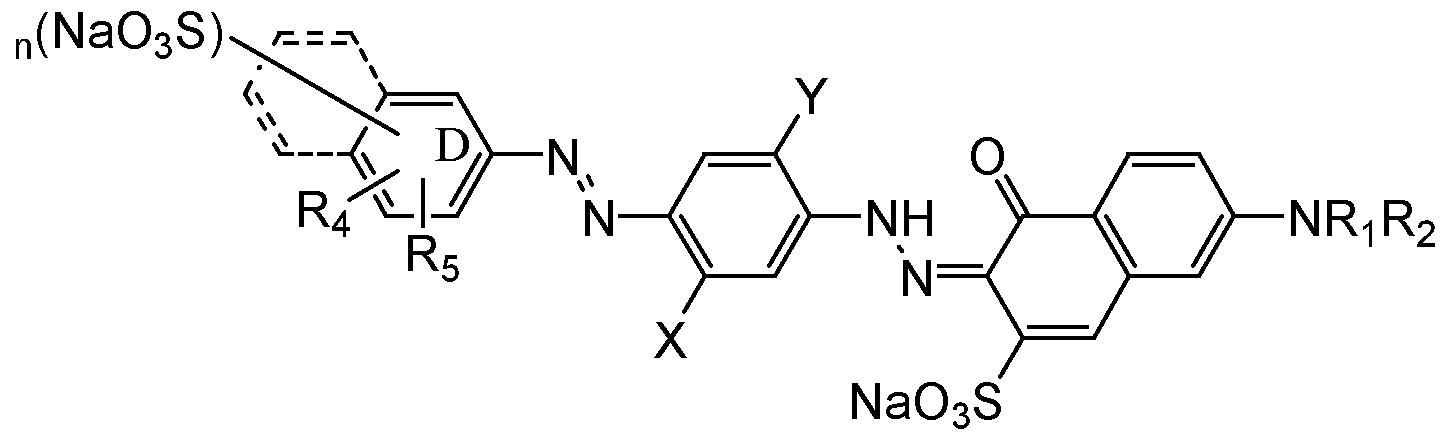
- the direct dye is a direct violet of the following structures:
- ring D and E may be independently naphthyl or phenyl as shown;
- Ri is selected from: hydrogen and Ci-C 4 -alkyl, preferably hydrogen;
- R 2 is selected from: hydrogen, Ci-C 4 -alkyl, substituted or unsubstituted phenyl and substituted or unsubstituted naphthyl, preferably phenyl;
- R 3 and R 4 are independently selected from: hydrogen and Ci-C 4 -alkyl, preferably hydrogen or methyl;
- Preferred dyes are direct violet 7, direct violet 9, direct violet 1 1 , direct violet 26, direct violet 31 , direct violet 35, direct violet 40, direct violet 41 , direct violet 51 , and direct violet 99.
- Bis-azo copper containing dyes such as direct violet 66 may be used.
- the benzidene based dyes are less preferred.
- the direct dye may be covalently linked to the photo-bleach, for example as described in WO2006/024612.
- the direct dye is present at 0.000001 to 1 wt% more preferably 0.00001 wt% to 0.0010 wt% of the composition.
- Acid dyes :
- Cotton substantive acid dyes give benefits to cotton containing garments.
- Preferred dyes and mixes of dyes are blue or violet.
- Preferred acid dyes are: (i) azine dyes, wherein the dye is of the following core structure:
- R a , R b , R c and R d are selected from: H, a branched or linear C1 to C7-alkyl chain, benzyl a phenyl, and a naphthyl; the dye is substituted with at least one SO3 " or -COO " group;
- the B ring does not carry a negatively charged group or salt thereof
- a ring may further substituted to form a naphthyl
- the dye is optionally substituted by groups selected from: amine, methyl, ethyl, hydroxyl, methoxy, ethoxy, phenoxy, CI, Br, I, F, and NO2.
- Preferred azine dyes are: acid blue 98, acid violet 50, and acid blue 59, more preferably acid violet 50 and acid blue 98.
- Other preferred non-azine acid dyes are acid violet 17, acid black 1 and acid blue 29.
- the acid dye is present at 0.0005 wt% to 0.01 wt% of the formulation.
- the composition may comprise one or more hydrophobic dyes selected from benzodifuranes, methine, triphenylmethanes, napthalimides, pyrazole, napthoquinone, anthraquinone and mono-azo or di-azo dye chromophores.
- hydrophobic dyes selected from benzodifuranes, methine, triphenylmethanes, napthalimides, pyrazole, napthoquinone, anthraquinone and mono-azo or di-azo dye chromophores.
- Hydrophobic dyes are dyes which do not contain any charged water solubilising group. Hydrophobic dyes may be selected from the groups of disperse and solvent dyes. Blue and violet anthraquinone and mono-azo dye are preferred.
- Preferred dyes include solvent violet 13, disperse violet 27 disperse violet 26, disperse violet 28, disperse violet 63 and disperse violet 77.
- the hydrophobic dye is present at 0.0001 wt% to 0.005 wt% of the formulation.
- Basic dyes are organic dyes which carry a net positive charge. They deposit onto cotton. They are of particular utility for used in composition that contain
- Dyes may be selected from the basic violet and basic blue dyes listed in the Colour Index International. Preferred examples include triarylmethane basic dyes, methane basic dye, anthraquinone basic dyes, basic blue 16, basic blue 65, basic blue 66, basic blue 67, basic blue 71 , basic blue 159, basic violet 19, basic violet 35, basic violet 38, basic violet 48; basic blue 3, basic blue 75, basic blue 95, basic blue 122, basic blue 124, basic blue 141 .
- Reactive dyes are dyes which contain an organic group capable of reacting with cellulose and linking the dye to cellulose with a covalent bond. They deposit onto cotton.
- the reactive group is hydrolysed or reactive group of the dyes has been reacted with an organic species such as a polymer, so as to the link the dye to this species.
- Dyes may be selected from the reactive violet and reactive blue dyes listed in the Colour Index International. Preferred examples include reactive blue 19, reactive blue 163, reactive blue 182 and reactive blue, reactive blue 96.
- Dye conjugates are formed by binding direct, acid or basic dyes to polymers or particles via physical forces. Dependent on the choice of polymer or particle they deposit on cotton or synthetics. A description is given in WO2006/055787.
- Particularly preferred dyes are: direct violet 7, direct violet 9, direct violet 1 1 , direct violet 26, direct violet 31 , direct violet 35, direct violet 40, direct violet 41 , direct violet 51 , direct violet 99, acid blue 98, acid violet 50, acid blue 59, acid violet 17, acid black 1 , acid blue 29, solvent violet 13, disperse violet 27 disperse violet 26, disperse violet 28, disperse violet 63, disperse violet 77 and mixtures thereof.
- Shading dye can be used in the absence of fiuorescer, but it is especially preferred to use a shading dye in combination with a fiuorescer, for example in order to reduce yellowing due to chemical changes in adsorbed fiuorescer.
- the detergent compositions may also optionally contain relatively low levels of organic detergent builder or sequestrant material.
- organic detergent builder or sequestrant material examples include the alkali metal, citrates, succinates, malonates, carboxymethyl succinates, carboxylates, polycarboxylates and polyacetyl carboxylates.
- specific examples include sodium, potassium and lithium salts of oxydisuccinic acid, mellitic acid, benzene
- polycarboxylic acids and citric acid.
- DEQUESTTM organic phosphonate type sequestering agents sold by Monsanto and alkanehydroxy phosphonates.
- suitable organic builders include the higher molecular weight polymers and copolymers known to have builder properties.
- such materials include appropriate polyacrylic acid, polymaleic acid, and polyacrylic/polymaleic acid copolymers and their salts, such as those sold by BASF under the name
- the organic builder materials may comprise from about 0.5% to 20 wt%, preferably from 1 wt% to 10 wt%, of the composition.
- the preferred builder level is less than 10 wt% and preferably less than 5 wt% of the composition.
- a preferred sequestrant is HEDP (1 -Hydroxyethylidene -1 , 1 ,-diphosphonic acid), for example sold as Dequest 2010.
- Dequest® 2066 Diethylenetriamine penta(methylene phosphonic acid or Heptasodium DTPMP. Hydrotropes
- compositions preferably comprise one or more hydrotopes; although the minimum amount consistent with the need for concentration should be used.
- Suitable hydrotropes include MPG (monopropylene glycol). This and/or other conventionally employed hydrotropes may be used in the composition at levels of from 2 to 10 wt%.
- a hydrotrope is a solvent that is neither water nor conventional surfactant that aids the solubilisation of the
- glycerol sodium cumene sulphonate
- ethanol other glycols, e.g. di propylene glycol, diethers and urea.
- buffers are MEA, and TEA. If present they are preferably used in the composition at levels of from 5 to 15 wt%.
- compositions may have their rheology modified by use of a material or materials that form a structuring network within the composition.
- Suitable structurants include hydrogenated castor oil, microfibrous cellulose and natural based structurants such as citrus pulp fibre. Citrus pulp fibre is particularly preferred especially if lipase enzyme is included in the composition.
- compositions may, and preferably do, comprise visual cues of solid material that is not dissolved in the composition. Preferably they are used in combination with an external structurant to ensure that they remain in suspension.
- visual cues are lamellar cues formed from polymer film and possibly comprising functional ingredients that may not be as stable if exposed to the alkaline liquid. Enzymes and bleach catalysts are examples of such ingredients. Also perfume, particularly microencapsulated perfume. Packaging and dosing
- the liquids may be packaged as unit doses. To allow greater flexibility in dosing the liquids are preferably supplied in multiuse plastics packs with a top or bottom closure. A dosing system may be supplied with the pack either as a part of the cap or as an integrated system. Method of use
- liquids according to the invention may be formulated to allow them to be dosed to a typical front loading automatic washing machine at a dosage level of 20ml.
- the low in wash surfactant level being compensated by the presence of enzymes, soil release polymer and EPEI together with further optional high efficacy cleaning ingredients, such as enzymes.
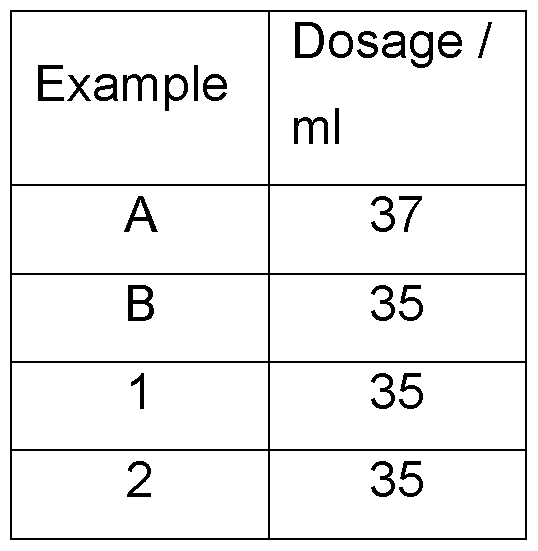
- the invention is also suitable for the more conventional dosage levels of about 35 ml. To obtain suitable detergent liquids of this type all that is necessary is to add further water and possibly perfume to the 20ml composition before it is packaged.
- the fabric conditioning active may be any of the known cationic softening actives, particularly quaternary ammonium compounds including the biodegradable ester quaternary ammonium actives;
- Fabric conditioners comprising imidazolines will also complex with anionic surfactant and the invention extends also to washing of fabrics that have previously been treated with fabric conditioner comprising this type of fabric conditioning active.
- LAS acid is C12-14 linear alkylbenzene sulphonic acid
- Fatty acid is saturated lauric fatty acid
- Prifac® 5908ex Croda is C12-14 linear alkylbenzene sulphonic acid
- SLES 3E0 is sodium lauryl ether sulphate with 3 moles EO.
- Empigen® BB is an alkyl betaine ex Huntsman (Coco dimethyl
- Nl 7E0 is C12-15 alcohol ethoxylate 7EO nonionic
- Neodol® 25-7 (ex Shell Chemicals),
- Stenol 1618L is C16/18 fatty alcohol nonionic ex Cognis.
- Genepol C200 is coco 20 EO nonionic ex Clariant.
- HTTEAQ is hardened tallow triethanolamine quaternary (cationic fabric softening active).
- MPG is mono propylene glycol.
- TEA is triethanolamine
- NaOH is 47% sodium hydroxide solution.
- EPEI Sokalan HP20 - ethoxylated polyethylene imine
- SRP soil release polymer
- Dequest® 2066 is Diethylenetriamine penta(methylene phosphonic acid
- Perfume is free oil perfume.
- the fabric conditioner The fabric conditioner
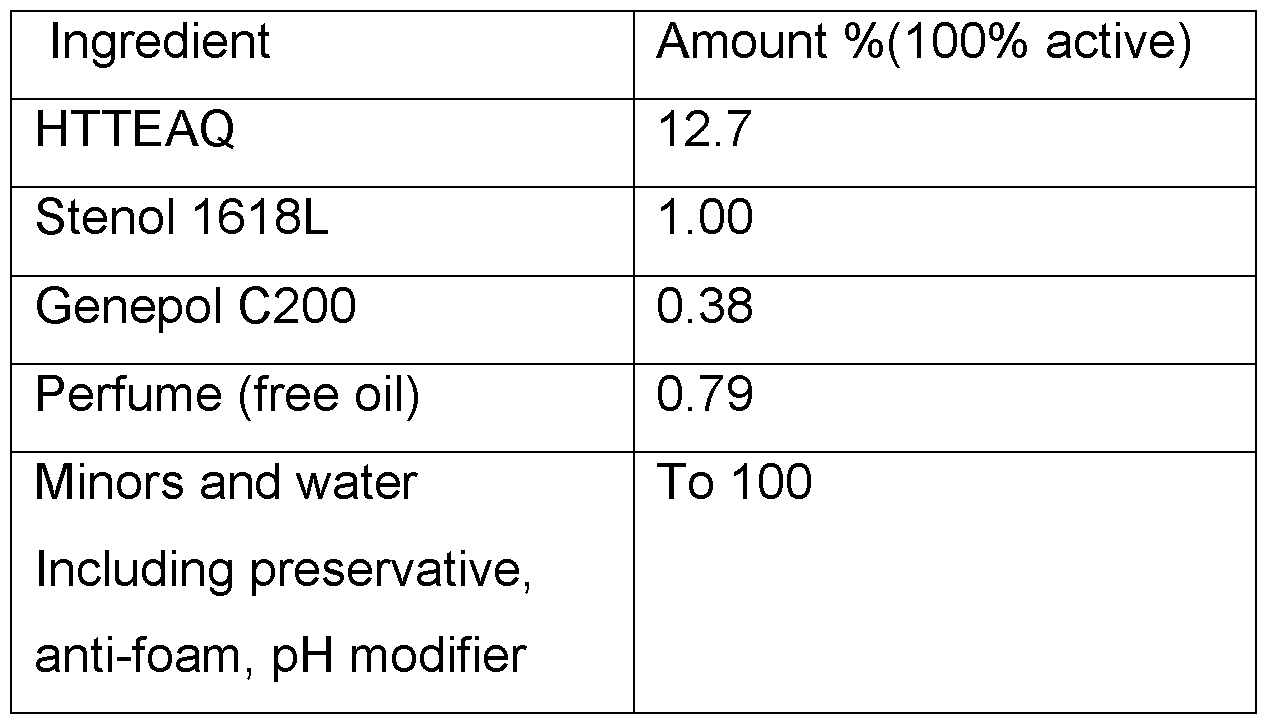
- the fabric conditioner used for the examples was a commercially available concentrated fabric conditioner composition sold under the "Comfort” brand in the UK and based on Hardened Tallow TEAQ.
- the formulation of the fabric conditioner is given in table 1 .
- the fabric conditioner was used at the recommended dose for this concentrated fabric conditioner of 55mls.
- the surfactant system is believed to be made up from MEA-Dodecylbenzenesulfonate (LAS neutralised with MEA), Sodium Laureth Sulfate (SLES) and, MEA-Palm Kernelate.
- MEA-Dodecylbenzenesulfonate LAS neutralised with MEA
- SLES Sodium Laureth Sulfate
- MEA-Palm Kernelate MEA-Dodecylbenzenesulfonate
- composition further includes: MEA Citrate, C12-14 Pareth-7 (nonionic/emulsifier), PEI- Ethoxylate, Trimonoethanolamine Etidronate, Propylene Glycol, MEA-Borate, Glycosidase, Sodium Sulfate, Disodium Distyrylbiphenyl Disulfonate, Ethanolamine, Protease, Calcium Chloride, Colorant, and perfume.
- Washes were conducted in a European Miele washing machine using the standard 30°C cotton wash cycle.
- the main wash intake was 15 L of ambient temperature water of 26°FH water (Ca:Mg 3: 1 ) and the total wash time (including rinses) was 1 hour 56 minutes.
- Process 1 - Prewash Treatment only Each of the products in Table 5 was used to wash a ballast load as described above together with a series of cotton and polyester swatches that were to be subsequently stained. After washing all fabrics were tumble dried. After two complete wash cycles, the swatches were soiled using a range of soils. A final wash treatment was then conducted on the stained swatches using the same ballast and wash conditions as before.
- the stained swatches were line dried in the dark before being assessed for stain removal.
- the colour of the stains was measured on a flatbed scanner and expressed in terms of the difference between the stain and clean (washed) cloth giving AE * (before wash) or ⁇ * ( after wash) values respectively.
- the ⁇ values being the colour differences defined as the Euclidian distance between the stain and clean cloth in L * a * b * colour space.
- the AE * (after wash) values were converted to Stain Removal Index (SRI) values by application of the standard transformation:
- Enzymatic stains Cocoa / milk, Choc Pudding (Heinz), Choc Ice Cream (Economy), Blood (haemoglobin).
- composition 2 there are significant wins with oily/fatty stains, especially on Polyester. There are significant wins on particulate stains and there is parity on enzymatic/ bleachable/ sequestrant stains. The effects are biggest with Oily/Fatty stains on Polyester.
- Composition 2 versus Comparative composition A shows superiority with fatty/oily stains on polyester. The same slight downward trend as compared with B is observed on cotton (2 significant results). Enzymatic and particulate stains give approximate parity. When the higher surfactant levels used in Composition 1 are compared with the results obtained for Composition 2 the benefit of using the lower in-wash non soap surfactant levels is seen. Composition 2 is outperforming composition 1 when used after rinse conditioner.
Landscapes
- Chemical & Material Sciences (AREA)
- Life Sciences & Earth Sciences (AREA)
- Engineering & Computer Science (AREA)
- Chemical Kinetics & Catalysis (AREA)
- Oil, Petroleum & Natural Gas (AREA)
- Wood Science & Technology (AREA)
- Organic Chemistry (AREA)
- Detergent Compositions (AREA)
Abstract
Description





Claims
Priority Applications (8)
| Application Number | Priority Date | Filing Date | Title |
|---|---|---|---|
| BR112013025674-5A BR112013025674B1 (en) | 2011-04-04 | 2012-03-05 | method for washing fabric |
| CN201280016945.1A CN103459577B (en) | 2011-04-04 | 2012-03-05 | Method of laundering fabric |
| PL12707100T PL2694635T3 (en) | 2011-04-04 | 2012-03-05 | Method of laundering fabric |
| EP12707100.9A EP2694635B1 (en) | 2011-04-04 | 2012-03-05 | Method of laundering fabric |
| PH1/2013/501797A PH12013501797A1 (en) | 2011-04-04 | 2012-03-05 | Method of laundering fabric |
| AU2012238950A AU2012238950B2 (en) | 2011-04-04 | 2012-03-05 | Method of laundering fabric |
| MX2013011464A MX2013011464A (en) | 2011-04-04 | 2012-03-05 | Method of laundering fabric. |
| ZA2013/06447A ZA201306447B (en) | 2011-04-04 | 2013-08-27 | Method of laundering fabric |
Applications Claiming Priority (2)
| Application Number | Priority Date | Filing Date | Title |
|---|---|---|---|
| EP11160937.6 | 2011-04-04 | ||
| EP11160937.6A EP2476743B1 (en) | 2011-04-04 | 2011-04-04 | Method of laundering fabric |
Publications (1)
| Publication Number | Publication Date |
|---|---|
| WO2012136427A1 true WO2012136427A1 (en) | 2012-10-11 |
Family
ID=44453797
Family Applications (1)
| Application Number | Title | Priority Date | Filing Date |
|---|---|---|---|
| PCT/EP2012/053709 Ceased WO2012136427A1 (en) | 2011-04-04 | 2012-03-05 | Method of laundering fabric |
Country Status (13)
| Country | Link |
|---|---|
| EP (2) | EP2476743B1 (en) |
| CN (1) | CN103459577B (en) |
| AR (1) | AR085771A1 (en) |
| AU (1) | AU2012238950B2 (en) |
| BR (1) | BR112013025674B1 (en) |
| CL (1) | CL2013002817A1 (en) |
| ES (1) | ES2421162T3 (en) |
| MX (1) | MX2013011464A (en) |
| MY (1) | MY161793A (en) |
| PH (1) | PH12013501797A1 (en) |
| PL (1) | PL2694635T3 (en) |
| WO (1) | WO2012136427A1 (en) |
| ZA (1) | ZA201306447B (en) |
Cited By (13)
| Publication number | Priority date | Publication date | Assignee | Title |
|---|---|---|---|---|
| CN104955930A (en) * | 2013-02-19 | 2015-09-30 | 宝洁公司 | Ways to Wash Fabrics |
| JP2017066341A (en) * | 2015-10-02 | 2017-04-06 | ライオン株式会社 | Liquid detergent for clothes |
| EP3312264A1 (en) * | 2016-10-21 | 2018-04-25 | The Procter & Gamble Company | Process of washing fabrics that have a softening active deposited thereon |
| EP3312266A1 (en) * | 2016-10-21 | 2018-04-25 | The Procter & Gamble Company | Process of washing fabrics that have a cationically charged softening active deposited thereon |
| KR101905888B1 (en) | 2016-08-18 | 2018-10-10 | 주식회사 영신물산 | Manufacturing method of bath softner agent and bath softner agent manufactured by same method |
| WO2019038187A1 (en) * | 2017-08-24 | 2019-02-28 | Unilever Plc | Improvements relating to fabric cleaning |
| WO2019038186A1 (en) * | 2017-08-24 | 2019-02-28 | Unilever Plc | Improvements relating to fabric cleaning |
| US10717948B2 (en) | 2013-02-19 | 2020-07-21 | The Procter & Gamble Company | Method of laundering a fabric |
| US20220195337A1 (en) * | 2019-05-16 | 2022-06-23 | Conopco, Inc., D/B/A Unilever | Laundry composition |
| US11692305B2 (en) | 2018-06-28 | 2023-07-04 | The Procter & Gamble Company | Fabric treatment compositions with polymer system and related processes |
| EP3342849B1 (en) | 2016-12-28 | 2024-06-19 | The Procter & Gamble Company | Water-soluble unit dose article comprising ethoxylated polyethyleneimine |
| DE102023109600A1 (en) | 2023-04-17 | 2024-10-17 | Gertraud Scholz | Anionic Soil Release Polyesters and their Use |
| US12371635B2 (en) * | 2019-05-16 | 2025-07-29 | Conopco, Inc. | Laundry composition |
Families Citing this family (10)
| Publication number | Priority date | Publication date | Assignee | Title |
|---|---|---|---|---|
| CN105647687A (en) * | 2015-09-17 | 2016-06-08 | 陕西天瑞生物科技有限公司 | Polyurethane surface pretreatment cleaning agent |
| CN109790491B (en) | 2016-09-27 | 2021-02-23 | 荷兰联合利华有限公司 | Household washing method |
| EP3342850A1 (en) | 2016-12-28 | 2018-07-04 | The Procter & Gamble Company | Water-soluble unit dose article comprising zwitterionic polyamine |
| WO2019035840A1 (en) * | 2017-08-18 | 2019-02-21 | The Procter & Gamble Company | Method of treating fabrics |
| CN112243455B (en) | 2018-06-26 | 2022-04-29 | 宝洁公司 | Liquid laundry detergent compositions |
| WO2020058024A1 (en) * | 2018-09-17 | 2020-03-26 | Unilever Plc | Detergent composition |
| WO2021200920A1 (en) * | 2020-04-01 | 2021-10-07 | ライオン株式会社 | Fiber product treating agent composition and method for treating fiber product |
| GB2630014A (en) * | 2023-04-04 | 2024-11-20 | Reckitt Benckiser Espana S L | Phosphonate-free liquid laundry detergent composition |
| EP4574943A1 (en) | 2023-12-20 | 2025-06-25 | The Procter & Gamble Company | Method of laundering fabric at low temperatures |
| EP4574941A1 (en) * | 2023-12-20 | 2025-06-25 | The Procter & Gamble Company | Method of laundering fabric at low temperatures |
Citations (116)
| Publication number | Priority date | Publication date | Assignee | Title |
|---|---|---|---|---|
| US2182306A (en) | 1935-05-10 | 1939-12-05 | Ig Farbenindustrie Ag | Polymerization of ethylene imines |
| US2208095A (en) | 1937-01-05 | 1940-07-16 | Ig Farbenindustrie Ag | Process of producing insoluble condensation products containing sulphur and nitrogen |
| US2553696A (en) | 1944-01-12 | 1951-05-22 | Union Carbide & Carbon Corp | Method for making water-soluble polymers of lower alkylene imines |
| US2806839A (en) | 1953-02-24 | 1957-09-17 | Arnold Hoffman & Co Inc | Preparation of polyimines from 2-oxazolidone |
| US3033746A (en) | 1958-06-19 | 1962-05-08 | Dow Chemical Co | Polyalkyleneimine, phenol germicides |
| US3644203A (en) | 1968-12-09 | 1972-02-22 | Lever Brothers Ltd | Fabric softener |
| GB1296839A (en) | 1969-05-29 | 1972-11-22 | ||
| GB1372034A (en) | 1970-12-31 | 1974-10-30 | Unilever Ltd | Detergent compositions |
| US3893929A (en) | 1971-10-28 | 1975-07-08 | Procter & Gamble | Compositions for imparting renewable soil release finish to polyester-containing fabrics |
| DE2527793A1 (en) | 1974-06-25 | 1976-01-15 | Procter & Gamble | LIQUID DETERGENT PREPARATIONS WITH DIRT-REPELLENT PROPERTIES |
| US3959230A (en) | 1974-06-25 | 1976-05-25 | The Procter & Gamble Company | Polyethylene oxide terephthalate polymers |
| US4116885A (en) | 1977-09-23 | 1978-09-26 | The Procter & Gamble Company | Anionic surfactant-containing detergent compositions having soil-release properties |
| US4435307A (en) | 1980-04-30 | 1984-03-06 | Novo Industri A/S | Detergent cellulase |
| DE3411941A1 (en) | 1983-04-04 | 1984-10-04 | Colgate-Palmolive Co., New York, N.Y. | LIQUID DETERGENT |
| DE3410810A1 (en) | 1983-03-29 | 1984-10-04 | Colgate-Palmolive Co., New York, N.Y. | PARTICULATE TEXTILE DETERGENT |
| EP0199403A2 (en) | 1985-04-15 | 1986-10-29 | The Procter & Gamble Company | Stable liquid detergent compositions |
| EP0201124A2 (en) | 1985-05-01 | 1986-11-12 | Procter & Gamble European Technical Center | Cleaning compositions |
| EP0218272A1 (en) | 1985-08-09 | 1987-04-15 | Gist-Brocades N.V. | Novel lipolytic enzymes and their use in detergent compositions |
| EP0219048A2 (en) | 1985-10-12 | 1987-04-22 | BASF Aktiengesellschaft | Use of graft copolymers of polyalkylenoxides and vinyl acetate as anti-redeposition agents in the washing and post-treatment of textiles containing synthetic fibres |
| US4702857A (en) | 1984-12-21 | 1987-10-27 | The Procter & Gamble Company | Block polyesters and like compounds useful as soil release agents in detergent compositions |
| US4711730A (en) | 1986-04-15 | 1987-12-08 | The Procter & Gamble Company | Capped 1,2-propylene terephthalate-polyoxyethylene terephthalate polyesters useful as soil release agents |
| US4721580A (en) | 1987-01-07 | 1988-01-26 | The Procter & Gamble Company | Anionic end-capped oligomeric esters as soil release agents in detergent compositions |
| JPS6336775A (en) | 1986-07-31 | 1988-02-17 | Res Dev Corp Of Japan | Novel alkalophilic strain of bacillus genus capable of producing beta-mannanase and beta-mannosidase and use thereof |
| EP0258068A2 (en) | 1986-08-29 | 1988-03-02 | Novo Nordisk A/S | Enzymatic detergent additive |
| JPS6356289A (en) | 1986-07-30 | 1988-03-10 | Res Dev Corp Of Japan | Beta-mannanase and production thereof |
| EP0260105A2 (en) | 1986-09-09 | 1988-03-16 | Genencor, Inc. | Preparation of enzymes having altered activity |
| FR2619393A1 (en) | 1987-08-10 | 1989-02-17 | Colgate Palmolive Co | DETERGENT COMPOSITION BASED ON ETHOXYLATE AND A COPOLYMER OF TEREPHTHALATE FACILITATING SOIL DECOLUTION AND METHOD FOR USE THEREOF |
| EP0305216A1 (en) | 1987-08-28 | 1989-03-01 | Novo Nordisk A/S | Recombinant Humicola lipase and process for the production of recombinant humicola lipases |
| EP0331376A2 (en) | 1988-02-28 | 1989-09-06 | Amano Pharmaceutical Co., Ltd. | Recombinant DNA, bacterium of the genus pseudomonas containing it, and process for preparing lipase by using it |
| WO1989009259A1 (en) | 1988-03-24 | 1989-10-05 | Novo-Nordisk A/S | A cellulase preparation |
| PL148326B1 (en) | 1986-07-15 | 1989-10-31 | A softerner for teytile products | |
| US4877896A (en) | 1987-10-05 | 1989-10-31 | The Procter & Gamble Company | Sulfoaroyl end-capped ester of oligomers suitable as soil-release agents in detergent compositions and fabric-conditioner articles |
| EP0357280A2 (en) | 1988-08-26 | 1990-03-07 | The Procter & Gamble Company | Soil release agents having allylderived sulfonated end caps |
| US4968451A (en) | 1988-08-26 | 1990-11-06 | The Procter & Gamble Company | Soil release agents having allyl-derived sulfonated end caps |
| EP0407225A1 (en) | 1989-07-07 | 1991-01-09 | Unilever Plc | Enzymes and enzymatic detergent compositions |
| JPH0347076A (en) | 1989-08-25 | 1991-02-28 | Res Dev Corp Of Japan | Beta-mannase and production thereof |
| US5008032A (en) | 1988-10-31 | 1991-04-16 | Basf Aktiengesellschaft | Use of partially esterified copolymers in liquid detergents |
| EP0442101A1 (en) | 1990-01-19 | 1991-08-21 | BASF Aktiengesellschaft | Polyesters containing nonionic surfactants in a condensed form, their preparation and their use in detergents |
| WO1991016422A1 (en) | 1990-04-14 | 1991-10-31 | Kali-Chemie Aktiengesellschaft | Alkaline bacillus lipases, coding dna sequences therefor and bacilli which produce these lipases |
| WO1991018974A1 (en) | 1990-05-29 | 1991-12-12 | Chemgen Corporation | HEMICELLULASE ACTIVE AT EXTREMES OF pH AND TEMPERATURE AND THE MEANS FOR THE PRODUCTION THEREOF |
| WO1992005249A1 (en) | 1990-09-13 | 1992-04-02 | Novo Nordisk A/S | Lipase variants |
| EP0483606A2 (en) | 1990-10-29 | 1992-05-06 | BASF Aktiengesellschaft | Use of polyesters comprising condensed tartaric acid as detergent additive, process for production of the polyesters, and polyesters based upon tartaric acid and tetracarboxylic acids |
| WO1992019708A1 (en) | 1991-04-30 | 1992-11-12 | The Procter & Gamble Company | Liquid detergents with aromatic borate ester to inhibit proteolytic enzyme |
| WO1992019709A1 (en) | 1991-04-30 | 1992-11-12 | The Procter & Gamble Company | Built liquid detergents with boric-polyol complex to inhibit proteolytic enzyme |
| WO1993018124A1 (en) | 1992-03-10 | 1993-09-16 | The Procter & Gamble Company | Granular detergent compositions |
| WO1993024622A1 (en) | 1992-05-22 | 1993-12-09 | Alko Ltd. | Mannanase enzymes, genes coding for them, methods for isolating the genes, and methods for bleaching lignocellulosic pulps |
| WO1993024618A1 (en) | 1992-06-01 | 1993-12-09 | Novo Nordisk A/S | Peroxidase variants with improved hydrogen peroxide stability |
| WO1994001541A1 (en) | 1992-07-06 | 1994-01-20 | Novo Nordisk A/S | C. antarctica lipase and lipase variants |
| WO1994025576A1 (en) | 1993-04-30 | 1994-11-10 | Novo Nordisk A/S | An enzyme exhibiting mannanase activity |
| WO1994025578A1 (en) | 1993-04-27 | 1994-11-10 | Gist-Brocades N.V. | New lipase variants for use in detergent applications |
| WO1995002028A1 (en) | 1993-07-08 | 1995-01-19 | The Procter & Gamble Company | Detergent compositions comprising soil release agents |
| WO1995002030A1 (en) | 1993-07-08 | 1995-01-19 | The Procter & Gamble Company | Detergent compositions comprising soil release agents |
| WO1995006720A1 (en) | 1993-08-30 | 1995-03-09 | Showa Denko K.K. | Novel lipase, microorganism producing the lipase, process for producing the lipase, and use of the lipase |
| WO1995010602A1 (en) | 1993-10-13 | 1995-04-20 | Novo Nordisk A/S | H2o2-stable peroxidase variants |
| WO1995014783A1 (en) | 1993-11-24 | 1995-06-01 | Showa Denko K.K. | Lipase gene and variant lipase |
| WO1995018207A1 (en) | 1993-12-24 | 1995-07-06 | Henkel Kommanditgesellschaft Auf Aktien | Liquid washing and cleaning agent |
| WO1995022615A1 (en) | 1994-02-22 | 1995-08-24 | Novo Nordisk A/S | A method of preparing a variant of a lipolytic enzyme |
| WO1995026397A1 (en) | 1994-03-29 | 1995-10-05 | Novo Nordisk A/S | Alkaline bacillus amylase |
| WO1995030744A2 (en) | 1994-05-04 | 1995-11-16 | Genencor International Inc. | Lipases with improved surfactant resistance |
| WO1995032232A1 (en) | 1994-05-20 | 1995-11-30 | Henkel Kommanditgesellschaft Auf Aktien | Soil release polyesters |
| WO1995035381A1 (en) | 1994-06-20 | 1995-12-28 | Unilever N.V. | Modified pseudomonas lipases and their use |
| WO1996000292A1 (en) | 1994-06-23 | 1996-01-04 | Unilever N.V. | Modified pseudomonas lipases and their use |
| JPH0851975A (en) | 1991-10-09 | 1996-02-27 | Res Dev Corp Of Japan | Novel β-mannanase and method for producing the same |
| WO1996012012A1 (en) | 1994-10-14 | 1996-04-25 | Solvay S.A. | Lipase, microorganism producing same, method for preparing said lipase and uses thereof |
| WO1996013580A1 (en) | 1994-10-26 | 1996-05-09 | Novo Nordisk A/S | An enzyme with lipolytic activity |
| WO1996016150A1 (en) | 1994-11-17 | 1996-05-30 | Henkel Kommanditgesellschaft Auf Aktien | Soil-repellent detergent with specific combination of surfactants |
| EP0728795A2 (en) | 1995-02-25 | 1996-08-28 | Basf Aktiengesellschaft | Process for preparing finely divided compositions of amphiphilic polymers and polycarboxylates and their use |
| WO1996027002A1 (en) | 1995-02-27 | 1996-09-06 | Novo Nordisk A/S | Novel lipase gene and process for the production of lipase with the use of the same |
| WO1996029397A1 (en) | 1995-03-17 | 1996-09-26 | Novo Nordisk A/S | Novel endoglucanases |
| EP0743358A1 (en) | 1995-05-18 | 1996-11-20 | Textil Color Ag | Composition for washing and cleaning of textile materials |
| WO1997003162A1 (en) | 1995-07-08 | 1997-01-30 | The Procter & Gamble Company | Detergent compositions |
| WO1997004079A1 (en) | 1995-07-14 | 1997-02-06 | Novo Nordisk A/S | A modified enzyme with lipolytic activity |
| WO1997007202A1 (en) | 1995-08-11 | 1997-02-27 | Novo Nordisk A/S | Novel lipolytic enzymes |
| WO1997011164A1 (en) | 1995-09-20 | 1997-03-27 | Genencor International, Inc. | Purified mannanase from bacillus amyloliquefaciens and method of preparation |
| US5648263A (en) | 1988-03-24 | 1997-07-15 | Novo Nordisk A/S | Methods for reducing the harshness of a cotton-containing fabric |
| WO1997041197A1 (en) | 1996-04-25 | 1997-11-06 | Basf Aktiengesellschaft | Detergent components protected against exothermic decomposition by oxidation |
| WO1997042285A1 (en) | 1996-05-03 | 1997-11-13 | The Procter & Gamble Company | Cotton soil release polymers |
| WO1997048787A1 (en) | 1996-06-19 | 1997-12-24 | Unilever N.V. | Bleach activation |
| WO1998012307A1 (en) | 1996-09-17 | 1998-03-26 | Novo Nordisk A/S | Cellulase variants |
| WO1998015346A1 (en) | 1996-10-04 | 1998-04-16 | Rhodia Inc. | Enhancement of soil release with gemini surfactants |
| WO1998015608A2 (en) * | 1996-10-07 | 1998-04-16 | The Procter & Gamble Company | Alkoxylated, quaternized polyamine detergent ingredients |
| WO1998015257A1 (en) | 1996-10-08 | 1998-04-16 | Novo Nordisk A/S | Diaminobenzoic acid derivatives as dye precursors |
| WO1998020092A2 (en) | 1996-11-01 | 1998-05-14 | The Procter & Gamble Company | Laundry detergent compositions comprising soil release polymer |
| WO1998039406A1 (en) | 1997-03-07 | 1998-09-11 | The Procter & Gamble Company | Bleach compositions |
| WO1998039098A1 (en) | 1997-03-07 | 1998-09-11 | The University Of Kansas | Catalysts and methods for catalytic oxidation |
| US5834412A (en) | 1995-12-21 | 1998-11-10 | The Procter & Gamble Company | Soil release polymers with fluorescent whitening properties |
| WO1998058044A1 (en) | 1997-06-17 | 1998-12-23 | Clariant Gmbh | Detergent and cleaning agent |
| WO1998059030A1 (en) | 1997-06-20 | 1998-12-30 | The Procter & Gamble Company | Soil release polymers with fluorescent whitening properties |
| RO114357B1 (en) | 1998-02-26 | 1999-03-30 | Sc Prod Cresus Sa | Anti-soiling composition for textile materials |
| WO1999019429A1 (en) | 1997-10-10 | 1999-04-22 | The Procter & Gamble Company | A detergent composition |
| WO1999027083A1 (en) | 1997-11-24 | 1999-06-03 | Novo Nordisk A/S | PECTIN DEGRADING ENZYMES FROM $i(BACILLUS LICHENIFORMIS) |
| WO1999027084A1 (en) | 1997-11-24 | 1999-06-03 | Novo Nordisk A/S | Novel pectate lyases |
| JPH11193397A (en) | 1997-12-26 | 1999-07-21 | Lion Corp | Detergent particle composition and method for producing the same |
| WO1999041346A1 (en) | 1998-02-11 | 1999-08-19 | Rhodia Chimie | Dirt removing detergent compositions |
| WO1999064619A2 (en) | 1998-06-10 | 1999-12-16 | Novozymes A/S | Novel mannanases |
| WO2000004120A1 (en) | 1998-07-15 | 2000-01-27 | Rhodia Chimie | Terephthalic polyester composition and its use as soil release agent |
| WO2000029537A1 (en) | 1998-11-13 | 2000-05-25 | The Procter & Gamble Company | Bleach compositions |
| WO2000052124A1 (en) | 1999-03-02 | 2000-09-08 | The Procter & Gamble Company | Stabilized bleach compositions |
| WO2000060060A2 (en) | 1999-03-31 | 2000-10-12 | Novozymes A/S | Polypeptides having alkaline alpha-amylase activity and nucleic acids encoding same |
| WO2001023515A1 (en) | 1999-09-29 | 2001-04-05 | Rhodia Inc. | Novel polymer based cleaning compositions for use in hard surface cleaning and laundry applications |
| EP1099748A2 (en) | 1999-11-13 | 2001-05-16 | Henkel Kommanditgesellschaft auf Aktien | Surfactant containing detergent compositions |
| JP2001181692A (en) | 1999-12-27 | 2001-07-03 | Lion Corp | Liquid detergent composition for partial washing |
| US6284524B1 (en) | 1997-11-24 | 2001-09-04 | Novozymes A/S | Pectate lyases |
| WO2002006442A2 (en) | 2000-07-19 | 2002-01-24 | Novozymes A/S | Cell-wall degrading enzyme variants |
| WO2002018474A1 (en) | 2000-09-02 | 2002-03-07 | Sasol Germany Gmbh | Free-flowing, amphiphilic, non-ionic oligoesters |
| WO2002048301A1 (en) | 2000-12-15 | 2002-06-20 | Unilever Plc | Ligand and complex for catalytically bleaching a substrate |
| WO2002077063A1 (en) | 2001-03-28 | 2002-10-03 | Basf Aktiengesellschaft | Dirt-removing polyesters |
| WO2005014769A1 (en) | 2003-08-06 | 2005-02-17 | Ciba Specialty Chemicals Holding Inc. | Shading composition |
| WO2005097959A1 (en) | 2004-04-08 | 2005-10-20 | Clariant Produkte (Deutschland) Gmbh | Detergent and cleaning agents containing dye fixatives and soil-release polymers |
| WO2006024612A1 (en) | 2004-08-30 | 2006-03-09 | Ciba Specialty Chemicals Holding Inc. | Shading process |
| WO2006055787A1 (en) | 2004-11-19 | 2006-05-26 | The Procter & Gamble Company | Whiteness perception compositions |
| WO2006086492A1 (en) | 2005-02-08 | 2006-08-17 | Basf Aktiengesellschaft | Method of making an alkoxylated polyethylenimine product |
| WO2006133868A1 (en) | 2005-06-15 | 2006-12-21 | Clariant Produkte (Deutschland) Gmbh | Detergents for hard surfaces |
| WO2006133867A1 (en) | 2005-06-15 | 2006-12-21 | Clariant Produkte (Deutschland) Gmbh | Dishwashing formulations comprising oligoesters |
| WO2008095626A1 (en) | 2007-02-03 | 2008-08-14 | Clariant Finance (Bvi) Limited | Aqueous oligo- and polyester formulations |
| WO2009153184A1 (en) | 2008-06-16 | 2009-12-23 | Unilever Plc | Improvements relating to fabric cleaning |
Family Cites Families (5)
| Publication number | Priority date | Publication date | Assignee | Title |
|---|---|---|---|---|
| US4125370A (en) | 1976-06-24 | 1978-11-14 | The Procter & Gamble Company | Laundry method imparting soil release properties to laundered fabrics |
| JPS6474992A (en) | 1987-09-16 | 1989-03-20 | Fuji Oil Co Ltd | Dna sequence, plasmid and production of lipase |
| AU4061900A (en) | 1999-04-01 | 2000-10-23 | Procter & Gamble Company, The | Transition metal bleaching agents |
| WO2006072083A1 (en) | 2004-12-27 | 2006-07-06 | The Dial Corporation | Liquid laundry detergent containing fabric conditioners |
| DE102008032206A1 (en) | 2008-07-09 | 2010-01-14 | Henkel Ag & Co. Kgaa | Perfumed laundry softener |
-
2011
- 2011-04-04 EP EP11160937.6A patent/EP2476743B1/en not_active Revoked
- 2011-04-04 ES ES11160937T patent/ES2421162T3/en active Active
-
2012
- 2012-03-05 CN CN201280016945.1A patent/CN103459577B/en active Active
- 2012-03-05 PH PH1/2013/501797A patent/PH12013501797A1/en unknown
- 2012-03-05 AU AU2012238950A patent/AU2012238950B2/en not_active Ceased
- 2012-03-05 MY MYPI2013701844A patent/MY161793A/en unknown
- 2012-03-05 MX MX2013011464A patent/MX2013011464A/en active IP Right Grant
- 2012-03-05 WO PCT/EP2012/053709 patent/WO2012136427A1/en not_active Ceased
- 2012-03-05 PL PL12707100T patent/PL2694635T3/en unknown
- 2012-03-05 EP EP12707100.9A patent/EP2694635B1/en not_active Revoked
- 2012-03-05 BR BR112013025674-5A patent/BR112013025674B1/en active IP Right Grant
- 2012-03-30 AR ARP120101100A patent/AR085771A1/en not_active Application Discontinuation
-
2013
- 2013-08-27 ZA ZA2013/06447A patent/ZA201306447B/en unknown
- 2013-09-30 CL CL2013002817A patent/CL2013002817A1/en unknown
Patent Citations (120)
| Publication number | Priority date | Publication date | Assignee | Title |
|---|---|---|---|---|
| US2182306A (en) | 1935-05-10 | 1939-12-05 | Ig Farbenindustrie Ag | Polymerization of ethylene imines |
| US2208095A (en) | 1937-01-05 | 1940-07-16 | Ig Farbenindustrie Ag | Process of producing insoluble condensation products containing sulphur and nitrogen |
| US2553696A (en) | 1944-01-12 | 1951-05-22 | Union Carbide & Carbon Corp | Method for making water-soluble polymers of lower alkylene imines |
| US2806839A (en) | 1953-02-24 | 1957-09-17 | Arnold Hoffman & Co Inc | Preparation of polyimines from 2-oxazolidone |
| US3033746A (en) | 1958-06-19 | 1962-05-08 | Dow Chemical Co | Polyalkyleneimine, phenol germicides |
| US3644203A (en) | 1968-12-09 | 1972-02-22 | Lever Brothers Ltd | Fabric softener |
| GB1296839A (en) | 1969-05-29 | 1972-11-22 | ||
| GB1372034A (en) | 1970-12-31 | 1974-10-30 | Unilever Ltd | Detergent compositions |
| US3893929A (en) | 1971-10-28 | 1975-07-08 | Procter & Gamble | Compositions for imparting renewable soil release finish to polyester-containing fabrics |
| DE2527793A1 (en) | 1974-06-25 | 1976-01-15 | Procter & Gamble | LIQUID DETERGENT PREPARATIONS WITH DIRT-REPELLENT PROPERTIES |
| US3959230A (en) | 1974-06-25 | 1976-05-25 | The Procter & Gamble Company | Polyethylene oxide terephthalate polymers |
| US4116885A (en) | 1977-09-23 | 1978-09-26 | The Procter & Gamble Company | Anionic surfactant-containing detergent compositions having soil-release properties |
| US4435307A (en) | 1980-04-30 | 1984-03-06 | Novo Industri A/S | Detergent cellulase |
| DE3410810A1 (en) | 1983-03-29 | 1984-10-04 | Colgate-Palmolive Co., New York, N.Y. | PARTICULATE TEXTILE DETERGENT |
| DE3411941A1 (en) | 1983-04-04 | 1984-10-04 | Colgate-Palmolive Co., New York, N.Y. | LIQUID DETERGENT |
| US4702857A (en) | 1984-12-21 | 1987-10-27 | The Procter & Gamble Company | Block polyesters and like compounds useful as soil release agents in detergent compositions |
| EP0199403A2 (en) | 1985-04-15 | 1986-10-29 | The Procter & Gamble Company | Stable liquid detergent compositions |
| EP0201124A2 (en) | 1985-05-01 | 1986-11-12 | Procter & Gamble European Technical Center | Cleaning compositions |
| EP0218272A1 (en) | 1985-08-09 | 1987-04-15 | Gist-Brocades N.V. | Novel lipolytic enzymes and their use in detergent compositions |
| EP0219048A2 (en) | 1985-10-12 | 1987-04-22 | BASF Aktiengesellschaft | Use of graft copolymers of polyalkylenoxides and vinyl acetate as anti-redeposition agents in the washing and post-treatment of textiles containing synthetic fibres |
| US4711730A (en) | 1986-04-15 | 1987-12-08 | The Procter & Gamble Company | Capped 1,2-propylene terephthalate-polyoxyethylene terephthalate polyesters useful as soil release agents |
| PL148326B1 (en) | 1986-07-15 | 1989-10-31 | A softerner for teytile products | |
| JPS6356289A (en) | 1986-07-30 | 1988-03-10 | Res Dev Corp Of Japan | Beta-mannanase and production thereof |
| JPS6336775A (en) | 1986-07-31 | 1988-02-17 | Res Dev Corp Of Japan | Novel alkalophilic strain of bacillus genus capable of producing beta-mannanase and beta-mannosidase and use thereof |
| EP0258068A2 (en) | 1986-08-29 | 1988-03-02 | Novo Nordisk A/S | Enzymatic detergent additive |
| EP0260105A2 (en) | 1986-09-09 | 1988-03-16 | Genencor, Inc. | Preparation of enzymes having altered activity |
| US4721580A (en) | 1987-01-07 | 1988-01-26 | The Procter & Gamble Company | Anionic end-capped oligomeric esters as soil release agents in detergent compositions |
| FR2619393A1 (en) | 1987-08-10 | 1989-02-17 | Colgate Palmolive Co | DETERGENT COMPOSITION BASED ON ETHOXYLATE AND A COPOLYMER OF TEREPHTHALATE FACILITATING SOIL DECOLUTION AND METHOD FOR USE THEREOF |
| EP0305216A1 (en) | 1987-08-28 | 1989-03-01 | Novo Nordisk A/S | Recombinant Humicola lipase and process for the production of recombinant humicola lipases |
| US4877896A (en) | 1987-10-05 | 1989-10-31 | The Procter & Gamble Company | Sulfoaroyl end-capped ester of oligomers suitable as soil-release agents in detergent compositions and fabric-conditioner articles |
| EP0331376A2 (en) | 1988-02-28 | 1989-09-06 | Amano Pharmaceutical Co., Ltd. | Recombinant DNA, bacterium of the genus pseudomonas containing it, and process for preparing lipase by using it |
| US5691178A (en) | 1988-03-22 | 1997-11-25 | Novo Nordisk A/S | Fungal cellulase composition containing alkaline CMC-endoglucanase and essentially no cellobiohydrolase |
| WO1989009259A1 (en) | 1988-03-24 | 1989-10-05 | Novo-Nordisk A/S | A cellulase preparation |
| US5648263A (en) | 1988-03-24 | 1997-07-15 | Novo Nordisk A/S | Methods for reducing the harshness of a cotton-containing fabric |
| US5776757A (en) | 1988-03-24 | 1998-07-07 | Novo Nordisk A/S | Fungal cellulase composition containing alkaline CMC-endoglucanase and essentially no cellobiohydrolase and method of making thereof |
| EP0357280A2 (en) | 1988-08-26 | 1990-03-07 | The Procter & Gamble Company | Soil release agents having allylderived sulfonated end caps |
| US4968451A (en) | 1988-08-26 | 1990-11-06 | The Procter & Gamble Company | Soil release agents having allyl-derived sulfonated end caps |
| US5008032A (en) | 1988-10-31 | 1991-04-16 | Basf Aktiengesellschaft | Use of partially esterified copolymers in liquid detergents |
| EP0407225A1 (en) | 1989-07-07 | 1991-01-09 | Unilever Plc | Enzymes and enzymatic detergent compositions |
| JPH0347076A (en) | 1989-08-25 | 1991-02-28 | Res Dev Corp Of Japan | Beta-mannase and production thereof |
| EP0442101A1 (en) | 1990-01-19 | 1991-08-21 | BASF Aktiengesellschaft | Polyesters containing nonionic surfactants in a condensed form, their preparation and their use in detergents |
| WO1991016422A1 (en) | 1990-04-14 | 1991-10-31 | Kali-Chemie Aktiengesellschaft | Alkaline bacillus lipases, coding dna sequences therefor and bacilli which produce these lipases |
| WO1991018974A1 (en) | 1990-05-29 | 1991-12-12 | Chemgen Corporation | HEMICELLULASE ACTIVE AT EXTREMES OF pH AND TEMPERATURE AND THE MEANS FOR THE PRODUCTION THEREOF |
| WO1992005249A1 (en) | 1990-09-13 | 1992-04-02 | Novo Nordisk A/S | Lipase variants |
| EP0483606A2 (en) | 1990-10-29 | 1992-05-06 | BASF Aktiengesellschaft | Use of polyesters comprising condensed tartaric acid as detergent additive, process for production of the polyesters, and polyesters based upon tartaric acid and tetracarboxylic acids |
| WO1992019708A1 (en) | 1991-04-30 | 1992-11-12 | The Procter & Gamble Company | Liquid detergents with aromatic borate ester to inhibit proteolytic enzyme |
| WO1992019709A1 (en) | 1991-04-30 | 1992-11-12 | The Procter & Gamble Company | Built liquid detergents with boric-polyol complex to inhibit proteolytic enzyme |
| JPH0851975A (en) | 1991-10-09 | 1996-02-27 | Res Dev Corp Of Japan | Novel β-mannanase and method for producing the same |
| WO1993018124A1 (en) | 1992-03-10 | 1993-09-16 | The Procter & Gamble Company | Granular detergent compositions |
| WO1993024622A1 (en) | 1992-05-22 | 1993-12-09 | Alko Ltd. | Mannanase enzymes, genes coding for them, methods for isolating the genes, and methods for bleaching lignocellulosic pulps |
| WO1993024618A1 (en) | 1992-06-01 | 1993-12-09 | Novo Nordisk A/S | Peroxidase variants with improved hydrogen peroxide stability |
| WO1994001541A1 (en) | 1992-07-06 | 1994-01-20 | Novo Nordisk A/S | C. antarctica lipase and lipase variants |
| WO1994025578A1 (en) | 1993-04-27 | 1994-11-10 | Gist-Brocades N.V. | New lipase variants for use in detergent applications |
| WO1994025576A1 (en) | 1993-04-30 | 1994-11-10 | Novo Nordisk A/S | An enzyme exhibiting mannanase activity |
| WO1995002028A1 (en) | 1993-07-08 | 1995-01-19 | The Procter & Gamble Company | Detergent compositions comprising soil release agents |
| WO1995002030A1 (en) | 1993-07-08 | 1995-01-19 | The Procter & Gamble Company | Detergent compositions comprising soil release agents |
| WO1995006720A1 (en) | 1993-08-30 | 1995-03-09 | Showa Denko K.K. | Novel lipase, microorganism producing the lipase, process for producing the lipase, and use of the lipase |
| WO1995010602A1 (en) | 1993-10-13 | 1995-04-20 | Novo Nordisk A/S | H2o2-stable peroxidase variants |
| WO1995014783A1 (en) | 1993-11-24 | 1995-06-01 | Showa Denko K.K. | Lipase gene and variant lipase |
| WO1995018207A1 (en) | 1993-12-24 | 1995-07-06 | Henkel Kommanditgesellschaft Auf Aktien | Liquid washing and cleaning agent |
| WO1995022615A1 (en) | 1994-02-22 | 1995-08-24 | Novo Nordisk A/S | A method of preparing a variant of a lipolytic enzyme |
| WO1995026397A1 (en) | 1994-03-29 | 1995-10-05 | Novo Nordisk A/S | Alkaline bacillus amylase |
| WO1995030744A2 (en) | 1994-05-04 | 1995-11-16 | Genencor International Inc. | Lipases with improved surfactant resistance |
| WO1995032232A1 (en) | 1994-05-20 | 1995-11-30 | Henkel Kommanditgesellschaft Auf Aktien | Soil release polyesters |
| WO1995035381A1 (en) | 1994-06-20 | 1995-12-28 | Unilever N.V. | Modified pseudomonas lipases and their use |
| WO1996000292A1 (en) | 1994-06-23 | 1996-01-04 | Unilever N.V. | Modified pseudomonas lipases and their use |
| WO1996012012A1 (en) | 1994-10-14 | 1996-04-25 | Solvay S.A. | Lipase, microorganism producing same, method for preparing said lipase and uses thereof |
| WO1996013580A1 (en) | 1994-10-26 | 1996-05-09 | Novo Nordisk A/S | An enzyme with lipolytic activity |
| WO1996016150A1 (en) | 1994-11-17 | 1996-05-30 | Henkel Kommanditgesellschaft Auf Aktien | Soil-repellent detergent with specific combination of surfactants |
| EP0728795A2 (en) | 1995-02-25 | 1996-08-28 | Basf Aktiengesellschaft | Process for preparing finely divided compositions of amphiphilic polymers and polycarboxylates and their use |
| WO1996027002A1 (en) | 1995-02-27 | 1996-09-06 | Novo Nordisk A/S | Novel lipase gene and process for the production of lipase with the use of the same |
| WO1996029397A1 (en) | 1995-03-17 | 1996-09-26 | Novo Nordisk A/S | Novel endoglucanases |
| EP0743358A1 (en) | 1995-05-18 | 1996-11-20 | Textil Color Ag | Composition for washing and cleaning of textile materials |
| WO1997003162A1 (en) | 1995-07-08 | 1997-01-30 | The Procter & Gamble Company | Detergent compositions |
| WO1997004079A1 (en) | 1995-07-14 | 1997-02-06 | Novo Nordisk A/S | A modified enzyme with lipolytic activity |
| WO1997007202A1 (en) | 1995-08-11 | 1997-02-27 | Novo Nordisk A/S | Novel lipolytic enzymes |
| WO1997011164A1 (en) | 1995-09-20 | 1997-03-27 | Genencor International, Inc. | Purified mannanase from bacillus amyloliquefaciens and method of preparation |
| US5834412A (en) | 1995-12-21 | 1998-11-10 | The Procter & Gamble Company | Soil release polymers with fluorescent whitening properties |
| WO1997041197A1 (en) | 1996-04-25 | 1997-11-06 | Basf Aktiengesellschaft | Detergent components protected against exothermic decomposition by oxidation |
| WO1997042285A1 (en) | 1996-05-03 | 1997-11-13 | The Procter & Gamble Company | Cotton soil release polymers |
| WO1997048787A1 (en) | 1996-06-19 | 1997-12-24 | Unilever N.V. | Bleach activation |
| WO1998012307A1 (en) | 1996-09-17 | 1998-03-26 | Novo Nordisk A/S | Cellulase variants |
| WO1998015346A1 (en) | 1996-10-04 | 1998-04-16 | Rhodia Inc. | Enhancement of soil release with gemini surfactants |
| US6242404B1 (en) | 1996-10-04 | 2001-06-05 | Rhodia Inc. | Enhanced soil release polymer compositions |
| WO1998015608A2 (en) * | 1996-10-07 | 1998-04-16 | The Procter & Gamble Company | Alkoxylated, quaternized polyamine detergent ingredients |
| WO1998015257A1 (en) | 1996-10-08 | 1998-04-16 | Novo Nordisk A/S | Diaminobenzoic acid derivatives as dye precursors |
| WO1998020092A2 (en) | 1996-11-01 | 1998-05-14 | The Procter & Gamble Company | Laundry detergent compositions comprising soil release polymer |
| WO1998039406A1 (en) | 1997-03-07 | 1998-09-11 | The Procter & Gamble Company | Bleach compositions |
| WO1998039098A1 (en) | 1997-03-07 | 1998-09-11 | The University Of Kansas | Catalysts and methods for catalytic oxidation |
| WO1998058044A1 (en) | 1997-06-17 | 1998-12-23 | Clariant Gmbh | Detergent and cleaning agent |
| WO1998059030A1 (en) | 1997-06-20 | 1998-12-30 | The Procter & Gamble Company | Soil release polymers with fluorescent whitening properties |
| WO1999019429A1 (en) | 1997-10-10 | 1999-04-22 | The Procter & Gamble Company | A detergent composition |
| WO1999027083A1 (en) | 1997-11-24 | 1999-06-03 | Novo Nordisk A/S | PECTIN DEGRADING ENZYMES FROM $i(BACILLUS LICHENIFORMIS) |
| WO1999027084A1 (en) | 1997-11-24 | 1999-06-03 | Novo Nordisk A/S | Novel pectate lyases |
| US6284524B1 (en) | 1997-11-24 | 2001-09-04 | Novozymes A/S | Pectate lyases |
| JPH11193397A (en) | 1997-12-26 | 1999-07-21 | Lion Corp | Detergent particle composition and method for producing the same |
| WO1999041346A1 (en) | 1998-02-11 | 1999-08-19 | Rhodia Chimie | Dirt removing detergent compositions |
| RO114357B1 (en) | 1998-02-26 | 1999-03-30 | Sc Prod Cresus Sa | Anti-soiling composition for textile materials |
| WO1999064619A2 (en) | 1998-06-10 | 1999-12-16 | Novozymes A/S | Novel mannanases |
| WO2000004120A1 (en) | 1998-07-15 | 2000-01-27 | Rhodia Chimie | Terephthalic polyester composition and its use as soil release agent |
| WO2000029537A1 (en) | 1998-11-13 | 2000-05-25 | The Procter & Gamble Company | Bleach compositions |
| WO2000052124A1 (en) | 1999-03-02 | 2000-09-08 | The Procter & Gamble Company | Stabilized bleach compositions |
| WO2000060060A2 (en) | 1999-03-31 | 2000-10-12 | Novozymes A/S | Polypeptides having alkaline alpha-amylase activity and nucleic acids encoding same |
| WO2001023515A1 (en) | 1999-09-29 | 2001-04-05 | Rhodia Inc. | Novel polymer based cleaning compositions for use in hard surface cleaning and laundry applications |
| EP1099748A2 (en) | 1999-11-13 | 2001-05-16 | Henkel Kommanditgesellschaft auf Aktien | Surfactant containing detergent compositions |
| JP2001181692A (en) | 1999-12-27 | 2001-07-03 | Lion Corp | Liquid detergent composition for partial washing |
| WO2002006442A2 (en) | 2000-07-19 | 2002-01-24 | Novozymes A/S | Cell-wall degrading enzyme variants |
| US7119056B2 (en) | 2000-09-02 | 2006-10-10 | Sasol Germany Gmbh | Free-flowing, amphiphilic, non-ionic oligoesters |
| WO2002018474A1 (en) | 2000-09-02 | 2002-03-07 | Sasol Germany Gmbh | Free-flowing, amphiphilic, non-ionic oligoesters |
| WO2002048301A1 (en) | 2000-12-15 | 2002-06-20 | Unilever Plc | Ligand and complex for catalytically bleaching a substrate |
| WO2002077063A1 (en) | 2001-03-28 | 2002-10-03 | Basf Aktiengesellschaft | Dirt-removing polyesters |
| WO2005014769A1 (en) | 2003-08-06 | 2005-02-17 | Ciba Specialty Chemicals Holding Inc. | Shading composition |
| WO2005097959A1 (en) | 2004-04-08 | 2005-10-20 | Clariant Produkte (Deutschland) Gmbh | Detergent and cleaning agents containing dye fixatives and soil-release polymers |
| WO2006024612A1 (en) | 2004-08-30 | 2006-03-09 | Ciba Specialty Chemicals Holding Inc. | Shading process |
| WO2006055787A1 (en) | 2004-11-19 | 2006-05-26 | The Procter & Gamble Company | Whiteness perception compositions |
| WO2006086492A1 (en) | 2005-02-08 | 2006-08-17 | Basf Aktiengesellschaft | Method of making an alkoxylated polyethylenimine product |
| WO2006133868A1 (en) | 2005-06-15 | 2006-12-21 | Clariant Produkte (Deutschland) Gmbh | Detergents for hard surfaces |
| WO2006133867A1 (en) | 2005-06-15 | 2006-12-21 | Clariant Produkte (Deutschland) Gmbh | Dishwashing formulations comprising oligoesters |
| WO2008095626A1 (en) | 2007-02-03 | 2008-08-14 | Clariant Finance (Bvi) Limited | Aqueous oligo- and polyester formulations |
| WO2009153184A1 (en) | 2008-06-16 | 2009-12-23 | Unilever Plc | Improvements relating to fabric cleaning |
Non-Patent Citations (14)
| Title |
|---|
| "Liquid detergents", 2006, CRC PRESS, pages: 490 |
| DARTOIS ET AL., BIOCHEMICA ET BIOPHYSICA ACTA, vol. 1131, 1993, pages 253 - 360 |
| DAVE; VAUGHN, J. BACTERIOL., vol. 108, 1971, pages 166 - 174 |
| HASEGAWA; NAGEL, J. FOOD SCI., vol. 31, 1966, pages 838 - 845 |
| HEFFRON ET AL., MOL. PLANT-MICROBE INTERACT., vol. 8, 1995, pages 331 - 334 |
| HENRISSAT ET AL., PLANT PHYSIOL., vol. 107, 1995, pages 963 - 976 |
| KARBASSI; VAUGHN, CAN. J. MICROBIOL., vol. 26, 1980, pages 377 - 384 |
| KELLY; FOGARTY, CAN. J. MICROBIOL., vol. 24, 1978, pages 1164 - 1172 |
| KIM ET AL., BIOSCI. BIOTECH. BIOCHEM., vol. 58, 1994, pages 947 - 949 |
| LEVINSON. J., SURFACTANTS AND DETERGENTS, vol. 2, no. 2, pages 223 - 235 |
| MENDOZA ET AL., WORLD J. MICROBIOL. BIOTECH., vol. 10, no. 5, 1994, pages 551 - 555 |
| NAGEL; VAUGHN, ARCH. BIOCHEM. BIOPHYS., vol. 93, 1961, pages 344 - 352 |
| NASSER ET AL., FEBS LETTS., vol. 335, 1993, pages 319 - 326 |
| TALBOT ET AL., APPL. ENVIRON. MICROBIOL., vol. 56, no. 11, pages 3505 - 3510 |
Cited By (21)
| Publication number | Priority date | Publication date | Assignee | Title |
|---|---|---|---|---|
| CN104955930A (en) * | 2013-02-19 | 2015-09-30 | 宝洁公司 | Ways to Wash Fabrics |
| US10717948B2 (en) | 2013-02-19 | 2020-07-21 | The Procter & Gamble Company | Method of laundering a fabric |
| EP2767579B1 (en) | 2013-02-19 | 2018-07-18 | The Procter and Gamble Company | Method of laundering a fabric |
| JP2017066341A (en) * | 2015-10-02 | 2017-04-06 | ライオン株式会社 | Liquid detergent for clothes |
| KR101905888B1 (en) | 2016-08-18 | 2018-10-10 | 주식회사 영신물산 | Manufacturing method of bath softner agent and bath softner agent manufactured by same method |
| US20180112154A1 (en) * | 2016-10-21 | 2018-04-26 | The Procter & Gamble Company | Process Of Washing Fabrics That Have A Cationically Charged Softening Active Deposited Thereon |
| US10457893B2 (en) * | 2016-10-21 | 2019-10-29 | The Procter & Gamble Company | Process of washing fabrics that have a softening active deposited thereon |
| WO2018075837A1 (en) * | 2016-10-21 | 2018-04-26 | The Procter & Gamble Company | Process of washing fabrics that have a softening active deposited thereon |
| US20180112153A1 (en) * | 2016-10-21 | 2018-04-26 | The Procter & Gamble Company | Process Of Washing Fabrics That Have A Softening Active Deposited Thereon |
| EP3312266A1 (en) * | 2016-10-21 | 2018-04-25 | The Procter & Gamble Company | Process of washing fabrics that have a cationically charged softening active deposited thereon |
| EP3312264A1 (en) * | 2016-10-21 | 2018-04-25 | The Procter & Gamble Company | Process of washing fabrics that have a softening active deposited thereon |
| RU2712189C1 (en) * | 2016-10-21 | 2020-01-24 | Дзе Проктер Энд Гэмбл Компани | Method of washing fabrics with a cationically charged softening active substance applied thereto |
| WO2018075834A1 (en) * | 2016-10-21 | 2018-04-26 | The Procter & Gamble Company | Process of washing fabrics that have a cationically charged softening active deposited thereon |
| JP2019533042A (en) * | 2016-10-21 | 2019-11-14 | ザ プロクター アンド ギャンブルカンパニーThe Procter & Gamble Company | Method for washing a fabric having a softening active material on which the fabric is adhered |
| EP3342849B1 (en) | 2016-12-28 | 2024-06-19 | The Procter & Gamble Company | Water-soluble unit dose article comprising ethoxylated polyethyleneimine |
| WO2019038186A1 (en) * | 2017-08-24 | 2019-02-28 | Unilever Plc | Improvements relating to fabric cleaning |
| WO2019038187A1 (en) * | 2017-08-24 | 2019-02-28 | Unilever Plc | Improvements relating to fabric cleaning |
| US11692305B2 (en) | 2018-06-28 | 2023-07-04 | The Procter & Gamble Company | Fabric treatment compositions with polymer system and related processes |
| US20220195337A1 (en) * | 2019-05-16 | 2022-06-23 | Conopco, Inc., D/B/A Unilever | Laundry composition |
| US12371635B2 (en) * | 2019-05-16 | 2025-07-29 | Conopco, Inc. | Laundry composition |
| DE102023109600A1 (en) | 2023-04-17 | 2024-10-17 | Gertraud Scholz | Anionic Soil Release Polyesters and their Use |
Also Published As
| Publication number | Publication date |
|---|---|
| AR085771A1 (en) | 2013-10-23 |
| EP2694635B1 (en) | 2015-11-25 |
| PL2694635T3 (en) | 2016-05-31 |
| MX2013011464A (en) | 2013-10-17 |
| EP2694635A1 (en) | 2014-02-12 |
| CL2013002817A1 (en) | 2014-08-22 |
| AU2012238950B2 (en) | 2014-11-20 |
| BR112013025674B1 (en) | 2021-02-02 |
| ES2421162T3 (en) | 2013-08-29 |
| CN103459577B (en) | 2015-05-27 |
| ZA201306447B (en) | 2014-10-29 |
| EP2476743B1 (en) | 2013-04-24 |
| MY161793A (en) | 2017-05-15 |
| CN103459577A (en) | 2013-12-18 |
| EP2476743A1 (en) | 2012-07-18 |
| AU2012238950A1 (en) | 2013-09-19 |
| PH12013501797A1 (en) | 2019-07-17 |
Similar Documents
| Publication | Publication Date | Title |
|---|---|---|
| EP2476743B1 (en) | Method of laundering fabric | |
| AU2009259498B2 (en) | Improvements relating to fabric cleaning | |
| US9150993B2 (en) | Methods and compositions for fabric cleaning | |
| EP2522714A1 (en) | Aqueous concentrated laundry detergent compositions | |
| EP2707472B1 (en) | Aqueous concentrated laundry detergent compositions | |
| EP2522715A1 (en) | Aqueous concentrated laundry detergent compositions | |
| AU2012213597B2 (en) | Alkaline liquid detergent compositions | |
| AU2012358647B2 (en) | Isotropic liquid detergents comprising soil release polymer | |
| EP3277784A1 (en) | Composition | |
| EP4263773A1 (en) | Cleaning composition | |
| WO2020016097A1 (en) | Use of a rhamnolipid in a surfactant system | |
| WO2017133879A1 (en) | Detergent liquid | |
| WO2019038187A1 (en) | Improvements relating to fabric cleaning | |
| WO2019038186A1 (en) | Improvements relating to fabric cleaning |
Legal Events
| Date | Code | Title | Description |
|---|---|---|---|
| 121 | Ep: the epo has been informed by wipo that ep was designated in this application |
Ref document number: 12707100 Country of ref document: EP Kind code of ref document: A1 |
|
| WWE | Wipo information: entry into national phase |
Ref document number: 12013501797 Country of ref document: PH |
|
| WWE | Wipo information: entry into national phase |
Ref document number: 2012707100 Country of ref document: EP |
|
| ENP | Entry into the national phase |
Ref document number: 2012238950 Country of ref document: AU Date of ref document: 20120305 Kind code of ref document: A |
|
| WWE | Wipo information: entry into national phase |
Ref document number: 2013002817 Country of ref document: CL |
|
| WWE | Wipo information: entry into national phase |
Ref document number: MX/A/2013/011464 Country of ref document: MX |
|
| NENP | Non-entry into the national phase |
Ref country code: DE |
|
| WWE | Wipo information: entry into national phase |
Ref document number: 1301005358 Country of ref document: TH |
|
| REG | Reference to national code |
Ref country code: BR Ref legal event code: B01A Ref document number: 112013025674 Country of ref document: BR |
|
| ENP | Entry into the national phase |
Ref document number: 112013025674 Country of ref document: BR Kind code of ref document: A2 Effective date: 20131004 |