WO2012137854A1 - Room-temperature-curable silicone rubber composition - Google Patents

Room-temperature-curable silicone rubber composition Download PDF

Info

Publication number
WO2012137854A1
WO2012137854A1 PCT/JP2012/059275 JP2012059275W WO2012137854A1 WO 2012137854 A1 WO2012137854 A1 WO 2012137854A1 JP 2012059275 W JP2012059275 W JP 2012059275W WO 2012137854 A1 WO2012137854 A1 WO 2012137854A1
Authority
WO
WIPO (PCT)
Prior art keywords
component
silicone rubber
room
group
temperature
Prior art date
Legal status (The legal status is an assumption and is not a legal conclusion. Google has not performed a legal analysis and makes no representation as to the accuracy of the status listed.)
Ceased
Application number
PCT/JP2012/059275
Other languages
French (fr)
Inventor
Harumi Kodama
Masayuki Onishi
Current Assignee (The listed assignees may be inaccurate. Google has not performed a legal analysis and makes no representation or warranty as to the accuracy of the list.)
DuPont Toray Specialty Materials KK
Original Assignee
Dow Corning Toray Co Ltd
Priority date (The priority date is an assumption and is not a legal conclusion. Google has not performed a legal analysis and makes no representation as to the accuracy of the date listed.)
Filing date
Publication date
Application filed by Dow Corning Toray Co Ltd filed Critical Dow Corning Toray Co Ltd
Priority to US14/009,671 priority Critical patent/US8957153B2/en
Priority to KR1020137027888A priority patent/KR20140031229A/en
Priority to EP12715228.8A priority patent/EP2694591B1/en
Priority to CN2012800174093A priority patent/CN103459509A/en
Publication of WO2012137854A1 publication Critical patent/WO2012137854A1/en
Anticipated expiration legal-status Critical
Ceased legal-status Critical Current

Links

Classifications

    • CCHEMISTRY; METALLURGY
    • C08ORGANIC MACROMOLECULAR COMPOUNDS; THEIR PREPARATION OR CHEMICAL WORKING-UP; COMPOSITIONS BASED THEREON
    • C08LCOMPOSITIONS OF MACROMOLECULAR COMPOUNDS
    • C08L83/00Compositions of macromolecular compounds obtained by reactions forming in the main chain of the macromolecule a linkage containing silicon with or without sulfur, nitrogen, oxygen or carbon only; Compositions of derivatives of such polymers
    • C08L83/04Polysiloxanes
    • CCHEMISTRY; METALLURGY
    • C08ORGANIC MACROMOLECULAR COMPOUNDS; THEIR PREPARATION OR CHEMICAL WORKING-UP; COMPOSITIONS BASED THEREON
    • C08KUse of inorganic or non-macromolecular organic substances as compounding ingredients
    • C08K3/00Use of inorganic substances as compounding ingredients
    • C08K3/34Silicon-containing compounds
    • C08K3/36Silica
    • CCHEMISTRY; METALLURGY
    • C08ORGANIC MACROMOLECULAR COMPOUNDS; THEIR PREPARATION OR CHEMICAL WORKING-UP; COMPOSITIONS BASED THEREON
    • C08GMACROMOLECULAR COMPOUNDS OBTAINED OTHERWISE THAN BY REACTIONS ONLY INVOLVING UNSATURATED CARBON-TO-CARBON BONDS
    • C08G77/00Macromolecular compounds obtained by reactions forming a linkage containing silicon with or without sulfur, nitrogen, oxygen or carbon in the main chain of the macromolecule
    • C08G77/04Polysiloxanes
    • CCHEMISTRY; METALLURGY
    • C08ORGANIC MACROMOLECULAR COMPOUNDS; THEIR PREPARATION OR CHEMICAL WORKING-UP; COMPOSITIONS BASED THEREON
    • C08GMACROMOLECULAR COMPOUNDS OBTAINED OTHERWISE THAN BY REACTIONS ONLY INVOLVING UNSATURATED CARBON-TO-CARBON BONDS
    • C08G77/00Macromolecular compounds obtained by reactions forming a linkage containing silicon with or without sulfur, nitrogen, oxygen or carbon in the main chain of the macromolecule
    • C08G77/04Polysiloxanes
    • C08G77/14Polysiloxanes containing silicon bound to oxygen-containing groups
    • C08G77/18Polysiloxanes containing silicon bound to oxygen-containing groups to alkoxy or aryloxy groups
    • CCHEMISTRY; METALLURGY
    • C08ORGANIC MACROMOLECULAR COMPOUNDS; THEIR PREPARATION OR CHEMICAL WORKING-UP; COMPOSITIONS BASED THEREON
    • C08GMACROMOLECULAR COMPOUNDS OBTAINED OTHERWISE THAN BY REACTIONS ONLY INVOLVING UNSATURATED CARBON-TO-CARBON BONDS
    • C08G77/00Macromolecular compounds obtained by reactions forming a linkage containing silicon with or without sulfur, nitrogen, oxygen or carbon in the main chain of the macromolecule
    • C08G77/48Macromolecular compounds obtained by reactions forming a linkage containing silicon with or without sulfur, nitrogen, oxygen or carbon in the main chain of the macromolecule in which at least two but not all the silicon atoms are connected by linkages other than oxygen atoms
    • CCHEMISTRY; METALLURGY
    • C08ORGANIC MACROMOLECULAR COMPOUNDS; THEIR PREPARATION OR CHEMICAL WORKING-UP; COMPOSITIONS BASED THEREON
    • C08KUse of inorganic or non-macromolecular organic substances as compounding ingredients
    • C08K5/00Use of organic ingredients
    • C08K5/54Silicon-containing compounds
    • C08K5/541Silicon-containing compounds containing oxygen
    • C08K5/5415Silicon-containing compounds containing oxygen containing at least one Si—O bond
    • C08K5/5419Silicon-containing compounds containing oxygen containing at least one Si—O bond containing at least one Si—C bond
    • CCHEMISTRY; METALLURGY
    • C08ORGANIC MACROMOLECULAR COMPOUNDS; THEIR PREPARATION OR CHEMICAL WORKING-UP; COMPOSITIONS BASED THEREON
    • C08KUse of inorganic or non-macromolecular organic substances as compounding ingredients
    • C08K5/00Use of organic ingredients
    • C08K5/56Organo-metallic compounds, i.e. organic compounds containing a metal-to-carbon bond
    • C08K5/57Organo-tin compounds
    • CCHEMISTRY; METALLURGY
    • C08ORGANIC MACROMOLECULAR COMPOUNDS; THEIR PREPARATION OR CHEMICAL WORKING-UP; COMPOSITIONS BASED THEREON
    • C08LCOMPOSITIONS OF MACROMOLECULAR COMPOUNDS
    • C08L83/00Compositions of macromolecular compounds obtained by reactions forming in the main chain of the macromolecule a linkage containing silicon with or without sulfur, nitrogen, oxygen or carbon only; Compositions of derivatives of such polymers
    • CCHEMISTRY; METALLURGY
    • C08ORGANIC MACROMOLECULAR COMPOUNDS; THEIR PREPARATION OR CHEMICAL WORKING-UP; COMPOSITIONS BASED THEREON
    • C08LCOMPOSITIONS OF MACROMOLECULAR COMPOUNDS
    • C08L83/00Compositions of macromolecular compounds obtained by reactions forming in the main chain of the macromolecule a linkage containing silicon with or without sulfur, nitrogen, oxygen or carbon only; Compositions of derivatives of such polymers
    • C08L83/14Compositions of macromolecular compounds obtained by reactions forming in the main chain of the macromolecule a linkage containing silicon with or without sulfur, nitrogen, oxygen or carbon only; Compositions of derivatives of such polymers in which at least two but not all the silicon atoms are connected by linkages other than oxygen atoms
    • CCHEMISTRY; METALLURGY
    • C08ORGANIC MACROMOLECULAR COMPOUNDS; THEIR PREPARATION OR CHEMICAL WORKING-UP; COMPOSITIONS BASED THEREON
    • C08GMACROMOLECULAR COMPOUNDS OBTAINED OTHERWISE THAN BY REACTIONS ONLY INVOLVING UNSATURATED CARBON-TO-CARBON BONDS
    • C08G77/00Macromolecular compounds obtained by reactions forming a linkage containing silicon with or without sulfur, nitrogen, oxygen or carbon in the main chain of the macromolecule
    • C08G77/48Macromolecular compounds obtained by reactions forming a linkage containing silicon with or without sulfur, nitrogen, oxygen or carbon in the main chain of the macromolecule in which at least two but not all the silicon atoms are connected by linkages other than oxygen atoms
    • C08G77/50Macromolecular compounds obtained by reactions forming a linkage containing silicon with or without sulfur, nitrogen, oxygen or carbon in the main chain of the macromolecule in which at least two but not all the silicon atoms are connected by linkages other than oxygen atoms by carbon linkages

Definitions

  • the present invention relates to a room-temperature-curable silicone rubber composition that cures at room temperature under the effect of contact with atmospheric moisture and that exhibits an excellent adhesiveness to substrate in contact with the composition during the cure of the composition.
  • Room-temperature-curable silicone rubber compositions which comprise a diorganopolysiloxane having on silicon atoms at both molecular chain terminals trimethoxysilylethyl-containing groups represented by the following formula:
  • compositions do not exhibit a satisfactory adhesiveness to substrate in contact with the compositions during the cure of the compositions.
  • the room-temperature-curable silicone rubber composition of the present invention comprises:
  • each R is independently selected from monovalent hydrocarbon groups that do not have an unsaturated aliphatic bond
  • R 2 is an alkyl group
  • each R 3 is independently selected from alkylene groups
  • "a” is an integer from 0 to 2
  • "p” is an integer from 1 to 50;
  • R 4 is a monovalent hydrocarbon group
  • R 5 is an alkyl group
  • "b" is 0 or 1 ;
  • the room-temperature-curable silicone rubber composition of the present invention cures at room temperature under the effect of contact with atmospheric moisture and exhibits an excellent adhesiveness for substrate in contact with the composition during the cure of the composition.
  • Component (A) which is a main component of the present composition, is an organopolysiloxane having on silicon atoms in the molecular chain in one molecule at least two alkoxysilyl-containing roups represented by the followin general formula:
  • Each R 1 in this formula is independently selected from monovalent hydrocarbon groups that do not have an unsaturated aliphatic bond and can be exemplified by alkyl groups such as methyl, ethyl, propyl, butyl, pentyl, hexyl, heptyl, octyl, nonyl, decyl, and octadecyl; cycloalkyl groups such as cyclopentyl and cyclohexyl; aryl groups such as phenyl, tolyl, xylyl, and naphthyl; aralkyl groups such as benzyl, phenethyl, and phenylpropyl; and halogenated alkyl groups such as 3-chloropropyl and 3,3,3- trifluoropropyl, wherein alkyl, cycloalkyl, and aryl are preferred and the methyl group and phenyl group are particularly preferred.
  • R 2 in the preceding formula is an alkyl group and can be exemplified by methyl, ethyl, propyl, butyl, pentyl, hexyl, heptyl, octyl, nonyl, decyl, and octadecyl and is preferably methyl or ethyl.
  • Each R 3 in the preceding formula is independently selected from alkylene groups and can be exemplified by
  • a in the preceding formula is an integer from 0 to 2 and is preferably 0 or 1.
  • p in the preceding formula is an integer from 1 to 50 and is preferably an integer from 1 to 20, more preferably an integer from 1 to 10, and particularly preferably an integer from 1 to 5.
  • alkoxysilyl-containing group can be exemplified by the group represented by the following formula :
  • Silicon atom-bonded groups in the molecular chain of component (A) other than the above-described alkoxysilyl-containing group can be exemplified by alkyl groups such as methyl, ethyl, propyl, butyl, pentyl, hexyl, heptyl, octyl, nonyl, decyl, and octadecyl; cycloalkyl groups such as cyclopentyl and cyclohexyl; alkenyl groups such as vinyl, allyl, butenyl, pentenyl, hexenyl, and heptenyl; aryl groups such as phenyl, tolyl, xylyl, and naphthyl; aralkyl groups such as benzyl, phenethyl, and phenylpropyl; and halogenated alkyl groups such as 3-chloropropyl and 3,3,3-trifluoride
  • component (A) there are no limitations on the molecular structure of component (A), and the molecular structure of component (A) can be, for example, straight chain, partially branched straight chain, branched chain, and cyclic, wherein straight chain, partially branched straight chain, and branched chain are preferred.
  • the alkoxysilyl-containing group may be bonded to silicon atom at the molecular chain terminals and/or may be bonded to silicon atom within the molecular chain.
  • a preferred component (A) is an organopolysiloxane that has a straight chain molecular structure and that has the previously described alkoxysilyl- containing groups on silicon atoms at both molecular chain terminals.
  • a viscosity at 25°C of component (A) there are no limitation on a viscosity at 25°C of component (A), but the viscosity is preferably in the range from 100 to 1 ,000,000 mPa-s and particularly preferably is in the range from 100 to 100,000 mPa-s.
  • the resulting silicone rubber exhibits an increased mechanical strength when the viscosity of component (A) meets or exceeds the lower limit on the indicated range, while the obtained composition has enhanced handling properties when the upper limit on the indicated range is not exceeded.
  • the method for producing component (A) can be exemplified by the method described in Kokai S62-207383 and the method described in Kokai S62-212488.
  • Component (B) is a component that improves the adhesiveness of the present composition and is an organopolysiloxane having on silicon atom in the molecular chain neither a hydroxyl group nor an alkoxy group.
  • the silicon atom-bonded groups in component (B), excluding the hydroxyl group and alkoxy group, can be exemplified by alkyl groups such as methyl, ethyl, propyl, butyl, pentyl, hexyl, heptyl, octyl, nonyl, decyl, and octadecyl; cycloalkyl groups such as cyclopentyl and cyclohexyl; alkenyl groups such as vinyl, allyl, butenyl, pentenyl, hexenyl, and heptenyl; aryl groups such as phenyl, tolyl, xylyl, and naphthyl; aralkyl
  • component (B) there are no limitations on the molecular structure of component (B), and the molecular structure of component (B) can be exemplified by straight chain, partially branched straight chain, branched chain, and cyclic, wherein straight chain, partially branched straight chain, and branched chain are preferred.
  • a viscosity at 25°C of component (B) is preferably in the range from 10 to 1 ,000,000 mPa-s and particularly preferably is in the range from 50 to 100,000 mPa-s.
  • Bleed out by component (B) from the obtained silicone rubber can be inhibited when the viscosity of component (B) meets or exceeds the lower limit on the indicated range, while the handling properties of the obtained composition are improved when the upper limit on the indicated range is not exceeded.
  • a content of component (B) is in the range from 1 to 100 parts by mass, preferably in the range from 1 to 80 parts by mass, more preferably in the range from 1 to 70 parts by mass, and particularly preferably in the range from 1 to 60 parts by mass.
  • the resulting composition exhibits an excellent adhesiveness when the content of component (B) meets or exceeds the lower limit on the indicated range, while bleed out by component (B) from the resulting silicone rubber can be inhibited when the upper limit on the indicated range is not exceeded.
  • the content of component (B) is particularly preferably in the range from 15 to 60 parts by mass per 100 parts by mass of component (A) because this provides an excellent adhesiveness to organic resins.
  • Component (C) functions as a crosslinking agent for the present composition and is an alkoxysilane or its partial hydrolysis and condensation product, wherein the alkoxysilane is represented by the following general formula:
  • R 4 in this formula is a monovalent hydrocarbon group and can be exemplified by alkyl groups such as methyl, ethyl, propyl, butyl, pentyl, hexyl, heptyl, octyl, nonyl, decyl, and octadecyl; cycloalkyl groups such as cyclopentyl and cyclohexyl; alkenyl groups such as vinyl, allyl, butenyl, pentenyl, hexenyl, and heptenyl; aryl groups such as phenyl, tolyl, xylyl, and naphthyl; aralkyl groups such as benzyl, phenethyl, and
  • R 5 in the preceding formula is an alkyl group and can be
  • Component (C) can be exemplified by trifunctional alkoxysilanes such as methyltrimethoxysilane, methyltriethoxysilane, ethyltrimethoxysilane, ethyltriethoxysilane, vinyltrimethoxysilane, and phenyltrimethoxysilane; by tetrafunctional alkoxysilanes such as tetramethoxysilane and tetraethoxysilane; and by the partial hydrolysis and condensation products of the preceding.
  • a single alkoxysilane or partial hydrolysis and condensation product thereof may be used or a mixture of two or more may be used.
  • a content of component (C), expressed per 100 parts by mass of component (A), is in the range from 0.5 to 30 parts by mass, preferably in the range from 0.5 to 20 parts by mass, more preferably in the range from 0.5 to 15 parts by mass, and particularly
  • component (C) preferably in the range from 0.5 to 10 parts by mass.
  • the content of component (C) meets or exceeds the lower limit on the indicated range, the obtained composition exhibits a satisfactory curability and the shelf life of the obtained composition under moisture exclusion is enhanced. On the other hand, the obtained composition will cure rapidly under the effect of atmospheric moisture when the upper limit on the indicated range is not exceeded.
  • Component (D) is a condensation reaction catalyst that accelerates crosslinking in the present composition.
  • Component (D) can be exemplified by tin compounds such as dimethyltin dineodecanoate and stannous octoate and by titanium compounds such as tetra(isopropoxy)titanium, tetra(n-butoxy)titanium, tetra(t-butoxy)titanium,
  • a content of component (D), expressed per 100 parts by mass of component (A), is in the range from 0.1 to 10 parts by mass and preferably in the range from 0.1 to 6 parts by mass.
  • the obtained composition will cure rapidly under the effect of atmospheric moisture when the content of component (D) meets or exceeds the lower limit on the indicated range, while, on the other hand, the shelf life of the obtained composition is improved when the upper limit on the indicated range is not exceeded.
  • the present composition preferably comprises (E) an adhesion promoter in order to improve the adhesiveness for organic resins in contact with the composition during the cure of the composition.
  • Component (E) can be exemplified by epoxy group- containing alkoxysilanes such as 3-glycidoxypropyltrimethoxysilane, 3- glycidoxypropyltriethoxysilane, 3-glycidoxypropylmethyldimethoxysilane, 2-(3,4- epoxycyclohexyl)ethyltrimethoxysilane, and 4-oxiranylbutyltrimethoxysilane; acrylic group-containing alkoxysilanes such as 3-methacryloxypropyltrimethoxysilane, 3- methacryloxypropyltriethoxysilane, and 3-acryloxypropyltrimethoxysilane; amino group- containing alkoxysilanes such as 3-aminopropyltrimethoxysilane, 3- aminopropyl
  • alkoxysilane as described above and an amino group-containing alkoxysilane as described above are particularly preferred.
  • the method for preparing such a reaction mixture between an epoxy group-containing alkoxysilane and an amino group-containing alkoxysilane can be exemplified by the methods described in Japanese Examined Patent Application Publication Nos. S55-41702 and H07-1 13083.
  • a content of component (E) should be an amount that can impart a satisfactory adhesiveness by the present composition for organic resin in contact with the composition during the cure of the composition, but is not otherwise limited.
  • the content of component (E) is preferably in the range from 0.01 to 10 parts by mass and more preferably in the range from 0.01 to 5 parts by mass.
  • a thoroughly satisfactory adhesiveness to organic resins is obtained when the content of component (E) meets or exceeds the lower limit on the indicated range.
  • the present composition cures rapidly under the effect of contact with atmospheric moisture when the upper limit on the indicated range is not exceeded.
  • component (F) a reinforcing filler is preferably incorporated in the present composition in order to obtain additional improvements in the adhesiveness.
  • Component (F) can be exemplified by fumed silica fine powder, precipitated silica fine powder, calcined silica fine powder, fumed titanium dioxide fine powder, and hydrophobed fine powders provided by subjecting the surface of the preceding to a surface treatment with, e.g., an organosilane, a silazane, a siloxane oligomer, and so forth.
  • a content of component (F) is not limited, but is preferably 0.1 to 50 parts by mass per 100 parts by mass of component (A).
  • the present composition may contain other optional components, for example, a nonreinforcing filler such as quartz fine powder, calcium carbonate fine powder, diatomaceous earth fine powder, aluminum hydroxide fine powder, alumina fine powder, magnesium hydroxide fine powder, magnesia fine powder, zinc oxide fine powder, zinc carbonate fine powder, and hydrophobed nonreinforcing fillers provided by subjecting the surface of the preceding to a surface treatment with, e.g., an organosilane, a silazane, a siloxane oligomer, and so forth; as well as an organic solvent; an antifungal agent; a flame retardant; a heat stabilizer; a plasticizer; an agent that imparts thixotropy; a cure accelerator; and a pigment.
  • a nonreinforcing filler such as quartz fine powder, calcium carbonate fine powder, diatomaceous earth fine powder, aluminum hydroxide fine powder, alumina fine powder, magnesium hydroxide fine powder, magnesia fine powder
  • the present composition can be prepared by mixing components (A), (B), (C), and (D), the optional components (E) and (F), and any other optional components to uniformity while excluding moisture.
  • the composition obtained thereby can be stored long-term by introducing it into a sealed container while excluding moisture and can cure rapidly under the effect of contact with atmospheric moisture to form a silicone rubber. Examples
  • the room-temperature-curable silicone rubber composition of the present invention is described in detail by the examples.
  • the viscosity reported in the examples is the value at 25°C.
  • the adhesiveness of the room-temperature-curable silicone rubber composition was evaluated using the following method.
  • a bead of the room-temperature-curable silicone rubber composition was applied on the substrate, e.g., a glass plate, aluminum plate (Al plate), alumite-treated aluminum plate (alumite-treated Al plate), copper plate, phenolic resin plate, polybutylene terephthalate (PBT) resin plate, polyphenylene sulfide (PPS) resin plate, and polyethylene terephthalate (PET) resin plate.
  • PBT polybutylene terephthalate
  • PPS polyphenylene sulfide
  • PET polyethylene terephthalate
  • CF ratio percentage of the area of the silicone rubber that underwent cohesive failure with respect to the area of adhesion by the silicone rubber.
  • a CF ratio of 100% means that the silicone rubber exhibited an excellent adhesiveness for the substrate, while a CF ratio of 0% means that the silicone rubber underwent peeling at the interface with the substrate.
  • Component (A-l) a dimethylpolysiloxane having a viscosity of 10,000 mPa ⁇ s and having on silicon atoms at both molecular chain terminals trimethoxysilylethyl- containing groups represented by the following formula:
  • Component (A-2) a dimethylpolysiloxane having a viscosity of 500 mPa-s and having on silicon atoms at both molecular chain terminals trimethoxysilylethyl- containing groups represented by the following formula: CH 3 CH 3
  • Component (B-l) a dimethylpolysiloxane having a viscosity of 500 mPa-s and having trimethylsiloxy groups on silicon atoms at both molecular chain terminals.
  • Component (B-2) a dimethylpolysiloxane having a viscosity of 100 mPa-s and having trimethylsiloxy groups on silicon atoms at both molecular chain terminals.
  • Component (B-3) a dimethylpolysiloxane having a viscosity of 9,000 mPa-s and having dimethylvinylsiloxy groups on silicon atoms at both molecular chain terminals.
  • Component (B-4) a dimethylpolysiloxane having a viscosity of 40,000 mPa-s and having dimethylvinylsiloxy groups on silicon atoms at both molecular chain terminals.
  • Component (B-5) a dimethylpolysiloxane having a viscosity of 400 mPa-s and having dimethylvinylsiloxy groups on silicon atoms at both molecular chain terminals.
  • Component (C-1) methyltrimethoxysilane
  • Component (E-1 ) a reaction mixture provided by reacting 3- glycidoxypropyltrimethoxysilane and 3-aminopropyltrimethoxysilane with a 2 : 1 molar ratio.
  • Component (F-l) fumed silica fine powder having a specific surface area by the BET method of 130 m 2 /g and having a surface treated with hexamethyldisilazane.
  • Room-temperature-curable silicone rubber compositions were prepared by mixing components (A-1 ), (B-l), (B-2), (B-3), (B-4), (C-1), (D-1) and (E-1 ) in the blend amounts shown in Table 1 to uniformity while excluding moisture. The adhesiveness of these room-temperature-curable silicone rubber compositions was evaluated and the results are given in Table 1.
  • Room-temperature-curable silicone rubber compositions were prepared by mixing components (A-2), (B-l), (C-l ), (D-l ) and (E-l ) in the blend amounts shown in Table 2 to uniformity while excluding moisture. The adhesiveness of these room- temperature-curable silicone rubber compositions was evaluated and the results are given in Table 2.
  • Room-temperature-curable silicone rubber compositions were prepared by mixing components (A-2), (B-l), (C-l), (D-l ), (E-l), and (F-l) in the blend amounts shown in Table 3 to uniformity while excluding moisture. The adhesiveness of these room- temperature-curable silicone rubber compositions was evaluated and the results are given in Table 3. [0033]
  • atmospheric moisture and exhibits an excellent adhesiveness for substrate in contact with the composition during the cure of the composition, is well adapted for use as a sealant for electrical and electronic components, as an adhesive, and as a moistureproof coating agent.
Landscapes

  • Chemical & Material Sciences (AREA)
  • Health & Medical Sciences (AREA)
  • Chemical Kinetics & Catalysis (AREA)
  • Medicinal Chemistry (AREA)
  • Polymers & Plastics (AREA)
  • Organic Chemistry (AREA)
  • Compositions Of Macromolecular Compounds (AREA)

Abstract

A room-temperature-curable silicone rubber composition comprises: (A) an organopolysiloxane having on silicon atoms in the molecular chain in one molecule at least two specific alkoxysilyl-containing groups; (B) an organopolysiloxane having on silicon atom in the molecular chain neither a hydroxyl group nor an alkoxy group; (C) an alkoxysilane or its partial hydrolysis and condensation product; (D) a condensation reaction catalyst; and optionally comprises (E) an adhesion promoter and/or (F) a reinforcing filler. The composition cures at room temperature due to contact with atmospheric moisture and exhibits an excellent adhesiveness to substrate in contact with the composition during the cure of the composition.

Description

DESCRIPTION
ROOM-TEMPERATURE-CURABLE SILICONE RUBBER COMPOSITION
Technical Field
[0001] The present invention relates to a room-temperature-curable silicone rubber composition that cures at room temperature under the effect of contact with atmospheric moisture and that exhibits an excellent adhesiveness to substrate in contact with the composition during the cure of the composition.
Background Art
[0002] Room-temperature-curable silicone rubber compositions, which comprise a diorganopolysiloxane having on silicon atoms at both molecular chain terminals trimethoxysilylethyl-containing groups represented by the following formula:
CH3 CH3 C2H4— Si— O— Si— C2H4-Si(OCH3)3
CH3 CH3
methyltnmethoxysilane; and an organotitanium compound, cure at room temperature under the effect of contact with atmospheric moisture {see Japanese Unexamined Patent
Application Publication Nos. (hereinafter referred to as "Kokai") S62-207383, S62-212488 and 2007-231 172} .
[0003] However, these compositions do not exhibit a satisfactory adhesiveness to substrate in contact with the compositions during the cure of the compositions.
[0004] It is an object of the present invention to provide a room-temperature-curable silicone rubber composition that cures at room temperature under the effect of contact with atmospheric moisture and that exhibits an excellent adhesiveness to substrate in contact with the composition during the cure of the composition.
Disclosure of Invention
[0005] The room-temperature-curable silicone rubber composition of the present invention comprises:
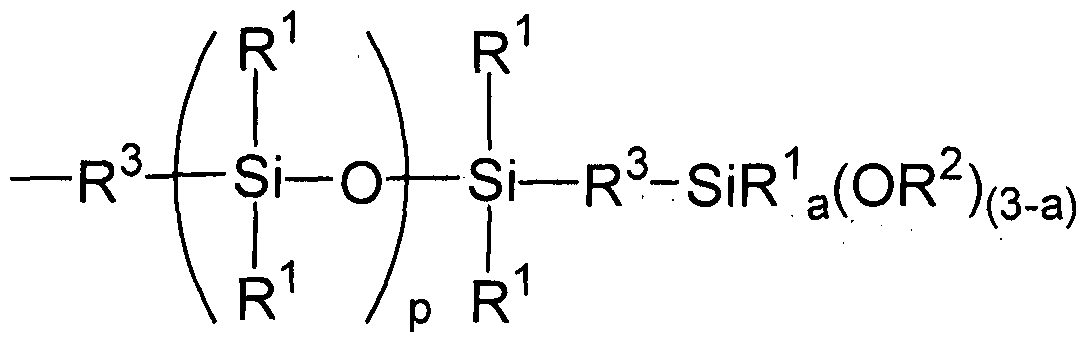
(A) 100 parts by mass of an organopolysiloxane having on silicon atoms in the molecular chain in one molecule at least two alkoxysilyl-containing groups represented by the following general formula:
Figure imgf000003_0001
wherein each R is independently selected from monovalent hydrocarbon groups that do not have an unsaturated aliphatic bond, R2 is an alkyl group, each R3 is independently selected from alkylene groups, "a" is an integer from 0 to 2, and "p" is an integer from 1 to 50;
(B) 1 to 100 parts by mass of an organopolysiloxane having on silicon atom in the
molecular chain neither a hydroxyl group nor an alkoxy group;
(C) 0.5 to 30 parts by mass of an alkoxysilane or its partial hydrolysis and condensation product, wherein the alkoxysilane is represented by the following general formula:
R4 b S i ( O R 5 ) ( 4_ b )
wherein R4 is a monovalent hydrocarbon group, R5 is an alkyl group, and "b" is 0 or 1 ; and
(D) 0.1 to 10 parts by mass of a condensation reaction catalyst.
Effects of Invention
[0006] The room-temperature-curable silicone rubber composition of the present invention cures at room temperature under the effect of contact with atmospheric moisture and exhibits an excellent adhesiveness for substrate in contact with the composition during the cure of the composition.
Detailed Description of the Invention
[0007] Component (A), which is a main component of the present composition, is an organopolysiloxane having on silicon atoms in the molecular chain in one molecule at least two alkoxysilyl-containing roups represented by the followin general formula:
Figure imgf000003_0002
[0008] Each R1 in this formula is independently selected from monovalent hydrocarbon groups that do not have an unsaturated aliphatic bond and can be exemplified by alkyl groups such as methyl, ethyl, propyl, butyl, pentyl, hexyl, heptyl, octyl, nonyl, decyl, and octadecyl; cycloalkyl groups such as cyclopentyl and cyclohexyl; aryl groups such as phenyl, tolyl, xylyl, and naphthyl; aralkyl groups such as benzyl, phenethyl, and phenylpropyl; and halogenated alkyl groups such as 3-chloropropyl and 3,3,3- trifluoropropyl, wherein alkyl, cycloalkyl, and aryl are preferred and the methyl group and phenyl group are particularly preferred. R2 in the preceding formula is an alkyl group and can be exemplified by methyl, ethyl, propyl, butyl, pentyl, hexyl, heptyl, octyl, nonyl, decyl, and octadecyl and is preferably methyl or ethyl. Each R3 in the preceding formula is independently selected from alkylene groups and can be exemplified by
methylmethylene, ethylene, methylethylene, propylene, butylene, pentylene, hexylene, heptylene, and octylene, wherein methylmethylene, ethylene, methylethylene, and propylene are preferred, "a" in the preceding formula is an integer from 0 to 2 and is preferably 0 or 1. "p" in the preceding formula is an integer from 1 to 50 and is preferably an integer from 1 to 20, more preferably an integer from 1 to 10, and particularly preferably an integer from 1 to 5.
[0009] The alkoxysilyl-containing group can be exemplified by the group represented by the following formula :
CH3 C2H4— Si— O— Si— C2H4-Si(OCH3)3
CH3 CH3
the group represented by the following formula:
CH3 C3H6— Si— O— Si— C2H4-Si(OCH3)3
CH3 CH3
the group represented by the following formula:
CH3 CH3 C2H4— Si— O— Si— C2H4-SiCH3(OCH3)2
CH3 ^ΗΙ
the group represented by the following formula: CH3 CH3 C2H— Si— O— Si— C3H6-Si(OCH3)3
CH3 CH3
s
the group represented by the following formula:
CH3 CH3
C3H6— Si— O— Si— C3H6-Si(OCH3)3
CH3 CH3
the group represented by the following formula:
CH3 CH3
C2H4— Si— O— Si— C6H12— Si(OCH3)3
CH3 CH3
and the group represented by the following formula:
Figure imgf000005_0001
[0010] Silicon atom-bonded groups in the molecular chain of component (A) other than the above-described alkoxysilyl-containing group can be exemplified by alkyl groups such as methyl, ethyl, propyl, butyl, pentyl, hexyl, heptyl, octyl, nonyl, decyl, and octadecyl; cycloalkyl groups such as cyclopentyl and cyclohexyl; alkenyl groups such as vinyl, allyl, butenyl, pentenyl, hexenyl, and heptenyl; aryl groups such as phenyl, tolyl, xylyl, and naphthyl; aralkyl groups such as benzyl, phenethyl, and phenylpropyl; and halogenated alkyl groups such as 3-chloropropyl and 3,3,3-trifluoropropyl, wherein alkyl, cycloalkyl, alkenyl, and aryl are preferred and methyl, vinyl, and phenyl are particularly preferred. There are no limitations on the molecular structure of component (A), and the molecular structure of component (A) can be, for example, straight chain, partially branched straight chain, branched chain, and cyclic, wherein straight chain, partially branched straight chain, and branched chain are preferred. The alkoxysilyl-containing group may be bonded to silicon atom at the molecular chain terminals and/or may be bonded to silicon atom within the molecular chain. A preferred component (A) is an organopolysiloxane that has a straight chain molecular structure and that has the previously described alkoxysilyl- containing groups on silicon atoms at both molecular chain terminals. There are no limitation on a viscosity at 25°C of component (A), but the viscosity is preferably in the range from 100 to 1 ,000,000 mPa-s and particularly preferably is in the range from 100 to 100,000 mPa-s. The resulting silicone rubber exhibits an increased mechanical strength when the viscosity of component (A) meets or exceeds the lower limit on the indicated range, while the obtained composition has enhanced handling properties when the upper limit on the indicated range is not exceeded.
[001 1 ] The method for producing component (A) can be exemplified by the method described in Kokai S62-207383 and the method described in Kokai S62-212488.
[0012] Component (B) is a component that improves the adhesiveness of the present composition and is an organopolysiloxane having on silicon atom in the molecular chain neither a hydroxyl group nor an alkoxy group. The silicon atom-bonded groups in component (B), excluding the hydroxyl group and alkoxy group, can be exemplified by alkyl groups such as methyl, ethyl, propyl, butyl, pentyl, hexyl, heptyl, octyl, nonyl, decyl, and octadecyl; cycloalkyl groups such as cyclopentyl and cyclohexyl; alkenyl groups such as vinyl, allyl, butenyl, pentenyl, hexenyl, and heptenyl; aryl groups such as phenyl, tolyl, xylyl, and naphthyl; aralkyl groups such as benzyl, phenethyl, and phenylpropyl; and halogenated alkyl groups such as 3-chloropropyl and 3,3,3-trifluoropropyl, wherein alkyl, cycloalkyl, alkenyl, and aryl are preferred and methyl, vinyl, and phenyl are particularly preferred. There are no limitations on the molecular structure of component (B), and the molecular structure of component (B) can be exemplified by straight chain, partially branched straight chain, branched chain, and cyclic, wherein straight chain, partially branched straight chain, and branched chain are preferred. There are no limitations on a viscosity at 25°C of component (B), but the viscosity is preferably in the range from 10 to 1 ,000,000 mPa-s and particularly preferably is in the range from 50 to 100,000 mPa-s. Bleed out by component (B) from the obtained silicone rubber can be inhibited when the viscosity of component (B) meets or exceeds the lower limit on the indicated range, while the handling properties of the obtained composition are improved when the upper limit on the indicated range is not exceeded.
[0013] Considered per 100 parts by mass of component (A), a content of component (B) is in the range from 1 to 100 parts by mass, preferably in the range from 1 to 80 parts by mass, more preferably in the range from 1 to 70 parts by mass, and particularly preferably in the range from 1 to 60 parts by mass. The resulting composition exhibits an excellent adhesiveness when the content of component (B) meets or exceeds the lower limit on the indicated range, while bleed out by component (B) from the resulting silicone rubber can be inhibited when the upper limit on the indicated range is not exceeded. The content of component (B) is particularly preferably in the range from 15 to 60 parts by mass per 100 parts by mass of component (A) because this provides an excellent adhesiveness to organic resins.
[0014] Component (C) functions as a crosslinking agent for the present composition and is an alkoxysilane or its partial hydrolysis and condensation product, wherein the alkoxysilane is represented by the following general formula:
R b S i ( O R 5 ) ( 4- b ) ,
[0015] R4 in this formula is a monovalent hydrocarbon group and can be exemplified by alkyl groups such as methyl, ethyl, propyl, butyl, pentyl, hexyl, heptyl, octyl, nonyl, decyl, and octadecyl; cycloalkyl groups such as cyclopentyl and cyclohexyl; alkenyl groups such as vinyl, allyl, butenyl, pentenyl, hexenyl, and heptenyl; aryl groups such as phenyl, tolyl, xylyl, and naphthyl; aralkyl groups such as benzyl, phenethyl, and
phenylpropyl; and halogenated alkyl groups such as 3-chloropropyl and 3,3,3- trifluoropropyl, wherein alkyl, cycloalkyl, alkenyl, and aryl are preferred and methyl is particularly preferred. R5 in the preceding formula is an alkyl group and can be
exemplified by methyl, ethyl, propyl, butyl, pentyl, and hexyl wherein methyl is preferred, "b" in the preceding formula is 0 or 1.
[0016] Component (C) can be exemplified by trifunctional alkoxysilanes such as methyltrimethoxysilane, methyltriethoxysilane, ethyltrimethoxysilane, ethyltriethoxysilane, vinyltrimethoxysilane, and phenyltrimethoxysilane; by tetrafunctional alkoxysilanes such as tetramethoxysilane and tetraethoxysilane; and by the partial hydrolysis and condensation products of the preceding. A single alkoxysilane or partial hydrolysis and condensation product thereof may be used or a mixture of two or more may be used.
[0017] A content of component (C), expressed per 100 parts by mass of component (A), is in the range from 0.5 to 30 parts by mass, preferably in the range from 0.5 to 20 parts by mass, more preferably in the range from 0.5 to 15 parts by mass, and particularly
preferably in the range from 0.5 to 10 parts by mass. When the content of component (C) meets or exceeds the lower limit on the indicated range, the obtained composition exhibits a satisfactory curability and the shelf life of the obtained composition under moisture exclusion is enhanced. On the other hand, the obtained composition will cure rapidly under the effect of atmospheric moisture when the upper limit on the indicated range is not exceeded.
, [0018] Component (D) is a condensation reaction catalyst that accelerates crosslinking in the present composition. Component (D) can be exemplified by tin compounds such as dimethyltin dineodecanoate and stannous octoate and by titanium compounds such as tetra(isopropoxy)titanium, tetra(n-butoxy)titanium, tetra(t-butoxy)titanium,
di(isopropoxy)bis(ethyl acetoacetate)titanium, di(isopropoxy)bis(methyl
acetoacetate)titanium, and di(isopropoxy)bis(acetylacetonate)titanium.
[0019] A content of component (D), expressed per 100 parts by mass of component (A), is in the range from 0.1 to 10 parts by mass and preferably in the range from 0.1 to 6 parts by mass. The obtained composition will cure rapidly under the effect of atmospheric moisture when the content of component (D) meets or exceeds the lower limit on the indicated range, while, on the other hand, the shelf life of the obtained composition is improved when the upper limit on the indicated range is not exceeded.
[0020] The present composition preferably comprises (E) an adhesion promoter in order to improve the adhesiveness for organic resins in contact with the composition during the cure of the composition. Component (E) can be exemplified by epoxy group- containing alkoxysilanes such as 3-glycidoxypropyltrimethoxysilane, 3- glycidoxypropyltriethoxysilane, 3-glycidoxypropylmethyldimethoxysilane, 2-(3,4- epoxycyclohexyl)ethyltrimethoxysilane, and 4-oxiranylbutyltrimethoxysilane; acrylic group-containing alkoxysilanes such as 3-methacryloxypropyltrimethoxysilane, 3- methacryloxypropyltriethoxysilane, and 3-acryloxypropyltrimethoxysilane; amino group- containing alkoxysilanes such as 3-aminopropyltrimethoxysilane, 3- aminopropyltriethoxysilane, N-(2-aminoethyl)-3-aminopropyltrimethoxysilane, and N- phenyl-3-aminopropyltrimethoxysilane; and reaction mixtures between an epoxy group- containing alkoxysilane as described above and an amino group-containing alkoxysilane as described above, wherein reaction mixtures between an epoxy group-containing
alkoxysilane as described above and an amino group-containing alkoxysilane as described above are particularly preferred. The method for preparing such a reaction mixture between an epoxy group-containing alkoxysilane and an amino group-containing alkoxysilane can be exemplified by the methods described in Japanese Examined Patent Application Publication Nos. S55-41702 and H07-1 13083.
[0021] A content of component (E) should be an amount that can impart a satisfactory adhesiveness by the present composition for organic resin in contact with the composition during the cure of the composition, but is not otherwise limited. Expressed per 100 parts by mass of component (A), the content of component (E) is preferably in the range from 0.01 to 10 parts by mass and more preferably in the range from 0.01 to 5 parts by mass. A thoroughly satisfactory adhesiveness to organic resins is obtained when the content of component (E) meets or exceeds the lower limit on the indicated range. On the other hand, the present composition cures rapidly under the effect of contact with atmospheric moisture when the upper limit on the indicated range is not exceeded.
[0022] (F) a reinforcing filler is preferably incorporated in the present composition in order to obtain additional improvements in the adhesiveness. Component (F) can be exemplified by fumed silica fine powder, precipitated silica fine powder, calcined silica fine powder, fumed titanium dioxide fine powder, and hydrophobed fine powders provided by subjecting the surface of the preceding to a surface treatment with, e.g., an organosilane, a silazane, a siloxane oligomer, and so forth. A content of component (F) is not limited, but is preferably 0.1 to 50 parts by mass per 100 parts by mass of component (A).
[0023] Insofar as the object of the present invention is not impaired, the present composition may contain other optional components, for example, a nonreinforcing filler such as quartz fine powder, calcium carbonate fine powder, diatomaceous earth fine powder, aluminum hydroxide fine powder, alumina fine powder, magnesium hydroxide fine powder, magnesia fine powder, zinc oxide fine powder, zinc carbonate fine powder, and hydrophobed nonreinforcing fillers provided by subjecting the surface of the preceding to a surface treatment with, e.g., an organosilane, a silazane, a siloxane oligomer, and so forth; as well as an organic solvent; an antifungal agent; a flame retardant; a heat stabilizer; a plasticizer; an agent that imparts thixotropy; a cure accelerator; and a pigment.
[0024] The present composition can be prepared by mixing components (A), (B), (C), and (D), the optional components (E) and (F), and any other optional components to uniformity while excluding moisture. The composition obtained thereby can be stored long-term by introducing it into a sealed container while excluding moisture and can cure rapidly under the effect of contact with atmospheric moisture to form a silicone rubber. Examples
[0025] The room-temperature-curable silicone rubber composition of the present invention is described in detail by the examples. The viscosity reported in the examples is the value at 25°C. The adhesiveness of the room-temperature-curable silicone rubber composition was evaluated using the following method.
[Method for evaluating the adhesiveness of the room-temperature-curable silicone rubber compositions]
[0026] A bead of the room-temperature-curable silicone rubber composition was applied on the substrate, e.g., a glass plate, aluminum plate (Al plate), alumite-treated aluminum plate (alumite-treated Al plate), copper plate, phenolic resin plate, polybutylene terephthalate (PBT) resin plate, polyphenylene sulfide (PPS) resin plate, and polyethylene terephthalate (PET) resin plate. This was followed by standing for 7 days at a temperature of 23 ± 2°C and a humidity of 50 ± 5% in order to cure the room-temperature-curable silicone rubber composition. The resulting silicone rubber was then peeled from the substrate using a spatula and the percentage of the area of the silicone rubber that underwent cohesive failure with respect to the area of adhesion by the silicone rubber was determined (CF ratio). A CF ratio of 100% means that the silicone rubber exhibited an excellent adhesiveness for the substrate, while a CF ratio of 0% means that the silicone rubber underwent peeling at the interface with the substrate.
[0027]
Component (A-l): a dimethylpolysiloxane having a viscosity of 10,000 mPa^s and having on silicon atoms at both molecular chain terminals trimethoxysilylethyl- containing groups represented by the following formula:
CH3 CH3
— C2H4— Si-o— Si— c2H4— Si(OCH3)3
CH3 CH3
Component (A-2): a dimethylpolysiloxane having a viscosity of 500 mPa-s and having on silicon atoms at both molecular chain terminals trimethoxysilylethyl- containing groups represented by the following formula: CH3 CH3
— C2H4— Si-o— Si— c2H4— Si(OCH3)3
CH3 CH3
Component (B-l): a dimethylpolysiloxane having a viscosity of 500 mPa-s and having trimethylsiloxy groups on silicon atoms at both molecular chain terminals.
Component (B-2): a dimethylpolysiloxane having a viscosity of 100 mPa-s and having trimethylsiloxy groups on silicon atoms at both molecular chain terminals.
Component (B-3): a dimethylpolysiloxane having a viscosity of 9,000 mPa-s and having dimethylvinylsiloxy groups on silicon atoms at both molecular chain terminals.
Component (B-4): a dimethylpolysiloxane having a viscosity of 40,000 mPa-s and having dimethylvinylsiloxy groups on silicon atoms at both molecular chain terminals.
Component (B-5): a dimethylpolysiloxane having a viscosity of 400 mPa-s and having dimethylvinylsiloxy groups on silicon atoms at both molecular chain terminals.
Component (C-1): methyltrimethoxysilane
Component (D-1 ): titanium diisopropoxybis(ethyl acetoacetate)
Component (E-1 ): a reaction mixture provided by reacting 3- glycidoxypropyltrimethoxysilane and 3-aminopropyltrimethoxysilane with a 2 : 1 molar ratio.
Component (F-l): fumed silica fine powder having a specific surface area by the BET method of 130 m2/g and having a surface treated with hexamethyldisilazane.
[Examples 1 to 12 and Comparative Example 1]
[0028] Room-temperature-curable silicone rubber compositions were prepared by mixing components (A-1 ), (B-l), (B-2), (B-3), (B-4), (C-1), (D-1) and (E-1 ) in the blend amounts shown in Table 1 to uniformity while excluding moisture. The adhesiveness of these room-temperature-curable silicone rubber compositions was evaluated and the results are given in Table 1.
[0029]
Table
Figure imgf000013_0001
[Examples 13 to 16 and Comparative Example 2]
[0030] Room-temperature-curable silicone rubber compositions were prepared by mixing components (A-2), (B-l), (C-l ), (D-l ) and (E-l ) in the blend amounts shown in Table 2 to uniformity while excluding moisture. The adhesiveness of these room- temperature-curable silicone rubber compositions was evaluated and the results are given in Table 2.
[0031 ]
Table 2
Figure imgf000014_0001
[Examples 17 and 18 and Comparative Example 3]
[0032] Room-temperature-curable silicone rubber compositions were prepared by mixing components (A-2), (B-l), (C-l), (D-l ), (E-l), and (F-l) in the blend amounts shown in Table 3 to uniformity while excluding moisture. The adhesiveness of these room- temperature-curable silicone rubber compositions was evaluated and the results are given in Table 3. [0033]
Table 3
Figure imgf000015_0001
Industrial Applicability
[0034] The room-temperature-curable silicone rubber composition of the present invention, because it cures at room temperature under the effect of contact with
atmospheric moisture and exhibits an excellent adhesiveness for substrate in contact with the composition during the cure of the composition, is well adapted for use as a sealant for electrical and electronic components, as an adhesive, and as a moistureproof coating agent.

Claims

A room-temperature-curable silicone rubber composition comprising:
(A) 100 parts by mass of an organopolysiloxane having on silicon atoms in the
molecular chain in one molecule at least two alkoxysilyl-containing groups represented by the following general formula:
Figure imgf000016_0001
wherein each R1 is independently selected from monovalent hydrocarbon groups that do not have an unsaturated aliphatic bond, R2 is an alkyl group, each R3 is independently selected from alkylene groups, "a" is an integer from 0 to 2, and "p" is an integer from 1 to 50;
(B) 1 to 100 parts by mass of an organopolysiloxane having on silicon atom in the molecular chain neither a hydroxyl group nor an alkoxy group;
(C) 0.5 to 30 parts by mass of an alkoxysilane or its partial hydrolysis and
condensation product, wherein the alkoxysilane is represented by the following general formula:
R 4 b S i ( O R 5 ) ( 4- b )
wherein R4 is a monovalent hydrocarbon group, R5 is an alkyl group, and "b" is 0 or 1 ; and
(D) 0.1 to 10 parts by mass of a condensation reaction catalyst. 2. The room-temperature-curable silicone rubber composition according to claim
1 , wherein a viscosity at 25°C of component (A) is 100 to 1 ,000,000 mPa-s.
3. The room-temperature-curable silicone rubber composition according to claim
1 , wherein component (A) is a straight-chain organopolysiloxane having alkoxysilyl- containing groups on silicon atoms at both molecular chain terminals. 4. The room-temperature-curable silicone rubber composition according to claim
1 , wherein the alkoxysilyl-containing group in component (A) is a group represented by the following formula: CH3 CH3
C2H4— Si— O Si— C2H4-Si(OCH3)3
CH3 CH3
The room-temperature-curable silicone rubber composition according to claim 1 , wherein a viscosity at 25°C of component (B) is 10 to 1 ,000,000 mPa-s.
6. The room-temperature-curable silicone rubber composition according to claim 1 , further comprising (E) an adhesion promoter in a quantity of 0.01 to 10 parts by mass per 100 parts by mass of component (A).
7. The room-temperature-curable silicone rubber composition according to claim 6, wherein component (E) is at least one adhesion promoter selected from the group consisting of epoxy group-containing alkoxysilanes, acrylic group-containing alkoxysilanes, amino group-containing alkoxysilanes, and the reaction mixtures of an epoxy group-containing alkoxysilane and an amino group-containing alkoxysilane.
8. The room-temperature-curable silicone rubber composition according to claim 1 , further comprising (F) a reinforcing filler in a quantity of 0.1 to 50 parts by mass per 100 parts by mass of component (A).
The room-temperature-curable silicone rubber composition according to claim 8, wherein component (F) is at least one reinforcing filler selected from the group consisting of fumed silica fine powder, precipitated silica fine powder, calcined silica fine powder, and fumed titanium oxide fine powder.
PCT/JP2012/059275 2011-04-04 2012-03-28 Room-temperature-curable silicone rubber composition Ceased WO2012137854A1 (en)

Priority Applications (4)

Application Number Priority Date Filing Date Title
US14/009,671 US8957153B2 (en) 2011-04-04 2012-03-28 Room-temperature-curable silicone rubber composition
KR1020137027888A KR20140031229A (en) 2011-04-04 2012-03-28 Room-temperature-curable silicone rubber composition
EP12715228.8A EP2694591B1 (en) 2011-04-04 2012-03-28 Room-temperature-curable silicone rubber composition
CN2012800174093A CN103459509A (en) 2011-04-04 2012-03-28 Room-temperature-curable silicone rubber composition

Applications Claiming Priority (2)

Application Number Priority Date Filing Date Title
JP2011083021A JP2012219113A (en) 2011-04-04 2011-04-04 Room-temperature curable silicone rubber composition
JP2011-083021 2011-04-04

Publications (1)

Publication Number Publication Date
WO2012137854A1 true WO2012137854A1 (en) 2012-10-11

Family

ID=45976486

Family Applications (1)

Application Number Title Priority Date Filing Date
PCT/JP2012/059275 Ceased WO2012137854A1 (en) 2011-04-04 2012-03-28 Room-temperature-curable silicone rubber composition

Country Status (7)

Country Link
US (1) US8957153B2 (en)
EP (1) EP2694591B1 (en)
JP (1) JP2012219113A (en)
KR (1) KR20140031229A (en)
CN (1) CN103459509A (en)
TW (1) TW201245335A (en)
WO (1) WO2012137854A1 (en)

Cited By (2)

* Cited by examiner, † Cited by third party
Publication number Priority date Publication date Assignee Title
WO2015098119A1 (en) 2013-12-27 2015-07-02 Dow Corning Toray Co., Ltd. Room-temperature-curable silicone rubber composition, and the use thereof
US12098281B2 (en) 2018-10-08 2024-09-24 Dow Silicones Corporation Dual curable organopolysiloxane composition

Families Citing this family (16)

* Cited by examiner, † Cited by third party
Publication number Priority date Publication date Assignee Title
JP5716139B1 (en) 2013-08-19 2015-05-13 住友精化株式会社 Addition-curable silicone resin composition, addition-curable silicone resin cured product, and optical semiconductor element encapsulant
JP5669990B1 (en) 2013-08-20 2015-02-18 住友精化株式会社 Condensation curable silicone resin composition, condensation curable silicone resin cured product, and optical semiconductor element encapsulant
EP3087143B1 (en) * 2013-12-27 2021-03-31 Dow Toray Co., Ltd. Room-temperature-curable silicone rubber composition, the use thereof, and method for repairing electronic device
KR102385489B1 (en) * 2014-04-09 2022-04-14 듀폰 도레이 스페셜티 머티리얼즈 가부시키가이샤 Curable organopolysiloxane composition, and protective-agent or adhesive-agent composition for electrical/electronic components
EP3347395B1 (en) * 2015-09-10 2020-04-22 Dow Global Technologies LLC Moisture curable systems based on polysilylated polyethers and titanium (iv) catalsts and/or zinc/cyclic amidine catalyst mixtures
CN110088206B (en) 2016-09-01 2021-08-20 陶氏东丽株式会社 Curable organopolysiloxane composition and protective agent or adhesive composition for electrical and electronic parts
JP6799067B2 (en) 2016-09-26 2020-12-09 ダウ・東レ株式会社 Curing Reactive Silicone Gel and Its Applications
KR102526235B1 (en) 2017-02-20 2023-04-28 다우 실리콘즈 코포레이션 Room-Curable Silicone Compositions and Electrical/Electronic Devices
US11396616B2 (en) 2017-04-06 2022-07-26 Dow Toray Co., Ltd. Liquid curable silicone adhesive composition, cured product thereof, and use thereof
TWI794401B (en) 2018-03-21 2023-03-01 美商陶氏有機矽公司 Room temperature curable organopolysiloxane composition and electric/electronic apparatus
EP3951858A4 (en) 2019-03-29 2022-12-28 Dow Toray Co., Ltd. MULTI-COMPONENT TYPE CURABLE ORGANOPOLYSILOXANE COMPOSITION, THERMOCONDUCTIVE ELEMENT AND HEAT DISSIPATING STRUCTURE
US11254838B2 (en) 2019-03-29 2022-02-22 Ppg Industries Ohio, Inc. Single component hydrophobic coating
JP7422742B2 (en) 2019-03-29 2024-01-26 ダウ・東レ株式会社 Multi-component thermally conductive silicone gel composition, thermally conductive member and heat dissipation structure
CN113950511B (en) 2019-06-21 2024-01-16 美国陶氏有机硅公司 Methods for preparing thixotropic silicone compositions
CN113950513B (en) 2019-06-21 2024-11-05 美国陶氏有机硅公司 Thermally conductive silicone composition
WO2021262497A1 (en) * 2020-06-24 2021-12-30 Dow Global Technologies Llc Silicone rubber compositions

Citations (7)

* Cited by examiner, † Cited by third party
Publication number Priority date Publication date Assignee Title
JPS5541702B2 (en) 1977-12-08 1980-10-25
JPS62207383A (en) 1986-03-03 1987-09-11 ダウ・コ−ニング・コ−ポレ−シヨン Production of silicone sealant
JPS62212488A (en) 1986-03-03 1987-09-18 ダウ・コ−ニング・コ−ポレ−シヨン One liquid type silicone sealant
US5053442A (en) * 1990-01-16 1991-10-01 Dow Corning Corporation Low modulus silicone sealants
JPH07113083B2 (en) 1987-08-28 1995-12-06 東レ・ダウコーニング・シリコーン株式会社 Room temperature curable organopolysiloxane composition
JP2007231172A (en) 2006-03-01 2007-09-13 Dow Corning Toray Co Ltd Protective composition for electrode or electric circuit
US20090286916A1 (en) * 2008-05-14 2009-11-19 Shin-Etsu Chemical Co., Ltd. Room temperature curable organopolysiloxane composition

Family Cites Families (7)

* Cited by examiner, † Cited by third party
Publication number Priority date Publication date Assignee Title
JP5101762B2 (en) * 1999-11-29 2012-12-19 東レ・ダウコーニング株式会社 Room temperature curable silicone rubber composition
JP2001192641A (en) * 2000-01-06 2001-07-17 Dow Corning Toray Silicone Co Ltd Sealant composition
JP2003049072A (en) * 2001-05-30 2003-02-21 Dow Corning Toray Silicone Co Ltd Cold curable silicone rubber composition
TWI389979B (en) * 2005-02-28 2013-03-21 Shinetsu Chemical Co Room temperature hardened organopolysiloxane composition
JP2007321122A (en) * 2006-06-05 2007-12-13 Shin Etsu Chem Co Ltd Room temperature curable organopolysiloxane composition
JP4530177B2 (en) * 2006-12-11 2010-08-25 信越化学工業株式会社 Room temperature curable organopolysiloxane composition
JP4775600B2 (en) * 2008-11-26 2011-09-21 信越化学工業株式会社 Room temperature curable organopolysiloxane composition

Patent Citations (7)

* Cited by examiner, † Cited by third party
Publication number Priority date Publication date Assignee Title
JPS5541702B2 (en) 1977-12-08 1980-10-25
JPS62207383A (en) 1986-03-03 1987-09-11 ダウ・コ−ニング・コ−ポレ−シヨン Production of silicone sealant
JPS62212488A (en) 1986-03-03 1987-09-18 ダウ・コ−ニング・コ−ポレ−シヨン One liquid type silicone sealant
JPH07113083B2 (en) 1987-08-28 1995-12-06 東レ・ダウコーニング・シリコーン株式会社 Room temperature curable organopolysiloxane composition
US5053442A (en) * 1990-01-16 1991-10-01 Dow Corning Corporation Low modulus silicone sealants
JP2007231172A (en) 2006-03-01 2007-09-13 Dow Corning Toray Co Ltd Protective composition for electrode or electric circuit
US20090286916A1 (en) * 2008-05-14 2009-11-19 Shin-Etsu Chemical Co., Ltd. Room temperature curable organopolysiloxane composition

Cited By (7)

* Cited by examiner, † Cited by third party
Publication number Priority date Publication date Assignee Title
WO2015098119A1 (en) 2013-12-27 2015-07-02 Dow Corning Toray Co., Ltd. Room-temperature-curable silicone rubber composition, and the use thereof
KR20160103070A (en) * 2013-12-27 2016-08-31 다우 코닝 도레이 캄파니 리미티드 Room-temperature-curable silicone rubber composition, and the use thereof
US20170029622A1 (en) * 2013-12-27 2017-02-02 Dow Corning Toray Co., Ltd. Room-temperature-curable silicone rubber composition, and the use thereof
EP3087144A4 (en) * 2013-12-27 2017-08-02 Dow Corning Toray Co., Ltd. Room-temperature-curable silicone rubber composition, and the use thereof
KR101884177B1 (en) * 2013-12-27 2018-08-02 다우 코닝 도레이 캄파니 리미티드 Room-temperature-curable silicone rubber composition, and the use thereof
US10072151B2 (en) 2013-12-27 2018-09-11 Dow Corning Toray Co., Ltd. Room-temperature-curable silicone rubber composition, and the use thereof
US12098281B2 (en) 2018-10-08 2024-09-24 Dow Silicones Corporation Dual curable organopolysiloxane composition

Also Published As

Publication number Publication date
EP2694591A1 (en) 2014-02-12
US20140066570A1 (en) 2014-03-06
JP2012219113A (en) 2012-11-12
KR20140031229A (en) 2014-03-12
US8957153B2 (en) 2015-02-17
EP2694591B1 (en) 2015-03-18
TW201245335A (en) 2012-11-16
CN103459509A (en) 2013-12-18

Similar Documents

Publication Publication Date Title
EP2694591B1 (en) Room-temperature-curable silicone rubber composition
EP3130632B1 (en) Adhesion promoter and curable organopolysiloxane composition containing same
JP6855548B2 (en) Room temperature curable silicone rubber composition and its uses
KR102224557B1 (en) Room-temperature-curable silicone rubber composition, the use thereof, and method for repairing electronic device
KR20190111040A (en) Room Temperature-Curable Silicone Compositions and Electrical / Electronic Devices
JP4522816B2 (en) Adhesive polyorganosiloxane composition having flame retardancy
JP2004292724A (en) Room temperature curable organopolysiloxane composition
US8247516B2 (en) Room-temperature curable organopolysiloxane composition
KR101127301B1 (en) Room Temperature Curable Organopolysiloxane Composition
US12305084B2 (en) Adhesive polyorganosiloxane composition
JP2020026493A (en) Room temperature curable polyorganosiloxane composition and cured product thereof
CN101275016A (en) Room temperature curable organopolysiloxane composition
JP4466846B2 (en) Room temperature curable organopolysiloxane composition
JP6836697B1 (en) Polyorganosiloxane composition for adhesion of polyphenylene sulfide resin
JP2010155898A (en) Room temperature-curable organopolysiloxane composition

Legal Events

Date Code Title Description
121 Ep: the epo has been informed by wipo that ep was designated in this application

Ref document number: 12715228

Country of ref document: EP

Kind code of ref document: A1

WWE Wipo information: entry into national phase

Ref document number: 2012715228

Country of ref document: EP

NENP Non-entry into the national phase

Ref country code: DE

ENP Entry into the national phase

Ref document number: 20137027888

Country of ref document: KR

Kind code of ref document: A

WWE Wipo information: entry into national phase

Ref document number: 14009671

Country of ref document: US