WO2012147944A1 - ジアミン化合物の製造方法 - Google Patents
ジアミン化合物の製造方法 Download PDFInfo
- Publication number
- WO2012147944A1 WO2012147944A1 PCT/JP2012/061445 JP2012061445W WO2012147944A1 WO 2012147944 A1 WO2012147944 A1 WO 2012147944A1 JP 2012061445 W JP2012061445 W JP 2012061445W WO 2012147944 A1 WO2012147944 A1 WO 2012147944A1
- Authority
- WO
- WIPO (PCT)
- Prior art keywords
- group
- carbon atoms
- mmol
- general formula
- alkyl group
- Prior art date
- Legal status (The legal status is an assumption and is not a legal conclusion. Google has not performed a legal analysis and makes no representation as to the accuracy of the status listed.)
- Ceased
Links
- 0 CC1(CC(COCC2(CN3[C@@]([C@@]4c5ccccc5)c5ccccc5)Cl)=CC=C(C)C1)*23N4S(c1c(C(F)(F)F)cccc1)(=O)=O Chemical compound CC1(CC(COCC2(CN3[C@@]([C@@]4c5ccccc5)c5ccccc5)Cl)=CC=C(C)C1)*23N4S(c1c(C(F)(F)F)cccc1)(=O)=O 0.000 description 1
- JJQOETSCLTYXJH-IDCGIGBZSA-N CC1=CCC(COCCN[C@@H](C(c2ccccc2)NS(c2c(C(F)(F)F)cccc2)(=O)=O)c2ccccc2)=CC1 Chemical compound CC1=CCC(COCCN[C@@H](C(c2ccccc2)NS(c2c(C(F)(F)F)cccc2)(=O)=O)c2ccccc2)=CC1 JJQOETSCLTYXJH-IDCGIGBZSA-N 0.000 description 1
- LPDOKSZOOMRFPA-UHFFFAOYSA-N OCCOCC1=CCC=CC1 Chemical compound OCCOCC1=CCC=CC1 LPDOKSZOOMRFPA-UHFFFAOYSA-N 0.000 description 1
Classifications
-
- C—CHEMISTRY; METALLURGY
- C07—ORGANIC CHEMISTRY
- C07C—ACYCLIC OR CARBOCYCLIC COMPOUNDS
- C07C303/00—Preparation of esters or amides of sulfuric acids; Preparation of sulfonic acids or of their esters, halides, anhydrides or amides
- C07C303/36—Preparation of esters or amides of sulfuric acids; Preparation of sulfonic acids or of their esters, halides, anhydrides or amides of amides of sulfonic acids
- C07C303/40—Preparation of esters or amides of sulfuric acids; Preparation of sulfonic acids or of their esters, halides, anhydrides or amides of amides of sulfonic acids by reactions not involving the formation of sulfonamide groups
-
- B—PERFORMING OPERATIONS; TRANSPORTING
- B01—PHYSICAL OR CHEMICAL PROCESSES OR APPARATUS IN GENERAL
- B01J—CHEMICAL OR PHYSICAL PROCESSES, e.g. CATALYSIS OR COLLOID CHEMISTRY; THEIR RELEVANT APPARATUS
- B01J31/00—Catalysts comprising hydrides, coordination complexes or organic compounds
- B01J31/16—Catalysts comprising hydrides, coordination complexes or organic compounds containing coordination complexes
- B01J31/18—Catalysts comprising hydrides, coordination complexes or organic compounds containing coordination complexes containing nitrogen, phosphorus, arsenic or antimony as complexing atoms, e.g. in pyridine ligands, or in resonance therewith, e.g. in isocyanide ligands C=N-R or as complexed central atoms
- B01J31/1805—Catalysts comprising hydrides, coordination complexes or organic compounds containing coordination complexes containing nitrogen, phosphorus, arsenic or antimony as complexing atoms, e.g. in pyridine ligands, or in resonance therewith, e.g. in isocyanide ligands C=N-R or as complexed central atoms the ligands containing nitrogen
-
- B—PERFORMING OPERATIONS; TRANSPORTING
- B01—PHYSICAL OR CHEMICAL PROCESSES OR APPARATUS IN GENERAL
- B01J—CHEMICAL OR PHYSICAL PROCESSES, e.g. CATALYSIS OR COLLOID CHEMISTRY; THEIR RELEVANT APPARATUS
- B01J31/00—Catalysts comprising hydrides, coordination complexes or organic compounds
- B01J31/16—Catalysts comprising hydrides, coordination complexes or organic compounds containing coordination complexes
- B01J31/22—Organic complexes
- B01J31/2265—Carbenes or carbynes, i.e.(image)
-
- C—CHEMISTRY; METALLURGY
- C07—ORGANIC CHEMISTRY
- C07C—ACYCLIC OR CARBOCYCLIC COMPOUNDS
- C07C309/00—Sulfonic acids; Halides, esters, or anhydrides thereof
- C07C309/63—Esters of sulfonic acids
- C07C309/72—Esters of sulfonic acids having sulfur atoms of esterified sulfo groups bound to carbon atoms of six-membered aromatic rings of a carbon skeleton
- C07C309/73—Esters of sulfonic acids having sulfur atoms of esterified sulfo groups bound to carbon atoms of six-membered aromatic rings of a carbon skeleton to carbon atoms of non-condensed six-membered aromatic rings
-
- C—CHEMISTRY; METALLURGY
- C07—ORGANIC CHEMISTRY
- C07C—ACYCLIC OR CARBOCYCLIC COMPOUNDS
- C07C311/00—Amides of sulfonic acids, i.e. compounds having singly-bound oxygen atoms of sulfo groups replaced by nitrogen atoms, not being part of nitro or nitroso groups
- C07C311/01—Sulfonamides having sulfur atoms of sulfonamide groups bound to acyclic carbon atoms
- C07C311/02—Sulfonamides having sulfur atoms of sulfonamide groups bound to acyclic carbon atoms of an acyclic saturated carbon skeleton
- C07C311/03—Sulfonamides having sulfur atoms of sulfonamide groups bound to acyclic carbon atoms of an acyclic saturated carbon skeleton having the nitrogen atoms of the sulfonamide groups bound to hydrogen atoms or to acyclic carbon atoms
- C07C311/05—Sulfonamides having sulfur atoms of sulfonamide groups bound to acyclic carbon atoms of an acyclic saturated carbon skeleton having the nitrogen atoms of the sulfonamide groups bound to hydrogen atoms or to acyclic carbon atoms to acyclic carbon atoms of hydrocarbon radicals substituted by nitrogen atoms, not being part of nitro or nitroso groups
-
- C—CHEMISTRY; METALLURGY
- C07—ORGANIC CHEMISTRY
- C07C—ACYCLIC OR CARBOCYCLIC COMPOUNDS
- C07C311/00—Amides of sulfonic acids, i.e. compounds having singly-bound oxygen atoms of sulfo groups replaced by nitrogen atoms, not being part of nitro or nitroso groups
- C07C311/15—Sulfonamides having sulfur atoms of sulfonamide groups bound to carbon atoms of six-membered aromatic rings
- C07C311/16—Sulfonamides having sulfur atoms of sulfonamide groups bound to carbon atoms of six-membered aromatic rings having the nitrogen atom of at least one of the sulfonamide groups bound to hydrogen atoms or to an acyclic carbon atom
- C07C311/18—Sulfonamides having sulfur atoms of sulfonamide groups bound to carbon atoms of six-membered aromatic rings having the nitrogen atom of at least one of the sulfonamide groups bound to hydrogen atoms or to an acyclic carbon atom to an acyclic carbon atom of a hydrocarbon radical substituted by nitrogen atoms, not being part of nitro or nitroso groups
-
- B—PERFORMING OPERATIONS; TRANSPORTING
- B01—PHYSICAL OR CHEMICAL PROCESSES OR APPARATUS IN GENERAL
- B01J—CHEMICAL OR PHYSICAL PROCESSES, e.g. CATALYSIS OR COLLOID CHEMISTRY; THEIR RELEVANT APPARATUS
- B01J2231/00—Catalytic reactions performed with catalysts classified in B01J31/00
- B01J2231/60—Reduction reactions, e.g. hydrogenation
- B01J2231/64—Reductions in general of organic substrates, e.g. hydride reductions or hydrogenations
-
- B—PERFORMING OPERATIONS; TRANSPORTING
- B01—PHYSICAL OR CHEMICAL PROCESSES OR APPARATUS IN GENERAL
- B01J—CHEMICAL OR PHYSICAL PROCESSES, e.g. CATALYSIS OR COLLOID CHEMISTRY; THEIR RELEVANT APPARATUS
- B01J2531/00—Additional information regarding catalytic systems classified in B01J31/00
- B01J2531/02—Compositional aspects of complexes used, e.g. polynuclearity
- B01J2531/0238—Complexes comprising multidentate ligands, i.e. more than 2 ionic or coordinative bonds from the central metal to the ligand, the latter having at least two donor atoms, e.g. N, O, S, P
- B01J2531/0241—Rigid ligands, e.g. extended sp2-carbon frameworks or geminal di- or trisubstitution
-
- B—PERFORMING OPERATIONS; TRANSPORTING
- B01—PHYSICAL OR CHEMICAL PROCESSES OR APPARATUS IN GENERAL
- B01J—CHEMICAL OR PHYSICAL PROCESSES, e.g. CATALYSIS OR COLLOID CHEMISTRY; THEIR RELEVANT APPARATUS
- B01J2531/00—Additional information regarding catalytic systems classified in B01J31/00
- B01J2531/80—Complexes comprising metals of Group VIII as the central metal
- B01J2531/82—Metals of the platinum group
- B01J2531/821—Ruthenium
-
- C—CHEMISTRY; METALLURGY
- C07—ORGANIC CHEMISTRY
- C07C—ACYCLIC OR CARBOCYCLIC COMPOUNDS
- C07C2601/00—Systems containing only non-condensed rings
- C07C2601/12—Systems containing only non-condensed rings with a six-membered ring
- C07C2601/16—Systems containing only non-condensed rings with a six-membered ring the ring being unsaturated
Definitions
- the present invention relates to a method for producing a diamine compound useful for forming a ruthenium-diamine complex important as an asymmetric reduction catalyst.
- Non-Patent Documents 5 and 6 Have reported that a complex in which a diamine moiety and an aromatic ring (arene) site coordinated to a ruthenium complex are connected by a carbon chain exhibits higher activity than conventional catalysts (Non-Patent Documents 5 and 6). 7, 8, 9, 10, etc.).
- the present inventors have developed a production method that can be carried out industrially under mild conditions. That is, the present invention includes the following contents.
- the following general formula (1) (Wherein R 1 is an alkyl group having 1 to 10 carbon atoms; an alkanesulfonyl group having 1 to 10 carbon atoms which may be substituted with a halogen atom; an alkyl group having 1 to 10 carbon atoms, or an alkyl group having 1 to 10 carbon atoms) An arylenesulfonyl group optionally substituted with a halogenated alkyl group or a halogen atom; an alkoxycarbonyl group having 2 to 11 carbon atoms in total; or a benzoyl group optionally substituted with an alkyl group having 1 to 10 carbon atoms; R 2 and R 3 are each independently an alkyl group having 1 to 10 carbon atoms; an alkyl group having 1 to 10 carbon atoms, an alkyl group having 1 to 10 carbon atoms, an al
- R 10 to R 14 each independently represents a hydrogen atom, an alkyl group having 1 to 10 carbon atoms, an alkoxy group having 1 to 10 carbon atoms, or a trisubstituted alkylsilyl group, and A 1 and A 3 Represents methylene, A 2 represents an oxygen atom or methylene, B represents a halogen atom, an alkanesulfonyloxy group or an arenesulfonyloxy group, and n 1 and n 2 are each independently 1 to 3. )
- the present invention provides a method for producing a diamine compound in which a diamine moiety and an arene moiety coordinated to a ruthenium complex are connected by a carbon chain.
- the conventional method for producing the diamine compound has a complicated synthesis method, uses toxic ammonia gas and Birch reduction, which cannot avoid the use of an ultra-low temperature apparatus, a bad smell of dimethyl sulfide as a by-product, There are problems such as the need to use Swern oxidation, which is a problem in industrialization due to the harmfulness of carbon oxide and the necessity of ultra-low temperature equipment, and low yield in some reactions.
- a highly active ruthenium-diamine complex is obtained by a production method using a novel intermediate obtained by halogenating or sulfonylating an alcohol synthesized by Diels-Alder reaction. Can be easily and efficiently produced.
- R 1 is an alkyl group having 1 to 10 carbon atoms; an alkanesulfonyl group having 1 to 10 carbon atoms which may be substituted with a halogen atom; an alkyl group having 1 to 10 carbon atoms, or an alkyl group having 1 to 10 carbon atoms
- R 2 and R 3 are each independently an alkyl group having 1 to 10 carbon atoms; an alkyl group having 1 to 10 carbon atoms, an alkoxy group having 1 to 10 carbon atoms, or a phenyl group optionally substituted with a hal
- the alkyl group having 1 to 10 carbon atoms represented by R 1 is a linear or branched alkyl group having 1 to 10 carbon atoms, preferably 1 to 5 carbon atoms.
- Specific examples of the alkyl group include a methyl group, an ethyl group, an n-propyl group, an isopropyl group, an n-butyl group, an isobutyl group, an s-butyl group, a t-butyl group, an n-pentyl group, and an n-hexyl group.
- Examples of the alkanesulfonyl group having 1 to 10 carbon atoms represented by R 1 include a methanesulfonyl group, an ethanesulfonyl group, a propanesulfonyl group, and the like.
- the alkanesulfonyl group may be substituted with one or more halogen atoms.
- Examples of the halogen atom include a chlorine atom, a bromine atom, and a fluorine atom.
- Examples of the alkanesulfonyl group having 1 to 10 carbon atoms substituted with a halogen atom include a trifluoromethanesulfonyl group.
- Examples of the arenesulfonyl group represented by R 1 include a benzenesulfonyl group.
- the arenesulfonyl group may be substituted with one or more alkyl groups having 1 to 10 carbon atoms, halogenated alkyl groups having 1 to 10 carbon atoms, or halogen atoms.
- Examples of the alkyl group having 1 to 10 carbon atoms include those listed as the alkyl group having 1 to 10 carbon atoms represented by R 1 .
- halogenated alkyl group having 1 to 10 carbon atoms examples include halides listed as the alkyl group having 1 to 10 carbon atoms represented by R 1 (the halogen atom includes, for example, a chlorine atom, a bromine atom, a fluorine atom, etc. And the like.
- the halogen atom include a chlorine atom, a bromine atom, and a fluorine atom.
- alkyl group having 1 to 10 carbon atoms, the halogenated alkyl group having 1 to 10 carbon atoms or the arenesulfonyl group substituted with a halogen atom examples include a p-toluenesulfonyl group, a 2,4,6-trimethylbenzenesulfonyl group, Examples include 4-trifluoromethylbenzenesulfonyl group, pentafluorobenzenesulfonyl group and the like.
- the alkoxycarbonyl group having 2 to 11 carbon atoms represented by R 1 is a linear or branched alkoxycarbonyl group having 2 to 11 carbon atoms, preferably 2 to 5 carbon atoms.
- alkoxycarbonyl group examples include a methoxycarbonyl group, an ethoxycarbonyl group, and a t-butoxycarbonyl group.
- the benzoyl group represented by R 1 may be substituted with one or more alkyl groups having 1 to 10 carbon atoms. Examples of the alkyl group having 1 to 10 carbon atoms include those listed as the alkyl group having 1 to 10 carbon atoms represented by R 1 . Examples of the benzoyl group which may be substituted with an alkyl group having 1 to 10 carbon atoms include benzoyl group, p-toluoyl group, o-toluoyl group and the like.
- Examples of the alkyl group having 1 to 10 carbon atoms represented by R 2 and R 3 include those listed as the alkyl group having 1 to 10 carbon atoms represented by R 1 .
- the phenyl group represented by R 2 and R 3 may be substituted with one or more alkyl groups having 1 to 10 carbon atoms, alkoxy groups having 1 to 10 carbon atoms, or a halogen atom.
- Examples of the alkyl group having 1 to 10 carbon atoms include those listed as the alkyl group having 1 to 10 carbon atoms represented by R 1 .
- the alkoxy group having 1 to 10 carbon atoms is a linear or branched alkoxy group having 1 to 10 carbon atoms, preferably 1 to 5 carbon atoms.
- alkoxy group examples include methoxy group, ethoxy group, n-propoxy group, isopropoxy group, n-butoxy group, isobutoxy group, s-butoxy group, t-butoxy group, n-pentyloxy group, n- Examples include a hexyloxy group, an n-heptyloxy group, an n-octyloxy group, an n-nonyloxy group, and an n-decyloxy group.
- halogen atom examples include a chlorine atom, a bromine atom, and a fluorine atom.
- Examples of the phenyl group substituted with an alkyl group having 1 to 10 carbon atoms, an alkoxy group having 1 to 10 carbon atoms or a halogen atom include 2,4,6-trimethylphenyl group, 4-methoxyphenyl group, 2,4 , 6-trimethylmethoxyphenyl group, 4-fluorophenyl group, 2-chlorophenyl group, 4-chlorophenyl group, 2,4-dichlorophenyl group, and the like.
- the cycloalkyl group having 3 to 8 carbon atoms represented by R 2 and R 3 is a monocyclic, polycyclic or bridged cycloalkyl group having 3 to 8 carbon atoms, preferably 5 to 8 carbon atoms. .
- cycloalkyl group having 3 to 8 carbon atoms include a cyclopropyl group, a cyclobutyl group, a cyclopentyl group, a cyclohexyl group, a cycloheptyl group, and a cyclooctyl group.
- These cycloalkyl groups may be substituted with alkyl groups such as a methyl group, an isopropyl group, and a t-butyl group.
- Ring R 2 and R 3 together form the 10 carbon number of 2 to R 2 and R 3 together are preferably of a linear or branched alkylene group having from 3 to 10, the adjacent A 4- to 8-membered, more preferably 5- to 8-membered cycloalkane ring is formed together with the carbon atom.
- Preferred examples of the cycloalkane ring include a cyclopentane ring, a cyclohexane ring, and a cycloheptane ring. These rings may have an alkyl group such as a methyl group, an isopropyl group, or a t-butyl group as a substituent.
- the alkyl group having 1 to 10 carbon atoms represented by R 10 to R 14 is a linear or branched alkyl group having 1 to 10 carbon atoms, preferably 1 to 5 carbon atoms.
- Specific examples of the alkyl group include a methyl group, an ethyl group, an n-propyl group, an isopropyl group, an n-butyl group, an isobutyl group, an s-butyl group, a t-butyl group, an n-pentyl group, and an n-hexyl group.
- the alkoxy group having 1 to 10 carbon atoms represented by R 10 to R 14 is a linear or branched alkoxy group having 1 to 10 carbon atoms, preferably 1 to 5 carbon atoms.
- Specific examples of the alkoxy group include methoxy group, ethoxy group, n-propoxy group, isopropoxy group, n-butoxy group, isobutoxy group, s-butoxy group, t-butoxy group, n-pentyloxy group, n- Examples include a hexyloxy group, an n-heptyloxy group, an n-octyloxy group, an n-nonyloxy group, and an n-decyloxy group.
- the alkyl group of the trisubstituted alkylsilyl group represented by R 10 to R 14 is an alkyl group having 1 to 10 carbon atoms, specifically, methyl group, ethyl group, n-propyl group, isopropyl group, n- Examples thereof include a butyl group, isobutyl group, s-butyl group, t-butyl group, n-pentyl group, n-hexyl group, n-heptyl group, n-octyl group, n-nonyl group and n-decyl group.
- trisubstituted alkylsilyl group examples include a trimethylsilyl group, a triethylsilyl group, a t-butyldimethylsilyl group, and a triisopropylsilyl group.
- Examples of the halogen atom represented by B include a chlorine atom, a bromine atom, and an iodine atom.
- the alkanesulfonyloxy group represented by B is preferably a linear or branched alkanesulfonyloxy group having 1 to 5 carbon atoms.
- alkanesulfonyloxy group examples include a methanesulfonyloxy group, a trifluoromethanesulfonyl group, an ethanesulfonyloxy group, an isopropanesulfonyloxy group, an n-propylsulfonyloxy group, an n-butylsulfonyloxy group, and a tert-butylsulfonyl group.
- Examples thereof include an oxy group and an n-pentanesulfonyloxy group.
- Examples of the arenesulfonyloxy group represented by B include a phenylsulfonyloxy group and a naphthylsulfonyloxy group. It may have 1 to 3 substituents on the phenyl ring of the phenylsulfonyloxy group or on the naphthalene ring of the naphthylsulfonyloxy group.
- Examples of the substituent include a linear or branched alkyl group having 1 to 6 carbon atoms, a linear or branched alkoxy group having 1 to 6 carbon atoms, a nitro group, and a halogen atom.
- phenylsulfonyloxy group examples include phenylsulfonyloxy, 4-methylphenylsulfonyloxy, 2-methylphenylsulfonyloxy, 4-nitrophenylsulfonyloxy, 4-methoxyphenylsulfonyloxy, 2-nitrophenylsulfonyloxy, 3-chlorophenylsulfonyloxy and the like.
- the naphthylsulfonyloxy group include ⁇ -naphthylsulfonyloxy and ⁇ -naphthylsulfonyloxy groups.
- Solvents used when synthesizing the compound represented by the general formula (1) from the compound represented by the general formula (2) and the compound represented by the general formula (3) which is a diamine compound include toluene, xylene, mesitylene and the like.
- Aromatic hydrocarbons such as chlorobenzene; ethers such as 1,4-dioxane; aprotic polar solvents such as N, N-dimethylformamide and dimethyl sulfoxide, etc. are preferred, particularly dimethyl Sulphoxide, toluene, xylene and mesitylene are preferred.
- the reaction may be performed by mixing water with another organic solvent using water as another solvent.
- Examples of the base used for the reaction include sodium hydroxide, sodium hydrogen carbonate, sodium carbonate, potassium hydroxide, potassium hydrogen carbonate, potassium carbonate, lithium hydroxide, lithium hydrogen carbonate, lithium carbonate, cesium carbonate, magnesium hydroxide, Inorganic bases such as magnesium carbonate, calcium hydroxide and calcium carbonate; tertiary organic amines such as trimethylamine, triethylamine, triisopropylamine, tributylamine and diisopropylethylamine are preferred, and triethylamine and diisopropylethylamine are particularly preferred.
- the amount of the base used is 0.2 to 2.0 equivalents, preferably 1.0 to 1.5 equivalents, relative to the compound represented by the general formula (2).
- the reaction temperature is, for example, 100 ° C. to 200 ° C., preferably 100 ° C. to 160 ° C. While the reaction time varies depending on the reaction substrate to be used, it is 30 minutes to 30 hours, preferably 1 hour to 12 hours.
- the reaction is preferably performed in an inert gas such as nitrogen gas or argon gas.
- additives such as sodium iodide, potassium iodide, lithium iodide, sodium bromide, potassium bromide, lithium bromide, potassium chloride, and lithium chloride may be added.
- potassium iodide and lithium iodide are preferable.
- the amount of the additive is 0 to 10 equivalents, preferably 0.1 to 1 equivalents, relative to the compound represented by the general formula (2).
- the compound represented by the general formula (2) can be synthesized, for example, by the method described in the following scheme 2.
- Scheme 2 (Wherein R 10 to R 14 , A 1 , A 2 , A 3 , n 1 , n 2 and B are the same as described above.)
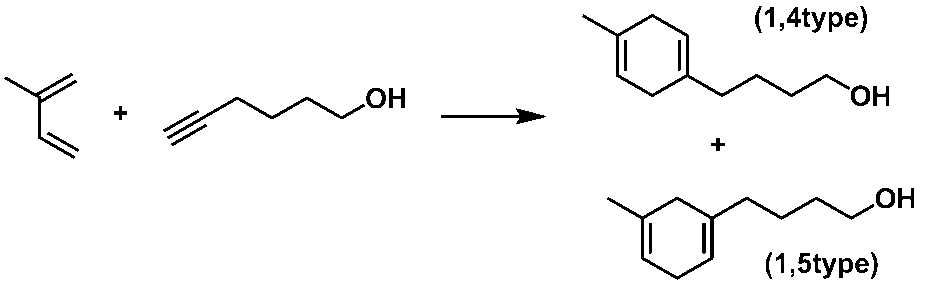
- Alcohol (c) can be synthesized by a Diels-Alder reaction between a diene having a substituent (a) and an alkyne having a substituent (b).
- Reaction reagents used include [1,2-bis (diphenylphosphino) ethane] cobalt (II) dibromide, 1,5-cyclooctadiene (naphthalene) rhodium (I) tetrafluoroborate, dichloro (1,4 And metal complexes such as -diaza-1,3-diene) iron (II) and dichlorobis (tri-o-biphenylphosphite) nickel (II).
- the solvent used in the Diels-Alder reaction is not particularly limited as long as it does not adversely influence the reaction.
- ethers such as diethyl ether, tetrahydrofuran and dioxane
- aromatic hydrocarbons such as toluene and xylene
- halogen-containing hydrocarbon solvents such as dichloromethane and 1,2-dichloroethane
- aprotic polar solvents such as acetonitrile, ethyl acetate, and acetone.
- dichloromethane and tetrahydrofuran are preferred.
- the reaction temperature of the Diels-Alder reaction is naturally in the range of ⁇ 20 ° C.
- hydroxyl group of alcohol (c) is converted to a leaving group such as a halogen atom, alkanesulfonyloxy group or arenesulfonyloxy group to synthesize a compound represented by general formula (2).
- Examples of the reagent for conversion to the leaving group used here are hydrogen chloride, thionyl chloride, sulfuryl chloride, oxalyl chloride, phosphorus trichloride, phosphorus pentachloride, hydrogen bromide, phosphorus tribromide, phosphorus pentabromide, tetra Carbon bromide, dimethylbromosulfonium bromide, thionyl bromide, hydrogen iodide, phosphorus triiodide, phosphonic acid triphenylmethiodide, p-toluenesulfonyl chloride, methanesulfonyl chloride, trifluoromethanesulfonyl chloride, trifluoromethanesulfonic anhydride Etc.
- the reaction solvent is not particularly limited.
- ethers such as diethyl ether, tetrahydrofuran and dioxane
- aromatic hydrocarbons such as benzene, toluene and xylene
- halogen-containing hydrocarbon solvents such as dichloromethane and 1,2-dichloroethane
- N N-dimethylformamide, acetonitrile, dimethyl sulfoxide, and other aprotic polar solvents
- methanol, ethanol, 2-propanol, and other alcohols methanol, ethanol, 2-propanol, and other alcohols.
- dichloromethane, tetrahydrofuran, and toluene are preferable.
- reaction temperature varies depending on the substrate used, but is usually in the range of ⁇ 30 ° C. to 200 ° C., preferably 10 ° C. to 100 ° C.
- reaction time varies depending on the substrate used, but is usually 30 minutes to 30 hours, preferably 1 hour to 20 hours.
- inert gas such as nitrogen or argon.
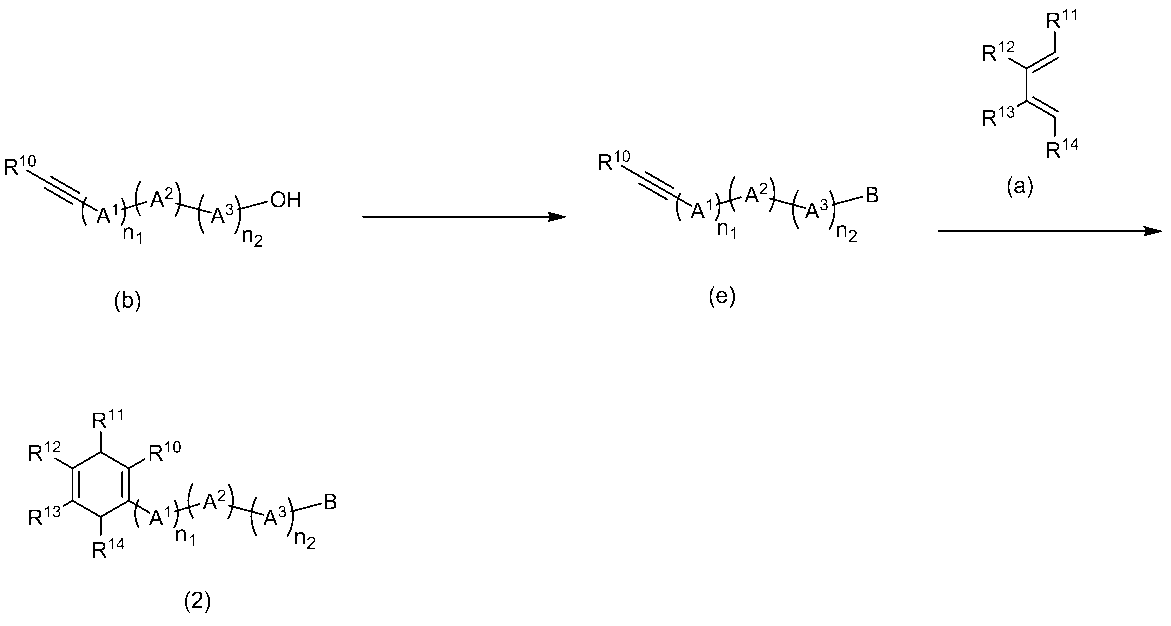
- the compound represented by General formula (2) is compoundable also by the scheme 3, for example.
- Scheme 3 (Wherein R 10 to R 14 , A 1 , A 2 , A 3 , n 1 , n 2 and B are the same as described above.)
- the hydroxyl group of the alkyne (b) having a substituent is converted to a leaving group such as a halogen atom, alkanesulfonyloxy group or arenesulfonyloxy group.
- a leaving group such as a halogen atom, alkanesulfonyloxy group or arenesulfonyloxy group.
- the compound represented by the general formula (e) is synthesized by the Diels-Alder reaction with the diene (a) having a substituent.
- the reagent for converting to a leaving group, the solvent, and the reaction conditions are the same as those described in Scheme 2 above.
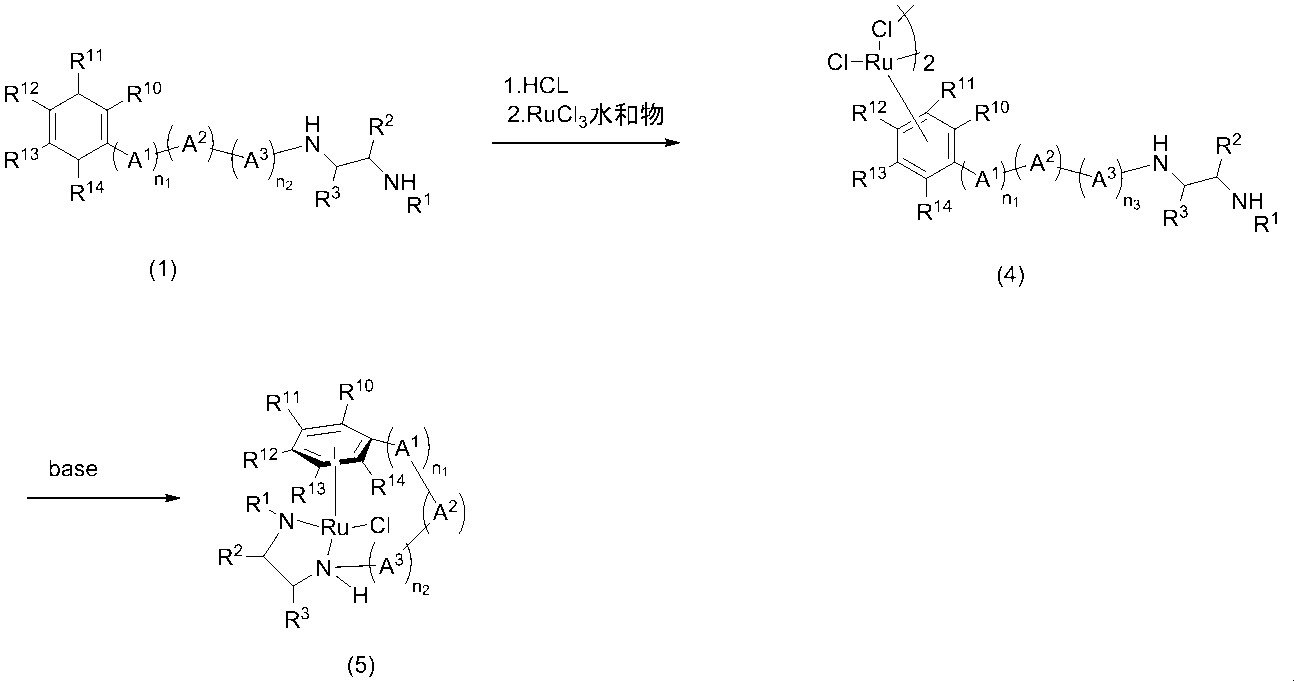
- the ruthenium-diamine complex (5) can be produced from the compound of the general formula (1) according to the description of, for example, Org. Lett. 9 (2007) p. 4659. (In the formula, R 1 to R 3 , R 10 to R 14 , A 1 , A 2 , A 3 , n 1 and n 2 are the same as described above.)
- the solvent used for synthesizing the complex of the general formula (4) from the compound of the general formula (1) and ruthenium (III) chloride or a hydrate thereof is not particularly limited, but 2-propanol, n-butanol, 2 -Butanol, n-pentanol, 2-pentanol, 3-pentanol, 3-methyl-1-butanol, cyclopentanol, 3-methoxy-1-propanol, 2-methoxyethanol, 2-ethoxyethanol, 2- Isopropoxyethanol, n-hexanol, 3-methoxy-1-butanol, 3-methoxy-3-methyl-1-butanol, 2-hexanol, 3-hexanol, cyclohexanol, n-heptanol, 2-heptanol, 3-heptanol , Cycloheptanol, n-octanol, 2-octanol, 3-octanol Ali
- a solvent may be used individually by 1 type and may be used in mixture of 2 or more types. By combining two or more solvents, the boiling point of the solvent can be adjusted to a desired range, and the reaction temperature can be adjusted when the reaction is performed under reflux. For example, a small amount of water may be mixed with alcohol.
- the amount of the compound of the general formula (1) used is 1 to 20 equivalents, preferably 1 to 10 equivalents, more preferably 1 to 5 equivalents relative to the ruthenium atom.
- the amount of the solvent used is not particularly limited as long as it dissolves ruthenium chloride or a hydrate thereof at the reaction temperature.
- reaction temperature varies depending on the solvent used, but is 60 ° C. or higher, preferably 100 ° C. or higher, and 200 ° C. or lower, preferably 160 ° C. or lower, from the viewpoint of reaction efficiency.
- the solvent used for synthesizing the complex of the general formula (5) from the complex of the general formula (4) is not particularly limited, but halogenated solvents such as methylene chloride, dichloroethane, chloroform, trifluoroethanol, toluene, xylene, etc.
- Aromatic ethers such as diisopropyl ether and tetrahydrofuran; alcohols such as methanol, ethanol, 2-propanol, n-butanol, 2-butanol, and n-pentanol.
- dichloromethane and isopropanol are preferable.
- a solvent may be used individually by 1 type and may be used in mixture of 2 or more types.
- the boiling point of the solvent can be adjusted to a desired range, and the reaction temperature can be adjusted when the reaction is performed under reflux.
- a small amount of water may be mixed with alcohol.
- the base used herein include sodium hydroxide, sodium hydrogen carbonate, sodium carbonate, potassium hydroxide, potassium hydrogen carbonate, potassium carbonate, lithium hydroxide, lithium hydrogen carbonate, lithium carbonate, cesium carbonate, magnesium hydroxide, magnesium carbonate And inorganic bases such as calcium hydroxide and calcium carbonate; amines such as triethylamine, tripropylamine, tributylamine, pyridine and triisopropylamine. Triethylamine is particularly preferred.
- the amount of the base used is 0.2 to 2 equivalents, preferably 1 to 1.5 equivalents, relative to the ruthenium atom. While the reaction time varies depending on the reaction substrate to be used, it is 30 min to 20 hr, preferably 1 hr to 12 hr. This reaction is preferably performed in an inert gas such as nitrogen gas or argon gas.
- YMC-Pack Pro C18 250 ⁇ 4.6 mm, 5 ⁇ m, 12 nm (manufactured by YMC) (manufactured by YMC) was used.
- MS measurement JMS-T100GCV manufactured by JEOL Ltd. or LCMS-IT-TOF manufactured by Shimadzu Corporation was used.
- symbol in an Example represents the following meaning.
- THF Tetrahydrofuran Msdpen: N-methanesulfonyl-1,2-diphenylethylenediamine
- Tsdpen N- (p-toluenesulfonyl) -1,2-diphenylethylenediamine o-TFTs-DPEN: N- (o-trifluoromethylbenzenesulfonyl) -1,2-diphenylethylenediamine
- TIPPs-DPEN N- (2,4,6-triisopropylbenzenesulfonyl) -1,2-diphenylethylenediamine
- DIPEA diisopropylethylamine MIBK: methyl isobutyl ketone
- S / C is the number of moles of substrate ketone / Represents the number of moles of catalyst.
- 1,2-bis (diphenylphosphino) ethane (0.77 g, 1.93 mmol), cobalt bromide 0.41 (0.41 g, 1.87 mmol), zinc iodide (1.19 g, 3.73 mmol), Zinc (0.24 g, 3.67 mmol) was dissolved in 45 mL of THF and stirred at 70 ° C. for 15 minutes. After cooling to room temperature and adding isoprene (7.55 g, 110.83 mmol), 5-hexyn-1-ol (8.94 g, 91.09 mmol) was slowly added dropwise in a water bath. After stirring at 35 ° C.
- a toluene solution (40 ml) of p-toluenesulfonyl chloride (15.94 g, 83.58 mmol) was slowly added dropwise in an ice bath, followed by stirring at room temperature for 1 hour. Water was added for liquid separation, and the obtained organic layer was washed with 2M hydrochloric acid and water.
- Example 3 4-methyl-N-((1S, 2S) -2- (4- (4-methylcyclohexa-1,4-dienyl) butylamino) -1,2-diphenylethyl) benzenesulfonamide and 4-methyl- Production of N-((1S, 2S) -2- (4- (5-methylcyclohexa-1,4-dienyl) butylamino) -1,2-diphenylethyl) benzenesulfonamide
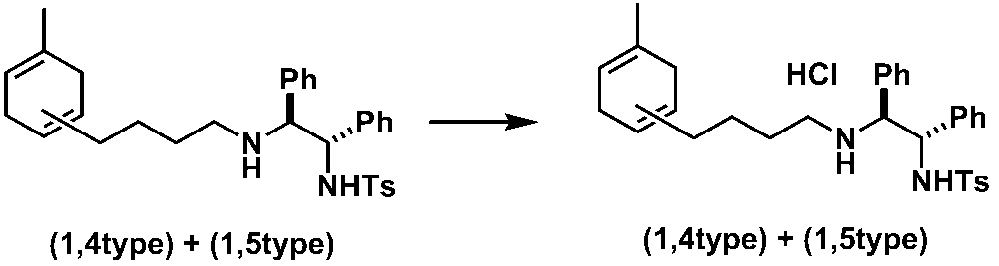
- Example 4 4-methyl-N-((1S, 2S) -2- (4- (4-methylcyclohexa-1,4-dienyl) butylamino) -1,2-diphenylethyl) benzenesulfonamide hydrochloride and 4- Preparation of methyl-N-((1S, 2S) -2- (4- (5-methylcyclohexa-1,4-dienyl) butylamino) -1,2-diphenylethyl) benzenesulfonamide hydrochloride
- the following NMR spectral data are for a mixture of two isomers.
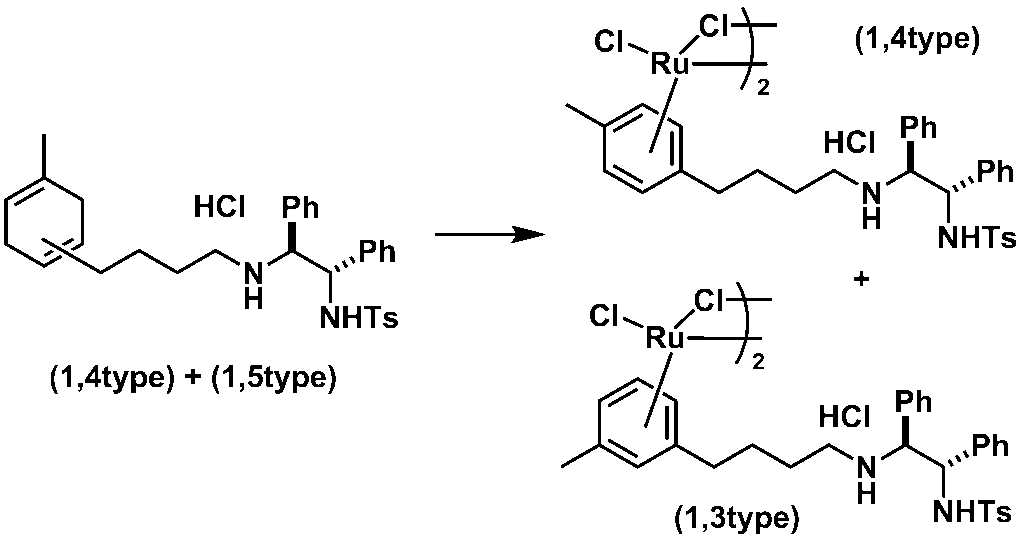
- the diamine hydrochloride (4.05 g, 8.52 mmol) and ruthenium trichloride trihydrate (2.03 g, 7.76 mmol) obtained in Example 8 were mixed in a mixed solvent of 60 ml of 3-methoxypropanol and 19 ml of water. Dissolved and stirred at 120 ° C. for 1 hour. The solvent was distilled off under reduced pressure, diethyl ether was added to the resulting residue, and the mixture was stirred at room temperature for 15 minutes. The precipitated crystals were filtered to obtain 5.49 g of the title compound ruthenium dimer. Yield 49.9%.
- the following NMR spectral data are for the main product (1,4 type).
- 1,2-bis (diphenylphosphino) ethane 800 mg, 2.00 mmol
- cobalt bromide 437 mg, 2.00 mmol
- zinc iodide 1.28 g, 4.00 mmol
- zinc (260 mg, 4.00 mmol) was dissolved in 40 mL of THF and stirred at 70 ° C. for 15 minutes.
- 2,3-dimethyl-1,3-butadiene (9.86 g, 120 mmol
- 5-hexyn-1-ol 9.8 g, 100 mmol
- 1,2-bis (diphenylphosphino) ethane (7.74 g, 0.019 mol), cobalt bromide (4.05 g, 0.019 mol), zinc iodide (11.82 g, 0.037 mol), zinc (2 .42 g, 0.037 mol) was dissolved in 460 ml of THF and stirred at 70 ° C. for 15 minutes. After cooling to room temperature and adding isoprene (74.89 g, 1.10 mol), alkyne alcohol (92.70 g, 0.93 mol) was slowly added dropwise in a water bath. After stirring at 35 ° C.
- Example 18 4-Methyl-N-((1R, 2R) -2- (2-((4-methylcyclohexa-1,4-dienyl) methoxy) ethylamino) -1,2-diphenylethyl) benzenesulfonamide hydrochloride And 4-methyl-N-((1R, 2R) -2- (2-((5-methylcyclohexa-1,4-dienyl) methoxy) ethylamino) -1,2-diphenylethyl) benzenesulfonamide hydrochloride Salt production
- the diamine hydrochloride of Example 18 (25.15 g, 45.20 mmol) was dissolved in a mixed solvent of 375 ml of 3-methoxypropanol and 75 ml of water. Ruthenium trichloride trihydrate (10.74 g, 41.09 mmol) and sodium hydrogen carbonate (3.45 g, 41.09 mmol) were added, and the mixture was stirred at 120 ° C. for 45 minutes. After collecting 3-methoxypropanol, 425 ml of MIBK and triethylamine (16.63 g, 164.4 mmol) were added, and the mixture was stirred at 60 ° C. for 1 hour.
- the diamine hydrochloride 5.0 g (8.25 mmol) produced in Example 20 was dissolved in a mixed solvent of 66 ml of 3-methoxypropanol and 22 ml of water. Ruthenium trichloride trihydrate (1.79 g, 6.86 mmol) and sodium bicarbonate (0.58 g, 6.86 mmol) were added, and the mixture was stirred at 120 ° C. for 2 hours. After collecting 50 ml of 3-methoxypropanol, 75 ml of MIBK and 2.78 g (27.45 mmol) of triethylamine were added and stirred at 60 ° C. for 1 hour.
- N-((1R, 2R) -2- (2- (cyclohexa-1,4-dienylmethoxy) ethylamino) -1,2-diphenylethyl) -4-methylbenzenesulfonamide (6.0 g, 11. 1 mmol)
- 50 ml of 0.5N HCl (methanol solution) and 150 ml of methanol were added and stirred at room temperature for 30 minutes, and then the solvent was removed with an evaporator.
- 1,2-bis (diphenylphosphino) ethane (0.25 g, 0.61 mmol), cobalt bromide (0.13 g, 0.59 mmol), zinc iodide (0.38 g, 1.19 mmol), zinc (0 0.08 g, 1.24 mmol) was dissolved in 15 ml of THF and stirred at 70 ° C. for 15 minutes. After cooling to room temperature and adding isoprene (0.95 g, 13.86 mmol), the tosylate (3.00 g, 11.89 mmol) obtained in Example 20 was slowly added dropwise in a water bath. After stirring at 35 ° C.
- Example 33 N-[(1S, 2S) -1,2-diphenyl-2- (4- (4-methylphenyl) butylamino) ethyl] -methanesulfonamide ammonium chloride ruthenium monomer and N-[(1S, 2S) -1 , 2-Diphenyl-2- (4- (3-methylphenyl) butylamino) ethyl] -methanesulfonamide ammonium chloride ruthenium hydrogen transfer reaction using acetophenone as a substrate
Landscapes
- Chemical & Material Sciences (AREA)
- Organic Chemistry (AREA)
- Chemical Kinetics & Catalysis (AREA)
- Inorganic Chemistry (AREA)
- Engineering & Computer Science (AREA)
- Materials Engineering (AREA)
- Organic Low-Molecular-Weight Compounds And Preparation Thereof (AREA)
- Heterocyclic Carbon Compounds Containing A Hetero Ring Having Oxygen Or Sulfur (AREA)
Abstract
Description
すなわち、本発明は以下の内容を含むものである。
[1]下記一般式(1):
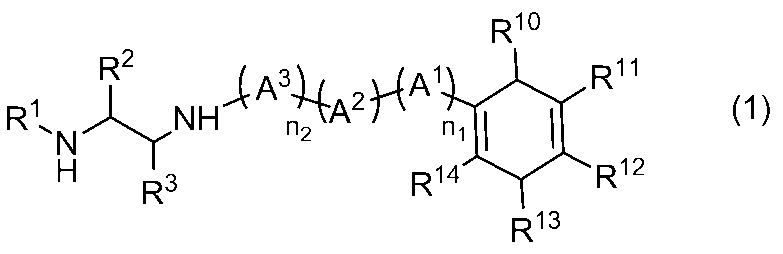
で表される化合物の製造方法であって、下記一般式(2):
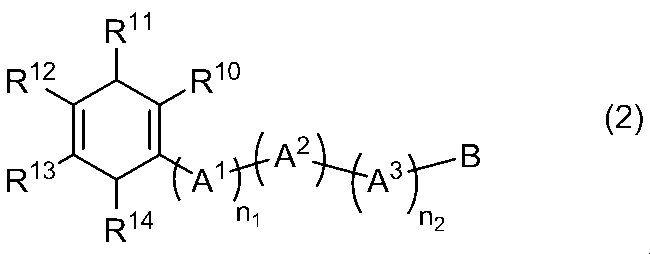
で表される化合物と、下記一般式(3):
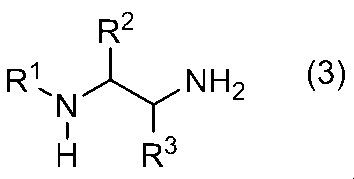
で表されるジアミン化合物とを反応させることを特徴とする前記製造方法。
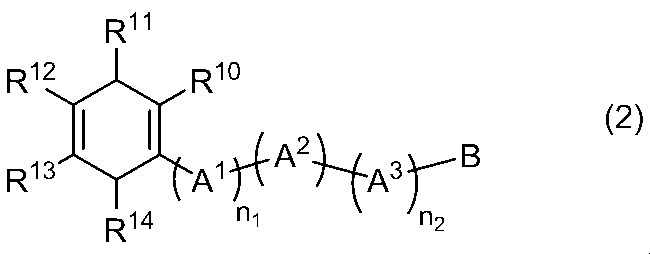
で表される化合物。
本発明において、下記一般式(1):
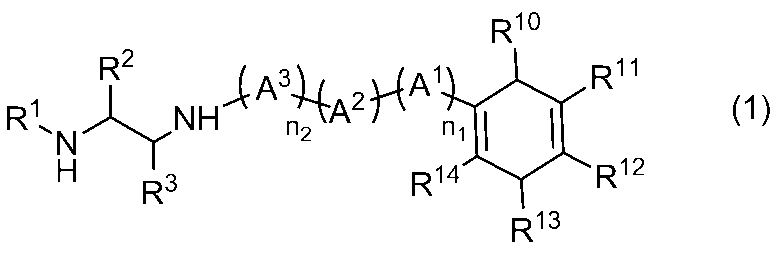
で表される化合物は、下記一般式(2):
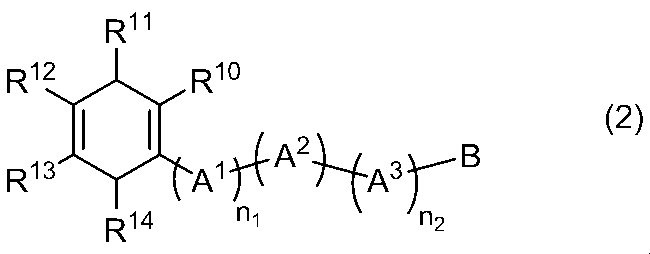
で表される化合物と、下記一般式(3):
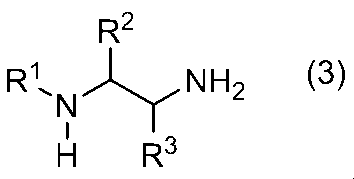
で表されるジアミン化合物とを反応させることによって製造する。
R1で表される炭素数1~10のアルカンスルホニル基としては、例えばメタンスルホニル基、エタンスルホニル基、プロパンスルホニル基等が挙げられる。前記アルカンスルホニル基は1又は複数のハロゲン原子で置換されていてもよい。ハロゲン原子としては、例えば塩素原子、臭素原子、フッ素原子等が挙げられる。ハロゲン原子で置換された炭素数1~10のアルカンスルホニル基としては、例えばトリフルオロメタンスルホニル基等が挙げられる。
R1で表されるアレーンスルホニル基としては、例えばベンゼンスルホニル基等が挙げられる。前記アレーンスルホニル基は、1又は複数の、炭素数1~10のアルキル基、炭素数1~10のハロゲン化アルキル基若しくはハロゲン原子で置換されていてもよい。炭素数1~10のアルキル基としては、R1で表される炭素数1~10のアルキル基として列記したもの等が挙げられる。炭素数1~10のハロゲン化アルキル基としては、R1で表される炭素数1~10のアルキル基として列記したもののハロゲン化物(ハロゲン原子としては、例えば塩素原子、臭素原子、フッ素原子等が挙げられる。)等が挙げられる。
ハロゲン原子としては、例えば塩素原子、臭素原子、フッ素原子等が挙げられる。炭素数1~10のアルキル基、炭素数1~10のハロゲン化アルキル基又はハロゲン原子で置換されたアレーンスルホニル基としては、例えばp-トルエンスルホニル基、2,4,6-トリメチルベンゼンスルホニル基、4-トリフルオロメチルベンゼンスルホニル基、ペンタフルオロベンゼンスルホニル基等が挙げられる。
R1で表される総炭素数2~11のアルコキシカルボニル基は、総炭素数2~11、好ましくは総炭素数2~5の直鎖又は分岐のアルコキシカルボニル基である。具体的なアルコキシカルボニル基としては、例えばメトキシカルボニル基、エトキシカルボニル基、t-ブトキシカルボニル基等が挙げられる。
R1で表されるベンゾイル基は1又は複数の炭素数1~10のアルキル基で置換されていてもよい。炭素数1~10のアルキル基としては、R1で表される炭素数1~10のアルキル基として列記したもの等が挙げられる。炭素数1~10のアルキル基で置換されていてもよいベンゾイル基としては、ベンゾイル基、p-トルオイル基、o-トルオイル基等が挙げられる。
R2及びR3で示されるフェニル基は、1又は複数の、炭素数1~10のアルキル基、炭素数1~10のアルコキシ基若しくはハロゲン原子で置換されていてもよい。炭素数1~10のアルキル基としては、R1で表される炭素数1~10のアルキル基として列記したもの等が挙げられる。炭素数1~10のアルコキシ基は、炭素数1~10、好ましくは炭素数1~5の直鎖又は分岐のアルコキシ基である。具体的なアルコキシ基としては、例えばメトキシ基、エトキシ基、n-プロポキシ基、イソプロポキシ基、n-ブトキシ基、イソブトキシ基、s-ブトキシ基、t-ブトキシ基、n-ペンチルオキシ基、n-ヘキシルオキシ基、n-ヘプチルオキシ基、n-オクチルオキシ基、n-ノニルオキシ基及びn-デシルオキシ基等が挙げられる。ハロゲン原子としては、例えば塩素原子、臭素原子、フッ素原子等が挙げられる。炭素数1~10のアルキル基、炭素数1~10のアルコキシ基又はハロゲン原子で置換されたフェニル基としては、例えば、2,4,6-トリメチルフェニル基、4-メトキシフェニル基、2,4,6-トリメメトキシフェニル基、4-フルオロフェニル基、2-クロロフェニル基、4-クロロフェニル基、2,4-ジクロロフェニル基等が挙げられる。
R2及びR3で示される炭素数3~8のシクロアルキル基は、炭素数3~8、好ましくは炭素数5~8の単環式、多環式、又は架橋式のシクロアルキル基である。具体的な炭素数3~8のシクロアルキル基としては、例えばシクロプロピル基、シクロブチル基、シクロペンチル基、シクロヘキシル基、シクロヘプチル基、シクロオクチル基等が挙げられる。
これらのシクロアルキル基は、メチル基、イソプロピル基、t-ブチル基等のアルキル基などで置換されていてもよい。
R10からR14で示される炭素数1~10のアルコキシ基は、炭素数1~10、好ましくは炭素数1~5の直鎖又は分岐のアルコキシ基である。具体的なアルコキシ基としては、例えばメトキシ基、エトキシ基、n-プロポキシ基、イソプロポキシ基、n-ブトキシ基、イソブトキシ基、s-ブトキシ基、t-ブトキシ基、n-ペンチルオキシ基、n-ヘキシルオキシ基、n-ヘプチルオキシ基、n-オクチルオキシ基、n-ノニルオキシ基及びn-デシルオキシ基等が挙げられる。
R10からR14で示される3置換アルキルシリル基のアルキル基としては、炭素数1~10のアルキル基であり、具体的にはメチル基、エチル基、n-プロピル基、イソプロピル基、n-ブチル基、イソブチル基、s-ブチル基、t-ブチル基、n-ペンチル基、n-ヘキシル基、n-ヘプチル基、n-オクチル基、n-ノニル基及びn-デシル基等が挙げられる。具体的な3置換アルキルシリル基としては、例えばトリメチルシリル基、トリエチルシリル基、t-ブチルジメチルシリル基、トリイソプロピルシリル基等が挙げられる。
Bで示されるアルカンスルホニルオキシ基は、好ましくは炭素数1~5の直鎖又は分枝鎖状のアルカンスルホニルオキシ基である。具体的なアルカンスルホニルオキシ基としては、例えばメタンスルホニルオキシ基、トリフルオロメタンスルホニル基、エタンスルホニルオキシ基、イソプロパンスルホニルオキシ基、n-プロピルスルホニルオキシ基、n-ブチルスルホニルオキシ基、tert-ブチルスルホニルオキシ基、n-ペンタンスルホニルオキシ基等が挙げられる。
Bで示されるアレーンスルホニルオキシ基としては、フェニルスルホニルオキシ基、ナフチルスルホニルオキシ基等が挙げられる。フェニルスルホニルオキシ基のフェニル環上又はナフチルスルホニルオキシ基のナフタレン環上に1~3個の置換基を有してもよい。
置換基としては、炭素数1~6の直鎖又は分枝鎖状アルキル基、炭素数1~6の直鎖又は分枝鎖状アルコキシ基、ニトロ基及びハロゲン原子等が挙げられる。具体的なフェニルスルホニルオキシ基としては、例えばフェニルスルホニルオキシ、4-メチルフェニルスルホニルオキシ、2-メチルフェニルスルホニルオキシ、4-ニトロフェニルスルホニルオキシ、4-メトキシフェニルスルホニルオキシ、2-ニトロフェニルスルホニルオキシ、3-クロロフェニルスルホニルオキシ等が挙げられる。具体的なナフチルスルホニルオキシ基としては、例えばα-ナフチルスルホニルオキシ、β-ナフチルスルホニルオキシ基等が挙げられる。
スキーム1

)
スキーム2

スキーム3
なお、以下の実施例等における錯体の同定及び純度決定に用いたNMRスペクトルは、バリアンテクノロジージャパンリミテッド製Mercury Plus 300 4N型装置もしくは、Bruker BioSpin Avance III 500 Systemで測定した。GC分析は、Chirasil-DEX CB(0.25mm×25m,0.25μm)(バリアン社製)もしくは、HP-1(0.32mm×30m,0.25μm)(アジレント・テクノロジー社製)を使用した。HPLC分析は、YMC-Pack Pro C18(250×4.6mm, 5μm, 12nm)(YMC社製)を使用した。また、MS測定は日本電子社製のJMS-T100GCVまたは島津製作所社製のLCMS-IT-TOFを使用した。
また、実施例中の記号は以下の意味を表す。
THF:テトラヒドロフラン
Msdpen:N-メタンスルホニル-1,2-ジフェニルエチレンジアミン
Tsdpen:N-(p-トルエンスルホニル)-1,2-ジフェニルエチレンジアミン
o-TFTs-DPEN:N-(o-トリフルオロメチルベンゼンスルホニル)-1,2-ジフェニルエチレンジアミン
TIPPs-DPEN:N-(2,4,6-トリイソプロピルベンゼンスルホニル)-1,2-ジフェニルエチレンジアミン
DIPEA:ジイソプロピルエチルアミン
MIBK:メチルイソブチルケトン
S/Cは基質ケトンのモル数/触媒モル数の値を表す。
4-(4-メチルシクロヘキサ-1,4-ジエニル)ブタン-1-オール及び4-(5-メチルシクロヘキサ-1,4-ジエニル)ブタン-1-オールの製造
4-(4-メチルシクロヘキサ-1,4-ジエニル)ブチル 4-メチルベンゼンスルホン酸塩及び4-(5-メチルシクロヘキサ-1,4-ジエニル)ブチル 4-メチルベンゼンスルホン酸塩の製造

HRMS (ESI) calcd for C18H24O3SNa [M+Na]+ 343.1338, found 343.1330
4-メチル-N-((1S,2S)-2-(4-(4-メチルシクロヘキサ-1,4-ジエニル)ブチルアミノ)-1,2-ジフェニルエチル)ベンゼンスルホンアミド及び4-メチル-N-((1S,2S)-2-(4-(5-メチルシクロヘキサ-1,4-ジエニル)ブチルアミノ)-1,2-ジフェニルエチル)ベンゼンスルホンアミドの製造

HRMS (ESI) calcd for C32H39N2O2S[M+H]+ 515.2727, found 515.2747
4-メチル-N-((1S,2S)-2-(4-(4-メチルシクロヘキサ-1,4-ジエニル)ブチルアミノ)-1,2-ジフェニルエチル)ベンゼンスルホンアミド塩酸塩及び4-メチル-N-((1S,2S)-2-(4-(5-メチルシクロヘキサ-1,4-ジエニル)ブチルアミノ)-1,2-ジフェニルエチル)ベンゼンスルホンアミド塩酸塩の製造
9.61(brs, 1H+1H’), 9.15(brs, 1H+1H’), 8.85(d, 1H+1H’), 7.29-6.79(m, 14H+14H’), 5.55(m, 1H’) ,5.48(m, 1H’), 5.36(m, 1H), 5.31 (m, 1H), 4.82(m, 1H+1H’), 4.54(m, 1H+1H’), 2.66(brs, 4H), 2.20(s, 3H+3H’), 1.99(brs, 4H’), 1.98-1.90(m, 2H’), 1.90-1.82(m, 2H), 1.71(s, 3H’), 1.70-1.52(m, 2H+2H’), 1.61(s, 3H), 1.38-1.18(m, 2H+2H’);
HRMS (ESI) calcd for C32H39N2O2S [M-Cl]+ 515.2727, found 515.2728
N-[(1S,2S)-1,2-ジフェニル-2-(4-(4-メチルフェニル)ブチルアミノ)エチル]-4-メチル ベンゼンスルホンアミド アンモニウム クロリド ルテニウム ダイマー及びN-[(1S,2S)-1,2-ジフェニル-2-(4-(3-メチルフェニル)ブチルアミノ)エチル]-4-メチル ベンゼンスルホンアミド アンモニウム クロリド ルテニウム ダイマーの製造
HRMS (FD) calcd for C32H35ClN2O2RuS [M/2-2HCl]+・ 648.1156, found 648.1182
N-[(1S,2S)-1,2-ジフェニル-2-(4-(4-メチルフェニル)ブチルアミノ)エチル]-4-メチル ベンゼンスルホンアミド アンモニウム クロリド ルテニウム モノマー及びN-[(1S,2S)-1,2-ジフェニル-2-(4-(3-メチルフェニル)ブチルアミノ)エチル]-4-メチル ベンゼンスルホンアミド アンモニウム クロリド ルテニウム モノマーの製造
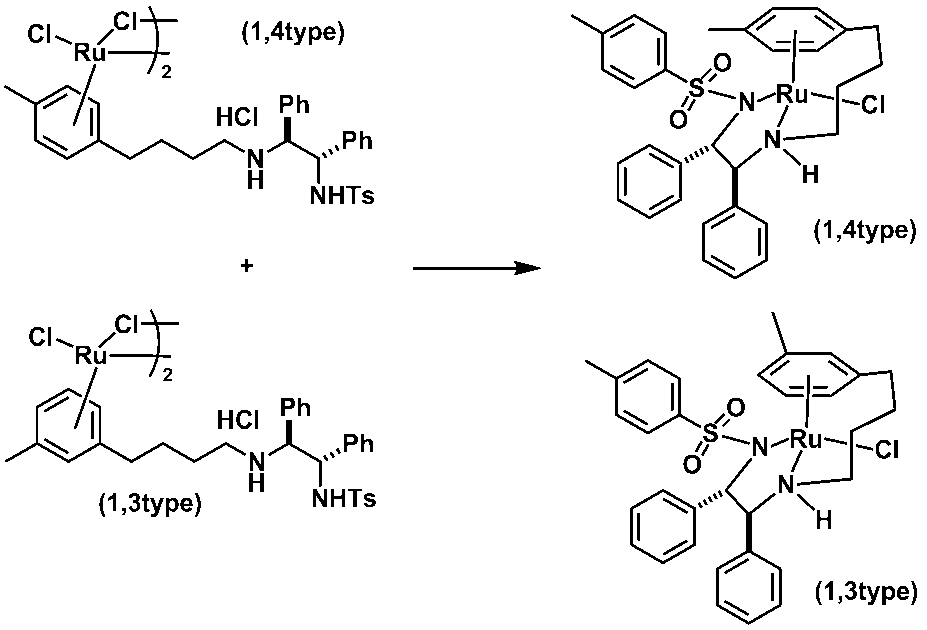
HRMS (ESI) calcd for C32H36ClN2O2RuS [M+H]+ 649.1224, found 649.1224
N-((1S,2S)-2-(4-(4-メチルシクロヘキサ-1,4-ジエニル)ブチルアミノ)-1,2-ジフェニルエチル)メタンスルホンアミド及びN-((1S,2S)-2-(4-(5-メチルシクロヘキサ-1,4-ジエニル)ブチルアミノ)-1,2-ジフェニルエチル)メタンスルホンアミドの製造
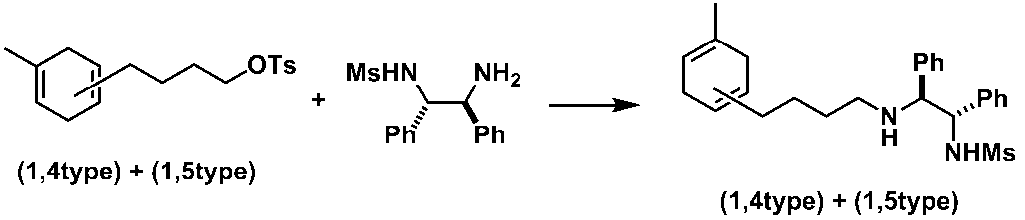
HRMS (ESI) calcd for C26H35N2O2S [M+H]+ 439.2414, found 439.2409
N-((1S,2S)-2-(4-(4-メチルシクロヘキサ-1,4-ジエニル)ブチルアミノ)-1,2-ジフェニルエチル)メタンスルホンアミド塩酸塩及びN-((1S,2S)-2-(4-(5-メチルシクロヘキサ-1,4-ジエニル)ブチルアミノ)-1,2-ジフェニルエチル)メタンスルホンアミド塩酸塩の製造
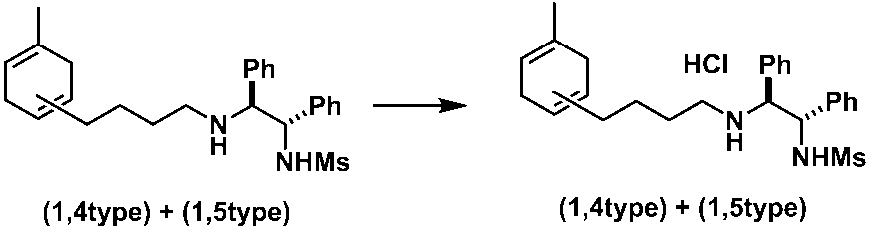
9.94(brs, 1H+1H’), 9.08(brs, 1H+1H’), 8.34(d, 1H+1H’), 7.39-7.00(m, 10H+10H’), 5.54(m, 1H’) ,5.47(m, 1H’), 5.35(m, 1H), 5.30 (m, 1H), 4.90(m, 1H+1H’), 4.56(m, 1H+1H’), 2.72-2.56(m, 6H+2H’), 2.47(s, 3H+3H’), 1.98(brs, 4H’), 1.93(t,J = 6.9Hz, 2H’), 1.85(t, J = 7.2Hz, 2H), 1.71(s, 3H’), 1.70-1.52(m, 2H+2H’), 1.61(s, 3H), 1.38-1.18(m, 2H+2H’);
HRMS (ESI) calcd for C26H35N2O2S [M-Cl]+ 439.2414, found 439.2422
N-[(1S,2S)-1,2-ジフェニル-2-(4-(4-メチルフェニル)ブチルアミノ)-エチル]- メタンスルホンアミド アンモニウム クロリド ルテニウム ダイマー及びN-[(1S,2S)-1,2-ジフェニル-2-(4-(3-メチルフェニル)ブチルアミノ)-エチル]- メタンスルホンアミド アンモニウム クロリド ルテニウム ダイマーの製造
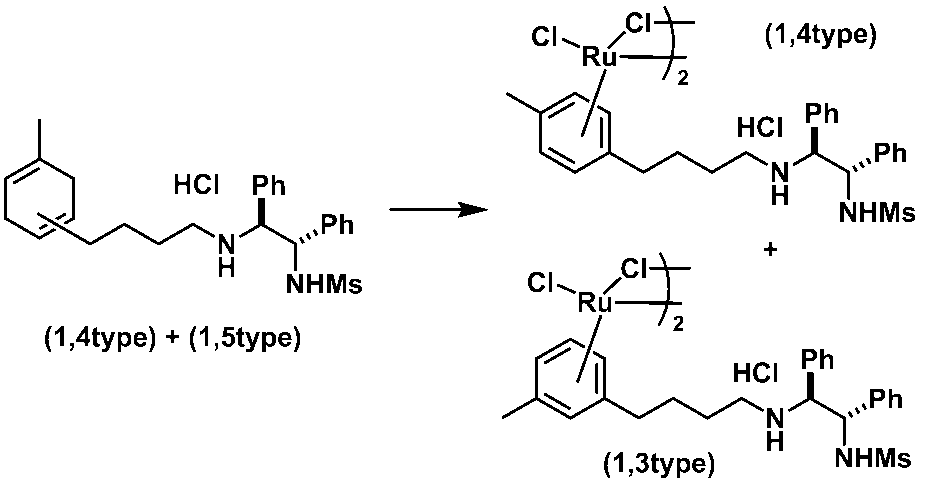
HRMS (FD) calcd for C26H31ClN2O2RuS [M/2-2HCl]+・ 572.0841, found 572.0863
N-[(1S,2S)-1,2-ジフェニル-2-(4-(4-メチルフェニル)ブチルアミノ)エチル]-メタンスルホンアミド アンモニウム クロリド ルテニウム モノマー及びN-[(1S,2S)-1,2-ジフェニル-2-(4-(3-メチルフェニル)ブチルアミノ)エチル]-メタンスルホンアミド アンモニウム クロリド ルテニウム モノマーの製造

HRMS (ESI) calcd for C26H32ClN2O2RuS [M+H]+ 573.0911, found 573.0912
4-(4、5-ジメチルシクロヘキサ-1,4-ジエニル)ブタン-1-オールの製造

4-(4、5-ジメチルシクロヘキサ-1,4-ジエニル)ブチル 4-メチルベンゼンスルホン酸塩の製造

4-メチル-N-((1S,2S)-2-(4-(4,5-ジメチルシクロヘキサ-1,4-ジエニル)ブチルアミノ)-1,2-ジフェニルエチル)ベンゼンスルホンアミド塩酸塩の製造

HRMS (ESI) calcd for C33H41N2O2S [M-Cl]+ 529.2892, found 529.2892
N-[(1S,2S)-1,2-ジフェニル-2-(4-(3,4-ジメチルフェニル)ブチルアミノ)-エチル]-4-メチル ベンゼンスルホンアミド アンモニウム クロリド ルテニウム ダイマーの製造
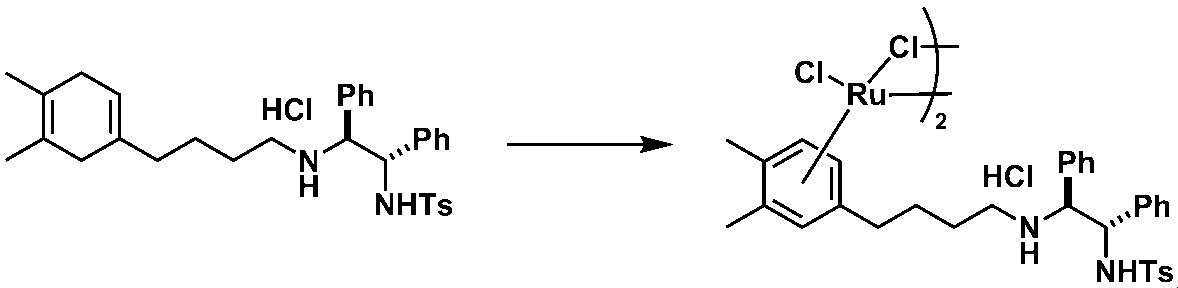
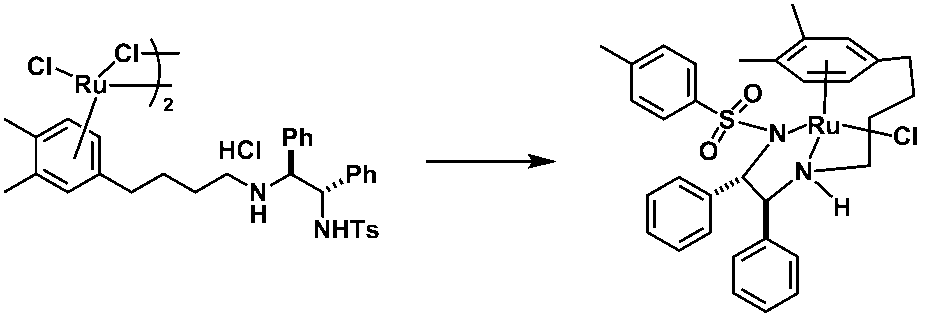
N-[(1S,2S)-1,2-ジフェニル-2-(4-(3,4-ジメチルフェニル)ブチルアミノ)エチル]-4-メチル ベンゼンスルホンアミド アンモニウム クロリド ルテニウム モノマーの製造
2-((4-メチルシクロヘキサ-1,4-ジエニル)メトキシ)エタノール及び2-((5-メチルシクロヘキサ-1,4-ジエニル)メトキシ)エタノールの製造
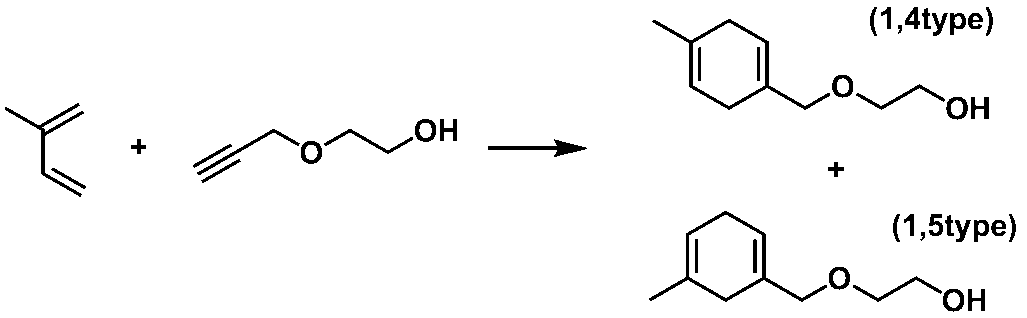
HRMS (ESI) calcd for C10H17O [M+H]+ 167.1430, found 167.1432
2-((4-メチルシクロヘキサ-1,4-ジエニル)メトキシ)エチル 4-メチルベンゼンスルホン酸塩及び2-((5-メチルシクロヘキサ-1,4-ジエニル)メトキシ)エチル 4-メチルベンゼンスルホン酸塩の製造

HRMS (ESI) calcd for C17H23O4S [M+H]+ 323.1312, found 323.1325
4-メチル-N-((1R,2R)-2-(2-((4-メチルシクロヘキサ-1,4-ジエニル)メトキシ)エチルアミノ)-1,2-ジフェニルエチル)ベンゼンスルホンアミド塩酸塩及び4-メチル-N-((1R,2R)-2-(2-((5-メチルシクロヘキサ-1,4-ジエニル)メトキシ)エチルアミノ)-1,2-ジフェニルエチル)ベンゼンスルホンアミド塩酸塩の製造
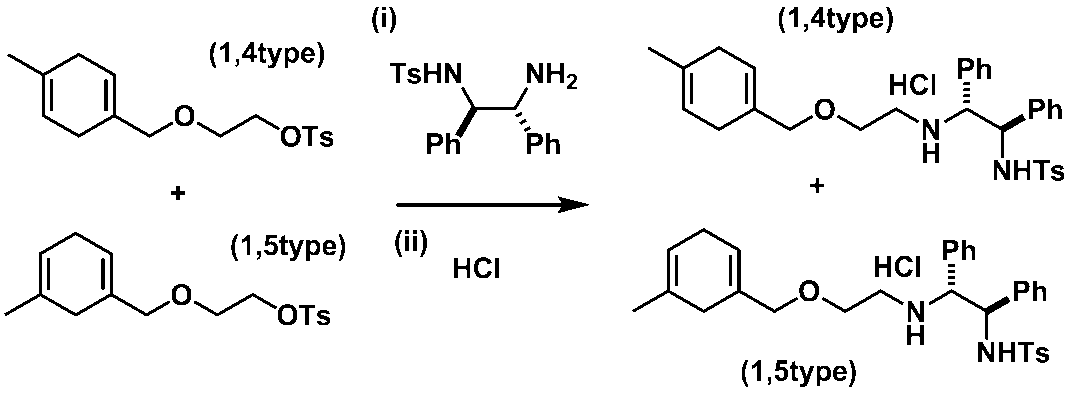
9.76(brs, 1H), 8.98-8.80(m, 2H), 7.30-6.72(m, 14H) ,5.68(m, 1H), 5.42 (m, 1H), 4.84(m, 1H), 4.62(m, 1H), 3.85(s, 2H), 3.61(m, 2H), 3.06-2.80(m, 2H), 2.57(brs, 4H), 2.21(s, 3H), 1.64(s, 3H) ;
HRMS (ESI) calcd for C31H37N2O3S [M-Cl]+ 517.2519, found 517.2523
N-[(1R,2R)-1,2-ジフェニル-2-(2-(4-メチルベンジルオキシ)エチルアミノ)-エチル]-4-メチルベンゼンスルホンアミド アンモニウム クロリド ルテニウム モノマー及びN-[(1R,2R)-1,2-ジフェニル-2-(2-(3-メチルベンジルオキシ)エチルアミノ)-エチル]-4-メチルベンゼンスルホンアミド アンモニウム クロリド ルテニウム モノマーの製造
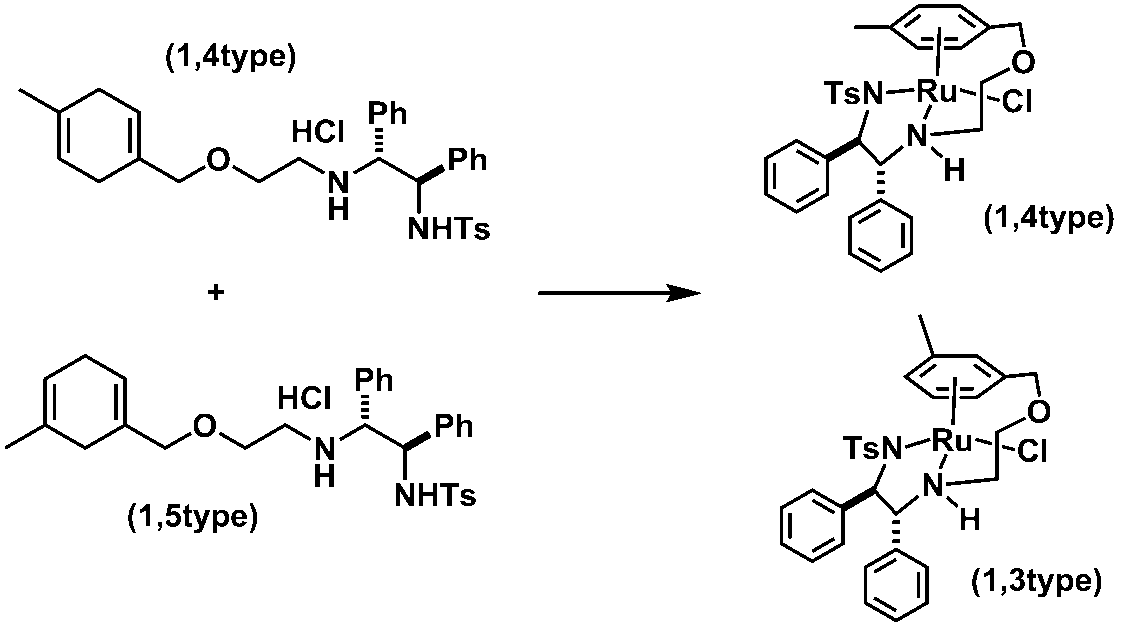
HRMS (ESI) calcd for C31H34ClN2O3RuS [M+H]+ 651.1017, found 651.1008
N-((1R,2R)-2-(2-((4-メチルシクロヘキサ-1,4-ジエニル)メトキシ)エチルアミノ)-1,2-ジフェニルエチル)-2-(トリフルオロメチル)ベンゼンスルホンアミド塩酸塩の製造
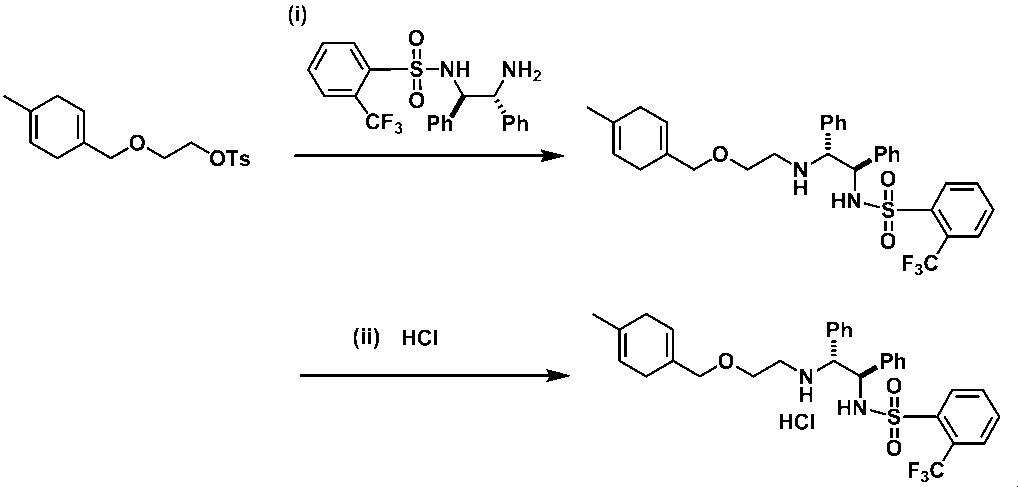
1.62(m, 3H), 2.60(s, 3H), 2.78 - 3.12(m, 2H), 3.52 - 3.70(m, 2H), 3.86(s, 2H) ,4.75(m, 1H), 4.92(m, 1H), 5.40(m, 1H), 5.68(m, 1H), 6.75 - 7.35(m, 10H), 7.40(t, 1H), 7.50(t, 1H), 7.60(d, 1H), 7.75(d, 1H), 8.90(m, 1H), 8.98(brd, 1H), 9.92(brd, 1H);
19F-NMR(d6-DMSO)δ: -57.16
HRMS (ESI) calcd for C31H33N2O3F3S・HCl [M‐Cl]+ 571.2237, found 571.244
N-[(1R,2R)-1,2-ジフェニル-2-(2-(4-メチルベンジルオキシ)エチルアミノ)-エチル]-2-トリフルオロメチルベンゼンスルホンアミド アンモニウム クロリド ルテニウム モノマーの製造
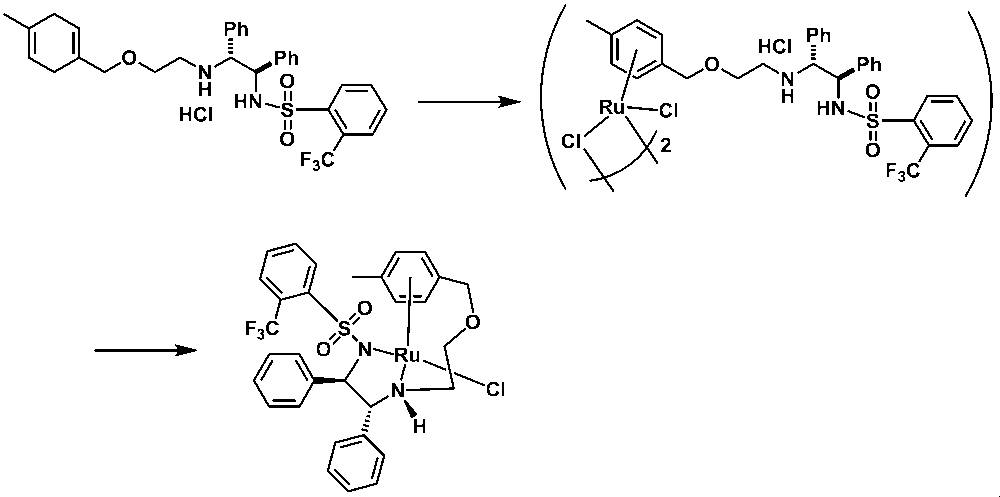
2.50 (s, 3H), 3.15 - 3.20 (m, 1H), 3.70 - 3.82 (m, 2H), 4.00 (m, 2H), 4.15 (m, 1H), 4.40 (m, 1H), 4.80 (m, 1H), 5.10 (d, 1H), 5.45 (d, 1H), 5.62 (d, 1H), 5.70 (d, 1H), 6.38 (d, 1H), 6.50 - 7.50(m, 14H);
19F-NMR(d6-DMSO)δ: -58.45
HRMS (ESI) calcd for C31H30ClN2O3F3RuS [M+H]+ 705.7034, found 705.0758
2,4,6-トリイソプロピル-N-((1S,2S)-2-(2-((4-メチルシクロヘキサ-1,4-ジエニル)メトキシ)エチルアミノ)-1,2-ジフェニルエチル)ベンゼンスルホンアミド

1.06(d, J = 6.9Hz, 3H), 1.21(d, J = 6.9Hz, 3H), 1.87(brs, 1H), 1.68(s, 3H), 2.60(brs, 4H), 2.71 - 2.48(m, 2H), 3.52-3.34(m, 2H), 3.55(d, J = 8.9Hz, 1H), 3.77(s, 2H), 3.95(septet, J = 6.7Hz, 3H), 4.40(d, J = 8.9Hz,1H), 5.44(m, 1H), 5.64(m, 1H),6.52(brs, 1H), 7.28 - 6.74(m, 12H);
HRMS (ESI) calcd for C39H53N2O3S [M+H]+ 629.3771, found 629.3771
N-[(1S,2S)-1,2-ジフェニル-2-(2-(4-メチルベンジルオキシ)エチルアミノ)-エチル]-2,4,6-トリイソプロピルベンゼンスルホンアミド アンモニウム クロリド ルテニウム モノマーの製造
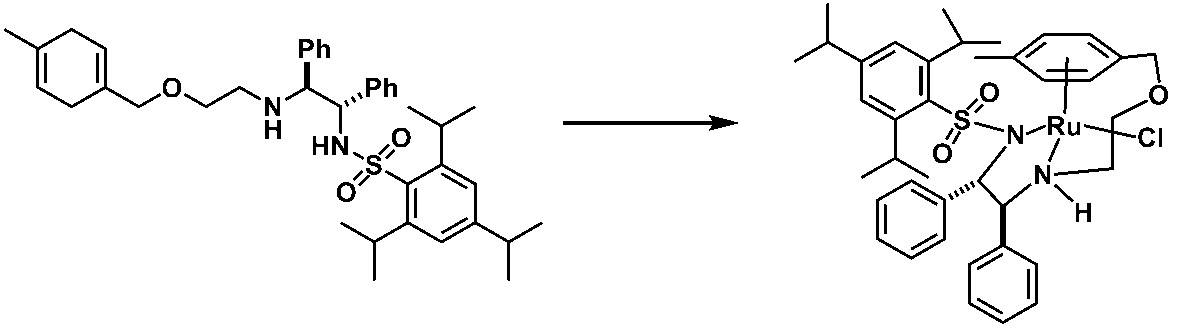
1.0 - 1.2 (m, 18H), 1.70(m, 1H), 2.41(s, 3H), 2.60(m, 1H), 3.05(m, 1H), 3.35(m, 1H),3.68(m, 1H), 3.75(t, 1H), 3.85(m, 2H), 4.18(d, 1H), 4.25(d, 1H), 4.85(brs, 1H), 5.02(d, 1H), 5.30(d, 1H), 5.48(d, 1H), 5.63(d, 1H), 6.35(d, 1H), 6.40 - 6.70(m, 10H), 6.90 - 7.05(m, 3H);
HRMS (ESI) calcd for C39H50N2O3SClRu [M+H]+ 763.2269, found 763.2257
2-(シクロヘキサ-1,4-ジエニルメトキシ)エタノールの製造

化コバルト(0.865g、4.00mmol)、ヨウ化亜鉛(4.2g、13.15mmol)をジクロロメタン175mLに溶解し、30℃で30分攪拌した。2-(プロピニルオキシ)エタノール(8.94g、91.0mmol)、ブタジエン(20wt%トルエン溶液)(36.8ml、136.5mmol)を加えた後、Bu4NBH4(1.1g、4.3mmol)を加えた。45℃で1時間攪拌した後、溶媒を減圧留去し、得られた残渣をシリカゲルカラムクロマトグラフィ(ヘキサン/酢酸エチル=5/1)で精製することにより表題化合物のアルコール11.7gを無色油状物質として得た。収率85.0%。
2-(シクロヘキサ-1,4-ジエニルメトキシ)エチル 4-メチルベンゼンスルホネートの製造

N-((1R,2R)-2-(2-(シクロヘキサ-1,4-ジエニルメトキシ)エチルアミノ)-1,2-ジフェニルエチル)-4-メチルベンゼンスルホンアミドの製造

HRMS (ESI) calcd for C30H35N2O3S [M+H]+ 503.5363, found 503.2383
N-[(1R,2R)-1,2-ジフェニル-2-(2-ベンジルオキシ
エチルアミノ)-エチル]-4-メチルベンゼンスルホンアミド アンモニウム クロリ
ド ルテニウム モノマー (Benzene-Ts-DENEB)の製造
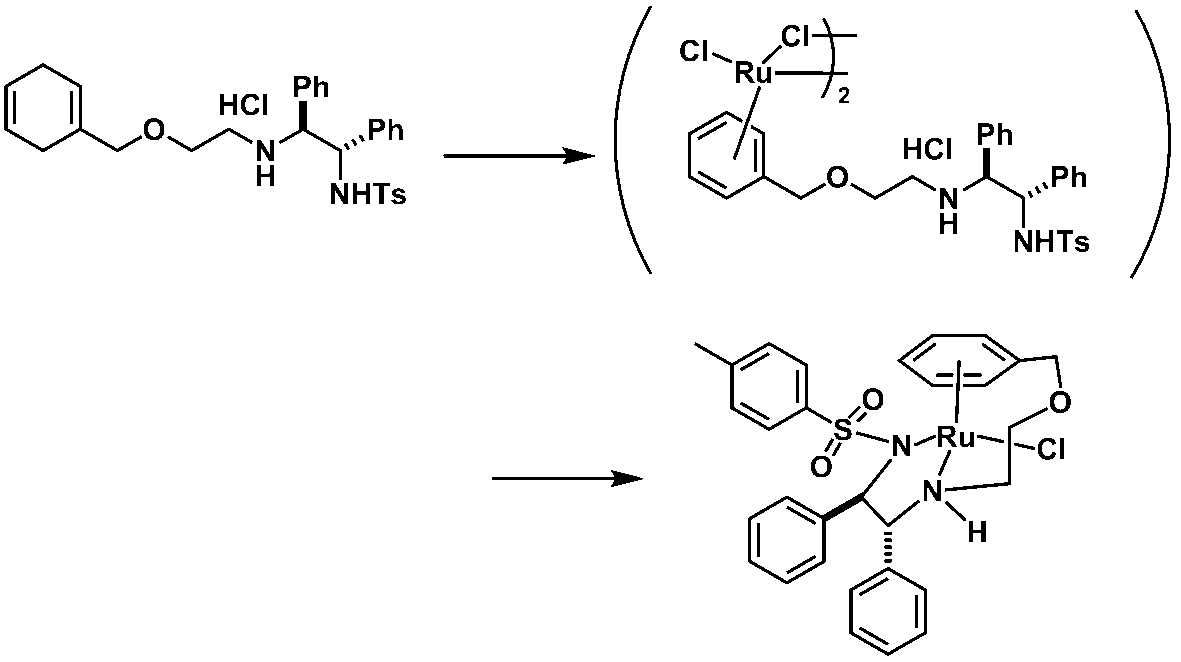
HRMS (ESI) calcd for C30H31ClN2O3RuS [M+H]+ 637.0860, found 637.0858
N-((1R,2R)-2-(2-(シクロヘキサ-1,4-ジエニルメトキシ)エチルアミノ)-1,2-ジフェニルエチル)メタンスルホンアミドの製造

N-[(1R,2R)-1,2-ジフェニル-2-(2-ベンジルオキシエチルアミノ)-エチル]メタンスルホンアミド アンモニウム クロリド ルテニウム モノマー (Benzene-Ms-DENEB)の製造
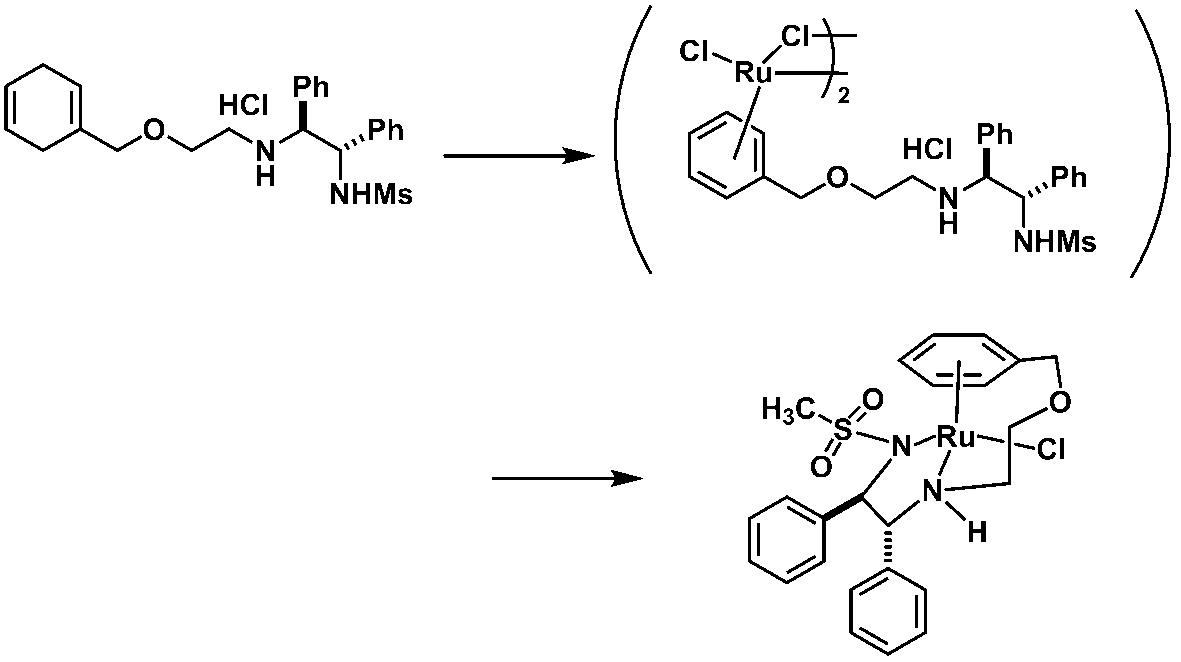
HRMS (ESI) calcd for C24H27N2O3RuS [M-Cl]+ 525.0780, found 525.0775
5-ヘキシニル 4-メチルベンゼンスルホン酸塩の製造

HRMS (ESI) calcd for C13H17O3S [M+H]+ 253.0893, found 253.08333
4-(4-メチルシクロヘキサ-1,4-ジエニル)ブチル 4-メチルベンゼンスルホン酸塩及び3-(5-メチルシクロヘキサ-1,4-ジエニル)プロピル 4-メチルベンゼンスルホン酸塩の製造
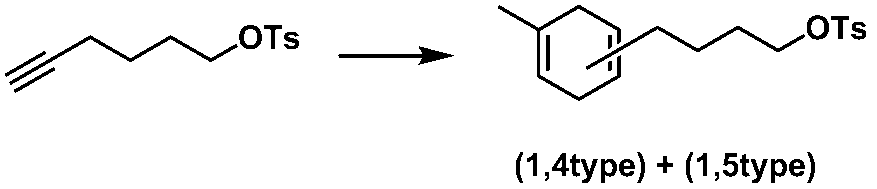
HRMS (ESI) calcd for C18H24O3SNa [M+Na]+ 343.1338, found 343.1342
N-[(1S,2S)-1,2-ジフェニル-2-(4-(4-メチルフェニル)ブチルアミノ)エチル]-4-メチル ベンゼンスルホンアミド アンモニウム クロリド ルテニウム モノマー及びN-[(1S,2S)-1,2-ジフェニル-2-(4-(3-メチルフェニル)ブチルアミノ)エチル]-4-メチル ベンゼンスルホンアミド アンモニウム クロリド ルテニウム モノマーを用いたアセトフェノンを基質とする水素移動反応
N-[(1S,2S)-1,2-ジフェニル-2-(4-(4-メチルフェニル)ブチルアミノ)エチル]-メタンスルホンアミド アンモニウム クロリド ルテニウム モノマー及びN-[(1S,2S)-1,2-ジフェニル-2-(4-(3-メチルフェニル)ブチルアミノ)エチル]-メタンスルホンアミド アンモニウム クロリド ルテニウム モノマーを用いたアセトフェノンを基質とする水素移動反応
N-[(1R,2R)-1,2-ジフェニル-2-(2-ベンジルオキシエチルアミノ)-エチル]-4-メチルベンゼンスルホンアミド アンモニウム クロリド ルテニウム モノマー (Benzene-Ts-DENEB)を用いたアセトフェノンを基質とする水素移動反応
N-[(1R,2R)-1,2-ジフェニル-2-(2-ベンジルオキシエチルアミノ)-エチル]メタンスルホンアミド アンモニウム クロリド ルテニウム モノマー (Benzene-Ms-DENEB)を用いたアセトフェノンを基質とする水素移動反応
Claims (3)
- 下記一般式(1):
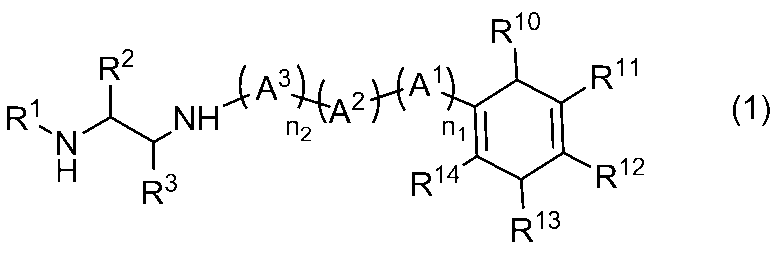
で表される化合物の製造方法であって、下記一般式(2):

で表される化合物と、下記一般式(3):
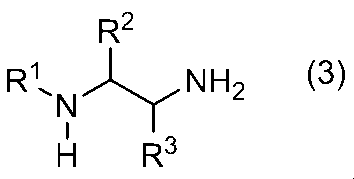
で表されるジアミン化合物とを反応させることを特徴とする前記製造方法。 - 一般式(2)で表される化合物と、一般式(3)で表されるジアミン化合物とを、100℃から200℃の温度で反応させる請求項1に記載の製造方法。
- 下記一般式(2):
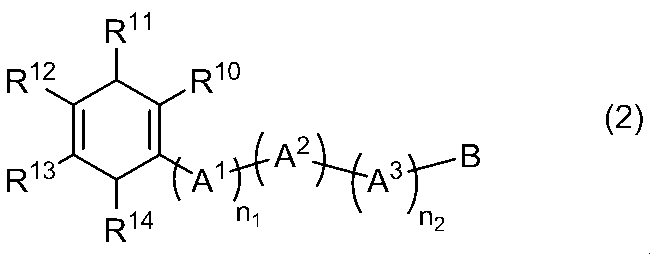
で表される化合物。
Priority Applications (5)
| Application Number | Priority Date | Filing Date | Title |
|---|---|---|---|
| EP12775932.2A EP2703386B1 (en) | 2011-04-28 | 2012-04-27 | Method for producing diamine compound |
| US14/111,828 US9073827B2 (en) | 2011-04-28 | 2012-04-27 | Method for producing diamine compound |
| CN201280020119.4A CN103502208B (zh) | 2011-04-28 | 2012-04-27 | 二胺化合物的制造方法 |
| CA2829971A CA2829971A1 (en) | 2011-04-28 | 2012-04-27 | Method for producing diamine compound |
| JP2013512484A JPWO2012147944A1 (ja) | 2011-04-28 | 2012-04-27 | ジアミン化合物の製造方法 |
Applications Claiming Priority (2)
| Application Number | Priority Date | Filing Date | Title |
|---|---|---|---|
| JP2011-101528 | 2011-04-28 | ||
| JP2011101528 | 2011-04-28 |
Publications (1)
| Publication Number | Publication Date |
|---|---|
| WO2012147944A1 true WO2012147944A1 (ja) | 2012-11-01 |
Family
ID=47072455
Family Applications (1)
| Application Number | Title | Priority Date | Filing Date |
|---|---|---|---|
| PCT/JP2012/061445 Ceased WO2012147944A1 (ja) | 2011-04-28 | 2012-04-27 | ジアミン化合物の製造方法 |
Country Status (6)
| Country | Link |
|---|---|
| US (1) | US9073827B2 (ja) |
| EP (1) | EP2703386B1 (ja) |
| JP (1) | JPWO2012147944A1 (ja) |
| CN (1) | CN103502208B (ja) |
| CA (1) | CA2829971A1 (ja) |
| WO (1) | WO2012147944A1 (ja) |
Cited By (5)
| Publication number | Priority date | Publication date | Assignee | Title |
|---|---|---|---|---|
| CN103073492A (zh) * | 2013-02-04 | 2013-05-01 | 中国科学院上海有机化学研究所 | 2-[3-(s)-[3-[2-(7-氯-2-喹啉基)乙烯基]苯基]-3-羟基丙基]苯甲酸酯的合成方法 |
| WO2013065867A1 (en) * | 2011-10-31 | 2013-05-10 | Takasago International Corporation | METHOD FOR PRODUCING OPTICALLY ACTIVE β-HYDROXY-α-AMINOCARBOXYLIC ACID ESTER |
| WO2014068331A1 (en) * | 2012-11-02 | 2014-05-08 | The University Of Warwick | Catalyst and process for synthesising the same |
| GB2535564A (en) * | 2014-09-19 | 2016-08-24 | Johnson Matthey Plc | Complexes and methods for their preparation |
| WO2021177287A1 (ja) * | 2020-03-03 | 2021-09-10 | 高砂香料工業株式会社 | ルテニウム錯体を吸着した活性炭を含む触媒、及びそれを用いた還元生成物の製造方法 |
Families Citing this family (2)
| Publication number | Priority date | Publication date | Assignee | Title |
|---|---|---|---|---|
| CA2832994A1 (en) * | 2011-05-06 | 2012-11-15 | Takasago International Corporation | Ruthenium-diamine complex and method for producing optically active compound |
| CN112239420B (zh) * | 2019-07-17 | 2023-12-08 | 东莞市东阳光仿制药研发有限公司 | 一种催化剂中间体的制备方法 |
Citations (1)
| Publication number | Priority date | Publication date | Assignee | Title |
|---|---|---|---|---|
| JP2012067071A (ja) * | 2010-08-26 | 2012-04-05 | Takasago Internatl Corp | ルテニウム−ジアミン錯体及び光学活性化合物の製造方法 |
Family Cites Families (5)
| Publication number | Priority date | Publication date | Assignee | Title |
|---|---|---|---|---|
| WO2007147897A1 (de) | 2006-06-23 | 2007-12-27 | Basf Se | Verfahren zur herstellung von optisch aktiven 2-halogen-1-phenylethanol-derivaten und folgeprodukten davon |
| JP5006059B2 (ja) * | 2007-01-29 | 2012-08-22 | エリック エム. カレイラ | キラルなイリジウムアクア錯体およびそれを用いた光学活性ヒドロキシ化合物の製造方法 |
| EP2062889A1 (de) * | 2007-11-22 | 2009-05-27 | Boehringer Ingelheim Pharma GmbH & Co. KG | Verbindungen |
| JP4644881B2 (ja) | 2008-09-19 | 2011-03-09 | 高砂香料工業株式会社 | ルテニウム錯体の製造方法 |
| ES2863542T3 (es) | 2009-03-17 | 2021-10-11 | Johnson Matthey Plc | Proceso para la hidrogenación de cetonas en presencia de catalizadores de Ru (II) |
-
2012
- 2012-04-27 CN CN201280020119.4A patent/CN103502208B/zh active Active
- 2012-04-27 CA CA2829971A patent/CA2829971A1/en not_active Abandoned
- 2012-04-27 US US14/111,828 patent/US9073827B2/en active Active
- 2012-04-27 EP EP12775932.2A patent/EP2703386B1/en active Active
- 2012-04-27 JP JP2013512484A patent/JPWO2012147944A1/ja active Pending
- 2012-04-27 WO PCT/JP2012/061445 patent/WO2012147944A1/ja not_active Ceased
Patent Citations (1)
| Publication number | Priority date | Publication date | Assignee | Title |
|---|---|---|---|---|
| JP2012067071A (ja) * | 2010-08-26 | 2012-04-05 | Takasago Internatl Corp | ルテニウム−ジアミン錯体及び光学活性化合物の製造方法 |
Non-Patent Citations (12)
| Title |
|---|
| CHEM REV., 1992, pages 1051 |
| CHEUNG, FUNG K. ET AL.: "An investigation into the tether length and substitution pattern of arene-substituted complexes for asymmetric transfer hydrogenation of ketones", ORGANIC LETTERS, vol. 9, no. 22, 2007, pages 4659 - 4662, XP002634537 * |
| DALTON. TRANS., vol. 39, 2010, pages 1395 |
| J. AM. CHEM. SOC., vol. 117, 1995, pages 7562 |
| J. AM. CHEM. SOC., vol. 118, 1996, pages 2521 |
| J. AM. CHEM. SOC., vol. 118, 1996, pages 4916 |
| J. AM. CHEM. SOC., vol. 127, 2005, pages 7318 |
| J. ORG. CHEM., vol. 71, 2006, pages 7035 |
| J. ORGANOMETALLIC. CHEM., vol. 693, 2008, pages 3527 |
| MARTINS, JOSE E. D. ET AL.: "Further 'tethered' Ru(II) catalysts for asymmetric transfer hydrogenation (ATH) of ketones; the use of a benzylic linker and a cyclohexyldiamine ligand", JOURNAL OF ORGANOMETALLIC CHEMISTRY, vol. 693, no. 23, 2008, pages 3527 - 3532, XP002634536 * |
| ORG. BIOMOL. CHEM., vol. 5, 2007, pages 1093 |
| ORG. LETT., vol. 9, 2007, pages 4659 |
Cited By (9)
| Publication number | Priority date | Publication date | Assignee | Title |
|---|---|---|---|---|
| WO2013065867A1 (en) * | 2011-10-31 | 2013-05-10 | Takasago International Corporation | METHOD FOR PRODUCING OPTICALLY ACTIVE β-HYDROXY-α-AMINOCARBOXYLIC ACID ESTER |
| WO2014068331A1 (en) * | 2012-11-02 | 2014-05-08 | The University Of Warwick | Catalyst and process for synthesising the same |
| US9321045B2 (en) | 2012-11-02 | 2016-04-26 | The University Of Warwick | Catalyst and process for synthesising the same |
| CN103073492A (zh) * | 2013-02-04 | 2013-05-01 | 中国科学院上海有机化学研究所 | 2-[3-(s)-[3-[2-(7-氯-2-喹啉基)乙烯基]苯基]-3-羟基丙基]苯甲酸酯的合成方法 |
| GB2535564A (en) * | 2014-09-19 | 2016-08-24 | Johnson Matthey Plc | Complexes and methods for their preparation |
| US10851126B2 (en) | 2014-09-19 | 2020-12-01 | Johnson Matthey Public Limited Company | Complexes and methods for their preparation |
| WO2021177287A1 (ja) * | 2020-03-03 | 2021-09-10 | 高砂香料工業株式会社 | ルテニウム錯体を吸着した活性炭を含む触媒、及びそれを用いた還元生成物の製造方法 |
| JPWO2021177287A1 (ja) * | 2020-03-03 | 2021-09-10 | ||
| JP7713439B2 (ja) | 2020-03-03 | 2025-07-25 | 高砂香料工業株式会社 | ルテニウム錯体を吸着した活性炭を含む触媒、及びそれを用いた還元生成物の製造方法 |
Also Published As
| Publication number | Publication date |
|---|---|
| CN103502208B (zh) | 2016-01-13 |
| CN103502208A (zh) | 2014-01-08 |
| CA2829971A1 (en) | 2012-11-01 |
| US9073827B2 (en) | 2015-07-07 |
| JPWO2012147944A1 (ja) | 2014-07-28 |
| US20140039220A1 (en) | 2014-02-06 |
| EP2703386A4 (en) | 2014-10-08 |
| EP2703386A1 (en) | 2014-03-05 |
| EP2703386B1 (en) | 2019-03-06 |
Similar Documents
| Publication | Publication Date | Title |
|---|---|---|
| JP5718178B2 (ja) | ルテニウム−ジアミン錯体及び光学活性化合物の製造方法 | |
| US9073827B2 (en) | Method for producing diamine compound | |
| US8969609B1 (en) | Ruthenium-diamine complex and method for producing optically active compound | |
| JP6048762B2 (ja) | 光学活性β−ヒドロキシ−α−アミノカルボン酸エステルの製造方法 | |
| JPWO2005070875A1 (ja) | アミン類の製造方法 | |
| JP2012082155A (ja) | トリアゾリウム塩及びその製造方法、アジドアルコール並びに不斉反応によるアルキル化オキシインドールの製造方法 | |
| JPWO2019069828A1 (ja) | 光学活性な2,3−ビスホスフィノピラジン誘導体、その製造方法、遷移金属錯体及び有機ホウ素化合物の製造方法 | |
| JP6476497B2 (ja) | 光学活性化合物の製造方法、及び新規な金属−ジアミン錯体 | |
| CN110494439A (zh) | 新型手性联苯二膦配体及其制备方法 | |
| JP5536541B2 (ja) | ルテニウム−ジアミン錯体および光学活性化合物の製造方法 | |
| CN114423727B (zh) | 含氟化合物的制造方法 | |
| JP6689750B2 (ja) | 固相担持ルテニウム−ジアミン錯体及び光学活性化合物の製造方法 | |
| JP4860510B2 (ja) | β位に不斉点を有するカルボン酸の製造及び求核剤 | |
| JP5280858B2 (ja) | 5,5’位で連結された1,1’−ビフェニル類軸性キラリティー配位子及びその製造方法 | |
| TWI589584B (zh) | 化合物及其製造方法、以及光學活性α-胺基膦酸衍生物之製造方法 | |
| JP2009215212A (ja) | リン含有化合物およびその製造方法 | |
| CN111655708A (zh) | 2,3-双膦基吡嗪衍生物、其制造方法、过渡金属配位化合物和手性催化剂以及有机硼化合物的制造方法 | |
| CN109311806A (zh) | 新的异羟肟酸衍生物的制造方法及其中间体 | |
| JP2019031460A (ja) | 2,3−ビスホスフィノピラジン誘導体の製造方法及びホスフィン遷移金属錯体の製造方法 |
Legal Events
| Date | Code | Title | Description |
|---|---|---|---|
| 121 | Ep: the epo has been informed by wipo that ep was designated in this application |
Ref document number: 12775932 Country of ref document: EP Kind code of ref document: A1 |
|
| ENP | Entry into the national phase |
Ref document number: 2829971 Country of ref document: CA |
|
| WWE | Wipo information: entry into national phase |
Ref document number: 14111828 Country of ref document: US |
|
| ENP | Entry into the national phase |
Ref document number: 2013512484 Country of ref document: JP Kind code of ref document: A |
|
| NENP | Non-entry into the national phase |
Ref country code: DE |