WO2012150549A1 - Disulfide dyes - Google Patents
Disulfide dyes Download PDFInfo
- Publication number
- WO2012150549A1 WO2012150549A1 PCT/IB2012/052178 IB2012052178W WO2012150549A1 WO 2012150549 A1 WO2012150549 A1 WO 2012150549A1 IB 2012052178 W IB2012052178 W IB 2012052178W WO 2012150549 A1 WO2012150549 A1 WO 2012150549A1
- Authority
- WO
- WIPO (PCT)
- Prior art keywords
- formula
- chosen
- radical
- fused
- compounds
- Prior art date
- Legal status (The legal status is an assumption and is not a legal conclusion. Google has not performed a legal analysis and makes no representation as to the accuracy of the status listed.)
- Ceased
Links
Classifications
-
- C—CHEMISTRY; METALLURGY
- C09—DYES; PAINTS; POLISHES; NATURAL RESINS; ADHESIVES; COMPOSITIONS NOT OTHERWISE PROVIDED FOR; APPLICATIONS OF MATERIALS NOT OTHERWISE PROVIDED FOR
- C09B—ORGANIC DYES OR CLOSELY-RELATED COMPOUNDS FOR PRODUCING DYES, e.g. PIGMENTS; MORDANTS; LAKES
- C09B49/00—Sulfur dyes
- C09B49/06—Sulfur dyes from azines, oxazines, thiazines or thiazoles
-
- A—HUMAN NECESSITIES
- A61—MEDICAL OR VETERINARY SCIENCE; HYGIENE
- A61K—PREPARATIONS FOR MEDICAL, DENTAL OR TOILETRY PURPOSES
- A61K8/00—Cosmetics or similar toiletry preparations
- A61K8/18—Cosmetics or similar toiletry preparations characterised by the composition
- A61K8/30—Cosmetics or similar toiletry preparations characterised by the composition containing organic compounds
- A61K8/49—Cosmetics or similar toiletry preparations characterised by the composition containing organic compounds containing heterocyclic compounds
- A61K8/4986—Cosmetics or similar toiletry preparations characterised by the composition containing organic compounds containing heterocyclic compounds with sulfur as the only hetero atom
-
- A—HUMAN NECESSITIES
- A61—MEDICAL OR VETERINARY SCIENCE; HYGIENE
- A61K—PREPARATIONS FOR MEDICAL, DENTAL OR TOILETRY PURPOSES
- A61K8/00—Cosmetics or similar toiletry preparations
- A61K8/18—Cosmetics or similar toiletry preparations characterised by the composition
- A61K8/30—Cosmetics or similar toiletry preparations characterised by the composition containing organic compounds
- A61K8/46—Cosmetics or similar toiletry preparations characterised by the composition containing organic compounds containing sulfur
-
- A—HUMAN NECESSITIES
- A61—MEDICAL OR VETERINARY SCIENCE; HYGIENE
- A61K—PREPARATIONS FOR MEDICAL, DENTAL OR TOILETRY PURPOSES
- A61K8/00—Cosmetics or similar toiletry preparations
- A61K8/18—Cosmetics or similar toiletry preparations characterised by the composition
- A61K8/30—Cosmetics or similar toiletry preparations characterised by the composition containing organic compounds
- A61K8/49—Cosmetics or similar toiletry preparations characterised by the composition containing organic compounds containing heterocyclic compounds
-
- A—HUMAN NECESSITIES
- A61—MEDICAL OR VETERINARY SCIENCE; HYGIENE
- A61Q—SPECIFIC USE OF COSMETICS OR SIMILAR TOILETRY PREPARATIONS
- A61Q5/00—Preparations for care of the hair
- A61Q5/04—Preparations for permanent waving or straightening the hair
-
- A—HUMAN NECESSITIES
- A61—MEDICAL OR VETERINARY SCIENCE; HYGIENE
- A61Q—SPECIFIC USE OF COSMETICS OR SIMILAR TOILETRY PREPARATIONS
- A61Q5/00—Preparations for care of the hair
- A61Q5/06—Preparations for styling the hair, e.g. by temporary shaping or colouring
- A61Q5/065—Preparations for temporary colouring the hair, e.g. direct dyes
-
- A—HUMAN NECESSITIES
- A61—MEDICAL OR VETERINARY SCIENCE; HYGIENE
- A61Q—SPECIFIC USE OF COSMETICS OR SIMILAR TOILETRY PREPARATIONS
- A61Q5/00—Preparations for care of the hair
- A61Q5/10—Preparations for permanently dyeing the hair
-
- C—CHEMISTRY; METALLURGY
- C09—DYES; PAINTS; POLISHES; NATURAL RESINS; ADHESIVES; COMPOSITIONS NOT OTHERWISE PROVIDED FOR; APPLICATIONS OF MATERIALS NOT OTHERWISE PROVIDED FOR
- C09B—ORGANIC DYES OR CLOSELY-RELATED COMPOUNDS FOR PRODUCING DYES, e.g. PIGMENTS; MORDANTS; LAKES
- C09B26/00—Hydrazone dyes; Triazene dyes
- C09B26/02—Hydrazone dyes
- C09B26/04—Hydrazone dyes cationic
-
- C—CHEMISTRY; METALLURGY
- C09—DYES; PAINTS; POLISHES; NATURAL RESINS; ADHESIVES; COMPOSITIONS NOT OTHERWISE PROVIDED FOR; APPLICATIONS OF MATERIALS NOT OTHERWISE PROVIDED FOR
- C09B—ORGANIC DYES OR CLOSELY-RELATED COMPOUNDS FOR PRODUCING DYES, e.g. PIGMENTS; MORDANTS; LAKES
- C09B29/00—Monoazo dyes prepared by diazotising and coupling
- C09B29/06—Monoazo dyes prepared by diazotising and coupling from coupling components containing amino as the only directing group
- C09B29/08—Amino benzenes
- C09B29/0805—Amino benzenes free of acid groups
- C09B29/0807—Amino benzenes free of acid groups characterised by the amino group
- C09B29/0809—Amino benzenes free of acid groups characterised by the amino group substituted amino group
- C09B29/081—Amino benzenes free of acid groups characterised by the amino group substituted amino group unsubstituted alkylamino, alkenylamino, alkynylamino, cycloalkylamino, aralkylamino or arylamino
-
- C—CHEMISTRY; METALLURGY
- C09—DYES; PAINTS; POLISHES; NATURAL RESINS; ADHESIVES; COMPOSITIONS NOT OTHERWISE PROVIDED FOR; APPLICATIONS OF MATERIALS NOT OTHERWISE PROVIDED FOR
- C09B—ORGANIC DYES OR CLOSELY-RELATED COMPOUNDS FOR PRODUCING DYES, e.g. PIGMENTS; MORDANTS; LAKES
- C09B29/00—Monoazo dyes prepared by diazotising and coupling
- C09B29/34—Monoazo dyes prepared by diazotising and coupling from other coupling components
- C09B29/36—Monoazo dyes prepared by diazotising and coupling from other coupling components from heterocyclic compounds
- C09B29/3691—Monoazo dyes prepared by diazotising and coupling from other coupling components from heterocyclic compounds containing nitrogen and sulfur as heteroatom
-
- C—CHEMISTRY; METALLURGY
- C09—DYES; PAINTS; POLISHES; NATURAL RESINS; ADHESIVES; COMPOSITIONS NOT OTHERWISE PROVIDED FOR; APPLICATIONS OF MATERIALS NOT OTHERWISE PROVIDED FOR
- C09B—ORGANIC DYES OR CLOSELY-RELATED COMPOUNDS FOR PRODUCING DYES, e.g. PIGMENTS; MORDANTS; LAKES
- C09B43/00—Preparation of azo dyes from other azo compounds
- C09B43/18—Preparation of azo dyes from other azo compounds by acylation of hydroxyl group or of mercapto group
-
- C—CHEMISTRY; METALLURGY
- C09—DYES; PAINTS; POLISHES; NATURAL RESINS; ADHESIVES; COMPOSITIONS NOT OTHERWISE PROVIDED FOR; APPLICATIONS OF MATERIALS NOT OTHERWISE PROVIDED FOR
- C09B—ORGANIC DYES OR CLOSELY-RELATED COMPOUNDS FOR PRODUCING DYES, e.g. PIGMENTS; MORDANTS; LAKES
- C09B43/00—Preparation of azo dyes from other azo compounds
- C09B43/44—Preparation of azo dyes from other azo compounds by substituting amine groups for hydroxyl groups or hydroxyl groups for amine groups; Desacylation of amino-acyl groups; Deaminating
-
- C—CHEMISTRY; METALLURGY
- C09—DYES; PAINTS; POLISHES; NATURAL RESINS; ADHESIVES; COMPOSITIONS NOT OTHERWISE PROVIDED FOR; APPLICATIONS OF MATERIALS NOT OTHERWISE PROVIDED FOR
- C09B—ORGANIC DYES OR CLOSELY-RELATED COMPOUNDS FOR PRODUCING DYES, e.g. PIGMENTS; MORDANTS; LAKES
- C09B44/00—Azo dyes containing onium groups
- C09B44/10—Azo dyes containing onium groups containing cyclammonium groups attached to an azo group by a carbon atom of the ring system
-
- C—CHEMISTRY; METALLURGY
- C09—DYES; PAINTS; POLISHES; NATURAL RESINS; ADHESIVES; COMPOSITIONS NOT OTHERWISE PROVIDED FOR; APPLICATIONS OF MATERIALS NOT OTHERWISE PROVIDED FOR
- C09B—ORGANIC DYES OR CLOSELY-RELATED COMPOUNDS FOR PRODUCING DYES, e.g. PIGMENTS; MORDANTS; LAKES
- C09B49/00—Sulfur dyes
-
- C—CHEMISTRY; METALLURGY
- C09—DYES; PAINTS; POLISHES; NATURAL RESINS; ADHESIVES; COMPOSITIONS NOT OTHERWISE PROVIDED FOR; APPLICATIONS OF MATERIALS NOT OTHERWISE PROVIDED FOR
- C09B—ORGANIC DYES OR CLOSELY-RELATED COMPOUNDS FOR PRODUCING DYES, e.g. PIGMENTS; MORDANTS; LAKES
- C09B62/00—Reactive dyes, i.e. dyes which form covalent bonds with the substrates or which polymerise with themselves
- C09B62/44—Reactive dyes, i.e. dyes which form covalent bonds with the substrates or which polymerise with themselves with the reactive group not directly attached to a heterocyclic ring
- C09B62/78—Reactive dyes, i.e. dyes which form covalent bonds with the substrates or which polymerise with themselves with the reactive group not directly attached to a heterocyclic ring with other reactive groups
-
- C—CHEMISTRY; METALLURGY
- C09—DYES; PAINTS; POLISHES; NATURAL RESINS; ADHESIVES; COMPOSITIONS NOT OTHERWISE PROVIDED FOR; APPLICATIONS OF MATERIALS NOT OTHERWISE PROVIDED FOR
- C09D—COATING COMPOSITIONS, e.g. PAINTS, VARNISHES OR LACQUERS; FILLING PASTES; CHEMICAL PAINT OR INK REMOVERS; INKS; CORRECTING FLUIDS; WOODSTAINS; PASTES OR SOLIDS FOR COLOURING OR PRINTING; USE OF MATERIALS THEREFOR
- C09D15/00—Woodstains
-
- A—HUMAN NECESSITIES
- A61—MEDICAL OR VETERINARY SCIENCE; HYGIENE
- A61K—PREPARATIONS FOR MEDICAL, DENTAL OR TOILETRY PURPOSES
- A61K2800/00—Properties of cosmetic compositions or active ingredients thereof or formulation aids used therein and process related aspects
- A61K2800/80—Process related aspects concerning the preparation of the cosmetic composition or the storage or application thereof
- A61K2800/88—Two- or multipart kits
- A61K2800/884—Sequential application
Definitions
- the present invention relates to novel disulfide dyes, compositions thereof, to processes for their preparation and to their use for the dyeing of organic materials, such as keratin fibers, wool, leather, silk, cellulose or polyamides, especially keratin-containing fibers, cotton or nylon, and preferably hair, more preferably human hair.
- organic materials such as keratin fibers, wool, leather, silk, cellulose or polyamides, especially keratin-containing fibers, cotton or nylon, and preferably hair, more preferably human hair.
- cationic dyes can be used to dye organic material, for example keratin, silk, cellulose or cellulose derivatives, and also synthetic fibers, for example polyamides.
- Cationic dyes exhibit very brilliant shades.
- a disadvantage is their unsatisfactory fastness to washing.
- A is selected from a residue of a cationic dye
- Xi and X2 independently from each other are selected from saturated or unsaturated Cr C3ohydrocarbon chains, optionally interrupted by at least one bivalent group chosen from -N(R-i)-; N + (R 1 )(R 2 )-; -0-; -S-; -CO-; -S0 2 -; and/or optionally interrupted by an optionally substituted, saturated or unsaturated, fused or non-fused, aromatic or nonaro- matic (hetero)cyclic radical optionally comprising at least one identical or different he- teroatom;
- V is CrC3alkylene, optionally substituted by hydroxy
- D is a radical chosen from -N(CO)-R3; Csat and C'sat independently from each other are optionally substituted, optionally cyclic, linear or branched C-i-C-isalkylene chains;
- R-i and R2 independently from each other are chosen from hydrogen; Ci-C4alkyl; hy- droxyalkyl; or aminoalkyl;
- R 3 is CrC 4 alkyl
- W is a fused or non-fused, aromatic or nonaromatic heterocycle comprising a quaternary ammonium
- Ar is chosen from C 5 or Cearyl radicals and aromatic bicycles of the naphthyl type, which are optionally substituted with at least one halogen atom, at least one alkyl group, at least one hydroxyl group; at least one alkoxy group, at least one hydroxyalkyl group or at least one amino group or (di)alkylamino group; and
- R 4 is hydrogen; or CrC 4 alkyl.
- residue of an organic dye is selected from azo, azomethin, hydrazomethin, merocyanine, methin and styryl dyes, and more preferred from azo, azomethin dye and hydrazomethin dyes;
- Suitable nitroaryl dyes of the present invention are for example selected from the following compounds:
- Suitable anthraquinone dyes suitable for the method of the present invention are the following compounds: 1-[(3-aminopropyl) amino]-anthraquinone (HC Red No. 7), 2-[(2- aminoethyl) amino]-anthraquinone (HC Orange No.
- Suitable cationic dyes are the following compounds: N-[4-[ [4-(diethylamino) phenyl] [4- (ethylamino)-naphth-l-yl] methylene]-2,5- cyclohexadien-1-yliden]-N-ethyl-ethaniminium- chloride (Basic Blue No.
- W is chosen from imidazolium, pyridinium, benzimidazolium, pyrazolium, and benzothia- zolium which are optionally substituted with at least one identical or different
- W is a radical of a cationic aromatic substituted or unsubstituted heterocyclic compound of formulae
- R5, R6, R7, Re, R9, R10, R11 , R12, Ri3 Ri 4 , Ri5, R16, R-I7, R18, Ri9 and R 2 g independently from each other are hydrogen; halogen; or CrCi 4 alkyl, which is saturated or unsaturated, linear or branched, substituted or unsubstituted, or interrupted or uninterrupted with heteroatoms; a radical of phenyl, which substituted or unsubstituted; a of carboxylic acid radical; sulfonic acid radical; hydroxy; nitrile; C Ci 6 alkoxy, (poly)-hydroxy-C2-C 4 - alkoxy; halogen; sulfonylamino; SR 2 o, NHR 2 i; N R22 235; OR 24 ; S0 2 ; COOR25;
- R20, R21 , R22, R23, R2 4 , R25, R26, R271 and R 2 s are each independently of the other hydrogen; unsubstituted or substituted CrCi 4 alkyl, C 2 -Ci 4 alkenyl, C 5 -Ci 0 aryl, C 5 -Ci 0 aryl-(Ci- Cioalkyl), or -Ci-Cioalkyl(C 5 -Ci 0 aryl); and
- An is an anion.
- A is chosen from the radicals
- W is a fused or non-fused, aromatic or nonaromatic heterocycle comprising a quaternary ammonium
- X-i, X 2 , D, Csat and C' sa t are defined as in formula (1 ).
- V is -(CH 2 ) 2 -;
- p 1 ;
- W is a fused or non-fused, aromatic or nonaromatic heterocycle comprising a quaternary ammonium.
- X-i, X 2 , Csat, C'sat and R 4 are defined as in formula(1 ).
- Yi is a biradical selected from phenylene; cyclohexylene; and C-i-Csalkylene;
- W is a fused or non-fused, aromatic or nonaromatic heterocycle comprising a quaternary ammonium
- Ar is defined as in formula (1 ).
- R 4 is methyl; or tert. butyl
- W is a fused or non-fused, aromatic or nonaromatic heterocycle comprising a quaternary ammonium
- Ar is defined as in formula (1 c).
- A is a radical of formula
- the aryl or heteroaryl radicals or the aryl or heteroaryl part of a radical may be substituted with at least one substituent carried by a carbon atom, chosen from a C1-C16, such as Cr Csalkyl optionally substituted with at least one radical chosen from hydroxyl, CrC 4 alkoxy, C2-C4 (poly)hydroxyalkoxy, acylamino, amino substituted with two CrC 4 alkyl, which are identical or different, optionally bearing at least one hydroxyl group, or it being possible for the two radicals to form, with the nitrogen atom to which they are attached, an optionally substituted, saturated or unsaturated heterocycle comprising from 5 to 7 members, such as 5 or 6 members, optionally comprising another heteroatom which is identical to or different from nitrogen; a halogen atom such as chlorine, fluorine or bromine; a hydroxyl group; C1-C4 alkoxy, a C2-C4 (poly)hydroxyalkoxy; amino, optionally substituted with one
- the residue of an organic dye is preferably selected from the group of anthraquinone, ac- ridine, azo, azomethine, hydrazomethine, benzodifuranone, coumarine, diketopyrrolopyrrol, dioxaxine, diphenylmethane, formazan, indigoid, indophenol, naphthalimide, naphthoquinone, nitroaryl, merocyanine, methin, oxazine, perinone, perylene, pyrenequinone, phtalo- cyanine, phenazine, quinoneimine, quinacridone, quinophtalone, styryl, triphenylmethane, xanthene, thiazine and thioxanthene dye.
- the dyeing composition useful in the method of the present invention may comprise at least one disulfide dye chosen from the dyes of formulae (1 ) and (2).
- the at least one disulphide dye may be present in the composition in an amount ranging from 0.001 to 50% relative to the total weight of the composition. In at least one embodiment embodiment, this amount ranges from 0.005 to 20% by weight, such as from 0.01 to 5% by weight relative to the total weight of the composition.
- the dyes of formula (1 ) and (2) according to the invention are suitable for dyeing organic materials, such as keratin-containing fibers, wool, leather, silk, cellulose or polyamides, cotton or nylon, and preferably human hair.
- the dyeings obtained are distinguished by their depth of shade and their good fastness properties to washing, such as, for example, fastness to light, shampooing and rubbing.
- the stability, in particular the storage stability of the dyes according to the invention are excellent.
- the multiplicity of shades of the dyes can be increased by combination with other dyes.
- the dyes of formula (1 ) and (2) of the present invention may be combined with dyes of the same or other classes of dyes, especially with direct dyes, oxidation dyes; dye precursor combinations of a coupler compound as well as a diazotized compound, or a capped diazotized compound; and/or cationic reactive dyes.
- Direct dyes are of natural origin or may be prepared synthetically. They are uncharged, cationic or anionic, such as acid dyes.
- the dyes of formula (1 ) and (2) may be used in combination with at least one single direct dye different from the dyes of formula (1 ) and (2).
- direct dyes are described in "Dermatology", edited by Ch. Culnan, H. Maibach, Verlag Marcel Dekker Inc., New York, Basle, 1986, Vol. 7, Ch. Zviak, The Science of Hair Care, chapter 7, p. 248-250, and in "Europaisches Inventar der Kosmetikrohstoffe", 1996, published by The European Commission, obtainable in diskette form from the Bundesver- band der yog Industrie- und glassesêt fur Arzneistoff, Reformwaren und Korperpf litism ittel e.V., Mannheim.
- cationic nitroaniline and anthraquinone dyes are useful for a combination with a dye of formula (1 ) and (2).
- the dyes of formula (1 ) and (2) may also be combined with acid dyes, for example the dyes which are known from the international names (Color index), or trade names.
- These acid dyes may be used either as single component or in any combination thereof.
- the dyes of formula (1 ) and (2) may also be combined with uncharged dyes, for example selected from the group of the nitroanilines, nitrophenylenediamines, nitroaminophenols, anthraquinones, indophenols, phenazines, phenothiazines, bispyrazolons, bispyrazol aza derivatives and methines.
- uncharged dyes for example selected from the group of the nitroanilines, nitrophenylenediamines, nitroaminophenols, anthraquinones, indophenols, phenazines, phenothiazines, bispyrazolons, bispyrazol aza derivatives and methines.
- the dyes of formula (1 ) and (2) may also be used in combination with oxida- tion dye systems.
- Oxidation dyes which, in the initial state, are not dyes but dye precursors are classified according to their chemical properties into developer and coupler compounds. Suitable oxidation dyes are described for example in
- Preferred developer compounds are for example primary aromatic amines, which are substituted in the para- or ortho- position with a substituted or unsubstituted hydroxy- or amino residue, or diaminopyridine derivatives, heterocyclic hydrazones, 4-aminopyrazol derivatives or 2,4,5, 6-tetraaminopyrimidine derivatives.
- developer compounds in their physiological compatible acid addition salt form such as hydrochloride or sulfate can be used.
- Developer compounds, which have aromatic OH radicals are also suitable in their salt form together with a base, such as alkali metalphenolates.
- Preferred developer compounds are disclosed in DE 19959479, p. 2, I. 8 - 29.
- Preferred coupler compounds are m-phenylendiamine derivatives, naphthole, resorcine and resorcine derivatives, pyrazolone and m-aminophenol derivatives, and most preferably the coupler compounds disclosed in DE 19959479, p.1 , I. 33 to p. 3, I. 1 1.
- autooxidizable compounds may be used in combination with the dyes of formula (1 ).
- Autooxidizable compounds are aromatic compounds with more than two substituents in the aromatic ring, which have a very low redox potential and will therefore be oxidized when exposed to the air.
- the dyeings obtained with these compounds are very stable and resistant to shampoo.
- Autooxidizable compounds are for example benzene, indole, or indole, especially 5,6- dihydroxyindol or 5,6-dihydroxyindol.
- the dyes of formula (1 ) may also be used in combination with naturally occurring dyes, such as henna red, henna neutral, henna black, camomile blossom, sandalwood, black tea, Rhamnus frangula bark, sage, campeche wood, madder root, catechu, sedre and alkanet root.
- naturally occurring dyes such as henna red, henna neutral, henna black, camomile blossom, sandalwood, black tea, Rhamnus frangula bark, sage, campeche wood, madder root, catechu, sedre and alkanet root.
- the dyes of formula (1 ) and (2) may also be used in combination with capped diazotized compounds.
- Suitable diazotized compounds are for example the compounds of formulae (1 ) - (4) in WO 2004/019897 (bridging gages 1 and 2) and the corresponding water-soluble coupling components (I) -(IV) as disclosed in the same reference on p. 3 to
- DC-01 WO 95/01772, wherein mixtures of at least two cationic dyes are disclosed, especially p. 2, I. 7 to p. 4, 1. 1 , preferably p. 4, I. 35 to p. 8, I. 21 ; formulations p. 1 1 , last ⁇ - p. 28, I. 19;
- DC-02 US 6,843,256, wherein cationic dyes are disclosed, especially the compounds of formulae (1 ), (2), (3) and (4) (col. 1 , I. 27 - col. 3, I. 20, and preferably the compounds as prepared in the examples 1 to 4 (col. 10, 1.42 to col. 13, I. 37; formulations col. 13, I. 38 to col. 15, I. 8;
- DC-04 DE-A-19 713 698, wherein direct dyes are described, especially p. 2, I. 61 to p. 3, I. 43; formulations p. 5, I. 26 to 60;
- DC-05 US 6,368,360, wherein directed dyes (col. 4, I. 1 to col. 6, I. 31 ) and oxidizing agents (col. 6, I. 37 -39) are disclosed; formulations col. 7, I. 47 to col. 9, I. 4;
- DC-06 EP 1 166 752, wherein cationic dyes (p. 3, I. 22 - p. 4, I. 15) and anionic UV- absorbers (p. 4, I. 27 - 30) are disclosed; formulations p. 7, I. 50 - p. 9, I. 56;
- DC-08 FR-2788432, wherein combinations of cationic dyes with Arianors are disclosed, especially p. 53, 1. 1 to p. 63, I. 23, more especially p. 51 to 52, most especially Basic Brown 17, Basic brown 16, Basic Red 76 and Basic Red 1 18, and/or at least one Basic Yellow 57, and/or at least one Basic Blue 99; or combinations of arianors and/or oxidative dyes, especially p. 2, I. 16 to p. 3, I. 16; dyeing formulations on p. 53, I. 1 to p. 63, I. 23;
- DC-09 DE-A-19 713 698, wherein the combinations of direct dyes and permanent-wave fixing comprising an oxidation agent, an oxidation dye and a direct dye are disclosed; especially p. 4, I. 65 to p. 5, I. 59;
- DC-10) EP 850 638, wherein developer compounds and oxidizing agents are disclosed; especially p. 2, I. 27 to p. 7, I. 46 and preferably p. 7, I. 20 to p. 9, I. 26; dyeing formulations p. 2, I. 3-12 and I. 30 to p. 14, and p. 28, I. 35 - p. 30, I. 20; preferably p. 30, I. 25 - p. 32, I. 30;(DC-1 1 ): US 6,190,421 wherein extemporaneous mixtures of a composition (A) containing one or more oxidation dye precursors and optionally one or more couplers, of a composition (B), in powder form, containing one or more direct dyes (col. 5, I.
- DC-12 US 6,228, 129, wherein a ready-to-use composition comprising at least one oxidation base, at least one cationic direct dye and at least one enzyme of the 2-electron ox- idoreductase type in the presence of at least one donor for the said enzyme are dis- closed; especially col. 8, I. 17 - col. 13, I. 65; dyeing formulations in col. 2, I. 16 to col.
- compositions of at least one cationic dye and at least one nitrated benzene dye with cationic direct dyes and nitro benzene direct dyes are de- scribed; on p. 2, I. 1 to p. 7, I. 9, and p. 39, I. 1 to p. 40 I. 1 1 , preferably p. 8, I. 12 to p.
- compositions comprising at least one direct cationic dye and at least one autooxidisable dye, especially benzene, indole and indole, derivatives are described, preferably direct dyes on p. 2, 1. 19 to p. 26, 1. 4, and autooxidizable dyes as disclosed especially on p. 26, 1. 10 to p. 28, 1. 15; dyeing formulations especially on p. 34, I. 5 to p. 35, li 18;
- DC-16 EP-A-850 637, wherein oxidation dyeing compositions comprising at least one oxidation base selected from para-phenylenediamines and
- the dyes of formula (1 ) according to the present invention may be added to the dye combinations or dyeing formulations or may be replaced with at least one dye of formula (1 ).
- the dyeing composition may further comprise at least one oxidation base and/or at least one coupler conventionally used for dyeing keratin fibers.
- oxidation bases mention may be made of paraphenylenediamines, bisphenyl- alkylenediamines, para-aminophenols, bis-para-aminophenols, ortho-aminophenols, heterocyclic bases and their addition salts.
- couplers there may be mentioned meta-phenylenediamines, meta-amino- phenols, meta-diphenols, naphthalene couplers, heterocyclic couplers and their addition salts.
- the coupler(s) is (are) each generally present in an amount ranging from 0.001 to 10% by weight relative to the total weight of the dyeing composition, such as from 0.005 to 6%.
- the oxidation base(s) present in the dyeing composition is (are) in general each present in an amount ranging from 0.001 to 10% by weight relative to the total weight of the dyeing composition, such as from 0.005 to 6% by weight.
- addition salts of the oxidation bases and couplers which can be used in the context of the present invention are chosen, for example, from addition salts with an acid, such as the hydrochlorides, hydrobromides, sulphates, citrates, succinates, tartrates, lac- tates, tosylates, benzenesulphonates, phosphates and acetates, and addition salts with a base, such as the alkali metal hydroxides such as sodium hydroxide or potassium hydroxide, aqueous ammonia, amines or alkanolamines.
- an acid such as the hydrochlorides, hydrobromides, sulphates, citrates, succinates, tartrates, lac- tates, tosylates, benzenesulphonates, phosphates and acetates
- a base such as the alkali metal hydroxides such as sodium hydroxide or potassium hydroxide, aqueous ammonia, amines or alkan
- the appropriate medium for dyeing also called the dye support, is a cosmetic medium which generally comprises water or a mixture of water and at least one organic solvent.
- organic solvent mention may be made for example of lower C1-C4 alkanols such as ethanol and isopropanol; polyols and polyol ethers such as 2-butoxyethanol, propylene glycol, propylene glycol monomethyl ether, diethylene glycol monoethyl ether and mono- methyl ether, and aromatic alcohols such as benzyl alcohol or phenoxyethanol, and mixtures thereof.
- lower C1-C4 alkanols such as ethanol and isopropanol
- polyols and polyol ethers such as 2-butoxyethanol, propylene glycol, propylene glycol monomethyl ether, diethylene glycol monoethyl ether and mono- methyl ether
- aromatic alcohols such as benzyl alcohol or phenoxyethanol, and mixtures thereof.
- the solvents when they are present, may be present in an amount ranging from 1 to 40% by weight relative to the total weight of the dyeing composition, such as from 5 to 30% by weight.
- the dyeing composition may also comprise at least one adjuvant conventionally used in compositions for dyeing the hair, such as anionic, cationic, nonionic, amphoteric or zwitteri- onic surfactants or mixtures thereof, anionic, cationic, nonionic, amphoteric or zwitterionic polymers or mixtures thereof, inorganic or organic thickening agents, such as anionic, cationic, nonionic and amphoteric associative polymeric thickeners, antioxidants, penetration agents, sequestering agents, perfumes, buffers, dispersing agents, conditioning agents such as for example modified or unmodified, volatile or nonvolatile silicones, film forming agents, ceramides, preservatives and opacifiers.
- adjuvant conventionally used in compositions for dyeing the hair such as anionic, cationic, nonionic, amphoteric or zwitteri- onic surfactants or mixtures thereof, anionic, cationic, nonionic, amphoteric or
- the above adjuvants are generally present in an amount for each of them of from 0.01 to 20% by weight relative to the weight of the composition.
- composition may also comprise at least one other additional disulphide compound different from that corresponding to formulae (1 ) or (2).
- the disulphide may be chosen from compounds comprising at least one fatty chain, such as at least one saturated or unsaturated, linear or branched C5-C3 hydrocarbon chain which is optionally substituted with a heteroatom and optionally interrupted by a neutralized or nonneutralized carboxyl group.
- the at least one additional disulphide compound is present in an amount ranging from 0.001 to 10% by weight relative to the weight of composition.
- the pH of the dyeing composition may range from 3 to 14, such as from 5 to 1 1 . It may be adjusted to the desired value by means of acidifying or alkalinizing agents customarily used for dyeing keratin fibers, or alternatively with the aid of conventional buffer systems.
- the acidifying agents there may be mentioned, by way of example, inorganic or organic acids such as hydrochloric acid, orthophosphoric acid, sulphuric acid, carboxylic acids such as acetic acid, tartaric acid, citric acid, lactic acid and sulphonic acids.
- the alkalinizing agents there may be mentioned, by way of example, aqueous ammonia, alkali metal carbonates, alkanolamines such as mono-, di- and triethanolamines and derivatives thereof, sodium or potassium hydroxides and compounds of the following fon-
- R is a propylene residue, which may be substituted with OH or Ci-C4alkyl,
- R 4 , R 5 and R6 are independently or dependency from each other hydrogen, Ci-C 4 alkyl or hydroxy-(CrC 4 )alkyl.
- the dyeing composition may be provided in various forms, such as in the form of a liquid, a cream, a gel, or in any other appropriate form for dyeing keratin fibers, such as the hair.
- the method of the invention comprises a pretreatment with a reducing agent capable of reducing the disulphide bond.
- the reducing agent is chosen, for example, from thiols, for example thioglycolic acid, cysteine, homocysteine, thiolactic acid, the salts of these thiols, phosphines, bisulphite and sulphites.
- This reducing agent may also be chosen from borohydrides and derivatives thereof, such as, for example, the borohydride, cyano borohydride, triacetoxyborohydride and trimethoxy borohydride salts: sodium, lithium, potassium, calcium and quaternary ammonium (tetrame- thylammonium, tetraethyl ammonium, tetra-n-butyl ammonium, benzyltriethylannnonium) salts; catecholborane.
- This pretreatment may be of a short duration, from 0.1 second to 30 minutes, for example from 0.1 second to 5 minutes, with a reducing agent as mentioned above.
- the application of the dyeing composition is generally carried out at room temperature. It may however be carried out at temperatures ranging from 20 to 100C.
- the reducing agent is added to the dyeing composition at the time of use.
- the application of the dyeing composition may be fol- lowed by a short reducing step of 0.1 second to 30 minutes, such as from 0.1 second to 5 minutes, with a reducing agent of the thiol or borohydride type as described above.
- the dyeing composition may comprise at least one oxidizing agent; the composition is then said to be "ready-to-use.”
- the composition is obtained by mixing the composition according to the disclosure with an oxidizing composition before application to the keratin materials to be treated.
- the oxidizing agent may be any oxidizing agent conventionally used in the field. Thus, it may be chosen from hydrogen peroxide, urea peroxide, alkali metal bromates, per salts such as perborates and persulphates, and enzymes, among which mention may be made of peroxidases, oxidoreductases containing 2 electrons such as uricases, and oxygenases containing 4 electrons such as laccases. In at least one embodiment, the oxidizing agent is hydrogen peroxide.
- the amount of oxidizing agent in the composition ranges from 1 to 40% by weight relative to the weight of the ready-to-use composition, such as from 1 to 20% by weight relative to the weight of the ready-to-use composition.
- the oxidizing composition used is an aqueous composition and may be in the form of a solution or also an emulsion.
- the dyeing composition free of oxidizing agent, is mixed with 0.5 to 10 equivalents by weight of the oxidizing composition.
- the pH of the ready-to-use composition is, for example, from 4 to 12, such as from 7 to 1 1.5.
- the application of the dyeing composition may be followed by an oxidizing post-treatment, or by a conditioning post-treatment optionally combined with an oxidizing post-treatment
- a multi-compartment device or dyeing "kit” in which a first compartment comprises a dyeing composition comprising at least one disulphide dye of formulae
- the present invention also relates to a multi compartment device in which a first compartment comprises a dyeing composition comprising at least one disulphide dye of formula (1 ) or (2); a second compartment comprises a reducing agent capable of reducing the disulphide bond of the dye; a third compartment comprises an oxidizing agent.
- Each of the abovementioned devices may be equipped with a means which makes it possible to deliver the desired mixture to the hair, for example such as the devices described in FR 2586913.
- T, s, d, q and J wherein t is a triplet, s is singlet, d is duplet, q is a quartet, and J is a coupling constant, define the NMRspectra values.
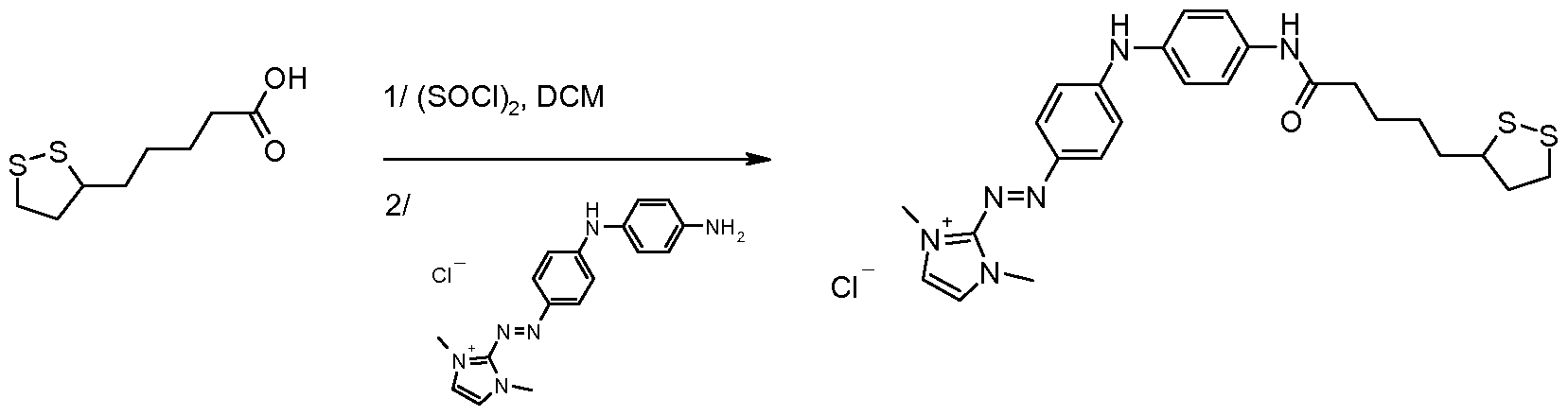
- 2,063 g of lipo ' ic acid (MW 206.33) are solubilized in 10 ml of DCM and cooled in a bath of ice and acetone. 1 ,13 g of thionyl chloride (MW 1 18,97) are added drop wise over 30 min at -8°C. The reaction mixture is stirred at room temperature for one hour.
- reaction mixture is then let warm up to room temperature, is diluted with 50 ml of dichloromethane and extracted with 50 ml aqueous HCI 5%.
- the organic phase is dried with sodium sulphate and evaporated to dryness giving 2.9 g of the expected compound 9.
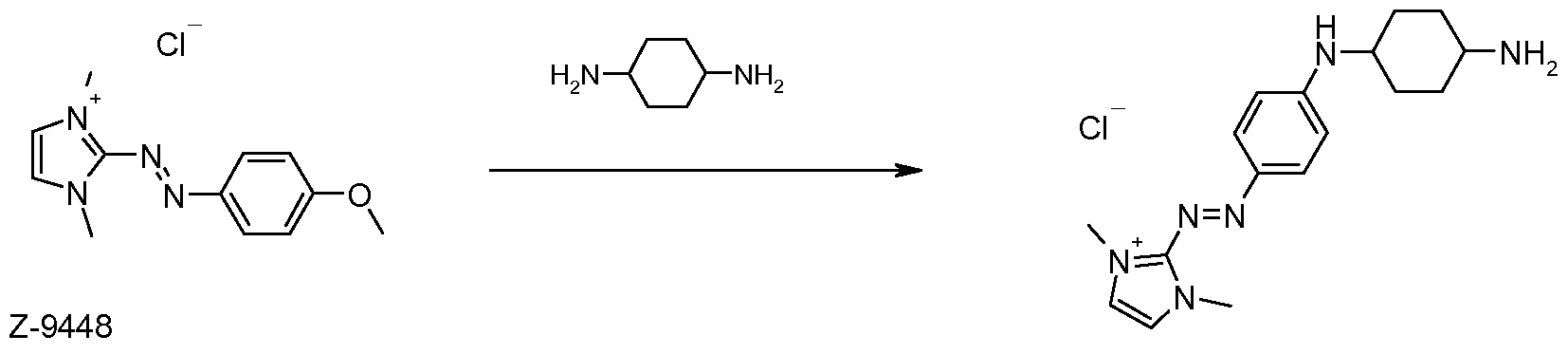
- 1 ,4 g of 4-amino-1 ,2-dimethyl-quinolinium (MW 284.43) are solubilised in 15 ml of formic acid and 20 ml of acetic acid.
- 1 ,4 g of nitric sulphuric acid 40% (MW 127.1 ) are added drop wise at 0 to 5°C within 5 minutes. After 2h diazotation at 0°C, the reaction mixture is dark yellow. This solution is added slowly to a solution of 1 ,76 g of compound 9 in 30 ml NMP at 0° C and is let stirring at this temperature for 2 hours. 15 ml of sodium hydroxide 4N are then added and left over night. The dark blue suspension is filtered and washed with water/methanol (1/1 ).
- the mixture is purified by filtration on silica gel (eluant THF/methanol 1/5).
- Solution 1 permanent lotion, pH 8.2
- 0.2 % (abs.) of the dye A1 is dissolved in a 5 % solution of a non-ionic surfactant (Planta- care 200UP, Henkel) adjusted to pH 9.5 using citric acid and monoethanolamine.
- a non-ionic surfactant Planta- care 200UP, Henkel
- This red dyeing solution is applied on the dry hair (two blond, two damaged and two 90% gray hair strands) and allowed to stand for 20 min. at room temperature. Then, the strands are rinsed under tap water and dried 12 hours.
- Solution 1 (permanent lotion) is applied on shampooed hair (two blond, two damaged and two 90% gray hair strands) and allowed to stand for 10 min. Then, the strands are rinsed under tap water, and the towel dry strands are treated with the 0.2%, by weight coloring material solution of example B1 allowed to stand for 20 min and then rinsed. Then, the towel dry strands are treated with the solution 2 (permanent fixation) and allowed to stand for 10 min. Then the strands are rinsed under tap water and dried 12 hours at room tem- perature.
- 0.1 % (abs.) of the dye A2 is dissolved in a 5 % solution of a non-ionic surfactant (Planta- care 200UP, Henkel) adjusted to pH 9.5 using citric acid and monoethanolamine.
- a non-ionic surfactant Planta- care 200UP, Henkel
- This red dyeing solution is applied on the dry hair (two blond, two middle blond, two damaged and two 90% gray hair strands) and allowed to stand for 20 min. at room temperature. Then, the strands are rinsed under tap water and dried 12 hours.
- Solution 1 (permanent lotion) is applied on shampooed hair (two blond, two middle blond, two damaged and two 90% gray hair strands) and allowed to stand for 10 min. Then, the strands are rinsed under tap water, and the towel dry strands are treated with the 0.2%, by weight coloring material solution of example B1 allowed to stand for 20 min and then rinsed. Then, the towel dry strands are treated with the solution 2 (permanent fixation) and allowed to stand for 10 min. Then the strands are rinsed under tap water and dried 12 hours at room temperature. dE *
- a paper web composed of bleached beech sulfite pulp (22 DEG SR) is produced on a continuously operating laboratory paper-making machine.
- An aqueous solution of the dye ac- cording to Example A2 is metered continuously into the low-density pulp 10 seconds upstream of the head box, with vigorous turbulence (0.5 percent dyeing, liquor ratio 400: 1 , hardness of water 10 DEG German hardness, pH 6, temperature 20 DEG).
- a deep magenta coloration of medium intensity is formed on the paper web. The effluent is completely colorless.
- the dye liquor is completely exhausted.
- a deep red coloration distinguished by good fastness to light and very good fastness to wet processing is formed on the cotton fabric.
- a textile fabric composed of regenerated (viscose) is dyed by the same procedure.
- a deep red dyeing which has good fastness to light and very good fastness to wet processing is also obtained on this material by means of the dye of Example A1.
Landscapes
- Chemical & Material Sciences (AREA)
- Life Sciences & Earth Sciences (AREA)
- Organic Chemistry (AREA)
- Health & Medical Sciences (AREA)
- Public Health (AREA)
- General Health & Medical Sciences (AREA)
- Animal Behavior & Ethology (AREA)
- Veterinary Medicine (AREA)
- Birds (AREA)
- Epidemiology (AREA)
- Engineering & Computer Science (AREA)
- Wood Science & Technology (AREA)
- Materials Engineering (AREA)
- Cosmetics (AREA)
- Coloring (AREA)
Abstract
Description





Claims


Priority Applications (6)
| Application Number | Priority Date | Filing Date | Title |
|---|---|---|---|
| KR1020137031605A KR102052423B1 (en) | 2011-05-03 | 2012-05-02 | Disulfide dyes |
| JP2014508908A JP5925879B2 (en) | 2011-05-03 | 2012-05-02 | Disulfide dye |
| CN201280027370.3A CN103582680B (en) | 2011-05-03 | 2012-05-02 | Disulfide dyes |
| US14/114,783 US8992633B2 (en) | 2011-05-03 | 2012-05-02 | Disulfide dyes |
| BR112013028030-1A BR112013028030B1 (en) | 2011-05-03 | 2012-05-02 | compound, method for dyeing human keratin fibers, and dyeing composition |
| EP12779423.8A EP2705094B1 (en) | 2011-05-03 | 2012-05-02 | Disulfide dyes |
Applications Claiming Priority (4)
| Application Number | Priority Date | Filing Date | Title |
|---|---|---|---|
| US201161481760P | 2011-05-03 | 2011-05-03 | |
| EP11164596 | 2011-05-03 | ||
| EP11164596.6 | 2011-05-03 | ||
| US61/481,760 | 2011-05-03 |
Publications (1)
| Publication Number | Publication Date |
|---|---|
| WO2012150549A1 true WO2012150549A1 (en) | 2012-11-08 |
Family
ID=44567830
Family Applications (1)
| Application Number | Title | Priority Date | Filing Date |
|---|---|---|---|
| PCT/IB2012/052178 Ceased WO2012150549A1 (en) | 2011-05-03 | 2012-05-02 | Disulfide dyes |
Country Status (7)
| Country | Link |
|---|---|
| US (1) | US8992633B2 (en) |
| EP (1) | EP2705094B1 (en) |
| JP (2) | JP5925879B2 (en) |
| KR (1) | KR102052423B1 (en) |
| CN (1) | CN103582680B (en) |
| BR (1) | BR112013028030B1 (en) |
| WO (1) | WO2012150549A1 (en) |
Cited By (4)
| Publication number | Priority date | Publication date | Assignee | Title |
|---|---|---|---|---|
| WO2016146813A1 (en) | 2015-03-19 | 2016-09-22 | Basf Se | Cationic direct dyes |
| WO2017093558A1 (en) * | 2015-12-03 | 2017-06-08 | L'oreal | Novel anionic dyes containing a disulfide heterocyclic unit, dyecomposition comprising them and process for dyeing human keratin materials using these dyes |
| WO2020048944A1 (en) * | 2018-09-04 | 2020-03-12 | Archroma Ip Gmbh | Method for dyeing a protein substrate |
| CN112391856A (en) * | 2020-10-27 | 2021-02-23 | 武汉纺织大学 | Method for resist dyeing of nylon fiber and protein powder |
Families Citing this family (7)
| Publication number | Priority date | Publication date | Assignee | Title |
|---|---|---|---|---|
| RU2680068C2 (en) | 2013-09-02 | 2019-02-14 | Л'Ореаль | Method for dyeing keratin fibres using cationic styryl disulphide dyes, and composition including said dyes |
| CN106279136B (en) * | 2016-08-15 | 2019-06-21 | 中山大学 | Compounds for the treatment of degenerative diseases of the central nervous system or brain tumors and uses thereof |
| GB201616657D0 (en) * | 2016-09-30 | 2016-11-16 | Innospec Ltd | Methods, compositions and uses relating thereto |
| GB201616652D0 (en) * | 2016-09-30 | 2016-11-16 | Innospec Ltd | Methods, compositions and uses relating thereto |
| AU2018244463B2 (en) * | 2017-03-30 | 2024-04-04 | The Board Of Regents Of The University Of Texas System | Quinoline derived small molecule inhibitors of nicotinamide N-methyltransferase (NNMT) and uses thereof |
| CN111910452A (en) * | 2020-08-03 | 2020-11-10 | 江苏阳光股份有限公司 | Pretreatment process for dyeing wool fabric by using acid dye and dyeing process |
| WO2022069091A1 (en) * | 2020-09-29 | 2022-04-07 | ADLER-Werk Lackfabrik Johann Berghofer GmbH & Co. KG | Reducing stain agent |
Citations (24)
| Publication number | Priority date | Publication date | Assignee | Title |
|---|---|---|---|---|
| FR2586913A1 (en) | 1985-09-10 | 1987-03-13 | Oreal | PROCESS FOR FORMING IN IN SITU A COMPOSITION CONSISTING OF TWO PARTS CONDITIONED SEPARATELY AND DISPENSING ASSEMBLY FOR IMPLEMENTING SAID METHOD |
| WO1995001772A1 (en) | 1993-07-05 | 1995-01-19 | Ciba-Geigy Ag | Process for dyeing keratin-containing fibres |
| DE19713698C1 (en) | 1997-04-03 | 1998-06-04 | Goldwell Gmbh | Dyeing and perming hair |
| EP0850636A1 (en) | 1996-12-23 | 1998-07-01 | L'oreal | Composition for the oxidative dyeing of keratinic fibres and dyeing process using this composition |
| EP0850638A1 (en) | 1996-12-23 | 1998-07-01 | L'oreal | Oxidative dye composition for keratinic fibres and dyeing process using this composition |
| EP0850637A1 (en) | 1996-12-23 | 1998-07-01 | L'oreal | Composition for the oxidative dyeing of keratinic fibres and dyeing process using this composition |
| DE19717224A1 (en) | 1997-04-24 | 1998-10-29 | Henkel Kgaa | Use of unsaturated aldehydes for dyeing keratin fibers |
| WO1999020235A1 (en) | 1997-10-22 | 1999-04-29 | L'oreal | Composition for dyeing keratin fibres and dyeing method using same |
| WO1999020234A1 (en) | 1997-10-22 | 1999-04-29 | L'oreal | Dyeing composition for keratin fibres and dyeing method using same |
| WO1999048856A1 (en) | 1998-03-20 | 1999-09-30 | L'oreal | Oxidation dyeing compositions containing a cationic coupling agent, novel cationic coupling agents |
| EP0970685A1 (en) | 1998-07-09 | 2000-01-12 | L'oreal | Composition for dyeing keratinous fibres containing a cationic direct dye and a thickening polymer |
| EP0998908A2 (en) | 1998-11-04 | 2000-05-10 | L'oreal | Dyeing composition containing a cattonic and an oxidativ dye based an pyrazolo-(1,5)-pyramidine and dyeing process |
| FR2788432A1 (en) | 1999-01-19 | 2000-07-21 | Oreal | USE FOR DIRECT DYING OF KERATINIC FIBERS FROM A COMBINATION OF TWO CATIONIC DYES |
| US6190421B1 (en) | 1996-04-25 | 2001-02-20 | L'oreal | Method for dyeing keratin fibres with oxidation dye precursors and direct powder dyes |
| US6228129B1 (en) | 1997-10-03 | 2001-05-08 | L'oreal S.A. | Oxidation dyeing composition for keratin fibres and dyeing method using said composition |
| DE19959479A1 (en) | 1999-12-10 | 2001-07-05 | Wella Ag | Partial and complete dying of human hair comprises an oxidation step and a dyeing step |
| EP1166752A2 (en) | 2000-06-23 | 2002-01-02 | GOLDWELL GmbH | Hair dyeing composition |
| US6368360B2 (en) | 1995-12-01 | 2002-04-09 | L'oreal S.A. | Method for dyeing keratin fibres with a dye composition containing at least one direct dye and a least one basifying agent |
| EP1219683A2 (en) | 1994-11-03 | 2002-07-03 | Ciba SC Holding AG | Cationic imidazolazo dyestuffs |
| WO2004019897A1 (en) | 2002-09-02 | 2004-03-11 | Ciba Specialty Chemicals Holding Inc. | Method of colouring porous material |
| US6843256B2 (en) | 2000-03-09 | 2005-01-18 | Ciba Specialty Chemicals Corporation | Method of coloring hair using cationic dyes |
| CN1853605A (en) * | 2004-10-14 | 2006-11-01 | 莱雅公司 | Dyeing composition containing specific disulfide dye and its dyeing method |
| CN1997340A (en) * | 2004-04-08 | 2007-07-11 | 西巴特殊化学制品控股公司 | Disulfide dyes, compositions containing them and methods of dyeing |
| WO2011054966A2 (en) * | 2009-11-09 | 2011-05-12 | L'oreal | New dyes with heterocyclic disulphide unit, colouring composition comprising them, and method for dyeing human keratinous fibres on the basis of these dyes |
Family Cites Families (12)
| Publication number | Priority date | Publication date | Assignee | Title |
|---|---|---|---|---|
| TW206224B (en) * | 1989-12-14 | 1993-05-21 | Takeda Pharm Industry Co Ltd | |
| JP3278687B2 (en) * | 1999-03-18 | 2002-04-30 | 独立行政法人産業技術総合研究所 | Disulfide derivative compound and self-assembled film comprising the same |
| US7488354B2 (en) * | 2004-10-14 | 2009-02-10 | L'oreal S.A. | Dyeing composition comprising at least one disulphide dye and method of dyeing human keratin fibers using this dye |
| ES2402575T3 (en) * | 2005-10-06 | 2013-05-06 | Basf Se | Triarylmethane dyes |
| FR2898903B1 (en) * | 2006-03-24 | 2012-08-31 | Oreal | DYEING COMPOSITION COMPRISING A FLUORESCENT DISULFIDE DYE, METHOD OF LIGHTENING KERATINIC MATERIALS FROM THAT COLORANT |
| DE102006038449A1 (en) * | 2006-06-08 | 2007-12-13 | Henkel Kgaa | Oxidative hair treatment with reduced hair damage |
| FR2919179B1 (en) * | 2007-07-24 | 2010-02-19 | Oreal | CAPILLARY COMPOSITION COMPRISING AT LEAST ONE DIRECT DISULFIDE DYE AND AT LEAST ONE ALKALINE HYDROXIDE AGENT AND METHOD FOR SIMULTANEOUS SHAPING AND COLORING. |
| FR2921381B1 (en) * | 2007-09-21 | 2009-10-30 | Oreal | HEMICYANINE STYRYLE THIOL / DISULFIDE DYE, TINCTORIAL COMPOSITION COMPRISING THE DYE, METHOD OF CLEANING KERATINIC MATERIALS FROM THAT COLORANT |
| FR2921256B1 (en) * | 2007-09-24 | 2009-12-04 | Oreal | COMPOSITION FOR COLORING KERATINIC FIBERS COMPRISING AT LEAST ONE DIRECT DYE WITH DISULFURE / THIOL FUNCTION AND AT LEAST ONE THIOL-FUNCTIONAL POLYMER AND PROCESS USING THE COMPOSITION |
| FR2928087B1 (en) * | 2008-02-29 | 2010-02-26 | Oreal | COMPOSITION FOR COLORING KERATIN FIBERS COMPRISING AT LEAST ONE DIRECT DYE WITH PROTECTED DISULFIDE / THIOL FUNCTION AND AT LEAST ONE THIOL FUNCTIONED SILICY COMPOUND AND PROCESS USING THE COMPOSITION. |
| JP5211362B2 (en) * | 2009-03-05 | 2013-06-12 | 国立大学法人 奈良先端科学技術大学院大学 | Azo compound having linker and metal ion recovery method using the azo compound |
| US8641783B2 (en) | 2010-08-17 | 2014-02-04 | Basf Se | Disulfide or thiol polymeric hair dyes |
-
2012
- 2012-05-02 BR BR112013028030-1A patent/BR112013028030B1/en active IP Right Grant
- 2012-05-02 CN CN201280027370.3A patent/CN103582680B/en active Active
- 2012-05-02 EP EP12779423.8A patent/EP2705094B1/en active Active
- 2012-05-02 WO PCT/IB2012/052178 patent/WO2012150549A1/en not_active Ceased
- 2012-05-02 KR KR1020137031605A patent/KR102052423B1/en active Active
- 2012-05-02 US US14/114,783 patent/US8992633B2/en not_active Expired - Fee Related
- 2012-05-02 JP JP2014508908A patent/JP5925879B2/en active Active
-
2016
- 2016-04-20 JP JP2016084244A patent/JP2016183340A/en active Pending
Patent Citations (24)
| Publication number | Priority date | Publication date | Assignee | Title |
|---|---|---|---|---|
| FR2586913A1 (en) | 1985-09-10 | 1987-03-13 | Oreal | PROCESS FOR FORMING IN IN SITU A COMPOSITION CONSISTING OF TWO PARTS CONDITIONED SEPARATELY AND DISPENSING ASSEMBLY FOR IMPLEMENTING SAID METHOD |
| WO1995001772A1 (en) | 1993-07-05 | 1995-01-19 | Ciba-Geigy Ag | Process for dyeing keratin-containing fibres |
| EP1219683A2 (en) | 1994-11-03 | 2002-07-03 | Ciba SC Holding AG | Cationic imidazolazo dyestuffs |
| US6368360B2 (en) | 1995-12-01 | 2002-04-09 | L'oreal S.A. | Method for dyeing keratin fibres with a dye composition containing at least one direct dye and a least one basifying agent |
| US6190421B1 (en) | 1996-04-25 | 2001-02-20 | L'oreal | Method for dyeing keratin fibres with oxidation dye precursors and direct powder dyes |
| EP0850636A1 (en) | 1996-12-23 | 1998-07-01 | L'oreal | Composition for the oxidative dyeing of keratinic fibres and dyeing process using this composition |
| EP0850638A1 (en) | 1996-12-23 | 1998-07-01 | L'oreal | Oxidative dye composition for keratinic fibres and dyeing process using this composition |
| EP0850637A1 (en) | 1996-12-23 | 1998-07-01 | L'oreal | Composition for the oxidative dyeing of keratinic fibres and dyeing process using this composition |
| DE19713698C1 (en) | 1997-04-03 | 1998-06-04 | Goldwell Gmbh | Dyeing and perming hair |
| DE19717224A1 (en) | 1997-04-24 | 1998-10-29 | Henkel Kgaa | Use of unsaturated aldehydes for dyeing keratin fibers |
| US6228129B1 (en) | 1997-10-03 | 2001-05-08 | L'oreal S.A. | Oxidation dyeing composition for keratin fibres and dyeing method using said composition |
| WO1999020234A1 (en) | 1997-10-22 | 1999-04-29 | L'oreal | Dyeing composition for keratin fibres and dyeing method using same |
| WO1999020235A1 (en) | 1997-10-22 | 1999-04-29 | L'oreal | Composition for dyeing keratin fibres and dyeing method using same |
| WO1999048856A1 (en) | 1998-03-20 | 1999-09-30 | L'oreal | Oxidation dyeing compositions containing a cationic coupling agent, novel cationic coupling agents |
| EP0970685A1 (en) | 1998-07-09 | 2000-01-12 | L'oreal | Composition for dyeing keratinous fibres containing a cationic direct dye and a thickening polymer |
| EP0998908A2 (en) | 1998-11-04 | 2000-05-10 | L'oreal | Dyeing composition containing a cattonic and an oxidativ dye based an pyrazolo-(1,5)-pyramidine and dyeing process |
| FR2788432A1 (en) | 1999-01-19 | 2000-07-21 | Oreal | USE FOR DIRECT DYING OF KERATINIC FIBERS FROM A COMBINATION OF TWO CATIONIC DYES |
| DE19959479A1 (en) | 1999-12-10 | 2001-07-05 | Wella Ag | Partial and complete dying of human hair comprises an oxidation step and a dyeing step |
| US6843256B2 (en) | 2000-03-09 | 2005-01-18 | Ciba Specialty Chemicals Corporation | Method of coloring hair using cationic dyes |
| EP1166752A2 (en) | 2000-06-23 | 2002-01-02 | GOLDWELL GmbH | Hair dyeing composition |
| WO2004019897A1 (en) | 2002-09-02 | 2004-03-11 | Ciba Specialty Chemicals Holding Inc. | Method of colouring porous material |
| CN1997340A (en) * | 2004-04-08 | 2007-07-11 | 西巴特殊化学制品控股公司 | Disulfide dyes, compositions containing them and methods of dyeing |
| CN1853605A (en) * | 2004-10-14 | 2006-11-01 | 莱雅公司 | Dyeing composition containing specific disulfide dye and its dyeing method |
| WO2011054966A2 (en) * | 2009-11-09 | 2011-05-12 | L'oreal | New dyes with heterocyclic disulphide unit, colouring composition comprising them, and method for dyeing human keratinous fibres on the basis of these dyes |
Non-Patent Citations (5)
| Title |
|---|
| "Europaisches Inventar der Kosmetikrohstoffe", 1996, THE EUROPEAN COMMISSION |
| CH. ZVIAK: "The Science of Hair Care", vol. 7, 1986, VERLAG MARCEL DEKKER INC., article "Dermatology", pages: 248 - 250 |
| CH. ZVIAK: "The Science of Hair Care", vol. 7, 1986, VERLAG MARCEL DEKKER INC., article "Dermatology", pages: 264 - 267 |
| R. S. ASQUITH; P. CARTHEW; T. T. FRANCIS, JSDC, May 1973 (1973-05-01), pages 168 - 172 |
| See also references of EP2705094A4 |
Cited By (7)
| Publication number | Priority date | Publication date | Assignee | Title |
|---|---|---|---|---|
| WO2016146813A1 (en) | 2015-03-19 | 2016-09-22 | Basf Se | Cationic direct dyes |
| US10494527B2 (en) | 2015-03-19 | 2019-12-03 | Basf Se | Cationic direct dyes |
| WO2017093558A1 (en) * | 2015-12-03 | 2017-06-08 | L'oreal | Novel anionic dyes containing a disulfide heterocyclic unit, dyecomposition comprising them and process for dyeing human keratin materials using these dyes |
| FR3044661A1 (en) * | 2015-12-03 | 2017-06-09 | Oreal | NOVEL ANIONIC COLORANTS HETEROCYCLIC DISULFIDE PATTERN, DYE COMPOSITION COMPRISING SAME, AND METHOD FOR COLORING HUMAN KERATINIC MATERIALS FROM THESE DYES |
| WO2020048944A1 (en) * | 2018-09-04 | 2020-03-12 | Archroma Ip Gmbh | Method for dyeing a protein substrate |
| CN112391856A (en) * | 2020-10-27 | 2021-02-23 | 武汉纺织大学 | Method for resist dyeing of nylon fiber and protein powder |
| CN112391856B (en) * | 2020-10-27 | 2022-06-03 | 武汉纺织大学 | Method for resist dyeing of nylon fiber and protein powder |
Also Published As
| Publication number | Publication date |
|---|---|
| CN103582680B (en) | 2016-04-06 |
| BR112013028030B1 (en) | 2021-01-05 |
| KR102052423B1 (en) | 2019-12-05 |
| US20140157529A1 (en) | 2014-06-12 |
| EP2705094B1 (en) | 2021-12-15 |
| EP2705094A1 (en) | 2014-03-12 |
| JP5925879B2 (en) | 2016-05-25 |
| KR20140027358A (en) | 2014-03-06 |
| JP2016183340A (en) | 2016-10-20 |
| CN103582680A (en) | 2014-02-12 |
| JP2014514420A (en) | 2014-06-19 |
| EP2705094A4 (en) | 2015-09-23 |
| BR112013028030A2 (en) | 2017-01-10 |
| US8992633B2 (en) | 2015-03-31 |
Similar Documents
| Publication | Publication Date | Title |
|---|---|---|
| US8992633B2 (en) | Disulfide dyes | |
| CN1997340B (en) | Disulfide dyes, compositions containing them and methods of dyeing | |
| KR100894973B1 (en) | Cationic reactive dyes | |
| KR101341855B1 (en) | Oxazine Disulfide Dyes | |
| FR2825622A1 (en) | COMPOSITION FOR DYEING KERATINIC FIBERS COMPRISING A SPECIAL DICATION DIAZOIC DYE | |
| EP1890669A1 (en) | Cationic oligomeric azo dyes | |
| BRPI0616803B1 (en) | xanthene dyes, their preparation process, method for dyeing the fibers, and composition | |
| BRPI0615644B1 (en) | dye compounds containing a thiol group, keratin-containing fiber dyeing method, as well as composition | |
| MX2009001598A (en) | Thiol derivative dyes. | |
| MXPA05002011A (en) | Method of colouring porous material. | |
| CN101861362A (en) | Dichromophoric carbonyl or heterocyclic dyes, dye compositions containing the dyes, method for dyeing keratin materials using the dyes | |
| EP1404762B1 (en) | A method of coloring hair using cationic dyes | |
| GB2409862A (en) | Method of colouring with capped diazotised compound and coupling component | |
| ES2468224T3 (en) | Nitrosulfide dyes | |
| BRPI0612834B1 (en) | keratin-containing fiber dyeing method and hair dyeing composition | |
| JP4002883B2 (en) | Composition for dyeing keratin fibers containing diheteroylarylmethane direct dye or leuco precursor of this dye and dyeing method using the same | |
| BRPI0614033A2 (en) | pyrido-thiazinium dyes | |
| US20040231072A1 (en) | Method of colouring porous material | |
| MXPA05002010A (en) | Method of colouring porous material. |
Legal Events
| Date | Code | Title | Description |
|---|---|---|---|
| WWE | Wipo information: entry into national phase |
Ref document number: 201280027370.3 Country of ref document: CN |
|
| 121 | Ep: the epo has been informed by wipo that ep was designated in this application |
Ref document number: 12779423 Country of ref document: EP Kind code of ref document: A1 |
|
| WWE | Wipo information: entry into national phase |
Ref document number: 2012779423 Country of ref document: EP |
|
| WWE | Wipo information: entry into national phase |
Ref document number: 14114783 Country of ref document: US |
|
| ENP | Entry into the national phase |
Ref document number: 2014508908 Country of ref document: JP Kind code of ref document: A |
|
| NENP | Non-entry into the national phase |
Ref country code: DE |
|
| ENP | Entry into the national phase |
Ref document number: 20137031605 Country of ref document: KR Kind code of ref document: A |
|
| REG | Reference to national code |
Ref country code: BR Ref legal event code: B01A Ref document number: 112013028030 Country of ref document: BR |
|
| ENP | Entry into the national phase |
Ref document number: 112013028030 Country of ref document: BR Kind code of ref document: A2 Effective date: 20131030 |