WO2012150663A1 - 改良された糖被覆リポソーム組成物 - Google Patents
改良された糖被覆リポソーム組成物 Download PDFInfo
- Publication number
- WO2012150663A1 WO2012150663A1 PCT/JP2012/002958 JP2012002958W WO2012150663A1 WO 2012150663 A1 WO2012150663 A1 WO 2012150663A1 JP 2012002958 W JP2012002958 W JP 2012002958W WO 2012150663 A1 WO2012150663 A1 WO 2012150663A1
- Authority
- WO
- WIPO (PCT)
- Prior art keywords
- sugar
- lipid
- antigen
- coated liposome
- coated
- Prior art date
- Legal status (The legal status is an assumption and is not a legal conclusion. Google has not performed a legal analysis and makes no representation as to the accuracy of the status listed.)
- Ceased
Links
Images


Classifications
-
- A—HUMAN NECESSITIES
- A61—MEDICAL OR VETERINARY SCIENCE; HYGIENE
- A61K—PREPARATIONS FOR MEDICAL, DENTAL OR TOILETRY PURPOSES
- A61K31/00—Medicinal preparations containing organic active ingredients
- A61K31/70—Carbohydrates; Sugars; Derivatives thereof
- A61K31/7088—Compounds having three or more nucleosides or nucleotides
-
- A—HUMAN NECESSITIES
- A61—MEDICAL OR VETERINARY SCIENCE; HYGIENE
- A61K—PREPARATIONS FOR MEDICAL, DENTAL OR TOILETRY PURPOSES
- A61K39/00—Medicinal preparations containing antigens or antibodies
- A61K39/39—Medicinal preparations containing antigens or antibodies characterised by the immunostimulating additives, e.g. chemical adjuvants
-
- A—HUMAN NECESSITIES
- A61—MEDICAL OR VETERINARY SCIENCE; HYGIENE
- A61K—PREPARATIONS FOR MEDICAL, DENTAL OR TOILETRY PURPOSES
- A61K47/00—Medicinal preparations characterised by the non-active ingredients used, e.g. carriers or inert additives; Targeting or modifying agents chemically bound to the active ingredient
- A61K47/50—Medicinal preparations characterised by the non-active ingredients used, e.g. carriers or inert additives; Targeting or modifying agents chemically bound to the active ingredient the non-active ingredient being chemically bound to the active ingredient, e.g. polymer-drug conjugates
- A61K47/69—Medicinal preparations characterised by the non-active ingredients used, e.g. carriers or inert additives; Targeting or modifying agents chemically bound to the active ingredient the non-active ingredient being chemically bound to the active ingredient, e.g. polymer-drug conjugates the conjugate being characterised by physical or galenical forms, e.g. emulsion, particle, inclusion complex, stent or kit
- A61K47/6905—Medicinal preparations characterised by the non-active ingredients used, e.g. carriers or inert additives; Targeting or modifying agents chemically bound to the active ingredient the non-active ingredient being chemically bound to the active ingredient, e.g. polymer-drug conjugates the conjugate being characterised by physical or galenical forms, e.g. emulsion, particle, inclusion complex, stent or kit the form being a colloid or an emulsion
- A61K47/6911—Medicinal preparations characterised by the non-active ingredients used, e.g. carriers or inert additives; Targeting or modifying agents chemically bound to the active ingredient the non-active ingredient being chemically bound to the active ingredient, e.g. polymer-drug conjugates the conjugate being characterised by physical or galenical forms, e.g. emulsion, particle, inclusion complex, stent or kit the form being a colloid or an emulsion the form being a liposome
-
- A—HUMAN NECESSITIES
- A61—MEDICAL OR VETERINARY SCIENCE; HYGIENE
- A61K—PREPARATIONS FOR MEDICAL, DENTAL OR TOILETRY PURPOSES
- A61K9/00—Medicinal preparations characterised by special physical form
- A61K9/10—Dispersions; Emulsions
- A61K9/127—Synthetic bilayered vehicles, e.g. liposomes or liposomes with cholesterol as the only non-phosphatidyl surfactant
- A61K9/1271—Non-conventional liposomes, e.g. PEGylated liposomes or liposomes coated or grafted with polymers
-
- A—HUMAN NECESSITIES
- A61—MEDICAL OR VETERINARY SCIENCE; HYGIENE
- A61P—SPECIFIC THERAPEUTIC ACTIVITY OF CHEMICAL COMPOUNDS OR MEDICINAL PREPARATIONS
- A61P35/00—Antineoplastic agents
-
- A—HUMAN NECESSITIES
- A61—MEDICAL OR VETERINARY SCIENCE; HYGIENE
- A61K—PREPARATIONS FOR MEDICAL, DENTAL OR TOILETRY PURPOSES
- A61K39/00—Medicinal preparations containing antigens or antibodies
- A61K2039/555—Medicinal preparations containing antigens or antibodies characterised by a specific combination antigen/adjuvant
- A61K2039/55511—Organic adjuvants
- A61K2039/55555—Liposomes; Vesicles, e.g. nanoparticles; Spheres, e.g. nanospheres; Polymers
Definitions
- the present invention relates to a sugar-coated liposome for use as a vaccine or an adjuvant and use of the liposome.
- the present invention relates to mannose-coated liposomes for use as vaccines or adjuvants in cancer treatment and use thereof.
- cancer vaccine is administered for the purpose of inducing the activity of this antigen-specific CTL, and is expected as a new therapeutic means in many intractable cancers.
- Numerous antigens such as CEA, survivin 2B, MUC-1, and WT-1 have been studied as cancer antigens used as cancer vaccines (Non-patent Document 1).
- the peptide vaccine is phagocytosed by antigen-presenting cells (dendritic cells, macrophages, etc.) in vivo, and the antigen is presented by major histocompatibility complex (MHC) molecules.
- MHC major histocompatibility complex
- CD8 + T cells that recognize antigens presented by MHC class I molecules are activated to differentiate and mature into antigen-specific CTLs.
- cytokines IL-2, IL-12, etc.
- Th cells CD4 + T cells activated by MHC class II and the epitope presented thereto. It is considered necessary (Non-Patent Document 1).
- IL-2 cytokines
- Th cells CD4 + T cells
- Non-patent document 2 when the MHC class I epitope antigen is used alone, Th cell support cannot be obtained, and IL-2 production from CD8 + CTL is weak, so many cancer cells cannot be killed in vivo.
- Non-patent document 2 the help from such CD4 + T cells is necessary for CTL induction in subhistocompatibility antigens, tumor antigens, soluble proteins, synthetic peptides, peptide-pulsed dendritic cells, and viral infections such as herpes simplex virus and influenza It has been reported that.
- tumors have a mechanism for suppressing immune function.
- cytokines such as IL-10 produced by tumors and their stromal cells are CD4 + CD25 + Foxp3 + regulatory T cells (T reg ), myeloid suppressor cells, tolerant dendritic cells and the like, which promote immunosuppression and tolerance
- T reg regulatory T cells
- myeloid suppressor cells myeloid suppressor cells
- tolerant dendritic cells tolerant dendritic cells and the like
- effector T cell anergy is induced, and tumor immune response is negatively controlled with the intratumoral immune environment as the main Th2. From this, in tumor vaccine therapy and cancer cell therapy, it has been reported that induction and activation of anti-tumor immunity is insufficient only by induction or transfer of tumor destructive CD8 + T cells (Non-patent Document 4). ).
- Non-patent Document 5 a cancer vaccine using CD8 + cell recognition antigen peptide (MHC class I antigen) was administered to 323 cancer metastasis patients every 3 weeks. No (non-patent document 6).
- TLR Toll-like receptor
- TLR9 Toll-like receptor 3 and TLR9 ligands induce CTL without the help of CD4 + T cells and stimulate their proliferation.
- antigen-specific CTL can be obtained by administering to a mouse a CTL peptide comprising the amino acid sequence of 257 to 264th of 10-30 ⁇ g of ovalbumin (OVA) in combination with 25 ⁇ g of poly (I: C) or CpG-B.
- OVA ovalbumin
- I: C poly
- CpG-B poly
- This CD4 + T cell-independent CTL induction is independent of enhanced expression of MHC class I molecules and CD86 in dendritic cells and enhanced production of IL-12, but is associated with interferon ⁇ / ⁇ production (Non-Patent Document 3).
- IFN- ⁇ interferon ⁇
- IFN- ⁇ interferon ⁇
- Mannotriose-coated liposomes are rapidly taken up by peritoneal macrophages (PEMs), which mature the macrophages to express the costimulatory molecules CD40, CD80 and CD86 and MHC class II molecules on their surface, It has been reported to produce IL-12.
- PEMs peritoneal macrophages
- IL-1 and IL-6 are not observed, so that it is reported that the reaction is different from the reaction by TLR ligand (Non-patent Document 13).
- Non-patent Document 13 spleen cells of mice sensitized with Man3-Lipo embedded with OVA produce IFN- ⁇ , a Th1 cytokine, by resensitization with OVA.
- spleen cells of mice sensitized with Leishmania antigen-embedded Man3-Lipo and Man5-Lipo produce IFN- ⁇ , an antigen-specific Th1 cytokine, by resensitization with the antigen. It has been reported that production of IL-4 and IL-5, which are Th2 cytokines, is suppressed (Non-patent Document 14).
- JP 7-126185 A International Publication No. WO2006 / 104199
- an object of the present invention is to provide a preparation having an effect of further promoting cellular immunity in use as an adjuvant.
- sugar-coated liposomes are known to promote antigen presentation to both MHC class I and MHC class II and to induce the production of Th1 cytokines such as IFN- ⁇ and IL-12. It was. However, as described above, it is known that IFN- ⁇ and IL-12 are unrelated to CD4 + -independent CTL induction using MHC class I alone, and MHC class I epitope alone (MHC class II epitope) It was completely unknown whether sugar-coated liposomes could induce CTLs in the absence of). In particular, since sugar is not a ligand for TLR3 or TLR9, the possibility of CD4 + -independent CTL induction via the above-mentioned TLR was not considered.
- the amount of antigen currently used in cancer immunotherapy is about 0.1 to 10 mg for humans and several tens of ⁇ g for mice. It was.
- the present inventors have determined that MHC class II molecule-independent (CD4 + T) by administering sugar-coated liposomes (particularly mannose-coated liposomes) together with antigens. It was found that CTLs can be activated in a cell-independent manner.
- the present inventors examined the amount of the antigen peptide vaccine necessary for the activation of cellular immunity using a mouse model. As a result, by using the sugar-coated liposome of the present invention, the antigen amount was 0.1. It has been found that a sufficient cancer therapeutic effect can be obtained at ⁇ 10 ng (antigen amount in terms of human being is about 0.5 ng to 30 ⁇ g).
- sugar-coated liposomes that have been conventionally sized with a filter of about 1 ⁇ m have been used (for example, Naoya Kojima et al., Journal of Controlled Release, Vol. 129: pp. 26-32 (2008); Takagi et al., Cytokine, Vol.40, pp.241-250 (2007); Y. Shimizu et al., Parasite Immunology, Vol.29; Yuzuru Ikehara et al., Cancer Res., Vol.66, No.17: pp. 8740-8748 (2006). )).
- the liposomes have higher aggregation properties as the particle size increases.
- Liposomes have been found to be highly capable of inducing an immune response to cellular immunity by significantly increasing IL-12 production and decreasing IL-6 production. The inventors have also found that the ability to induce an immune response to cellular immunity is sufficiently high if there is a particle size of at least 1000 nm.
- the present inventors have found that the ratio of the sugar-modified lipid to the unmodified lipid is high, and the CTL inducing ability of the liposome is high. I found.
- the present invention provides a sugar-coated liposome that activates CTL with a small amount of antigen to promote cellular immunity.
- the present invention relates to the following (1) to (27).
- (1) A sugar-coated liposome for use with an MHC class I molecule-binding peptide or a nucleic acid encoding the peptide.
- (2) The sugar-coated liposome according to (1), which can induce and / or proliferate antigen-specific CTL independent of MHC class II molecules.
- the tumor antigen is a peptide antigen comprising the 80th to 88th amino acid sequences of survivin 2B.
- a sugar-coated liposome wherein the molar ratio of sugar-modified lipid to unmodified lipid is 0.00075 or more.
- a pharmaceutical composition comprising the liposome according to any one of (1) to (24) as an active ingredient.
- the molar ratio of sugar coating amount to unmodified lipid is 0.00075 to 0.075, 0.0025 to 0.075, or 0.0075 to 0.025.
- Sugar-coated liposomes that are ⁇ 800 nm, 250-800 nm, 300-800 nm, 180 nm-500 nm, 250-500 nm, or 300-500 nm.
- the sugar-coated liposome according to any one of the following (a) to (r): (A) A sugar-coated liposome having a molar ratio of sugar coating to unmodified lipid (sugar-modified lipid / unmodified lipid) of 0.00075 to 0.075 and a particle size of 100 to 1000 nm. (B) A sugar-coated liposome having a sugar coating amount of 0.00075 to 0.075 in a molar ratio (sugar-modified lipid / non-modified lipid) to an unmodified lipid, and a particle size of 180 to 700 nm.
- a sugar-coated liposome having a molar ratio of sugar coating to unmodified lipid (sugar-modified lipid / unmodified lipid) of 0.00075 to 0.075 and a particle size of 300 to 600 nm.
- D A sugar-coated liposome having a molar ratio of sugar coating to unmodified lipid (sugar-modified lipid / unmodified lipid) of 0.00075 to 0.075 and a particle size of 450 to 600 nm.
- a sugar-coated liposome having a molar ratio of sugar coating to unmodified lipid (sugar-modified lipid / unmodified lipid) of 0.00075 to 0.075 and a particle size of 180 to 1100 nm.
- a sugar-coated liposome having a molar ratio of sugar coating to unmodified lipid (sugar-modified lipid / unmodified lipid) of 0.00075 to 0.075 and a particle size of 250 to 1100 nm.
- a sugar-coated liposome having a molar ratio of sugar coating to unmodified lipid (sugar-modified lipid / unmodified lipid) of 0.00075 to 0.075 and a particle size of 180 to 800 nm.
- H A sugar-coated liposome having a molar ratio of sugar coating to unmodified lipid (sugar-modified lipid / unmodified lipid) of 0.00075 to 0.075 and a particle size of 250 to 800 nm.
- a sugar-coated liposome having a molar ratio of sugar coating to unmodified lipid (sugar-modified lipid / unmodified lipid) of 0.00075 to 0.075 and a particle size of 300 to 500 nm.
- (M) A sugar-coated liposome having a molar ratio of sugar coating to unmodified lipid (sugar-modified lipid / unmodified lipid) of 0.00075 to 0.075 and a particle size of 450 to 600 nm.
- (N) A sugar-coated liposome having a molar ratio of sugar coating to unmodified lipid (sugar-modified lipid / unmodified lipid) of 0.0075 to 0.025 and a particle size of 180 to 1100 nm.
- a sugar-coated liposome having a molar ratio of sugar coating to unmodified lipid (sugar-modified lipid / unmodified lipid) of 0.0075 to 0.025 and a particle size of 250 to 800 nm.
- R A sugar-coated liposome having a molar ratio of sugar coating to unmodified lipid (sugar-modified lipid / unmodified lipid) of 0.0075 to 0.025 and a particle size of 300 to 500 nm.
- the present invention relates to a method for treating cancer, comprising administering the sugar-coated liposome of the present invention.
- the “MHC class I molecule-binding peptide” means a peptide presented by an MHC class I molecule after being taken up by an antigen-presenting cell. Whether or not a certain peptide is an MHC class I molecule-binding peptide is determined by, for example, taking a peptide fragment of interest into an antigen-presenting cell and bringing it into contact with a T cell, and then a cytokine produced or an activated CTL Can be determined as an index. When a CTL that produces Th1 cytokines such as IFN- ⁇ and IL-12 and / or recognizes the peptide is activated, the peptide is an MHC class I molecule binding peptide.
- a MHC class I molecule binding peptide when acquiring a MHC class I molecule binding peptide, it can obtain by peptide mapping. That is, a peptide fragment predicted to be cleaved by the proteasome is taken into an antigen-presenting cell and contacted with a T cell, and finally the IFN- ⁇ is produced using a cytokine produced or activated CTL as an index. Can be obtained by producing Th1 cytokines such as IL-12 and / or narrowing down to 7-10 amino acids that activate CTLs that recognize the peptides.
- Th1 cytokines such as IL-12 and / or narrowing down to 7-10 amino acids that activate CTLs that recognize the peptides.
- nucleic acid encoding an MHC class I molecule-binding peptide refers to a nucleic acid that is translated in vivo to give an MHC class I molecule-binding peptide.
- it may have a region necessary for transcription and translation of the nucleic acid.
- the nucleic acid encoding the MHC class I molecule-binding peptide is a nucleic acid that is taken up by the antigen-presenting cell and gives the MHC class I molecule-binding peptide in the cell.
- the MHC class I molecule is preferably compatible with the human leukocyte antigen (HLA) allele (HLA haplotype) to be administered. That is, it is preferable to use an HLA haplotype-restricted MHC class I molecule-binding peptide to be administered or a nucleic acid encoding the peptide.
- HLA haplotype-restricted MHC class I molecule-binding peptide to be administered or a nucleic acid encoding the peptide.
- the MHC class I molecule-binding peptide in the present specification may contain an artificially modified amino acid in addition to a naturally occurring amino acid. Further, for example, the number of amino acids of the MHC class I molecule-binding peptide is preferably 7 to 10 amino acids.
- the MHC class I molecule-binding peptide of the present invention comprises: a subhistocompatible antigen; a tumor-specific antigen; a soluble protein; an antigen of a virus such as herpes simplex virus or influenza virus; a parasite such as Leishmania, Toxoplasma or malaria
- a peptide having a partial amino acid sequence of a fungal antigen such as Candida, Aspergillus, and Cryptococcus
- a bacterial antigen such as Mycoplasma and Streptococcus, and capable of binding to an MHC class I molecule.
- Tumor-specific antigens include hepatitis B virus, SV40 / polyomavirus, human papillomavirus (eg, E6 and E7 proteins), human adenovirus type 5, human herpes virus type 8, and shope fibroma virus Antigens derived from tumor virus proteins such as Rous sarcoma virus and human T cell leukemia virus; antigens derived from proteins specifically expressed in cancer cells such as ras, p53, survivin 2B, CEA, MUC-1, and WT-1. included.
- human papillomavirus eg, E6 and E7 proteins
- human adenovirus type 5 human herpes virus type 8
- shope fibroma virus Antigens derived from tumor virus proteins such as Rous sarcoma virus and human T cell leukemia virus
- antigens derived from proteins specifically expressed in cancer cells such as ras, p53, survivin 2B, CEA, MUC-1, and WT
- survivin 2B-derived antigen examples include a peptide consisting of the amino acid sequence of survivin 2B80-88 peptide antigen (Ala-Tyr-Ala-Cys-Asn-Thr-Ser-Thr-Leu: SEQ ID NO: 2). This peptide is particularly effective for patients exhibiting the HLA-A24 HLA haplotype.
- nucleic acids encoding MHC class I molecule-binding peptides include minor histocompatibility antigens; tumor specific antigens (hepatitis B virus, SV40 / polyoma virus, human papillomavirus (eg, E6 and E7 proteins), Antigens derived from tumor virus proteins such as human adenovirus type 5, human herpesvirus type 8, shope fibromas virus, rous sarcoma virus, human T cell leukemia virus; ras, p53, survivin 2B, CEA, MUC-1 Antigens derived from proteins specifically expressed in cancer cells such as WT-1); soluble proteins; antigens of viruses such as herpes simplex virus and influenza virus; antigens of parasites such as leishmania, toxoplasma and malaria; True aspergillus, cryptococcus, etc.
- tumor specific antigens hepatitis B virus, SV40 / polyoma virus, human papillomavirus (
- S antigen including mycoplasma
- a nucleic acid encoding a peptide capable of binding to MHC class I molecules have the amino acid sequence of part or all of an antigen of bacteria such as Streptococcus.
- the nucleic acid encoding the MHC class I molecule-binding peptide is the nucleic acid encoding survivin 2B80-88 peptide, it can be GCTTACCGCCTGTAATACCAGCACTTTG (SEQ ID NO: 1).
- the MHC class I molecule-binding peptide of the present invention comprises: subhistocompatibility antigen; tumor specific antigen; soluble protein; antigen of virus such as herpes simplex virus, influenza virus; antigen of parasite such as leishmania, toxoplasma, malaria A fungal antigen such as Candida, Aspergillus, Cryptococcus, etc .; a peptide in which an amino acid is added / inserted or substituted into an amino acid sequence derived from a naturally occurring antigen such as a bacterial antigen such as Mycoplasma or Streptococcus; May be.
- the amino acid constituting the MHC class I molecule-binding peptide of the present invention may be modified at the terminal or inside thereof.
- the MHC class I molecule-binding peptide of the present invention may be bound to a stabilizing substance such as PEG at the terminal or internal amino acid, or two or more peptides may be bound via a linker or the like.
- a dimer may be formed.
- survivin 2B80-88 peptide can form a dimer through a cysteine residue in the peptide, and such survivin 2B80-88 peptide dimer is also included in the MHC class I molecule-binding peptide of the present invention. .
- an antigen that cannot induce and / or proliferate antigen-specific CTL in the absence of MHC class II antigen refers to an MHC class I molecule-binding peptide, which stimulates MHC class II molecules. This means that the antigen-specific CTL cannot be induced and / or proliferated to such an extent that a therapeutic effect can be obtained in an environment where no is present. Whether an antigen is capable of inducing and / or proliferating antigen-specific CTL in the absence of MHC class II antigen is determined for MHC class II molecule-binding peptide against disease model animals sensitized to the antigen.
- the evaluation of the degree of healing can be performed when the peptide is administered in comparison with the case where the peptide is not administered and when it is evaluated that the peptide alone cannot be used as a pharmaceutical product. It can be carried out by evaluating that antigen-specific CTLs cannot be induced and / or proliferated to such an extent that they are effective.
- sugar-coated liposome refers to a liposome having at least one sugar bonded to its surface.
- the sugar-coated liposome of the present invention may be a liposome further bound with another substance as long as sugar is bound to the surface.
- “for use with a MHC class I molecule-binding peptide or a nucleic acid encoding the peptide” means that the sugar-coated liposome encodes the MHC class I molecule-binding peptide or the peptide.
- Nucleic acids may be encapsulated or may include both sugar-coated liposomes and MHC class I molecule binding peptides or nucleic acids encoding the peptides prepared separately for use together.
- the present invention also encompasses sugar-coated liposomes prepared for use with MHC class I molecule binding peptides or nucleic acids encoding the peptides.
- the sugar-coated liposome of the present invention is the MHC class I molecule-binding peptide or the nucleic acid encoding the peptide.
- it may mean a sugar-coated liposome prepared for the purpose of being administered separately at intervals of time or continuously.
- the adjuvant effect of the sugar-coated liposome of the present invention is similarly exerted even when the antigen is encapsulated or administered separately from the antigen.
- the sugar of the sugar-coated liposome of the present invention is not particularly limited as long as it can bind to a lectin derived from an antigen-presenting cell.
- antigen-presenting cells mean macrophages and dendritic cells.
- the lectin derived from antigen-presenting cells means a mannose receptor or the like present on the surface of the antigen-presenting cells.
- the monosaccharide constituting the sugar preferably has a property of binding to a lectin of an antigen-presenting cell itself.
- D-mannose is recognized in the order of its recognition strength, such as recognition by a mannose receptor of macrophages.
- D-Man L-fucose (L-Fuc), D-acetylglucosamine (D-GlcNAc), D-glucose (D-Glc), D-galactose (D-Gal), D-acetylgalactosamine (D- GalNCa) and D-rhamnose (D-Lam).
- the sugar may be a polymer of a plurality of sugars (whether linear or branched), and the number of sugars forming such a polymer is 2 to 11 pieces.
- mannobiose mannotriose, mannotetraose, mannopentaose, mannohexaose, or mannoheptaose
- two or more sugars can be linked by ⁇ 1 ⁇ 2 bond, ⁇ 1 ⁇ 3 bond, ⁇ 1 ⁇ 4 bond, ⁇ 1 ⁇ 6 bond, ⁇ 1 ⁇ 4 bond, or a combination thereof.
- the sugar of the sugar-coated liposome of the present invention is a polymer of a plurality of sugars
- it is only necessary to bind to the lectin of the antigen-presenting cell as the polymer, and antigen presentation as a constituent component (for example, constituent sugar) What does not bind to the lectin of the cell may be included.
- Whether or not a certain sugar can bind to a lectin of an antigen-presenting cell can be determined by a method well known to those skilled in the art, for example, by adding a sample sugar added with a label to a solid phase on which a lectin is immobilized, It can be determined by measuring the degree of binding.
- the sugar contained in the sugar-coated liposome of the present invention has a binding force equal to or higher than that of mannobiose, mannotriose, mannotetraose, mannopentaose, mannohexaose, or mannoheptaose. It is a sugar that binds to lectins.
- mannopentaose and mannoundekaose can take the following structures.
- Man means mannose
- GlcNAc means N-acetylglucosamine.
- Man (mannose) bonded with ⁇ 1 ⁇ 2 may be present independently or may not be present.
- the sugar-coated liposome of the present invention is preferably a mannobiose-coated liposome, a mannotriose-coated liposome, a mannotetraose-coated liposome, a mannopentaose-coated liposome, a mannohexaose-coated liposome, or a mannoheptaose-coated liposome. More preferably, it is a mannotriose-coated liposome.
- the sugar coating amount in the sugar-coated liposome is preferably 0.00075 or more, more preferably 0.0025 or more, and most preferably, in the molar ratio to the unmodified lipid (sugar-modified lipid / unmodified lipid). Is 0.0075 or more.
- the sugar-coated liposome can have a sugar coating amount of 0.00075 to 0.075, preferably 0.0025 to 0.005 in terms of a molar ratio with respect to the unmodified lipid (sugar-modified lipid / unmodified lipid). 075, more preferably 0.0075 to 0.025.
- the sugar coating amount can be appropriately determined by a method well known to those skilled in the art, and preferably can be quantified by a measurement method combining HPLC and an evaporative light scattering detector (Shimizu, Y. et al., J Chromatogr.B., 754: 127-133 (2001)). Specifically, ELSD (trade name “SEDRE SEDEX-55”) is used as a detector, and Wakosil 5TMS (diameter: 4.6 mm, length: 25 cm, particle size: 5 ⁇ m; manufactured by Wako Pure Chemical Industries, Ltd.) is used for the column.
- ELSD trade name “SEDRE SEDEX-55”
- Wakosil 5TMS diameter: 4.6 mm, length: 25 cm, particle size: 5 ⁇ m; manufactured by Wako Pure Chemical Industries, Ltd.
- Wakosil 5TMS (diameter: 4.6 mm, length: 1 cm) is used as the guard column, and chloroform / methanol / water (1: 33: 6 [volume ratio]) is used as the eluent. With an isocratic elution at 8 ml / min, the injection volume can be measured at 20 ⁇ L.
- the sugar-coated liposome of the present invention shows a bell-shaped correlation between its particle size and reactivity. Therefore, it can be set as the granule which shows suitable reactivity by being a suitable particle size range.
- the lower limit value of the particle diameter can be set to, for example, 100 nm, 180 nm, 200 nm, 250 nm, 300 nm, 400 nm, or 450 nm.
- the sugar-coated liposome preferably has an upper limit value of the particle size, for example, 1100 nm, 1000 nm, 900 nm, 800 nm, 700 nm, 600 nm, 550 nm, and 500 nm.
- the particle size of the sugar-coated liposome can be 100 to 1100 nm, 100 to 1000 nm, 180 to 700 nm, 200 to 700 nm, 300 to 700 nm, 300 to 600 nm, 400 to 600 nm, or 450 to 600 nm.
- the particle size of the sugar-coated liposome is 180-1100 nm, 250-1100 nm, 300-1100 nm, 180 nm-1000 nm, 180 nm-800 nm, 250-800 nm, 300-800 nm, 180 nm-500 nm, 250-500 nm, 300-500 nm. can do.
- the particle size of the sugar-coated liposome means the particle size determined by the following method:
- the prepared sugar-coated liposome is diluted with PBS, and the particle size distribution by dynamic light scattering. It can be determined by measuring with a meter (ZETA SIZER Nano-ZS, manufactured by Malvern, Inc.) and calculating with a program attached to the measuring device.
- a specific particle size for example, a sugar-coated liposome having a particle size of 300 to 600 nm
- a liposome having the particle size for example, a particle size of 300 to 600 nm.
- sugar-coated liposome 600 nm
- liposomes with other particle sizes may be mixed.
- “included as main sugar-coated liposomes” means, for example, 30% or more, 40% or more, 50% or more, 60% or more, 70% or more, 80% or more, 90% or more of sugar-coated liposomes It may mean that it is included in the particle size range of the sugar-coated liposome of the present invention.
- the particle size means an average value of the particle size of the sugar-coated liposome.
- the “liposome” means an endoplasmic reticulum formed of a lipid bilayer including an aqueous medium inside, and the lipid bilayer may be a monolayer or a multilayer.
- the “lipid” constituting the liposome is not particularly limited as long as it is a lipid having a hydrophilic group and a hydrophobic group and capable of constituting an endoplasmic reticulum.
- cholesterol (Chol), phytosterol, 3 ⁇ -Sterols such as [N- (dimethylaminoethane) carbamoyl] cholesterol (DC-Chol), N- (trimethylammonioethyl) carbamoylcholesterol (TC-Chol); dipalmitoylphosphatidylethanolamine (DPPE), Phosphatidylethanolamines such as stearoylphosphatidylethanolamine (DSPE); phosphatidylcholines such as dipalmitoylphosphatidylcholine (DPPC); distearoylphosphatidylcholine (DSPC); dipalmitoylphos Phosphatidylserines such as phatidylserine (DPPS), distearoylphosphatidylserine (DSPS); phosphatidic acids such as dipalmitoylphosphatidic acid (DPPA), distearoylphosphatidic acid (DSPA), or combinations of two or
- the “sugar-modified lipid” means a lipid constituting the liposome of the present invention and bound to the sugar.
- the sugar-modified lipid include mannobiose-modified DPPE, mannotriose-modified DPPE, mannotetraose-modified DPPE, mannopentaose-modified DPPE, mannohexaose-modified DPPE, or mannoheptaose-modified DPPE. More preferably, it is mannotriose-modified DPPE.
- the “unmodified lipid” means a lipid that constitutes the liposome of the present invention and has no sugar bonded thereto.
- the “unmodified lipid” may be synonymous with the “lipid”.
- an antigen-specific CTL can be induced and / or proliferated in an MHC class II molecule-independent manner
- an MHC class I molecule can be obtained even in the absence of an MHC class II molecule-binding antigen. It means that the antigen-specific CTL can be induced and / or propagated in the presence of a binding antigen and a sugar-coated liposome. The fact that sugar-coated liposomes can induce and / or proliferate antigen-specific CTLs in an MHC class II molecule-independent manner in the absence of MHC class II molecule-binding antigen in vivo or in vitro. This can be confirmed by administering a class I molecule-binding antigen and measuring the production of CTL specific for the MHC class I molecule-binding antigen. More specifically, for example, it can be confirmed according to the method described in the examples of the present specification.
- the sugar-coated liposome of the present invention can activate CTLs independently of MHC class II molecules.
- the sugar-coated liposome of the present invention in which a tumor antigen specific for MHC class I molecules is encapsulated can exhibit an antitumor effect without requiring auxiliary stimulation.
- the liposome particle size to 100 to 1000 nm, it is possible to enhance the release of type 1 cytokines independent of MHC class II molecules.
- the sugar coating amount to 0.00075 or more in the molar ratio of the sugar-modified lipid to the non-modified lipid, it is possible to increase the release of type 1 cytokines independently of MHC class II molecules.
- the vertical axis represents the concentration of IL-12p40
- the horizontal axis represents the average particle diameter of the mannose-coated liposome.
- the vertical axis represents the concentration of IL-6
- the horizontal axis represents the average particle diameter of the mannose-coated liposome. It is a figure which shows the result of having measured the change of IL-12p40 production ability by the macrophage by the difference in mannose coating amount.
- the vertical axis represents the concentration of IL-12p40
- the horizontal axis represents the amount of Man3-DPPE coating (molar ratio of sugar-modified lipid to unmodified lipid).
- the vertical axis indicates the concentration of IL-6
- the horizontal axis indicates the amount of Man3-DPPE coating (molar ratio of sugar-modified lipid to unmodified lipid).
- FIG. 3 is a graph showing the results of measuring the antigen-specific CTL inducing ability of mannose-coated liposomes encapsulating a peptide consisting of the 257th to 264th amino acid sequences of ovalbumin (hereinafter referred to as “OVA 257-264 ”).
- OVA 257-264 a peptide consisting of the 257th to 264th amino acid sequences of ovalbumin
- the vertical axis represents cytotoxic activity (%)
- the horizontal axis represents the ratio of effector cells to target cells.
- FIG. 6 is a graph showing changes in tumor size when survivin 2B80-88 peptide encapsulated in mannose-coated liposomes is administered to model mice.
- the horizontal axis indicates the week after the start of administration
- the vertical axis indicates the tumor size (mm 3 ).
- the vertical axis represents the concentration of IL-12p40 (pg / mL), and the horizontal axis represents the particle size ( ⁇ m) of the liposome used (the pore size of the membrane filter used in the extruder). It is a graph which shows the result of having measured the inducibility of IL-6 of MCL from which a particle size differs.
- the vertical axis represents the concentration of IL-12p40 (ng / mL), and the horizontal axis represents the particle size ( ⁇ m) of the liposome used (the pore size of the membrane filter used in the extruder).
- the approximate curve drawn using the fitting of the graph module of Excel about the correlation with the particle size of MCL and macrophage activation ability is shown.
- the vertical axis represents IL-12-inducing ability (%), and the horizontal axis represents the particle size of the liposomes measured with a Malvern Setasizer.
- the MHC class I molecule-binding peptide can be produced by a method well known to those skilled in the art used for amino acid synthesis, and can be produced by chemical synthesis using, for example, the Fmoc method or the Boc method. MHC class I molecule-binding peptides can also be synthesized using an automatic peptide synthesizer. As such a peptide synthesizer, for example, PSSM-8 (Shimadzu Corporation); model 433A peptide synthesizer (Applied Biosystems, Inc.); ACT396Apex (Advanced ChemTech Inc.) Etc.
- PSSM-8 Shiadzu Corporation
- model 433A peptide synthesizer Applied Biosystems, Inc.
- ACT396Apex Advanced ChemTech Inc.
- a nucleic acid encoding an MHC class I molecule-binding peptide can be produced by a method well known to those skilled in the art used for nucleic acid synthesis.
- a commercially available nucleic acid synthesizer may be used, or a primer for amplifying a target nucleic acid may be appropriately designed using a gene having a desired nucleic acid sequence as a template, and a nucleic acid amplification method such as PCR may be employed.
- the “sugar-coated liposome” is a method known as a method for producing antigen-encapsulated liposomes using the lipids constituting the above-mentioned liposomes, for example, International Publications WO95 / 11704, WO2005 / 087196, WO2006 / 104199, WO2007 / 122756, Alternatively, it can be produced by using the method described in Japanese Patent Application Publication No. 2001-081044.
- the sugar-coated liposome is prepared in advance by combining a sugar and lipid conjugate (sugar-modified lipid) (for example, a conjugate of mannopentaose and DPPE, or a conjugate of mannotriose and DPPE). It can be obtained by producing liposomes by the following method using the conjugate.
- a sugar and lipid conjugate for example, a conjugate of mannopentaose and DPPE, or a conjugate of mannotriose and DPPE.
- the liposome having a desired sugar coating amount of the present invention can be synthesized by using a desired ratio of sugar-modified lipid and non-modified lipid in the following liposome synthesis method.
- Liposomes are obtained by physical or chemical treatment of lipids such as phospholipids, such as the Bangham method (also called thin film method), reverse phase evaporation method, ultrasonic method, extrusion method, French press method, homogenization method, ethanol. It can be prepared by an injection method, a dehydration-rehydration method or the like.
- the liposome is prepared by heating a mixture containing one or more lipids, water, and a water-miscible organic solvent in a temperature range of 62 to 80 ° C. to dissolve the lipid, and after the heating step, And a method including a cooling step of cooling the mixture.
- the water-miscible organic solvent can be, for example, 5 to 30% by volume with respect to the total volume of the water and the water-miscible organic solvent.
- the liposome prepared in the absence of the sugar-modified lipid and the sugar-modified lipid are mixed and allowed to stand at 4 ° C. to room temperature for 24 to 120 hours to introduce sugar onto the liposome surface. be able to.
- a sugar-binding liposome can be obtained by directly binding the liposome and sugar.
- the sugar-coated liposome having a desired particle size of the present invention can be prepared to have a desired particle size or particle size distribution by appropriately selecting a filter and filtering.
- the liposome of the present invention may be a liposome sized with a filter of 100 to 1000 nm, preferably a liposome sized with a filter of 200 to 1000 nm, and most preferably with a filter of 600 to 1000 nm. It is a granulated liposome.
- sugar-coated liposomes While applying sugar-coated liposomes to a double-layered filter (for example, 100, 200, 400, 600, 1000 nm) in the range of 0.2 to 1 MPa using an extruder (Northern Lipids Inc.) By performing the sizing 10 times, a sugar-coated liposome having a desired particle size can be obtained.
- a double-layered filter for example, 100, 200, 400, 600, 1000 nm
- extruder Northern Lipids Inc.
- the sugar-coated liposome of the present invention encapsulates an MHC class I molecule-binding peptide or a nucleic acid encoding the peptide
- the encapsulation of the peptide or the nucleic acid encoding the peptide in the sugar-coated liposome is used in the production of liposomes.
- Liposome suspension in which a peptide or a nucleic acid encoding the peptide is dissolved or suspended in a water-soluble solvent or a sugar-coated liposome is suspended in an aqueous solvent containing the peptide or the nucleic acid encoding the peptide is repeated. It may be carried out by freezing and thawing.
- the amount of the antigen peptide to be encapsulated in the sugar-coated liposome is usually 1 to 100 ⁇ g, more preferably 10 to 50 ⁇ g per 1 mg of lipid constituting the sugar-coated liposome.
- the amount of the nucleic acid encoding the antigen peptide to be encapsulated in the sugar-coated liposome is usually 0.1 to 500 ⁇ g, more preferably 1 to 50 ⁇ g per 1 mg of lipid constituting the sugar-coated liposome.
- the presence of the nucleic acid in the liposome can be determined by measuring the ultraviolet absorption of the nucleic acid or using a reagent that specifically binds to the nucleic acid (for example, ethidium bromide).
- mannose-coated liposome encapsulating the antigen peptide or the nucleic acid encoding the peptide may be prepared by the above method, and then prepared by centrifugation or the like so that the concentration of the liposome encapsulating the antigen is increased.
- the liposome of the present invention can activate CTLs independently of MHC class II molecules
- mammals can be selected by appropriately selecting the MHC class I molecule-binding peptide used together with the nucleic acid encoding the peptide. It can be used as a therapeutic or prophylactic agent (ie, animal drug or pharmaceutical) for various diseases.
- diseases that can be treated and / or prevented by the liposomes of the present invention include leukemia (subhistocompatibility antigen); tumor (tumor-specific antigen) ); Virus infections (virus antigens) such as herpes simplex virus and influenza virus; Parasitic diseases (parasitic antigens) such as Leishmania, Toxoplasma and Malaria; Fungal infections (fungal antigens) such as Candida, Aspergillus and Cryptococcus And bacterial infections (bacterial antigens) such as mycoplasma and streptococcus.
- leukemia subhistocompatibility antigen
- tumor tumor-specific antigen
- Virus infections virus antigens
- Parasitic diseases parasitic antigens
- Parasitic antigens such as Leishmania, Toxoplasma and Malaria
- Fungal infections fungal antigens
- Candida Aspergillus and Cryptococcus
- bacterial infections such as mycoplasma and streptococcus.
- the pharmaceutical composition includes animal drugs as well as drugs for administration to humans.
- cancer and “tumor” mean a tissue mass that is invasive and excessively proliferates against the control in vivo, and includes malignant tumors (including cancer and sarcoma), malignant neoplasms. Synonymous with living things.
- malignant tumors including cancer and sarcoma
- malignant neoplasms Synonymous with living things.
- examples of the cancer or tumor to be treated and / or prevented by the sugar-coated liposome and pharmaceutical composition of the present invention include liver cancer, gall cancer, colon cancer, gastric cancer, breast cancer, pancreatic cancer, myeloma, or leukemia. it can.
- the administration site is oral administration, buccal administration, intranasal administration, eye drop administration, intratracheal administration, subcutaneous administration, transdermal administration, transmucosal administration, intramuscular administration. And intravascular (intravenous) administration.
- the preparation include injections, capsules, tablets, syrups, granules, patches, ointments, powders and the like.
- the medicament containing the sugar-coated liposome of the present invention as an active ingredient may be administered alone or as a pharmacologically acceptable substance ("Pharmaceutical Additives Encyclopedia” Yakuji Nipposha, "Handbook of Pharmaceutical Excipients" APhA (See Publications).
- examples of storage containers include ampoules, vials, prefilled syringes, cartridges for pen-type syringes, and infusion bags. Can do.
- the administration method of the pharmaceutical composition containing the sugar-coated liposome of the present invention as an active ingredient is not particularly limited as long as a desired therapeutic effect or preventive effect can be obtained, and is preferably administered subcutaneously or intramuscularly.
- various non-invasive administration methods such as injection, oral, nasal, transdermal, and transmucosal administration can be selected.
- the pharmaceutical composition containing the sugar-coated liposome of the present invention as an active ingredient may be administered temporarily, or may be administered continuously or intermittently.
- the administration frequency of the sugar-coated liposome of the present invention is preferably a single administration, 1 to 4 administrations per week, and more preferably a single administration or once a week administration. Also, intermittent administration such as once every 1 to 3 months can be selected.
- the sugar-coated liposome of the present invention and the MHC class I molecule-binding antigen are administered as separate preparations, they can be administered simultaneously, continuously, or separately with time.
- the dosage of the medicine containing the sugar-coated liposome of the present invention as an active ingredient is not particularly limited as long as it is a dosage that can achieve a desired therapeutic effect or preventive effect, and can be appropriately determined depending on symptoms, sex, age, and the like. it can.
- the dose of the sugar-coated liposome of the present invention is, for example, the desired therapeutic effect or preventive effect (or suppression of cancer metastasis when the treatment target disease is cancer), or the MHC class I molecule used in the blood of the patient.
- the number of cytotoxic T cells specific for the binding peptide can be determined as an index.
- the amount of antigen per dose is 5 to 500 ng / kg (preferably 5 to 50 ng / kg, more preferably 5 to 10 ng / kg). Can be administered. Further, when determining the dose on the basis of per head, the antigen amount per time is 0.1 ng to 300 ⁇ g / head (preferably 0.1 ng to 50 ⁇ g / head, more preferably 0.2 ng to 10 ⁇ g / head). Head). For example, when a drug containing the sugar-coated liposome of the present invention as an active ingredient is administered to a human, the dose of the antigen is 0.5 ng to 30 ⁇ g per patient, more preferably 0. It is 5 ng to 5 ⁇ g, and more preferably 1 ng to 1 ⁇ g.
- MCLs with Different Particle Sizes MCLs with different particle sizes were produced by the following method.
- MCL was obtained by stirring and cooling at room temperature for 20 minutes.
- the prepared MCL suspension was suspended three times with PBS, centrifuged, and the supernatant was removed to remove t-butanol in the suspension.
- the MCL was passed through a double-layered membrane filter (pore size 1000, 600, 400 and 200 nm) 10 times in succession using an extruder (Northern Lipids Inc.) of the sizing apparatus, and sized. .
- each MCL suspension was washed and collected by centrifugation and then suspended in PBS.
- Measurement of the average particle size of the obtained MCL was performed using a particle size distribution meter (ZETA SIZEN Nano-ZS manufactured by Malvern Co., Ltd.) by dynamic light scattering.
- the average particle sizes of MCLs sized with a pore size of 1000, 600, 400 and 200 nm were 596, 441, 308 and 178 nm, respectively.
- Cholesterol content was analyzed using a commercially available kit, Cholesterol E-Test Wako (Wako Pure Chemical Industries, Ltd., 439-17501).
- Man3-DPPE Preparation of MCL with different mannotriose coating amount
- Man3-DPPE was added to 15.9 mg, 6.1 mg, 1.83 mg, 0.61 mg, 0.183 mg, 0.061 mg, DPPC 75.9 mg and cholesterol 40 mg, respectively.
- 0 mg DPPC: cholesterol: Man3-DPPE (molar ratio) was 1: 1: 0.15, 1: 1: 0.05, 1: 1: 0.015, 1: 1: 0.005, respectively.
- These mixtures were each mixed with 0.85 mL of t-butanol solution in a glass vial. After the lipid component was heated and dissolved in a 70 ° C.
- the molar ratio of DPPC: cholesterol: Man3-DPPE (in parentheses is the molar ratio of Man3-DPPE to unmodified lipid), 1: 1: 0.15 (0.075), 1: 1: 0.05 ( 0.025), 1: 1: 0.015 (0.0075), 1: 1: 0.005 (0.0025), 1: 1: 0.0015 (0.00075), 1: 1: 0.
- the average particle sizes of MCL prepared at 0005 (0.00025), 1: 1: 0 (0) were 695, 609, 599, 554, 609, 529 and 588 nm, respectively.
- Cholesterol content was analyzed using a commercially available kit, Cholesterol E-Test Wako (Wako Pure Chemical Industries, Ltd., 439-17501).
- Example 2 Macrophage activating ability of MCL with different particle size Average particle size equivalent to 60 ⁇ g of cholesterol after disinfecting the abdomen of 8 weeks old BALB / cCrSlc mice (Japan SLC Co., Ltd.) with absorbent cotton soaked in 70% ethanol MCL produced in Example 1 (1) with diameters of 178, 308, 441 and 596 nm was administered into the abdominal cavity with a syringe for tuberculin. One hour after the administration, the mouse was euthanized, and immediately, 5 mL of PBS was injected into the mouse abdominal cavity to wash the abdominal cavity, and the washing solution was collected from the abdominal cavity to collect free cells in the abdominal cavity. The washing solution was centrifuged at 1,500 rpm for 5 minutes.
- the precipitated cells were suspended in 10 mL of 10% fetal bovine serum (FBS) -containing RPMI medium, centrifuged several times at 1,500 rpm for 5 minutes, and then 1 ⁇ 10 6 cells in 10% FBS-containing RPMI medium. / ML and seeded on a cell culture dish. After culturing in a 5% CO 2 incubator at 37 ° C. for 1 hour to adhere CD11b positive cells (macrophages), non-adherent cells were washed away. After changing the medium, the cells were cultured in a 5% CO 2 incubator at 37 ° C. for 20 hours, and the culture supernatant was collected. Cytokines (IL-12p40 and IL-6) in the culture supernatant were measured using a Mouse OptEIA ELISA kit (BD Biosciences).
- FBS fetal bovine serum
- MCL has a high ability to induce an immune response to cellular immunity by significantly increasing IL-12 production and decreasing IL-6 production at an average particle size of 178 nm or more (particularly 308 nm or more). It became clear.
- Example 3 Macrophage activating ability of MCL with different Man3-DPPE coating amount After abdominal part of BALB / cCrSlc mouse (Japan SLC Co., Ltd.) 8 weeks old was disinfected with absorbent cotton soaked in 70% ethanol, equivalent to 60 ⁇ g of cholesterol MCLs with different Man3-DPPE coating amounts prepared in Example 1 (2) (Man3-DPPE molar ratios when the unmodified lipid is 1 are 0.075, 0.0025, and 0.0075, respectively). , 0.0025, 0.00075, 0.00025, 0) were administered intraperitoneally with a tuberculin syringe.
- the mouse was euthanized, and immediately, 5 mL of PBS was injected into the mouse abdominal cavity to wash the abdominal cavity, and the washing solution was collected from the abdominal cavity to collect free cells in the abdominal cavity.
- the washing solution was centrifuged at 1,500 rpm for 5 minutes.
- the precipitated cells were suspended in 10 ml of 10% FBS-containing RPMI medium, centrifuged several times at 1,500 rpm for 5 minutes, and then adjusted to 1 ⁇ 10 6 cells / mL with 10% FBS-containing RPMI medium. And seeded in cell culture dishes. After culturing in a 5% CO 2 incubator at 37 ° C.
- CD11b positive cells Macrophages
- non-adherent cells were washed away.
- the cells were cultured in a 5% CO 2 incubator at 37 ° C. for 20 hours, and the culture supernatant was collected.
- Cytokines (IL-12p40 and IL-6) in the culture supernatant were measured by Mouse OptEIA ELISA kit (BD Biosciences).
- MCL significantly increases IL-12 production and decreases IL-6 production when the Man3-DPPE coating amount is 0.00075 or more (particularly 0.0075 or more) in a molar ratio with respect to the unmodified lipid. As a result, it was revealed that the ability to induce the immune state to cellular immunity is high.
- OVA 257-264 encapsulated mannose-coated liposome induces cytotoxic activity
- Preparation of antigen peptide OVA 257-264 encapsulated MCL DPPC 75.9 mg, cholesterol 40 mg and Man3-DPPE 6.1 mg (DPPC: cholesterol: Man3-DPPE (Molar ratio of 1: 1: 0.05) was weighed into a glass vial and 0.85 mL of t-butanol solution was mixed. After the lipid component is stirred and dissolved in a 70 ° C water bath, 4 mL of OVA 257-264 solution (0.5 mg / mL 10% sucrose) is added to the lipid solution and heated again in the 70 ° C water bath to obtain the lipid component. was dissolved. After lipid dissolution, the mixture was stirred for 10 minutes in a water bath kept at 70 ° C. The mixture was stirred and cooled at room temperature for 20 minutes to produce OVA 257-264- encapsulated MCL.
- the prepared OVA 257-264- encapsulated MCL suspension was suspended in PBS three times, centrifuged, and the supernatant was removed to remove t-butanol and antigen not encapsulated in MCL in the suspension. Subsequently, the OVA 257-264- encapsulated MCL was subjected to particle size regulation by passing it 10 times by applying pressure to a two-layer 1000 nm filter with nitrogen gas using an extruder (Northern Lipids Inc.). OVA 257-264 encapsulated MCL was centrifuged and suspended in PBS.
- the obtained OVA 257-264 encapsulated MCL was analyzed using cholesterol E-Test Wako (Wako Pure Chemical Industries, Ltd., 439-17501) for measuring the amount of cholesterol, and HPLC for measuring the amount of encapsulated peptide.
- the lipid recovery rate was about 80%.
- the average particle size of OVA 257-264 encapsulated MCL was 503 nm.
- OVA 257-264 cytotoxic activity of the encapsulated MCL encapsulation MCL is mouse lymphoma Houma E. Measured by induction of CTL against G7-OVA.
- G7-OVA (ATCC, CRL-2113) is EL4 into which a cDNA that stably produces endogenous OVA / H2Kb complex that induces CTL activity is introduced.
- EL4 is a thymoma cell line H-2 b haplotype from C57BL / 6 (M.W.Moore, et al , (1988) Cell, 54 (6):. See 777-785).
- OVA 257-264- encapsulated MCL preparation solution containing each prepared OVA 257-264 amount was subcutaneously subcutaneously in the lumbar region of 3 C57BL / 6 mice (Japan SLC Co., Ltd.) twice a week at 100 ⁇ L / head. Administered. Seventeen days after the first immunization, the spleen was removed from the mouse and ground with two slide glasses while immersed in 5 mL of 10% FBS-containing RPMI medium.
- the mixture was transferred to a 15 mL centrifuge tube, and lysed blood ⁇ 140 mM NH 4 Cl, 17 mM Tris-HCl (pH 7.65) ⁇ was added to the spleen cells extracted from one mouse so as to be 1 mL. After 1 minute and a half treatment, blood cells were destroyed. After the treatment, an appropriate amount of 10% FBS-containing RPMI medium was added, and after centrifugation washing, the supernatant was removed to separate lymphocytes. 1 ⁇ 10 7 cells of the separated lymphocytes were cultured at 37 ° C. for 70 hours in 2 mL of 10% FBS-containing RPMI medium containing 1 ⁇ g of OVA 257-264 , and these cells were used as effector cells.
- E effector cells
- T target cells
- E.G7-OVA cell 10 4 cells / well
- E / T Ratio 50: 1, 25: 1, 12.5: 1) , 6.25: 1, 3.125: 1, 1: 1), and then cultured at 37 ° C. for 4 hours.
- the cytotoxic activity was measured by CytoTox96 assay kit (Promega) according to the following procedure.
- the effector cells were transferred to each cell number (50 ⁇ 10 4 , 25 ⁇ 10 4 , 12.5 ⁇ ).
- 10 4 , 6.25 ⁇ 10 4 , 3.125 ⁇ 10 4 , 1 ⁇ 10 4 cells / 50 ⁇ L 5% FBS-containing RPMI medium (cell number ratio: effector cell: target cell 50: 1 25: 1, 12: 1, 6: 1, 3: 1, 1: 1).
- 100 ⁇ L of these cell solutions were placed in a round-bottom 96-well cell culture plate and centrifuged at 250 ⁇ g at 25 ° C.
- Cytotoxic activity (%) ⁇ (Experimental)-(Effect Spontaneous)-(Target Spontaneous) ⁇ / ⁇ (Target Maximum)-(Target Spontaneous) ⁇ ⁇ 100
- EXPERIMENTAL Absorbance at 490 nm of sample after mixing target cells and effector cells
- Effector Spontaneous Absorbance at 490 nm of sample in which only effector cells are cultured
- Target Spontaneous Absorbance at 490 nm of sample in which only target cells are cultured
- Target Maxim Absorbance at 490 nm of sample in which all target cells were lysed with lysis solution
- FIG. Preparation of peptide-containing mannose-coated liposome (hereinafter referred to as “SVN2B (80-88) -MCL”) consisting of amino acids 80-88 of survivin 2B
- SVN2B (80-88) a peptide consisting of amino acid sequences 80-88 (SEQ ID NO: 2)
- SVN2B (80-88) is an MHC class I molecule-binding antigen (Hirohashi, Y Et al., Clinical Cancer Research (2002) 8: 1731-1739).
- DPPC 75.9 mg, cholesterol 40 mg and Man3-DPPE 6.1 mg were weighed into a glass vial and mixed with 0.85 mL of t-butanol solution. . After the lipid components are stirred and dissolved in a 70 ° C water bath, 4 mL of SVN2B (80-88) solution (1 mg / mL) (saline solution) is added to the lipid solution and heated again in the 70 ° C water bath. The lipid component was dissolved.
- SVN2B (80-88) -MCL was prepared by stirring and cooling at room temperature for 20 minutes.
- the prepared SVN2B (80-88) -MCL suspension was suspended in PBS three times, centrifuged, and the supernatant was removed, whereby SVN2B (80-88) that was not encapsulated in t-butanol and MCL in the suspension. ) was removed.
- the SVN2B (80-88) -MCL is sized by passing it 10 times by pressing it with a 1000 nm filter on a double-layered 1000 nm filter using an extruder (Northern Lipids Inc.). It was. The average particle size was 441 nm.
- SVN2B (80-88) -MCL was centrifuged and suspended in PBS.
- cholesterol content was measured by Cholesterol E-Test Wako (Wako Pure Chemical Industries, Ltd., 439-17501).
- the liberated SVN2B (80-88) was analyzed by HPLC system (Separations Module 2695-2489, Waters), column (186002684, SunFire, C18 5 ⁇ m, 4.6 ⁇ 250 mm, Waters), and guard column (186002684, SunFire). , C18 5 ⁇ m, 4.6 ⁇ 20 mm, Waters) with water (0.1% TFA (208-02741, Wako)) and AcCN (0.1% TFA (208-02741, Wako) as the mobile phase.
- the amount of SVN2B (80-88) was determined by HPLC using gradient elution and detecting a wavelength of 215 nm.
- the amount of SVN2B (80-88) encapsulated per 1 mg of cholesterol constituting the mannose-coated liposome was 16.6 ⁇ g as determined by HPLC.
- Example 6 Anti-cancer effect of SVN2B (80-88) -MCL
- pIRES vector Clontech, # 631605
- Renca cells ATCC # CRL-2947
- Renca cells were suspended in 2.5 ml of DMEM containing 10% FBS, pipetted, spread on a 6-well plate, and cultured at 5% CO 2 and 37 ° C.
- the medium was replaced with 10% FBS-containing DMEM medium containing 1 ⁇ g / mL puromycin and cultured at 37 ° C. with 5% CO 2 . Since the cells without the vector were killed on the second day after the medium exchange, the cells grown after that were further cultured for 7 days.
- SVN2B (80-88) (10 ⁇ g) alone was not different from the PBS administration group, and no tumor growth inhibitory effect was observed. Therefore, SVN2B (80-88), which is an MHC class I molecule-binding antigen, alone could not show an antitumor effect even at 10 ⁇ g, whereas by encapsulating SVN2B (80-88) in MCL, 0. Even a trace amount of 166 to 16.6 ng showed a very excellent antitumor effect in the absence of MHC class II antigen. As described above, the amount of vaccine conventionally used in cancer immunotherapy is about 0.1 to 10 mg for humans and several tens of ⁇ g for mice.
- ng order in mice and several ng to several hundred ng antigens showed that the tumor can be suppressed.
- Example 7 Preparation of Mannose Coated Liposomes (MCL) with Different Particle Sizes MCL was prepared using the same raw materials and methods as in Example 1. However, a total of 6 types of membrane filters with pore sizes of 0.1, 0.2, 0.4, 0.6, 1.0, and 2.0 ⁇ m are set in the extruder, filtered, and sized. Liposomes were prepared. The particle size of the prepared liposome was measured with two types of particle size distribution measuring instruments of Malvern and HORIBA. Although the parallelism of the particle size measured by the quantity measuring device was good, the larger the particle size, the higher HORIBA tended to appear (FIG. 7).
- Example 8 FIG. Macrophage activating ability of MCL with different particle size
- the ability of MCL to activate macrophage with different particle size was examined by the procedure of FIG. That is, the liposomes having the respective particle sizes prepared in Example 7 were administered into the abdominal cavity of BALB / c mice (Nihon SLC Co., Ltd.) 8 months old.
- 5 ml of PBS was quickly injected with an injection needle, washed with the abdominal cavity, and the washing solution was collected, and the intraperitoneal free cells were collected.
- the collected liquid was centrifuged at 1500 rpm for 5 minutes, and the precipitated cells were suspended in 10 ml of 10% FBS-containing RPMI medium.
- the measurement results of IL-12p40 and IL-6 are shown in FIG. 9 and FIG.
- the ability of MCL to induce IL-12p40 depends on its particle size, and the particle size is 0.6 to 1.0 ⁇ m (0.3 to 0.5 ⁇ m in Malvern) as measured by a HORIBA device. Noh was the strongest.
- the inhibitory ability of IL-6 was the strongest in MCL having a particle size of 0.3 to 1.0 ⁇ m (in Malvern, 0.2 to 0.5 ⁇ m) as a result of measurement with a HORIBA apparatus. It was revealed that the particle size-reaction relationship shows a bell shape.
Landscapes
- Health & Medical Sciences (AREA)
- Chemical & Material Sciences (AREA)
- Life Sciences & Earth Sciences (AREA)
- Animal Behavior & Ethology (AREA)
- Medicinal Chemistry (AREA)
- Pharmacology & Pharmacy (AREA)
- General Health & Medical Sciences (AREA)
- Public Health (AREA)
- Veterinary Medicine (AREA)
- Epidemiology (AREA)
- Dispersion Chemistry (AREA)
- General Chemical & Material Sciences (AREA)
- Chemical Kinetics & Catalysis (AREA)
- Organic Chemistry (AREA)
- Molecular Biology (AREA)
- Nuclear Medicine, Radiotherapy & Molecular Imaging (AREA)
- Engineering & Computer Science (AREA)
- Bioinformatics & Cheminformatics (AREA)
- Immunology (AREA)
- Microbiology (AREA)
- Mycology (AREA)
- Medicinal Preparation (AREA)
- Medicines Containing Antibodies Or Antigens For Use As Internal Diagnostic Agents (AREA)
- Medicines That Contain Protein Lipid Enzymes And Other Medicines (AREA)
- Pharmaceuticals Containing Other Organic And Inorganic Compounds (AREA)
- Peptides Or Proteins (AREA)
Abstract
【課題】 本発明は、アジュバントや免疫抑制機序の解除方法としての利用において、より細胞性免疫を促進させる効果のある製剤を提供することを課題とする。 【解決手段】 MHCクラスI抗原と共に投与することにより、MHCクラスII抗原非依存的(CD4+T細胞非依存的)にCTLを活性化可能な糖被覆リポソーム(特にマンノース被覆リポソーム)を提供する。特に、糖被覆リポソームの粒径が100~1100nm及び/又は糖修飾脂質の脂質に対するモル比が0.00075~0.075である糖被覆リポソームを提供する。
Description
本発明は、ワクチン又はアジュバントとして利用するための糖被覆リポソーム及び該リポソームの利用に関する。特に本発明は、癌治療においてワクチン又はアジュバントとして利用するためのマンノース被覆リポソーム及びその利用に関する。
通常、健康な生体内においては免疫系による癌細胞の認識・傷害メカニズムが働き癌細胞の発生、増殖を抑制している。その主たる機構は、細胞傷害性Tリンパ球(Cytotoxic T Lymphocyte:CTL)やナチュラルキラー細胞等による細胞性免疫である。その中でも、抗原特異的CTLが主たる癌細胞排除機構のエフェクター細胞と言われている。この抗原特異的CTLの活性を誘導する目的で投与されるのが癌ワクチンで、難治性の多くの癌で新しい治療手段として期待されている。癌ワクチンとして用いる癌抗原としては、CEA、サバイビン2B、MUC-1、WT-1等多数の抗原が検討されている(非特許文献1)。
ペプチドワクチンは、生体内において抗原提示細胞(樹状細胞、マクロファージ等)に貪食され、抗原が主要組織適合遺伝子複合体(MHC)分子により提示される。MHCクラスI分子により提示された抗原を認識したCD8+T細胞は、活性化されて抗原特異的なCTLへと分化・成熟する。通常CD8+細胞の活性化には、MHCクラスIIとこれに提示されるエピトープにより活性化されたCD4+T細胞(Th細胞)が放出するサイトカイン(IL-2、IL-12等)による刺激等の助けが必要であると考えられている(非特許文献1)。特にCTLの増殖にはIL-2による補助刺激が必要であることが知られている。実際に、MHCクラスIエピトープ抗原を単独で使用した場合には、Th細胞の補助が得られず、またCD8+CTLからのIL-2産生等も弱いため生体内において多くの癌細胞を殺すことができないと考えられている(非特許文献2)。特に、このようなCD4+T細胞による助けは、副組織適合性抗原や、腫瘍抗原、可溶性タンパク質、合成ペプチド、ペプチドパルス樹状細胞、及びヘルペス単純ウイルスやインフルエンザなどのウイルス感染におけるCTLの誘導反応に必要であることが報告されている。
また、腫瘍には免疫機能を抑制するメカニズムが備わっていることが知られている。例えば、腫瘍やその間質細胞が産生するIL-10等のサイトカインは、CD4+CD25+Foxp3+制御性T細胞(Treg)、骨髄系抑制細胞、寛容性樹状細胞等の免疫抑制や免疫寛容を促進する細胞群を誘導する他、エフェクターT細胞のアナジーを誘導し、腫瘍内免疫環境をTh2主体として腫瘍免疫応答を負に制御していることが知られている。このことから、腫瘍ワクチン療法及び癌細胞療法においては、腫瘍破壊性のCD8+T細胞の誘導又は移入だけでは抗腫瘍免疫の誘導及び活性化が不十分であることが報告されている(非特許文献4)。実際に、サバイビン2Bペプチド抗原(0.1,1.0,又は10.0mg)を用いた臨床試験では治療効果が得られていない(非特許文献5)。また、323例の癌転移患者に対してCD8+細胞認識抗原ペプチド(MHCクラスI抗原)を用いた癌ワクチンを3週間毎に1mg投与した臨床試験でも、有効率は2.9%しか得られていない(非特許文献6)。
このような問題を解決し癌免疫療法を実用化するため、アジュバントや免疫抑制機序の解除技術が開発されている。例えば、MHCクラスI抗原をアジュバントと併用することにより、CTLを活性化する試みが行われている。Montanide ISA51アジュバントをウィルムス腫瘍遺伝子抗原ペプチド3mgと共に1週間間隔で3カ月使用することにより、1例に治療効果が認められている(非特許文献7、非特許文献8)。その他の細胞性免疫を誘導するアジュバントとして、ヒートショックプロテイン(HSP)が知られており、例えば、HSP70、HSP90、gp96等が用いられている。HSPは抗原提示細胞に取り込まれ、他の抗原分子の交差提示を促進する。例えば、サバイビン2B抗原ペプチドをHSP90やHSP70と併用することにより抗腫瘍効果を増強する試みが行われている(非特許文献9)。
また、Toll様受容体(TLR)3及びTLR9のリガンドがCD4+T細胞の助けなくCTLを誘導し、その増殖を刺激することが報告されている。例えば、10~30μgのオブアルブミン(OVA)の257~264番目のアミノ酸配列からなるCTLペプチドを25μgのpoly(I:C)やCpG-Bと組み合わせてマウスに投与することにより、抗原特異的CTLを誘導するだけでなく、CTLの増殖を促進することが報告されている。このCD4+T細胞非依存的CTL誘導は、樹状細胞におけるMHCクラスI分子やCD86の発現の増強や、IL-12の産生促進とは無関係である一方、インターフェロンα/β産生と関連することが開示されている(非特許文献3)。CTL反応の誘導にIL-12やインターフェロンγ(IFN-γ)が不要であること、特にCTLはIL-12非存在下でも抗癌作用を発揮することについて、他にも報告されている(非特許文献10)。
また、癌ワクチン療法を免疫抑制機序の解除と組み合わせて使用する例として、171例のヒト非小細胞肺癌患者に対し、シクロフォスファミド(300mg/m2)を投与して免疫寛容を解除後、リポソームに包埋したMUC-1抗原BLP25(1mg)及びアジュバント(モノホスホリルリピッドA)を6週おきに5カ月投与することにより生存率中央値の延長を認めた報告がある(非特許文献11)。
しかし、これらのアジュバントや免疫抑制機序の解除方法は、それぞれ利点はあるものの、CTL抗原を癌免疫治療のワクチンとして利用して抗腫瘍効果を得るには十分ではなく、CTL抗原を癌免疫治療のワクチンとして実用化するためのより優れた製剤が求められていた。
マクロファージは糖鎖認識レセプター(マクロファージマンノースレセプターCD206等)により細菌を認識することから、樹状細胞やマクロファージへの糖鎖認識レセプターを介したワクチンデリバリーが提案されている。また、マンノースが表面に結合したリポソームは、包埋するワクチンを樹状細胞やマクロファージへ運搬するだけではなく、細胞免疫誘導のためのアジュバント活性があることが知られている(特許文献1、非特許文献12)。特に、マンノース被覆リポソームは、MHCクラスI分子と同時にMHCクラスII分子による抗原提示を促進して、IFN-γやIL-12等のTh1サイトカインの産生を誘導し、CTLの活性化を促進すると考えられている(特許文献2)。
例えば、マンノトリオース被覆リポソーム(Man3-Lipo)は、腹腔マクロファージ(PEMs)に素早く取り込まれ、該マクロファージを成熟させてその表面に補助刺激分子CD40、CD80及びCD86並びにMHCクラスII分子を発現させ、IL-12を産生させることが報告されている。このMan3-Lipoによるマクロファージの活性化においてはIL-1及びIL-6の産生が見られないことから、TLRリガンドによる反応とは異なることが報告されている(非特許文献13)。
また、OVAを包埋したMan3-Lipoにより感作したマウスの脾臓細胞は、OVAで再感作することによりTh1サイトカインであるIFN-γを産生することが報告されている(非特許文献13)。同様にリーシュマニア抗原を包埋したMan3-Lipo及びMan5-Lipoにより感作したマウスの脾臓細胞は、抗原を用いて再感作することにより抗原特異的なTh1サイトカインであるIFN-γを産生し、Th2サイトカインであるIL-4及びIL-5の産生が抑制されることが報告されている(非特許文献14)。
岩山ら、外科治療、Vol.96:pp.50-54(2007)
西村孝司、医学のあゆみ、Vol.221,No.8:pp.641-646
Sandra Hervas-Stubbsら、BLOOD,Vol.109:5318-5326(2007)
池田ら、実験医学、Vol.27,No.14:2176-2184(2009)
鶴間哲弘ら、癌と化学療法、Vol.31,No.11:1634-1636(2004)
Rosenberg,S.A.ら、Nature Medicine,Vol.10:909-915(2004)
岡ら、日本臨床免疫学会会誌、Vol.31,No.5:375-382(2008)
Tsuboi,Aら、Int.J.Hematol.,Vol.86:414-417(2007)
Kurotaniら、The Journal of Immunology、Vol.179、pp.1803-1813
Lakshmi Krishnanら、Cancer Research,Vol.63:2526-2534(2003)
Sangha R.ら、Clin.Cancer Res.,13(15Pt2):s4652-4654(2007)
Fukusawaら、FEBS Letters、Vol.441、pp.353-356(1998)
Takagiら、Cytokine、Vol.40、pp.241-250(2007)
Y.Shimizuら、Parasite Immunology,Vol.29:229-239(2007)
よって、本発明は、アジュバントとしての利用において、より細胞性免疫を促進させる効果のある製剤を提供することを課題とする。上述の通り、糖被覆リポソームについては、MHCクラスI及びMHCクラスIIの両方への抗原提示を促進すること、及び、IFN-γやIL-12等のTh1サイトカインの産生を誘導することが知られていた。しかし、上述の通り、MHCクラスIを単独で用いたCD4+非依存的CTL誘導にはIFN-γやIL-12が無関係であることが知られており、MHCクラスIエピトープ単独(MHCクラスIIエピトープの非存在下)で糖被覆リポソームがCTLを誘導できるかどうかは全く未知であった。特に、糖はTLR3又はTLR9のリガンドではないことから、上述のTLRを介したCD4+非依存的CTL誘導の可能性も考えられなかった。
また、実際のワクチンの利用の側面においては、ワクチン供給の安定性を確保するためにも少ない抗原量で十分な効果を奏することが好ましい。上述の通り、例えば癌免疫治療において現在用いられている抗原量はヒトで0.1~10mg程度、マウスで数十μgであるが、より少ない抗原量で実現可能な癌ワクチン製剤が望まれていた。
本発明者らは、糖被覆リポソームを用いた細胞性免疫の促進について検討を行った結果、糖被覆リポソーム(特にマンノース被覆リポソーム)を抗原と共に投与することにより、MHCクラスII分子非依存的(CD4+T細胞非依存的)に、CTLを活性化することができることを見出した。また、本発明者らは、細胞性免疫の活性化に必要な抗原ペプチドワクチンの量についてマウスモデルを用いて検討したところ、本発明の糖被覆リポソームを使用することにより、抗原量が0.1~10ng(ヒトに換算すると抗原量が約0.5ng~30μg)で十分な癌治療効果が得られることを見出した。
また、糖被覆リポソームは従来約1μmのフィルターで整粒されたものが使用されていた(例えば、Naoya Kojimaら、Journal of Controlled Release,Vol.129:pp.26-32(2008);Takagiら、Cytokine、Vol.40、pp.241-250(2007);Y.Shimizuら、Parasite Immunology,Vol.29;Yuzuru Ikeharaら、Cancer Res.,Vol.66,No.17:pp.8740-8748(2006))。しかし、リポソームは粒子径が大きくなると、凝集性が高まることが予想される。また、投与量が極微量になった場合、含量(投与量)均一性を保つことが難しくなる可能性がある。更に、リポソーム製剤の保存安定性を高めるために凍結乾燥製剤化することが必要となった場合、粒子径の大きいリポソームでは凍結乾燥の前後でリポソームの粒度分布が大きく異なるなど、粒子径制御が難しくなることも考えられる。よって、より小さな粒子径であって、効果の高いリポソームが求められている。本発明者らは、糖被覆リポソームの粒径について検討を行った結果、糖被覆リポソームの粒径とそのアジュバント活性の間に相関があることを見出し、特に粒径が100nm以上であれば糖被覆リポソームは、顕著にIL-12の産生を増加させ、かつIL-6の産生を減少させることにより、免疫応答を細胞性免疫に誘導する能力が高いことを見出した。また、本発明者らは、少なくとも1000nmの粒径があれば、免疫応答を細胞性免疫に誘導する能力が十分高いことを見出した。
更に、従来の糖被覆リポソームにおける糖被覆量は、DPPC:コレステロール:糖リピッド=1:1:0.1(例えば、Y.Shimizuら、Parasite Immunology,Vol.29:229-239(2007);Yuzuru Ikeharaら、Cancer Res.,Vol.66,No.17:pp.8740-8748(2006))であった。本発明者らは、糖被覆リポソームの糖被覆量とその活性との関係について検討を行った結果、非修飾脂質に対する糖修飾脂質の割合が0.00075以上であるリポソームのCTL誘導能が高いことを見出した。
よって、本発明は少ない抗原量でCTLを活性化して細胞性免疫を促進する糖被覆リポソームを提供するものである。具体的には、本発明は、以下の(1)~(27)に関する。
(1) MHCクラスI分子結合性ペプチド又は当該ペプチドをコードする核酸と共に使用するための糖被覆リポソーム。
(2) MHCクラスII分子非依存的に抗原特異的CTLを誘導及び/又は増殖させることができる、(1)に記載の糖被覆リポソーム。
(3) MHCクラスI分子結合性ペプチドが、MHCクラスII抗原非存在下で抗原特異的CTLを誘導及び/又は増殖することができない抗原である、(1)又は(2)に記載の糖被覆リポソーム。
(4) MHCクラスI分子結合性ペプチドが、副組織適合性抗原、腫瘍特異性抗原、可溶性タンパク質、ウイルス抗原、原虫抗原、真菌抗原、細菌抗原である、(1)に記載の糖被覆リポソーム。
(5) MHCクラスI分子結合性ペプチドが腫瘍抗原である、(1)に記載の糖被覆リポソーム。
(6) 腫瘍抗原が、サバイビン2Bの80番目から88番目のアミノ酸配列を含むペプチド抗原である、(5)に記載の糖被覆リポソーム。
(7) 糖被覆リポソームの粒径が100~1000nmである、(1)~(6)のいずれか1項に記載の糖被覆リポソーム。
(8) 糖被覆リポソームの粒径が300~700nmである、(7)に記載の糖被覆リポソーム。
(9) 糖修飾脂質の非修飾脂質に対するモル比が、0.00075以上である、(1)~(8)のいずれか1項に記載の糖被覆リポソーム。
(10) 糖修飾脂質の非修飾脂質に対するモル比が、0.00075~0.075である、(9)に記載の糖被覆リポソーム。
(11) 糖修飾脂質の非修飾脂質に対するモル比が、0.0075以上である、(9)に記載の糖被覆リポソーム。
(12) 糖修飾脂質の非修飾脂質に対するモル比が、0.0075~0.075である、(11)に記載の糖被覆リポソーム。
(13) 糖被覆リポソームの粒径が100~1000nmである、糖被覆リポソーム。
(14) 糖被覆リポソームの粒径が300~700nmである、(13)に記載の糖被覆リポソーム。
(15) 糖修飾脂質の非修飾脂質に対するモル比が、0.00075以上である、(13)又は(14)に記載の糖被覆リポソーム。
(16) 糖修飾脂質の非修飾脂質に対するモル比が、0.00075~0.075である、(15)に記載の糖被覆リポソーム。
(17) 糖修飾脂質の非修飾脂質に対するモル比が、0.0075以上である、(15)に記載の糖被覆リポソーム。
(18) 糖修飾脂質の非修飾脂質に対するモル比が、0.0075~0.075である、(17)に記載の糖被覆リポソーム。
(19) 糖修飾脂質の非修飾脂質に対するモル比が、0.00075以上である、糖被覆リポソーム。
(20) 糖修飾脂質の非修飾脂質に対するモル比が、0.00075~0.075である、(19)に記載の糖被覆リポソーム。
(21) 糖修飾脂質の非修飾脂質に対するモル比が、0.0075以上である、(19)に記載の糖被覆リポソーム。
(22) 糖修飾脂質の非修飾脂質に対するモル比が、0.0075~0.075である、(21)に記載の糖被覆リポソーム。
(23) 糖がオリゴマンノースである、(1)~(22)、(28)及び(29)のいずれか1項に記載の糖被覆リポソーム。
(24) オリゴマンノースが、マンノビオース、マンノトリオース、マンノテトラオース、マンノペンタオース、マンノヘキサオース、又は、マンノヘプタオースである、(23に記載の糖被覆リポソーム。
(25) (1)~(24)のいずれか1項に記載のリポソームを有効成分として含有する医薬組成物。
(26) 癌の免疫療法に使用するための(25)に記載の医薬組成物。
(27) 患者一人につき一回辺り0.5ng~30μgを投与することを特徴とする、(25)又は(26)に記載の医薬組成物。
(28) 糖被覆量が非修飾脂質とのモル比(糖修飾脂質/非修飾脂質)が、0.00075~0.075、0.0025~0.075、又は、0.0075~0.025であり、かつ、粒径が、100~1000nm、180~700nm、200~700nm、300~700nm、300~600nm、400~600nm、450~600nm、180~1100nm、250~1100nm、300~1100nm、180nm~800nm、250~800nm、300~800nm、180nm~500nm、250~500nm、又は300~500nmである糖被覆リポソーム。
(29) 以下の(a)~(r)のいずれか1つに記載の糖被覆リポソーム:
(a)糖被覆量が非修飾脂質とのモル比(糖修飾脂質/非修飾脂質)が、0.00075~0.075であり、かつ、粒径が、100~1000nmである糖被覆リポソーム。
(b)糖被覆量が非修飾脂質とのモル比(糖修飾脂質/非修飾脂質)が、0.00075~0.075であり、かつ、粒径が180~700nmである糖被覆リポソーム。
(c)糖被覆量が非修飾脂質とのモル比(糖修飾脂質/非修飾脂質)が、0.00075~0.075であり、かつ、粒径が300~600nmである糖被覆リポソーム。
(d)糖被覆量が非修飾脂質とのモル比(糖修飾脂質/非修飾脂質)が、0.00075~0.075であり、かつ、粒径が450~600nmである糖被覆リポソーム。
(e)糖被覆量が非修飾脂質とのモル比(糖修飾脂質/非修飾脂質)が、0.00075~0.075であり、かつ、粒径が180~1100nmである糖被覆リポソーム。
(f)糖被覆量が非修飾脂質とのモル比(糖修飾脂質/非修飾脂質)が、0.00075~0.075であり、かつ、粒径が250~1100nmである糖被覆リポソーム。
(g)糖被覆量が非修飾脂質とのモル比(糖修飾脂質/非修飾脂質)が、0.00075~0.075であり、かつ、粒径が180nm~800nmである糖被覆リポソーム。
(h)糖被覆量が非修飾脂質とのモル比(糖修飾脂質/非修飾脂質)が、0.00075~0.075であり、かつ、粒径が250~800nmである糖被覆リポソーム。
(i)糖被覆量が非修飾脂質とのモル比(糖修飾脂質/非修飾脂質)が、0.00075~0.075であり、かつ、粒径が、300~500nmである糖被覆リポソーム。
(j)糖被覆量が非修飾脂質とのモル比(糖修飾脂質/非修飾脂質)が、0.0075~0.025であり、かつ、粒径が、100~1000nmである糖被覆リポソーム。
(k)糖被覆量が非修飾脂質とのモル比(糖修飾脂質/非修飾脂質)が、0.0075~0.025であり、かつ、粒径が180~700nmである糖被覆リポソーム。
(l)糖被覆量が非修飾脂質とのモル比(糖修飾脂質/非修飾脂質)が、0.0075~0.025であり、かつ、粒径が300~600nmである糖被覆リポソーム。
(m)糖被覆量が非修飾脂質とのモル比(糖修飾脂質/非修飾脂質)が、0.00075~0.075であり、かつ、粒径が450~600nmである糖被覆リポソーム。
(n)糖被覆量が非修飾脂質とのモル比(糖修飾脂質/非修飾脂質)が、0.0075~0.025であり、かつ、粒径が180~1100nmである糖被覆リポソーム。
(o)糖被覆量が非修飾脂質とのモル比(糖修飾脂質/非修飾脂質)が、0.0075~0.025であり、かつ、粒径が250~1100nmである糖被覆リポソーム。
(p)糖被覆量が非修飾脂質とのモル比(糖修飾脂質/非修飾脂質)が、0.0075~0.025であり、かつ、粒径が180nm~800nmである糖被覆リポソーム。
(q)糖被覆量が非修飾脂質とのモル比(糖修飾脂質/非修飾脂質)が、0.0075~0.025であり、かつ、粒径が250~800nmである糖被覆リポソーム。
(r)糖被覆量が非修飾脂質とのモル比(糖修飾脂質/非修飾脂質)が、0.0075~0.025であり、かつ、粒径が、300~500nmである糖被覆リポソーム。
(1) MHCクラスI分子結合性ペプチド又は当該ペプチドをコードする核酸と共に使用するための糖被覆リポソーム。
(2) MHCクラスII分子非依存的に抗原特異的CTLを誘導及び/又は増殖させることができる、(1)に記載の糖被覆リポソーム。
(3) MHCクラスI分子結合性ペプチドが、MHCクラスII抗原非存在下で抗原特異的CTLを誘導及び/又は増殖することができない抗原である、(1)又は(2)に記載の糖被覆リポソーム。
(4) MHCクラスI分子結合性ペプチドが、副組織適合性抗原、腫瘍特異性抗原、可溶性タンパク質、ウイルス抗原、原虫抗原、真菌抗原、細菌抗原である、(1)に記載の糖被覆リポソーム。
(5) MHCクラスI分子結合性ペプチドが腫瘍抗原である、(1)に記載の糖被覆リポソーム。
(6) 腫瘍抗原が、サバイビン2Bの80番目から88番目のアミノ酸配列を含むペプチド抗原である、(5)に記載の糖被覆リポソーム。
(7) 糖被覆リポソームの粒径が100~1000nmである、(1)~(6)のいずれか1項に記載の糖被覆リポソーム。
(8) 糖被覆リポソームの粒径が300~700nmである、(7)に記載の糖被覆リポソーム。
(9) 糖修飾脂質の非修飾脂質に対するモル比が、0.00075以上である、(1)~(8)のいずれか1項に記載の糖被覆リポソーム。
(10) 糖修飾脂質の非修飾脂質に対するモル比が、0.00075~0.075である、(9)に記載の糖被覆リポソーム。
(11) 糖修飾脂質の非修飾脂質に対するモル比が、0.0075以上である、(9)に記載の糖被覆リポソーム。
(12) 糖修飾脂質の非修飾脂質に対するモル比が、0.0075~0.075である、(11)に記載の糖被覆リポソーム。
(13) 糖被覆リポソームの粒径が100~1000nmである、糖被覆リポソーム。
(14) 糖被覆リポソームの粒径が300~700nmである、(13)に記載の糖被覆リポソーム。
(15) 糖修飾脂質の非修飾脂質に対するモル比が、0.00075以上である、(13)又は(14)に記載の糖被覆リポソーム。
(16) 糖修飾脂質の非修飾脂質に対するモル比が、0.00075~0.075である、(15)に記載の糖被覆リポソーム。
(17) 糖修飾脂質の非修飾脂質に対するモル比が、0.0075以上である、(15)に記載の糖被覆リポソーム。
(18) 糖修飾脂質の非修飾脂質に対するモル比が、0.0075~0.075である、(17)に記載の糖被覆リポソーム。
(19) 糖修飾脂質の非修飾脂質に対するモル比が、0.00075以上である、糖被覆リポソーム。
(20) 糖修飾脂質の非修飾脂質に対するモル比が、0.00075~0.075である、(19)に記載の糖被覆リポソーム。
(21) 糖修飾脂質の非修飾脂質に対するモル比が、0.0075以上である、(19)に記載の糖被覆リポソーム。
(22) 糖修飾脂質の非修飾脂質に対するモル比が、0.0075~0.075である、(21)に記載の糖被覆リポソーム。
(23) 糖がオリゴマンノースである、(1)~(22)、(28)及び(29)のいずれか1項に記載の糖被覆リポソーム。
(24) オリゴマンノースが、マンノビオース、マンノトリオース、マンノテトラオース、マンノペンタオース、マンノヘキサオース、又は、マンノヘプタオースである、(23に記載の糖被覆リポソーム。
(25) (1)~(24)のいずれか1項に記載のリポソームを有効成分として含有する医薬組成物。
(26) 癌の免疫療法に使用するための(25)に記載の医薬組成物。
(27) 患者一人につき一回辺り0.5ng~30μgを投与することを特徴とする、(25)又は(26)に記載の医薬組成物。
(28) 糖被覆量が非修飾脂質とのモル比(糖修飾脂質/非修飾脂質)が、0.00075~0.075、0.0025~0.075、又は、0.0075~0.025であり、かつ、粒径が、100~1000nm、180~700nm、200~700nm、300~700nm、300~600nm、400~600nm、450~600nm、180~1100nm、250~1100nm、300~1100nm、180nm~800nm、250~800nm、300~800nm、180nm~500nm、250~500nm、又は300~500nmである糖被覆リポソーム。
(29) 以下の(a)~(r)のいずれか1つに記載の糖被覆リポソーム:
(a)糖被覆量が非修飾脂質とのモル比(糖修飾脂質/非修飾脂質)が、0.00075~0.075であり、かつ、粒径が、100~1000nmである糖被覆リポソーム。
(b)糖被覆量が非修飾脂質とのモル比(糖修飾脂質/非修飾脂質)が、0.00075~0.075であり、かつ、粒径が180~700nmである糖被覆リポソーム。
(c)糖被覆量が非修飾脂質とのモル比(糖修飾脂質/非修飾脂質)が、0.00075~0.075であり、かつ、粒径が300~600nmである糖被覆リポソーム。
(d)糖被覆量が非修飾脂質とのモル比(糖修飾脂質/非修飾脂質)が、0.00075~0.075であり、かつ、粒径が450~600nmである糖被覆リポソーム。
(e)糖被覆量が非修飾脂質とのモル比(糖修飾脂質/非修飾脂質)が、0.00075~0.075であり、かつ、粒径が180~1100nmである糖被覆リポソーム。
(f)糖被覆量が非修飾脂質とのモル比(糖修飾脂質/非修飾脂質)が、0.00075~0.075であり、かつ、粒径が250~1100nmである糖被覆リポソーム。
(g)糖被覆量が非修飾脂質とのモル比(糖修飾脂質/非修飾脂質)が、0.00075~0.075であり、かつ、粒径が180nm~800nmである糖被覆リポソーム。
(h)糖被覆量が非修飾脂質とのモル比(糖修飾脂質/非修飾脂質)が、0.00075~0.075であり、かつ、粒径が250~800nmである糖被覆リポソーム。
(i)糖被覆量が非修飾脂質とのモル比(糖修飾脂質/非修飾脂質)が、0.00075~0.075であり、かつ、粒径が、300~500nmである糖被覆リポソーム。
(j)糖被覆量が非修飾脂質とのモル比(糖修飾脂質/非修飾脂質)が、0.0075~0.025であり、かつ、粒径が、100~1000nmである糖被覆リポソーム。
(k)糖被覆量が非修飾脂質とのモル比(糖修飾脂質/非修飾脂質)が、0.0075~0.025であり、かつ、粒径が180~700nmである糖被覆リポソーム。
(l)糖被覆量が非修飾脂質とのモル比(糖修飾脂質/非修飾脂質)が、0.0075~0.025であり、かつ、粒径が300~600nmである糖被覆リポソーム。
(m)糖被覆量が非修飾脂質とのモル比(糖修飾脂質/非修飾脂質)が、0.00075~0.075であり、かつ、粒径が450~600nmである糖被覆リポソーム。
(n)糖被覆量が非修飾脂質とのモル比(糖修飾脂質/非修飾脂質)が、0.0075~0.025であり、かつ、粒径が180~1100nmである糖被覆リポソーム。
(o)糖被覆量が非修飾脂質とのモル比(糖修飾脂質/非修飾脂質)が、0.0075~0.025であり、かつ、粒径が250~1100nmである糖被覆リポソーム。
(p)糖被覆量が非修飾脂質とのモル比(糖修飾脂質/非修飾脂質)が、0.0075~0.025であり、かつ、粒径が180nm~800nmである糖被覆リポソーム。
(q)糖被覆量が非修飾脂質とのモル比(糖修飾脂質/非修飾脂質)が、0.0075~0.025であり、かつ、粒径が250~800nmである糖被覆リポソーム。
(r)糖被覆量が非修飾脂質とのモル比(糖修飾脂質/非修飾脂質)が、0.0075~0.025であり、かつ、粒径が、300~500nmである糖被覆リポソーム。
また、別の態様において、本発明は、本発明の糖被覆リポソームを投与することを特徴とする癌の治療方法に関する。
本明細書において、「MHCクラスI分子結合性ペプチド」とは、抗原提示細胞に取り込まれた後、MHCクラスI分子によって提示されるペプチドを意味する。あるペプチドがMHCクラスI分子結合性ペプチドであるか否かは、例えば、対象のペプチド断片を抗原提示細胞に取り込ませ、T細胞と接触させた後、産生されるサイトカイン、あるいは活性化されるCTLを指標として決定することができる。IFN-γやIL-12等のTh1サイトカインを産生し、及び/又は当該ペプチドを認識するCTLが活性化される場合、当該ペプチドはMHCクラスI分子結合性ペプチドである。また、MHCクラスI分子結合性ペプチドを取得する場合には、ペプチドマッピングにより得ることができる。すなわち、プロテアソームで切断されると予測されるペプチド断片を抗原提示細胞に取り込ませ、T細胞と接触させた後、産生されるサイトカイン、あるいは活性化されるCTLを指標として、最終的にIFN-γやIL-12等のTh1サイトカインを産生し、及び/又は当該ペプチドを認識するCTLを活性化する7-10アミノ酸に絞り込むことにより得ることができる。
本明細書において、「MHCクラスI分子結合性ペプチドをコードする核酸」とは、生体内で翻訳されることによりMHCクラスI分子結合性ペプチドを与える核酸のことであり、当該核酸はMHCクラスI分子結合性ペプチドをコードする核酸の他、当該核酸の転写・翻訳のために必要な領域を有していてもよい。好ましくは、MHCクラスI分子結合性ペプチドをコードする核酸は抗原提示細胞に取り込まれて当該細胞内でMHCクラスI分子結合性ペプチドを与える核酸である。
MHCクラスI分子は、投与対象のヒト白血球抗原(HLA)の対立遺伝子(HLAハプロタイプ)と適合していることが好ましい。即ち、投与対象のHLAハプロタイプ拘束性のMHCクラスI分子結合性ペプチド又は当該ペプチドをコードする核酸を用いることが好ましい。本明細書におけるMHCクラスI分子結合性ペプチドは、天然に存在するアミノ酸の他、人工的に修飾したアミノ酸を含んでいてもよい。また、例えば、MHCクラスI分子結合性ペプチドのアミノ酸の数は好ましくは7~10アミノ酸である。例えば、本発明のMHCクラスI分子結合性ペプチドは、副組織適合性抗原;腫瘍特異性抗原;可溶性タンパク質;ヘルペス単純ウイルス、インフルエンザウイルス等のウイルスの抗原;リーシュマニア、トキソプラズマ、マラリアなどの寄生虫の抗原;カンジダ、アスペルギルス、クリプトコッカスなどの真菌類の抗原;マイコプラズマ、ストレプトコッカスなどの細菌類の抗原の一部のアミノ酸配列を有し、MHCクラスI分子に結合可能なペプチドであってもよい。腫瘍特異性抗原としては、B型肝炎ウイルス、SV40/ポリオーマウイルス、ヒト・パピローマウイルス(例えば、E6及びE7タンパク質)、ヒト・アデノウイルス5型、ヒト・ヘルペスウイルス8型、ショープ・線維腫ウイルス、ラウス肉腫ウイルス、ヒトT細胞白血病ウイルス等の腫瘍ウイルスタンパク質由来の抗原;ras、p53、サバイビン2B、CEA、MUC-1、WT-1等の癌細胞で特異的に発現するタンパク質由来の抗原が含まれる。サバイビン2B由来抗原としては、サバイビン2B80-88ペプチド抗原のアミノ酸配列(Ala-Tyr-Ala-Cys-Asn-Thr-Ser-Thr-Leu:配列番号2)からなるペプチドを挙げることができる。本ペプチドは、HLA-A24のHLAハプロタイプを示す患者に特に有効である。また、MHCクラスI分子結合性ペプチドをコードする核酸は、副組織適合性抗原;腫瘍特異性抗原(B型肝炎ウイルス、SV40/ポリオーマウイルス、ヒト・パピローマウイルス(例えば、E6及びE7タンパク質)、ヒト・アデノウイルス5型、ヒト・ヘルペスウイルス8型、ショープ・線維腫ウイルス、ラウス肉腫ウイルス、ヒトT細胞白血病ウイルス等の腫瘍ウイルスタンパク質由来の抗原;ras、p53、サバイビン2B、CEA、MUC-1、WT-1等の癌細胞で特異的に発現するタンパク質由来の抗原);可溶性タンパク質;ヘルペス単純ウイルス、インフルエンザウイルス等のウイルスの抗原;リーシュマニア、トキソプラズマ、マラリアなどの寄生虫の抗原;カンジダ、アスペルギルス、クリプトコッカスなどの真菌類の抗原;マイコプラズマ、ストレプトコッカスなどの細菌類の抗原の一部又は全部のアミノ酸配列を有しMHCクラスI分子に結合可能なペプチドをコードする核酸を含む。例えば、MHCクラスI分子結合性ペプチドをコードする核酸が、サバイビン2B80-88ペプチドをコードする核酸の場合、GCTTACGCCTGTAATACCAGCACTTTG(配列番号1)とすることができる。
本発明のMHCクラスI分子結合性ペプチドは、副組織適合性抗原;腫瘍特異性抗原;可溶性タンパク質;ヘルペス単純ウイルス、インフルエンザウイルス等のウイルスの抗原;リーシュマニア、トキソプラズマ、マラリアなどの寄生虫の抗原;カンジダ、アスペルギルス、クリプトコッカスなどの真菌類の抗原;マイコプラズマ、ストレプトコッカスなどの細菌類の抗原等の天然に存在する抗原由来のアミノ酸配列にアミノ酸が付加/挿入され、又はアミノ酸が置換されたペプチドであってもよい。また、本発明のMHCクラスI分子結合性ペプチドを構成するアミノ酸はその末端又は内部において修飾されていてもよい。また、本発明のMHCクラスI分子結合性ペプチドは、その末端又は内部のアミノ酸においてPEG等の安定化物質と結合していてもよく、リンカー等を介して2以上のペプチドが結合していてもよく、あるいは、ダイマーを形成していてもよい。例えば、サバイビン2B80-88ペプチドは、ペプチド内のシステイン残基を介してダイマーを形成することができるが、そのようなサバイビン2B80-88ペプチドダイマーも本発明のMHCクラスI分子結合性ペプチドに含まれる。
本明細書において、「MHCクラスII抗原非存在下で抗原特異的CTLを誘導及び/又は増殖することができない抗原」とは、MHCクラスI分子結合性ペプチドであって、MHCクラスII分子の刺激が存在しない環境下で治療効果を奏する程度に抗原特異的CTLを誘導及び/又は増殖することができないことを意味する。ある抗原がMHCクラスII抗原非存在下で抗原特異的CTLを誘導及び/又は増殖することができるかどうかは、当該抗原に感作性の疾患モデル動物に対して、MHCクラスII分子結合性ペプチド又はMHCクラスII分子刺激性物質を投与することなく当該抗原ペプチドを投与し、免疫反応が誘導される所望の期間経過後の当該疾患の治癒の程度を評価することにより決定することができる。治癒の程度の評価は、当該ペプチドを投与した場合と投与しない場合とを比較して投与した場合に十分な治療効果がなく当該ペプチド単独では医薬品として利用可能ではないと評価できる場合には、治療効果を奏する程度に抗原特異的CTLを誘導及び/又は増殖することができないと評価することにより行うことができる。
本明細書において、「糖被覆リポソーム」とは、表面に少なくとも1つの糖が結合したリポソームのことである。本発明の糖被覆リポソームは、表面に糖が結合している限り、更にその他の物質が結合したリポソームであってもよい。本明細書において、糖被覆リポソームを「MHCクラスI分子結合性ペプチド又は当該ペプチドをコードする核酸と共に使用するための」とは、糖被覆リポソームにMHCクラスI分子結合性ペプチド又は当該ペプチドをコードする核酸が封入されていてもよいし、共に使用するために別々に調製された糖被覆リポソームとMHCクラスI分子結合性ペプチド又は当該ペプチドをコードする核酸の両方を含んでいてもよい。また、本発明は、MHCクラスI分子結合性ペプチド又は当該ペプチドをコードする核酸と共に使用するために調製された糖被覆リポソームをも包含する。糖被覆リポソームとMHCクラスI分子結合性ペプチド又は当該ペプチドをコードする核酸が別々の製剤として提供される場合、本発明の糖被覆リポソームは、MHCクラスI分子結合性ペプチド又は当該ペプチドをコードする核酸と、同時に、時間をおいて、又は連続的に別々に投与されることを目的として用意された糖被覆リポソームを意味してもよい。本発明の糖被覆リポソームのアジュバント効果は、抗原を封入した状態であっても抗原と別々に投与された場合であっても同様に発揮される。
本発明の糖被覆リポソームが有する糖は、抗原提示細胞由来のレクチンに結合することができれば特に限定されない。ここで、抗原提示細胞とは、マクロファージ及び樹状細胞を意味する。また、抗原提示細胞由来のレクチンとは、前記抗原提示細胞の表面に存在するマンノースレセプター等を意味する。前記糖を構成する単糖としては、それ自体が抗原提示細胞のレクチンに結合する性質を有することが好ましく、例えばマクロファージのマンノースレセプターが認識する等として、その認識の強さの順に、D-マンノース(D-Man)、L-フコース(L-Fuc)、D-アセチルグルコサミン(D-GlcNAc)、D-グルコース(D-Glc)、D-ガラクトース(D-Gal)、D-アセチルガラクトサミン(D-GalNCa)、D-ラムノース(D-Lam)を含む。
また、糖はモノマーの他、複数の糖の重合体(直鎖状であると分岐状であるとを問わない)であってもよく、このような重合体を形成する糖の数は2~11個である。例えば、糖としてマンノースを使用する場合、マンノビオース、マンノトリオース、マンノテトラオース、マンノペンタオース、マンノヘキサオース、又は、マンノヘプタオースを使用することができる。また、2以上の糖は、α1→2結合、α1→3結合、α1→4結合、α1→6結合、β1→4結合又はこれらの組み合わせにより結合することができる。また、本発明の糖被覆リポソームが有する糖が複数の糖の重合体の場合、当該重合体として抗原提示細胞のレクチンに結合することができればよく、その構成成分(例えば、構成糖)として抗原提示細胞のレクチンに結合しないものを含んでいてもよい。ある糖が抗原提示細胞のレクチンに結合することができるかどうかは、当業者周知の方法により決定することができ、例えばレクチンを固定化した固相に標識を付加した検体の糖を添加し、結合の程度を測定することにより決定することができる。好ましくは、本発明の糖被覆リポソームが有する糖は、マンノビオース、マンノトリオース、マンノテトラオース、マンノペンタオース、マンノヘキサオース、又は、マンノヘプタオースと同等かそれ以上の結合力でレクチンに結合する糖である。
例えば、マンノペンタオース、マンノウンデカオースは、以下の構造を取ることができる。なお、以下の式において、Manはマンノース、GlcNAcはN-アセチルグルコサミンを意味する。化2の式中α1→2結合しているMan(マンノース)は、それぞれ独立して、存在していてもよく、存在しなくてもよい。

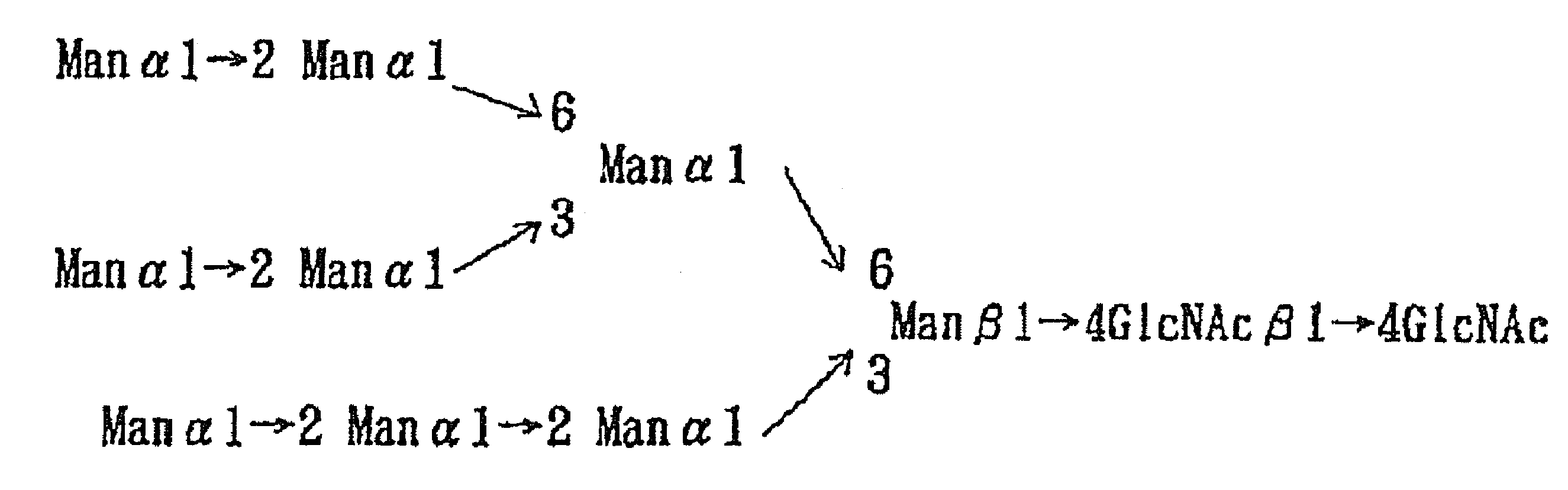
本発明の糖被覆リポソームとして、好ましくは、マンノビオース被覆リポソーム、マンノトリオース被覆リポソーム、マンノテトラオース被覆リポソーム、マンノペンタオース被覆リポソーム、マンノヘキサオース被覆リポソーム、又は、マンノヘプタオース被覆リポソームであり、より好ましくは、マンノトリオース被覆リポソームである。
糖被覆リポソームにおける糖被覆量は、非修飾脂質とのモル比(糖修飾脂質/非修飾脂質)において、0.00075以上であることが好ましく、より好ましくは、0.0025以上であり、最も好ましくは0.0075以上である。例えば、糖被覆リポソームは、糖被覆量が非修飾脂質とのモル比(糖修飾脂質/非修飾脂質)で0.00075~0.075とすることができ、好ましくは、0.0025~0.075であり、より好ましくは、0.0075~0.025である。糖被覆量は、当業者周知の方法を適宜用いて決定することができ、好ましくは、HPLCとエバポレイティブ光散乱ディテクターを組み合わせた測定法により定量することができる(Shimizu,Y.ら、J.Chromatogr.B.,754:127-133(2001))。具体的には、検出器としてELSD(商品名「SEDERE SEDEX-55」)を使用し、カラムには、Wakosil 5TMS(直径4.6mm、長さ25cm、粒径5μm;和光純薬工業製)を使用し、ガードカラムとして、Wakosil 5TMS(直径4.6mm、長さ1cm)を使用し、溶離液には、クロロホルム/メタノール/水(1:33:6[体積比])を使用し、0.8ml/minのアイソクラティック溶出で、インジェクション量は20μLで測定することができる。
本発明の糖被覆リポソームは、その粒径と反応性が、ベルシェープ型の相関を示す。したがって、適切な粒径範囲であることにより、適した反応性を示す粒体とすることができる。粒径の下限値を、例えば100nm、180nm、200nm、250nm、300nm、400nm、又は450nmとすることができる。また、糖被覆リポソームは、好ましくは、粒径の上限値を、例えば、1100nm、1000nm、900nm、800nm、700nm、600nm、550nm、500nmとすることができる。例えば、糖被覆リポソームの粒径は、100~1100nm、100~1000nm、180~700nm、200~700nm、300~700nm、300~600nm、400~600nm又は450~600nmとすることができる。あるいは、糖被覆リポソームの粒径は、180~1100nm、250~1100nm、300~1100nm、180nm~1000nm、180nm~800nm、250~800nm、300~800nm、180nm~500nm、250~500nm、300~500nmとすることができる。本明細書において、特に言及しない限り、糖被覆リポソームの粒径とは、以下の方法により決定した粒径を意味する:調製した糖被覆リポソームをPBSで希釈して、動的光散乱による粒度分布計(マルバーン社製、ZETA SIZER Nano-ZS)で測定し、当該測定装置に付属のプログラムにより算出して決定することができる。また、本発明の糖被覆リポソームが特定の粒径により定義される(例えば、粒径が300~600nmである糖被覆リポソームである)場合、当該粒径を有するリポソーム(例えば、粒径が300~600nmである糖被覆リポソーム)を主要な糖被覆リポソームとして包含する限り、他の粒径のリポソームが混在していてもよい。ここで、「主要な糖被覆リポソームとして包含する」とは、例えば、30%以上、40%以上、50%以上、60%以上、70%以上、80%以上、90%以上の糖被覆リポソームが本発明の糖被覆リポソームの粒径範囲に含まれることを意味していてもよい。好ましくは、本発明の糖被覆リポソームが特定の粒径により定義される場合、当該粒径は糖被覆リポソームの粒径の平均値を意味する。
本明細書において、「リポソーム」とは、内部に水性媒体を包含する脂質二重膜で形成された小胞体を意味し、脂質二重膜は単層であっても多層であってもよい。本明細書において、リポソームを構成する「脂質」は、親水基及び疎水基を備え、小胞体を構成することが可能な脂質であれば特に限定されないが、例えば、コレステロール(Chol)、フィトステロール、3β-[N-(ジメチルアミノエタン)カルバモイル]コレステロール(DC-Chol)、N-(トリメチルアンモニオエチル)カルバモイルコレステロール(TC-Chol)等のステロール類;ジパルミトイルフォスファチジルエタノールアミン(DPPE)、ジステアロイルフォスファチジルエタノールアミン(DSPE)等のフォスファチジルエタノールアミン類;ジパルミトイルホスファチジルコリン(DPPC)、ジステアロイルホスファチジルコリン(DSPC)等のホスファチジルコリン類;ジパルミトイルホスファチジルセリン(DPPS)、ジステアロイルホスファチジルセリン(DSPS)等のホスファチジルセリン類;ジパルミトイルホスファチジン酸(DPPA)、ジステアロイルホスファチジン酸(DSPA)等のホスファチジン酸類等又は2以上のこれらの脂質の組み合わせを挙げることができる。
本明細書において、「糖修飾脂質」とは、本発明のリポソームを構成する脂質であって、前記糖との結合した脂質を意味する。糖修飾脂質としては、マンノビオース修飾DPPE、マンノトリオース修飾DPPE、マンノテトラオース修飾DPPE、マンノペンタオース修飾DPPE、マンノヘキサオース修飾DPPE、又は、マンノヘプタオース修飾DPPEを挙げることができ、より好ましくは、マンノトリオース修飾DPPEである。また、「非修飾脂質」とは、本発明のリポソームを構成する脂質であって、糖の結合していない脂質を意味する。「非修飾脂質」は、前記「脂質」と同義であってもよい。
また、本明細書において「MHCクラスII分子非依存的に抗原特異的CTLを誘導及び/又は増殖させることができる」とは、MHCクラスII分子結合性抗原が存在しない条件下でもMHCクラスI分子結合性抗原と糖被覆リポソームの存在下で当該抗原特異的CTLを誘導及び/又は増殖させることができることを意味する。糖被覆リポソームがMHCクラスII分子非依存的に抗原特異的CTLを誘導及び/又は増殖させることができることは、MHCクラスII分子結合性抗原非存在下でin vivo又はin vitroで糖被覆リポソームとMHCクラスI分子結合性抗原を投与し、当該MHCクラスI分子結合性抗原特異的なCTLの産生を測定することにより確認することができる。より具体的には、例えば、本明細書の実施例記載の方法に準じて確認することができる。
本発明の糖被覆リポソームは、MHCクラスII分子非依存的にCTLを活性化することができる。特に、MHCクラスI分子に特異的な腫瘍抗原を封入した本発明の糖被覆リポソームは、補助的な刺激を必要とすることなく抗腫瘍効果を示すことができる。また、リポソームの粒径を100~1000nmとする事により、MHCクラスII分子非依存的にタイプ1サイトカインの放出を高めることができる。また、糖被覆量を糖修飾脂質の非修飾脂質とのモル比において0.00075以上とすることにより、同様にMHCクラスII分子非依存的にタイプ1サイトカインの放出を高めることができる。
MHCクラスI分子結合性ペプチドは、アミノ酸合成に用いられる当業者周知の方法を用いて製造することができ、例えば、Fmoc法またはBoc法等を用いて化学合成により作製できることができる。また、MHCクラスI分子結合性ペプチドは、自動ペプチド合成機を用いて合成することもできる。このようなペプチド合成機としては、例えば、PSSM-8(島津製作所);モデル433Aペプチドシンセサイザ(アプライドバイオシステムズ社(Applied Biosystems, Inc.));ACT396Apex(アドバンストケムテック社(Advanced ChemTech Inc.))等が挙げられる。
MHCクラスI分子結合性ペプチドをコードする核酸は、核酸合成に用いられる当業者周知の方法を用いて製造することができる。例えば、市販の核酸合成機を用いてもよいし、所望の核酸配列を有する遺伝子を鋳型として、目的の核酸を増幅させるプライマーを適宜設計し、PCR等の核酸増幅方法を採用してもよい。
「糖被覆リポソーム」は、上述のリポソームを構成する脂質を原料として、抗原封入リポソームの製造方法として公知の方法、例えば、国際公開公報WO95/11704、WO2005/087196、WO2006/104199、WO2007/122756、又は、日本国特許出願公開公報第2001-081044号に記載の方法、を用いることにより製造することができる。
具体的には、糖被覆リポソームは、糖と脂質の結合物(糖修飾脂質)(例えば、マンノペンタオースとDPPEとの結合物、又は、マンノトリオースとDPPEの結合物)を予め調製し、当該結合物を用いて以下の方法でリポソームを製造することにより得ることができる。特に、本発明の所望の糖被覆量を有するリポソームは、以下のリポソームの合成方法において所望の比率の糖修飾脂質と非修飾脂質を使用することにより合成することができる。リポソームは、リン脂質等の脂質に物理的あるいは化学的処理、例えば、Bangham法(薄膜法ともいう)、逆相蒸発法、超音波法、エクストルージョン法、フレンチプレス法、ホモジナイゼーション法、エタノール注入法、脱水-再水和法等を施すことにより調製することができる。また、リポソームは、1以上の脂質と、水と、水混和性有機溶媒とを含む混合物を62~80℃の温度範囲で加熱し、前記脂質を溶解する加熱工程と、前記加熱工程後に、前記混合物を冷却する冷却工程とを含む方法により調製することもできる。ここで、前記水混和性有機溶媒は、例えば、前記水と前記水混和性有機溶媒との全容量に対して5~30体積%とすることができる。
あるいは、糖被覆リポソームは、糖修飾脂質の非存在下で製造したリポソームと糖修飾脂質とを混合し、4℃~室温下、24~120時間静置することにより、糖をリポソーム表面へ導入することができる。あるいは、リポソームと糖と直接結合させることによって糖結合リポソームを得ることもできる。
本発明の所望の粒径を有する糖被覆リポソームは、適宜フィルター等を選択してろ過することにより、所望の粒径又は粒度分布となるよう調製することができる。例えば、本発明のリポソームは、100~1000nmのフィルターで整粒したリポソームであってよく、好ましくは、200~1000nmのフィルターで整粒したリポソームであり、最も好ましくは、600~1000nmのフィルターで整粒したリポソームである。糖被覆リポソームを整粒装置のエクストルーダー(Northern Lipids Inc.)を用いて、2枚重ねのフィルター(例えば、100、200、400、600、1000nm)に0.2~1MPaの範囲で加圧しながら10回整粒を行うことにより、所望の粒径を有する糖被覆リポソームを得ることができる。
本発明の糖被覆リポソームがMHCクラスI分子結合性ペプチド又は当該ペプチドをコードする核酸を封入している場合、糖被覆リポソームへのペプチド又は当該ペプチドをコードする核酸の封入は、リポソームの製造において使用する水溶性溶媒中にペプチド又は当該ペプチドをコードする核酸を溶解又は懸濁させ、又は、ペプチド又は当該ペプチドをコードする核酸含有水性溶媒中に糖被覆リポソームを懸濁させたリポソーム懸濁液を繰り返し凍結融解させることにより実施してもよい。糖被覆リポソームに封入する抗原ペプチドの量は、糖被覆リポソームを構成する脂質1mg当たり、通常1~100μgであり、より好ましくは、10~50μgである。糖被覆リポソームに封入する抗原ペプチドをコードする核酸の量は、糖被覆リポソームを構成する脂質1mg当たり、通常0.1~500μgであり、より好ましくは、1~50μgである。リポソームが核酸を有していることは、核酸の紫外部吸収を測定し、又は核酸と特異的に結合する試薬(例えば、エチジウムブロマイド)を使用することにより調べることができる。また、抗原ペプチド又は当該ペプチドをコードする核酸を封入したマンノース被覆リポソームは、上記方法により製造された後、遠心分離等により、抗原が封入されたリポソームの濃度が高くなるよう調製してもよい。
本発明のリポソームは、MHCクラスII分子非依存的にCTLを活性化することができることから、共に使用するMHCクラスI分子結合性ペプチド又は当該ペプチドをコードする核酸を適宜選択することにより、哺乳動物の様々な疾患の治療薬又は予防薬(即ち、動物薬又は医薬)として使用することができる。本発明のリポソームにより治療及び/又は予防可能な疾患、あるいは、本発明の医薬組成物が治療及び/又は予防対象とする疾患としては、白血病(副組織適合性抗原);腫瘍(腫瘍特異性抗原);ヘルペス単純ウイルス、インフルエンザウイルス等のウイルス感染症(ウイルス抗原);リーシュマニア、トキソプラズマ、マラリアなどの寄生虫病(寄生虫抗原);カンジダ、アスペルギルス、クリプトコッカスなどの真菌感染症(真菌類抗原);マイコプラズマ、ストレプトコッカスなどの細菌感染症(細菌類抗原)を挙げることができる。また、発明のリポソームにより治療及び/又は予防可能な哺乳動物としては、ヒト、ウマ、ヒツジ、ブタ、ヤギ、ウシ、イヌ、ネコ、ウサギ、マウス、モルモット等を挙げることができる。よって、本明細書において、医薬組成物とは、ヒトに投与するための医薬の他、動物薬をも含む。
本明細書において、「癌」、「腫瘍」とは、浸潤性に生体内の制御に反して自律的に過剰に増殖する組織塊を意味し、悪性腫瘍(癌、肉腫を含む)、悪性新生物と同義である。本発明の糖被覆リポソーム及び医薬組成物が治療及び/又は予防対象とする癌又は腫瘍としては、肝癌、胆癌、大腸癌、胃癌、乳癌、膵臓癌、骨髄腫、又は、白血病を挙げることができる。
本発明の糖被覆リポソームを医薬として使用する場合、投与部位としては、経口投与、口腔内投与、鼻腔内投与、点眼投与、気道内投与、皮下投与、経皮投与、経粘膜投与、筋肉内投与、血管内(静脈内)投与等を挙げることができる。また、製剤としては、例えば、注射剤、カプセル剤、錠剤、シロップ剤、顆粒剤、貼布剤、軟膏、粉霧剤等を挙げることができる。本発明の糖被覆リポソームを有効成分として含有する医薬は、単独で投与しても良いし、薬理学的に許容される単体(「医薬品添加物事典」薬事日報社、「Handbook of Pharmaceutical Excipients」APhA Publications社参照)と共に投与されてもよい。また、本発明の糖被覆リポソームを有効成分として含有する医薬を注射剤として使用する場合、保存容器としては、アンプル、バイアル、プレフィルドシリンジ、ペン型注射器用カートリッジ、及び、点滴用バッグ等を挙げることができる。
本発明の糖被覆リポソームを有効成分として含有する医薬組成物の投与方法は、所望の治療効果又は予防効果が得られる方法であれば特に限定はなく、好ましくは、皮下または筋肉内投与する。本発明の糖被覆リポソームの投与方法としては、注射又は経口、経鼻、経皮、経粘膜投与等の各種非観血的投与方法を選択することができる。また、本発明の糖被覆リポソームを有効成分として含有する医薬組成物は、一時的に投与してもよいし、持続的又は断続的に投与してもよい。例えば、本発明の糖被覆リポソームの投与頻度として、好ましくは、単回投与、1週間に1~4回投与であり、より好ましくは、単回または1週間に1回投与である。また、1か月~3か月毎に1回などの間歇的投与も選択できる。また、本発明の糖被覆リポソームとMHCクラスI分子結合性抗原が別々の製剤として投与される場合、同時に、連続的に、又は時間をおいて別々に投与することができる。
本発明の糖被覆リポソームを有効成分として含有する医薬の投与量は、所望の治療効果又は予防効果が得られる投与量であれば特に限定は無く、症状、性別、年齢等により適宜決定することができる。本発明の糖被覆リポソームの投与量は、例えば、目的の治療効果若しくは予防効果(又は、治療対象疾患が癌の場合には癌転移の抑制)、あるいは患者の血中の使用したMHCクラスI分子結合性ペプチドに特異的な細胞傷害性T細胞の数を指標として決定することができる。例えば、対象の体重を基準として投与量を決定する場合、1回につき抗原量として、5~500ng/kg(好ましくは、5~50ng/kg、より好ましくは、5~10ng/kg)の量で投与することができる。また、一頭当たりを基準として投与量を決定する場合、1回につき抗原量として、0.1ng~300μg/頭(好ましくは、0.1ng~50μg/頭、より好ましくは、0.2ng~10μg/頭)を投与することができる。例えば、本発明の糖被覆リポソームを有効成分として含有する医薬をヒトに投与する場合の投与量は、抗原量として、患者1人1回につき0.5ng~30μgであり、より好ましくは、0.5ng~5μgであり、更に好ましくは、1ng~1μgである。
以下、本発明をより詳細に説明するため実施例を示すが、本発明はこれに限定されるものではない。なお、本願全体を通して引用される全文献は参照によりそのまま本願に組み込まれる。
実施例1.マンノース被覆リポソーム(MCL)の調製
(1)粒径の異なるMCLの調製
粒径の異なるMCLは以下の方法により作製した。DPPC75.9mg、コレステロール40mg、およびMan3-DPPE6.1mg(モル比でDPPC:コレステロール:Man3-DPPE=1:1:0.05)をガラスバイアル内でt-ブタノール溶液0.85mLと混合した。70℃のウォーターバスで脂質成分を加温溶解させた後、PBS溶液4mLを脂質溶解液に加え、70℃のウォーターバスで再度加温して脂質成分を溶解させた。脂質溶解後、70℃に保温したウォーターバス内で10分間攪拌した。室温下で20分間攪拌冷却することでMCLを得た。作製したMCL懸濁液はPBSで3回懸濁、遠心、上清除去することで、懸濁液中のt-ブタノールを除去した。続いてMCLを整粒装置のエクストルーダー(Northern Lipids Inc.)を用いて、2枚重ねのメンブレンフィルター(孔径1000、600、400および200nm)に、順次10回ずつ通過させて整粒を行った。次に各々のMCL懸濁液を遠心法にて洗浄回収後、PBSに懸濁した。得られたMCLの平均粒子径の測定は、動的光散乱による粒度分布計(マルバーン社製、ZETA SIZER Nano-ZS)を用いて行った。その結果、孔径1000、600、400および200nmで整粒したMCLの平均粒子径は、それぞれ596、441、308および178nmであった。コレステロール量の分析は、市販のキットであるコレステロールE-テストワコー(和光純薬工業株式会社、439-17501)を用いて行った。
(1)粒径の異なるMCLの調製
粒径の異なるMCLは以下の方法により作製した。DPPC75.9mg、コレステロール40mg、およびMan3-DPPE6.1mg(モル比でDPPC:コレステロール:Man3-DPPE=1:1:0.05)をガラスバイアル内でt-ブタノール溶液0.85mLと混合した。70℃のウォーターバスで脂質成分を加温溶解させた後、PBS溶液4mLを脂質溶解液に加え、70℃のウォーターバスで再度加温して脂質成分を溶解させた。脂質溶解後、70℃に保温したウォーターバス内で10分間攪拌した。室温下で20分間攪拌冷却することでMCLを得た。作製したMCL懸濁液はPBSで3回懸濁、遠心、上清除去することで、懸濁液中のt-ブタノールを除去した。続いてMCLを整粒装置のエクストルーダー(Northern Lipids Inc.)を用いて、2枚重ねのメンブレンフィルター(孔径1000、600、400および200nm)に、順次10回ずつ通過させて整粒を行った。次に各々のMCL懸濁液を遠心法にて洗浄回収後、PBSに懸濁した。得られたMCLの平均粒子径の測定は、動的光散乱による粒度分布計(マルバーン社製、ZETA SIZER Nano-ZS)を用いて行った。その結果、孔径1000、600、400および200nmで整粒したMCLの平均粒子径は、それぞれ596、441、308および178nmであった。コレステロール量の分析は、市販のキットであるコレステロールE-テストワコー(和光純薬工業株式会社、439-17501)を用いて行った。
(2)マンノトリオース被覆量の異なるMCLの調製
DPPC75.9mgとコレステロール40mgにMan3-DPPEを、それぞれ18.3mg,6.1mg,1.83mg,0.61mg,0.183mg,0.061mg,0mg加えた(DPPC:コレステロール:Man3-DPPE(モル比)は、それぞれ、1:1:0.15,1:1:0.05,1:1:0.015,1:1:0.005,1:1:0.0015,1:1:0.0005,1:1:0)。これらの混合物を、それぞれガラスバイアル内でt-ブタノール溶液0.85mLと混合した。70℃のウォーターバスで脂質成分を加温溶解した後、PBS4mLを脂質溶解液に加え、70℃のウォーターバスで再度加温して、脂質成分を溶解した。脂質溶解後、70℃に保温したウォーターバス内で10分間撹拌した。室温下で20分間撹拌冷却することでMCLを作製した。作製したMCL懸濁液をPBSで3回懸濁、遠心、上清除去することで、懸濁液中のt-ブタノールを除去した。続いて、作製したMCLを整粒装置のエクストルーダー(Northern Lipids Inc.)を用いて、2枚重ねの孔径1000nmのメンブレンフィルターにチッソガスで加圧して10回通過させることで整粒を行った。次に各々のMCL懸濁液を遠心法にて洗浄回収後、PBSに懸濁した。得られたMCLの平均粒子径の測定は、動的光散乱による粒度分布計(マルバーン社製、ZETA SIZER Nano-ZS)を用いて行った。その結果、DPPC:コレステロール:Man3-DPPEのモル比(カッコ内はMan3-DPPEの非修飾脂質に対するモル比)、1:1:0.15(0.075),1:1:0.05(0.025),1:1:0.015(0.0075),1:1:0.005(0.0025),1:1:0.0015(0.00075),1:1:0.0005(0.00025),1:1:0(0)で調製したMCLの平均粒子径は、それぞれ695、609、599、554、609、529および588nmであった。コレステロール量の分析は、市販のキットであるコレステロールE-テストワコー(和光純薬工業株式会社、439-17501)を用いて行った。
DPPC75.9mgとコレステロール40mgにMan3-DPPEを、それぞれ18.3mg,6.1mg,1.83mg,0.61mg,0.183mg,0.061mg,0mg加えた(DPPC:コレステロール:Man3-DPPE(モル比)は、それぞれ、1:1:0.15,1:1:0.05,1:1:0.015,1:1:0.005,1:1:0.0015,1:1:0.0005,1:1:0)。これらの混合物を、それぞれガラスバイアル内でt-ブタノール溶液0.85mLと混合した。70℃のウォーターバスで脂質成分を加温溶解した後、PBS4mLを脂質溶解液に加え、70℃のウォーターバスで再度加温して、脂質成分を溶解した。脂質溶解後、70℃に保温したウォーターバス内で10分間撹拌した。室温下で20分間撹拌冷却することでMCLを作製した。作製したMCL懸濁液をPBSで3回懸濁、遠心、上清除去することで、懸濁液中のt-ブタノールを除去した。続いて、作製したMCLを整粒装置のエクストルーダー(Northern Lipids Inc.)を用いて、2枚重ねの孔径1000nmのメンブレンフィルターにチッソガスで加圧して10回通過させることで整粒を行った。次に各々のMCL懸濁液を遠心法にて洗浄回収後、PBSに懸濁した。得られたMCLの平均粒子径の測定は、動的光散乱による粒度分布計(マルバーン社製、ZETA SIZER Nano-ZS)を用いて行った。その結果、DPPC:コレステロール:Man3-DPPEのモル比(カッコ内はMan3-DPPEの非修飾脂質に対するモル比)、1:1:0.15(0.075),1:1:0.05(0.025),1:1:0.015(0.0075),1:1:0.005(0.0025),1:1:0.0015(0.00075),1:1:0.0005(0.00025),1:1:0(0)で調製したMCLの平均粒子径は、それぞれ695、609、599、554、609、529および588nmであった。コレステロール量の分析は、市販のキットであるコレステロールE-テストワコー(和光純薬工業株式会社、439-17501)を用いて行った。
実施例2.粒径の異なるMCLのマクロファージ活性化能
生後8週齢のBALB/cCrSlcマウス(日本エスエルシー株式会社)の腹部を70%エタノールに浸した脱脂綿で消毒した後、コレステロール量で60μg相当の、平均粒子径が178、308、441及び596nmの実施例1(1)で作製したMCLをツベルクリン用シリンジで腹腔に投与した。投与から1時間経過した後、マウスを安楽死させ、すみやかにマウス腹腔内へ5mLのPBSを注入して腹腔を洗浄し、洗浄液を腹腔から回収することで腹腔内の遊離細胞を回収した。洗浄液を1,500rpmで5分間遠心した。沈澱した細胞は、10%ウシ胎児血清(FBS)含有RPMI培地10mLに懸濁して、1,500rpmで5分間の遠心洗浄を数回行った後、10%FBS含有RPMI培地で1×106cells/mLとなるように調整し、細胞培養ディッシュに播いた。37℃の5%CO2インキュベーターで1時間培養し、CD11b陽性細胞(マクロファージ)を接着させた後、非付着細胞を洗い流した。培地交換後、37℃の5%CO2インキュベーターで20時間培養し、培養上清を回収した。培養上清中のサイトカイン(IL-12p40およびIL-6)をMouse OptEIA ELISA kit(BD Biosciences)を用いて測定した。
生後8週齢のBALB/cCrSlcマウス(日本エスエルシー株式会社)の腹部を70%エタノールに浸した脱脂綿で消毒した後、コレステロール量で60μg相当の、平均粒子径が178、308、441及び596nmの実施例1(1)で作製したMCLをツベルクリン用シリンジで腹腔に投与した。投与から1時間経過した後、マウスを安楽死させ、すみやかにマウス腹腔内へ5mLのPBSを注入して腹腔を洗浄し、洗浄液を腹腔から回収することで腹腔内の遊離細胞を回収した。洗浄液を1,500rpmで5分間遠心した。沈澱した細胞は、10%ウシ胎児血清(FBS)含有RPMI培地10mLに懸濁して、1,500rpmで5分間の遠心洗浄を数回行った後、10%FBS含有RPMI培地で1×106cells/mLとなるように調整し、細胞培養ディッシュに播いた。37℃の5%CO2インキュベーターで1時間培養し、CD11b陽性細胞(マクロファージ)を接着させた後、非付着細胞を洗い流した。培地交換後、37℃の5%CO2インキュベーターで20時間培養し、培養上清を回収した。培養上清中のサイトカイン(IL-12p40およびIL-6)をMouse OptEIA ELISA kit(BD Biosciences)を用いて測定した。
IL-12p40及びIL-6の測定結果をそれぞれ図1及び図2に示す。MCLは平均粒子径178nm以上(特に、308nm以上)において、顕著にIL-12の産生を増加させ、かつIL-6の産生を減少させることにより、免疫応答を細胞性免疫に誘導する能力が高いことが明らかになった。
実施例3.Man3-DPPE被覆量の異なるMCLのマクロファージ活性化能
生後8週齢のBALB/cCrSlcマウス(日本エスエルシー(株))の腹部を70%エタノールに浸した脱脂綿で消毒した後、コレステロール量で60μg相当の、実施例1(2)で調製したMan3-DPPE被覆量の異なるMCL(非修飾脂質を1とした場合のMan3-DPPEのモル比が、それぞれ、0.075、0.0025、0.0075、0.0025、0.00075、0.00025、0)をツベルクリン用シリンジで腹腔内に投与した。投与から1時間経過した後、マウスを安楽死させ、すみやかにマウス腹腔内へ5mLのPBSを注入して腹腔を洗浄し、洗浄液を腹腔から回収することで腹腔内の遊離細胞を回収した。洗浄液を1,500rpmで5分間遠心した。沈澱した細胞は、10%FBS含有RPMI培地10mlに懸濁して、1,500rpmで5分間の遠心洗浄を数回行った後、10%FBS含有RPMI培地で1×106cells/mLに調整し、細胞培養ディッシュに播いた。37℃の5%CO2インキュベーターで1時間培養し、CD11b陽性細胞(マクロファージ)を接着させた後、非付着細胞を洗い流した。培地交換後、37℃の5%CO2インキュベーターで20時間培養し、培養上清を回収した。培養上清中のサイトカイン(IL-12p40およびIL-6)をMouse OptEIA ELISA kit(BD Biosciences)により測定した。
生後8週齢のBALB/cCrSlcマウス(日本エスエルシー(株))の腹部を70%エタノールに浸した脱脂綿で消毒した後、コレステロール量で60μg相当の、実施例1(2)で調製したMan3-DPPE被覆量の異なるMCL(非修飾脂質を1とした場合のMan3-DPPEのモル比が、それぞれ、0.075、0.0025、0.0075、0.0025、0.00075、0.00025、0)をツベルクリン用シリンジで腹腔内に投与した。投与から1時間経過した後、マウスを安楽死させ、すみやかにマウス腹腔内へ5mLのPBSを注入して腹腔を洗浄し、洗浄液を腹腔から回収することで腹腔内の遊離細胞を回収した。洗浄液を1,500rpmで5分間遠心した。沈澱した細胞は、10%FBS含有RPMI培地10mlに懸濁して、1,500rpmで5分間の遠心洗浄を数回行った後、10%FBS含有RPMI培地で1×106cells/mLに調整し、細胞培養ディッシュに播いた。37℃の5%CO2インキュベーターで1時間培養し、CD11b陽性細胞(マクロファージ)を接着させた後、非付着細胞を洗い流した。培地交換後、37℃の5%CO2インキュベーターで20時間培養し、培養上清を回収した。培養上清中のサイトカイン(IL-12p40およびIL-6)をMouse OptEIA ELISA kit(BD Biosciences)により測定した。
IL-12p40及びIL-6の測定結果をそれぞれ図3及び図4に示す。MCLは、Man3-DPPE被覆量が非修飾脂質に対するモル比で0.00075以上(特には、0.0075以上)において、顕著にIL-12の産生を増加させ、IL-6の産生を減少させることによって、免疫状態を細胞性免疫に誘導する能力が高いことが明らかになった。
実施例4.OVA257-264封入マンノース被覆リポソーム(MCL)の細胞傷害活性誘導作用
(1)抗原ペプチドOVA257-264封入MCLの調製
DPPC75.9mg、コレステロール40mgおよびMan3-DPPE6.1mg(DPPC:コレステロール:Man3-DPPEのモル比は、1:1:0.05)をガラスバイアルに秤量し、t-ブタノール溶液0.85mLを混合した。70℃のウォーターバスで脂質成分を攪拌溶解した後、OVA257-264溶液(0.5mg/mL10%スクロース)4mLを脂質溶解液に加え、70℃のウォーターバスで再度加温して、脂質成分を溶解した。脂質溶解後、70℃に保温したウォーターバス内で10分間撹拌した。室温下で20分間撹拌冷却して、OVA257-264封入MCLを作製した。
(1)抗原ペプチドOVA257-264封入MCLの調製
DPPC75.9mg、コレステロール40mgおよびMan3-DPPE6.1mg(DPPC:コレステロール:Man3-DPPEのモル比は、1:1:0.05)をガラスバイアルに秤量し、t-ブタノール溶液0.85mLを混合した。70℃のウォーターバスで脂質成分を攪拌溶解した後、OVA257-264溶液(0.5mg/mL10%スクロース)4mLを脂質溶解液に加え、70℃のウォーターバスで再度加温して、脂質成分を溶解した。脂質溶解後、70℃に保温したウォーターバス内で10分間撹拌した。室温下で20分間撹拌冷却して、OVA257-264封入MCLを作製した。
作製したOVA257-264封入MCL懸濁液をPBSで3回懸濁、遠心、上清除去することで、懸濁液中のt-ブタノールおよびMCLに封入されなかった抗原を除去した。続いて、OVA257-264封入MCLを整粒装置のエクストルーダー(Northern Lipids Inc.)を用いて、2枚重ねの1000nmフィルターにチッソガスで加圧して10回通過させることで整粒を行った。OVA257-264封入MCLを遠心洗浄後、PBSに懸濁した。得られたOVA257-264封入MCLの分析は、コレステロール量測定をコレステロールE-テストワコー(和光純薬工業株式会社、439-17501)で、封入ペプチド量測定はHPLCを用いて行った。脂質の回収率は80%程度であった。また、OVA257-264封入MCLの平均粒子径は503nmであった。
(2)OVA257-264封入MCLの細胞傷害活性
OVA257-264封入MCLの細胞傷害活性は、マウスリンホーマE.G7-OVAに対するCTLの誘導により測定した。E.G7-OVA(ATCC、CRL-2113)は、CTL活性を誘導するOVA/H2Kb複合体を安定的に内因産生するようなcDNAを遺伝子導入されたEL4である。EL4は、C57BL/6由来のH-2bハプロタイプの胸腺種細胞株である(M.W.Moore,et al.,(1988)Cell,54(6):777-785参照)。
OVA257-264封入MCLの細胞傷害活性は、マウスリンホーマE.G7-OVAに対するCTLの誘導により測定した。E.G7-OVA(ATCC、CRL-2113)は、CTL活性を誘導するOVA/H2Kb複合体を安定的に内因産生するようなcDNAを遺伝子導入されたEL4である。EL4は、C57BL/6由来のH-2bハプロタイプの胸腺種細胞株である(M.W.Moore,et al.,(1988)Cell,54(6):777-785参照)。
1mL中にOVA257-264を22.3μg、コレステロールを4mg含むOVA257-264封入MCL溶液を原液(1倍)とした。この原液の、10倍,100倍,1000倍,10000倍希釈液を生理食塩水で調製した。その後、OVA257-264量が96,9.6,0.96,0.096ngになるように、各OVA257-264封入MCL希釈液から等量を計り取り、生理食塩水で全量を100μLとした。調製した各OVA257-264量を含むOVA257-264封入MCL調製液を、各群3匹のC57BL/6マウス(日本エスエルシー株式会社)腰部の皮下に100μL/headで1週間ごとに2回投与した。初回免疫から17日後にマウスから脾臓を摘出し、10%FBS含有RPMI培地5mLに浸しながらスライドガラス2枚ですりつぶした。その後、15mLの遠心管に移して、マウス1匹から摘出した脾細胞に対して溶血液{140mM NH4Cl,17mM Tris-HCl(pH7.65)}が1mLとなるように加え、氷上にて1分半処理し、血球細胞を破壊した。処理後、10%FBS含有RPMI培地を適量加え、遠心洗浄後、上清を除去することでリンパ球を分離した。分離したリンパ球の1×10⁷cellsを、OVA257-264を1μg含有する10%FBS含有RPMI培地2mL中で37℃、70時間培養し、この細胞をエフェクター細胞とした。ターゲット細胞(T)(E.G7-OVA cell:104cells/well)に対してエフェクター細胞(E)を以下の比(E/T Ratio=50:1,25:1,12.5:1,6.25:1,3.125:1,1:1)で混合した後、37℃で、4時間培養し、CytoTox96アッセイキット(Promega)により以下の手順で細胞傷害活性を測定した。
まず、ターゲット細胞(E.G7-OVA:1×10⁴cells/50μL 5%FBS含有RPMI培地)に対して、エフェクター細胞を各細胞数(50×104,25×104,12.5×104,6.25×104,3.125×104,1×104cells/50 μL 5%FBS含有RPMI培地)で混合した(細胞数比は、エフェクター細胞:ターゲット細胞=50:1,25:1,12:1,6:1,3:1,1:1とした)。これらの細胞液100μLを丸底の96穴細胞培養プレートに入れ、25℃、250×gで4分間遠心し、両細胞をプレート底面で接触させ、反応を促進した。37℃で4時間培養後、25℃、250×gで4分間遠心し、その上清50μLを基質液50μLと混合した。30分間反応させた後、反応停止液50μLを加え、490nmの吸光度を測定し、下記の計算式にて細胞傷害活性を算出した。
[計算式]
細胞傷害活性(%)={(Experimental)-(Effecter Spontaneous)-(Target Spontaneous)}/{(Target Maximum)-(Target Spontaneous)}×100
Experimental:ターゲット細胞とエフェクター細胞を混合し、反応させたサンプルの490nmの吸光度
Effecter Spontaneous:エフェクター細胞のみを培養したサンプルの490nmの吸光度
Target Spontaneous:ターゲット細胞のみを培養したサンプルの490nmの吸光度
Target Maximum:すべてのターゲット細胞を溶解液で溶解したサンプルの490nmの吸光度
細胞傷害活性(%)={(Experimental)-(Effecter Spontaneous)-(Target Spontaneous)}/{(Target Maximum)-(Target Spontaneous)}×100
Experimental:ターゲット細胞とエフェクター細胞を混合し、反応させたサンプルの490nmの吸光度
Effecter Spontaneous:エフェクター細胞のみを培養したサンプルの490nmの吸光度
Target Spontaneous:ターゲット細胞のみを培養したサンプルの490nmの吸光度
Target Maximum:すべてのターゲット細胞を溶解液で溶解したサンプルの490nmの吸光度
結果を図5に示す。本実験の結果、OVA257-264封入MCLの免疫抗原量が0.096ngのとき、最も高い細胞傷害(CTL)活性(65%)が検出された。よって、MCLは、ごく微量の抗原ペプチドで強いアジュバンド効果を示すことが示唆された。
実施例5.サバイビン2Bの80-88番目のアミノ酸配列からなるペプチド含有マンノース被覆リポソーム(以下、「SVN2B(80-88)-MCL」という)の調製
(1)SVN2B(80-88)-MCLの調製
サバイビン2Bの80-88番目のアミノ酸配列からなるペプチド(配列番号2)(以下、「SVN2B(80-88)」という)は、MHCクラスI分子結合性抗原であることが既に報告されている(Hirohashi,Yら、Clinical Cancer Research(2002)8:1731-1739)。よって、SVN2B(80-88)を単独及びマンノース被覆リポソームと組み合わせて使用した場合の抗癌作用について実験を行った。
DPPC75.9mg、コレステロール40mgおよびMan3-DPPE6.1mg(DPPC:コレステロール:Man3-DPPEのモル比は、1:1:0.05)をガラスバイアルに秤量し、t-ブタノール溶液0.85mLを混合した。70℃のウォーターバスで脂質成分を撹拌溶解した後、SVN2B(80-88)溶液(1mg/mL)(生理食塩水溶液)4mLを脂質溶解液に加え、70℃のウォーターバスで再度加温して、脂質成分を溶解した。脂質溶解後、70℃に保温したウォーターバス内で10分間撹拌した。室温下で20分間撹拌冷却して、SVN2B(80-88)-MCLを作製した。
作製したSVN2B(80-88)-MCL懸濁液をPBSで3回懸濁、遠心、上清除去することで、懸濁液中のt-ブタノールおよびMCLに封入されなかったSVN2B(80-88)を除去した。続いて、SVN2B(80-88)-MCLを整粒装置のエクストルーダー(Northern Lipids Inc.)を用いて、2枚重ねの1000nmフィルターにチッソガスで加圧して10回通過させることで整粒を行った。平均粒子径は441nmであった。次に、SVN2B(80-88)-MCLを遠心洗浄後、PBSに懸濁した。得られたSVN2B(80-88)-MCLの分析は、コレステロール量測定をコレステロールE-テストワコー(和光純薬工業株式会社、439-17501)で測定した。
(1)SVN2B(80-88)-MCLの調製
サバイビン2Bの80-88番目のアミノ酸配列からなるペプチド(配列番号2)(以下、「SVN2B(80-88)」という)は、MHCクラスI分子結合性抗原であることが既に報告されている(Hirohashi,Yら、Clinical Cancer Research(2002)8:1731-1739)。よって、SVN2B(80-88)を単独及びマンノース被覆リポソームと組み合わせて使用した場合の抗癌作用について実験を行った。
DPPC75.9mg、コレステロール40mgおよびMan3-DPPE6.1mg(DPPC:コレステロール:Man3-DPPEのモル比は、1:1:0.05)をガラスバイアルに秤量し、t-ブタノール溶液0.85mLを混合した。70℃のウォーターバスで脂質成分を撹拌溶解した後、SVN2B(80-88)溶液(1mg/mL)(生理食塩水溶液)4mLを脂質溶解液に加え、70℃のウォーターバスで再度加温して、脂質成分を溶解した。脂質溶解後、70℃に保温したウォーターバス内で10分間撹拌した。室温下で20分間撹拌冷却して、SVN2B(80-88)-MCLを作製した。
作製したSVN2B(80-88)-MCL懸濁液をPBSで3回懸濁、遠心、上清除去することで、懸濁液中のt-ブタノールおよびMCLに封入されなかったSVN2B(80-88)を除去した。続いて、SVN2B(80-88)-MCLを整粒装置のエクストルーダー(Northern Lipids Inc.)を用いて、2枚重ねの1000nmフィルターにチッソガスで加圧して10回通過させることで整粒を行った。平均粒子径は441nmであった。次に、SVN2B(80-88)-MCLを遠心洗浄後、PBSに懸濁した。得られたSVN2B(80-88)-MCLの分析は、コレステロール量測定をコレステロールE-テストワコー(和光純薬工業株式会社、439-17501)で測定した。
(2)SVN2B(80-88)-MCLに封入されたSVN2B(80-88)の定量
マンノース被覆リポソームへ封入されたSVN2B(80-88)の量は、以下の手順に従い測定した。1.5mLチューブに(1)で調製した100μLのSVN2B(80-88)-MCL懸濁液に400μLのメタノールを加え、リポソームを破壊してSVN2B(80-88)を遊離させた。遊離したSVN2B(80-88)は、HPLCシステム(Separations Module 2695-2489、Waters社)、カラム(186002684、SunFire、C18 5μm、4.6×250mm、Waters社)、及び、ガードカラム(186002684、SunFire、C18 5μm、4.6×20mm、Waters社)を使用し、移動相として水(0.1%TFA(208-02741、Wako社))及びAcCN(0.1%TFA(208-02741、Wako社))を使用して、グラジエント溶出のHPLCにかけ、波長215nmを検出することにより、SVN2B(80-88)の量を測定した。HPLCによって定量され、マンノース被覆リポソームを構成するコレステロール1mg当たりのSVN2B(80-88)の封入量は16.6μgであった。
マンノース被覆リポソームへ封入されたSVN2B(80-88)の量は、以下の手順に従い測定した。1.5mLチューブに(1)で調製した100μLのSVN2B(80-88)-MCL懸濁液に400μLのメタノールを加え、リポソームを破壊してSVN2B(80-88)を遊離させた。遊離したSVN2B(80-88)は、HPLCシステム(Separations Module 2695-2489、Waters社)、カラム(186002684、SunFire、C18 5μm、4.6×250mm、Waters社)、及び、ガードカラム(186002684、SunFire、C18 5μm、4.6×20mm、Waters社)を使用し、移動相として水(0.1%TFA(208-02741、Wako社))及びAcCN(0.1%TFA(208-02741、Wako社))を使用して、グラジエント溶出のHPLCにかけ、波長215nmを検出することにより、SVN2B(80-88)の量を測定した。HPLCによって定量され、マンノース被覆リポソームを構成するコレステロール1mg当たりのSVN2B(80-88)の封入量は16.6μgであった。
実施例6.SVN2B(80-88)-MCLの抗癌作用
(1)Renca細胞へのsurvivin2Bの導入
pIRES vector(Clontech,#631605)にサバイビン2Bを導入してpIRES-ss-survivin2Bベクターを作製した。Renca細胞(ATCC #CRL-2947)に作製したpIRES-ss-survivin2Bベクターをトランスフェクションした。Renca細胞に10%FBS含有DMEM2.5mlで懸濁してピペッティングし、6well plateに撒き5%CO2、37℃で培養した。1.5mLチューブにLipofectamine2000 10μLを添加し、Opti-MEM培地250μLで懸濁させた(Transfer試薬)。また、1.5mLチューブにpIRES-ss-survivin2Bベクター 3μLを添加し、Opti-MEM培地250μLで懸濁させた(プラスミド液)。室温で5分間静置後、Transfer試薬とプラスミド液を混合し、室温で20分間静置した。凡そ50%コンフルエントになったRenca細胞に混合液を添加し、5%CO2、37℃で培養した。2日後以降、1μg/mLのピューロマイシンを含有する10%FBS含有DMEM培地に交換し、5%CO2、37℃で培養した。培地交換後、ベクターが入っていない細胞は2日目で死滅するので、それ以降増殖した細胞を更に7日間培養した。
(1)Renca細胞へのsurvivin2Bの導入
pIRES vector(Clontech,#631605)にサバイビン2Bを導入してpIRES-ss-survivin2Bベクターを作製した。Renca細胞(ATCC #CRL-2947)に作製したpIRES-ss-survivin2Bベクターをトランスフェクションした。Renca細胞に10%FBS含有DMEM2.5mlで懸濁してピペッティングし、6well plateに撒き5%CO2、37℃で培養した。1.5mLチューブにLipofectamine2000 10μLを添加し、Opti-MEM培地250μLで懸濁させた(Transfer試薬)。また、1.5mLチューブにpIRES-ss-survivin2Bベクター 3μLを添加し、Opti-MEM培地250μLで懸濁させた(プラスミド液)。室温で5分間静置後、Transfer試薬とプラスミド液を混合し、室温で20分間静置した。凡そ50%コンフルエントになったRenca細胞に混合液を添加し、5%CO2、37℃で培養した。2日後以降、1μg/mLのピューロマイシンを含有する10%FBS含有DMEM培地に交換し、5%CO2、37℃で培養した。培地交換後、ベクターが入っていない細胞は2日目で死滅するので、それ以降増殖した細胞を更に7日間培養した。
(2)サバイビン2B発現Renca細胞移植マウスへのSVN2B(80-88)-MCLの効果
BALB/Cマウス(日本クレア株式会社)背部の皮下にサバイビン2B発現Renca細胞(Renca-survivin細胞)を2×105cells/匹となるように移植した。約2週間後、3-5mm径の腫瘍が形成されていることを確認し、実施例5で作製したSVN2B(80-88)-MCLをマウスに投与した。マウス1匹当り、800ng、166ng、16.6ng、1.66ng、0.166ngのSVN2B(80-88)(コレステロール量で、それぞれ、50μg、10μg、1μg、0.1μg、0.01μg)のSVN2B(80-88)-MCLをPBSで懸濁して200uLに調製した調製液を投与した。また、SVN2B(80-88)-MCLの代わりに、空のMCL(コレステロール量で50μg)、SVN2B(80-88)10μgをPBS200μLに懸濁した調製液、及びPBS200μLをコントロールとして投与した。各群は3匹とし、毎週腫瘍体積を、投与後3週目まで計測した。4日目の計測日以前に10μg投与群で2匹死亡し、1μg投与群で1匹死亡した。
BALB/Cマウス(日本クレア株式会社)背部の皮下にサバイビン2B発現Renca細胞(Renca-survivin細胞)を2×105cells/匹となるように移植した。約2週間後、3-5mm径の腫瘍が形成されていることを確認し、実施例5で作製したSVN2B(80-88)-MCLをマウスに投与した。マウス1匹当り、800ng、166ng、16.6ng、1.66ng、0.166ngのSVN2B(80-88)(コレステロール量で、それぞれ、50μg、10μg、1μg、0.1μg、0.01μg)のSVN2B(80-88)-MCLをPBSで懸濁して200uLに調製した調製液を投与した。また、SVN2B(80-88)-MCLの代わりに、空のMCL(コレステロール量で50μg)、SVN2B(80-88)10μgをPBS200μLに懸濁した調製液、及びPBS200μLをコントロールとして投与した。各群は3匹とし、毎週腫瘍体積を、投与後3週目まで計測した。4日目の計測日以前に10μg投与群で2匹死亡し、1μg投与群で1匹死亡した。
(3)結果を図8に示す。1.66ngのSVN2B(80-88)を封入したSVN2B(80-88)-MCLを投与した群で最も腫瘍増殖抑制効果が高く、次に0.166ngのSVN2B(80-88)を封入したSVN2B(80-88)-MCLを投与した群で腫瘍増殖抑制効果が高かった。空のMCL(コレステロール量で50μg)と16.6μgのSVN2B(80-88)を封入したSurvivin2B-MCLを投与した群はほぼ同程度の腫瘍抑制効果を示したが、ネガティブコントロール(PBS投与群)と比較して、腫瘍を抑制する効果を示した。SVN2B(80-88)(10μg)の単独投与はPBS投与群と差が無く、腫瘍増殖抑制効果が見られなかった。よって、MHCクラスI分子結合性抗原であるSVN2B(80-88)は単独では10μgでも抗腫瘍効果を示すことができなかった一方、SVN2B(80-88)をMCLに封入することにより、0.166~16.6ngという微量でもMHCクラスII抗原非存在下で非常に優れた抗腫瘍効果を示した。上述の通り、従来癌免疫治療において用いられているワクチン量はヒトで0.1~10mg程度、マウスで数十μgであるところ、本発明のMCLが抗腫瘍効果を示す抗原量はマウスで0.166~16.6ng(ヒトに換算すると抗原量が約1ng~1μg)と、従来技術と比較して非常に微量であり、マウスでngオーダー、ヒトでも数ng~数百ngの抗原(SVN2B(80-88))で腫瘍を抑制できることが示された。
実施例7.粒径の異なるマンノース被覆リポソーム(MCL)の調製
実施例1と同様の原材料、方法を用いてMCLを調製した。ただし、エクストルーダーに孔径0.1, 0.2, 0.4, 0.6, 1.0, 2.0μmの合計6種類のメンブランフィルターをセットし、濾過、整粒し、夫々の径のリポソームを調製した。
調製したリポソームの粒径をMalvern社とHORIBA社の2種類の粒度分布測定器で測定した。量測定器で測定した粒径のパラレリズムは良かったが、粒径が大きくなるほど、HORIBAの方が高く出る傾向にあった(図7)。
実施例1と同様の原材料、方法を用いてMCLを調製した。ただし、エクストルーダーに孔径0.1, 0.2, 0.4, 0.6, 1.0, 2.0μmの合計6種類のメンブランフィルターをセットし、濾過、整粒し、夫々の径のリポソームを調製した。
調製したリポソームの粒径をMalvern社とHORIBA社の2種類の粒度分布測定器で測定した。量測定器で測定した粒径のパラレリズムは良かったが、粒径が大きくなるほど、HORIBAの方が高く出る傾向にあった(図7)。
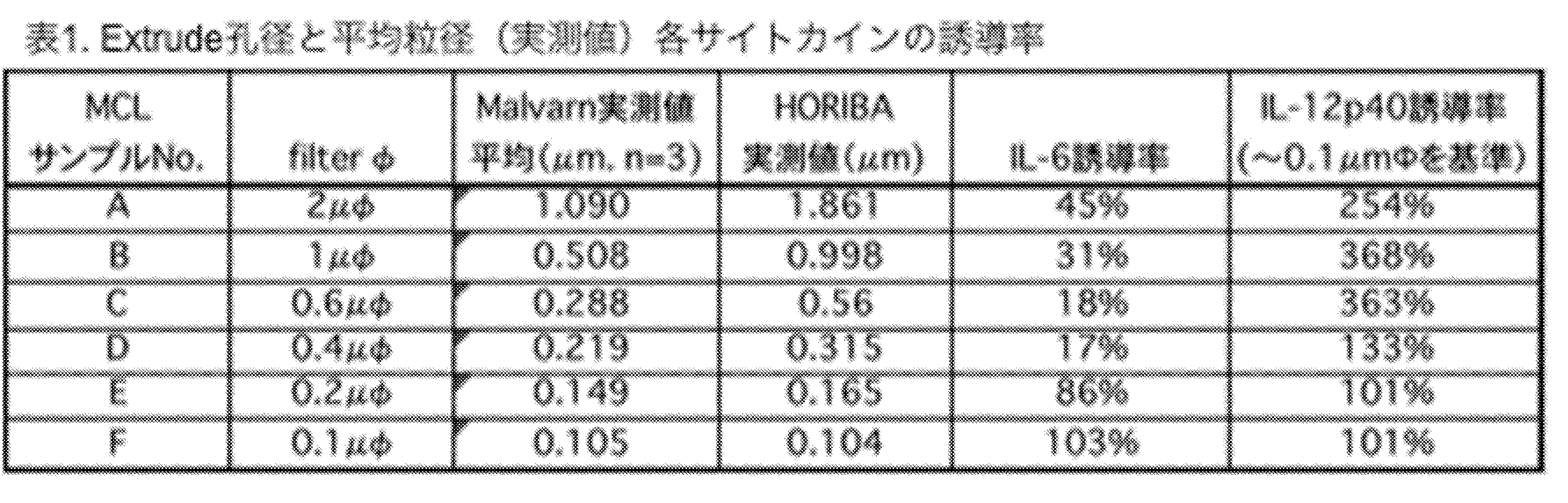
実施例8.粒径の異なるMCLのマクロファージ活性化能
粒径の異なるMCLのマクロファージ活性化能を図8の手順で調べた。すなわち、生後8ヶ月のBALB/c マウス(日本エスエルシー株式会社)の腹腔内に上記実施例7で調製した各粒径のリポソームを投与した。一時間後、マウスを安楽死させた後、速やかに5ml のPBSを注射針で注入、腹腔洗浄し、その洗浄液を回収し、その中にある腹腔内遊離細胞を回収した。回収液を1500rpmで5分間遠心後、沈殿した細胞を10%FBS含有RPMI培地10mlに懸濁した。 この操作を数回繰り返した後、細胞培養ディッシュに播いた。次いで、37℃の5%CO2インキュベーターで一時間培養し、接着細胞(マクロファージ)を接着させた後、非接着細胞を洗浄除去した。培地交換の後、37℃の5%CO2インキュベーターで20時間培養し、培養上清を回収した。培養上清中のIL-12p40、IL-6をMouse OptEIA ELISA kit(BD BioSciences)を用いて測定した。
粒径の異なるMCLのマクロファージ活性化能を図8の手順で調べた。すなわち、生後8ヶ月のBALB/c マウス(日本エスエルシー株式会社)の腹腔内に上記実施例7で調製した各粒径のリポソームを投与した。一時間後、マウスを安楽死させた後、速やかに5ml のPBSを注射針で注入、腹腔洗浄し、その洗浄液を回収し、その中にある腹腔内遊離細胞を回収した。回収液を1500rpmで5分間遠心後、沈殿した細胞を10%FBS含有RPMI培地10mlに懸濁した。 この操作を数回繰り返した後、細胞培養ディッシュに播いた。次いで、37℃の5%CO2インキュベーターで一時間培養し、接着細胞(マクロファージ)を接着させた後、非接着細胞を洗浄除去した。培地交換の後、37℃の5%CO2インキュベーターで20時間培養し、培養上清を回収した。培養上清中のIL-12p40、IL-6をMouse OptEIA ELISA kit(BD BioSciences)を用いて測定した。
IL-12p40及びIL-6の測定結果を図9及び図10に示す。MCLのIL-12p40の誘導能は、その粒径に依存し、その粒径がHORIBAの装置での測定結果で0.6~1.0μm(マルバーンでは、0.3~0.5μm)の誘導能が最も強かった。また、IL-6の抑制能は、HORIBAの装置での測定結果で0.3~1.0μm(マルバーンでは、0.2~0.5μm)の粒径のMCLが最も強かった。その粒径-反応相関性は、ベルシェープ型を示すことが明らかとなった。
MCLの粒径とマクロファージ活性化能と相関について、近似曲線を描きIL-12誘導率がベースの250%以上になる範囲をサイトカイン誘導に最適な粒度範囲として計算で求めた。すなわち、MCLの粒径とマクロファージ活性化能と相関について、エクセルのグラフモジュールのフィッティングを用いて曲線を描いた(図11)。この曲線に対して250%活性化ポイントを二点間を結ぶ近似的な方程式から交点を求める形で計算したところ、0.25~1.1μm(Φ)と算出された。ただし、この粒度は、Malvern社のセータサイザーによる測定値を用いた。
Claims (27)
- MHCクラスI分子結合性ペプチド又は当該ペプチドをコードする核酸と共に使用するための糖被覆リポソーム。
- MHCクラスII分子非依存的に抗原特異的CTLを誘導及び/又は増殖させることができる、請求項1に記載の糖被覆リポソーム。
- MHCクラスI分子結合性ペプチドが、MHCクラスII抗原非存在下で抗原特異的CTLを誘導及び/又は増殖することができない抗原である、請求項1又は請求項2に記載の糖被覆リポソーム。
- MHCクラスI分子結合性ペプチドが、副組織適合性抗原、腫瘍特異性抗原、可溶性タンパク質、ウイルス抗原、原虫抗原、真菌抗原、細菌抗原である、請求項1に記載の糖被覆リポソーム。
- MHCクラスI分子結合性ペプチドが腫瘍抗原である、請求項1に記載の糖被覆リポソーム。
- 腫瘍抗原が、サバイビン2Bの80番目から88番目のアミノ酸配列を含むペプチド抗原である、請求項5に記載の糖被覆リポソーム。
- 糖被覆リポソームの粒径が100~1000nmである、請求項1~請求項6のいずれか1項に記載の糖被覆リポソーム。
- 糖被覆リポソームの粒径が180~1100nmである、請求項7に記載の糖被覆リポソーム。
- 糖修飾脂質の非修飾脂質に対するモル比が、0.00075以上である、請求項1~請求項8のいずれか1項に記載の糖被覆リポソーム。
- 糖修飾脂質の非修飾脂質に対するモル比が、0.00075~0.075である、請求項9に記載の糖被覆リポソーム。
- 糖修飾脂質の非修飾脂質に対するモル比が、0.0075以上である、請求項9に記載の糖被覆リポソーム。
- 糖修飾脂質の非修飾脂質に対するモル比が、0.0075~0.075である、請求項11に記載の糖被覆リポソーム。
- 糖被覆リポソームの粒径が100~1000nmである、糖被覆リポソーム。
- 糖被覆リポソームの粒径が180~1100nmである、請求項13に記載の糖被覆リポソーム。
- 糖修飾脂質の非修飾脂質に対するモル比が、0.00075以上である、請求項13又は請求項14に記載の糖被覆リポソーム。
- 糖修飾脂質の非修飾脂質に対するモル比が、0.00075~0.075である、請求項15に記載の糖被覆リポソーム。
- 糖修飾脂質の非修飾脂質に対するモル比が、0.0075以上である、請求項15に記載の糖被覆リポソーム。
- 糖修飾脂質の非修飾脂質に対するモル比が、0.0075~0.075である、請求項17に記載の糖被覆リポソーム。
- 糖修飾脂質の非修飾脂質に対するモル比が、0.00075以上である、糖被覆リポソーム。
- 糖修飾脂質の非修飾脂質に対するモル比が、0.00075~0.075である、請求項19に記載の糖被覆リポソーム。
- 糖修飾脂質の非修飾脂質に対するモル比が、0.0075以上である、請求項19に記載の糖被覆リポソーム。
- 糖修飾脂質の非修飾脂質に対するモル比が、0.0075~0.075である、請求項21に記載の糖被覆リポソーム。
- 糖がオリゴマンノースである、請求項1~請求項22のいずれか1項に記載の糖被覆リポソーム。
- オリゴマンノースが、マンノビオース、マンノトリオース、マンノテトラオース、マンノペンタオース、マンノヘキサオース、又は、マンノヘプタオースである、請求項23に記載の糖被覆リポソーム。
- 請求項1~請求項24のいずれか1項に記載のリポソームを有効成分として含有する医薬組成物。
- 癌の免疫療法に使用するための請求項25に記載の医薬組成物。
- 患者一人につき一回辺り0.5ng~30μgを投与することを特徴とする、請求項25又は請求項26に記載の医薬組成物。
Priority Applications (2)
| Application Number | Priority Date | Filing Date | Title |
|---|---|---|---|
| JP2013513071A JP6062360B2 (ja) | 2011-05-02 | 2012-05-01 | 改良された糖被覆リポソーム組成物 |
| EP12779704.1A EP2735314B1 (en) | 2011-05-02 | 2012-05-01 | Sugar-coated liposome composition |
Applications Claiming Priority (2)
| Application Number | Priority Date | Filing Date | Title |
|---|---|---|---|
| JP2011102962 | 2011-05-02 | ||
| JP2011-102962 | 2011-05-02 |
Publications (1)
| Publication Number | Publication Date |
|---|---|
| WO2012150663A1 true WO2012150663A1 (ja) | 2012-11-08 |
Family
ID=47107854
Family Applications (1)
| Application Number | Title | Priority Date | Filing Date |
|---|---|---|---|
| PCT/JP2012/002958 Ceased WO2012150663A1 (ja) | 2011-05-02 | 2012-05-01 | 改良された糖被覆リポソーム組成物 |
Country Status (3)
| Country | Link |
|---|---|
| EP (1) | EP2735314B1 (ja) |
| JP (1) | JP6062360B2 (ja) |
| WO (1) | WO2012150663A1 (ja) |
Cited By (1)
| Publication number | Priority date | Publication date | Assignee | Title |
|---|---|---|---|---|
| WO2014171116A1 (ja) * | 2013-04-18 | 2014-10-23 | 国立大学法人帯広畜産大学 | マラリア原虫感染症に対するワクチン製剤 |
Families Citing this family (1)
| Publication number | Priority date | Publication date | Assignee | Title |
|---|---|---|---|---|
| EP3021844B1 (en) * | 2013-07-17 | 2019-11-13 | Council of Scientific & Industrial Research | Pharmaceutical composition for the treatment of diminution of bone tissue |
Citations (8)
| Publication number | Priority date | Publication date | Assignee | Title |
|---|---|---|---|---|
| WO1995011704A1 (en) | 1993-10-29 | 1995-05-04 | Tonen Corporation | Liposome having oligosaccharide on the surface |
| JP2001081044A (ja) | 1999-09-14 | 2001-03-27 | Tokai Univ | リポソームおよびそれからなるワクチン |
| WO2005087196A1 (ja) | 2004-03-17 | 2005-09-22 | Tokai University Educational System | 免疫応答システムを利用したドラッグデリバリーシステム |
| WO2006104199A1 (ja) | 2005-03-29 | 2006-10-05 | Tokai University Educational System | 免疫誘導のためのリポソーム組成物 |
| WO2007122756A1 (ja) | 2006-04-20 | 2007-11-01 | Tokai University Educational System | オリゴ糖を表面に有するリポソームを含むアレルギー治療剤 |
| JP2007308472A (ja) * | 2006-04-20 | 2007-11-29 | Toray Ind Inc | オリゴ糖を表面に有するリポソームを含むアレルギー治療剤 |
| WO2010032408A1 (ja) * | 2008-09-17 | 2010-03-25 | 国立大学法人帯広畜産大学 | ネオスポラ原虫感染症に対するワクチン製剤 |
| WO2011024482A1 (ja) * | 2009-08-29 | 2011-03-03 | 株式会社バイオメッドコア | 抗原特異的t細胞誘導能測定法 |
Family Cites Families (1)
| Publication number | Priority date | Publication date | Assignee | Title |
|---|---|---|---|---|
| WO2010074172A1 (ja) * | 2008-12-24 | 2010-07-01 | 株式会社バイオメッドコア | リポソームの製造方法ならびにコレステロール溶解方法 |
-
2012
- 2012-05-01 EP EP12779704.1A patent/EP2735314B1/en not_active Not-in-force
- 2012-05-01 WO PCT/JP2012/002958 patent/WO2012150663A1/ja not_active Ceased
- 2012-05-01 JP JP2013513071A patent/JP6062360B2/ja not_active Expired - Fee Related
Patent Citations (9)
| Publication number | Priority date | Publication date | Assignee | Title |
|---|---|---|---|---|
| WO1995011704A1 (en) | 1993-10-29 | 1995-05-04 | Tonen Corporation | Liposome having oligosaccharide on the surface |
| JPH07126185A (ja) | 1993-10-29 | 1995-05-16 | Tonen Corp | オリゴ糖を表面に有するリポソーム |
| JP2001081044A (ja) | 1999-09-14 | 2001-03-27 | Tokai Univ | リポソームおよびそれからなるワクチン |
| WO2005087196A1 (ja) | 2004-03-17 | 2005-09-22 | Tokai University Educational System | 免疫応答システムを利用したドラッグデリバリーシステム |
| WO2006104199A1 (ja) | 2005-03-29 | 2006-10-05 | Tokai University Educational System | 免疫誘導のためのリポソーム組成物 |
| WO2007122756A1 (ja) | 2006-04-20 | 2007-11-01 | Tokai University Educational System | オリゴ糖を表面に有するリポソームを含むアレルギー治療剤 |
| JP2007308472A (ja) * | 2006-04-20 | 2007-11-29 | Toray Ind Inc | オリゴ糖を表面に有するリポソームを含むアレルギー治療剤 |
| WO2010032408A1 (ja) * | 2008-09-17 | 2010-03-25 | 国立大学法人帯広畜産大学 | ネオスポラ原虫感染症に対するワクチン製剤 |
| WO2011024482A1 (ja) * | 2009-08-29 | 2011-03-03 | 株式会社バイオメッドコア | 抗原特異的t細胞誘導能測定法 |
Non-Patent Citations (20)
| Title |
|---|
| FUKUSAWA ET AL., FEBS LETTERS, vol. 441, 1998, pages 353 - 356 |
| HIROHASHI, Y, CLINICAL CANCER RESEARCH, vol. 8, 2002, pages 1731 - 1739 |
| IKEDA ET AL., EXPERIMENTAL MEDICINE, vol. 27, no. 14, 2009, pages 2176 - 2184 |
| IWAYAMA ET AL., GEKACHIRYO (''SURGICAL TREATMENT'' IN JAPANESE, vol. 96, 2007, pages 50 - 54 |
| KUROTANI ET AL., THE JOURNAL OF IMMUNOLOGY, vol. 179, pages 1803 - 1813 |
| LAKSHMI KRISHNAN ET AL., CANCER RESEARCH, vol. 63, 2003, pages 2526 - 2534 |
| M. W. MOORE ET AL., CELL, vol. 54, no. 6, 1988, pages 777 - 785 |
| NAOYA KOJIMA ET AL., JOURNAL OF CONTROLLED RELEASE, vol. 129, 2008, pages 26 - 32 |
| OKA ET AL., JAPANESE JOURNAL OF CLINICAL IMMUNOLOGY, vol. 31, no. 5, 2008, pages 375 - 382 |
| ROSENBERG, S.A. ET AL., NATURE MEDICINE, vol. 10, 2004, pages 909 - 915 |
| SANDRA HERVAS-STUBBS ET AL., BLOOD, vol. 109, 2007, pages 5318 - 5326 |
| SANGHA R. ET AL., CLIN. CANCER RES., vol. 13, no. 15, 2007, pages 4652 - 4654 |
| SHIMIZU, Y., J. ET AL., CHROMATOGR. B., vol. 754, 2001, pages 127 - 133 |
| TAKAGI ET AL., CYTOKINE, vol. 40, 2007, pages 241 - 250 |
| TAKASHI NISHIMURA, IGAKUNOAYUMI (''PROCEEDINGS IN MEDICINE'' IN JAPANESE, vol. 221, no. 8, pages 641 - 646 |
| TSUBOI, A ET AL., INT. J. HEMATOL., vol. 86, 2007, pages 414 - 417 |
| TSURUMA TETSUHIRO ET AL., JAPANESE JOURNAL OF CANCER AND CHEMOTHERAPY, vol. 31, no. 11, 2004, pages 1634 - 1636 |
| Y. SHIMIZU ET AL., PARASITE IMMUNOLOGY, vol. 29 |
| Y. SHIMIZU ET AL., PARASITE IMMUNOLOGY, vol. 29, 2007, pages 229 - 239 |
| YUZURU IKEHARA ET AL., CANCER RES., vol. 66, no. 17, 2006, pages 8740 - 8748 |
Cited By (1)
| Publication number | Priority date | Publication date | Assignee | Title |
|---|---|---|---|---|
| WO2014171116A1 (ja) * | 2013-04-18 | 2014-10-23 | 国立大学法人帯広畜産大学 | マラリア原虫感染症に対するワクチン製剤 |
Also Published As
| Publication number | Publication date |
|---|---|
| JP6062360B2 (ja) | 2017-01-18 |
| EP2735314B1 (en) | 2018-10-17 |
| JPWO2012150663A1 (ja) | 2014-07-28 |
| EP2735314A4 (en) | 2015-07-15 |
| EP2735314A1 (en) | 2014-05-28 |
Similar Documents
| Publication | Publication Date | Title |
|---|---|---|
| JP7670445B2 (ja) | 癌の予防及び治療のための抗原性ペプチド | |
| JP7331207B2 (ja) | 癌治療のための免疫原性化合物 | |
| JP5230891B2 (ja) | 抗原特異的t細胞の新規な誘導方法 | |
| US12447201B2 (en) | Immunogenic compounds for cancer therapy | |
| Cui et al. | Coating of mannan on LPD particles containing HPV E7 peptide significantly enhances immunity against HPV-positive tumor | |
| EP4357356A2 (en) | Antigenic peptides for prevention and treatment of b-cell malignancy | |
| CN110049774A (zh) | 肿瘤相关抗原表位的小型生物群序列变体 | |
| US20230105457A1 (en) | Immunogenic Compounds For Treatment Of Adrenal Cancer | |
| Ito et al. | Antigen/adjuvant-displaying enveloped viral replica as a self-adjuvanting anti-breast-cancer vaccine candidate | |
| Verma et al. | Delivery of a cancer-testis antigen-derived peptide using conformationally restricted dipeptide-based self-assembled nanotubes | |
| JP6062360B2 (ja) | 改良された糖被覆リポソーム組成物 | |
| WO2025227066A2 (en) | Ras vaccine compositions and methods of use |
Legal Events
| Date | Code | Title | Description |
|---|---|---|---|
| 121 | Ep: the epo has been informed by wipo that ep was designated in this application |
Ref document number: 12779704 Country of ref document: EP Kind code of ref document: A1 |
|
| DPE1 | Request for preliminary examination filed after expiration of 19th month from priority date (pct application filed from 20040101) | ||
| NENP | Non-entry into the national phase |
Ref country code: DE |
|
| ENP | Entry into the national phase |
Ref document number: 2013513071 Country of ref document: JP Kind code of ref document: A |
|
| WWE | Wipo information: entry into national phase |
Ref document number: 2012779704 Country of ref document: EP |