WO2012155199A1 - Amine derivatives as potassium channel blockers - Google Patents

Amine derivatives as potassium channel blockers Download PDF

Info

Publication number
WO2012155199A1
WO2012155199A1 PCT/AU2012/000538 AU2012000538W WO2012155199A1 WO 2012155199 A1 WO2012155199 A1 WO 2012155199A1 AU 2012000538 W AU2012000538 W AU 2012000538W WO 2012155199 A1 WO2012155199 A1 WO 2012155199A1
Authority
WO
WIPO (PCT)
Prior art keywords
alkyl
halo
hal
compound according
pharmaceutically acceptable
Prior art date
Legal status (The legal status is an assumption and is not a legal conclusion. Google has not performed a legal analysis and makes no representation as to the accuracy of the status listed.)
Ceased
Application number
PCT/AU2012/000538
Other languages
French (fr)
Inventor
Andrew Harvey
Agnes Bombrun
Rachel Cooke
Isabelle Jeanclaude-Etter
Nathan Kuchel
Jerome Molette
Jorgen Mould
Dharam Paul
Rajinder Singh
Cristina Donini
Veronique COLOVRAY
Current Assignee (The listed assignees may be inaccurate. Google has not performed a legal analysis and makes no representation or warranty as to the accuracy of the list.)
Bionomics Ltd
Merck Patent GmbH
Original Assignee
Bionomics Ltd
Merck Patent GmbH
Priority date (The priority date is an assumption and is not a legal conclusion. Google has not performed a legal analysis and makes no representation as to the accuracy of the date listed.)
Filing date
Publication date
Priority to EP12785759.7A priority Critical patent/EP2709985B1/en
Priority to AU2012255690A priority patent/AU2012255690B2/en
Priority to NZ617638A priority patent/NZ617638B2/en
Priority to JP2014510611A priority patent/JP6254075B2/en
Priority to US14/118,170 priority patent/US9493451B2/en
Priority to CA2836311A priority patent/CA2836311A1/en
Priority to CN201280033131.9A priority patent/CN103781763B/en
Application filed by Bionomics Ltd, Merck Patent GmbH filed Critical Bionomics Ltd
Publication of WO2012155199A1 publication Critical patent/WO2012155199A1/en
Priority to IL229447A priority patent/IL229447B/en
Anticipated expiration legal-status Critical
Priority to US14/668,272 priority patent/US20150299184A1/en
Priority to US15/366,513 priority patent/US9914702B2/en
Priority to US15/876,960 priority patent/US20180273476A1/en
Ceased legal-status Critical Current

Links

Classifications

    • CCHEMISTRY; METALLURGY
    • C07ORGANIC CHEMISTRY
    • C07DHETEROCYCLIC COMPOUNDS
    • C07D213/00Heterocyclic compounds containing six-membered rings, not condensed with other rings, with one nitrogen atom as the only ring hetero atom and three or more double bonds between ring members or between ring members and non-ring members
    • C07D213/02Heterocyclic compounds containing six-membered rings, not condensed with other rings, with one nitrogen atom as the only ring hetero atom and three or more double bonds between ring members or between ring members and non-ring members having three double bonds between ring members or between ring members and non-ring members
    • C07D213/04Heterocyclic compounds containing six-membered rings, not condensed with other rings, with one nitrogen atom as the only ring hetero atom and three or more double bonds between ring members or between ring members and non-ring members having three double bonds between ring members or between ring members and non-ring members having no bond between the ring nitrogen atom and a non-ring member or having only hydrogen or carbon atoms directly attached to the ring nitrogen atom
    • C07D213/24Heterocyclic compounds containing six-membered rings, not condensed with other rings, with one nitrogen atom as the only ring hetero atom and three or more double bonds between ring members or between ring members and non-ring members having three double bonds between ring members or between ring members and non-ring members having no bond between the ring nitrogen atom and a non-ring member or having only hydrogen or carbon atoms directly attached to the ring nitrogen atom with substituted hydrocarbon radicals attached to ring carbon atoms
    • C07D213/36Radicals substituted by singly-bound nitrogen atoms
    • C07D213/40Acylated substituent nitrogen atom
    • AHUMAN NECESSITIES
    • A61MEDICAL OR VETERINARY SCIENCE; HYGIENE
    • A61PSPECIFIC THERAPEUTIC ACTIVITY OF CHEMICAL COMPOUNDS OR MEDICINAL PREPARATIONS
    • A61P1/00Drugs for disorders of the alimentary tract or the digestive system
    • A61P1/02Stomatological preparations, e.g. drugs for caries, aphtae, periodontitis
    • AHUMAN NECESSITIES
    • A61MEDICAL OR VETERINARY SCIENCE; HYGIENE
    • A61PSPECIFIC THERAPEUTIC ACTIVITY OF CHEMICAL COMPOUNDS OR MEDICINAL PREPARATIONS
    • A61P13/00Drugs for disorders of the urinary system
    • A61P13/12Drugs for disorders of the urinary system of the kidneys
    • AHUMAN NECESSITIES
    • A61MEDICAL OR VETERINARY SCIENCE; HYGIENE
    • A61PSPECIFIC THERAPEUTIC ACTIVITY OF CHEMICAL COMPOUNDS OR MEDICINAL PREPARATIONS
    • A61P17/00Drugs for dermatological disorders
    • AHUMAN NECESSITIES
    • A61MEDICAL OR VETERINARY SCIENCE; HYGIENE
    • A61PSPECIFIC THERAPEUTIC ACTIVITY OF CHEMICAL COMPOUNDS OR MEDICINAL PREPARATIONS
    • A61P17/00Drugs for dermatological disorders
    • A61P17/06Antipsoriatics
    • AHUMAN NECESSITIES
    • A61MEDICAL OR VETERINARY SCIENCE; HYGIENE
    • A61PSPECIFIC THERAPEUTIC ACTIVITY OF CHEMICAL COMPOUNDS OR MEDICINAL PREPARATIONS
    • A61P25/00Drugs for disorders of the nervous system
    • AHUMAN NECESSITIES
    • A61MEDICAL OR VETERINARY SCIENCE; HYGIENE
    • A61PSPECIFIC THERAPEUTIC ACTIVITY OF CHEMICAL COMPOUNDS OR MEDICINAL PREPARATIONS
    • A61P29/00Non-central analgesic, antipyretic or antiinflammatory agents, e.g. antirheumatic agents; Non-steroidal antiinflammatory drugs [NSAID]
    • AHUMAN NECESSITIES
    • A61MEDICAL OR VETERINARY SCIENCE; HYGIENE
    • A61PSPECIFIC THERAPEUTIC ACTIVITY OF CHEMICAL COMPOUNDS OR MEDICINAL PREPARATIONS
    • A61P3/00Drugs for disorders of the metabolism
    • A61P3/04Anorexiants; Antiobesity agents
    • AHUMAN NECESSITIES
    • A61MEDICAL OR VETERINARY SCIENCE; HYGIENE
    • A61PSPECIFIC THERAPEUTIC ACTIVITY OF CHEMICAL COMPOUNDS OR MEDICINAL PREPARATIONS
    • A61P31/00Antiinfectives, i.e. antibiotics, antiseptics, chemotherapeutics
    • A61P31/04Antibacterial agents
    • A61P31/08Antibacterial agents for leprosy
    • AHUMAN NECESSITIES
    • A61MEDICAL OR VETERINARY SCIENCE; HYGIENE
    • A61PSPECIFIC THERAPEUTIC ACTIVITY OF CHEMICAL COMPOUNDS OR MEDICINAL PREPARATIONS
    • A61P35/00Antineoplastic agents
    • AHUMAN NECESSITIES
    • A61MEDICAL OR VETERINARY SCIENCE; HYGIENE
    • A61PSPECIFIC THERAPEUTIC ACTIVITY OF CHEMICAL COMPOUNDS OR MEDICINAL PREPARATIONS
    • A61P37/00Drugs for immunological or allergic disorders
    • A61P37/02Immunomodulators
    • AHUMAN NECESSITIES
    • A61MEDICAL OR VETERINARY SCIENCE; HYGIENE
    • A61PSPECIFIC THERAPEUTIC ACTIVITY OF CHEMICAL COMPOUNDS OR MEDICINAL PREPARATIONS
    • A61P37/00Drugs for immunological or allergic disorders
    • A61P37/02Immunomodulators
    • A61P37/06Immunosuppressants, e.g. drugs for graft rejection
    • AHUMAN NECESSITIES
    • A61MEDICAL OR VETERINARY SCIENCE; HYGIENE
    • A61PSPECIFIC THERAPEUTIC ACTIVITY OF CHEMICAL COMPOUNDS OR MEDICINAL PREPARATIONS
    • A61P43/00Drugs for specific purposes, not provided for in groups A61P1/00-A61P41/00
    • AHUMAN NECESSITIES
    • A61MEDICAL OR VETERINARY SCIENCE; HYGIENE
    • A61PSPECIFIC THERAPEUTIC ACTIVITY OF CHEMICAL COMPOUNDS OR MEDICINAL PREPARATIONS
    • A61P9/00Drugs for disorders of the cardiovascular system
    • CCHEMISTRY; METALLURGY
    • C07ORGANIC CHEMISTRY
    • C07CACYCLIC OR CARBOCYCLIC COMPOUNDS
    • C07C217/00Compounds containing amino and etherified hydroxy groups bound to the same carbon skeleton
    • C07C217/78Compounds containing amino and etherified hydroxy groups bound to the same carbon skeleton having amino groups and etherified hydroxy groups bound to carbon atoms of six-membered aromatic rings of the same carbon skeleton
    • C07C217/80Compounds containing amino and etherified hydroxy groups bound to the same carbon skeleton having amino groups and etherified hydroxy groups bound to carbon atoms of six-membered aromatic rings of the same carbon skeleton having amino groups and etherified hydroxy groups bound to carbon atoms of non-condensed six-membered aromatic rings
    • C07C217/82Compounds containing amino and etherified hydroxy groups bound to the same carbon skeleton having amino groups and etherified hydroxy groups bound to carbon atoms of six-membered aromatic rings of the same carbon skeleton having amino groups and etherified hydroxy groups bound to carbon atoms of non-condensed six-membered aromatic rings of the same non-condensed six-membered aromatic ring
    • C07C217/90Compounds containing amino and etherified hydroxy groups bound to the same carbon skeleton having amino groups and etherified hydroxy groups bound to carbon atoms of six-membered aromatic rings of the same carbon skeleton having amino groups and etherified hydroxy groups bound to carbon atoms of non-condensed six-membered aromatic rings of the same non-condensed six-membered aromatic ring the oxygen atom of at least one of the etherified hydroxy groups being further bound to a carbon atom of a six-membered aromatic ring, e.g. amino-diphenylethers
    • CCHEMISTRY; METALLURGY
    • C07ORGANIC CHEMISTRY
    • C07CACYCLIC OR CARBOCYCLIC COMPOUNDS
    • C07C317/00Sulfones; Sulfoxides
    • C07C317/26Sulfones; Sulfoxides having sulfone or sulfoxide groups and nitrogen atoms, not being part of nitro or nitroso groups, bound to the same carbon skeleton
    • C07C317/32Sulfones; Sulfoxides having sulfone or sulfoxide groups and nitrogen atoms, not being part of nitro or nitroso groups, bound to the same carbon skeleton with sulfone or sulfoxide groups bound to carbon atoms of six-membered aromatic rings of the carbon skeleton
    • CCHEMISTRY; METALLURGY
    • C07ORGANIC CHEMISTRY
    • C07DHETEROCYCLIC COMPOUNDS
    • C07D209/00Heterocyclic compounds containing five-membered rings, condensed with other rings, with one nitrogen atom as the only ring hetero atom
    • C07D209/02Heterocyclic compounds containing five-membered rings, condensed with other rings, with one nitrogen atom as the only ring hetero atom condensed with one carbocyclic ring
    • C07D209/52Heterocyclic compounds containing five-membered rings, condensed with other rings, with one nitrogen atom as the only ring hetero atom condensed with one carbocyclic ring condensed with a ring other than six-membered
    • CCHEMISTRY; METALLURGY
    • C07ORGANIC CHEMISTRY
    • C07DHETEROCYCLIC COMPOUNDS
    • C07D211/00Heterocyclic compounds containing hydrogenated pyridine rings, not condensed with other rings
    • C07D211/04Heterocyclic compounds containing hydrogenated pyridine rings, not condensed with other rings with only hydrogen or carbon atoms directly attached to the ring nitrogen atom
    • C07D211/06Heterocyclic compounds containing hydrogenated pyridine rings, not condensed with other rings with only hydrogen or carbon atoms directly attached to the ring nitrogen atom having no double bonds between ring members or between ring members and non-ring members
    • C07D211/08Heterocyclic compounds containing hydrogenated pyridine rings, not condensed with other rings with only hydrogen or carbon atoms directly attached to the ring nitrogen atom having no double bonds between ring members or between ring members and non-ring members with hydrocarbon or substituted hydrocarbon radicals directly attached to ring carbon atoms
    • C07D211/10Heterocyclic compounds containing hydrogenated pyridine rings, not condensed with other rings with only hydrogen or carbon atoms directly attached to the ring nitrogen atom having no double bonds between ring members or between ring members and non-ring members with hydrocarbon or substituted hydrocarbon radicals directly attached to ring carbon atoms with radicals containing only carbon and hydrogen atoms attached to ring carbon atoms
    • C07D211/16Heterocyclic compounds containing hydrogenated pyridine rings, not condensed with other rings with only hydrogen or carbon atoms directly attached to the ring nitrogen atom having no double bonds between ring members or between ring members and non-ring members with hydrocarbon or substituted hydrocarbon radicals directly attached to ring carbon atoms with radicals containing only carbon and hydrogen atoms attached to ring carbon atoms with acylated ring nitrogen atom
    • CCHEMISTRY; METALLURGY
    • C07ORGANIC CHEMISTRY
    • C07DHETEROCYCLIC COMPOUNDS
    • C07D211/00Heterocyclic compounds containing hydrogenated pyridine rings, not condensed with other rings
    • C07D211/04Heterocyclic compounds containing hydrogenated pyridine rings, not condensed with other rings with only hydrogen or carbon atoms directly attached to the ring nitrogen atom
    • C07D211/06Heterocyclic compounds containing hydrogenated pyridine rings, not condensed with other rings with only hydrogen or carbon atoms directly attached to the ring nitrogen atom having no double bonds between ring members or between ring members and non-ring members
    • C07D211/08Heterocyclic compounds containing hydrogenated pyridine rings, not condensed with other rings with only hydrogen or carbon atoms directly attached to the ring nitrogen atom having no double bonds between ring members or between ring members and non-ring members with hydrocarbon or substituted hydrocarbon radicals directly attached to ring carbon atoms
    • C07D211/18Heterocyclic compounds containing hydrogenated pyridine rings, not condensed with other rings with only hydrogen or carbon atoms directly attached to the ring nitrogen atom having no double bonds between ring members or between ring members and non-ring members with hydrocarbon or substituted hydrocarbon radicals directly attached to ring carbon atoms with substituted hydrocarbon radicals attached to ring carbon atoms
    • C07D211/26Heterocyclic compounds containing hydrogenated pyridine rings, not condensed with other rings with only hydrogen or carbon atoms directly attached to the ring nitrogen atom having no double bonds between ring members or between ring members and non-ring members with hydrocarbon or substituted hydrocarbon radicals directly attached to ring carbon atoms with substituted hydrocarbon radicals attached to ring carbon atoms with hydrocarbon radicals, substituted by nitrogen atoms
    • CCHEMISTRY; METALLURGY
    • C07ORGANIC CHEMISTRY
    • C07DHETEROCYCLIC COMPOUNDS
    • C07D211/00Heterocyclic compounds containing hydrogenated pyridine rings, not condensed with other rings
    • C07D211/04Heterocyclic compounds containing hydrogenated pyridine rings, not condensed with other rings with only hydrogen or carbon atoms directly attached to the ring nitrogen atom
    • C07D211/06Heterocyclic compounds containing hydrogenated pyridine rings, not condensed with other rings with only hydrogen or carbon atoms directly attached to the ring nitrogen atom having no double bonds between ring members or between ring members and non-ring members
    • C07D211/36Heterocyclic compounds containing hydrogenated pyridine rings, not condensed with other rings with only hydrogen or carbon atoms directly attached to the ring nitrogen atom having no double bonds between ring members or between ring members and non-ring members with hetero atoms or with carbon atoms having three bonds to hetero atoms with at the most one bond to halogen, e.g. ester or nitrile radicals, directly attached to ring carbon atoms
    • C07D211/38Halogen atoms or nitro radicals
    • CCHEMISTRY; METALLURGY
    • C07ORGANIC CHEMISTRY
    • C07DHETEROCYCLIC COMPOUNDS
    • C07D213/00Heterocyclic compounds containing six-membered rings, not condensed with other rings, with one nitrogen atom as the only ring hetero atom and three or more double bonds between ring members or between ring members and non-ring members
    • C07D213/02Heterocyclic compounds containing six-membered rings, not condensed with other rings, with one nitrogen atom as the only ring hetero atom and three or more double bonds between ring members or between ring members and non-ring members having three double bonds between ring members or between ring members and non-ring members
    • C07D213/04Heterocyclic compounds containing six-membered rings, not condensed with other rings, with one nitrogen atom as the only ring hetero atom and three or more double bonds between ring members or between ring members and non-ring members having three double bonds between ring members or between ring members and non-ring members having no bond between the ring nitrogen atom and a non-ring member or having only hydrogen or carbon atoms directly attached to the ring nitrogen atom
    • C07D213/06Heterocyclic compounds containing six-membered rings, not condensed with other rings, with one nitrogen atom as the only ring hetero atom and three or more double bonds between ring members or between ring members and non-ring members having three double bonds between ring members or between ring members and non-ring members having no bond between the ring nitrogen atom and a non-ring member or having only hydrogen or carbon atoms directly attached to the ring nitrogen atom containing only hydrogen and carbon atoms in addition to the ring nitrogen atom
    • C07D213/16Heterocyclic compounds containing six-membered rings, not condensed with other rings, with one nitrogen atom as the only ring hetero atom and three or more double bonds between ring members or between ring members and non-ring members having three double bonds between ring members or between ring members and non-ring members having no bond between the ring nitrogen atom and a non-ring member or having only hydrogen or carbon atoms directly attached to the ring nitrogen atom containing only hydrogen and carbon atoms in addition to the ring nitrogen atom containing only one pyridine ring
    • CCHEMISTRY; METALLURGY
    • C07ORGANIC CHEMISTRY
    • C07DHETEROCYCLIC COMPOUNDS
    • C07D213/00Heterocyclic compounds containing six-membered rings, not condensed with other rings, with one nitrogen atom as the only ring hetero atom and three or more double bonds between ring members or between ring members and non-ring members
    • C07D213/02Heterocyclic compounds containing six-membered rings, not condensed with other rings, with one nitrogen atom as the only ring hetero atom and three or more double bonds between ring members or between ring members and non-ring members having three double bonds between ring members or between ring members and non-ring members
    • C07D213/04Heterocyclic compounds containing six-membered rings, not condensed with other rings, with one nitrogen atom as the only ring hetero atom and three or more double bonds between ring members or between ring members and non-ring members having three double bonds between ring members or between ring members and non-ring members having no bond between the ring nitrogen atom and a non-ring member or having only hydrogen or carbon atoms directly attached to the ring nitrogen atom
    • C07D213/60Heterocyclic compounds containing six-membered rings, not condensed with other rings, with one nitrogen atom as the only ring hetero atom and three or more double bonds between ring members or between ring members and non-ring members having three double bonds between ring members or between ring members and non-ring members having no bond between the ring nitrogen atom and a non-ring member or having only hydrogen or carbon atoms directly attached to the ring nitrogen atom with hetero atoms or with carbon atoms having three bonds to hetero atoms with at the most one bond to halogen, e.g. ester or nitrile radicals, directly attached to ring carbon atoms
    • C07D213/61Halogen atoms or nitro radicals
    • CCHEMISTRY; METALLURGY
    • C07ORGANIC CHEMISTRY
    • C07DHETEROCYCLIC COMPOUNDS
    • C07D213/00Heterocyclic compounds containing six-membered rings, not condensed with other rings, with one nitrogen atom as the only ring hetero atom and three or more double bonds between ring members or between ring members and non-ring members
    • C07D213/02Heterocyclic compounds containing six-membered rings, not condensed with other rings, with one nitrogen atom as the only ring hetero atom and three or more double bonds between ring members or between ring members and non-ring members having three double bonds between ring members or between ring members and non-ring members
    • C07D213/04Heterocyclic compounds containing six-membered rings, not condensed with other rings, with one nitrogen atom as the only ring hetero atom and three or more double bonds between ring members or between ring members and non-ring members having three double bonds between ring members or between ring members and non-ring members having no bond between the ring nitrogen atom and a non-ring member or having only hydrogen or carbon atoms directly attached to the ring nitrogen atom
    • C07D213/60Heterocyclic compounds containing six-membered rings, not condensed with other rings, with one nitrogen atom as the only ring hetero atom and three or more double bonds between ring members or between ring members and non-ring members having three double bonds between ring members or between ring members and non-ring members having no bond between the ring nitrogen atom and a non-ring member or having only hydrogen or carbon atoms directly attached to the ring nitrogen atom with hetero atoms or with carbon atoms having three bonds to hetero atoms with at the most one bond to halogen, e.g. ester or nitrile radicals, directly attached to ring carbon atoms
    • C07D213/62Oxygen or sulfur atoms
    • C07D213/63One oxygen atom
    • C07D213/64One oxygen atom attached in position 2 or 6
    • CCHEMISTRY; METALLURGY
    • C07ORGANIC CHEMISTRY
    • C07DHETEROCYCLIC COMPOUNDS
    • C07D213/00Heterocyclic compounds containing six-membered rings, not condensed with other rings, with one nitrogen atom as the only ring hetero atom and three or more double bonds between ring members or between ring members and non-ring members
    • C07D213/02Heterocyclic compounds containing six-membered rings, not condensed with other rings, with one nitrogen atom as the only ring hetero atom and three or more double bonds between ring members or between ring members and non-ring members having three double bonds between ring members or between ring members and non-ring members
    • C07D213/04Heterocyclic compounds containing six-membered rings, not condensed with other rings, with one nitrogen atom as the only ring hetero atom and three or more double bonds between ring members or between ring members and non-ring members having three double bonds between ring members or between ring members and non-ring members having no bond between the ring nitrogen atom and a non-ring member or having only hydrogen or carbon atoms directly attached to the ring nitrogen atom
    • C07D213/60Heterocyclic compounds containing six-membered rings, not condensed with other rings, with one nitrogen atom as the only ring hetero atom and three or more double bonds between ring members or between ring members and non-ring members having three double bonds between ring members or between ring members and non-ring members having no bond between the ring nitrogen atom and a non-ring member or having only hydrogen or carbon atoms directly attached to the ring nitrogen atom with hetero atoms or with carbon atoms having three bonds to hetero atoms with at the most one bond to halogen, e.g. ester or nitrile radicals, directly attached to ring carbon atoms
    • C07D213/62Oxygen or sulfur atoms
    • C07D213/70Sulfur atoms
    • CCHEMISTRY; METALLURGY
    • C07ORGANIC CHEMISTRY
    • C07DHETEROCYCLIC COMPOUNDS
    • C07D213/00Heterocyclic compounds containing six-membered rings, not condensed with other rings, with one nitrogen atom as the only ring hetero atom and three or more double bonds between ring members or between ring members and non-ring members
    • C07D213/02Heterocyclic compounds containing six-membered rings, not condensed with other rings, with one nitrogen atom as the only ring hetero atom and three or more double bonds between ring members or between ring members and non-ring members having three double bonds between ring members or between ring members and non-ring members
    • C07D213/89Heterocyclic compounds containing six-membered rings, not condensed with other rings, with one nitrogen atom as the only ring hetero atom and three or more double bonds between ring members or between ring members and non-ring members having three double bonds between ring members or between ring members and non-ring members with hetero atoms directly attached to the ring nitrogen atom
    • CCHEMISTRY; METALLURGY
    • C07ORGANIC CHEMISTRY
    • C07DHETEROCYCLIC COMPOUNDS
    • C07D231/00Heterocyclic compounds containing 1,2-diazole or hydrogenated 1,2-diazole rings
    • C07D231/02Heterocyclic compounds containing 1,2-diazole or hydrogenated 1,2-diazole rings not condensed with other rings
    • C07D231/10Heterocyclic compounds containing 1,2-diazole or hydrogenated 1,2-diazole rings not condensed with other rings having two or three double bonds between ring members or between ring members and non-ring members
    • C07D231/12Heterocyclic compounds containing 1,2-diazole or hydrogenated 1,2-diazole rings not condensed with other rings having two or three double bonds between ring members or between ring members and non-ring members with only hydrogen atoms, hydrocarbon or substituted hydrocarbon radicals, directly attached to ring carbon atoms
    • CCHEMISTRY; METALLURGY
    • C07ORGANIC CHEMISTRY
    • C07DHETEROCYCLIC COMPOUNDS
    • C07D233/00Heterocyclic compounds containing 1,3-diazole or hydrogenated 1,3-diazole rings, not condensed with other rings
    • C07D233/54Heterocyclic compounds containing 1,3-diazole or hydrogenated 1,3-diazole rings, not condensed with other rings having two double bonds between ring members or between ring members and non-ring members
    • C07D233/56Heterocyclic compounds containing 1,3-diazole or hydrogenated 1,3-diazole rings, not condensed with other rings having two double bonds between ring members or between ring members and non-ring members with only hydrogen atoms or radicals containing only hydrogen and carbon atoms, attached to ring carbon atoms
    • CCHEMISTRY; METALLURGY
    • C07ORGANIC CHEMISTRY
    • C07DHETEROCYCLIC COMPOUNDS
    • C07D233/00Heterocyclic compounds containing 1,3-diazole or hydrogenated 1,3-diazole rings, not condensed with other rings
    • C07D233/54Heterocyclic compounds containing 1,3-diazole or hydrogenated 1,3-diazole rings, not condensed with other rings having two double bonds between ring members or between ring members and non-ring members
    • C07D233/64Heterocyclic compounds containing 1,3-diazole or hydrogenated 1,3-diazole rings, not condensed with other rings having two double bonds between ring members or between ring members and non-ring members with substituted hydrocarbon radicals attached to ring carbon atoms, e.g. histidine
    • CCHEMISTRY; METALLURGY
    • C07ORGANIC CHEMISTRY
    • C07DHETEROCYCLIC COMPOUNDS
    • C07D237/00Heterocyclic compounds containing 1,2-diazine or hydrogenated 1,2-diazine rings
    • C07D237/02Heterocyclic compounds containing 1,2-diazine or hydrogenated 1,2-diazine rings not condensed with other rings
    • C07D237/06Heterocyclic compounds containing 1,2-diazine or hydrogenated 1,2-diazine rings not condensed with other rings having three double bonds between ring members or between ring members and non-ring members
    • C07D237/08Heterocyclic compounds containing 1,2-diazine or hydrogenated 1,2-diazine rings not condensed with other rings having three double bonds between ring members or between ring members and non-ring members with only hydrogen atoms, hydrocarbon or substituted hydrocarbon radicals, directly attached to ring carbon atoms
    • CCHEMISTRY; METALLURGY
    • C07ORGANIC CHEMISTRY
    • C07DHETEROCYCLIC COMPOUNDS
    • C07D239/00Heterocyclic compounds containing 1,3-diazine or hydrogenated 1,3-diazine rings
    • C07D239/02Heterocyclic compounds containing 1,3-diazine or hydrogenated 1,3-diazine rings not condensed with other rings
    • C07D239/24Heterocyclic compounds containing 1,3-diazine or hydrogenated 1,3-diazine rings not condensed with other rings having three or more double bonds between ring members or between ring members and non-ring members
    • CCHEMISTRY; METALLURGY
    • C07ORGANIC CHEMISTRY
    • C07DHETEROCYCLIC COMPOUNDS
    • C07D239/00Heterocyclic compounds containing 1,3-diazine or hydrogenated 1,3-diazine rings
    • C07D239/02Heterocyclic compounds containing 1,3-diazine or hydrogenated 1,3-diazine rings not condensed with other rings
    • C07D239/24Heterocyclic compounds containing 1,3-diazine or hydrogenated 1,3-diazine rings not condensed with other rings having three or more double bonds between ring members or between ring members and non-ring members
    • C07D239/26Heterocyclic compounds containing 1,3-diazine or hydrogenated 1,3-diazine rings not condensed with other rings having three or more double bonds between ring members or between ring members and non-ring members with only hydrogen atoms, hydrocarbon or substituted hydrocarbon radicals, directly attached to ring carbon atoms
    • CCHEMISTRY; METALLURGY
    • C07ORGANIC CHEMISTRY
    • C07DHETEROCYCLIC COMPOUNDS
    • C07D239/00Heterocyclic compounds containing 1,3-diazine or hydrogenated 1,3-diazine rings
    • C07D239/02Heterocyclic compounds containing 1,3-diazine or hydrogenated 1,3-diazine rings not condensed with other rings
    • C07D239/24Heterocyclic compounds containing 1,3-diazine or hydrogenated 1,3-diazine rings not condensed with other rings having three or more double bonds between ring members or between ring members and non-ring members
    • C07D239/28Heterocyclic compounds containing 1,3-diazine or hydrogenated 1,3-diazine rings not condensed with other rings having three or more double bonds between ring members or between ring members and non-ring members with hetero atoms or with carbon atoms having three bonds to hetero atoms with at the most one bond to halogen, directly attached to ring carbon atoms
    • C07D239/32One oxygen, sulfur or nitrogen atom
    • C07D239/34One oxygen atom
    • CCHEMISTRY; METALLURGY
    • C07ORGANIC CHEMISTRY
    • C07DHETEROCYCLIC COMPOUNDS
    • C07D241/00Heterocyclic compounds containing 1,4-diazine or hydrogenated 1,4-diazine rings
    • C07D241/02Heterocyclic compounds containing 1,4-diazine or hydrogenated 1,4-diazine rings not condensed with other rings
    • C07D241/10Heterocyclic compounds containing 1,4-diazine or hydrogenated 1,4-diazine rings not condensed with other rings having three double bonds between ring members or between ring members and non-ring members
    • C07D241/12Heterocyclic compounds containing 1,4-diazine or hydrogenated 1,4-diazine rings not condensed with other rings having three double bonds between ring members or between ring members and non-ring members with only hydrogen atoms, hydrocarbon or substituted hydrocarbon radicals, directly attached to ring carbon atoms
    • CCHEMISTRY; METALLURGY
    • C07ORGANIC CHEMISTRY
    • C07DHETEROCYCLIC COMPOUNDS
    • C07D241/00Heterocyclic compounds containing 1,4-diazine or hydrogenated 1,4-diazine rings
    • C07D241/02Heterocyclic compounds containing 1,4-diazine or hydrogenated 1,4-diazine rings not condensed with other rings
    • C07D241/10Heterocyclic compounds containing 1,4-diazine or hydrogenated 1,4-diazine rings not condensed with other rings having three double bonds between ring members or between ring members and non-ring members
    • C07D241/14Heterocyclic compounds containing 1,4-diazine or hydrogenated 1,4-diazine rings not condensed with other rings having three double bonds between ring members or between ring members and non-ring members with hetero atoms or with carbon atoms having three bonds to hetero atoms with at the most one bond to halogen, e.g. ester or nitrile radicals, directly attached to ring carbon atoms
    • C07D241/18Oxygen or sulfur atoms
    • CCHEMISTRY; METALLURGY
    • C07ORGANIC CHEMISTRY
    • C07DHETEROCYCLIC COMPOUNDS
    • C07D309/00Heterocyclic compounds containing six-membered rings having one oxygen atom as the only ring hetero atom, not condensed with other rings
    • C07D309/02Heterocyclic compounds containing six-membered rings having one oxygen atom as the only ring hetero atom, not condensed with other rings having no double bonds between ring members or between ring members and non-ring members
    • C07D309/08Heterocyclic compounds containing six-membered rings having one oxygen atom as the only ring hetero atom, not condensed with other rings having no double bonds between ring members or between ring members and non-ring members with hetero atoms or with carbon atoms having three bonds to hetero atoms with at the most one bond to halogen, e.g. ester or nitrile radicals, directly attached to ring carbon atoms
    • C07D309/14Nitrogen atoms not forming part of a nitro radical
    • CCHEMISTRY; METALLURGY
    • C07ORGANIC CHEMISTRY
    • C07DHETEROCYCLIC COMPOUNDS
    • C07D401/00Heterocyclic compounds containing two or more hetero rings, having nitrogen atoms as the only ring hetero atoms, at least one ring being a six-membered ring with only one nitrogen atom
    • C07D401/02Heterocyclic compounds containing two or more hetero rings, having nitrogen atoms as the only ring hetero atoms, at least one ring being a six-membered ring with only one nitrogen atom containing two hetero rings
    • C07D401/12Heterocyclic compounds containing two or more hetero rings, having nitrogen atoms as the only ring hetero atoms, at least one ring being a six-membered ring with only one nitrogen atom containing two hetero rings linked by a chain containing hetero atoms as chain links
    • CCHEMISTRY; METALLURGY
    • C07ORGANIC CHEMISTRY
    • C07DHETEROCYCLIC COMPOUNDS
    • C07D405/00Heterocyclic compounds containing both one or more hetero rings having oxygen atoms as the only ring hetero atoms, and one or more rings having nitrogen as the only ring hetero atom
    • C07D405/02Heterocyclic compounds containing both one or more hetero rings having oxygen atoms as the only ring hetero atoms, and one or more rings having nitrogen as the only ring hetero atom containing two hetero rings
    • C07D405/12Heterocyclic compounds containing both one or more hetero rings having oxygen atoms as the only ring hetero atoms, and one or more rings having nitrogen as the only ring hetero atom containing two hetero rings linked by a chain containing hetero atoms as chain links
    • CCHEMISTRY; METALLURGY
    • C07ORGANIC CHEMISTRY
    • C07DHETEROCYCLIC COMPOUNDS
    • C07D411/00Heterocyclic compounds containing two or more hetero rings, at least one ring having oxygen and sulfur atoms as the only ring hetero atoms
    • C07D411/02Heterocyclic compounds containing two or more hetero rings, at least one ring having oxygen and sulfur atoms as the only ring hetero atoms containing two hetero rings
    • C07D411/12Heterocyclic compounds containing two or more hetero rings, at least one ring having oxygen and sulfur atoms as the only ring hetero atoms containing two hetero rings linked by a chain containing hetero atoms as chain links
    • CCHEMISTRY; METALLURGY
    • C07ORGANIC CHEMISTRY
    • C07DHETEROCYCLIC COMPOUNDS
    • C07D413/00Heterocyclic compounds containing two or more hetero rings, at least one ring having nitrogen and oxygen atoms as the only ring hetero atoms
    • C07D413/02Heterocyclic compounds containing two or more hetero rings, at least one ring having nitrogen and oxygen atoms as the only ring hetero atoms containing two hetero rings
    • C07D413/12Heterocyclic compounds containing two or more hetero rings, at least one ring having nitrogen and oxygen atoms as the only ring hetero atoms containing two hetero rings linked by a chain containing hetero atoms as chain links
    • CCHEMISTRY; METALLURGY
    • C07ORGANIC CHEMISTRY
    • C07DHETEROCYCLIC COMPOUNDS
    • C07D451/00Heterocyclic compounds containing 8-azabicyclo [3.2.1] octane, 9-azabicyclo [3.3.1] nonane, or 3-oxa-9-azatricyclo [3.3.1.0<2,4>] nonane ring systems, e.g. tropane or granatane alkaloids, scopolamine; Cyclic acetals thereof
    • C07D451/02Heterocyclic compounds containing 8-azabicyclo [3.2.1] octane, 9-azabicyclo [3.3.1] nonane, or 3-oxa-9-azatricyclo [3.3.1.0<2,4>] nonane ring systems, e.g. tropane or granatane alkaloids, scopolamine; Cyclic acetals thereof containing not further condensed 8-azabicyclo [3.2.1] octane or 3-oxa-9-azatricyclo [3.3.1.0<2,4>] nonane ring systems, e.g. tropane; Cyclic acetals thereof
    • C07D451/04Heterocyclic compounds containing 8-azabicyclo [3.2.1] octane, 9-azabicyclo [3.3.1] nonane, or 3-oxa-9-azatricyclo [3.3.1.0<2,4>] nonane ring systems, e.g. tropane or granatane alkaloids, scopolamine; Cyclic acetals thereof containing not further condensed 8-azabicyclo [3.2.1] octane or 3-oxa-9-azatricyclo [3.3.1.0<2,4>] nonane ring systems, e.g. tropane; Cyclic acetals thereof with hetero atoms directly attached in position 3 of the 8-azabicyclo [3.2.1] octane or in position 7 of the 3-oxa-9-azatricyclo [3.3.1.0<2,4>] nonane ring system
    • CCHEMISTRY; METALLURGY
    • C07ORGANIC CHEMISTRY
    • C07CACYCLIC OR CARBOCYCLIC COMPOUNDS
    • C07C2601/00Systems containing only non-condensed rings
    • C07C2601/02Systems containing only non-condensed rings with a three-membered ring

Definitions

  • the present invention relates to compounds useful in the modulation of potassium channel activity in cells, in particular the activity of Kv1.3 channels found in T cells.
  • the invention also relates to the use of these compounds in the treatment or prevention of autoimmune and inflammatory diseases, including multiple sclerosis, pharmaceutical compositions containing these compounds and methods for their preparation.
  • Potassium channels represent a complex class of voltage-gated ion channels from both functional and structural standpoints. Their functions include regulating neurotransmitter release, heart rate, insulin secretion, neuronal excitability, epithelial electrolyte transport, smooth muscle contraction, and cell volume.
  • four sequence-related potassium channel genes - shaker, shaw. shab. and shal - have been identified in Drosophila, and each has been shown to have human homolog(s).
  • KCNA3 encodes the voltage-gated Kv1.3 potassium channel, which is shaker-related and is expressed in lymphocytes (T and B lymphocytes), the central nervous system, fat and other tissues.
  • the functional channel is composed of four identical ⁇ 1 ⁇ 3 ⁇ -sub units.
  • the K v 1.3 potassium channel regulates membrane potential and thereby indirectly influences calcium signaling in human effector- memory T cells (Grissmer S. et al, Proc. Natl. Acad. Sci. U.S.A. 87(23): 9411 -5; DeCoursey T.E. et al, Nature 307 (5950): 465-8; Chandy K.G. et al. Trends Pharmacol. Sci. 25(5); 280-9; Wulff H. et al, J. Clin. Invest. 111 (1 ): 1703-13). Effector memory T cells are important mediators of multiple sclerosis, Type I diabetes mellltus, psoriasis, and rheumatoid arthritis.
  • the K v 1.3 channel is expressed in T and B lymphocytes in a distinct pattern thai depends on the state of lymphocyte activation and differentiation.
  • naive and central memory T cells increase expression of the Ca3.1 channel per cell
  • effector- memory T cells Increase expression of the K v 1.3 channel.
  • human B cells naive and early memory B cells express small numbers of K v 1.3 and KCa3.1 channels when they are quiescent, and augment KCa3.1 expression after activation.
  • class- switched memory B cells express high numbers of 1.3 channels per cell (about 1500/cell) and this number increases after activation (Chandy K. G. et al, Trends Pharmacol. Sci. 25(5): 280-9; Wulff H.
  • Kv1.3 The K v 1.3 channel promotes the calcium homeostasis required for T-cell receptor-mediated cell activation, gene transcription, and proliferation (Panyi, G et al (2004) Trends Immunol 25:565-569). Kv1.3 is physically coupled through a series of adaptor proteins to the T-cell receptor signaling complex and it traffics to the Immunological synapse during antigen presentation. However, blockade of the channel does not prevent immune synapse formation (Panyi G. et al. Proc. Natl. Acad. Sci.
  • K V 1.3 and KCa3.1 regulate membrane potential and calcium signaling of T cells. Calcium entry through the CRAC channel is promoted by potassium efflux through the Kv1.3 and KCa3.1 potassium channels. Blockade of K v 1.3 channels in effector-memory T cells suppresses activities like calcium signaling, cytokine production (interferon-gamma, interleukin 2) and cell proliferation.
  • Effector-memory T cells were originally defined by their expression of cell surface markers, and can enter sites of Inflammation in non- lymphoid tissues, while not participating in the process of lymphoid recirculation carried out by most other lymphocytes.
  • TEMs have been shown to uniquely express high numbers of the K v 1.3 potassium channel and depend on these channels for their function.
  • K v 1.3 blockers paralyze effector-memory T cells at the sites of inflammation and prevent their reactivation in inflamed tissues. In contrast.
  • K v 1.3 blockers do not affect the homing to and motility within lymph nodes of naive and central memory T cells, most likely because these cells express the KCa3.1 channel and are therefore protected from the effect of K v 1.3 blockade. Suppressing the function of these cells by selectively blocking the Kv1 -3 channel offers the potential for highly effective therapy of autoimmune diseases with minimal effects on either beneficial immune responses or other organs (Chandy K.G. et al, Trends Pharmacol. Sci. 25(5): 280-9; Wulff H. et al, J. Clin. Invest. 1 1 1 (11): 1703-13; Beeton C et al, Proc. Natl. Acad. Sci.
  • Kv1.3 has been reported to be expressed in the inner mitochondrial membrane in lymphocytes.
  • the apoptotic protein Bax has been suggested to insert into the outer membrane of the mitochondria and occlude the pore of K 1.3 via a lysine residue.
  • Kv1.3 blockade may contribute to apoptosie (Szabo I. et al, J. Biot. Chem. 280(13): 12790-8; Szabo I. et al., Proc. Natl. Acad Sci. U.S.A. 105(39): 14861-6).
  • Autoimmune Disease is a family of disorders resulting from tissue damage caused by a malfunctioning immune system, affecting tens of millions of people worldwide. Such diseases may be restricted to a single organ, as e.g. in multiple sclerosis and Type I diabetes mellitus, or may involve multiple organs as in the case of rheumatoid arthritis and systemic lupus erythematosus. Treatment is generally palliative and typically includes anti-inflammatory and immunosuppressive drugs. The severe side effects of many of these therapies have fueled a continuing search for more effective and selective immunosuppressive drugs. Among these are those which can selectivel .
  • Multiple sclerosis is a disease caused by autoimmune damage to the central nervous system including the brain, which affects roughly two and a half million people worldwide. Symptoms include muscle weakness and paralysis, and the disease can progress rapidly and unpredictably and may eventually lead to death. Treatment usually includes the use of anti-inflammatory and immunosuppressive drugs which have potentially severe side effects.
  • K V 1 3 has been shown to be highly expressed in autoreactive effector memory T cells from MS patients ( ulff, H et al (2003) J Clin Invest 111 :1703-1713; Rus H et al (2005) PNAS 102:11094- 1 099).
  • Animal models of multiple sclerosis have been successfully treated using blockers of the K v 1.3 potassium channel.
  • disease-associated myelin-specific T cells from the blood are predominantly co-stimulation independent effector-memory T cells that express high numbers of K v 1.3 channels.
  • T cells in MS lesions in postmortem brain lesions are also predominantly effector-memory T cells that express high levels of the K v 1.3 channel (Wulff H. et al, J. Clin. Invest. 111(11): 1703-13; Beeton C. et al, Proc. Natl, Acad. Sci. U.S.A. 103(46): 17414-9).
  • Type 1 diabetes mellitus is a disease caused by autoimmune destruction of insulin- producing cells in the pancreas, resulting in high blood sugar and other metabolic abnormalities.
  • Type 1 diabetes mellitus affects close to four hundred thousand people in the US alone, and is usually diagnosed before age 20. Its long-term consequences may include blindness, nerve damage and kidney failure, and left untreated is rapidly fatal. Treatment involves life-long administration of insulin or pancreas transplantation, both of which may entail serious side effects (Beeton C. et al, Proc. Natl. Acad. Sci. U.S.A. 103(46): 17414-9).
  • v 1.3 is also considered a therapeutic target for the treatment of obesity, for enhancing peripheral insulin sensitivity in patients with type-2 diabetes mellitus, for preventing bone resorption fn periodontal disease, for rheumatoid arthritis, for inflammatory skin conditions, such as psoriasis, and for asthma (Tucker K. et al. Int. J. Obes. (Lond) 32(8): 1222-32; Xu J. et al, Hum. ol Genet. 12(5): 551-9; Xu J. et al. Proc. Natl. Acad. Sci. U.S.A. 101(9): 3112-7; Valverde P. et al, J. Dent.
  • K v 1.3 blockers are thus potential therapeutic agents as immunosuppressants or Immune system modulators including for the prevention of graft rejection, and the treatment of autoimmune and inflammatory disorders.
  • K v 1.3 modulators may be used alone or in conjunction with other immunosuppressants, such as selective KCa3.1 blockers or cyclosporin, in order to possibly achieve synergism and/or to reduce toxicity, especially of cyclosporin.
  • immunosuppressants such as selective KCa3.1 blockers or cyclosporin
  • 5,494,895 discloses the use of a thirty-one amino acid peptide, scorpion peptide margatoxin, as a selective inhibitor and probe of K v 1 3 channels present in human lymphocytes, and also as an immunosuppressant. However the use of this compound is limited by its potent toxicity.
  • the present invention provides compounds of Formula (I) and related Formulae, and pharmaceutical compositions thereof.
  • compounds of Formula (I) have potency and selectivity in the prevention and treatment of conditions that have been associated with autoimmune disorders, immune-mediated disorders, inflammatory disorders, or other disorders, or conditions which benefit clinically from immunosuppressants, including multiple sclerosis, type-1 diabetes mellitus, type-2 diabetes mellitus, rheumatoid arthritis, systemic lupus erythematosus, psoriasis, contact dermatitis, obesity, graft-versus host disease, transplant rejection, and delayed type hypersensitivity.
  • compounds, pharmaceutical compositions and methods provided are useful to treat, prevent or ameliorate a range of conditions In mammals such as, but not limited to, immune disorders and autoimmune diseases of various genesis or etiology, for example rheumatoid arthritis, multiple sclerosis, psoriasis, type 1 diabetes, graft-versus host disease, transplant rejection.
  • compounds, pharmaceutical compositions and methods provided are useful as antiinflammatory agents for the treatment of arthritis, and as agents to treat Parkinson's Disease, Alzheimer's Disease, asthma, myocardial infarction, neurodegenerative disorders, inflammatory bowel disease and autoimmune disorders, renal disorders, obesity, eating disorders, cancer, schizophrenia, epilepsy, sleeping disorders, cognitive disorders, depression, anxiety, blood pressure, and lipid disorders.
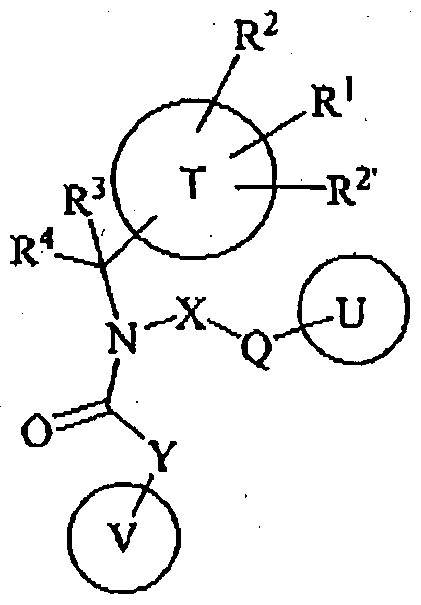
  • the present invention provides compounds of Formula (I):
  • G 1 denotes a single bond
  • G 2 denotes a CO group
  • X is selected from a single bond, an alkylene group having 1 to 6 carbon atoms optionally substituted with 1 or 2 substituents selected from fluoro or CrCe-alkyl,
  • Y is selected from an alkylene group having 1 to 6 carbon atoms optionally substituted one or two times with C 3 -C e -cycloalkyl or d-C 3 -alkyl; or a 3-8- membered cycloalkylene group,
  • Q . is selected from O, NH or a single bond
  • W is selected from SO, S0 2 or a single bond.
  • U is cyctoalkyi, cycloalkenyi, heterocyclyl or heteroaryl, each of the above groups being optionally substituted with 1 to 3 substitutent6 selected from Hal, N0 2 , CN, - S j-C,-C e -alkyl. -S-Ci-Ce-alkyl. N e 2 .
  • V is an aryl group optionally substituted with 1 to 3 substitutents selected from Hal, N0 2 . CN, SO z -Ci-Ce alkyl, NMe 2 , C C e -alkyl, O-d-Ce-alkyl, -(CH z ) m -0-Ci-C 6 -alkyl, -CrCe-halo-alkyl. 0-Ci-C e -halo-alkyl or a 5-6-mBmbered heteroaromatic group,
  • T denotes phenyl, triezoly), thiazolyl, oxazolyl, oxadiazolyl. or pyrazolyt.
  • R 1 is Hal, -Ci-Ce-alkyl. O-C-Ce-alkyl, -(CHz O-C-Ca-alkyl, 0-C,-C e -haio-alkyl,
  • O-C-Ce-halo-alkyl O-C-Ce-halo-alkyl, -SOj-Ci-Ce-alkyl, -(CH 2 ) m -S0 2 -Ci-C e -alkyl, -SOrCi-Ce-halo- alkyl, - ⁇ CH 2 ) m -SO z -C,-C B -halo-alkyl, -S0 2 -3-8-cyeioalkyl, -(CHj SOrS-S- cycloalkyl, cyano or -Ci-Ce-halo-alkyl,
  • R 2 and R a are independently from one another H, Hal, -Ci-Ce-alkyl, -0-C,-C 6 -alkyl, -(CH 2 ), «-0-Ci-C B -alkyl, 0-C C 6 -halo-alkyl, -(CH z ) m -0-C r C e -halo-alkyl, -S0 2 -C,-C 6 - alkyl, -(CH a ) m -S ⁇ VCrC 6 -alkyl, .SO r C r C e -halo-alkyl, alkyl. -S0 2 -3-8-cycloalkyl, -(CH 2 ) m -SOj-3-8-cycloalkyl, -Ci-Ce-haio-alkyl, or
  • R 1 and R 2 are linked to form with the ring T to which they are attached a 7-12-membered fused heterocyclyl or 7-12-membered fused cycloalkyl. each of which may be optionally substituted with 1 to 3 Hal, - ( -VCe-halo-alkyl, N0 2 , CN, C C e -alkyl. - (CH 2 ) m -0-C,-Ce-alkyl. or -0-Ci-C 6 -alkyl,
  • R 3 is CrCe-alkyl, Ci-C e -hal08lkyl,
  • aloalkyl a 3-8-membered cycloalkyl group, optionally substituted with 1 to 3 substitutents independently selected from Hal, or CrCe-alkyl; or a 3-8-membered heterocyclic group, optionally substituted with 1 to 3 substitutents independently selected from Hal, -Ci-Ce-halo-alkyl, N0 2 , CN.
  • Ci-Ce-alkyl -(CH 2 ) m - O-d-Ce-alkyl, -O-Ci-Ce-alkyl, -(CH 2 ) m - O-C Ci-halo-alkyl, -(CH 2 ) m -S02-Ci-C 6 -halo-alkyl, -S0 2 -Ci-C e 'halo-alkyl, -0-C C e - halo-alkyl. -C(0)-C,-C 6 -alkyl. or -C(0)0-C C e -alkyl,
  • R 4 denotes H, C ⁇ Ce-alkyl, or forms together with R 3 a 3-8-membered cycloalkyl ring, optionally substituted with Hal, -d-Ce-halo-alkyl, N0 2 , CN.
  • Ci-Ce-alkyl, -(CHa -O- Ci-C e -alkyl, -O-C.-Ce-alkyl. -C(0).Ci-Ce-alkyl, or -C(0)0-C,-C e -alkyl, m is selected from 1. 2, 3 or 4, preferably 1 or 2,
  • Hal is F, CI, Br, or I, wherein -G 2 -Y-W together is at least 3 atoms in length, as well as pharmaceutically acceptable salts thereof, or is an enantiomeric mixture of 2 enantiomers in all ratios, and/or as a mixture of diastereoisomers in all ratios.
  • the present invention provides a kit or a set comprising at least one compound of Formula (I) or related Formulae, preferably in combination with immunomodulating agents.
  • the kit consists of separate packs of; (a) an effective amount of a compound of the Formula (I) and/or pharmaceutically usable derivatives, solvates, salts, hydrates and stereoisomers thereof, including mixtures thereof in all ratios, and
  • the present invention relates to pharmaceutical compositions comprising a compound provided herein, and a pharmaceutical carrier, excipient or diluent.
  • the pharmaceutical composition can comprise one or more of the compounds described herein. It will be understood that compounds provided herein useful in the pharmaceutical compositions and treatment methods disclosed herein, can be pharmaceutically acceptable as prepared and used.
  • the present invention relates to methods for preventing, treating or ameliorating a condition from among those listed herein, particularly conditions that are associated with immune-mediated reactions, autoimmune conditions, or other conditions which are modulated by immunosuppression.
  • these conditions are multiple sclerosis, type-1 diabetes mellitus. rheumatoid arthritis, p$oriasls, contact dermatitis, obesity, systemic lupus erythematosus, graft-versus host disease, and transplant rejection, which method comprises administering to a mammal in need thereof an amount of one or more of the compounds provided herein, or pharmaceutical composition thereof, effective to prevent, treat or ameliorate the condition.
  • the present invention extends to the use of any of the compounds of the invention for the preparation of medicaments that may be administered for such treatments, as well as to such compounds for the treatments disclosed and specified.
  • the present invention is directed to methods for synthesizing the compounds described herein, with representative synthetic protocols and pathways described below.
  • the Invention provides new compounds which can modulate the activity of the voltage gated potassium channel K v 1.3, and thus avert or treat any maladies that may be causally related to aberrations in such activity.
  • the Invention also provides a series of compounds that can treat or alleviate maladies or symptoms of same, such as immune-mediated disorders and autoimmune diseases, that may be causally related to the activation of the Kv1.3 channel.
  • the invention also provides a series of compounds that can treat a disease or condition, wherein the disease or condition is selected from: Acute disseminated encephalomyelitis (ADE ), Addison's disease, Allopecia areata, Alzhelmers disease, Ankylosing spondylitis, Antiphospholipid antibody syndrome, Autoimmune hemolytic anemia, Autoimmune hepatitis. Autoimmune inner ear disease, Autoimmune Lymphoproliferative Syndrome (ALPS), Autoimmune polyendocrine/polyglandular syndrome, Autoimmune thrombocytoipenia purpura, Bale disease, Behcet disease. Bullous pemphigoid, Cardiomyopathy.
  • ADE Acute disseminated encephalomyelitis
  • Addison's disease Addison's disease
  • Allopecia areata Allopecia areata
  • Alzhelmers disease Ankylosing spondylitis
  • Antiphospholipid antibody syndrome Autoimmune hemolytic
  • Celiac sprue-dermatitis herpetiformis Chronic fatigue immune dysfunction syndrome (CFIDS), Chronic inflammatory demyelinating neuropathy, Cicatrical pemphigoid, Coeliac disease, Cold agglutinin disease.
  • CIDS Chronic fatigue immune dysfunction syndrome
  • Chronic inflammatory demyelinating neuropathy Cicatrical pemphigoid
  • Coeliac disease Cold agglutinin disease.
  • CREST syndrome Crohn's disease
  • Cystic fibrosis Degos disease
  • Dermatomyositis Diabetes (Type I or Juvenile onset)
  • Early onset dementia Eczema.
  • Endotoxin shock Essential mixed cryoglobulinemia, Familial Mediterranean fever, Fibromyalgia, Fibromyositis, Goodpasture's syndrome, Graves' disease, Guillain-Barre syndrome (GBS), Hashimoto's t yroldosis. Hidradenitis suppurativa, Idiopathic pulmonary fibrosis, Idiopathic thrombocytopenic purpura, IgA nephropathy, Lambert-Eaton Myasthenic Syndrome, Leukemia, Lichen planus, Meniere disease, Mixed connective tissue disease, Multiple sclerosis.
  • Multiphasic disseminated encephalomyelitis Myasthenia gravis, Neuromyelitis Optica, Paraneoplastic Syndromes, Pemphigus, Pemphigus vulgaris, Pernicious anaemia, Polyarteritis nodosum, Polychondritis, Polymyalgia rhematica, Polymyositis, Primary agammaglobulinemia, Primary biliary cirrhosis.
  • Transplant or Allograft rejection Ulcerative colitis, Uveitis, Vasculitis, Vitiligo, Graft vs Host disease, pustular psoriasis, and Wegener's granulomatosis.
  • the invention further provides a series of compounds that can treat a disease or condition, wherein the disease or condition is selected from: resistance by transplantation of organs or tissue, graft- versus-host diseases brought about by medulla ossium transplantation, rheumatoid arthritis, systemic lupus, erythematosus, Hashimoto's thyroiditis, multiple sclerosis, myasthenia gravis, type I diabetes uveitis, juvenile- onset or recent-onset diabetes mellitus.
  • the disease or condition is selected from: resistance by transplantation of organs or tissue, graft- versus-host diseases brought about by medulla ossium transplantation, rheumatoid arthritis, systemic lupus, erythematosus, Hashimoto's thyroiditis, multiple sclerosis, myasthenia gravis, type I diabetes uveitis, juvenile- onset or recent-onset diabetes mellitus.
  • posterior uveitis allergic encephalomyelitis, glomerulonephritis, infectious diseases caused by pathogenic microorganisms, inflammatory and hyperprollferative skin diseases, psoriasis, atopical dermatitis, contact dermatitis, eczematous dermatitises, seborrhoeis dermatitis, Lichen planus, Pemphigus, bullous pemphigoid. Epidermolysis bullosa, urticaria angioedemas.
  • vasculitides erythemas, cutaneous eosinophilias, Lupus erythematosus, acne, Alopecia areata, keratoconjunctivitis, vernal conjunctivitis, uveitis associated with Behcet's disease, keratitis, herpetic keratitis, conical cornea, dystrophia epitheliatis corneae, corneal leukoma, ocular pemphigus, Mooren's ulcer, Scleritis, Graves' opthalmopathy, Vogt- Koyanagi-Harada syndrome, sarcoidosis, pollen allergies, reversible obstructive airway disease, bronchial asthma, allergic asthma, intrinsic asthma, extrinsic asthma, dust asthma, chronic or inveterate asthma, late asthma and airway hyper-responsiveness, bronchitis, gastric ulcers, vascular damage caused by ischemic diseases and thrombosis, ischemic bowel diseases
  • the invention further provides pharmaceutical compositions that are effective in the treatment or prevention of a variety of disease states, including the diseases associated with the central nervous system, cardiovascular conditions, chronic pulmonary obstructive disease (COPD), inflammatory bowel disease, rheumatoid arthritis, osteoarthritis, and other diseases where an immunological inflammatory component or autoimmune component is present.
  • COPD chronic pulmonary obstructive disease
  • inflammatory bowel disease rheumatoid arthritis
  • osteoarthritis osteoarthritis
  • compounds of the present invention are used in the treatment and prophylaxis of a condition selected from Multiple sclerosis, Rheumatoid arthritis, Psoriasis, Type 1 Diabetes, Type II Diabetes, Systemic lupus nephritis, Oncology. Glomerulonephritis. Sjogrens's syndrome, Transplant rejection, Graft versus host disease, Allergic contact dermatitis, Neointimal hyperplasia/restenosis, Periodontal disease, Leprosy, and Obesity.
  • a condition selected from Multiple sclerosis, Rheumatoid arthritis, Psoriasis, Type 1 Diabetes, Type II Diabetes, Systemic lupus nephritis, Oncology. Glomerulonephritis. Sjogrens's syndrome, Transplant rejection, Graft versus host disease, Allergic contact dermatitis, Neointimal hyperplasia/restenosis, Periodontal disease, Leprosy, and Obe
  • W is S0 2 .
  • Q is a single bond. ln an embodiment Q is a single bond, and W is S0 2 .
  • Q and W are single bonds.
  • G 2 -Y-W together is from 3-6 atoms in length.
  • G 2 -Y-W together is 3 atoms in length.
  • G 2 -Y-W together is 4 atoms in length.
  • G 2 -Y-W together is 5 atoms in length.
  • G 2 -Y-W together is 6 atoms in length.
  • G 2 -Y-W together is 3 atoms in length and W is a single bond.
  • G a -Y-W together is 3 atoms in length and W is S0 2 .
  • G 2 -Y-W together is 3 atoms in length and Q is a single bond.
  • G 2 -Y-W together is 4 atoms in length and W is a single bond.
  • G 2 -Y-W together is 4 atoms in length and W is S0 2 .
  • G 2 -Y-W together is 4 atoms in length and Q is a single bond.
  • G -Y-W together is 5 atoms in length and W is a single bond.
  • G s -Y-W together is 5 atoms in length and W is S0 2 .
  • G 2 -Y-W together is 5 atoms in length and Q is a single bond.
  • G 2 -Y-W together is 6 atoms in length and W is a single bond. ln an embodiment G 2 -Y-W together is 6 atoms in length and W is S0 2 .
  • G 2 -Y-W together Is 6 atoms in length and Q is a single bond.
  • -G 2 -Y-W- is selected from one of the following:
  • V is an optionally substituted phenyl group.
  • V is an optionally substituted phenyl group
  • Q is a single bond
  • V is an optionally substituted phenyl group
  • W is S0 2 .
  • V is an optionally substituted phenyl group
  • Q is a single bond
  • W is S0 2 .
  • V Is an optionally substituted phenyl group.
  • Q and W are single bonds. Accordingly, in a further embodiment the invention relates to compounds of formula (la):
  • X is selected from a single bond, an alkylene group having 1 to 6 carbon atoms optionally substituted with 1 or 2 substituents selected from fluoro or C-rCe-alkyl,
  • Y is selected from an alkylene group having 1 to 6 carbon atoms optionally substituted one or two times with CyCa-cycloalkyl or Ci-Cs-alkyl; or a 3-8- membered cycloalkyiene group,
  • Q is selected from O, NH or a single bond
  • ⁇ V Is an aryl group optionally substituted with 1 to 3 substitutents selected from Hal, N0 2 , CN, S0 2 -Ci-C e alkyl, NMej. CVCs-alkyl, 0-C,-C e -alkyl.
  • U is cycloalkyl. cycloalkenyl, heterocyclyl or heteroaryl, each of the above groups being optionally substituted with 1 to 3 substitutents selected from Hal, N0 2 , CN. - SOj-CrCe-a!kyl. -S-C-Ce-alkyl, NMe 4 . C,-C 6 -alkyl, -C(0)0-C r C e -alkyl. ⁇ - ⁇ ,- ⁇ - alkyl, -(CHiJm-O-C Ce-alk l, -C Ce-halo-alkyl, or a 5-6-membered heteroaromatic group being optionally substituted by Hal,
  • T denotes phenyl, triazolyl, thiazolyl, oxazolyl, oxadiazoly!, or pyrazolyl
  • R 1 is Hal, -C-Ce-alkyl, 0-C,-Ce-alkyl, -(CH ⁇ nrO-d-Ce-alkyl, 0-Ci-C e -halo-alkyl. -(CH z ) m - O-CrCe-halo-alkyl, -SOj-C Ce-alkyl, -(CH ⁇ -SCVCrCe-alkyl.
  • R 2 and R 3 ⁇ 4 are independently from one another H, Hal, -C r C e -alkyl, -0-Ci-C e -alkyl, -(CH 2 ) rn -0-C 1 -C e -alkyl, 0-C r Ce-halo-alkyl, -(CH 2 ) m -0-Ci-C e -halo-alkyl, -S0 2 -C r C e - alkyl, -(CH 2 ) m -S0 2 -C 1 -C e -alkyl, -S0 2 -C n -C 6 -halo-alkyl,
  • R 1 and R 2 are linked to form with the ring T to which they are attached a 7 ⁇ 12-membered fused heterocyclyl or 7-12-membered fused cycloalkyi, each of which may be optionally substituted with 1 to 3 Hal, d-Ce-halo-alkyl, N0 2 , CN, CrC 6 -alkyl. - (CHzJm-O-d-Ce-alkyl, or -O-C C -alkyl,
  • R 3 is CVCe-alkyl, C,-C 6 -haloalkyl. -(CH ⁇ -Od-Ce-alkyl. or -(ChfeJnrO-C-Ce- haloalkyl; a 3-8-membered cycloalkyi group, optionally substituted with 1 to 3 substitutents independently selected from Hal, -Cr-Ce-halo-alkyl, or Ci-Cs-alkyl; or a 3-8-membered heterocyclic group, optionally substituted with 1 to 3 substitutents independently selected from Hal, -C C e -halo-alkyl.
  • R 4 denotes H, Ci-Ce-alkyl, or forms together with R s a 3-8-membered cycloalkyi ring, optionally substituted with Hal. -Ci-Ce-halo-alkyl, N0 2 , CN, CrCe-alkyl, - ⁇ CH 2 ) m - - Ci-Ce-alkyl, -0-Ci-C e -alkyl, -C(0)-C t -Ce-alkyl.
  • each m is independently selected from 1 , 2, 3, or 4 preferably 1 or 2; as well as pharmaceutically acceptable salte thereof, or is an enantiomeric mixture of 2 enantiomers In all ratios, and/or as a mixture of diastereoisomers in all ratios.
  • X is an aikylene group having 1 to 4 carbon atoms, optionally substituted with 1 or 2 substituents selected from fluoro or Ci-C 8 -el yl.
  • X is selected from methylene or ethylene.
  • X is methylene
  • X is a single bond.
  • Y is an aikylene group having 1 to 4 carbon atoms, optionally substituted one or two times with C3-C 8 -cycloalkyl or Ci-C 3 -alkyl.
  • Y is selected from methylene, ethylene, propylene, isopropylene, or tertbutylene.
  • Y is a 3-8-membered cycloalkylene group, or 3-8-membered cycloalkenylene.
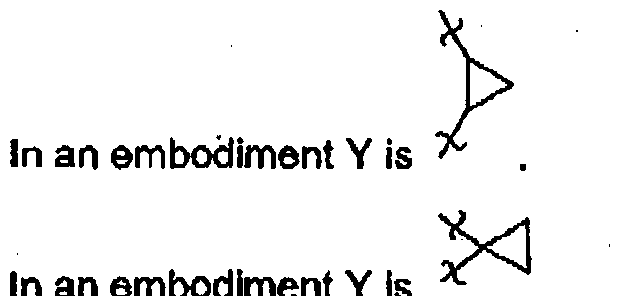
  • Y is a 3-membered cycloalkylene.
  • Q is a single bond.
  • the compound of the invention is a compound of formula (la 1 ). In an embodiment the compound of the invention is a compound of formula (la”). In an embodiment the compound of the invention is a compound of formula (la 1 "). In an embodiment the compound of the invention is a compound of formula (la lv ). ln an embodiment the compound of the invention is a compound of formula (la v ).
  • the compound of the invention Is a compound of formula (la vl ).
  • the compound of the invention is a compound of formula (la 1 ), (la 111 ), (la ⁇ ), wherein Q is a single bond.
  • the compound of the invention is a compound of formula (la la ).
  • the compound of the invention is a compound of formula (la" la ).
  • the compound of the invention is a compound of formula (la vla ).
  • the invention contemplates the following further general formulae: wherein 1 , R 2 , R z , R 3 and R 4 , T, U and V are as defined above for compounds of formula (la).
  • X selected from a single bond, an alkylene group having 1 to 6 carbon atoms optionally substituted with 1 or 2 substituents selected from fluoro or Ci-Ce-alkyl,
  • Y is a 3-membered cycloalkylene group
  • Q is selected from O. NH or a single bond
  • V is an aryl group optionally substituted with 1 to 3 substitutents selected from Hal, N0 2 , CN, S0 2 -d-Ce alkyl, N e*. d-Ce-alkyl, O-d-d-alkyl, -(CH 2 ) m -0-Ci-C6-alkyl, -CrCe-halo-alkyl, 0-d-C $ -halo-alkyl or a 5-6-membered heteroaromatic group,
  • U is cycloalkyl, cycloalkenyl, heterocyclyl or heteroaryl, each of the above groups being optionally substituted with 1 to 3 substitutents selected from Hal, N0 2 , CN, ⁇ SOa-CvCe-alkyl, -S-Ci-C e -alkyl.
  • T denotes phenyl, triazolyl, thiazolyl, oxazolyl, oxadiazol l, or pyrazolyl
  • R 1 is Hal, -C-Ce-alkyl, 0-C,-C e -alkyl, -(CHa O-C d-alkyl. 0-Ci-C 6 -halo-alkyl, - ⁇ CH 2 ) m - 0-d-C 6 -halo-alkyl. -S0 2 -Ci-C e -alkyl, - ⁇ CH 2 ) m -SCvd-C e -alkyl.
  • R 2 and R are Independently from one another H, Hal, -Ci-C 6 -alkyl, -0-Ci-C e -alkyl, (CH 2 ) m -0-C 1 -C 6 -alkyl, O-Ci-C 6 -hal0-alkyl, -(CH 2 ) m -O-C C e -hal0-alkyl, -S0 2 -Ci-C e - alkyl, -(CH 2 ) m -S0 2 -Ci-C6-alkyl ( -S0 2 -C,-C 6 -halo-alkyl.
  • R and R 2 are linked to form with the ring T to which they are attached a 7-12-membered fused heterocyclyl or 7-12-membered fused cycloalkyl. each of which may be optionally substituted with 1 to 3 Hal, -d-C e -halo-alkyl, C ⁇ , CN, d-Ce-alkyl, - (CH 2 ) m -0-Ci-C e -alkyl, or -O-CrCe-alkyl,
  • R 3 is C-Ce-alkyl, C,-C 6 -haloalkyl, -(CH ⁇ .O-d-d-alkyl. or -(CH 2 ), negligence-0-Ci-C6- haloalkyl; a 3-8-membered cycloalkyl group, optionally substituted with 1 to 3 substitutents Independently selected from Hal. -C,-C e -halo-alkyl, or d-Cs-alkyl; or a 3-8-membered heterocyclic group, optionally substituted with 1 to 3 substitutents independently selected from Hal, -d-drhalo-alkyl.
  • R* denotes H, d-Cj-alkyl, or forms together with R 3 a 3-8-membered cycloalkyi ring, optionally substituted with Hal, -C t -Ce-halo-alkyl, NO z , CiM, d-Ce-alkyl, -(CH 2 ) m -0- C-Ce-alkyl.
  • each m is independently selected from 1, 2, 3, or 4, as well as pharmaceutically acceptable salts thereof, or Is an enantiomeric mixture of 2 enantiomers in all ratios, and/or as a mixture of diastereoisomers in all ratios.
  • Q is a single bond.
  • Q and X are single bonds.
  • X is Ci-C 4 alkylene. in ah embodiment X is methylene, ethylene, propylene or isopropylene, In an embodiment X is methylene or ethylene. In an embodiment X is methylene.
  • the compounds of the invention may be represented by the following general formula (lb la ):
  • X is selected from a single bond, an alkylene group having 1 to 6 carbon atoms optionally substituted with 1 or 2 substituents selected from fluoro or d-d-alkyl.
  • Y is an alkylene group having 1 to 6 carbon atoms
  • Q is selected from O. NH or a single bond.
  • V is an aryl group optionally substituted with 1 to 3 substitutents selected from Hal, N0 2l CN, S0 2 -C,-C e alkyl, NMe 2 , d-Ce-alkyl, O-d-Ce-alkyl, -(CH 2 ) m -0-Ci-C e -alkyl. -Ci-Ce-halo-alkyl, O-d-Ce-halo-alkyl or a 5-6-membered heteroaromatic group,
  • U is cycloalkyl, cydoalkenyl, heterocydyl or heteraary!, each of the above groups being optionally substituted with 1 to 3 substitutents selected from Hal, NO ? , CN. - SOz-C-Ce-alkyl, -S-d-Ce-alkyl, NMe 2 , d-C e -alkyl, -C(0)0-C C e -alkyl. O-d-Ce- alkyl, -(CHi) m -0-Ci-C 6 -alkyl. -C
  • T is a phenyl, a triazolyl, a thiazolyl, an oxazolyl, an oxadiazolyl, or pyrazolyl group.
  • R is Hal, -d-Ce-alkyl, O-d-Ce-alkyl, -(CH 2 ) m -0-d-Ce-alkyl, 0-C r C e -halo-alkyl, -(CH 2 ) m - O-d-Ce-halo-alkyl, -SOj-d-Ce-alkyl. -(CH 2 ) ffl -S0 2 -d-Ce-a'kyl.
  • R 2 and R 2 ' are independently from one another H, Hal, -d-Ce-alkyl, -0-C,-C 6 -alkyl, -(CHz O-d-Ce-alkyl, O-d-Ce-halo-alkyl, -(CHz O-d-Ce-halo-alkyl, -S0 2 -d-C e - alkyl, -(CH 2 > m -S0 2 -C 1 -C e -alkyl > -SOj-d-Ce-halo-alkyl.
  • R 1 and R 2 are linked to form with the ring T to which they are attached a 7-12-membered fused heterocydyl or 7-12-membered fused cycloalkyl. each of which may be optionally substituted with 1 to 3 Hal, -d-Cg-halo-alkyl, N0 2 , CN, Ci-C 3 -alkyl. - (CH 2 ) n ,-0'Ci-CB-alkyl. or -0-d-C 6 -alkyl.
  • R 3 is d-Ce-alkyl, d-Ce-haloalkyl,
  • haloalkyl a 3-8-membered cydoalkyl group, optionally substituted with 1 to 3 substitutents independently selected from Hal. -Ci-Ce-halo-alkyl, or Ci-Ce-alkyl; or a 3-8-membered heterocyclic group, optionally substituted with 1 to 3 substitutents independently selected from Hal, -d-Ce-halo-atkyl, N0 2 , CN. d-Ce-alkyl.
  • R 4 denotes H, d-C 6 -elkyl. or forms together with R 3 a 3-8-membered cycloalkyi ring, optionally substituted with Hal. -d-Ce-halo-alkyl, N0 2 , CN, Ci-Ce-alkyl, -(CH 2 ) m -0- d-Ce-alkyl, -0-C,-C e -alkyl, -C(0)-Ci-C e -alkyl, or -C(0)0-C,-C B -alky
  • Q is a single bond.
  • Q and X are single bonds.
  • R 4 is H or CrC+ alkyl.
  • R 4 is H.
  • R 4 is C 1 -C4 alkyl.
  • R 4 is methyl
  • R 3 is optionally substituted C1-C4 alkyl, or optionally substituted C 3 -C e cycloalkyl.
  • R 3 and R 4 are independently CrCj-alkyl.
  • R 3 and R 4 are both methyl.
  • R 4 is hydrogen and R 3 is tetrahydrofuranyl, azetidlnyl, piperadlnyl, or tetrahydropyranyl.
  • the present invention provides compounds of Formulae (I), (la), (lb) or (Ic) and each sub formula wherein R 4 denotes M or Me and R 3 is selected from the following groups:
  • substitutents independently selected from Hal, -Ci-C e -halo-alkyl, N0 2 , CN, Ci-Ce-alkyl, -(CH s ) m -0-C r Ce-a!kyl, '(CH 2 ) rn -S0 2 -C 1 -C 6 -alkyl 1 -S0 2 -C,-C e -alkyl, -O-C Cralk l.-iCH ⁇ -O-C Ce-halo- alkyl, -(CH ⁇ m-SC ⁇ -C Ce-halo-alkyl. -S0 2 -Ci-C e -halo-alkyl, or -O-CVCe-halo-alkyl, or R* forms together with R* a 3 membered cyctoalkyl ring.
  • R is H and R 3 is C,-C e alkyl, cyclopropyl. or a 3-8-membered heterocyclic group.
  • R 4 is H and R 1 is ( Ce alkyl or cyclopropyl. ln an embodiment with specific reference to compounds of formula (la), (lb), (Ic) and sub formula thereof, R 4 is H and R 3 is cyclopropyl.
  • R* is H and R 3 is ethyl.
  • R 4 is H and R 3 is isopropyl.
  • R 4 is H and R J is methyl.
  • U is a 5-6-membered cycloalkyl group, a .5-12-membered heterbcyclyl or a 5-6 membered heteroaryl, each of the above groups being optionally substituted with 1 to 3 substitutents selected from Hal. N0 2 . CN, SO 3 ⁇ 4 , NMe 2 .
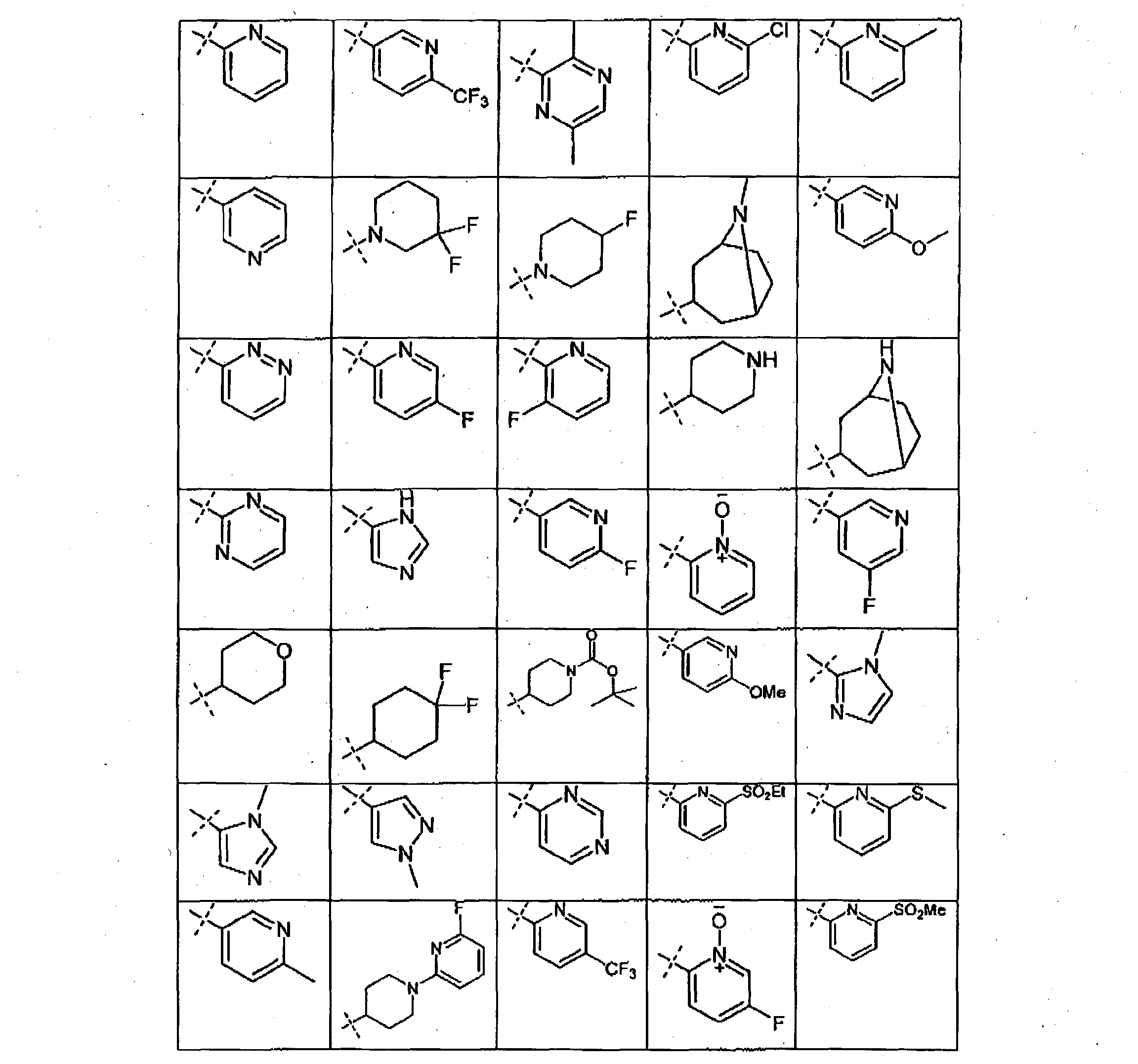
  • U is selected from pyridinyl, pyrazmyl, pyridazinyl, pyrimidinyl, imidazolyl, pyrazolyl. tetrahydropyranyl. cyclohexyl, 8-azabicyclo[3.2.1]octan-3-yl, triazolyl and piperidinyl. each of the above groups being optionally substituted with 1 to 3 substitutents selected from Hal. N0 2 . CN, S0 2> Nlvte*, Ci-Ce-alkyl, O-CrCe-alkyl, -(CH 2 ) m - O-C Ce-alkyl.
  • U is selected from pyridinyl, pyridazinyl and pyrazolyl, each of the above groups being optionally substituted with 1 to 3 substitutents selected from CF 3 . - S0 2 -Ci-C6-alkyl, C C e -a'kyl or Hal.
  • U is selected from pyridinyl. pyridazinyl and pyrazolyl, each of the above groups being optionally substituted with a substituted selected from CF 3 , -S0 2 Me, methyl or F.
  • U is selected from pyridinyl. pyridazinyl and pyrazolyl, each of the above groups being optionally substituted with a substituted selected from CF 3 , -S0 2 Me, methyl or F.
  • V is an aryl group optionally substituted with 1 to 3 substitutents selected from Hal, -C C B -halo-alkyl, 0-CrC B -halo-alkyl or S0 2 -Ci-C e alkyl.
  • V is a phenyl group optionally substituted with 1 to 3 substitutents selected from Hal. N0 2l CN. SOa-CrCe alkyl, NMe3 ⁇ 4. C,-C 6 -alkyl, 0-C r C 6 -alkyl, -(CH 2 )m-0- C,-Ce-alkyl, -C t -Ce-halo-alkyl, O-CrCe-halo-alkyl or a 5-6-membered heteroaromatic group.
  • V is a phenyl group optionally substituted with 1 to 3 substitutents selected from Hal. -C C 6 -halo-alkyl, O-C,-Ce-hal0-alkyl or S0 2 -C,-C e alkyl.
  • V is a phenyl group optionally substituted with 1 or 2 substituents selected from F, CI. -CF 3l -OCFj, -OCHF 2 or -S0 2 Me.
  • V is a phenyl group optionally substituted by F. ln a further embodiment, with specific reference to compounds of Formula (I), (la), (lb), (lc) and sub formula thereof the present invention provides wherein V is selected from:
  • R denotes Hal, N(1 ⁇ 4. CN, S0 2 -Ci.C e alkyl, N e 2 , C-Ce-alkyl, 0-C r C e -alkyi, - (CHjJm-O-CrCe-alkyl, CF 3l or a 5-6-membered heteroaromatic group.
  • T is phenyl, triazolyl, oxadiazolyl or diazolyl.
  • T is phenyl
  • R 1 is O-C t -Ce-alkyl. Hal, -(CH 2 ) m -0-Ci-C e -alkyl, -C,-C 6 -alkyl, 0-C r C e - halo-alkyl, -SCvC ⁇ Ce-alkyl, -Ci-Ce-halo-alkyl, -S0 2 -3-8-cycloalkyl, or cyano, in which m is 1.
  • R 2 and R 2' are H or Hal. In an embodiment R 2 is H or Hal and R ? is H.
  • R 1 is 0-Ci-C e -alkyl, Hal, -(CHi)m-0-C C a -alkyl, -C C e -alkyl, O-C Ce- halo-alkyl, -SOi-Ci-C «-alkyl, -d-Ce-halo-alkyl, -S0 2 -3-8-cydoall ⁇ yl, or cyano, in which m is I. R ⁇ s H or Hal and R ⁇ is H.
  • R 1 and R 2 are linked to form with the ring T to which they are attached
  • R 1 and R* are linked to form with the ring T to which they are attached
  • T is phenyl, triazolyl. oxadiazolyl or diazolyl;
  • R 1 is 0-Ci-C 6 -alkyl, Hal. - (CHzJm-O-CrCe-alkyl, -Ci -C h alky I. O-d-Ce-halo-alkyl, -SO_-C,-C e -alkyl ( -d-Ce-halo-alkyl, -SOi-3-8-cycloalkyl, or cyano.
  • m is 1 ;
  • R 2 is H or Hal and R is H; or
  • R and R 2 are linked to form with the ring T to which they are attached a dihydrobenzofuranyl, an
  • indanyl each of these groups being optionally substituted by 1 to 3 -Ci-C B -alkyl.
  • T is phenyl
  • R 1 is O-d-CVhalo-alkyl, -SOi-CrCe-alk l or Hal. and R* and R 2 are H; or R 1 and R' are linked to form with the ring T to which they are attached which is optionally substituted with 1 or 2 -0,-0 $
  • T is a phenyl ring wherein at least one of R 1 , R 2 or R s ' is in para position with regard to the rest of the molecule.
  • T is a phenyl ring wherein at least one of R ⁇ R a or R 2 ' is in meta position with regard to the rest of the molecule.
  • T is a phenyl ring wherein at least one of R R 2 or R 2 ' is in ortho position with regard to the rest of the molecule.
  • the present invention provides compounds of Formula (I) and related Formulae wherein Hal preferably denotes F, CI or Br, most preferably F. and/or
  • a 3-8-membered cycloalkyl group preferably is a cyclopropyl, a cyclobutyl, or a cyclopentyl, and/or
  • a 3-8-membered cycloalkylene group preferably is cyclopropylene, a cydobutylene, or a cyclopentylene, and/or
  • a 3-8-membered heterocyclic group preferably has 1 to 3 carbon atoms which is replaced by a group selected from O, S, N, SO, S0 3 , CO.
  • a 3-8-membered heterocyclic group preferably denotes one of the following groups:
  • a 7-12 membered heterocyclic ring preferably denotes a bicyclic ring having 7 to 12 carbon atoms wherein the 2 rings are fused or bridged, and wherein 1 to 3 carbon atoms may be replaced by a group selected from O, S, N, SO, S0 2 , CO.
  • a 7- 2 membered heterocyclic ring preferably denotes one of the following groups:
  • a 5-6-membered heteroaromatic group denotes an aromatic ring having 5 or 6 members and containing 1 to 3 heteroatoms selected from N, O or S.
  • a 5-6-membered heteroaromatic group preferably denotes one of the following groups:
  • a CvC B -halo-alkyl denotes a linear or branched aikyl having 1 to 6 carbon atom wherein 1 to 6 H atom is replaced by a halogen, preferably a F atom.
  • the present invention provides compounds of Formula (II):
  • G 1 denotes a single bond
  • G 2 denotes a CO group
  • X is selected from a single bond, an alkylene group having 1 to 6 carbon atome optionally substituted with 1 or 2 substituents selected from fluoro or C r Ce-alkyl,
  • Y is selected from an alkylene group having 1 to 6 carbon atoms optionally substituted one or two times with C 3 -C 3 -cycloalkyl or Ci-C 3 -alkyl; or a 3-8- membered cycloalkylene group,
  • Q 16 selected from O, NH or a single bond
  • W is selected from SO, SO» or a single bond
  • U is cycioalkyi, cycloalkenyl. heterocyciyi or heteroaryl, each of the above groups being optionally substituted with 1 to 3 substitutents selected from Hal, N0 2l CN, - SOz-d-Ce-alkyl, -S-C C 6 -alkyl, NMe 2 , C,-C e -alkyl, -C(0)0-C,-C 6 -alkyl. 0-d-C e - alkyl, -(CHiJ m -O-C Ce-alkyl, -CVCe-halo-alkyl, or a 5- membered heteroaromatic group being optionally substituted by Hal,
  • V is an aryl group optionally substituted with 1 to 3 substitutents selected from Hal, N ⁇ 3 ⁇ 4, CN, S02-C r C e alkyl, NMe 2 , C t -C e -alkyl, O-CrCe-alkyl, -(CHi) m -0'Ci-C e -a]kyl, -C,-Ce-halo-aikyi, o-C,-Ce-halo-alkyl or a 5-6-membered heteroaromatic group,
  • T denotes phenyl, triazolyl. thiazolyl, oxazolyl, oxadiazolyl, or pyrazolyl,
  • R 1 is H, Hal, -C-Ce-alkyl, O-CrC-alkyl. ⁇ CH ⁇ -O-C.-Ce-alkyl, 0-C,-Ce-halo-alkyl. - (CHz O-CrCe-halo-alkyl, -S0 2 -C,-C 6 -alkyl, -S0 2 -Ci-C 6 - halo-alkyl, -(CH 2 ) rt ,-S0 2 -C 1 -C e -haio-alkyl. -SO r 3-8-cycloalkyl, -(CH 2 ) m -SO s -3-S- cycloalkyl, cyano or -CVCe-hafo-alkyl,
  • R 2 and R 2 ' are independently from one another H. Hal, -Ci-Ce-alkyl, -0-Ci-C e -alkyl, -(CH 2 ) m -0-C 1 -C B -alkyi, O-C,-C e -hal0-alkyl, -(CH 2 ) m -0-C C 6 -halo-alkyl, -S0 2 -C C e - alkyl, -(CH 2 ) m -S0 2 -C,-C,-alkyl, -S0 2 -CrCe-halo-alkyl, -(CH 2 ) m -S0 2 -Ci-C e' halo- alkyl, 'S0 2 -3-8-cycloalkyl, -(CH 2 ) m -S0 2 -3-8-cycloalkyl.
  • R 1 and R* are linked to form with the ring T to which they are attached a 7-12-membered fused heterocyciyi or 7-12-membered fused cycioalkyi, and optionally substituted with 1 to 3 Hal, -CrCe-halo-alkyl, N0 2 , CIM, a linear or branched alkyl group having 1 to 6 carbon atoms, -(CH 2 ) m -0-C,-C e -alkyl, or -0-Ci-C 6 -alkyl,
  • R 3 is Ci-Ce-alkyl
  • R* is Ci-Ce-alkyl
  • m is selected from 1 , 2, 3 or 4, preferably 1 or 2
  • Hal is F, CI, Br. or I, wherein -G 2 -Y-W together is at least 3 atoms in length, as well as pharmaceutically acceptable salts thereof, or is an enantiomeric mixture of 2 enantiomers in all ratios, and/or as a mixture of diastereoisomers in all ratios.
  • R 3 is Ci-C 3 -alkyl.
  • R 4 is Ci-C 3 -alkyl.
  • R 3 and R 4 are Ci-C 3 -alkyl.
  • R 3 is methyl
  • R 4 is methyl
  • R* and R 4 are methyl.
  • R 1 , R 2 , R 2 ', m and Hal are as defined above for a compound of Formula (I), (la), (lb) or (lc).
  • R 3 and R 4 are methyl and T is phenyl and R , R 2 . and R z are all H.
  • pharmaceutical composition, method or use of the present invention described above a compound of Formula (II) may be present or used instead of a compound of Formula (I).
  • Alkyi refers to monovalent alkyl groups which may be straight chained or branched.
  • an alkyl group has 1 to 6 carbon atoms (i.e., Ci-Ce-alkyl).
  • an alkyl group ha 1 to 4 carbon atoms (i.e., (VCValkyl).
  • an alkyl group has 1 to 3 carbon atoms (i.e., Ci-C 3 -alkyl). Examples of such alkyl groups include methyl, ethyl, n-propyl, so-propyl. n-butyl, /so-butyl. n-hexyl, and the like.
  • Alkylene refers to divalent alkyl groups which may be straight chained or branch chained.
  • the alkenylene group has 1 to 6 carbon atoms. In certain embodiments 1 to 4 carbon atoms. In certain other embodiments 1 to 3 carbon atoms. In still further embodiments 1 or 2 carbon atoms.
  • alkylene groups include methylene (-CH 2 -), ethylene (-CH 2 CH 2 -), and the propylene isomers (e.g., - CH 2 CH 2 CH 2 - and -CH(CHj)CH 2 -). and the like.
  • Aryl refers to an aromatic carbocyclic group having a single ring (eg. phenyl) or multiple condensed rings (eg naphthyl or anthryl), preferably having from 6 to 14 carbon atoms.
  • aryl groups include phenyl, naphthyl and the like.
  • Cycloalkyl refers to cyclic alkyl groups having a single cyclic ring or multiple condensed or fused rings, preferably incorporating 3 to 12 carbon atoms.
  • Such cycloalkyl groups include, by way of example, single ring structures such as cyclopropyl, cyclobutyl, cyclopentyl, cyclohexyl. cyclooctyl. and the like, or multiple ring structures such as adamantanyl, indanyl, 1,2,3,4-tetrahydronapthalenyl and the like.
  • Cycloalkenyl refers to cyclic alkenyl groups having a single cyclic ring or multiple condensed or fused rings, and at least one point of internal unsaturation, preferably incorporating 3 to 8 carbon atoms.
  • suitable cycloalkenyl groups include, for instance, cyclobut-2-enyl, cyclopent-3-enyl, cyclohex-4-enyl, cyclooct-3-enyl, indenyl and the like.
  • Hal or “halogen” refers to fluoro, chloro, bromo and iodo.
  • Heteroaryl or “Heteroaromatic” refers to a monovalent aromatic heterocyclic group which fulfils the Hiickel criteria for aromaticity (ie. contains 4n + 2 ⁇ electrons) and preferably has from 2 to 10 carbon atoms and 1 to 4 heteroatoms selected from oxygen, nitrogen, selenium, and sulfur within the ring (and includes oxides of sulfur, selenium and nitrogen).
  • Such heteroaryl groups can have a single ring (eg. pyridyl, pyrrolyl or N-oxides thereof or furyl) or multiple condensed rings (eg. indolizinyl, benzoimldazolyl, coumarinyl, quinolinyl. isoquinolinyl or benzothienyl).
  • Heterocyclyl or “Heterocyclic” refers to a monovalent saturated or unsaturated group having a single ring or multiple condensed or fused rings, preferably from 1 to 8 carbon atoms and from 1 to 4 hetero atoms selected from nitrogen, sulfur, SO, SO t , oxygen, selenium or phosphorous within the ring, in one embodiment, the heteroatoms are selected from nitrogen, sulfur, SO, SO z and oxygen.
  • heterocyclyl and heteroaryl groups include, but are not limited to, oxazole, pyrrole, imidazole, pyrazole, pyridine, pyrazine, pyrimidine, pyridazine, indolizine, isoindole, indole, indazole, purine, qulnolizine, isoquinoline.
  • phenanthroline isothiazole, phenazine, isoxazole, isothiazole, phenoxazine, phenothiazine, imldazolidine, imidazoline, piperidine, piperazine, indoline.
  • phthalimide 1 ,2,3,4-tetrahydroisoquinoline, 4,5,6,7-tetrahydrobenzo[b]thiophene, thlazole, thiadiazoles.
  • oxadiazole oxatriazole, tetrazole, thiazolidine, thiophene, benzotbjthiophene, morphollno, piperidinyl, pyrrolidine, tetrahydrofuranyl, triazole, and the like.
  • “Pharmaceutically acceptable” means approved or approvable by a regulatory agency of the Federal or a state government or the corresponding agency in countries other than the United States, or that is listed in the U.S. Pharmacopoeia or other generally recognized pharmacopoeia for use in animals, and more particularly, in humans.
  • “Pharmaceutically acceptable salt” refers to a salt of a compound of the invention that is pharmaceutically acceptable and that possesses the desired pharmacological activity of the parent compound.
  • such salts are non-toxic may be inorganic or organic acid addition salts and base addition salts.
  • such salts include: (1) acid addition salts, formed with inorganic acids such as hydrochloric acid, hydrobromic acid, sulfuric acid, nitric acid, phosphoric acid, and the like; or formed with organic acids such as acetic acid, propionic acid, hexanoic acid, cyclopentanepropionic acid, glycolic acid, pyruvic acid, lactic acid, ma Ionic acid, succinic acid, malic acid, maleic acid, fumaric acid, tartaric acid, citric acid, benzoic acid, 3-(4-hydroxybenzoyl) benzoic acid, cinnamic acid, mandelic acid, methanesulfonic acid, ethanesulfonic acid, 1 ,2-ethane-disulforwc acid, 2- hydroxyethanesulfonic acid, benzenesulfonic acid, 4-chlorobenzenesulfonic acid, 2- naphthalenesulfonic acid, 4-toluen
  • Salts further include, by way of example only, sodium, potassium, calcium, magnesium, ammonium, tetraalkylammonium, and the like; and when the compound contains a basic functionality, salts of non toxic organic or inorganic acids, such as hydrochloride, hydrobromide, tartrate, mesylate, acetate, maleate, oxalate and the like.
  • non toxic organic or inorganic acids such as hydrochloride, hydrobromide, tartrate, mesylate, acetate, maleate, oxalate and the like.
  • pharmaceutically acceptable cation refers to an acceptable cationic counter- ion of an acidic functional group. Such cations are exemplified by sodium, potassium, calcium, magnesium, ammonium, tetraalkylammonium cations, and the like.
  • “Pharmaceutically acceptable vehicle” refers to a diluent, adjuvant, excipient or carrier with which a compound of the invention is administered.
  • Prodrugs refers to compounds, including derivatives of the compounds of the invention, which have cleavable groups and become by solvolysis or under physiological conditions the compounds of the invention which are pharmaceutically active in vivo. Such examples include, but are not limited to, choline ester derivatives and the like, N-alkylmorpholine esters and the like.
  • Solvate refers to forms of the compound that are associated with a solvent, usually by a solvolysis reaction. This physical association includes hydroge bonding. Conventional solvents include water, ethanol, acetic acid and the like.
  • the compounds of the invention may be prepared e.g. in crystalline form and may be solvated or hydrated.
  • Suitable solvates include pharmaceutically acceptable solvates, such as hydrates, and further include both stoichiometric solvates and non-stoichiometric solvates. In certain instances the solvate will be capable of isolation, for example when one or more solvent molecules are incorporated in the crystal lattice of the crystalline solid. 'Solvate' encompasses both solution-phase and isolable solvates. Representative solvates include hydrates, ethanolates and methanolates.
  • compounds of the invention may possess asymmetric centres and are therefore capable of existing in more than one stereoisomeric form.
  • the invention thus also relates to compounds in substantially pure isomeric form at one or more asymmetric centre eg., greater than about 90% ee, such as about 95% or 97% ee or greater than 99% ee, as well as mixtures in all ratios, including racemic mixtures, thereof.
  • the compounds may also therefore appear as an enantiomerically enriched mixture of two enantiomers in all ratios, and/or as a mixture of diastereoisomers in all ratios.
  • Such isomers may be prepared by asymmetric synthesis, for example using chiral intermediates, or mixtures may be resolved by conventional methods, eg., chromatography, or use of a resolving agent.
  • the compounds of the present invention may be capable of undergoing tautomerism. Accordingly, all possible tautomers of a compound of the present invention fall within the scope and spirit of the invention.
  • a hydrogen atom may be replaced with an isotope of hydrogen.
  • deuterium may be used to replace a metabolically labile hydrogen to improve the pharmacokinetics.
  • tritium may be incorporated into a compound for diagnostic or analytical purposes, including but not limited to biodistribution studies.
  • “Therapeutically effective amount” means the amount of a compound that, when administered to a subject for treating a disease, is sufficient to effect such treatment for the disease.
  • the "therapeutically effective amount” includes that amount of a compound or composition that will elicit the biologicaf or medical response of a subject that is being sought by a medical doctor or other clinician.
  • the “therapeutically effective amount” can vary depending on the compound, the disease and its severity, and the age, weight, etc., of the subject to be treated.
  • Preventing refers to a reduction in risk of acquiring or developing a disease or disorder (i.e., causing at least one of the clinical symptoms of the disease not to develop in a subject that may be exposed to a disease-causing agent, or predisposed to the disease in advance of disease onset.
  • prophylaxis is related to "prevention”, and refers to a measure or procedure the purpose of which is to prevent, rather than to treat or cure a disease.
  • 'Treating" or “treatment” of any disease or disorder refers, in one embodiment, to ameliorating the disease or disorder (i.e., arresting the disease or reducing the manifestation, extent or severity of at least one of the clinical symptoms thereof).
  • 'treating' or 'treatment' refers to ameliorating at least one physical parameter, which may not be discernible by the subject.
  • "treating" or “treatment” refers to modulating the disease or disorder, either physically, (e.g., stabilization of a discernible symptom), physiologically, (e.g., stabilization of a physical parameter), or both.
  • “treating" or “treatment” relates to slowing the progression of the disease.
  • Compounds of the present invention are meant to embrace compounds of the Formula(e) as hereinbefore described, which expression includes the prodrugs, the pharmaceutically acceptable salts, and the solvates, e.g., hydrates, where the context so permits. Similarly, reference to intermediates, whether or not they themselves are claimed, is meant to embrace their salts, and solvates, where the context so permits.
  • the inhibition data shown for the compounds of the list below was calculated using the steady state current amplitude at the end of the depolarising pulse in patch clamp evaluations (as described in the Biology Protocols: 1. Electrophysiology).
  • Compounds of Formula (I) can be made by the reaction of the compounds of Formula 5, wherein R 1 , R 2 , R 7 ', R 3 , R 4 , G 1 , X, Q, T and U are as above defined, with a compound of Formula 8, wherein G ⁇ Y, W and V are as above defined, and wherein LG denotes a suitable leaving group, as depicted in scheme 1.
  • LG preferably denotes an halogen, preferably chlorine or bromine, a sulfonate, or denotes an activated acid derivative obtained by the reaction of a carboxylic acid in the presence of an amide coupling agent.
  • the amide coupling agents include EDCl.
  • BOP, PyBOP, HOBt, HATU, T3P, DCC can be used in a suitable solvent, as for example dichloromethane or dimethyiformamide at room temperature.
  • the secondary amines 5 is converted to compounds of Formula (I) by reaction with an activated acid such as an acid chloride, in dichloromethane at room temperature, or a mixed anhydride or a N-succinimide ester in ethanol at room temperature or by reaction with an acid in the presence of an amide coupling reagent selected from EDCl, BOP, PyBOP, HOBt, HATU, T3P, DCC in dichloromethane or dimethyiformamide at room temperature.
  • an activated acid such as an acid chloride, in dichloromethane at room temperature, or a mixed anhydride or a N-succinimide ester in ethanol at room temperature
  • an amide coupling reagent selected from EDCl, BOP, PyBOP, HOBt,
  • compounds of Formula (I) can be synthesised by reacting a compound of Formula 7, wherein R 1 , R 2 , R 2 ', R 5 , R 4 , G 4 , Y, W, T and V are as above defined, with a compound of Formula 9, wherein G ⁇ X. Q, U are as above define and wherein LG denotes a suitable leaving group. Examples of such alkanes having LG groups are alkyl halides or alkyl sulfonates.
  • the reaction of compounds of Formula 7 with compounds of Formula 9 is preferably performed in the presence of a base such as sodium hydride, potassium tert-butoxide, potassium carbonate preferably in dimethyiformamide or acetonitrile.
  • the temperature of the reaction Is between room temperature and 100 "C, preferably between 20 and 60"C.
  • a phase transfer catalyst such as tetra-rt- butylammonium bromide can be used. Preferred conditions are the use of acetone or acetonitrile with heating at 45-100 °C.
  • the compounds of Formula 5 can be synthesised b reacting ketones 1 , wherein R 1 . R 2 , R 2 ', R s and T are as above defined, with amines 2, wherein G 1 , X, Q and U are as above defined, according to scheme 2.
  • This reaction is preferably performed by reductive amination via an imine intermediate.
  • R 4 and T are as above defined, with the aldehyde of Formula 4, wherein Q and U are as above defined, and wherein X' denotes a linear or branched alkyi having 1 to 6 carbon atom or a cyclic alkyi having 3 to 8 carbon atoms wherein 1 -CH 2 - group, in this linear, branched or cyclic alkyi, is replaced by a -CO- group.
  • the reductive aminatlon reaction described in scheme 2 can occur in a single pot reaction using borohydride reagants, including but not limited to sodium cyanoborohydride, sodium acetoxyboro-hydride and sodium borohydride in halogenated solvents such as dichloromethane or 1 ,2-dichloroethane, or alcohols such as methanol, typically at room temperature for 0.5-12 hours.
  • borohydride reagants including but not limited to sodium cyanoborohydride, sodium acetoxyboro-hydride and sodium borohydride in halogenated solvents such as dichloromethane or 1 ,2-dichloroethane, or alcohols such as methanol, typically at room temperature for 0.5-12 hours.
  • the reaction can also occur in two steps. Firstly by the formation of imine in the presence of an acid including but not limited to p-toiuenesulfonic acid, or Amberlyst resin and also a dehydrating reagent, such as but not limited to magnesium sulphate, sodium sulphate, molecular slaves or TiCU using for example dichloromethane, ethanol, ethyl acetate or dimethyl sulfoxide as solvent. This step may be performed in a Dean Stark apparatus using toluene at 90-110 °C. In a second step, the imine can be converted to the secondary amine using borohydride reagents as described above.
  • an acid including but not limited to p-toiuenesulfonic acid, or Amberlyst resin and also a dehydrating reagent, such as but not limited to magnesium sulphate, sodium sulphate, molecular slaves or TiCU using for example dichloromethane, ethanol, ethy
  • Secondary amines 5 may be prepared by the alkylation of primary amines 2 with a compound of Formula 6 or the amine 3 with a compound of Formula 10, wherein LG in Formulae 6 and 10 denotes a suitable leaving group.
  • suitable leaving groups may be selected from halogen, preferably chlorine or bromine, or a sulfonate group, preferably selected from mesylate, tosylate, benzyl sulphonyl, a perfluoroalkyl sulfonate such as mono, di or trifluoromethyl sulfonate or triflate.
  • the reaction is preferably performed In the presence of a base, such as potassium carbonate or triethylamine, in solvents preferably selected from dichloromethane, acetonitrile. dimethyl sulfoxide, at temperatures ranging from room temperature to 100 "C, As disclosed in scheme 3.
  • a base such as potassium carbonate or triethylamine
  • Compounds of Formula 7 may be prepared by reacting a compound of Formula 3, wherein R ⁇ R 2 , R 2 ', R 5 , R 4 and T are as above defined, with a compound of Formula 8, wherein G 2 , Y. , and V are as above defined, and wherein LG is as defined above, as mentioned In scheme 4.
  • Amines of Formula 3 can be acylated with compounds of Formula 8, using techniques well known in the art.
  • LG in the compounds of Formula 8 is preferably an activated acid obtained by reaction of a COOH group in the presence of an amide coupling reagent.
  • the amide coupling reagents include EDCI. BOP, PyBOP, HOBt. HATU, T3P, DCC. They can be used in a suitable solvent, as for example dichloromethane or dlmethylformamide at room temperature.
  • Amines 3 wherein R 4 is H can be prepared by functional group transformations well known in the art- Non-limiting examples are provided in Scheme 5.
  • Ketones 11 can be condensed with hydroxylamine. for instance in ethanol at 80-100 "C for 1-2 days to give 12, which can in turn be reduced to amine 3 using for example Raney nickel in methanol at 80-100 °C for 2-6 hours, or by hydrogenation using palladium on charcoal for instance in ethanol at room temperature for 1-12 hours.
  • Aldehydes 13 can be treated with metallated alkyl species such as Grignard reagents or alkyl lithiums to give secondary alcohols 14 for instance In diethylether or tetrahydrofuran at -78 "C for 1-4 hours, which can be converted to azides 15 using techniques known in the art, for instance by reaction with sodium azide in chloroform and sulfuric acid at 0 °C to room temperature.
  • the azides can be reduced to the amines 3 for example by catalytic hydrogenation with palladium on charcoal in methanol at room temperature or by using PPh 3 / H 2 0 (Staudinger conditions).
  • Reaction of benzonitriles 16 with Grignard reagents or alkyl lithiums for example diethyl ether or tetrahydrofuran at room temperature to 50 "C for 1-4 hours can give imines 17. which may be reduced for instance with sodium borohydride in methanol at room temperature or lithium aluminium hydride in dimethyl formamide at room temperature or borane-THF complex in tetrahydrofuran at -20 *C to room temperature to give the amines 3.
  • EDC.HCI (1-ethyl-3- (3-dimethylaminopropyl)carbodiirnide hydrochloride), eq. (equivalents), EtOAc (ethyl acetate), EtOH (ethanol), g (gram). Gen. (General Procedure). cHex (cyclohexane), HPLC (high performance liquid chromatography), hr (hour), IPA (isopropyl alcohol), int. (intermediate), LCMS (liquid chromatography - mass spectrometry), MHz (Megahertz), MeOH (methanol), min (minute), mL (milliliter), mmol (millimole).
  • PBS phosphate buffered saline
  • PDA photodiode array
  • PMB para-methoxybenzyl
  • cPr cyclo-propyl
  • iPr Iso-propyl
  • PTLC preparative thin layer chromatography
  • Rt retention time
  • T room temperature
  • TBAF tetra-butylammonium fluoride
  • TBTU W,/V,W',W-tetramethyl-0-(benzotriazoH- yl)uronium tetrafluoroborate
  • T3P propane phosphonic acid anhydride
  • TEA triethyl amine
  • TFA trlfluoroacetic acid
  • THF tetrahydrofuran
  • t triplet
  • PetEther petroleum ether
  • TBME terf-butyl methyl ether
  • TLC thin layer chromatography
  • TMS trimethylsilyl
  • TMSI trimethylsilyl iodide
  • UV ultraviolet
  • # of iso. number of stereoisomers).
  • HPLC Method 1 - Waters Alliance 2695, column Waters XBridge C8 3.5 ⁇ ⁇ 4.6x50 mm. conditions: solvent A (H 2 0 with 0.1% TFA), solvent B (ACN with 0.05% TFA), gradient 5% B to 100% B over 8 min, UV detection with PDA Water 996 (230-400 nm).
  • LCMS Method 2 - Agilent 1100 Series LC/MSD, column Phenomenex Gemini-NX C18 5 ⁇ , Zorbax Eclipse XBD-C8 or Luna 5 ⁇ C8, 150 x 4.6 mm, with mobile phase 80% ACN, 15% H z O, 5% buffer (3:1 MeOH/H 2 0, 315 mg HC0 2 NH 4 , 1 mL AcOH) and MS detection (ESI method).
  • UPLC Method 3 - Waters Acquity, column Waters Acquity UPLC BEH C18 1.7 ⁇ 2.1x50 mm, conditions; solvent A (10 mM ammonium acetate in water + 5% ACN), solvent B (ACN), UV detection (PDA, 230-400 nm) and MS detection (SQ detector, positive and negative ESI modes, cone voltage 30 V). Gradient 5% B to 100% B over 3 min or gradient 40 B to 100% B over 3 min.
  • Triethylamine or diisopropylethylamine (2 eq.) was added to a solution of sec-amine (1 eq.) in anhydrous DCM or Et 2 0 (0.1-0.3M) and the resulting solution was stirred at RT under a nitrogen atmosphere for 5 min.
  • Acid chloride 1.5-2.5 eq.
  • the reaction mixture was stirred until completion (LCMS).
  • the reaction mixture was diluted with EtOAc or diethyl ether and washed thoroughly with NaHC0 3 (aq.) solution followed by distilled water.
  • the organic layer was separated, dried (MgSO*) and concentrated under reduced pressure.
  • the crude material was purified using either PTLC or silica-gel flash chromatography using increasing gradient of EtOAc or/and MeOH in hexane or DCM as elu nt.
  • Oxalyl chloride (1.5 eq.) was added slowly to a solution of anhydrous dimethylsulfoxide (3.0 eq.) in anhydrous DCM (0.17-2.0 ) at -78 "C under a nitrogen atmosphere and stirred for 30 min.
  • anhydrous dimethylsulfoxide (3.0 eq.) in anhydrous DCM (0.17-2.0 ) at -78 "C under a nitrogen atmosphere and stirred for 30 min.
  • To the resulting mixture was added the alcohol (1 eq.) dissolved in anhydrous DCM (0.2-Q.4M) and the reaction mixture was stirred at -78 "C for 45 min.
  • Anhydrous triethylamine (6 eq.) was added drop-wise and reaction was stirred at -78 °C for 30 min and then at RT for 30 min.
  • microwave irradiation of the above solution at 120°C for 5 minutes produced the desired product.
  • N-tert-butoxycarbonyl derivative was dissolved in a solution of HCI in Et 2 0. After several minutes a precipitate formed and LCMS was used to monitor the reaction progress. Upon completion the precipitate was collected by vacuum filtration and the product re-crystallised from DMC/Et 2 0,
  • Step i To a suspension of NaH 60% In mineral oil (1.2eq) in dry DMF (0.1M) under N 2 at RT was added the appropriate thiol (1.2eq.) drop-wise. After stirring at this temperature for 10 min. a solution of the 6-bromopyridine analogue in dry DMF (0.1 M) was added drop- wise and the reaction heated to 60°C. The reaction was monitored by LCMS/TLC and following completion was quenched with sat.NH 4 CI. The product was extracted with EtOAc (3 x) and the combined extracts dried (MgS0 4 ) and concentrated under reduced pressure. The crude material was purified by either PTLC or silica-gel flash column chromatography using the appropriate solvent to obtain the thlopyridine intermediate.
  • Step ii) To a solution of the thiopyridine intermediate in dry DCM (0.1 M) under 2 at 0°C was added m-CPBA (2 eq) portion-wise. The reaction was monitored by LCMS TLC and following completion was quenched with sat NaHCOj. The product was extracted with EtOAc (3 x) and the combined extracts dried (MgS0 4 ) and concentrated under reduced pressure. The crude material was purified by either PTLC or silica-gel flash column chromatography using the appropriate solvent
  • Enantiomer A of 4-chlorophenyl(cyclopropyl)met anamine purified from the racemate of 4-chlorophenyl(cyclopropyl)methanamine by preparative HPLC using a Chiralpak AYH 250x20 mm column (Daicel) (eluent BOH DEA 0.1 % v/v, flow 10 ml min, 427 mg, 2.35 mmol) and pyridine-2-carboxaldehyde (201 mg, 1.87 mmol), were reacted according to General Procedure A to afford the titled compound (433 mg, 85%) as a yellow oil.
  • Enantiomer B of 4-chlorophenyl(cyclopropyl)methanamine (purified from the racemate of 4-chlorophenyl(cy opropyl)methanamine by preparative HPLC using a Chiralpak AYH 250x20 mm column (Daicel) (eluent EtOH DEA 0.1% v/v, flow 10 ml min, 419 mg, 2.31 mmol) and pyridine-2-carboxaldehyde (201 mg, 1.87 mmol), were reacted according to General Procedure A to give the titled compound (499 mg, 98%) as a yellow oil.
  • 1 HN R (CDCI.) S 8.56 (d. J 4.5 H3 ⁇ 4.
  • Step 1 2-chloro-/V-f(1 S)-1-(4-fluorophenyl)-2-methylproPyltecetamtde
  • Step 2 ⁇ (1 S)-1-(4-fluorophenyl)-2-methylpropyn-2-(4-fluoropiperidin ⁇ 1 -v[3 ⁇ 4acetamide
  • Step 3 Enantiomer A of 1 -(4-fluorophenyl)-A -f2-(4-fluoropiperldln-1-yl)ethvn-2- methvtpropan-1 -amine
  • Tetraethyl orthotitanate (2.84 mL, 13.4 mmol) was added into a solution of cyclopropyl[3-(ethylsulfonyl)phenyl]methanone (2.0 9; 8.4 mmol) and 2,2-difluoro- 2-pyridin-2-yl-ethylamine benzenesulfonate (3.18 g, 10.1 mmol) in anhydrous THF (16 mL) at RT. The resulting mixture was heated at reflux for 2 hours, and then cooled to RT. Sodium borohydride (952 mg. 25.2 mmol) was added and the resulting mixture was stirred at RT until completion.
  • Aluminium chloride (8.78 g, 65.8 mmol) was added into a solution of propionyl chloride (4.86 mL, 55.7 mmol) in anhydrous DCM (35 mL) cooled at 5*C. The resulting solution was stirred at 5 D C for 15 minutes, and then added dropwise over 5 minutes into a solution of (ethylthio)benzene in anhydrous DCM (35 mL) cooled at -10°C. After 1.5 hours at -10°C, the reaction mixture was poured into a mixture of a 5N aqueous solution of HCI (100 mL) and crushed ice, and then was extracted with DCM (2x100 mL).
  • Step 3 allyl-[1-(4-ethanesulfonyl-Phenyl)-propyll-amine
  • a mixture of bis(dibenzylideneacetone)palladium (387 mg, 0.67 mmol) and 1 ,4- bis(diphenylphosphino)butane (287 mg, 0.67 mmol) was prepared in THF (20 mL) under nitrogen and stirred at T for 15 minutes.
  • the preformed catalyst and thiosalicylic acid (2.28 g, 14.8 mmol) were added into a solution of allyl-[1-(4- ethanesulfonyl-phenyl)-propyG-amine (3.60 g, 13.5 mmol) in THF (20 mL). The resulting mixture was stirred at 60 4 C for 3 hours until completion.
  • Step 2 terf-Butyl 3-[(£)-f4-fluorophenyl)(hvdroxyimino)methvnazetidine-1- carboxylate
  • Step 3 terf-Butyl 3-famino(4-fluorophenyl)methyllazetidine-1-carboxylate
  • Step 1 3-(4-Benzyloxy-benzoyl)-azetidine-1-carboxylic aoid tert-butyl ester
  • Step 3 7erf-butyl 3-rf4-(difluoromethoxy>phenvnfhvdroxy methyllazetidine-1- carboxylate
  • Step 5 tert-butyl 3-f
  • Step 6 tert-butyl 3-faminof4-(dlfluoromethoxy)phenyllmethyl)azetidine-1» carboxylate
  • Step-1 1-r4-(dlfluoromethoxy> phenyl1-2-methylpropan-1-ol
  • Step-2 1-(1-azido-2-methylpropyl)-4-fdifluoromethoxy) benzene
  • Step-3 (1-f4-(difluoromethoxy3 ⁇ 4 phenyl]-2-methylpropyl ⁇ amine
  • Step 2 cvclopropyhP-isopropylsulfanyl-phenvD-melhanone
  • the reaction mixture was diluted with a 5N aqueous solution of HO (32.3 mL) over 20 minutes keeping temperature below 1Q e C, and then stirred at 40"C for 2 hours and at RT for 72 hours.
  • the layers were separated and the organic one was washed with water, dried (Na 2 S0 4 ) and concentrated under reduced pressure to give the title compound as a yellow oil (10.38 g, 88%), used without further purification.
  • UPLC/MS (max plot) 89.9%; Rt 1.97 min; ( S+) 221.3 (( ⁇ + ⁇ ).
  • Step 3 C-cvclopropyl-C-f3-(propane-2-sulfonyl -phenyll-methylamine (Intermediate al) and cvctopropy 3-(propane-2-sulfonyl)-ohenylll-methanone (Intermediate az)
  • Step 1 Preparation of cvclopropyl f3-(ethylthio) phenyl! methanone
  • Step 2 Preparation of cyclopropyl [3-(ethylsulfonvD phenyll methanone
  • Step 1 C-Cvclopropyl-C-( 3-6thylsulfanyl-phenyl)-methylarnine hydrochloride
  • Step 3 -(azido(3-fethylsulfonyl)phenyl)methvnietrahvdro-2H-pyran
  • Step 4 4-fazido(3-(ethylsulfonyl>phenyl')methylMetrahvdro-2H-pyran
  • Step 2 Svpthesis of cvcloproDyl(2-f2.2-difluoroethoxy)phenyl)benzonltrile
  • Step 1 4-i3-ethylsulfanyl-bezoyl)-piperidine-1-carboxylic acid tert-butyl ester
  • Step 2 4-(3-ethanesulfonyl-bezoyl -piperidine-1-carboxyHc acid tert-butyl ester
  • Step 1 1-(2.4-difluorophenyl)-N-hvdroxy-1-n-methylpiperid ⁇ l-(2,4-difluorophenyl)- /-hydroxy-1-(piperidin-4-yl)metrianimine hydrochloride was reacted according to General Procedure Q to give the title compound.
  • Step 2 1-(2.4-difluorophenyl)-1 -(1-methylpiperidin-4-yl)methanamine
  • Step 2 benzyl K1-f4-(difluoromethoxytohenyll-2-hydroxyethyl> carbamate
  • Step 3 benzyl ⁇ 1-r4-(difluoromethoxy)phenyll-2-methoxyethyl) carbamate
  • chiral acids or acid chlorides are racemic mixtures of enantiomers, otherwise chiral acids or chiral acid chlorides are enantbpure and the absolute stereochemistry is not known.
  • Example 1 A/-rcvclopropyl 4-methoxyphfenyl)methvn-3-f4-fluorophenyl)-W-(pyridin- 2-ylmethyl)butanamide
  • Example 5 Diastereomer A of (3ffl-A/-ri-cvclopropyl(4-chlorophenvi)methyl1-3 : (4 : f(uorophenyl)-A -(pyridin-2-ylmethyl)butanamide. and
  • Example 6 Diastereomer B of (3W)-A/-ri-cvclopropyl(4-chlorophenvnmethvn-3-(4-fluorophenyl)-A/-(pyrldln-2- ylmethvQbutanamlde
  • Example 3 was a diastereomeric mixture and was resolved by on Prep LC 4000 with 2777C Sample Manager PAL (loop: 5ml) and Waters Fraction collector III, equipped with Waters 2487 Dual Detector using Chiralpak ADH 250x 20 mm (Daicel) (eluent hexane EtOH DEA 85/15 01 v/v/v, flow 10 ml min) to afford compound 5 (first eluting) ant- compound 6 (second eluting).
  • Example 7 Diaatereomer A of (3S)-A 1 vclopropyl(4-chIorophenyl)methyll-3-(4- fluorophenyl)-rV-(pyridin-2-ylmethyl)butanamide, and Example 8: diastereomer B of (3S)-A-ri-cyclopropyl(4-chiorophenyl)methvn-3 ' f4-fluorophenyl)- V- ⁇ pyridin-2- ylmethvDbutanamide
  • Example 4 was a diastereomeric mixture and was resolved by on Prep LC 4000 with 2777C Sample Manager PAL (loop: 5ml) and Waters Fraction collector III, equipped with Waters 2487 Dual Detector using Chiralpak IA 250x20 mm (eluent hexane ISOH 50/50 v/v, flow 10 ml min) to afford compound 7 (first eluting) and compound 8 (second eluting).
  • Example 10 A -f ( 4-chlorophenvn ( cvclopropynmethyll-2-f4-fluorophenyl)-/V-(pyridin- 2-ylmethyl)cvclopropanecarboxamlde fii
  • Example 13 Dlastereomer C of A ⁇ -r(4-chloropher>yt)(cvclopropy»methvn-2- 4- fluorophenvn-A -(pyridin-2-ylmethv cvclopropanecarboxamide
  • Example 14 Diastereomer D of A/-r(4-c lorophenyl)(cvciopropyl)methyll-2-(4- fluorophenvn-Af-ipyrldin-2»ylmetriv»cvclopropanecarboxamide
  • Example 41 A/-ri-(2.3-dihvdro-1 -inder>-5-v»ethvn-3-(4-fluorophenyl)-W-rZ-(3.6- dimethylpyrazin-2-yloXv)ethyllbutanamlde
  • Example 44 ⁇ -T1-f2.3-dihvdro 1/ -lnden-S-yl)ethyl1-3- ⁇ 4-fluoroDhenvn-/tf-r2-(6- chloropyridin-2-yloxy)ethvnbutanamide
  • Example 48 /tf-ri-f2.3-dihvdro-iH-lnden-S-yl)etrivn-3-(4-fluoroprienyl)-W-r2-(S- chloropyridin-2-yloxytethyriproP8namide
  • Example 46 A/-r -(2.3-d ' ihvdrp-1W-inden-5-vnethyll-3-(4-Huorophenyl)-W-i2-(pyridin- 2-yloxy)ethvHbutanamide
  • Example 53 AW -( 2.3-dihvdro-1 ff-iriden-S-yllethyll-3-(4-fluorophenvn-A/-r2-(6- methylpyridin-2-yloxy)ethyllpropanamide
  • Example 54 N-fl -f 2.2-dimethvM .3-benzoxathlol-5-yl)ethvn-3-( 4-fluoroph&nv»-A (pyridm-2-ylmethvDpropanamide
  • Example 65 3-(4 ⁇ fluorophenyl) " JV-f(1S) ' 1-i2-methoxyphenvHethviyA/-(pyridin-2- vtmethvUpropanamide
  • Example 67 (50 mg) was separated by chiral HPLC (AD-H, 250x20mm, 5um) using EtOH+0.1% DEA dOmL/min) to give the title compound (1st eluting pic) as a yellow oil (19 mg).
  • HPLC Methodhod 1
  • Rt 3.13 min Purity: 99.4%
  • UPLC/MS Methodhod 3 407.2 (M+H) * .
  • Example 62 ⁇ - ⁇ -f 2.2-dimethyl-1.3-bon20xathiot-5-yl)ethvH-W-iPyrldin-2-ylmethv ⁇ 3-
  • Example 52 To a solution of Example 52 (70 mg, 0.14 mmol) in glacial AcOH (5 mL) at 0 *C was added H 2 0 2 (0.03 mL. 0.28 mmol). After stirring for 2 hr, H 2 0 2 (0.12 mL, 1.12 mmol) was added and the stirring continued at RT overnight. Water was added and the aqueous phase was extracted with DCM. The combined organics were then extracted with 1 M NaOH. dired (MgSCv), filtered and concentrated under reduced pressure. The crude mixlure was purified by MD Autoprep to give the title compound as a vitreous solid. 'H NMR ⁇ CDCI a ) ⁇ 8.41-8.29 (m. 1H).
  • Example 54 To a solution of Example 54 (70 mg, 0.16 mmol) in glacial AcOH (5 rnL) at 0 *C was added H 2 0 2 (35 ⁇ . 0.31 mmol). After stirring for 2 nr. Hi0 2 (0.14 mL, 1.24 mmol) was added and the stirring continued at RT overnight. Water was added and the aqueous phase was extracted with DCM. The combined organics were then extracted with 1 M NaOH, dired (MgS ⁇ 3 ⁇ 4 ⁇ , filtered and concentrated under reduced pressure. The crude was purified by MD Autoprep to give the title compound as a vitreous solid. 'H NMR (CDCI 3 ) ⁇ 8.50-8.37 (m.
  • Example 65 2-f(4-fluorophenyHsulfonyn-A - ⁇ 1 -f2-f methoxymethyl)pheny»ethyl)-/v- (pyridin-2-ylmethvOacetamide and
  • Example 66 1-»4-fliiorophenyl)sulfonvH-W- 1-r2- (methoxymethyl)phenyllethyl - tf-(pyrldin-2-ylmethvHcvclopropanecarboxamide
  • Example 65 HPLC (Method 1) Rt 2.78 min (Purity: 93.7%). UPLC/MS (Method 3) 457.1 ( +H)V
  • Example 76 Diastereomer A of A -r(4-chlorophenylUcvclopropyl)methyll-3-f(4- fluorophenvnsulfonvn-/V-(pyridin-2-ylmethyl)butanamide
  • Example 78 Diastereomer A of 3-H-fluorophenv0-fV-ri-(4-methyl-4H-1.2.4-triazol-3- yliethvH-fl-(pyridin-2-ylmethyl)butanamlde
  • Example 80 tf-r(4-chlorophenyl>(cvclopropyl)rr>ethyll-2-f 4-fiuorophenvnsulfonyl -A/- (8-methyl-8-a3 ⁇ 4abicvclof3.2.1loctan-3-yl>acetamlde
  • Example 88 W-fcvclopropyir4 ⁇ difluorometh0xy)phenyl1methyl)-3-r(4- fluorophenv»)sulfonvn-yV-f(6-methoxypyridin-3-vnmethyllbutanamide
  • Example 91 Enantiomer A of JV-(cvclopropylf4- ⁇ difluoromethoxy)phenylTmethyl ' 1 - r(4-fluorophenvnsulfonyn-fV-(pyridin-2-ylmethyl)cvclopropanecarboxamlde and
  • Example 92 Enantiomer B of iV-(cvclopropyl[4-(drfluoromethoxy)phenyllmethylM- r(4-fluorophenyl3 ⁇ 4sulfonvn-W-(pyridin-2-ylmethvncvclopropanecarboxamide
  • Example 93 A/-f(4-c
  • Example 94 Enantlomer A of V-f(1-(4-fluorophenyl)-2-methylpropylM-ri4- fluoroph-jnyl)sulfonyl -A/-f2-(4-fluoropipendin-1-yl)ethvncvclopropanecarboxamide
  • Example 96 Enantiomer A of (/V-n-(3-bromophenyHcvclopropyn-3-(4-fluorophenyl)- W-(pyridln-2-ylmethyl)butanamide
  • Steps 1-3 Preparation of Intermediate ak.
  • HPLC 92 1 % (AUC), Rt 2.1 miri.
  • Method A- 0.1% TFA in H 2 0, B-0.1% TFA in ACN, Flow 2.0 mL/min; Column: XBridge C8 (50 x 4.6 mm. 3.5 m).
  • Step 8 Preparation of I-8 Trimethylsulfoxonium iodide (1B5.7 g, 0.72 mol) was suspended in dry DMSO (700 mL). To this suspension under ice-cooling, sodium hydride (60 % suspension in mineral oil) (32.4 g, 1.35 mol) was carefully added in portions over a time period of 1 h. (Note: exotherm! Then reaction mixture ' was stirred at RT for 1 h. To this suspension was added a solution of tert-Butyl (4-fluorophenyl)acrylate (100.0 g, 0.42 mol) in dry DMSO (250 mL) and the mixture was stirred at RT for 12 h.
  • tert-Butyl (4-fluorophenyl)acrylate 100.0 g, 0.42 mol
  • tert-butyl 2-(4-fluorophenyl)cyclopropanecarboxylate (12.0 g; 50.79 mmol; 1.00 eq.) was dissolved in DCM (60 mL). 4M HCI in dioxane (38.1 mL) was added. After stirring for 6hr.at RT an HPLC indicated 65 % conversion. More HCI in dioxane (20 mL) was added and the reaction was stirred O/N at RT after what an HPLC indicated full conversion and 100 % a/a.
  • reaction mixture was stirred at 0 a C for 15 min and then 2 1 4 1 6-Tripropyl-[1 ,3 1 5,2,4,6]trioxatriphosphinane 2.4.6-trioxide (21.43 mL; 36.03 mmol; 2.00 eq.) was added dropwise (addition took 15 min).
  • the cooling bath was removed and the mixture was heated to 60 "C (external temperature) for 5hr.until completion.
  • the reaction mixture was cooled to RT, quenched with a saturated solution of NaHCOa (100 mL) and phases were separated.
  • HPLC 99.1 % (AUC). Rt 4.5 min. Method; A- 0.1 % TFA in H 2 0, B-0.1 % TFA in ACN. Flow 2.0 mL/min; Column XBridge C8 (50 X 4. ⁇ mm, 3.5 Mm).
  • Acid chloride 1-10 (300 mg, 1.51 mmol) was added to a solution (1.25 M) of amine I-4 ( 300 mg, 0.98 mmol) in pyridine at RT under ⁇ atmosphere and stirred overnight ( ⁇ 20 h).
  • the reaction was diluted with diethyl ether (50 mL) and washed with H a O (30 mL x2), aqueous NH ⁇ CI (30 mL), aqueous NaHC0 3 (30 mL) and brine (15 mL).
  • the organic layer was dried (MgSO ⁇ ), filtered and concentrated under reduced pressure.
  • Step 2 Preparation of cvclopropyl[3-(ethylsurfanyl)phenyllmethanQl fll-2)
  • Step 3 Preparation of cvclopropylf3-(ethylsulfonyl)phenyllmetrianol (II-3)
  • Step 4 Preparation of -fazjdotcyclopropy methyll-S-fmethylsulfonvnbenzene
  • Step 5 Preparation of 1-cvclopropyH -f3-(ethylsulfonv»Dhenyllmethanamlne fll-5)
  • Step 6 Preparation of 1-cyciopropyl-H3-(ethyls )lfonyl) phenvH-N-ff6-(trifluoromethyl) pyridin-3-yll methyl) methanamine (H-6)
  • Step 7 Preparation of (1R. 2R)-2-(4-Fluoro-phenyl)-cvclopropanecarboxyllc acid f(R/S)- cvclopropyl-(3-ethanesutfonyl-phenvO-methylK6-trifluoromethyl-pyridin-3-ylmethVl)-amide i!bZl
  • Step 1-2 Preparation of cyclopropyl f3-(ethylthio) phenyl! methanone (int. am) Method as previously described.
  • Step 3 Preparation of 1-cyclopropyl-1-f3-iethylsulfonyl) phenyll-N-(f6-(trifluoromethyl) pyridin-3- ⁇ methyl) methanamine fll-6)
  • Reaction mixture was stirred at reflux for 6h until completion (a sample was treated with an excess of NaBH* at 5 e C before injection in UPLC/MS). Reaction mixture was cooled down to 0*C and N3BH (1 .59 g; 41.96 mrnol; 2.00 eq.) was added portion wise over 5 minutes. Reaction mixture was stirred at 0°C for 1h until reduction completion.
  • Reaction mixture was quenched with an excess of methanol added dropwise (important foaming) then resulting suspension was filtered and filtrate was concentrated until 30mL was left.
  • Sodium hydroxide 1 N (1D0mL) was added and resulting thick suspension was suspended In MTBE. Filtration was done and salts were washed with MTBE. Biphasic filtrate was separated and aqueous phase was extracted with MTBE.
  • Step 4 Preparation C1 R. 2R)-2-(4-Fluoro-Phenyl)-cvclooropanecarboxylic acid UR)- cvclopropyl-(3-ethanesulfonyl-phenyl)-methylH6- ⁇
  • racemic benzylamlne intermediate II-5 (synthesis described below) was synthesized and both enantiomers were separated by chiral HPLC. Then enantiomer ll-5a was coupled with 4-bromobenzoic acid and structure of resulting amide H-9 was determined by X-ray to be the (R)-enantiomer, as described below. To provide further confirmation, the (S)-enantiomer ll-5b was used to synthesize an analogue of the final compound, which was compared with pure Example 99 by chiral HPLC. The stereochemistry of Example 99 was proved to be RRR.
  • Step 1 Preparation of C-CvclOpropyl-C-O-ethylaulfanyl-phenvD-methylamine hydrochloride ( ⁇ -6)
  • Reaction mixture was stirred at 40"C for 4h to get lithium-bromine exchange completion. Temperature was brought down to -30 e C and cyclopropanecerbonitrile (7.64mL; 101.32 mmol; 1.1 Oeq) was added drop wise over 10 minutes. Resulting nice orange light suspension was stirred at -30*C for 2h and was then allowed to warm up to 0°C until completion (Monitoring of reaction was done by quenching sample with HCI (1 N) and following ketimine and ketone formation by UPLC/MS).
  • Step 2 Preparation of C-Cvclopropyl-C-(3-ethanesulfonyl-phenyl)-methylamine (II-5)
  • H-8 (12.00 g; 49.22 mmol; 1.00 eq
  • perchloric acid (4.20 mL; 49.22 mmol; 1.00 eq; 70%) in one portion.
  • reaction mixture was cooled down to 15°C and hydrogen peroxide (50.27 mL; 492.21 mmol; 10.00 eq; 30%) was added drop wise over 10 min (exothermic at the beginning of addition) keeping temperature at 20°C.
  • solution was stirred at RT for 15 min after what exotherm brought temperature at 30°C, ice bath was used to maintain temperature at 25 * C for 5h until nearly completion.
  • Step 4 Preparation of 4-Bromo-N-rtR)-cyclopropyl-f3-ethanesulfonyl-phenyl)-methyll- benzamide ⁇ -9)
  • first eluting enantiomer ll-5a was R and second eluting enantiomer ll-5b was S.
  • Il-5b was then used for the synthesis depicted below;
  • Example 99 ethaneBulfonyl-phenyl)-methyl (6-trifluoromethyl-pyridin-3-ylmethyl)-amide (11-10) was injected by chiral SFC in the same conditions than the one used for the isolation of Example 99 (Chiralcel OD-H, 250x20mm, 5um; Co-solvent: 20% MeOH). Under these conditions Example 99 was the first eluting and product 11-10, showed to be the second eluting Example 100 (SRR).
  • Example 99 (1R. 2R ⁇ 2-(4 ⁇ Fluoro-phenyl)-cyclopropanecarboxylic acid ffS)- cyclopropyM3-ethanesulfonyl-phenyl)-methyll-(6 rifl ⁇
  • LCMS conditions in Tables 3-12 are denoted as: 8 LCMS (Method 2) and 0 UPLC (Method 3).

Landscapes

  • Chemical & Material Sciences (AREA)
  • Organic Chemistry (AREA)
  • Health & Medical Sciences (AREA)
  • Chemical Kinetics & Catalysis (AREA)
  • Life Sciences & Earth Sciences (AREA)
  • General Chemical & Material Sciences (AREA)
  • Medicinal Chemistry (AREA)
  • Nuclear Medicine, Radiotherapy & Molecular Imaging (AREA)
  • Veterinary Medicine (AREA)
  • Pharmacology & Pharmacy (AREA)
  • Public Health (AREA)
  • Animal Behavior & Ethology (AREA)
  • General Health & Medical Sciences (AREA)
  • Engineering & Computer Science (AREA)
  • Bioinformatics & Cheminformatics (AREA)
  • Immunology (AREA)
  • Dermatology (AREA)
  • Heart & Thoracic Surgery (AREA)
  • Biomedical Technology (AREA)
  • Child & Adolescent Psychology (AREA)
  • Diabetes (AREA)
  • Hematology (AREA)
  • Obesity (AREA)
  • Communicable Diseases (AREA)
  • Oncology (AREA)
  • Pain & Pain Management (AREA)
  • Rheumatology (AREA)
  • Urology & Nephrology (AREA)
  • Cardiology (AREA)
  • Neurology (AREA)
  • Neurosurgery (AREA)
  • Transplantation (AREA)
  • Pharmaceuticals Containing Other Organic And Inorganic Compounds (AREA)
  • Plural Heterocyclic Compounds (AREA)
  • Organic Low-Molecular-Weight Compounds And Preparation Thereof (AREA)
  • Hydrogenated Pyridines (AREA)
  • Pyridine Compounds (AREA)
  • Nitrogen Condensed Heterocyclic Rings (AREA)

Abstract

The present invention relates to compounds useful in the modulation of potassium channel activity in cells, in particular the activity of Kv1.3 channels found in T cells. The invention also relates to the use of these compounds in the treatment or prevention of autoimmune and inflammatory diseases, including multiple sclerosis, pharmaceutical compositions containing these compounds and methods for their preparation.

Description

AMINE DERIVATIVES AS POTASSIUM CHANNEL BLOCKERS FIELD OF INVENTION
The present invention relates to compounds useful in the modulation of potassium channel activity in cells, in particular the activity of Kv1.3 channels found in T cells. The invention also relates to the use of these compounds in the treatment or prevention of autoimmune and inflammatory diseases, including multiple sclerosis, pharmaceutical compositions containing these compounds and methods for their preparation.
BACKGROUND
Potassium channels represent a complex class of voltage-gated ion channels from both functional and structural standpoints. Their functions include regulating neurotransmitter release, heart rate, insulin secretion, neuronal excitability, epithelial electrolyte transport, smooth muscle contraction, and cell volume. In general, four sequence-related potassium channel genes - shaker, shaw. shab. and shal - have been identified in Drosophila, and each has been shown to have human homolog(s). KCNA3 encodes the voltage-gated Kv1.3 potassium channel, which is shaker-related and is expressed in lymphocytes (T and B lymphocytes), the central nervous system, fat and other tissues. The functional channel is composed of four identical Κν1 ·3 α-sub units. The Kv1.3 potassium channel regulates membrane potential and thereby indirectly influences calcium signaling in human effector- memory T cells (Grissmer S. et al, Proc. Natl. Acad. Sci. U.S.A. 87(23): 9411 -5; DeCoursey T.E. et al, Nature 307 (5950): 465-8; Chandy K.G. et al. Trends Pharmacol. Sci. 25(5); 280-9; Wulff H. et al, J. Clin. Invest. 111 (1 ): 1703-13). Effector memory T cells are important mediators of multiple sclerosis, Type I diabetes mellltus, psoriasis, and rheumatoid arthritis.
The Kv1.3 channel is expressed in T and B lymphocytes in a distinct pattern thai depends on the state of lymphocyte activation and differentiation. Upon activation, naive and central memory T cells increase expression of the Ca3.1 channel per cell, while effector- memory T cells Increase expression of the Kv1.3 channel. Amongst human B cells, naive and early memory B cells express small numbers of Kv1.3 and KCa3.1 channels when they are quiescent, and augment KCa3.1 expression after activation. In contrast, class- switched memory B cells express high numbers of 1.3 channels per cell (about 1500/cell) and this number increases after activation (Chandy K. G. et al, Trends Pharmacol. Sci. 25(5): 280-9; Wulff H. et al, J. Clin. Invest. 1 1 1 (11): 1703-13; Wulff H. et al, J. Immunol. 173(2): 776- 86). The Kv 1.3 channel promotes the calcium homeostasis required for T-cell receptor-mediated cell activation, gene transcription, and proliferation (Panyi, G et al (2004) Trends Immunol 25:565-569). Kv1.3 is physically coupled through a series of adaptor proteins to the T-cell receptor signaling complex and it traffics to the Immunological synapse during antigen presentation. However, blockade of the channel does not prevent immune synapse formation (Panyi G. et al. Proc. Natl. Acad. Sci. U.S.A., 101 (5):1285-90; Beeton C. et al, Proc. Natl. Acad. Sci. U.S.A., 103(46): 17414-9).KV1.3 and KCa3.1 regulate membrane potential and calcium signaling of T cells. Calcium entry through the CRAC channel is promoted by potassium efflux through the Kv1.3 and KCa3.1 potassium channels. Blockade of Kv1.3 channels in effector-memory T cells suppresses activities like calcium signaling, cytokine production (interferon-gamma, interleukin 2) and cell proliferation. Effector-memory T cells (TEM) were originally defined by their expression of cell surface markers, and can enter sites of Inflammation in non- lymphoid tissues, while not participating in the process of lymphoid recirculation carried out by most other lymphocytes. TEMs have been shown to uniquely express high numbers of the Kv1.3 potassium channel and depend on these channels for their function. In vivo, Kv1.3 blockers paralyze effector-memory T cells at the sites of inflammation and prevent their reactivation in inflamed tissues. In contrast. Kv1.3 blockers do not affect the homing to and motility within lymph nodes of naive and central memory T cells, most likely because these cells express the KCa3.1 channel and are therefore protected from the effect of Kv1.3 blockade. Suppressing the function of these cells by selectively blocking the Kv1 -3 channel offers the potential for highly effective therapy of autoimmune diseases with minimal effects on either beneficial immune responses or other organs (Chandy K.G. et al, Trends Pharmacol. Sci. 25(5): 280-9; Wulff H. et al, J. Clin. Invest. 1 1 1 (11): 1703-13; Beeton C et al, Proc. Natl. Acad. Sci. U.S.A., 103(46): 17414-9; Matheu M. P. et al, Immunity 29(4): 602-14). Kv1.3 has been reported to be expressed in the inner mitochondrial membrane in lymphocytes. The apoptotic protein Bax has been suggested to insert into the outer membrane of the mitochondria and occlude the pore of K 1.3 via a lysine residue. Thus. Kv1.3 blockade may contribute to apoptosie (Szabo I. et al, J. Biot. Chem. 280(13): 12790-8; Szabo I. et al., Proc. Natl. Acad Sci. U.S.A. 105(39): 14861-6). Autoimmune Disease is a family of disorders resulting from tissue damage caused by a malfunctioning immune system, affecting tens of millions of people worldwide. Such diseases may be restricted to a single organ, as e.g. in multiple sclerosis and Type I diabetes mellitus, or may involve multiple organs as in the case of rheumatoid arthritis and systemic lupus erythematosus. Treatment is generally palliative and typically includes anti-inflammatory and immunosuppressive drugs. The severe side effects of many of these therapies have fueled a continuing search for more effective and selective immunosuppressive drugs. Among these are those which can selectivel . inhibit the function of effector-memory T cells, known to be involved in the etiology of many of these autoimmune diseases and thereby ameliorate many autoimmune diseases without compromising the protective immune response. Multiple sclerosis is a disease caused by autoimmune damage to the central nervous system including the brain, which affects roughly two and a half million people worldwide. Symptoms include muscle weakness and paralysis, and the disease can progress rapidly and unpredictably and may eventually lead to death. Treatment usually includes the use of anti-inflammatory and immunosuppressive drugs which have potentially severe side effects. KV1 3 has been shown to be highly expressed in autoreactive effector memory T cells from MS patients ( ulff, H et al (2003) J Clin Invest 111 :1703-1713; Rus H et al (2005) PNAS 102:11094- 1 099). Animal models of multiple sclerosis have been successfully treated using blockers of the Kv1.3 potassium channel. In patients with multiple sclerosis, disease-associated myelin-specific T cells from the blood are predominantly co-stimulation independent effector-memory T cells that express high numbers of Kv1.3 channels. T cells in MS lesions in postmortem brain lesions are also predominantly effector-memory T cells that express high levels of the Kv1.3 channel (Wulff H. et al, J. Clin. Invest. 111(11): 1703-13; Beeton C. et al, Proc. Natl, Acad. Sci. U.S.A. 103(46): 17414-9).
Type 1 diabetes mellitus is a disease caused by autoimmune destruction of insulin- producing cells in the pancreas, resulting in high blood sugar and other metabolic abnormalities. Type 1 diabetes mellitus affects close to four hundred thousand people in the US alone, and is usually diagnosed before age 20. Its long-term consequences may include blindness, nerve damage and kidney failure, and left untreated is rapidly fatal. Treatment involves life-long administration of insulin or pancreas transplantation, both of which may entail serious side effects (Beeton C. et al, Proc. Natl. Acad. Sci. U.S.A. 103(46): 17414-9). v1.3 is also considered a therapeutic target for the treatment of obesity, for enhancing peripheral insulin sensitivity in patients with type-2 diabetes mellitus, for preventing bone resorption fn periodontal disease, for rheumatoid arthritis, for inflammatory skin conditions, such as psoriasis, and for asthma (Tucker K. et al. Int. J. Obes. (Lond) 32(8): 1222-32; Xu J. et al, Hum. ol Genet. 12(5): 551-9; Xu J. et al. Proc. Natl. Acad. Sci. U.S.A. 101(9): 3112-7; Valverde P. et al, J. Dent. Res 84(6): 488-99; Tschritter O. et al, J. Clin. Endocrinol. etab. 91(2): 654-8; Beeton, C. et al, Proc. Natl. Acad. Sci. U.S.A. 103(46): 17414-17419; Azam, P. et al, J. invest. Derm. 127: 1419-1429; Bradd!ng, P et al, Br. J. Pharmacol. 157: 1330-1339).
Compounds which are selective Kv1.3 blockers are thus potential therapeutic agents as immunosuppressants or Immune system modulators including for the prevention of graft rejection, and the treatment of autoimmune and inflammatory disorders. Kv1.3 modulators may be used alone or in conjunction with other immunosuppressants, such as selective KCa3.1 blockers or cyclosporin, in order to possibly achieve synergism and/or to reduce toxicity, especially of cyclosporin. At present there exist a number of non-selective K channels that will inhibit lymphocyte proliferation, but have adverse side effects. Other K channels exist in a wide range of tissues including the heart and brain, and generally blocking these channels is undesirable. U.S. Patent No. 5,494,895 discloses the use of a thirty-one amino acid peptide, scorpion peptide margatoxin, as a selective inhibitor and probe of Kv1 3 channels present in human lymphocytes, and also as an immunosuppressant. However the use of this compound is limited by its potent toxicity.
International patent Application publications numbers WO 97/16438 and WO 09/716437, and US Patent No. 6,051,590 describe the use of the triterpene. correolide and related compounds as immunosuppressants fn the treatment of conditions in mammals affected or facilitated by Kv1.3 inhibition.
There is still a need for improved and specific therapies for immune diseases. Including autoimmune diseases, and for immunosuppressive agents which lack problematic side effects and specifically target channels involved in immune cell mediated actions. SUMMA Y OF THE INVENTION
The present invention provides compounds of Formula (I) and related Formulae, and pharmaceutical compositions thereof. In certain embodiments compounds of Formula (I) have potency and selectivity in the prevention and treatment of conditions that have been associated with autoimmune disorders, immune-mediated disorders, inflammatory disorders, or other disorders, or conditions which benefit clinically from immunosuppressants, including multiple sclerosis, type-1 diabetes mellitus, type-2 diabetes mellitus, rheumatoid arthritis, systemic lupus erythematosus, psoriasis, contact dermatitis, obesity, graft-versus host disease, transplant rejection, and delayed type hypersensitivity. In particular, compounds, pharmaceutical compositions and methods provided are useful to treat, prevent or ameliorate a range of conditions In mammals such as, but not limited to, immune disorders and autoimmune diseases of various genesis or etiology, for example rheumatoid arthritis, multiple sclerosis, psoriasis, type 1 diabetes, graft-versus host disease, transplant rejection. In some embodiments, compounds, pharmaceutical compositions and methods provided are useful as antiinflammatory agents for the treatment of arthritis, and as agents to treat Parkinson's Disease, Alzheimer's Disease, asthma, myocardial infarction, neurodegenerative disorders, inflammatory bowel disease and autoimmune disorders, renal disorders, obesity, eating disorders, cancer, schizophrenia, epilepsy, sleeping disorders, cognitive disorders, depression, anxiety, blood pressure, and lipid disorders. in one aspect the present invention provides compounds of Formula (I):
Figure imgf000006_0001
(I) Wherein
G1 denotes a single bond, G2 denotes a CO group,
X is selected from a single bond, an alkylene group having 1 to 6 carbon atoms optionally substituted with 1 or 2 substituents selected from fluoro or CrCe-alkyl,
Y is selected from an alkylene group having 1 to 6 carbon atoms optionally substituted one or two times with C3-Ce-cycloalkyl or d-C3-alkyl; or a 3-8- membered cycloalkylene group,
Q . is selected from O, NH or a single bond,
W is selected from SO, S02 or a single bond.
U is cyctoalkyi, cycloalkenyi, heterocyclyl or heteroaryl, each of the above groups being optionally substituted with 1 to 3 substitutent6 selected from Hal, N02, CN, - S j-C,-Ce-alkyl. -S-Ci-Ce-alkyl. N e2. CrCe-alkyl, -CiOJO-d-Ce-alkyl, , 0-Ci-Ce- alkyl, -(CH2)ltl-0-C1-C1-alkyl, -d-Ce-halo-alky!. or a 5-6-membered heteroaromatic group being optionally substituted by Hal,
V is an aryl group optionally substituted with 1 to 3 substitutents selected from Hal, N02. CN, SOz-Ci-Ce alkyl, NMe2, C Ce-alkyl, O-d-Ce-alkyl, -(CHz)m-0-Ci-C6-alkyl, -CrCe-halo-alkyl. 0-Ci-Ce-halo-alkyl or a 5-6-mBmbered heteroaromatic group,
T denotes phenyl, triezoly), thiazolyl, oxazolyl, oxadiazolyl. or pyrazolyt.
R1 is Hal, -Ci-Ce-alkyl. O-C-Ce-alkyl, -(CHz O-C-Ca-alkyl, 0-C,-Ce-haio-alkyl,
Figure imgf000007_0001
O-C-Ce-halo-alkyl, -SOj-Ci-Ce-alkyl, -(CH2)m-S02-Ci-Ce-alkyl, -SOrCi-Ce-halo- alkyl, -{CH2)m-SOz-C,-CB-halo-alkyl, -S02-3-8-cyeioalkyl, -(CHj SOrS-S- cycloalkyl, cyano or -Ci-Ce-halo-alkyl,
R2 and Ra" are independently from one another H, Hal, -Ci-Ce-alkyl, -0-C,-C6-alkyl, -(CH2),«-0-Ci-CB-alkyl, 0-C C6-halo-alkyl, -(CHz)m-0-CrCe-halo-alkyl, -S02-C,-C6- alkyl, -(CHa)m-S<VCrC6-alkyl, .SOrCrCe-halo-alkyl,
Figure imgf000008_0001
alkyl. -S02-3-8-cycloalkyl, -(CH2)m-SOj-3-8-cycloalkyl, -Ci-Ce-haio-alkyl, or
R1 and R2 are linked to form with the ring T to which they are attached a 7-12-membered fused heterocyclyl or 7-12-membered fused cycloalkyl. each of which may be optionally substituted with 1 to 3 Hal, -(-VCe-halo-alkyl, N02, CN, C Ce-alkyl. - (CH2)m-0-C,-Ce-alkyl. or -0-Ci-C6-alkyl,
R3 is CrCe-alkyl, Ci-Ce-hal08lkyl,
Figure imgf000008_0002
aloalkyl; a 3-8-membered cycloalkyl group, optionally substituted with 1 to 3 substitutents independently selected from Hal,
Figure imgf000008_0003
or CrCe-alkyl; or a 3-8-membered heterocyclic group, optionally substituted with 1 to 3 substitutents independently selected from Hal, -Ci-Ce-halo-alkyl, N02, CN. Ci-Ce-alkyl, -(CH2)m- O-d-Ce-alkyl,
Figure imgf000008_0004
-O-Ci-Ce-alkyl, -(CH2)m- O-C Ci-halo-alkyl, -(CH2)m-S02-Ci-C6-halo-alkyl, -S02-Ci-Ce'halo-alkyl, -0-C Ce- halo-alkyl. -C(0)-C,-C6-alkyl. or -C(0)0-C Ce-alkyl,
R4 denotes H, C^Ce-alkyl, or forms together with R3 a 3-8-membered cycloalkyl ring, optionally substituted with Hal, -d-Ce-halo-alkyl, N02, CN. Ci-Ce-alkyl, -(CHa -O- Ci-Ce-alkyl, -O-C.-Ce-alkyl. -C(0).Ci-Ce-alkyl, or -C(0)0-C,-Ce-alkyl, m is selected from 1. 2, 3 or 4, preferably 1 or 2,
Hal is F, CI, Br, or I, wherein -G2-Y-W together is at least 3 atoms in length, as well as pharmaceutically acceptable salts thereof, or is an enantiomeric mixture of 2 enantiomers in all ratios, and/or as a mixture of diastereoisomers in all ratios.
In a second aspect, the present invention provides a kit or a set comprising at least one compound of Formula (I) or related Formulae, preferably in combination with immunomodulating agents. Preferably, the kit consists of separate packs of; (a) an effective amount of a compound of the Formula (I) and/or pharmaceutically usable derivatives, solvates, salts, hydrates and stereoisomers thereof, including mixtures thereof in all ratios, and
(b) an effective amount of a further medicament active ingredient.
In another aspect, the present invention relates to pharmaceutical compositions comprising a compound provided herein, and a pharmaceutical carrier, excipient or diluent. The pharmaceutical composition can comprise one or more of the compounds described herein. It will be understood that compounds provided herein useful in the pharmaceutical compositions and treatment methods disclosed herein, can be pharmaceutically acceptable as prepared and used.
In another aspect, the present invention relates to methods for preventing, treating or ameliorating a condition from among those listed herein, particularly conditions that are associated with immune-mediated reactions, autoimmune conditions, or other conditions which are modulated by immunosuppression. Examples of these conditions are multiple sclerosis, type-1 diabetes mellitus. rheumatoid arthritis, p$oriasls, contact dermatitis, obesity, systemic lupus erythematosus, graft-versus host disease, and transplant rejection, which method comprises administering to a mammal in need thereof an amount of one or more of the compounds provided herein, or pharmaceutical composition thereof, effective to prevent, treat or ameliorate the condition.
In addition to the methods of treatment set forth above, the present invention extends to the use of any of the compounds of the invention for the preparation of medicaments that may be administered for such treatments, as well as to such compounds for the treatments disclosed and specified. In additional aspects, the present invention is directed to methods for synthesizing the compounds described herein, with representative synthetic protocols and pathways described below.
Accordingly, it is an aim of this invention to provide new compounds which can modulate the activity of the voltage gated potassium channel Kv 1.3, and thus avert or treat any maladies that may be causally related to aberrations in such activity. The Invention also provides a series of compounds that can treat or alleviate maladies or symptoms of same, such as immune-mediated disorders and autoimmune diseases, that may be causally related to the activation of the Kv1.3 channel.
The invention also provides a series of compounds that can treat a disease or condition, wherein the disease or condition is selected from: Acute disseminated encephalomyelitis (ADE ), Addison's disease, Allopecia areata, Alzhelmers disease, Ankylosing spondylitis, Antiphospholipid antibody syndrome, Autoimmune hemolytic anemia, Autoimmune hepatitis. Autoimmune inner ear disease, Autoimmune Lymphoproliferative Syndrome (ALPS), Autoimmune polyendocrine/polyglandular syndrome, Autoimmune thrombocytoipenia purpura, Bale disease, Behcet disease. Bullous pemphigoid, Cardiomyopathy. Celiac sprue-dermatitis herpetiformis, Chronic fatigue immune dysfunction syndrome (CFIDS), Chronic inflammatory demyelinating neuropathy, Cicatrical pemphigoid, Coeliac disease, Cold agglutinin disease. CREST syndrome, Crohn's disease, Cystic fibrosis, Degos disease, Dermatomyositis, Diabetes (Type I or Juvenile onset), Early onset dementia, Eczema. Endotoxin shock, Essential mixed cryoglobulinemia, Familial Mediterranean fever, Fibromyalgia, Fibromyositis, Goodpasture's syndrome, Graves' disease, Guillain-Barre syndrome (GBS), Hashimoto's t yroldosis. Hidradenitis suppurativa, Idiopathic pulmonary fibrosis, Idiopathic thrombocytopenic purpura, IgA nephropathy, Lambert-Eaton Myasthenic Syndrome, Leukemia, Lichen planus, Meniere disease, Mixed connective tissue disease, Multiple sclerosis. Multiphasic disseminated encephalomyelitis, Myasthenia gravis, Neuromyelitis Optica, Paraneoplastic Syndromes, Pemphigus, Pemphigus vulgaris, Pernicious anaemia, Polyarteritis nodosum, Polychondritis, Polymyalgia rhematica, Polymyositis, Primary agammaglobulinemia, Primary biliary cirrhosis. Plaque Psoriasis, Psoriatic arthritis, Raynaud phenomenon, Reiter syndrome, Restenosis following angioplasty, Rheumatic fever, Rheumatoid arthritis, Rheumatoid psoriasis, Sarcoidosis, Scleroderma, Sepsis, Sezar s disease, Sjogren's syndrome, Stiff- person syndrome. Systemic lupus erythematous (SLE), Takayasu arteritis, Temporal arteritis (also known as "giant cell arteritis"). Transplant or Allograft rejection, Ulcerative colitis, Uveitis, Vasculitis, Vitiligo, Graft vs Host disease, pustular psoriasis, and Wegener's granulomatosis.
The invention further provides a series of compounds that can treat a disease or condition, wherein the disease or condition is selected from: resistance by transplantation of organs or tissue, graft- versus-host diseases brought about by medulla ossium transplantation, rheumatoid arthritis, systemic lupus, erythematosus, Hashimoto's thyroiditis, multiple sclerosis, myasthenia gravis, type I diabetes uveitis, juvenile- onset or recent-onset diabetes mellitus. posterior uveitis, allergic encephalomyelitis, glomerulonephritis, infectious diseases caused by pathogenic microorganisms, inflammatory and hyperprollferative skin diseases, psoriasis, atopical dermatitis, contact dermatitis, eczematous dermatitises, seborrhoeis dermatitis, Lichen planus, Pemphigus, bullous pemphigoid. Epidermolysis bullosa, urticaria angioedemas. vasculitides, erythemas, cutaneous eosinophilias, Lupus erythematosus, acne, Alopecia areata, keratoconjunctivitis, vernal conjunctivitis, uveitis associated with Behcet's disease, keratitis, herpetic keratitis, conical cornea, dystrophia epitheliatis corneae, corneal leukoma, ocular pemphigus, Mooren's ulcer, Scleritis, Graves' opthalmopathy, Vogt- Koyanagi-Harada syndrome, sarcoidosis, pollen allergies, reversible obstructive airway disease, bronchial asthma, allergic asthma, intrinsic asthma, extrinsic asthma, dust asthma, chronic or inveterate asthma, late asthma and airway hyper-responsiveness, bronchitis, gastric ulcers, vascular damage caused by ischemic diseases and thrombosis, ischemic bowel diseases, inflammatory bowel diseases, necrotizing enterocolitis, intestinal lesions associated with thermal bums and leuKotriene B4-mediated diseases, Coeliac diseases, proctitis, eosinophilic gastroenteritis, mastocytosis, Crohn's disease, ulcerative colitis, migraine, rhinitis, eczema, interstitial nephritis, Good-pasture's syndrome, hemolytic-uremic syndrome, diabetic nephropathy, multiple myositis, Guillaln-Barre syndrome, Meniere's disease, polyneuritis, multiple neuritis, mononeuritis, radiculopathy, hyperthyroidism, Basedow's disease, pure red cell aplasia, aplastic anemia, hypoplastic anemia, idiopathic thrombocytopenic purpura, autoimmune hemolytic anemia, agranulocytosis, pernicious anemia, megaloblastic anemia, anerythroplasia, osteoporosis, sarcoidosis, fibroid lung, idiopathic interstitial pneumonia, dermatomyositis, leukoderma vulgaris, ichthyosis vulgaris, photoallergy sensitivity, cutaneous T cell lymphoma, arteriosclerosis; atherosclerosis, aortitis syndrome, polyarteritis nodosa, myocardosis, scleroderma, Wegener's granuloma, Sjogren's syndrome, adiposis, eosinophilic fascitis, lesions of gingiva, periodontium, alveolar bone, substantia ossea dentls, glomerulonenephritis, male pattern alopecia or alopecia senilis by preventing epilation or providing hair germination and/or promoting hair generation and hair growth, muscular dystrophy; Pyoderma and Sezary's syndrome, Addison's disease, ischemia-reperfusion injury of organs which occurs upon preservation, transplantation or ischemic disease, - Π - endotoxin-shock, pseudomembranous colitis, colitis caused by drug or radiation, ischemic acute renal insufficiency, chronic renal insufficiency, toxinosis caused by lung-oxygen or drugs, lung cancer, pulmonary emphysema, cataracta siderosis, retinitis pigmentosa, senile macular degeneration, vitreal scarring, corneal alkali burn, dermatitis erythema multiforme, linear igA ballous dermatitis and cement dermatitis, gingivitis, periodontitis, sepsis, pancreatitis, diseases caused by environmental pollution, aging, carcinogenis, metastasis of carcinoma and hypobaropathy, disease caused by histamine or teukotriene- C4 release, Behcet's disease, autoimmune hepatitis, primary biliary cirrhosis sclerosing cholangitis, partial liver resection, acute liver necrosis, necrosis caused by toxin, viral hepatitis, shock, or anoxia, B-virus hepatitis, non-A non-B hepatitis, cirrhosis, alcoholic cirrhosis, hepatic failure, fulminant hepatic failure, late-onset hepatic failure, "acute-on- chronic" liver failure, augmentation of chemotherapeutlc effect, cytomegalovirus infection, HCMV infection, AIDS, cancer, senile dementia, trauma, and chronic bacterial infection.
The invention further provides pharmaceutical compositions that are effective in the treatment or prevention of a variety of disease states, including the diseases associated with the central nervous system, cardiovascular conditions, chronic pulmonary obstructive disease (COPD), inflammatory bowel disease, rheumatoid arthritis, osteoarthritis, and other diseases where an immunological inflammatory component or autoimmune component is present.
In an embodiment, compounds of the present invention are used in the treatment and prophylaxis of a condition selected from Multiple sclerosis, Rheumatoid arthritis, Psoriasis, Type 1 Diabetes, Type II Diabetes, Systemic lupus nephritis, Oncology. Glomerulonephritis. Sjogrens's syndrome, Transplant rejection, Graft versus host disease, Allergic contact dermatitis, Neointimal hyperplasia/restenosis, Periodontal disease, Leprosy, and Obesity.
In another embodiment is a single bond.
In another embodiment W is S02.
In an embodiment Q is a single bond. ln an embodiment Q is a single bond, and W is S02.
In an embodiment Q and W are single bonds.
In an embodiment G2-Y-W together is from 3-6 atoms in length.
In an embodiment G2-Y-W together is 3 atoms in length.
In an embodiment G2-Y-W together is 4 atoms in length.
In an embodiment G2-Y-W together is 5 atoms in length.
In an embodiment G2-Y-W together is 6 atoms in length.
In an embodiment G2-Y-W together is 3 atoms in length and W is a single bond.
In an embodiment Ga-Y-W together is 3 atoms in length and W is S02.
In an embodiment G2-Y-W together is 3 atoms in length and Q is a single bond.
In an embodiment G2-Y-W together is 4 atoms in length and W is a single bond.
In an embodiment G2-Y-W together is 4 atoms in length and W is S02.
In an embodiment G2-Y-W together is 4 atoms in length and Q is a single bond.
In an embodiment G -Y-W together is 5 atoms in length and W is a single bond.
In an embodiment Gs-Y-W together is 5 atoms in length and W is S02.
In an embodiment G2-Y-W together is 5 atoms in length and Q is a single bond.
In an embodiment G2-Y-W together is 6 atoms in length and W is a single bond. ln an embodiment G2-Y-W together is 6 atoms in length and W is S02.
In an embodiment G2-Y-W together Is 6 atoms in length and Q is a single bond.
In certain embodiments -G2-Y-W- is selected from one of the following:
Figure imgf000014_0001
In an embodiment V is an optionally substituted phenyl group.
In an embodiment V is an optionally substituted phenyl group, and Q is a single bond.
In an embodiment V is an optionally substituted phenyl group, and W is S02.
In an embodiment V is an optionally substituted phenyl group, Q is a single bond, and W is S02.
In an embodiment V Is an optionally substituted phenyl group. Q and W are single bonds. Accordingly, in a further embodiment the invention relates to compounds of formula (la):
Figure imgf000015_0001
wherein:
X is selected from a single bond, an alkylene group having 1 to 6 carbon atoms optionally substituted with 1 or 2 substituents selected from fluoro or C-rCe-alkyl,
Y is selected from an alkylene group having 1 to 6 carbon atoms optionally substituted one or two times with CyCa-cycloalkyl or Ci-Cs-alkyl; or a 3-8- membered cycloalkyiene group,
Q is selected from O, NH or a single bond,
■ V Is an aryl group optionally substituted with 1 to 3 substitutents selected from Hal, N02, CN, S02-Ci-Ce alkyl, NMej. CVCs-alkyl, 0-C,-Ce-alkyl.
Figure imgf000015_0002
-Ci-Ce-halo-alkyl. O-C^Ce-halo-alkyl or a 5-6-membered heteroaromatic group,
U is cycloalkyl. cycloalkenyl, heterocyclyl or heteroaryl, each of the above groups being optionally substituted with 1 to 3 substitutents selected from Hal, N02, CN. - SOj-CrCe-a!kyl. -S-C-Ce-alkyl, NMe4. C,-C6-alkyl, -C(0)0-CrCe-alkyl. Ο-Ο,-Οβ- alkyl, -(CHiJm-O-C Ce-alk l, -C Ce-halo-alkyl, or a 5-6-membered heteroaromatic group being optionally substituted by Hal,
T denotes phenyl, triazolyl, thiazolyl, oxazolyl, oxadiazoly!, or pyrazolyl, R1 is Hal, -C-Ce-alkyl, 0-C,-Ce-alkyl, -(CH^nrO-d-Ce-alkyl, 0-Ci-Ce-halo-alkyl. -(CHz)m- O-CrCe-halo-alkyl, -SOj-C Ce-alkyl, -(CH^-SCVCrCe-alkyl. -SO2-C,-Ce-hal0- alkyl, -(CHzJm-SOz-CrCe-halo-alk l, -SOr3-8-cycloalkyl, -(CH2)m-SOz-3-8- cycloalkyl. cyano or -CrCe-halo-alkyl.
R2 and R¾ are independently from one another H, Hal, -CrCe-alkyl, -0-Ci-Ce-alkyl, -(CH2)rn-0-C1-Ce-alkyl, 0-CrCe-halo-alkyl, -(CH2)m-0-Ci-Ce-halo-alkyl, -S02-CrCe- alkyl, -(CH2)m-S02-C1-Ce-alkyl, -S02-Cn-C6-halo-alkyl,
Figure imgf000016_0001
alkyl, -S02-3-8-cycloalky), -(CH2)m-SO 3-8-cycloalkyl) -C (Vhalo-alkyl. or
R1 and R2 are linked to form with the ring T to which they are attached a 7^12-membered fused heterocyclyl or 7-12-membered fused cycloalkyi, each of which may be optionally substituted with 1 to 3 Hal, d-Ce-halo-alkyl, N02, CN, CrC6-alkyl. - (CHzJm-O-d-Ce-alkyl, or -O-C C -alkyl,
R3 is CVCe-alkyl, C,-C6-haloalkyl. -(CH^-Od-Ce-alkyl. or -(ChfeJnrO-C-Ce- haloalkyl; a 3-8-membered cycloalkyi group, optionally substituted with 1 to 3 substitutents independently selected from Hal, -Cr-Ce-halo-alkyl, or Ci-Cs-alkyl; or a 3-8-membered heterocyclic group, optionally substituted with 1 to 3 substitutents independently selected from Hal, -C Ce-halo-alkyl. N<¼, CN, C,-Ce-alkyl, -(CHiJm- O-C-Ce-alkyl, -(CH^-SC C-Ce-alkyl. -SOrC,-C6-alkyl, -0-C Ce-alkyl, -{CH2),„- 0-Ci-Ce-halo-alkyl.
Figure imgf000016_0002
-SCvCi-Ce-halo-alkyl. -0-Ci-Ce- halo-alkyl, -CCO-C Cs-alkyl, or -C(0)0-C,-Ce-alkyl,
R4 denotes H, Ci-Ce-alkyl, or forms together with Rs a 3-8-membered cycloalkyi ring, optionally substituted with Hal. -Ci-Ce-halo-alkyl, N02, CN, CrCe-alkyl, -{CH2)m- - Ci-Ce-alkyl, -0-Ci-Ce-alkyl, -C(0)-Ct-Ce-alkyl. or-C(0)0-C,-Ce-alkyl, and each m is independently selected from 1 , 2, 3, or 4 preferably 1 or 2; as well as pharmaceutically acceptable salte thereof, or is an enantiomeric mixture of 2 enantiomers In all ratios, and/or as a mixture of diastereoisomers in all ratios.
In relation to compounds of formula (la) the following further definitions may apply: ln an embodiment X is an aikylene group having 1 to 4 carbon atoms, optionally substituted with 1 or 2 substituents selected from fluoro or Ci-C8-el yl.
In an embodiment X is selected from methylene or ethylene.
In an embodiment X is methylene.
In an embodiment X is a single bond.
In an embodiment Y is an aikylene group having 1 to 4 carbon atoms, optionally substituted one or two times with C3-C8-cycloalkyl or Ci-C3-alkyl.
In an embodiment Y is selected from methylene, ethylene, propylene, isopropylene, or tertbutylene.
In an embodiment Y is
Figure imgf000017_0001
In an embodiment Y is a 3-8-membered cycloalkylene group, or 3-8-membered cycloalkenylene.
In an embodiment Y is a 3-membered cycloalkylene.
Figure imgf000017_0002
an embodiment Y is
In an embodiment Y-W is
Figure imgf000017_0003
Figure imgf000018_0001
In an embod ment -
In an embodiment Y-W is
Figure imgf000018_0002
In an embodiment Y-W is X
In an embodiment Y-W is
Figure imgf000018_0003
In an embodiment Q is a single bond.
Accordingly the invention contemplates compounds of the following general formulae:
Figure imgf000019_0001
(la") (la"1)
Figure imgf000019_0002
(Ia,v) davl) wherein R1, R2, R2', R5 and R\ T, Q, U and V are as defined above for compounds of formula (la).
In an embodiment the compound of the invention is a compound of formula (la1). In an embodiment the compound of the invention is a compound of formula (la"). In an embodiment the compound of the invention is a compound of formula (la1"). In an embodiment the compound of the invention is a compound of formula (lalv). ln an embodiment the compound of the invention is a compound of formula (lav).
In an embodiment the compound of the invention Is a compound of formula (lavl).
In an embodiment the compound of the invention is a compound of formula (la1), (la111), (la^), wherein Q is a single bond.
In further embodiments the invention contemplates the following general formulae:
Figure imgf000020_0001
(la'*) (la111*) (lavl») wherein R\ R2, Rz, R5 and R\ T, U and V are as defined above for compounds of formula (la).
In an embodiment the compound of the invention is a compound of formula (lala).
In an embodiment the compound of the invention is a compound of formula (la"la).
In an embodiment the compound of the invention is a compound of formula (lavla).
In still further embodiments the invention contemplates the following further general formulae:
Figure imgf000021_0001
wherein 1, R2, Rz, R3 and R4, T, U and V are as defined above for compounds of formula (la).
In a further embodiment, where W is a single bond, the invention relates to compounds of formula (lb) and salts thereof:
Figure imgf000021_0002
(lb) wherein:
X selected from a single bond, an alkylene group having 1 to 6 carbon atoms optionally substituted with 1 or 2 substituents selected from fluoro or Ci-Ce-alkyl,
Y is a 3-membered cycloalkylene group, Q is selected from O. NH or a single bond,
V is an aryl group optionally substituted with 1 to 3 substitutents selected from Hal, N02, CN, S02-d-Ce alkyl, N e*. d-Ce-alkyl, O-d-d-alkyl, -(CH2)m-0-Ci-C6-alkyl, -CrCe-halo-alkyl, 0-d-C$-halo-alkyl or a 5-6-membered heteroaromatic group,
U is cycloalkyl, cycloalkenyl, heterocyclyl or heteroaryl, each of the above groups being optionally substituted with 1 to 3 substitutents selected from Hal, N02, CN, · SOa-CvCe-alkyl, -S-Ci-Ce-alkyl. NMe2l d-Ce-alkyl, -C{0)0-Ci-C6-alkyl, 0-C CB- alkyl, -(CH2)m-0-CrCe-alkyl, -CrCe-halo-alkyl, or a 5-6-membered heteroaromatic group being optionally substituted by Hal,
T denotes phenyl, triazolyl, thiazolyl, oxazolyl, oxadiazol l, or pyrazolyl,
R1 is Hal, -C-Ce-alkyl, 0-C,-Ce-alkyl, -(CHa O-C d-alkyl. 0-Ci-C6-halo-alkyl, -<CH2)m- 0-d-C6-halo-alkyl. -S02-Ci-Ce-alkyl, -{CH2)m-SCvd-Ce-alkyl. -SCvd-Ce-halo- alkyl, -(CHi)m-S02-d-C8-rialo-alkyl, -S02-3-8-cycloalkyl, -<CH2)m-S02-3-8- cycloalkyl. cyano or -d-Ce-halo-alkyl.
R2 and R are Independently from one another H, Hal, -Ci-C6-alkyl, -0-Ci-Ce-alkyl, (CH2)m-0-C1-C6-alkyl, O-Ci-C6-hal0-alkyl, -(CH2)m-O-C Ce-hal0-alkyl, -S02-Ci-Ce- alkyl, -(CH2)m-S02-Ci-C6-alkyl( -S02-C,-C6-halo-alkyl. -(CH2)m-S02-Ci-C6-halo- alkyl. -S02-3-8-cycloalkyl, -(CH2)m-S02-3-8-cycloalkyl, -d-Ce-halo-alkyl, or
R and R2 are linked to form with the ring T to which they are attached a 7-12-membered fused heterocyclyl or 7-12-membered fused cycloalkyl. each of which may be optionally substituted with 1 to 3 Hal, -d-Ce-halo-alkyl, C^, CN, d-Ce-alkyl, - (CH2)m-0-Ci-Ce-alkyl, or -O-CrCe-alkyl,
R3 is C-Ce-alkyl, C,-C6-haloalkyl, -(CH^.O-d-d-alkyl. or -(CH2),„-0-Ci-C6- haloalkyl; a 3-8-membered cycloalkyl group, optionally substituted with 1 to 3 substitutents Independently selected from Hal. -C,-Ce-halo-alkyl, or d-Cs-alkyl; or a 3-8-membered heterocyclic group, optionally substituted with 1 to 3 substitutents independently selected from Hal, -d-drhalo-alkyl. N02, CN, Ct-Ce-alkyl, -(CH2)n,- O-d-Ce-alkyl, -(CHz -SOa-d-Ce-alkyl. -SCvd-Ce-alkyl, -0-Ci-Ce-alkyl, -(CH2)m- O-CrCe-halo-alkyl, -(CH2)m-S02-Ci-C6-halo-aikyl, -S02-Ci-Ce-halo-alkyl, -0-Ci-Ce- halo-alkyl. -C(0)-Ci-Ce-alkyl, or -C(0)0-C Ce~alkyl,
R* denotes H, d-Cj-alkyl, or forms together with R3 a 3-8-membered cycloalkyi ring, optionally substituted with Hal, -Ct-Ce-halo-alkyl, NOz, CiM, d-Ce-alkyl, -(CH2)m-0- C-Ce-alkyl. -O-d-Ce-alkyl, -C(0)-d-C6-alkyl, or-C(0)0-C,-C6-alkyl, and each m is independently selected from 1, 2, 3, or 4, as well as pharmaceutically acceptable salts thereof, or Is an enantiomeric mixture of 2 enantiomers in all ratios, and/or as a mixture of diastereoisomers in all ratios.
In an embodiment Q is a single bond.
In an embodiment Q and X are single bonds.
In an embodiment the present invention contemplates the following further general formulae:
Figure imgf000023_0001
(lb1) (lb11) wherein R1, R2, R2, R* and R4, T, X, Q, U and V are as defined above for compounds of formula (lb).
With reference to formula (lb1), the following further definitions may apply:
In an embodiment X is Ci-C4 alkylene. in ah embodiment X is methylene, ethylene, propylene or isopropylene, In an embodiment X is methylene or ethylene. In an embodiment X is methylene.
In an embodiment the compounds of the invention may be represented by the following general formula (lbla):
Figure imgf000024_0001
In still further embodiments the invention relates to compounds of formula (Ic) and salts thereof:
Figure imgf000024_0002
(Ic) wherein: X is selected from a single bond, an alkylene group having 1 to 6 carbon atoms optionally substituted with 1 or 2 substituents selected from fluoro or d-d-alkyl.
Y is an alkylene group having 1 to 6 carbon atoms, Q is selected from O. NH or a single bond.
V is an aryl group optionally substituted with 1 to 3 substitutents selected from Hal, N02l CN, S02-C,-Ce alkyl, NMe2, d-Ce-alkyl, O-d-Ce-alkyl, -(CH2)m-0-Ci-Ce-alkyl. -Ci-Ce-halo-alkyl, O-d-Ce-halo-alkyl or a 5-6-membered heteroaromatic group,
U is cycloalkyl, cydoalkenyl, heterocydyl or heteraary!, each of the above groups being optionally substituted with 1 to 3 substitutents selected from Hal, NO?, CN. - SOz-C-Ce-alkyl, -S-d-Ce-alkyl, NMe2, d-Ce-alkyl, -C(0)0-C Ce-alkyl. O-d-Ce- alkyl, -(CHi)m-0-Ci-C6-alkyl. -C|-Ce-halo-alkyl, or a 5-6-membered heteroaromatic group being optionally substituted by Hal,
T is a phenyl, a triazolyl, a thiazolyl, an oxazolyl, an oxadiazolyl, or pyrazolyl group.
R is Hal, -d-Ce-alkyl, O-d-Ce-alkyl, -(CH2)m-0-d-Ce-alkyl, 0-CrCe-halo-alkyl, -(CH2)m- O-d-Ce-halo-alkyl, -SOj-d-Ce-alkyl. -(CH2)ffl-S02-d-Ce-a'kyl. -S02-d-Ce-halo- alkyl, -(CH^-SOz-d-d-halo-alkyl, -S02-3-8^cycloalkyl, (CHz),n-S02-3-8- cycloalkyl, cyano or -d-Ce-halo-alkyl.
R2 and R2' are independently from one another H, Hal, -d-Ce-alkyl, -0-C,-C6-alkyl, -(CHz O-d-Ce-alkyl, O-d-Ce-halo-alkyl, -(CHz O-d-Ce-halo-alkyl, -S02-d-Ce- alkyl, -(CH2>m-S02-C1-Ce-alkyl> -SOj-d-Ce-halo-alkyl. -(CH2)m-S02-C,-Ce-hato- alkyl, -S03-3-B-cycloalkyl, -(CH2)m-SOr3-8-cycloalkyl, -Ci-Ce-halo-alkyl, or
R1 and R2 are linked to form with the ring T to which they are attached a 7-12-membered fused heterocydyl or 7-12-membered fused cycloalkyl. each of which may be optionally substituted with 1 to 3 Hal, -d-Cg-halo-alkyl, N02, CN, Ci-C3-alkyl. - (CH2)n,-0'Ci-CB-alkyl. or -0-d-C6-alkyl.
R3 is d-Ce-alkyl, d-Ce-haloalkyl,
Figure imgf000025_0001
haloalkyl; a 3-8-membered cydoalkyl group, optionally substituted with 1 to 3 substitutents independently selected from Hal. -Ci-Ce-halo-alkyl, or Ci-Ce-alkyl; or a 3-8-membered heterocyclic group, optionally substituted with 1 to 3 substitutents independently selected from Hal, -d-Ce-halo-atkyl, N02, CN. d-Ce-alkyl. -(CH^m- O-d-Ce-alkyl, -(CH2)in-SOi-C1-Ce-alkyl, -SCvd-Ce-a!kyl, -0-Ci-CB-alkyl, -(CH2)m- 0-Ci-Ce-halo-alkyl,
Figure imgf000026_0001
-SCvd-Ce-halo-alkyl, -O-d dr halo-alkyl, -C(0)-d-Ce-alkyl, or -C(0)0-d-Ci>-alkyl.
R4 denotes H, d-C6-elkyl. or forms together with R3 a 3-8-membered cycloalkyi ring, optionally substituted with Hal. -d-Ce-halo-alkyl, N02, CN, Ci-Ce-alkyl, -(CH2)m-0- d-Ce-alkyl, -0-C,-Ce-alkyl, -C(0)-Ci-Ce-alkyl, or -C(0)0-C,-CB-alky|, each m is independently selected from 1. 2, 3. or 4, as well as pharmaceutically acceptable salts thereof, or is an enantiomeric mixture of 2 enantiomers In all ratios, and/or as a mixture of diastereoisomers in all ratios.
In an embodiment Q is a single bond.
In an embodiment Q and X are single bonds.
In an embodiment the present invention contemplates the following further general formulae:
Figure imgf000027_0001
(Iclv) (lcv) (IcV) wherein R1, R2, R2', R3 and R4, T, Q, U and V are as defined above for compounds of formula (la).
In an embodiment in relation to formulae (Ic1), (Ic"), and (lc"n) Q is a single bond.
In still a further embodiment the invention contemplates the following further general formula:
Figure imgf000028_0001
(lc,a) (lc"a) (Ic'"») wherein R\ R2, R2 , Rj and R4, T, U and V are as defined above for compounds of formula
(la).
With reference to Formulae (I), (la), (lb) or (Ic) and each sub formula, the following further definitions may apply:
In an embodiment R4 is H or CrC+ alkyl.
In an embodiment R4 is H.
In an embodiment R4 is C1-C4 alkyl.
In an embodiment R4 is methyl.
In an embodiment R3 is optionally substituted C1-C4 alkyl, or optionally substituted C3-Ce cycloalkyl.
In an embodiment R3 and R4 are independently CrCj-alkyl.
In an embodiment R3 and R4 are both methyl.
In an embodiment R4 is hydrogen and R3 is tetrahydrofuranyl, azetidlnyl, piperadlnyl, or tetrahydropyranyl. In an embodiment, the present invention provides compounds of Formulae (I), (la), (lb) or (Ic) and each sub formula wherein R4 denotes M or Me and R3 is selected from the following groups:
Figure imgf000029_0001
wherein the above-mentioned groups may be further substituted by 1 to 3 substitutents independently selected from Hal, -Ci-Ce-halo-alkyl, N02, CN, Ci-Ce-alkyl, -(CHs)m-0-Cr Ce-a!kyl, '(CH2)rn-S02-C1-C6-alkyl1 -S02-C,-Ce-alkyl, -O-C Cralk l.-iCH^-O-C Ce-halo- alkyl, -(CH^m-SC^-C Ce-halo-alkyl. -S02-Ci-Ce-halo-alkyl, or -O-CVCe-halo-alkyl, or R* forms together with R* a 3 membered cyctoalkyl ring.
In an embodiment with specific reference to compounds of formula (la), (lb), (Ic) and sub formula thereof, R is H and R3 is C,-Ce alkyl, cyclopropyl. or a 3-8-membered heterocyclic group.
In an embodiment with specific reference to compounds of formula (la), (lb), (Ic) and sub formula thereof, R4 is H and R1 is ( Ce alkyl or cyclopropyl. ln an embodiment with specific reference to compounds of formula (la), (lb), (Ic) and sub formula thereof, R4 is H and R3 is cyclopropyl.
In an embodiment with specific reference to compounds of formula (la), (lb), (Ic) and sub formula thereof. R* is H and R3 is ethyl.
In an embodiment with specific reference to compounds of formula (la), (lb), (Ic) and sub formula thereof, R4 is H and R3 is isopropyl.
In an embodiment with specific reference to compounds of formula (la), (lb), (Ic) and sub formula thereof, R4 is H and RJ is methyl.
In an embodiment U is a 5-6-membered cycloalkyl group, a .5-12-membered heterbcyclyl or a 5-6 membered heteroaryl, each of the above groups being optionally substituted with 1 to 3 substitutents selected from Hal. N02. CN, SO¾, NMe2. C Ce-alkyl, 0-Ci-C6-alk l, - (CHz -O-CVCe-alkyl, -CtOjO-d-Ce-alkyl, -SOj-CVCe-alkyl, -S-C-Ce-alkyl. -C,-Ce-halo- alkyl. or a 5-6-membered heteroaromatie group being optionally substituted by Hal.
In an embodiment U is selected from pyridinyl, pyrazmyl, pyridazinyl, pyrimidinyl, imidazolyl, pyrazolyl. tetrahydropyranyl. cyclohexyl, 8-azabicyclo[3.2.1]octan-3-yl, triazolyl and piperidinyl. each of the above groups being optionally substituted with 1 to 3 substitutents selected from Hal. N02. CN, S02> Nlvte*, Ci-Ce-alkyl, O-CrCe-alkyl, -(CH2)m- O-C Ce-alkyl. -C(0)0-Ci-Ce-alkyl, -S02-Ci-C_-alkyl, -S-Ci-C6-alkyl, -d-Ce-halo-alkyl, or a 5-6-membered heteroaromatic group being optionally substituted by Hal.
In an embodiment U is selected from pyridinyl, pyridazinyl and pyrazolyl, each of the above groups being optionally substituted with 1 to 3 substitutents selected from CF3. - S02-Ci-C6-alkyl, C Ce-a'kyl or Hal.
In an embodiment, U is selected from pyridinyl. pyridazinyl and pyrazolyl, each of the above groups being optionally substituted with a substituted selected from CF3, -S02Me, methyl or F. In a further embodiment, with specific reference to compounds of Formula (I), (la), (lb).
(Ic) and sub formula thereof the present invention provides wherein U is selected from:
Figure imgf000031_0001
Figure imgf000032_0001
In a further embodiment, with specific reference to compounds of Formula (I), (la), (lb), (lc) and sub formula thereof the present invention provides wherein U is selected from:
Figure imgf000032_0003
Figure imgf000032_0002
In an embodiment V is an aryl group optionally substituted with 1 to 3 substitutents selected from Hal, -C CB-halo-alkyl, 0-CrCB-halo-alkyl or S02-Ci-Ce alkyl.
In an embodiment V is a phenyl group optionally substituted with 1 to 3 substitutents selected from Hal. N02l CN. SOa-CrCe alkyl, NMe¾. C,-C6-alkyl, 0-CrC6-alkyl, -(CH2)m-0- C,-Ce-alkyl, -Ct-Ce-halo-alkyl, O-CrCe-halo-alkyl or a 5-6-membered heteroaromatic group.
In an embodiment V is a phenyl group optionally substituted with 1 to 3 substitutents selected from Hal. -C C6-halo-alkyl, O-C,-Ce-hal0-alkyl or S02-C,-Ce alkyl.
In an embodiment V is a phenyl group optionally substituted with 1 or 2 substituents selected from F, CI. -CF3l -OCFj, -OCHF2 or -S02Me.
In an embodiment V is a phenyl group optionally substituted by F. ln a further embodiment, with specific reference to compounds of Formula (I), (la), (lb), (lc) and sub formula thereof the present invention provides wherein V is selected from:
Figure imgf000033_0001
Wherein R denotes Hal, N(¼. CN, S02-Ci.Ce alkyl, N e2, C-Ce-alkyl, 0-CrCe-alkyi, - (CHjJm-O-CrCe-alkyl, CF3l or a 5-6-membered heteroaromatic group.
In a further embodiment, with specific reference to compounds of Formula (I), (la), (lb). (Ic) and sub formula thereof the present invention provides wherein V is selected from:
Figure imgf000033_0002
a further embodiment, with specific reference to compounds of Formula (I), (la), (lb), (Ic) and sub formula thereof the present invention provides wherein V is selected from:
Figure imgf000034_0001
In an embodiment T is phenyl, triazolyl, oxadiazolyl or diazolyl.
In an embodiment T is phenyl.
In an embodiment R1 is O-Ct-Ce-alkyl. Hal, -(CH2)m-0-Ci-Ce-alkyl, -C,-C6-alkyl, 0-CrCe- halo-alkyl, -SCvC^Ce-alkyl, -Ci-Ce-halo-alkyl, -S02-3-8-cycloalkyl, or cyano, in which m is 1.
In an embodiment R2 and R2' are H or Hal. In an embodiment R2 is H or Hal and R? is H.
In an embodiment R1 is 0-Ci-Ce-alkyl, Hal, -(CHi)m-0-C Ca-alkyl, -C Ce-alkyl, O-C Ce- halo-alkyl, -SOi-Ci-C«-alkyl, -d-Ce-halo-alkyl, -S02-3-8-cydoall<yl, or cyano, in which m is I. R^s H or Hal and R^ is H.
In an embodiment R1 and R2 are linked to form with the ring T to which they are attached
a dihydrobenzofuranyl, an indanyl,
Figure imgf000034_0002
of these groups being optionally substituted with 1 to 3 Hal, -Ci-Ce-halo-alkyl, N02, CN, Ci-Ce- alkyl, -(CH2)B1-0-Ci-Ce-alkyl1 or -0-CrCe-alkyl. in an embodiment R1 and R* are linked to form with the ring T to which they are attached
a dihydrobenzofuranyl, an indanyl,
Figure imgf000034_0003
each of these groups being optionally substituted by 1 to 3 -d-C6-alkyl. ln an embodiment T is phenyl, triazolyl. oxadiazolyl or diazolyl; R1 is 0-Ci-C6-alkyl, Hal. - (CHzJm-O-CrCe-alkyl, -Ci -Chalky I. O-d-Ce-halo-alkyl, -SO_-C,-Ce-alkyl( -d-Ce-halo-alkyl, -SOi-3-8-cycloalkyl, or cyano. in which m is 1 ; R2 is H or Hal and R is H; or R and R2 are linked to form with the ring T to which they are attached a dihydrobenzofuranyl, an
indanyl,
Figure imgf000035_0001
each of these groups being optionally substituted by 1 to 3 -Ci-CB-alkyl.
In an embodiment T is phenyl, R1 is O-d-CVhalo-alkyl, -SOi-CrCe-alk l or Hal. and R* and R2 are H; or R1 and R' are linked to form with the ring T to which they are attached
Figure imgf000035_0002
which is optionally substituted with 1 or 2 -0,-0$
In a further embodiment, with specific reference to compounds of Formula (I), (la), (lb),
(lg) and sub formula thereof the present invention provides wherein the group
Figure imgf000035_0003
is selected from:
Figure imgf000035_0004
Figure imgf000036_0001
ln a further embodiment, with specific reference to compounds of Formula (I), (la), (Ib),
(lc) and sub formula thereof the present invention provides wherein the group
Figure imgf000037_0001
Figure imgf000037_0002
In an embodiment, T is a phenyl ring wherein at least one of R1, R2 or Rs' is in para position with regard to the rest of the molecule.
In an embodiment, T is a phenyl ring wherein at least one of R\ Ra or R2' is in meta position with regard to the rest of the molecule.
In an embodiment, T is a phenyl ring wherein at least one of R R2 or R2' is in ortho position with regard to the rest of the molecule.
In one aspect, the present invention provides compounds of Formula (I) and related Formulae wherein Hal preferably denotes F, CI or Br, most preferably F. and/or
A 3-8-membered cycloalkyl group preferably is a cyclopropyl, a cyclobutyl, or a cyclopentyl, and/or
A 3-8-membered cycloalkylene group preferably is cyclopropylene, a cydobutylene, or a cyclopentylene, and/or
A 3-8-membered heterocyclic group preferably has 1 to 3 carbon atoms which is replaced by a group selected from O, S, N, SO, S03, CO. A 3-8-membered heterocyclic group preferably denotes one of the following groups:
Figure imgf000038_0001
and/or
A 7-12 membered heterocyclic ring preferably denotes a bicyclic ring having 7 to 12 carbon atoms wherein the 2 rings are fused or bridged, and wherein 1 to 3 carbon atoms may be replaced by a group selected from O, S, N, SO, S02, CO. A 7- 2 membered heterocyclic ring preferably denotes one of the following groups:
Figure imgf000038_0002
and/or A 5-6-membered heteroaromatic group denotes an aromatic ring having 5 or 6 members and containing 1 to 3 heteroatoms selected from N, O or S. A 5-6-membered heteroaromatic group preferably denotes one of the following groups:
Figure imgf000039_0002
wherein these groups may be substituted according to the definitions provided above, and/or
A CvCB-halo-alkyl denotes a linear or branched aikyl having 1 to 6 carbon atom wherein 1 to 6 H atom is replaced by a halogen, preferably a F atom.
In another aspect, the present invention provides compounds of Formula (II):
Figure imgf000039_0001
(II)
Wherein
G1 denotes a single bond, G2 denotes a CO group. X is selected from a single bond, an alkylene group having 1 to 6 carbon atome optionally substituted with 1 or 2 substituents selected from fluoro or CrCe-alkyl,
Y is selected from an alkylene group having 1 to 6 carbon atoms optionally substituted one or two times with C3-C3-cycloalkyl or Ci-C3-alkyl; or a 3-8- membered cycloalkylene group,
Q 16 selected from O, NH or a single bond, W is selected from SO, SO» or a single bond,
U is cycioalkyi, cycloalkenyl. heterocyciyi or heteroaryl, each of the above groups being optionally substituted with 1 to 3 substitutents selected from Hal, N02l CN, - SOz-d-Ce-alkyl, -S-C C6-alkyl, NMe2, C,-Ce-alkyl, -C(0)0-C,-C6-alkyl. 0-d-Ce- alkyl, -(CHiJm-O-C Ce-alkyl, -CVCe-halo-alkyl, or a 5- membered heteroaromatic group being optionally substituted by Hal,
V is an aryl group optionally substituted with 1 to 3 substitutents selected from Hal, N<¾, CN, S02-CrCe alkyl, NMe2, Ct-Ce-alkyl, O-CrCe-alkyl, -(CHi)m-0'Ci-Ce-a]kyl, -C,-Ce-halo-aikyi, o-C,-Ce-halo-alkyl or a 5-6-membered heteroaromatic group,
T denotes phenyl, triazolyl. thiazolyl, oxazolyl, oxadiazolyl, or pyrazolyl,
R1 is H, Hal, -C-Ce-alkyl, O-CrC-alkyl. ^CH^-O-C.-Ce-alkyl, 0-C,-Ce-halo-alkyl. - (CHz O-CrCe-halo-alkyl, -S02-C,-C6-alkyl,
Figure imgf000040_0001
-S02-Ci-C6- halo-alkyl, -(CH2)rt,-S02-C1-Ce-haio-alkyl. -SOr3-8-cycloalkyl, -(CH2)m-SOs-3-S- cycloalkyl, cyano or -CVCe-hafo-alkyl,
R2 and R2' are independently from one another H. Hal, -Ci-Ce-alkyl, -0-Ci-Ce-alkyl, -(CH2)m-0-C1-CB-alkyi, O-C,-Ce-hal0-alkyl, -(CH2)m-0-C C6-halo-alkyl, -S02-C Ce- alkyl, -(CH2)m-S02-C,-C,-alkyl, -S02-CrCe-halo-alkyl, -(CH2)m-S02-Ci-Ce'halo- alkyl, 'S02-3-8-cycloalkyl, -(CH2)m-S02-3-8-cycloalkyl. -C,-Ce-halo-alkyl, or
R1 and R* are linked to form with the ring T to which they are attached a 7-12-membered fused heterocyciyi or 7-12-membered fused cycioalkyi, and optionally substituted with 1 to 3 Hal, -CrCe-halo-alkyl, N02, CIM, a linear or branched alkyl group having 1 to 6 carbon atoms, -(CH2)m-0-C,-Ce-alkyl, or -0-Ci-C6-alkyl,
R3 is Ci-Ce-alkyl,
R* is Ci-Ce-alkyl, m is selected from 1 , 2, 3 or 4, preferably 1 or 2, Hal is F, CI, Br. or I, wherein -G2-Y-W together is at least 3 atoms in length, as well as pharmaceutically acceptable salts thereof, or is an enantiomeric mixture of 2 enantiomers in all ratios, and/or as a mixture of diastereoisomers in all ratios.
In an embodiment R3 is Ci-C3-alkyl.
In an embodiment R4 is Ci-C3-alkyl.
In an embodiment R3 and R4 are Ci-C3-alkyl.
In an embodiment R3 is methyl.
In an embodiment R4 is methyl.
In an embodiment R* and R4 are methyl.
In some embodiments G\ G2, X, Y, Q, W, U, V. T. R1, R2, R2', m and Hal are as defined above for a compound of Formula (I), (la), (lb) or (lc).
In an embodiment with specific reference to formula (II) R3 and R4 are methyl and T is phenyl and R , R2. and Rz are all H. In other aspects, in the Kit or set, pharmaceutical composition, method or use of the present invention described above a compound of Formula (II) may be present or used instead of a compound of Formula (I).
"Alkyi" refers to monovalent alkyl groups which may be straight chained or branched. In certain embodiments an alkyl group has 1 to 6 carbon atoms (i.e., Ci-Ce-alkyl). In certain embodiments an alkyl group ha 1 to 4 carbon atoms (i.e., (VCValkyl). In certain embodiments an alkyl group has 1 to 3 carbon atoms (i.e., Ci-C3-alkyl). Examples of such alkyl groups include methyl, ethyl, n-propyl, so-propyl. n-butyl, /so-butyl. n-hexyl, and the like.
"Alkylene" refers to divalent alkyl groups which may be straight chained or branch chained. In certain embodiments the alkenylene group has 1 to 6 carbon atoms. In certain embodiments 1 to 4 carbon atoms. In certain other embodiments 1 to 3 carbon atoms. In still further embodiments 1 or 2 carbon atoms. Examples of such alkylene groups include methylene (-CH2-), ethylene (-CH2CH2-), and the propylene isomers (e.g., - CH2CH2CH2- and -CH(CHj)CH2-). and the like.
"Aryl" refers to an aromatic carbocyclic group having a single ring (eg. phenyl) or multiple condensed rings (eg naphthyl or anthryl), preferably having from 6 to 14 carbon atoms. Examples of aryl groups include phenyl, naphthyl and the like.
"Cycloalkyl" refers to cyclic alkyl groups having a single cyclic ring or multiple condensed or fused rings, preferably incorporating 3 to 12 carbon atoms. Such cycloalkyl groups include, by way of example, single ring structures such as cyclopropyl, cyclobutyl, cyclopentyl, cyclohexyl. cyclooctyl. and the like, or multiple ring structures such as adamantanyl, indanyl, 1,2,3,4-tetrahydronapthalenyl and the like.
"Cycloalkenyl" refers to cyclic alkenyl groups having a single cyclic ring or multiple condensed or fused rings, and at least one point of internal unsaturation, preferably incorporating 3 to 8 carbon atoms. Examples of suitable cycloalkenyl groups include, for instance, cyclobut-2-enyl, cyclopent-3-enyl, cyclohex-4-enyl, cyclooct-3-enyl, indenyl and the like. "Hal" or "halogen" refers to fluoro, chloro, bromo and iodo.
"Heteroaryl" or "Heteroaromatic" refers to a monovalent aromatic heterocyclic group which fulfils the Hiickel criteria for aromaticity (ie. contains 4n + 2 π electrons) and preferably has from 2 to 10 carbon atoms and 1 to 4 heteroatoms selected from oxygen, nitrogen, selenium, and sulfur within the ring (and includes oxides of sulfur, selenium and nitrogen). Such heteroaryl groups can have a single ring (eg. pyridyl, pyrrolyl or N-oxides thereof or furyl) or multiple condensed rings (eg. indolizinyl, benzoimldazolyl, coumarinyl, quinolinyl. isoquinolinyl or benzothienyl).
"Heterocyclyl" or "Heterocyclic" refers to a monovalent saturated or unsaturated group having a single ring or multiple condensed or fused rings, preferably from 1 to 8 carbon atoms and from 1 to 4 hetero atoms selected from nitrogen, sulfur, SO, SOt, oxygen, selenium or phosphorous within the ring, in one embodiment, the heteroatoms are selected from nitrogen, sulfur, SO, SOz and oxygen.
Examples of heterocyclyl and heteroaryl groups include, but are not limited to, oxazole, pyrrole, imidazole, pyrazole, pyridine, pyrazine, pyrimidine, pyridazine, indolizine, isoindole, indole, indazole, purine, qulnolizine, isoquinoline. quinoline, phthalazine, naphthylpyridine, quinoxaline, quinazoline, cinnoline, pteridine, carbazole, carboline, phenanthridine, acridine. phenanthroline, isothiazole, phenazine, isoxazole, isothiazole, phenoxazine, phenothiazine, imldazolidine, imidazoline, piperidine, piperazine, indoline. phthalimide, 1 ,2,3,4-tetrahydroisoquinoline, 4,5,6,7-tetrahydrobenzo[b]thiophene, thlazole, thiadiazoles. oxadiazole, oxatriazole, tetrazole, thiazolidine, thiophene, benzotbjthiophene, morphollno, piperidinyl, pyrrolidine, tetrahydrofuranyl, triazole, and the like.
"Pharmaceutically acceptable" means approved or approvable by a regulatory agency of the Federal or a state government or the corresponding agency in countries other than the United States, or that is listed in the U.S. Pharmacopoeia or other generally recognized pharmacopoeia for use in animals, and more particularly, in humans.
"Pharmaceutically acceptable salt" refers to a salt of a compound of the invention that is pharmaceutically acceptable and that possesses the desired pharmacological activity of the parent compound. In particular, such salts are non-toxic may be inorganic or organic acid addition salts and base addition salts. Specifically, such salts include: (1) acid addition salts, formed with inorganic acids such as hydrochloric acid, hydrobromic acid, sulfuric acid, nitric acid, phosphoric acid, and the like; or formed with organic acids such as acetic acid, propionic acid, hexanoic acid, cyclopentanepropionic acid, glycolic acid, pyruvic acid, lactic acid, ma Ionic acid, succinic acid, malic acid, maleic acid, fumaric acid, tartaric acid, citric acid, benzoic acid, 3-(4-hydroxybenzoyl) benzoic acid, cinnamic acid, mandelic acid, methanesulfonic acid, ethanesulfonic acid, 1 ,2-ethane-disulforwc acid, 2- hydroxyethanesulfonic acid, benzenesulfonic acid, 4-chlorobenzenesulfonic acid, 2- naphthalenesulfonic acid, 4-toluenesulfonic acid, camphorsulfonic acid, 4- methylbicyclo[2.2.2]-oct-2-ene-1-carboxylic acid, glucoheptonic acid, 3- phenylpropionic acid, trimethylacetic acid, tertiary butylacetic acid, lauryl sulfuric acid, gluconic acid, glutamic acid, hydroxynaphtholc acid, salicylic acid, stearic acid, muconic acid, and the like; or (2) salts formed when an acidic proton present in the parent compound either is replaced by a metal Ion, e.g., an alkali metal ion, an alkaline earth ion, or an aluminum ion; or coordinates with an organic base such as ethanolamine, diethanolamine, triethanolamine, N-methylglucamine and the like. Salts further include, by way of example only, sodium, potassium, calcium, magnesium, ammonium, tetraalkylammonium, and the like; and when the compound contains a basic functionality, salts of non toxic organic or inorganic acids, such as hydrochloride, hydrobromide, tartrate, mesylate, acetate, maleate, oxalate and the like.
The term "pharmaceutically acceptable cation" refers to an acceptable cationic counter- ion of an acidic functional group. Such cations are exemplified by sodium, potassium, calcium, magnesium, ammonium, tetraalkylammonium cations, and the like.
"Pharmaceutically acceptable vehicle" refers to a diluent, adjuvant, excipient or carrier with which a compound of the invention is administered.
"Prodrugs" refers to compounds, including derivatives of the compounds of the invention, which have cleavable groups and become by solvolysis or under physiological conditions the compounds of the invention which are pharmaceutically active in vivo. Such examples include, but are not limited to, choline ester derivatives and the like, N-alkylmorpholine esters and the like. "Solvate" refers to forms of the compound that are associated with a solvent, usually by a solvolysis reaction. This physical association includes hydroge bonding. Conventional solvents include water, ethanol, acetic acid and the like. The compounds of the invention may be prepared e.g. in crystalline form and may be solvated or hydrated. Suitable solvates Include pharmaceutically acceptable solvates, such as hydrates, and further include both stoichiometric solvates and non-stoichiometric solvates. In certain instances the solvate will be capable of isolation, for example when one or more solvent molecules are incorporated in the crystal lattice of the crystalline solid. 'Solvate' encompasses both solution-phase and isolable solvates. Representative solvates include hydrates, ethanolates and methanolates.
It will also be recognised that compounds of the invention may possess asymmetric centres and are therefore capable of existing in more than one stereoisomeric form. The invention thus also relates to compounds in substantially pure isomeric form at one or more asymmetric centre eg., greater than about 90% ee, such as about 95% or 97% ee or greater than 99% ee, as well as mixtures in all ratios, including racemic mixtures, thereof. The compounds may also therefore appear as an enantiomerically enriched mixture of two enantiomers in all ratios, and/or as a mixture of diastereoisomers in all ratios. Such isomers may be prepared by asymmetric synthesis, for example using chiral intermediates, or mixtures may be resolved by conventional methods, eg., chromatography, or use of a resolving agent.
Furthermore, depending on the substitution pattern the compounds of the present invention may be capable of undergoing tautomerism. Accordingly, all possible tautomers of a compound of the present invention fall within the scope and spirit of the invention.
It would be appreciated that in certain embodiments a hydrogen atom may be replaced with an isotope of hydrogen. For example, deuterium may be used to replace a metabolically labile hydrogen to improve the pharmacokinetics. Alternatively, tritium may be incorporated into a compound for diagnostic or analytical purposes, including but not limited to biodistribution studies. "Therapeutically effective amount" means the amount of a compound that, when administered to a subject for treating a disease, is sufficient to effect such treatment for the disease. The "therapeutically effective amount" includes that amount of a compound or composition that will elicit the biologicaf or medical response of a subject that is being sought by a medical doctor or other clinician. The "therapeutically effective amount" can vary depending on the compound, the disease and its severity, and the age, weight, etc., of the subject to be treated.
"Preventing" or "prevention" refers to a reduction in risk of acquiring or developing a disease or disorder (i.e., causing at least one of the clinical symptoms of the disease not to develop in a subject that may be exposed to a disease-causing agent, or predisposed to the disease in advance of disease onset.
The term "prophylaxis" is related to "prevention", and refers to a measure or procedure the purpose of which is to prevent, rather than to treat or cure a disease.
'Treating" or "treatment" of any disease or disorder refers, in one embodiment, to ameliorating the disease or disorder (i.e., arresting the disease or reducing the manifestation, extent or severity of at least one of the clinical symptoms thereof). In another embodiment 'treating' or 'treatment' refers to ameliorating at least one physical parameter, which may not be discernible by the subject. In yet another embodiment, "treating" or "treatment" refers to modulating the disease or disorder, either physically, (e.g., stabilization of a discernible symptom), physiologically, (e.g., stabilization of a physical parameter), or both. In a further embodiment, "treating" or "treatment" relates to slowing the progression of the disease.
"Compounds of the present invention", and equivalent expressions, are meant to embrace compounds of the Formula(e) as hereinbefore described, which expression includes the prodrugs, the pharmaceutically acceptable salts, and the solvates, e.g., hydrates, where the context so permits. Similarly, reference to intermediates, whether or not they themselves are claimed, is meant to embrace their salts, and solvates, where the context so permits. The inhibition data shown for the compounds of the list below was calculated using the steady state current amplitude at the end of the depolarising pulse in patch clamp evaluations (as described in the Biology Protocols: 1. Electrophysiology).
GENERAL DESCRIPTION OF CHEMISTRY
Compounds of Formula (I) can be made by the reaction of the compounds of Formula 5, wherein R1, R2, R7', R3, R4, G1, X, Q, T and U are as above defined, with a compound of Formula 8, wherein G\ Y, W and V are as above defined, and wherein LG denotes a suitable leaving group, as depicted in scheme 1. LG preferably denotes an halogen, preferably chlorine or bromine, a sulfonate, or denotes an activated acid derivative obtained by the reaction of a carboxylic acid in the presence of an amide coupling agent. The amide coupling agents include EDCl. BOP, PyBOP, HOBt, HATU, T3P, DCC. They can be used in a suitable solvent, as for example dichloromethane or dimethyiformamide at room temperature. Under preferred conditions, the secondary amines 5 is converted to compounds of Formula (I) by reaction with an activated acid such as an acid chloride, in dichloromethane at room temperature, or a mixed anhydride or a N-succinimide ester in ethanol at room temperature or by reaction with an acid in the presence of an amide coupling reagent selected from EDCl, BOP, PyBOP, HOBt, HATU, T3P, DCC in dichloromethane or dimethyiformamide at room temperature.
Alternatively, compounds of Formula (I) can be synthesised by reacting a compound of Formula 7, wherein R1, R2, R2', R5, R4, G4, Y, W, T and V are as above defined, with a compound of Formula 9, wherein G\ X. Q, U are as above define and wherein LG denotes a suitable leaving group. Examples of such alkanes having LG groups are alkyl halides or alkyl sulfonates. The reaction of compounds of Formula 7 with compounds of Formula 9 is preferably performed in the presence of a base such as sodium hydride, potassium tert-butoxide, potassium carbonate preferably in dimethyiformamide or acetonitrile. The temperature of the reaction Is between room temperature and 100 "C, preferably between 20 and 60"C. Optionally, a phase transfer catalyst, such as tetra-rt- butylammonium bromide can be used. Preferred conditions are the use of acetone or acetonitrile with heating at 45-100 °C.
Scheme 1:
Figure imgf000048_0001
Figure imgf000048_0002
When R4 is H, the compounds of Formula 5 can be synthesised b reacting ketones 1 , wherein R1. R2, R2', Rs and T are as above defined, with amines 2, wherein G1, X, Q and U are as above defined, according to scheme 2. This reaction is preferably performed by reductive amination via an imine intermediate.
Alternatively, when G1 is a single bond, compounds of Formula 5, wherein R1, R2. R!'. R3, R4, X, Q, T and U are as defined above, may be synthesised by reacting a compound of Formula 3, wherein R1, R2, R2', R*. R4 and T are as above defined, with the aldehyde of Formula 4, wherein Q and U are as above defined, and wherein X' denotes a linear or branched alkyi having 1 to 6 carbon atom or a cyclic alkyi having 3 to 8 carbon atoms wherein 1 -CH2- group, in this linear, branched or cyclic alkyi, is replaced by a -CO- group. Scheme 2.
Figure imgf000048_0003
R-« = H
Figure imgf000049_0001
G1 = a bond
The reductive aminatlon reaction described in scheme 2 can occur in a single pot reaction using borohydride reagants, including but not limited to sodium cyanoborohydride, sodium acetoxyboro-hydride and sodium borohydride in halogenated solvents such as dichloromethane or 1 ,2-dichloroethane, or alcohols such as methanol, typically at room temperature for 0.5-12 hours.
The reaction can also occur in two steps. Firstly by the formation of imine in the presence of an acid including but not limited to p-toiuenesulfonic acid, or Amberlyst resin and also a dehydrating reagent, such as but not limited to magnesium sulphate, sodium sulphate, molecular slaves or TiCU using for example dichloromethane, ethanol, ethyl acetate or dimethyl sulfoxide as solvent. This step may be performed in a Dean Stark apparatus using toluene at 90-110 °C. In a second step, the imine can be converted to the secondary amine using borohydride reagents as described above.
Secondary amines 5 may be prepared by the alkylation of primary amines 2 with a compound of Formula 6 or the amine 3 with a compound of Formula 10, wherein LG in Formulae 6 and 10 denotes a suitable leaving group. Such suitable leaving groups may be selected from halogen, preferably chlorine or bromine, or a sulfonate group, preferably selected from mesylate, tosylate, benzyl sulphonyl, a perfluoroalkyl sulfonate such as mono, di or trifluoromethyl sulfonate or triflate. The reaction is preferably performed In the presence of a base, such as potassium carbonate or triethylamine, in solvents preferably selected from dichloromethane, acetonitrile. dimethyl sulfoxide, at temperatures ranging from room temperature to 100 "C, As disclosed in scheme 3.
Scheme 3.
Figure imgf000050_0001
Compounds of Formula 7 may be prepared by reacting a compound of Formula 3, wherein R\ R2, R2', R5, R4 and T are as above defined, with a compound of Formula 8, wherein G2, Y. , and V are as above defined, and wherein LG is as defined above, as mentioned In scheme 4.
Scheme 4:
Figure imgf000050_0002
7
Amines of Formula 3 can be acylated with compounds of Formula 8, using techniques well known in the art. For this purpose, LG in the compounds of Formula 8 is preferably an activated acid obtained by reaction of a COOH group in the presence of an amide coupling reagent. The amide coupling reagents include EDCI. BOP, PyBOP, HOBt. HATU, T3P, DCC. They can be used in a suitable solvent, as for example dichloromethane or dlmethylformamide at room temperature.
Amines 3 wherein R4 is H can be prepared by functional group transformations well known in the art- Non-limiting examples are provided in Scheme 5. Ketones 11 can be condensed with hydroxylamine. for instance in ethanol at 80-100 "C for 1-2 days to give 12, which can in turn be reduced to amine 3 using for example Raney nickel in methanol at 80-100 °C for 2-6 hours, or by hydrogenation using palladium on charcoal for instance in ethanol at room temperature for 1-12 hours. Aldehydes 13 can be treated with metallated alkyl species such as Grignard reagents or alkyl lithiums to give secondary alcohols 14 for instance In diethylether or tetrahydrofuran at -78 "C for 1-4 hours, which can be converted to azides 15 using techniques known in the art, for instance by reaction with sodium azide in chloroform and sulfuric acid at 0 °C to room temperature. The azides can be reduced to the amines 3 for example by catalytic hydrogenation with palladium on charcoal in methanol at room temperature or by using PPh3 / H20 (Staudinger conditions). Reaction of benzonitriles 16 with Grignard reagents or alkyl lithiums for example diethyl ether or tetrahydrofuran at room temperature to 50 "C for 1-4 hours can give imines 17. which may be reduced for instance with sodium borohydride in methanol at room temperature or lithium aluminium hydride in dimethyl formamide at room temperature or borane-THF complex in tetrahydrofuran at -20 *C to room temperature to give the amines 3.
Scheme 5.
Figure imgf000051_0001
CHEMISTRY PROTOCOLS
The following abbreviations refer to the abbreviations used below:
AcOH (acetic acid), CAN (acetonitrile) BINAP {2,2,-bis(disphenylphosphino)-1 ,1 '- binaphthalene), dba (dibenzylidene acetone), ba (broad singlet), iBu (iso-butyl), tBu (tort- Butyl), tBuOK (potassium tert-butoxide), m-CPBA (meta-chloroperbenzoic acid); CDI (1, 1 '- Carbonyldiimidazole), cond, (conditions), DAST (diethylaminosulfurtrifluoride), DBU (1 ,8- dizabicyclo[5.4.0]undec-7-ene), DC (dichloromethane), DEA (diethylamine), DIAD (dilsobutylazodicarboxylate), DIEA (di-isopropyl ethylamine), DMA (dimethyl acetamide), DMAP (4-dimethylaminopyridine), DMSO (dimethyl sulfoxide), DMF (N.N- dimethylformamlde), DPPA (diphenylphosphoryJ azide), d (doublet). EDC.HCI (1-ethyl-3- (3-dimethylaminopropyl)carbodiirnide hydrochloride), eq. (equivalents), EtOAc (ethyl acetate), EtOH (ethanol), g (gram). Gen. (General Procedure). cHex (cyclohexane), HPLC (high performance liquid chromatography), hr (hour), IPA (isopropyl alcohol), int. (intermediate), LCMS (liquid chromatography - mass spectrometry), MHz (Megahertz), MeOH (methanol), min (minute), mL (milliliter), mmol (millimole). mM (miilimolar), mp (melting point), MS (mass spectrometry), MTBE (methyl tert-butyl ether), MW (microwave), NMM (N-methyl morpholine). m (multiplet), NMR (Nuclear Magnetic Resonance), NBS (N-bromo succinimide). PBS (phosphate buffered saline), PDA (photodiode array), PMB (para-methoxybenzyl), cPr (cyclo-propyl), iPr (Iso-propyl), PTLC (preparative thin layer chromatography), Rt (retention time), T (room temperature), TBAF (tetra-butylammonium fluoride), TBTU (W,/V,W',W-tetramethyl-0-(benzotriazoH- yl)uronium tetrafluoroborate), T3P (propane phosphonic acid anhydride), TEA (triethyl amine). TFA (trlfluoroacetic acid), THF (tetrahydrofuran). t (triplet), PetEther (petroleum ether), TBME (terf-butyl methyl ether), TLC (thin layer chromatography), TMS (trimethylsilyl), TMSI (trimethylsilyl iodide), UV (ultraviolet), # of iso. (number of stereoisomers).
The compounds of invention have been named according to the standards used in the program ACD/Name Batch from Advanced Chemistry Development Inc., ACD/Labs (7.00 Release). Product version: 7.10, build: 15 Sep 2003. NMR. HPLC and MS data provided in the examples described below are registered on: NMR: Bruker DPX-300 (300 MHz) or Varian Gemini 2000 (300 MHz) using residual signal of deuterated solvent as internal reference.
HPLC: Method 1 - Waters Alliance 2695, column Waters XBridge C8 3.5 μ ι 4.6x50 mm. conditions: solvent A (H20 with 0.1% TFA), solvent B (ACN with 0.05% TFA), gradient 5% B to 100% B over 8 min, UV detection with PDA Water 996 (230-400 nm).
LCMS: Method 2 - Agilent 1100 Series LC/MSD, column Phenomenex Gemini-NX C18 5 μηι, Zorbax Eclipse XBD-C8 or Luna 5μπι C8, 150 x 4.6 mm, with mobile phase 80% ACN, 15% HzO, 5% buffer (3:1 MeOH/H20, 315 mg HC02NH4, 1 mL AcOH) and MS detection (ESI method).
UPLC: Method 3 - Waters Acquity, column Waters Acquity UPLC BEH C18 1.7 μπν 2.1x50 mm, conditions; solvent A (10 mM ammonium acetate in water + 5% ACN), solvent B (ACN), UV detection (PDA, 230-400 nm) and MS detection (SQ detector, positive and negative ESI modes, cone voltage 30 V). Gradient 5% B to 100% B over 3 min or gradient 40 B to 100% B over 3 min.
MD Autoprep: preparative HPLC purifications are performed with a mass directed auto- purification Fractionlynx from Waters equipped with a Sunfire Prep C18 OBD column 19x100 mm or 30x100 mm 5 μΓη, unless otherwise reported. All HPLC purifications were performed with a gradient of ACN/H20 or ACN/H20/HCOOH (0.1 %).
Preparative Chlral Separation of Example Compounds: preparative SFC/HPLC purifications were performed using the columns and conditions listed below (250x20mm).
A = SFC Chiralpak 1A (35-40eC, 10-20% MeOH or EtOH in heptane, 60—80 mL min)
B = SFC Chiralpak 1C (40°C, 15-30% MeOH, EtOH or IPA in heptane (with up to 0.1% DEA). 60-100 mL/min)
C = SFC Chiralpak AD-H (40°C, 7%EtOH in heptane, 60mUmin)
D = SFC ChiralCel ODH (4D°C, 10-20% MeOH or EtOH in heptane (with up to 0.1% DEA), 60-80 mL/min)
E = HPLC ChiralCel ODH (20% IPA in heptane, with 0.1 % DEA, lOmL/min)
F = HPLC Chiralpak 1C (20-50% EtOH or IPA in heptane with 0.1% DEA, 10-20 mL/min) G = HPCL Chlralpak 1A (100% EtOH or 20% EtOH or IPA in heptane with either 0.1% DEA or 0.37% DCM and 0.19% acetone, 10mlJmin)
H = HPLC Chiralpak AYH (20% IPA in heptane 10mL/min)
I * SFC Chiralcel OJH (35-40°C. 20% MeOH in heptane, 60-80 mL/min)
J .e HPLC Chiralpak AYH (20% EtOH in heptane with 0.1% DEA, OmL/min)
EXAMPLES AND GENERAL PROCEDURES General procedures
General Procedure A: Reductive amlnation of aldehydes/ketones to sec-amines using triacetoxyborohydride
To a solution of aldehyde/ketone (1 eq.) and amine (1-2.5 eq.) in anhydrous DCE (-0.1M), sodium triacetoxyborohydride (1,5-3.0 eq.) and with or without acetic acid (2-3 eq.) were added sequentially and the resulting reaction mixture was stirred under a nitrogen atmosphere at RT until completion. The crude reaction mixture was diluted with EtOAc and the organics washed with a NaHCO* (aq.) solution or 1 NaOH followed by distilled water. The organic layer was separated, dried (MgSO ) and concentrated under reduced pressure to provide the crude product, which was used without purification to the next step or purified by MD Autoprep or by silica-gel column chromatography using increasing gradient of EtOAc or/and MeOH in hexane or DCM as eluant to afford the secondary amine.
General Procedure B: Reductive amination of aldehydes/ketones to sec-amines using p-toluenesulfonic acid and Dean-Stark apparatus
To a solution of aldehyde/ketone (1 eq.) and amine (1-4 eq.) in toluene (2-5 M) was added p-toluenesulfonic acid (0.1 eq.) and resulting mixture was heated to reflux under Dean- Stark conditions. After the formation of the imine intermediate (TLC/LCMS), solvent was removed under reduced pressure and .the resulting residue was dissolved in MeOH or DCM. Sodium borohydride or sodium triacetoxyborohydride was added and reaction mixture was stirred at RT under a nitrogen atmosphere. Upon completion of the reaction (LCMS), the solvent was removed under reduced pressure and the resulting residue was dlluted with EtOAc or DCM and the organics waehed with saturated NH„Ct (aq.) solution or 1 M NaOH followed by distilled water. The organic layer was separated, dried (MgS04) and concentrated under reduced pressure to give the crude product, which was used without purification to the next step or purified by MD Autoprep or by flash chromatography (silica-gel, EtOAc) to afford the secondary amine.
General Procedure C: Preparation of f-amidea from acid chlorides
Triethylamine or diisopropylethylamine (2 eq.) was added to a solution of sec-amine (1 eq.) in anhydrous DCM or Et20 (0.1-0.3M) and the resulting solution was stirred at RT under a nitrogen atmosphere for 5 min. Acid chloride (1.5-2.5 eq.) was added and the reaction mixture was stirred until completion (LCMS). The reaction mixture was diluted with EtOAc or diethyl ether and washed thoroughly with NaHC03 (aq.) solution followed by distilled water. The organic layer was separated, dried (MgSO*) and concentrated under reduced pressure. The crude material was purified using either PTLC or silica-gel flash chromatography using increasing gradient of EtOAc or/and MeOH in hexane or DCM as elu nt.
General Procedure D: Preparation of tert/afy-amides from acids
To a solution of sec-amine (1 eq.) with or without triethylamine (1-1.5 eq.) and acid (1-6 eq.) in anhydrous DCE (0.22-0.28M) at 0"C or RT, was added 1-propylphosphonic acid cyclic anhydride (T3P) (1-4 eq.) under a nitrogen atmosphere. The mixture was allowed to stir at RT or reflux until reaction completion (LCMS). The reaction was quenched by the addition of 1M NaOH and extracted with EtOAc or DCM. Organic layer was washed sequentially with 1 M NaOH and then with 1 M HCI> filtered, dried (MgS04) and concentrated under reduced pressure, to obtain a yellow oil, which was purified using PTLC and/or silica-gel flash chromatography or was used without purification to the next step or by MD Autoprep.
General procedure E: Formation of sulfonamides
To a mixture of potassium carbonate (2 eq.) in anhydrous acetonitrile (0.1-0.4 M) were added the sec-amine (1 eq.) and the sulfonyl chloride (1.5-2.5 eq.) sequentially under nitrogen atmosphere. The resulting mixture was heated to reflux until reaction completion (LCMS). Solvent was removed under reduced pressure and the reaction mixture was diluted with BOAc and washed thoroughly with NaHCOs (aq.) solution followed by distilled water. The organic layer was separated, dried (MgS04) and concentrated under reduced pressure. The crude material was purified using either PTLC or silica-gel flash chromatography using increasing gradient of EtOAc or/and MeOH in hexane or DCM as eluant.
General Procedure F: Deprotection of acetal
A solution of acetal (1 eq.) in a mixture of CH3CN/H20/TFA (1/1/0.04) (0.1-0.5 M) was stirred at RT for 18 hr. The reaction was diluted with DCM and was then washed sequentially with 1 HCI, 1 M NaOH and brine. The organic was dried (MgS04), filtered and concentrated under reduced pressure and the crude material purified by column chromatography or used directly to the next step without further purification.
General Procedure G: Swern-oxidation of alcohols to aldehydes
Oxalyl chloride (1.5 eq.) was added slowly to a solution of anhydrous dimethylsulfoxide (3.0 eq.) in anhydrous DCM (0.17-2.0 ) at -78 "C under a nitrogen atmosphere and stirred for 30 min. To the resulting mixture, was added the alcohol (1 eq.) dissolved in anhydrous DCM (0.2-Q.4M) and the reaction mixture was stirred at -78 "C for 45 min. Anhydrous triethylamine (6 eq.) was added drop-wise and reaction was stirred at -78 °C for 30 min and then at RT for 30 min. The DCM was removed under reduced pressure and residue was dissolved in diethyl ether and washed with NH4CI (aq.) solution. The organic layer was separated and the aqueous layer was again extracted with diethyl ether. The organic layers were combined, dried (MgSO«), filtered and concentrated under reduced pressure to give the crude product, which was purified by column chromatography.
General Procedure H: Alkylation of sec-amines
To the solution of sec-amine (1 eq.) in anhydrous DCM (-0.14M) was added sequentially DIPEA (1.2-1.5 eq.) and chloroacetylchloride (1.1-.1.4 eq.) and the. resulting mixture was stirred at RT under a nitrogen atmosphere until completion. The reaction was quenched with water and extracted with DCM. The combined organics were dried (MgS04) and concentrated under reduced pressure. Crude material was purified using PTLC and/or silica-gel column chromatography. General Procedure I; Preparation of Namides
To a solution of amide (1 eq.) and amine (2-2.5 eq.) in anhydrous DMF (0.1 1-0.12M) was added Na2C03 (2-2.5 eq.) and sodium iodide (1-1.1 eq.) sequentially and the resulting mixture was stirred at 65°C overnight. The reaction mixture was cooled to RT and diluted with diethyl ether and washed with water. Organic layer was separated, dried (MgS04) and concentrated under reduced pressure. Crude material was purified using silica-gel column chromatography.
General Procedure J: Preparation of acid chlorides
A suspension of acid in thionyl chloride (0.4-0.6M) was stirred at RT overnight or refluxed for 1h. Excess thionyl chloride was removed under reduced pressure at RT and traces were removed under reduced pressure. A clear oil of acid chloride was obtained, which was used without further purification.
Or
To a solution of the acid and DMF (cat) in anhydrous DCM at 0°C was added a solution of oxalyl chloride (3eq.) in anhydrous DCM, dropwise. The reaction mixture was stirred for 1 r at 0°C, before warming to RT and stirring for a further 1 hr. The reaction mixture was concentrated under reduced pressure and used without further purification.
General Procedure : Reductive amination of ketones with amine.HCl to sec- amines using Ti(OiPr)* and NaBH3(CN)
To a suspension of the amine.HCl salt (1.5eq.) in THF was added DIPEA (1.5eq.), the ketone (1eq.) and Ti(OiPr). and the reaction mixture heated to 50°C in a sealed tube ON. The reaction mixture was cooled to RT and a solution of NaBH3(CN) (2eq.) in MeOH was added and the reaction mixture heated to 50°C ON. The reaction mixture was cooled and diluted with Et20 and quenched with NaOH(1M). The Diphasic solution was filtered through Celite and the phases separated before extracting the aqueous phase with EtOAc (2x). The combined extracts were dried (MgS04) and concentrated under reduced pressure to provide the crude product which was used without purification in the next step or purified by silica-gel column chromatography using the appropriate solvent. General Procedure L: Reductive amination of aldehydes/ketones to sec-amines using sodium borohydride
To a solution of the ketone/aldehyde (1eq.) and the amine (leq) in THF (0.2M) at RT was added gSO« (2.5eq.). The reaction was monitored by LCMS/TLC for completion of imine formation (heated to 60°C if required). Upon completion the reaction mixture was filtered through Celite and concentrated under reduced pressure. The imine was taken up in MeOH (0.2M) and NaBH« was added at RT. The reaction was monitored by LC S TLC. Upon complete reduction of the imlne the reaction mixture was diluted with NH4CI (sat. aq.) and the product extracted with DC (3 x). The combined extracts were dried ( gS04) and concentrated under reduced pressure to provide the crude product which was used without purification In the next step or purified by silica-gel column chromatography using the appropriate solvent.
General Procedure M: Preparation of f-amides from acid chlorides in pyridine
To a solution of the acid chloride (1.5eq.) in pyridine (0.2M) was added a solution of the amine (1eq.) in pyridine followed by DMAP (0.2eq.). The reaction mixture was stirred until complete (by LC S or TLC). The reaction mixture was concentrated under reduced pressure and diluted with Et20. The organics were washed with H20 (3x) and NH4Cl (sat aq., 1x) before stirring vigorously with K2C03 (2 ) for 1 hr. The phases were then separated and the organics dried ( gS04) and concentrated under reduced pressure. The crude material was purified by either PTLC or silica-gel flash column chromatography using the appropriate solvent.
General Procedure N: Liberation of N-tert-butoxycarbonyl protected amines using Tfl/ISI.
To a solution of the N-tert-butoxycarbonyl derivative in CHCIs (0.2 ) at RT was added T SI, dropwise. The solution was stirred for 5 minutes at RT before quenching by addition of a couple of drops of MeOH followed by NaHCOs (sat. aq ). The product was extracted into DCM (3 x) and the combined extracts dried (MgS04) and concentrated under reduced pressure. The crude material was purified by PTLC and/or silica-gel flash column chromatography using the appropriate solvent. General Procedure O; Liberation of N-tert-butoxycarbonyl protected amines using TFA
To solution of the N-tert-butoxycarbonyl derivative in DCM or DCE (0.5M) was added TFA at RT and the reaction mixture stirred. The reaction progress was monitored, by TLC/LCMS and upon completion the reaction was quenched by addition of NaHC03 (sat. aq ). The product was extracted with DCM (3x) and the combined extracts dried (MgS04) and concentrated under reduced pressure. The crude material was either used without purification in the next step or purified by either PTLC or silica-gel flash column chromatography using the appropriate solvent.
Note: for particularly unreactive analogues microwave irradiation of the above solution at 120°C for 5 minutes produced the desired product.
General Procedure P: Liberation of N-tert-butoxycarbonyl protected amines using HCI
The the N-tert-butoxycarbonyl derivative was dissolved in a solution of HCI in Et20. After several minutes a precipitate formed and LCMS was used to monitor the reaction progress. Upon completion the precipitate was collected by vacuum filtration and the product re-crystallised from DMC/Et20,
General Procedure Q: N-methyiation via reductive amination of an amine and formaldehyde with sodium triacetoxyboro hydride or sodium cyanoborohydride.
To a solution of the amine in MeOH (0.2M) was added AcOH and formaldehyde (37% in H20). The reaction mixture was stirred at RT for 30 min before addition of NaHB(OAch or NaBHa(CN). The reaction was monitored by LCMS/TLC and following completion was quenched with NaHCOa (sat. aq.). The product was extracted with EtOAc {3 x) and the combined extracts dried (MgS04) and concentrated under reduced pressure. The crude material was purified by either PTLC or silica-gel flash column chromatography using the appropriate solvent.
General Procedure R: Pyridine N-oxide formation using m-CPBA
To a solution of the pyridine analogue in DCM (0.1 M) at 0°C was added m-CPBA (1.2eq.) and the reaction mixture warmed to RT. The reaction progress was monitored by TLC/LC S and upon completion the reaction mixture was diluted with EtOAc and washed with NaOH (1M. 3x), brine (1x), dried ( gS04) and concentrated under reduced pressure. The crude product was purified by pTLC or silica-gel flash column chromatography using the appropriate solvent.
General Procedure S; Amine formation using CHjC02NH4 and NaBH}(CN)
To a solution of the Ketone analogue in MeOH (0.1 Wl) was added ammonium acetate (10eq.) and NaBH3(CN) (4eq.), The reaction mixture was heated at reflux for 18 hours. The reaction mixture was cooled to RT and concentrated under reduced pressure and the crude residue partitioned between 1M NaOH and EtOAc. The layers were separated and the aqueous further extracted with EtOAc (2 x). The extracts were combined, dried over MgS04, filtered and concentrated under reduced pressure. The crude product was purified by silica-gel flash column chromatography using the appropriate solvent.
General Procedure T: Conversion of 6-Bromopyridine to 6-alkylsul one
Step i) To a suspension of NaH 60% In mineral oil (1.2eq) in dry DMF (0.1M) under N2 at RT was added the appropriate thiol (1.2eq.) drop-wise. After stirring at this temperature for 10 min. a solution of the 6-bromopyridine analogue in dry DMF (0.1 M) was added drop- wise and the reaction heated to 60°C. The reaction was monitored by LCMS/TLC and following completion was quenched with sat.NH4CI. The product was extracted with EtOAc (3 x) and the combined extracts dried (MgS04) and concentrated under reduced pressure. The crude material was purified by either PTLC or silica-gel flash column chromatography using the appropriate solvent to obtain the thlopyridine intermediate.
Step ii) To a solution of the thiopyridine intermediate in dry DCM (0.1 M) under 2 at 0°C was added m-CPBA (2 eq) portion-wise. The reaction was monitored by LCMS TLC and following completion was quenched with sat NaHCOj. The product was extracted with EtOAc (3 x) and the combined extracts dried (MgS04) and concentrated under reduced pressure. The crude material was purified by either PTLC or silica-gel flash column chromatography using the appropriate solvent
General Procedure U: Preparation of t-Amides using HATU To a solution of acid (1.05eq.) and DIPEA (2.1eq.) in anhydrous DMF (8mL per 2O0mg acid) at 0°C under a nitrogen atmosphere was added HATU (1.1eq.) followed by amine (1eq.). The mixture was stirred at this temperature for 3 hr. and then brought to ambient temperature and stirred for 16 hr. Once complete the reaction was diluted with EtOAc and extracted with water x 1, sat. NaHC03 x 1 and brine x 1. the combined organ ics were then dried (MgS04), filtered, concentrated under reduced pressure and purified by column chromatography eluting with 5% diethyl ether in DC .
General Procedure Y: Reductive animation of aldehydee/ketones to sec-amines using sodium cyanoborohydride
To a solution of the ketone aldehyde (1eq.) and the amine (0.9 eq) in DCE (0.2 ) at RT was added a solution of sodium cyanoborohydride (4 eq) in eOH (0.8 M) in three portions within 2 hours and reaction mixture was stirred overnight at RT. The reaction was quenched by addition of sodium bicarbonate (sat. aq.) and extracted with EtOA The organic layer was washed with brine, dried over MgS04 and concentrated under reduced pressure. The crude material was purified by silica-gel flash chromatography using 10% MeOH in 1/1 DCM/Diethyl ether mixture as eluent.
General Procedure AD: Modified reductive amination with acetone
To a solution of amine (1 eq.) in anhydrous THF (1mU per 100mg amine) was added acetone (4 eq.) followed by Ti(OPr¾4 (1.4 eq.) and the vessel sealed and heated to 4Q*C for 2 hr. After this time the volatiles were removed under a stream of nitrogen and methanol (1mL per 200mg amine) was added to the residue. To this was added acetone (1 eq.) followed by NaBHjCN (2 eq.) and the vessel sealed and heated to 40"C for 2 hr. Once complete the mixture was diluted with EtOAc and quenched with minimal sat. NaHCOa solution, the mixture was then filtered through Celite washing with EtOAc. The filtrate was then extracted with sat. NaHC03 solution x 1 and the organics dried (MgSO-t), concentrated under reduced pressure and the crude material used. Intermediate a:
1-cvclopropyl-1-(4-methoxyphenyl>-Af-( pyridin-2-ylmethyl)methanamine
Figure imgf000062_0001
Cyclopropyi-4-methoxyphenyl ketone (1 g, 5.67 mmol) and 2-(aminomethyi) pyridine (1.18 mL. 11.35 mmol). were reacted according to General Procedure A to afford the title compound as a pale yellow oil. 1H NM (CDC ) δ 8.56-8.55 (m, H), 7.63-7.57 (dt, J = 1.5, 7.8 Hz, 1H), 7.33-7.29 (m, 2H), 7.19-7.12 (m, 2H). 6.91-Θ.87 (m. 2H), 3.81 (s. 3H). 3.81- 3.68 (m. 2H). 2.77 (d, J = 9.0 Hz. 1H). 1 65 (bs, 1H), 1.19-1.16 (m, 1H). 0.66-0 56 (m, 1H), 0.43-0.27 (m, 2H). 0.21-0.14 (m. 1H). MS (ES*) m/z 269.2 (M + H)\
Intermediate b:
Figure imgf000062_0002
4-Chlorophenyl cyclopropylketone (500 mg. 2.77 mmol) and 2-(aminomethyl) pyridine (1.151 mL, 11.17 mmol) were reacted according to General Procedure B to afford title compound as a pale yellow oil. *H NMR (CDCI3) δ 8.57 (m. H), 7.63-7.57 (m, 1H). 7.35- 7.29 (m. 4H). 7.17-7.12 (m, 2H), 3.79-3.66 (m, 2H), 2.79 (d. J = 8.91 Hz. 1H). 1.14-1.05
(m. 1H). 0.67-0.59 (m, 1H), 0.43-0.29 (m. 2H). 0.22-0.15 (m. 1H). LCMS (Method 2) m/z 273.2 (M + H)*. Intermediate c: Enantiomer A of 1-cvclopropyl-1-(4-chlorophonyl)- /-( pyrldin-2- vlmethvDmethanamine
Figure imgf000063_0001
Enantiomer A of 4-chlorophenyl(cyclopropyl)met anamine (purified from the racemate of 4-chlorophenyl(cyclopropyl)methanamine by preparative HPLC using a Chiralpak AYH 250x20 mm column (Daicel) (eluent BOH DEA 0.1 % v/v, flow 10 ml min, 427 mg, 2.35 mmol) and pyridine-2-carboxaldehyde (201 mg, 1.87 mmol), were reacted according to General Procedure A to afford the titled compound (433 mg, 85%) as a yellow oil. 1HN R (CDCIj) δ 8.56 (d. J = 4.5 Hz, 1H), 7.63-7.57 (m, 1H), 7.35-7.28 (m, 4H), 7.17-7.12 (m, 2H), 3.77-3.66 (m, 2H). 2.79 (d, J = 9.0 Hz. 1 H), 2.38 ( s, 1H). 1.13-1.03 (m, 1H), 0.67- 0.58 (tn. 1 H), 0.43-0.28 (m, 2H). 0.21-0.14 (m, 1H). MS (ES*) m/z 273.2 ( + H*).
Intermediate d: Enantiomer B of 1-cvclopropyl-1-<4-chlorophenyl)-/V-(pyridin-2- ylmethvDmethanamlne
Figure imgf000063_0002
Enantiomer B of 4-chlorophenyl(cyclopropyl)methanamine (purified from the racemate of 4-chlorophenyl(cy opropyl)methanamine by preparative HPLC using a Chiralpak AYH 250x20 mm column (Daicel) (eluent EtOH DEA 0.1% v/v, flow 10 ml min, 419 mg, 2.31 mmol) and pyridine-2-carboxaldehyde (201 mg, 1.87 mmol), were reacted according to General Procedure A to give the titled compound (499 mg, 98%) as a yellow oil. 1HN R (CDCI.) S 8.56 (d. J = 4.5 H¾. 1H), 7.63-7.57 (m, 1H), 7.35-7.28 (m, 4H), 7.17-7.12 (m, 2H), 3.77-3 66 (m, 2H), 2.79 (d, J = 9.0 Hz, 1 H), 2.38 (bs, 1H), 1.13-1.03 (m, 1H), 0.67- 0.58 (m, 1 H), 0.43-0.28 (m, 2H), 0.21-0.14 (m, 1H). WIS (ES*) m z 273.2 ( + H*). Intermediate i:
l -cvclopentvM -(4-fluorophenvi>-Af-{pyridin-2-ylmethv»methanarnine
Figure imgf000064_0001
Cyclopentyl(4-fluorophenyl)methanamine hydrochloride (200 mg, 0.87 mmol) and 2- pyridinecarboxaldehyde (93 mg, 0.87 mmol) were reacted according to General Procedure A (however triethylamine (0.12 mL, 0.87 mmol) was stirred for 10 min with the amine hydrochloride prior to addition of aldehyde) to give the title compound as a yellow oil (251 mg, quantitative) 1H NMR (CDC ) δ 8.58-8.56 (m, 1H). 7.61 (td. J = 7.7, 1.8 Hz, 1 H), 7.33-7.25 (m, 2H). 7.17-6.99 (m, 4H), 3.69 (d, J = 14.2 Hz, 1 H), 3.59 (d. J = 14.2 Hz. 1 H), 3.32 (d, J = 8.3 Hz, 1 H), 2.18-1.22 (m, 8H), 1.10-1.01 (m, 1 H). HPLC (Method 1) Rt 2 72 min (Purity: 95.1%). UPLC/ S (Method 3) 285.2 (M+H)+.
Figure imgf000064_0002
1 -(2-Methyl-2,3-dihydro-benzofurarv5-yl)-propylamine (178 mg, 0.93 mmol) and 2- pyridinecaifcoxaldehyde ( 00 mg, 0.93 mmol), were reacted according to General Procedure A to give the title compound as a yellow oil (190 mg, 72%). 1H NMR (de- DMSO) δ 8.46-8.44 (m. 1H), 7.75-7.69 (m. 1H), 7.40-7.38 (m. 1 H), 7.23-7.19 (m, 1 H), 7.13 (s, 1 H). 6.98-6.96 (m, 1 H). 6 65-6.62 (m, 1 H), 4.93-4.B2 (m. 1 H), 3.63-3.51 (m. 2H), 3.30-3.24 (m, 1H), 2.80-2.71 (m, 1H), 2.64-2.52 (m. 1H), 1.74-1.65 (m, 1 H), 1.55-1.46 (m, H), 1.39-1.37 (d, J = 6.2 Hz, 3H), 0.77-0.72 (t, J = 7.4 Hz. 3H). HPLC (Method 1) Rt 7.76 min (Purity: 99.4%). UPLC/MS (Method 3) 283 1 (M+H)*. Intermediate v:
1-(2,3-dihvdro-lWnden-S-yl)-^-f2-r3.6-d»rnethylDyrazln-2-v»oxy)etriyllethanamine
Figure imgf000065_0001
1 -lndan-5-yl-ethylamine (107 mg, 0.66 mmol) and intermediate mm (110 mg, 0.73 mmol). were reacted according to General Procedure A to give the title compound as clear oil. Ή
N R (CDCIj) δ 7.83 (s, 1H), 7.20-7.07 (m. 3H), 4.44-7.32 (m. 2H). 3.82 (q, J
1H), 2.96- 2.82 (m, 6H), 2.42 (s, 3H), 2.36 ( s, 3H), 2.12-2.02 (m, 2H). 1.37 (d, J
3H). -LCMS (Method 2) m/z 312.5 (M + H)+.
Intermediate x:
Figure imgf000065_0002
5-Acetylindane (106 mg, 0.66 mmol) and intermediate kk were reacted as described according to General Procedure A to afford the titled compound as a yellow oil. 1HNMR (CDCI3) S 7.51 (t, J = 7.8 Hz, 1 H), 7.21-7.08 (m, 3H), 6,88 (d, J = 7.8 Hz, 1 H), 6.65 (d, J = 7.8 Hz, 1H), 4.43-4.31 (m. 2H). 3.82 (q, J = 6.6 Hz, 1H), 2.94-2.79 (m, 6H), 2.12-2.02 (m.
2H). 1.76 (s, 1H), 1.37 (d, J = 6.6 Hz, 3H). LCMS (Method 2) m/z 317.3 (M + H)*.
Intermediate v;
1 2.3H<ihvdro-1^inden-S-yl)-W-r2^pyrldin-2-yloxy)ethyl]ethanarriine
Figure imgf000066_0001
S-Acetylindane (214 mg, 1.34 mmol) and 2-(pyridin-2-yloxy)ethanamine (prepared according to the procedure outlined in Tetrahedron 1988, 44(1), 91-100) (448 mg. 3.24 mmol), were reacted as described according to General Procedure A to afford the titled compound (275 mg, 73%) as a yellow oil. 1HNMR (CDCIj) δ 8.14-8.12 (m, 1H). 7.58-7.53 (m, 1H), 7.22-7 08 (m, 3H), 6.87-6.83 (m, 1H), 6.75-6.72 (m, 1H), 4.43-4.30 (m, 2H), 3.82 (q, J = 6.6 Hz, 1 H), 2.95-2.80 (m. 6H), 2.12-2.02 (m, 2H), 1.76 (9. 1H). 1.37 (d, J = 6.6 Hz, 3H). LCMS (Method 2) m/z 283.3 (M + H)+.
Intermediate bb:
1-(2.3-dihvdro-1H-inden-5-yl)-rV-r2-(G-methylpyridin-2-v1oxy)ethyllethanamine
Figure imgf000066_0002
5-Acetyllndane (214 mg, 1.34 mmol) and 2-[(6-methylpyridin-2-yi)oxy]e1hanamine (prepared according to the procedure outlined in US3535328 (A), 761 mg, 5.0 mmol), were reacted as described according to General Procedure A to afford the titled compound as a yellow oil. 1HN R (CDC ) δ 7 44 (dd, J = 8.1, 7.2 Hz, 1H). 7.22-7.08 (m, 3H). 6.70 (d, J = 7.2 Hz, 1H), 652 (d, J = 8.1 Hz, 1H), 4.41-4.28 (m, 2H), 3.82 (q, J - 6.6 Hz, 1 H), 2.94-2.79 (m, 6H), 2.42 (s. 3H), 2.12-2.02 (m, 2H). 1.88 (s. 1H), 1.37 (d, J = 6.6 Hz, 3H). LCMS (Method 2) m/z 297.2 (M + H)*. Intermediafe cc:
Figure imgf000067_0001
1-(2,2-Dimethyl-1,3-benzoxathiol-5-yl)ethanone (prepared according to procedure outlined in the Journal of Heterocyclic Chemistry, 1984. 21(2). 573-6 and 1982, 19(1), 135-9) (126 mg; 0.60 mmol), 2-(aminomethyl)pyridine (262 mg, 2.42 mmol) and p-toluenesulfonic acid monohydrate (12 mg, 0.06 mmol) were reacted according to General Procedure B. to give the title compound as a pale yellow oil (156 mg, 86%). Ή NMR (CDCI3) δ 8.54 (ddd, J = 4.9. 1.7. 0.9 Hz, ΊΗ). 7.60 (td, J = 7.7, 1.7 Hz, 1H), 7.21-7.13 (m, 3H), 6.95 (dd, J = 8.2, 1.9 Hz, 1H), 6.69 (d, J = 8.2 Hz. 1H), 3.82-3.71 (m, 3H). 2.47 (brs, 1H), 1.84 (s, 6H), 1.39 (d, J = 6.6 Hz, 3H). HPLC (Method 1) Rt 2.84 min (Purity: 98.6%). UPLC/MS (Method 3) 301.1 M+H)+.
Figure imgf000067_0002
2-Pyridinecarboxaldehyde (200 mg, 1.87 mmol) and (S)-2-methoxy-a-methylbenzylamine (282 mg. 1.87 mmol), were reacted according to General Procedure A to give the title compound as a yellow oil (368 mg, 81%). 1H NMR (CDCI3) δ 8 54 (m. 1H). 7.60 (td, J = 7.7, 1.8 Hz, 1H), 7.41 (dd, J = 7.5, 1.6 Hz, 1H), 7.26-7.19 (m, 2H), 7.12 (m, 1H), 6-96 (m. 1H), 6.87 (d, J = 8.2 Hz. 1H), 4.24 (q, J « 6.7 Hz, 1H). 3.82 (s, 3H), 3.78 (s. 2H), 2.33 (brs. 1H), 1.42 (d, J = 6.7 Hz. 3H). HPLC (Method 1) Rt 2.11 min (Purity: 99.1%). UPLC/MS (Method 3) 243.0 (M+H)*.
Figure imgf000068_0001
2-Pyridinecarboxaldehyde (200 mg. 1.87 mmol) and (R)-2-methoxy-a-methylbenzylamine (282 mg, 1.87 mmol) were reacted according to General Procedure A to give the title compound as a yellow oil (368 mg, 81%). 1H NMR (CDCI3) δ 8.54 (ddd, J = 4.9. 1.6, 0.8 Hz. 1 H). 7.60 (td, J = 7.7, 1.8 Hz, 1 H). 7.42 (dd, J - 7.5. 1.7 Hz, 1H). 7.26-7.19 (m, 2H). 7.12 (m, 1 H), 6.96 (td, J - 7.4, 1.0 Hz. 1H), 6.86 (dd. J = 8.2, 0.8 Hz. 1H), 4.22 (q, J = 6.6 Hz, 1 H), 3 82 (s, 3H), 3.77 (s, 2H), 2.33 (brs, 1H), 1.41 (d, J - 6.6 Hz, 3H). HPLC (Method 1) Rt 2.05 min (Purity: 98.8%). UPLC/MS (Method 3) 243.1 (M+H)\
Intermediate ff: 1 -r2-imethoxymethvnphenyl1-A>-(Pyridin-2-ylmethyl)ethanamlne
Figure imgf000068_0002
l-(2-(Methoxymethyl)phenyl]ethanone (prepared according to procedure outlined in the Journal of Organic Chemistry, 1970, 35(8). 2532-8) (205 mg. 1.25 mmol), 2- (aminomethyl)pyridine (135 mg, 1.25 mmol) and p-toluenesulfonic acid monohydrate (24 mg, 0.12 mmol). were reacted according to General Procedure B to give the title compound as a yellow oil (276 mg, 86%). Λ NMR (CDCIj) 6 8.58-8.52 (m, 1 H). 7.66 (d, J- » 7.8, 1 H). 7.61 (td, J = 7.7, 1.8, 1H), 7.39-7.28 (m. 2H), 7.19 (ddd, J = 12.4, 8.2, 3.1. 3H). 4.45 (8, 2H). 4.24 (q, J = 6.5, 1H), 3 78 (s, 2H), 3.33 (s. 3H). 1.44 (d. J = 6.5, 3H). HPLC (Method 1) Rt 2.34 min (Purity: 96.2%). UPLC/MS (Method 3) 257.1 (M+H)*
Intermediate g : 1-i2.3-dihvdro-1H-inden-S-yl)-A -(pyridin.2-ylmethyl)ethanamine
Figure imgf000068_0003
5-Acetylindane (1.0 9, 6-24 mmol) and 2-(aminomethyl)pyridine (639 μΙ, 6.24 mmol) were reacted according to General Procedure B to give the title compound as a yellow oil. *H N R (de-DMSO) δ 8.47-8 45 (m. 1H), 7.76-7.70 (m, 1H). 7.41-7.39 (m, 1H), 7.24-7.06 (m, 4H), 3.71-3.65 (m, 1H), 3.59 (s, 2H), 2.85-2.79 (m, 4H). 2.02-1.98 (m, 2H), 1.26 (d, J = 6.6Hz, 3H). HPLC (Method 1) Rt 2.39 min (Purity. 91.7%). UPLC/MS (Method 3) 253.1 (M+H)*.
Intermediate hh: 3- 4-f luorophenyhbutanat
Figure imgf000069_0001
3-(4-Fluorophenyl)butan-1-ol (2.01 g, 11.94 mmol). oxalyl chloride (1.60 mL, 18.34 mmol), DMSO (2.60 mL, 36.61 mmol) and TEA (10.00 mL, 74.46 mmol), were reacted according to General Procedure G to afford the titled compound (1.69 g, 85%) as a yellow oil. 1HNMR (CDC ) S 9.69 (t, J = 1.8Hz, 1H). 7.21-7 14 (m. 2H). 7.02-6.95 (m, 2H), 3.36 (sextet, J = 7.2 Hz. 1H), 2.77-2.60 (m, 2H), 1.29 (d. J 7.2 Hz. 3H).
Intermediate kk: 2-ri6-chloropyridm-2-yl)oxy1ethanamine
Figure imgf000069_0002
To a solution of ethanolamine (1.00 g, 16.4 mmol) in anhydrous 1 ,4-dioxane (20 mL) at RT was added NaH (60% in oil) (655 mg, 16.4 mmol) portion-wise. The reaction mixture was heated to reflux (100 °C) for 30 mins. then cooled to RT and 2.6-dichloropyridine (2.423 g. 16.4 mmol) was then added. The reaction mixture was again heated to reflux (100 °C) for 3 hr, then cooled to RT. quenched with water and extracted with diethyl ether. The combined organic extracts were dried (MgS04), filtered and concentrated under reduced pressure to afford crude 2-[(6-chloropyrldin-2-yl)oxy]ethanamine which was purified by flash chromatography eluting initially With1 :1 EtOAc;hexane to remove any remaining 2.6-dichloropyridine then eluted with 1:9 MeOH;DCM to obtain pure 2-[(6- chloropyridin-2-yl)oxy]ethanamlne as a pale yellow oil (1.846 g, 65% yield). Η NMR (CDCI3) 8 7.50 (t, J 7.8 Hz, 1H), 6.88 (d, J = 7.8 Hz. 1 H), 6.66 (d, J = 7.8 Hz. 1 H), 4.31 (t, J = 5 4 Hz, 2H), 3.05 (t, J = 5.4 Hz, 2H), 1.35 (br s, 2H). Intermediate II: 2-r(3.6-dimethylpyrazin-2-yl>oxy1ethanot
Figure imgf000070_0001
To a solution of ethylene glycol (1.00 g, 16.11 mmol) in anhydrous DMF (10 mL) at RT was added NaH (60% in oil) (222 mg, 6.04 mmol) portion-wise. The reaction mixture was stirred for 5 mln before addition of 3-chloro-2,5-dimethylpyrazine (574 mg, 4.03 mmol). The mixture was heated to 50 °C for 20 hr, then cooled to RT, quenched with water and extracted with. The combined organic extracts were dried (MgSO-4), filtered and concentrated under reduced pressure. The crude material was purified by flash chromatography eluting with 1 A EtOAcihexane to afford the titled compound as a pale yellow solid. H NMR (CDCI3) 8 7.87 (s, 1H), 4.50-4.47 (m, 2H), 3.98-3.93 (m, 2H), 3 44 (t, J = 5.7 Hz. 1H), 2.42 (s. 3H). 2.38 (s, 3H). LCMS (Method 2) m/z 169.3 (M + H)+.
Intermediate mm: f(3.6-dlmethylpyrazin-2-vHoxy1acetaldehvdg
Figure imgf000070_0002
Intermediate II ( 50 mg, 0.89 mmol) was reacted according to General Procedure G and the crude aldehyde was used as such without further purification. LCMS (Method 2) m/z 167.3 (M + H)4.
Intermediate nrt: 3-(4-fluorophenyl)butanoyl chloride
Figure imgf000070_0003
3-(4-Fluorophenyl)butanoic acid (2 g, 9.97 mmol) and thlonyl chloride (20 mL) were reacted according to General Procedure J to afford the titled compound (quantitative conversion) as a clear oil, which was used without further purification. Intermedlate go: 2-f4"fluorophenyl)cvclorjropanecarbonyl chloride
Figure imgf000071_0001
2-(4-fluorophenyl)cyclopropanecarboxylic acid (2 g, 10 07 mmol) and thionyl chloride (20 mL) were reacted according to General Procedure J to afford the titled compound as a clear oil, which was used without further purification.
Figure imgf000071_0002
To a solution of cyclopropancarbonyl chloride (2.6 g, 25.26 mmol) in anhydrous DCM (20 mL) at -10 *C under a nitrogen atmosphere was added AICI_ (1.7 g, 12.63 mmol) portion- wise and the mixture was stirred until homogeneous. The solution w s then added to a solution of 2,2-dimethyl-1 ,3-benzoxathiole (prepared according to procedure outlined in the Journal of Heterocyclic Chemistry, 1984, 21 (2). 573-6 and 1982. 19(1), 135-9) (2.1 g, 12.63 mmol) in anhydrous DCM (20 mL) at -10 °C. After stirring for 30 min at -10 eC, the mixture was poured into 5M NaOH. The aqueous phase was extracted twice with DCM. The combined' organics were dried (MgS04), filtered and concentrated under reduced pressure to give an oil. The oil was purified by column chromatography using 5% to 20% EtOAc in /7-heptane to give title compound as a white solid (542mg, 18%). 1H NMR (CDCI3) 6 7.80 (d. J = 1.9 Hz. 1H). 7,74 (dd. J = 8.3. 1.9 Hz, 1H). 6.82 (d, J ~ 8.3 Hz, 1 H), 2.60-2.53 (m, 1 H), 1.86 (s. 6H). 1.22-1.17 (m. 2H), 1,02-0.96 (m. 2H). HPLC (Method 1) Rt 4.15 min (Purity: 86.9%).
Intermediate vv:
Figure imgf000071_0003
To a solution of Intermediate uu (542 mg, 2.31 mmol) in glacial AcOH (10 mL) at 0 "C was added H202 (2.62 mL. 23.13 mmol). After stirring for 30 min at RT, H202 (5.2 mL, 46.26 mmol) was added and the reaction was stirred at RT for 18 hr. DCM was added and the organic phase was washed with water, 1 NaOH. saturated solution of sodium thiosulfate, dried (MgSO«), filtered and concentrated under reduced pressure to give the title compound as a white solid (625 mg, quantitative). 1H NMR (CDCI3) δ 8.04 (d, J - 1.9 Hz, 1H). 7.89 (dd, J - 8.7, 1 9 Hz, 1H), 6.76 (d, J = 8.7 Hz. 1H), 2.30-2.22 (m, 1H). 1.44 (s,
6H), 0.95-0.90 (m, 2H), 0.78-0.72 (m, 2H). HPLC (max plot) 93.7%; Rt 3.40min. UPLC/MS
(Method 3) 2Θ7.0 (Μ+ΗΓ. Intermediate ww:
Figure imgf000072_0001
A solution of Intermediate w (625 mg, 2.35 mmol) in hydroxylamine (10 mL) and EtOH (10 mL) was heated at 90 °C for 2 days. The mixture was then cooled to RT, water was added and the mixture was extracted four times with DCM. The combined organics were washed with water, dried ( gS04), filtered and concentrated under reduced pressure, n- Heptane was added and the solid was triturated, sonicated and filtered to give the title compound as a white solid (578 mg, 88%). UPLC/MS (Method 3) 282.0 (M+H)*.
Intermediate xx:
Figure imgf000072_0002
A solution of Intermediate ww (578 mg, 2.05 mmol) in MeOH (20 mL) was hydrogenated in H-Cube® (Thalesnano)with Raney nickel 1mL/m in 60 bars at 90 *C under recycling condition for 3 hr. The mixture was then concentrated under reduced pressure and the titled compound was isolated as HCI salt (white solid) after exposure to HCI (1.25N in diethyl ether) (380 mg, 61%). HPLC (max plot) 90.5%; Rt 3.40min. UPLC/MS (Method 3) 251.0 (M+H)+.
Intermediate vv: 1-cvclopropyl-1-(2.2-dlmethyl-313-dioxido-1«3-benzoxathlol-5-yl)-r - (pyrtdin-2-ylmethvOmethanamine
Figure imgf000073_0001
Intermediate xx (195 mg, 0.64 mmol) and 2-pyridinecarboxaldehyde (69 mg; 0.64 mmol) were reacted according to General Procedure A (however triethylamine (0.089 mL, 0.64 mmol) was stirred for 10 min with the amine hydrochloride prior to addition of aldehyde) to give the title compound as a yellow oil (180 mg, 78%). *H N R (CDCI3) δ 8.57-8.55 (m, 1 H), 7.79-7.62 (m, 3H). 7.19-6.99 (m, 3H), 3.89-3.70 (m, 2H), 2.88 (d, J = 9.0 Hz, 1 H), 1.75 (s, 6H), 1.19 (brs. 1H), 0.75-0.17 (m, 4H). HPLC (Method 1) t 2.26 min (Purity: 86.3%). UPLC/MS (Method 3) 359.1 (M+H)*.
Intermediate zz: 1-(4-methyl-4/y-1 -tPyridin-2-ylmethyl>ethanamine
Figure imgf000073_0002
1-(4-Methyl-4H-[1 ,2.4jtriazol-3-yl)-ethylamine dihydrochloride (140 mg; 0 70 mmol) and 2- pyridinecarboxaldehyde (83 mg, 0.77 mmol) were reacted according to General Procedure A to give the title compound as an oil. UPLC/MS (Method 3) 218.1 (M+H)*.
Intermediate aaa: 1-(3-ethyl-1.2,4-oxadiazol-5-yl)-W-[Pyrldin-2-ylmethyl)ethanam>ne
Figure imgf000073_0003
1-(3-ethyl-1,2,4-oxadiazol-5-yl)ethanamine (180 mg, 0.71 mmol) and 2- pyridinecarboxaldehyde (83 mg, 0.78 mmol). were reacted according to General Procedure A to give the title compound as an oil (87 mg, 53%). 1H NMR (d„-DMSO) δ 8.56-8.54 (m. 1 H), 7,64 (dt. J = 1.8, 7.7Hz, 1 H), 7.30-7.28 (m. 1H), 7.19-7.15 (m, 1 H). 4.19 (q. J = 6.9Hz, 1H), 4.00-3.88 (m. 2H). 3.10-2.70 (br s, 1 H) 2.75 (q, J = 7.6Hz, 2H), 1.58 (d. J = 6.9Hz, 3H), 1.32 (t, J = 7.6Hz, 3H). UPLC/MS (Method 3) 233.1 (M+H)+. Intermedlate ab: Enantiomer A of 1-(4-fluorophenyl)-Af-r2-(4-fluorop}peridin-1 - yltethyl1-2-methylpropan-1 -amine
Figure imgf000074_0001
Step 1 : 2-chloro-/V-f(1 S)-1-(4-fluorophenyl)-2-methylproPyltecetamtde
To a solution of intermediate bk (0.50g, 167mmol) in anhydrous DCM {10mL) at RT was added DIPEA (610 μΙ_, 129 mmol)) followed by chloro acetylchloride (280 μΐ, 113 mmol. The reaction progress was monitored by LCMS and TLC, upon completion the reaction mixture was diluted with EtOAc and washed with NH4CI (1/2 sat. aq.. 2x) and brine (1x). dried (Na2SO«) and concentrated under reduced pressure. The crude product was purified by flash silica gel chromatograph (20% EtOAc/hexane, Rf-0.24) to give the intermediate shown as a white solid (94%, 683mg). LCMS (Method 2) mlz 244.3 (M + H)*.
Step 2: ΛΜ(1 S)-1-(4-fluorophenyl)-2-methylpropyn-2-(4-fluoropiperidin^1 -v[¾acetamide
A solution of the amide (332 mg, 243 mmol), Nal (620 mg, 150 mmol). Na2COa (296 mg, 106 mmol) and 4-fluoropiperidine.HCI (386 mg, 140 mmol) in anhydrous D F was flushed with Nj, stoppered and heated to 60°C ON. The reaction mixture was diluted with EtOAc and washed with NH„CI (1/2 sat. aq., 3x) and brine (1x), dried (Na2S04) and concentrated under reduced pressure. The crude product was purified by flash silica gel chromatography (60% EtOAc/hexane. Rf = 0.34) to give the intermediate shown as a yellow oil (97%. 40Bmg). LCMS (Method 2) m/z 311.2 (M + H)*.
Step 3: Enantiomer A of 1 -(4-fluorophenyl)-A -f2-(4-fluoropiperldln-1-yl)ethvn-2- methvtpropan-1 -amine
To a 0°C solution of the amide (389mg. 310 mmol) in anhydrous THF (5mL) was added L1AIH4 (133 mg, 351 mmol) and the reaction mixture warmed to 50aC. Reaction progress was monitored by LCMS and upon completion was quenched by cooling to 0°C, diluting with EtOAc (10mL) and slow addition of NaK tartrate (1 M) solution. A grey solid formed and the reaction mixture was for 3 days during which time the solids dissolved. The product was extracted into EtOAc (3x) and the pooled extracts were dried (Na2S04) and concentrated under reduced pressure. The crude product was purified by flash silica gel chromatography (4% MeOH/EtOAc, Rf = 0.24) to give the title compound as a yellow oil (82%. 408mg). LC S (Method 2) m/z 297.2 (M + H)+. intermediate ac: Cyclopropyl-(3-ethanesulfonyl-phenvn-nnethyll-(2.2-difluoro-2- pyrid i n -2-yl-ethyl)-amlne
Figure imgf000075_0001
Tetraethyl orthotitanate (2.84 mL, 13.4 mmol) was added into a solution of cyclopropyl[3-(ethylsulfonyl)phenyl]methanone (2.0 9; 8.4 mmol) and 2,2-difluoro- 2-pyridin-2-yl-ethylamine benzenesulfonate (3.18 g, 10.1 mmol) in anhydrous THF (16 mL) at RT. The resulting mixture was heated at reflux for 2 hours, and then cooled to RT. Sodium borohydride (952 mg. 25.2 mmol) was added and the resulting mixture was stirred at RT until completion. The reaction mixture was poured in MeOH (20 mL) under vigorous stirring, and then the resulting suspension was filtered off and rinsed with MTBE. A 1 N aqueous solution of NaOH (100 mL) was added to the filtrate under vigorous stirring and the precipitate was removed by filtration. The resulting biphasic filtrate was separated and the aqueous layer was extracted with MTBE. The combined organic layers were washed with water and brine, dried (Na2S04) and concentrated under reduced pressure. After purification by flash chromatography (silica, petroleum ether/EtOAc 1:1).' the title compound was obtained as a colourless oil (790 mg.
25%). UPLC/MS (max plot) 90.3%; Rt 1.54 min; (MS+) 381.4 flM+Hf).
Intermediate adj Ar-f(4-chlorophenylKcvclopropynmethvn-8-methyl-8- azablcvclor3.2.1loctan-3-amine
Figure imgf000075_0002
To a solution of 4-chlorobenzaldehyde (400 mg, 2.84 mmol) and 8-methyl-8- azabicyclo[3.2,1]octan-3-amine (413 mg. 2.98 mmol) in anhydrous THF (6 mL) was added magnesium sulphate (685 mg, 5.69 mmof) and the resulting reaction mixture was stirred at T for 4 hours. Reaction mixture was filtered and filtrate was concentrated under reduced pressure to obtain imine-intermediate as light brown oil (748 mg). Cyclopropyl bromide (5.69 mmol) was dissolved in dry diethyl ether (6 mL) under nitrogen atmosphere at -78 *C and treated with tert-BuLi. After 10 minutes, cooling was removed and the mixture was stirred at room temperature for 1 hr. Reaction mixture was again cooled to · 78°C and a solution of imine- intermediate in dry diethyl ether (4 mL) was added slowly. Cooling was removed and reaction was stirred at room temperature for 24 hr. The crude reaction mixture was diluted with EtOAc and the organics washed with ammonium chloride (aqueous) solution followed by brine. The organic layer was separated, dried (MgSO«) and concentrated under reduced pressure to provide the title compound (800 mg), which was used without purification to the next step. 'H N R (CDCI3) 6 7.29-7.21 (m, 4H), 3.08-3.0 (m. 2H), 2.87 (d. 8.4 Hz, 1H), 2.67-2.61 (m. 1 H), 2.23 (s, 3H). 2 03- 1.38 (m, 9H), 1.02-0.88 (m. 1H). 0.63-0.53 (m. 1H). 0.43-0.33 (m, 1 H), 0.32-0.18 (m. 1H). MS <ES+) m/z 305.2 (M + H+).
Intermediate ae: 1-(4-ethanesulfonyl-phenvH-propylamlne
Figure imgf000076_0001
Step 1: 1-(4-ethylsulfanyl-phenylVpropan-1-one
Aluminium chloride (8.78 g, 65.8 mmol) was added into a solution of propionyl chloride (4.86 mL, 55.7 mmol) in anhydrous DCM (35 mL) cooled at 5*C. The resulting solution was stirred at 5DC for 15 minutes, and then added dropwise over 5 minutes into a solution of (ethylthio)benzene in anhydrous DCM (35 mL) cooled at -10°C. After 1.5 hours at -10°C, the reaction mixture was poured into a mixture of a 5N aqueous solution of HCI (100 mL) and crushed ice, and then was extracted with DCM (2x100 mL). The combined organic layers were washed with a saturated solution of NaHCOj and brine, then dried (MgSO,) and concentrated under reduced pressure to give the title compound as a greenish solid (8.7 g, 88%). use without further purification.1!-! NMR (300 MHz, DMSO-d6) δ 7.94-7.81 (m, 2H), 7.45-7.34 (m, 2H), 3.04 (m, 4H), 1.28. (t. J = 7 3 H*. 3H), 1.07 (t, J = 7.2 Hz, 3H). UPLC/MS (max plot) 100%; Rt 1.78 min; (MS+) 195.1 ([M+H]*). Step 2: 1-(4-ethanesulfonyl-phenyl -propan-1-one
A solution of qxone monopersulfate {58.8 g, 94.0 mmol) in water (160 mL) was added over 5 minutes into a solution of 1-{4-ethylsulfany|-phenyl)-propan-1-one (8.7 g, 44.8 mmol) in EtOAc (80 mL). The resulting mixture was stirred at T for 4 hours under vigorous stirring. The layers were separated and the aqueous layer was extracted with EtOAc (300 mL). The combined organic layers were washed with water (200 mL) and brine (200 mL), and then dried (MgS0 ) and concentrated under reduced pressure to give 8.86 g of an off-white solid. The solid was triturated in EfeO, and then filtered off end dried under reduced pressure to give the title compound as a white solid (7.8 g, 77%) Ή NMR (300 MHz. DMSO-d6) S 8.29-8.11 (m, 2H), 8.11 -7.95 (m, 2H), 3.38 (q, J = 7.4 Hz, 2H), 3.13 (q, J = 7.1 Hz, 2H). 1.19-1.01 (m. 6H), HPLC (max plot) 99.7%: Rt 2.90 min. UPLC/MS (max plot) 100%; Rt 1.09 min; (MS+) 244.3 ([M+NH*)*).
Step 3: allyl-[1-(4-ethanesulfonyl-Phenyl)-propyll-amine
A solution of 1-(4-ethanesulfonyI-phenyl)-propan-1-one (5.80 g, 25.6 mmol) and allylamine (3.85 mL, 51.3 mmol) was prepared in anhydrous THF (70 mL), and then tetraethyl orthotitanate (8.6 mL, 41.0 mmol) was added. The resulting mixture was heated at 60eC for 2 hours, and then stirred at RT for 15 hours. The reaction mixture was cooled down to 5°C and NaBH, (1.94 g, 51.3 mmol) was added portion-wise over 5 min. The resulting mixture was stirred for 2 hours allowing temperature to warm up to RT, and then MeOH (60 mL) was added drop-wise over 15 min. The mixture was diluted with a 1N aqueous solution of HCI (100 mL) and washed twice with TBE (2x50 mL). The aqueous layer was basified with a 1N aqueous solution of NaOH and extracted with MTBE (2x100 mL). The organic layers were combined, washed with brine, dried (MgS04) and concentrated under reduced pressure to give the title compound as a colourless oil (3.67 g, 54%), used without further purification. UPLC MS (max plot) 98.3%, Rt 1.11 min; (MS+) 268.2 (ΙΜ+ΗΓ).
Step 4: 1-(4-ethanesulfonyl-phenyl)-propylamine
A mixture of bis(dibenzylideneacetone)palladium (387 mg, 0.67 mmol) and 1 ,4- bis(diphenylphosphino)butane (287 mg, 0.67 mmol) was prepared in THF (20 mL) under nitrogen and stirred at T for 15 minutes. The preformed catalyst and thiosalicylic acid (2.28 g, 14.8 mmol) were added into a solution of allyl-[1-(4- ethanesulfonyl-phenyl)-propyG-amine (3.60 g, 13.5 mmol) in THF (20 mL). The resulting mixture was stirred at 604C for 3 hours until completion. The reaction mixture was diluted a 1N aqueous solution of HCI. and then washed with EtOAc. The aqueous layer was basified with a 1 N aqueous solution of NaOH, and then extracted with EtOAc (3x100 mL). The organic layers were combined, dried ( gS04) and concentrated under reduced pressure to give 2.55 g of a yellow oil. After purification by flash chromatography (silica, THF), the racemic title compound was obtained as a pale yellow oil (2.1 g, 69%). Refer to Table 1 for separation of enantiomers.
Intermediate af: 1-(4-methanesulfortyl-phenyl)-propylamine
Figure imgf000078_0001
The title compound was prepared following procedures described for Intermediate ae (steps 1 to 4), but starting from (methylthio)benzene in step 1. After purification by flash chromatography (silica, THF), the racemic title compound was obtained as a pale yellow oil (3.65 g). Refer to Table 1 for separation of enantiomers.
Intermediate aq: fert-Butyl 3-famino(4-fluorophenyl)methvnazotidine-1- carboxylate
Figure imgf000078_0002
Steo 1: ferf-Butyl 3-(4-fluorobenzovnazetidine-1-carboxylate
To a solution of 1-Bromo-4-fluorobenzene (20 g, 0.0984 mol) in dry tetrahydrofuran (200 mL) was added n-Butyl lithium (76.8 mL, 0.1229 mol. 1.6 M solution in hexane) in drops at -78 °C under nitrogen and stirred at same temperature for 1hr. To this reaction mixture, tert-Butyl 3-{[methoxy (methyl) amino] carbonyl} azetldine-1-carboxylate (20 g. 0.0819 mol) in tetrahydrofuran (75 mL) was added at -78 °C, The reaction mixture was stirred for 1 hr at -78 °C. The reaction mixture was quenched with ice and extracted with ethyl acetate (2 x 100 mL) and dried over sodium sulphate. The solvent was evaporated and the residue was purified by column chromatography by using silica gel (60-120 mesh) using pet ether and ethyl acetate (80:20) as an eluent to afford (23 g, 96 %) of the title compound as a pale brown liquid. TLC: Pet ether / Ethyl acetate :( 5/5), R/ = 0.6; Ή NMR (400MHz. D SO-d6): δ 7.98-7.94 (m, 2H), 7.39-7.34 (m, 2H). 4.41- 4.34 (m. 1H), 4.12 (s. 2H), 3.95 (s, 2H), 1.36 (ε, 9Η).
Step 2: terf-Butyl 3-[(£)-f4-fluorophenyl)(hvdroxyimino)methvnazetidine-1- carboxylate
To a solution of terf-Butyl 3-(4-fluorobenzoyl) azetidine-1-carboxylate (14 g, 0.0501 mot) in a mixture of methanol (120 mL) and water (20 mL) was added sodium acetate (10.2 g, 0.1253 mol) followed by hydroxyl amine hydrochloride (6.9 g, 0 1002 mol) at RT. The reaction mixture was stirred at RT for 12 hr. After completion of the reaction, the reaction mixture was concentrated under reduced pressure. The residue was dissolved with ethyl acetate (200 mL), washed with an aqueous solution of sodium bicarbonate (10 %, 100 mL), water (100 mL), brine solution (100 mL) and dried over sodium sulphate. The solvent was evaporated and the crude material was purified by column chromatography by using pet ether and ethyl acetate (50:50) as an eluent to afford (13 g, 88 %) of the title compound as a white solid. TLC: Pet ether /Ethyl acetate :( 7/3), R, = 0.2; 1H NMR (400 MHz, DMSO-d6): δ 11.38 (s, 1 H). 7.41-7.38 (m, 2H), 7.25-7.20 (m. 2H), 4.12-4.08 (t, J = 8.2 Hz, 1H), 4.04-3 95 (m, 2H), 3.82-3.76 (m, 2H). 1.37 (s, 9H).
Step 3: terf-Butyl 3-famino(4-fluorophenyl)methyllazetidine-1-carboxylate
To a solution of ferf-Butyl 3-[(e)-(4-fluorophenyl)(hydroxyimino)methyl]azetidine- 1-carboxylate (12 g, 0.0407 mol) in methanol (300 mL) was added palladium on carbon (10 %, 3.Θ g). Thfs reaction mixture was hydrogenated under 20 Kg of pressure of Hydrogen for 12 hr at RT. The reaction mixture was filtered off catalyst and the filtrate was concentrated. The resulted residue was purified by acid-base work up [the residue was taken in an aqueous solution of citric acid (1 %, 50 mL) and washed with ethyl acetate (2 x 100 mL). The seperated aqueous layer was basified with an aqueous solution of sodium bicarbonate (10 %, 40 mL ) and extracted with DC (2 x 100 mL). The DCM layer was washed with brine solution, dried over sodium sulphate and evaporated under reduced pressure] to afford (8.6 g, 74 %) of the title compound as a white solid. TLC: Pet ether / Ethyl acetate :( 1/1 ), R, = 0.2. 1H N R (400 MHz. DMSO-d6): δ 7.39-7.36 (m, 2H), 7.12-7.08 (m, 2H), 3.87-3.85 (d, J - 8.9 Hz. 1 H), 3.81-3.79 (d. J = 5.9 Hz. 2H), 3.57 (s. 1 H), 3 46-3.43 (t, J = 7.6 Hz, 1 H), 2.67-2 60 (m, 1H), 2.02 (s, 2H) 1.36 (s, 9H); LCMS: 181 [ -100]* intermediate ah: tef -butv^-(aminor4-(difluoromethoxy)phenvnmethv0 azet'idine
Figure imgf000080_0001
Step 1 ; 3-(4-Benzyloxy-benzoyl)-azetidine-1-carboxylic aoid tert-butyl ester
To a stirred solution of 1-(Benzyloxy)-4-bromobenzene (32.3 g, 0.12 mol) in dry THF (250 mL) was added n-Butyl lithium (83 mL. 0.13 mol. 1.6 M solution in hexane) in drops at -78 °C under nitrogen and the reaction mixture was stirred at same temperature for 1 nr. To this reaction mixture, a solution of fert-butyl 3- {[methoxy(methyl)amlno]carbonyl}azetidine-1-carboxylate (25 g, 0.10 mol) in dry THF (150 mL) was added in drops. The reaction mixture was stirred at -78 °C for 1 nr. After completion of reaction, the reaction mixture was quenched with ice water and extracted with ethyl acetate (2 x 200 mL). The combined organic layer washed with water (200 mL), brine (100 mL) and dried over sodium sulphate. The solvent was concentrated under reduced pressure; the crude product was slurred with pet ether (100 mL) and ethyl acetate (50 mL). The solids were filtered to afford (30g, 75 %) of the titled compound as white solid. TLC-Pet ether/ Ethyl acetate (8:2), R, = 0.7; 'H NMR (400MHz, DMSO-de) δ 7.84-7.82 (t. J = 8.0 Hz, 2H). 7.46-7.31 (m, 5H), 7.14-7.10 (m, 2H), 5.20 (s, 2H), 4.35-4.28 (m, 1H), 4.10 (s, 2H), 3.93 (s, 2H). 1.36 (s, 9H). Step 2: terf-birtyl 3-fhydroxyf4-hvdroxyDhenvJ)rriethyllazelicline-1-carboxylate
To a solution 3-(4-benzyloxy-benzoyl)-azetidine-1-carboxylic acid tert-butyl ester (48 g, 0.01 mo!) In methanol (600 mL) was added 10% Pd/C (5 g) and the reaction mixture was hydrogenated at 5.0 kg 7cm'1 pressure of hydrogen at RT for 8 hr. After the completion of reaction, the reaction mixture was filtered through celite bed to remove the catalyst and the filtrate was concentrated under reduced pressure. The crude product was purified by column chromatography by using pet ether and ethyl acetate as an eluent to afford (40 g, 98 %) of the titled compound as white solid. TLC-Pet ether/ Ethyl acetate (5:5), Rf = 0.5; Ή NM (400 MHz, DMSO-de) S 9.26 (s, 1 H), 7.11-7.08 (m, 2H), 6.69-6.66 (m. 2H), 5.31- 5.30 (d. J = 4.0 Hz, 1H), 4.50-4.47 (dd, J= 4.0 Hz, 8.0 Hz. 1H). 3.74 (s, 2H), 3.62 (S, 1 H), 3.54-3.50 (t, J - 16.0 Hz, 1 H), 2.69-2.64 (m, 1 H), 1.39 {s, 9H).
Step 3: 7erf-butyl 3-rf4-(difluoromethoxy>phenvnfhvdroxy methyllazetidine-1- carboxylate
To a stirred solution of fert-butyl 3-(hydroxy (4-hydroxyphenyl) methyl] azetidine-' 1-carboxylate (40 g, 0.143· mol) in a mixture of acetonitrile (400 mL) and potassium hydroxide (in water 400 mL) (160 g, 0.91 mol) in a 1 Ltr pressure vessel, was added diethyl(bromodifluromethyl) phosphonate (84 g. 0.09 mof) at - 78 °C under nitrogen. The vessel was sealed and mixture was warmed to RT over a period of 30 min. After completion of reaction, mixture was diluted with diethyl ether (400 mL) and stirred for 15 min. The organic layer separated and washed with water (200 mL), brine (100 mL) and dried over sodium sulphate. The solvent was concentrated under reduced pressure. The crude product was. purified by column chromatography by using pet. ether and ethyl acetate as an eluent to afford (22 g, 50 %) of the titled compound as white solid. TLC-Pet ether/ Ethyl acetate (5:5), R, = 0.3; 'H NMR (400MHz, DMSO-de) 6 7.39-7.00 (m, 5H), 5.56 (s, 1H), 4.65-4.62 (dd, J = 4.0 Hz, 12 Hz, 1H), 3.76 -3.61 (m, 4H), 2.74-2.70 a, J = 16 Hz, 1 H), 1.36 (s, 9H).
Step 4; terf-butyl 3-l4-(dlfluoromethoxy)penzoyllazetidine-1-carboxylate
To a stirred solution of oxalyl chloride (24.2 g, 0.19 mol) In DCM (200 mL) was added D SO (29.9 g, 0.38 mol) in drops at -78 WC under nitrogen. After 15 min, a solution of terf-butyl 3-[[4-(dlfluoromethoxy)phBnyll(hydroxy)rnethyl]azetidine-1- carboxylate (21 g, 0.06 mol) in DCM was added in drops at -78 °C. The reaction mixture was stirred at same temperature for 3 nr. and was added triethylamine (54 mL, 0.38 mol) at -78 °C In drops. The reaction mixture was stirred for additional 2 hr.and quenched with aqueous solution of sodium bicarbonate solution (10%, 200 mL) and extracted with DCM (2 x 200 mL). The combined organic layer was washed with aqueous solution of citric acid (1 %, 200 mL), water {200 mL), brine (100 mL) and dried over sodium sulphate. The solvent was concentrated under reduced pressure to afford (20 g, 96 %) of the titled compound as white solid. TLC-Pet ether/ Ethyl acetate (4:6). Rf = 0.2; 1H NMR (400MHz, DMSO-d6) δ 7.84-7.82 (t, J = 8.0 Hz, 2H), 7.46-7.31 (m, 5H), 7.14-7.10 (m, 2H),5.20 (s, 2H). 4.35- 4.28 (m, 1H), 4.10 (s, 2H). 4.39 (e, 2H), 1.36 (s, 9H).
Step 5: tert-butyl 3-f|,4-(difluoromethoxy)phenvn(hvdroxyimino methvnazetldlne-1 - carboxylate
To a stirred solution of terf-butyl 3-[4-(difluoromethoxy) benzoyl] azetidine-1- carboxylate (20 g, 0.06 mol) in methanol (150 mL) and water (50 mL) was added sodium acetate (12.5 g, 0.15 mol) followed by hydroxyl amine hydrochloride (8.4 g, 0.12 mol) at RT. The reaction mixture was stirred at RT for 12 hr. The reaction mixture was concentrated under reduced pressure and the residue was diluted ethyl acetate (2 x 200 mL) was washed with aqueous sodium bicarbonate solution (10%, 200 mL). water (100 mL), brine (100 mL) and dried over sodium sulphate. The solvent was concentrated under reduced pressure to afford (20 g, 96 %) of the titled compound as an off white solid. TLC-Pet ether/ Ethyl acetate (5:5). R( - 0,3; 1H NMR (400MHz:, DMSO-de) S 11.18 (s, 1 H), 7.54-7.09 {m, 5H), 4.11-3.76 (m, 5H), 1.34 (s. 9H).
Step 6: tert-butyl 3-faminof4-(dlfluoromethoxy)phenyllmethyl)azetidine-1» carboxylate
To a solution of te/ -butyl 3-[(2 [4-(difluoromethoxy)phenylJ(hydroxyimino)methyl] azetidine-1-carboxylate (20 g, 0.05 mol) in methanol (50D mL) was added 10 % Pd/C (3 g) and the reaction mixture was hydrogenated under 20 bar pressure of hydrogen at RT for 48 hr. The reaction mixture was filtered through celite bed to remove the catalyst and the filtrate was concentrated under reduced pressure to afford (16 g, 86 %) of the titled compound as colourless liquid. TLC-Pet ether/ Ethyl acetate (4:6). , = 0.2; 1H NMR (400MHz. DMSO-d6) δ 7.34-6.99 (m, 5H). 3.87-3.85 (d, J = 8.0 Hz. 3H). 3.79 (s, 1H), 3.57-3,44 (m, 1 H),2.65-2 59 (m, 1 H). 2.06-2.03 (d. J = 12.0 Hz, 2H), i.34 (s, 9H); LCMS: (Method 1) 282.5 [M+100f
Refer to Table 1 for separation of enantiomers.
Intermedlate ai: tert-butyl 4-(amino (4-<difluoromethoxy) phenyl) methyl) p|per.dine-1-carboxylate and Intermediate as: ferf-Butyl 4-t4- (difluoromethoxy) benrovHptperidine-l -carboxylate
Intermediate as Intermediate ai
Figure imgf000084_0001
The title compounds were prepared following the procedures described for Intermediate ah (steps 1-6), but 1-(Benzyloxy)-4-bromobenzene (23 g, 0.08 mol) and tert-butyl 4-{[rhethoxy (methyl) amino] carbonyl) piperidine-1-carboxylate (20 g. 0.07 mol) were used in Step 1.
Intermediate as (Step 4) was achieved as a white solid. TLC-Pet ether/ Ethyl acetate (4:6), R,= 0.2; 1H NMR (400 MHz, DMSO-de) δ 7.80 (s, 1 H), 7.71-7.00 (d, J = 4.0 Hz, 1 H). 7.66-7.64 (d, J = 8.0 Hz. 1 H), 7.59-7.57 (t. J = 16.0 Hz, 1 H), 3.95-3.85 (m. 2H), 3.71-3.22 (m, 1 H), 3 28-3.22 (m. 2H) 2.53-2.48 (m, 2H), 2.03- 1.99 (m, 2H). 1.74-1.71 (m, 1H), 1.59-1.53 (m. 1H), 1.35 (bs, 9H), 1.22-1.19 (m, 1H), 1.09-O.99 (m, 3H), 0.97-0.96 (m, 1 H).
Intermediate ai (Step 6) was achieved as a colourless liquid. TLC-Pet ether/ Ethyl acetate (4:6), R, = 0.2; 1H NMR (400MHz, DMSO-de) 8 7.34-6.99 (m. 5H), 3.95- 3 92 (d. J = 12.0 Hz, 1H), 3.87-3.84 (d, J = 12.0 Hz, 1H), 3.55-3.53 (d, J = 8.0 Hz, 1 H), 2.59-2.48 (m, 2H), 1.97 (s, 1H), 1.78-1.75 (d, J = 12.0 Hz, 2H) 1.51 -1.46 (m. 1 H),1.35 (s, 9H), 1.21-1.16 (m, 1 H), 1.04-0.89 (m. 2H). LCMS (Method 1) 254.4 (M-100) Intermediate ai: (1~f4-(dlfluoromethoxy) phenyH-2-methylpropyl) amine
Figure imgf000085_0001
Step-1 : 1-r4-(dlfluoromethoxy> phenyl1-2-methylpropan-1-ol
To a stirred solution of 4-difluoromethoxy benzaldehyde (23g, 0.1334 mol) in dry THF (400 mL) under N8.was added isopropyl magnesium chloride (2.0 M in THF) (20.59g. 100.1 mL, 0.2002 mol) slowly at 0°C. The reaction mixture was stirred at RT for 3 hr. TLC confirmed the completion of the reaction mixture. The reaction mixture was again cooled to 0°C and quenched with saturated NH4CI solution and extracted with (2x 1000 mL) of ethyl acetate. The organic layer was separated, dried oyer Na2S04 and evaporated. The crude was passed through silica gel column (60-120mesh), pet ether/ ethyl acetate as elutent to afford (13g, 45%) of the titled compound as pale yellow liquid. TLC- pet ether/ethyl acetate: (8/2): f¾ - 0 5; 1H NWIR (DMSO-d*. 400MHz) δ 7.31-7.29 (d, J-11.2 Hz, 2H), 7.37-7.00 (t, 1 H). 7.10-7.08 (d, J-8.6HZ. 2H), 5.13-5 12 (d, J-4.4Hz. 1H). 4.25-4.22(t. 1H), 1.79-1.746 (m,1 H), 0.94-0.84 (d, 3H), 0.81-0,71 (d, 3H).
Step-2: 1-(1-azido-2-methylpropyl)-4-fdifluoromethoxy) benzene
To an ice-cooled solution of 1-(4-(difluoromethoxy) phenyl]-2-methylpropan-1-ol (6.75 g, 0.0312 mol) in 21 mL of 56% sulphuric acid and 21 mL of chloroform was added sodium azide (6.1 g, 0.0937 mol ) in portions at 0°C and the mixture was stirred at RT for 5 hr. The reaction was completed by TLC. The reaction mixture was diluted with ice cold water (75 mL) and extracted with DCM (2x 75 mL). The separated organic layer was washed with brine solution and dried over Na2SO^ and evaporated. The crude was passed through chromatography using silica gel {60-120me$h) using pet ether/ ethyl acetate as an elutent to afford (5.9g, 79%) of the titled compound as pa!e yellow oil. TLC- pet ether/ethyl acetate: (8/2): R, = 0.7; LC S (Method 1) 214.3 (M-27) 'H NMR (DMSO-d6l 400MHz) 8 7.39-7.37 (d, J-8.6Hz, 2H), 7.44-7.07 (t, 1H), 7.21-7.18 ( d, J-8.6Hz. 2H). 4 46-4 44 (d. J-8.2Hz. 1 H), 1.97-1.92 (m, 1H), 0.95-0.93 (d, 3H), 0.81 -0.70 (d, 3H). Step-3: (1-f4-(difluoromethoxy¾ phenyl]-2-methylpropyl} amine
To a stirred solution of 1-(1-azido-2-metnylpropyl)-4-(difluorornethoxy) benzene (20 g) in methanol (500 mL) was added 10% Pd on carbon (2.0 g) under N2 bubbling. The reaction was carried out at 5kg/cm2 pressure of H2 at T for 12 hr. The catalyst was collected by filtration and washed with methanol. The combined filtrate concentrated under reduced pressure. The resulted residue was purified by acid-base work up. ie; The reaction mixture was taken with 1 % citric acid solution and washed with ethyl acetate (2x 75 mL). The separated aqueous layer was basified with 25% ammonia solution and extracted with ethyl acetate (2x 50mL), washed with brine, dried over Na2S04 and evaporated under reduced pressure to afford (15 g, 84%) of the titled compound as a yellow liquid. Refer to Table 1 for separation of enantiomers.
Intermediate ak: (cvclopropyl[4-(difluoromethoxy)phenyl1methyl}amine
Figure imgf000086_0001
The title compound was prepared following the procedure described for Intermediate aj (steps 1-3). using 4-difluoromethoxy benzaldehyde (40g, 0.234 mol) and cPrMgBr (0.5 M in THF) in step 1. The title compound was achieved as a yellow liquid (17g, 60%). TLC- chloroform /methanol; (9/1): Rr = 0.1 ; LCMS (Method 1); 197 [ -16Γ Ή NMR (DMSO-de, 400MHz) δ .7.44-7.41 (2H, d, J- 11.32Hz). 7.11-7.08 (2H, d, J-11.28Hz). 7.36-6.99 (1 H, t), 3.17-3.15 (1 H. d). 2.2- 1.93 (2H. bs), 0.94-0.89 (1H. m), 0.46-0.41 (1H, m), 0.35-0.27 (2H, m), 0.26-0.22 (1H, m).
Intermediate al: cvclopropyl-C-r3-(propane-2-sulfonyl)-phenyl1)- methylamine and Intermediate az: cvclopropyl-r3-(propane-2-sulfonyl)- phenyl]Vmethanone
Figure imgf000086_0002
Iflteonadiate si Intermediate a: Step 1 : 1-bromo-3-(isopropylthio)benzene
2-Bromopropane (5.46 mL, 58.2 mmol) was added dropwise into a mixture of 3- bromothiophenol (6.29 mL, 52.9 mmol) and K2COs (10.96 g, 79.3 mmol) in anhydrous DMF (100 mL), and then stirred at RT overnight. The reaction mixture was diluted with water (200 mL) and extracted with TBE (3x150 mL). The combined organic layers were washed with brine, dried (MgS04) and concentrated under reduced pressure to give the title compound as a colourless oil (12.44 g, quantitative), used without further purification, UPLC/MS (max plot) 100%; Rt 2.23 min; ( S+) no signal.
Step 2: cvclopropyhP-isopropylsulfanyl-phenvD-melhanone
A 2.5M solution of butyllithium in toluene (21.53 mL, 53.8 mmol) was added dropwise over 8 minutes into a solution of l-bromo-3-(isopropylthlo)benzene (12.44 g, 53.8 mmol) in anhydrous toluene (125 mL) at RT and the resulting mixture was stirred overnight, and then 1 hour at 40"C. The reaction mixture was cooled at -30aC and cyclopropanecarbonitrile (4.46 mL, 59.2 mmol) was added dropwise over 10 minutes. The resulting orange suspension was stirred at -30°C for 30 minutes and was then allowed to warm up to 0°C for 1.5 hours. The reaction mixture was diluted with a 5N aqueous solution of HO (32.3 mL) over 20 minutes keeping temperature below 1QeC, and then stirred at 40"C for 2 hours and at RT for 72 hours. The layers were separated and the organic one was washed with water, dried (Na2S04) and concentrated under reduced pressure to give the title compound as a yellow oil (10.38 g, 88%), used without further purification. UPLC/MS (max plot) 89.9%; Rt 1.97 min; ( S+) 221.3 ((Μ+Η ).
Step 3: C-cvclopropyl-C-f3-(propane-2-sulfonyl -phenyll-methylamine (Intermediate al) and cvctopropy 3-(propane-2-sulfonyl)-ohenylll-methanone (Intermediate az)
The title compounds were prepared following procedures described for Intermediate ae (steps 2 to 4), but starting from cyclopropyl-(3-isopropylsulfanyl- phenyl)-methanone in step 2. Refer to Table 1 for separation of enantiomers. Intermediate am: Cyclopropyl [3-(ethylsulfonv0 phenyl! methanone
Figure imgf000088_0001
Step 1: Preparation of cvclopropyl f3-(ethylthio) phenyl! methanone
The title compound was prepared following the procedure described for Intermediate al (step 2), but starting from 3-8romo-1-ethanesulfanytbenzene (25.40 g: 116.98 mmol). The crude material (23.40 g; crude yield: 96. Θ8 %) was obtained as greenish oil, which was used directly without further purification. UPLC/MS: (Method 3) MS(ES*) 207; H NMR (DMSO, 300 MHz) δ 7.89 - 7.83 (m, 2H). 7.61 - 7.56 (m. 1H), 7.52-7.46 (m. 1H), 3.10- 3.00 (m, 2H), 2.95-2.85 (m, 1H), 1.30-1.22 (m. 3H). 1.08 - 1.00 (m, 4H).
Step 2: Preparation of cyclopropyl [3-(ethylsulfonvD phenyll methanone
The title compound was prepared following the procedure described for Intermediate ae (step 2), but starting from cyclopropyl [3-(ethylthio) phenyl] methanone (18.43 g; 80.40 mmol). The crude title product was obtained as orange oil, which was used directly without further purification [18.28 g; crude yield: 95 %; purity: 95%; corrected yield: 91 %]. UPLC/MS: (Method 3) MS(ES*) 239. 'H NMR (DMSO. 300 MHz) δ 8.50 - 8.45 (m, 2H), 8.24 - 8.19 (ffl, 1 H), 7.95-7.88 (m, 1 H), 3.50-3.42 (m, 2H). 3.10-3.00 (m. 1 H), 1.22-1.12 (m, 7H).
Intermediate an; C-cvclopropyl-C-(4-ethanesulfonyl-phenyl)Tmethylamine
Figure imgf000088_0002
The title compounds were prepared following procedures described for Intermediate ae (steps 1 to 4), but starting from cyclopropanecarbonyl chloride in step 1. After purification by flash chromatography (silica, THF), the racemlc title compound was obtained as a colourless oil (2.51 g, 16% over 4 steps). Refer to Table 1 for separation of enantiomers. Intermediate ao: C-cvclopropyl-C-r4>fpropane-2-sulfonyl)-phenyl1)- methylamlne
Figure imgf000089_0001
The title compounds were prepared following procedures described for Intermediate ae (steps 1 to 4), but starting from (isopropylthio)benzene and cyclopropanecarbonyl chloride in step 1. After purification by flash chromatography (silica, THF), the racemic title compound was obtained as a colourless oil (5.26 g. 30% over 4 steps).
To a solution of terf-Butyl 3-(4-fluorobenzoyi) azetidine-1-carboxylate (14 g, 0.0501 mol) in a mixture of methanol (120 mL) and water (20 mL) was added sodium acetate (10.2 g, 0.1253 mol) followed by hydroxyl amine hydrochloride (6.9 g, 0.1002 mot) at RT. The reaction mixture was stirred at RT for 12 hr. After completion of the reaction, the reaction mixture was concentrated under reduced pressure. The residue was dissolved with ethyl acetate (200 mL), washed with an aqueous solution of sodium bicarbonate (10 %, 100 mL), water {100 mL), brine solution (100 mL) and dried over sodium sulphate. The solvent was evaporated and the crude material was purified by column chromatography by using pet ether and ethyl acetate (50:50) as an eluent to afford (13 g. 88 %) of the title compound as a white solid. TLC: Pet ether /Ethyl acetate :( 7/3). R, = 0.2; 1H NMR (400 MHz, DMSO-d6): δ 11.38 (s, 1 H), 7.41-7.38 (m, 2H), 7.25-7 20 (m. 2H), 4.12-4.08 (t. J = 8.2 Hz, 1H), 4.04-3.95 (m, 2H), 3.82-3.76 (m, 2H), 1.37 (s, 9H).
Refer to Table 1 for separation of enantiomers.
Intermediate ar:
Figure imgf000089_0002
Step 1 : C-Cvclopropyl-C-( 3-6thylsulfanyl-phenyl)-methylarnine hydrochloride
To a 500mL three necked flask under nitrogen containing 3-Bromo-1- ethanesulfanylbenzene 3 (20.00g; 92.11 mmol; LOOeq) in dry toluene (200mL; 20V) at RT - S9 - was added rapidly a solution of n-butyllithium (36.84ml., 92.11 mmol; LOOeq; 2.5 in toluene). Reaction mixture was stirred at RT overnight (Monitoring of lithium-bromine exchange was performed by quenching a sample with C02 and by injecting resulting carboxyiic acid in UPLC/MS: 7% of starting material 3 was left). Reaction mixture was stirred at 40"C for 4 hr to get lithium-bromine exchange completion.
Temperature was brought down to -30"C and cyclopropanecarbonitrile (7.64mL; 101.32 mmol; 1.1 Oeq) was added drop wise over 10 minutes. Resulting nice orange light suspension was stirred at -30*C for 2 hr and was then allowed to warm up to 0°C until completion (Monitoring of reaction was done by quenching sample with HCI (1 N) and following ketimine and ketone formation by UPLC/MS).
Ethanol (100mL; 5V) was added in one portion and sodium borohydride (6.97g; 184,22 mmol; 2.00eq) was added to the resulting colourless solution keeping temperature below 10"C. Reaction mixture was stirred at RT over the week-end after what new batch of sodium borohydride (6.97g; 184.22 mmol; 2.00 eq.) was added to get completion after 5h.
Reaction mixture was poured in a large beaker containing HCI (5N, . 100mL; careful important foaming). Phases were separated and aqueous phase was washed with MTBE (2x150mL) and then basified with NaOH (6N). Aqueous phase was then extracted with MTBE (3x150mL) and combined organic phase was washed with brine, dried over Na2S04. filtered and concentrated to afford colourless oil (m=12.05g)
This oil was dissolved in 250mL of diethyl ether at RT and then HCI (2N) in diethyl ether was added drop wise. Resulting white suspension was filtered and dried under reduced pressure to give title product [14.21g: crude yield; 63%; purity: 100%; corrected yield 63%] as white powder. UPLC/MS: (Method 3) MS(ES') 207 (M-NH2f .
Step 2: Preparation of C-Cvclopropyl-C-f3-ethanesulfonyl-phenyl)-methylamine
To a solution of C-Cyclopropyl-C-{3-ethylsulfanyl-phenyl)-methylamine (12.00 g; 49.22 mmol; 1.00 eq) in acetic acid (120mL; 10V) was added perchloric acid (4.20 mL; 49.22 mmol; 1.00 eq; 70%) in one portion. Then reaction mixture was cooled down to 15°C and hydrogen peroxide (50.27 mL; 492.21 mmol; 10.00 eq; 30%) was added drop wise over 10 min (exothermic at the beginning of addition) keeping temperature at 20°C. Then solution was stirred at RT for 15 min after what exotherm brought temperature at 30CC, ice bath was used to maintain temperature at 25*C for 5 hr until nearly completion. The reaction was quenched with an excess of NaOH (5N) and the product extracted with dichloromethane. After drying over Na2S04, filtration and concentration, resulting yellow oil (m=10g) was purified by chromatoflash (Si02, THF) to give the title product {8.00g; crude yield: 68%; purity: 91%; corrected yield 62%] as colourless oil (traces of THF by NMR). UPLC/MS: (Method 3) MS(ES') 239 [ -NH2]+
Refer to Table 1 for separation of enantiomers.
Intermediate at: tert-butyl 3-(aminof4-{trifluoromethoxy)phenyl1methyl)azetidine-1- carboxylate
Figure imgf000091_0001
The title compound was prepared following procedures described for Intermediate ag (steps 1-3), but starting from 1-bromo-4-{trifluoromethoxy)benzene (20 g, 0.0786 mol). The titled compound was achieved as a white solid. TLC-Pet ether/ Ethyl acetate (1:1), R, = 0.3; 1H NMR (400MHz, DMSO-de) δ 7.48-7.46 (m, 2H), 7.28-7.26 <d, J = 8.0 Hz, 2H), 3.91-3.89 (d. J - 8.0 Hz. 1H), 3.84-3.79 (bs, 2H), 3.59 (bs, 1 H), 3.49-3.45 (t. J = 8.0 Hz, 1H), 2.67-2.61 (m. 1H), 1.97 (bs, 2H), 1.34 (s. 9H). LCMS: (Method 1) 291.01 [Μ-56 intermediate au: C--r(4-cvclopropanesulfonyl"Phenyl)-C-cvclopropyl1- methylamine
Figure imgf000091_0002
The title compounds were prepared following procedures described for intermediate ae (steps 1 to 4). but starting from (cyclopropylthio)benzene and cyclopropanecarbonyl chloride in step 1. After purification by flash chromatography (silica, THF), the racemic title compound was obtained as a white solid (2.77 g, 21% over 4 steps). Refer to Table 1 for separation of enantiomers. Intermediate av; i1/?,2ft)-2-(4-fluorophenyl)cvclopropanecarbonyl fluoride
Figure imgf000092_0001
Intermediate da (1 gm, 5.55 mmol) was dissolved in DCM (3 mL) and DAST (880 μΙ, 6.66 mmoi) was added to the solution at RT under stirring and nitrogen atmosphere. Reaction was stirred for 1 hr. and then quenched by the addition of aqueous solution of sodium bicarbonate and extracted with DCM. Organic layer was separated, dried (MgS0 ) and concentrated under reduced pressure to get the crude light brown thick oily material which was used without any purification.
Intermediate aw: 4-(a2idof3-(ethylsulfonyl¾phenvnmethyl)tetrahvdro-2H-pyran
Figure imgf000092_0002
Step 1: (3-(ethylthio)Phenyl)rtetrahvdro-2H-Dyran-4-yl>rnethartol
To a solution of 1 -Bromo-3'(ethylthio)benzene (720.9 mg, 3.32 mmol) in dry THF (5mL) under N2 at -78°C was added 1.9M n-BuLi in cyclohexane (2 mL, 3.80 mmol) drop-wise. The reaction was stirred at this temperature for 10 mins before addition of 4- formyltetrahydropyran (350 μί, 3.36 mmol) drop-wise. The cooling bath was removed and the reaction allowed to achieve ambient temperature over 1 hour. TLC (1 :9 EtOAc/hexanes) showed the reaction complete. The reaction was quenched with sat.NH4CI and extracted with EtjO. The extracts were combined, dried over MgS04l filtered and concentrated under reduced pressure. The crude material was purified by column chromatography eluting with 15-30% EtOAc hexanes to afford (3- (ethylthio)phenyl)(tetrahydro-2H-pyran-4-yl)methanol (719.1 mg. 2.85 mmol, 86%)
Step 2: (3-(ethylsulfonyl)phenylHtetrahvdro-2H-pyran-4-yl)methanol
To a solution of (3-(ethylthio)phenyl)(tetrahydro-2H-pyran-4-yl)methanol (709.1 g, 2.81 mmol) in dry DCM (10mL) under N2 at 0°C was added mCPBA (5.88 g 26.25 mmol) portion-wise. The reaction was stirred at this temperature for 1 hour. LCMS showed the reaction complete. The reaction was quenched with sat.NaHC03 and extracted with EtOAc. The extracts were combined, dried over MgSO*. filtered and concentrated under reduced pressure. The crude material was purified by column chromatography eluting with 30-80% EtOAc/hexanes to afford (3-(ethylsu!fonyl)phenyl)(tetrahydro-2H-pyran-4- yl)methanol (654.9 mg, 2.30 mmol, 82%)
Step 3: -(azido(3-fethylsulfonyl)phenyl)methvnietrahvdro-2H-pyran
To a solution of (3-(ethylsulfonyl)phenyl)(tetrahydro-2H-pyran-4-yl)methanol (304.2 g, 1.07 mmol) in a mixture of dry touerte and dry THF (7 mL, 2:5 ) under N2 at 0°C was added sequentially DPPA (350 μΐ, 1.Θ2 mmol) and DBU (250 μί, 1.67 mmol) drop-wise. After stirring for 10 min at this temperature, the cooling bath was removed and the reaction allowed to achieve ambient temperature over 1 hour before heating to 80°C overnight. LCMS showed the reaction complete. The reaction was cooled to RT, quenched with $at.NH4CI and extracted with EtOAc. The extracts were combined and washed with Η¾0 (x2) and brine, dried over gS04, filtered and concentrated under reduced pressure. The crude material was purified by column chromatography eluting with 30-45% EtOAc hexanes to afford 4-(azido(3-(ethylsulfonyl)phenyl)methyl)tetrahydro-2H-pyran (294.7 mg, 0.95 mmol, 89%)
Step 4: 4-fazido(3-(ethylsulfonyl>phenyl')methylMetrahvdro-2H-pyran
To a solution of 4-(a2ido(3-(ethylsulfonyl)phenyl)methyl)tetrahydro-2H-pyran (290.7 mg, 0.940 mmol) in MeOH (5mL) under N2 was added 10%Pd/C (33.4 mg, -11% w/w). The vessel was placed under Hj atm. and stirred at RT for 2 hours. LCMS showed the reaction complete. The reaction was filtered through Celite and concentrated under reduced pressure. The crude material was purified by column chromatography eluting with 3-15% MeOH/DCM to afford the title compound (210.2 mg, 0.74 mmol, 79%). MS (ES+) m/z 284.2 (M - H)+.
Intermediate ax: Cvclopropyl(2-(2.2-difluoroethoxylphenv0benzonitrlle
Figure imgf000093_0001
Stsp 1 : Synthesis of 2-(2.2-difluoroethoxy)ber-zonitrile
To the solution of 2-cyanophenol (5 g. 42.0 mmol) and 2,2-difluoroethanol (5.166 g, 63 mmol) in toluene (120 mL) was added triphenylphosphine (14.312 g, 54.6 mmol) and reaction mixture was stirred for 5 min at room temperature. Dlisopropyl azodicar oxylate (11.64 mL. 57.6 mmol) was added to the reaction and stirring was continued overnight. Reaction was quenched by the addition of saturated NH4CI solution and extracted with DCM. The organic layer was separated, dried (MgSCXi), filtered and concentrated under reduced pressure to give the crude product, which was purified by silica gel column chromatography using 15% EtOAc in hexane as eluant to afford the title compound as colourless oil (7 g, 91%).1H .NMR (CDCl3) S 7.62-7.54 (m, 2H). 7.13-6.97 (m. 2H), 6.37- 5.98 (m. 1H), 4.36-4.26 (m. 2H).
Step 2: Svpthesis of cvcloproDyl(2-f2.2-difluoroethoxy)phenyl)benzonltrile
2-(2.2-difluoroethoxy)benzonitrile (2 g, 10.9 mmo) was dissolved in THF (15 mL) and added dropwise to the cyclopropylmagnesium bromide solution (30 6 mL, 15.3 mmol) at RT under nitrogen atmosphere. After complete addition, reaction was heated to 50°C and stirred for 4 hr. Reaction was cooled to RT and eOH (25 mL) was added followed by th sequential addition of sodium borohydride (826 mg). Reaction was quenched by the slow addition of saturated NH4CI solution and extracted with ethyl acetate. The organic layer was separated, dried (MgSO ), filtered and concentrated under reduced pressure to give the crude material, which was purified by column chromatography to afford title compound as white solid (1.3 g, 52%).1H NMR (CDC ) δ 7.48-6.81 (m, 4H), 6.31-5.92 {m. 1 H), 4.26- 4.16 (m, 2H). 3.47 (d, J - 8.7 Hz, 1H), 1.66-1.17 (m, 1H), 0.66-0.57 (m, 1H), Q.49-0.20(m, 3H). MS (ES+) (Method 2) m/z 226.2 ( - H)*.
Intermediate ay: Cyclopropyl(2-(trifluoromethoxy)phenyl)ben2onitrile
Figure imgf000094_0001
2-(2,2-difluoroethoxy)ben2onitrile (as per Intermediate ax, step 1) (2 g, 10.7 mmo) was dissolved in THF (15 mL) and added dropwise to the cyclopropylmagnesium bromide solution (32.1 mL, 16.0 mmol) at RT under nitrogen atmosphere. After complete addition. reaction was heated to 50°C and stirred for overnight. Reaction was cooled to RT and MeOH (25 mL) was added followed by the sequential addition of sodium borohydride (809 mg). Reaction was quenched by the s!ow addition of saturated NH,CI solution and extracted with ethyl acetate. The organic layer was separated, dried (MgS04), filtered and concentrated under reduced pressure to give pate yellow gummy material, which was used without any purification. MS (ES*) (Method 2) mfc 230.2 (M - H)+.
Intermediate fa: i-f4-(propane-2-sulfonv»-phenyri-propan-1-one
Figure imgf000095_0001
The title compound was prepared following procedures described for Intermediate ae (steps 1 and 2), but starting from (isopropylthio)benzene in step 1. After purification by flash chromatography (silica, cHex/EtOAc 6:4), followed by trituration in Et20, the title compound was obtained as a white powder (2.1 g, 26% over 2 steps). *H NMR (300 MHz, DMSO-de) S 8.33-8.11 (m, 2H). 8.07-7.89 (m, 2H), 3.59-3.43 (m. 1 H), 3.14 (q, J = 7.1 Hz, 2H). 1.24-1.02 (m, 9H). HPLC (max plot) 99.3%; Rt 3.21 min. UPLC/MS (max plot) 100%; Rt 1.24 min; (MS+) 258.3 (fM+NH*]* ).
Intermediate fb: 4-f3-trifluoromethyl-benzoyl)-piperidine-1-carboxy»c acid tert-butyl ester
Figure imgf000095_0002
A solution of -bromo-3-trifluoromethyl-benzene (1.70 gT 7.56 mmol) in anhydrous EtzO (7 mL) was added dropwise over 5 minutes into a 1.6M solution of butyllithium in hexanes (4.72 mL, 7.56 mmol) in anhydrous E^O (35 mL) cooled at -78eC After 15 minutes at -78°C, a solution of tert-butyl 4- (methoxy(methyl)amino]carbonyl-pipeTidine-1-carboxylate (2.06 g, 7.56 mmol) in anhydrous Et20 (7 mL) was added dropwise over 5 min. After 1 hour at -780C, the cooling bath was removed and water (25 mL) was added and the mixture was allowed to come back at RT. The resulting mixture was diluted with Et20 (30 mL) and the layers were separated. The organic layer was washed with water (2x25 mL) and brine (25 mL), dried (Na2SOw) and concentrated under reduced pressure to give 2.44 g of a pale yellow oil. This oil was dissolved in eOH (12 mL), then water (6 mL) was added slowly. The precipitate was filtered off, washed twice with a mixture of MeOH/water (2:1 ) and dried under reduced pressure to give the title compound as a white powder (1.31 g, 49%). Ή NMR (300 MHz. DMSO-de) δ
8.31 (d. J = 7.9 Hz. 1 H), 8.23 (s, 1 H), 8.03 (d, J = 7.8 Hz, 1H), 7.80 (dd, J = 7.9, 7.8 Hz, 1 H), 3.97 (d. j = 12.8 Hz, 2H), 3.73 (tt, J = 11.3. 3.5 Hz. 1 H). 2.92 (br s, 2H), 1.77 (dd, J = 12.7, 1.6 Hz, 2H), 1.49-1.31 (m, 11 H).UPLC/ S (Method 3) (MS-) 356.5 {[M-H]').
Intermediate fc: yV-fcvclopropyir4-(difluoromethoxyiphenyllmethyl)-2-(3.3- dIfluoropiperidin-1-vHethanamlne
Figure imgf000096_0001
The title compound was prepared following procedures described for intermediate ab (steps 1 -3) using Intermediate ak (1.2 g, 5.63 mmol), (48 over 3 steps). LCMS (Method 2) (ES*) 361.2 [M+Hf .
Intermediate fd: (1 R)-1-(4-methoxyphenyl)- V-(pyriditi-2-ylmetr)yHethanamine
Figure imgf000096_0002
(R)-(+)-1-(4-Methoxyphenyl)ethylamine (153.6 mg, 1.02 mmol), 2-pyridinecarbaldehyde (100 μΐ, 1.05 mmol) and sodium triacetoxyborohydride (345.2 mg, 1.63 mmol) were reacted as described under General Procedure A to give the title compound (215.6 mg. 87.2%) as pale yellow oil. 1H NMR (300 MHz, CDCI3) δ 8.56-8.47 (m, 1 H), 7.63-7.57 (m, 1 H), 7.37-7.08 (m, 4H), 6.90-6.85 (m, 2H). 3.84-3.72 (m, 6H), 1.39 (d, J = 6.6 Hz, 3H). LCMS (Method 2) (ES*) mfz 243.3 (M + H+) Intermediate ie: S)-1^4-methoxyphenyl -A/-fpyridin-2-v>methyl)ethanamine
Figure imgf000097_0001
(S)-(-)-1-(4-Methoxyphenyl)ethylamine (150.9 mg, 1.00 mmol), 2-pyridinecarbaldehyde (100 μΐ, 1.05 mmol) and sodium triacetoxyborohydride (341.7 mg, 1.61 mmol) were reacted as described under General Procedure A to give the title compound (217.7 mg, 89.8%) as pale yellow oil. 1H NMR (300 MHz, CDCI») S 8.56-8.47 (m, 1H), 7.63-7.57 (rrt, 1 H), 7.37-7.08 (m, 4H), 6.90-6.85 (m, 2H), 3.84-3.67 (m, 6H), 1.39 (d. J - Θ.6 Hz. 3H). LCMS (Method 2) (ES+) mfe 243.3 (M + H*)
Intermediate fq: 1 -(2.3-dihvdro-1 H-inden-S-yl)-A r6~(trif luoromethvhpyrld n-3- yllmethyllethanamine
Figure imgf000097_0002
1-lndan-5-yl-ethylamine (170 mg. 1.054 mmol), 6-(trifluoromethyl)pyridine-3- carboxaldehyde (203 mg. 1.159 mmol), sodium triacetoxyborohydride (447 mg, 2.108 mmol) and acetic acid (190 mg, 3.163 mmol) were reacted using General Procedure A. The crude material was purified by flash chromatography (silica-gel. EtOAc DCM 3:7) to give the title compound (60 mg, 18%) as pale yellow oil. 1H NMR (300 MHz, CDCU) & 8.62 (s, 1H), 7.83 (dd, J = 1.5, 8.1 Hz, 1H). 7.61 (d, J = 8.1 Hz, 1H), 7.20-7.16 (m, 2H), 7.07 (dd, J = 1.5, 8.1 Hz, 1H), 3.79-3.68 (m, 3H), 2.90 (t, J = 7.5 Hz. 4H), 2.13-2.03 (m, 2H), 1.37 (d, J = 6 6 Hz, 3H). LCMS (Method 2) (ES+) m/z 321.2 (M + H*).
Intermediate fh: 4-famino-(3-ethanesulfonyl-phenyl)-methyn- piperldlne-1- carboxylic acid tert-butyl ester
Figure imgf000097_0003
Step 1 : 4-i3-ethylsulfanyl-bezoyl)-piperidine-1-carboxylic acid tert-butyl ester
The title compound was prepared following procedures described for intermediate ai (Step 1), to afford the titled compound as colourless liquid. TLC-Pet ether/ Ethyl acetate (8:2), Rf - 0 7; <H NMR (400MHz, DMSO-d6) δ 7.80 (s, 2H), 7.79- 7,69 (dd. J - 7.7, 1.0 Hz, 1 H), 7.58-7.55 (m, 1H), 7.49-7.45 (t. J - 14 Hz, 1 H) 3.96-3.93 (d. J = 12 Hz, 2H) 3.62 (s, 1H) 3.06-3.01 (m, 2H) 2.93-2.91 (t, 2H) 1.75- 1.72 (d, J = 11.6 Hz, 2H) 1.41-1.35 (m, 11 H) 1.25-1.23 (m, 3H).
Step 2: 4-(3-ethanesulfonyl-bezoyl -piperidine-1-carboxyHc acid tert-butyl ester
The title compound was prepared following procedures described for General Procedure Q using 4-(3-ethylsulfanyl-bezoyl)-piperidine-1-carboxylic acid tert- butyl ester (11 g, 0.025 mol). The titled compound {8 g, 66 %) was achieved as an off white solid. TLC-Pet ether/ Ethyl acetate (5:5), R, = 0.5; Ή NMR (400MHz, D SO-de) 8 8.36-8.34 (dd, J = 8.0. 1.1 Hz. 2H). 8 15-8.12 (m, 1H). 7.83-7.81 (t, J = 8.0 Hz. H), 4.02-3.98 (dd. J = 14.8, 6.8 Hz. 2H) 3.74 -3.71 (m, 1 H) 3.52-3.67 (m, 2H) 2.91 (bs, 2H) 1.79-1.76 (d. J - 12 Hz, 2H) 1.42-1.39 (m, 11H) 1.12-1.08 (t. J = 16 HZ. 3H).
S\ep 3: 4-famino-(3-ethanesulfonyl-phenyl)-methyll- piperidine-1-carboxyllc acid tert-butyl ester
The title compound was prepared following procedures described for intermediate ai (Steps 5 and 6), using 4-(3-ethylsulfanyl-benzoyl)-piperidine-1-carboxylic acid tert-butyl ester (8 g, 0.020 mol). The titled compound was achieved as a colourless liquid (2.5g, 52%). TLC-Pet ether/ Ethyl acetate (4:6), , = 0.2; 1H NMR (400MHz, DMSO-de) δ 7.80 (s, 1 H), 7.71-7.00 (d, J = 4.0 Hz, 1 H). 7.66-7.64 (d, J - 8.0 Hz, 1H). 7.59-7.57 (t, J = 16.0 Hz. 1H), 3.95-3.85 (m. 2H), 3.71-3.22 (m. 1H), 3.28-3.22 (m, 2H) 2.53-2.48 (m, 2H), 2.03-1.99 (m, 2H), 1.74-1.71 (m, 1H). 1.59-1.53 (m, 1H). 1.35 (bs, 9H), 1.22-1.19 (m, 1H), 1.09-0.99 (m, 3H), 0.97-0.96 (m. 1H). LCMS: (Method 1) 282.5 [M+.100], Intermedlate fl: 1"(2.4-difluorophenvh-1-M"methylpiperidin-4-yl)methanamine
Figure imgf000099_0001
Step 1 : 1-(2.4-difluorophenyl)-N-hvdroxy-1-n-methylpiperid^ l-(2,4-difluorophenyl)- /-hydroxy-1-(piperidin-4-yl)metrianimine hydrochloride was reacted according to General Procedure Q to give the title compound.
Step 2: 1-(2.4-difluorophenyl)-1 -(1-methylpiperidin-4-yl)methanamine
1 -(2,4-difluorophenyl)-W-hydroxy-1 -(1-methylpiperidin-4-yl)methanimine (1eq.) was dissolved in the smallest amount of THF (1 mL per 150 mg oxime) and the mixture cooled to 0"C before addition of 70% aqueous formic acid (5 mL per 150mg oxime). Once added the mixture was allowed to attain ambient temperature and zinc powder (30eq.) was added portion wise over 15 min. The reaction mixture was stirred until complete (1.5 hr) at room temperature. Once complete the mixture was filtered through Celite and washed with EtOAc. The filtrate was neutralized with a concentrated ammonia solution to pH 8 and then extracted with 10% MeOH in DCWI (x 3). The combined organlcs were then dried (MgSOd). concentrated under reduced pressure to yield 1.368g. 88% of 1-(2,4- difluorophenyl)-1-(1-methylpiperidin-4-yl)methanamine. LCMS (Method 2) 241.3 [Μ+Η
Intermediate fi: 1-f4- difluoromethoxy>phenyl1-2-methoxyethanamlne
Figure imgf000099_0002
Step 1: 1-fdifluoromethoxy)-4-ethenylbenzene
To a solution of methyl triphenylphosphonium Iodide (2.348g) in anhydrous diethyl ether
(40mL) under a nitrogen atmosphere was added KOBu' (0 913g) portion-wise. The mixture was stirred for 5 minutes, after which time 4-difluoromethoxybenzaldehyde (1g) was added drop-wise as a solution in anhydrous diethyl ether (10mL), once added the mixture was stirred until complete. Once complete most of the diethyl ether was removed under reduced pressure, being very careful not to remove the alkene. pentane (lOOmL) was then added. The mixture was filtered through a plug of silica gel eluting with 5% diethyl ether In pentane. The collection of atKene was monitored by TLC and once no further alkene was coming through the filtration was stopped and the diethyl ether and pentane mixture removed under reduced pressure, again being careful not to remove the volatile alkene. This gave ~500mg of 1 -(difluoromethoxy)-4-ethenylbenzene. -50% yield which contained small amounts of diethyl ether and pentane and was used as such in Step 2.
Step 2: benzyl K1-f4-(difluoromethoxytohenyll-2-hydroxyethyl> carbamate
Synthesis of benzyl l{1-(4-(difluoromethoxy)phenyl]-2-hydroxyethyl} carbamate was performed as outlined in J. Am. Chem. Soc, 1998, p1207 using 1 -(difluoromethoxy)-4* ethenylbenzene to give 401 mg, 40% yield.
Step 3: benzyl {1-r4-(difluoromethoxy)phenyll-2-methoxyethyl) carbamate
To a solution of benzyl {1-[4-(difluoromethoxy)phenyl|-2-hydroxyethyl} carbamate (1 eq.) in anhydrous acetone (1mL per 50mg alcohol) was added Mel (5 eq.) followed by Ag¾Q (5 e ) under nitrogen. The vessel was sealed to prevent Mel evaporation and stirred for 1 day. After this time additional Mel (2 eq.) was added and the vessel sealed again and stirred for 2 days. After this time the mixture was filtered through Celite washing with EtOAc. the filtrate was concentrated under reduced pressure and the crude material purified by column chromatography eluting with 30% EtOAc in hexanes, giving the title compound in quantitative yield (265mg).
Step 4: 1-f4-fdifluoromethoxy)phenvn-2-methoxyethanamlne
To a solution of benzyl {1-[4-(difluoromethoxy)phenylJ-2-methoxyethyl} carbamate (1 eq.) in methanol (4mL per 150mg Cbz protected amine) under a nitrogen atmosphere was added Pd/C (10% by weight). The atmosphere was then changed to hydrogen and the mixture left to stir until complete (0.5 hr). Once complete the mixture was filtered through Celite to give 177mg, 94% of the crude material 1 -[4-(difluoromethoxy)phenylJ-2- methoxyethanamine. LCMS (Method 2) 218.2 (M + H]* intermediate fk: 1-r4-/Dropan-2-yl)-4W-1.2.4^rlazol-3-vn-iV- r6- itrifluoromethvQpyridin-3-vnmcthyl ethanamine
Figure imgf000101_0001
To a suspension of l^-ipropa ^-ylHH-l^^-tria-tol-S-ylJet anamine dihydrochloride hydrochloride (300 mg, 1.32 mmol) and 6-(trifluoromethyl)nicotinaldehyde (210 mg, 1.20 mmol) in anhydrous THF was added K2COs (0.183 mg, 1.32 mmol) and stirred for 1 hour. The reaction was quenched by addition of MeOH, filtered and NaBH (I8lmg, 4.78 mmol) was added and the reaction mixture stirred until complete by LCMS. The reaction was partitioned between EtOAc and NaHC03 (sat. aq.). The organic phase was loaded straight onto a column and eluted with 100% EtOAc to give 80mg (21 %) of the title compound. MS (ES*) m/z 314.3 (M + H*)
Tabfe 1: Separation of Chiral Intermediates
Figure imgf000102_0001
Table 1 continued: Separation of C iral Intermediates
Figure imgf000103_0001
Table 2: Acid to Acid Chloride Intermediates
Where indicated the chiral acids or acid chlorides are racemic mixtures of enantiomers, otherwise chiral acids or chiral acid chlorides are enantbpure and the absolute stereochemistry is not known.
Figure imgf000104_0001
Example 1 : A/-rcvclopropyl 4-methoxyphfenyl)methvn-3-f4-fluorophenyl)-W-(pyridin- 2-ylmethyl)butanamide
Figure imgf000105_0001
Intermediate a (25 mg, 0.09 mmol) was reacted with Intermediate nn (46.7 mg, 0.23 mmol) in presence of triethylamine (26 μΙ, 0.19 mmol) according to General Procedure C to afford the title compound (34 mg, 84 %) as clear oil. 'H NMR (CDCI3) δ 8.52-8.37 (m, 1H), 7.65-7.43 (m, 1H), 7.30-6.70 (m, 10H), 5.19-4.96 (m, 1H). 4.55-4.12 (m, 2H), 3.81- 3.77 (m, 3H). 3.57- 3.47 (m, 1H), 2.79-2.35 (m, 2H). 1.33-1.23 (m, 4H), 1.20-0.15 (m, 4H). H NMR (de-D SO, 110°C) δ 8.42 (or s, 1H). 7.61-7.56 (m, 1H), 7.27-6.99 (m, 8H), 6.84- 6.81 (m, 2H), 4.72-4.67 (m, 2H), 4,34 (t, J - 1 .7 Hz, 1H), 3.75 (s. 3H), 3.42-3.32 (m, 1H), 2.80-2.43 (m, 2H), 1.28-1.12 (m. 4H), 0.68-0.61 (m, 1 H). 0.32-0.12 (m, 3H). LCMS (Method 2) Rt 2.346 min (98.2% purity), m z 433.3 (M + H)*.
Example 2: V-rcvclopropyU4-methoxyphenvnmethvn-3-f4-fluorophenyl)-fV-ipyridin
2-ylmethvDpropanamide
Figure imgf000105_0002
Intermediate a (30 mg, 0.11 mmol) was reacted with 3-(4-fluorophenyl)propanoyl chloride ( 41.7 mg. 0.22 mmol) in presence of trielhylamine (31.2 μΙ, 0.22 mmol) according to General Procedure C to afford the title compound (32 mg, 68 %) as dear oil. NMR (CDCI3) δ 8.49-8.41 (m, 1H). 7.56-7.50 (m, 1H), 7.26-7.05 (m, 6H), 6.99-6.89 (m. 2H). 6.84^6.78 (m, 2H), 5.20-5.11 (m, 1 H). 4.51-4.09 (m, 2H), 3.79 (br s, 3H), 3.06- 2.90 (m. 2H), 2.75-2.47 (m, 2H). 1.04-0,95 (m. 1H), 0 79-0.66 (m, 1H), 0.39-0.28 (m. 2H), 0.12- 0.04 (m, 1 H). LCMS (Method 2) Rt 2.192 min (96.6% purity), m/z 419.2 ( + H)*,
Example 3. f3/?)'/tf-fcvclopropy»4-chloroprfenyl)methyll-3- 4-fluorophenv»-/tf- (pyridin-2-ylmethyl)biitanamide
Figure imgf000106_0001
Intermediate b (30 mg, 0.11 mmol) was? reacted with Intermediate ei (44 mg, 0.22 mmol) in presence of triethylamine (31 μΙ, 0.22 mmol) according to General Procedure C to afford the title compound (42 mg, 88 %) as clear oil. 'H NMR (CDCI3) 6 8.53*8.36 (m, 1 H), 7.65^7.44 (m, 1 H), 7.33-6.82 (m, 10H) 5.21-4.96 (m, 1H), 4.57-4.06 (m, 2H), 3.58-3.42 (m, 1 H), 2.74- 2,28 (m, 2H), 1.33-1.24 (m. 4H), O.98-0.82 (m, 1 H), 0.76-0.56 (m, 1 H), 0.40- 0.18 (m. 2H). HPLC (Method 2) Rt 2.831 min (100% purity). MS (ES+) m/z 437.3 (M + H ).
Example 4. (3S)-Af-icyctoproPVl(4-chlorophenyl>methvn-3-(4-fluoroPhenv -<V- (pyridin-2-ylmethyl)butanamide
Figure imgf000106_0002
Intermediate b (30 mg. 0.11 mmol) was reacted with Intermediate oo (44 mg, 0.22 mmol) in presence of triethylamine (31 μΙ, 0.22 mmol) according to General Procedure C to afford the title compound (43 mg, 90 %) as clear oil, 'H NMR (CDCI3) S 8.52-8.36 (m, 1 H), 7.65-7.43 (m. 1 H), 7.33-6.82 (m, 10H) 5.21-4 96 (m, 1H). 4.57-4.05 (m. 2H), 3.58-3.42 (m, 1 H), 2.74- 2.28 (m, 2H), 1.33-1.24 (no, 4H). 0.98-0.82 (m, 1H), 0.78-0.55 (m. 1H). 0.40- 0.18 (m, 2H). HPLC (Method 2) Rt 2.809 min (100% purity). MS (EST) m/z 437.3 (M + H+).
Example 5: Diastereomer A of (3ffl-A/-ri-cvclopropyl(4-chlorophenvi)methyl1-3:(4: f(uorophenyl)-A -(pyridin-2-ylmethyl)butanamide. and Example 6: Diastereomer B of (3W)-A/-ri-cvclopropyl(4-chlorophenvnmethvn-3-(4-fluorophenyl)-A/-(pyrldln-2- ylmethvQbutanamlde
Figure imgf000107_0001
Example 3 was a diastereomeric mixture and was resolved by on Prep LC 4000 with 2777C Sample Manager PAL (loop: 5ml) and Waters Fraction collector III, equipped with Waters 2487 Dual Detector using Chiralpak ADH 250x 20 mm (Daicel) (eluent hexane EtOH DEA 85/15 01 v/v/v, flow 10 ml min) to afford compound 5 (first eluting) ant- compound 6 (second eluting).
Example 7: Diaatereomer A of (3S)-A 1 vclopropyl(4-chIorophenyl)methyll-3-(4- fluorophenyl)-rV-(pyridin-2-ylmethyl)butanamide, and Example 8: diastereomer B of (3S)-A-ri-cyclopropyl(4-chiorophenyl)methvn-3'f4-fluorophenyl)- V-<pyridin-2- ylmethvDbutanamide
Figure imgf000108_0001
Example 4 was a diastereomeric mixture and was resolved by on Prep LC 4000 with 2777C Sample Manager PAL (loop: 5ml) and Waters Fraction collector III, equipped with Waters 2487 Dual Detector using Chiralpak IA 250x20 mm (eluent hexane ISOH 50/50 v/v, flow 10 ml min) to afford compound 7 (first eluting) and compound 8 (second eluting).
Example 9: -rcvciopropyl(4-c lorophenyl)methyl1-3-(4-fluoroPhBnyl>-Af-f pyridin-2- ylmethvDpropanamlde
Figure imgf000108_0002
Intermediate b (30 mg. 0.11 mmol) was reacted with 3-(4-fluorophenyl)propanoyl chloride (41 mg, 0.22 mmol) in presence of triethylamine (31 μΙ, 0.22 mmol) according to General Procedure C to afford the title compound (40 mg, 86 %) as clear oil. *H N R (CDCI3) δ 8.49-8.3B (m, 1H), 7.58-7.50 (m, 1H). 7.28-6.90 (m. 10H) 5.19-5.11 (m. 1H), 4.53-4.07 (m, 2H), 3.05-2.95 (m, 2H), 2.70- 2.51 (m, 2H), 1.18-0.92 (m. 1 H), 0.86-0.68 (m, 1H), 0.58- 0.49 (m, 1H). 0.40-0.27 (m, 2H). LCMS (Method 2) Rt 2.605 min (100% purity), mlz 423 3 (M + H)*.
Example 10: A -f(4-chlorophenvn(cvclopropynmethyll-2-f4-fluorophenyl)-/V-(pyridin- 2-ylmethyl)cvclopropanecarboxamlde fii
Figure imgf000109_0001
Intermediate b (23 mg, 0.08 mmol) was reacted with Intermediate qq (33.5 mg, 0.17 mmol) in presence of triethylamine (23.5 μΙ, 0.17 mmol) according to General Procedure C to afford the title compound (28 mg, 76 %) as clear oil. Ή NMR (CDCI3) δ 6.44-8.35 (m, 1 H), 7.65-6 BD (m, 11H), 5.22-5.07 (m, 1H), 4.78-4.28 (m, 2H). 2.52-2.43 (m, 1H), 1.88- 1.66 (m, 2H), 1.30-1.05 (m, 2H), 0.90-054 (m, 2H), 048-0.12 (m, 2H). LC S (Method 2) Rt 2.652 min (98.4% purity), m/z 435.2 (M + H)*.
Example 13: Dlastereomer C of A^-r(4-chloropher>yt)(cvclopropy»methvn-2- 4- fluorophenvn-A -(pyridin-2-ylmethv cvclopropanecarboxamide
Figure imgf000109_0002
Intermediate d (75 mg, 0.28 mmol). Intermediate gj (63 mg, 0.35 mmol), triethylamine (74 μΙ, 0.42 mmol) and T3P (330 μΙ. 0.55 mmol) were reacted according to General Procedure D to afford the titled compound (77 mg, 64%) as a pale yellow oil. 1H NMR (CDC ) δ 8.48- 8.35 (m, 1H), 7.67-7.42 (m, 1H), 7.39-7.23 (m, 5H), 7 16-6.96 (m, 1H), 6.90-6.79 (m. 4H), 5.21-5.15 (m, 1H), 4.78-4.36 (m, 2H), 2.50-2.44 (m, 1H), 1.84-1.78 (m, TH), 1.74-1.66 (m. 1H), 1.25-1.07 (m. 2H), 0.82-0.74 (m, 1H). 0.69-0.61 (m, 1H). 048-0.23 (m. 2H). HPLC (Method 2) Rt 2.638 min (100% purity). MS (ES+) mfc 435.2 (M + H+). Example 14: Diastereomer D of A/-r(4-c lorophenyl)(cvciopropyl)methyll-2-(4- fluorophenvn-Af-ipyrldin-2»ylmetriv»cvclopropanecarboxamide
Figure imgf000110_0001
Intermediate d (73 mg, 0.27 mmol), Intermediate da (60 mg, 0.33 mmol), tnethylamine (74 μΙ, 0.42 mmol) and T3P (330 μΐ, 0.55 mmol) were reacted according to General Procedure D to afford the titled compound (74 mg. 64%) as a pale yellow oil. 1H N R (CDCI3) δ 8.44-8.42 (m. 1H), 7.68-7.53 (m. 1 H), 7.39-7.36 (m, 2H), 7.31-7.20 (m, 3H), 7.14-7.05 (m, 1 H), 6.95-6.83 (m, 4H), 5.20-5.07 (m, 1 H), 4.79-4.29 (m, 2H), 2.51-2.45 (m, 1 H). 1.90-1.83 (m, 1H), 1.80-1.70 (m, 1 H), 1.28-1.06 (m. 2H), 0.80-0.70 (m, W). 0.62- 0.53 <m. 1 H), 0.44-0.33 (m, 1H), 0.29-0.16 (m, 1 H). HPLC (Method 2) Rt 2.697 min (100% purity). MS (ES*) m/z 435.2 (M + H*).
Example 21 : rV-rcvclopentyl(4-fluorophenyl>methyll-3-f4-fluorophenvh-rV-f pyridin-2- ylmethvDpropanamtdo
Figure imgf000110_0002
Intermediate i (125 mg, 0.44 mmol), 3-(4-fluorophenyl)propionic acid (148 mg, 0.88 mmol), tnethylamine (0.12 mL. 0.88 mmol) and T3P (0.84 mL, 1.32 mmol) were reacted according to General Procedure D to give the title compound as a yellow oil, 'H NMR (de- DMSO) 6 8.35-8.31 (m, 1H), 7.46-6.92 <m, 10H), 6.57-6.38 (m, 1H), 5.58-4.90 (m, 1 H), 4.60-4.46 (m, 2H), 3.23-2.68 (m. 4H), 2.48-2.36 (m. 1H), 1.61-1.36 (m, 6H), 1.26-0.87 (m, 2H). HPLC (Method 1) Rt 3.80 min (Purity: 99.9%). UPLC/MS (Method 3) 435.2 (M+H)*. Example 24: 3-i4-fluorophenyl)-/V-ri-(2-rnethyl-2,3-dlhydro-1 -benzofuran-S- v))propyll-A/-(pyridin-?-ylmethyl)propanarnide
Figure imgf000111_0001
Intermediate I (60 mg, 0.21 mmol), 3-(4-fluorophenyl)propionic acid (54 mg, 0.32 mmol), T3P (178 μΙ, 0.32 mmol) and triethylamine (29 μΙ, 0.21 mmol) were reacted according to General Procedure D to give the title compound as a colourless oil (51 mg). 1H NMR (d6- DMSO) δ 8.42-8.33(m. 1H), 7.56-7.46 (m, 1H). 7.38-6.94 (m, 7H), 6.81-6.76 (m, 1H). 6.58-6.52 (m, 1H), 5.65-4.96 (m. 1H), 4.89-4.77 (m, 1H), 4.48-4.22 (m, 2H), 3.24-2.81 (m, 4H), 2.70-2.52 (m, 2H), 1.93-1.66 (m. 2H), 1.33-1 31 (m, 3H), 0.77-0.70 (m, 3H). HPLC (Method 1) Rt 3.36 min (Purity: 100.0%). UPLC/MS (Method 3) 433.4 (M+H)4.
Compound 39: Piastoreomer A of W-M-(2.3-dlhvdro^W-inden-5-vnethvn-3-i4- f>uorophenvU-/V-(r6-(trifluoromethvnpyridin-3-yl]methyl)butanamide & Compound 40: Diastereomer B of A/-f1-(2.3-dihvdro-1A -inden-5-v0ethyl]-3-(4-fluorophenyll-A/- (f6-(trifluoromethyl)pyrldin-3-yllrnethyl butanamide
Figure imgf000111_0002
Intermediate fg (50 mg, 0.156 mmol) was reacted with Intermediate nn (79 mg, 0.390 mmol) in preeence of TEA (44 μΙ, 0.312 mmol) using General Procedure C to afford racemic compounds 39 and 40 (arbitrarily assigned above). The crude material was purified over PTLC (silica-gel, DCM) Compound 39 (25 mg, 33%) was eluted first as clear oil. 1H NMR (300 MHz, DMSO. 110°C) δ 8.31 (bs. 1H), 7.57-7.45 (m, 2H), 7.36-7.27 (m. 3H). 7.09-6.96 (m. 4H). 5.66 (bs. 1H), 4.51-4.36 (m, 2H). 3.43-3.33 (m, 1H), 2.86-2.73 (m, 5H), 2.16-1.88 (m, 3H), 1.40 (d, J = 7.2 Hz. 3H), 1.27 (d. J - 6 9 Hz, 3H). Ή NMR (300 - I l l -
MHz. CDCIa) δ 8.38-8-21 (m, 1 H), 7.52-6.72 (m, 9H), 6.16-5.18 (m, 1 H), 4.54-4.14 (m, 2H). 3.57-3.48 {m. 1 H>, 2.96-2.38 (m, 5H), 2.24-1.86 (m. 2H). 1.37-1.27 (m, 7H) HPLC (Method 2) Rt 3.670 min (96% purity). MS (ES*) m/z 485.2 (M + M*) Compound 40 as ©luted second (28 mg, 37%) as clear oil. Ή NMR (300 MHz, CDCI3) δ 8.28-8.14 (m, 1 H), 7.42-6.55 (m, 9H), 6.14-5.15 (m. 1 H), 4.41-4.22 (m, 2H), 3.60-3.48 (m, 1 H), 2.99-2.38 (m, 5H), 2.06-1.95 (m. 2H), 1.53 (d. J = 7.2 Hz, 3H), 1 .37 (d. J = 6.9 Hz, 3H). 1.31-1.25 (m, 1H). HPLC (Method 2) Rt 3.562 min (97.9% purity). MS (ES+) m/z 485.2 (M + H*).
Example 41 : A/-ri-(2.3-dihvdro-1 -inder>-5-v»ethvn-3-(4-fluorophenyl)-W-rZ-(3.6- dimethylpyrazin-2-yloXv)ethyllbutanamlde
Figure imgf000112_0001
Intermediate v (70 mg, 0.23 mmol) was reacted with Intermediate nn (1 3 mg, 0.56 mmol) in presence of triethylamine (63 μΙ, 0.45 mmol) according to General Procedure C to afford the title compound (75 mg, 70 %) as clear oil. 'H NMR (CDCI3) δ 7.86-7.80 (m, 1 H), 7.25-6.76 (m, 7H), 6.05-4.97 (m, 1 H), 4.42- 3.12 (m. 5H). 2.91 -2.58 (m, 5H), 2.36-2.28 (m, 6H), 2.12-1.98 (m, 2H), 1.68-1.26 (m. 7H). LCMS (Method 2) Rt 4.153 min (95% purity), m/z 476.5 (M + H)\
Example 44: ^-T1-f2.3-dihvdro 1/ -lnden-S-yl)ethyl1-3-<4-fluoroDhenvn-/tf-r2-(6- chloropyridin-2-yloxy)ethvnbutanamide
Figure imgf000112_0002
Intermediate x (67 mg, 0.21 mmol), Intermediate nn and (75 mg, 0.38 mmol). DIPEA (60 μΙ, 0.35 mmol) were reacted according to General Procedure C to afford the titled compound (93 mg, 91%) as a yellow oil. *H NMR (CDCI3) δ 7.53-7.44 (m, 1H), 7.30-7.04 (m. 4H), 6.99-6.72 (m, 4H), 6.55-6.50 (m, 1H), 6.07-4.97 (m, 1H), 4.38-4.1Θ (m, 1H), 4.12- 3.84 (m, 1H), 3.80-3.09 (m, 3H), 2.95-2,74 (m, 5H), 2.70-2.59 (m. 1 H), 2.12-1.98 (m. 2H), 1.87-1.29 (m, 6H). LCMS (Method 2) Rt 5.132 min (98% purity), mfz 481.2 (M + H)\
Example 48: /tf-ri-f2.3-dihvdro-iH-lnden-S-yl)etrivn-3-(4-fluoroprienyl)-W-r2-(S- chloropyridin-2-yloxytethyriproP8namide
Figure imgf000113_0001
Intermediate x (66 mg, 0.21 mmol), 3-(4-fluorophenyl)propanoyl chloride, (58 mg, 0.31 mmol) and DIPEA (50 μΙ, 0.29 mmol) were reacted according to General Procedure C to afford the titled compound (83 mg, 86%) as a yellow oil. Ή NMR (CDCb) δ 7.51-7.44 (m, 1H). 7.27-7.12 (m, 4H), 7.03-6.85 (m. 4H), 6.56-6.48 (m, 1 H). 6.10-5.02 (m, 1 H), 4.43- 4.24 (m, 1 H), 4.09-3.20 (m. 3H), 3.09-2.98 (m, 2H), 2.94-2.72 (m, 6H), 2.11-2.00 (m, 2H), 1.62-1.51 (m, 3H). LCMS (Method 2) Rt 4.592 min (98% purity), m/z 467.3 (M + H)+.
Example 46: A/-r -(2.3-d'ihvdrp-1W-inden-5-vnethyll-3-(4-Huorophenyl)-W-i2-(pyridin- 2-yloxy)ethvHbutanamide
Figure imgf000113_0002
Intermediate y (69 mg, 0.24 mmol), Intermediate nn (71 mg, 0.35 mmol) and DIPEA (60 μΙ, 0.35 mmol) were reacted according to General Procedure C to afford the titled compound (98 mg, 90%) as a pale yellow oil. 1H NMR (CDCI3) δ 8.10-8.04 (m, 1 H). 7.58- 7.49 (m. 1 H), 7.28-7.04 (nn, 4H). 6.99-6.76 (m, 4H), 664-6.59 (m, 1H), 6.04-4.96 (m, 1H), 4.38-4.23 (m, 1 H), 4.18-4.02 (m, 1 H), 3.87-3.14 (nn, 3H), 2.98-2.58 (m, 6H). 2.11-1.98 (m, 2H). 1.64-1.29 (m, 6H). LC S (Method 2) Rt 3.979 min (100% purity), m/z 447.3 ( + H)T.
Example 47: V-H-f2.3-dihvdro-1 Wnden-5-yl)et vn-3-(4-fluorophenyl)-W-f2-(pyrldln-
2-yloxytethvnpropanamide
Figure imgf000114_0001
Intermediate y (71 mg. 0.25 mmol), 3-(4-fluorophenyl)propanoyl chloride (72 mg, 0.39 mmol) and DIPEA (60 μΙ, 0.35 mmol) were reacted according to General Procedure C to afford the titled compound (99 mg, 91%) as a yellow oil. 1H NMR (CDCIj) δ 8.11-7.97 (m, 1H). 7.56-7.50 (m, 1H), 7.24-7.13 (m. 4H), 7.04-6 92 (m, 3H), 6.91-6.81 (m, 1 H), 6.65- 6 57 (m, 1H), 6.07-5.03 (m, 1H), 4.45-4.29 (m, 1H). 4.16-3.22 (m, 3H). 3.07-2.97 (m, 2H), 2.94-2.71 (m, 6H), 2.10-1.99 (m, 2H), 1.60-1.52 (m. 3 H). LCMS (Method 2) Rt 3.568 min (100% purity), m/z 433.3 (M + H)*.
Example 49 3-(4>fluorophenyl)-<V-r(1 ?)-1-(4-metht>xyphenyl)ethyll- -(Pyridln-2- VlmethvUbutanamide
Figure imgf000114_0002
Intermediate fd (45.6 mg, 0.19 mmol) was reacted with Intermediate nn (45 μί. 0.28 mmol) in presence of TEA (60 ΐ, 0.43 mmol) as described under General Procedure C to afford the crude material. The compound was purified by silica gel column chromatography (EtOAc DCM 2:8) to give the title compound (64.1 mg. 83%) as a clear oil. 1H NMR (300 MHz, CDCW & 8.50-8.36 (m, 1H), 7.58-7.39 (m, 1H). 7.28-6.64 (m, 10H), 6.15-5.16 (m, 1H), 4.93-4.00 (m, 2H). 3.79-3.76 (m, 3H), 3.59-3,43 (m. 1H). 2.98-2.36 (m, 2H), 1.50-1.22 (m, 6H). MS (ES+) m/z 407.3 (M + H+).
Example 51L A/-f1-i2.3-dlhvdro-1H-inden-5-yl)ethyll-4-phenyl^-f2^pyridin-2- yloxytethvHbutanamide
Figure imgf000115_0001
Intermediate y (72 mg, 0.25 mmol), 3-phenylpropanoyl chloride (76 mg. 0.41 mmol) and DIPEA (65 μ|, 0.38 mmol) were reacted according to General Procedure C to afford the titled compound (96 mg. 88%) as a yellow oil. 1H NMR (CDCIj) 8 8.1 -8.08 (m, 1H), 7.57- 7.49 (m. 1H), 7.30-6.95 (m, 8H), 6.88-6.80 (m, 1H), 6.67-6.59 (m, 1H), 6.11-4.99 (m. 1H), 4.48-4.28 (m, 1H), 4.20-3.98 (m, 1H), 3.81-3.23 (m, 2H), 2.89-2.84 (m, 4H), 2 74-2.67 (m, 2H), 2.59-2.45 (m, 2H), 2.13-1.99 (m, 4H), 1.63-1.54 (m, 3H). LCMS (Method 2) Rt 4.078 min (100% purity), m/z 429.2 (M + Hf.
Example 52: V-f1-t2.3-dihvdro-1W inden-S-vnethvn-3-f4-fluorophenyl)-- V-f2-f6- methylpyrld)n-2-yloxy)ethyllbutanamide
Figure imgf000115_0002
Intermediate bb (73 mg. 0.25 mmol), Intermediate nn (71 mg, 0.35 mmol) and DIPEA (60 μΙ, 0.35 mmol) were reacted according to General Procedure C to afford the titled compound (103 mg, 91%) as a pale yellow oil. 1H NMR (CDCI3) δ 7.45-7.38 (m, 1 H), 7.25- 7.05 (m, 4H), 6.98-6.90 (m, 2H). 6.83-Θ.65 (m, 2H). 6.44-6.37 (m, 1H). 6.07-4.94 (m, 1H), 4.40-3.98 (m, 2H), 3.88-3.10 (m, 3H), 2.93-2.56 (m, 6H). 2.40-2.38 (m, 3H), 2.12-1.98 (m, 2H), 1.69-1.43 (m, 3H), 1.37-1.26 (m. 3H). LCMS (Method 2) Rt 5.038 min (100% purity), m/z 461 2 ( + H)+.
Example 53: AW -( 2.3-dihvdro-1 ff-iriden-S-yllethyll-3-(4-fluorophenvn-A/-r2-(6- methylpyridin-2-yloxy)ethyllpropanamide
Figure imgf000116_0001
Intermediate bb (71 mg, 0.24 mmol), 3-(4-ftuorophenyl)propanoyl chloride (66 mg, 0.35 mmol) and DIPEA (60 μΙ, 0.35 mmol) were reacted according to General Procedure C to afford the titled compound (74 mg. 70%) as a pale yellow oil. Ή NMR (CDC ) δ 7.44-7.38 (m, 1H), 7.22-7.13 (m, 4H). 7.O4-6.90 (nn, 3H). 6.69-6.67 (m, 1H), 6.46-6.36 (m, 1H), 6.07- 5.00 (m. 1H), 4.45-4.25 (m. 1H). 4.16-3.20 (m, 3H). 3.13-2.92 (m, 2H), 2.89-2.71 (m, 6H). 2.40-2.30 (m, 3H), 2.11-2.00 (m, 2H), 1.68-1.53 (m, 3H). LCMS (Method 2) Rt 4.44 min (98% purity), m/z 447.3 (M + H)\
Example 54: N-fl -f 2.2-dimethvM .3-benzoxathlol-5-yl)ethvn-3-( 4-fluoroph&nv»-A (pyridm-2-ylmethvDpropanamide
Figure imgf000116_0002
Intermediate cc (83 mg, 0.28 mmol). 3-(4-fluorophenyl)propionic acid (46 mg, 0.28 mmol), triethylamine (0.04 mL, 0.28 mmol) and T3P (0,18 mL. 0.28 mmol) were reacted according to General Procedure D to give the title compound as a colourless oil (75 mg. 61 %).1H NMR (CDCI3) 6 8.40 (d, J = 4.0 Hz. 0.7H), 8.35 (d. J = 4.9 Hz. 0.3H), 7.43 (td, J ~ 7,7, 1.8 Hz, 1H), 7.17 - 6.62 (m, 7H). 6 56 (t, J = 8.7 Hz, 1H). Θ.04 (q, J ~ 7.1 Hz. 0.6H), 5.07 (d, J = 6.6 Hz. 0.4H), 4.78 (d, J = 16.0 Hz, 0.4H), 4.25 (m, 1.6H), 3.64 (t. J = 5.7 Hz, 0.2H), 2.95 (dt, J = 19.7. 7.2 Hz, Ϊ .8Η), 2.77 (t, J = 7.3 Hz, 0.6H). 2.59 - 2.38 (m. 1.4H), 1.74 (s, 5H), 1.49 (S, 1H), 1.37 (d, J - 7.0 Hz, 1H), 1.26 (d, J = 7.2 Hz. 2H). HPLC (Method 1) Rt 3.61 mln (Purity: 97.8%). UPLC/MS (Method 3) 451.3 (M+H)*.
Example 65: 3-(4^fluorophenyl)"JV-f(1S)'1-i2-methoxyphenvHethviyA/-(pyridin-2- vtmethvUpropanamide
Figure imgf000117_0001
Intermediate dd (80 mg, 0.33 mmol). 3-(4-fluorophenyl)propionic acid (56 mg, 0.33 mmol), triethylamine (0.05 mL, 0.33 mmol) and T3P (0.21 mL, 0.33 mmol) ere reacted according to General Procedure D to give the title compound as a brown oil (78 mg, 60%). H NMR (CDCIa) 6 8.39-8.30 (m. 1 H). 7.45-7.37 (m, 1H), 7.29-7.20 (m, 2H). 7 20-6.74 (m. 7H), 6.67-6.63 (m, 1 H), 6.42-5.47 (m, 1 H), 4.6 .38 (m. 2H), 3.70 (s, 3H). 3.13-2.49 (m, 4H), 1 48-1.42 (m, 3H). HPLC (Method 1) Rt 3.17 min (Purity: 99.0%). UPLC MS (Method 3) 393.3 (M+H)*.
Example 57: 3-f 4-f luoropheny»-AM1 -f2-imethoxymethyl>ph9nvnethyn-AMpyridln-2- ylmethvDpropanamide
Figure imgf000117_0002
Intermediate ff (80 mg; 0.31 mmol), 3-(4-fluorophenyl)propionic acid (58 mg, 0.34 mmol), T3P (348 pi, 0 62 mmol) and triethylamine (42 pi, 0.31 mmol) were reacted according to General Procedure D to give the title compound as a yellow oil. 1H NMR (de-DMSO) δ 8.38-8.33 (m, 1H), 7.58-7.35 (m, 2H), 7.28-7.01 (m, 8H), 6.94-6.85 (m, 1H), 6.05-5.53 <m, 1 H), 4.70-4.06 (m, 4H). 3.24-3.20 (m, 3H), 2.94-2.53 (m. 4H), 1.45-1.31 (m, 3H), HPLC (Method 1) Rt 3.30 min (Purity: 100.0%). UPLC/MS (Method 3) 407.3 ( +H)\
Example 58: Enantiomer A of 3-(4-fluorophenv»-<y-f1:r2-
Figure imgf000118_0001
Example 67 (50 mg) was separated by chiral HPLC (AD-H, 250x20mm, 5um) using EtOH+0.1% DEA dOmL/min) to give the title compound (1st eluting pic) as a yellow oil (19 mg). HPLC (Method 1) Rt 3.13 min (Purity: 99.4%). UPLC/MS (Method 3) 407.2 (M+H)*.
Example 61: W-^1«)-1-f2-methoxyphenyltethvn-jV-fPyridin-2-ylmethyl)-3-f3- ftrifluoromethvnphenyllpropanamid
Figure imgf000118_0002
Intermediate ee (80 mg, 0.33 mmol), 3-(3-trifluoromethylphenyl)propionic acid (72 mg, 0.33 mmol), T3P (0.21 mL. 0.33 mmol) and triethylamine (0,05 mL, 0.33 mmol) were reacted according to General Procedure D to give the title compound as a brown oil (64 mg. 44%). Ή NMR (CDCI3) δ 8.40-8.29 (m, 1 H), 7.54-7.36 (m, 5H), 7.28-7.25 (m. 1H), 7.17-7.12 (m. 1H). 7.05-7.65 (m, 3H), 6.67-6.64 (m, 1H), 6.21-5.47 (m, 1H), 4.64-4.40 (m, 2H), 3.68-3.67 (m, 3H), 3.23-2.56 (m, 4H). 1.49-1.44 (m, 3H). HPLC (Method 1) t 3.68 mln (Purity: 00.0%). UPLC/MS (Method 3) 443.3 (M+H)*.
Example 62: Λ -Π -f 2.2-dimethyl-1.3-bon20xathiot-5-yl)ethvH-W-iPyrldin-2-ylmethv ~3-
Figure imgf000119_0001
Intermediate cc (83 mg, 0.28 mmol), 3-(3-trifluoromethylphenyl)propionic acid (60 mg. 0.28 mmol). T3P (0.18 mL, 0.28 mmol and triethylamine (0.04 mL, 0.28 mmol) were reacted according to General Procedure D to give the title compound as a yellow oil. H IMMR (CDCIj) δ 8.47-8.41 (m, 1 H), 7.61-7.35 (m, 5H), 7.13-6.80 (m, 5H), 6.14-5.11 (m, H), 4.89-4.29 (m. 2H), 3.16-3.01 (m, 2H), 2.91-2.57 (m, 2H), 1.80 (s, 6H), 1.45-1.32 (m. 3H). HPLC (Method 1) Rt 3.99 mln (Purity: 96.8%). UPLC/MS (Method 3) 501.4 (M+Hf.
Example 63: W-ri-iZ^-dimethyl-S-pxldo-LS-benzoxathiol-S-vDethYiyW-fPyridin^-
Figure imgf000119_0002
To a solution of Example 52 (70 mg, 0.14 mmol) in glacial AcOH (5 mL) at 0 *C was added H202 (0.03 mL. 0.28 mmol). After stirring for 2 hr, H202 (0.12 mL, 1.12 mmol) was added and the stirring continued at RT overnight. Water was added and the aqueous phase was extracted with DCM. The combined organics were then extracted with 1 M NaOH. dired (MgSCv), filtered and concentrated under reduced pressure. The crude mixlure was purified by MD Autoprep to give the title compound as a vitreous solid. 'H NMR <CDCIa) δ 8.41-8.29 (m. 1H). 7 79-7.30 (m, 7H). 7.22-6.79 (m, 3H), 6.23-5.18 (m. 1H), 4.87-4.29 (m, 2H), 3.26-2.61 (m. 4H), 1.81 (br s. 3H), 1.50-1.39 (m, 6H). HPLC (Method 1) Rt 3.42 rnin (Purity: 85.9%). UPLC/MS (Method 3) 5 7.3 (M+H)*.
Figure imgf000120_0001
fluorophenvn-Af-(pyridin-2-ylmethvnpropanamide
Figure imgf000120_0002
To a solution of Example 54 (70 mg, 0.16 mmol) in glacial AcOH (5 rnL) at 0 *C was added H202 (35 μΙ. 0.31 mmol). After stirring for 2 nr. Hi02 (0.14 mL, 1.24 mmol) was added and the stirring continued at RT overnight. Water was added and the aqueous phase was extracted with DCM. The combined organics were then extracted with 1 M NaOH, dired (MgS<¾}, filtered and concentrated under reduced pressure. The crude was purified by MD Autoprep to give the title compound as a vitreous solid. 'H NMR (CDCI3) δ 8.50-8.37 (m. 1 H), 7.72-6.82 (m, 10H), 6.22-5.19 (m, 1 H), 4.85-4.21 (m, 2H), 3.10-2.53 (m, 4H), 1.81 (s, 3H). 1.51-1.37 (m, 6H). HPLC (Method 1) Rt 2 81 min (Purity: 96.0%). UPLC/MS (Method 3) 4Θ7.3 (M+H)*.
Example 65: 2-f(4-fluorophenyHsulfonyn-A -{1 -f2-f methoxymethyl)pheny»ethyl)-/v- (pyridin-2-ylmethvOacetamide and Example 66: 1-»4-fliiorophenyl)sulfonvH-W- 1-r2- (methoxymethyl)phenyllethyl - tf-(pyrldin-2-ylmethvHcvclopropanecarboxamide
Figure imgf000120_0003
«5 66 Intermediate ff (120 mg, 0.47 mmol), 1-((4-fluorophenyl)sulfonyl]cyclopropanecarboxylic acid (prepared according to the procedure outlined in the Bulletin of the Chemical Society of Japan 1985, 58(2), 765-6) (172 mg, 0.70 mmol) containing 10% of [(4- fluorophenyl)sulfonyl]acetic add, T3P (392 μΙ. 0.70 mmol) and triethyiamlne (65 μΙ, 0 47 mmol) were reacted according to General Procedure D to give Example 65 and Example 66 as brown solids. Example 65: HPLC (Method 1) Rt 2.78 min (Purity: 93.7%). UPLC/MS (Method 3) 457.1 ( +H)V Example 66: 'hi NMR (CDCIs) δ 8.44-8.43 (m, 1H), 7.69-7.64 (m, 2H), 7.48-7.38 (m, 2H), 7.30-7.07 (m, 6H), 6.75-6.72 (m, 1H), 5.80-5.70 (m, 1 H), 5.12- 5.00 (m, 2H), 4.66-4.62 (m, 1H), 4.27-4.23 (m, 1H), 3.36 (s, 3H), 1.95 (br s, 1H), 1.77-1.54 (m, 4H). 1.40 (d, J = 7.0 Hz. 3H). HPLC (Method 1) Rt 3.11 min (Purity: 97.6%). UPLC/MS (Method 3) 483.1 (M+H)+.
Example 67: A/-[1-(2.3-dlhvdro-1A/-inden-5-vHethylV3-f4-fluorophenvn-rV-(r-'Vridin-2- ylmethvDpropanamldB
Figure imgf000121_0001
Intermediate gg (100 mg, 0.40 mmol), 3-(4-fluorophenyl)propionic acid (73 mg. 0.44 mmol), T3P (442 μΙ, 0.79 mmol) and triethylamine (53 μΙ, 0.40 mmol) were reacted according to General Procedure D to give the title compound as a yellow oil. Ή NMR (de- DMSO) δ 8.48-8.46 (m, 1H), 7.67-7.58 (m, 1H). 7.32-6.94 (m. 9H). 5.94-5.31 (m, 1H), 4.69-4.01 (m, 2H), 2.99-2.65 (m, 8H), 2.02-1.91 (m. 2H), 1.39-1.24 (m, 3H). HPLC (Method 1) Rt 3.68 min.
Exaroote 74: Diastereomer A of <V-tcycloDropyl(2.2-dimethyl-3.3-dlox{do-1.3-
Figure imgf000122_0001
Intermediate yy (75 mg, 0.21 mmol), Intermediate di (76 mg, 0.42 mmol) . trlethylamine (87 μΙ, 0.63 mmol) and T3P (266 mg, 0.42 mmol) were reacted according to General
Procedure D to give the title compound as a white solid (41 mg, 37%). Ή NMR (CDCI3) δ
8 52-8.33 (m, 1H). 7.69-7.44 (m, 2H), 7.23-6.74 (m. 8H), 5.12 (dd, J = 10.4, 4.6 Hz, 1H), 4.55-4.12 (m. 2H). 3.56-3.46 (m, 1 H). 2.71-2.44 (m, 2H), 1.71 (s, 6H), 1.34-0.23 (m, 8H). HPLC (Method 1) t 2.63 min (Purity; 98.4%). UPLC/MS (Method 3) 523.1 (M+H)*.
Example 76: Diastereomer A of A -r(4-chlorophenylUcvclopropyl)methyll-3-f(4- fluorophenvnsulfonvn-/V-(pyridin-2-ylmethyl)butanamide
Figure imgf000122_0002
Intermediate b (100 mg, 0.37 mmol). Intermediate do (135 mg; 0.55 mmol), T3P (409 μΙ, 0 73 mmol) and triethylamine (77 μΙ, 0.55 mmol) were reacted according to General Procedure D to give the racemic mixture as a pale pink solid. HPLC (Method 1) Rt 3.55 min (Purity: 94.7%). UPLC/MS (Method 3) 501.1 (M+H)*. The isomers were separated by SFC Chlralpak IC at 35°C, 20 EtOH. 100mL/min. The title compound was the first eluting isomer, eluting at 2.98 minutes. Example 78: Diastereomer A of 3-H-fluorophenv0-fV-ri-(4-methyl-4H-1.2.4-triazol-3- yliethvH-fl-(pyridin-2-ylmethyl)butanamlde
Figure imgf000123_0001
Intermediate zz (44 mg. 0.2 mmol), 3-(4-fluorophenyl)butanoic acid (55 mg; 0.30 mmol), T3P (226 μΐ, 0.41 mmol) and triethyiamine (42 μΙ, 0.3 mmol) were reacted according to
General Procedure D to give the title compound as a brown solid. 1H M (c*-DMSO) 6 8.38-8.30 (m, 1H), 7.85-7.80 (m, 1H), 7.56-7.49 (m, 1H). 7.22-7.07 <m, 3H), 6.29-6.1-7 (m, 1 H), 4.68-4.36 (m, 2H). 3.53 (s, 1.5H). 3.51-3.41 (m, 1H), 3.14 (s. 1.5H), 2.99-2.57 (m, 2H), 1.67-1.55 (m, 3H). 1.29-1.26 (m, 3H). HPLC (Method 1) Rt 2.21 min (Purity: 97.7%). UPLC/ S (Method 3) 382.2 ( +H)\ The isomers were separated by HPLC Chiralpak IC:EtOH+0.1% DEA, 10mL/min. The title compound was the first eluting isomer, eluting at 9.44min
Example 80: tf-r(4-chlorophenyl>(cvclopropyl)rr>ethyll-2-f 4-fiuorophenvnsulfonyl -A/- (8-methyl-8-a¾abicvclof3.2.1loctan-3-yl>acetamlde
Figure imgf000123_0002
Intermediate ad (430 mg, 1.41 mmol), (4-fluoro-benzenesulfonyl)-acetic acid (339 mg, 1 ,55 mmol). T3P (1.678 mL, 2.82 mmol) and triethyiamine (0.393 mL, 2.82 mmol) were reacted according to General Procedure D to give the title compound as a white solid (380 mg, 53%). Ή NMR (CDCI3) δ 7.99-7.92 (m, 2H), 7.49-7.47 (m, 2H), 7.38-7.35 (m, 2H), 7.30-7.23 (m, 2H), 4.69-4.56 (m, 1 H), 4.26-4.04 (m, 3H), 3 65-3.44 (m, 2H), 3.03-2.92 (m. 1H), 2.61 (d, J = 3.9 Hz, 3H), 2.26-1.84 (m, 7H). 186-1.75 (m, 1H), 0.99-0.90 (m, 1 H), 0 81-0.71 (m, 1H). 0.63-0.55 (m. 1H). 0.49-0.41 (m, 1H). LCMS {Method 2) Rt 2.59 min (Purity: 99.4%), m/z 505.2 (M + H)*.
Example 87: 3-(4-FluoroDhenvn- tf-ri'(4-methyl-4H-1.2.4>triazol-3-v»ethvn-W-(pyridin- 2-ylmethyl)butanamide
Figure imgf000124_0001
Intermediate aaa (87 mg, 0.37 mmol), 3-(4-fluorophenyl)butanoic acid (102 mg; 0.56 mmol). T3P (418 μΙ, 0.75 mmol) and triethylamine (78 μΙ, 0.5B mmol) were reacted according to General Procedure D to give the title compound as a brown oil. 'H NMR (d6- DMSO) δ 8.59-8.52 (m, 1H). 7.78-7.59 (m, 1H), 7.24-7.18 (m. 1 H), 7.15-7.09 (m.. 2H), 7.03-6.90 (m, 3H), 5.94-5.30 (m, 1H), 4.96-4.46 (m, 2H), 3.50-3.40 (m. 1H), 2.94-2.46 {m, 4H), 1.76-1.56 (m, 1 H), 1.54-1.47 (m, 2H), 1.35-1.31 (m, 1H), 1.27-1 ,20 (m. 5H)..HPLC (Method 1) Rt 3.03 min (Purity: 100.0%). UPLC/MS (Method 3) 397.2 (M+H)\
Example 88: W-fcvclopropyir4^difluorometh0xy)phenyl1methyl)-3-r(4- fluorophenv»)sulfonvn-yV-f(6-methoxypyridin-3-vnmethyllbutanamide
Figure imgf000124_0002
Intermediate ak (311 mg, 0.93 mmol), Intermediate do (275 mg, 1.12 mmol) T3P (1.48 mL, 2.33mmol) and triethylamine {0.324 mL, 1.86 mmol) were reacted according to General Procedure D to give the title compound as a yellow oil (64 mg, 12%). LCMS (Method 2) Rt 2.13 min (Purity: 99%) m/z 563.3 (M + H)*. E ample B9: /V-f( ?)-cvcloproPV>r4-(dif luoromethoxy)phenvnmethyl)-2-[1 -<4- fluorophenvt)cvclopropyli-Af-(pyridazln-3-ylmethvhacetamide
Figure imgf000125_0001
Intermediate bt (77 mg, 0.25 mmol), Intermediate eh (84 mg. 0.40 mmol) and triethylamine (O.HOmL, 0.79 mmol) were reacted in Et20 according to General Prodecure C to give the title compound as a orange/light brown oil (46 mg, 36%). LC S (Method 2) 482.2 ( +H)*.
Example 91: Enantiomer A of JV-(cvclopropylf4-<difluoromethoxy)phenylTmethyl '1 - r(4-fluorophenvnsulfonyn-fV-(pyridin-2-ylmethyl)cvclopropanecarboxamlde and Example 92: Enantiomer B of iV-(cvclopropyl[4-(drfluoromethoxy)phenyllmethylM- r(4-fluorophenyl¾sulfonvn-W-(pyridin-2-ylmethvncvclopropanecarboxamide
Figure imgf000125_0002
Intermediate ak (275 mg, 0.094 mmol), Intermediate ds (265 mg, 1.08mmol), T3P (1.44 mL, 2.26 mmol) and triethylamine (0.315 mL, 1.81 mmol) were reacted according to General Procedure D to give the racemlc mixture of the title compounds (143 mg. 30%). The isomers were separated by chiral HPLC according to Method G. The first eluling isomer (12.67 min. m/z 532.1 ( + H)*) was Enantiomer A and the second eluting isomer (29.53 min, m/z 532.1 (M + H)*) was Enantiomer B. Example 93: A/-f(4-c |orophenyl)(cyclopropyl)methyll-W-iS-fnethyl-e- azabicvclor3-2.lloct-3-vU-2-(phenylsulfonv»acetamlde
Figure imgf000126_0001
Intermediate ad (250 mg, 0.82 mmol), Intermediate dl (197 mg, 0.Θ84 mmol), T3P (0.978 mL, 1.64 mmol) and Iriethylamine (0.126 mL, 0.902 mmol) were reacted according to General Procedure D to give a racemate of the title compound as a glassy solid (250 mg, 63%). LCMS Method 2 m/z 487.3 (M + H)+.
Example 94: Enantlomer A of V-f(1-(4-fluorophenyl)-2-methylpropylM-ri4- fluoroph-jnyl)sulfonyl -A/-f2-(4-fluoropipendin-1-yl)ethvncvclopropanecarboxamide
Figure imgf000126_0002
Intermediate ab (104.8 mg, 0.35 mmol), Intermediate es (109 mg, 0.41 mmol) and triethylamine (0.082 mL, 0.79 mmol) were reacted in Et20 according to General Prodecure C to give the title compound as a yelow oil (71 mg. 38%). LCMS (Method 2) 523.2 (M+H)*. Example 95; Enantiomer A of A -f(4-chloroph9nyl)(cvclopropyl)mot vn-2-[1-(4- fluorophenv[)cvcloproPyll-A -(pyridin-2-ylmethyl)acetamide
Figure imgf000127_0001
Intermediate c (65mg, 0.24 mmol), Intermediate dh (47 mg, 0.24 mmol), T3P (0.240 mL, 0.40 mmol) and triethylamine (0.054 mL, 0.30 mmol) were reacted according to General Procedare D to give the title compound as a yellow oil (51 mg, 48%). LCMS (Method 2) 44Θ.2 (M+H)T.
Example 96: Enantiomer A of (/V-n-(3-bromophenyHcvclopropyn-3-(4-fluorophenyl)- W-(pyridln-2-ylmethyl)butanamide
Figure imgf000127_0002
1-(3-bromophenyl)-cyclopropanamine (50 mg. 0.24 mmol)) and Intermediate oo (43 mg, 0.024 mmol), T3P (0.240 mL, 0.040) and triethylamine (0.054 mL, 0.30 mmol) were reacted according to General Procedure D to give the title compound as a yellow oil (56 mg, 50%. (LCMS (Method 2) 467.0 (M+H)
Example 97: (1R,2R>-2-(4~Fluoro-phenyl)-cvclopropanecarboxylic acid f(R)-cyclopropyl- (4-difluoromethoxy-phenyl)-methvn-Pyrldazin-3-ylmethyl-amlde
Synthetic Scheme
Figure imgf000128_0001
M 17 M
Condition?: (a) Cyclopropyl magnesium bromide, dry THF. O'C. RT 58%. (b) Sulfgric acid, NaNj, Chloroform. 0°C, RT. 63%. (c) Pd/C, Methanol, Ha. RT, 39%. (d) Chiral separation: Heptane/I PA DIEA 43%. (e) Pyridazine-3-carbaldehyde, NaBH(OAe)3l AcOH. DCE, RT, 73%. (0 Malonic acid, piperidine, pyridine, 100°C, 93%. (g) Boc20, D AP, t-Butanol, 80eC, 93%. (h) Trimethylsulfoxonium iodide, NaH, dry DMSO. 0"C. RT, 52%. (i) HCI M in dioxane, DCM, RT, 97%. (j) Chiral separation: Heptane/EtOH 90: 10. 49%. <k) T3P in etOAc. DIEA, DCE, 60°C, 73% or 1. 1-10, SoCI2) DMF, 2. I-5, Pyr, RT, 54%.
Protocols
Steps 1-3: Preparation of Intermediate ak. C-i(R)-C-Cvclopropyl-C-(4-difluoromet1 oxy- phenvhl-methylamine
Method as (previously described).
HPLC: 97.6 % (AUC), Rt 2.7 mln. Method: A- 0.1% TFA in H20. B-0.1 TFA in ACN, Flow 2.0 mlJmirr, Column: XBridge C8 (50 x 4.6 mm, 3.5 μπι).
LCMS: 98.85 % (AUC), Rt 4.5 min, MS(ES+) (M-16. 197). Method- A: 10mM NH.HCO.: B- ACN, Flow .0 mlJmin. Column; XBridge C8 (50 x 4.6 mm, 3.5 μηι).
TLC: chloroform /methanol: (9/1), R, = 0.1 'Η NMR (DMSO-de, 400 MHz) δ 7.43 - 7.41 (d, J = 9.4 Hz. 2H). 7.35 - 6.98 (t, 2H), 7.10 - 7.08 (d, J = 11.4 Hz, 1 H), 3.19 - 3.14' (d, s 8.0 Hz 1 H), 2.0 - 1.97 (bs, 2H). 0.92 - 0.89 (m, 1 H), 0.44 - 0.41 (m, H). 0.33 -0.29 {m, 2H), 0.26 - 0 23 (m. 1 H).
Step 4: Preparation of I-4 (Intermediate bt)
Cliiral separation of l-D (17.0 g) was performed under the below conditions:
Chiralcel OD-H, 250 x 20 mm. 5 pm; Heptane /IPA/ DIEA; Concentration 42.5 mg/mL; Flow 10 mL/min to yield the 1st eluting, l-E, C-[(R)-C-Cyclopropyl-C-(4-difluoromethoxy-phenyl)]- methylamine [7.3 g; yield 43 %] as a yellow liquid.
HPLC: 92 1 % (AUC), Rt 2.1 miri. Method: A- 0.1% TFA in H20, B-0.1% TFA in ACN, Flow 2.0 mL/min; Column: XBridge C8 (50 x 4.6 mm. 3.5 m).
Chiral HPLC: 100.0 % (AUC), Rt 7.7 min. Method: Hexane/IPA DIEA 90/10/0.1. Flow 2.0 mL/mln, Column: Chiralcel OD (250 x 4.6 mm. 5 pm).
UPLC/MS: 87.0 % (AUC), Rt 0.8 min. MS(ES') (M-16, 197). Method: A: water NH«OAc 10 mM; B- ACN. Flow 1 .0 mL/min. Column: Acquity UPLC BEH C18 (2.1 x 50 mm, 1.7 pm)
'H NMR (CDCIj, 300 MHz) δ 7.29 - 7.05 (m. 2H), 6.95 - 6.76 (m, 2H), 6.27 (t, J = 73.2 Hz, 1 H), 2.98 (d. J = 8.6 Hz, 1H), 1.36 (s, 2H), 0.89 - 0.79 (m, 1H), 0.47 - 0.02 (m, 4H).
Step 5: Preparation of I-5
Under N2, to a solution of C-[(S)-C-Cyclopropyl-C-(4-difluoromethoxy-phenyl)}- methylamine (5.5 g; 25.79 mmol; 1.00 eq.) and Pyrida∑ine-3-carbaldehyde (2.79 g; 25.79 mmol; 1.00 eq.) In DCE (90 mL) was added at RT sodium triacetoxyborohydride (10.93 g; 51 59 mmol; 2.00 eq.) followed by AcOH (4.43 mL; 77.38 mmol; 3.00 eq.) (Internal temperature increased to 35 eC). The reaction mixture was stirred at RT for 1.5hr.until completion. The reaction was quenched carefully and slowly with a 50 % aqueous saturated solution of K2C03 (100 mL). The product was extracted with DCM (3 x 150 mL). Combined organics were dried over MgS04, filtered and concentrated under reduced pressure giving the crude product as a brown oil m = 9.2 g. It was purified by flash chromatography (Si02) eluting with DCM/MeOH 95:5 (Rf = 0.33) to yield 6 [(R)- Cyclopropyl-(4^ifiuoromethoxy-phenyl)-methyl]-pyridaziri-3-ylmethyl-arnine [5.8 g, yield 73 %] as a yellow oil.
UPLC/MS: 97.5 % (AUC), Rt 1.3 min. WlS(E=S*) 306.3). Method: A: water NH,OAc 10 mM; B- ACN, Flow 1.0 mUmin, Column: Acquity UPLC BEH C18 (2.1 x 50 mm, 1.7 pm).
'H NMR (CDCI,, 300 MHz) δ 8.86 (dd, J = 4.4, 2.2 Hz. 1H), 7.27 - 7.10 (m, 4H), 6.93 - 6.81 (m. 2H), 6.30 (t, J = 74.1 Hz, 1 H), 3.85 - 3.61 (m. 2H), 2.68 (d, J = 8.9 Hz, 1H), 2.22 (bs, 1H). 0.93 - 0.84 (m, 1H), 0.53 - 0.32 (m, 1H). 0.25 - 0.10 (m, 2H), 0.08 - 0.01 (m, 1H).
Step 6: Preparation of I-6
A mixture of 4-Fluoro-benzaldehyde (200.0 g. 1.61 mol) and malonic acid (503.1 g, 4.83 mol) and piperidine (25 mL, catalytic amount) in pyridine (1L) refluxed at 100 "C under nitrogen for 12 h. After cooling to RT, the reaction mixture was quenched by adding to Ice cold solution of 6N HCL .The solid was filtered and washed with cold water and dried under reduced pressure to yield l-H (4-Fluorophenyl)acrylic acid (250.0 g; yield 93 %] as a white solid. H NMR (DMSO-de. 400. Hz) δ 12.37 (br s. 1H), 7.77-7.74 (m,2H), 7.60-7.56 (d. J=16.0 Hz, 1H), 7.26-7.21 (m, 2H), 6.51-6.47 (d, J 6.0 Hz. 1 H).
Step 7: Preparation of l-7_
To the mixture of (4-Fluorophenyl)acrylic acid (257.0 g, 1.55 mol) and D AP (56.74 g. 2.01 mol) in t-Butanol (1L) was added BOC anhydride (438.7 g, 2.01 mol) in drops. The reaction mixture was heated to 80'C under nitrogen atmosphere for 12 h. After cooling to RT, solvent was removed under reduced pressure. The crude material was stirred with pet ether (250 mL) and the solid was filtered to yield l-l tert-Butyl (4-fluorophenyl)acrylate [320.0 g; yield 93 %] as a white solid.
*H NMR (DMSO-de, 400 MHz) & 7.78-7.74 (m. 2H), 7.56-7.52 (d . J=16.0 Hz. 1H). 7.26- 7.21 (m, 2H), 6.50-6.46 (d, J=16.0 Hz, 1 H). 1.46 (s. 9H).
Step 8: Preparation of I-8 Trimethylsulfoxonium iodide (1B5.7 g, 0.72 mol) was suspended in dry DMSO (700 mL). To this suspension under ice-cooling, sodium hydride (60 % suspension in mineral oil) (32.4 g, 1.35 mol) was carefully added in portions over a time period of 1 h. (Note: exotherm!) Then reaction mixture' was stirred at RT for 1 h. To this suspension was added a solution of tert-Butyl (4-fluorophenyl)acrylate (100.0 g, 0.42 mol) in dry DMSO (250 mL) and the mixture was stirred at RT for 12 h. The reaction mixture was carefully quenched by adding to ice-cold solution of 1.5 M HCI (500 mL) and extracted with EtOAc (3 x 500 mL). Combined organic layer was washed with water (500 mL), brine and dried over Na2SO, and evaporated to dryness. The crude material was purified by column chromatography using silica gel (60-120 mesh) and pet ether/EtOAc as eluent to yield I -J tert-Butyl 2-(4-fluorophenyl)cyclopropanecarboxylate [56.0 g g; yield 52 %J as a white solid.
HPLC: 97.2 % (AUC) , Rt 5.56 min. Method: A-0.1%TFA in H20. B-0.1%TFA in ACN, Flow 2.0 mL/min, Column: XBridge C8 (50x4.6 mm, 3.5 pm).
LCMS: 98.8 % (AUC), Rt 6.99 mln, MS(ES ) 179.0. Method: A: 10 mM NH4HCO3 in H20, B: ACN, Flow 1.0 mL/min, Column: XBridge C8 (50x4.6 mm, 3.5 pm).
*H NMR (DMSO-de.400 MHz) δ 7.20-7.10 (m. 2H). 7.09-7.05 (m, 2H), 2.49-2.33 (m. 1 H), 1.82-1.77 (m.1 H). 1.40 (s, 9H), 1.39-1.36 (m, 1H), 1.30-1.20 (m, 1H).
Step 9: Preparation of I-9
Under N2, tert-butyl 2-(4-fluorophenyl)cyclopropanecarboxylate (12.0 g; 50.79 mmol; 1.00 eq.) was dissolved in DCM (60 mL). 4M HCI in dioxane (38.1 mL) was added. After stirring for 6hr.at RT an HPLC indicated 65 % conversion. More HCI in dioxane (20 mL) was added and the reaction was stirred O/N at RT after what an HPLC indicated full conversion and 100 % a/a. The reaction mixture was evaporated to dryness at RT (first removed excess HCI) then turned the bath on at ET = 50 °C to remove the solvents to yield l-K tert-Butyl 2-(4-fluqrophenyl)cyclopropanecarboxyIic acid [8.93 g g; yield 97 %] as a white solid as the expected racemic compound.
HPLC; 98.0 % (AUC), Rt 3.55 min. Method: A-0.1%TFA in H20, B-Q.1%TFA in ACN, Flow 2.0 mL/min, Column: XBridge C8 (50x4.6 mm. 3.5 pm). 1 H-NNIR (300 MHz. DMSO-dO) δ 12.2-10.6 (bs, 1H), 7.15-7.05 (m. 2H). 7.05-6.95 (m, 2H), 2.61 (m. 1H), 1.88 (m, 1H), 1.67 (m, 1H), 1.39 (m, 1H).
Step 1 ; Preparation of 1-10
Chfral separation of l-K (10.2 g) was performed under the below conditions.
Chiralpak AD-H, 250x20mm, 5 pm; Heptane/EtOH (90/10); Concentration 63 mg/mL; Flow 10 mlJrnin to yield the 1 st eluting. (1R, 2R)-2-(4-Fluoro-phenyl)-cyclopropane carboxylic acid [5.0 g; yield 49 %] as a white solid.
HPLC: 99.9 % (AUC), Rt 3.1 min. Method: A- 0.1% TFA in H_0, B-0.1% TFA in ACN. Flow 2.0 mlJmin; Column; XBridge C8 (50 x 4.6 mm, 3.5 pm)
UPLC/MS: 98.5 % (AUC). Rt 0.7 min. MS(E-S ) 179. Method: A: water MH4OAc 10 mM; B- ACN, Flow 1.0 mlJmin. Column: Acquity UPLC BEH C18 (2.1 x 50 mm. 1.7 \im).
*H NMR (CDCI3, 300 MHz) 5 7.26 - 6.95 (m. 4H), 2.62 - 2.55 (m, 1H), 1.88 - 1.62 (m, 2H). 1.40 -1.26 (m. 1H).
Comments: The single crystal structure resolution gave as absolute configuration the following (1 R. 2R)-2-(4-Fluoro-phenyl)-cyclopropane carboxylic acid.
Step 11: Preparation of Example 97
A solution of [(R)-Cyclopropyl-(4-difluoromethoxy-phenyl)-methyll-pyrida2in-3-ylmethyl- amine (5.50 g; 18.01 mmol; 1.00 eq.) in DCE (110.00 mL) was cooled to 0 "C. Then iPr2NEt (6.13 mL; 36.03 mmol; 2.00 eq.) was added followed by (1 R,2R)-2-(4-Fluoro- phenyl)-cyclopropanecarboxylic acid (3.57 g; 19.82 mmol; 1.10 eq.). The reaction mixture was stirred at 0 aC for 15 min and then 21416-Tripropyl-[1 ,315,2,4,6]trioxatriphosphinane 2.4.6-trioxide (21.43 mL; 36.03 mmol; 2.00 eq.) was added dropwise (addition took 15 min). The cooling bath was removed and the mixture was heated to 60 "C (external temperature) for 5hr.until completion. The reaction mixture was cooled to RT, quenched with a saturated solution of NaHCOa (100 mL) and phases were separated. The aqueous phase was extracted with EtOAc (2 x 150 mL), combined organics were washed with a saturated solution of NaHC03 (100 mL), brine (100 mL), dried over MgS04, filtered and concentrated under reduced pressure giving a brown oil m = 9.07 g. The crude product was purified by flash chromatography (Si02) eiuting with EtOAc-cHex 7:3 to afford (1 R,2R)-2-(4-Fluoro-pheny^cyclopropane«.rboxylic acid as a sticky beige solid m = 7.5 g, difficult to handle. NMR showed 1.7 % of EtOAc and traces of acetic acid.
HPLC: 99.1 % (AUC). Rt 4.5 min. Method; A- 0.1 % TFA in H20, B-0.1 % TFA in ACN. Flow 2.0 mL/min; Column XBridge C8 (50 X 4.Θ mm, 3.5 Mm).
Chiral HPLC (SFC): 1 D0.0 % (AUC), Rt 1.9 min. Method: C02, EtOH, DIEA, Flow 4.0 mL/mln, Column Chiralpak AYH (250 x 4.6 mm).
UPLC/MS: 98.1 % (AUC), Rt 1.8 min. MS(ES') 468. Method: A: water NH«OAc 10 mM; B- ACN, Flow-1.0 mUmln. Column: Acquity UPLC BEH C18 (2.1 x 50 mm, 1.7 pm).
An alternative procedure was used on small scale:
Acid chloride 1-10 (300 mg, 1.51 mmol) was added to a solution (1.25 M) of amine I-4 ( 300 mg, 0.98 mmol) in pyridine at RT under ≥ atmosphere and stirred overnight (~20 h). The reaction was diluted with diethyl ether (50 mL) and washed with HaO (30 mL x2), aqueous NH<CI (30 mL), aqueous NaHC03 (30 mL) and brine (15 mL). The organic layer was dried (MgSO<), filtered and concentrated under reduced pressure. The residue was purified by flash chromatography (small silica gel column 2.5 x 7 cm, eluant = 1/1 hexane/diethyl ether (300 mL) to pure diethyl ether (400 mL)) to provide Example 97 as a very thick, light-brown oil (247 mg, 54% yield. 98% purity). LCMS (Method 2) 468.2 (M+H)*.
1H NMR (CDCIa, 300 MHz) δ 9.03 - 8.95 (m, 1 H). 7.65 - 6 87 (m. 10H), 6.49 (t. J = 73.8 Hz. 1 H), 5.26 - 4.30 (m, 4H), 2.52-2.46 (m. 1 H), 1.94-1.57 (m , 2H). 1.390 - 1.10 (m. 2H). 0.87 - 0.05 (m. 3H).
Determination of absolute stereochemistry:
Trials of recrystalllzation were performed in order to get crystalline form. Different solvents or mixtures were tried to recrystallize the parent on 150 mg scale (2-BuOH, EkO/pentane, Etj-O, MIBK, 1 -BuOH, DCM pentane. ACN/H20, ACN. MTBE, diisopropylether, heptanone, diphenylether, AcOH, AcOH/H20, toluene, dibutylether). Finally after 2 weeks, recrystallisation from dibutylether occurred to afford crystals. XRPD showed crystalline form and structure was resolved via single crystal XRay analysis.
5.0 g of the beige sticky solid previously isolated was taken up in dibutyl ether (125 mL), the reaction mixture was heated until complete dissolution and then the oil bath was removed. Under stirring, seeding (100 mg of crystals of the smaller batch) was performed and crystallization occured after a few minutes. The suspension was stirred for 5hr. at RT and then it was put in the fridge for 2 days. The suspension was filtered, washed with dibutylether (50 mL) and dried under reduced pressure to yield (1R,2R)-2-(4-Fluoro- phenyl)-cyclopropanecarboxylic acid ((R)-cyclopropy 4-difluoromethoxy-phenyl)-methyl]- pyridazin-3-ylmethyl-amide[4.1 g; yield 84 %; corrected yield 73%] as an off white solid. XRPD showed a different crystalline form than the smaller batch.
Figure imgf000134_0001
Example 98: (1R.2R)-2- 4-Ftuoro-phenyl)-cvclopropanecarboxylic acid f(S)-cvclopropyl- (4-dlfluoromethoxy-phenyl)-methvn-pyrida¾in-3-ylmethyl-amide
Intermediate bs (96 mg, 0.32 mmol), Intermediate eh (94 mg, 0.47 mmol) and triethylamine (0.125 mL, 0.90 mmol) were reacted in DCM according to General Prodecure C to give the title compound as a light brown glassy oil (89 mg, 61 %). LCMS (Method 2) 468.2 (M+H)*. Example 99: ( R. 2R)~2-f4-Fluoro-ph nyl)-cy opropanecarboxylic acid TfRl- cvclopropyl'(3-et ane8ulfonyl-phenyl)-methylT-(6-trlfluorornethyl-pyridin-3-yliinethYl>- amide
Synthetic scheme for small scale synthesis (<5q). (Note: synthesis described gives is a m
Figure imgf000135_0001
Conditions:
(a) 1. nBuLi in hexane, THF, -78°C, 2 DMF, -78°C -> RT, 82%. (b) cPrMgBr, THF, 0°C-> RT, 77%. (c) m-CPBA. D C. 0°C -> RT (96%). (d) DPPA, DBU, Toluene, 0°C->RT- >80°Cf 94%. (e) 10% Pd/C. H2l eOH, RT, 88%. (f) 6-(trifluoromethyl}nicotlnaldehyde, NaBH(OAc)s, MgSO„, 1,2-DCE, 89%. (g) 1-10. 60% T3P (in EtOAc), TEA, 1,2-DCE, 66%
Protocols:
Step 1 : Preparation of 3-(ethylsulfanyl)benzaldehyde (H-D
To a solution of 3-bromo-1-ethanesulfanylbenzene (3.000 g, 13.8 mmol) in anhydroue THF at -78"C under a nitrogen atmosphere was added 1.963M n-BuLi (7.742 ml, 15.2 mmol) dropwise and the mixture stirred at this temperature for 5 min. After this time DMF (2.14 ml, 27.6 mmol) was added dropwise and the mixture allowed to attain ambient temperature over 5 minutes. Once complete the reaction was poured into water (50 ml) and the organic layer separated. The organics were again washed with water (x1) and brine (x1) dried (MgSO,|), filtered and concentrated in vecuo to give crude aldehyde. The aldehyde was purified by column chromatography (silica-gel. 5% EtOAc petroleum spirits. R, « 0.4 1/19 EtOAc/PS) to yield 1.883 g, 82% of IM as a pale yellow oil. *HNMR (300 MHz. CDCI3) 6 9.98 (e. 1 H). 7.79 (dd. J = 1.5. 2.1 Hz 1H). 7.65 (ddd, J = 1.2. 1.5. 7.5 Hz. 1H), 7.45 (t, J = 8.1 Hz, 1H), 3.02 (q, J - 7.2 Hz, 2H), 1.35 (t, J = 7.5 Hz, 3H).
Step 2: Preparation of cvclopropyl[3-(ethylsurfanyl)phenyllmethanQl fll-2)
To a stirred solution of 11-1 (2.64 g. 15.9 mmol) in dry THF (20 ml) at 0°C under N2 atmosphere was added cyclopropyl magnesium bromide (0.5 M in THF, 35 ml, 17.5 mmol) dropwise. The cold bath was removed and the reaction mixture stirred at room temperature for 30mm. TLC in 10% ethyl acetate in hexane indicated the disappearance of starling aldehyde. · The reaction mixture was cooled to 0°C and quenched with sat. NH4CI solution and extracted with 3 x 25 ml of diethyl ether. The organic extracts were combined, dried over MgS0 , filtered and concentrated under reduced pressure. The crude product was purified by column chromatography (silica-gel, 5-25% EtOAc/petro!eurn spirits, R, = 0.3 1/4 EtOAc/PS) to afford H-2 (2.55 g, 77% yield) as a pale yellow oil. 1HNMR (300 MHz, CDCIj) θ 7.40-7.39 (m, 1H). 7.28-7.21 (m. 3H), 3.99 (d. J = 8.4 Hz, 1 H), 2.97 (q, J = 7.2 Hz, 2H), 1.33 (t, J = 7.5 Hz. 3H). 1.26-1. 7 (m, 1H), 0.66-0.36 (m. 4H).
Step 3: Preparation of cvclopropylf3-(ethylsulfonyl)phenyllmetrianol (II-3)
To a stirred solution of II-2 (2.54 g. 12.2 mmol) in dry DCM (20 ml) at 0°C under N2 atmosphere was added m-CPBA (5.12 g, 26.0 mmol) in 3 portions. The cold bath was removed and the reaction mixture stirred at room temperature for 1 h. LCMS indicated the reaction complete. The reaction was quenched with sat. NaHCO¾ solution and extracted with 3 x 25 ml of ethyl acetate. The organic extracts were combined, dried over MgSO„. filtered and concentrated under reduced pressure. The crude product was purified by column chromatography (silica-gel, 30-50% EtOAc petroleum spirits. Rt = 0.1 1/1 EtOAc/PS) to afford II-3 (2.81 g, 96% yield) as a pale doudy oil. 1HNMR (300 MHz, CDCIa) 6 7.99-7.98 (m, 1H), 7.83 (d. J = 7.5Hz. 1 H), 7.74 (d. J = 7.8 Hz, 1H), 4.10 (d, J = 8.4 Hz, 1H), 3.13 (q, J = 7.5 Hz, 2H), 1.29 (t, J ~ 7.5Hz, 3H). 1.21 (m, 1H), 0.66 (m, 2H); 0.48 (m, 2H). MS (ES*) m/z 258.2 (M + NH,*).
Step 4: Preparation of -fazjdotcyclopropy methyll-S-fmethylsulfonvnbenzene
3-Eazido(cyclopropyl)rriethyl]phenyl methyl sulfone (11-4) To a stirred solution of 11-3 (1.40 g, 5.8 mmol) in dry PhMe (15 ml) at 0*C under N2 atmosphere was added DPPA (1.7 mL, 7.9 mmol) drop-wise followed by DBU (1.2 mL, 8 0 mmol) drop-wise. The cold bath was removed and the reaction mixture stirred at room temperature for 30 min before heating at 80°C for 5 hours. LCMS indicated the reaction complete. The reaction was quenched with sat. NHaCI solution and extracted with 3 x 25 ml of ethyl acetate. The organic extracts were combined and washed with sat. NH4CI solution, H20 (x2) and brine, dried over MgSO^, filtered and concentrated under reduced pressure. The crude product was purified by column chromatography (silica-gel, 15-25% EtOAc petroleum spirits. R, = 0.27 1/3 EtOAc PS) to afford II-4 (1.45 g. 94% yield) as a clear oil.
NB: It is necessary to run a gradient elution as the azlde runs just above an impurity (R, = 0.21 1/3 EtOAc PS) from the reaction. The azide developes as a green spot in vanillin dip, the impurity does not develop using these conditions. 1HNMR (300 MHz, CDCfe) δ 7.91 (dd, J = 2.1, 3.0 Hz 1H), 7.86 (ddd, J = 1.5, 15, 7.8 Hz, 1H), 7-67 (ddd. J = 7.B, 1.2, 1.2 Hz, 1H), 7.58 (dd, J = 7.8, 7.8 Hz. 1H), 3.95 (d, J = 8.7 Hz, 1H). 3.13 (q, J = 7.5 Hz, 2H), 1.29 (m. 4H), 0.82 (m, 1 H), 0.64 (m, 2H). 0.38 (m, 2H). MS (ES+) m z 283.3 (M + NH ).
Step 5: Preparation of 1-cvclopropyH -f3-(ethylsulfonv»Dhenyllmethanamlne fll-5)
To a stirred solution of the II-4 (1.45 g, 5 5 mmol) in MeOH (15 ml) under N2 atmosphere was added 10%Pd/C (136.7 mg, -9% w w) in one portion. The flask was evacuated and flushed with H2(V) and the reaction mixture stirred at room temperature for 2 h. LCMS indicated the reaction complete. The reaction was filtered through Celite® and concentrated under reduced pressure to afford II-5 (1.15 g. 88% yield) as a yellow oil. 1HNMR (300 MHz, CDCIj) 8 7.95 (dd, J = 1.8, 1.8 Hz. 1H). 7.76 (m. 2H). 7.53 (dd, J o 7.8, 7.8 Hz, 1H), 3.29 (d, J * 8.4 Hz. 1H), 3.12 (q. J = 7.5 Hz, 2H), 1.28 (t, J = 7.5 Hz, 3H), 1.06 (m, H), 0.64 (m, 1 H). 0.51 (m. 1 H), 0.34 (m, 2H). MS (ES*) m/z 479.2 (M + WT).
Step 6: Preparation of 1-cyciopropyl-H3-(ethyls )lfonyl) phenvH-N-ff6-(trifluoromethyl) pyridin-3-yll methyl) methanamine (H-6)
To a stirred suspension of H-5 (1.14 g, 4.8 mmol) and andhydrous MgSCv, (1.35 g. 1 1.2 mmol) in 1,2-DCE (30 ml) under Nz atmosphere was 6-(trifluoromethyl)nicotinaldehyde (854.7 mg, 4.8 mmol) in one portion. The reaction was stirred at room temperature for 30 min before addition of NaBH(OAc)s (1.49 g. 7.0 mmol) in one portion. The reaction was stirred at room temperature for a further 3 h. LCMS indicated the reaction complete. The reaction was quenched with sat. NaHC03 solution and extracted with 3 x 25mL of ethyl acetate. The organic extracts were combined, dried over MgSO.,, filtered and concentrated under reduced pressure. The crude product was purified by column chromatography (silica-gel, 30-60% EtOAc petroleum spirits, fy - 0.20 1/1 EtOAc PS) to afford II-6 (1.69 g, 89% yield) as a pale yellow oil. 'HN R (300 MHz. CDCI3) δ 8 60 (d, J- 1.5 Hz. 1H), 7.94 (dd, J = 1.5. 1.5 Hz. 1H), 7.8 (m, 2H), 7.61 (m, 3H). 3.73 (q. J = ), 3.77 (d, J = 14.1 Hz, 1H,). 3.70 (d, J - 14.1 Hz. 1H„), 2.96 (d. J = 9 Hz, 1H). 1.29 (t, J = 7.2 Hz, 3H), 1.09 (m. 1 H). 0.66 (m, 1H), 0.45 (m, 1 H). 0.31 (m. 2H). MS (ES*) m z 399.2 (M + H*).
Step 7: Preparation of (1R. 2R)-2-(4-Fluoro-phenyl)-cvclopropanecarboxyllc acid f(R/S)- cvclopropyl-(3-ethanesutfonyl-phenvO-methylK6-trifluoromethyl-pyridin-3-ylmethVl)-amide i!bZl
To a stirred solution of II-6 (229.3 mg, 0.58 mmol) and 1-10 (124,4 mg, 0.69 mmol) in ,2- DCE (5 mL) at 0°C under N2 atmosphere was added TEA (160 μΙ_, 1.1 mmol) followed by T3P (50% in EtOAc, 800 μΙ_, 1 ,3 mmol) drop-wise. The cold bath was removed and the reaction mixture stirred at room temperature for -16 hours. LCMS indicated the reaction complete. The reaction was quenched with sat. NaHCOj solution and extracted with 3 x 5 ml of ethyl acetate. The organic extracts were combined, dried over MgSO filtered and concentrated under reduced pressure. The crude product was purified by column chromatography (silica-gel, 5-20% EtOAc/DCM, R,= 0.48 3/17 EtOAc/DCM) to afford (1 R, 2R)-2-(4-Fluoro-phenyl)-cyclopropanecarboxylic acid [(R/S cyclopropyl-(3-ethanesulfonyl- phenyl)-methyl]'(6-trifluoromethyl-pyridin-3-ylmethyl)-amide (214.4 mg, 66% yield) as a glassy yellow oil. 1HNMR (300 MHz, CDCI3) S 8.64-8.43 (m, 1 H). 7.96-7.39 (m, 6H). 7.07- 6 72 (m, 4H). 5.37-4.35 (m. 3H). 4.12 (q, J = 7.2 Hz. 2H). 3.15-0.32 (m, 12H). MS (ES*) m z 561.3 (M + H").
Figure imgf000139_0001
Conditions:
(a) n-biityllithium. toluene, 40eC; Cyclopropanecarbonitrile, -30*C; HCI 5N, 40*C, 87%. (b) Oxone, AcOEt water, 25eC, 91%. (c) 5-(Aminomethyl)-2-(trifluoromethyl) pyridine, Ti(OEt)4, THF. reflux; NaBft,, 5*C, 60%. (d) 50% T3P in EtOAc, NEt3. DCE, 60 "C, 94 %. (e) Chiral separation by SFC, 37%. Overall yield: 17% (including chiral separation)
Protocols
Step 1-2: Preparation of cyclopropyl f3-(ethylthio) phenyl! methanone (int. am) Method as previously described.
UPLC/MS: 95.0 % (AUG). Rt 1.13 min, MS(ES*) (239). Method: A: water NH4OAc 10 mM; B- ACN, Flow 1.0 mL min. Column; Acquity UPLC BEH C18 (2.1 x 50 mm, 1.7 pm) H NM (DMSO, 300 MHz) 6 8.50 - 8.45 (m, 2H), 8.24 - 8.19 (m, 1H), 7.95-7.88 (m, 1 H), 3.50-3.42 (m, 2H), 3.10-3 00 (m. 1H). 1.22-1.12 (m, 7H).
Step 3: Preparation of 1-cyclopropyl-1-f3-iethylsulfonyl) phenyll-N-(f6-(trifluoromethyl) pyridin-3-νΠ methyl) methanamine fll-6)
To a 100 mL three necked flask under nitrogen containing cyclopropyl [3-(ethylsulfonyl) phenyl] methanone l-O (5.00 g; 20.98 mmol; 1.00 eq.) in solution in dry THF (50 mL, 10V) was added 5-{Aminomethyl)-2-(trifluoromethyl) pyridine, l-P (4.43 g; 25.18 mmol; 1.20 eq.) and tetraethyl orthotitanate (17.73 mL; 83.93 mmol; 4.00 eq.) in one portion. Reaction mixture was stirred at reflux for 6h until completion (a sample was treated with an excess of NaBH* at 5eC before injection in UPLC/MS). Reaction mixture was cooled down to 0*C and N3BH (1 .59 g; 41.96 mrnol; 2.00 eq.) was added portion wise over 5 minutes. Reaction mixture was stirred at 0°C for 1h until reduction completion.
Reaction mixture was quenched with an excess of methanol added dropwise (important foaming) then resulting suspension was filtered and filtrate was concentrated until 30mL was left. Sodium hydroxide 1 N (1D0mL) was added and resulting thick suspension was suspended In MTBE. Filtration was done and salts were washed with MTBE. Biphasic filtrate was separated and aqueous phase was extracted with MTBE. Combined organic phase was washed with water, dried over Na2S04, filtered and concentrated to give thick yellow oil which was purified by flash chromatography (SiC¾) eluting with (Heptane / ethyl acetate: 1/1 ) to give title product l-Q [5.35 g; crude yield: 64 %; purity: 94%; corrected yield: 60%] as yellow clear oil. Used without further purification
UPLC/WIS: 94.0 % (AUC). Rt 1.72 min, MS(ES+) (399). Method: A: water NH4OAc 10 mM; B- ACN, Flow 1.0 mlJmin. Column: Acquity UPLC BEH C18 (2.1 x 50 mm. 1.7 pm)
'H NMR (300 MHz, CDCI3) δ 8.40 - 8.35 (d, J = 2.0 Hz. 1 H), 7.74 - 7.70 (m. 1 H), 7.65 - 7.55 (m, 2H), 7.50 - 7.44 (m, 1 H), 7.43 - 7.38 (d. J = 8.0 Hz. 1 H), 7.37 - 7.28 (m, 1 H), 3 59 - 3.42 (m, 2H). 2.95 - 2.84 (m, 2H), 2.78 - 2.69 (d. J = 8.9 Hz, 1 H), 1.14 - 0.97 (m. 3H). 0.93 - 0.79 (m, 1 H), 0.70 - 0.59 (m, 1H). 0.49 - 0.36 (m. 1H), 0.28 - 0.16 (m, 1 H), 0.15 - 0.00 (m. 1 H).
Step 4: Preparation C1 R. 2R)-2-(4-Fluoro-Phenyl)-cvclooropanecarboxylic acid UR)- cvclopropyl-(3-ethanesulfonyl-phenyl)-methylH6-^^
(Example 99)
To a 250mL flask under nitrogen containing 1 -cyclopropyl-1-[3-(ethylsulfonyl)phenylj-N- {[6-<trifluoromethyl)pyridin-3-yl]methyl)methanamine l-Q (8.00 g; 20.08 mmol; 1.00 eq.) and (1 R,2R)-2-(4-fluorophenyl)cyclopropanecarboxylic acid l-L (4.34 g; 24.09 mmol; 1.20 eq.) in solution in1.2-dichloroethane (120 mL; 15V) at 0°C was added triethylamine (5.57 mL; 40.16 mmol; 2.00 eq.) in one portion followed by -propylphosphonic acid cyclic anhydride T3P (28.11 g; 44.17 mmol; 2.20 eq.; 50% in ethyl acetate) which was added drop-wise over Sminutes. The cold bath was removed and the reaction mixture was stirred at 60°C for 14h until completion. Reaction mixture was cooled down to 25" C and quenched with a saturated solution of NaHC03. Phases were separated and aqueous phase was extracted with ethyl acetate. Combined organic phase was washed with a saturated solution of NaHCOj, then with brine. After drying over Na2S04, filtration and concentration (bath temp: 37eC), title product 7 [11.36 g; crude yield: quantitative; purity: 93.7%; corrected yield 93.7%] was obtained as white solid foam. Chiral purification by SFC was done directly without further purification using the conditions below:
Column: Chiralcel OD-H, 250x20mm, 5um; Co-solvent: 20% MeOH; Flow: 80mL/min; Back Pressure: 120 bars; Column temperature: 304C
Results:
4.12 g of the title compound (Example 99) and 4.24 g of the second diastereoisomer, Example 100. were obtained as respectively first and second eluling, after injection of · 11 2g of racemic mixture.
HPLC: 98.87 % (AUC). Rt 5.01 min. Method: A- 0.1% TFA in H20. B-0.1% TFA in ACN, Flow 2.0 mL min; Column: XBridge C8 (50 x 4.6 mm, 3.5 pm).
Chiral HPLC. 100.0 % (AUC), Rt 7.7 min. Method: Hexane/IPA/DIEA 90/10/0.1, Flow 2.0 mL/min, Column; Chiralcel OD (250 x 4.6 mm, 5 pm).
UPLC/MS: 100 % (AUC), Rt 2.11 min, MS(ES+) (561). Method: A: water NH4OAc 10 mM; B- ACN, Flow 1.0 mL/min. Column: Acquity UPLC BEH C18 (2.1 x 50 mm, 1.7 pm) H NMR (300 MHz. DMSO) δ 8.28 - 8.07 (m. 1 H), 7.69 - 7.62 (m, 1H), 7.60 - 7.47 (m, 3H), 7.43 - 7.26 (m, 2H), 7.04 - 6.94 (d, J - 8.6 Hz, 1H). 6.90 - 6.81 (d. J = 8.2 Hz, 1H), 6.78 - 6.63 (m, 2H). 4.88 - 4.59 (m, 2H), 4.54 - 4.23 (m, 1H), 3.06 - 2.89 (m, 2H), 2.41 - 2.30 (m, 0.5H), 2.25 - 2.17 (m, 0.5H). 2.11 - .99 (m. 0.5H), 1.65 - 1.71 (m. 0.5H). 1.45 - 1.15 (m, 2H), 1.03 - 0.86 (m, 1H), 0.86 - 0.64 (m, 3H). 0.58 - 0.40 (m, 1 H), 0.25 - 0.00 (m. 3H).
Absolute configuration determination
I order to establish absolute configuration of the asymmetric carbon bearing the nitrogen, racemic benzylamlne intermediate II-5 (synthesis described below) was synthesized and both enantiomers were separated by chiral HPLC. Then enantiomer ll-5a was coupled with 4-bromobenzoic acid and structure of resulting amide H-9 was determined by X-ray to be the (R)-enantiomer, as described below. To provide further confirmation, the (S)-enantiomer ll-5b was used to synthesize an analogue of the final compound, which was compared with pure Example 99 by chiral HPLC. The stereochemistry of Example 99 was proved to be RRR.
Synthetic scheme for preparation of heavy atom-containing amide analogue of 11-5 for crystallographic determination of abspjufe sjergfrphemistrv.
Figure imgf000142_0001
Conditions:
(a) n-butyllithium 2.5 in toluene, 40"C; Cyclopropanecarbonitrile, -30°C; Sodium borohydride. ethanol, RT; HCl 2N in diethyl ether. 63%. (b) Perchloric acid 70%, hydrogen peroxide 30%, Acetic acid, RT, 62%. (c) Chiralpak AY-H, 250x20mm, 5um;. Heptane/EtOH/DEA (60/40/0.1). (d) 4-brorno-benzoic acid, T3P, NEt3, DCE, RT. 62%.
Protocol
Step 1: Preparation of C-CvclOpropyl-C-O-ethylaulfanyl-phenvD-methylamine hydrochloride (ΊΙ-6)
To a 500mL three necked flask under nitrogen containing 3-Bromo-1- ethanesulfanylbenzene (20.00g; 92 11 mmol; I.OOeq) in dry toluene (200mL; 20V) at RT was added rapidly a solution of n-butyllithium (36.64mL; 92.11 mmol; 1.00eq; 2.5M In toluene). Reaction mixture was stirred at RT overnight (Monitoring of lithium-bromine exchange was performed by quenching a sample with C02 and by injecting resulting carboxylic acid in UPLC/ S: 7% of starting material 3 was left). Reaction mixture was stirred at 40"C for 4h to get lithium-bromine exchange completion. Temperature was brought down to -30eC and cyclopropanecerbonitrile (7.64mL; 101.32 mmol; 1.1 Oeq) was added drop wise over 10 minutes. Resulting nice orange light suspension was stirred at -30*C for 2h and was then allowed to warm up to 0°C until completion (Monitoring of reaction was done by quenching sample with HCI (1 N) and following ketimine and ketone formation by UPLC/MS).
Ethanol (100mL; 5V) was added in one portion and sodium borohydride (6.Q7g; 184.22 mmol; 2.00eq) was added to the resulting colourless solution keeping temperature below 10°C. Reaction mixture was stirred at RT over the week-end after what new batch of sodium borohydride (6.97g; 184.22 mmol; 2.00eq) was added to get completion after 5h.
Reaction mixture was poured in a large beaker containing HCI5N (lOOmL, careful important foaming). Phases were separated and aqueous phase was washed with MTBE (2x150mL) and then basified with NaOH5N. Aqueous phase was then extracted with MTBE (3xl50mL) and combined organic phase was washed with brine, dried over Na2S04, filtered and concentrated to afford colourless oil (m=12.05g)
This oil was dissolved in 250mL of diethyl ether at RT and then HCI2N in diethyl ether was added drop wise. Resulting white suspension was filtered and dried under reduced pressure to give title product H-8 [I4.21g; crude yield: 63%; purity: 100%; corrected yield 63%] as white powder.
UPLC/MS: 100 % (AUC), Rt 1.00 min, MS(ES*) (207 [M-NH2]*). Method: A: water NH.OAC 10 mM; B- ACN, Flow 1.0 mlJmin. Column: Acquity UPLC BEH C18 (2.1 x 50 mm, 1.7 pm)
Step 2: Preparation of C-Cvclopropyl-C-(3-ethanesulfonyl-phenyl)-methylamine (II-5) To a solution of H-8 (12.00 g; 49.22 mmol; 1.00 eq) in acetic acid (120mL; 10V) was added perchloric acid (4.20 mL; 49.22 mmol; 1.00 eq; 70%) in one portion. Then reaction mixture was cooled down to 15°C and hydrogen peroxide (50.27 mL; 492.21 mmol; 10.00 eq; 30%) was added drop wise over 10 min (exothermic at the beginning of addition) keeping temperature at 20°C. Then solution was stirred at RT for 15 min after what exotherm brought temperature at 30°C, ice bath was used to maintain temperature at 25*C for 5h until nearly completion.
Quench was done with an excess of NaOH 5N and extraction was done with dichloromethane. After drying over Na2S04l filtration and concentration, resulting yellow oil (m=10g) was purified by chromatoflash (Si02l THF) to give title product II-5 [8.00g; crude yield: 68%; purity: 91%; corrected yield 62%] as colourless oil (traces of THF by NMR).
UPLC/MS: 91 % (AUC), Rt 0.57 min, MS(ES') (239 [M-NHaf).- Method: A; water NH4OAc 10 itiM; B- ACN, Flow 1.0 mL/mln. Column: Acquity UPLC BEH C18 (2.1 x 50 mm, 1.7 Mm)
Step 3: Chiral separation
Chiral separation was done on Chiralpak AY-H, 250x20mm. 5um using Heptane/EtOH/DEA (60/40/0.1) as eluent (feed concentration; 114 mg/mL; flow 10 mL/mln). First eluting enantiomer ll-5a (m=3.00g) and second eluting enantiomer ll-5b (m=3.47g) were obtained.
First eluting enantiomer was arbitrary selected for next step
Step 4: Preparation of 4-Bromo-N-rtR)-cyclopropyl-f3-ethanesulfonyl-phenyl)-methyll- benzamide ΠΙ-9)
To a stirred solution of ll-5a (289mg; 1.21 mmoi; 1.00 eq) and 4-bromo-benzoic acid l-U (291.28mg; 1.45 mmol; 1.20 eq) in DCE (4.00mL) at RT under was added triethylamine (0.33 mL; 2.42 mmol; 2.00 eq) in one portion followed by 2,4,6-Tripropyl- [I .S.S^Aejtrioxatriphos inane 2,4,6-trioxide (1.69 g; 2.66 mmol; 2.20 eq; 50% in ethyl acetate). The reaction mixture was stirred at RT until completion.
Reaction mixture was washed successively with a saturated solution of NaHCOj, HCl (1N). water and finally with brine. After drying over Na2S04, filtration and concentration, resulting off white solid was suspended in diethyl ether, filtered and dried to give title product II-9 [320 mg; crude yield: 63%; purity: 98%; corrected yield 62%] as off white solid. This product was sent for absolute configuration determination a. Results
Crystal structure was solved and showed undoubtedly the R-configuration.
Figure imgf000145_0001
Therefore first eluting enantiomer ll-5a was R and second eluting enantiomer ll-5b was S. C-[(S)-G-Cyclopropyl-C-(3-ethanesulfonyl-phenyl)]-methylamine. Il-5b was then used for the synthesis depicted below;
Figure imgf000145_0002
ethaneBulfonyl-phenyl)-methyl (6-trifluoromethyl-pyridin-3-ylmethyl)-amide (11-10) was injected by chiral SFC in the same conditions than the one used for the isolation of Example 99 (Chiralcel OD-H, 250x20mm, 5um; Co-solvent: 20% MeOH). Under these conditions Example 99 was the first eluting and product 11-10, showed to be the second eluting Example 100 (SRR).
Therefore absolute configuration of the Example 99 could be definitively attributed as RRR. Examplc 100: (1R. 2R^2-(4^Fluoro-phenyl)-cyclopropanecarboxylic acid ffS)- cyclopropyM3-ethanesulfonyl-phenyl)-methyll-(6 rifl^
amide
Seperated from a diastereomeric mixture II-7. Column: Chiralcel OD-H, 250x20mm, 5um; Co-solvent: 20% MeOH; Flow: 80ml_/min; Back Pressure: 120 bars; Column temperature: 30eC (Second eluting ieomer, 5.01 min). UPLC/MS (Method 3) 560.6 (M+H).
Example 101: 2-f4-Fluorophenylsulfonyl)- V-(2-phenylpropan-2-vn-A/-(pyridine-2- ylmethvDacetamlde
Figure imgf000146_0001
Pyridine-2-carboxaldehyde (33 μΐ, 0 37 mmol) and 2-phenylpropane-2-amine (53 μί, 11.35 mmol), were reacted according to General Procedure L to afford 2-Phenyl-W- (pyridine-2-ylmethyl)propane-2-amine as a light brown oil. MS (ES+) m/z 227.3 (M + H)*. 2-Phenyl-W-(pyridine-2-ylmethyl)propane-2-amine (50 mg, 0.22 mmol). Intermediate dm (58 mg, 0.27 mmol), T3P (0.265 mL, 0.44 mmol) and triethylamine (0.037 mL, 0.27 mmol) were reacted according to General Procedure D to give the title compound as a pale yellow solid (75 mg, 79%). LCMS (Method 2) 427.2 (M+H)"\
The remaining examples are described in Tables 3 -12. It will be understood that the io groups installed during the reductive aminations described in General Procedures A, B, K, L, Y, AD resulting from the corresponding commercially available amine, aldehyde or ketone unless otherwise specified. The R10 groups in these tables are identified below:
Figure imgf000147_0001
LCMS conditions in Tables 3-12 are denoted as: 8 LCMS (Method 2) and 0 UPLC (Method 3).
Table 3
Figure imgf000148_0001
Chiral Separation
SFC/
MS LCMS T HPLC * of
Example Ri R> Rii Int.1 Int. ii Procedures (M+H] (m in.) cond. ISO.
110 4-OCHFj iPr b 4-F - bm ea Gen.A,C 487.3* 1
111 4-OCHFa iPr b 4-F - bn ea Gen. A. C 487.3' 1
112 4-OCHF2 iPr eg 4'-F - bm ea Gen. A. C. R 503.3 * 1
113 iPr a 4'-F - bn ea Gen. A, C 470.2" 1
114 4-OCHF- IPr a 4-F - bm ea Gen. A. C 470.2 « 1
116 4-OCHFa iPr b 2-F 4'-F bm eb Gen! A, C 605.2 * not separated 2
1 6 4-S02El Et b 4-F - be ea Gen. A C 499.2 · not separated 2
117 4-S02Et Et b 4-F - bd ea Gen, A, C 49Θ.24 not separated 2
116 4-SOjEt et a 4'-F - bd ea Gen. A, C 482.2 a not separated 2
119 4-SOjEt et d 2'-F 4'-F be eb Gen. A. C 567-3 a not separated 2
120 4-SOaMe Et d 4'-F - be ea Gen. A, C 535.2 » 1
121 4-SOjMe Et d 4'-F - bf ea Gen, C 535.2 " 1
122 4'SOjMe Et b 4'-F - bf ea Gen. A, C 485.24 1
123 4-SOjMe Me a 4'-F - bh ea Gen.AC 454.2 * 1 24 4-S0»Nle Et a 4'-F - bf ea Gen. A,C 468.2 " 1
125 4-SOaMe et a 4'-F be ea Gen. A. c 468.24 1
126 4-SO,Me Me d 4--F - bg da Gen, A D S21.3* 1
127 4-SOj e Et d 2'-F 4'-F be db Gen. A, D 553.3* not separated
128 4-S02MB Et d 2'-F 4'-F bf eb Gen. A, C 553.66 32.15 F 1
129 4-SO,Me El d 2-F 4-F bf eb Gen. A, C 553.6" 27.33 F 1
130 4-SOjlPr et a 4'-F - fa ea Gen.S.A, M 496.31 not separated 2 Table 4
Figure imgf000149_0001
Criirsl Separation
Silica Gel F-C
MS LCMS RT or SFC/HPLC
Example R R. Rio Int. i Procedures [WI+H1 (min.) Cond. ISO.
140 4-OCHFz - s ai Gen. AC, N.Q 517.3" 2
141 4-OCHFj b ai Gen. AC, N 528.3 a 1.866 Silica Gel F-C 1
142 4-OCHF, b ai Gen. AC, N.Q 542.3 a 1.B32 Silica Gel F-C 1
143 3-SO»E1 - b m Gen. AC.O, Q 568.2 ' 1
144 4-F 2-F b fi Gen. A C 612.3" 1
145 4-F 2-F c fi Gen. AC 512-3 " 4.42 D 1
146 3-CF, - b lb Gen. S, A C, O, Q 544.2" 2.423 Silica Gel F-C 1
147 3-CF3 - b lb Gen, S, C, O, Q S44.2» 2.391 Silica Gel F-C 1
148 3-CF3 - q to Gen. S, Λ C, O, Q 544r2* 2.195 Silica Gel F-C 1
Table 5
Figure imgf000150_0001
Table 6
Figure imgf000151_0001
Chlrat Separation
Silica Gel F-C
MS UCMS RT or SFCMPLC
Example R, n io Int. 1 Procedures [M +HJ (mfn.) cond. iso.
170 3-S04Et 2 c ew Gen. A, C 656.2 " not separated 2
171 4-F 1 c Eh Gen. A, 0 467.5 6 2.16 A 1
172 4-F 1 c «h Gen. A. D 467.5 " 2.57 A 1
173 4-F 1 a flh Gen. A. 0 450.5 6 27.03 F 1
174 4-F 1 a gh Gen. A, D 460.5 " 34.12 F 1
175 4-F 1 b eh Gen. A, C 467.3 6 3.022 Silica Gel F-C 1
176 4-F 1 b tfh Gen. A, C 467.3 " 2.837 Silica Gel F-C 1
Table 7
Figure imgf000152_0001
Figure imgf000152_0002
Table 7 continues on next page Table 7 continued
Chiral Separation
MS SFC/HPt-C
LCmSRT # of conditions
Example Ri R» « Ru Inti Int. ii Procedures (M +HI (min.) Iso.
216 3-so,a e 3'.CFS - ar ed Gen. Λ C 543.2 * not sepe rated 4
217 3-SOjEI e S'-CF3 - ar ed Gen. AC 6436" 22.39 J 1
218 3-SOaEt c 4'-F - ar ea Gen. AC 511.2* not separated 2
219 3-SOjEl u 4*-F • ar Ba Gen. AM 520.2 · not separated 2
220 S-S<¾Et s 2'-OCFa - ca ef Gen Α,Μ 552.2 * not separated 2
221 3-SQaEt s 2'-OCF3 - cb ef Gen. AM 5S2.2 · not separated 2
222 Ά-SOJEt b 4'-OCHF2 - ar °9 Gen. A, C 559.2 ' not separated 4
223 3-SOa& a 4'-F - ca Θ8 Gen. AC 484.2 " 1
224 3-SOjEt a 4-F - cb ea Gen. AC 487.3 * 1
225 3-S<¾El a 3'CFj - cb ed Gen. AM 544.2* not separated
226 3-SC¼Et a 3-CF3 - ca ed Gen. AM 644.2 not separated
227 4-SO.Et b 3'-CF3 - bx ad Gen. A, C 581.0 " 3.05 B 1
228 4-S(¾Er b 3-CF. - bx ed Gen. C 561 JB" 4.15 B 1
220 4-SOjEt b 2'-F 4'-F bx eb Gen. A, C 529.8 * 4.42 0 1
230 4-s<¾et b 2'-F 4'-F bx eb Gen. A, c 529.6 5.21 D 1
231 4--Κ¼ΕΙ a 4'-F - bx ea Gen. A. C 494.2 " 1
232 4-S(¾et t> 4-F - bx ea Gen, C 511.2 * 1
233 4-SOaEt A' F - bw ea Gen. AC 011.2" 1
234 4-SOjiPr G 4'-F - by ea Gen. AC S25.3 * 1
235 4-SC¾IPr C 4'-F - bz ea Gen. AC 5253 * 1
236 4-S<¾IPr a 4-F - bz ea Gen. A. C 508.3 * 1
237 4-S<¾iPr a 4'-F - by ea Gen. C 508.3 * 1
238 4-SOaiPr b 4'-F - bz ea Gen. A, C 525.3 * 1
23d 4-SOjiPr b 4'-F - by ea Gen. A C 525.3 * 1
240 3-SOa'iPr a 4'-F - bv ea Gert.Y.M 608.3" 1
241 3-SOgiPr a 4'-F - bu ea Gen. Y. M 508.3* 1
242 3-S<¾iPr b 4'-F - bu ea Gen. A C 525.3 * 1
243 3-SOjiPr b 4-F - bv ea Gen. A, C 525.3 · 1
244 3-SOjiPr q 4"-F - az ea Gen. K. C 525.3 a not separated
246 3-SOjiPr c 4-F - bu ea Gen. A. C 525.3 * 1
246 3-SO,iPr c 4'-F - bv ea Gon. AC 526.3 * 1
247 3-5<¾iPr ab 4'-F - az da Gen. K. O 508.34 not separated
248 4-SC¼cPr a 4'-F - cd ea Gen. C 506.2» 1
249 4-SOjCPr β 4'-F - ca ea Gen. A C 508.2* 1
260 4-SO-cPr b 4-F - cd ea Gen. A C 523.2 · 1
Z51 3-CN c 4'-F - da Gen. A D 444.1 " 32.4 H 1
252 3-CN c 4'-F - * da Gen. A D 444.1 " 22.82 H 1
253 4-CI ac 4'-F - or da Gen. A D,T 527.2* 1
Gen. A D.T
2S4 4-CI ad 4'-F bf da (Step 1) 481-2" ,
255 4-CI ac 4"-F - br da Gen.AD.Tl 513.3* 1
* B-laminoCYCloeroovlmcthyll-benzonitnle Table 8
Figure imgf000154_0001
Table 9
Figure imgf000155_0002
Figure imgf000155_0001
All examples are single isomers
Table 10
Figure imgf000156_0001
Figure imgf000156_0002
Table 10 continued on next page Table 10 continued
Figure imgf000157_0001
Table 11
Figure imgf000158_0001
Figure imgf000158_0003
Table 12
Figure imgf000158_0002
Figure imgf000158_0004
1 -( t -m ethyl - 1 H- ,2 ,4-tri azol-S-yl)- -propana mine
' g-methyt-4-<1-methylethyl)-4H-1 ,2,4-tria¾ole-3-methanamine
" a-methyi-3-d -methylathyl)-i .2.4-<-tedla.ole-5>methen8rriine BIOLOGY PROTOCOLS
1. ELECTROPHYSIOLOGY
Kvl .x currents were measured in Kv1.3/CHO or Kv1.5/CHO cells using a planar electrode version (Nanion Technologies GMBH) of the patch-damp technique. Whole-cell Kv1 x current transients were evoked by 500 ms depolarising voltage pulses to +40 mV from a holding potential of -80 mV applied at 10 s intervals for Kv1.5 and at 30 6 intervals for Kv1.3 to allow adequate time for recovery from inactivation. Cells were continuously bathed in a buffered saline solution containing (mM): 160 NaCI. 4 5 CI, 2 CaCI2, 1 MgCI2l 5 glucose, 10 HEPES, pH 7.4, 290-310 mOsm.Kg"1. The internal (pipette) solution contained (mM): 0 NaCI. 70 F, 75 KCI. 2 MgCla. 10 HEPES. 10 EGTA. pH 7.2. 290-310 mOsm. Kg'1 Series resistance compensation (60-80%) was applied to cells in which the peak current amplitude exceeded 2 nA.
Compound preparation and potency assessment
Compounds were initially dissolved in DM50 to 10 mM. After further dilution in DMSO, compounds were finally diluted in bath solution 1/200 (to give a final DMSO concentration of 0.5%) and applied directly to the recording chamber. Compounds were added at increasing concentrations allowing ample time for steady state block to be achieved between each concentration. Each compound was tested at 5-6 different concentrations on 2-3 cells. Compound ICS0 values were determined by fitting the average normalised reduction of either the current integral or the steady state current amplitude at the end of the 500 ms depolarising pulse obtained at each compound concentration to the Hill equation. The IC50 data reported herein is based on the steady state calculation.
2. EFFECTOR MEMORY T CELL PROLIFERATION ASSAY WITH CYTOKINE READ OUT
Inhibition of proliferation
Inhibition of TeM function in vitro was based on methods published by (Hu et al., 2007, J. Immunol., 179, 4563-4570; Wulff ei al., 2003. J. Clin. Invest., 111, 1703-1713, Beeton ef a/., 2005, Mol. Pharmacol., 67, 1369-1381). Peripheral blood mononuclear cells were purified from human whole blood preparations using Ficoll density centrifugation. TEM cells were obtained by enrichment of the CD45RA-CCR7- population using monoclonal antibodies, labelled magnetic beads and magnetic separation ( iltenyi Biotec). Enriched TEM cells were incubated at a concentration of 2x10s cells per well in 96→well plates in RPMI medium supplemented with 5% human serum, glutamine (Gibco) and penicillin/streptomycin (Gibco). Once plated, cells were incubated with compound at varying concentrations for 2 hours at 37°C before being stimulated. Compound dilutions were made up in T cell medium + DMSO (to keep the concentration of D SO constant within the dilutions) and 75 μΙ /well were added. After two hours, 150 μΙ of well contents were transferred to another 96 well plate coated with anti-human CD3 antibody (2 μ9/ππΙ overnight and then extensively washed with PBS). . 72 hours later tritiated thymidine was added and proliferation of TEM cells measured by. scintillation counting of thymidine incorporation. All incubations took place in an incubator at 37eC and 5% CO*
Inhibition of human interferon gamma (IFN-y) and IL 17 secretion
Peripheral blood mononuclear cells were purified from human whole blood preparations using Ficoll density centrifugation. TEM cells were obtained by enrichment of the CD45RA- CCR7- population using monoclonal antibodies, labelled magnetic beads and magnetic separation (Miltenyi Biotec). Enriched TEM cells were incubated at a concentration of 2x10⁵ cells per well in 96-well plates in RPMI medium supplemented with 5% human serum, glutamine (Gibco) and penicillin/streptomycin (Gibco). Once plated, cells were incubated with compound dilutions for 2 hours at 37°C before being stimulated. Compound dilutions were made up in T cell medium + DMSO (to keep the concentration of DMSO constant within the dilutions) and 75 μΙ /well were added. After two hours, 150 μ| of well contents were transferred to another 96 well plate coated with anti-human CD3 antibody (2 g/ml overnight and then extensively washed with PBS). 72 hours later supernatant was removed and analysed for presence of human IFNy or IL-17 using an EL!SA kit (R&D Systems) and a Fluostar optical density reader (450 nm wavelength filter). All incubations took place in an incubator at 37°C and 5% C02. ln vitro inhibition of proliferation and cytokine secretion by antigen-specific ret T ceils
Lewis rats were immunised subcutaneously with 200 μΙ OVA protein (Sigma) emulsion in CFA (DIFCO). 7 days later rats were challenged with OVA solution intradermal^ into the middle of the right ear. 24 hours later the rats were killed and inguinal lymph nodes removed. Following homogenisation (gentleMACS Dissociator (MACS Mi!tenyi Biotec)) and passage through a filter, cetl suspensions-were prepared in RPMI (supplemented with 10% FBS (heat-inactivated, Invitrogen) 1% Pen-Strep (Invitrogen), 1% Hepes 1M (Invitrogen), 1% Glutemax (Invitrogen), 1% MEM (SIGMA), 2.5μΜ B-mercapfoethanol (Invitrogen), 1μΜ sodium pyruvate (Invitrogen) and plated in 96 well plates at a concentration of 5x10s cells per well. Cells were left either unstimulated or stimulated with Con A (Sigma) in the presence of compound at varying concentrations and incubated at 37°C, 5% C02 for 48 hours. After this time 10 μΙ tritiated thymidine (1 pCi per well) was added to cell proliferation plates and incubated overnight for a further 16 hours el 37'C and 5% C02. Plates were frozen (-20"C) until further use. At a convenient time, cells were harvested on filters (Filtermat A Perkin Elmer) and tritiated thymidine incorporation was measured using a Microbeta counter.
Duplicate cultures were set up under the same stimulation conditions for measurement of IFN-γ and IL-17 production. After 72 hours incubation, supematants were removed and stored at -80°C until cytokine analysis (IL17A & IFNg, custom Rat 2 Plex Cytokine Panel, IL17-A & IFNgamma, Kit LEGENDplex, or Kit Milliplex, MerckMillipore).
Results according to Method D1 :
ICJO (Kvl.3 ICso (Kvl.3 ICso (Kvl.3
Example ephys steady Example ephys steady Example ephys steady state, nM) state, nM) state, nM)
1 <50 9 50-200 21 50-200
2 50-200 10 50-200 24 S0-200
5 <50 13 50-200 39 50-200
8 <50 14 <50 40 50-200 ICso {Kvl.3 lCso (Kvl.3 ICso (Kvl.3
Example ephys steady Example ephys steady Example ephys steady state. nM) state, nM) state. nM)
41 50-200 80 200-1000 115 50-200
44 200-1000 87 200-1000 116 200-1000
4S 200-1000 88 50-200 117 50-200
46 50-200 89 <50 118 1000-2000
47 50-200 91 200-1000 11Q 50-200
51 50-200 92 200-1000 120 200-1000
52 200-1000 93 50-200 121 50-200
53 50-200 94 50-200 122 50-200
54 200-1000 95 <50 123 200-1000
55 200-1000 96 50-200 124 200-1000
57 200-1000 97 <50 125 . 1000-2000
61 50-200 98 50-200 126 200-1000
62 200-1000 99 <50 127 50-200
63 1000-2000 100 50-200 128 50-200
65 >1000 101 200-1000 129 50-200
66 50-200 110 <50 130 200-1000
67 200-1000 111 50-200 140 1000-2000
7 <50 112 50-200 141 200-1000
76 <50 113 200-1000 142 200-1000
78 200-1000 114 50-200 143 200-1000 ICS0 ( vl.3 ICso ( vl.3 ICS0 (KV1.3
Example ephys steady Example ephys steady Example ephys steady state. nM) state, nM) state, nM)
144 200-1000 171 200-1000 212 50-200
145 200-1000 172 50-200 214 50-200
146 200-100D 173 50-200 215 50-200
147 200-1000 174 50-200 216 50-200
148 200-1000 175 200-1000 217 50-200
150 200-1000 176 50-200 218 50-200
151 200-1000 180 50-200 219 50-200
152 200-1000 182 50-200 220 50-200
153 1000-2000 183 200-1000 221 200-1000
154 200-1000 184 200-1000 222 50-200
15S 200-1000 186 200-1000 223 50-200
156 50-200 187 200-1000 224 200-1000
157 200-1000 188 50-200 225 200-1000
158 200-1000 189 200-1000 226 200-1000 9 200-1000 190 <50 227 50-200
160 200-1000 101 50-200 228 50-200
161 200-1000 192 200-1000 229 50-200
162 200-1000 193 50-200 230 50-200
163 200-1000 196 50-200 231 50-200
170 200-1000 197 50-200 232 50-200 ICso (Kvl.3 ICso ( vl,3 ICstt (Kvl.3
Example ephys steady Example ephys steady Example ephys steady
state, n ) state, nM) state, nM)
233 50 200 253 <50 290 50-200
234 200-1000 254 50-200 291 50-200
235 200-1000 255 <50 292 200-1000
236 50-200 260 50-200 293 50-200
237 50-200 261 200-1000 294 50-200
238 50-200 262 <50 295 50-200
239 200-1000 263 50-200 296 <S0
240 200-1000 26 <50 297 200-1000
241 200-1000 265 50-200 296 200-1000
242 50-200 269 50-200 299 50-200
243 50-200 270 50-200 300 50-200
244 200-1000 271 200-1000 301 50-200
245 200-1000 272 50-200 302 50-200
246 200-1000 280 200 1000 303 50-200
247 50-200 281 200-1000 304 50-200
248 200-1000 282 50-200 305 50-200
24Θ 50-200 283 50-200 306 200-1000
250 200-1000 284 200-1000 307 50-200
251 200-1000 287 200-1000 308 50-200
252 50-200 288 1000-2000 309 50-200 ICso (Kvl.3 ICso (Kvl.3
Example e hys steady Example ephys steady state, nM) state, nM)
310 200-1000 332 50-200
311 200-1000 333 200-1000
312 50-200 340 200-1000
313 50-200 341 200-1000
314 200-1000 342 200-1000
315 200-1000 343 200-1000
316 200-1000 344 200-1000
317 200-1000 350 200-1000
318 50-200 351 200-1000
319 50-200 352 50-200
320 <50 354 200-1000
321 200-100 355 50-200
322 50-200 356 50-200
323 200-1000
324 50-200
327 1000-2000
328 200-1000
329 50-200
330 50-200
331 50-200

Claims

A compound of Formula (I);
Figure imgf000166_0001
Wherein
G1 denotes a single bond, G2 denotes a CO group,
X is selected from a single bond, an alkylene group having 1 to 6 carbon atoms optionally substituted with 1 or 2 substituents selected from fluoro or Ci-Ce-alkyl,
Y is selected from an alkylene group having 1 to 6 carbon atoms optionally substituted one or two times with Cs-C3-cycloalkyl or Ci-Cj-a'kyl; or a 3-8- membered cycloalkylene group,
Q is selected from O, NH or a single bond.
W is selected from SO, S02 or a single bond,
U is cycloalkyi, cycloalkenyl, heterocyclyl or heteroaryl, each of the above groups being optionally substituted with 1 to 3 substitutents selected from Hal, N02, CN, - S02-Ci-Ce-alkyl, S-C Ce-alkyl, NM¾. (-VCe-alkyl, -C(0)0-C, -Chalk I. 0-C,-Ce- alkyl, -(CHi)m-0-C,-Ce-alkyl, -d-d-halo-alkyl, or a 5-6-membered heteroaromatic group being optionally substituted by Hal,
V is an aryl group optionally substituted with 1 to 3 substitutents selected from Hal, N02, CN. S02-Ci-C6 alkyl. NMe2, d-Ce-alkyl, O-d-d-alkyl. -(CHzVO- d-alkyl. -Ci-Ce-halo-alkyl, O-C^Ce-halo-alkyl or a 5-6-membered heteroaromatic group,
T denotes phenyl, tria*olyl. thiazolyl, oxazolyl, oxadiazolyl, or pyrazolyl,
R is Hal, -d-Ce-alkyl, O-d-Ce-alkyl, -(CH2)m-0-d-Ce-alkyl, 0-d-C6-halo-alkyl, -(CH2)m- O-d-d-halo-alkyl, -S02-Ci-Ce-alkyl, -(CH2)m-S02-C,-Ce-alkyl, S02-d-Ce-halo- alkyl, -(CH2)m-S02-d-Ce-halo-alkyl, -S02-3-8-cycloalkyl. (CH2)m-S02-3-8- cycloalkyl, cyano or -Ci-Ce-halo-alkyl,
R2 and R¾ are independently from one another H. Hal, -d-Ce-alkyl, -O-d-d-alkyl, -(CH2)m-0-Ci-d-alkyl, C-d-Ce-halo-alkyl, -(CH2)m-0-CrCe-halo alkyl. -SO d-Cr alkyl, (CH2)m-S02-C,-d-alkyl, -S02-C1-d-halo-alkyl, -(CH.Jm-SOrCi-Cj-halo- alkyl, -S02-3-8-cycloalkyl, -(CH2)m-S02-3-8-cycloalkyl, -d-Ce-halo-alkyl, or
R1 and Ra are linked to form with the ring T to which they are attached a 7-12-membered fused heterocyclyl or 7-12-membered fused cycloalkyl, each of which may be optionally substituted with 1 to 3 Hal, -C Ce-halo-alkyl, N02, CN, Ci-Ce-alkyl, - (CH2)m-0-d-Ce-atkyl. or -0-d-C6-alkyl, * is d-Ce-alkyl, d-< hatoalky], -(CH2)m-0-Ci-Ce-alkyl, or -(CHi)m-0-d-Ce- haloalkyl; a 3-8-membered cycloalkyl group, optionally substituted with 1 to 3 substitutents independently selected from Hal, -C,-Ce-halo-alkyl, or d-Ce-alkyl; or a 3-8-membered heterocyclic group, optionally substituted with 1 to 3 substitutents independently selected from Hal, -d-Ce-halo-alkyl, N<¾. CN. d-Ce-alkyl, -(CH2)m- O-d-Ce-alkyl, -(CH2)m-S02-CrCe-alkyl, -S02-C,-C6-alkyl. -O-d-Ce-alkyl, -(CH2),„- O-d-Ce-halo-alkyl.
Figure imgf000167_0001
-S02-C Ce-halo-alkyt, -O-d-Ce- halo-alkyl, -C(0)-C,-Ce-alkyl, or -C(O)0-d-Ce-alkyl,
R4 denotes H, Ci-Ce-alkyl, or forms together with R3 a 3-8-membered cycloalkyl ring, optionally substituted with Hal, -d-Ce-halo-alkyl, NC¾, CN, d-Ce-alkyl. -(CH2)m-0- CrCe-alkyl, -O-d-d-a'kyl. -CiPHVd-alkyl, or -C(0)0-d-Ce-alkyl, m is selected from 1 , 2, 3 or 4, preferably 1 or 2,
Hal is F, CI, Br, or I, wherein -Ga-Y-W together is at least 3 atoms in length, or a pharmaceutically acceptable salts thereof, of an enantiomeric mixture of 2 enantiomers in all ratios, and/or as a mixture of cJiastereoisomers in all ratios.
2. A compound according to claim 1 or a pharmaceutically acceptable salt thereof wherein V is a phenyl group optionally substituted with 1 to 3 substitu es selected from Hal, N02, CN, SOrC,-Ce alkyl, NMez, Ci-C6-alkyl, 0-CrCe-alkyl,
Figure imgf000168_0001
-C Ce-haio-aikyl, O-CrCe-halo-alkyl or a 5-6-membered heteroaromatic group.
3. A compound according to claim 1 or claim 2 or a pharmaceutically acceptable salt thereof wherein V is a phenyl group optionally substituted with 1 to 3 substitutents selected from Hal, -C Ce-halo-alkyl, O-C Ce-halo-alkyl or S02-Ci-Ce alkyl.
4. A compound according to any one of claims 1 to 3 or a pharmaceutically acceptable salt thereof wherein U is a 5-6-membered cycloalkyi group, a 5-12-membered heterocyclyl or a 5-6 membered heteroaryl, each of the above groups being optionally substituted with 1 to 3 substitutents selected from Hal, NO,, CN, S02, NMe2, Ci-C6-alkyl, 0-Ct-C3-alkyl, -(CH2)m-0-C,-C6-alkyl, -CtOJO-d-Ce-alk l. -S02-Ci-Ce-alkyl, -S-Ct-Ce-alkyl, -C -C«-halo-alkyl, or a 5-6-membered heteroaromatic group being optionally substituted by Hal.
5. A compound according to any one of claims 1 to 4 or a pharmaceutically acceptable salt thereof U is selected from pyridinyl, pyrazinyl, pyridazinyl, pyrimidinyl, imidazolyl, pyrazolyl, tetrahydropyranyl, cyclohexyl, 8-azabicyclo[3.2.1]octan-3-yl, triazolyl and piperidinyl. each of the above groups being optionally substituted with 1 to 3 substitutents selected from Hal, N02, CN, S02, NMe2, CrCe-alkyl, 0-Ci-Ce-alkyl, -(CH2)m- 0-C,-C6-alkyl, -C(0)0-C Ce-alkyl, -S02-Ci-Ce-alkyl, -S-Ci-C6-alkyl, -d-Ce-halo-alkyl, or a 5-6-membered heteroaromatic group being optionally substituted by Hal.
6. A compound according to any one of claims 1 to 5 or a pharmaceutically acceptable salt thereof wherein U is selected from pyridinyl, pyridazinyl and pyrazolyl, each of the above groups being optionally substituted with 1 to 3 substitutents selected from CFs. -S02-C,-Ce-alkyl, (VCe-alkyl or Hal.
7. A compound according to any one of claims 1 to 6 or a pharmaceutically acceptable salt thereof wherein T is phenyl, triazo!yl, or oxadiazolyl.
8. A compound according to any one of claims 1 to 7 or a pharmaceutically acceptable salt thereof wherein T is phenyl.
9. A compound according to any one of claims 1 to 8 or a pharmaceutically acceptable salt thereof wherein 1 is 0-C Ce-alkyl, Hal, -(CHiVO-C-Cfralkyl. -CrCe- alkyl. 0-C,-Ce-halo-alkyl, -S02-Ci-Ce-alkyl, -C,-C6-halo-alkyl, -S02-3-8-cycloalkyl, or cyano, in which m is 1.
10. A compound according to any one of claims 1 to 9 or a pharmaceutically acceptable salt thereof wherein R2 and R2' are H or Hal.
11. A compound according to any one of claims 1 to 10 or a pharmaceutically acceptable salt thereof wherein R2 is H or Hal and R2" is H.
12. A compound according to any one of claims 1 to 11 or a pharmaceutically acceptable salt thereof wherein R1 is 0-C,-Ce-<alkyl, Hal,
Figure imgf000169_0001
-CrCe- alkyl, 0-Ci-C6-halo-alkyl, -SOz-Ci-C6-alkyl, -CrC6-halo-alkyl, -SOz-3-e-cycloalkyl, or cyano, in which m is 1, R2 Is H or Hal and R2- is H.
13. A compound according to any one of claims 1 to 8 or a pharmaceutically acceptable salt thereof wherein R and R2 are linked to form with the ring T to which they
are attached a dihydrobenzofuranyl. an indanyl.
Figure imgf000169_0002
each of these groups being optionally substituted with 1 to 3 Hal, -C,-Ce~halo-alkyl, N02.
CN. Ci-Ce-alkyl, -(CHi O-Ci-Ce-alkyl, or -O-d-Ce-alkyl.
14. A compound according to any one of claims. 1 to 7 or a pharmaceutically acceptable salt thereof wherein T is phenyl, triazolyl, oxadiazolyl or diazolyl; R1 is 0-C Ce-alkyl. Hal, -(CHzJm-O-C-Ce-alkyl, -C,-C6-alkyl, 0-Ci-Ce-hs>lo-alkyl, -S02-C -Ce-alkyl, is a se
Figure imgf000170_0001
groups being optionally substituted by 1 to 3 -Ci-Ce-alkyl.
15. A compound according to any one of claims 1 to 14 or a pharmaceutically acceptable salt thereof wherein R4 is H and R3 is C,-Ce alkyl. cyclopropyl, or a 3-8- rnembered heterocyclic group.
16. A compound according to any one of claims 1 to 15 or a pharmaceutically acceptable salt thereof wherein R4 is H and R3 is C,-Ce alkyl or cyclopropyl.
17. A compound according to any one of claims 1 to 16 or a pharmaceutically acceptable salt thereof wherein R4 is H and R3 is cyclopropyl.
18. A compound according to any one of claims 1 to 17 or a pharmaceutically acceptable salt thereof wherein R4 is H and R3 is ethyl.
19. A compound according to any one of claims 1 to 14 or a pharmaceutically acceptable salt thereof wherein R3 and R4 are independently Ci-C3-alkyl.
20. A compound according to claim 19 or a pharmaceutically acceptable salt thereof wherein R3 and R4 are both methyl.
21. A compound according to any one of claims 1 to 14 wherein R3 and R4 are methyl and T is phenyl and R1. R2, and R2 are all H.
22. A compound according to claim 1 represented by formula (la):
Figure imgf000171_0001
(la) wherein:
X is selected from a single bond, an alkylene group having 1 to 6 carbon atoms optionally substituted with 1 or 2 substltuents selected from fluoro or CVCe-alkyl,
Y is selected from an alkylene group having 1 to 6 carbon atoms optionally substituted one or two times with C3-Ce-cycloatkyl or (VCj-alkyl; or a 3-8- membered cycloalkylene group,
Q is selected from O, NH or a single bond,
V is an aryl group optionally substituted with 1 to 3 substltutents selected from Hal, N02, CN, SOz-Ci-C6 alkyl, NMe2l C,-Ce-alkyl. O-CVCe-alkyl. -(CH2)m-0-C,-Ce-alkyl, -CrCe-halo-alkyl, 0-Ci-Ce-halo-alkyl or a 5-6-membered heteroaromatic group,
U is cycloalkyi, cycloalkenyl, heterocyclyl or heteroaryl, each of the above groups being optionally substituted with 1 to 3 substitutents selected from Hal, N02. CN, · S02-Ci-CB-alkyl, -S-CVCe-alkyl, N e2, C-Ce-alkyl, -C(0)0-C,-Ce-alkyl, O-CVCe- alkyl, -(CH2)m-0-C1-Ce-alkyl, -Ο,-Ce-halo-alkyl, or a 5-6-membered heteroaromatic group being optionally substituted by Hal,
T denotes phenyl, triazolyl, thiazolyl, oxazolyl, oxadiazolyl, or pyrazolyl, R1 is Hal, -d-Ce-alKyl, 0-d-C6-alkyl, -(CH2)m-0-C Ce-alkyl, O-d-Ce-halo-alkyl, -(CH2)m- O-d-d-halo-alkyl, -SCVd Ce-alkyl, -(CH^-SOz-d-Ce-alkyl, -S02-d-Ce-halo- alkyl, -(CHa)m-S02-Ci- e-hal -alkyl. -SOr3-8-cycloalkyl. -(CH2)m-S02-3-8- cycloalkyl, cyano or -d-Ce-halo-alkyl,
R2 and R2' are independently from one another H, Hal, -CrCe-alkyl. -O-d-Ce-alkyl, -(CH2)m-0-C,-C6-alkyl. 0-C,-Ce-halo-alkyl. -(CH2)m-0-d-d-halo-alkyl, -S02-C Ce- alkyl,
Figure imgf000172_0001
-SCVd-Ce-halo-alkyl, -(CH2}m-S02-d-C6-halo- alkyl, -S02-3-8-cycloalkyl, -(CH2)m-S02-3-8-cycloalkyl, -d-Ce-halo-alkyl, or
R1 and R2 are linked to form with the ring T to which they are attached a 7-12-membered fused heterocycJyl or 7-12-mambered fused cycloalkyl, each of which may be optionally substituted with 1 to 3 Hal, -Ci-Ce-halo-alkyl, N02l CN, d-d-alkyl, -
Figure imgf000172_0002
or -O-Ci-Ce-alkyl,
R* is d-Of-alkyl, d-d-haloalkyl, -(CH2)m-0-Ci-Ce-alkyl. or -(CH^m-O-d-Ce- haloalkyl; a 3-8-membered cycloalkyl group, optionally substituted with 1 to 3 substitutents independently selected from Hal, -d-Crhalo-aikyl, or d-d-alkyl; or a 3-8-membered heterocyclic group, optionally substituted with 1 to 3 substitutents independently selected from Hal, -d-Ce-halo-alkyl. NOa, CN, d-Ce-alkyl, -(CH2}m- O-d-Cj-alkyl, -(CH2)m-SOrd-Ce-alkyl. -SCVC-Ce-alkyl, -O-d-Ce-alkyl, -(CH2)m- O-d-Ce-halo-alkyl,
Figure imgf000172_0003
-S02-d-Ce-halo-alk l, -0-d-C6- halo-alkyl, -C(0)-d-e6-alkyl, or -C(0)0-d-C6-alkyl. * denotes H, d-d-alkyl, or forms together with R3 a 3-8-membered cycloalkyl ring, optionally substituted with Hal. -d-Ce-halo-alkyl, N02, CN, Ci-C6-alkyl, -(CH2)m-0- C Ce-alkyl, -O-d-Ce-alkyl, -C(0)-d-Ce-alkyl. or -C(0)0-C Ce-alkyl, and each m is independently selected from 1. 2, 3, or 4 preferably 1 or 2; or a pharmaceutically acceptable salts thereof, or an enantiomeric mixture of 2 enantiomers in all ratios, and/or as a mixture of diastereolsomers In all ratios.
23. A compound according to claim 22 or a pharmaceutically acceptable salt thereof wherein V is a phenyl group optionally substituted with 1 to 3 substitutents selected from Ha|, NO2, GN. SOa-C-Ce alkyl, N ea, C-Ce-alkyl. 0-Cn-Ce-alkyl, -(CH2)m-0-CrCe-alkyl. -Ct-Ce-halo-alkyl, O-Ci-C«-hal0-alkyl or a 5-6-membered heteroaromatic group.
24. A compound according to claim 22 or claim 23 or a pharmaceutically acceptable salt thereof wherein V is a phenyl group optionally substituted with 1 to 3 substitutents selected from Hal, -C Ce-halo-alkyl, 0-Ci-Ce-halo-alkyl or SOj-Ci-Ce alkyl.
25. A compound according to any one of claims 22 to 24 or a pharmaceutically acceptable salt thereof wherein U is a 5-6-membered cycloalkyi group, a 5-12-membered heterocyclyl or a 5-6 membered heteroaryl, each of the above groups being optionally substituted with 1 to 3 substitutents selected from Hal, N02, CN. SO2, NMe2, Ci-Ce-alkyl, 0-Ci-Ce-alkyl, -(CH2)m-0-CrCe-alkyl. -C(0)0-C Ce-alkyl, -SOj-Ci-Ce-alkyl, -S^CrCe-alkyl, -Ct-Cs-halo-alkyl, or a 5-6-membered heteroaromatic group being optionally substituted by Hal.
26. A compound according to any one of claims 22 to 25 or a pharmaceutically acceptable salt thereof U is selected from pyridinyl, pyrazinyl, pyridazfnyl, pyrimidinyl, imldazolyl, pyrazolyl, tetrahydropyranyt, cyclohexyl, 8-azabicyelo[3.2.1]octan-3-yl, triazolyl and piperidinyl, each of the above groups being optionally substituted with 1 to 3 substitutents selected from Hal, N02l CN, SOz, NMe2. C,-Ce-alkyl. 0-C,-Ce-alkyl. -(CH2)m- 0-C,-C6-alkyl, -CCOJO^C-Ce-alkyl, -SOa-C^Ce-alky!, -S-Ci-Ce-alk l. -d-Ce-halo-alkyl, or a 5-6-membered heteroaromatic group being optionally substituted by Hal.
27. A compound according to any one of claims 22 to 26 or a pharmaceutically acceptable salt thereof wherein U is selected from pyridinyl, pyridazinyl and pyrazolyl. each of the above groups being optionally substituted with 1 to 3 substitutents selected from CF3, -S02-Ci-Ce-alkyl, CrCe-alkyl or Hal.
28. A compound according to any one of claims 22 to 27 or a pharmaceutically acceptable salt thereof wherein T is phenyl, triazolyl, or oxadiazolyl.
29. A compound according to any one of claims 22 to 28 or a pharmaceutically acceptable salt thereof wherein T is phenyl.
30. A compound according to any one of claims 22 to 29 or a pharmaceutically acceptable salt thereof wherein R1 is O-d-Ce-alkyl, Hal.
Figure imgf000174_0001
-C,-C6- alkyl, O-Ci-Ce-halo-alkyl, -SOz-CrCe-alkyl, -Ci-Ce-halo-alkyl, -S02-3-8-cycloalkyl, or cyano, In which m Is 1.
31. A compound according to any one of claims 22 to 30 or a pharmaceutically acceptable salt thereof wherein R2 and R are H or Hal.
32. A compound according to any one of claims 22 to 31 or a pharmaceutically acceptable salt thereof wherein R2 is H or Hal and R2' is H.
33. A compound according to any one of claims 22 to 32 or a pharmaceutically acceptable salt thereof wherein R1 is O-Ci-Ce-alkyl, Hal. *(CH2)„rO-Ci-Ce-alkyl, -Ci-Ce- alkyl, O-C-Ce-halo-alkyl, -S02-C1-Ce-alkyl1 -Ci-Ce-halo-alkyl, -S02-3'8*cycloalky|, or cyano, in which m is 1, R2 is H or Hal and R2' is H.
34. A compound according to any one of claims 22 to 29 or a pharmaceutically acceptable salt thereof wherein R1 and R2 are linked to form with the ring T to which they
are attached a dihydrobenzofuranyl, an indanyl,
Figure imgf000174_0002
each of these groups being optionally substituted with 1 to 3 Hal, -d-Ce-halo-alkyl, N02, CN, d-Ce-alkyl, -{CHz^-O-d-Ce-alkyl. or -O-d- j-alkyl.
35. A compound according to any one of claims 22 to 28 or a pharmaceutically acceptable salt thereof wherein T is phenyl, triazolyl, oxadiazolyl or diazolyl; R1 is O-d- Ce-alkyl. Hal, -(CH2)m-0-d-C6-alkyl, -C,-Ce-alkyl, O-d-Ce-hato-alkyl, -SCvd-Ce-alkyl. -C,-Ce-halo-alkyl, -S02-3-8-cycloalkyl, or cyano, in which m is 1 ; R7 is H or Hal and R2" is H; or R1 and R2 are linked to form with the ring T to which they are attached a dihydrobenzofuranyl, an indanyl,
Figure imgf000175_0001
each of these groups being optionally substituted by 1 to 3 -C,-Ce-alkyl.
36 A compound according to any one of claims 22 to 35 or a pharmaceutically acceptable salt thereof wherein R4 is H and R9 is Ci-Ce alkyl, cyclopropyl, or a 3-8- membered heterocyclic group.
37. A compound according to any one of claims 22 to 36 or a pharmaceutically acceptable salt thereof wherein R4 is H and R3 is CrCe alkyl or cyclopropyl.
38. A compound according to any. one of claims 22 to 37 or a pharmaceutically acceptable salt thereof wherein R4 is H and R3 is cyclopropyl.
39. A compound according to any one of claims 22 to 38 or a pharmaceutically acceptable salt thereof wherein R* is H and R3 is ethyl.
40. A compound according to any one of claims 22 to 35 or a pharmaceutically acceptable salt thereof wherein R3 and R4 are independently Ci-C3-alkyl.
41. A compound according to claim 40 or a pharmaceutically acceptable salt thereof wherein R3 and R4 are both methyl.
42. A compound according to any one of claims 22 to 35 wherein R3 and R4 are methyl and T is phenyl and R1, R2, and Rz are all H.
43. A compound according to claim 22 or a pharmaceutically acceptable salt thereof represented by one of the following formulae:
Figure imgf000176_0001
Figure imgf000176_0002
44. A compound according to claim 1 or a pharmaceutically acceptable salt thereof represented by formula (lb)
Figure imgf000177_0001
(lb) wherein;
X selected from a single bond, an alkylene group having 1 to 6 carbon atoms optionally substituted with 1 or 2 substituents selected from fluoro or d-Ce-alkyl,
Y is a 3-membered cycloalkylene group, Q Is selected from O. NH or a single bond,
V is an aryl group optionally substituted with 1 to 3 substitutents selected from Hal, NOa. CN, S02-d-Ce alkyl. NMe*. Ci-Ce-alkyl, 0-C,-Ce-alkyl. -(CHj -O-CrCe-alkyl, -Ct-Ce-halo-alkyl. 0-C,-Ce-halo-alkyl or a 5-6-membered heteroaromatic group.
U is cycloalkyl, cycloalkenyl, heterocyclyl or heteroaryl, each of the above groups being optionally substituted with 1 to 3 substitutents selected from Hal, NO;. CN, - SOj-d-Ce-alkyl, -S-d-Ce-alkyl, N e2, d-Ce-alkyl, -C(0)0-d-Ce-alkyl, 0-C,-Ce- alkyl, -(CH2)rtl-0-C,-Ce-alkyl1 -C,-Ce-halo-alkyl, or a 5-6-membered heteroaromatic group being optionally substituted by Hal,
T denotes phenyl, trlazolyl, thiazolyi, oxazolyl, oxadiazolyl, or pyrazolyl,
R1 is Hal. -d-Ce-alkyl. O-d-Ce-alkyl. -(CH2)m-0-d-d-alkyl, O-d-Ce-halo-alkyl, -(CH2)m- O-d-Ce-halo-alkyl. -SOi-d-Cs-alkyl, -(CHj m-SOz-d-Ce-alkyl. -S02-C,-C6-halo- alkyl, -(CH2)m-S02-C Ce'halo-alkyl. -S02-3-8-cycloalkyl. -(CH2)m-S02-3-8* cycloalkyl, cyan or -d-Ce-halo-alkyl,
Rz and R2' are independently from one another H, Hal, -d-Ce-alkyl, -O-d-Ce-alkyl.
-(CH2)m-0-Ci-Ce-alkyl, 0-Ci-C6-halo-alkyl, -(CH2)m-0-C1-C6-halo-alkyl, -SOrCi-C6- alkyl. -(CH2)m-S02-CrC6-alkyl, -SCVd-Ce-halo-alkyl, -(CH2)m-SOa-C,-Ce-rialo- alkyl. -S02-3-8-cycloalkyl, (CH m-SOz-S-e-c cloalk l, -d-Ce-halo-alkyl. or
R1 and R2 are linked to form with the ring T to which they are attached a 7-12-rnembered fused heterocyclyl or 7-12-membered fused cycloalkyl, each of which may be optionally substituted with 1 to 3 Hal. -d-Ce-halo-alkyl, N02. CN, d-Ce-alkyl, - (CH^m'O-d-Ce-alk l. or -0-d-Ce-alkyl,
R3 is Ci-C6-alkyl, d-Ce-haloalkyl. -(CH2)m-0-C Ce-alkyl, or -(CH2)^-0-d-C6- haloalkyl; a 3-8-membered cycloalkyl group, optionally substituted with 1 to 3 substitutents independently selected from Hal, -d-Ce-halo-alkyl, or -Ce-a'ky': or a 3-8-membered heterocyclic group, optionally substituted with 1 to 3 substitutents independently selected from Hal, -d-Ce-halo-alkyl, N02, CN, d-C6-alkyl, -(CHz)m- O-d-Ce-alkyl, -(CHzVSCvd-Co-alkyl, -SCvd-Ce-alkyl, -0-C C6-alkyl, -(CHz O-C Ce-halo-alkyl, -(CH2)m-S02-d-Ce-halo-alkyl, -SCvd-Ce-halo-alkyl, -0-Ci-C6- ha!o-alkyl, -C(0)-d-d-alkyl, or -C<0)0-d-Ce-alkyl,
R4 denotes H, d-Ce-alkyl. or forms together with Rs a 3-8-membered cycloalkyl ring, optionally substituted with Hal, -d-C8-halo-alkyl, N02, CN, d-Ce-alkyl, -(CHz)m-0- d-Ce-alkyl, -0-C Ce-alkyl. -C(0)-d-C6-alkyl, or -C(0)0-CrC6-alkyl, and each m is independently selected from 1, 2, 3, or 4, or a pharmaceutically acceptable salts thereof, or an enantiomeric mixture of 2 enantiomers in all ratios, and/or as a mixture of diastereoisomers in all ratios.
45. A compound according to claim 44 or a pharmaceutically acceptable salt thereof wherein V is a phenyl group optionally substituted with 1 to 3 substitutents selected from Hal, N02. CN, S02-C C6 alkyl, NMe2, d-Ce-alkyl,. 0.-d-C6-alkyl, -(CH2)m-0-C Ce-alkyl, -d-C6-halo-alkyl, 0-Ci-Ce-halo-alkyl or a 5-6-membered heteroaromatic group.
46. A compound according to claim 44 or claim 45 or a pharmaceutically acceptable salt thereof wherein V is a phenyl group optionally substituted with 1 to 3 substitutents selected from Hal, -CrC6-halo-alkyi, O-C Ce-hal0-alkyl or SOrCi-C6 alkyl.
47. A compound according to any one of claims 44 to 46 or a pharmaceutically acceptable salt thereof wherein U is a 5-6-membered cycloalkyi group, a 5-12-membered helerocyclyl or a 5-6 membered heteroaryl, each of the above groups being optionally substituted with 1 to 3 substitutents selected from Hal, N02, CN, SOt, N e2, d-Ce-alkyl, 0-CrCe-alkyl, -(CH2)m-0-CrC6-alkyl, -C(0)0-CrCe-alky|. -S02-C,-Ce-alkyl, -S-C,-Ce-alkyl. •CrCe-halo-alkyl. or a 5-6-membered heteroaromatic group being optionally substituted by Hal.
48. A compound according to any one of claims 44 to 47 or a pharmaceutically acceptable salt thereof U is selected from pyridinyl, pyrazinyl, pyrldazlnyl, pyrimidinyl, imidazolyl, pyrazolyl, tetrahydropyranyl, cyclohexyl, 8'azabicyclo[3.2.1]octan-3-yi, triazolyl and plperidlnyl, each of the above groups being optionally substituted with 1 to 3 substitutents selected from Hal, N02, CN, S02, NMe2, C-Ce-alkyl, 0'C Ce-alkyl, -(CHa)m- 0-C,-Cralkyl, -CtOJO-d-Ce-alk l, -S02-CrC6-alkyl, -S-d-Ce-alkyl. -d-Ce-halo-alkyl, or a 5-6-membered heteroaromatic group being optionally substituted by Hal.
49. A compound according to any one of claims 44 to 48 or a pharmaceutically acceptable salt thereof wherein U is selected from pyridinyl, pyridazinyl and pyrazolyl, each of the above groups being optionally substituted with 1 to 3 substitutents selected from CF3> -SOrCi-C6-alkyl, d-Ce-alkyl or Hal.
50. A compound according to any one of claims 44 to 49 or a pharmaceutically acceptable salt thereof wherein T is phenyl, triazolyl, or oxadiazolyl.
51. A compound according to any one of claims 44 to 50 or a pharmaceutically acceptable salt thereof wherein T is phenyl.
52. A compound according to any one of claims 44 to 51 or a pharmaceutically acceptable salt thereof wherein R1 is 0-Ci-C6-alkyl. Hal, -(CH2)m-0-C1-C6-alkyl, -CrC0- alkyl, {.MVCe-halo-alkyl, -S02-C Ce-alkyl, -Ci-Ce-halo-alkyl. -S02-3-6-cycloalkyl, or cyano, in which m is 1.
53. A compound according to any one of claims 44 to 52 or a pharmaceutically acceptable salt thereof wherein R2 and R2' are H or Mai.
54. A compound according to any one of claims 44 to 53 or a pharmaceutically acceptable salt thereof wherein R* is H or Hal and R2' is H.
55. A compound according to any one of claims 44 to 54 or a pharmaceutically acceptable salt thereof wherein R1 is 0-C|-Ce-alkyl, Hal, -(CH2)m-0-Ci-Ce-alkyl, -d-C6- alkyl, O-Ci-CVhalo-alky), -S02-Ci-C6-alkyl, -Ci-Ce-halo-alkyl, -S02-3-8-cycloalkyl, or cyano, in which m is 1 , R2 is H or Hal and R2- is H.
56. A compound according to any one of claims 44 to 4Θ or a pharmaceutically acceptable salt thereof wherein R1 and R2 are lin
are attached a dihydrobenzofuranyl, an indanyl,
Figure imgf000180_0001
each of these groups being optionally substituted with 1 to 3 Hal, -C Ce-halo-aikyl, N<¾, CN, Ci-Ce-alkyl. -(CHsJ^O-d-Ce-alkyl, or -O-C Cs-alkyl.
57. A compound according to any one of claims 44 to 48 or a pharmaceutically acceptable salt thereof wherein T is phenyl, triazolyl, oxadiazolyl or diazolyl; R1 is O-C1- Ce-alkyl, Hal.
Figure imgf000180_0002
-C Ce-alkyl, O-C Ce-halo-alkyl. -SOj-Ci-Ce-alkyl, -C^Ce-halo-alkyl, -SOr3-8~cycloalkyl, or cyano, in which m is 1 ; R2 is H or Hal and r is H; or R1 and R2 are linked to re attached a
dihydrobenzofuranyl, an indanyl,
Figure imgf000180_0003
each of these groups being optionally substituted by 1 to 3 -C^-CValkyl.
58. A compound according to any one of claims 44 to 57 or a pharmaceutically acceptable ealt thereof wherein R4 is H and R5 is C,-Ce a'kyl. cyclopropyl, or a 3-8- membered heterocyclic group.
59. A compound according to any one of claims 44 to 58 or a pharmaceutically acceptable salt thereof wherein R4 is H and R3 is Ci-C6 alkyl or cyclopropyl.
60. A compound according to any one of claims 44 to 59 or a pharmaceutically acceptable salt thereof wherein R4 is H and R' is cyclopropyl.
61. A compound according to any one of claims 44 to 58 or a pharmaceutically acceptable salt thereof wherein R4 is H and RJ is ethyl.
62. A compound according to any one of claims 44 to 57 or a pharmaceutically acceptable salt thereof wherein R3 and R4 are independently Ci-C3-alkyl.
63. A compound according to claim 62 or a pharmaceutically acceptable salt thereof wherein R3 and R4 are both methyl.
64. A compound according to any one of claims 44 to 57 wherein Rs and R" are methyl and T is phenyl and R\ Ra, and R2' are all H.
65. A compound according to claim 44 or a pharmaceutically acceptable salt thereof represented by one of the following formulae:
Figure imgf000182_0001
(lb1) Ob") wherein R1, R2, R2. R3 and R4, T, Q, X, U and V are as defined above for compounds of formula (lb).
66. A compound according to claim 1 represented by formula (Ic):
Figure imgf000182_0002
(Ic) wherein:
X is selected from a single bond, an alkylene group having 1 to 6 carbon atoms optionally substituted with 1 or 2 substrtuents selected from fluoro or Ci-C6-alkyl,
Y is an alkylene group having 1 to 6 carbon atoms, Q is selected from O, NH or a single bond,
V is an aryl group optionally substituted with 1 to 3 substitutents selected from Hal.
N02) CN, S C Ce alkyl, NMe2, C,-C,-alkyl. O-d Co-alkyl, -(CH^^-O-CrCe-alkyl, -d-Ce-halo-alkyl, O-d-Ce-halo-alkyl or a 5-6-membered heteroaromatic group,
U is cycloalkyl, cycloalkenyl, heterocyclyl or heteroaryl, each of the above groups being optionally substituted with 1 to 3 substitutents selected from Hal. N02, CN. - SOj-Ct-Ce-alkyl, -S-d-Ce-alkyl. NMe?. d-Ce-alkyl, -CiOJO-d-Ce-alkyl, 0-Ci-Ce- alkyl. -(CH2)n,-0-CrCe-alkyl. -d-Ce-halo-alkyl, or a 5-6-membered heteroaromatic group being optionally substituted by Hal,
T is a phenyl, a triazolyl, a thiazolyl, an oxazolyl, an oxadiazolyl, or pyrazolyl group,
R1 is Hal, -CrCB-alkyl, 0-Ci-Ce-alkyl, -(CH2)m-0-d-Ce-alkyl, O-C,-Ce-hal0-alkyl, -(CHz)m- . O-d-Ce-halo-alkyl, -S02-Ci-Ce-alkyl, -(CHz SOa-Ci-Ce-alk l, -SO d-Ce-halo- alkyl, -(CHs)m-S02-Ci-Ce-halo-alkyl, -SOr3~8-cycloalkyl, -(CH2)m-S02-3-8- cycloalkyl, cyano or -d-Ce-halo-alkyl,
R2 and R2' are independently from one another H, Hal, -d-Ce-alkyl. -O-d-Ce-alkyl, -(CH2)m-0-C,-C6-alkyl, 0-CrCe-halo-alkyl, -(CH^m-O-d-Ce-halo-alkyl, -S02-CrCe- alkyl, -(CH2)m'SOrC1-Ce-fllkyl. -S02-d-CB-halo-alkyl, -(CH2)m-SOrCi-Ce-helo- alkyl, -SO^-e-cycloalkyl, -(CH2)m-S02-3-8-cycloalkyl, -d-Ce-halo-alkyl, or
R1 and R2 are linked to form with the ring T to which they are attached a 7-12-membered fused heterocyclyl or 7-12-membered fused cycloalkyl, each of which may be optionally substituted with 1 to 3 Hal, -C,-C6-halo-alkyl, N02, CN, d-Ce-alkyl, - (CH2)m-0-d-C6-alkyl, or -O-d-Ce-alkyl.
R3 is d-Cs-alkyl, Ct-Ce-haloalkyl, -(CH2)m-0-CrCe-alkyl, or -(CH2)m-0-C,-C6- haloalkyl; a 3-8-membered cycloalkyl group, optionally substituted with 1 to 3 substitutents independently selected from Hal, -d-Ce-halo-alkyl, or Ci-Ce-alkyl; or a 3-8-membered heterocyclic group, optionally substituted with 1 to 3 substitutents independently selected from Hal, -Ci-Ce-ha!o-alkyl, N02l CN, Ci-C6-alkyl, -(CH2)nr 0-C,-C6-alkyl, -(CHz)m-S02-d-Ce-alkyl, -S02-d-Ce-alkyl, -0-C,-C_-alkyl, -{CH2)m- O-C Ce-halo-alkyl, -(CH2)m-S02-C4-C*-halo-alkyl, -S02-C,-Ce-halo-alkyl. -O-C^Ce- halo-alkyl, -C(0)-C,-C6-alkyl, or -C(0)0-C,-Ce-alkyl,
R4 denotes H, C Ce-alkyl, or forms together with R3 a 3-8-membered cycloalkyl ring, optionally substituted with Hal, -Ci-Cg-halo-alkyl, N02l CN, C,-Ce-alkyl, -{CH2)m-0- d-Ce-alkyl. 'O-CrCe-alkyl, -C(0)-Ci-Ce-alkyl, or-CiC O-C Ce-alk l, each m is independently selected from 1, 2, 3, or 4, or a pharmaceutically acceptable salts thereof, or an enantiomeric mixture of 2 enantlomers in all ratios, and/or as a mixture of diastereoisomers in all ratios.
67. A compound according to claim 66 or a pharmaceutically acceptable salt thereof wherein V i3 a phenyl group optionally substituted with 1 to 3 substitutents selected from Hal, N02l CN. S02-C Ce alkyl, N e2, d-Ce-alkyl. 0-C,-Ce-alkyl. -iCH2)m-0-CrCe-alkyl. -Ci-C6-halo-alkyl, 0-Ci-Ce-halo-alkyl or a 5-6-membered heteroaromatic group.
68. A compound according to claim ΘΘ or claim 67 or a pharmaceutically acceptable salt thereof wherein V is a phenyl group optionally substituted with 1 to 3 substitutents selected from Hal, -Ci-Ca-halo-alkyl, 0-C C6-haIo-alky| or S02-CrCe alkyl.
69. A compound according to any one of claims 66 to 68 or a pharmaceutically acceptable salt thereof wherein U is a 5-6-membered cycloalkyl group, a 5-12-membered heteracyclyl or a 5-6 membered heteroaryl, each of the above groups being optionally substituted with 1 to 3 substitutents. selected from Hal, N02, CN, S02, N e2, C,-C6-alkyl. O-C-Ce-alkyl, -(CH2)m-0-Ci-C6-alkyl, -C(0)0-C,-Ce-alkyl. -SCvC-Ce-alkyl, -S-C,-Ce-alkyl, -CrCe-halo-alkyl, or a 5-6-membered heteroaromatic group being optionally substituted by Hal.
70. A compound according to any one of claims 66 to 69 or a pharmaceutically acceptable salt thereof U is selected from pyridinyl. pyrazlnyl, pyrtdazlnyl, pyrimidinyl, imidazolyl, pyrazolyl. tetrahydropyranyl, cyclohexyl, 8-azabicyclo[3.2.1]octan-3-yl, triazolyl and piperidinyl, each of the above groups being optionally substituted with 1 to 3 substitutents selected from Hal. N02> CN, SC^, NMe2, CrCe-alkyl. 0-Ci-Ce-alkyl, -(CH2)m- O-C-Ce-alkyl, -C(0)0-C,-C6-alkyl. -S02-CrCe-aikyl, -S-CrCe-alkyl, -Ci-Ce-halo-alkyl, or a 5-6-membered heteroaromatic group being optionally substituted by Hal.
71. A compound according to any one of claims 66 to 70 or a pharmaceutically acceptable salt thereof wherein U is selected from pyridinyt. pyridazinyl and pyrazolyl, each of the above groups being optionally substituted with 1 to 3 substitutents selected from CF3, -SOj-Ci-Ce-alkyl. C,-Ce-alkyl or Hal.
72. A compound according to any one of claims 66 to 71 or a pharmaceutically acceptable salt thereof wherein T is phenyl, triazolyl, or oxadiazotyl.
73. A compound according to any one of claims 66 to 72 or a pharmaceutically acceptable salt thereof wherein T is phenyl.
74. A compound according to any one of claims 66 to 73 or a pharmaceutically acceptable salt thereof wherein R1 is 0-Ci-Ce-alkyl, Hal, -(CH2)m-0-C Ce-alkyl, -C,-Ct- alkyl, 0-CrCe-halo-alkyl. -S02-CVCe-alkyl, -C.-Cs-halo-alkyl, -S02-3-8-cycloalkyl, or cyano, in which m is 1.
75. A compound according to any one of claims 66 to 74 or a pharmaceutically acceptable salt thereof wherein R2 and R2' are H or Hal.
76. A compound according to any one of claims 66 to 75 or a pharmaceutically acceptable salt thereof wherein R2 is H or Hal and R2 is H.
77. A compound according to any one of claims 66 to 76 or a pharmaceutically acceptable salt thereof wherein R is O-C-Ce-alkyl, Hal, -(CHz)m-0-Ci-C6-alkyl, -C Ce- alkyl, O-C-Ce-halo-alkyl. -SOj-Ct-Ce-alkyl, -d-Ce-hak alkyl. -S02-3-8-cyctaalkyl, or cyano, in which m is 1, Ra Is H or Hal and Rr is H.
78. A compound according to any one of claims 66 to 73 or a pharmaceutically acceptable salt thereof wherein R1 and R2 are linked to form with the ring T to which they are attached a dihydrobenzofuranyl, an indanyl,
Figure imgf000186_0001
each of these groups being optionally substituted with 1 to 3 Hal, -Ci-Ce-halo-alkyl, N02,
CN, Ci-Ce-alkyl, -{CH2)m-OCrCe-alkyl. or -O-d-CValkyl.
79. A compound according to any one of claims 66 to 72 or a pharmaceutically acceptable salt thereof wherein T is phenyl, triazolyl, oxadiazolyl or diazoiyi; R1 is O-Cr Ce-alkyl, Hal, -(CHa^-O-CrCe-alkyl, -Ci-Ce-alkyl, 0-Ci-Ce-halo-alkyl, -S02-Ci-Ce-alkyl. -C Ce-halo-alkyl, -S02-3-8-cycloalkyl, or cyano, in which m is 1 ; R2 is H or Hal and R* is H; or R and R2 are linked to to which they, are attached a
dihydrobenzofuranyl, an indanyl,
Figure imgf000186_0002
or each of these groups being optionally substituted by 1 to 3 -Ci-Ce-alkyl.
80. A compound according to any one of claims 66 to 79 or a pharmaceutically acceptable ealt thereof wherein R4 is H and RJ is C,-C6 alkyl, cyclopropyl, or a 3-8- membered heterocyclic group.
81. A compound according to any one of claims 66 to 80 or a pharmaceutically acceptable salt thereof wherein R is H and R3 is C Ce alkyl or cyclopropyl.
82. A compound according to any one of claims 66 to 81 or a pharmaceutically acceptable salt thereof wherein R" is H and R5 is cyclopropyl.
83. A compound according to any one of claims 66 to 82 or a pharmaceutically acceptable salt thereof wherein R4 is H and R* is ethyl.
84. A compound according to any one of claims 66 to 79 or a pharmaceutically acceptable salt thereof wherein RJ and R4 are independently C C^alkyl.
85. A compound according to any one of claims 66 to 79 wherein R3 and R* are methyl and T is phenyl and R\ R*. and R2" are all H.
86. A compound according to claim 83 or a pharmaceutically acceptable salt thereof wherein R3 and R* are both methyl.
87. A compound according to claim 66 or a pharmaceutically acceptable salt thereof represented by one of the following formulae:
Figure imgf000187_0001
(lc,v) (lcv) (lcv') wherein R1, R2, R2', R3 and R , T, Q, U and V are as defined above for compounds of formula (la).
Figure imgf000188_0001
G1 denotes a single bond,
G2 denotes a CO group,
X is selected from a single bond, an alkylene group having 1 to 6 carbon atoms optionally substituted with 1 or 2 substituents selected from fluoro or C C6-alkyl,
Y is selected from an alkylene group having 1 to 6 carbon atoms optionally substituted one or two times with CrCe-cycloalkyl or Ci-Cj-alkyl; or a 3-8- membered cycloalkylene group,
Q is selected from O, NH or a single bond,
W is selected from SO, S03 or a single bond, U is cycloalkyl, cycloalkenyl. heterocyclyt or heteroaryl, each of the above groups being optionally substituted with 1 to 3 substitutents selected from Mai, N02, CN, · SOj-d-Ce-alkyl, -S-Ci-Ce-alkyl, NMe2, d-Ce-alkyl, -C(0)f C Ce-alkyl, 0-d-Ce- alkyl, -(CHi O-d-d-alkyl, -Ci-Ce-halo-alkyl, or a 5-6-membered heteroaromatic group being optionally substituted by Hal,
V is an aryl group optionally substituted with 1 to 3 substitutents selected from Hal, N<¾. CN. SCvCrCe alkyl. NMe2, d-Ce-alkyl, 0-C,-Ce-alkyl, -(CHiVO-d-Ce-alkyl. -d-C«-halo-alkylt 0-d-Ce-halo-alkyl or a 5-8-membered heteroaromatic group,
T denotes phenyl, triazolyl, thiazolyl, oxazolyl. oxadiazolyl, or pyrazolyl,
R1 is H, Hal, -d-Ce-alkyl, 0-CrC»-alkyl. -{CH2)m-0-Ci-Ce-alkyt, O-d-d-halo-alkyl. - (CHjJm-O-d-Ce-halo-alkyl. -SCvd-d-alkyl, -(CH2 SCvCi-C6-alkyl. -SOrC Ce- halo-alkyl, -(CH2)m-SO2-C1-Ce-hal0-alkyl, -S(¾-3-8-cycloalkyl, -{CH2)m-SOa-3-8- cycloalkyl. cyano or -Ci-Ce-halo-alkyl,
R2 and R2' are independently from one another H. Hal. -C,-C6-alkyl, -0-C Ce-alkyl.
-(CH2)m-0-CrCe-alkyl. 0-d-Ce-halo-alkyl, -(CHi)m-0-C,-C6-halo-alkyl, -S02-C,-Ce- alkyl, -(CH2)m-S02-Ci-Ce-alkyt, -S04-d-Ce-halo-alkyl.
Figure imgf000189_0001
alkyl, -S02-3-8-cycloalkyl. -(CH2)m-SC>2-3-8-cycloalkyl, -d-Qs-halo-alkyl, or
R1 and R2 are linked to form with the ring T to which they are attached a 7-12-membered fused heterocyclyt or 7-12-membered fused cycloalkyl, and optionally substituted with 1 to 3 Hal. -d-Ce-halo-alkyl. N02. CN, a linear or branched alkyt group having 1 to 6 carbon atoms, -(CH2)ra-0-Ci-Ce-alkyl. or -O-d-d-alkyl,
R3 is d-Ce-alkyl.
R4 is d-Ce-alkyl, m is selected from 1 , 2, 3 or 4, preferably 1 or 2,
Hal is F. CI, Br. or I, wherein -G2-Y-W together is at least 3 atoms in length, or a pharmaceutically acceptable salts thereof, or an enantiomeric mixture of 2 enantiomers in all ratios, and/or as a mixture of diastereoisomers in all ratios.
89. A compound according to claim 88 or a pharmaceutically acceptable salt thereof wherein R3 and R4 are Independently C,-C3-alkyl.
90. A compound according to claim 88 or claim 89 or a pharmaceutically acceptable salt thereof wherein R3 and RA are methyl.
91. A compound according to any one of claims 88 to 90 or a pharmaceutically acceptable salt thereof wherein V is a phenyl group optionally substituted with 1 to 3 substitutents selected from Hal, N02, CN, S02-CrCe alkyl. l\I e2, C,-Ce-alkyl, O-Ci-Ce- alkyl. -(CHiJm-O-d-Ce-alkyl, -C,-Ce-halo-alkyl, O-C^Ce-halo-alkyl or a 5-6-membered heteroaromatic group.
92. A compound according to any one of claims 88 to 91 or a pharmaceutically acceptable salt thereof wherein V is a phenyl group optionally substituted with 1 to 3 substitutents selected from Hal, -C-Ce-halo-alkyl, 0-C,-Ce-halo-alkyl or S02-C Ce alkyl.
93. A compound according to any one of claims 88 to 92 or a pharmaceutically acceptable salt thereof wherein U is a 5-6-membered cycloalkyl group, a 5-12-membered heterocyclyl or a 5-6 membered heteroaryl, each of the above groupe being optionally substituted with 1 to 3 substitutents selected from Hal, N02, CN, S02, NMe2. Ci-Ce-alkyl, O-C Ce-alkyl. -(CH2)m-0-C,-Ce-alkyl, -C(0)0-C Ce-alkyl, -S02-C,-Ce-alkyl, -S-C C6-alkyl, -Ci-Ce-halo-a!kyl, or a 5-6-membered heteroaromatic group being optionally substituted by Hal.
94. A compound according to any one of claims 88 to 93 or a pharmaceutically acceptable salt thereof U is selected from pyridinyl. pyrazinyl, pyridazinyl, pyrimidinyl, imidazolyl, pyrazolyl, tetrahydropyranyl, cyclohexyl, 8-azabicyclo[3 2.1]octan-3-yl, Iriazolyl and piperidinyl, each of the above groups being optionally substituted with 1 to 3 substitutents selected from Hal, N02. CN, SC¾, NMe2. C,-Ce-alkyl, O-d-Ce-alkyl, -(CH2)m- O-C Ce-alkyl, -C(0)0-CrCe-alkyl. -S02-Ci-C8-alkyl. -S-Ct-Ce-alkyl, -d-Ce-halo-alkyl, or a 5-6-membered heteroaromatic group being optionally substituted by Hal.
95. A compound according to any one of claims 88 to 94 or a pharmaceutically acceptable salt thereof wherein U is selected from pyridinyi, pyndazinyl and pyrazolyl, each of the above groups being optionally substituted with 1 to 3 substitutents selected from CF3l -S02-CrCe-alkyl, C,-Ce-alkyl or Hal.
96. A compound according to any one of claims 88 to 95 or a pharmaceutically acceptable salt thereof wherein T is phenyl, triazolyj, or oxadiazolyl.
97. A compound according to any one of claims 88 to 90 or a pharmaceutically acceptable salt thereof wherein T is phenyl.
98. A compound according to claim 88 wherein R' and R4 are methyl and T is phenyl and R\ R*. R'.are H.
99. A compound according to any one of claims 88 to 97 or a pharmaceutically acceptable salt thereof wherein R1 is 0-Cr-C alkyl, Hal, -(CHaVO-C Ce-alkyl, -Ci-C8- alkyl. O-d-Ce-halo-alkyl. -SO -C-Cg-alkyl, -Ci-Ce-halo-alkyl, -S<¾-3-8-cycloalkyl, or cyano, in which m is 1.
100. A compound according to any one of claims 88 to 99 or a pharmaceutically acceptable salt thereof wherein R2 and R are H or Hal.
101. A compound according to any one of claims 88 to 100 or a pharmaceutically acceptable salt thereof wherein R2 is H or Hal and R2- is H.
102. A compound according to any one of claims 88 to 101 or a pharmaceutically acceptable salt thereof wherein R1 is O-C-Ce-alkyl, Hal, -(CH^m-O-C^Ce-alkyl, -Ci-Ce- alkyl, O-Ci-Ce-halo-alkyl, -S<¾-Ci-C6-alkyl, -C Ce-halo-alkyl, -S02-3-8-cyc1oalkyl, or cyano, in which m is 1, Rz is H or Hal and Rx is H.
103. A compound according to any one of claims 88 to 97 or a pharmaceutically acceptable salt thereof wherein R1 and R2 are linked to form with the ring T to which they
are attached a dihydrobenzofuranyl, an indanyl,
Figure imgf000192_0001
each of these groups being optionally substituted with 1 to 3 Hal, -CVCe-halo-alkyl, N<¼,
CN, Ci-Ce-alkyl, .(CH2)m-0-Ci-Ce-alkyl, or -0-Ci-C6-alkyl.
104. A compound according to any one of claims 88 to 96 or a pharmaceutically acceptable salt thereof wherein T is phenyl, triazolyl, oxadiazolyl or diazolyl; R1 is 0-Ct- C6-alkyl, Hal, -(CHa O-d-Ce-alkyl, -CrC-alky!, O-d-Ce-halo-alkyl, -SCVd-Ce-alkyl, -C Ce-halo-alkyl, -SO_.-3-8-cycloalkyl, or cyano. in which m is 1 ; R* is H or Hal and Rz is H; or R and R2 are linked to re attached a
dihydrobenzofuranyl, an indanyl,
Figure imgf000192_0002
each of these groups being optionally substituted by 1 to 3 -C-i-C6-alkyl.
105. A compound according to any one of claims 1 to 104 substantially as hereinbefore described with reference to any one of the Examples.
106. A pharmaceutical composition comprising a compound according to any one of claims 1 to 105 together with a pharmaceutically acceptable vehicle.
107. A method of treating a condition selected from autoimmune disorders, immune- mediated disorders, inflammatory disorders, or other disorders, or conditions which benefit clinically from immunosuppressants, including multiple sclerosis, type-1 diabetes mellitus, type-2 diabetes mellitus, rheumatoid arthritis, systemic lupus erythematosus, psoriasis, contact dermatitis, obesity, graft-versus host disease, transplant rejection, and delayed type hypersensitivity, including the step of administering an effective amount of a compound according to any one of claims 1 to 105 or a pharmaceutical composition according to claim 106.
108. A method of treating a condition selected from Multiple sclerosis, Rheumatoid arthritis, Psoriasis, Type 1 Diabetes, Type II Diabetes, Systemic lupus nephritis. Oncology, Glomerulonephritis, Sjogrens's syndrome, Transplant rejection, Graft versus host disease, Allergic contact dermatitis. Neolntlmal hyperplasia/restenosis. Periodontal disease, Leprosy, or Obesity, including the step of administering an effective amount of a compound according to any one of claims 1 to 105 or a pharmaceutical composition according to claim 106.
109. Use of a compound according to any one of claims 1 to 105 in the manufacture of a medicament for treating a condition selected from autoimmune disorders, immune- mediated disorders, inflammatory disorders, or other disorders, or conditions which benefit clinically from. immunosuppressants, including multiple sclerosis, type-1 diabetes mellitus. type-2 diabetes mellitus, rheumatoid arthritis, systemic lupus erythematosus, psoriasis, contact dermatitis, obesity, graft-versus host disease, transplant rejection, and delayed type hypersensitivity.
110. Use of a compound according to any one of claims 1 to 105 in the manufacture of a medicament for treating a condition selected from Multiple sclerosis. Rheumatoid arthritis, Psoriasis, Type 1 Diabetes, Type II Diabetes, Systemic lupus nephritis. Oncology, Glomerulonephritis, Sj6grens's syndrome. Transplant rejection, Graft versus host disease. Allergic contact dermatitis, Neointimal hyperplasia/restenosis. Periodontal disease, Leprosy, or Obesity.
111. Use of a compound according to any one of claims 1 to 105 for use in treating a condition selected from autoimmune disorders, immune-mediated disorders, inflammatory disorders, or other disorders, or conditions which benefit clinically from immunosuppressants, including multiple sclerosis, type-1 diabetes mellitus, type-2 diabetes mellitus, rheumatoid arthritis, systemic lupus erythematosus, psoriasis, contact dermatitis, obesity, graft-versus host disease, transplant rejection, and delayed type hypersensitivity,
112. Use of a compound according to any one of claims 1 to 105 for use in treating a condition selected from Multiple sclerosis, Rheumatoid arthritis, Psoriasis, Type 1 Diabetes, Type Jl Diabetes, Systemic lupus nephritis, Oncology, Glomerulonephritis, SjOgrens's syndrome. Transplant rejection, Graft versus host disease, Allergic contact dermatitis, Neointimal hyperplasia/restenosis. Periodontal disease, Leprosy, or Obesity.
1 1 3. A process of making compounds of Formula (I) as defined in claim 1 comprising the steps of reacting a compound of Formula 5, wherein R1, R2, R2', R3, R*. G1. X, Q, T and U are as defined in claim 1 , with a compound of Formula 8, wherein G2, Y, W, and V are as defined in claim 1 and wherein LG is a suitable leaving group,
Figure imgf000194_0001
Or reacting a compound of Formula 7, wherein R1, R2, R2', R3, R4, G2, Y, W, T and V are as defined in claim 1 , with a compound of Formula 9, wherein G\ X, Q and U are as defined in claim and wherein LG denotes a suitable leaving group.
Figure imgf000194_0002
7
PCT/AU2012/000538 2011-05-16 2012-05-16 Amine derivatives as potassium channel blockers Ceased WO2012155199A1 (en)

Priority Applications (11)

Application Number Priority Date Filing Date Title
CN201280033131.9A CN103781763B (en) 2011-05-16 2012-05-16 Amine derivatives as potassium channel blockers
NZ617638A NZ617638B2 (en) 2011-05-16 2012-05-16 Amine derivatives as potassium channel blockers
JP2014510611A JP6254075B2 (en) 2011-05-16 2012-05-16 Amine derivatives as potassium channel blockers
US14/118,170 US9493451B2 (en) 2011-05-16 2012-05-16 Amine derivatives as potassium channel blockers
CA2836311A CA2836311A1 (en) 2011-05-16 2012-05-16 Amine derivatives as potassium channel blockers
EP12785759.7A EP2709985B1 (en) 2011-05-16 2012-05-16 Amine derivatives as potassium channel blockers
AU2012255690A AU2012255690B2 (en) 2011-05-16 2012-05-16 Amine derivatives as potassium channel blockers
IL229447A IL229447B (en) 2011-05-16 2013-11-14 Amine derivatives as potassium channel blockers
US14/668,272 US20150299184A1 (en) 2011-05-16 2015-03-25 Amine Derivatives as Potassium Channel Blockers
US15/366,513 US9914702B2 (en) 2011-05-16 2016-12-01 Amine derivatives as potassium channel blockers
US15/876,960 US20180273476A1 (en) 2011-05-16 2018-01-22 Amine derivatives as potassium channel blockers

Applications Claiming Priority (2)

Application Number Priority Date Filing Date Title
US201161486536P 2011-05-16 2011-05-16
US61/486,536 2011-05-16

Related Child Applications (2)

Application Number Title Priority Date Filing Date
US14/118,170 A-371-Of-International US9493451B2 (en) 2011-05-16 2012-05-16 Amine derivatives as potassium channel blockers
US14/668,272 Division US20150299184A1 (en) 2011-05-16 2015-03-25 Amine Derivatives as Potassium Channel Blockers

Publications (1)

Publication Number Publication Date
WO2012155199A1 true WO2012155199A1 (en) 2012-11-22

Family

ID=47176042

Family Applications (1)

Application Number Title Priority Date Filing Date
PCT/AU2012/000538 Ceased WO2012155199A1 (en) 2011-05-16 2012-05-16 Amine derivatives as potassium channel blockers

Country Status (8)

Country Link
US (4) US9493451B2 (en)
EP (1) EP2709985B1 (en)
JP (1) JP6254075B2 (en)
CN (1) CN103781763B (en)
AU (1) AU2012255690B2 (en)
CA (1) CA2836311A1 (en)
IL (1) IL229447B (en)
WO (1) WO2012155199A1 (en)

Cited By (20)

* Cited by examiner, † Cited by third party
Publication number Priority date Publication date Assignee Title
WO2015042243A1 (en) 2013-09-19 2015-03-26 Bristol-Myers Squibb Company Triazolopyridine ether derivatives and their use in neurological and pyschiatric disorders
US9493451B2 (en) 2011-05-16 2016-11-15 Bionomics Limited Amine derivatives as potassium channel blockers
WO2019180185A1 (en) 2018-03-22 2019-09-26 F. Hoffmann-La Roche Ag Oxazine monoacylglycerol lipase (magl) inhibitors
WO2020193419A1 (en) * 2019-03-22 2020-10-01 Saniona A/S Novel potassium channel inhibitors
US10934244B2 (en) 2015-06-15 2021-03-02 Nmd Pharma A/S Compounds for use in treating neuromuscular disorders
WO2021058416A1 (en) 2019-09-23 2021-04-01 F. Hoffmann-La Roche Ag Heterocyclic compounds
US11147788B2 (en) 2017-12-14 2021-10-19 Nmd Pharma A/S Compounds for the treatment of neuromuscular disorders
WO2022043284A1 (en) 2020-08-26 2022-03-03 F. Hoffmann-La Roche Ag Heterocyclic compounds useful as magl inhibitors
WO2022049134A1 (en) 2020-09-03 2022-03-10 F. Hoffmann-La Roche Ag Heterocyclic compounds
US11591284B2 (en) 2017-12-14 2023-02-28 Nmd Pharma A/S Compounds for the treatment of neuromuscular disorders
US11608347B2 (en) 2018-01-08 2023-03-21 Hoffmann-La Roche Inc. Octahydropyrido[1,2-alpha]pyrazines as MAGL inhibitors
US11730714B2 (en) 2017-12-14 2023-08-22 Nmd Pharma A/S Compounds for the treatment of neuromuscular disorders
US11802133B2 (en) 2018-08-13 2023-10-31 Hoffmann-La Roche Inc. Heterocyclic compounds as monoacylglycerol lipase inhibitors
US11814375B2 (en) 2019-09-12 2023-11-14 Hoffmann-La Roche Inc. Heterocyclic compounds
WO2023247670A1 (en) 2022-06-24 2023-12-28 F. Hoffmann-La Roche Ag New heterocyclic-carbonyl-cyclic compounds as magl inhibitors
EP4294523A4 (en) * 2021-02-18 2025-01-08 X-Biotix Therapeutics, Inc. ARYLTHIOETHER ACETAMIDE AND RELATED COMPOUNDS AND THEIR USE IN THE TREATMENT OF MEDICAL CONDITIONS
WO2025133134A1 (en) * 2023-12-21 2025-06-26 SelectION Therapeutics GmbH Peptide for treating atopic dermatitis
US12440477B2 (en) 2017-12-14 2025-10-14 Nmd Pharma A/S Compounds for the treatment of neuromuscular disorders
EP4522583A4 (en) * 2022-05-10 2026-03-11 Relay Therapeutics Inc PI3K-ALPHA Inhibitor and Methods for Using It
US12577257B2 (en) 2018-11-22 2026-03-17 Hoffmann-La Roche Inc. Heterocyclic compounds

Families Citing this family (2)

* Cited by examiner, † Cited by third party
Publication number Priority date Publication date Assignee Title
US20230023559A1 (en) * 2019-10-07 2023-01-26 D. E. Shaw Research, Llc Arylmethylene heterocyclic compounds as kv1.3 potassium shaker channel blockers
JP7780440B2 (en) * 2019-10-07 2025-12-04 ディー.イー.ショウ リサーチ,エルエルシー Aryl heterobicyclic compounds as Kv1.3 potassium shaker channel blockers - Patent Application 20070122997

Citations (4)

* Cited by examiner, † Cited by third party
Publication number Priority date Publication date Assignee Title
WO2007015775A2 (en) * 2005-07-22 2007-02-08 Merck & Co., Inc. Potassium channel inhibitors
WO2007089735A2 (en) * 2006-02-01 2007-08-09 Merck & Co., Inc. Potassium channel inhibitors
US20080221194A1 (en) * 2005-03-15 2008-09-11 Harvey Andrew J Novel Potassium channel Blockers and Uses Thereof
WO2009043117A1 (en) * 2007-10-04 2009-04-09 Bionomics Limited Novel aryl potassium channel blockers and uses thereof

Family Cites Families (26)

* Cited by examiner, † Cited by third party
Publication number Priority date Publication date Assignee Title
GB1469772A (en) 1973-06-21 1977-04-06 Boots Co Ltd Fungicidal imidazole derivatives
JPS58103348A (en) 1981-12-11 1983-06-20 Mitsui Toatsu Chem Inc Preparation of n-substituted amide compound
JPS58131977A (en) 1981-12-29 1983-08-06 Mitsubishi Chem Ind Ltd N-(2,3-epoxypropylene)-n-aralkylsulfonamide and selective herbicide containing said compound as active component
JPS5916831A (en) 1982-07-20 1984-01-28 Mitsui Toatsu Chem Inc Preparation of n-substituted amide compound
JPS59155366A (en) 1983-02-22 1984-09-04 Ube Ind Ltd Amide derivative, its preparation, and herbicide
JPS59155304A (en) 1983-02-23 1984-09-04 Ube Ind Ltd Fungicide for agricultural and horticultural purposes
JPS6041603A (en) 1983-08-15 1985-03-05 Hokko Chem Ind Co Ltd Fungicide for agricultural and horticultural use
JPS6084204A (en) 1983-09-20 1985-05-13 Hokko Chem Ind Co Ltd Agricultural and horticultural germicide
JP2612645B2 (en) 1991-04-05 1997-05-21 東洋インキ製造株式会社 Method for producing carboxamide compound
JPH0641603A (en) 1992-07-24 1994-02-15 Hitachi Metals Ltd Press-forming machine
JPH0684204A (en) 1992-09-01 1994-03-25 Nippon Columbia Co Ltd Optical information recording medium
US5494895A (en) 1993-07-22 1996-02-27 Merck & Co., Inc. Scorpion peptide margatoxin with immunosuppressant activity
IL117440A0 (en) 1995-03-31 1996-07-23 Pfizer Pyrrolidinyl hydroxamic acid compounds and their production process
WO1997016437A1 (en) 1995-10-31 1997-05-09 Merck & Co., Inc. Triterpene derivatives with immunosuppressant activity
EP0891347A4 (en) 1995-10-31 1999-04-07 Merck & Co Inc TRITERPENES DERIVATIVES HAVING IMMUNOSUPPRESSIVE ACTIVITY
TR200100631T2 (en) 1998-08-20 2002-08-21 Agouron Pharmaceuticals,Inc. Non-peptide GnRH substances
WO2002083143A1 (en) 2000-12-11 2002-10-24 Tularik Inc. Cxcr3 antagonists
US20050228017A1 (en) 2001-10-31 2005-10-13 Morphochem Aktiengesellschaft Fur Kombinatorische Chemie Novel anticancer compounds
EP1466904A4 (en) 2001-12-28 2005-12-14 Takeda Pharmaceutical BIARYL COMPOUND AND USE THEREOF
ME02540B (en) 2004-03-15 2017-02-20 Janssen Pharmaceutica Nv Optoidnih receptora modulators
JP4787254B2 (en) 2004-08-05 2011-10-05 エフ.ホフマン−ラ ロシュ アーゲー Indole, indazole or indoline derivatives
US20100022637A1 (en) 2005-09-29 2010-01-28 The Trustees Of Columbia University In The City Of New York Identification of anti-cancer compounds and compounds for treating huntington's disease and methods of treatment thereof
WO2010015935A2 (en) 2008-08-06 2010-02-11 Actavis Group Ptc Ehf Unsaturated cinacalcet salts and processes for preparing cinacalcet hydrochloride
US8188079B2 (en) 2009-08-19 2012-05-29 Hoffman-La Roche Inc. 3-amino-5-phenyl-5,6-dihydro-2H-[1,4]oxazines
EP2524912A1 (en) 2011-05-16 2012-11-21 Bionomics Limited Amine derivatives
AU2012255690B2 (en) 2011-05-16 2015-06-11 Bionomics Limited Amine derivatives as potassium channel blockers

Patent Citations (4)

* Cited by examiner, † Cited by third party
Publication number Priority date Publication date Assignee Title
US20080221194A1 (en) * 2005-03-15 2008-09-11 Harvey Andrew J Novel Potassium channel Blockers and Uses Thereof
WO2007015775A2 (en) * 2005-07-22 2007-02-08 Merck & Co., Inc. Potassium channel inhibitors
WO2007089735A2 (en) * 2006-02-01 2007-08-09 Merck & Co., Inc. Potassium channel inhibitors
WO2009043117A1 (en) * 2007-10-04 2009-04-09 Bionomics Limited Novel aryl potassium channel blockers and uses thereof

Non-Patent Citations (6)

* Cited by examiner, † Cited by third party
Title
DATABASE CAS [online] 5 May 2011 (2011-05-05), XP055135273, accession no. 290492-99-7 *
DATABASE CAS 10 April 2011 (2011-04-10), XP055135315, retrieved from N N N N accession no. 277997-05-3 *
DATABASE CAS 13 April 2011 (2011-04-13), XP055135311, retrieved from N N N N accession no. 279264-78-6 *
DATABASE CAS 4 May 2011 (2011-05-04), XP055135310, retrieved from N N N N accession no. 289770-12-2 *
DATABASE CAS 5 May 2011 (2011-05-05), XP055135274, retrieved from N N N N accession no. 290480-74-8 *
See also references of EP2709985A4 *

Cited By (29)

* Cited by examiner, † Cited by third party
Publication number Priority date Publication date Assignee Title
US9493451B2 (en) 2011-05-16 2016-11-15 Bionomics Limited Amine derivatives as potassium channel blockers
US9914702B2 (en) 2011-05-16 2018-03-13 Bionomics Limited Amine derivatives as potassium channel blockers
WO2015042243A1 (en) 2013-09-19 2015-03-26 Bristol-Myers Squibb Company Triazolopyridine ether derivatives and their use in neurological and pyschiatric disorders
US10934244B2 (en) 2015-06-15 2021-03-02 Nmd Pharma A/S Compounds for use in treating neuromuscular disorders
US11730714B2 (en) 2017-12-14 2023-08-22 Nmd Pharma A/S Compounds for the treatment of neuromuscular disorders
US12440477B2 (en) 2017-12-14 2025-10-14 Nmd Pharma A/S Compounds for the treatment of neuromuscular disorders
US11147788B2 (en) 2017-12-14 2021-10-19 Nmd Pharma A/S Compounds for the treatment of neuromuscular disorders
US11591284B2 (en) 2017-12-14 2023-02-28 Nmd Pharma A/S Compounds for the treatment of neuromuscular disorders
US11608347B2 (en) 2018-01-08 2023-03-21 Hoffmann-La Roche Inc. Octahydropyrido[1,2-alpha]pyrazines as MAGL inhibitors
WO2019180185A1 (en) 2018-03-22 2019-09-26 F. Hoffmann-La Roche Ag Oxazine monoacylglycerol lipase (magl) inhibitors
US12281124B2 (en) 2018-08-13 2025-04-22 Hoffmann-La Roche Inc. Heterocyclic compounds as monoacylglycerol lipase inhibitors
US11802133B2 (en) 2018-08-13 2023-10-31 Hoffmann-La Roche Inc. Heterocyclic compounds as monoacylglycerol lipase inhibitors
US12577257B2 (en) 2018-11-22 2026-03-17 Hoffmann-La Roche Inc. Heterocyclic compounds
US12006289B2 (en) 2019-03-22 2024-06-11 Saniona A/S Potassium channel inhibitors
CN113631538A (en) * 2019-03-22 2021-11-09 萨尼奥纳有限责任公司 Novel potassium channel inhibitors
KR102865950B1 (en) 2019-03-22 2025-09-30 사니오나 에이/에스 Novel potassium channel inhibitors
US12391644B2 (en) 2019-03-22 2025-08-19 Saniona A/S Potassium channel inhibitors
WO2020193419A1 (en) * 2019-03-22 2020-10-01 Saniona A/S Novel potassium channel inhibitors
KR20210143756A (en) * 2019-03-22 2021-11-29 사니오나 에이/에스 Novel Potassium Channel Inhibitors
CN113631538B (en) * 2019-03-22 2024-05-31 萨尼奥纳有限责任公司 New potassium channel inhibitors
US11814375B2 (en) 2019-09-12 2023-11-14 Hoffmann-La Roche Inc. Heterocyclic compounds
WO2021058416A1 (en) 2019-09-23 2021-04-01 F. Hoffmann-La Roche Ag Heterocyclic compounds
WO2022043284A1 (en) 2020-08-26 2022-03-03 F. Hoffmann-La Roche Ag Heterocyclic compounds useful as magl inhibitors
US11981661B2 (en) 2020-09-03 2024-05-14 Hoffmann-La Roche Inc. Heterocyclic compounds
WO2022049134A1 (en) 2020-09-03 2022-03-10 F. Hoffmann-La Roche Ag Heterocyclic compounds
EP4294523A4 (en) * 2021-02-18 2025-01-08 X-Biotix Therapeutics, Inc. ARYLTHIOETHER ACETAMIDE AND RELATED COMPOUNDS AND THEIR USE IN THE TREATMENT OF MEDICAL CONDITIONS
EP4522583A4 (en) * 2022-05-10 2026-03-11 Relay Therapeutics Inc PI3K-ALPHA Inhibitor and Methods for Using It
WO2023247670A1 (en) 2022-06-24 2023-12-28 F. Hoffmann-La Roche Ag New heterocyclic-carbonyl-cyclic compounds as magl inhibitors
WO2025133134A1 (en) * 2023-12-21 2025-06-26 SelectION Therapeutics GmbH Peptide for treating atopic dermatitis

Also Published As

Publication number Publication date
EP2709985A4 (en) 2014-12-10
US20170088519A1 (en) 2017-03-30
AU2012255690A1 (en) 2013-03-14
JP2014524886A (en) 2014-09-25
US20140336198A1 (en) 2014-11-13
US9914702B2 (en) 2018-03-13
US20150299184A1 (en) 2015-10-22
IL229447B (en) 2018-02-28
NZ617638A (en) 2015-09-25
CN103781763B (en) 2017-03-22
CA2836311A1 (en) 2012-11-22
US9493451B2 (en) 2016-11-15
CN103781763A (en) 2014-05-07
IL229447A0 (en) 2014-01-30
JP6254075B2 (en) 2017-12-27
AU2012255690B2 (en) 2015-06-11
EP2709985A1 (en) 2014-03-26
US20180273476A1 (en) 2018-09-27
EP2709985B1 (en) 2017-10-04

Similar Documents

Publication Publication Date Title
EP2709985B1 (en) Amine derivatives as potassium channel blockers
TWI761961B (en) Fused pyridone compound and preparation method and application thereof
EP3580220B1 (en) Aminotriazolopyridines as kinase inhibitors
KR102479789B1 (en) Cyclopropyl-amide compounds as dual LSD1/HDAC inhibitors
IL303209A (en) Heteroaryl carboxamide compound
JPWO2015079692A1 (en) Urea derivative or pharmacologically acceptable salt thereof
JP2009197010A (en) Derivative having ppar agonistic activity
US20180186739A1 (en) Spiro[cyclobutane-1,3&#39;-indolin]-2&#39;-one derivatives as bromodomain inhibitors
US12286422B2 (en) Methods and compositions of 4-substituted benzoylpiperazine-1-substituted carbonyls as β-catenin/B-cell lymphoma 9 inhibitors
JP5665057B2 (en) HDL raising agent
IL301007A (en) Gpr52 modulator compounds
TW202229275A (en) Autotaxin inhibitor compounds
JP7168456B2 (en) Indoline derivatives and methods of using and producing them
EP2524912A1 (en) Amine derivatives
NZ617638B2 (en) Amine derivatives as potassium channel blockers
HK1195556A (en) Amine derivatives as potassium channel blockers
HK1195556B (en) Amine derivatives as potassium channel blockers
KR102651320B1 (en) Novel heteroaryl substituted derivative, and pharmaceutical composition for the prevention or treatment of neurodegenerative disease, cancer, and inflammatory disease comprising thereof
TWI911340B (en) heteroarylmethylamine compounds
HK1263406B (en) Cyclopropyl-amide compounds as dual lsd1/hdac inhibitors
HK1263406A1 (en) Cyclopropyl-amide compounds as dual lsd1/hdac inhibitors

Legal Events

Date Code Title Description
121 Ep: the epo has been informed by wipo that ep was designated in this application

Ref document number: 12785759

Country of ref document: EP

Kind code of ref document: A1

ENP Entry into the national phase

Ref document number: 2012255690

Country of ref document: AU

Date of ref document: 20120516

Kind code of ref document: A

ENP Entry into the national phase

Ref document number: 2836311

Country of ref document: CA

Ref document number: 2014510611

Country of ref document: JP

Kind code of ref document: A

NENP Non-entry into the national phase

Ref country code: DE

REEP Request for entry into the european phase

Ref document number: 2012785759

Country of ref document: EP

WWE Wipo information: entry into national phase

Ref document number: 2012785759

Country of ref document: EP

WWE Wipo information: entry into national phase

Ref document number: 14118170

Country of ref document: US