WO2012157279A1 - 順序保存暗号化システム、装置、方法及びプログラム - Google Patents
順序保存暗号化システム、装置、方法及びプログラム Download PDFInfo
- Publication number
- WO2012157279A1 WO2012157279A1 PCT/JP2012/003239 JP2012003239W WO2012157279A1 WO 2012157279 A1 WO2012157279 A1 WO 2012157279A1 JP 2012003239 W JP2012003239 W JP 2012003239W WO 2012157279 A1 WO2012157279 A1 WO 2012157279A1
- Authority
- WO
- WIPO (PCT)
- Prior art keywords
- ciphertext
- distribution
- data
- encryption
- vecn
- Prior art date
- Legal status (The legal status is an assumption and is not a legal conclusion. Google has not performed a legal analysis and makes no representation as to the accuracy of the status listed.)
- Ceased
Links
Images




Classifications
-
- G—PHYSICS
- G06—COMPUTING OR CALCULATING; COUNTING
- G06F—ELECTRIC DIGITAL DATA PROCESSING
- G06F21/00—Security arrangements for protecting computers, components thereof, programs or data against unauthorised activity
- G06F21/70—Protecting specific internal or peripheral components, in which the protection of a component leads to protection of the entire computer
- G06F21/71—Protecting specific internal or peripheral components, in which the protection of a component leads to protection of the entire computer to assure secure computing or processing of information
- G06F21/72—Protecting specific internal or peripheral components, in which the protection of a component leads to protection of the entire computer to assure secure computing or processing of information in cryptographic circuits
-
- G—PHYSICS
- G06—COMPUTING OR CALCULATING; COUNTING
- G06F—ELECTRIC DIGITAL DATA PROCESSING
- G06F21/00—Security arrangements for protecting computers, components thereof, programs or data against unauthorised activity
- G06F21/60—Protecting data
- G06F21/62—Protecting access to data via a platform, e.g. using keys or access control rules
- G06F21/6218—Protecting access to data via a platform, e.g. using keys or access control rules to a system of files or objects, e.g. local or distributed file system or database
- G06F21/6227—Protecting access to data via a platform, e.g. using keys or access control rules to a system of files or objects, e.g. local or distributed file system or database where protection concerns the structure of data, e.g. records, types, queries
-
- H—ELECTRICITY
- H04—ELECTRIC COMMUNICATION TECHNIQUE
- H04L—TRANSMISSION OF DIGITAL INFORMATION, e.g. TELEGRAPHIC COMMUNICATION
- H04L9/00—Cryptographic mechanisms or cryptographic arrangements for secret or secure communications; Network security protocols
- H04L9/06—Cryptographic mechanisms or cryptographic arrangements for secret or secure communications; Network security protocols the encryption apparatus using shift registers or memories for block-wise or stream coding, e.g. DES systems or RC4; Hash functions; Pseudorandom sequence generators
- H04L9/0618—Block ciphers, i.e. encrypting groups of characters of a plain text message using fixed encryption transformation
-
- H—ELECTRICITY
- H04—ELECTRIC COMMUNICATION TECHNIQUE
- H04L—TRANSMISSION OF DIGITAL INFORMATION, e.g. TELEGRAPHIC COMMUNICATION
- H04L9/00—Cryptographic mechanisms or cryptographic arrangements for secret or secure communications; Network security protocols
- H04L9/06—Cryptographic mechanisms or cryptographic arrangements for secret or secure communications; Network security protocols the encryption apparatus using shift registers or memories for block-wise or stream coding, e.g. DES systems or RC4; Hash functions; Pseudorandom sequence generators
- H04L9/065—Encryption by serially and continuously modifying data stream elements, e.g. stream cipher systems, RC4, SEAL or A5/3
- H04L9/0656—Pseudorandom key sequence combined element-for-element with data sequence, e.g. one-time-pad [OTP] or Vernam's cipher
- H04L9/0662—Pseudorandom key sequence combined element-for-element with data sequence, e.g. one-time-pad [OTP] or Vernam's cipher with particular pseudorandom sequence generator
-
- H—ELECTRICITY
- H04—ELECTRIC COMMUNICATION TECHNIQUE
- H04L—TRANSMISSION OF DIGITAL INFORMATION, e.g. TELEGRAPHIC COMMUNICATION
- H04L9/00—Cryptographic mechanisms or cryptographic arrangements for secret or secure communications; Network security protocols
- H04L9/30—Public key, i.e. encryption algorithm being computationally infeasible to invert or user's encryption keys not requiring secrecy
Definitions
- the present invention relates to an order storage encryption system, an encryption device, an order storage encryption method, and an order storage encryption program.
- the encryption method is used to ensure the confidentiality of data in communication.
- a related technique for example, there is a method described in Non-Patent Document 1.
- Cryptography is used to ensure the confidentiality of data in communication. However, it is not always useful to conceal data completely, and it is useful because it is too concealed. May be damaged.
- Non-Patent Document 1 As the authors of Non-Patent Document 1 have acknowledged the method proposed in Non-Patent Document 1, considerations on safety have only been incomplete, and this is the reason for putting this method into practical use. It becomes an obstacle.
- an object of the present invention is to provide an order storage encryption system, an encryption device, an order storage encryption method, and an order storage encryption program that perform order storage encryption that can ensure safety.
- the order-preserving encryption system includes encryption means for generating a ciphertext as a sum of data in accordance with a predetermined distribution X, and the encryption means has a bit length determined at random as the distribution X.
- the ciphertext is generated using a distribution represented in a format in which data is randomly selected according to a distribution according to a bit length.
- the encryption device includes encryption means for generating a ciphertext as a sum of data according to a predetermined distribution X, and the encryption means includes data of a randomly determined bit length as the distribution X.
- the ciphertext is generated using a distribution expressed in a format of being randomly selected according to a distribution according to a bit length.
- the order-preserving encryption method generates a ciphertext as a sum of data according to a predetermined distribution X, and randomly distributes data having a bit length determined randomly according to the distribution according to the bit length.
- the ciphertext is generated using a distribution expressed in the form of being selected.
- An order-preserving encryption program causes a computer to execute an encryption process for generating a ciphertext as a sum of data according to a predetermined distribution X, and is randomly determined as a distribution X in the encryption process.
- a process of generating ciphertext using a distribution expressed in a format in which data having a bit length is randomly selected according to a distribution according to the bit length is performed.
- order-preserving encryption that can ensure safety can be performed.
- ⁇ 1, ..., N ⁇ be a plaintext space.
- X be a probability distribution that outputs a positive value in most cases, and let ⁇ be a constant.
- ⁇ [i] is a random number according to the probability distribution X, and only a person who knows the secret key K can calculate ⁇ [i].
- the present invention can be executed for any X, but from the viewpoint of security, it is desirable that the distribution be such that the number of bits increases with a low probability. If X satisfies these properties, each ⁇ [m] is chosen according to X, so ⁇ [m] is less likely to be longer than ⁇ [m + 1], ⁇ [m + 2], ... It has a bit length. In this case, ⁇ [m], which is a random number having a long bit length, hides ⁇ [m + 1], ⁇ [m + 2], ..., which are random numbers having a shorter bit length, so ⁇ [m], ⁇ [ m] + ⁇ [m + 1], ⁇ [m] + ⁇ [m + 2], ...
- a distribution defined as follows can be used as X satisfying the above-described properties.
- B [1] is a probability distribution that outputs non-negative integers with a bit length of n [1] or less
- B [U] is a probability distribution that outputs non-negative integers with a bit length of n [U] or less.
- X is the distribution that ⁇ follows when ⁇ is selected by the method “integer j chooses according to D [p [1], ..., p [U]] and then chooses ⁇ according to B [j]” .
- X When X is defined as above, X outputs a non-negative integer having a bit length less than or equal to length n [1] with probability p [1], and a bit length greater than n [1] with probability p [2] Output a non-negative integer with n [2], output a non-negative integer with bit length n [3] greater than n [2] with probability p [3]. Therefore, if p [1], ..., p [U], n [1], ..., n [U] are appropriately selected, X satisfies the above-described property.
- the first embodiment when m is encrypted, it is necessary to add m + ⁇ + 1 pieces of data ⁇ [ ⁇ ],..., ⁇ [m]. Is proportional to the size of m. In addition, the calculation amount of the same compound number is also proportional to the size of m. Therefore, the first embodiment can obtain an effect when m is small, but it can be said that when m is large, it is not efficient as compared with other embodiments described later.
- the distribution B [j] is a binomial distribution B ( ⁇ [j], q).
- ⁇ [1], ..., ⁇ [U] and q are parameters.
- the binomial distribution B (k, p ′) is a distribution that follows the number of tables that appear when k coins having the probability of appearing on the table are p ′.
- n [m, j] be the original number of S [m, j].
- each ⁇ [i] follows the distribution B [j]
- C [m] depends on vecn [m].
- Algo (k, p ') be an algorithm that selects an output according to the binomial distribution B (k, p')
- vecAlgo (k, vecp ') be an algorithm that selects an output according to the distribution vecB (k, vecp').
- u and v are set to - ⁇ -1 and M, respectively.
- C [u] is 0, and C [v] and vecn are C [M] and vecn [M] that have already been obtained, respectively.
- the section ⁇ u + 1,..., V ⁇ matches the plaintext space, so the plaintext m for which the ciphertext is to be calculated belongs to the section ⁇ u + 1,. Therefore, the above conditions are satisfied in the initial state.
- the ciphertext of m is recursively calculated by the bisection method using the function RecEnc (K ', u, v, C [u], C [v], vecn, m) as follows.
- K ′ is a random number sequence that is a part of the secret key.
- Ceil (x) is a function that outputs a value obtained by rounding up the decimal point of the input real number x.
- the ciphertext of w follows the condition that the ciphertext of u and the ciphertext of v are C [u] and C [v] respectively” distribution Dist (C [u], Select C [w] according to C [v], vecn, vecn ').
- the random number used when selecting C [w] according to Dist (C [u], C [v], vecn, vecn ') uses a pseudo-random number sequence selected using K'. If m ⁇ w, RecEnc (K ′, u, w, C [u], C [w], vecn ′, m) is recursively executed. Otherwise, RecEnc (K ′, w, v, C [w], C [v], vecn-vecn ′, m) is recursively executed.
- C [u], C [v], vecn, vecn ' uses pseudorandom numbers when selecting an element from Dist (C [u], C [v], vecn, vecn') in the above algorithm. This is to ensure that the same ciphertext C [w] is always output.
- the above algorithm is executed for various inputs m, and C [w] is calculated each time. Since C [w] is a ciphertext for w, the value C [w] must always be the same value regardless of m. However, if a true random number is used in the calculation of Dist (C [u], C [v], vecn, vecn '), it is not guaranteed that the same value is always obtained.
- HG (k, t, l) and vecHG (k, vect, l) are defined as follows.
- k, t, and l are non-negative integers.
- HG (k, t, l) When l balls are selected from a bottle containing kt white balls and t black balls, the number of black balls in the selected balls It is a probabilistic algorithm that determines the output according to the following distribution (hypergeometric distribution).
- ⁇ VecHG (k, vect, l): Probabilistic algorithm for determining output n ' (n' [1], ..., n '[U]) according to the following distribution: k balls in the bottle Yes. The ball is marked with one of the marks 1, ..., U, and the number of balls marked i is t [i]. When selected, the number of balls of mark i included in the selected ball is n ′ [j].
- vecDist u, v, w, vecn
- Dist C [u], C [v], vecn, vecn '
- vecDist u, v, w, vecn
- vecHG vu, vecn, wu; cc
- the symbol “A (x; r)” means “output when A (x) is executed using r as a random number”.
- cc and cc ′ are pseudo-random numbers selected using K ′.
- the decryption algorithm in the second embodiment is executed dichotomically and recursively like the encryption algorithm described above.
- the difference between the encryption algorithm and the decryption algorithm in the second embodiment is as follows.
- N ( ⁇ , V) represents a normal distribution with an average of ⁇ and a variance of V.
- the operation is performed by replacing Algo and Dist in the second embodiment with appropriate functions Algo ′ and Dist ′, and further changing the number of bits of the pseudo random number sequences cc and cc ′.
- the safety of the second embodiment will be described.
- the ciphertext of the second embodiment is the same as the ciphertext of the invention of the first embodiment. Therefore, the safety of the second embodiment is the same as that of the first embodiment. As described above, the safety of the first embodiment can be ensured, so this guarantees the safety of the second embodiment.
- each device of the present embodiment includes an input / output unit 11, an operation unit 12, a storage unit 13, and a communication unit, respectively. 14 is provided.
- These apparatuses are realized by an information processing apparatus such as a personal computer that operates according to a program, for example.
- the input / output unit 11, the calculation unit 12, the storage unit 13, and the communication unit 14 are realized by, for example, a keyboard, a CPU, a memory, and a network interface unit, respectively.
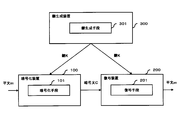
- the order storage encryption system includes an encryption device 100, a decryption device 200, and a key generation device 300.
- the encryption device 100 includes the encryption unit 101.
- the decoding device 200 includes a decoding unit 201.
- the description will be made on the assumption that two types of devices, the encryption device 100 and the decryption device 200, are used.
- one device is configured to include both the encryption means and the decryption means. Also good.
- encryption algorithms and decryption algorithms will be described. Specifically, CPUs of one or a plurality of information processing apparatuses that implement an order storage encryption system execute processing according to these algorithms.
- a bit string K called a key (hereinafter referred to as key K) is stored in advance in the storage unit 13 of the encryption device 100 and the decryption device 200.
- the key K is generated by means called key generation means.
- the key generation device 300 is prepared separately from the encryption device 100 and the decryption device 200, and this device includes the key generation unit 301 and executes the process of generating the key K. Yes.
- the key generation means includes any of the encryption device 100, the decryption device 200, or a third device different from them, and is configured to execute the process of generating the key K. Also good.
- the encryption device 100 or the decryption device 200 includes key generation means, and generates the key K. It is desirable to execute the process.
- the key generation unit 301 generates a key K and outputs the generated key K.
- the key generation unit 301 is realized by a CPU of an information processing apparatus that operates according to a program.
- the encryption unit 101 receives the key K and the plaintext m as input, encrypts the received plaintext m using the key K, and outputs the ciphertext C.
- the encryption unit 101 is realized by a CPU of an information processing apparatus that operates according to a program.
- Decryption means 201 receives key K and ciphertext C as inputs, decrypts the received ciphertext C using key K, and outputs plaintext m.
- the decoding 201 means is realized by the CPU of the information processing apparatus that operates according to the program.
- processing is performed according to the following procedure. It is assumed that the key K generated in advance by the key generation unit 301 is written in the storage unit 13 of the encryption device 100 and the decryption device 200.
- the encryption device 100 writes the plaintext m input by the input / output unit 11 in the storage unit 13.
- the encryption device 100 reads the key K and the plaintext m from the storage unit 13, executes the encryption processing by the encryption means 101 with these as inputs, and calculates the ciphertext C as the output.
- the encryption device 100 transmits the ciphertext C from the communication unit 14 to the decryption device 200.
- the decryption apparatus 200 receives the ciphertext C using the communication unit 14.
- the decryption device 200 reads the key K from the storage unit 13, receives the key K and the ciphertext C as input, executes decryption processing by the decryption means 201, and calculates plaintext m as the output.
- ⁇ 1,..., M ⁇ is a plaintext space
- U, ⁇ , and ⁇ are constants.
- B [i] be a probability distribution.
- B [j] uniform distribution on the interval ⁇ 0, ..., ⁇ [j] ⁇ , binomial distribution B ( ⁇ [j], p [j]), normal distribution N ( ⁇ [j], V [j]) can be used.
- ⁇ 80 or more.
- vecBernoulli (vecp) be an algorithm that outputs a value between 1 and U, and the probability of outputting j is p [j].
- vecBernoulli (vecp) may be realized by any method, for example, by the following method.
- P [0] 0.
- Parameters M, U, ⁇ , ⁇ , and vecp are stored in the storage unit 13 of each device, and each device can use these values as necessary.
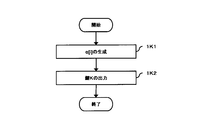
- processing executed by the key generation means will be described. Details of processing executed by the key generation unit 301 in the present embodiment are as follows.
- the key generation unit 301 executes vecBernoulli (vecp) and obtains its output j [i] (1K1).
- the key generation unit 301 selects ⁇ [i] according to B [j [i]] (1K1).
- the key generation unit 301 outputs the key K to the encryption device 100 and the decryption device 200.
- the encryption unit 101 outputs C as ciphertext C (step 1E3 in FIG. 4).
- the encryption unit 101 outputs the ciphertext C to the decryption device 200.
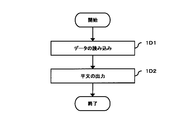
- step 1D2 if C ⁇ S, the decryption means 201 outputs a message indicating that it is an illegal ciphertext and abnormally stops (step 1D2).
- (1) S + ⁇ [i] is newly set as S (step 1D2).
- the decryption means 201 If the input is illegal data, the decryption means 201 outputs a message indicating that the data is invalid and stops abnormally (step 1D2).
- the decryption means 201 outputs a message indicating that the data is invalid and stops abnormally (step 1D2).
- a message output but what kind of notification may be sufficient.
- plaintext size comparison can be efficiently performed in an encrypted state in which security is ensured.
- Second embodiment The apparatus configuration of the second embodiment and the parameters M, U, ⁇ , ⁇ , and vecp are the same as those of the first embodiment. However, in this embodiment, the function of each means is different compared to the first embodiment.
- Each parameter is stored in the storage unit 13 of each device, and each device can use these values as necessary.
- HG is the function described in the outline above.
- vecHG is the function described in the outline above.
- vecAlgo (k, vecp ') can be calculated by the following method, for example.
- vecHG (k, vect, l) can be calculated, for example, by the following method.
- processing executed by the key generation means will be described. Details of processing executed by the key generation unit 301 in the present embodiment are as follows.
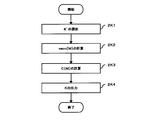
- the key generation means 301 randomly selects a bit string K ′ of ⁇ bits (step 2K1 in FIG. 6).
- the key generation unit 301 executes vecAlgo (M + ⁇ + 1, vecp) to obtain an output vecn [M] (step 2K2 in FIG. 6).
- the key generation means 301 executes Algo (s (vecn [M]), q) to obtain an output C [M] (step 2K3 in FIG. 6).
- Ceil (x) be a function that outputs the value of the input real number x rounded up
- the algorithm Dist, vecDist use L, L 'as the number of random bits used in the calculation, and PRF (K,.)
- the output is a pseudo-random function using K as a key and the output is an L-bit pseudo-random number
- the output is a pseudo-random function using PRF '(K, To do.
- b” represents the concatenation of the bit strings a and b
- “A (x; r)” for algorithm A is “output when A (x) is executed using r as a random number”.
- w Ceil ((u + v) / 2) is calculated (step 2RE2 in FIG. 7).
- cc PRF (K ′, (vu
- wu) is calculated (step 2RE3 in FIG. 7)
- vecn ′ vecDist (u, v, w, vecn; cc) is calculated ( Step 2RE3 in FIG.
- cc ′ PRF ′ (K ′, s (vecn)
- s (vecn ′)) is calculated (step 2RE4 in FIG. 7).
- C [w] Dist (C [u], C [v], vecn, vecn ′; cc ′) is calculated (step 2RE4 in FIG. 7).
- RecEnc (K ′, w, v, C [w], C [v], vecn-vecn ′, m) is output (step 2RE6 in FIG. 7).
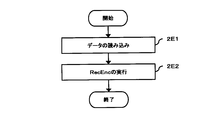
- the encryption unit 101 executes RecEnc ′ (K ′, ⁇ 1, M, 0, C [M], vecn [M], m) (step 2E2 in FIG. 8).
- w Ceil ((u + v) / 2) is calculated (step 2RD2 in FIG. 9).
- cc PRF (K ′, (vu
- wu) is calculated (step 2RD3 in FIG. 9)
- vecn ′ vecDist (u, v, w, vecn; cc) is calculated ( Step 2RD3 in FIG. 9).
- cc ′ PRF ′ (K ′, s (vecn)
- s (vecn ′)) is calculated (step 2RD4 in FIG. 9).
- C [w] Dist (C [u], C [v], vecn, vecn ′; cc ′) is calculated (step 2RD4 in FIG. 9).
- RecDec K ′, w, v, C [w], C [v], vecn-vecn ′, m
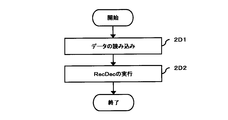
- the decoding unit 201 executes RecDec ′ (K ′, ⁇ 1, M, 0, C [M], vecn [M], m) (step 2D2 in FIG. 10).
- plaintext size comparison can be efficiently performed in an encrypted state in which security is ensured.
- encryption and decryption processing can be performed by a more efficient method than in the first embodiment.
- Normal ( ⁇ , V) be an algorithm that selects the output according to a normal distribution with mean ⁇ and variance V.
- Algo (s (vecn [M]), q) by the key generation means of the second embodiment is changed to the following algorithm Algo ′ (s (vecn [M]), t ( vecn [M])).
- Algorithm Dist '(C [u], C [v], vecn, vecn') is defined as follows.
- C C [u] + s (vecn ') + Normal (2 (C [v] -C [u] -s (vecn)) ⁇ (t (vecn') / t (vecn)), ⁇ (t ( vecn ') t (vecn-vecn') / t (vecn))) and output C.
- RecEnc ′ (K ′, u, v, C [u], C [v], vecn, m) is the same as RecEnc (K ′, u, v, C [u], C [v] in the second embodiment) , vecn, m) (step 2RE4) is changed to the following procedure.
- Cc ' PRF' '(K', s (vecn)
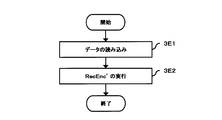
- the encryption unit 101 executes RecEnc ′ (K ′, ⁇ 1, M, 0, C [M], vecn [M], m) (step 3E2 in FIG. 11).
- RecDec ′ (K ′, u, v, C [u], C [v], vecn, m) is defined as RecDec (K ′, u, v, C [u], C in the second embodiment).
- [Step 2RD4] of [v], vecn, m) is changed to the following procedure.
- Cc ' PRF' '(K', s (vecn)
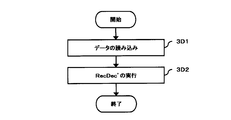
- the decoding unit 201 executes RecDec ′ (K ′, ⁇ 1, M, 0, C [M], vecn [M], m) (step 3D2 in FIG. 12).
- plaintext size comparison can be efficiently performed in an encrypted state in which security is ensured.
- encryption and decryption processing can be performed by a more efficient method than in the first embodiment.
- the ciphertext of the fourth embodiment is obtained by adding a random number R to the ciphertext of the first embodiment. Since the ciphertext is agitated by adding the random number R, higher security is guaranteed.
- the apparatus configuration of the fourth embodiment is the same as that of the first embodiment. However, in this embodiment, the function of each means is different compared to the first embodiment.
- ⁇ may be set to 0.
- Other parameters are the same as those of the first embodiment.
- processing executed by the key generation means will be described. Details of processing executed by the key generation unit 301 in the present embodiment are as follows.
- the key generation unit 301 Like the key generation process in the first embodiment, the key generation unit 301 generates a key K ′.
- the key generation means 301 selects a ⁇ -bit random number R.
- the encryption unit 101 inputs K ′ and m and performs the same encryption process as in the first embodiment, thereby obtaining the output C ′.
- the decoding unit 201 inputs K ′ and C ′ and performs the same decoding process as in the first embodiment to obtain the output m.
- the decryption means 201 outputs plaintext m.
- plaintext size comparison can be efficiently performed in an encrypted state in which security is ensured.
- the ciphertext is agitated by adding the random number R, higher security is ensured as compared with the first embodiment.
- the configuration of the “first embodiment” in the fourth embodiment is changed to the configuration of the “second embodiment”. That is, the configuration shown in the fourth embodiment is applied to the configuration shown in the second embodiment. As a result, in this embodiment, it is possible to perform encryption and decryption processing by a more efficient method than in the fourth embodiment.
- the configuration of the “first embodiment” in the fourth embodiment is changed to the configuration of the “third embodiment”. That is, the configuration shown in the fourth embodiment is applied to the configuration shown in the third embodiment. As a result, in this embodiment, it is possible to perform encryption and decryption processing by a more efficient method than in the fourth embodiment.
- the present invention makes it possible to retrieve data in order while ensuring safety in, for example, a secure database. Therefore, the present invention has the utility that data cannot be read illegally and the utility that data is used by search.
- the method described in Non-Patent Document 1 also performs a bisection recursion as in the second embodiment of the present invention, but the distribution determination parameter guarantees the novelty of the present invention. To do.
- the distribution determination parameter vecn there is no data corresponding to the distribution determination parameter vecn in the present invention.
- the recursion can be turned only by determining the distribution by the distribution determination parameter, it can be said that the present invention and the method described in Non-Patent Document 1 are significantly different from each other.
- the distribution determination parameter ensures the inventive step of the present invention.
- the ciphertext of the second embodiment becomes the same as the ciphertext of the first embodiment. Therefore, as described above, the invention of the second embodiment is also secure. Secured. Since the method described in Non-Patent Document 1 has not been secured, it can be said that the present invention has an inventive step.
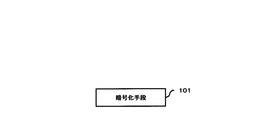
- FIG. 13 is a block diagram illustrating a minimum configuration example of the order storage encryption system.
- the order storage encryption system includes an encryption unit 101 as a minimum component.
- the encryption unit 101 In the minimum-order order storage encryption system shown in FIG. 13, the encryption unit 101 generates a ciphertext as a sum of data according to a predetermined distribution X. Further, the encryption unit 101 generates a ciphertext using a distribution represented as a distribution X in a format in which data having a randomly determined bit length is randomly selected according to a distribution according to the bit length.
- the order-preserving encryption system generates an encryption unit (implemented by the encryption unit 101, for example) that generates a ciphertext as a sum of data (for example, ⁇ [j]) according to a predetermined distribution X.
- the encryption means includes, as distribution X, a randomly determined bit length (for example, j [i]) data (for example, ⁇ [j]) according to the bit length (for example, B [j ]),
- the ciphertext is generated using a distribution expressed in the form of being selected at random.
- K ( ⁇ [ ⁇ ],..., ⁇ [N])
- a ciphertext encrypted using a key ( ⁇ [ ⁇ ],..., ⁇ [N])
- K ( ⁇ [ ⁇ ],..., ⁇ [N])
- Decryption means for decryption for example, realized by the decryption means 201
- the order storage encryption system includes an encryption device including an encryption unit that uses a key including a plurality of sets of data for encryption, and a decryption unit that decrypts a ciphertext encrypted using the key.
- a key generation unit including a decryption device, selecting a number of data proportional to the original number of the plaintext space, and generating and outputting a set including all the selected data as a key.
- the key generation unit selects the data When selecting a random number that determines the length of the data, select data having a bit length according to the selected random number, and the encryption means inputs the key and plaintext to the size of the plaintext.
- the ciphertext to be encrypted is calculated by adding a proportional number of data, and the decryption means inputs the key and ciphertext, and adds the number of data proportional to the size of m for each m Output m that matches the ciphertext.
- Ciphertext may be configured to notify that it is illegal in the absence of m that matches the ciphertext.
- K ′ is selected at random
- the parameter vecn [M] for determining the distribution is selected according to a predetermined algorithm
- vecn [M] is input as a parameter to encrypt according to the distribution. It may be configured to include a key generation unit that selects a sentence C [M] and outputs a set including K ′, vecn [M], and C [M] as a key.
- vecn [M] is a set including a plurality of data
- the key generation means is a value in which the sum of the data included in vecn [M] is determined in advance. It may be configured to select according to the binomial distribution under the condition of becoming.
- vecn [M] is a set including a plurality of data, and the key generation means sets the data included in the vecn [M] as a condition that the sum of them becomes a predetermined value. 7.
- the encryption means receives a key and plaintext as input and executes a subroutine (for example, RecEnc ′), and the subroutine receives an interval including the plaintext as input (for example, u, v), Furthermore, the ciphertext corresponding to the values at both ends of the interval is also received as an input (for example, C [u], C [v]), and the distribution determination parameter vecn in the interval is also received as an input.
- a subroutine for example, RecEnc ′
- the subroutine receives an interval including the plaintext as input (for example, u, v)
- the ciphertext corresponding to the values at both ends of the interval is also received as an input (for example, C [u], C [v])
- the distribution determination parameter vecn in the interval is also received as an input.
- the distribution determination parameter vecn ′ is selected according to a predetermined algorithm, and then the vecn, the vecn ′, and the interval At both ends
- the ciphertext corresponding to the w is selected according to the distribution selected using the ciphertext corresponding to, and pseudorandom numbers are used when selecting data according to the distribution, and the input plaintext is already encrypted 2.
- vecn ' is a set including a plurality of data, and the subroutine follows the hypergeometric distribution under the condition that the sum of the data included in the vecn' becomes a predetermined value.
- the decryption means receives the key and the ciphertext as input and executes a subroutine (for example, RecEnc ').
- the subroutine is a section of ciphertext space, and the input ciphertext belongs to the section. Is received as an input (for example, C [u], C [v]), and plaintext corresponding to ciphertext corresponding to both ends of the section is also received as an input (for example, u, v.), And distribution distribution in the section is determined. Parameter vecn is also received as input, ciphertext C [w] corresponding to w is calculated by specifying value w, and the interval is further divided into two by C [w], and the input ciphertext is divided.
- the subroutine When calculating the ciphertext corresponding to the w, the subroutine is recursively executed with the one of the sections belonging to the input as an input, first, the distribution determination parameter vecn 'A predetermined algorithm And then selecting the ciphertext corresponding to the w according to the distribution selected using the vecn, the vecn ′ and the ciphertext corresponding to the values at both ends of the interval, and the distribution 2.
- An encryption device including an encryption unit and a decryption device including a decryption unit are provided.
- K ′ is randomly selected, and a parameter vecn [M] for determining a distribution is selected according to a predetermined algorithm.
- the plaintext corresponding to the ciphertext corresponding to both ends of the section is also received as input
- the distribution determination parameter vecn in the section is also received as input
- the ciphertext C [w] corresponding to w is specified by specifying the value w And further dividing the section into two by C [w], and depending on which of the divided sections the input ciphertext belongs to, the subroutine as When recursively executing and calculating the ciphertext corresponding to w, first, the distribution determination parameter vecn ′ is selected according to a predetermined algorithm, and then the vecn, the vecn ′, and the interval
- the ciphertext corresponding to the w is selected according to the distribution selected using the ciphertext corresponding to the values at both ends, and when selecting data according to the distribution, pseudorandom numbers are used, and the input
- the order storage encryption system and outputs the dark ciphertext when the ciphertext is already matches one of the values calculated ciphertext.
- An encryption device including an encryption unit and a decryption device including a decryption unit are provided, K ′ is randomly selected, and a parameter vecn [M] for determining distribution is selected according to a predetermined algorithm.
- Key generation that inputs vecn [M] as a parameter, selects ciphertext C [M] according to the distribution, and outputs a set including K ′, vecn [M], and C [M] as a key
- the vecn [M] is a set including a plurality of data, and the key generation means sets the data included in the vecn [M] to a predetermined value.
- the encryption means receives the key and plaintext as input and executes a subroutine, and the subroutine receives an interval including the plaintext as input, and further, The ciphertext corresponding to the values at both ends is also accepted as input.
- the distribution determination parameter vecn in the section is also received as an input, a ciphertext corresponding to w is calculated by specifying a value w, the section is further divided into two by w, and the plaintext is divided Depending on which section it belongs to, the subroutine is recursively executed by inputting the section to which it belongs, and when calculating the ciphertext corresponding to w, first, the distribution determination parameter vecn ′ Is selected according to a predetermined algorithm, and then the ciphertext corresponding to the w according to the distribution selected using the vecn, the vecn ′ and the ciphertext corresponding to the values at both ends of the interval.
- a pseudo-random number is used, and when the input plaintext matches any of the values already calculated ciphertext, the ciphertext is output and v ecn ′ is a set including a plurality of data, and the encryption means selects the data included in the vecn ′ according to a hypergeometric distribution under a condition that the sum of the data becomes a predetermined value.
- the decryption means receives the key and the ciphertext as input and executes a subroutine, and the subroutine receives as input a ciphertext space section in which the input ciphertext belongs to the section.
- the plaintext corresponding to the ciphertext corresponding to both ends of the section is also received as an input, and the distribution determination parameter vecn in the section is also received as an input, and the ciphertext C [w] corresponding to w is calculated by specifying the value w Further, the section is further divided into two by C [w], and depending on which of the divided sections the input ciphertext belongs to, the subsection to which the section belongs is input.
- the distribution determination parameter vecn ′ is first selected according to a predetermined algorithm, and then the vecn, the vecn ′, and the The ciphertext corresponding to the w is selected according to the distribution selected using the ciphertext corresponding to the values at both ends of the section, and when selecting data according to the distribution, pseudorandom numbers are used, and When the input ciphertext matches any of the values already calculated for the ciphertext, the ciphertext is output, and the predetermined distribution is obtained by adding the ciphertext corresponding to the end of the section to the hypergeometric distribution.
- An order-preserving encryption system characterized by being.
- An encryption device including an encryption unit and a decryption device including a decryption unit are provided, K ′ is randomly selected, and a parameter vecn [M] for determining a distribution is selected according to a predetermined algorithm, Key generation that inputs vecn [M] as a parameter, selects ciphertext C [M] according to the distribution, and outputs a set including K ′, vecn [M], and C [M] as a key
- the vecn [M] is a set including a plurality of data, and the key generation means sets the data included in the vecn [M] to a predetermined value.
- the encryption means receives the key and plaintext as input and executes a subroutine, and the subroutine receives an interval including the plaintext as input, and further, The ciphertext corresponding to the values at both ends is also accepted as input.
- the distribution determination parameter vecn in the section is also received as an input, a ciphertext corresponding to w is calculated by specifying a value w, the section is further divided into two by w, and the plaintext is divided Depending on which section it belongs to, the subroutine is recursively executed by inputting the section to which it belongs, and when calculating the ciphertext corresponding to w, first, the distribution determination parameter vecn ′ Is selected according to a predetermined algorithm, and then the ciphertext corresponding to the w according to the distribution selected using the vecn, the vecn ′ and the ciphertext corresponding to the values at both ends of the interval.
- the distribution obtained is the hypergeometric distribution plus the ciphertext corresponding to the end of the section, and the decryption means receives the key and the ciphertext as input and executes a subroutine.
- the input ciphertext that belongs to the section is received as input, and the plaintext corresponding to the ciphertext corresponding to both ends of the section is also received as input, and the distribution determination parameter vecn in the section is also input as input.
- the subroutine Receives the value w, calculates the ciphertext C [w] corresponding to w, further divides the section into two by C [w], and the input ciphertext is divided into any of the divided sections Depending on whether it belongs, the subroutine is recursively executed by inputting the section to which it belongs, and when calculating the ciphertext corresponding to w, first the distribution determination parameter vecn ′ is set in advance.
- Selecting according to a predetermined algorithm then selecting the ciphertext corresponding to the w according to the distribution selected using the vecn, the vecn ′ and the ciphertext corresponding to the values at the ends of the interval; Furthermore, when selecting data according to the distribution, a pseudo-random number is used, and if the input ciphertext matches any of the values already calculated for the ciphertext, the ciphertext is output, and the determined distribution is An order-preserving encryption system characterized by a normal distribution.
- the present invention can be used for a secure database, for example. If the data encrypted according to the present invention is stored in the database, it is industrially useful because the data can be searched in order while keeping the data secret.
- the use of the database is expected to increase more than ever due to the recent development of cloud technology, so the usefulness of the present invention is expected to increase further in the future.
Landscapes
- Engineering & Computer Science (AREA)
- Computer Security & Cryptography (AREA)
- Theoretical Computer Science (AREA)
- Signal Processing (AREA)
- Computer Networks & Wireless Communication (AREA)
- Physics & Mathematics (AREA)
- Computer Hardware Design (AREA)
- Software Systems (AREA)
- General Engineering & Computer Science (AREA)
- General Physics & Mathematics (AREA)
- General Health & Medical Sciences (AREA)
- Bioethics (AREA)
- Health & Medical Sciences (AREA)
- Databases & Information Systems (AREA)
- Mathematical Physics (AREA)
- Computing Systems (AREA)
- Storage Device Security (AREA)
Abstract
Description
・{u+1,...,v}上の分布決定パラメータvecnが求まっている。
・暗号文を算出したい平文mは区間{u+1,...,v}に属している。
・w=Ceil(u+v/2)を計算する。
・{u+1,...,w}上の分布決定パラメータvecn'を関数Dist(u,v,w,vecn)に従って計算する。ただしここでvecDist(u,v,w,vecn)が用いる乱数として、K'を使って選ばれた擬似乱数列を用いる。
・vecn'を用いる事で、「uの暗号文とvの暗号文とがそれぞれC[u],C[v]であるという条件下wの暗号文が従う」分布Dist(C[u],C[v],vecn,vecn')に従ってC[w]を選ぶ。Dist(C[u],C[v],vecn,vecn')に従ってC[w]を選ぶ際に用いる乱数は、K'を使って選ばれた擬似乱数列を用いる。
・m≦wであれば、RecEnc(K',u,w,C[u],C[w],vecn',m)を再帰的に実行する。
・そうでなければRecEnc(K',w,v,C[w],C[v],vecn-vecn',m)を再帰的に実行する。
・vecHG(k,vect,l):以下の分布に従って出力n'=(n'[1],...,n'[U])を決める確率的アルゴリズム:瓶にk個のボールが入っている。ボールには1,...,Uのいずれかのマークが書かれており、iのマークのついたボールの数はt[i]個であるという状況下でこの瓶からl個のボールを選んだとき、選ばれたボールに含まれているマークiのボールの数をn'[j]とする。
・「各jに対しS[j]の元で区間{u+1,...,v}に属しているものの個数がn[j]である」という条件下、「S[j]の元で区間{u+1,...,Ceil(u+v/2)}に属しているものの個数」の従う分布から元を選ぶのが容易である。
・uの暗号文がC[u]であり、vの暗号文がC[v]であり、しかも「各jに対しS[j]の元で区間{u+1,...,v}に属しているものの個数がn[j]である」という条件下、w=Ceil(u+v/2)の暗号文が従う分布から元を選ぶのが容易である。
本発明による順序保存暗号化システムの構成を図1、図2を参照して説明する。図1に示すように、本実施形態の各装置(図2に示す暗号化装置100、復号装置200および鍵生成装置300)は、それぞれ入出力部11、演算部12、記憶部13および通信部14を備えている。これらの装置は、例えばプログラムに従って動作するパーソナルコンピュータ等の情報処理装置によって実現される。また、この場合、入出力部11、演算部12、記憶部13および通信部14は、例えば、それぞれキーボード、CPU、メモリ、およびネットワークインタフェース部によって実現される。また、図2に示すように、本実施形態では、順序保存暗号化システムは、暗号化装置100、復号装置200および鍵生成装置300を含む。
・2λP[j-1]<x≦2λP[j]となるjを見つけ、そのようなjを出力する。
・鍵生成手段301は、B[j[i]]に従ってα[i]を選択する(1K1)。
(1)S+α[i]を新しくSとする(ステップ1D2)。
(2)C≦Sなら復号結果としてiを出力して正常停止する(ステップ1D2)。
また、復号手段201は、入力が不正なデータだった場合には、不正な暗号文である事を示すメッセージを出力して異常停止する(ステップ1D2)。なお、不正な暗号文である事を示すことができれば、メッセージの出力に限らず、どのような通知であってもよい。
第二の実施形態の装置構成、およびパラメータM,U,ζ,λ,vecpは第一の実施形態のそれと同一である。ただし、本実施形態では、第一の実施形態と比較して、各手段の機能が異なる。
・vecAlgo(k,vecp'): 上述の概要で説明した分布vecB(k,vecp')に従って出力を選ぶ。
・Dist(C1,C2,vecn,vecn'):C1+HG(s(vecn),C2-C1,s(vecn'))を出力する。ここでHGは上述の概要で説明した関数である。
・vecDist(u,v,w,vecn):vecHG(v-u,vecn,w-u)を出力する。ここでvecHGは上述の概要で説明した関数である。
2.j=1,...,U-1に対して以下の(1)(2)を実行する。
(1)二項分布B(k,p'[j])に従ってn[j]を選ぶ。
(2)k'にk'-n[j]を上書きする。
3.n[U]=k'とする。
4.vecn=(n[1],...,n[U])を出力する。
2.j=1,...,U-1に対して以下の(1)(2)を実行する。
(1)HG(k',t[j],l')を実行し、出力n[j]を得る。
(2)k'-t[j]をk'に上書きし、l'-n[j]をl'に上書きする。
3.n[U]=l'とする。
4.vecn=(n[1],...,n[U])を出力する。
第三の実施形態の装置構成、およびパラメータM,U,ζ,λ,vecpは第一の実施形態のそれと同一である。ただし、本実施形態では、第一の実施形態と比較して、各手段の機能が異なる。
・C[M]を出力する。
第四の実施形態の暗号文は第一の実施形態の暗号文に乱数Rを加えたものである。乱数Rを加える事で暗号文が撹拌される為、より高い安全性が保証される。第四の実施形態の装置構成は第一の実施形態のそれと同一である。ただし、本実施形態では、第一の実施形態と比較して、各手段の機能が異なる。
第五の実施形態は、第四の実施形態中にある「第一の実施形態」の構成を「第二の実施形態」の構成にかえたものである。すなわち、第二の実施形態で示した構成に第四の実施形態で示した構成を適用したものである。これによって、本実施形態では、第四の実施形態と比較して、より効率的な方法で暗号化および復号処理を行うことができる。
第六の実施形態は、第四の実施形態中にある「第一の実施形態」の構成を「第三の実施形態」の構成にかえたものである。すなわち、第三の実施形態で示した構成に第四の実施形態で示した構成を適用したものである。これによって、本実施形態では、第四の実施形態と比較して、より効率的な方法で暗号化および復号処理を行うことができる。
101 暗号化手段
200 復号装置
201 復号手段
300 鍵生成装置
301 鍵生成手段
Claims (10)
- 暗号文を事前に定められた分布Xに従うデータの和として生成する暗号化手段を含み、
前記暗号化手段は、前記分布Xとして、ランダムに決められたビット長のデータがビット長に応じた分布に従ってランダムに選択されるという形式であらわされる分布を用いて暗号文を生成する
ことを特徴とする順序保存暗号化システム。 - 平文空間の元の数に比例した数のデータを選択し、選択した前記データを全て含む組を鍵として生成し出力する鍵生成手段を含み、
前記鍵生成手段は、前記データを選択する際には、前記データの長さを決定する乱数を選択し、選択した前記乱数に従ったビット長のデータを選択する
請求項1記載の順序保存暗号化システム。 - 暗号化手段は、複数のデータの組を含む鍵を暗号化に用い、平文を暗号化するために、前記平文の大きさに比例した数の前記データを足しあわせて暗号化する
請求項1記載の順序保存暗号化システム。 - 複数のデータの組を含む鍵を用いて暗号化された暗号文を復号する復号手段を含み、
前記復号手段は、暗号文を復号するために、各mに対してmの大きさに比例した数の前記データを足しあわせた値を計算し、前記足しあわせた値が前記暗号文と一致する前記mを出力し、前記暗号文と一致する前記mが存在しない場合には前記暗号文が不正なものである事を通知する
請求項1記載の順序保存暗号化システム。 - 複数のデータの組を含む鍵を暗号化に用いる暗号化手段を含む暗号化装置と、
前記鍵を用いて暗号化された暗号文を復号する復号手段を含む復号装置とを備え、
平文空間の元の数に比例した数のデータを選択し、選択した前記データを全て含む組を鍵として生成し出力する鍵生成手段を含み、
前記鍵生成手段は、前記データを選択する際には、前記データの長さを決定する乱数を選択し、選択した前記乱数に従ったビット長のデータを選択し、
前記暗号化手段は、前記鍵と平文とを入力して該平文の大きさに比例した数の前記データを足しあわせて暗号化する暗号文を計算し、
前記復号手段は、前記鍵と前記暗号文とを入力して、各mに対してmの大きさに比例した数の前記データを足しあわせた値を計算し、前記足しあわせた値が前記暗号文と一致する前記mを出力し、前記暗号文と一致する前記mが存在しない場合には前記暗号文が不正なものである事を通知する
請求項1記載の順序保存暗号化システム。 - K'をランダムに選択し、
分布を決めるパラメータvecn[M]を事前に定められたアルゴリズムに従って選択し、
前記vecn[M]をパラメータとして入力して前記分布に従って暗号文C[M]を選択し、
前記K'と前記vecn[M]と前記C[M]とを含む組を鍵として出力する鍵生成手段を含む
請求項1記載の順序保存暗号化システム。 - vecn[M]は、複数のデータを含む組であり、
鍵生成手段は、前記vecn[M]に含まれる前記データを、それらの総和が事前に定められた値になるという条件下で二項分布に従って選択する
請求項6記載の順序保存暗号化システム。 - 暗号文を事前に定められた分布Xに従うデータの和として生成する暗号化手段を含み、
前記暗号化手段は、前記分布Xとして、ランダムに決められたビット長のデータがビット長に応じた分布に従ってランダムに選択されるという形式であらわされる分布を用いて暗号文を生成する
ことを特徴とする暗号化装置。 - 暗号文を事前に定められた分布Xに従うデータの和として生成し、
前記分布Xとして、ランダムに決められたビット長のデータがビット長に応じた分布に従ってランダムに選択されるという形式であらわされる分布を用いて暗号文を生成する
ことを特徴とする順序保存暗号化方法。 - コンピュータに、
暗号文を事前に定められた分布Xに従うデータの和として生成する暗号化処理を実行させ、
前記暗号化処理で、前記分布Xとして、ランダムに決められたビット長のデータがビット長に応じた分布に従ってランダムに選択されるという形式であらわされる分布を用いて暗号文を生成する処理を
実行させるための順序保存暗号化プログラム。
Priority Applications (4)
| Application Number | Priority Date | Filing Date | Title |
|---|---|---|---|
| US14/117,801 US9460315B2 (en) | 2011-05-18 | 2012-05-17 | Order-preserving encryption system, device, method, and program |
| JP2013515004A JP5929905B2 (ja) | 2011-05-18 | 2012-05-17 | 順序保存暗号化システム、装置、方法及びプログラム |
| CN201280021751.0A CN103503363A (zh) | 2011-05-18 | 2012-05-17 | 顺序保持加密系统、设备、方法和程序 |
| EP12786276.1A EP2712115A4 (en) | 2011-05-18 | 2012-05-17 | SEQUENTIAL ENCRYPTION SYSTEM AND DEVICE, METHOD AND PROGRAM THEREFOR |
Applications Claiming Priority (2)
| Application Number | Priority Date | Filing Date | Title |
|---|---|---|---|
| JP2011111599 | 2011-05-18 | ||
| JP2011-111599 | 2011-05-18 |
Publications (1)
| Publication Number | Publication Date |
|---|---|
| WO2012157279A1 true WO2012157279A1 (ja) | 2012-11-22 |
Family
ID=47176628
Family Applications (1)
| Application Number | Title | Priority Date | Filing Date |
|---|---|---|---|
| PCT/JP2012/003239 Ceased WO2012157279A1 (ja) | 2011-05-18 | 2012-05-17 | 順序保存暗号化システム、装置、方法及びプログラム |
Country Status (5)
| Country | Link |
|---|---|
| US (1) | US9460315B2 (ja) |
| EP (1) | EP2712115A4 (ja) |
| JP (1) | JP5929905B2 (ja) |
| CN (1) | CN103503363A (ja) |
| WO (1) | WO2012157279A1 (ja) |
Cited By (2)
| Publication number | Priority date | Publication date | Assignee | Title |
|---|---|---|---|---|
| WO2014132552A1 (ja) * | 2013-02-28 | 2014-09-04 | 日本電気株式会社 | 順序保存暗号化システム、装置、方法およびプログラム |
| KR20190133350A (ko) * | 2018-05-23 | 2019-12-03 | 세종대학교산학협력단 | 암호문 비교 방법 및 이를 수행하기 위한 장치 |
Families Citing this family (8)
| Publication number | Priority date | Publication date | Assignee | Title |
|---|---|---|---|---|
| KR102219476B1 (ko) * | 2014-05-14 | 2021-02-24 | 삼성전자주식회사 | 데이터를 암호화하는 방법 및 그를 위한 장치 |
| US9798810B2 (en) | 2014-09-30 | 2017-10-24 | At&T Intellectual Property I, L.P. | Methods and apparatus to track changes to a network topology |
| US9596081B1 (en) * | 2015-03-04 | 2017-03-14 | Skyhigh Networks, Inc. | Order preserving tokenization |
| US9800558B2 (en) | 2015-10-01 | 2017-10-24 | Sap Se | Frequency-hiding order-preserving encryption |
| US9830470B2 (en) | 2015-10-09 | 2017-11-28 | Sap Se | Encrypting data for analytical web applications |
| US10580225B2 (en) | 2017-03-31 | 2020-03-03 | Toyota Motor Engineering & Manufacturing North America, Inc. | Privacy-aware signal monitoring systems and methods |
| US12602145B1 (en) * | 2023-02-14 | 2026-04-14 | K. Melsh Innovative Software, Inc. | Mouse and keyboard functionality for efficient extraction of content |
| CN119254467B (zh) * | 2024-09-13 | 2025-11-28 | 金邦达有限公司 | 数据加密的方法、加密装置和计算机可读存储介质 |
Citations (1)
| Publication number | Priority date | Publication date | Assignee | Title |
|---|---|---|---|---|
| US20050147240A1 (en) * | 2004-01-05 | 2005-07-07 | Rakesh Agrawal | System and method for order-preserving encryption for numeric data |
Family Cites Families (5)
| Publication number | Priority date | Publication date | Assignee | Title |
|---|---|---|---|---|
| EP1593098B2 (en) * | 2003-01-31 | 2010-09-15 | Panasonic Corporation | Semiconductor memory card, and program for controlling the same |
| US7395437B2 (en) * | 2004-01-05 | 2008-07-01 | International Business Machines Corporation | System and method for fast querying of encrypted databases |
| US20070038579A1 (en) * | 2005-08-12 | 2007-02-15 | Tsys-Prepaid, Inc. | System and method using order preserving hash |
| US20120121080A1 (en) * | 2010-11-11 | 2012-05-17 | Sap Ag | Commutative order-preserving encryption |
| KR101727312B1 (ko) * | 2010-12-22 | 2017-04-14 | 한국전자통신연구원 | 순서 보존 암호화 및 복호화 장치와 그 방법 |
-
2012
- 2012-05-17 EP EP12786276.1A patent/EP2712115A4/en not_active Withdrawn
- 2012-05-17 JP JP2013515004A patent/JP5929905B2/ja not_active Expired - Fee Related
- 2012-05-17 WO PCT/JP2012/003239 patent/WO2012157279A1/ja not_active Ceased
- 2012-05-17 US US14/117,801 patent/US9460315B2/en not_active Expired - Fee Related
- 2012-05-17 CN CN201280021751.0A patent/CN103503363A/zh active Pending
Patent Citations (1)
| Publication number | Priority date | Publication date | Assignee | Title |
|---|---|---|---|---|
| US20050147240A1 (en) * | 2004-01-05 | 2005-07-07 | Rakesh Agrawal | System and method for order-preserving encryption for numeric data |
Non-Patent Citations (4)
| Title |
|---|
| ALEXANDRA BOLDYREVA; NATHAN CHENETTE; YOUNHO LEE; ADAM O'NEILL: "Order-Preserving Symmetric Encryption", EUROCRYPT, 2009, pages 224 - 241 |
| BOLDYREVA, A. ET AL.: "Order-Preserving Symmetric Encryption", LECTURE NOTES IN COMPUTER SCIENCE, vol. 5479, 2009, pages 224 - 241, XP047030467 * |
| See also references of EP2712115A4 |
| YOTSUJI, TETSUAKI: "Probability Distribution Random Number Generating Method for Calculator Simulation", June 2010, PLEIADES PUBLISHING HOUSE |
Cited By (4)
| Publication number | Priority date | Publication date | Assignee | Title |
|---|---|---|---|---|
| WO2014132552A1 (ja) * | 2013-02-28 | 2014-09-04 | 日本電気株式会社 | 順序保存暗号化システム、装置、方法およびプログラム |
| JPWO2014132552A1 (ja) * | 2013-02-28 | 2017-02-02 | 日本電気株式会社 | 順序保存暗号化システム、装置、方法およびプログラム |
| KR20190133350A (ko) * | 2018-05-23 | 2019-12-03 | 세종대학교산학협력단 | 암호문 비교 방법 및 이를 수행하기 위한 장치 |
| KR102126295B1 (ko) | 2018-05-23 | 2020-06-24 | 세종대학교산학협력단 | 암호문 비교 방법 및 이를 수행하기 위한 장치 |
Also Published As
| Publication number | Publication date |
|---|---|
| JP5929905B2 (ja) | 2016-06-08 |
| JPWO2012157279A1 (ja) | 2014-07-31 |
| CN103503363A (zh) | 2014-01-08 |
| US9460315B2 (en) | 2016-10-04 |
| EP2712115A4 (en) | 2015-01-21 |
| US20140089678A1 (en) | 2014-03-27 |
| EP2712115A1 (en) | 2014-03-26 |
Similar Documents
| Publication | Publication Date | Title |
|---|---|---|
| JP5929905B2 (ja) | 順序保存暗号化システム、装置、方法及びプログラム | |
| US8121294B2 (en) | System and method for a derivation function for key per page | |
| JP6477461B2 (ja) | 順序保存暗号化システム、装置、方法およびプログラム | |
| JP6386198B1 (ja) | 暗号化装置及び復号装置 | |
| JP5593458B2 (ja) | 文字列がオートマトンに受理されるか否かを認証するシステム | |
| JPWO2019130528A1 (ja) | 変換鍵生成装置、暗号文変換装置、秘匿情報処理システム、変換鍵生成方法、変換鍵生成プログラム、暗号文変換方法及び暗号文変換プログラム | |
| JP6305638B2 (ja) | 暗号システム及び鍵生成装置 | |
| CN103780382B (zh) | 一种基于超球面的多变量公钥加密/解密系统及方法 | |
| JP2015184594A (ja) | 暗号文処理装置、暗号文処理方法、暗号文処理プログラムおよび情報処理装置 | |
| CN113904808B (zh) | 一种私钥分发、解密方法、装置、设备及介质 | |
| JPWO2016088453A1 (ja) | 暗号化装置、復号装置、暗号処理システム、暗号化方法、復号方法、暗号化プログラム、及び復号プログラム | |
| Lauter | Postquantum opportunities: lattices, homomorphic encryption, and supersingular isogeny graphs | |
| WO2021129470A1 (zh) | 基于多项式完全同态的二进制数据加密系统及方法 | |
| KR101914453B1 (ko) | 암호화 장치 및 방법 | |
| US11799628B2 (en) | Apparatus and method for processing non-polynomial operation on encrypted messages | |
| WO2019043921A1 (ja) | 暗号化装置、復号装置、暗号化方法、復号方法、暗号化プログラム及び復号プログラム | |
| US8325913B2 (en) | System and method of authentication | |
| CN116170142B (zh) | 分布式协同解密方法、设备和存储介质 | |
| JPWO2014109059A1 (ja) | データの暗号化記憶システム | |
| CN112134701A (zh) | 敏感关键字可否认编辑加密方法 | |
| JP5818768B2 (ja) | マスク生成装置、情報処理装置、及びその方法、プログラム | |
| JP7786593B2 (ja) | 暗号システム、方法及びプログラム | |
| CN119892501B (zh) | 一种访问控制内积函数加解密方法、装置、设备、介质及产品 | |
| Elhamrawy | Multiple Image Encryption in Business Applications using DNA Coding | |
| KR20260020885A (ko) | 동형 암호문 처리 방법 및 전자 장치 |
Legal Events
| Date | Code | Title | Description |
|---|---|---|---|
| 121 | Ep: the epo has been informed by wipo that ep was designated in this application |
Ref document number: 12786276 Country of ref document: EP Kind code of ref document: A1 |
|
| ENP | Entry into the national phase |
Ref document number: 2013515004 Country of ref document: JP Kind code of ref document: A |
|
| WWE | Wipo information: entry into national phase |
Ref document number: 2012786276 Country of ref document: EP |
|
| WWE | Wipo information: entry into national phase |
Ref document number: 14117801 Country of ref document: US |
|
| NENP | Non-entry into the national phase |
Ref country code: DE |