WO2012161160A1 - バチルス属に属する菌株、微生物製剤、及び植物の栽培方法 - Google Patents
バチルス属に属する菌株、微生物製剤、及び植物の栽培方法 Download PDFInfo
- Publication number
- WO2012161160A1 WO2012161160A1 PCT/JP2012/062935 JP2012062935W WO2012161160A1 WO 2012161160 A1 WO2012161160 A1 WO 2012161160A1 JP 2012062935 W JP2012062935 W JP 2012062935W WO 2012161160 A1 WO2012161160 A1 WO 2012161160A1
- Authority
- WO
- WIPO (PCT)
- Prior art keywords
- strain
- bacillus
- plant
- nematode
- fungus
- Prior art date
- Legal status (The legal status is an assumption and is not a legal conclusion. Google has not performed a legal analysis and makes no representation as to the accuracy of the status listed.)
- Ceased
Links
Images


Classifications
-
- A—HUMAN NECESSITIES
- A01—AGRICULTURE; FORESTRY; ANIMAL HUSBANDRY; HUNTING; TRAPPING; FISHING
- A01N—PRESERVATION OF BODIES OF HUMANS OR ANIMALS OR PLANTS OR PARTS THEREOF; BIOCIDES, e.g. AS DISINFECTANTS, AS PESTICIDES OR AS HERBICIDES; PEST REPELLANTS OR ATTRACTANTS; PLANT GROWTH REGULATORS
- A01N63/00—Biocides, pest repellants or attractants, or plant growth regulators containing microorganisms, viruses, microbial fungi, animals or substances produced by, or obtained from, microorganisms, viruses, microbial fungi or animals, e.g. enzymes or fermentates
- A01N63/20—Bacteria; Substances produced thereby or obtained therefrom
- A01N63/22—Bacillus
-
- C—CHEMISTRY; METALLURGY
- C12—BIOCHEMISTRY; BEER; SPIRITS; WINE; VINEGAR; MICROBIOLOGY; ENZYMOLOGY; MUTATION OR GENETIC ENGINEERING
- C12N—MICROORGANISMS OR ENZYMES; COMPOSITIONS THEREOF; PROPAGATING, PRESERVING, OR MAINTAINING MICROORGANISMS; MUTATION OR GENETIC ENGINEERING; CULTURE MEDIA
- C12N1/00—Microorganisms; Compositions thereof; Processes of propagating, maintaining or preserving microorganisms or compositions thereof; Processes of preparing or isolating a composition containing a microorganism; Culture media therefor
- C12N1/20—Bacteria; Culture media therefor
-
- C—CHEMISTRY; METALLURGY
- C12—BIOCHEMISTRY; BEER; SPIRITS; WINE; VINEGAR; MICROBIOLOGY; ENZYMOLOGY; MUTATION OR GENETIC ENGINEERING
- C12N—MICROORGANISMS OR ENZYMES; COMPOSITIONS THEREOF; PROPAGATING, PRESERVING, OR MAINTAINING MICROORGANISMS; MUTATION OR GENETIC ENGINEERING; CULTURE MEDIA
- C12N1/00—Microorganisms; Compositions thereof; Processes of propagating, maintaining or preserving microorganisms or compositions thereof; Processes of preparing or isolating a composition containing a microorganism; Culture media therefor
- C12N1/20—Bacteria; Culture media therefor
- C12N1/205—Bacterial isolates
-
- C—CHEMISTRY; METALLURGY
- C12—BIOCHEMISTRY; BEER; SPIRITS; WINE; VINEGAR; MICROBIOLOGY; ENZYMOLOGY; MUTATION OR GENETIC ENGINEERING
- C12R—INDEXING SCHEME ASSOCIATED WITH SUBCLASSES C12C - C12Q, RELATING TO MICROORGANISMS
- C12R2001/00—Microorganisms ; Processes using microorganisms
- C12R2001/01—Bacteria or Actinomycetales ; using bacteria or Actinomycetales
- C12R2001/07—Bacillus
Definitions
- the present invention relates to novel microorganisms useful for plant disease control, nematode control and plant growth promotion. More specifically, the plant disease controlling action, the nematode controlling action and / or the plant growth promoting action are far superior to those of the microorganisms belonging to the closely related Bacillus amyloliquefaciens ( Bacillus amyloliquefaciens ) disclosed in the literature. Of Bacillus sp. ( Bacillus sp. ) AT-332 and Bacillus sp. ( Bacillus sp. ) AT-79, and plants using cells and cultures of these microorganisms.
- the present invention relates to a disease control agent, a nematode control agent and a plant growth promoter.
- the main methods of controlling plant diseases and nematodes are methods using chemical pesticides, and up until now chemical pesticides have made possible stable production of crops.
- existing chemical pesticides have difficulty in sufficient control such as environmental impact and continuous appearance of resistant bacteria due to continuous use of chemical pesticides, and the problem of difficult-to-control diseases such as bacterial diseases is increasing. Therefore, as a control method other than chemical pesticides, biological control techniques using microorganisms isolated from the natural world have attracted attention, and several microbial pesticides have been commercialized.
- existing microbial pesticides have the disadvantages that their effects are not stable compared to chemical pesticides, and there are few applied diseases. Under these circumstances, novel microbial pesticides having new disease and stable control effect are desired.
- a Talaromyces flavus Talaromyces flavus
- Pseudomonas fluorescens Pseudomonas fluorescens
- a nonpathogenic Erwinia carotovora Erwinia carotovora
- Trichoderma atroviride Trichoderme drug
- Bacillus simplex agents Bacillus subtilis agents and the like are registered and used as microbial pesticides.
- Pasteuria penetrans Pasteuria penetrans
- monochlorosporium phymatopagum Monacrosporium phymatophagum
- Patent Document 1 a plant disease controlling agent using a bacterium belonging to Bacillus amyloliquefaciens (Bacillus amyloliquefaciens) is disclosed.
- the active ingredient of this plant disease control agent is a product of microorganisms, and bacteria themselves are not used as pesticides.
- the control object is the disease by filamentous fungi, and the control of the disease by bacteria is not described.
- Patent Document 2 discloses a microbial pesticide that can simultaneously control filamentous fungal diseases and bacterial diseases and in which viable cells themselves are effective. There is no mention of control.
- Patent No. 3471815 discloses a plant disease control agent using a Bacillus bacterium which is applicable to a wide range of plant diseases and effective against corn rootworm, There is no mention of nematode control.
- Patent No. 4071036 discloses Bacillus sp. D747 strain which can be used for plant disease control and pest control, but there is no description on the control of nematodes.
- Patent No. 3471811 discloses a nematode control agent using Bacillus bacteria.
- the active ingredient of this nematode control agent is bacteria or spores of Bacillus firmus strain having anti-nematode activity, but it has not been described for controlling plant diseases.
- Patent No. 4359653 discloses a method of controlling a nematode with an anti-nematode toxin produced by a novel strain of Bacillus thuringiensis . No mention is made of plant disease control.
- Rhizobium bacteria Rhizobia
- Pseudomonas bacteria Pseudomonas bacteria
- Bacillus bacteria there are very few that are put to practical use because of the low effect.
- Bacillus bacteria which are effective against plant diseases in general, can be used for nematode control, and have a plant growth promoting effect have not been known so far.
- An object of the present invention is to isolate and provide from the natural world a novel microorganism having the effects of suppressing the onset of multiple plant diseases, controlling nematodes, and / or promoting the growth of plants.
- Another object of the present invention is to provide a plant disease control agent, a nematode control agent and a plant growth promoter which can contain the above-mentioned microorganism as effective bacteria and can be used as a biopesticide (microbial preparation).
- the present inventors separate from the natural world new strains belonging to the genus Bacillus which have action to suppress the onset of multiple plant diseases, nematode control action and plant growth promotion action. In particular, they have completed the present invention.
- the present invention relates to the following 1 to 4 strains, 5 to 8 microbial preparations, and 9 plant cultivation methods.
- the Bacillus sp. Bacillus sp.
- AT-332 strain according to the above 1 or 2 which has 16S rDNA represented by the base sequence of SEQ ID NO: 2.
- AT-79 strain according to the above 1 or 2 which has 16S rDNA represented by the nucleotide sequence of SEQ ID NO: 3.
- a microorganism preparation comprising the strain and / or the culture of the strain according to any one of the above 1 to 4 as an active ingredient. 6.
- the Bacillus sp. AT-332 strain and AT-79 strain of the present invention can be obtained by culturing the culture (including viable cells) or cultured isolated cells thereof on plants such as roots, stems, leaves, seeds, fruits, etc. Alternatively, by being present in the cultivated soil, the occurrence of various plant diseases can be suppressed in a wide range, and nematodes can be controlled, and the growth of useful plants can be further promoted.
- the inventors of the present invention newly have a highly safe superior microbial pesticide and / or microbial fertilizer having a very broad antibacterial spectrum against various plant diseases, exhibiting an anti-nematode activity and having a plant growth promoting effect.
- Microorganisms were screened from various plants, soil, etc. for the purpose of development. As a result, it is said that the strain isolated from the soil collected in Ibaraki Prefecture exhibits a broad antibacterial activity against various plant diseases, exhibits a high nematode activity against nematodes, and has a plant growth promoting effect.
- Useful findings were obtained.
- both strains (AT-332 and AT-79) newly isolated are motility gram-positive bacilli and are grown under aerobic conditions, as is apparent from the bacteriological properties described later. It formed a spore. Moreover, the catalase reaction and the oxidase reaction were both positive. Furthermore, as a result of identification based on the base sequence of about 1500 bp on the 5 'end side of 16S rDNA, it was recognized as a novel strain of Bacillus genus closely related to Bacillus amyloliquefaciens ( Bacillus amyloliquefaciens ).
- the AT-332 strain and the AT-79 strain are novel strains because they exhibit excellent characteristics of being effective against a wide range of plant diseases, exhibiting high control effect against nematodes, and having a plant growth promoting effect. It was identified as Bacillus amyloliquefaciens (Bacillus amyloliquefaciens) closely related to Bacillus sp. It was named AT-332 and AT-79 strains.
- novel strain AT-332 strain and AT-79 strain can be obtained from a trustee organization or an independent administrative corporation Patent Institute for Technology Evaluation, Patent Microorganisms Depositary Center ( ⁇ 2-5-2 Kazusa, Kisarazu City, Chiba Prefecture, Japan 8) Deposited as Bacillus sp. ( Bacillus sp. ) AT-332 and AT-79 (original deposit date (acceptance date): May 2, 2011, accession number: NITE BP-1095 and NITE BP- 1094).
- Bacillus sp. Bacillus sp. AT-332 (NITE BP-1095) are as follows. The bacteriological properties were determined with reference to the following documents. Priest (F.F.), Goodfellow (M.), Shoot (L.A.), Berkeley (R.C. W.): Bacillus amyloliquefaciens sp. , Nom. Rev. International Journal of Systematic Bacteriology, 1987, 37, 69-71 (PRIEST (FG), GOODFELLOW (M.), SHUTE (LA) and BERKELEY (RCW): Bacillus amyloliquefaciens sp. Nov., Nom. Rev. Int. J. Syst. Bacteriol., 1987, 37, 69-71.) And Birdsey's Manual of Systematic Bacteriology, 2nd Edition, Volume 3 (Bergey's Manual of Systematic Bacteriology, Second Edition volume 3. ).
- Morphological properties Form Aspergillus, Size: width 0.8 to 0.9 ⁇ m, length 1.5 to 2.0 ⁇ m, Mobility: +, State of deposition of eyebrows: Presence of spores: + (quasi-end).
- Bacillus sp. AT-79 Bacillus sp. AT-79 (NITE BP-1094) are as follows.
- Morphological properties Form Aspergillus, Size: width 0.8 to 0.9 ⁇ m, length 1.5 to 2.0 ⁇ m, Mobility: +, State of deposition of eyebrows: Presence of spores: + (quasi-end).
- the base sequence of the 5 'terminal 16S rDNA of Bacillus sp. AT-332 strain of the present invention is shown by SEQ ID NO: 2, and the base sequence of the 5' terminal 16S rDNA of Bacillus sp. AT-79 strain is SEQ ID NO: 3 Indicated.
- SEQ ID NOS: 2 and 3 differ only in the two bases of base numbers 444 and 1242.
- the 444th base is SEQ ID NO: 2 guanine (g)
- SEQ ID NO: 3 is adenine (a)
- SEQ ID NO: 2 is adenine (a)
- SEQ ID NO: 3 is guanine (SEQ ID NO: 3).
- the microorganism according to the present invention has the 5 'end 16S shown by the base sequence of SEQ ID NO: 1 containing the sequences of SEQ ID NO: 2 and SEQ ID NO: 3 above (ie, bases of 444 and 1242 are denoted by r). It can be characterized as having rDNA.
- analysis of the 16S rDNA base sequence was performed as follows. DNA extraction is performed by InstaGene Matrix (Bio Rad (BIO RAD), Calfonia (CA), USA), PCR is Prime Star HS DNA polymerase (PrimeSTAR HS DNA Polymerase) (Takara Bio Inc.) The cycle sequence is performed by the Big Dye Terminator version 3.1 cycle sequencing kit (BigDye Terminator v3.1 Cycle Sequencing Kit) (Applied Biosystems, Calfonia (CA), USA). did. Primers used (Y. Nakagawa et al .: Gene analysis method 16S rRNA gene sequencing, edited by the Japan Actinomycosis Society, classification and identification of actinomycetes, 88-117 pp.
- BLAST (ALTSCHUL, (SF) et al .: Gapped BLAST and PSI-BLAST: a new generation of protein database search programs. Nucleic Acid Res. 1997, 25, 3389-3402) against an international base sequence database (GenBank / DDBJ / EMBL)
- GenBank / DDBJ / EMBL an international base sequence database
- 16S rDNA base sequences of AT-332 strain and AT-79 strain show high homology to 16S rDNA derived from Bacillus genus, and 16S of Bacillus amyloliquefaciens (Bacillus amyloliquefaciens) BCRC11601 All showed the highest homology with 99.9% homology with rDNA.
- 16S rDNA base sequences which completely correspond to 16S rDNA base sequences derived from Bacillus are searched for AT-332 strain and AT-79 strain. It was not.
- molecular phylogenetic analysis was performed as follows. Molecular phylogenetic tree analysis by acquiring 16S rDNA derived from a reference strain of the closely related bacteria group estimated from the international base sequence database (GenBank / DDBJ / EMBL) using the approximately 1500 bp of the 16S rDNA base sequence obtained above Carried out.
- the strain derived from 16S rDNA used for molecular phylogenetic tree estimation is as follows. ⁇ Bacillus subtilis ( Bacillus subtilis ) IAM 12118 T (AB 042061) ⁇ Bacillus subtilis and subsp. Spidizenii ( Bacillus subtilis subsp.
- Bacillus mojabensis Bacillus mojavensis ) IFO 15718 T (AB021191) ⁇ Bacillus varismortis ( Bacillus vallismortis ) DSM 11031 T (AB021198) ⁇ Bacillus amyloliquefaciens ( Bacillus amyloliquefaciens ) BCRC11601 T (EF 433406) -Bacillus atrophaeus ( Bacillus atrophaeus ) JCM9070 T (AB021181) ⁇ Bacillus aerophilus ( Bacillus aerophilus ) 28K T (AJ831844) ⁇ Bacillus sonorensis ( Bacillus sonorensis ) BCRC17416 T (EF433411) ⁇ Bacillus licheniformis ( Bacillus licheniformis ) DSM 13 T (AE017333) ⁇ Bacillus artitudinis (
- the obtained molecular phylogenetic tree is shown in FIG.
- the numbers near the branches of the branches are bootstrap values, and the lower left line shows the scale bar.
- AT-332 strain and AT-79 strain have the property of not reducing nitrate as described above, the bacteriological properties described in Bergey's Manual are completely identical to those of Bacillus aminonechifaciens. It was not.
- AT-332 strain and AT-79 strain are considered to be closely related to Bacillus amino acid luciferase as a result of 16S rDNA analysis, AT-332 strain and AT- strain can not be concluded. 79 strains were used as new strains of Bacillus.
- the Bacillus sp. AT-332 strain and AT-79 strain of the present invention can be grown by known means such as stationary culture on a solid medium, liquid culture, etc.
- the present bacteria are not particularly limited as long as they survive and grow.
- common media such as meat extract media, media containing glucose, peptone, yeast extract and the like can be mentioned.
- a solid medium such as a slant medium containing agar and a plate medium may be used.
- any one which can be assimilated by the strain can be used.
- sugars such as glucose, galactose, lactose, sucrose, maltose, malt extract, waste molasses, molasses, starch hydrolysate, etc.
- various syntheses available for AT-332 strain and AT-79 strain can be used. Natural carbon sources can be mentioned.
- various synthetic or natural products available to the strain including organic nitrogen-containing substances such as peptone, meat extract, yeast extract, soy flour, corn steep liquor and the like can be used. .
- inorganic salts such as sodium chloride and phosphate, salts of metals such as calcium, magnesium and iron, and trace nutrient sources such as vitamins and amino acids can be added as necessary.
- the culture can be performed under aerobic conditions such as shaking culture and aeration culture.
- the culture temperature is 20 to 40 ° C., preferably 25 to 35 ° C.
- the pH is 5 to 8, preferably 6 to 7, and the culture period is 1 to 4 days, preferably 2 to 3 days.
- the culture containing the cells of Bacillus sp. AT-332 strain and AT-79 strain of the present invention has properties of suppressing various plant diseases, controlling nematodes, and promoting the growth of useful plants.
- a treated product such as a mixture of the culture and other components, a cell obtained by centrifuging the culture or a washed cell thereof
- treated products such as a mixture of the culture separated cells and other components, and dilutions thereof with liquids or solids on plants such as roots, stems, leaves, seeds and fruits, or their cultivation
- various plant diseases can be suppressed and nematodes can be controlled.
- the Bacillus sp. AT-332 strain and AT-79 strain of the present invention are in the state of vegetative cells, in the state of spores, or in the state of coexistence as long as the bacteria survive. However, it can be used as a plant disease control agent, a nematode control agent and a plant growth promoter. In addition, even if the culture medium components are mixed as they are cultured, they can be used even in the state where the components other than the bacterial cells are removed by washing with distilled water or the like.
- the Bacillus sp. AT-332 strain and AT-79 strain of the present invention are fungi and bacteria belonging to Oomycetes, Ascomycetes, Basidiomycetes and Deuteromycetes. Diseases of plants caused by species, and Damilenchus dipsaci , Dimo thaliana ( Ditylenchus destructor ), Negusa nematode ( Pratylenchus sp. ), Nematodes nematode ( Meloidogyne sp. ), Cyst nematode ( Hetero duc . Plant parasitic nematodes such as Globodera spp. ) Can be controlled. At the same time, it can promote the growth of grains, vegetables, fruits, flowers and beans.
- bacteria causing bacteria which can be controlled by Bacillus sp. AT-332 strain and AT-79 strain of the present invention, specifically, rice blast fungus ( Pyricularia oryzae ), sesame leaf blight fungus ( Cochliobolus miyabeanus ), sheath blight fungus (Rhizoctonia solani), fool seedlings fungus (Gibberella fujikuroi), powdery mildew of wheat (Erysiphe graminis f.sp. hordei, Erysiphe graminis f.sp.
- soot point fungus Zygophiala jamaicensis
- soot spots fungus Gloeodes pomigena
- black spot fungus Mycosphaerella pomi
- anthracnose fungus Glomerella cingulata
- brown spot fungus Diplocarponmali
- None of scab Venturia nashicola
- black spot fungus Alternaria alternatajapanese pear pathotype , Wamon fungus (Physalospora piricola), brown spot fungus (Gymnosporangium asiaticum), peach of ash star fungus (Monilinia fructicola), scab (Cladosporium carpophilum), Phomopsis Rot (Phomopsis sp.), Grape brown spot fungus (Pseudocercospora vitis ), Rot disease ( Marssonina viticola ), black
- the plant disease control agent in the present invention also includes a postharvest disease control agent for preventing rot of agricultural products, particularly fruits, during storage after harvest.
- the types of agricultural products to which the postharvest disease preventive agent of the present invention is applied are not limited at all, but examples include fruits such as strawberries, grapes, figs, citrus fruits, peaches, melons, watermelons, apples, pears, bananas, pineapples, etc. Vegetables such as cucumber, tomato, Chinese cabbage, cabbage, green onion, onion, carrot, radish, ginger, green pepper, eggplant, pumpkin and bean sprouts can be mentioned.
- the type of mold causing postharvest disease is not limited at all, but examples include Botrytis cinerea , Colletotrichum gloeosporioides , Alternaria alternata and the like.
- plant parasitic nematodes such as the nematode nematode Meloidogyne hapla , Meloidogyne incognita , Meloidogyne javanica , and other Meloidogyne species; Globodera rostochiensis and other Globodera species; Heterodera avenae , Heterodera glycines , Heterodera schachtii , Heterodera trifolii , and other Heterodera species; Anguina species of seed caries nematode; Aphelenchius species of chestnuts and hazelnuts; Belonolaimus longicaudatus and other Belonolaimus species; Bursaphelenchus xylophilus and other Bursaphelenchus species pine nematodes;
- the Bacillus sp. AT-332 and AT-79 strains of the invention are particularly useful for controlling Meloidogyne species, Globodera species, Heterodera species, Pratylenchus species, Radopholus species, Rotylenchus species, and Tylenchulus species, in particular Meloidogyne species, It is preferably used to control Pratylenchus species, Globodera species, and Heterodera species.
- Crops capable of promoting the growth of AT-332 strain and AT-79 strain include cereal grains such as rice, wheat, corn and vegetables such as carrot, cucumber, radish, squash, lettuce, eggplant, tomato, cabbage and potato Chinese cabbage, Chinese chrysanthemum, Komatsuna, peppers, green onions, onions, ginger, garlic, strawberries, mushrooms, such as shiitake, fruits, such as oysters, pears, oranges, grapes, apples, peaches, flowers, such as chrysanthemum, tulips, roses , Beans, such as soybean, sesame, peanut and the like.
- cereal grains such as rice, wheat, corn and vegetables such as carrot, cucumber, radish, squash, lettuce, eggplant, tomato, cabbage and potato Chinese cabbage, Chinese chrysanthemum, Komatsuna, peppers, green onions, onions, ginger, garlic, strawberries, mushrooms, such as shiitake, fruits, such as oysters, pears, oranges, grapes, apples, peaches, flowers, such as chrysanthem
- the plant disease control agent, the nematode control agent and the plant growth promoter according to the present invention can control plant diseases and nematodes as described above, and have the Bacillus sp. AT-332 strain and AT-79 strain having a plant growth promoting effect. Is contained as effective bacteria.
- the AT-332 strain or the AT-79 strain can be used alone, or both strains can be used in combination. Also, each mutant can be used.
- a mutant has bacteriological properties of the AT-332 strain and the AT-79 strain, and has a plant disease control action, a nematode control action and a plant growth promoting action, and a spontaneous mutation strain, ultraviolet light
- a mutant strain with a chemical mutagen or a cell fusion strain or a gene recombination strain can be used.
- the plant body is used at a concentration of 10 5 to 10 10 / ml. Preferably, it is added.
- the amount applied can be appropriately determined according to the case of the above-mentioned viable bacteria.
- the microorganism preparation of the present invention comprises the cells and / or the culture of AT-332 strain and AT-79 strain alone, as well as inactive liquid Alternatively, it may be diluted with a solid carrier and used as an agent added with a surfactant, a dispersing agent and other adjuvants as needed.
- Specific formulation examples include dosage forms such as granules, powders, wettable powders, suspension formulations, emulsions and the like.
- the carrier for example, talc, bentonite, kaolin, clay, diatomite, white carbon, vermiculite, hydrated lime, ammonium sulfate, silica sand, urea, porous solid carrier, water, isopropyl alcohol, methyl naphthalene, xylene, cyclohexanone, alkylene glycol And the like.
- surfactant and dispersant for example, dinaphthylmethane sulfonate, alcohol sulfate, lignin sulfonate, alkyl aryl sulfonate, polyoxyethylene glycol ether, polyoxyethylene sorbitan monoalkylate, polyoxyethylene Alkyl aryl ether etc. are mention
- the adjuvant carboxymethylcellulose, polyethylene glycol, propylene glycol, gum arabic, xanthan gum and the like can be mentioned, and as the protecting agent, skimmed milk, pH buffer and the like can be mentioned.
- the amount of viable cells of AT-332 strain and / or the amount of culture thereof, as well as the application time and amount can be appropriately determined according to the case of the above-mentioned viable cells.
- the microorganism preparation of the present invention optionally comprises active ingredients other than the active ingredient of the present invention, such as insecticides, other fungicides, herbicides, plants Growth regulators, fertilizers, etc. can be included.
- active ingredients other than the active ingredient of the present invention such as insecticides, other fungicides, herbicides, plants Growth regulators, fertilizers, etc.
- the plant disease control agent and the nematode control agent of the present invention may contain other types of strains together with the AT-332 strain and / or the AT-79 strain.
- microbicide component examples include, for example, biteltanol, bromconazole, cyproconazole, difenoconazole, diniconazole, enilconazole, epoxyconazole, fluquinonazole, fenbuconazole, flusilazole, flutriahol, hexaconazole, imiveneco Nazole, Ipuconazole, Metconazole, Microbutanil, Penconazole, Propioconazole, Prothioconazole, Cimeconazole, Triadimefon, Triadimenol, Tribumenol, Tebuconazole, Tetraconazole, Triticonazole, Prochloraz, Peflazoate, Imazalil, Triflumizole, Ciazofamide, Benomil, Carbendazim, Thiabendazole, Fuberidazole, Etaboxam, Etridiazole, Oxoponazole Fumaric Acid Himexazole
- insecticide component for example, acetamiprid, picerothin, fenitrothion, acephate, carbaryl, methamyl, cartap, cyhalothrin, etofenprox, teflubenzurone, flufenisolone, flufenoxron, tebufenozide, fenpyroximate, pyridaben, imidacloprid, buprofezin, BPMC, MIPC Malathion, methidathion, fenthion, diazinon, oxydeprophos, vaidothione, ethiophene carb, pyrimicarb, permethrin, cypermethrin, bifenthrin, halfenprox, silafluophene, nitenpyram, chlorfluazuron, methoxyphenidide, tebufenpyrado, pyrimidiphen, culciclopihexi
- the plant disease control agent, the nematode control agent and the plant growth promoter of the present invention can be applied directly as it is or diluted with water or the like.
- the application method of the plant disease controlling agent, the nematode controlling agent and the plant growth promoting agent is not particularly limited. For example, a method of directly spraying on plants and pests, a method of spraying on soil, water and fertilizer added to plants and soil Methods to add to, and methods to coat seeds.
- the application amount of the preparation varies depending on the target disease, target pest, target crop, application method, occurrence tendency, degree of damage, environmental conditions, dosage form used, etc., so it is preferable to adjust appropriately.
- the Bacillus sp. AT-332 strain and AT-79 strain of the present invention have a broad disease and nematode control spectrum, and can control multiple plant diseases and nematodes, and are useful. It can promote the growth of plants. Since the plant disease control agent, the nematode control agent and the plant growth promoter of the present invention containing these strains are highly safe to the environment and have control effects against a plurality of diseases and nematodes, It can be used as a biopesticide and / or biofertilizer that can widely prevent diseases and nematodes without using other combined means, and can promote the growth of useful plants.
- the present invention is specifically described by the following production examples, formulation examples, examples and comparative examples, but the present invention is not limited to these examples.
- the AT-332 strain and the AT-79 strain were isolated from the soil containing plant roots. More specifically, soil in Moriya, Ibaraki Prefecture, Japan was collected in August 2009, and 1 g of dried soil obtained by heat treatment (80 ° C., 10 minutes) was suspended in sterile water. The suspension was diluted 10 2 to 10 4 times, and separation culture (28 ° C., 3 days) was performed in a common broth medium (Eiken Chemical Co., Ltd.) to separate out formed colonies. The isolated colonies were found on potato-dextrose agar to find strains effective against various plant pathogens. Furthermore, shaking culture was carried out in a potato-dextrose liquid medium, and Bacillus sp. Strains AT-332 and AT-79 were isolated as strains showing activity against 2 stage larvae of sweet potato. The identification method of each strain, the method of various analysis and its results, and the bacteriological properties are as described in [Form for carrying out the invention].
- AT-332 strain As a preculture, one platinum ear of a preservative of the bacterium of the present invention (AT-332 strain) contains 60 ml of a common broth medium (Eiken Chemical Co., Ltd.) per flask. After inoculation in a baffled 500 ml Erlenmeyer flask, it was cultured at 28 ° C. for 1 day at a rotational speed of 180 rpm with a rotary shaker.
- a common broth medium Eiken Chemical Co., Ltd.
- the rotation speed is 500 rpm, 1 L
- the cells were cultured at 35 ° C. for 3 days.
- the main culture yielded about 1800 g of a culture.
- the cell concentration was about 8.0 ⁇ 10 9 CFU / ml.
- About 1800 g of the obtained culture was frozen at -80.degree. C., freeze-dried and crushed under reduced pressure to obtain about 140 g of dry powder.
- the cell concentration was about 1.0 ⁇ 10 11 CFU / g.
- AT-79 strain As a preculture, one platinum ear of a preservative of the bacterium of the present invention (AT-79 strain) contains 60 ml of a common broth medium (Eiken Chemical Co., Ltd.) per flask. After inoculation in a baffled 500 ml Erlenmeyer flask, it was cultured at 28 ° C. for 1 day at a rotational speed of 180 rpm with a rotary shaker.
- a common broth medium Eiken Chemical Co., Ltd.
- the rotation speed is 500 rpm, 1 L
- the cells were cultured at 35 ° C. for 3 days.
- the main culture yielded about 1700 g of a culture.
- the cell concentration was about 9.0 ⁇ 10 9 CFU / ml.
- About 1700 g of the obtained culture was frozen at -80.degree. C., freeze-dried and crushed under reduced pressure to obtain about 130 g of dry powder.
- the cell concentration was about 1.1 ⁇ 10 11 CFU / g.
- Formulation Example 1 Hydrating agent 60 parts of the dry powder obtained by Preparation Example 1, 25 parts of diatomaceous earth, 5 parts of white carbon, 8 parts of sodium lignin sulfonate and 2 parts of sodium alkylnaphthalene sulfonate are mixed and pulverized to be hydrated I got an agent.
- Formulation Example 2 Granules 5 parts of the dry powder obtained according to Production Example 1, 25 parts of Bennite, 66 parts of Talc, 2 parts of sodium dodecylbenzene sulfonate, and 2 parts of sodium lignin sulfonate are mixed and pulverized, and water is about 20 Part was added, and the mixture was kneaded by a kneader, granulated through a granulator, and then dried and sized to obtain granules.
- Formulation Example 3 Hydrating Agent 60 parts of the dry powder obtained by Preparation Example 2, 25 parts of diatomaceous earth, 5 parts of white carbon, 8 parts of sodium lignin sulfonate and 2 parts of sodium alkylnaphthalene sulfonate are mixed and pulverized to be hydrated I got an agent.
- Formulation Example 4 Granules 5 parts of the dry powder obtained according to Preparation Example 2, 25 parts of Bennite, 66 parts of Talc, 2 parts of sodium dodecylbenzene sulfonate, and 2 parts of sodium lignin sulfonate are mixed and crushed, and water is about 20 Part was added, and the mixture was kneaded by a kneader, granulated through a granulator, and then dried and sized to obtain granules.
- Example 1 and Comparative Example 1 Effect test on rice blast disease Formulation Example 1 and Formulation Example 3 in rice (variety: Koshihikari, 15 plants planted) grown in a plastic pot with a diameter of 6 cm up to the 3-leaf stage in a greenhouse A 250-fold dilution of wettable powder was sprayed with a spray gun in a sufficient amount. A 250-fold dilution of Impression Hydrate (SDS Biotech Co., Ltd.) as a comparison agent was similarly tested. The next day, the rice blast fungus ( Pyricularia oryzae ) spore suspension was spray inoculated. The pot was kept in a 22 ° C.
- Impression Hydrate SDS Biotech Co., Ltd.
- control value (%) was calculated based on the number of lesions in the untreated area.
- Table 1 By treating with the microorganism preparation according to the present invention, the incidence of rice blast was remarkably reduced as compared with the untreated area, and an extremely high control effect was obtained.
- Example 2 and Comparative Example 2 Effect test for cucumber anthracnose First and second leaves of three-leaf stage cucumber (variety: Tokiwa light No. 3 P type) grown in a plastic pot with a diameter of 6 cm in a greenhouse Then, a 250-fold diluted solution of the wettable powder of Formulation Example 1 and Formulation Example 3 was sprayed with a spray gun in a sufficient amount. A 250-fold dilution of Impression Hydrate (SDS Biotech Co., Ltd.) as a comparison agent was similarly tested. The next day, the cucumber anthracnose ( Colletorichum lagenarium ) spore suspension was spray inoculated. The pot was kept in a 22 ° C.
- Impression Hydrate SDS Biotech Co., Ltd.
- control value (%) was calculated based on the diseased area rate of the untreated area. The results are shown in Table 2.
- Example 3 and Comparative Example 3 Effect test for tomato epidemic Weakening agent of Formulation Example 1 and Formulation Example 3 for 5-leaf stage tomato (variety: sugar lamp) grown in a plastic pot having a diameter of 6 cm in a greenhouse A 250-fold dilution of was sprayed with a spray gun in a sufficient amount. A 250-fold dilution of Impression Hydrate (SDS Biotech Co., Ltd.) as a comparison agent was similarly tested. On the next day, a spray suspension of Phytophthora infestans zoosporangia was sprayed. The pot was kept in a 22 ° C.
- Impression Hydrate SDS Biotech Co., Ltd.
- control value (%) was calculated based on the diseased area rate of the untreated area.
- Table 3 The results are shown in Table 3.
- Example 4 and Comparative Example 4 Effect Test on Cucumber Downy Mildew Formulation Example 1 and Formulation Example for a 3-leaf stage cucumber (variety: light No. 3 P type) grown in a plastic pot with a diameter of 6 cm in a greenhouse A 250-fold dilution of the wettable powder of 3 was sprayed with a spray gun in a sufficient amount. A 250-fold dilution of Impression Hydrate (SDS Biotech Co., Ltd.) as a comparison agent was similarly tested. The next day, the cucumber downy mildew ( Pseudoperonospora cubensis ) zoospore suspension was spray-inoculated. The pot was kept in a 22 ° C.
- control value (%) was calculated based on the diseased area rate of the untreated area.
- Table 4 The results are shown in Table 4.
- Example 5 and Comparative Example 5 Effect Test on Apple Spotted Leaf Leaf Disease Apple (Xu Lin) leaves are collected, and a 250-fold diluted solution of the wettable powder of Formulation Example 1 and Formulation Example 3 is sprayed on the leaf back with a spray gun. Sufficiently sprayed. A 250-fold dilution of Impression Hydrate (SDS Biotech Co., Ltd.) as a comparison agent was similarly tested. After spraying, the leaves were air-dried and spray-inoculated with a spore suspension of apple blight ( Altenaria Alternaria mali ). After leaving for 4 days at 20 ° C. under high humidity, the incidence area rate was visually examined to determine the control value.
- Impression Hydrate SDS Biotech Co., Ltd.
- the control value (%) was calculated based on the diseased area rate of the untreated area.
- the results are shown in Table 5.
- Example 6 and Comparative Example 6 Effect test for cucumber powdery mildew (field test) Tests were conducted using cucumber in a self-owned greenhouse (test area: 4 m 2 / area, 10 shares / area, 3 stations). The onset was spontaneous. The wettable powders of Formulation Example 1 and Formulation Example 3 were sprayed at intervals of 7 days four times at 500-fold dilution, 1000-fold dilution, and 2000-fold dilution, and the control value was calculated from the incidence of diseased area on leaves.
- Impression water dispersible powder SDS Biotech Co., Ltd. 500 times and 1000 times as a comparative agent, Botkiller water dispersible powder (Idemitsu Kosan Co., Ltd.) 1000 times, Botopic water dispersible medicine
- a 2000-fold dilution of Ecoshot water dispersible granules Kumiai Chemical Industries Co., Ltd.
- a Morestan water-dispersible formulation Agro-Kaneshaw Co., Ltd. 3000-fold dilution was used.
- the incidence of the untreated area was 47.4%.
- the control value (%) was calculated based on the incidence rate of the untreated area.
- Table 6 The results are shown in Table 6.
- Example 7 and Comparative Example 7 Effect test on eggplant gray mold (field test) A test (test area: 5.6 m 2 / area, 7 shares / area, 3 stations) was carried out using eggplant in a greenhouse owned by the company. The onset was spontaneous. The wettable powders of Formulation Example 1 and Formulation Example 3 were sprayed at 7-day intervals 4 times at 500-fold dilution and 1000-fold dilution, and the control value was calculated from the incidence of fruits on fruits.
- Impression water-dispersible powder SDS Biotech Co., Ltd. 500 times, Botkiller water-dispersible powder (Idemitsu Kosan Co., Ltd.) 1000 times, Botopika water-dispersible medicine (Idemitsu Kosan Co., Ltd.) 2000 times, Eco shot water dispersible granules (Kumiai Chemical Industries, Ltd.) 1000 times and PSD flowable 20 (Syngenta Japan Co., Ltd.) 1500 times diluted solution were used.
- the incidence fruit rate of the untreated area was 15%.
- the control value (%) was calculated based on the incidence and fruit rate of the untreated area.
- the results are shown in Table 7.
- Example 8 and Comparative Example 8 Rice seedling blight control effect test Rice seedling bactericidal (Burkholderia plantarii) suspension (1 ⁇ ) obtained by shaking culture at 27 ° C. for 52 hours in PD liquid medium A rice seed meal (variety: Koshihikari) was dip-inoculated at 10 8 CFU / ml) for 1 hour under reduced pressure conditions to prepare a rice seedling blight-infected bacterial seed coat. After soaking the above-mentioned rice seedling bactericidal inoculum for 24 hours in the 100-fold diluted solution of the wettable powder of Formulation Example 1 and Formulation Example 3, discard the soaking treatment solution, and keep it in a 32 ° C. moisture chamber for 1 day Sprouted.
- a rice seed meal (variety: Koshihikari) was dip-inoculated
- a 100-fold dilution of Impression Hydrate (SDS Biotech Co., Ltd.) as a comparative agent was similarly tested. Seed the germinated seeds in a plastic cup with a diameter of 6 cm filled with a seedling culture soil, and after 3 days sowing, keep in a seedling storage room at 30 ° C and manage for 15 days in a wet room at 25 ° C. Were investigated and the incidence rate was determined. The control value (%) was calculated based on the diseased seedling rate of the untreated area. Seeding amount per cup is 3 g (90 to 110 seeds) of dry meal. The results are shown in Table 8. By treating with the microorganism preparation according to the present invention, the incidence rate of rice seedling blight was remarkably reduced as compared with the untreated area, and an extremely high control effect was obtained.
- Impression Hydrate SDS Biotech Co., Ltd.
- Example 9 and Comparative Example 9 Effect test on cucumber seedling blight 3 g of a culture of cotton bud of seedling blight fungus mixed with 500 ml of sterile soil and then packed in a plastic pot, 1 g of the granules of Formulation Example 2 and Formulation Example 4 Treated with soil.
- As a comparative agent 84 mg of impression wettable powder (SDS Biotech Co., Ltd.) was similarly tested. After sowing a cucumber (Sagami Hankaku) and cultivating it at 23 ° C. for one week, the germination rate was examined. The control efficacy (control value%) was calculated based on the germination rate of the untreated area. The results are shown in Table 9.
- the incidence of cucumber seedling blight was remarkably reduced as compared with the untreated area, and an extremely high control effect was obtained.
- Example 10 and Comparative Example 10 Activity against second-stage larvae of sweet potato cat nematode nematode The nematode activity was tested against second-stage larvae of sweet potato cat nematode that hatched within 24 hours from egg sacs collected from the roots of eggplant (seven).
- the 100-fold diluted solutions of Formulation Example 1 and Formulation Example 3 (tween 20 5,000-fold diluted solution) and an equivalent amount of 2nd stage nematode second stage larval suspension (about 50 heads) were added to a 24-well microplate.
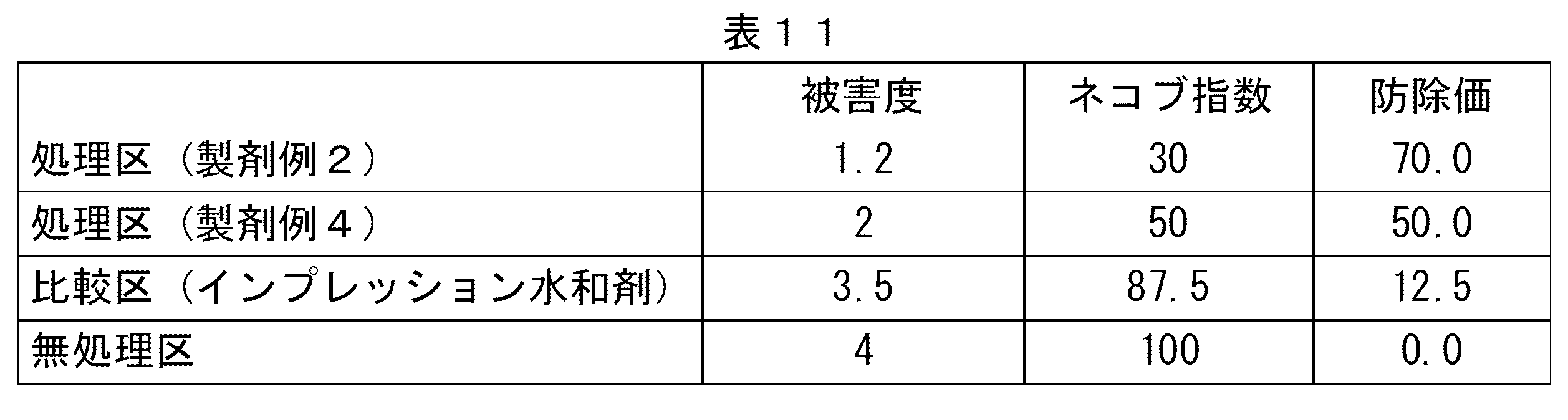
- Example 11 and Comparative Example 11 Pesticidal effect test on sweet potato cat nematode nematode
- the granules of Formulation Example 2 and Formulation Example 4 are mixed uniformly into 1/10000 a Wagner pot at a ratio of 40 kg / 10 a to the sweet potato cat nematode contaminated soil Variety: fixed planted sugar lamp).
- a comparative agent a impression wettable powder (SDS Biotech Co., Ltd.) was similarly tested at a rate of 3.3 kg / 10 a.
- One month after planting the degree of damage to the root (about catfish) was classified and evaluated according to the following criteria, and the catob index was determined according to the following equation to calculate the control value.
- the results are shown in Table 11.
- Example 12 and Comparative Examples 12 to 13 Plant growth promoting effect of AT-332 (basic test) A basic petri dish test was conducted on Arabidopsis thaliana to determine the plant growth promoting effect of AT-332. The Arabidopsis thaliana seeds were immersed in 1% sodium hypochlorite solution for 20 minutes and then immersed in 70% ethanol for 2 minutes to sterilize the surface of the seeds. Thereafter, it was washed with sterile distilled water and used for experiments. Into two divided sterile petri dishes, Murashige and Skoog salt medium (pH 5.7) containing 0.8% agar was poured, and after cooling, it was used for the experiment.
- Murashige and Skoog salt medium pH 5.7
- the disc was inoculated, and the remaining portion was divided and inoculated with sprouted Arabidopsis thaliana seeds.
- the plates inoculated with the fungus and Arabidopsis thaliana were kept at 22 ° C. (12 hours light / 12 hours dark) for 10 days to observe the growth condition of the plants.
- the results are shown in the photographs of FIGS. 2 (a) to (d) together with the results of the control (FIG. 2 (a)) which was not inoculated with bacteria.
- AT-332 (Example 12; (b)) is Bacillus subtilis GB03 (comparative example 12; (c)), which is actually sold and used in the United States, Bacillus subtilis MBI 600. A remarkable plant growth promoting effect was observed compared to (Comparative Example 13; (d)).
- Example 13 Plant growth promoting effect (pot test) of AT-332 and AT-79 strains Pot tests were conducted on Chinese cabbage seedlings to determine the plant growth promoting effects of AT-332 and AT-79 strains.
- the AT-332 and AT-79 strains were cultured in liquid LB medium for 24 hours, and the cells were collected by centrifugation. The collected cells were suspended in sterile 0.85% sodium chloride aqueous solution to 1 ⁇ 10 9 CFU / ml, and 40 ml / kg was mixed with the culture soil previously sterilized to obtain treated soil. .
- the thing which mixed 40 ml / kg only with the sterilized 0.85% sodium chloride aqueous solution was used as untreated soil in the culture soil previously sterilized.
Landscapes
- Life Sciences & Earth Sciences (AREA)
- Health & Medical Sciences (AREA)
- Engineering & Computer Science (AREA)
- Zoology (AREA)
- Chemical & Material Sciences (AREA)
- Biotechnology (AREA)
- Wood Science & Technology (AREA)
- General Health & Medical Sciences (AREA)
- Organic Chemistry (AREA)
- Bioinformatics & Cheminformatics (AREA)
- Genetics & Genomics (AREA)
- Virology (AREA)
- Microbiology (AREA)
- Tropical Medicine & Parasitology (AREA)
- Biochemistry (AREA)
- General Engineering & Computer Science (AREA)
- Biomedical Technology (AREA)
- Medicinal Chemistry (AREA)
- Agronomy & Crop Science (AREA)
- Pest Control & Pesticides (AREA)
- Plant Pathology (AREA)
- Dentistry (AREA)
- Environmental Sciences (AREA)
- Agricultural Chemicals And Associated Chemicals (AREA)
- Micro-Organisms Or Cultivation Processes Thereof (AREA)
Abstract
Description
本発明の他の目的は、前記の微生物を有効菌として含有し、生物農薬(微生物製剤)として使用できる植物病害防除剤、線虫防除剤及び植物成長促進剤を提供することにある。
1.配列番号2または3の塩基配列で示される16S rDNAを有することを特徴とする菌株。
2.菌株自体及び/または菌株の培養物が植物病害防除作用、線虫防除作用及び/または植物成長促進作用の効果を示す前項1に記載の菌株。
3.配列番号2の塩基配列で示される16S rDNAを有する前項1または2に記載のバチルス・エスピー(Bacillus sp.)AT-332菌株。
4.配列番号3の塩基配列で示される16S rDNAを有する前項1または2に記載のバチルス・エスピー(Bacillus sp.)AT-79菌株。
5.前項1~4のいずれかに記載の菌株及び/または菌株の培養物を有効成分として含有する微生物製剤。
6.植物病害防除剤である前項5に記載の微生物製剤。
7.線虫防除剤である前項5に記載の微生物製剤。
8.植物成長促進剤である前項5に記載の微生物製剤。
9.前項5~8のいずれかに記載の微生物製剤で植物を処理する植物の栽培方法。
プリースト(エフ.ジー),グッドフェロー(エム.),シュート(エル.エー),バークレー(アール.シー.ダブリュ):バチルス・アミロリクエファシエンス・エスピー・ノブ.,ノム.レヴ.インターナショナル・ジャーナル・オブ・システマティック・バクテリオロジー,1987,37,69-71(PRIEST(F.G.), GOODFELLOW(M.), SHUTE(L.A.) and BERKELEY(R.C.W.): Bacillus amyloliquefaciens sp. nov., nom. rev. Int. J. Syst. Bacteriol., 1987, 37, 69-71.)及び
バージーズ・マニュアル・オブ・システマティック・バクテリオロジー,第2版,第3巻(Bergey's Manual of Systematic Bacteriology, Second Edition volume 3.)。
形態:桿菌、
大きさ:幅0.8~0.9μm、長さ1.5~2.0μm、
運動性:+、
鞭毛の着生状態:周毛、
胞子の有無:+(準端立)。
培地:ニュートリエント・アガー(nutrient agar)培地(30℃)、
形:円形、
隆起状態:扁平状、
周縁:全縁、
表面の形状:スムーズ、
粘稠度:粘稠性、
透明度:不透明、
色調:クリーム色、
光沢:無光沢、
色素産生:非産生。
グラム染色性:+、
硝酸塩の還元:-、
脱窒反応:-、
MRテスト:-、
VPテスト:+、
インドールの生成:-、
硫化水素の生成:-、
デンプンの加水分解:+、
クエン酸の利用:-(コーサー(Koser))、
+(クリステンセン(Christensen))、
無機窒素源の利用:-(硝酸塩)、
+(アンモニウム塩)、
ウレアーゼ:-、
オキシダーゼ:+、
カタラーゼ:+、
生育の範囲 pH5:+、
pH8:+、
pH9:+、
生育の温度 37℃:+、
45℃:+、
50℃:+、
55℃:-、
嫌気状態での生育:-、
OFテスト(酸化/発酵):-/-、
糖類からの酸産生/ガス産生:
L-アラビノース:+/-、
D-グルコース:+/-、
D-フラクトース:+/-、
マルトース:+/-、
ラクトース:-/-、
D-ソルビトース:+/-、
イノシトール:+/-、
D-キシロース:+/-、
D-マンノース:+/-、
D-ガラクトース:-/-、
サッカロース:+/-、
トレハロース:+/-、
D-マンニトール:+/-、
グリセリン:+/-、
β-ガラクトシダーゼ活性:-、
アルギニンジヒドロラーゼ活性:-、
リジンデカルボキシラーゼ活性:-、
トリプトファンデアミナーゼ活性:-、
ゼラチナーゼ活性:+。
形態:桿菌、
大きさ:幅0.8~0.9μm、長さ1.5~2.0μm、
運動性:+、
鞭毛の着生状態:周毛、
胞子の有無:+(準端立)。
培地:ニュートリエント・アガー(nutrient agar)培地(30℃)、
形:円形、
隆起状態:扁平状、
周縁:全縁、
表面の形状:スムーズ、
粘稠度:粘稠性、
透明度:不透明、
色調:クリーム色、
光沢:無光沢、
色素産生:非産生。
グラム染色性:+、
硝酸塩の還元:-、
脱窒反応:-、
MRテスト:-、
VPテスト:+、
インドールの生成:-、
硫化水素の生成:-、
デンプンの加水分解:+、
クエン酸の利用:-(コーサー(Koser))、
+(クリステンセン(Christensen))、
無機窒素源の利用:-(硝酸塩)、
+(アンモニウム塩)、
ウレアーゼ:-、
オキシダーゼ:+、
カタラーゼ:+、
生育の範囲 pH5:+、
pH8:+、
pH9:+、
生育の温度 37℃:+、
45℃:+、
50℃:+、
55℃:-、
嫌気状態での生育:-、
OFテスト(酸化/発酵):-/-、
糖類からの酸産生/ガス産生:
L-アラビノース:+/-、
D-グルコース:+/-、
D-フラクトース:+/-、
マルトース:+/-、
ラクトース:-/-、
D-ソルビトース:+/-、
イノシトール:+/-、
D-キシロース:+/-、
D-マンノース:+/-、
D-ガラクトース:-/-、
サッカロース:+/-、
トレハロース:+/-、
D-マンニトール:+/-、
グリセリン:+/-、
β-ガラクトシダーゼ活性:-、
アルギニンジヒドロラーゼ活性:-、
リジンデカルボキシラーゼ活性:-、
トリプトファンデアミナーゼ活性:-、
ゼラチナーゼ活性:+。
配列番号2と3とは、塩基番号444と1242の2箇所の塩基のみが異なる。444番の塩基が、配列番号2はグアニン(g)で、配列番号3はアデニン(a)であり、1242番の塩基が、配列番号2はアデニン(a)であり、配列番号3はグアニン(g)である。
DNA抽出はインスタジーン・マトリックス(InstaGene Matrix)(バイオラッド(BIO RAD)社製,カルフォニア(CA),米国)により、PCRはプライムスターHS・DNAポリメラーゼ(PrimeSTAR HS DNA Polymerase)(タカラバイオ社製)により、サイクルシークエンスはビッグダイ・ターミネーター・ヴァージョン3.1サイクル・シークエンシング・キット(BigDye Terminator v3.1 Cycle Sequencing Kit)(アプライド・バイオシステム(Applied Biosystems)社製,カルフォニア(CA),米国)により、それぞれ実施した。使用プライマー(中川恭好他:遺伝子解析法 16S rRNA遺伝子の塩基配列決定法,日本放線菌学会編,放線菌の分類と同定,88-117pp.日本学会事務センター,2001)は、9F、339F,785F、1099F、536R、802R、1242R、及び1541Rである。シークエンスはエービーアイ・プリズム3100・ジェネティック・アナライザー・システム(ABI PRISM 3100 Genetic Analyzer System)(アプライド・バイオシステム(Applied Biosystems)社製,カルフォニア(CA),米国)により行った。
上記で得られた16S rDNAの塩基配列約1500bpを用い、推定される近縁菌群の基準株由来の16S rDNAを国際塩基配列データベース(GenBank/DDBJ/EMBL)より取得して、分子系統樹解析を実施した。
・バチルス・サブチリス(Bacillus subtilis)IAM12118T(AB042061)
・バチルス・サブチリス・亜種スピジゼニイ(Bacillus subtilis subsp.spizizenii)NBRC101239T(AB325584)
・バチルス・モジャベンシス(Bacillus mojavensis)IFO15718 T(AB021191)
・バチルス・バリスモルティス(Bacillus vallismortis)DSM11031 T(AB021198)
・バチルス・アミロリクエファシエンス(Bacillus amyloliquefaciens)BCRC11601 T(EF433406)
・バチルス・アトロフェウス(Bacillus atrophaeus)JCM9070 T(AB021181)
・バチルス・アエロフィラス(Bacillus aerophilus)28K T(AJ831844)
・バチルス・ソノレンシス(Bacillus sonorensis)BCRC17416 T(EF433411)
・バチルス・リケニフォルミス(Bacillus licheniformis)DSM13 T(AE017333)
・バチルス・アルチツジニス(Bacillus altitudinis)41KF2b T(AJ831842)
・バチルス・セレウス(Bacillus cereus)ATCC14579 T(NC_004722)BSL2
株名の末尾のTはその種の基準株を示す。BSLはバイオセーフティレベル(レベル2以上を表記)であることを示す。括弧内はアクセッション番号を示す。
枝の分岐付近の数字がブートストラップ値であり、左下の線はスケールバーを示す。
本発明のバチルス・エスピーAT-332菌株及びAT-79菌株の菌体を含む培養物、培養物と他成分の混合物等の処理物、培養物を遠心分離処理した菌体もしくはその洗浄菌体等の培養分離菌体、培養分離菌体と他成分の混合物等の処理物、及び液体や固体によるこれらの希釈物等を、根、茎、葉、種子、果実等の植物体上、あるいはその栽培土壌中に存在させることにより、各種の植物病害を抑止し、線虫を防除することができる。
本発明の植物病害防除剤、線虫防除剤及び植物成長促進剤において、AT-332菌株またはAT-79菌株を単体で使用することもできるが、両菌株を併用することもできる。また、それぞれの変異体をも使用することができる。変異体とは、上記AT-332菌株及びAT-79菌株の細菌学的特性を有し、植物病害防除作用、線虫防除作用及び植物成長促進作用を有するものであり、自然突然変異株、紫外線や化学変異剤による突然変異株、また細胞融合株及び遺伝子組み替え株等が利用可能である。
AT-332菌株及びAT-79菌株を植物根を含む土壌より分離した。
詳細に述べると、2009年8月に日本国茨城県守谷市の土壌を採取し、熱処理(80℃、10分間)することにより得られた乾燥土壌1gを滅菌水で懸濁した。その懸濁液を102~104倍に希釈し、普通ブイヨン培地(栄研化学(株))で分離培養(28℃、3日間)を行ない、形成したコロニーを分離した。分離したコロニーを、ポテト-デキストロース寒天培地上で、各種植物病原菌に対して効果のある菌株を見出した。さらに、ポテト-デキストロース液体培地で振とう培養し、サツマイモネコブセンチュウ2期幼虫に対する活性を示す菌株としてバチルス・エスピー(Bacillus sp.)AT-332菌株及びAT-79菌株を分離した。
各菌株の同定方法、各種解析の方法とその結果、及び細菌学的性質は、[発明を実施するための形態]に記載の通りである。
前培養として、本発明細菌(AT-332菌株)の保存菌の一白金耳をフラスコ当たり60mlの普通ブイヨン培地(栄研化学(株))を含むバッフル付き500ml三角フラスコに植菌後、回転振とう機で回転数180rpm、28℃、1日間培養した。
上記前培養により得られた培養物60mlを2000mlのLB培地(ペプトン20g,酵母エキス10g,塩化ナトリウム20g,残り 水)を含む5000mlジャーファーメンターに植菌後、本培養として、回転数500rpm、1L/hで35℃、3日間培養した。
上記本培養により、約1800gの培養物を得た。その菌体濃度は約8.0×10⁹CFU/mlであった。
得られた培養物約1800gを-80℃で凍結後、減圧下で凍結乾燥して粉砕することにより、約140gの乾燥粉末を得た。その菌体濃度は約1.0×10¹¹CFU/gであった。
前培養として、本発明細菌(AT-79菌株)の保存菌の一白金耳をフラスコ当たり60mlの普通ブイヨン培地(栄研化学(株))を含むバッフル付き500ml三角フラスコに植菌後、回転振とう機で回転数180rpm、28℃、1日間培養した。
上記前培養により得られた培養物60mlを2000mlのLB培地(トリプトン20g,酵母エキス10g,塩化ナトリウム20g,残り 水)を含む5000mlジャーファーメンターに植菌後、本培養として、回転数500rpm、1L/hで35℃、3日間培養した。
上記本培養により、約1700gの培養物を得た。その菌体濃度は約9.0×10⁹CFU/mlであった。
得られた培養物約1700gを-80℃で凍結後、減圧下で凍結乾燥して粉砕することにより、約130gの乾燥粉末を得た。その菌体濃度は約1.1×10¹¹CFU/gであった。
製剤例1:水和剤
製造例1によって得られた乾燥粉末60部、珪藻土25部、ホワイトカーボン5部、リグニンスルホン酸ソーダ8部、及びアルキルナフタレンスルホン酸ソーダ2部を混合粉砕して水和剤を得た。
製造例1によって得られた乾燥粉末5部、ベンナイト25部、タルク66部、ドデシルベンゼンスルホン酸ソーダ2部、及びリグニンスルホン酸ソーダ2部を混合、粉砕し、水約20部を加えて、混練機で練った後、造粒機を通して造粒し、次いで乾燥整粒して粒剤を得た。
製造例2によって得られた乾燥粉末60部、珪藻土25部、ホワイトカーボン5部、リグニンスルホン酸ソーダ8部、及びアルキルナフタレンスルホン酸ソーダ2部を混合粉砕して水和剤を得た。
製造例2によって得られた乾燥粉末5部、ベンナイト25部、タルク66部、ドデシルベンゼンスルホン酸ソーダ2部、及びリグニンスルホン酸ソーダ2部を混合、粉砕し、水約20部を加えて、混練機で練った後、造粒機を通して造粒し、次いで乾燥整粒して粒剤を得た。
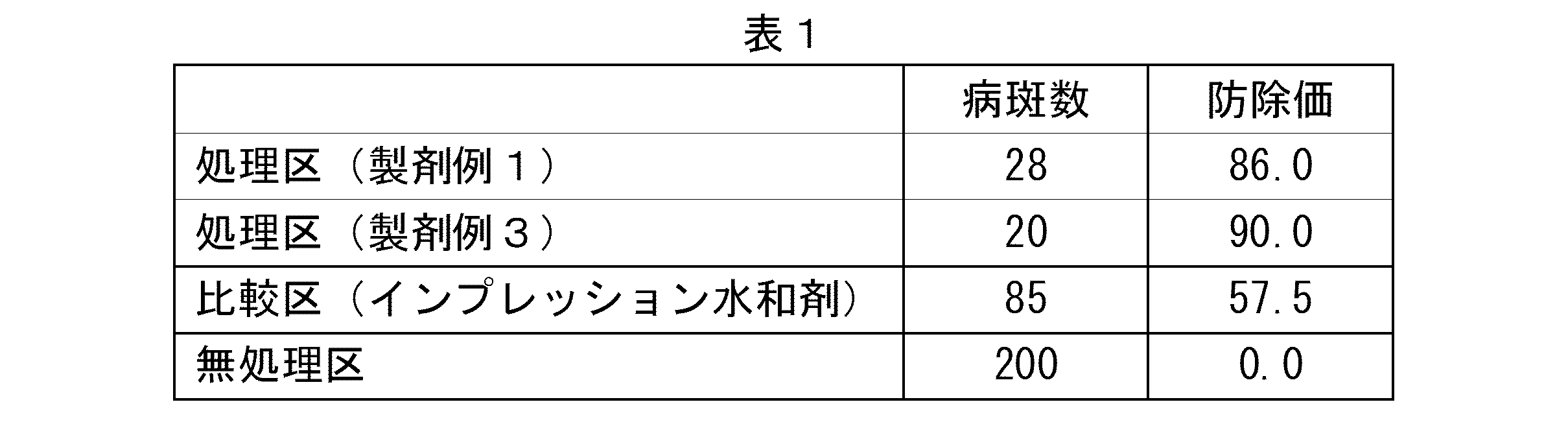
温室内にて直径6cmのプラスチックポットに3葉期まで生育させたイネ(品種:コシヒカリ,15本植え)に製剤例1及び製剤例3の水和剤の250倍希釈液をスプレーガンにて十分量散布した。比較剤としてインプレッション水和剤((株)エス・ディー・エス バイオテック)を250倍希釈したものを同様に供試した。翌日、イネいもち病菌(Pyricularia oryzae)胞子懸濁液を噴霧接種した。ポットを22℃湿室下に24時間保持した後、温室内に7日間放置し、接種葉の病斑数を調査し、防除価を求めた。防除価(%)は無処理区の病斑数を基準にして算出した。結果は表1に示すように、本発明に関わる微生物製剤で処理することによりイネいもち病の発病率が無処理区に比べて著しく減少し、極めて高い防除効果が得られた。
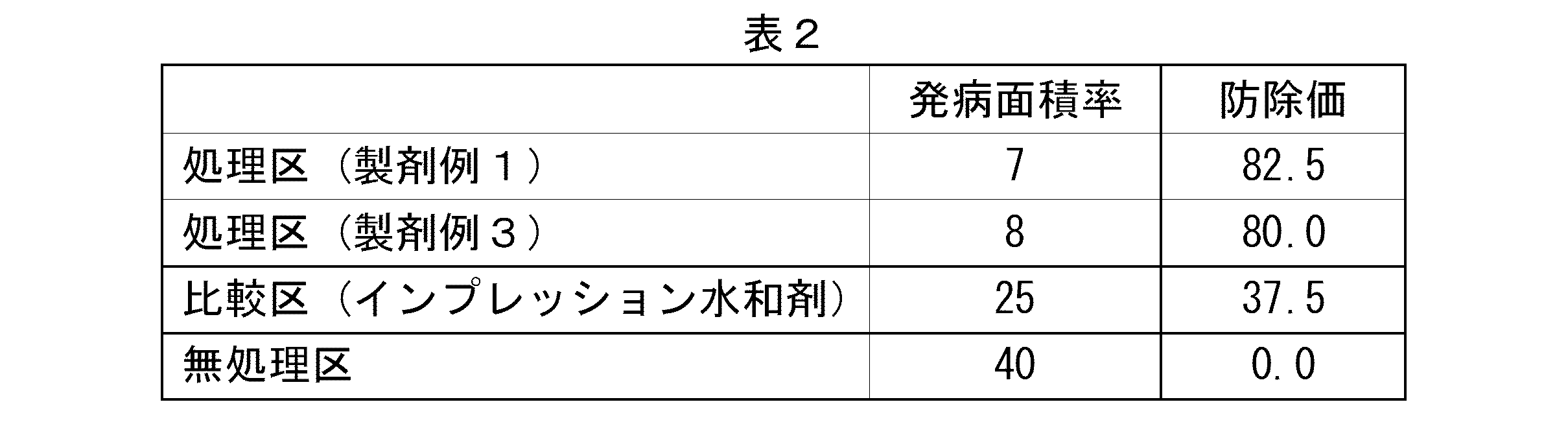
温室内にて直径6cmのプラスチックポットにて育成した3葉期のキュウリ(品種:ときわ光3号P型)の第1葉と第2葉に、製剤例1及び製剤例3の水和剤の250倍希釈液をスプレーガンにて十分量散布した。比較剤としてインプレッション水和剤((株)エス・ディー・エス バイオテック)を250倍希釈したものを同様に供試した。翌日、キュウリ炭疽病菌(Colletorichum lagenarium)胞子懸濁液を噴霧接種した。ポットを22℃湿室下に24時間保持した後、温室内に7日間放置し、第1葉と第2葉の発病面積率を肉眼調査し、防除価を求めた。防除価(%)は無処理区の発病面積率を基準にして算出した。結果は表2に示すように、本発明に関わる微生物製剤で処理することによりキュウリ炭疽病の発病率が無処理区に比べて著しく減少し、極めて高い防除効果が得られた。
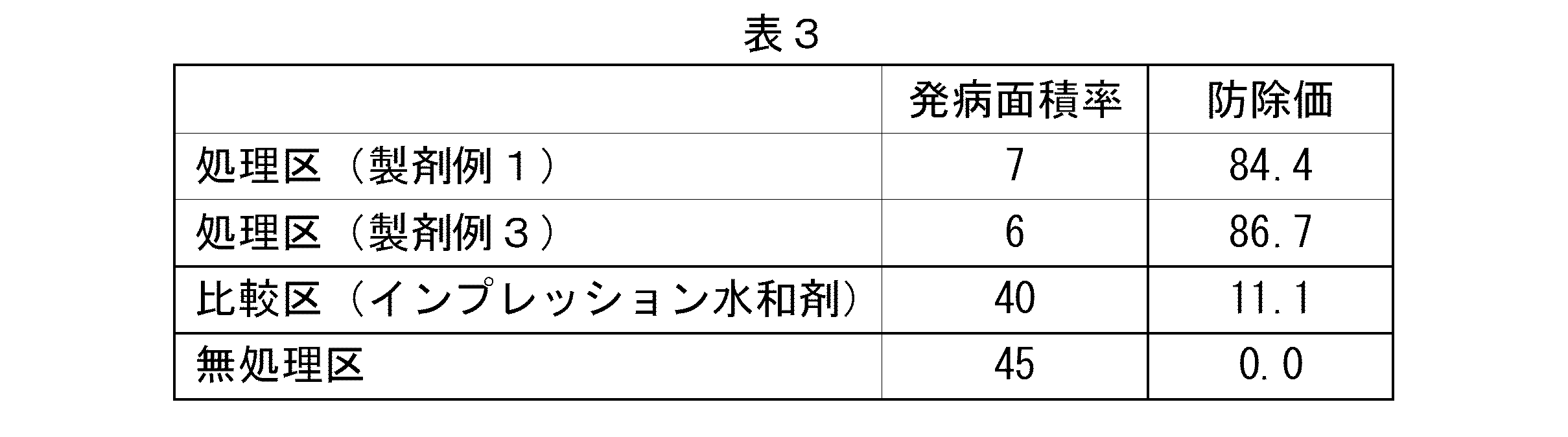
温室内にて直径6cmのプラスチックポットにて育成した5葉期のトマト(品種:シュガーランプ)に、製剤例1及び製剤例3の水和剤の250倍希釈液をスプレーガンにて十分量散布した。比較剤としてインプレッション水和剤((株)エス・ディー・エス バイオテック)を250倍希釈したものを同様に供試した。翌日トマト疫病菌(Phytophthora infestans)遊走子のう懸濁液を噴霧接種した。ポットを22℃湿室下に16時間保持した後、温室内に3日間放置し、第三、四及び五本葉の発病面積率を肉眼調査し、防除価を求めた。防除価(%)は無処理区の発病面積率を基準にして算出した。結果は表3に示すように、本発明に関わる微生物製剤で処理することによりトマト疫病の発病率が無処理区に比べて著しく減少し、極めて高い防除効果が得られた。
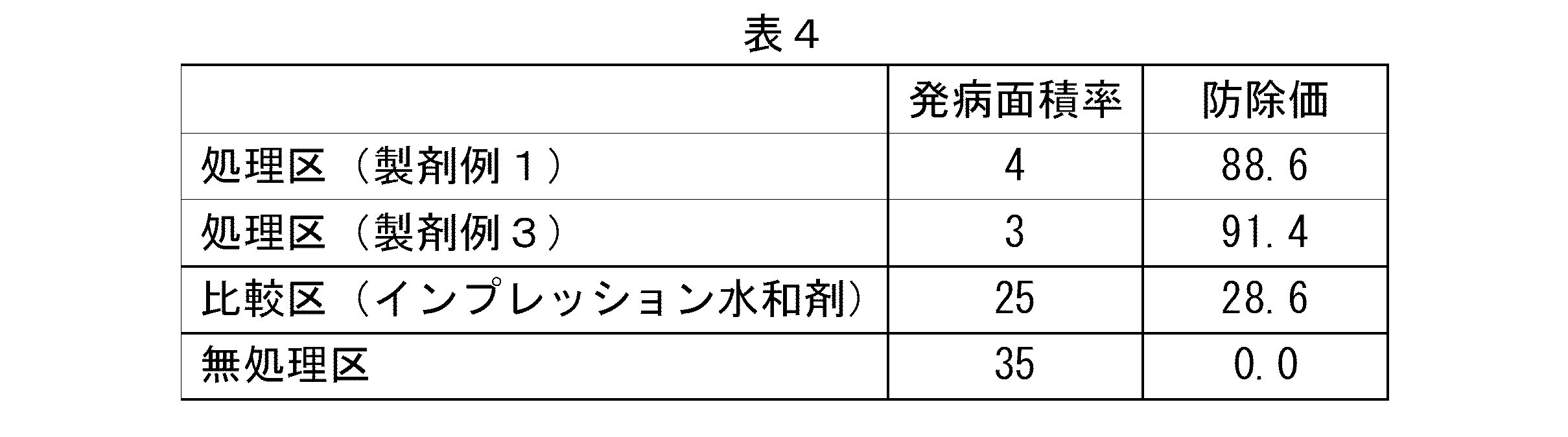
温室内にて直径6cmのプラスチックポットにて育成した3葉期のキュウリ(品種:光3号P型)に、製剤例1及び製剤例3の水和剤の250倍希釈液をスプレーガンにて十分量散布した。比較剤としてインプレッション水和剤((株)エス・ディー・エス バイオテック)を250倍希釈したものを同様に供試した。翌日キュウリべと病(Pseudoperonospora cubensis)遊走子懸濁液を噴霧接種した。ポットを22℃湿室下に18時間保持した後、温室内に3日間放置し、第一及び二本葉の発病面積率を肉眼調査し、防除価を求めた。防除価(%)は無処理区の発病面積率を基準にして算出した。結果は表4に示すように、本発明に関わる微生物製剤で処理することによりキュウリべと病の発病率が無処理区に比べて著しく減少し、極めて高い防除効果が得られた。
リンゴ(王林)の葉を採取し、葉裏に製剤例1及び製剤例3の水和剤の250倍希釈液をスプレーガンにて十分量散布した。比較剤としてインプレッション水和剤((株)エス・ディー・エス バイオテック)を250倍希釈したものを同様に供試した。散布後、葉を風乾し、リンゴ斑点落葉病菌(Altenaria Alternaria mali)の胞子懸濁液を噴霧接種した。20℃、多湿下で4日間置いた後、発病面積率を肉眼調査し、防除価を求めた。防除価(%)は無処理区の発病面積率を基準にして算出した。結果は表5に示すように、本発明に関わる微生物製剤で処理することによりリンゴ斑点落葉病の発病率が無処理区に比べて著しく減少し、極めて高い防除効果が得られた。
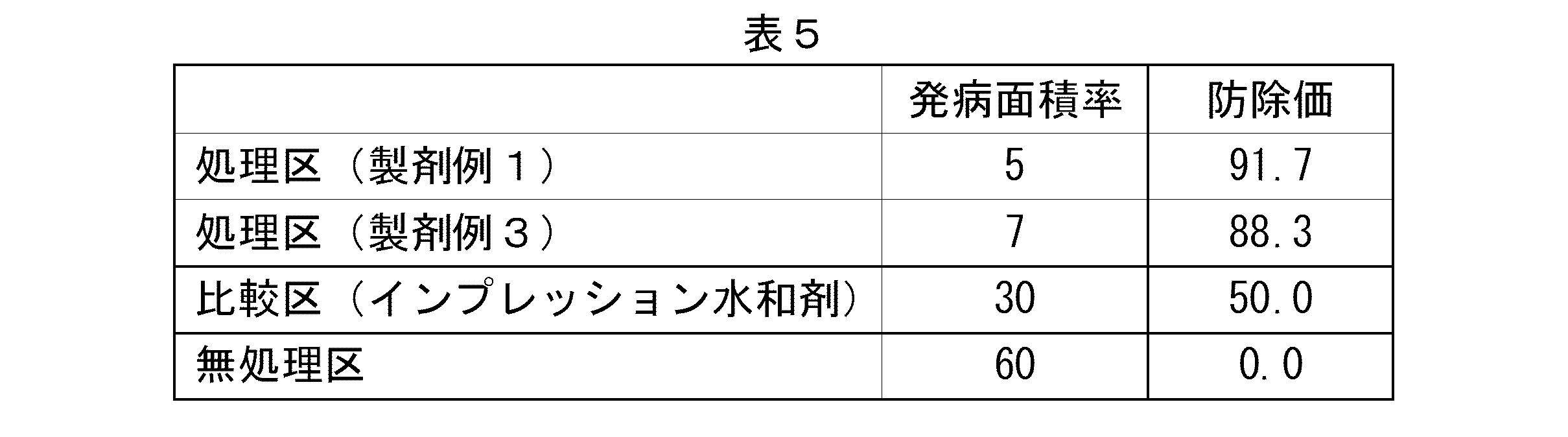
自社保有温室内でキュウリを用いて試験(試験区:4m2/区、10株/区、3連制)を行なった。発病は自然発生とした。製剤例1及び製剤例3の水和剤を、500倍希釈、1000倍希釈、2000倍希釈で7日間隔4回散布し、葉への発病面積率により防除価を算出した。比較剤としてインプレッション水和剤((株)エス・ディー・エス バイオテック)500倍及び1000倍、ボトキラー水和剤(出光興産(株))1000倍、ボトピカ水和剤(出光興産(株))2000倍、エコショット顆粒水和剤(クミアイ化学工業(株))1000倍、モレスタン水和剤(アグロ カネショウ(株))3000倍希釈液を用いた。なお、無処理区の発病度は47.4%であった。防除価(%)は無処理区の発病度率を基準にして算出した。結果は表6に示すように、本発明に関わる微生物製剤で処理することによりキュウリうどんこ病の発病率が無処理区に比べて著しく減少し、極めて高い防除効果が得られた。また、比較剤として用いた既存の市販のバチルス・ズブチリス剤(インプレッション水和剤(特許文献3),ボトキラー水和剤,ボトピカ水和剤,エコショット顆粒水和剤(特許文献4))に比べて著しく高い効果が圃場でも確認された。また、500倍希釈では化学剤のモレスタン水和剤と同等レベルの非常に高い防除効果を示した。

自社保有温室内でナスを用いて試験(試験区:5.6m2/区、7株/区、3連制)を行なった。発病は自然発生とした。製剤例1及び製剤例3の水和剤を、500倍希釈、1000倍希釈で7日間隔4回散布し、果実への発病果率により防除価を算出した。比較剤としてインプレッション水和剤((株)エス・ディー・エス バイオテック)500倍、ボトキラー水和剤(出光興産(株))1000倍、ボトピカ水和剤(出光興産(株))2000倍、エコショット顆粒水和剤(クミアイ化学工業(株))1000倍、セイビアーフロアブル20(シンジェンタジャパン(株))1500倍希釈液を用いた。なお、無処理区の発病果率は15%であった。防除価(%)は無処理区の発病果率に基づき算出した。結果は表7に示すように、本発明に関わる微生物製剤で処理することによりナス灰色かび病の発病率が無処理区に比べて著しく減少し、極めて高い防除効果が得られた。また、比較剤として用いた既存の市販のバチルス・ズブチリス剤(インプレッション水和剤、ボトキラー水和剤、ボトピカ水和剤、エコショット顆粒水和剤)に比べて著しく高い効果が圃場でも確認された。また、500倍希釈では化学剤のセイビアーフロアブル20と同等レベルの非常に高い防除効果を示した。

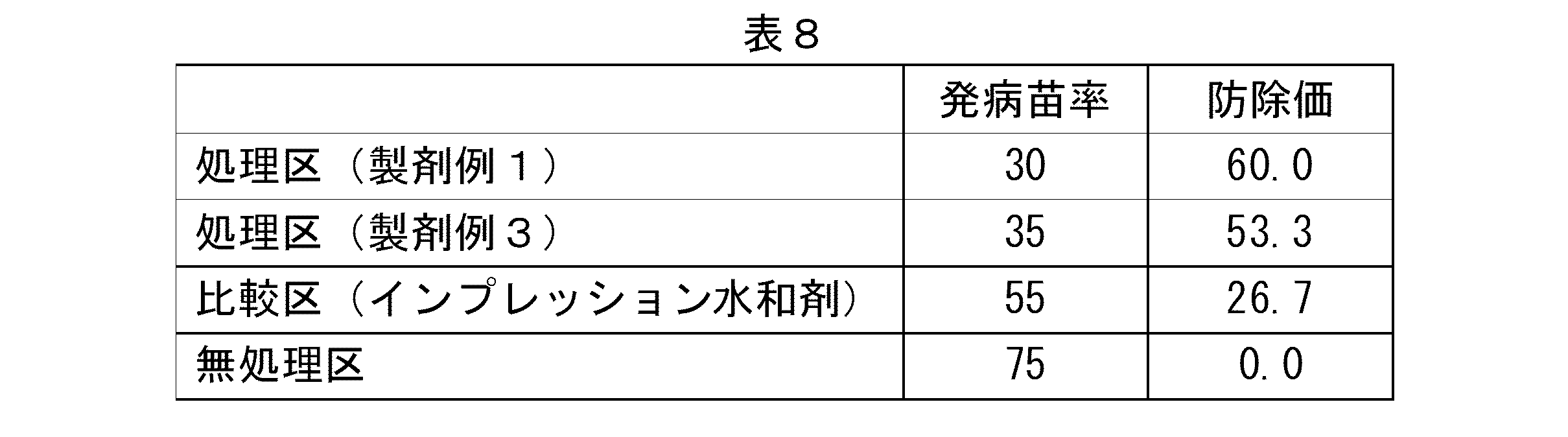
PD液体培地で27℃、52時間振とう培養して得られたイネ苗立枯細菌病菌(Burkholderia plantarii)懸濁液(1×10⁸CFU/ml)にイネ種籾(品種:コシヒカリ)を減圧条件下で1時間浸漬接種し、イネ苗立枯細菌病感染籾を作成した。製剤例1及び製剤例3の水和剤の100倍希釈液に、上記のイネ苗立枯細菌病感染籾を24時間浸漬した後、浸漬処理液を捨て、32℃の湿室内に1日保って催芽させた。比較剤としてインプレッション水和剤((株)エス・ディー・エス バイオテック)を100倍希釈したものを同様に供試した。育苗培土を充填させた径6cmのプラスチックカップに催芽種子を播種し、播種3日後、30℃の育苗庫内に保ち、さらに25℃の湿室内で15日間管理した後に、全苗について発病の有無を調査し、発病苗率を求めた。防除価(%)は無処理区の発病苗率に基づいて算出した。1カップ当たりの播種量は乾籾3g(90~110粒)。結果は表8に示すように、本発明に関わる微生物製剤で処理することによりイネ苗立枯細菌病の発病率が無処理区に比べて著しく減少し、極めて高い防除効果が得られた。
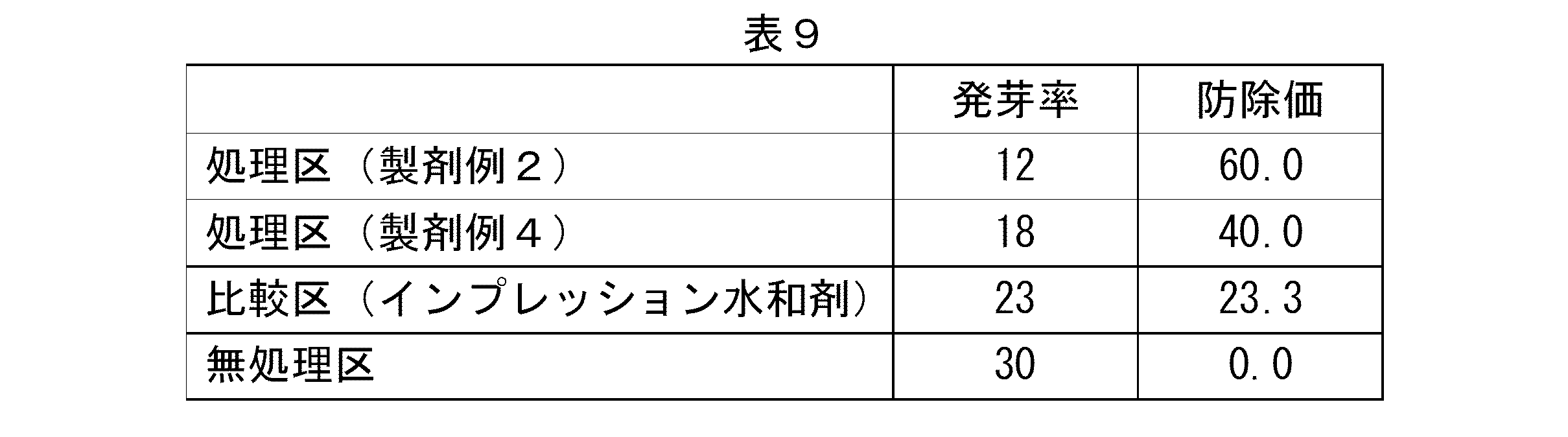
苗立枯病菌のフスマ培養物3gを滅菌土壌500mlに混和したのちプラスチックポットに詰め、製剤例2及び製剤例4の粒剤を1g土壌混和処理した。比較剤としてインプレッション水和剤((株)エス・ディー・エス バイオテック)84mgを同様に供試した。キュウリ(相模半白)を播種して、23℃、1週間栽培した後、発芽率を調査した。防除効力(防除価%)は無処理区の発芽率に基づき算出した。結果は表9に示すように、本発明に関わる微生物製剤で処理することによりキュウリ苗立枯病の発病率が無処理区に比べて著しく減少し、極めて高い防除効果が得られた。
ナス(十両)の根より採集した卵嚢より24時間以内に孵化したサツマイモネコブセンチュウ2期幼虫に対する殺線虫活性を試験した。24穴のマイクロプレートに製剤例1及び製剤例3の100倍希釈液(tween20 5000倍希釈溶液)、及び当量のネコブセンチュウ2期幼虫懸濁液(約50頭)を添加した。比較剤としてインプレッション水和剤((株)エス・ディー・エス バイオテック)を100倍希釈したものを同様に供試した。プレートを密封して、28℃、相対湿度約50%のインキュベーター内に配置した。72時間後に、実体顕微鏡下での観察により死亡率を調べた。その際、不動の線虫は死亡したものとみなした。殺線虫率は以下の式により算出した。結果は表10に示すように、本発明に関わる微生物製剤で処理することによりサツマイモネコブセンチュウ2期幼虫に対する極めて高い殺線虫活性が得られた。


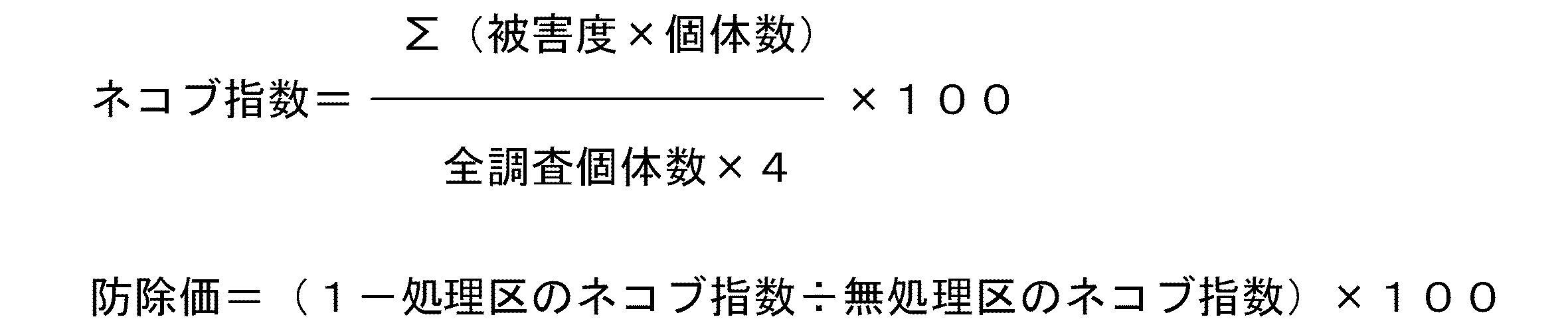
1/10000aワグネルポットに40kg/10aの割合でサツマイモネコブセンチュウ汚染土壌に製剤例2及び製剤例4の粒剤を均一に混合し、ミニトマト(品種:シュガーランプ)を定植した。比較剤としてインプレッション水和剤((株)エス・ディー・エス バイオテック)を3.3kg/10aの割合で同様に供試した。定植1ヵ月後に根の被害度(ネコブ程度)を以下の基準により類別評価し、下記の式の通りネコブ指数を求め、防除価を算出した。結果は表11に示すように、本発明に関わる微生物製剤で処理することによりサツマイモネコブセンチュウによる根部の被害は無処理区に比べて著しく減少し、極めて高い防除効果が得られた。
1:こぶが一見しただけでは目立たないが少数認めうる、
2:こぶが少数散見される、
3:こぶが中程度認められる、
4:こぶが根圏:の全体にわたって多く認められる。
シロイヌナズナを対象に基礎シャーレ試験を行いAT-332の植物成長促進効果を測定した。シロイヌナズナ種子を1%次亜塩素酸ナトリウム液に20分浸後、70%エタノールで2分間浸漬し、種子表面の殺菌を行った。その後、滅菌蒸留水で洗浄し、実験に使用した。2分割された滅菌シャーレに0.8%の寒天を含むMurashige and Skoog salt 培地(pH5.7)を注ぎ込み、冷却後、実験に使用した。
AT-332(実施例12)、バチルス・サブチリス(Bacillus subtilis)GB03(比較例12)、バチルス・サブチリス(Bacillus subtilis)MBI600(比較例13)を上記シャーレの分割された片方に置かれた滅菌ペーパーディスクに接種し、分割された残りの部分にシロイヌナズナ発芽種子を接種した。菌とシロイヌナズナを接種したプレートは、22℃(照光12時間/遮光12時間)で10日間保温し、植物の生育状況を観察した。結果を菌を接種しなかった対照(図2(a))の結果と共に図2(a)~(d)の写真に示す。AT-332(実施例12;(b))は、米国で実際に販売・使用されているバチルス・サブチリス(Bacillus subtilis )GB03(比較例12;(c))、バチルス・サブチリス(Bacillus subtilis )MBI600(比較例13;(d))に比べても顕著な植物成長促進効果が認められた。
ハクサイ幼苗を対象にしてポット試験を行いAT-332及びAT-79菌株の植物成長促進効果を測定した。まず、AT-332及びAT-79菌株を液体LB培地で24時間培養後、菌体を遠心集菌した。回収した菌体を滅菌した0.85%塩化ナトリウム水溶液で1×10⁹ CFU/mlになるように懸濁し、予め滅菌しておいた培養土に、1kgあたり40ml混和したものを処理土壌とした。一方、予め滅菌しておいた培養土に、滅菌した0.85%塩化ナトリウム水溶液のみを1kgあたり40ml混和したものを無処理土壌とした。処理土壌及び無処理土壌を100gずつ、プラスチッック製のポット(口径70mm×高さ68mm)に入れ、これにハクサイ(品種:野崎白菜二号)の種子を播種した。その後、22℃に設定した温室内に置き、30日後に生育したハクサイの生重量を測定した。結果を図3に示す。AT-332及びAT-79菌株の作物に対する明らかな成長促進効果が認められた。
Claims (9)
- 配列番号2または3の塩基配列で示される16S rDNAを有することを特徴とする菌株。
- 菌株自体及び/または菌株の培養物が植物病害防除作用、線虫防除作用及び/または植物成長促進作用の効果を示す請求項1に記載の菌株。
- 配列番号2の塩基配列で示される16S rDNAを有する請求項1または2に記載のバチルス・エスピー(Bacillus sp.)AT-332菌株。
- 配列番号3の塩基配列で示される16S rDNAを有する請求項1または2に記載のバチルス・エスピー(Bacillus sp.)AT-79菌株。
- 請求項1~4のいずれかに記載の菌株及び/または菌株の培養物を有効成分として含有する微生物製剤。
- 植物病害防除剤である請求項5に記載の微生物製剤。
- 線虫防除剤である請求項5に記載の微生物製剤。
- 植物成長促進剤である請求項5に記載の微生物製剤。
- 請求項5~8のいずれかに記載の微生物製剤で植物を処理する植物の栽培方法。
Priority Applications (13)
| Application Number | Priority Date | Filing Date | Title |
|---|---|---|---|
| ES12789590.2T ES2616911T3 (es) | 2011-05-26 | 2012-05-21 | Cepa que pertenece al género Bacillus, agente microbiológico, y procedimiento de cultivo de plantas |
| CA2836726A CA2836726C (en) | 2011-05-26 | 2012-05-21 | Strain belonging to bacillus genus, microbiological agent, and plant cultivation method |
| EP12789590.2A EP2716748B1 (en) | 2011-05-26 | 2012-05-21 | Strain belonging to bacillus genus, microbiological agent, and plant cultivation method |
| JP2012546657A JP5198690B2 (ja) | 2011-05-26 | 2012-05-21 | バチルス属に属する菌株、微生物製剤、及び植物の栽培方法 |
| BR112013030228-3A BR112013030228B1 (pt) | 2011-05-26 | 2012-05-21 | cepas de bactérias que pertencem ao gênero bacillus, agente microbiológico e método para cultivar plantas |
| NZ617974A NZ617974B2 (en) | 2011-05-26 | 2012-05-21 | Strain belonging to bacillus genus, microbiological agent, and plant cultivation method |
| MX2013013640A MX348159B (es) | 2011-05-26 | 2012-05-21 | Cepa que pertenece al genero bacillus, agente microbiologico y metodo de cultivo de la planta. |
| US14/119,022 US9504257B2 (en) | 2011-05-26 | 2012-05-21 | Strain belonging to Bacillus genus, microbiological agent, and plant cultivation method |
| CN201280025668.0A CN103703120B (zh) | 2011-05-26 | 2012-05-21 | 属于芽孢杆菌属的菌株、微生物制剂及植物的栽培方法 |
| AU2012259893A AU2012259893B2 (en) | 2011-05-26 | 2012-05-21 | Strain belonging to Bacillus genus, microbiological agent, and plant cultivation method |
| IL229514A IL229514B (en) | 2011-05-26 | 2013-11-20 | A species belonging to the genus Bacillus, a microbiological factor and a method of plant cultivation |
| ZA2013/08830A ZA201308830B (en) | 2011-05-26 | 2013-11-22 | Strain belonging to bacillus genus, microbiological agent, and plant cultivation method |
| US15/295,117 US10219517B2 (en) | 2011-05-26 | 2016-10-17 | Strain belonging to Bacillus genus, microbiological agent, and plant cultivation method |
Applications Claiming Priority (2)
| Application Number | Priority Date | Filing Date | Title |
|---|---|---|---|
| JP2011062109 | 2011-05-26 | ||
| JPPCT/JP2011/062109 | 2011-05-26 |
Related Child Applications (2)
| Application Number | Title | Priority Date | Filing Date |
|---|---|---|---|
| US14/119,022 A-371-Of-International US9504257B2 (en) | 2011-05-26 | 2012-05-21 | Strain belonging to Bacillus genus, microbiological agent, and plant cultivation method |
| US15/295,117 Continuation US10219517B2 (en) | 2011-05-26 | 2016-10-17 | Strain belonging to Bacillus genus, microbiological agent, and plant cultivation method |
Publications (1)
| Publication Number | Publication Date |
|---|---|
| WO2012161160A1 true WO2012161160A1 (ja) | 2012-11-29 |
Family
ID=47217237
Family Applications (1)
| Application Number | Title | Priority Date | Filing Date |
|---|---|---|---|
| PCT/JP2012/062935 Ceased WO2012161160A1 (ja) | 2011-05-26 | 2012-05-21 | バチルス属に属する菌株、微生物製剤、及び植物の栽培方法 |
Country Status (13)
| Country | Link |
|---|---|
| US (2) | US9504257B2 (ja) |
| EP (1) | EP2716748B1 (ja) |
| CN (1) | CN103703120B (ja) |
| AU (1) | AU2012259893B2 (ja) |
| BR (1) | BR112013030228B1 (ja) |
| CA (1) | CA2836726C (ja) |
| CL (1) | CL2013003374A1 (ja) |
| ES (1) | ES2616911T3 (ja) |
| IL (1) | IL229514B (ja) |
| MX (1) | MX348159B (ja) |
| PT (1) | PT2716748T (ja) |
| WO (1) | WO2012161160A1 (ja) |
| ZA (1) | ZA201308830B (ja) |
Cited By (8)
| Publication number | Priority date | Publication date | Assignee | Title |
|---|---|---|---|---|
| JP2013066467A (ja) * | 2011-09-22 | 2013-04-18 | Republic Of Korea (Rural Development Administration) | バチルスバリスモルティスbs07m菌株、微生物製剤、及び作物育成方法 |
| WO2015025869A1 (ja) * | 2013-08-23 | 2015-02-26 | 国立大学法人鹿児島大学 | 土壌伝染性病害防除剤及びそれを用いた土壌伝染性病害防除方法 |
| WO2015056666A1 (ja) * | 2013-10-17 | 2015-04-23 | 出光興産株式会社 | 新規微生物およびその利用 |
| WO2015156274A1 (ja) * | 2014-04-09 | 2015-10-15 | 株式会社エス・ディー・エス バイオテック | 微生物農薬組成物、その製造方法及び微生物農薬の安定化方法 |
| JP2020026393A (ja) * | 2018-08-09 | 2020-02-20 | 株式会社浜口微生物研究所 | イモグサレ線虫防除剤および防除方法 |
| JP2020515569A (ja) * | 2017-03-27 | 2020-05-28 | テンフォールド テクノロジーズ リミティッド ライアビリティ カンパニー | 植物病を予防又は制御するための方法及び農業用組成物 |
| JP2022033569A (ja) * | 2020-08-17 | 2022-03-02 | タカノフーズ株式会社 | 植物病害防除剤及び植物病害防除方法 |
| US12274732B2 (en) | 2017-03-27 | 2025-04-15 | Tenfold Technologies, LLC | Anti-pathogen composition and methods of use thereof |
Families Citing this family (35)
| Publication number | Priority date | Publication date | Assignee | Title |
|---|---|---|---|---|
| US8993484B1 (en) | 2013-10-04 | 2015-03-31 | Fmc Corporation | Methods for improving plant growth |
| US8937054B1 (en) | 2013-12-05 | 2015-01-20 | Fmc Corporation | Liquid-fertilizer ready formulations of bifenthrin |
| CN103789233A (zh) * | 2014-01-15 | 2014-05-14 | 河南农业大学 | 防治小麦禾谷孢囊线虫病的生防菌株09b18、制备生防菌剂的方法及其应用 |
| CN103952348B (zh) * | 2014-04-24 | 2017-01-11 | 烟台地元生物科技有限公司 | 耐寒短杆菌及微生物菌剂和它们的应用 |
| ES2561908B2 (es) * | 2014-07-31 | 2016-12-01 | Universidad De Granada | Uso de Bacillus methylotrophicus como estimulante del crecimiento vegetal y medio de control biológico, y cepas aisladas de dicha especie |
| CN104593284B (zh) * | 2014-09-06 | 2017-10-10 | 山西农业大学 | 一株核桃内生菌及其应用 |
| WO2016109332A1 (en) | 2014-12-29 | 2016-07-07 | Fmc Corporation | Compositions and methods for use of insecticide with bacillus sp. d747 |
| UY36335A (es) * | 2014-12-29 | 2017-04-28 | Fmc Corp | Composiciones microbianas destinadas a ser utilizadas en combinación con insecticidas para suelos, para beneficiar el crecimiento de las plantas |
| US10375964B2 (en) | 2014-12-29 | 2019-08-13 | Fmc Corporation | Microbial compositions and methods of use for benefiting plant growth and treating plant disease |
| CN104839227A (zh) * | 2015-04-08 | 2015-08-19 | 江苏省农业科学院 | 解淀粉芽孢杆菌b-1619在防治根结线虫病害中的应用 |
| CN104982312B (zh) * | 2015-06-19 | 2017-08-25 | 卞佳林 | 一种圣女果盆栽的栽培方法 |
| AR108659A1 (es) * | 2016-06-03 | 2018-09-12 | Valent Biosciences Llc | Composiciones no acuosas, no oleosas con bacillus amyloliquefaciens |
| US10263332B2 (en) | 2017-09-18 | 2019-04-16 | Apple Inc. | Antenna arrays with etched substrates |
| CN109749953B (zh) * | 2018-12-04 | 2020-07-07 | 青岛农业大学 | 蜡样芽孢杆菌、菌剂及其制备方法和应用 |
| CN111662837B (zh) * | 2019-03-07 | 2023-01-24 | 宁夏大学 | 一株萎缩芽孢杆菌及其用途 |
| CN110423707B (zh) * | 2019-06-27 | 2022-07-22 | 南通大学 | 枯草芽孢杆菌菌株nh-6及其应用 |
| US11200333B2 (en) * | 2019-08-13 | 2021-12-14 | International Business Machines Corporation | File exposure to an intended recipient |
| CN110628681B (zh) * | 2019-10-11 | 2021-04-30 | 沈阳农业大学 | 一种高地芽孢杆菌菌株及其在水稻纹枯病上的应用 |
| CN110668903A (zh) * | 2019-10-23 | 2020-01-10 | 中国农业科学院烟草研究所 | 一种线虫综合治理的微生物菌肥 |
| CN111040976B (zh) * | 2020-01-06 | 2021-04-13 | 安徽农业大学 | 一株解淀粉芽孢杆菌及其应用 |
| CN110982765B (zh) * | 2020-01-19 | 2021-11-02 | 闽江学院 | 一株内生解淀粉芽孢杆菌jl-b05及其应用 |
| CN111440743B (zh) * | 2020-04-09 | 2022-05-27 | 山东农业大学 | 一株防病促生和土壤改良的解淀粉芽孢杆菌peba20及其应用 |
| CN111778190B (zh) * | 2020-07-16 | 2022-03-08 | 山东滇鲁生物科技有限公司 | 一株防治根结线虫病的短短芽孢杆菌及其应用 |
| CN112708572B (zh) * | 2020-07-17 | 2023-10-24 | 兰州理工大学 | 一种提高党参产量和品质的微生物复合菌剂及制备方法和应用 |
| CN114276945B (zh) * | 2020-09-18 | 2023-07-21 | 中国科学院微生物研究所 | 一株苏云金芽孢杆菌及其应用 |
| CN114214220B (zh) * | 2020-09-18 | 2023-07-21 | 中国科学院微生物研究所 | 一株苏云金芽孢杆菌及其在促进植物生长中的应用 |
| CN112725236B (zh) * | 2020-12-08 | 2022-02-01 | 青岛农业大学 | 土壤短芽孢杆菌dr2-1及其应用 |
| CN113186133B (zh) * | 2021-05-12 | 2023-03-10 | 青海省农林科学院 | 一种高地芽孢杆菌s1012及其应用 |
| CN113773992B (zh) * | 2021-09-17 | 2023-02-07 | 赣南师范大学 | 高地芽孢杆菌Ba1449及菌剂在防治植物真菌病中的应用 |
| CN116355760B (zh) * | 2021-12-27 | 2026-04-14 | 华中农业大学 | 一种枝状枝孢菌及其在制备防治植物病原线虫药剂中的应用 |
| CN114874948B (zh) * | 2022-06-02 | 2023-05-02 | 青岛农业大学 | 一株高地芽孢杆菌hmqau20091、菌剂及其制备方法和应用 |
| CN117801995A (zh) * | 2023-12-29 | 2024-04-02 | 广东植物龙生物技术股份有限公司 | 一株防治根结线虫的蜡样芽胞杆菌及其应用 |
| CN117882738A (zh) * | 2024-01-08 | 2024-04-16 | 广东省农业科学院植物保护研究所 | 一种贝莱斯芽孢杆菌干悬浮剂及其制备方法 |
| CN118909893B (zh) * | 2024-10-12 | 2025-01-28 | 内蒙古自治区农牧业科学院 | 萎缩芽孢杆菌n-3及其在防治植物病害中的应用 |
| CN119931887B (zh) * | 2025-01-24 | 2025-08-15 | 中国农业科学院农业资源与农业区划研究所 | 一株拮抗马铃薯多种病原真菌的细菌菌株及其应用 |
Citations (6)
| Publication number | Priority date | Publication date | Assignee | Title |
|---|---|---|---|---|
| WO1996032840A1 (en) | 1995-04-17 | 1996-10-24 | Ecogen Israel Partnership | Bacteria having nematicidal activity and their agricultural use |
| WO1997012980A1 (en) | 1995-10-06 | 1997-04-10 | Mycogen Corporation | Identification of, and uses for, nematicidal bacillus thuringiensis genes, toxins, and isolates |
| WO1998050422A1 (en) | 1997-05-09 | 1998-11-12 | Agraquest, Inc. | A novel strain of bacillus for controlling plant diseases and corn rootworm |
| JP2955655B2 (ja) | 1998-03-06 | 1999-10-04 | 農林水産省蚕糸・昆虫農業技術研究所長 | 植物病害の防除剤及び防除方法 |
| US20040265292A1 (en) | 2001-11-26 | 2004-12-30 | Satoshi Watanabe | Bacillus sp d747 strain, plant disease controllring agents and insect pest controlling agents using the same and control method using the agents |
| JP2009247302A (ja) | 2008-04-09 | 2009-10-29 | Kumiai Chem Ind Co Ltd | バシルス・アミロリクエファシエンスの新菌株及びそれを用いた植物病害防除剤 |
Family Cites Families (5)
| Publication number | Priority date | Publication date | Assignee | Title |
|---|---|---|---|---|
| US6103228A (en) * | 1997-05-09 | 2000-08-15 | Agraquest, Inc. | Compositions and methods for controlling plant pests |
| US6524998B1 (en) * | 1999-03-01 | 2003-02-25 | Auburn University | Biological compositions and methods for enhancing plant growth and health and producing disease-suppressive plants |
| CN1952116A (zh) * | 2006-04-18 | 2007-04-25 | 兰州大学 | 一株解淀粉芽孢杆菌菌株及其应用 |
| CN100547066C (zh) * | 2007-08-02 | 2009-10-07 | 河北师范大学 | 一种枯草芽孢杆菌及其应用 |
| WO2009031874A1 (es) | 2007-09-04 | 2009-03-12 | Jorge Olmos Soto | Cepa de bacillus subtilis para uso agrícola |
-
2012
- 2012-05-21 MX MX2013013640A patent/MX348159B/es active IP Right Grant
- 2012-05-21 EP EP12789590.2A patent/EP2716748B1/en active Active
- 2012-05-21 WO PCT/JP2012/062935 patent/WO2012161160A1/ja not_active Ceased
- 2012-05-21 US US14/119,022 patent/US9504257B2/en active Active
- 2012-05-21 CA CA2836726A patent/CA2836726C/en active Active
- 2012-05-21 AU AU2012259893A patent/AU2012259893B2/en active Active
- 2012-05-21 BR BR112013030228-3A patent/BR112013030228B1/pt active IP Right Grant
- 2012-05-21 PT PT127895902T patent/PT2716748T/pt unknown
- 2012-05-21 ES ES12789590.2T patent/ES2616911T3/es active Active
- 2012-05-21 CN CN201280025668.0A patent/CN103703120B/zh active Active
-
2013
- 2013-11-20 IL IL229514A patent/IL229514B/en active IP Right Grant
- 2013-11-22 ZA ZA2013/08830A patent/ZA201308830B/en unknown
- 2013-11-25 CL CL2013003374A patent/CL2013003374A1/es unknown
-
2016
- 2016-10-17 US US15/295,117 patent/US10219517B2/en active Active
Patent Citations (10)
| Publication number | Priority date | Publication date | Assignee | Title |
|---|---|---|---|---|
| WO1996032840A1 (en) | 1995-04-17 | 1996-10-24 | Ecogen Israel Partnership | Bacteria having nematicidal activity and their agricultural use |
| JP3471811B2 (ja) | 1995-04-17 | 2003-12-02 | エコゲン イスラエル パートナーシップ | 抗線虫活性を有する細菌及びその農業的用途 |
| WO1997012980A1 (en) | 1995-10-06 | 1997-04-10 | Mycogen Corporation | Identification of, and uses for, nematicidal bacillus thuringiensis genes, toxins, and isolates |
| JP4359653B2 (ja) | 1995-10-06 | 2009-11-04 | マイコーゲン コーポレーション | 抗線虫性バチルス・チューリンギエンシス(Bacillus thuringiensis)遺伝子、毒素、および単離株の同定およびその利用 |
| WO1998050422A1 (en) | 1997-05-09 | 1998-11-12 | Agraquest, Inc. | A novel strain of bacillus for controlling plant diseases and corn rootworm |
| JP3471815B2 (ja) | 1997-05-09 | 2003-12-02 | アグラクエスト,インコーポレイテッド | 植物疾病およびコーンルートワームを制御するためのBacillusの新規な株 |
| JP2955655B2 (ja) | 1998-03-06 | 1999-10-04 | 農林水産省蚕糸・昆虫農業技術研究所長 | 植物病害の防除剤及び防除方法 |
| US20040265292A1 (en) | 2001-11-26 | 2004-12-30 | Satoshi Watanabe | Bacillus sp d747 strain, plant disease controllring agents and insect pest controlling agents using the same and control method using the agents |
| JP4071036B2 (ja) | 2001-11-26 | 2008-04-02 | クミアイ化学工業株式会社 | バシルスsp.D747菌株およびそれを用いた植物病害防除剤および害虫防除剤 |
| JP2009247302A (ja) | 2008-04-09 | 2009-10-29 | Kumiai Chem Ind Co Ltd | バシルス・アミロリクエファシエンスの新菌株及びそれを用いた植物病害防除剤 |
Non-Patent Citations (11)
Cited By (18)
| Publication number | Priority date | Publication date | Assignee | Title |
|---|---|---|---|---|
| JP2013066467A (ja) * | 2011-09-22 | 2013-04-18 | Republic Of Korea (Rural Development Administration) | バチルスバリスモルティスbs07m菌株、微生物製剤、及び作物育成方法 |
| WO2015025869A1 (ja) * | 2013-08-23 | 2015-02-26 | 国立大学法人鹿児島大学 | 土壌伝染性病害防除剤及びそれを用いた土壌伝染性病害防除方法 |
| WO2015056666A1 (ja) * | 2013-10-17 | 2015-04-23 | 出光興産株式会社 | 新規微生物およびその利用 |
| AU2014335393B2 (en) * | 2013-10-17 | 2020-03-26 | Sds Biotech K.K. | Novel microorganism and use thereof |
| JPWO2015056666A1 (ja) * | 2013-10-17 | 2017-03-09 | 出光興産株式会社 | 新規微生物およびその利用 |
| US10428394B2 (en) | 2013-10-17 | 2019-10-01 | Idemitsu Kosan Co., Ltd. | Method of promoting plant growth |
| EP3059304A4 (en) * | 2013-10-17 | 2017-07-05 | Idemitsu Kosan Co., Ltd | Novel microorganism and use thereof |
| KR101923413B1 (ko) * | 2014-04-09 | 2018-11-29 | 가부시키가이샤 에스디에스 바이오텍크 | 미생물 농약 조성물, 그 제조 방법 및 미생물 농약의 안정화 방법 |
| US10111423B2 (en) | 2014-04-09 | 2018-10-30 | Sds Biotech K.K. | Microbial pesticide composition of dried Bacillus |
| JPWO2015156274A1 (ja) * | 2014-04-09 | 2017-04-13 | 株式会社エス・ディー・エス バイオテック | 微生物農薬組成物、その製造方法及び微生物農薬の安定化方法 |
| WO2015156274A1 (ja) * | 2014-04-09 | 2015-10-15 | 株式会社エス・ディー・エス バイオテック | 微生物農薬組成物、その製造方法及び微生物農薬の安定化方法 |
| JP2020515569A (ja) * | 2017-03-27 | 2020-05-28 | テンフォールド テクノロジーズ リミティッド ライアビリティ カンパニー | 植物病を予防又は制御するための方法及び農業用組成物 |
| JP7084414B2 (ja) | 2017-03-27 | 2022-06-14 | テンフォールド テクノロジーズ リミティッド ライアビリティ カンパニー | 植物病を予防又は制御するための方法及び農業用組成物 |
| US11920125B2 (en) | 2017-03-27 | 2024-03-05 | Tenfold Technologies, LLC | Methods and agricultural compositions for preventing or controlling plant diseases |
| US12274732B2 (en) | 2017-03-27 | 2025-04-15 | Tenfold Technologies, LLC | Anti-pathogen composition and methods of use thereof |
| JP2020026393A (ja) * | 2018-08-09 | 2020-02-20 | 株式会社浜口微生物研究所 | イモグサレ線虫防除剤および防除方法 |
| JP2022033569A (ja) * | 2020-08-17 | 2022-03-02 | タカノフーズ株式会社 | 植物病害防除剤及び植物病害防除方法 |
| JP7514142B2 (ja) | 2020-08-17 | 2024-07-10 | タカノフーズ株式会社 | 植物病害防除剤及び植物病害防除方法 |
Also Published As
| Publication number | Publication date |
|---|---|
| US10219517B2 (en) | 2019-03-05 |
| CA2836726A1 (en) | 2012-11-29 |
| AU2012259893B2 (en) | 2015-09-24 |
| US20140179528A1 (en) | 2014-06-26 |
| CN103703120B (zh) | 2015-04-15 |
| CL2013003374A1 (es) | 2014-10-03 |
| MX348159B (es) | 2017-05-31 |
| US20170027177A1 (en) | 2017-02-02 |
| BR112013030228B1 (pt) | 2021-03-16 |
| CA2836726C (en) | 2019-10-22 |
| PT2716748T (pt) | 2017-03-21 |
| MX2013013640A (es) | 2014-04-25 |
| BR112013030228A2 (pt) | 2016-12-13 |
| NZ617974A (en) | 2015-11-27 |
| EP2716748A1 (en) | 2014-04-09 |
| CN103703120A (zh) | 2014-04-02 |
| ES2616911T3 (es) | 2017-06-14 |
| EP2716748B1 (en) | 2016-12-21 |
| EP2716748A4 (en) | 2014-10-22 |
| IL229514A0 (en) | 2014-01-30 |
| US9504257B2 (en) | 2016-11-29 |
| ZA201308830B (en) | 2015-04-29 |
| IL229514B (en) | 2019-03-31 |
Similar Documents
| Publication | Publication Date | Title |
|---|---|---|
| CN103703120B (zh) | 属于芽孢杆菌属的菌株、微生物制剂及植物的栽培方法 | |
| CN111356761B (zh) | 用于植物病原体的生物防治的方法和组合物 | |
| JP6469016B2 (ja) | 新規微生物およびその利用 | |
| US10154670B2 (en) | Compositions comprising Bacillus strains and methods of use to suppress the activities and growth of fungal plant pathogens | |
| JP3776919B2 (ja) | バチルス属細菌を用いた植物病害の防除方法および防除剤 | |
| KR100903253B1 (ko) | 바실러스 sp. D747 균주, 이를 이용한 식물병해방제제및 해충방제제 및 이들을 이용한 방제방법 | |
| JP2022501395A (ja) | バシラス・アミロリクエファシエンスfcc1256組成物および植物病原菌の防除方法 | |
| US20120028799A1 (en) | Growth enhancement and control of bacterial and fungal plant diseases with streptomyces scopuliridis | |
| JP5198690B2 (ja) | バチルス属に属する菌株、微生物製剤、及び植物の栽培方法 | |
| JP2007055982A (ja) | バチルス属細菌の栄養細胞を有効成分とする植物病害の防除方法および防除剤 | |
| TWI571511B (zh) | 芽孢桿菌屬所屬之菌株、微生物製劑及植物的栽培方法 | |
| US20260013508A1 (en) | Biological control agent | |
| NZ617974B2 (en) | Strain belonging to bacillus genus, microbiological agent, and plant cultivation method |
Legal Events
| Date | Code | Title | Description |
|---|---|---|---|
| ENP | Entry into the national phase |
Ref document number: 2012546657 Country of ref document: JP Kind code of ref document: A |
|
| 121 | Ep: the epo has been informed by wipo that ep was designated in this application |
Ref document number: 12789590 Country of ref document: EP Kind code of ref document: A1 |
|
| ENP | Entry into the national phase |
Ref document number: 2836726 Country of ref document: CA |
|
| REEP | Request for entry into the european phase |
Ref document number: 2012789590 Country of ref document: EP |
|
| WWE | Wipo information: entry into national phase |
Ref document number: 2012789590 Country of ref document: EP Ref document number: MX/A/2013/013640 Country of ref document: MX |
|
| ENP | Entry into the national phase |
Ref document number: 2013/1960 Country of ref document: KE |
|
| WWE | Wipo information: entry into national phase |
Ref document number: 2013003374 Country of ref document: CL |
|
| NENP | Non-entry into the national phase |
Ref country code: DE |
|
| ENP | Entry into the national phase |
Ref document number: 2012259893 Country of ref document: AU Date of ref document: 20120521 Kind code of ref document: A |
|
| REG | Reference to national code |
Ref country code: BR Ref legal event code: B01A Ref document number: 112013030228 Country of ref document: BR |
|
| WWE | Wipo information: entry into national phase |
Ref document number: 14119022 Country of ref document: US |
|
| ENP | Entry into the national phase |
Ref document number: 112013030228 Country of ref document: BR Kind code of ref document: A2 Effective date: 20131125 |