WO2012161315A1 - 微細凹凸構造を表面に有する物品の製造方法 - Google Patents
微細凹凸構造を表面に有する物品の製造方法 Download PDFInfo
- Publication number
- WO2012161315A1 WO2012161315A1 PCT/JP2012/063498 JP2012063498W WO2012161315A1 WO 2012161315 A1 WO2012161315 A1 WO 2012161315A1 JP 2012063498 W JP2012063498 W JP 2012063498W WO 2012161315 A1 WO2012161315 A1 WO 2012161315A1
- Authority
- WO
- WIPO (PCT)
- Prior art keywords
- mold
- release agent
- mold release
- convex structure
- fine concavo
- Prior art date
- Legal status (The legal status is an assumption and is not a legal conclusion. Google has not performed a legal analysis and makes no representation as to the accuracy of the status listed.)
- Ceased
Links
Images


Classifications
-
- B—PERFORMING OPERATIONS; TRANSPORTING
- B05—SPRAYING OR ATOMISING IN GENERAL; APPLYING FLUENT MATERIALS TO SURFACES, IN GENERAL
- B05D—PROCESSES FOR APPLYING FLUENT MATERIALS TO SURFACES, IN GENERAL
- B05D5/00—Processes for applying liquids or other fluent materials to surfaces to obtain special surface effects, finishes or structures
- B05D5/02—Processes for applying liquids or other fluent materials to surfaces to obtain special surface effects, finishes or structures to obtain a matt or rough surface
-
- B—PERFORMING OPERATIONS; TRANSPORTING
- B29—WORKING OF PLASTICS; WORKING OF SUBSTANCES IN A PLASTIC STATE IN GENERAL
- B29C—SHAPING OR JOINING OF PLASTICS; SHAPING OF MATERIAL IN A PLASTIC STATE, NOT OTHERWISE PROVIDED FOR; AFTER-TREATMENT OF THE SHAPED PRODUCTS, e.g. REPAIRING
- B29C37/00—Component parts, details, accessories or auxiliary operations, not covered by group B29C33/00 or B29C35/00
- B29C37/0067—Using separating agents during or after moulding; Applying separating agents on preforms or articles, e.g. to prevent sticking to each other
-
- B—PERFORMING OPERATIONS; TRANSPORTING
- B29—WORKING OF PLASTICS; WORKING OF SUBSTANCES IN A PLASTIC STATE IN GENERAL
- B29C—SHAPING OR JOINING OF PLASTICS; SHAPING OF MATERIAL IN A PLASTIC STATE, NOT OTHERWISE PROVIDED FOR; AFTER-TREATMENT OF THE SHAPED PRODUCTS, e.g. REPAIRING
- B29C39/00—Shaping by casting, i.e. introducing the moulding material into a mould or between confining surfaces without significant moulding pressure; Apparatus therefor
- B29C39/02—Shaping by casting, i.e. introducing the moulding material into a mould or between confining surfaces without significant moulding pressure; Apparatus therefor for making articles of definite length, i.e. discrete articles
- B29C39/10—Shaping by casting, i.e. introducing the moulding material into a mould or between confining surfaces without significant moulding pressure; Apparatus therefor for making articles of definite length, i.e. discrete articles incorporating preformed parts or layers, e.g. casting around inserts or for coating articles
-
- B—PERFORMING OPERATIONS; TRANSPORTING
- B29—WORKING OF PLASTICS; WORKING OF SUBSTANCES IN A PLASTIC STATE IN GENERAL
- B29C—SHAPING OR JOINING OF PLASTICS; SHAPING OF MATERIAL IN A PLASTIC STATE, NOT OTHERWISE PROVIDED FOR; AFTER-TREATMENT OF THE SHAPED PRODUCTS, e.g. REPAIRING
- B29C33/00—Moulds or cores; Details thereof or accessories therefor
- B29C33/56—Coatings, e.g. enameled or galvanised; Releasing, lubricating or separating agents
-
- B—PERFORMING OPERATIONS; TRANSPORTING
- B29—WORKING OF PLASTICS; WORKING OF SUBSTANCES IN A PLASTIC STATE IN GENERAL
- B29C—SHAPING OR JOINING OF PLASTICS; SHAPING OF MATERIAL IN A PLASTIC STATE, NOT OTHERWISE PROVIDED FOR; AFTER-TREATMENT OF THE SHAPED PRODUCTS, e.g. REPAIRING
- B29C33/00—Moulds or cores; Details thereof or accessories therefor
- B29C33/56—Coatings, e.g. enameled or galvanised; Releasing, lubricating or separating agents
- B29C33/60—Releasing, lubricating or separating agents
-
- B—PERFORMING OPERATIONS; TRANSPORTING
- B29—WORKING OF PLASTICS; WORKING OF SUBSTANCES IN A PLASTIC STATE IN GENERAL
- B29C—SHAPING OR JOINING OF PLASTICS; SHAPING OF MATERIAL IN A PLASTIC STATE, NOT OTHERWISE PROVIDED FOR; AFTER-TREATMENT OF THE SHAPED PRODUCTS, e.g. REPAIRING
- B29C39/00—Shaping by casting, i.e. introducing the moulding material into a mould or between confining surfaces without significant moulding pressure; Apparatus therefor
- B29C39/14—Shaping by casting, i.e. introducing the moulding material into a mould or between confining surfaces without significant moulding pressure; Apparatus therefor for making articles of indefinite length
- B29C39/148—Shaping by casting, i.e. introducing the moulding material into a mould or between confining surfaces without significant moulding pressure; Apparatus therefor for making articles of indefinite length characterised by the shape of the surface
-
- B—PERFORMING OPERATIONS; TRANSPORTING
- B29—WORKING OF PLASTICS; WORKING OF SUBSTANCES IN A PLASTIC STATE IN GENERAL
- B29C—SHAPING OR JOINING OF PLASTICS; SHAPING OF MATERIAL IN A PLASTIC STATE, NOT OTHERWISE PROVIDED FOR; AFTER-TREATMENT OF THE SHAPED PRODUCTS, e.g. REPAIRING
- B29C59/00—Surface shaping of articles, e.g. embossing; Apparatus therefor
- B29C59/02—Surface shaping of articles, e.g. embossing; Apparatus therefor by mechanical means, e.g. pressing
- B29C59/04—Surface shaping of articles, e.g. embossing; Apparatus therefor by mechanical means, e.g. pressing using rollers or endless belts
-
- B—PERFORMING OPERATIONS; TRANSPORTING
- B29—WORKING OF PLASTICS; WORKING OF SUBSTANCES IN A PLASTIC STATE IN GENERAL
- B29C—SHAPING OR JOINING OF PLASTICS; SHAPING OF MATERIAL IN A PLASTIC STATE, NOT OTHERWISE PROVIDED FOR; AFTER-TREATMENT OF THE SHAPED PRODUCTS, e.g. REPAIRING
- B29C59/00—Surface shaping of articles, e.g. embossing; Apparatus therefor
- B29C59/02—Surface shaping of articles, e.g. embossing; Apparatus therefor by mechanical means, e.g. pressing
- B29C59/04—Surface shaping of articles, e.g. embossing; Apparatus therefor by mechanical means, e.g. pressing using rollers or endless belts
- B29C59/046—Surface shaping of articles, e.g. embossing; Apparatus therefor by mechanical means, e.g. pressing using rollers or endless belts for layered or coated substantially flat surfaces
-
- G—PHYSICS
- G02—OPTICS
- G02B—OPTICAL ELEMENTS, SYSTEMS OR APPARATUS
- G02B1/00—Optical elements characterised by the material of which they are made; Optical coatings for optical elements
- G02B1/10—Optical coatings produced by application to, or surface treatment of, optical elements
- G02B1/11—Anti-reflection coatings
-
- G—PHYSICS
- G02—OPTICS
- G02B—OPTICAL ELEMENTS, SYSTEMS OR APPARATUS
- G02B1/00—Optical elements characterised by the material of which they are made; Optical coatings for optical elements
- G02B1/10—Optical coatings produced by application to, or surface treatment of, optical elements
- G02B1/11—Anti-reflection coatings
- G02B1/118—Anti-reflection coatings having sub-optical wavelength surface structures designed to provide an enhanced transmittance, e.g. moth-eye structures
-
- B—PERFORMING OPERATIONS; TRANSPORTING
- B29—WORKING OF PLASTICS; WORKING OF SUBSTANCES IN A PLASTIC STATE IN GENERAL
- B29C—SHAPING OR JOINING OF PLASTICS; SHAPING OF MATERIAL IN A PLASTIC STATE, NOT OTHERWISE PROVIDED FOR; AFTER-TREATMENT OF THE SHAPED PRODUCTS, e.g. REPAIRING
- B29C35/00—Heating, cooling or curing, e.g. crosslinking or vulcanising; Apparatus therefor
- B29C35/02—Heating or curing, e.g. crosslinking or vulcanizing during moulding, e.g. in a mould
- B29C35/08—Heating or curing, e.g. crosslinking or vulcanizing during moulding, e.g. in a mould by wave energy or particle radiation
- B29C35/0805—Heating or curing, e.g. crosslinking or vulcanizing during moulding, e.g. in a mould by wave energy or particle radiation using electromagnetic radiation
- B29C2035/0827—Heating or curing, e.g. crosslinking or vulcanizing during moulding, e.g. in a mould by wave energy or particle radiation using electromagnetic radiation using UV radiation
-
- B—PERFORMING OPERATIONS; TRANSPORTING
- B29—WORKING OF PLASTICS; WORKING OF SUBSTANCES IN A PLASTIC STATE IN GENERAL
- B29C—SHAPING OR JOINING OF PLASTICS; SHAPING OF MATERIAL IN A PLASTIC STATE, NOT OTHERWISE PROVIDED FOR; AFTER-TREATMENT OF THE SHAPED PRODUCTS, e.g. REPAIRING
- B29C59/00—Surface shaping of articles, e.g. embossing; Apparatus therefor
- B29C59/02—Surface shaping of articles, e.g. embossing; Apparatus therefor by mechanical means, e.g. pressing
- B29C59/022—Surface shaping of articles, e.g. embossing; Apparatus therefor by mechanical means, e.g. pressing characterised by the disposition or the configuration, e.g. dimensions, of the embossments or the shaping tools therefor
- B29C2059/023—Microembossing
-
- B—PERFORMING OPERATIONS; TRANSPORTING
- B29—WORKING OF PLASTICS; WORKING OF SUBSTANCES IN A PLASTIC STATE IN GENERAL
- B29C—SHAPING OR JOINING OF PLASTICS; SHAPING OF MATERIAL IN A PLASTIC STATE, NOT OTHERWISE PROVIDED FOR; AFTER-TREATMENT OF THE SHAPED PRODUCTS, e.g. REPAIRING
- B29C33/00—Moulds or cores; Details thereof or accessories therefor
- B29C33/42—Moulds or cores; Details thereof or accessories therefor characterised by the shape of the moulding surface, e.g. ribs or grooves
- B29C33/424—Moulding surfaces provided with means for marking or patterning
-
- G—PHYSICS
- G02—OPTICS
- G02B—OPTICAL ELEMENTS, SYSTEMS OR APPARATUS
- G02B1/00—Optical elements characterised by the material of which they are made; Optical coatings for optical elements
- G02B1/10—Optical coatings produced by application to, or surface treatment of, optical elements
- G02B1/18—Coatings for keeping optical surfaces clean, e.g. hydrophobic or photo-catalytic films
Definitions
- the present invention relates to a method for manufacturing an article having a fine concavo-convex structure on its surface.
- This application claims priority based on Japanese Patent Application No. 2011-118087 filed in Japan on May 26, 2011 and Japanese Patent Application No. 2011-118088 filed on May 26, 2011 in Japan, The contents are incorporated here.
- the concavo-convex structure called the moth-eye structure in which substantially conical convex portions are arranged is an effective anti-reflection means by continuously increasing the refractive index from the refractive index of air to the refractive index of the material of the article. It is known that
- a liquid active energy ray-curable resin composition is sandwiched between a mold having a fine concavo-convex structure on the surface and a substrate, and this is irradiated with active energy rays.
- a method of forming a cured resin layer in which a fine concavo-convex structure is transferred onto the surface of a substrate has been attracting attention.
- the mold which has anodized alumina which has several pores on the surface of an aluminum base material attracts attention (patent document 1).
- the contact interface between the mold and the active energy ray-curable resin composition is greatly increased for the following reasons (i) to (iii), and therefore, the mold is difficult to release from the cured resin layer.
- the average interval of pores in the anodized alumina is about 100 nm to 400 nm, and the distance between the pores where the pores are closest is several nm to several tens of nm. That is, the structure is very fine.
- the smoothness of the wall surfaces of the pores may be reduced, and the wall surfaces of the pores may become rough to some extent. is there.
- In order to obtain a function such as a sufficient antireflection effect it is necessary to make the aspect ratio of the pores relatively large.
- the height of the convex portion of the fine concavo-convex structure to be transferred gradually changes, so that not only the surface physical properties of the article but also the optical characteristics change. For this reason, an article having a fine concavo-convex structure obtained on the surface while the surface characteristics and optical characteristics have changed since the start of production cannot be shipped as a product, and the surface characteristics and optical characteristics of the article are The raw materials and materials that are consumed before stabilization is wasted.
- the present invention cures an active energy ray-curable resin composition sandwiched between a mold and a substrate, and forms a cured resin layer onto which the fine concavo-convex structure of the mold is transferred on the surface of the substrate. Even if the fine concavo-convex structure of the mold is repeatedly transferred, the mold releasability between the mold and the cured resin layer and the shape and surface characteristics of the transferred fine concavo-convex structure can be maintained, and the article having the fine concavo-convex structure on the surface is stable. A method that can be manufactured with high productivity is provided.
- the first aspect of the present invention is a method for manufacturing an article having the following fine relief structure on the surface.
- a method for producing an article having a fine concavo-convex structure on the surface comprising the following steps (I) and (II): (I) A step of coating a mold surface having a fine concavo-convex structure made of anodized alumina on a surface with a mold release treatment solution containing a mold mold release agent, wherein the mold mold release agent comprises 1 phosphate ester compound.
- the pH of the aqueous solution is 3.0 or more when 1 g of the mold release agent is extracted with 50 mL of water.
- step (II) After step (I), an active energy ray-curable resin composition containing a polymerizable compound, a polymerization initiator and an internal mold release agent is sandwiched between the mold and the substrate, and the active energy is sandwiched between them. A step of irradiating and curing a line to form a cured resin layer having the fine concavo-convex structure transferred on the surface of the substrate to obtain an article having the fine concavo-convex structure on the surface.
- the second aspect of the present invention is a method for producing an article having the following fine relief structure on the surface.
- a method for producing an article having a fine concavo-convex structure on the surface comprising the following steps (I ′) and (II ′): (I ′) A step of coating the surface of a mold having a fine concavo-convex structure made of anodized alumina on the surface with a (poly) oxyalkylene alkyl phosphate compound.
- step (II ′) After step (I ′), an active energy ray-curable resin composition containing a polymerizable compound, a polymerization initiator, and an internal release agent is sandwiched between the mold and the substrate, A step of irradiating and curing an active energy ray to form a cured resin layer onto which the fine concavo-convex structure is transferred on the surface of the base material to obtain an article having the fine concavo-convex structure on the surface.
- step (I ′) includes the following steps (I′-1) and (I′-2): Method.
- I′-1 A step of preparing a mold release treatment solution by dissolving a (poly) oxyalkylene alkyl phosphate compound in a solvent.
- II′-2 A step of applying a release treatment solution to the surface of the mold and drying it.
- the third aspect of the present invention is a method for producing an article having the following fine concavo-convex structure on the surface.
- a method for producing an article having a fine concavo-convex structure on the surface comprising the following steps (I ′′) to (II ′′): (I ′′) A step of treating the surface of a mold having a fine concavo-convex structure made of anodized alumina on the surface with a mold release agent.
- step (II ′′) After step (I ′′), an active energy ray-curable resin composition containing a polymerizable compound, a polymerization initiator, and the same internal mold release agent as the mold mold release agent, An article having a fine concavo-convex structure on the surface thereof is formed on the surface of the substrate by sandwiching it between the materials and irradiating and curing the active energy ray to form a cured resin layer to which the fine concavo-convex structure is transferred. Obtaining step.
- step (I ′′) includes the following steps (I ′′ -1) to (I ′′ -2): Method.
- (I ′′ -1) A step of preparing a mold release treatment solution by dissolving a mold release agent in a solvent.
- (I ′′ -2) A step of applying a mold release treatment solution to the mold surface and drying it.
- the active energy ray-curable resin composition is cured while being sandwiched between the mold and the substrate, and the fine concavo-convex structure of the mold is transferred.
- the mold releasability between the mold and the cured resin layer and the shape and surface characteristics of the transferred fine uneven structure
- the fine concavo-convex structure means a structure in which an average interval (period) between convex portions or concave portions is not more than a visible light wavelength, that is, 400 nm or less.
- an active energy ray means visible light, an ultraviolet-ray, an electron beam, plasma, a heat ray (infrared rays etc.), etc.
- the (poly) oxyalkylene alkyl phosphate compound means an oxyalkylene alkyl phosphate compound having one oxyalkylene group or a polyoxyalkylene alkyl phosphate compound having two or more oxyalkylene groups.
- (Meth) acrylate means acrylate or methacrylate.
- the method for producing an article having a fine concavo-convex structure on the surface according to the first aspect of the present invention is a method having the following steps (I) and (II).
- (I) A step of coating a mold surface having a fine concavo-convex structure made of anodized alumina on a surface with a mold release treatment solution containing a mold mold release agent, wherein the mold mold release agent comprises 1 phosphate ester compound.
- the pH of the aqueous solution is 3.0 or more when 1 g of the mold release agent is extracted with 50 mL of water.
- step (II) After step (I), an active energy ray-curable resin composition containing a polymerizable compound, a polymerization initiator and an internal mold release agent is sandwiched between the mold and the substrate, and the active energy is sandwiched between them. A step of irradiating and curing a line to form a cured resin layer having the fine concavo-convex structure transferred on the surface of the substrate to obtain an article having the fine concavo-convex structure on the surface.
- the method for producing an article having a fine relief structure on the surface according to the second aspect of the present invention is a method having the following steps (I ′) and (II ′).
- (I ′) A step of coating the surface of a mold having a fine concavo-convex structure made of anodized alumina on the surface with a (poly) oxyalkylene alkyl phosphate compound.
- step (II ′) After step (I ′), an active energy ray-curable resin composition containing a polymerizable compound, a polymerization initiator, and an internal release agent is sandwiched between the mold and the substrate, A step of irradiating and curing an active energy ray to form a cured resin layer onto which the fine concavo-convex structure is transferred on the surface of the base material to obtain an article having the fine concavo-convex structure on the surface.
- the method for producing an article having a fine concavo-convex structure on the surface according to the third aspect of the present invention is a method having the following steps (I ") and (II").
- (I ′′) A step of treating the surface of a mold having a fine concavo-convex structure made of anodized alumina on the surface with a mold release agent.
- step (II ′′) After step (I ′′), an active energy ray-curable resin composition containing a polymerizable compound, a polymerization initiator, and the same internal mold release agent as the mold mold release agent, An article having a fine concavo-convex structure on the surface thereof is formed on the surface of the substrate by sandwiching it between the materials and irradiating and curing the active energy ray to form a cured resin layer to which the fine concavo-convex structure is transferred. Obtaining step.
- the surface of the mold on which the fine concavo-convex structure is formed is coated with a (poly) oxyalkylene alkyl phosphate compound that is a mold release agent.
- the surface of the mold on which the fine concavo-convex structure is formed is coated with a (poly) oxyalkylene alkyl phosphate compound.
- Step (I ′′) in the third aspect of the present invention is the same as step (I).
- Steps (I), (I ′) and (I ′′) have the following steps (I-1) and (I-2) in that the mold is uniformly and sufficiently thinly coated with the mold release agent. It is preferable.
- (I-1) A step of preparing a release treatment solution by dissolving a (poly) oxyalkylene alkyl phosphate compound in a solvent.
- (I-2) A step of applying a mold release treatment solution to the surface of the mold and drying it.
- the mold release agent containing one or more types of phosphate ester compounds used in the present invention has an aqueous solution pH of 3.0 or more when 1 g of mold release agent is extracted with 50 mL of water. If pH is 3.0 or more, the fine uneven
- the pH is more preferably 3.0 or more, and particularly preferably 3.5 or more.
- the pH of the mold release agent is preferably 7.0 or less, more preferably 6.0 or less, and particularly preferably 5.0 or less. That is, the pH of the mold release agent is preferably 3.0 to 7.0, more preferably 3.5 to 6.0, and particularly preferably 3.5 to 5.0.
- the (poly) oxyalkylene alkyl phosphate compound contains a very small amount of phosphoric acid as an impurity. If this phosphoric acid concentration is too high, there is a possibility that when the mold is left in contact with the mold, the mold melts and the fine uneven shape changes or disappears. When the mold release agent melts the mold, it is not preferable because the storage conditions and period of the mold from the mold release processing to the transfer of the fine uneven shape are limited. Therefore, as a result of diligent investigation, if the mold release agent comprising the (poly) alkylenealkylphosphate ester compound has a pH of 3.0 or more, it is sufficient to keep the mold release agent in contact with the mold. It was found that dissolution of the mold was suppressed.
- the phosphoric acid concentration of the mold release agent when the pH was 3.0 or more was 10 ppm or less. That is, the phosphoric acid concentration of the mold release agent is preferably 70 ppm or less, more preferably 10 ppm or less, and may be 0 ppm.
- the mold can be produced, for example, by a method having the following steps (a) to (f).
- B A step of removing a part or all of the oxide film to form anodic oxidation pore generation points on the surface of the aluminum substrate.
- C A step of anodizing the aluminum substrate again in the electrolytic solution to form an oxide film having pores at the pore generation points.
- D A step of enlarging the diameter of the pores.
- E A step of anodizing again in the electrolytic solution after the step (d).
- F A step of repeating steps (d) and (e) to obtain a mold in which anodized alumina having a plurality of pores is formed on the surface of aluminum.
- the shape of the aluminum substrate include a roll shape, a circular tube shape, a flat plate shape, and a sheet shape.
- the aluminum substrate is preferably polished by mechanical polishing, bedding polishing, chemical polishing, electrolytic polishing (etching) or the like in order to smooth the surface state.
- etching electrolytic polishing
- the purity of aluminum is preferably 99% or more, more preferably 99.5% or more, and particularly preferably 99.8% or more.
- the purity of aluminum is low, when anodized, an uneven structure having a size to scatter visible light may be formed due to segregation of impurities, or the regularity of pores obtained by anodization may be lowered.
- the electrolytic solution include sulfuric acid, oxalic acid, and phosphoric acid.
- the concentration of oxalic acid is preferably 0.7 M or less. When the concentration of oxalic acid exceeds 0.7M, the current value becomes too high, and the surface of the oxide film may become rough. When the formation voltage is 30 to 60 V, anodized alumina having highly regular pores with a period of 100 nm can be obtained. Regardless of whether the formation voltage is higher or lower than this range, the regularity tends to decrease.
- the temperature of the electrolytic solution is preferably 60 ° C. or lower, and more preferably 45 ° C. or lower. When the temperature of the electrolytic solution exceeds 60 ° C., a so-called “burn” phenomenon occurs, and the pores may be broken, or the surface may melt and the regularity of the pores may be disturbed.
- the concentration of sulfuric acid is preferably 0.7M or less. If the concentration of sulfuric acid exceeds 0.7M, the current value may become too high to maintain a constant voltage. When the formation voltage is 25 to 30 V, anodized alumina having highly regular pores with a period of 63 nm can be obtained. The regularity tends to decrease whether the formation voltage is higher or lower than this range.
- the temperature of the electrolytic solution is preferably 30 ° C. or less, and more preferably 20 ° C. or less. When the temperature of the electrolytic solution exceeds 30 ° C., a so-called “burn” phenomenon occurs, and the pores may be broken or the surface may melt and the regularity of the pores may be disturbed.
- Examples of the method for removing the oxide film include a method in which aluminum is not dissolved but dissolved in a solution that selectively dissolves the oxide film and removed.
- Examples of such a solution include a chromic acid / phosphoric acid mixed solution.
- the pore diameter expansion treatment is a treatment for expanding the diameter of the pores obtained by anodic oxidation by immersing in a solution dissolving the oxide film. Examples of such a solution include a phosphoric acid aqueous solution of about 5% by mass. The longer the pore diameter expansion processing time, the larger the pore diameter.
- the total number of repetitions is preferably 3 times or more, and more preferably 5 times or more.
- the diameter of the pores decreases discontinuously, so that the effect of reducing the reflectance of the moth-eye structure formed using anodized alumina having such pores is insufficient.
- Examples of the shape of the pore 12 include a substantially conical shape, a pyramid shape, a cylindrical shape, and the like, and a cross-sectional area of the pore in a direction orthogonal to the depth direction such as a conical shape and a pyramid shape has a depth from the outermost surface.
- a shape that continuously decreases in the direction is preferred.
- the average interval between the pores 12 is not more than the wavelength of visible light, that is, not more than 400 nm.
- the average interval between the pores 12 is preferably 20 nm or more.
- the average interval between the pores 12 was measured by measuring the distance between adjacent pores 12 (distance from the center of the pore 12 to the center of the adjacent pore 12) by electron microscope observation, and averaging these values. It is a thing.
- the depth of the pores 12 is preferably 80 to 500 nm, more preferably 120 to 400 nm, and particularly preferably 150 to 300 nm.
- the depth of the pore 12 is a value obtained by measuring the distance between the bottom of the pore 12 and the top of the convex portion existing between the pores 12 when observed at an magnification of 30000 by electron microscope observation. It is.
- the aspect ratio (pore depth / average interval between pores) of the pores 12 is preferably 0.8 to 5.0, more preferably 1.2 to 4.0, and 1.5 to 3.0. Is particularly preferred.
- the mold release agent contains one or more phosphate ester compounds.
- a phosphoric acid ester compound is an ester of an organic phosphorus compound in which phosphoric acid and alcohol are dehydrated and condensed, and is a generic name for compounds having a structure in which all or part of the three hydrogen atoms of phosphoric acid are substituted with organic groups. It is.
- Examples of phosphoric acid esters include phosphoric acid monoesters, phosphoric acid diesters, and phosphoric acid triesters having 1, 2 and 3 substitutions.
- the (poly) oxyalkylene alkyl phosphate compound is a compound obtained by dehydration condensation of phosphoric acid and poly (oxyalkylene) alkyl ether.
- the mold release agent (poly) oxyalkylene alkyl phosphate compound interacts with alumina and is adsorbed on the surface of the mold, and exhibits release properties at the interface with the active energy ray-curable resin composition and its cured product. Demonstrate. Furthermore, unlike the fluorine-containing silane compound, the (poly) oxyalkylene alkyl phosphate compound does not generate aggregates and the like, so even when the mold release agent fills the fine uneven structure on the mold surface, The excess mold release agent on the mold surface is transferred to the active energy ray-curable resin composition with a small number of transfers, and the fine uneven structure on the mold surface is restored.
- the (poly) oxyalkylene alkyl phosphate compound which is a mold release agent may be the same compound as the internal release agent added to the active energy ray-curable resin composition described later, or may be a different compound. . If the mold release agent and the internal release agent are the same compound, stable surface characteristics can be obtained from the beginning of transfer.
- the internal release agent and the mold release agent may be different compounds.
- (poly) oxyalkylene alkyl phosphate compound which is a mold release agent
- a compound represented by the following formula (1) is preferable from the viewpoint of releasability.
- (HO) 3-n (O ) P [—O— (R 2 O) m —R 1 ] n
- R 1 is an alkyl group
- R 2 is an alkylene group
- m is an integer of 1 to 20
- n is an integer of 1 to 3.
- R 1 is preferably an alkyl group having 1 to 20 carbon atoms, and more preferably an alkyl group having 3 to 18 carbon atoms. Specifically, the carbon number is preferably 4 to 16, and more preferably 6 to 15.
- R 2 is preferably an alkylene group having 1 to 4 carbon atoms, more preferably an alkylene group having 2 to 3 carbon atoms. Specifically, ethylene or propylene is preferable, and ethylene is more preferable.
- m is more preferably an integer of 1 to 10.
- C12 to C15 means an alkyl group having 12 to 15 carbon atoms.
- TDP-10, TDP-8, TDP-6, and TDP-2 are preferable, and TDP-10 and TDP-8 are more preferable.
- a (poly) oxyalkylene alkyl phosphate compound may be used individually by 1 type, and may use 2 or more types together.
- the solvent is selected without any limitation as long as it can uniformly dissolve the (poly) oxyalkylene alkyl phosphate compound, has good wettability to the mold surface, and can be dried after application of the mold release treatment solution. And can be used.
- the solvent examples include water, alcohols (methanol, ethanol, isopropyl alcohol, etc.), ketones (acetone, methyl ethyl ketone, etc.), esters (ethyl acetate, butyl acetate, etc.), aliphatic hydrocarbons (hexane, heptane, etc.) ), Aromatic hydrocarbons (benzene, toluene, etc.), halogenated solvents (dichloromethane, etc.) and the like. Of these, water and alcohols are preferable, and water is more preferable.
- a solvent may be used individually by 1 type and may use 2 or more types together.
- the mold release treatment solution is obtained by dissolving a (poly) oxyalkylene alkyl phosphate compound that is a mold release agent in a solvent.
- concentration of the mold release agent is optimized by the application method to the mold, and the concentration of the layer formed by the (poly) oxyalkylene alkyl phosphate compound after the release treatment solution is dried ensures the releasability. If it is.
- the thickness of the layer formed by the (poly) oxyalkylene alkyl phosphate compound is about several tens of meters, sufficient releasability can be secured. Even if the thickness of the layer is several ⁇ m or more, only a necessary and sufficient amount of (poly) oxyalkylene alkyl phosphate compound remains on the mold surface if transferred several times, and an excessive amount of (poly) oxyalkylene The alkyl phosphate compound moves to the cured resin layer side. Accordingly, an article having a stable and uniform protrusion shape and surface characteristics can be obtained thereafter.
- the concentration of the mold release agent is preferably 0.001 to 10% by mass, more preferably 0.01 to 2% by mass, further preferably 0.01 to 1% by mass in the mold release solution. 0.5% by mass is particularly preferred.
- the mold release treatment solution may contain an antifoaming agent or the like for the purpose of improving the handleability.
- the mold release treatment solution is preferably a uniform solution, and preferably free from suspended matter and turbidity. This is because suspended matters and turbidity can directly cause defects on the mold surface and poor appearance during the mold release process.
- the transparency of the mold release treatment solution can be measured using a turbidimeter or the like, and it is desirable that particulate matter and turbidity are not substantially detected. For example, it is preferably 0 degree in terms of turbidity (JIS K0101).
- the method for applying the release treatment solution to the mold is not particularly limited as long as the release treatment solution can be applied to the surface of the mold.
- Examples of the application method include dip coating, spray coating, and wiping with a wiper soaked with a release treatment solution.
- the mold release treatment solution may be dried as long as the solvent used in the mold release treatment solution can be sufficiently removed.
- the drying method is not particularly limited as long as the solvent can be sufficiently removed, but it is desirable to select an environment for drying according to the selected solvent. Examples of the drying method include standing in a clean environment, drying with a high-temperature dryer, and drying under reduced pressure.
- step (II) an active energy ray-curable resin composition containing a polymerizable compound, a polymerization initiator, and an internal release agent is sandwiched between a mold and a substrate, and this is irradiated with active energy rays. And cured to form a cured resin layer to which the fine concavo-convex structure is transferred on the surface of the base material to obtain an article having the fine concavo-convex structure on the surface.
- Step (II ′) is the same as step (II).
- step (II ′′) an active energy ray-curable resin composition containing a polymerizable compound, a polymerization initiator, and the same internal mold release agent as the mold release agent is sandwiched between the mold and the substrate. Then, this is irradiated with active energy rays and cured to form a cured resin layer having the fine concavo-convex structure transferred on the surface of the substrate to obtain an article having the fine concavo-convex structure on the surface.
- Examples of the shape of the substrate include a film, a sheet, an injection molded product, and a press molded product.
- Examples of the material of the substrate include polycarbonate resin, polystyrene resin, polyester resin, acrylic resin, cellulose resin (such as triacetyl cellulose), polyolefin, and glass.
- the active energy ray-curable resin composition is a composition containing a polymerizable compound, a polymerization initiator, and an internal mold release agent.
- the viscosity at 25 ° C. of the composition is preferably 10,000 mPa ⁇ s or less, more preferably 5000 mPa ⁇ s or less, and even more preferably 2000 mPa ⁇ s or less.
- the viscosity of the composition is measured at 25 ° C. using a rotary E-type viscometer.
- the active energy ray-curable resin composition contains an internal release agent, continuous transferability can be improved. If the internal mold release agent is to improve the mold releasability between the cured product of the active energy ray curable resin composition and the mold surface, and is compatible with the active energy ray curable resin composition, In particular, the composition is not limited.
- Examples of the internal release agent include (poly) oxyalkylene alkyl phosphate compounds, fluorine-containing compounds, silicone compounds, compounds having a long chain alkyl group, polyalkylene wax, amide wax, and Teflon powder (Teflon is a registered trademark). Etc. These may be used alone or in combination of two or more. Among these, those containing a (poly) oxyalkylene alkyl phosphate compound as a main component are preferable.
- the release property between the cured resin layer, which is the cured product, and the mold becomes particularly good. Further, since the load at the time of releasing is extremely low, the fine concavo-convex structure is less damaged, and as a result, the fine concavo-convex structure of the mold can be transferred efficiently and accurately.
- (poly) oxyalkylene alkyl phosphate compound a compound represented by the following formula (1) is preferable from the viewpoint of releasability.
- (HO) 3-n (O ) P [—O— (R 2 O) m —R 1 ] n (1)
- R 1 is an alkyl group
- R 2 is an alkylene group
- m is an integer of 1 to 20
- n is an integer of 1 to 3.
- R 1 is preferably an alkyl group having 1 to 20 carbon atoms, and more preferably an alkyl group having 3 to 18 carbon atoms. Specifically, the carbon number is preferably 4 to 16, and more preferably 6 to 15.
- R 2 is preferably an alkylene group having 1 to 4 carbon atoms, more preferably an alkylene group having 2 to 3 carbon atoms. Specifically, an ethylene group or a propylene group is preferable, and an ethylene group is more preferable.
- m is preferably an integer of 1 to 10.
- C12 to C15 means an alkyl group having 12 to 15 carbon atoms.
- TDP-10, TDP-8, TDP-6, and TDP-2 are preferable, and TDP-6 and TDP-2 are more preferable.
- a (poly) oxyalkylene alkyl phosphate compound may be used individually by 1 type, and may use 2 or more types together.
- the amount of the (poly) oxyalkylene alkyl phosphate compound as an internal release agent is preferably 0.01 to 1% by mass with respect to 100% by mass of the polymerizable compound. 0.05 to 0.5 mass% is more preferable, and 0.05 to 0.1 mass% is still more preferable.
- the amount of the (poly) oxyalkylene alkyl phosphate compound is 1% by mass or less, a decrease in the performance of the cured resin layer can be suppressed. Moreover, the fall of adhesiveness with a base material is suppressed, As a result, the resin residue (molding defect) to a mold and peeling of the cured resin layer from articles
- the amount of the (poly) oxyalkylene alkyl phosphate compound is 0.01% by mass or more, the mold releasability from the mold is sufficient, and the resin residue (unsatisfactory mold release) on the mold is suppressed.
- the internal mold release agent has a pH of preferably 3.0 or more, more preferably 3.5 or more, and particularly preferably 3.5 or more in order to maintain the fine uneven shape of the mold made of alumina.
- the pH of the internal release agent is preferably 7.0 or less, more preferably 6.0 or less, and particularly preferably 5.0 or less. That is, the pH of the internal release agent is preferably 3.0 to 7.0, more preferably 3.5 to 6.0, and particularly preferably 3.5 to 5.0.
- the (poly) oxyalkylene alkyl phosphate compound contains a very small amount of phosphoric acid as an impurity.
- the phosphoric acid concentration in the internal mold release agent is preferably 70 ppm or less, more preferably 10 ppm or less, and may be 0 ppm.
- the active energy ray-curable resin composition may contain a component for improving the release property other than the (poly) oxyalkylene alkyl phosphate compound for the purpose of further improving the release property.
- a component for improving the release property other than the (poly) oxyalkylene alkyl phosphate compound for the purpose of further improving the release property.
- the component include a fluorine-containing compound, a silicone compound, a phosphate ester compound, a compound having a long-chain alkyl group, a solid wax (polyalkylene wax, amide wax, Teflon powder (Teflon is a registered trademark), etc.), etc. And the like, and the like.
- Polymerizable compound examples include monomers, oligomers, reactive polymers, and the like having radical and / or cationic polymerizability in the molecule.
- Examples of the monomer having radical polymerizability include a monofunctional monomer and a polyfunctional monomer.
- Monofunctional monomers include methyl (meth) acrylate, ethyl (meth) acrylate, propyl (meth) acrylate, n-butyl (meth) acrylate, i-butyl (meth) acrylate, s-butyl (meth) acrylate, t- Butyl (meth) acrylate, 2-ethylhexyl (meth) acrylate, lauryl (meth) acrylate, alkyl (meth) acrylate, tridecyl (meth) acrylate, stearyl (meth) acrylate, cyclohexyl (meth) acrylate, benzyl (meth) acrylate, Phenoxyethyl (meth) acrylate, isobornyl (meth) acrylate, glycidyl (meth) acryl
- alkyl (meth) acrylate, N, N-dimethyl (meth) acrylamide, and 2-hydroxyethyl (meth) acrylate are preferable, and alkyl acrylate, N, N-dimethylacrylamide, and 2-hydroxyethyl acrylate are more preferable. These may be used alone or in combination of two or more.
- Polyfunctional monomers include ethylene glycol di (meth) acrylate, tripropylene glycol di (meth) acrylate, polyethylene glycol di (meth) acrylate, isocyanuric acid ethylene oxide modified di (meth) acrylate, triethylene glycol di (meth) Acrylate, diethylene glycol di (meth) acrylate, neopentyl glycol di (meth) acrylate, 1,6-hexanediol di (meth) acrylate, 1,5-pentanediol di (meth) acrylate, 1,3-butylene glycol di ( (Meth) acrylate, polybutylene glycol di (meth) acrylate, 2,2-bis (4- (meth) acryloxypolyethoxyphenyl) propane, 2,2-bis (4- (meth) acryloxyethoxy Phenyl) propane, 2,2-bis (4- (3- (meth) acryloxy-2-hydroxypropoxy) phenyl) propane, 1,
- Examples of the monomer having cationic polymerizability include monomers having an epoxy group, an oxetanyl group, an oxazolyl group, a vinyloxy group, and the like, and a monomer having an epoxy group is particularly preferable.
- ethylene glycol diglycidyl ether diethylene glycol diglycidyl ether, polyethylene glycol diglycidyl ether, propylene glycol diglycidyl ether, tripropylene glycol diglycidyl ether, polypropylene glycol diglycidyl ether, neopentyl glycol diglycidyl ether, 1, 6-hexanediol diglycidyl ether, glycerin diglycidyl ether, trimethylolpropane triglycidyl ether, hydrogenated bisphenol A diglycidyl ether, bisphenol A PO2 molar adduct diglycidyl ether, 3-ethyl-3-hydroxymethyloxetane, 2- Ethylhexyloxetane, xylylenebisoxetane, 3-ethyl-3 ⁇ [((3-ethyl Oxetan-3-yl) methoxy] methyl ⁇
- oligomer or reactive polymer examples include unsaturated polyesters such as a condensate of unsaturated dicarboxylic acid and polyhydric alcohol; polyester (meth) acrylate, polyether (meth) acrylate, polyol (meth) acrylate, epoxy (meth) Examples thereof include acrylates, urethane (meth) acrylates, cationic polymerization type epoxy compounds, homopolymers of the above-described monomers having a radical polymerizable group in the side chain, and copolymerized polymers. Of these, epoxy (meth) acrylate and urethane (meth) acrylate are preferable, and urethane (meth) acrylate is more preferable.
- the polymerizable compound a combination of radical polymerizable monomers or a combination of radical polymerizable monomer and cationic polymerizable monomer is preferable, and a combination of radical polymerizable monomers is more preferable.
- photopolymerization initiator When using a photocuring reaction, examples of the photopolymerization initiator include benzoin, benzoin methyl ether, benzoin ethyl ether, benzoin isopropyl ether, benzoin isobutyl ether, benzyl, benzophenone, p-methoxybenzophenone, 2,2-diethoxy.
- 2-hydroxy-2-methyl-1-phenylpropan-1-one, 1-hydroxy-cyclohexyl-phenyl-ketone, 2,4,6-trimethylbenzoyldiphenylphosphine oxide, bis (2,4,6- Trimethylbenzoyl) -phenylphosphine oxide is preferable, and 1-hydroxy-cyclohexyl-phenyl-ketone and bis (2,4,6-trimethylbenzoyl) -phenylphosphine oxide are more preferable.
- These may be used alone or in combination of two or more.
- thermal polymerization initiator examples include methyl ethyl ketone peroxide, benzoyl peroxide, dicumyl peroxide, t-butyl hydroperoxide, cumene hydroperoxide, t-butyl peroxy octoate, organic peroxides such as t-butylperoxybenzoate and lauroyl peroxide; azo compounds such as azobisisobutyronitrile; N, N-dimethylaniline, N, N-dimethyl-p- Examples thereof include a redox polymerization initiator combined with an amine such as toluidine. Of these, organic peroxides or azo compounds are preferable, and azo compounds are more preferable.
- the amount of the polymerization initiator is preferably 0.1 to 10% by mass with respect to 100% by mass of the polymerizable compound. When the amount of the polymerization initiator is less than 0.1% by mass, the polymerization is difficult to proceed. When the amount of the polymerization initiator exceeds 10% by mass, the cured film may be colored or the mechanical strength may be lowered.
- the active energy ray-curable resin composition may be a non-reactive polymer, an active energy ray sol-gel reactive composition, an antistatic agent, an additive such as a fluorine compound for improving antifouling properties, or a fine particle, if necessary.
- a small amount of a solvent may be contained.
- non-reactive polymers examples include acrylic resins, styrene resins, polyurethanes, cellulose resins, polyvinyl butyral, polyesters, thermoplastic elastomers, and the like.
- active energy ray sol-gel reactive composition examples include alkoxysilane compounds and alkyl silicate compounds.
- alkoxysilane compound examples include tetramethoxysilane, tetra-i-propoxysilane, tetra-n-propoxysilane, tetra-n-butoxysilane, tetra-sec-butoxysilane, tetra-t-butoxysilane, methyltriethoxysilane, Examples include methyltripropoxysilane, methyltributoxysilane, dimethyldimethoxysilane, dimethyldiethoxysilane, trimethylethoxysilane, trimethylmethoxysilane, trimethylpropoxysilane, and trimethylbutoxysilane.
- alkyl silicate compound examples include methyl silicate, ethyl silicate, isopropyl silicate, n-propyl silicate, n-butyl silicate, n-pentyl silicate, acetyl silicate and the like.
- Articles having a fine concavo-convex structure on the surface can obtain super water repellency due to the lotus effect if the surface is made of a hydrophobic material, and super hydrophilicity if the surface is made of a hydrophilic material. It is known to be obtained.
- the active energy ray-curable resin composition capable of forming a hydrophobic material includes a fluorine-containing compound or a silicone-based compound. It is preferable to use a composition.
- Fluorine-containing compounds examples include a fluorine-containing monomer, a fluorine-containing silane compound, a fluorine-containing surfactant, and a fluorine-containing polymer.
- fluorine-containing monomer examples include a fluoroalkyl group-substituted vinyl monomer and a fluoroalkyl group-substituted ring-opening polymerizable monomer.
- fluoroalkyl group-substituted vinyl monomer examples include fluoroalkyl group-substituted (meth) acrylates, fluoroalkyl group-substituted (meth) acrylamides, fluoroalkyl group-substituted vinyl ethers, and fluoroalkyl group-substituted styrenes.
- fluoroalkyl group-substituted ring-opening polymerizable monomer examples include fluoroalkyl group-substituted epoxy compounds, fluoroalkyl group-substituted oxetane compounds, and fluoroalkyl group-substituted oxazoline compounds.
- fluorine-containing silane compounds include 3,3,3-trifluoropropyltrimethoxysilane, 3,3,3-trifluoropropyltriacetoxysilane, dimethyl-3,3,3-trifluoropropylmethoxysilane, and tridecafluoro. -1,1,2,2-tetrahydrooctyltriethoxysilane and the like.
- fluorine-containing surfactant examples include a fluoroalkyl group-containing anionic surfactant and a fluoroalkyl group-containing cationic surfactant.
- Fluoropolymers include polymers of fluoroalkyl group-containing monomers, copolymers of fluoroalkyl group-containing monomers and poly (oxyalkylene) group-containing monomers, copolymers of fluoroalkyl group-containing monomers and crosslinking reactive group-containing monomers. A polymer etc. are mentioned.
- the fluorine-containing polymer may be a copolymer with another copolymerizable monomer.
- Silicone compounds examples include (meth) acrylic acid-modified silicone, silicone resin, silicone silane coupling agent and the like.
- examples of the (meth) acrylic acid-modified silicone include silicone (di) (meth) acrylate, and examples thereof include silicone diacrylates “X-22-164” and “X-22-1602” manufactured by Shin-Etsu Chemical Co., Ltd. Preferably used.
- an active energy ray-curable resin composition capable of forming a hydrophilic material is a composition containing at least a hydrophilic monomer. It is preferable to use it. From the viewpoint of scratch resistance and imparting water resistance, those containing a cross-linkable polyfunctional monomer are more preferable. In addition, the same (namely, hydrophilic polyfunctional monomer) may be sufficient as the polyfunctional monomer which can be bridge
- the active energy ray-curable resin composition capable of forming a hydrophilic material includes a tetrafunctional or higher polyfunctional (meth) acrylate, a bifunctional or higher hydrophilic (meth) acrylate, and a monofunctional monomer as necessary. More preferably, the composition is used.
- tetrafunctional or higher polyfunctional (meth) acrylates examples include ditrimethylolpropane tetra (meth) acrylate, pentaerythritol tetra (meth) acrylate, pentaerythritol ethoxytetra (meth) acrylate, dipentaerythritol hydroxypenta (meth) acrylate, di Pentaerythritol hexa (meth) acrylate, succinic acid / trimethylolethane / acrylic acid molar mixture 1: 2: 4 condensation reaction mixture, urethane acrylates (manufactured by Daicel-Cytec: EBECRYL220, EBECRYL1290K, EBECRYL1290K, EBECRYL5129, EBECRYL8210, EBECRYL 8301, KRM 8200), polyether acrylates (manufactured by Daicel-Cytec:
- the proportion of the tetrafunctional or higher polyfunctional (meth) acrylate is preferably 40 to 90% by mass in 100% by mass of the polymerizable compound, more preferably 50 to 90% by mass from the viewpoint of water resistance and chemical resistance. ⁇ 80 mass% is particularly preferred.
- the ratio of the tetrafunctional or higher polyfunctional (meth) acrylate is 40% by mass or more, the elastic modulus is increased and the scratch resistance is improved.
- the ratio of the tetrafunctional or higher polyfunctional (meth) acrylate is 90% by mass or less, small cracks are hardly formed on the surface, and the appearance is hardly deteriorated.
- Examples of the bifunctional or more hydrophilic (meth) acrylate include Aronix M-240, Aronix M-260 (manufactured by Toagosei Co., Ltd.), NK ester AT-20E, NK ester ATM-35E (manufactured by Shin-Nakamura Chemical Co., Ltd.), etc.
- Examples include polyfunctional acrylates having a long-chain polyethylene glycol and polyethylene glycol dimethacrylate. These may be used alone or in combination of two or more.
- the total of the average repeating units of the polyethylene glycol chain present in one molecule is preferably 6 to 40, more preferably 9 to 30, and particularly preferably 12 to 20.
- the average repeating unit of the polyethylene glycol chain is 6 or more, the hydrophilicity is sufficient and the antifouling property is improved.
- the average repeating unit of the polyethylene glycol chain is 40 or less, the compatibility with a polyfunctional (meth) acrylate having 4 or more functionalities is improved, and the active energy ray-curable resin composition is hardly separated.
- the proportion of the bifunctional or higher functional hydrophilic (meth) acrylate is preferably 20 to 80% by mass and more preferably 25 to 70% by mass in 100% by mass of the polymerizable compound.
- the ratio of the bifunctional or higher hydrophilic (meth) acrylate is 20% by mass or more, the hydrophilicity is sufficient and the antifouling property is improved.
- the proportion of the bifunctional or higher hydrophilic (meth) acrylate is 80% by mass or less, the elastic modulus is increased and the scratch resistance is improved.
- hydrophilic monofunctional monomers examples include monofunctional (meth) acrylates having a polyethylene glycol chain in the ester group such as M-20G, M-90G, and M-230G (manufactured by Shin-Nakamura Chemical Co., Ltd.), and hydroxyalkyl (meth) acrylates.
- cationic monomers such as monofunctional (meth) acrylates having a hydroxyl group in the ester group, monofunctional acrylamides, methacrylamide propyltrimethylammonium methyl sulfate, methacryloyloxyethyltrimethylammonium methyl sulfate, and the like.
- a viscosity modifier such as acryloylmorpholine or vinylpyrrolidone
- an adhesion improver such as acryloyl isocyanate for improving the adhesion to the article body, or the like may be used.
- the proportion of the monofunctional monomer is preferably 0 to 20% by mass and more preferably 5 to 15% by mass in 100% by mass of the polymerizable compound.
- the proportion of the monofunctional monomer is 20% by mass or less, antifouling property or scratch resistance is sufficient without a shortage of tetrafunctional or higher polyfunctional (meth) acrylate or bifunctional or higher hydrophilic (meth) acrylate.
- the monofunctional monomer may be blended in an active energy ray-curable resin composition as a low-polymerization polymer obtained by (co) polymerizing one or two or more of them in an amount of 0 to 35% by mass in 100% by mass of the polymerizable compound. Good.
- a polymer having a low polymerization degree 40/40 of monofunctional (meth) acrylates having a polyethylene glycol chain in an ester group such as M-230G (manufactured by Shin-Nakamura Chemical Co., Ltd.) and methacrylamide propyltrimethylammonium methyl sulfate 60 copolymerized oligomer (manufactured by MRC Unitech Co., Ltd., MG polymer).
- SP value The SP value is a solubility parameter [unit: (J / cm 3 ) 1/2 ] calculated by the Fedors method, and is a value represented by the following equation.
- SP value ( ⁇ ) ( ⁇ H / V) 1/2
- ⁇ H represents the heat of molar evaporation [J]
- V represents the molar volume [cm 3 ].
- ⁇ H and V are each the heat of molar evaporation of the atomic group ( ⁇ ei) described in “POLYMER ENGINEERING AND SCIENCE, 1974, Vol. 14, No. 2, ROBERT F. FEDORS. (Pages 151 to 153)”.
- Total ⁇ ei ( ⁇ H) and molar volume ( ⁇ vi) total ⁇ vi (V), which can be obtained from ( ⁇ ei / ⁇ vi) 1/2 .
- the difference in SP value between the internal mold release agent and the mold release agent is preferably 2.0 or less, more preferably 1.5 or less.
- the greater the difference the lower the compatibility.
- the mold surface gradually changes from a mold release agent-rich state to an internal release agent-rich state. For this reason, if the compatibility between the two is too low, problems such as whitening of the surface may occur.
- An article having a fine concavo-convex structure on its surface is manufactured as follows using, for example, a manufacturing apparatus shown in FIG. Between a roll-shaped mold 20 having a fine concavo-convex structure (not shown) on the surface and a strip-shaped film 42 (base material) that moves along the surface of the roll-shaped mold 20 in synchronization with the rotation of the roll-shaped mold 20.
- the active energy ray-curable resin composition 38 is supplied from the tank 22.
- the film 42 and the active energy ray curable resin composition 38 are nipped between the roll-shaped mold 20 and the nip roll 26 whose nip pressure is adjusted by the pneumatic cylinder 24, and the active energy ray curable resin composition 38 is
- the film 42 and the roll-shaped mold 20 are uniformly distributed, and at the same time, the concave portions of the fine concavo-convex structure of the roll-shaped mold 20 are filled.
- the active energy ray curable resin composition 38 is irradiated through the film 42 from the active energy ray irradiation device 28 installed below the roll-shaped mold 20 to cure the active energy ray curable resin composition 38.
- the cured resin layer 44 to which the fine uneven structure on the surface of the roll-shaped mold 20 is transferred is formed.
- an article 40 as shown in FIG. 3 is obtained.
- the active energy ray irradiation device 28 is preferably a high-pressure mercury lamp, a metal halide lamp, a fusion lamp, or the like.
- the amount of light irradiation energy is preferably 100 to 10,000 mJ / cm 2 .
- FIG. 3 is a cross-sectional view showing an example of an article 40 having a fine concavo-convex structure on the surface.
- the film 42 is a light transmissive film.
- the film material include polycarbonate, polystyrene resin, polyester, polyurethane, acrylic resin, polyether sulfone, polysulfone, polyether ketone, cellulose resin (triacetyl cellulose, etc.), polyolefin, alicyclic polyolefin, and the like. It is done.
- the cured resin layer 44 is a film made of a cured product of the active energy ray curable resin composition, and has a fine uneven structure on the surface.
- the fine uneven structure on the surface of the article 40 is formed by transferring the fine uneven structure on the surface of the anodized alumina, and the active energy ray-curable resin composition is cured. It has the some convex part 46 which consists of a thing.
- the fine concavo-convex structure is preferably a so-called moth-eye structure in which a plurality of protrusions (convex portions) having a substantially conical shape or a pyramid shape are arranged. It is known that the moth-eye structure in which the distance between the protrusions is less than or equal to the wavelength of visible light is an effective anti-reflection measure by continuously increasing the refractive index from the refractive index of air to the refractive index of the material. It has been.
- the average interval between the convex portions is not more than the wavelength of visible light, that is, not more than 400 nm.
- the average distance between the convex portions is about 100 to 200 nm, and is particularly preferably 250 nm or less.
- the average interval between the convex portions is preferably 20 nm or more from the viewpoint of easy formation of the convex portions.
- the average interval between the convex portions is obtained by measuring 50 intervals between adjacent convex portions (distance from the center of the convex portion to the center of the adjacent convex portion) by electron microscope observation, and averaging these values. .
- the height of the protrusions is preferably 80 to 500 nm, more preferably 120 to 400 nm, and particularly preferably 150 to 300 nm when the average interval is 100 nm. If the height of the convex portion is 80 nm or more, the reflectance is sufficiently low and the wavelength dependency of the reflectance is small. If the height of a convex part is 500 nm or less, the scratch resistance of a convex part will become favorable.
- the height of the convex portion is a value obtained by measuring the distance between the topmost portion of the convex portion and the bottommost portion of the concave portion existing between the convex portions when observed with an electron microscope at a magnification of 30000 times.
- the aspect ratio of the convex part (height of convex part / average interval between convex parts) is preferably 0.8 to 5.0, more preferably 1.2 to 4.0, and 1.5 to 3.0. Particularly preferred. If the aspect ratio of the convex portion is 1.0 or more, the reflectance is sufficiently low. If the aspect ratio of the convex portion is 5.0 or less, the scratch resistance of the convex portion is good.
- the shape of the convex part is a shape in which the convex sectional area in the direction perpendicular to the height direction continuously increases in the depth direction from the outermost surface, that is, the sectional shape in the height direction of the convex part is a triangle, trapezoid, A shape such as a bell shape is preferred.
- the difference between the refractive index of the cured resin layer 44 and the refractive index of the film 42 is preferably 0.2 or less, more preferably 0.1 or less, and particularly preferably 0.05 or less.
- the refractive index difference is 0.2 or less, reflection at the interface between the cured resin layer 44 and the film 42 is suppressed.
- the water contact angle on the surface of the fine uneven structure is preferably 90 ° or more, more preferably 110 ° or more, and particularly preferably 120 ° or more. If the water contact angle is 90 ° or more, water stains are less likely to adhere, so that sufficient antifouling properties are exhibited. Moreover, since water does not adhere easily, anti-icing can be expected.
- the water contact angle on the surface of the fine uneven structure is preferably 25 ° or less, more preferably 23 ° or less, and particularly preferably 21 ° or less. If the water contact angle is 25 ° or less, the dirt attached to the surface is washed away with water, and oil dirt is less likely to adhere, so that sufficient antifouling properties are exhibited.
- the water contact angle is preferably 3 ° or more from the viewpoint of suppressing the deformation of the fine concavo-convex structure due to water absorption of the cured resin layer 44 and the accompanying increase in reflectance.
- the use of the article 40 includes an antireflection article, an antifogging article, an antifouling article, a water repellent article, and more specifically, an antireflection display, a clock face plate, a touch panel member, a dirt adsorbing member, and a humidity control member.
- the active energy ray-curable resin composition contains an internal release agent.
- the mold releasability between the mold and the cured resin layer can be maintained.
- the mold release agent (poly) oxyalkylene alkyl phosphate compound since the surface of the mold on which the fine concavo-convex structure is formed is coated with the mold release agent (poly) oxyalkylene alkyl phosphate compound, the mold fine concavo-convex structure is transferred to the surface of the article.
- the mold release agent poly
- Reduction rate (%) ⁇ (Mass of mold before immersion ⁇ Mass of mold after washing) / Mass of mold before immersion ⁇ ⁇ 100
- SP value of release agent The SP value of the phosphate ester compound used as the mold release agent was calculated by the Fedors method.
- the change in the reflectance spectrum with the number of transfers is small and the reflectance spectrum is stabilized with a small number of transfers.
- three reflectance spectra were measured while changing the measurement points, and the average was calculated. The number of times the reflectance spectrum did not change depending on the number of transfers was defined as the number of stabilization of the reflectance spectrum.
- TDP-2 (manufactured by Nikko Chemicals Co., Ltd.) as an internal mold release agent is added to the base composition A so that the internal mold release agent is 0.5% by mass with respect to 100% by mass of the polymerizable compound.
- An energy ray curable resin composition was completed.
- TDP-2 (manufactured by Nikko Chemicals) as a mold release agent was dissolved in isopropyl alcohol to prepare a release treatment solution having a mold release agent concentration of 0.02% by mass. Thereafter, mold release treatment was performed in the same manner as in Example 1, and evaluation was performed in the same manner as in Example 1. The evaluation results are shown in Table 2.
- Example 3 TDP-2 (manufactured by Nikko Chemicals) as an internal mold release agent is added to the base composition A so that the internal mold release agent is 0.02% by mass with respect to 100% by mass of the polymerizable compound.
- An energy ray curable resin composition was completed.
- As a mold release agent TDP-2 (manufactured by Nikko Chemicals) was dissolved in isopropyl alcohol to prepare a release treatment solution having a mold release agent concentration of 1.0 mass%. Thereafter, mold release treatment was performed in the same manner as in Example 1, and evaluation was performed in the same manner as in Example 1. The evaluation results are shown in Table 2.
- TDP-2 (manufactured by Nikko Chemicals) as an internal mold release agent is added to the base composition A so that the internal mold release agent is 0.1% by mass with respect to 100% by mass of the polymerizable compound.
- An energy ray curable resin composition was completed.
- TDP-2 (manufactured by Nikko Chemicals) as an internal mold release agent is added to the base composition A so that the internal mold release agent is 0.02% by mass with respect to 100% by mass of the polymerizable compound.
- An energy ray curable resin composition was completed.
- TDP-8 (manufactured by Nikko Chemicals) as a mold release agent was dissolved in water to prepare a release treatment solution having a mold release agent concentration of 0.02% by mass. Thereafter, mold release treatment was performed in the same manner as in Example 1, and evaluation was performed in the same manner as in Example 1. The evaluation results are shown in Table 2.
- Example 6 TDP-2 (manufactured by Nikko Chemicals Co., Ltd.) as an internal mold release agent is added to the base composition A so that the internal mold release agent is 0.5% by mass with respect to 100% by mass of the polymerizable compound.
- An energy ray curable resin composition was completed.
- TDP-8 (manufactured by Nikko Chemicals) as a mold release agent was dissolved in water to prepare a release treatment solution having a mold release agent concentration of 1.0 mass%. Thereafter, mold release treatment was performed in the same manner as in Example 1, and evaluation was performed in the same manner as in Example 1. The evaluation results are shown in Table 2.
- Example 7 TDP-8 (manufactured by Nikko Chemicals) as an internal mold release agent is added to the base composition A so that the internal mold release agent is 0.1% by mass with respect to 100% by mass of the polymerizable compound.
- An energy ray curable resin composition was completed.
- As a mold release agent TDP-8 (manufactured by Nikko Chemicals) was dissolved in water to prepare a release treatment solution having a mold release agent concentration of 0.1% by mass. Thereafter, mold release treatment was performed in the same manner as in Example 1, and evaluation was performed in the same manner as in Example 1. The evaluation results are shown in Table 2.
- Example 8 TDP-8 (manufactured by Nikko Chemicals Co., Ltd.) as an internal mold release agent is added to the base composition A so that the internal mold release agent is 0.02% by mass with respect to 100% by mass of the polymerizable compound.
- An energy ray curable resin composition was completed.
- TDP-8 (manufactured by Nikko Chemicals) as a mold release agent was dissolved in water to prepare a release treatment solution having a mold release agent concentration of 0.02% by mass. Thereafter, mold release treatment was performed in the same manner as in Example 1, and evaluation was performed in the same manner as in Example 1. The evaluation results are shown in Table 2.
- Example 9 TDP-8 (manufactured by Nikko Chemicals Co., Ltd.) as an internal mold release agent is added to the base composition A so that the internal mold release agent is 0.5% by mass with respect to 100% by mass of the polymerizable compound.
- An energy ray curable resin composition was completed.
- TDP-8 (manufactured by Nikko Chemicals) as a mold release agent was dissolved in water to prepare a release treatment solution having a mold release agent concentration of 1.0 mass%. Thereafter, mold release treatment was performed in the same manner as in Example 1, and evaluation was performed in the same manner as in Example 1. The evaluation results are shown in Table 2.
- Example 1 Evaluation was performed in the same manner as in Example 1 except that the mold release treatment was not performed. The first transfer caused a mold release failure, and an article that could be evaluated could not be obtained. The evaluation results are shown in Table 3.
- Example 2 Evaluation was performed in the same manner as in Example 1 except that the internal mold release agent was not added to the base composition A. Although the first transfer was possible, it was found that the fifth transfer caused a release failure and the continuous transfer property was poor. The evaluation results are shown in Table 3.
- the active energy ray-curable resin composition containing the (poly) oxyalkylene alkyl phosphate compound was used as the internal release agent, and the (poly) oxyalkylene alkyl was used as the mold release agent.
- the release treatment using a release treatment solution containing a phosphoric acid compound, it was possible to achieve good release properties and obtain an article having stable surface characteristics and optical characteristics from a small number of transfer times. .
- the method for producing an article having a fine concavo-convex structure on the surface of the present invention is useful for efficient mass production of antireflection articles, antifogging articles, antifouling articles, and water repellent articles.
Landscapes
- Engineering & Computer Science (AREA)
- Mechanical Engineering (AREA)
- Physics & Mathematics (AREA)
- General Physics & Mathematics (AREA)
- Optics & Photonics (AREA)
- Moulds For Moulding Plastics Or The Like (AREA)
- Shaping Of Tube Ends By Bending Or Straightening (AREA)
- Casting Or Compression Moulding Of Plastics Or The Like (AREA)
- Polymerisation Methods In General (AREA)
- Printing Plates And Materials Therefor (AREA)
- Surface Treatment Of Optical Elements (AREA)
Abstract
Description
本願は、2011年5月26日に、日本に出願された特願2011-118087号および2011年5月26日に、日本に出願された特願2011-118088号に基づき優先権を主張し、その内容をここに援用する。
また、該モールドとしては、簡便に製造できることから、複数の細孔を有する陽極酸化アルミナをアルミニウム基材の表面に有するモールドが注目されている(特許文献1)。
(i)陽極酸化アルミナにおける細孔の平均間隔が100nmから400nm程度であり、また細孔が最も接近する部分の細孔間距離は数nmから数十nmである。すなわち、構造が非常に微細である。
(ii)特許文献1に記載されているように、陽極酸化とエッチングとを繰り返して細孔を形成した場合、細孔の壁面の平滑性が低くなり、細孔の壁面がある程度粗くなる場合がある。
(iii)充分な反射防止効果等の機能を得ようとした場合には、細孔のアスペクト比を比較的大きくする必要がある。
しかし、該方法には、下記の問題(iv)~(viii)がある。
(v)モールドの表面から脱落したモールド離型剤が、物品の表面に移行することで、物品表面が汚染され、転写初期から転写回数が増えるに連れて物品の表面特性が大きく変化していく現象が顕在化することがある。さらに、モールド離型剤が脱落していく状況では、転写される微細凹凸構造の凸部の高さも徐々に変化していくため、物品の表面物性だけではなく、光学特性も変化していく。そのため、製造を開始してから、表面特性と光学特性が変化している間に得られる微細凹凸構造を表面に有する物品は、製品として出荷することができず、物品の表面特性と光学特性が安定化するまでに費やされる原料や資材は無駄になってしまう。
(vii)含フッ素シラン化合物は、吸湿した場合にシラノール基同士の反応による凝集物が発生するため、モールドの表面の安定的な均一処理には課題がある。そのため、離型処理の際に離型処理液の液だまりが発生すると、その部分に含フッ素シラン化合物の凝集物が残り、モールドの欠陥となる場合がある。
(viii)モールドの表面に形成した含フッ素シラン化合物の単分子膜の上に残った不要な残渣等を、フッ素系溶媒でリンスする場合には、工程数とコストがさらに増加してしまう。
(I)モールド離型剤を含む離型処理溶液で、陽極酸化アルミナからなる微細凹凸構造を表面に有するモールド表面を被覆する工程であって、前記モールド離型剤は、リン酸エステル化合物を1種類以上含み、前記モールド離型剤1gを50mLの水で抽出したときの、水溶液のpHが3.0以上である。
(II)工程(I)の後、重合性化合物と重合開始剤と内部離型剤とを含む活性エネルギー線硬化性樹脂組成物を、前記モールドと基材との間に挟み、これに活性エネルギー線を照射して硬化させて、前記微細凹凸構造が転写された硬化樹脂層を前記基材の表面に形成し、微細凹凸構造を表面に有する物品を得る工程。
(I’)陽極酸化アルミナからなる微細凹凸構造を表面に有するモールドの表面を、(ポリ)オキシアルキレンアルキルリン酸化合物で被覆する工程。
(II’)工程(I’)の後、重合性化合物と重合開始剤と内部離型剤とを含む活性エネルギー線硬化性樹脂組成物を、前記モールドと基材との間に挟み、これに活性エネルギー線を照射して硬化させて、前記微細凹凸構造が転写された硬化樹脂層を前記基材の表面に形成し、微細凹凸構造を表面に有する物品を得る工程。
(I’-1)(ポリ)オキシアルキレンアルキルリン酸化合物を溶媒に溶かして離型処理溶液を調製する工程。
(I’-2)モールドの表面に離型処理溶液を塗布し、乾燥させる工程。
(I”)陽極酸化アルミナからなる微細凹凸構造を表面に有するモールドの表面を、モールド離型剤で処理する工程。
(II”)工程(I”)の後、重合性化合物と、重合開始剤と、前記モールド離型剤と同じ内部離型剤とを含む活性エネルギー線硬化性樹脂組成物を、前記モールドと基材との間に挟み、これに活性エネルギー線を照射して硬化させて、前記微細凹凸構造が転写された硬化樹脂層を前記基材の表面に形成し、微細凹凸構造を表面に有する物品を得る工程。
(I”-1)モールド離型剤を溶媒に溶かして離型処理溶液を調製する工程。
(I”-2)モールドの表面に離型処理溶液を塗布し、乾燥させる工程。
本発明の第一の側面における微細凹凸構造を表面に有する物品の製造方法は、下記の工程(I)および(II)を有する方法である。
(I)モールド離型剤を含む離型処理溶液で、陽極酸化アルミナからなる微細凹凸構造を表面に有するモールド表面を被覆する工程であって、前記モールド離型剤は、リン酸エステル化合物を1種類以上含み、前記モールド離型剤1gを50mLの水で抽出したときの、水溶液のpHが3.0以上である。
(II)工程(I)の後、重合性化合物と重合開始剤と内部離型剤とを含む活性エネルギー線硬化性樹脂組成物を、前記モールドと基材との間に挟み、これに活性エネルギー線を照射して硬化させて、前記微細凹凸構造が転写された硬化樹脂層を前記基材の表面に形成し、微細凹凸構造を表面に有する物品を得る工程。
(I’)陽極酸化アルミナからなる微細凹凸構造を表面に有するモールドの表面を、(ポリ)オキシアルキレンアルキルリン酸化合物で被覆する工程。
(II’)工程(I’)の後、重合性化合物と重合開始剤と内部離型剤とを含む活性エネルギー線硬化性樹脂組成物を、前記モールドと基材との間に挟み、これに活性エネルギー線を照射して硬化させて、前記微細凹凸構造が転写された硬化樹脂層を前記基材の表面に形成し、微細凹凸構造を表面に有する物品を得る工程。
(I”)陽極酸化アルミナからなる微細凹凸構造を表面に有するモールドの表面を、モールド離型剤で処理する工程。
(II”)工程(I”)の後、重合性化合物と、重合開始剤と、前記モールド離型剤と同じ内部離型剤とを含む活性エネルギー線硬化性樹脂組成物を、前記モールドと基材との間に挟み、これに活性エネルギー線を照射して硬化させて、前記微細凹凸構造が転写された硬化樹脂層を前記基材の表面に形成し、微細凹凸構造を表面に有する物品を得る工程。
本発明の第一の側面における工程(I)は、モールドの微細凹凸構造が形成された側の表面を、モールド離型剤である(ポリ)オキシアルキレンアルキルリン酸化合物で被覆する。
本発明の第二の側面における工程(I’)は、モールドの微細凹凸構造が形成された側の表面を、(ポリ)オキシアルキレンアルキルリン酸化合物で被覆する。
本発明の第三の側面における工程(I”)は工程(I)と同様である。
工程(I)、(I’)および(I”)は、モールドを均一、かつ十分に薄くモールド離型剤で被覆する点から、下記の工程(I-1)および(I-2)を有することが好ましい。
(I-1)(ポリ)オキシアルキレンアルキルリン酸化合物を溶媒に溶かして離型処理溶液を調製する工程。
(I-2)モールドの表面に離型処理溶液を塗布し、乾燥させる工程。
(ポリ)オキシアルキレンアルキルリン酸エステル化合物は、不純物として極少量のリン酸を含む。このリン酸濃度が大きすぎると、モールドにモールド離型剤が接触した状態で放置した場合にモールドが溶けて微細凹凸形状が変化したり消失したりする可能性がある。モールド離型剤がモールドを溶かしてしまう場合、モールドの離型処理から微細凹凸形状を転写するまでのモールドの保管条件や期間が限られてしまうため、好ましくない。
そこで、鋭意検討を進めた結果、(ポリ)アルキレンアルキルリン酸エステル化合物からなるモールド離型剤のpHが3.0以上であれば、モールド離型剤がモールドに接触した状態を保っても十分にモールドの溶解が抑えられることが分かった。pHが3.0以上である場合のモールド離型剤のリン酸濃度は10ppm以下であった。
すなわち、モールド離型剤のリン酸濃度は70ppm以下が好ましく、10ppm以下がより好ましく、0ppmであってもよい。
モールドは、例えば、下記の工程(a)~(f)を有する方法によって作製できる。
(a)アルミニウム基材を電解液中、定電圧下で陽極酸化してアルミニウム基材の表面に酸化皮膜を形成する工程。
(b)酸化皮膜の一部または全てを除去し、アルミニウム基材の表面に陽極酸化の細孔発生点を形成する工程。
(c)アルミニウム基材を電解液中、再度陽極酸化し、細孔発生点に細孔を有する酸化皮膜を形成する工程。
(d)細孔の径を拡大させる工程。
(e)工程(d)の後、電解液中、再度陽極酸化する工程。
(f)工程(d)と工程(e)を繰り返し行い、複数の細孔を有する陽極酸化アルミナがアルミニウムの表面に形成されたモールドを得る工程。
図1に示すように、アルミニウム基材10を陽極酸化すると、細孔12を有する酸化皮膜14が形成される。
アルミニウム基材の形状としては、ロール状、円管状、平板状、シート状等が挙げられる。
また、アルミニウム基材は、表面状態を平滑化にするために、機械研磨、羽布研磨、化学的研磨、電解研磨処理(エッチング処理)等で研磨されることが好ましい。また、アルミニウム基材は、所定の形状に加工する際に用いた油が付着していることがあるため、陽極酸化の前にあらかじめ脱脂処理されることが好ましい。
電解液としては、硫酸、シュウ酸、リン酸等が挙げられる。
シュウ酸の濃度は、0.7M以下が好ましい。シュウ酸の濃度が0.7Mを超えると、電流値が高くなりすぎて酸化皮膜の表面が粗くなることがある。
化成電圧が30~60Vの時、周期が100nmの規則性の高い細孔を有する陽極酸化アルミナを得ることができる。化成電圧がこの範囲より高くても低くても規則性が低下する傾向にある。
電解液の温度は、60℃以下が好ましく、45℃以下がより好ましい。電解液の温度が60℃を超えると、いわゆる「ヤケ」といわれる現象がおこり、細孔が壊れたり、表面が溶けて細孔の規則性が乱れたりすることがある。
硫酸の濃度は0.7M以下が好ましい。硫酸の濃度が0.7Mを超えると、電流値が高くなりすぎて定電圧を維持できなくなることがある。
化成電圧が25~30Vの時、周期が63nmの規則性の高い細孔を有する陽極酸化アルミナを得ることができる。化成電圧がこの範囲より高くても低くても規則性が低下する傾向がある。
電解液の温度は、30℃以下が好ましく、20℃以下がより好ましい。電解液の温度が30℃を超えると、いわゆる「ヤケ」といわれる現象がおこり、細孔が壊れたり、表面が溶けて細孔の規則性が乱れたりすることがある。
図1に示すように、酸化皮膜14の一部または全てを一旦除去し、これを陽極酸化の細孔発生点16にすることで細孔の規則性を向上することができる。酸化皮膜14は全てを除去せずに一部が残るような状態でも、酸化皮膜14のうち、すでに規則性が十分に高められた部分が残っているのであれば、酸化皮膜除去の目的を果たすことができる。
図1に示すように、酸化皮膜を除去したアルミニウム基材10を再度、陽極酸化すると、円柱状の細孔12を有する酸化皮膜14が形成される。
陽極酸化は、工程(a)と同様な条件で行えばよい。陽極酸化の時間を長くするほど深い細孔を得ることができる。ただし、工程(b)の効果が失われない範囲であれば、工程(c)での陽極酸化の電圧、電解液の種類、温度等を適宜調整することが可能である。
図1に示すように、細孔12の径を拡大させる処理(以下、細孔径拡大処理と記す。)
を行う。細孔径拡大処理は、酸化皮膜を溶解する溶液に浸漬して陽極酸化で得られた細孔の径を拡大させる処理である。このような溶液としては、例えば、5質量%程度のリン酸水溶液等が挙げられる。
細孔径拡大処理の時間を長くするほど、細孔径は大きくなる。
図1に示すように、再度、陽極酸化すると、円柱状の細孔12の底部から下に延びる、直径の小さい円柱状の細孔12がさらに形成される。
陽極酸化は、工程(a)と同様な条件で行えばよい。陽極酸化の時間を長くするほど深い細孔を得ることができる。
図1に示すように、工程(d)の細孔径拡大処理と、工程(e)の陽極酸化を繰り返すと、直径が開口部から深さ方向に連続的に減少する形状の細孔12を有する酸化皮膜14が形成され、アルミニウム基材10の表面に陽極酸化アルミナ(アルミニウムの多孔質の酸化皮膜(アルマイト))を有するモールド18が得られる。最後は工程(d)で終わることが好ましい。
細孔12間の平均間隔は、電子顕微鏡観察によって隣接する細孔12間の間隔(細孔12の中心から隣接する細孔12の中心までの距離)を50点測定し、これらの値を平均したものである。
細孔12の深さは、電子顕微鏡観察によって倍率30000倍で観察したときにおける、細孔12の最底部と、細孔12間に存在する凸部の最頂部との間の距離を測定した値である。
細孔12のアスペクト比(細孔の深さ/細孔間の平均間隔)は、0.8~5.0が好ましく、1.2~4.0がより好ましく、1.5~3.0が特に好ましい。
本発明の第一の側面において、モールド離型剤は、リン酸エステル化合物を1種類以上含む。リン酸エステル化合物とは、有機リン化合物のうち、リン酸とアルコールが脱水縮合したエステルであり、リン酸が持つ3個の水素の全てまたは一部が有機基に置換された構造の化合物の総称である。リン酸エステルとしては、その置換の数が1,2,3個のものを順にリン酸モノエステル、リン酸ジエステル、リン酸トリエステルが挙げられる。(ポリ)オキシアルキレンアルキルリン酸化合物は、リン酸とポリ(オキシアルキレン)アルキルエーテルが脱水縮合した化合物である。
モールド離型剤である(ポリ)オキシアルキレンアルキルリン酸化合物は、アルミナと相互作用してモールドの表面に吸着して活性エネルギー線硬化性樹脂組成物およびその硬化物との界面で離型性を発揮する。さらに、(ポリ)オキシアルキレンアルキルリン酸化合物は、含フッ素シラン化合物等と違って凝集物等を生じないため、モールド離型剤がモールドの表面の微細凹凸構造を埋めてしまうような場合でも、少ない転写回数でモールドの表面の余分なモールド離型剤が活性エネルギー線硬化性樹脂組成物に移行し、モールドの表面の微細凹凸構造が回復する。
モールド離型剤と内部離型剤とが同じ化合物であれば、転写初期から安定した表面特性が得られる。
なお、例えば、内部離型剤として最適な(ポリ)オキシアルキレンアルキルリン酸化合物と、モールド離型剤として用いるための溶媒への希釈およびモールドの離型処理が容易な(ポリ)オキシアルキレンアルキルリン酸化合物とが異なる場合は、内部離型剤とモールド離型剤とを異なる化合物としてもよい。
(HO)3-n(O=)P[-O-(R2O)m-R1]n ・・・(1)
R1は、アルキル基であり、R2は、アルキレン基であり、mは1~20の整数であり、nは1~3の整数である。
R2としては、炭素数1~4のアルキレン基が好ましく、炭素数2~3のアルキレン基がより好ましい。具体的には、エチレンまたはプロピレンが好ましく、エチレンがより好ましい。
mは、1~10の整数がより好ましい。
(ポリ)オキシアルキレンアルキルリン酸化合物は、モノエステル体(n=1)、ジエステル体(n=2)、トリエステル体(n=3)のいずれであってもよい。また、ジエステル体またはトリエステル体の場合、1分子中の複数の(ポリ)オキシアルキレンアルキル基はそれぞれ異なっていてもよい。
城北化学社製:JP-506H(n≒1~2,m≒1,R1=ブチル,R2=エチレン)、
アクセル社製:モールドウイズINT-1856(構造非公開)、
日光ケミカルズ社製:TDP-10(n≒3,m≒10,R1=C12~15,R2=エチレン)、TDP-8(n≒3,m≒8,R1=C12~15,R2=エチレン)、TDP-6(n≒3,m≒6,R1=C12~15,R2=エチレン)、TDP-2(n≒3,m≒2,R1=C12~15,R2=エチレン)、DDP-10(n≒2,m≒10,R1=C12~15,R2=エチレン)、DDP-8(n≒2,m≒8,R1=C12~15,R2=エチレン)、DDP-6(n≒2,m≒6,R1=C12~15,R2=エチレン)、DDP-4(n≒2,m≒4,R1=C12~15,R2=エチレン)、DDP-2(n≒2,m≒2,R1=C12~15,R2=エチレン)、TLP-4(n≒3,m≒4,R1=ラウリル,R2=エチレン)、TCP-5(n≒3,m≒5,R1=セチル,R2=エチレン)、DLP-10(n≒3,m≒10,R1=ラウリル,R2=エチレン)。
ここで、C12~C15とは、炭素数12~15のアルキル基を意味する。
これらの中でも、TDP-10,TDP-8,TDP-6,TDP-2が好ましく、TDP-10,TDP-8がより好ましい。
(ポリ)オキシアルキレンアルキルリン酸化合物は、1種を単独で用いてもよく、2種以上を併用してもよい。
溶媒は、(ポリ)オキシアルキレンアルキルリン酸化合物を均一に溶解させることができ、モールドの表面への濡れ性が良好で、かつ離型処理溶液の塗布後に乾燥させることができれば、特に制限無く選択し、用いることができる。
溶媒としては、例えば、水、アルコール類(メタノール、エタノール、イソプロピルアルコール等)、ケトン類(アセトン、メチルエチルケトン等)、エステル類(酢酸エチル、酢酸ブチル等)、脂肪族炭化水素類(ヘキサン、ヘプタン等)、芳香族炭化水素類(ベンゼン、トルエン等)、ハロゲン系溶媒(ジクロロメタン等)等が挙げられる。なかでも水、アルコール類が好ましく、水がより好ましい。
溶媒は、1種を単独で用いてもよく、2種以上を併用してもよい。
離型処理溶液は、モールド離型剤である(ポリ)オキシアルキレンアルキルリン酸化合物を溶媒に溶かすことで得られる。モールド離型剤の濃度は、モールドへの塗布方法によって最適化され、離型処理溶液を乾燥させた後に(ポリ)オキシアルキレンアルキルリン酸化合物によって形成される層が、離型性を確保できる濃度であればよい。
また、離型処理溶液は、取り扱い性を改善する目的で、消泡剤等を含んでいてもよい。
モールドへの離型処理溶液の塗布方法は、モールドの表面に離型処理溶液を塗布できれば特に制限されるものではない。塗布方法としては、例えば、ディップコート、スプレー塗工、離型処理溶液を染み込ませたワイパー等による拭き上げ、等が挙げられる。
離型処理溶液の乾燥は、離型処理溶液に用いた溶媒が十分除去できればよい。溶媒が十分除去可能であれば乾燥方法は特に制限されないが、選択した溶媒に応じて乾燥させる環境を選択することが望ましい。
乾燥方法としては、例えば、クリーン環境での静置、高温乾燥機での乾燥、減圧乾燥、等が挙げられる。
工程(II)においては、重合性化合物と重合開始剤と内部離型剤とを含む活性エネルギー線硬化性樹脂組成物を、モールドと基材との間に挟み、これに活性エネルギー線を照射して硬化させて、微細凹凸構造が転写された硬化樹脂層を基材の表面に形成し、微細凹凸構造を表面に有する物品を得る。
工程(II’)は、工程(II)と同様である。
工程(II”)においては、重合性化合物と、重合開始剤と、モールド離型剤と同じ内部離型剤とを含む活性エネルギー線硬化性樹脂組成物を、モールドと基材との間に挟み、これに活性エネルギー線を照射して硬化させて、前記微細凹凸構造が転写された硬化樹脂層を前記基材の表面に形成し、微細凹凸構造を表面に有する物品を得る。
基材の形状としては、フィルム、シート、射出成形品、プレス成形品等が挙げられる。
基材の材質としては、例えば、ポリカーボネート系樹脂、ポリスチレン系樹脂、ポリエステル系樹脂、アクリル系樹脂、セルロース系樹脂(トリアセチルセルロース等)、ポリオレフィン、ガラス等が挙げられる。
活性エネルギー線硬化性樹脂組成物は、重合性化合物と、重合開始剤と、内部離型剤とを含む組成物である。
活性エネルギー線硬化性樹脂組成物が内部離型剤を含むことによって、連続転写性を高めることができる。
内部離型剤は、活性エネルギー線硬化性樹脂組成物の硬化物と、モールド表面との離型性を向上するものであり、かつ活性エネルギー線硬化性樹脂組成物との相溶性があれば、特にその組成は制限されない。
(HO)3-n(O=)P[-O-(R2O)m-R1]n ・・・(1)
R1は、アルキル基であり、R2は、アルキレン基であり、mは1~20の整数であり、nは1~3の整数である。
R2としては、炭素数1~4のアルキレン基が好ましく、炭素数2~3のアルキレン基がより好ましい。具体的には、エチレン基かプロピレン基が好ましく、エチレン基がより好ましい。
mは、1~10の整数が好ましい。
(ポリ)オキシアルキレンアルキルリン酸化合物は、モノエステル体(n=1)、ジエステル体(n=2)、トリエステル体(n=3)のいずれであってもよい。また、ジエステル体またはトリエステル体の場合、1分子中の複数の(ポリ)オキシアルキレンアルキル基はそれぞれ異なっていてもよい。
城北化学社製:JP-506H(n≒1~2,m≒1,R1=ブチル,R2=エチレン)、アクセル社製:モールドウイズINT-1856(構造非公開)、日光ケミカルズ社製:TDP-10(n≒3,m≒10,R1=C12~15,R2=エチレン)、TDP-8(n≒3,m≒8,R1=C12~15,R2=エチレン)、TDP-6(n≒3,m≒6,R1=C12~15,R2=エチレン)、TDP-2(n≒3,m≒2,R1=C12~15,R2=エチレン)、DDP-10(n≒2,m≒10,R1=C12~15,R2=エチレン)、DDP-8(n≒2,m≒8,R1=C12~15,R2=エチレン)、DDP-6(n≒2,m≒6,R1=C12~15,R2=エチレン)、DDP-4(n≒2,m≒4,R1=C12~15,R2=エチレン)、DDP-2(n≒2,m≒2,R1=C12~15,R2=エチレン)、TLP-4(n≒3,m≒4,R1=ラウリル,R2=エチレン)、TCP-5(n≒3,m≒5,R1=セチル,R2=エチレン)、DLP-10(n≒3,m≒10,R1=ラウリル,R2=エチレン)。
ここで、C12~C15とは、炭素数12~15のアルキル基を意味する。
これらの中でも、TDP-10、TDP-8、TDP-6、TDP-2が好ましく、TDP-6、TDP-2がより好ましい。
(ポリ)オキシアルキレンアルキルリン酸化合物は、1種を単独で用いてもよく、2種以上を併用してもよい。
そこで、鋭意検討を進めた結果、(ポリ)アルキレンアルキルリン酸エステル化合物からなる内部離型剤のpHが3.0以上であれば、転写回数の増大によっても微細凹凸形状がほとんど劣化することなく、物品を長期にわたって安定して生産可能であることが分かった。pHが3.0以上である場合の内部離型剤のリン酸濃度は10ppm以下であった。
すなわち、内部離型剤中のリン酸濃度は70ppm以下が好ましく、10ppm以下がより好ましく、0ppmであってもよい。
重合性化合物としては、分子中にラジカル重合性および/またはカチオン重合性を有するモノマー、オリゴマー、反応性ポリマー等が挙げられる。
単官能モノマーとしては、メチル(メタ)アクリレート、エチル(メタ)アクリレート、プロピル(メタ)アクリレート、n-ブチル(メタ)アクリレート、i-ブチル(メタ)アクリレート、s-ブチル(メタ)アクリレート、t-ブチル(メタ)アクリレート、2-エチルヘキシル(メタ)アクリレート、ラウリル(メタ)アクリレート、アルキル(メタ)アクリレート、トリデシル(メタ)アクリレート、ステアリル(メタ)アクリレート、シクロヘキシル(メタ)アクリレート、ベンジル(メタ)アクリレート、フェノキシエチル(メタ)アクリレート、イソボルニル(メタ)アクリレート、グリシジル(メタ)アクリレート、テトラヒドロフルフリル(メタ)アクリレート、アリル(メタ)アクリレート、2-ヒドロキシエチル(メタ)アクリレート、ヒドロキシプロピル(メタ)アクリレート、2-メトキシエチル(メタ)アクリレート、2-エトキシエチル(メタ)アクリレート等の(メタ)アクリレート誘導体;(メタ)アクリル酸、(メタ)アクリロニトリル;スチレン、α-メチルスチレン等のスチレン誘導体;(メタ)アクリルアミド、N,N-ジメチル(メタ)アクリルアミド、N,N-ジエチル(メタ)アクリルアミド、ジメチルアミノプロピル(メタ)アクリルアミド等の(メタ)アクリルアミド誘導体等が挙げられる。なかでもアルキル(メタ)アクリレート、N,N-ジメチル(メタ)アクリルアミド、2-ヒドロキシエチル(メタ)アクリレートが好ましく、アルキルアクリレート、N,N-ジメチルアクリルアミド、2-ヒドロキシエチルアクリレートがより好ましい。これらは、1種を単独で用いてもよく、2種類以上を併用してもよい。
光硬化反応を利用する場合、光重合開始剤としては、例えば、ベンゾイン、ベンゾインメチルエーテル、ベンゾインエチルエーテル、ベンゾインイソプロピルエーテル、ベンゾインイソブチルエーテル、ベンジル、ベンゾフェノン、p-メトキシベンゾフェノン、2,2-ジエトキシアセトフェノン、α,α-ジメトキシ-α-フェニルアセトフェノン、メチルフェニルグリオキシレート、エチルフェニルグリオキシレート、4,4’-ビス(ジメチルアミノ)ベンゾフェノン、2-ヒドロキシ-2-メチル-1-フェニルプロパン-1-オン、1-ヒドロキシ-シクロヘキシルフェニルケトン等のカルボニル化合物;テトラメチルチウラムモノスルフィド、テトラメチルチウラムジスルフィド等の硫黄化合物;2,4,6-トリメチルベンゾイルジフェニルフォスフィンオキサイド、ビス(2,4,6-トリメチルベンゾイル)-フェニルフォスフィンオキサイド等のアシルフォスフィンオキサイド類が挙げられる。なかでも2-ヒドロキシ-2-メチル-1-フェニルプロパン-1-オン、1-ヒドロキシ-シクロヘキシル-フェニル-ケトン、2,4,6-トリメチルベンゾイルジフェニルフォスフィンオキサイド、ビス(2,4,6-トリメチルベンゾイル)-フェニルフォスフィンオキサイドが好ましく、1-ヒドロキシ-シクロヘキシル-フェニル-ケトン、ビス(2,4,6-トリメチルベンゾイル)-フェニルフォスフィンオキサイドがより好ましい。これらは、1種を単独で用いてもよく、2種以上を併用してもよい。
活性エネルギー線硬化性樹脂組成物は、必要に応じて、非反応性のポリマー、活性エネルギー線ゾルゲル反応性組成物、帯電防止剤、防汚性を向上させるためのフッ素化合物等の添加剤、微粒子、少量の溶媒を含んでいてもよい。
活性エネルギー線ゾルゲル反応性組成物としては、アルコキシシラン化合物、アルキルシリケート化合物等が挙げられる。
硬化樹脂層の微細凹凸構造の表面の水接触角を90°以上にするためには、疎水性の材料を形成し得る活性エネルギー線硬化性樹脂組成物として、フッ素含有化合物またはシリ
コーン系化合物を含む組成物を用いることが好ましい。
フッ素含有化合物としては、含フッ素モノマー、含フッ素シラン化合物、含フッ素界面活性剤、含フッ素ポリマー等が挙げられる。
フルオロアルキル基置換ビニルモノマーとしては、フルオロアルキル基置換(メタ)アクリレート、フルオロアルキル基置換(メタ)アクリルアミド、フルオロアルキル基置換ビニルエーテル、フルオロアルキル基置換スチレン等が挙げられる。
シリコーン系化合物としては、(メタ)アクリル酸変性シリコーン、シリコーン樹脂、シリコーン系シランカップリング剤等が挙げられる。
(メタ)アクリル酸変性シリコーンとしては、シリコーン(ジ)(メタ)アクリレート等が挙げられ、例えば、信越化学工業社製のシリコーンジアクリレート「X-22-164」「X-22-1602」等が好ましく用いられる。
硬化樹脂層の微細凹凸構造の表面の水接触角を25°以下にするためには、親水性の材料を形成し得る活性エネルギー線硬化性樹脂組成物として、少なくとも親水性モノマーを含む組成物を用いることが好ましい。また、耐擦傷性や耐水性付与の観点からは、架橋可能な多官能モノマーを含むものがより好ましい。なお、親水性モノマーと架橋可能な多官能モノマーは、同一(すなわち、親水性多官能モノマー)であってもよい。さらに、活性エネルギー線硬化性樹脂組成物は、その他のモノマーを含んでいてもよい。
4官能以上の多官能(メタ)アクリレートとしては、5官能以上の多官能(メタ)アクリレートがより好ましい。
ポリエチレングリコールジ(メタ)アクリレートにおいて、一分子内に存在するポリエチレングリコール鎖の平均繰り返し単位の合計は、6~40が好ましく、9~30がより好ましく、12~20が特に好ましい。ポリエチレングリコール鎖の平均繰り返し単位が6以上であれば、親水性が十分となり、防汚性が向上する。ポリエチレングリコール鎖の平均繰り返し単位が40以下であれば、4官能以上の多官能(メタ)アクリレートとの相溶性が良好となり、活性エネルギー線硬化性樹脂組成物が分離しにくい。
親水性単官能モノマーとしては、M-20G、M-90G、M-230G(新中村化学工業社製)等のエステル基にポリエチレングリコール鎖を有する単官能(メタ)アクリレート、ヒドロキシアルキル(メタ)アクリレート等のエステル基に水酸基を有する単官能(メタ)アクリレート、単官能アクリルアミド類、メタクリルアミドプロピルトリメチルアンモニウムメチルサルフェート、メタクリロイルオキシエチルトリメチルアンモニウムメチルサルフェート等のカチオン性モノマー類等が挙げられる。
また、単官能モノマーとして、アクリロイルモルホリン、ビニルピロリドン等の粘度調整剤、物品本体への密着性を向上させるアクリロイルイソシアネート類等の密着性向上剤等を用いてもよい。
SP値は、Fedors法によって計算される溶解度パラメータ〔単位:(J/cm3 )1/2 〕であり、次式で表される値である。
SP値(δ)=(ΔH/V)1/2
式中、ΔHはモル蒸発熱[J]を表し、Vはモル体積[cm3 ]を表す。また、ΔH、Vとしては各々、「POLYMER ENGINEERING AND SCIENCE, 1974, Vol.14, No.2, ROBERT F. FEDORS. (151~153頁)」に記載の、原子団のモル蒸発熱(△ei)の合計ΣΔei(=ΔH)、モル体積(△vi)の合計ΣΔvi(V)を用いることができ、(ΣΔei/ΣΔvi)1/2 から求められる。
微細凹凸構造を表面に有する物品は、例えば、図2に示す製造装置を用いて、下記のようにして製造される。
微細凹凸構造(図示略)を表面に有するロール状モールド20と、ロール状モールド20の回転に同期してロール状モールド20の表面に沿って移動する帯状のフィルム42(基材)との間に、タンク22から活性エネルギー線硬化性樹脂組成物38を供給する。
剥離ロール30により、表面に硬化樹脂層44が形成されたフィルム42をロール状モールド20から剥離することによって、図3に示すような物品40を得る。
図3は、微細凹凸構造を表面に有する物品40の一例を示す断面図である。
フィルム42は、光透過性フィルムである。フィルムの材料としては、ポリカーボネート、ポリスチレン系樹脂、ポリエステル、ポリウレタン、アクリル系樹脂、ポリエーテルスルフォン、ポリスルフォン、ポリエーテルケトン、セルロース系樹脂(トリアセチルセルロース等)、ポリオレフィン、脂環式ポリオレフィン等が挙げられる。
陽極酸化アルミナのモールドを用いた場合の物品40の表面の微細凹凸構造は、陽極酸化アルミナの表面の微細凹凸構造を転写して形成されたものであり、活性エネルギー線硬化性樹脂組成物の硬化物からなる複数の凸部46を有する。
凸部間の平均間隔は、電子顕微鏡観察によって隣接する凸部間の間隔(凸部の中心から隣接する凸部の中心までの距離)を50点測定し、これらの値を平均したものである。
凸部の高さは、電子顕微鏡によって倍率30000倍で観察したときにおける、凸部の最頂部と、凸部間に存在する凹部の最底部との間の距離を測定した値である。
物品40の用途としては、反射防止物品、防曇性物品、防汚性物品、撥水性物品、より具体的には、ディスプレー用反射防止、時計文字板、タッチパネル部材、汚れ吸着部材、調湿部材、抗菌部材、サニタリー部材、自動車メーターカバー、自動車ミラー、自動車窓、有機または無機エレクトロルミネッセンスの光取り出し効率向上部材、太陽電池部材等が挙げられる。
モールド離型剤1gをクロロホルム50mLに溶解させ、これに水50mLを加えて、混合液を分液漏斗にて激しく攪拌した(水抽出試験)。
ついで、一晩静置した後、有機層と水層(水溶液)とに分離し、イオンクロマトグラフ(日本ダイオネクス株式会社製、「DX-500」)を用いて水溶液中のリン酸濃度を測定した。
また、pH試験機(株式会社堀場製作所製、「カスタニーLAB」)を用い、25℃の条件にて水溶液のpHを測定した。
50℃のモールド離型剤にモールドを22時間浸漬させて浸漬試験を行った。
浸漬試験後、モールドを取り出し、アセトン、クロロホルムを用いて洗浄した。浸漬試験前と洗浄後のモールドの質量を測定し、下記式より減少率を求めた。
減少率(%)={(浸漬前のモールドの質量-洗浄後のモールドの質量)/浸漬前のモールドの質量}×100
離型処理溶液として、モールド離型剤の0.1質量%イソプロピルアルコール溶液を調製した。ついで、モールドに離型処理溶液をディップコートし、乾燥後のモールド表面を観察した。
○:液ダレ跡などが無く、表面が均一にコーティングされた。
×:液ダレ跡や白化などが認められる。
モールド離型剤として使用したリン酸エステル化合物のSP値の計算はFedors法によって実施した。
1つのモールドで後述する転写試験を繰り返し行い、離型時の剥離力およびモールドの表面への樹脂付着を評価した。剥離力はJIS Z0237記載の90°引き剥がし法に準拠して測定し、剥離力が30N/mより大きい場合に離型性×とした。
○:剥離力が小さく容易に離型でき、かつ、モールドへの樹脂付着がない。
×:剥離力が大きい、または、モールドへの樹脂付着が認められる。
モールドの微細凹凸構造が形成された側に10μLの活性エネルギー線硬化性樹脂組成物を滴下し、ポリエチレンテレフタレート(以下、PETと記す。)フィルムを被せた後、50Nの荷重を印加するとともに、UV照射機(高圧水銀ランプ:積算光量1100mJ/cm2)によって硬化を行った。ついで、PETフィルムごと硬化樹脂層をモールドから離型することによりPETフィルムの表面に微細凹凸構造を転写した物品を得た。
接触角測定装置(協和界面科学社製、DM301)を用い、物品の微細凹凸構造が形成された側の表面に、1μLの水を滴下した後、滴下の3秒後から1秒間隔で水接触角を5秒間測定し、平均値を求めた。さらに、水を滴下する位置を変えて同様の操作を3回行い、計3回の平均値を算出した。
物品の微細凹凸構造が形成されていない側の表面を粗面化した後、つや消し黒色に塗ったサンプルについて、分光光度計(日立製作所社製、U-4000)を用い、入射角5°、波長380~780nmの範囲で硬化樹脂層の表面の反射率スペクトルを測定した。
微細凹凸構造の反射率スペクトルは、微細凹凸構造の凹凸高さや凹凸の断面形状が変化すると形が変化することが一般的に知られている。よって、転写回数による反射率スペクトルの変化が小さく、少ない転写回数で反射率スペクトルが安定することが好ましい。
物品について、測定点を変えながら3箇所の反射率スペクトルを測定し、その平均を算出した。転写回数によって反射率スペクトルが変化しなくなった回数を、反射率スペクトルの安定化回数とした。
重合性化合物100質量%に対して以下に示す割合で各成分を混合し、ベース組成物Aを調製した。
DPHA:ジペンタエリスリトールヘキサアクリレート(新中村化学工業社製、NKエステル A-DPH);25質量%、
PETA:ペンタエリスリトールトリアクリレート(第一工業製薬社製、ニューフロンティア PET-3);25質量%、
DPEA-12:EO変性ジペンタエリスリトールヘキサアクリレート(日本化薬社製、カヤラッド DPEA-12);25質量%、
PEGDA-14EO:ポリエチレングリコールジアクリレート(新中村化学工業社製、NKエステル A-600);25質量%、
IRGACURE 184:1-ヒドロキシシクロヘキシルフェニルケトン(BASF社製、IRGACURE 184);1.0質量%、
IRGACURE 819:ビス(2,4,6-トリメチルベンゾイル)-フェニルフォスフィンオキサイド(BASF社製、IRGACURE 819);0.5質量%。
50mm×50mm×厚さ0.3mmのアルミニウム板(純度99.99%)を、過塩素酸/エタノール混合溶液(1/4体積比)中で電解研磨しものを用意した。
工程(a):
該アルミニウム板について、0.3Mシュウ酸水溶液中で、直流40V、温度16℃の条件で6時間陽極酸化を行った。
工程(b):
酸化皮膜が形成されたアルミニウム板を、6質量%リン酸/1.8質量%クロム酸混合水溶液に3時間浸漬して、酸化皮膜を除去した。
工程(c):
該アルミニウム板について、0.3Mシュウ酸水溶液中、直流40V、温度16℃の条件で30秒間陽極酸化を行った。
酸化皮膜が形成されたアルミニウム板を、32℃の5質量%リン酸水溶液に8分間浸漬して、細孔径拡大処理を行った。
工程(e):
該アルミニウム板について、0.3Mシュウ酸水溶液中、直流40V、温度16℃の条件で30秒間陽極酸化を行った。
前記工程(d)および工程(e)を合計で5回繰り返し、細孔の平均間隔(周期):100nm、深さ:230nmの略円錐形状の細孔を有する陽極酸化アルミナが表面に形成されたモールドaを得た。
シャワーを用いてモールドaの表面のリン酸水溶液を軽く洗い流した後、モールドaを流水中に10分間浸漬した。
工程(h):
モールドaにエアーガンからエアーを吹き付け、モールドaの表面に付着した水滴を除去した。
ベース組成物Aに、内部離型剤としてTDP-2(日光ケミカルズ社製、式(1)のR1=炭素数12~15のアルキル基、R2=炭素数2のアルキレン基、n=2~3、m=2)を、重合性化合物の100質量%に対して内部離型剤が0.1質量%となるように添加して活性エネルギー線硬化性樹脂組成物を完成した。
モールド離型剤としてTDP-2(日光ケミカルズ社製)をイソプロピルアルコールに溶解して、モールド離型剤の濃度が0.1質量%である離型処理溶液を調製した。
モールドaを離型処理溶液に10分間浸漬した後、ゆっくり引き上げ、6時間以上静置して離型処理溶液を乾燥させた。
活性エネルギー線硬化性樹脂組成物を用いて前記転写試験を行い、離型性を評価した。また、得られた物品について、水接触角、反射率スペクトルの安定化回数を測定した。結果を表2に示す。
ベース組成物Aに、内部離型剤としてTDP-2(日光ケミカルズ社製)を、重合性化合物の100質量%に対して内部離型剤が0.5質量%となるように添加して活性エネルギー線硬化性樹脂組成物を完成させた。
モールド離型剤としてTDP-2(日光ケミカルズ社製)をイソプロピルアルコールに溶解して、モールド離型剤の濃度が0.02質量%である離型処理溶液を調製した。
以降、実施例1と同様にしてモールドの離型処理を行い、実施例1と同様にして評価を行った。評価結果を表2に示す。
ベース組成物Aに、内部離型剤としてTDP-2(日光ケミカルズ社製)を、重合性化合物の100質量%に対して内部離型剤が0.02質量%となるように添加して活性エネルギー線硬化性樹脂組成物を完成させた。
モールド離型剤としてTDP-2(日光ケミカルズ社製)をイソプロピルアルコールに溶解して、モールド離型剤の濃度が1.0質量%である離型処理溶液を調製した。
以降、実施例1と同様にしてモールドの離型処理を行い、実施例1と同様にして評価を行った。評価結果を表2に示す。
ベース組成物Aに、内部離型剤としてTDP-2(日光ケミカルズ社製)を、重合性化合物の100質量%に対して内部離型剤が0.1質量%となるように添加して活性エネルギー線硬化性樹脂組成物を完成させた。
モールド離型剤としてTDP-8(日光ケミカルズ社製、式(1)のR1=炭素数12~15のアルキル基、R2=炭素数2のアルキレン基、n=2~3、m=8)を水に溶解して、モールド離型剤の濃度が0.1質量%である離型処理溶液を調製した。
以降、実施例1と同様にしてモールドの離型処理を行い、実施例1と同様にして評価を行った。評価結果を表2に示す。
ベース組成物Aに、内部離型剤としてTDP-2(日光ケミカルズ社製)を、重合性化合物の100質量%に対して内部離型剤が0.02質量%となるように添加して活性エネルギー線硬化性樹脂組成物を完成させた。
モールド離型剤としてTDP-8(日光ケミカルズ社製)を水に溶解して、モールド離型剤の濃度が0.02質量%である離型処理溶液を調製した。
以降、実施例1と同様にしてモールドの離型処理を行い、実施例1と同様にして評価を行った。評価結果を表2に示す。
ベース組成物Aに、内部離型剤としてTDP-2(日光ケミカルズ社製)を、重合性化合物の100質量%に対して内部離型剤が0.5質量%となるように添加して活性エネルギー線硬化性樹脂組成物を完成させた。
モールド離型剤としてTDP-8(日光ケミカルズ社製)を水に溶解して、モールド離型剤の濃度が1.0質量%である離型処理溶液を調製した。
以降、実施例1と同様にしてモールドの離型処理を行い、実施例1と同様にして評価を行った。評価結果を表2に示す。
ベース組成物Aに、内部離型剤としてTDP-8(日光ケミカルズ社製)を、重合性化合物の100質量%に対して内部離型剤が0.1質量%となるように添加して活性エネルギー線硬化性樹脂組成物を完成させた。
モールド離型剤としてTDP-8(日光ケミカルズ社製)を水に溶解して、モールド離型剤の濃度が0.1質量%である離型処理溶液を調製した。
以降、実施例1と同様にしてモールドの離型処理を行い、実施例1と同様にして評価を行った。評価結果を表2に示す。
ベース組成物Aに、内部離型剤としてTDP-8(日光ケミカルズ社製)を、重合性化合物の100質量%に対して内部離型剤が0.02質量%となるように添加して活性エネルギー線硬化性樹脂組成物を完成させた。
モールド離型剤としてTDP-8(日光ケミカルズ社製)を水に溶解して、モールド離型剤の濃度が0.02質量%である離型処理溶液を調製した。
以降、実施例1と同様にしてモールドの離型処理を行い、実施例1と同様にして評価を行った。評価結果を表2に示す。
ベース組成物Aに、内部離型剤としてTDP-8(日光ケミカルズ社製)を、重合性化合物の100質量%に対して内部離型剤が0.5質量%となるように添加して活性エネルギー線硬化性樹脂組成物を完成させた。
モールド離型剤としてTDP-8(日光ケミカルズ社製)を水に溶解して、モールド離型剤の濃度が1.0質量%である離型処理溶液を調製した。
以降、実施例1と同様にしてモールドの離型処理を行い、実施例1と同様にして評価を行った。評価結果を表2に示す。
モールドの離型処理を行わなかった以外は、実施例1と同様にして評価を行った。1回目の転写で離型不良を生じてしまい、評価できる物品を得ることができなかった。評価結果を表3に示す。
ベース組成物Aに内部離型剤を添加しなかった以外は、実施例1と同様にして評価を行った。1回目の転写は可能であったが、5回目の転写で離型不良を生じ、連続転写性が劣ることが分かった。評価結果を表3に示す。
モールド離型剤として含フッ素シラン化合物であるオプツールDSX(ダイキン工業社製)の0.1質量%を、パーフルオロポリエーテル系溶媒であるオプツールHD-ZV(ダイキン工業社製)に溶解して離型処理溶液を調製した。
以降、実施例1と同様にしてモールドの離型処理を行い、実施例1と同様にして評価を行った。評価結果を表3に示す。
離型性については問題なかったが、モールドの微細凹凸構造が転写されたフィルムの表面は、オプツールDSXの影響で接触角が高く、100回転写時点でも徐々に接触角が低下していく途中であった。また、反射率スペクトルについても徐々に変化し続け、100回転写時点でも変化は続いていた。

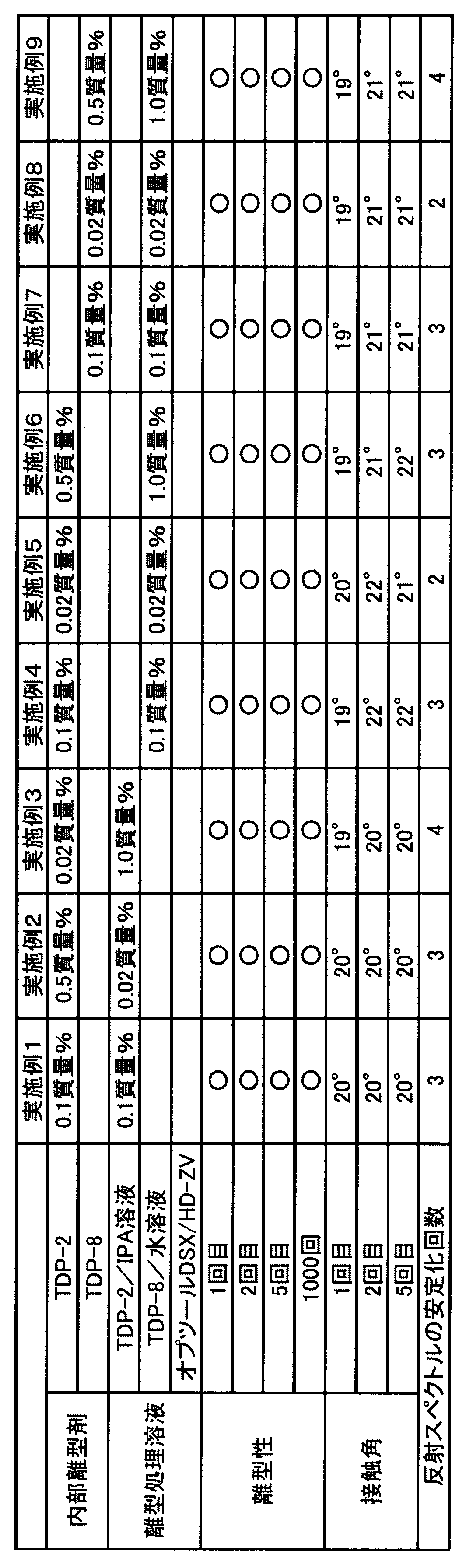
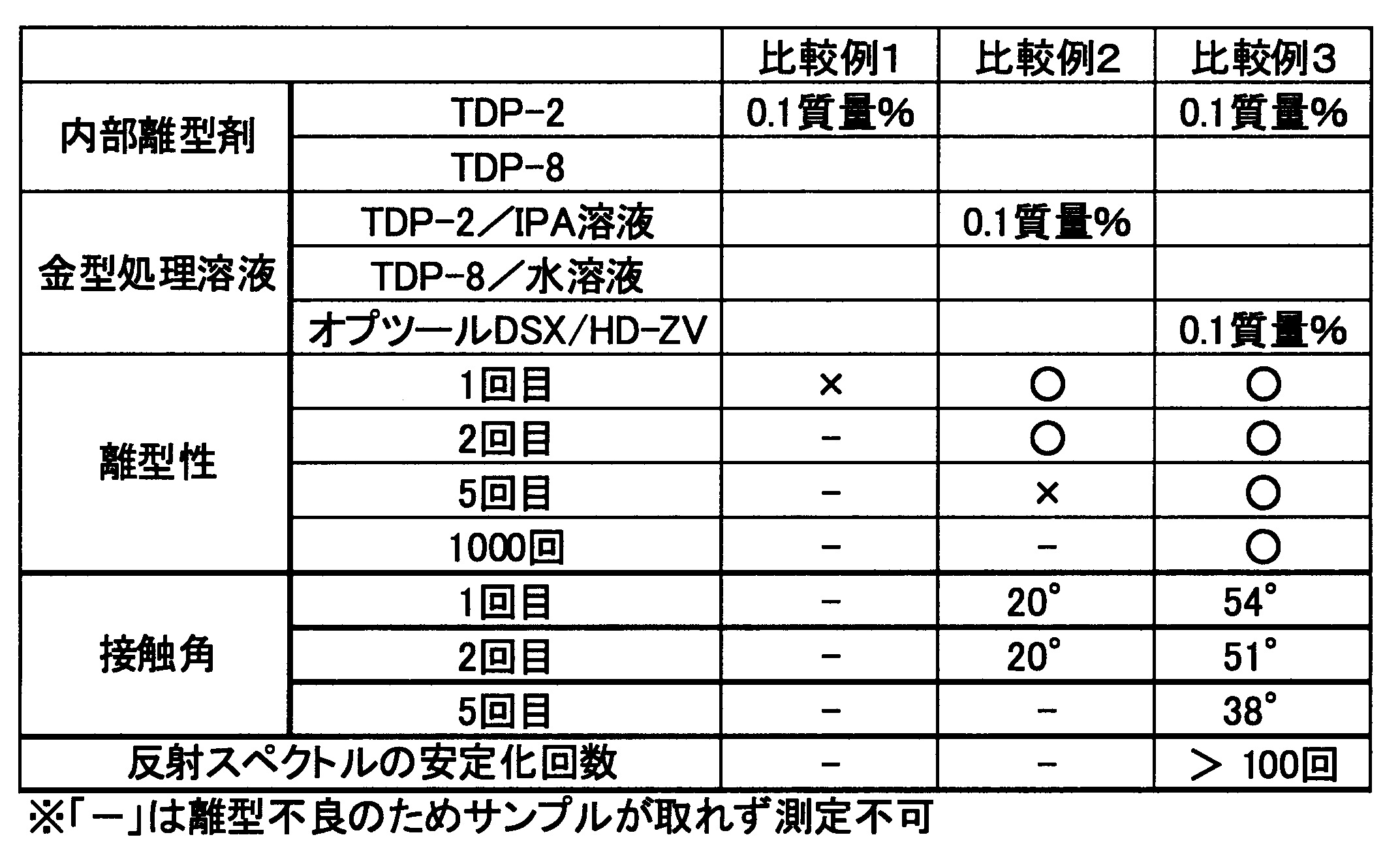
18 モールド
20 ロール状モールド
38 活性エネルギー線硬化性樹脂組成物
40 物品
42 フィルム(基材)
44 硬化樹脂層
Claims (8)
- 下記の工程(I)および(II)を有する、微細凹凸構造を表面に有する物品の製造方法。
(I)モールド離型剤を含む離型処理溶液で、陽極酸化アルミナからなる微細凹凸構造を表面に有するモールド表面を被覆する工程であって、前記モールド離型剤は、リン酸エステル化合物を1種類以上含み、前記モールド離型剤1gあたり50mLの水で抽出したときの、水溶液のpHが3.0以上である。
(II)工程(I)の後、重合性化合物と重合開始剤と内部離型剤とを含む活性エネルギー線硬化性樹脂組成物を、前記モールドと基材との間に挟み、これに活性エネルギー線を照射して硬化させて、前記微細凹凸構造が転写された硬化樹脂層を前記基材の表面に形成し、微細凹凸構造を表面に有する物品を得る工程。 - 前記モールド離型剤が、(ポリ)オキシアルキレンアルキルリン酸化合物であることを特徴とする、請求項1に記載の微細凹凸構造を表面に有する物品の製造方法。
- 前記離型処理溶液が、前記モールド離型剤の0.01~2.0質量%水溶液であることを特徴とする、請求項1または2に記載の微細凹凸構造を表面に有する物品の製造方法。
- 前記活性エネルギー線硬化性樹脂組成物が、前記内部離型剤として(ポリ)オキシアルキレンアルキルリン酸化合物を含む、請求項1から3のいずれか一項に記載の微細凹凸構造を表面に有する物品の製造方法。
- 前記内部離型剤1gを50mLの水で抽出したときの、水溶液のpHが3.0以上である、請求項1から4のいずれか一項に記載の微細凹凸構造を表面に有する物品の製造方法。
- 前記モールド離型剤と前記内部離型剤が同一であることを特徴とする、請求項1から5のいずれか一項に記載の微細凹凸構造を表面に有する物品の製造方法。
- 前記モールド離型剤と前記内部離型剤とのSP値の差が2.0以下であることを特徴とする、請求項1から6のいずれか一項に記載の微細凹凸構造を表面に有する物品の製造方法。
- モールド離型剤と内部離型剤とのSP値の差が2.0以下であることを特徴とする、微細凹凸構造を表面に有する物品の製造方法。
Priority Applications (5)
| Application Number | Priority Date | Filing Date | Title |
|---|---|---|---|
| EP12789003.6A EP2636501B1 (en) | 2011-05-26 | 2012-05-25 | Method for producing article having fine concavo-convex structure on surface |
| CN201280003971.0A CN103260841B (zh) | 2011-05-26 | 2012-05-25 | 表面具有微细凹凸结构的物品的制造方法 |
| US13/990,183 US9138775B2 (en) | 2011-05-26 | 2012-05-25 | Method for preparing article having uneven microstructure on surface thereof |
| JP2012528965A JP5162726B2 (ja) | 2011-05-26 | 2012-05-25 | 微細凹凸構造を表面に有する物品の製造方法 |
| KR1020137013918A KR101361900B1 (ko) | 2011-05-26 | 2012-05-25 | 미세 요철 구조를 표면에 갖는 물품의 제조 방법 |
Applications Claiming Priority (4)
| Application Number | Priority Date | Filing Date | Title |
|---|---|---|---|
| JP2011118087 | 2011-05-26 | ||
| JP2011118088 | 2011-05-26 | ||
| JP2011-118088 | 2011-05-26 | ||
| JP2011-118087 | 2011-05-26 |
Publications (1)
| Publication Number | Publication Date |
|---|---|
| WO2012161315A1 true WO2012161315A1 (ja) | 2012-11-29 |
Family
ID=47217380
Family Applications (1)
| Application Number | Title | Priority Date | Filing Date |
|---|---|---|---|
| PCT/JP2012/063498 Ceased WO2012161315A1 (ja) | 2011-05-26 | 2012-05-25 | 微細凹凸構造を表面に有する物品の製造方法 |
Country Status (7)
| Country | Link |
|---|---|
| US (1) | US9138775B2 (ja) |
| EP (1) | EP2636501B1 (ja) |
| JP (2) | JP5162726B2 (ja) |
| KR (1) | KR101361900B1 (ja) |
| CN (1) | CN103260841B (ja) |
| TW (1) | TWI476088B (ja) |
| WO (1) | WO2012161315A1 (ja) |
Cited By (17)
| Publication number | Priority date | Publication date | Assignee | Title |
|---|---|---|---|---|
| WO2015022973A1 (ja) * | 2013-08-13 | 2015-02-19 | 富士フイルム株式会社 | 硬化性樹脂組成物、光学部品、レンズおよび光学部品の製造方法 |
| WO2015046134A1 (ja) * | 2013-09-30 | 2015-04-02 | 富士フイルム株式会社 | 光インプリント用硬化性組成物及びパターン形成方法 |
| WO2016080245A1 (ja) * | 2014-11-20 | 2016-05-26 | シャープ株式会社 | 殺菌作用を備えた表面を有する合成高分子膜 |
| JP2016112804A (ja) * | 2014-12-16 | 2016-06-23 | 大日本印刷株式会社 | 反射防止物品及び美術品展示体 |
| WO2016175170A1 (ja) * | 2015-04-30 | 2016-11-03 | シャープ株式会社 | 殺菌作用を備えた表面を有する合成高分子膜 |
| WO2016208540A1 (ja) * | 2015-06-23 | 2016-12-29 | シャープ株式会社 | 殺菌作用を備えた表面を有する合成高分子膜 |
| WO2017014086A1 (ja) * | 2015-07-17 | 2017-01-26 | シャープ株式会社 | 殺菌作用を備えた表面を有する合成高分子膜およびそれを備えるフィルム |
| US10071175B2 (en) | 2014-04-28 | 2018-09-11 | Sharp Kabushiki Kaisha | Filter and container having microbicidal activity |
| JP2018149807A (ja) * | 2017-03-13 | 2018-09-27 | 三菱ケミカル株式会社 | 金型離型処理溶液及びフィルムの製造方法 |
| WO2018173867A1 (ja) * | 2017-03-21 | 2018-09-27 | シャープ株式会社 | 防汚性フィルム |
| US10136638B2 (en) | 2014-04-22 | 2018-11-27 | Sharp Kabushiki Kaisha | Synthetic polymer film whose surface has microbicidal activity, multilayer structure having synthetic polymer film, sterilization method with the use of surface of synthetic polymer film, method for reactivating surface of synthetic polymer film, mold for production of synthetic polymer film, and mold manufacturing method |
| JPWO2018139418A1 (ja) * | 2017-01-30 | 2019-12-19 | シャープ株式会社 | 防汚性フィルム |
| WO2020203761A1 (ja) * | 2019-03-29 | 2020-10-08 | キヤノン株式会社 | 吸光遮熱膜、吸光遮熱部材、および物品、並びにそれらの製造方法 |
| JP2020164993A (ja) * | 2019-03-29 | 2020-10-08 | キヤノン株式会社 | 吸光遮熱膜、吸光遮熱部材、および物品、並びにそれらの製造方法 |
| US10934405B2 (en) | 2018-03-15 | 2021-03-02 | Sharp Kabushiki Kaisha | Synthetic polymer film whose surface has microbicidal activity, plastic product which includes synthetic polymer film, sterilization method with use of surface of synthetic polymer film, photocurable resin composition, and manufacturing method of synthetic polymer film |
| US10968292B2 (en) | 2017-09-26 | 2021-04-06 | Sharp Kabushiki Kaisha | Synthetic polymer film whose surface has microbicidal activity, photocurable resin composition, manufacturing method of synthetic polymer film, and sterilization method with use of surface of synthetic polymer film |
| US11364673B2 (en) | 2018-02-21 | 2022-06-21 | Sharp Kabushiki Kaisha | Synthetic polymer film and production method of synthetic polymer film |
Families Citing this family (17)
| Publication number | Priority date | Publication date | Assignee | Title |
|---|---|---|---|---|
| JP5128719B1 (ja) * | 2011-01-31 | 2013-01-23 | 三菱レイヨン株式会社 | 活性エネルギー線硬化性組成物、および微細凹凸構造を表面に有する透明フィルムの製造方法 |
| JP5629025B2 (ja) * | 2013-01-23 | 2014-11-19 | デクセリアルズ株式会社 | 親水性積層体、及びその製造方法、防汚用積層体、物品、及びその製造方法、並びに防汚方法 |
| US20160116642A1 (en) * | 2013-05-21 | 2016-04-28 | Mitsubishi Rayon Co., Ltd. | Laminate |
| CN105451966B (zh) * | 2013-08-14 | 2017-03-15 | 三菱丽阳株式会社 | 圆柱状纳米压印用模具的制造方法,和纳米压印用再生模具的制造方法 |
| JP6865520B2 (ja) * | 2014-06-24 | 2021-04-28 | 三菱ケミカル株式会社 | 菌体付着対策方法 |
| WO2016021367A1 (ja) * | 2014-08-07 | 2016-02-11 | シャープ株式会社 | 表面が殺菌作用を備えたフィンを有する熱交換器、殺菌作用を備えた表面を有する金属部材、熱交換器のフィンの表面または金属部材の表面を用いたカビの発生を抑制する方法および殺菌方法、ならびに、金属部材を有する電気湯沸かし器、飲料供給器および弁当箱のふた |
| KR101592910B1 (ko) * | 2014-09-16 | 2016-02-11 | 박근노 | 임프린팅 장치 |
| US10980255B2 (en) | 2014-12-25 | 2021-04-20 | Sharp Kabushiki Kaisha | Food preservation method, food film, food container, and food handling method |
| JP6009722B1 (ja) * | 2014-12-26 | 2016-10-19 | 三井化学株式会社 | 内部離型剤、該内部離型剤を含む組成物および該組成物を用いたプラスチックレンズの製造方法 |
| JP6605612B2 (ja) * | 2015-09-17 | 2019-11-13 | シャープ株式会社 | 殺菌作用を備えた表面を有する合成高分子膜、合成高分子膜の製造方法および合成高分子膜の表面を用いた殺菌方法 |
| WO2018135358A1 (ja) * | 2017-01-18 | 2018-07-26 | シャープ株式会社 | 防汚性フィルム |
| US11118163B2 (en) | 2017-02-02 | 2021-09-14 | Sartorius Stedim Biotech Gmbh | Separation of cell populations by marker identification and sedimentation velocity |
| JP6837123B2 (ja) * | 2017-02-24 | 2021-03-03 | シャープ株式会社 | 加飾フィルム |
| JP2020082575A (ja) * | 2018-11-28 | 2020-06-04 | シャープ株式会社 | 防汚性フィルム及び重合性組成物 |
| WO2020158546A1 (ja) * | 2019-01-31 | 2020-08-06 | ダイキン工業株式会社 | 離型剤 |
| DE202023000325U1 (de) | 2023-02-13 | 2024-05-17 | IMOS Gubela Gesellschaft mit beschränkter Haftung | Superhydrophobe modulare Struktur |
| EP4414092A1 (de) | 2023-02-13 | 2024-08-14 | IMOS Gubela GmbH | Modulares mikrostrukturelement |
Citations (5)
| Publication number | Priority date | Publication date | Assignee | Title |
|---|---|---|---|---|
| JP2005156695A (ja) | 2003-11-21 | 2005-06-16 | Kanagawa Acad Of Sci & Technol | 反射防止膜及びその製造方法、並びに反射防止膜作製用スタンパ及びその製造方法 |
| JP2007326367A (ja) | 2007-06-18 | 2007-12-20 | Daikin Ind Ltd | インプリント加工用モールド及びその製造方法 |
| JP2010005841A (ja) * | 2008-06-25 | 2010-01-14 | Mitsubishi Rayon Co Ltd | モールドの製造方法 |
| JP2011025683A (ja) * | 2009-07-03 | 2011-02-10 | Mitsubishi Rayon Co Ltd | モールドの製造方法 |
| WO2011155499A1 (ja) * | 2010-06-07 | 2011-12-15 | 三菱レイヨン株式会社 | 微細凹凸構造を表面に有する物品の製造方法、金型の離型処理方法、および金型表面離型処理用活性エネルギー線硬化性樹脂組成物 |
Family Cites Families (13)
| Publication number | Priority date | Publication date | Assignee | Title |
|---|---|---|---|---|
| US4118235A (en) * | 1975-09-18 | 1978-10-03 | Daikin Kogyo Co., Ltd. | Mold release agent |
| US6491979B1 (en) * | 1998-07-17 | 2002-12-10 | Daikin Industries, Ltd. | Fluorine-containing surface treatment composition |
| JP4011811B2 (ja) | 2000-01-14 | 2007-11-21 | Jsr株式会社 | 光硬化性樹脂組成物及び光学部材 |
| JP5271486B2 (ja) * | 2006-08-16 | 2013-08-21 | 株式会社ブリヂストン | 離型剤、これを用いた凹凸パターンの形成方法及び光情報記録媒体の製造方法、並びに光情報記録媒体 |
| TWI504500B (zh) * | 2007-10-25 | 2015-10-21 | 三菱麗陽股份有限公司 | 壓模及其製造方法、成形體的製造方法以及壓模的鋁原型 |
| WO2009107946A2 (ko) | 2008-02-26 | 2009-09-03 | 주식회사 신대특수재료 | 열변형 온도가 높고 열안정성이 우수한 초고굴절 광학수지 조성물, 이를 이용한 광학렌즈 및 그 제조방법 |
| JP2009241351A (ja) | 2008-03-31 | 2009-10-22 | Mitsubishi Rayon Co Ltd | インサート成形用フィルム、インサート成形品およびその製造方法 |
| US20110318539A1 (en) * | 2009-03-03 | 2011-12-29 | Satoru Ozawa | Process for producing film |
| JP5425516B2 (ja) * | 2009-04-24 | 2014-02-26 | 公益財団法人神奈川科学技術アカデミー | スタンパ製造用アルミニウム基材およびスタンパの製造方法 |
| JP5474401B2 (ja) * | 2009-04-24 | 2014-04-16 | 公益財団法人神奈川科学技術アカデミー | スタンパ製造用アルミニウム基材およびスタンパの製造方法 |
| JP2011002762A (ja) * | 2009-06-22 | 2011-01-06 | Dnp Fine Chemicals Co Ltd | 光の反射防止効果を有する成型品 |
| JP5206622B2 (ja) * | 2009-08-07 | 2013-06-12 | 三菱瓦斯化学株式会社 | 金属微細構造体のパターン倒壊抑制用処理液及びこれを用いた金属微細構造体の製造方法 |
| KR101207637B1 (ko) * | 2009-11-06 | 2012-12-03 | 미쓰이 가가쿠 가부시키가이샤 | 광학 재료용 내부 이형제의 제조 방법, 광학 재료용 내부 이형제 및 그것을 포함하는 중합성 조성물 |
-
2012
- 2012-05-25 US US13/990,183 patent/US9138775B2/en active Active
- 2012-05-25 TW TW101118630A patent/TWI476088B/zh active
- 2012-05-25 JP JP2012528965A patent/JP5162726B2/ja active Active
- 2012-05-25 EP EP12789003.6A patent/EP2636501B1/en active Active
- 2012-05-25 CN CN201280003971.0A patent/CN103260841B/zh active Active
- 2012-05-25 KR KR1020137013918A patent/KR101361900B1/ko active Active
- 2012-05-25 WO PCT/JP2012/063498 patent/WO2012161315A1/ja not_active Ceased
- 2012-11-02 JP JP2012242773A patent/JP2013033287A/ja active Pending
Patent Citations (5)
| Publication number | Priority date | Publication date | Assignee | Title |
|---|---|---|---|---|
| JP2005156695A (ja) | 2003-11-21 | 2005-06-16 | Kanagawa Acad Of Sci & Technol | 反射防止膜及びその製造方法、並びに反射防止膜作製用スタンパ及びその製造方法 |
| JP2007326367A (ja) | 2007-06-18 | 2007-12-20 | Daikin Ind Ltd | インプリント加工用モールド及びその製造方法 |
| JP2010005841A (ja) * | 2008-06-25 | 2010-01-14 | Mitsubishi Rayon Co Ltd | モールドの製造方法 |
| JP2011025683A (ja) * | 2009-07-03 | 2011-02-10 | Mitsubishi Rayon Co Ltd | モールドの製造方法 |
| WO2011155499A1 (ja) * | 2010-06-07 | 2011-12-15 | 三菱レイヨン株式会社 | 微細凹凸構造を表面に有する物品の製造方法、金型の離型処理方法、および金型表面離型処理用活性エネルギー線硬化性樹脂組成物 |
Non-Patent Citations (2)
| Title |
|---|
| ROBERT F. FEDORS, POLYMER ENGINEERING AND SCIENCE, vol. 14, no. 2, 1974, pages 151 - 153 |
| See also references of EP2636501A4 * |
Cited By (32)
| Publication number | Priority date | Publication date | Assignee | Title |
|---|---|---|---|---|
| US9714335B2 (en) | 2013-08-13 | 2017-07-25 | Fujifilm Corporation | Curable resin composition, optical component, lens, and method for manufacturing optical component |
| JP2015057462A (ja) * | 2013-08-13 | 2015-03-26 | 富士フイルム株式会社 | 硬化性樹脂組成物、光学部品およびレンズ |
| WO2015022973A1 (ja) * | 2013-08-13 | 2015-02-19 | 富士フイルム株式会社 | 硬化性樹脂組成物、光学部品、レンズおよび光学部品の製造方法 |
| WO2015046134A1 (ja) * | 2013-09-30 | 2015-04-02 | 富士フイルム株式会社 | 光インプリント用硬化性組成物及びパターン形成方法 |
| JP2015070145A (ja) * | 2013-09-30 | 2015-04-13 | 富士フイルム株式会社 | 光インプリント用硬化性組成物、パターン形成方法、微細パターン、および半導体デバイスの製造方法 |
| US11638423B2 (en) | 2014-04-22 | 2023-05-02 | Sharp Kabushiki Kaisha | Synthetic polymer film whose surface has microbicidal activity, multilayer structure having synthetic polymer film, sterilization method with the use of surface of synthetic polymer film, method for reactivating surface of synthetic polymer film, mold for production of synthetic polymer film, and mold manufacturing method |
| US11641854B2 (en) | 2014-04-22 | 2023-05-09 | Sharp Kabushiki Kaisha | Synthetic polymer film whose surface has microbicidal activity, multilayer structure having synthetic polymer film, sterilization method with the use of surface of synthetic polymer film, method for reactivating surface of synthetic polymer film, mold for production of synthetic polymer film, and mold manufacturing method |
| US10278387B2 (en) | 2014-04-22 | 2019-05-07 | Sharp Kabushiki Kaisha | Synthetic polymer film whose surface has microbicidal activity, multilayer structure having synthetic polymer film, sterilization method with the use of surface of synthetic polymer film, method for reactivating surface of synthetic polymer film, mold for production of synthetic polymer film, and mold manufacturing method |
| US10136638B2 (en) | 2014-04-22 | 2018-11-27 | Sharp Kabushiki Kaisha | Synthetic polymer film whose surface has microbicidal activity, multilayer structure having synthetic polymer film, sterilization method with the use of surface of synthetic polymer film, method for reactivating surface of synthetic polymer film, mold for production of synthetic polymer film, and mold manufacturing method |
| US10071175B2 (en) | 2014-04-28 | 2018-09-11 | Sharp Kabushiki Kaisha | Filter and container having microbicidal activity |
| JP2016153510A (ja) * | 2014-11-20 | 2016-08-25 | シャープ株式会社 | 殺菌作用を備えた表面を有する合成高分子膜 |
| US10251393B2 (en) | 2014-11-20 | 2019-04-09 | Sharp Kabushiki Kaisha | Synthetic polymer film having surface provided with bactericidal activity |
| WO2016080245A1 (ja) * | 2014-11-20 | 2016-05-26 | シャープ株式会社 | 殺菌作用を備えた表面を有する合成高分子膜 |
| JP2016112804A (ja) * | 2014-12-16 | 2016-06-23 | 大日本印刷株式会社 | 反射防止物品及び美術品展示体 |
| JPWO2016175170A1 (ja) * | 2015-04-30 | 2018-04-12 | シャープ株式会社 | 殺菌作用を備えた表面を有する合成高分子膜 |
| WO2016175170A1 (ja) * | 2015-04-30 | 2016-11-03 | シャープ株式会社 | 殺菌作用を備えた表面を有する合成高分子膜 |
| JPWO2016208540A1 (ja) * | 2015-06-23 | 2018-04-12 | シャープ株式会社 | 殺菌作用を備えた表面を有する合成高分子膜 |
| WO2016208540A1 (ja) * | 2015-06-23 | 2016-12-29 | シャープ株式会社 | 殺菌作用を備えた表面を有する合成高分子膜 |
| JPWO2017014086A1 (ja) * | 2015-07-17 | 2018-07-05 | シャープ株式会社 | 殺菌作用を備えた表面を有する合成高分子膜およびそれを備えるフィルム |
| WO2017014086A1 (ja) * | 2015-07-17 | 2017-01-26 | シャープ株式会社 | 殺菌作用を備えた表面を有する合成高分子膜およびそれを備えるフィルム |
| JPWO2018139418A1 (ja) * | 2017-01-30 | 2019-12-19 | シャープ株式会社 | 防汚性フィルム |
| JP2018149807A (ja) * | 2017-03-13 | 2018-09-27 | 三菱ケミカル株式会社 | 金型離型処理溶液及びフィルムの製造方法 |
| JP7087461B2 (ja) | 2017-03-13 | 2022-06-21 | 三菱ケミカル株式会社 | 金型離型処理溶液及びフィルムの製造方法 |
| WO2018173867A1 (ja) * | 2017-03-21 | 2018-09-27 | シャープ株式会社 | 防汚性フィルム |
| JPWO2018173867A1 (ja) * | 2017-03-21 | 2020-04-23 | シャープ株式会社 | 防汚性フィルム |
| US10968292B2 (en) | 2017-09-26 | 2021-04-06 | Sharp Kabushiki Kaisha | Synthetic polymer film whose surface has microbicidal activity, photocurable resin composition, manufacturing method of synthetic polymer film, and sterilization method with use of surface of synthetic polymer film |
| US11364673B2 (en) | 2018-02-21 | 2022-06-21 | Sharp Kabushiki Kaisha | Synthetic polymer film and production method of synthetic polymer film |
| US10934405B2 (en) | 2018-03-15 | 2021-03-02 | Sharp Kabushiki Kaisha | Synthetic polymer film whose surface has microbicidal activity, plastic product which includes synthetic polymer film, sterilization method with use of surface of synthetic polymer film, photocurable resin composition, and manufacturing method of synthetic polymer film |
| JP2020164993A (ja) * | 2019-03-29 | 2020-10-08 | キヤノン株式会社 | 吸光遮熱膜、吸光遮熱部材、および物品、並びにそれらの製造方法 |
| WO2020203761A1 (ja) * | 2019-03-29 | 2020-10-08 | キヤノン株式会社 | 吸光遮熱膜、吸光遮熱部材、および物品、並びにそれらの製造方法 |
| JP7672791B2 (ja) | 2019-03-29 | 2025-05-08 | キヤノン株式会社 | 吸光遮熱膜、吸光遮熱部材、および物品、並びにそれらの製造方法 |
| US12571944B2 (en) | 2019-03-29 | 2026-03-10 | Canon Kabushiki Kaisha | Light-absorbing heat-shielding film, light-absorbing heat-shielding member, article, and method of producing the same |
Also Published As
| Publication number | Publication date |
|---|---|
| US9138775B2 (en) | 2015-09-22 |
| JP5162726B2 (ja) | 2013-03-13 |
| TW201302416A (zh) | 2013-01-16 |
| EP2636501A1 (en) | 2013-09-11 |
| TWI476088B (zh) | 2015-03-11 |
| CN103260841A (zh) | 2013-08-21 |
| KR101361900B1 (ko) | 2014-02-12 |
| EP2636501A4 (en) | 2014-03-12 |
| US20140077418A1 (en) | 2014-03-20 |
| KR20130069877A (ko) | 2013-06-26 |
| CN103260841B (zh) | 2015-12-23 |
| EP2636501B1 (en) | 2014-12-10 |
| JP2013033287A (ja) | 2013-02-14 |
| JPWO2012161315A1 (ja) | 2014-07-31 |
Similar Documents
| Publication | Publication Date | Title |
|---|---|---|
| JP5162726B2 (ja) | 微細凹凸構造を表面に有する物品の製造方法 | |
| KR101443484B1 (ko) | 미세 요철 구조를 표면에 갖는 물품의 제조 방법 | |
| KR101490577B1 (ko) | 미세 요철 구조를 표면에 갖는 물품의 제조 방법, 금형의 이형 처리 방법, 및 금형 표면 이형 처리용 활성 에너지선 경화성 수지 조성물 | |
| JP5362826B2 (ja) | 微細凹凸構造を有する硬化樹脂層が基材の表面に形成された物品の製造方法 | |
| JP7087461B2 (ja) | 金型離型処理溶液及びフィルムの製造方法 | |
| JP6455127B2 (ja) | 透明フィルムの製造方法 | |
| JP2012108502A (ja) | 微細凹凸構造を表面に有する物品の製造方法 | |
| KR20130069876A (ko) | 활성 에너지선 경화성 조성물, 및 미세 요철 구조를 표면에 갖는 투명 필름의 제조 방법 | |
| JP2017032756A (ja) | 透明フィルム及びその製造方法 | |
| JP2015223725A (ja) | 微細凹凸構造を表面に有する物品の製造方法 | |
| JP2013182007A (ja) | 微細凹凸構造を表面に有する物品の製造方法および製造装置 | |
| JP2011224900A (ja) | モールド、その製造方法ならびに処理方法、および物品の製造方法 | |
| JP5751535B2 (ja) | 金型の洗浄方法、及び、物品の製造方法 |
Legal Events
| Date | Code | Title | Description |
|---|---|---|---|
| ENP | Entry into the national phase |
Ref document number: 2012528965 Country of ref document: JP Kind code of ref document: A |
|
| 121 | Ep: the epo has been informed by wipo that ep was designated in this application |
Ref document number: 12789003 Country of ref document: EP Kind code of ref document: A1 |
|
| WWE | Wipo information: entry into national phase |
Ref document number: 13990183 Country of ref document: US Ref document number: 2012789003 Country of ref document: EP |
|
| ENP | Entry into the national phase |
Ref document number: 20137013918 Country of ref document: KR Kind code of ref document: A |
|
| NENP | Non-entry into the national phase |
Ref country code: DE |