WO2012169418A1 - 太陽電池モジュール及びその製造方法 - Google Patents
太陽電池モジュール及びその製造方法 Download PDFInfo
- Publication number
- WO2012169418A1 WO2012169418A1 PCT/JP2012/064040 JP2012064040W WO2012169418A1 WO 2012169418 A1 WO2012169418 A1 WO 2012169418A1 JP 2012064040 W JP2012064040 W JP 2012064040W WO 2012169418 A1 WO2012169418 A1 WO 2012169418A1
- Authority
- WO
- WIPO (PCT)
- Prior art keywords
- solar cell
- panel
- cell module
- light
- cell element
- Prior art date
- Legal status (The legal status is an assumption and is not a legal conclusion. Google has not performed a legal analysis and makes no representation as to the accuracy of the status listed.)
- Ceased
Links
Images
Classifications
-
- H—ELECTRICITY
- H10—SEMICONDUCTOR DEVICES; ELECTRIC SOLID-STATE DEVICES NOT OTHERWISE PROVIDED FOR
- H10F—INORGANIC SEMICONDUCTOR DEVICES SENSITIVE TO INFRARED RADIATION, LIGHT, ELECTROMAGNETIC RADIATION OF SHORTER WAVELENGTH OR CORPUSCULAR RADIATION
- H10F19/00—Integrated devices, or assemblies of multiple devices, comprising at least one photovoltaic cell covered by group H10F10/00, e.g. photovoltaic modules
- H10F19/80—Encapsulations or containers for integrated devices, or assemblies of multiple devices, having photovoltaic cells
- H10F19/804—Materials of encapsulations
-
- B—PERFORMING OPERATIONS; TRANSPORTING
- B32—LAYERED PRODUCTS
- B32B—LAYERED PRODUCTS, i.e. PRODUCTS BUILT-UP OF STRATA OF FLAT OR NON-FLAT, e.g. CELLULAR OR HONEYCOMB, FORM
- B32B17/00—Layered products essentially comprising sheet glass, or glass, slag, or like fibres
- B32B17/06—Layered products essentially comprising sheet glass, or glass, slag, or like fibres comprising glass as the main or only constituent of a layer, next to another layer of a specific material
- B32B17/10—Layered products essentially comprising sheet glass, or glass, slag, or like fibres comprising glass as the main or only constituent of a layer, next to another layer of a specific material of synthetic resin
- B32B17/10005—Layered products essentially comprising sheet glass, or glass, slag, or like fibres comprising glass as the main or only constituent of a layer, next to another layer of a specific material of synthetic resin laminated safety glass or glazing
- B32B17/10009—Layered products essentially comprising sheet glass, or glass, slag, or like fibres comprising glass as the main or only constituent of a layer, next to another layer of a specific material of synthetic resin laminated safety glass or glazing characterized by the number, the constitution or treatment of glass sheets
- B32B17/10036—Layered products essentially comprising sheet glass, or glass, slag, or like fibres comprising glass as the main or only constituent of a layer, next to another layer of a specific material of synthetic resin laminated safety glass or glazing characterized by the number, the constitution or treatment of glass sheets comprising two outer glass sheets
-
- B—PERFORMING OPERATIONS; TRANSPORTING
- B32—LAYERED PRODUCTS
- B32B—LAYERED PRODUCTS, i.e. PRODUCTS BUILT-UP OF STRATA OF FLAT OR NON-FLAT, e.g. CELLULAR OR HONEYCOMB, FORM
- B32B17/00—Layered products essentially comprising sheet glass, or glass, slag, or like fibres
- B32B17/06—Layered products essentially comprising sheet glass, or glass, slag, or like fibres comprising glass as the main or only constituent of a layer, next to another layer of a specific material
- B32B17/10—Layered products essentially comprising sheet glass, or glass, slag, or like fibres comprising glass as the main or only constituent of a layer, next to another layer of a specific material of synthetic resin
- B32B17/10005—Layered products essentially comprising sheet glass, or glass, slag, or like fibres comprising glass as the main or only constituent of a layer, next to another layer of a specific material of synthetic resin laminated safety glass or glazing
- B32B17/10009—Layered products essentially comprising sheet glass, or glass, slag, or like fibres comprising glass as the main or only constituent of a layer, next to another layer of a specific material of synthetic resin laminated safety glass or glazing characterized by the number, the constitution or treatment of glass sheets
- B32B17/10082—Properties of the bulk of a glass sheet
- B32B17/10091—Properties of the bulk of a glass sheet thermally hardened
-
- B—PERFORMING OPERATIONS; TRANSPORTING
- B32—LAYERED PRODUCTS
- B32B—LAYERED PRODUCTS, i.e. PRODUCTS BUILT-UP OF STRATA OF FLAT OR NON-FLAT, e.g. CELLULAR OR HONEYCOMB, FORM
- B32B17/00—Layered products essentially comprising sheet glass, or glass, slag, or like fibres
- B32B17/06—Layered products essentially comprising sheet glass, or glass, slag, or like fibres comprising glass as the main or only constituent of a layer, next to another layer of a specific material
- B32B17/10—Layered products essentially comprising sheet glass, or glass, slag, or like fibres comprising glass as the main or only constituent of a layer, next to another layer of a specific material of synthetic resin
- B32B17/10005—Layered products essentially comprising sheet glass, or glass, slag, or like fibres comprising glass as the main or only constituent of a layer, next to another layer of a specific material of synthetic resin laminated safety glass or glazing
- B32B17/10165—Functional features of the laminated safety glass or glazing
- B32B17/10293—Edge features, e.g. inserts or holes
- B32B17/10302—Edge sealing
-
- B—PERFORMING OPERATIONS; TRANSPORTING
- B32—LAYERED PRODUCTS
- B32B—LAYERED PRODUCTS, i.e. PRODUCTS BUILT-UP OF STRATA OF FLAT OR NON-FLAT, e.g. CELLULAR OR HONEYCOMB, FORM
- B32B17/00—Layered products essentially comprising sheet glass, or glass, slag, or like fibres
- B32B17/06—Layered products essentially comprising sheet glass, or glass, slag, or like fibres comprising glass as the main or only constituent of a layer, next to another layer of a specific material
- B32B17/10—Layered products essentially comprising sheet glass, or glass, slag, or like fibres comprising glass as the main or only constituent of a layer, next to another layer of a specific material of synthetic resin
- B32B17/10005—Layered products essentially comprising sheet glass, or glass, slag, or like fibres comprising glass as the main or only constituent of a layer, next to another layer of a specific material of synthetic resin laminated safety glass or glazing
- B32B17/1055—Layered products essentially comprising sheet glass, or glass, slag, or like fibres comprising glass as the main or only constituent of a layer, next to another layer of a specific material of synthetic resin laminated safety glass or glazing characterized by the resin layer, i.e. interlayer
- B32B17/10798—Layered products essentially comprising sheet glass, or glass, slag, or like fibres comprising glass as the main or only constituent of a layer, next to another layer of a specific material of synthetic resin laminated safety glass or glazing characterized by the resin layer, i.e. interlayer containing silicone
-
- H—ELECTRICITY
- H10—SEMICONDUCTOR DEVICES; ELECTRIC SOLID-STATE DEVICES NOT OTHERWISE PROVIDED FOR
- H10F—INORGANIC SEMICONDUCTOR DEVICES SENSITIVE TO INFRARED RADIATION, LIGHT, ELECTROMAGNETIC RADIATION OF SHORTER WAVELENGTH OR CORPUSCULAR RADIATION
- H10F19/00—Integrated devices, or assemblies of multiple devices, comprising at least one photovoltaic cell covered by group H10F10/00, e.g. photovoltaic modules
- H10F19/80—Encapsulations or containers for integrated devices, or assemblies of multiple devices, having photovoltaic cells
- H10F19/807—Double-glass encapsulation, e.g. photovoltaic cells arranged between front and rear glass sheets
-
- H—ELECTRICITY
- H10—SEMICONDUCTOR DEVICES; ELECTRIC SOLID-STATE DEVICES NOT OTHERWISE PROVIDED FOR
- H10F—INORGANIC SEMICONDUCTOR DEVICES SENSITIVE TO INFRARED RADIATION, LIGHT, ELECTROMAGNETIC RADIATION OF SHORTER WAVELENGTH OR CORPUSCULAR RADIATION
- H10F71/00—Manufacture or treatment of devices covered by this subclass
-
- H—ELECTRICITY
- H10—SEMICONDUCTOR DEVICES; ELECTRIC SOLID-STATE DEVICES NOT OTHERWISE PROVIDED FOR
- H10F—INORGANIC SEMICONDUCTOR DEVICES SENSITIVE TO INFRARED RADIATION, LIGHT, ELECTROMAGNETIC RADIATION OF SHORTER WAVELENGTH OR CORPUSCULAR RADIATION
- H10F77/00—Constructional details of devices covered by this subclass
- H10F77/40—Optical elements or arrangements
- H10F77/42—Optical elements or arrangements directly associated or integrated with photovoltaic cells, e.g. light-reflecting means or light-concentrating means
-
- H—ELECTRICITY
- H10—SEMICONDUCTOR DEVICES; ELECTRIC SOLID-STATE DEVICES NOT OTHERWISE PROVIDED FOR
- H10F—INORGANIC SEMICONDUCTOR DEVICES SENSITIVE TO INFRARED RADIATION, LIGHT, ELECTROMAGNETIC RADIATION OF SHORTER WAVELENGTH OR CORPUSCULAR RADIATION
- H10F77/00—Constructional details of devices covered by this subclass
- H10F77/40—Optical elements or arrangements
- H10F77/42—Optical elements or arrangements directly associated or integrated with photovoltaic cells, e.g. light-reflecting means or light-concentrating means
- H10F77/484—Refractive light-concentrating means, e.g. lenses
-
- H—ELECTRICITY
- H10—SEMICONDUCTOR DEVICES; ELECTRIC SOLID-STATE DEVICES NOT OTHERWISE PROVIDED FOR
- H10F—INORGANIC SEMICONDUCTOR DEVICES SENSITIVE TO INFRARED RADIATION, LIGHT, ELECTROMAGNETIC RADIATION OF SHORTER WAVELENGTH OR CORPUSCULAR RADIATION
- H10F77/00—Constructional details of devices covered by this subclass
- H10F77/40—Optical elements or arrangements
- H10F77/42—Optical elements or arrangements directly associated or integrated with photovoltaic cells, e.g. light-reflecting means or light-concentrating means
- H10F77/488—Reflecting light-concentrating means, e.g. parabolic mirrors or concentrators using total internal reflection
-
- H—ELECTRICITY
- H10—SEMICONDUCTOR DEVICES; ELECTRIC SOLID-STATE DEVICES NOT OTHERWISE PROVIDED FOR
- H10F—INORGANIC SEMICONDUCTOR DEVICES SENSITIVE TO INFRARED RADIATION, LIGHT, ELECTROMAGNETIC RADIATION OF SHORTER WAVELENGTH OR CORPUSCULAR RADIATION
- H10F77/00—Constructional details of devices covered by this subclass
- H10F77/60—Arrangements for cooling, heating, ventilating or compensating for temperature fluctuations
- H10F77/63—Arrangements for cooling directly associated or integrated with photovoltaic cells, e.g. heat sinks directly associated with the photovoltaic cells or integrated Peltier elements for active cooling
-
- B—PERFORMING OPERATIONS; TRANSPORTING
- B32—LAYERED PRODUCTS
- B32B—LAYERED PRODUCTS, i.e. PRODUCTS BUILT-UP OF STRATA OF FLAT OR NON-FLAT, e.g. CELLULAR OR HONEYCOMB, FORM
- B32B2307/00—Properties of the layers or laminate
- B32B2307/30—Properties of the layers or laminate having particular thermal properties
- B32B2307/302—Conductive
-
- B—PERFORMING OPERATIONS; TRANSPORTING
- B32—LAYERED PRODUCTS
- B32B—LAYERED PRODUCTS, i.e. PRODUCTS BUILT-UP OF STRATA OF FLAT OR NON-FLAT, e.g. CELLULAR OR HONEYCOMB, FORM
- B32B2307/00—Properties of the layers or laminate
- B32B2307/40—Properties of the layers or laminate having particular optical properties
- B32B2307/412—Transparent
-
- B—PERFORMING OPERATIONS; TRANSPORTING
- B32—LAYERED PRODUCTS
- B32B—LAYERED PRODUCTS, i.e. PRODUCTS BUILT-UP OF STRATA OF FLAT OR NON-FLAT, e.g. CELLULAR OR HONEYCOMB, FORM
- B32B2307/00—Properties of the layers or laminate
- B32B2307/50—Properties of the layers or laminate having particular mechanical properties
- B32B2307/558—Impact strength, toughness
-
- B—PERFORMING OPERATIONS; TRANSPORTING
- B32—LAYERED PRODUCTS
- B32B—LAYERED PRODUCTS, i.e. PRODUCTS BUILT-UP OF STRATA OF FLAT OR NON-FLAT, e.g. CELLULAR OR HONEYCOMB, FORM
- B32B2307/00—Properties of the layers or laminate
- B32B2307/70—Other properties
- B32B2307/704—Crystalline
-
- B—PERFORMING OPERATIONS; TRANSPORTING
- B32—LAYERED PRODUCTS
- B32B—LAYERED PRODUCTS, i.e. PRODUCTS BUILT-UP OF STRATA OF FLAT OR NON-FLAT, e.g. CELLULAR OR HONEYCOMB, FORM
- B32B2307/00—Properties of the layers or laminate
- B32B2307/70—Other properties
- B32B2307/712—Weather resistant
-
- B—PERFORMING OPERATIONS; TRANSPORTING
- B32—LAYERED PRODUCTS
- B32B—LAYERED PRODUCTS, i.e. PRODUCTS BUILT-UP OF STRATA OF FLAT OR NON-FLAT, e.g. CELLULAR OR HONEYCOMB, FORM
- B32B2457/00—Electrical equipment
-
- Y—GENERAL TAGGING OF NEW TECHNOLOGICAL DEVELOPMENTS; GENERAL TAGGING OF CROSS-SECTIONAL TECHNOLOGIES SPANNING OVER SEVERAL SECTIONS OF THE IPC; TECHNICAL SUBJECTS COVERED BY FORMER USPC CROSS-REFERENCE ART COLLECTIONS [XRACs] AND DIGESTS
- Y02—TECHNOLOGIES OR APPLICATIONS FOR MITIGATION OR ADAPTATION AGAINST CLIMATE CHANGE
- Y02B—CLIMATE CHANGE MITIGATION TECHNOLOGIES RELATED TO BUILDINGS, e.g. HOUSING, HOUSE APPLIANCES OR RELATED END-USER APPLICATIONS
- Y02B10/00—Integration of renewable energy sources in buildings
- Y02B10/10—Photovoltaic [PV]
-
- Y—GENERAL TAGGING OF NEW TECHNOLOGICAL DEVELOPMENTS; GENERAL TAGGING OF CROSS-SECTIONAL TECHNOLOGIES SPANNING OVER SEVERAL SECTIONS OF THE IPC; TECHNICAL SUBJECTS COVERED BY FORMER USPC CROSS-REFERENCE ART COLLECTIONS [XRACs] AND DIGESTS
- Y02—TECHNOLOGIES OR APPLICATIONS FOR MITIGATION OR ADAPTATION AGAINST CLIMATE CHANGE
- Y02E—REDUCTION OF GREENHOUSE GAS [GHG] EMISSIONS, RELATED TO ENERGY GENERATION, TRANSMISSION OR DISTRIBUTION
- Y02E10/00—Energy generation through renewable energy sources
- Y02E10/50—Photovoltaic [PV] energy
- Y02E10/52—PV systems with concentrators
Definitions
- the present invention relates to a solar cell module and a manufacturing method thereof.
- the temperature of the solar cell module greatly increases due to sunlight, particularly in summer. And it is known that the temperature of a solar cell element will also rise with the temperature rise of a solar cell module, and, thereby, the power generation efficiency of a solar cell module will fall. For example, in the case of a single crystal silicon cell, assuming that the power generation efficiency at 25 ° C. is 100%, the power generation efficiency decreases by about 0.4% every time the element temperature increases by 1 ° C. from 25 ° C. Therefore, how to dissipate the temperature of the raised solar cell element is an important factor for efficiently using the module.
- the solar cell module that is generating power is not always subjected to uniform solar radiation, and in reality, the solar cell module may be partially shaded. In such a case, power generation by the solar cell element in the shaded portion becomes insufficient, and as a result, a reverse bias voltage is applied to the solar cell element, and a heat generation phenomenon called a hot spot occurs. If this phenomenon called a hot spot continues, the temperature of the solar cell element may continue to rise, and in the worst case, it may be damaged.
- Patent Document 1 Japanese Patent No. 2770906
- the block member is combined with a heat pipe to dissipate heat to the back surface
- Patent Document 2 Japanese Patent Laid-Open No. 9-186353
- heat is dissipated by stacking metal heat dissipating parts having different linear expansion coefficients
- Patent Document 3 Japanese Patent No.
- Patent Document 4 Japanese Patent Laid-Open No. 2006-156581.
- the use of a metal material may cause a high cost in manufacturing the module due to the material cost and processing cost, and the overall weight of the module increases, which is inconvenient to handle.
- a resin containing a metal additive is bonded to the electrode plate under the solar cell as a heat dissipation electrical insulating layer having insulating properties.
- Heat is dissipated (for example, see Patent Document 5: Japanese Patent Laid-Open No. 2006-332535), or two types of resin layers having an elastic difference or a viscosity difference are provided between the solar cell and the fixed backing plate to dissipate heat.
- a method for example, see Patent Document 6: Japanese Patent Application Laid-Open No. 2007-165485) has been proposed.
- EVA ethylene vinyl acetate copolymer
- sealing is performed by a laminating process involving decompression and heating.
- This process consists of a lot of complicated work, and defects in this process lead to deterioration of the characteristics of the solar cell.
- lead wires from the positive and negative electrodes located at both ends of the solar cell module are made to have heat resistance.
- a film covered with a film it is possible to prevent short-circuiting with other lead wires (see, for example, Patent Document 7: JP-A-9-326497), or at least a surface covering material or a back surface covering material of a photovoltaic element.
- Patent Document 8 Japanese Patent Laid-Open No. 11-87744.
- the wiring connection part on the surface of the solar cell element may cause embrittlement in an outdoor environment where temperature rise and fall occur due to the difference in coefficient of linear expansion and modulus of the sealing material on the front side and the back side of the solar cell element.
- Non-Patent Document 2 D. L. King, M. A. Quintana, J. A. Kratochvil, D. E. Ellibee and B. R. Hansen, “Photovoltaic Module Performance and Durability Following Long Term” Field Expos-ure, Progress in Photovoltaics: Research and Application 8 (2000) pp.
- Non-Patent Document 3 MA Quintana, DL King, TJ MacMahon and CR Osterwald , "Commonly Ob-served Degradation in Field-Aged Photovoltaic Modules", Proceedings of the 29 th IEEE Photovoltaic Specialists Conference, New La, (2002) see pp.1392-1395).
- the conventional method uses an adhesive to join the solar cell element and the heat dissipating member, or provides two types of resin layers to increase the heat dissipating performance. It could cause an increase.
- the adhesive when used for more than 10 years, there is a concern that it will cause embrittlement in an outdoor environment where the temperature rises and falls as described above, which may cause foreign matter. It was.
- the conventional method may cover the lead wire with a film, or the cover material may be formed as an integral laminated film with two or more types of resin, leading to an increase in cost, and may not be easily reworked. There was sex.
- An object of the present invention is to provide a solar cell module that is excellent in heat dissipation of a solar battery cell, can be easily reworked, has an improved yield, and can be manufactured at a reduced cost, and a method for manufacturing the solar cell module. .
- the present invention provides a solar cell element in a space formed by a transparent member panel that allows sunlight to enter and a thermally conductive member panel that is disposed on the opposite side of sunlight incidence.
- Thermally conductive with sufficient area to relieve distortion due to difference in linear expansion coefficient when temperature rises and to reliably release heat by pressing with a rubber-like elastic light-transmitting elastomer member
- a solar cell module having a structure.
- this invention provides the following solar cell module and its manufacturing method.
- a light-transmitting elastomer member and a solar cell element are light-transmitted in a gap between a panel of a transparent member that allows sunlight to enter and a panel of a heat conductive member disposed on the opposite side of sunlight incidence.
- the transparent elastomer member is disposed on the sunlight incident side, and the solar cell element is interposed between the light-transmitting elastomer member and pressed against the panel side of the thermally conductive member.
- Solar cell module [2] The solar cell module according to [1], wherein a heat conductive elastomer layer is interposed between the panel of the heat conductive member and the solar cell element.
- the solar cell module according to any one of [1] to [7], wherein the light-transmitting elastomer member is formed from a cured product of a silicone rubber composition.
- a light-transmitting elastomer member and a solar cell element are sequentially laminated on a transparent member panel on which sunlight is incident, and further the solar cell element is covered with the thermally conductive member panel by the light-transmitting elastomer member.
- a method for producing a solar cell module wherein the solar cell element is disposed so as to be pressed and pressed against the panel side of the thermally conductive member.
- a sealing member is disposed on the outer peripheral portion of a transparent member panel on which sunlight is incident, a spacer member is disposed on the inside thereof, and a light-transmitting elastomer and a solar cell element are disposed on the inner side thereof.
- the solar cell module of the present invention is optimal as a solar cell module having a structure excellent in heat dissipation of a cell whose temperature has been increased by sunlight or a hot spot and having reduced manufacturing costs. Moreover, since the sealing of the solar cell element by a complicated laminating process becomes unnecessary, an improvement in yield can be expected. Since the solar cell element is pressure-bonded only by pressing the elastomer, it can be easily reworked.
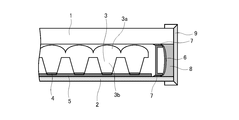
- FIG. 1 is a partially omitted cross-sectional view of a solar cell module according to an embodiment of the present invention. It is a partially omitted sectional view of a solar cell module according to another embodiment of the present invention using an optical sheet of a concentrating solar cell.
- FIG. 1 shows an example of a solar cell module using a plate-like sheet as a light-transmitting elastomer member
- FIG. 2 shows another solar cell module using an optical sheet of a concentrating solar cell as a light-transmitting elastomer member. An example is shown.
- reference numeral 1 is a transparent member panel for allowing sunlight to enter
- 2 is a thermally conductive member panel disposed on the opposite side of the sunlight incidence.
- the light transmissive elastomer member 3 and the solar cell element 4 made of a semiconductor substrate dispose the light transmissive elastomer member on the light incident side, and the light transmissive elastomer member 3 causes the solar cell element 4 to be the heat conductive member. It is interposed in a state where it is pressed and pressed against the panel 2 side. In this case, in the example of FIGS.
- a heat conductive elastomer layer 5 is interposed between the solar cell element 4 and the panel 2 of the heat conductive member, and the solar cell element 4 includes the heat conductive elastomer layer 5. To the panel 2 of the heat conductive member.
- the solar cell element 4 has the solar cells continuously arranged without gaps, and the light-transmitting elastomer member 3 is formed in a plate-like sheet shape.
- the solar cell element 4 has solar cells arranged at predetermined intervals, and the light-transmitting elastomer member 3 is formed as an optical sheet of a concentrating solar cell, and has a cross section. It consists of a hemispherical head 3a and an inverted frustoconical columnar portion 3b that is provided integrally therewith, and the solar cell element (solar cell) 4 is pressed by the lower end surface of the columnar portion 3b.
- a spacer member 6 is disposed in the vicinity of the gap end between the panels 1 and 2, and sealing members 7 and 7 are interposed between the upper and lower portions of the spacer member 6 and the panels 1 and 2, respectively.
- a sealing member 8 is disposed on the gap end side of the spacer member 6, and the light-transmitting elastomer member 3, the solar cell element 4, and the heat conductive elastomer layer 5 in the gap are sealed.
- a frame member 9 having a U-shaped cross section is bridged between the upper edge portions of both the panels 1 and 2, and the two panels 1 and 2 are fixed.
- a preferable method for obtaining such a solar cell module is made of butyl rubber in a frame shape inside the outer peripheral portion of the surface opposite to the light incident surface of the panel 1 of the transparent member for allowing sunlight to enter such as white plate tempered glass.
- a spacer member 6 made of aluminum alloy or the like is arranged along the inside of the sealing member 8 arranged in a frame shape.
- a sealing member 7 made of silicone rubber or the like is disposed between the spacer member 6 and the white plate tempered glass 1 on the light incident surface side.
- the light-transmitting elastomer member 3 and the solar cell element 4 are installed inside the spacer member 8 so that the panel 1 and the light-transmitting elastomer member 3 are in contact with each other.
- the heat conductive elastomer layer 5 is disposed so as to be in contact with the solar cell element 4, and then the panel 2 of the heat conductive member is disposed on the side opposite to the light incident side of the heat conductive elastomer layer 5.
- a sealing member 7 made of silicone rubber or the like is interposed between the spacer member 6 and the panel 2, and the spacer member and the butyl rubber sealing member are sandwiched and joined.
- a vacuum laminator apparatus is used while heating to 100 to 150 ° C. under a vacuum of 100 to 130 Pa. It is preferable to use and join.
- the panel 1 and 2 on the light incident surface side and the opposite surface side thereof are fixed to the solar cell element by a frame member 9 made of a U-shaped aluminum alloy so that a required pressure is applied, and the solar cell module Is preferably produced.
- the panel 1 of the transparent member a member having long-term reliability performance in outdoor use including transparency, weather resistance, and impact resistance is required.
- white plate reinforced glass acrylic resin, fluororesin or
- acrylic resin fluororesin or
- polycarbonate resin or the like
- white plate tempered glass having a thickness of about 3 to 5 mm is widely used.
- examples of the material include a glass material, a synthetic resin material, a metal material, or a composite member thereof.
- the glass material include blue plate glass, white plate glass, or tempered glass
- examples of the synthetic resin material include acrylic resin, polycarbonate (PC) resin, polyethylene terephthalate (PET) resin, and epoxy resin.
- examples of the metal material include copper, aluminum, and iron
- examples of the composite material include a synthetic resin carrying a material having high thermal conductivity such as silica, titanium oxide, alumina, and aluminum nitride.
- the direct sunlight light and a part of the scattered light are placed on the side opposite to the sunlight incident side.
- the plant grows by irradiating part of the sunlight to the part opposite to the incident surface of the solar cell module, that is, the part that is originally shaded. It can be used for grazing livestock.
- the solar cell element 4 is a solar cell element using one or two types of silicon materials selected from single crystal silicon or polycrystalline silicon.
- seat of the concentrating solar cell of FIG. 2 is 1 compared with the solar cell element of FIG. It is possible to reduce from / 2 to 1/3.
- the light-transmitting elastomer member 3 This requires transparency and weather resistance as well as long-term reliability of 20 years or more in outdoor use, and therefore has high ultraviolet resistance and high heat compression molding.
- a millable type silicone rubber composition highly filled with fumed silica is cured. It is preferable to use the following sheet.
- the sheet obtained by curing the silicone rubber composition is, for example, the following average composition formula (I) as the component (A): R 1 a SiO (4-a) / 2 (I)
- R 1 represents the same or different unsubstituted or substituted monovalent hydrocarbon group, and a is a positive number of 1.95 to 2.05.
- 100 parts by weight of an organopolysiloxane having a degree of polymerization of at least 100 and having at least two aliphatic unsaturated groups in one molecule (B) 70 to 150 parts by mass of fumed silica having a specific surface area exceeding 200 m 2 / g, (C) 0.1-30 parts by mass of an organohydrogenpolysiloxane containing hydrogen atoms bonded to at least two silicon atoms in one molecule, and (D) a hydrosilylation reaction catalyst with respect to component (A) It is obtained by curing a silicone rubber composition comprising 0.5 to 1,000 ppm.
- This silicone rubber composition is a millable type material that can be extruded, calendered, etc., and its cured product has high transparency even if it contains silica, and is used as an optical sheet for concentrating solar cells. Is optimal.
- the component (A) is an organopolysiloxane having a degree of polymerization represented by the average composition formula (I) of 100 or more.
- R 1 represents the same or different unsubstituted or substituted monovalent hydrocarbon group, usually having 1 to 12 carbon atoms, particularly preferably having 1 to 8 carbon atoms.
- Is an alkyl group such as a methyl group, an ethyl group, a propyl group, a butyl group, a hexyl group or an octyl group; a cycloalkyl group such as a cyclopentyl group or a cyclohexyl group; an alkenyl group such as a vinyl group, an allyl group or a propenyl group; Groups, aryl groups such as phenyl and tolyl groups, aralkyl groups such as benzyl and 2-phenylethyl groups, or groups in which some or all of the hydrogen atoms of these groups are substituted with halogen atoms or cyano groups.
- a methyl group, a vinyl group, a phenyl group, and a trifluoropropyl group are preferable, and a methyl group and a vinyl group are particularly preferable.
- the main chain of the organopolysiloxane is composed of repeating dimethylsiloxane units, or a part of the dimethylpolysiloxane structure composed of repeating dimethylsiloxane units constituting the main chain is phenyl.
- a diphenylsiloxane unit, a methylphenylsiloxane unit, a methylvinylsiloxane unit, a methyl-3,3,3-trifluoropropylsiloxane unit or the like having a group, a vinyl group, a 3,3,3-trifluoropropyl group or the like is introduced Etc. are suitable.
- the organopolysiloxane preferably has an aliphatic unsaturated group such as two or more alkenyl groups or cycloalkenyl groups in one molecule, and particularly preferably a vinyl group.
- an aliphatic unsaturated group such as two or more alkenyl groups or cycloalkenyl groups in one molecule, and particularly preferably a vinyl group.
- the aliphatic unsaturated group may be bonded to a silicon atom at the molecular chain end, or may be bonded to a silicon atom in the middle of the molecular chain, or both. It is preferably bonded to the silicon atom.
- A is a positive number of 1.95 to 2.05, preferably 1.98 to 2.02, more preferably 1.99 to 2.01.
- R 1 in the average composition formula (I) is more preferably a monovalent hydrocarbon group having 1 to 6 carbon atoms, and at least two in one molecule are alkenyl groups. .
- the organopolysiloxane of component (A) is blocked with a triorganosiloxy group such as a trimethylsiloxy group, a dimethylphenylsiloxy group, a dimethylhydroxysiloxy group, a dimethylvinylsiloxy group, a methyldivinylsiloxy group, or a trivinylsiloxy group.
- Preferred examples can be given. Particularly preferred are methyl vinyl polysiloxane, methyl phenyl vinyl polysiloxane, methyl trifluoropropyl vinyl polysiloxane and the like.
- Such an organopolysiloxane can be obtained by, for example, hydrolyzing and condensing one or more types of organohalogenosilanes, or by converting cyclic polysiloxanes (siloxane trimers, tetramers, etc.) to alkaline or acidic. It can obtain by ring-opening polymerization using the catalyst of.
- These are basically linear diorganopolysiloxanes, but the component (A) may be a mixture of two or more different molecular weights (degree of polymerization) and molecular structures.
- the degree of polymerization of the organopolysiloxane is 100 or more, preferably 100 to 100,000, particularly preferably 3,000 to 20,000. This degree of polymerization can be measured as a weight average degree of polymerization in terms of polystyrene by gel permeation chromatography (GPC) analysis.
- GPC gel permeation chromatography
- the component (B) is reinforcing silica having a BET specific surface area of more than 200 m 2 / g.
- This reinforcing silica is added to obtain a silicone rubber composition having excellent transparency and excellent mechanical strength.
- the BET specific surface area needs to exceed 200 m 2 / g, preferably 250 m 2 / g or more.
- the upper limit of the BET specific surface area is not particularly limited, but is preferably about 500 m 2 / g or less, preferably about 400 m 2 / g or less from the viewpoint of workability and the like.
- the silica used in the silicone rubber composition includes fumed silica, precipitated silica, and the like, but when the precipitated silica is used, the transparency is lowered, so fumed silica is used. Further, those whose surfaces have been subjected to a hydrophobic treatment with chlorosilane, alkoxysilane, hexamethyldisilazane, or the like are also preferably used. In particular, the treatment with hexamethyldisilazane is preferable because of high transparency.
- the amount of reinforcing silica used as component (B) is preferably 70 to 150 parts by weight, more preferably 70 to 120 parts by weight, and less than 70 parts by weight, based on 100 parts by weight of organopolysiloxane of component (A). Then, the transparency of the sheet
- Component (C) is an organohydrogenpolysiloxane containing hydrogen atoms bonded to at least two silicon atoms in one molecule.
- This organohydrogenpolysiloxane contains hydrogen atoms (SiH groups) bonded to at least two silicon atoms in one molecule, and preferably has the following average composition formula (II) R 2 b H c SiO (4 -bc) / 2 (II) Wherein R 2 is a substituted or unsubstituted monovalent hydrocarbon group having 1 to 6 carbon atoms, b is a number from 0.7 to 2.1, and c is from 0.18 to 1.0. And b + c satisfies 0.8 to 3.0.) A conventionally known organohydrogenpolysiloxane represented by the formula is applicable.
- R 2 is a substituted or unsubstituted monovalent hydrocarbon group having 1 to 6 carbon atoms, preferably having no aliphatic unsaturated bond, such as a methyl group, an ethyl group, a propyl group, a butyl group, Alkyl groups such as pentyl group and hexyl group, unsubstituted monovalent hydrocarbon groups such as cyclohexyl group, cyclohexenyl group and phenyl group, and monovalent hydrocarbons such as 3,3,3-trifluoropropyl group and cyanomethyl group
- a substituted monovalent hydrocarbon group such as a substituted alkyl group in which at least a part of the hydrogen atoms of the group is substituted with a halogen atom or a cyano group.
- b and c preferably, b is 0.8 to 2.0, c is 0.2 to 1.0, and b + c is 1.0 to 2.5.
- the molecular structure of the organohydrogenpolysiloxane of component (C) may be any of linear, cyclic, branched, and three-dimensional network.
- the number of silicon atoms in one molecule (or the degree of polymerization) is preferably 2 to 300, particularly about 4 to 200, which is liquid at room temperature.
- the hydrogen atom (SiH group) bonded to the silicon atom may be at the end of the molecular chain, at the side chain, or both, and at least two (usually 2 to 300) per molecule.
- those containing 3 or more (for example, 3 to 200), more preferably about 4 to 150 are used.
- component (C) organohydrogenpolysiloxane examples include 1,1,3,3-tetramethyldisiloxane, 1,3,5,7-tetramethylcyclotetrasiloxane, methylhydrogencyclopolysiloxane, Methylhydrogensiloxane / dimethylsiloxane cyclic copolymer, tris (dimethylhydrogensiloxy) methylsilane, tris (dimethylhydrogensiloxy) phenylsilane, trimethylsiloxy group-blocked methylhydrogenpolysiloxane, trimethylsiloxy group-blocked dimethyl at both ends Siloxane / methylhydrogensiloxane copolymer, dimethylhydrogensiloxy group-blocked dimethylpolysiloxane at both ends, dimethylhydrogensiloxy group-blocked dimethylsiloxane / methyl at both ends Idrogen siloxane copolymer, trimethyls
- the blending amount of the organohydrogenpolysiloxane as the component (C) is 0.1 to 30 parts by weight, more preferably 0.1 to 10 parts by weight, still more preferably with respect to 100 parts by weight of the organopolysiloxane as the component (A). Is 0.3 to 10 parts by mass.
- the organohydrogenpolysiloxane of component (C) is a molar ratio of hydrogen atoms bonded to silicon atoms in component (C) (ie, SiH groups) to alkenyl groups bonded to silicon atoms in component (A). However, the amount is preferably 0.5 to 5 mol / mol, more preferably 0.8 to 4 mol / mol, and still more preferably 1 to 3 mol / mol.
- hydrosilylation reaction catalyst of component (D) known ones can be applied, such as platinum black, platinous chloride, chloroplatinic acid, a reaction product of chloroplatinic acid and a monohydric alcohol, chloroplatinic acid and olefin. And platinum-based catalysts such as platinum bisacetoacetate, palladium-based catalysts, rhodium-based catalysts, and the like.
- the blending amount of the hydrosilylation reaction catalyst of component (D) can be a catalytic amount, and is usually about 0.5 to 1,000 ppm, preferably about 1 to 200 ppm as platinum group metal with respect to component (A). .
- the silicone rubber composition comprising at least the components (A) to (D) can contain a flame retardant, a colorant and the like as long as the object of the present invention is not impaired.
- the silicone rubber composition can be obtained by kneading a predetermined amount of the above-described components with a two roll, kneader, Banbury mixer or the like.
- the molding method is not particularly limited, but press molding, extrusion molding, calendar molding, and the like are possible.
- the curing conditions for the silicone rubber composition are not particularly limited.
- a keypad or the like can be obtained by heat-curing at 80 to 300 ° C., particularly 100 to 250 ° C. for 5 seconds to 1 hour, particularly 30 seconds to 30 minutes. Further, post-curing may be performed at 100 to 200 ° C. for about 10 minutes to 10 hours.
- the total light transmittance of the cured sheet having a thickness of 2 mm is preferably 90% or more at a wavelength of 0.35 to 1.15 ⁇ m which is a spectral sensitivity region of crystalline silicon. . Specifically, it is preferably 90% or more as measured by a direct reading haze computer HGM-2 manufactured by Suga Test Instruments Co., Ltd. If the total light transmittance is less than 90%, light diffusion is too large, and incident light may not reach the farthest part of the optical sheet.
- the cured product of the silicone rubber composition has a 2 mm thick cured sheet having a haze value of 10% or less, particularly 8% or less as measured by a direct reading haze computer HGM-2 manufactured by Suga Test Instruments Co., Ltd. Is preferred.
- a direct reading haze computer HGM-2 manufactured by Suga Test Instruments Co., Ltd. Is preferred.
- the haze value exceeds 10%, light diffusion is too large, and incident light may not reach the farthest part of the light-transmitting elastomer member.
- An optical sheet for a concentrating solar cell was prepared by curing a silicone rubber composition having a transmittance of 90% or more (in the case of a thickness of 2 mm) with respect to a wavelength of refractive index of 0.35 to 1.15 ⁇ m. The case will be described.
- the concentrating solar cell in order to efficiently capture the direct sunlight, it is necessary to consider that the altitude in the south and middle fluctuates from season to season, and the concentrating solar used in the solar cell module of the present invention.
- the shape is formed in a uniaxial direction.
- the optical sheet for the concentrating solar cell used in the solar cell module shown in FIG. According to the shape, it was confirmed by using geometric optical software (Light Tools) that the light can be incident on the light receiving surface of the solar cell on the emission side with respect to the oblique incidence of 23 degrees. And it confirmed that the total incident area to a solar cell was 2.7 to 1.0 with respect to the total sunlight incident area of this optical sheet.
- a tracking system toward the sun on the light receiving surface is not essential.
- the frame member 9 is preferably made of aluminum alloy, stainless steel or the like that has excellent strength against impact, wind pressure, or snow, has weather resistance, and is lightweight.
- the frame member 9 formed of these materials is mounted so as to surround the outer periphery of the structure sandwiched between the panels 1 and 2, and is fixed by screws.
- the solar cell module of the present invention presses the solar cell element by pressing through the rubber-like elastic light-transmitting elastomer member 3, and the pressing pressure at that time is 0.01 MPa or more and 5.0 MPa or less. In particular, a range of 0.05 MPa to 2.0 MPa is preferable. If the pressure of the pressure is less than 0.01 MPa, the solar cell element may not be fixed, or a part of the incident sunlight may not be taken into the device, and the temperature rise of the solar cell element may be There is a possibility that it will be difficult to dissipate heat from the back side.
- the pressing pressure is greater than 5.0 MPa
- the strain due to the difference in the linear expansion coefficient at the time of temperature rise / fall cannot be relieved, and particularly when the optical sheet of the concentrating solar cell of FIG.
- the optical sheet which is an elastomer is deformed and the light collecting function is inferior.
- the solar cell element may be damaged.
- the solar cell module of the present invention can hold the outer edge portion of the panel 1 of the transparent member that makes sunlight incident and the panel 2 of the heat conductive member on the opposite side of the sunlight incidence via the spacer member 6. it can.
- the light-transmitting elastomer member having the rubber-like elasticity is maintained with the distance between the transparent member panel 1 on which sunlight is incident and the heat conductive member panel 2 constant.
- the material include metals such as aluminum or hard resins. Silicone rubber or butyl rubber can be used for joining the spacer member to the panel.
- the thermal conductive elastomer layer 5 can be provided between the panel 2 of the thermal conductive member and the solar cell element 4, but this may be disposed as a sheet. It may be formed as a coating layer.
- the strain due to the difference in linear expansion coefficient between the panel 2 of the thermally conductive member and the solar cell element 4 is alleviated or absorbed, or the panel 2 of the thermally conductive member is in close contact with the panel 2. And the generated heat can be efficiently dissipated.
- This thermally conductive elastomer layer 5 is a cured silicone rubber having a thermal conductivity of 0.2 W / m ⁇ K to 5 W / m ⁇ K (ASTM E 1530), particularly 0.5 to 5 W / m ⁇ K. It is preferable. If the thermal conductivity is smaller than 0.2 W / m ⁇ K, it is necessary to increase the thermocompression bonding temperature between the panel 2 of the thermally conductive member and the solar cell element 4 or to increase the bonding time. There are cases where it is disadvantageous in terms of efficiency. If it exceeds 5 W / m ⁇ K, the hardness of the thermally conductive elastomer layer becomes high, so that it becomes difficult to process it into a sheet, and at the same time, it is difficult to uniformly press the solar cell element.
- the thickness of the heat conductive elastomer layer 5 is preferably 200 ⁇ m or more and 700 ⁇ m or less, particularly preferably 300 ⁇ m or more and 500 ⁇ m or less. If the thickness is smaller than 200 ⁇ m, the heat transfer from the solar cell element to the thermally conductive elastomer layer is not performed quickly, and the temperature increase of the solar cell element may not be suppressed. If the thickness is greater than 700 ⁇ m, there is a possibility that heat transfer from the heat conductive elastomer layer to the heat conductive member is not performed promptly.
- the composition for forming the thermally conductive elastomer layer 5 comprises 10 to 1, at least one selected from carbon, metal, metal oxide, metal nitride, and metal carbide in 100 parts by mass of organopolysiloxane. It is obtained by adding 600 parts by mass. Specific examples of these include silver powder, copper powder, iron powder, nickel powder, aluminum powder, etc. for metal, zinc oxide, metal oxides such as magnesium, aluminum, silicon, iron, boron, aluminum for metal nitride, Examples of nitrides such as silicon and metal carbides include carbides such as silicon and boron.
- various additives such as color pigments, heat resistance improvers, flame retardant improvers, acid acceptors, etc., or various alkoxysilanes, diphenylsilanediols, carbons as dispersants are added to the above heat conductive elastomer composition.
- Functional silane, silanol group-containing siloxane and the like may be added.
- This thermally conductive elastomer composition is obtained by uniformly mixing the above components using a kneader such as a two-roll, Banbury mixer, kneader, planetary mixer, etc., and heat-treating it at a temperature of 100 ° C. or higher as necessary. Obtainable.
- a kneader such as a two-roll, Banbury mixer, kneader, planetary mixer, etc.
- the curing agent that cures the thermally conductive elastomer composition to form a rubber elastic body may be a conventionally known curing agent that is usually used for curing a silicone rubber composition, which is used for radical reaction.
- Organic peroxides such as di-t-butyl peroxide, 2,5-dimethyl-2,5-di (t-butylperoxy) hexane and dicumyl peroxide, and organopolysiloxanes as alkenyl groups as addition reaction curing agents Having an organohydrogenpolysiloxane containing two or more hydrogen atoms bonded to silicon atoms in one molecule and a platinum group metal catalyst, and the organopolysiloxane contains a silanol group as a condensation reaction curing agent.
- Two or more hydrolyzable groups such as alkoxy, acetoxy, ketoxime, propenoxy, etc.
- thermally conductive elastomer composition either a millable type silicone rubber composition or a liquid type silicone rubber composition may be used. From the viewpoint of workability and moldability, an organic peroxide curable or addition reaction curable heat conductive silicone rubber composition is preferred. It is preferable to form a heat conductive elastomer layer by curing the heat conductive elastomer composition.
- Example 1 Production of Solar Cell Module (1)
- a solar cell module was produced using the light-transmitting elastomer member molded in Reference Example 1. That is, a tape-shaped butyl rubber sealing member was arranged in a frame shape inside the outer peripheral portion of the surface opposite to the light incident surface of the 3.2 mm thick white plate tempered glass on the light incident surface side. Next, a spacer member made of an aluminum alloy was arranged along the inside of the sealing member made of butyl rubber arranged in the frame shape. In this case, a silicone rubber sealing member was disposed between the spacer member and the white plate tempered glass on the light incident surface side.
- the light-transmitting elastomer member and the solar cell element were placed inside the spacer member so that the white plate tempered glass and the light-transmitting elastomer member were in contact with each other.
- a heat-dissipating silicone sheet TC-20A (thickness 0.2 mm, thermal conductivity 1.1 W / m ⁇ K) manufactured by Shin-Etsu Chemical Co., Ltd. was used as the thermal conductive elastomer on the side opposite to the light incident surface of the solar cell element. It arranged so that it might touch.
- a white plate tempered glass different from the white plate tempered glass was disposed on the side opposite to the light incident side of the thermal conductive elastomer.
- a silicone rubber sealing member was interposed between the spacer member and the other white plate tempered glass, and the spacer member and the butyl rubber sealing member were sandwiched and joined.
- bonding was performed using a vacuum laminator apparatus while heating to about 120 ° C. under a vacuum of 110 Pa. .
- the white plate tempered glass on the light incident surface side and the opposite surface side thereof are fixed by a U-shaped aluminum alloy frame so that a pressure of about 0.5 MPa is applied to the solar cell element, and the solar cell module (1 ) Was produced.
- the electrode is taken out between the two glasses in the same manner as a double-sided light receiving module in which a double-sided glass structure is usually used. Wiring was done.
- Example 2 Manufacture of solar cell module (2) A heat dissipation silicone sheet TC-45A (thickness 0.45 mm, thermal conductivity 1.1 W / m ⁇ K) manufactured by Shin-Etsu Chemical Co., Ltd. was used as a thermal conductive elastomer. A solar cell module (2) was produced in the same manner as in Example 1 except that it was used.
- Example 3 Manufacture of solar cell module (3) A heat dissipation silicone sheet TC-45BG (thickness 0.45 mm, thermal conductivity 5.0 W / m ⁇ K) manufactured by Shin-Etsu Chemical Co., Ltd. was used as a heat conductive elastomer. A solar cell module (3) was produced in the same manner as in Example 1 except that it was used.
- Table 1 shows the results of the adhesion of the thermally conductive elastomers of Examples 1 to 3 to the solar cell element and the heat dissipation of the heat generated in the solar cell element.
Landscapes
- Physics & Mathematics (AREA)
- Thermal Sciences (AREA)
- Photovoltaic Devices (AREA)
- Cooling Or The Like Of Electrical Apparatus (AREA)
Abstract
Description
更に歩留まりについても、従来の方法では導出リード線をフィルムで被覆したり、被覆材を2種類以上の樹脂で一体積層フィルム状にしたり、コスト増加につながる可能性があり、また容易にリワークできない可能性があった。
[1]太陽光を入射させる透明部材のパネルと太陽光入射の反対側に配置された熱伝導性部材のパネルとの間の空隙に、光透過性エラストマー部材と太陽電池素子とを、光透過性エラストマー部材を太陽光入射側に配置すると共に、この光透過性エラストマー部材によって太陽電池素子を上記熱伝導性部材のパネル側に押圧して圧着した状態で介装してなることを特徴とする太陽電池モジュール。
[2]熱伝導性部材のパネルと太陽電池素子との間に熱伝導性エラストマー層を介装した[1]記載の太陽電池モジュール。
[3]熱伝導性エラストマー層が熱伝導率0.2W/m・K以上5W/m・K以下の熱伝導性シリコーンゴムによって形成された[2]記載の太陽電池モジュール。
[4]透明部材のパネルと熱伝導性部材のパネルとの間の空隙端部にスペーサー部材を配設した[1]~[3]のいずれかに記載の太陽電池モジュール。
[5]透明部材のパネルと熱伝導性部材のパネルとの外縁部間にフレーム部材を架け渡して両パネルを固定した[1]~[4]のいずれかに記載の太陽電池モジュール。
[6]熱伝導性部材のパネルが、硝子材、合成樹脂材、金属材又はそれらの複合材によって形成された[1]~[5]のいずれかに記載の太陽電池モジュール。
[7]太陽電池素子がシリコン材料によって形成された[1]~[6]のいずれかに記載の太陽電池モジュール。
[8]光透過性エラストマー部材が、シリコーンゴム組成物の硬化物から形成された[1]~[7]のいずれかに記載の太陽電池モジュール。
[9]光透過性エラストマー部材が、集光型太陽電池の光学シートである[1]~[8]のいずれかに記載の太陽電池モジュール。
[10]太陽光を入射させる透明部材のパネルに光透過性エラストマー部材と太陽電池素子とを順次積層し、更に太陽電池素子を覆って熱伝導性部材のパネルを、上記光透過性エラストマー部材によって太陽電池素子をこの熱伝導性部材のパネル側に押圧して圧着するように配置することを特徴とする太陽電池モジュールの製造方法。
[11]太陽光を入射させる透明部材のパネルの外周部に封止部材、その内側にスペーサー部材を配置し、その内方に光透過性エラストマーと太陽電池素子とを配置した後、熱伝導性パネルを配置するようにした[10]記載の太陽電池モジュールの製造方法。
[12]上記太陽電池素子を覆って熱伝導性エラストマーを配置し、その上に上記熱伝導性部材のパネルを配置するようにした[10]又は[11]記載の太陽電池モジュールの製造方法。
[13]透明部材のパネルと熱伝導性部材のパネルとの外縁部間にフレーム部材を架け渡して両パネルを固定した[10]~[12]のいずれかに記載の太陽電池モジュールの製造方法。
また、煩雑なラミネート工程による太陽電池素子の封止が不要となるため、歩留まりの向上が期待できる。太陽電池素子はエラストマーの押圧によってのみ圧着されているので容易にリワークできる。
図1は、光透過性エラストマー部材として板状シートを用いた太陽電池モジュールの一例を示し、図2は光透過性エラストマー部材として集光型太陽電池の光学シートを用いた太陽電池モジュールの他の例を示す。
この場合、図1,2の例では、太陽電池素子4と熱伝導性部材のパネル2との間に熱伝導性エラストマー層5が介在し、太陽電池素子4はこの熱伝導性エラストマー層5を介して熱伝導性部材のパネル2に圧着されている。
また、太陽電池素子4においては、単結晶シリコンもしくは多結晶シリコンのうちから選ばれる1種もしくは2種のシリコン材料を用いて太陽電池素子とするものである。なお、図2の、集光型太陽電池の光学シートを用いた太陽電池モジュールに用いる太陽電池素子は太陽光の集光により太陽電池素子の面積を、図1の太陽電池素子と比較して1/2から1/3に減らすことが可能である。
(A)成分として、下記平均組成式(I)
R1 aSiO(4-a)/2 (I)
(式中、R1は同一又は異種の非置換又は置換の一価炭化水素基を示し、aは1.95~2.05の正数である。)
で表され、一分子中に少なくとも2個の脂肪族不飽和基を有する重合度が100以上のオルガノポリシロキサンを100質量部、
(B)比表面積が200m2/gを超える煙霧質シリカを70~150質量部、
(C)一分子中に少なくとも2個のケイ素原子と結合した水素原子を含有するオルガノハイドロジェンポリシロキサンを0.1~30質量部、及び
(D)ヒドロシリル化反応触媒を(A)成分に対し0.5~1,000ppmを含んでなるシリコーンゴム組成物を硬化させて得られる。
特に、オルガノポリシロキサンは、一分子中に2個以上のアルケニル基、シクロアルケニル基等の脂肪族不飽和基を有するものが好ましく、特にビニル基であることが好ましい。この場合、全R1中0.01~20モル%、特に0.02~10モル%が脂肪族不飽和基であることが好ましい。なお、この脂肪族不飽和基は、分子鎖末端でケイ素原子に結合していても、分子鎖の途中のケイ素原子に結合していても、その両方であってもよいが、少なくとも分子鎖末端のケイ素原子に結合していることが好ましい。
また、aは1.95~2.05、好ましくは1.98~2.02、より好ましくは1.99~2.01の正数である。
(A)成分のオルガノポリシロキサンは、分子鎖末端がトリメチルシロキシ基、ジメチルフェニルシロキシ基、ジメチルヒドロキシシロキシ基、ジメチルビニルシロキシ基、メチルジビニルシロキシ基、トリビニルシロキシ基等のトリオルガノシロキシ基で封鎖されたものを好ましく挙げることができる。
特に好ましいものとしては、メチルビニルポリシロキサン、メチルフェニルビニルポリシロキサン、メチルトリフルオロプロピルビニルポリシロキサン等を挙げることができる。
オルガノポリシロキサンの重合度は100以上、好ましくは100~100,000、特に好ましくは3,000~20,000である。なお、この重合度は、ゲルパーミエーションクロマトグラフィ(GPC)分析によるポリスチレン換算の重量平均重合度として測定することができる。
R2 bHcSiO(4-b-c)/2 (II)
(式中、R2は炭素数1~6の置換又は非置換の一価炭化水素基であり、bは0.7~2.1の数であり、cは0.18~1.0の数であり、かつb+cは0.8~3.0を満足する。)
で示される従来から公知のオルガノハイドロジェンポリシロキサンが適用可能である。
bとcに関して、好ましくは、bは0.8~2.0、cは0.2~1.0、かつb+cは1.0~2.5を満足する。
また、(C)成分のオルガノハイドロジェンポリシロキサンは、(A)成分中のケイ素原子に結合したアルケニル基に対する(C)成分中のケイ素原子に結合した水素原子(即ち、SiH基)のモル比が、好ましくは0.5~5モル/モル、より好ましくは0.8~4モル/モル、更に好ましくは1~3モル/モルとなる量で配合される。
(D)成分のヒドロシリル化反応触媒の配合量は触媒量とすることができ、通常、白金族金属として(A)成分に対し、0.5~1,000ppm、好ましくは1~200ppm程度である。
シリコーンゴム組成物は、上述した成分の所定量を2本ロール、ニーダー、バンバリーミキサー等で混練りすることによって得ることができる。
シリコーンゴム組成物を成形する場合、成形方法としては、特に限定されないが、プレス成形、押し出し成形、カレンダー成形等が可能である。
上記熱伝導性エラストマー組成物を硬化させることにより、熱伝導性エラストマー層を形成することが好ましい。
ジメチルシロキサン単位99.475モル%、メチルビニルシロキサン単位0.50モル%、ジメチルビニルシロキサン単位0.025モル%からなり、平均重合度が約6,000であるオルガノポリシロキサン100質量部、BET比表面積300m2/gのシリカ(商品名アエロジル300、日本アエロジル(株)製)70質量部、分散剤としてヘキサメチルジシラザン16質量部、水4質量部を添加し、ニーダーにて混練りし、170℃にて2時間加熱処理してコンパウンドを調製した。
上記コンパウンド100質量部に対し、付加架橋硬化剤としてC-25A(白金触媒)/C-25B(オルガノハイドロジェンポリシロキサン)(共に、信越化学工業(株)製)をそれぞれ0.5質量部/2.0質量部を2本ロールで混練後添加し、均一に混合した後、120℃、70kgf/cm2の条件で10分間プレスキュアーを行い、次いで200℃で4時間ポストキュアーを行い、厚さ2mmの試験用シートを成形した。
参考例1で成形した光透過性エラストマー部材を用いて太陽電池モジュールを作製した。即ち、光入射面側の厚さ3.2mmの白板強化ガラスの光入射面とは反対面の外周部の内側に額縁状にテープ状ブチルゴム製封止部材を配置した。次に、該額縁状に配置したブチルゴム製封止部材の内側に沿ってアルミニウム合金製のスペーサー部材を配置した。この場合、該スペーサー部材と上記光入射面側の白板強化ガラスとの間にシリコーンゴム製封止部材を配置した。次いで、上記スペーサー部材の内方に上記光透過性エラストマー部材及び太陽電池素子を上記白板強化ガラスと上記光透過性エラストマー部材とが接するように設置した。次いで、熱伝導性エラストマーとして信越化学工業(株)製放熱シリコーンシートTC-20A(厚さ0.2mm、熱伝導率1.1W/m・K)を上記太陽電池素子の光入射面の反対側に接するように配置した。次に、上記白板強化ガラスとは別の白板強化ガラスを上記熱伝導性エラストマーの光入射側と反対側に配置した。この場合、上記スペーサー部材とこの別の白板強化ガラスとの間にはシリコーンゴム製の封止部材を介在させ、該スペーサー部材及び上記ブチルゴム製封止部材を挟むようにして接合した。また接合の際には水分の混入を避けるために、かつブチルゴム製封止部材の封止性能を向上させるために110Paの真空下で約120℃に加熱しながら真空ラミネーター装置を用いて接合させた。更に、上記太陽電池素子に対し約0.5MPaの圧力がかかるように光入射面側及びその反対面側の白板強化ガラスをコの字形のアルミニウム合金製のフレームによって固定し、太陽電池モジュール(1)を作製した。なお、この場合は太陽光入射面及びその反対側の面の両面がガラスの構造となるので、通常両面ガラスの構造が用いられる両面受光型モジュールと同じように、両ガラスの間から電極を取り出し配線を行った。
熱伝導性エラストマーとして信越化学工業(株)製放熱シリコーンシートTC-45A(厚さ0.45mm、熱伝導率1.1W/m・K)を用いた他は、実施例1と同様にして太陽電池モジュール(2)を作製した。
熱伝導性エラストマーとして信越化学工業(株)製放熱シリコーンシートTC-45BG(厚さ0.45mm、熱伝導率5.0W/m・K)を用いた他は、実施例1と同様にして太陽電池モジュール(3)を作製した。

◎:きわめて良好
○:良好
△:悪い
×:きわめて悪い
2 熱伝導性部材のパネル
3 光透過性エラストマー部材
3a 断面半球状頭部
3b 断面逆円錐台状柱部
4 太陽電池素子
5 熱伝導性エラストマー層
6 スペーサー部材
7 封止部材
8 封止部材
9 フレーム部材
Claims (13)
- 太陽光を入射させる透明部材のパネルと太陽光入射の反対側に配置された熱伝導性部材のパネルとの間の空隙に、光透過性エラストマー部材と太陽電池素子とを、光透過性エラストマー部材を太陽光入射側に配置すると共に、この光透過性エラストマー部材によって太陽電池素子を上記熱伝導性部材のパネル側に押圧して圧着した状態で介装してなることを特徴とする太陽電池モジュール。
- 熱伝導性部材のパネルと太陽電池素子との間に熱伝導性エラストマー層を介装した請求項1記載の太陽電池モジュール。
- 熱伝導性エラストマー層が熱伝導率0.2W/m・K以上5W/m・K以下の熱伝導性シリコーンゴムによって形成された請求項2記載の太陽電池モジュール。
- 透明部材のパネルと熱伝導性部材のパネルとの間の空隙端部にスペーサー部材を配設した請求項1乃至3のいずれか1項記載の太陽電池モジュール。
- 透明部材のパネルと熱伝導性部材のパネルとの外縁部間にフレーム部材を架け渡して両パネルを固定した請求項1乃至4のいずれか1項記載の太陽電池モジュール。
- 熱伝導性部材のパネルが、硝子材、合成樹脂材、金属材又はそれらの複合材によって形成された請求項1乃至5のいずれか1項記載の太陽電池モジュール。
- 太陽電池素子がシリコン材料によって形成された請求項1乃至6のいずれか1項記載の太陽電池モジュール。
- 光透過性エラストマー部材が、シリコーンゴム組成物の硬化物から形成された請求項1乃至7のいずれか1項記載の太陽電池モジュール。
- 光透過性エラストマー部材が、集光型太陽電池の光学シートである請求項1乃至8のいずれか1項記載の太陽電池モジュール。
- 太陽光を入射させる透明部材のパネルに光透過性エラストマー部材と太陽電池素子とを順次積層し、更に太陽電池素子を覆って熱伝導性部材のパネルを、上記光透過性エラストマー部材によって太陽電池素子をこの熱伝導性部材のパネル側に押圧して圧着するように配置することを特徴とする太陽電池モジュールの製造方法。
- 太陽光を入射させる透明部材のパネルの外周部に封止部材、その内側にスペーサー部材を配置し、その内方に光透過性エラストマーと太陽電池素子とを配置した後、熱伝導性パネルを配置するようにした請求項10記載の太陽電池モジュールの製造方法。
- 上記太陽電池素子を覆って熱伝導性エラストマーを配置し、その上に上記熱伝導性部材のパネルを配置するようにした請求項10又は11記載の太陽電池モジュールの製造方法。
- 透明部材のパネルと熱伝導性部材のパネルとの外縁部間にフレーム部材を架け渡して両パネルを固定した請求項10乃至12のいずれか1項記載の太陽電池モジュールの製造方法。
Priority Applications (4)
| Application Number | Priority Date | Filing Date | Title |
|---|---|---|---|
| KR1020137029928A KR20140031259A (ko) | 2011-06-06 | 2012-05-31 | 태양전지 모듈 및 그 제조방법 |
| US14/008,919 US20140014182A1 (en) | 2011-06-06 | 2012-05-31 | Solar cell module and method for manufacturing same |
| CN201280027785.0A CN103636005B (zh) | 2011-06-06 | 2012-05-31 | 太阳能电池组件及其制造方法 |
| EP12797410.3A EP2720277A4 (en) | 2011-06-06 | 2012-05-31 | SOLAR CELL MODULE AND METHOD FOR THE PRODUCTION THEREOF |
Applications Claiming Priority (2)
| Application Number | Priority Date | Filing Date | Title |
|---|---|---|---|
| JP2011-126467 | 2011-06-06 | ||
| JP2011126467 | 2011-06-06 |
Publications (1)
| Publication Number | Publication Date |
|---|---|
| WO2012169418A1 true WO2012169418A1 (ja) | 2012-12-13 |
Family
ID=47295984
Family Applications (1)
| Application Number | Title | Priority Date | Filing Date |
|---|---|---|---|
| PCT/JP2012/064040 Ceased WO2012169418A1 (ja) | 2011-06-06 | 2012-05-31 | 太陽電池モジュール及びその製造方法 |
Country Status (7)
| Country | Link |
|---|---|
| US (1) | US20140014182A1 (ja) |
| EP (1) | EP2720277A4 (ja) |
| JP (1) | JP5920031B2 (ja) |
| KR (1) | KR20140031259A (ja) |
| CN (1) | CN103636005B (ja) |
| TW (1) | TWI539612B (ja) |
| WO (1) | WO2012169418A1 (ja) |
Cited By (2)
| Publication number | Priority date | Publication date | Assignee | Title |
|---|---|---|---|---|
| CN104659128A (zh) * | 2013-11-21 | 2015-05-27 | 台虹科技股份有限公司 | 导热密封复合层及包含其的太阳能模块 |
| US20150287860A1 (en) * | 2014-04-07 | 2015-10-08 | Shin-Etsu Chemical Co., Ltd. | Solar cell encapsulant silicone composition and solar cell module |
Families Citing this family (8)
| Publication number | Priority date | Publication date | Assignee | Title |
|---|---|---|---|---|
| JP2014072261A (ja) * | 2012-09-28 | 2014-04-21 | Kyocera Corp | 光電変換モジュール |
| TW201519460A (zh) * | 2013-11-11 | 2015-05-16 | Taiflex Scient Co Ltd | 導熱密封複合層及包含其之太陽能模組 |
| IL251076B2 (en) * | 2014-09-11 | 2023-11-01 | Surany Res And Development Llc | A modular solar system and crop management method |
| JP2016062931A (ja) * | 2014-09-15 | 2016-04-25 | 国立大学法人長岡技術科学大学 | 集光型太陽電池モジュール及び集光型太陽光発電システム |
| KR102506999B1 (ko) * | 2017-08-16 | 2023-03-08 | 한국전자통신연구원 | 태양전지 패키지 |
| ES2931087B2 (es) * | 2021-06-07 | 2023-08-01 | Univ Jaen | Módulo fotovoltaico bifacial semitransparente con concentradores de irradiancia posterior |
| KR102825190B1 (ko) | 2025-03-18 | 2025-06-26 | (주)엡스코어 | 내화 및 에지실링을 구비한 G to S 구조의 프레임 일체형 태양광모듈 및 그 제조방법 |
| KR102838159B1 (ko) | 2025-03-18 | 2025-07-24 | (주)엡스코어 | 태양광모듈의 에지실링 구조 및 태양광모듈 제조방법 |
Citations (13)
| Publication number | Priority date | Publication date | Assignee | Title |
|---|---|---|---|---|
| JPH09186353A (ja) | 1995-12-28 | 1997-07-15 | Fujikura Ltd | 太陽電池モジュール |
| JPH09326497A (ja) | 1996-06-03 | 1997-12-16 | Kanegafuchi Chem Ind Co Ltd | 太陽電池モジュール及びその製造方法 |
| JP2770906B2 (ja) | 1995-09-08 | 1998-07-02 | 株式会社日立製作所 | 太陽電池モジュールおよびその製造方法 |
| JPH10299353A (ja) * | 1997-04-28 | 1998-11-10 | Showa Shell Sekiyu Kk | 複層ガラス一体型太陽電池パネル |
| JP2001244486A (ja) * | 2000-02-25 | 2001-09-07 | Sanyo Electric Co Ltd | 太陽電池モジュール |
| JP2002536834A (ja) * | 1999-02-01 | 2002-10-29 | クルス グラス プラス スピーゲル アクチエンゲゼルシヤフト | 太陽電池モジュール |
| JP2006156581A (ja) | 2004-11-26 | 2006-06-15 | Kyocera Corp | 光電変換モジュール |
| JP2006332535A (ja) | 2005-05-30 | 2006-12-07 | Sharp Corp | 集光型太陽電池モジュール |
| JP2007165485A (ja) | 2005-12-12 | 2007-06-28 | Daido Steel Co Ltd | 太陽光発電モジュールの製造方法 |
| JP4206265B2 (ja) | 2002-12-19 | 2009-01-07 | 京セラ株式会社 | 太陽電池モジュール |
| WO2010080469A2 (en) * | 2008-12-19 | 2010-07-15 | E. I. Du Pont De Nemours And Company | Mechanically reliable solar cell modules |
| WO2011046787A1 (en) * | 2009-10-13 | 2011-04-21 | Bp Corporation North America Inc. | Thermally conducting materials for solar panel components |
| JP2011166020A (ja) * | 2010-02-12 | 2011-08-25 | Fujikura Rubber Ltd | 太陽電池用バックシート、及び、それを用いた太陽電池モジュール、ならびに、前記太陽電池用バックシートの製造方法、及び、前記太陽電池モジュールの製造方法 |
Family Cites Families (4)
| Publication number | Priority date | Publication date | Assignee | Title |
|---|---|---|---|---|
| JPH11103086A (ja) * | 1997-07-29 | 1999-04-13 | Kanegafuchi Chem Ind Co Ltd | 太陽電池モジュール |
| WO2008136872A2 (en) * | 2006-12-22 | 2008-11-13 | Adriani Paul M | Structures for low cost, reliable solar modules |
| US20090255571A1 (en) * | 2008-04-14 | 2009-10-15 | Bp Corporation North America Inc. | Thermal Conducting Materials for Solar Panel Components |
| DE102008049890A1 (de) * | 2008-10-02 | 2010-04-22 | Webasto Ag | Photovoltaische Anordnung und Verfahren zur Herstellung der photovoltaischen Anordnung |
-
2012
- 2012-05-31 EP EP12797410.3A patent/EP2720277A4/en not_active Withdrawn
- 2012-05-31 KR KR1020137029928A patent/KR20140031259A/ko not_active Ceased
- 2012-05-31 JP JP2012123925A patent/JP5920031B2/ja active Active
- 2012-05-31 CN CN201280027785.0A patent/CN103636005B/zh not_active Expired - Fee Related
- 2012-05-31 US US14/008,919 patent/US20140014182A1/en not_active Abandoned
- 2012-05-31 WO PCT/JP2012/064040 patent/WO2012169418A1/ja not_active Ceased
- 2012-06-05 TW TW101120131A patent/TWI539612B/zh not_active IP Right Cessation
Patent Citations (13)
| Publication number | Priority date | Publication date | Assignee | Title |
|---|---|---|---|---|
| JP2770906B2 (ja) | 1995-09-08 | 1998-07-02 | 株式会社日立製作所 | 太陽電池モジュールおよびその製造方法 |
| JPH09186353A (ja) | 1995-12-28 | 1997-07-15 | Fujikura Ltd | 太陽電池モジュール |
| JPH09326497A (ja) | 1996-06-03 | 1997-12-16 | Kanegafuchi Chem Ind Co Ltd | 太陽電池モジュール及びその製造方法 |
| JPH10299353A (ja) * | 1997-04-28 | 1998-11-10 | Showa Shell Sekiyu Kk | 複層ガラス一体型太陽電池パネル |
| JP2002536834A (ja) * | 1999-02-01 | 2002-10-29 | クルス グラス プラス スピーゲル アクチエンゲゼルシヤフト | 太陽電池モジュール |
| JP2001244486A (ja) * | 2000-02-25 | 2001-09-07 | Sanyo Electric Co Ltd | 太陽電池モジュール |
| JP4206265B2 (ja) | 2002-12-19 | 2009-01-07 | 京セラ株式会社 | 太陽電池モジュール |
| JP2006156581A (ja) | 2004-11-26 | 2006-06-15 | Kyocera Corp | 光電変換モジュール |
| JP2006332535A (ja) | 2005-05-30 | 2006-12-07 | Sharp Corp | 集光型太陽電池モジュール |
| JP2007165485A (ja) | 2005-12-12 | 2007-06-28 | Daido Steel Co Ltd | 太陽光発電モジュールの製造方法 |
| WO2010080469A2 (en) * | 2008-12-19 | 2010-07-15 | E. I. Du Pont De Nemours And Company | Mechanically reliable solar cell modules |
| WO2011046787A1 (en) * | 2009-10-13 | 2011-04-21 | Bp Corporation North America Inc. | Thermally conducting materials for solar panel components |
| JP2011166020A (ja) * | 2010-02-12 | 2011-08-25 | Fujikura Rubber Ltd | 太陽電池用バックシート、及び、それを用いた太陽電池モジュール、ならびに、前記太陽電池用バックシートの製造方法、及び、前記太陽電池モジュールの製造方法 |
Non-Patent Citations (4)
| Title |
|---|
| BARRY KETOLA; KEITH R. MCINTOSH; ANN NORRIS; MARY KAY TOMALIA: "Silicone for Photovoltaic Encapsulation", 23RD EUROPEAN PHOTOVOLTAIC SOLAR ENERGY CONFERENCE, 2008, pages 2969 - 2973 |
| D. L. KING; M. A. QUINTANA; J. A. KRATOCHVIL; D. E. ELLIBEE; B. R. HANSEN, PHOTOVOLTAIC MODULE PERFORMANCE AND DURABILITY FOLLOWING LONG TERM FIELD EXPOSURE, PROGRESS IN PHOTOVOLTAICS: RESEARCH AND APPLICATION, vol. 8, 2000, pages 241 - 256 |
| M. A. QUINTANA; D. L. KING; T. J. MACMAHON; C. R. OSTERWALD: "Commonly Observed Degradation in Field-Aged Photovoltaic Modules", PROCEEDINGS OF THE 29TH IEEE PHOTOVOLTAIC SPECIALISTS CONFERENCE, 2002, pages 1392 - 1395 |
| See also references of EP2720277A4 |
Cited By (3)
| Publication number | Priority date | Publication date | Assignee | Title |
|---|---|---|---|---|
| CN104659128A (zh) * | 2013-11-21 | 2015-05-27 | 台虹科技股份有限公司 | 导热密封复合层及包含其的太阳能模块 |
| CN104659128B (zh) * | 2013-11-21 | 2017-09-29 | 台虹科技股份有限公司 | 包含导热密封复合层的太阳能模块 |
| US20150287860A1 (en) * | 2014-04-07 | 2015-10-08 | Shin-Etsu Chemical Co., Ltd. | Solar cell encapsulant silicone composition and solar cell module |
Also Published As
| Publication number | Publication date |
|---|---|
| JP2013016784A (ja) | 2013-01-24 |
| EP2720277A4 (en) | 2014-12-17 |
| CN103636005B (zh) | 2016-08-17 |
| CN103636005A (zh) | 2014-03-12 |
| TW201314932A (zh) | 2013-04-01 |
| JP5920031B2 (ja) | 2016-05-18 |
| US20140014182A1 (en) | 2014-01-16 |
| TWI539612B (zh) | 2016-06-21 |
| KR20140031259A (ko) | 2014-03-12 |
| EP2720277A1 (en) | 2014-04-16 |
Similar Documents
| Publication | Publication Date | Title |
|---|---|---|
| JP5920031B2 (ja) | 太陽電池モジュール及びその製造方法 | |
| JP6217328B2 (ja) | 太陽電池封止用紫外線遮蔽性シリコーン接着剤シート並びにそれを用いた太陽電池モジュール | |
| JP5831159B2 (ja) | 太陽電池モジュール | |
| TW201605980A (zh) | 太陽能電池用聚矽氧封裝材料組成物及太陽能電池模組 | |
| CN102812562B (zh) | 光伏组件 | |
| JP5603434B2 (ja) | 集光型太陽光電池用の有機材料光学シート | |
| JP5837474B2 (ja) | 太陽電池モジュールの製造方法 | |
| JP5954281B2 (ja) | 太陽電池封止用シリコーン接着剤シート並びにそれを用いた太陽電池モジュールの製造方法 | |
| JP6269527B2 (ja) | 太陽電池モジュールの製造方法 | |
| JP2013153085A (ja) | 太陽電池モジュールの製造方法及び太陽電池モジュール | |
| JP2013153086A (ja) | 太陽電池モジュールの製造方法及び太陽電池モジュール | |
| JP6319118B2 (ja) | 太陽電池モジュール及び太陽電池モジュールの製造方法 | |
| JP6070527B2 (ja) | 太陽電池モジュールの製造方法 | |
| KR101413892B1 (ko) | 광전지 모듈 | |
| JP2018082073A (ja) | 太陽電池モジュールの製造方法 | |
| WO2019082927A1 (ja) | 太陽電池モジュール |
Legal Events
| Date | Code | Title | Description |
|---|---|---|---|
| 121 | Ep: the epo has been informed by wipo that ep was designated in this application |
Ref document number: 12797410 Country of ref document: EP Kind code of ref document: A1 |
|
| WWE | Wipo information: entry into national phase |
Ref document number: 14008919 Country of ref document: US |
|
| ENP | Entry into the national phase |
Ref document number: 20137029928 Country of ref document: KR Kind code of ref document: A |
|
| REEP | Request for entry into the european phase |
Ref document number: 2012797410 Country of ref document: EP |
|
| WWE | Wipo information: entry into national phase |
Ref document number: 2012797410 Country of ref document: EP |
|
| NENP | Non-entry into the national phase |
Ref country code: DE |