WO2012171326A1 - 从生物性油脂制备燃料的方法 - Google Patents
从生物性油脂制备燃料的方法 Download PDFInfo
- Publication number
- WO2012171326A1 WO2012171326A1 PCT/CN2012/000790 CN2012000790W WO2012171326A1 WO 2012171326 A1 WO2012171326 A1 WO 2012171326A1 CN 2012000790 W CN2012000790 W CN 2012000790W WO 2012171326 A1 WO2012171326 A1 WO 2012171326A1
- Authority
- WO
- WIPO (PCT)
- Prior art keywords
- catalyst
- oil
- hydrodeoxygenation
- hydrogen
- reaction
- Prior art date
- Legal status (The legal status is an assumption and is not a legal conclusion. Google has not performed a legal analysis and makes no representation as to the accuracy of the status listed.)
- Ceased
Links
Classifications
-
- C—CHEMISTRY; METALLURGY
- C10—PETROLEUM, GAS OR COKE INDUSTRIES; TECHNICAL GASES CONTAINING CARBON MONOXIDE; FUELS; LUBRICANTS; PEAT
- C10G—CRACKING HYDROCARBON OILS; PRODUCTION OF LIQUID HYDROCARBON MIXTURES, e.g. BY DESTRUCTIVE HYDROGENATION, OLIGOMERISATION, POLYMERISATION; RECOVERY OF HYDROCARBON OILS FROM OIL-SHALE, OIL-SAND, OR GASES; REFINING MIXTURES MAINLY CONSISTING OF HYDROCARBONS; REFORMING OF NAPHTHA; MINERAL WAXES
- C10G3/00—Production of liquid hydrocarbon mixtures from oxygen-containing organic materials, e.g. fatty oils, fatty acids
- C10G3/50—Production of liquid hydrocarbon mixtures from oxygen-containing organic materials, e.g. fatty oils, fatty acids in the presence of hydrogen, hydrogen donors or hydrogen generating compounds
-
- C—CHEMISTRY; METALLURGY
- C10—PETROLEUM, GAS OR COKE INDUSTRIES; TECHNICAL GASES CONTAINING CARBON MONOXIDE; FUELS; LUBRICANTS; PEAT
- C10G—CRACKING HYDROCARBON OILS; PRODUCTION OF LIQUID HYDROCARBON MIXTURES, e.g. BY DESTRUCTIVE HYDROGENATION, OLIGOMERISATION, POLYMERISATION; RECOVERY OF HYDROCARBON OILS FROM OIL-SHALE, OIL-SAND, OR GASES; REFINING MIXTURES MAINLY CONSISTING OF HYDROCARBONS; REFORMING OF NAPHTHA; MINERAL WAXES
- C10G11/00—Catalytic cracking, in the absence of hydrogen, of hydrocarbon oils
- C10G11/02—Catalytic cracking, in the absence of hydrogen, of hydrocarbon oils characterised by the catalyst used
- C10G11/04—Oxides
- C10G11/05—Crystalline alumino-silicates, e.g. molecular sieves
-
- C—CHEMISTRY; METALLURGY
- C10—PETROLEUM, GAS OR COKE INDUSTRIES; TECHNICAL GASES CONTAINING CARBON MONOXIDE; FUELS; LUBRICANTS; PEAT
- C10G—CRACKING HYDROCARBON OILS; PRODUCTION OF LIQUID HYDROCARBON MIXTURES, e.g. BY DESTRUCTIVE HYDROGENATION, OLIGOMERISATION, POLYMERISATION; RECOVERY OF HYDROCARBON OILS FROM OIL-SHALE, OIL-SAND, OR GASES; REFINING MIXTURES MAINLY CONSISTING OF HYDROCARBONS; REFORMING OF NAPHTHA; MINERAL WAXES
- C10G3/00—Production of liquid hydrocarbon mixtures from oxygen-containing organic materials, e.g. fatty oils, fatty acids
- C10G3/42—Catalytic treatment
-
- C—CHEMISTRY; METALLURGY
- C10—PETROLEUM, GAS OR COKE INDUSTRIES; TECHNICAL GASES CONTAINING CARBON MONOXIDE; FUELS; LUBRICANTS; PEAT
- C10G—CRACKING HYDROCARBON OILS; PRODUCTION OF LIQUID HYDROCARBON MIXTURES, e.g. BY DESTRUCTIVE HYDROGENATION, OLIGOMERISATION, POLYMERISATION; RECOVERY OF HYDROCARBON OILS FROM OIL-SHALE, OIL-SAND, OR GASES; REFINING MIXTURES MAINLY CONSISTING OF HYDROCARBONS; REFORMING OF NAPHTHA; MINERAL WAXES
- C10G3/00—Production of liquid hydrocarbon mixtures from oxygen-containing organic materials, e.g. fatty oils, fatty acids
- C10G3/42—Catalytic treatment
- C10G3/44—Catalytic treatment characterised by the catalyst used
- C10G3/48—Catalytic treatment characterised by the catalyst used further characterised by the catalyst support
- C10G3/49—Catalytic treatment characterised by the catalyst used further characterised by the catalyst support containing crystalline aluminosilicates, e.g. molecular sieves
-
- C—CHEMISTRY; METALLURGY
- C10—PETROLEUM, GAS OR COKE INDUSTRIES; TECHNICAL GASES CONTAINING CARBON MONOXIDE; FUELS; LUBRICANTS; PEAT
- C10G—CRACKING HYDROCARBON OILS; PRODUCTION OF LIQUID HYDROCARBON MIXTURES, e.g. BY DESTRUCTIVE HYDROGENATION, OLIGOMERISATION, POLYMERISATION; RECOVERY OF HYDROCARBON OILS FROM OIL-SHALE, OIL-SAND, OR GASES; REFINING MIXTURES MAINLY CONSISTING OF HYDROCARBONS; REFORMING OF NAPHTHA; MINERAL WAXES
- C10G65/00—Treatment of hydrocarbon oils by two or more hydrotreatment processes only
- C10G65/02—Treatment of hydrocarbon oils by two or more hydrotreatment processes only plural serial stages only
- C10G65/12—Treatment of hydrocarbon oils by two or more hydrotreatment processes only plural serial stages only including cracking steps and other hydrotreatment steps
-
- C—CHEMISTRY; METALLURGY
- C10—PETROLEUM, GAS OR COKE INDUSTRIES; TECHNICAL GASES CONTAINING CARBON MONOXIDE; FUELS; LUBRICANTS; PEAT
- C10G—CRACKING HYDROCARBON OILS; PRODUCTION OF LIQUID HYDROCARBON MIXTURES, e.g. BY DESTRUCTIVE HYDROGENATION, OLIGOMERISATION, POLYMERISATION; RECOVERY OF HYDROCARBON OILS FROM OIL-SHALE, OIL-SAND, OR GASES; REFINING MIXTURES MAINLY CONSISTING OF HYDROCARBONS; REFORMING OF NAPHTHA; MINERAL WAXES
- C10G69/00—Treatment of hydrocarbon oils by at least one hydrotreatment process and at least one other conversion process
- C10G69/02—Treatment of hydrocarbon oils by at least one hydrotreatment process and at least one other conversion process plural serial stages only
- C10G69/04—Treatment of hydrocarbon oils by at least one hydrotreatment process and at least one other conversion process plural serial stages only including at least one step of catalytic cracking in the absence of hydrogen
-
- C—CHEMISTRY; METALLURGY
- C11—ANIMAL OR VEGETABLE OILS, FATS, FATTY SUBSTANCES OR WAXES; FATTY ACIDS THEREFROM; DETERGENTS; CANDLES
- C11B—PRODUCING, e.g. BY PRESSING RAW MATERIALS OR BY EXTRACTION FROM WASTE MATERIALS, REFINING OR PRESERVING FATS, FATTY SUBSTANCES, e.g. LANOLIN, FATTY OILS OR WAXES; ESSENTIAL OILS; PERFUMES
- C11B3/00—Refining fats or fatty oils
- C11B3/12—Refining fats or fatty oils by distillation
-
- C—CHEMISTRY; METALLURGY
- C11—ANIMAL OR VEGETABLE OILS, FATS, FATTY SUBSTANCES OR WAXES; FATTY ACIDS THEREFROM; DETERGENTS; CANDLES
- C11C—FATTY ACIDS FROM FATS, OILS OR WAXES; CANDLES; FATS, OILS OR FATTY ACIDS BY CHEMICAL MODIFICATION OF FATS, OILS, OR FATTY ACIDS OBTAINED THEREFROM
- C11C3/00—Fats, oils, or fatty acids by chemical modification of fats, oils, or fatty acids obtained therefrom
- C11C3/12—Fats, oils, or fatty acids by chemical modification of fats, oils, or fatty acids obtained therefrom by hydrogenation
-
- C—CHEMISTRY; METALLURGY
- C10—PETROLEUM, GAS OR COKE INDUSTRIES; TECHNICAL GASES CONTAINING CARBON MONOXIDE; FUELS; LUBRICANTS; PEAT
- C10G—CRACKING HYDROCARBON OILS; PRODUCTION OF LIQUID HYDROCARBON MIXTURES, e.g. BY DESTRUCTIVE HYDROGENATION, OLIGOMERISATION, POLYMERISATION; RECOVERY OF HYDROCARBON OILS FROM OIL-SHALE, OIL-SAND, OR GASES; REFINING MIXTURES MAINLY CONSISTING OF HYDROCARBONS; REFORMING OF NAPHTHA; MINERAL WAXES
- C10G2300/00—Aspects relating to hydrocarbon processing covered by groups C10G1/00 - C10G99/00
- C10G2300/10—Feedstock materials
- C10G2300/1011—Biomass
-
- C—CHEMISTRY; METALLURGY
- C10—PETROLEUM, GAS OR COKE INDUSTRIES; TECHNICAL GASES CONTAINING CARBON MONOXIDE; FUELS; LUBRICANTS; PEAT
- C10G—CRACKING HYDROCARBON OILS; PRODUCTION OF LIQUID HYDROCARBON MIXTURES, e.g. BY DESTRUCTIVE HYDROGENATION, OLIGOMERISATION, POLYMERISATION; RECOVERY OF HYDROCARBON OILS FROM OIL-SHALE, OIL-SAND, OR GASES; REFINING MIXTURES MAINLY CONSISTING OF HYDROCARBONS; REFORMING OF NAPHTHA; MINERAL WAXES
- C10G2400/00—Products obtained by processes covered by groups C10G9/00 - C10G69/14
- C10G2400/02—Gasoline
-
- C—CHEMISTRY; METALLURGY
- C10—PETROLEUM, GAS OR COKE INDUSTRIES; TECHNICAL GASES CONTAINING CARBON MONOXIDE; FUELS; LUBRICANTS; PEAT
- C10G—CRACKING HYDROCARBON OILS; PRODUCTION OF LIQUID HYDROCARBON MIXTURES, e.g. BY DESTRUCTIVE HYDROGENATION, OLIGOMERISATION, POLYMERISATION; RECOVERY OF HYDROCARBON OILS FROM OIL-SHALE, OIL-SAND, OR GASES; REFINING MIXTURES MAINLY CONSISTING OF HYDROCARBONS; REFORMING OF NAPHTHA; MINERAL WAXES
- C10G2400/00—Products obtained by processes covered by groups C10G9/00 - C10G69/14
- C10G2400/04—Diesel oil
-
- Y—GENERAL TAGGING OF NEW TECHNOLOGICAL DEVELOPMENTS; GENERAL TAGGING OF CROSS-SECTIONAL TECHNOLOGIES SPANNING OVER SEVERAL SECTIONS OF THE IPC; TECHNICAL SUBJECTS COVERED BY FORMER USPC CROSS-REFERENCE ART COLLECTIONS [XRACs] AND DIGESTS
- Y02—TECHNOLOGIES OR APPLICATIONS FOR MITIGATION OR ADAPTATION AGAINST CLIMATE CHANGE
- Y02P—CLIMATE CHANGE MITIGATION TECHNOLOGIES IN THE PRODUCTION OR PROCESSING OF GOODS
- Y02P30/00—Technologies relating to oil refining and petrochemical industry
- Y02P30/20—Technologies relating to oil refining and petrochemical industry using bio-feedstock
Definitions
- the present invention relates to the field of energy technology, and in particular to a method for preparing a fuel from a biological fat.
- BACKGROUND OF THE INVENTION The increasing shortage of fossil fuels and the environmental pollution caused by combustion have forced people to seek renewable clean fuels.
- clean fuels produced from regenerative bio-oils such as soybean oil, jatropha oil, lard, and food waste are considered green, renewable, and carbon-neutral.
- Biological fats such as vegetable fats and oils are fats obtained by extracting plant seeds, pulp and other parts, and containing a large amount of long-chain carbon triglycerides and free fatty acids.
- Biological fats and oils are divided into two categories according to their use. They are edible and industrial. Those that are liquid at normal temperature are called oils, and those that are solid and semi-solid are called fats. Biological oils and crude oils (including waste lubricating oils) have great differences in composition. The main difference is that biological oils have high oxygen content and low levels of sulfur, nitrogen and aromatics. Crude oil, on the other hand, Contains high amounts of sulfur, nitrogen and aromatics with low oxygen content. Therefore, the method of manufacturing a fuel using crude oil as a raw material cannot be applied to a processing method using biological fats and fats as a raw material based on the difference in composition components.
- CN101230309A teaches a method for reducing the production of biodiesel from high acid value palm oil, which requires two esterifications, and the methanol required for esterification exchange is 6-9 times (molar ratio) of oil, and there is no methanol. Recycling, lack of environmental protection and economy.
- the above prior art processes are cumbersome, have high operational complexity, and high energy consumption; and in the esterification exchange process, high use of alcohols such as methanol or ethanol is involved, resulting in a substantial increase in production costs.
- Chinese Patent Publication No. CN101070483A teaches a method for producing biodiesel from soda ash seed oil, which needs to be washed with a large amount of water after the esterification exchange.
- Chinese Patent Publication No. CN1412278A teaches a method for preparing biodiesel using a high acid value oil and palm oil using a strong acid as a catalyst, but this method generates a large amount of waste water and severely corrodes the reactor.
- the above prior art processes all produce a large amount of waste water, which not only increases production costs, but also does not meet environmental protection objectives and economic benefits.
- WO 2009/039347 teaches the treatment of biorenewable feedstocks to produce diesel fractions in a two-step process of hydrodeoxygenation and hydroisomerization.
- US 2006/0207166 teaches techniques for simultaneous hydrodeoxygenation and hydroisomerization.
- a common drawback of these techniques is the poor stability of the catalyst and the high hydrogen consumption of the process, especially in the processing of highly oxygenated vegetable oils and animal fats.
- direct hydrogenation techniques are limited by the amount of free fatty acids in the feedstock.
- the prior art literature only discloses the direct hydrotreating of up to 15% free fatty acids to produce hydrocarbon fuels (Yanyong Liu et al., Chem. Lett. 2009, 38, 552).
- the transesterification technology is to produce biodiesel by esterification exchange, and a large amount of low-carbon alcohol must be consumed, which increases the production cost.
- CN10101314748A discloses a catalytic conversion method of animal and vegetable oils, the product component is mainly C2-C4 olefin, and the total yield is only 45 wt%, and the obtained gasoline-diesel component is too small, and does not involve steam. Hydrotreating of diesel.
- Chinese Patent Publication No. CN101475870A teaches a hydrocarbon catalytic cracking distillation technique for waste lubricating oil resources mainly composed of hydrocarbons. In this technology, the waste lubricating oil treated is mainly composed of hydrazine hydrocarbons, and the catalytic cracking is selective cleavage of carbon-carbon bonds (CC bonds). The main reactions are as follows:
- the cleavage reaction does not form water (H 2 0), so that it is not necessary to consider the water resistance of the catalyst.
- the waste lubricating oil is mainly composed of alkanes, and directly forms hydrocarbons and olefins after catalytic cracking.
- the main components of biological oils and fats have high oxygen content.
- the hydrothermal stability of the catalyst must be considered. Therefore, the technique taught by Chinese Patent Publication No.
- CN101475870A cannot be applied to the processing of biological fats and oils.
- the biodiesel obtained has a high density and cannot be blended with petroleum diesel components.
- the biodiesel has a low calorific value, and the fuel economy blended with the petroleum diesel component is poor. Therefore, biodiesel is considered to be unreasonable. Think of the diesel blending component.
- the present invention provides a novel biological grease treatment technique which can produce a high quality biomass fuel and is highly suitable as a diesel blending component.
- the present invention provides a method for preparing a biomass fuel, which is a biomass oil as a raw material, and a biomass fuel equivalent to a fuel component obtained by refining crude oil is produced by the following steps, the method comprising: a catalytic cracking deoxygenation reaction of the biological oil in the presence of a cracking deoxygenation catalyst under heating; (b) mixing the product of step (a) with hydrogen; and (c) in the presence of a hydrodeoxygenation catalyst The mixture from step (b) is subjected to a catalytic hydrodeoxygenation reaction under heating.
- step (c) can be further fractionated depending on the actual application requirements.
- the hydrogen is mixed with the catalytic cracking deoxidation product before being injected into the reaction column to carry out the reaction of the step (c), but the hydrogen gas may be directly injected into the reaction tower for hydrogenation and then mixed with the catalytic cracking deoxidation product to Carry out the reaction of step (c).
- the technical feature is that a double deoxidation step of catalytic cracking deoxygenation-catalytic hydrodeoxygenation is used, so that the large amount of exothermic and rapid deactivation of the catalyst caused by the direct hydrogenation technology in the prior art can be avoided. Disadvantages, but also significantly reduce hydrogen consumption.
- the biological oil and fat according to the present invention may include an animal source, a plant source, a microbial source, or the foregoing. Mixture. Bio-oils for industrial use or consumption can be utilized.
- biological oils are rich in triglycerides and free fatty acids, and the fatty acid chain length is usually C12-C24, mostly C16 and C18.
- biological fats including but not limited to, rapeseed oil, soybean oil, palm oil, sunflower oil, cottonseed oil, jatropha oil, olive oil, castor oil, microalgae oil, tallow, lard, butter, Poultry fat, fish oil, food waste oil, etc.
- vegetable fats and oils are preferred starting materials.
- the fuel which can be prepared by the present invention is generally referred to as biomass fuel, meaning a solid, liquid, or gas composed or extracted from biomass, and the so-called biomass refers to a product of metabolism of an organic living organism or an organic living organism.
- biomass fuel meaning a solid, liquid, or gas composed or extracted from biomass
- biomass refers to a product of metabolism of an organic living organism or an organic living organism.
- the biodiesel is equivalent to the components of petroleum diesel refined from petrochemical feedstocks (eg, crude oil), which are highly compatible, fully blendable, and blended with the resulting diesel fuel and petroleum The considerable properties and applications of diesel.
- the invention adopts a double deoxidation process of catalytic cracking deoxidation-catalytic hydrodeoxygenation.
- the bio-oil is first treated by a combination of catalytic cracking and distillation.
- This process removes some of the oxygen from the feed and then removes the remaining oxygen by catalytic hydrogenation. Since hydrogen is not required in the step of catalytic cracking and deoxidation, and most of the oxygen is removed, the consumption of hydrogen in the subsequent catalytic hydrodeoxygenation step can be greatly reduced.
- the free fatty acid is partially deoxygenated by decarbonylation, or decarboxylated to form CO, 3 ⁇ 40 and an olefin, and the triglyceride is decarbonylated by cleavage.
- Decarboxylation produces the corresponding long chain anthracene and olefin, C0 2 , CO, 3 ⁇ 40, and propylene or propylene.
- the chemical reaction formula is as follows:
- R-CH 2 -COOH ⁇ R-CH 3 + C0 2 or R CH 2 + CO + H 2 0
- R"-CH 2 -COOCH 2 R in all the above chemical reaction equations is an alkyl group having a carbon number CIO - C22.
- the above hydrodeoxygenation reaction further removes the oxygen-containing fraction which is not removed during the catalytic cracking deoxidation process, and simultaneously saturates the olefin produced in the catalytic cracking process to obtain a product having high stability.
- the advantage of the present invention is that by catalytic cracking
- the deoxidized fraction is further subjected to hydrodeoxygenation reaction, the reaction conditions are mild (low partial pressure of hydrogen, low reaction temperature), good catalyst stability, low hydrogen consumption, and maximum utilization of existing equipment of the refinery for production.
- the biomass fuel produced can be directly used as a fuel, for example, as gasoline, diesel, aviation kerosene, etc., or used to blend components.
- the main carbon chain component of the biomass fuel is C8-C24, which has a high 16-inch value. In traditional petroleum diesel, it has a lower density and is virtually free of sulfur, nitrogen and aromatics.
- the clean fuel produced by the Ming method is an ideal high-quality diesel blending component, which can be blended with low-value catalytic light cycle oil hydrotreating to produce oil (lower value of 16 ⁇ ), so as to meet the requirements of relevant standards.
- the invention is mainly based on two steps of catalytic cracking deoxidation and catalytic hydrodeoxygenation, and the combination of the two steps is very flexible, and can be operated not only continuously but also separately. Specifically, catalytic cracking deoxidation occurs.
- the first reaction zone in action and the second reaction zone in which catalytic hydrodeoxygenation occurs can be operated continuously or intermittently depending on the operating conditions of the actual application.
- the second reaction The hydrodeoxygenation step in the section is preferably carried out in a continuous operation, which has the advantages that the reaction conditions are stable and the product is stable; and the catalytic cracking deoxygenation step in the first reaction section can be carried out in batch mode.
- the continuous operation of the deoxidation step, the catalytic cracking and deoxidation step can be carried out by a multi-distillation cycle operation, or a continuous Distillation operation.
- the cracking deoxygenation catalyst used in the first reaction zone is, for example but not limited to, a molecular sieve catalyst.
- Suitable pyrolysis deoxygenation catalysts can be found in the Handbook of Industrial Catalysts (Edited by Huang Zhongtao, Chemical Industry Press, Published in 2004, hereby incorporated by reference herein in its entirety in its entirety in its entirety in the the the the the the A mixture with molecular sieves is used as a cracking catalyst.
- the molecular sieve may be selected from the group consisting of HY, Hp, SAPO-31, HZSM-5, HZSM-22, or a mixture of any of the above ingredients, and may have a molecular sieve content of from about 5 to 70% by weight.
- a binder for example, tianjing powder
- a strip for example, tianjing powder
- the size of the shaped cracking deoxygenation catalyst is determined according to the actual conditions of the first reaction zone, for example, according to the diameter of the catalytic distillation column. In one embodiment, the ratio of the equivalent diameter of the shaped cracking deoxygenation catalyst to the diameter of the catalytic distillation column should be less than 0.1.
- the ratio of the cracking deoxidation catalyst to the raw material introduced into the first reaction zone may be determined depending on actual operating conditions, and the ratio is not particularly limited.
- the mass ratio of the cracking deoxygenation catalyst to the biological grease may be about 1:5 to 1:50, that is, 1:5, 1:10, 1:15, depending on the amount of the reaction. 1: 20, 1: 30, 1: 40, 1: 50, etc.
- the mass ratio of the cleavage deoxidation catalyst to the biological grease is preferably 1:20. In another embodiment, the mass ratio of the cracking deoxygenation catalyst to the biological grease is preferably 1:10. In an embodiment, the cleavage deoxygenation catalysis in the first reaction zone can be carried out in a heated environment of about 100 to 600 ° C to obtain a cracked deoxygenated product such as an olefin, a hydrazine, carbon monoxide, carbon dioxide, water, or the like.
- the cleavage deoxidation catalysis can be at a temperature of about 100 T:, 200 ° C, 250 ° C, 300 ° C, 350 ° C, 400 V, 450 ° C, 500 ° C, 600 ° C, or It is carried out in the temperature range defined by any two points.
- the composition of the feedstock oil will affect the temperature selection.
- the cracking deoxygenation reaction temperature is determined according to the flow of the feedstock oil. In one embodiment, it is preferably about 300-600 °C.
- the product from the first reaction zone is thoroughly mixed with hydrogen, and then, a second reaction zone containing a hydrodeoxygenation catalyst is introduced for catalytic hydrodeoxygenation.
- the hydrodeoxygenation catalyst used in the second reaction zone is, for example but not limited to, a supported metal catalyst.
- a supported metal catalyst can be found in the Handbook of Industrial Catalysts (edited by Huang Zhongtao, Chemical Industry Press, 2004) and Hydrotreating (Director of the Morning, China Petrochemical Press, 2008) (here) Both are incorporated in the specification of the present application by reference.
- the supported metal catalyst is composed of a support and a metal distributed on the support, and the metal contained may be a single metal, a mixture of metals, or an alloy.
- the metal may be selected from transition metals in the periodic table of the elements, including metal elements of Group III, Group IVB, Group VB, Group VIB Group VIIB, Group VIII.
- Group VIII which may be selected from the group consisting of Fe, Co, Ni, Ru, RH, Pd, Os, Ir, Pt, and the like. In another embodiment, it may be selected from the group consisting of Ni, Co, Mo, W, Cu, Pd, Ru, Pt, and the like.
- the metal content may be from 0.1 to 30% by weight.
- the support may be selected from an oxide support or a carbon material having a dual mesoporous composite structure.
- the oxide support may be selected from the group consisting of SiO 2 , A 1 2 0 3 , Ti 0 2 , SiO 2 —Al 2 0 3 , Al 2 0 3 —Ti 0 2 or Si 0 2 —Al 2 0 3 —Ti 0 2 .
- the ratio of the hydrodeoxygenation catalyst to the reactants introduced into the second reaction zone may be determined depending on actual operating conditions, and the ratio is not particularly limited.
- the catalytic hydrodeoxygenation in the second reaction zone can be carried out in a heated environment of about 200 to 400 ° C, for example, about 200 ° C, 250 ° C, 300 ° C, 350 ° C.
- the operating system can be integrated, and the exhaust gas and waste residue generated by the method can be used for heating, thereby reducing energy consumption, no secondary pollution, and achieving energy saving and environmental protection effects.
- the catalytic cracking deoxygenation reaction is carried out in a catalytic distillation column, the temperature of the distillation pot is controlled between 100-600 Torr, and the alumina-molecular sieve mixture is used as a cracking deoxidation catalyst. The ratio of the agent to the oil is controlled between 1:5:20.
- the above reaction step may be carried out intermittently, or a continuous operation may be carried out by switching between distillation stills.
- the distilled fraction is mixed with hydrogen through a feed pump, and then introduced into a reaction column equipped with a hydrodeoxygenation catalyst to carry out a reaction, using a supported metal or sulfide as a hydrodeoxygenation catalyst.
- the hydrotreating reactor has a controlled feed temperature of 200-400 ° C, a partial pressure of hydrogen of 1-6 MPa, a volumetric space velocity of 0.5-4.0 IT 1 and a hydrogen to oil volume ratio of 200-1200:1.
- a clean fuel derived from vegetable oil can be obtained, which is divided into gasoline and diesel according to the fraction temperature.
- the dry gas and the waste residue generated in the conversion process of the vegetable oil can be used for auxiliary heating.
- the biomass fuel produced by the method of the present invention such as renewable diesel, can be further processed as needed, isomerized to lower the freezing point, and produce a fuel having good low temperature characteristics.
- the invention is described in detail below with reference to the preferred embodiments of the invention.
- Example 1 A palmitic acid oil was used as a raw material for the process of the present invention. The basic properties, composition analysis and course of palmitic acid oil are shown in Table 1. Palmitated oil is solid at room temperature and has a free fatty acid content of up to 67%.
- the oxygen content in the feedstock oil can be removed in the form of water, thereby reducing the formation of water in the subsequent hydrogenation process and prolonging the hydrogenation catalyst. Life expectancy.
- the gasoline and diesel fraction yield is about 80%.
- the gasoline-diesel fraction deoxygenated by catalytic cracking is mixed with hydrogen, and then introduced into a reaction tower equipped with a hydrodeoxygenation catalyst to carry out a reaction.
- a supported metal or metal sulfide is used as the hydrodeoxygenation catalyst.
- the rest of the reaction conditions are shown in Table 3, and the composition analysis of the obtained clean fuel is shown in Table 4. Table 3. Hydrodeoxygenation conditions
- the palmitic acid oil is subjected to hydrodeoxygenation after catalytic desulfurization of the deoxygenated fraction, and the obtained fraction has an acid value of 0.06 mgKOH/g, which is much lower than the Chinese biodiesel standard.
- the standard value of BD100 The sulfur content is lower than the standard value of China's diesel (III) standard GB 19147-2009 (hereinafter referred to as the national diesel) and the European Union (V) standard EN590:2004 (hereinafter referred to as the European V diesel).
- the cetane number is much higher than the national III diesel and Euro V diesel standard values.
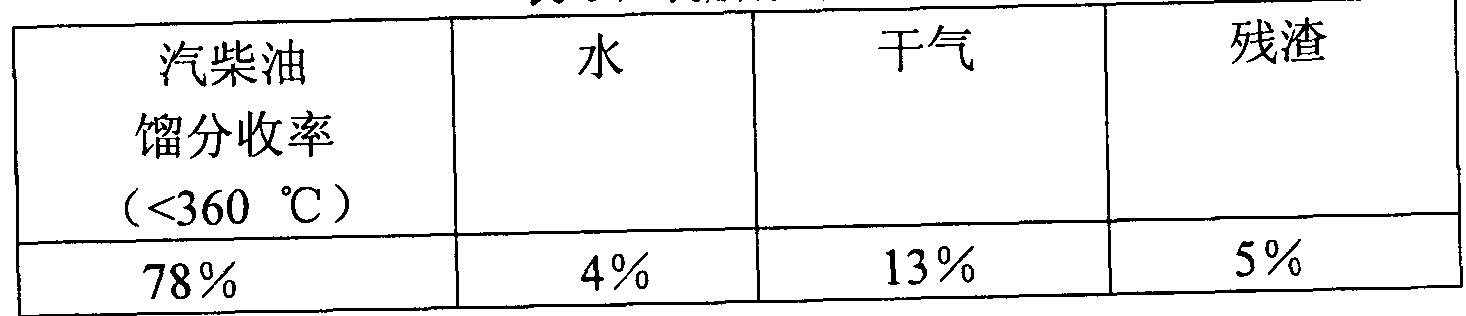
- Jatropha curcas oil was used as a raw material for the method of the present invention. Jatropha curcas oil is liquid at room temperature, and its basic properties, composition analysis and distillation range are shown in Table 5. 0 Table 5, base 2 characteristics of Jatropha curcas
- the catalytic cracking deoxidation step of the method of the present invention can remove the oxygen content in the feedstock oil in the form of water, thereby reducing the formation of water in the subsequent hydrogenation process and prolonging the hydrogenation catalyst. Life expectancy.
- the gasoline and diesel fraction yield is about 78%.
- the gasoline-diesel fraction deoxygenated by catalytic cracking is mixed with hydrogen, and then passed to a reaction tower equipped with a hydrodeoxygenation catalyst for reaction. A supported metal or metal sulfide is used as the hydrodeoxygenation catalyst.
- the remaining reaction conditions are shown in Table 7, and the composition analysis of the obtained clean fuel is shown in Table 8. Table 7.
- Example 1 and Example 2 respectively provide examples of the most difficult to process and easiest to process in non-edible animal and vegetable fats and oils, and by the method of the present invention, clean fuels excellent in properties can be obtained. It also reflects that the method of the present invention is not critical for biological fats and oils and can be applied to all bio-fabricated oils, even the most difficult-to-process palmitate oils, to produce high quality clean fuels by the method of the present invention.
- the clean fuel produced by the process of the present invention has a major carbon chain composition of C8-C24, which has a higher hexadeciene value than conventional petroleum diesel, has a lower density, and is substantially free of sulfur, nitrogen and aromatics.
- the clean fuel produced by the method of the present invention is an ideal high-quality diesel blending component, which can be blended with low-value catalytic light cycle oil hydrotreating to produce oil (lower value of hexadecanthene), thereby Production of ultra-low sulfur diesel that meets the relevant standards.
- Example 3 An example of applying the method of the present invention to industrial grade production of clean fuel is provided. Referring to Fig.
- a biological fat or oil raw material is injected into a distillation still 1 for heating, and then introduced into a catalytic distillation column 2, in which a cracking deoxidation catalyst is disposed, and a biodegradable solution is subjected to cracking and deoxidation under a certain temperature condition.
- the gasoline-diesel fraction obtained from the catalytic distillation column 2 is passed to a hydrotreating reaction column 7.
- the gasoline-diesel fraction produced by the catalytic distillation column 2 may be first mixed with hydrogen by a feed pump 5, and then heated into a hydrotreating reaction column 7 via a heat exchanger and a heating furnace 6.
- the hydrotreating reaction column 7 is provided with a hydrodeoxygenation catalyst, which is steamed by the catalyst under a preset temperature condition.
- the fraction from the distillation column 2 to the hydrorefining reaction column 7 is subjected to catalytic hydrodeoxygenation with hydrogen, and finally the obtained product can be passed to an atmospheric distillation column 9 for fractional distillation to obtain a clean fuel such as gasoline or diesel.
- the method of the invention first utilizes catalytic cracking deoxidation treatment to break a large number of carbon-oxygen bonds contained in the biological oil and fat, and then undergoes catalytic hydrodeoxygenation to obtain a final clean fuel, thereby effectively reducing the hydrogen consumption necessary for the hydrogenation reaction.
- the two-stage treatment of hydrodeoxygenation directly on the biological oil and then rehydroisomerization, or the prior art combines hydrodeoxygenation and hydroisomerization into one treatment.
- the process of the invention can save up to 50% of hydrogen usage.
- the method of the present invention does not require a lower alcohol and does not produce by-product glycerin, and the method is simple and can greatly reduce the cost.
Landscapes
- Chemical & Material Sciences (AREA)
- Oil, Petroleum & Natural Gas (AREA)
- Engineering & Computer Science (AREA)
- Chemical Kinetics & Catalysis (AREA)
- Organic Chemistry (AREA)
- General Chemical & Material Sciences (AREA)
- Life Sciences & Earth Sciences (AREA)
- Wood Science & Technology (AREA)
- Crystallography & Structural Chemistry (AREA)
- Microbiology (AREA)
- Production Of Liquid Hydrocarbon Mixture For Refining Petroleum (AREA)
- Fats And Perfumes (AREA)
Abstract
Description

Claims
Priority Applications (10)
| Application Number | Priority Date | Filing Date | Title |
|---|---|---|---|
| BR112013031344A BR112013031344A2 (pt) | 2011-06-13 | 2012-06-12 | método de preparação de combustível utilizando óleos e gorduras biológicos |
| PL12800464T PL2719746T3 (pl) | 2011-06-13 | 2012-06-12 | Sposób wytwarzania paliwa z oleju biologicznego i tłuszczu |
| PH1/2013/502356A PH12013502356A1 (en) | 2011-06-13 | 2012-06-12 | A method for preparing fuel by using biological oils and fats |
| DK12800464.5T DK2719746T3 (en) | 2011-06-13 | 2012-06-12 | Process for the production of fuel from biological oil and fat |
| EP12800464.5A EP2719746B1 (en) | 2011-06-13 | 2012-06-12 | Method for preparing fuel from biological oil and fat |
| US14/126,007 US9938468B2 (en) | 2011-06-13 | 2012-06-12 | Method for preparing fuel by using biological oils and fats |
| AU2012269637A AU2012269637B2 (en) | 2011-06-13 | 2012-06-12 | Method for preparing fuel from biological oil and fat |
| ES12800464T ES2714870T3 (es) | 2011-06-13 | 2012-06-12 | Método para preparar combustible usando aceites y grasas biológicas |
| IN9841DEN2013 IN2013DN09841A (zh) | 2011-06-13 | 2012-06-12 | |
| ZA2013/09448A ZA201309448B (en) | 2011-06-13 | 2013-12-13 | A method for preparing fuel by using biological oils and fats |
Applications Claiming Priority (4)
| Application Number | Priority Date | Filing Date | Title |
|---|---|---|---|
| CN2011101570812A CN102250634A (zh) | 2011-06-13 | 2011-06-13 | 一种利用植物油生产可再生汽柴油的方法 |
| CN201110157081.2 | 2011-06-13 | ||
| CN201110425819.9 | 2011-12-16 | ||
| CN2011104258199A CN102492455A (zh) | 2011-12-16 | 2011-12-16 | 从生物性油脂制备燃料的方法 |
Publications (1)
| Publication Number | Publication Date |
|---|---|
| WO2012171326A1 true WO2012171326A1 (zh) | 2012-12-20 |
Family
ID=47027371
Family Applications (1)
| Application Number | Title | Priority Date | Filing Date |
|---|---|---|---|
| PCT/CN2012/000790 Ceased WO2012171326A1 (zh) | 2011-06-13 | 2012-06-12 | 从生物性油脂制备燃料的方法 |
Country Status (15)
| Country | Link |
|---|---|
| US (1) | US9938468B2 (zh) |
| EP (1) | EP2719746B1 (zh) |
| CN (1) | CN102746871B (zh) |
| AU (1) | AU2012269637B2 (zh) |
| BR (1) | BR112013031344A2 (zh) |
| DK (1) | DK2719746T3 (zh) |
| ES (1) | ES2714870T3 (zh) |
| IN (1) | IN2013DN09841A (zh) |
| MY (1) | MY165737A (zh) |
| PH (1) | PH12013502356A1 (zh) |
| PL (1) | PL2719746T3 (zh) |
| SG (1) | SG10201607350VA (zh) |
| TW (1) | TWI551548B (zh) |
| WO (1) | WO2012171326A1 (zh) |
| ZA (1) | ZA201309448B (zh) |
Cited By (2)
| Publication number | Priority date | Publication date | Assignee | Title |
|---|---|---|---|---|
| CN111135855A (zh) * | 2020-03-19 | 2020-05-12 | 郑州轻工业大学 | 用于植物油脂气相催化裂化的整装式hzsm-5分子筛催化剂及其制备方法和应用 |
| CN114250079A (zh) * | 2021-11-17 | 2022-03-29 | 青岛科技大学 | 一种催化油酸甲酯选择性加氢脱氧生产生物柴油的方法 |
Families Citing this family (9)
| Publication number | Priority date | Publication date | Assignee | Title |
|---|---|---|---|---|
| CN106398875A (zh) * | 2016-11-11 | 2017-02-15 | 禄丰云瑞油脂科技有限公司 | 用地沟油生产硬脂酸的方法 |
| FI127783B (en) | 2017-11-27 | 2019-02-28 | Neste Oyj | Manufacture of a mixture of fuels |
| FI20176177A1 (en) * | 2017-12-28 | 2019-06-29 | Neste Oyj | Preparation of an aviation fuel composition |
| CN110423631A (zh) * | 2019-01-24 | 2019-11-08 | 易高环保能源研究院有限公司 | 一种动植物油脂直接加氢制备高十六烷值柴油的方法 |
| CN109913256B (zh) * | 2019-02-01 | 2021-07-02 | 易高环保能源研究院有限公司 | 利用高酸值生物性油脂制备燃料的方法及系统 |
| CN110467945A (zh) * | 2019-06-27 | 2019-11-19 | 江苏大学 | 一种微藻液化多产物参与餐厨废弃油共热解提质的方法 |
| CN119546725A (zh) * | 2022-07-08 | 2025-02-28 | 雪佛龙美国公司 | 废塑料与生物进料的共混物和制备方法 |
| CN115161073B (zh) * | 2022-07-11 | 2025-12-23 | 南京林业大学 | 一种皂脚两级加氢制备液体燃料的方法 |
| CN115595171B (zh) * | 2022-10-27 | 2024-04-05 | 江西尊创新能源有限公司 | 一步法生产高十六烷值低凝点生物柴油的加氢装置及工艺 |
Citations (16)
| Publication number | Priority date | Publication date | Assignee | Title |
|---|---|---|---|---|
| CN1412278A (zh) | 2002-11-04 | 2003-04-23 | 宋庭礼 | 用高酸值废动植物油生产生物柴油的方法 |
| US20060186020A1 (en) | 2005-02-18 | 2006-08-24 | Petroleo Brasileiro S.A. - Petrobras | Vegetable oil hydroconversion process |
| US20060207166A1 (en) | 2005-03-21 | 2006-09-21 | Ben-Gurion University Of The Negev Research & Development Authority | Production of diesel fuel from vegetable and animal oils |
| CN1858161A (zh) | 2006-06-02 | 2006-11-08 | 中国农业科学院油料作物研究所 | 利用棕榈油制备生物柴油的方法 |
| CN101070483A (zh) | 2007-07-13 | 2007-11-14 | 杨庆利 | 利用碱蓬籽仁油生产生物柴油的方法 |
| CN101230309A (zh) | 2008-01-11 | 2008-07-30 | 四川大学 | 一种降低高酸值棕榈油制生物柴油的方法 |
| CN101294091A (zh) * | 2007-04-27 | 2008-10-29 | 周鼎力 | 从含油植物中提取汽油柴油的方法和设备 |
| CN101314748A (zh) | 2007-05-31 | 2008-12-03 | 中国石油化工股份有限公司 | 一种植物油脂或/和动物油脂的催化转化方法 |
| CN101328418A (zh) | 2007-06-22 | 2008-12-24 | 俞炳宇 | 一种利用植物油制造生物柴油的方法 |
| WO2009039347A1 (en) | 2007-09-20 | 2009-03-26 | Uop Llc | Production of diesel fuel from biorenewable feedstocks with lower hydrogen consumption |
| CN101423451A (zh) * | 2007-10-31 | 2009-05-06 | 中国石油化工股份有限公司 | 一种从生物油脂制取低碳烯烃和芳烃的催化转化方法 |
| CN101475870A (zh) | 2009-01-17 | 2009-07-08 | 大连理工大学 | 一种资源化利用废润滑油生产汽柴油的方法 |
| CN101842465A (zh) * | 2007-06-15 | 2010-09-22 | 纳幕尔杜邦公司 | 将可再生资源转化成石蜡以用作柴油调合料的催化方法 |
| US20110011721A1 (en) * | 2009-07-16 | 2011-01-20 | Champagne Gary E | Vacuum Pyrolytic Gasification And Liquefaction To Produce Liquid And Gaseous Fuels From Biomass |
| WO2011031320A2 (en) * | 2009-09-09 | 2011-03-17 | University Of Massachusetts | Systems and processes for catalytic pyrolysis of biomass and hydrocarbonaceous materials for production of aromatics with optional olefin recycle, and catalysts having selected particle size for catalytic pyrolysis |
| CN102250634A (zh) * | 2011-06-13 | 2011-11-23 | 大连理工大学 | 一种利用植物油生产可再生汽柴油的方法 |
Family Cites Families (13)
| Publication number | Priority date | Publication date | Assignee | Title |
|---|---|---|---|---|
| US4399234A (en) * | 1981-10-13 | 1983-08-16 | Gulf Research & Development Company | Process for preparing gasoline range hydrocarbons from synthesis gas and catalyst used therefor |
| US4599480A (en) * | 1985-07-12 | 1986-07-08 | Shell Oil Company | Sequential cracking of hydrocarbons |
| US5336841A (en) * | 1993-04-05 | 1994-08-09 | Chemical Research & Licensing Company | Oxygenate removal in MTBE process |
| US6100435A (en) * | 1998-11-13 | 2000-08-08 | Exxon Chemical Patents Inc. | Use of catalytic distillation to produce cyclopentane or cyclopentene |
| US20070102481A1 (en) * | 2003-06-09 | 2007-05-10 | Rikiya Kato | Solder paste |
| MX2008000259A (es) * | 2005-07-04 | 2008-03-11 | Neste Oil Oyj | Proceso para la fabricacion de hidrocarburos de la clase del diesel. |
| EP2032677B1 (en) * | 2006-06-09 | 2021-08-04 | Albemarle Netherlands B.V. | Catalytic hydrodeoxygenation of an oxygenate feedstock |
| GB2447684B (en) | 2007-03-21 | 2011-11-23 | Statoil Asa | Biogasoline |
| US7999143B2 (en) * | 2007-09-20 | 2011-08-16 | Uop Llc | Production of diesel fuel from renewable feedstocks with reduced hydrogen consumption |
| FI20075794L (fi) | 2007-11-09 | 2009-05-10 | Upm Kymmene Oyj | Integroitu prosessi diesel-polttoaineen valmistamiseksi biologisesta materiaalista ja prosessiin liittyvät tuotteet, käyttötavat ja laitteisto |
| US8742183B2 (en) | 2007-12-21 | 2014-06-03 | Uop Llc | Production of aviation fuel from biorenewable feedstocks |
| CN101270300B (zh) * | 2008-04-30 | 2012-08-08 | 中国石油天然气股份有限公司 | 一种用于生产生物柴油的加氢脱氧催化剂 |
| CN101899326B (zh) * | 2010-05-14 | 2013-06-05 | 大连理工大学 | 一种页岩油催化提质方法 |
-
2012
- 2012-06-12 AU AU2012269637A patent/AU2012269637B2/en active Active
- 2012-06-12 MY MYPI2013702385A patent/MY165737A/en unknown
- 2012-06-12 WO PCT/CN2012/000790 patent/WO2012171326A1/zh not_active Ceased
- 2012-06-12 ES ES12800464T patent/ES2714870T3/es active Active
- 2012-06-12 IN IN9841DEN2013 patent/IN2013DN09841A/en unknown
- 2012-06-12 CN CN201210193332.7A patent/CN102746871B/zh active Active
- 2012-06-12 SG SG10201607350VA patent/SG10201607350VA/en unknown
- 2012-06-12 BR BR112013031344A patent/BR112013031344A2/pt not_active Application Discontinuation
- 2012-06-12 PL PL12800464T patent/PL2719746T3/pl unknown
- 2012-06-12 DK DK12800464.5T patent/DK2719746T3/en active
- 2012-06-12 EP EP12800464.5A patent/EP2719746B1/en active Active
- 2012-06-12 PH PH1/2013/502356A patent/PH12013502356A1/en unknown
- 2012-06-12 US US14/126,007 patent/US9938468B2/en active Active
- 2012-06-13 TW TW101121175A patent/TWI551548B/zh active
-
2013
- 2013-12-13 ZA ZA2013/09448A patent/ZA201309448B/en unknown
Patent Citations (16)
| Publication number | Priority date | Publication date | Assignee | Title |
|---|---|---|---|---|
| CN1412278A (zh) | 2002-11-04 | 2003-04-23 | 宋庭礼 | 用高酸值废动植物油生产生物柴油的方法 |
| US20060186020A1 (en) | 2005-02-18 | 2006-08-24 | Petroleo Brasileiro S.A. - Petrobras | Vegetable oil hydroconversion process |
| US20060207166A1 (en) | 2005-03-21 | 2006-09-21 | Ben-Gurion University Of The Negev Research & Development Authority | Production of diesel fuel from vegetable and animal oils |
| CN1858161A (zh) | 2006-06-02 | 2006-11-08 | 中国农业科学院油料作物研究所 | 利用棕榈油制备生物柴油的方法 |
| CN101294091A (zh) * | 2007-04-27 | 2008-10-29 | 周鼎力 | 从含油植物中提取汽油柴油的方法和设备 |
| CN101314748A (zh) | 2007-05-31 | 2008-12-03 | 中国石油化工股份有限公司 | 一种植物油脂或/和动物油脂的催化转化方法 |
| CN101842465A (zh) * | 2007-06-15 | 2010-09-22 | 纳幕尔杜邦公司 | 将可再生资源转化成石蜡以用作柴油调合料的催化方法 |
| CN101328418A (zh) | 2007-06-22 | 2008-12-24 | 俞炳宇 | 一种利用植物油制造生物柴油的方法 |
| CN101070483A (zh) | 2007-07-13 | 2007-11-14 | 杨庆利 | 利用碱蓬籽仁油生产生物柴油的方法 |
| WO2009039347A1 (en) | 2007-09-20 | 2009-03-26 | Uop Llc | Production of diesel fuel from biorenewable feedstocks with lower hydrogen consumption |
| CN101423451A (zh) * | 2007-10-31 | 2009-05-06 | 中国石油化工股份有限公司 | 一种从生物油脂制取低碳烯烃和芳烃的催化转化方法 |
| CN101230309A (zh) | 2008-01-11 | 2008-07-30 | 四川大学 | 一种降低高酸值棕榈油制生物柴油的方法 |
| CN101475870A (zh) | 2009-01-17 | 2009-07-08 | 大连理工大学 | 一种资源化利用废润滑油生产汽柴油的方法 |
| US20110011721A1 (en) * | 2009-07-16 | 2011-01-20 | Champagne Gary E | Vacuum Pyrolytic Gasification And Liquefaction To Produce Liquid And Gaseous Fuels From Biomass |
| WO2011031320A2 (en) * | 2009-09-09 | 2011-03-17 | University Of Massachusetts | Systems and processes for catalytic pyrolysis of biomass and hydrocarbonaceous materials for production of aromatics with optional olefin recycle, and catalysts having selected particle size for catalytic pyrolysis |
| CN102250634A (zh) * | 2011-06-13 | 2011-11-23 | 大连理工大学 | 一种利用植物油生产可再生汽柴油的方法 |
Non-Patent Citations (4)
| Title |
|---|
| "FANG Xiangchen", 2008, CHINA PETROCHEMICAL PRESS |
| "Industrial Catalysts Handbook", 2004, HUANG ZHONGTAO, CHEMICAL INDUSTRY PRESS |
| See also references of EP2719746A4 |
| YANYONG LIU ET AL., CHEM. LETT., vol. 38, 2009, pages 552 |
Cited By (3)
| Publication number | Priority date | Publication date | Assignee | Title |
|---|---|---|---|---|
| CN111135855A (zh) * | 2020-03-19 | 2020-05-12 | 郑州轻工业大学 | 用于植物油脂气相催化裂化的整装式hzsm-5分子筛催化剂及其制备方法和应用 |
| CN114250079A (zh) * | 2021-11-17 | 2022-03-29 | 青岛科技大学 | 一种催化油酸甲酯选择性加氢脱氧生产生物柴油的方法 |
| CN114250079B (zh) * | 2021-11-17 | 2023-01-10 | 青岛科技大学 | 一种催化油酸甲酯选择性加氢脱氧生产生物柴油的方法 |
Also Published As
| Publication number | Publication date |
|---|---|
| AU2012269637B2 (en) | 2017-05-18 |
| CN102746871A (zh) | 2012-10-24 |
| BR112013031344A2 (pt) | 2016-11-29 |
| EP2719746A1 (en) | 2014-04-16 |
| PH12013502356A1 (en) | 2014-01-06 |
| EP2719746B1 (en) | 2019-01-02 |
| SG10201607350VA (en) | 2016-10-28 |
| AU2012269637A1 (en) | 2014-01-16 |
| HK1177221A1 (zh) | 2013-08-16 |
| US9938468B2 (en) | 2018-04-10 |
| ZA201309448B (en) | 2015-04-29 |
| TWI551548B (zh) | 2016-10-01 |
| PL2719746T3 (pl) | 2019-06-28 |
| IN2013DN09841A (zh) | 2015-07-03 |
| EP2719746A4 (en) | 2015-06-17 |
| CN102746871B (zh) | 2016-02-17 |
| TW201249753A (en) | 2012-12-16 |
| DK2719746T3 (en) | 2019-04-01 |
| ES2714870T3 (es) | 2019-05-30 |
| US20140135542A1 (en) | 2014-05-15 |
| MY165737A (en) | 2018-04-20 |
Similar Documents
| Publication | Publication Date | Title |
|---|---|---|
| TWI551548B (zh) | 從生物性油脂製備燃料的方法 | |
| Liu et al. | Hydrotreatment of vegetable oils to produce bio-hydrogenated diesel and liquefied petroleum gas fuel over catalysts containing sulfided Ni–Mo and solid acids | |
| Sugami et al. | Renewable diesel production from rapeseed oil with hydrothermal hydrogenation and subsequent decarboxylation | |
| JP2012530149A (ja) | 植物油または脂肪酸誘導体を用いるディーゼル燃料の調製方法 | |
| Choo et al. | Recent progress in catalytic conversion of microalgae oil to green hydrocarbon: A review | |
| Li et al. | Recent advances for the production of hydrocarbon biofuel via deoxygenation progress | |
| KR20120032018A (ko) | 천연 지방 & 오일의 복합 혼합물로부터의 바이오-나프타의 제조 방법 | |
| AU2006264899A1 (en) | Process for the manufacture of diesel range hydrocarbons | |
| JP7530097B2 (ja) | 液体炭化水素燃料の製造方法 | |
| CN104250558A (zh) | 一种脂肪酸酯加氢生产正构烷烃的方法 | |
| WO2013086762A1 (zh) | 从生物性油脂制备燃料的方法 | |
| Krár et al. | Bio gas oils with improved low temperature properties | |
| CN101815777A (zh) | 制备生物基燃料的高能效方法 | |
| US12286599B2 (en) | Method and system for preparing fuel by using high acid value biological oil and fat | |
| CN106170530B (zh) | 生产烯烃化合物和烃燃料或其馏分的方法 | |
| Lalitpattarakit et al. | Effects of operating parameters on green diesel production via deoxygenation of triglycerides | |
| Oi et al. | Mesoporous and other types of catalysts for conversion of non-edible oil to biogasoline via deoxygenation | |
| CN102250634A (zh) | 一种利用植物油生产可再生汽柴油的方法 | |
| Aziz et al. | Synthesis of green diesel from palm oil using nickel-based catalyst: A review | |
| Xie et al. | Research progress on biodiesel production utilizing waste oils and biomass-derived catalysts | |
| Rahmawati et al. | Review journal: The effect of heterogeneous zeolite catalyst and modified zeolite catalysts on biogaseline yields | |
| HK1177221B (zh) | 从生物性油脂制备燃料的方法 | |
| Dragomir et al. | Renewable Diesel Production by Co-processing of Rapeseed Oil Mixed with Straight Run Gas Oil | |
| Zhao et al. | Catalytic cracking of sunflower oils over ZSM-5 catalysts | |
| Baladincz et al. | Investigation of the hydroconversion of lard and lard-gas oil mixture on PtPd/USY catalyst |
Legal Events
| Date | Code | Title | Description |
|---|---|---|---|
| 121 | Ep: the epo has been informed by wipo that ep was designated in this application |
Ref document number: 12800464 Country of ref document: EP Kind code of ref document: A1 |
|
| WWE | Wipo information: entry into national phase |
Ref document number: 2012800464 Country of ref document: EP |
|
| NENP | Non-entry into the national phase |
Ref country code: DE |
|
| ENP | Entry into the national phase |
Ref document number: 2012269637 Country of ref document: AU Date of ref document: 20120612 Kind code of ref document: A |
|
| WWE | Wipo information: entry into national phase |
Ref document number: 14126007 Country of ref document: US |
|
| REG | Reference to national code |
Ref country code: BR Ref legal event code: B01A Ref document number: 112013031344 Country of ref document: BR |
|
| ENP | Entry into the national phase |
Ref document number: 112013031344 Country of ref document: BR Kind code of ref document: A2 Effective date: 20131205 |