WO2012173232A1 - 中空糸膜モジュールの補修方法および中空糸膜モジュール - Google Patents
中空糸膜モジュールの補修方法および中空糸膜モジュール Download PDFInfo
- Publication number
- WO2012173232A1 WO2012173232A1 PCT/JP2012/065381 JP2012065381W WO2012173232A1 WO 2012173232 A1 WO2012173232 A1 WO 2012173232A1 JP 2012065381 W JP2012065381 W JP 2012065381W WO 2012173232 A1 WO2012173232 A1 WO 2012173232A1
- Authority
- WO
- WIPO (PCT)
- Prior art keywords
- hollow fiber
- fiber membrane
- repair
- membrane module
- leak
- Prior art date
- Legal status (The legal status is an assumption and is not a legal conclusion. Google has not performed a legal analysis and makes no representation as to the accuracy of the status listed.)
- Ceased
Links
Images


Classifications
-
- B—PERFORMING OPERATIONS; TRANSPORTING
- B01—PHYSICAL OR CHEMICAL PROCESSES OR APPARATUS IN GENERAL
- B01D—SEPARATION
- B01D65/00—Accessories or auxiliary operations, in general, for separation processes or apparatus using semi-permeable membranes
- B01D65/10—Testing of membranes or membrane apparatus; Detecting or repairing leaks
- B01D65/106—Repairing membrane apparatus or modules
- B01D65/108—Repairing membranes
-
- B—PERFORMING OPERATIONS; TRANSPORTING
- B01—PHYSICAL OR CHEMICAL PROCESSES OR APPARATUS IN GENERAL
- B01D—SEPARATION
- B01D65/00—Accessories or auxiliary operations, in general, for separation processes or apparatus using semi-permeable membranes
- B01D65/10—Testing of membranes or membrane apparatus; Detecting or repairing leaks
- B01D65/106—Repairing membrane apparatus or modules
-
- B—PERFORMING OPERATIONS; TRANSPORTING
- B01—PHYSICAL OR CHEMICAL PROCESSES OR APPARATUS IN GENERAL
- B01D—SEPARATION
- B01D69/00—Semi-permeable membranes for separation processes or apparatus characterised by their form, structure or properties; Manufacturing processes specially adapted therefor
- B01D69/08—Hollow fibre membranes
-
- B—PERFORMING OPERATIONS; TRANSPORTING
- B01—PHYSICAL OR CHEMICAL PROCESSES OR APPARATUS IN GENERAL
- B01D—SEPARATION
- B01D2321/00—Details relating to membrane cleaning, regeneration, sterilization or to the prevention of fouling
- B01D2321/34—Details relating to membrane cleaning, regeneration, sterilization or to the prevention of fouling by radiation
-
- B—PERFORMING OPERATIONS; TRANSPORTING
- B01—PHYSICAL OR CHEMICAL PROCESSES OR APPARATUS IN GENERAL
- B01D—SEPARATION
- B01D2321/00—Details relating to membrane cleaning, regeneration, sterilization or to the prevention of fouling
- B01D2321/42—Chemical regeneration
Definitions
- the present invention relates to a method for repairing a hollow fiber membrane module and a hollow fiber membrane module used for filtering water to be treated in sewage treatment; water purification treatment; tertiary treatment for the purpose of purifying reclaimed water.
- hollow fiber membrane modules have been widely used.
- the hollow fiber membrane module is immersed in the water tank to be treated with the membrane exposed, and filters the water to be treated.
- a hollow fiber membrane module includes, for example, a plurality of hollow fiber membranes arranged in a sheet shape, and two water collecting pipes provided at both ends in the length direction of the hollow fiber membrane. There is.
- both ends of each hollow fiber membrane are fixed in the water collecting pipe by a potting material, and at least one of the ends is open.
- a leak portion may occur due to a defect in the manufacturing process when manufacturing the hollow fiber membrane module.
- a potting material enters and cures between the hollow fiber membranes or between the hollow fiber membrane and the water collecting tube, so that the hollow fiber membranes or the hollow fiber membrane and the water collecting tube are cured. And are fixed. However, at that time, air remains in the potting material, and as a result, the inside and outside of the hollow fiber membrane may not be completely isolated, and may become a leak portion.
- Patent Document 1 discloses a repair method using a one-pack type ultraviolet curable resin
- Patent Document 2 discloses a repair method using a hot melt resin.
- the present invention has been made in view of the above circumstances, and it is an object of the present invention to provide a repair method that excels in repair workability, strength of repaired portions, and the like.
- a method for repairing a leak portion generated in a hollow fiber membrane module wherein the leak portion is repaired using a repair agent that is cured by a combined curing function having a moisture curing function and a light curing function. It is a repair method of a hollow fiber membrane module which has a process.
- gas is injected into the hollow fiber membrane module in the filtration direction of the hollow fiber membrane module or in the opposite direction, and the leak It is a repair method of the hollow fiber membrane module as described in [1] which performs the said repair process after detecting a part.
- the leak portion is a defective portion of the membrane surface of the hollow fiber membrane included in the hollow fiber membrane module, and in the repairing step, the repair agent is applied to the defective portion, [1] or [2 ].
- [6] The method for repairing a hollow fiber membrane module according to any one of [1] to [5], wherein the repair agent has a viscosity at room temperature before curing of 10 to 3000 mPa ⁇ s.
- [7] The hollow fiber according to any one of [1] to [6], wherein a moisture content of the hollow fiber membrane included in the hollow fiber membrane module when performing the repairing step is 90% by mass or less. This is a method for repairing a membrane module.
- [8] A hollow fiber membrane module repaired by the method according to any one of [1] to [7].
- the repair method of the present invention is excellent in repair workability and strength of repaired parts.
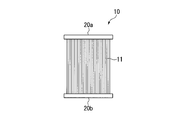
- FIG. 1 is a front view showing an example of a hollow fiber membrane module repaired by the leak repair method of the present invention.
- This hollow fiber membrane module 10 includes a plurality of hollow fiber membranes 11 arranged in a sheet shape, and two water collection pipes 20a and 20b provided at both ends in the length direction of the hollow fiber membrane 11. And has a flat rectangular shape as a whole. Both ends of each hollow fiber membrane 11 are open and fixed in a non-removable manner in the water collecting pipes 20a and 20b by a potting material made of polyurethane resin or the like, and the flow paths in the hollow fiber membranes 11 and the water collecting pipes 20a and 20b Are communicating.
- the hollow fiber membrane module 10 shown in FIG. 1 is generally referred to as a submerged membrane module, and is immersed in a water tank to be treated and suction filtered to at least one of the end surfaces of the water collecting tubes 20a and 20b. Filtered water can be obtained from a water intake (not shown) formed in the above.
- the fraction level of the hollow fiber membrane 11 may be any level of a microfiltration membrane (MF), an ultrafiltration membrane (UF), a nanofiltration membrane (NF), etc., depending on the subject of filtration,
- MF microfiltration membrane
- UF ultrafiltration membrane
- NF nanofiltration membrane
- the pore diameter, porosity, film thickness, outer diameter, etc. are appropriately determined.
- an ultrafiltration membrane particularly a hollow fiber membrane having a membrane fraction molecular weight of tens of thousands to hundreds of thousands.
- the outer diameter of the hollow fiber membrane 11 is, for example, 0.1 to 10 mm, and preferably 0.5 to 5 mm.
- the material of the hollow fiber membrane 11 is not limited as long as it is a material that can be molded into a hollow fiber membrane, and for example, a resin such as cellulose, polyolefin, polyvinyl alcohol, polysulfone, polyacrylonitrile, and fluorine can be used. 1 or more types can be used. Specific examples include polyethylene, polypropylene, polyvinylidene fluoride, polytetrafluoroethylene, and polysulfone.
- PVDF polyvinylidene fluoride
- examples of the polyvinylidene fluoride include a homopolymer of vinylidene fluoride and a copolymer obtained by copolymerizing a monomer copolymerizable with vinylidene fluoride with vinylidene fluoride.
- Examples of the monomer copolymerizable with vinylidene fluoride include vinyl fluoride, tetrafluoroethylene, ethylene trifluoride, hexafluoropropylene, and the like, and one or more types can be used.
- the hollow fiber membrane 11 may be provided with a hollow support inside for the purpose of preventing membrane breakage during long-term use.
- the support include hollow monofilament yarn, knitted string, braided string, and the like.
- thermosetting resin such as an epoxy resin is preferably used in addition to the above-described polyurethane resin.
- the potting material isolates the inside and the outside of the hollow fiber membrane 11 in the water collection pipes 20a and 20b.
- the material of the water collecting pipes 20a and 20b may be any material having mechanical strength and durability, such as polycarbonate, polysulfone, polypropylene, acrylic resin, ABS resin, modified PPE resin, PPS resin, and corrosion-resistant metal. It is preferable to select one having good adhesion to the potting material.
- the immersion type hollow fiber membrane module having a flat rectangular shape as a whole as shown in FIG. 1, for example, Zeeweed 500d of Zenon Environment Co., Ltd., SADF 2580 of Mitsubishi Rayon Co., Ltd. and the like can be mentioned. Since such a hollow fiber membrane module 10 has a flat rectangular shape, it has excellent integration and cleanability when immersed in the water tank to be treated. Moreover, since the water collection part 20a, 20b is the form fixed to the both ends of the hollow fiber membrane 11 so that attachment or detachment is impossible, the pressure collection property is excellent, the structure is simple, and the degree of integration is high. preferable.
- the configuration and shape of the hollow fiber membrane module are not limited to those shown in the drawings, and are appropriately selected in view of the size of the water tank to be treated, the properties of the treatment components contained in the water to be treated, the cleanability, etc.
- the water collecting pipe is not limited to a pipe having a rectangular cross section perpendicular to the axial direction, and includes a pipe having a circular (annular) cross section.
- FIG. 1 In addition, in FIG.
- a so-called immersion type membrane module is shown as an example, but in this embodiment, by pressurizing water to be treated, from the outer peripheral side or inner peripheral side of the hollow fiber membrane, the inner peripheral side or outer peripheral side
- the present invention can also be applied to a so-called pressure-type membrane module that is fed into a filter to obtain filtered water.
- examples of the cylindrical pressure-type hollow fiber membrane module include Microsa UNA-600A and Microsa UNA-620A manufactured by Asahi Kasei Corporation.
- the membrane surface of the hollow fiber membrane 11 is damaged by foreign matters contained in the water to be treated, and defective portions such as pinholes and tears occur on the membrane surface.
- defects in the manufacturing process for example, poor injection of potting material, occur between the hollow fiber membranes 11 or in the gap between the hollow fiber membrane 11 and the water collecting pipes 20a and 20b.
- the portion becomes a leak portion, and in some cases, the potting material is peeled off from the water collecting pipes 20a and 20b as the hollow fiber membrane module 10 is used, thereby becoming a leak portion.
- the leak portion refers to a portion in which the separation between the inner side and the outer side of the hollow fiber membrane 11 becomes incomplete and the water to be treated leaks into the filtered water side.
- Examples of a leak inspection method for detecting the leak portion 30 include an inspection method using fine particles and a so-called suction method.
- the hollow fiber membrane module 10 is used. 10 is preferably a method in which gas is injected in the filtration direction of the hollow fiber membrane module 10 or in the opposite direction, and the leak portion is specified from the location where bubbles are generated.
- the hollow fiber membrane module 10 is immersed in an organic solvent aqueous solution such as an ethanol aqueous solution, and a gas is injected in that state, or the hollow fiber membrane module 10 is immersed in an ethanol aqueous solution to hydrophilize the membrane surface,
- an organic solvent aqueous solution such as an ethanol aqueous solution
- a gas is injected in that state
- the hollow fiber membrane module 10 is immersed in an ethanol aqueous solution to hydrophilize the membrane surface
- a surfactant aqueous solution may be used in place of the organic solvent aqueous solution.
- Such a leak inspection method using a pressurized gas has high detection sensitivity and is widely adopted.
- the water collection pipes 20 a and 20 b are fixed to both ends of the hollow fiber membrane 11 so as not to be detachable, and the end face of the hollow fiber membrane 11 cannot be exposed.
- gas is press-fitted into the hollow fiber membrane 11 from the water collecting pipes 20a and 20b side, and bubbles from the hollow fiber membrane 11 are removed.
- a method of specifying the generation point that is, a method of press-fitting gas in the direction opposite to the filtration direction is preferably employed.
- the leak portion 30 thus detected is repaired using a curable repair agent having a composite curing function (repair process).
- the curable repair agent having a composite curing function refers to a resin-based repair agent that starts curing by at least two mechanisms.
- the initiation of the curing includes, for example, secondary polymerization with a macromonomer.
- Such a repair agent having a composite curing function is excellent in curability in a short time and can repair the leaked portion 30 quickly and uniformly, so that the workability of the repair is good, and the strength and durability of the repaired portion. Also excellent.
- Specific examples of the curing function include photocuring, heat curing, moisture curing and the like.
- a one-pack type repairing agent excellent in pot life is preferable from the viewpoint of workability.
- acrylic adhesive, epoxy adhesive, oxetane adhesive, cyanoacrylate adhesive, silicone adhesive Among them, those having a composite curing function can be appropriately selected.
- the repair agent used in this embodiment has at least a moisture curing function and a light curing function (ultraviolet curing function) as a composite curing function.
- a repairing agent having at least a moisture curing function the hollow fiber membrane module 10 in a wet state after the leak portion 30 is detected by the method using the pressurized gas as described above is used for drying. Can be repaired without drying.
- the repair agent having a moisture curing function reacts with moisture contained in the hollow fiber membrane 11 and cures, the anchor effect is exhibited and the hollow fiber membrane 11 is well bonded.
- the hollow fiber membrane is not used when performing leak re-inspection to confirm whether or not the leak portion is reliably closed after repairing the leak portion, or when returning the hollow fiber membrane module to the water tank to be treated. It is necessary to make the yarn membrane hydrophilic again, which takes time and labor. On the other hand, when it is not dried before repairing, the work of making it hydrophilic again becomes unnecessary, and both time and labor can be reduced.
- contraction of the hollow fiber membrane by repeating drying and hydrophilization can also be avoided. Furthermore, if drying is not required before repair, it is not necessary to move the hollow fiber membrane module 10 to a facility with a drying facility, and it is possible to quickly repair at the site of use thereof, that is, a water purification plant or a sewage treatment plant. it can. As a result, the time and labor required for the work associated with the repair of the leak portion 30 can be greatly reduced, and the work efficiency on site can be greatly improved.
- drying of a leak part is indispensable as pre-processing at the time of repair. If the leak portion is not dried, these repair agents do not adhere well to the leak portion.
- the repair agent which has a photocuring function with such a moisture hardening function is used, about the area
- a region where light energy is difficult to reach for example, a deep portion of a repair agent
- the repair agent at the repaired portion has a high degree of crosslinking, and does not swell or deteriorate even when immersed in water after curing, and is excellent in strength and durability.
- a repair agent having a photo-curing function refers to a substance that begins to cure by UV irradiation and cures to practical strength, and after that, it can maintain practical strength even after UV irradiation is stopped. Those having characteristics such as curing in units are preferred.
- a repairing agent having a photocuring function a repairing agent that contains a photopolymerization initiator having a reaction wavelength between 100 and 400 nm and can avoid the influence of visible light (indoor scattered light) is preferable.
- LED ultraviolet lamps that are commonly used as ultraviolet irradiation devices have the largest amount of light in the vicinity of 350 nm, and such a repair agent containing a photopolymerization initiator having a maximum absorption in the vicinity of 350 nm is efficient, cost and resource-saving. From the viewpoint of, it can be preferably used.
- a repairing agent having a moisture curing function and a photocuring function as a composite curing function for example, a repairing agent containing a cyanoacrylate-based component and a photopolymerization initiator, a polymerizable silicon-containing component and a photopolymerization initiator are contained. And repair agents. Among these, a repair agent containing a cyanoacrylate-based component and a photopolymerization initiator is preferable from the viewpoint of solvent resistance and adhesive strength.
- cyanoacrylate-based component examples include cyanoacrylate monomers represented by the chemical formula: H 2 C ⁇ C (CN) —COOR.
- R is, for example, a substituent selected from C1-15 alkyl, alkoxyalkyl, cycloalkyl, alkenyl, aralkyl, aryl, allyl and haloalkyl groups.
- cyanoacrylate monomer examples include methyl cyanoacrylate, ethyl-2-cyanoacrylate, propyl cyanoacrylate, butyl cyanoacrylate (eg, n-butyl-2-cyanoacrylate), octyl cyanoacrylate, allyl cyanoacrylate, ⁇ -Methoxyethyl cyanoacrylate, one or more of which can be used.
- ethyl-2-cyanoacrylate is particularly preferred.
- the amount of the cyanoacrylate component contained in the repair agent is preferably 50 to 98% by mass, more preferably 75 to 95% by mass, and still more preferably 85 to 90% by mass.
- Examples of the polymerizable silicon-containing component include silicon-containing monomers and silicon-containing oligomers or macromonomers having these silicon-containing monomers as repeating units.
- examples of the silicon-containing monomer include compounds having two or more alkoxysilyl groups (for example, alkyltrimethoxysilane such as vinyltrimethoxysilane and aminoalkyltrimethoxysilane such as 3-aminopropyltriethoxysilane). it can.
- silicon-containing oligomers or macromonomers a part of the unreacted alkoxysilyl group may be hydrolyzed to form a silanol group.
- 1 or more types of polymerizable silicon-containing components can be used.
- the photopolymerization initiator is not particularly limited, but a photopolymerization initiator commercially available under the trade name “IRGACURE” from Ciba Specialty Chemicals, Tarrytown, New York or the trade name “DAROCUR” is preferable.
- Such photopolymerization initiator is specifically exemplified below.
- “IRGACURE” 184 (1-hydroxycyclohexyl phenyl ketone)
- “IRGACURE” 907 (2-methyl-1- [4- (methylthio) phenyl] -2-morpholinopropan-1-one)
- “IRGACURE” 369 (2-benzyl-2-N, N-dimethylamino-1- (4-morpholinophenyl) -1-butanone)
- “IRGACURE” 500 combination of 1-hydroxycyclohexyl phenyl ketone and benzophenone
- “IRGACURE” 651 (2,2-dimethoxy-2-phenylacetophenone)
- “IRGACURE” 1700 (combination of bis (2,6-dimethoxybenzoyl-2,4,4-trimethylpentyl) phosphine oxide and 2-hydroxy-2-methyl-1-phenylpropan-1-one) (7) “
- photoinitiators useful in this embodiment include alkyl pyruvates (eg, methyl pyruvate, ethyl pyruvate, propyl pyruvate, butyl pyruvate, etc.), aryl pyruvates (eg, phenyl pyruvate, benzyl Pyruvate, etc.) and derivatives in which some of these compounds are substituted with substituents.
- alkyl pyruvates eg, methyl pyruvate, ethyl pyruvate, propyl pyruvate, butyl pyruvate, etc.
- aryl pyruvates eg, phenyl pyruvate, benzyl Pyruvate, etc.
- photopolymerization initiators for use in this embodiment include 2,2-dimethoxy-2-phenylacetophenone (eg, “IRGACURE” 651), 2-hydroxy-2-methyl-1-phenyl- UV photoinitiators such as 1-propane (eg “DAROCUR” 1173), bis (2,4,6-trimethylbenzoyl) phenylphosphine oxide (eg “IRGACURE” 819); bis (2,6-dimethoxybenzoyl- (2,4,4-trimethylpentyl) phosphine oxide and 2-hydroxy-2-methyl-1-phenylpropan-1-one in combination with an ultraviolet / visible initiator (eg “IRGACURE” 1700); 5 -2,4-cyclopentadiene-1-yl) bis [2,6-difluoro-3-(1H-pyrrol - 1-yl) phenyl] titanium (e.g. "IRGACURE” 784DC)).
- DAROCUR 2-hydroxy-2-methyl-1-
- the periphery of the leak portion 30 is at least wet without drying the hollow fiber membrane module 10 after the leak test using a drying facility.
- the repair agent 40 While in the state, as shown in FIG. 2B, the repair agent 40 is attached so as to block the leak portion 30 on the membrane surface of the hollow fiber membrane.
- the adhesion method include a method of dropping the repair agent 40 and a method of applying it.
- the repair agent 40 adheres well to the periphery of the leak portion 30 due to the anchor effect caused by the reaction with the moisture in the hollow fiber membrane 11, and is sufficient even for regions where moisture is difficult to penetrate by ultraviolet irradiation. Harden. Therefore, the repair agent 40 at the repaired portion has strength and durability due to the anchor effect and a high degree of cross-linking, and does not swell or deteriorate even if immersed in the water tank to be treated again.
- the wet state is a state where moisture adheres to the finger or the like when the hollow fiber membrane is lightly pressed with the finger or the like.
- the “periphery of the leak portion” means a portion to which a repair agent adheres for the purpose of closing the leak portion, and the repair agent usually includes the leak portion in the length direction of the hollow fiber membrane. In the range of about 3 to 5 cm.
- the hollow fiber membrane module 10 in the example of FIG. 1 has a configuration in which the water collecting pipes 20a and 20b are fixed to both ends of the hollow fiber membrane 11 so as not to be detachable and the end face of the hollow fiber membrane 11 cannot be exposed.
- the repair method of directly closing the leak portion 30 with the repair agent 40 is employed, and the repair method of sealing the end face of the hollow fiber membrane in which the leak portion is generated cannot be employed.
- the ultraviolet irradiation device in addition to the LED ultraviolet lamp (UV-LED) described above, for example, a metal halide lamp, a high-pressure mercury lamp, an ultra-high pressure mercury lamp, a deep ultraviolet lamp, a lamp that uses a microwave to excite a mercury lamp without an electrode from the outside, Examples include ultraviolet lasers and xenon lamps.
- UV-LED LED ultraviolet lamp
- a metal halide lamp for example, a metal halide lamp, a high-pressure mercury lamp, an ultra-high pressure mercury lamp, a deep ultraviolet lamp, a lamp that uses a microwave to excite a mercury lamp without an electrode from the outside
- Examples include ultraviolet lasers and xenon lamps.
- an LED ultraviolet lamp using a UV-LED as a light source is easier to switch between lighting (irradiation) and extinguishing than, for example, other ultraviolet lamps. Therefore, in the repair work in which turning on (irradiating) and turning off is repeated, it is preferable to easily control the timing of ultraviolet i
- the viscosity before curing of the repair agent 40 affects the workability of repair, the durability of repaired parts, and the like.
- the preferred viscosity of the repair agent 40 varies depending on the size of the leak portion 30 and the like, and can be used from 1 mPa ⁇ s to a paste at room temperature (23 ° C.), preferably 10 to 3000 mPa ⁇ s, more preferably Is 100 to 1000 mPa ⁇ s.
- the viscosity exceeds the upper limit of the above range, even if the repair agent 40 is attached to the periphery of the leaked portion 30 in a wet state, the repair agent 40 is less likely to penetrate in the film thickness direction, It becomes difficult to carry out a substitution / crosslinking reaction.
- the anchor effect due to the reaction between the repair agent 40 and the moisture contained in the hollow fiber membrane 11 is reduced, and the durability when the repaired hollow fiber membrane module is used for a long time tends to decrease.
- the viscosity exceeds the upper limit of the above range the applied repair agent 40 has a large film thickness, making it difficult for ultraviolet rays to reach the deep part of the repair agent 40, and the membrane surface of the hollow fiber membrane 11 and the repair agent. Curing of the repairing agent 40 in the vicinity of the interface with 40 is weakened. As a result, unless the ultraviolet irradiation time is lengthened, the durability of the repaired portion tends to be lowered.
- the repair agent 40 spreads over a wide area around the leak portion 30, and it becomes difficult to maintain a sufficient film thickness as the repair agent 40.
- the anchor effect becomes insufficient, and the durability when the repaired hollow fiber membrane module is used for a long time tends to be lowered.
- the hole of the part which does not need repair may be obstruct
- a photopolymerization initiator having an absorption maximum at a wavelength of 365 nm which is often used as a wavelength of an ultraviolet lamp and ethyl Preferred examples include cyanoacrylate photocurable instant adhesives containing -2-cyanoacrylate. Examples of such a cyanoacrylate photocurable instant adhesive include Henkel's Loctite # 4305 and ThreeBond # 1773E.
- a preferable wet state of the hollow fiber membrane when performing the repairing process is a state where the moisture content of the hollow fiber membrane is 90% by mass or less.
- the repair agent 40 does not sufficiently adhere to the damaged portion on the periphery of the leak portion 30 and may flow down. Therefore, the surface of the hollow fiber membrane to be repaired may be absorbed with water-absorbing paper (such as waste paper) to wipe off water droplets on the surface, and the moisture content may be 90% by mass or less.
- the preferable lower limit of the moisture content is 30% by mass, and the more preferable lower limit is 50% by mass. If the moisture content is less than 30% by mass, the moisture curing function of the repair agent may not work sufficiently when the outside air is dry.
- the moisture content of the hollow fiber membrane is measured in advance using a hollow fiber membrane sample.
- a hollow fiber membrane sample For example, when a hollow fiber membrane immersed in a hydrophilic liquid such as a hydrophilizing agent, water, or an aqueous solution is taken out of the liquid and left at room temperature (23 ° C.) in the leak inspection or the like, the standing time increases. Accordingly, the moisture content of the hollow fiber membrane decreases. Therefore, if the relationship between the standing time and the moisture content of the hollow fiber membrane is determined in advance using, for example, a sample cut to a length of 3 to 5 cm, the hollow fiber membrane to be actually repaired can be left at room temperature. The moisture content can be determined based on time.
- the moisture content may be adjusted by wiping the surface of the hollow fiber membrane with water-absorbing paper, so what is the moisture content after the surface of the hollow fiber membrane is wiped with water-absorbing paper? Or, it is possible to adopt a method that is obtained in advance.
- the water content of the hollow fiber membrane is “the water content of the periphery of the leak portion of the hollow fiber membrane”
- the periphery of the leak portion is “for the purpose of closing the leak portion” The part where the repair agent is attached.
- the moisture content is the percentage of moisture contained in the sample when the mass of the sample to be measured is 100% by mass, and is obtained by the following formula.
- Moisture content (mass%) (mass before drying ⁇ mass after drying) / mass before drying ⁇ 100
- the mass before drying is the mass of the hollow fiber membrane sample taken out after being immersed in a hydrophilic liquid.
- the mass after drying is the mass after the hollow fiber membrane sample that has been dipped in a hydrophilic liquid and taken out is dried. Specifically, after the hollow fiber membrane sample was left in a constant temperature dryer at 105 ° C. for 2 hours, taken out from the dryer, immediately moved into a desiccator that is a dry atmosphere and allowed to cool for 40 to 60 minutes. The mass after drying.
- the repair agent when a curable repair agent having a composite curing function is used in the repair process for repairing a leak portion, the repair agent is excellent in curability in a short time and repairs the leak portion quickly and uniformly. Therefore, the workability of repair is good, and the strength and durability of the repaired part are also excellent.
- the hollow fiber membrane when a repair agent having a moisture curing function and a light curing function is used as the composite curing function, the hollow fiber membrane can be repaired without drying with a drying facility, and the combined effect of the moisture curing function and the light curing function is achieved.
- the repaired part adheres well to the hollow fiber membrane and has a high degree of cross-linking to the inside of the repairing agent, so that it does not swell or deteriorate even if immersed in the water tank to be treated again. Excellent durability.
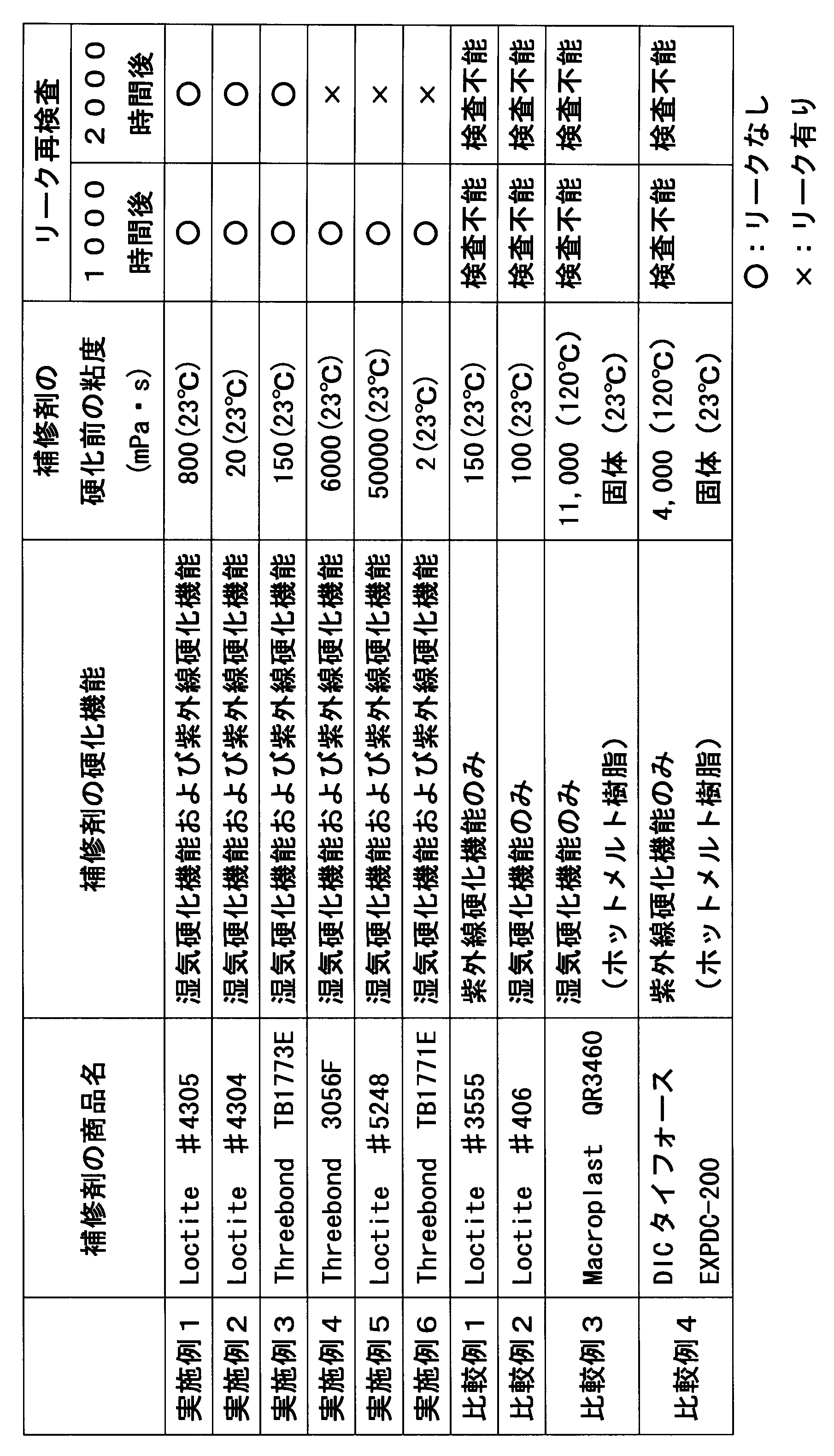
- Example 1 A number of porous hollow fiber membranes (manufactured by Mitsubishi Rayon Co., Ltd., inner diameter 1000 ⁇ m, outer diameter 2800 ⁇ m) processed into a hollow shape by knitting PET (polyester) fibers and having a PVDF porous portion formed on the surface thereof, With respect to the immersion type hollow fiber membrane module in which these hollow fiber membranes are exposed, the following are performed: (1) Leak inspection, (2) Leak repair, and (3) Leak after repair Inspection and filtration operation were performed.
- the hollow fiber membrane module described above is immersed in a hydrophilization solution (manufactured by Nissin Chemical Industry Co., Ltd., Olphine EXP4036, 0.3 wt% aqueous solution: surface tension 25.8 mN / m) for 10 minutes, and then temporarily removed. Then, it was re-immersed in a water tank containing water, and in that state, pressurized air was injected from the inside to the hollow fiber membrane of the hollow fiber membrane module at 100 kPa, and a leak test was performed.
- a hydrophilization solution manufactured by Nissin Chemical Industry Co., Ltd., Olphine EXP4036, 0.3 wt% aqueous solution: surface tension 25.8 mN / m
- the applied repair agent was irradiated with ultraviolet rays from above using a UV-LED light (ultraviolet wavelength: 365 nm) using a high-power ultraviolet LED manufactured by Nichia Corporation to perform secondary curing.
- the irradiation intensity was 30 mW ⁇ cm 2 and the irradiation time was 30 seconds.
- the leak portion could be reliably repaired in a short time, and the repaired portion also had sufficient durability and pressure resistance.
- Example 2 Cyanoacrylate-based adhesive (Loctite # 4304 manufactured by Henkel) having a moisture curing function and a light curing function as a repair agent, and containing a photopolymerization initiator and ethyl cyanoacrylate (content in the adhesive is 95% by mass) Except for using a viscosity of 20 mPa ⁇ s (23 ° C.), in the same manner as in Example 1, (1) Leak inspection, (2) Leak repair, and (3) Leak inspection and filtration operation after repair went. In the leak inspection after repair, no bubbles were generated, and it was confirmed that the leak portion was repaired. Moreover, using the hollow fiber membrane module after repair, the filtration operation was performed in the same manner as in Example 1, and the leak inspection was performed again after 1000 hours and 2000 hours, but no leak was observed in any case. It was.
- Example 3 As a repair agent, a cyanoacrylate-based adhesive (TB1773E manufactured by Threebond) having a moisture curing function and a photocuring function, and containing a photopolymerization initiator and ethyl cyanoacrylate (content in the adhesive is 90% by mass), viscosity of 150 mPa (1) Leak inspection, (2) Leak repair, and (3) Leak inspection and filtration after repair were performed except that s (23 ° C.) was used. . In the leak inspection after repair, no bubbles were generated, and it was confirmed that the leak portion was repaired. Moreover, using the hollow fiber membrane module after repair, the filtration operation was performed in the same manner as in Example 1, and the leak inspection was performed again after 1000 hours and 2000 hours, but no leak was observed in any case. It was.
- T1773E manufactured by Threebond a cyanoacrylate-based adhesive having a moisture curing function and a photocuring function, and containing a photopolymerization initiator and ethyl
- Cyanoacrylate adhesive (Threebond 3056F viscosity 6000 mPa) having a moisture curing function and a photocuring function as a repairing agent and containing a photopolymerization initiator and ethyl cyanoacrylate (content in the adhesive is 90% by mass)
- Leak inspection, (2) Leak repair, and (3) Leak inspection and filtration after repair were performed except that s (23 ° C.) was used. . Since the used repair agent had high viscosity, it was difficult to penetrate into the hollow fiber membrane during repair. However, there was no generation of bubbles in the leak inspection after repair, and it was confirmed that the leak portion was repaired reliably.
- the filtration operation was performed in the same manner as in Example 1, and the leak inspection was performed again after 1000 hours and 2000 hours. A leak was observed. This was because the viscosity of the repair agent was high and it was difficult for the repair agent to penetrate into the hollow fiber membrane, so that a sufficient anchor effect was not obtained; the viscosity of the repair agent was high, and the thickness of the applied repair agent was large. This is considered to be because the ultraviolet rays did not sufficiently reach the deep part of the repair agent, and the curing of the repair agent near the interface between the membrane surface of the hollow fiber membrane and the repair agent was slightly weakened.
- Example 5 As a repairing agent, a silicone adhesive having a moisture curing function and a photocuring function and containing a photopolymerization initiator and a polymerizable silicon-containing component (Loctite # 5248 manufactured by Henkel, viscosity 50000 mPa ⁇ s (23 ° C.)) was used. Except for the above, in the same manner as in Example 1, (1) leak inspection, (2) repair of the leak portion, and (3) leak inspection after repair and filtration operation were performed. Since the used repair agent had high viscosity, it was difficult to penetrate into the hollow fiber membrane during repair. However, there was no generation of bubbles in the leak inspection after repair, and it was confirmed that the leak portion was repaired reliably.
- Lictite # 5248 manufactured by Henkel, viscosity 50000 mPa ⁇ s (23 ° C.) was used. Except for the above, in the same manner as in Example 1, (1) leak inspection, (2) repair of the leak portion, and (3) leak inspection after repair and
- the filtration operation was performed in the same manner as in Example 1, and the leak inspection was performed again after 1000 hours and 2000 hours. A leak was observed. This was because the viscosity of the repair agent was high and it was difficult for the repair agent to penetrate into the hollow fiber membrane, so that a sufficient anchor effect was not obtained; the viscosity of the repair agent was high, and the thickness of the applied repair agent was large. This is considered to be because the ultraviolet rays did not sufficiently reach the deep part of the repair agent, and the curing of the repair agent near the interface between the membrane surface of the hollow fiber membrane and the repair agent was slightly weakened.
- Example 6 As a repair agent, a moisture-curing function and a light-curing function, a cyanoacrylate-based adhesive (TB1771E manufactured by Threebond) having a photopolymerization initiator and ethyl cyanoacrylate (content in the adhesive is 90% by mass), viscosity 2 mPa (1) Leak inspection, (2) Leak repair, and (3) Leak inspection and filtration after repair were performed except that s (23 ° C.) was used. . Since the used repair agent has a very low viscosity, it penetrated the hollow fiber membrane sufficiently during repair, but it flowed extensively around the leaked portion, and the thickness of the applied repair agent was the same as in the case of Example 1. It was only about 1/10.
- Example 1 The leak test of (1) above as in Example 1 except that an acrylic UV curable resin (Loctite # 3555, viscosity 150 mPa ⁇ s (23 ° C.) manufactured by Henkel) having only an UV curable function was used as a repair agent. After that, he tried to repair (2) above. However, after application, the acrylic ultraviolet curable resin cured by irradiating with ultraviolet rays peeled off from the leaked portion, and repair itself was not possible.
- an acrylic UV curable resin Lictite # 3555, viscosity 150 mPa ⁇ s (23 ° C.) manufactured by Henkel
- Example 2 (1) Leak inspection in the same manner as in Example 1 except that a cyanoacrylate-based instant adhesive having only a moisture curing function (Loctite # 406, viscosity: 100 mPa ⁇ s (23 ° C.)) is used as a repair agent. (2) Leak repair and (3) leak inspection after repair. However, (2) UV irradiation was not performed in the repair of the leak portion. However, (3) When a leak inspection after repair (leak re-inspection) was performed, the repair agent in the repaired portion gradually swelled to expose the leaked portion, and therefore the filtration operation could not be performed.
- a cyanoacrylate-based instant adhesive having only a moisture curing function Lictite # 406, viscosity: 100 mPa ⁇ s (23 ° C.)
- Example 3 As in Example 1, except that a hot melt adhesive having a moisture curing function (Macroplast QR3460 viscosity 11,000 mPa ⁇ s (120 ° C.) solid at room temperature (23 ° C.)) was used as a repair agent. (1) Leak inspection, (2) Leak repair, and (3) Leak inspection after repair were performed. However, (2) UV irradiation was not performed in the repair of the leak portion. (3) When a leak inspection after repair (leak re-inspection) was performed, the repair agent at the repaired part gradually peeled off and the leaked part was exposed, so that the filtration operation could not be performed.
- a leak inspection after repair (leak re-inspection) was performed, the repair agent at the repaired part gradually peeled off and the leaked part was exposed, so that the filtration operation could not be performed.
Landscapes
- Chemical & Material Sciences (AREA)
- Chemical Kinetics & Catalysis (AREA)
- Separation Using Semi-Permeable Membranes (AREA)
Abstract
Description
本願は、2011年06月16日に、日本に出願された特願2011-134318号に基づき優先権を主張し、その内容をここに援用する。
また、中空糸膜モジュールの製造時にも、製造工程の不良によりリーク部が生じることがある。例えば、中空糸膜モジュールの製造時には、中空糸膜同士の間や中空糸膜と集水管の間の隙間に、ポッティング材が入り込み硬化することによって、中空糸膜同士や、中空糸膜と集水管とが固定される。ところが、その際、空気がポッティング材中に残存してしまい、その結果、中空糸膜の内外が完全には隔離されず、リーク部となる場合がある。
[2]前記中空糸膜モジュールを水または水溶液の中に浸漬した状態で、前記中空糸膜モジュールに対して、該中空糸膜モジュールの濾過方向またはその逆方向に気体を圧入して、前記リーク部を検出した後、前記補修工程を行う、[1]に記載の中空糸膜モジュールの補修方法である。
[3]前記リーク部は、前記中空糸膜モジュールの具備する中空糸膜の膜面の欠陥箇所であり、前記補修工程では、前記欠陥箇所に前記補修剤を塗布する、[1]または[2]に記載の中空糸膜モジュールの補修方法である。
[4]前記補修剤は、シアノアクリレート系成分と光重合開始剤とを含有する、[1]~[3]のいずれか1つに記載の中空糸膜モジュールの補修方法である。
[5]前記補修剤は、重合性ケイ素含有成分と光重合開始剤とを含有する、[1]~[3]のいずれか1つに記載の中空糸膜モジュールの補修方法である。
[6]前記補修剤は、硬化前の室温での粘度が10~3000mPa・sである、[1]~[5]のいずれか1つに記載の中空糸膜モジュールの補修方法である。
[7]前記補修工程を行う際の前記中空糸膜モジュールの具備する中空糸膜の含水率が、90質量%以下である、[1]~[6]のいずれか1つに記載の中空糸膜モジュールの補修方法である。
[8][1]~[7]のいずれか1つに記載の方法により補修された中空糸膜モジュールである。
図1は、本発明のリーク部補修方法で補修される中空糸膜モジュールの一例を示す正面図である。
この中空糸膜モジュール10は、シート状に配列された複数本の中空糸膜11と、中空糸膜11の長さ方向の両端部に設けられた2本の集水管20a,20bからなる集水部とを備え、全体として平たい矩形の形状を有している。各中空糸膜11の両端部は開口した状態で、ポリウレタン樹脂などからなるポッティング材により集水管20a,20b内に着脱不能に固定され、中空糸膜11と集水管20a,20b内の流路とが連通している。
また、その集水部は、集水管20a,20bが中空糸膜11の両端部に着脱不能に固定された形態であるため、耐圧性が優れるとともに、構成がシンプルであって集積度の点で好ましい。
このような加圧気体を用いたリーク検査方法は、検出感度が高く、広く採用されている。
ここで、複合硬化機能を有する硬化性の補修剤とは、少なくとも2つ以上の機構により硬化を開始する樹脂系補修剤のことを言う。ただし、この硬化の開始には、例えばマクロモノマーによる2次重合を含む。このような複合硬化機能を有する補修剤は、短時間での硬化性に優れ、リーク部30をすばやく均一に補修できるため、補修の作業性が良好であるとともに、補修した箇所の強度、耐久性にも優れる。硬化機能の具体例としては、光硬化、熱硬化、湿気硬化などが挙げられる。
少なくとも湿気硬化機能を有する補修剤を用いることにより、上述のような加圧気体を用いた方法でリーク部30を検出した後の湿潤状態にある中空糸膜モジュール10について、これを乾燥設備を用いて乾燥することなく、補修できる。また、湿気硬化機能を有する補修剤は、中空糸膜11に含まれる水分と反応して硬化するため、アンカー効果が発揮され、中空糸膜11と良好に接着する。
なお、紫外線によってのみ硬化する紫外線硬化型樹脂やホットメルト樹脂からなる従来の補修剤を用いる場合には、補修時の前処理としてリーク部の乾燥が不可欠である。リーク部が乾燥していないと、これらの補修剤は、リーク部に良好に付着しない。
光硬化機能を有する補修剤としては、100~400nmの間に反応波長を有する光重合開始剤を含み、可視光(室内散乱光)の影響を回避できる補修剤が好ましい。また、紫外線照射装置として一般に多用されるLED紫外線ランプは、350nm付近の光量が最も多く、このような350nm付近に極大吸収を持つ光重合開始剤を含む補修剤は、効率性、コスト、省資源の観点から好ましく使用できる。
Rは、例えば、C1~15アルキル、アルコキシアルキル、シクロアルキル、アルケニル、アラルキル、アリール、アリルおよびハロアルキル基から選択される置換基である。
シアノアクリレートモノマーの具体例としては、メチルシアノアクリレート、エチル-2-シアノアクリレート、プロピルシアノアクリレート、ブチルシアノアクリレート(例えばn-ブチル-2-シアノアクリレートなど。)、オクチルシアノアクリレート、アリルシアノアクリレート、β-メトキシエチルシアノアクリレートが挙げられ、これらのうち1種以上を使用できる。これらのなかでは、エチル-2-シアノアクリレートが特に好ましい。
(1)「IRGACURE」184(1-ヒドロキシシクロヘキシルフェニルケトン)
(2)「IRGACURE」907(2-メチル-1-[4-(メチルチオ)フェニル]-2-モルフォリノプロパン-1-オン)
(3)「IRGACURE」369(2-ベンジル-2-N,N-ジメチルアミノ-1-(4-モルフォリノフェニル)-1-ブタノン)
(4)「IRGACURE」500(1-ヒドロキシシクロヘキシルフェニルケトンとベンゾフェノンとの組合せ)
(5)「IRGACURE」651(2,2-ジメトキシ-2-フェニルアセトフェノン)
(6)「IRGACURE」1700(ビス(2,6-ジメトキシベンゾイル-2,4,4-トリメチルペンチル)ホスフィンオキシドと2-ヒドロキシ-2-メチル-1-フェニルプロパン-1-オンとの組合せ)
(7)「IRGACURE」819(ビス(2,4,6-トリメチルベンゾイル)フェニルホスフィンオキシド)
(8)「DAROCUR」1173(2-ヒドロキシ-2-メチル-1-フェニル-1-プロパン)
(9)「DAROCUR」4265(2,4,6-トリメチルベンゾイルジフェニルホスフィンオキシドと2-ヒドロキシ-2-メチル-1-フェニルプロパン-1-オンとの組合せ)
(10)可視(青色)光重合開始剤
(11)dl-カンファーキノン
(12)「IRGACURE」784DC
が挙げられる。
これにより、補修剤40は、中空糸膜11中の水分との反応によるアンカー効果により、リーク部30の周縁と良好に付着し、かつ、紫外線照射により、湿気が浸透しにくい領域についても充分に硬化する。よって、補修した箇所の補修剤40は、アンカー効果や高い架橋度に起因した強度、耐久性を備え、再度、被処理水槽に浸漬されても、膨潤したり劣化したりしない。
また、図1の例の中空糸膜モジュール10は、集水管20a,20bが中空糸膜11の両端部に着脱不能に固定され、中空糸膜11の端面を露出させることができない形態であるため、補修剤40でリーク部30を直接塞ぐ補修方法が採用され、リーク部が生じた中空糸膜の端面を封止する補修方法は採用できない。
粘度が上記範囲の上限値を超えると、湿潤状態にあるリーク部30の周縁に補修剤40を付着させても、補修剤40が膜厚方向に浸透しにくくなり、膜の内部にある水分と置換・架橋反応することが難しくなる。その結果、補修剤40と中空糸膜11に含まれる水分とが反応することによるアンカー効果が少なくなり、補修した中空糸膜モジュールを長時間使用した場合の耐久性が低下する傾向がある。また、該粘度が上記範囲の上限値を超えると、塗布された補修剤40の膜厚が大きくなり、補修剤40の深部まで紫外線が到達しにくくなり、中空糸膜11の膜面と補修剤40との界面付近における補修剤40の硬化が弱くなる。その結果、紫外線の照射時間を長くしないと、補修箇所の耐久性が低下する傾向がある。一方、上記範囲の下限値未満では、補修剤40がリーク部30の周囲の広範囲に広がりすぎ、補修剤40としての充分な膜厚を保持することが難しくなる。その結果、アンカー効果が不充分となり、補修した中空糸膜モジュールを長時間使用した場合の耐久性が低下する傾向がある。また、補修が必要ない部分の孔を補修剤40で閉塞してしまい、膜面積を低下させる可能性がある。
例えば、リーク検査などにおいて親水化剤、水、水溶液などの親水性の液体に浸漬された中空糸膜を、該液体から取り出し、室温(23℃)にて放置した場合、その放置時間が大きくなるにしたがって、中空糸膜の含水率は小さくなる。そこで、放置時間と中空糸膜の含水率との関係を、例えば3~5cmの長さに切り出されたサンプルを用いてあらかじめ求めておけば、実際に補修する中空糸膜について、室温での放置時間に基いて、含水率を求めることができる。
また、上述のように、中空糸膜の表面を吸水紙でぬぐうことにより、その含水率を調整することもあるため、中空糸膜の表面を吸水紙でぬぐった後の含水率がどの程度になるか、あらかじめ求めておく方法も採用できる。
なお、ここで「中空糸膜の含水率」とは、「中空糸膜のリーク部の周縁の含水率」であり、「リーク部の周縁」とは、「リーク部を閉塞する目的のために補修剤が付着する部分」のことを言う。
含水率(質量%)=(乾燥前質量-乾燥後質量)/乾燥前質量×100
ここで、乾燥前質量とは、親水性の液体に浸漬した後、取り出された中空糸膜のサンプルの質量である。また、乾燥後質量とは、親水性液体に浸漬し、取り出された中空糸膜サンプルを乾燥した後の質量である。具体的には、中空糸膜サンプルを105℃の定温乾燥機内に2時間静置後、乾燥機から取り出し、ただちに乾燥雰囲気であるデシケータ内に移動させて40~60分間放冷した後の質量が、乾燥後質量である。
なかでも、複合硬化機能として湿気硬化機能と光硬化機能とを有する補修剤を用いると、中空糸膜を乾燥設備で乾燥することなく補修できるうえ、湿気硬化機能と光硬化機能との複合効果により、補修した箇所(補修剤)が中空糸膜と良好に接着し、かつ、補修剤の内部まで高い架橋度となり、再度被処理水槽に浸漬しても、膨潤したり劣化したりせず、強度、耐久性に優れる。
[実施例1]
PET(ポリエステル)繊維を編むことにより中空状に加工し、その表面にPVDF多孔質部を形成した多孔質中空糸膜(三菱レイヨン(株)製、内径1000μm、外径2800μm)を多数本備え、これらの中空糸膜が露出している状態の浸漬型の中空糸膜モジュールについて、以下のようにして、(1)リーク検査と、(2)リーク部の補修と、(3)補修後のリーク検査および濾過運転とを行った。
上述の中空糸膜モジュールを親水化溶液(日信化学工業(株)製、オルフィンEXP4036、0.3wt%水溶液:表面張力25.8mN/m)に10分間浸漬後、一旦取り出し、水の入った水槽に浸漬しなおし、その状態で、中空糸膜モジュールの中空糸膜に対して内側から加圧空気を100kPaで注入し、リーク検査を実施した。
中空糸膜から気泡が発生した箇所をリーク部としてマーキングした後、中空糸膜モジュール内部の水を排出させ、リーク部とその周囲の液滴を水が滴下しない程度にウエスペーパーでぬぐった。その際のリーク部周縁の含水率は、あらかじめ求めておいた中空糸膜サンプルのデータから、75%であった。
湿気硬化機能と光硬化機能とを有する補修剤として、365nmに吸収極大を持つ光重合開始剤と、エチル-2-シアノアクリレート(接着剤中の含有量は95質量%)とを含むシアノアクリレート系光硬化性瞬間接着剤(Henkel製 Loctite#4305)を用いた。この接着剤は、室温(23℃)での粘度が800mPa・sであった。
そして、上述にようにして検出されたリーク部を塞ぐように、この補修剤300μLを滴下、塗布した。すると、膜厚方向に含まれる水分と塗布した補修剤が反応し、1次硬化(湿気硬化)した。
ついで、塗布した補修剤に対して、その上方から、日亜化学工業製の高出力紫外線LEDを使用したUV-LEDライト(紫外線波長365nm)により紫外線を照射し、2次硬化を行った。照射強度は30mW・cm2、照射時間は30秒間とした。
上述のようにリーク部を補修した後、上記(1)と同様にしてリーク検査(リーク再検査)を行った。その結果、気泡の発生はなく、リーク部が確実に補修されていることが確認できた。
さらに、この補修後の中空糸膜モジュールを用いて、水中で1000時間の濾過運転を行い、その後、再度リーク検査を実施したが、補修したリーク部からの気泡の発生はなかった。さらに2000時間まで濾過運転した後、同様に再度リーク検査を行っても、リークは見られなかった。
補修剤として、湿気硬化機能と光硬化機能を有し、光重合開始剤とエチルシアノアクリレート(接着剤中の含有量は95質量%)とを含有するシアノアクリレート系接着剤(Henkel製 Loctite#4304 粘度20mPa・s(23℃))を用いた以外は、実施例1と同様にして、(1)リーク検査と(2)リーク部の補修と(3)補修後のリーク検査および濾過運転とを行った。補修後のリーク検査で気泡の発生はなく、リーク部が確実に補修されていることが確認できた。また、補修後の中空糸膜モジュールを用いて、実施例1と同様にして濾過運転を行い、1000時間後および2000時間後に再度リーク検査を行ったが、いずれの場合にもリークは見られなかった。
補修剤として、湿気硬化機能と光硬化機能を有し、光重合開始剤とエチルシアノアクリレート(接着剤中の含有量は90質量%)とを含有するシアノアクリレート系接着剤(Threebond製 TB1773E 粘度150mPa・s(23℃))を用いた以外は、実施例1と同様にして、(1)リーク検査と(2)リーク部の補修と(3)補修後のリーク検査および濾過運転とを行った。補修後のリーク検査で気泡の発生はなく、リーク部が確実に補修されていることが確認できた。また、補修後の中空糸膜モジュールを用いて、実施例1と同様にして濾過運転を行い、1000時間後および2000時間後に再度リーク検査を行ったが、いずれの場合にもリークは見られなかった。
補修剤として、湿気硬化機能と光硬化機能を有し、光重合開始剤とエチルシアノアクリレート(接着剤中の含有量は90質量%)とを含有するシアノアクリレート系接着剤(Threebond製 3056F 粘度6000mPa・s(23℃))を用いた以外は、実施例1と同様にして、(1)リーク検査と(2)リーク部の補修と(3)補修後のリーク検査および濾過運転とを行った。
使用した補修剤は粘度が高いため、補修時に中空糸膜へ浸透しにくかったが、補修後のリーク検査で気泡の発生はなく、リーク部が確実に補修されていることを確認できた。しかしながら、補修後の中空糸膜モジュールを用いて、実施例1と同様にして濾過運転を行い、1000時間後および2000時間後に再度リーク検査を行ったところ、2000時間後において、補修剤の端部からリークが認められた。これは、補修剤の粘度が高く、補修剤が中空糸膜へ浸透しにくかったため、充分なアンカー効果が得られなかったこと;補修剤の粘度が高く、塗布された補修剤の膜厚が大きくなったため、補修剤の深部まで紫外線が充分に到達せず、中空糸膜の膜面と補修剤との界面付近における補修剤の硬化がやや弱くなったこと;などが原因と考えられる。
補修剤として、湿気硬化機能と光硬化機能を有し、光重合開始剤と重合性ケイ素含有成分とを含むシリコーン系接着剤(Henkel製 Loctite#5248 粘度50000mPa・s(23℃))を用いた以外は、実施例1と同様にして、(1)リーク検査と(2)リーク部の補修と(3)補修後のリーク検査および濾過運転とを行った。
使用した補修剤は粘度が高いため、補修時に中空糸膜へ浸透しにくかったが、補修後のリーク検査で気泡の発生はなく、リーク部が確実に補修されていることを確認できた。しかしながら、補修後の中空糸膜モジュールを用いて、実施例1と同様にして濾過運転を行い、1000時間後および2000時間後に再度リーク検査を行ったところ、2000時間後において、補修剤の端部からリークが認められた。これは、補修剤の粘度が高く、補修剤が中空糸膜へ浸透しにくかったため、充分なアンカー効果が得られなかったこと;補修剤の粘度が高く、塗布された補修剤の膜厚が大きくなったため、補修剤の深部まで紫外線が充分に到達せず、中空糸膜の膜面と補修剤との界面付近における補修剤の硬化がやや弱くなったこと;などが原因と考えられる。
補修剤として、湿気硬化機能と光硬化機能を有し、光重合開始剤とエチルシアノアクリレート(接着剤中の含有量は90質量%)とを含有するシアノアクリレート系接着剤(Threebond製 TB1771E 粘度2mPa・s(23℃))を用いた以外は、実施例1と同様にして、(1)リーク検査と(2)リーク部の補修と(3)補修後のリーク検査および濾過運転とを行った。
使用した補修剤は粘度がきわめて低いため、補修時に中空糸膜へ充分に浸透はしたものの、リーク部の周囲に広範囲に流れてしまい、塗布された補修剤の膜厚は実施例1の場合の1/10程度にしかならなかった。補修後のリーク検査では、気泡の発生はなく、リーク部が確実に補修されていることが確認できたが、補修後の中空糸膜モジュールを用いて、実施例1と同様にして濾過運転を行い、1000時間後および2000時間後に再度リーク検査を行ったところ、2000時間後の場合に、補修剤の端部からリークが認められた。これは、補修剤の粘度が低く、補修剤の膜厚を大きくできなかったため、充分なアンカー効果が得られなかったためと考えられる。
補修剤として、紫外線硬化機能のみを有するアクリル系紫外線硬化樹脂(Henkel製 Loctite#3555 粘度150mPa・s(23℃))を用いたこと以外は、実施例1と同様に上記(1)のリーク検査をし、その後上記(2)の補修を行おうとした。しかしながら、塗布後、紫外線照射して硬化したアクリル系紫外線硬化樹脂がリーク部から剥離してしまい、補修自体ができなかった。
なお、別途、(1)のリーク検査後、リーク部をマーキングし充分に乾燥させた上で、アクリル系紫外線硬化樹脂(Henkel製 Loctite#3555)でリーク部の補修を行ったところ、その後、上記(3)のリーク再検査を行っても、リークは認められなかった。
補修剤として、湿気硬化機能のみを有するシアノアクリレート系瞬間接着剤(Henkel製 Loctite#406 粘度100mPa・s(23℃))を用いた以外は、実施例1と同様にして、(1)リーク検査と(2)リーク部の補修と(3)補修後のリーク検査とを行った。ただし、(2)リーク部の補修において、紫外線照射は実施しなかった。しかしながら、(3)補修後のリーク検査(リーク再検査)を行ったところ、補修した箇所の補修剤が徐々に膨潤してリーク部が露出し、そのため、濾過運転ができなかった。
補修剤として、湿気硬化機能を有するホットメルト接着剤(Henkel製 Macroplast QR3460 粘度11,000mPa・s(120℃) 室温(23℃)では固体)を用いた以外は、実施例1と同様にして、(1)リーク検査と(2)リーク部の補修と(3)補修後のリーク検査とを行った。ただし、(2)リーク部の補修において、紫外線照射は実施しなかった。(3)補修後のリーク検査(リーク再検査)を行ったところ、補修した箇所の補修剤が徐々に剥離してリーク部が露出し、そのため、濾過運転ができなかった。これは、補修剤の内部領域には湿気が浸透せず、補修剤の内部領域の硬化が不足したためと考えられる。また、使用したホットメルト接着剤は粘度が高いため、膜厚方向に浸透しにくく、アンカー効果も不充分であった。
補修剤として、紫外線硬化機能を有するホットメルト接着剤(DIC タイフォース EXPDC-200 粘度4000mPa・s(120℃) 室温(23℃)では固体)を用いた以外は、実施例1と同様にして、(1)リーク検査と(2)リーク部の補修と(3)補修後のリーク検査とを行った。しかしながら、(3)補修後のリーク検査(リーク再検査)を行ったところ、補修した箇所の補修剤が徐々に剥離してリーク部が露出し、そのため、濾過運転ができなかった。これは、乾燥していない中空糸膜のリーク部には、ホットメルト接着剤が良好に付着しなかったためと考えられる。
11 中空糸膜
20a,20b 集水管
30 リーク部
40 補修剤
Claims (8)
- 中空糸膜モジュールに生じたリーク部を補修する方法であって、湿気硬化機能と光硬化機能とを備えた複合硬化機能により硬化する補修剤を用いて、前記リーク部を補修する補修工程を有する、中空糸膜モジュールの補修方法。
- 前記中空糸膜モジュールを水または水溶液の中に浸漬した状態で、前記中空糸膜モジュールに対して、該中空糸膜モジュールの濾過方向またはその逆方向に気体を圧入して、前記リーク部を検出した後、前記補修工程を行う、請求項1に記載の中空糸膜モジュールの補修方法。
- 前記リーク部は、前記中空糸膜モジュールの具備する中空糸膜の膜面の欠陥箇所であり、
前記補修工程では、前記欠陥箇所に前記補修剤を塗布する、請求項1に記載の中空糸膜モジュールの補修方法。 - 前記補修剤は、シアノアクリレート系成分と光重合開始剤とを含有する、請求項1に記載の中空糸膜モジュールの補修方法。
- 前記補修剤は、重合性ケイ素含有成分と光重合開始剤とを含有する、請求項1に記載の中空糸膜モジュールの補修方法。
- 前記補修剤は、硬化前の室温での粘度が10~3000mPa・sである、請求項1に記載の中空糸膜モジュールの補修方法。
- 前記補修工程を行う際の前記中空糸膜モジュールの具備する中空糸膜の含水率が、90質量%以下である、請求項1に記載の中空糸膜モジュールの補修方法。
- 請求項1ないし7のいずれか一項に記載の方法により補修された中空糸膜モジュール。
Priority Applications (5)
| Application Number | Priority Date | Filing Date | Title |
|---|---|---|---|
| US14/125,769 US10898862B2 (en) | 2011-06-16 | 2012-06-15 | Hollow fiber membrane module repair method and hollow fiber membrane module |
| CN201280039442.6A CN103732313B (zh) | 2011-06-16 | 2012-06-15 | 中空纤维膜组件的修补方法以及中空纤维膜组件 |
| EP12800100.5A EP2722099A4 (en) | 2011-06-16 | 2012-06-15 | REPAIR PROCEDURE FOR A HOLLOW FIBER MEMBRANE MODULE AND HOLLOW FIBER MEMBRANE MODULE |
| KR1020137032099A KR101579664B1 (ko) | 2011-06-16 | 2012-06-15 | 중공사막 모듈의 보수 방법 및 중공사막 모듈 |
| JP2012531928A JP5637214B2 (ja) | 2011-06-16 | 2012-06-15 | 中空糸膜モジュールの補修方法および中空糸膜モジュール |
Applications Claiming Priority (2)
| Application Number | Priority Date | Filing Date | Title |
|---|---|---|---|
| JP2011134318 | 2011-06-16 | ||
| JP2011-134318 | 2011-06-16 |
Publications (1)
| Publication Number | Publication Date |
|---|---|
| WO2012173232A1 true WO2012173232A1 (ja) | 2012-12-20 |
Family
ID=47357209
Family Applications (1)
| Application Number | Title | Priority Date | Filing Date |
|---|---|---|---|
| PCT/JP2012/065381 Ceased WO2012173232A1 (ja) | 2011-06-16 | 2012-06-15 | 中空糸膜モジュールの補修方法および中空糸膜モジュール |
Country Status (6)
| Country | Link |
|---|---|
| US (1) | US10898862B2 (ja) |
| EP (1) | EP2722099A4 (ja) |
| JP (1) | JP5637214B2 (ja) |
| KR (1) | KR101579664B1 (ja) |
| CN (1) | CN103732313B (ja) |
| WO (1) | WO2012173232A1 (ja) |
Cited By (5)
| Publication number | Priority date | Publication date | Assignee | Title |
|---|---|---|---|---|
| JP2015116527A (ja) * | 2013-12-17 | 2015-06-25 | 旭化成ケミカルズ株式会社 | 開口封止部材、膜モジュール、及び膜モジュールの補修方法 |
| CN106102878A (zh) * | 2013-11-21 | 2016-11-09 | Oasys水有限公司 | 用于修复膜以及改进渗透驱动膜系统的性能的系统和方法 |
| US10384167B2 (en) | 2013-11-21 | 2019-08-20 | Oasys Water LLC | Systems and methods for improving performance of osmotically driven membrane systems |
| JP2024013158A (ja) * | 2022-07-19 | 2024-01-31 | 栗田工業株式会社 | 透過膜の補修剤および透過膜の補修方法 |
| USD1020349S1 (en) * | 2020-09-28 | 2024-04-02 | Brita Lp | Water pitcher |
Families Citing this family (5)
| Publication number | Priority date | Publication date | Assignee | Title |
|---|---|---|---|---|
| KR102069050B1 (ko) * | 2014-12-29 | 2020-01-22 | 코오롱인더스트리 주식회사 | 중공사막의 리크 보수 방법 |
| CN104816476B (zh) * | 2015-04-21 | 2017-11-03 | 中山火炬职业技术学院 | 一种粉基3d打印成品色彩再现性的优化方法 |
| CN106178958B (zh) * | 2016-08-08 | 2019-04-16 | 杭州求是膜技术有限公司 | 一种片状帘式膜封装和堵漏工艺 |
| KR102055054B1 (ko) * | 2018-04-05 | 2020-01-22 | 한양대학교 산학협력단 | 중공사 리페어 방법 |
| CN111389233B (zh) * | 2020-03-20 | 2022-07-01 | 北京碧水源膜科技有限公司 | 针对功能层损伤的微滤膜修复液的制备方法及微滤膜修复的方法 |
Citations (7)
| Publication number | Priority date | Publication date | Assignee | Title |
|---|---|---|---|---|
| JPS62140607A (ja) * | 1985-12-13 | 1987-06-24 | Daicel Chem Ind Ltd | 中空糸型モジユ−ルの無菌リ−ク検出方法 |
| JPS62227409A (ja) * | 1986-03-31 | 1987-10-06 | Teijin Ltd | 選択透過性複合膜の修復法 |
| JPH05168875A (ja) | 1991-12-20 | 1993-07-02 | Kuraray Co Ltd | 中空糸膜モジュールのリーク箇所の補修方法および中空糸膜モジュール |
| JPH07136253A (ja) | 1993-11-17 | 1995-05-30 | Asahi Medical Co Ltd | 中空糸型人工臓器の補修方法および補修された中空糸型人工臓器 |
| JPH09249708A (ja) * | 1995-10-19 | 1997-09-22 | Three Bond Co Ltd | 光硬化性組成物 |
| JP2001205056A (ja) | 2000-01-28 | 2001-07-31 | Mitsubishi Rayon Co Ltd | 分離膜のリーク検査方法 |
| JP2008031307A (ja) * | 2006-07-28 | 2008-02-14 | Three Bond Co Ltd | 光硬化性オルガノポリシロキサン組成物 |
Family Cites Families (18)
| Publication number | Priority date | Publication date | Assignee | Title |
|---|---|---|---|---|
| US3527841A (en) * | 1968-04-10 | 1970-09-08 | Eastman Kodak Co | Alpha-cyanoacrylate adhesive compositions |
| JPS5926321B2 (ja) | 1976-07-26 | 1984-06-26 | ダイセル化学工業株式会社 | 中空繊維の補修方法 |
| US4188817A (en) * | 1978-10-04 | 1980-02-19 | Standard Oil Company (Indiana) | Method for detecting membrane leakage |
| JPS6257475A (ja) * | 1985-09-06 | 1987-03-13 | Toagosei Chem Ind Co Ltd | 接着剤 |
| US5561173A (en) * | 1990-06-19 | 1996-10-01 | Carolyn M. Dry | Self-repairing, reinforced matrix materials |
| JPH05184886A (ja) | 1991-12-28 | 1993-07-27 | Kuraray Co Ltd | 中空糸膜モジュールのリーク補修装置 |
| US5300608A (en) | 1992-03-31 | 1994-04-05 | Loctite Corporation | Process for preparing alkoxy-terminated organosiloxane fluids using organo-lithium reagents |
| TW369554B (en) * | 1995-10-19 | 1999-09-11 | Three Bond Co Ltd | Photocurable composition |
| US5824180A (en) | 1995-10-19 | 1998-10-20 | Three Bond Co., Ltd. | Method of bonding or decorating artificial nail |
| US5922783A (en) * | 1997-02-27 | 1999-07-13 | Loctite Corporation | Radiation-curable, cyanoacrylate-containing compositions |
| FR2816851B1 (fr) * | 2000-11-20 | 2003-09-26 | Aquasource | Perfectionnements apportes au procedes de reparation par obturation des fibres creuses des membranes, notamment d'ultra-, nano- et hyper-filtration |
| JP2003277422A (ja) | 2002-03-22 | 2003-10-02 | Three Bond Co Ltd | 光硬化性組成物 |
| ATE515319T1 (de) * | 2005-12-07 | 2011-07-15 | Dow Global Technologies Llc | Einführstellendichtung für wickelmodul |
| JP2008037907A (ja) * | 2006-08-02 | 2008-02-21 | Three Bond Co Ltd | 硬化性樹脂組成物 |
| EP2137275A1 (de) * | 2007-04-18 | 2009-12-30 | Henkel AG & Co. KGaA | Schnell aushärtende cyanacrylate als klebstoffe |
| US8608817B2 (en) * | 2007-11-09 | 2013-12-17 | Hollingsworth & Vose Company | Meltblown filter medium |
| KR20110001433A (ko) * | 2009-06-30 | 2011-01-06 | 코오롱건설주식회사 | 중공사 분리막의 결점 수리 방법 |
| WO2012077067A2 (en) * | 2010-12-07 | 2012-06-14 | Shichrur, Naim | Reinforced board and method of producing thereof |
-
2012
- 2012-06-15 EP EP12800100.5A patent/EP2722099A4/en not_active Withdrawn
- 2012-06-15 KR KR1020137032099A patent/KR101579664B1/ko active Active
- 2012-06-15 JP JP2012531928A patent/JP5637214B2/ja active Active
- 2012-06-15 US US14/125,769 patent/US10898862B2/en active Active
- 2012-06-15 WO PCT/JP2012/065381 patent/WO2012173232A1/ja not_active Ceased
- 2012-06-15 CN CN201280039442.6A patent/CN103732313B/zh active Active
Patent Citations (7)
| Publication number | Priority date | Publication date | Assignee | Title |
|---|---|---|---|---|
| JPS62140607A (ja) * | 1985-12-13 | 1987-06-24 | Daicel Chem Ind Ltd | 中空糸型モジユ−ルの無菌リ−ク検出方法 |
| JPS62227409A (ja) * | 1986-03-31 | 1987-10-06 | Teijin Ltd | 選択透過性複合膜の修復法 |
| JPH05168875A (ja) | 1991-12-20 | 1993-07-02 | Kuraray Co Ltd | 中空糸膜モジュールのリーク箇所の補修方法および中空糸膜モジュール |
| JPH07136253A (ja) | 1993-11-17 | 1995-05-30 | Asahi Medical Co Ltd | 中空糸型人工臓器の補修方法および補修された中空糸型人工臓器 |
| JPH09249708A (ja) * | 1995-10-19 | 1997-09-22 | Three Bond Co Ltd | 光硬化性組成物 |
| JP2001205056A (ja) | 2000-01-28 | 2001-07-31 | Mitsubishi Rayon Co Ltd | 分離膜のリーク検査方法 |
| JP2008031307A (ja) * | 2006-07-28 | 2008-02-14 | Three Bond Co Ltd | 光硬化性オルガノポリシロキサン組成物 |
Non-Patent Citations (1)
| Title |
|---|
| See also references of EP2722099A4 |
Cited By (7)
| Publication number | Priority date | Publication date | Assignee | Title |
|---|---|---|---|---|
| CN106102878A (zh) * | 2013-11-21 | 2016-11-09 | Oasys水有限公司 | 用于修复膜以及改进渗透驱动膜系统的性能的系统和方法 |
| EP3071319A4 (en) * | 2013-11-21 | 2017-10-18 | Oasys Water, Inc. | Systems and methods for repairing membranes and improving performance of osmotically driven membrane systems |
| US10384167B2 (en) | 2013-11-21 | 2019-08-20 | Oasys Water LLC | Systems and methods for improving performance of osmotically driven membrane systems |
| CN106102878B (zh) * | 2013-11-21 | 2019-11-08 | 欧赛斯水务有限公司 | 用于修复膜以及改进渗透驱动膜系统的性能的系统和方法 |
| JP2015116527A (ja) * | 2013-12-17 | 2015-06-25 | 旭化成ケミカルズ株式会社 | 開口封止部材、膜モジュール、及び膜モジュールの補修方法 |
| USD1020349S1 (en) * | 2020-09-28 | 2024-04-02 | Brita Lp | Water pitcher |
| JP2024013158A (ja) * | 2022-07-19 | 2024-01-31 | 栗田工業株式会社 | 透過膜の補修剤および透過膜の補修方法 |
Also Published As
| Publication number | Publication date |
|---|---|
| EP2722099A4 (en) | 2014-11-05 |
| US10898862B2 (en) | 2021-01-26 |
| CN103732313A (zh) | 2014-04-16 |
| JPWO2012173232A1 (ja) | 2015-02-23 |
| JP5637214B2 (ja) | 2014-12-10 |
| CN103732313B (zh) | 2016-10-26 |
| EP2722099A1 (en) | 2014-04-23 |
| KR101579664B1 (ko) | 2015-12-22 |
| US20140116935A1 (en) | 2014-05-01 |
| KR20140016970A (ko) | 2014-02-10 |
Similar Documents
| Publication | Publication Date | Title |
|---|---|---|
| JP5637214B2 (ja) | 中空糸膜モジュールの補修方法および中空糸膜モジュール | |
| KR101136943B1 (ko) | 내오염성이 향상된 친수성 분리막의 제조방법 및 상기 방법으로 제조된 친수성 분리막 | |
| WO2002040140A1 (fr) | Perfectionnements apportes aux procedes de reparation par obturation des fibres creuses des membranes, notamment d'ultra-, nano-, et hyper-filtration | |
| JP6278541B2 (ja) | 中空糸膜モジュール及びその製造方法 | |
| KR101580702B1 (ko) | 복합 분리막 | |
| JP2010516457A (ja) | 修飾多孔質膜、膜の細孔の修飾方法、及びその使用法 | |
| US20240261733A1 (en) | Fluorinated filter membrane, filters, and methods | |
| CN1729043A (zh) | 用uv固化粘合剂的螺旋过滤模件的折叠保护及其制造方法 | |
| JP5811738B2 (ja) | 中空糸膜モジュールの補修方法及び中空糸膜モジュール | |
| EP2752234A1 (en) | Hollow fiber membrane module inspection method | |
| CN114471192B (zh) | 一种pvdf中空纤维膜及其制备方法和用途 | |
| JP2013111565A (ja) | ガス分離膜、その製造方法、それを用いたガス分離膜モジュール | |
| CN1745885A (zh) | 一种复合纳滤膜的制备方法及其制品 | |
| US20250375740A1 (en) | Membranes having a crosslinked block copolymer and processes for making same | |
| US20020063096A1 (en) | Filter cartridge and filtration method using the same | |
| KR20110001433A (ko) | 중공사 분리막의 결점 수리 방법 |
Legal Events
| Date | Code | Title | Description |
|---|---|---|---|
| ENP | Entry into the national phase |
Ref document number: 2012531928 Country of ref document: JP Kind code of ref document: A |
|
| 121 | Ep: the epo has been informed by wipo that ep was designated in this application |
Ref document number: 12800100 Country of ref document: EP Kind code of ref document: A1 |
|
| ENP | Entry into the national phase |
Ref document number: 20137032099 Country of ref document: KR Kind code of ref document: A |
|
| WWE | Wipo information: entry into national phase |
Ref document number: 14125769 Country of ref document: US |
|
| NENP | Non-entry into the national phase |
Ref country code: DE |