WO2012176802A1 - オーステナイト系ステンレス鋼及びオーステナイト系ステンレス鋼材の製造方法 - Google Patents
オーステナイト系ステンレス鋼及びオーステナイト系ステンレス鋼材の製造方法 Download PDFInfo
- Publication number
- WO2012176802A1 WO2012176802A1 PCT/JP2012/065733 JP2012065733W WO2012176802A1 WO 2012176802 A1 WO2012176802 A1 WO 2012176802A1 JP 2012065733 W JP2012065733 W JP 2012065733W WO 2012176802 A1 WO2012176802 A1 WO 2012176802A1
- Authority
- WO
- WIPO (PCT)
- Prior art keywords
- less
- austenitic stainless
- stainless steel
- steel
- content
- Prior art date
- Legal status (The legal status is an assumption and is not a legal conclusion. Google has not performed a legal analysis and makes no representation as to the accuracy of the status listed.)
- Ceased
Links
Classifications
-
- C—CHEMISTRY; METALLURGY
- C21—METALLURGY OF IRON
- C21D—MODIFYING THE PHYSICAL STRUCTURE OF FERROUS METALS; GENERAL DEVICES FOR HEAT TREATMENT OF FERROUS OR NON-FERROUS METALS OR ALLOYS; MAKING METAL MALLEABLE, e.g. BY DECARBURISATION OR TEMPERING
- C21D8/00—Modifying the physical properties of ferrous metals or ferrous alloys by deformation combined with, or followed by, heat treatment
-
- C—CHEMISTRY; METALLURGY
- C21—METALLURGY OF IRON
- C21D—MODIFYING THE PHYSICAL STRUCTURE OF FERROUS METALS; GENERAL DEVICES FOR HEAT TREATMENT OF FERROUS OR NON-FERROUS METALS OR ALLOYS; MAKING METAL MALLEABLE, e.g. BY DECARBURISATION OR TEMPERING
- C21D6/00—Heat treatment of ferrous alloys
- C21D6/004—Heat treatment of ferrous alloys containing Cr and Ni
-
- C—CHEMISTRY; METALLURGY
- C22—METALLURGY; FERROUS OR NON-FERROUS ALLOYS; TREATMENT OF ALLOYS OR NON-FERROUS METALS
- C22C—ALLOYS
- C22C30/00—Alloys containing less than 50% by weight of each constituent
-
- C—CHEMISTRY; METALLURGY
- C22—METALLURGY; FERROUS OR NON-FERROUS ALLOYS; TREATMENT OF ALLOYS OR NON-FERROUS METALS
- C22C—ALLOYS
- C22C38/00—Ferrous alloys, e.g. steel alloys
- C22C38/001—Ferrous alloys, e.g. steel alloys containing N
-
- C—CHEMISTRY; METALLURGY
- C22—METALLURGY; FERROUS OR NON-FERROUS ALLOYS; TREATMENT OF ALLOYS OR NON-FERROUS METALS
- C22C—ALLOYS
- C22C38/00—Ferrous alloys, e.g. steel alloys
- C22C38/002—Ferrous alloys, e.g. steel alloys containing In, Mg, or other elements not provided for in one single group C22C38/001 - C22C38/60
-
- C—CHEMISTRY; METALLURGY
- C22—METALLURGY; FERROUS OR NON-FERROUS ALLOYS; TREATMENT OF ALLOYS OR NON-FERROUS METALS
- C22C—ALLOYS
- C22C38/00—Ferrous alloys, e.g. steel alloys
- C22C38/004—Very low carbon steels, i.e. having a carbon content of less than 0,01%
-
- C—CHEMISTRY; METALLURGY
- C22—METALLURGY; FERROUS OR NON-FERROUS ALLOYS; TREATMENT OF ALLOYS OR NON-FERROUS METALS
- C22C—ALLOYS
- C22C38/00—Ferrous alloys, e.g. steel alloys
- C22C38/005—Ferrous alloys, e.g. steel alloys containing rare earths, i.e. Sc, Y, Lanthanides
-
- C—CHEMISTRY; METALLURGY
- C22—METALLURGY; FERROUS OR NON-FERROUS ALLOYS; TREATMENT OF ALLOYS OR NON-FERROUS METALS
- C22C—ALLOYS
- C22C38/00—Ferrous alloys, e.g. steel alloys
- C22C38/02—Ferrous alloys, e.g. steel alloys containing silicon
-
- C—CHEMISTRY; METALLURGY
- C22—METALLURGY; FERROUS OR NON-FERROUS ALLOYS; TREATMENT OF ALLOYS OR NON-FERROUS METALS
- C22C—ALLOYS
- C22C38/00—Ferrous alloys, e.g. steel alloys
- C22C38/18—Ferrous alloys, e.g. steel alloys containing chromium
- C22C38/40—Ferrous alloys, e.g. steel alloys containing chromium with nickel
- C22C38/44—Ferrous alloys, e.g. steel alloys containing chromium with nickel with molybdenum or tungsten
-
- C—CHEMISTRY; METALLURGY
- C22—METALLURGY; FERROUS OR NON-FERROUS ALLOYS; TREATMENT OF ALLOYS OR NON-FERROUS METALS
- C22C—ALLOYS
- C22C38/00—Ferrous alloys, e.g. steel alloys
- C22C38/18—Ferrous alloys, e.g. steel alloys containing chromium
- C22C38/40—Ferrous alloys, e.g. steel alloys containing chromium with nickel
- C22C38/58—Ferrous alloys, e.g. steel alloys containing chromium with nickel with more than 1.5% by weight of manganese
Definitions
- the present invention relates to an austenitic stainless steel and an austenitic stainless steel manufacturing method, and more particularly to an austenitic stainless steel and an austenitic stainless steel manufacturing method used in a corrosive environment such as a chemical plant.
- urea is generally produced by the following method.
- a mixed gas containing ammonia and carbon dioxide is condensed at a high pressure of 130 kg / cm 2 or higher in a high temperature range of 160 to 230 ° C.
- urea is produced by the synthesis reaction.
- urea is manufactured under high temperature and high pressure, steel materials used in a urea plant are required to have excellent high temperature strength.
- ammonia carbamate is very corrosive. It is generally known that ammonia carbamate corrosion correlates with nitric acid corrosion. Therefore, a steel material for a urea plant is required to have not only high-temperature strength but also excellent nitric acid corrosion resistance.
- Austenitic stainless steel represented by JIS SUS316, SUS317, etc. has excellent corrosion resistance. Therefore, these austenitic stainless steels are utilized as plant steel materials.
- Patent Document 2 proposes an austenitic stainless steel having excellent nitric acid corrosion resistance even after cold working.
- Patent document 2 Ni, Mn, C, N, Si, and Cr content in steel are controlled. It is described in Patent Document 2 that martensite generation due to work-induced transformation after cold working is thereby suppressed and excellent nitric acid corrosion resistance is obtained.
- Patent Document 3 proposes a super austenitic stainless steel having excellent corrosion resistance.
- Cu is contained with Cr, Ni, Mo, and Mn.
- Patent Document 3 describes that excellent corrosion resistance can be obtained by containing appropriate amounts of these elements.
- the austenitic stainless steels disclosed in Patent Documents 1 to 3 may not be able to obtain sufficient high-temperature strength while maintaining resistance to nitric acid corrosion.
- An object of the present invention is to provide an austenitic stainless steel having high high-temperature strength and excellent nitric acid corrosion resistance.
- the austenitic stainless steel according to the present invention is, by mass%, C: 0.050% or less, Si: 0.01 to 1.00%, Mn: 1.75 to 2.50%, P: 0.050% or less.
- the austenitic stainless steel according to the present invention has high high-temperature strength and excellent nitric acid corrosion resistance.
- the austenitic stainless steel according to the present invention further comprises Ca: 0.0100% or less, Mg: 0.0100% or less, and rare earth element (REM): 0.200% or less instead of part of Fe. 1 type or 2 types selected from may be contained.
- REM rare earth element
- the production method of the austenitic stainless steel material according to the present invention is, by mass%, C: 0.050% or less, Si: 0.01 to 1.00%, Mn: 1.75 to 2.50%, P: 0.00. 050% or less, S: 0.0100% or less, Ni: 20.00 to 24.00%, Cr: 23.00 to 27.00%, Mo: 1.80 to 3.20%, and N: 0 .110 to 0.180%, with the balance being a material comprising Fe and impurities, a step of hot-working the material to produce a steel material, and a 1050 to 1100 ° C. solution to the steel material And a solution treatment process at a solution temperature.
- the austenitic stainless steel material manufactured by the manufacturing method according to the present invention has high high-temperature strength and excellent resistance to nitric acid corrosion.
- % of the element content means mass%.
- the present inventor examined the high temperature strength and nitric acid corrosion resistance of austenitic stainless steel. As a result, the present inventors have obtained the following knowledge.
- Mn dissolves in steel and increases the high temperature strength of the steel. Furthermore, even if Mn is contained, the nitric acid corrosion resistance of steel is unlikely to decrease. Therefore, Mn is effective in order to obtain high high-temperature strength and excellent nitric acid corrosion resistance.
- the sigma phase decreases the resistance to nitric acid corrosion. Therefore, in order to obtain excellent nitric acid corrosion resistance, the generation of the ⁇ phase must be suppressed.
- Cr and Mo like Mn, are dissolved in steel to increase the high temperature strength of the steel. However, Cr and Mo promote the formation of the ⁇ phase. Therefore, in this invention, Cr content and Mo content are suppressed. Specifically, the upper limit of Cr content is 27.00% and the upper limit of Mo content is 3.20%.
- the solution temperature in the solution treatment is 1050 to 1100 ° C. If the solution temperature is less than 1050 ° C., a ⁇ phase is generated. Specifically, the area ratio of the ⁇ phase in the steel exceeds 0.1%. As a result, the nitric acid corrosion resistance decreases. On the other hand, if the solution temperature exceeds 1100 ° C, the high-temperature strength decreases. If the chemical composition is adjusted based on the above (A) and (C) and the solution temperature is set to 1050 to 1100 ° C., the high temperature strength and nitric acid corrosion resistance of the produced austenitic stainless steel become high.
- the yield strength at 230 ° C. is 220 MPa or more
- the corrosion degree in a 65% nitric acid corrosion test according to JIS G0573 (1999) is 0.085 g / m 2 / h or less.
- the austenitic stainless steel according to the present invention has the following chemical composition.
- C 0.050% or less Carbon (C) combines with Cr to form Cr carbide. Cr carbide precipitates at the grain boundaries and increases the high temperature strength of the steel. On the other hand, if C is contained excessively, a Cr-deficient layer is formed in the vicinity of the grain boundary. Cr-deficient layers reduce the nitric acid corrosion resistance of steel. Therefore, the C content is 0.050% or less. Although the lower limit of the C content is not particularly provided, the above effect is remarkably obtained when it is 0.002% or more. The upper limit of the preferable C content is less than 0.050%, more preferably 0.030%. Furthermore, the minimum with preferable C content is 0.010%.
- Si 0.01 to 1.00% Silicon (Si) deoxidizes steel. Si further increases the oxidation resistance of the steel. On the other hand, if Si is excessively contained, Si segregates at the grain boundaries. The segregated Si reacts with combustion slag containing chloride, thereby causing intergranular corrosion. If Si is contained excessively, the mechanical properties of the steel such as ductility are further lowered. Therefore, the Si content is 0.01 to 1.00%.
- the minimum of preferable Si content is higher than 0.01%, More preferably, it is 0.10%, More preferably, it is 0.20%.
- the upper limit of the Si content is preferably less than 1.00%, more preferably 0.40%, and still more preferably 0.30%.
- Mn 1.75 to 2.50%
- Manganese (Mn) dissolves in steel and increases the high temperature strength of the steel. Furthermore, even if Mn is contained, the nitric acid corrosion resistance of steel is unlikely to decrease. Therefore, Mn is effective in increasing the high temperature strength while maintaining the nitric acid corrosion resistance of the steel. Mn further deoxidizes the steel. Further, Mn is an austenite forming element and stabilizes the austenite phase in the matrix. Further, Mn combines with S in the steel to form MnS and enhances the hot workability of the steel. On the other hand, if Mn is contained excessively, the workability and weldability of the steel are lowered. Therefore, the Mn content is 1.75 to 2.50%.
- the minimum of preferable Mn content is higher than 1.75%, More preferably, it is 1.85%, More preferably, it is 1.90%.
- the upper limit of the preferable Mn content is less than 2.50%, more preferably 2.30%, and still more preferably 2.00%.
- P 0.050% or less Phosphorus (P) is an impurity. P decreases the weldability and workability of steel. Therefore, it is preferable that the P content is small.
- the P content is 0.050% or less.
- the upper limit of the preferable P content is less than 0.050%, more preferably 0.020% or less, and still more preferably 0.015% or less.
- S 0.0100% or less (Sulfur) S is an impurity. S reduces the weldability and workability of steel. Therefore, it is preferable that the S content is small.
- the S content is 0.0100% or less.
- the upper limit of the preferable S content is lower than 0.0100%, more preferably 0.0020%, and still more preferably 0.0012%.
- Nickel (Ni) is an austenite-forming element and stabilizes the austenite phase in the matrix. Ni further increases the high temperature strength and nitric acid corrosion resistance of the steel. On the other hand, if Ni is contained excessively, the solid solubility limit of N is decreased, and the nitric acid corrosion resistance of the steel is lowered by lowering the strength and precipitation of nitride. Therefore, the Ni content is 20.00 to 24.00%.
- the minimum of preferable Ni content is higher than 20.00%, More preferably, it is 21.00%, More preferably, it is 22.00%.
- the upper limit of the preferable Ni content is less than 24.00%, more preferably 23.00%, and still more preferably 22.75%.
- Chromium (Cr) enhances the nitric acid corrosion resistance of steel. Cr further dissolves in the steel to increase the high temperature strength of the steel. On the other hand, if Cr is excessively contained, a ⁇ phase is precipitated in the steel, and the nitric acid corrosion resistance of the steel is lowered. The ⁇ phase further reduces the weldability and workability of the steel. Therefore, the Cr content is 23.00 to 27.00%.
- the lower limit of the preferable Cr content is higher than 23.00%, more preferably 24.00%, and still more preferably 24.50%.
- the upper limit of the preferable Cr content is less than 27.00%, more preferably 26.00%, and still more preferably 25.50%.
- Mo 1.80 to 3.20% Molybdenum (Mo) increases the resistance to nitric acid corrosion of steel. Mo further dissolves in the steel to increase the high temperature strength of the steel. On the other hand, if Mo is contained excessively, the ⁇ phase is precipitated in the steel, and the nitric acid corrosion resistance of the steel is lowered. The ⁇ phase further reduces the weldability and workability of the steel. Therefore, the Mo content is 1.80 to 3.20%.
- the minimum of preferable Mo content is higher than 1.80%, More preferably, it is 1.90%, More preferably, it is 2.00%.
- the upper limit of the preferable Mo content is less than 3.20%, more preferably 2.80%, and still more preferably 2.50%.
- N 0.110 to 0.180%
- Nitrogen (N) is an austenite-forming element and stabilizes the austenite phase in the matrix. Nitrogen further forms fine nitrides to refine crystal grains and increase the high temperature strength of the steel. It also has the effect of stabilizing the surface film, increasing the nitric acid corrosion resistance.
- the N content is 0.110 to 0.180%.
- the lower limit of the preferable N content is higher than 0.110%, more preferably higher than 0.120%, and still more preferably 0.130%.
- the upper limit of the preferable N content is less than 0.180%, more preferably 0.170%, and still more preferably 0.160%.
- the balance of the austenitic stainless steel according to the present invention is Fe and impurities. Impurities are ores and scraps used as raw materials for steel, or elements mixed in from the environment of the manufacturing process.
- the grain size number of the austenitic stainless steel according to the present invention measured by corroding with about 20% aqueous nitric acid based on JIS G0551 (2005) is 6.0 or more. If the particle size number is 6.0 or more, the austenitic stainless steel has excellent high temperature strength while maintaining nitric acid corrosion resistance.
- the area ratio of the sigma phase (hereinafter referred to as ⁇ phase) in the steel is 0.1% or less.
- the area ratio of the ⁇ phase is calculated by the following method.
- a sample for micro observation is collected from an arbitrary portion of the austenitic stainless steel material.
- the surface of the collected sample is mechanically polished and etched.
- arbitrary 6 fields of view are observed using a 400 ⁇ lens including a lattice of 400 points in total of 20 points ⁇ 20 points with an optical microscope.
- the observation area of each visual field is 225 ⁇ m 2 .
- the number of ⁇ phases existing on the lattice points in each field of view is counted, and the value obtained by dividing by the total number of lattice points (2400 points) in six fields is defined as the area ratio of ⁇ phase (unit:%).
- the area ratio of the ⁇ phase in the steel is 0.1% or less. Therefore, the austenitic stainless steel according to the present invention has excellent nitric acid corrosion resistance. If the steel having the above-described chemical composition is manufactured by the manufacturing method described later, the area ratio of the ⁇ phase becomes 0.1% or less.
- the area ratio of the ⁇ phase is preferably less than 0.05%, more preferably 0.01% or less.
- the austenitic stainless steel of the present invention having the above configuration has excellent high temperature strength and nitric acid corrosion resistance.
- the high temperature strength at 230 ° C. of the austenitic stainless steel according to the present invention is 220 MPa or more.
- the yield strength here is defined as 0.2% yield strength.
- the corrosion degree obtained by the 65% nitric acid corrosion test (Huey test) based on JIS G0573 (1999) is 0.085 g / m 2 / h or less.
- the total content of C and N is 0.145% or more.
- the high temperature strength of the austenitic stainless steel is further increased.
- the austenitic stainless steel according to the present invention further contains one or more selected from the group consisting of Ca, Mg, and rare earth elements (REM). All of these elements enhance the hot workability of steel.
- REM rare earth elements
- Ca 0.0100% or less Calcium (Ca) is a selective element. Ca improves the hot workability of steel. On the other hand, if Ca is excessively contained, the cleanliness of the steel is lowered. Therefore, the nitric acid corrosion resistance and toughness of the steel are lowered, and the mechanical properties of the steel are lowered. Therefore, the Ca content is 0.0100% or less. If the Ca content is 0.0005% or more, the above-described effect is remarkably obtained.
- the upper limit of the preferable Ca content is less than 0.0100%, and more preferably 0.0050%.
- Mg 0.0100% or less
- Magnesium (Mg) is a selective element. Mg improves the hot workability of steel. On the other hand, if Mg is contained excessively, the cleanliness of the steel decreases. Therefore, the nitric acid corrosion resistance and toughness of the steel are lowered, and the mechanical properties of the steel are lowered. Therefore, the Mg content is 0.0100% or less. If the Mg content is 0.0005% or more, the above-described effect is remarkably obtained.
- the upper limit of the preferable Mg content is less than 0.0100%, and more preferably 0.0050%.
- Rare earth element (REM) 0.200% or less
- Rare earth element (REM) is a selective element. REM has a high affinity with S. Therefore, REM improves the hot workability of steel. However, if REM is contained excessively, the cleanliness of the steel decreases. Therefore, the nitric acid corrosion resistance and toughness of the steel are lowered, and the mechanical properties of the steel are lowered. Therefore, the REM content is 0.200% or less. If the REM content is 0.001% or more, the above-described effect is remarkably obtained.
- the upper limit of the preferable REM content is less than 0.150%, and more preferably 0.100%.
- REM is a general term for 17 elements in the periodic table, in which yttrium (Y) and scandium (Sc) are added to lanthanum (La) of atomic number 57 to lutetium (Lu) of atomic number 71.
- the content of REM means the total content of one or more of these elements.
- the total content of Ca, Mg, and REM is preferably 0.0150% or less. In this case, excellent hot workability can be obtained while maintaining the nitric acid corrosion resistance of the steel.
- a molten steel having the above chemical composition is manufactured by melting in a blast furnace or electric furnace. A well-known degassing process is performed with respect to the manufactured molten steel as needed.
- the material is manufactured from molten steel.
- molten steel is made into a cast material by a continuous casting method.
- the cast material is, for example, a slab, bloom or billet.
- the molten steel is made into an ingot by the ingot-making method.
- the material referred to in this specification is, for example, the above-described casting material or ingot.
- the manufactured material (cast material or ingot) is hot-worked by a known method to obtain an austenitic stainless steel material.
- the austenitic stainless steel material is, for example, a steel pipe (seamless pipe or welded steel pipe), a steel plate, a bar steel, a wire, a forged steel, or the like.
- Hot working is, for example, piercing rolling, hot rolling, hot forging, or the like. You may implement cold processing, such as cold rolling and cold drawing, with respect to the austenitic stainless steel material after hot processing.
- the solution treatment is performed on the manufactured austenitic stainless steel material.
- the temperature of the solution treatment (solution temperature) is 1050 to 1100 ° C.
- solution temperature is 1050 to 1100 ° C.
- the solution temperature is less than 1050 ° C.
- a ⁇ phase is generated, and the area ratio of the ⁇ phase in the steel exceeds 0.1%.
- the solution temperature exceeds 1100 ° C.
- the crystal grains become coarse and the particle size number becomes less than 6.0.
- the solution temperature is 1050 to 1100 ° C.
- the grain size number of the crystal grains is 6.0 or more and the area ratio of the ⁇ phase is 0.1% or less.
- the preferred holding (soaking) time at the solution temperature is 1 to 10 minutes. More preferably, the upper limit of the soaking time is 5 minutes.
- the steel is kept at the solution temperature for a predetermined time and then rapidly cooled.
- the austenitic stainless steel according to the present invention is manufactured.
- the chemical compositions of marks 1 to 3, 6, 7 and 12 were within the scope of the present invention.
- the Mn content of the marks 4 and 5 was less than the lower limit of the Mn content of the present invention.
- the Ni content of the mark 8 was less than the lower limit of the Ni content of the present invention, and the Ni content of the mark 9 exceeded the upper limit of the Ni content of the present invention.
- the lower limit of the N content of the mark 10 was less than the lower limit of the N content of the present invention, and the N content of the mark 11 exceeded the upper limit of the N content of the present invention.
- Each manufactured ingot was hot forged and hot rolled to produce an intermediate material. Further, the intermediate material was cold-rolled to produce an austenitic stainless steel plate having a thickness of 30 mm.
- the solution treatment was carried out at the solution temperature shown in Table 1 on the manufactured steel sheet.
- the retention time at the solution temperature was 3 minutes for all marks. After the holding time elapsed, the steel sheet was rapidly cooled (water cooled).
- Test specimens were collected from the steel plates of each manufactured mark. Using the test piece, a microscopic test of the crystal grain size in accordance with JIS G0551 (2005) was performed, and the crystal grain size number of the austenite crystal grain of each mark was obtained.
- 65% nitric acid corrosion test A 65% nitric acid corrosion test (Huey test) based on JIS G0573 (1999) was carried out to investigate the nitric acid corrosion resistance of the steel plates of each mark. Specifically, a test piece of 40 mm ⁇ 10 mm ⁇ 2 mm was taken from each mark steel plate. The surface area of the test piece was 1000 mm 2 . Further, a test solution having a nitric acid concentration of 65% by mass was prepared. The specimen was immersed in the boiling test solution for 48 hours (first immersion test). After the test, a new test solution was prepared and a second immersion test was performed. Specifically, a sample was taken out from the test solution used for the first immersion test, and the test piece was immersed in the test solution for the second immersion test for 48 hours. The immersion test as described above was repeated 5 times (from the first to the fifth).
- the mass of the test piece was measured, and the difference (weight loss) was obtained. Based on the weight loss, the weight loss per unit time per unit area of the test piece (hereinafter referred to as unit weight loss, the unit is g / m 2 / h) was determined for each immersion test. The average value of the unit weight loss obtained 5 times (from 1st to 5th) was defined as the corrosion degree (g / m 2 / h).
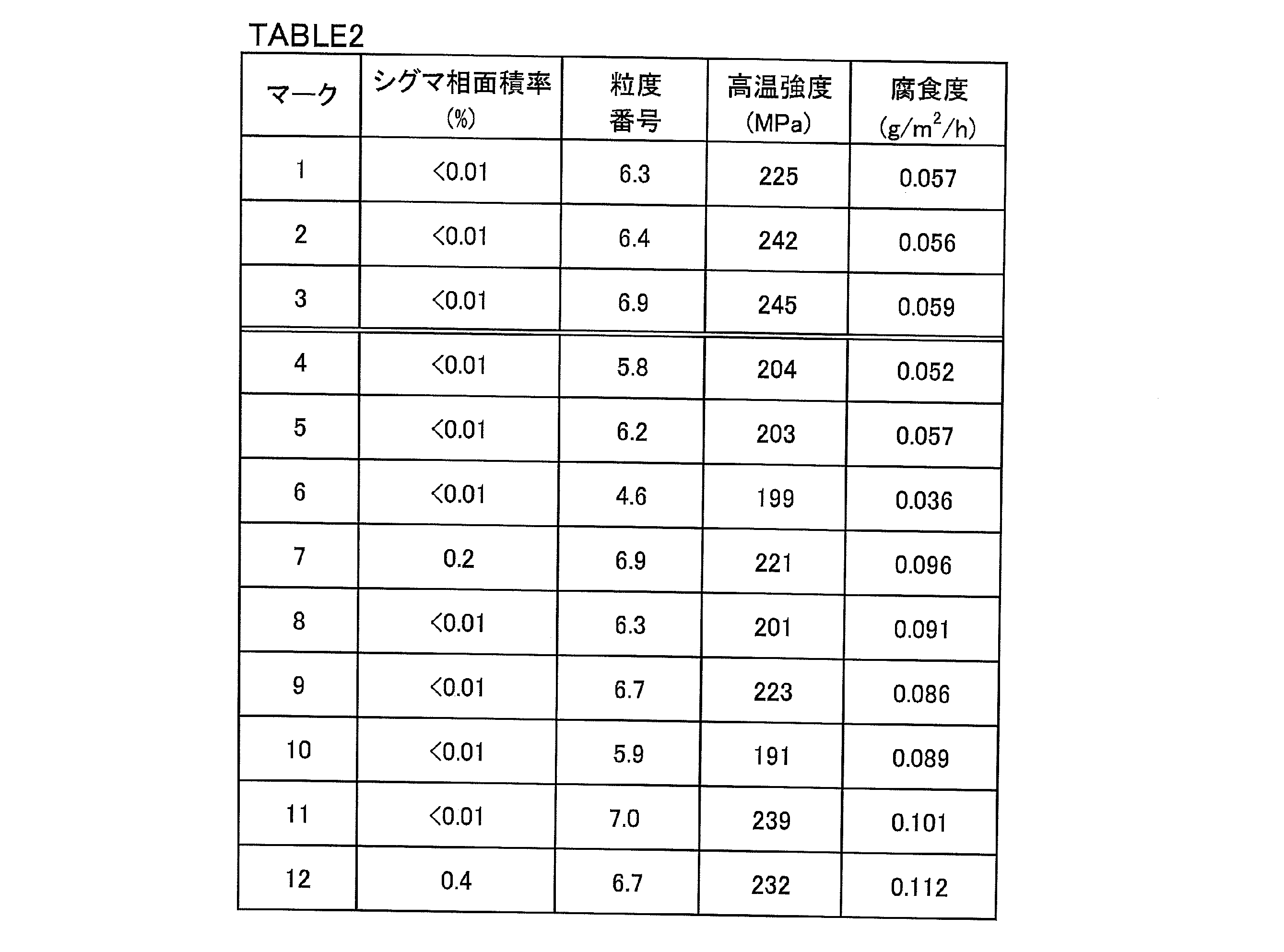
- Test results The test results are shown in Table 2.
- the chemical compositions of marks 1 to 3 were within the range of the chemical composition of the present invention, and the solution temperature was also within the range of 1050 to 1100 ° C. Therefore, the ⁇ phase area ratio of the austenitic stainless steel sheets marked 1 to 3 was 0.1% or less, and the particle size number was 6.0 or more. Therefore, the high temperature strength of the marks 1 to 3 was 220 MPa or more, and the corrosion degree was 0.085 g / m 2 / h or less.
- the Mn content of the mark 4 was less than the lower limit of the Mn content of the present invention, and the solution temperature exceeded 1100 ° C. Therefore, the particle size number of the mark 4 was less than 6.0, and the high temperature strength was less than 220 MPa.
- the Mn content of the mark 5 was less than the lower limit of the Mn content of the present invention. Therefore, the high temperature strength of the mark 5 was less than 220 MPa.
- the chemical composition of the mark 6 was within the range of the chemical composition of the present invention, the solution temperature exceeded 1100 ° C. Therefore, the particle size number of the mark 6 was less than 6.0, and the high temperature strength was less than 220 MPa.
- the chemical composition of the marks 7 and 12 was within the range of the chemical composition of the present invention, but the solution temperature was less than 1050 ° C. Therefore, the ⁇ phase area ratio exceeded 0.1%. As a result, the corrosion degree exceeded 0.085 g / m 2 / h.
- the Ni content of the mark 8 was less than the lower limit of the Ni content of the present invention. Therefore, the high-temperature strength was less than 220 MPa, and the corrosion degree exceeded 0.085 g / m 2 / h.
- the Ni content of the mark 9 exceeded the upper limit of the Ni content of the present invention. Therefore, the degree of corrosion exceeded 0.085 g / m 2 / h.
- the N content of the mark 10 was less than the lower limit of the N content of the present invention. Therefore, the particle size number was less than 6.0. Therefore, the high-temperature strength was less than 220 MPa, and the corrosion degree exceeded 0.085 g / m 2 / h.
- the N content of the mark 11 exceeded the upper limit of the N content of the present invention. Therefore, the degree of corrosion exceeded 0.085 g / m 2 / h.
- the present invention can be widely applied to steel materials that require high-temperature strength and nitric acid corrosion resistance, and can be applied to steel materials for chemical plants, for example.
- the present invention is particularly suitable for a steel material for a urea plant.
Landscapes
- Chemical & Material Sciences (AREA)
- Engineering & Computer Science (AREA)
- Mechanical Engineering (AREA)
- Materials Engineering (AREA)
- Metallurgy (AREA)
- Organic Chemistry (AREA)
- Physics & Mathematics (AREA)
- Thermal Sciences (AREA)
- Crystallography & Structural Chemistry (AREA)
- Heat Treatment Of Steel (AREA)
- Heat Treatment Of Sheet Steel (AREA)
Abstract
Description
本発明によるオーステナイト系ステンレス鋼は、以下の化学組成を有する。
炭素(C)は、Crと結合してCr炭化物を形成する。Cr炭化物は結晶粒界に析出し、鋼の高温強度を高める。一方、Cが過剰に含有されれば、結晶粒界近傍にCr欠乏層が形成される。Cr欠乏層は、鋼の耐硝酸腐食性を低下する。したがって、C含有量は、0.050%以下である。C含有量の下限は特に設けないが、0.002%以上であれば、上記効果が顕著に得られる。好ましいC含有量の上限は、0.050%未満であり、さらに好ましくは0.030%である。さらに好ましいC含有量の下限は0.010%である。
珪素(Si)は、鋼を脱酸する。Siはさらに、鋼の耐酸化性を高める。一方、Siが過剰に含有されれば、Siは結晶粒界に偏析する。偏析したSiが、塩化物を含む燃焼スラグと反応することにより、粒界腐食が発生する。Siが過剰に含有されればさらに、延性等の鋼の機械的性質が低下する。したがって、Si含有量は、0.01~1.00%である。好ましいSi含有量の下限は、0.01%よりも高く、さらに好ましくは、0.10%であり、さらに好ましくは、0.20%である。好ましいSi含有量の上限は、1.00%未満であり、さらに好ましくは、0.40%であり、さらに好ましくは、0.30%である。
マンガン(Mn)は、鋼に固溶して、鋼の高温強度を高める。さらに、Mnが含有されても、鋼の耐硝酸腐食性は低下しにくい。したがって、Mnは、鋼の耐硝酸腐食性を維持しつつ、高温強度を高めるのに有効である。Mnはさらに、鋼を脱酸する。Mnはさらに、オーステナイト形成元素であり、マトリックス中のオーステナイト相を安定化する。Mnはさらに、鋼中のSと結合してMnSを形成し、鋼の熱間加工性を高める。一方、Mnが過剰に含有されれば、鋼の加工性及び溶接性が低下する。したがって、Mn含有量は、1.75~2.50%である。好ましいMn含有量の下限は、1.75%よりも高く、さらに好ましくは、1.85%であり、さらに好ましくは1.90%である。好ましいMn含有量の上限は、2.50%未満であり、さらに好ましくは、2.30%であり、さらに好ましくは2.00%である。
燐(P)は不純物である。Pは、鋼の溶接性及び加工性を低下する。したがって、P含有量は少ない方が好ましい。P含有量は、0.050%以下である。好ましいP含有量の上限は、0.050%未満であり、さらに好ましくは、0.020%以下であり、さらに好ましくは、0.015%以下である。
(硫黄)Sは、不純物である。Sは、鋼の溶接性及び加工性を低下する。したがって、S含有量は少ない方が好ましい。S含有量は、0.0100%以下である。好ましいS含有量の上限は、0.0100%よりも低く、さらに好ましくは、0.0020%であり、さらに好ましくは、0.0012%である。
ニッケル(Ni)は、オーステナイト形成元素であり、マトリックス中のオーステナイト相を安定化する。Niはさらに、鋼の高温強度及び耐硝酸腐食性を高める。一方、Niが過剰に含有されれば、Nの固溶限が減少し強度の低下及び窒化物析出により鋼の耐硝酸腐食性をかえって低下させる。したがって、Ni含有量は、20.00~24.00%である。好ましいNi含有量の下限は、20.00%よりも高く、さらに好ましくは、21.00%であり、さらに好ましくは、22.00%である。好ましいNi含有量の上限は、24.00%未満であり、さらに好ましくは、23.00%であり、さらに好ましくは、22.75%である。
クロム(Cr)は、鋼の耐硝酸腐食性を高める。Crはさらに、鋼に固溶して鋼の高温強度を高める。一方、Crが過剰に含有されれば、鋼中にσ相が析出し、鋼の耐硝酸腐食性が低下する。σ相はさらに、鋼の溶接性及び加工性を低下する。したがって、Cr含有量は、23.00~27.00%である。好ましいCr含有量の下限は、23.00%よりも高く、さらに好ましくは、24.00%であり、さらに好ましくは、24.50%である。好ましいCr含有量の上限は、27.00%未満であり、さらに好ましくは、26.00%であり、さらに好ましくは、25.50%である。
モリブデン(Mo)は、鋼の耐硝酸腐食性を高める。Moはさらに、鋼に固溶して鋼の高温強度を高める。一方、Moが過剰に含有されれば、鋼中にσ相が析出し、鋼の耐硝酸腐食性が低下する。σ相はさらに、鋼の溶接性及び加工性を低下する。したがって、Mo含有量は、1.80~3.20%である。好ましいMo含有量の下限は、1.80%よりも高く、さらに好ましくは、1.90%であり、さらに好ましくは、2.00%である。好ましいMo含有量の上限は、3.20%未満であり、さらに好ましくは、2.80%であり、さらに好ましくは、2.50%である。
窒素(N)は、オーステナイト形成元素であり、マトリックス中のオーステナイト相を安定化する。窒素はさらに、微細な窒化物を形成して結晶粒を微細化し、鋼の高温強度を高める。また、表面皮膜を安定化させる効果もあり耐硝酸腐食性を高める。一方、Nが過剰に含有されれば、窒化物が過剰に生成され、鋼の熱間加工性が低下し、さらに、耐硝酸腐食性が低下する。したがって、N含有量は、0.110~0.180%である。好ましいN含有量の下限は、0.110%よりも高く、さらに好ましくは、0.120%よりも高く、さらに好ましくは、0.130%である。好ましいN含有量の上限は、0.180%未満であり、さらに好ましくは、0.170%であり、さらに好ましくは、0.160%である。
本発明によるオーステナイト系ステンレス鋼におけるJIS G0551(2005)に基づき約20%の硝酸水溶液を用いて腐食させて測定した結晶粒の粒度番号は、6.0以上である。粒度番号が6.0以上であれば、オーステナイト系ステンレス鋼は、耐硝酸腐食性を維持しつつ、優れた高温強度を有する。
本発明によるオーステナイト系ステンレス鋼ではさらに、鋼中のシグマ相(以下、σ相という)の面積率が0.1%以下である。ここで、σ相の面積率は、以下の方法により算出される。
本発明によるオーステナイト系ステンレス鋼はさらに、Ca、Mg、及び希土類元素(REM)からなる群から選択される1種以上を含有する。これらの元素はいずれも、鋼の熱間加工性を高める。
カルシウム(Ca)は、選択元素である。Caは、鋼の熱間加工性を高める。一方、Caが過剰に含有されれば、鋼の清浄度が低下する。そのため、鋼の耐硝酸腐食性及び靭性が低下し、鋼の機械的性質が低下する。したがって、Ca含有量は0.0100%以下である。Ca含有量が0.0005%以上であれば、上記効果が顕著に得られる。好ましいCa含有量の上限は、0.0100%未満であり、さらに好ましくは、0.0050%である。
マグネシウム(Mg)は、選択元素である。Mgは、鋼の熱間加工性を高める。一方、Mgが過剰に含有されれば、鋼の清浄度が低下する。そのため、鋼の耐硝酸腐食性及び靭性が低下し、鋼の機械的性質が低下する。したがって、Mg含有量は0.0100%以下である。Mg含有量が0.0005%以上であれば、上記効果が顕著に得られる。好ましいMg含有量の上限は、0.0100%未満であり、さらに好ましくは、0.0050%である。
希土類元素(REM)は選択元素である。REMは、Sとの親和力が高い。そのためREMは、鋼の熱間加工性を高める。しかしながら、REMが過剰に含有されれば、鋼の清浄度が低下する。そのため、鋼の耐硝酸腐食性及び靭性が低下し、鋼の機械的性質が低下する。したがって、REM含有量は0.200%以下である。REM含有量が0.001%以上であれば、上記効果が顕著に得られる。好ましいREM含有量の上限は、0.150%未満であり、さらに好ましくは、0.100%である。
本発明によるオーステナイト系ステンレス鋼材の製造方法の一例を説明する。
表1に示す化学組成を有するマーク1~12のオーステナイト系ステンレス鋼を高周波加熱真空炉で溶解し、インゴットを製造した。

製造された各マークの鋼板の任意の箇所からミクロ試験観察用の試料を採取した。採取された試料の表面を機械研磨し、エッチングした。エッチングされた試料表面において、光学顕微鏡で20点×20点の計400点の格子の入った400倍のレンズを用いて任意の6視野を観察した。各視野の領域は225μm2であった。各視野における格子点上に存在するσ相の数をカウントした。σ相の総カウント数を6視野の総格子点数(2400点)で除した値を、σ相の面積率(単位は%)とした。
製造された各マークの鋼板から試験片を採取した。試験片を用いて、JIS G0551(2005)に準拠した結晶粒度の顕微鏡試験を実施し、各マークのオーステナイト結晶粒の結晶粒度番号を求めた。
製造された各マークの鋼板から、平行部の外径が6mmの丸棒試験片を採取した。採取された丸棒試験片を用いて、JIS G0567(1998)に準拠した高温引張試験を実施し、各マークの降伏強度(MPa)を求めた。試験温度は230℃であった。また、0.2%耐力を降伏強度と定義した。
JIS G0573(1999)に準拠した65%硝酸腐食試験(ヒューイ試験)を実施して、各マークの鋼板の耐硝酸腐食性を調査した。具体的には、各マークの鋼板から40mm×10mm×2mmの試験片を採取した。試験片の表面積は1000mm2であった。さらに、硝酸の濃度が65質量%である試験溶液を準備した。沸騰した試験溶液内に試験片を48時間浸漬した(1回目浸漬試験)。試験終了後、新しい試験溶液を準備し、2回目の浸漬試験を実施した。具体的には、1回目浸漬試験に利用した試験溶液から試料を取り出し、試験片を2回目の浸漬試験用の試験溶液に48時間浸漬した。以上のような浸漬試験を5回(第1回目~第5回目まで)繰り返した。
試験結果を表2に示す。
度が0.085g/m2/hを超えた。
Claims (5)
- 質量%で、
C:0.050%以下、
Si:0.01~1.00%、
Mn:1.75~2.50%、
P:0.050%以下、
S:0.0100%以下、
Ni:20.00~24.00%、
Cr:23.00~27.00%、
Mo:1.80~3.20%、及び、
N:0.110~0.180%、
を含有し、残部はFe及び不純物からなり、
JIS G0551(2005)に基づく結晶粒の粒度番号が6.0以上であり、
σ相の面積率が0.1%以下である、オーステナイト系ステンレス鋼。 - 請求項1に記載のオーステナイト系ステンレス鋼であってさらに、
前記Feの一部に代えて、
Ca:0.0100%以下、
Mg:0.0100%以下、及び、
希土類元素(REM):0.200%以下からなる群から選択される1種又は2種以上を含有する、オーステナイト系ステンレス鋼。 - 請求項1又は請求項2に記載のオーステナイト系ステンレス鋼であって、
230℃における降伏強度が220MPa以上であり、JIS G0573(1999)に準拠した65%硝酸腐食試験における腐食度が0.085g/m2/h以下である、オーステナイト系ステンレス鋼。 - 質量%で、C:0.050%以下、Si:0.01~1.00%、Mn:1.75~2.50%、P:0.050%以下、S:0.0100%以下、Ni:20.00~24.00%、Cr:23.00~27.00%、Mo:1.80~3.20%、及び、N:0.110~0.180%を含有し、残部はFe及び不純物からなる素材を準備する工程と、
前記素材を熱間加工して鋼材を製造する工程と、
前記鋼材に対して、1050~1100℃の溶体化温度で溶体化処理を実施する工程とを備える、オーステナイト系ステンレス鋼材の製造方法。 - 請求項4に記載のオーステナイト系ステンレス鋼材の製造方法であって、
前記素材はさらに、前記Feの一部に代えて、Ca:0.0100%以下、Mg:0.0100%以下、及び、希土類元素(REM):0.200%以下からなる群から選択される1種又は2種以上を含有する、オーステナイト系ステンレス鋼材の製造方法。
Priority Applications (9)
| Application Number | Priority Date | Filing Date | Title |
|---|---|---|---|
| CA2839876A CA2839876C (en) | 2011-06-24 | 2012-06-20 | Austenitic stainless steel and method for producing austenitic stainless steel material |
| US14/128,777 US9506126B2 (en) | 2011-06-24 | 2012-06-20 | Austenitic stainless steel and method for producing austenitic stainless steel material |
| RU2014102172/02A RU2572937C2 (ru) | 2011-06-24 | 2012-06-20 | Аустенитная нержавеющая сталь и способ получения материала из аустенитной нержавеющей стали |
| EP12802967.5A EP2725113B1 (en) | 2011-06-24 | 2012-06-20 | Method for producing austenitic stainless steel and austenitic stainless steel material |
| KR1020137033377A KR20140014280A (ko) | 2011-06-24 | 2012-06-20 | 오스테나이트계 스테인레스강 및 오스테나이트계 스테인레스 강재의 제조 방법 |
| BR112013031880A BR112013031880A2 (pt) | 2011-06-24 | 2012-06-20 | método para produzir aço inoxidável austenítico e material de aço inoxidável |
| JP2012528975A JP5201297B2 (ja) | 2011-06-24 | 2012-06-20 | オーステナイト系ステンレス鋼及びオーステナイト系ステンレス鋼材の製造方法 |
| CN201280031273.1A CN103620076A (zh) | 2011-06-24 | 2012-06-20 | 奥氏体系不锈钢以及奥氏体系不锈钢材的制造方法 |
| ES12802967.5T ES2605847T3 (es) | 2011-06-24 | 2012-06-20 | Método para producir acero inoxidable austenítico y material de acero inoxidable austenítico |
Applications Claiming Priority (2)
| Application Number | Priority Date | Filing Date | Title |
|---|---|---|---|
| JP2011140283 | 2011-06-24 | ||
| JP2011-140283 | 2011-06-24 |
Publications (1)
| Publication Number | Publication Date |
|---|---|
| WO2012176802A1 true WO2012176802A1 (ja) | 2012-12-27 |
Family
ID=47422634
Family Applications (1)
| Application Number | Title | Priority Date | Filing Date |
|---|---|---|---|
| PCT/JP2012/065733 Ceased WO2012176802A1 (ja) | 2011-06-24 | 2012-06-20 | オーステナイト系ステンレス鋼及びオーステナイト系ステンレス鋼材の製造方法 |
Country Status (10)
| Country | Link |
|---|---|
| US (1) | US9506126B2 (ja) |
| EP (1) | EP2725113B1 (ja) |
| JP (1) | JP5201297B2 (ja) |
| KR (1) | KR20140014280A (ja) |
| CN (1) | CN103620076A (ja) |
| BR (1) | BR112013031880A2 (ja) |
| CA (1) | CA2839876C (ja) |
| ES (1) | ES2605847T3 (ja) |
| RU (2) | RU2572937C2 (ja) |
| WO (1) | WO2012176802A1 (ja) |
Cited By (3)
| Publication number | Priority date | Publication date | Assignee | Title |
|---|---|---|---|---|
| CN105755369A (zh) * | 2016-04-28 | 2016-07-13 | 江阴兴澄特种钢铁有限公司 | 一种易焊接低温抗层状撕裂性能优异的钢板及其制备方法 |
| JPWO2021256128A1 (ja) * | 2020-06-19 | 2021-12-23 | ||
| DE112021003995T5 (de) | 2020-07-31 | 2023-05-11 | Nippon Yakin Kogyo Co., Ltd. | Hochkorrosionsbeständiger austenitischer rostfreier stahl und verfahren zur herstellung desselben |
Families Citing this family (10)
| Publication number | Priority date | Publication date | Assignee | Title |
|---|---|---|---|---|
| CN105986195A (zh) * | 2015-02-09 | 2016-10-05 | 宝钢特钢有限公司 | 一种新型抗点蚀耐热镍基合金 |
| CN108779539B (zh) | 2015-12-14 | 2021-03-26 | 世伟洛克公司 | 无需退火固溶的高度合金不锈钢锻件 |
| ES2798429T3 (es) * | 2016-04-06 | 2020-12-11 | Nippon Steel Corp | Acero inoxidable austenítico y método de producción del mismo |
| US20190112694A1 (en) * | 2016-04-07 | 2019-04-18 | Nippon Steel & Sumitomo Metal Corporation | Austenitic Stainless Steel Material |
| CN109207697A (zh) * | 2018-11-23 | 2019-01-15 | 成都斯杰化工机械有限公司 | 超低碳高锰钼不锈钢及其制备方法 |
| US12221665B2 (en) * | 2019-05-31 | 2025-02-11 | Nippon Steel Corporation | Austenitic stainless steel material |
| CN111575591A (zh) * | 2020-06-24 | 2020-08-25 | 中国石油化工股份有限公司 | 一种耐腐蚀的不锈钢材料 |
| JP7818896B2 (ja) * | 2020-11-27 | 2026-02-24 | 三菱重工エンジン&ターボチャージャ株式会社 | オーステナイト系ステンレス鋳鋼およびオーステナイト系ステンレス鋳鋼の製造方法 |
| CN113218736A (zh) * | 2021-05-07 | 2021-08-06 | 大唐锅炉压力容器检验中心有限公司 | 一种汽轮机螺栓用马氏体不锈钢的原奥氏体晶界腐蚀方法 |
| KR20230093652A (ko) | 2021-12-20 | 2023-06-27 | 주식회사 포스코 | 시그마상과 표면결함이 억제된 고내식 오스테나이트계 스테인리스강 및 이의 제조방법 |
Citations (9)
| Publication number | Priority date | Publication date | Assignee | Title |
|---|---|---|---|---|
| JPS60224764A (ja) * | 1984-04-24 | 1985-11-09 | Sumitomo Metal Ind Ltd | 高温用n含有オ−ステナイトステンレス鋼 |
| JPH06256911A (ja) | 1993-03-03 | 1994-09-13 | Nkk Corp | 冷間における加工若しくは変形後の耐硝酸腐食性に優れたオーステナイトステンレス鋼 |
| JPH09184013A (ja) * | 1995-12-28 | 1997-07-15 | Nippon Steel Corp | 耐硝酸腐食性に優れたMo含有オーステナイト系ステンレス熱延鋼板の製造方法 |
| JPH1088289A (ja) | 1996-09-12 | 1998-04-07 | Hitachi Ltd | 高耐食性高強度Cr−Mn系オーステナイト焼結鋼とその製造方法及びその用途 |
| JP2004339569A (ja) * | 2003-05-15 | 2004-12-02 | Nippon Steel Corp | 固体高分子型燃料電池セパレータ用ステンレス鋼板並びにその製造方法及び成形方法 |
| JP2005023343A (ja) * | 2003-06-30 | 2005-01-27 | Sumitomo Metal Ind Ltd | 原子力用オーステナイト系ステンレス鋼管 |
| JP2005509751A (ja) | 2001-11-22 | 2005-04-14 | サンドビック アクティエボラーグ | 超オーステナイトステンレス鋼 |
| JP2008019479A (ja) * | 2006-07-13 | 2008-01-31 | Nippon Steel & Sumikin Stainless Steel Corp | 強度及び延性に優れたオーステナイト系ステンレス圧延鋼板及びその製造方法 |
| JP2009068079A (ja) * | 2007-09-14 | 2009-04-02 | Sumitomo Metal Ind Ltd | 耐水蒸気酸化性に優れた鋼管 |
Family Cites Families (5)
| Publication number | Priority date | Publication date | Assignee | Title |
|---|---|---|---|---|
| JPS55100966A (en) * | 1979-01-23 | 1980-08-01 | Kobe Steel Ltd | High strength austenite stainless steel having excellent corrosion resistance |
| SU1686028A1 (ru) * | 1989-11-16 | 1991-10-23 | Центральный научно-исследовательский институт черной металлургии им.И.П.Бардина | Нержавеюща сталь |
| IT1295384B1 (it) * | 1997-10-23 | 1999-05-12 | Snam Progetti | Rivestimento protettivo di apparecchiature a pressione utilizzabili in processi per la sintesi dell'urea |
| SE528008C2 (sv) * | 2004-12-28 | 2006-08-01 | Outokumpu Stainless Ab | Austenitiskt rostfritt stål och stålprodukt |
| US20060243356A1 (en) | 2005-02-02 | 2006-11-02 | Yuusuke Oikawa | Austenite-type stainless steel hot-rolling steel material with excellent corrosion resistance, proof-stress, and low-temperature toughness and production method thereof |
-
2012
- 2012-06-20 CA CA2839876A patent/CA2839876C/en not_active Expired - Fee Related
- 2012-06-20 RU RU2014102172/02A patent/RU2572937C2/ru active
- 2012-06-20 WO PCT/JP2012/065733 patent/WO2012176802A1/ja not_active Ceased
- 2012-06-20 US US14/128,777 patent/US9506126B2/en active Active
- 2012-06-20 RU RU2015152343A patent/RU2618021C1/ru active
- 2012-06-20 JP JP2012528975A patent/JP5201297B2/ja active Active
- 2012-06-20 CN CN201280031273.1A patent/CN103620076A/zh active Pending
- 2012-06-20 EP EP12802967.5A patent/EP2725113B1/en active Active
- 2012-06-20 ES ES12802967.5T patent/ES2605847T3/es active Active
- 2012-06-20 BR BR112013031880A patent/BR112013031880A2/pt not_active Application Discontinuation
- 2012-06-20 KR KR1020137033377A patent/KR20140014280A/ko not_active Ceased
Patent Citations (9)
| Publication number | Priority date | Publication date | Assignee | Title |
|---|---|---|---|---|
| JPS60224764A (ja) * | 1984-04-24 | 1985-11-09 | Sumitomo Metal Ind Ltd | 高温用n含有オ−ステナイトステンレス鋼 |
| JPH06256911A (ja) | 1993-03-03 | 1994-09-13 | Nkk Corp | 冷間における加工若しくは変形後の耐硝酸腐食性に優れたオーステナイトステンレス鋼 |
| JPH09184013A (ja) * | 1995-12-28 | 1997-07-15 | Nippon Steel Corp | 耐硝酸腐食性に優れたMo含有オーステナイト系ステンレス熱延鋼板の製造方法 |
| JPH1088289A (ja) | 1996-09-12 | 1998-04-07 | Hitachi Ltd | 高耐食性高強度Cr−Mn系オーステナイト焼結鋼とその製造方法及びその用途 |
| JP2005509751A (ja) | 2001-11-22 | 2005-04-14 | サンドビック アクティエボラーグ | 超オーステナイトステンレス鋼 |
| JP2004339569A (ja) * | 2003-05-15 | 2004-12-02 | Nippon Steel Corp | 固体高分子型燃料電池セパレータ用ステンレス鋼板並びにその製造方法及び成形方法 |
| JP2005023343A (ja) * | 2003-06-30 | 2005-01-27 | Sumitomo Metal Ind Ltd | 原子力用オーステナイト系ステンレス鋼管 |
| JP2008019479A (ja) * | 2006-07-13 | 2008-01-31 | Nippon Steel & Sumikin Stainless Steel Corp | 強度及び延性に優れたオーステナイト系ステンレス圧延鋼板及びその製造方法 |
| JP2009068079A (ja) * | 2007-09-14 | 2009-04-02 | Sumitomo Metal Ind Ltd | 耐水蒸気酸化性に優れた鋼管 |
Non-Patent Citations (1)
| Title |
|---|
| See also references of EP2725113A4 |
Cited By (4)
| Publication number | Priority date | Publication date | Assignee | Title |
|---|---|---|---|---|
| CN105755369A (zh) * | 2016-04-28 | 2016-07-13 | 江阴兴澄特种钢铁有限公司 | 一种易焊接低温抗层状撕裂性能优异的钢板及其制备方法 |
| JPWO2021256128A1 (ja) * | 2020-06-19 | 2021-12-23 | ||
| JP7095811B2 (ja) | 2020-06-19 | 2022-07-05 | Jfeスチール株式会社 | 合金管およびその製造方法 |
| DE112021003995T5 (de) | 2020-07-31 | 2023-05-11 | Nippon Yakin Kogyo Co., Ltd. | Hochkorrosionsbeständiger austenitischer rostfreier stahl und verfahren zur herstellung desselben |
Also Published As
| Publication number | Publication date |
|---|---|
| BR112013031880A2 (pt) | 2016-12-13 |
| US20140137994A1 (en) | 2014-05-22 |
| RU2014102172A (ru) | 2015-07-27 |
| EP2725113B1 (en) | 2016-09-14 |
| EP2725113A1 (en) | 2014-04-30 |
| JP5201297B2 (ja) | 2013-06-05 |
| RU2618021C1 (ru) | 2017-05-02 |
| CA2839876A1 (en) | 2012-12-27 |
| KR20140014280A (ko) | 2014-02-05 |
| CN103620076A (zh) | 2014-03-05 |
| CA2839876C (en) | 2016-04-12 |
| JPWO2012176802A1 (ja) | 2015-02-23 |
| US9506126B2 (en) | 2016-11-29 |
| EP2725113A4 (en) | 2014-11-26 |
| ES2605847T3 (es) | 2017-03-16 |
| RU2572937C2 (ru) | 2016-01-20 |
Similar Documents
| Publication | Publication Date | Title |
|---|---|---|
| JP5201297B2 (ja) | オーステナイト系ステンレス鋼及びオーステナイト系ステンレス鋼材の製造方法 | |
| KR102090201B1 (ko) | 오스테나이트계 내열합금 및 그 제조 방법 | |
| JP6904359B2 (ja) | オーステナイト系ステンレス鋼 | |
| AU2017247759B2 (en) | Austenitic stainless steel material | |
| JP7518342B2 (ja) | 二相ステンレス鋼材 | |
| US20190284666A1 (en) | NiCrFe Alloy | |
| JP7425360B2 (ja) | マルテンサイト系ステンレス鋼材、及び、マルテンサイト系ステンレス鋼材の製造方法 | |
| JP5589965B2 (ja) | オーステナイト系ステンレス鋼管の製造方法及びオーステナイト系ステンレス鋼管 | |
| JP2010222695A (ja) | 耐食性の良好な省合金二相ステンレス鋼材とその製造方法 | |
| WO2021033672A1 (ja) | 二相ステンレス鋼材 | |
| US20210062314A1 (en) | Austenitic heat resistant alloy | |
| JP7397391B2 (ja) | Fe-Cr-Ni合金材 | |
| US20190127832A1 (en) | Austenitic Stainless Steel | |
| JP7498420B1 (ja) | 二相ステンレス鋼材 | |
| JP6340870B2 (ja) | オーステナイト系ステンレス鋼 | |
| KR20200080312A (ko) | 2상 스테인리스강 및 2상 스테인리스강의 제조 방법 |
Legal Events
| Date | Code | Title | Description |
|---|---|---|---|
| ENP | Entry into the national phase |
Ref document number: 2012528975 Country of ref document: JP Kind code of ref document: A |
|
| 121 | Ep: the epo has been informed by wipo that ep was designated in this application |
Ref document number: 12802967 Country of ref document: EP Kind code of ref document: A1 |
|
| REEP | Request for entry into the european phase |
Ref document number: 2012802967 Country of ref document: EP |
|
| ENP | Entry into the national phase |
Ref document number: 20137033377 Country of ref document: KR Kind code of ref document: A |
|
| ENP | Entry into the national phase |
Ref document number: 2839876 Country of ref document: CA |
|
| WWE | Wipo information: entry into national phase |
Ref document number: 14128777 Country of ref document: US |
|
| NENP | Non-entry into the national phase |
Ref country code: DE |
|
| ENP | Entry into the national phase |
Ref document number: 2014102172 Country of ref document: RU Kind code of ref document: A |
|
| REG | Reference to national code |
Ref country code: BR Ref legal event code: B01A Ref document number: 112013031880 Country of ref document: BR |
|
| ENP | Entry into the national phase |
Ref document number: 112013031880 Country of ref document: BR Kind code of ref document: A2 Effective date: 20131211 |