WO2013002133A1 - 太陽電池用封止膜及びこれを用いた太陽電池 - Google Patents
太陽電池用封止膜及びこれを用いた太陽電池 Download PDFInfo
- Publication number
- WO2013002133A1 WO2013002133A1 PCT/JP2012/065959 JP2012065959W WO2013002133A1 WO 2013002133 A1 WO2013002133 A1 WO 2013002133A1 JP 2012065959 W JP2012065959 W JP 2012065959W WO 2013002133 A1 WO2013002133 A1 WO 2013002133A1
- Authority
- WO
- WIPO (PCT)
- Prior art keywords
- group
- solar cell
- sealing film
- silane coupling
- coupling agent
- Prior art date
- Legal status (The legal status is an assumption and is not a legal conclusion. Google has not performed a legal analysis and makes no representation as to the accuracy of the status listed.)
- Ceased
Links
Images

Classifications
-
- H—ELECTRICITY
- H10—SEMICONDUCTOR DEVICES; ELECTRIC SOLID-STATE DEVICES NOT OTHERWISE PROVIDED FOR
- H10F—INORGANIC SEMICONDUCTOR DEVICES SENSITIVE TO INFRARED RADIATION, LIGHT, ELECTROMAGNETIC RADIATION OF SHORTER WAVELENGTH OR CORPUSCULAR RADIATION
- H10F19/00—Integrated devices, or assemblies of multiple devices, comprising at least one photovoltaic cell covered by group H10F10/00, e.g. photovoltaic modules
- H10F19/80—Encapsulations or containers for integrated devices, or assemblies of multiple devices, having photovoltaic cells
- H10F19/804—Materials of encapsulations
-
- B—PERFORMING OPERATIONS; TRANSPORTING
- B32—LAYERED PRODUCTS
- B32B—LAYERED PRODUCTS, i.e. PRODUCTS BUILT-UP OF STRATA OF FLAT OR NON-FLAT, e.g. CELLULAR OR HONEYCOMB, FORM
- B32B17/00—Layered products essentially comprising sheet glass, or glass, slag, or like fibres
- B32B17/06—Layered products essentially comprising sheet glass, or glass, slag, or like fibres comprising glass as the main or only constituent of a layer, next to another layer of a specific material
- B32B17/10—Layered products essentially comprising sheet glass, or glass, slag, or like fibres comprising glass as the main or only constituent of a layer, next to another layer of a specific material of synthetic resin
- B32B17/10005—Layered products essentially comprising sheet glass, or glass, slag, or like fibres comprising glass as the main or only constituent of a layer, next to another layer of a specific material of synthetic resin laminated safety glass or glazing
- B32B17/10009—Layered products essentially comprising sheet glass, or glass, slag, or like fibres comprising glass as the main or only constituent of a layer, next to another layer of a specific material of synthetic resin laminated safety glass or glazing characterized by the number, the constitution or treatment of glass sheets
- B32B17/10018—Layered products essentially comprising sheet glass, or glass, slag, or like fibres comprising glass as the main or only constituent of a layer, next to another layer of a specific material of synthetic resin laminated safety glass or glazing characterized by the number, the constitution or treatment of glass sheets comprising only one glass sheet
-
- B—PERFORMING OPERATIONS; TRANSPORTING
- B32—LAYERED PRODUCTS
- B32B—LAYERED PRODUCTS, i.e. PRODUCTS BUILT-UP OF STRATA OF FLAT OR NON-FLAT, e.g. CELLULAR OR HONEYCOMB, FORM
- B32B17/00—Layered products essentially comprising sheet glass, or glass, slag, or like fibres
- B32B17/06—Layered products essentially comprising sheet glass, or glass, slag, or like fibres comprising glass as the main or only constituent of a layer, next to another layer of a specific material
- B32B17/10—Layered products essentially comprising sheet glass, or glass, slag, or like fibres comprising glass as the main or only constituent of a layer, next to another layer of a specific material of synthetic resin
- B32B17/10005—Layered products essentially comprising sheet glass, or glass, slag, or like fibres comprising glass as the main or only constituent of a layer, next to another layer of a specific material of synthetic resin laminated safety glass or glazing
- B32B17/1055—Layered products essentially comprising sheet glass, or glass, slag, or like fibres comprising glass as the main or only constituent of a layer, next to another layer of a specific material of synthetic resin laminated safety glass or glazing characterized by the resin layer, i.e. interlayer
- B32B17/10761—Layered products essentially comprising sheet glass, or glass, slag, or like fibres comprising glass as the main or only constituent of a layer, next to another layer of a specific material of synthetic resin laminated safety glass or glazing characterized by the resin layer, i.e. interlayer containing vinyl acetal
-
- C—CHEMISTRY; METALLURGY
- C08—ORGANIC MACROMOLECULAR COMPOUNDS; THEIR PREPARATION OR CHEMICAL WORKING-UP; COMPOSITIONS BASED THEREON
- C08J—WORKING-UP; GENERAL PROCESSES OF COMPOUNDING; AFTER-TREATMENT NOT COVERED BY SUBCLASSES C08B, C08C, C08F, C08G or C08H
- C08J5/00—Manufacture of articles or shaped materials containing macromolecular substances
- C08J5/18—Manufacture of films or sheets
-
- C—CHEMISTRY; METALLURGY
- C08—ORGANIC MACROMOLECULAR COMPOUNDS; THEIR PREPARATION OR CHEMICAL WORKING-UP; COMPOSITIONS BASED THEREON
- C08K—Use of inorganic or non-macromolecular organic substances as compounding ingredients
- C08K5/00—Use of organic ingredients
- C08K5/54—Silicon-containing compounds
- C08K5/541—Silicon-containing compounds containing oxygen
- C08K5/5415—Silicon-containing compounds containing oxygen containing at least one Si—O bond
- C08K5/5419—Silicon-containing compounds containing oxygen containing at least one Si—O bond containing at least one Si—C bond
-
- C—CHEMISTRY; METALLURGY
- C08—ORGANIC MACROMOLECULAR COMPOUNDS; THEIR PREPARATION OR CHEMICAL WORKING-UP; COMPOSITIONS BASED THEREON
- C08K—Use of inorganic or non-macromolecular organic substances as compounding ingredients
- C08K5/00—Use of organic ingredients
- C08K5/54—Silicon-containing compounds
- C08K5/544—Silicon-containing compounds containing nitrogen
-
- C—CHEMISTRY; METALLURGY
- C08—ORGANIC MACROMOLECULAR COMPOUNDS; THEIR PREPARATION OR CHEMICAL WORKING-UP; COMPOSITIONS BASED THEREON
- C08J—WORKING-UP; GENERAL PROCESSES OF COMPOUNDING; AFTER-TREATMENT NOT COVERED BY SUBCLASSES C08B, C08C, C08F, C08G or C08H
- C08J2331/00—Characterised by the use of copolymers of compounds having one or more unsaturated aliphatic radicals, each having only one carbon-to-carbon double bond, and at least one being terminated by an acyloxy radical of a saturated carboxylic acid, or carbonic acid, or of a haloformic acid
- C08J2331/02—Characterised by the use of omopolymers or copolymers of esters of monocarboxylic acids
- C08J2331/04—Homopolymers or copolymers of vinyl acetate
-
- Y—GENERAL TAGGING OF NEW TECHNOLOGICAL DEVELOPMENTS; GENERAL TAGGING OF CROSS-SECTIONAL TECHNOLOGIES SPANNING OVER SEVERAL SECTIONS OF THE IPC; TECHNICAL SUBJECTS COVERED BY FORMER USPC CROSS-REFERENCE ART COLLECTIONS [XRACs] AND DIGESTS
- Y02—TECHNOLOGIES OR APPLICATIONS FOR MITIGATION OR ADAPTATION AGAINST CLIMATE CHANGE
- Y02E—REDUCTION OF GREENHOUSE GAS [GHG] EMISSIONS, RELATED TO ENERGY GENERATION, TRANSMISSION OR DISTRIBUTION
- Y02E10/00—Energy generation through renewable energy sources
- Y02E10/50—Photovoltaic [PV] energy
Definitions
- the present invention relates to a solar cell encapsulating film comprising an ethylene-vinyl acetate copolymer as a main component, and more particularly to a solar cell encapsulating film having improved insulation in a high temperature environment.
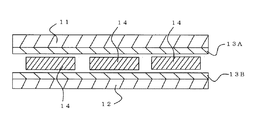
- a solar cell generally has a surface side transparent protective member 11 made of a glass substrate or the like, a surface side sealing film 13A, a solar cell 14 such as a silicon crystal power generation element, a back side sealing film. 13B and the back surface side protection member (back cover) 12 are laminated in this order, and after deaeration under reduced pressure, the surface side sealing film 13A and the back surface side sealing film 13B are cross-linked and cured by heating and pressurizing, and integrated by bonding. Is manufactured.
- a plurality of solar cell cells 14 are connected and used in order to obtain a high electrical output. Therefore, in order to ensure the insulation of the solar cell 14, the solar cell is sealed using the insulating sealing films 13 ⁇ / b> A and 13 ⁇ / b> B.
- thin-film solar cells such as thin-film silicon-based, thin-film amorphous silicon-based solar cells, and copper indium selenide (CIS) -based solar cells are also being developed.
- transparent substrates such as glass and polyimide substrates
- a power generation element layer such as a semiconductor layer is formed on the surface of the substrate by a chemical vapor deposition method or the like, and a sealing film or the like is laminated thereon and bonded and integrated.
- an ethylene-polar monomer copolymer such as an ethylene vinyl acetate copolymer (hereinafter also referred to as EVA) or an ethylene ethyl acrylate copolymer (EEA) is used.
- EVA ethylene vinyl acetate copolymer
- EAA ethylene ethyl acrylate copolymer
- a film is used.
- EVA films are preferably used because they are inexpensive and have high transparency.
- the ethylene-polar monomer copolymer film for a sealing film has a crosslinking density improved by using a crosslinking agent such as an organic peroxide in order to improve the film strength and durability.
- the electricity generated by the solar cell or the thin-film solar cell power generation element (in the present invention, collectively referred to as a solar cell element) is reliably obtained using incident sunlight. It is necessary to be able to take it out. For this reason, the solar cell sealing film is required to have high insulating properties so that electricity does not leak over a long period of time, and has been improved from the past.
- silane coupling is performed with respect to 100 parts by mass of an ethylene / polar monomer copolymer. It is specified that the agent is blended at a ratio of 0.03 to 0.3 parts by mass.
- Patent Document 2 includes an ethylene-polar monomer copolymer such as EVA and a crosslinking agent as a solar cell sealing film having excellent insulation particularly in a high temperature environment, and has a volume resistivity in a 60 ° C. atmosphere.
- the sealing film is described as being defined as 1.0 ⁇ 10 13 to 5.0 ⁇ 10 14 ⁇ ⁇ cm.
- the types and blending amounts of a crosslinking agent and a crosslinking aid are mainly adjusted.
- an object of the present invention is to provide a solar cell sealing film having high insulation properties and excellent durability in adhesive strength in a high temperature environment.
- an object of the present invention is to provide a solar cell using this sealing film.
- the object is a solar cell sealing film comprising a composition containing an ethylene-polar monomer copolymer and a crosslinking agent, wherein the composition further comprises three alkoxysilyl groups in the molecule. It is achieved by a solar cell sealing film characterized by comprising a silane coupling agent A having and a silane coupling agent B having one alkoxysilyl group in the molecule.
- the silane coupling agent A is a silane coupling agent having a structure in which three alkoxysilyl groups are bonded to one organic functional group, and the silane coupling agent B has one structure per one organic functional group.
- a silane coupling agent having a structure in which an alkoxysilyl group is bonded By blending both of these two types of silane coupling agents, compared to conventional sealing films, the insulation is improved and the durability of the adhesive force in a high temperature environment is improved. A sealing film is obtained.
- Preferred embodiments of the solar cell sealing film according to the present invention are as follows.
- the content of the silane coupling agent A is 0.2 to 1 part by mass with respect to 100 parts by mass of the ethylene-polar monomer copolymer, and the content of the silane coupling agent B is The content is 0.1 to 1 part by mass with respect to 100 parts by mass of the ethylene-polar monomer copolymer.
- the silane coupling agent A is a silane coupling agent having an isocyanurate group in the molecule. That is, the silane coupling agent A preferably has a structure in which three alkoxysilyl groups are bonded to an isocyanurate group.
- the silane coupling agent A is The following formula (I):
- R 1 and R 2 each independently represent a methyl group, an ethyl group, or a 2-methoxyethyl group, and R 3 each independently represents a divalent group having 2 to 11 carbon atoms. Represents a hydrocarbon group, n represents 0, 1 or 2] It is a silane coupling agent represented by these.
- the silane coupling agent A is 1,3,5-tris [3- (trimethoxysilyl) propyl] isocyanurate, 1,3,5-tris [3- (triethoxysilyl) propyl] isocyanurate 1,3,5-tris [3- (methyldimethoxysilyl) propyl] isocyanurate, and at least selected from the group consisting of 1,3,5-tris [3- (methyldiethoxysilyl) propyl] isocyanurate It is a kind of silane coupling agent. Of these silane coupling agents, 1,3,5-tris [3- (trimethoxysilyl) propyl] isocyanurate is particularly preferable.
- the silane coupling agent B is Formula (II) below:
- R 4 and R 5 each independently represents a methyl group, an ethyl group or a 2-methoxyethyl group
- X represents a vinyl group, an epoxy group, a styryl group, a methacryloyl group, an acryloyl group at the terminal.
- the silane coupling agent B is selected from 3-methacryloxypropyltrimethoxysilane, 3-methacryloxypropyltriethoxysilane, N-phenyl-3-aminopropyltrimethoxysilane, and 3-isocyanatopropyltriethoxysilane.
- the volume resistivity in a 25 ° C. environment after crosslinking is 1.0 ⁇ 10 16 ⁇ ⁇ cm or more. Such a volume resistivity can be said to have sufficiently high insulation.
- the glass adhesive strength measured by a 180 ° peel test JIS K 6584 (1994) after being allowed to stand in an environment of a temperature of 85 ° C. and a humidity of 85% RH is 20 N / cm or more. is there. If such an adhesive strength is obtained after the durability test, it can be said that the adhesive strength is sufficient.
- the ethylene-polar monomer copolymer is an ethylene-vinyl acetate copolymer.
- the crosslinking agent is an organic peroxide.
- the above object is also achieved by a solar cell characterized in that a solar cell element is sealed with the solar cell sealing film of the present invention. Thereby, it is possible to obtain a solar cell having high power generation efficiency and maintaining high power generation efficiency for a long time even in a high temperature environment.
- a specific type of silane coupling agent is blended in combination, so that the insulating property is high and the high temperature environment is maintained.
- the sealing film for solar cells excellent in durability of the adhesive force can be provided.
- the solar cell sealing film of the present invention it is possible to provide a solar cell having high power generation efficiency and maintaining high power generation efficiency for a long time even in a high temperature environment.
- the sealing film for solar cell of the present invention comprises a composition containing at least an ethylene-polar monomer copolymer and a crosslinking agent, and the composition further comprises a silane coupling having three alkoxysilyl groups in the molecule.
- Agent A and silane coupling agent B having one alkoxysilyl group in the molecule are included.
- Silane coupling agent A having three alkoxysilyl groups in the molecule is a silane coupling agent having a structure in which three alkoxysilyl groups are bonded to one organic functional group
- silane coupling agent B is It is a silane coupling agent having a structure in which one alkoxysilyl group is bonded to one organic functional group (that is, a silane coupling agent generally used as an adhesion improver).
- a silane coupling agent generally used as an adhesion improver As shown in the examples described later, by blending both of the above-mentioned two types of silane coupling agents, the insulating property of the solar cell sealing film is improved as compared with the case of blending only one of them. And durability of the adhesive force in a high temperature environment can be improved.
- the amount of silane coupling agent A and silane coupling agent B is not particularly limited. However, if the amount of silane coupling agent A or silane coupling agent B is too small, the effect of the present invention may be low, and if it is too large, bleeding out (exudation of additives after film formation) may occur. is there. Accordingly, the content of the silane coupling agent A is preferably 0.2 to 1 part by weight, more preferably 0.2 to 0.8 part by weight, particularly 100 parts by weight of the ethylene-polar monomer copolymer. 0.2 to 0.5 parts by mass are preferred.
- the content of the silane coupling agent B is preferably 0.1 to 1 part by weight, more preferably 0.1 to 0.8 part by weight, particularly 100 parts by weight of the ethylene-polar monomer copolymer. 0.3 to 0.8 parts by mass is preferable.
- the silane coupling agent A is not particularly limited as long as it has three alkoxysilyl groups in the molecule.
- a compound in which three alkoxysilyl groups are bonded to a polyfunctional organic functional group and a compound in which a compound in which one alkoxysilyl group is bonded to an organic functional group are trimerized can be mentioned.
- Such a silane coupling agent A preferably has a structure having an isocyanurate group in the molecule.
- silane coupling agent A has the following formula (I):
- R 1 and R 2 each independently represent a methyl group, an ethyl group, or a 2-methoxyethyl group
- R 3 each independently represents a divalent group having 2 to 11 carbon atoms.
- examples of the divalent hydrocarbon group having 2 to 11 carbon atoms include alkylene groups such as ethylene group, propylene group, hexylene group, n-octylene group, and iso-decylene group, phenylene group, propylphenylene group, etc.
- Aralkylene groups such as an arylene group, a phenylpropylene group, a phenylbutylene group, and a phenylhexylene group.
- Such silane coupling agents include 1,3,5-tris [3- (trimethoxysilyl) propyl] isocyanurate, 1,3,5-tris [3- (triethoxysilyl) propyl] isocyanurate, Preferred are 1,3,5-tris [3- (methyldimethoxysilyl) propyl] isocyanurate and 1,3,5-tris [3- (methyldiethoxysilyl) propyl] isocyanurate.
- These silane coupling agents may be used alone as the silane coupling agent A, or may be used in combination of two or more.
- 1,3,5-tris [3- (trimethoxysilyl) propyl] isocyanurate 1,3,5-tris having a trialkoxysilyl group in terms of glass adhesion [3- (Triethoxysilyl) propyl] isocyanurate is more preferable, and 1,3,5-tris [3- (trimethoxysilyl) propyl] isocyanurate is particularly preferable because it is easily available.
- the silane coupling agent B can be used without particular limitation as long as it is a silane coupling agent having a structure in which one alkoxysilyl group is bonded to one organic functional group.
- the silane coupling agent B is the following formula (II):
- R 4 and R 5 each independently represents a methyl group, an ethyl group or a 2-methoxyethyl group
- X represents a vinyl group, an epoxy group, a styryl group, a methacryloyl group, an acryloyl group at the terminal.
- the above functional group may be directly bonded to Si, or the above functional group may be bonded via a divalent hydrocarbon group such as an alkylene group.
- X include a vinyl group, 3-glycidoxypropyl group, p-styryl group, 3-methacryloxypropyl group, 3-acryloyloxypropyl group, 3-aminopropyl group, and N-phenyl-3-aminopropyl. Group, 3-mercaptopropyl group, 3-isocyanatopropyl group and the like.
- the silane coupling agent represented by the formula (II) is generally used as an adhesion improver, and includes, for example, 3-methacryloxypropyltrimethoxysilane, 3-methacryloxypropyltriethoxysilane, 3- Methacryloxypropylmethyldimethoxysilane, 3-methacryloxypropylmethyldiethoxysilane, vinyltrimethoxysilane, vinyltriethoxysilane, vinyltris (2-methoxyethoxy) silane, vinyltriacetoxysilane, 3-glycidoxypropyltrimethoxysilane 3-glycidoxypropylmethyldimethoxysilane, 3-glycidoxypropyltriethoxysilane, 2- (3,4-epoxycyclohexyl) ethyltrimethoxysilane, 3-mercaptopropyltrimethoxysilane, 3-a Roh aminopropyltriethoxysilane, N-2- (aminoethy
- silane coupling agents may be used alone as silane coupling agent B, or may be used in combination of two or more.
- silane coupling agents those having a trialkoxysilyl group are preferable from the viewpoint of glass adhesion, and 3-methacryloxypropyltrimethoxysilane, 3-methacryloxypropyltriethoxysilane, N-phenyl-3- Preferred examples include aminopropyltrimethoxysilane and 3-isocyanatopropyltriethoxysilane.
- 3-methacryloxypropyltrimethoxysilane is particularly preferable.
- the solar cell sealing film preferably has a volume resistivity of 1.0 ⁇ 10 16 ⁇ ⁇ cm or more in a 25 ° C. environment after crosslinking as an evaluation of insulation.
- a volume resistivity can be said to be a solar cell sealing film having a sufficiently higher insulating property than conventional sealing films.
- the volume resistivity ( ⁇ ⁇ cm) in a 25 ° C. atmosphere after crosslinking is obtained by crosslinking a solar cell sealing film, and then a high resistivity meter (Hiresta UP (manufactured by Mitsubishi Chemical Corporation)) and a probe ( It is a value measured in an atmosphere of 25 ° C. using UR-100 (manufactured by Mitsubishi Chemical Corporation).
- the solar cell sealing film was subjected to 180 ° after standing for 2000 hours in an environment of a temperature of 85 ° C. and a humidity of 85% RH as a durability test after crosslinking as an evaluation of durability of the adhesive force.
- the glass adhesion measured by a peel test JIS K 6584 (1994)) is preferably 20 N / cm or more.
- Such an adhesive strength after the durability test can be said to be a solar cell sealing film having a sufficient adhesive strength durability.
- the polar monomer of the ethylene-polar monomer copolymer which is the main component of the composition for the sealing film for solar cells of the present invention, is an unsaturated carboxylic acid, its salt, its ester, its amide, vinyl ester, carbon monoxide, etc. Can be illustrated.
- unsaturated carboxylic acids such as acrylic acid, methacrylic acid, fumaric acid, itaconic acid, monomethyl maleate, monoethyl maleate, maleic anhydride, itaconic anhydride, lithium of these unsaturated carboxylic acids, sodium, Salts of monovalent metals such as potassium, salts of polyvalent metals such as magnesium, calcium and zinc, methyl acrylate, ethyl acrylate, isopropyl acrylate, isobutyl acrylate, n-butyl acrylate, isooctyl acrylate, methacrylic acid
- unsaturated carboxylic acid esters such as methyl, ethyl methacrylate, isobutyl methacrylate, and dimethyl maleate
- vinyl esters such as vinyl acetate and vinyl propionate, carbon monoxide, sulfur dioxide, etc. be able to.
- ethylene-polar monomer copolymer examples include ethylene-acrylic acid copolymers, ethylene-unsaturated carboxylic acid copolymers such as ethylene-methacrylic acid copolymers, and ethylene-unsaturated carboxylic acids.
- Ionomers in which some or all of the carboxyl groups of the copolymer are neutralized with the above metals ethylene-methyl acrylate copolymers, ethylene-ethyl acrylate copolymers, ethylene-methyl methacrylate copolymers, ethylene- Isobutyl acrylate copolymer, ethylene-unsaturated carboxylic acid ester copolymer such as ethylene-n-butyl acrylate copolymer, ethylene-isobutyl acrylate-methacrylic acid copolymer, ethylene-n-butyl acrylate -Ethylene-unsaturated carboxylic acid ester-unsaturated carbo such as methacrylic acid copolymer
- Typical examples include acid copolymers and ionomers in which some or all of the carboxyl groups have been neutralized with the above metals, ethylene-vinyl ester copolymers such as ethylene-vinyl acetate copolymers
- the ethylene-polar monomer copolymer it is preferable to use a copolymer having a melt flow rate defined by JIS K7210 of 35 g / 10 min or less, particularly 3 to 6 g / 10 min.
- a copolymer having a melt flow rate defined by JIS K7210 of 35 g / 10 min or less, particularly 3 to 6 g / 10 min.
- the ethylene-polar monomer copolymer sheet using such an ethylene-polar monomer copolymer having a melt flow rate it is possible to produce laminated glass and solar cells as an interlayer film for laminated glass and a sealing film for solar cells. When used in the above, it is possible to suppress the sheet from melting and being displaced and protruding from the end of the substrate.
- melt flow rate MFR
- an ethylene-polar monomer copolymer As the ethylene-polar monomer copolymer, an ethylene-vinyl acetate copolymer (EVA) is particularly preferable. This makes it possible to form an ethylene-polar monomer copolymer sheet that is inexpensive and excellent in transparency and flexibility.
- EVA ethylene-vinyl acetate copolymer
- the content of vinyl acetate in the ethylene-vinyl acetate copolymer is preferably 20 to 35% by mass, more preferably 22 to 30% by mass, and particularly preferably 24 to 28% by mass with respect to EVA.
- the lower the content of EVA vinyl acetate units the harder the sheet obtained.
- the content of vinyl acetate is less than 20% by mass, the resulting sheet may not have sufficient transparency when crosslinked and cured at a high temperature. Moreover, when it exceeds 35 mass%, the hardness of a sheet
- the solar cell encapsulating film of the present invention further comprises a polyvinyl acetal resin (for example, polyvinyl formal, polyvinyl butyral (PVB resin), modified PVB), and a vinyl chloride resin. May be used for In that case, PVB is particularly preferable.
- PVB is particularly preferable.
- the crosslinking agent contained in the composition for a solar cell sealing film of the present invention is capable of forming a crosslinked structure of an ethylene-polar monomer copolymer, and improves the strength, adhesiveness and durability of the sheet. be able to.
- an organic peroxide or a photopolymerization initiator is preferably used as the crosslinking agent. Among these, it is preferable to use an organic peroxide because an ethylene polar monomer copolymer sheet with improved temperature dependency of adhesive strength, transparency, moisture resistance, and penetration resistance can be obtained.
- Any organic peroxide may be used as long as it decomposes at a temperature of 100 ° C. or higher to generate radicals.
- the organic peroxide is generally selected in consideration of the film formation temperature, the adjustment conditions of the composition, the curing temperature, the heat resistance of the adherend, and the storage stability. In particular, the one having a decomposition temperature of 70 ° C. or more with a half-life of 10 hours is preferable.
- organic peroxide examples include, from the viewpoint of processing temperature and storage stability of the resin, for example, benzoyl peroxide curing agent, tert-hexyl peroxypivalate, tert-butyl peroxypivalate, 3, 5, 5- Trimethylhexanoyl peroxide, di-n-octanoyl peroxide, lauroyl peroxide, stearoyl peroxide, 1,1,3,3-tetramethylbutylperoxy-2-ethylhexanoate, succinic acid peroxide, 2,5-dimethyl-2,5-di (tert-butylperoxy) hexane, 2,5-dimethyl-2,5-di (2-ethylhexanoylperoxy) hexane, 1-cyclohexyl-1-methylethyl Peroxy-2-ethylhexanoate, tert-hexylpa Oxy-2-ethylhexano
- benzoyl peroxide-based curing agent any can be used as long as it decomposes at a temperature of 70 ° C. or higher to generate radicals, and those having a decomposition temperature of 50 hours or higher with a half-life of 10 hours are preferable, It can be appropriately selected in consideration of preparation conditions, film formation temperature, curing (bonding) temperature, heat resistance of the adherend, and storage stability.
- Usable benzoyl peroxide curing agents include, for example, benzoyl peroxide, 2,5-dimethylhexyl-2,5-bisperoxybenzoate, p-chlorobenzoyl peroxide, m-toluoyl peroxide, 2, Examples include 4-dichlorobenzoyl peroxide and t-butyl peroxybenzoate.
- the benzoyl peroxide curing agent may be used alone or in combination of two or more.
- organic peroxide 2,5-dimethyl-2,5di (tert-butylperoxy) hexane and 1,1-bis (tert-hexylperoxy) -3,3,5-trimethylcyclohexane are particularly preferable. .
- an ethylene-polar monomer copolymer sheet having excellent insulating properties can be obtained. Such a sheet is effective when used as a solar cell sealing film.
- the content of the organic peroxide is preferably 0.1 to 2 parts by mass, more preferably 0.2 to 1.5 parts by mass with respect to 100 parts by mass of the ethylene-polar monomer copolymer. preferable. If the content of the organic peroxide is small, the insulating property of the resulting solar cell sealing film may be lowered, and if it is increased, the compatibility with the ethylene-polar monomer copolymer may be deteriorated.
- photopolymerization initiator any known photopolymerization initiator can be used, but a photopolymerization initiator having good storage stability after blending is desirable.
- photopolymerization initiators include 2-hydroxy-2-methyl-1-phenylpropan-1-one, 1-hydroxycyclohexyl phenyl ketone, and 2-methyl-1- (4- (methylthio) phenyl).
- Acetophenones such as -2-morpholinopropane-1, benzoins such as benzyldimethylketal, benzophenones such as benzophenone, 4-phenylbenzophenone and hydroxybenzophenone, thioxanthones such as isopropylthioxanthone and 2-4-diethylthioxanthone, As other special ones, methylphenylglyoxylate can be used. Particularly preferably, 2-hydroxy-2-methyl-1-phenylpropan-1-one, 1-hydroxycyclohexyl phenyl ketone, 2-methyl-1- (4- (methylthio) phenyl) -2-morpholinopropane-1, Examples include benzophenone.
- photopolymerization initiators may be optionally selected from one or more known photopolymerization accelerators such as a benzoic acid type such as 4-dimethylaminobenzoic acid or a tertiary amine type. It can be used by mixing at a ratio. Moreover, it can be used individually by 1 type of only a photoinitiator, or 2 or more types of mixture.
- a photopolymerization accelerator such as a benzoic acid type such as 4-dimethylaminobenzoic acid or a tertiary amine type. It can be used by mixing at a ratio. Moreover, it can be used individually by 1 type of only a photoinitiator, or 2 or more types of mixture.
- the content of the photopolymerization initiator is preferably 0.5 to 5.0 parts by mass with respect to 100 parts by mass of the ethylene-polar monomer copolymer.
- composition of the ethylene-polar monomer copolymer sheet of the present invention may further contain a crosslinking aid, if necessary.
- the cross-linking aid can improve the gel fraction of the ethylene-polar monomer copolymer and improve the adhesion and durability of the ethylene-polar monomer copolymer sheet.
- the content of the crosslinking aid is generally 10 parts by mass or less, preferably 0.1 to 5 parts by mass, more preferably 0.1 to 2.5 parts by mass with respect to 100 parts by mass of the ethylene-polar monomer copolymer. Used in the department. Thereby, an ethylene-polar monomer copolymer sheet having further excellent adhesiveness can be obtained.
- crosslinking aid compound having a radical polymerizable group as a functional group
- examples of the crosslinking aid include trifunctional crosslinking aids such as triallyl cyanurate and triallyl isocyanurate, and (meth) acrylic esters (eg, NK ester) ) Monofunctional or bifunctional crosslinking aids.
- trifunctional crosslinking aids such as triallyl cyanurate and triallyl isocyanurate, and (meth) acrylic esters (eg, NK ester) ) Monofunctional or bifunctional crosslinking aids.
- triallyl cyanurate and triallyl isocyanurate are preferable, and triallyl isocyanurate is particularly preferable.
- the sealing film for solar cell of the present invention is used as necessary for improving or adjusting various physical properties of the film (optical properties such as mechanical strength and transparency, heat resistance, light resistance, crosslinking speed, etc.).
- various additives such as a plasticizer, an acryloxy group-containing compound, a methacryloxy group-containing compound and / or an epoxy group-containing compound may be further included.
- the plasticizer is not particularly limited, but generally an ester of a polybasic acid or an ester of a polyhydric alcohol is used. Examples thereof include dioctyl phthalate, dihexyl adipate, triethylene glycol-di-2-ethylbutyrate, butyl sebacate, tetraethylene glycol diheptanoate, and triethylene glycol dipelargonate.
- One type of plasticizer may be used, or two or more types may be used in combination.
- the plasticizer content is preferably in the range of 5 parts by mass or less with respect to 100 parts by mass of the ethylene-polar monomer copolymer.
- the acryloxy group-containing compound and the methacryloxy group-containing compound are generally acrylic acid or methacrylic acid derivatives, and examples thereof include acrylic acid or methacrylic acid esters and amides.
- ester residues include linear alkyl groups such as methyl, ethyl, dodecyl, stearyl, lauryl, cyclohexyl group, tetrahydrofurfuryl group, aminoethyl group, 2-hydroxyethyl group, 3-hydroxypropyl group And 3-chloro-2-hydroxypropyl group.
- Examples of amides include diacetone acrylamide.
- polyhydric alcohols such as ethylene glycol, triethylene glycol, polypropylene glycol, polyethylene glycol, trimethylolpropane, and pentaerythritol, and esters of acrylic acid or methacrylic acid can also be used.
- Epoxy-containing compounds include triglycidyl tris (2-hydroxyethyl) isocyanurate, neopentyl glycol diglycidyl ether, 1,6-hexanediol diglycidyl ether, allyl glycidyl ether, 2-ethylhexyl glycidyl ether, phenyl glycidyl ether, phenol (Ethyleneoxy) 5 glycidyl ether, pt-butylphenyl glycidyl ether, adipic acid diglycidyl ester, phthalic acid diglycidyl ester, glycidyl methacrylate, butyl glycidyl ether.
- the acryloxy group-containing compound, the methacryloxy group-containing compound, or the epoxy group-containing compound is generally 0.5 to 5.0 parts by mass, particularly 1.0 to 100 parts by mass of the ethylene-polar monomer copolymer, respectively. It is preferably contained in an amount of ⁇ 4.0 parts by mass.
- the solar cell sealing film of the present invention may contain an ultraviolet absorber, a light stabilizer and an anti-aging agent.
- an ultraviolet absorber By including the ultraviolet absorber, it is possible to suppress deterioration of the ethylene-polar monomer copolymer due to the influence of irradiated light and the like, and yellowing of the solar cell sealing film.
- the ultraviolet absorber is not particularly limited, but 2-hydroxy-4-methoxybenzophenone, 2-hydroxy-4-n-dodecyloxybenzophenone, 2,4-dihydroxybenzophenone, 2,2′-dihydroxy-4-methoxy Preferred examples include benzophenone ultraviolet absorbers such as benzophenone and 2-hydroxy-4-n-octoxybenzophenone.
- the blending amount of the benzophenone ultraviolet absorber is preferably 0.01 to 5 parts by mass with respect to 100 parts by mass of the ethylene-polar monomer copolymer.
- a light stabilizer can also suppress the deterioration of the ethylene-polar monomer copolymer due to the influence of irradiated light and the like, and the yellowing of the solar cell sealing film.
- a light stabilizer called a hindered amine type is preferably used as the light stabilizer.
- LA-52, LA-57, LA-62, LA-63LA-63p, LA-67, LA-68 (all ADEKA), Tinuvin 744, Tinuvin® 770, Tinuvin® 765, Tinuvin 144, Tinuvin® 622LD, CHIMASSORB® 944LD (all manufactured by Ciba Specialty Chemicals Co., Ltd.), UV-3034 (manufactured by BF Goodrich) Can be mentioned.
- the light stabilizer may be used alone or in combination of two or more kinds, and the blending amount is 0.01 to 5 parts by mass with respect to 100 parts by mass of the ethylene-polar monomer copolymer. It is preferable that
- antioxidants examples include hindered phenol antioxidants such as N, N′-hexane-1,6-diylbis [3- (3,5-di-tert-butyl-4-hydroxyphenyl) propionamide], Examples thereof include phosphorus heat stabilizers, lactone heat stabilizers, vitamin E heat stabilizers, and sulfur heat stabilizers.
- a composition in which each of the above materials is mixed by a known method using a super mixer (high-speed fluid mixer), a roll mill or the like is molded by ordinary extrusion molding, calendar molding (calendering), or the like, and then a sheet-like material It can manufacture by the method of obtaining.
- a sheet-like material can be obtained by dissolving the composition in a solvent and coating the solution on a suitable support with a suitable coating machine (coater) and drying to form a coating film.
- the heating temperature during film formation is preferably a temperature at which the crosslinking agent does not react or hardly reacts.
- the temperature is preferably 50 to 90 ° C, particularly 40 to 80 ° C.
- the thickness of the solar cell sealing film is not particularly limited, but may be in the range of 50 ⁇ m to 2 mm.
- the structure of the solar cell of the present invention is not particularly limited as long as the solar cell element (including solar cell and thin film solar cell element) is sealed with the solar cell sealing film of the present invention.
- the structure etc. which sealed the cell for solar cells by interposing the sealing film for solar cells of this invention between the surface side transparent protection member and the back surface side protection member, and making it bridge-integrate are mentioned.
- the side (light-receiving surface side) by which the light of a photovoltaic cell is irradiated is called “front surface side”
- the surface opposite to the light-receiving surface of a photovoltaic cell is called "back surface side.”
- the solar cell sealing film of the present invention has high insulating properties and high durability of the adhesive force in a high temperature environment.
- the solar cell has high efficiency and maintains its high power generation efficiency for a long time even in a high temperature environment.
- the front surface side transparent protective member 11, the front surface side sealing film 13A, the solar cell 14, the back surface side sealing film 13B, and the back surface side protective member. 12 and the sealing films 13A and 13B may be cross-linked and cured according to a conventional method such as heating and pressing.
- the heating and pressurization for example, the laminate is heated with a vacuum laminator at a temperature of 135 to 180 ° C., further 140 to 180 ° C., particularly 155 to 180 ° C., a degassing time of 0.1 to 5 minutes, and a press pressure of 0.1.
- Heat pressing may be performed at a pressure of ⁇ 1.5 kg / cm 2 and a press time of 5 to 15 minutes.
- the front side sealing film 13A and the back side sealing film 13B are interposed.
- the surface side transparent protection member 11, the back surface side protection member 12, and the cell 14 for solar cells can be integrated, and the cell 14 for solar cells can be sealed.
- the solar cell sealing film of the present invention is not limited to a solar cell using a single crystal or polycrystalline silicon crystal solar cell as shown in FIG. It can also be used for sealing films of thin film solar cells such as solar cells and copper indium selenide (CIS) solar cells. In this case, for example, it can also be used for sealing films of thin film solar cells such as thin film silicon-based, thin-film amorphous silicon-based solar cells, and copper indium selenide (CIS) -based solar cells.
- the solar cell of the present invention is formed on the thin film solar cell element layer formed by a chemical vapor deposition method or the like on the surface of the surface side transparent protective member such as a glass substrate, a polyimide substrate, or a fluororesin transparent substrate.
- the structure for laminating the battery sealing film and the back surface side protective member and adhering and integrating them On the solar cell element formed on the surface of the back surface side protective member, the structure for laminating the battery sealing film and the back surface side protective member and adhering and integrating them, the front surface side Laminated transparent protective member, bonded and integrated structure, or front side transparent protective member, front side sealing film, thin film solar cell element, back side sealing film, and back side protective member are laminated in this order, For example, a structure that is bonded and integrated.
- the surface-side transparent protective member 11 used in the solar cell of the present invention is usually a glass substrate such as silicate glass.
- the thickness of the glass substrate is generally from 0.1 to 10 mm, and preferably from 0.3 to 5 mm.
- the glass substrate may generally be chemically or thermally strengthened.
- the back surface side protective member 12 used in the present invention is preferably a plastic film such as polyethylene terephthalate (PET). Further, a film obtained by laminating a fluorinated polyethylene film, particularly a fluorinated polyethylene film / Al / fluorinated polyethylene film in this order in consideration of heat resistance and wet heat resistance may be used.
- PET polyethylene terephthalate
- the solar cell (including a thin film solar cell) of the present invention is characterized by a sealing film used on the front surface side and / or the back surface side as described above. Therefore, the members other than the sealing film such as the front-side transparent protective member, the back-side protective member, and the solar cell need only have the same configuration as the conventionally known solar cell, and are not particularly limited. .
- Examples 1 to 17, Comparative Examples 1 to 7 Each material was supplied to a roll mill with the formulation shown in Tables 1 and 2, and kneaded at 70 ° C. to prepare a sealing film composition for a solar cell.
- the solar cell encapsulating film composition was calendered at 70 ° C. and allowed to cool to produce a solar cell encapsulating film (thickness 0.5 mm).
- Adhesion strength was evaluated by a 180 ° peel test (JIS K 6854, 1994). Specifically, the 180 ° peel test was performed according to the following procedure as shown in FIG. Glass substrate 21 (thickness 3 mm) / each solar cell sealing film 23 / release PET (thickness 0.75 mm) was laminated in this order, and the resulting laminate was vacuum deaerated with a vacuum laminator. After temporary pressure bonding at 100 ° C. for 10 minutes, the mixture was further placed in an oven and crosslinked at a temperature of 155 ° C. for 45 minutes.
- a part between the glass substrate 21 and the solar cell sealing film 23 is peeled off, and the solar cell sealing film 23 is folded back 180 ° to obtain a tensile tester (manufactured by Shimadzu Corporation, Autograph).
- the peeling force at a pulling speed of 100 mm / min was measured and used as the glass adhesive force (initial) [N / cm].
- the sample after cross-linking was allowed to stand for 2000 hours in an environment of a temperature of 85 ° C. and a humidity of 85% RH. After) was measured. If the adhesive strength after the durability test was 20 N / cm or more, the test was accepted.
- Comparative Example 5 the composition of the silane coupling agent was the same as that of Comparative Example 3, and when a large amount of the crosslinking assistant triallyl isocyanurate was blended, the volume resistivity was improved, but the durability of the glass adhesive strength was rejected. Met. This is thought to be because when a large amount of a crosslinking aid is blended, the volume resistivity tends to be improved because the crosslinking density is improved, but the flexibility of the film is lowered and the film tends to deteriorate.
- a solar cell having a high insulating property with a volume resistivity of 1.0 ⁇ 10 16 or more in a 25 ° C. environment after crosslinking and a high durability of the glass adhesive force in the high temperature environment It was shown that an encapsulating film was obtained.
- the present invention it is possible to provide a solar cell having high power generation efficiency and maintaining the high power generation efficiency for a long period of time in a high temperature environment.
Landscapes
- Chemical & Material Sciences (AREA)
- Health & Medical Sciences (AREA)
- Chemical Kinetics & Catalysis (AREA)
- Medicinal Chemistry (AREA)
- Polymers & Plastics (AREA)
- Organic Chemistry (AREA)
- Engineering & Computer Science (AREA)
- Manufacturing & Machinery (AREA)
- Materials Engineering (AREA)
- Photovoltaic Devices (AREA)
- Sealing Material Composition (AREA)
- Compositions Of Macromolecular Compounds (AREA)
Abstract
Description
(2)前記シランカップリング剤Aが、分子内にイソシアヌレート基を有するシランカップリング剤である。即ち、シランカップリング剤Aは、イソシアヌレート基に3個のアルコキシシリル基が結合した構造であることが好ましい。
(3)前記シランカップリング剤Aが、
下記式(I):

で表されるシランカップリング剤である。
(5)前記シランカップリング剤Bが、
下記式(II):

で表されるシランカップリング剤である。
(7)架橋後の25℃環境下における体積固有抵抗が1.0×10¹⁶Ω・cm以上である。このような体積固有抵抗であれば、十分に高い絶縁性を有しているといえる。
(8)架橋後に、温度85℃、湿度85%RHの環境下で2000時間放置した後、180°ピール試験(JIS K 6584(1994年))により測定したガラス接着力が、20N/cm以上である。耐久試験後にこのような接着力であれば、十分な接着力の耐久性を有しているといえる。
(9)前記エチレン-極性モノマー共重合体が、エチレン-酢酸ビニル共重合体である。
(10)前記架橋剤が、有機過酸化物である。

で表されるシランカップリング剤であることが好ましい。ここで、炭素原子数が2~11の二価の炭化水素基としては、エチレン基、プロピレン基、ヘキシレン基、n-オクチレン基、iso-デシレン基等のアルキレン基、フェニレン基、プロピルフェニレン基等のアリーレン基、フェニルプロピレン基、フェニルブチレン基、フェニルヘキシレン基等のアラルキレン基が挙げられる。

で表されるシランカップリング剤であることが好ましい。ここで、Xは、上記の官能基が直接Siに結合していても良く、アルキレン基等の二価の炭化水素基を介して上記の官能基が結合していても良い。Xとしては、例えば、ビニル基、3-グリシドキシプロピル基、p-スチリル基、3-メタクリロキシプロピル基、3-アクリロイルキシプロピル基、3-アミノプロピル基、N-フェニル-3-アミノプロピル基、3-メルカプトプロピル基、3-イソシアネートプロピル基等が挙げられる。
本発明の太陽電池用封止膜の組成物の主成分であるエチレン-極性モノマー共重合体の極性モノマーは、不飽和カルボン酸、その塩、そのエステル、そのアミド、ビニルエステル、一酸化炭素等を例示することができる。より具体的には、アクリル酸、メタクリル酸、フマル酸、イタコン酸、マレイン酸モノメチル、マレイン酸モノエチル、無水マレイン酸、無水イタコン酸等の不飽和カルボン酸、これら不飽和カルボン酸のリチウム、ナトリウム、カリウムなどの1価金属の塩やマグネシウム、カルシウム、亜鉛などの多価金属の塩、アクリル酸メチル、アクリル酸エチル、アクリル酸イソプロピル、アクリル酸イソブチル、アクリル酸n-ブチル、アクリル酸イソオクチル、メタクリル酸メチル、メタクリル酸エチル、メタクリル酸イソブチル、マレイン酸ジメチル等の不飽和カルボン酸エステル、酢酸ビニル、プロピオン酸ビニルのようなビニルエステル、一酸化炭素、二酸化硫黄などの一種又は二種以上などを例示することができる。
本発明の太陽電池用封止膜の組成物に含まれる架橋剤は、エチレン-極性モノマー共重合体の架橋構造を形成することができるもので、シートの強度、接着性及び耐久性を向上することができる。架橋剤は、有機過酸化物又は光重合開始剤を用いることが好ましい。なかでも、接着力、透明性、耐湿性、耐貫通性の温度依存性が改善されたエチレン極性モノマー共重合体シートが得られることから、有機過酸化物を用いるのが好ましい。
本発明のエチレン-極性モノマー共重合体シートの組成物は、必要に応じて、さらに架橋助剤を含んでいてもよい。前記架橋助剤は、エチレン-極性モノマー共重合体のゲル分率を向上させ、エチレン-極性モノマー共重合体シートの接着性及び耐久性を向上させることができる。
本発明の太陽電池用封止膜は、膜の種々の物性(機械的強度、透明性等の光学的特性、耐熱性、耐光性、架橋速度等)の改良あるいは調整のため、必要に応じて、可塑剤、アクリロキシ基含有化合物、メタクリロキシ基含有化合物及び/又はエポキシ基含有化合物などの各種添加剤をさらに含んでいてもよい。
本発明の太陽電池用封止膜を形成するには、公知の方法に準じて行えばよい。例えば、上記の各材料をスーパーミキサー(高速流動混合機)、ロールミル等を用いて公知の方法で混合した組成物を通常の押出成形、又はカレンダ成形(カレンダリング)等により成形してシート状物を得る方法により製造することができる。また、前記組成物を溶剤に溶解させ、この溶液を適当な塗布機(コーター)で適当な支持体上に塗布、乾燥して塗膜を形成することによりシート状物を得ることもできる。尚、製膜時の加熱温度は、架橋剤が反応しない或いはほとんど反応しない温度とすることが好ましい。例えば、50~90℃、特に40~80℃とするのが好ましい。太陽電池用封止膜の厚さは、特に制限されないが、50μm~2mmの範囲であればよい。
本発明の太陽電池の構造は、本発明の太陽電池用封止膜により太陽電池素子(太陽電池用セル、薄膜太陽電池素子を含む)を封止していていれば、特に制限されない。例えば、表面側透明保護部材と裏面側保護部材との間に、本発明の太陽電池用封止膜を介在させて架橋一体化させることにより太陽電池用セルを封止させた構造などが挙げられる。なお、本発明において、太陽電池セルの光が照射される側(受光面側)を「表面側」と称し、太陽電池セルの受光面とは反対面側を「裏面側」と称する。
表1及び2に示す配合で各材料をロールミルに供給し、70℃で、混練して太陽電池用封止膜組成物を調製した。前記太陽電池用封止膜組成物を、70℃で、カレンダ成形し、放冷し、太陽電池用封止膜(厚さ0.5mm)を作製した。
(1)体積固有抵抗
上記で作製した各太陽電池用封止膜のサンプル(100mm×100mm)を離型PET(厚さ0.75mm)上に積層し、真空ラミネーターにて100℃、1分で仮圧着した後、オーブン中で155℃、45分加熱して架橋させた。
作製した各サンプルについて、高抵抗率計(ハイレスタUP(三菱化学社製))とプローブ(UR-100(三菱化学社製))を用いて、25℃環境下において1000Vで印加し、体積固有抵抗(Ω・cm)を測定した。体積固有抵抗が1.0×10¹⁶Ω・cm以上を合格とした。
(2)ガラス接着力の耐久性
接着力は180°ピール試験(JIS K 6584、1994年)により評価した。180°ピール試験は、具体的には、下記手順に従って、図2に示すように行った。
ガラス基板21(厚さ3mm)/上記各太陽電池用封止膜23/離型PET(厚さ0.75mm)をこの順で積層し、得られた積層体を真空ラミネーターで真空脱気し、100℃、10分間仮圧着した後、さらにオーブンに入れ、温度155℃、45分間架橋させた。これを、ガラス基板21と太陽電池用封止膜23との間の一部を剥離して、太陽電池用封止膜23を180°折り返して引張試験機(島津製作所社製、オートグラフ)を用いて引っ張り速度100mm/分時の引き剥がし力を測定し、ガラス接着力(初期)[N/cm]とした。
また、接着力の耐久性を調べるため、架橋後のサンプルを温度85℃、湿度85%RHの環境下で2000時間放置後に、同様に、180°ピール試験を行い、ガラス接着力(耐久性試験後)を測定した。耐久性試験後の接着力が20N/cm以上であれば合格とした。

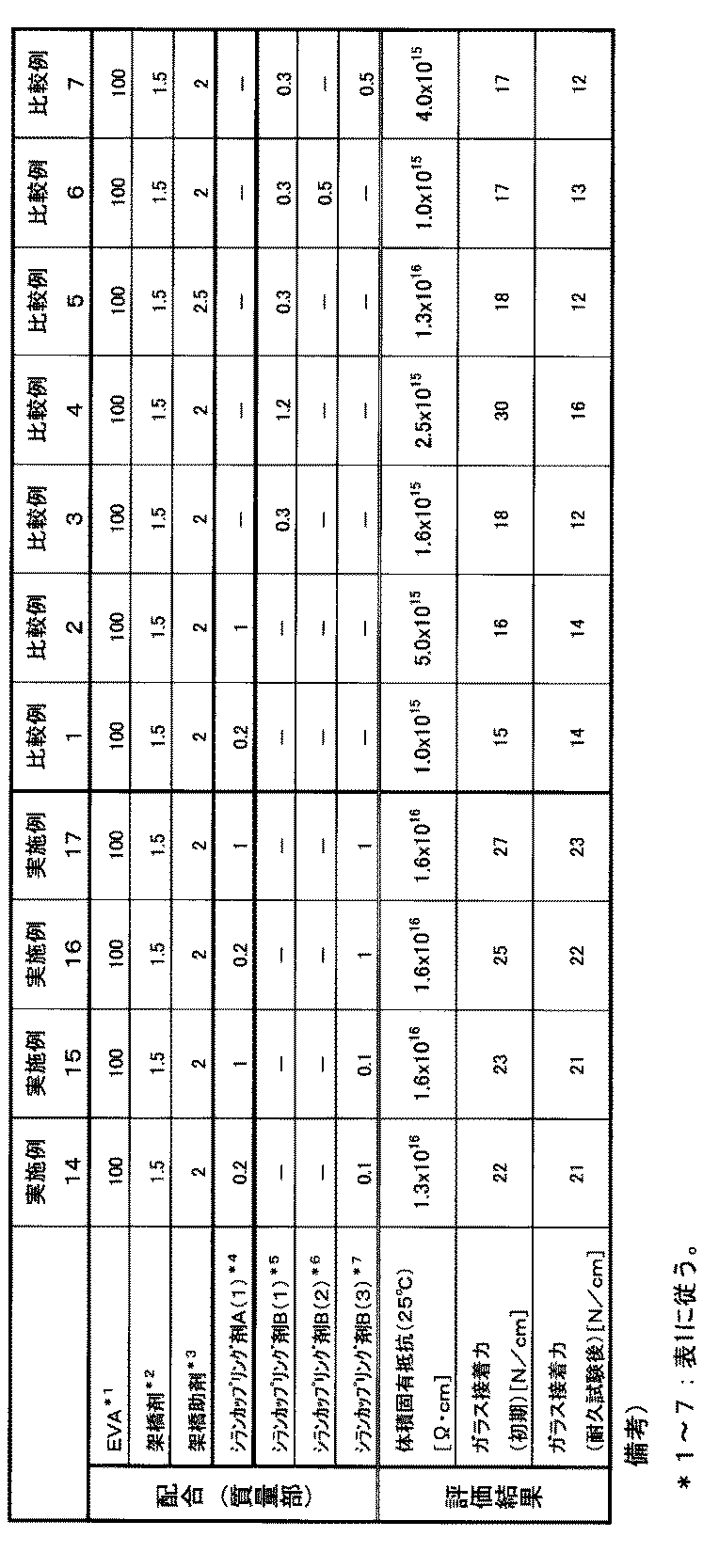
各サンプルの評価結果を表1及び2に示す。実施例1~17において、分子内に3個のアルコキシシリル基を有するシランカップリング剤Aとして1,3,5-トリス[3-(トリメトキシシリル)プロピル]イソシアヌレート、及び分子内に1個のアルコキシシリル基を有するシランカップリング剤Bとして、3-メタクリロキシプロピルトリメトキシシラン、N-フェニル-3-アミノプロピルトリメトキシシラン、又は3-イソシアネートプロピルトリエトキシシランを配合した太陽電池用封止膜は、25℃環境下における体積固有抵抗、ガラス接着力の耐久性が全て合格であった。
12 裏面側保護部材
13A 表面側封止膜
13B 裏面側封止膜
14 太陽電池用セル
21 ガラス基板
23 太陽電池用封止膜
Claims (12)
- エチレン-極性モノマー共重合体、及び架橋剤を含む組成物からなる太陽電池用封止膜であって、
前記組成物が、更に、分子内に3個のアルコキシシリル基を有するシランカップリング剤A、及び分子内に1個のアルコキシシリル基を有するシランカップリング剤Bを含むことを特徴とする太陽電池用封止膜。 - 前記シランカップリング剤Aの含有量が、前記エチレン-極性モノマー共重合体100質量部に対して、0.2~1質量部であり、且つ
前記シランカップリング剤Bの含有量が、前記エチレン-極性モノマー共重合体100質量部に対して、0.1~1質量部である請求項1に記載の太陽電池用封止膜。 - 前記シランカップリング剤Aが、分子内にイソシアヌレート基を有するシランカップリング剤である請求項1又は2に記載の太陽電池用封止膜。
- 前記シランカップリング剤Aが、下記式(I):

で表されるシランカップリング剤である請求項1~3のいずれか1項に記載の太陽電池用封止膜。 - 前記シランカップリング剤Aが、1,3,5-トリス[3-(トリメトキシシリル)プロピル]イソシアヌレート、1,3,5-トリス[3-(トリエトキシシリル)プロピル]イソシアヌレート、1,3,5-トリス[3-(メチルジメトキシシリル)プロピル]イソシアヌレート、及び1,3,5-トリス[3-(メチルジエトキシシリル)プロピル]イソシアヌレートからなる群から選択される少なくとも1種のシランカップリング剤である請求項1~4のいずれか1項に記載の太陽電池用封止膜。
- 前記シランカップリング剤Bが、下記式(II):

で表されるシランカップリング剤である請求項1~5のいずれか1項に記載の太陽電池用封止膜。 - 前記シランカップリング剤Bが、3-メタクリロキシプロピルトリメトキシシラン、3-メタクリロキシプロピルトリエトキシシラン、N-フェニル-3-アミノプロピルトリメトキシシラン、及び3-イソシアネートプロピルトリエトキシシランからなる群から選択される少なくとも1種のシランカップリング剤である請求項1~6のいずれか1項に記載の太陽電池用封止膜。
- 架橋後の体積固有抵抗(25℃環境下)が1.0×10¹⁶Ω・cm以上である請求項1~7のいずれか1項に記載の太陽電池用封止膜。
- 架橋後に、温度85℃、湿度85%RHの環境下で2000時間放置した後、180°ピール試験(JIS K 6584、1994年)により測定したガラス接着力が、20N/cm以上である請求項1~8のいずれか1項に記載の太陽電池用封止膜。
- 前記エチレン-極性モノマー共重合体が、エチレン-酢酸ビニル共重合体である請求項1~9のいずれか1項に記載の太陽電池用封止膜。
- 前記架橋剤が、有機過酸化物である請求項1~10に記載の太陽電池用封止膜。
- 請求項1~11のいずれか1項に記載の太陽電池用封止膜により太陽電池素子を封止してなることを特徴とする太陽電池。
Priority Applications (4)
| Application Number | Priority Date | Filing Date | Title |
|---|---|---|---|
| ES12805221.4T ES2598884T3 (es) | 2011-06-27 | 2012-06-22 | Película de sellado para célula solar y célula solar que usa la película de sellado |
| CN201280031499.1A CN103636003B (zh) | 2011-06-27 | 2012-06-22 | 太阳能电池用密封膜和使用其的太阳能电池 |
| EP12805221.4A EP2725627B1 (en) | 2011-06-27 | 2012-06-22 | Solar cell sealing film and solar cell using the sealing film |
| US14/125,827 US20140090709A1 (en) | 2011-06-27 | 2012-06-22 | Solar cell sealing film and solar cell using the sealing film |
Applications Claiming Priority (2)
| Application Number | Priority Date | Filing Date | Title |
|---|---|---|---|
| JP2011141416A JP5785794B2 (ja) | 2011-06-27 | 2011-06-27 | 太陽電池用封止膜及びこれを用いた太陽電池 |
| JP2011-141416 | 2011-06-27 |
Publications (1)
| Publication Number | Publication Date |
|---|---|
| WO2013002133A1 true WO2013002133A1 (ja) | 2013-01-03 |
Family
ID=47424029
Family Applications (1)
| Application Number | Title | Priority Date | Filing Date |
|---|---|---|---|
| PCT/JP2012/065959 Ceased WO2013002133A1 (ja) | 2011-06-27 | 2012-06-22 | 太陽電池用封止膜及びこれを用いた太陽電池 |
Country Status (6)
| Country | Link |
|---|---|
| US (1) | US20140090709A1 (ja) |
| EP (1) | EP2725627B1 (ja) |
| JP (1) | JP5785794B2 (ja) |
| CN (1) | CN103636003B (ja) |
| ES (1) | ES2598884T3 (ja) |
| WO (1) | WO2013002133A1 (ja) |
Families Citing this family (9)
| Publication number | Priority date | Publication date | Assignee | Title |
|---|---|---|---|---|
| EP2947516A1 (en) * | 2014-05-22 | 2015-11-25 | Ricoh Company, Ltd. | Developing device, and image forming apparatus and process cartridge incorporating same |
| JP6267794B2 (ja) * | 2014-06-27 | 2018-01-24 | 三井化学東セロ株式会社 | 太陽電池封止材用樹脂組成物、太陽電池封止材および太陽電池モジュール |
| JP2016092353A (ja) * | 2014-11-11 | 2016-05-23 | 凸版印刷株式会社 | 太陽電池用封止フィルムおよび太陽電池モジュール |
| KR20170115347A (ko) * | 2016-04-07 | 2017-10-17 | 현대자동차주식회사 | 태양전지를 갖는 자동차 루프패널 |
| KR101981331B1 (ko) * | 2017-03-30 | 2019-05-22 | 에스케이씨에코솔루션즈(주) | 태양전지용 봉지재 및 이를 포함하는 태양전지 모듈 |
| CN110194934B (zh) * | 2019-04-29 | 2022-02-08 | 旭科新能源股份有限公司 | 一种光伏用封装胶膜、其制备方法及应用 |
| CN114958216A (zh) * | 2022-06-27 | 2022-08-30 | 苏州赛伍应用技术股份有限公司 | 一种异质结电池用封装胶膜及其制备方法和应用 |
| CN114921187B (zh) * | 2022-06-27 | 2024-06-25 | 苏州赛伍应用技术股份有限公司 | 一种封装胶膜及其制备方法和应用 |
| JP7727253B1 (ja) | 2024-03-05 | 2025-08-21 | ダイキン工業株式会社 | 組成物、それを用いたシート及びその製造方法 |
Citations (3)
| Publication number | Priority date | Publication date | Assignee | Title |
|---|---|---|---|---|
| JP2009200385A (ja) * | 2008-02-25 | 2009-09-03 | Toppan Printing Co Ltd | 太陽電池用保護シート及びこれを用いた太陽電池モジュール |
| JP2011044626A (ja) * | 2009-08-24 | 2011-03-03 | Bridgestone Corp | 太陽電池封止膜及びこれを用いた太陽電池 |
| WO2011068188A1 (ja) * | 2009-12-04 | 2011-06-09 | Jsr株式会社 | 封止用材料、太陽電池モジュール用積層シートおよび太陽電池モジュール |
Family Cites Families (14)
| Publication number | Priority date | Publication date | Assignee | Title |
|---|---|---|---|---|
| JP2001244383A (ja) * | 2000-02-29 | 2001-09-07 | Sumitomo Bakelite Co Ltd | 半導体装置 |
| US7189781B2 (en) * | 2003-03-13 | 2007-03-13 | H.B. Fuller Licensing & Finance Inc. | Moisture curable, radiation curable sealant composition |
| WO2006085603A1 (ja) * | 2005-02-10 | 2006-08-17 | Du Pont-Mitsui Polychemicals Co., Ltd. | 太陽電池封止材の製造方法 |
| US20060235221A1 (en) * | 2005-04-14 | 2006-10-19 | Childress R S | Process for making silylisocyanurate |
| CN101410990B (zh) * | 2006-04-05 | 2011-03-30 | 株式会社普利司通 | 太阳能电池用密封膜和使用该密封膜的太阳能电池 |
| JP5103801B2 (ja) * | 2006-06-14 | 2012-12-19 | 凸版印刷株式会社 | 太陽電池用バックシート及び太陽電池モジュール |
| JP5391515B2 (ja) * | 2006-09-11 | 2014-01-15 | 凸版印刷株式会社 | 太陽電池用裏面保護シートおよび太陽電池モジュール |
| EP2068375A1 (en) * | 2007-12-03 | 2009-06-10 | Tendris Solutions B.V. | Flexible solar cell laminate comprising a crystalline semiconductor layer |
| US20090260675A1 (en) * | 2008-04-18 | 2009-10-22 | Serkan Erdemli | Encapsulation of solar modules |
| JP2010100839A (ja) * | 2008-09-26 | 2010-05-06 | Kaneka Corp | 太陽電池モジュール用硬化性組成物および太陽電池モジュール |
| MY162462A (en) * | 2009-06-01 | 2017-06-15 | Mitsui Chemicals Tohcello Inc | Encapsulant material for solar cells comprising an ethylene resin composition |
| JP5683460B2 (ja) * | 2009-06-05 | 2015-03-11 | 三井化学東セロ株式会社 | 太陽電池封止膜の保存用または運搬用包装体、および太陽電池封止膜の保存または運搬方法 |
| US9040165B2 (en) * | 2009-11-26 | 2015-05-26 | Bridgestone Corporation | Solar cell sealing film and solar cell |
| JP2012054276A (ja) * | 2010-08-31 | 2012-03-15 | Toppan Printing Co Ltd | 太陽電池用裏面保護シート及びそれを用いた太陽電池モジュール |
-
2011
- 2011-06-27 JP JP2011141416A patent/JP5785794B2/ja not_active Expired - Fee Related
-
2012
- 2012-06-22 WO PCT/JP2012/065959 patent/WO2013002133A1/ja not_active Ceased
- 2012-06-22 US US14/125,827 patent/US20140090709A1/en not_active Abandoned
- 2012-06-22 ES ES12805221.4T patent/ES2598884T3/es active Active
- 2012-06-22 EP EP12805221.4A patent/EP2725627B1/en not_active Not-in-force
- 2012-06-22 CN CN201280031499.1A patent/CN103636003B/zh not_active Expired - Fee Related
Patent Citations (3)
| Publication number | Priority date | Publication date | Assignee | Title |
|---|---|---|---|---|
| JP2009200385A (ja) * | 2008-02-25 | 2009-09-03 | Toppan Printing Co Ltd | 太陽電池用保護シート及びこれを用いた太陽電池モジュール |
| JP2011044626A (ja) * | 2009-08-24 | 2011-03-03 | Bridgestone Corp | 太陽電池封止膜及びこれを用いた太陽電池 |
| WO2011068188A1 (ja) * | 2009-12-04 | 2011-06-09 | Jsr株式会社 | 封止用材料、太陽電池モジュール用積層シートおよび太陽電池モジュール |
Non-Patent Citations (1)
| Title |
|---|
| See also references of EP2725627A4 * |
Also Published As
| Publication number | Publication date |
|---|---|
| CN103636003A (zh) | 2014-03-12 |
| ES2598884T3 (es) | 2017-01-30 |
| EP2725627A4 (en) | 2015-05-06 |
| EP2725627A1 (en) | 2014-04-30 |
| JP5785794B2 (ja) | 2015-09-30 |
| JP2013008889A (ja) | 2013-01-10 |
| CN103636003B (zh) | 2016-05-11 |
| EP2725627B1 (en) | 2016-08-10 |
| US20140090709A1 (en) | 2014-04-03 |
Similar Documents
| Publication | Publication Date | Title |
|---|---|---|
| JP5785794B2 (ja) | 太陽電池用封止膜及びこれを用いた太陽電池 | |
| CN103392238B (zh) | 太阳能电池用密封膜和使用密封膜的太阳能电池 | |
| JP5587659B2 (ja) | 太陽電池用封止膜及びこれを用いた太陽電池 | |
| CN104081540B (zh) | 太阳能电池用密封膜和使用其的太阳能电池 | |
| JP2014207457A (ja) | 太陽電池用封止膜及びこれを用いた太陽電池、並びに太陽電池用封止膜における電気絶縁性の低下を抑制する方法 | |
| WO2011102242A1 (ja) | 太陽電池用封止膜及びこれを用いた太陽電池 | |
| WO2014017282A1 (ja) | 太陽電池用封止膜、太陽電池モジュール及び太陽電池用封止膜の選定方法 | |
| JP5819159B2 (ja) | 太陽電池用封止膜及びこれを用いた太陽電池 | |
| JP5788712B2 (ja) | エチレン−極性モノマー共重合体シート、並びにこれを用いた合わせガラス用中間膜、合わせガラス、太陽電池用封止膜及び太陽電池 | |
| JP5755950B2 (ja) | 太陽電池封止膜及びこれを用いた太陽電池 | |
| JP6054664B2 (ja) | 太陽電池用封止膜、及びその選定方法 | |
| JP5624898B2 (ja) | 太陽電池用裏面側保護部材一体型封止膜の製造方法、並びにこれを用いた太陽電池及びその製造方法 | |
| JP5591564B2 (ja) | 太陽電池用封止膜及びこれを用いた太陽電池 | |
| JP5726568B2 (ja) | 太陽電池用封止膜及びこれを用いた太陽電池 | |
| JP5893908B2 (ja) | 太陽電池用封止膜及びこれを用いた太陽電池 | |
| JP5604335B2 (ja) | 太陽電池用封止膜及びこれを用いた太陽電池 | |
| JP6054665B2 (ja) | 太陽電池モジュール | |
| JP2011249701A (ja) | 太陽電池用封止膜及びこれを用いた太陽電池 | |
| JP2012182406A (ja) | 太陽電池用封止膜及びこれを用いた太陽電池 | |
| JP2013030584A (ja) | 太陽電池用封止膜及びこれを用いた太陽電池 | |
| JP2013030583A (ja) | 太陽電池用封止膜及びこれを用いた太陽電池 |
Legal Events
| Date | Code | Title | Description |
|---|---|---|---|
| WWE | Wipo information: entry into national phase |
Ref document number: 201280031499.1 Country of ref document: CN |
|
| 121 | Ep: the epo has been informed by wipo that ep was designated in this application |
Ref document number: 12805221 Country of ref document: EP Kind code of ref document: A1 |
|
| WWE | Wipo information: entry into national phase |
Ref document number: 14125827 Country of ref document: US |
|
| NENP | Non-entry into the national phase |
Ref country code: DE |
|
| REEP | Request for entry into the european phase |
Ref document number: 2012805221 Country of ref document: EP |
|
| WWE | Wipo information: entry into national phase |
Ref document number: 2012805221 Country of ref document: EP |