WO2013011930A1 - 光学活性テトラヒドロキノリン類の製造方法 - Google Patents
光学活性テトラヒドロキノリン類の製造方法 Download PDFInfo
- Publication number
- WO2013011930A1 WO2013011930A1 PCT/JP2012/067879 JP2012067879W WO2013011930A1 WO 2013011930 A1 WO2013011930 A1 WO 2013011930A1 JP 2012067879 W JP2012067879 W JP 2012067879W WO 2013011930 A1 WO2013011930 A1 WO 2013011930A1
- Authority
- WO
- WIPO (PCT)
- Prior art keywords
- group
- iii
- optionally substituted
- iridium
- complex
- Prior art date
- Legal status (The legal status is an assumption and is not a legal conclusion. Google has not performed a legal analysis and makes no representation as to the accuracy of the status listed.)
- Ceased
Links
- 0 *NC(C1NCCC1)=O Chemical compound *NC(C1NCCC1)=O 0.000 description 1
Images


Classifications
-
- C—CHEMISTRY; METALLURGY
- C07—ORGANIC CHEMISTRY
- C07F—ACYCLIC, CARBOCYCLIC OR HETEROCYCLIC COMPOUNDS CONTAINING ELEMENTS OTHER THAN CARBON, HYDROGEN, HALOGEN, OXYGEN, NITROGEN, SULFUR, SELENIUM OR TELLURIUM
- C07F5/00—Compounds containing elements of Groups 3 or 13 of the Periodic Table
-
- C—CHEMISTRY; METALLURGY
- C07—ORGANIC CHEMISTRY
- C07D—HETEROCYCLIC COMPOUNDS
- C07D215/00—Heterocyclic compounds containing quinoline or hydrogenated quinoline ring systems
- C07D215/02—Heterocyclic compounds containing quinoline or hydrogenated quinoline ring systems having no bond between the ring nitrogen atom and a non-ring member or having only hydrogen atoms or carbon atoms directly attached to the ring nitrogen atom
- C07D215/04—Heterocyclic compounds containing quinoline or hydrogenated quinoline ring systems having no bond between the ring nitrogen atom and a non-ring member or having only hydrogen atoms or carbon atoms directly attached to the ring nitrogen atom with only hydrogen atoms or radicals containing only hydrogen and carbon atoms, directly attached to the ring carbon atoms
-
- B—PERFORMING OPERATIONS; TRANSPORTING
- B01—PHYSICAL OR CHEMICAL PROCESSES OR APPARATUS IN GENERAL
- B01J—CHEMICAL OR PHYSICAL PROCESSES, e.g. CATALYSIS OR COLLOID CHEMISTRY; THEIR RELEVANT APPARATUS
- B01J31/00—Catalysts comprising hydrides, coordination complexes or organic compounds
- B01J31/16—Catalysts comprising hydrides, coordination complexes or organic compounds containing coordination complexes
- B01J31/18—Catalysts comprising hydrides, coordination complexes or organic compounds containing coordination complexes containing nitrogen, phosphorus, arsenic or antimony as complexing atoms, e.g. in pyridine ligands, or in resonance therewith, e.g. in isocyanide ligands C=N-R or as complexed central atoms
- B01J31/1805—Catalysts comprising hydrides, coordination complexes or organic compounds containing coordination complexes containing nitrogen, phosphorus, arsenic or antimony as complexing atoms, e.g. in pyridine ligands, or in resonance therewith, e.g. in isocyanide ligands C=N-R or as complexed central atoms the ligands containing nitrogen
- B01J31/181—Cyclic ligands, including e.g. non-condensed polycyclic ligands, comprising at least one complexing nitrogen atom as ring member, e.g. pyridine
-
- B—PERFORMING OPERATIONS; TRANSPORTING
- B01—PHYSICAL OR CHEMICAL PROCESSES OR APPARATUS IN GENERAL
- B01J—CHEMICAL OR PHYSICAL PROCESSES, e.g. CATALYSIS OR COLLOID CHEMISTRY; THEIR RELEVANT APPARATUS
- B01J31/00—Catalysts comprising hydrides, coordination complexes or organic compounds
- B01J31/16—Catalysts comprising hydrides, coordination complexes or organic compounds containing coordination complexes
- B01J31/22—Organic complexes
- B01J31/2282—Unsaturated compounds used as ligands
- B01J31/2295—Cyclic compounds, e.g. cyclopentadienyls
-
- C—CHEMISTRY; METALLURGY
- C07—ORGANIC CHEMISTRY
- C07B—GENERAL METHODS OF ORGANIC CHEMISTRY; APPARATUS THEREFOR
- C07B53/00—Asymmetric syntheses
-
- C—CHEMISTRY; METALLURGY
- C07—ORGANIC CHEMISTRY
- C07D—HETEROCYCLIC COMPOUNDS
- C07D215/00—Heterocyclic compounds containing quinoline or hydrogenated quinoline ring systems
- C07D215/02—Heterocyclic compounds containing quinoline or hydrogenated quinoline ring systems having no bond between the ring nitrogen atom and a non-ring member or having only hydrogen atoms or carbon atoms directly attached to the ring nitrogen atom
- C07D215/04—Heterocyclic compounds containing quinoline or hydrogenated quinoline ring systems having no bond between the ring nitrogen atom and a non-ring member or having only hydrogen atoms or carbon atoms directly attached to the ring nitrogen atom with only hydrogen atoms or radicals containing only hydrogen and carbon atoms, directly attached to the ring carbon atoms
- C07D215/06—Heterocyclic compounds containing quinoline or hydrogenated quinoline ring systems having no bond between the ring nitrogen atom and a non-ring member or having only hydrogen atoms or carbon atoms directly attached to the ring nitrogen atom with only hydrogen atoms or radicals containing only hydrogen and carbon atoms, directly attached to the ring carbon atoms having only hydrogen atoms, hydrocarbon or substituted hydrocarbon radicals, attached to the ring nitrogen atom
-
- C—CHEMISTRY; METALLURGY
- C07—ORGANIC CHEMISTRY
- C07D—HETEROCYCLIC COMPOUNDS
- C07D215/00—Heterocyclic compounds containing quinoline or hydrogenated quinoline ring systems
- C07D215/02—Heterocyclic compounds containing quinoline or hydrogenated quinoline ring systems having no bond between the ring nitrogen atom and a non-ring member or having only hydrogen atoms or carbon atoms directly attached to the ring nitrogen atom
- C07D215/12—Heterocyclic compounds containing quinoline or hydrogenated quinoline ring systems having no bond between the ring nitrogen atom and a non-ring member or having only hydrogen atoms or carbon atoms directly attached to the ring nitrogen atom with substituted hydrocarbon radicals attached to ring carbon atoms
- C07D215/14—Radicals substituted by oxygen atoms
-
- C—CHEMISTRY; METALLURGY
- C07—ORGANIC CHEMISTRY
- C07D—HETEROCYCLIC COMPOUNDS
- C07D215/00—Heterocyclic compounds containing quinoline or hydrogenated quinoline ring systems
- C07D215/02—Heterocyclic compounds containing quinoline or hydrogenated quinoline ring systems having no bond between the ring nitrogen atom and a non-ring member or having only hydrogen atoms or carbon atoms directly attached to the ring nitrogen atom
- C07D215/16—Heterocyclic compounds containing quinoline or hydrogenated quinoline ring systems having no bond between the ring nitrogen atom and a non-ring member or having only hydrogen atoms or carbon atoms directly attached to the ring nitrogen atom with hetero atoms or with carbon atoms having three bonds to hetero atoms with at the most one bond to halogen, e.g. ester or nitrile radicals, directly attached to ring carbon atoms
- C07D215/18—Halogen atoms or nitro radicals
-
- C—CHEMISTRY; METALLURGY
- C07—ORGANIC CHEMISTRY
- C07D—HETEROCYCLIC COMPOUNDS
- C07D215/00—Heterocyclic compounds containing quinoline or hydrogenated quinoline ring systems
- C07D215/02—Heterocyclic compounds containing quinoline or hydrogenated quinoline ring systems having no bond between the ring nitrogen atom and a non-ring member or having only hydrogen atoms or carbon atoms directly attached to the ring nitrogen atom
- C07D215/16—Heterocyclic compounds containing quinoline or hydrogenated quinoline ring systems having no bond between the ring nitrogen atom and a non-ring member or having only hydrogen atoms or carbon atoms directly attached to the ring nitrogen atom with hetero atoms or with carbon atoms having three bonds to hetero atoms with at the most one bond to halogen, e.g. ester or nitrile radicals, directly attached to ring carbon atoms
- C07D215/20—Oxygen atoms
-
- C—CHEMISTRY; METALLURGY
- C07—ORGANIC CHEMISTRY
- C07D—HETEROCYCLIC COMPOUNDS
- C07D215/00—Heterocyclic compounds containing quinoline or hydrogenated quinoline ring systems
- C07D215/02—Heterocyclic compounds containing quinoline or hydrogenated quinoline ring systems having no bond between the ring nitrogen atom and a non-ring member or having only hydrogen atoms or carbon atoms directly attached to the ring nitrogen atom
- C07D215/16—Heterocyclic compounds containing quinoline or hydrogenated quinoline ring systems having no bond between the ring nitrogen atom and a non-ring member or having only hydrogen atoms or carbon atoms directly attached to the ring nitrogen atom with hetero atoms or with carbon atoms having three bonds to hetero atoms with at the most one bond to halogen, e.g. ester or nitrile radicals, directly attached to ring carbon atoms
- C07D215/20—Oxygen atoms
- C07D215/22—Oxygen atoms attached in position 2 or 4
-
- C—CHEMISTRY; METALLURGY
- C07—ORGANIC CHEMISTRY
- C07D—HETEROCYCLIC COMPOUNDS
- C07D215/00—Heterocyclic compounds containing quinoline or hydrogenated quinoline ring systems
- C07D215/02—Heterocyclic compounds containing quinoline or hydrogenated quinoline ring systems having no bond between the ring nitrogen atom and a non-ring member or having only hydrogen atoms or carbon atoms directly attached to the ring nitrogen atom
- C07D215/16—Heterocyclic compounds containing quinoline or hydrogenated quinoline ring systems having no bond between the ring nitrogen atom and a non-ring member or having only hydrogen atoms or carbon atoms directly attached to the ring nitrogen atom with hetero atoms or with carbon atoms having three bonds to hetero atoms with at the most one bond to halogen, e.g. ester or nitrile radicals, directly attached to ring carbon atoms
- C07D215/20—Oxygen atoms
- C07D215/22—Oxygen atoms attached in position 2 or 4
- C07D215/227—Oxygen atoms attached in position 2 or 4 only one oxygen atom which is attached in position 2
-
- C—CHEMISTRY; METALLURGY
- C07—ORGANIC CHEMISTRY
- C07F—ACYCLIC, CARBOCYCLIC OR HETEROCYCLIC COMPOUNDS CONTAINING ELEMENTS OTHER THAN CARBON, HYDROGEN, HALOGEN, OXYGEN, NITROGEN, SULFUR, SELENIUM OR TELLURIUM
- C07F17/00—Metallocenes
- C07F17/02—Metallocenes of metals of Groups 8, 9 or 10 of the Periodic Table
-
- B—PERFORMING OPERATIONS; TRANSPORTING
- B01—PHYSICAL OR CHEMICAL PROCESSES OR APPARATUS IN GENERAL
- B01J—CHEMICAL OR PHYSICAL PROCESSES, e.g. CATALYSIS OR COLLOID CHEMISTRY; THEIR RELEVANT APPARATUS
- B01J2231/00—Catalytic reactions performed with catalysts classified in B01J31/00
- B01J2231/60—Reduction reactions, e.g. hydrogenation
- B01J2231/64—Reductions in general of organic substrates, e.g. hydride reductions or hydrogenations
- B01J2231/641—Hydrogenation of organic substrates, i.e. H2 or H-transfer hydrogenations, e.g. Fischer-Tropsch processes
- B01J2231/643—Hydrogenation of organic substrates, i.e. H2 or H-transfer hydrogenations, e.g. Fischer-Tropsch processes of R2C=O or R2C=NR (R= C, H)
-
- B—PERFORMING OPERATIONS; TRANSPORTING
- B01—PHYSICAL OR CHEMICAL PROCESSES OR APPARATUS IN GENERAL
- B01J—CHEMICAL OR PHYSICAL PROCESSES, e.g. CATALYSIS OR COLLOID CHEMISTRY; THEIR RELEVANT APPARATUS
- B01J2531/00—Additional information regarding catalytic systems classified in B01J31/00
- B01J2531/02—Compositional aspects of complexes used, e.g. polynuclearity
- B01J2531/0269—Complexes comprising ligands derived from the natural chiral pool or otherwise having a characteristic structure or geometry
- B01J2531/0275—Complexes comprising ligands derived from the natural chiral pool or otherwise having a characteristic structure or geometry derived from amino acids
-
- B—PERFORMING OPERATIONS; TRANSPORTING
- B01—PHYSICAL OR CHEMICAL PROCESSES OR APPARATUS IN GENERAL
- B01J—CHEMICAL OR PHYSICAL PROCESSES, e.g. CATALYSIS OR COLLOID CHEMISTRY; THEIR RELEVANT APPARATUS
- B01J2531/00—Additional information regarding catalytic systems classified in B01J31/00
- B01J2531/80—Complexes comprising metals of Group VIII as the central metal
- B01J2531/82—Metals of the platinum group
- B01J2531/827—Iridium
Definitions
- the present invention relates to a method for producing optically active 2-substituted-1,2,3,4-tetrahydroquinolines and a novel chiral iridium catalyst used therefor.
- Optically active tetrahydroquinolines especially optically active 2-substituted-1,2,3,4-tetrahydroquinolines having a substituent at the 2-position are included in many naturally occurring compounds such as physiologically active alkaloids as pharmaceuticals. Is also an important compound widely used.
- the corresponding 2-substituted-quinolines are asymmetrically reduced and optically active 2-substituted-1,2,3,4-in one step.
- Various methods for obtaining tetrahydroquinolines have been developed.
- Non-Patent Document 1 a method of reducing a chiral acid with a Hantzsch ester using an asymmetric catalyst
- Non-Patent Documents 2 and 3 a method of reducing with a hydrogen gas using an iridium catalyst having a chiral ligand
- Non-patent Document 4 A method of reducing with sodium formate using a rhodium catalyst having TsDPEN and its analog as a ligand in an aqueous medium is known (Non-patent Document 4).
- these methods are not always satisfactory as an industrial production method.
- Non-Patent Document 1 the method of using Hantzsch ester as a reducing agent
- Non-Patent Document 2 and 3 since the reactivity of quinoline is low, it is necessary to react hydrogen under high pressure (for example, 40-50 atm. Thus, there are problems such as an increase in manufacturing cost.
- Non-patent Document 4 in the method of reducing with an inexpensive sodium formate in an aqueous medium (Non-patent Document 4), most of the quinoline compounds as raw materials are hardly soluble in water, and strict liquidity adjustment is essential.
- Non-patent Document 4 the reaction of 2-methylquinoline using an iridium catalyst having TsDPEN as a ligand (Non-patent Document 4) has a problem that an asymmetric yield as low as 11% ee can be obtained. Under such circumstances, development of a method for providing industrially advantageous optically active 2-substituted-1,2,3,4-tetrahydroquinolines, which are units of many useful substances, is currently urgently required. It has been.
- the present invention provides a novel chiral iridium (III) complex, and optically active 2-substituted-quinolines using the chiral iridium (III) complex in an economical and easy-to-operate manner. It is an object of the present invention to provide a production method for converting into substituted-1,2,3,4-tetrahydroquinolines.
- the present inventors have already prepared an iridium (III) complex catalyst having a chiral proline amide as a ligand for an imine compound formed from a ketone and an amine without isolating it in solution.
- An iridium (III) complex catalyst having a chiral proline amide as a ligand for an imine compound formed from a ketone and an amine without isolating it in solution.
- Patent Document 1 A patent application relating to a method for obtaining an optically active amine by performing a hydrogen transfer-type asymmetric reduction reaction in the presence of a hydrogen-donating compound.
- the present inventors have found that optically active 2-substituted-1,2,3,4-tetrahydroquinolines can be obtained with an asymmetric yield, and have further studied to complete the present invention. That is, the present invention provides an industrially excellent method for obtaining optically active 2-substituted-1,2,3,4-tetrahydroquinolines by asymmetric reduction of 2-substituted-quinolines.
- R 1 is an optionally substituted alkyl group, an optionally substituted aryl group, an optionally substituted aralkyl group, an optionally substituted cycloalkyl group, or an optionally substituted group.
- R 2 represents a hydrogen atom, an optionally substituted alkyl group, an optionally substituted aryl group, an optionally substituted aralkyl group, an optionally substituted cycloalkyl group, or an optionally substituted hetero
- R 2 is present at any position from the 5th position to the 8th position of the quinoline ring,
- R 3 represents a hydrogen atom, an optionally substituted alkyl group, an optionally substituted aryl group, an optionally substituted aralkyl group, an optionally substituted cycloalkyl group or a substituted group; A heteroaryl group that may be present, and an asterisk (*) represents an asymmetric carbon atom.
- the chiral proline amide compound is (R) -N- (6-quinolinyl) -2-pyrrolidinecarboxamide or (S) -N- (6-quinolinyl) -2-pyrrolidinecarboxamide [1] to [3] The production method according to any one of [3].
- a chiral proline amide compound is (R) -N- (2-methoxy-3-dibenzofuranyl) -2-pyrrolidinecarboxamide or (S) -N- (2-methoxy-3-dibenzofuranyl) ) The production method according to any one of [1] to [3], which is 2-pyrrolidinecarboxamide.
- An iridium (III) complex having a chiral proline amide compound as a ligand is (R) or (S) -chloro [(1,2,3,4,5- ⁇ ) -pentamethyl-2, 4-cyclopentadien-1-yl] [N- (2-methoxy-3-dibenzofuranyl) -2-pyrrolidinecarboxamidate- ⁇ N1, ⁇ N2] iridium (III) catalyst, (R) or (S) -chloro [(1,2,3,4,5- ⁇ ) -pentamethyl-2,4-cyclopentadien-1-yl] (N-6-quinolinyl-2-pyrrolidinecarboxamidato- ⁇ N1, ⁇ N2) iridium (III)
- An iridium (III) complex having a chiral proline amide compound as a ligand is represented by (R) or (S) -chloro [(1,2,3,4,5- ⁇ ) -pentamethyl-2, [4]
- R 3 represents a hydrogen atom, an optionally substituted alkyl group, an optionally substituted aryl group, an optionally substituted aralkyl group, an optionally substituted cycloalkyl group or a substituted group; A heteroaryl group that may be present, and an asterisk (*) represents an asymmetric carbon atom.
- Cp * represents (1,2,3,4,5- ⁇ ) -pentamethyl-2,4-cyclopentadien-1-yl.
- R 3 is any one of hydrogen, a 6-quinolinyl group, and a 2-methoxy-3-dibenzofuranyl group.
- optically active 2-substituted-1,2,3,4-tetrahydroquinolines can be advantageously produced industrially at low cost under simple process control using general-purpose equipment. Can do.
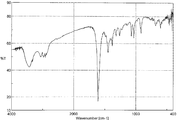
- the IR (KBr) chart of ( ⁇ N1, ⁇ N2) iridium (III) is shown.
- Crystalline (S) -chloro [(1,2,3,4,5- ⁇ ) -pentamethyl-2,4-cyclopentadien-1-yl] (2-pyrrolidinecarboxamidate-) prepared in Example 4 of the present application
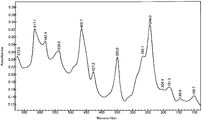
- the far-infrared spectrum of ( ⁇ N1, ⁇ N2) iridium (III) is shown.
- Crystalline (S) -chloro [(1,2,3,4,5- ⁇ ) -pentamethyl-2,4-cyclopentadien-1-yl] (2-pyrrolidinecarboxamidate-) prepared in Example 4 of the present application 1 shows a powder X-ray diffraction pattern of ⁇ N1, ⁇ N2) iridium (III). The far-infrared spectrum of the powder manufactured in Reference Example 1 is shown.
- Iridium (III) chloro complexes with chiral proline amide compounds as ligands include, for example, iridium (III) compounds, chiral proline amides It can be prepared by reacting a similar compound and a base.
- iridium (III) chloro complexes that is, p-CH 3 C 6 H 4 SO 3 ⁇ , CH 3 SO 3 ⁇ , CF 3 SO 3 ⁇ , NO 3 ⁇ , BF 4 ⁇ , ClO 4 ⁇ , PF 6 ⁇ , SbF 6 -, B [3,5 -di (trifluoromethyl) phenyl] 4 - , or B (4-fluorophenyl) 4 - iridium having an anion (III) complexes, for example a chiral prolinamide compound and the ligand
- the iridium (III) chloro complex can be prepared as a raw material.
- R 3 represents a hydrogen atom, an optionally substituted alkyl group, an optionally substituted aryl group, an optionally substituted aralkyl group, an optionally substituted cycloalkyl group or a substituted group;
- the iridium (III) complex having a chiral proline amide compound as a ligand is usually represented by the following formula:
- the iridium (III) complex having a chiral proline amide compound as a ligand is Formula [IV]
- R 3 represents a hydrogen atom, an optionally substituted alkyl group, an optionally substituted aryl group, an optionally substituted aralkyl group, an optionally substituted cycloalkyl group or a substituted group; A heteroaryl group that may be present, and an asterisk (*) represents an asymmetric carbon atom.
- Cp * represents (1,2,3,4,5- ⁇ ) -pentamethyl-2,4-cyclopentadien-1-yl.
- the iridium (III) complex having the above chiral proline amide compound as a ligand is represented by the formula [III] wherein R 3 is any one of hydrogen, 6-quinolinyl group, and 2-methoxy-3-dibenzofuranyl group. It is preferable to have these ligands.
- examples of the proline amide include 2-pyrrolidinecarboxamide and the like
- examples of the prolineamide quinoline derivative include N-6-quinolinyl-2-pyrrolidinecarboxamide
- examples of the prolineamide methoxydibenzofuran derivative examples of the prolineamide methoxydibenzofuran derivative.
- iridium (III) complex having a chiral proline amide compound as a ligand include, for example, (R) or (S) -chloro [(1,2,3,4,5- ⁇ ) -pentamethyl. -2,4-cyclopentadien-1-yl] [N- (2-methoxy-3-dibenzofuranyl) -2-pyrrolidinecarboxamidato- ⁇ N1, ⁇ N2] iridium (III) complex, (R) or (S ) -Chloro [(1,2,3,4,5- ⁇ ) -pentamethyl-2,4-cyclopentadien-1-yl] (N-6-quinolinyl-2-pyrrolidinecarboxamidato- ⁇ N1, ⁇ N2) iridium (III) Complex, (R) or (S) -Chloro [(1,2,3,4,5- ⁇ ) -pentamethyl-2,4-cyclopentadien-1-yl] (2-pyrrolidinecarbox
- Cl ⁇ represents another ligand, such as p-CH 3 C 6 H 4 SO 3 ⁇ , CH 3 SO 3 ⁇ , CF 3 SO 3 ⁇ , NO 3 ⁇ , BF 4 ⁇ .
- the iridium (III) complex having a chiral proline amide compound as a ligand may be crystalline or amorphous, but is preferably crystalline.
- the iridium (III) complex having a chiral proline amide compound as a ligand can be used for the asymmetric reduction reaction using the prepared solution as a catalyst as it is, but as a crystalline or amorphous iridium (III) complex It is more preferable to use the purified and isolated product for the asymmetric reduction reaction.
- purified and isolated crystalline or amorphous iridium (III) complex is used as a catalyst for asymmetric reduction reaction, the chemical yield and chirality of the product are superior compared to the case where the catalyst preparation solution is used as it is. This is because the yield is achieved.
- the iridium (III) complex undergoes partial epimerization during catalyst preparation or while the preparation liquid is left standing due to the action of the base component coexisting in the catalyst preparation solution, resulting in a decrease in the optical purity of the catalyst. Because it will do. For this reason, when using a catalyst preparation liquid as it is, it is necessary to use it immediately after preparation.
- the iridium (III) complex is purified and isolated from the catalyst preparation solution, the base component and epimer (epimer) that cause epimerization in the process can also be removed, so the crystallinity is high in optical purity and good in storage stability. Alternatively, an amorphous iridium (III) complex is obtained.
- Purification and isolation methods include isolating the produced iridium (III) complex from a solution once by concentration, etc., and then purifying it by a known recrystallization method or reprecipitation method, or by using a solvent with high purification efficiency from the beginning. And the like, and the main product precipitated through the purification process is filtered, washed, and dried. Chemically and optically pure crystalline or amorphous can be used by these methods. Iridium (III) complex can be easily obtained. A purified and isolated crystalline or amorphous iridium (III) complex has high stability, chemical and optical purity are constant over a long period of time, and long-term storage at room temperature is possible.
- the iridium (III) complex can be suitably used, for example, as an asymmetric reduction catalyst in the production of optically active tetrahydroquinolines and optically active amines.
- crystalline usually means that the molecules are regularly and three-dimensionally arranged.
- amorphous usually means that the molecules have a disordered arrangement without forming a regular spatial lattice.
- iridium (III) compound examples include pentamethylcyclopentadienyl iridium (III) chloride dimer ([Cp * IrCl 2 ] 2 ), acetylacetonatoiridium (III), tris (Norbornadiene) (acetylacetonato) iridium (III) and the like are mentioned, and pentamethylcyclopentadienyliridium (III) chloride dimer ([Cp * IrCl 2 ] 2 ) is particularly preferable.
- the iridium (III) chloro complex is prepared by preparing a complex other than the iridium (III) chloro complex, that is, p-CH 3 C 6 H 4 SO 3 ⁇ , CH 3 SO 3 ⁇ , CF 3 SO 3 ⁇ , NO 3 ⁇ , BF 4 -, ClO 4 -, PF 6 -, SbF 6 -, B [3,5-di (trifluoromethyl) phenyl] 4 - , or B (4-fluorophenyl) 4 - used in the preparation of iridium (III) complexes with anions be able to.
- Chiral proline amide compounds used for the preparation of the iridium (III) chloro complex include compounds of the formula [III]:
- R 3 represents a hydrogen atom, an optionally substituted alkyl group, an optionally substituted aryl group, an optionally substituted aralkyl group, an optionally substituted cycloalkyl group or a substituted group; A heteroaryl group that may be present, and an asterisk (*) represents an asymmetric carbon atom.
- proline amide compounds represented by the formula [III] include proline amides and N-substituted amides such as N-alkyl amides, N-cycloalkyl amides, N-aryl amides, N-heteroaryl amides, N- Aralkylamide, N-heteroarylalkylamide and the like can be mentioned. These are examples of the R 3 substituent, but the substituent may further have a substituent (hereinafter sometimes referred to as a substituent).
- alkyl group examples include linear or branched alkyl groups having 1 to 20 carbon atoms that do not contain asymmetric carbons, and specifically include methyl groups, ethyl groups, and the like.
- Propyl group isopropyl group, butyl group, isobutyl group, tert-butyl group, pentyl group, hexyl group, heptyl group, octyl group, nonyl group, decyl group, dodecyl group, pentadecyl group, hexadecyl group, octadecyl group, etc. It is done.
- Examples of the “cycloalkyl group” in N-cycloalkylamide include a cycloalkyl group having 3 to 7 carbon atoms, and specifically include a cyclopropyl group, a cyclobutyl group, a cyclopentyl group, a cyclohexyl group, a cycloheptyl group, and the like. Can be mentioned.
- aryl group in N-arylamide examples include an aryl group having 6 to 20 carbon atoms, and specifically include a phenyl group, 1-naphthyl group, 2-naphthyl group, anthryl group, phenanthryl group, 2- Biphenyl group, 3-biphenyl group, 4-biphenyl group, terphenyl group and the like can be mentioned.
- heteroaryl group examples include a heteroaryl group containing an atom selected from a nitrogen atom, a sulfur atom and an oxygen atom as a hetero atom, specifically, a furanyl group, Thienyl, oxazolyl, isoxazolyl, thiazolyl, isothiazolyl, pyrrolyl, imidazolyl, pyrazolyl, pyridyl, pyrimidinyl, pyrazinyl, phthalazinyl, triazinyl, indolyl, isoindolyl, quinolinyl, isoquinolinyl And a dibenzofuranyl group.
- Examples of the “aralkyl group” in N-aralkylamide include those obtained by substituting the hydrogen atom of the alkyl group with an aryl group.
- Examples of the aralkyl group in N-aralkylamide include a benzyl group, a phenylethyl group, and a phenylpropyl group.
- Examples of the “heteroarylalkyl group” in N-heteroarylalkylamide include those in which the hydrogen atom of the above alkyl group is substituted with a heteroaryl group.
- Examples of the heteroarylalkyl group in N-heteroarylalkylamide include a heteroarylmethyl group, a heteroarylethyl group, a heteroarylpropyl group, and the like.
- substituents (substituents) of the aforementioned “alkyl group”, “aryl group”, “heteroaryl group”, “aralkyl group” and “cycloalkyl group” include halogen (for example, fluorine atom, chlorine atom, bromine atom)
- a linear or branched alkyl group having 1 to 6 carbon atoms for example, methyl group, ethyl group, propyl group, isopropyl group, butyl group, isobutyl group, tert-butyl group, pentyl group, Hexyl group, etc.), aralkyl groups having 7 to 12 carbon atoms (for example, phenylethyl group, phenylpropyl group, naphthylmethyl group, etc.), linear or branched alkoxy groups having 1 to 6 carbon atoms (for example, methoxy group, Ethoxy group, propoxy group, isopropoxy group, butoxy group, isobutoxy group
- Chiral proline heteroarylamide compounds include (R) or (S) -N- (6-quinolinyl) -2-pyrrolidinecarboxamide or (R) or (S) -N- (2-methoxy-3-dibenzo Furanyl) -2-pyrrolidinecarboxamide and the like are preferred from the viewpoints of reactivity and optical purity of the product when used in a reduction reaction as a ligand of an iridium (III) complex catalyst.
- chiral proline amide compounds are complexes other than iridium (III) chloro complexes, that is, p-CH 3 C 6 H 4 SO 3 ⁇ , CH 3 SO 3 ⁇ , CF 3 SO 3 ⁇ , NO 3 ⁇ , BF 4. It can also be used for iridium (III) complexes having — , ClO 4 ⁇ , PF 6 ⁇ , SbF 6 ⁇ , B [3,5-di (trifluoromethyl) phenyl] 4 ⁇ or B (4-fluorophenyl) 4 ⁇ anions. it can.
- the amount of the chiral proline amide compound to be used is generally about 0.1 to 10 mol, preferably about 0.5 to 4 mol, per 1 mol of the starting iridium (III) compound.
- the amount of the chiral proline amide compound used is usually about 2 to 3 mol, preferably about 2 to 2.2 mol, relative to 1 mol of the dimer.
- the base used for the preparation of the iridium (III) chloro complex is preferably a weak base, more preferably a tertiary amine, an alkali metal hydrogencarbonate or an alkaline earth metal carbonate.
- Weak bases include tertiary amines such as triethylamine, trimethylamine, tributylamine, N-methylmorpholine, alkali metal hydrogen carbonates such as sodium hydrogen carbonate and potassium hydrogen carbonate, alkaline earth carbonates such as calcium carbonate and magnesium carbonate Metal salts and the like are more preferable, and triethylamine is particularly preferable.
- alkali metal hydroxides such as sodium hydroxide and potassium hydroxide and strong bases such as sodium methoxide
- the amount of the base used is usually about 2 to 3 mol, preferably about 2 to 2.2 mol, relative to 1 mol of the dimer.
- reaction Preparation of an iridium (III) chloro complex having a chiral proline amide compound as a ligand is, for example, preferably dissolving a chiral proline amide compound in a solvent, adding an iridium (III) compound and a base, preferably This can be done by stirring.
- the reaction temperature of the present invention is not particularly limited, but is usually from ⁇ 30 ° C. to 200 ° C., preferably from ⁇ 10 ° C. to 100 ° C., more preferably from 5 ° C. to 40 ° C., and room temperature. It is particularly preferred that Although the reaction time of the present invention is not particularly limited, it may usually be 1 minute to 72 hours, preferably 3 minutes to 48 hours, and particularly preferably 10 minutes to 20 hours.
- the target optically active tetrahydroquinoline can be obtained by performing known treatments such as concentration, extraction, filtration, and washing. If necessary, crystallization and recrystallization, salt formation with achiral acids such as hydrochloric acid, sulfuric acid, methanesulfonic acid, formic acid, trifluoroacetic acid and their recrystallization, or chiral mandelic acid, tartaric acid, dibenzoyltartaric acid, ditoluoyl
- achiral acids such as hydrochloric acid, sulfuric acid, methanesulfonic acid, formic acid, trifluoroacetic acid and their recrystallization, or chiral mandelic acid, tartaric acid, dibenzoyltartaric acid, ditoluoyl
- the preparation of iridium (III) chloro complexes with chiral proline amide compounds as ligands involves contacting the chiral proline amide compounds with pentamethylcyclopentadienyl iridium (III) chloride dimer in the presence of a weak base. It is preferable.
- M represents a monovalent to trivalent metal cation
- X represents p-CH 3 C 6 H 4 SO 3 ⁇ , CH 3 SO 3 ⁇ , CF 3 SO 3 ⁇ , NO 3 ⁇ , BF 4 ⁇ , ClO 4 ⁇ , PF 6 ⁇ , SbF 6 ⁇ , B [3,5-di (trifluoromethyl) phenyl] 4 — or B (4-fluorophenyl) 4 —
- a represents an integer of 1 to 3
- b represents an integer of 1 to 3.
- a metal salt represented by By adding the metal salt, the chloro anion in the iridium (III) chloro complex is exchanged, and an iridium (III) complex containing an anion derived from the metal salt represented by X can be generated.
- M examples include monovalent metal cations such as lithium ion, sodium ion, potassium ion, copper (I) ion, mercury (I) ion and silver ion; magnesium ion, calcium ion, strontium ion, barium ion and cadmium ion. , Nickel (II) ion, zinc ion, copper (II) ion, mercury (II) ion, cobalt (II) ion, tin (II) ion, lead (II) ion, manganese (II) ion, etc.
- monovalent metal cations such as lithium ion, sodium ion, potassium ion, copper (I) ion, mercury (I) ion and silver ion; magnesium ion, calcium ion, strontium ion, barium ion and cadmium ion.
- Metal cations such as aluminum ions, iron (III) ions, chromium (III) ions; and the like.
- M a monovalent metal cation is preferable, and a silver ion is more preferable.
- the metal salt represented by the formula [V] include silver hexafluorophosphate, silver trifluoromethanesulfonate, silver hexafluoroantimonate, silver perchlorate, and silver tetrafluoroborate.
- the amount of the metal salt to be used is usually about 0.7 to 1.4 mol, preferably about 0.9 to 1.1 mol, per 1 mol of iridium (III) chloro complex, for example.
- solvent In the preparation of the iridium (III) complex, it is preferable to use a solvent.
- the solvent is not particularly limited, and either an inorganic solvent or an organic solvent can be used, but an organic solvent is preferable as the solvent.
- the organic solvent include aliphatic hydrocarbons (eg, pentane, hexane, heptane, octane, cyclohexane, etc.), aromatic hydrocarbons (eg, benzene, toluene, xylene, etc.), halogenated hydrocarbons (eg, dichloromethane, 1 , 2-dichloroethane, chloroform, carbon tetrachloride, o-dichlorobenzene, etc.), alcohols (eg methanol, ethanol, isopropyl alcohol, t-butyl alcohol, t-amyl alcohol etc.), ethers (eg dimethyl ether, ethyl methyl ether)
- ethers In the case of using alcohols, ethers, amides, sulfoxides, nitriles, ketones, and esters that are miscible with water, up to about 50% of water may be included.
- methanol water-containing methanol, ethanol, water-containing ethanol, methylene chloride, ethyl acetate or acetonitrile is more preferable.
- optically active 2-substituted-1,2,3,4-tetrahydroquinoline can be efficiently produced by the following reaction route. Can be produced.
- the chemical reaction formula of the present invention is as follows. In the chemical reaction formula below, Hydrogen source represents a hydrogen donor source.
- R 1 is an optionally substituted alkyl group, an optionally substituted aryl group, an optionally substituted aralkyl group, an optionally substituted cycloalkyl group, or an optionally substituted group.
- R 2 represents a hydrogen atom, an optionally substituted alkyl group, an optionally substituted aryl group, an optionally substituted aralkyl group, an optionally substituted cycloalkyl group, or an optionally substituted hetero
- R 2 is present at any position from the 5th position to the 8th position of the quinoline ring,
- the “alkyl group” in the optionally substituted alkyl group represented by R 1 is preferably a linear or branched alkyl group having 1 to 20 carbon atoms, such as a methyl group, Ethyl, propyl, isopropyl, butyl, isobutyl, tert-butyl, pentyl, hexyl, heptyl, octyl, nonyl, decyl, undecyl, dodecyl, tridecyl, tetradecyl, A pentadecyl group, a hexadecyl group, an octadecyl group, etc. are mentioned.
- Examples of the “aryl group” in the optionally substituted aryl group represented by R 1 include aromatic hydrocarbon groups having 6 to 14 carbon atoms, such as a phenyl group, a naphthyl group, or an anthranyl group. Is mentioned.
- Examples of the “aralkyl group” in the optionally substituted aralkyl group represented by R 1 include those in which a hydrogen atom of an alkyl group having 1 to 3 carbon atoms is substituted with the above aryl group, specifically a benzyl group , Phenylethyl group, phenylpropyl group, naphthylmethyl group and the like.
- heteroaryl group in the optionally substituted heteroaryl group represented by R 1 include a heteroaryl group having 5 to 14 carbon atoms, specifically, a furanyl group, a thienyl group, an oxazolyl group, Isoxazolyl group, thiazolyl group, isothiazolyl group, pyrrolyl group, imidazolyl group, pyrazolyl group, pyridyl group, pyrimidinyl group, pyrazinyl group, phthalazinyl group, triazinyl group, indolyl group, isoindolyl group, quinolinyl group, isoquinolinyl group, dibenzofuranyl group, etc.
- Examples of the “cycloalkyl group” in the optionally substituted cycloalkyl group represented by R 1 include a cycloalkyl group having 3 to 7 carbon atoms, and specifically include a cyclopropyl group, a cyclobutyl group, and a cyclopentyl group. Cyclohexyl group, cycloheptyl group and the like.
- R 1 may be an optionally substituted alkyl group, an optionally substituted aryl group, an optionally substituted aralkyl group, an optionally substituted heteroaryl group, an optionally substituted cycloalkyl
- Examples of the substituent (substituent) of the group include the same as the above-described substituent (A).
- An optionally substituted alkyl group represented by R 2 an optionally substituted aryl group, an optionally substituted aralkyl group, an optionally substituted heteroaryl group, an optionally substituted cycloalkyl
- the group include the same groups as those described above for the substituent (A).
- the substituent for the optionally substituted hydroxyl group, optionally substituted thiol group, optionally substituted amino group or optionally substituted carbamoyl group represented by R 2 include those having 1 to 1 carbon atoms.
- alkyl groups for example, methyl group, ethyl group, propyl group, isopropyl group, butyl group, isobutyl group, tert-butyl group, pentyl group, hexyl group, etc.
- C 7-12 Aralkyl groups for example, phenylmethyl group, phenylethyl group, phenylpropyl group, naphthylmethyl group, etc.
- halogenated alkyl groups for example, monofluoromethyl group, difluoromethyl group, trifluoromethyl group, difluoroethyl group, trifluoroethyl
- carbonyl group for example, methylcarbonyl group, ethyl Sulfonyl group, phenylcarbonyl group, methoxycarbonyl group, phenoxycarbonyl group, etc.
- sulfonyl group eg,
- Examples of the substituent for the optionally substituted aryloxy group and optionally substituted heteroaryloxy group represented by R 2 include the same substituents as those described above for the substituent (A).
- Examples of the esterified carboxyl group represented by R 2 include an alkoxycarbonyl group (for example, methoxycarbonyl group) and an aryloxycarbonyl group (for example, phenoxycarbonyl group).
- Examples of the halogen atom represented by R 2 include a fluorine atom, a chlorine atom, a bromine atom, and an iodine atom.
- R 2 is present at any position of the 5th to 8th positions of the quinoline ring, and n is an integer of 1 to 4. n is preferably 1 or 2.
- Examples of the ring in the case where a plurality of R 2 are present and adjacent R 2 mutually form a ring include aliphatic rings such as methylenedioxy, carbonate, acetonide, oxazole, oxazolinone or methyl oxazole, furan, thiophene , Aromatic rings such as pyrrole, benzene, naphthalene or anthracene, and the like, and the ring may be substituted with any substituent. Examples of the substituent in this case are the same as those described above for the substituent (A).
- R 3 represents a hydrogen atom, an optionally substituted alkyl group, an optionally substituted aryl group, an optionally substituted aralkyl group, an optionally substituted cycloalkyl group or a substituted group; A heteroaryl group that may be present, and an asterisk (*) represents an asymmetric carbon atom.
- Cp * represents (1,2,3,4,5- ⁇ ) -pentamethyl-2,4-cyclopentadien-1-yl.
- the iridium (III) complex preferably has a ligand of the formula [III] in which R 3 is any one of hydrogen, a 6-quinolinyl group, and a 2-methoxy-3-dibenzofuranyl group.
- An iridium (III) complex having a chiral prolineamide compound as a ligand is represented by (R) or (S) -chloro [(1,2,3,4,5- ⁇ ) -pentamethyl-2,4-cyclo Pentadien-1-yl] [N- (2-methoxy-3-dibenzofuranyl) -2-pyrrolidinecarboxamidate- ⁇ N1, ⁇ N2] iridium (III) catalyst, (R) or (S) -chloro [(1 , 2,3,4,5- ⁇ ) -pentamethyl-2,4-cyclopentadien-1-yl] (N-6-quinolinyl-2-pyrrolidinecarboxamidato- ⁇ N1, ⁇ N2) any of iridium (III) catalysts It is preferable that Further, an iridium (III) complex having a chiral proline amide compound as a ligand is (R) or (S) -chloro [(1,2,3,4,5- ⁇
- the iridium (III) complex having a chiral proline amide compound as a ligand is crystalline.
- Chiral proline amide compounds that are ligands of iridium (III) complexes include compounds of formula (III)
- R 3 represents a hydrogen atom, an optionally substituted alkyl group, an optionally substituted aryl group, an optionally substituted aralkyl group, an optionally substituted cycloalkyl group or a substituted group; A heteroaryl group that may be present, and an asterisk (*) represents an asymmetric carbon atom.
- the compound shown by these is preferable.
- These chiral proline amide compounds are preferably (R) or (S) -proline amide or (R) or (S) -proline heteroaryl amide, more preferably (R) or (S) -proline heteroaryl amide. preferable.
- Chiral proline heteroarylamide compounds include (R) or (S) -N- (6-quinolinyl) -2-pyrrolidinecarboxamide or (R) or (S) -N- (2-methoxy-3-dibenzo Furanyl) -2-pyrrolidinecarboxamide and the like are preferable.
- the amount of the iridium (III) complex having a chiral proline amide compound as a ligand is usually about 0.1 to about 10 mol%, preferably about 0.2 to about 5 with respect to 1 mol of compound [I]. Mol%.
- Examples of the hydrogen donating compound used in the production of the optically active 2-substituted-1,2,3,4-tetrahydroquinolines include formic acid, ammonium formate, sodium formate, potassium formate, and 2-propanol.
- Formic acid is preferred.
- a tertiary amine such as triethylamine in combination.
- the amount of the hydrogen donating compound to be used is generally about 2 mol to about 40 mol, preferably about 4 mol to about 20 mol, per 1 mol of compound [I].
- reaction In the reduction reaction, for example, compound [I] is preferably dissolved in a solution described in the following solvent section, and an iridium (III) complex having a chiral proline amide compound as a ligand is added and dissolved in the solution. Then, it can be suitably carried out by adding and reacting a hydrogen-donating compound.
- the reaction temperature of this reaction is usually ⁇ 70 ° C. or higher, preferably about ⁇ 30 ° C. to about 40 ° C.
- the reaction time of the present invention is not particularly limited, but may be 1 minute to 72 hours, preferably 3 minutes to 48 hours, and more preferably 10 minutes to 20 hours.
- the target optically active tetrahydroquinoline can be obtained by performing known treatments such as concentration, extraction, filtration, and washing. If necessary, crystallization and recrystallization, salt formation with achiral acids such as hydrochloric acid, sulfuric acid, methanesulfonic acid, formic acid, trifluoroacetic acid and their recrystallization, or chiral mandelic acid, tartaric acid, dibenzoyltartaric acid, ditoluoyl
- achiral acids such as hydrochloric acid, sulfuric acid, methanesulfonic acid, formic acid, trifluoroacetic acid and their recrystallization, or chiral mandelic acid, tartaric acid, dibenzoyltartaric acid, ditoluoyl
- solvent In the production of optically active 2-substituted-1,2,3,4-tetrahydroquinolines, it is preferable to use a solvent. It does not specifically limit as a solvent, Both an inorganic solvent and an organic solvent can be used. Examples of the solvent include acetonitrile, ethyl acetate, isopropyl acetate, N, N-dimethylformamide, tetrahydrofuran, dimethoxyethane, dichloromethane, alcohols such as methanol, ethanol, 2-propanol, and ethylene glycol, and water-containing solvents thereof. It is done.
- the amount of the solvent to be used is generally about 2 L to about 200 L, preferably about 5 L to about 100 L, per 1 kg of compound [I].
- the formic acid-triethylamine mixture can also be used as a hydrogen donating compound and a solvent.
- the amount of formic acid used is usually about 2 to 40 mol, preferably about 4 to about 20 mol, per 1 mol of compound [I].
- the amount of triethylamine used is usually about 0.1 mol to about 1 mol, preferably about 0.2 mol to about 0.7 mol, relative to 1 mol of formic acid.
- optically active 2-substituted-1,2,3,4-tetrahydroquinolines represented by the formula can be produced.
- examples of uses of the optically active 2-substituted-1,2,3,4-tetrahydroquinolines include pharmaceuticals, agricultural chemicals, liquid crystal materials, and intermediates thereof.
- the melting point was measured with a micro melting point measuring device MP (manufactured by Yanagimoto Seisakusho).
- the elemental analysis of iridium was carried out using an iCAP 6500 Duo ICP emission analyzer (manufactured by Thermo Fisher Scientific).
- the infrared spectrum (IR) was measured by FT / IR-4100 (manufactured by JASCO).
- the far-infrared spectrum was measured by the polyethylene paste method using IFS-66V / s (manufactured by Bruker).
- Nuclear magnetic resonance spectrum (NMR) was measured by Gemini-200 (manufactured by Varian).
- the (1,2,3,4,5- ⁇ ) -pentamethyl-2,4-cyclopentadien-1-yl moiety is Cp *
- 2-pyrrolidinecarboxamide is PA
- N-6-quinolinyl -2-pyrrolidinecarboxamide is referred to as PQA
- N- (2-methoxy-3-dibenzofuranyl) -2-pyrrolidinecarboxamide is referred to as PMDBFA.
- Acetonitrile was distilled off under reduced pressure, and then 50 ml of saturated brine and 25 ml of water were added to the residue, followed by extraction three times with chloroform (the addition amounts of chloroform were 40 ml, 30 ml, and 30 ml, respectively).
- the extracts were collected, washed once with 40 ml of saturated brine, dried over anhydrous sodium sulfate.
- the desiccant was removed and the filtrate was concentrated under reduced pressure. To the concentrated residue, 12 ml of acetonitrile was added and dissolved by heating to 50 ° C., 24 ml of diisopropyl ether was added, and the solution was cooled to below freezing point to precipitate crystals.
- Precipitated crystals were filtered by suction, washed successively with 15 ml of acetonitrile / water (20/1) and then with 10 ml of acetonitrile, and then dried in vacuo at 40-50 ° C. for 5 hours to find 2.175 g of (R) -chloro [(1,1, 2,3,4,5- ⁇ ) -pentamethyl-2,4-cyclopentadien-1-yl] (N-6-quinolinyl-2-pyrrolidinecarboxamidate- ⁇ N1, ⁇ N2) iridium (III) (Cp * Ir (Cl ⁇ ) (R—PQA—H + )) was obtained as a yellow crystalline powder.
- Example 9 Asymmetric reduction of 2-methylquinoline 1.00 g of 2-methylquinoline is dissolved in 60 ml of methylene chloride, and crystalline (S) -chloro [(1,2,3,4,5- ⁇ ) -pentamethyl-2,4 -Cyclopentadien-1-yl] (2-pyrrolidinecarboxamidato- ⁇ N1, ⁇ N2) iridium (III) (Cp * Ir (Cl ⁇ ) (S—PA—H + )) 66.5 mg (2.0 mol%) ) was added.
- the solution was cooled to ⁇ 20 ° C., 8.4 ml of a formic acid / triethylamine (molar ratio 5/2) mixed solution was added dropwise, and stirring was continued at the same temperature for 20 hours.
- the reaction mixture is made basic by adding aqueous potassium carbonate solution, and the layers are separated, and the organic layer is washed with water and concentrated to give 1.05 g of 2-methyl-1,2,3,4-tetrahydroquinoline as an oil. It was.
- the optical purity of this product was analyzed using an optically active column (CHIRALCEL OJ-RH; manufactured by Daicel Chemical Industries, Ltd.), the S form was excessive and the optical purity was 90.4% ee.
- Example 10 The same operation as in Example 7 was carried out using 6-fluoro-2-methylquinoline as a raw material for asymmetric reduction of 6-fluoro-2-methylquinoline. As a result, 6-fluoro-2-methyl-1,2,3 , 4-tetrahydroquinoline was obtained. This product had an excess of S form and an optical purity of 95.4% ee.
- Example 11 The same operation as in Example 7 was carried out using 6-methoxy-2-methylquinoline as an asymmetric reduction raw material for 6-methoxy-2-methylquinoline. As a result, 6-methoxy-2-methyl-1,2,3 , 4-tetrahydroquinoline was obtained. This product had an excess of S form and an optical purity of 80.4% ee.
- Example 12 Asymmetric reduction of 2-methylquinoline 55.6 mg (1.0 mol% as dimer) of pentamethylcyclopentadienyliridium (III) chloride dimer ([Cp * IrCl 2 ] 2 ), (S) -prolinamide 7 mg and 15.6 mg of triethylamine were added to 10 ml of methylene chloride, followed by stirring at room temperature for about 30 minutes under an argon atmosphere to obtain a catalyst preparation solution. 1.00 g of 2-methylquinoline was dissolved in 60 ml of methylene chloride, the above catalyst preparation solution was added, and the mixture was cooled to -10 ° C.
- Example 3 The catalyst preparation liquid prepared in Example 11 was used as an asymmetric reaction catalyst for 2-methylquinoline using an iridium catalyst preparation liquid (amount of catalyst used: 0.2 mol%) that was allowed to stand for one week after preparation. Except that it was used after being allowed to stand for 1 week, the same operation as in Comparative Example 11 was performed. As a result, 2-methyl-1,2,3,4-tetrahydroquinoline was obtained with a reaction rate of 56.9%. This product had an excess of R form and an optical purity of 49.8% ee.
- Example 13 Asymmetric reduction of 2-phenylquinoline 1.03 g of 2-phenylquinoline was dissolved in 30 ml of 10% aqueous methanol to obtain crystalline (S) -chloro [(1,2,3,4,5- ⁇ ) -pentamethyl-2, 4-cyclopentadien-1-yl] (2-pyrrolidinecarboxamidato- ⁇ N1, ⁇ N2) iridium (III) (Cp * Ir (Cl ⁇ ) (S-PA-H + )) 47.7 mg (2.0 mol) %).
- the solution was cooled to ⁇ 20 ° C., 6.0 ml of a mixed solution of formic acid / triethylamine (molar ratio 5/2) was added dropwise, and stirring was continued for 20 hours at the same temperature, whereby the reaction was completed.
- the product was 2-phenyl-1,2,3,4-tetrahydroquinoline from NMR, and was analyzed using an optically active column (CHIRALCEL OJ-RH; manufactured by Daicel Chemical Industries, Ltd.). The optical purity was 74.1% ee.
- the precipitate produced by the reaction was collected by filtration, washed with 50% aqueous methanol, and air-dried to obtain 406 mg of colorless crystals. This was (R) -2-phenyl-1,2,3,4-tetrahydroquinoline, and the optical purity was 98.3% ee.
- the solution was cooled to ⁇ 20 ° C., 5.0 ml of formic acid / triethylamine (molar ratio 5/2) mixed solution was added dropwise, and stirring was continued at the same temperature for 2 days. Thereafter, when the same amount of the catalyst and the formic acid / triethylamine mixed solution was further added and stirring was continued for 1 day, the reaction was completed.
- the reaction solution was concentrated under reduced pressure, extracted with methylene chloride, basified with an aqueous sodium carbonate solution and then separated, and the organic layer was washed with water and concentrated.
- Example 15 Asymmetric reduction of 2- (3-hydroxyphenyl) -5-benzyloxyquinoline 523 mg of 2- (3-hydroxyphenyl) -5-benzyloxyquinoline is dissolved in 40 ml of methanol, and crystalline (R) -chloro [(1 , 2, 3, 4, 5- ⁇ ) -pentamethyl-2,4-cyclopentadien-1-yl] (2-pyrrolidinecarboxamidato- ⁇ N1, ⁇ N2) iridium (III) (Cp * Ir (Cl ⁇ ) ( R-PA-H + )) 30.4 mg was added. The solution was cooled to ⁇ 20 ° C. and stirring was continued for 2 days.
- the reaction mixture was concentrated under reduced pressure, made basic by the addition of methylene chloride and aqueous sodium carbonate solution, and the layers were separated. The organic layer was washed with water and concentrated.
- the oily substance obtained by column chromatography was purified by methylene chloride / n-hexane (4 / The component eluted in 3) was collected and concentrated under reduced pressure to obtain 434 mg of an oily substance.
- This is 1,2,3,4-tetrahydro-2- (3-hydroxyphenyl) -5-benzyloxyquinoline according to NMR and analyzed using an optically active column (CHIRALPAC IB; manufactured by Daicel Chemical Industries, Ltd.). As a result, the R form was excessive and the optical purity was 78.0% ee.
- Example 20 Synthesis of Cp * Ir (CF 3 SO 3 ⁇ ) (S—PA—H + ) Similar to Example 19 except that silver trifluoromethanesulfonate was added to Cp * Ir (Cl ⁇ ) (S—PA—H + ). As a result of the reaction, a yellow crystalline powder was obtained.
- Example 21 Synthesis of Cp * Ir (SbF 6 ⁇ ) (S—PA—H + ) The same method as in Example 19 except that silver hexafluoroantimonate is added to Cp * Ir (Cl ⁇ ) (S—PA—H + ). As a result, a dark brown crystalline powder was obtained.
- Example 22 Synthesis of Cp * Ir (ClO 4 ⁇ ) (S—PA—H + ) Silver perchlorate was added to Cp * Ir (Cl ⁇ ) (S—PA—H + ), and the reaction was carried out in the same manner as in Example 19. As a result, a yellow crystalline powder was obtained.
- Example 24 Synthesis of (Cp * Ir (PF 6 ⁇ ) (S—PQA-H + ) The same method as in Example 23 except that silver hexafluorophosphate was added to Cp * Ir (Cl ⁇ ) (S—PQA—H + ). As a result of the reaction, yellow crystalline powder was obtained.
- Example 28 Asymmetric reduction of 2-methylquinoline using Cp * Ir (BF 4 ⁇ ) (S-PQA-H + ) 36 mg of 2-methylquinoline was dissolved in 5 ml of methylene chloride, and Cp * Ir (BF 4 ⁇ ) (S -PQA-H + ) 6.6 mg was added. The solution was cooled to ⁇ 20 ° C., 1.0 ml of a formic acid / triethylamine (5/2) mixed solution was added, and stirring was continued for 48 hours at the same temperature. When the reaction solution was analyzed using an optically active column (CHIRALCEL OJ-RH; manufactured by Daicel Chemical Industries, Ltd.), the S form was excessive and the optical purity was 91% ee.
- an optically active column CHIRALCEL OJ-RH
- optically active 2-substituted-1,2,3,4-tetrahydroquinolines can be produced at low cost under simple process control using simple equipment. Therefore, it is useful industrially.
Landscapes
- Chemical & Material Sciences (AREA)
- Organic Chemistry (AREA)
- Inorganic Chemistry (AREA)
- Engineering & Computer Science (AREA)
- Materials Engineering (AREA)
- Chemical Kinetics & Catalysis (AREA)
- Catalysts (AREA)
- Organic Low-Molecular-Weight Compounds And Preparation Thereof (AREA)
- Quinoline Compounds (AREA)
- Low-Molecular Organic Synthesis Reactions Using Catalysts (AREA)
- Plural Heterocyclic Compounds (AREA)
- Pyrrole Compounds (AREA)
Abstract
Description
これまで、光学活性2-置換テトラヒドロキノリン類の効率的な製造方法として、対応する2-置換-キノリン類を不斉還元し、一工程で光学活性2-置換―1,2,3,4-テトラヒドロキノリン類を得る種々の方法が開発されてきた。例えばキラルな酸を不斉触媒に用いてHantzschエステルで還元する方法(非特許文献1)、キラル配位子を有するイリジウム触媒を用いて水素ガスで還元する方法(非特許文献2、3)、水媒体中でTsDPEN及びその類縁体を配位子とするロジウム触媒を用いて蟻酸ナトリウムで還元する方法(非特許文献4)などが知られている。
しかしながら、これらの方法は工業的製法として必ずしも満足できるものではない。例えばHantzschエステルを還元剤として用いる方法(非特許文献1)は、非常に高価なHantzschエステルを、化学量論量用いることが必要であることから、工業的に実施することが難しい。また、水素ガスで還元する方法(非特許文献2、3)は、キノリンの反応性が低いために水素を高圧下(例えば40-50気圧)で反応させる必要があるため、製造設備が大がかりになり、製造コストが高くなるなどの問題がある。
さらに水媒体中で安価な蟻酸ナトリウムで還元する方法(非特許文献4)では、原料であるキノリン化合物のほとんどのものが水に難溶性であるうえに厳密な液性調整が不可欠であることや高価なロジウム錯体が必須であるため工業的に不利である。また、TsDPENを配位子とするイリジウム触媒を用いた2-メチルキノリンの反応(非特許文献4)では11%eeという低い不斉収率しか得られないなどの問題がある。
このような状況下、多くの有用な物質のユニットである光学活性2-置換―1,2,3,4-テトラヒドロキノリン類を工業的に有利に提供する方法の開発が現在喫緊の課題として求められている。
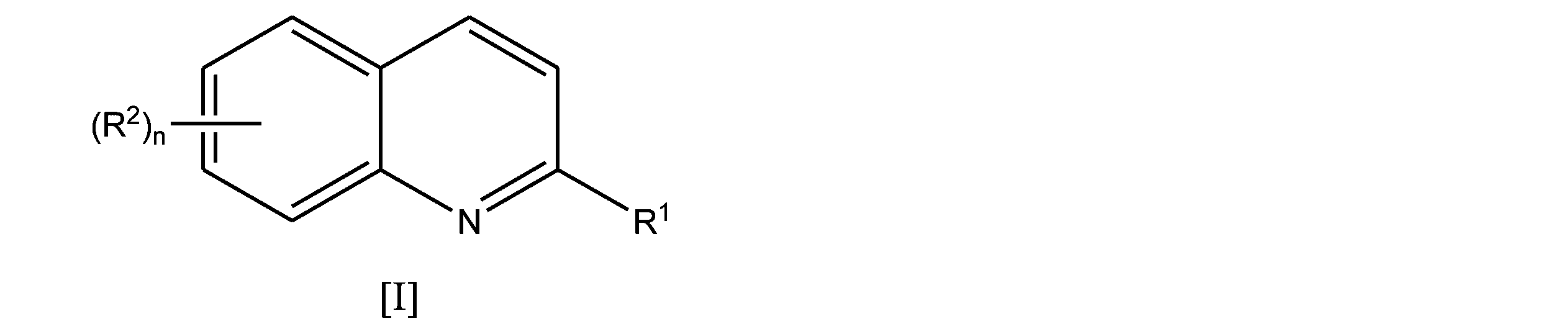
[1] 式[I]:

R2は水素原子、置換されていてもよいアルキル基、置換されていてもよいアリール基、置換されていてもよいアラルキル基、置換されていてもよいシクロアルキル基、置換されていてもよいヘテロアリール基、置換されていてもよい水酸基、置換されていてもよいチオール基、置換されていてもよいアミノ基、置換されていてもよいカルバモイル基、置換されていてもよいアリールオキシ基、置換されていてもよいヘテロアリールオキシ基、カルボキシル基、エステル化されたカルボキシル基、シアノ基、ニトロ基またはハロゲン原子を示し、
R2はキノリン環の5位~8位のいずれの位置に存在し、
nは1~4の整数であり、
nが2以上でありR2が互いに隣接する場合は、隣接するR2同士で互いに環を形成していてもよい。)
で示されるキノリン化合物を、
キラルなプロリンアミド類化合物を配位子とするイリジウム(III)錯体及び水素供与性化合物の存在下で還元することを特徴とする式[II]:
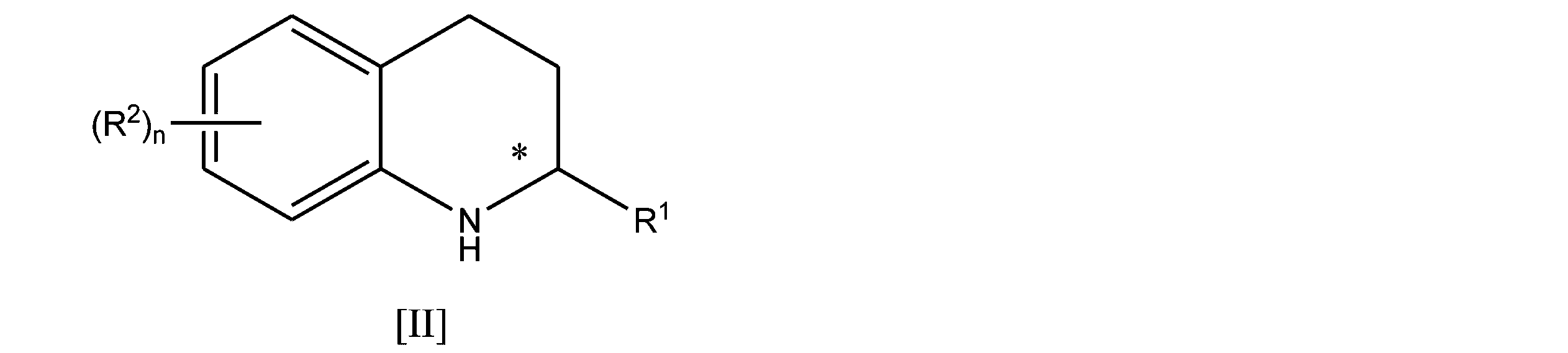
で示される光学活性2-置換―1,2,3,4-テトラヒドロキノリン類の製造方法。
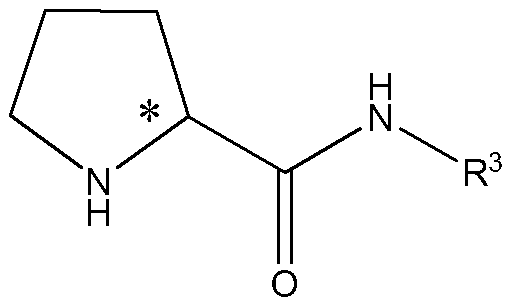
[2] キラルなプロリンアミド類化合物が、式[III]:
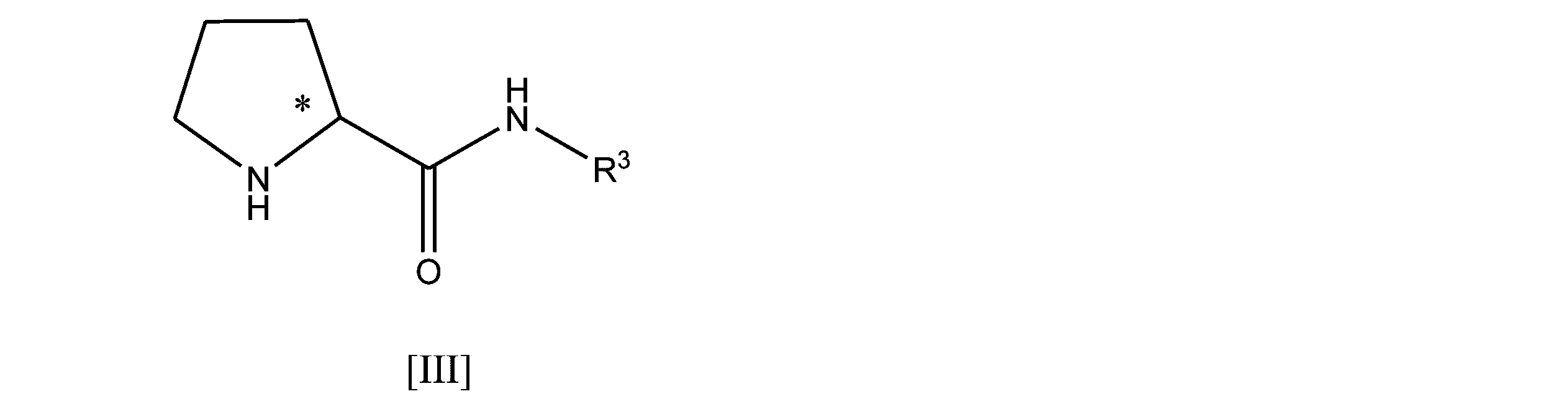
で示される化合物である[1]に記載の製造方法。
[3] キラルなプロリンアミド類化合物が、(R)-プロリンヘテロアリ-ルアミドまたは(S)-プロリンヘテロアリ-ルアミドである[1]または[2]に記載の製造方法。
[4] キラルなプロリンアミド類化合物が、(R)-N-(6-キノリニル)-2-ピロリジンカルボキサミドまたは(S)-N-(6-キノリニル)-2-ピロリジンカルボキサミドである[1]~[3]のいずれかに記載の製造方法。
[5] キラルなプロリンアミド類化合物が、(R)-N-(2-メトキシ-3-ジベンゾフラニル)-2-ピロリジンカルボキサミドまたは(S)-N-(2-メトキシ-3-ジベンゾフラニル)-2-ピロリジンカルボキサミドである[1]~[3]のいずれかに記載の製造方法。
[6] キラルなプロリンアミド類化合物が、(R)-2-ピロリジンカルボキサミドまたは(S)-2-ピロリジンカルボキサミドである[1]または[2]に記載の製造方法。
[7] キラルなプロリンアミド類化合物を配位子とするイリジウム(III)錯体が、式[IV]
Cp*Ir(X)(L-H+) [IV]
(式中、XはCl-,p-CH3C6H4SO3 -,CH3SO3 -,CF3SO3 -,NO3 -,BF4 -,ClO4 -,PF6 -,SbF6 -,B[3,5-di(trifluoromethyl)phenyl]4 -又はB(4-fluorophenyl)4 -を示し、Lは式[III]
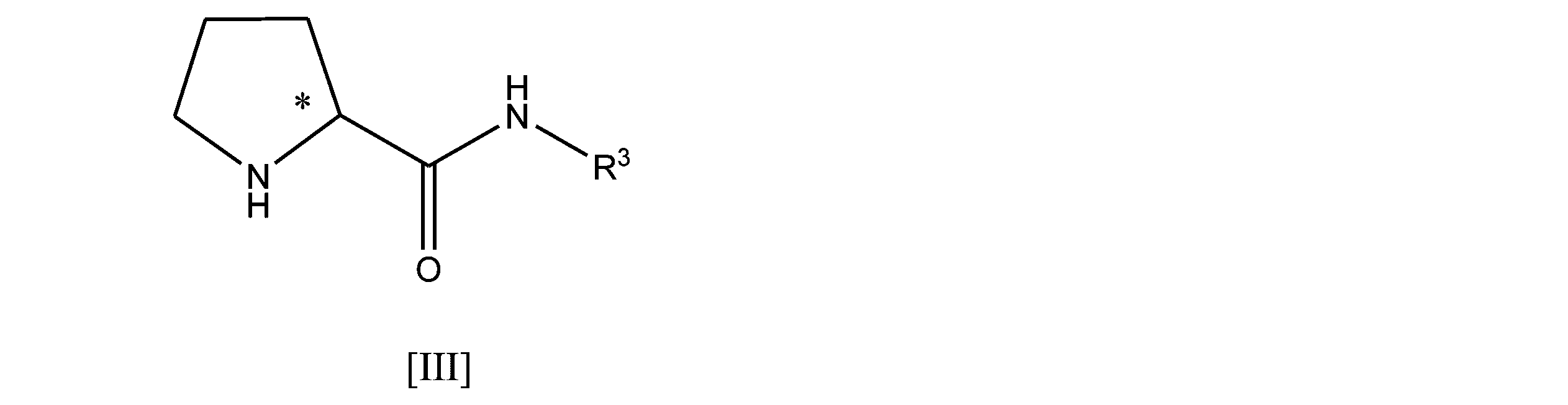
で示される化合物を示し、Cp*は(1,2,3,4,5-η)-ペンタメチル-2,4-シクロペンタジエン-1-イルを示す。)
で示される請求項1~3のいずれかに記載の製造方法。
[8] R3が水素、6-キノリニル基、2-メトキシ-3-ジベンゾフラニル基のいずれかである式[III]の配位子を有する[7]に記載の製造方法。
[9] キラルなプロリンアミド類化合物を配位子とするイリジウム(III)錯体が、(R)もしくは(S)-クロロ〔(1,2,3,4、5-η)-ペンタメチル-2,4-シクロペンタジエン-1-イル〕〔N-(2-メトキシ-3-ジベンゾフラニル)-2-ピロリジンカルボキサミダト-κN1,κN2〕イリジウム(III)触媒、(R)もしくは(S)-クロロ〔(1,2,3,4、5-η)-ペンタメチル-2,4-シクロペンタジエン-1-イル〕(N-6-キノリニル-2-ピロリジンカルボキサミダト-κN1,κN2)イリジウム(III)触媒のいずれかである[7]または[8]に記載の製造方法。
[10] キラルなプロリンアミド類化合物を配位子とするイリジウム(III)錯体が、(R)もしくは(S)-クロロ〔(1,2,3,4,5-η)-ペンタメチル-2,4-シクロペンタジエン-1-イル〕(2-ピロリジンカルボキサミダト-κN1,κN2)イリジウム(III)触媒のいずれかである[7]または[8]に記載の製造方法。
[11] キラルなプロリンアミド類化合物を配位子とするイリジウム(III)錯体が結晶性である[1]~[10]のいずれかに記載の製造方法。
[12] キラルなプロリンアミド類化合物を配位子とするイリジウム(III)錯体が非晶性である[1]~[10]のいずれかに記載の製造方法。
[13] 水素供与性化合物が蟻酸である[1]~[12]のいずれかに記載の製造方法。
[14] 式[IV]
Cp*Ir(X)(L-H+) [IV]
(式中、XはCl-,p-CH3C6H4SO3 -,CH3SO3 -,CF3SO3 -,NO3 -,BF4 -,ClO4 -,PF6 -,SbF6 -,B[3,5-di(trifluoromethyl)phenyl]4 -又はB(4-fluorophenyl)4 -を示し、Lは式[III]

で示される化合物を示し、Cp*は(1,2,3,4,5-η)-ペンタメチル-2,4-シクロペンタジエン-1-イルを示す。)
で示されるイリジウム(III)錯体。
[15] R3が水素、6-キノリニル基、2-メトキシ-3-ジベンゾフラニル基のいずれかである式[III]の配位子を有する[14]に記載のイリジウム(III)錯体。
[16] (R)もしくは(S)-クロロ〔(1,2,3,4,5-η)-ペンタメチル-2,4-シクロペンタジエン-1-イル〕〔N-(2-メトキシ-3-ジベンゾフラニル)-2-ピロリジンカルボキサミダト-κN1,κN2〕イリジウム(III)錯体。
[17] (R)もしくは(S)-クロロ〔(1,2,3,4,5-η)-ペンタメチル-2,4-シクロペンタジエン-1-イル〕(N-6-キノリニル-2-ピロリジンカルボキサミダト-κN1,κN2)イリジウム(III)錯体。
[18] (R)もしくは(S)-クロロ〔(1,2,3,4,5-η)-ペンタメチル-2,4-シクロペンタジエン-1-イル〕(2-ピロリジンカルボキサミダト-κN1,κN2)イリジウム(III)錯体。
[19] 結晶性である[14]~[18]のいずれかに記載のイリジウム(III)錯体。
[20] 非晶性である[14]~[18]のいずれかに記載のイリジウム(III)錯体。
[21] キラルなプロリンアミド類化合物とペンタメチルシクロペンタジエニルイリジウム(III)クロリドダイマーを弱塩基の存在下に接触させることを特徴とする[14]~[20]のいずれかに記載のイリジウム(III)クロロ錯体の製造方法。
[22] 弱塩基が第3級アミン類、炭酸水素アルカリ金属塩または炭酸アルカリ土類金属塩である[21]に記載のイリジウム(III)クロロ錯体の製造方法。
キラルなプロリンアミド類化合物を配位子とするイリジウム(III)クロロ錯体は、例えばイリジウム(III)化合物、キラルなプロリンアミド類化合物及び塩基を反応させることで調製することができる。イリジウム(III)クロロ錯体以外の錯体、すなわちp-CH3C6H4SO3 -,CH3SO3 -,CF3SO3 -,NO3 -,BF4 -,ClO4 -,PF6 -,SbF6 -,B[3,5-di(trifluoromethyl)phenyl]4 -又はB(4-fluorophenyl)4 -アニオンを有するイリジウム(III)錯体は、例えばキラルなプロリンアミド類化合物を配位子とするイリジウム(III)クロロ錯体を原料として調製できる。

で示されるキラルなプロリンアミド類と3価のイリジウム化合物から形成される錯体であり、以下イリジウム(III)錯体ともいう。
キラルなプロリンアミド類化合物を配位子とするイリジウム(III)錯体は、通常下記式
で表すことができる。
式[IV]
Cp*Ir(X)(L-H+) [IV]
(式中、XはCl-,p-CH3C6H4SO3 -,CH3SO3 -,CF3SO3 -,NO3 -,BF4 -,ClO4 -,PF6 -,SbF6 -,B[3,5-di(trifluoromethyl)phenyl]4 -又はB(4-fluorophenyl)4 -を示し、Lは式[III]

で示される化合物を示し、Cp*は(1,2,3,4,5-η)-ペンタメチル-2,4-シクロペンタジエン-1-イルを示す。
上記キラルなプロリンアミド類化合物を配位子とするイリジウム(III)錯体は、R3としては水素、6-キノリニル基、2-メトキシ-3-ジベンゾフラニル基のいずれかである式[III]の配位子を有することが好ましい。
[Cp*Ir(L-H+)]+(X) [VI]
(式中、各記号は式[IV]と同じ意味を示す。)
で示す錯体として表現されてもよい。

キラルなプロリンアミド類化合物を配位子とするイリジウム(III)錯体は、調製した溶液をそのまま触媒として不斉還元反応に用いることもできるが、結晶性又は非晶性のイリジウム(III)錯体として精製単離したものを不斉還元反応に用いる方がより好ましい。精製単離された結晶性又は非晶性のイリジウム(III)錯体を触媒として不斉還元反応に用いると、触媒調製溶液をそのまま使用した場合に比べて生成物において優れた化学収率および不斉収率が達成されるからである。
精製単離の方法としては、生成したイリジウム(III)錯体を溶液から濃縮等で一旦単離した後に公知の再結晶法や再沈殿法で精製する方法や、はじめから精製効率の高い溶媒のもとで錯体形成を行い、精製過程を経て析出してくる主生成物を濾過、洗浄、乾燥させる方法などを用いることができ、これらの方法により化学的かつ光学的に純粋な結晶性又は非晶性のイリジウム(III)錯体を容易に得ることができる。
精製単離された結晶性又は非晶性のイリジウム(III)錯体は安定性が高く、化学純度および光学純度が長期間にわたって一定であり、室温で長期保存が可能である。この錯体を触媒として不斉還元反応に用いれば、高い化学収率および不斉収率で還元生成物が得られる。
イリジウム(III)錯体は、例えば光学活性テトラヒドロキノリン類、光学活性アミン類の製造における不斉還元触媒などに好適に用いることができる。
イリジウム(III)クロロ錯体の調製に用いるイリジウム(III)化合物としては、例えばペンタメチルシクロペンタジエニルイリジウム(III)クロリドダイマー([Cp*IrCl2]2)、アセチルアセトナトイリジウム(III)、トリス(ノルボルナジエン)(アセチルアセトナト)イリジウム(III)などが挙げられ、とりわけペンタメチルシクロペンタジエニルイリジウム(III)クロリドダイマー([Cp*IrCl2]2)が好ましい。イリジウム(III)クロロ錯体は、イリジウム(III)クロロ錯体以外の錯体の調製、すなわちp-CH3C6H4SO3 -,CH3SO3 -,CF3SO3 -,NO3 -,BF4 -,ClO4 -,PF6 -,SbF6 -,B[3,5-di(trifluoromethyl)phenyl]4 -又はB(4-fluorophenyl)4 -アニオンを有するイリジウム(III)錯体の調製に用いることができる。
イリジウム(III)クロロ錯体の調製に用いるキラルなプロリンアミド類化合物としては、式[III]:

で示される化合物が挙げられる。
式[III]で表されるプロリンアミド類化合物としては、プロリンアミドの他、N-置換アミド、例えばN-アルキルアミド、N-シクロアルキルアミド、N-アリールアミド、N-ヘテロアリールアミド、N-アラルキルアミド、N-ヘテロアリールアルキルアミドなどが挙げられる。これらはR3置換基の例示であるが、置換基はさらに置換基(以下、置換分ということもある。)を有していてもよい。
N-シクロアルキルアミドにおける“シクロアルキル基”としては、例えば炭素数3~7のシクロアルキル基が挙げられ、具体的にはシクロプロピル基、シクロブチル基、シクロペンチル基、シクロヘキシル基、シクロヘプチル基などが挙げられる。
N-アリールアミドにおける“アリール基”としては、例えば炭素数6~20のアリール基が挙げられ、具体的にはフェニル基、1-ナフチル基、2-ナフチル基、アントリル基、フェナンスリル基、2-ビフェニル基、3-ビフェニル基、4-ビフェニル基、ターフェニル基などが挙げられる。
N-ヘテロアリールアミドにおける“ヘテロアリール基”としては、例えば窒素原子、硫黄原子及び酸素原子などから選択される原子を異項原子として含有するヘテロアリール基が挙げられ、具体的にはフラニル基、チエニル基、オキサゾリル基、イソキサゾリル基、チアゾリル基、イソチアゾリル基、ピロリル基、イミダゾリル基、ピラゾリル基、ピリジル基、ピリミジニル基、ピラジニル基、フタラジニル基、トリアジニル基、インドリル基、イソインドリル基、キノリニル基、イソキノリニル基、ジベンゾフラニル基などが挙げられる。
N-アラルキルアミドにおける“アラルキル基”としては、上記したアルキル基の水素原子をアリール基で置換したものが挙げられる。N-アラルキルアミドにおけるアラルキル基は、例えばベンジル基、フェニルエチル基、フェニルプロピル基などが挙げられる。
N-ヘテロアリールアルキルアミドにおける“ヘテロアリールアルキル基”としては、上記したアルキル基の水素原子をヘテロアリール基で置換したものが挙げられる。N-ヘテロアリールアルキルアミドにおけるヘテロアリールアルキル基としては、例えばヘテロアリールメチル基、ヘテロアリールエチル基、ヘテロアリールプロピル基などが挙げられる。
これらのキラルなプロリンアミド類化合物は、イリジウム(III)クロロ錯体以外錯体、すなわちp-CH3C6H4SO3 -,CH3SO3 -,CF3SO3 -,NO3 -,BF4 -,ClO4 -,PF6 -,SbF6 -,B[3,5-di(trifluoromethyl)phenyl]4 -又はB(4-fluorophenyl)4 -アニオンを有するイリジウム(III)錯体にも用いることができる。
キラルなプロリンアミド類化合物の使用量は、イリジウム(III)化合物がダイマーである場合、該ダイマー1モルに対して通常約2~3モル、好ましくは約2~2.2モルである。
イリジウム(III)クロロ錯体の調製に用いる塩基としては弱塩基が好ましく、第3級アミン類、炭酸水素アルカリ金属塩または炭酸アルカリ土類金属塩であることがより好ましい。弱塩基としては、トリエチルアミン、トリメチルアミン、トリブチルアミン、N-メチルモルホリンなどの第3級アミン類、炭酸水素ナトリウム、炭酸水素カリウムなどの炭酸水素アルカリ金属塩、炭酸カルシウム、炭酸マグネシウムなどの炭酸アルカリ土類金属塩などがより好ましく、トリエチルアミンが特に好ましい。水酸化ナトリウム、水酸化カリウム等のアルカリ金属の水酸化物やナトリウムメトキシド等の強塩基を触媒の調製に用いることは、調製したプロリンアミド錯体が速やかにエピ化し光学純度が低下するために好ましくない。
塩基の使用量は、原料のイリジウム(III)化合物がダイマーである場合、該ダイマー1モルに対して通常約2~3モル、好ましくは約2~2.2モルである。
キラルなプロリンアミド類化合物を配位子とするイリジウム(III)クロロ錯体の調製は、例えばキラルなプロリンアミド類化合物を好ましくは溶媒に溶解し、イリジウム(III)化合物及び塩基を添加し、好ましくは攪拌することにより行うことができる。
本発明の反応温度としては特に限定されないが、通常は-30℃~200℃であればよく、-10℃~100℃であることが好ましく、5℃~40℃であることがより好ましく、室温であることが特に好ましい。
本発明の反応時間としては特に限定されないが、通常は1分~72時間であればよく、3分~48時間であることが好ましく、10分~20時間であることが特に好ましい。
イリジウム(III)クロロ錯体以外の調製、すなわちp-CH3C6H4SO3 -,CH3SO3 -,CF3SO3 -,NO3 -,BF4 -,ClO4 -,PF6 -,SbF6 -,B[3,5-di(trifluoromethyl)phenyl]4 -又はB(4-fluorophenyl)4 -アニオンを有するイリジウム(III)錯体の調製において、さらに式[V]
MaXb [V]
(式中、Mは1~3価の金属カチオンを表し、Xはp-CH3C6H4SO3 -,CH3SO3 -,CF3SO3 -,NO3 -,BF4 -,ClO4 -,PF6 -,SbF6 -,B[3,5-di(trifluoromethyl)phenyl]4 -又はB(4-fluorophenyl)4 -を示し、
aは1~3の整数を示し、bは1~3の整数を示す。)
で示される金属塩を用いることが好ましい。
上記金属塩を加えることで、イリジウム(III)クロロ錯体中のクロロアニオンが交換され、Xで示される金属塩由来のアニオンを含むイリジウム(III)錯体を生成させることができる。
式[V]で示される金属塩としては、例えばヘキサフルオロリン酸銀、トリフルオロメタンスルホン酸銀、ヘキサフルオロアンチモン酸銀、過塩素酸銀、テトラフルオロホウ酸銀等が挙げられる。
金属塩の使用量は、例えばイリジウム(III)クロロ錯体1モルに対し通常約0.7~1.4モル、好ましくは約0.9~1.1モルである。
イリジウム(III)錯体の調製において、溶媒を用いることが好ましい。溶媒としては特に限定されず、無機溶媒、有機溶媒のいずれも用いることができるが、溶媒としては有機溶媒が好ましい。
有機溶媒としては、例えば脂肪族炭化水素類(例えばペンタン、ヘキサン、ヘプタン、オクタン、シクロヘキサン等)、芳香族炭化水素類(例えばベンゼン、トルエン、キシレン等)、ハロゲン化炭化水素類(例えばジクロロメタン、1,2-ジクロロエタン、クロロホルム、四塩化炭素、o-ジクロロベンゼン等)、アルコール類(例えばメタノール、エタノール、イソプロピルアルコール、t-ブチルアルコール、t-アミルアルコール等)、エーテル類(例えばジメチルエーテル、エチルメチルエーテル、ジエチルエーテル、ジイソプロピルエーテル、ジグリム、tert-ブチルメチルエーテル、ジメトキシエタン、エチレングリコールジエチルエーテル、テトラヒドロフラン、1,4-ジオキサン等)、アミド類(例えばN,N-ジメチルホルムアミド、N,N-ジメチルアセトアミド、N-メチルピロリドン等)、スルホキシド類(例えばジメチルスルホキシド等)、ニトリル類(例えばアセトニトリル、プロピオニトリル、ベンゾニトリル等)、ケトン類(例えばアセトン、メチルエチルケトン、メチルイソブチルケトン等)、エステル化合物(例えば酢酸メチル、酢酸エチル等)などが挙げられる。水とよく混和するアルコール類、エーテル類、アミド類、スルホキシド類、ニトリル類、ケトン類、エステル類を用いる場合には50%程度までの水を含ませてもよい。中でもメタノール、水含有メタノール、エタノール、水含有エタノール、塩化メチレン、酢酸エチルまたはアセトニトリルがより好ましい。
本発明によれば、例えば下記の反応ルートにより効率的に光学活性2-置換―1,2,3,4-テトラヒドロキノリン類を製造することができる。本発明の化学反応式は下記の如くである。なお、下記化学反応式中のHydrogen sourceは、水素供与源を示す。

R2は水素原子、置換されていてもよいアルキル基、置換されていてもよいアリール基、置換されていてもよいアラルキル基、置換されていてもよいシクロアルキル基、置換されていてもよいヘテロアリール基、置換されていてもよい水酸基、置換されていてもよいチオール基、置換されていてもよいアミノ基、置換されていてもよいカルバモイル基、置換されていてもよいアリールオキシ基、置換されていてもよいヘテロアリールオキシ基、カルボキシル基、エステル化されたカルボキシル基、シアノ基、ニトロ基またはハロゲン原子を示し、
R2はキノリン環の5位~8位のいずれの位置に存在し、
nは1~4の整数であり、
nが2以上でありR2が互いに隣接する場合は、隣接するR2同士で互いに環を形成していてもよい。)
で示されるキノリン化合物を、
キラルなプロリンアミド類化合物を配位子とするイリジウム(III)錯体及び水素供与性化合物の存在下で還元することにより式[II]:

で示される光学活性2-置換―1,2,3,4-テトラヒドロキノリン類を製造することができる。
光学活性2-置換―1,2,3,4-テトラヒドロキノリン類の製造において、一般式[I]
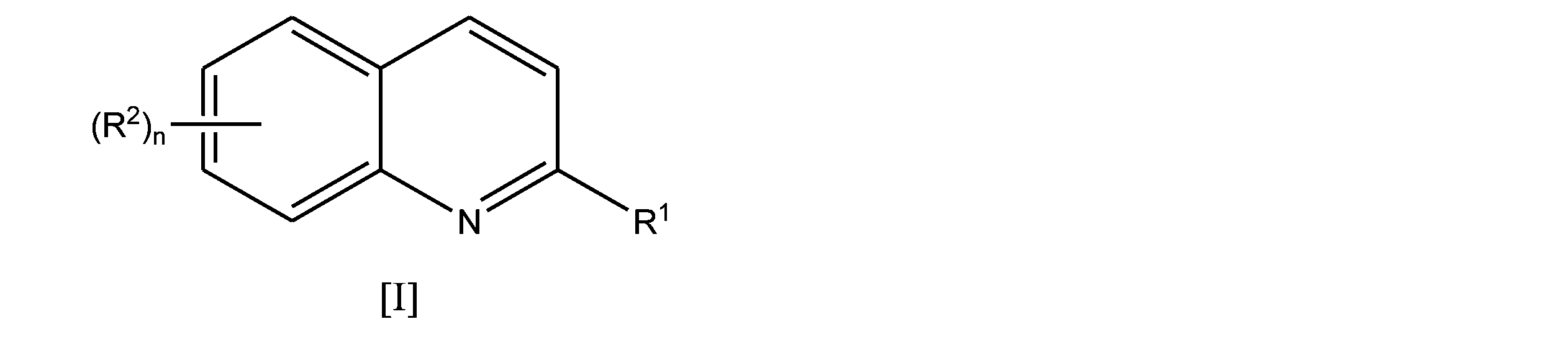
で示されるキノリン化合物(以下、単に化合物[I]ともいう。)は、本発明において不斉水素化反応の原料として使用される。
R1で示される置換されていてもよいアリール基における“アリール基”としては、例えば炭素数6~14の芳香族炭化水素基が挙げられ、具体的にはフェニル基、ナフチル基またはアントラニル基などが挙げられる。
R1で示される置換されていてもよいアラルキル基における“アラルキル基”としては、炭素数1~3のアルキル基の水素原子を上記アリール基で置換したものが挙げられ、具体的にはベンジル基、フェニルエチル基、フェニルプロピル基、ナフチルメチル基などが挙げられる。
R1で示される置換されていてもよいヘテロアリール基における“ヘテロアリール基”としては、例えば炭素数5~14のヘテロアリール基が挙げられ、具体的にはフラニル基、チエニル基、オキサゾリル基、イソキサゾリル基、チアゾリル基、イソチアゾリル基、ピロリル基、イミダゾリル基、ピラゾリル基、ピリジル基、ピリミジニル基、ピラジニル基、フタラジニル基、トリアジニル基、インドリル基、イソインドリル基、キノリニル基、イソキノリニル基、ジベンゾフラニル基などが挙げられる。
R1で示される置換されていてもよいシクロアルキル基における“シクロアルキル基”としては、例えば炭素数3~7のシクロアルキル基が挙げられ、具体的にはシクロプロピル基、シクロブチル基、シクロペンチル基、シクロヘキシル基、シクロヘプチル基などが挙げられる。
R1で示される置換されていてもよいアルキル基、置換されていてもよいアリール基、置換されていてもよいアラルキル基、置換されていてもよいヘテロアリール基、置換されていてもよいシクロアルキル基の置換基(置換分)としては前記した置換基(A)と同様のものが挙げられる。
R2で示される置換されていてもよい水酸基、置換されていてもよいチオール基、置換されていてもよいアミノ基もしくは置換されていてもよいカルバモイル基の置換基としては、例えば炭素数1~6の直鎖状または分枝状のアルキル基(例えばメチル基、エチル基、プロピル基、イソプロピル基、ブチル基、イソブチル基、tert-ブチル基、ペンチル基、ヘキシル基など)、炭素数7~12のアラルキル基(例えばフェニルメチル基、フェニルエチル基、フェニルプロピル基、ナフチルメチル基など)、ハロゲン化アルキル基(例えばモノフルオロメチル基、ジフルオロメチル基、トリフルオロメチル基、ジフルオロエチル基、トリフルオロエチル基、トリクロロメチル基など)、カルボニル基(例えばメチルカルボニル基、エチルカルボニル基、フェニルカルボニル基、メトキシカルボニル基、フェノキシカルボニル基など)、スルホニル基(例えばメチルスルホニル基、トルエンスルホニル基、トリフルオロメチルスルホニル基など)、シリル基(例えばトリメチルシリル基、トリフェニルシリル基、tert-ブチルジメチルシリル基など)などが挙げられる。
R2で示される置換されていてもよいアリールオキシ基、置換されていてもよいヘテロアリールオキシ基の置換基としては、前記した置換基(A)と同様のものが挙げられる。
R2で示されるエステル化されたカルボキシル基としては、アルコキシカルボニル基(例えばメトキシカルボニル基など)やアリールオキシカルボニル基(例えばフェノキシカルボニル基など)が挙げられる。
R2で示されるハロゲン原子としてはフッ素原子、塩素原子、臭素原子、ヨウ素原子などが挙げられる。
R2が複数個存在し、隣接するR2同士で互いに環を形成する場合の環としては、例えばメチレンジオキシ、カーボネート、アセトニド、オキサゾール、オキサゾリノンもしくはメチルオキサゾール等の脂肪族環や、フラン、チオフェン、ピロール、ベンゼン、ナフタレンもしくはアントラセンなどの芳香族環などを挙げることができ、当該環は任意の置換基で置換されていてもよい。この場合の置換基としては、前記した置換基(A)と同様のものが挙げられる。
光学活性2-置換―1,2,3,4-テトラヒドロキノリン類の製造に用いる光学活性2-置換―1,2,3,4-テトラヒドロキノリン類の製造に用いるキラルなプロリンアミド類化合物を配位子とするイリジウム(III)錯体は、式[IV]
Cp*Ir(X)(L-H+) [IV]
(式中、XはCl-,p-CH3C6H4SO3 -,CH3SO3 -,CF3SO3 -,NO3 -,BF4 -,ClO4 -,PF6 -,SbF6 -,B[3,5-di(trifluoromethyl)phenyl]4 -又はB(4-fluorophenyl)4 -を示し、Lは式[III]

で示される化合物を示し、Cp*は(1,2,3,4,5-η)-ペンタメチル-2,4-シクロペンタジエン-1-イルを示す。)で示されるものが好ましい。
上記イリジウム(III)錯体は、R3が水素、6-キノリニル基、2-メトキシ-3-ジベンゾフラニル基のいずれかである式[III]の配位子を有することが好ましい。
また、キラルなプロリンアミド類化合物を配位子とするイリジウム(III)錯体が、(R)もしくは(S)-クロロ〔(1,2,3,4,5-η)-ペンタメチル-2,4-シクロペンタジエン-1-イル〕(2-ピロリジンカルボキサミダト-κN1,κN2)イリジウム(III)触媒のいずれかであることが好ましい。
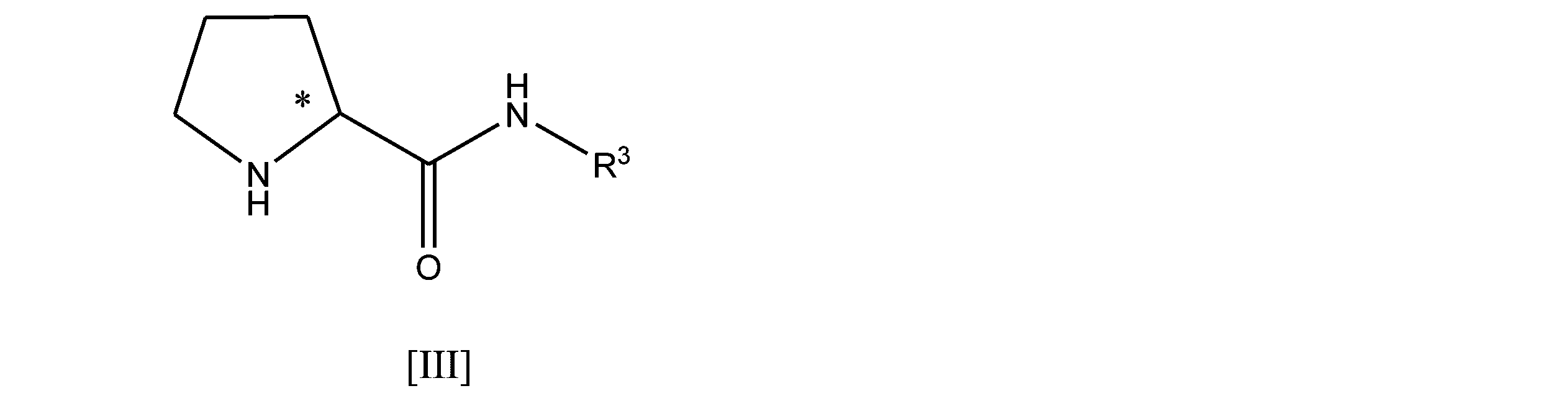
で示される化合物が好ましい。
これらキラルなプロリンアミド類化合物としては、(R)若しくは(S)-プロリンアミド又は(R)若しくは(S)-プロリンヘテロアリールアミドが好ましく、(R)若しくは(S)-プロリンヘテロアリールアミドがより好ましい。キラルなプロリンヘテロアリールアミド類化合物としては、(R)若しくは(S)-N-(6-キノリニル)-2-ピロリジンカルボキサミド又は(R)若しくは(S)-N-(2-メトキシ-3-ジベンゾフラニル)-2-ピロリジンカルボキサミドなどが好ましい。
キラルなプロリンアミド類化合物を配位子とするイリジウム(III)錯体の使用量は化合物[I]1モルに対して通常約0.1~約10モル%、好ましくは約0.2~約5モル%である。
光学活性2-置換―1,2,3,4-テトラヒドロキノリン類の製造に用いる水素供与性化合物としては、例えば蟻酸、蟻酸アンモニウム、蟻酸ナトリウム、蟻酸カリウムまたは2-プロパノールなどが挙げられるが、とりわけ蟻酸が好ましい。水素供与性化合物として蟻酸を用いるときは、例えばトリエチルアミン等の第三級アミンを併用すると好ましい。水素供与性化合物の使用量は、通常化合物[I]1モルに対し約2モル~約40モル、好ましくは約4モル~約20モルである。
上記還元反応は、例えば化合物[I]を好ましくは下記溶媒の項にて説明する溶液に溶解させ、当該溶液にキラルなプロリンアミド類化合物を配位子とするイリジウム(III)錯体を添加、溶解させた後に、水素供与性化合物を添加、反応させること等により好適に実施できる。
本反応の反応温度は、通常-70℃以上であり、好ましくは約-30℃~約40℃である。
本発明の反応時間としては特に限定されないが、1分~72時間であればよく、3分~48時間であることが好ましく、10分~20時間であることがより好ましい。
反応後は、公知の濃縮、抽出、ろ過、洗浄などの処理を行うことにより、目的とする光学活性テトラヒドロキノリンを得ることができる。必要に応じて、結晶化や再結晶、塩酸、硫酸、メタンスルホン酸、蟻酸、トリフルオロ酢酸などのアキラルな酸との塩形成やその再結晶、またはキラルなマンデル酸、酒石酸、ジベンゾイル酒石酸、ジトルオイル酒石酸、10-カンファスルホン酸、リンゴ酸などを用いた化学的光学分割の手法などを用いることにより光学的に純粋な光学活性テトラヒドロキノリンに導くことができる。
光学活性2-置換―1,2,3,4-テトラヒドロキノリン類の製造において、溶媒を用いることが好ましい。溶媒としては特に限定されず、無機溶媒、有機溶媒のいずれも用いることができる。溶媒としては、例えばアセトニトリル、酢酸エチル、酢酸イソプロピル、N,N-ジメチルホルムアミド、テトラヒドロフラン、ジメトキシエタン、ジクロロメタン、またはメタノール、エタノール、2-プロパノール、エチレングリコールなどのアルコール類やこれらの含水溶媒などが挙げられる。溶媒の使用量は、化合物[I]1kgに対し、通常約2L~約200L、好ましくは約5L~約100Lである。
蟻酸-トリエチルアミン混合物は、水素供与性化合物と溶媒をかねて用いることもできる。水素供与性化合物及び溶媒として蟻酸-トリエチルアミン混合物を用いる場合、蟻酸の使用量は、通常化合物[I]1モルに対し約2~40モル、好ましくは約4~約20モルである。また、トリエチルアミンの使用量は、通常蟻酸1モルに対し約0.1モル~約1モル、好ましくは約0.2モル~約0.7モルである。
本反応により、一般式[II]

で示される光学活性2-置換―1,2,3,4-テトラヒドロキノリン類を製造することができる。
上記光学活性2-置換―1,2,3,4-テトラヒドロキノリン類の用途としては、例えば医薬品、農薬、液晶材料やそれらの中間体などが挙げられる。
融点は、微量融点測定装置 MP(柳本製作所製)により計測した。
イリジウムの元素分析は、iCAP6500Duo ICP発光分析装置(サーモフィッシャー・サイエンティフィク製)を用いておこなった。
赤外スペクトル(IR)は、FT/IR-4100(JASCO製)により計測した。
遠赤外スペクトルは、IFS―66V/s(Bruker製)を用いポリエチレンペースト法により計測した。
核磁気共鳴スペクトル(NMR)は、Gemini-200(Varian製)により計測した。内部標準物質としてTMS(Tetramethylsilane)を用い、測定溶媒としてCDCl3またはCD3ODまたはDMSO-d6を用いて、室温下で計測した。測定値はすべてδ(ppm)で示した。
比旋光度は、P-1020(JASCO製)により計測した。
粉末X線回折パターンはMiniFlexII(理学電機製)を用いて測定した。
光学純度はキラルカラムを用いた高速液体クロマトグラフィー(HPLC:島津製作所製 LC10A)により、各エナンチオマーに対応するピークの面積比から決定した。
反応に用いた溶媒及び試薬は特記ない限り、市販品を使用した。
(実施例1)
結晶性(R)-クロロ〔(1,2,3,4、5-η)-ペンタメチル-2,4-シクロペンタジエン-1-イル〕(2-ピロリジンカルボキサミダト-κN1,κN2)イリジウム(III)(Cp * Ir(Cl - )(R-PA-H + ))の合成
ペンタメチルシクロペンタジエニルイリジウム(III)クロリドダイマー([Cp*IrCl2]2)1.593g、(R)-プロリンアミド502mg、トリエチルアミン425mgを塩化メチレン40mlに順次加えて、室温で一晩攪拌を続けた。20%食塩水10mlを反応液に添加し約30分間攪拌した後に静置、分液した。
水層を塩化メチレン10mlで抽出した後に有機層を合わせて20%食塩水10mlで洗浄した。この水層をさらに塩化メチレン10mlで抽出した後に有機層を合わせて無水硫酸ナトリウム10gを加え、一晩乾燥した。乾燥剤をろ過、塩化メチレンで洗浄した後に減圧濃縮し、その濃縮残留物にテトラヒドロフラン/ジイソプロピルエーテル(1/1)20mlを加え、35~40℃で約1時間攪拌した。析出結晶を吸引ろ過しテトラヒドロフラン/ジイソプロピルエーテル(1/1)10ml洗浄した後に40~50℃で5時間真空乾燥したところ、1.813gの(R)-クロロ〔(1,2,3,4,5-η)-ペンタメチル-2,4-シクロペンタジエン-1-イル〕(2-ピロリジンカルボキサミダト-κN1,κN2)イリジウム(III)(Cp*Ir(Cl-)(R-PA-H+))が黄色結晶性粉末として得られた。
元素分析:C15H24ClIrN2O(476.01)計算値(%)C37.84、H5.08、N5.88、Ir40.4 実測値(%)C37.81、H5.07、N5.93、Ir40.7
IR(KBr):3429,3282,1599cm-1
1H-NMR (200 MHz, CDCl3): δ 1.60-2.28 (4H, m, 2 x CH2), 1.70 (15H, s, 5Me of Cp*), 2.71-2.93 (1H, m, one of NCH2), 3.41-3.55 (1H, m, one of NCH2), 3.89-4.01 (1H, m, NCH), 4.96 (2H, br, 2 x NH).
13C-NMR (50.3 MHz, CDCl3): δ9.1 (5Me of Cp*), 27.1 (CH2), 28.2 (CH2), 54.3 (NCH2), 62.9 (NCH), 84.4 (ArC of Cp*), 183.5 (C=O).
(実施例2)
結晶性(R)-クロロ〔(1,2,3,4,5-η)-ペンタメチル-2,4-シクロペンタジエン-1-イル〕(2-ピロリジンカルボキサミダト-κN1,κN2)イリジウム(III)(Cp * Ir(Cl - )(R-PA-H + ))の合成
ペンタメチルシクロペンタジエニルイリジウム(III)クロリドダイマー([Cp*IrCl2]2)3.59g、(R)-プロリンアミド1.08gをアセトニトリル90mlに懸濁してアルゴン気流中室温で攪拌しながらトリエチルアミン1.38mlを滴下して室温で約1.5時間攪拌した。減圧下でアセトニトリルを留去した後、残留物に飽和食塩水60ml及び水30mlを加え、クロロホルムで3回抽出した(クロロホルムの添加量は、それぞれ45ml,30ml,30ml)。抽出液を集め飽和食塩水45mlで1回洗浄し、無水硫酸ナトリウムを加え乾燥した。乾燥剤を除去し、ろ液を減圧下で濃縮した。残留濃縮物にアセトニトリル15mlを加え、氷点下まで溶液を冷却し結晶を析出させた。
結晶をろ過して集め、アセトニトリル/ジイソプロピルエーテル(1/3)で洗浄した後に60℃で3時間真空乾燥したところ、3.289gの(R)-クロロ〔(1,2,3,4,5-η)-ペンタメチル-2,4-シクロペンタジエン-1-イル〕(2-ピロリジンカルボキサミダト-κN1,κN2)イリジウム(III)(Cp*Ir(Cl-)(R-PA-H+))が黄色結晶性粉末として得られた。
元素分析:C15H24ClIrN2O(476.01)計算値(%)C37.84、H5.08、N5.88、Ir40.4 実測値(%)C37.82、H5.08、N5.94、Ir40.7
水分(カールフィッシャー法):0.17%
結晶性(S)-クロロ〔(1,2,3,4、5-η)-ペンタメチル-2,4-シクロペンタジエン-1-イル〕(2-ピロリジンカルボキサミダト-κN1,κN2)イリジウム(III)(Cp * Ir(Cl - )(S-PA-H + ))の合成
ペンタメチルシクロペンタジエニルイリジウム(III)クロリドダイマー([Cp*IrCl2]2)1.593g、(S)-プロリンアミド502mg、トリエチルアミン425mgを塩化メチレン40mlに順次加えて、室温で一晩攪拌を続けた。20%食塩水10mlを反応液に添加し約30分間攪拌した後に静置、分液した。水層を塩化メチレン10mlで抽出した後に有機層を合わせて20%食塩水10mlで洗浄した。この水層をさらに塩化メチレン10mlで抽出した後に、有機層を合わせて無水硫酸ナトリウム10gを加え、一晩乾燥した。乾燥剤をろ過、塩化メチレンで洗浄した後に減圧濃縮し、その濃縮残留物にテトラヒドロフラン/ジイソプロピルエーテル(1/1)20mlを加えて35~40℃で約1時間攪拌した。析出結晶を吸引ろ過し、テトラヒドロフラン/ジイソプロピルエーテル(1/1)10mlで洗浄した後に40~50℃で5時間真空乾燥したところ、1.796gの(S)-クロロ〔(1,2,3,4,5-η)-ペンタメチル-2,4-シクロペンタジエン-1-イル〕(2-ピロリジンカルボキサミダト-κN1,κN2)イリジウム(III)(Cp*Ir(Cl-)(S-PA-H+))が黄色結晶性粉末として得られた。
IR(KBr):3433,3281,1599cm-1
1H-NMR (200 MHz, CDCl3): δ1.60-2.28 (4H, m, 2 x CH2), 1.70 (15H, s, 5Me of Cp*), 2.71-2.93 (1H, m, one of NCH2), 3.41-3.56 (1H, m, one of NCH2), 3.88-4.00 (1H, m, NCH), 4.96 (2H, br, 2 x NH).
13C-NMR (50.3 MHz, CDCl3): δ9.1 (5Me of Cp*), 27.1 (CH2), 28.2 (CH2), 54.3 (NCH2), 62.9 (NCH), 84.5 (ArC of Cp*), 183.6 (C=O).
結晶性(S)-クロロ〔(1,2,3,4,5-η)-ペンタメチル-2,4-シクロペンタジエン-1-イル〕(2-ピロリジンカルボキサミダト-κN1,κN2)イリジウム(III)(Cp * Ir(Cl - )(S-PA-H + ))の合成
ペンタメチルシクロペンタジエニルイリジウム(III)クロリドダイマー([Cp*IrCl2]2)3.19g、(S)-プロリンアミド0.959gをアセトニトリル80mlに懸濁して、アルゴン気流中室温で攪拌しながらトリエチルアミン1.23mlを滴下して室温で約1時間攪拌した。減圧下でアセトニトリルを留去した後、残留物に飽和食塩水50ml及び水25mlを加え、クロロホルムで3回抽出した(クロロホルムの添加量は、それぞれ40ml,30ml,30ml)。抽出液を集め飽和食塩水40mlで1回洗浄し、無水硫酸ナトリウムを加え乾燥した。乾燥剤を除去し、ろ液を減圧下で濃縮した。濃縮残留物にアセトニトリル12mlを加えて50℃に加温して溶かし、ジイソプロピルエーテル24mlを加え、氷点下まで溶液を冷却し結晶を析出させた。
結晶をろ過して集め、アセトニトリル/ジイソプロピルエーテル(1/3)で洗浄した後に60℃で3時間真空乾燥したところ、3.028gの(S)-クロロ〔(1,2,3,4,5-η)-ペンタメチル-2,4-シクロペンタジエン-1-イル〕(2-ピロリジンカルボキサミダト-κN1,κN2)イリジウム(III)(Cp*Ir(Cl-)(S-PA-H+))が黄色結晶性粉末として得られた。
上記物質のIR(KBr)を[図1]に、遠赤外線スペクトルを[図2]に、粉末X線回折パターンを[図3]に、それぞれ示す。
水分(カールフィッシャー法):0.30%
元素分析:C15H24ClIrN2O(476.01)計算値(%)C37.84、H5.08、N5.88 実測値(%)C37.74、H5.08、N5.89
IR(KBr):3433,1609, 1449, 917cm-1
遠赤外線スペクトル:664, 641,604,581,564,540,468,449,417,350,270cm-1
1H-NMR (200 MHz, CDCl3): δ1.60-2.28 (4H, m, 2 x CH2), 1.70 (15H, s, 5Me of Cp*), 2.71-2.93 (1H, m, one of NCH2), 3.40-3.60 (1H, m, one of NCH2), 3.85-4.05 (1H, m, NCH), 4.75-5.00 (1H, br, NH) , 4.90 (1H, s, NH).
1H-NMR (200 MHz, DMSO-d6): δ1.46-1.93 (4H, m), 1.63 (15H, s, 5Me of Cp*), 2.48-2.74 (1H, m, one of NCH2), 3.23-3.38 (1H, m, one of NCH2), 3.45-3.58 (1H, m, NCH), 5.04 (1H, br s, CONH), 6.15-6.30 (6.23 centered, 1H, br, NH).
13C-NMR (50.3 MHz, DMSO-d6): 8.6 (5Me of Cp*), 26.1 (CH2), 27.8 (CH2), 53.6 (NCH2), 62.1 (NCH), 83.7 (ArC of Cp*), 182.2 (C=O).
Winfried Hoffmuellerらの方法(Winfried Hoffmueller,Kurt Polborn, Joerg Knizek, Heinlich Noeth and Wolfgang Beck, Z. anorg. Allg. Chem.1997, 623, 1903-1911.)に従い、上記文献中の化合物10の粉末を調製した。上記物質の遠赤外線スペクトルを[図4]に示す。
遠赤外線スペクトル:617,583,539,466,427,350,266,244cm-1
結晶性(R)-クロロ〔(1,2,3,4、5-η)-ペンタメチル-2,4-シクロペンタジエン-1-イル〕(N-6-キノリニル-2-ピロリジンカルボキサミダト-κN1,κN2)イリジウム(III)(Cp * Ir(Cl - )(R-PQA-H + ))の合成
ペンタメチルシクロペンタジエニルイリジウム(III)クロリドダイマー([Cp*IrCl2]2)1.593g、(R)-N-6-キノリニル-2-ピロリジンカルボキサミド502mg、トリエチルアミン425mgをアセトニトリル50mlに順次加えて、室温で一晩攪拌を続けた。析出結晶を吸引ろ過し、アセトニトリル/水(20/1)15ml、次いでアセトニトリル10mlで順次洗浄した後に40~50℃で5時間真空乾燥したところ、2.175gの(R)-クロロ〔(1,2,3,4、5-η)-ペンタメチル-2,4-シクロペンタジエン-1-イル〕(N-6-キノリニル-2-ピロリジンカルボキサミダト-κN1,κN2)イリジウム(III)(Cp*Ir(Cl-)(R-PQA-H+))が黄色結晶性粉末として得られた。
IR(KBr):3446,3128,1576cm-1
1H-NMR (200 MHz, CD3OD): δ1.37 (15H, s, 5Me of Cp*), 1.66-2.32 (4H, m, 2 x CH2), 3.18-3.36 (1H, m, one of NCH2), 3.48-3.59 (1H, m, one of NCH2), 4.06-4.14 (1H, m, NCH), 7.50 (1H, dd, J = 8.2, 4.2 Hz), 7.76 (1H, dd, J = 8.6, 2.2 Hz), 7.79 (1H, br s), 7.96 (1H, br d, J = 8.6 Hz), 8.29 (1H, br dd, J = 8.2, 1.6 Hz), 8.75 (1H, dd, J = 4.2, 1.6 Hz).
13C-NMR (50.3 MHz, CD3OD): δ8.9 (5Me of Cp*), 27.9 (CH2), 31.1 (CH2), 56.0 (NCH2), 66.3 (NCH), 87.1 (ArC of Cp*), 122.7 (CH), 125.7 (CH), 128.8 (CH), 130.2 (quaternary), 133.2 (CH), 138.0 (CH), 146.9 (quaternary), 149.2 (quaternary), 150.3 (CH), 183.2 (C=O).
結晶性(S)-クロロ〔(1,2,3,4、5-η)-ペンタメチル-2,4-シクロペンタジエン-1-イル〕(N-6-キノリニル-2-ピロリジンカルボキサミダト-κN1,κN2)イリジウム(III)(Cp * Ir(Cl - )(S-PQA-H + ))
の合成
ペンタメチルシクロペンタジエニルイリジウム(III)クロリドダイマー([Cp*IrCl2]2)1.593g、(S)-N-6-キノリニル-2-ピロリジンカルボキサミド502mg、トリエチルアミン425mgをアセトニトリル50mlに順次加えて、室温で一晩攪拌を続けた。析出結晶を吸引ろ過し、アセトニトリル/水(20/1)15ml、次いでアセトニトリル10mlで順次洗浄した後に40~50℃で5時間真空乾燥したところ、2.322gの(S)-クロロ〔(1,2,3,4、5-η)-ペンタメチル-2,4-シクロペンタジエン-1-イル〕(N-6-キノリニル-2-ピロリジンカルボキサミダト-κN1,κN2)イリジウム(III)(Cp*Ir(Cl-)(S-PQA-H+))が黄色結晶性粉末として得られた。
IR(KBr):3433,3130,1576cm-1
1H-NMR (200 MHz, CD3OD): δ1.37 (15H, s, 5Me of Cp*), 1.66-2.32 (4H, m, 2 x CH2), 3.16-3.36 (1H, m, one of NCH2), 3.48-3.59 (1H, m, one of NCH2), 4.06-4.14 (1H, m, NCH), 7.50 (1H, dd, J = 8.2, 4.4 Hz), 7.76 (1H, dd, J = 8.6, 2.2 Hz), 7.79 (1H, br s), 7.96 (1H, br d, J = 8.6 Hz), 8.29 (1H, br dd, J = 8.2, 1.6 Hz), 8.75 (1H, dd, J = 4.4, 1.6 Hz).
13C-NMR (50.3 MHz, CD3OD): δ8.9 (5Me of Cp*), 27.9 (CH2), 31.1 (CH2), 56.0 (NCH2), 66.3 (NCH), 87.1 (ArC of Cp*), 122.7 (CH), 125.7 (CH), 128.8 (CH), 130.2 (quaternary), 133.2 (CH), 138.0 (CH), 146.9 (quaternary), 149.2 (quaternary), 150.3 (CH), 183.2 (C=O).
結晶性(R)-クロロ〔(1,2,3,4、5-η)-ペンタメチル-2,4-シクロペンタジエン-1-イル〕〔N-(2-メトキシ-3-ジベンゾフラニル)-2-ピロリジンカルボキサミダト-κN1,κN2〕イリジウム(III)(Cp * Ir(Cl - )(R-PMDBFA-H + ))の合成
ペンタメチルシクロペンタジエニルイリジウム(III)クロリドダイマー([Cp*IrCl2]2)1.593g、(R)-N-(2-メトキシ-3-ジベンゾフラニル)-2-ピロリジンカルボキサミド1.361g及びトリエチルアミン425mgをアセトニトリル50mlに順次加えて、室温で一晩攪拌を続けた。水7.0mlを反応液に添加し約30分間攪拌した。その後析出結晶を吸引ろ過し、アセトニトリル/水(9/1)20ml、次いでアセトニトリル10mlで順次洗浄した後に40~50℃で5時間真空乾燥したところ、2.623gの(R)-クロロ〔(1,2,3,4、5-η)-ペンタメチル-2,4-シクロペンタジエン-1-イル〕〔N-(2-メトキシ-3-ジベンゾフラニル)-2-ピロリジンカルボキサミダト-κN1,κN2〕イリジウム(III)(Cp*Ir(Cl-)(R-PMDBFA-H+))が黄色結晶性粉末として得られた。
IR(KBr):3446,3214,1581cm-1
1H-NMR (200 MHz, CD3OD): δ1.38 (15H, s, 5Me of Cp*), 3.93 (3H, s, OMe), 7.48 (1H, s, ArH), 7.57 (1H, s, ArH).
結晶性(S)-クロロ〔(1,2,3,4、5-η)-ペンタメチル-2,4-シクロペンタジエン-1-イル〕〔N-(2-メトキシ-3-ジベンゾフラニル)-2-ピロリジンカルボキサミダト-κN1,κN2〕イリジウム(III)(Cp * Ir(Cl - )(S-PMDBFA-H + ))の合成
ペンタメチルシクロペンタジエニルイリジウム(III)クロリドダイマー([Cp*IrCl2]2)1.593g、(S)-N-(2-メトキシ-3-ジベンゾフラニル)-2-ピロリジンカルボキサミド1.361g及びトリエチルアミン425mgをアセトニトリル50mlに順次加えて、室温で一晩攪拌を続けた。水7.0mlを反応液に添加し、約30分間攪拌した後に、析出結晶を吸引ろ過した。結晶をアセトニトリル/水(9/1)20ml、次いでアセトニトリル10mlで洗浄した後に40~50℃で5時間真空乾燥したところ、2.655gの(S)-クロロ〔(1,2,3,4、5-η)-ペンタメチル-2,4-シクロペンタジエン-1-イル〕〔N-(2-メトキシ-3-ジベンゾフラニル)-2-ピロリジンカルボキサミダト-κN1,κN2〕イリジウム(III)(Cp*Ir(Cl-)(S-PMDBFA-H+))が黄色結晶性粉末として得られた。
IR(KBr):3433,3215,1580cm-1
1H-NMR (200 MHz, CD3OD): δ1.38 (15H, s, 5Me of Cp*), 3.93 (3H, s, OMe), 7.48 (1H, s, ArH), 7.58 (1H, s, ArH).
2-メチルキノリンの不斉還元
2-メチルキノリン 1.00gを塩化メチレン 60mlに溶解し、結晶性(S)-クロロ〔(1,2,3,4,5-η)-ペンタメチル-2,4-シクロペンタジエン-1-イル〕(2-ピロリジンカルボキサミダト-κN1,κN2)イリジウム(III)(Cp*Ir(Cl-)(S-PA-H+)) 66.5mg(2.0モル%)を加えた。溶液を-20℃に冷却し、蟻酸/トリエチルアミン(モル比5/2)混合溶液8.4mlを滴下し、同温で20時間攪拌を続けたところ反応が終了した。反応液に炭酸カリウム水溶液を加えて塩基性にした後に分液し、有機層を水洗、濃縮したところ、1.05gの2-メチル-1,2,3,4-テトラヒドロキノリンが油状物として得られた。
このものの光学純度を光学活性カラム(CHIRALCEL OJ-RH;ダイセル化学工業(株)製)を用い分析したところ、S体が過剰で光学純度は90.4%eeであった。
1H-NMR (200 MHz, CDCl3): δ1.21 (3H, d, J = 6.2 Hz, 2-Me), 1.58 (1H, dddd, J = 12.8, 11.0, 9.9, 5.9 Hz, one of 3-H2), 1.93 (1H, dddd, J = 12.8, 5.5, 3.7, 2.9 Hz, one of 3-H2), 2.64-2.94 (2H, m, 4-H2), 3.30-3.85 (1H, br, 1-H), 3.39 (1H, dqd, J = 9.9, 6.2, 2.9 Hz, 2-H), 6.44-6.49 (1H, m, ArH), 6.60 (1H, td, J = 7.3, 1.2 Hz, ArH), 6.91-7.01 (2H, m, ArH).
13C-NMR (50.3 MHz, CDCl3): δ22.6 (2-Me), 26.6 (3-C), 30.1 (4-C), 47.2 (2-C), 114.0 (ArC), 117.0 (ArC), 121.1 (quaternary ArC), 126.7 (ArC), 129.3 (ArC), 144.7 (quaternary ArC).
6-フルオロ-2-メチルキノリンの不斉還元
原料として6-フルオロ-2-メチルキノリンを用いて実施例7と同様の操作を行ったところ、6-フルオロ-2-メチル-1,2,3,4-テトラヒドロキノリンが得られた。このものはS体が過剰であり光学純度は95.4%eeであった。
6-メトキシ-2-メチルキノリンの不斉還元
原料として6-メトキシ-2-メチルキノリンを用いて実施例7と同様の操作を行ったところ、6-メトキシ-2-メチル-1,2,3,4-テトラヒドロキノリンが得られた。このものはS体が過剰であり光学純度は80.4%eeであった。
2-メチルキノリンの不斉還元
ペンタメチルシクロペンタジエニルイリジウム(III)クロリドダイマー([Cp*IrCl2]2)55.6mg(ダイマーとして1.0モル%)、(S)-プロリンアミド16.7mg、トリエチルアミン15.6mgを塩化メチレン10mlに加えてアルゴン雰囲気下に室温で約30分間攪拌し、触媒調製液を得た。
2-メチルキノリン 1.00gを塩化メチレン 60mlに溶解し、上記触媒調製液を加えて-10℃に冷却した。蟻酸/トリエチルアミン(モル比5/2)混合溶液8.4mlを反応液に滴下し、同温で一晩攪拌したところ、2-メチル-1,2,3,4-テトラヒドロキノリンが得られた。このものはS体が過剰であり光学純度は86.4%eeであった。
結晶性イリジウム触媒(使用触媒量0.2モル%)を用いた2-メチルキノリンの不斉反応
2-メチルキノリン 1.00gを塩化メチレン 60mlに溶解し、触媒として6.7mg(0.2モル%)の結晶性(R)-クロロ〔(1,2,3,4,5-η)-ペンタメチル-2,4-シクロペンタジエン-1-イル〕(2-ピロリジンカルボキサミダト-κN1,κN2)イリジウム(III)(Cp*Ir(Cl-)(R-PA-H+))錯体を加えて-10℃に冷却し、蟻酸/トリエチルアミン(モル比5/2)混合溶液8.4mlを滴下し同温で2日間攪拌したところ反応率73%で2-メチル-1,2,3,4-テトラヒドロキノリンが得られた。このものはR体が過剰であり光学純度は90.2%eeであった。
イリジウム触媒調製液(使用触媒量0.2モル%)を用いた2-メチルキノリンの不斉反応
ペンタメチルシクロペンタジエニルイリジウム(III)クロリドダイマー([Cp*IrCl2]2)55.6mg、(R)-プロリンアミド16.7mg、トリエチルアミン15.6mgを塩化メチレン10mlに加えてアルゴン雰囲気下に室温で約30分間攪拌して、触媒調製液を得た。2-メチルキノリン 1.00gを塩化メチレン 60mlに溶解し、上記触媒調製液の10分の1量(イリジウムクロリドダイマーとして0.1モル%分に相当)を加えて-10℃に冷却し、蟻酸/トリエチルアミン(モル比5/2)混合溶液8.4mlを滴下し、同温で2日間攪拌したところ反応率67.4%で2-メチル-1,2,3,4-テトラヒドロキノリンが得られた。このものはR体が過剰であり光学純度は85.4%eeであった。
調製後1週間放置させたイリジウム触媒調製液(使用触媒量0.2モル%)を用いた2-メチルキノリンの不斉反応
触媒として、実施例11で調製した触媒調製液を、調製後室温で1週間放置させた後に用いた以外は、比較例11と同様の操作を行ったところ、反応率56.9%で2-メチル-1,2,3,4-テトラヒドロキノリンが得られた。このものはR体が過剰であり光学純度は49.8%eeであった。
2-フェニルキノリンの不斉還元
2-フェニルキノリン 1.03gを10%含水メタノール 30mlに溶解し結晶性(S)-クロロ〔(1、2,3、4、5-η)-ペンタメチル-2,4-シクロペンタジエン-1-イル〕(2-ピロリジンカルボキサミダト-κN1,κN2)イリジウム(III)(Cp*Ir(Cl-)(S-PA-H+)) 47.7mg(2.0モル%)を加えた。溶液を-20℃に冷却し蟻酸/トリエチルアミン(モル比5/2)混合溶液6.0mlを滴下し同温で20時間攪拌を続けたところ、反応は終了した。
生成物はNMRより2-フェニル-1,2,3,4-テトラヒドロキノリンであり、光学活性カラム(CHIRALCEL OJ-RH;ダイセル化学工業(株)製)を用い分析したところ、R体が過剰で光学純度は74.1%eeであった。
反応で生じる沈殿物を濾取し50%含水メタノールで洗浄、風乾すると、406mgの無色結晶が得られた。これは(R)-2-フェニル-1,2,3,4-テトラヒドロキノリンであり、光学純度は98.3%eeであった。
比旋光度:〔α〕D 20 -69.8°(c=1.0,MeOH)
1H-NMR (200 MHz, CDCl3): δ1.89-2.19 (2H, m, 3-H2), 2.74 (1H, HB of ABXX’ system, JAB = 16.3 Hz, JBX = JBX’ = 4.8 Hz, one of 4-H2), 2.92 (1H, HA of ABXX’ system, JAB = 16.3 Hz, JAX = 10.5 Hz, JAX’ = 5.9 Hz, one of 4-H2), 4.04 (1H, br s, 1-H), 4.44 (1H, dd, J = 9.1, 3.7 Hz, 2-H), 6.51-6.57 (1H, m, ArH), 6.65 (1H, td, J = 7.3, 1.1 Hz, ArH), 6.96-7.06 (2H, m, ArH), 7.23-7.43 (5H, m, Ph).
13C-NMR (50.3 MHz, CDCl3): δ26.4 (3-C), 31.0 (4-C), 56.2 (2-C), 114.0 (ArC), 117.2 (ArC), 120.9 (quaternary ArC), 126.5 (ArC), 126.9 (ArC), 127.4 (ArC), 128.6 (ArC), 129.3 (ArC), 144.7 (quaternary ArC), 144.8 (quaternary ArC).
2-(3-ヒドロキシフェニル)-5-(3-トリフルオロメトキシフェニル)キノリンの不斉還元
2-(3-ヒドロキシフェニル)-5-(3-トリフルオロメトキシフェニル)キノリン 381mgをメタノール 30mlに溶解し、結晶性(R)-クロロ〔(1、2,3、4、5-η)-ペンタメチル-2,4-シクロペンタジエン-1-イル〕(2-ピロリジンカルボキサミダト-κN1,κN2)イリジウム(III)(Cp*Ir(Cl-)(R-PA-H+)) 23.8mgを加えた。溶液を-20℃に冷却し、蟻酸/トリエチルアミン(モル比5/2)混合溶液5.0mlを滴下し、同温で2日間攪拌を続けた。その後さらに上記触媒および蟻酸/トリエチルアミン混合溶液の同量を追加して1日間攪拌を続けると、反応は終了した。反応液を減圧濃縮し、塩化メチレンで抽出し炭酸ナトリウム水溶液を加えて塩基性とした後に分液し、有機層を水洗、濃縮した。
得られた油状物をカラムクロマト精製し、塩化メチレン/n-ヘキサン(3/1)で溶出される成分を分取し減圧濃縮したところ、280mgの油状物が得られた。
このものはNMRより1,2,3,4-テトラヒドロ-2-(3-ヒドロキシフェニル)-5-(3-トリフルオロメトキシフェニル)キノリンであり、光学活性カラム(CHIRALCEL OJ-RH;ダイセル化学工業(株))を用い分析したところ、R体が過剰で光学純度は71.3%eeであった。
1H-NMR (200 MHz, CDCl3): δ1.74-1.94 (1H, m, one of 3-H2), 2.01-2.11 (1H, m, one of 3-H2), 2.44-2.59 (1H, m, one of 4-H2), 2.73 (1H, HA of ABXX’ system, JAB = 16.7 Hz, JAX = 10.0 Hz, JAX’ = 5.1 Hz, one of 4-H2), 4.41 (1H, dd, J = 8.8, 3.5 Hz, 2-H), 6.53-6.57 (1H, m, ArH), 6.58-6.61 (1H, m, ArH), 6.74 (1H, ddd, J = 8.1, 2.6, 0.9 Hz, ArH), 6.84-6.87 (1H, m, ArH), 6.93 (1H, br d, J = 7.8 Hz, ArH), 7.07 (1H, t, J = 7.8 Hz, ArH), 7.12-7.27 (5H, m, ArH), 7.33-7.44 (1H, m, ArH).
13C-NMR (50.3 MHz, CDCl3): δ24.7 (3-C), 30.7 (4-C), 55.7 (2-C), 113.3 (ArCH), 113.7 (ArCH), 114.4 (ArCH), 118.2 (quaternary ArC), 118.7 (ArCH), 118.9 (ArCH), 119.1 (ArCH), 121.7 (ArCH), 123.1 (CF3), 126.8 (ArCH), 127.6 (ArCH), 129.3 (ArCH), 129.9 (ArCH), 140.9 (quaternary ArC), 143.8 (quaternary ArC), 144.7 (quaternary ArC), 146.7 (quaternary ArC), 148.9 (quaternary ArC), 155.8 (quaternary ArC).
実施例12で得られたカラムクロマト精製品224mgをジメチルスルホキシド8.0mlに溶解し、炭酸セシウム283mgおよび1,1,2,2-テトラフルオロ-1-ヨードエタン139mgを加え、水冷下に溶液を一晩撹拌し続けた。反応物を塩化メチレンで抽出し、炭酸水素ナトリウム水溶液で洗浄、更に5回の水洗を行った後に減圧濃縮したところ、240mgの油状物が得られた。
得られた油状物をカラムクロマト精製し、塩化メチレン/n-ヘキサン(1/10)で溶出される成分を分取し減圧濃縮したところ、221mgの油状物が得られた。このものはNMRより1,2,3,4-テトラヒドロ-2-〔3-(1,1,2,2-テトラフルオロエトキシ)フェニル〕-5-(3-トリフルオロメトキシフェニル)キノリンであり、
光学活性カラム(CHIRALCEL OJ-RH;ダイセル化学工業(株)製)を用い分析したところ、R体が過剰で光学純度は66.8%eeであった。
1H-NMR (200 MHz, CDCl3): δ1.77-1.96 (1H, m, one of 3-H2), 1.99-2.14 (1H, m, one of 3-H2), 2.53 (1H, HB of ABXX’ system, JAB = 16.7 Hz, JBX = JBX’ = 5.1 Hz, one of 4-H2), 2.75 (1H, HA of ABXX’ system, JAB = 16.7 Hz, JAX = 10.0 Hz, JAX’ = 5.3 Hz, one of 4-H2), 4.21 (1H, br s, NH), 4.50 (1H, dd, J = 8.9, 3.6 Hz, 2-H), 5.90 (1H, tt, 2JHF = 53.1 Hz, 1JHF = 2.9 Hz, CF2H), 6.61 (2H, d, J = 7.7 Hz, ArH), 7.04-7.45 (9H, m, ArH).
13C-NMR (50.3 MHz, CDCl3): δ24.6 (3-C), 30.9 (4-C), 55.5 (2-C), 107.7 (CF2H), 113.8 (ArCH), 116.5 (OCF2), 118.1 (quaternary ArC), 118.9 (ArCH), 119.2 (ArCH), 119.8 (ArCH), 120.6 (ArCH), 121.7 (ArCH), 123.1 (CF3), 124.6 (ArCH), 126.9 (ArCH), 127.5 (ArCH), 129.3 (ArCH), 129.9 (ArCH), 140.9 (quaternary ArC), 143.8 (quaternary ArC), 144.6 (quaternary ArC), 147.1 (quaternary ArC), 149.0 (quaternary ArC), 149.2 (quaternary ArC).
2-(3-ヒドロキシフェニル)-5-ベンジルオキシキノリンの不斉還元
2-(3-ヒドロキシフェニル)-5-ベンジルオキシキノリン 523mgをメタノール 40mlに溶解し、結晶性(R)-クロロ〔(1、2,3、4、5-η)-ペンタメチル-2,4-シクロペンタジエン-1-イル〕(2-ピロリジンカルボキサミダト-κN1,κN2)イリジウム(III)(Cp*Ir(Cl-)(R-PA-H+)) 30.4mgを加えた。溶液を-20℃に冷却し、2日間攪拌を続けたところ反応は終了した。反応液を減圧濃縮し、塩化メチレンおよび炭酸ナトリウム水溶液を加えて塩基性とした後に分液し有機層を水洗、濃縮して得られる油状物をカラムクロマト精製し塩化メチレン/n-ヘキサン(4/3)で溶出される成分を分取し減圧濃縮すると434mgの油状物が得られた。
このものはNMRより1,2,3,4-テトラヒドロ-2-(3-ヒドロキシフェニル)-5-ベンジルオキシキノリンであり、光学活性カラム(CHIRALPAC IB;ダイセル化学工業(株)製)を用い分析したところ、R体が過剰で光学純度は78.0%eeであった。
1H-NMR (200 MHz, CDCl3): δ1.81-2.01 (1H, m, one of 3-H2), 2.04-2.18 (1H, m, one of 3-H2), 2,64-2.93 (2H, m, 4-H2), 4.30 (1H, dd, J = 9.2, 3.1 Hz, 2-H), 5.04 (2H, s, OCH2Ph), 6.22 (1H, br d, J = 8.1 Hz, ArH), 6.31 (1H, br d, J = 8.1 Hz, ArH), 6.72 (1H, ddd, J = 8.1, 2.6, 0.9 Hz, ArH), 6.81-6.85 (1H, m, ArH), 6.89-7.00 (2H, m, ArH), 7.14-7.47 (6H, m, ArH).
13C-NMR (50.3 MHz, CDCl3): δ20.4 (3-C), 30.5 (4-C), 55.6 (2-C), 69.7 (benzylic C), 100.9 (ArCH), 107.7 (ArCH), 109.9 (quaternary ArC), 113.4 (ArCH), 114.3 (ArCH), 119.0 (ArCH), 126.9 (ArCH), 127.1 (ArCH), 127.7 (ArCH), 128.4 (ArCH), 129.8 (ArCH), 137.7 (quaternary ArC), 145.8 (quaternary ArC), 146.7 (quaternary ArC), 155.8 (quaternary ArC), 157.0 (quaternary ArC).
(S)-クロロ〔(1,2,3,4、5-η)-ペンタメチル-2,4-シクロペンタジエン-1-イル〕(N-6-キノリニル-2-ピロリジンカルボキサミダト-κN1,κN2)イリジウム(III)(Cp * Ir(Cl - )(S-PQA-H + ))を用いた2-メチルキノリンの不斉還元
2-メチルキノリン 36mgを塩化メチレン 5mlに溶解し、(S)-クロロ〔(1,2,3,4、5-η)-ペンタメチル-2,4-シクロペンタジエン-1-イル〕(N-6-キノリニル-2-ピロリジンカルボキサミダト-κN1,κN2)イリジウム(III)(Cp*Ir(Cl-)(S-PQA-H+)) 6.0mgを加えた。溶液を-20℃に冷却し、蟻酸/トリエチルアミン(5/2)混合溶液1.0mlを加えて同温で48時間攪拌を続けたところ反応がほぼ終了した。光学活性カラム(CHIRALCEL OJ-RH;ダイセル化学工業(株)製)を用い分析したところ、S体が過剰で、光学純度は91%eeであった。
(S)-クロロ〔(1,2,3,4、5-η)-ペンタメチル-2,4-シクロペンタジエン-1-イル〕〔N-(2-メトキシ-3-ジベンゾフラニル)-2-ピロリジンカルボキサミダト-κN1,κN2〕イリジウム(III)(Cp * Ir(Cl - )(S-PMDBFA-H + ))を用いた2-メチルキノリンの不斉還元
2-メチルキノリン 36mgを塩化メチレン 5mlに溶解し、(S)-クロロ〔(1,2,3,4、5-η)-ペンタメチル-2,4-シクロペンタジエン-1-イル〕〔N-(2-メトキシ-3-ジベンゾフラニル)-2-ピロリジンカルボキサミダト-κN1,κN2〕イリジウム(III)(Cp*Ir(Cl-)(S-PMDBFA-H+)) 7.3mgを加えた。溶液を-20℃に冷却し、蟻酸/トリエチルアミン(5/2)混合溶液1.0mlを加えて同温で48時間攪拌を続けたところ反応がほぼ終了した。光学活性カラム(CHIRALPAC IB;ダイセル化学工業(株)製)を用い分析したところ、S体が過剰で、光学純度は92%eeであった。
Cp * Ir(BF 4 - )(S-PA-H + )の合成
クロロ〔(1,2,3,4、5-η)-ペンタメチル-2,4-シクロペンタジエン-1-イル〕(2-ピロリジンカルボキサミダト-κN1,κN2)イリジウム(III)(Cp*Ir(Cl-)(S-PA-H+))238mgをメタノール10mlに溶解してアルゴン置換し、テトラフルオロホウ酸銀、98mgを加えて一晩攪拌した後に不溶物を濾別し減圧濃縮すると264mgの結晶となった。少量のエタノールを加えて懸濁液にした後に濾過、洗浄、50℃で真空乾燥すると褐色結晶189mgが得られた。
1H-NMR (200 MHz, DMSO-d6): δ1.55-1.84 (3H, m), 1.72 (15H, s, 5Me of Cp*), 1.94-2.10 (1H, m), 2.65-2.85 (1H, m, one of NCH2), 3.40-3.63 (2H, m, one of NCH2 and NCH), 5.57 (1H, br s, CONH), 6.30 (1H, br td-like, NH).
13C-NMR (50.3 MHz, DMSO-d6): δ8.6 (5Me of Cp*), 26.5 (CH2), 29.2 (CH2), 56.4 (NCH2), 62.5 (NCH), 91.8 (ArC of Cp*), 183.0 (C=O).
Cp * Ir(PF 6 - )(S-PA-H + )の合成
(S)-クロロ〔(1,2,3,4、5-η)-ペンタメチル-2,4-シクロペンタジエン-1-イル〕(2-ピロリジンカルボキサミダト-κN1,κN2)イリジウム(III)(Cp*Ir(Cl-)(S-PA-H+)) 238mgをメタノール10mlに溶解してアルゴン置換し、ヘキサフルオロリン酸銀127mgを加えて一晩攪拌した後に不溶物を濾別し減圧濃縮したところ、291mgの結晶が得られた。これに少量のメタノールを加えて懸濁液にした後に濾過、洗浄した後、50℃で真空乾燥したところ、淡赤褐色の結晶性粉末177mgが得られた。
1H-NMR (200 MHz, DMSO-d6): δ1.54-1.83 (3H, m), 1.72 (15H, s, 5Me of Cp*), 1.95-2.10 (1H, m), 2.65-2.86 (1H, m, one of NCH2), 3.41-3.62 (2H, m, one of NCH2 and NCH), 5.58 (1H, br s, CONH), 6.31 (1H, br td-like, NH).
13C-NMR (50.3 MHz, DMSO-d6): δ8.7 (5Me of Cp*), 26.5 (CH2), 29.2 (CH2), 56.4 (NCH2), 62.5 (NCH), 92.0 (ArC of Cp*), 183.1 (C=O).
Cp * Ir(CF 3 SO 3 - )(S-PA-H + )の合成
Cp*Ir(Cl-)(S-PA-H+)にトリフルオロメタンスルホン酸銀を加えて、実施例19と同様の方法により反応を行ったところ、黄色の結晶性粉末が得られた。
13C-NMR (50.3 MHz, DMSO-d6): δ8.6 (5Me of Cp*), 26.5 (CH2), 29.2 (CH2), 56.4 (NCH2), 62.5 (NCH), 91.9 (ArC of Cp*), 183.0 (C=O).
Cp * Ir(SbF 6 - )(S-PA-H + )の合成
Cp*Ir(Cl-)(S-PA-H+)にヘキサフルオロアンチモン酸銀を加えて、実施例19と同様の方法により反応を行ったところ、暗褐色の結晶性粉末が得られた。
13C-NMR (50.3 MHz, DMSO-d6): δ8.6 (5Me of Cp*), 26.5 (CH2), 29.2 (CH2), 56.4 (NCH2), 62.5 (NCH), 91.8 (ArC of Cp*), 183.0 (C=O).
Cp * Ir(ClO 4 - )(S-PA-H + )の合成
Cp*Ir(Cl-)(S-PA-H+)に過塩素酸銀を加え、実施例19と同様の方法により反応を行ったところ、黄色の結晶性粉末が得られた。
13C-NMR (50.3 MHz, DMSO-d6): δ8.6 (5Me of Cp*), 26.5 (CH2), 29.2 (CH2), 56.4 (NCH2), 62.5 (NCH), 91.9 (ArC of Cp*), 183.0 (C=O).
Cp * Ir(BF 4 - )(S-PQA-H + )の合成
Cp*Ir(Cl-)(S-PQA-H+)302mgをメタノール10mlに加えてアルゴン置換し、テトラフルオロホウ酸銀98mgを加えて一晩攪拌した後、水5mlを加えて約1時間攪拌を続けた。不溶物を濾別し減圧濃縮した。得られた残留濃縮物をメタノールにより結晶化させ濾過、洗浄した後、50℃で真空乾燥したところ、黄色の結晶性粉末114mgが得られた。
1H-NMR (200 MHz, DMSO-d6): δ1.36 (15H, s, 5Me of Cp*), 1.39-1.57 (1H, m), 1.62-2.23 (3H, m), 2.79-3.00 (1H, m, one of NCH2), 3.54-3.78 (2H, m, one of NCH2 and NCH), 6.75 (1H, br td-like, NH), 7.49-7.62 (3H, m, ArH), 7.98 (1H, d, J = 8.8 Hz, ArH), 8.29 (1H, dd, J = 8.8, 1.2 Hz, ArH), 8.84 (1H, dd, J = 4.2, 1.6 Hz, ArH).
13C-NMR (50.3 MHz, DMSO-d6): δ8.4 (5Me of Cp*), 25.7 (CH2), 29.4 (CH2), 55.7 (NCH2), 62.5 (NCH), 89.2 (ArC of Cp*), 121.5 (ArCH), 123.7 (ArCH), 127.9 (quaternary ArC), 128.4 (ArCH), 131.4 (ArCH), 135.3 (ArCH), 145.5 (quaternary ArC), 147.2 (quaternary ArC), 149.6 (ArCH), 182.8 (C=O).
(Cp * Ir(PF 6 - )(S-PQA-H + )の合成
Cp*Ir(Cl-)(S-PQA-H+)にヘキサフルオロリン酸銀を加えて実施例23と同様の方法により反応を行ったところ、黄色の結晶性粉末が得られた。
13C-NMR (50.3 MHz, DMSO-d6): δ8.4 (5Me of Cp*), 25.7 (CH2), 29.4 (CH2), 55.7 (NCH2), 62.5 (NCH), 89.1 (ArC of Cp*), 121.5 (ArCH), 123.7 (ArCH), 127.9 (quaternary ArC), 128.4 (ArCH), 131.5 (ArCH), 135.3 (ArCH), 145.4 (quaternary ArC), 147.3 (quaternary ArC), 149.6 (ArCH), 182.7 (C=O).
Cp * Ir(PF 6 - )(S-PMDBFA-H + )の合成
Cp*Ir(Cl-)(S-PMDBFA-H+)336mgを50%含水メタノール20mlに加えてアルゴン置換し、ヘキサフルオロリン酸銀126mgを加えて一晩攪拌した。約50℃に加温し約30分間攪拌した後に不溶物を濾別し減圧濃縮した。得られた濃縮残留物を50%含水メタノールより結晶化させ濾過、洗浄した後、50℃で真空乾燥したところ、茶褐色の結晶性粉末190mgが得られた。
1H-NMR (200 MHz, DMSO-d6, mainly two rotamers observed in the ratio ca. 7:3): δ1.31 (15H x 0.7, s, 5Me of Cp* for the major), 1.58-2.18 (4H, m), 1.34 (15H x 0.3, s, 5Me of Cp* for the minor), 2.83-3.12 (1H, m, one of NCH2), 3.50-3.76 (2H, m, one of NCH2 and NCH), 3.84 (3H x 0.7, s, OMe for the major), 3.88 (3H x 0.3, s, OMe for the minor), 6.89 (0.7H, br td-like, NH for the major), 7.04 (0.3H, br td-like, NH for the minor), 7.31-7.54 (2H, m, ArH), 7.38 (0.3H, s, ArH), 7.39 (0.7H, s, ArH), 7.65 (1H, br d, J = 7.5 Hz, ArH), 7.77 (0.7H, s, ArH), 7.81 (0.3H, s, ArH), 8.12 (1H, dd, J = 7.5, 1.1 Hz, ArH).
13C-NMR (50.3 MHz, DMSO-d6, two rotamers observed): δ8.2 (5Me of Cp* for the major), 8.3 (5Me of Cp* for the minor), 25.4 (CH2 for the major), 25.7 (CH2 for the minor), 29.1 (CH2 for the major), 29.2 (CH2 for the minor), 54.8 (CH2 for the minor), 55.2 (CH2 for the major), 55.4 (OMe for the minor), 56.2 (OMe for the major), 61.7 (NCH), 87.0 (quaternary ArC of Cp* for the major), 88.6 (quaternary ArC of Cp* for the minor), 95.0 (ArC), 102.3 (ArCH for the minor), 102.7 (ArCH for the major), 109.9 (ArCH), 111.5 (ArCH for the major), 112.0 (ArCH for the minor), 120.4 (ArCH for the minor), 120.8 (ArCH for the major), 122.8 (ArCH), 124.1 (quaternary ArC), 126.7 (ArCH), 137.7 (quaternary ArC for the minor), 139.1 (quaternary ArC for the major), 149.4 (quaternary ArC for the minor), 149.6 (quaternary ArC for the major), 151.0 (quaternary ArC for the minor), 151.8 (quaternary ArC for the major), 156.0 (quaternary ArC for the major), 156.1 (quaternary ArC for the minor), 183.7 (CO for the major), 184.8 (CO for the minor).
Cp * Ir(PF 6 - )(S-PA-H + )を用いた2-メチルキノリンの不斉還元
2-メチルキノリン 36mgを塩化メチレン 5mlに溶解し、Cp*Ir(PF6 -)(S-PA-H+)6.8mgを加えた。溶液を-20℃に冷却し、蟻酸/トリエチルアミン(5/2)混合溶液1.0mlを加えて同温で48時間攪拌を続けたところ反応が終了した。反応液を光学活性カラム(CHIRALCEL OJ-RH;ダイセル化学工業(株)製)を用い分析したところ、S体が過剰で、光学純度は82%eeであった。
Cp * Ir(CF 3 SO 3 - )(S-PA-H + )を用いた2-メチルキノリンの不斉還元
2-メチルキノリン 36mgを塩化メチレン 5mlに溶解し、Cp*Ir(CF3SO3 -)(S-PA-H+)5.9mgを加えた。溶液を-20℃に冷却し、蟻酸/トリエチルアミン(5/2)混合溶液1.0mlを加えて同温で48時間攪拌を続けたところ反応が終了した。反応液を光学活性カラム(CHIRALCEL OJ-RH;ダイセル化学工業(株)製)を用い分析したところ、S体が過剰で、光学純度は86%eeであった。
Cp * Ir(BF 4 - )(S-PQA-H + )を用いた2-メチルキノリンの不斉還元
2-メチルキノリン 36mgを塩化メチレン 5mlに溶解し、Cp*Ir(BF4 -)(S-PQA-H+)6.6mgを加えた。溶液を-20℃に冷却し、蟻酸/トリエチルアミン(5/2)混合溶液1.0mlを加えて同温で48時間攪拌を続けたところ反応がほぼ終了した。反応液を光学活性カラム(CHIRALCEL OJ-RH;ダイセル化学工業(株)製)を用い分析したところ、S体が過剰で、光学純度は91%eeであった。
Claims (22)
- 式[I]:

R2は水素原子、置換されていてもよいアルキル基、置換されていてもよいアリール基、置換されていてもよいアラルキル基、置換されていてもよいシクロアルキル基、置換されていてもよいヘテロアリール基、置換されていてもよい水酸基、置換されていてもよいチオール基、置換されていてもよいアミノ基、置換されていてもよいカルバモイル基、置換されていてもよいアリールオキシ基、置換されていてもよいヘテロアリールオキシ基、カルボキシル基、エステル化されたカルボキシル基、シアノ基、ニトロ基またはハロゲン原子を示し、
R2はキノリン環の5位~8位のいずれの位置に存在し、
nは1~4の整数であり、
nが2以上でありR2が互いに隣接する場合は、隣接するR2同士で互いに環を形成していてもよい。)
で示されるキノリン化合物を、
キラルなプロリンアミド類化合物を配位子とするイリジウム(III)錯体及び水素供与性化合物の存在下で還元することを特徴とする式[II]:

で示される光学活性2-置換―1,2,3,4-テトラヒドロキノリン類の製造方法。 - キラルなプロリンアミド類化合物が、式[III]:
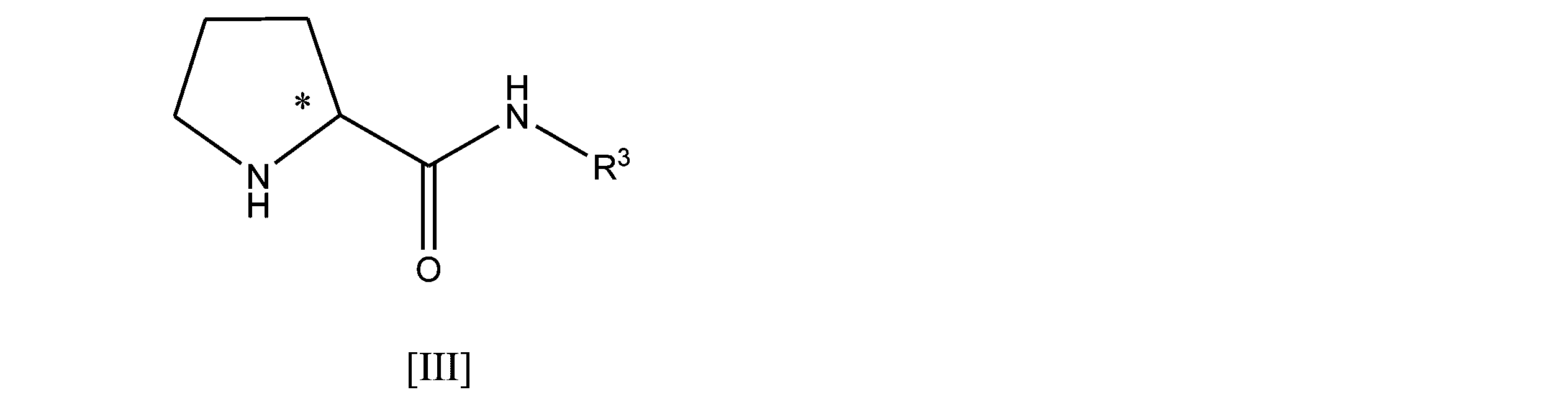
で示される化合物である請求項1に記載の製造方法。 - キラルなプロリンアミド類化合物が、(R)-プロリンヘテロアリ-ルアミドまたは(S)-プロリンヘテロアリ-ルアミドである請求項1または2に記載の製造方法。
- キラルなプロリンアミド類化合物が、(R)-N-(6-キノリニル)-2-ピロリジンカルボキサミドまたは(S)-N-(6-キノリニル)-2-ピロリジンカルボキサミドである請求項1~3のいずれかに記載の製造方法。
- キラルなプロリンアミド類化合物が、(R)-N-(2-メトキシ-3-ジベンゾフラニル)-2-ピロリジンカルボキサミドまたは(S)-N-(2-メトキシ-3-ジベンゾフラニル)-2-ピロリジンカルボキサミドである請求項1~3のいずれかに記載の製造方法。
- キラルなプロリンアミド類化合物が、(R)-2-ピロリジンカルボキサミドまたは(S)-2-ピロリジンカルボキサミドである請求項1または2に記載の製造方法。
- キラルなプロリンアミド類化合物を配位子とするイリジウム(III)錯体が、式[IV]
(化4)
Cp*Ir(X)(L-H+) [IV]
(式中、XはCl-,p-CH3C6H4SO3 -,CH3SO3 -,CF3SO3 -,NO3 -,BF4 -,ClO4 -,PF6 -,SbF6 -,B[3,5-di(trifluoromethyl)phenyl]4 -又はB(4-fluorophenyl)4 -を示し、Lは式[III]
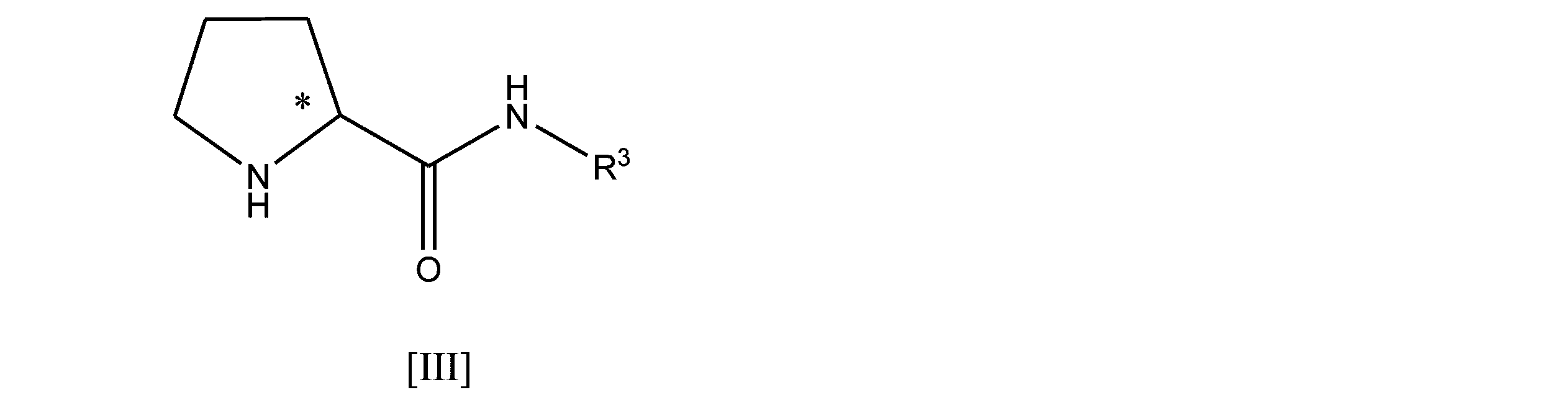
で示される化合物を示し、Cp*は(1,2,3,4,5-η)-ペンタメチル-2,4-シクロペンタジエン-1-イルを示す。)
で示される請求項1~3のいずれかに記載の製造方法。 - R3が水素、6-キノリニル基、2-メトキシ-3-ジベンゾフラニル基のいずれかである式[III]の配位子を有する請求項7に記載の製造方法。
- キラルなプロリンアミド類化合物を配位子とするイリジウム(III)錯体が、(R)もしくは(S)-クロロ〔(1,2,3,4、5-η)-ペンタメチル-2,4-シクロペンタジエン-1-イル〕〔N-(2-メトキシ-3-ジベンゾフラニル)-2-ピロリジンカルボキサミダト-κN1,κN2〕イリジウム(III)触媒、(R)もしくは(S)-クロロ〔(1,2,3,4、5-η)-ペンタメチル-2,4-シクロペンタジエン-1-イル〕(N-6-キノリニル-2-ピロリジンカルボキサミダト-κN1,κN2)イリジウム(III)触媒のいずれかである請求項7または8に記載の製造方法。
- キラルなプロリンアミド類化合物を配位子とするイリジウム(III)錯体が、(R)もしくは(S)-クロロ〔(1,2,3,4,5-η)-ペンタメチル-2,4-シクロペンタジエン-1-イル〕(2-ピロリジンカルボキサミダト-κN1,κN2)イリジウム(III)触媒のいずれかである請求項7または8に記載の製造方法。
- キラルなプロリンアミド類化合物を配位子とするイリジウム(III)錯体が結晶性である請求項1~10のいずれかに記載の製造方法。
- キラルなプロリンアミド類化合物を配位子とするイリジウム(III)錯体が非晶性である請求項1~10のいずれかに記載の製造方法。
- 水素供与性化合物が蟻酸である請求項1~12のいずれかに記載の製造方法。
- 式[IV]
(化6)
Cp*Ir(X)(L-H+) [IV]
(式中、XはCl-,p-CH3C6H4SO3 -,CH3SO3 -,CF3SO3 -,NO3 -,BF4 -,ClO4 -,PF6 -,SbF6 -,B[3,5-di(trifluoromethyl)phenyl]4 -又はB(4-fluorophenyl)4 -を示し、Lは式[III]

で示される化合物を示し、Cp*は(1,2,3,4,5-η)-ペンタメチル-2,4-シクロペンタジエン-1-イルを示す。)
で示されるイリジウム(III)錯体。 - R3が水素、6-キノリニル、2-メトキシ-3-ジベンゾフラニルのいずれかである式[III]の配位子を有する請求項14に記載のイリジウム(III)錯体。
- (R)もしくは(S)-クロロ〔(1,2,3,4,5-η)-ペンタメチル-2,4-シクロペンタジエン-1-イル〕〔N-(2-メトキシ-3-ジベンゾフラニル)-2-ピロリジンカルボキサミダト-κN1,κN2〕イリジウム(III)錯体。
- (R)もしくは(S)-クロロ〔(1,2,3,4,5-η)-ペンタメチル-2,4-シクロペンタジエン-1-イル〕(N-6-キノリニル-2-ピロリジンカルボキサミダト-κN1,κN2)イリジウム(III)錯体。
- (R)もしくは(S)-クロロ〔(1,2,3,4,5-η)-ペンタメチル-2,4-シクロペンタジエン-1-イル〕(2-ピロリジンカルボキサミダト-κN1,κN2)イリジウム(III)錯体。
- 結晶性である請求項14~18のいずれかに記載のイリジウム(III)錯体。
- 非晶性である請求項14~18のいずれかに記載のイリジウム(III)錯体。
- キラルなプロリンアミド類化合物とペンタメチルシクロペンタジエニルイリジウム(III)クロリドダイマーを弱塩基の存在下に接触させることを特徴とする請求項14~20のいずれかに記載のイリジウム(III)クロロ錯体の製造方法。
- 弱塩基が第3級アミン類、炭酸水素アルカリ金属塩または炭酸アルカリ土類金属塩である請求項21に記載のイリジウム(III)クロロ錯体の製造方法。
Priority Applications (3)
| Application Number | Priority Date | Filing Date | Title |
|---|---|---|---|
| EP12815048.9A EP2733138B1 (en) | 2011-07-15 | 2012-07-13 | Method for producing optically active tetrahydroquinoline |
| JP2013524698A JP6073223B2 (ja) | 2011-07-15 | 2012-07-13 | 光学活性テトラヒドロキノリン類の製造方法 |
| US14/232,589 US9108986B2 (en) | 2011-07-15 | 2012-07-13 | Method for producing optically active tetrahydroquinolines |
Applications Claiming Priority (4)
| Application Number | Priority Date | Filing Date | Title |
|---|---|---|---|
| JP2011157043 | 2011-07-15 | ||
| JP2011-157043 | 2011-07-15 | ||
| JP2011263182 | 2011-12-01 | ||
| JP2011-263182 | 2011-12-01 |
Publications (1)
| Publication Number | Publication Date |
|---|---|
| WO2013011930A1 true WO2013011930A1 (ja) | 2013-01-24 |
Family
ID=47558108
Family Applications (1)
| Application Number | Title | Priority Date | Filing Date |
|---|---|---|---|
| PCT/JP2012/067879 Ceased WO2013011930A1 (ja) | 2011-07-15 | 2012-07-13 | 光学活性テトラヒドロキノリン類の製造方法 |
Country Status (4)
| Country | Link |
|---|---|
| US (1) | US9108986B2 (ja) |
| EP (1) | EP2733138B1 (ja) |
| JP (2) | JP6073223B2 (ja) |
| WO (1) | WO2013011930A1 (ja) |
Cited By (3)
| Publication number | Priority date | Publication date | Assignee | Title |
|---|---|---|---|---|
| WO2023249106A1 (ja) * | 2022-06-24 | 2023-12-28 | 東レ株式会社 | 筋萎縮性側索硬化症の治療剤又は予防剤 |
| WO2023249107A1 (ja) * | 2022-06-24 | 2023-12-28 | 東レ株式会社 | 末梢神経障害の治療剤又は予防剤 |
| WO2023249105A1 (ja) * | 2022-06-24 | 2023-12-28 | 東レ株式会社 | 薬剤性心筋障害の治療剤又は予防剤 |
Families Citing this family (4)
| Publication number | Priority date | Publication date | Assignee | Title |
|---|---|---|---|---|
| CN109575060B (zh) * | 2018-12-19 | 2020-11-17 | 南开大学 | 螺环双硼催化剂的合成及其在氢化反应中的应用 |
| MX2022003448A (es) * | 2019-09-25 | 2022-04-19 | Bayer Ag | Mejora de la hidrogenacion enantioselectiva de 1,2-dihidroquinolinas 4-sustituidas en presencia de un catalizador quiral de iridio y un aditivo. |
| EP4055025A1 (en) * | 2019-11-07 | 2022-09-14 | DSM IP Assets B.V. | New transition metal catalyst |
| CN116496496B (zh) * | 2023-04-27 | 2024-11-05 | 中国石油大学(华东) | 一种基于三嗪共价框架材料(CTFs)制备单位点催化剂的制备方法 |
Citations (1)
| Publication number | Priority date | Publication date | Assignee | Title |
|---|---|---|---|---|
| WO2009005024A1 (ja) | 2007-07-03 | 2009-01-08 | Hamari Chemicals, Ltd. | 光学活性アミンの製造方法 |
Family Cites Families (3)
| Publication number | Priority date | Publication date | Assignee | Title |
|---|---|---|---|---|
| JP5041501B2 (ja) * | 2000-08-01 | 2012-10-03 | 塩野義製薬株式会社 | アミド化合物を配位子とする遷移金属錯体を用いたアルコールの製造方法 |
| JP5847386B2 (ja) * | 2010-09-15 | 2016-01-20 | 関東化學株式会社 | アミン化合物の製造方法 |
| EP2772476B1 (en) | 2011-10-25 | 2017-01-11 | Hamari Chemicals, Ltd. | Method for producing optically active alcohol |
-
2012
- 2012-07-13 EP EP12815048.9A patent/EP2733138B1/en active Active
- 2012-07-13 WO PCT/JP2012/067879 patent/WO2013011930A1/ja not_active Ceased
- 2012-07-13 US US14/232,589 patent/US9108986B2/en active Active
- 2012-07-13 JP JP2013524698A patent/JP6073223B2/ja active Active
-
2016
- 2016-11-24 JP JP2016228424A patent/JP6420294B2/ja active Active
Patent Citations (1)
| Publication number | Priority date | Publication date | Assignee | Title |
|---|---|---|---|---|
| WO2009005024A1 (ja) | 2007-07-03 | 2009-01-08 | Hamari Chemicals, Ltd. | 光学活性アミンの製造方法 |
Non-Patent Citations (8)
| Title |
|---|
| ANGEW. CHEM. INT. ED, vol. 45, 2006, pages 3683 - 3686 |
| ANGEW. CHEM. INT. ED, vol. 48, 2009, pages 6524 - 6528 |
| J. AM. CHEM. SOC, vol. 125, 2003, pages 10536 - 10537 |
| ORG. LETT, vol. 10, 2008, pages 5265 - 5268 |
| See also references of EP2733138A4 |
| WEN-BO WANG ET AL.: "Highly Enantioselective Iridium-Catalyzed Hydrogenation of Heteroaromatic Compounds, Quinolines", JOURNAL OF THE AMERICAN CHEMICAL SOCIETY, vol. 125, 2003, pages 10536 - 10537, XP055104054 * |
| WINFRIED HOFFMUELLER; KURT POLBORN; JOERG KNIZEK; HEINRICH NOETH; WOLFGANG BECK, Z. ANORG. ALLG. CHEM., vol. 623, 1997, pages 1903 - 1911 |
| ZHI-WEI LI ET AL.: "Air-Stable and Phosphine-Free Iridium Catalysts for Highly Enantioselective Hydrogenation of Quinoline Derivatives", ORGANIC LETTERS, vol. 10, no. 22, 2008, pages 5265 - 5268, XP055142179 * |
Cited By (3)
| Publication number | Priority date | Publication date | Assignee | Title |
|---|---|---|---|---|
| WO2023249106A1 (ja) * | 2022-06-24 | 2023-12-28 | 東レ株式会社 | 筋萎縮性側索硬化症の治療剤又は予防剤 |
| WO2023249107A1 (ja) * | 2022-06-24 | 2023-12-28 | 東レ株式会社 | 末梢神経障害の治療剤又は予防剤 |
| WO2023249105A1 (ja) * | 2022-06-24 | 2023-12-28 | 東レ株式会社 | 薬剤性心筋障害の治療剤又は予防剤 |
Also Published As
| Publication number | Publication date |
|---|---|
| US9108986B2 (en) | 2015-08-18 |
| EP2733138A4 (en) | 2014-12-03 |
| EP2733138A1 (en) | 2014-05-21 |
| JP6073223B2 (ja) | 2017-02-01 |
| US20140228572A1 (en) | 2014-08-14 |
| JPWO2013011930A1 (ja) | 2015-02-23 |
| JP6420294B2 (ja) | 2018-11-07 |
| JP2017095462A (ja) | 2017-06-01 |
| EP2733138B1 (en) | 2016-09-28 |
Similar Documents
| Publication | Publication Date | Title |
|---|---|---|
| JP6420294B2 (ja) | イリジウム(iii)錯体 | |
| Veisi et al. | Chemoselective hydration of nitriles to amides using hydrated ionic liquid (IL) tetrabutylammonium hydroxide (TBAH) as a green catalyst | |
| JP7164647B2 (ja) | 金属錯体 | |
| JP6148351B2 (ja) | 置換ピロリジン−2−カルボキサミドの不斉合成 | |
| KR20140013232A (ko) | N-(2-히드록시에틸)니코틴아미드 및 니코란딜의 제조방법 | |
| CN103012350B (zh) | 苯并吡喃类手性化合物的合成方法 | |
| CN105037442A (zh) | 新型手性硫醚-膦配体及制备方法及用途 | |
| KR101744046B1 (ko) | 실로도신 합성에 유용한 중간체의 제조방법 | |
| JP6336579B2 (ja) | ピリジン又はピラジン含有化合物 | |
| JP5622565B2 (ja) | 安定なヴィナミジニウム塩およびそれを用いた含窒素複素環合成 | |
| CN113549007B (zh) | 一种哌啶乙酸酯类化合物的制备方法 | |
| JP7349551B2 (ja) | 含フッ素ピリミジン化合物およびその製造方法 | |
| Komatsuzaki et al. | An Anion Receptor Based on Poly-Substituted Cobalticinium Complexes. | |
| JP6038800B2 (ja) | 光学活性アルコールの製造方法 | |
| HU202481B (en) | Process for producing n-phenyl-n-(methoxyacetyl)-dl-alanine methyl ester derivatives | |
| JP5594821B2 (ja) | 新規なアザカリックス[3]ピリジン及びその製造方法 | |
| KR101057304B1 (ko) | 키랄 촉매를 이용한 아스파르트산 유도체의 제조방법 | |
| JPWO2013027835A1 (ja) | 光学活性ナフタレン化合物の製法 | |
| US20140018566A1 (en) | Palladium(ii)-catalyzed selective fluorination of benzoic acids and derivatives | |
| KR101590592B1 (ko) | 디피롤 케톤의 제조 방법 및 이에 의하여 제조된 디피롤 케톤 | |
| JP6498502B2 (ja) | 8−オキサ−6−アザビシクロ[3,2,1]オクタン誘導体の製造方法 | |
| WO2015163446A1 (ja) | イミダゾール化合物の製造方法 | |
| JP2016020322A (ja) | 1,1’9,9’−ビカルバゾール類、1,1’−ビカルバゾール塩類、及びその製造方法 | |
| Cież et al. | Synthesis of novel, chiral, water-soluble isothiazole derivatives | |
| PL236913B1 (pl) | N-benzylowa pochodna z układem 4a-arylo-1,4a,9,9a-tetrahydroindeno[ 2,1-b]pirydyn-2-onu i sposób jej otrzymywania |
Legal Events
| Date | Code | Title | Description |
|---|---|---|---|
| 121 | Ep: the epo has been informed by wipo that ep was designated in this application |
Ref document number: 12815048 Country of ref document: EP Kind code of ref document: A1 |
|
| ENP | Entry into the national phase |
Ref document number: 2013524698 Country of ref document: JP Kind code of ref document: A |
|
| NENP | Non-entry into the national phase |
Ref country code: DE |
|
| REEP | Request for entry into the european phase |
Ref document number: 2012815048 Country of ref document: EP |
|
| WWE | Wipo information: entry into national phase |
Ref document number: 2012815048 Country of ref document: EP |
|
| WWE | Wipo information: entry into national phase |
Ref document number: 14232589 Country of ref document: US |