WO2013013369A1 - Dried pulp preparation from unprocessed raw materials - Google Patents
Dried pulp preparation from unprocessed raw materials Download PDFInfo
- Publication number
- WO2013013369A1 WO2013013369A1 PCT/CN2011/077501 CN2011077501W WO2013013369A1 WO 2013013369 A1 WO2013013369 A1 WO 2013013369A1 CN 2011077501 W CN2011077501 W CN 2011077501W WO 2013013369 A1 WO2013013369 A1 WO 2013013369A1
- Authority
- WO
- WIPO (PCT)
- Prior art keywords
- pulp
- fruit
- vegetable
- dried
- accordance
- Prior art date
- Legal status (The legal status is an assumption and is not a legal conclusion. Google has not performed a legal analysis and makes no representation as to the accuracy of the status listed.)
- Ceased
Links
Classifications
-
- A—HUMAN NECESSITIES
- A23—FOODS OR FOODSTUFFS; TREATMENT THEREOF, NOT COVERED BY OTHER CLASSES
- A23L—FOODS, FOODSTUFFS OR NON-ALCOHOLIC BEVERAGES, NOT OTHERWISE PROVIDED FOR; PREPARATION OR TREATMENT THEREOF
- A23L2/00—Non-alcoholic beverages; Dry compositions or concentrates therefor; Preparation or treatment thereof
- A23L2/385—Concentrates of non-alcoholic beverages
- A23L2/39—Dry compositions
- A23L2/395—Dry compositions in a particular shape or form
-
- A—HUMAN NECESSITIES
- A23—FOODS OR FOODSTUFFS; TREATMENT THEREOF, NOT COVERED BY OTHER CLASSES
- A23L—FOODS, FOODSTUFFS OR NON-ALCOHOLIC BEVERAGES, NOT OTHERWISE PROVIDED FOR; PREPARATION OR TREATMENT THEREOF
- A23L2/00—Non-alcoholic beverages; Dry compositions or concentrates therefor; Preparation or treatment thereof
- A23L2/385—Concentrates of non-alcoholic beverages
- A23L2/39—Dry compositions
-
- A—HUMAN NECESSITIES
- A23—FOODS OR FOODSTUFFS; TREATMENT THEREOF, NOT COVERED BY OTHER CLASSES
- A23B—PRESERVATION OF FOODS, FOODSTUFFS OR NON-ALCOHOLIC BEVERAGES; CHEMICAL RIPENING OF FRUIT OR VEGETABLES
- A23B7/00—Preservation of fruit or vegetables; Chemical ripening of fruit or vegetables
- A23B7/02—Dehydrating; Subsequent reconstitution
- A23B7/022—Dehydrating; Subsequent reconstitution with addition of chemicals before or during drying, e.g. semi-moist products
-
- A—HUMAN NECESSITIES
- A23—FOODS OR FOODSTUFFS; TREATMENT THEREOF, NOT COVERED BY OTHER CLASSES
- A23L—FOODS, FOODSTUFFS OR NON-ALCOHOLIC BEVERAGES, NOT OTHERWISE PROVIDED FOR; PREPARATION OR TREATMENT THEREOF
- A23L19/00—Products from fruits or vegetables; Preparation or treatment thereof
- A23L19/01—Instant products; Powders; Flakes; Granules
-
- A—HUMAN NECESSITIES
- A23—FOODS OR FOODSTUFFS; TREATMENT THEREOF, NOT COVERED BY OTHER CLASSES
- A23L—FOODS, FOODSTUFFS OR NON-ALCOHOLIC BEVERAGES, NOT OTHERWISE PROVIDED FOR; PREPARATION OR TREATMENT THEREOF
- A23L19/00—Products from fruits or vegetables; Preparation or treatment thereof
- A23L19/09—Mashed or comminuted products, e.g. pulp, purée, sauce, or products made therefrom, e.g. snacks
-
- A—HUMAN NECESSITIES
- A23—FOODS OR FOODSTUFFS; TREATMENT THEREOF, NOT COVERED BY OTHER CLASSES
- A23L—FOODS, FOODSTUFFS OR NON-ALCOHOLIC BEVERAGES, NOT OTHERWISE PROVIDED FOR; PREPARATION OR TREATMENT THEREOF
- A23L2/00—Non-alcoholic beverages; Dry compositions or concentrates therefor; Preparation or treatment thereof
- A23L2/52—Adding ingredients
Definitions
- the present invention relates generally to the field of food and beverages.
- the present invention relates to dried fruit and vegetable pulp and to products containing such pulp preparations.
- One embodiment relates to a dried fruit or vegetable pulp preparation comprising a density modifying ingredient .
- Beverages on the basis of fruit juices or fruit flavours are generally well-liked by consumers and are perceived as refreshing, in particular during the warm season, while at the same time they generally are beneficial to the consumer' s health .
- beverages on the basis of fruit juices or fruit flavours are produced from concentrate, e.g. from powdered beverages.
- pulp particles may be added to fruit juice preparations.
- the presence of pulp particles in beverages is considered as pleasant by the consumer as it more closely resembles the mouth feel of freshly squeezed fruit juices, for example.
- the application of dehydrated fruit pulp to powdered beverages to deliver a pulp mouthfeel after reconstitution is not a simple task to accomplish reasons, e.g., due to costs or technical limitations.
- US4233334 discloses a dry powdered beverage mix adapted to be reconstituted in cold water.
- the powdered mix includes beaten cellulose pulp, which imparts an appearance and mouth-feel resembling freshly squeezed natural juice.
- the beaten pulp is mixed with sugar, and the pulp/sugar mixture is air dried to form a dry cake which is then crushed to a powder.
- Pulp is in particularly perceived as pleasant, if it is visible in the beverage, well hydrated and maintains a floating status in the beverage.
- EP0098120B1 addresses the problem that natural citrus pulp often is not easy to rehydrate after drying and hence often clumps and generates particles with a high density. It is suggested to adjust the pH of citrus pulp to at least 4.0 before freeze drying the pulp to a moisture content of less than 10 weight -% and grinding it. This way a dried citrus pulp with improved wetting and dispersion characteristics is obtained .
- sugar particles and pulp particles e.g. in a powdered beverage composition
- the robust and sharp edged sugar particles grind the pulp particles and - consequently - destroy at least in part the pulp structure. Similar friction effects can also be observed in between the pulp particles. This happens in particular during production and transport, but also during storage times Additionally, it is a technical challenge to mix relatively low density pulp with sugar particles to homogeneity during processing. Further segregation could be observed during transportation and storage.
- the results are pulp particle segregation, impaired hydration properties, and an impaired mouthfeel of the final product after reconstitution with milk or water.
- such a pulp should be obtainable by a process with a high freeze drying efficiency for dried pulp resulting in pulp which is less cohesive and caking is avoided.
- a density modifying ingredient e.g., complex carbohydrates or glycerol
- pulp preparations are dried in the presence of complex carbohydrates with a low water solubility, such as starch, the sticking of pulp particles is avoided. If the pulp preparations are dried in the presence of a humectant, such as glycerol, rather soft pulp particles can be obtained. Such pulp particles were found to be more resistant towards mechanical stress. Consequently, unwanted particle breakage can be avoided.
- a humectant such as glycerol
- the rather soft particles avoid unnecessary friction between the pulp particles and the resulting segregation.
- one embodiment of the present invention is a dried fruit or vegetable pulp preparation comprising dried fruit or vegetable pulp and a density modifying ingredient.
- a fruit or vegetable pulp preparation is considered dried if it has a water content of below 10 weight-%, below 5 weight-%, or for example below 3 weight-%.
- Dry density modifying ingredients may contain less than 10 weight-%, less than 3 weight %, less than 1 weight-%, or no water. Density modifying ingredients also have a higher density that the dried pulp to be produced and can be rehydrated with water.
- the density modifying ingredient may be selected from the group consisting of complex carbohydrates or humectants.
- a suitable humectant may be glycerol, for example.
- the at least one complex carbohydrate should be not soluble in water.
- a compound is considered to have a low solubility in water if 10 weight-% of the compound do not dissolve substantially completely in water at room temperature during 30 minutes.
- the density modifying ingredients may be present in an amount corresponding to about at least 0.5 weight-%, at least 10 weight-% or at least 20 weight-% compared to the dry weight of the pulp.
- the complex carbohydrate which has a low solubility in water may be starch, for example.
- the density modifying ingredient may consist out of at least one complex carbohydrate.
- It may also contain at least 1 weight %, at least 10 weight- %, at least 20 weight %, or at least 50 weight-% of a complex carbohydrate which has a low solubility in water; and in addition other carbohydrates.
- These other carbohydrates may or may not be water soluble.
- Water soluble sugars may be used.
- Typical sugars may be maltodextrin, glucose, trehalose, sucrose, maltose, lactose or combinations thereof, for example Consequently, the fruit or vegetable pulp preparation may comprise a density modifying ingredient comprising a mixture of at least one sugar and/or at least one complex carbohydrate
- the density modifying ingredient may further contain a humectants, such as glycerol, for example.
- the fruit or vegetable pulp preparation is obtainable - and may be obtained - by a process comprising the steps of separating the pulp from the fruits or vegetables, adding the density modifying ingredient to the pulp and drying the pulp.
- the outer skin, membranes and seeds are removed and only the pulp is used for further processing.
- the density modifying ingredient is added to the pulp before the drying step. This allows homogeneous distribution and allows the density modifying ingredient to protect the pulp during the subsequent drying process and avoids unwanted cohesion .
- Drying allows reducing the water activity and the water content of the pulp allowing easy storing and avoiding decay processes .
- the fruit or vegetable pulp may be dried by any method that is known in the art .
- the pulp may be dried by, for example, by air drying (AD), freeze draying(FD), roller drying, spray drying, vacuum drying (VD) , microwave drying, or combinations thereof.
- AD air drying
- FD freeze draying
- VD vacuum drying
- microwave drying microwave drying
- Freeze dried pulp had excellent visual properties, also after reconstitution, significantly better compared to other drying techniques . Freeze drying also allowed generating an improved floating status of the pulp after reconstitution in water.
- Freeze drying further allowed delivering a pulp with a superior chewy perception after reconstitution .
- Freeze dried pulp was also shown to have the best rehydration properties.
- Freeze drying also allowed it to minimize pulp shrinkage during the drying procedure compared to other drying processes
- Fruit pulp is usually produced from waste products in the juice production, e.g. from citrus grain after juice extraction. Oftentimes the grains are dried before they are applied to pulp production.
- Such pulp can very well be used in the context of the present invention and would allow valorisation of a product that would otherwise be thrown away.
- the present inventors were able to demonstrate that dried fruit or vegetable pulp obtained from fresh fruits or vegetables has superior properties compared to pulp obtained from waste products of the juice production.
- the inventors have found that when waste products or by ⁇ products from juice production are used, more working steps are needed to produce pulp, resulting in higher labour cost. This has the consequence that using whole fruits or vegetables as starting material for pulp production may be more economic.
- Fruits or vegetables are considered "unprocessed” if they are used as such as raw material to prepare pulp and were in particular not treated beforehand to remove the juice prior to pulp collection, for example by squeezing or beating the fruit or vegetable to extract the juice.
- the flesh of the fruits or vegetables is used to prepare the pulp. Peeled fruit or vegetables may be considered as unprocessed. Without wishing to be bound by theory, the inventors believe that this difference is due to the fact that in pulps obtained from processed fruits or vegetables the texture and structure of the pulp is significantly damaged by the strong squeezing or beating operation. If unprocessed fruits or vegetables are used for dried pulp production, the fruit or vegetable grain is protected and will not be damaged during pulp production.
- the dried fruit or vegetable pulp preparation may be obtained from fresh, unprocessed fruits or vegetables.
- Fruits or vegetables are considered "fresh" if they are used within normal consumption times after harvest. These time frames may vary depending on the fruit or vegetable. For example, a fresh fruit is not dried and has a water content corresponding to at least 50%, preferably at least 75% even more preferred at least 90% corresponding to the fruit or vegetable directly after harvest.
- the inventors also found that using fresh unprocessed fruit or vegetables as starting material rather than processed fruit pulp after squeezing out juice, allows increasing the freeze drying efficiency significantly so that far less cost spent on raw material is needed for obtaining a fixed amount of dried pulp.
- the fruit or vegetable pulp may be cut before drying, e.g., in particular before freeze drying. Cutting the pulp, e.g., into cubes or other shapes allows improving the rehydration properties of the resulting pulp preparation.
- the pulp may be cut into pieces with an edge length in the range of about 0.5-30 mm.
- the pulp may be cut into cubes with an edge length in the range of 0.5-30 mm, for example 3 - 6 mm.
- the inventors have found particular good properties for cubes with an edge length of about 3 or about 6 mm.
- the dicing size has an effect on pulp size and visual properties. Cubes with a longer edge length produce bigger pulp segments after reconstitution and the risk to produce unwanted very fine pulp segments is reduced.
- the pulp may be blanched, preferable before being frozen and/or cut.
- Blanching will help to sterilize the pulp. Blanching also can be used to stop unwanted enzyme activity in the pulp, to remove unwanted strong tastes and/or to soften the pulp, or to kill unwanted microorganism in the preparation to control the microbial level.
- the pulp may be blanched in a sugar solution before it is frozen and/or dried.
- sugar any food grade sugar can be used. An example is sucrose.
- the sugar solution may contain water and sugar. Blanching is typically carried out in boiling water, although lower temperatures may be used.
- the solution may be heated to at least about 60°C, at least about 80°C or at least about 100 °C.
- the sugar solution may contain about 0.1-99 weight-% sugar, e.g. 10-30 weight-% sugar, for example about 20 weight-% sugar.
- the duration of the blanching procedure will depend on the type of pulp used but will typically be between about 30 seconds and 5 minutes, for example about 1 - 3 minutes, such as about 2 minutes. Such a pre-treatment of the pulp will further contribute to an excellent optical appearance of the final fruit or vegetable pulp preparation.
- the blanching step helps to further purify the pulp from unwanted residues of peel or other constituents which may not have been completely removed in the separation step of the pulp from the rest of the fruit or vegetable.
- the process of the present invention has the advantage that the individual particles of the pulp are treated very carefully, preserving their natural character and appearance.
- the fruit or vegetable pulp preparation in accordance with the present invention in a dehydrated state may have more than 50% particles of a size in the range between 0.5 mm to 30 mm.
- Further ingredients e.g., such as the density modifying ingredient, such as the at least one complex carbohydrate, maltodextrin, sucrose, trehalose, maltose, glucose, glycerine, or combinations thereof may be added to the pulp, for example after the bleaching step.
- ingredients should be added to the pulp before drying.
- such ingredients could be added to the pulp before it is frozen.
- the shake-down density of the final dried pulp can be varied and can for example range from 0.02 to 0.50g/ml.
- modified starches such as acid-treated starch, alkaline-treated starch, bleached starch, oxidized starch, enzyme-treated starches, monostarch phosphate, distarch phosphate, phosphated distarch phosphate, acetylated distarch phosphate starch acetate, acetylated distarch adipate, hydroxypropyl starch, hydroxypropyl distarch phosphate, hydroxypropyl distarch glycerol, starch sodium octenyl succinate, acetylated oxidized starch, or combinations thereof may be used.
- modified starches such as acid-treated starch, alkaline-treated starch, bleached starch, oxidized starch, enzyme-treated starches, monostarch phosphate, distarch phosphate, phosphated distarch phosphate, acetylated distarch phosphate starch acetate, acetylated distarch adipate
- the ideal shakedown density of the pulp particles will depend on a number of factors such as the overall average size of the pulp particle as well as the nature and density of the origin composition that was used to produce the pulp particles of the present invention.
- Handedown density or “tap density” of a powder is understood in the art as the ratio of its mass to the volume it occupies after it has been subjected to a fixed number of taps under specified conditions (e.g. in 30 seconds, manual jolt density meter 100 times with 8.5 height of stroke using 500 mL Stainless steel) . It is conventionally expressed in grams per millilitre .
- the pulp may be obtained from edible fruit or vegetables.
- "Edible” means a material that is approved for human or animal consumption .
- the pulp may be obtained from fruit of the genus citrus fruits, for example oranges, tangerines, lemons, grapefruits, pomelos; or apples; peaches; pineapples; cherries; apricots; grapes; guava; sapodillas; tomatoes; mangos; bananas; or combinations thereof.
- Orange pulp is widely used and may hence be a preferred example .
- Pomelos are a further preferred example, as they allow easy separation of the pulp from the whole fruit and show particular good efficiency and high yields in pulp production. Further they have a high nutritional value and are relatively inexpensive .
- the composition of the present invention may be used to prepare any kind of edible composition.
- Edible compositions include beverages.
- the composition will generally be liquid prior to consumption, but this does not have to be the case.
- the composition may also be to be consumed in the dry state or may be to be incorporated into other compositions, for example gel like compositions or creamy compositions such as yoghurts, ice creams or puddings.
- the compositions of the present invention may also be to be incorporated into dry preparations such as cakes, for example.
- composition of the present invention may also be used for cosmetic compositions and/or hygiene products such as shower gels, or face masks, for example.
- the composition is a powdered beverage or may be a part of a powdered beverage.
- Such a powdered beverage comprises the composition of the present invention.
- the powdered beverage may contain at least 0.1 weight-%, at least 2 weight-% of the fruit or vegetable pulp preparation in the dry state and optionally food additives and/or food ingredients. Food additives and/or further food ingredients may be added.
- the pulp preparation produced in accordance with the present invention results in a protected pulp structure and minimizes breakage during processing.
- a powdered beverage composition in accordance with the present invention may have a degree of homogeneity with a coefficient of variation of at most 25%.
- the present invention further extends to the use of at least one complex carbohydrate in the production of dried fruit or vegetable pulp to prevent sticking of pulp particles after drying .
- the present invention also comprises the use of at least one complex carbohydrate in the production of dried fruit or vegetable pulp to adjust the density of the dried pulp.
- the complex carbohydrate may preferably have a low water solubility.
- the complex carbohydrate may be part of a density modifying ingredient as described above.
- the density modifying ingredient may also be used to produce an anti-caking effect in the pulp production. This can for example be achieved if the density modifying ingredient is a starch, optionally in combination with other carbohydrates.
- the density modifying ingredient may also be used to avoid breakage of dried pulp. This can for example be achieved if the density modifying ingredient is glycerol.
- the density modifying ingredient, optionally in combination with sugar, may also be used to improve the flow ability of a powdered beverage preparation containing a dried pulp preparation .
- Figure 1 shows an example of the process of the present invention .
- Figure 2 shows the resulting fruit pulp obtained by the process of figure 1 reconstituted in water
- Figure 3 shows the result of a breakage test of the dried pulp preparation of the present invention
- Figure 4 shows the result of a caking test of the dried pulp preparation of the present invention
- A FD pomelo pulp with additive composition 1
- B FD pomelo pulp without additives
- Figure 5 shows the result of a shake down density test of the dried pulp preparation of the present invention
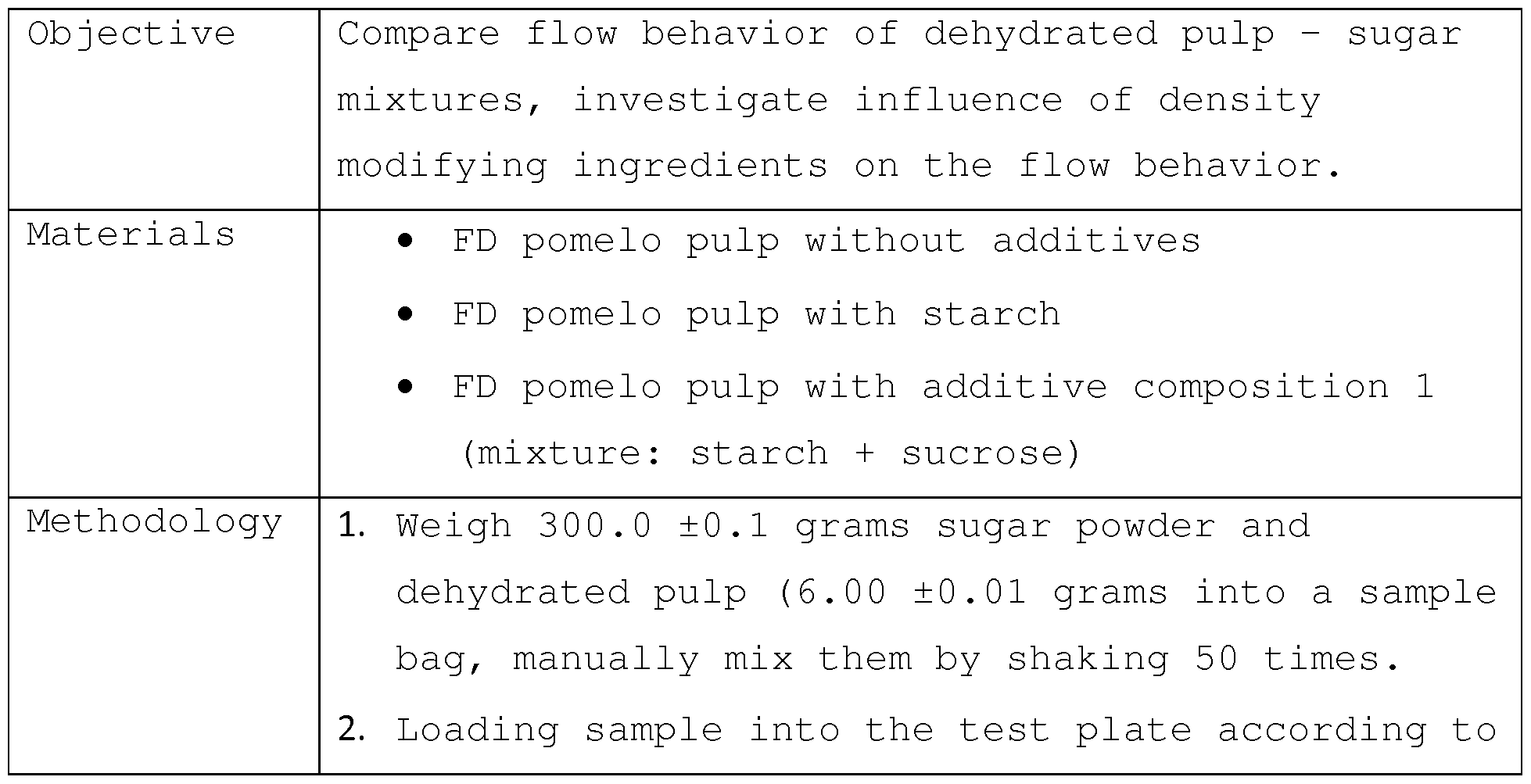
- Figure 6 shows the result of a flow ability test of the dried pulp preparation of the present invention in a final product
- Fruit pulp was separated from the whole pomelo fruit. The following table summarizes this separation procedure. The percentages are given in weight-%. About 40 weight-% of the pomelo are fruit pulp an can be used for the production of the dried fruit pulp preparation of the present invention.
- the inventors have prepared dried pomelo pulp in accordance with the present invention.
- FIG 1 for pomelo pulp.
- Figure 2 shows the pomelo pulp floating after reconstitution in water
- the inventors have further carried out a consumer test in order to investigate whether or not dried pulp prepared from fresh unprocessed fruit or vegetables was preferred by consumers over traditionally prepared fruit pulp from the waste products of orange juice production.
- sample 2 and 3 have a more chewy perception, look better and have a better mouthfeel than sample 1.
- the inventors further tested the effect of additives on the reduction of unwanted effects such as caking and on the overall quality of the resulting dehydrated pulp.
- complex carbohydrates such as starch for example, allows it to improve the quality of the dehydrated pulp and to reduce caking.
- complex carbohydrates such as starch for example
- the addition of other low water soluble complex carbohydrates may further be used to overcome caking problems after freeze drying caused by other ingredients, such as maltodextrin.
- sugar can be used to adjust the density of dried pulp.
- glycerol helps to prevent caking.
- complex carbohydrates such as starch for example, allows it further to retain coloring agents in the pulp allowing for color modifications.
- the inventors have carried out further experiments to investigate the anti-breakage properties of density modifying ingredients .
- Anti breakage properties are important for dehydrated pulp and its applied products under processing and transportation situations .
- W B - weight (g) of low size fraction ( ⁇ 1.25 mm) ;
- the inventors have carried out further experiments to investigate the anti-caking properties of density modifying ingredients .
- V volume of tapped pulp, in mL .
- dehydrated pulp was improved, by adjusting the density modifying ingredients composition formula, pulps with different shaken down density values were obtained.
- the inventors have carried out further experiments to investigate the flow ability of the dried pulp preparation of the present invention with or without density modifying ingredients.
- a key application of the dehydrated pulp preparation of the present invention is its application in powdered beverages with additional sugar content. Different dried pulp made with or without density modifying ingredients were found to change the flow behavior of finish product.
- Tester configure parameters and test samples by PFT.
- Data set 1 FD without additives + sugar powder
- Data set 2 FD with starch + sugar powder
- Data set 3 FD with additives composition 1 + sugar powder
Landscapes
- Life Sciences & Earth Sciences (AREA)
- Chemical & Material Sciences (AREA)
- Engineering & Computer Science (AREA)
- Food Science & Technology (AREA)
- Polymers & Plastics (AREA)
- Health & Medical Sciences (AREA)
- Nutrition Science (AREA)
- Chemical Kinetics & Catalysis (AREA)
- General Chemical & Material Sciences (AREA)
- Wood Science & Technology (AREA)
- Zoology (AREA)
- Preparation Of Fruits And Vegetables (AREA)
Abstract
Description


Claims
Priority Applications (7)
| Application Number | Priority Date | Filing Date | Title |
|---|---|---|---|
| US14/234,316 US20140308424A1 (en) | 2011-07-22 | 2011-07-22 | Dried pulp preparation from unprocessed raw materials |
| PCT/CN2011/077501 WO2013013369A1 (en) | 2011-07-22 | 2011-07-22 | Dried pulp preparation from unprocessed raw materials |
| CN201180072467.1A CN103687502A (en) | 2011-07-22 | 2011-07-22 | Dried pulp preparation from unprocessed raw materials |
| PH1/2013/502595A PH12013502595A1 (en) | 2011-07-22 | 2011-07-22 | Dried pulp preparation from unprocessed raw materials |
| MX2014000530A MX2014000530A (en) | 2011-07-22 | 2011-07-22 | Dried pulp preparation from unprocessed raw materials. |
| EP11870121.8A EP2734061A4 (en) | 2011-07-22 | 2011-07-22 | DRIED PULP PREPARATION PRODUCED FROM UNTREATED RAW MATERIALS |
| BR112014000868A BR112014000868A2 (en) | 2011-07-22 | 2011-07-22 | preparation of dried pulp from unprocessed raw materials |
Applications Claiming Priority (1)
| Application Number | Priority Date | Filing Date | Title |
|---|---|---|---|
| PCT/CN2011/077501 WO2013013369A1 (en) | 2011-07-22 | 2011-07-22 | Dried pulp preparation from unprocessed raw materials |
Publications (1)
| Publication Number | Publication Date |
|---|---|
| WO2013013369A1 true WO2013013369A1 (en) | 2013-01-31 |
Family
ID=47600446
Family Applications (1)
| Application Number | Title | Priority Date | Filing Date |
|---|---|---|---|
| PCT/CN2011/077501 Ceased WO2013013369A1 (en) | 2011-07-22 | 2011-07-22 | Dried pulp preparation from unprocessed raw materials |
Country Status (7)
| Country | Link |
|---|---|
| US (1) | US20140308424A1 (en) |
| EP (1) | EP2734061A4 (en) |
| CN (1) | CN103687502A (en) |
| BR (1) | BR112014000868A2 (en) |
| MX (1) | MX2014000530A (en) |
| PH (1) | PH12013502595A1 (en) |
| WO (1) | WO2013013369A1 (en) |
Cited By (1)
| Publication number | Priority date | Publication date | Assignee | Title |
|---|---|---|---|---|
| CN109631502A (en) * | 2019-01-03 | 2019-04-16 | 东北农业大学 | The method for microwave drying of foam pulp temperature uniformity is improved using regulation wind speed |
Families Citing this family (5)
| Publication number | Priority date | Publication date | Assignee | Title |
|---|---|---|---|---|
| CN105495598B (en) * | 2015-12-25 | 2017-12-22 | 宁夏中宁县尚江南枸杞制品有限公司 | The production method of lyophilized wolfberry fruit powder |
| BR112018074774A2 (en) * | 2016-05-31 | 2019-03-06 | Ogilvie Watkins Robert | methods for processing green banana pulp, methods for processing green banana peel, food products, nutritional supplements and pharmaceutical compositions |
| US11191289B2 (en) | 2018-04-30 | 2021-12-07 | Kraft Foods Group Brands Llc | Spoonable smoothie and methods of production thereof |
| JP7179950B1 (en) | 2021-11-18 | 2022-11-29 | アサヒ飲料株式会社 | Beverages containing fruit-derived insoluble solids |
| US12507716B1 (en) | 2025-05-22 | 2025-12-30 | That's It Nutrition, Llc | Two stage dehydration method for plant based food processing |
Citations (3)
| Publication number | Priority date | Publication date | Assignee | Title |
|---|---|---|---|---|
| GB1124335A (en) * | 1964-10-14 | 1968-08-21 | Gen Foods Corp | Beverage concentrate |
| EP1051917A2 (en) * | 1999-05-11 | 2000-11-15 | Bestfoods | Process for making agglomerated roll-dried flakes from fruit or vegetables |
| CN101991168A (en) * | 2010-06-30 | 2011-03-30 | 雀巢公司 | Powder beverage containing fruit or vegetable meat pulp |
Family Cites Families (20)
| Publication number | Priority date | Publication date | Assignee | Title |
|---|---|---|---|---|
| US3315619A (en) * | 1964-09-14 | 1967-04-25 | Kellog Co | Apparatus for the production of food product |
| FR2079776A5 (en) * | 1970-02-12 | 1971-11-12 | Etna | Fruit preservation - with addition of a lyophilisation agent before freeze-drying |
| DE2938596C2 (en) * | 1979-09-24 | 1982-05-19 | Maizena Gmbh, 2000 Hamburg | Dry product reconstitutable with hot aqueous liquids and process for its manufacture |
| US4477481A (en) * | 1982-06-24 | 1984-10-16 | General Foods Corporation | Method for producing dried citrus pulp |
| FR2552307B1 (en) * | 1983-09-27 | 1989-04-14 | Gervais Danone Sa | IMPROVEMENTS RELATING TO TOPPING COMPOSITIONS FOR FOOD PRODUCTS SUCH AS MILKY DESSERTS |
| US5084296A (en) * | 1990-01-30 | 1992-01-28 | Kraft General Foods, Inc. | Process for making simulated fruit pieces |
| US5124162A (en) * | 1991-11-26 | 1992-06-23 | Kraft General Foods, Inc. | Spray-dried fixed flavorants in a carbohydrate substrate and process |
| US6287612B1 (en) * | 1998-12-01 | 2001-09-11 | Nestec S.A. | Liquid food products and package therefore |
| US20010053404A1 (en) * | 2000-05-12 | 2001-12-20 | Powrie William Duncan | Formulation and process for producing a universal fruit base for use in preparing non-settling, creamy, smooth, thick fruit beverages |
| ATE399473T1 (en) * | 2002-07-19 | 2008-07-15 | Nestec Sa | METHOD FOR PRODUCING A POWDERED, REHYDRATABLE PRODUCT BY EXTRUSION-EXPANSION |
| JP4284437B2 (en) * | 2003-01-30 | 2009-06-24 | 明治乳業株式会社 | Method for producing coffee bean extract |
| WO2005063032A1 (en) * | 2003-12-30 | 2005-07-14 | Council Of Scientific And Industrial Research | Process for preparing shelf stable custard apple pulp and powder |
| US20060025381A1 (en) * | 2004-07-29 | 2006-02-02 | National Starch And Chemical Investment Holding Company | Use of a chemically modified starch product |
| US7569244B2 (en) * | 2005-04-08 | 2009-08-04 | J. Kirk Jordan | Ready-to-eat dry fruit products and process |
| US7851005B2 (en) * | 2005-05-23 | 2010-12-14 | Cadbury Adams Usa Llc | Taste potentiator compositions and beverages containing same |
| EP1964479B1 (en) * | 2007-02-14 | 2013-05-15 | DSM IP Assets B.V. | Process for the manufacture of a powder containing carotenoids |
| CN101181040A (en) * | 2007-12-07 | 2008-05-21 | 华南理工大学 | A kind of preparation method of banana powder with good rehydration property and not easy to agglomerate |
| MX2011000748A (en) * | 2008-08-01 | 2011-02-24 | Unilever Nv | Dried vegetables and a process for producing the same. |
| US9107445B2 (en) * | 2009-07-10 | 2015-08-18 | Intercontinental Great Brands Llc | Beverage composition with foam generating component |
| CN101692846B (en) * | 2009-10-15 | 2011-08-17 | 山西师范大学 | A kind of preparation method of vacuum freeze-dried watermelon slice |
-
2011
- 2011-07-22 CN CN201180072467.1A patent/CN103687502A/en active Pending
- 2011-07-22 MX MX2014000530A patent/MX2014000530A/en unknown
- 2011-07-22 PH PH1/2013/502595A patent/PH12013502595A1/en unknown
- 2011-07-22 BR BR112014000868A patent/BR112014000868A2/en not_active Application Discontinuation
- 2011-07-22 WO PCT/CN2011/077501 patent/WO2013013369A1/en not_active Ceased
- 2011-07-22 US US14/234,316 patent/US20140308424A1/en not_active Abandoned
- 2011-07-22 EP EP11870121.8A patent/EP2734061A4/en not_active Withdrawn
Patent Citations (3)
| Publication number | Priority date | Publication date | Assignee | Title |
|---|---|---|---|---|
| GB1124335A (en) * | 1964-10-14 | 1968-08-21 | Gen Foods Corp | Beverage concentrate |
| EP1051917A2 (en) * | 1999-05-11 | 2000-11-15 | Bestfoods | Process for making agglomerated roll-dried flakes from fruit or vegetables |
| CN101991168A (en) * | 2010-06-30 | 2011-03-30 | 雀巢公司 | Powder beverage containing fruit or vegetable meat pulp |
Non-Patent Citations (1)
| Title |
|---|
| See also references of EP2734061A4 * |
Cited By (1)
| Publication number | Priority date | Publication date | Assignee | Title |
|---|---|---|---|---|
| CN109631502A (en) * | 2019-01-03 | 2019-04-16 | 东北农业大学 | The method for microwave drying of foam pulp temperature uniformity is improved using regulation wind speed |
Also Published As
| Publication number | Publication date |
|---|---|
| CN103687502A (en) | 2014-03-26 |
| PH12013502595A1 (en) | 2019-09-02 |
| BR112014000868A2 (en) | 2017-02-14 |
| EP2734061A4 (en) | 2015-08-12 |
| US20140308424A1 (en) | 2014-10-16 |
| MX2014000530A (en) | 2014-05-01 |
| EP2734061A1 (en) | 2014-05-28 |
Similar Documents
| Publication | Publication Date | Title |
|---|---|---|
| JP6124806B2 (en) | Dried vegetable powder and method for producing the same | |
| WO2013014053A1 (en) | Dried pulp preparation from unprocessed raw materials | |
| CN102805408B (en) | Preparation process of navel orange-kiwi fruit composite fruit powder | |
| US8980362B2 (en) | Powdered beverage comprising fruit or vegetable pulp | |
| CN105167056B (en) | A kind of high concentration blueberry juice drink | |
| US20140308424A1 (en) | Dried pulp preparation from unprocessed raw materials | |
| JP5671563B2 (en) | Green beverage and method for producing the same | |
| JP3769274B2 (en) | Green leaf granule and method for producing green leaf granule | |
| KR101743141B1 (en) | Oriental melon grain syrup with contains ginger, and manufacturing method thereof | |
| CA3153559A1 (en) | Hemp compositions and methods of making the same | |
| CN104286757A (en) | Heat-clearing pear powder and preparation method thereof | |
| Patil et al. | Standardization of Pretreatments for Liquefaction of Custard Apple for Spray Drying | |
| KR101729067B1 (en) | The manufacturing method of sugar-free tea using Yuja skin | |
| KR20210067060A (en) | Manufacturing method of ripe persimmon puree with ginger and ripe persimmon puree with ginger manufactured by the same | |
| US5965177A (en) | Method for producing a clouding agent | |
| KR100840876B1 (en) | Citron tea and its manufacturing method | |
| KR101949975B1 (en) | Manufacturing method of sliced and dried ginseng | |
| CN105495263A (en) | Tomato effervescent tablet and process thereof | |
| KR102278170B1 (en) | Food composition comprising Palmyra Palm, Ginseng, and Artichoke as an active ingredient and manufacturing method thereof | |
| JP5874207B2 (en) | Pasty food | |
| CN105995944A (en) | Leek sauce being able to prevent colds, and production method thereof | |
| CN104970139A (en) | Instant beverage and preparation method thereof | |
| KR20140115036A (en) | Functional coffee containing honey bee and the method thereof | |
| CN109221839A (en) | A kind of preparation method of the beverage made of fruits or vegetables rich in resveratrol | |
| Hla et al. | Preparation of Beverages Powder from Fruits |
Legal Events
| Date | Code | Title | Description |
|---|---|---|---|
| 121 | Ep: the epo has been informed by wipo that ep was designated in this application |
Ref document number: 11870121 Country of ref document: EP Kind code of ref document: A1 |
|
| WWE | Wipo information: entry into national phase |
Ref document number: MX/A/2014/000530 Country of ref document: MX |
|
| NENP | Non-entry into the national phase |
Ref country code: DE |
|
| REEP | Request for entry into the european phase |
Ref document number: 2011870121 Country of ref document: EP |
|
| WWE | Wipo information: entry into national phase |
Ref document number: 2011870121 Country of ref document: EP |
|
| WWE | Wipo information: entry into national phase |
Ref document number: 14234316 Country of ref document: US |
|
| REG | Reference to national code |
Ref country code: BR Ref legal event code: B01A Ref document number: 112014000868 Country of ref document: BR |
|
| ENP | Entry into the national phase |
Ref document number: 112014000868 Country of ref document: BR Kind code of ref document: A2 Effective date: 20140114 |