WO2013021944A1 - 金属ナノ粒子のpcp複合体とその作製方法 - Google Patents
金属ナノ粒子のpcp複合体とその作製方法 Download PDFInfo
- Publication number
- WO2013021944A1 WO2013021944A1 PCT/JP2012/069845 JP2012069845W WO2013021944A1 WO 2013021944 A1 WO2013021944 A1 WO 2013021944A1 JP 2012069845 W JP2012069845 W JP 2012069845W WO 2013021944 A1 WO2013021944 A1 WO 2013021944A1
- Authority
- WO
- WIPO (PCT)
- Prior art keywords
- pcp
- metal nanoparticles
- metal
- composite
- catalyst
- Prior art date
- Legal status (The legal status is an assumption and is not a legal conclusion. Google has not performed a legal analysis and makes no representation as to the accuracy of the status listed.)
- Ceased
Links
Images


Classifications
-
- B—PERFORMING OPERATIONS; TRANSPORTING
- B01—PHYSICAL OR CHEMICAL PROCESSES OR APPARATUS IN GENERAL
- B01J—CHEMICAL OR PHYSICAL PROCESSES, e.g. CATALYSIS OR COLLOID CHEMISTRY; THEIR RELEVANT APPARATUS
- B01J31/00—Catalysts comprising hydrides, coordination complexes or organic compounds
- B01J31/02—Catalysts comprising hydrides, coordination complexes or organic compounds containing organic compounds or metal hydrides
- B01J31/06—Catalysts comprising hydrides, coordination complexes or organic compounds containing organic compounds or metal hydrides containing polymers
-
- B—PERFORMING OPERATIONS; TRANSPORTING
- B01—PHYSICAL OR CHEMICAL PROCESSES OR APPARATUS IN GENERAL
- B01J—CHEMICAL OR PHYSICAL PROCESSES, e.g. CATALYSIS OR COLLOID CHEMISTRY; THEIR RELEVANT APPARATUS
- B01J35/00—Catalysts, in general, characterised by their form or physical properties
- B01J35/50—Catalysts, in general, characterised by their form or physical properties characterised by their shape or configuration
- B01J35/51—Spheres
- B01J35/53—Spheres with a core-shell structure
-
- B—PERFORMING OPERATIONS; TRANSPORTING
- B01—PHYSICAL OR CHEMICAL PROCESSES OR APPARATUS IN GENERAL
- B01J—CHEMICAL OR PHYSICAL PROCESSES, e.g. CATALYSIS OR COLLOID CHEMISTRY; THEIR RELEVANT APPARATUS
- B01J23/00—Catalysts comprising metals or metal oxides or hydroxides, not provided for in group B01J21/00
- B01J23/38—Catalysts comprising metals or metal oxides or hydroxides, not provided for in group B01J21/00 of noble metals
- B01J23/40—Catalysts comprising metals or metal oxides or hydroxides, not provided for in group B01J21/00 of noble metals of the platinum group metals
-
- B—PERFORMING OPERATIONS; TRANSPORTING
- B01—PHYSICAL OR CHEMICAL PROCESSES OR APPARATUS IN GENERAL
- B01J—CHEMICAL OR PHYSICAL PROCESSES, e.g. CATALYSIS OR COLLOID CHEMISTRY; THEIR RELEVANT APPARATUS
- B01J23/00—Catalysts comprising metals or metal oxides or hydroxides, not provided for in group B01J21/00
- B01J23/38—Catalysts comprising metals or metal oxides or hydroxides, not provided for in group B01J21/00 of noble metals
- B01J23/48—Silver or gold
-
- B—PERFORMING OPERATIONS; TRANSPORTING
- B01—PHYSICAL OR CHEMICAL PROCESSES OR APPARATUS IN GENERAL
- B01J—CHEMICAL OR PHYSICAL PROCESSES, e.g. CATALYSIS OR COLLOID CHEMISTRY; THEIR RELEVANT APPARATUS
- B01J23/00—Catalysts comprising metals or metal oxides or hydroxides, not provided for in group B01J21/00
- B01J23/70—Catalysts comprising metals or metal oxides or hydroxides, not provided for in group B01J21/00 of the iron group metals or copper
-
- B—PERFORMING OPERATIONS; TRANSPORTING
- B01—PHYSICAL OR CHEMICAL PROCESSES OR APPARATUS IN GENERAL
- B01J—CHEMICAL OR PHYSICAL PROCESSES, e.g. CATALYSIS OR COLLOID CHEMISTRY; THEIR RELEVANT APPARATUS
- B01J31/00—Catalysts comprising hydrides, coordination complexes or organic compounds
- B01J31/16—Catalysts comprising hydrides, coordination complexes or organic compounds containing coordination complexes
- B01J31/1691—Coordination polymers, e.g. metal-organic frameworks [MOF]
-
- B—PERFORMING OPERATIONS; TRANSPORTING
- B01—PHYSICAL OR CHEMICAL PROCESSES OR APPARATUS IN GENERAL
- B01J—CHEMICAL OR PHYSICAL PROCESSES, e.g. CATALYSIS OR COLLOID CHEMISTRY; THEIR RELEVANT APPARATUS
- B01J31/00—Catalysts comprising hydrides, coordination complexes or organic compounds
- B01J31/16—Catalysts comprising hydrides, coordination complexes or organic compounds containing coordination complexes
- B01J31/18—Catalysts comprising hydrides, coordination complexes or organic compounds containing coordination complexes containing nitrogen, phosphorus, arsenic or antimony as complexing atoms, e.g. in pyridine ligands, or in resonance therewith, e.g. in isocyanide ligands C=N-R or as complexed central atoms
- B01J31/1805—Catalysts comprising hydrides, coordination complexes or organic compounds containing coordination complexes containing nitrogen, phosphorus, arsenic or antimony as complexing atoms, e.g. in pyridine ligands, or in resonance therewith, e.g. in isocyanide ligands C=N-R or as complexed central atoms the ligands containing nitrogen
- B01J31/181—Cyclic ligands, including e.g. non-condensed polycyclic ligands, comprising at least one complexing nitrogen atom as ring member, e.g. pyridine
- B01J31/1815—Cyclic ligands, including e.g. non-condensed polycyclic ligands, comprising at least one complexing nitrogen atom as ring member, e.g. pyridine with more than one complexing nitrogen atom, e.g. bipyridyl, 2-aminopyridine
-
- B—PERFORMING OPERATIONS; TRANSPORTING
- B01—PHYSICAL OR CHEMICAL PROCESSES OR APPARATUS IN GENERAL
- B01J—CHEMICAL OR PHYSICAL PROCESSES, e.g. CATALYSIS OR COLLOID CHEMISTRY; THEIR RELEVANT APPARATUS
- B01J31/00—Catalysts comprising hydrides, coordination complexes or organic compounds
- B01J31/16—Catalysts comprising hydrides, coordination complexes or organic compounds containing coordination complexes
- B01J31/22—Organic complexes
- B01J31/2204—Organic complexes the ligands containing oxygen or sulfur as complexing atoms
- B01J31/2208—Oxygen, e.g. acetylacetonates
- B01J31/2226—Anionic ligands, i.e. the overall ligand carries at least one formal negative charge
- B01J31/223—At least two oxygen atoms present in one at least bidentate or bridging ligand
- B01J31/2239—Bridging ligands, e.g. OAc in Cr2(OAc)4, Pt4(OAc)8 or dicarboxylate ligands
-
- B—PERFORMING OPERATIONS; TRANSPORTING
- B01—PHYSICAL OR CHEMICAL PROCESSES OR APPARATUS IN GENERAL
- B01J—CHEMICAL OR PHYSICAL PROCESSES, e.g. CATALYSIS OR COLLOID CHEMISTRY; THEIR RELEVANT APPARATUS
- B01J35/00—Catalysts, in general, characterised by their form or physical properties
- B01J35/30—Catalysts, in general, characterised by their form or physical properties characterised by their physical properties
- B01J35/391—Physical properties of the active metal ingredient
- B01J35/395—Thickness of the active catalytic layer
-
- B—PERFORMING OPERATIONS; TRANSPORTING
- B01—PHYSICAL OR CHEMICAL PROCESSES OR APPARATUS IN GENERAL
- B01J—CHEMICAL OR PHYSICAL PROCESSES, e.g. CATALYSIS OR COLLOID CHEMISTRY; THEIR RELEVANT APPARATUS
- B01J35/00—Catalysts, in general, characterised by their form or physical properties
- B01J35/30—Catalysts, in general, characterised by their form or physical properties characterised by their physical properties
- B01J35/396—Distribution of the active metal ingredient
- B01J35/398—Egg yolk like
-
- B—PERFORMING OPERATIONS; TRANSPORTING
- B01—PHYSICAL OR CHEMICAL PROCESSES OR APPARATUS IN GENERAL
- B01J—CHEMICAL OR PHYSICAL PROCESSES, e.g. CATALYSIS OR COLLOID CHEMISTRY; THEIR RELEVANT APPARATUS
- B01J35/00—Catalysts, in general, characterised by their form or physical properties
- B01J35/40—Catalysts, in general, characterised by their form or physical properties characterised by dimensions, e.g. grain size
- B01J35/45—Nanoparticles
-
- B—PERFORMING OPERATIONS; TRANSPORTING
- B01—PHYSICAL OR CHEMICAL PROCESSES OR APPARATUS IN GENERAL
- B01J—CHEMICAL OR PHYSICAL PROCESSES, e.g. CATALYSIS OR COLLOID CHEMISTRY; THEIR RELEVANT APPARATUS
- B01J37/00—Processes, in general, for preparing catalysts; Processes, in general, for activation of catalysts
- B01J37/04—Mixing
-
- C—CHEMISTRY; METALLURGY
- C01—INORGANIC CHEMISTRY
- C01C—AMMONIA; CYANOGEN; COMPOUNDS THEREOF
- C01C1/00—Ammonia; Compounds thereof
- C01C1/02—Preparation, purification or separation of ammonia
- C01C1/04—Preparation of ammonia by synthesis
- C01C1/0405—Preparation of ammonia by synthesis from N2 and H2 in presence of a catalyst
- C01C1/0411—Preparation of ammonia by synthesis from N2 and H2 in presence of a catalyst characterised by the catalyst
-
- C—CHEMISTRY; METALLURGY
- C07—ORGANIC CHEMISTRY
- C07C—ACYCLIC OR CARBOCYCLIC COMPOUNDS
- C07C51/00—Preparation of carboxylic acids or their salts, halides or anhydrides
-
- C—CHEMISTRY; METALLURGY
- C07—ORGANIC CHEMISTRY
- C07C—ACYCLIC OR CARBOCYCLIC COMPOUNDS
- C07C63/00—Compounds having carboxyl groups bound to a carbon atoms of six-membered aromatic rings
- C07C63/307—Monocyclic tricarboxylic acids
-
- C—CHEMISTRY; METALLURGY
- C07—ORGANIC CHEMISTRY
- C07C—ACYCLIC OR CARBOCYCLIC COMPOUNDS
- C07C65/00—Compounds having carboxyl groups bound to carbon atoms of six—membered aromatic rings and containing any of the groups OH, O—metal, —CHO, keto, ether, groups, groups, or groups
- C07C65/01—Compounds having carboxyl groups bound to carbon atoms of six—membered aromatic rings and containing any of the groups OH, O—metal, —CHO, keto, ether, groups, groups, or groups containing hydroxy or O-metal groups
- C07C65/03—Compounds having carboxyl groups bound to carbon atoms of six—membered aromatic rings and containing any of the groups OH, O—metal, —CHO, keto, ether, groups, groups, or groups containing hydroxy or O-metal groups monocyclic and having all hydroxy or O-metal groups bound to the ring
-
- C—CHEMISTRY; METALLURGY
- C07—ORGANIC CHEMISTRY
- C07F—ACYCLIC, CARBOCYCLIC OR HETEROCYCLIC COMPOUNDS CONTAINING ELEMENTS OTHER THAN CARBON, HYDROGEN, HALOGEN, OXYGEN, NITROGEN, SULFUR, SELENIUM OR TELLURIUM
- C07F1/00—Compounds containing elements of Groups 1 or 11 of the Periodic Table
- C07F1/08—Copper compounds
-
- C—CHEMISTRY; METALLURGY
- C07—ORGANIC CHEMISTRY
- C07F—ACYCLIC, CARBOCYCLIC OR HETEROCYCLIC COMPOUNDS CONTAINING ELEMENTS OTHER THAN CARBON, HYDROGEN, HALOGEN, OXYGEN, NITROGEN, SULFUR, SELENIUM OR TELLURIUM
- C07F3/00—Compounds containing elements of Groups 2 or 12 of the Periodic Table
- C07F3/06—Zinc compounds
-
- C—CHEMISTRY; METALLURGY
- C07—ORGANIC CHEMISTRY
- C07F—ACYCLIC, CARBOCYCLIC OR HETEROCYCLIC COMPOUNDS CONTAINING ELEMENTS OTHER THAN CARBON, HYDROGEN, HALOGEN, OXYGEN, NITROGEN, SULFUR, SELENIUM OR TELLURIUM
- C07F5/00—Compounds containing elements of Groups 3 or 13 of the Periodic Table
- C07F5/06—Aluminium compounds
-
- C—CHEMISTRY; METALLURGY
- C08—ORGANIC MACROMOLECULAR COMPOUNDS; THEIR PREPARATION OR CHEMICAL WORKING-UP; COMPOSITIONS BASED THEREON
- C08G—MACROMOLECULAR COMPOUNDS OBTAINED OTHERWISE THAN BY REACTIONS ONLY INVOLVING UNSATURATED CARBON-TO-CARBON BONDS
- C08G79/00—Macromolecular compounds obtained by reactions forming a linkage containing atoms other than silicon, sulfur, nitrogen, oxygen, and carbon with or without the latter elements in the main chain of the macromolecule
-
- C—CHEMISTRY; METALLURGY
- C08—ORGANIC MACROMOLECULAR COMPOUNDS; THEIR PREPARATION OR CHEMICAL WORKING-UP; COMPOSITIONS BASED THEREON
- C08K—Use of inorganic or non-macromolecular organic substances as compounding ingredients
- C08K3/00—Use of inorganic substances as compounding ingredients
-
- C—CHEMISTRY; METALLURGY
- C08—ORGANIC MACROMOLECULAR COMPOUNDS; THEIR PREPARATION OR CHEMICAL WORKING-UP; COMPOSITIONS BASED THEREON
- C08K—Use of inorganic or non-macromolecular organic substances as compounding ingredients
- C08K3/00—Use of inorganic substances as compounding ingredients
- C08K3/02—Elements
- C08K3/08—Metals
-
- C—CHEMISTRY; METALLURGY
- C08—ORGANIC MACROMOLECULAR COMPOUNDS; THEIR PREPARATION OR CHEMICAL WORKING-UP; COMPOSITIONS BASED THEREON
- C08L—COMPOSITIONS OF MACROMOLECULAR COMPOUNDS
- C08L85/00—Compositions of macromolecular compounds obtained by reactions forming a linkage in the main chain of the macromolecule containing atoms other than silicon, sulfur, nitrogen, oxygen and carbon; Compositions of derivatives of such polymers
-
- B—PERFORMING OPERATIONS; TRANSPORTING
- B01—PHYSICAL OR CHEMICAL PROCESSES OR APPARATUS IN GENERAL
- B01J—CHEMICAL OR PHYSICAL PROCESSES, e.g. CATALYSIS OR COLLOID CHEMISTRY; THEIR RELEVANT APPARATUS
- B01J2231/00—Catalytic reactions performed with catalysts classified in B01J31/00
- B01J2231/60—Reduction reactions, e.g. hydrogenation
- B01J2231/62—Reductions in general of inorganic substrates, e.g. formal hydrogenation, e.g. of N2
-
- B—PERFORMING OPERATIONS; TRANSPORTING
- B01—PHYSICAL OR CHEMICAL PROCESSES OR APPARATUS IN GENERAL
- B01J—CHEMICAL OR PHYSICAL PROCESSES, e.g. CATALYSIS OR COLLOID CHEMISTRY; THEIR RELEVANT APPARATUS
- B01J2531/00—Additional information regarding catalytic systems classified in B01J31/00
- B01J2531/02—Compositional aspects of complexes used, e.g. polynuclearity
- B01J2531/0202—Polynuclearity
- B01J2531/0205—Bi- or polynuclear complexes, i.e. comprising two or more metal coordination centres, without metal-metal bonds, e.g. Cp(Lx)Zr-imidazole-Zr(Lx)Cp
-
- B—PERFORMING OPERATIONS; TRANSPORTING
- B01—PHYSICAL OR CHEMICAL PROCESSES OR APPARATUS IN GENERAL
- B01J—CHEMICAL OR PHYSICAL PROCESSES, e.g. CATALYSIS OR COLLOID CHEMISTRY; THEIR RELEVANT APPARATUS
- B01J2531/00—Additional information regarding catalytic systems classified in B01J31/00
- B01J2531/02—Compositional aspects of complexes used, e.g. polynuclearity
- B01J2531/0213—Complexes without C-metal linkages
-
- B—PERFORMING OPERATIONS; TRANSPORTING
- B01—PHYSICAL OR CHEMICAL PROCESSES OR APPARATUS IN GENERAL
- B01J—CHEMICAL OR PHYSICAL PROCESSES, e.g. CATALYSIS OR COLLOID CHEMISTRY; THEIR RELEVANT APPARATUS
- B01J2531/00—Additional information regarding catalytic systems classified in B01J31/00
- B01J2531/20—Complexes comprising metals of Group II (IIA or IIB) as the central metal
- B01J2531/26—Zinc
-
- B—PERFORMING OPERATIONS; TRANSPORTING
- B01—PHYSICAL OR CHEMICAL PROCESSES OR APPARATUS IN GENERAL
- B01J—CHEMICAL OR PHYSICAL PROCESSES, e.g. CATALYSIS OR COLLOID CHEMISTRY; THEIR RELEVANT APPARATUS
- B01J2540/00—Compositional aspects of coordination complexes or ligands in catalyst systems
- B01J2540/10—Non-coordinating groups comprising only oxygen beside carbon or hydrogen
-
- B—PERFORMING OPERATIONS; TRANSPORTING
- B82—NANOTECHNOLOGY
- B82Y—SPECIFIC USES OR APPLICATIONS OF NANOSTRUCTURES; MEASUREMENT OR ANALYSIS OF NANOSTRUCTURES; MANUFACTURE OR TREATMENT OF NANOSTRUCTURES
- B82Y30/00—Nanotechnology for materials or surface science, e.g. nanocomposites
-
- B—PERFORMING OPERATIONS; TRANSPORTING
- B82—NANOTECHNOLOGY
- B82Y—SPECIFIC USES OR APPLICATIONS OF NANOSTRUCTURES; MEASUREMENT OR ANALYSIS OF NANOSTRUCTURES; MANUFACTURE OR TREATMENT OF NANOSTRUCTURES
- B82Y40/00—Manufacture or treatment of nanostructures
-
- C—CHEMISTRY; METALLURGY
- C08—ORGANIC MACROMOLECULAR COMPOUNDS; THEIR PREPARATION OR CHEMICAL WORKING-UP; COMPOSITIONS BASED THEREON
- C08K—Use of inorganic or non-macromolecular organic substances as compounding ingredients
- C08K2201/00—Specific properties of additives
- C08K2201/011—Nanostructured additives
-
- H—ELECTRICITY
- H01—ELECTRIC ELEMENTS
- H01M—PROCESSES OR MEANS, e.g. BATTERIES, FOR THE DIRECT CONVERSION OF CHEMICAL ENERGY INTO ELECTRICAL ENERGY
- H01M4/00—Electrodes
- H01M4/86—Inert electrodes with catalytic activity, e.g. for fuel cells
- H01M4/90—Selection of catalytic material
- H01M4/92—Metals of platinum group
-
- Y—GENERAL TAGGING OF NEW TECHNOLOGICAL DEVELOPMENTS; GENERAL TAGGING OF CROSS-SECTIONAL TECHNOLOGIES SPANNING OVER SEVERAL SECTIONS OF THE IPC; TECHNICAL SUBJECTS COVERED BY FORMER USPC CROSS-REFERENCE ART COLLECTIONS [XRACs] AND DIGESTS
- Y02—TECHNOLOGIES OR APPLICATIONS FOR MITIGATION OR ADAPTATION AGAINST CLIMATE CHANGE
- Y02E—REDUCTION OF GREENHOUSE GAS [GHG] EMISSIONS, RELATED TO ENERGY GENERATION, TRANSMISSION OR DISTRIBUTION
- Y02E60/00—Enabling technologies; Technologies with a potential or indirect contribution to GHG emissions mitigation
- Y02E60/30—Hydrogen technology
- Y02E60/50—Fuel cells
Definitions
- the present invention relates to a composite having metal nanoparticles and PCP (Porous Coordination Polymer) and a method for producing the same.
- PCP Porous Coordination Polymer
- PCP composite catalyst with a structure in which the surface of the nanocatalyst is coated with PCP is indispensable in order to capture the gas involved in the catalytic reaction with PCP, to make it react reliably, and to achieve a highly efficient and highly selective reaction. It is.
- Non-Patent Document 1 since the metal nanoparticles are composited after the PCP is prepared in advance, the metal nanoparticles have a structure attached to the outside of the PCP, and the composite effect of the metal nanoparticles and the PCP is limited. Met.
- Non-Patent Document 2 metal ions (Al, Cu) and ligands (bpdc, btc) are allowed to act in the presence of iron oxide to form a complex of metal ions and ligands.
- the body is used for applications such as drug sustained-release preparations, and iron oxide is used to transport to the target position using a magnet due to its magnetism, and is part of the surface of the iron oxide nanoparticles. It is only integrated with PCP, and iron oxide particles do not exist inside PCP.
- An object of the present invention is to provide a composite in which metal nanoparticles and PCP interact.
- the present invention provides the following composite and a method for producing the same.
- Item 1 A composite comprising metal nanoparticles inside a porous coordination polymer (PCP), wherein the PCP is composed of a metal ion and an organic ligand.
- PCP porous coordination polymer
- Item 2. Item 3. The composite according to Item 1 or 2, wherein the metal nanoparticles are noble metal nanoparticles.
- Item 3. Item 2. The composite according to Item 1, wherein the average thickness of the PCP layer from the surface to the metal nanoparticles is 1 to 200 nm.
- Item 4. Item 4.
- the metal nanoparticles are at least one catalyst selected from the group consisting of gold, platinum, palladium, nickel, cobalt, manganese, chromium, silver, copper, iron, ruthenium, rhodium, zinc, alloys or oxides thereof.
- the complex according to any one of Items 1 to 5, wherein the size of the complex is 1 to 500 nm.
- any one of Items 1 to 6, wherein 50% or more, 60% or more, 70% or more, 80% or more, 90% or more, or 95% or more of the metal nanoparticles can come into contact with a gaseous reactant passing through the PCP layer.
- Item 8. Use of the composite according to any one of Items 1 to 7 as a catalyst.
- Item 9. A method for producing a compound, comprising reacting the metal nanoparticles of the composite according to any one of Items 1 to 7 with a gas adsorbed by the PCP to produce a compound.
- Item 8 The composite according to any one of Items 1 to 7, wherein the metal ion is mixed with a polyvalent carboxylic acid ligand and / or a nitrogen-containing heterocyclic ligand in the presence of a metal nanoparticle and a solvent. Manufacturing method.
- the PCP of the present invention is composed of metal ions and organic ligands coordinated therewith, and there is an infinite variety of substances by combining the types of metal ions and organic ligands.
- adsorbents such as zeolite and activated carbon
- the degree of freedom in molecular design is extremely high, and it has properties as an adsorbent that stably stores a large amount of gas molecules.
- the porous coordination polymer (PCP) composite catalyst has higher efficiency and higher performance than existing nanomaterials.
- the catalyst material can be excellent in selectivity.
- core-shell type PCP composite particles containing metal nanoparticles inside the PCP can be obtained.
- the PCP-based composite catalyst of the present invention can be widely applied and used in various catalyst development researches with a purposeful and rational construction technique.
- homogeneous catalysts molecular catalysts
- PCP nano-metallic catalysts
- reliable reaction Highly efficient and highly selective reaction can be realized.
- only the by-product gas that activates the catalyst can be captured by the PCP and reliably reacted.
- the pore wall becomes a so-called “partition plate”, so sintering (deterioration of active points due to grain growth) is prevented. This can be prevented, and the aggregation / fusion of metal nanoparticles is suppressed, so that the lifetime of the metal nanocatalyst is expected.
- the complex molecular catalyst which is a homogeneous catalyst, is immobilized in the PCP pores, outflow can be prevented and the catalyst can be used repeatedly.
- the pores have an adsorbed gas, it is possible to prevent poisoning from a gas that becomes a catalyst poison.
- PCP nanopores cause molecular stress. From this, it is expected that the substrate is deformed by a specific nanospace stress and is activated as a result, and more efficiently activated by the coexisting catalyst.
- PCP composite catalysts with a catalyst dispersed on the surface of PCP have been obtained.
- the ratio of the interface between the PCP and the catalyst is important, but the PCP is very large in the micrometer order, and the ratio in contact with the active metal species is very small, and the reaction is highly efficient. It is very difficult to cause.
- the core / shell type PCP composite of the present invention in which the nanocatalyst is embedded inside the PCP or the surface of the nanocatalyst is coated, has a very high ratio of contact with the active metal species and highly efficient reaction. Can be caused.
- the composite of the present invention is a composite containing metal nanoparticles inside a porous coordination polymer (PCP).
- PCP porous coordination polymer
- “including inside” means that the metal nanoparticles are coated with PCP, or that the metal nanoparticles are embedded in the PCP.
- the PCP forms several layers and covers the entire metal nanoparticles, for example, as shown on the right side of FIG.
- the composite preferably has only one metal nanoparticle inside, but a plurality of metal nanoparticles may exist.
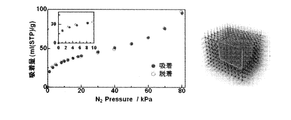
- PCP has a large number of pores, and these pores are preferably formed three-dimensionally as shown in FIG. 4, but may be formed two-dimensionally or one-dimensionally.
- the pores of PCP are usually formed regularly.
- the metal nanoparticles may be included in the PCP while being closely fixed to the PCP, or may be included in a movable state inside the PCP.
- at least one metal nanoparticle smaller than the lumen of the PCP may be movably contained in the bag-like PCP.
- a gaseous substance having an affinity for PCP is concentrated and supplied to the surface of the internal metal nanoparticles through the pores, and the substance after the reaction is released to the outside from the pores of the PCP. It is preferable that PCP has a high affinity with the gaseous material of the reaction raw material and a low affinity of the product after the reaction in order to carry out the catalytic reaction using the metal nanoparticle catalyst.
- Catalysts of metal nanoparticles include, for example, catalysts that produce ammonia from hydrogen and nitrogen, hydrocarbons such as ammonia, methane, ethane, and propane, catalysts that produce hydrogen from alcohols such as methanol, ethanol, and propanol, carbon dioxide, and monoxide Examples thereof include a catalyst that reacts with carbon and the like to extend a group having 1 carbon atom such as COOH, CHO, and CH 2 OH.
- the metal nanoparticles are a catalyst
- reactants necessary for the catalytic reaction can be concentrated on the catalyst surface, and a chemical reaction or the like can be performed efficiently.
- PCP can freely change the size of the pores and the type of compounds incorporated into the pores by changing the types of metal ions and ligands that make up the PCP, so various reactions can be performed on the surface of the metal nanoparticles. Can do.
- PCP By having PCP on the surface, even if the concentration of the gaseous substance of the reaction raw material outside the complex is low, the concentration of the gaseous substance having an affinity for PCP inside and on the surface of the metal nanoparticles is dramatically increased. The reaction efficiency is remarkably improved by the presence of PCP. Moreover, the partial pressure of the gaseous reaction raw material in the case of performing the same reaction can be reduced significantly.
- the composite of the present invention has a core (metal nanoparticle) -shell (PCP) structure.
- a core metal nanoparticle
- PCP shell
- a plurality of metal nanoparticles core
- PCP shell
- the composite of the present invention may be in the form of a powder or a film such as a thin film. Furthermore, when the composite of the present invention is in a powder form, it may be formed into a granular shape.
- the composite of the present invention may have a sufficiently large effective surface area even if a large number of metal nanoparticles are present as long as it has a sheet-like or film-like shape. It is preferable that the particle size is small so that the number of metal nanoparticles is as small as possible.
- the size of the composite in the case of a lump shape is about 1 to 500 nm, preferably about 1 to 100 nm. When these particles are spread in the transverse direction, the composite may contain many particles. For example, the composite of FIG.
- the PCP layer needs to have a certain thickness in order to concentrate the external gaseous substance inside the PCP layer. However, if the PCP layer is too thick, the gaseous substance reaches the place where the metal nanoparticles are present. Will take longer.
- the thickness of the preferred PCP layer is about 1 to 100 nm, preferably about 1 to 20 nm.
- the metal nanoparticles of the present invention preferably have a shape mainly composed of a plane such as a cube, a rectangular parallelepiped, a plate, a truncated octahedron or a (regular) octahedron (FIG. 5). It may be any shape such as a piece.
- the composite of the present invention has a structure in which metal nanoparticles are entirely covered with PCP, and a gaseous or liquid substance supplied from the outside passes through the pores of a certain size in the PCP. Supplied to the surface of the particles. Therefore, when the metal nanoparticles have a catalytic action, the composite of the present invention can obtain a specific substance with high selectivity from a specific raw material (gas adsorbed by PCP).
- Metal nanoparticles are composed of metals (including alloys) or metal oxides.
- Examples of the metal include gold, platinum, silver, copper, ruthenium, tin, palladium, rhodium, iridium, osmium, nickel, cobalt, zinc, iron, yttrium, magnesium, manganese, titanium, zirconium, and hafnium.
- Examples of the metal oxide include PtO 2 , CuO, ruthenium (IV) oxide, rhodium oxide, ruthenium oxide, Fe 2 O 3 , Fe 3 O 4 , ZnO, osmium oxide (IV), and the like.
- the size of the metal nanoparticles is about 0.5 to 200 nm, preferably about 1 to 100 nm, more preferably about 5 to 20 nm.
- the metal nanoparticles of the present invention can be surface treated.
- a surface treatment a surface treatment with a hydrophilic polymer such as polyvinylpyrrolidone, polyacrylamide, polydimethylacrylamide, poly (meth) acrylate, polyoxyethylene oxide, polyoxyethylene alkyl ether, polyvinyl alcohol or the like is preferable.
- a hydrophilic polymer can be bound by such surface treatment.
- a hydrophilic polymer can be introduce
- a compound having an SH group and another reactive group for example, an amino group, a hydroxyl group, a carboxyl group, etc.
- a metal nanoparticle are reacted to generate a metal-S bond, thereby introducing the metal-S bond.
- a PCP layer can be formed by reacting a ligand and a metal ion with another reactive group (for example, an amino group, a hydroxyl group, a carboxyl group, etc.).
- a metal ion or an organic ligand which is a constituent element of PCP, can be present on the surface of the metal nanoparticles or in the vicinity of the surface by bonding, adsorption or interaction, the PCP can be formed therefrom.
- a polymer, a compound, etc. which have SH group can cut
- PCP components metal ions and ligands
- a dilute solution solpension
- metal ions are contained inside the PCP.
- Only the obtained complex may be separated by a method such as centrifugation.
- metal ions are not surface-treated with a thiol compound or the like, there is an advantage that a catalytic reaction can be efficiently performed.
- the particles of the composite can be reduced, and aggregation (overlap) of the metal nanoparticles can be prevented.
- Examples of the substance for introducing a functional group capable of constituting PCP (coordinating bond) on the surface of the metal nanoparticles include p-mercaptophenol, aminobenzenethiol, p-mercaptopyridine, p-mercaptobenzoic acid, Examples thereof include 11-mercapto-1-undecanol and 11-mercaptoundecanoic acid.
- a functional group capable of constituting PCP (coordinating bond) is introduced into the metal nanoparticle via the SH group, this functional group has a weaker bond with the metal nanoparticle than the SH group.
- the metal nanoparticle is a metal oxide, it can be bonded to the metal nanoparticle by a functional group having oxygen such as OH and COOH.
- the metal nanoparticles used in the present invention can be produced according to a known method. Specifically, the methods described in Adv. Funct. Mater. 2009, 19, 189-200 can be exemplified.
- the surface-treated Pd nanoparticles used in the Examples were prepared by adding a reducing agent and (1 0 0) to poly (N-vinyl-2-pyrrolidone) and Na 2 PdCl 4 aqueous solution, which are protective polymers.
- Pd nanocrystals having a cubic shape can be prepared by adding a capping reagent that protects only the surface) and controls crystal growth, and reducing it.
- the composite of the present invention can be obtained by assembling PCP from the surface of metal nanoparticles. It is desirable to replace the metal surface with a self-assembled monolayer (SAM) having the same functional group as that of the ligand component of PCP.
- a metal nanoparticle-PCP composite can be prepared by adding a PCP raw material to a metal nanoparticle substituted with SAM, followed by heating and stirring.
- the composite of the present invention can be produced in the same manner for metal nanoparticles other than Pd.
- PCP usually has two or more layers (for example, 2 to 100 layers, preferably 3 to 50 layers, more preferably 4 to 30 layers, particularly 4 to 20 layers) composed of a metal and a ligand. Is repeated, for example, metal ions and / or ligands can be used as a solar cell element by changing a layer and realizing a series of electrons.
- PCP is composed of a metal ion and an organic ligand, and may contain a counter anion.
- Metal ions include ions such as magnesium, calcium, manganese, iron, ruthenium, cobalt, rhodium, nickel, palladium, copper, zinc, cadmium, titanium, vanadium, chromium, manganese, platinum, ruthenium, molybdenum, zirconium, and scandium.
- ions of metals such as magnesium, manganese, iron, cobalt, nickel, copper, and zinc are more preferable.
- the metal ion a single metal ion may be used, or two or more metal ions may be used in combination.
- two or three aromatic rings such as benzene, naphthalene, anthracene, phenanthrene, fluorene, indane, indene, pyrene, 1,4-dihydronaphthalene, tetralin, biphenylene, triphenylene, acenaphthylene, and acenaphthene are used.
- the ligand is a halogen atom such as F, Cl, Br, or I, an acylamino group such as a nitro group, an amino group, or an acetylamino group, a cyano group, a hydroxyl group, methylenedioxy, C1-C4 alkoxy group having straight or branched chain such as ethylenedioxy, methoxy, ethoxy, etc., C1-C4 alkyl having straight chain or branched chain such as methyl, ethyl, propyl, tert-butyl, isobutyl, etc.
- the ligand is a halogen atom such as F, Cl, Br, or I
- an acylamino group such as a nitro group, an amino group, or an acetylamino group
- a cyano group a hydroxyl group, methylenedioxy, C1-C4 alkoxy group having straight or branched chain such as ethylenedi
- a nitrogen-containing aromatic compound capable of coordinating with two or more ring nitrogen atoms such as an unsaturated divalent carboxylic acid, pyrazine, 4,4′-bipyridyl, diazapyrene, etc. Etc.).
- the ligand When the ligand is neutral, it has a counter anion necessary to neutralize the metal ion.
- Such counter anions include chloride, bromide, iodide, sulfate, nitrate, phosphate, trifluoroacetate, methanesulfonate, toluenesulfonate, benzenesulfonate, Examples include chlorate ions.
- the PCP including the metal ion and the organic ligand is a PCP having a two-dimensional pore such as a sheet shape or a three-dimensional pore including a bidentate ligand in which a plurality of sheets are coordinated in an axial position.
- PCP having the following one-dimensional pores can also be used.
- the PCP used in the present invention is, for example, the following literature, review (Angew. Chem. Int. Ed. 2004, 43, 2334-2375 .; Angew. Chem. Int. Ed. 2008, 47, 2-14 .; Chem. Soc. Rev., 2008, 37, 191-214 .; PNAS, 2006, 103, 10186-10191 .; Chem. Rev., 2011, 111, 688-764 .; Nature, 2003, 423, 705-714.
- the present invention is not limited to these, and known PCPs or PCPs that can be manufactured in the future can be widely used.
- the ratio (weight ratio) between PCP and metal nanoparticles is PCP 1 to 99 wt%: metal nanoparticles 99 to 1 wt%, preferably PCP 10 to 50 wt%: metal nanoparticles 50 to 90 wt%.
- PCP gas adsorbed by PCP (methane, ethane, carbon monoxide, carbon dioxide, ethylene, acetylene, benzene, toluene, etc.), metal nanoparticle catalyst (Au, Pt, Pd, Ni, etc.), other reaction components (hydrogen, Ammonia, oxygen, water, silane, HCN, etc.) and products (formaldehyde, acetaldehyde, acetic acid, methanol, ethanol, etc.) include the following combinations. All PCPs are applicable.
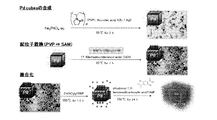
- Example 1 (1) Synthesis of Pd cubes ( Figure 1) Using a cubic active metal species (Pd), we investigated the compounding with PCP.
- Cubic Pd was adhered to the surface by adding polyvinylpyrrolidone (PVP; 105 mg), ascorbic acid (60 mg) and KBr (300 mg) to Na2PdCl4 aqueous solution (17.4 mM) and reducing at 80 ° C. for 3 hours. Pd nanoparticles (10 nm) were obtained.
- PVP ⁇ SAM Ligand substitution
- HOOC- (CH 2 ) 10 -SH is a self-assembled monolayer (SAM) that has the same functional group (COOH) as the ligand component of PCP at the end to assemble PCP from the surface of the active metal species. Used to replace the metal (Pd) surface.
- SAM self-assembled monolayer
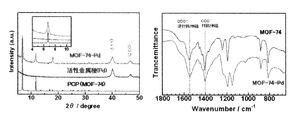
- FIG. 2 shows the result of powder X-ray diffraction of the composite obtained.
- the powder X-ray diffraction pattern of the composite diffraction peaks derived from active metal species and PCP were observed, respectively.
- the desired product was formed because the stretching vibration derived from PCP was made at the same position as a single PCP. It can be seen that the XRD peak of PCP constituting the complex is broader than that of a single PCP. This result indicates that the PCP crystallite size of the prepared PCP complex is small.
- FIG. 3 shows that a very thin film is formed around the cubic type active metal species.
- An EDS spectrum analysis was conducted to examine the components of this film. A spectrum derived from the active metal species and the metal ions composing PCP was obtained in the central part. On the other hand, when the surface portion was analyzed, only the metal ion component constituting PCP was obtained. We succeeded in obtaining a complex in which a PCP film was formed around the active metal species. To date, there have been no reports on core-shell type PCP composites with nano catalyst surfaces coated with PCP, and this is the first example.
- FIG. 4 shows the results of the adsorption measurement. Adsorption due to macropores was observed on the low pressure side with the N2 pressure, which revealed that the composite had porosity. In this way, we have succeeded in finding a method to cover the active metal species with PCP.
- Example 2 Formic acid oxidation reaction was carried out using the composite obtained in Example 1 as an electrode catalyst. Cubic active metal species and composites 2.5 mg, carbon paste (CPO) 2.5 mg, ethanol 11.5 ⁇ l and “Nafion (registered trademark)” [DuPont, 10-fold diluted sample with a solid content of 5% by mass It was added to 11.5 ⁇ l of a mixed solvent and irradiated with ultrasonic waves to form a suspension. 23 ⁇ L of this suspension was applied to a glassy carbon electrode (3 mm diameter, electrode area 7.1 mm 2 ) and dried to obtain a modified electrode.
- CPO carbon paste
- Nafion registered trademark
- This modified electrode is immersed in a mixed solution of 0.5 M sulfuric acid and 1.0 M formic acid, and a scanning range of ⁇ 0.1 to 1.00 V with respect to the silver-silver chloride electrode potential in an argon atmosphere at room temperature and atmospheric pressure. The potential was cycled at a scan rate of 10 mV / s.
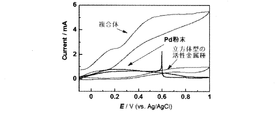
- FIG. Similar to Reference 1 (J. Phys. Chem. C 2010, 114, 21417-21422), when Pd powder is used, current peaks corresponding to formic acid oxidation reaction can be confirmed around 0.15 V and 0.65 V. A catalytic current corresponding to the formic acid oxidation reaction was also observed in the complex, indicating that the complex had catalytic activity.
- the formate oxidation current value of the composite is about 2 mA, which shows a very high catalytic activity compared to the current value of the cubic active metal species. It has been found that it improves dramatically.
- the loading technology on PCP is also very important because it can be widely applied and used in various catalyst development researches, from homogeneous catalysts to heterogeneous catalysts used in solid phase. Specifically, it can be a fundamental technology that has an impact on the industry in various fields such as ammonia synthesis and organic reaction catalysts (cross coupling reaction, metathesis reaction, etc.).
- the composite is also useful as an electrode catalyst for a fuel cell using hydrogen, methanol, formic acid or the like as a fuel. By using PCP that can concentrate the substrate, the reaction proceeds with high efficiency, and high current efficiency is expected.
- the inside of PCP pores is made hydrophobic, and the pore size is controlled to have a certain size. It is designed so that only an organic substance (substrate) can be incorporated and can be reacted selectively, and it becomes a useful organic reaction catalyst having mild selectivity and high selectivity. Moreover, by providing an unsaturated site in the pore, for example, only an olefin having a double bond can be adsorbed and reacted. In this way, only the target substrate can be reacted with high efficiency and high selectivity by considering the pore size of PCP, the properties within the pore (hydrophobic / hydrophilic), and the unsaturated sites.
Landscapes
- Chemical & Material Sciences (AREA)
- Organic Chemistry (AREA)
- Chemical Kinetics & Catalysis (AREA)
- Engineering & Computer Science (AREA)
- Materials Engineering (AREA)
- Inorganic Chemistry (AREA)
- Medicinal Chemistry (AREA)
- Polymers & Plastics (AREA)
- Health & Medical Sciences (AREA)
- Oil, Petroleum & Natural Gas (AREA)
- Analytical Chemistry (AREA)
- Catalysts (AREA)
- Compositions Of Macromolecular Compounds (AREA)
- Polymers With Sulfur, Phosphorus Or Metals In The Main Chain (AREA)
- Dispersion Chemistry (AREA)
Abstract
Description
項1. 金属ナノ粒子を多孔性配位高分子(PCP)の内部に含む複合体であって、前記PCPが金属イオンと有機配位子から構成される、複合体。
項2. 前記金属ナノ粒子が貴金属ナノ粒子である、項1又は2に記載の複合体。
項3. 表面から金属ナノ粒子に到達するまでのPCP層の平均厚さが1~200nmである、項1に記載の複合体。
項4. 前記PCPが金属イオンとカルボキシル基を有する配位子と環内窒素原子により配位可能な含窒素芳香族化合物から構成される、項1~3のいずれかに記載の複合体。
項5. 前記金属ナノ粒子が金、白金、パラジウム、ニッケル、コバルト、マンガン、クロム、銀、銅、鉄、ルテニウム、ロジウム、亜鉛、それらの合金もしくは酸化物からなる群から選ばれる少なくとも1種の触媒である、項1~4のいずれかに記載の複合体。
項6. 前記複合体のサイズが1~500nmである、項1~5のいずれかに記載の複合体。
項7. 前記金属ナノ粒子の50%以上、60%以上、70%以上、80%以上、90%以上或いは95%以上が前記PCP層を通るガス状の反応物と接触し得る、項1~6のいずれかに記載の複合体。
項8. 項1~7のいずれかに記載の複合体の触媒としての使用。
項9. 項1~7のいずれかに記載の複合体の金属ナノ粒子と、前記PCPにより吸着されるガスを反応させて化合物を生成させることを特徴とする、前記化合物の製造方法。
項10. 前記ガスが水素と窒素であり、金属ナノ粒子が鉄系の触媒であり、生成物がアンモニアである、項9に記載の製造方法
項11. 金属ナノ粒子及び溶媒の存在下で金属イオンと多価カルボン酸配位子及び/又は含窒素ヘテロ環配位子を混合することを特徴とする、項1~7のいずれかに記載の複合体の製造方法。
IRMOF-1, Zn4O(BDC)3 (H2BDC= benzenedicarboxylic acid)
MOF-69C, Zn3(OH2)(BDC)2
MOF-74, M2(DOBDC) (H2DOBDC=2,5-dihydroxyterephthalic acid, M=Zn, Co, Ni, Mg)
HKUST-1, Cu3(BTC)2 (H3BTC=1,3,5-benzenetricarboxylic acid)
MOF-508, Zn(BDC)(bipy)0.5
Zn-BDC-DABCO,Zn2(BDC)2(DABCO), (DABCO=1,4-diazabicyclo[2.2.2]-octane)
Cr-MIL-101, Cr3F(H2O)2O(BDC)3
Al-MIL-110, Al8(OH)12{(OH)3(H2O)3}[BTC]3,
Al-MIL-53, Al(OH)[BDC]
ZIF-8, Zn(MeIM)2, (H-MeIM=2-methylimidazole)
MIL-88B, Cr3OF(O2C-C6H4-CO2)3
MIL-88C, Fe3O(O2C-C10H6-CO2)3
MIL-88D, Cr3OF(O2C-C12H8-CO2)3
CID-1 [Zn2(ip)2(bpy)2] (Hip=isophthalic acid, bpy=4,4'-bipyridine)

実施例1
(1)Pd cubes の合成(図1)
立方体型活性金属種(Pd)を用い、PCPとの複合化の検討を行った。
(2)配位子置換(PVP→SAM)
(1)で得られたPdナノ粒子の水溶液にHOOC-(CH2)10-SH(70mg)のエタノール溶液を加え、80℃で1時間反応させることにより、HOOC-(CH2)10-SHをSH基を介してPd粒子に結合させた。
HOOC-(CH2)10-SHは、活性金属種の表面からPCPを組み上げていくため、PCPの配位子成分と同じ官能基(COOH)を末端に有する自己組織化単分子膜(SAM)で金属(Pd)表面を置換するために使用した。
(3)複合化
自己組織化単分子膜(SAM)で金属(Pd)表面を置換した粒子の水懸濁液にZn(NO3)2/DMF(40mg)を加え、100℃で1.5時間反応させて、ZnイオンをHOOC-(CH2)10-SHの末端のCOOH基に結合し、次いでジヒドロキシ1,4-ベンゼンジカルボン酸(10mg)のDMF溶液を加え、100℃で24時間加熱・撹拌することにより、活性金属種-PCP複合体を作製した(図1)。
実施例1で得た複合体を電極触媒として用い、ギ酸酸化反応を実施した。立方体型の活性金属種および複合体をそれぞれ2.5mgとカーボンペースト (CPO) 2.5 mgをエタノール11.5 μlと「ナフィオン(登録商標)」〔デュポン社製、固形分濃度5質量%の十倍希釈サンプル〕11.5 μlの混合溶媒に添加し、超音波を照射して懸濁液とした。この懸濁液23μLをグラッシーカーボン電極〔3mm径、電極面積は7.1mm2〕に塗布し、乾燥することで修飾電極を得た。この修飾電極を濃度0.5Mの硫酸および1.0 Mギ酸の混合溶液中に浸漬し、室温、大気圧下、アルゴン雰囲気において、銀塩化銀電極電位に対して-0.1~1.00Vの走査範囲で、10mV/sの走査速度で電位をサイクルした。結果を図6に示す。
文献1(J. Phys. Chem. C 2010, 114, 21417-21422)と同様、Pd粉末を用いた場合には0.15Vおよび0.65 V付近に、ギ酸の酸化反応に対応する電流ピークが確認できる。複合体においてもギ酸の酸化反応に対応する触媒電流が観測されたことから、当該複合体は触媒活性を有することがわかった。さらに、複合体のギ酸酸化電流値は2 mA程度であり、立方体型の活性金属種の電流値と比較すると、非常に高い触媒活性を示していることから、PCPを被覆することで触媒活性を飛躍的に向上させることがわかった。
Claims (11)
- 金属ナノ粒子を多孔性配位高分子(PCP)の内部に含む複合体であって、前記PCPが金属イオンと有機配位子から構成される、複合体。
- 前記金属ナノ粒子が貴金属ナノ粒子である、請求項1又は2に記載の複合体。
- 表面から金属ナノ粒子に到達するまでのPCP層の平均厚さが1~200nmである、請求項1に記載の複合体。
- 前記PCPが金属イオンとカルボキシル基を有する配位子と環内窒素原子により配位可能な含窒素芳香族化合物から構成される、請求項1~3のいずれかに記載の複合体。
- 前記金属ナノ粒子が金、白金、パラジウム、ニッケル、コバルト、マンガン、クロム、銀、銅、鉄、ルテニウム、ロジウム、亜鉛、それらの合金もしくは酸化物からなる群から選ばれる少なくとも1種の触媒である、請求項1~4のいずれかに記載の複合体。
- 前記複合体のサイズが1~500nmである、請求項1~5のいずれかに記載の複合体。
- 前記金属ナノ粒子の50%以上、60%以上、70%以上、80%以上、90%以上或いは95%以上が前記PCP層を通るガス状の反応物と接触し得る、請求項1~6のいずれかに記載の複合体。
- 請求項1~7のいずれかに記載の複合体の触媒としての使用。
- 請求項1~7のいずれかに記載の複合体の金属ナノ粒子と、前記PCPにより吸着されるガスを反応させて化合物を生成させることを特徴とする、前記化合物の製造方法。
- 前記ガスが水素と窒素であり、金属ナノ粒子が鉄系の触媒であり、生成物がアンモニアである、請求項9に記載の製造方法
- 金属ナノ粒子及び溶媒の存在下で金属イオンと多価カルボン酸配位子及び/又は含窒素ヘテロ環配位子を混合することを特徴とする、請求項1~7のいずれかに記載の複合体の製造方法。
Priority Applications (5)
| Application Number | Priority Date | Filing Date | Title |
|---|---|---|---|
| CN201280037865.4A CN103717647B (zh) | 2011-08-05 | 2012-08-03 | 金属纳米粒子的pcp复合体及其制造方法 |
| US14/237,292 US9586196B2 (en) | 2011-08-05 | 2012-08-03 | Metal nanoparticle-PCP complex and manufacturing method therefor |
| KR1020147005064A KR101596608B1 (ko) | 2011-08-05 | 2012-08-03 | 금속 나노 입자의 pcp 복합체와 그 제작 방법 |
| EP12821892.2A EP2740754A4 (en) | 2011-08-05 | 2012-08-03 | METAL NANOPARTICLE PCP COMPLEX AND MANUFACTURING METHOD THEREFOR |
| JP2013528009A JP5946456B2 (ja) | 2011-08-05 | 2012-08-03 | 金属ナノ粒子のpcp複合体とその作製方法 |
Applications Claiming Priority (2)
| Application Number | Priority Date | Filing Date | Title |
|---|---|---|---|
| JP2011-171542 | 2011-08-05 | ||
| JP2011171542 | 2011-08-05 |
Publications (2)
| Publication Number | Publication Date |
|---|---|
| WO2013021944A1 true WO2013021944A1 (ja) | 2013-02-14 |
| WO2013021944A9 WO2013021944A9 (ja) | 2013-05-02 |
Family
ID=47668452
Family Applications (1)
| Application Number | Title | Priority Date | Filing Date |
|---|---|---|---|
| PCT/JP2012/069845 Ceased WO2013021944A1 (ja) | 2011-08-05 | 2012-08-03 | 金属ナノ粒子のpcp複合体とその作製方法 |
Country Status (6)
| Country | Link |
|---|---|
| US (1) | US9586196B2 (ja) |
| EP (1) | EP2740754A4 (ja) |
| JP (1) | JP5946456B2 (ja) |
| KR (1) | KR101596608B1 (ja) |
| CN (1) | CN103717647B (ja) |
| WO (1) | WO2013021944A1 (ja) |
Cited By (13)
| Publication number | Priority date | Publication date | Assignee | Title |
|---|---|---|---|---|
| WO2014046107A1 (ja) * | 2012-09-20 | 2014-03-27 | 国立大学法人京都大学 | 金属ナノ粒子複合体およびその製造方法 |
| JPWO2013099382A1 (ja) * | 2011-12-28 | 2015-04-30 | 株式会社村田製作所 | 機能性材料の製造方法および電子部品 |
| WO2015170688A1 (ja) * | 2014-05-07 | 2015-11-12 | 国立大学法人北陸先端科学技術大学院大学 | 金属担持多孔性配位高分子触媒 |
| CN105233872A (zh) * | 2015-10-22 | 2016-01-13 | 辽宁大学 | 一种Pd@MIL-101复合材料及其制备方法和应用 |
| JPWO2015137272A1 (ja) * | 2014-03-11 | 2017-04-06 | 国立大学法人京都大学 | 多孔性構造体およびその製造方法並びに複合金属ナノ粒子の製造方法 |
| JP2017150057A (ja) * | 2016-02-26 | 2017-08-31 | 富士通株式会社 | 二酸化炭素還元用電極、容器、及び二酸化炭素還元装置 |
| JP2017160476A (ja) * | 2016-03-08 | 2017-09-14 | 富士通株式会社 | 二酸化炭素還元装置 |
| JPWO2017010491A1 (ja) * | 2015-07-15 | 2018-04-26 | 古河電気工業株式会社 | 水素貯蔵・供給用ナノ結晶複合体触媒および水素貯蔵・供給用ナノ結晶複合体触媒混合物並びに水素の供給方法 |
| JP2018095945A (ja) * | 2016-12-16 | 2018-06-21 | 富士通株式会社 | 吸着剤、吸着剤の製造方法、二酸化炭素還元用電極、及び二酸化炭素還元装置 |
| JP2021116504A (ja) * | 2020-01-29 | 2021-08-10 | 平岡織染株式会社 | 消臭抗菌性シート状物及びその製造方法 |
| JP2021137242A (ja) * | 2020-03-04 | 2021-09-16 | 平岡織染株式会社 | 帯電防止性消臭シート状物及びその製造方法 |
| JP2021145698A (ja) * | 2020-03-16 | 2021-09-27 | 平岡織染株式会社 | 消臭抗菌性シート状物及びその製造方法 |
| JP2022013196A (ja) * | 2020-07-03 | 2022-01-18 | 平岡織染株式会社 | 消臭性抗菌防黴物質、消臭性抗菌防黴塗料組成物、及び消臭性抗菌防黴塗膜 |
Families Citing this family (19)
| Publication number | Priority date | Publication date | Assignee | Title |
|---|---|---|---|---|
| US9890184B2 (en) * | 2012-11-20 | 2018-02-13 | Riken | Complex and use of same |
| CN104399529B (zh) * | 2014-11-18 | 2016-11-23 | 中国石油大学(北京) | 一种二烯烃选择性加氢催化剂及其制备方法与应用 |
| WO2016123534A1 (en) * | 2015-01-29 | 2016-08-04 | Basf Corporation | Platinum group metal (pgm) catalysts for automotive emissions treatment |
| US10159969B2 (en) * | 2015-03-31 | 2018-12-25 | Colorado School Of Mines | Ammonia synthesis at moderate conditions using hydrogen permeable membrane reactors |
| US10586984B2 (en) * | 2015-04-20 | 2020-03-10 | Anteo Technologies Pty Ltd. | Electrode composition |
| CN104923256B (zh) * | 2015-06-11 | 2017-07-28 | 哈尔滨工业大学 | 负载钯的功能化纳米粒子磁性催化剂的制备方法 |
| JP6757726B2 (ja) | 2015-07-15 | 2020-09-23 | 古河電気工業株式会社 | 基材一体型ナノ結晶金属酸化物複合体含有触媒およびその製造方法ならびに触媒部品 |
| CN106064097B (zh) * | 2016-06-08 | 2018-10-30 | 南京科技职业学院 | 一种常温合成氨催化剂及其制备方法 |
| KR102582049B1 (ko) * | 2016-06-17 | 2023-09-21 | 주식회사 엘지에너지솔루션 | 리튬 코발트 산화물을 포함하는 코어 및 리간드 화합물을 포함하는 배위 고분자 코팅층으로 구성된 양극활물질 입자 및 이를 제조하는 방법 |
| RU2622293C1 (ru) * | 2016-06-30 | 2017-06-14 | Федеральное государственное автономное образовательное учреждение высшего образования "Национальный исследовательский технологический университет "МИСиС" | Способ получения катализатора и способ гидрогенизационной конверсии диоксида углерода в жидкие углеводороды с его использованием |
| CN107221458B (zh) * | 2017-05-25 | 2019-11-15 | 温州大学 | 镍配合物为前躯体的掺碳氧化镍复合电极材料及其制备方法 |
| KR102123148B1 (ko) * | 2018-04-18 | 2020-06-15 | 인천대학교 산학협력단 | 금속착물을 활용한 탄소껍질을 가진 금속 촉매의 합성방법 |
| CN111092234B (zh) * | 2019-12-04 | 2022-04-12 | 东南大学 | 一种高性能氧还原催化剂的制备方法 |
| CN111215147B (zh) * | 2020-02-19 | 2024-05-03 | 中国科学技术大学 | 一种负载型蛋黄-蛋壳结构纳米催化剂及其制备方法 |
| CN111450889B (zh) * | 2020-04-03 | 2023-08-01 | 哈尔滨师范大学 | 一种Ni2Fe-ICP纳米片及其室温生长的制备方法 |
| CN115719815B (zh) * | 2021-08-25 | 2025-02-18 | 中国科学院大连化学物理研究所 | 一种碳基电催化剂和催化剂担载的电极及其制备和应用 |
| CN114622242B (zh) * | 2022-02-15 | 2023-01-06 | 苏州大学 | Ni/NiO纳米异质结多孔石墨碳复合材料及其制备方法与应用 |
| CN115385317A (zh) * | 2022-09-23 | 2022-11-25 | 宜都兴发化工有限公司 | 一种赝晶转化法制备介孔纳米磷酸铁的方法 |
| CN119683574B (zh) * | 2024-12-20 | 2025-10-14 | 吉林大学 | 一种结晶PdCN@非晶PdP核壳纳米颗粒的制备方法 |
Citations (4)
| Publication number | Priority date | Publication date | Assignee | Title |
|---|---|---|---|---|
| JP2005075870A (ja) * | 2003-08-29 | 2005-03-24 | Kyoto Univ | アニオン部位を規則的に有する配位高分子 |
| JP2005255651A (ja) * | 2004-03-15 | 2005-09-22 | Kyoto Univ | 有機金属錯体構造体及びその製造方法、並びに、該有機金属錯体構造体を用いた機能性膜、機能性複合材料、機能性構造体及び吸脱着センサー |
| JP2006248989A (ja) * | 2005-03-10 | 2006-09-21 | Kyoto Univ | 多孔性配位高分子およびそれからなる触媒 |
| JP2010527890A (ja) * | 2007-05-21 | 2010-08-19 | 財団法人韓国化学研究院 | 配位的に不飽和な金属部位を有する表面官能基化された多孔性有機無機ハイブリッド材料又はメソポーラス材料の製造及びその触媒的応用 |
Family Cites Families (5)
| Publication number | Priority date | Publication date | Assignee | Title |
|---|---|---|---|---|
| KR101002571B1 (ko) * | 2007-01-03 | 2010-12-17 | 주식회사 인실리코텍 | 다공성 금속-유기 골격 구조를 갖는 배위중합체 결정 및이의 제조방법 |
| US20100183497A1 (en) * | 2007-11-06 | 2010-07-22 | Quantumsphere, Inc. | System and method for ammonia synthesis |
| CN101596465B (zh) * | 2009-06-30 | 2011-08-24 | 北京大学 | 基于金属有机框架结构的金属催化剂及其制备方法和应用 |
| CN101733162A (zh) * | 2009-12-24 | 2010-06-16 | 上海交通大学 | 有机金属框架物负载钯及其制备方法、用途 |
| WO2011133999A1 (en) * | 2010-04-30 | 2011-11-03 | Commonwealth Scientific And Industrial Research Organisation | Crystallisation facilitators for the synthesis of metal organic frameworks |
-
2012
- 2012-08-03 US US14/237,292 patent/US9586196B2/en active Active
- 2012-08-03 KR KR1020147005064A patent/KR101596608B1/ko not_active Expired - Fee Related
- 2012-08-03 CN CN201280037865.4A patent/CN103717647B/zh not_active Expired - Fee Related
- 2012-08-03 EP EP12821892.2A patent/EP2740754A4/en not_active Withdrawn
- 2012-08-03 JP JP2013528009A patent/JP5946456B2/ja active Active
- 2012-08-03 WO PCT/JP2012/069845 patent/WO2013021944A1/ja not_active Ceased
Patent Citations (4)
| Publication number | Priority date | Publication date | Assignee | Title |
|---|---|---|---|---|
| JP2005075870A (ja) * | 2003-08-29 | 2005-03-24 | Kyoto Univ | アニオン部位を規則的に有する配位高分子 |
| JP2005255651A (ja) * | 2004-03-15 | 2005-09-22 | Kyoto Univ | 有機金属錯体構造体及びその製造方法、並びに、該有機金属錯体構造体を用いた機能性膜、機能性複合材料、機能性構造体及び吸脱着センサー |
| JP2006248989A (ja) * | 2005-03-10 | 2006-09-21 | Kyoto Univ | 多孔性配位高分子およびそれからなる触媒 |
| JP2010527890A (ja) * | 2007-05-21 | 2010-08-19 | 財団法人韓国化学研究院 | 配位的に不飽和な金属部位を有する表面官能基化された多孔性有機無機ハイブリッド材料又はメソポーラス材料の製造及びその触媒的応用 |
Non-Patent Citations (16)
| Title |
|---|
| ADV. FUNCT. MATER., vol. 19, 2009, pages 189 - 200 |
| ANGEW. CHEM. INT. ED., vol. 43, 2004, pages 2334 - 2375 |
| ANGEW. CHEM. INT. ED., vol. 47, 2008, pages 2 - 14 |
| CHEM. REV., vol. 111, 2011, pages 688 - 764 |
| CHEM. SOC. REV., vol. 37, 2008, pages 191 - 214 |
| CHEMCOMM, vol. 47, 2011, pages 3075 - 3077 |
| CORMA A. ET AL.: "Engineering Metal Organic Frameworks for Heterogeneous Catalysis", CHEM. REV., vol. 110, no. 8, August 2010 (2010-08-01), pages 4606 - 4655, XP055143014 * |
| EL-SHALL M. SAMY ET AL.: "Metallic and bimetallic nanocatalysts incorporated into highly porous coordination polymer MTL-101", JOURNAL OF MATERIALS CHEMISTRY, vol. 19, no. 41, 2009, pages 7625 - 7631, XP055143017 * |
| EUR. J. INORG. CHEM., 2010, pages 3701 - 3714 |
| J. PHYS. CHEM. C, vol. 114, 2010, pages 21417 - 21422 |
| KENJI NISHIKAWA: "Pd Nano Ryushi Naiho MOF (Metal-Organic Framework) Shokubai no Chosei to Fukin'itsukei Shokubai Hanno eno Oyo", SHOKUBAI TORONKAI TORONKAI A YOKOSHU, vol. 110, 2012, pages 414, XP008173240 * |
| NATURE, vol. 423, 2003, pages 705 - 714 |
| PNAS, vol. 103, 2006, pages 10186 - 10191 |
| See also references of EP2740754A4 |
| TURNER S. ET AL.: "Direct Imaging of Loaded Metal-Organic Framework Materials(Metal@MOF-5)", CHEM. MATER., vol. 20, no. 17, 2008, pages 5622 - 5627, XP055143013 * |
| YUKI TANIKUCHI: "Junan na MOF ni Naiho shita Pd Nano Ryushi no Chosei to sono Shokubai Sayo", SOCIETY OF NANO SCIENCE AND TECHNOLOGY DAI 10 KAI TAIKAI KOEN YOKOSHU, vol. 10, June 2012 (2012-06-01), pages 222, XP008173427 * |
Cited By (19)
| Publication number | Priority date | Publication date | Assignee | Title |
|---|---|---|---|---|
| JPWO2013099382A1 (ja) * | 2011-12-28 | 2015-04-30 | 株式会社村田製作所 | 機能性材料の製造方法および電子部品 |
| US9608213B2 (en) | 2011-12-28 | 2017-03-28 | Murata Manufacturing Co., Ltd. | Method for manufacturing functional material and electronic component |
| JPWO2014046107A1 (ja) * | 2012-09-20 | 2016-08-18 | 国立大学法人京都大学 | 金属ナノ粒子複合体およびその製造方法 |
| WO2014046107A1 (ja) * | 2012-09-20 | 2014-03-27 | 国立大学法人京都大学 | 金属ナノ粒子複合体およびその製造方法 |
| JPWO2015137272A1 (ja) * | 2014-03-11 | 2017-04-06 | 国立大学法人京都大学 | 多孔性構造体およびその製造方法並びに複合金属ナノ粒子の製造方法 |
| WO2015170688A1 (ja) * | 2014-05-07 | 2015-11-12 | 国立大学法人北陸先端科学技術大学院大学 | 金属担持多孔性配位高分子触媒 |
| JPWO2015170688A1 (ja) * | 2014-05-07 | 2017-04-20 | 国立大学法人北陸先端科学技術大学院大学 | 金属担持多孔性配位高分子触媒 |
| JPWO2017010491A1 (ja) * | 2015-07-15 | 2018-04-26 | 古河電気工業株式会社 | 水素貯蔵・供給用ナノ結晶複合体触媒および水素貯蔵・供給用ナノ結晶複合体触媒混合物並びに水素の供給方法 |
| CN105233872A (zh) * | 2015-10-22 | 2016-01-13 | 辽宁大学 | 一种Pd@MIL-101复合材料及其制备方法和应用 |
| JP2017150057A (ja) * | 2016-02-26 | 2017-08-31 | 富士通株式会社 | 二酸化炭素還元用電極、容器、及び二酸化炭素還元装置 |
| JP2017160476A (ja) * | 2016-03-08 | 2017-09-14 | 富士通株式会社 | 二酸化炭素還元装置 |
| JP2018095945A (ja) * | 2016-12-16 | 2018-06-21 | 富士通株式会社 | 吸着剤、吸着剤の製造方法、二酸化炭素還元用電極、及び二酸化炭素還元装置 |
| JP2021116504A (ja) * | 2020-01-29 | 2021-08-10 | 平岡織染株式会社 | 消臭抗菌性シート状物及びその製造方法 |
| JP7290330B2 (ja) | 2020-01-29 | 2023-06-13 | 平岡織染株式会社 | 消臭抗菌性シート状物及びその製造方法 |
| JP2021137242A (ja) * | 2020-03-04 | 2021-09-16 | 平岡織染株式会社 | 帯電防止性消臭シート状物及びその製造方法 |
| JP7348654B2 (ja) | 2020-03-04 | 2023-09-21 | 平岡織染株式会社 | 帯電防止性消臭シート状物及びその製造方法 |
| JP2021145698A (ja) * | 2020-03-16 | 2021-09-27 | 平岡織染株式会社 | 消臭抗菌性シート状物及びその製造方法 |
| JP7339666B2 (ja) | 2020-03-16 | 2023-09-06 | 平岡織染株式会社 | 消臭抗菌性シート状物及びその製造方法 |
| JP2022013196A (ja) * | 2020-07-03 | 2022-01-18 | 平岡織染株式会社 | 消臭性抗菌防黴物質、消臭性抗菌防黴塗料組成物、及び消臭性抗菌防黴塗膜 |
Also Published As
| Publication number | Publication date |
|---|---|
| KR101596608B1 (ko) | 2016-02-22 |
| EP2740754A4 (en) | 2015-10-14 |
| WO2013021944A9 (ja) | 2013-05-02 |
| EP2740754A1 (en) | 2014-06-11 |
| JP5946456B2 (ja) | 2016-07-06 |
| KR20140050081A (ko) | 2014-04-28 |
| CN103717647A (zh) | 2014-04-09 |
| JPWO2013021944A1 (ja) | 2015-03-05 |
| CN103717647B (zh) | 2016-12-07 |
| US9586196B2 (en) | 2017-03-07 |
| US20140186253A1 (en) | 2014-07-03 |
Similar Documents
| Publication | Publication Date | Title |
|---|---|---|
| JP5946456B2 (ja) | 金属ナノ粒子のpcp複合体とその作製方法 | |
| Lai et al. | Atomic‐local environments of single‐atom catalysts: synthesis, electronic structure, and activity | |
| Xiong et al. | Thermally stable single‐atom heterogeneous catalysts | |
| Chaudhari et al. | A review on sustainable iron oxide nanoparticles: syntheses and applications in organic catalysis and environmental remediation | |
| Lei et al. | Emerging single atom catalysts in gas sensors | |
| Dai et al. | Recent progresses in metal–organic frameworks based core–shell composites | |
| Li et al. | Well-defined materials for heterogeneous catalysis: from nanoparticles to isolated single-atom sites | |
| Gong et al. | Heterostructured Ni/NiO nanocatalysts for ozone decomposition | |
| Wu et al. | Facile incorporation of Au nanoparticles into an unusual twofold entangled Zn (II)-MOF with nanocages for highly efficient CO2 fixation under mild conditions | |
| Rong et al. | Non-noble metal@ carbon nanosheet derived from exfoliated MOF crystal as highly reactive and stable heterogeneous catalyst | |
| Chen et al. | Single silver adatoms on nanostructured manganese oxide surfaces: Boosting oxygen activation for benzene abatement | |
| Zhu et al. | Metal–organic framework composites | |
| Zhang et al. | Graphene oxide as a surfactant and support for in-situ synthesis of Au–Pd nanoalloys with improved visible light photocatalytic activity | |
| JP6188700B2 (ja) | 金属ナノ粒子複合体およびその製造方法 | |
| Chen et al. | Controlled encapsulation of flower-like Rh–Ni alloys with MOFs via tunable template Dealloying for enhanced selective hydrogenation of alkyne | |
| Li et al. | Immobilization of metal–organic framework nanocrystals for advanced design of supported nanocatalysts | |
| Lemaire et al. | Copper benzenetricarboxylate metal–organic framework nucleation mechanisms on metal oxide powders and thin films formed by atomic layer deposition | |
| Jiang et al. | In situ synthesis of core–shell Pt–Cu frame@ metal–organic frameworks as multifunctional catalysts for hydrogenation reaction | |
| Liu et al. | Fe-functionalized α-Fe2O3/ZnO nanocages for ppb-level acetone gas sensing | |
| Bewana et al. | Inorganic perovskite-induced synergy on highly selective Pd-catalyzed hydrogenation of cinnamaldehyde | |
| Guo et al. | Fabrication of homogeneous non-noble metal nanoparticles within metal–organic framework nanosheets for catalytic reduction of 4-nitrophenol | |
| Shan et al. | Self-template synthesis of a MnCeOδ/Co3O4 polyhedral nanocage catalyst for toluene oxidation | |
| Kaishyop et al. | Ni–N synergy enhanced the synthesis of formic acid via CO 2 hydrogenation under mild conditions | |
| Panda et al. | Cs6W11O36/MIL-88B (Fe)–NH2 binary nanohybrid photocatalysts for selective oxidation of the C (sp3)–H bond of toluene to benzaldehyde | |
| Lu et al. | Ion-exchange loading promoted stability of platinum catalysts supported on layered protonated titanate-derived titania nanoarrays |
Legal Events
| Date | Code | Title | Description |
|---|---|---|---|
| 121 | Ep: the epo has been informed by wipo that ep was designated in this application |
Ref document number: 12821892 Country of ref document: EP Kind code of ref document: A1 |
|
| DPE1 | Request for preliminary examination filed after expiration of 19th month from priority date (pct application filed from 20040101) | ||
| ENP | Entry into the national phase |
Ref document number: 2013528009 Country of ref document: JP Kind code of ref document: A |
|
| NENP | Non-entry into the national phase |
Ref country code: DE |
|
| WWE | Wipo information: entry into national phase |
Ref document number: 14237292 Country of ref document: US |
|
| ENP | Entry into the national phase |
Ref document number: 20147005064 Country of ref document: KR Kind code of ref document: A |