WO2013035059A1 - Bindemittel und verfahren zur herstellung von metallischen oder keramischen formkörpern im pulverspritzguss - Google Patents

Bindemittel und verfahren zur herstellung von metallischen oder keramischen formkörpern im pulverspritzguss Download PDF

Info

Publication number
WO2013035059A1
WO2013035059A1 PCT/IB2012/054603 IB2012054603W WO2013035059A1 WO 2013035059 A1 WO2013035059 A1 WO 2013035059A1 IB 2012054603 W IB2012054603 W IB 2012054603W WO 2013035059 A1 WO2013035059 A1 WO 2013035059A1
Authority
WO
WIPO (PCT)
Prior art keywords
weight
binder
poly
components
integer
Prior art date
Legal status (The legal status is an assumption and is not a legal conclusion. Google has not performed a legal analysis and makes no representation as to the accuracy of the status listed.)
Ceased
Application number
PCT/IB2012/054603
Other languages
English (en)
French (fr)
Inventor
Johan Ter Maat
Martin Blömacher
Hans Wohlfromm
Mario NOHE
Robert Loos
Current Assignee (The listed assignees may be inaccurate. Google has not performed a legal analysis and makes no representation or warranty as to the accuracy of the list.)
BASF China Co Ltd
BASF SE
Original Assignee
BASF China Co Ltd
BASF SE
Priority date (The priority date is an assumption and is not a legal conclusion. Google has not performed a legal analysis and makes no representation as to the accuracy of the date listed.)
Filing date
Publication date
Application filed by BASF China Co Ltd, BASF SE filed Critical BASF China Co Ltd
Priority to EP12829611.8A priority Critical patent/EP2753443B1/de
Priority to ES12829611.8T priority patent/ES2659560T3/es
Priority to PL12829611T priority patent/PL2753443T3/pl
Priority to KR1020147008946A priority patent/KR101929081B1/ko
Priority to JP2014529116A priority patent/JP6133874B2/ja
Priority to DK12829611.8T priority patent/DK2753443T3/en
Priority to CN201280054202.3A priority patent/CN103917315B/zh
Publication of WO2013035059A1 publication Critical patent/WO2013035059A1/de
Anticipated expiration legal-status Critical
Ceased legal-status Critical Current

Links

Classifications

    • BPERFORMING OPERATIONS; TRANSPORTING
    • B22CASTING; POWDER METALLURGY
    • B22FWORKING METALLIC POWDER; MANUFACTURE OF ARTICLES FROM METALLIC POWDER; MAKING METALLIC POWDER; APPARATUS OR DEVICES SPECIALLY ADAPTED FOR METALLIC POWDER
    • B22F3/00Manufacture of workpieces or articles from metallic powder characterised by the manner of compacting or sintering; Apparatus specially adapted therefor ; Presses and furnaces
    • B22F3/10Sintering only
    • BPERFORMING OPERATIONS; TRANSPORTING
    • B22CASTING; POWDER METALLURGY
    • B22FWORKING METALLIC POWDER; MANUFACTURE OF ARTICLES FROM METALLIC POWDER; MAKING METALLIC POWDER; APPARATUS OR DEVICES SPECIALLY ADAPTED FOR METALLIC POWDER
    • B22F1/00Metallic powder; Treatment of metallic powder, e.g. to facilitate working or to improve properties
    • B22F1/10Metallic powder containing lubricating or binding agents; Metallic powder containing organic material
    • BPERFORMING OPERATIONS; TRANSPORTING
    • B22CASTING; POWDER METALLURGY
    • B22FWORKING METALLIC POWDER; MANUFACTURE OF ARTICLES FROM METALLIC POWDER; MAKING METALLIC POWDER; APPARATUS OR DEVICES SPECIALLY ADAPTED FOR METALLIC POWDER
    • B22F9/00Making metallic powder or suspensions thereof
    • B22F9/16Making metallic powder or suspensions thereof using chemical processes
    • B22F9/30Making metallic powder or suspensions thereof using chemical processes with decomposition of metal compounds, e.g. by pyrolysis
    • B22F9/305Making metallic powder or suspensions thereof using chemical processes with decomposition of metal compounds, e.g. by pyrolysis of metal carbonyls
    • CCHEMISTRY; METALLURGY
    • C04CEMENTS; CONCRETE; ARTIFICIAL STONE; CERAMICS; REFRACTORIES
    • C04BLIME, MAGNESIA; SLAG; CEMENTS; COMPOSITIONS THEREOF, e.g. MORTARS, CONCRETE OR LIKE BUILDING MATERIALS; ARTIFICIAL STONE; CERAMICS; REFRACTORIES; TREATMENT OF NATURAL STONE
    • C04B35/00Shaped ceramic products characterised by their composition; Ceramics compositions; Processing powders of inorganic compounds preparatory to the manufacturing of ceramic products
    • C04B35/01Shaped ceramic products characterised by their composition; Ceramics compositions; Processing powders of inorganic compounds preparatory to the manufacturing of ceramic products based on oxide ceramics
    • C04B35/10Shaped ceramic products characterised by their composition; Ceramics compositions; Processing powders of inorganic compounds preparatory to the manufacturing of ceramic products based on oxide ceramics based on aluminium oxide
    • C04B35/111Fine ceramics
    • CCHEMISTRY; METALLURGY
    • C04CEMENTS; CONCRETE; ARTIFICIAL STONE; CERAMICS; REFRACTORIES
    • C04BLIME, MAGNESIA; SLAG; CEMENTS; COMPOSITIONS THEREOF, e.g. MORTARS, CONCRETE OR LIKE BUILDING MATERIALS; ARTIFICIAL STONE; CERAMICS; REFRACTORIES; TREATMENT OF NATURAL STONE
    • C04B35/00Shaped ceramic products characterised by their composition; Ceramics compositions; Processing powders of inorganic compounds preparatory to the manufacturing of ceramic products
    • C04B35/01Shaped ceramic products characterised by their composition; Ceramics compositions; Processing powders of inorganic compounds preparatory to the manufacturing of ceramic products based on oxide ceramics
    • C04B35/26Shaped ceramic products characterised by their composition; Ceramics compositions; Processing powders of inorganic compounds preparatory to the manufacturing of ceramic products based on oxide ceramics based on ferrites
    • C04B35/265Compositions containing one or more ferrites of the group comprising manganese or zinc and one or more ferrites of the group comprising nickel, copper or cobalt
    • CCHEMISTRY; METALLURGY
    • C04CEMENTS; CONCRETE; ARTIFICIAL STONE; CERAMICS; REFRACTORIES
    • C04BLIME, MAGNESIA; SLAG; CEMENTS; COMPOSITIONS THEREOF, e.g. MORTARS, CONCRETE OR LIKE BUILDING MATERIALS; ARTIFICIAL STONE; CERAMICS; REFRACTORIES; TREATMENT OF NATURAL STONE
    • C04B35/00Shaped ceramic products characterised by their composition; Ceramics compositions; Processing powders of inorganic compounds preparatory to the manufacturing of ceramic products
    • C04B35/01Shaped ceramic products characterised by their composition; Ceramics compositions; Processing powders of inorganic compounds preparatory to the manufacturing of ceramic products based on oxide ceramics
    • C04B35/48Shaped ceramic products characterised by their composition; Ceramics compositions; Processing powders of inorganic compounds preparatory to the manufacturing of ceramic products based on oxide ceramics based on zirconium or hafnium oxides, zirconates, zircon or hafnates
    • C04B35/486Fine ceramics
    • CCHEMISTRY; METALLURGY
    • C04CEMENTS; CONCRETE; ARTIFICIAL STONE; CERAMICS; REFRACTORIES
    • C04BLIME, MAGNESIA; SLAG; CEMENTS; COMPOSITIONS THEREOF, e.g. MORTARS, CONCRETE OR LIKE BUILDING MATERIALS; ARTIFICIAL STONE; CERAMICS; REFRACTORIES; TREATMENT OF NATURAL STONE
    • C04B35/00Shaped ceramic products characterised by their composition; Ceramics compositions; Processing powders of inorganic compounds preparatory to the manufacturing of ceramic products
    • C04B35/515Shaped ceramic products characterised by their composition; Ceramics compositions; Processing powders of inorganic compounds preparatory to the manufacturing of ceramic products based on non-oxide ceramics
    • C04B35/56Shaped ceramic products characterised by their composition; Ceramics compositions; Processing powders of inorganic compounds preparatory to the manufacturing of ceramic products based on non-oxide ceramics based on carbides or oxycarbides
    • C04B35/565Shaped ceramic products characterised by their composition; Ceramics compositions; Processing powders of inorganic compounds preparatory to the manufacturing of ceramic products based on non-oxide ceramics based on carbides or oxycarbides based on silicon carbide
    • CCHEMISTRY; METALLURGY
    • C04CEMENTS; CONCRETE; ARTIFICIAL STONE; CERAMICS; REFRACTORIES
    • C04BLIME, MAGNESIA; SLAG; CEMENTS; COMPOSITIONS THEREOF, e.g. MORTARS, CONCRETE OR LIKE BUILDING MATERIALS; ARTIFICIAL STONE; CERAMICS; REFRACTORIES; TREATMENT OF NATURAL STONE
    • C04B35/00Shaped ceramic products characterised by their composition; Ceramics compositions; Processing powders of inorganic compounds preparatory to the manufacturing of ceramic products
    • C04B35/515Shaped ceramic products characterised by their composition; Ceramics compositions; Processing powders of inorganic compounds preparatory to the manufacturing of ceramic products based on non-oxide ceramics
    • C04B35/58Shaped ceramic products characterised by their composition; Ceramics compositions; Processing powders of inorganic compounds preparatory to the manufacturing of ceramic products based on non-oxide ceramics based on borides, nitrides, i.e. nitrides, oxynitrides, carbonitrides or oxycarbonitrides or silicides
    • C04B35/584Shaped ceramic products characterised by their composition; Ceramics compositions; Processing powders of inorganic compounds preparatory to the manufacturing of ceramic products based on non-oxide ceramics based on borides, nitrides, i.e. nitrides, oxynitrides, carbonitrides or oxycarbonitrides or silicides based on silicon nitride
    • CCHEMISTRY; METALLURGY
    • C04CEMENTS; CONCRETE; ARTIFICIAL STONE; CERAMICS; REFRACTORIES
    • C04BLIME, MAGNESIA; SLAG; CEMENTS; COMPOSITIONS THEREOF, e.g. MORTARS, CONCRETE OR LIKE BUILDING MATERIALS; ARTIFICIAL STONE; CERAMICS; REFRACTORIES; TREATMENT OF NATURAL STONE
    • C04B35/00Shaped ceramic products characterised by their composition; Ceramics compositions; Processing powders of inorganic compounds preparatory to the manufacturing of ceramic products
    • C04B35/622Forming processes; Processing powders of inorganic compounds preparatory to the manufacturing of ceramic products
    • C04B35/626Preparing or treating the powders individually or as batches ; preparing or treating macroscopic reinforcing agents for ceramic products, e.g. fibres; mechanical aspects section B
    • C04B35/62605Treating the starting powders individually or as mixtures
    • C04B35/62625Wet mixtures
    • C04B35/6264Mixing media, e.g. organic solvents
    • CCHEMISTRY; METALLURGY
    • C04CEMENTS; CONCRETE; ARTIFICIAL STONE; CERAMICS; REFRACTORIES
    • C04BLIME, MAGNESIA; SLAG; CEMENTS; COMPOSITIONS THEREOF, e.g. MORTARS, CONCRETE OR LIKE BUILDING MATERIALS; ARTIFICIAL STONE; CERAMICS; REFRACTORIES; TREATMENT OF NATURAL STONE
    • C04B35/00Shaped ceramic products characterised by their composition; Ceramics compositions; Processing powders of inorganic compounds preparatory to the manufacturing of ceramic products
    • C04B35/622Forming processes; Processing powders of inorganic compounds preparatory to the manufacturing of ceramic products
    • C04B35/626Preparing or treating the powders individually or as batches ; preparing or treating macroscopic reinforcing agents for ceramic products, e.g. fibres; mechanical aspects section B
    • C04B35/63Preparing or treating the powders individually or as batches ; preparing or treating macroscopic reinforcing agents for ceramic products, e.g. fibres; mechanical aspects section B using additives specially adapted for forming the products, e.g.. binder binders
    • C04B35/632Organic additives
    • C04B35/634Polymers
    • C04B35/63404Polymers obtained by reactions only involving carbon-to-carbon unsaturated bonds
    • C04B35/6342Polyvinylacetals, e.g. polyvinylbutyral [PVB]
    • CCHEMISTRY; METALLURGY
    • C04CEMENTS; CONCRETE; ARTIFICIAL STONE; CERAMICS; REFRACTORIES
    • C04BLIME, MAGNESIA; SLAG; CEMENTS; COMPOSITIONS THEREOF, e.g. MORTARS, CONCRETE OR LIKE BUILDING MATERIALS; ARTIFICIAL STONE; CERAMICS; REFRACTORIES; TREATMENT OF NATURAL STONE
    • C04B35/00Shaped ceramic products characterised by their composition; Ceramics compositions; Processing powders of inorganic compounds preparatory to the manufacturing of ceramic products
    • C04B35/622Forming processes; Processing powders of inorganic compounds preparatory to the manufacturing of ceramic products
    • C04B35/626Preparing or treating the powders individually or as batches ; preparing or treating macroscopic reinforcing agents for ceramic products, e.g. fibres; mechanical aspects section B
    • C04B35/63Preparing or treating the powders individually or as batches ; preparing or treating macroscopic reinforcing agents for ceramic products, e.g. fibres; mechanical aspects section B using additives specially adapted for forming the products, e.g.. binder binders
    • C04B35/632Organic additives
    • C04B35/634Polymers
    • C04B35/63448Polymers obtained otherwise than by reactions only involving carbon-to-carbon unsaturated bonds
    • C04B35/6346Polyesters
    • CCHEMISTRY; METALLURGY
    • C04CEMENTS; CONCRETE; ARTIFICIAL STONE; CERAMICS; REFRACTORIES
    • C04BLIME, MAGNESIA; SLAG; CEMENTS; COMPOSITIONS THEREOF, e.g. MORTARS, CONCRETE OR LIKE BUILDING MATERIALS; ARTIFICIAL STONE; CERAMICS; REFRACTORIES; TREATMENT OF NATURAL STONE
    • C04B35/00Shaped ceramic products characterised by their composition; Ceramics compositions; Processing powders of inorganic compounds preparatory to the manufacturing of ceramic products
    • C04B35/622Forming processes; Processing powders of inorganic compounds preparatory to the manufacturing of ceramic products
    • C04B35/626Preparing or treating the powders individually or as batches ; preparing or treating macroscopic reinforcing agents for ceramic products, e.g. fibres; mechanical aspects section B
    • C04B35/63Preparing or treating the powders individually or as batches ; preparing or treating macroscopic reinforcing agents for ceramic products, e.g. fibres; mechanical aspects section B using additives specially adapted for forming the products, e.g.. binder binders
    • C04B35/632Organic additives
    • C04B35/634Polymers
    • C04B35/63448Polymers obtained otherwise than by reactions only involving carbon-to-carbon unsaturated bonds
    • C04B35/63488Polyethers, e.g. alkylphenol polyglycolether, polyethylene glycol [PEG], polyethylene oxide [PEO]
    • CCHEMISTRY; METALLURGY
    • C04CEMENTS; CONCRETE; ARTIFICIAL STONE; CERAMICS; REFRACTORIES
    • C04BLIME, MAGNESIA; SLAG; CEMENTS; COMPOSITIONS THEREOF, e.g. MORTARS, CONCRETE OR LIKE BUILDING MATERIALS; ARTIFICIAL STONE; CERAMICS; REFRACTORIES; TREATMENT OF NATURAL STONE
    • C04B35/00Shaped ceramic products characterised by their composition; Ceramics compositions; Processing powders of inorganic compounds preparatory to the manufacturing of ceramic products
    • C04B35/622Forming processes; Processing powders of inorganic compounds preparatory to the manufacturing of ceramic products
    • C04B35/626Preparing or treating the powders individually or as batches ; preparing or treating macroscopic reinforcing agents for ceramic products, e.g. fibres; mechanical aspects section B
    • C04B35/63Preparing or treating the powders individually or as batches ; preparing or treating macroscopic reinforcing agents for ceramic products, e.g. fibres; mechanical aspects section B using additives specially adapted for forming the products, e.g.. binder binders
    • C04B35/638Removal thereof
    • CCHEMISTRY; METALLURGY
    • C08ORGANIC MACROMOLECULAR COMPOUNDS; THEIR PREPARATION OR CHEMICAL WORKING-UP; COMPOSITIONS BASED THEREON
    • C08LCOMPOSITIONS OF MACROMOLECULAR COMPOUNDS
    • C08L59/00Compositions of polyacetals; Compositions of derivatives of polyacetals
    • C08L59/02Polyacetals containing polyoxymethylene sequences only
    • CCHEMISTRY; METALLURGY
    • C08ORGANIC MACROMOLECULAR COMPOUNDS; THEIR PREPARATION OR CHEMICAL WORKING-UP; COMPOSITIONS BASED THEREON
    • C08LCOMPOSITIONS OF MACROMOLECULAR COMPOUNDS
    • C08L59/00Compositions of polyacetals; Compositions of derivatives of polyacetals
    • C08L59/04Copolyoxymethylenes
    • CCHEMISTRY; METALLURGY
    • C22METALLURGY; FERROUS OR NON-FERROUS ALLOYS; TREATMENT OF ALLOYS OR NON-FERROUS METALS
    • C22CALLOYS
    • C22C19/00Alloys based on nickel or cobalt
    • C22C19/03Alloys based on nickel or cobalt based on nickel
    • C22C19/05Alloys based on nickel or cobalt based on nickel with chromium
    • C22C19/051Alloys based on nickel or cobalt based on nickel with chromium and Mo or W
    • C22C19/056Alloys based on nickel or cobalt based on nickel with chromium and Mo or W with the maximum Cr content being at least 10% but less than 20%
    • CCHEMISTRY; METALLURGY
    • C22METALLURGY; FERROUS OR NON-FERROUS ALLOYS; TREATMENT OF ALLOYS OR NON-FERROUS METALS
    • C22CALLOYS
    • C22C29/00Alloys based on carbides, oxides, nitrides, borides, or silicides, e.g. cermets, or other metal compounds, e.g. oxynitrides, sulfides
    • C22C29/12Alloys based on carbides, oxides, nitrides, borides, or silicides, e.g. cermets, or other metal compounds, e.g. oxynitrides, sulfides based on oxides
    • CCHEMISTRY; METALLURGY
    • C04CEMENTS; CONCRETE; ARTIFICIAL STONE; CERAMICS; REFRACTORIES
    • C04BLIME, MAGNESIA; SLAG; CEMENTS; COMPOSITIONS THEREOF, e.g. MORTARS, CONCRETE OR LIKE BUILDING MATERIALS; ARTIFICIAL STONE; CERAMICS; REFRACTORIES; TREATMENT OF NATURAL STONE
    • C04B2235/00Aspects relating to ceramic starting mixtures or sintered ceramic products
    • C04B2235/02Composition of constituents of the starting material or of secondary phases of the final product
    • C04B2235/30Constituents and secondary phases not being of a fibrous nature
    • C04B2235/32Metal oxides, mixed metal oxides, or oxide-forming salts thereof, e.g. carbonates, nitrates, (oxy)hydroxides, chlorides
    • C04B2235/3231Refractory metal oxides, their mixed metal oxides, or oxide-forming salts thereof
    • C04B2235/3244Zirconium oxides, zirconates, hafnium oxides, hafnates, or oxide-forming salts thereof
    • C04B2235/3246Stabilised zirconias, e.g. YSZ or cerium stabilised zirconia
    • CCHEMISTRY; METALLURGY
    • C04CEMENTS; CONCRETE; ARTIFICIAL STONE; CERAMICS; REFRACTORIES
    • C04BLIME, MAGNESIA; SLAG; CEMENTS; COMPOSITIONS THEREOF, e.g. MORTARS, CONCRETE OR LIKE BUILDING MATERIALS; ARTIFICIAL STONE; CERAMICS; REFRACTORIES; TREATMENT OF NATURAL STONE
    • C04B2235/00Aspects relating to ceramic starting mixtures or sintered ceramic products
    • C04B2235/02Composition of constituents of the starting material or of secondary phases of the final product
    • C04B2235/50Constituents or additives of the starting mixture chosen for their shape or used because of their shape or their physical appearance
    • C04B2235/54Particle size related information
    • C04B2235/5418Particle size related information expressed by the size of the particles or aggregates thereof
    • C04B2235/5445Particle size related information expressed by the size of the particles or aggregates thereof submicron sized, i.e. from 0,1 to 1 micron
    • CCHEMISTRY; METALLURGY
    • C04CEMENTS; CONCRETE; ARTIFICIAL STONE; CERAMICS; REFRACTORIES
    • C04BLIME, MAGNESIA; SLAG; CEMENTS; COMPOSITIONS THEREOF, e.g. MORTARS, CONCRETE OR LIKE BUILDING MATERIALS; ARTIFICIAL STONE; CERAMICS; REFRACTORIES; TREATMENT OF NATURAL STONE
    • C04B2235/00Aspects relating to ceramic starting mixtures or sintered ceramic products
    • C04B2235/60Aspects relating to the preparation, properties or mechanical treatment of green bodies or pre-forms
    • C04B2235/602Making the green bodies or pre-forms by moulding
    • C04B2235/6021Extrusion moulding
    • CCHEMISTRY; METALLURGY
    • C04CEMENTS; CONCRETE; ARTIFICIAL STONE; CERAMICS; REFRACTORIES
    • C04BLIME, MAGNESIA; SLAG; CEMENTS; COMPOSITIONS THEREOF, e.g. MORTARS, CONCRETE OR LIKE BUILDING MATERIALS; ARTIFICIAL STONE; CERAMICS; REFRACTORIES; TREATMENT OF NATURAL STONE
    • C04B2235/00Aspects relating to ceramic starting mixtures or sintered ceramic products
    • C04B2235/60Aspects relating to the preparation, properties or mechanical treatment of green bodies or pre-forms
    • C04B2235/602Making the green bodies or pre-forms by moulding
    • C04B2235/6022Injection moulding
    • CCHEMISTRY; METALLURGY
    • C04CEMENTS; CONCRETE; ARTIFICIAL STONE; CERAMICS; REFRACTORIES
    • C04BLIME, MAGNESIA; SLAG; CEMENTS; COMPOSITIONS THEREOF, e.g. MORTARS, CONCRETE OR LIKE BUILDING MATERIALS; ARTIFICIAL STONE; CERAMICS; REFRACTORIES; TREATMENT OF NATURAL STONE
    • C04B2235/00Aspects relating to ceramic starting mixtures or sintered ceramic products
    • C04B2235/60Aspects relating to the preparation, properties or mechanical treatment of green bodies or pre-forms
    • C04B2235/604Pressing at temperatures other than sintering temperatures
    • CCHEMISTRY; METALLURGY
    • C04CEMENTS; CONCRETE; ARTIFICIAL STONE; CERAMICS; REFRACTORIES
    • C04BLIME, MAGNESIA; SLAG; CEMENTS; COMPOSITIONS THEREOF, e.g. MORTARS, CONCRETE OR LIKE BUILDING MATERIALS; ARTIFICIAL STONE; CERAMICS; REFRACTORIES; TREATMENT OF NATURAL STONE
    • C04B2235/00Aspects relating to ceramic starting mixtures or sintered ceramic products
    • C04B2235/65Aspects relating to heat treatments of ceramic bodies such as green ceramics or pre-sintered ceramics, e.g. burning, sintering or melting processes
    • C04B2235/656Aspects relating to heat treatments of ceramic bodies such as green ceramics or pre-sintered ceramics, e.g. burning, sintering or melting processes characterised by specific heating conditions during heat treatment
    • C04B2235/6562Heating rate
    • CCHEMISTRY; METALLURGY
    • C04CEMENTS; CONCRETE; ARTIFICIAL STONE; CERAMICS; REFRACTORIES
    • C04BLIME, MAGNESIA; SLAG; CEMENTS; COMPOSITIONS THEREOF, e.g. MORTARS, CONCRETE OR LIKE BUILDING MATERIALS; ARTIFICIAL STONE; CERAMICS; REFRACTORIES; TREATMENT OF NATURAL STONE
    • C04B2235/00Aspects relating to ceramic starting mixtures or sintered ceramic products
    • C04B2235/65Aspects relating to heat treatments of ceramic bodies such as green ceramics or pre-sintered ceramics, e.g. burning, sintering or melting processes
    • C04B2235/656Aspects relating to heat treatments of ceramic bodies such as green ceramics or pre-sintered ceramics, e.g. burning, sintering or melting processes characterised by specific heating conditions during heat treatment
    • C04B2235/6565Cooling rate
    • CCHEMISTRY; METALLURGY
    • C04CEMENTS; CONCRETE; ARTIFICIAL STONE; CERAMICS; REFRACTORIES
    • C04BLIME, MAGNESIA; SLAG; CEMENTS; COMPOSITIONS THEREOF, e.g. MORTARS, CONCRETE OR LIKE BUILDING MATERIALS; ARTIFICIAL STONE; CERAMICS; REFRACTORIES; TREATMENT OF NATURAL STONE
    • C04B2235/00Aspects relating to ceramic starting mixtures or sintered ceramic products
    • C04B2235/65Aspects relating to heat treatments of ceramic bodies such as green ceramics or pre-sintered ceramics, e.g. burning, sintering or melting processes
    • C04B2235/656Aspects relating to heat treatments of ceramic bodies such as green ceramics or pre-sintered ceramics, e.g. burning, sintering or melting processes characterised by specific heating conditions during heat treatment
    • C04B2235/6567Treatment time
    • CCHEMISTRY; METALLURGY
    • C08ORGANIC MACROMOLECULAR COMPOUNDS; THEIR PREPARATION OR CHEMICAL WORKING-UP; COMPOSITIONS BASED THEREON
    • C08KUse of inorganic or non-macromolecular organic substances as compounding ingredients
    • C08K3/00Use of inorganic substances as compounding ingredients
    • C08K3/02Elements
    • C08K3/08Metals
    • CCHEMISTRY; METALLURGY
    • C08ORGANIC MACROMOLECULAR COMPOUNDS; THEIR PREPARATION OR CHEMICAL WORKING-UP; COMPOSITIONS BASED THEREON
    • C08KUse of inorganic or non-macromolecular organic substances as compounding ingredients
    • C08K3/00Use of inorganic substances as compounding ingredients
    • C08K3/10Metal compounds
    • C08K3/14Carbides
    • CCHEMISTRY; METALLURGY
    • C08ORGANIC MACROMOLECULAR COMPOUNDS; THEIR PREPARATION OR CHEMICAL WORKING-UP; COMPOSITIONS BASED THEREON
    • C08KUse of inorganic or non-macromolecular organic substances as compounding ingredients
    • C08K3/00Use of inorganic substances as compounding ingredients
    • C08K3/18Oxygen-containing compounds, e.g. metal carbonyls
    • C08K3/20Oxides; Hydroxides
    • C08K3/22Oxides; Hydroxides of metals
    • CCHEMISTRY; METALLURGY
    • C08ORGANIC MACROMOLECULAR COMPOUNDS; THEIR PREPARATION OR CHEMICAL WORKING-UP; COMPOSITIONS BASED THEREON
    • C08KUse of inorganic or non-macromolecular organic substances as compounding ingredients
    • C08K3/00Use of inorganic substances as compounding ingredients
    • C08K3/34Silicon-containing compounds

Definitions

  • Binders and process for the production of metallic or ceramic moldings by powder injection molding are Binders and process for the production of metallic or ceramic moldings by powder injection molding
  • the present invention relates to binders for powdered metals or pulverulent metal alloys or powdered ceramics, thermoplastic materials containing these binders for the production of metallic or ceramic shaped bodies, their use and processes for the production of molded articles therefrom.
  • Metallic or ceramic moldings can be produced by injection molding, extrusion or compression of thermoplastic materials which, in addition to metal powders and / or ceramic powders, have an organic binder. These are highly filled organic polymer molding compounds.
  • the brown part also contains a binder component that is not removed in the primary debinding. This residual binder is intended to hold the powder particles together in the molded part and is usually expelled by thermal decomposition.
  • the first binders for the powder injection molding process were generally based on blends of polyethylene or polypropylene and wax.
  • the green body is first removed from the wax by melting, and the residual binder is burnt out by slow pyrolysis.
  • the green parts For melting, the green parts must be stored in a powder bed, because the green strength is practically not given by the melting.
  • Later binder systems for thermal debinding dispensed with the melting, because the elaborate embedding of the green parts in powder and subsequent excavation are far too time-consuming.
  • an improved binder system for complete thermal debindering consists of several components, for example polyoxymethylene (POM), polypropylene, waxes and resins as described in DE 199 25 197. These components are successively heated during heating at different temperatures Released moldings, so that the usually lower binder component is still present at least 400 ° C and can be seen as a residual binder.
  • a purely thermal debinding takes 1 to 3 days and is thus extremely slow.
  • a still further improved process is solvent depletion which utilizes binder systems containing binder components of varying solubility.
  • a binder component is first removed by solvent extraction, after which the remaining, not or very poorly soluble in the solvent residual binder component is again removed by a slow thermal decomposition of the molded part (eg US 4,197.1 18 or EP 501 602). In this case, the melt region of the residual binder is passed through and plastic deformation of the powder molded part is thereby inevitable.
  • WO 201 1/016718 A1 describes a process for the production of metallic or ceramic shaped bodies, in which a metallic or ceramic sintered powder is mixed with a binder mixture of a polymer, such as e.g. Polyoxymethylene (POM or polyacetal) and a non-polymeric solvent for the polymer (molecular weight ⁇ 300 g / mol, melting point> RT) a molding composition is formed.
  • the binder preferably contains at least 5% by weight each of the polymer and the non-polymeric solvent.
  • the non-polymeric solvent is evaporated (e.g., at 69 to 130 ° C) or may be dissolved or diluted from the molding compound with another solvent.
  • the remaining polymer is removed by thermal debindering, preferably above 200 ° C.
  • thermal debindering preferably above 200 ° C.
  • POM as a binder component in addition to caprolactam (weight percentages 50:50)
  • the 2-stage thermal debinding with an evaporation at 69 to 130 ° C and a thermal debinding> 240 ° C is disclosed.
  • a disadvantage of this process is that such binders already evaporate the non-polymeric solvent during mixing with the sintered powder and during processing on the injection molding machine.
  • the low molecular weight component is sweated out on the green part surface and pollutes the injection mold.
  • the green part strength is significantly reduced.
  • a complete thermal binder removal is also described with polyoxymethylene binders on the example of ceramic powders at temperatures of 160 to 220 ° C. in the presence of air or at 300 to 360 ° C. in the presence of nitrogen (US Pat. No. 5,080,846 A and WO 91/07364 A1). Y.
  • Kankawa Journal of the Japan Society of Powder Metallurgy 43/7 (1996) 840-845 reports investigations of a thermal debinding in air of a metal powder (SUS316L) with, inter alia, polyacetal as binder component at 300 to 320 ° C.
  • SUS316L metal powder
  • polyacetal as binder component at 300 to 320 ° C.
  • the pure thermal binder removal is very slow and deformation of the moldings occurs very frequently, since the temperatures in the thermal debindering (> 200 ° C) of the metallic molding compounds in a temperature range far above the melt range of polyacetal (160 to 170 ° C. ) lie.
  • thermal debinding in an oxygen-containing atmosphere is a problem with the use of metal powders, as opposed to ceramic powders, because the powder surface is generally oxidized in the process and thus compromises the quality and integrity of the sintered article.
  • Another method for debinding the green part according to the prior art is based on a catalytic debindering by treatment of the green part in a gaseous, acidic atmosphere at elevated temperature. Molding compounds for catalytic debindering come with even less residual binder. In general, the residual binder content is around 10%, the remainder usually being polyacetal.
  • EP-A 0 413 231 discloses, for example, a process for producing an inorganic sintered molding in which a mixture of a sinterable inorganic powder and polyoxymethylene as a binder is formed into a green body and the binder is then treated by treating the green body in a gaseous, acidic, eg boron trifluoride or HN03, containing atmosphere is removed. Subsequently, the thus treated green body is sintered.
  • Examples of sintered powders are both oxide ceramic powders such as Al 2 O 3 , ZrO 2 , Y 2 O 3 and non-oxide ceramic powders such as SiC, Si 3 N 4 , and metal powder.
  • EP-A 0 444 475 describes binder compositions which are suitable for ceramic molded articles and which, in addition to polyoxymethylene, comprise poly-1,3-dioxolane, poly-1,3-dioxane or poly-1,3-dioxepane as additional soluble polymer or as polymer dispersible in polyoxymethylene aliphatic polyurethanes, aliphatic polyepoxides, poly (C 2 -C 6 -alkylene oxides), aliphatic polyamides or polyacrylates or mixtures thereof.
  • EP 0 465 940 A1 and DE 100 19 447 A1 describe thermoplastic molding compositions for the production of metallic moldings which, in addition to a sinterable pulverulent metal or a pulverulent metal alloy, contain a mixture of polyoxymethylene homopolymers or copolymers and a polymer which is immiscible therewith as binder.
  • Suitable additional polymers include polyolefins, in particular polyethylene and polypropylene, as well as polymers of methacrylic acid esters such as PMMA (EP 0 465 940 A1).
  • binder for inorganic material powder for producing metallic and ceramic shaped bodies said binder is a mixture of polyoxymethylene homo- or copolymers, and a polymer system of polytetrahydrofuran and at least one polymer is selected from C 2- 8-olefins, vinyl aromatic monomers, Vinylestern aliphatic C -s-carboxylic acids, vinyl-Ci -8- alkyl ethers or Ci-i 2 -alkyl (meth) acrylates.
  • WO 2008/006776 A1 describes a binder for inorganic material powder for producing metallic shaped bodies, wherein said binder is a mixture of polyoxymethylene homo- or copolymers, and a polymer system selected from C 2- 8-olefins and poly-1, 3-dioxepane or poly-1, 3- Dioxolane are.
  • the debindering of the green parts is carried out catalytically using the aforementioned polyoxyethylene binder systems by treating the green part in a gaseous, acidic atmosphere of e.g. Hydrogen halides, formic acid or nitric acid at elevated temperature.
  • the polyoxymethylene homopolymers or copolymers are depolymerized residue-free, followed by a thermal Restent- Kunststoff of the remaining polymer.
  • the melt region of the residual binder is passed through and a certain plastic deformation of the powder molded part is thereby unavoidable.
  • the residual binder content after the catalytic removal of the first binder is generally about 10% and is thus lower than after a solvent removal of the first binder, in which the residual binder content is usually from 30 to 70%.
  • a lower residual binder content has the advantage that the plastic deformation of the molded part is usually less pronounced.
  • a catalytic debinding of moldings with oxalic acid is described in WO 94/25205.
  • the catalytic debinding with oxalic acid is significantly slower in direct comparison with HN0 3 and oxalic acid is problematic as a solid in the dosage, so that it has not yet come to industrial use.
  • US 2008/0075620 A1 describes a catalytic debinding of a molded part obtained by powder injection molding with ozone for the removal of polyethers, polylactides and / or aliphatic polycarbonates as the first binder component.
  • Polyacetal-based polyether components are preferred.
  • the binder phase may also contain a second binder having a higher thermal decomposition temperature than the first binder component which is removed in a subsequent debindering step.
  • the second binder is preferably polystyrene and / or a polyolefin.
  • the proportion of the first component in the binder phase is 20% by weight or more. Mixtures of binders containing polyether or polyacetals and polyester are not described in detail.
  • US 2008/0227906 A1 describes the catalytic debinding of molded parts obtained by powder injection molding with an alkaline gas such as ammonia for the removal of a first binder component, which is preferably based on aliphatic polyesters and / or polyethers. Preference is given to polyesters, in particular polycarbonates and polyhydroxy acids such as polyglycolide and polylactide.
  • the binder phase may include a second binder which has a higher decomposition temperature than the first binder and is removed at a higher temperature in a later debinding step.
  • the second (residual) binder is preferably polystyrene and / or a polyolefin.
  • the proportion of the first binder in the binder phase is 20% by weight or more. Mixtures of binders containing polyethers and polyesters are not described in detail.
  • the residual debinding may take place separately in a dedicated furnace, especially if the content of residual binder is 30% by weight or more.
  • a faster heating and thus a shorter cycle time and higher capacity of the sintering plant is possible without pyrolysis of the residual binder in the sintering furnace.
  • the component producer now has to decide at a very early stage which primary debindering method he wants to use; the system question arises without delay.
  • producers who use the catalytic debinding and remove the residual binder in the sintering furnace there are producers who prefer solvent predistiltration with subsequent pyrolysis of the residual binder in a burnout furnace prior to final sintering and, in addition, those who, after debinding the solvent, drive off the residual binder in the brown portion in the sintering furnace.
  • Ready-to-use granules for catalytic debinding are available on the market. Operators of solvent removal are usually backwards integrated and manufacture their granules themselves from purchased powders and binder components; But there are already the first ready-to-use granules for solvent removal on the market.
  • the backward-integrated producer therefore has the choice between its own, cost-intensive product development and the investment in additional new debindering systems, or it must restrict itself to a smaller product range in an inflexible manner.
  • the task is therefore to develop an improved binder for the production of metallic or ceramic shaped articles , which is universally and flexibly applicable and thus the free choice of the usual methods for binder removal possible.
  • the invention relates to a binder B for producing ceramic or metallic moldings containing
  • B-i from 40 to 95% by weight of at least one polyoxymethylene homopolymer or copolymer
  • B 2 from 2 to 60% by weight of at least one polyether selected from poly-1,3-dioxolane, poly-1,3-dioxane, poly-1,3-dioxepan, polytetrahydrofuran, poly-p-dioxanone and their copolymers,
  • R 5 is the moiety (- CH 2 -) m , wherein m is an integer from 2 to 4, and R 6 is the moiety (- CH 2 -) n, wherein m is an integer from 2 to 4;
  • R 7 is a (dC 6 ) alkylene radical
  • the proportion of component B-1) is preferably 50 to 90 wt .-%, particularly preferably 50 to 80 wt .-%, based on the total amount of the binder B).
  • the proportion of component B 2 ) is preferably 5 to 50 wt .-%, particularly preferably 15 to 45 wt .-%, based on the total amount of the binder B).
  • the proportion of component B 3 ) is preferably 3 to 12 wt .-%, more preferably 4 to 10 wt .-%, based on the total amount of the binder B).
  • the polyoxymethylene homopolymers or copolymers (POM) of component B-1) are known as such and are commercially available.
  • the homopolymers are usually prepared by polymerization of formaldehyde or trioxane, preferably in the presence of suitable catalysts.
  • preferred polyoxymethylene copolymers also contain trioxane and other cyclic or linear formals or other formaldehyde sources as the main monomers.
  • main monomers is intended to express that the proportion of these monomers in the total amount of monomers, ie the sum of main and comonomers, is greater than the proportion of comonomers in the total amount of monomers.
  • POM polymers have at least 50 mol% of repeating units - CH 2 O- in the main polymer chain.
  • Suitable polyoxymethylene copolymers are described in EP-A 0 446 708 (page 3, line 39 to page 4, line 31). Polyacetals are available on the market, for example, Messrs. BASF under the brand name Ultraform ® and Fa. Ticona under the brand name Hostaform ®.
  • Suitable as component B 2 are polyethers selected from poly-1, 3-dioxolane, poly-1, 3-dioxane, poly-1, 3-dioxepan, polytetrahydrofuran, poly-p-dioxanone and their copolymers.
  • Component B 2 ) is acid-catalytically at least partially decomposable.
  • the average molecular weights (weight average) of the polyether B 2 ) are preferably 600 to 100,000 g / mol, in particular 2,000 to 60,000 g / mol.
  • poly-1, 3-dioxolane, poly-1, 3-dioxepane and polytetrahydrofuran are preferred.
  • Corresponding products are commercially available or easy to manufacture.
  • Polytetrahydrofuran can be obtained from BASF under the trade name PolyTHF ®.
  • Poly-p-dioxanone can be obtained from Fa. Evonik under the trade name Resomer ®.
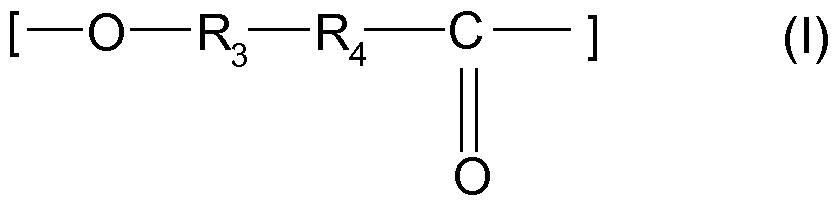
  • polyhydroxyalkanoates containing structural units of the formula (I) wherein R 3 is the moiety - (CH) y (CH 2) x CH 3 , where x is an integer from 0 to 2 and y is an integer from 0 to 1, and R 4 is the moiety (- CH 2 -) z , where z is an integer from 1 to 5, and their mixtures, their stereoisomers and their copolymers.
  • polyhydroxyalkanoates examples include polyglycolide, polylactide, poly-4-hydroxybutanoate, poly-3-hydroxybutanoate, poly-3-hydroxyvalerate, poly-3-hydroxyhexanoate and polycaprolactone.
  • copolymers examples are copolyesters of the (L, D) polylactide or copolyester of the aforementioned hydroxybutanoates with 3-hydroxyvalerate or 3-hydroxyhexanoate or copolyesters of polyglycolide, polylactide and polylcaprolactone.
  • Polyglycolide for example, offered by Fa. Kureda under the brand name Kuredux ® ; Polylactides in various LD ratios are available from Natureworks under the brand name Ingeo®, various copolymers of glycolide, L- and D-lactide and caprolactone are available from Evonik under the brand name Resomer ® .
  • Polycaprolactones are available from the company. Perstorp under the trade name CAPA ®.
  • Poly-3-hydroxybutyrate-co-4-hydroxybutyrates are known in particular from Metabolix. They are marketed under the trade name Mirel ®. Poly-3-hydroxybutyrate-co-3-hydroxyhexanoates are known from the company P & G or Kaneka. Poly-3-hydroxybutyrate are sold for example by the company. PHB Industrial under the brand name Biocycle ® and by the company. Tianan under the name Enmat ®.
  • polyesters are the polycondensates of dicarboxylic acids and diols containing structural units of the formula (II)
  • R 5 is the moiety (- CH 2 -) m , where m is an integer from 2 to 4
  • R 6 is the moiety (- CH 2 -) n, where m is an integer from 2 to 4, as well as their mixtures and their copolymers.
  • these polycondensates are polyethylene and polybutylene malonate, polyethylene and polybutylene succinate, polyethylene and polybutylene glutarate, polyethylene and polybutylene adipate.
  • Suitable Polybutylensuccinate and polybutylene succinate-co-adipate are examples of playing sold by the company. Showa Denko under the trade name Bionolle ®. Polyethylensuccinate and polyethylene succinate-co-adipate offered by the company. Nippon Shokubai under the brand name Lunar SE ®.
  • polyesters are aliphatic polyalkylene carbonates containing structural units of the general formula (III)
  • R 7 is a (dC 6 ) -alkylene, as well as their mixtures and their copolymers.
  • polyalkylene carbonates examples include polyethylene and polypropylene carbonate. Suitable polyethylene and polypropylene carbonates are offered for example by the company. Empower Materials Inc. under the brand name QPAC ®.
  • the aliphatic polyesters B 3 generally have a weight average molecular weight of from 2,000 to 1,000,000, preferably from 20,000 to 100,000.
  • the polyesters B 3) are preferably selected from poly (C2-C4) -alkylencarbonat, poly (C 2 -C 4) -alkylensuccinat, polylactide, polycaprolactone and Polyhydroxybutanoat.
  • a binder B for producing ceramic or metallic shaped bodies, comprising
  • B-i 50 to 90% by weight of at least one polyoxymethylene homopolymer or copolymer
  • B 2 from 5 to 50% by weight of at least one polyether selected from poly-1,3-dioxolane, poly-1,3-dioxepan and polytetrahydrofuran and their copolymers, B 3 ) 3 to 15 wt .-% of at least one aliphatic polyester selected from: poly (C 2 -C 4 ) alkylene carbonate, poly (C 2 -C 4 ) alkylene succinate, polylactide, polycaprolactone and polyhydroxybutanoate and their stereoisomers and Copolymers, wherein the sum of the components B- 1 ), B 2 ) and B 3 ) gives 100 wt .-%.
  • Another object of the invention is a thermoplastic composition for the production of metallic or ceramic moldings, containing
  • B-i from 40 to 95% by weight of at least one polyoxymethylene homopolymer or copolymer
  • B 2 from 2 to 60% by weight of at least one polyether selected from: polypropylene oxide, poly-1,3-dioxolane, poly-1,3-dioxane, poly-1,3-dioxepane, polytetrahydrofuran, poly- p-dioxanone and its copolymers;
  • polyether selected from: polypropylene oxide, poly-1,3-dioxolane, poly-1,3-dioxane, poly-1,3-dioxepane, polytetrahydrofuran, poly- p-dioxanone and its copolymers;
  • R 3 is the grouping - (CH) y (CH 2 ) x CH 3 , where x is an integer from 0 to 2 and y is an integer from 0 to 1, and R 4 is the grouping (-
  • R 7 is a (C 1 -C 6 ) -alkylene radical
  • the inorganic sinterable powder A) can be selected from all known suitable inorganic sinterable powders. Preferably, it is selected from metal powders, metal alloy powders, metal carbonyl powders, ceramic powders, and mixtures thereof.
  • metals which may be present in powder form are aluminum, iron, in particular carbonyl iron powder, chromium, cobalt, copper, nickel, silicon, titanium and tungsten.
  • powdered metal alloys for example, high or low alloyed steels and metal alloys based on aluminum, iron, titanium, copper, nickel, tungsten or cobalt are mentioned.
  • Both powders of already finished alloys such as e.g. To name superalloys such as I N713C, GMR 235 and IN 100 and the alloys known from magnet technology with the main components Nd-Fe-B and Sm-Co, as well as to name powder mixtures of the individual alloy components.
  • the metal powders, metal alloy powders and metal carbonyl powders can also be used in a mixture.
  • Suitable inorganic powders are also oxide ceramic powders such as Al 2 O 3 , ZrO 2 Y 2 O 3 but also non-oxide ceramic powders such as SiC, Si 3 N 4 , and more complex oxide powders such as NiZnFe 2 0 4 , and inorganic color pigments such as CoAI 2 0 4 .
  • the particle sizes of the abovementioned powders are preferably 0, 1 to 50 ⁇ m, more preferably 0.3 to 30 ⁇ m.
  • the metal powders, metal alloy powders, metal carbonyl powders and ceramic powders can also be used in a mixture, for example for the production of hard metals such as WC / Co.
  • the optionally present as component C) dispersing agent may be selected from known dispersing aids. Examples are oligomeric polyethylene oxide having an average molecular weight of 200 to 600, stearic acid, stearic acid amide, hydroxystearic acid, fatty alcohols, fatty alcohol sulfonates and block copolymers of ethylene oxide and propylene oxide, and also polyisobutylene.
  • the dispersing aid is particularly preferably used in an amount of from 1 to 5% by volume, based on the components A), B) and C).
  • the thermoplastic compositions may also contain conventional additives and processing aids which favorably influence the rheological properties of the mixtures during shaping.
  • thermoplastic compositions of the invention can be used for the production of metallic or ceramic moldings from the powder A).
  • the present invention therefore also relates to a process for the production of a metallic or ceramic molding from the thermoplastic composition according to the invention by injection molding, extrusion or compression to form a molded part, followed by removal of the binder and sintering, characterized in that the molded part is used to remove the binder treated according to one of the following variants:
  • Variant 3 with the steps: 3a) at least partial extraction of the binder components B 2 ) and B 3 ) and optionally C) from the molded part by a solvent in which the component Bi) is insoluble,
  • thermoplastic composition of the invention used in the process according to the invention can be carried out in a conventional manner in a kneader or extruder at temperatures of 150 to 200 ° C (see, EP-A 0 413 231). After cooling the mass, it can be granulated. According to a preferred embodiment, the preparation of the thermoplastic mass to be formed by melting the components B) and mixing the components A) and optionally C) take place.
  • component B) can be melted in a twin-screw extruder at temperatures of preferably 150 to 220 ° C., in particular 170 to 200 ° C.
  • Component A) is then metered at temperatures in the same range in the required amount to the melt stream of component B).
  • component A) contains on the surface the dispersant (s) C).
  • the preparation of the thermoplastic compositions can also be carried out by melting the components B) and C) in the presence of component A) at temperatures of 150 to 220 ° C.
  • the usual screw and piston injection molding machines can be used for the molding of the thermoplastic molding composition by injection molding.
  • the molding is generally carried out at temperatures of 175 to 200 ° C and pressures of 3,000 to 20,000 kPa in molds having a temperature of 60 to 140 ° C.
  • the catalytic debinding in step 1 a) and 3c) of the process according to the invention is carried out by acid treatment of the molding preferably at temperatures in the range of 80 to 180 ° C over a period of preferably 0.1 to 24 hours, more preferably 0.5 to 12 hours ,
  • the required treatment time depends on the treatment temperature, the concentration and the type of acid in the treatment atmosphere as well as on the size of the shaped body and on the particle size of the powder A.
  • the acid concentration is under the usual conditions about 4 to 5% by volume of the atmospheric gas, which is generally nitrogen.
  • Suitable acids for the acid-catalyzed debindering in step 1 a) and 3c) of the process according to the invention are, for example, inorganic, at room temperature already gaseous, but at least at the treatment temperature vaporizable acids. Examples are hydrohalic acids and nitric acid. Suitable organic acids are formic acid, acetic acid, oxalic acid or trifluoroacetic acid. Also suitable as acid are BF 3 or its adducts of organic ethers.
  • a conventional carrier gas inert gas, for example nitrogen
  • this can be previously passed through the acid and charged with it.
  • the thus loaded carrier gas is then brought to the treatment temperature, which is suitably higher than the loading temperature in order to avoid condensation of the acid.
  • the acids can also be vaporized in the furnace chamber itself and quickly distributed by swirling the furnace atmosphere in the furnace chamber.
  • the acid is preferably fed to the binder removal furnace via a metering device, evaporated in a shallow dish and uniformly distributed by circulation of the furnace atmosphere.
  • step 1 a) and 3c) of the process according to the invention can be carried out in commercially available plants which function according to the principles described in EP-A 0 413 231.
  • the catalytic binder removal according to step 1 a) and 3c) of the process according to the invention can also be carried out advantageously, especially when using molding compositions containing reactive and / or oxidation-sensitive sinterable powders A, with acids which are solid at room temperature and sublimate at higher temperatures melt and evaporate, including in particular those with a sublimation or melting point between 80 and 200 ° C.
  • oxalic acid preferably anhydrous oxalic acid, or oxalic acid dihydrate. It is particularly preferred to use a solution of anhydrous oxalic acid in formic acid, acetic acid or mixtures thereof.
  • glyoxylic acid and malonic acid are suitable.
  • benzenesulfonic acid naphthalenesulfonic acids and maleic acid or mixtures thereof.
  • the abovementioned acids can be used either alone or together with a carrier gas such as air, nitrogen or a noble gas in debinding.
  • the acids used generally reach the debinding temperature initially in the gas phase, act from here on the remaining binder B- ⁇ ) and desublimate or solidify after cooling on the walls of the binder removal device. In a subsequent debinding process, they return to the gas phase, ie the acid practically does not leave the device.
  • the abovementioned acids which are solid at room temperature and sublimate or melt and evaporate at higher temperatures, as a solution in polar solvents, preferably having boiling points below 200 ° C to use.
  • polar solvents preferably having boiling points below 200 ° C to use.
  • especially acetone, dioxane, ethanol and acetonitrile are suitable, but especially organic acids such as formic acid and / or acetic acid.
  • the acid treatment in step 1 a) and 3c) of the process according to the invention is carried out in the variant with acids which are solid at room temperature and sublimate at higher temperatures or melt and evaporate, preferably at temperatures in the range of 100 to 160 ° C.
  • the anhydrous oxalic acid is fed as a solution via a metering the debinding furnace, evaporated and evenly distributed by a circulation of the furnace atmosphere.
  • the catalytic acid treatment in step 1 a) of the process according to the invention is preferably carried out until the binder components B-1) and B 2 ) in the molded part are at least 90% by weight, preferably 95% by weight, particularly preferably 98% % By weight are removed.
  • the catalytic debindering in step 3c) of the process according to the invention is preferably carried out until the binder component B-1) in the molding is removed to at least 20%, preferably 50%, more preferably 85%, most preferably 95% or more is.
  • step 3 c) it may be advantageous in step 3 c) to remove the binder component B-1 only partially catalytically, since usually the binder-free components still have to be rearranged for sintering in another furnace and the molding strength then may be insufficient. In such cases, the removal of only 20 to 50% of the binder component B-1) may be more effective; the remaining, stabilizing residue can then be thermally removed in the sintering furnace with an adapted cycle. If this is not necessary, then in step 3 c) a removal of 85 wt .-%, preferably 95 wt .-% or more of the binder component B- ⁇ ) should be sought.
  • the preferred binder components B 2 ), B 3 ) and optionally C) can be dissolved, for example, in aprotic organic solvents such as ethers, esters, amides or ketones, for example tetrahydrofuran, diethyl ether, butyrolactone, dimethylformamide, methyl ethyl ketone or acetone, but also in protic organic solvents such as CrC 6 -alcohols such as ethanol and isopropanol; Poly-1,3-dioxolane can also be dissolved in water.
  • aprotic organic solvents such as ethers, esters, amides or ketones, for example tetrahydrofuran, diethyl ether, butyrolactone, dimethylformamide, methyl ethyl ketone or acetone
  • protic organic solvents such as CrC 6 -alcohols such as ethanol and isopropanol
  • Poly-1,3-dioxolane
  • water can be used as a solvent, it is particularly preferred because water provides much easier and environmentally friendlier handling because of its incombustibility.
  • this is preferably a conventional corrosion inhibitor, for example modified phosphonates such as amino-tris (methylenephosphonic acid), hydroxyethylamino-di (methylenephosphonic acid) or phosphonobutane-1,2,4-tricarboxylic acid , available eg from Zschimmer & Schwarz.
  • Extremely reactive sintering powders A are preferably treated with aprotic organic solvents, such as tetrahydrofuran, diethyl ether, butyrolactone, dimethylformamide, methyl ethyl ketone or, preferably, acetone.
  • aprotic organic solvents such as tetrahydrofuran, diethyl ether, butyrolactone, dimethylformamide, methyl ethyl ketone or, preferably, acetone.
  • the treatment of the molding with a solvent according to step 2a) and 3a) of the process according to the invention can be carried out in commercially available plants with closed solvent cycle for the purification of machined, contaminated with lubricants workpieces, described by way of example in DE-A 4337129.
  • step 2a) and 3a) at elevated temperature to a maximum of 120 ° C to accelerate the dissolution process, more preferably carried out step 2a) and 3a) at boiling temperature of the solvent under reflux.
  • binder component B- ⁇ ) - Polyoxymethylenhomo and copolymers (POM) - are resistant to 120 ° C against virtually all common solvents and guarantee even at higher temperatures up to 120 ° C always still a very high strength.
  • step 2a) and 3a) of the process according to the invention a large difference in concentration between the soluble binder components B 2 ), B 3 ) and optionally C) in the molding and the solvent during extraction stands.
  • the latter can be achieved by replacing the loaded solvent often with fresh solvent and / or the dissolved extract is quickly carried away, for example by a circulation of the surface of the extraction material.
  • binder components B 2 ) and / or B 3 ) and optionally C) are only partially soluble in the chosen solvent and are only partially removable in the solvent debinding of step 2a) and 3a).
  • a partial removal of the abovementioned binder components may be advantageous for the strength of the molded parts with regard to handling during the subsequent thermal or catalytic debindering.
  • the residual binder function desired for conversion into the sintering furnace can also be given by the fact that component B-1) is only incompletely removed in the case of thermal debindering in accordance with step 2c) or in the case of catalytic debindering in step 3c).
  • Component C) may also be soluble in the same solvents as component (s) B 2 ) and / or B 3 ), which is generally advantageous.
  • the treatment with a solvent according to step 2a) and 3a) of the process of the invention is preferably carried out until the binder components B 2 ), B 3 ) and C) at least 50 wt .-%, preferably to 70 wt .-%, more preferably 80 wt .-%, are removed from the molding. This condition is generally reached after 4 to 40 hours.
  • the required treatment time depends on the treatment temperature, the quality of the solvent for the binder components B 2 ), B 3 ) and C), the molecular weight of the binder components B 2 ), B 3 ) and C), as well as on the size of the molding .
  • the green parts, which are now porous and saturated with solvent still have to be dried.
  • the drying of the molding is preferably carried out in a conventional manner, for example by means of a vacuum drying oven, a heat cabinet or a convection oven, according to step 2b) and 3b) of the method according to the invention.
  • the drying can also be advantageously integrated in step 2c) and 3c) of the method according to the invention.
  • both the drying and the thermal or catalytic debinding according to step 2c) and 3c) of the component Bi) in the same system, for example in a circulating furnace, are carried out, whereby a reloading of the brown parts is not required.
  • the solvent is removed in a separate step 2b) and 3b).
  • the drying temperature is based on the boiling point of the solvent, but is preferably chosen slightly lower in order to avoid the risk of a sudden or too fast drying process with possible negative consequences for the quality of the green part.
  • the drying according to step 2b) and 3b) of the process according to the invention is completed in 0.5 to 8 h.
  • the oxidative thermal debindering 2c) of the component B-1) takes place in furnaces in which the moldings are exposed in an oxygen-containing atmosphere to a suitable temperature in the range from 140 to 200 ° C. for a defined period of time.
  • the design and materials of the furnace must ensure that the temperature in the furnace volume is the same everywhere, and good heat transfer to the moldings to be debinded is achieved. In particular, cold spots in the interior of the furnace system are to be avoided in order to prevent the condensation of decomposition products.
  • An oxygen-containing atmosphere is to be understood as meaning a gas mixture of an inert gas such as nitrogen or argon with 1 to 100% by volume of oxygen, with air being preferred.
  • internals or circulation elements are known from the prior art, which ensure a uniform distribution and turbulence of the furnace atmosphere, so that all shaped bodies are subjected to the same temperature conditions as possible.
  • a preferred oven is a conventional convection oven for heat treatments.
  • sufficient fresh gas supply is necessary (at least tenfold replacement) to sufficiently dilute the decomposition product formaldehyde ( ⁇ 4% by volume) and thus keep the oven in a safe operating condition, eg Air / formaldehyde mixtures are flammable.
  • the oxidative thermal Restentbind réelle according to step 2c) of the method according to the invention is preferably carried out until the binder component Bi) at least 20 wt .-%, preferably at 50 wt .-%, particularly preferably at 85 wt .-%, from the molded part is removed.
  • step 1 b The residual binder amount of component B 3 ) still present after step 1 a) can be expelled in step 1 b), usually integrated into the sintering cycle, by slow heating.
  • steps 2d) and 3d) for optionally remaining amounts of the components B- 1 ), B 2 ), B 3 ), and / or C).
  • the thermal Restentbind für or pyrolysis according to because of steps 1 b), 2d) and 3d) can, usually in the sintering furnace, take place under reduced pressure or in a carrier gas to lead out the decomposition products.
  • a carrier gas usually, for metal powder as the carrier gas, an inert gas such as nitrogen or argon is selected, or else a reducing gas such as e.g. Hydrogen.
  • an inert gas is usually selected as the carrier gas, or the residual thermal debinding is carried out in a vacuum.
  • the decomposition range of the residual binder depends on the polymer and the selected atmosphere, but is usually in the temperature range 200 to 600 ° C. In this temperature range, a reduced heating rate of 5 ° C./min, preferably 3 ° C./min, particularly preferably 2 ° C./min, is recommended. At the temperature of the maximum decomposition rate of the polymer, a holding step having a length of 0.25 to 4 hours, preferably 0.5 to 1 hour, may be introduced. For this purpose, in the adjacent temperature ranges below and above this characteristic temperature, a higher heating rate, e.g. 3 to 5 ° C / min, to be selected.
  • the product thus freed from the binder by the process according to the invention can be converted in the usual way by sintering at temperatures above 600 ° C. to 2000 ° C. into a metallic or ceramic shaped body.
  • the sintering may optionally take place at an accelerated heating rate of 5 to 10 ° C / min in the temperature range of 200 to 600 ° C, if there is no residual binder more.
  • the molding compositions of the invention are universally applicable and are suitable for various methods for the production of moldings.
  • the shaped bodies according to the invention can be used as components.
  • test compounds were homogenized in a cone mixer and homogenized and granulated in a laboratory extruder heated to 190 ° C.
  • test mass with ceramic powder according to Example 9 was prepared in a heated to 180 ° C sigma kneader with a kneading time of 2 h.
  • the molding compound 1 had the following composition:
  • the proportion by weight of the binder components B1, B2, and B3 is thus as follows:
  • the molding compound 2 had the following composition:
  • the proportion by weight of the binder components B1, B2, and B3 is thus as follows:
  • the molding compound 3 had the following composition: 56.75% by volume of a mixture of 98% by weight of carbonyl iron powder and 2% by weight of carbonyl nickel powder (FN 2)
  • PBS polybutylene succinate
  • the proportion by weight of the binder components B1, B2, and B3 is thus as follows:
  • the molding compound 4 had the following composition:
  • the proportion by weight of the binder components B1, B2, and B3 is thus as follows:
  • the molding compound 5 had the following composition:
  • PCL polycaprolactone
  • the proportion by weight of the binder components B1, B2, and B3 is thus as follows:
  • the molding compound 6 had the following composition:
  • PDP polydioxepane
  • the proportion by weight of the binder components B1, B2, and B3 is thus as follows:
  • the molding compound 7 had the following composition:
  • PPC polypropylene carbonate
  • the proportion by weight of the binder components B1, B2, and B3 is thus as follows:
  • the molding compound 8 had the following composition:
  • the molding compound 8 is thus the weight fraction of the binder components B1, B2, and
  • the molding compound 9 had the following composition:
  • PDP polydioxepan
  • PBS polybutylene succinate
  • the proportion by weight of the binder components B1, B2, and B3 is thus as follows:
  • the length of the component was 100 mm, the weight of the sintered part obtained was about 34 g for examples 1 to 7, about 40 g for example 8 and about 26 g for example 9.
  • test masses were melted in the cylinder of the injection molding machine at 190 ° C, the injection mold was heated to 135 ° C.
  • required injection pressure was approx. 1500 - 1800 bar, a normal value for POM-based injection molding compounds.
  • test masses differed in the cooling time required before demolding.
  • the test masses with a higher content of component B 2 ) (30% and higher) were somewhat softer and required a longer cooling time in order to be able to demold the green part intact; the green parts also showed some streaks on the surface.
  • test mass 2 Only the test mass 2 with a high PDL content. could only be processed with a pressure of 600 bar. In addition, the melt temperature and the mold temperature had to be lowered by about 10 ° C.
  • the primary catalytic acid debinding was carried out with the components of Examples 1 to 9 in a 50 L laboratory oven at 110 ° C. It was purged for inerting with 500 L / h of nitrogen, after 1 h 30 ml / h HN0 3 were dosed into it and further purged with 500 l / h of nitrogen oven and evaporated.
  • the sintering curve was as follows:
  • the sintered parts achieved a good sintering density of 7.89 g / cm 3 .
  • Example 9 The powder molding of Example 9 obtained after catalytic debinding was sintered in air in a commercial ceramic sintering furnace with the following schedule.
  • the obtained sintered parts were intact, defect-free and had a good sintered density of 6.05 g / cm 3 .
  • the green parts produced from the test masses were pretreated in a solvent, after which the molded part was dried, thermally restentbindert and sintered.
  • the green parts were treated in a stirred three-necked flask in boiling solvent (acetone, ethanol, water and chloroform were used) under reflux for 24 h. Only Example 8 had to be treated for 48 hours for debinding in water.
  • the weight loss was determined after drying for 4 h in a convection oven at the boiling point of the solvent.
  • Examples 1 and 8 show that the choice of solvent (acetone, ethanol or water) decides whether and how much of the binder component B 3 ) is dissolved.
  • Example 8 shows a solvent removal of poly-1,3-dioxolane as component B 2 ) with water.
  • the debindering is only half as fast, but otherwise works flawlessly.
  • the moldings were thermally de-bindered in air.
  • the thermal debinding was carried out in a gas-tight, air-circulated 50 L air oven with 500 L / h of air.
  • the moldings were heated for 12 h in the 165 ° C on heated oven treated. Thereafter, the moldings were removed and the weight loss was determined (Table 4).
  • the determined weight loss is in most of the examples close to or slightly above the content of binder component B-1) and demonstrates the effectiveness of the method according to the invention.
  • the additional weight loss has its origin in the residue of binder component B 2 ) not dissolved in the preceding solvent debinder, which is then degraded during thermal debindering.
  • the components of Examples 4 and 6 showed cracks or delaminations; the weight loss remains well below the expected from the content of component B- ⁇ ) value.
  • the loss of binder components B 2 ) and B 3 ) in step 2a) was less than the preferred 70%.
  • the molded parts treated according to the two-stage debinding method of variant 2 were sintered as described in variant 1.
  • the solvent debinding was carried out with the molding compositions of Examples 1 to 9 in the same solvents as in Variant 2.
  • the moldings were dried at 60 ° C.
  • the drying and catalytic debinding were carried out in a gas-tight, circulated with 500 L / h of nitrogen 50 L furnace with circulation.
  • the catalytic debinding was carried out as in Variant 1.
  • the moldings prediluted in the solvent were dried in a convection oven at the boiling point of the solvent and subjected to catalytic debindering as described for variant 1.
  • the weight loss was determined with respect to the weight of the untreated molding (Table 6). Table 6 Effect of solvent and catalytic debinding
  • the determined weight loss after catalytic debindering is in all examples again usually just below or slightly above the content of binder component B-1) and demonstrates the effectiveness of this variant of the method according to the invention.

Landscapes

  • Chemical & Material Sciences (AREA)
  • Engineering & Computer Science (AREA)
  • Ceramic Engineering (AREA)
  • Manufacturing & Machinery (AREA)
  • Organic Chemistry (AREA)
  • Materials Engineering (AREA)
  • Structural Engineering (AREA)
  • Chemical Kinetics & Catalysis (AREA)
  • Inorganic Chemistry (AREA)
  • Mechanical Engineering (AREA)
  • Metallurgy (AREA)
  • Health & Medical Sciences (AREA)
  • Medicinal Chemistry (AREA)
  • Polymers & Plastics (AREA)
  • Composite Materials (AREA)
  • General Chemical & Material Sciences (AREA)
  • Powder Metallurgy (AREA)
  • Compositions Of Macromolecular Compounds (AREA)
  • Compositions Of Oxide Ceramics (AREA)
  • Adhesives Or Adhesive Processes (AREA)

Abstract

Die Erfindung betrifft Bindemittel für pulverförmige Metalle, Metalllegierungen oder Keramiken auf Basis von Polyacetalen, Polyethern und Polyestern. Diese Erfindung betrifft weiterhin diese Bindemittel enthaltende thermoplastische Massen für die Herstellung metallischer oder keramischer Formkörper, die Verwendung dieser Bindemittel und Verfahren zur Herstellung von Formkörpern aus diesen Bindemitteln.

Description

Bindemittel und Verfahren zur Herstellung von metallischen oder keramischen Formkörpern im Pulverspritzguss
Beschreibung
Die vorliegende Erfindung betrifft Bindemittel für pulverförmige Metalle oder pulverför- mige Metalllegierungen oder pulverförmige Keramiken, diese Bindemittel enthaltende thermoplastische Massen für die Herstellung metallischer oder keramischer Formkörper, ihre Verwendung und Verfahren zur Herstellung von Formkörpern daraus.
Metallische bzw. keramische Formkörper können durch Spritzgießen, Extrudieren oder Verpressen von thermoplastischen Massen hergestellt werden, die neben Metallpulvern und/oder Keramikpulvern ein organisches Bindemittel aufweisen. Es handelt sich um hochgefüllte organische Polymerformmassen.
Nach dem Formen der thermoplastischen Masse zu einem Grünteil wird das organische Bindemittel zu einem Teil in einer Primärentbinderung entfernt und das erhaltene entbinderte Grünteil (= Braunteil) wird weiter behandelt. Das Braunteil enthält noch eine Binderkomponente, die in der Primärentbinderung nicht entfernt wird. Dieser Restbinder soll die Pulverpartikel in dem Formteil zusammenhalten und wird üblicherweise durch thermische Zersetzung ausgetrieben.
Das nun erhaltene, vollständig entbinderte Braunteil (= Weißteil) wird gesintert. Oft, aber nicht immer, ist die thermische Zersetzung des Restbinders in den Sinterzyklus integriert.
Die ersten Bindemittel für das Pulverspritzgussverfahren basierten im Allgemeinen auf Mischungen von Polyethylen oder Polypropylen und Wachs. Dabei wird der Grünkör- per durch Ausschmelzen zunächst vom Wachs befreit und der Restbinder durch eine langsame Pyrolyse ausgebrannt. Für das Ausschmelzen müssen die Grünteile in einem Pulverbett eingelagert werden, weil die Grünfestigkeit durch das Schmelzen praktisch nicht gegeben ist. Spätere Bindersysteme für die thermische Entbinderung verzichten auf das Ausschmelzen, weil das aufwändige Einbetten der Grünteile in Pulver und nachfolgende Ausgraben viel zu zeitaufwendig sind.
Üblicherweise besteht ein verbessertes Bindersystem für die vollständige thermische Entbinderung aus mehreren Komponenten z.B. aus Polyoxymethylen (POM), Polypropylen, Wachsen und Harzen wie in DE 199 25 197 beschrieben. Diese Komponenten werden sukzessive beim Aufheizen bei unterschiedlichen Temperaturen aus dem Formkörper freigesetzt, so dass der üblicherweise geringere Binderbestandteil noch bis mindestens 400 °C vorhanden ist und als Restbinder gesehen werden kann. Eine rein thermische Entbinderung dauert 1 bis 3 Tage und ist somit extrem langsam. Ein noch weiter verbessertes Verfahren stellt die Lösungsmittelentbinderung dar, bei welcher Bindemittelsysteme, welche Binderkomponenten unterschiedlicher Löslichkeit enthalten, eingesetzt werden. Zur Entbinderung des Grünteils wird zunächst eine Binderkomponente durch Lösungsmittelextraktion entfernt, wonach die verbleibende, nicht oder sehr schlecht in dem Lösungsmittel lösliche Restbinderkomponente wiederum durch eine langsame thermische Zersetzung aus dem Formteil entfernt wird (z.B. US 4,197,1 18 oder EP 501 602). Dabei wird der Schmelzebereich des Restbinders durchschritten und eine plastische Verformung des Pulverformteils ist dadurch unumgänglich.
WO 201 1/016718 A1 beschreibt ein Verfahren zur Herstellung von metallischen oder keramischen Formkörpern, bei welchem aus einem metallischen oder keramischen Sinterpulver mit einer Bindermischung aus einem Polymer wie z.B. Polyoxymethylen (POM oder auch Polyacetal) und einem nicht-polymeren Lösungsmittel für das Polymer (Molmasse < 300 g/mol, Schmelzpunkt > RT) eine Formmasse gebildet wird. Der Binder enthält vorzugsweise jeweils mindestens 5 Gew.-% des Polymers und des nicht- polymeren Lösungsmittels. Das nicht-polymere Lösungsmittel wird verdampft (z.B. bei 69 bis 130°C) oder kann aus der Formmasse mit einem weiteren Lösungsmittel herausgelöst oder verdünnt werden. Das verbleibende Polymer wird durch eine thermische Entbinderung, vorzugsweise oberhalb 200 °C, entfernt. In den Beispielen mit einem Metallpulver, POM als Binderkomponente neben Caprolactam (Gew.-Anteile 50:50) wird die 2-stufige thermische Entbinderung mit einer Verdampfung bei 69 bis 130°C und einer thermischen Entbinderung > 240°C offenbart.
Von Nachteil bei diesem Verfahren ist, dass solche Binder beim Mischen mit dem Sin- terpulver und bei der Verarbeitung auf der Spritzgießmaschine bereits das nicht poly- mere Lösungsmittel verdampfen. Die niedermolekulare Komponente wird an der Grünteiloberfläche ausgeschwitzt und verschmutzt die Spritzgießform. Darüber hinaus ist die Grünteilfestigkeit deutlich verringert. Eine komplett thermische Binderentfernung wird auch mit Polyoxymethylenbindern am Beispiel von Keramikpulvern bei Temperaturen von 160 bis 220 °C in Gegenwart von Luft bzw. bei 300 bis 360 °C in Gegenwart von Stickstoff beschrieben (US 5,080,846 A und WO 91/07364 A1 ). Y. Kankawa (Journal of the Japan Society of Powder Metallurgy 43/7 (1996) 840-845 berichtet über Untersuchungen einer thermischen Entbinderung in Luft von einem Metallpulver (SUS316L) mit u.a. Polyacetal als Binderkomponente bei 300 bis 320 °C. Wie bereits zuvor ausgeführt, ist die rein thermische Binderentfernung sehr langsam und eine Verformung der Formkörper tritt sehr häufig auf, da die Temperaturen bei der thermischen Entbinderung (> 200 °C) der metallischen Formmassen in einem Temperaturbereich weit oberhalb des Schmelzebereichs von Polyacetal (160 bis 170 °C) liegen.
Darüber hinaus stellt die thermische Entbinderung in einer sauerstoffhaltigen Atmosphäre bei Verwendung von Metallpulvern, in Gegensatz zu Keramikpulvern, ein Problem dar, weil die Pulveroberfläche bei dem Vorgang im Allgemeinen oxidiert wird und damit die Qualität und Integrität des gesinterten Formteils beeinträchtigt wird.
Ein weiteres Verfahren zur Entbinderung des Grünteils gemäß dem Stand der Technik beruht auf einer katalytischen Entbinderung durch Behandlung des Grünteils in einer gasförmigen, säurehaltigen Atmosphäre bei erhöhter Temperatur. Formmassen für die katalytische Entbinderung kommen mit noch weniger Restbinder aus. Im Allgemeinen liegt der Restbindergehalt um die 10 %, der Rest besteht üblicherweise aus Polyacetal.
EP-A 0 413 231 offenbart beispielsweise ein Verfahren zur Herstellung eines anorganischen Sinterformteils, bei welchem ein Gemisch aus einem sinterbaren anorganischen Pulver und Polyoxymethylen als Bindemittel zu einem Grünkörper verformt wird und das Bindemittel dann durch Behandeln des Grünkörpers in einer gasförmigen, säurehaltigen z.B. Bortrifluorid oder HN03, enthaltenden Atmosphäre entfernt wird. Anschließend wird der so behandelte Grünkörper versintert. Beispiele für sinterformige Pulver sind sowohl oxidische Keramikpulver wie Al203, Zr02, Y2O3 als auch nicht- oxidische Keramikpulver wie SiC, Si3N4, und Metallpulver.
Mit einer ausschließlich aus POM bestehenden Binderphase werden jedoch in der Praxis keine zufriedenstellenden Ergebnisse erhalten, da die Braunteilfestigkeit völlig unzureichend ist und die Sinterdichten zu niedrig sind. EP-A 0 444 475 beschreibt für keramische Formkörper geeignete Binderzusammensetzungen, die neben Polyoxymethylen als zusätzliches lösliches Polymerisat Poly-1 ,3- Dioxolan, Poly-1 ,3-Dioxan oder Poly-1 ,3-Dioxepan enthalten oder als in Polyoxymethylen dispergierbares Polymerisat aliphatische Polyurethane, aliphatische Po- lyepoxide, Poly(C2-C6-alkylenoxide), aliphatische Polyamide oder Polyacrylate oder deren Mischungen enthalten. In der EP 0 465 940 A1 und DE 100 19 447 A1 werden thermoplastische Formmassen für die Herstellung metallischer Formkörper beschrieben, die neben einem sinterbaren pulverförmigen Metall oder einer pulverförmigen Metalllegierung eine Mischung aus Polyoxymethylenhomo- oder copolymerisaten und einem damit nicht mischbaren Polymerisat als Bindemittel enthalten. Als zusätzliches Polymerisat kommen Polyolefine, insbesondere Polyethylen und Polypropylen, wie auch Polymerisate von Methacrylsäu- reestern wie PMMA, in Betracht (EP 0 465 940 A1 ). DE 100 19 447 A1 beschreibt Bindemittel für anorganische Materialpulver zur Herstellung metallischer und keramischer Formkörper, wobei diese Bindemittel eine Mischung aus Polyoxymethylenhomo- oder Copolymerisaten und einem Polymersystem aus Polytetrahydrofuran und mindestens einem Polymer aus C2-8-Olefinen, vinylaromatischen Monomeren, Vinylestern aliphatischer Ci-s-Carbonsäuren, Vinyl-Ci-8-Alkylethern oder Ci-i2-Alkyl(meth)acrylaten enthalten.
WO 2008/006776 A1 beschreibt Bindemittel für anorganische Materialpulver zur Herstellung metallischer Formkörper, wobei diese Bindemittel eine Mischung aus Polyoxymethylenhomo- oder Copolymerisaten und einem Polymersystem aus C2-8- Olefinen und Poly-1 ,3-Dioxepan oder Poly-1 ,3-Dioxolan sind.
Die Entbinderung der Grünteile erfolgt bei Verwendung der vorgenannten Polyoxyme- thylen-Bindemittelsysteme katalytisch durch Behandlung des Grünteils in einer gasförmigen, säurehaltigen Atmosphäre von z.B. Halogenwasserstoffen, Ameisensäure oder Salpetersäure bei erhöhter Temperatur. Dabei werden die Polyoxymethylenhomo- oder copolymerisate rückstandsfrei depolymerisiert, gefolgt von einer thermischen Restent- binderung des zurückbleibenden Polymerisats. Auch hier wird der Schmelzebereich des Restbinders durchschritten und eine gewisse plastische Verformung des Pulverformteils ist dadurch unumgänglich. Der Restbindergehalt beträgt nach der katalyti- schen Entfernung des Erstbinders im Allgemeinen etwa 10% und ist somit geringer als nach einer Lösungsmittelentbinderung des Erstbinders, bei welcher der Restbinderanteil üblicherweise 30 bis 70 % beträgt. Ein geringerer Restbindergehalt hat den Vorteil, dass die plastische Verformung des Formteils üblicherweise weniger ausgeprägt ist.
Eine katalytische Entbinderung von Formteilen mit Oxalsäure wird in der WO 94/25205 beschrieben. Die katalytische Entbinderung mit Oxalsäure ist im direkten Vergleich mit HN03 jedoch deutlich langsamer und Oxalsäure ist als Feststoff problematisch in der Dosierung, so dass sie bisher nicht zum industriellen Einsatz gekommen ist.
US 2008/0075620 A1 beschreibt eine katalytische Entbinderung eines durch Pulver- spritzguss erhaltenen Formteils mit Ozon zur Entfernung von Polyethern, Polylactiden und/oder aliphatischen Polycarbonaten als erster Binderkomponente. Polyether- komponenten auf Polyacetalbasis sind bevorzugt. Die Binderphase kann noch einen zweiten Binder mit einer höheren thermischen Zersetzungstemperatur als die erste Binderkomponente enthalten, welcher in einem nachfolgenden Entbinderungsschritt entfernt wird. Der zweite Binder ist vorzugsweise Polystyrol und/oder ein Polyolefin. Der Anteil der ersten Komponente in der Binderphase beträgt 20 Gew.-% oder mehr. Mischungen von Bindern, die Polyether bzw. Polyacetale und Polyester enthalten, werden nicht näher beschrieben. US 2008/0227906 A1 beschreibt die katalytische Entbinderung von durch Pulverspritz- guss erhaltenen Formteilen mit einem alkalischen Gas wie z.B. Ammoniak zur Entfernung von einer ersten Binderkomponente, welche vorzugsweise auf aliphatischen Po- lyestern und/oder Polyethern basiert. Bevorzugt sind Polyester, insbesondere Polycar- bonate und Polyhydroxysäuren wie Polyglycolid und Polylactid. Die Binderphase kann einen zweiten Binder enthalten, welcher eine höhere Zersetzungstemperatur als der erste Binder aufweist und in einem späteren Entbinderungsschritt bei höherer Temperatur entfernt wird. Der zweite (Rest)binder ist vorzugsweise Polystyrol und/oder ein Polyolefin. Der Anteil des Erstbinders in der Binderphase beträgt 20 Gew.-% oder mehr. Mischungen von Bindern, die Polyether und Polyester enthalten, werden nicht näher beschrieben.
Ein weiteres Entbinderungsverfahren zur Entfernung von Polycarbonaten mit einem alkalischen Gas wird in US 2008/0226489 A1 beschrieben. Der Restbinder wird gemäß dem Stand der Technik ausnahmslos durch thermische Zersetzung entfernt. Die Temperatur, welche zur Entfernung des Restbinders aus dem Formteil benötigt wird, ist abhängig vom gewählten Polymer und von der Wahl des Ofenschutzgases, liegt aber üblicherweise im Temperaturbereich von 300 bis 600°C, insbesondere 400 bis 500°C.
Die Restentbinderung kann getrennt in einem eigens dafür installierten Ofen stattfinden, insbesondere wenn der Gehalt an Restbinder 30 Gew.-% oder mehr beträgt. Das hat den Vorteil, dass der Sinterofen nicht mit pyrolysierten organischen Substanzen verunreinigt werden kann, die sich bevorzugt an kälteren Stellen sammeln und durch Reinigungsvorgänge regelmäßig entfernt werden müssen. Außerdem ist ohne Pyrolyse des Restbinders im Sinterofen ein schnelleres Aufheizen und damit eine kürzere Zykluszeit und höhere Kapazität der Sinteranlage möglich.
Der Bauteileproduzent muss nun bereits in einem sehr frühen Stadium festlegen, wel- che primäre Entbinderungsmethode er verwenden will; die Systemfrage stellt sich un- verzüglich. Somit gibt es Produzenten, welche die katalytische Entbinderung einsetzen und den Restbinder im Sinterofen entfernen. Ferner gibt es Produzenten, die eine Lö- sungsmittelvorentbinderung mit nachfolgender Pyrolyse des Restbinders in einem Ausbrandofen vor dem abschließenden Sintern bevorzugen, und darüber hinaus dieje- nigen, welche nach einer Lösungsmittelvorentbinderung den Restbinder im Braunteil im Sinterofen austreiben.
Gebrauchsfertige Granulate für die katalytische Entbinderung sind am Markt erhältlich. Betreiber einer Lösungsmittelentbinderung sind in der Regel rückwärts integriert und fertigen Ihre Granulate selbst aus zugekauften Pulvern und Bindemittelkomponenten; es gibt aber auch bereits die ersten gebrauchsfertigen Granulate für Lösungsmittelentbinderungen am Markt.
Die Systemwahl hat implizit den Nachteil, dass ein rückwärts integrierter Betreiber ei- ner Lösungsmittelentbinderungs-Anlage kommerziell verfügbare Formteilmassen mit einer großen Auswahl an verschiedenen Metalllegierungen und auch Keramiken wie die Granulate, die für die katalytische Entbinderung vorgesehen sind, nicht oder nur unter erheblichem finanziellen Aufwand zur Produktionsreife bringen könnte.
Der rückwärts integrierte Produzent hat somit die Wahl zwischen einer eigenen, kostenintensiven Produktentwicklung und der Investition in zusätzliche neue Entbinde- rungsanlagen oder er muss sich unflexibel auf eine kleinere Produktpalette einschränken Es besteht somit die Aufgabe ein verbessertes Bindemittel zur Herstellung von metallischen oder keramischen Formkörpern zu entwickeln, welches universell und flexibel einsetzbar ist und somit die freie Wahl der gängigen Methoden zur Binderentfernung ermöglicht. Gegenstand der Erfindung ist ein Bindemittel B zur Herstellung keramischer oder metallischer Formkörper enthaltend
B-i) 40 bis 95 Gew.-% mindestens eines Polyoxymethylenhomo- oder -copolymerisats;
B2) 2 bis 60 Gew.-% mindestens eines Polyethers ausgewählt aus Poly-1 ,3-dioxolan, Poly-1 ,3-dioxan, Poly-1 ,3-dioxepan, Polytetrahydrofuran, Poly-p-dioxanon und deren Copolymeren,
B3) 2 bis 15 Gew.-% mindestens eines aliphatischen Polyesters ausgewählt aus:
Polyhydroxyalkanoaten enthaltend Struktureinheiten der Formel (I)
Figure imgf000008_0001
wobei R3 die Gruppierung -(CH)y(CH2)xCH3, worin x eine ganze Zahl von 0 bis 2 und y eine ganze Zahl von 0 bis 1 ist, und R4 die Gruppierung (— CH2— )z , worin z eine ganze Zahl von 1 bis 5 ist, bedeutet;
Polykondensaten enthaltend Struktureinheiten der Formel (II)
[— O— R— O C— R6 C ] (II)
O O
wobei R5 die Gruppierung (— CH2— )m, worin m eine ganze Zahl von 2 bis 4 ist, und R6 die Gruppierung (— CH2— )n, worin m eine ganze Zahl von 2 bis 4 ist, bedeutet;
Polyalkylencarbonaten enthaltend Struktureinheiten der allgemeinen Formel (III)
[— R7— O C— O— ] (Mi)
O wobei R7 ein (d-C6)-Alkylenrest ist;
sowie deren Stereoisomeren und Copolymeren, wobei die Summe der Komponenten B-ι), B2) und B3) 100 Gew.-% ergibt.
Der Anteil der Komponente B-ι) beträgt bevorzugt 50 bis 90 Gew.-%, besonders bevorzugt 50 bis 80 Gew.-%, bezogen auf die Gesamtmenge des Bindemittels B).
Der Anteil der Komponente B2) beträgt bevorzugt 5 bis 50 Gew.-%, besonders bevorzugt 15 bis 45 Gew.-%, bezogen auf die Gesamtmenge des Bindemittels B).
Der Anteil der Komponente B3) beträgt bevorzugt 3 bis 12 Gew.-%, besonders bevor- zugt 4 bis 10 Gew.-%, bezogen auf die Gesamtmenge des Bindemittels B). Die Polyoxymethylenhomo- oder copolymerisate (POM) der Komponente B-ι) sind als solche bekannt und handelsüblich. Die Homopolymeren werden üblicherweise durch Polymerisation von Formaldehyd oder Trioxan hergestellt, vorzugsweise in der Gegenwart von geeigneten Katalysatoren. Im Rahmen der Erfindung bevorzugte Po- lyoxymethylen-Copolymere enthalten ebenfalls Trioxan und andere cyclische oder lineare Formalen bzw. sonstigen Formaldehyd-Quellen als Hauptmonomere. Die Bezeichnung Hauptmonomere soll ausdrücken, dass der Anteil dieser Monomere an der Gesamtmonomermenge, also der Summe von Haupt- und Comonomeren, größer ist als der Anteil der Comonomere an der Gesamtmonomermenge. Ganz allgemein wei- sen derartige POM-Polymere mindestens 50 mol-% an wiederkehrenden Einheiten - CH20- in der Polymerhauptkette auf. Geeignete Polyoxymethylenco-polymere werden in der EP-A 0 446 708 (Seite 3, Zeile 39 bis Seite 4, Zeile 31 ) beschrieben. Polyacetale sind am Markt beispielsweise von Fa. BASF unter dem Markennamen Ultraform® und von Fa. Ticona unter dem Markennamen Hostaform® erhältlich.
Geeignet als Komponente B2) sind Polyether ausgewählt aus Poly-1 ,3-dioxolan, Poly- 1 ,3-dioxan, Poly-1 ,3-dioxepan, Polytetrahydrofuran, Poly-p-dioxanon und deren Copo- lymeren. Die Komponente B2) ist säurekatalytisch zumindest teilweise zersetzbar. Die mittleren Molekulargewichte (Gewichtsmittelwert) der Polyether B2) betragen vorzugs- weise 600 bis 100.000 g/mol, insbesondere 2000 bis 60.000 g/mol.
Unter den vorgenannten Polyethern B2) sind Poly-1 ,3-dioxolan, Poly-1 ,3-dioxepan und Polytetrahydrofuran bevorzugt. Entsprechende Produkte sind im Handel erhältlich oder leicht herstellbar. Polytetrahydrofuran kann von Fa. BASF unter dem Markennamen PolyTHF® bezogen werden; Poly-p-dioxanon ist bei Fa. Evonik unter dem Markennamen Resomer® erhältlich.
Die entsprechenden Herstellungsverfahren, insbesondere von Polyethern auf Basis von 1 ,3-Dioxepan, 1 ,3-Dioxan, sowie 1 ,3-Dioxolan, verlaufen ähnlich wie bereits für Polyacetal beschrieben und sind dem Fachmann bekannt, so dass sich hier nähere Angaben erübrigen. Es können auch Mischungen von verschiedenen Polyethern und/oder von Polyethern verschiedener Molekulargewichte eingesetzt werden. Geeignet als Komponente B3) sind prinzipiell alle aliphatischen Polyester. Insbesondere geeignet sind Polyhydroxyalkanoate enthaltend Struktureinheiten der Formel (I)
Figure imgf000010_0001
wobei R3 die Gruppierung -(CH)y(CH2)xCH3, worin x eine ganze Zahl von 0 bis 2 und y eine ganze Zahl von 0 bis 1 ist, und R4 die Gruppierung (— CH2— )z , worin z eine ganze Zahl von 1 bis 5 ist, bedeutet, sowie deren Mischungen, deren Stereoisomere und deren Copolymere.
Beispiele für diese Polyhydroxyalkanoate sind Polyglycolid, Polylactid, Poly-4-hydroxy- butanoat, Poly-3-hydroxybutanoat, Poly-3-hydroxyvalerat, Poly-3-hydroxyhexanoat und Polycaprolacton.
Beispiele der Copolymere sind Copolyester des (L, D)-Polylactids oder Copolyester der vorgenannten Hydroxybutanoate mit 3-Hydroxyvalerat oder 3-Hydroxyhexanoat oder Copolyester von Polyglycolid, Polylactid und Polylcaprolacton. Polyglycolid wird beispielsweise angeboten von Fa. Kureda unter den Markennamen Kuredux®; Polylactide in verschiedenen L-D-Verhältnissen werden angeboten von Fa. Natureworks unter dem Markennamen Ingeo®, verschiedenste Copolymere von Glycolid, L- und D-Lactid und Caprolacton werden angeboten von Fa. Evonik unter dem Markennamen Reso- mer®. Polycaprolactone sind erhältlich von Fa. Perstorp unter dem Markennamen CAPA®.
Poly-3-hydroxybutyrate-co-4-hydroxybutyrate sind insbesondere von der Fa. Metabolix bekannt. Sie werden unter dem Handelsnamen Mirel® vertrieben. Poly-3-hydroxy- butyrate-co-3-hydroxyhexanoate sind von der Fa. P&G oder Kaneka bekannt. Poly-3- hydroxybutyrate werden beispielsweise von der Fa. PHB Industrial unter dem Markennamen Biocycle® und von der Fa. Tianan unter dem Namen Enmat® vertrieben.
Weiterhin gut geeignete aliphatische Polyester sind die Polykondensate aus Dicarbon- säuren und Diolen enthaltend Struktureinheiten der Formel (II)
[-O— R— O C-R6 C— ] (Ii)
O O wobei R5 die Gruppierung (— CH2— )m, worin m eine ganze Zahl von 2 bis 4 ist, und R6 die Gruppierung (— CH2— )n, worin m eine ganze Zahl von 2 bis 4 ist, bedeutet, sowie deren Mischungen und deren Copolymere. Beispiele für diese Polykondensate sind Polyethylen- und Polybutylenmalonat, Polyethylen- und Polybutylensuccinat, Polyethylen- und Polybutylenglutarat, Polyethylen- und Polybutylenadipat.
Geeignete Polybutylensuccinate und Polybutylensuccinat-co-adipate werden bei- spielsweise von der Fa. Showa Denko unter dem Markennamen Bionolle® vertrieben. Polyethylensuccinate und Polyethylensuccinat-co-adipat werden von der Fa. Nippon Shokubai unter dem Markennamen Lunare SE® angeboten.
Weitere geeignete Polyester sind aliphatische Polyalkylencarbonate enthaltend Struk- tureinheiten der allgemeinen Formel (III)
[— R7— O C— O— ] (Mi)
O wobei R7 ein (d-C6)-Alkylenrest ist, sowie deren Mischungen und deren Copolymere.
Beispiele derartiger Polyalkylencarbonate sind Polyethylen- und Polypropylencarbonat. Geeignete Polyethylen- und Polypropylencarbonate werden beispielsweise von der Fa. Empower Materials Inc. unter dem Markennamen QPAC® angeboten. Die aliphatischen Polyester B3) weisen in der Regel ein Molekulargewicht (Gewichtsmittelwert) von 2.000 bis 1.000.000, vorzugsweise von 20.000 bis 100.000 auf.
Die Polyester B3) sind bevorzugt ausgewählt aus Poly-(C2-C4)-alkylencarbonat, Poly- (C2-C4)-alkylensuccinat, Polylactid, Polycaprolacton und Polyhydroxybutanoat.
Gemäß einer bevorzugten Ausführungsform der Erfindung wird ein Bindemittel B zur Herstellung keramischer oder metallischer Formkörper bereitgestellt, enthaltend
B-i) 50 bis 90 Gew.-% mindestens eines Polyoxymethylenhomo- oder -copolymerisats;
B2) 5 bis 50 Gew.-% mindestens eines Polyethers ausgewählt aus Poly-1 ,3- dioxolan, Poly-1 ,3-dioxepan und Polytetrahydrofuran und deren Copolyme- ren, B3) 3 bis 15 Gew.-% mindestens eines aliphatischen Polyesters ausgewählt aus: Poly-(C2-C4)-alkylencarbonat, Poly-(C2-C4)-alkylensuccinat, Polylactid, Polycaprolacton und Polyhydroxybutanoat sowie deren Stereoisomere und Copolymere, wobei die Summe der Komponenten B-ι), B2) und B3) 100 Gew.-% ergibt.
Weiterer Gegenstand der Erfindung ist eine thermoplastische Masse für die Herstellung metallischer oder keramischer Formkörper, enthaltend
A) 40 bis 65 Vol-% mindestens eines anorganischen sinterbaren Pulvers A
B) 35 bis 60 Vol-% einer Mischung aus
B-i) 40 bis 95 Gew.-% mindestens eines Polyoxymethylenhomo- oder -copolymerisats;
B2) 2 bis 60 Gew.-% mindestens eines Polyethers ausgewählt aus: Polypropy- lenoxid, Poly-1 ,3-dioxolan, Poly-1 ,3-dioxan, Poly-1 ,3-dioxepan, Polytetra- hydrofuran, Poly-p-dioxanon und deren Copolymeren;
B3) 2 bis 15 Gew.-% mindestens eines aliphatischen Polyesters ausgewählt aus: Polyhydroxyalkanoaten enthaltend Struktureinheiten der Formel (I)
Figure imgf000012_0001
wobei R3 die Gruppierung -(CH)y(CH2)xCH3, worin x eine ganze Zahl von 0 bis 2 und y eine ganze Zahl von 0 bis 1 ist, und R4 die Gruppierung (—
CH2— )z , worin z eine ganze Zahl von 1 bis 5 ist, bedeutet;
Polykondensaten enthaltend Struktureinheiten der Formel (II) [-O— R— O C -R6 C— ] (Ii)
O O wobei R5 die Gruppierung (— CH2— )m, worin m eine ganze Zahl von 2 bis 4 ist, und R6 die Gruppierung (— CH2— )n, worin m eine ganze Zahl von 2 bis 4 ist, bedeutet; Polyalkylencarbonaten enthaltend Struktureinheiten der allgemeinen Formel (II I)
[— R7— O C— O— ] (Mi)
O wobei R7 ein (Ci - C6)-Alkylenrest ist,
sowie deren Stereoisomeren und Copolymeren;
und C) 0 bis 5 Vol-% eines Dispergierhilfsmittels, wobei die Summe der Komponenten A), B) und C) 100 Vol-% ergibt.
Das anorganische sinterbare Pulver A) kann aus allen bekannten geeigneten anorga- nischen sinterbaren Pulvern ausgewählt werden. Vorzugsweise ist es ausgewählt aus Metallpulvern, Metalllegierungspulvern, Metallcarbonylpulvern, keramischen Pulvern und Gemischen davon.
Als Metalle, die in Pulverform vorliegen können, seien beispielsweise Aluminium, Ei- sen, insbesondere Carbonyleisenpulver, Chrom, Cobalt, Kupfer, Nickel, Silizium, Titan und Wolfram genannt. Als pulverförmige Metalllegierungen sind beispielsweise hoch oder niedrig legierte Stähle sowie Metalllegierungen auf der Basis von Aluminium, Eisen, Titan, Kupfer, Nickel, Wolfram oder Kobalt zu nennen. Dabei sind sowohl Pulver von bereits fertigen Legierungen wie z.B. Superlegierungen wie I N713C, GMR 235 und IN 100 und die aus der Magnettechnik bekannten Legierungen mit den Hauptbestandteilen Nd-Fe-B und Sm-Co zu nennen, als auch Pulvermischungen der einzelnen Legierungsbestandteile zu nennen. Die Metallpulver, Metalllegierungspulver und Metall- carbonylpulver können auch im Gemisch eingesetzt werden.
Geeignete anorganische Pulver sind ferner oxidische Keramikpulver wie Al203, Zr02 Y203 aber auch nicht-oxidische Keramikpulver wie SiC, Si3N4, und komplexere Oxidpulver, wie NiZnFe204, sowie anorganische Farbpigmente, wie CoAI204.
Die Korngrößen der vorgenannten Pulver betragen vorzugsweise 0, 1 bis 50 μηη, besonders bevorzugt 0,3 bis 30 μηη. Die Metallpulver, Metalllegierungspulver, Metall- carbonylpulver und keramische Pulver können auch im Gemisch, wie z.B. für die Herstellung von Hartmetallen wie WC / Co eingesetzt werden. Das als Komponente C) gegebenenfalls vorliegende Dispergierhilfsmittel kann aus bekannten Dispergierhilfsmitteln ausgewählt sein. Beispiele sind oligomeres Polyethyl- enoxid mit einem mittleren Molekulargewicht von 200 bis 600, Stearinsäure, Stearin- säureamid, Hydroxystearinsäure, Fettalkohole, Fettalkoholsulfonate und Blockcopoly- mere von Ethylen- und Propylenoxid, sowie Polyisobutylen. Besonders bevorzugt wird das Dispergierhilfsmittel in einer Menge von 1 bis 5 Vol-%, bezogen auf die Komponenten A), B) und C), eingesetzt. Zusätzlich können die thermoplastischen Massen auch übliche Zusatzstoffe und Verarbeitungshilfsmittel, die die rheologischen Eigenschaften der Mischungen bei der Formgebung günstig beeinflussen, enthalten.
Die erfindungsgemäßen thermoplastischen Massen können zur Herstellung von metal- lischen oder keramischen Formkörpern aus dem Pulver A) verwendet werden.
Die vorliegende Erfindung betrifft daher auch ein Verfahren zur Herstellung eines metallischen oder keramischen Formkörpers aus der erfindungsgemäßen thermoplastischen Masse durch Spritzgießen, Extrudieren oder Verpressen zu einem Formteil, an- schließendes Entfernen des Bindemittels und Sintern, dadurch gekennzeichnet, dass man zum Entfernen des Bindemittels das Formteil nach einer der folgenden Varianten behandelt:
• Variante 1 mit den Schritten:
1 a) säurekatalysierte Entbinderung der Komponenten B-ι und B2 aus dem Formteil und
1 b) anschließende thermische Entbinderung der Komponenten B3 und gegebenenfalls C) bei 200 bis 600 °C,
oder
• Variante 2 mit den Schritten:
2a) Extraktion von mindestens 50 Gew.-% der Bindemittelkomponenten B2) und B3) und gegebenenfalls C) aus dem Formteil durch ein Lösungsmittel, in welchem die Komponente B-ι) unlöslich ist,
2b) Entfernung des Lösungsmittels aus dem Formteil durch Trocknen,
2c) anschließende thermische zumindest teilweise Entbinderung der Komponente B1 bei 140 bis 200 °C aus dem Formteil in einer sauerstoffhaltigen Atmosphäre, und
2d) gegebenenfalls thermische Entbinderung bei 200 bis 600 °C der gegebenenfalls noch vorhandenen Restmengen der Komponenten B-ι), B2), B3) und/oder C), oder
Variante 3 mit den Schritten: 3a) zumindest teilweise Extraktion der Bindemittelkomponenten B2) und B3) und gegebenenfalls C) aus dem Formteil durch ein Lösungsmittel, in welchem die Komponente B-i) unlöslich ist,
3b) Entfernung des Lösungsmittels aus dem Formteil durch Trocknen,
3c) anschließende säurekatalysierte zumindest teilweise Entbinderung der Komponente B-i) und Restmengen von Komponente B2) aus dem Formteil und
3d) gegebenenfalls thermische Entbinderung bei 200 - 600°C der gegebenenfalls noch vorhandenen Restmengen der Komponenten B-i), B2), B3) und/oder C). Die Herstellung der bei dem erfindungsgemäßen Verfahren eingesetzten erfindungsgemäßen thermoplastischen Masse kann auf übliche Weise in einem Kneter oder Extruder bei Temperaturen von 150 bis 200°C erfolgen (vgl. EP-A 0 413 231 ). Nach Abkühlen der Masse kann diese granuliert werden. Gemäß einer bevorzugten Ausführungsform kann die Herstellung der zu verformenden thermoplastischen Masse durch Aufschmelzen der Komponenten B) und Einmischen der Komponenten A) und gegebenenfalls C) erfolgen. Beispielsweise kann die Komponente B) in einem Zweischneckenextruder bei Temperaturen von vorzugsweise 150 bis 220°C, insbesondere 170 bis 200°C aufgeschmolzen werden. Die Komponente A) wird anschließend bei Temperaturen im gleichen Bereich in der erforderlichen Menge zu dem Schmelzestrom der Komponente B) dosiert. Vorteilhafterweise enthält die Komponente A) auf der Oberfläche das oder die Dispergierhilfsmittel C). Die Herstellung der thermoplastischen Massen kann aber auch durch Aufschmelzen der Komponenten B) und C) in Gegenwart der Komponente A) bei Temperaturen von 150 bis 220°C erfolgen. Für die Formgebung der thermoplastischen Formmasse durch Spritzguss können die üblichen Schnecken- und Kolbenspritzgussmaschinen eingesetzt werden. Die Formgebung erfolgt im Allgemeinen bei Temperaturen von 175 bis 200°C und Drücken von 3.000 bis 20.000 kPa in Formen, die eine Temperatur von 60 bis 140°C aufweisen. Die katalytische Entbinderung in Schritt 1 a) und 3c) des erfindungsgemäßen Verfahrens erfolgt durch Säurebehandlung des Formteils vorzugsweise bei Temperaturen im Bereich von 80 bis 180°C über einen Zeitraum von bevorzugt 0,1 bis 24 Stunden, besonders bevorzugt 0,5 bis 12 Stunden. Die erforderliche Behandlungsdauer hängt von der Behandlungstemperatur, der Konzentration und des Typs der Säure in der Behand- lungsatmosphäre wie auch von der Größe des Formkörpers und von der Korngröße des Pulvers A ab. Die Säurekonzentration beträgt unter den üblichen Bedingungen ca. 4 bis 5 Vol-% des Atmosphärengases, welches im Allgemeinen Stickstoff ist.
Geeignete Säuren für die säurekatalysierte Entbinderung in Schritt 1 a) und 3c) des erfindungsgemäßen Verfahrens sind beispielsweise anorganische, bei Raumtempera- tur bereits gasförmige, zumindest aber bei der Behandlungstemperatur verdampfbare Säuren. Beispiele sind Halogenwasserstoffsäuren und Salpetersäure. Geeignete organische Säuren sind Ameisensäure, Essigsäure, Oxalsäure oder Trifluoressigsäure. Weiterhin als Säure geeignet sind BF3 oder dessen Addukte an organische Ether.
Wird für die vorgenannten Säuren ein übliches Trägergas (Inertgas z.B. Stickstoff) verwendet, so kann dieses vorher durch die Säure geleitet und mit dieser beladen werden. Das so beladene Trägergas wird dann auf die Behandlungstemperatur gebracht, die zweckmäßigerweise höher als die Beladungstemperatur ist, um eine Kondensation der Säure zu vermeiden. Die Säuren können auch im Ofenraum selbst verdampft und durch Verwirbelung der Ofenatmosphäre schnell im Ofenraum verteilt werden.
Bevorzugt wird die Säure über eine Dosiereinrichtung dem Entbinderungsofen zugeführt, in einer flachen Schale verdampft und durch eine Umwälzung der Ofenat- mosphäre gleichmäßig verteilt.
Die Säurebehandlung in Schritt 1 a) und 3c) des erfindungsgemäßen Verfahrens kann in handelsüblichen Anlagen ausgeführt werden, die nach den Grundlagen wie in EP-A 0 413 231 beschrieben funktionieren.
Die katalytische Entbinderung gemäß Schritt 1 a) und 3c) des erfindungsgemäßen Verfahrens kann auch vorteilhaft, insbesondere bei Verwendung von Formmassen enthaltend reaktive und/oder oxidationsempfindliche sinterbare Pulver A, mit Säuren erfolgen, die bei Raumtemperatur fest sind und bei höheren Temperaturen sublimieren o- der schmelzen und verdampfen, darunter insbesondere solche mit einem Sublimations- oder Schmelzpunkt zwischen 80 und 200°C. Bevorzugt sind Oxalsäure, vorzugsweise wasserfreie Oxalsäure, oder Oxalsäuredihydrat. Es wird besonders bevorzugt eine Lösung von wasserfreier Oxalsäure in Ameisensäure, Essigsäure oder deren Gemischen verwendet. Weiterhin eignen sich Glyoxalsäure und Malonsäure. Außer- dem kommen Benzolsulfonsäure, Naphthalinsulfonsäuren und Maleinsäure oder deren Mischungen in Betracht. Die vorgenannten Säuren können sowohl für sich allein oder auch zusammen mit einem Trägergas wie Luft, Stickstoff oder einem Edelgas bei der Entbinderung eingesetzt werden. Bei der zuletzt genannten Ausführungsform gelangen die verwendeten Säuren im Allgemeinen bei der Entbinderungstemperatur zunächst in die Gasphase, wirken von hier aus auf das verbliebene Bindemittel B-ι) ein und desublimieren oder erstarren nach Abkühlung an den Wandungen der Entbinderungsvorrichtung. In einem anschließenden Entbinderungsvorgang gelangen sie wieder in die Gasphase, d.h. die Säure ver- lässt die Vorrichtung praktisch nicht. Zur Erleichterung der Dosierung kann es zweckmäßig sein, die oben genannten Säuren, die bei Raumtemperatur fest sind und bei höheren Temperaturen sublimieren oder schmelzen und verdampfen, als Lösung in polaren Lösungsmitteln, vorzugsweise mit Siedepunkten unter 200°C, einzusetzen. Als solche kommen vor allem Aceton, Dioxan, Ethanol und Acetonitril in Betracht, insbesondere aber organische Säuren wie Ameisensäure und/oder Essigsäure.
Die Säurebehandlung in Schritt 1 a) und 3c) des erfindungsgemäßen Verfahrens erfolgt bei der Variante mit Säuren, die bei Raumtemperatur fest sind und bei höheren Temperaturen sublimieren oder schmelzen und verdampfen, vorzugsweise bei Temperaturen im Bereich von 100 bis 160°C.
Bevorzugt wird die wasserfreie Oxalsäure als Lösung über eine Dosiereinrichtung dem Entbinderungsofen zugeführt, verdampft und durch eine Umwälzung der Ofenatmosphäre gleichmäßig verteilt.
Die katalytische Säurebehandlung in Schritt 1 a) des erfindungsgemäßen Verfahrens wird vorzugsweise solange durchgeführt, bis die Binderkomponenten B-ι) und B2) in dem Formteil zu mindestens 90 Gew.-%, bevorzugt zu 95 Gew.-%, besonders bevorzugt zu 98 Gew.-% entfernt sind.
Die katalytische Entbinderung in Schritt 3c) des erfindungsgemäßen Verfahrens wird vorzugsweise solange durchgeführt, bis die Binderkomponente B-ι) in dem Formteil zu mindestens 20 %, bevorzugt zu 50 %, besonders bevorzugt zu 85 %, ganz besonders bevorzugt zu 95 % oder mehr entfernt ist.
Es kann in Schritt 3 c) vorteilhaft sein, die Bindemittelkomponente B-ι) nur teilweise katalytisch zu entfernen, da üblicherweise die entbinderten Bauteile noch für das Sintern in einen anderen Ofen umgelagert werden müssen und die Formteilfestigkeit dann unzureichend werden kann. In solchen Fällen kann die Entfernung von lediglich 20 bis 50 % der Bindemittelkomponente B-ι) zielführender sein; der zurückbleibende, stabilisierende Rest kann dann im Sinterofen mit einem angepassten Zyklus thermisch entfernt werden. Sollte dies nicht nötig sein, dann ist in Schritt 3 c) eine Entfernung von 85 Gew.-%, bevorzugt 95 Gew.-% oder mehr der Bindemittelkomponente B-ι) anzustreben.
Bei der Extraktion der Bindemittelkomponenten B2), B3) und gegebenenfalls C) aus dem Formteil gemäß Schritt 2a) und 3a) des erfindungsgemäßen Verfahrens richtet sich die Wahl des Lösungsmittels nach der chemischen Natur der vorgenannten Komponenten. Auch Mischungen geeigneter Lösungsmittel können verwendet werden.
Die bevorzugten Bindemittelkomponenten B2), B3) und gegebenenfalls C) können bei- spielsweise in aprotischen organischen Lösungsmitteln gelöst werden wie Ether, Ester, Amide oder Ketone, z.B. Tetrahydrofuran, Diethylether, Butyrolacton, Dimethylforma- mid, Methylethylketon oder Aceton, aber auch in protischen organischen Lösungsmitteln wie CrC6-Alkoholen z.B. Ethanol und Isopropanol; Poly-1 ,3-dioxolan kann darüber hinaus in Wasser gelöst werden.
Falls Wasser als Lösungsmittel verwendet werden kann, wird es besonders bevorzugt, da Wasser wegen der Nichtbrennbarkeit eine noch viel einfachere und zudem umweltverträglichere Handhabung ermöglicht. Für reaktive und/oder oxidationsempfindliche Sinterpulver A wird bei Verwendung von Wasser als Lösungsmittel diesem vorzugsweise ein üblicher Korrosionsinhibitor, beispielsweise modifizierte Phosphonate wie Amino-tris(methylenphosphonsäure), Hydro- xyethylamino-di(methylenphosphonsäure) oder Phosphonobutan-1 ,2,4-tricarbonsäure, erhältlich z.B. von der Fa. Zschimmer & Schwarz, hinzugefügt.
Äußerst reaktive Sinterpulver A werden vorzugsweise mit aprotischen organischen Lösungsmitteln, wie Tetrahydrofuran, Diethylether, Butyrolacton, Dimethylformamid, Methylethylketon oder vorzugsweise Aceton, behandelt. Die Behandlung des Formteils mit einem Lösungsmittel gemäß Schritt 2a) und 3a) des erfindungsgemäßen Verfahrens kann in handelsüblichen Anlagen mit geschlossenem Lösungsmittelkreislauf für die Reinigung von bearbeiteten, mit Schmiermittel verunreinigten Werkstücken durchgeführt werden, beispielhaft beschrieben in DE-A 4337129. Vorzugsweise erfolgt Schritt 2a) und 3a) bei erhöhter Temperatur bis maximal 120°C um den Lösungsprozess zu beschleunigen, besonders bevorzugt erfolgen Schritt 2a) und 3a) bei Siedetemperatur des Lösungsmittels unter Rückfluss.
Die als Restbinder für Schritt 2a) und 3a) des erfindungsgemäßen Verfahrens eingesetzte Bindemittelkomponente B-ι) - Polyoxymethylenhomo-und copolymere (POM) - sind bis 120°C gegen praktisch alle gängigen Lösungsmittel resistent und garantieren auch bei höheren Temperaturen bis 120 °C immer noch eine sehr hohe Festigkeit.
Es ist von Vorteil, wenn in Schritt 2a) und 3a) des erfindungsgemäßen Verfahrens bei der Extraktion ein großer Konzentrationsunterschied zwischen den löslichen Binder- komponenten B2), B3) und gegebenenfalls C) im Formteil und dem Lösungsmittel be- steht. Letzteres kann man dadurch erreichen, dass man das beladene Lösungsmittel häufig durch frisches Lösungsmittel austauscht und/oder das gelöste Extrakt schnell beispielsweise durch eine Umwälzung von der Oberfläche des Extraktionsgutes weggeführt wird.
Es kann sich ergeben und auch erwünscht sein, dass die Bindemittelkomponenten B2) und/oder B3) und gegebenenfalls C) nur teilweise in dem gewählten Lösungsmittel löslich sind und bei der Lösungsmittelvorentbinderung gemäß Schritt 2a) und 3a) nur teilweise entfernbar sind. Eine teilweise Entfernung der vorgenannten Bindemittelkompo- nenten kann für die Festigkeit der Formteile im Hinblick auf die Handhabung bei der noch folgenden thermischen oder katalytischen Entbinderung von Vorteil sein.
Alternativ kann die für das Umsetzen in den Sinterofen erwünschte Restbinderfunktion auch dadurch gegeben sein, dass die Komponente B-ι) bei der thermischen Entbinde- rung gemäß Schritt 2c) oder bei der katalytischen Entbinderung gemäß Schritt 3c) nur unvollständig entfernt wird.
Die Komponente C) kann ebenfalls in den gleichen Lösungsmitteln löslich sein wie die Komponente(n) B2) und/oder B3), was im Allgemeinen von Vorteil ist.
Die Behandlung mit einem Lösungsmittel gemäß Schritt 2a) und 3a) des erfindungsgemäßen Verfahrens wird vorzugsweise so lange durchgeführt, bis die Bindemittelkomponenten B2), B3) und C) zu mindestens 50 Gew.-%, vorzugsweise zu 70 Gew.-%, besonders bevorzugt zu 80 Gew.-%, aus dem Formteil entfernt sind. Dieser Zustand wird im Allgemeinen nach 4 bis 40 Stunden erreicht. Die erforderliche Behandlungsdauer hängt von der Behandlungstemperatur, von der Güte des Lösungsmittels für die Bindemittelkomponenten B2), B3) und C), vom Molekulargewicht der Bindemittelkomponenten B2), B3) und C), wie auch von der Größe des Formkörpers ab. Nach der Extraktion gemäß Schritt 2a) und 3a) müssen die Grünteile, welche nun porös und mit Lösungsmittel gesättigt sind, noch getrocknet werden. Die Trocknung des Formteils geschieht vorzugsweise auf herkömmliche Weise, beispielsweise mit Hilfe eines Vakuumtrockenofens, eines Wärmeschranks oder eines Umwälzofens, gemäß Schritt 2b) und 3b) des erfindungsgemäßen Verfahrens.
Die Trocknung kann aber auch vorteilhaft in Schritt 2c) und 3c) des erfindungsgemäßen Verfahrens integriert sein. In diesem Fall kann sowohl die Trocknung als auch die thermische bzw. katalytische Entbinderung gemäß Schritt 2c) und 3c) der Komponente B-i) in der gleichen Anlage, beispielsweise in einem Umwälzofen, ausgeführt werden, wodurch ein Umladen der Braunteile nicht erforderlich ist. Vorzugsweise wird das Lösungsmittel in einem separaten Schritt 2b) und 3b) entfernt. Dabei orientiert sich die Trocknungstemperatur nach der Siedetemperatur des Lösungsmittels, wird aber vorzugsweise etwas niedriger gewählt, um das Risiko eines schlagartigen oder zu schnellen Trocknungsvorgangs mit möglichen negativen Folgen für die Qualität des Grünteils zu vermeiden. Üblicherweise ist die Trocknung gemäß Schritt 2b) und 3b) des erfindungsgemäßen Verfahrens in 0,5 bis 8 h abgeschlossen.
Die oxidative thermische Entbinderung 2c) der Komponente B-ι) gemäß dem erfin- dungsgemäßen Verfahren findet in Ofenanlagen statt, in denen die Formteile in einer sauerstoffhaltigen Atmosphäre für einen definierten Zeitraum einer geeigneten Temperatur im Bereich von 140 bis 200°C ausgesetzt werden. Die Konstruktion und die Materialien des Ofens müssen gewährleisten, dass die Temperatur in dem Ofenvolumen überall gleich ist, und eine gute Wärmeübertragung auf die zu entbindernden Formteile erreicht wird. Insbesondere sind kalte Stellen im Inneren der Ofenanlage zu vermeiden, um das Auskondensieren von Zersetzungsprodukten zu verhindern. Unter einer sauerstoffhaltigen Atmosphäre ist ein Gasgemisch aus einem Inertgas wie Stickstoff oder Argon mit 1 bis 100 Vol-% Sauerstoff zu verstehen, wobei Luft bevorzugt ist. Bei Batch- Öfen sind aus dem Stand der Technik Einbauten bzw. Umwälzelemente bekannt, die für eine gleichmäßige Verteilung und Verwirbelung der Ofenatmosphäre sorgen, so dass sämtliche Formkörper möglichst gleichen Temperaturbedingungen unterliegen.
Ein bevorzugter Ofen ist ein üblicher Umwälzofen für Wärmebehandlungen. Insbesondere bei höherer Beladung des Ofens ist neben der Gasverwirbelung eine ausreichen- de Frischgasversorgung notwendig (mindestens ein zehnfacher Austausch), um das Zersetzungsprodukt Formaldehyd ausreichend zu verdünnen (< 4 Vol-%) und damit den Ofen in einem sicheren Betriebszustand zu halten, da z.B. Luft/Formaldehyd- Gemische zündfähig sind. Die oxidative thermische Restentbinderung gemäß Schritt 2c) des erfindungsgemäßen Verfahrens wird vorzugsweise so lange durchgeführt, bis die Bindemittelkomponente B-i) mindestens zu 20 Gew.-%, vorzugsweise zu 50 Gew.-%, besonders bevorzugt zu 85 Gew.-%, aus dem Formteil entfernt ist. Es kann wünschenswert sein nicht die ganze vorhandene Menge an Polyacetal thermisch zu entfernen, da üblicherweise die entbinderten Bauteile noch für das Sintern in einen anderen Ofen umgelagert werden müssen und die Formteilfestigkeit dann unzureichend werden kann. In solchen Fällen kann die Entfernung von lediglich 20 bis 50 Gew.-% der Maximalmenge der Bindemittelkomponente B-i) zielführender sein; der zurückbleibende, stabilisierende Rest kann dann im Sinterofen mit einem angepassten Zyklus thermisch entfernt werden.
Die nach Schritt 1 a) noch vorhandene Restbindermenge der Komponente B3) kann in Schritt 1 b), üblicherweise integriert in den Sinterzyklus, durch langsames Aufheizen ausgetrieben werden. Das Gleiche gilt auch in den Schritten 2d) und 3d) für gegebenenfalls noch vorhandene Restmengen der Komponenten B-ι), B2), B3), und/oder C).
Die thermische Restentbinderung oder Pyrolyse gemäß denn Schritten 1 b), 2d) und 3d) kann, üblicherweise im Sinterofen, unter reduziertem Druck stattfinden oder auch in einem Trägergas zum Herausführen der Zersetzungsprodukte. Üblicherweise wird für Metallpulver als Trägergas ein inertes Gas wie Stickstoff oder Argon gewählt, oder auch ein reduzierendes Gas wie z.B. Wasserstoff. Für Keramikpulver wird als Trägergas üblicherweise Luft, oder, insbesondere bei Nichtoxidkeramik, ein Inertgas ausge- wählt oder die thermische Restentbinderung wird im Vakuum ausgeführt.
Der Zersetzungsbereich des Restbinders ist abhängig vom Polymeren und von der gewählten Atmosphäre, befindet sich aber üblicherweise im Temperaturbereich 200 bis 600°C. In diesem Temperaturbereich empfiehlt sich eine reduzierte Aufheizgeschwin- digkeit von 5 °C/min, bevorzugt 3°C/min, besonders bevorzugt 2°C/min. Bei der Temperatur der maximalen Zersetzungsgeschwindigkeit des Polymeren kann eine Haltestufe mit einer Länge von 0,25 bis 4 h, bevorzugt 0,5 bis 1 h eingeführt werden. Dafür kann dann in den angrenzenden Temperaturbereichen unter- und oberhalb dieser charakteristischen Temperatur eine höhere Aufheizgeschwindigkeit, z.B. 3 bis 5 °C/min, gewählt werden.
Das so nach dem erfindungsgemäßen Verfahren vom Bindemittel befreite Produkt kann in üblicher weise durch Sintern bei Temperaturen oberhalb 600°C bis 2000°C in einen metallischen oder keramischen Formkörper überführt werden. Das Sintern kann gegebenenfalls mit einer beschleunigten Aufheizrate von 5 bis 10 °C/min im Temperaturbereich von 200 bis 600°C erfolgen, sofern es keinen Restbinder mehr gibt.
Die erfindungsgemäßen Formmassen sind universell einsetzbar und eignen sich für verschiedenartige Verfahren zur Herstellung von Formkörpern. Die erfindungsgemäßen Formkörper können als Bauteile verwendet werden.
Die Erfindung wird nachstehend anhand von Beispielen näher erläutert: In den nachfolgenden Beispielen wurden Versuchsmassen in einem Konusmischer homogenisiert und in einem auf 190 °C beheizten Laborextruder homogenisiert und granuliert.
Die Versuchsmasse mit Keramikpulver gemäß Beispiel 9 wurde in einem auf 180 °C beheizten Sigmakneter mit einer Knetzeit von 2 h hergestellt.
Beispiel 1
Die Formmasse 1 wies die folgende Zusammensetzung auf:
56,75 Vol-% einer Mischung aus 98 Gew.-% Carbonyleisenpulver und 2 Gew.-% Carbonylnickelpulver (FN2)
43,25 Vol-% Binder, enthaltend
+ 62 Gew.-% Polyoxymethylen mit 2 mol-% 1 ,3-Dioxepan
+ 29 Gew.-% Polydioxolan (PDL) mit einer Molmasse 28.000,
+ 9 Gew.-% Polylactid (PLA) mit einer Molmasse 120.000
In der Formmasse 1 ist damit der Gewichtsanteil der Binderkomponenten B1 , B2, und B3 wie folgt:
B1 7,26 Gew.-%
B2 3,39 Gew.-%
B3 1 ,1 1 Gew.-%
Beispiel 2
Die Formmasse 2 wies die folgende Zusammensetzung auf:
56,75 Vol-% einer Mischung aus 98 Gew.-% Carbonyleisenpulver und 2 Gew.-% Carbonylnickelpulver (FN2)
43,25 Vol-% Binder, enthaltend
+ 48 Gew.-% Polyoxymethylen mit 2 mol-% 1 ,3-Dioxepan
+ 43 Gew.-% Polydioxolan (PDL) mit einer Molmasse 28.000,
+ 9 Gew.-% Polylactid (PLA) mit einer Molmasse 120.000
In der Formmasse 2 ist damit der Gewichtsanteil der Binderkomponenten B1 , B2, und B3 wie folgt:
B1 5,62 Gew.-%
B2 5,05 Gew.-%
B3 1 ,08 Gew.-%
Beispiel 3
Die Formmasse 3 wies die folgende Zusammensetzung auf: 56,75 Vol-% einer Mischung aus 98 Gew.-% Carbonyleisenpulver und 2 Gew.-% Carbonylnickelpulver (FN2)
43,25 Vol-% Binder, enthaltend
+ 86 Gew.-% Polyoxymethylen mit 2 mol-% 1 ,3-Dioxepan
+ 3 Gew.-% Polytetrahydofuran (PTHF) mit der Molmasse 2000,
+ 1 1 Gew.-% Polybutylensuccinat (PBS) mit einem Molgewicht von 109.000
In der Formmasse 3 ist damit der Gewichtsanteil der Binderkomponenten B1 , B2, und B3 wie folgt:
B1 10,17 Gew.-%
B2 0,36 Gew.-%
B3 1 ,32 Gew.-%
Beispiel 4
Die Formmasse 4 wies die folgende Zusammensetzung auf:
56,75 Vol-% einer Mischung aus 98 Gew.-% Carbonyleisenpulver und 2 Gew.-% Carbonylnickelpulver (FN2)
43,25 Vol-% Binder, enthaltend
+ 67 Gew.-% Polyoxymethylen mit 2 mol-% 1 ,3-Dioxepan
+ 24 Gew.-% Polydioxolan (PDL) mit einer Molmasse 12.500,
+ 9 Gew.-% Polybutylensuccinat (PBS) mit einem Molgewicht von 109.000
In der Formmasse 4 ist damit der Gewichtsanteil der Binderkomponenten B1 , B2, und B3 wie folgt:
B1 7,90 Gew.-%
B2 2,81 Gew.-%
B3 1 ,13 Gew.-%
Beispiel 5
Die Formmasse 5 wies die folgende Zusammensetzung auf:
56,75 Vol-% einer Mischung aus 98 Gew.-% Carbonyleisenpulver und 2 Gew.-% Carbonylnickelpulver (FN2)
43,25 Vol-% Binder, enthaltend
+ 68 Gew.-% Polyoxymethylen mit 2 mol-% 1 ,3-Dioxepan
+ 24 Gew.-% Polydioxolan (PDL) mit einer Molmasse 28.000,
+ 8 Gew.-% Polycaprolacton (PCL) mit einer Molmasse 23.600
In der Formmasse 5 ist damit der Gewichtsanteil der Binderkomponenten B1 , B2, und B3 wie folgt:
B1 7,91 Gew.-% B2 2,81 Gew.-%
B3 0,99 Gew.-%
Beispiel 6
Die Formmasse 6 wies die folgende Zusammensetzung auf:
56,75 Vol-% einer Mischung aus 98 Gew.-% Carbonyleisenpulver und 2 Gew.-% Carbonylnickelpulver (FN2)
43,25 Vol-% Binder, enthaltend
+ 79 Gew.-% Polyoxymethylen mit 2 mol-% 1 ,3-Dioxepan
+ 16 Gew.-% Polydioxepan (PDP) mit einer Molmasse 33.000,
+ 5 Gew.-% Poly-3-hydroxybutyrat-co-3-hydroxyvalerat, (PHBV) mit einer Molmasse 840.000
In der Formmasse 6 ist damit der Gewichtsanteil der Binderkomponenten B1 , B2, und B3 wie folgt:
B1 9,08 Gew.-%
B2 1 ,90 Gew.-%
B3 0,55 Gew.-% Beispiel 7
Die Formmasse 7 wies die folgende Zusammensetzung auf:
56,75 Vol-% einer Mischung aus 98 Gew.-% Carbonyleisenpulver und 2 Gew.-%
Carbonylnickelpulver (FN2)
43,25 Vol-% Binder, enthaltend
+ 69 Gew.-% Polyoxymethylen mit 2 mol-% 1 ,3-Dioxepan
+ 29 Gew.-% Polydioxolan (PDL) mit einer Molmasse 28.000,
+ 2,4 Gew.-% Polypropylencarbonat (PPC) mit einer Molmasse 89.000
In der Formmasse 7 ist damit der Gewichtsanteil der Binderkomponenten B1 , B2, und B3 wie folgt:
B1 8,14 Gew.-%
B2 3,41 Gew.-%
B3 0,29 Gew.-% Beispiel 8
Die Formmasse 8 wies die folgende Zusammensetzung auf:
64 Vol-% eines Metallpulvers der Zusammensetzung 316L (DIN 1.4404) mit einer mittleren Korngröße von 10 μηη
36 Vol-% Binder, enthaltend
+ 62 Gew.-% Polyoxymethylen mit 2 mol-% 1 ,3-Dioxepan + 29 Gew.-% Polydioxolan (PDL) mit einer Molmasse 28.000,
+ 9 Gew.-% Polylactid (PLA) mit einer Molmasse 120.000
In der Formmasse 8 ist damit der Gewichtsanteil der Binderkomponenten B1 , B2, und
B3 wie folgt:
B1 5,31 Gew.-%
B2 2,43 Gew.-%
B3 0,80 Gew.-% Beispiel 9
Die Formmasse 9 wies die folgende Zusammensetzung auf:
47 Vol-% eines Keramikpulvers der Zusammensetzung Zr02 - 5 Gew.-% Y203 (TZP) mit einer mittleren Korngröße von 0,3 μηη
51 Vol-% Binder, enthaltend
+ 79 Gew.-% Polyoxymethylen mit 2 mol-% 1 ,3-Dioxepan
+ 19 Gew.-% Polydioxepan (PDP) mit einer Molmasse 12.500,
+ 2 Gew.-% Polybutylensuccinat (PBS) mit einer Molmasse 109.000
2 Vol-% Dispergator C, ein ethoxylierter Fettalkohol mit der Molmasse 600 In der Formmasse 9 ist damit der Gewichtsanteil der Binderkomponenten B1 , B2, und B3 wie folgt:
B1 13,56 Gew.-%
B2 3,30 Gew.-%
B3 0,41 Gew.-%
C 1 ,70 Gew.-%
Spritzqießversuche an realen Bauteilen
Die Untersuchung der generellen Eignung der Versuchsmassen wurde mit einem kom- plexen und schweren Bauteil ausgeführt, ein mit zwei Bandangüssen an den Positionen 1 angespritztes Scharnier komplexer Geometrie (Figur 1 : oben Ansicht, unten Aufsicht des Bauteils).
Die Länge des Bauteils betrug 100 mm, das Gewicht des erhaltenen Sinterteils war für die Beispiele 1 bis 7 ca. 34 g, für Beispiel 8 ca. 40 g und für Beispiel 9 ca. 26 g.
Damit ist sichergestellt, dass die Ergebnisse der Versuche auch praxisrelevant sind, denn das Eigengewicht dieses Bauteils stellt überdurchschnittlich hohe Forderungen an die Festigkeit nach der Entbinderung. Untersuchung der Verarbeitung auf der Spritzgießmaschine
Die Versuchsmassen wurden im Zylinder der Spritzgießmaschine bei 190 °C aufgeschmolzen, die Spritzgießform war auf 135°C temperiert. Generell war der benötigte Einspritzdruck ca. 1500 - 1800 bar, ein für POM-basierte Spritzgießmassen normaler Wert.
Die Versuchsmassen unterschieden sich in der benötigten Kühlzeit vor der Entfor- mung. Die Versuchsmassen mit einem höheren Anteil an der Komponente B2) (30 % und höher) waren etwas weicher und benötigten eine längere Kühlzeit, um das Grünteil intakt entformen zu können; die Grünteile zeigten auch etwas stärker Schlieren auf der Oberfläche.
Bei allen Versuchsmassen war die Verarbeitung auf übliche Weise möglich. Lediglich die Versuchsmasse 2 mit einem hohen PDL-Gehalt. konnte nur mit einem Druck von 600 bar verarbeitet werden. Zusätzlich musste die Massetemperatur und die Formtemperatur ca. 10 °C abgesenkt werden.
Untersuchung des Entbinderns und des Sinterns Variante 1 - Katalvtische und thermische Entbinderung
Die primäre katalytische Säureentbinderung wurde mit den Bauteilen der Beispiele 1 bis 9 in einem 50-L-Laborofen bei 1 10°C ausgeführt. Es wurde zum Inertisieren mit 500 L/h Stickstoff gespült, nach 1 h wurden in den weiterhin mit 500 L/h Stickstoff gespülten Ofen 30 ml/h HN03 hineindosiert und verdampft.
So wurden die Grünteile aus den Beispielen 1 bis 9 einer katalytischen Entbinderung unterzogen. Nach 6 h Entbinderzeit war von allen Bauteilen der Anteil an katalytisch zersetzbaren Binderanteilen (B-i + B2) zu mindestens 90 % entfernt (Tabelle 1 ).
Tabelle 1 Effekt der säurekatalytischen Entbinderung
Figure imgf000027_0001
Die nach der Entbinderung erhaltenen Pulverformteile der Beispiele 1 bis 7 wurden in einem 30-L-Sinterofen mit Molybdänverkleidung und Molybdänsinterelementen unter Stickstoff zunächst bei Temperaturen von RT bis 600°C thermisch entbindert und dann bei höheren Temperaturen bis 1280°C unter Stickstoff der Qualität 4.8 gesintert.
Die Sinterkurve war wie folgt:
Raumtemperatur bis 600°C mit 5°C / Min
Haltezeit bei 600°C: 1 h
600 °C bis 1280°C mit 5°C / Min.
Haltezeit bei 1280°C: 1 h
Abkühlen mit 5°C / Min bis 1000°C
Ofen aus, natürliche Abkühlung.
Mit diesem Sinterprogramm war es für fast alle Formmassen gemäß den Beispielen 1 bis 7 möglich, intakte Sinterteile mit einer guten Sinterdichte von zumindest 7,59 g/cm3 zu erreichen (siehe Tabelle x).
Lediglich die Formmasse gemäß Beispiel 4 erreichte unter diesen Bedingungen nur eine Sinterdichte von 7,42 g/cm3. Eine gute Dichte von 7,61 g/cm3 konnte mit dieser Formmasse mit einer reduzierten Aufheizgeschwindigkeit von 3°C / min im Bereich RT bis 600°C erreicht werden; dieser Befund begründet die bevorzugte Untergrenze von 90 % für die katalytische Entbinderung von POM nach Variante 1 , denn die niedrigere Aufheizgeschwindigkeit beeinflusst die Kapazität des Sinterofens und damit die Wirtschaftlichkeit des Verfahrens negativ. Das nach dem erfindungsgemäßen Verfahren erhaltene Formteil gemäß Beispiel 8 wurde in dem gleichen Sinterofen unter Wasserstoff der Qualität 4.8 gesintert. Die Sinterkurve war wie folgt:
Raumtemperatur bis 600°C mit 5°C / Min
- Haltezeit bei 600°C: 1 h
600°C bis 1380°C mit 5°C / Min
Haltezeit bei 1380°C: 1 h
Abkühlen mit 5°C / Min bis 1000°C
Ofen aus, natürliche Abkühlung.
Auch hier war es möglich intakte Sinterteile zu erhalten. Die Sinterteile erreichten eine gute Sinterdichte von 7,89 g/cm3.
Das nach der katalytischen Entbinderung erhaltene Pulverformteil des Beispiels 9 wur- de in einem handelsüblichen Keramiksinterofen mit folgendem Programm in Luft gesintert.
Raumtemperatur bis 270°C mit 3°C / Min
Haltezeit bei 270°C: 1 h
270°C bis 1500°C mit 3°C / Min
- Haltezeit bei 1500°C: 1 h
Abkühlen mit 5°C / Min bis 1000°C
Ofen aus, natürliche Abkühlung
Die erhaltenen Sinterteile waren intakt, fehlerfrei und wiesen eine gute Sinterdichte 6,05 g/cm3 auf.
Tabelle 2 Sinterdichte der thermisch entbinderten und gesinterten Formteile
Beispiel Sinterdichte g/cmJ
1 ) FN2 - 29 PDL - 9 PLA 7,63
2) FN2 - 43 PDL - 9 PLA 7,62
3) FN2 - 3 PTHF - 11 PBS 7,59
4) FN2 - 24 PDL - 9 PBS 7,42 (7,61 )
5) FN2 - 24 PDL - 8 PCL 7,59
6) FN2 - 16 PDP - 5 PHBV 7,60
7) FN2 - 29 PDL - 2,4 PPC 7,63
8) 316L - 29 PDL - 9 PLA 7,89
9) TZP - 19 PDP - 2 PBS 6,05 Variante 2 - Lösungsmittelentbinderung + thermische Entbinderung
Die aus den Versuchsmassen hergestellten Grünteile wurden in einem Lösungsmittel vorbehandelt, danach wurde das Formteil getrocknet, thermisch restentbindert und gesintert.
Für die Lösungsmittelentbinderung wurden die Grünteile in einem gerührten Dreihalskolben im siedenden Lösungsmittel (Aceton, Ethanol, Wasser und Chloroform wurden eingesetzt) unter Rückfluss für 24 h behandelt. Lediglich Beispiel 8 musste für die Entbinderung in Wasser 48 h behandelt werden.
Der Gewichtsverlust wurde nach 4 h Trocknung in einem Umluftofen bei der Siedetemperatur des Lösungsmittels bestimmt.
Tabelle 3 Effekt der Lösungsmittelentbinderung
Figure imgf000029_0001
* in % von (B2 + B3 + C)
Die Grünteile aus Beispiel 1 und 8 zeigen, dass die Wahl des Lösungsmittels (Aceton, Ethanol oder Wasser) mit darüber entscheidet, ob und wie viel der Bindemittelkompo- nente B3) gelöst wird.
Beispiel 8 zeigt eine Lösungsmittelentbinderung von Poly-1 ,3-Dioxolan als Komponente B2) mit Wasser. Die Entbinderung ist zwar nur halb so schnell, funktioniert aber ansonsten einwandfrei.
Anschließend wurden die Formteile thermisch in Luft nachentbindert. Die thermische Entbinderung wurde in einem gasdicht geschlossenen, mit 500 L/h Luft gespülten 50-L- Ofen mit Luftumwälzung ausgeführt. Die Formteile wurden 12 h in dem auf 165°C auf- geheizten Ofen behandelt. Danach wurden die Formteile entnommen und der Gewichtsverlust wurde bestimmt (Tabelle 4).
Effekt der thermischen Entbinderung
Figure imgf000030_0001
** Risse im Formteil
Der ermittelte Gewichtsverlust liegt bei den meisten Beispielen nah an oder etwas über dem Gehalt an Bindemittelkomponente B-ι) und belegt die Effektivität des erfindungsgemäßen Verfahrens. Der zusätzliche Gewichtsverlust findet seinen Ursprung in dem in der vorangehenden Lösemittelentbinderung nicht gelösten Rest von Bindemittelkomponente B2), welche dann bei der thermischen Entbinderung abgebaut wird. Die Bauteile von Beispiel 4 und 6 zeigten Risse bzw. Delaminierungen; der Gewichtsverlust bleibt deutlich unter den aus dem Gehalt an Komponente B-ι) zu erwartenden Wert. Hier war der Verlust an Bindemittelkomponenten B2) und B3) in Schritt 2a) geringer als die bevorzugten 70 %.
Mit einem deutlich langsameren Stufenprogramm waren diese Formteile jedoch intakt thermisch zu entbindern. Dazu wurde folgendes Programm verwendet:
Stufe Ti T2 Heizrate Ve it bei T2
[°C] [°C] [°C/h] [h]
0 RT 130 300 1
1 130 140 10 6
2 140 150 10 16
3 150 160 10 1
4 160 170 10 1
5 170 170 5
Mit diesem Heizprogramm war es möglich, intakt entbinderte Formteile zu erhalten; der Gewichtsverlust wird in Tabelle 3 in Klammern berichtet. Es ist also möglich mit zumindest 50 % Gewichtsverlust an Bindemittelkomponenten B2) und B3) in Schritt 2a) zu arbeiten.
Das langsamere Programm verringert jedoch die Wirtschaftlichkeit und muss in der Praxis oft, abhängig von Geometrie und Wandstärke des Formteils, feinjustiert und angepasst werden und ist daher aufwendiger.
Die nach dem zweistufigen Entbinderverfahren der Variante 2 behandelten Formteile wurden gesintert wie bei Variante 1 beschrieben. Die Sinterteile, auch die aus den Beispielen 4 und 6 mit dem langsameren Heizprogramm, waren intakt und fehlerfrei (Tabelle 5).
Tabelle 5 Sinterdichten der gesinterten Formteile
Beispiel Lösungsmittel Sinterdichte
g/cm3
1 ) FN2 - 29 PDL - 9 PLA Aceton 7,63
Ethanol 7,61
2) FN2 - 43 PDL - 9 PLA Aceton 7,62
3) FN2 - 3 PTHF - 11 PBS Chloroform 7,63
4) FN2 - 24 PDL - 9 PBS Aceton (7,60)
5) FN2 - 24 PDL - 8 PCL Aceton 7,59
6) FN2 - 16 PDP - 5 PHBV Aceton (7,59)
7) FN2 - 29 PDL - 2,4 PPC Aceton 7,61
8) 316L - 29 PDL - 9 PLA Aceton 7,94
Wasser 48 h 7,93
9) TZP - 19 PDP - 2 PBS Aceton 6,06 Variante 3 - Losungsmittelentbinderung + katalytische Entbinderung
Die Losungsmittelentbinderung erfolgte mit den Formmassen der Beispiele 1 bis 9 in den gleichen Lösungsmitteln wie in Variante 2.
Anschließend wurden die Formteile bei 60°C getrocknet. Die Trocknung und die katalytische Entbinderung wurde in einem gasdicht geschlossenen, mit 500 L/h Stickstoff gespülten 50-L-Ofen mit Umwälzung ausgeführt. Die katalytische Entbinderung wurde wie in Variante 1 ausgeführt. Im Anschluss wurden die im Lösungsmittel vorentbinder- ten Formteile in einem Umluftofen bei der Siedetemperatur des Lösungsmittels getrocknet und einer katalytischen Entbinderung wie bei Variante 1 beschrieben unterzogen. Der Gewichtsverlust wurde, in Bezug auf das Gewicht des unbehandelten Formteils, ermittelt (Tabelle 6). Tabelle 6 Effekt der Lösungsmittel- und katalytischen Entbinderung
Figure imgf000032_0001
Der ermittelte Gewichtsverlust nach der katalytischen Entbinderung liegt bei allen Beispielen wieder meist knapp unter oder etwas über dem Gehalt an Bindemittelkompo- nente B-ι) und belegt die Effektivität dieser Variante des erfindungsgemäßen Verfahrens.
Der zusätzliche Gewichtsverlust findet auch hier seinen Ursprung in dem in der vorangehenden Lösemittelentbinderung nicht gelösten Rest von Bindemittelkomponente B2), welche bei der katalytischen Entbinderung auch abgebaut wird. Alle nach dem zweistufigen Entbinderverfahren der Variante 3 erhaltenen Formteile wurden gesintert wie bei Variante 1 beschrieben. Die Sinterteile waren intakt und fehlerfrei (Tabelle 7). Tabelle 7 Sinterdichten der nach Variante 3 behandelten Formteile
Beispiel Lösungsmittel Sinterdichte
g/cm3
1 ) FN2 - 29 PDL - 9 PLA Aceton 7,62
Ethanol 7,62
2) FN2 - 43 PDL - 9 PLA Aceton 7,62
3) FN2 - 3 PTHF - 11 PBS Chloroform 7,62
4) FN2 - 24 PDL - 9 PBS Aceton 7,61
5) FN2 - 24 PDL - 8 PCL Aceton 7,60
6) FN2 - 16 PDP - 5 PHBV Aceton 7,60
7) FN2 - 29 PDL - 2,4 PPC Aceton 7,62
8) 316L - 29 PDL - 9 PLA Aceton 7,91
Wasser 48 h 7,90
9) TZP - 19 PDP - 2 PBS Aceton 6,06

Claims

Patentansprüche
1 . Bindemittel B zur Herstellung keramischer oder metallischer Formkörper enthaltend
B-i) 40 bis 95 Gew.-% mindestens eines Polyoxymethylenhomo- oder -copolymerisats,
B2) 2 bis 60 Gew.-% mindestens eines Polyethers ausgewählt aus Poly-1 ,3- dioxolan, Poly-1 ,3-dioxan, Poly-1 ,3-dioxepan, Polytetrahydrofuran, Poly-p- dioxanon und deren Copolymeren,
B3) 2 bis 15 Gew.-% mindestens eines aliphatischen Polyesters ausgewählt aus:
Polyhydroxyalkanoaten enthaltend Struktureinheiten der Formel (I)
Figure imgf000034_0001
wobei R3 die Gruppierung -(CH)y(CH2)xCH3, worin x eine ganze Zahl von 0 bis 2 und y eine ganze Zahl von 0 bis 1 ist, und R4 die Gruppierung (— CH2— )z , worin z eine ganze Zahl von 1 bis 5 ist, bedeutet;
Polykondensaten enthaltend Struktureinheiten der Formel (II)
Figure imgf000034_0002
wobei R5 die Gruppierung (— CH2— )m, worin m eine ganze Zahl von 2 bis 4 ist, und R6 die Gruppierung (— CH2— )n, worin m eine ganze Zahl von 2 bis 4 ist, bedeutet;
Polyalkylencarbonaten enthaltend Struktureinheiten der allgemeinen Formel (III)
[— R7— O C— O— ] (Mi)
O wobei R7 ein (Ci - C6)-Alkylenrest ist; sowie deren Stereoisomeren und Copolymeren,
wobei die Summe der Komponenten B-ι), B2) und B3) 100 Gew.-% ergibt.
2. Bindemittel B gemäß Anspruch 1 , enthaltend
B-i) 50 bis 90 Gew.-% mindestens eines Polyoxymethylenhomo- oder
-copolymerisats;
B2) 5 bis 50 Gew-% mindestens eines Polyethers ausgewählt aus Poly-1 ,3- dioxolan, Poly-1 ,3-dioxepan und Polytetrahydrofuran und deren Copolymeren,
B3) 3 bis 12 Gew.-% mindestens eines aliphatischen Polyesters ausgewählt aus:
Poly-(C2-C4)-alkylencarbonat, Poly-(C2-C4)-alkylensuccinat, Polylactid, Po- lycaprolacton und Polyhydroxybutanoat sowie deren Stereoisomere und Copolymere,
wobei die Summe der Komponenten B-i), B2) und B3) 100 Gew.-% ergibt.
3. Thermoplastische Masse für die Herstellung metallischer oder keramischer Formkörper, enthaltend
A) 40 bis 65 Vol.-% mindestens eines anorganischen sinterbaren Pulvers A B) 35 bis 60 Vol.-% einer Mischung aus
B-i) 40 bis 95 Gew.-% mindestens eines Polyoxymethylenhomo- oder -copolymerisats;
B2) 2 bis 60 Gew.-% mindestens eines Polyethers ausgewählt aus: Poly- 1 ,3-dioxolan, Poly-1 ,3-dioxan, Poly-1 ,3-dioxepan, Polytetrahydro- furan, Poly-p-dioxanon und deren Copolymeren;
B3) 2 bis 15 Gew.-% mindestens eines aliphatischen Polyesters ausgewählt aus:
Polyhydroxyalkanoaten enthaltend Struktureinheiten der Formel (I)
Figure imgf000035_0001
wobei R3 die Gruppierung -(CH)y(CH2)xCH3, worin x eine ganze Zahl von 0 bis 2 und y eine ganze Zahl von 0 bis 1 ist, und R4 die Gruppierung (— CH2— )z , worin z eine ganze Zahl von 1 bis 5 ist, bedeutet;
Polykondensaten enthaltend Struktureinheiten der Formel (II) [-O— R— O C -R6 C— ] (Ii)
O O wobei R5 die Gruppierung (— CH2— )m, worin m eine ganze Zahl von 2 bis 4 ist, und R6 die Gruppierung (— CH2— )n, worin m eine ganze Zahl von 2 bis 4 ist, bedeutet;
Polyalkylencarbonaten enthaltend Struktureinheiten der allgemeinen Formel (III)
[— R7— O C— O— ] (Mi)
O
wobei R7 ein (Ci - C6)-Alkylenrest ist,
sowie deren Stereoisomeren und Copolymeren;
und
C) 0 bis 5 Vol.-% eines Dispergierhilfsmittels, wobei die Summe der Komponenten A), B) und C) 100 Gew.-% ergibt.
4. Thermoplastische Masse gemäß Anspruch 3, dadurch gekennzeichnet, dass das anorganische sinterbare Pulver A ausgewählt ist aus Metallpulvern, Metalllegie- rungspulvern, Metallcarbonylpulvern, keramischen Pulvern und Gemischen davon.
5. Verwendung der thermoplastischen Massen gemäß Anspruch 3 oder 4 zur Herstellung von metallischen oder keramischen Formteilen.
6. Metallisches oder keramisches Formteil, hergestellt aus thermoplastischen Formmassen gemäß Anspruch 3 oder 4.
7. Verfahren zur Herstellung von metallischen oder keramischen Formteilen aus einer thermoplastischen Masse gemäß Anspruch 3 oder 4 durch Spritzgießen, Extrudie- ren oder Verpressen zu einem Formteil, anschließendes Entfernen des Bindemittels und Sintern, dadurch gekennzeichnet, dass man zum Entfernen des Bindemittels das Formteil nach einer der folgenden Varianten behandelt: • Variante 1 mit den Schritten:
1 a) säurekatalysierte Entbinderung der Komponenten B-ι und B2 aus dem Formteil und
1 b) anschließende thermische Entbinderung der Komponenten B3 und gege- benenfalls C bei 200 - 600°C,
oder
• Variante 2 mit den Schritten:
2a) Extraktion von mindestens 50 Gew.-% der Bindemittelkomponenten B2) und B3) und gegebenenfalls C) aus dem Formteil durch ein Lösungsmittel, in welchem die Komponente B-ι) unlöslich ist,
2b) Entfernung des Lösungsmittels aus dem Formteil durch Trocknen,
2c) anschließende thermische zumindest teilweise Entbinderung der Komponente B-i) bei 140 - 200°C aus dem Formteil in einer sauerstoffhaltigen Atmosphäre, und
2d) gegebenenfalls thermische Entbinderung bei 200 - 600°C der gegebenenfalls noch vorhandenen Restmengen der Komponenten B-i), B2), B3) und/oder C),
oder
• Variante 3 mit den Schritten:
3a) zumindest teilweise Extraktion der Bindemittelkomponenten B2) und B3) und gegebenenfalls C) aus dem Formteil durch ein Lösungsmittel, in welchem die Komponente B-i) unlöslich ist,
3b) Entfernung des Lösungsmittels aus dem Formteil durch Trocknen,
3c) anschließende säurekatalysierte zumindest teilweise Entbinderung der Komponente B-i) und Restmengen von Komponente B2) aus dem Formteil und
3d) gegebenenfalls thermische Entbinderung bei 200 - 600°C der gegebenenfalls noch vorhandenen Restmengen der Komponenten B-i), B2), B3) und/oder C).
PCT/IB2012/054603 2011-09-07 2012-09-06 Bindemittel und verfahren zur herstellung von metallischen oder keramischen formkörpern im pulverspritzguss Ceased WO2013035059A1 (de)

Priority Applications (7)

Application Number Priority Date Filing Date Title
EP12829611.8A EP2753443B1 (de) 2011-09-07 2012-09-06 Bindemittel und verfahren zur herstellung von metallischen oder keramischen formkörpern im pulverspritzguss
ES12829611.8T ES2659560T3 (es) 2011-09-07 2012-09-06 Aglutinantes y procedimientos para la fabricación de cuerpos moldeados metálicos o cerámicos en moldeo por inyección de polvo
PL12829611T PL2753443T3 (pl) 2011-09-07 2012-09-06 Środki wiążące i sposób wytwarzania metalowych lub ceramicznych elementów kształtowych metodą proszkowego formowania wtryskowego
KR1020147008946A KR101929081B1 (ko) 2011-09-07 2012-09-06 분말 사출 성형에서 금속 또는 세라믹 성형물을 제조하기 위한 결합제 및 방법
JP2014529116A JP6133874B2 (ja) 2011-09-07 2012-09-06 バインダーおよび粉末射出成型による金属製またはセラミック製成型物の製造方法
DK12829611.8T DK2753443T3 (en) 2011-09-07 2012-09-06 ADMINISTRATOR AND PROCEDURE FOR MANUFACTURING METAL OR CERAMIC CASTLE BODIES WITH POWDER INJECTION
CN201280054202.3A CN103917315B (zh) 2011-09-07 2012-09-06 用于在粉末注塑中制备金属模制品或陶瓷模制品的粘合剂和方法

Applications Claiming Priority (2)

Application Number Priority Date Filing Date Title
EP11180380 2011-09-07
EP11180380.5 2011-09-07

Publications (1)

Publication Number Publication Date
WO2013035059A1 true WO2013035059A1 (de) 2013-03-14

Family

ID=47831600

Family Applications (1)

Application Number Title Priority Date Filing Date
PCT/IB2012/054603 Ceased WO2013035059A1 (de) 2011-09-07 2012-09-06 Bindemittel und verfahren zur herstellung von metallischen oder keramischen formkörpern im pulverspritzguss

Country Status (9)

Country Link
EP (1) EP2753443B1 (de)
JP (1) JP6133874B2 (de)
KR (1) KR101929081B1 (de)
CN (1) CN103917315B (de)
DK (1) DK2753443T3 (de)
ES (1) ES2659560T3 (de)
HU (1) HUE036520T2 (de)
PL (1) PL2753443T3 (de)
WO (1) WO2013035059A1 (de)

Cited By (1)

* Cited by examiner, † Cited by third party
Publication number Priority date Publication date Assignee Title
WO2015177208A1 (en) * 2014-05-21 2015-11-26 Basf Se Process for improving the flexural toughness of moldings

Families Citing this family (1)

* Cited by examiner, † Cited by third party
Publication number Priority date Publication date Assignee Title
US20220372282A1 (en) * 2019-12-24 2022-11-24 Kolon Plastics, Inc. Binder composition for metal powder injection molding

Citations (17)

* Cited by examiner, † Cited by third party
Publication number Priority date Publication date Assignee Title
US4197118A (en) 1972-06-14 1980-04-08 Parmatech Corporation Manufacture of parts from particulate material
EP0413231A2 (de) 1989-08-16 1991-02-20 BASF Aktiengesellschaft Verfahren zur Herstellung eines anorganischen Sinterformteiles
WO1991007364A1 (en) 1989-11-13 1991-05-30 Hoechst Celanese Corporation Process for removing polyacetal binder from molded ceramic green bodies
EP0444475A2 (de) 1990-02-21 1991-09-04 BASF Aktiengesellschaft Thermoplastische Massen für die Herstellung keramischer Formkörper
EP0446708A2 (de) 1990-03-08 1991-09-18 BASF Aktiengesellschaft Thermoplastische Massen für die Herstellung metallischer FormkÀ¶rper
EP0465940A2 (de) 1990-07-07 1992-01-15 BASF Aktiengesellschaft Thermoplastische Massen für die Herstellung metallischer Formkörper
EP0501602A2 (de) 1991-02-28 1992-09-02 MITSUI MINING &amp; SMELTING CO., LTD. Verfahren zur Entfernung von Bindemittel aus Pulverformkörpern
DE4337129A1 (de) 1992-10-30 1994-08-18 Loemi Gmbh Verfahren und Vorrichtung zum Reinigen von Gegenständen
WO1994025205A1 (de) 1993-05-04 1994-11-10 Basf Aktiengesellschaft Verfahren zur herstellung von sinterformteilen
DE19925197A1 (de) 1998-06-01 1999-12-09 Mold Research Co Spritzgußfähige Metallpulverzusammensetzung und Spritzguß- und Sinterverfahren unter Verwendung einer derartigen Zusammensetzung
DE10019447A1 (de) 2000-04-19 2001-10-25 Basf Ag Bindemittel für anorganische Materialpulver zur Herstellung metallischer und keramischer Formkörper
JP2002069145A (ja) 2000-08-24 2002-03-08 Polyplastics Co ポリアセタール共重合体
WO2008006776A1 (de) 2006-07-13 2008-01-17 Basf Se Bindemittel enthaltende thermoplastische massen für die herstellung metallischer formkörper
US20080075620A1 (en) 2006-09-22 2008-03-27 Seiko Epson Corporation Method for producing sintered body and sintered body
US20080226489A1 (en) 2007-03-15 2008-09-18 Seiko Epson Corporation Sintered body and method for producing the same
US20080227906A1 (en) 2007-03-15 2008-09-18 Seiko Epson Corporation Composition for forming compact, degreased body, and sintered body
WO2011016718A1 (en) 2009-08-03 2011-02-10 Syroko B.V. Method for producing a powder injection moulded part

Family Cites Families (3)

* Cited by examiner, † Cited by third party
Publication number Priority date Publication date Assignee Title
ATE423812T1 (de) * 1997-07-22 2009-03-15 Metabolix Inc Polyhydroxyalkanoat formmassen
US20060099103A1 (en) * 2002-10-29 2006-05-11 Basf Aktiengesellschaft Metal powder injection molding material and metal powder injection molding method
SE0401041D0 (sv) * 2004-04-21 2004-04-21 Hoeganaes Ab Sintered metal parts and method for the manufacturing thereof

Patent Citations (19)

* Cited by examiner, † Cited by third party
Publication number Priority date Publication date Assignee Title
US4197118A (en) 1972-06-14 1980-04-08 Parmatech Corporation Manufacture of parts from particulate material
EP0413231A2 (de) 1989-08-16 1991-02-20 BASF Aktiengesellschaft Verfahren zur Herstellung eines anorganischen Sinterformteiles
WO1991007364A1 (en) 1989-11-13 1991-05-30 Hoechst Celanese Corporation Process for removing polyacetal binder from molded ceramic green bodies
US5080846A (en) 1989-11-13 1992-01-14 Hoechst Celanese Corp. Process for removing polyacetal binder from molded ceramic greenbodies
EP0444475A2 (de) 1990-02-21 1991-09-04 BASF Aktiengesellschaft Thermoplastische Massen für die Herstellung keramischer Formkörper
EP0446708A2 (de) 1990-03-08 1991-09-18 BASF Aktiengesellschaft Thermoplastische Massen für die Herstellung metallischer FormkÀ¶rper
EP0465940A2 (de) 1990-07-07 1992-01-15 BASF Aktiengesellschaft Thermoplastische Massen für die Herstellung metallischer Formkörper
EP0501602A2 (de) 1991-02-28 1992-09-02 MITSUI MINING &amp; SMELTING CO., LTD. Verfahren zur Entfernung von Bindemittel aus Pulverformkörpern
DE4337129A1 (de) 1992-10-30 1994-08-18 Loemi Gmbh Verfahren und Vorrichtung zum Reinigen von Gegenständen
WO1994025205A1 (de) 1993-05-04 1994-11-10 Basf Aktiengesellschaft Verfahren zur herstellung von sinterformteilen
DE19925197A1 (de) 1998-06-01 1999-12-09 Mold Research Co Spritzgußfähige Metallpulverzusammensetzung und Spritzguß- und Sinterverfahren unter Verwendung einer derartigen Zusammensetzung
DE10019447A1 (de) 2000-04-19 2001-10-25 Basf Ag Bindemittel für anorganische Materialpulver zur Herstellung metallischer und keramischer Formkörper
JP2002069145A (ja) 2000-08-24 2002-03-08 Polyplastics Co ポリアセタール共重合体
WO2008006776A1 (de) 2006-07-13 2008-01-17 Basf Se Bindemittel enthaltende thermoplastische massen für die herstellung metallischer formkörper
US20090288739A1 (en) * 2006-07-13 2009-11-26 Basf Se Binder-comprising thermoplastic compositions for producing shaped metallic bodies
US20080075620A1 (en) 2006-09-22 2008-03-27 Seiko Epson Corporation Method for producing sintered body and sintered body
US20080226489A1 (en) 2007-03-15 2008-09-18 Seiko Epson Corporation Sintered body and method for producing the same
US20080227906A1 (en) 2007-03-15 2008-09-18 Seiko Epson Corporation Composition for forming compact, degreased body, and sintered body
WO2011016718A1 (en) 2009-08-03 2011-02-10 Syroko B.V. Method for producing a powder injection moulded part

Non-Patent Citations (2)

* Cited by examiner, † Cited by third party
Title
See also references of EP2753443A4
Y. KANKAWA, JOURNAL OF THE JAPAN SOCIETY OF POWDER METALLURGY, vol. 43/7, 1996, pages 840 - 845

Cited By (7)

* Cited by examiner, † Cited by third party
Publication number Priority date Publication date Assignee Title
WO2015177208A1 (en) * 2014-05-21 2015-11-26 Basf Se Process for improving the flexural toughness of moldings
KR20170010391A (ko) * 2014-05-21 2017-01-31 바스프 에스이 성형물의 굴곡 인성 개선 방법
CN106661310A (zh) * 2014-05-21 2017-05-10 巴斯夫欧洲公司 改进模制品的挠曲韧性的方法
JP2017523257A (ja) * 2014-05-21 2017-08-17 ビーエーエスエフ ソシエタス・ヨーロピアBasf Se 成形品の曲げ靭性を改良する方法
CN106661310B (zh) * 2014-05-21 2019-08-13 巴斯夫欧洲公司 改进模制品的挠曲韧性的方法
US10961384B2 (en) 2014-05-21 2021-03-30 Basf Se Process for improving the flexural toughness of moldings
KR102363249B1 (ko) 2014-05-21 2022-02-16 바스프 에스이 성형물의 굴곡 인성 개선 방법

Also Published As

Publication number Publication date
JP6133874B2 (ja) 2017-05-24
JP2014529575A (ja) 2014-11-13
ES2659560T3 (es) 2018-03-16
DK2753443T3 (en) 2018-02-19
KR101929081B1 (ko) 2018-12-13
EP2753443A4 (de) 2015-09-09
CN103917315A (zh) 2014-07-09
HUE036520T2 (hu) 2018-07-30
PL2753443T3 (pl) 2018-04-30
KR20140059841A (ko) 2014-05-16
EP2753443A1 (de) 2014-07-16
CN103917315B (zh) 2016-08-24
EP2753443B1 (de) 2017-11-15

Similar Documents

Publication Publication Date Title
EP2686286B1 (de) Verfahren zur herstellung von metallischen oder keramischen formkörpern
EP0465940B1 (de) Thermoplastische Massen für die Herstellung metallischer Formkörper
EP2552630B1 (de) Verfahren zur herstellung von formkörpern aus aluminiumlegierungen
EP0444475B1 (de) Thermoplastische Massen für die Herstellung keramischer Formkörper
US8674018B2 (en) Binder and process for producing metallic or ceramic moldings in powder injection molding
EP1276811B1 (de) Bindemittel für anorganische materialpulver zur herstellung metallischer und keramischer formkörper
EP2709967A1 (de) Verfahren zur herstellung von bauteilen im pulverspritzgussverfahren
US9162927B2 (en) Process for producing metallic or ceramic shaped bodies
WO2004039522A1 (de) Metallpulverspritzgussmasse und verfahren zum metallpulverspritzguss
WO2001098230A2 (en) Aqueous injection molding binder composition and molding process
US9403212B2 (en) Process for producing components by powder injection molding
EP2321076B1 (de) Bindemittel für die herstellung gesinterter formteile
EP2753443B1 (de) Bindemittel und verfahren zur herstellung von metallischen oder keramischen formkörpern im pulverspritzguss
RU2169056C2 (ru) Способ изготовления деталей из неорганического порошкообразного материала (варианты) и связующая композиция для осуществления способа
EP2739417B1 (de) Bindemittelmischung für die herstellung von formteilen mittels spritzverfahren
WO2008077776A2 (de) Verfahren zum thermischen entbindern eines durch spritzgiessen, extrudieren oder verpressen unter verwendung einer thermoplastischen masse hergestellten metallischen und/oder keramischen formkörpers
DE10235413A1 (de) Herstellung Presshilfsmittel-haltiger Pulver
DE102009057128A1 (de) Verfahren zur Herstellung von sintermetallischen Hohlkörpern, damit erhältliche Produkte und deren Verwendung

Legal Events

Date Code Title Description
121 Ep: the epo has been informed by wipo that ep was designated in this application

Ref document number: 12829611

Country of ref document: EP

Kind code of ref document: A1

ENP Entry into the national phase

Ref document number: 2014529116

Country of ref document: JP

Kind code of ref document: A

NENP Non-entry into the national phase

Ref country code: DE

REEP Request for entry into the european phase

Ref document number: 2012829611

Country of ref document: EP

WWE Wipo information: entry into national phase

Ref document number: 2012829611

Country of ref document: EP

ENP Entry into the national phase

Ref document number: 20147008946

Country of ref document: KR

Kind code of ref document: A