WO2013039058A1 - 新規納豆菌及びこれを用いて製造した納豆 - Google Patents
新規納豆菌及びこれを用いて製造した納豆 Download PDFInfo
- Publication number
- WO2013039058A1 WO2013039058A1 PCT/JP2012/073175 JP2012073175W WO2013039058A1 WO 2013039058 A1 WO2013039058 A1 WO 2013039058A1 JP 2012073175 W JP2012073175 W JP 2012073175W WO 2013039058 A1 WO2013039058 A1 WO 2013039058A1
- Authority
- WO
- WIPO (PCT)
- Prior art keywords
- natto
- strain
- test
- subtilis
- bacteria
- Prior art date
- Legal status (The legal status is an assumption and is not a legal conclusion. Google has not performed a legal analysis and makes no representation as to the accuracy of the status listed.)
- Ceased
Links
Images








Classifications
-
- C—CHEMISTRY; METALLURGY
- C12—BIOCHEMISTRY; BEER; SPIRITS; WINE; VINEGAR; MICROBIOLOGY; ENZYMOLOGY; MUTATION OR GENETIC ENGINEERING
- C12N—MICROORGANISMS OR ENZYMES; COMPOSITIONS THEREOF; PROPAGATING, PRESERVING, OR MAINTAINING MICROORGANISMS; MUTATION OR GENETIC ENGINEERING; CULTURE MEDIA
- C12N1/00—Microorganisms; Compositions thereof; Processes of propagating, maintaining or preserving microorganisms or compositions thereof; Processes of preparing or isolating a composition containing a microorganism; Culture media therefor
- C12N1/20—Bacteria; Culture media therefor
-
- A—HUMAN NECESSITIES
- A23—FOODS OR FOODSTUFFS; TREATMENT THEREOF, NOT COVERED BY OTHER CLASSES
- A23L—FOODS, FOODSTUFFS OR NON-ALCOHOLIC BEVERAGES, NOT OTHERWISE PROVIDED FOR; PREPARATION OR TREATMENT THEREOF
- A23L11/00—Pulses, i.e. fruits of leguminous plants, for production of food; Products from legumes; Preparation or treatment thereof
- A23L11/50—Fermented pulses or legumes; Fermentation of pulses or legumes based on the addition of microorganisms
-
- A—HUMAN NECESSITIES
- A23—FOODS OR FOODSTUFFS; TREATMENT THEREOF, NOT COVERED BY OTHER CLASSES
- A23L—FOODS, FOODSTUFFS OR NON-ALCOHOLIC BEVERAGES, NOT OTHERWISE PROVIDED FOR; PREPARATION OR TREATMENT THEREOF
- A23L29/00—Foods or foodstuffs containing additives; Preparation or treatment thereof
- A23L29/065—Microorganisms
-
- C—CHEMISTRY; METALLURGY
- C12—BIOCHEMISTRY; BEER; SPIRITS; WINE; VINEGAR; MICROBIOLOGY; ENZYMOLOGY; MUTATION OR GENETIC ENGINEERING
- C12N—MICROORGANISMS OR ENZYMES; COMPOSITIONS THEREOF; PROPAGATING, PRESERVING, OR MAINTAINING MICROORGANISMS; MUTATION OR GENETIC ENGINEERING; CULTURE MEDIA
- C12N1/00—Microorganisms; Compositions thereof; Processes of propagating, maintaining or preserving microorganisms or compositions thereof; Processes of preparing or isolating a composition containing a microorganism; Culture media therefor
- C12N1/20—Bacteria; Culture media therefor
- C12N1/205—Bacterial isolates
-
- A—HUMAN NECESSITIES
- A23—FOODS OR FOODSTUFFS; TREATMENT THEREOF, NOT COVERED BY OTHER CLASSES
- A23V—INDEXING SCHEME RELATING TO FOODS, FOODSTUFFS OR NON-ALCOHOLIC BEVERAGES AND LACTIC OR PROPIONIC ACID BACTERIA USED IN FOODSTUFFS OR FOOD PREPARATION
- A23V2002/00—Food compositions, function of food ingredients or processes for food or foodstuffs
-
- C—CHEMISTRY; METALLURGY
- C12—BIOCHEMISTRY; BEER; SPIRITS; WINE; VINEGAR; MICROBIOLOGY; ENZYMOLOGY; MUTATION OR GENETIC ENGINEERING
- C12R—INDEXING SCHEME ASSOCIATED WITH SUBCLASSES C12C - C12Q, RELATING TO MICROORGANISMS
- C12R2001/00—Microorganisms ; Processes using microorganisms
- C12R2001/01—Bacteria or Actinomycetales ; using bacteria or Actinomycetales
- C12R2001/07—Bacillus
- C12R2001/125—Bacillus subtilis ; Hay bacillus; Grass bacillus
Definitions
- the present invention relates to a strain isolated from nature and natto produced using this strain.
- natto is produced by inoculating steamed soybeans with natto bacteria, fermenting and aging in the fermentation chamber. And in view of the human intestinal regulating action and thrombolytic action of Bacillus natto, the natto is consumed and is provided as a so-called health food.
- Bacillus natto is a kind of Bacillus subtilis and inhabits a lot of rice straw.
- Bacillus natto is a kind of Bacillus subtilis and inhabits a lot of rice straw.
- Bacillus natto is a kind of Bacillus subtilis and inhabits a lot of rice straw.
- the bacteria are attached in the form of spores.
- natto bacteria inhabit the natural world, and by separating bacteria with different personalities from various natto bacteria, natto different from normal can be obtained.
- natto is generally a food that people like and dislike because it contains a lot of sticky material that is peculiar to natto and slimy mucilage, and also has a natto odor unique to natto.
- natto may be avoided due to its stickiness and natto odor. As a result, the stickiness and natto odor are reduced, making it more popular. There is a need for improved food status.
- the inventor of this application started research on natto bacteria in around 1980, collected soil and rice straw from the famous natto production areas all over Japan, collected and collected natto bacteria, and continued to investigate its characteristics. As a result, it has been thought that the soil and rice straw collected and inhabited more than a thousand species of Bacillus natto.
- the present invention provides a strain capable of producing natto with low stickiness and natto smell, and natto produced using the same, by selecting from among the natto bacteria in the hands of the present inventor. For the purpose.
- natto with less stickiness and natto odor it was found that natto with a high sweetness was obtained from the natto bacteria of the present invention, and furthermore, it had the character to soften natto.
- the applicant of the present application conducted a 16S rDNA nucleotide sequence analysis and physiological / biochemical property test of this strain, Techno Suruga Lab Co., Ltd. (hereinafter simply referred to as “Techno Suruga Lab”), located at 330 Nagasaki, Shimizu-ku, Shizuoka City, Shizuoka Prefecture. To obtain the following test results.
- the registration number in the Technosuruga Lab for the specimen strain (AZ-5512), which is the specimen is represented as “SIID10004”.
- the sample delivery from the inventor of the present application to Techno Suruga Lab was made on April 7, 2011, the separation source was soil, and the test result report was made on May 30, 2011.
- Method 1 Culture conditions A strain cultured under the following conditions was used as a test cell. ⁇ Medium nutrient agar (Oxoid, Hampshire, England) ⁇ Culture temperature 30 °C ⁇ Culture period 24 hours
- Bacteria second stage test The following kits were used for the bacteria second stage test. Also British NCIMB Additional tests were conducted in accordance with the technical alliance with Ltd. (http: //www.ncimb.comuk/) and related literature on classification and identification. ⁇ Use kit API50CHB (bioMerieux, Lyon, France)
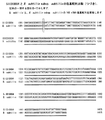
- the 16S rDNA base sequence of AZ-5512 (SIID10004) is higher than the 16S rDNA base sequence of the genus Bacillus Although homology was shown but the 16S rDNA base sequence derived from the reference strain was not searched, two types of 16S rDNA base sequences were obtained and BLAST homology search was performed. As a result, the 16S rDNA base sequence of AZ-5512 (SIID10004) is B. subtilis Subsp. inaquosorum NRRL B-23052 strain and B. tequilensis NRRL B-41771 strain showed high homology of 99.9% respectively (FIG. 1).
- AZ-5512 belongs to the genus Bacillus at the genus level. Also, AZ-5512 (SIID10004) and B.subtilis A difference of one base was confirmed between the 16S rDNA base sequences of subsp. subtilis, and it was found that they were clearly different (FIGS. 2 to 4). Thus, 16SrDNA Based on the results of the nucleotide sequence analysis, AZ-5512 (SIID10004) is a Bacillus sp. It was estimated. 2 to 4, “the present strain AZ-5512 (SIID10004) and B. In the figure showing the base sequence comparison of subtilis subsp. and subtilis, the part where the sequence matches is indicated by "*", and B. subtilis is B. subtilis. It means the 16S rDNA base sequence of subsp. subtilis.
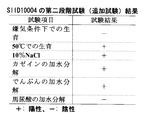
- AZ-5512 (SIID10004) is a gram-positive spore-forming gonococci with motility, and no swelling of the cells due to the spore was observed, the catalase reaction was positive, and the oxidase reaction was negative (FIG. 5). These properties are considered to be almost the same as those of the genus Bacillus.
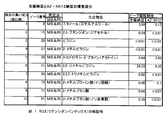
- AZ-5512 (SIID10004) oxidizes glycerol, L-arabinose, ribose, glucose, etc., does not oxidize D-arabinose, D-xylose, etc., produces acetoin, Hydrolysis was performed to reduce nitrate (FIGS. 6 and 7).
- AZ-5512 (SIID10004) did not grow under anaerobic conditions, grew at 50 ° C. and 10% NaCI, hydrolyzed casein and starch, and did not hydrolyze hippuric acid (FIG. 8). These properties are considered to be almost the same as the properties of B. subtilis whose closeness was suggested in the results of 16S rDNA nucleotide sequence analysis.
- AZ-5512 was identified as Bacillus subtilis (Bacillus subtilis).
- the natto production test using the isolated bacteria is performed in a small automatic natto manufacturing apparatus for laboratories by inoculating various kinds of isolated bacteria into steamed soybeans and filling them into natto containers.
- physical and chemical tests are further performed on the products that are deemed necessary, and excellent natto-producing bacteria are discovered. Natto can be produced.
- This strain (AZ-5512) was also selected through this process.
- natto using this strain is as follows. That is, normal soybean material for natto is usually immersed in a normal condition, and is cooked properly in the range of 120 ° C to 130 ° C for 15 to 60 minutes. The number of spores of the strain per gram of 1.0 ⁇ 10 3 Inoculate 5 to 1.0 x 10 5 cells, fill into a container, and ferment under conditions of room temperature 36 to 40 ° C and high humidity. The production of natto using this strain (AZ-5512) was also followed.
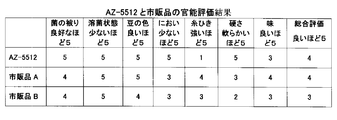
- the sensory test was conducted using three varieties of natto using this strain (AZ-5512) and commercial products A and B natto on the same production date, which were taken out of the refrigerator two days after production and left at room temperature for 1 hour. Later, a sensory test was performed.
- a five-point evaluation was performed by five employees who belonged to the quality control section of the applicant. That is, commercial products A and B natto were inspected at the same time, and the evaluation was “3 (ordinary)” in a five-step evaluation, “5” was good and “1” was bad (FIG. 9).
- natto using this strain (AZ-5512) has a slightly sweeter scent and no natto odor. Because it does not smell of natto, it is thought that it is a product that is well accepted by people who don't like natto.
- natto using this strain (AZ-5512) is a very soft product that is easy to eat and easy to process as a food processing material. Although stringing is a characteristic of natto, it was found that natto using this strain (AZ-5512) has almost no stringing. In addition, when natto using this strain (AZ-5512) was sampled by a foreigner, it was found that it can also be eaten by a foreigner who does not like the sticky texture of sticky noodles.
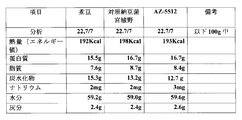
- natto using this strain (AZ-5512) has a sweetness and a lot of amino acids that cause sweetness, so a sweet natto product can be obtained. Details are as shown in FIG.
- the measuring method is as follows. 150 g of natto for analysis was put in a stomacher bag, and 300 ml of tap water was added and allowed to stand at room temperature. Every 20 minutes, the natto in the bag was gently stirred for about 30 seconds so that no bubbles formed in the water, and the stickiness of the natto surface was evenly eluted in the water. In the final round after 60 minutes, after similarly stirring, the natto in the bag was filtered through a colander, and 200 ml or more of filtrate was collected in a 500 ml stainless beaker. Installed so that the viscometer rotor sinks in the beaker filtrate. For ordinary natto, measure the absolute viscosity using the normal rotor No.
- the GC conditions are as follows. Gas chromatograph ... Shimadzu GC14B type capillary column ... DB-Wax (inner diameter 0.53mm x length 30m, film thickness 1 ⁇ m, manufactured by Agilent) Carrier gas: helium: flow rate, 35 cm / sec: injection temperature, 250 ° C .; initial column temperature: 50 ° C., rate of temperature increase, 4 ° C./min: detector, FID.
- the MS conditions are as follows. Equipment: JEOL JMS-DX303 Ion source temperature ... 200 °C Ionization voltage ... 70V Mass range... 35-400amu Scan time ... 1 scan / second detection ... RI detector.
- the method is as follows. Take 10 g of natto into a 500 ml Erlenmeyer flask, connect a Tenax-TA column (diameter 3 mm x length 15 cm), and flow helium gas at a flow rate of 10 ml / min for 50 minutes into the Erlenmeyer flask containing the sample. Gathered.
- FIG. 14 shows the result of comparing the peak area value obtained by GC detection with the FID with the peak area value of the internal standard substance.
- the main odor components of natto are the following 10 components. That is, 1. ethanol 2. Diacetyl 3. Pyrazine 4. 2-Methylpyrazine Five. Acetoin 6. 2,5-Dimethylpyrazine 7. 2,3,5-Trimethylpyrazine 8. Isolaxan 9. Isovaleric acid 10. 2-Methylbutyric acid
- the hardness test of natto was performed based on the measurement method of steamed soybean and natto by the natto test method edited by the natto test method study group. This is to cool the steamed soybeans and natto so as not to lose moisture, place them one by one on the top clock scale, crush them with the index finger, and make the hardness by the number of grams when crushed. Yes, in this test, the average value of 60 grains was obtained.
- Test results (2-1) The hardness after fermentation is reduced to 80-70% in the present strain (AZ-5512) compared to the hardness of steamed soybeans, but in the case of commercial strains, it is 110-130 %, And the difference in hardness is about 60%. (2-2) In the case of this strain (AZ-5512), it softens after completion of fermentation. In the case of a commercially available fungus, it tends to soften after 3 days of refrigeration, but it does not reach the hardness of boiled beans. (2-3) In the case of this strain (AZ-5512), it was softened after fermentation, regardless of the variety of raw soybean.
- natto tempura For example, it can be used for fried in oil, natto tempura, fries, etc.
- natto generation of ammonia odor and deterioration of tempura oil were caused, but the present invention natto can reduce such deterioration as much as possible.
- the natto of the present invention has a beautiful appearance, especially black bean natto, which is worthy of its color, has a sweet aroma and a sweet taste, so it can be used for toppings of cakes, etc. It can also be baked and nutritionally enhanced.
Landscapes
- Life Sciences & Earth Sciences (AREA)
- Engineering & Computer Science (AREA)
- Health & Medical Sciences (AREA)
- Chemical & Material Sciences (AREA)
- Biotechnology (AREA)
- Microbiology (AREA)
- Organic Chemistry (AREA)
- Bioinformatics & Cheminformatics (AREA)
- Genetics & Genomics (AREA)
- Wood Science & Technology (AREA)
- Zoology (AREA)
- Polymers & Plastics (AREA)
- Food Science & Technology (AREA)
- Nutrition Science (AREA)
- Tropical Medicine & Parasitology (AREA)
- General Engineering & Computer Science (AREA)
- General Health & Medical Sciences (AREA)
- Biochemistry (AREA)
- Biomedical Technology (AREA)
- Virology (AREA)
- Medicinal Chemistry (AREA)
- Agronomy & Crop Science (AREA)
- Botany (AREA)
- Beans For Foods Or Fodder (AREA)
- Micro-Organisms Or Cultivation Processes Thereof (AREA)
Abstract
Description
「食品加工シリーズ(5) 納豆」(渡辺杉夫、農文協)
「Industrialization of Indigenous
Fermented Foods」(渡辺杉夫他、MERCEL DEKKER INC)
「発酵と醸造 ▲3▼」(渡辺杉夫・他、光琳)
「つくって遊ぼう (2) 納豆の絵本」(渡辺杉夫・他、農文協)
「納豆の科学―最新情報による総合的考察」(渡辺杉夫・他、建帛社)
「大豆のすべて」(渡辺杉夫・他、サイエンスフォーラム)
「納豆の研究法」(渡辺杉夫・他編 恒星社 厚生閣 )
「食品知識ミニブックスシリーズ 納豆入門」(渡辺杉夫、日本食糧新聞社)
「納豆の製造技術と包装工程」(1985-10 食品と科学 (株)食品と化学社)
「大豆工業・その発展の過程と現状」(1991-2/3合併号社団法人大豆安定協会)
「納豆製造技術の課題・国際技術移転」(1994-10 大豆と技術 (株)フードジャーナル社)
「納豆発酵中の熱量測定」(1999-05-15 日本食品化学工業会)
「成長市場:納豆生産の工業化と国際化」(2000-09-01 農林水産技術研究ジャーナル)
「エラスターゼ高生産菌のロイシン要求性株による低臭納豆の開発」(2001-04-15
日本食品科学工学誌)
「糸引き納豆製造法の改良」(2001-04-15 日本食品科学工誌)
「環境ストレス下における納豆菌の胞子形成」(2006-03-15 日本食品科学工学誌)
「軟らかく糸引きの良い高齢者向け納豆の開発」(2006-09 日本食品科学工学誌)
「高橋菌から分離した納豆菌KFPの食品エキスによる胞子形成」(2007-09日本食品科学工学誌)
subtilis)に属する菌であると同定され、これを独立行政法人産業技術総合研究所・特許生物寄託センターに寄託した(受託番号:FERM P-22135)。
16SrDNA(16SrRNA遺伝子)塩基配列解析、形態観察及び生理・生化学性状試験(以下、「細菌第一段階試験」及び「細菌第二段階試験」と称する。)の結果から検体の帰属分類を推定する。
1.培養条件
以下の条件で培養した菌株を供試菌体とした。
・培地 nutrient agar
(Oxoid,Hampshire,England)
・培養温度 30℃
・培養期間 24時間
抽出からサイクルシークエンスまでの操作は各プロトコールに基づいた。
・DNA抽出 lnstaGene Matrix (BIO
RAD,CA,USA)
・PCR PrimeSTAR HS DNA Polymerase (タカラバイオ,滋賀)
・サイクルシークエンス BigDye Tenllinator v3.1
Cycle Sequencing Kjt (Applied Biosystems, CA,USA)
・使用プライマー) PCR増幅:9F,1510Rシークエンス:9F785F,802R,1510R
・シークエンス ABI PRISM 3130 xl Genetic
Analyzer System(Applied Biosystems, CA,USA)
・配列決定 ChromasPro l.4(Technelysium Pty
Ltd.,Tewantin,AUS)
・相同性検索及び簡易分子系統解析 ソフトウェア;アポロン2.0(テクノスルガ・ラボ,静岡) データベース;アポロンDB-BA
6.0(テクノスルガ・ラボ,静岡) 国際塩基配列データベース(GenBank/DDBJ/EMBL)
光学顕微鏡による形態観察及びBARROW らの方法に基づき、カタラーゼ反応、オキシダーゼ反応、ブドウ糖からの酸/ガス産生、ブドウ糖の酸化/醗酵(O/F)について試験を行った。
・グラム染色 フェイバーG「ニッスイ」(日水製薬、東京)
・顕微鏡 光学顕微鏡BX50F4(オリンパス、東京)
細菌第二段階試験には以下のキットを用いた。また、英国NCIMB
Ltd.(http://www.ncimb.comuk/)との技術提携事項及び分類・同定の関連文献に従い、追加試験を実施した。
・使用キット API50CHB(bioMerieux、Lyon、France)
1.16SrDNA(16SrRNA 遺伝子)塩基配列解析
subsp.inaquosorum NRRL B-23052株及びB.tequilensis NRRL B-41771株に対し、それぞれ相同率99.9%の高い相同性を示した(図1)。
subsp. subtilisの16S rDNA塩基配列間には、1塩基の相違点が確認され、明確に異なることが判明した(図2~図4)。このように、16SrDNA
塩基配列解析の結果から、AZ-5512(SIID10004)はB.subtilisに近縁なBacillus sp.と推定された。尚、図2~図4の「本株菌AZ-5512(SIID10004)とB.
subtilis subsp.及びsubtilisの塩基配列比較を示す図」において、配列の一致する箇所は「*」で示し、B.subtilisは、B.subtilis
subsp.subtilisの16SrDNA塩基配列を意味する。
subsp.subtilisとの間で認められた16SrDNA 塩基配列の相違は、B.subtilis種内での相違であるとも捉えられる。
subtilis)に属する菌であることが判明した。
ガスクロマトグラフ…島津製作所GC14B型
キャピラリーカラム…DB-Wax(内径0.53mm×長さ30m、膜厚1μm,アジレント社製)
キャリアガス…ヘリウム:流速、35cm/秒:注入温度、250℃;カラム初期温度:50℃、昇温割合、4℃/分:検出器、FID.
機器…日本電子JMS-DX303
イオン源温度…200℃
イオン化電圧…70V
マスレンジ…35-400amu
スキャン時間…1スキャン/秒
検出…RI検出器。
納豆10gを500ml三角フラスコに採り、Tenax-TAカラム(直径3mm×長さ15cm)を接続し、ヘリウムガスを流速10ml/分で50分間、試料の入った三角フラスコに流して試料の揮発性成分を集気した。集気終了後Tenax-TAカラムをDB-Waxカラムの上端に接続し、カラム出口をX字キャピラリーコネクターにより、メイクアップ・ガスを加えながら2方向にヒューズドシリカチュープを用いて分岐し、一方をピーク検出のためにFIDへ導き,もう一方をガスクロマトグラフ・オーブンの外へ導き、スニッフィング(Sniffing:人が臭いを嗅ぐ)法で納豆臭類似成分10種を調べた。
同一のカラムを日本電子製ガスクロマトグラブ・マススペクトロメーターJMS-DX303に接続し、同一の条件で分析することにより、臭い物質の固定を行った。尚、マススペクトル測定は35-400amuの範囲を1秒間で走査することにより行い、電子衝撃法で得られたスペクトルを日本電子製コンピューター(DAWIN)に保存してあるデーターベースと比較することによりピークの固定を行った。更に、リテンションインデックス(以下,RI)を標品と比較することにより同定を確実なものとした。
1.エタノール
2.ジアセチル
3.ピラジン
4. 2-メチルピラジン
5.アセトイン
6. 2,5-ジメチルピラジン
7. 2,3,5,-トリメチルピラジン
8.イソラクサン
9.イソ吉草酸
10.2-メチル酪酸
(1)試験方法
製造条件
(1-1)蒸煮条件 1.6k-26min-20min
(1-2)接種菌量 原液2.0×10⁸
(1-3)醗酵条件
温度経過 43℃8h、46℃5h、43℃7h、20℃2h
湿度経過 初発80%以上
(1-4)冷蔵 5℃
(3-1)同一の原料大豆で試験を行ったが、醗酵後当日で納豆の硬度は蒸煮大豆に比較し、50%となった。
(3-2)3日間の冷蔵保存中の硬度変化はみられなかった。
(1)試験方法
種類の異なる大豆3種にAZ=5512株と市販菌とをそれぞれ接種し、軟化度の比較試験を行った。市販菌は、鈴丸(図15)、地塚(図16)、とよまさり(図17)である。
(2-1)醗酵終了後の硬度は蒸煮大豆の硬度に比較し、本株菌(AZ-5512)では80~70%と低下するが、市販菌の場合は110~130%に硬化し、硬度の差は60%程度となる。
(2-2)本株菌(AZ-5512)の場合は、醗酵終了後に軟化する。市販菌の場合は、冷蔵3日後には軟化傾向をみせるが、煮豆の硬度程度にはならない。
(2-3) 本株菌(AZ-5512)の場合は、原料大豆の品種を選ばず、醗酵後軟化した。
Claims (2)
- バチルス・ズブチルス(Bacillus subtilis)AZ-5512菌株(FERM
P-22135)。 - バチルス・ズブチルス(Bacillus subtilis)AZ-5512菌株(FERM
P-22135)を用いて製造したことを特徴とする納豆。
Priority Applications (3)
| Application Number | Priority Date | Filing Date | Title |
|---|---|---|---|
| EP12832197.3A EP2757150B1 (en) | 2011-09-13 | 2012-09-11 | New bacillus subtilis subsp. natto and natto produced using same |
| US14/344,064 US20140335262A1 (en) | 2011-09-13 | 2012-09-11 | Bacillus subtilis subsp. natto and natto produced by using same |
| KR1020147009119A KR101722822B1 (ko) | 2011-09-13 | 2012-09-11 | 신규 낫토균(納豆菌) 및 이것을 사용해서 제조한 낫토 |
Applications Claiming Priority (2)
| Application Number | Priority Date | Filing Date | Title |
|---|---|---|---|
| JP2011198971A JP4918173B1 (ja) | 2011-09-13 | 2011-09-13 | 新規納豆菌及びこれを用いて製造した納豆 |
| JP2011-198971 | 2011-09-13 |
Publications (1)
| Publication Number | Publication Date |
|---|---|
| WO2013039058A1 true WO2013039058A1 (ja) | 2013-03-21 |
Family
ID=46243782
Family Applications (1)
| Application Number | Title | Priority Date | Filing Date |
|---|---|---|---|
| PCT/JP2012/073175 Ceased WO2013039058A1 (ja) | 2011-09-13 | 2012-09-11 | 新規納豆菌及びこれを用いて製造した納豆 |
Country Status (5)
| Country | Link |
|---|---|
| US (1) | US20140335262A1 (ja) |
| EP (1) | EP2757150B1 (ja) |
| JP (1) | JP4918173B1 (ja) |
| KR (1) | KR101722822B1 (ja) |
| WO (1) | WO2013039058A1 (ja) |
Cited By (1)
| Publication number | Priority date | Publication date | Assignee | Title |
|---|---|---|---|---|
| WO2015163120A1 (ja) * | 2014-04-24 | 2015-10-29 | 茨城県 | 糸引性低下納豆菌株及び該納豆菌株による納豆の製造方法と納豆 |
Families Citing this family (3)
| Publication number | Priority date | Publication date | Assignee | Title |
|---|---|---|---|---|
| KR101865177B1 (ko) * | 2016-11-25 | 2018-06-08 | 롯데제과 주식회사 | 효소 생성능, 담즙 저항성, 및 헬리코박터 파일로리에 대한 항균능을 가지면서 혈전 용해능을 가지는 바실러스 서브틸리스(Bacillus subtilis) LRCC1002 균주 |
| CN110506106A (zh) * | 2017-04-06 | 2019-11-26 | 韩国食品研究院 | 具有降低糖基化终末产物的活性的新型菌株及其用途 |
| KR102005434B1 (ko) * | 2018-02-22 | 2019-07-30 | 강원대학교산학협력단 | 아플라톡신 생성 아스퍼질러스 플라버스 균주를 억제하는 바실러스 서틸리스 af11 |
Citations (8)
| Publication number | Priority date | Publication date | Assignee | Title |
|---|---|---|---|---|
| JPS6455156A (en) * | 1987-08-25 | 1989-03-02 | Otsuka Food Co Ltd | 'natto' |
| JPH06269281A (ja) * | 1993-03-22 | 1994-09-27 | Aomori Pref Gov | アンモニア発生量およびプロテアーゼ活性の低い納豆菌及びそれを用いた納豆の製造方法 |
| JP2554454B2 (ja) | 1994-09-12 | 1996-11-13 | 鈴与工業株式会社 | エラスターゼ生産納豆菌及びこれを用いた納豆の製造方法 |
| JP2006025785A (ja) * | 2004-06-15 | 2006-02-02 | Mitsukan Group Honsha:Kk | 糸引性低下納豆菌、該納豆菌を用いて製造された糸引性低下納豆 |
| JP2006067992A (ja) | 2004-08-02 | 2006-03-16 | Suzuyo Kogyo Co Ltd | バチルス・ズブチルス菌株及びこれを用いて製造した納豆 |
| JP2006314252A (ja) | 2005-05-12 | 2006-11-24 | Suzuyo Kogyo Co Ltd | 納豆の製造方法 |
| JP2007143467A (ja) * | 2005-11-28 | 2007-06-14 | Mitsukan Group Honsha:Kk | グルタミン合成酵素遺伝子、該遺伝子の発現が増強された納豆菌、及び該納豆菌を用いて製造されたアンモニア含量低下納豆 |
| JP2007209294A (ja) * | 2006-02-13 | 2007-08-23 | Takano Foods Kk | 納豆菌及び納豆の製造方法 |
Family Cites Families (15)
| Publication number | Priority date | Publication date | Assignee | Title |
|---|---|---|---|---|
| JPH03254659A (ja) * | 1990-03-05 | 1991-11-13 | Asahi Kogyo Kk | 高旨み高粘性納豆の製造法 |
| JPH0440889A (ja) * | 1990-06-06 | 1992-02-12 | Fujitsuko Kk | 納豆菌およびそれを用いた納豆の製法 |
| JPH0646924B2 (ja) * | 1990-11-06 | 1994-06-22 | タカノフーズ株式会社 | 納豆の製造方法及び納豆菌 |
| JPH08154616A (ja) * | 1994-12-09 | 1996-06-18 | Kikkoman Corp | 品質改良納豆および新規変異菌株 |
| JPH10262655A (ja) * | 1997-03-25 | 1998-10-06 | Hoshino Kagaku Kk | 新規な納豆菌およびその取得方法ならびに新規な納豆菌が産生するポリ−γ−グルタミン酸とそれを利用した調味料 |
| JP4264159B2 (ja) * | 1999-04-07 | 2009-05-13 | 株式会社ミツカングループ本社 | ビタミンk2高生産性納豆菌、その育種方法及び納豆 |
| JP3822773B2 (ja) * | 2000-02-28 | 2006-09-20 | 株式会社丸美屋 | 血栓溶解酵素及び粘質物を多量に生産する納豆菌株及びその取得方法 |
| JP2002034554A (ja) * | 2000-07-28 | 2002-02-05 | Mitsukan Group Honsha:Kk | ビタミンk2高生産納豆菌、その育種方法及び納豆 |
| JP3564121B2 (ja) * | 2003-01-20 | 2004-09-08 | タカノフーズ株式会社 | 納豆菌及び納豆の製造方法 |
| JP4241746B2 (ja) * | 2006-02-10 | 2009-03-18 | 幹 木内 | バチルス・ズブチリス菌株およびこれを用いた納豆の製造方法 |
| JP2008113633A (ja) * | 2006-11-08 | 2008-05-22 | Mitsukan Group Honsha:Kk | ビタミンb2高生産納豆菌、及び該納豆菌を用いて製造された納豆 |
| JP4657366B2 (ja) * | 2007-02-27 | 2011-03-23 | 株式会社ミツカングループ本社 | アンモニア低発生性納豆菌、該納豆菌を用いた納豆の製造方法及び納豆 |
| JP4659781B2 (ja) * | 2007-04-25 | 2011-03-30 | 株式会社ミツカングループ本社 | 新規納豆菌、及び該納豆菌を用いて製造された柔らかい納豆 |
| JP2009201466A (ja) * | 2008-02-29 | 2009-09-10 | Fujicco Co Ltd | 納豆の製法およびそれにより得られた納豆 |
| JP2009213423A (ja) * | 2008-03-12 | 2009-09-24 | Takano Foods Kk | アンモニア生産が抑制された納豆菌、及びそれを用いて製造した納豆 |
-
2011
- 2011-09-13 JP JP2011198971A patent/JP4918173B1/ja active Active
-
2012
- 2012-09-11 WO PCT/JP2012/073175 patent/WO2013039058A1/ja not_active Ceased
- 2012-09-11 EP EP12832197.3A patent/EP2757150B1/en not_active Not-in-force
- 2012-09-11 US US14/344,064 patent/US20140335262A1/en not_active Abandoned
- 2012-09-11 KR KR1020147009119A patent/KR101722822B1/ko not_active Expired - Fee Related
Patent Citations (8)
| Publication number | Priority date | Publication date | Assignee | Title |
|---|---|---|---|---|
| JPS6455156A (en) * | 1987-08-25 | 1989-03-02 | Otsuka Food Co Ltd | 'natto' |
| JPH06269281A (ja) * | 1993-03-22 | 1994-09-27 | Aomori Pref Gov | アンモニア発生量およびプロテアーゼ活性の低い納豆菌及びそれを用いた納豆の製造方法 |
| JP2554454B2 (ja) | 1994-09-12 | 1996-11-13 | 鈴与工業株式会社 | エラスターゼ生産納豆菌及びこれを用いた納豆の製造方法 |
| JP2006025785A (ja) * | 2004-06-15 | 2006-02-02 | Mitsukan Group Honsha:Kk | 糸引性低下納豆菌、該納豆菌を用いて製造された糸引性低下納豆 |
| JP2006067992A (ja) | 2004-08-02 | 2006-03-16 | Suzuyo Kogyo Co Ltd | バチルス・ズブチルス菌株及びこれを用いて製造した納豆 |
| JP2006314252A (ja) | 2005-05-12 | 2006-11-24 | Suzuyo Kogyo Co Ltd | 納豆の製造方法 |
| JP2007143467A (ja) * | 2005-11-28 | 2007-06-14 | Mitsukan Group Honsha:Kk | グルタミン合成酵素遺伝子、該遺伝子の発現が増強された納豆菌、及び該納豆菌を用いて製造されたアンモニア含量低下納豆 |
| JP2007209294A (ja) * | 2006-02-13 | 2007-08-23 | Takano Foods Kk | 納豆菌及び納豆の製造方法 |
Non-Patent Citations (19)
| Title |
|---|
| "Daizukougyou - Sono Hatten No Katei To Genzyou", 1991, INSTITUTE OF SOYBEAN STABILITY ASSOCIATION |
| "Development of Low-Odor Natto produced with Leucine- requiring Mutants of Elastase-Producing Natto Bacillus", JOURNAL OF THE JAPAN SOCIETY FOR FOOD SCIENCE AND TECHNOLOGY, 15 April 2001 (2001-04-15) |
| "Development of Soft, Natto having less sticky threads produced for Aged persons", JOURNAL OF THE JAPAN SOCIETY FOR FOOD SCIENCE AND TECHNOLOGY, 2006 |
| "Itohiki Natto Seizouhou No Kairyo", JOURNAL OF THE JAPAN SOCIETY FOR FOOD SCIENCE AND TECHNOLOGY, 15 April 2001 (2001-04-15) |
| "Microcalorimetric Analysis of Fermentation of Natto, a Traditional Japanese Food", 15 May 1999, JAPAN SOCIETY FOR FOOD SCIENCE AND TECHNOLOGY |
| "Natto No Kenkyuhou", KOUSEISHA-KOUSEIKAKU CORPORATION |
| "Natto No Seizougizyutsu To Housoukoutei", SHOKUHIN TO KAGAKUSHA |
| "Natto Seizou Gizyutsu No Kadai - Kokusai Gizyutsu Iten", 1994, FOOD JOURNAL CO., LTD |
| "Seicho Shizyou: Natto Seisan No Kougyouka To Kokusaika", JOURNAL OF TECHNOLOGY RESEARCH FOR AGRICULTURE, FORESTRY AND FISHERIES, 1 September 2000 (2000-09-01) |
| "Spore Formation in Natto Bacilli under Environmental Stress", JOURNAL OF THE JAPAN SOCIETY FOR FOOD SCIENCE AND TECHNOLOGY, 15 March 2006 (2006-03-15) |
| "Takabashikin Kara Bunrishita Nattokin KFP No Shokuhin Ekisuniyoru Houshikeisei", JOURNAL OF THE JAPAN SOCIETY FOR FOOD SCIENCE AND TECHNOLOGY, 2007 |
| SUGIO WATANABE ET AL.: "Chiiki Shigen Katsuyou Shokuhin Kakou Souran", vol. 5, RURAL CULTURE ASSOCIATION JAPAN |
| SUGIO WATANABE ET AL.: "Hakkou To Zyouzou", KOURIN |
| SUGIO WATANABE ET AL.: "Industrialization of Indigenous Fermented Foods", MERCEL DEKKER INC |
| SUGIO WATANABE ET AL.: "Natto No Kagaku - Saishin Zyouhouniyouru Sougouteki Kousatsu", KENPAKUSHA |
| SUGIO WATANABE ET AL.: "Natto No Subete", SCIENCE FORUM |
| SUGIO WATANABE ET AL.: "Tsukutte Asobou (2) Natto No Ehon", RURAL CULTURE ASSOCIATION JAPAN |
| SUGIO WATANABE: "Shokuhin Kakou Series", RURAL CULTURE ASSOCIATION JAPAN |
| SUGIO WATANABE: "Shokuhinchishiki Mini Book Series Natto Nyuumon", JAPAN FOOD JOURNAL CO., LTD. |
Cited By (1)
| Publication number | Priority date | Publication date | Assignee | Title |
|---|---|---|---|---|
| WO2015163120A1 (ja) * | 2014-04-24 | 2015-10-29 | 茨城県 | 糸引性低下納豆菌株及び該納豆菌株による納豆の製造方法と納豆 |
Also Published As
| Publication number | Publication date |
|---|---|
| EP2757150A4 (en) | 2015-06-24 |
| US20140335262A1 (en) | 2014-11-13 |
| JP2013059277A (ja) | 2013-04-04 |
| KR101722822B1 (ko) | 2017-04-06 |
| JP4918173B1 (ja) | 2012-04-18 |
| KR20140060569A (ko) | 2014-05-20 |
| EP2757150B1 (en) | 2018-01-17 |
| EP2757150A1 (en) | 2014-07-23 |
Similar Documents
| Publication | Publication Date | Title |
|---|---|---|
| Zhang et al. | Characterization of γ-aminobutyric acid (GABA)-producing Saccharomyces cerevisiae and coculture with Lactobacillus plantarum for mulberry beverage brewing | |
| Ardhana et al. | The microbial ecology of cocoa bean fermentations in Indonesia | |
| Johansson et al. | Phenotypically based taxonomy using API 50CH of lactobacilli from Nigerian ogi, and the occurrence of starch fermenting strains | |
| CN108004175B (zh) | 一种贝莱斯芽孢杆菌及其制备方法和应用 | |
| Thwe et al. | Isolation, characterization, and utilization of γ-aminobutyric acid (GABA)-producing lactic acid bacteria from Myanmar fishery products fermented with boiled rice | |
| Ewuoso et al. | Lactic acid bacteria and yeasts in spontaneously fermented sorghum sourdough | |
| JP4918173B1 (ja) | 新規納豆菌及びこれを用いて製造した納豆 | |
| KR101825957B1 (ko) | 저온 적응성 효모 사카로마이세스 세레비지에 y297 및 이를 이용하여 제조된 발효주 | |
| Guan et al. | Bioturbation effect of artificial inoculation on the flavor metabolites and bacterial communities in the Chinese Mao-tofu fermentation | |
| JP6177564B2 (ja) | 優れた低温感受性を示す新規納豆菌および二次発酵が顕著に抑制された納豆 | |
| Adeniran et al. | Microbiological studies and sensory evaluation of breadfruit and cassava co-fermented into gari analogue | |
| KR20150032379A (ko) | Gaba 생산능이 우수한 락토바실러스 브레비스 4-12 균주 및 이를 함유한 김치의 제조방법 | |
| Zhu et al. | Safety assessment and fermentation potential of Lactiplantibacillus plantarum L3 isolated from the traditional Chinese fermented food Bianba for yogurt production | |
| KR102404753B1 (ko) | 복합 균주를 이용한 발효 식품의 제조방법 및 이에 따라 제조된 발효 식품 | |
| Enujiugha et al. | Evaluation of starters for the fermentation of African oil bean (Pentaclethra macrophylla Benth) seeds | |
| Flibert et al. | Lactic acid bacteria and yeasts associated with cassava fermentation to attiéké in burkina faso and their technological properties | |
| KR102231483B1 (ko) | 바실러스 세레우스 생육 저해력을 갖는 류코노스톡 메센테로이데스 균주 | |
| Sakai et al. | Isolation of lactic acid bacteria from takanazuke as a starter strain to reduce added salt and stabilize fermentation | |
| JP2006067992A (ja) | バチルス・ズブチルス菌株及びこれを用いて製造した納豆 | |
| JP5732505B2 (ja) | グルコース高含有納豆、該納豆を作るための納豆菌及び該グルコース高含有納豆の製造方法 | |
| TWI694776B (zh) | 用於提升茶材料風味的製茶方法及其產物 | |
| Hang et al. | Diversity of cultivable lactic acid bacteria and bacilli in traditional fermented foods in Vietnam. | |
| JP5334530B2 (ja) | 新規乳酸菌を含む食品及びその製造方法 | |
| Akanni | Alkaline fermentation of Bambara groundnut (Vigna subterranean L. Verdc.) as dawadawa-like African food condiment | |
| KR101526955B1 (ko) | 전통장류 유래 알코올을 고생산하는 효모 균주 및 이의 용도 |
Legal Events
| Date | Code | Title | Description |
|---|---|---|---|
| 121 | Ep: the epo has been informed by wipo that ep was designated in this application |
Ref document number: 12832197 Country of ref document: EP Kind code of ref document: A1 |
|
| NENP | Non-entry into the national phase |
Ref country code: DE |
|
| ENP | Entry into the national phase |
Ref document number: 20147009119 Country of ref document: KR Kind code of ref document: A |
|
| WWE | Wipo information: entry into national phase |
Ref document number: 2012832197 Country of ref document: EP |
|
| WWE | Wipo information: entry into national phase |
Ref document number: 14344064 Country of ref document: US |