WO2013042764A1 - ニトリル共重合体ゴム組成物及びゴム架橋物 - Google Patents
ニトリル共重合体ゴム組成物及びゴム架橋物 Download PDFInfo
- Publication number
- WO2013042764A1 WO2013042764A1 PCT/JP2012/074201 JP2012074201W WO2013042764A1 WO 2013042764 A1 WO2013042764 A1 WO 2013042764A1 JP 2012074201 W JP2012074201 W JP 2012074201W WO 2013042764 A1 WO2013042764 A1 WO 2013042764A1
- Authority
- WO
- WIPO (PCT)
- Prior art keywords
- weight
- copolymer rubber
- nitrile copolymer
- nitrile
- rubber composition
- Prior art date
- Legal status (The legal status is an assumption and is not a legal conclusion. Google has not performed a legal analysis and makes no representation as to the accuracy of the status listed.)
- Ceased
Links
Classifications
-
- C—CHEMISTRY; METALLURGY
- C08—ORGANIC MACROMOLECULAR COMPOUNDS; THEIR PREPARATION OR CHEMICAL WORKING-UP; COMPOSITIONS BASED THEREON
- C08L—COMPOSITIONS OF MACROMOLECULAR COMPOUNDS
- C08L15/00—Compositions of rubber derivatives
-
- C—CHEMISTRY; METALLURGY
- C08—ORGANIC MACROMOLECULAR COMPOUNDS; THEIR PREPARATION OR CHEMICAL WORKING-UP; COMPOSITIONS BASED THEREON
- C08L—COMPOSITIONS OF MACROMOLECULAR COMPOUNDS
- C08L9/00—Compositions of homopolymers or copolymers of conjugated diene hydrocarbons
- C08L9/02—Copolymers with acrylonitrile
-
- C—CHEMISTRY; METALLURGY
- C08—ORGANIC MACROMOLECULAR COMPOUNDS; THEIR PREPARATION OR CHEMICAL WORKING-UP; COMPOSITIONS BASED THEREON
- C08K—Use of inorganic or non-macromolecular organic substances as compounding ingredients
- C08K5/00—Use of organic ingredients
- C08K5/04—Oxygen-containing compounds
- C08K5/10—Esters; Ether-esters
- C08K5/11—Esters; Ether-esters of acyclic polycarboxylic acids
-
- C—CHEMISTRY; METALLURGY
- C08—ORGANIC MACROMOLECULAR COMPOUNDS; THEIR PREPARATION OR CHEMICAL WORKING-UP; COMPOSITIONS BASED THEREON
- C08L—COMPOSITIONS OF MACROMOLECULAR COMPOUNDS
- C08L25/00—Compositions of, homopolymers or copolymers of compounds having one or more unsaturated aliphatic radicals, each having only one carbon-to-carbon double bond, and at least one being terminated by an aromatic carbocyclic ring; Compositions of derivatives of such polymers
- C08L25/02—Homopolymers or copolymers of hydrocarbons
- C08L25/04—Homopolymers or copolymers of styrene
- C08L25/08—Copolymers of styrene
-
- C—CHEMISTRY; METALLURGY
- C08—ORGANIC MACROMOLECULAR COMPOUNDS; THEIR PREPARATION OR CHEMICAL WORKING-UP; COMPOSITIONS BASED THEREON
- C08L—COMPOSITIONS OF MACROMOLECULAR COMPOUNDS
- C08L27/00—Compositions of homopolymers or copolymers of compounds having one or more unsaturated aliphatic radicals, each having only one carbon-to-carbon double bond, and at least one being terminated by a halogen; Compositions of derivatives of such polymers
- C08L27/02—Compositions of homopolymers or copolymers of compounds having one or more unsaturated aliphatic radicals, each having only one carbon-to-carbon double bond, and at least one being terminated by a halogen; Compositions of derivatives of such polymers not modified by chemical after-treatment
- C08L27/04—Compositions of homopolymers or copolymers of compounds having one or more unsaturated aliphatic radicals, each having only one carbon-to-carbon double bond, and at least one being terminated by a halogen; Compositions of derivatives of such polymers not modified by chemical after-treatment containing chlorine atoms
- C08L27/06—Homopolymers or copolymers of vinyl chloride
-
- Y—GENERAL TAGGING OF NEW TECHNOLOGICAL DEVELOPMENTS; GENERAL TAGGING OF CROSS-SECTIONAL TECHNOLOGIES SPANNING OVER SEVERAL SECTIONS OF THE IPC; TECHNICAL SUBJECTS COVERED BY FORMER USPC CROSS-REFERENCE ART COLLECTIONS [XRACs] AND DIGESTS
- Y10—TECHNICAL SUBJECTS COVERED BY FORMER USPC
- Y10T—TECHNICAL SUBJECTS COVERED BY FORMER US CLASSIFICATION
- Y10T428/00—Stock material or miscellaneous articles
- Y10T428/13—Hollow or container type article [e.g., tube, vase, etc.]
- Y10T428/1352—Polymer or resin containing [i.e., natural or synthetic]
- Y10T428/1379—Contains vapor or gas barrier, polymer derived from vinyl chloride or vinylidene chloride, or polymer containing a vinyl alcohol unit
Definitions
- the present invention relates to a nitrile copolymer rubber composition that provides a rubber cross-linked product having excellent mandrel crack resistance and gasoline permeation resistance, cold resistance and ozone resistance.
- rubber containing a ⁇ , ⁇ -ethylenically unsaturated nitrile monomer unit and a conjugated diene monomer unit has been known as a rubber having excellent oil resistance.
- nitrile copolymer rubber is used as a material for rubber products around various oils of automobiles such as fuel hoses, gaskets, packings, and oil seals.
- Patent Document 1 discloses a very high nitrile rubber (super high nitrile means a very high nitrile content of 55 to 80% by weight of nitrile), A vulcanizable nitrile copolymer rubber composition containing a vinyl chloride resin, a filler, a plasticizer and a vulcanizing agent is proposed.
- this vulcanizable nitrile rubber composition can provide a rubber vulcanizate having excellent gasoline permeation resistance and the like, there is a problem that mandrel cracks are likely to occur when molded using a mandrel. It was.
- An object of the present invention is to provide a nitrile copolymer rubber composition that provides a rubber cross-linked product having excellent mandrel crack resistance and good gasoline permeation resistance, cold resistance and ozone resistance.
- the present inventors have found that the above object is achieved by a nitrile copolymer rubber composition containing a specific nitrile copolymer rubber, a vinyl chloride resin and a specific plasticizer. Has been achieved, and the present invention has been completed.
- ⁇ , ⁇ -ethylenically unsaturated nitrile monomer unit (a1) 35 to 85% by weight, conjugated diene monomer unit (a2) optionally at least partially hydrogenated 15 to 65% by weight, cationic
- the ⁇ , ⁇ -ethylenically unsaturated nitrile monomer unit (a1) containing 0 to 30% by weight of the monomer unit (a3) and 0 to 50% by weight of the aromatic vinyl monomer unit (a4)
- a nitrile copolymer rubber composition containing a vinyl chloride resin (B) and a plasticizer (C) represented by the following general formula (1) is provided.
- R 1 is an alkylene group having 1 to 8 carbon atoms
- a and b are each independently an integer of 3 to 11
- c and d are each independently an integer of 0 to 8
- R 2 and R 3 are each independently an alkylene group having 1 to 6 carbon atoms.
- the said plasticizer (C) is what is represented by following General formula (2).
- R 1 is an alkylene group having 4 carbon atoms
- a and b are each independently an integer of 4 to 5
- c and d are each independently an integer of 0 to 4
- R 2 And R 3 is an alkylene group having 2 carbon atoms.
- the content of the vinyl chloride resin (B) is 1 to 150 parts by weight with respect to 100 parts by weight of the nitrile copolymer rubber (A), and the plasticizer
- the content of (C) is preferably 1 to 200 parts by weight.
- the content ratio of the cationic monomer unit (a3) in the nitrile copolymer rubber (A) is preferably 0.1 to 20% by weight.
- the content of the aromatic vinyl monomer unit (a4) in the nitrile copolymer rubber (A) is preferably 1 to 30% by weight.
- the nitrile copolymer rubber (A) preferably contains 0.5 to 90% by weight of methyl ethyl ketone insoluble matter.
- the nitrile copolymer rubber composition of the present invention further comprises a layered inorganic filler (D) having an aspect ratio of 30 to 2,000 with respect to 100 parts by weight of the nitrile copolymer rubber (A).
- the content is preferably 1 to 100 parts by weight.
- the present invention also provides a crosslinkable nitrile rubber composition containing the above nitrile copolymer rubber composition and a crosslinking agent, and a rubber crosslinked product obtained by crosslinking the crosslinkable nitrile rubber composition. Is done. And according to this invention, the hose obtained by bridge
- a nitrile copolymer rubber composition capable of providing a rubber cross-linked product having excellent mandrel crack resistance and excellent gasoline permeation resistance, cold resistance and ozone resistance.
- the nitrile copolymer rubber composition of the present invention is ⁇ , ⁇ -ethylenically unsaturated nitrile monomer unit (a1) 35 to 85% by weight, conjugated diene monomer unit (a2) optionally at least partially hydrogenated 15 to 65% by weight, cationic
- the ⁇ , ⁇ -ethylenically unsaturated nitrile monomer unit (a1) containing 0 to 30% by weight of the monomer unit (a3) and 0 to 50% by weight of the aromatic vinyl monomer unit (a4)
- R 1 is an alkylene group having 1 to 8 carbon atoms
- a and b are each independently an integer of 3 to 11
- c and d are each independently an integer of 0 to 8
- R 2 and R 3 are each independently an alkylene group having 1 to 6 carbon atoms.
- Nitrile copolymer rubber (A) used in the present invention comprises 35 to 85% by weight of ⁇ , ⁇ -ethylenically unsaturated nitrile monomer unit (a1), a conjugated diene which may be at least partially hydrogenated. Containing 15 to 65% by weight of monomer unit (a2), 0 to 30% by weight of cationic monomer unit (a3), and 0 to 50% by weight of aromatic vinyl monomer unit (a4), , ⁇ -ethylenically unsaturated nitrile monomer unit (a1) and aromatic vinyl monomer unit (a4) are nitrile copolymer rubber having a total content of 35 to 85% by weight.
- the ⁇ , ⁇ -ethylenically unsaturated nitrile monomer forming the ⁇ , ⁇ -ethylenically unsaturated nitrile monomer unit (a1) may be any ⁇ , ⁇ -ethylenically unsaturated compound having a nitrile group.
- acrylonitrile and methacrylonitrile are preferable, and acrylonitrile is particularly preferable. These can be used individually by 1 type or in combination of multiple types.
- the content ratio of the ⁇ , ⁇ -ethylenically unsaturated nitrile monomer unit (a1) in the nitrile copolymer rubber (A) is 35 to 85% by weight, preferably 39%, based on the total monomer units. It is ⁇ 79 wt%, more preferably 40 to 65 wt%. If the content ratio of the ⁇ , ⁇ -ethylenically unsaturated nitrile monomer unit (a1) is too low, the oil resistance and gasoline permeation resistance of the resulting rubber cross-linked product are deteriorated. On the other hand, if the content ratio of the ⁇ , ⁇ -ethylenically unsaturated nitrile monomer unit is too high, the brittle temperature of the resulting rubber cross-linked product becomes high and the cold resistance becomes poor.
- the nitrile copolymer rubber (A) used in the present invention is a conjugated diene monomer unit (a2) that may be at least partially hydrogenated so that the resulting rubber cross-linked product has rubber elasticity. Containing.
- “at least part of which may be hydrogenated” includes, as the conjugated diene monomer unit (a2), a hydrogenated carbon-carbon unsaturated bond in the conjugated diene monomer unit. Means that.
- the conjugated diene monomer forming the conjugated diene monomer unit (a2) which may be at least partially hydrogenated is preferably a conjugated diene monomer having 4 to 6 carbon atoms.
- the content ratio of the conjugated diene monomer unit (a2) which may be at least partially hydrogenated is 15 to 65% by weight based on the total monomer units, The content is preferably 19.9 to 59.9% by weight, more preferably 29.7 to 54.7% by weight.
- the content ratio of the conjugated diene monomer unit (a2) which may be at least partially hydrogenated is too low, the rubber elasticity of the resulting rubber crosslinked product may be lowered.
- the content of the conjugated diene monomer unit (a2), which may be at least partially hydrogenated is too high, the resulting rubber cross-linked product may be deteriorated in gasoline permeability resistance.
- the nitrile copolymer rubber (A) used in the present invention preferably contains a cationic monomer unit (a3).
- the cationic monomer unit (a3) means at least one monomer unit selected from the group consisting of a cation-containing monomer unit and a monomer unit capable of forming a cation.
- the cation-containing monomer that forms the cationic monomer unit (a3) is a monomer that forms a monomer unit that is positively charged when the resulting polymer is in contact with water or an aqueous acid solution. If it is, it will not be specifically limited. Examples of such cation-containing monomers include monomers containing a quaternary ammonium base. Further, as a monomer that forms a monomer unit capable of forming a cation, an ammonium salt (for example, amine hydrochloride or amine sulfate) is brought into contact with an aqueous acid solution such as hydrochloric acid and sulfuric acid such as a tertiary amino group. And a monomer having a precursor part (substituent) that forms a cation such as a salt).
- an ammonium salt for example, amine hydrochloride or amine sulfate
- the cation-containing monomer examples include (meth) acryloyloxytrimethylammonium chloride (abbreviation of “methacryloyloxytrimethylammonium chloride and acryloyloxytrimethylammonium chloride”, the same shall apply hereinafter), (meth) acryloyloxyhydroxypropyltrimethyl.
- a quaternary ammonium salt such as ammonium chloride, (meth) acryloyloxytriethylammonium chloride, (meth) acryloyloxydimethylbenzylammonium chloride, (meth) acryl
- the monomer that forms a monomer unit capable of forming a cation include vinyl group-containing cyclic tertiary amine monomers such as 2-vinylpyridine and 4-vinylpyridine; dimethyl (meth) acrylate Tertiary amino group-containing (meth) acrylic acid ester monomers such as aminoethyl; (meth) acrylamide-containing (meth) acrylamide monomers such as (meth) acrylamide dimethylaminoethyl and N, N-dimethylaminopropyl acrylamide N- (4-anilinophenyl) acrylamide, N- (4-anilinophenyl) methacrylamide, N- (4-anilinophenyl) cinnamamide, N- (4-anilinophenyl) crotonamide, N- Phenyl-4- (3-vinylbenzyloxy) aniline, N-phenyl-4- (4-vinylbenzyloxy) aniline And the like
- the vinyl group-containing cyclic tertiary amine monomer, the tertiary amino group-containing (meth) acrylic acid ester monomer, and the Tertiary amino group-containing (meth) acrylamide monomers are preferred, vinyl group-containing cyclic tertiary amine monomers and tertiary amino group-containing (meth) acrylamide monomers are more preferred, vinyl group-containing cyclic tertiary monomers.
- a secondary amine monomer is more preferable, among which vinyl group-containing pyridines are particularly preferable, and 2-vinylpyridine is most preferable.
- the content of the cationic monomer unit (a3) is 0 to 30% by weight, preferably 0.1 to 20% by weight, particularly preferably 0.3 to 10% by weight, based on all monomer units. is there.
- the resulting rubber cross-linked product becomes more excellent in gasoline permeation resistance.
- the nitrile copolymer rubber (A) used in the present invention preferably contains an aromatic vinyl monomer unit (a4) from the viewpoint of improving gasoline permeability resistance and cold resistance of the resulting rubber cross-linked product.
- an aromatic vinyl monomer forming the aromatic vinyl monomer unit (a4) an aromatic vinyl compound having no polar group is preferably used.
- styrene examples thereof include styrene, ⁇ -methylstyrene, 2-methylstyrene, 3-methylstyrene, 4-methylstyrene, 2,4-diisopropylstyrene, 2,4-dimethylstyrene, 4-t-butylstyrene, and 5 -T-butyl-2-methylstyrene and the like can be mentioned, but styrene is preferable because the effect of the present invention becomes more remarkable. These may be used alone or in combination of two or more.
- the content of the aromatic vinyl monomer unit (a4) is 0 to 50% by weight, preferably from 0 to 50% by weight, based on the total monomer units, from the viewpoint of improving gasoline permeability resistance and cold resistance of the resulting rubber cross-linked product. It is 1 to 30% by weight, particularly preferably 5 to 30% by weight.
- the nitrile copolymer rubber (A) used in the present invention has a total content of ⁇ , ⁇ -ethylenically unsaturated nitrile monomer unit (a1) and aromatic vinyl monomer unit (a4).
- the total monomer unit is 35 to 85% by weight, preferably 40 to 80% by weight, and particularly preferably 45 to 70% by weight. If the total content of the ⁇ , ⁇ -ethylenically unsaturated nitrile monomer unit (a1) and the aromatic vinyl monomer unit (a4) is too low, the gasoline permeability resistance of the resulting rubber cross-linked product deteriorates. If too much, cold resistance is inferior.
- the nitrile copolymer rubber (A) used in the present invention is a conjugated diene monomer in which at least a part of the ⁇ , ⁇ -ethylenically unsaturated nitrile monomer unit (a1) may be hydrogenated.
- the unit (a2), the cationic monomer unit (a3) and the aromatic vinyl monomer unit (a4) other monomers copolymerizable with the monomers forming these monomer units
- the unit may be contained.
- the content ratio of such other monomer units is preferably 30% by weight or less, more preferably 20% by weight or less, and still more preferably 10% by weight or less based on the total monomer units.
- Examples of such other copolymerizable monomers include fluorine-containing vinyl compounds such as fluoroethyl vinyl ether, fluoropropyl vinyl ether, difluoroethylene, and tetrafluoroethylene; 1,4-pentadiene, 1,4-hexadiene, Non-conjugated diene compounds such as vinyl norbornene and dicyclopentadiene; ethylene; ⁇ -olefin compounds such as propylene, 1-butene, 4-methyl-1-pentene, 1-hexene and 1-octene; acrylic acid, methacrylic acid and the like ⁇ , ⁇ -ethylenically unsaturated monovalent carboxylic acid; ⁇ , ⁇ -ethylenically unsaturated polyvalent carboxylic acid such as maleic acid, maleic anhydride, itaconic acid, itaconic anhydride, fumaric acid, maleic anhydride, and the like Products; methyl (meth) acrylate, eth
- Monoesters and diesters of monovalent carboxylic acids alkoxyalkyl esters of ⁇ , ⁇ -ethylenically unsaturated carboxylic acids such as methoxyethyl (meth) acrylate, methoxypropyl (meth) acrylate, butoxyethyl (meth) acrylate; Hydroxyalkyl esters of ⁇ , ⁇ -ethylenically unsaturated carboxylic acids such as 2-hydroxyethyl (meth) acrylate and 3-hydroxypropyl (meth) acrylate; divinyl compounds such as divinylbenzene; ethylene di (meth) acrylate, diethylene glycol di Multifunctional ethylenic unsaturation such as (meth) acrylates, di (meth) acrylates such as ethylene glycol di (meth) acrylate; tri (meth) acrylates such as trimethylolpropane tri (meth) acrylate; In addition to the monomer, self-crosslinking
- the Mooney viscosity of the nitrile copolymer rubber (A) (hereinafter sometimes referred to as “polymer Mooney viscosity”) (ML 1 + 4 , 100 ° C.) is preferably 3 to 250, more preferably 15 to 180, A preferred range is 20 to 160. If the polymer Mooney viscosity of the nitrile copolymer rubber (A) is too low, the strength characteristics of the resulting rubber cross-linked product may be lowered. On the other hand, if it is too high, the workability may be deteriorated.
- the nitrile copolymer rubber (A) used in the present invention can be produced by copolymerizing each monomer constituting the nitrile copolymer rubber (A).
- the method for copolymerizing each monomer is not particularly limited.
- an emulsion polymerization method for obtaining a latex of a copolymer having an average particle diameter of about 50 to 1000 nm using an emulsifier such as sodium dodecylbenzenesulfonate is not particularly limited.
- a suspension polymerization method (including a fine suspension polymerization method) for obtaining an aqueous dispersion of a copolymer having an average particle size of about 0.2 to 200 ⁇ m using a dispersant such as polyvinyl alcohol is preferably used.
- a dispersant such as polyvinyl alcohol
- the emulsion polymerization method is more preferable because the polymerization reaction can be easily controlled.
- the emulsion polymerization method is preferably performed according to the following procedure.
- the ⁇ , ⁇ -ethylenically unsaturated nitrile monomer is referred to as “monomer (m1)”
- the conjugated diene monomer is referred to as “monomer (m2)”
- a cationic monomer The monomer forming the body unit is “monomer (m3)”
- the aromatic vinyl monomer is “monomer (m4)”.
- monomer (m1) 35 to 85% by weight, preferably 39 to 79% by weight, more preferably 40 to 65% by weight, monomer (m2) 15 to 65% by weight, preferably 19.9 to 59%.
- a monomer mixture comprising 0 to 50% by weight, preferably 1 to 30% by weight, particularly preferably 5 to 30% by weight of monomer (m4) (provided that monomer (m1), monomer (M2), the monomer (m3), and the monomer (m4) are 100% by weight in total).
- the polymerization conversion rate is preferably 50 to 95% by weight, the polymerization reaction After stopping the process, a method of removing unreacted monomers as desired is preferable.
- the amount of the monomer (m1) used in the emulsion polymerization method is too small, the oil resistance of the resulting rubber cross-linked product deteriorates and the gasoline permeation resistance deteriorates.
- the amount of the monomer (m1) used is too small, the cold resistance of the resulting rubber cross-linked product will deteriorate.
- the amount of the monomer (m2) used is too large, the resulting rubber cross-linked product will be gasoline resistant. There is a tendency for permeability to deteriorate.
- the monomer (m3) within the above range, it is possible to further improve the gasoline permeability resistance of the obtained rubber cross-linked product. Furthermore, by using the monomer (m4) in the above range, it is possible to improve the gasoline permeation resistance and the cold resistance of the obtained rubber cross-linked product.
- the polymerization reaction may be started using the total amount of the monomers (m1) to (m4) used for the emulsion polymerization, but the composition distribution of each monomer unit of the copolymer to be produced is controlled, and From the viewpoint of obtaining a rubber cross-linked product rich in rubber elasticity, a polymerization reaction is started using a part of the total amount of monomers (m1) to (m4) used for emulsion polymerization, and then emulsification is performed in the middle of the reaction. It is preferable to continue the polymerization reaction by adding the remainder of the monomers (m1) to (m4) used for the polymerization to the reactor. This is because if the total amount of the monomers (m1) to (m4) used for the emulsion polymerization is reacted from the beginning of the polymerization reaction, the composition distribution of the copolymer is expanded.
- the monomer (m1) used for the polymerization is preferably 10 to 100% by weight, more preferably 20 to 100% by weight, particularly preferably 30 to 100% by weight, and the monomer (m2) used for the polymerization.
- the polymerization conversion rate with respect to the monomer mixture charged into the reactor is preferably in the range of 5 to 80% by weight, and the remaining monomer It is preferred to continue the polymerization reaction is added to the reactor. Even when the monomer (m3) is not used, the polymerization reaction is performed using the above-mentioned amounts of the monomer (m1), the monomer (m2), and the monomer (m4) used for the polymerization. It is preferable to perform polymerization by adding the remainder of the monomer (m1), monomer (m2), and monomer (m4) to the reactor.
- the polymerization reaction is performed using the above-mentioned amounts among the monomer (m1), the monomer (m2), and the monomer (m3) used for the polymerization. It is preferable to perform polymerization by adding the remainder of the monomer (m1), monomer (m2), and monomer (m3) to the reactor. Further, even when the monomer (m3) and the monomer (m4) are not used, the polymerization reaction is performed using the above-mentioned amounts of the monomer (m1) and the monomer (m2) used for the polymerization. It is preferable to perform polymerization by adding the remainder of the monomer (m1) and the monomer (m2) to the reactor.
- the method for adding the remaining monomer is not particularly limited, but it may be added all at once, dividedly, or continuously.
- the remaining monomer is preferably added in portions, particularly preferably added in portions 1 to 6 times. preferable.
- the amount of the monomer to be added in a divided manner and the timing of the divided addition are adjusted according to the progress of the polymerization reaction so that the desired nitrile copolymer rubber (A) can be obtained. Adjust it.
- latex of the nitrile copolymer rubber (A) can be obtained by removing unreacted monomers by using a known method such as heat distillation, vacuum distillation, steam distillation or the like, if desired.
- the solid content concentration of the latex of the nitrile copolymer rubber (A) obtained by the emulsion polymerization method is preferably 5 to 70% by weight, more preferably 10 to 60% by weight, and particularly preferably 15 to 50%. % By weight.
- the conjugated diene monomer unit of the copolymer obtained by copolymerization as described above is hydrogenated (hydrogenation reaction). Hydrogenated nitrile copolymer rubber may also be used.
- the conjugated diene monomer unit includes a structure in which the conjugated diene monomer unit is hydrogenated (saturated conjugated diene monomer unit).
- the method for hydrogenation is not particularly limited, and a known method may be adopted.
- the iodine value is preferably in the range of 0 to 70, more preferably in the range of 4 to 60.
- the nitrile copolymer rubber (A) has 0% insoluble matter in methyl ethyl ketone (MEK) from the viewpoint of improving gasoline permeability resistance. It is preferable to contain 5 to 90% by weight.
- Methyl ethyl ketone insoluble matter was obtained by immersing 1 g of nitrile copolymer rubber (A) in 200 ml of methyl ethyl ketone, leaving it to stand at 23 ° C. for 24 hours, and then filtering using 80 mesh wire netting, and evaporating the filtrate by evaporation to dryness.
- the remaining dry solid content [methyl ethyl ketone soluble content: (y) g] can be weighed and calculated by the following formula.
- Methyl ethyl ketone insoluble matter 100 ⁇ (1-y) / 1
- the methyl ethyl ketone insoluble matter in the nitrile copolymer rubber (A) is preferably 0.5 to 90% by weight, particularly preferably 1 to 80% by weight.
- Examples thereof include a method for adjusting the dissolved content. These methods (I) to (III) can be used in combination. When hydrogenation is performed, depending on the conditions, a small amount of methyl ethyl ketone insoluble matter may be generated when hydrogenation is performed.
- Vinyl chloride resin (B) The nitrile copolymer rubber composition of the present invention contains a vinyl chloride resin (B). By containing the vinyl chloride resin (B), ozone resistance can be further improved when a rubber cross-linked product is obtained.
- the main constituent monomer constituting the resin is vinyl chloride, and the content of the monomer unit is preferably 50 to 100% by weight, more preferably 60%. -100% by weight, particularly preferably 70-100% by weight.
- the vinyl chloride resin (B) is preferably granular, and the volume average particle diameter is preferably 0.01 ⁇ m to 1 mm, more preferably 0.05 to 500 ⁇ m, still more preferably 0.1 to 200 ⁇ m, particularly preferably. Is 0.1 to 10 ⁇ m.
- the volume average particle size is measured by a laser diffraction / scattering particle size measuring device. If the volume average particle size of the vinyl chloride resin (B) is too small, the ozone resistance of the crosslinked rubber may be lowered. Conversely, if it is too large, poor dispersion may occur during kneading.
- the Tg of the vinyl chloride resin (B) is preferably 50 to 180 ° C., particularly preferably 60 to 150 ° C.
- the degree of polymerization of the vinyl chloride resin (B) is not particularly limited, but the average degree of polymerization measured by the solution viscosity method specified in JIS K6721 is preferably 400 to 3,000, more preferably 600 to 2,000. . If the degree of polymerization is too small, the ozone resistance of the rubber cross-linked product may be deteriorated. Conversely, if the degree of polymerization is too large, the molding processability may be inferior.
- the content of the vinyl chloride resin (B) is preferably 1 to 150 parts by weight, more preferably 10 to 120 parts by weight, and particularly preferably 20 to 100 parts by weight with respect to 100 parts by weight of the nitrile copolymer rubber (A). Part.
- the content of the vinyl chloride resin (B) is preferably 1 to 150 parts by weight, more preferably 10 to 120 parts by weight, and particularly preferably 20 to 100 parts by weight with respect to 100 parts by weight of the nitrile copolymer rubber (A). Part.
- the nitrile copolymer rubber composition of the present invention contains a plasticizer (C) represented by the following general formula (1).
- a and b are each independently an integer of 3 to 11
- c and d are each independently an integer of 0 to 8
- R 2 and R 3 are each independently an alkylene group having 1 to 6 carbon atoms.
- the nitrile copolymer rubber composition of the present invention is excellent in mandrel crack resistance by containing the plasticizer (C), and the resulting rubber cross-linked product has gasoline permeation resistance, cold resistance and ozone resistance. It will be excellent.
- R 1 is preferably an alkylene group having 3 to 6 carbon atoms
- R 2 and R 3 are each independently an alkylene group having 1 to 4 carbon atoms
- a and b are each independently an integer of 3 to 6
- c and d are preferably each independently an integer of 0 to 6
- the plasticizer (C) is represented by the following general formula: It is particularly preferable that it is represented by (2).
- R 1 is an alkylene group having 4 carbon atoms
- a and b are each independently an integer of 4 to 5
- c and d are each independently an integer of 0 to 4
- R 2 And R 3 is an alkylene group having 2 carbon atoms.
- adipic acid diester compounds are preferred, and adipic acid di (methoxytriethoxyethyl), adipic acid (methoxytriethoxyethyl) ) (Methoxytetraethoxyethyl), di (methoxytetraethoxyethyl) adipate, butoxytriethoxyethyl (pentoxytetraethoxyethyl) and adipic acid (pentoxytriethoxyethyl) (pentoxytetraethoxyethyl) Is particularly preferred. These can be used individually by 1 type or in combination of multiple types.
- the content of the plasticizer (C) in the nitrile rubber composition of the present invention is preferably 1 to 200 parts by weight, more preferably 2 to 140 parts by weight with respect to 100 parts by weight of the nitrile copolymer rubber (A). More preferably, it is 5 to 80 parts by weight, particularly preferably 15 to 80 parts by weight.
- the content of the plasticizer (C) is in the above range, in addition to preventing bleeding, the effect of the present invention becomes even more remarkable.
- the plasticizer (C) includes succinic acid, glutaric acid, adipic acid, suberic acid, azelaic acid and other alkane dicarboxylic acids, methoxytriethoxyethanol, methoxytetraethoxyethanol, butoxytriethoxyethanol, pentoxytetraethoxyethanol.
- Ethoxytripropoxypropanol, ethoxytetrapentoxypentanol, and other alcohols having an ether bond in the molecule can be obtained by an esterification reaction by a conventionally known method.
- the nitrile copolymer rubber composition of the present invention is a layered inorganic filler (D) having an aspect ratio of 30 to 2,000 in order to impart excellent gasoline permeation resistance and cold resistance to the resulting rubber cross-linked product. It is preferable to contain.
- the aspect ratio of the layered inorganic filler (D) is preferably 40 to 1,000, particularly preferably 50 to 500.
- the aspect ratio of the layered inorganic filler (D) can be calculated by determining the ratio between the average surface diameter and the average thickness of the primary particles of the layered inorganic filler (D).
- the surface average diameter and the average thickness are calculated as the arithmetic average value by measuring the surface diameter and thickness of 100 layered inorganic fillers (D) randomly selected with an atomic force microscope. Number average value.
- the layered inorganic filler (D) used in the present invention is not particularly limited, and it may be a natural product or a synthetic product, whether it is a natural product or a refined product. Also good. Specific examples include kaolinites such as kaolinite and halosite; smectites such as montmorillonite, beidellite, nontronite, saponite, hectorite, stevensite, mica; vermiculites; chlorite; talc; E glass Or glass flakes which are amorphous plate-like particles such as C glass; Among them, smectites are preferable, and montmorillonite, mica, and saponite are particularly preferable.
- kaolinites such as kaolinite and halosite
- smectites such as montmorillonite, beidellite, nontronite, saponite, hectorite, stevensite, mica
- vermiculites chlorite
- talc E glass Or
- nitrile copolymer rubber (A) has a cationic monomer unit, the nitrile copolymer Excellent dispersibility in the combined rubber (A).
- montmorillonite is contained as a main component in bentonite. Therefore, as montmorillonite, bentonite, preferably obtained by purifying can be used.
- the volume average particle size of the layered inorganic filler (D) measured with a laser diffraction / scattering particle size measuring device is preferably 0.1 to 80 ⁇ m, more preferably 0.1 to 60 ⁇ m, and still more preferably 0.1 to 40 ⁇ m. is there.
- the surface is treated with at least one organic substance selected from the group consisting of fatty acids, fatty acid salts, fatty acid esters, resin acids, resin acid salts and resin acid esters. Also good.
- the dispersibility in the nitrile copolymer rubber composition can be enhanced.
- the content ratio of the layered inorganic filler (D) in the nitrile rubber composition of the present invention is preferably 1 to 100 parts by weight, more preferably 3 to 75 parts per 100 parts by weight of the nitrile copolymer rubber (A). Part by weight, more preferably 5 to 50 parts by weight.
- the content of the layered inorganic filler (D) is in the above range, the effect of improving gasoline permeation resistance and cold resistance becomes even more remarkable.
- nitrile copolymer rubber composition of the present invention other compounding agents used for general rubber as necessary, for example, crosslinking retarder, reinforcing agent, plasticizer other than plasticizer (C), layered inorganic Additives such as fillers other than the filler (D), anti-aging agents, stabilizers, lubricants, adhesives, lubricants, processing aids, flame retardants, antifungal agents, antistatic agents, coloring agents, etc. Also good.
- an anti-aging agent such as phenol, amine, benzimidazole or phosphoric acid
- an anti-aging agent such as phenol, amine, benzimidazole or phosphoric acid
- 2,2'-methylenebis (4-methyl-6-t-butylphenol) and the like are used for phenols, and 4,4'-bis ( ⁇ , ⁇ -dimethylbenzyl) diphenylamine and N-isopropyl-N 'for amines.
- -Phenyl-p-phenylenediamine and the like, and benzimidazole type include 2-mercaptobenzimidazole and the like. These may be used alone or in combination of two or more.
- fillers other than the layered inorganic filler (D) include carbon black, silica, calcium carbonate, aluminum silicate, magnesium silicate, calcium silicate, magnesium oxide, zinc (meth) acrylate and magnesium (meth) acrylate. And ⁇ , ⁇ -ethylenically unsaturated carboxylic acid metal salts. These fillers are subjected to a coupling treatment with a silane coupling agent, a titanium coupling agent or the like, or a surface modification treatment agent with a higher fatty acid derivative such as a higher fatty acid or its metal salt, ester or amide or a surfactant. be able to.
- the nitrile rubber composition of the present invention may contain a rubber other than the nitrile copolymer rubber (A) as long as the effects of the present invention are not impaired.
- Rubbers other than the nitrile copolymer rubber (A) are not particularly limited, but acrylic rubber, ethylene-acrylic acid copolymer rubber, fluororubber, styrene-butadiene copolymer rubber, ethylene-propylene copolymer rubber, ethylene -Propylene-diene terpolymer rubber, epichlorohydrin rubber, urethane rubber, chloroprene rubber, ethylene-vinyl acetate copolymer, chlorosulfonated polyethylene, natural rubber and polyisoprene rubber.
- the blending amount does not impair the excellent oil resistance and normal physical properties of nitrile copolymer rubber (A).
- the method for producing the nitrile copolymer rubber composition of the present invention is not particularly limited, and the latex of nitrile copolymer rubber (A) obtained by emulsion polymerization as described above, A latex composition obtained by mixing (latex blend) an aqueous dispersion of a latex-form vinyl chloride resin (B) produced by a conventionally known emulsion polymerization method and a layered inorganic filler (D) used as necessary.
- the rubber composition obtained by coagulating the product to produce crumb and drying is added with a plasticizer (C) and components such as an anti-aging agent and a reinforcing agent as necessary, and a roll, a Banbury mixer, etc. It is preferable to prepare the nitrile rubber composition of the present invention by kneading with a kneader.
- the aqueous dispersion of the layered inorganic filler (D) may be prepared by adding the layered inorganic filler (D) while strongly stirring an aqueous medium such as ion exchange water.
- an aqueous medium such as ion exchange water.
- An aqueous medium containing a dispersant such as sodium pyrophosphate, sodium polymaleate, Na salt of ⁇ -naphthalenesulfonic acid / formalin condensate, a surfactant and the like may be used. These can be used individually by 1 type or in combination of multiple types.
- the solid content concentration of the layered inorganic filler (D) is preferably 1 to 50% by weight, more preferably 2 to 40% by weight.
- a latex of nitrile copolymer rubber (A) is added to a vinyl chloride resin (B), a plasticizer (C ), And the lamellar inorganic filler (D) added as necessary, or the total amount of one or more components or a part thereof to obtain a latex composition, followed by coagulation / drying And the above-mentioned remaining components can be obtained by kneading with a kneader such as a roll or a Banbury mixer together with components such as an anti-aging agent and a reinforcing agent added as necessary.
- a kneader such as a roll or a Banbury mixer together with components such as an anti-aging agent and a reinforcing agent added as necessary.
- the method for coagulating the latex composition is not particularly limited, and a known method such as salting out coagulation is applied. Among these, it is preferable to carry out by salting out the latex composition by adding it to an aqueous solution containing a coagulant.
- the coagulant include calcium chloride, sodium chloride, calcium hydroxide, aluminum sulfate, and aluminum hydroxide.
- the amount of the coagulant used is preferably 0.5 to 150 parts by weight, particularly preferably 0.5 to 20 parts by weight, based on 100 parts by weight of the nitrile copolymer rubber (A).
- the nitrile copolymer rubber (A) contains a cationic monomer unit
- a dilute sulfuric acid aqueous solution or the like is added when salting out the latex composition. It is preferable to control the pH of the aqueous solution below the isoelectric point of the latex composition of the nitrile copolymer rubber (A).
- the pH of the aqueous solution of the coagulant By controlling the pH of the aqueous solution of the coagulant, the zeta potential of the functional group possessed by the cationic monomer unit contained in the nitrile copolymer rubber (A) is increased.
- the dispersibility of the inorganic filler (D) is improved, and the crumb particle size obtained by solidification can be increased.
- the crumb particle size greatly affects the degree of dehydration in the vibrating screen and squeezer following the coagulation and washing process, the crumb recovery rate, and the dryness in the drying process. It is preferably 1 to 40 mm.
- the crumb washing, dehydrating and drying methods are the same as the washing / dehydrating and drying methods in general rubber production.
- a washing / dehydrating method a crumb obtained by coagulation and water may be separated using a mesh filter, a centrifugal separator, etc., then washed, and the crumb may be dehydrated with a squeezer or the like.
- the nitrile rubber composition of the present invention is dried by a band dryer, a ventilated vertical dryer, a single screw extruder, a twin screw extruder or the like generally used for producing rubber until the desired moisture content is obtained. Obtainable. Moreover, you may perform coagulation
- crosslinkable nitrile rubber composition of the present invention comprises the nitrile copolymer rubber composition of the present invention and a crosslinking agent.
- the crosslinking agent include a sulfur-based crosslinking agent and an organic peroxide crosslinking agent. Although these can be used individually by 1 type or in combination of multiple types, it is preferable to use a sulfur type crosslinking agent.
- Sulfur-based crosslinking agents include powdered sulfur, sulfur white, precipitated sulfur, colloidal sulfur, surface-treated sulfur, insoluble sulfur, and other sulfur; sulfur chloride, sulfur dichloride, morpholine disulfide, alkylphenol disulfide, dibenzothiazyl disulfide, N, Sulfur-containing compounds such as N′-dithio-bis (hexahydro-2H-azenopine-2), phosphorus-containing polysulfides, polymer polysulfides; tetramethylthiuram disulfide, selenium dimethyldithiocarbamate, 2- (4′-morpholinodithio) And sulfur donating compounds such as benzothiazole; These can be used individually by 1 type or in combination of multiple types.
- organic peroxide crosslinking agents include dicumyl peroxide, cumene hydroperoxide, t-butylcumyl peroxide, paramentane hydroperoxide, di-t-butyl peroxide, 1,3-bis (t-butylperoxyisopropyl) benzene, 1,4-bis (t-butylperoxyisopropyl) benzene, 1,1-di-t-butylperoxy-3,3-trimethylcyclohexane, 4,4-bis- (t-butyl-peroxy) -n-butylvale 2,5-dimethyl-2,5-di-t-butylperoxyhexane, 2,5-dimethyl-2,5-di-t-butylperoxyhexyne-3, 1,1-di-t-butyl Peroxy-3,5,5-trimethylcyclohexane, p-chlorobenzoyl peroxide, t-butyl
- the content of the cross-linking agent in the cross-linkable nitrile rubber composition formed from the nitrile rubber composition of the present invention is not particularly limited, but it is preferably 0.1% relative to 100 parts by weight of the nitrile copolymer rubber (A). 1 to 10 parts by weight, more preferably 0.2 to 5 parts by weight.
- crosslinking assistants such as zinc white and stearic acid
- crosslinking accelerators such as guanidine, aldehyde-amine, aldehyde-ammonia, thiazole, sulfenamide, and thiourea
- the amounts of these crosslinking aids and crosslinking accelerators are not particularly limited, and are preferably in the range of 0.1 to 10 parts by weight with respect to 100 parts by weight of the nitrile copolymer rubber (A).
- a multifunctional monomer such as trimethylolpropane trimethacrylate, divinylbenzene, ethylene dimethacrylate, or triallyl isocyanurate can be used in combination as a crosslinking aid.
- the amount of these crosslinking aids is not particularly limited, but is preferably in the range of 0.5 to 20 parts by weight with respect to 100 parts by weight of the nitrile copolymer rubber (A).
- the crosslinkable nitrile rubber composition formed from the nitrile copolymer rubber composition of the present invention has other compounding agents used for general rubber as necessary, for example, a crosslinking retarder, a reinforcing agent, Plasticizers other than plasticizer (C), fillers other than layered inorganic filler (D), anti-aging agents, stabilizers, lubricants, adhesives, lubricants, processing aids, flame retardants, antifungal agents, antistatic You may mix
- a crosslinking retarder such as an agent, a coloring agent, and a coupling agent.
- the method for preparing the crosslinkable nitrile rubber composition of the present invention is not particularly limited, but a crosslinking agent, a crosslinking aid and other compounding agents are added to the nitrile copolymer rubber composition obtained by the above method. Kneading with a kneading machine such as a roll or a Banbury mixer.
- the blending order is not particularly limited, but components (such as a crosslinking agent and a crosslinking accelerator) that are easily decomposed by heat after sufficiently mixing components that are not easily reacted or decomposed by heat do not decompose. What is necessary is just to mix in temperature for a short time.
- the cross-linked nitrile rubber composition of the present invention has a Mooney viscosity (hereinafter sometimes referred to as “compound Mooney viscosity”) (ML 1 + 4 , 100 ° C.) of preferably 5 to 300, more preferably 10 to 250. is there.
- compound Mooney viscosity hereinafter sometimes referred to as “compound Mooney viscosity”
- Cross-linked rubber The cross-linked rubber of the present invention is obtained by cross-linking the cross-linkable nitrile rubber composition.
- the crosslinkable nitrile rubber composition When the crosslinkable nitrile rubber composition is crosslinked, it is molded by a molding machine corresponding to the shape of the molded article (rubber crosslinked product) to be produced, for example, an extruder, an injection molding machine, a compressor, a roll, etc.
- the shape of the crosslinked product is fixed by crosslinking reaction.
- the crosslinking may be performed after molding in advance, or the crosslinking may be performed simultaneously with the molding.
- the molding temperature is usually 10 to 200 ° C, preferably 25 to 120 ° C.
- the crosslinking temperature is usually 100 to 200 ° C., preferably 130 to 190 ° C.
- the crosslinking time is usually 1 minute to 24 hours, preferably 2 minutes to 1 hour.
- the rubber cross-linked product of the present invention thus obtained has excellent mandrel crack resistance, and excellent gasoline permeation resistance, cold resistance and ozone resistance, in addition to the original characteristics of nitrile rubber with good oil resistance. It is a rubber cross-linked product.
- the nitrile copolymer rubber composition, the crosslinkable nitrile rubber composition of the present invention, and the cross-linked product thereof are suitable for use in many fields such as fuel hoses and fuel seals.
- the rubber cross-linked product of the present invention can be suitably used as a fuel hose or the like by forming a hose consisting of one layer or two or more layers comprising at least one layer of the rubber cross-linked product of the present invention.
- the layer made of the rubber cross-linked product of the present invention may be used for any of the inner layer, intermediate layer, and outer layer.
- tetrabutyl is added to either or both of the layer made of the rubber cross-linked product of the present invention and the other layer.
- Phosphonium salts such as phosphonium benzotriazolate, tetraoctylphosphonium benzotriazolate, methyltrioctylphosphonium benzotriazolate, tetrabutylphosphonium tolyltriazolate, tetraoctylphosphonium tolyltriazolate, 1,8-diazabicyclo (5 4.0) Undecene-7 salt (DBU salt), 1,5-diazabicyclo (4.3.0) -nonene-5 salt (DBN salt) and the like may be contained.
- DBU salt Undecene-7 salt
- DBN salt 1,5-diazabicyclo
- the method for producing the hose including the rubber cross-linked product of the present invention having the above-described configuration is not particularly limited, but the hose can be produced by forming into a cylindrical shape using an extruder or the like and crosslinking it. it can. Since the crosslinkable nitrile rubber composition formed from the nitrile copolymer rubber composition of the present invention has the property that mandrel cracks are unlikely to occur, it is preferably produced using a mandrel. That is, the crosslinkable nitrile rubber composition formed from the nitrile copolymer rubber composition of the present invention is molded into a cylindrical shape, and the shape is fixed by inserting a mandrel into the obtained cylindrical molded body. It can be produced by forming a body and crosslinking it.
- the rubber cross-linked product of the present invention comprises a seal member such as packing, gasket, O-ring, oil seal, etc .; hose such as oil hose, fuel hose, inlet hose, gas hose, brake hose, refrigerant hose, etc .; diaphragms; It is particularly suitable as a hose, and particularly suitable as a hose obtained by crosslinking a molded product obtained by molding a cross-linkable nitrile rubber composition into a cylinder and inserting a mandrel. It is done.
- the gas transported by the gas hose include air, nitrogen, oxygen, hydrogen, carbon dioxide, carbon monoxide, methane, ethane, propane, dimethyl ether, and water vapor.
- the Mooney viscosity (polymer Mooney viscosity) (ML 1 + 4 , 100 ° C.) of the Mooney viscosity nitrile copolymer rubber was measured according to JIS K6300.
- a crosslinkable nitrile rubber composition (including the case of the “crosslinkable hydrogenated nitrile rubber composition”) is placed in a mold having a length of 15 cm, a width of 15 cm, and a depth of 0.2 cm, and press molding at 160 ° C. for 20 minutes while applying pressure.
- a sheet-like rubber cross-linked product was obtained.
- JIS K6251 using a test piece punched out in dumbbell shape No. 3, the tensile strength, elongation and 100% tensile stress of the rubber cross-linked product are obtained, and in accordance with JIS K6253.
- the hardness of the rubber cross-linked product was measured using a durometer hardness tester type A, respectively.
- Gasoline permeability coefficient Prepare the same sheet-like rubber cross-linked product used for evaluation of the above-mentioned normal physical properties, and use "mixture of isooctane, toluene and ethanol in a weight ratio of 2: 2: 1" as fuel oil.
- the gasoline permeability coefficient was measured by the aluminum cup method. Specifically, 50 ml of the above fuel oil is put into a 100 ml capacity aluminum cup, and a sheet-like rubber cross-linked product is placed on the cup, which is then covered with a fastener and a sheet-like rubber cross-linked product. Thus, the area separating the inside and outside of the aluminum cup was adjusted to 25.50 cm 2 .
- the aluminum cup was left in a constant temperature bath at 23 ° C., and the weights after 6 days and 7 days from the start of measurement were measured, and the gasoline permeation amount was calculated from the difference (weight loss) (unit: g ⁇ mm / m 2 ⁇ day).
- a gasoline permeability coefficient is so preferable that a value is low.
- the brittle temperature was measured in accordance with JIS K6261 using the same sheet-like rubber cross-linked product used for the evaluation of the normal state physical properties. The lower the embrittlement temperature, the better the cold resistance.
- Ozone resistance test Ozone resistance under conditions of temperature 40 ° C, ozone concentration 50 pphm, 30% elongation 72 hours according to JIS K6259 using the same sheet-like rubber cross-linked product used for evaluation of the above-mentioned normal physical properties. The test was conducted, and the ozone resistance was evaluated by observing the surface state of the sample after the test. Evaluation was performed according to the following criteria. ⁇ : No occurrence of cracks was observed. X: Generation
- crosslinkable nitrile rubber composition including the case of the “crosslinkable hydrogenated nitrile rubber composition” with a mandrel crack resistant extruder so as to have an inner diameter of 4.0 mm and an outer diameter of 8.0 mm.
- the obtained cylindrical molded body of the crosslinkable nitrile rubber composition was kept in an oven at 40 ° C. for 72 hours, then taken out and left at room temperature (23 ° C., the same applies hereinafter), and then cylindrical molded. The body was cut to a length of 3 cm to prepare a test piece.
- a silicone release agent (trade name “Sebazole 2200”, manufactured by one company) on the tip of the mandrel, the mandrel is inserted into the test piece so that the release agent spreads evenly on the inner wall of the test piece. The protruding release agent was wiped off. Next, after holding at 40 ° C. for 24 hours, the mixture was held in an oven at 150 ° C. for 30 minutes for crosslinking, returned to room temperature, the mandrel was removed, the mandrel was removed, and a hose test piece was obtained.
- a silicone release agent trade name “Sebazole 2200”, manufactured by one company
- the obtained hose test piece was cut with a cutter in the vertical direction (the length direction of the hose), and the outer periphery and inner wall of the hose test piece were visually observed to evaluate the occurrence of cracks. Evaluation is performed by inserting a mandrel having a different diameter every 1.0 mm from 5.0 mm to 14.0 mm into three test pieces (test pieces before inserting the mandrel), and expanding the inner diameter of the test piece. The expansion rate was calculated when one of the three pieces had cracks. The greater the expansion rate at which cracks occur, the better the mandrel crack resistance.
- Expansion rate (%) [(outer diameter of mandrel (mm)) ⁇ (inner diameter of test piece before inserting mandrel (mm))] / (inner diameter of test piece before inserting mandrel (mm)) ⁇ 100
- Production Example 1 (Production of latex of nitrile copolymer rubber (A1)) A reaction vessel was charged with 240 parts of water, 75.7 parts of acrylonitrile and 2.5 parts of sodium dodecylbenzenesulfonate (emulsifier), and the temperature was adjusted to 5 ° C.
- the polymerization reaction of the stage was performed. Thereafter, when the polymerization conversion ratio with respect to all monomers charged reached 75% by weight, 0.3 part of hydroxylamine sulfate and 0.2 part of potassium hydroxide were added to stop the polymerization reaction. After the reaction was stopped, the contents of the reaction vessel were heated to 70 ° C., and unreacted monomers were recovered by steam distillation under reduced pressure to obtain a latex of nitrile copolymer rubber (A1) (solid content: 24% by weight) Got.
- A1 solid content: 24% by weight
- a part of the latex was sampled, coagulated with a large amount of methanol, filtered and dried to obtain a nitrile copolymer rubber (A1).
- the content ratio of each monomer unit constituting the obtained nitrile copolymer rubber (A1) was measured by 1 H-NMR using an FT-NMR apparatus (trade name “AVANCE III500”) manufactured by Bruker BioSpin Corporation. As a result, they were 50% by weight of acrylonitrile units and 50% by weight of 1,3-butadiene units.
- the Mooney viscosity (polymer Mooney viscosity) of the nitrile copolymer rubber (A1) was 75, and the methyl ethyl ketone (MEK) insoluble content of the nitrile copolymer rubber (A1) was 0% by weight.
- Production Example 2 (Production of latex of nitrile copolymer rubber (A2))
- the monomer charged in the first stage of emulsion polymerization was changed to 78 parts of acrylonitrile, 10 parts of styrene, and 11.6 parts of 1,3-butadiene, and the polymerization conversion was 28% by weight, 47% by weight.
- a latex of nitrile copolymer rubber (A2) (solid content concentration 23 wt%) was obtained in the same manner as in Production Example 1 except that the polymerization reaction was stopped when the polymerization conversion rate reached 70 wt%.
- the content ratio of each monomer unit constituting the obtained nitrile copolymer rubber (A2) was measured in the same manner as in Production Example 1. As a result, 50% by weight of acrylonitrile units and 40% by weight of 1,3-butadiene units were measured. The styrene unit was 10% by weight. Further, the Mooney viscosity (polymer Mooney viscosity) of the nitrile copolymer rubber (A2) was 73, and the methyl ethyl ketone (MEK) insoluble content of the nitrile copolymer rubber (A2) was 0% by weight.
- Production Example 3 (Production of latex of nitrile copolymer rubber (A3))
- Production Monomer 1 was prepared except that the monomer charged in the first stage of the emulsion polymerization was changed to 75.7 parts of acrylonitrile, 2.2 parts of 2-vinylpyridine and 22 parts of 1,3-butadiene.
- a latex of nitrile copolymer rubber (A3) solid content: 24% by weight was obtained.
- the content ratio of each monomer unit constituting the obtained nitrile copolymer rubber (A3) was measured in the same manner as in Production Example 1. As a result, 50% by weight of acrylonitrile units and 48% by weight of 1,3-butadiene units were measured.
- the 2-vinylpyridine unit was 2% by weight.
- the Mooney viscosity (polymer Mooney viscosity) of the nitrile copolymer rubber (A3) was 73.
- the nitrile copolymer rubber (A3) had an insoluble content in methyl ethyl ketone (MEK) of 0% by weight.
- Production Example 4 (Production of latex of nitrile copolymer rubber (A4))
- the monomer charged in the first stage of the emulsion polymerization was changed to 78 parts of acrylonitrile, 0.4 part of trimethylolpropane trimethacrylate and 21.6 parts of 1,3-butadiene, and the polymerization conversion rate was changed.
- a part of the latex was sampled, coagulated with a large amount of methanol, filtered and dried to obtain a nitrile copolymer rubber (A4).
- the content ratio of each monomer unit constituting the obtained nitrile copolymer rubber (A4) was measured by 1 H-NMR using an FT-NMR apparatus (trade name “AVANCE III500”) manufactured by Bruker BioSpin Corporation. As a result, they were 50% by weight of acrylonitrile units and 50% by weight of 1,3-butadiene units.
- the insoluble matter of methyl ethyl ketone (MEK) of the nitrile copolymer rubber (A4) was 72% by weight.
- Production Example 5 (Production of latex of nitrile copolymer rubber (A5))
- the monomers charged in the first stage of the emulsion polymerization were changed to 75 parts of acrylonitrile, 17 parts of styrene, 0.4 part of trimethylolpropane trimethacrylate, and 7.6 parts of 1,3-butadiene.
- a latex of nitrile copolymer rubber (A5) (solid content concentration 23 wt%) was obtained in the same manner as in Production Example 1 except that the polymerization reaction was stopped when the polymerization conversion rate reached 70 wt%.
- the content ratio of each monomer unit constituting the obtained nitrile copolymer rubber (A5) was measured in the same manner as in Production Example 4. As a result, 50% by weight of acrylonitrile units and 30% by weight of 1,3-butadiene units were measured. The styrene unit was 20% by weight. Moreover, the insoluble matter of methyl ethyl ketone (MEK) of the nitrile copolymer rubber (A5) was 72% by weight.
- MEK methyl ethyl ketone
- Production Example 6 (Production of latex of nitrile copolymer rubber (A6))
- the monomers charged in the first step of the emulsion polymerization were 77.2 parts of acrylonitrile, 9.8 parts of styrene, 0.4 parts of trimethylolpropane trimethacrylate, 10.3 butadiene 1,3. And 2.3 parts of 2-vinylpyridine, and when the polymerization conversion reached 28%, 47% and 60% by weight, 7 parts and 7 parts of 1,3-butadiene were added to the reaction vessel, respectively. 7 parts were added and the second, third and fourth stage polymerization reactions were carried out, and the polymerization reaction was stopped when the polymerization conversion rate reached 70% by weight.
- a latex of nitrile copolymer rubber (A6) solid content concentration 23% by weight
- the content ratio of each monomer unit constituting the obtained nitrile copolymer rubber (A6) was measured in the same manner as in Production Example 4. As a result, 50% by weight of acrylonitrile units and 38% by weight of 1,3-butadiene units were measured.
- the styrene unit was 10% by weight and the 2-vinylpyridine unit was 2% by weight.
- the insoluble matter of methyl ethyl ketone (MEK) of the nitrile copolymer rubber (A6) was 71% by weight.
- Production Example 7 (Production of latex of nitrile copolymer rubber (A7))
- the monomer charged in the first stage of the emulsion polymerization was changed to 23.2 parts of acrylonitrile and 74 parts of 1,3-butadiene, and the polymerization conversion reached 38% by weight and 60% by weight.
- 4 parts and 2.8 parts of acrylonitrile were added to the reaction vessel, respectively, to carry out the second and third stage polymerization reactions, and when the polymerization conversion reached 75% by weight, the polymerization reaction was stopped.
- a nitrile copolymer rubber (A7) latex solid content: 24% by weight
- the content ratio of each monomer unit constituting the obtained nitrile copolymer rubber (A7) was measured in the same manner as in Production Example 1. As a result, 30% by weight of acrylonitrile monomer unit and 1,3-butadiene unit were obtained. It was 70% by weight. Further, the Mooney viscosity (polymer Mooney viscosity) of the nitrile copolymer rubber (A7) was 69, and the methyl ethyl ketone (MEK) insoluble content of the nitrile copolymer rubber (A7) was 0% by weight.
- Production Example 8 (Production of latex of hydrogenated nitrile copolymer rubber (A8)) Using the latex of the nitrile copolymer rubber (A1) obtained in Production Example 1, a palladium catalyst (1% by weight) was added to the reactor so that the palladium content was 1000 ppm with respect to the dry rubber weight contained in the latex. A solution in which palladium acetate / acetone solution and equal weight of ion-exchanged water are mixed), and hydrogenation reaction is carried out at a hydrogen pressure of 3 MPa and a temperature of 50 ° C. for 6 hours to obtain a latex of hydrogenated nitrile copolymer rubber (A8). Obtained.
- the content ratio of each monomer unit constituting the obtained hydrogenated nitrile copolymer rubber (A8) was measured in the same manner as in Production Example 1. As a result, 50% by weight of acrylonitrile monomer unit, 1,3- The butadiene unit was 50% by weight (including the hydrogenated part).
- the hydrogenated nitrile copolymer rubber (A8) had a Mooney viscosity (polymer Mooney viscosity) of 155, an iodine value of 20, and a methyl ethyl ketone (MEK) insoluble content of 4% by weight.
- Production Example 9 (Production of vinyl chloride resin latex) A pressure-resistant reaction vessel was charged with 120 parts of water, 0.8 part of sodium lauryl sulfate and 0.06 part of potassium persulfate, and after repeated vacuum degassing twice, 100 parts of vinyl chloride was charged and heated while stirring. The emulsion polymerization was carried out at 47 ° C. After the polymerization conversion reached 90%, it was cooled to room temperature to remove unreacted monomers. The concentration of the obtained vinyl chloride resin latex was 41% by weight. The average particle size of the vinyl chloride resin was 0.3 ⁇ m, the average degree of polymerization according to JIS K6721 was 1,300, and the glass transition temperature was 80 ° C.
- Example 1 While stirring the latex of the nitrile copolymer rubber (A1) obtained in Production Example 1 in a container, the solid content of the latex of the nitrile copolymer rubber (A1) (amount of nitrile copolymer rubber) is 100 parts.
- a latex composition of nitrile copolymer rubber was obtained by adding and mixing 65 parts of the vinyl chloride resin latex obtained in Production Example 9 in terms of solid content.
- the latex composition of the obtained nitrile copolymer rubber contains calcium chloride (coagulant) in an amount of 4% by weight with respect to the amount of nitrile copolymer rubber (A1) in the latex composition.
- 10% dilute sulfuric acid is added to the aqueous solution to be coagulated in a timely manner so that the pH of the aqueous solution during coagulation is 2, and the mixture is poured and coagulated while stirring to adjust the pH, and the nitrile copolymer rubber (A1) and chloride A crumb made of vinyl resin was produced.
- the obtained crumb was filtered, washed with water, dried under reduced pressure at 60 ° C., and then dried crumb and stabilizer (trade name “Alkamizer 1”, manufactured by Kyowa Chemical Co., Ltd.) 2 using a Banbury mixer. The parts were mixed until the temperature reached 180 ° C.
- this mixture was transferred to a roll and 0.8 part of 325 mesh sulfur as a cross-linking agent and 2.5 parts of tetramethylthiuram disulfide (trade name “Noxeller TT”, manufactured by Ouchi Shinsei Chemical Co., Ltd.) and N-cyclohexyl -2-Benzothiazolylsulfenamide (trade name “Noxeller CZ”, manufactured by Ouchi Shinsei Chemical Co., Ltd., crosslinking accelerator) 2.5 parts was added and kneaded at 50 ° C. to obtain a crosslinkable nitrile rubber composition. Prepared.
- Examples 2 to 6 Instead of the nitrile copolymer rubber (A1), the nitrile copolymer rubber (A2) obtained in Production Example 2 (Example 2) and the nitrile copolymer rubber (A3) obtained in Production Example 3, respectively.
- Example 3 Nitrile copolymer rubber (A4) obtained in Production Example 4 (Example 4), Nitrile copolymer rubber (A5) obtained in Production Example 5 (Example 5), Production Example A crosslinkable nitrile rubber composition was prepared and evaluated in the same manner as in Example 1 except that the nitrile copolymer rubber (A6) (Example 6) obtained in 6 was used. The results are shown in Table 1.
- Example 7 100 parts of purified bentonite (trade name “Bengel HV”, manufactured by Hojun Co., Ltd., aspect ratio: 295) as a layered inorganic filler is added to 1995 parts of distilled water in the presence of 5 parts of sodium polyacrylate to increase the strength. The mixture was stirred to obtain an aqueous dispersion of a layered inorganic filler having a solid content concentration of 5%.
- the latex of the nitrile copolymer rubber (A3) obtained in Production Example 3 was stirred in the container, the solid content of the latex of the nitrile copolymer rubber (A3) (nitrile copolymer rubber amount) 100 Part of the aqueous dispersion of the latex of the vinyl chloride resin obtained in Production Example 9 (65 parts of vinyl chloride resin) and the layered inorganic filler prepared above (20 parts of the layered inorganic filler) Were added and mixed to obtain a latex composition of nitrile copolymer rubber.
- the latex composition of the obtained nitrile copolymer rubber contains calcium chloride (coagulant) in an amount of 4% by weight with respect to the amount of nitrile copolymer rubber (A3) in the latex composition.
- 10% dilute sulfuric acid is added to the aqueous solution to be coagulated in a timely manner so that the pH of the aqueous solution during coagulation is 2, and the mixture is poured and agglomerated with stirring while adjusting the pH to give nitrile copolymer rubber (A3), chloride A crumb consisting of vinyl resin and layered inorganic filler was produced.
- the obtained crumb was filtered, washed with water, dried under reduced pressure at 60 ° C., and then dried crumb and stabilizer (trade name “Alkamizer 1”, manufactured by Kyowa Chemical Co., Ltd.) 2 using a Banbury mixer. The parts were mixed until the temperature reached 180 ° C.
- this mixture was transferred to a roll and 0.8 part of 325 mesh sulfur as a cross-linking agent and 2.5 parts of tetramethylthiuram disulfide (trade name “Noxeller TT”, manufactured by Ouchi Shinsei Chemical Co., Ltd.) and N-cyclohexyl -2-Benzothiazolylsulfenamide (trade name “Noxeller CZ”, manufactured by Ouchi Shinsei Chemical Co., Ltd., crosslinking accelerator) 2.5 parts was added and kneaded at 50 ° C. to obtain a crosslinkable nitrile rubber composition. Prepared.
- a crosslinkable nitrile rubber composition was prepared and evaluated in the same manner as in Example 1 except that 25 parts of a non-applicable plasticizer) was used in combination. The results are shown in Table 1.
- di (butoxyethoxyethyl) adipate is represented by the following formula (1):
- R 1 is an alkylene group having 4 carbon atoms
- R 2 and R 3 are alkylene groups having 2 carbon atoms
- di-2-ethylhexyl phthalate also has a phenylene group having 6 carbon atoms as a group corresponding to R 1 in the formula (1).
- the plasticizer (C) represented by the formula (1) includes Not applicable.
- Comparative Example 4 A crosslinkable nitrile rubber composition was prepared in the same manner as in Example 1 except that the nitrile copolymer rubber (A7) obtained in Production Example 7 was used instead of the nitrile copolymer rubber (A1). The evaluation was made in the same manner. The results are shown in Table 1.
- Example 13 A crosslinkable nitrile rubber composition was prepared in the same manner as in Example 1 except that the hydrogenated nitrile copolymer rubber (A8) obtained in Production Example 8 was used instead of the nitrile copolymer rubber (A1). Prepared and evaluated in the same manner. The results are shown in Table 2.
Landscapes
- Chemical & Material Sciences (AREA)
- Health & Medical Sciences (AREA)
- Chemical Kinetics & Catalysis (AREA)
- Medicinal Chemistry (AREA)
- Polymers & Plastics (AREA)
- Organic Chemistry (AREA)
- Compositions Of Macromolecular Compounds (AREA)
- Addition Polymer Or Copolymer, Post-Treatments, Or Chemical Modifications (AREA)
- Rigid Pipes And Flexible Pipes (AREA)
Abstract
Description
しかしながら、この加硫性ニトリルゴム組成物は、耐ガソリン透過性等に優れたゴム加硫物を提供可能ではあるが、マンドレルを用いて成形した場合に、マンドレルクラックが発生し易いという問題があった。
α,β-エチレン性不飽和ニトリル単量体単位(a1)35~85重量%、少なくとも一部が水素化されていてもよい共役ジエン単量体単位(a2)15~65重量%、カチオン性単量体単位(a3)0~30重量%、及び芳香族ビニル単量体単位(a4)0~50重量%を含有し、前記α,β-エチレン性不飽和ニトリル単量体単位(a1)と前記芳香族ビニル単量体単位(a4)との合計含有量が35~85重量%であるニトリル共重合体ゴム(A)、
塩化ビニル樹脂(B)、並びに、下記一般式(1)で表される可塑剤(C)を含有してなるニトリル共重合体ゴム組成物が提供される。


そして、前記ニトリル共重合体ゴム(A)中の前記カチオン性単量体単位(a3)の含有割合が、0.1~20重量%であることが好ましい。
さらに、前記ニトリル共重合体ゴム(A)中の前記芳香族ビニル単量体単位(a4)の含有割合が、1~30重量%であることが好ましい。
そして、本発明のニトリル共重合体ゴム組成物は、さらに、アスペクト比が30~2,000である層状無機充填剤(D)を、前記ニトリル共重合体ゴム(A)100重量部に対して、1~100重量部含有することが好ましい。
そして、本発明によれば、上記に記載の架橋性ニトリルゴム組成物を筒状に成形し、マンドレルを挿入して得られる成形体を、架橋して得られるホースが提供される。
α,β-エチレン性不飽和ニトリル単量体単位(a1)35~85重量%、少なくとも一部が水素化されていてもよい共役ジエン単量体単位(a2)15~65重量%、カチオン性単量体単位(a3)0~30重量%、及び芳香族ビニル単量体単位(a4)0~50重量%を含有し、前記α,β-エチレン性不飽和ニトリル単量体単位(a1)と前記芳香族ビニル単量体単位(a4)との合計含有量が35~85重量%であるニトリル共重合体ゴム(A)、塩化ビニル樹脂(B)、並びに、下記一般式(1)で表される可塑剤(C)を含有してなる。

本発明に用いられるニトリル共重合体ゴム(A)は、α,β-エチレン性不飽和ニトリル単量体単位(a1)35~85重量%、少なくとも一部が水素化されていてもよい共役ジエン単量体単位(a2)15~65重量%、カチオン性単量体単位(a3)0~30重量%、及び芳香族ビニル単量体単位(a4)0~50重量%を含有し、前記α,β-エチレン性不飽和ニトリル単量体単位(a1)と前記芳香族ビニル単量体単位(a4)との合計含有量が35~85重量%であるニトリル共重合体ゴムである。
ここで、「少なくとも一部が水素化されていてもよい」とは、共役ジエン単量体単位(a2)として、共役ジエン単量体単位中の炭素間不飽和結合を水素化したものも含むことを意味する。
なお、以下において、適宜、α,β-エチレン性不飽和ニトリル単量体を「単量体(m1)」とし、共役ジエン単量体を「単量体(m2)」とし、カチオン性単量体単位を形成する単量体を「単量体(m3)」とし、芳香族ビニル単量体を「単量体(m4)」とする。
また、本発明のニトリル共重合体ゴム組成物は、耐ガソリン透過性向上の観点から、前記ニトリル共重合体ゴム(A)が、メチルエチルケトン(MEK)不溶解分を0.5~90重量%含有することが好ましい。
本発明のニトリル共重合体ゴム組成物は、塩化ビニル樹脂(B)を含有する。塩化ビニル樹脂(B)を含有することにより、ゴム架橋物とした場合に、耐オゾン性がより一層改善されたものすることができる。
塩化ビニル樹脂(B)の体積平均粒径が小さすぎるとゴム架橋物の耐オゾン性が低下するおそれがあり、逆に、大きすぎると混練時に分散不良が発生する可能性がある。
本発明のニトリル共重合体ゴム組成物は、下記一般式(1)で表される可塑剤(C)を含有してなる。

本発明のニトリル共重合体ゴム組成物は、上記可塑剤(C)を含有することにより耐マンドレルクラック性に優れ、また、得られるゴム架橋物が、耐ガソリン透過性、耐寒性及び耐オゾン性に優れたものとなる。

本発明のニトリル共重合体ゴム組成物は、得られるゴム架橋物に優れた耐ガソリン透過性及び耐寒性を持たせるために、アスペクト比が30~2,000である層状無機充填剤(D)を含有することが好ましい。
本発明のニトリル共重合体ゴム組成物の製造方法は、特に限定されないが、上述した乳化重合などによって得られるニトリル共重合体ゴム(A)のラテックスと、従来公知の乳化重合法により製造したラテックス状態の塩化ビニル樹脂(B)と、必要に応じて用いられる層状無機充填剤(D)の水性分散液を混合(ラテックスブレンド)し、得られたラテックス組成物を凝固させてクラムを生成させ、乾燥することにより得られたゴム組成物に、可塑剤(C)及び必要に応じて老化防止剤、補強剤などの成分を添加し、ロールやバンバリーミキサー等の混錬機で混錬することにより、本発明のニトリルゴム組成物を調製することが好ましい。
本発明の架橋性ニトリルゴム組成物は、本発明のニトリル共重合体ゴム組成物と架橋剤とを含有するものである。架橋剤としては、硫黄系架橋剤、有機過酸化物架橋剤等が挙げられる。これらは一種単独で又は複数種併せて用いることができるが、硫黄系架橋剤を用いることが好ましい。
なお、この場合における、配合順序は特に限定されないが、熱で反応や分解しにくい成分を充分に混合した後、熱で分解しやすい成分(架橋剤、架橋促進剤など)を、分解が起こらない温度で短時間で混合すればよい。
本発明のゴム架橋物は、上記架橋性ニトリルゴム組成物を架橋してなるものである。
架橋性ニトリルゴム組成物を架橋する際には、製造する成形品(ゴム架橋物)の形状に対応した成形機、たとえば、押出機、射出成形機、圧縮機、ロールなどにより成形を行い、次いで架橋反応させることにより架橋物の形状を固定化する。架橋を行う際には、予め成形した後に架橋してもよいし、成形と同時に架橋を行ってもよい。成形温度は、通常、10~200℃、好ましくは25~120℃である。架橋温度は、通常、100~200℃、好ましくは130~190℃であり、架橋時間は、通常、1分~24時間、好ましくは2分~1時間である。
なお、上記ガスホースで輸送するガスとしては、空気、窒素、酸素、水素、二酸化炭素、一酸化炭素、メタン、エタン、プロパン、ジメチルエーテル、水蒸気等が挙げられる。
ニトリル共重合体ゴム(「水素化ニトリル共重合体ゴム」の場合も含む)のムーニー粘度(ポリマー・ムーニー粘度)(ML1+4、100℃)は、JIS K6300に準拠して測定した。
ニトリル共重合体ゴム(「水素化ニトリル共重合体ゴム」の場合も含む)1gを200mlのメチルエチルケトンに浸漬させ、23℃で24時間放置後、80メッシュ金網を用いてろ過し、ろ液を蒸発乾燥固化させ、得られた残存乾燥固形分[メチルエチルケトン可溶分:(y)g]を秤量し、下式によりメチルエチルケトン不溶解分を算出した。
メチルエチルケトン不溶解分(重量%)=100×(1-y)/1
架橋性ニトリルゴム組成物(「架橋性水素化ニトリルゴム組成物」の場合も含む)を縦15cm、横15cm、深さ0.2cmの金型に入れ、加圧しながら160℃で20分間プレス成形してシート状のゴム架橋物を得た。得られたシート状のゴム架橋物を用いてJIS K6251に従い、ダンベル状3号形で打ち抜いた試験片を用いてゴム架橋物の引張強さ、伸び及び100%引張応力を、また、JIS K6253に従い、デュロメータ硬さ試験機タイプAを用いてゴム架橋物の硬さを、それぞれ測定した。
上記常態物性の評価に用いたシート状のゴム架橋物と同様のものを準備し、燃料油として「イソオクタンとトルエンとエタノールを重量比2:2:1で混合したもの」を使用して、アルミカップ法によりガソリン透過係数を測定した。具体的には、100ml容量のアルミニウム製のカップに、上記燃料油を50ml入れ、その上にシート状のゴム架橋物をのせ、これで蓋をして、締め具で、シート状のゴム架橋物によりアルミカップ内外を隔てる面積が25.50cm2になるように調整した。そして、該アルミカップを23℃の恒温槽内にて、放置し、測定開始から6日後と7日後の重量を測定し、その差(重量損失)からガソリン透過量を算出した(単位:g・mm/m2・day)。
なお、ガソリン透過係数は値が低い程、好ましい。
上記常態物性の評価に用いたシート状のゴム架橋物と同様のものを用い、JIS K6261に従い、脆化温度を測定した。
脆化温度が低いほど耐寒性に優れる。
上記常態物性の評価に用いたシート状のゴム架橋物と同様のものを用い、JIS K6259に従い、温度40℃、オゾン濃度50pphm、30%伸長で72時間、の条件で耐オゾン性試験を行い、試験後の試料の表面状態を観察することにより耐オゾン性の評価を行った。評価は、下記の基準にて行なった。
○:クラックの発生が認められなかった。
×:クラックの発生が認められた。
押出機で、架橋性ニトリルゴム組成物(「架橋性水素化ニトリルゴム組成物」の場合も含む)を内径4.0mm、外径8.0mmになるように押出し、筒状成形体を得た。得られた架橋性ニトリルゴム組成物の筒状成形体を40℃のオーブン内に72時間保持した後、これを取り出して室温(23℃のこと。以下同様)で放置し、その後、筒状成形体を長さ3cmに切断して試験片を作製した。マンドレルの先端にシリコーン系離型剤(商品名「セバゾール2200」、一方社製)を2滴垂らしてから試験片にマンドレルを挿入し、離型剤が試験片の内壁に均一に広がるようにし、はみ出した離型剤を拭き取った。次いで、40℃に24時間保持した後、オーブンで150℃に30分間保持して架橋し、室温に戻して、マンドレルを抜いて、マンドレルを外し、ホース試験片を得た。得られたホース試験片を縦方向(ホースの長さの方向)にカッターで切断し、ホース試験片の外周及び内壁を目視で観察し亀裂の発生を評価した。
評価は、5.0mmから14.0mmまで1.0mm毎に異なる径の異なるマンドレルを、それぞれ3個の試験片(マンドレル挿入前の試験片)に挿入し、試験片の内径を拡張させ、試験片3個中に1個でも亀裂が発生したときの拡張率を求めた。亀裂が発生する拡張率が大きいほど耐マンドレルクラック性に優れる。
拡張率(%)=[(マンドレルの外径(mm))-(マンドレル挿入前の試験片の内径(mm))]/(マンドレル挿入前の試験片の内径(mm))×100
反応容器に、水240部、アクリロニトリル75.7部及びドデシルベンゼンスルホン酸ナトリウム(乳化剤)2.5部を仕込み、温度を5℃に調整した。次いで、気相を減圧して十分に脱気してから、1,3-ブタジエン22部、重合開始剤であるパラメンタンヒドロペルオキシド0.06部、エチレンジアミン四酢酸ナトリウム0.02部、硫酸第一鉄(7水塩)0.006部及びホルムアルデヒドスルホキシル酸ナトリウム0.06部、ならびに連鎖移動剤であるt-ドデシルメルカプタン1部を添加して乳化重合の1段目の反応を開始した。反応開始後、仕込み単量体に対する重合転化率が42重量%、60重量%に達した時点で、反応容器に1,3-ブタジエンをそれぞれ12部及び12部追加添加して2段目及び3段目の重合反応を行った。その後、仕込み全単量体に対する重合転化率が75重量%に達した時点でヒドロキシルアミン硫酸塩0.3部、及び水酸化カリウム0.2部を添加して重合反応を停止させた。反応停止後、反応容器の内容物を70℃に加温し、減圧下に水蒸気蒸留により未反応の単量体を回収してニトリル共重合体ゴム(A1)のラテックス(固形分24重量%)を得た。
製造例1において、乳化重合1段目の反応の仕込み単量体を、アクリロニトリル78部、スチレン10部及び1,3-ブタジエン11.6部に変更し、重合転化率が28重量%、47重量%及び60重量%に達した時点で、反応容器に1,3-ブタジエンをそれぞれ7部、7部及び7部追加添加して2段目、3段目及び4段目の重合反応を行い、重合転化率が70重量%に達した時点で重合反応を停止させた以外は製造例1と同様にしてニトリル共重合体ゴム(A2)のラテックス(固形分濃度23重量%)を得た。
製造例1において、乳化重合1段目の反応の仕込み単量体を、アクリロニトリル75.7部、2-ビニルピリジン2.2部及び1,3-ブタジエン22部に変更した以外は、製造例1と同様にして、ニトリル共重合体ゴム(A3)のラテックス(固形分:24重量%)を得た。
製造例1において、乳化重合の1段目の反応の仕込み単量体を、アクリロニトリル78部、トリメチロールプロパントリメタクリレート0.4部及び1,3-ブタジエン21.6部に変更し、重合転化率が36重量%及び53重量%に達した時点で、反応容器に1,3-ブタジエンをそれぞれ13.5部及び13部追加添加して2段目及び3段目の重合反応を行い、重合転化率が70重量%に達した時点で重合反応を停止させた以外は製造例1と同様にしてニトリル共重合体ゴム(A4)のラテックス(固形分濃度22重量%)を得た。
製造例1において、乳化重合の1段目の反応の仕込み単量体を、アクリロニトリル75部、スチレン17部、トリメチロールプロパントリメタクリレート0.4部及び1,3-ブタジエン7.6部に変更し、重合転化率が45重量%及び60重量%に達した時点で、反応容器に1,3-ブタジエンをそれぞれ9部及び9部追加添加して2段目及び3段目の重合反応を行い、重合転化率が70重量%に達した時点で重合反応を停止させた以外は製造例1と同様にして、ニトリル共重合体ゴム(A5)のラテックス(固形分濃度23重量%)を得た。
製造例1において、乳化重合の1段目の反応の仕込み単量体を、アクリロニトリル77.2部、スチレン9.8部、トリメチロールプロパントリメタクリレート0.4部、1,3-ブタジエン10.3部及び2-ビニルピリジン2.3部に変更し、重合転化率が28重量%、47重量%及び60重量%に達した時点で、反応容器に1,3-ブタジエンをそれぞれ7部、7部及び7部追加添加して2段目、3段目及び4段目の重合反応を行い、重合転化率が70重量%に達した時点で重合反応を停止させた以外は製造例1と同様にして、ニトリル共重合体ゴム(A6)のラテックス(固形分濃度23重量%)を得た。
製造例1において、乳化重合1段目の反応の仕込み単量体を、アクリロニトリル23.2部及び1,3-ブタジエン74部に変更し、重合転化率が38重量%及び60重量%に達した時点で、反応容器にアクリロニトリルをそれぞれ4部及び2.8部追加添加して2段目及び3段目の重合反応を行い、重合転化率が75重量%に達した時点で重合反応を停止させた以外は製造例1と同様にして、ニトリル共重合体ゴム(A7)のラテックス(固形分24重量%)を得た。
製造例1で得られたニトリル共重合体ゴム(A1)のラテックスを用い、該ラテックスに含有される乾燥ゴム重量に対してパラジウム含有量が1000ppmになるように反応器にパラジウム触媒(1重量%酢酸パラジウムアセトン溶液と等重量のイオン交換水を混合した溶液)を添加して、水素圧3MPa、温度50℃で6時間水素添加反応を行い、水素化ニトリル共重合体ゴム(A8)のラテックスを得た。
耐圧反応容器に、水120部、ラウリル硫酸ナトリウム0.8部及び過硫酸カリウム0.06部を仕込んで、減圧脱気を2回くり返した後、塩化ビニルを100部仕込み、攪拌しつつ加温して47℃にて乳化重合を行った。重合転化率が90%に達した後、室温に冷却して未反応単量体を除去した。得られた塩化ビニル樹脂ラテックスの濃度は41重量%であった。塩化ビニル樹脂の平均粒径は0.3μmであり、JIS K6721による平均重合度は1,300、ガラス転移温度は80℃であった。
製造例1にて得られたニトリル共重合体ゴム(A1)のラテックスを容器内で撹拌しつつ、ニトリル共重合体ゴム(A1)のラテックスの固形分(ニトリル共重合体ゴム量)100部に対して、固形分換算で65部の、製造例9にて得られた塩化ビニル樹脂のラテックスを添加・混合して、ニトリル共重合体ゴムのラテックス組成物を得た。そして、得られたニトリル共重合体ゴムのラテックス組成物を、そのラテックス組成物中のニトリル共重合体ゴム(A1)の量に対して4重量%となる量の塩化カルシウム(凝固剤)を含有する水溶液中に、凝固中の水溶液のpHが2となるよう10%希硫酸を適時添加してpHを調整しながら、撹拌下で注ぎ入れて凝固させ、ニトリル共重合体ゴム(A1)及び塩化ビニル樹脂からなるクラムを生成させた。
ニトリル共重合体ゴム(A1)の代わりに、それぞれ、製造例2で得られたニトリル共重合体ゴム(A2)(実施例2)、製造例3で得られたニトリル共重合体ゴム(A3)(実施例3)、製造例4で得られたニトリル共重合体ゴム(A4)(実施例4)、製造例5で得られたニトリル共重合体ゴム(A5)(実施例5)、製造例6で得られたニトリル共重合体ゴム(A6)(実施例6)を用いた以外は、実施例1と同様にして架橋性ニトリルゴム組成物を調製し、評価を行った。結果を表1に示す。
層状無機充填剤としての精製ベントナイト(商品名「ベンゲル HV」、株式会社ホージュン製、アスペクト比:295)100部を、蒸留水1995部に、ポリアクリル酸ナトリウム5部の存在下に添加して強攪拌し、固形分濃度5%の層状無機充填剤の水性分散液を得た。
可塑剤として、アジピン酸ジ(メトキシトリエトキシエチル)(式(2)で、a=4、b=4、c=0、d=0の化合物)60部の代わりに、それぞれ、アジピン酸(メトキシトリエトキシエチル)(メトキシテトラエトキシエチル)(式(2)で、a=4、b=5、c=0、d=0の化合物)60部(実施例8)、アジピン酸ジ(メトキシテトラエトキシエチル)(式(2)で、a=5、b=5、c=0、d=0の化合物)60部(実施例9)、アジピン酸(ブトキシトリエトキシエチル)(ペントキシテトラエトキシエチル)(式(2)で、a=4、b=5、c=3、d=4の化合物)60部(実施例10)、アジピン酸(ペントキシトリエトキシエチル)(ペントキシテトラエトキシエチル)(式(2)で、a=4、b=5、c=4、d=4の化合物)60部(実施例11)、を使用した以外は、実施例1と同様にして、架橋性ニトリルゴム組成物を調製し、同様に評価を行った。結果を表1に示す。
可塑剤として、アジピン酸ジ(メトキシトリエトキシエチル)(式(2)で、a=4、b=4、c=0、d=0の化合物)60部の代わりに、アジピン酸(メトキシトリエトキシエチル)(メトキシテトラエトキシエチル)(式(2)で、a=4、b=5、c=0、d=0の化合物)35部とアジピン酸ジ(ブトキシエトキシエチル)(式(1)に該当しない可塑剤)25部を併用した以外は、実施例1と同様にして、架橋性ニトリルゴム組成物を調製し、同様に評価を行った。結果を表1に示す。
可塑剤としてのアジピン酸ジ(メトキシトリエトキシエチル)(式(2)で、a=4、b=4、c=0、d=0の化合物)60部の代わりに、それぞれ、アジピン酸ジ(ブトキシエトキシエチル)60部(比較例1)、フタル酸ジ2-エチルヘキシル60部(比較例2)を使用した以外は、実施例1と同様にして、架橋性ニトリルゴム組成物を調製し、同様に評価を行った。結果を表1に示す。
なお、アジピン酸ジ(ブトキシエトキシエチル)は、式(1)において、R1が炭素数4のアルキレン基、R2及びR3が炭素数2のアルキレン基、a=2、b=2、c=3、d=3であるために、式(1)で表される可塑剤(C)には該当しない。また、フタル酸ジ2-エチルヘキシルも、式(1)のR1に対応する基として、炭素数6のフェニレン基を有するものであり、式(1)で表される可塑剤(C)には該当しない。
可塑剤としてのアジピン酸ジ(メトキシトリエトキシエチル)(式(2)で、a=4、b=4、c=0、d=0の化合物)を使用しなかった以外は、実施例1と同様にして、架橋性ニトリルゴム組成物を調製し、同様に評価を行った。結果を表1に示す。
ニトリル共重合体ゴム(A1)の代わりに、製造例7で得られたニトリル共重合体ゴム(A7)を用いた以外は、実施例1と同様にして、架橋性ニトリルゴム組成物を調製し、同様にして評価を行った。結果を表1に示す。
ニトリル共重合体ゴム(A1)の代わりに、製造例8で得られた水素化ニトリル共重合体ゴム(A8)を用いた以外は、実施例1と同様にして、架橋性ニトリルゴム組成物を調製し、同様にして評価を行った。結果を表2に示す。
可塑剤としてのアジピン酸ジ(メトキシトリエトキシエチル)(式(2)で、a=4、b=4、c=0、d=0の化合物)60部の代わりに、アジピン酸ジ(ブトキシエトキシエチル)(式(1)に該当しない可塑剤)60部を使用した以外は、実施例13と同様にして、架橋性ニトリルゴム組成物を調製し、同様にして評価を行った。結果を表2に示す。
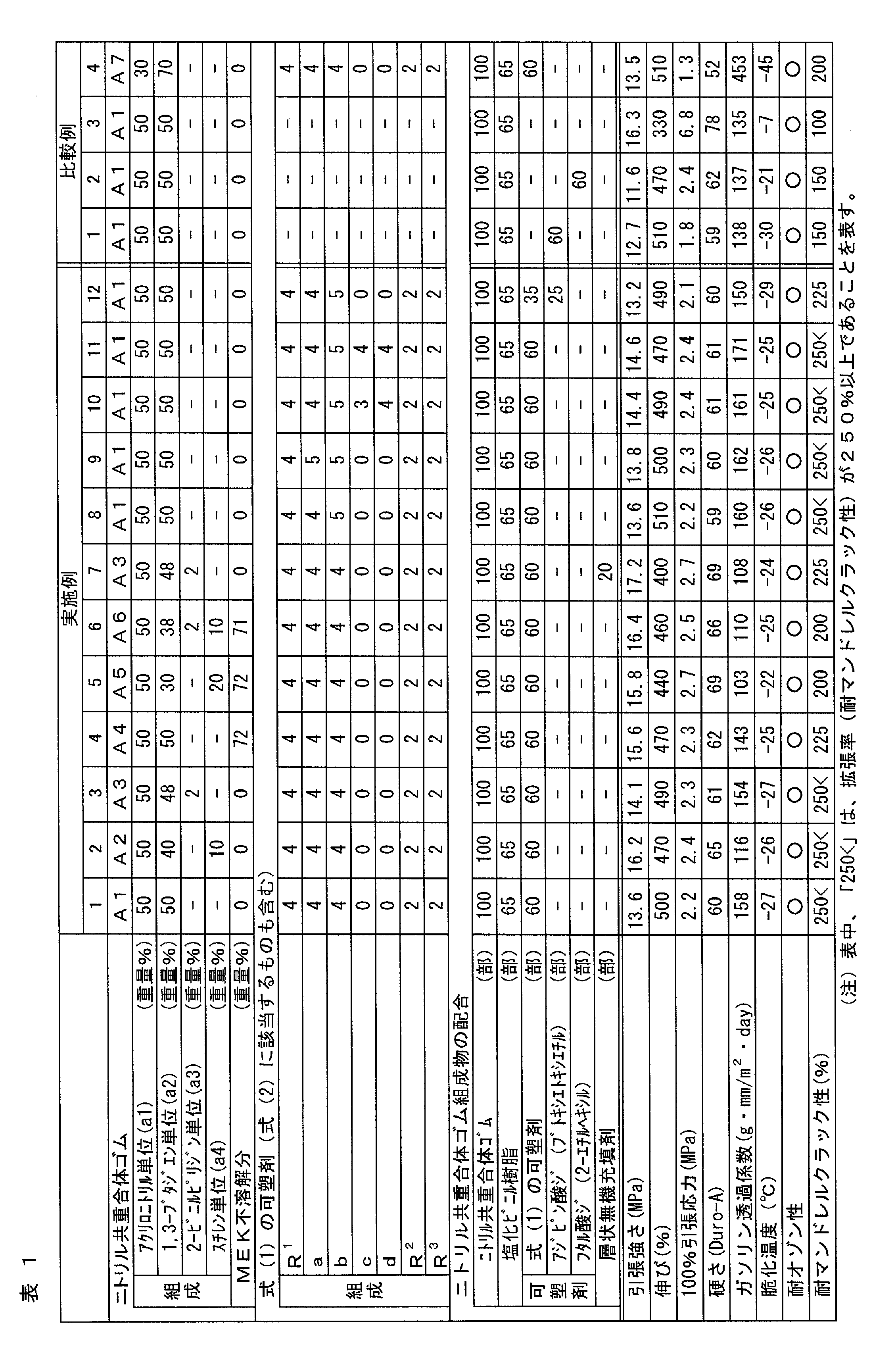

これに対して、式(1)に該当しない可塑剤を使用したために本発明の要件を満たさないニトリル共重合体ゴム組成物を用いた場合には、耐マンドレルクラック性に劣る結果となった(比較例1、2)。
また、可塑剤を使用しなかったために本発明の要件を満たさないニトリル共重合体ゴム組成物を用いた場合には、耐寒性及び耐マンドレルクラック性に劣る結果となった(比較例3)。
また、α,β-エチレン性不飽和ニトリル単量体単位(a1)と芳香族ビニル単量体単位(a2)との合計含有量が少なすぎるニトリル共重合体ゴムを用いたために本発明の要件を満たさない場合には、耐ガソリン透過性に劣る結果となった(比較例4)。
また、水素化ニトリル共重合体ゴムを用いた場合に、式(1)に該当しない可塑剤を使用したために本発明の要件を満たさないときは、耐マンドレルクラック性に劣る結果となった(比較例5)。
Claims (10)
- α,β-エチレン性不飽和ニトリル単量体単位(a1)35~85重量%、少なくとも一部が水素化されていてもよい共役ジエン単量体単位(a2)15~65重量%、カチオン性単量体単位(a3)0~30重量%、及び芳香族ビニル単量体単位(a4)0~50重量%を含有し、前記α,β-エチレン性不飽和ニトリル単量体単位(a1)と前記芳香族ビニル単量体単位(a4)との合計含有量が35~85重量%であるニトリル共重合体ゴム(A)、
塩化ビニル樹脂(B)、
並びに、下記一般式(1)で表される可塑剤(C)を含有してなるニトリル共重合体ゴム組成物。

- 前記可塑剤(C)が、下記一般式(2)で表される請求項1に記載のニトリル共重合体ゴム組成物。

- 前記ニトリル共重合体ゴム(A)100重量部に対する、前記塩化ビニル樹脂(B)の含有量が1~150重量部であり、前記可塑剤(C)の含有量が1~200重量部である請求項1又は2に記載のニトリル共重合体ゴム組成物。
- 前記ニトリル共重合体ゴム(A)中の前記カチオン性単量体単位(a3)の含有割合が、0.1~20重量%である請求項1~3のいずれか1項に記載のニトリル共重合体ゴム組成物。
- 前記ニトリル共重合体ゴム(A)中の前記芳香族ビニル単量体単位(a4)の含有割合が、1~30重量%である請求項1~4のいずれか1項に記載のニトリル共重合体ゴム組成物。
- 前記ニトリル共重合体ゴム(A)が、メチルエチルケトン不溶解分を0.5~90重量%含有する請求項1~5のいずれか1項に記載のニトリル共重合体ゴム組成物。
- さらに、アスペクト比が30~2,000である層状無機充填剤(D)を、前記ニトリル共重合体ゴム(A)100重量部に対して、1~100重量部含有する請求項1~6のいずれか1項に記載のニトリル共重合体ゴム組成物。
- 請求項1~7のいずれか1項に記載のニトリル共重合体ゴム組成物と架橋剤とを含有する架橋性ニトリルゴム組成物。
- 請求項8に記載の架橋性ニトリルゴム組成物を架橋してなるゴム架橋物。
- 請求項8に記載の架橋性ニトリルゴム組成物を筒状に成形し、マンドレルを挿入して得られる成形体を、架橋して得られるホース。
Priority Applications (7)
| Application Number | Priority Date | Filing Date | Title |
|---|---|---|---|
| JP2013534766A JP5892171B2 (ja) | 2011-09-21 | 2012-09-21 | ニトリル共重合体ゴム組成物及びゴム架橋物 |
| BR112014006268-4A BR112014006268B1 (pt) | 2011-09-21 | 2012-09-21 | composição de borracha de copolímero de nitrila, borracha reticulada, e mangueira |
| CN201280046147.3A CN103797062B (zh) | 2011-09-21 | 2012-09-21 | 腈共聚物橡胶组合物和橡胶交联物 |
| KR1020147005994A KR101906957B1 (ko) | 2011-09-21 | 2012-09-21 | 니트릴 공중합체 고무 조성물 및 고무 가교물 |
| US14/241,551 US20140220279A1 (en) | 2011-09-21 | 2012-09-21 | Nitrile copolymer rubber composition and cross-linked rubber |
| EP12834133.6A EP2746330B1 (en) | 2011-09-21 | 2012-09-21 | Nitrile copolymer rubber composition and rubber crosslink |
| ES12834133.6T ES2643399T3 (es) | 2011-09-21 | 2012-09-21 | Composición de caucho de copolímero de nitrilo y reticulación de caucho |
Applications Claiming Priority (2)
| Application Number | Priority Date | Filing Date | Title |
|---|---|---|---|
| JP2011205612 | 2011-09-21 | ||
| JP2011-205612 | 2011-09-21 |
Publications (1)
| Publication Number | Publication Date |
|---|---|
| WO2013042764A1 true WO2013042764A1 (ja) | 2013-03-28 |
Family
ID=47914524
Family Applications (1)
| Application Number | Title | Priority Date | Filing Date |
|---|---|---|---|
| PCT/JP2012/074201 Ceased WO2013042764A1 (ja) | 2011-09-21 | 2012-09-21 | ニトリル共重合体ゴム組成物及びゴム架橋物 |
Country Status (9)
| Country | Link |
|---|---|
| US (1) | US20140220279A1 (ja) |
| EP (1) | EP2746330B1 (ja) |
| JP (1) | JP5892171B2 (ja) |
| KR (1) | KR101906957B1 (ja) |
| CN (1) | CN103797062B (ja) |
| BR (1) | BR112014006268B1 (ja) |
| ES (1) | ES2643399T3 (ja) |
| PL (1) | PL2746330T3 (ja) |
| WO (1) | WO2013042764A1 (ja) |
Cited By (3)
| Publication number | Priority date | Publication date | Assignee | Title |
|---|---|---|---|---|
| CN105829433A (zh) * | 2013-12-24 | 2016-08-03 | 日本瑞翁株式会社 | 交联性腈橡胶组合物及橡胶交联物 |
| JP2020050722A (ja) * | 2018-09-26 | 2020-04-02 | 日本ゼオン株式会社 | ゴム混合液、ニトリル基含有共重合体ゴム組成物、架橋性ゴム組成物およびゴム架橋物 |
| WO2020066770A1 (ja) * | 2018-09-27 | 2020-04-02 | 日本ゼオン株式会社 | ニトリルゴム組成物およびニトリルゴム組成物の製造方法 |
Families Citing this family (8)
| Publication number | Priority date | Publication date | Assignee | Title |
|---|---|---|---|---|
| JP6196290B2 (ja) * | 2013-03-28 | 2017-09-13 | デンカ株式会社 | ブレンドゴム、ブレンドゴム組成物及び加硫物 |
| CN104538635B (zh) * | 2014-12-11 | 2017-02-22 | 江西先材纳米纤维科技有限公司 | 一种锂离子电池硅材料用高性能粘结剂及其制备方法 |
| CN107207944B (zh) * | 2015-02-16 | 2019-04-05 | 日本瑞翁株式会社 | 橡胶交联物 |
| KR102364365B1 (ko) | 2017-12-08 | 2022-02-17 | 주식회사 엘지화학 | 신규한 가교제 화합물 및 이를 이용하여 제조되는 중합체 |
| CN110506074B (zh) | 2017-12-08 | 2021-03-26 | 株式会社Lg化学 | 超吸收性聚合物的制备方法 |
| EP3889215A4 (en) * | 2018-11-30 | 2022-08-24 | Zeon Corporation | LATEX COMPOSITION FOR DIP MOLDING AND DIP MOLDED ARTICLE |
| WO2021241407A1 (ja) * | 2020-05-27 | 2021-12-02 | 日本ゼオン株式会社 | ディップ成形用ラテックス組成物およびディップ成形体 |
| CN114230945B (zh) * | 2021-12-28 | 2023-03-31 | 中国化工集团曙光橡胶工业研究设计院有限公司 | 一种氟橡胶、丁腈橡胶、丁基橡胶的复合方法 |
Citations (12)
| Publication number | Priority date | Publication date | Assignee | Title |
|---|---|---|---|---|
| JPS5310645A (en) * | 1976-07-06 | 1978-01-31 | Thiokol Chemical Corp | Low temperature plasticizers |
| JPS56120735A (en) * | 1980-02-29 | 1981-09-22 | Adeka Argus Chem Co Ltd | Plasticized synthetic resin composition |
| JPS62185734A (ja) * | 1986-02-10 | 1987-08-14 | Hitachi Cable Ltd | 導電性床シート |
| JPH02158639A (ja) * | 1988-12-12 | 1990-06-19 | Adeka Argus Chem Co Ltd | 耐寒性可塑化ゴム組成物 |
| JPH0359045A (ja) * | 1989-07-28 | 1991-03-14 | Dainippon Ink & Chem Inc | ゴム用縮合系可塑剤及びゴム組成物 |
| JPH07149990A (ja) * | 1993-11-29 | 1995-06-13 | Asahi Denka Kogyo Kk | 合成ゴム組成物 |
| JP2001072804A (ja) * | 1999-06-28 | 2001-03-21 | Tokai Rubber Ind Ltd | ゴム組成物及び自動車用燃料輸送ホース |
| JP2007277341A (ja) | 2006-04-04 | 2007-10-25 | Nippon Zeon Co Ltd | 加硫性ニトリル共重合体ゴム組成物およびその加硫物 |
| WO2009096456A1 (ja) * | 2008-01-30 | 2009-08-06 | Zeon Corporation | ニトリル共重合体ラテックス組成物およびニトリル共重合体ゴム組成物 |
| JP2011012132A (ja) * | 2009-06-30 | 2011-01-20 | Nippon Zeon Co Ltd | ニトリルゴム組成物および架橋性ゴム組成物、並びにゴム架橋物 |
| WO2011016479A1 (ja) * | 2009-08-05 | 2011-02-10 | 日本ゼオン株式会社 | ニトリルゴム組成物、架橋性ニトリルゴム組成物、ゴム架橋物、及びニトリルゴム組成物の製造方法 |
| JP2011213844A (ja) * | 2010-03-31 | 2011-10-27 | Nippon Zeon Co Ltd | ニトリル共重合体ゴム組成物 |
Family Cites Families (5)
| Publication number | Priority date | Publication date | Assignee | Title |
|---|---|---|---|---|
| JP4172151B2 (ja) * | 1998-11-04 | 2008-10-29 | 日本ゼオン株式会社 | 燃料ホース用ポリブレンド組成物、架橋物および燃料ホース |
| JP4899262B2 (ja) * | 2000-11-13 | 2012-03-21 | Jsr株式会社 | 不飽和ニトリル−共役ジエン系ゴム及びゴム組成物並びにこれらの製造方法 |
| JP5417730B2 (ja) * | 2008-03-28 | 2014-02-19 | 日本ゼオン株式会社 | ニトリル共重合体ラテックス組成物およびニトリル共重合体ゴム組成物 |
| JP5617638B2 (ja) * | 2008-10-29 | 2014-11-05 | 日本ゼオン株式会社 | 燃料ホース用の架橋性ニトリル共重合体ゴム組成物の製造方法および燃料ホース用のゴム架橋物 |
| JP5381088B2 (ja) * | 2008-12-25 | 2014-01-08 | 日本ゼオン株式会社 | ニトリル共重合体ゴム組成物 |
-
2012
- 2012-09-21 WO PCT/JP2012/074201 patent/WO2013042764A1/ja not_active Ceased
- 2012-09-21 BR BR112014006268-4A patent/BR112014006268B1/pt not_active IP Right Cessation
- 2012-09-21 JP JP2013534766A patent/JP5892171B2/ja active Active
- 2012-09-21 PL PL12834133T patent/PL2746330T3/pl unknown
- 2012-09-21 ES ES12834133.6T patent/ES2643399T3/es active Active
- 2012-09-21 KR KR1020147005994A patent/KR101906957B1/ko not_active Expired - Fee Related
- 2012-09-21 CN CN201280046147.3A patent/CN103797062B/zh active Active
- 2012-09-21 EP EP12834133.6A patent/EP2746330B1/en active Active
- 2012-09-21 US US14/241,551 patent/US20140220279A1/en not_active Abandoned
Patent Citations (12)
| Publication number | Priority date | Publication date | Assignee | Title |
|---|---|---|---|---|
| JPS5310645A (en) * | 1976-07-06 | 1978-01-31 | Thiokol Chemical Corp | Low temperature plasticizers |
| JPS56120735A (en) * | 1980-02-29 | 1981-09-22 | Adeka Argus Chem Co Ltd | Plasticized synthetic resin composition |
| JPS62185734A (ja) * | 1986-02-10 | 1987-08-14 | Hitachi Cable Ltd | 導電性床シート |
| JPH02158639A (ja) * | 1988-12-12 | 1990-06-19 | Adeka Argus Chem Co Ltd | 耐寒性可塑化ゴム組成物 |
| JPH0359045A (ja) * | 1989-07-28 | 1991-03-14 | Dainippon Ink & Chem Inc | ゴム用縮合系可塑剤及びゴム組成物 |
| JPH07149990A (ja) * | 1993-11-29 | 1995-06-13 | Asahi Denka Kogyo Kk | 合成ゴム組成物 |
| JP2001072804A (ja) * | 1999-06-28 | 2001-03-21 | Tokai Rubber Ind Ltd | ゴム組成物及び自動車用燃料輸送ホース |
| JP2007277341A (ja) | 2006-04-04 | 2007-10-25 | Nippon Zeon Co Ltd | 加硫性ニトリル共重合体ゴム組成物およびその加硫物 |
| WO2009096456A1 (ja) * | 2008-01-30 | 2009-08-06 | Zeon Corporation | ニトリル共重合体ラテックス組成物およびニトリル共重合体ゴム組成物 |
| JP2011012132A (ja) * | 2009-06-30 | 2011-01-20 | Nippon Zeon Co Ltd | ニトリルゴム組成物および架橋性ゴム組成物、並びにゴム架橋物 |
| WO2011016479A1 (ja) * | 2009-08-05 | 2011-02-10 | 日本ゼオン株式会社 | ニトリルゴム組成物、架橋性ニトリルゴム組成物、ゴム架橋物、及びニトリルゴム組成物の製造方法 |
| JP2011213844A (ja) * | 2010-03-31 | 2011-10-27 | Nippon Zeon Co Ltd | ニトリル共重合体ゴム組成物 |
Non-Patent Citations (1)
| Title |
|---|
| See also references of EP2746330A4 |
Cited By (4)
| Publication number | Priority date | Publication date | Assignee | Title |
|---|---|---|---|---|
| CN105829433A (zh) * | 2013-12-24 | 2016-08-03 | 日本瑞翁株式会社 | 交联性腈橡胶组合物及橡胶交联物 |
| JP2020050722A (ja) * | 2018-09-26 | 2020-04-02 | 日本ゼオン株式会社 | ゴム混合液、ニトリル基含有共重合体ゴム組成物、架橋性ゴム組成物およびゴム架橋物 |
| JP7200569B2 (ja) | 2018-09-26 | 2023-01-10 | 日本ゼオン株式会社 | ゴム混合液、ニトリル基含有共重合体ゴム組成物、架橋性ゴム組成物およびゴム架橋物 |
| WO2020066770A1 (ja) * | 2018-09-27 | 2020-04-02 | 日本ゼオン株式会社 | ニトリルゴム組成物およびニトリルゴム組成物の製造方法 |
Also Published As
| Publication number | Publication date |
|---|---|
| CN103797062A (zh) | 2014-05-14 |
| JPWO2013042764A1 (ja) | 2015-03-26 |
| EP2746330B1 (en) | 2017-07-19 |
| US20140220279A1 (en) | 2014-08-07 |
| PL2746330T3 (pl) | 2017-11-30 |
| JP5892171B2 (ja) | 2016-03-23 |
| KR20140068931A (ko) | 2014-06-09 |
| ES2643399T3 (es) | 2017-11-22 |
| KR101906957B1 (ko) | 2018-10-11 |
| CN103797062B (zh) | 2016-05-18 |
| BR112014006268A2 (pt) | 2017-04-11 |
| EP2746330A4 (en) | 2015-06-17 |
| EP2746330A1 (en) | 2014-06-25 |
| BR112014006268B1 (pt) | 2021-01-05 |
Similar Documents
| Publication | Publication Date | Title |
|---|---|---|
| JP5892171B2 (ja) | ニトリル共重合体ゴム組成物及びゴム架橋物 | |
| JP5655784B2 (ja) | ニトリルゴム組成物、架橋性ニトリルゴム組成物、ゴム架橋物、及びニトリルゴム組成物の製造方法 | |
| JP5617638B2 (ja) | 燃料ホース用の架橋性ニトリル共重合体ゴム組成物の製造方法および燃料ホース用のゴム架橋物 | |
| JP5742836B2 (ja) | ホース用ニトリル共重合体ゴム組成物および架橋物 | |
| JP5347770B2 (ja) | ニトリルゴム組成物および架橋性ゴム組成物、並びにゴム架橋物 | |
| JP5417730B2 (ja) | ニトリル共重合体ラテックス組成物およびニトリル共重合体ゴム組成物 | |
| CN103339181B (zh) | 丁腈橡胶组合物及交联性丁腈橡胶组合物以及橡胶交联物 | |
| WO2009096456A1 (ja) | ニトリル共重合体ラテックス組成物およびニトリル共重合体ゴム組成物 | |
| JP6225919B2 (ja) | ニトリル共重合体ゴム組成物 | |
| JPWO2008123405A1 (ja) | ニトリル共重合体ゴム組成物およびニトリル共重合体ラテックス組成物 | |
| KR102269046B1 (ko) | 니트릴 공중합체 고무 조성물 | |
| WO2016132978A1 (ja) | ゴム架橋物 | |
| JP5482385B2 (ja) | ニトリル共重合体ゴム組成物 | |
| JP5381088B2 (ja) | ニトリル共重合体ゴム組成物 | |
| WO2013133358A1 (ja) | ニトリル共重合体ゴム組成物の製造方法 | |
| JP2010155883A (ja) | ニトリル共重合体ゴム組成物 | |
| JP2009221371A (ja) | ニトリル共重合体ゴム組成物の製造方法 | |
| JP5803914B2 (ja) | ニトリル共重合体ゴム組成物 |
Legal Events
| Date | Code | Title | Description |
|---|---|---|---|
| 121 | Ep: the epo has been informed by wipo that ep was designated in this application |
Ref document number: 12834133 Country of ref document: EP Kind code of ref document: A1 |
|
| ENP | Entry into the national phase |
Ref document number: 2013534766 Country of ref document: JP Kind code of ref document: A |
|
| WWE | Wipo information: entry into national phase |
Ref document number: 14241551 Country of ref document: US |
|
| ENP | Entry into the national phase |
Ref document number: 20147005994 Country of ref document: KR Kind code of ref document: A |
|
| REEP | Request for entry into the european phase |
Ref document number: 2012834133 Country of ref document: EP |
|
| WWE | Wipo information: entry into national phase |
Ref document number: 2012834133 Country of ref document: EP |
|
| NENP | Non-entry into the national phase |
Ref country code: DE |
|
| REG | Reference to national code |
Ref country code: BR Ref legal event code: B01A Ref document number: 112014006268 Country of ref document: BR |
|
| ENP | Entry into the national phase |
Ref document number: 112014006268 Country of ref document: BR Kind code of ref document: A2 Effective date: 20140317 |