WO2013046108A1 - Ruthenium or osmium complex, method for its preparation and use thereof - Google Patents
Ruthenium or osmium complex, method for its preparation and use thereof Download PDFInfo
- Publication number
- WO2013046108A1 WO2013046108A1 PCT/IB2012/055058 IB2012055058W WO2013046108A1 WO 2013046108 A1 WO2013046108 A1 WO 2013046108A1 IB 2012055058 W IB2012055058 W IB 2012055058W WO 2013046108 A1 WO2013046108 A1 WO 2013046108A1
- Authority
- WO
- WIPO (PCT)
- Prior art keywords
- formula
- denotes
- alkyl
- atom
- aryl
- Prior art date
- Legal status (The legal status is an assumption and is not a legal conclusion. Google has not performed a legal analysis and makes no representation as to the accuracy of the status listed.)
- Ceased
Links
Classifications
-
- B—PERFORMING OPERATIONS; TRANSPORTING
- B01—PHYSICAL OR CHEMICAL PROCESSES OR APPARATUS IN GENERAL
- B01J—CHEMICAL OR PHYSICAL PROCESSES, e.g. CATALYSIS OR COLLOID CHEMISTRY; THEIR RELEVANT APPARATUS
- B01J31/00—Catalysts comprising hydrides, coordination complexes or organic compounds
- B01J31/16—Catalysts comprising hydrides, coordination complexes or organic compounds containing coordination complexes
- B01J31/22—Organic complexes
- B01J31/2265—Carbenes or carbynes, i.e.(image)
- B01J31/2269—Heterocyclic carbenes
-
- C—CHEMISTRY; METALLURGY
- C07—ORGANIC CHEMISTRY
- C07F—ACYCLIC, CARBOCYCLIC OR HETEROCYCLIC COMPOUNDS CONTAINING ELEMENTS OTHER THAN CARBON, HYDROGEN, HALOGEN, OXYGEN, NITROGEN, SULFUR, SELENIUM OR TELLURIUM
- C07F15/00—Compounds containing elements of Groups 8, 9, 10 or 18 of the Periodic Table
- C07F15/0006—Compounds containing elements of Groups 8, 9, 10 or 18 of the Periodic Table compounds of the platinum group
- C07F15/0046—Ruthenium compounds
-
- B—PERFORMING OPERATIONS; TRANSPORTING
- B01—PHYSICAL OR CHEMICAL PROCESSES OR APPARATUS IN GENERAL
- B01J—CHEMICAL OR PHYSICAL PROCESSES, e.g. CATALYSIS OR COLLOID CHEMISTRY; THEIR RELEVANT APPARATUS
- B01J31/00—Catalysts comprising hydrides, coordination complexes or organic compounds
- B01J31/16—Catalysts comprising hydrides, coordination complexes or organic compounds containing coordination complexes
- B01J31/22—Organic complexes
- B01J31/2265—Carbenes or carbynes, i.e.(image)
- B01J31/2269—Heterocyclic carbenes
- B01J31/2273—Heterocyclic carbenes with only nitrogen as heteroatomic ring members, e.g. 1,3-diarylimidazoline-2-ylidenes
-
- B—PERFORMING OPERATIONS; TRANSPORTING
- B01—PHYSICAL OR CHEMICAL PROCESSES OR APPARATUS IN GENERAL
- B01J—CHEMICAL OR PHYSICAL PROCESSES, e.g. CATALYSIS OR COLLOID CHEMISTRY; THEIR RELEVANT APPARATUS
- B01J31/00—Catalysts comprising hydrides, coordination complexes or organic compounds
- B01J31/16—Catalysts comprising hydrides, coordination complexes or organic compounds containing coordination complexes
- B01J31/22—Organic complexes
- B01J31/2265—Carbenes or carbynes, i.e.(image)
- B01J31/2278—Complexes comprising two carbene ligands differing from each other, e.g. Grubbs second generation catalysts
-
- C—CHEMISTRY; METALLURGY
- C07—ORGANIC CHEMISTRY
- C07C—ACYCLIC OR CARBOCYCLIC COMPOUNDS
- C07C29/00—Preparation of compounds having hydroxy or O-metal groups bound to a carbon atom not belonging to a six-membered aromatic ring
- C07C29/56—Preparation of compounds having hydroxy or O-metal groups bound to a carbon atom not belonging to a six-membered aromatic ring by isomerisation
-
- C—CHEMISTRY; METALLURGY
- C07—ORGANIC CHEMISTRY
- C07C—ACYCLIC OR CARBOCYCLIC COMPOUNDS
- C07C67/00—Preparation of carboxylic acid esters
- C07C67/28—Preparation of carboxylic acid esters by modifying the hydroxylic moiety of the ester, such modification not being an introduction of an ester group
- C07C67/297—Preparation of carboxylic acid esters by modifying the hydroxylic moiety of the ester, such modification not being an introduction of an ester group by splitting-off hydrogen or functional groups; by hydrogenolysis of functional groups
-
- C—CHEMISTRY; METALLURGY
- C07—ORGANIC CHEMISTRY
- C07C—ACYCLIC OR CARBOCYCLIC COMPOUNDS
- C07C67/00—Preparation of carboxylic acid esters
- C07C67/30—Preparation of carboxylic acid esters by modifying the acid moiety of the ester, such modification not being an introduction of an ester group
- C07C67/333—Preparation of carboxylic acid esters by modifying the acid moiety of the ester, such modification not being an introduction of an ester group by isomerisation; by change of size of the carbon skeleton
-
- C—CHEMISTRY; METALLURGY
- C07—ORGANIC CHEMISTRY
- C07D—HETEROCYCLIC COMPOUNDS
- C07D207/00—Heterocyclic compounds containing five-membered rings not condensed with other rings, with one nitrogen atom as the only ring hetero atom
- C07D207/46—Heterocyclic compounds containing five-membered rings not condensed with other rings, with one nitrogen atom as the only ring hetero atom with hetero atoms directly attached to the ring nitrogen atom
- C07D207/48—Sulfur atoms
-
- C—CHEMISTRY; METALLURGY
- C07—ORGANIC CHEMISTRY
- C07D—HETEROCYCLIC COMPOUNDS
- C07D307/00—Heterocyclic compounds containing five-membered rings having one oxygen atom as the only ring hetero atom
- C07D307/02—Heterocyclic compounds containing five-membered rings having one oxygen atom as the only ring hetero atom not condensed with other rings
- C07D307/26—Heterocyclic compounds containing five-membered rings having one oxygen atom as the only ring hetero atom not condensed with other rings having one double bond between ring members or between a ring member and a non-ring member
- C07D307/28—Heterocyclic compounds containing five-membered rings having one oxygen atom as the only ring hetero atom not condensed with other rings having one double bond between ring members or between a ring member and a non-ring member with only hydrogen atoms, hydrocarbon or substituted hydrocarbon radicals, directly attached to ring carbon atoms
-
- C—CHEMISTRY; METALLURGY
- C08—ORGANIC MACROMOLECULAR COMPOUNDS; THEIR PREPARATION OR CHEMICAL WORKING-UP; COMPOSITIONS BASED THEREON
- C08G—MACROMOLECULAR COMPOUNDS OBTAINED OTHERWISE THAN BY REACTIONS ONLY INVOLVING UNSATURATED CARBON-TO-CARBON BONDS
- C08G61/00—Macromolecular compounds obtained by reactions forming a carbon-to-carbon link in the main chain of the macromolecule
- C08G61/02—Macromolecular compounds containing only carbon atoms in the main chain of the macromolecule, e.g. polyxylylenes
- C08G61/04—Macromolecular compounds containing only carbon atoms in the main chain of the macromolecule, e.g. polyxylylenes only aliphatic carbon atoms
- C08G61/06—Macromolecular compounds containing only carbon atoms in the main chain of the macromolecule, e.g. polyxylylenes only aliphatic carbon atoms prepared by ring-opening of carbocyclic compounds
- C08G61/08—Macromolecular compounds containing only carbon atoms in the main chain of the macromolecule, e.g. polyxylylenes only aliphatic carbon atoms prepared by ring-opening of carbocyclic compounds of carbocyclic compounds containing one or more carbon-to-carbon double bonds in the ring
-
- B—PERFORMING OPERATIONS; TRANSPORTING
- B01—PHYSICAL OR CHEMICAL PROCESSES OR APPARATUS IN GENERAL
- B01J—CHEMICAL OR PHYSICAL PROCESSES, e.g. CATALYSIS OR COLLOID CHEMISTRY; THEIR RELEVANT APPARATUS
- B01J2231/00—Catalytic reactions performed with catalysts classified in B01J31/00
- B01J2231/50—Redistribution or isomerisation reactions of C-C, C=C or C-C triple bonds
- B01J2231/52—Isomerisation reactions
-
- B—PERFORMING OPERATIONS; TRANSPORTING
- B01—PHYSICAL OR CHEMICAL PROCESSES OR APPARATUS IN GENERAL
- B01J—CHEMICAL OR PHYSICAL PROCESSES, e.g. CATALYSIS OR COLLOID CHEMISTRY; THEIR RELEVANT APPARATUS
- B01J2231/00—Catalytic reactions performed with catalysts classified in B01J31/00
- B01J2231/50—Redistribution or isomerisation reactions of C-C, C=C or C-C triple bonds
- B01J2231/54—Metathesis reactions, e.g. olefin metathesis
-
- B—PERFORMING OPERATIONS; TRANSPORTING
- B01—PHYSICAL OR CHEMICAL PROCESSES OR APPARATUS IN GENERAL
- B01J—CHEMICAL OR PHYSICAL PROCESSES, e.g. CATALYSIS OR COLLOID CHEMISTRY; THEIR RELEVANT APPARATUS
- B01J2231/00—Catalytic reactions performed with catalysts classified in B01J31/00
- B01J2231/50—Redistribution or isomerisation reactions of C-C, C=C or C-C triple bonds
- B01J2231/54—Metathesis reactions, e.g. olefin metathesis
- B01J2231/543—Metathesis reactions, e.g. olefin metathesis alkene metathesis
-
- B—PERFORMING OPERATIONS; TRANSPORTING
- B01—PHYSICAL OR CHEMICAL PROCESSES OR APPARATUS IN GENERAL
- B01J—CHEMICAL OR PHYSICAL PROCESSES, e.g. CATALYSIS OR COLLOID CHEMISTRY; THEIR RELEVANT APPARATUS
- B01J2231/00—Catalytic reactions performed with catalysts classified in B01J31/00
- B01J2231/60—Reduction reactions, e.g. hydrogenation
- B01J2231/64—Reductions in general of organic substrates, e.g. hydride reductions or hydrogenations
- B01J2231/641—Hydrogenation of organic substrates, i.e. H2 or H-transfer hydrogenations, e.g. Fischer-Tropsch processes
- B01J2231/643—Hydrogenation of organic substrates, i.e. H2 or H-transfer hydrogenations, e.g. Fischer-Tropsch processes of R2C=O or R2C=NR (R= C, H)
-
- B—PERFORMING OPERATIONS; TRANSPORTING
- B01—PHYSICAL OR CHEMICAL PROCESSES OR APPARATUS IN GENERAL
- B01J—CHEMICAL OR PHYSICAL PROCESSES, e.g. CATALYSIS OR COLLOID CHEMISTRY; THEIR RELEVANT APPARATUS
- B01J2531/00—Additional information regarding catalytic systems classified in B01J31/00
- B01J2531/80—Complexes comprising metals of Group VIII as the central metal
- B01J2531/82—Metals of the platinum group
- B01J2531/821—Ruthenium
-
- C—CHEMISTRY; METALLURGY
- C08—ORGANIC MACROMOLECULAR COMPOUNDS; THEIR PREPARATION OR CHEMICAL WORKING-UP; COMPOSITIONS BASED THEREON
- C08G—MACROMOLECULAR COMPOUNDS OBTAINED OTHERWISE THAN BY REACTIONS ONLY INVOLVING UNSATURATED CARBON-TO-CARBON BONDS
- C08G2261/00—Macromolecular compounds obtained by reactions forming a carbon-to-carbon link in the main chain of the macromolecule
- C08G2261/30—Monomer units or repeat units incorporating structural elements in the main chain
- C08G2261/33—Monomer units or repeat units incorporating structural elements in the main chain incorporating non-aromatic structural elements in the main chain
- C08G2261/332—Monomer units or repeat units incorporating structural elements in the main chain incorporating non-aromatic structural elements in the main chain containing only carbon atoms
- C08G2261/3324—Monomer units or repeat units incorporating structural elements in the main chain incorporating non-aromatic structural elements in the main chain containing only carbon atoms derived from norbornene
-
- C—CHEMISTRY; METALLURGY
- C08—ORGANIC MACROMOLECULAR COMPOUNDS; THEIR PREPARATION OR CHEMICAL WORKING-UP; COMPOSITIONS BASED THEREON
- C08G—MACROMOLECULAR COMPOUNDS OBTAINED OTHERWISE THAN BY REACTIONS ONLY INVOLVING UNSATURATED CARBON-TO-CARBON BONDS
- C08G2261/00—Macromolecular compounds obtained by reactions forming a carbon-to-carbon link in the main chain of the macromolecule
- C08G2261/40—Polymerisation processes
- C08G2261/41—Organometallic coupling reactions
- C08G2261/418—Ring opening metathesis polymerisation [ROMP]
Definitions
- the present invention relates to novel complexes of metals that act as pre(catalysts), a method of manufacturing them as well as their use in the metathesis, isomerisation and cycloisomerisation of oleofins, a method of manufacturing them as well as their use in olefin metathesis, isomerisation and cycloisomerisation reactions, as well as in olefin as well as in reakcji hydrogen transfer.
- the present invention is useful in broadly understood organic synthesis.
- Complexes defined by Formula 1, according to the present invention are useful in a broad range of reactions.
- a good result may be obtained by conducting both numerous metathesis ring closure reactions, as well as homometatheses, cross metatheses as well as well as metatheses of the "alkene-alkyne" (ene-yne), ring-opening polymerisation reactions (ROMP), olefin isomerisation reactions, olefin cycloisomerisation reactions as well as hydrogen transfer reactions.
- the high polarity of the compounds being the subject of the present invention also makes it easier to remove ruthenium compounds from the reaction products, which is very significant in the synthesis of compounds for the pharmaceutical industry.
- the subject of the present invention are novel metal complexes, containing a nitroanion group defined by Formula 1:
- M denotes ruthenium or osmium
- L 1 and L 2 denote neutral ligands
- X denotes an anionic ligand
- Z denotes a nitrogen atom
- Y denotes an oxygen atom
- R l , R 2 denote, independently of one another, a hydrogen atom, a fluoride atom, Ci-C 2 5 alkyl, C t - C25 perfiuoroalkyl, C 2 -C 25 alkene, C3-C7 cycloalkyl, C 2 -C 25 alkenyl, C 3 -C 2 5 cycloalkenyl, C 2 -C 2 5 alkynyl, C 3 -C 2 5 cycloalkynyl, C[-C 2 5 alkoxyl , C 5 -C 2 4 aryl, C 5 -C o heteroaryl, or a 3-12 membered heterocycle wherein the alkyl groups may be joined together in a ring, preferentially a hydrogen, a nitro (-N0 2 ), cyanide (-CN), carboxyl (-COOH), carboxyl (-COOR'), amido (-CONR ' 2 ), sulphonyl (-
- R of Formula 1 denotes a hydrogen atom or methyl group; R denotes a hydrogen atom and the
- each R 5 denotes, independently of one another, C1-C12 alkyl, C 3 -C i 2 cycloalkyl, C 5 -C 2 o aryl, 5- 12 membered heteroaryl;
- each R , R , R , R and R denotes, independently of one another, a hydrogen atom, C [-Ci 2 alkyl, C 3 -C i 2 cycloalkyl, C 2 -Ci 2 alkenyl or C5-Q0 aryl which may be substituted with at least one C i-Ci 2 alkyl, C i-C i 2 perhaloalkyl, Ci-C t2 alkoxyl or fluoride atom, and groups R 6 , R 7 , R 8 , R 9 and R 10 may possibly be interconnected.
- Carbene ligands may be classically coordinated, as in structures 2a-2h, or in a non-classic fashion (abnormal carbenes", see: Chem. Rev. 2009, 109, 3445) as in structures 2i-2p.
- the anionic ligand X of Formula 1 denotes a chlorine atom
- neutral ligand L 1 denotes -P(R 5 ) 3 in which substituent R 5 has a meaning as set out above; and neutral ligand L denotes ligands defined by Formula 2a or 2b:
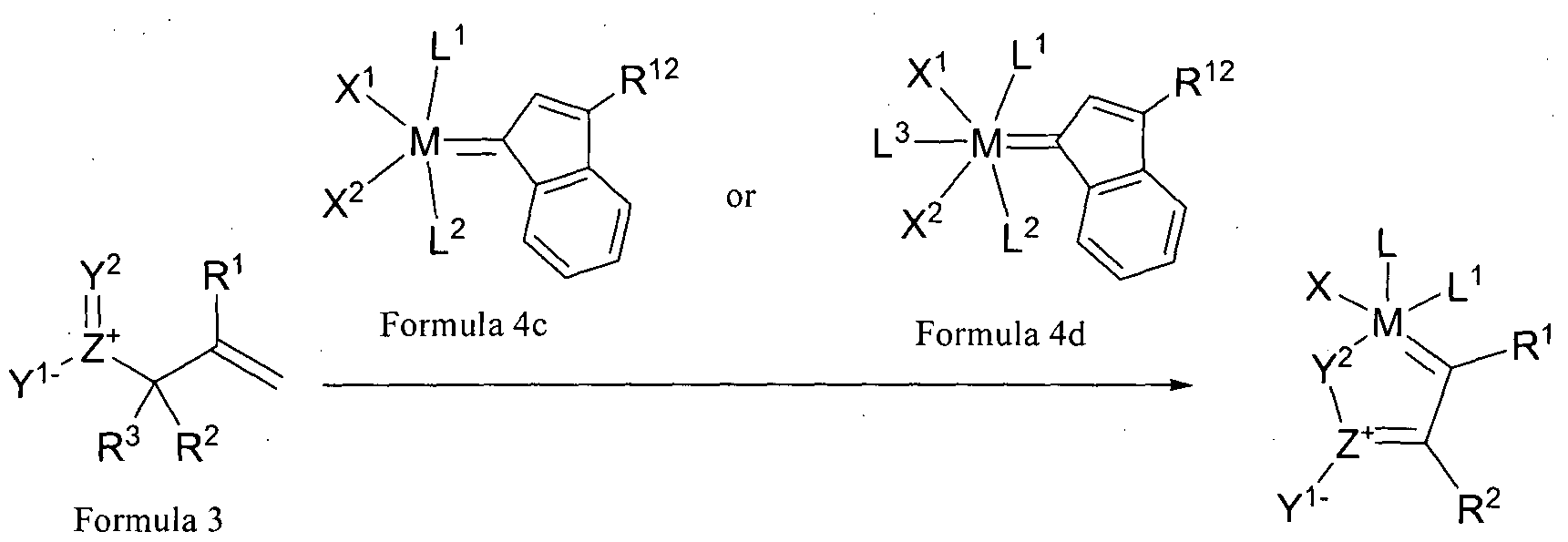
- the subject of the present invention is also a method of producing complexes of metals defined by Formula 1, which encompasses the reaction of compounds defined by Formula 3
- R 1 , R2 , Z, Y have meanings as defined above
- R 3 , R 13 , R 14 denote, independently of one another, a hydrogen atom, a fluoride atom, Ci-C 2 5 alkyl, Ci-C 25 perfluoroalkyl, C 2 -C 2 5 alkene, C 3 -C 7 cycloalkyl, C 2 -C 25 alkenyl, C 3 -C 25 cycloalkenyl, C 2 -C 2 5 alkynyl, C -C 2 5 cycloalkynyl, Ci-C 2 5 alkoxyl, C5-Q4 aryl, heteroaryl C5-C 2 o, or a 3-12 membered heterocycle wherein the alkyl groups may be joined together in a ring, preferentially a hydrogen, a nitro group (-N0 2 ), a cyanide group (-CN), carboxyl (-COOH), carboxyl (-COOR'
- R 1 denotes hydrogen, a fluoride atom, C 1-C 12 alkyl, C3-C 12 cycloalkyl, C 2 -Ci 2 alkenyl, C3-C 12 cycloalkenyl, C2-C 12 alkynyl, C 3 -Ci 2 cycloalkynyl, C1-C 12 alkoxyl, C5-C20 aryl, C5-C 2 o heteroaryl, or a 3-12 membered heterocycle;
- M denotes ruthenium or osmium
- L 1 , L 2 and L 3 independently of one another, denote neutral ligands
- X 1 and X 2 independently of one another, denote an anionic ligand
- R 1 1 has the same meaning as R 1 of Formula 1;
- R 12 denotes a hydrogen atom, C 5 -C 2 o aryl, C5-C20 heteroaryl, vinyl or allenyl.
- the reaction is carried out over a period from 1 min. do 250 h, at a temperature in the range from 0 to 150°C.
- the reaction is carried out in a chlorineinated solvent or in aromatic hydrocarbons, or in protic or aprotic solvents, such as alcohols or ketones or in mixtures thereof.
- the reaction is carried out in a solvent selected from among methylene chloride and/or toluene.
- the present invention also relates to the use of complexes of ruthenium defined by Formula 1 as (pre)catalysts in metathesis reactions.
- ruthenium complexes defined by Formula 1 are used as (pre)catalysts in metathesis ring closing reactions, homometatheses, cross-metatheses, "alkene-alkyne” metathesis (ene-yne) ROMP polymerisations as well as olefin cyclomerisation reactions.
- a fluoride atom denotes an element selected from among F, CI, Br, or I.
- the term “carbene” denotes a molecule containing a neutral carbon atom with a valence number of two and two unpaired valence electrons.
- the term “carbene” also encompasses carbene analogues in which the carbon atom is substituted by another chemical elements such as boron, silicon, germanium, tin, lead, nitrogen, phosphorus, sulphur, selenium and tellurium.
- alky refers to a saturated, linear, or branched hydrocarbon substituent with the indicated number of carbon atoms.
- alkyl substituent are -methyl, -ethyl, -n- propyl, -rc-butyl, -M-pentyl, -n-hexyl, -M-heptyl, - «-octyl, - «-nonyl, and - «-decyl.
- Representative branched -(Ci-Cio)alkyls encompass -isopropyl, -sec-butyl, -isobutyl, -teri-butyl, -isopentyl, - neopentyl, -1-methylbutyl, -2-methylbutyl, -3-methylbutyl, -1 ,1 -dimethylpropyl, -1,2- dimethylpropyl, -1-methylpentyl, -2-methylpentyl, -3-methylpentyl, -4-methylpentyl, -1- ethylbutyl, -2-ethylbutyl, -3-ethylbutyl, -1 , 1 -dimethylbutyl, -1 ,2-dimethylbutyl, -1 ,3- dimethylbutyl, -2,2-dimethylbutyl, -2,3-dimethylbutyl, -3,3-
- peril uoroalkyl denotes an alkyl group as defined above in which all hydrogen atoms have been replaced by identical or different atomy fluoride atoms.
- cycloalkyl refers to a saturated mono- or polycyclic hydrocarbon substituent with the indicated number of carbon atoms. Examples of cycloalkyl substituents are -cyclopropyl, - cyclobutyl, -cyclopentyl, -cyclohexyl, -cycloheptyl, -cyclooctyl, -cyclononyl, -cyclodecyl, and the like.
- alkenyl refers to an unsaturated, linear, or branched acyclic hydrocarbon substituent with the indicated number of carbon atoms and containing at least one double carbon- carbon bond.
- alkenyl substituents are: -vinyl, -allyl, -1-butenyl, -2-butenyl, - isobutylenyl, -1 -pentenyl, -2-pentenyl, -3 -methyl- 1-butenyl, -2-methyl-2-butenyl, -2,3 -dimethyl - 2-butenyl, -1-hexenyl, -2-hexenyl, -3-hexenyl, -1-he tenyl, -2-heptenyl, -3-heptenyl, -1-octenyl, - 2-octenyl, -3-octenyl, -1-nonenyl, -2-nonenyl, -3-nonenyl, -1-decenyl, -2-decenyl, -3-decenyl and the like.
- cycloalkenyl refers to an unsaturated mono- or polycyclic hydrocarbon substituent with the indicated number of carbon atoms and containing at least one double carbon- carbon bond.
- Examples of cycloalkenyl substituents are -cyclopentenyl, -cyclopentadienyl, - cyclohexenyl, -cyclohexadienyl, -cycloheptenyl, -cycloheptadienyl, -cycloheptatrienyl, -cyclooctenyl, -cyclooctadienyl, -cyclooctatrienyl, -cyclooctatetraenyl, -cyclononenyl, - cyclononadienyl, -cyclodecenyl, -cyclodekadienyl and the like.
- alkynyl refers to an unsaturated, linear, or branched acyclic hydrocarbon substituent with the indicated number of carbon atoms and containing at least one triple carbon- carbon bond.
- alkynyl substituents are -acethylenyl, -propynyl, -1-butynyl, -2- butynyl, -1-pentynyl, -2-pentynyl, -3-methyl- 1-butynyl, -4-pentynyl, -1-hexynyl, -2-hexynyl, -5- hexynyl and the like.
- cycloalkynyl refers to saturated mono- or polycyclic hydrocarbon substituent with the indicated number of carbon atoms and containing at least one triple carbon-carbon bond.
- Examples of cycloalkynyl substituents are -cyclohexynyl, -cycloheptynyl, -cyclooctynyl, and the like.
- aryl refers to an aromatic mono- or polycyclic hydrocarbon substituent with the indicated number of carbon atoms.
- aryl substituents are -phenyl, -tolyl, -xylyl, - naphthyl and the like.
- heteroaryl refers to an aromatic mono- or polycyclic hydrocarbon substituent with the indicated number of carbon atoms in which at least one the carbon atom has been replaced by a heteroatom selected from among O, N and S.
- heteroaryl substituents are -furyl, - thienyl,- imidazolyl, -oxazolyl, -thiazolyl, -isoxazolyl, -triazolyl, -oxadiazolyl, -thiadiazolyl, - tetrazolyl, -pirydyl, -pirymidyl, -triazynyl, -indolyl, -benzo[b]furyl, -benzo[b]thienyl, -indazolyl, -benzoimidazolyl, -azaindolyl, -quinolyl, -isoquinolyl, -carbazolyl and the like.
- heterocycle refers to saturated or partially unsaturated mono- or polycyclic hydrocarbon substituents, with the indicated number of carbon atoms in which at least one the carbon atom has been replaced by heteroatom selected from among O, N and S.
- heterocyclic substituents are -furyl, -thiophenyl, -pyrolyl, -oxazolyl, -imidazolyl, -thiazolyl, - isoxazolyl, -pirazolyl, -isothiazolyl, -triazynyl, -pyrolidynonyl, -pyrolidynyl, -hydantoinyl, - oxiranyl, -oxethanyl, -tetrahydrofuranyl, -tetrahydrothiophenyl, -quinolinyl, -isoquinolinyl, - chromonyl, -cumarynyl,
- neutral ligands refers to uncharged substituents, capable of coordinating with a metallic centre (ruthenium atom).
- ligands may be: amines, phosphines and their oxides, alkyl and alkane phosphorines and phosphoranes, arsines and their oxides, ethers, alkyl and aryl sulphides, coordinated hydrocarbons, alkyl and aryl halides.
- indenyl refers to an unsaturated hydrocarbon substituent with an inden skeleton (benzocyclopentadiene).
- heteroindenyl refers to an indenyl substituent, defined above in which at least one carbon atom is replaced with a heteroatom from a group encompassing: nitrogen, oxygen and sulphur.
- an anionic ligand refers to a substituent capable of coordinating with a metallic centre (ruthenium atom) possessing a charge capable of the partial or full compensation of the metallic centre charge.
- ligands may be: fluoride, chloride, bromide, iodide, cianide, cyanin and thiocyanin anions, carboxylic acid anions, alcohol anions, anions of phenols, thiols and thiophenols, anions of hydrocarbons with a displaced charge (i.e. cyclopentadiene), anions of (organo)sulphuric and (organo)phosphoric acids as well as their esters (such as i.e.
- alkylsulphonic and arylsulphonic acids anions of alkylsulphonic and arylsulphonic acids, anions of alkylphosphoric and arylphosphoric acids, anions of alkyl and aryl esters of sulphuric acid, anions of alkyl and aryl estersof phosphoric acids, anions of alkyl and aryl esters of alkylphosphoric and arylphosphoric acids).
- an anionic ligand may possess linked L , L , L groups such as a katechol anion, an acetylacetone anion, a salicylic aldehyde anion.
- Anionic ligands (X 1 , X 2 ) as well as neutral ligands (L 1 , L 2 , L 3 ) may be linked forming polydentate ligands, for example: bidentate ligands (X 1 , X 2 ), tridentate ligands (X 1 , X 2 , L 1 ), tetradentate ligands (X 1 , X 2 , L 1 , L 2 ), bidentate ligands (X 1 , L 1 ), tridentate ligands (X 1 , L l , L 2 ), tetradentate ligands (X 1 , L 1 , L 2 , L 3 ), bidentate ligands (L 1 , L 2 ), tri
- the resulting solution were mixed at room temperature for 20 hours. From this time, all subsequent operations were performed in the open air, without the need for a protective argon atmosphere.
- the reaction mixture was concentrated in an evaporator and loaded onto a chromatography column packed with a silica gel. The column was developed with an ethyl acetate-cyclohexane solution (10% v/v), collecting the green fraction. After evaporating off the solvent, we obtained complex la as an olive, microcrystalline solid (52.6 mg, 55% efficiency).
- the resulting solution were mixed at room temperature for about 15 min. From this time, all subsequent operations were performed in the open air, without the need for a protective argon atmosphere.
- the reaction mixture was concentrated in an evaporator and loaded onto a chromatography column packed with a silica gel. The column was developed with an ethyl acetate-cyclohexane solution (10% v/v), collecting the green fraction. After evaporating off the solvent, we obtained complex lb as an olive, microcrystalline solid (93.3 mg, 66% efficiency).
- reaction mixture was concentrated in an evaporator and loaded onto a chromatography column packed with a silica gel. The column was developed with an ethyl acetate-cyclohexane solution (10% v/v), collecting the green fraction. After evaporating off the solvent, we obtained complex lc as an olive, microcrystalline solid (9.5 mg, 50% efficiency).
- reaction mixture was concentrated in an evaporator and loaded onto a chromatography column packed with a silica gel.
- the column was developed with an ethyl acetate-cyclohexane solution (10% v/v), collecting the green fraction. After evaporating off the solvent, we obtained complex Id as an olive, microcrystalline solid (83.1 mg, 52% efficiency).
- Procedure A in a Schlenk vessel, we placed a diene solution (48.4 mg, 0.20 mmol) in toluene (2 ml), we added hexachloroethane (1.9 mg, 4% mo i), and next, the catalyst la (1.6 mg, l% mo i). The vessel contents were mixed at a temperature of 80°C for 2 h. The raw post-reaction mixture was analysed using gas chromatography. The efficiency of the product metathesis was 100%.
- Procedure B in a Schlenk vessel, we placed a diene solution (48.0 mg, 0.20 mmol) in toluene (2 ml), we added chlorotrimethylsilane (0.9 mg, 4% mo i), and next, the catalyst la (1.6 mg, l% mo i).
- the vessel contents were mixed at a temperature of 80°C for 2 h.
- the raw post-reaction mixture was analysed using gas chromatography. The efficiency of the product metathesis was 85%.
- Procedure C in a Schlenk vessel, we placed a diene solution (31.2 mg, 0.13 mmol) in carbon tetrachloride (0.6 ml), and next we added catalyst lb (5.1 mg, 5% mo i). The vessel contents were mixed at a temperature of 60°C for 4 h The raw post-reaction mixture was analysed using gas chromatography. The efficiency of the product metathesis was 98%.
- Procedure D in a Schlenk vessel, we placed a diene solution (30.7 mg, 0.13 mmol) in carbon tetrachloride (0.6 ml), and next we added catalyst la (5.0 mg, 5% mo i). The vessel contents were mixed at a temperature of 60°C for 2 h. The raw post-reaction mixture was analysed using gas chromatography. The efficiency of the product metathesis was 100%.
- Example XVIII Production of polidicyclopentadiene: a flask was loaded with dicyclopentadiene (132 mg, 1.0 mmol) in toluene (5 mL) and mixed at room temperature. Next, we added a chlorotrimethylsilane solution (1.1 mg, l% mo i) and catalyst la (0.2 mg, 0.025% mo i in toluene and the flask contents were mixed at the same temperature for 10 min. Next, we supplemented the flask with toluene and brought it to boiling temp, in order to wash off the unreacted dicyclopentadiene. The insoluble polymer was washed with toluene and dried under reduced pressure at a temperature of 100 °C for 12 h The conversion of dicyclopentadiene was 99%.
- Example XIX In a Schlenk vessel, we placed a solution of catalyst la (15.7 mg, 2% mo i) in tetrahydrofuran (2.5 ml) and we added sodium hydride (2.8 mg, 7% mo i). To this mixture we then added acetophenone (120.3 mg, 1.0 mmol) and isopropyl alcohol (2.5 ml). The vessel contents were mixed at a temperature of 70 °C for 5 h. The raw mixture was purified using column chromatography on a silica gel (elution with cyclohexane: ethyl acetate 20:1). We obtained 95 mg of a liquid product (efficiency 78%).
Landscapes
- Chemical & Material Sciences (AREA)
- Organic Chemistry (AREA)
- Chemical Kinetics & Catalysis (AREA)
- Inorganic Chemistry (AREA)
- Engineering & Computer Science (AREA)
- Materials Engineering (AREA)
- Health & Medical Sciences (AREA)
- Medicinal Chemistry (AREA)
- Polymers & Plastics (AREA)
- Organic Low-Molecular-Weight Compounds And Preparation Thereof (AREA)
- Catalysts (AREA)
- Low-Molecular Organic Synthesis Reactions Using Catalysts (AREA)
- Polyoxymethylene Polymers And Polymers With Carbon-To-Carbon Bonds (AREA)
- Pyrrole Compounds (AREA)
Abstract
Description




Claims


Priority Applications (6)
| Application Number | Priority Date | Filing Date | Title |
|---|---|---|---|
| CN201280046966.8A CN104185506A (en) | 2011-09-26 | 2012-09-23 | Ruthenium complex or osmium complex and its preparation method and use |
| JP2014531366A JP5908093B2 (en) | 2011-09-26 | 2012-09-23 | Ruthenium or osmium complexes, methods for their preparation, and uses thereof |
| US14/346,865 US20150298111A1 (en) | 2011-09-26 | 2012-09-23 | Ruthenium Or Osmium Complex, Method For Its Preparation And Use Thereof |
| EP12781456.4A EP2760581B1 (en) | 2011-09-26 | 2012-09-23 | Ruthenium complex, method for its preparation and use thereof |
| SG11201400937SA SG11201400937SA (en) | 2011-09-26 | 2012-09-23 | Ruthenium or osmium complex, method for its preparation and use thereof |
| IL231682A IL231682A0 (en) | 2011-09-26 | 2014-03-24 | Ruthenium or osmium complex ,method for its preparation ans use thereof |
Applications Claiming Priority (2)
| Application Number | Priority Date | Filing Date | Title |
|---|---|---|---|
| PLP.396439 | 2011-09-26 | ||
| PL396439A PL220408B1 (en) | 2011-09-26 | 2011-09-26 | Ruthenium or osmium complex, its preparation and use |
Publications (1)
| Publication Number | Publication Date |
|---|---|
| WO2013046108A1 true WO2013046108A1 (en) | 2013-04-04 |
Family
ID=47143220
Family Applications (1)
| Application Number | Title | Priority Date | Filing Date |
|---|---|---|---|
| PCT/IB2012/055058 Ceased WO2013046108A1 (en) | 2011-09-26 | 2012-09-23 | Ruthenium or osmium complex, method for its preparation and use thereof |
Country Status (8)
| Country | Link |
|---|---|
| US (1) | US20150298111A1 (en) |
| EP (1) | EP2760581B1 (en) |
| JP (1) | JP5908093B2 (en) |
| CN (1) | CN104185506A (en) |
| IL (1) | IL231682A0 (en) |
| PL (1) | PL220408B1 (en) |
| SG (1) | SG11201400937SA (en) |
| WO (1) | WO2013046108A1 (en) |
Families Citing this family (1)
| Publication number | Priority date | Publication date | Assignee | Title |
|---|---|---|---|---|
| JP7652073B2 (en) * | 2019-09-27 | 2025-03-27 | 日本ゼオン株式会社 | Polymer-containing material, its manufacturing method, and film |
Family Cites Families (7)
| Publication number | Priority date | Publication date | Assignee | Title |
|---|---|---|---|---|
| IT1286879B1 (en) * | 1996-11-21 | 1998-07-17 | Consiglio Nazionale Ricerche | 1,3-DIPHOSPHINEPROPANE BINDERS AND COMPLEXES FORMED THEM WITH TRANSITION METALS, THEIR PREPARATION AND USE |
| DE69819501T2 (en) * | 1997-06-27 | 2004-09-23 | Ciba Speciality Chemicals Holding Inc. | RUTHENIUM AND OSMIUM CARB CATALYST |
| PL199412B1 (en) * | 2002-10-15 | 2008-09-30 | Boehringer Ingelheim Int | Ruthenium new complexes as (pre) catalytic agents of permutation reaction, new derivatives of 2-alkoxy-5-nitrostyrene as intermediate compounds and method of their receiving |
| FR2909381A1 (en) * | 2006-11-30 | 2008-06-06 | Enscr | RETHENIUM COMPLEXES AND THE USE OF SUCH COMPLEXES FOR OLEFIN METATHESIS |
| JP5619724B2 (en) * | 2008-04-09 | 2014-11-05 | マテリア, インコーポレイテッド | Ruthenium olefin metathesis catalyst having N-heterocyclic carbene ligand with substituted skeleton |
| EP2276725B1 (en) * | 2008-04-11 | 2012-07-04 | F. Hoffmann-La Roche AG | New ruthenium complexes as catalysts for metathesis reactions |
| EP2280017B1 (en) * | 2009-07-21 | 2013-01-02 | Rimtec Corporation | Catalytic complex for olefin metathesis reactions, process for the preparation thereof and use thereof |
-
2011
- 2011-09-26 PL PL396439A patent/PL220408B1/en unknown
-
2012
- 2012-09-23 CN CN201280046966.8A patent/CN104185506A/en active Pending
- 2012-09-23 JP JP2014531366A patent/JP5908093B2/en active Active
- 2012-09-23 US US14/346,865 patent/US20150298111A1/en not_active Abandoned
- 2012-09-23 EP EP12781456.4A patent/EP2760581B1/en not_active Not-in-force
- 2012-09-23 SG SG11201400937SA patent/SG11201400937SA/en unknown
- 2012-09-23 WO PCT/IB2012/055058 patent/WO2013046108A1/en not_active Ceased
-
2014
- 2014-03-24 IL IL231682A patent/IL231682A0/en unknown
Non-Patent Citations (15)
| Title |
|---|
| ANGEW. CHEM. INT. ED., vol. 114, 2002, pages 2403 - 2405 |
| ANGEW. CHEM. INT. ED., vol. 114, 2002, pages 4210 - 4212 |
| ANGEW. CHEM. INT. ED., vol. 46, 2007, pages 7206 - 7209 |
| CHEM. REV., vol. 109, 2009, pages 3445 |
| CHEM. REV., vol. 109, 2009, pages 3708 - 3742 |
| CHEM. REV., vol. 110, 2010, pages 1746 - 1787 |
| J AMER. CHEM. SOC., vol. 122, 2000, pages 8168 - 8179 |
| J CHEM. SOC. CHEM. COMMUN., 1999, pages 601 - 602 |
| JOSEPH N. COALTER ET AL: "Reactivity of [RuHCl(P iPr3)2] 2 with Functionalized Vinyl Substrates. The H2 Ligand as a Sensitive Probe of Electronic Structure", INORGANIC CHEMISTRY, vol. 39, no. 17, 1 August 2000 (2000-08-01), pages 3749 - 3756, XP055045907, ISSN: 0020-1669, DOI: 10.1021/ic9905998 * |
| ORG. LETT., vol. 1, 1999, pages 953 - 956 |
| ORGANOMETALLICS, vol. 29, 2010, pages 6045 - 6050 |
| ORGANOMETALLICS, vol. 30, 2011, pages 3971 - 3980 |
| RAFAL GAWIN ET AL: "A Dormant Ruthenium Catalyst Bearing a Chelating Carboxylate Ligand: In-Situ Activation and Application in Metathesis Reactions", ANGEWANDTE CHEMIE INTERNATIONAL EDITION, vol. 46, no. 38, 24 September 2007 (2007-09-24), pages 7206 - 7209, XP055045928, ISSN: 1433-7851, DOI: 10.1002/anie.200701302 * |
| TETRAHEDRON LETT., vol. 41, 2000, pages 9973 - 9976 |
| WAI YIU HUNG ET AL: "Electrophilic Substitution Reactions of Metallabenzynes", JOURNAL OF THE AMERICAN CHEMICAL SOCIETY, vol. 133, no. 45, 16 November 2011 (2011-11-16), pages 18350 - 18360, XP055045798, ISSN: 0002-7863, DOI: 10.1021/ja207315h * |
Also Published As
| Publication number | Publication date |
|---|---|
| EP2760581A1 (en) | 2014-08-06 |
| IL231682A0 (en) | 2014-05-28 |
| US20150298111A1 (en) | 2015-10-22 |
| PL396439A1 (en) | 2013-04-02 |
| JP2014532047A (en) | 2014-12-04 |
| JP5908093B2 (en) | 2016-04-26 |
| CN104185506A (en) | 2014-12-03 |
| EP2760581B1 (en) | 2016-11-09 |
| SG11201400937SA (en) | 2014-07-30 |
| PL220408B1 (en) | 2015-10-30 |
Similar Documents
| Publication | Publication Date | Title |
|---|---|---|
| KR102637889B1 (en) | Method for preparing ruthenium complex and its intermediates and method for using them in olefin metathesis | |
| EP2718016B1 (en) | New complexes of ruthenium, method for their preparation, and their application in olefin metathesis reactions | |
| EP3294747B1 (en) | Ruthenium complexes, method of producing them, and their use | |
| PL241085B1 (en) | Application of ruthenium complexes in olefin metathesis | |
| PL227609B1 (en) | New ruthenium complexes, their preparation and their use | |
| EP2760581B1 (en) | Ruthenium complex, method for its preparation and use thereof | |
| EP4466101B1 (en) | New stereoretentive ruthenium complexes, method of their preparation, intermediates used in this method and use of new stereoretentive ruthenium complexes in olefin metathesis reactions | |
| EP3548501B1 (en) | Novel ruthenium complex, method of its production and its use in reaction of olefine metathesis | |
| EP2938622B1 (en) | Novel ruthenium complexes, a method of producing them, and their use in olefin metathesis | |
| PL245084B1 (en) | Method of obtaining phosphines (III) from appropriate phosphine (V) oxides | |
| PL216625B1 (en) | Ruthenium complexes, their preparation and their use |
Legal Events
| Date | Code | Title | Description |
|---|---|---|---|
| 121 | Ep: the epo has been informed by wipo that ep was designated in this application |
Ref document number: 12781456 Country of ref document: EP Kind code of ref document: A1 |
|
| WWE | Wipo information: entry into national phase |
Ref document number: 14346865 Country of ref document: US Ref document number: 231682 Country of ref document: IL |
|
| ENP | Entry into the national phase |
Ref document number: 2014531366 Country of ref document: JP Kind code of ref document: A |
|
| NENP | Non-entry into the national phase |
Ref country code: DE |
|
| REEP | Request for entry into the european phase |
Ref document number: 2012781456 Country of ref document: EP |
|
| WWE | Wipo information: entry into national phase |
Ref document number: 2012781456 Country of ref document: EP |