WO2013048147A2 - L-글루탐산 및 염기성 아미노산을 포함하는 아미노산 조미료 조성물 - Google Patents

L-글루탐산 및 염기성 아미노산을 포함하는 아미노산 조미료 조성물 Download PDF

Info

Publication number
WO2013048147A2
WO2013048147A2 PCT/KR2012/007827 KR2012007827W WO2013048147A2 WO 2013048147 A2 WO2013048147 A2 WO 2013048147A2 KR 2012007827 W KR2012007827 W KR 2012007827W WO 2013048147 A2 WO2013048147 A2 WO 2013048147A2
Authority
WO
WIPO (PCT)
Prior art keywords
amino acid
composition
acid
lysine
seasoning
Prior art date
Legal status (The legal status is an assumption and is not a legal conclusion. Google has not performed a legal analysis and makes no representation as to the accuracy of the status listed.)
Ceased
Application number
PCT/KR2012/007827
Other languages
English (en)
French (fr)
Other versions
WO2013048147A3 (ko
Inventor
박동철
김용덕
전혜승
한민호
박복준
강기권
Current Assignee (The listed assignees may be inaccurate. Google has not performed a legal analysis and makes no representation or warranty as to the accuracy of the list.)
Daesang Corp
Original Assignee
Daesang Corp
Priority date (The priority date is an assumption and is not a legal conclusion. Google has not performed a legal analysis and makes no representation as to the accuracy of the date listed.)
Filing date
Publication date
Priority claimed from KR1020110144456A external-priority patent/KR101328091B1/ko
Priority claimed from KR1020120069380A external-priority patent/KR101451253B1/ko
Application filed by Daesang Corp filed Critical Daesang Corp
Priority to EP12835848.8A priority Critical patent/EP2762011B1/en
Priority to CN201280055761.6A priority patent/CN103957730B/zh
Priority to JP2014533203A priority patent/JP6023813B2/ja
Publication of WO2013048147A2 publication Critical patent/WO2013048147A2/ko
Publication of WO2013048147A3 publication Critical patent/WO2013048147A3/ko
Anticipated expiration legal-status Critical
Ceased legal-status Critical Current

Links

Classifications

    • A—HUMAN NECESSITIES
    • A23—FOODS OR FOODSTUFFS; TREATMENT THEREOF, NOT COVERED BY OTHER CLASSES
    • A23L—FOODS, FOODSTUFFS OR NON-ALCOHOLIC BEVERAGES, NOT OTHERWISE PROVIDED FOR; PREPARATION OR TREATMENT THEREOF
    • A23L27/00—Spices; Flavouring agents or condiments; Artificial sweetening agents; Table salts; Dietetic salt substitutes; Preparation or treatment thereof
    • A23L27/86—Addition of bitterness inhibitors
    • A—HUMAN NECESSITIES
    • A23—FOODS OR FOODSTUFFS; TREATMENT THEREOF, NOT COVERED BY OTHER CLASSES
    • A23L—FOODS, FOODSTUFFS OR NON-ALCOHOLIC BEVERAGES, NOT OTHERWISE PROVIDED FOR; PREPARATION OR TREATMENT THEREOF
    • A23L27/00—Spices; Flavouring agents or condiments; Artificial sweetening agents; Table salts; Dietetic salt substitutes; Preparation or treatment thereof
    • A23L27/20—Synthetic spices, flavouring agents or condiments
    • A23L27/21—Synthetic spices, flavouring agents or condiments containing amino acids
    • A23L27/22—Synthetic spices, flavouring agents or condiments containing amino acids containing glutamic acids
    • A—HUMAN NECESSITIES
    • A23—FOODS OR FOODSTUFFS; TREATMENT THEREOF, NOT COVERED BY OTHER CLASSES
    • A23V—INDEXING SCHEME RELATING TO FOODS, FOODSTUFFS OR NON-ALCOHOLIC BEVERAGES AND LACTIC OR PROPIONIC ACID BACTERIA USED IN FOODSTUFFS OR FOOD PREPARATION
    • A23V2002/00—Food compositions, function of food ingredients or processes for food or foodstuffs

Definitions

  • Amino acid seasoning composition containing L-glutamic acid and basic amino acid
  • the present invention relates to an amino acid seasoning composition
  • an amino acid seasoning composition comprising L "" guglutamic acid and a basic amino acid (preferably Lgulysine).
  • L-Lysine is an essential amino acid in the human body, and is an essential nutrient that is likely to be lacking, especially in Asians based on vegetable cereals. These nutrients act as protein precursors for skeletal formation in the body, physiologically promoting carnitine biosynthesis, which is involved in fatty acid metabolism, promoting the intestinal development when ingested in combination with calcium, which is a mineral that aids growth, and other glutamic acid and arginine. In addition, it is known to have an immune enhancing effect.
  • L-Glutamic acid is an acidic amino acid and is the most abundant amino acid in vegetable protein foods such as animal proteins such as beef, pork, chicken, and vegetables such as kelp, tomatoes, beans, and mushrooms. It is known. Glutamic acid is an important metabolite of amino acid metabolism, a major precursor of glutamine, which is important for ammonia detoxification, and one of the important neurotransmitters in the brain, and plays an important role in brain activity such as cognitive ability and memory. In addition, as a precursor of arginine, plin, glutathione, it has the effect of maintaining the small intestine mucosa healthy, promoting the development of the small intestine and promoting the absorption of nutrients. It is also known as a precursor of glutathione, a component of folic acid and a major antioxidant in the body.
  • seasonings are an essential ingredient, and by microbial fermentation, monosodium glutamate (MSG) has a firm market position as a seasoning for improving taste.
  • MSG monosodium glutamate
  • yeast extract, hydrolyzed vegetable protein (HVP) and soy sauce by enzymatic digestion from yeast, wheat and soybean protein materials are commonly used.
  • HVP hydrolyzed vegetable protein
  • soy sauce by enzymatic digestion from yeast, wheat and soybean protein materials are commonly used.
  • proteolytic seasoning material it is a situation that the universal application to the food industry also shows a limit due to the unique functional odor, non-degradable peptide, high price and high market price.
  • L-lysine-L- glutamic acid crystal salts have been disclosed in the manufacturing method, such crystal salt form methyl alcohol, ethyl alcohol used as a crystallization solvent during the manufacturing process Uneven mixing of L-glutamic acid and L-lysine due to differences in dissolution characteristics In its sensory characteristics, it has a problem as a seasoning material by retaining taste, acidity, and unique amino acid odor (USP 4563359, 1986).
  • the amino acid composition containing glutamic acid US 20110064861, 2011
  • the composition containing nucleic acid and branched chain amino acids (BCAA) KR 0130012, 2009
  • Searching techniques for seasoning materials for the sake of satisfaction are partially disclosed.
  • the present inventors have nutritional benefits while having excellent sensuality (enriching taste and taste). Research efforts have been made to develop improved amino acid seasonings in aspects (eg, sodium reduction). As a result, to fit the basic amino acid of L- lysine L- glutamic heunhap (preferably heunhap evenly at a constant rate heunhap), pH 6.5- 8 eu zero (preferably, pH 6.5 eu 7.8 in aqueous solution, but ), And then prepared by drying (e.g., lyophilization or spray drying) in which the mixing ratio of L-lysine and L-glutamic acid is not changed.
  • the present invention has been completed by providing an amorphous form of the product.
  • the amino acid seasoning composition is provided without the formation of L-glutamic acid, L ⁇ lysine crystals while maintaining the initial molar ratio of L-glutamic acid and L-lysine.
  • L-lysine, L-glutamic acid crystals are inadequate for providing a seasoning composition.
  • the L-lysine and L-glutamic acid complex amino acid seasonings of the present invention solve the problems of the prior art and exhibit excellent sensory properties (improved taste and taste).
  • the present invention provides a superior advantage in both sensory, usability and economy by producing seasonings having a good taste and saltiness, while the manufacturing process is simple and the production cost is economical.
  • an object of the present invention is to provide a complex amino acid seasoning composition.
  • Another object of the present invention is to provide a method for seasoning sodium ⁇ reduced food.
  • Another object of the present invention to provide a food, health food or functional food comprising a complex amino acid seasoning composition. Another object of the present invention to provide a method for producing a complex amino acid seasoning composition.
  • Still another object of the present invention is to provide a method for removing off-flavor of amino acid seasoning.
  • the present invention provides a complex amino acid seasoning composition comprising L ⁇ glutamic acid and basic amino acid and having a pH of 6.5 ⁇ 8.0 in an aqueous solution.
  • the present inventors have tried to develop an amino acid seasoning improved in nutritional aspects (e.g., sodium reduction effect) while having excellent sensory properties (enhancing taste and taste).
  • L-lysine which is a basic amino acid for L-glutamic acid
  • pH 6.5- After mixing to 8.0 (preferably pH 6.5-7.8), the ratio of the first L-lysine and L-glutamic acid is prepared by an unchanged drying method (e. G.
  • the present invention has been completed to provide a product in an amorphous or amorphous form having excellent characteristics in terms of characteristics.
  • the amino acid seasoning composition is provided without the formation of L-glutamic acid, L-lysine crystals while maintaining the initial molar ratio of L ⁇ glutamic acid and L-lysine.
  • the L lysine, L-glutamic acid complex amino acid seasoning of the present invention solves the problems of the prior art in the senses and exhibits excellent sensory properties (enrichment and taste enhancement).
  • the present invention provides a superior advantage in both sensory usability and economy by producing seasonings having a good taste and a taste while the manufacturing process is simple and the production cost is economical.
  • the term 'seasoning' means a substance used to change or enhance the flavor of natural foods such as meat and vegetables or processed foods such as candy and snacks, and through physical, microbial or enzymatic processes from animals and plants Can be obtained. Seasonings can be divided into natural seasonings, natural copper and other seasonings and synthetic seasonings according to raw materials and manufacturing processes (The Flavourings in Food Regulations, Amended 1994).
  • Seasonings can also be divided into solid seasonings and liquid seasonings.
  • the amino acid seasoning when the amino acid seasoning is prepared in an aqueous solution or paste, it can be used as a liquid seasoning, and when dry powdered, it can be used as a solid seasoning.
  • the invention is the first invention to mix basic amino acids with L-glutamic acid at an appropriate ratio to improve the overall functionality of amino acid seasonings.
  • the aqueous solution state of amino acid seasonings is appropriate.
  • the pH at 6.5-8.0 the biggest feature of the present invention in terms of maximizing the sensory.
  • the determinant of the functionality of the amino acid seasoning of the present invention is the pH in the aqueous solution of the amino acid seasoning, typically the pH of the amino acid seasoning of the present invention is 6.5-8.0, preferably 6.5-7.8, 6.7-7.6, more preferably 6.5-7.8, 6.8-7.5, More preferably, it is 7.0-7.2.
  • the amino acid seasoning compositions of the present invention comprise L-glutamic acid and basic amino acids (preferably L-basic amino acids, more preferably L-lysine).
  • the basic amino acid that can be used in the present invention is an amino acid having a pH of 9.0 or more in an aqueous solution, more preferably an amino acid selected from the group consisting of L lysine L—arginine, ornithine, citrine, and combinations thereof.
  • the basic amino acid is an amino acid selected from the group consisting of L-lysine, L ⁇ arginine and combinations thereof.
  • the composition of the present invention comprises L-glutamic acid, L-lysine and Lvoarginine.
  • L-lysine is 30-59% by weight (more preferably 4-50% by weight based on the total composition). , More preferably 43-48 weight%, even more preferably 45-47 weight 3 ⁇ 4)
  • L-arginine is 1 ⁇ 20 weight% (more preferably 1-10 weight%, even more preferably Is included in an amount of 3-8 wt%, even more preferably 4-5 wt%).
  • the amino acid seasoning composition of the present invention comprises L-glutamic acid, L-lysine and L-arginine
  • the content is 50% by weight of L-glutamic acid 4, 30-59% by weight L-lysine and L-arginine 1- 20% by weight, more preferably L-glutamic acid 4 g 50 3 ⁇ 4>, 45-48% L-lysine and 4-5% L-arginine.
  • compositions of the invention comprise L-glutamic acid and L-lysine.
  • the composition of the present invention has an amorphous form.
  • the present invention provides a complex amino acid seasoning composition
  • a complex amino acid seasoning composition comprising L-glutamic acid and L-lysine, having an amorphous form and having a pH of 6.5-8.0 in an aqueous solution.
  • One of the characteristics of the amino acid seasoning composition of the present invention is to have an amorphous form.
  • This amorphous form is a feature that is directly related to the great improvement in umami and salty taste, which is the effect achieved by the amino acid seasoning composition of the present invention.
  • L-glutamic acid Conventional amino acid seasonings, including L lysine, have a crystalline form, in which case there is a disadvantage in inferior functionality, and it has a problem as a seasoning material by retaining taste, acidity and unique amino acid odor (see USP). 4563359).
  • the term 'amorphous' is used as a term indicating a state in which the appearance is not constant, or is also referred to as amorphous.
  • Solids are morphologically classified into crystalline (solid) solids with constant angles and clear crystals, and amorphous solids with irregular appearance.
  • the amino acid seasoning of the present invention is amorphous, and its form can be confirmed by electron microscopic analysis and the like that it is clearly different from the 'crystal form' powder of the prior art (see Example 2, Fig. 2 and 3).
  • Amino acid seasoning composition used in the present invention include L- glutamic acid and L- lysine eu
  • This is to precisely control the pH range, which is a feature of the present invention.
  • a method for precisely adjusting the pH range a method of uniformly mixing an acidic amino acid L-glutamic acid powder and a basic amino acid L-lysine powder is most important. More preferably, the mixture is uniformly mixed in a solution. Manufacture.
  • the content and content ratio of L-glutamic acid and L ⁇ lysine initially used in the final product do not change, which is a factor determining the excellent functionality of the amino acid seasoning of the present invention.
  • L-glutamic acid can be obtained through the fermentation and recovery and purification process of the microorganism.
  • L-glutamic acid used in the present invention is It has a free base form, and more preferably has a free base form in which inorganic ions are not bonded. According to a preferred embodiment of the present invention, L-glutamic acid used in the present invention is not in crystalline salt form. In the case of conventional amino acid seasonings comprising L-glutamic acid, the salt form of L ⁇ glutamic acid is used, but the present invention utilizes the free base form of L-glutamic acid, which is one of the features of the present invention.
  • L ⁇ glutamic acid is 30-90 weight% or 40-90 weight%, more preferably 30-60 weight%, even more preferably 4 based on the total amino acid seasoning composition. 50% by weight, even more preferably 45-49.2% by weight, most preferably 48.5 mm 49.2% by weight.
  • % by weight refers to the percentage of the corresponding amino acid content relative to the total content of amino acids included in the amino acid seasoning composition of the present invention.
  • composition of the present invention as a substance which is mixed with L-glutamic acid to improve the functionality of the amino acid seasoning, the inventors have selected the basic amino acid L-lysine.
  • L-lysine can be obtained through the fermentation of microorganisms and its high purity purification process.
  • L-lysine used in the amino acid seasoning composition of the present invention may be prepared by dissolving a crystalline salt form (eg, L-lysine hydrochloride) by a cation exchange resin or a desalting process.
  • L lysine can be purified from microbial liquid fermentation with high purity.
  • L-lysine which is a basic amino acid used in the present invention, has a free base form, and more preferably, has a free base form in which inorganic ions are not bound. .
  • L-lysine used in the present invention is not in crystalline form.
  • L-lysine is 10-70 wt% or 10-60 wt%, more preferably 40-70 wt%, even more preferably 50- based on the total amino acid seasoning composition. 60 weight%>, even more preferably 50.8-55.0 weight%, most preferably 50.8-51.5 weight%.
  • the invention of mixing L-lysine, which is a basic amino acid with L-glutamic acid, in a certain ratio, and improving it as a seasoning through overall sensory control is the first invention of the present invention.
  • the pH in the aqueous solution of amino acid seasoning to 6.5-8.0 (preferably 6.5-7.8, more preferably 6.5-7.5)
  • the determinant of the functionality of the amino acid seasoning of the present invention is the pH in the aqueous solution of the amino acid seasoning, typically the pH of the amino acid seasoning of the present invention is 6.5 8.0, preferably 6.5 to 8, 6.7-7.6, more preferably 6.5-7.8, 6.8-7.5, More preferably, it is 7.0-7.2.
  • the molar ratio of the basic amino acid L-lysine and the acidic amino acid L-glutamic acid in the amino acid seasoning composition of the present invention is 9 ⁇ 1.0: 1.0 ⁇ 1.1.
  • the functionality of the seasoning composition of the present invention can be maximized by the molar ratio composition of the two amino acids.
  • the composition of the present invention is essential for seasoning materials And at least one auxiliary seasoning material selected from the group consisting of amino acids, nucleic acids and organic acids.
  • the essential amino acid is at least one essential selected from the group consisting of L-valine, L-leucine, L-isoleucine, L-phenylalanine, L-threonine, L-methionine, L-tryptophan and combinations thereof Amino acids, more preferably L—valine or L-leucine, wherein the essential amino acid comprises 0.01% to 50% by weight, more preferably 0.05% to 30% by weight based on the total composition .
  • the nucleic acid is cytidine, uridine, adenosine, guanos ine, thymidine 'inosine and salt form of the nucleic acid, yeast extract At least one nucleic acid selected from the group consisting of soy powder and combinations thereof, more preferably inosine salt, guanosine salt or high nucleic acid-containing yeast, wherein the nucleic acid is 0.01 to 70% by weight based on the total composition. Weight%, more preferably 0.02 weight% to 30 weight%.
  • the organic acid is at least one selected from the group consisting of succinic acid (succinic acid), malic acid, citric acid, acetic acid, lactic acid, fumaric acid, tartaric acid, ascorbic acid, gluconic acid, salt forms of the organic acid, and combinations thereof
  • succinic acid succinic acid
  • malic acid citric acid
  • acetic acid lactic acid
  • fumaric acid tartaric acid
  • ascorbic acid ascorbic acid
  • gluconic acid salt forms of the organic acid
  • the organic acid comprises 0,1 to 80% by weight, more preferably 0.5 to 30% by weight based on the total composition.
  • the composition comprises from 0.01 to 50% by weight, more preferably from 0.02 to 30% by weight of essential amino acids, nucleic acids or organic acids based on the total composition.
  • the amino acid seasoning composition of the present invention It has seasoning properties to improve saltiness and umami. Therefore, the composition of the present invention can not only reduce or replace sodium, but can also show very good performance as a seasoning material.
  • the present invention provides a method for preparing a complex amino acid seasoning composition, comprising the following steps:
  • the present invention is for producing the above-described amino acid seasoning composition of the present invention, the contents in common between the two are omitted in order to avoid excessive complexity of the present specification.
  • the method of the present invention can provide an amino acid seasoning composition excellent in functionality as a protoc for producing the amino acid seasoning composition of the present invention described above through a simple process.
  • L-glutamic acid and L-lysine in free base form are mixed in a certain molar ratio in a liquid phase to prepare a mixture.
  • the solvent used in the preparation of the mixture is preferably water.
  • L ⁇ lysine is added in an amount of 10-60% by weight based on the total mixture, and the amino acid molar ratio of L-glutamic acid to L-lysine is 9-. 1.0: 1.0-1.1.
  • the pH of the complex or the complex amino acid seasoning composition is 6.5-7.8.
  • L-glutamic acid and L-lysine in the finally prepared composite amino acid seasoning composition have a free base form.
  • L-glutamic acid and L-lysine in the complex amino acid seasoning composition in the finally prepared complex amino acid seasoning composition are not in crystalline salt form.
  • the complex amino acid seasoning composition improves saltiness and umami.
  • the molar ratio of L ⁇ glutamic acid and L ⁇ lysine in step (a) is substantially maintained in the amorphous complex amino acid seasoning composition of step (b).
  • step (b) Drying of step (b) can be carried out through various methods known in the art.
  • the mixture of step (a) may be dried by spray drying (SD) or lyophilization (FD).
  • spray drying (SD) is a method of dehydrating or drying a liquid containing one or more compounds, which can be recovered in the form of dry powder and / or granular products.
  • Spray drying is well suited for the continuous production of dry solids in the form of agglomerates such as powders, granules or coatings from liquid feedstocks such as solutions, suspensions and pastes.
  • the product of the spray drying method has well-defined characteristics in consideration of particle shape, residual moisture content, particle size, and the like. Free flowing particle product.
  • the supplied dry air typically has a temperature in the range of 120 ° C. to 200 ° C. Most preferably, the temperature of the supplied dry air ranges from about 140 ° C. to 1801 :.
  • the present invention provides a sodium-lowering seasoning method of food comprising the following steps: (a) selecting a food; And (b) applying the complex amino acid seasoning composition (preferably, the complex amino acid seasoning composition comprising L ⁇ glutamic acid and L-lysine) of the present invention to the food.
  • the complex amino acid seasoning composition preferably, the complex amino acid seasoning composition comprising L ⁇ glutamic acid and L-lysine
  • the present invention provides a food, health food or functional food comprising the complex amino acid seasoning composition of the present invention described above.
  • the present invention includes the above-described amino acid seasoning composition of the present invention, the common content between the two is omitted in order to avoid excessive complexity of the present specification.
  • the food of the present invention is any food known in the art. Also includes, for example, natural foods, processed meats, dairy foods, instant foods, fermented foods, noodles, meats (including meat, cooked meats and dried meats), vegetables (vegetables, pickles, cooked vegetables and dried foods).
  • the complex amino acid seasoning composition of the present invention is a conventional seasoning composition (e.g., yeast extract and wheat protein Compared to the seafood), the salt enhancer effect is excellent, and this shows an excellent sodium reduction effect. Therefore, using the complex amino acid seasoning composition of the present invention, it is possible to replace or There is an advantage that can be reduced.
  • a conventional seasoning composition e.g., yeast extract and wheat protein Compared to the seafood
  • the salt enhancer effect is excellent, and this shows an excellent sodium reduction effect. Therefore, using the complex amino acid seasoning composition of the present invention, it is possible to replace or There is an advantage that can be reduced.
  • Example 9-12 below shows the results of applying the complex amino acid seasoning composition of the present invention to soups, sauces, and seasons for example, showing a 2-4 fold increase in sodium reduction effect compared to the existing seasoning compositions. This sodium reduction effect is a very interesting result considering the state of the art.
  • the sodium reduction effect according to the invention is preferably 20-100%, 20-80%, 20-70%, 20-60%, 30-100%, 30-80%, 30-70% or 30-60% to be.
  • The% value used herein referring to the sodium reduction effect is that of the salt (NaCl) replaced by the composition of the present invention, having the same salt taste as the reference salt containing a certain amount of salt (NaCl). The amount is expressed as a percentage.
  • the present invention provides a method for removing off-flavor of amino acid seasoning comprising the step of adding L-arginine to an amino acid seasoning composition comprising an amino acid.
  • L—arginine is added to the amino acid seasoning composition in order to remove the off-flavor caused by amino acids in the seasoning composition comprising amino acids.
  • the amino acid seasoning composition from which the odor is removed by the present invention is a seasoning composition containing various amino acids, for example, a composition including glutamic acid, lysine, alanine, plinine, serine, aspartic acid, histidine, or a combination thereof.
  • the amino acid seasoning composition from which the odor is removed by the invention is a composition comprising glutamic acid, lysine or a combination thereof.
  • the amount of arginine used is preferably 1-20 mol% by weight, more preferably 1-10 mol% by weight, even more preferably 3-8 mol% by weight, even more preferably 4 to the total seasoning composition -5 molar weight %
  • the present invention provides a seasoning composition comprising L-glutamic acid and a basic amino acid (preferably L-lysine).
  • composition of the present invention it is possible to provide a sensory and nutritionally good health seasoning that masks the bitter taste and odor derived from a single amino acid and improves the umami and salt taste.
  • the seasoning composition of the present invention selects a basic amino acid (preferably L-lysine) as a complex seasoning component having improved functionalities by combining L-glutamic acid amino acid and L-glutamic acid as a base component, and L- By precisely adjusting the pH of the complex of glutamic acid and basic amino acid to a certain range, a complex amino acid seasoning having excellent functional properties is provided.
  • a basic amino acid preferably L-lysine
  • 1 is a pattern analysis result of the electronic tongue taste according to the mixing ratio change of L-lysine and L-glutamic acid.
  • Figure 2 is the result of analyzing the particle shape of the crystalline and amorphous amino acid seasoning using L lysine and L- glutamic acid through an electron microscope (lOOx and 500x magnification of scale).
  • Figure 3 is the result of analyzing the particle shape of the crystalline and amorphous amino acid seasoning using L- lysine and L- glutamic acid through an electron microscope (lOOOx and ⁇ magnification of scale).
  • Figure 4 is an analysis result by the electronic tongue system of the rich taste, salty enhancer effect of L- lysine and L- glutamic acid powder products. Labeled "LG (Lys, Glu)" are L-lysine and L-glutamic acid powder products of the present invention. The rich and salty effect of FIG. 4 is expressed as a relative value with only 0 salt added as salt.
  • 5 is a sensory pattern result of L-arginine addition based on L-lysine and L-glutamic acid.
  • Figure 6a-6b is the result of measuring the salt enhancement rate of L- lysine, L- glutamic acid solution.
  • Figure 7a-7b is a result confirmed by the panel sensory evaluation (Fig. 7a) and electronic tongue analysis (Fig. 7b) of salt enhancement and sodium reduction effect of L- lysine, L-glutamic acid powder product using potato soup ⁇
  • Figure 8a_8b is a result confirmed by the panel sensory evaluation (Fig. 8a) and electronic tongue analysis (Fig. 8b) of the sodium reduction and salt enhancer effect of L lysine, L- glutamic acid powder products applied to the Alfredo sauce (Alfredo sauce).
  • 9 is a result of evaluating the sodium reduction and salt taste enhancement effect of L-lysine and L-glutamic acid powder product applied to seasoning for potato chips through a panel sensory test.
  • Fig. 10 shows the result of electronic tongue sensory measurement when valine is added to L-lysine and L-glutamic acid amino acid seasoning according to concentration.
  • Fig. 11 shows the results of electronic tongue sensory measurement when isolysine was added to L-lysine and L-glutamic acid amino acid seasoning according to concentration.
  • Fig. 12 shows the results of electronic tongue sensory measurement when added to L-lysine and L-glutamic acid amino acid seasoning according to leucineol concentration.
  • Fig. 13 shows the results of electronic tongue sensory measurements when nucleic acids are added to L-lysine and L-glutamic acid amino acid seasoning according to concentration.
  • Fig. 14 shows the result of electronic tongue sensory measurement when the nucleic acid high content yeast extract is added to L-lysine and L-glutamic acid amino acid seasoning according to concentration.
  • Fig. 15 shows the results of electronic tongue sensory measurement when adding succinic acid, malic acid or citric acid to a concentration of 0.02% by weight of L lysine and L-glutamic acid amino acid seasoning.
  • Fig. 16 shows the results of electronic tongue sensory measurements when soy flour, yeast extract or chlorella extract was added to L-lysine or L-glutamic acid amino acid seasoning at a concentration of 0.015% by weight.
  • Amino acid seasonings according to the invention are mixed seasoning compositions of glutamic acid and basic amino acids.
  • the composition is a compound in which the basic amino acids L-lysine and arginine and the acidic amino acid glutamic acid are mixed in a molar increase ratio of 1.0-1.1: 0.9-1.0.
  • Each amino acid is more than 99% liquid and powder products through the fermentation and purification process is not limited in form.
  • the amino acid composition is characterized by a ratio of 50% by weight or less of L-glutamic acid and 50% by weight or more of basic amino acid in the total molar weight.
  • the content of L lysine accounts for 30% by weight or more, and the L-arginine content consists of 20% by weight or less of mole.
  • the seasoning composition of the present invention is preferably in the pH range 6.5-8.0.
  • the constituent amino acids of the present invention are not limited in morphology such as liquid or dry powder, and the amino acid mixture may be various purification processes such as hot air drying, lyophilization or concentrated crystallization.
  • L-lysine (purified free base form, hereafter referred to as L-lysine), a seasoning material used as a main ingredient of the present invention, was used, or hydrochloride was purified from L-lysine hydrochloride to a high-purity product.
  • L-lysine used in the present invention can be obtained by purchase or by direct manufacture.
  • An example of a method for directly preparing L-lysine is as follows.
  • lysine fermentation was carried out to obtain a fermentation broth containing lysine, followed by centrifugation of the lysine-containing fermentation broth to remove the cells, and the lysine supernatant from which the cells were removed was loaded into a strong acid cation exchange resin. Adsorption of lysine and removal of residual sugars and anions. Lysine adsorbed on the strong acid cation exchange resin is eluted using ammonia water (NH 4 0H) and passed through the strong base anion exchange resin to decolorize by adsorbing color material.
  • ammonia water NH 4 0H
  • the L-lysine solution purified through ion exchange resin was decolorized by adding 5% w / w activated carbon based on lysine for 30 minutes, filtered, and sterilized by passing through a sterilization filter of 0.45 ⁇ or less.
  • the sterilized liquid L-lysine is concentrated to 50% or more and then used as it is, or spray-dried to prepare a L-lysine powder having a dry content of 98% or more.
  • L-glutamic acid used in the present invention can be obtained by purchase or by direct manufacture.
  • An example of a method for producing L-glutamic acid directly is as follows. Glutamic acid production. Normal glutamic acid fermentation using the strain is carried out to obtain a fermentation broth containing glutamic acid. Glutamic acid after cell separation, adjusted to ⁇ 3.2 ⁇ 3.4 and crystallized to obtain glutamic acid crystals. Glutamic acid crystals are dissolved in water, recrystallized and dried to L-glutamic acid in the form of a free base.
  • the basic amino acid L-lysine powder or a hydrate thereof and the acidic amino acid L-glutamic acid powder were homogenized by mixing / stirring with water at a predetermined ratio.
  • the amino acid mixing molar ratio of L-lysine and L-glutamic acid was adjusted at a ratio of 1.00: 0.98 (when the concentration of ⁇ 7.2 solution was 5 wt%) so that ⁇ of the liquid mixture was 6.5-7.5, and L-lysine and L ⁇ glutamic acid were adjusted.
  • a solution in which the combined concentration was added at least 30 mol wt 3/3 was prepared.
  • Lysine—Glutamic Acid Solution Sterile by filtration (0.45 ⁇ MF).
  • the liquid mixture obtained at this time was spray dried or lyophilized to quickly obtain an amorphous seasoning powder. Both spray dried and lyophilized are at least 98 wt% based on amino acid dry matter and at most 12 wt% of moisture.
  • Example 2 Particle Morphology and Particle Size Analysis of Amorphous Amino Acid Blend Seasoning Using L-Lysine and L-Glutamic Acid
  • Amorphous L-lysine and L-glutamic acid mixed solution prepared according to Example 1 was prepared in the form of spray drying (SD) and lyophilization (FD).
  • SD spray drying
  • FD lyophilization
  • it was prepared by drying the resulting crystalline powder. The particle shape and particle size of the three powders were analyzed.
  • the particle shape was observed by electron microscope and the pretreatment method was as follows. After attaching the carbon tape to the stub and attaching the sample on the carbon tape, the stub was fixed in the vacuum drying oven and dried at 30 ° C for 2 hours. PT coating was performed on the dried sample using a platinum deposition equipment (Hitachi E-1030). The coating time was carried out for 120 seconds, and the coated stub was put into the SEM equipment (Hitachi S-4700) for observation. In addition, the particle size analyzer used in the particle size analysis was used Microtrac S3500. The samples were prepared in powder form, the fluid was Ethan, the running time was 30 seconds, and the distribution was measured 3 times based on volume and the average value was used.
  • L-lysine / L- glutamic acid mixed powder of the lyophilized (SD) form prepared according to the present invention was observed as amorphous (amorphous, amorphous) particles, and the particle size was measured.
  • the particle size distribution ranged from 7.0-325.0 ⁇ and averaged 61.83 ⁇ .
  • L-lysine / L-glutamic acid mixed powder in the form of lyophilized (FD) was also observed in the form of no crystals.
  • Particle size analysis showed a particle size distribution of 6.0-995.5 ⁇ with an average size of 471.7 ym.
  • the powder particles of the two forms (SD or FD) showed a significant difference in the shape and size of the particles.
  • the size distribution of was 2 ⁇ 5- 995.5 um and averaged 388.3 ⁇ .
  • the amino acid seasoning obtained through the present invention was prepared in the form of 'amorphous' liquid or powder or granules instead of the crystalline L-lysine glutamate powder in order to simultaneously improve the taste and taste, ⁇ , seasoning prepared through the present invention
  • the morphology of the particles was clearly different from the 'crystal-form' powders by electron microscopic analysis.
  • Example 3 sensory evaluation of the mixing ratio of L- lysine and L- glutamic acid
  • Example 4 Analysis of sensory pattern according to pH of L-lysine / L-glutamic acid solution
  • Example 3 The mixed seasoning solution in Example 3 was subjected to a taste test using an electronic tongue system (Sensing System TS # 5000Z, Insent Inc. Japan). When the 5 electrodes immersed in a cup of 35 wt% sample solution 35 have reached equilibrium, the measurement is completed, washed with wash solution and stabilized in standard solution (30 mM potassium chloride, 0.3 mM tartaric acid). After the steps, the next sample was analyzed. All experiments were repeated four times, and proceeded at room temperature.
  • the electronic tongue system also showed a significant difference in the sensory pattern according to the mixed molar ratios of L-lysine and L-glutamic acid, and the pH of the seasoning liquid was alkaline (increase in L-lysine content). , Saltness, Umami and body feeling are increased, and acidity is rapidly decreased, resulting in an excellent sensory pattern (see FIG. 1). This result is consistent with the sensory preference analysis in Example 3. As described above, it was confirmed that the pH conditions in the mixed liquid phase of L-lysine and L-glutamic acid are important factors influencing the savory taste of the seasoning obtained by the present invention, and the pH 6.5-7.5 condition.
  • Example 5 Rich taste, salty enhancer effect of L-lysine / L- glutamic acid mixed product
  • Example 4 MSG (product of Daesang Co., Ltd.), yeast extract (Angel, China), which is commonly used as seasoning to enhance the flavor and salty effect of L lysine / L-glutamic acid powder product (product prepared in Example 1) And wheat protein hydrolyzate (HVP; Hydrolyzed vegetable protein, Givaudan, France) powder.
  • HVP wheat protein hydrolyzate
  • Example 4 a mixed solution containing L-lysine / L-glutamic acid powder product, MSG, Yeast extract, and 0.2 g HVP in 0.5 g NaCl solution in 100 ml of water was prepared.
  • Sensing System TS— Taste test was performed using 5000Z, Insent Inc. Japan).
  • Example 6 Comparison of Electronic Tongue Patterns of L-Arginine and L-Glutamic Acid Compositions
  • L-arginine solution 1.0 molar weight
  • L-glutamate sodium 1.0 molar weight «and L-arginine
  • the electronic tongue sensory pattern differences of L-glutamic acid (1: 1 molar ratio composition, 2 mole weight%) were compared, as shown in Table 2.
  • Example 7 Comparative Effect of L-Arginine Addition
  • L-lysine and L-glutamic acid composition the effect of increasing the taste is increased with the increase of L-lysine incorporation ratio.
  • the bitter taste of L-lysine increased.
  • the inventors added L-arginine in the L-lysine ratio to 0, 1.0, 2.5, 5.0 or 20 moles. After adding by weight%, L-lysine iron content was proportionally reduced to 51, 50, 48.5, 46.0 or 31 ⁇ 0 mole weight%, and the sensory pattern was analyzed using an electronic tongue analyzer (see FIG. 2). .
  • An aqueous solution of 7.2 was prepared. The prepared aqueous solution was hot air dried under an inflow temperature of 190 ° C.
  • Soybean sprout soup and radish soup were applied for the comparative evaluation of seasoning effect, and when the soup started boiling after adding 0.4% sodium chloride to enhance its taste, L-lysine and L-glutamic acid 0.16% by weight, the present invention After boiled for about 5 minutes with the addition of .16 wt.% Of seasonings, the bean sprouts or radishes were removed, and the taste of soup was compared. Evaluation criteria were measured by the five-point scale of preference for umami taste, and evaluated as a score according to the preference of umami taste.
  • Example 9 Determination of Salt-Treatment Enhancement Rate of L-Lysine and L-Glutamic Acid Solution
  • Yeast extract (YE; Yeast extract, Angel, China)
  • wheat protein hydrolysate (HVP; hydrolyly vegetable vegetable Givaudan, France) powder products used as conventional seasonings and L-lysine, L , glutamic acid powder products was compared.
  • the salty data of FIG. 6B are values using the electronic tongue system (TS-5000Z).
  • Example 10 Sodium Reduction Effect through Increasing Salt in Salt-Lysine and L-Glutamic Acid Powder Products Using Potato Soup
  • L-lysine, L-glutamic acid powder product prepared according to Example 1 and related seasonings
  • potato soup was prepared as a reference group, as shown in Table 5, and the potato soup with only 30% salt reduction in the standard group was used as the control group, and 0.3 weight of L-lysine in the control group.
  • Experiments were performed using L-glutamic acid powder product, 0.3 wt% yeast extract and 3 wt% HVP group as comparative sample groups, respectively.
  • Example 11 Sodium Reduction Effect through the Intensification of Salt of L-Lysine and L-Glutamic Acid Powder Using Alfredo Sauce
  • L- lysine, L- glutamic acid powder added group showed an excellent salt-improving effect, showing a 40.2% sodium (black salt) reduction effect compared to the standard group, HVP added group (15.6%) or YE addition group (13.) was confirmed to be superior to the sodium reduction effect.
  • Example 12 Effect of Sodium Reduction through the Increasing Salt of L-Lysine and L-Glutamic Acid Powder Products Using Potato Chips Seasoning
  • Valine (Ajinomoto, Japan) is an essential amino acid-based amino acid in order to find a substance that maintains or enhances the effect of enhancing the taste and improves the taste at the same time, based on L-lysine and L-glutamic acid complex amino acid seasoning (product prepared in Example 1). ), Isoleucine (Ajinomoto, Japan) or leucine (Ajinomoto, Japan) is dissolved in an aqueous solution containing 0.5% by weight of salt and 0.2% by weight amino acid seasoning at a concentration of 0.05% to 0.2% by weight using an electronic tongue system. Taste pattern was analyzed. An electronic tongue system (Sensing System TS-5000Z, Insent Inc.
  • Japan was used for sensory analysis.When five electrodes immersed in a cup of sample solution 35 reached equilibrium, the measurement was completed, washed with cleaning solution and then standard. Following a stabilization step in solution (30 mM potassium chloride and 0.3 mM tartaric acid), the following samples were analyzed. All experiments were repeated four times and proceeded at room temperature.
  • L- leucine When L- leucine is added, it has an effect of enhancing umami and economically useful concentration is L- lysine of 25 weight 3 ⁇ 4> when the sum of L-lysine and L-glutamic acid is 100% by weight, in this case the total amino acid seasoning
  • the amount of L-leucine in the composition (including water) is 0.05% by weight.
  • Example 14 Measurement of Electron Tongue Addition with Nucleic Acid Based Nucleic Acid (Subject, Republic of Korea) or Nucleic Acid High Content Yeast Extract (Subject, Republic of Korea), respectively, via the electronic tongue system in the same manner as in Example 13 described above. The sensory function of the added sample was measured.
  • the taste pattern was analyzed using the electronic tongue system at a concentration of 1% by weight to 10% by weight with respect to 100% by weight of the complex amino acid seasoning, which is a concentration when the strong taste of the nucleic acid is not increased.
  • both nucleic acid or high nucleic acid yeast extract showed the effect of increasing the taste and salt taste with increasing concentration. These two substances showed excellent sensory activity at a concentration of 1% by weight compared to 100% by weight of complex amino acid seasoning.
  • the umami taste was significantly improved compared to amino acid seasoning when 0.002% by weight of nucleic acid high-yeast yeast was used.
  • Example 15 Electronic Tongue Sensory Measurement by Addition of Organic Acid-Based Succinic Acid through the Electronic Tongue System in the same manner as in Example 13 described above.
  • FUS0 chem. Japan
  • malic acid FUSO chem,, Japan
  • citric acid FUSO chem., Japan
  • the addition of malic acid or citric acid showed an effect of reducing the bitter taste, but rather showed a sensory pattern of reducing the flavor and flavor of amino acid seasonings, and the seasoning effect was reduced, and the addition of succinic acid significantly increased the flavor and salt taste. Indicated.
  • the succinic acid was found to have an excellent improvement of the sensory activity compared to the amino acid seasoning in the umami portion.
  • Example 16 Measurement of Electronic Tongue Sensory by Addition of Natural Seasoning Seasoning Yeast Extract (YG-10, Subject), Soy Powder (42% Salinity, Givaudan, Switzerland) and Chlorella Extract (CGF) Co., Ltd.) was added 0.015% in an aqueous solution and subjected to sensory analysis using an electronic tongue system. Flavor was enhanced by the addition of natural seasonings. However, in case of chlorella extract, the sour and bitter taste was increased, which lowered the seasoning effect. Soy sauce powder and yeast extract showed excellent sensory taste and taste. It was found that the interaction as a seasoning material with respect to the existing natural yeast extract and soy powder was found to be good.
  • Example 17 Sensory Evaluation of Complex Amino Acid Seasonings
  • Yeast extract (YG-10) 0.02% by weight, 10% nucleic acid-containing yeast extract (YN ⁇ 10) 0.002% by weight, nucleic acid (subject, Korea) 0.002% by weight, succinic acid 0.02
  • the weight percent was prepared by adding 0.2% by weight of amino acid composition and the complex amino acid seasoning added in each concentration to the potato soup as shown in Table 2, and the flavor and flavor of the seasoning was 5 points compared to the amino acid seasoning-free potato soup by 14 panelists. It measured by the measuring method.
  • the flavor and salt taste of seasonings compared with no additives were evaluated as being very weak (1 point), weak (2 points), normal (3 points), strong (4 points) or very strong (5 points).
  • Table 14 shows the sensory evaluation results. According to the sensory evaluation, amino acid seasonings were 2 or 6 points in flavor compared to uncooked potato soup, and high content of nucleic acid yeast, nucleic acid, and succinic acid in which amino acid seasonings contained stern flavor elements were scored. It became.

Landscapes

  • Life Sciences & Earth Sciences (AREA)
  • Health & Medical Sciences (AREA)
  • Nutrition Science (AREA)
  • Chemical & Material Sciences (AREA)
  • Engineering & Computer Science (AREA)
  • Food Science & Technology (AREA)
  • Polymers & Plastics (AREA)
  • Proteomics, Peptides & Aminoacids (AREA)
  • Seasonings (AREA)
  • Coloring Foods And Improving Nutritive Qualities (AREA)

Abstract

본 발명은 L-글루탐산 및 염기성 아미노산을 포함하며 수용액 상태에서 pH 6.5-8.0인 아미노산 조미료 조성물에 관한 것이다. 본 발명의 조미료 조성물은 L-글루탐산 아미노산을 기본 성분으로 하고 L-글루탐산과 조합을 이루어 관능과 염미가 개선된 복합 조미료 성분으로서, 염기성 아미노산을 선택하고, L-글루탐산과 염기성 아미노산의 복합물에 대한 pH를 일정 범위로 정교하게 조절함으로써 관능이 매우 우수한 복합 아미노산 조미료를 제공한다.

Description

【명세서】
【발명의 명칭】
L-글루탐산 및 염기성 아미노산을 포함하는 아미노산 조미료 조성물 【기술분야】
본 발명은 L" "ᅳ글루탐산 및 염기성 아미노산 (바람직하게는, Lᅳ라이신)을 포함하는 아미노산 조미료 조성물에 관한 것이다.
【발명의 배경이 되는 기술】
L-라이신 (L-Lysine)은 인체 내 필수 아미노산으로 특히 식물성 곡류를 주식으로 하는 동양계에서는 부족해지기 쉬운 필수 영양소이다. 이러한 영양소는 체내 골격형성을 위한 단백질 전구체로써 작용하며, 생리적으로는 지방산 대사 촉진에 관여하는 카르니틴 생합성, 성장발달에 도움을 주는 무기질인 칼슴 흡수촉진 및 다른 글루타민산, 아르기닌과 병행 섭취 시 장내 발달 촉진과 더불어 면역력 증강 효과가 있는 것으로 알려져 있다.
L-글루타민산 (L-Glutamic acid)은 산성 아미노산이며 쇠고기, 돼지고기, 닭고기 등 동물성 단백질과, 다시마, 토마토, 콩, 버섯 등의 채소류 등 식물성 단백질 식품에 가장 많이 존재하는 아미노산으로서, 모유에도 다량 함유되어 있는 것으로 알려져 있다. 글루타민산은 아미노산 대사의 중요물질로서, 암모니아 해독작용에 중요한 글루타민의 주요 전구체이며, 뇌에서 작용하는 중요한 신경전달물질 중 하나로서, 인지능력, 기억력 등 두뇌활동에 중요한 역할을 한다. 또한 아르기닌, 프를린, 글루타티온의 전구체로서 소장점막을 건강하게 유지, 소장관 발달을 촉진하여 영양소 흡수를 촉진시키는 효과를 지닌다. 그밖에 엽산의 성분이며 체내 주요 항산화제인 글루타티온의 전구물질로서 알려져 있다.
식품산업에서 조미료는 필수적 요소로써 , 미생물 발효법에 의해 전세계적으로 글루타민산 나트륨염 (monosodi删 glutamate; MSG)은 맛을 향상시키기 위한 조미료로서 확고한 시장의 지위를 차지하고 있다. 또한 효모, 밀, 콩 유래의 단백질 소재로부터 효소분해에 의한 효모액기스, HVP(hydrolyzed vegetable protein) 및 간장 등이 보편적으로 사용되고 있다. 하지만 이러한 단백질 분해성 조미소재의 경우, 특유의 관능취, 비분해성 펩타이드에 의한 고미 및 고가의 시장 가격으로 식품산업무문에 보편적 적용 또한 한계를 보이고 있는 실정이다.
또한 최근에는 사회적 이슈로서 생활습관병으로 알려진 대사성 증후군 (metabolic syndrome)에 대한 예방과, 건강소재에 대한 관심의 증가를 통해 조미소재 부문에서도 나트륨 함량을 줄이고, 영양학적 가치가 높은 고급 소재의 개발이 급속히 진행되고 있는 추세이다.
감칠맛 증진 및 나트륨 저감화 목적으로 무기염 형태의 칼륨, 암모늄, 칼슘 및 글루타민산을 흔합한 물질돌 (USP 4563359, 1986)이 조미성분으로 개발되었으나, 감칠맛의 저하, 무기 이온에 따라 영향을 주는 불균일한 이취, 안전성 및 용해성 저하에 따른 제조공정 및 식품에의 적용 상 문제점 때문에 글루타민산나트륨처럼 보편적인 조미료로 이용하기에는 매우 제한적이다. 또한, Kyowa사의 JP 18486 (1961) 특허공보에 따라 L-라이신 -L-글루타민산 결정염등의 제조방법이 개시 된 바 있지만, 이러한 결정염 형태는 제조공정 중에 결정화 용매로 이용되는 메틸알코을, 에틸알코올 하에서 용해특성의 차이에 기인되어 L-글루타민산과 L-라이신이 불균등하게 흔합되어, 그 관능적 특징에 있어 고미, 산미 내지 특유의 아미노산 이취를 보유함으로써 조미소재로써 문제점을 가지고 있다 (USP 4563359, 1986). 이외에도 글루타민산을 함유하는 아미노산 조성물 (US 20110064861, 2011), 핵산과 분지쇄 아미노산 (branched chain aa, BCAA)을 함유하는 조성물 (KR 0130012, 2009) 등 맛 (감칠맛, 염미 증강), 영양, 경제성을 동시에 만족시키기 위한 목적의 조미소재들에 대한 탐색기술들이 부분적으로 개시 되어 있다. 본 명세서 전체에 걸쳐 다수의 논문 및 특허문헌이 참조되고 그 인용이 표시되어 있다. 인용된 논문 및 특허문헌의 개시 내용은 그 전체로서 본 명세서에 참조로 삽입되어 본 발명이 속하는 기술 분야의 수준 및 본 발명의 내용이 보다 명확하게 설명된다. .
【발명의 내용】
【해결하고자 하는 과제】
상기 종래기술을 볼 때 염미를 증강시키는 기술은 다수 있으나 감칠맛과 염미를 동시에 증강시키는 기술은 미비한 편이었다.
상기 종래기술에 의하면 L—라이신과 L-글루탐산 흔합용액에 알코올을 첨가하여 결정을 형성시키는 경우는, L-라이신과 L-글루탐산의 흔합비율을 조절하기가 매우 어려운 한계점을 가지고 있다. 이 경우 Lᅳ라이신의 비율이 높은 경우 특유의 아미노산 이취가 다량 존재하고, L-글루탐산의 함량이 높은 경우 산미와 고미를 가지는 문제점을 가지고 있다.
본 발명자들은 우수한 관능 (감칠맛과 염미 증강)을 가지면서 영양학적인 측면 (예컨대, 나트륨 저감효과)에서 개선된 아미노산 조미료를 개발하고자 연구 노력하였다. 그 결과, L-글루탐산에 염기성 아미노산인 L-라이신을 적합하게 흔합 (바람직하게는, 일정 흔합비율로 균일하게 흔합)하되, 수용액 상태에서 pH 6.5- 8ᅳ0(바람직하게는, pH 6.5ᅳ7.8)이 되도록 흔합한 후, 최초의 Lᅳ라이신과 L-글루탐산의 흔합비율이 변화되지 않은 건조 (예컨대, 동결건조 또는 분무건조)방법으로 제조함으로써 관능적, 영양학적인 측면에서 우수한 특성을 지니는 비결정 혹은 무정형 (amorphous) 형태의 제품을 제공하여, 본 발명을 완성하게 되었다. 본 발명에 따르면, 아미노산 조미료 조성물은 L-글루탐산 및 L-라이신의 초기 몰 비율을 유지하면서 L-글루탐산, Lᅳ라이신 결정의 형성 없이 제공된다.
종래의 L-라이신, Lᅳ글루탐산 결정염 방법으로 수득된 경우에는, 산미와 고미의 증가와 같은 관능적 특성에 심각한 문제가 발생되는데, 이는 종래방법에 내재된 한계사항 때문이다.
따라서, L-라이신, L-글루탐산 결정이 형성되는 종래의 방법은 조미료 조성물을 제공하는 데 부적합하다. 그러나, 본 발명의 L—라이신, L—글루탐산 복합 아미노산 조미료는 관능적으로 볼 때 종래기술의 문제점이 해결되고 우수한 관능적 특성 (감칠맛과 염미 증강)을 나타낸다. 종래의 기술과 비교하여 본 발명은 제조공정이 간단하며 생산비용이 경제적인 반면, 우수한 감칠맛과 염미를 갖는 조미료를 제조함으로써 관능, 이용성 및 경제성 모두에서 우수한 이점을 제공한다.
따라서, 본 발명의 목적은 복합 아미노산 조미료 조성물을 제공하는 데 있다. 본 발명의 다른 목적은 식품의 나트륨ᅳ저감 조미방법을 제공하는 데 있다.
본 발명의 다른 목적은 복합 아미노산 조미료 조성물을 포함하는 식품, 건강 식품 또는 기능성 식품을 제공하는 데 있다. 본 발명의 또 다른 목적은 복합 아미노산 조미료 조성물의 제조방법을 제공하는 데 있다.
본 발명의 또 다른 목적은 아미노산 조미료의 이취 제거방법을 제공하는 데 있다 .
본 발명의 다른 목적 및 이점은 하기의 발명의 상세한 설명, 청구범위 및 도면에 의해 보다 명확하게 된다 .
【과제의 해결 수단】
본 발명의 일 양태에 따르면, 본 발명은 Lᅳ글루탐산 및 염기성 아미노산을 포함하며 수용액 상태에서 pH 6.5ᅳ 8.0인 복합 아미노산조미료 조성물을 제공한다.
상기 종래기술을 볼 때 염미를 증강시키는 기술은 다수 있으나 감칠맛과 염미를 동시에 증강시키는 기술은 미비한 편이었다.
상기 종래기술에 의하면 L-라이신과 Lᅳ글루탐산 흔합용액에 알코을을 첨가하여 결정을 형성시키는 경우는, L-라이신과 Lᅳ글루탐산의 흔합비율을 조절하기가 매우 어려운 한계점을 가지고 있다. 이 경우 L-라이신의 비율이 높은 경우 특유의 아미노산 이취가 다량 존재하고, L ^루탐산의 함량이 높은 경우 산미와 고미를 가지는 문제점을 가지고 있다.
본 발명자들은 우수한 관능 (감칠맛과 염미 증강)을 가지면서 영양학적인 측면 (예컨대, 나트륨 저감효과)에서 개선된 아미노산 조미료를 개발하고자 연구 노력하였다ᅳ 그 결과, L-글루탐산에 염기성 아미노산인 L-라이신을 적합하게 흔합 (바람직하게는, 일정 흔합비율로 균일하게 흔합)하되, 수용액 상태에서 pH 6.5- 8.0(바람직하게는, pH 6.5-7.8)이 되도록 흔합한 후, 최초의 L-라이신과 L-글루탐산의 흔합비율이 변화되지 않은 건조 (예컨대, 동결건조 또는 분무건조)방법으로 제조함으로써 관능적, 영양학적인 측면에서 우수한 특성을 지니는 비결정 혹은 무정형 (amorphous) 형태의 제품을 제공하여, 본 발명을 완성하게 되었다. 본 발명에 따르면, 아미노산 조미료 조성물은 Lᅳ글루탐산 및 L-라이신의 초기 몰 비율을 유지하면서 L-글루탐산, L-라이신 결정의 형성 없이 제공된다.
종래의 L-라이신ᅳ Lᅳ글루탐산 결정염 방법으로 수득된 경우에는, 산미와 고미의 증가와 같은 관능적 특성에 심각한 문제가 발생되는데, 이는 종래방법에 내재된 한계사항 때문이다.
따라서, L-라이신, L-글루탐산 결정이 형성되는 종래의 방법은 조미료 조성물을 제공하는 데 부적합하다. 그러나, 본 발명의 Lᅳ라이신, L-글루탐산 복합 아미노산 조미료는 관능적으로 볼 때 종래기술의 문제점이 해결되고 우수한 관능적 특성 (감칠맛과 염미 증강)을 나타낸다. 종래의 기술과 비교하여 본 발명은 제조공정이 간단하며 생산비용이 경제적인 반면, 우수한 감칠맛과 염미를 갖는 조미료를 제조함으로써 관능 이용성 및 경제성 모두에서 우수한 이점을 제공한다. 본 명세서에서, 용어 '조미료' 는 고기 및 야채와 같은 천연 식품 또는 캔디 및 스넥 같은 가공 식품의 향미를 변화 또는 증진시키기 위해 사용되는 물질을 의미하며, 동식물로부터 물리적, 미생물적 또는 효소적 과정을 통해 수득할 수 있다. 조미료는 원료 및 제조 공정에 따라 천연 조미료, 천연ᅳ동등 조미료 및 합성 조미료로 나눌 수 있다 (The Flavourings in Food Regulations, Amended 1994) .
또한, 조미료는 그 형태적으로 고상 조미료와 액상 조미료로 나눌 수 있으며 , 본 발명의 제조방법에 따라 아미노산 조미료를 수용액 혹은 페이스트로 조제할 경우, 액상 조미료로 사용할 수 있으며, 건조 분말화 할 경우에는, 고상 조미료로 사용할 수 있다. 본 발명자들이 아는 한, L-글루탐산에 염기성 아미노산을 적합한 비율로 흔합하여, 아미노산 조미료의 전체적인 관능을 개선하는 발명은 본 발명이 최초이다ᅳ 사용되는 아미노산의 함량을 적절히 조절하여, 아미노산 조미료의 수용액 상태에서의 pH를 6.5-8.0으로 조절함으로써, 관능을 극대화 한 측면에서 본 발명의 가장 큰 특징이 있다.
본 발명의 아미노산 조미료의 관능의 결정적 요소는 아미노산 조미료의 수용액 상태에서의 pH이며, 전형적으로 본 발명의 아미노산 조미료의 pH는 6.5-8.0, 바람직하게는 6.5~7.8, 6.7-7.6, 보다 바람직하게는 6.5~7.8, 6.8~7.5, 보다 더 바람직하게는 7.0-7.2이다.
이러한 적절한 pH 조절에 의해, 아미노산 조미료 조성물의 염미, 우아미 및 바디감 (풍미)이 증가되고, 산미가 급격히 감소되어 우수한 관능을 나타낸다.
본 발명의 아미노산 조미료 조성물은 L-글루탐산 및 염기성 아미노산 (바람직하게는, L-염기성 아미노산, 보다 바람직하게는 L—라이신)을 포함한다. 바람직하게는, 본 발명에서 이용될 수 있는 염기성 아미노산은 수용액 중 pH 9.0 이상인 아미노산이며, 보다 바람직하게는 Lᅳ라이신 L—아르기닌, 오르니틴, 시트를린 및 그의 조합으로 구성된 군으로부터 선택되는 아미노산이고, 보다 더 바람직하게는 염기성 아미노산은 L—라이신, Lᅳ아르기닌 및 그의 조합으로 구성된 군으로부터 선택되는 아미노산이이다.
바람직하게는, 본 발명의 조성물은 L-글루탐산, L-라이신 및 Lᅳ아르기닌을 포함한다. 본 발명의 아미노산 조미료 조성물에서 염기성 아미노산으로서 L-라이신 및 L- 아르기닌을 포함하는 경우, 바람직하게는 L-라이신은 전체 조성물을 기준으로 하여 30- 59 중량 % (보다 바람직하게는 4으50 증량 %, 보다 더 바람직하게는 43-48 중량 %, 보다 더욱 더 바람직하게는 45-47 중량 ¾), L-아르기닌은 1ᅳ 20 중량 % (보다 바람직하게는 1-10 ᅳ중량 %, 보다 더 바람직하게는 3—8 중량 %, 보다 더욱 더 바람직하게는 4-5 중량 %)의 함량으로 포함된다ᅳ
본 발명의 아미노산 조미료 조성물이 L-글루탐산, L-라이신 및 L-아르기닌을 포함하는 경우, 바람직하게 함량은 L-글루탐산 4으50 중량 %, L-라이신 30-59 중량 % 및 L-아르기닌 1-20 중량 %, 보다 바람직하게는 L-글루탐산 4그 50 증량 ¾>, L-라이신 45ᅳ48 중량 % 및 L-아르기닌 4-5 중량 %이다.
본 발명의 복합 아미노산 2미료 조성물의 바람직한 구현예 본 발명의 바람직한 구현예에 따르면, 본 발명의 조성물은 L-글루탐산 및 L- 라이신을 포함한다. 바람직하게는, 본 발명의 조성물은 무정형 (amorphorous)의 형태를 갖는다.
본 발명의 다른 양태에 따르면, 본 발명은 L-글루탐산 및 L-라이신을 포함하고 무정형 (amorphorous)의 형태를 가지며 수용액 상태에서 pH 6.5-8.0을 나타내는 것을 특징으로 하는 복합 아미노산조미료 조성물을 제공한다.
본 발명의 아미노산 조미료 조성물의 특징 중 하나는 무정형의 형태를 갖는 것이다. 이러한 무정형의 형태는 본 발명의 아미노산 조미료 조성물에 의해 달성되는 효과인 감칠맛 및 염미의 큰 개선과 직접적으로 관련되어 있는 특징이다。 L-글루탐산 및 Lᅳ라이신을 포함하는 종래의 아미노산 조미료는 결정형의 형태를 가지며 이 경우, 관능성이 떨어지는 단점이 있으며, 고미, 산미 및 특유의 아미노산 이취를 보유함으로써 조미소재로써 문제점을 가지고 있다 (참조: USP 4563359).
본 명세서에서, 용어 '비결정형 (amorphous)' 이란 외형이 일정하지 않은 상태를 나타내는 용어로써 사용되며, 혹은 무정형이라고도 한다. 고체는 면각이 일정하고 결정면이 명확한 결정성 (crystal form) 고체와 외형이 일정치 않은 비결정형 (amorphous) 고체로 형태적으로 분류된다.
본 발명의 아미노산 조미료는 무정형이며, 그 형태를 전자현미경 분석 등을 통해 종래기술의 '결정성 (crystal form)' 분말과는 차이가 명확히 있음을 확인할 수 있다 (참조: 실시예 2, 도 2 및 3).
본 발명에서 이용되는 아미노산 조미료 조성물은 L-글루탐산 및 L-라이신을 포함한다ᅳ 바람직하게는, 프리베이스 (free base) 형태의 L-글루탐산과 프리베이스 (free base) 형태의 L—라이신 혹은 이의 수화물을 포함한다. 이는 본 발명의 특징인 pH 범위를 정교하게 조절하기 위한 것이다. pH 범위를 정교하게 조절하기 위한 방법으로는 산성 아미노산인 L-글루탐산 분말과 염기성 아미노산인 L-라이신 분말을 균일하게 흔합하는 방식이 가장 중요하며, 보다 바람직하게는 용액 중에서 균일하게 흔합하여 흔합물을 제조한다. 본 발명에 따르면, 최종 산물 (아미노산 조미료)에서 초기에 이용된 L-글루탐산 및 Lᅳ라이신의 함량 및 함량비가 변화하지 않으며, 이는 본 발명의 아미노산 조미료의 우수한 관능성을 결정하는 요소이다.
본 발명의 아미노산 조미료의 성분 중 하나인 L-글루탐산은 미생물의 발효 및 회수 정제공정을 통해 얻을 수 있다.
본 발명의 바람직한 구현 예에 따르면, 본 발명에서 이용되는 L-글루탐산은 프리베이스 (free base) 형태를 가지며, 보다 바람직하게는 무기이온이 결합되지 않은 프리베이스 (free base) 형태를 갖는다. 본 발명의 바람직한 구현 예에 따르면, 본 발명에서 이용되는 L-글루탐산은 결정염 형태가 아니다. L-글루탐산을 포함하는 통상적인 아미노산 조미료인 경우, Lᅳ글루탐산의 염 형태를 이용하지만, 본 발명은 L- 글루탐산의 프리베이스 (free base) 형태를 이용하며, 이는 본 발명의 특징 중 하나이다. 본 발명의 바람직한 구현예에 따르면, Lᅳ글루탐산은 전체 아미노산 조미료 조성물을 기준으로 하여 30-90 중량 % 또는 40—90 증량 %, 보다 바람직하게는 30-60 중량 %, 보다 더 바람직하게는 4으 50 증량 %, 보다 더욱 더 바람직하게는 45-49.2 증량 %, 가장 바람직하게는 48.5ᅳ 49.2 중량 %로 포함된다.
본 명세서에서 용어 "중량 %" 는 본 발명의 아미노산 조미료 조성물에 포함되는 아미노산들의 총 함량에 대한 해당 아미노산의 함량의 백분율을 의미한다.
본 발명의 조성물에서, L-글루탐산과 흔합되어 아미노산 조미료의 관능을 개선하는 물질로서, 본 발명자들은 염기성 아미노산인 L-라이신을 선택하였다.
L-라이신은 미생물의 발효 및 이의 고순도 정제공정을 통해 얻을 수 있다. 예를 들어, 본 발명의 아미노산 조미료 조성물에 이용되는 L-라이신은 결정성 염 형태 (예컨대, L-라이신 염산염)를 용해하여 이를 양이온교환수지 혹은 탈염공정을 통한 제조공정으로 제조할 수 있다. 또한, Lᅳ라이신은 미생물 액상 발효물로부터 고순도로 정제하여 사용할 수 있다.
본 발명의 바람직한 구현 예에 따르면, 본 발명에서 이용되는 염기성 아미노산인 L-라이신은 프리베이스 (free base) 형태를 가지며, 보다 바람직하게는 무기이온이 결합되지 않은 프리베이스 (free base) 형태를 갖는다. 본 발명의 바람직한 구현 예에 따르면, 본 발명에서 이용되는 L-라이신은 결정염 형태가 아니다. 본 발명의 바람직한 구현예에 따르면, L—라이신은 전체 아미노산 조미료 조성물을 기준으로 하여 10—70 wt% 또는 10—60 wt%, 보다 바람직하게는 40-70 중량 %, 보다 더 바람직하게는 50-60 중량 %>, 보다 더욱 더 바람직하게는 50.8-55.0 증량 %, 가장 바람직하게는 50.8-51.5 중량 %로 포함된다.
본 발명자들이 아는 한, L-글루탐산에 염기성 아미노산인 L-라이신을 일정 비율로 흔합하여, 전체적인 관능조절을 통해 조미료로 개선하는 발명은 본 발명이 최초이다ᅳ 사용되는 아미노산의 중량 %를 적절히 조절하여, 아미노산 조미료의 수용액 상태에서의 pH를 6.5-8.0(바람직하게는 6.5-7.8, 보다 바람직하게는 6.5-7.5)으로 조절함으로써, 관능을 극대화 한 측면에서 본 발명의 특징이 있다.
본 발명의 아미노산 조미료의 관능의 결정적 요소는 아미노산 조미료의 수용액 상태에서의 pH이며, 전형적으로 본 발명의 아미노산 조미료의 pH는 6.5 8.0, 바람직하게는 6.5〜그 8, 6.7-7.6, 보다 바람직하게는 6.5~7.8, 6.8~7.5, 보다 더 바람직하게는 7.0-7.2이다.
이러한 적절한 pH 조절에 의해, 아미노산 조미료 조성물의 염미, 감칠맛 및 바디감이 증가되고, 산미가 급격히 감소되어 우수한 관능을 나타낸다.
본 발명의 바람직한 구현 예에 따르면, 본 발명의 아미노산 조미료 조성물에서 염기성 아미노산인 L—라이신과 산성 아미노산인 L-글루탐산의 몰 비는 으 9~1.0:1.0~1.1이다. 상기 두 아미노산의 몰 비 조성에 의해 본 발명 조미료 조성물의 관능이 극대화 될 수 있다.
본 발명의 바람직한 구현 예에 따르면, 본 발명의 조성물에서 L-글루탐산 및 L- 라이신 사이에는 실질적으로 공유결합 및 이온결합이 없다.
본 발명의 바람직한 구현 예에 따르면, 본 발명의 조성물은 조미소재용 필수 아미노산, 핵산 및 유기산으로 구성된 군으로부터 선택되는 최소 1종의 보조 조미 소재를 추가적으로 포함한다.
바람직하게는, 상기 필수 아미노산은 L-발린, Lᅳ로이신, L-이소로이신, L- 페닐알라닌, Lᅳ트레오닌, L-메티오닌, L-트립토판 및 그의 조합으로 구성된 군으로부터 선택되는 최소 1종 이상의 필수 아미노산이고, 보다 바람직하게는, L—발린 또는 L- 로이신을 포함하며, 상기 필수아미노산은 전체 조성물을 기준으로 하여 0.01 중량 % 내지 50 중량 %, 보다 바람직하게는 0.05 중량 % 내지 30 중량 % 포함한다.
바람직하게는, 상기 핵산은 시티딘 (cytidine), 우리딘 (uridine) , 아데노신 (adenosine ) , 구아노신 (guanos ine), 티미딘 (thymidine) ' 이노신 (inosine) 및 상기 핵산의 염 형태, 효모액기스, 간장분말 및 그의 조합으로 구성된 군으로부터 선택되는 최소 1종 이상의 핵산이고, 보다 바람직하게는, 이노신염, 구아노신염 또는 핵산 고함유 효모이며, 상기 핵산은 전체 조성물을 기준으로 하여 0.01 중량 % 내지 70 중량 %, 보다 바람직하게는 0.02 중량 % 내지 30 중량 % 포함한다.
바람직하게는, 상기 유기산은 호박산 (숙신산, succinic acid), 사과산, 구연산, 초산, 젖산, 푸마르산, 주석산, 아스코르브산, 글루콘산, 상기 유기산의 염 형태 및 그의 조합으로 구성된 군으로부터 선택되는 최소 1종 이상의 유기산이고, 보다 바람직하게는 호박산염이며, 상기 유기산은 전체 조성물을 기준으로 하여 0,1 내지 80 중량 %을, 보다 바람직하게는 0.5 중량 % 내지 30 중량 ¾포함한다.
바람직하게는, 상기 조성물은 필수 아미노산, 핵산 또는 유기산을 전체 조성물을 기준으로 하여 0.01 내지 50 중량 %을, 보다 바람직하게는 0.02 내지 30 중량 %를 포함한다.
본 발명의 바람직한 구현예에 따르면, 본 발명의 아미노산 조미료 조성물은 염미 (Saltiness) 및 감칠맛 (Umami)을 향상시키는 조미특성을 갖는다. 따라서, 본 발명의 조성물은 나트륨을 저감 또는 대체할 수 있을 뿐만 아니라, 조미소재로서도 매우 우수한 performance를 보일 수 있다. 본 발명의 또 다른 양태에 따르면, 본 발명은 다음 단계를 포함하는 복합 아미노산 조미료 조성물의 제조방법을 제공한다:
(a) 프리베이스 (free base) 형태의 L-글루탐산 및 L-라이신을 액상에서 일정 몰 비율로 흔합하여 흔합물을 제조하는 단계로서, 상기 흔합물의 pH는 6, 5-8.0을 나타내며; 및
(b) 상기 흔합물을 건조하여 무정형 (amorphorous)의 복합 아미노산 조미료 조성물을 수득하는 단계 ,
본 발명은 상술한 본 발명의 아미노산 조미료 조성물을 제조하기 위한 것이기 때문에, 이 둘 사이에 공통된 내용은 본 명세서의 과도한 복잡성을 피하기 위하여, 그 기재를 생략한다.
본 발명의 방법은 상술한 본 발명의 아미노산 조미료 조성물을 제조하기 위한 protoc 로서, 간편한 공정을 통하여 관능성이 우수한 아미노산 조미료 조성물을 제공할 수 있다.
본 발명에 따르면, 우선 프리베이스 (free base) 형태의 L-글루탐산 및 L— 라이신을 액상에서 일정 몰 비율로 흔합하여 흔합물을 제조한다.
흔합물 제조 시 사용되는 용매는 바람직하게는 물이다.
본 발명의 바람직한 구현 예에 따르면, Lᅳ라이신은 전체 흔합물을 기준으로 하여 10-60 중량 %을 첨가하며, 상기 L-글루탐산 대 L—라이신의 아미노산 몰비는 으 9- 1.0:1.0-1.1이다.
본 발명의 바람직한 구현 예에 따르면, 상기 흔합물 또는 상기 복합 아미노산 조미료 조성물의 pH는 6.5-7.8이다.
본 발명의 바람직한 구현 예에 따르면, 최종적으로 제조된 복합 아미노산 조미료 조성물에서 L-글루탐산 및 L-라이신은 프리베이스 (free base) 형태를 갖는다.
본 발명의 바람직한 구현 예에 따르면, 최종적으로 제조된 복합 아미노산 조미료 조성물에서 복합 아미노산 조미료 조성물에서 L-글루탐산 및 L—라이신은 결정염 형태가 아니다.
본 발명의 바람직한 구현 예에 따르면, 복합 아미노산 조미료 조성물의 상기 L- 글루탐산 및 L-라이신 사이에는 실질적으로 공유결합 및 이은결합이 없다.
본 발명의 바람직한 구현 예에 따르면, 복합 아미노산 조미료 조성물은 염미 (Saltiness) 및 감칠맛 (Umami)을 향상시킨다.
본 발명의 바람직한 구현 예에 따르면, 단계 (a)에서 Lᅳ글루탐산 및 Lᅳ라이신의 몰 비율은 단계 (b)의 무정형 (amorphorous)의 복합 아미노산 조미료 조성물에서도 실질적으로 유지된다.
단계 (b)의 건조는 당업계에 공지된 다양한 방법을 통하여 실시할 수 있다. 예를 들어, 분무건조 (SD) 혹은 동결건조 (FD) 방법으로 단계 (a)의 흔합물을 건조할 수 있다. 본 발명에서, 분무건조 (SD)는 건조 분말형 및 /또는 과립형 생성물의 형태로 회수될 수 있는, 하나 이상의 화합물을 함유한 액체를 탈수 또는 건조하는 방법이다. 분무건조는 용액, 현탁액, 페이스트와 같은 액체 공급원료로부터 분말, 과립 또는 코팅 등 응집물 형태로의 건조 고체물의 연속 제조에 매우 적합하다. 바람직하게는 분무건조 방법의 생성물은 입자형태, 잔여 수분 함량, 입자 크기 등을 고려한 잘 정의된 특성을 갖는 자유 유동성 입자 생성물이다. 유체가 물인 경우, 본 발명에 따르면, 공급된 건조 공기는 통상적으로 온도가 120°C 내지 200°C의 범위이다. 가장 바람직하게는, 공급된 건조공기의 온도는 약 140°C 내지 1801:의 범위이다.
본 발명의 또 다른 양태에 따르면, 본 발명은 다음 단계를 포함하는 식품의 나트륨 -저감 조미방법을 제공한다: (a) 식품을 선택하는 단계; 및 (b) 상기 식품에 상술한 본 발명의 복합 아미노산 조미료 조성물 (바람직하게는, Lᅳ글루탐산 및 L- 라이신을 포함하는 복합 아미노산 조미료 조성물)을 적용하는 단계.
본 발명의 다른 양태에 따르면, 본 발명은 상술한 본 발명의 복합 아미노산 조미료 조성물을 포함하는 식품, 건강식품 또는 기능성 식품을 제공한다.
본 발명은 상술한 본 발명의 아미노산 조미료 조성물을 포함하기 때문에, 이 둘 사이에 공통된 내용은 본 명세서의 과도한 복잡성을 피하기 위하여, 그 기재를 생략한다ᅳ 본 발명의 식품은 당업계에 공지된 어떠한 식품도 포함하며, 예를 들어 천연식품, 육가공식품, 낙농식품, 즉석식품, 발효식품, 면류, 육류 (생육류, 요리된 육류 및 건조 육류 포함), 채소류 (생채소류, 피클, 요리된 채소류 및 건조 채소류 포함), 과일 (생과일, 요리된 과일 및 건조 과일 포함), 곡물류 (건조 곡물 및 빵 포함), 가공식품 (건조, 캔 소스 및 수프 포함) 및 스낵류를 포함하나, 이에 한정되는 것은 아니다ᅳ 하기의 실시예 9-12에서 입증된 바와 같이, 본 발명의 복합 아미노산 조미료 조성물은 기존의 조미료 조성물 (예컨대, 효모엑기스 및 밀단백가수분해물)과 비교하여 염미 증강 효과가 우수하고, 이에 우수한 나트륨 저감 효과를 나타낸다. 따라서, 본 발명의 복합 아미노산 조미료 조성물을 이용하면, 종래의 식품에서 나트륨을 대체 또는 저감시킬 수 있는 이점이 있다.
하기의 실시예 9-12는 본 발명의 복합 아미노산 조미료 조성물을 예시적으로 스프, 소스 및 시즈닝에 적용한 결과로서 , 기존의 조미료 조성물과 비교하여 나트륨 저감 효과가 2-4배 증가된 양상을 나타낸다. 이러한 나트륨 저감 효과는 종래의 기술 수준을 고려하면, 매우 흥미로운 결과이다.
본 발명에 의한 나트륨 저감 효과는 바람직하게는 20-100%, 20-80%, 20-70%, 20- 60%, 30-100%, 30-80%, 30-70% 또는 30-60%이다. 본 명세서에서 나트륨 저감 효과를 언급하면서 사용되는 % 수치는 일정량의 소금 (NaCl)을 포함하는 표준군 (reference)의 염미와 동일한 염미를 가지면서, 본 발명의 조성물에 의해 대체되는 소금 (NaCl)의 양을 백분율로 표시한 것이다.
본 발명의 복합 아미노산 조미료 조성물을 이용하여 식품을 제조하는 경우, 전체적인 관능성 (특히, 감칠맛 및 염미)이 크게 개선되고, 나트륨을 대체 또는 저감시킬 수 있어, 맛과 영양학적인 측면에서 모두 우수한 식품을 제공할 수 있다. 본 발명의 또 다른 양태에 따르면, 본 발명은 아미노산을 포함하는 아미노산 조미료 조성물에 L—아르기닌을 첨가하는 단계를 포함하는 아미노산 조미료의 이취 제거방법을 제공한다.
본 발명에 따르면, 아미노산을 포함하는 조미료 조성물에서 아미노산에 의해 유발되는 이취감을 제거하기 위하여, 아미노산 조미료 조성물에 L—아르기닌을 첨가한다. 본 발명에 의해 이취감이 제거되는 아미노산 조미료 조성물은 다양한 아미노산을 포함하는 조미료 조성물이며, 예를 들어, 글루탐산, 라이신, 알라닌, 프를린, 세린, 아스파르트산, 히스티딘 또는 이의 조합을 포함하는 조성물이다. 바람직하게는, 본 발명에 의해 이취감이 제거되는 아미노산 조미료 조성물은 글루탐산, 라이신 또는 이의 조합을 포함하는 조성물이다.
사용되는 아르기닌의 양은 전체 조미료 조성물에 대하여 바람직하게는 1-20 몰 중량 %ᅳ 보다 바람직하게는 1-10 몰 중량 %, 보다 더 바람직하게는 3-8 몰 중량 %, 보다 더욱 더 바람직하게는 4-5몰 중량%이다ᅳ
【발명의 효과】
본 발명의 특징 및 이점을 요약하면 다음과 같다:
(a) 본 발명은 L-글루탐산 및 염기성 아미노산 (바람직하게는, L—라이신)을 포함하는 조미료 조성물을 제공한다.
(b) 본 발명의 조성에 따르면 단일 아미노산에서 유래된 쓴맛과 이취를 차폐하고, 감칠맛과 염미를 개선한 관능적, 영양학적으로 우수한 건강 조미료를 제공할 수 있다.
(c) 본 발명의 조미료 조성물은 L-글루탐산 아미노산을 기본 성분으로 하고 L- 글루탐산과 조합을 이루어 관능이 개선된 복합 조미료 성분으로서 염기성 아미노산 (바람직하게는, L—라이신)을 선택하고, L-글루탐산과 염기성 아미노산의 복합물에 대한 PH를 일정 범위로 정교하게 조절함으로써 관능성이 매우 우수한 복합 아미노산조미료를 제공한다.
(d) 본 발명에 의하면, 라이신-글루탐산 결정염 공정을 사용하지 않고, 제조공정이 간단하며 생산비용이 경제적인 반면, 기존의 결정염 형태의 조미료의 관능의 문제점을 개선하여 관능 및 영양학적으로 우수한 아미노산 조미료를 용이하게 제조함으로씨 관능, 이용성 및 경제성 모두에서 우수한 산업적 이점을 제공한다. 【도면의 간단한 설명】
도 1은 L—라이신 및 L-글루탐산의 혼합 비율 변화에 따른 전자혀 맛의 패턴 분석 결과이다.
도 2는 Lᅳ라이신 및 L—글루탐산을 이용한 결정형 및 비결정형 아미노산 조미료의 입자형태를 전자현미경을 통해 분석한 결과이다 (lOOx and 500x magnification of scale) .
도 3은 L-라이신 및 L-글루탐산을 이용한 결정형 및 비결정형 아미노산 조미료의 입자형태를 전자현미경을 통해 분석한 결과이다 (lOOOx and ΙΟΟΟΟχ magnification of scale) .
도 4는 L-라이신 및 L-글루탐산 분말제품의 감칠맛, 염미 증강 효과를 전자혀 시스템에 의한 분석결과이다. "LG(Lys, Glu)" 로 표시된 것이 본 발명의 L-라이신 및 L-글루탐산 분말제품이다. 도 4의 감칠맛, 염미증강 효과는 소금 (salt)만 첨가된 경우를 "0" 으로 하여 상대적인 값으로 나타내었다.
도 5는 L—라이신, L-글루탐산을 기준으로 한 L-아르기닌 첨가에 따른 관능 패턴 결과이다ᅳ
도 6a— 6b는 L-라이신, L-글루탐산 용액의 염미 증강율을 측정한 결과이다.
도 7a-7b는 감자스프를 활용한 L-라이신, L-글루탐산 분말 제품의 염미증강 및 나트륨저감 효과를 패널 관능평가 (도 7a) 및 전자혀 분석 (도 7b)을 통해 확인한 결과이다ᅳ
도 8a_8b는 알프레도 소스 (Alfredo sauce)에 적용한 Lᅳ라이신, L-글루탐산 분말 제품의 나트륨저감 및 염미증강효과를 패널 관능평가 (도 8a) 및 전자혀 분석 (도 8b)을 통해 확인한 결과이다. 도 9는 감자칩용 시즈닝에 적용한 L-라이신, L-글루탐산 분말 제품의 나트륨 저감 및 염미 증강 효과를 패널 관능테스트를 통해 평가한 결과이다.
도 10은 L-라이신, L-글루탐산 아미노산 조미료에 발린을 농도별로 첨가할 때의 전자혀 관능 측정 결과를 나타낸다.
도 11은 L-라이신, L-글루탐산 아미노산 조미료에 이소로이신을 농도별로 첨가할 때의 전자혀 관능 측정 결과를 나타낸다.
도 12는 L-라이신, L-글루탐산 아미노산 조미료에 로이신올 농도별로 첨가할 때의 전자혀 관능 측정 결과를 나타낸다.
도 13은 L—라이신, L-글루탐산 아미노산 조미료에 핵산을 농도별로 첨가할 때의 전자혀 관능 측정 결과를 나타낸다.
도 14는 L-라이신, L-글루탐산 아미노산 조미료에 핵산 고함량 효모 엑기스를 농도별로 첨가할 때의 전자혀 관능 측정 결과를 나타낸다.
도 15는 Lᅳ라이신, L-글루탐산 아미노산 조미료에 호박산, 사과산 또는 구연산을 0.02 중량 %의 농도로 첨가할 때의 전자혀 관능 측정 결과를 나타낸다.
도 16은 L-라이신, L-글루탐산 아미노산 조미료에 간장분말, 효모액기스 또는 클로렐라추출물을 0.015 중량 %의 농도로 첨가할 때의 전자혀 관능 측정 결과를 나타낸다.
【발명을 실시하기 위한 구체적인 내용】
이하, 실시예를 통하여 본 발명을 더욱 상세히 설명하고자 한다. 이들 실시예는 오로지 본 발명을 보다 구체적으로 설명하기 위한 것으로, '본 발명의 요지에 따라 본 발명의 범위가 이들 실시예에 의해 제한되지 않는다는 것은 당업계에서 통상의 지식을 가진 자에 있어서 자명할 것이다. 실시예
본 발명에 따른 아미노산 조미료는 글루탐산 및 염기성 아미노산의 흔합 조미료 조성물이다. 가장 바람직하게는, 염기성 아미노산인 L-라이신 및 아르기닌과 산성 아미노산인 글루탐산을 몰 증량비로 1.0-1.1:0.9-1.0 비율로 흔합된 조성물이다. 각각의 아미노산은 발효, 정제과정을 통해 99% 이상의 액상 및 분말 제품으로 그 형태에 제한이 있지는 않다.
바람직하게는, 상기 아미노산 조성물은 전체 몰 중량에서 L-글루탐산은 50 몰 중량 % 이하이며, 염기성 아미노산은 50 몰 중량 % 이상을 포함하는 비율을 특징으로 하고 있다. 본 발명의 조성물에서, 염기성 아미노산으로서 L-라이신 및 L-아르기닌을 포함하는 경우, Lᅳ라이신의 함량은 30 몰 증량 % 이상을 차지하고, L-아르기닌 함량은 몰 20 중량 % 이하의 비율로 구성됨을 특징으로 하며, 본 발명의 조미료 조성물은 수용액은 pH 6.5-8.0 범위가 바람직하다. 본 발명의 구성 아미노산은 액상 또는 건조 분말 등의 형태적 제한은 없으며, 아미노산 흔합물은 열풍건조, 동결건조 또는 농축 결정화 방법 등의 다양한 정제 공정으로 가능하다. 실시예 1: L-라이신 및 L-글루타민산 복합 조미료 제조방법
본 발명의 주성분으로 사용되는 조미료 재료인 L-라이신 (정제한 프리베이스 (free base)형태, 이하 L—라이신)을 사용하거나, 혹은 L-라이신 염산염으로부터 염산염을 탈염, 고순도 제품으로 정제하여 사용하였다ᅳ 본 발명에서 이용되는 L-라이신은 구입하거나 또는 직접 제조하여 얻을 수 있다. L-라이신을 직접 제조하는 방법의 예는 다음과 같다. 코리네형 균주를 이용하여, 라이신 발효를 진행하여 라이신이 포함된 발효액을 얻은 다음, 라이신이 포함된 발효액을 원심분리하여 균체를 제거하고 균체가 제거된 라이신 상등액은 강산성 양이온교환수지에 통액 (loading) 하여 라이신올 흡착시키고 잔류당과 음이온 종류를 제거한다. 강산성 양이온 교환수지에 흡착된 라이신은 암모니아수 (NH40H)를 사용하여 용리 (elution)하고 강염기성 음이온교환수지에 통과하여 색도물질을 흡착시켜 탈색한다. 이온교환수지를 통해 정제된 L-라이신 용액을 라이신 기준 5% w/w 활성탄을 첨가하여 30 분간 탈색한 후 여과하고 0.45 μιτ 이하의 제균필터를 통과시켜 제균한다. 제균된 액상 L-라이신은 50% 농도 이상으로 농축한 후 그대로 사용하거나, 혹은 분무건조하여 건조 함량 98% 이상의 L-라이신 분말을 제조한다.
본 발명에서 이용되는 L-글루타민산은 구입하거나 또는 직접 제조하여 얻을 수 있다. L-글루타민산을 직접 제조하는 방법의 예는 다음과 같다. 글루타민산 생산.균주를 이용한 통상의 글루타민산 발효를 진행하여 글루타민산이 포함된 발효액을 얻는다. 글루 타민산은 균체분리한 후 ρΗ 3.2~3.4로 조정하고 결정화하여 글루타민산 결정을 수득한다 결정 여과 시 모액과 함께 균체를 제거한다. 글루타민산 결정은 물에 용해 후 재결정화 를 거쳐 프리베이스 형태의 L-글루타민산으로 건조한다.
상기 염기성 아미노산 L-라이신 분말 혹은 이의 수화물과 산성 아미노산 L-글루 타민산 분말을 물과 함께 일정 배합비율로 흔합 /교반하여 균질화하였다. 이때, 액상 흔 합액의 ρΗ가 6.5-7.5가 되도록, L-라이신과 L-글루타민산의 아미노산 흔합 몰비를 1.00 : 0.98 비율로 (ρΗ 7.2 용액 농도 5 wt% 일때) 조절하고 L-라이신 및 Lᅳ글루타민산 합산 농도를 30 몰 wt¾ 이상을 첨가한 용액을 제조하였다. 라이신—글루타민산 용액을 여과하여 제균하였다 (0.45 μιιι MF). 이때 수득되는 액상 흔합물을 분무건조하거나 혹은 동결건조하여 신속하게 비결정성 조미료 분말을 수득하였다. 분무건조물 및 동결건조물 모두 아미노산 건조물 기준 98 wt% 이상이며 수분은 12 wt % 이하이다. 실시예 2: L-라이신 및 L-글루타민산을 이용한 비결정형 아미노산 혼합 조미료의 입자형태 및 입도 분석
실시예 1에 따라 제조된 비결정성 L-라이신 및 L-글루타민산 흔합용액을 분무건 조 (SD)와 동결건조 (FD) 형태로 제조하였다. 또한, 종래의 결정성 방법 따라, L-라이신 및 L-글루타민산 흔합액에 메칠 알코올을 첨가하여 가온 후 균질화한 뒤 넁각하여 생성 된 결정성 분말을 건조하여 제조하였다. 위 3가지 분말에 대한 입자 형태 및 입도를 분 석하였다。
입자형태는 전자현미경을 통해 관찰하였고 전처리 방법은 다음과 같다. Stub에 carbon tape를 붙이고 Carbon tape위에 시료를 부착시킨 후 시료가 고정된 stub를 vacuum drying oven에 넣고 30°C에서 2시간 건조하였다. 건조된 시료에 백금 증착 장비 (Hitachi E-1030)를 이용하여 PT coating을 진행하였다. 코팅시간은 120초간 진행하였고 Coating이 완료된 stub를 SEM 장비 (Hitachi S-4700)에 넣어 관찰을 진행하였다. 또한 입 도분석에 사용된 입도 분석기는 Microtrac S3500을 사용하였다. 시료는 분말형태로 준비 하였고 Fluid는 Ethan 을 사용하였으며 running time은 30초였고 분포계산은 부피를 기 준으로 하여 3번을 측정하고 평균값을사용하였다.
전자현미경의 관찰 결과는 도면 2 및 3과 같다 (도면 2 A(xl00), B(x500); 도면 3 C(xl000), D(xl0000) 참조). 본 발명을 통해 제조한 동결건조 (SD)형태의 L-라이신 /L— 글루타민산 흔합분말은 무정형 (amorphous, 비결정형)의 입자로 관찰되며, 입도를 측정한 결과 입자 크기 분포는 7.0-325.0 μιη의 크기를 보였고 평균 61.83 μιτι의 크기를 보였다. 동결건조 (FD)형태의 L—라이신 /L—글루타민산 흔합분말 또한 결정이 생성되지 않은 형태로 관찰되며 입도분석 결과 입자 크기 분포는 6.0-995.5 μιτι의 크기를 보이며 평균 471.7 ym의 크기를 보였다. 상기의 두 형태 (SD 혹은 FD)의 분말 입자는 결정형 (Crystal- form)을 나타내는 L-라이신 글루타민산 결정염과 비교해 볼 때, 입자의 형태 및 크기가 확연히 차이가 있음을 확인할 수 있었고, 결정염의 입자의 크기 분포는 2。5- 995.5 um이며 평균 388.3 μηι의 크기를 보였다. 따라서 본 발명을 통해 수득되는 아미노산 조미료는 감칠맛 및 염미를 동시에 향상시키기 위해, 결정형 L-라이신 글루타민산염 분말 대신 '비결정형' 액상 혹은 분말 혹은 과립의 형태로 제조하였으며 ᅳ, 본 발명을 통해 제조된 조미료 입자의 형태는 전자현미경적 분석 등을 통해 '결정성 (crystal— form)' 분말과는 차이가 명확히 있음을 확인할 수 있었다. , 실시예 3: L-라이신 및 L-글루탐산의 배합비율 별 관능평가
본 발명의 조미료 제조는 프리베이스 (free base)의 L-라이신을 사용하거나 혹은 L-라이신 염산염에서 염산염을 탈염, 고순도 제품 (분자량 =146.2)으로 정제하여, L- 라이신 10 g이 함유된 200 ιιιί 용액 중에 분말 결정화된 L-글루타민산 (분자량 =14그 1)을 첨가하여 L-라이신 및 L—글루탐산의 몰 비가 1.0-1.1: 0.9— 1.0이 되도록 흔합하여 ρΗ 6.0-7.5의 수용액을 제조하였다.
Lᅳ라이신 중량 몰수 대비 첨가되는 L-글루타민산 농도에 따라 흔합 조미액의 ρΗ는 변화되었으며, 이러한 흔합비율에 따른 관능 차이를 전문패널 (η=12)을 통한 관능평가를 수행하였다。 흔합비율에 따라 감칠맛과 이취감에 대한 차이를 보였으며, L- 라이신 함량 비율이 증가할수록 감칠맛의 정도는 증가하였으며, 이의 비율에 따른 수용액 pH는 6.83 이상에서 전체적인 맛의 선호도가 높게 나타났다. 반면, L-라이신 함량 비율의 증가에 따라 아미노산 특이한 이취감이 증가되었으며, pH 7.54에서는 관능적 이취감이 크게 보이는 문제점을 보였다 (표 1). 즉 통상의 기술을 통한 결정염 분말제품의 경우에서는 pH의 조절이 용이하지 않기 때문에 최적의 감칠맛을 내는 pH 조건을 제조하기 어렵다. 따라서 본 발명을 통한 제조방법을 통해서는 L-라이신과 L- 글루타민산의 배합비율로 최적의 감칠맛을 내는 pH 조건을 용이하게 조절할 수 있는 이점을 가진다.
【표 1】
Figure imgf000026_0001
실시예 4: L-라이신 /L-글루타민산용액의 pH에 따른 관능 패턴 분석
실시예 3에서의 흔합 조미액에 대하여 전자혀 시스템 (Sensing System TSᅳ 5000Z, Insent Inc. 일본)을 활용하여 맛 테스트를 수행하였다. 1 중량 % 농도의 시료용액 35 이 담긴 컵에 잠겨있는 5개의 전극들이 평형에 도달하게 되면 측정을 마치고 세척액으로 세척한 뒤 표준용액 (30 mM 염화칼륨, 0.3 mM 타르타르산)에서 안정화 단계를 거쳐, 다음 시료를 분석하였다. 모든 실험은 4회 반복으로 실시했으며, 상온에서 진행하였다.
표 1에서의 결과와 동일하게, 전자혀 시스템에서도 L-라이신 및 L-글루타민산의 흔합 몰비율에 따라 관능패턴에 있어 큰 차이를 보였으며, 조미액의 pH가 알칼리 (L- 라이신 함량 증대) 조건 시, 염미 (Saltness), 우마미 (Umami) 및 바디감이 증가되고, 산미가 급격히 감소되는 결과를 보여 우수한 관능 패턴을 나타내었다 (도 1 참조). 이러한 결과는 실시예 3에서의 관능 선호도 분석과 일치되는 결과이다. 이렇듯 본 발명올 통한 제조방법에 있어서, L-라이신 및 L—글루타민산의 흔합 액상단계에서의 pH조건이 발명에 의해 수득되는 조미료의 감칠맛을 좌우하는 중요인자임을 확인하였으며, 상기의 pH 6.5-7.5 조건이 되기 위해서는 또한 L—라이신과 L-글루타민산의 아미노산 몰비가 전체 조성물 기준 1.0— 1.1 :0.9-1.0이 되도록 그 배합 비율이 중요함을 확인하였다. 실시예 5: L-라이신 /L-글루타민산 흔합분말제품의 감칠맛, 염미 증강효과
Lᅳ라이신 /L-글루타민산 분말제품 (실시예 1에서 제조된 제품)의 감칠맛과 염미 증강효과를 통상적으로 조미료로 사용되는 있는 MSG (대상 (주) 제품, 한국), 효모액기스 (Angel, 중국) 및 밀단백가수분해물 (HVP; Hydro lyzed vegetable protein, Givaudan, 프랑스)분말제품과 비교하였다. 실시예 4에서와 같이 물 100 ml에 0.5 g NaCl 용액에 L-라이신 /L-글루타민산 분말제품, MSG, Yeast extract, HVP 0.2g이 함유된 흔합 용액을 조제한 후, 전자혀 시스템 (Sensing System TS— 5000Z, Insent Inc. 일본)을 활용하여 맛 테스트를 수행하였다. 도 4에서와 같이 L-라이신 /L—글루타민산 분말제품 [LG(Lys, Glu)]의 경우 감칠맛이 크게 증가되고, 염미가 강화된 관능적 특성을 보임을 확인 하였다. 실시예 6: L-아르기닌과 L-글루탐산조성물의 전자혀 패턴 비교 실시예 4에서와 동일한 방법으로 L-아르기닌 용액 (1.0 몰 중량 )), L-글루탐산 나트륨 (1.0 몰 중량 « 및 L-아르기닌, L-글루탐산 (1:1 몰 비 흔합조성물, 2 몰 중량 %)의 전자혀 관능 패턴 차이를 비교하였다. 표 2에서 볼 수 있듯이, L-아르기닌, L-글루탐산의 경우 L-아르기닌의 강한 신맛, 쓴맛, 짠맛 (염미)이 상쇄되어 일반적으로 사용되는 글루탐산나트륨과 유사한 풍미의 맛의 패턴을 보였다. 이러한 결과는 실시예 4에서와 같이 L-아르기닌, L-글루탐산도 L-라이신, L-글루탐산과 동일한 풍미의 조미 효과를 보임을 확인하였다.
【표 2】
Lᅳ아르기닌, L-글루탐산 조성물과 글루탐산나트륨의 전자혀 패턴비교
Figure imgf000028_0001
실시예 7: L-아르기닌 첨가 효과 비교 상기 실시예 3에서와 같이 L-라이신, L-글루탐산 조성물의 경우 L—라이신 흔합 비율의 증가에 따라 감칠맛의 증가 효과를 보이나, 이에 동반된 Lᅳ라이신의 쓴맛 즉 L- 라이신의 이취감이 증대하는 결과를 보였다. 이러한 문제점을 극복하기 위해 본 발명자들은 L—라이신 비율 중 L—아르기닌 첨가량을 0, 1.0, 2.5, 5.0 또는 20 몰 중량 %로 첨가한 후 이에 비례하여 L-라이신 철가량을 51, 50, 48.5, 46.0 또는 31ᅳ0 몰 중량 %로 감소하며 전자혀 분석기기를 이용하여 관능 패턴을 분석하였다 (참조: 도 2). 첨가되는 아르기닌 함량이 5 몰 증량 % 이하 시 산미가 감소되고, 감칠맛과 염미가 증가되는 효과를 확인할 수 있었다. 한편 아르기닌 함량의 5 몰 중량 % 이상 증가는 전체적인 산미의 증대와 더불어 아르기닌의 이취감이 잔류되는 문제점을 가지고 있다. 실시예 8: 아미노산조미료 관능비교 상기 실시예 7에서 관능적 향상을 보이는 아르기닌 첨가 비율 5 몰 중량 ¾> 조건에서 아미노산 조미료 (글루탐산:라이신:아르기닌 몰비 =0.49 :0.46 :0.05) 비율로 20 중량 % 농도 pH 7.2의 수용액을 조제하였다. 조제된 수용액은 일본 오카와라사 제품 열풍건조기하에서 유입온도 190°C 하에서 열풍 건조하였으며, 건조된 분말 제품을 관능평가를 위한 시료로 사용하였다. 조미 효과의 비교 평가를 위해 콩나물국 및 무우국을 적용 대상으로 하였으며, 이의 맛의 증대를 위해 0.4% 염화나트륨을 첨가한 후 국이 끓기 시작한 시점에 L-라이신, L—글루탐산 0.16 중량 %, 본 발명의 조미료 .16 중량 %를 첨가하여 약 5분간 끓인 후, 콩나물 혹은 무우의 건더기는 제거한 후 국물맛의 감칠 맛 정도를 비교 평가 하였다. 평가 기준은 감칠맛의 선호도를 5점 척도법으로 측정하였으며, 감칠맛의 선호도에 따른 점수로서 평가하였다.
표 3에서와 같이, 평가 대상으로 한 31명의 관능비교 결과에서 L-라이신, L- 글루탐산 및 L-라이신, L-글루탐산, L-아르기닌 모두 감칠맛의 개선을 나타내었으며, 특히 L-라이신, L-글루탐산, L-아르기닌이 감칠맛의 개선이 매우 우수하게 나타났다ᅳ 【표 3】
Figure imgf000030_0001
※대조군과 비교하여 p<0.05에서 유의적 차이가 있음 (Dunnet's test)을 의미한다 (ANOVA Duncan' s test, p<0.05, SPSS 12.0 for Windows).
실시예 9: L-라이신, Lᅳ글루탐산용액의 염미 증강율 측정 본 발명의 무정형 L-라이신, Lᅳ글루탐산 분말제품 (실시예 1에 따라 제조됨)의 염미 증강효과를 확인하기 위하여, 농도별 소금 (NaCl) 표준용액을 이용하여 훈련된 패널 관능평가 (n=10)를 실시하였다. 통상의 조미료로 사용되고 있는 효모액기스 (YE; Yeast extract, Angel , 중국) 및 밀단백가수분해물 (HVP; hydro lyzed vegetable protein Givaudan, 프랑스) 분말제품과 L-라이신, Lᅳ글루탐산 분말제품의 염미 증강효과를 비교하였다. 즉, 0.5 중량 % NaCl 용액에 L-라이신, L-글루탐산 분말제품 (Lys, Glu), 효모엑기스 (YE) 및 HVP 0.2 g을 각각 첨가한 시료용액을 조제한 후, 일련의 소금 (NaCl) 표준용액 (0.4%(w/w), 0.5%(vv/w), 0.6%(vv/w) 및 0.7%(w/w))의 염미 (짠맛)강도와, 시료용액의 염미 (짠맛) 강도를 비교하였다ᅳ
도 6a 및 표 4에 나타난 바와 같이, L—라이신, L-글루탐산 분말제품의 경우, 0.5% 표준 소금용액 대비, 1.2배 염미가 증가하였으며, 동일농도로 첨가된 효모액기스 및 HVP에 비해 염미증강 효과가 뛰어남을 확인하였다.
【표 4】
Figure imgf000031_0001
*시료 용액의 염미 강도를 0.4%(\v/w), 0.5%(\v/w), 0.6%(w/w) 및 0.7%(w/w) 농도로 조절된 NaCl 표준용액의 염기 강도와 비교하였다.
또한, 소금 표준용액에 농도별로 L-라이신, L-글루탐산 분말제품을 첨가할 경우 농도 -의존적으로 염미가 증가함을 확인 할 수 있었다 (도 6b). 도 6b의 염미 데이터는 전자혀 시스템 (TS-5000Z)을 이용한 값이다.
실시예 10: 감자스프를 활용한 L-라이신, L-글루탐산 분말 제품의 염미증강을 통한 나트륨저감 효과
L-라이신, L-글루탐산 분말제품 (실시예 1에 따라 제조됨) 및 관련 조미료의 염미증강 효과를 감자스프에 적용하여 패널 관능평가 (n=10) 및 전자혀 분석 (TS- 5000Z)을 통해 확인하였다. 분석을 위해 표 5와 같이 감자스프를 제조하여 표준군 (Reference)군으로 하였으며, 표준군에서 30% 소금만 줄인 감자스프를 대조 (Control)군으로 하였고, 대조군에 0.3 중량 )의 L-라이신, L-글루탐산 분말제품, 0.3 중량 %의 효모엑기스 및 으 3 중량 %의 HVP를 첨가한 군을 각각 비교시료군으로 하여 실험을 수행하였다. 준비된 각각의 표준군 시료, 대조군 시료 및 시험 시료들에 대하여 훈련된 패널 (n=10)에 의해 무작위 맹검법을 통해 염미의 강도를 9점 척도법으로 관능평가 되었으며ᅳ 이러한 관능평가의 결과는 전자혀 시스템을 통해 재분석하여 상호상관성을 확인하였다. 【표 5】 성분 표준군 (중량 %) Lys/Glu (중량 %)
감자 25 25
양파 5 5
마늘 1.5 1.5
파 (Spring onion) 3 3 밀크 32.5 32.5
신선 크림 12.5 12.5
루 (Roux) 1.5 1.5
금 : J 1;.""' o.. : 0.56
: L-Cys ,L一 Giu :" : 3
18.2 18.14
합계 100 100
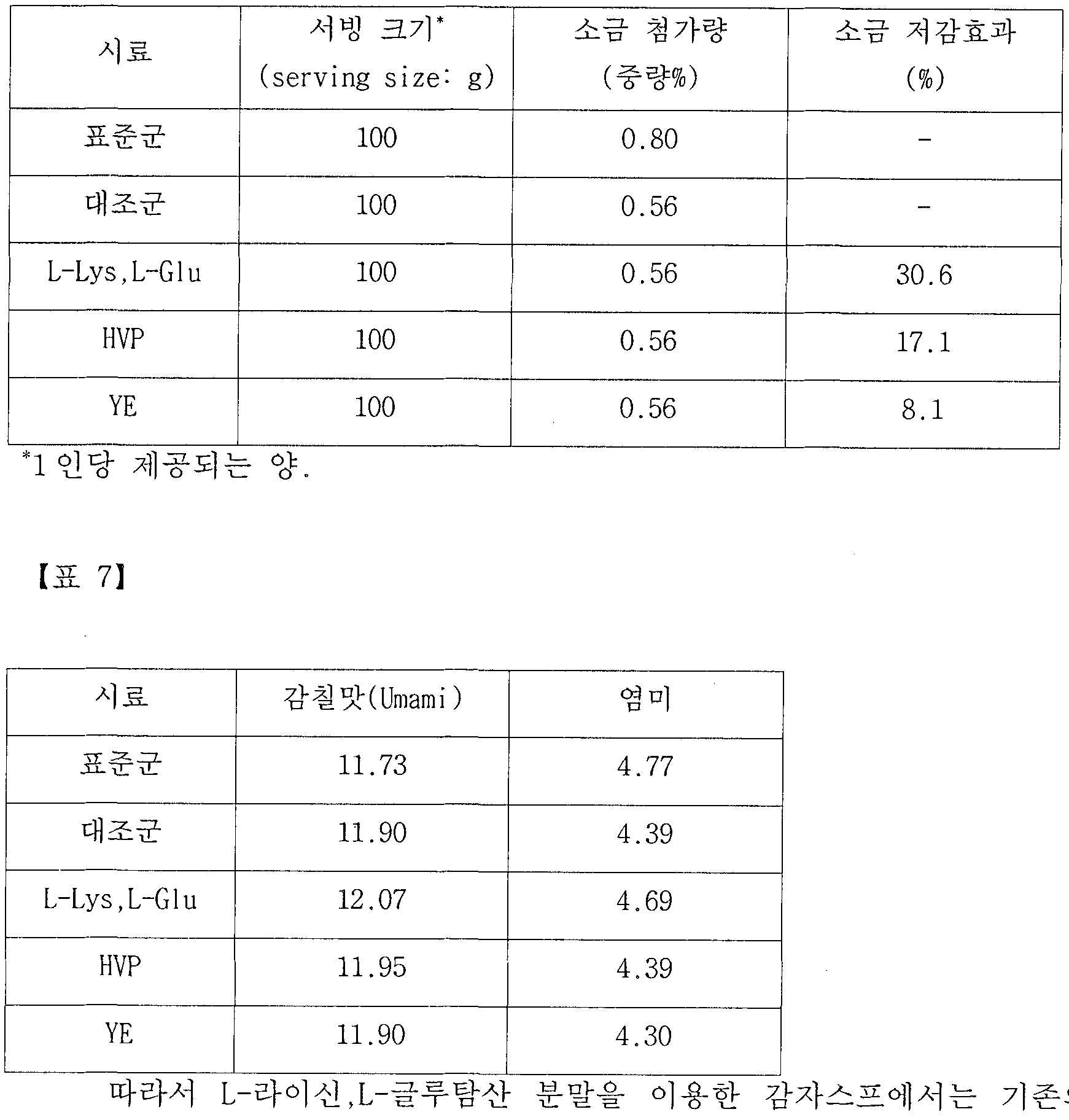
도 7a 및 표 6에 나타난 바와 같이, L—라이신, L-글루탐산 분말 첨가군의 경우, 뛰어난 염미증강 효과를 보여 표준군 대비 3으 6%의 나트륨 (흑은 소금) 저감효과를 나타내었으며, HVP 첨가군 (17.1%) 및 YE 첨가군 (8.1%)의 나트륨 저감효과보다 우수함을 확인하였다. 또한 전자혀 분석을 통해 L-라이신, L—글루탐산 분말 첨가군이 다른 시료군에 비해 감칠맛과 염미의 강도가 가장 우수함을 확인하였으며, 특히 감칠맛의 강도는 표준군에 비해서도 우수하였다 (참조: 도 7b 및 표 7).
【표 6】
Figure imgf000033_0002
Figure imgf000033_0001
풍미를 유지하면서 염미의 증가를 통한 나트륨 저감효과를 확인할 수 있었다. 실시예 11: 알프레도 소스 (Alfredo sauce)를 활용한 L-라이신, L—글루탐산 분말제품의 염미증강을 통한 나트륨저감 효과
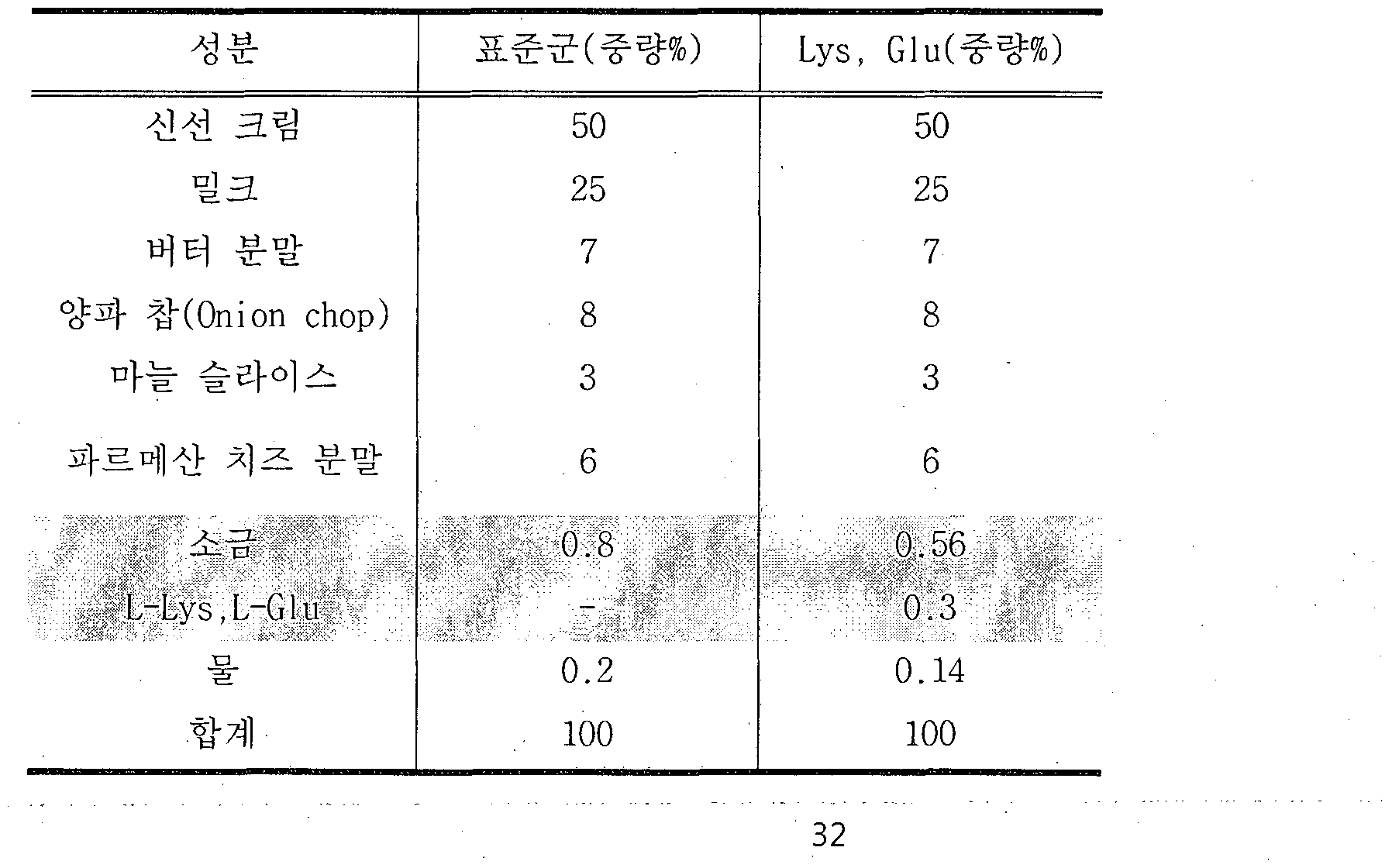
L-라이신, L—글루탐산 분말제품 (실시예 1에 따라 제조됨) 및 관련 조미료의 염미증강 효과를 알프레도 소스 (Alfredo sauce)에 적용하여 패널 관능평가 (n=10) 및 전자혀 분석 (Sensing System TS-5000Z, Insent Inc. 일본)을 통해 확인하였다. 분석을 위해 표 8과 같이 알프레도 소스를 제조하여 표준군으로 하였으며, 표준군에서 30% 소금 저감화한 군을 대조군으로 하였고, 대조군에 0.3 증량 %의 L-라이신, L—글루탐산 분말제품, 0.3 중량 %의 효모액기스 (YE) 및 0.3 중량 %의 HVP를 첨가한 군을 각각 비교 시료군으로 하여 실험을 수행하였다. 준비된 각각의 표준군 시료, 대조군 시료 및 비교 시료군 시료들에 대하여, 훈련된 패널 (n=l0)에 의해 무작위 맹검법을 통해 염미의 강도를 9점 척도법으로 관능평가 되었으며 이러한 관능평가의 결과는 전자혀 시스템을 통해 재분석하여 상호상관성을 확인하였다.
【표 8】
Figure imgf000034_0001
도 8a 및 표 9에 기재된 바와 같이, L-라이신, L-글루탐산 분말 첨가군의 경우, 뛰어난 염미증강 효과를 보여 표준군 대비 40.2%의 나트륨 (흑은 소금) 저감효과를 나타내었으며, HVP 첨가군 (15.6%)이나 YE첨가군 (13. )의 나트륨저감 효과보다 우수함을 확인하였다.
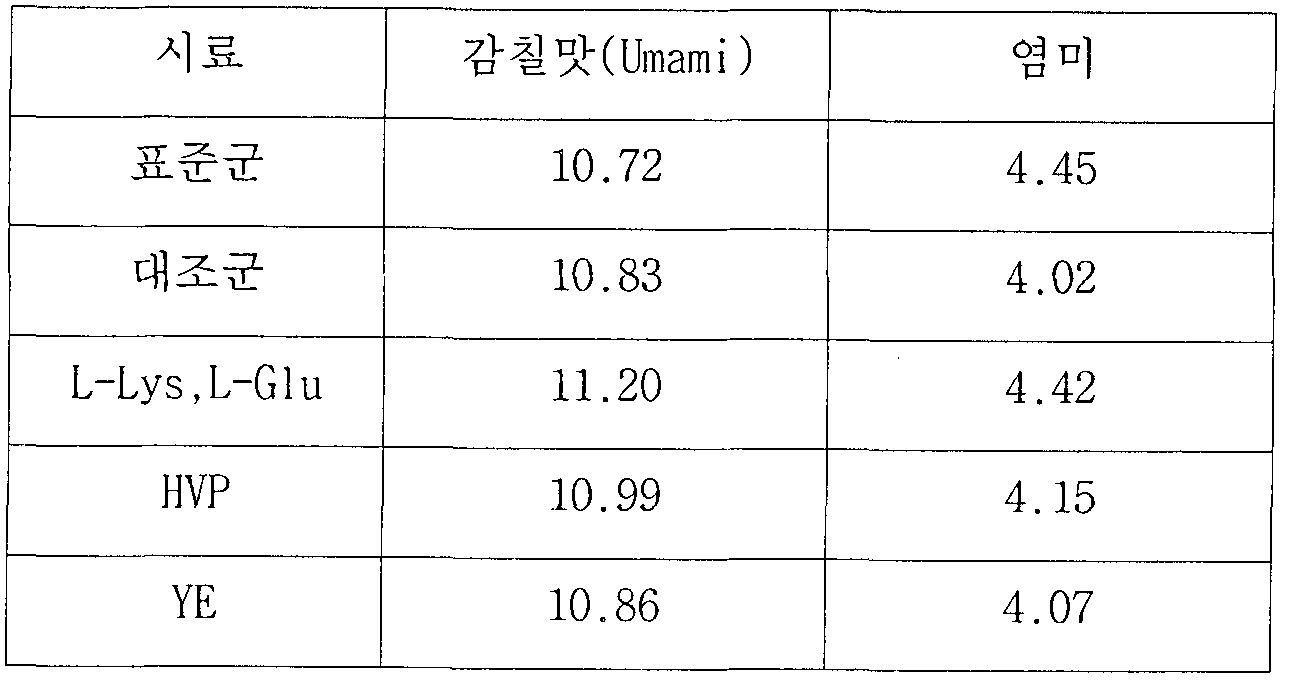
또한 전자혀 분석을 통해 L-라이신, L-글루탐산 분말 첨가군이 감칠맛과 염미의 강도에서 다른 시료군에 비해 뛰어남을 알 수 있었으며, ^은맛의 경우 표준군보다 감소하여 풍미를 더욱 좋게 하였다 (참조: 도 8b 및 표 10).
【표 9】
Figure imgf000035_0001
【표 10】
Figure imgf000035_0002
따라서 L-라이신, L-글루탐산 분말을 이용한 알프레도 소스에서는 기존의 감칠맛 및 풍미는 더 좋아지고 염미는 증가하여 나트륨저감 효과를 확인할수 있었다.
실시예 12: 감자칩 (Potato crisps)용 시즈닝을 활용한 L-라이신, L-글루탐산 분말제품의 염미증강을 통한 나트륨저감 효과
L-라이신, L-글루탐산 분말제품 (실시예 1에 따라 제조됨) 및 관련 조미료의 염미증강 효과를 감자칩용 시즈닝 (Seasoning, 표 11)에 적용하여 패널 관능평가 (n=10)를 통해 확인하였다. 실시예 10 및 11에서와 동일한 방법으로 시료들을 준비하여 관능평가 및 전자혀 분석에 사용하였다.
【표 11】 감자칩용 시즈닝
Figure imgf000036_0001
시즈닝용으로 감자칩에 5 중량 % 처리됨 도 9 및 표 12에 기재된 바와 같이, L-라이신, L-글루탐산 분말 첨가군의 경우, 뛰어난 염미증강효과를 보여 표준군 대비 58.3%의 나트륨 (흑은 소금) 저감효과를 나타내었으며, 동일농도의 HVP 첨가군 (29, )이나 YE 첨가군 (29.2%)의 나트륨저감 효과에 약 2배 수준으로 매우 우수함을 확인할 수 있었다.
【표 12】
Figure imgf000037_0001
실시예 13: 필수 아미노산계 첨가 전자혀 관능 측정
L-라이신, L-글루탐산 복합 아미노산 조미료 (실시예 1에서 제조된 제품)를 주성분으로 하여 염미 증강의 효과를 유지 혹은 높이며 동시에 감칠맛을 향상 시키는 물질을 찾기 위해 필수 아미노산계 아미노산 중 발린 (Ajinomoto, Japan), 이소로이신 (Ajinomoto, Japan) 또는 로이신 (Ajinomoto, Japan)을 0.5 중량 %식염과 0.2 중량 ¾> 아미노산 조미료가 용해된 수용액에 0.05 증량 % 내지 0.2 중량 %의 농도로 용해하여 전자혀 시스템을 이용하여 맛패턴을 분석하였다. 관능 분석을 위해 전자혀 시스템 (Sensing System TS-5000Z, Insent Inc. 일본)을 사용하였다, 시료용액 35 이 담긴 컵에 잠겨있는 5개의 전극들이 평형에 도달하게 되면 측정을 마치고 세척액으로 세척한 뒤 표준용액 (30 mM 염화칼륨 및 0.3 mM 타르타르산)에서 안정화 단계를 거쳐, 다음 시료를 분석하였다. 모든 실험은 4회 반복으로 실시하였으며 상온에서 진행하였다.
도 10, 도 11 및 도 12에서와 같이, 각각 L-발린, L—이소로이신 또는 L—로이신의 농도를 높여감에 따라 신맛 및 쓴맛은 감소되고 감칠맛은 상승하는 결과를 얻었다. 특히 도 12에서와 같이 수용액상에 L—로이신을 첨가했을 때 아미노산 조미료의 감칠맛을 가장 높게 증강시킴을 확인 하였다. 또한 풍미도 함께 증강시키는 것을 확인 하였다. L-로이신 첨가 시, 감칠맛을 증강시키는 효과를 가지며 경제적으로 유용한 농도는 L-라이신과 L-글루탐산의 합을 100 증량 %로 보았을 때, L-로이신이 25 중량 ¾>이며, 이 경우 전체 아미노산 조미료 조성물 (물을 포함)에서 L-로이신의 사용량은 0.05 중량 %가 되도록 하는 것이 바람직하다. 실시예 14: 핵산계 첨가 전자혀 관능 측정 상기 기술된 실시예 13과 동일한 방법으로 전자혀 시스템을 통하여 각각 핵산 (대상 (주), 대한민국) 또는 핵산 고함량 효모액기스 (대상 (주), 대한민국)첨가한 시료의 관능을 측정하였다.
핵산의 강한 맛이 증가되지 않을 때의 농도인 복합 아미노산 조미료 100 중량 % 대비 1 중량 % 내지 10 증량 %의 농도로 전자혀 시스템을 이용하여 맛패턴을 분석하였다. 도 13 및 도 14와 같이 핵산 또는 핵산 고함량 효모액기스 모두 농도의 증가에 따라 감칠맛 및 염미를 상승시키는 효과를 나타내었다. 이 두 물질은 복합 아미노산 조미료 100 증량 % 대비 1 중량 %의 농도에서도 우수한 관능을 보임을 알 수 있었다. 특히 핵산 고함량 효모 0.002 중량 %를 사용한 경우 감칠맛이 아미노산 조미료 대비 크게 향상되었다。 실시예 15: 유기산계 첨가에 따른 전자혀 관능 측정 상기 기술된 실시예 13과 동일한 방법으로 전자혀 시스템을 통해 호박산 (FUS0 chem. , Japan), 사과산 (FUSO chem, , Japan) , 또는 구연산 (FUSO chem. , Japan)을 첨가한 시료의 전자혀 관능을 측정하였다.
도 15와 같이 사과산 또는 구연산의 첨가는 쓴맛을 감소시키는 효과를 보이나 아미노산 조미료의 감칠맛과 풍미를 오히려 감소시키는 관능 패턴을 보여 조미효과는 저하시켰고, 호박산의 첨가는 감칠맛 및 염미를 크게 상승시키는 효과를 나타내었다. 특히 호박산은 감칠맛의 부분에서 아미노산 조미료대비 관능의 우수한 향상이 있음을 알 수 있었다. 실시예 16: 천연유래 조미료 첨가에 따른 전자혀 관능 측정 천연유래 조미료 성분 중 효모액기스 (YG-10, 대상 (주) ), 간장분말 (염도 42%, Givaudan, 스위스) 및 클로렐라추출물 (CGF, 대상 (주) )을 수용액 상태에서 0.015%을 첨가하여 전자혀 시스템을 이용하여 관능 분석을 하였다. 천연 유래 조미소재 첨가 시 풍미가 증진되었다. 그러나 클로렐라 추출물의 경우는 신맛과 쓴맛을 상승시켜 조미효과를 낮추는 영향을 주었고 감칠맛의 상승되지 않았다. 간장분말 및 효모액기스는 감칠맛과 염미를 동시에 높여 주는 우수한 관능을 나타내었다. 기존 천연유래 효모액기스 및 간장분말에 대한 조미 소재로서의 상호작용이 좋게 나타남을 규명하였다. 실시예 17: 복합 아미노산 조미료의 관능 평가 복합 아미노산 조미료에 감칠맛을 증진시키는 물질을 가지고 조미료 감칠맛에 대한 관능평가를 진행하였다. 효모엑기스 (YG— 10) 0.02 중량 %, 10% 핵산함유 효모 액기스 (YNᅳ 10) 0.002 중량 %, 핵산 (대상 (주),대한민국) 0.002 증량 %, 호박산 0.02 중량 %를 표 2와 같은 감자스프에 0.2 중량 %의 아미노산 조성물과 각각의 농도로 첨가된 복합아미노산조미료를 준비하여 14명의 패널에 의한 아미노산 조미료 무첨가 감자스프 대비 조미료의 감칠맛 및 염미의 정도를 5점 측정법으로 측정하였다. 무첨가 대비 조미료의 감칠맛 및 염미는 매우 약하다 (1점), 약하다 (2점), 보통 (3점), 강하다 (4점) 또는 매우 강하다 (5점)로 점수를 측정하여 평가하였다.
표 14는 관능평가 결과이다. 관능평가를 보면 무첨가 감자스프 대비 아미노산 조미료는 감칠맛이 2, 6점으로 나왔고 아미노산 조미료에 선미의 감칠맛 성분이 포함된 고함량 핵산효모, 핵산, 호박산은 높은 수준의 점수를 얻어 강한 감칠맛이 느껴진다고 평가되었다.
이러한 결과는 전자혀 시스템을 통해 확인한 결과와 일치하며 복합아미노산 조성물의 감칠맛이 향상된 것을 확인하였다.
【표 13]
Figure imgf000040_0001
Figure imgf000040_0002
Figure imgf000041_0001
이상으로 본 발명의 특정한 부분을 상세히 기술하였는 바, 당업계의 통상의 지식을 가진 자에게 있어서 이러한 구체적인 기술은 단지 바람직한 구현예일 뿐이며, 이에 본 발명의 범위가 제한되는 것이 아닌 점은 명백하다. 따라서 본 발명의 실질적인 범위는 첨부된 청구항과 그의 등가물에 의하여 정의된다고 할 것이다.

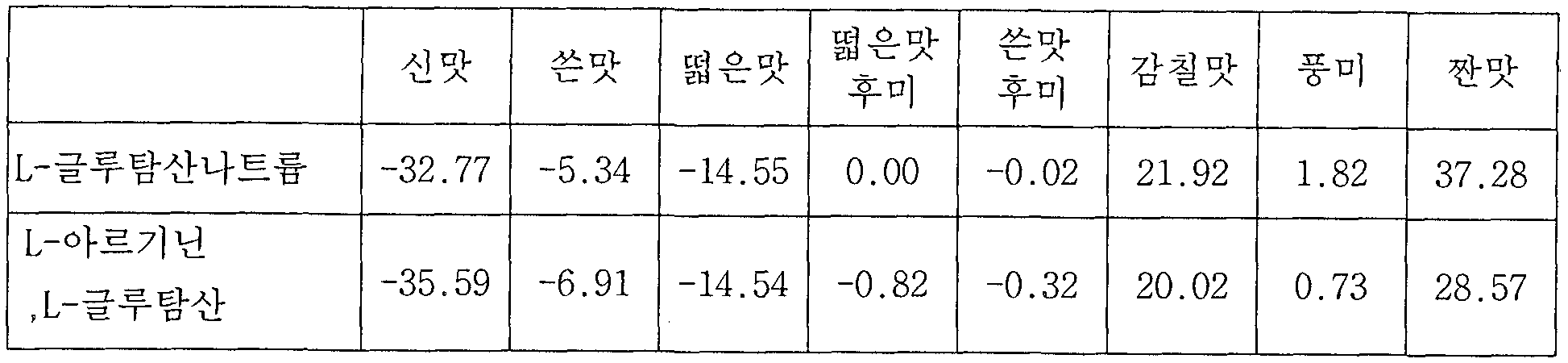
Claims

【특허청구범위】
【청구항 1】
L-글루탐산 및 염기성 아미노산을 포함하며 수용액 상태에서 pH 6.5-8.0을 나타내는 것을 특징으로 하는 복합 아미노산 조미료 조성물.
【청구항 2]
제 1 항에 있어서, 상기 염기성 아미노산은 ᅳ라이신, L-아르기닌, 오르니틴, 시트를린 및 그의 조합으로 구성된 군으로부터 선택되는 아미노산인 것을 특징으로 하는 조성물.
【청구항 3】
제 2 항에 있어서, 상기 염기성 아미노산은 L—라이신, L-아르기닌 및 그의 조합으로 구성된 군으로부터 선택되는 아미노산인 것을 특징으로 하는 조성물.
【청구항 4]
제 3 항에 있어서, 상기 조성물은 L-글루탐산, L-라이신 및 L-아르기닌을 포함하는 것을 특징으로 하는 조성물.
【청구항 5]
제 3 항에 있어서, 상기 염기성 아미노산은 L-라이신이고, 상기 L-글루탐산 및
L一라이신을 포함하는 아미노산 조미료 조성물은 무정형 (amorphorous)의 형태를 가지는 것을 특징으로 하는 조성물.
【청구항 6】
제 5 항에 있어서, 상기 L-글루탐산 대 L—라이신의 아미노산 몰비는 0.9- 1.0:1.0-1.1인 것을 특징으로 하는 조성물.
【청구항 7】
제 1 항에 있어서, 상기 복합 아미노산 조미료 조성물의 수용액 상태에서의 pH는 6.5— 7.8인 것을 특징으로 하는 조성물.
【청구항 8]
제 1 항에 있어서, 상기 L-글루탐산 및 염기성 아미노산은 프리베이스 (free base) 형태를 가지는 것을 특징으로 하는 조성물.
【청구항 9】
제 1 항에 있어서, 상기 조성물에서 L—글루탐산 및 염기성 아미노산은 결정염 형태가 아닌 것을 특징으로 하는 조성물.
【청구항 10】
제 1 항에 있어서, 상기 조성물에서 L—글루탐산 및 염기성 아미노산 사이에는 실질적으로 공유결합 및 이온결합이 없는 것을 특징으로 하는 조성물.
【청구항 11】
제 1 항에 있어서, 상기 조성물은 염미 (Saltiness) 및 감칠맛 (Umami)을 향상시키는 것을 특징으로 하는 조성물.
【청구항 12】
제 1 항에 있어서, 상기 조성물은 분말, 세립 또는 과립인 것을 특징으로 하는 조성물.
【청구항 13】
제 1 항에 있어서, 상기 조성물은 조미소재용 필수 아미노산, 핵산 및 유기산으로 구성된 군으로부터 선택되는 최소 1종의 보조 조미 소재를 추가적으로 포함하는 것을 특징으로 하는 조성물.
【청구항 14】
제 13 항에 있어서, 상기 필수 아미노산은 L-발린, Lᅳ로이신 L-이소로이신, L- 페닐알라닌, L—트레오닌, L-메티오닌, L-트립토판 및 그의 조합으로 구성된 군으로부터 선택되는 최소 1종 이상의 필수 아미노산이며, 전체 조성물을 기준으로 하여 0.01 증량 ¾> 내지 50 중량 %을 포함하는 것을 특징으로 하는 조성물.
【청구항 15]
제 13 항에 있어서, 상기 핵산은 시티딘 (cytidine), 우리딘 (uridine), 아데노신 (adenosine), 구아노신 (guanos ine) , 티미딘 (thymidine), 이노신 (inosine) 및 상기 핵산의 염 형태, 효모액기스, 간장분말 및 그의 조합으로 구성된 군으로부터 선택되는 최소 1종 이상의 핵산이며, 전체 조성물을 기준으로 하여 0.01 내지 70 중량 %을 포함하는 것을 특징으로 하는 조성물.
【청구항 16】
제 13 항에 있어서, 상기 유기산은 호박산 (숙신산, succinic acid), 사과산, 구연산, 초산, 젖산, 푸마르산, 주석산, 아스코르브산, 글루콘산, 상기 유기산의 염 형태 및 그의 조합으로 구성된 군으로부터 선택되는 최소 1종 이상의 유기산이며, 전체 조성물을 기준으로 하여 0.1 내지 80 중량 %을 포함하는 것을 특징으로 하는 조성물.
【청구항 17]
다음 단계를 포함하는 식품의 나트륨 -저감 조미방법:
(a) 식품을 선택하는 단계; 및
(b) 상기 식품에 상기 제 1 항 내지 제 16 항 중 어느 한 항의 복합 아미노산 조미료 조성물을 적용하는 단계 .
【청구항 18]
상기 제 1 항 내지 제 16 항 중 어느 한 항의 복합 아미노산 조미료 조성물을 포함하는 식품, 건강 식품 또는 기능성 식품.
【청구항 19】
아미노산을 포함하는 아미노산 조미료 조성물에 L—아르기닌을 첨가하는 단계 포함하는 아미노산 조미료의 이취 제거방법
【청구항 20】
다음 단계를 포함하는 복합 아미노산 조미료 조성물의 제조방법:
(a) 프리베이스 (free base) 형태의 L-글루탐산 및 L-라이신을 액상에서 일정 몰 비율로 흔합하여 흔합물을 제조하는 단계로서, 상기 흔합물의 pH는 6.5-8.0을 나타내며 ; 및
(b) 상기 흔합물을 건조하여 무정형 (amorphorous)의 복합 아미노산 조미료 조성물을 수득하는 단계 .
【청구항 21】
제 20 항에 있어서, 상기 단계 (a)에서 L-글루탐산 및 L-라이신의 몰 비율은 단계 (b)의 무정형 (amorphorous)의 복합 아미노산 조미료 조성물에서도 실질적으로 유지되는 것을 특징으로 하는 방법.
PCT/KR2012/007827 2011-09-30 2012-09-27 L-글루탐산 및 염기성 아미노산을 포함하는 아미노산 조미료 조성물 Ceased WO2013048147A2 (ko)

Priority Applications (3)

Application Number Priority Date Filing Date Title
EP12835848.8A EP2762011B1 (en) 2011-09-30 2012-09-27 Amino acid seasoning composition comprising l-glutamic acid and basic amino acids
CN201280055761.6A CN103957730B (zh) 2011-09-30 2012-09-27 包含l-谷氨酸及碱性氨基酸的氨基酸调味料组合物
JP2014533203A JP6023813B2 (ja) 2011-09-30 2012-09-27 L−グルタミン酸及び塩基性アミノ酸を含むアミノ酸調味料組成物

Applications Claiming Priority (6)

Application Number Priority Date Filing Date Title
KR20110099558 2011-09-30
KR10-2011-0099558 2011-09-30
KR10-2011-0144456 2011-12-28
KR1020110144456A KR101328091B1 (ko) 2011-12-28 2011-12-28 L-글루탐산 및 l-라이신을 포함하는 아미노산 조미료 조성물
KR1020120069380A KR101451253B1 (ko) 2011-09-30 2012-06-27 L-글루탐산 및 염기성 아미노산을 포함하는 아미노산 조미료 조성물
KR10-2012-0069380 2012-06-27

Publications (2)

Publication Number Publication Date
WO2013048147A2 true WO2013048147A2 (ko) 2013-04-04
WO2013048147A3 WO2013048147A3 (ko) 2013-05-23

Family

ID=47992812

Family Applications (1)

Application Number Title Priority Date Filing Date
PCT/KR2012/007827 Ceased WO2013048147A2 (ko) 2011-09-30 2012-09-27 L-글루탐산 및 염기성 아미노산을 포함하는 아미노산 조미료 조성물

Country Status (5)

Country Link
US (2) US20130084378A1 (ko)
EP (1) EP2762011B1 (ko)
JP (2) JP6023813B2 (ko)
CN (1) CN103957730B (ko)
WO (1) WO2013048147A2 (ko)

Families Citing this family (15)

* Cited by examiner, † Cited by third party
Publication number Priority date Publication date Assignee Title
US20150150291A1 (en) * 2011-09-30 2015-06-04 Daesang Corporation Amino acid seasoning compositions comprising l-glutamic acid and l-lysine
JP2018518197A (ja) * 2015-05-27 2018-07-12 ドゥーマトーク リミテッド 増強された塩組成物およびその調製方法
JP5984280B1 (ja) * 2016-02-05 2016-09-06 二郎 片岡 粉末アミノ酸混合調味料及びその製造方法並びに醸造食品用粉末アミノ酸混合調味料及びその製造方法
US10375976B2 (en) 2016-04-01 2019-08-13 Frito-Lay North America, Inc. Flavor-enhanced beverage product and method of enhancing the flavor thereof
US20170280757A1 (en) * 2016-04-01 2017-10-05 Frito-Lay North America, Inc. Umami-Enhanced Food Product and Method of Enhancing the Umami Taste of Food Products
JP6981039B2 (ja) * 2016-05-23 2021-12-15 味の素株式会社 ソース及びそれを含む食品の製造方法
AU2017293113A1 (en) * 2016-07-07 2018-10-18 Société des Produits Nestlé S.A. Sugar-dipeptide conjugates as flavor molecules
IT201700087359A1 (it) 2017-07-28 2019-01-28 Professional Dietetics Spa Composizioni comprendenti amino acidi per l'uso nel trattamento di malattie associate a disfunzione mitocondriale
IT201800006725A1 (it) 2018-06-27 2019-12-27 Composizioni comprendenti aminoacidi per l'uso nella prevenzione e nel trattamento di malattie epatiche
IT201900002109A1 (it) 2019-02-13 2020-08-13 Professional Dietetics Spa Composizioni comprendenti amminoacidi per l'uso nel trattamento di lesioni del sistema nervoso centrale
EP3932213A4 (en) * 2019-02-28 2022-11-16 Mizkan Holdings Co., Ltd. Acetic acid-containing seasoning liquid
IT202000000454A1 (it) 2020-01-13 2021-07-13 Professional Dietetics Spa Composizioni comprendenti amino acidi per la prevenzione e il trattamento del cancro
IT202000000442A1 (it) 2020-01-13 2021-07-13 Professional Dietetics Spa Composizioni comprendenti amino acidi per l'uso nella prevenzione e nel trattamento di effetti collaterali della chemioterapia
CN111406925A (zh) * 2020-04-30 2020-07-14 千禾味业食品股份有限公司 一种酱油粉的增香基料、制备方法及增香方法
JPWO2022085750A1 (ko) * 2020-10-22 2022-04-28

Citations (3)

* Cited by examiner, † Cited by third party
Publication number Priority date Publication date Assignee Title
US4563359A (en) 1981-12-07 1986-01-07 Ajinomoto Company, Limited Coated compound seasoning compositions
KR20090130012A (ko) 2007-04-09 2009-12-17 니뽄 다바코 산교 가부시키가이샤 조미료 조성물, 짠맛 같은 정미 증강제, 및 음식품의 짠맛 같은 정미 증강 방법
US20110064861A1 (en) 2008-03-14 2011-03-17 Nippon Suisan Kaisha, Ltd. Salty taste enhancer and food or drink containing the same

Family Cites Families (26)

* Cited by examiner, † Cited by third party
Publication number Priority date Publication date Assignee Title
CA844557A (en) * 1970-06-16 Ohara Masami Method for preparing seasoning compositions
AT224422B (de) * 1959-08-06 1962-11-26 Stamicarbon Verfahren zur Herstellung fetthältiger Nahrungsmittel
US3410695A (en) * 1963-10-31 1968-11-12 Kyowa Hakko Kogyo Kk Products and process for improving the quality of seasonings, foods and beverages
GB1064417A (en) * 1963-12-09 1967-04-05 Kyowa Hakko Kogyo Kk Process for the preparation of copolypeptides
LU62953A1 (ko) * 1971-04-08 1972-12-11
JPS58164683A (ja) * 1982-03-25 1983-09-29 Takeda Chem Ind Ltd 安定化された固体組成物
US5145707A (en) * 1991-12-12 1992-09-08 Kraft General Foods, Inc. Salt enhancer
PT677249E (pt) * 1994-04-15 2001-09-28 Nestle Sa Alimentos com sabor a sal intensificado
US6063428A (en) * 1996-02-26 2000-05-16 The Procter & Gamble Company Green tea extract subjected to cation exchange treatment and nanofiltration to improve clarity and color
JP3618486B2 (ja) 1996-09-11 2005-02-09 株式会社ナムコ シミュレータの操作入力装置及びこれを用いたシミュレータ
CN1140190C (zh) * 1999-11-29 2004-03-03 协和发酵工业株式会社 食盐味增强方法、食盐味增强剂、食盐味调料以及食盐味增强食品
JP2001271089A (ja) * 2000-03-24 2001-10-02 Snow Brand Milk Prod Co Ltd アミノ酸配合香料
JP3401501B2 (ja) * 2000-08-25 2003-04-28 有限会社 農業科学研究所 農園芸用資材
JP3906099B2 (ja) * 2001-02-28 2007-04-18 エーザイ・アール・アンド・ディー・マネジメント株式会社 調味料
JP4089164B2 (ja) * 2001-03-01 2008-05-28 味の素株式会社 γ−グルタミル化によるアミノ酸の呈味性(嗜好性)改善方法
JP2002345430A (ja) * 2001-05-28 2002-12-03 Kyowa Hakko Kogyo Co Ltd 食塩味増強方法、食塩味増強剤、食塩味調味料および食塩味増強飲食品
JP2006075101A (ja) * 2004-09-10 2006-03-23 Ajinomoto Co Inc 昆布様調味料又は飲食品及びその製造方法
JP4559344B2 (ja) * 2004-11-12 2010-10-06 花王株式会社 液体調味料
US7727524B2 (en) * 2004-11-12 2010-06-01 Kao Corporation Low sodium liquid seasoning with anti-hypertensive activity
TW200635517A (en) * 2004-12-08 2006-10-16 Ajinomoto Kk A method for imparting rich taste to foods and beverages and a novel seasoning composition
JP2011120603A (ja) * 2005-04-27 2011-06-23 Kao Corp 液体調味料の製造方法
JP5156361B2 (ja) * 2007-12-21 2013-03-06 日本水産株式会社 塩味増強剤及びその製造方法
DE102008024206A1 (de) * 2008-05-14 2009-11-19 Symrise Gmbh & Co. Kg Aromakompositionen und Zubereitungen umfassend Nα-β-Alanyl-Dipeptide
US20100034944A1 (en) * 2008-08-06 2010-02-11 Martha Lubenova Beyazova Use of Avocado Derivatives in Flavor Applications
JPWO2010018614A1 (ja) * 2008-08-11 2012-01-26 味の素株式会社 呈味性が改善された親水性アミノ酸含有製剤
JP5628499B2 (ja) * 2009-09-18 2014-11-19 日本水産株式会社 塩味増強剤を含有する低食塩醤油又は低食塩醤油調味料

Patent Citations (3)

* Cited by examiner, † Cited by third party
Publication number Priority date Publication date Assignee Title
US4563359A (en) 1981-12-07 1986-01-07 Ajinomoto Company, Limited Coated compound seasoning compositions
KR20090130012A (ko) 2007-04-09 2009-12-17 니뽄 다바코 산교 가부시키가이샤 조미료 조성물, 짠맛 같은 정미 증강제, 및 음식품의 짠맛 같은 정미 증강 방법
US20110064861A1 (en) 2008-03-14 2011-03-17 Nippon Suisan Kaisha, Ltd. Salty taste enhancer and food or drink containing the same

Non-Patent Citations (1)

* Cited by examiner, † Cited by third party
Title
See also references of EP2762011A4

Also Published As

Publication number Publication date
EP2762011B1 (en) 2019-06-19
JP2014531211A (ja) 2014-11-27
EP2762011A4 (en) 2015-07-08
US9220289B2 (en) 2015-12-29
US20150086692A1 (en) 2015-03-26
US20130084378A1 (en) 2013-04-04
EP2762011A2 (en) 2014-08-06
JP6023813B2 (ja) 2016-11-09
CN103957730A (zh) 2014-07-30
JP2016165297A (ja) 2016-09-15
CN103957730B (zh) 2016-02-24
WO2013048147A3 (ko) 2013-05-23

Similar Documents

Publication Publication Date Title
JP6023813B2 (ja) L−グルタミン酸及び塩基性アミノ酸を含むアミノ酸調味料組成物
JP5667439B2 (ja) 塩味増強剤及びそれを含有する飲食品
TWI556750B (zh) 用於製備作為天然調味劑製備原料之imp發酵液或麩胺酸發酵液的方法
CA2760388C (en) Composition for low-salt food or beverage
JP5680815B2 (ja) 塩化カリウム含有飲食品の製造方法、及び該製造方法によって得られた塩化カリウム含有飲食品
JP5634069B2 (ja) 呈味が改善された液体調味料
KR101328091B1 (ko) L-글루탐산 및 l-라이신을 포함하는 아미노산 조미료 조성물
JP2011062167A (ja) 塩味増強剤を含有する低食塩醤油又は低食塩醤油調味料
EP1776875A1 (en) Seasoning composition, seasoning material and process for producing food therewith
KR101451253B1 (ko) L-글루탐산 및 염기성 아미노산을 포함하는 아미노산 조미료 조성물
CN102686116A (zh) 呈味改善的液体调味料
KR100859098B1 (ko) 단백가수분해물로부터 천연 아미노산 함유 코쿠미조미료의제조방법
PL243112B1 (pl) Zastosowanie chelatu aminokwasowego jako zamiennika soli w produktach spożywczych, dodatek spożywczy zawierający ten chelat aminokwasowy oraz sposób wytwarzania zamiennika soli
KR100859099B1 (ko) 음식품 또는 조미료의 코쿠미 증강제
KR101694808B1 (ko) 유리 아미노산을 포함하는 식품 또는 아미노산 조미료 조성물의 짠맛 증강 방법
EP1827134B1 (en) Flavour enhancer
US20150150291A1 (en) Amino acid seasoning compositions comprising l-glutamic acid and l-lysine
KR101694810B1 (ko) 아미노산 조미료 조성물의 부정적인 맛 저감 방법
KR20150071043A (ko) 산성 아미노산 및 염기성 아미노산을 포함하는 짠맛이 증강된 아미노산 조미료 조성물
KR20160082767A (ko) 라이신의 쓴맛 및 떫은맛 저감방법
TW201438596A (zh) 增強鹽味及/或鮮甜味之飲食品及其製造方法、增強飲食品之鹽味及/或鮮甜味用之組成物、增強飲食品之鹽味及/或鮮甜味之方法
WO2009119892A1 (ja) 加熱調理感を付与する調味料組成物
JP2019525907A (ja) 風味分子としての糖ジペプチド複合体

Legal Events

Date Code Title Description
WWE Wipo information: entry into national phase

Ref document number: 201280055761.6

Country of ref document: CN

ENP Entry into the national phase

Ref document number: 2014533203

Country of ref document: JP

Kind code of ref document: A

NENP Non-entry into the national phase

Ref country code: DE

WWE Wipo information: entry into national phase

Ref document number: 2012835848

Country of ref document: EP

121 Ep: the epo has been informed by wipo that ep was designated in this application

Ref document number: 12835848

Country of ref document: EP

Kind code of ref document: A2